Mark Wasiuta teaches at GSAPP Columbia University where he is Director of Exhibitions, and Co-Director of the MS degree program Critical, Curatorial and Conceptual Practices in Architecture. Recent exhibitions curated and produced with various collaborators include, La Fine Del Mondo, at the 14th Architectural Exhibition at the Venice Biennale, Invention, at the 31st São Paulo Art Biennial, Air Manifest: Los Angeles 1955, 1965, at Studio X Istanbul, in conjunction with the 2nd Istanbul Design Biennial. He is co-editor and co-author of Dan Graham’s New Jersey. Forthcoming publications include Documentary Remains, Environmental Communications: Contact High and Environments and Counter Environments. Experimental Media in Italy: The New Domestic Landscape. Mark Wigley is a Professor of Architecture at Columbia University. The historian and theorist explores the intersection of architecture, art, philosophy, culture, and technology. His books include: Derrida’s Haunt: The Architecture of Deconstruction; White Walls, Designer Dresses: The Fashioning of Modern Architecture; and Constant’s New Babylon: The Hyper-Architecture of Desire. His latest book is Buckminster Fuller Inc. - Architecture in the Age of Radio (Lars Muller, 2015). He has curated exhibitions at the Museum of Modern Art and The Drawing Center in New York, the Witte de With in Rotterdam, and the Canadian Centre for Architecture in Montreal. He and Beatriz Colomina are curating the Istanbul Design Biennial 2016. He was born in New Zealand, trained there as an architect then as a scholar, and is based in New York. Gene Youngblood is known internationally as a theorist of media arts and politics, and as author of the influential book, Expanded Cinema (1970). With an Introduction by R. Buckminster Fuller, Expanded Cinema was seminal in establishing media art as a recognized artistic and scholarly discipline. Youngblood is also widely known as a pioneering voice for media democracy; as a columnist for the 1960s underground newspaper, The Los Angeles Free Press, he wrote a series of articles about new media and World Game which introduced the idea to a broad counterculture audience. Youngblood identifies himself today not as a theorist but as a political radical proposing revolutionary media action which he calls The Build. Strategies inspired by World Game are at the center of The Build. http:// secessionfromthebroadcast.org./
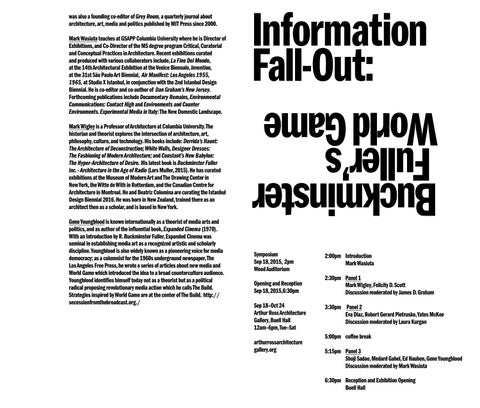
Information Fall-Out: Buckminster Fuller’s World Game
was also a founding co-editor of Grey Room, a quarterly journal about architecture, art, media and politics published by MIT Press since 2000.
Symposium Sep 18, 2015, 2pm Wood Auditorium
2:00pm Introduction Mark Wasiuta
Opening and Reception Sep 18, 2015,6:30pm
2:30pm Panel 1 Mark Wigley, Felicity D. Scott Discussion moderated by James D. Graham
Sep 18–Oct 24 Arthur Ross Architecture Gallery, Buell Hall 12am–6pm, Tue–Sat
3:30pm Panel 2 Eva Diaz, Robert Gerard Pietrusko, Yates McKee Discussion moderated by Laura Kurgan
arthurrossarchitecture gallery.org
5:00pm coffee break 5:15pm Panel 3 Shoji Sadao, Medard Gabel, Ed Hauben, Gene Youngblood Discussion moderated by Mark Wasiuta 6:30pm Reception and Exhibition Opening Buell Hall
Eva Díaz, Medard Gabel, James Graham, Ed Hauben, Laura Kurgan, Yates McKee, Robert Pietrusko, Shoji Sadao, Felicity Scott, Mark Wasiuta, Mark Wigley, Gene Youngblood Eva Díaz is Assistant Professor in the History of Art and Design Department at Pratt Institute in Brooklyn. Her book The Experimenters: Chance and Design at Black Mountain College was released this year by the University of Chicago Press. The project examines how an interdisciplinary group of artists proposed new models of art practice around the concept of experimentation, and focuses on three key Black Mountain teachers in the late 1940s and early 1950s: Josef Albers, John Cage, and Buckminster Fuller. She is at work on her next book, The Fuller Effect: The Critique of Total Design in Postwar Art for which she received an art writer’s grant from Creative Capital/Warhol Foundation. Her writing has appeared in magazines and journals such as Artforum, Cabinet, Frieze, Grey Room, October, and in numerous museum exhibition catalogues. Medard Gabel has conducted workshops, consulted, and given lectures for over 400 corporations, colleges, universities, high schools, organizations, and governments throughout the world—including the U.S. Congress, United Nations, GM, IBM, and Motorola. He is the former executive director of the World Game Institute. He worked with Buckminster Fuller for twelve years where he learned the power and utility of whole systems thinking, global perspectives and a good sense of humor. Mr. Gabel has been designing, developing, and delivering experiential educational programs since 1970. He is currently the Executive Director of EarthGame, Pacem in Terris, and CEO of BigPictureSmallWorld and BigPicture Consulting. He is the author of six books on global problems, resources and strategies, the global energy situation, the global food situation, the U.S. food system, planning, and multinational corporations. James Graham is the Director of Publications at Columbia University’s Graduate School of Architecture, Planning and Preservation, where he also teaches. He has edited several books on the Columbia Books on Architecture and the City imprint, and is the founding editor of The Avery Review, a monthly journal of critical essays on architecture. He is completing his dissertation on applied psychology and architectural pedagogy in the Soviet Union, the United States, and Germany between the world wars, and his writing has been published in Grey Room, Aggregate, JSAH, New Inquiry, Manifest, and AA Files, among other journals. Ed Hauben grew up in The Bronx and attended the High School of Music & Art and Cooper Union, where he was educated in art and architecture. Subsequent to that he had the great fortune to study with, and work for R. Buckminster Fuller on the development of Bucky’s visionary World Game project. Ed spent two years working with Bucky as spokesmen for World Game, giving lectures and running workshops. After that period, Ed returned to the Boston area where he co-founded Interface. From there he went on to have a series of various successful careers in industries like Gift Novelties, Graphic Communications and Architecture. During these years he developed a passion for mindfulness meditation. All of this experience has led Ed to his present position as Director of Newton (MA) Community
Education program. Laura Kurgan is an Associate Professor of Architecture at the Graduate School of Architecture Planning and Preservation at Columbia University, where she directs the Visual Studies curriculum, and the Spatial Information Design Lab. She is the author of Close Up at a Distance: Mapping, Technology, and Politics (Zone Books, 2013). Her work explores things ranging from digital mapping technologies to the ethics and politics of mapping, and the art, science and visualization of data. Her work has appeared at the Cartier Foundation in Paris, the Venice Architecture Biennale, the Whitney Altria, MACBA Barcelona, the ZKM in Karlsruhe, and the Museum of Modern Art. She was the winner of the United States Artists Rockefeller Fellowship in 2009. Yates Mckee is an art critic based in New York City. His work has appeared in venues including October, Grey Room, South Atlantic Quarterly, and The Nation. He has worked with groups including Strike Debt, Flood Wall Street, Illuminator Collective, and GULF, and he is co-editor of the volume Sensible Politics: The Visual Cultures of Nongovernmental Activism (Zone Books, 2012). His book Strike Art: Contemporary Art and the Post-Occupy Condition is forthcoming this winter from Verso Books. Robert Gerard Pietrusko is a designer based in Cambridge, Massachusetts. His work explores contemporary technologies of measurement, simulation, and visualization, and their relationship to the production of space. He has exhibited at MoMA, SFMOMA, and ZKM, among others. Pietrusko is an Assistant Professor of Landscape Architecture and Urban Planning at Harvard University’s Graduate School of Design where his current research traces the mid-century development of large-scale spatial taxonomies. Shoji Sadao is the president of Fuller and Sadao PC, and was the Executive Director at the Isamu Noguchi Foundation where he is Honorary Life Trustee. Sadao met Fuller while studying architecture at Cornell University and began working with him in 1954. Fuller and Sadao’s first project was the U.S. Pavilion at Expo 67 in Montreal. Other projects included the Dymaxion World Map, the design and fabrication of the tensegrity mast, and the Student Religious Center at Southern Illinois University at Edwardsville. Fuller introduced Sadao to sculptor Isamu Noguchi and the pair worked on landscape and sculptural projects. A friend and partner to both Fuller and Noguchi, Sadao published in 2011 Buckminster Fuller and Isamu Noguchi: Best of Friends chronicling the friendship of the two figures as well as insightfully illustrating their career endeavors. Felicity D. Scott is an associate professor at Columbia University’s Graduate School of Architecture, Planning and Preservation, where she also acts as director of the PhD program in architecture (history and theory) and as co-director of the program in Critical, Curatorial and Conceptual Practices in Architecture (CCCP). In addition to numerous articles on contemporary art and architecture, she is the author of Architecture or Techno-Utopia: Politics after Modernism (MIT, 2007), Living Archive 7: Ant Farm (ACTAR Editorial, 2008), and Outlaw Territories: Environments of Insecurity/ Architectures of Counter-Insurgency, forthcoming on Zone Books. She