10
t r e n d s
Trends The Age of Doubt Page 10
Turning Twelve in 2012 Page 14
It’s All About Shoes Page 15
The Way Forward Page 16
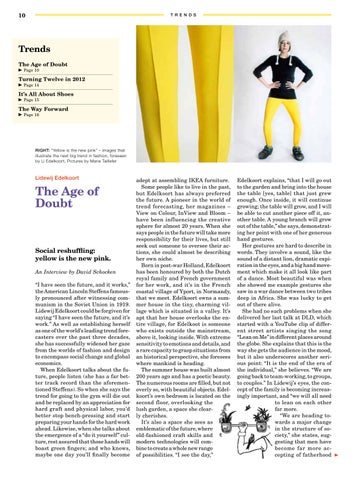
right: “Yellow is the new pink” – images that illustrate the next big trend in fashion, foreseen by Li Edelkoort, Pictures by Marie Taillefer
Lidewij Edelkoort
The Age of Doubt
Social reshuffling: yellow is the new pink. An Interview by David Schocken “I have seen the future, and it works,” the American Lincoln Steffens famously pronounced after witnessing communism in the Soviet Union in 1919. Lidewij Edelkoort could be forgiven for saying “I have seen the future, and it’s work.” As well as establishing herself as one of the world’s leading trend forecasters over the past three decades, she has successfully widened her gaze from the worlds of fashion and design to encompass social change and global economics. When Edelkoort talks about the future, people listen (she has a far better track record than the aforementioned Steffens). So when she says the trend for going to the gym will die out and be replaced by an appreciation for hard graft and physical labor, you’d better stop bench-pressing and start preparing your hands for the hard work ahead. Likewise, when she talks about the emergence of a “do it yourself ” culture, rest assured that those hands will boast green fingers; and who knows, maybe one day you’ll finally become
adept at assembling IKEA furniture. Some people like to live in the past, but Edelkoort has always preferred the future. A pioneer in the world of trend forecasting, her magazines – View on Colour, InView and Bloom – have been influencing the creative sphere for almost 20 years. When she says people in the future will take more responsibility for their lives, but still seek out someone to oversee their actions, she could almost be describing her own niche. Born in post-war Holland, Edelkoort has been honoured by both the Dutch royal family and French government for her work, and it’s in the French coastal village of Yport, in Normandy, that we meet. Edelkoort owns a summer house in the tiny, charming village which is situated in a valley. It’s apt that her house overlooks the entire village, for Edelkoot is someone who exists outside the mainstream, above it, looking inside. With extreme sensitivity to emotions and details, and a rare capacity to grasp situations from an historical perspective, she foresees where mankind is heading. The summer house was built almost 200 years ago and has a poetic beauty. The numerous rooms are filled, but not overly so, with beautiful objects. Edelkoort’s own bedroom is located on the second floor, overlooking the lush garden, a space she clearly cherishes. It’s also a space she sees as emblematic of the future, where old-fashioned craft skills and modern technologies will combine to create a whole new range of possibilities. “I see the day,”
Edelkoort explains, “that I will go out to the garden and bring into the house the table [yes, table] that just grew enough. Once inside, it will continue growing; the table will grow, and I will be able to cut another piece off it, another table. A young branch will grow out of the table,” she says, demonstrating her point with one of her generous hand gestures. Her gestures are hard to describe in words. They involve a sound, like the sound of a distant lion, dramatic expiration in the eyes, and a big hand movement which make it all look like part of a dance. Most beautiful was when she showed me example gestures she saw in a war dance between two tribes deep in Africa. She was lucky to get out of there alive. She had no such problems when she delivered her last talk at DLD, which started with a YouTube clip of different street artists singing the song “Lean on Me” in different places around the globe. She explains that this is the way she gets the audience in the mood, but it also underscores another serious point: “It is the end of the era of the individual,” she believes. “We are going back to team-working, to groups, to couples.” In Lidewij’s eyes, the concept of the family is becoming increasingly important, and “we will all need to lean on each other far more. “We are heading towards a major change in the structure of society,” she states, suggesting that men have become far more accepting of fatherhood