The Legal Issue 32
The First Amendment’s Impact on Campus Diversity BY ALANNA KLAPP
Universities are places where people from different backgrounds and viewpoints are constantly engaged in discussion. For that reason, free speech legal issues often arise. Additionally, the advent of the internet has opened up a new dimension of problems, among them academic freedom for faculty and students, freedom of association, and the blurring of the line between free speech and hate speech. These matters all impact diversity in positive and negative ways. The internet on campus brings about technologyrelated free speech concerns. Registered Patent Attorney Steve Grant says the internet makes it easier to write hurtful words anonymously one wouldn’t otherwise say in person. Universities also have to be prudent about student usage of computer facilities and online resources for allocation purposes and content, such as questionable websites. Another common free speech issue on campus concerns academic freedom among faculty and students. For example, a professor may take a controversial political or religious stand and be denied tenure. The professor then complains about the denial because of political or religious views. “In a sense that’s almost the basis of some free speech questions,” says Greg Magarian, professor of Law at Washington University in St. Louis. “Are we regulating what the people in the university community can do based on their ideas?” Universities have to be careful to uphold the First Amendment for both students and faculty who express their ideas, even if those ideas aren’t considered politically correct. Freedom of association is another hot topic within the realm of free speech. If a chapter of the Christian Legal Society bans gay members and a public university responds by withholding sponsorship, does the university have an obligation to treat all student organizations the same way? This was the question posed to the Supreme Court in 2010 in the case of Christian Legal Society v. Martinez. The Court ruled in favor of the defendent, requiring university student groups to accept anyone from the student body as a member. The line between free speech and hate speech is a
PROFILES IN DIVERSITY JOURNAL
May/June 2013
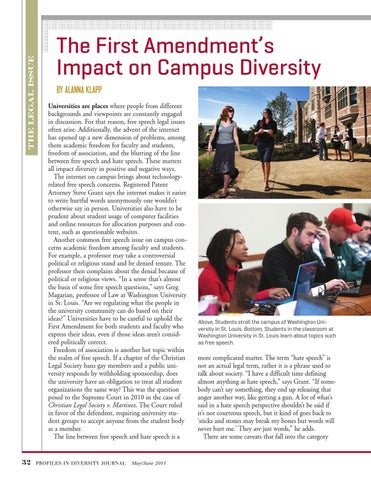
Above, Students stroll the campus of Washington University in St. Louis. Bottom, Students in the classroom at Washington University in St. Louis learn about topics such as free speech.
more complicated matter. The term “hate speech” is not an actual legal term, rather it is a phrase used to talk about society. “I have a difficult time defining almost anything as hate speech,” says Grant. “If somebody can’t say something, they end up releasing that anger another way, like getting a gun. A lot of what’s said in a hate speech perspective shouldn’t be said if it’s not courteous speech, but it kind of goes back to ‘sticks and stones may break my bones but words will never hurt me.’ They are just words,” he adds. There are some caveats that fall into the category