.1
.2
Each summer, thousands of RT fans make the journey to Austin, TX to join in the RTX festivities. This year, for five friends making the pilgrimage from Virginia, their trip was cut short in a tragic manner. Their vehicle was struck by a wrong-way driver--and then an 18 wheeler--in East Texas on the Friday of RTX, as they had nearly finished their journey to the convention. Sadly, the community lost Kyle Mathers, Dale Neibaur and Holly Novak. Kevin DiCicco was treated and released from the hospital. However, Hannah Galbraith is facing a much more difficult road to recovery. Once the news broke to the community, we responded as we always do. We come out in force to take care of those we love. At the time of this writing (two weeks after RTX), the community has raised over $37,000 (with some help from RT personalities and friends, including Burnie Burns, Matt Hullum, Ray Narvaez, Jr., Jeff Williams, and Kerry Shawcross) to support Kevin and Hannah’s recoveries. On behalf of the BIGBITE staff, we extend our deepest condolences to the friends and family of Kyle, Dale, and Holly. To Kevin and Hannah, we wish you a speedy recovery. We love you. Words by Joe Dalton
Rooster Teeth CEO Matt Hullum breaks the news of the accident to RTX attendees at the “Founding Fathers” panel. He asked the attendees to be careful and safe, adding “We love you.”
.3
.4
6 - A NEWBIE, A VETERAN AND AN RT EMPLOYEE GO TO RTX 13 - WHAT YOU HAD TO SAY ABOUT RTX 14 - BIGBITE & DRINK
16 - JOE GINMAN (RT RADIO) INTERVIEW 24 - FULFILLING THE PROMISE OF HALO 28 - RWBY: REMNANTS TO COME
31 - WHY HD REMAKES ARE IMPORTANT
41 - REVIEWS 44 - ROOSTER TEETH YOUTUBE RANKINGS
34 - YOUR FAVORITE RT PERSONALITY
48 - LAST ISSUES STATS
BIGBITE is: For advertising, contributing, and all other EDITOR & GRAPHIC DESIGNER: James Perrett inquiries contact bigbitemagazine@gmail.com SOCIAL MEDIA DIRECTOR: Joe Dalton GRAPHIC DESIGNER: Ben Grove
CREDITS
by Tara Lingard & JP, illustration by JP Pg 31: Words by Andy Ford, design by JP Pg 16-17: Interview + design by JP Pg 32-33: Illustration by Andy Ford
Pg 1 (cover): Illustration + p g
18:
Illustration
by
JP Pg
34-40:
Wo r d s
and
poll
d e s i g n by Jame s Pe r re tt ( J P ) P g
19:
Illustration
by
J P by Joe Dalton, design by JP
P g 3 : Wo r d s b y J o e D a l t o n Pg 20-21: Words by Kelly E, design by JP Pg 41: Words by Ben Grove, illustration by JP Pg
4:
Illustration
by
J P Pg 22: Illustration by Ben Grove P g
Pg
6-10: Words + inter view by P g
23:
Illustration
by
42:
Wo r d s
by
Killerkel
J P Pg 43: Words by Dane Hume of Something
Dominic Dobrzensky, design by JP P g 2 4 - 2 5 : Wo r d s b y M a t t h e w About a Beard, illustration by JP Pg 11: Illustration by Ben Grove Va n D e Z a n d e , Pg Pg
12: 13:
Illustration Design
by by
design
by
J P Pg 44-47: Research by aya, design by JP
J P Pg 26-27: Illustration by Ben Grove P g
48-49:
Design
by
JP
J P Pg 28-29: Words by Kelly E, design by JP
Pg 14-15: Idea by Tara Lingard, words P g 3 0 : D e s i g n b y B e n G r o v e
.5
.6
Since it began, RTX has very much been about bringing people together. Creators, fans, friends. In this spirit I present the thoughts of three community members representing different parts of this year’s RTX.
She is a cosplayer. She’s attended several West Coast events with her cospartner-in-crime TillyIsFat. This is her first RTX.
A former Austinite, he is an original Guardian and a Team Lead for one of the most popular attractions at this year’s RTX. He’s also a Rooster Teeth Site Admin which means he’s good to know if you find spam bots.
He’s a writer. He’s worked on Red Vs. Blue and X-Ray and Vav for Rooster Teeth. He has a book out about RvB that you should order (http://redvsbluebook.com). He’s been to RTX a few times and this could be his biggest year yet. Eddy also has no profile picture on his RT profile... Classic Eddy.
.7
If your RTX 2015 weekend were to have a motto, and tried to make the event conform to it. Don’t what would it be? try to do two things at once and enjoy where you are. That being said, it helps to have a vague idea InvertLaura: We’re here for a reason. (So have of where you want to be, because the event is so fun, be spontaneous, create memories!) big it can swallow you up and leave you behind (in Radius55: Sleep? Who told you we’d get to awesomeness). sleep? Give me their name so I can denounce them What do you depend upon at conventions? properly. InvertLaura: I consider myself the packer mom Eddy: Be flexible. I think most people who go to for conventions. Water, granola bars and some RTX for the first time generally have no idea what good friends are the only things I really need to to expect. I’ve been twice and both times were survive conventions. entirely different experiences! Come ready to meet new people and be open to the convention being Radius55: My Guardian Team, and my Bagdifferent than your expectations. Much better and o-Stuff. It has sharpies, food, water, a multitool, more fun experience that way. basic first aid (you don’t realize how great it is to have band aids and ibuprofen until your feet are Let’s get this out of the way. Top three things blistered and sore after a day’s walking/standing), excited/hoping for! spare socks, a phone charger, emergency cash, and InvertLaura: the ever versatile duct tape. Plus a few other odds 1) Connecting with the community and ends I pick up. 2) Traveling to Austin with three of my closest Eddy: I absolutely depend on having a phone friends charger with me and a clear route to food, because 3) Dressing up as fictional characters I eat about a million times per day. In terms of Radius55: people, Jordan Cwierz is basically my go-to guy 1) Seeing all the people I only get to meet with for all things fun and exciting. We met at my first once a year. RTX and started a bromance that has never died 2) Joel not defacing the Tower of Pimps while it’s (love you boo) I sort of just bum along with him under my care. and play shadow. Totally not in a creepy way, but 3) Being back in Austin for a while. maybe a little. Eddy: I’m really hoping to see some new Rooster Teeth content. The Lazer Team trailer is super exciting, and I can’t wait to see more new stuff out of these guys. I’m also looking to meet more community members and make more friends! I like friends. Are you someone who plans and prepares ahead or do you play activities at events by ear? InvertLaura: Personally, I like to plan certain events but ensure that there is enough time for shenanigans throughout the day. Radius55: As a Guardian Team Lead, I can’t really afford not to plan. Then again, you can’t plan for every event (2014 Fire Drill, anyone?) or attendee, so flexibility is important.
.8
Eddy: Some of my worst experiences at RTX (and any con, really) have been when I had a plan
Who would be the craziest person to hang out with at RTX and why? InvertLaura: The craziest person to hang out with at RTX would be Arryn Zech. I have always respected her as a woman, and she is an amazing voice actor. I always thought highly of her, so being put into a situation like that would be surreal. Radius55: Joel Heyman. But “May you lead an interesting life” is a curse in some cultures. Joel will certainly get into the most interesting situations. His pranks on Jack Pattillo are the stuff of legend and he’s as unpredictable as they come. Plus I’d love to talk economics with him sometime. Looks like his Greece predictions were spot on. Eddy: Either the Mega 64 guys or Blaine Gibson. I think Blaine is basically one of the funniest
people on the planet and I love hanging out with that guy, because you never know what’s going to come out of his mouth or his muscles.
want to spend hundreds of dollars to collect solely the signatures of the people they respect. Plus, it’s their way of showing appreciation to their fans!
What’s the easiest way to break the ice at events like this?
Radius55: Actually, I’ve been big into getting autographs. I can understand the appeal, but don’t go after them. But never understood charging for them, either. Still cool that they don’t demand tribute for a reminder of meeting them.
InvertLaura: Easiest way to break the ice is talk about common interests. If someone is wearing a Team Fortress 2 shirt or cosplaying X-Ray and Vav, the easiest thing to do is talk to them about the fandom they are representing. Most of the time, they know enough about the fandom they are showing to the world, and it makes for easy conversation! Also, when approaching a cosplayer, ask them about how they made their prop or accessories! People love to talk about the process went through, and it’s a beautiful way to learn! Radius55: I’ve always been partial to uberchild’s boombox approach from RTX 2011. But if you can’t get one of those, and you’re in line for a panel that doesn’t start for an hour, you need to get to know your neighbors. Have a deck of cards (normal, Cards Against Humanity, or whatever) and ask your neighbors to join in for a game. And about half of der kids these days seem to have Nindinder DSes and their Pokemans (Ya’ll dun better get off my lawn). Chances are, your neighbor may want to play. And can buy bluetooth portable speakers for about $40. Get one and stream the latest podcast/RT video/other popular panel to it. Remember, these people are here because their interests are pretty close to yours. Eddy: I’m an awful ice breaker. To be honest I’m generally an insecure person so it’s difficult for me to go up and talk to new people. The company has grown so much that I really only know a handful of people at the RT offices, and I’m not as plugged into the community as I’d like to be, so I sort of feel in-between groups sometimes. I’m hoping to change that a bit this year and not worry so much about it. Just introduce yourself to people, ask them about themselves and see what happens. You’re all there for the same reason so there is more than enough common ground to go around.
Eddy: It’s actually super awesome because they genuinely enjoy hanging out with their fans and signing for them. I think the main thing is to be courteous and respectful of their time because they are just SO DANG NICE they’ll give you more than they actually have. Do you have favourite cosplays that you love seeing at conventions? InvertLaura: I love seeing Lady Loki at the convention scene. Everyone approaches the project differently, and yet the character is very recognizable. She is also a cosplay that I would love to do myself one day, but I’m on the verge of figuring out my personal design. Until then, I will simply watch in awe, and compliment them on their hard work. Radius55: No specific characters. I’ve seen a lot of good ones, though. 501st and 405th always do a great job. Then there are all of the RT specific ones. I actually like the creative ones over main character stuff. Then there are all the randoms characters. Mash ups are especially awesome. I saw a Zombie Mario a few years back, and someone did a pretty cool Furry Commander Shepard last year. Eddy: I’m the least crafty person in the world so I love seeing good cosplay. My favorite is always going to be the elaborate Halo armor stuff because I’m a Halo geek at heart. What also impresses me is anyone who carries around a huge prop. It takes major commitment to lug around a 7 foot buster sword all day.
Rooster Teeth employees don’t charge for photos or signatures. Why is that a cool thing? InvertLaura: RT understands that people do not
.9
You’re in Austin. It’s well known for its food. What’s a snack you’d like or recommend? InvertLaura: This will be my first time going Austin, so I will more than likely follow the rule that if I never heard of the restaurant before, I might as well try it. Conventions are long, and so are the lines for food, so I always keep granola bars with me for an extra boost of energy, and my friends always appreciate it! Radius55: Never snacked much in the 5 years I lived there. The food is awesome, but I prefer full meals to snacks. - Z-Tejas over on the west side of downtown serves a great Sunday Brunch (get the free corn bread) and there are a ton of small places on Congress, both North and South of the lake. - I also don’t care what Burnie says, Hoppdoddy makes damn good burgers. Just get there before noon or be ready to wait in line. - Amy’s Ice Cream is delicious, especially the Mexican Vanilla. - And Rudy’s is always a staple for BBQ.
.10
- Only other suggestion is to avoid Iron Works BBQ, no matter who tells you otherwise. Overpriced and poor quality in my opinion. Eddy: I’m actually in Houston, but I’m super familiar with lots of Austin eateries. I highly recommend Chilantro (dat Kimchi fries tho) for great Korean/Mexican fusion and Casino El Camino for amazing burgers.
I hope you’ve enjoyed reading the thoughts of Laura, Austin and Eddy! They kindly took the time to answer my questions before RTX 2015. I had the pleasure of meeting up with them throughout the weekend and hopefully we’ll see you at RTX in 2016! Dominic/Count3D
.11
.12
.13
.14 .14
.15 .15
I got the chance to speak with Joe Ginman, the host of RT Radio. Check out what he had to say about the show! Hi Jo e! C ou l d you introduce yourself to our readers please? Well, I’m Joe. Ginman on the site. I currently live in London and do freelance video production for work, but most of the time I’m doing podcasts and playing games.
.16
things so that other members of the community could host too. After that, I basically took over the day-to-day running of the group.
Favourite song at the moment? I have an eclectic music taste but I’m slightly stuck in my ways at the moment so it’s nothing over current. At the moment it’s probably Gust of Wind which is another Pharrell/ How did RT Radio start D a f t P u n k t r a c k . out? What made you wake up one morning Could you describe and think, “I want to how you plan for a start a radio show”? show? How do you Well actually, I didn’t. c h o o s e t h e m u s i c ? Caiti Ward sent out a We have a Thursday tweet saying she was show, and 2, 2 hour slots playing some music in on Fridays so, first things sponsor chat and that first I schedule all the was the start of it. I was hosts for 2 months at a in the chat that first week time. There’s a different and returned the follow- community guest every ing week. A few weeks Friday with our regulater Caiti couldn’t spare lar DJs fill in the other the time and asked me to slots. With the addition cover. After a couple of of the Thursday show months of covering the about 6 months ago, occasional week, Caiti I’ve transitioned away asked me to organise from hosting on Fridays
and basically just do the Thursday show. This allows for more members of the community to have a chance on the main Friday show. Hosts can basically play whatever they want. I try and steer them away from doing 2 hours of speed metal of something but really they can do anything they want. Most will send a playlist with their selections beforehand. It’s great when that happens as it makes putting our postshow playlists together a lot easier. How did you first come across Rooster Teeth? Same way as a lot of people I guess. Was browsing YouTube and a recommended video was Red vs Blue Season 1 Episode 1. I ended up binge watching all the available episode on YouTube and then headed over to the site to watch the rest. I got over to the site just as the S9 trailer went live. I watched for S9 and some
AH stuff without membership then joined up just before S10. With just over 1000 members RT Radio is a hit! Are there any exciting plans in the future? I absolutely have plans. In an ideal world I’d love to turn our little chat into a proper internet radio station. That’s a long way down the road though. For now it’s a case of improving the experience of the current format. Optimising it so the most amount of people can enjoy it is my main goal. Right now it’s an hour on Thursdays and 4 on Fridays. The Friday one is in need of tweaking because of the times we started out with means that it runs from 10pm-2am. With the majority of the regulars being in the UK now it means we lose quite a few people between midnight and 1am. Fixing that will be the major chance in the next few months.
Listen to RT Radio every Thursday and Friday. For more information visit their RT group page: roosterteeth.com/group/rt-radio A ls o, go tel l Jo e that he’s a r a d g u y v i a h i s RT prof i l e : roosterteeth.com/user/Ginman Interview by James Perrett
.17
.18
.19
.20
.21
.22
.23
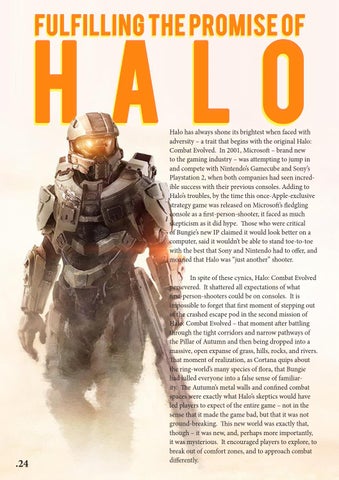
Halo has always shone its brightest when faced with adversity – a trait that begins with the original Halo: Combat Evolved. In 2001, Microsoft – brand new to the gaming industry – was attempting to jump in and compete with Nintendo’s Gamecube and Sony’s Playstation 2, when both companies had seen incredible success with their previous consoles. Adding to Halo’s troubles, by the time this once-Apple-exclusive strategy game was released on Microsoft’s fledgling console as a first-person-shooter, it faced as much skepticism as it did hype. Those who were critical of Bungie’s new IP claimed it would look better on a computer, said it wouldn’t be able to stand toe-to-toe with the best that Sony and Nintendo had to offer, and moaned that Halo was “just another” shooter.
.24
In spite of these cynics, Halo: Combat Evolved persevered. It shattered all expectations of what first-person-shooters could be on consoles. It is impossible to forget that first moment of stepping out of the crashed escape pod in the second mission of Halo: Combat Evolved – that moment after battling through the tight corridors and narrow pathways of the Pillar of Autumn and then being dropped into a massive, open expanse of grass, hills, rocks, and rivers. That moment of realization, as Cortana quips about the ring-world’s many species of flora, that Bungie had lulled everyone into a false sense of familiarity. The Autumn’s metal walls and confined combat spaces were exactly what Halo’s skeptics would have led players to expect of the entire game – not in the sense that it made the game bad, but that it was not ground-breaking. This new world was exactly that, though – it was new, and, perhaps more importantly, it was mysterious. It encouraged players to explore, to break out of comfort zones, and to approach combat differently.
While the world itself encouraged new playstyles, the intelligence of the enemy AI all but mandated them. The Covenant was a fearsome new opponent with the unique abilities to work together and to adapt to situational challenges. Even so, after several expansive battles on even more expansive battlefields, the Covenant began to feel predictable, and the thrill of the new world could not mask what at its core was a stock narrative – aliens are evil, shoot the aliens, save the day. But Bungie had tricked players yet again, and what they had done with taking a stock environment and surprising players with one that was new and mysterious, they would do the same with Halo’s narrative. The arrival of the enigmatic monitor 343 Guilty Spark alongside the horrifying Flood brought a surprising twist in both tone and direction, while dialogue between Chief, Cortana, and Guilty Spark posed many questions – about the ring world, about the universe, and about Master Chief. And then Halo: Combat Evolved ended, leaving most of those questions unanswered.
character undeveloped – Master Chief John-117. The iconic soldier would be left adrift for two more installments of Halo. With Bungie and Halo sitting comfortably at the top of the gaming world, these games failed to hold onto the mystery of the Master Chief saga. Bungie then sold the rights to Halo and moved on, leaving 343 Industries to take up the mantle and continue the Spartan’s story. Halo 4, while unable to recapture the old feeling of innovation and wonder, explored the separation between soldiers and humanity, and the difference between man and machine. In doing so, 343 accomplished what Bungie could not – they humanized the master chief. They exposed his flaws, and they showed that Master Chief, in spite of all of his military expertise, survival skills, and unshakeable determination, could fail. With Halo 5: Guardians, 343 Industries – following a disastrous rollout of The Master Chief Collection on Xbox One and being fully aware of what is at stake for the franchise – has taken Halo back to its roots and stands poised to address questions left unanswered by Bungie while also posing an even more dangerous one. With two main protagonists, two stories, and one truth, the question lingers - “What if Chief is wrong?”
Bungie continued to push the first-personshooter envelope with Halos 2 and 3. In Halo 2, Bungie developed the Covenant beyond the confines of being the evil aliens who needed to be shot. Even the parasitic Flood was given intelligence in the form of the Grave Mind. Halo 3 expanded on the relationship between humanity and former Covenant forces, showing them working together Words by Matthew VanDeZande to defend the galaxy. But countless skirmishes on massive battlefields later, the Halo trilogy would Pictures: 343 Industries end with questions still unanswered and one crucial
.25
.26
.27
RWBY is a Rooster Teeth production that follows Ruby Rose, Weiss Schnee, Blake Belladonna, and Yang Xiao Long (team RWBY) through their adventures in the fantastical world of Remnant. The series, created by the late Monty Oum, was first released on November 17th, 2012. Since this time, the show has been developed thoroughly, with two seasons under its belt and a third in production. Currently, the project is headed by Kerry Shawcross, Gray Haddock, and Miles Luna, all supported by a wide team of diverse technical and creative talents. In short, RWBY has come far since its inception and continues to grow more impressive by the day.
.28
Season one of RWBY found the team, much like the viewer, getting its bearings in a new environment. The characters learned all about each other and of Beacon, the Huntsman and Huntress training school that they attend. Ruby and the gang discovered secrets and schemes, ultimately allowing them to come together as friends and comrades in arms
while still bringing up plenty of questions desperately waiting to be answered. With season two came the removal of “shadow people” (rest in peace) but brought significant improvement to animation quality. Everything looked more natural. Additionally, longer episodes allowed for much more to happen during the season. Time was spent on deeper character and plot engagement, taking the audience and the story much farther developmentally than the previous season. In fact, there were very few low points in season two. Aside from a few awkward exposition pieces (Yang and Blake’s Semblance explanations, respectfully), the only off moment was the finale. The issue here was that the climax of the season happened in the episode before, leaving the height of the finale lower and unsatisfying in comparison. It was an issue of pacing, which the rest of the season accomplished very well.
During the RWBY Panel at RTX 2015, we got a peek into the plans of season three. We saw a cute ramen stand scene as well as an early in development battle between a new team from Haven Academy, team ABRN, versus team RWBY. This fight included one character’s use of a hover board, which further defined the tools and technology available in Remnant, and the arena in which the combat occurred. The arena is hexagonal in shape and massive in scope. It has the ability to turn itself, and parts of itself, into different biomes with environmental hazards. Judging by this, the arena could also be able to drastically change shape, at least in terms of topography. Either way, season three looks like it’s going to have a lot more action this time around. The third season of RWBY, even in its early stages, looks to be fantastic. If the growth from season two to season three is anything like the improvements made by its predecessors, even just a
little, then this series of episodes is going to be exciting and well worth the wait. In the mean time, we’ll just keep arguing on whether or not it’s anime. Words Killerkel (Kelly E.) Pictures: Rooster Teeth
.29
.30
Why HD Remakes are Important
U’s Virtual Console. The classics released on there aren’t remastered, but that’s a great thing, because it’s allowing new gamers to play games how they were played when they were first released. On Sony’s end, characters like Jak and Daxter didn’t even see a new game for the PS3, so a remaster was a great way to keep the characters relevant. Sly Cooper had a 4th title in the series release on PlayStation 3, so the HD Collection gave gamers a way to play through the first three titles and get to know the characters of the franchise. So along with nostalgia, these games continue to generate new fans as well.
History tends to repeat itself. Big phones got small, now they’re big again. Furby’s are back on store shelves, and don’t get me started on the McRib. One way gamers can relate to this is through HD Remakes and Re-releases of video games. For years now, certain games have been getting their graphics touched up and their resolutions up-scaled by technology that just wasn’t available in the past. Some might see this as a rehashing for some quick cash but I think it’s much more. I believe remakes provide a great way to keep enjoyable IPs alive, provide abundant nostalgia and give new gamers a way to History, much like my formatting, tends to repeat experience some amazing titles. itself. In the case of HD Remasters and Collections, it could be a great thing. Some might think it’s more The first HD Remake / Collection I purchased was of the same. “It’s nothing new to us.” “We’ve seen the Jak and Daxter Collection for my PS3. In fact, this already.” Well, it might not be, and you might being primarily an Xbox gamer, switching from Ps2 have. But some of us like the old stuff enough to to 360 and One, my PS3 is essentially a console for experience it again. It’s also new to others, and has Sony exclusive titles and HD remakes, but back to the potential to be great for them as well. A games my point. I bought the collection because Jak was main purpose is to be played. If a game is the reason I wanted a Playstation 2 when I was in enjoyable to the point where it makes sense the 4th grade. It’s still my favorite game of all time, from a business and now I was able to play through the whole series perspective to again as an adult! Sure, I could pop the classics into a be released Ps2, but the polish and convenience of one disc, on a a g a i n current gen console at the time, was nice for the day b e c au s e it and age we were in. So for me, it’s all about nostalgia. w i l l b e But the fact is these games have a chance to draw played by in a new, younger audience, all while keeping some o l d a n d amazing characters alive. new gamers alike, Believe it or not, a lot of gamers today weren’t around I’m all for it. for the era of the Ps2 and Xbox. They jumped in with Keep the remakes coming. the Ps3, Wii and 360. I once heard a child refer to the 360 as “Retro”. Once I was done cringing, I made Also, please give me myself believe he would eventually learn about all Jak 4. the great titles that came out before 2005 (especially the even greater titles released before 1995, Words by Andy Ford but I didn’t get my hopes up). HD Remakes and collections are a way to bring these older titles to a newer audience, who might not have heard of them before. Nintendo is doing great things with the Wii
.31
.32
.33
.34
.35
.36
.37
.38
.39
.40
A R K H A M
K N I G H T
G O O D N I G H T DA R K K N I G H T With a character that has seen endless renditions throughout the game and film industry, Rocksteady faced the tough dilemma of how do you go bigger and better than the rest. And boy, did they deliver. The third and final instalment in the Arkham series hit consoles in June, and has all ready firmly established itself as a Game of the Year contender, and possibly as one of the best open world games ever created. The series found itself early on for numerous reasons, including its strike and counter fighting style, which this time around feels more fluid and powerful than previously. The sprawling, incredibly detailed Gotham City provides a beautiful, distinctive playground with vast environments, from smoky side streets, grim alleyways, to rain coated roads, all built with the Batmobile’s functionality in mind.
with mass battles against enemy drones, the filmlike chase sequences, and even dual takedowns to assist the Bat. But it also provides new challenges to many puzzle based missions, and plenty of the infamous Riddler trophies. And hurtling out of it to glide kick an enemy never loses its satisfaction. The battle mode is fun for a while, but the increasing number of drones with each battle does become monotonous. But there is no denying the Batmobile handles great, and gives every Batman fan a sense of excitement for being behind the wheel.
The story was handled superbly, whilst maybe not the strongest of the Arkham series, it has a sense of finality throughout. It brings the best of Batman’s allies and rogues together for a brilliant final tale. The mystery around the identity of the Arkham Knight quickly fizzles out, due to plenty of foreshadowing, but John Noble’s deep, nonchalant threats, portrays a sublime Scarecrow to keep the fear amongst the The addition of the Batmobile provides a welcomed city of Gotham. fresh perspective for a lot of the gameplay we’ve come to expect. It not only enlarges the action, With around 12 hours of story, the side missions maintain a very pleasant distraction or post story challenge. With numerous Batman allies and enemies to team up with and against, and Riddler trophies returning, which alone produces hours of mind boggling tasks, you can’t begin to question the variety and sheer amount of content this game provides. Arkham Knight offers an unparalleled Batman experience, a remarkable game on every level. No n - s t o p a c t i o n , superb voice acting, an exquisite environment, and a f**king Batmobile. If this truly is Rocksteady’s final Batman game, then it concludes on an incredibly high note. Arguably the best game of the current generation of consoles to date, Arkham Knight thoroughly deserves its place at the top of everyone’s must-play list. Words by Ben Grove
.41
Let’s Play - GTA V – Kamikaze
Let’s Play – GTA V – Guest Stars & Explosions
Applause: The idea is fantastic and hilarious to watch. If you think you would love seeing supersonic jets smashing into helpless cyclists, then this one’s for you. The cast is perfect and you can tell they’re having fun, which is one of the most important factors in a let’s play. Speaking of cast, Mica Burton definitely adds to the awesome. Of all the next potential Achievement Hunter candidates, she’s the one with the highest chances of success. She doesn’t try too hard, she’s funny, and the audience doesn’t hate her, which is a plus.
Applause: Colton Dunn. It’s always nice to have some different flavors in a Let’s Play video, and Dunn is no exception. He’s funny when he speaks up, especially later on in the video. Hilarious individuals aside, Guest Stars & Explosions has some genuinely funny moments, especially once the cast warms up a bit.
Critique: The video does take some time to get going. In usual Achievement Hunter fashion, the game type they start with wasn’t tested, which does hurt the video in terms of pacing. Additionally, Critique: Not much to say here. If Achievement even though Dunn was fantastic and funny when Hunter yelling and cursing isn’t really your style, he spoke up, he did seem a bit out of his element. then maybe give it a pass. But, even then, it’s good enough for a strong argument to try it anyways. Overall: Let’s Play – GTA V – Guest Stars & Explosions is worth a watch. It has everything a Overall: There isn’t a single low point in this video, typical fan wants, plus a little extra. Dunn was a and that’s something special. pleasure, and it would be great to see him more on the channel.
.42
Words by Killerkel (Kelly E.)
FANTASTIC FOUR I’ve been tasked with coming up with a review for the latest Fantastic Four instalment, but for the life of me I’m not quite sure what there is left to say about a film which has been attacked so unanimously by critics and fans alike. At time of my viewing - two weeks after its release - the film had grossed an opening weekend of just $26.2 million in the States, while it currently sits at 8% on Rotten Tomatoes, making it both a critical and commercial flop. Nevertheless I bought a ticket against my better judgement and at just over 100 minutes later I left the cinema with the strangest feeling - wasn’t I supposed to hate this film? From what I’d heard it was literally worse than Hitler, but despite its terrible dialogue and regurgitated script there were still some aspects which I genuinely enjoyed.
made Transformers: Age of Extinction look like Shakespeare; it’s CGI laughable and, most alarmingly, there was nothing I hadn’t already seen a hundred times before. Seriously, had this film been made ten years ago it would have been ok, but it’s not so it wasn’t. Audiences have matured since comic-book films came into fashion in the early 00s thanks in part to the Dark Knight trilogy. It’s not enough to stick a few cutesy action sequences in though, you need to tell the story and explain why we feel for the characters so that when something does happen we don’t just shrug. Sadly Fantastic Four can’t help but fail here as I just didn’t care - at all. In a way it’s kind of refreshing to see that others felt this way, rather than aimlessly buying a ticket because it happens to be a ‘blockbuster’.
In short, Fantastic Four is the cinematic equivalent Take for instance the scene in which our heroes of a ham sandwich. It’s plain, unoriginal and a little discover their powers. Now most comic-book films bit boring, but you’ll eat it if there’s nothing else in. routinely follow the same rules in this department: something good/bad happens, our hero is affected Words by Dane Hume of Something About a Beard by this, they experience certain changes and then we are greeted to a five-minute-montage of them in action. Fantastic Four tells a slightly more gruesome tale of events, as we witness a man roasting on a slab, another being crushed under a pile of rubble and a third crawling to save him as his body stretches like distorted rubber across the floor. Very gruesome and equally impressive. I also liked that they went with a younger cast with the likes of Michael B. Jordan and Miles Teller, both of whom have given stellar performances in Fruitvale Station and Whiplash respectively. Tobey Kebell did an amazing job too as Victor von Doom at the start of the film, until the script took a turn for the worse however and decided to take a dump on that idea. I was impressed with the gruesomeness of his character however, exploding people’s heads left, right and centre with just a thought - blood splats and all. Of course this film didn’t get its reviews without justification and in truth there were plenty of aspects that really irritated me. The design for Dr. Doom was crappy; the pacing was terrible; the dialogue
.43
.44
.45
.46
.47
.48
.49