AMERICAN WAY OF LIFE MAGAZINE
cidal thoughts. Suicide is the third leading cause of death for students on college campuses, according to the National Alliance on Mental Illness. With these numbers in mind, many institutions work to provide resources for students. The AU Counseling Center provides services to its at-risk population, offering group and individual counseling. Group therapy sessions are geared toward specific issues, such as sexual assault, stress management and understanding oneself and relationships with others better. Individual therapy works differently, according to Amanda Rahimi, the assistant director for outreach and consultation at the Counseling Center. “The Counseling Center provides time-limited individual counseling,” Rahimi said. “Oftentimes students will come in with concerns that are a really good fit for that, so they will maximize the six to eight sessions here and be able to get a lot of benefits.” Because many still need assistance after maxing out the individual appointments available, the center frequently works to assist students in finding off-campus community providers who fit their mental health and financial needs.
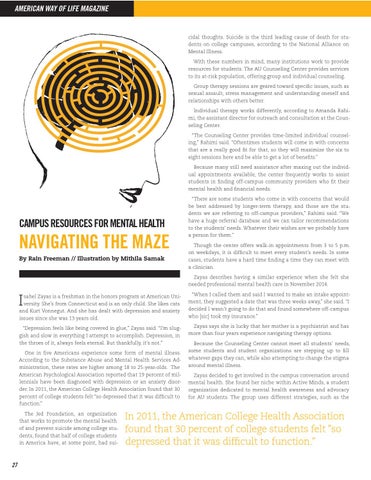
CAMPUS RESOURCES FOR MENTAL HEALTH
NAVIGATING THE MAZE By Rain Freeman // Illustration by Mithila Samak
“There are some students who come in with concerns that would be best addressed by longer-term therapy, and those are the students we are referring to off-campus providers,” Rahimi said. “We have a huge referral database and we can tailor recommendations to the students' needs. Whatever their wishes are we probably have a person for them.” Though the center offers walk-in appointments from 3 to 5 p.m. on weekdays, it is difficult to meet every student’s needs. In some cases, students have a hard time finding a time they can meet with a clinician. Zayas describes having a similar experience when she felt she needed professional mental health care in November 2014.
sabel Zayas is a freshman in the honors program at American University. She’s from Connecticut and is an only child. She likes cats and Kurt Vonnegut. And she has dealt with depression and anxiety issues since she was 13 years old.
I
“When I called them and said I wanted to make an intake appointment, they suggested a date that was three weeks away,” she said. “I decided I wasn’t going to do that and found somewhere off-campus who [sic] took my insurance.”
“Depression feels like being covered in glue,” Zayas said. “I'm sluggish and slow in everything I attempt to accomplish. Depression, in the throes of it, always feels eternal. But thankfully, it's not."
Zayas says she is lucky that her mother is a psychiatrist and has more than four years experience navigating therapy options.
One in five Americans experience some form of mental illness. According to the Substance Abuse and Mental Health Services Administration, these rates are higher among 18 to 25-year-olds. The American Psychological Association reported that 19 percent of millennials have been diagnosed with depression or an anxiety disorder. In 2011, the American College Health Association found that 30 percent of college students felt “so depressed that it was difficult to function.” The Jed Foundation, an organization that works to promote the mental health of and prevent suicide among college students, found that half of college students in America have, at some point, had sui-
27
Because the Counseling Center cannot meet all students’ needs, some students and student organizations are stepping up to fill whatever gaps they can, while also attempting to change the stigma around mental illness. Zayas decided to get involved in the campus conversation around mental health. She found her niche within Active Minds, a student organization dedicated to mental health awareness and advocacy for AU students. The group uses different strategies, such as the
In 2011, the American College Health Association found that 30 percent of college students felt "so depressed that it was difficult to function."