questions
critical
Why Orchestras Need Entrepreneurial Musicians
S
erious music students today expect that they will have to create their own career path. They must be entrepreneurs, educators, grant-writers, marketers, and performers. Anyone following the professional training of musicians will surely notice that programs in entrepreneurship and leadership have become de rigueur at major conservatories and schools of music. New England Conservatory’s Entrepreneurial Musicianship department states that “excellence is just a starting point. Musicians must be more than virtuosi; they must be their own businesses.” The Eastman School of Music’s Arts Leadership Program’s goals are “to inspire students with a personal vision, to equip them with the professional skills and experience that will allow them to take charge of their career prospects, and to encourage them to provide leadership in the musical culture and marketplace.” And the USC Thornton School’s Arts Leadership program is perhaps most ambitious in staking a vision of the future, stating that the program will “help current and future arts leaders find success in an environment in which old models no longer apply, innovation is constant, resilience trumps stability, and where personal creativity, courage, and sense of possibility are the keys to a rich and rewarding life in the arts.” Amen! What are all these entrepreneurial musicians doing when they graduate? One
20
thing at least some of them are doing is forming their own ensembles. And I don’t mean string quartets and brass quintets, or at least not the traditional kinds. Musicianlead ensembles today tend to each have a distinct profile associated with the founder or founders, instrumentation is flexible, and they work with a vastly expanded creative palette. And they are not entirely new. Some of the most exciting musicmaking today is coming from innovative
Musician-led ensembles today tend to each have a distinct profile associated with the founder or founders, instrumentation is flexible, and they work with an expanded creative palette. And they are not entirely new. young ensembles that began playing together in school—Alarm Will Sound at Eastman, eighth blackbird at Oberlin, The Knights at Juilliard, for example. For many, these are friendships as well as professional relationships. They have chosen the people they want to make music with. Collaboration also extends to a blurring of the roles between performers and administrators. While to some degree this is simply a function of smaller-scale operations, there is also a conscious effort to have performers take responsibility for the operating success of their organizations. Claire Chase, founder of ICE, seeks out
Klaus Lucka
by Jesse Rosen
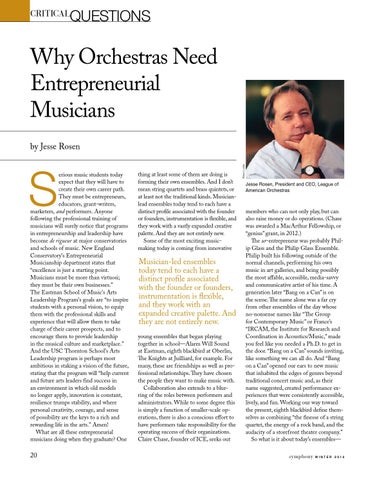
Jesse Rosen, President and CEO, League of American Orchestras
members who can not only play, but can also raise money or do operations. (Chase was awarded a MacArthur Fellowship, or “genius” grant, in 2012.) The ur-entrepreneur was probably Philip Glass and the Philip Glass Ensemble. Philip built his following outside of the normal channels, performing his own music in art galleries, and being possibly the most affable, accessible, media-savvy and communicative artist of his time. A generation later “Bang on a Can” is on the scene. The name alone was a far cry from other ensembles of the day whose no-nonsense names like “The Group for Contemporary Music” or France’s “IRCAM, the Institute for Research and Coordination in Acoustics/Music,” made you feel like you needed a Ph.D. to get in the door. “Bang on a Can” sounds inviting, like something we can all do. And “Bang on a Can” opened our ears to new music that inhabited the edges of genres beyond traditional concert music and, as their name suggested, created performance experiences that were consistently accessible, lively, and fun. Working our way toward the present, eighth blackbird define themselves as combining “the finesse of a string quartet, the energy of a rock band, and the audacity of a storefront theater company.” So what is it about today’s ensembles— symphony
winter 2014