Western Australian Wine Industry Strategic Plan 2024-24
Wines of WA Audited Financial Report 2024-25 APC Report
Western Australia RDE Strategic Priorities 2021 -25
Western Australia Sustainability Report 2024-25
Wine Australia Regional Program Annual Report
Export Growth Partnership 2024-25 Report
Export Growth Partnership Program
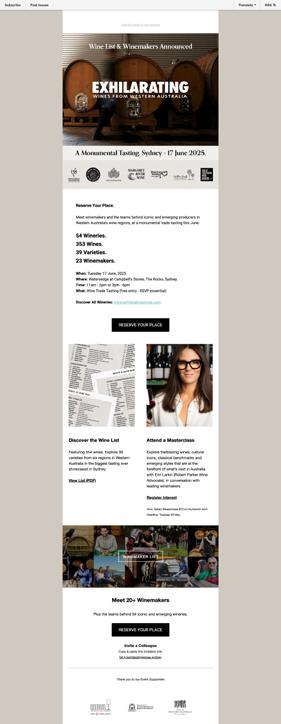
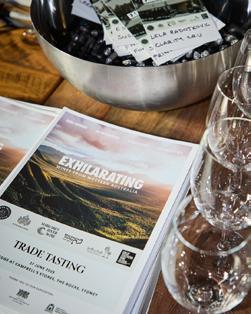
EXHILARATING Wines from Western Australia
Sydney Event Report
Introduction
The Wine industry Association of Western Australia (Inc.) (Wines of Western Australia), established in 1987, is the State’s representative organisation for wine producers.
WA Wine Industry Vision
As outlined in the Western Australian Wine industry Strategic Plan 2024 - 34, Western Australian wine producers have a shared vision that:
“The fine wine regions of Western Australia are celebrated the world over”
This will be achieved by:
“Working collaboratively to advocate and promote the growth of a sustainable and profitable Western Australian wine sector”
The measurable goals of the 10-year strategy focus on:
- increasing value and volume in our domestic and export markets and;
- to be international leaders in sustainable wine production
Wines of Western Australia Charter
The Western Australian Wine industry Strategic Plan 2024 – 34 mandates that Wines of Western Australia should, “ensure the continued representation of the fine wine regions of Western Australia at a State and National level … and support regional leadership to ensure that the regions are well represented now and in the future.”
We deliver this through:
• Advocacy and Representation to ensure government, at all levels, understand the benefits we provide to the state economy, particularly in regional WA . We work to ensure our social license to operate is retained and strengthened. We continue to build strong partnerships with tourism, developing complimentary market development programs. We work to ensure that Western Australians are truly proud of our wine industry.
• Administration of technical and marketing program funding to provide Western Australian wine producers opportunities to improve business practises and market access.
• Communication to ensure wine industry participants are aware of the issues that affect their businesses, enabling them to make informed decisions on the direction of the industry and their individual businesses.
Industry Overview
Wine is a major value adding industry with significant regional economic and employment benefits. In 2024-25 the total value of the WA wine industry was estimated at over $900 million with a farm gate grape value of $97 million. (DPIRD Situational Analysis of Horticulture in Western Australia)
The Western Australian wine industry produces about 40 million litres of wine annually representing 4% of the volume of Australia’s wine production but 8.5% of the value.
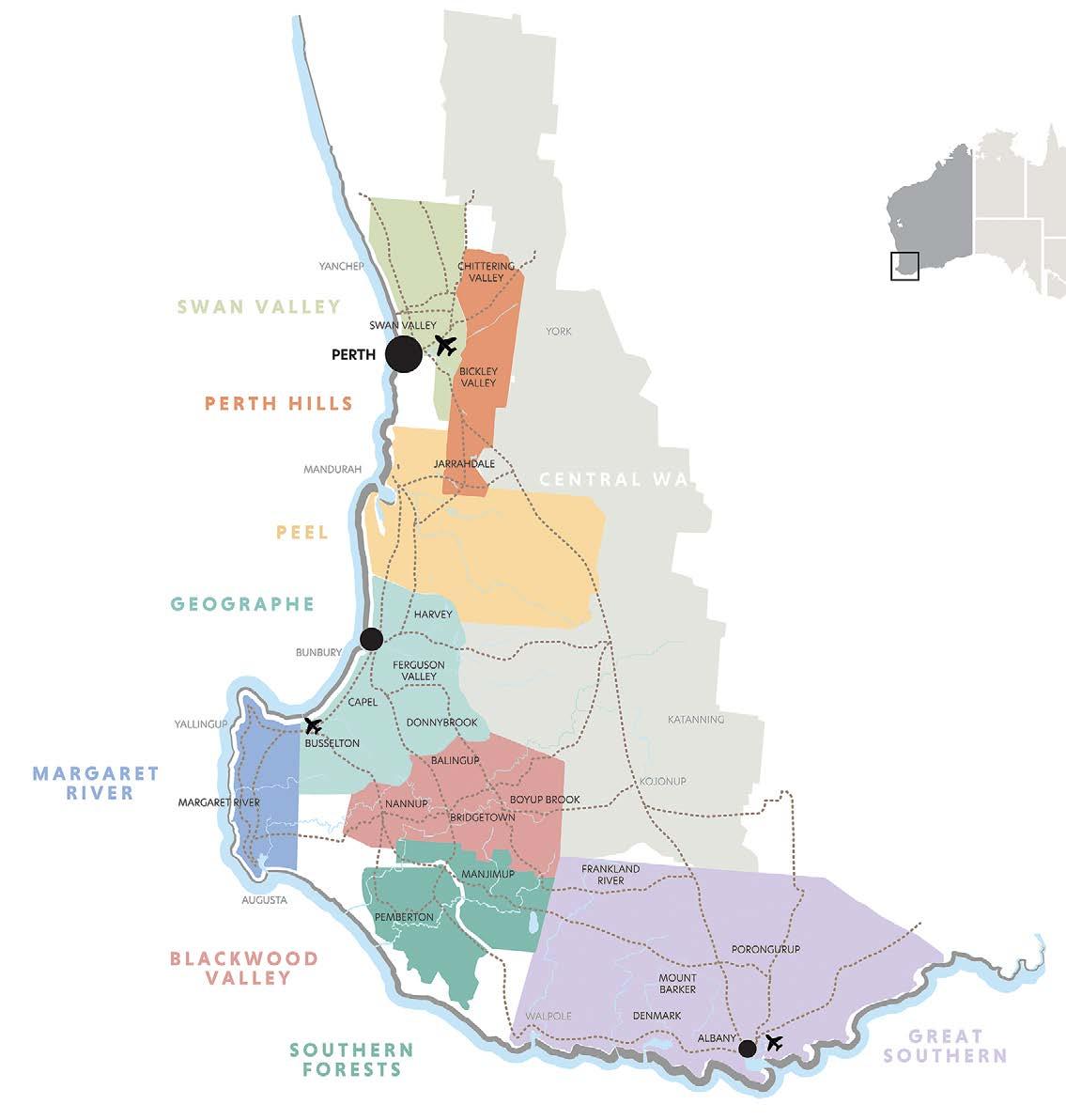
There are nine gazetted wine regions in Western Australia covering just under 50,000 square kilometres with approximately 10,500 hectares planted to 60 varieties of grapevines.
There are 304 wine producers and 473 wine grape growers with 200 cellar door/wine tourism facilities spread across the nine regions.
Industry development is supported through the Agricultural Produce Commission fee for service collection where producers pay a fee per tonne of grapes owned at the point of crush.
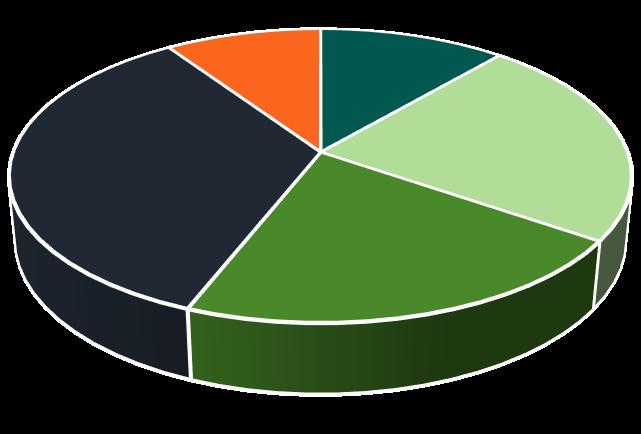
Regarding market channels, 46% of total value was sold in WA, 44% in eastern Australia and 10% in exports.
Western Australian wine producers are focused on crafting wines that reflect the provenance of their vineyards and regions.
Strategic Priorities 2024-25
Priority
INDUSTRY STRUCTURE AND DEVELOPMENT
Build a culture of collaboration with an expectation of success
Priority Issues
Implement 10 Year Industry Plan
Support industry development through partnerships and collaboration.
Provide administrative and governance resourcing for partnerships and collaborative projects.
Manage Export Market Development funding and resources in collaboration with RAs and producers
MARKET DEVELOPMENT
Strategic regional collaboration driven by energised producers
SUSTAINABILTY, INNOVATION, RDE&A AND BIOSECURITY
All of industry best practise across the value chain
Domestic market development
Build partnerships (government, value chain, allied sectors) to support regional brand development and increase national and international consumer demand
Facilitated RDE partnership discussion between industry, Wine Australia and DPIRD
Smoke taint
Provide administrative and compliance support for Wine Australia funded Regional Program
Ensure industry biosecurity regulations protect assets and facilitate innovation
Ensure taxation regime offers best operational environment for WA fine wine producers.
Activities and Progress
Implemented plan with a focus on market development and industry sustainability.
Negotiated further four-year funding partnership with state government. Extended RDE Partnership with Wine Australia. Submitted application for federal climate smart grant.
Managed/facilitated Committees and working groups. Continued administrative support for Blackwood Valley and Geographe.
Managed relationships with state government agencies, Wine Australia, Australian Grape and Wine
Managed compliance and administration of Export Growth Partnership including Industry Steering Committee
ADVOCACY AND REPRESENTATION
Lean, proactive, unified and Influential
Ensure legislation and regulation offers best operational environment for WA fine wine producers.
Ensure an enduring social licence for WA wine producers.
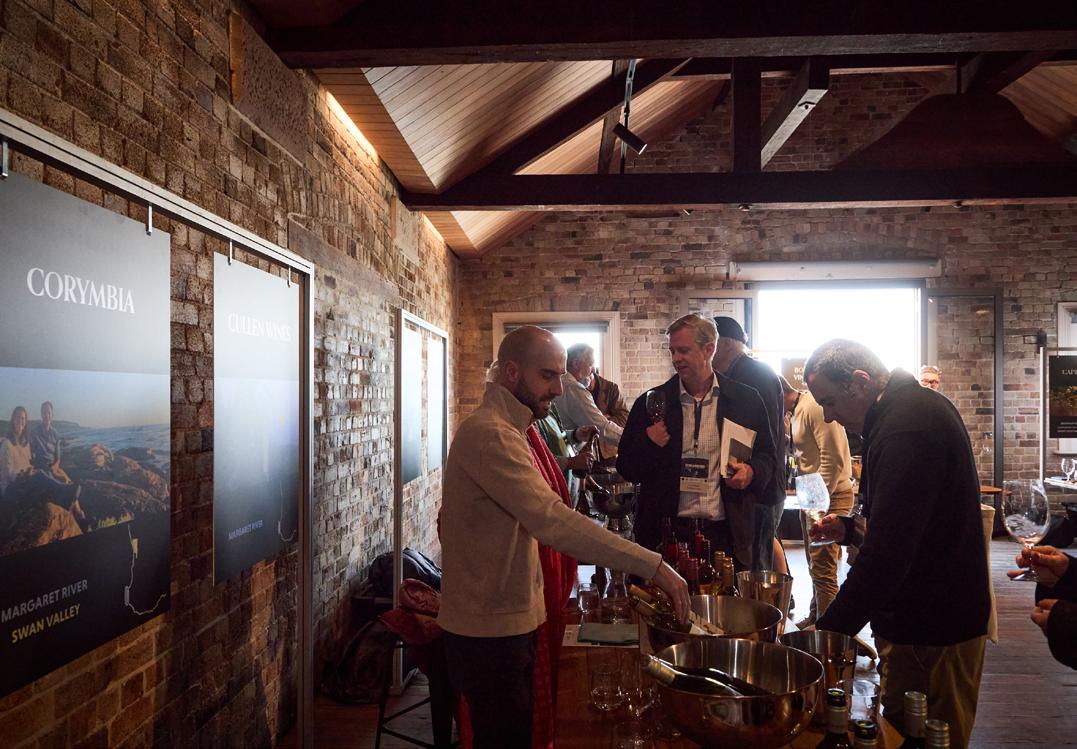
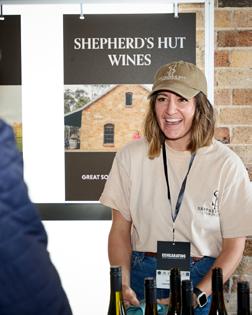
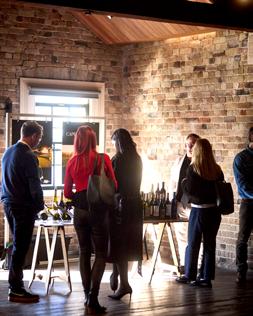
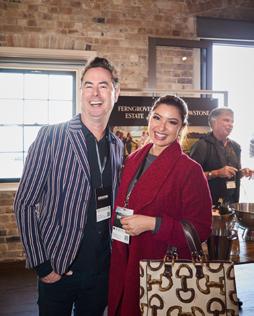
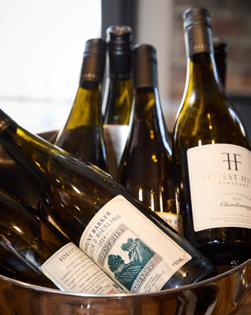
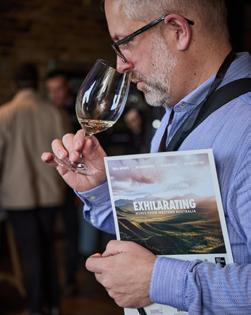
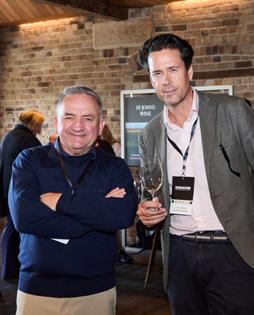
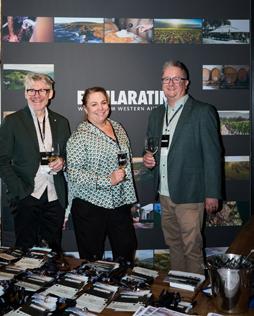
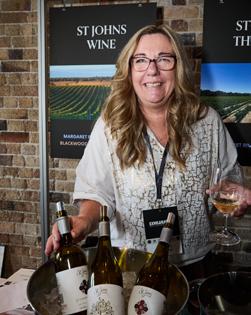
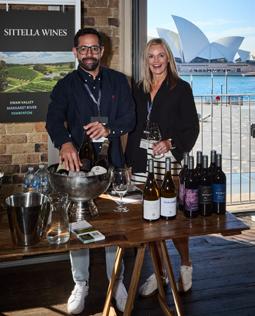
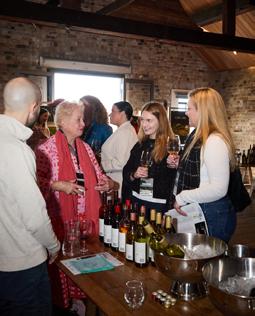
Implemented Sydney trade event featuring state Exhilarating brand
Worked with Wine Australia, Austrade/TradeStart, Department of Primary Industries, Tourism WA, Development Commissions, local government and allied sectors to implement EGP and domestic market development
Partnership agreement extension negotiated.
Supported Regions and producers to manage prescribed burns programs
In partnership with Department of Primary Industries, Technical Committee implemented programs to address identified challenges through the Wine Australia Regional Program
Continued to share industry ratified position for further taxation reform with other regions/states.
Advocated for further amendments to Liquor Control Act; support national advocacy on Container Deposit Scheme proposals in all states, including WA
Worked with Australian Grape and Wine and other state associations to ensure aligned and strong communications/advocacy.
Independent Chair’s Report
Wines of Western Australia: July 2024 – June 2025
Having completed my second full year as Independent Chair of Wines of Western Australia, I am pleased to report on a period of significant achievement and strategic advancement. Building on the foundation established last year, we have delivered transformative initiatives that position our industry for long-term sustainability and growth. The release of our industry's first Sustainability Report and the staging of our largest-ever interstate trade showcase mark this second year as transformative for Wines of Western Australia I continue to be inspired by the talent, resilience, and innovation of Western Australian wine producers.
Industry Context
The 2024-25 year presented our producers with both familiar and new challenges. The 2024 vintage was among the earliest on record, with extreme heat and drought conditions testing viticultural expertise across all regions. Economic headwinds persisted, with continuing pressure on consumer spending and rising operational costs. However, these challenges were met with the characteristic ingenuity and adaptability that defines our industry.
Importantly, this year also brought opportunity. The removal of Chinese tariffs opened new export possibilities, while growing global demand for sustainably produced wines aligned perfectly with Western Australia's strengths and values.
Strategic Implementation
In my first year, we ratified our ambitious 10-year Strategic Plan. This second year has been about implementation and delivery. The plan's focus on sustainable fine wine production, domestic market development, and international market expansion has guided our priorities and resource allocation. I am proud to report substantial progress across all three pillars.
Key Activities and Highlights
Throughout 2024-25, we advanced several major initiatives:
Sustainability Leadership
We established Wines of Western Australia as a national sustainability leader through the release of our inaugural Wine Industry Sustainability Report in July 2025. With 75% of our SWA members already
certified (well above the 55% national average) we've positioned Wines of Western Australia among the top ten regions internationally for sustainable wine production. This work was led by our Sustainability Program Manager Eloise Jarvis in partnership with Wine Australia and DPIRD. The report's 2021 carbon baseline (160,736 tonnes CO₂e) and comprehensive 2025-2029 Strategic Plan provide our roadmap
Export Growth Partnership Evolution
We completed a comprehensive review of our Export Growth Partnership with DPIRD and secured a renewed commitment from the Cook Labor Government with doubled funding to approximately $7 million. This represents a strong vote of confidence in our industry's strategic direction and the value of government-industry collaboration.
"Exhilarating Wines of Western Australia"
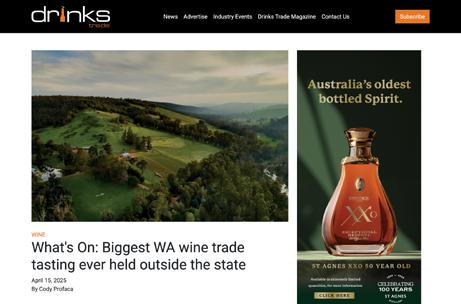
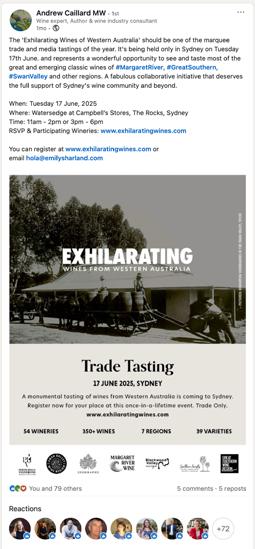
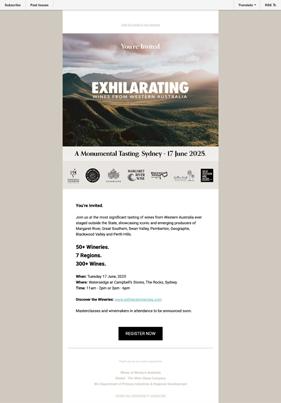
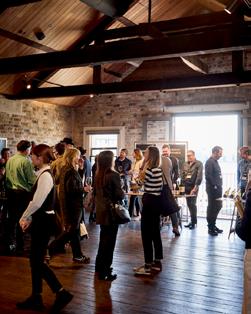
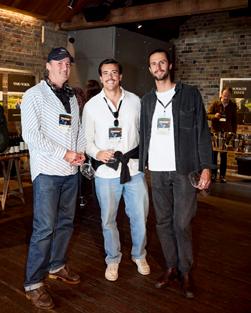
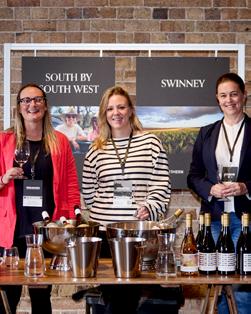
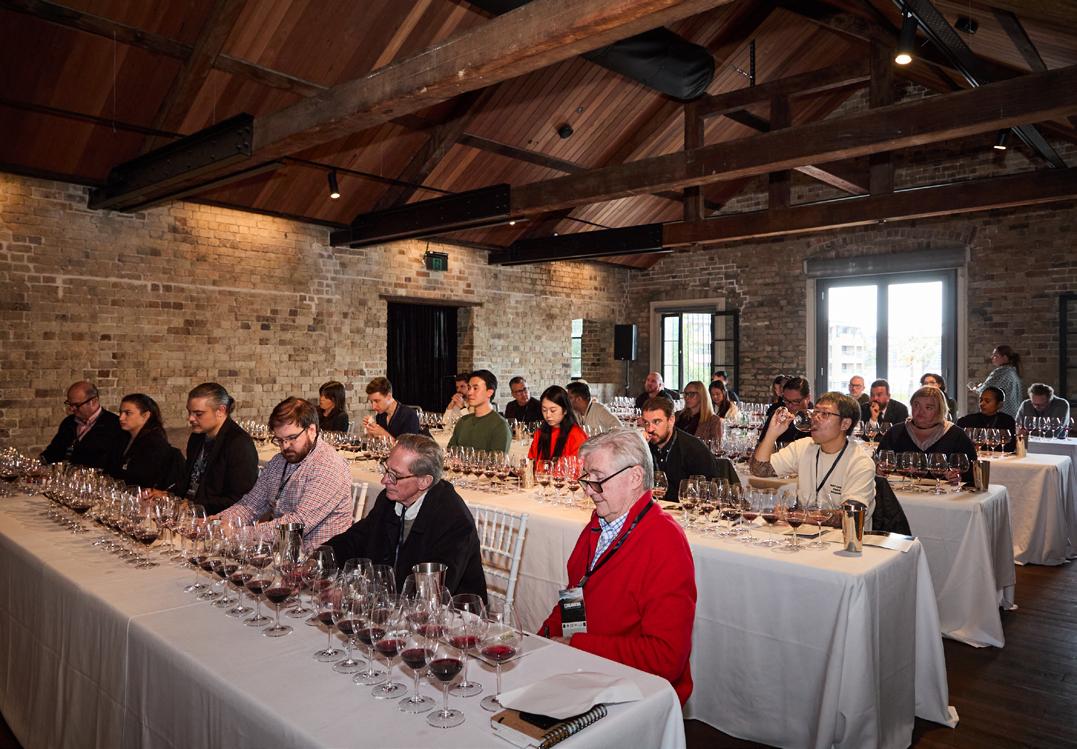
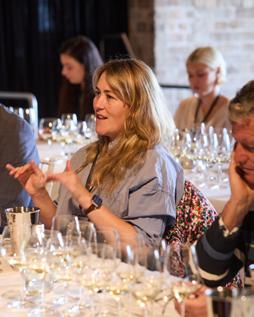
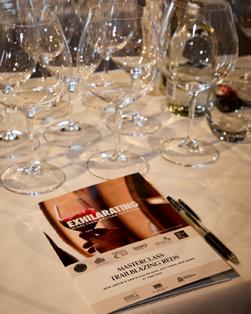
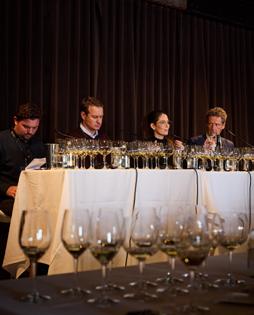
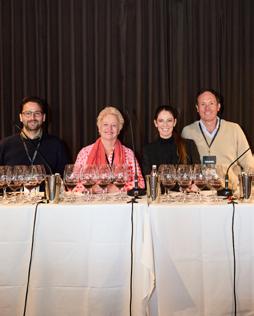
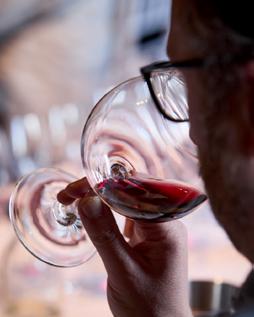
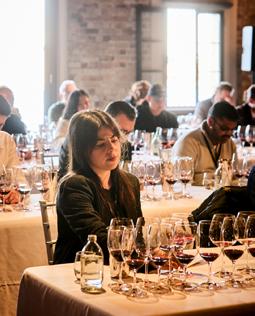
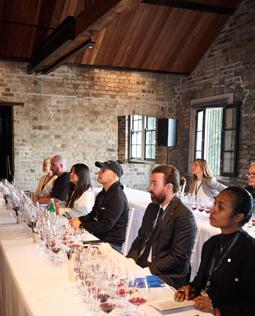
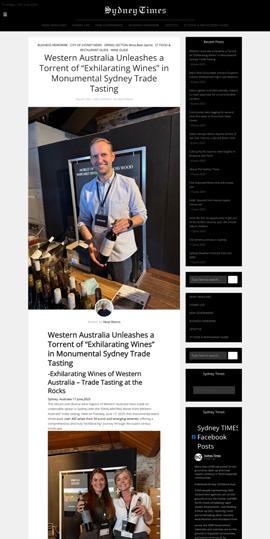
In June 2025, we delivered the most significant trade tasting of Western Australian wines ever staged outside our state. Fifty wineries showcased over 300 wines to the Sydney market, representing all seven of our wine regions. This bold initiative demonstrated our commitment to raising the national profile of WA wines and supporting our producers' market access.
Professional Development
We launched the Cultivate Leadership program, investing in the next generation of industry leaders across Great Southern, Blackwood Valley, and Southern Forests regions. We also funded two local members to attend the Australian Wine Industry Technical Conference, ensuring WA producers have access to cutting-edge technical knowledge.
Industry Collaboration
We strengthened our Wine Industry Partnership with DPIRD, creating robust frameworks for implementing sustainability initiatives and supporting regional development. Our work with regional wine associations has enhanced coordination and collective impact across the state.
Advocacy and Recognition
We continued our advocacy work while celebrating industry excellence through support of the Wine Show of Western Australia, WA Good Food Guide Wine Awards, and regional wine shows. These platforms showcase the exceptional quality of WA wines and the expertise of our winemakers.
Conclusion
This second year has reinforced my confidence in the strategic direction we have set and the capability of our industry to achieve ambitious goals. The completion of major initiatives such as the Sustainability Report and the Sydney trade tasting demonstrates what we can accomplish when we work collaboratively with clear purpose.
The challenges ahead remain significant: climate adaptation, market development, rising costs and maintaining social licence all require sustained effort. However, I have seen firsthand the determination and innovation of our producers, and I am optimistic about our collective future.
This determination and innovation is continually recognised in national wine show results where Western Australian wines are awarded trophies at a number that is significantly disproportionate to our contribution to national crush volume.
I extend my sincere gratitude to CEO Larry Jorgensen for his strategic leadership and tireless advocacy on behalf of our industry. His consistent and effective engagement with government is second to none. I thank my fellow Board members for their commitment, expertise, and collaborative approach to strategy and governance. Most importantly, I thank the producers and regional associations who are the heart of this industry. Your passion and excellence in the vineyard and cellar room is what makes our advocacy work meaningful.
As we continue to implement our 10-year Strategic Plan, I look forward to working together to realize our vision of the fine wine regions of Western Australia being celebrated the world over.
Michael Hollingdale Independent Chair Wines of Western Australia
Treasurer’s Report
Wines of Western Australia (“WOWA”) has continued to successfully manage its financial affairs during the 2024/25 financial year to deliver its core activities of advocacy and representation, including the management and oversight of major projects designed to provide tangible benefits to WA Wine Producers, most noticeably the Export Growth Partnership (EGP) with the State Government, which came to an end at June 2025, with a new 4 year project commencing in the current financial year focused on both export and domestic market development as well as sustainability activities.
The financial affairs of WOWA are the responsibility of the Board, including the approval of an operating budget at the start of each financial year. The Treasurer oversees the financial affairs and prepares a report and financial summary that is tabled at each WOWA board meeting, noting the operating results against budget and other key financial matters including the financial management of grant projects managed by the association. The board has also established a Finance Review Committee to meet as required and review any financial matters outside normal operations or considered to be of significance with recommendations made to the board.
Overview of 2024/25 Financial Position
The summary of the Association’s income and expenditure for the year ended 30 June 2025 is as follows:
Operating Activities
Revenue from operating activities totalled $314,752 for the year compared to $325,506 for the prior year, a decrease of $10,754. The decrease was largely due to lower APC fees collected from wine producers for the 2024/25 financial year.
Total Operating expenditure for the year decreased by $20,851, primarily due to one off strategic planning costs incurred in the prior financial year.
The net operating surplus for the year was $1,775, compared to a net deficit recorded last year of $8,322.
Grant/Project Activities
Grant/Project activities comprise income and expenditures that relate specifically to various grant funded projects and are therefore excluded from Operating Activities.
The EGP concluded on 30 June 2025 and as a result certain income was able to be recognised by WOWA on conclusion of the project, resulting in a surplus of $146,590 from project activities. Some additional income will also be recognised in the 2025/26 financial year, further strengthening the net financial position of WOWA.
In addition, during 2024/25, WOWA undertook a joint one-year Sustainability Project with Wine Australia whereby each party contributed $50,000 to fund activities directly related to sustainability activities.
Several new grant funded projects have been entered into in the 2026 financial year which will provide further opportunities for WOWA to deliver tangible benefits to WA Wine Producers that align with the industry’s strategic plan and goals.
Balance Sheet Position
The net equity position of the Association as at 30 June 2025 totals $317,833, compared to $169,468 in the prior year
The strong net asset position should provide the basis for WOWA to continue to deliver its core activities for the benefit of the Western Australian Wine Industry.
Cameron Rhodes Treasurer – Wines of Western Australia
CEO Report
In 2024-25 WoWA implemented the Western Australian Wine Industry Strategic Plan 2024-24. Priorities for 2024-25 were:
• Secure funding and resources to support Regions to implement strategic plans
• Securing funding and resources to implement programs for international and domestic market development including wine tourism.
• Securing funding and resources to implement a one-year project focused on supporting producers to achieve Sustainable Winegrowing Australia certification.
• Ensuring legislation and regulation offers the best operational environment for WA fine wine producers and a secure, enduring social licence for WA wine producers.
The key activities to achieve these aims are Advocacy, Representation, Administration and Communication.
Advocacy
In 2024-25, Wines of Western Australia advocated for the industry on the following issues:
• Continued partnership with the state government to align Export Growth Partnership (EGP) resources to support export market development for Western Australian wine producers In 2024-25, a total of $859,050 of EGP funds and $177,00 of federal funds were leveraged with $1,054,725 WA producer and regional association funds. In total, an investment of $2.09 million to build strong and diverse export markets and rebuild domestic markets.
• Secured an extension to EGP funding partnership for a further four years (202529). The Wine Industry Partnership will focus on domestic and export market development and industry sustainability as outlined in the WA Wine Industry Strategic Plan 2024-34. State government funding has increased to $6 million matched with $3 million of industry contributions
• Agreed with Wine Australia, an extension of the 2024-25 RDE partnership for a further two years, focusing on industry sustainability
and practise change across the value chain.
• Worked with AGW and other state associations to oppose implementation of Container Deposit Schemes (CDS) in Western Australia other states.
• Worked with all Regional Associations and the Department of Biodiversity Conservation and Attractions establishing late season burn-off protocols to ensure late harvested fruit was not affected by prescribed burning
Representation
In 2024-25, Wines of Western Australia engaged the following government and industry bodies on the following issues:
• Minister for Agriculture and the Department of Primary Industries and Regional Development and Minister for Tourism and Tourism WA, advocating for increased alignment of funding for market development, wine tourism and industry development.
• Department of Racing Gaming and Liquor to maintain direct communication links on issues affecting WA wine producers
• Maintained strong links with Australian Grape and Wine attending (AGW) State Association meetings, Small Winemaker Committee meetings and providing WA input to national advocacy processes.
• Developed a funding partnership with Wine Australia aligning RDE resources to Western Australia’s strategic priorities.
Administration
In 2024-25, Wines of Western Australia administered the following projects on behalf of the WA wine industry:
• Worked with APC administration and Wine Producers’ Committee to refine collection process for FFS collection on the 2024 vintage
• Project management/compliance of the EGP with State Government, Wine Australia, Austrade and Regional Development Commissions
• Administration of the Wine Australia Regional Program in partnership with
DPIRD.
• Implemented and administered a funding partnership with Wine Australia to support producers to obtain Sustainable Winegrowing Australia certification. This included appointment of a Sustainability Industry Steering Committee.
• Provided administrative support for Geographe and Blackwood Valley regional wine associations.
• Negotiated terms for the WA wine industry service agreement with Australia Post.
• Negotiated terms for the WA wine industry co-membership arrangement with CCIWA
In 2024-25 we supported the following Industry Working Groups:
• Industry Sustainability Steering Committee which provides oversight of the Wine Australia Regional Program other RDE&A activities and biosecurity issues for WA producers.
• Export Growth Partnership Industry Steering Committee. Comprised of the Wines of Western Australia CEO, industry representatives and DPIRD, this working oversees and approves the EGP program developed by Hydra Consulting.
• Domestic Market Development Steering Committee which guided implementation of the Sydney Exhilarating trade event. Chaired by Mike Calneggia with industry and DPIRD representatives.
• Financial Review Committee (FRC) Comprised of the Wines of Western Australia Executive Committee and Board members, the FRC provides oversight of Wines of Western Australia’ grant funding financial commitments
Communication
In 2024-25, we continued our regular communications strategy including:
• A weekly e-newsletter which provides nontime sensitive information.
• Regular updates on market development activities and opportunities.
• Regular updates on sustainability program activities and opportunities.
• For urgent, critical information, members receive an email, text message or phone call directly from me
• Eye to eye on a regular basis to share a coffee or a glass wine, depending on the time of day, discussing what you feel are the key issues affecting your business and region
Maintained www.winewa.asn.au as a highly ranked landing site for consumers and tourists and a resource for WA wine producers via assets listed below:
• the localista searchable database was linked directly to the Australian Tourism Data Warehouse which feeds into Australia.com, Tourism Australia’s consumer facing platform
• the Wine Adventurer guide to the fine wine regions of WA
• the Wine Exportal, a one stop information shop for WA producers
National Representation
It is important that WA continues to provide energised and capable people at a national representative level to ensure our state issues are understood and addressed. In 2024-25, Wines of Western Australia facilitated the following input at national level.
Australian Grape and Wine
Western Australian Board representatives were:
• Nick James-Martin, Wines of Merritt (Small Winery Membership Committee Appointed)
• Cameron Rhodes, Fermoy Estate (Small Winery Membership Committee) Appointed
Wine Australia
As summarised throughout this report, WoWA continues to work with Wine Australia across a number of projects to support industry development. These include the Regional Program, the Sustainability Program and various market development activities across a range of international markets.
Human Resources
Wines of Western Australia has two employees and also uses contracted professional services and formalised working groups, to deliver value to WA wine producers through the APC fee for service model.
Employees are:
Larry Jorgensen – Chief Executive Officer
Caroline Taylor – Administration and Communications Officer
In 2024-25 we used the following contracted service providers:
• Michael Hollingdale as Independent Chair
• Hydra Consulting as Program Manager of the WA Wines to the World market development program delivered in partnership with the WA state government.
• Eloise Jarvis as Program Manager of the Sustainability Program delivered in partnership with Wine Australia.
• Debbie Bell as bookkeeper/financial administration
In closing, I wish to acknowledge the contribution and support of the following people:
• Regional Association Committees who have provided input to the development of policies and programs to support industry development.
• Producers who have provided input to the development of policies and programs to support industry development.
• The Wines of Western Australia Board of Directors who have provided support and guidance to our team
• The Wines of Western Australia Executive Committee including Independent Chair Michael Hollingdale and Treasurer Cameron Rhodes.
• Our team of people who work with dedication and patience to provide service to our members
Larry Jorgensen
Chief Executive Officer
Wines of Western Australia
November 25, 2024
Membership Report
The WA wine industry utilises the fee for service Agricultural Produce Commission (APC) funding model for the 2024-25 financial year The fees were affected against the 2024 vintage. A fee per tonne was collected from the owner of the fruit at crush and distributed to Wines of Western Australia to provide state-based services and to Regional Associations based on the GI origin of the fruit to provide regionally based services.
The aggregated budgeted revenue from APC collections for 2024-25 was $739,576 based on a projected 52,000 tonne vintage. The final amounts collected at 30 June 2025 were $679,535 and 48,725 tonnes. This represents 92% of budgeted revenue and 94% of projected volume Wines of Western Australia APC income was budgeted to be $259,218 with $240,610 collected. See APC Budget and the audited financial report in appendices
In total, 304 producers provided return forms. The number of producers skews towards under 150 tonnes at 77.5%, with 11.5% in the 150-500 tonnes range and 7% over 500 tonnes The share of aggregated production skews toward over 500 tonnes at 68%, with 19% from producers in the 150500 tonnes range and 13% from producers in the under 150 tonne range.
Industry Production Data
A significant benefit arising from the APC collection is resulting production data. Information collected via the process includes GI origin of fruit by variety. This provides an accurate snapshot of production capacity and will be invaluable to producers in determining how to structure their business to best meet market demand State level summary data follows.
Average production over the six-year period from 2018 – 24 is 52,000, noting 2019 and 2020 vintages were weather affected resulting in sub 50,000 tonne vintages.
Margaret River and the Great Southern produce 80% of state crush with Swan Districts, Southern Forests and Geographe combined producing a majority of the remaining 20%.
Vineyard area of 11,700 hectares was confirmed via satellite scan and subsequent ground truthing in 2016. This is being updated in 2025 - 26 using a satellite vineyard scan and further ground truthing.
Production is skewed towards white production at 60% of production.
Cabernet Sauvignon, Shiraz and Merlot represent 83% of red production Pinit Noir, Malbec, Grenache, Tempranillo, Cabernet Franc, Sangiovese, Petit Verdot complete the top 10 red varieties grown in Western Australia.
Sauvignon Blanc, Chardonnay and Semillon total 82% of white production. Chenin Blanc, Riesling, Verdelho, Pinot Gris, Muscadelle, Savignin Blanc and Viognier complete the top 10 white varieties grown in Western Australia.
Notable over the six-year period is the significant growth in plantings and production of ‘alternative varieties both white and red, including Fiano, Vermentino and Mourvèdre
There are a total of 31 varieties of red grapes and 27 varieties of white grapes grown commercially in WA.
See the complete APC Production report in the appendices of this report.
Member Benefits
Advocacy and support
The primary role of Wines of Western Australia is to represent and advocate for the interests of WA wine producers.
Access to Export Growth Partnership
All FFS paying producers can participate in EGP programs.
Access to Sustainability Program
All FFS paying producers can access support provided via the Sustainability Program funded in partnership with Wine Australia.
Weekly Industry Update
Wines of Western Australia provides access to essential information for WA wine producers through weekly emails.
Australia Post
Membership entitles access to the Wines of Western Australia alliance with Australia Post whereby members can take advantage of specialised wine handling and delivery services at significantly reduced prices in both the domestic and overseas markets.
Bunnings
All Wines of Western Australia Members are eligible to obtain a Bunnings Power Pass card providing access to discounts on a wide range of items and simplified pay and check-out. Skips the queues and cruise out in minutes.
Chamber of Commerce and Industry, WA (CCIWA)
Membership permits access to the dual Wines of Western Australia / CCI membership agreement. This provides members with access to the full range of CCI member benefits including advice and assistance on industrial relations, workplace agreements, worker’s compensation, occupational safety and health, industry training, trade, environmental compliance and more.
Localista listing on Wines of Western Australia website
All FFS paying producers are listed for free on the Wines of Western Australia website Localista searchable data base. The list is searchable by a number of criteria and is a useful online tool for wine
tourists visiting the fine wine regions of Western Australia
Affiliate Membership Benefits
Affiliate members receive the following benefits:
• Receive regular issues of the Wines of Western Australia E-newsletter and keeping up to date with all the latest wine industry news
• Access and notification to networking events and workshops with Wines of Western Australia wine producers and growers
• Access to WA wine industry Australia Post parcel rates
• All Wines of Western Australia Affiliate Members are eligible to obtain a Bunnings Power Pass card providing access to discounts on a wide range of items and simplified pay and check-out. Skips the queues and cruise out in minutes.
Industry sustainability and RDE
RD&E 5-Year Strategic Plan
In July 2021, the Wines of Western Australia facilitated a strategic planning session to identify the RD&E strategic priorities over the next 5 years. The resulting 2021 – 26 WA Wine industry RD&E Strategic Priorities Plan (RDESP) is included in the appendices and is available on the Wines of Western Australia website in the Technical Section.
The process included a one-day workshop attended by WA producers, regions, DPIRD, Wine Australia and other stakeholders.
The RDESP is the guiding document in determining what issues are addressed by industry through research and extension in partnership with state and federal government agencies. The priorities identified were:
1. Understanding the intricacies of provenance and the fine wine regions of WA
2. Rapid access to new genetic plant material
3. Supporting WA producers to adopt Sustainable Winegrowing Australia (SWA)
4. Supporting WA producers to adopt on-farm biosecurity practises
5. Declining vineyard yields
6. Low adoption rate of RDE in WA
A summary of outputs and strategic priorities is included in the appendices.
Industry Sustainability Program
Through a funding partnership with Wine Australia, a one-year pilot program to support industry sustainability certification was implemented in 202425. Key Outputs include:
- The Western Australian Wine Industry Sustainability Strategy 2025-2029 with operationalised SMART goals.
- Comprehensive industry engagement through a sustainability survey reaching 50 producers (16% of WA's wine producers), identifying top priorities across water management, soil health, certification options, sustainable packaging, and circular economy practices.
- Six workshops conducted across five regions (Great Southern, Swan Districts, Southern Forests, Geographe, and Margaret River) covering topics including driving sustainability in wine, carbon smart production, and winery wastewater management.
- Support for the Margaret River Wine Show Trophy for Sustainability ($2,000), Margaret River Lightweight Packaging Initiative ($5,000)
- Blackwood Valley Wine Industry Association Partnership ($1,500 ).
- Sustainability Program Annual Report documenting practical case studies from producers across multiple regions demonstrating successful implementation of water efficiency, carbon sequestration, digital monitoring, and biodiversity restoration programs.
Further results of the one-year pilot program include:
1. An extension of the Wine Australia partnership for a further two years. This partnership will support 1.0 FTE to deliver the WA Wine Industry Sustainability Strategy
2. Development and submission of a grant application under the NHT Climate Smart Program (noting the application was successful)
The Sustainability Program Annual Report is available in the appendices of this document.
DPIRD Wine R&D Activities
Understanding the intricacies of provenance in Western Australian wine regions
- Participating producers to the project in Margaret River and Great Southern were invited to taste through the 2024 wines when bottled.
- Sensory analysis and chemical profiling complete on 2024 samples by the AWRI.
- CRC partners are now focusing on statistical analysis of data rather than chemical analysis.
- Successfully completed the final harvest –19 x MR Chardonnay, 19 x MR Cabernet, 12 x GS Riesling and 7 x GS Shiraz (unable to harvest 2 sites due to frost damage and bird/kangaroo damage).
- GS sites to have soil characterised in spring.
Grapevine Germplasm Relocation
Following detection of Diaporthe ampelina at Manjimup Horticultural Research Institute, DPIRD is collaborating with Wine Australia, WoWA and WAVIA to relocate 145 priority grapevine accessions (over 130 varieties and 180 clones) to UWA's Shenton Park facility, with completion expected by August 2026.
Wine Australia Regional Program
Delivered in partnership with Wine Australia and DPIRD, the Regional Program utilises the RD&E 5year strategic plan to deliver extension and adoption activities to support Western Australian wine producers. In 2024-25, the following programs were delivered:
- Demonstrating the influence of clonal selection on Southern Forests Pinot Noir vineyard performance and wine quality
- Advancing technical insights of pruning techniques and strategies
- Demonstrating the influence of clonal selection on Margaret River Cabernet wine quality
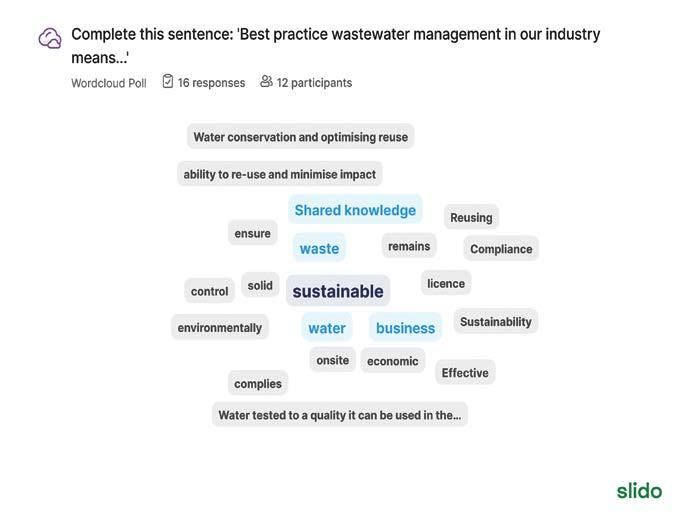
- Supporting the adoption of winery wastewater best practices
The annual report for the program is available in the appendices of this document.
The Industry Sustainability Steering Committee oversees the development and implementation of the Sustainability Program and the Wine Australia Regional Program delivered in partnership with Wine Australia.
The Committee also reviews:
• biosecurity
• water security
• resource management
• biosecurity issues
Committee Members for 2024-25 were:
Larry Jorgensen – WoWA (Chair)
Eloise Jarvis – Program Manager
Matty Trent – Swan Valley
Marcus Giesler – Perth Hills
Lucy Nankervis – Geographe
Amanda Whiteland – Margaret River
Kate Morgan – Margaret River
Craig Nield – Blackwood Valley
Monica Radomiljac – Southern Forests
Laura Wishart – Great Southern
Steve Kirby – Large Producer
Courtney Treacher – Multi region producer
Julian Marchant – Wine Australia
Richard Fennessy – DPIRD
Market Development
Export Growth Partnership
The Export Growth Partnership (EGP) concluded in 2024-25. The EGP was a four-year partnership between Wines of Western Australia (for the WA wine industry) and the WA State government. Each partner contributed over $3 million dollars to support export market development and growth activities.
The EGP supported increased profitability of the WA wine industry by:
- Growing the average value and volumes of WA wines exported
- Growing the number of WA wine producers successfully participating in export markets
- Aligning investment in international wine marketing, promotion, media and wine tourism to maximize profile and sales outcomes for WA fine wines
Pre-program work completed in 2020-21 identified target markets, priority activities and strengthening relationships with key partners including Austrade, Wine Australia and WA State government overseas trade offices.
The key markets currently are China, UK, USA, Singapore, Japan, Hong Kong, and Southeast Asia
In, 2024-25 with a full year of unrestricted trade to China, export volume and value increased, surpassing levels achieved in 2020-21 at the start of the program.
While China provided most of the growth in 2024-25, value and volume sent to the UK continued to support a more diversified market mix.
At 30 June 2025, Western Australia’s share of national export value (1.7%) and volume (.7%) grew by 21% and 17% respectively compared to Jul1 2021 at the start of the EGP.
The EGP provided the following support to WA producers and regions in 2024-25:
- Subsidised stand support at ProWein Shanghai 2024
- Collaborative stand at VinExpo Asia in Singapore
- In-bound China trade visit October 2024
- In-bound UK/Asia trade visit May 2025
- Funding for regions and producer groups to implement collaborative market development
- Funding for producers to implement distributor and retailer promotional programs in UK, USA, North/South Asia including China
- Subsidised participation in Austrade new to market program for Japan
- Support for trade/media tastings/masterclasses in the UK, USA, Japan and South Korea
- Translation of education assets to support tastings/masterclasses in Japan
- Through additional funding to support market re-entry to China provided by the state government in May 2024, a range of activities were implemented. See 2024-25 program report for further details.
A full review of program activities and outcomes for 2024-25 is included in the appendices of this report.
An end of program review undertaken by Agknowledge is available in the appendices of this report.
Domestic Market Development
EGP funds were approved for allocation to domestic market development in May 2024.
A steering committee was formed to deliver a trade focused event in Sydney June 2025 and the development of a state-based brand positioning strategy to support the event and subsequent activities
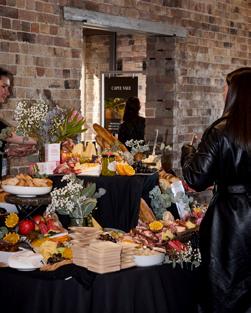
Over 50 producers attended the event with trade and media numbers at just over 300.
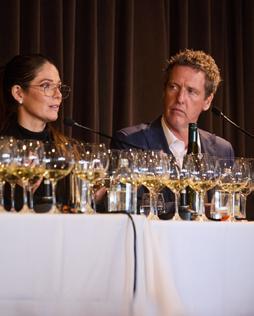
The event included masterclasses hosted by international wine journalist, Erin Larkin and two tasting sessions with producers engaging directly trade and media.
A summary of the event is included in the appendices of this report.
The Domestic program also supported Top Up Wine Awards, a state-based consumer choice competition. Further detail can be viewed at Top Up Wines • WA Top 100 Wine Awards
Wines of Western Australia Board of Directors 2024-25
Board Position
Skills Based - Independent Chair
Michael Hollingdale
Producer Under 150 TonnesLiv Maiorana – South by South-West Wines
Producer Over 1000 TonnesFranklin Tate – Franklin Tate Estates resigned May 2025
Regionally Appointed Perth Hills/Peel/Swan Valley (note one vote for this shared position)
Marcus Giesler – Plume Estate
Garth Cliff – Vino Volta
Regionally Appointed Geographe -
Anita Robinson - Talisman
Regionally Appointed Margaret River (note one vote for each regionally appointed position)
Tom Hill – Juniper Estate
Amanda Whiteland - Margaret River Wine Association
Regionally Appointed Blackwood Valley/Southern Forests (note one vote for this shared position)
Melissa Bell – Ampersand Estate
Craig Nield – Beulah Wines
Regionally Appointed Great Southern
Peter Cooke – Great Southern Wine Producers
Skills Based -
Open
Executive - Chief Executive Officer
Larry Jorgensen – Wines of Western Australia
2024-25 Wines of Western Australia APC Budget
Final Strategic Framework 2024–34
The fine wine regions of Western Australia are celebrated the world over.
Working collaboratively to advocate and promote the growth of a sustainable and profitable Western Australian wine sector.
Expand domestic and international markets – through growth in value, diversification of markets, and growth in premium wine sales targeting:
i. Sales to export markets comprise 15 per cent of total production
ii. Export sales average of $15 per bottle free on board (FOB)
iii. Increase the market share, value and volume of domestic fine wine sales in Australia by 2.0 per cent plus CPI per annum (wholesale and direct to consumer).
To be recognised for our sustainability – by becoming international leaders in sustainable wine production by targeting :
i. The highest share of growers and producers in Australia who are accredited sustainable producers to international standards
ii. Consumers recognise Western Australia as one of the top ten regions internationally for sustainable fine wine production.
Priorities
Strategic Initiatives
Unified leadership structure – enhance and strengthen the leadership role of Wines of Western Australia to ensure the continued representation of the fine wine regions of Western Australia at a State and National level. The fostering of regional leadership to ensure that the regions are well represented now and in the future.
Data strategy – develop a data strategy to improve and enhance the capture of data to guide the development of industry and the execution of the Strategic Plan for the Western Australian wine industry.
Industry promotion – promote the industry as a sustainable producer of fine wines as a significant component of brand value.
Wine and food tourism – align and build the activities of with Tourism WA and other regional, State and National bodies that promote Western Australia and Australia as a fine wine and food destination.
Promotion of fine wine – focus on the promotion of our fine wines regions while building on the promotion of premium wines.
Strengthen local markets – build relationships and partnerships with industry stakeholders that will increase the demand for fine wine produced by the regions of Western Australia.
Expand national markets – identify strategies to increase demand in other Australian markets by working with State and National partners to build knowledge of, and increased access to these markets. Build the capacity of Western Australian wine producers to capture these market opportunities.
Grow international markets – rebuild, grow and diversify the export market by working with State and National bodies to build knowledge of, and access to, overseas markets. Build the export readiness and capability of industry.
Industry Leadership Brand Market Opportunities Industry Sustainability Regulation & Policy
Business and workforce – develop the business resilience and skills of industry to ensure it can adapt and thrive. Develop skills and career pathways to ensure the industry is an employer of choice.
Research, development and adoption –identify and access R&D and new technology, and develop ways to adopt this knowledge to ensure the industry remains efficient and productive in a changing operating environment.
Biosecurity – develop industry’s ability to respond to biosecurity incursions through planning and innovation. Ensure the industry understands its roles and responsibilities and those of its consumers. Improve access to new genetic plant material.
Licence to operate – enhance the industry’s environmental, social and governance credentials to ensure its ongoing sustainability.
Regulatory and policy environment – work collaboratively with government and regulators to address current challenges for industry in relation to the current regulatory and policy environment to achieve the best outcomes for industry.
Regulation and policy preparedness –establish a regulatory and policy action plan to position the industry to respond quickly to future regulatory and policy requirements that impact the industry.
ABN 23 095 700 543
Special Purpose Financial Report - 30 June 2025
General information
The financial statements cover Wine Industry Association of Western Australia Inc. as an individual entity. The financial statements are presented in Australian dollars, which is Wine Industry Association of Western Australia Inc.'s functional and presentation currency.
Wine Industry Association of Western Australia Inc. is a not-for-profit incorporated association, incorporated and domiciled in Australia. Its registered office and principal place of business is:
Level 17,2 The Esplanade Perth 6000
A description of the nature of the incorporated association's operations and its principal activities are included in the Committees' report, which is not part of the financial statements.
The financial statements were authorised for issue on 16 October 2025.
Wine Industry Associatlon of Western Australia Ine. Committees'
deelaration
30 une 2025
In the Committees opininn
the incorporated ataociation ik not a reporting entity beAUse there are no users dependent on general purpose Wmenia tatements Accordingy as dexrhdie ste t ta the Boancial statements, the attached special purpose financial statement have been prepared for the purposes Associations Incorporation Act 2015 and associated regulations, the attached financial statementt and notes financial statements
On behalf of the Committees
of complying with the Western Australlan legislation the comply with the Accounting
Standards as descrlbed in note 1to the
Tere are reasonabie grounds to believe that the incorporated association will be able to pay its debts as and when they become due and payable
Name Larrysorgensen Position: Chief Executive Officer
the attached financial statements and notes give a true and fair view of the incorporated association's financial position as at 30 June 2025 and of its oerformance for the financial year ended on that date; and 2025
Position: Treasurer
Name: Cameron Rhodes
Committees' report 30 June 2025
The Committees present their report, together with the financial statements, on the incorporated a5soua year ended 30 June 2025.
Committee members
E wBPeSons were committee members of the incorporated association during the whole of the financial yea and up to the date of this report, unless otherwise stated:
Michael Hollingdale- Independent Chair -eligible until 2025 AGM
Livia Maiorana - Appointed to 2nd term November 2023 - eligible until2025 AGM
Cameron Rhodes - Appointed to 2nd term November 2023 - eligible until 2025 AGM
Marcus Gieseler - Appointed to 1t term Jul 2023 - eligible until 2025 AGM
Garth Cliff - Appointed to 3rd term November 2024 -eligible until 2026 AGM
Anita Robinson - Appointed to 1t term November 2023 - eligible until 2025 AGM
Tom Hill- Appointed to 2nd term November 2024 - eligible until 2026 AGM
Amanda Whiteland - Appointed to 3rd term November 2023 - eligible until 2025 AGM
Melissa Bell- Appointed to 1st term December 2023 - eligible until 2025 AGM
Peter Cooke - Appointed to 2nd term November 2024 - eligible until 2026 AGM
Craig Nield - Appointed to 3rd term November 2024- eligible until 2026 AGM
Larry Jorgensen -CEO
Franklin Tate - Resigned 15 May 2025
Principal activities
During the financial year the principal continuing activities of the incorporated association consisted of: industry is clearly understood by government, the community and other complimentary industry sectors. Administration of technical and marketing program funding to provide Regional Associations and producers access
to oppotunities to improve business practices and market access. Communication to ensure wine industry participants are aware of the issues that may affect their businesses.
Operating Result
The net surplus of Wine Industry Association of Western Australia Inc. for the financial year ended 30 June 2025 amounted to $148,365 (2024: net surplus $8,322)
On behalf of the Committees
Name: L¥rry lorgensen
Position: Chief Executive Officer
Name: Cameron Rhodes
Position: Treasurer
DIRECTORS:
VIRAL PATEL RCA, CA
ALASTAIR ABBOTT RCA, CA
CHASSEY DAVIDS RCA, CA
FAZ BASHI RCA, CPA
ASSOCIATE DIRECTORS:
ROBERT CAMPBELL RCA, CA
SANTO CASILLI FCPA PFIIA
AUDITOR'S INDEPENDENCE DECLARATION
To the Committee of Wine Industry Association of Western Australia Inc
In accordance with the requirements of section 80 of the Associations Incorporation Act 2015 (WA), in relation to our audit of the financial report of Wine Industry Association of Western Australia Inc for the year ended 30 June 2025, to the best of my knowledge and belief, there have been:
a. No contraventions of the auditor independence requirements of the AssociationsIncorporationAct2015 (WA)in relation to the audit; and
b. No contraventions of any applicable code of professional conduct in relation to the audit
Australian Audit
Viral Patel, CA, CPA, RCA
Registered Company Auditor number 333615 Director
Australian Audit
Perth, Western Australia
Date:
16 October 2025
Australian Audit is a CA Practice
DIRECTORS:
VIRAL PATEL RCA, CA
ALASTAIR ABBOTT RCA, CA
CHASSEY DAVIDS RCA, CA
FAZ BASHI RCA, CPA
ASSOCIATE DIRECTORS:
ROBERT CAMPBELL RCA, CA
SANTO CASILLI FCPA PFIIA
INDEPENDENT AUDITOR’S REPORT
To the members of Wine Industry Association of Western Australia Inc
Report on the Audit of the Financial Report
Opinion
We have audited the financial report of Wine Industry Association of Western Australia Inc (the incorporated association), which comprises the statement of financial position as at 30 June 2025, the statement of profit or loss and other comprehensive income, statement of changes in equity and statement of cash flows for the year then ended, and notes to the financial statements, including a summary of material accounting policies and the committee's declaration.
In our opinion the accompanying financial report has been prepared in accordance with requirements of the Associations Incorporation Act 2015 (WA), including:
a. giving a true and fair view of the incorporated association’s financial position as at 30 June 2025, and of its financial performance and its cash flows for the year then ended; and
b. complying with Australian Accounting Standards to the extent described in Note 1
Basis for Opinion
We conducted our audit in accordance with Australian Auditing Standards. Our responsibilities under those standards are further described in the Auditor’sResponsibilitiesfortheAuditoftheFinancialReportsection of our report. We are independent of the incorporated association in accordance with the Associations Incorporation Act 2015 (WA) and the ethical requirements of the Accounting Professional and Ethical Standards Board’s APES 110 Code of Ethics for Professional Accountants (the Code) that are relevant to our audit of the financial report in Australia. We have also fulfilled our other ethical responsibilities in accordance with the Code.
We believe that the audit evidence we have obtained is sufficient and appropriate to provide a basis for our opinion.
Australian Audit is a CA Practice
Emphasis of Matter – Basis of Accounting
We draw attention to Note 1 to the financial report, which describes the basis of accounting. The financial report has been prepared to assist the incorporated association to meet the requirements of the Associations Incorporation Act 2015 (WA). As a result, the financial report may not be suitable for another purpose. Our opinion is not modified in respect of this matter.
Responsibilities of Management and The Committee for the Financial Report
Management is responsible for the preparation and fair presentation of the financial report in accordance with Australian Accounting Standards to the extent described in Note 1 and the Associations Incorporation Act 2015 (WA). The responsibility of Management also includes such internal control as management determines is necessary to enable the preparation and fair presentation of a financial report that is free from material misstatement, whether due to fraud or error.
In preparing the financial report, management is responsible for assessing the incorporated association’s ability to continue as a going concern, disclosing, as applicable, matters relating to going concern and using the going concern basis of accounting unless management either intends to liquidate the incorporated association or to cease operations, or has no realistic alternative but to do so.
The Committee are responsible for overseeing the incorporated association’s financial reporting process.
Auditor’s Responsibilities for the Audit of the Financial Report
Our objectives are to obtain reasonable assurance about whether the financial report as a whole is free from material misstatement, whether due to fraud or error, and to issue an auditor’s report that includes our opinion.
Reasonable assurance is a high level of assurance, but is not a guarantee that an audit conducted in accordance with the Australian Auditing Standards will always detect a material misstatement when it exists. Misstatements can arise from fraud or error and are considered material if, individually or in the aggregate, they could reasonably be expected to influence the economic decisions of users taken on the basis of this financial report.
As part of an audit in accordance with Australian Auditing Standards, we exercise professional judgment and maintain professional scepticism throughout the audit. We also:
Identify and assess the risks of material misstatement of the financial report, whether due to fraud or error, design and perform audit procedures responsive to those risks, and obtain audit evidence that is sufficient and appropriate to provide a basis for our opinion. The risk of not detecting a material misstatement resulting from fraud is higher than for one resulting from error, as fraud may involve collusion, forgery, intentional omissions, misrepresentations, or the override of internal control.
Obtain an understanding of internal control relevant to the audit in order to design audit procedures that are appropriate in the circumstances, but not for the purpose of expressing an opinion on the effectiveness of the incorporated association’s internal control.
Evaluate the appropriateness of accounting policies used and the reasonableness of accounting estimates and related disclosures made by management.
Conclude on the appropriateness of management’s use of the going concern basis of accounting and, based on the audit evidence obtained, whether a material uncertainty exists related to events or conditions that may cast significant doubt on the incorporated association’s ability to continue as a going concern. If we conclude that a material uncertainty exists, we are required to draw attention in our auditor’s report to the related disclosures in the financial report or, if such disclosures are inadequate, to modify our opinion. Our conclusions are based on the audit evidence obtained up to the date of our auditor’s report. However, future events or conditions may cause the incorporated association to cease to continue as a going concern. Evaluate the overall presentation, structure and content of the financial report, including the disclosures, and whether the financial report represents the underlying transactions and events in a manner that achieves fair presentation.
We communicate with the Committee regarding, among other matters, the planned scope and timing of the audit and significant audit findings, including any significant deficiencies in internal control that we identify during our audit.
Report on Other Legal and Regulatory Requirements
In our opinion, the incorporated association has complied with 82(1)(b), (c) and (d) of the Associations Incorporation Act 2015 (WA):
a. by providing us with all information, explanation and assistance necessary for the conduct of the audit;
b. by keeping financial records sufficient to enable a financial report to be prepared and audited; and c. by keeping other records required by Part 5 of the AssociationsIncorporationAct2015(WA), including those records required by Section 66 that correctly record its operations, so as to enable true and fair financial statements to be prepared.
Australian Audit
Viral Patel, CA, CPA,
RCA
Registered Company Auditor number 333615
Director
Australian Audit
Perth, Western Australia
Date:
16 October 2025
Australian Audit is a CA Practice
For the year ended 30 June 2025
(8,322)
Industry Association of Western Australia
Statement of financial position As at 30 June 2025
Wine Industry Association of Western Australia Inc. Statement of changes in equity
For the year ended 30 June 2025
For the year ended 30 June 2025
Wine Industry Association of Western Australia Inc.
Notes to the financial statements 30 June 2025
Note 1. Material accounting policy information
The accounting policies that are material to the incorporated association are set out either in the respective notes or below. The accounting policies adopted are consistent with those of the previous financial year, unless otherwise stated.
New or amended Accounting Standards and Interpretations adopted
The incorporated association has adopted all of the new or amended Accounting Standards and Interpretations issued by the Australian Accounting Standards Board ('AASB') that are mandatory for the current reporting period.
Any new or amended Accounting Standards or Interpretations that are not yet mandatory have not been early adopted.
Basis of preparation
In the Committees' opinion, the incorporated association is not a reporting entity because there are no users dependent on general purpose financial statements.
These are special purpose financial statements that have been prepared for the purposes of complying with the Western Australian legislation the Associations Incorporation Act 2015 and associated regulations. The Committees have determined that the accounting policies adopted are appropriate to meet the needs of the members of Wine Industry Association of Western Australia Inc..
These financial statements have been prepared in accordance with the recognition and measurement requirements specified by the Australian Accounting Standards and Interpretations issued by the Australian Accounting Standards Board ('AASB') and the disclosure requirements of AASB 101 'Presentation of Financial Statements', AASB 107 'Statement of Cash Flows', AASB 108 'Accounting Policies, Changes in Accounting Estimates and Errors', AASB 1048 'Interpretation of Standards' and AASB 1054 'Australian Additional Disclosures', as appropriate for not-for profit oriented entities.
Historical cost convention
The financial statements have been prepared under the historical cost convention, except for, where applicable, the revaluation of financial assets and liabilities at fair value through profit or loss, financial assets at fair value through other comprehensive income, investment properties, certain classes of property, plant and equipment and derivative financial instruments.
Critical accounting estimates
The preparation of the financial statements requires the use of certain critical accounting estimates. It also requires management to exercise its judgement in the process of applying the incorporated association's accounting policies. The areas involving a higher degree of judgement or complexity, or areas where assumptions and estimates are significant to the financial statements, are disclosed in note 2.
Revenue recognition
The incorporated association recognises revenue as follows:
Revenue from contracts with customers
Revenue is recognised at an amount that reflects the consideration to which the incorporated association is expected to be entitled in exchange for transferring goods or services to a customer. For each contract with a customer, the incorporated association: identifies the contract with a customer; identifies the performance obligations in the contract; determines the transaction price which takes into account estimates of variable consideration and the time value of money; allocates the transaction price to the separate performance obligations on the basis of the relative stand-alone selling price of each distinct good or service to be delivered; and recognises revenue when or as each performance obligation is satisfied in a manner that depicts the transfer to the customer of the goods or services promised.
Note 1. Material accounting policy information (continued)
Variable consideration within the transaction price, if any, reflects concessions provided to the customer such as discounts, rebates and refunds, any potential bonuses receivable from the customer and any other contingent events. Such estimates are determined using either the 'expected value' or 'most likely amount' method. The measurement of variable consideration is subject to a constraining principle whereby revenue will only be recognised to the extent that it is highly probable that a significant reversal in the amount of cumulative revenue recognised will not occur. The measurement constraint continues until the uncertainty associated with the variable consideration is subsequently resolved. Amounts received that are subject to the constraining principle are recognised as a refund liability.
Membership Fee
Revenue from the membership fee is recognised on receipt basis.
Rendering of services
Revenue from a contract to provide services is recognised over time as the services are rendered based on either a fixed price or an hourly rate.
Interest
Interest revenue is recognised as interest accrues using the effective interest method. This is a method of calculating the amortised cost of a financial asset and allocating the interest income over the relevant period using the effective interest rate, which is the rate that exactly discounts estimated future cash receipts through the expected life of the financial asset to the net carrying amount of the financial asset.
Other revenue
Other revenue is recognised when it is received or when the right to receive payment is established.
Income tax
As the incorporated association is a tax exempt institution in terms of subsection 50-10 of the Income Tax Assessment Act 1997, as amended, it is exempt from paying income tax.
Current and non-current classification
Assets and liabilities are presented in the statement of financial position based on current and non-current classification.
An asset is classified as current when: it is either expected to be realised or intended to be sold or consumed in the incorporated association's normal operating cycle; it is held primarily for the purpose of trading; it is expected to be realised within 12 months after the reporting period; or the asset is cash or cash equivalent unless restricted from being exchanged or used to settle a liability for at least 12 months after the reporting period. All other assets are classified as non-current.
A liability is classified as current when: it is either expected to be settled in the incorporated association's normal operating cycle; it is held primarily for the purpose of trading; it is due to be settled within 12 months after the reporting period; or there is no right at the end of the reporting period to defer the settlement of the liability for at least 12 months after the reporting period. All other liabilities are classified as non-current.
Impairment of non-financial assets
Non-financial assets are reviewed for impairment whenever events or changes in circumstances indicate that the carrying amount may not be recoverable. An impairment loss is recognised for the amount by which the asset's carrying amount exceeds its recoverable amount.
Recoverable amount is the higher of an asset's fair value less costs of disposal and value-in-use. The value-in-use is the present value of the estimated future cash flows relating to the asset using a pre-tax discount rate specific to the asset or cash-generating unit to which the asset belongs. Assets that do not have independent cash flows are grouped together to form a cash-generating unit.
Notes to the financial statements 30 June 2025
Note 1. Material accounting policy information (continued)
Goods and Services Tax ('GST') and other similar taxes
Revenues, expenses and assets are recognised net of the amount of associated GST, unless the GST incurred is not recoverable from the tax authority. In this case it is recognised as part of the cost of the acquisition of the asset or as part of the expense.
Receivables and payables are stated inclusive of the amount of GST receivable or payable. The net amount of GST recoverable from, or payable to, the tax authority is included in other receivables or other payables in the statement of financial position.
Cash flows are presented on a gross basis. The GST components of cash flows arising from investing or financing activities which are recoverable from, or payable to the tax authority, are presented as operating cash flows.
Commitments and contingencies are disclosed net of the amount of GST recoverable from, or payable to, the tax authority.
New Accounting Standards and Interpretations not yet mandatory or early adopted
Australian Accounting Standards and Interpretations that have recently been issued or amended but are not yet mandatory, have not been early adopted by the incorporated association for the annual reporting period ended 30 June 2025. The incorporated association has not yet assessed the impact of these new or amended Accounting Standards and Interpretations.
Note 2. Critical accounting judgements, estimates and assumptions
The preparation of the financial statements requires management to make judgements, estimates and assumptions that affect the reported amounts in the financial statements. Management continually evaluates its judgements and estimates in relation to assets, liabilities, contingent liabilities, revenue and expenses. Management bases its judgements, estimates and assumptions on historical experience and on other various factors, including expectations of future events, management believes to be reasonable under the circumstances. The resulting accounting judgements and estimates will seldom equal the related actual results. The judgements, estimates and assumptions that have a significant risk of causing a material adjustment to the carrying amounts of assets and liabilities (refer to the respective notes) within the next financial year are discussed below.
Allowance
for expected credit losses
The allowance for expected credit losses assessment requires a degree of estimation and judgement. It is based on the lifetime expected credit loss, grouped based on days overdue, and makes assumptions to allocate an overall expected credit loss rate for each group. These assumptions include recent sales experience and historical collection rates.
Impairment
of non-financial assets other than goodwill and other indefinite life intangible
assets
The incorporated association assesses impairment of non-financial assets other than goodwill and other indefinite life intangible assets at each reporting date by evaluating conditions specific to the incorporated association and to the particular asset that may lead to impairment. If an impairment trigger exists, the recoverable amount of the asset is determined. This involves fair value less costs of disposal or value-in-use calculations, which incorporate a number of key estimates and assumptions.
Employee benefits provision
As discussed in note 1, the liability for employee benefits expected to be settled more than 12 months from the reporting date are recognised and measured at the present value of the estimated future cash flows to be made in respect of all employees at the reporting date. In determining the present value of the liability, estimates of attrition rates and pay increases through promotion and inflation have been taken into account.
Note 3. Grant and Project Income
Note 4. Grant Expenses
Note 5. Employee Expenses
Note 6. Cash and cash equivalents
Accounting policy for cash and cash equivalents
Cash and cash equivalents includes cash on hand, deposits held at call with financial institutions, other short-term, highly liquid investments with original maturities of three months or less that are readily convertible to known amounts of cash and which are subject to an insignificant risk of changes in value.
Note 7. Trade and other receivables
Accounting policy for trade and other receivables
Trade receivables are initially recognised at fair value and subsequently measured at amortised cost using the effective interest method, less any allowance for expected credit losses. Trade receivables are generally due for settlement within 30 days.
The incorporated association has applied the simplified approach to measuring expected credit losses, which uses a lifetime expected loss allowance. To measure the expected credit losses, trade receivables have been grouped based on days overdue.
Note 8. Other
Note 9. Property, plant and equipment
Accounting policy for property, plant and equipment
Plant and equipment is stated at historical cost less accumulated depreciation and impairment. Historical cost includes expenditure that is directly attributable to the acquisition of the items.
Depreciation is calculated on a straight-line basis to write off the net cost of each item of property, plant and equipment (excluding land) over their expected useful lives as follows:
Plant and equipment 3-7 years
The residual values, useful lives and depreciation methods are reviewed, and adjusted if appropriate, at each reporting date.
An item of property, plant and equipment is derecognised upon disposal or when there is no future economic benefit to the incorporated association. Gains and losses between the carrying amount and the disposal proceeds are taken to profit or loss.
Note 10. Intangibles
Note 11. Trade and other payables
Accounting policy for trade and other payables
These amounts represent liabilities for goods and services provided to the incorporated association prior to the end of the financial year and which are unpaid. Due to their short-term nature they are measured at amortised cost and are not discounted. The amounts are unsecured and are usually paid within 30 days of recognition.
Note 12. Contract liabilities
Accounting policy for contract liabilities
Contract liabilities represent the incorporated association's obligation to transfer goods or services to a customer and are recognised when a customer pays consideration, or when the incorporated association recognises a receivable to reflect its unconditional right to consideration (whichever is earlier) before the incorporated association has transferred the goods or services to the customer.
Note 13. Employee benefits
Accounting policy for employee benefits
Short-term employee benefits
Liabilities for wages and salaries, including non-monetary benefits, annual leave and long service leave expected to be settled wholly within 12 months of the reporting date are measured at the amounts expected to be paid when the liabilities are settled.
Note 14. Retained surpluses
Note 15. Remuneration of auditors
During the financial year the following fees were paid or payable for services provided by Australian Audit, the auditor of the incorporated association:
Note 16. Contingent assets
The incorporated association had no contingent assets at the current or comparative date.
Note 17. Contingent liabilities
The incorporated association had no contingent liabilities at the current or comparative reporting date.
June 2025
Note 18. Commitments
The incorporated association had no commitments at the current or comparative reporting date.
Note 19. Related party transactions
Transactions with related parties
There were no transactions with related parties during the current and previous financial year.
Receivable from and payable to related parties
There were no trade receivables from or trade payables to related parties at the current and previous reporting date.
Loans to/from related parties
There were no loans to or from related parties at the current and previous reporting date.
Note 20. Constitutional Requirements
Under the Constitution, if the Association is wound up, any property of the Association that remains after satisfaction of the debts and liabilities of the Council and the costs, charges and expenses of that winding up,that property shall be distributed to another incorporated association having similar objects to those of Association for charitable or benevolent purposes .At the date of this report it would appear that there is no intent to have the Association wound up.
Note 21. Events after the reporting period
No matter or circumstance has arisen since 30 June 2025 that has significantly affected, or may significantly affect the incorporated association's operations, the results of those operations, or the incorporated association's state of affairs in future financial years.
Note 22. Reconciliation of surplus/(deficit) to net cash generated / (used in) from operating activities
/ (used in) from
Annual Snapshot
Executive Summary
The 2024 vintage in Western Australia was marked by seasonal variation with a warmer than average summer, which then resulted in an early onset to harvest and a compressed vintage. This had an impact on grape yields and wine production with the state production being at 48,725 tonnes for 2024, slightly lower than the previous long-term average of 55,000 tonnes.
For all regions vintage was underway several weeks earlier than normal, with the Swan Valley commencing in early January, quickly followed by Geographe, Margaret River and Great Southern.
There were lower yields across all nine wine regions in Western Australia, especially in the dryer areas and those with unirrigated vineyards. Red varieties were the most affected with some heat related berry dehydration, thus reducing yield per tonne.
Overall selective harvesting, and excellent management of the climate conditions by growers across the regions still resulted in high quality grapes being produced in 2024. Comprising of 62% white varietals and 38% red varietals:
• The top three white varieties by volume are Sauvignon Blanc, Chardonnay and Semillon at 83% of total white production. Other important white varieties in the top 6 of note are Chenin Blanc, Riesling and Verdelho.
• The top three red varieties by volume accounting for 81% of total red productions are Shiraz, Cabernet Sauvignon and Merlot. Merlot production has seen a decrease over the past 5 years, but amongst the next four important red varietal, Sangiovese, Grenache, Tempranillo and Malbec, there have been some significant increases.
Of additional interest is the diversity of grape varieties grown in Western Australia. Although the wellknown Chardonnay, Sauvignon Blanc, Semillon, Cabernet and Shiraz make up a large portion of the production, there are in fact more than 53 known varieties grown across the state.
In the past nine years the white varietals Fiano and Vermentino have had significant growth alongside the red varietals of Mourvèdre, Montepulciano and Zinfandel. These varieties have moved from being experimental into commercial production, supported by the trial and research work undertaken by Richard Fennessey, DPIRD, into alternative varieties in recent years.
The strength of WA is our diversity of climate and terroir across regions, allowing for optimal varietal selection and growing them in the best locations. It is an important aspect of the fine wine regions of WA story.
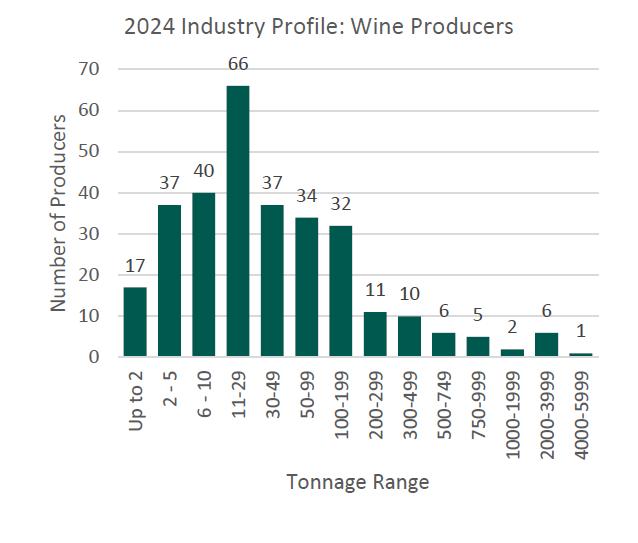
Most WA producers are small/medium by national parameters and our industry is skewed towards small business models.
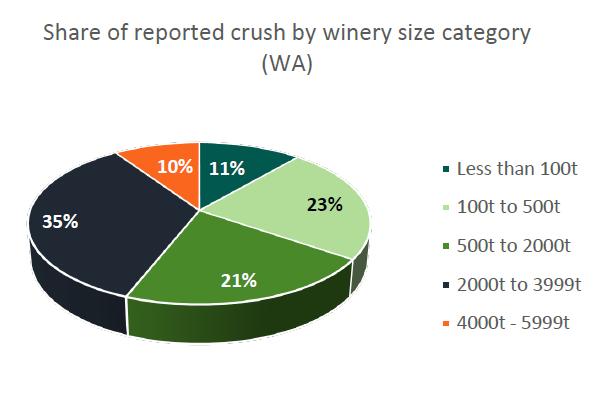
• 76% of producers are processing less than 100 tonnes annually and account for 11% of total production.
• 17% of producers are processing between 100 – 500 tonnes annually and account for 23% of total production.
• 6.5% of producers are processing over 500 tonnes annually and account for 66% of total production.
The Wine Producers Committee is working in partnership with Wines of WA and the APC to further utilise the vintage data that is captured so that insights can be made available to producers to assist in their medium to long term business planning.
Beyond production data collation, the APC fee-for-service funds a comprehensive set of state and regional services to producers, delivered in partnership by Wines of Western Australia and Regional Wine associations. Services include advancing a strong brand which enhances the reputation of Western Australian fine wine regions; expanding local, interstate and international market opportunities; supporting producers in research, development and education to build a sustainable industry and representing producers to positively influence regulation and policy matters. APC fee-forservice funds are often leveraged with state and federal government funding and resources to deliver these services.
Pippa Nielsen Chair of the Wine Producers Committee
About this Report
In Western Australia, a range of industry development, market development, consumer promotion and other services for the benefit of winegrape producers are funded through an Agricultural Produce Commission annual fee-for-service. The 2024/25 fee-for-service, due for payment mid-2024, is calculated based on the 2024 vintage. As part of the fee collection process, and to provide valuable market insight for fee-for-service payers, varietal data for the 2024 vintage collected from the from wine producers and the analysis of that data is presented in this report. The report is prepared based on the current data at the time of preparation, and accordingly, there may be minor and immaterial variances with prior vintage reports attributable to late / historical lodgements.
Producers may note that there are differences in the figures and trends reported when compared to the Wine Australia National Vintage Report for the same vintage. This is largely due to methodology and timing, with the National Vintage Report offering essential early insights based on a methodology relying on the voluntary survey, whereas the APC report is prepared based on actual production data reported for the vintage.
Disclaimer
This information has been made available to assist on the understanding that the Agricultural Produce Commission is not rendering professional advice. The Agricultural Produce Commission accepts no responsibility for the results of any actions taken based on the information contained in this report, nor for the accuracy, currency or completeness of any material contained in it. The Agricultural Produce Commission expressly disclaims all and any liability and responsibility to any person in respect of consequences of anything done in respect of reliance, whether wholly or in part, upon this report.
Vintage 2024: WA Industry Snapshot
Industry Participation: V2018 to V2024
The number of wine producers crushing grapes for Vintage 2024 remained steady.
The Western Australian industry is largely comprised of small wine businesses, with 76% of wine producers crushing less than 100 tonnes, accounting for 11% of the 2024 production.
2024 Industry Profile: Wine Grape Growers
Vintage 2024: State Summary
Figure 1: WA State Production Trend (by colour)
State
Production
(Tonnes)
Vintage 2024 saw a reduction in production levels with a total reported statewide production of 48,725 tonnes, slightly lower than the long-term average of 55,000 tonnes. A considerably warmer, dryer and longer summer than usual in Western Australia had an impact on production volumes in 2024. The drop in production was more noticeable in red varieties, than whites, with drops of 24% and 8%, respectively.
2: WA State Production Trend (by region) Table 1: Vintage 2024 Reported Production by Region (tonnes)
State Production (Tonnes) by Region
Figure
Red Varietals Production Summary
"Other" Reported Red Varieties
Vintage 2024
CABERNET SAUVIGNON SHIRAZ
MERLOT
MALBEC
TEMPRANILLO
SANGIOVESE
PINOT NOIR
GRENACHE
CABERNET FRANC
OTHER RED VARIETIES <100t each)
State production is still majority comprised of cabernet sauvignon and shiraz, accounting for 75% of the red varieties crushed.
Shiraz and Merlot production are showing a slight decreasing trend over the past 5 years, whereas Cabernet Sauvignon has remained consistent, with 80% of production arising from Margaret River.
The next six varieties are showing significant increase in production since data collection commenced in 2016, in particular Sangiovese, Tempranillo, and Grenache.
Trend Analysis: Red Production (WA)
Reds: Leading Varieties
Reds: Varieties >100 tonnes
CABERNET SAUVIGNON SHIRAZ MERLOT PINOT NOIR
MALBEC GRENACHE
TEMPRANILLO
CABERNET FRANC SANGIOVESE PETIT VERDOT
Red Varietals Dataset
White Varietals Production Summary
"Other" Reported White Varieties
SCHEUREBE
TRAMINER
ROUSSANNE
TREBBIANO
PEDRO XIMENEZ
ALBARINO
GRUNER VELTLINER
SAVIGNIN BLANC
SAUVIGNON BLANC CHARDONNAY
SEMILLON
RIESLING
PINOT GRIS
OTHER WHITE VARIETIES (<100t ea)
CHENIN BLANC
VERDELHO
MUSCADELLE
Sauvignon Blanc, Chardonnay and Semillon continue to account for a large portion of white grape production, being 83% of the total.
Chenin Blanc is continuing to be consistent as well, accounting for 14%, leaving 3% of 16+ other white varietals.
ARNEIS
VERDEJO
PROSECCO
MUSCAT BLANC A PETITS
GRAINS
GEWURTZTRAMINER
VERMINTINO
FIANO
VIOGNIER
Fiano and Vermentino have increased over 100% in production over the last 8 vintages and now make up 38% of the Other white varietal group.
Trend Analysis: White Production (WA)
Whites: Leading Varieties
Whites: Other Varieties
VERDELHO PINOT GRIS
MUSCADELLE
VIOGNIER FIANO VERMINTINO
White Varietals Dataset
Want to learn more? Access previous vintage reports at www.apcwa.org.au/research-library
Online: www.apcwa.org.au
Email: apcadmin@dpird.wa.gov.au
Phone: (08) 9368 3465
WA Wine Industry RDE Strategic Review
27 July 2021
Department of Primary Industries and Regional Development Verschuer Drive, Bunbury
SUMMARY AND OUPUTS
The purpose of the meeting was to explore the key challenges faced by WA wine producers and then develop a strategic framework to address these. The outputs confirm:
1. What are the challenges?
2. How can these be overcome?
3. Who can assist WA producers to do so?
4. When can the programs be implemented?
These outputs will be used to guide RD&E the resources allocated by WA wine producers in partnership with the WA state government, Wine Australia and the relevant research service providers.
Members of the Wines of WA Technical Committee, representatives from all WA wine regions, WoWA Board members and WA based RDE researchers/service providers and key DPIRD personnel participated in the meeting.
The group first reviewed the 2014-24 WA Wine Industry Strategic Plan and 2017 RD&E Strategic Review Outputs. It was agreed that the broad themes regarding RD&E outlined in these documents remain relevant. Confirming the industry’s strategic direction has been consistent and focused on the medium/long-term challenges and opportunities that will enable innovation and sustainable growth.
Input from Australian Grape and Wine (AGW) and Wine Australia (AGWA) confirmed the need for a strategic national approach in allocating resources and funding from federal levies and research & development corporations (RDCs). Additionally, the federal government has requested that all agricultural RDCs collaborate to ensure cross-sector projects, further leverage levy funding. The RDC’s focus going forward will move towards facilitating adoption and commercialisation to drive innovation and sustainable growth.
For wine industry levies specifically, it was noted that there will be less allocated to Strategic Partnership Agreements (SPAs), with more competitive grants for state/region specific projects It should be noted, the amount of federal levies available will decrease over coming years, increasing the need for an over-arching national strategic framework that guides the allocation of levies.
AGW and AGWA have been consulting broadly with state/regional bodies, a draft discussion paper has been circulated to encourage a national approach to RDE priorities.
WA Wine Industry RDE Strategic Review
27 July 2021
Department of Primary Industries and Regional Development
Verschuer Drive, Bunbury
SUMMARY AND OUPUTS
RDE Strategic Focus Areas
1. Understanding the intricacies of provenance and the fine wine regions of WA Wines of WA Strategic Plan 2014-24 is focused on improving our fine wine quality, and the distinctive qualities of our fine wine regions. Understanding what makes a wine region unique is important to both producers and consumers, particularly those regions producing iconic wines. A greater understanding of the interaction of climatic and geophysical aspects on wine composition and sensory attributes is essential in verifying provenance, guiding future vineyard developments, improving quality and our competitive advantage in the market. This information will become a powerful tool to communicate throughout our value chain/s the uniqueness and value of WA provincial wines from a scientific basis. Funding and resourcing for this project has been confirmed under the Export Growth Partnership with the WA government. The project will be delivered by DPIRD in partnership with Margaret River and Great Southern wine regions initially and other regions subsequently
2. Supporting WA producers to adopt Sustainable Winegrowing Australia (SWA)
- Why: WoWA is of the view that the WA wine industry can be world leaders in sustainability. Supporting an evidence-based approach to sustainability will improve the viability of our grape and wine businesses and enhance our competitive advantage, as well as addressing our social license to operate. It’s for these reasons that the Wine of WA Strategic Plan supports the SWA certification of all grape growers and wine makers by 2030.
- What: SWA is the national program for grape growers and winemakers to demonstrate and continuously improve the sustainability of vineyards and wineries through the environmental, social, and economic aspects of their businesses
- How: An Industry Development Officer (IDO) to support growers/producers to adopt SWA and implement it into their business practises
- Who: A partnership between WA wine industry, AGWA and DPIRD to support an IDO, with direct links to the national SWA program
- When: Immediate start
- Success: 100% members and 60% certified in 5 years
3. Supporting WA producers to adopt on-farm biosecurity practises
- Why: A key component of our unique value proposition or competitive advantage is our freedom from many pests and diseases. Less pests and diseases leads to reduced inputs and improves the quality of our fine wines. Protecting this important competitive advantage is critical. WoWA identified this as one of their top 5 priorities in the WoWA Strategic Plan 2014-24
- What: To protect our competitive advantage and build on it its was recognised that that we needed to increase the awareness and application of best practise biosecurity at the farm level.
27 July 2021
Department of Primary Industries and Regional Development Verschuer Drive, Bunbury
SUMMARY AND OUPUTS
- How: An Industry Development Officer (IDO) to support and drive the implementation of on-farm biosecurity best practise
- Who: A partnership between WA wine industry, AGWA and DPIRD to fund/resource an IDO, with direct links to the national SWA program
- When: Immediate start
- Success: Within 5 years 80% of vineyards and winemakers have implemented the industry agreed on-farm best practice biosecurity functions.
4. Why are vineyard yields declining in WA?
- Why: As a result of broad industry consultation and feedback it is acknowledged that many vineyards in WA are declining in yield. In most wine growing areas in the world plantings are replaced every 20 to 25yrs through rotational establishment programs. In WA most vineyards were established 20 to 25 years ago. This has the WA industry confronted with a unique situation. The issue being when to replace the vines. A diagnostic approach to addressing the decline in yield would help determine the priority areas for replacement. As well as how best to manage the remaining vines to obtain optimum production from them for the remainder of their lives.
- What: Vineyard yield is declining across most regions. A program to determine why and how to address this is required. As well as a strategy to replace the vines in the best sequence to optimise production and returns.
- How: Case studies at farm level across regions to investigate the cause of yield decline. Agronomist to review economics of various mitigation strategies to address issue effectively.
- Who: DPIRD/industry
- When: immediate start
- Success: In 5 years, 50% of grape growers are applying the knowledge to effectively address the factors contributing to yield decline in vines. They know how to determine when vines need to be replaced, and how to optimise the yield of existing vines waiting to be replaced. This is supported by economic modelling, and decision support tools that growers interact with to determine the critical intervention points. Every year at least 20% of the total area to vines is replanted to new root stock.
5. Why is the adoption of RD&E so low by WA Wine industry?
- Why: RD&E conducted for an industry that is not adopted is of little value to that industry. The WA Wine industry wants to grow and be sustainable into the future, however it recognises that the adaption and implementation rate of many of the technologies developed by the RDCs is low amongst the WA levy payers.
- What: Often there are very logical reasons while growers are not applying these technologies. Identifying these constraints and barriers will enable the industry to be more innovative and productive going forward.
- How: PhD project looking at why current technologies are not be adopted by growers. It will focus on the perceived barriers and constraints to the adoption of the key technologies, and how these can best be overcome.
- A second PhD project will look at who are the influential people in the industry across a range of key topics and map the these out This study will also look at how growers want to be supported to take on new technologies. As well as what
27 July 2021
Department of Primary Industries and Regional Development Verschuer Drive, Bunbury
SUMMARY AND OUPUTS
publications they read to understand the new technologies available and how to assess if they worth employing. review current adoption strategies and examples of best practise models in other regions (Napa, NZ) and industries. An IDO to oversee and implement recommendations.
- Who: Murdoch, UWA, WA wine industry, AGWA/AWRI, ASVO and DPIRD
- When: Immediate start
- Success: In 5 years (50% of growers) widespread implementation on-farm of at least three key technologies that are not currently widely adopted across the industry. This could include on-farm biosecurity, sustainability certification and strategies to address vineyard yield declines.
6. Rapid access to new genetic plant material
- Why: Access to large volumes of new genetic material at comparable costs to the eastern states is essential to ensuring the WA industry is able to response rapidly to emerging consumer trends, and take on disease resistant, and improved quality/yielding lines/varieties. An inability to access this material will result in reduced plantings, greater risk with new plantings not having resistance and/or yield and quality improvements. This would result in the WA industry losing its competitive advantage and/or market share over time, with the industry becoming unviable in the medium term.
- It is well recognised and acknowledged that protecting the WA industry from additional pests and diseases is critical. That is why it’s imperative that access to new genetic plant material doesn’t compromise this position, but it’s cost effective, and the risks have been effectively mitigated ensuring our pristine environment is not compromised.
- What: WA growers do not have the same access to enough quality plant material compared to other state and countries. This has limited innovation, renewal, and growth of vineyards.
- How: Advocate for policy change to allow direct importation of quality plant material from certified national and international providers
- Who: WoWA and DPIRD
- When: Immediately
- Success: Within 12 months, producers have rapid access to the required plant material. A process is in place to enable large volumes and range of varieties/lines of pest and disease free material to enter the state in a timely manner at reasonable cost to the growers.
We acknowledge all Traditional Custodians of the Noongar/Bibbulman Nation of Western Australia on which we grow and make our wines. We pay our respects to Elders past and present, and recognise their continuing connection to land, waters and culture.
VISION 7 WESTERN AUSTRALIAN WINE REGIONS – ESSENTIAL INSIGHTS
11 Beulah Wines: Pioneering sustainable practices in an emerging wine region
14 WESTERN AUSTRALIA’S CARBON FOOTPRINT BASELINE – 2021 VINTAGE
19 From Climate Science to Farm-Gate Solutions: WA Wine Industry Collaboration Pilots Data-Driven Adaptation
22 SUSTAINABLE WINEGROWING AUSTRALIA: WA BENCHMARKS
24 Water Smart Viticulture at Aylesbury Estate
26 DRIVING SUSTAINABILITY IN WESTERN AUSTRALIAN WINE 2024-2025 PROGRAM
28 Cherubino Wines: Water-Focused Soil Management Achieves Carbon Negative Status
Margaret River Wine Region: Leading Through Strategic Partnership
OUR PATH FORWARD: FROM BASELINE TO ACTION
OUR ROADMAP TO 2029 35 ACKNOWLEDGEMENTS
FOREWORD
Message from Wines of WA CEO
Wines of Western Australia (WoWA) was established in 1987. As the peak representative organisation for wine producers in the State our mission is to provide a unified, strategically influential voice that creates opportunities for the fine wine regions and producers of Western Australia.
Working with industry and key stakeholders, WoWA developed the Strategic Plan for the Western Australian Wine Industry 20242034, which has provided the framework for funding partnerships with Wine Australia and the WA state government. The Wine Industry Partnership (WIP) with the Department of Primary Industries and Regional Development (DPIRD) focuses on developing high value domestic and international markets and supporting producers to adopt world’s best practise growing and production methods to achieve an aim to be recognised as one of the top ten regions internationally for sustainable wine production.
The Western Australian wine industry stands at a pivotal moment. Our pristine environment and unique terroir have long been our competitive advantage, but today’s global market demands more than exceptional quality wines – it requires demonstrable commitment to environmental stewardship, social responsibility, and economic resilience.
The Western Australian Wine Industry Sustainability Strategy 2025-2029 – Building a Resilient Future marks a transformative step for our industry. Building on the foundations established in our Strategic Plan for the Western Australian Wine Industry 2024-2034, this initiative positions sustainability as one of five strategic priorities that will define our future.
Our commitment extends beyond compliance. We are targeting ambitious goals: 75% of producers certified under
internationally recognised sustainability standards by 2029, 40% reduction in carbon emissions by 2030, and recognition as one of the world’s top ten regions for sustainable wine production. Through feedback gained over the past 12 months these aspirational targets are supported by detailed implementation plans, dedicated funding, and collaborative partnerships across government, industry, and research institutions.
This inaugural Sustainability Report sets the baseline and outlines how Western Australian winegrowers and producers can lead through innovation and collaboration. From the Margaret River region’s pioneering sustainability program to emerging regions embracing climate-smart practices, we are creating a model for sustainable wine production that respects our unique environment while ensuring long-term economic viability.
In the face of climate change, evolving market expectations, and increasing global competition, our focus on sustainability is not just an environmental imperative – it’s a business necessity.
This strategy represents our commitment to preserving Western Australia’s natural advantages while building the skills, technologies, and partnerships needed to thrive in a changing world.
Larry Jorgensen Chief Executive Officer Wines of Western Australia
To be recognised for our sustainability by becoming international leaders in sustainable wine production by targeting
The highest share of growers and producers in Australia who are accredited sustainable producers to international standards, and
Consumers recognise Western Australia as one of the top ten regions internationally for sustainable fine wine production.
Beulah Wines, Blackwood Valley Wine Region.
Western Australia’s wine industry is committed to enhancing industry sustainability to support growth and investment across the value chain. We are ensuring that Western Australia’s fine wine regions remain viable, dynamic, and responsible, while continuing to produce the renowned fine wines they are known for.
Our approach to sustainability encompasses:
Environmental Stewardship
Implementing climate-adaptive practices, reducing carbon emissions, enhancing biodiversity, conserving water resources, improving soil health and minimising waste across the value chain while ensuring resource efficiency contributes to long-term economic viability.
Social Responsibility
Building industry resilience through workforce development, supporting regional communities, ensuring workplace safety, fostering diversity and inclusion, creating sustainable livelihoods and engaging with First Nations knowledge and participation.
Economic Resilience
Building the capacity of wine businesses and the broader industry to maintain profitability, adapt to market disruptions, and invest in long-term sustainability while preserving the premium positioning that differentiates WA wines globally.
Governance
Establishing transparent leadership structures and ethical business practices that ensure accountability, regulatory compliance, and responsible risk management while driving innovation and creating enduring value throughout the supply chain.
This report establishes our baseline performance and sets out our strategic direction for the next five years, in alignment with Wine Australia’s Safeguarding the Future for Australian Wine, An Emissions Reduction Roadmap, September 2023 [1] and the principles of Australian Grape and Wine’s One Grape & Wine Sector Plan, Resetting the path to Vision 2050. [2] Through collective action and a shared vision, we are working to position Western Australia as a global leader in sustainable winegrowing.
WESTERN AUSTRALIAN WINE REGIONS – ESSENTIAL INSIGHTS
Western Australia’s wine regions are founded on scientifically documented natural advantages detailed in DPIRD’s comprehensive analysis Geology, soils and Climate of Western Australia’s wine regions.[4] While these advantages are extraordinary, they require proactive stewardship to maintain their competitive edge.
essential. Open ocean and the Nullabor Plain create natural biosecurity barriers, keeping Western Australia phylloxera-free. However, increasing global trade and climate pressures make isolation alone insufficient, requiring proactive biosecurity protocols as essential, not optional, responses.
Ancient geological foundation offers unique terroir potential.
Western Australia’s wine regions are established over some of Earth’s oldest bedrock. Almost 70% of our wine regions sit over rocks older than 600 million years, with about 40% of vines growing over rocks older than 1 billion years. The Yilgarn Craton (2.6+ billion years old), Albany-Fraser Orogen (1.1 billion years old), and Leeuwin Complex (up to 1 billion years old) provide distinct geological signatures across regions. This ancient foundation creates weathered soil profiles and unique mineral compositions rarely found in global wine regions but requires understanding of regional geological diversity for optimal site selection.
Mediterranean climate under measurable pressure.
Our Mediterraneaninfluenced climates historically supported premium wine production, but this advantage is actively eroding. Southwestern WA has experienced 10-20% winter rainfall decline since the 1970s, with June and July rainfall declining up to 20% since the mid-1970s - the largest regional decline in Australia. Growing degree day accumulations show warming trends across regions, with some areas exceeding optimal ranges for traditional varieties. Our climate advantage depends on immediate adaptation strategies, not passive reliance on historical patterns.
Southwest Australia Global Biodiversity Hotspot status creates opportunity with obligation.
Six of our nine wine regions lie within this globally recognised hotspot, supporting over 4,000 endemic plant species with 49% found nowhere else on Earth. With only 30% of original vegetation remaining and continuing habitat pressure, our biodiversity advantage requires active regenerative practices and landscape stewardship across all regions.
Diverse soil landscapes from ancient weathering.
Each region offers distinct soil expressions from deep weathering of ancient bedrock: Margaret River’s ironstone gravels over Leeuwin Complex granite; Great Southern’s diverse soils spanning Yilgarn Craton and AlbanyFraser Orogen; Perth Hills’ metamorphic complex soils from Jimperding and Chittering formations; Pemberton’s coolclimate ironstone gravels and red-brown loams across multiple geological units; Geographe’s mixed Yilgarn Craton and Perth Basin sediment soils; Swan District’s alluvial plains and coastal dune systems; and Blackwood Valley, Manjimup, and Peel’s characteristic Yilgarn Craton-derived profiles. These lateritic formations and deep weathering profiles create unique terroir expressions but require region-specific management approaches for optimal vineyard performance.
COLLABORATIVE INNOVATION:
GOVERNMENT-INDUSTRY PARTNERSHIP
DRIVES WINE SUSTAINABILITY
Regions: Great Southern and Margaret River
The WA Government’s Shoestring Digital program, led by DPIRD in collaboration with the University of Cambridge, North Metropolitan TAFE and local service providers, is transforming wine industry sustainability through low-cost digital monitoring solutions under AU$600. Assisting SME producers who want to start or enhance their sustainability journey, the program offers a suite of digital solutions including power, temperature and efficiency monitoring, with comprehensive technical support provided.
Scalability Across Operations
Three WA wineries demonstrate the program’s adaptability across different scales, driven by varied motivators including Sustainable Winegrowing Australia certification requirements, environmental performance improvement goals, and the need for affordable technical solutions. “The Shoestring Digital approach is easily scalable depending on what outcomes you’re after,” explains Sam Palmer, Winemaker at Castle Rock Estate (~280 tonnes capacity), who implemented power meter readers to isolate winery consumption for Sustainable Winegrowing Australia reporting.
Fraser Gallop Estate (300 tonnes capacity) focused on chiller monitoring to understand their largest electricity consumer. “We are continually looking for practical ways to improve our environmental performance while maintaining the quality and character of our wines,” says Head Winemaker Ellin Tritt, highlighting energy use optimisation opportunities from equipment shutdown during non-operating hours to peak-pricing avoidance.
Heytesbury Wine Group, includes Vasse Felix and Idée Fixe wineries (combined capacity of ~2,250 tonnes), deployed comprehensive monitoring across both facilities. “We have reduced our air conditioning run times in
our warehouse by up to 4-6 hours a day and now run to conditions and timers to maintain steady temperature,” reports Brent Carter, Sustainability and Compliance Officer.
Sustainability Outcomes
Early results demonstrate measurable improvements. Fraser Gallop Estate’s monitoring identifies seven energy efficiency opportunities, whilst Castle Rock Estate’s data supports renewable energy investment decisions. Vasse Felix’s warehouse optimisation illustrates immediate energy savings through condition-based operation.
Future Impact
These producers position digital innovation as fundamental to industry sustainability. “Digital data is the only way to provide the required information to drive and justify improvement, especially as we all work towards net zero goals,” emphasises Carter.
Palmer reinforces the industry leadership imperative: “The success and longevity of our industry is dependent on our ability to establish rigorous sustainability practices.”
The Shoestring Digital program demonstrates how accessible technology enables WA wine producers to build data-driven sustainability foundations supporting the industry’s goal of recognition as one of the top ten sustainable wine regions globally by 2034.
Want more information? Email foodindustryinnovation@dpird.wa.gov.au to start your Shoestring Digital Solution today.
BEULAH WINES: PIONEERING SUSTAINABLE PRACTICES IN AN EMERGING WINE REGION
Region: Blackwood Valley
What began as a creek rehabilitation project in 2007 at Beulah Wines in Boyup Brook, Blackwood Valley, has evolved into an 18-year showcase of integrated farming demonstrating how environmental restoration drives business innovation. The Nield Family’s transformation of degraded waterways across their 500-hectare property created thriving native ecosystems while establishing a commercial native seed production enterprise, proving that wine, livestock and environmental enterprises operate as mutually reinforcing systems.
The Transformation
Initial Investment (2007-2011)
• Total funding: $25,460 (Groundworks Southwest Land Management Program + $3,600 farm contribution)
• Area rehabilitated: 12 hectares across three creek line locations
• Cost effectiveness: $2,000 per hectare
• Native species planted: Over 15 species including 4500+ individual plants and 6kg of seed for direct seeding
• Methods: Strategic fencing, livestock exclusion, direct seeding, tree planting
The species selection was comprehensive and locally appropriate, including significant plantings of Eucalyptus wandoo (2,000 plants), Eucalyptus maculata (2,000 plants), and Acacia saligna, Acacia extensa (direct seeded), alongside smaller quantities of specialised species such as Melalecua, Banksia species, and various understory plants selected for specific soil and moisture conditions.
Comparison of rehabilitated area. Image (a) taken in 2010 prior to direct seeding and native seedling plantings, while image (b) is a panoramic view taken in June 2025 showing significant establishment of grasses, shrubs and trees, resulting in erosion control, improved water retention and wildlife corridors.
Proven Outcomes
Environmental Performance By 2011, rehabilitated areas showed established vegetation communities with high survival rates. Strategic use of Acacia saligna provided excellent early ground cover and erosion control, naturally dying after 5-7 years to allow eucalyptus and melaleucas to establish. Today, high-density self-sown melaleucas flourish along creek lines, matching natural bush patterns nearby.
The rehabilitated areas now retain water in the lower landscape, improving water quality and providing pumping options during dry seasons that enhance drought resilience. Biodiversity improvements include increased populations of small birds (wrens, robins), regular red-tailed black cockatoo visits, and gilgies (freshwater crustacea) returning to the creek system. Wildlife corridors now connect rehabilitated areas to remnant bush, enhancing landscapescale conservation.
Exceptional Cost-Effectiveness
The project’s financial sustainability is impressive. Annual maintenance costs have averaged just $500 per year – primarily for fence repairs and spot spraying – totalling approximately $7,000 over 14 years compared to the original $25,460 investment. This represents negligible ongoing costs while delivering sustained environmental and business benefits.
Business Innovation
The Nields developed environmental expertise in trialling a native seed production orchard, plus utilising rehabilitated areas as seed sources. A commercial planting of Kunzea pomifera (Muntries) supplies fresh, frozen and freeze-dried berries to premium suppliers like Fervor events. This demonstrates market demand for sustainably produced native products. Wine production operates with minimal chemical inputs and zero pesticides. While reviewing the suitability of Australian Wool Sustainability Scheme certification alongside exploring synergies with other certification schemes that share similar sustainability pillars, the Nields are avoiding duplication while building comprehensive credentials.
Industry Influence and Adaptive Management
The spectacular everlasting daisies flourishing in Beulah’s rehabilitated areas captured industry attention beyond Western Australia. Skillogalee Estate in Clare Valley successfully trialled the wildflower approach in vineyard mid-rows in 2024 through the EcoVineyards program, with winemaker Kerri Thompson “gobsmacked” at their performance in extremely dry conditions.
The 2023-24 drought provided a practical resilience test. When feed became scarce, Craig strategically grazed sheep in a 3-hectare section – the first time such management was considered. Light grazing didn’t significantly impact rehabilitation, while areas holding water and maintaining green native grasses through summer provided valuable drought protection. This experience now informs developing comprehensive land management protocols for both drought resilience and innovative fire management strategies, including mosaic burning techniques that could enhance longterm ecosystem health.
Integrated Innovation and Industry Leadership
Beulah Wines operates as a fully integrated system where creek rehabilitation supports vineyard sustainability, livestock drought resilience, and commercial seed production. Technology adoption includes photo-point monitoring, drone footage, weather monitoring, and sustainable practices like reduced plastic use and non-mulesed sheep management.
The sustainability philosophy has extended through the generations, with both Craig and Jodi’s parents adopting environmental practices into their respective farming enterprises, and both Nield children actively engaged in discussions and decision-making, despite pursuing alternative career paths. This ensures continuity while bringing fresh perspectives across the diverse enterprises. The 18-year journey reveals critical success factors: costeffective restoration at $2,000/ha with minimal maintenance, revenue diversification, and whole-farm integration generating operational synergies.
Based on this success, expansion plans include additional rehabilitation work, increased seed production, continued pasture improvement and deep-rooted cover crops. For other producers, key recommendations are: “Look at what works in your local area, use endemic species where possible, and remember that environmental benefits are positive.” Most significantly, successful knowledge transfer to interstate wine producers demonstrates scalability.
As Western Australia’s wine industry works toward recognition as one of the world’s top ten sustainable wine regions by 2034, Beulah Wines provides a practical model for future-proofing operations while enhancing natural landscapes.
Taken June 2025. Left hand image looking south through rehabilitated creek-line with livestock excluded since 2007. Right hand image looking north along adjacent creek-line where livestock have not been excluded.
Spectacular native everlastings, Rhodanthe chloreocephala spp rosea, planted mid-row at Beulah Wines in 2023.
WESTERN AUSTRALIA’S CARBON FOOTPRINT BASELINE – 2021 VINTAGE
Western Australia’s wine industry has taken its first decisive step toward sustainability leadership by establishing a comprehensive carbon emissions baseline using data from Wine Australia’s Safeguarding the future for Australian Wine, An Emissions Reduction Roadmap, September 2023. [1] While this 2021 assessment of 160,736 tonnes of carbon dioxide equivalent (tCO₂e) represents our best available data foundation, it acknowledges important gaps that create clear opportunities for enhanced measurement and targeted action through the Western Australian Wine Industry Sustainability Strategy 2025-2029 – Building a Resilient Future This baseline isn’t just about numbers – it’s about WA’s commitment to becoming Australia’s sustainability leader while protecting our premium wine reputation for future generations.
What the data tells us:
• Total Emissions: 160,736 tCO₂e
• Carbon intensity: 2.970 tCO₂e per tonne of grapes - above international benchmarks but with clear pathways for improvement
• Biggest opportunity: Packaging represents 41% of total emissions, with Margaret River’s lightweight glass initiative already showing the way forward
• Hidden strength: Lower electricity intensity (9% vs 13% nationally) reveals strong foundation for renewable energy expansion
• Collaboration potential: 77% of emissions occur in our value chain, creating significant opportunities through partnerships with suppliers and distributors
This baseline establishes a credible starting point for WA to pursue the highest share of certified sustainable producers in Australia while building international recognition as a sustainable fine wine region – turning our challenges into competitive advantages.
Methodology and Scope
This baseline represents Western Australia’s first systematic assessment of wine industry emissions, built on primary data from approximately 35-40% of industry businesses (primarily Sustainable Winegrowing Australia participants) and extrapolated using Wine Australia’s total hectare and production statistics.[1] While this provides reasonable business representation, the production volume share represented by participants is unknown, and Sustainable Winegrowing Australia participants may not reflect broader industry practices.
Where WA-specific data was unavailable, national averages and international benchmarks were applied following international best practice. The assessment covers all nine wine regions across Western Australia’s entire value chain, from vineyard operations through to end-of-life packaging disposal.
This approach establishes a credible foundation for tracking sustainability progress and enables targeted regional initiatives. Most importantly, it demonstrates our commitment to transparency and continuous improvement as we work toward our 2030 emission reduction targets.
Figure 1. Western Australian wine industry emissions by scope (a) Total, (b) Vineyard, and (c) Winery. [1]
Total Western Australia Wine Industry Emissions Profile
Carbon Intensity Metrics
Carbon intensity is total carbon emissions (tCO₂e) divided by tonnes of grapes harvested. In 2021 WA produced 160,736 tCO₂e from 54,116 tonnes production, harvested off 10,784 ha.
• Per Hectare: 14.9 tCO₂e per hectare of vineyard
• Per Tonne of Grapes: 2.970 tCO₂e per tonne of grapes harvested*
• Per Bottle: Approximately 3.2 to 3.4 kg CO₂e per 750mL bottle of wine produced**
* Primary industry metric for vineyard and wine production analysis.
** Based on assumed extraction of 700 and 650 L per tonne grapes (vine to bottle) respectively for production of premium wine.
Strategic Position: Western Australia vs National Performance
Carbon Intensity Comparison
Western Australia’s carbon intensity of 2.970 tCO₂e per tonne compares to the national average of 0.949 tCO₂e per tonne (1,927,072 tCO₂e from 2.03 million tonnes production), representing a significant opportunity for targeted intervention. This intensity difference reflects WA’s unique market positioning as a premium, export (domestic and international) focused wine region in a geographically isolated location. Rather than seeing this as a disadvantage, it highlights our potential for leadership in sustainable premium wine production.
Our higher baseline means every improvement delivers greater impact. When combined with our strengths in renewable energy efficiency and packaging innovation such as Margaret River’s lightweight glass initiative, we’re positioned to demonstrate that premium wine regions can achieve dramatic emissions reductions while maintaining quality and export competitiveness.
Table 2. Emissions scope performance comparison: Western Australian wine industry compared with the 2021 national average. [1]
Figure 2. Western Australian wine industry emissions profile by source for wineries (a) and vineyards (b). [1]
Primary Emissions Sources
Packaging Dominates (41% of total emissions) Glass and packaging represents the single largest contributor at 60,892 tCO₂e (38% of total), with related transport and distribution adding 43,126 tCO₂e (27%). This 65% combined impact highlights packaging as the critical intervention point for emissions reduction.
Value Chain Intensity Scope 3 emissions represent 77% of WA’s footprint, significantly higher than the national average of 73%, indicating that WA’s wine industry is more dependent on external suppliers and logistics networks. This value chain intensity creates both challenges and opportunities across multiple categories:
Vineyard Dependencies (14,474 tCO₂e total): Chemical inputs dominate at 13,790 tCO₂e, representing 58% of total vineyard emissions and 2.1 times higher than direct fuel combustion. This heavy reliance on purchased chemicals and other inputs highlights significant opportunities for sustainable procurement strategies and integrated pest management approaches.
Supply Chain Leverage: The concentration of emissions in packaging and chemical supply chains means WA’s emission reduction success depends heavily on supplier partnerships and industry collaboration. Unlike regions with higher direct operational emissions, WA’s pathway to sustainability leadership requires coordinating action across multiple external partners –positioning the industry to drive broader supply chain transformation that extends well beyond regional boundaries and influences global wine industry practices.
Operational Efficiency Potential Fuel combustion represents the largest operational emission source at 8,438 tCO₂e, split between vineyard operations (6,468 tCO₂e) and winery operations (1,970 tCO₂e), with additional sources including refrigerants (913 tCO₂e), fertilisers (934 tCO₂e), and crop residues (247 tCO₂e). Immediate efficiency opportunities focus on fuel optimisation through equipment upgrades, precision agriculture technologies, and operational scheduling improvements, while refrigerant management and fertiliser application efficiency present additional quick-win opportunities for emission reductions and improved cost-effectiveness.
Fermentation processes generate 12,241 tCO₂e and make up part of biogenic emissions, along with carbon sequestration, in wineries and vineyards. They are not included within the baseline emissions calculation within the Australian grape and wine sector [1] but have been highlighted to illustrate their contribution and the opportunity for carbon dioxide capture.
Next Steps and Continuous Improvement
As the industry implements the sustainability strategy, data collection will expand across all regions and operation types, enhancing accuracy of future reporting and enabling more targeted regional initiatives. This baseline should be viewed as the definitive starting point for measuring progress toward 2030 emission reduction targets, with annual updates planned to track improvement and refine reduction strategies.
The comprehensive nature of this assessment, combined with Western Australian Wine Industry Sustainability Strategy 2025-2029 – Building a Resilient Future, positions the Western Australian wine industry to achieve its goal of becoming international leaders in sustainable wine production while maintaining the premium positioning that drives export success.
FROM CLIMATE SCIENCE TO FARM-GATE SOLUTIONS: WA WINE
INDUSTRY COLLABORATION PILOTS DATA-DRIVEN ADAPTATION
Region: Great Southern
“Climate change is already accelerating ripening. The 2024 harvest was brought forward by nearly three weeks,” observed Murray Gomm from Oranje Tractor Wine. While an outlying season, Murray’s observation captures what producers across Western Australia are experiencing firsthand – the subtle but undeniable shifts that signal deeper transformations unfolding in our vineyards.
Industry-Driven
Innovation Delivers Practical Solutions
This observation sparked an innovative collaboration that’s redefining how our wine sector approaches climate adaptation. Led by ARCA Sustainability’s founder Isidora Bianchi, the Climate Resilience Assessment Pilot 1 represents the industry’s response to a critical gap – translating cutting-edge climate science into actionable business intelligence.
Significantly, this pilot project was principally self-funded by participants seeking practical solutions, demonstrating genuine industry commitment to evidence-based adaptation. The collaboration brings together Oranje Tractor Wine’s 3.16-hectare Albany operation, founded by Murray Gomm and Pamela Lincoln in 1998, with Chalari Wines, established in 2017 by Alexi Christidis, creating a comprehensive vineyard-to-winery assessment model.
The platform combines satellite imagery, artificial intelligence, and over 200 peerreviewed studies to deliver location-specific climate risk and opportunity assessments.
“The gap isn’t just about access to climate science, but about translating that science into actionable, economically viable decisionmaking tools,” Bianchi explains.
Phase 1 – the Pilot Project
Oranje Tractors’ regenerative agriculture approach to viticulture positions the vineyard as a low carbon operator, actively sequestering carbon through soil health practices. Meanwhile, Chalari Wines’ minimal intervention winemaking processes and comprehensive renewable energy sourcing strategies create a synergistic sustainability model that extends from vineyard to cellar. This integrated approach delivers measurable environmental benefits, achieving a carbon footprint of just 0.9 kgCO2eq per wine bottle – considerably below the national average.
Figure 3. Total carbon emissions for Oranje Tractor Wine across vineyard and wine production.
However, pressing adaptation needs emerged. The property’s natural water source has diminished by 50% in the past year alone, forcing exploration of alternative irrigation solutions. “Vines are smaller,” Murray notes, capturing measurable changes in growth patterns reflecting shifting growing conditions. Meanwhile, the warming of winter seasons is projected to disrupt the vines’ essential dormancy chilling hours, threatening fruit quality and yield consistency.
“No matter the size of your business, investing in climate adaptation today is critical to future proof your business tomorrow”
The assessment identified location-specific opportunities alongside risks across the region. For example, in Great Southern’s Frankland River region, traditional frost risks will decrease while sunburn necrosis is projected to increase substantially. For Oranje Tractor’s Albany location, their later-ripening varieties will benefit from projected warming, provided water availability remains sufficient. The vineyard’s high soil organic carbon levels (5%) and established regenerative practices provide natural resilience against heat stress and hydrological extremes. These soil health investments create a buffer against climate variability, improving water retention capacity and supporting vine stress tolerance.
Advancing WA Wine Industry Strategic Objectives
This pilot project directly supports the WA Wine Industry Sustainability Strategic Plan 20252029, advancing business resilience through climate adaptation and driving industry innovation through strategic R&D partnerships. The successful Phase 1 aligns with emissions reduction goals and supports increasing sustainability certification by 40% statewide.
Phase 2: Climate Resilience Project
Extension will advance the platform to an actionable minimum viable product with integrated climate reporting and monitoring capabilities.
Phase 3: Scalable
SaaS Platform represents full realisation of a climate strategy roadmap with AI capabilities integration, extending coverage to across all WA wine regions and other sectors.
However, ARCA Sustainability’s limited development capacity creates a strategic decision point. Strong interest from broadacre agriculture and other climate-vulnerable sectors means the team must prioritise the industry demonstrating strongest commitment. The wine industry’s participation in Phase 2 will determine whether we secure access to purpose-built climate adaptation tools supporting our strategic sustainability objectives, or whether these resources are redirected to more responsive agricultural sectors.
Industry response will determine whether WA wine sustains its competitive advantage in climate-smart viticulture essential for achieving our 2025-2029 strategic goals.
Expressions of interest for Phase 2 participation can contact Isidora Bianchi at ARCA Sustainability for more information email: ibianchi@arcasustain.com.au
Figure 5. Climate resilience physical risk and opportunity assessment matrix – likelihood versus impact analysis
Figure 4. Carbon emissions profile for grape growing and winemaking operations at Oranje Tractor Wines (Total: 5,826 kgCO2e)
SUSTAINABLE WINEGROWING AUSTRALIA: WA BENCHMARKS
Key Highlights:
• Winery certification: 85% (22 of 26 members certified)
• Vineyard certification: 77% (86 of 112 members certified)
Western Australia demonstrates strong leadership in sustainable winegrowing with 75% of all members certified (110 certified, 36 members, 146 total) as of June 2025.
[5] While direct comparison is limited by different reporting periods, this certification rate substantially exceeds the 55% national average reported in Sustainable Winegrowing Australia’s Impact Report 2024 [6], suggesting WA’s continued leadership trajectory in sustainability adoption. WA represents 5,088 hectares of certified and member vineyard area with 30,307 tonnes of grapes crushed by member wineries. [7]
WA Membership Profile
• Regional concentration: Margaret River dominates with 87 vineyard members and 24 winery members
• Industry representation & scale opportunity: 82% of WA’s wine operations produce <150 tonnes annually, current Sustainable Winegrowing Australia membership captures predominantly mid to larger scale producers. This indicates substantial growth potential to engage the state’s many small-scale operations, however, based on feedback from WoWA’s 2024 Sustainability Survey the challenge to adoption lies in delivery of an affordable end-to-end management tool.
WA Member Performance Highlights
Based on data collected through Sustainable Winegrowing Australia, Western Australian producers demonstrate strong performance across key sustainability areas:
& Emissions
• 16% of vineyard members generate renewable energy onsite
• 52% of winery members generate renewable energy onsite
• Total renewable generation: 1.75 million kWh (vineyards and wineries combined)
Water Management
• 94% of vineyards use efficient drip irrigation systems
• Strong regional adaptation with Great Southern achieving 40% lower water usage per hectare compared to the WA average (0.77 ML/ ha vs 1.30 ML/ha)
Biodiversity
• 79% of vineyard members actively protect and enhance biodiversity
• 1,609 hectares dedicated to biodiversity conservation
• 32% of members participate in off-farm biodiversity projects
• Water source independence with 99.9% from surface water dams (79%), groundwater (13%), and river water (8%) Waste Management
WA’s impressive 75% certification rate demonstrates strong industry commitment to sustainability, though data analysis revealed several opportunities that could strengthen our impact measurement and national influence. Current reporting limitations include confidentiality protocols that prevent regional analysis where fewer than 5 members exist (such as Great Southern wineries), limited availability of disaggregated national benchmarks for meaningful state comparisons, and emphasis on practice adoption rather than environmental outcome metrics.
• 77% of vineyard members implement waste recycling programs
• 92% of winery members recycle non-organic waste
• 64% of wineries compost organic process waste
We must prioritise expanding regional representation to enable complete statewide reporting, collaborate with AWRI and Sustainable Winegrowing Australia to advocate for enhanced national data standardisation, and develop WA-specific environmental impact measurement systems that track actual outcomes alongside our practice adoption rates. By addressing these data gaps while building on our existing sustainability leadership, WA can establish itself as both a national performance leader and a pioneer in evidence-based sustainability measurement, creating valuable insights that benefit our members and the broader Australian wine industry.
WATER SMART VITICULTURE AT AYLESBURY ESTATE
Region: Geographe
Irrigation Upgrade
Delivers 30-40% Water
Savings in Ferguson Valley
Ryan Gibbs represents the sixth generation of his family farming in Ferguson Valley. Operating a diversified agricultural business including both wine production and cattle grazing, Ryan balances intensive and extensive land use systems across the property. With 150 years of agricultural experience behind him, he understands that sustainable land management requires constant adaptation.
“With each of our production systems we are ultimately seeking a balance between the capability of our land and what it can produce at the end of the cycle,” Ryan explains. “We have always treated the land as our most valuable raw material.”
When he observed uneven vineyard performance, increasing water use from the property’s dam, and rising energy costs, he recognised targeted action was needed.
“On the wine side of the operation - an intensive system compared to grazing - we have to be conscious of the increased output vines will give from the dirt they’re grown in,” he notes.
The Solution
Ryan invested approximately $15,000 to renew his 7.7-hectare vineyard irrigation system over 2-3 years with pressure compensated driplines – equivalent to ~$1,950 per hectare or $1.36 per vine. The upgrade was necessitated by water quality issues common in the Darling Scarp region, where elevated iron levels in runoff water had degraded his existing pressure compensated system and were blocking irrigation emitters, reducing system efficiency.
“I think this problem is more widespread than people think - any grower using runoff water in the hill areas of the Darling Scarp will have elevated iron levels enough to cause issues,” he observes.
The renewed system maintains consistent water delivery regardless of pressure variations across the vineyard, using a flexible membrane that adjusts to pressure changes for uniform water distribution. Ryan now uses direct peroxide injection to clean the system and prevent blockages, plus annual fertigation post-harvest.
“My experience with irrigation hardware over 30 years is that the more complicated it’s designed, the less reliable it will be. We prefer simple, effective solutions,” Ryan notes.
Measurable Outcomes
Ryan’s practical monitoring approach across the 7.7-hectare vineyard (1,428 vines per hectare, averaging 8.5 tonnes per hectare yield) delivered clear results:
• Water efficiency: Estimated 30-40% reduction in vineyard water use
• Yield consistency: Most observable improvement in grape quality and production uniformity
• Energy savings: Significant reductions, though offset by rising electricity costs
• Risk management: Increased water security for dry seasons
“The risk management benefit of having more water volume available in poor seasons has been worth the investment alone,” Ryan emphasises.
Pressure compensated driplines can achieve up to 60% water efficiency improvements, making Ryan’s 30-40% savings a conservative outcome. The Australian Wine Research Institute identifies irrigation system efficiency as critical for water use optimisation, with approximately 87% of Australian wine grape production relying on irrigation.
Sustainability Philosophy
Ryan offers a candid perspective on industry sustainability programs, expressing frustration with initiatives that don’t understand farming realities. “We’re naturally invested in the land’s long-term health because it’s our livelihood. It’s somewhat insulting to be ‘told’ how to operate by people who don’t understand farming at ground level.” He believes the industry needs to shift the narrative from viewing farmers as environmental threats to recognising them as custodians of the land and preservers of the environment.
Ryan believes growers will readily adopt practices that make them more efficient, save money, or simplify operations - but many sustainability programs focus on measurement and compliance rather than practical outcomes. While recognising that you can’t monitor what you don’t measure, he argues programs need to deliver tangible economic benefits beyond data collection. His approach aligns with WA’s sustainability strategic goals of achieving 30% water use reduction by 2029 through practical innovation and support.
Message to Industry
Ryan’s advice to fellow producers reflects practical experience: “As growers, we try to be as gentle as possible to our environment. We can’t afford to waste time and money using excess chemicals or fertilisers that compromise our land. This is how we’ve functioned for 150 years.”
His irrigation upgrade demonstrates how targeted, practical innovation supports both environmental stewardship and business sustainability - exactly what WA’s wine industry needs for long-term success.
DRIVING SUSTAINABILITY IN WESTERN AUSTRALIAN WINE 2024-2025 PROGRAM
Highlights $100,000 Investment Sustainability Survey 6 Workshops across 5 regions Strategic Plan 2025-2029 Wine Industry Wastewater Roundtable Inaugural Sustainability Report
Major Achievements Delivered
Strategic Foundation Built
• Industry Reference Group (IRG) established. 14 members, representing all regional associations, production, viticulture, business sizes, DPIRD and Wine Australia
• Western Australian Wine Industry Sustainability Strategy 2025-2029. Building a Resilient Future completed with measurable SMART goals and operationalised for 2025-2026
Industry Engagement & Consultation
• Comprehensive sustainability survey completed across 50 producers (16% of WA’s wine producers)
• Sustainability Survey Regional priorities identified through extensive consultation
Top 5 Sustainability Priorities Across All Regions:
• Water management and conservation
• Soil health and regenerative agriculture
• Sustainability certification options
Sustainable packaging and waste management
• Circular economy practices and waste reduction
• 6 Workshops delivered across five regions, using interactive digital engagement, covering diverse topics and available through WoWA website
• Driving Sustainability in Wine, Great Southern, Swan Districts and Southern Forests with hybrid delivery
• Carbon Smart Wine Production, Geographe (recorded) and Swan Districts
• Winery Wastewater Management Margaret River with hybrid delivery
• Wine Industry Wastewater Roundtable: Multi-regional with DPIRD and Environmental Experts
Strategic Partnerships & Collaboration
Key Partnerships and Network
• Wine Australia & Wines of WA collaboration partnership
• Department of Primary Industries and Regional Development engagement and collaboration
• Department of Water and Environmental Regulation engagement and collaboration
• Regional support
• Margaret River Wine Show Trophy for Sustainability $2000
• Margaret River Wine Association Lightweight Packaging Initiative $5000
• Blackwood Valley Wine Industry Association Partnership, Grounded Festival 2025 Silver Sponsor $1500
• Sustainable Wine Roundtable membership
Slido – Interactive workshop tools to capture real-time responses.
CHERUBINO WINES: WATER-FOCUSED SOIL MANAGEMENT ACHIEVES CARBON NEGATIVE STATUS
Regions: Great Southern and Pemberton
Cherubino Wine’s motivation seven years ago wasn’t carbon credits or sustainability credentials – it was water, in particular increasing water holding capacity of their Frankland River vineyard soils. “For every 1% increase in organic carbon levels, you get 3,000 – 185,000 litres of available water per hectare,” Larry Cherubino explains. “The motivation for the whole process was, how do we actually push as much organic carbon back into our soils?”
This water-focused pragmatism has delivered extraordinary results. Cherubino Wines has verified carbon negative status, with vineyards sequestering -10,284 kg CO₂e per tonne of grapes produced.
Key Insights:
• 84% increase in soil organic carbon (SOC) from 2020 to 2023
• Annual sequestration rate: 29.1 tonnes carbon per hectare
• Some areas reaching 6% SOC content
The Transformation in Numbers
The independently verified data tells a remarkable story:
• Soil organic carbon: Increased from 2.21% (2020) to 4.07% (2023)
• Net greenhouse gas emissions: Transformed from 207 t CO₂e to -11,485 t CO₂e annually
• Carbon sequestration: 11,706 t CO₂e locked into soil in 2022/23 alone
• Nitrogen efficiency: Reduced from 17.5 kg N/ha to 7.0 kg N/ha (60% reduction)
• Fertiliser application: Cut from 0.5 t/ha to 0.2 t/ha
• Yield maintained: 10-20% improvements in yield
Simple Solutions, Extraordinary Results
Cherubino’s approach deliberately avoids complexity. “Virtually all we’re using is just a Southwest mix,” Larry notes. “Nothing special, just a mix of species: oats, rye, some clovers, stuff that can grow mass that suits the southwest and has good germination. You don’t have to spend a fortune on fancy cultivars.” This mid-row cropping program runs across 160 hectares annually, with strategic timing incorporating pruning and mulching operations.
The biological transformation includes complete fertiliser program overhaul, switching from synthetic inputs like calcium nitrate and mono-ammonium phosphate to biological alternatives. “I wouldn’t even call it innovation,” Larry reflects. “My granddad was doing this 90 years ago. It’s the most basic of all principles.”
Achievements are verified through Carbon Friendly’s ISO 14064-2:2019/20 compliant methodology, with third-party verification by AUS-QUAL, providing access to global carbon markets.
The Business Reality
Figure 6. Weighted average SOC of Cherubino Wines vineyards between 2020 and 2023
Sustainability comes with honest economics: approximately $300/t/ha more than conventional methods, with $25,000 initial certification costs. “Once you commit, it’s going to cost you 15 to 25% more in inputs but the costs do eventually come down as the numbers show,” Larry acknowledges.
However, the carbon negative status has opened crucial export markets. Head of Brand Marketing Lucy Anderson explains: “Our UK distributor Hatch Mansfield recently became
B Corp certified. In terms of market access, it’s been incredibly beneficial.”
Despite challenging conditions, Cherubino achieved their second-best Pemberton results on record in 2025, while enabling 30% bottle weight reduction across their range.
Future Vision
Cherubino Wines aims to achieve comprehensive climate neutrality across their entire operation through formal certification. This next phase involves verifying winery carbon emissions and extending carbon sequestration beyond viticultural land use to encompass all property and wine production areas.
Lucy envisions broader sustainability goals: “B Corp certification would be my ultimate goal within 5 years. It doesn’t just look at environmental but also social responsibility and governance.”
Cherubino Wines recently joined Carbon Friendly’s International Carbon Project, accessing a global network of verified sustainable agriculture operations for diversified revenue streams through carbon trading.
While Cherubino’s scale enabled formal certification investment, their fundamental practices – cover cropping, biological fertilisers, soil building – are already implemented by many WA grapegrowers. The challenge for smaller producers isn’t adoption but documentation, as Larry notes: “A lot of people are doing it without knowing they are. They just don’t have the evidence.”
Third-party verification by AUS-QUAL confirms Carbon Friendly Standard V1.4 compliance with ISO 14064-2:2019/20 Standard.
Table 5. Greenhouse gas emission sources and sinks of Cherubino Wines vineyards in the base year (2021/22) and assessment year (2022/23)
MARGARET RIVER WINE REGION: LEADING THROUGH STRATEGIC PARTNERSHIP
Region: Margaret River
Margaret River region is Western Australia’s premier sustainability leader with four years of dedicated program development (2020-2024). The collaboration between Margaret River Wine Association (MRWA) and WoWA’s Sustainability Program demonstrates how established regional programs scale through strategic funding partnerships to deliver statewide benefits.
Lightweight Glass Charter: State-Wide Program Development
Building on MRWA Sustainability Program’s proven foundation, the Lightweight Glass Packaging Charter represents strategic collaboration between regional innovation and state-wide investment. In May 2025, WoWA’s Sustainability Program provided $5,000 funding support for the ongoing development of Margaret River’s packaging initiative.
In return for WoWA’s funding support all resources and tools associated with MRWA’s Lightweight Glass Packaging Charter were shared to enable a state-based program to be developed for all WA wine regions.
This collaboration includes:
• Transferring proven methodologies including the Average Bottle Weight Calculator
• Sharing educational materials and implementation guides
• Providing Charter framework access for adoption across WA regions
• Enabling Margaret River’s coordinated national media campaign
This partnership transforms a regional initiative into a state-wide program, positioning Margaret River region as the national leader in wine packaging sustainability.
Wastewater Leadership: WoWA-Led Advocacy Success
WoWA’s Sustainability Program has led constructive wastewater management engagement and advocacy, with MRWA as the key regional partner. WoWA’s coordinated stateled advocacy with Department of Water and Environmental Regulations (DWER) facilitated the May 2025 Winery Wastewater Roundtable at South Regional TAFE Margaret River, bringing together wine producers (61% from Margaret River), DPIRD specialists, and environmental consultants.
Comprehensive Industry Workshop:
Building on the roundtable success, WoWA delivered a comprehensive Winery Wastewater Workshop on 12 June 2025 at Augusta Margaret River Shire Council Chambers. This half-day workshop provided practical guidance on sustainable wastewater management pathways, regulatory compliance, and treatment innovations. Expert facilitators from DPIRD, DWER, and environmental consultants delivered targeted sessions covering environmental licensing, monitoring requirements, and biological treatment systems, with participants receiving comprehensive resources including decision trees, compliance checklists, and digital calculation tools.
2025 Industry Engagement Outcomes:
Identified the need for an industry working group addressing wastewater management related concerns including:
• Regulatory compliance pathways and environmental risk assessments
• Technical innovation sharing for wastewater treatment systems
• Sustainable reporting frameworks for compliance monitoring
• Code of Practice
Collaborative Recognition: Inaugural Trophy for Sustainability
MRWA initiated the inaugural Trophy for Sustainability at the 2024 Margaret River Wine Show, with WoWA’s Sustainability Program providing sponsorship. This industryfirst initiative recognises wines of excellence meeting sustainability criteria including Sustainable Winegrowing Australia certification, organic/biodynamic status, or lightweight glass packaging.
Winner: Voyager Estate’s Coastal Cabernet Sauvignon 2023 (Certified Organic, Certified member of Sustainable Winegrowing Australia, transitioning to lightweight glass).
Strategic Investment Value
The partnership between MRWA and WoWA delivers maximum return on investment by transforming proven regional programs into state-wide initiatives. MRWA’s resource sharing ensures all WA wine regions benefit from tested methodologies, while WoWA’s strategic funding amplifies regional innovation for industry-wide impact.
The collaboration proves that sustainability leadership strengthens regional competitiveness through strategic partnership, positioning Western Australia’s wine industry at the forefront of national sustainability practice.
Margaret River goes lightweight
OUR PATH FORWARD: FROM BASELINE TO ACTION
Ambitious Targets for 2030
Based on our 2021 carbon emissions baseline data and aligned with the national Emissions Reduction Roadmap [1] Western Australia’s wine industry is committed to achieving:
• 42% reduction in carbon emissions by 2030 across all scopes
• 75% of producers sustainably certified
• 30% reduction in water usage across vineyard and winery operations
• 50% adoption of lightweight glass bottles (under 420g)
• 10% increase in land area dedicated to biodiversity enhancement
• 90% implementation of best-practice biosecurity protocols at WA vineyards
These targets represent Western Australia’s contribution to the national goals outlined in Wine Australia’s Emissions Reduction Roadmap [1] and align with the strategic priorities of the One Grape & Wine Sector Plan [2]
What Success Will Require
Achieving these targets will require collective action and commitment from all stakeholders in the Western Australian wine industry:
From Individual Producers
• Measuring and reporting carbon emissions across all scopes
• Implementing energy efficiency measures and transitioning to renewable energy
• Adopting sustainable water management practices
• Investing in lightweight packaging and exploring alternative packaging solutions
• Preserving and enhancing biodiversity on vineyard properties
• Participating in industry knowledgesharing and collaboration
• Facilitating knowledge sharing and best practices
• Supporting smaller producers with resources and expertise
• Representing regional interests in state and national discussions
• Promoting regional sustainability credentials to markets
From Industry Bodies
• Providing tools, resources, and education to support emission reduction
• Advocating for policy support and funding
• Establishing consistent reporting frameworks
• Promoting Western Australian sustainable wines to global markets
• Developing partnerships with research institutions and technology providers
From Government
• Supportive policy frameworks for renewable energy transition
• Targeted funding for sustainability initiatives
• Research and development support
• Recognition of industry efforts in climate action
• Promotion of Western Australian sustainable wines internationally
A Call to Action
This report establishes our starting point and charts the pathway for Western Australia to be recognised among the top ten sustainable wine regions globally by 2034. The region possesses significant natural advantages – maritime climate, biosecurity protection from geographic isolation, and pioneering producers already demonstrating world-class sustainable practices.
Achieving this vision requires building on existing strengths while implementing comprehensive sustainability initiatives across environmental, social, and economic dimensions. The journey toward becoming a global leader in sustainable wine production will demand dedication, innovation, and collaboration from every member of Western Australia’s wine community.
By committing to our ambitious targets and working together across the value chain, Western Australia can transform its natural advantages into a world-class sustainable wine region recognised for both quality and environmental leadership. With coordinated effort, we can ensure that Western Australia’s fine wine regions remain viable, dynamic, and responsible, while continuing to produce the renowned fine wines they are known for –now and for generations to come.
ACKNOWLEDGEMENTS
WA WINE INDUSTRY SUSTAINABILITY STRATEGIC PLAN 2025-2029
VISION
The fine wine regions of Western Australia are celebrated the world over.
MISSION
Enhance industry sustainability to support growth and investment across the value chain, ensuring that Western Australia’s fine wine regions remain viable, dynamic, and responsible, while continuing to produce the renowned fine wines they are known for.
OBJECTIVES
To be recognised for our sustainability – by becoming international leaders in sustainable wine production by targeting:
• The highest share of growers and producers in Australia who are accredited sustainable producers to international standards
• Consumers recognise Western Australia as one of the top ten regions internationally for sustainable fine wine production.
STRATEGIES
BUSINESS & WORKFORCE RESEARCH, DEVELOPMENT & ADOPTION BIOSECURITY LICENCE TO OPERATE
Be an employer of choice by developing business resilience skills to help the industry adapt and thrive, while promoting relevant education, training, career pathways, and government programs
1. Regional Leadership Accelerator Program
2. Margaret River Industry Development Officer Program
3. Digital Business Transformation Program
4. Wine Industry Career Pathways Program
Identify and leverage R&D and new technologies, develop collaborative programs, and facilitate access to funded initiatives and adoption of sustainable research outputs to ensure the industry remains efficient and productive in a changing environment.
1. WA Wine Climate Resilience and Adaptation Project and Toolkit 2. Sustainable Wastewater Management Initiative 3. Sustainable Packaging Collaborative
4. Waste Management and Circular Economy Initiative
Strengthen biosecurity by enhancing the industry’s capacity to respond to incursions through planning, innovation, consumer education, and improving access to new genetic plant material through collaborating with government.
WA Wine Industry Comprehensive Biosecurity Program
Enhance the industry’s Environmental, Social, and Governance (ESG) credentials to ensure its ongoing sustainability.
Rootstock and New Varieties Adaptation Program 1. WA Wine Industry Governance and Compliance Program
2. WA Sustainable Winegrowing Australia certification fast-track
3. Carbon Neutral WA Wine Pathway
4. Enhancing Water Security & Biodiversity through Dam and Riparian Rehabilitation
5. Biodiversity Benchmarking & Natural Capital Pathways
6. WA Wine Sustainability
The development of this inaugural Sustainability Report and the Western Australian Wine Industry Sustainability Strategy 2025-2029 reflects the collective commitment of an industry united in purpose. The Industry Reference Group’s dedicated guidance over nine months has been instrumental in establishing this strategic pathway forward, bringing together diverse perspectives from across all regions and production scales to create a truly representative vision for the industry’s future.
The initiatives outlined for the next five years represent an ambitious strategic commitment – evidence of what becomes possible when passionate individuals collaborate with shared intent. The partnerships forged with Wine Australia, the Department of Primary Industries and Regional Development, and the Department of Water and Environmental Regulation demonstrate how industry and government can work together to drive meaningful change that benefits both business and environment.
Connect With Us
Wines of Western Australia
E projectmanager@winewa.asn.au
M +61 447 587151
W winewa.asn.au
Follow Us: @EnjoyWAWine
Bibliography
Perhaps most encouraging has been connecting with the many people throughout Western Australia’s wine regions who are passionate about sustainability. Their dedication reveals that sustainability truly wears many coats – from ambitious carbonnegative operations to thoughtful water conservation measures, from innovative packaging solutions to careful biodiversity stewardship. Each contribution, whether a transformative industry initiative or a considered vineyard practice, strengthens the collective effort.
This collaborative foundation provides genuine optimism for Western Australia’s wine industry future. With established partnerships, clear strategic direction, and demonstrated industry commitment to sustainable practices, the pathway to international recognition as a leader in sustainable wine production is not just aspirational – it is achievable.
Eloise
Jarvis Sustainability Program Manager Wines of Western Australia
This report was produced with support from:
Department of Primary Industries and Regional Development
1. Wine Australia. Safeguarding the future for Australian Wine, An Emissions Reduction Roadmap, September 2023. [cited 2025 Jun 30]. Available from: https://www.wineaustralia.com/getmedia/409219da-5883-41dba492-8534eb7cdc1f/WineAustralia_EmissionsReductionRoadmap.pdf
2. Australian Grape and Wine. One Grape and Sector Plan, Resetting the path to Vision 2050; 2024 [cited 2025 Jun 30] Available from: https://www.wineaustralia.com/getmedia/2a1987c8-04fb-4e5a-81fa-72b2cd8d0b0d/ OSP_Plan_A4_W.pdf
3. Milton A, Wong S, Gatt A. National Vineyard Scan 2019, Summary Report Number: CT-TR-2019-00037, Document Version 1.1. Adelaide (Australia): Gaia Agricultural Intelligence, Consilium Technology Pty Ltd; 2019.
4. Tille P, Stuart-Street A, Gardiner P. Geology, soils and climate of Western Australia’s wine regions. Bulletin 4925. Perth (Australia): Department of Primary Industries and Regional Development, Western Australian Government; 2022.
5. Sustainable Winegrowing Australia. Search Members, State - Western Australia. [cited 2025 Jun 30]. Available from: https://member.sustainablewinegrowing.com.au/member_register
6. Australian Wine Research Institute. Sustainable Winegrowing Australia, Impact Report 2024. [cited 2025 Jun 30]. Available from: https://sustainablewinegrowing.com.au/2024-impact-report/
7. Australian Wine Research Institute. Sustainable Winegrowing Australia, Western Australia Data and Statistics Report. The Sustainable Winegrowing Australia membership data contained in this report was provided to Wines of Western Australia by AWRI in an aggregated and de-identified format and was accurate as of 30 June 2025.
REGIONAL PROGRAM PARTNER DETAILS
Regional zone Western Australia
Administrative organisation Wines of Western Australia
Administrative primary contact Larry Jorgensen
Phone 08 9284 3355
Mobile 0448 884 161
Address PO Box 2091, Claremont North WA 6010
Email ceo@winewa.asn.au
Start Date 1 July 2024
End Date 30 June 2025
Please note: Regional Program guidelines are accessible from Research | Wine Australia When complete, please send this form to research@wineaustralia.com.
ACTIVITY REPORT
Please copy and complete the table below for the number of activities you pursued in 2024-25 Activities should correspond to those detailed in the 2024-25 AOP, subject to subsequent variations. Please complete the budget overview at the end of the document.
ACTIVITY 1
Demonstrating the influence of clonal selection on Southern Forests Pinot Noir vineyard performance and wine quality – Year 1
Was the activity achieved and, in the timeframe, expected? (250 words)
This activity successfully collected viticultural performance data from 14 different clones/selections of Pinot Noir establishing the first year of data to build upon from future Regional Program activities.
Small-lot wines from the 14 clones/selections were made using a standardised procedure and bottled (July 2025).
Unfortunately a nearby bushfire occurred just prior to harvest and continued into the harvest period. The wines are most likely tainted by this smoke event and will not be suitable for presentation to industry. Currently investigating if these wines can be utilised for smoke taint related research. Samples have been provided to Dr Mango Parker at AWRI to quantify potential taint.
If applicable, please re-state and report specifically against the SMART objectives as specified in your AOP.
1. Carry out Year 1 of a field trial to assess the vine performance and production characteristics of Pinot Noir clones at an established site in the Pemberton wine region. Completed.
2. Collect and collate data throughout the growing season that can be used to compare the performance of 14 clones of Pinot Noir. Completed.
3. Produce standardised small-lot wines from 14 different clones of Pinot Noir for the purposes of future industry workshop tastings. Most likely wines are smoke tainted and not suitable for extension activities.
What were the three key learnings of this activity for your region?
1 The viticultural data suggests some clear differences between the clones which will be validated through future data.
2 Pinot Noir is sensitive to smoke taint as the research suggests. Exploring opportunities to utilise these wines for smoke taint related research.
3. Proof of concept provides confidence for continued activities over following seasons.
What final products were generated by this activity, if any?
A poster summarising the first-year findings was displayed at the 2025 Australian Wine Industry Technical Conference
A Wine Industry Newsletter article summarising this activity was published in the June 2025 Wine Industry Newsletter.
Small-lot wines of the 14 clones bottled in July 2025.
Budget: was funding expended as approved in the Regional Funding Agreement and 2024–25 AOP? Please state approved funds and actual expenditure and detail any difference
Funds were expended as budgeted with DPIRD contributing in-kind.
Comments: please provide any further comments about this activity
This season provided a strong foundation to build upon future seasons and if wines are unsuitable for extension activities we actively investigating ways they could be used in smoke taint research so to ensure the outputs can still benefit industry.
ACTIVITY 2
Advancing technical insights of pruning techniques and strategies
Was the activity achieved and, in the timeframe, expected? (250 words)
SIMONIT&SIRCH full day pruning workshops in Swan Valley, Margaret River and Great Southern wine regions on the week commencing 10 June 2024. The activity successfully delivered content on the SIMONIT&SIRCH key pruning principles; branching, vascular flow, cuts and crowns and protective wood.
If applicable, please re-state and report specifically against the SMART objectives as specified in your AOP.
1. At least 60 growers at three regional workshops will be provided with practical techniques to manage and maintain aging vines. Achieved, 67 producers attended in total.
2. At least 80% of attendees indicate that they will review their pruning strategies and methodologies Of those who completed the post-event survey, 100% either agreed or strongly agreed they would be reviewing their strategies and methodologies.
3. At least 90% of workshop attendees will consider the workshops to be valuable or very valuable use of Regional Program funds Of those who completed the post-event survey, 100% either agreed or strongly agreed this activity was good use of Wine Australia’s Regional Program funds.
What were the three key learnings of this activity for your region?
1. There is significant interest from WA producers to improve the way they approach pruning vines.
2. Providing infield practical demonstrations of the learnings was highly valued by the participants.
3. Producers are experiencing yield decline in mature vineyards which in many cases can be attributed to trunk disease. Managing these diseases by pruning techniques that respect vascular flow and minimise wound impact can help ensure continued health and commercial viability of aging vine assets.
What final products were generated by this activity, if any?
Three full day workshops across the Swan Valley, Margaret River and Great Southern wine regions.
Wine Industry Newsletter summarising the activity published in September 2024.
Budget: was funding expended as approved in the Regional Funding Agreement and 2024–25 AOP? Please state approved funds and actual expenditure and detail any difference.
Funds were expended as budgeted with $1,866 overspent.
Comments: please provide any further comments about this activity
Slightly overspent due to speakers travel and fees being higher than anticipated, overall 2024-25 budget balanced across the other activities.
ACTIVITY 3
Demonstrating the influence of clonal selection on Margaret River Cabernet Sauvignon wine quality – Year 4
Was the activity achieved and, in the timeframe, expected? (250 words)
This activity successfully collected viticultural performance data from 14 different clones/selections of Cabernet Sauvignon contributing to previous datasets gained from past Regional Program activities.
Small-lot wines from the 14 clones/selections were made using a standardised procedure consistent with previous years.
Information and wines produced from this activity were featured at a workshop at the 2025 Australian Wine Industry Technical Conference.
Tannin profiling of the last three vintages of trial wines was conducted but there was no statistical relationships found between clone and tannin profile.
If applicable, please re-state and report specifically against the SMART objectives as specified in your AOP.
1. The fourth and final year of a field trial to assess viticultural performance of 14 clones/selections of Cabernet Sauvignon in Margaret River is completed, for delivery through future industry workshops. Complete.
2. Small-lot wines from the trial block are produced for the purpose of future industry wine tasting workshops. Complete.
3. Combined data from four seasons allows producers to select Cabernet clones which are best suited for their requirements and site characteristics. Complete, results will be presented at future extension activities.
What were the three key learnings of this activity for your region?
1. The clones featured within the activity have shown clear differences in timing of harvest and key viticultural performance indicators such as yield, berry and bunch weight, bunches per vine and vegetative growth.
2. This activity offers a unique and valued opportunity for producers to gather insights into the performance of Cabernet clones.
3. Genetic diversity in varietal plantings can be beneficial in terms of blending options for a ‘house style’, offsetting seasonal climatic variation and alleviating vintage logistic pressures by staggering harvest dates
What final products were generated by this activity, if any?
A poster summarising the four-year findings was displayed at the 2025 Australian Wine Industry Technical Conference in addition to a workshop held on 20 July 2025.
Additionally, two workshops titled ‘Understanding grapevine clones’ were presented in Margaret River (30 July 2024) and Great Southern (31 July 2024) showcasing this activity and a tasting of the small-lot wines to demonstrate the influence of clonal selection on Cabernet wine attributes.
Small-lot wines of the 14 clones/selections bottled in August 2025.
Budget: was funding expended as approved in the Regional Funding Agreement and 2024–25 AOP? Please state approved funds and actual expenditure and detail any difference.
Funds were expended as budgeted ($64 underspent).
Comments: please provide any further comments about this activity
This activity finalises the collection of knowledge and wines that are providing producers in WA and elsewhere with valuable information to assist in decision-making when considering new plantings or grafting over to Cabernet Sauvignon.
ACTIVITY 4
Supporting the adoption of winery wastewater best practices
Was the activity achieved and, in the timeframe, expected? (250 words)
An industry survey was developed and distributed to all wineries within WA. A total of 41 wineries participated in the survey and results have been provided to Wines of WA.
A Wastewater forum was held in Margaret River on 12 June 2025 with 16 attendees. The key objectives of the workshop were:
1. Promote sustainable wastewater management pathways for wine producers.
2. Understanding regulations.
3. Sustainable Winegrowing Australia: measuring and monitoring.
4. Industry Tools and resources.
5. Innovation & Solutions
If applicable, please re-state and report specifically against the SMART objectives as specified in your AOP.
1. At least 30 small-scale wine producers gain a greater understanding of best practice wastewater management, where the challenges lie and what standards are expected from regulators and stakeholders. Complete, with the 16 workshop attendees and those who have accessed the video recording and read the newsletter article it is likely at least 30 producers have accessed this information.
2. At least 80% of participants intend to use new methodologies and/or technologies to improve their management of wastewater. Not measured. Used a survey during the workshop to identify support priorities which showed site-specific compliance assessment as a priority.
3. At least 90% of attendees will consider the workshop to be valuable or very valuable use of levy funds. Not measured. Used survey during the workshop to identify future workshop topics, seasonal management and vintage planning of wastewater systems plus integrating into carbon farming/biodiversity programs were identified as priorities.
What were the three key learnings of this activity for your region?
1. Wastewater infrastructure in WA wineries is aging and a potential risk to business continuity.
2. Cost is the primary barrier to improvement.
3. There is a knowledge gap around best practices and regulations
4. Strong appetite for innovation, benchmarking, and peer learning.
What final products were generated by this activity, if any?
Survey report.
Video of Wastewater workshop available at https://www.youtube.com/watch?v=gMwtVIurGPo
Article summarising the workshop was published in the June 2025 edition of the Wine Industry Newsletter.
During the workshop a number of producers were recruited to form an industry working group to steer upcoming wastewater focused activities.
Budget: was funding expended as approved in the Regional Funding Agreement and 2024–25 AOP? Please state approved funds and actual expenditure and detail any difference.
DPIRD provided $7K cash toward the costs of the survey which was significantly higher than budgeted. Majority of costs for the extension activity (wastewater forum) were provided in-kind.
Comments: please provide any further comments about this activity
A demonstration site was not included in this activity but possible as a outcome of the industry survey in due course.
OVERVIEW OF 2024–25 BUDGET
1 DEMONSTRATING THE INFLUENCE OF CLONAL SELECTION ON SOUTHERN FORESTS PINOT NOIR VINEYARD PERFORMANCE AND WINE
3
4 SUPPORTING THE ADOPTION OF WINERY WASTEWATER BEST PRACTICES
Please answer the questions below in relation to the entire 2024–25 Regional Program budget for your region.
Has the cash and/or in-kind funding been received and applied as approved in the Regional Funding Agreement?
Yes
When complete, please send this form to research@wineaustralia.com
WA Wines to the World PROGRAM
UPDATE – 2024/25
GLOBAL ACTIVATIONS
Activation: Exporters: New or Existing Delivery Partner(s):
Winexportal.info
New & Existing
'New Voices' Content
Development & Distribution – now moved to China funded prog.
New & Existing Freelance Writers
Description/Purpose:
Ongoing development and maintenance of WA Wines to the World website to ensure an effective communication and registration platform for industry users, plus access to relevant export resources and program assets.
Builds on earlier program activity to further develop a body of WA wine storytelling content through ‘New Voices’ activation. Focus this year is on developing stories based on the needs of targeted publications.
Progress/Status:
ONGOING across program:
• www.winexportal.info (Password: GlobalGrowth)
PLANNED for July 2025 completion (LATE):
• See ‘New Voices’ Stories web page
• Have already had 5 stories published with The Buyer, UK
• Currently embarking on new UK/USA/Asia media outreach – working on new stories/concepts with preferred writers.
• Two articles completed so far by Cassandra Charlick and additional article(s) being worked on by Max Brearley.
WA Education Assets –Japanese Translation & Annual Update
CAPABILITY DEVELOPMENT
Support for Regions & Producer Groups
New & Existing
New & Existing Regions & Producer Groups
Builds on earlier program activity to develop a set of assets for WA as a whole, covering all regions. An important resource for trade/consumer education and media. Focus on finalisation of WA Regional Guide (media kit), translated into Japanese, plus provision for annual update of Regional Fact Sheets.
Collaborative proposals brought to the program from regions or producer groups. Based on an open call for proposals with clear guidelines that identify program KPIs.
HAS NOT PROGRESSED:
• Annual Update of Regional Fact Sheets shelved – ran out of time with updated data not provided by WoWA (due to APC delays)
• WA Regional Guide (media kit) shelved given work to be undertaken under Domestic Program
ONGOING across 12-month program (final claims expected August/September 2025):
• See web post (with linked docs)
• Registrations opened 31 Nov 2023, closed 31 Jan 2024.
• 1x submission pre-approved (IWSC Judging in MR, commenced June 2024), claim already processed for payment.
• 4 x large submissions requiring funding of $20,000+ (2 covering HR support for regions, 1 for Thailand Outbound Mission and 1 for Periscope USA Activation).
• 4 x small submissions <$20,000 (3 for Asian activations and 1 for Global).
• See current summary of all submissions Export Capability Development Program
– now moved to China funded prog.
CAPABILITY DEVELOPMENT
New (main focus) Kuehne + Nagel (New Exporters Workshop)
Comprised two parts:
1. New Exporters Workshop (plus coaching):
Two half-day workshops covering wine export essentials for new exporters (incl the start of an export plan), with a significant export toolkit provided. Four one-on-one coaching sessions offered to participants in follow-up (1 hour each).
2. AI Webinar (plus coaching):
One hour workshop on “Using AI to Support Your Export Efforts”, with a limited number of one-on-one coaching sessions offered in follow-up (1 hour each).
Inbound Trade Visit Asia/UK New (main focus) TradeStart & Regions Distributor/ Buyer Tour to Margaret River and the Great Southern, targeting appropriate buyers in selected Asian markets and the UK. Focus is to bring in buyers that can ‘turn the dial’ on sales of WA wines, mainly new direct imports. Project managed by WA Wines to the World, with assistance from TradeStart/regions.
COMPLETED July 2024:
• See web post - New Exporter Workshops delivered in Perth and Margaret River (22 & 23/07/24)
• 20 participants across both venues, various GI’s (exceeding expectations)
• Excellent survey feedback re workshops and resources
COMPLETED May 2025:
• 40x follow-up coaching sessions delivered to 12x participants of New Exporter Workshops
COMPLETED June 2025:
• See web post - AI Webinar delivered (19/06/25)
• 30 exporters registered; estimated 12+ attended in person
• 2x AI coaching sessions delivered
COMPLETED May 2025:
• See web post (with linked docs) – project funded and managed by WA Wines to the World
• 11x buyers representing 9x businesses, plus 1x Austrade and 1x media (from China/HK, Singapore, Thailand, Malaysia & UK)
• Program involved 50+ producers across GS and MR regions (established and NTM brands)
• Very positive outcomes reported to datenumerous relationships established and some orders already placed – See Stakeholder Report
UK & IRELAND ACTIVATIONS
Activation: Exporters: New or Existing
UK/Ireland Retail Promotions Support Program (Round 4)
Existing UK and Ireland Retailers & Distributors
Builds on previous program activity; a series of options for producers already established in the UK and Ireland markets to undertake retail promotions with their distribution and retail partners, with 40% funding support from WA Wines to the World.
ONGOING across 12-month program (final claims expected August/September 2025):
• 4 claims processed; 3 claims outstanding (1 of these in progress)
UK/Ireland Distributor Incentives Support Program (Round 4)
Existing UK and Ireland Distributors
Wine Blast Inbound Visit & Podcast Existing (main focus) TradeStart, Regions and Pair’d
Builds on previous program activity; a series of options for producers already established in the UK and Ireland markets to undertake new or expanded distributor incentives programs targeted at sales team performance in the UK and Ireland, with 30% funding support from WA Wines to the World.
Activation to invite Peter Richards MW from Wine Blast (world’s leading wine podcast) on an inbound itinerary led and co-funded by participating producers, as well as Pair’d. Will result in 2 dedicated wine podcasts – 1 for Margaret River and the other for Great Southern – plus media opportunities in other publications that Peter writes for.
• See Wines of WA Media Release – good media outcomes and socials coverage to date
• Download podcasts here – very impressed with final format and coverage of producers, will prove to be great ongoing assets for regions!
• See Decanter magazine article re Cherubino ‘road trip’
Australia & NZ Trade Tasting – NTM support
Wine Australia Bespoke Press Kit
New Wine Australia 50% subsidy support for WA NTM entrants participating in Wine Australia’s Australian & NZ Trade Tasting event in January (London). Event showcases a diverse range of Australian (and now NZ) wines to 500+ targeted attendees in London.
Existing Wine Australia Media pitch to 12x selected UK press/writers; 6 wines sent by courier together with printed material, coordinated by Wine Australia.
COMPLETED January 2025:
• See web post (with links)
• 4x NTM tables being subsidised from GS (1x full table, 2x half tables) and MR (1x full table)
• See Wine Australia EDM post-event
COMPLETED January 2025:
• MRWA directly managed this opportunity, focusing on MR wines in lightweight bottles (GS featured last year)
• See MRWA Media Release
• See postcard sent with wine packs
• Wines distributed to a great list of writers with plenty of great press including articles in The Telegraph and The Guardian.
• See MRWA Report
NORTH AMERICA ACTIVATIONS
USA Distributor Incentives Support (Round 3)
Existing (with Importers & Distributors)
USA Distributors & Importers Builds on previous program activity; a series of options for producers already established in the USA market to undertake new or expanded distributor incentives programs targeted at sales team performance and BTG placements, with
ONGOING across 12-month program (final claims expected August/September 2025):
• See web post (with linked docs)
• 2x participating producers, from MR/GS
• 1 claim processed; 1 claim outstanding
US Sommelier Competition & TEXSOM Tasting Tables
Existing (with Importers & Distributors)
Botrytis Consulting and JTSI (WA Govt Office, USA)
30% funding support from WA Wines to the World.
Botrytis Consulting (Jane Lopes MS and Jonathan Ross MS) will manage a WA Wine Competition for US national somms/trade, plus oversee a WA wine activation to coincide with the in-person competition finals (comprising trade masterclass and consumer tastings) in Houston. They will also attend TEXSOM and present 2x WA wine tables as means to capture additional trade involvement.
• Note high drop-offs experienced in this program (due to importer for 2 brands going ‘belly-up’ and difficulties getting programs off the ground)
COMPLETED August 2024:
• See web post (with linked docs)
• 14x producers participated in major activationcompetition & trade/consumer events (Houston)
• 7x producers involved in TEXSOM 25 - Dallas 27/08/24
• 8x USA wine service staff participated in finalsHouston 28/08/24.
• WA Govt Office coordinated additional trade/consumer activations in Austin to follow
• Winning sommelier from Raffles Boston travelled to MR in Nov 2024
• See final report from Botrytis Consulting
• See Wines of WA Media Release
North America Roadshow
Inbound Trade Visit USA/Canada
Existing Wine Australia
• Support for producers taking tables at Wine Australia’s North America Roadshow – 2 separate dates
Existing Regions & Producers (as funding partners)
• Idea for a MR producer-led and co-funded trip to WA (along the lines of the former James Busby tours). Target buyers to be identified in conjunction with interested producers.
ASIA (ex-China) ACTIVATIONS
Activation: Exporters: New or Existing Delivery Partner(s):
Asia On/Off-Trade Promotions Support Program (Round 3)
Existing Asia Distributors & Trade
COMPLETED September 2024:
• Sept 2024: Houston, Vancouver – see Wine Australia Media Release
• 5x WA producers participated, all MR
COMPLETED May 2025:
• May 2025: Chicago, Montreal, Toronto, Washington DC – See Wine Australia web page
• 3x WA producers participating, MR & GS
Despite solid participation rates across both events, we only received 1x producer claim (since claiming was complicated by mixed distributor tables)
PLANNED for January 2026 completion (LATE):
• Numbers insufficient for original May 2025 dates, given short lead times.
• MRWA has significant interest from buyers to attend in January 2026 as well as producers to co-fund, awaiting resolution from WoWA.
Description/Purpose: Progress/Status:
Builds on previous program activity; a series of options for producers already established in Asian markets to undertake on- and off-trade promotions with their distribution partners, with
ONGOING across 12-month program (final claims expected August/September 2025):
Existing Wine Australia, Austrade and JTSI (WA Govt Office, Japan)
40% funding support from WA Wines to the World.
Provide support package to producers wishing to participate in this Wine Australia and Austrade initiative (an event they now hold annually) Opportunity to participate in masterclass and buyers dinner. Co-funding provided by WA Govt Tokyo Office.
• 13x WA producers participated (with 57 SKUs), various GIs
• GS masterclass (1 of only 3 presented) – see Wine Australia Masterclass Report
• 2x MR SKUs featured at wine trade dinner – see Wine Australia Dinner Report
• 300 guests attended main tasting - awaiting additional details from Wine Australia
Japan New-to-Market Promotion & Tasting
New & Existing Wine Connection and TradeStart
WA to feature as ‘Region of Honour’ at annual Wine Connection Tasting Fair (Nov 2024) –producers to attend in person in Singapore. Includes extensive promo package extending through to Chinese New Year 2025.
COMPLETED November 2024 – January 2025:
• See package outline here for listed producers
• WC committed to placing orders for 15,000 bottles (~ SGD 300,000 value) across 5x participating producers (2x existing; 3x NTM).
• See Region of Honour web page and blog
• See Wines of WA Media Release
• Orders placed for 14,856 bottles (~SGD 205,000 value) – as reported by 4/5 producers (EVOI did not confirm numbers), so a good result (despite change of staff/head buyer)
Vinexpo Asia 2025 (Singapore)
New Austrade and JTSI (WA Govt Office, Japan)
Provide support to producers wishing to participate in this Austrade activation (same format as 2023/2024 event).
New & Existing Wine Australia
Collaborative stand/presence at Vinexpo for WA producers and/or regions, within the larger Wine Australia stand.
COMPLETED January - February 2025:
• See web post (with linked docs)
• 11x participating WA producers, 27x wines selected for blind tasting
• See Austrade Report and WANDS article
• Austrade reported separately that 2 importers were following up with Fermoy Estate and 1 importer with Gilbert Estate
COMPLETED May 2025:
• See web post (with linked docs)
• Participated with WA multi-region booth and MR booth, 11x producers – our largest presence yet (LM attended).
• Foot traffic was low and the 3 producers that provided feedback via our survey did not see great value in the event (despite being pleased with the WA shared booth concept).
• See Wine Australia Report
• See WA Wines to the World Report
CHINA ACTIVATIONS
Activation: Exporters: New or Existing Delivery Partner(s):
Asia On/Off-Trade Promotions Support Program (Round 3, CHINA)
Wine Australia China Roadshow 2024
Existing China Importers, Distributors & Trade
New & Existing Wine Australia
Description/Purpose:
For producers re-engaging with the China market to undertake on- and off-trade promotions with their distribution partners, with 40% funding support from WA Wines to the World.
Provide $3,500 table fees subsidy to exporters wishing to participate in this Wine Australia activation (taking place in Guangzhou, Shanghai, Chengdu and Beijing).
Progress/Status:
ONGOING across 12-month program (final claims expected August/September 2025):
• See web post (with linked docs)
• 6x participating producers (7x campaigns across China), various GIs
• 6 claims processed; 1 claim outstanding (in progress)
COMPLETED August 2024:
• See Wine Australia web page
• 5x WA wine exporters took part (representing 7x WA producers)
• See Wine Australia Media Release
• See Wine Australia Report
Vino Joy News Report (China’s Top 50 Wine Importers)
Support for Regions & Producer Groups (CHINA)
New & Existing Vino Joy News
New & Existing Regions & Producer Groups
Purchase of Vino Joy News’ extensive 70 page report on China’s Top 50 Wine Importers to inform China program and disseminate key information to regions.
Collaborative China market proposals brought to the program from regions or producer groups. Based on an open call for proposals with clear guidelines that identify program KPIs.
COMPLETED August 2024:
• Purchased and distributed to MRWA and GSWPA – see Report Intro (which we are able to share)
• Using to guide current/future activations
ONGOING from September 2024 through end of FY (final claims expected August/September 2025):
• See web post
• R1 EOIs closed 31/07/24 – 3x submissions approved (1 from GSWPA, 2 from Periscope Mgmt)
• R2 EOIs closed 06/12/24 – 2x submissions approved (1 from For U Global, 1 from Periscope Mgmt)
• See current summary of all submissions
Inbound Trade Visit (China Wine Buyer Tour)
New & Existing TradeStart & Regions
China Wine Buyer Tour to Margaret River and the Great Southern, targeting appropriate buyers across Mainland China, Hong Kong and Macau. Focus is to bring in buyers that can ‘turn the dial’ on sales of WA wines, both new direct imports as well as new listings (purchases through other 3rd party importers). Project managed by WA Wines to the World, with assistance from TradeStart/regions.
COMPLETED October 2024:
• See web post (with linked docs) – project managed by WA Wines to the World
• 11x buyers representing 10x businesses (Mainland China majority, plus 1 from HK)
• Program involved 50+ producers across GS and MR regions (established and NTM brands)
• Positive outcomes reported to date (esp re quality of buyers) - numerous relationships established and some orders already placed –See Stakeholder Report
Promotions Support Program (Round 1)
Existing China Importers, Distributors, Trade & Corporate Clients
ProWine Shanghai 2024 New & Existing Wine Australia
For producers re-engaging with the China market to undertake a (more flexible) range of promotions with their distribution partners, with 40% funding support from WA Wines to the World.
Provide $2,500 table fees subsidy to exporters wishing to participate in this important tradeshow (either participating with Wine Australia or independently).
ONGOING across 12-month program (final claims expected August/September 2025):
• See web post (with linked docs)
• 3x participating producers, 3x exporter/portfolio (6x campaigns across China), various GIs
• 4 claims processed; 2 claims outstanding (1 in progress)
COMPLETED November 2024:
• See web post (with links)
• 6x WA exporters participated
• See Wine Australia Media Release
• See Wine Australia Report
Summary of the Wines of Western Australia Export Growth Partnership (EGP) 2021-2025 Program Review and Future Directions
The Export Growth Partnership (EGP) is a co-funded initiative between the Western Australian (WA) wine industry and the WA State Government, each contributing $3 million over five years (2021-2025). Its main objectives are to increase the profitability and global presence of WA wines by growing export volume and value, expanding the number of exporting producers, and aligning marketing and promotional investments to maximise the profile and sales of WA fine wines internationally and domestically.
Review of the Past Four Years (2021-2025)
1. Program Achievements and Impact
• Export Growth: WA wine exports increased by 29.27% in volume to 5.3 million litres and by 20.65% in value to $44.4 million from July 2021 to March 2025. This growth outperformed other major Australian wine regions, with WA’s share of national export value rising to 19.8%.
• Market Diversification: The program successfully diversified export markets, reducing reliance on any single region. Key markets with strong growth included China (especially after tariff removals in 2024), the UK, Singapore, Hong Kong, and Japan. This diversification strategy helped mitigate risks associated with global trade volatility.
• Premium Positioning: The average export price per litre increased to $12.67, reflecting a strategic focus on premium and fine wine segments. This premium positioning aligns with WA’s reputation for producing high-quality regional wines, particularly from Margaret River and Great Southern.
• Industry Participation: The number of WA wineries actively exporting grew from 166 to 177, indicating increased industry engagement and capacity to access international markets.
• Collaboration and Capability Building: The EGP fostered stronger collaboration among regions, producers, government bodies, and allied sectors such as tourism and food. It also invested in capability development programs to build industry skills, resilience, and self-reliance.
2. Program Delivery and Management
• The program was managed by Hydra Consulting under an Industry Steering Group (ISG) comprising wine industry representatives, regional associations, and government officials. This governance model enabled responsive adjustments to global market changes and ensured alignment with industry needs.
• Key program activities included international market research, in-market activations, inbound trade and media visits, retail and distributor support, and marketing campaigns targeting premium segments and emerging markets.
• The program also supported wine tourism development, building on prior initiatives like the International Wine Tourism Grant (IWTG), which enhanced regional wine tourism capacity despite COVID-19 challenges.
3. Challenges Faced
• Global economic headwinds and declining wine consumption in some traditional markets posed ongoing challenges.
• The COVID-19 pandemic initially disrupted international travel and trade activities, although the program adapted to resume full operations by 2023-24.
• Smaller producers faced barriers to full participation, including resource constraints and limited awareness of export opportunities.
• The removal of China’s tariffs in 2024 opened new growth avenues but required renewed efforts to rebuild market relationships and presence.
Export Growth Partnership 2021-25 Program Review and Future Delivery
Opportunities for Wines of Western Australia I May 2025
Key Steps Forward: Industry Growth Partnership (IGP) 2025-2029
Building on the EGP’s success, the WA State Government and wine industry have agreed to extend and expand funding to $6 million each over four years (2025-29) under a new Industry Growth Partnership (IGP). This broader program will incorporate domestic market strategies and sustainability initiatives aligned with the WA Wine Industry Strategic Plan 2024-2034.
1. Strategic Priorities
Priority Area
Strengthen Premium Positioning
Market Diversification
Enhanced Domestic Marketing
Trade Initiatives
Regional and Producer Collaboration
Industry Capability Building
Government and National Body Collaboration
Program Monitoring and Refinement
Key Focus
Leverage WA’s reputation for fine wines with targeted marketing emphasising regional provenance.
Continue expanding into Southeast Asia, China, Japan, UK, and North America with tailored strategies.
Invest in East Coast Australian markets (NSW, Victoria, Queensland) through trade and consumer events.
Expand support for international trade shows, in-market activations, and inbound trade visits.
Broaden participation to include smaller regions and producers, fostering collaboration with tourism and food sectors.
Develop training programs to build skills, resilience, and self-reliance among producers and industry professionals.
Align state and national resources, leveraging agencies like Austrade and Tourism WA for greater impact.
Implement robust evaluation and reporting to ensure efficiency and effectiveness of initiatives.
2. Sustainability and Industry Support
• The IGP will incorporate sustainability programs to support adoption of Sustainable Winegrowing Australia (SWA) practices, addressing barriers faced by smaller producers and promoting environmental stewardship across all regions.
• Dedicated engagement officers and project managers will provide support to increase certification uptake and align sustainability with market expectations.
3. Market Focus and Growth Opportunities
• The program will prioritise high-growth and premium markets, particularly leveraging the reopening of China post-tariffs and expanding presence in North America and Southeast Asia.
• Domestic market development will be enhanced to increase WA wine visibility and sales within Australia, especially in key eastern states.
EXPORT VOLUME GROWTH
+29.27% (from ~4.1 million to 5.3 million litres)
EXPORT VALUE GROWTH
+20.65% (from ~$36.8 million to $44.4 million)
AVERAGE EXPORT PRICE PER LITRE
$12.67 NUMBER OF EXPORTING WINERIES
166à177
KEY EXPORT MARKETS WITH GROWTH · China · UK · Singapore · Hong Kong · Japan NEW OPPORTUNITIES
North America Southeast Asia REDUCED RELIANCE ON SINGLE MARKETS
Summary of the Wines of Western
Premium positioning
Market diversification
Domestic market growth
Strategic Priorities for 2025-29 Program Funding and Governance
Trade initiatives
Regional collaboration
Industry capability
Sustainability integration
FUNDING $6m Each from WA Government and industry (2025-29)
Conclusion
GOVERNANCE
Industry Steering Group with producers, regions, government PROGRAM MANAGEMENT by Hydra Consulting and Wines of WA
The 2021-25 Export Growth Partnership has successfully increased the volume, value, and premium positioning of WA wines in export markets while fostering industry collaboration and capability. The program’s strategic approach to market diversification and premium branding has positioned WA well against national peers. The expanded Industry Growth Partnership for 2025-29 will build on these achievements by integrating domestic market development and sustainability initiatives, ensuring the WA wine industry’s continued growth, resilience, and global competitiveness in line with the WA Wine Industry Strategic Plan 2024-2034.
EVENT WRAP UP - SYDNEY TRADE TASTING 17 JUNE 2025
EVENT PROMOTIONS
THE EVENT:
The most significant tasting of wines from Western Australia ever staged outside of the state.
50 wineries, 350+ wines, 39 varietals, with winemakers and owners attending.
Social Media - Wine Associations, Wineries, Sommeliers Australia
Phone Campaign to 500 Independent Retailers & Personal Invitations Sent
Trade Media - The Shout, Australian Hotelier & Drinks Trade Articles
Linkedin Direct Messages to 150 Key Wine Decision Makers
You’re Invited - Trade Tasting
ATTENDEE SNAPSHOT
NATIONAL RETAIL BUYERS:
ALDI Executive Manager
ALM Liquor National Sales and Distribution Manager
ALM Liquor Brand and portfolio manager
AUSTRALIAN LIQUOR MARKETERS National Category Manager - Wine
COSTCO Buyer
DIFFERENT DROP Owner
UNITED CELLARS Head Wine Buyer
ENDEAVOUR Category Manager
ENDEAVOUR Fine Wine Account Manager West
ENDEAVOUR DRINKS GROUP Assistant Category Manager - Fine Wine
LIQUOR STAX AUSTRALIA General Manager
LANGTONS Buyer
QANTAS WINE Product Manager & Sommelier
WINE SELECTORS Senior Buyer
OTHER INFLUENTIAL INDUSTRY:
WINE ARK CEO
WSET APP Business Manager
Rob Geddes MW (Gold Book)
Andrea Pritzker MW (Wine Pilot / Wine Intuition)
Annette Lacey MW (Solotel)
The Wined Up Podcast
Wine Animal
The Sydney TImes
Drinks Trade
Travel Daily & KarryOn
INDEPENDENT RETAIL (OWNERS & MANAGERS - sample)
Barny's Fine Wines and Ales, Chambers Cellars, Chippendale Cellars, Enmore Fine Wines, Little Bay Cellars, Five Way Cellars, Georges Cellar, Wine Simple, Porters, Barrel & Batch, Grevillea Food & Wine, Midway Cellars, Red Bottle, The Blind Wine Co, Tom's Cellars, Surry Hills Fine Wines + more
FLAGSHIP ON PREMISE (SOMMELIERS & OWNERS - sample)
Solotel Group. Merivale Group - various venues, Etymon Projects, Housemade
Bar and Grill, Shangri-La, Sixpenny, Song Bird, The Collective, The Cut Bar & Grill, The Wine Library, Otto Ristorante, 8 on Trinity, Chez Crix, Where's Nick + independent pub / hotels
DISTRIBUTION COMPANY
OWNERS & SENIOR MANAGERS - sample:
Cellarhand, Oatley Fine Wine Merchants, Joval, Pure Wine Co, Vintage House & Spirits, Negociants / Samuel Smith & Son, Fesq
MASTERCLASSES
MASTERCLASSES - TRAILBLAZING WHITES:
Exploring trailblazing wines, cultural icons, classical benchmarks and emerging styles that are at the forefront of what’s next in Australia with Erin Larkin (Robert Parker Wine Advocate), in conversation with leading winemakers. Wine list curated by Erin Larkin. Attendees were half curated / half ballot from the EOIs received.
PANELLISTS: BRENDAN CARR, PATRICK CORBETT, DAVID MOULTON
Exploring trailblazing wines, cultural icons, classical benchmarks and emerging styles that are at the forefront of what’s next in Australia with Erin Larkin (Robert Parker Wine Advocate), in conversation with leading winemakers. Wine list curated by Erin Larkin. Attendees were half curated / half ballot from the EOIs received.
PANELLISTS: BRENDAN CARR, PATRICK CORBETT, DAVID MOULTON
WINE LIST:
Picardy Estate Pinot Noir 2022
Shepherds Hut Michael Mayo Pinot Noir 2023
Vino Volta Pezzonovante Grenache 2023
Swinney Farvie Grenache 2023
Smallwater Estate Estate Shiraz 2022
Alkoomi Family Collection Shiraz 2022
Nikola Estate 'The Minimalist' Montepulciano 2023
Willow Bridge Estate Solana Tempranillo 2023
South by South West 'Super Margs' Sangiovese, Cabernet Sauvignon 2023
Cullen Wines Diana Madeline 2023
Corymbia Cabernet Sauvignon 2023
Forest Hill Block 5 Cabernet Sauvignon 2023
ATTENDEES:
BENNELONG Sommelier
UNITED CELLARS Head Wine Buyer
ETYMON PROJECTS Head Sommelier
AUSTRALIAN LIQUOR MARKETERS National Category Manager - Wine
ZENITH HOTELS Head of Retail & Procurement
NATIONAL SALES AND DISTRIBUTION
MANAGER IBP ALM
WHERE'S NICK Sommelier
SYDNEY TIMES MEDIA Publishing Director
GEORGE'S CELLAR Store Manager
PORTERS LIQUOR PYRMONT Owner & Guest
GOLDEN AGE CINEMA Programmer
Strikethrough = last minute cancel or no show
WALSH BAY WINE Cellar Owner
ROYAL SYDNEY YACHT SQUADRON Cellar Supervisor/Sommelier
ENDEAVOUR DRINKS GROUP Category Manager
ENDEAVOUR DRINKS GROUP Fine Wine ACM West
ENDEAVOUR DRINKS GROUP Fine Wine Buyer
ENMORE FINE WINES Director
GARFISH Sommelier
HOUSEMADE HOSPITALITY Group Head of Wine
SHANGRI-LA Wine list Consultant
POST-EVENT COVERAGE & FEEDBACK:
"Congrats on a great event — even at a different tasting the day afterwards people were still talking about it."
Cody Profaca Digital Editor, Drinks Trade
"I
thoroughly enjoyed yesterday. What a great event."
Ian Wolfe Category Manager, EDG
Tourism WA raises its glass
Wednesday 18th June 2025
MORE ABOUT
suggesting airlines will look to fly more frequently on aircraft able to travel longer distances.
WiNEs of Western Australia was in Sydney this week with 50 of its leading vineyards and winemakers for a comprehensive showcase of the sector, which is eager to meet rising interest from domestic and overseas visitors.
This shift will be driven by a growing desire for short-haul travel and low-cost carriers gaining traction with piecemeal airfares offering greater flexibility.
Air has bolstered its fleet to nearly 200 aircraft, signing an order for 50 Airbus A350-1000 long-range planes at the Paris Air Show.
The new order complements an existing pipeline of 132 aircraft, taking its total order book to 182.
Spitsbergen refurb
H x Exp E di T io N s’ MS
Demand for twin-aisle aircraft will also grow to around 8,320 planes as carriers in emerging markets boost long-range fleets.
Spitsbergen has completed a major refurbishment, part of the cruise line’s €7 million overhaul along with sister ship MS Fram. Spitsbergen features enhanced guest spaces, a bistro, science centre and updated exterior.
Dozens of wineries are dotted along more than 600km of the WA coast, ranging from the Swan Valley north of Perth to Albany in the deep southwest corner.
Specifics of the order include a firm purchase for 25 planes, with a further 25 as an option.
As the airline edges closer to its maiden flight later this year, Riyadh Air has its sights on flying to more than 100 cities by 2030.
Riyadh Air plans to offer a threeclass product across its new A350 fleet, comprised of first, business and economy classes.
The 220-guest ship will sail again for the summer Arctic season in and around Svalbard, before heading east towards Norway for winter.
From Jan to Mar, it will sail above the Arctic Circle, coinciding
Boeing Senior Vice President of Commercial Sales and Marketing, Brad McMullen, said resilience “will remain hallmark of this growing industry as we continue to see strong demand for new airplanes”, with aviation returning to its pre-pandemic growth. ML Riyadh fleet grows
Wines of Western Australia CEO Larry Jorgenson said the region is benefiting from good numbers on direct Jetstar flights from Sydney and Melbourne into Busselton, with travellers spending longer in the region and venturing further to coastal corners such as Albany, Denmark and Esperence.
“Already in 2025, we have received our AOC and unveiled our new cabin interiors, and having now completed our initial three aircraft orders, we are in a position to fulfil our ambitious network goals,” said Riyadh Air Chief Executive Tony Douglas.
The region’s population will swell again in Nov, with Margaret River selected to host the prestigious World’s 50 Best Vineyards awards.
NTI a 2025 is off to an awesome start, with 1,720 peer nominations receivedcongratulations to everyone that’s been nominated. Your outstanding achievements have been officially recognised and we couldn’t be happier for you.
With the submissions portal opening next week, wanted to share some hints to make your submission stand out:
WHAT ’s in a name, especially when it comes to a fine wine?
Some may take their inspiration from a floral variety that grows nearby, an animal species, a grape, or the name of the original owner. Then, there’s Andrew Dawson (pictured), one of 50 exhibitors on show at the Wines of Western Australia event in Sydney yesterday. Deciding against anything pretentious, Dawson simply went with ‘Yeah Wine’. Works for us...and tasty.
The awards will take place on 19 Nov, one day before the fourday Pair’d Margaret River Region festival, which celebrates the best available wine and food pairings.
Jorgensen is pictured above
For the individual categoriesmake sure your video is engaging by maintaining eye contact with the camera.
Don’t just read your notes, let your personality shine through. Your response should also focus on your own strengths and accomplishments.
Think along the lines of, ‘how have I gone above and beyond what is expected of me?’
Provide examples of how you from Jenny Le, National Corporate
Tourism credit for all
Nomi NAT io N s for the NSW ourism Awards are now open, with accessibility in the spotlight.
This year, the program aims to recognise operators offering great service and experiences for people of all abilities, with the Excellence in Accessible Tourism category.
“Tourism is about connection, discovery and joy - and everyone should be able to take part in that,” said CEO Natalie Goodward. View nomination form HErE.