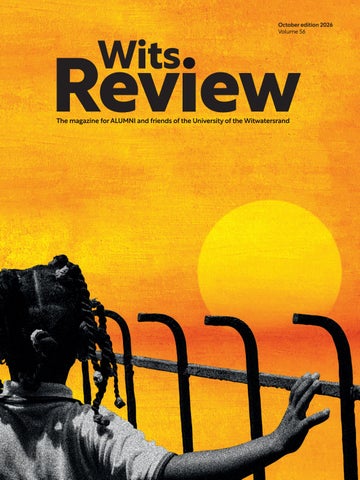
October edition 2026 Volume 56
The magazine for ALUMNI and friends of the University of the Witwatersrand
1
2 Wits Review OCTOBER 2026
Scrapping for the team In only his 9th Test cap, scrumhalf Morne van den Berg (BA 2022) emerged as one of the Springboks’ star performers in the series-clinching 43-28 victory against the All Blacks in Baltimore, US on 12 September 2026. Affectionately known as “Krappie”, he told local media he wouldn’t let the praise go to his head. “It’s special, I’m so glad we do it for the country…It’s your responsibility to do your best for the Springboks, and that’s what’s special. It’s not about individuals, it’s about the team and how you serve the team.” From his standout performances with the FNB Wits Blues in the Varsity Cup, Van den Berg progressed to professional rugby with the Lions and later earned a call-up to the Springboks. Earlier in April 2026, the FNB Wits Blues capped off a perfect season by winning the 2026 FNB Varsity Shield. Image: Getty
1
IN THIS ISSUE
44 Zandile Mkwanazi WitsieForGood
48
GirlCode founder loves tech and bringing people together for the common good
Cover feature
The moving school
For nearly two decades the Three2Six Project has helped displaced children get access to an education. Wits alumni have been at the heart of keeping it going
REGUL ARS Editor’s Note ............................................... 05 News .............................................................. 06 Socials ........................................................... 11 Research ...................................................... 22 Witsies with the Edge ............................. 30 International Witsies ............................... 56 Books ............................................................. 66 In Memoriam ............................................. 70
78
66 Books
Wits End
Chris Soal
On the poet’s power to distil daily miracles
Artwork: Running to stand still (Detail), 2024
Chris Thurman 2 Wits Review OCTOBER 2026
Artist’s monograph calls for a fresh way of seeing
M A G A Z I N E Editor Peter Maher
26
Contributing & managing editor Jacqueline Steeneveldt
Profile
Contributors Lucille Davie, Heather Dugmore Professor Chris Thurman
‘Embracing African culture is not only an aesthetic position’
Photography Chanté Schatz, Brett Eloff, Bongimpilo Zondi Image: Brett Eloff
Peter Rich
36 Profile
Thando Hopa
Printing Remata Published by the Office of Alumni Relations, University of the Witwatersrand, Johannesburg. Address: Private Bag 3, Wits, 2050, South Africa / Tel +27 (0)11 717 1090 Email: alumni@wits.ac.za, www.wits.ac.za/alumni Update contact details: www.wits.ac.za/alumni/ updateyourdetails
Lawyer, activist and model longs for the freedom to ‘just be’
Wits Review is published twice a year. The views expressed in this publication are not necessarily those of the editor, the Office of Alumni Relations or of the University of the Witwatersrand. ©Copyright of all material in this publication is vested in the authors thereof. Requests to reproduce any of the material should be directed to the editor.
24 What’s in the enamel Research
Proteins preserved for millions of years reveal new clues about Homo naledi
Wits Review Magazine, Volume 56, October edition 2026
ty Get ge: Ima
Image: Matthew Berger
Graphic design Jignasa Diar
Platinum winner
Gold winner
3
I N T E R N AT I O N A L W I T S I E S
4 Wits Review OCTOBER 2026
EDITORIAL
Wits changed me for good
T
ime flies when you’re having fun! I was keenly aware that I’d reached the standard retirement age of 65 in April this year, but it took a colleague to remind me of another milestone: this is also my 20th year leading Wits’ Alumni Relations programme. It’s easy to forget age when one works at a university, as one is surrounded by a student body that renews itself every year. There is an almost timeless quality to campus life – an endless succession of youngsters arriving with new ideas, ambitions and possibilities. But while the students remain forever young, I have to concede that enjoying a Wits Special sandwich now comes with consequences! I am profoundly grateful for the opportunity I have had to represent this remarkable University and its awesome alumni. I have met Witsies across South Africa and around the world whose achievements, generosity and commitment to making a difference have continually reminded me what it means to belong to this community. I have been fortunate to work with talented and committed colleagues, distinguished vice-chancellors, and exceptional executive committees of Convocation. I have been humbled by alumni who volunteer their time, organise gatherings in cities around the world, share their expertise, mentor others, reconnect us with long-lost Witsies and act as passionate ambassadors for their university. Their loyalty and goodwill have sustained and strengthened our alumni programme. Early in my career, visits to universities abroad showed me what becomes possible when institutions cultivate a lifelong sense of identity, belonging and pride in students and alumni. Many legacy initiatives resulted from this learning experience, ranging from developing a Wits Kudu mascot and starting the Wits Reveal and Spirit Game traditions, to honouring alumni through the Scholarship Honour Boards in the
Great Hall and commemorating the role of Wits and Witsies in opposing apartheid with a memorial plaque. Among my happiest memories are meeting alumni at gatherings around the world, renewing friendships at Founders’ Tea, and celebrating the Wits’ centenary with students and alumni reimagining past traditions. And then, of course, there is this magazine. We launched the Wits Review in 2007 and, nurtured by a succession of talented colleagues, it has grown into an award-winning publication with a loyal readership. I am proud of what it has become and confident that, in the hands of the current editorial team, it will continue to flourish. Looking back, I realise that while I have spent much of my career trying to strengthen the connection between Wits and its alumni, Wits has, in turn, shaped me. They say you are more likely to retain memories if your days are varied rather than routine. I have 20 years of vivid and treasured memories of people, places and moments that will remain with me forever. Whatever my ongoing involvement with alumni relations may be, two things will remain true: Wits changed my life for the better and it has been one of the greatest privileges of my life to serve this University and its alumni. No matter where I go and whatever I do, I will continue to be a Witsie, contributing however I can to this great institution. ■ Peter Maher, Director of Alumni Relations 5
NEWS
Stay in touch: Please share your news and remember to update your contact details. Email letters to alumni@wits.ac.za
Where in the world is your Witsie cap? From ancient ruins and Mediterranean coastlines to football stadiums, cafés and far-flung corners of the globe, the Witsie cap has been making appearances wherever our alumni find themselves. We’d love to share these experiences with readers, so next time you’re travelling or just doing something interesting, take something Witsie with you and send us the photo.
“Trust is not what we add to the technology once it works. Trust ís the technology, and the argument I’m putting forward is that this is the part of AI that Africa can build for the world, not the part you wait to receive from it.”
Image: Orde Eliason
OVERHEARD
Dr Shakir Mohamed (BSc Eng 2005, MSc Eng 2007) director of research at Google DeepMind, during the third annual Barry Dwolatzky Memorial Lecture on 16 September 2026. He suggested that his alma mater would be the ideal place for an independent AI evaluation institute on the continent.
Wits Review bags a few Jacqueline Steeneveldt (BNurs 1995, MA 2005) received the Chairperson’s Award of Excellence and a Platinum Award at the 2025 MACE Awards (Marketing, Advancement and Communication in Education) for feature writing in What’s in a gaze? (Vol 51) and What’s Inside? (Vol 52). The magazine also received Gold in the Printed: External Magazines and Newsletters category for Vol 53.
Jignasa Diar (BA FA 1994) received a 2026 Africa International Design Award for her design of the magazine in the Communications Design category. The awards recognise work that responds to contemporary challenges and contributes to the future of design in Africa. Entries are assessed by leading professionals, educators and cultural figures from Africa and beyond. 6 Wits Review OCTOBER 2026
NEWS
Wits hits top spot
Image: Brett Eloff
Wits University was ranked number one in Africa and South Africa and 200 out of 21 291 universities worldwide in the 2026 Center for World University Rankings (CWUR) list, which was released in June 2026. CWUR does not use reputational surveys or data submissions from universities. Instead, it relies entirely on independently sourced, outcome-based indicators, including alumni academic success, graduate employability, faculty distinctions, and research performance. Together, these four research measures give a comprehensive picture of how much a university contributes to global knowledge. One of the strongest aspects of Wits’ performance was graduate employability. It achieved an employability ranking of 97 globally, highlighting the success of its alumni community. Source: Wits News
Image: Adobe Stock
1 000 second chances and counting The Wits University Liver Transplant Programme reached a landmark 1 000 liver transplants in July 2026. This includes 637 adults and 363 children and numerous second chances for patients and families. Based at Wits Donald Gordon Medical Centre in collaboration with Charlotte Maxeke Johannesburg Academic Hospital, the programme performed its first liver transplant in 2004. Over 22 years, it has grown into a national and regional referral centre and one of Africa’s leading transplant centres. The unit also acquired Africa’s first liver perfusion machine, which will keep donor organs viable outside the body for extended periods and improve transplant outcomes. Professor Jerome Loveland (MBBCh 1996), head of Wits’ transplant programme, said that any transplant “is the culmination of years of expertise and systems development across highly specialised teams.” He said he was most proud of building a team
that now spans surgery, medicine, radiology, nursing, rehabilitation and research, while training the next generation of healthcare professionals. Behind every surgical breakthrough are years of research. Research director Dr June Fabian (BPharm 1990, MPharm 1994, MBBCh 1998, MMed 2008, PhD 2021) said the unit’s research helped shape work with global impact, including research showing that HIVpositive mothers can safely donate part of their liver to HIV-negative children. Her team has also studied how African children process anti-rejection medication, helping doctors tailor treatment more accurately. Transplant unit administrative and colorectal manager Carla Wilmans (BPharm 1996) says the milestone showed what is possible through public-private collaboration. ■ 7
Images: Chanté Schatz
ALUMNI GIVING
A courtroom to practise In 2022, the family of the late Supreme Court Justice Ralph Zulman (BCom 1959, LLB 1961, HDipTaxLaw 1974) donated funds to the Wits School of Law to establish a portable Moot Court. The Ralph Zulman Moot Court Centre was officially opened on 26 August 2026 in its permanent home, the Rembrandt Gallery. Fitted with benches and audiovisual equipment, the space simulates a real courtroom for student training. “A facility like this doesn’t fall from the sky. It takes a considerable amount of vision, a considerable number of resources, time, and effort to make this final thing happen,” said Professor Emile Zitzke, acting academic director at the School of Law.
Justice Zulman enjoyed a close relationship with Wits. As a student, he served in leadership structures including the SRC, the Wits RAG Committee, the Wits Constitution Committee and the Law Students Council. He later remained connected through teaching, alumni service, Convocation and honorary academic roles. An internationally recognised expert in crossborder insolvency, Justice Zulman represented South Africa in important international legal forums and held senior positions across the legal profession. The new Moot Court Centre honours Justice Zulman’s legacy and will equip the next generation of Wits law graduates. ■ Source: Wits News
Boost for cancer research The Philip Sceales and Janet Antrobus Cancer Research Trust has entrusted just over R5.28 million to Wits to establish a perpetual endowment for breast cancer research. Created in memory of Janet Antrobus, who died after a long battle with breast cancer, and her father Philip Sceales, the fund will support Wits researchers working across breast cancer care. “We are delighted that Wits has accepted the donation and established an endowment fund. This will ring-fence the funds and ensure that they are used for the purpose for which the Trust was established,” said Grahame Lindop (BA 1967), who is the chairman of the Trust. His wife Barbara Lindop (BA Hons 1983) is Janet’s sister and the founder and coordinator of the Sekoto Foundation for many years. I Source: Wits News 8 Wits Review OCTOBER 2026
Years 2001-2026
ANNIVERSARY
A birthday worth chirping about On 11 September 2026 the Wits Institute for Social and Economic Research (WiSER) celebrated its 25th birthday. Established in September 2001 by Prof Deborah Posel (BA 1977, BA Hons 1979), WiSER has spent the last quartercentury building a globally recognised, interdisciplinary network dedicated to advanced research in the humanities and social sciences. It serves as the intellectual home to prominent global thinkers and academics, including 2024 Holberg Prize winner Professor Achille Mbembe. Between July and October 2026 the institute hosted Avian Encounters: Bird/Human Relations, a series convened by professors Isabel Hofmeyr (PhD 2021) and Sarah Nuttall, which explores: “In an age of extinction, partial adaption and survival, what would a better understanding of the lives of birds afford us – and perhaps them?” This series drew on research from literature, science studies, climate sciences, migration studies, and visual and film studies.
Image: From the 3rd session of the series titled Bird-Brained: Diasporic and Migratory Subjectivities through the Mind and Eyes of a Printmaker with Prof Vulindlela Nyoni from the Nelson Mandela University.
9
Image: Alex Chapanga
ALUMNI GIVING
A helping hand across generations
Image: Mahlako
Current and former Wits student leaders spanning five decades gathered on 20 August 2026 for the inaugural Student Leaders’ Dialogue. The event was hosted in partnership with the South African Student Solidarity Foundation for Education (SASSFE), a trust that connects former Wits student leaders and supports efforts to address student debt and food insecurity, together with the Wits Student Governance Office and Alumni Relations. Deputy Minister of Higher Education and Training Dr Nomusa Dube-Ncube described the initiative as “nation-building in miniature”, noting the value of young leaders learning from those who had led the institution before them.
10 Wits Review OCTOBER 2026
Above: Kenneth Creamer, Sthandiwe Msomi, Terry Tselane, Gilbert Nchabeleng, Nomusa Dube-Ncube, David Masondo, Orediretse Masebe and Tebogo Thothela
Accounting for funding gap Mahlako Financial Services, an investment management firm, made a R1 million donation to the Margo Steele School of Accountancy, which coincided with the 50th anniversary of the Soweto Uprising. The gift, made in perpetuity, is aimed at supporting skills development and nurturing future leaders in finance and business. Mahlako Financial Services is led by Wits alumni Makole Mupita (BCom 1998), Meta Mhlarhi (BCom 1999) and Mitesh Pema (BCom 2002, PDip Com 2004). During their conversation with Professor Zubair Wadee (BCom 2000, BAcc 2001, MCom 2022), head of the Margo Steele School of Accountancy, the team reflected on how their Wits journeys were shaped by tough moments, hard work and the valuable friendships they made along the way. They said all experiences continue to guide their professional lives. Their donation is especially focused on postgraduate support, helping to address a critical funding gap for students pursuing the demanding chartered accountant pathway.
SOCIALS
Images: Bongimpilo Zondi
ALUMNI WEBINAR
Movement is Medicine 20 August 2026
ALUMNI WEEKEND
At an online Wits alumni webinar, Professors Georgia Torres (BEd 1989, MSc Med 1997, PhD 2014), Jon Patricios (MBBCh 2002) and Philippe Gradidge (MSc Med 2010, PhD 2016) explored how physical activity supports healthy ageing, protects against disease and boosts wellbeing. The message was practical and reassuring: movement doesn’t have to mean intense workouts. Walking the dog, taking the stairs or stepping away from the desk all add up. “Every movement counts,” said Prof Gradidge.
Wonder of Science at Wits 5 September 2026
Hundreds of Witsies returned to campus for an inaugural Alumni Science Open Day, a family-friendly celebration of science featuring talks, demonstrations, exhibitions, museum visits, and Digital Dome experiences. The day showcased how Wits continues to shape the future of science. 11
SOCIALS
Images: Chanté Schatz & Vivid
ZYLSTRA COMPLEX
A landmark gift, an enduring legacy
T
he former Impilo Building at the Wits Education Campus has taken on new life as the Wits Brian and Dorothy Zylstra Sports Complex – a R300-million facility for sport, health, exercise medicine, teaching, and research. Launched at a VIP preview event on 30 May 2026, and officially opened to alumni in September, the complex honours Wits alumni Brian and Dorothy Zylstra and the Skye Foundation’s decades-long support for Wits. Philip Zylstra (BSc Eng 1987), the couple’s oldest son, called it “a fitting testament” to his parents and a gesture of gratitude to the University that shaped their lives. Vice-Chancellor Professor Zeblon Vilakazi (MSc 1994, PhD 1998) described the gift as “one of the largest family gifts to Wits University”, saying it “ignites a new era for our University’s sports culture”. Inside, the complex brings together consulting rooms, research laboratories, a high-performance sport gym,
12 Wits Review OCTOBER 2026
movement laboratories, hydrotherapy facilities, radiology services, an anti-doping facility and a 50m heated training pool. The gift is a resource for students, athletes, patients and the wider community. Professor Jon Patricios (MBBCh 1992), Wits Sports Health director and originator of the integrated concept, called it “a oneof-a-kind” facility that will serve Wits, Johannesburg and, ultimately, national and international communities through “dynamic teaching, research, high-performance training, and evidence-based clinical practice”. The building’s value, said Professor Georgia Torres (BEd 1989, MSc Med 1997, PhD 2014) head of the Department of Exercise Science and Sports Medicine at Wits, lies in the “proximity of place” that enables interdisciplinary clinical teams to work together in ways that can influence human performance and health. “The beauty of this building is that it’s all under one roof.” ■
SOCIALS
John, Philip and David Zylstra
The Zylstra footprint Brian Zylstra (BCom 1957) came to Wits from Kimberley, captained the Wits First XV, earned Transvaal colours and received a Wits Full Blue. He married Dorothy O’ Neil (BA Hons 1964, DipEd Remedial 1975) and they had three sons: Philip, David (BA 1988, PDM 1989) and John. After qualifying as a chartered accountant, Brian co-founded Skye Products in 1964. In 1997, Brian and Dorothy established the Skye Foundation Trusts, using proceeds from the sale of Skye Products to support postgraduate students, honours students and talented sports candidates. From 1995 until 2003 Brian served as a Governor of the Wits Foundation. He was a member of the Wits executive committee of Convocation in 1998 when he funded the establishment of Arena magazine, the precursor to Wits Review. In 1996, they funded Cyril Coetzee’s 28-square-metre painting T’kama Adamastor, commissioned for the William Cullen Library. In 2007, Brian and Dorothy received a Gold Medal for sustained support. ■
13
SOCIALS
2026 FOUNDERS’ TEA
Feeling the spirit of Wits
O
n the first Sunday of September over 400 Wits guests made their way to the Linder Auditorium for one of the University’s most cherished traditions: Founders’ Tea. The annual gathering honours alumni who earned their degrees more than 40 years ago, reconnecting generations of Witsies with the institution that shaped them. This year’s event also welcomed the Class of 1986 to their first Founders’ Tea. The move gave the morning an unexpectedly warm and intimate atmosphere as guests were greeted with music by the Wits String Ensemble before ViceChancellor and Principal Professor Zeblon Vilakazi welcomed alumni and reflected on the event’s theme, “Rooted in legacy: Honouring the past and inspiring the future.”
“Each generation is inspired by the generations that came before, contributes something, and has a responsibility to leave it in better shape than they found it,” he said. He reminded guests that universities are among the few institutions that endure across centuries. Companies may come and go, he noted, and even monarchies change, but universities remain. “We are mere curators and custodians of this passing phase,” he said. “And that is why we’re here today, to celebrate this great institution.”
14 Wits Review OCTOBER 2026
Guest speaker Philip Zylstra (BSc Eng 1987), chairperson of the Skye Foundation, reflected on the legacy of his parents, after whom the Wits Brian and Dorothy Zylstra Sports Complex is named. A video of the complex was followed by an impact statement from Dean of Students Jerome September, who highlighted its importance for student life and wellbeing. University Registrar Tasneem Wadvalla closed the formal programme with remarks and a vote of thanks before guests moved to the Examination Hall for high tea. For many alumni, the morning felt like a homecoming. Gordon and Sally Anderson loved to reconnect with old friends and “feel the spirit of Wits today”, while Gerry Gallow said it was always interesting and encouraging to get an update on all that is happening at Wits and said the new sports facility was most impressive. Noelene Pearson-Harvey said guests were “warmly welcomed” despite the cold, rainy weather, and several alumni described the Linder Auditorium and Examination Hall as an excellent option for future Founders’ Tea events. Others spoke of pride and renewed connection. One guest called the morning “a valuable insight into the many good things happening at Wits”, while another described it as “truly uplifting” and said it made them feel “very proud to be a Witsie”. ■
SOCIALS
At 100, Dr John Callaghan (MBBCh 1949) made sure not to miss 2026 Founders’ Tea, accompanied by his son, John William. He was the oldest alumnus at this year’s event and remarkably still goes to work. The ear, nose and throat specialist spent his milestone birthday in his Brooklyn consulting room seeing patients – just as he had done for decades. Dr Callaghan began his career at Elim Hospital in Limpopo before working as a GP in the Greater Marico area, where obstetrics and rural medicine formed part of daily life. Dr Callaghan’s wife, Johanna Maria, died 25 years ago. “The last three years of her life she couldn’t speak. She had a brain haemorrhage. I looked after her, suctioned her lungs, changed her catheters – it was a difficult time,” he said. Although he no longer operates, he still consults and does medico-legal work. “Medicine is a wonderful, living science,” he said. He said his retirement will happen gradually. For now, work is “the most wonderful form of retirement”. ■ Additional source: Medical Brief
Images: Vivid
‘Work is my retirement’
15 15
ALUMNI REUNION
LONDON
10 September 2026
Images: Orde Eliason
SOCIALS
Alumni in London attended a reunion held at Goodenough College, where Sir John Lazar CBE FREng (BSc 1982, BSc Hons 1983), president of the Royal Academy of Engineering, delivered a presentation on AI and the topical issue of managing the risks it could pose to society. Professor Sir David King HonFREng, FRS (BSc Hons 1961, PhD 1964, DSc honoris causa 2003), former chief scientific advisor to the UK Government, delivered closing remarks where he reflected on his experience at Wits under apartheid and spoke warmly of the joyful atmosphere of present-day graduation ceremonies at the University.
Professor Sir David King
Sir John Lazar
16 Wits Review OCTOBER 2026
SOCIALS
SOCIA SL OSC I A L S
ALUMNI REUNION
EDINBURGH
13 September 2026
There was a marvellous turnout for the first ever reunion of Witsies in Scotland, held at the iconic Balmoral Hotel in Edinburgh. Lynda Murray, Wits’ UK representative, welcomed guests and Peter Maher, director of Alumni Relations, gave an overview of Wits today and yesterday. In closing remarks, Dr Bill Carman (MBBCh 1982, MMed 1990), Wits benefactor, clinical virologist and CEO of Fast-track Diagnostics, inspired guests with an appeal for charitable giving.
Images: Simon Williams
Dr Bill Carman
17 17
SOCIALS
From left: Advocate Mohamed Ameermia, Firoza Mayet (Karodia), Prof Yunus Ballim, Fahmida Cachalia, Ashraf Essop, Fatima Cachalia, Rashid Seedat, Naseera Ballim, Kuben Pillay and Sello Semenya
ALUMNI REUNION
Reclaiming the Archive - the Experience of Black Students at Wits: 1975-1985 13 June 2026
To mark the 50th anniversary of the June 1976 student uprising, Wits alumni gathered for an event in partnership with the Wits History Department and History Workshop, to share memories of studying at Wits during apartheid and contribute photographs, documents and testimony to a living archive. The project aims to preserve underrepresented histories and deepen understanding of Black student life, activism and belonging at Wits. One of the key organisers, Emeritus Professor Yunus Ballim (BSc Eng 1981, MSc Eng 1983, PhD 1994), said “The idea is to incorporate master’s students who will interview alumni and document what it meant to be at Wits at the time. Alumni will be contacted to participate in verbal interviews or share written submissions.” He said that Wits’ senior archivist Gabriele Mohale was very excited to start cataloguing and digitising the material. “For many of us, in the many things that apartheid did, one of the things I found most difficult was the daily persistent humiliations of everything regarding your identity… 1976 gave a glimpse that the impregnable 18 Wits Review OCTOBER 2026
apartheid had fragile flanks and that its flanks were exposed. The possibility of a new way of knowing the world is really what carried us through university studies,” Prof Ballim said. Three alumni speakers, Musa Furumele (BSc Eng 1987, GDE 1989, MSc Eng 1991), Zaheda Abed (BA Speech & Hearing 1979) and Michael Sarjoo (BA 1983), also shared their reflections. “When I stood on those Great Hall steps, I never felt small, I never felt that I didn’t belong here. It belonged to us,” Sarjoo said. Similarly Abed said: “Coming to the campus for the first time, it was absolutely amazing. To see all the students on the lawns, the music in the air…it was just out of this world. I just felt so privileged.” As part of the activism, she recalled the connection and joy across the races. ■
SOCIALS
NETWORKING EVENT
Prof Vukosi Marivate: Exploring Ourselves Through AI
How can artificial intelligence help us understand who we are — and who gets represented? Professor Vukosi Marivate (BSc Eng 2007, MSc Eng 2009) returned to Wits to present “Exploring Ourselves Through AI”. Drawing on personal stories and his work in African language technologies, he challenged alumni to think critically about the information shaping AI systems. “African AI is not going to build itself,” he said. Marivate argued that representation matters: if African knowledge, languages and values are absent from digital systems, they cannot reflect the societies they serve. He said that Africa needs to build and develop its own ecosystems of skilled innovators committed to building custom-made technologies relevant to very particular African needs. The audience discussion was animated, with questions from those curious about using AI to upgrade their professional skills and identify possible areas of research. Educators, meanwhile, raised concerns about the ease with which a younger generation has embraced AI tools, choosing “cognitive offloading” rather than tackling difficult questions themselves.
NETWORKING EVENT
How to Lead the Future with Dr Craig Wing 12 April 2026, 3 June 2026
Images: Bongimpilo Zondi
11 June 2026
Wits Alumni Relations was delighted to host Dr Craig Wing (BSc Eng 2002, MSc 2006) at an in-person event (held at the Chalsty Centre Auditorium) on 12 April 2026 as well as a follow-up webinar on 3 June 2026. He shared tools for thinking about the future more creatively and highlighted a quote from Alvin Toffler: “The illiterate of the 21st century will not be those who cannot read or write, but those who cannot learn, unlearn and relearn.” His latest book, Four Future Seasons (Penguin Random House, 2025), outlines Wing’s model, which categorises the future into seasonal cycles and he challenged all participants to reflect on the question: “Which season are you in?”
Dr Craig Wing
19
ANNIVERSARY
The Tshimologong Digital Innovation Precinct
Years 2016-2026
The Tshimologong Digital Innovation Precinct, which was the brainchild of Prof Barry Dwolatzky (BSc Eng 1975), opened on 1 September 2016 to catalyse Braamfontein into a premier technology destination to raise the profile of African digital innovation. 20 Wits Review OCTOBER 2026
Tshimologong is Setswana for “new beginnings”. The precinct offers digital startups and students a fully-fledged coworking space equipped with uncapped internet, meeting rooms, a coffee shop, and ample opportunities for networking and learning through our community events and training initiatives. For the past decade, the precinct has hosted Fak’ugesi Festival, one of Africa’s leading digital creativity festivals, bringing together creativity, technology and culture.
IMPACT TO DATE
105 Start-Ups Incubated
172 Entrepreneurs Impacted
423 Im ag e:
Ad ob eS to ck
Community Alumni Entrepreneurs
“Every year, something extraordinary happens. For a few days in October, Johannesburg becomes a living laboratory of possibility. Artists meet engineers. Designers challenge scientists. Gamers collaborate with musicians. Students spark conversations that grow into partnerships, prototypes and new ways of seeing the world. That is the spirit of Fak’ugesi.”
163 Community Startups
Fak’ugesi Festival director Alby Michaels (BA Hons 2017) For more info visit: www.tshimologong.joburg
21
22 Wits Review OCTOBER 2026
RESEARCH GEOPHYSICS
A DEEPER VIEW OF THE KAROO Professor Musa Manzi (BSc 2007, BSc Hons 2009, PhD 2013), director of the Wits Seismic Research Centre and joint winner of the TW Kambule-NSTF Researcher Award at the 2025/2026 NSTF-South32 Awards, is leading a national initiative to map the subsurface geology of South Africa’s Karoo Basin. The Wits-led Karoo Geophysical Research Project, undertaken for the Petroleum Agency South Africa, will provide the first large-scale picture of the basin’s deep geology across an area of about 700 000 square kilometres. The team is using broadband seismic technology developed at Wits, together with airborne magnetic and magnetotelluric methods, to map geological structures, groundwater systems, mineral deposits and potential energy resources. The findings will also improve understanding of geohazards and environmental risks linked to natural resource development. The project is scheduled for completion in 2027. Source: Wits News
Image: Adobe Stock
23 23
Image: Adobe Stock
PALAEOPROTEOMICS
WHAT’S HIDDEN IN THE ENAMEL? Dr Palesa Madupe (BSc 2013), a postdoctoral researcher at the Max Planck Institute for Evolutionary Anthropology in Germany and a HERI Research Associate, led an international team that extracted and analysed the first protein fragments from the fossil teeth of Homo naledi, an extinct human relative discovered in South Africa’s Cradle of Humankind. Published in Cell, the study involved researchers from the University of Copenhagen, Wits and 13 other institutions. The team analysed 23 teeth from at least 20 individuals, the largest extinct hominin sample yet 24 Wits Review OCTOBER 2026
examined using ancient protein analysis. The researchers searched the tooth enamel for Amelogenin-Y, a protein found only on the male Y chromosome, to determine biological sex. They found no evidence of the protein, suggesting that all individuals in the sample were biologically female. Madupe said dental enamel preserves proteins by shielding them from environmental contamination, allowing genetic information to survive for millions of years. Source: HERI, Image: Matthew Berger
RESEARCH
A QUANTUM LIFELINE THROUGH THE STORM
A research team in Wits’ Structured Light Laboratory has shown that quantum information carried by twisted light can remain intact under strong atmospheric turbulence. Lead author Tatjana Kleine, a master’s student in the Physics Department, reported the findings in Physical Review Letters. The researchers used topology – mathematical properties that remain stable – to protect the information without adding specially engineered optical structures. The approach could support more resilient quantum networks, secure long-distance communications and quantum computers that are less vulnerable to environmental interference. The laboratory, founded and led by A-rated scientist Professor Andrew Forbes, has also contributed to the spin-out company Button Optics. *Dr Isaac Nape (MSc 2017, PhD 2022), who contributed to the research paper, received the 2026 NRF Research Excellence Award for Early Career/Emerging Researchers. Source: Wits News
P U B L I C H E A LT H
UNDERCOVER CALORIES IN YOUR GLASS
Do you know what’s in your favourite alcoholic drink? A study by Dr Siphiwe Dlamini (PhD 2021) has found that most South Africans have little way of knowing how many calories, how much sugar or what ingredients are contained in the alcoholic beverages they buy because this information is rarely disclosed on labels or retailer websites. Dlamini draws on research examining the online nutrition information provided for more than 3 500 alcoholic beverages sold by major South African retailers, including beers, wines, spirits and ready-to-drink products. The study found that while most products disclosed alcohol by volume (ABV), information on calories, sugars, carbohydrates and ingredients was rarely available. Only about one in three products disclosed sugar content, while information on energy, carbohydrates, protein, fat, fibre and sodium was available for fewer than 3% of products. Ingredient lists were also rarely provided. The findings come amid growing concern about obesity in South Africa, where nearly half of adults are overweight or obese. Dlamini argues that improved nutritional transparency would help consumers make more informed choices and align South Africa with international trends towards greater alcohollabelling requirements. Source: The Conversation
Imag e: Ad obe Stoc k
PHOTONICS
25
PROFILE
Layers of creativity
Celebrated architect Peter Rich shares the inspiration behind his designs and what drives his passion.
P
BY LU C I L L E DAV I E
eter Rich (BArch 1973, MArch 1991) is one
of the world’s most respected architects, with dozens of awards and accolades. Joburg born and raised, he describes himself as “a 60s kid”, and “Wits through and through”. “I was born to be an architect, following in the footsteps of my uncle,” he says. Two of his three sons are also architects. It’s a profession that exists “first and foremost to enrich the human experience”, says this youthful 81-year-old. This instinct was shaped by travel, mentorship and African design traditions. One of his early formative experiences, at 19, was a 26 Wits Review OCTOBER 2026
visit to Mozambique in 1964. En route he saw the decorative Ndebele homes that were to inspire his work, and he later cemented a pupil-mentor relationship with the acclaimed Portuguese/Mozambican architect Pancho Guedes (BArch 1953, DArch honoris causa 2003). Guedes was “a maverick and a surrealist, who opened my eyes to the genius of Africa,” he says. As head of architecture at Wits for 15 years, Guedes encouraged Rich’s research into Ndebele design. Years later, in 1994, Rich curated an exhibition of Ndebele artforms at the South African National Gallery, one of the first to bring their rituals and materials to the wider public. “I’ve learnt incredibly valuable lessons, from women who were profoundly good artists and architects,” he says. For Rich, embracing African culture was not only an aesthetic position, but also part of a broader activism; he also supported the anti-apartheid sports boycott and tried to do community work in the townships during apartheid. “I picked up from Pancho the idea that being a
Image: Brett Eloff
Left and above: Mapungubwe Interpretation Centre in Limpopo
curator, art collector, architect and artist were not separate roles, but interconnected ways of seeing,” says Rich. “He believed that as a creative being you needed to bring many layers to what you did, because each one informed the other.” He was fortunate to be “of the generation of teachers at Wits who taught the first generation of African architects”. In turn, Rich has had an influential role on his students, among them Dr Sechaba Maape (BAS 2009, BAS Hons 2011, MArch Prof 2012), now a senior lecturer in the Wits School of Architecture and Planning. “His allegorical drawings on the board were a source of inspiration. He was quite eccentric and performative. He showed us that Africa has a worthwhile repository from which to find inspiration. He definitely shaped many of us.” After three decades of teaching at Wits, Rich
“Architecture to me raises the human spirit. It’s not just a building” 27
PROFILE
left in 2007 to start his own practice. Over the years he has designed shopping centres, spectacular homes, museums, cultural centres and bush lodges, blending indigenous space-making traditions, community upliftment and sustainable materials. His most lauded building is the Mapungubwe Interpretation Centre in Limpopo, which won the World Building of the Year award in 2009. He says it “launched [him] into the world”. The building celebrates the sophisticated society of the 13th century Mapungubwe kingdom. Its outstanding feature is the use of curved timbrel vaults made from low-grade earth tiles with a hand press. The building was shortlisted for the prestigious Aga Khan Architecture Award in 2013 and won the Special Solution with Brick category at the Wienerberger Brick Award in 2012. Since then, Rich has designed projects and buildings in places as far-flung as China and Rwanda. The projects that followed Mapungubwe include the Earth Pavilion in London, which won the Built Environment category at the 2010 Earth Awards, and the vaulted interior of an office in Chicago. The building he says he is fondest of is the Alexandra Heritage Centre in the township north-east of Johannesburg. His modus operandi was to go into the community, find out what was important to them, and build something that catered for their needs. The centre is built over a road with no boundary walls, and has an open and welcoming feel, with delightful features like stained glass windows, colourful mosaic pavements and stone walls and pillars. Another significant building is the colourful Elim shopping centre in Limpopo, designed for a black client during apartheid. It not only provided retail opportunities, but also encouraged social life in the rural town, with a beer garden and outdoor gathering space. “Architecture to me raises the human spirit. It’s not just a building,” Rich says.
Ranah Stone Valley, China
He has taken many elements of the Ndebele layout as a blueprint for his own home in Parktown. It is replete with blue and turquoise walls and triangular shapes, bursting with African art and artefacts. Art is a major force in Rich’s life. He conceptualises his buildings in detailed artistic form before they are produced as plans. He has received many awards locally and internationally, including the South Africa Institute of Architects Gold Medal and 16 SAIA Awards of Merit. Rich is a fellow of the Sidney Sussex College in Cambridge, as well as an International Fellow of the Royal Institute of British Architects and an Honorary Fellow of the American Institute of Architects. He is an international juror for excellence awards in China and India, and has twice been invited to exhibit drawings of buildings at the Venice Biennale. These and other honours are deeply felt – but Wits still holds a special place. With some nostalgia, Rich says: “It would be really nice if I got a building to design on the campus of my alma mater.” n
Rich the athlete Peter Rich was an outstanding hurdler. At university his speed qualified him for entry to the Olympics in Tokyo in 1964 and Mexico in 1968 – he was ranked the 6th fastest hurdler in the world – but he supported the anti-apartheid sports boycott and so didn’t get to test himself against the world’s best. “I trained three hours a day, seven days a week for 12 years,” he recalls of his years at high school and Wits. He was a national hurdles champion five times and received Springbok colours in 1966, 1968 and 1970.
28 Wits Review OCTOBER 2026
Gheralta Lodge, Ethiopia
Anji, China
Moditlo Game Reserve, Hoedspruit
House Kennedy, George
Earth Pavilion, London Alexandra Heritage Centre
Ranah, China
Angel’s View, Mpumalanga
29
WITSIES WITH THE EDGE
La Scala director
Alessandro Talevi The first South African to direct a La Scala-commissioned production of Verdi’s opera Nabucco, Alessandro Talevi (BMus 1998, MMus 2001) staged the work in Milan from 16 May to 9 June 2026. Talevi studied piano accompaniment at the Royal Academy of Music in London after his Wits qualifications and is now based in Italy. He said in an interview that he was still unsure why his name was chosen. “To this day, it’s a mystery as to who suggested me in the first place,” he says. “I didn’t ask too many questions and perhaps that’s best.” For Verdi, Nabucco was the breakthrough. First performed at La Scala in 1842, it is the work that helped turn the young composer into the figure who would become almost inseparable from Italian opera itself. Talevi’s direction was praised for its theatrical spectacle and massive stage elements. William Kentridge’s production of The Magic Flute was commissioned by La Monnaie in Brussels in 2005. It later toured globally as a visiting production and travelled to La Scala in 2011. 30 Wits Review OCTOBER 2026
WITSIES WITH THE EDGE
Multifaceted trailblazer
Image: Teatro alla Scalla, Brescia e Amisano
Sarah Langa
Considered one of South Africa’s most influential content creators, Sarah Langa (BA 2019, PDBA 2020, MBA 2025) has extended her reach into interior design, presenting “The Soft Life” at 2026 Decorex Africa, where her design brand SL Interiors was launched. “Interior design has always been an extension of how I tell stories,” she said. “I want to create spaces that feel deeply personal while celebrating the incredible creativity, craftsmanship and heritage that exists across Africa.” One of the most talked-about pieces was the Umshanelo Chair, inspired by the traditional African grass broom found in countless South African homes. Image: Adobe Stock
Fintech innovator
Peter Berry Peter Berry (BCom 1993, BAcc 1995) has long recognised the potential of South Africa’s informal retail sector. He is the founder and CEO of Shop2Shop, which began in 2017 as a payment solution, initially in Khayelitsha, and now provides the technology small businesses need to run their operations through fast transactions, business funding and insurance. In July 2026 Pepkor, South Africa’s retail giant, announced it would merge its Flash business with Shop2Shop, to create a R21.3-billion fintech platform. The merger has been tentatively called FintechCo. It will process more than R200-billion in annual throughput. The company serves 177 000 traders with 114 000 acquiring devices and 2 900 cash-counting safes, and processed R131-billion in supplier payments in the past 12 months. “Ordering stock and paying suppliers is by far the most used feature,” Berry said, describing the combined service offering as “a financial management system for small businesses” rather than simply a payment system, which is a model used successfully in economies such as China. 31
WITSIES WITH THE EDGE
Pioneering in-utero surgeon
Michael Belfort The TinyStitch device provides suitable sutures for the tiniest patients
Image: TMC
Chief of Obstetrics and Gynaecology at Texas Children’s Hospital, Professor Michael Belfort (MBBCh 1981) led a pioneering operation on baby Theo French while he was still in the womb. Theo had gastroschisis, a serious birth defect in which the intestines grow outside the body. The delicate surgery involved opening the mother’s abdomen, lifting and supporting the uterus, removing the amniotic fluid and replacing it with heated, humidified carbon dioxide gas. Using tiny two-millimetre instruments inserted through ports into the uterus, the team pushed Theo’s bowel back inside and sutured it closed. Belfort said the procedure took 10 years to move from idea to reality, through research, animal studies and simulations. Theo became the third baby to undergo the highly regulated clinical-trial procedure, after patients from Brazil and Mexico. Now six months old, Theo lives in London and is thriving. In 2019, Belfort brought a team of foetal surgery experts to work with Professor Ermos Nicolaou at Wits and Mediclinic Morningside, where they helped perform the first foetal spina bifida surgery on the continent.
2026 Royal Society Fellows
Glenda Gray & Clifford Woolf Professor Glenda Gray (MBBCh 1986) and Professor Clifford Woolf (BSc 1972, MBBCh 1977, PhD 1979) have been elected 2026 Fellows of the Royal Society, one of the world’s oldest and most prestigious scientific academies. Gray, a paediatrician and clinician scientist, is recognised for pioneering work in HIV prevention, HIV vaccines, antiretroviral prophylaxis and COVID-19 vaccine research in South Africa. She credits Wits and clinical work in Johannesburg with grounding her in evidence-based medicine, social responsibility and team science. Woolf, a neuroscientist at Boston Children’s Hospital and Harvard Medical School, is honoured for major contributions to pain research, including central sensitisation, pre-emptive analgesia and novel therapeutic approaches. His interest began at Wits through physiology studies and clinical exposure to post-surgical pain at Johannesburg General Hospital. 32 Wits Review OCTOBER 2026
Image: Biénne Huisman/Spotlight
HONORARY D O C T O R AT E S
“May this day remind us all that the true measure of success is not what we accumulate, but what we contribute. Not what we possess, but what we pass on, not how loudly we speak, but how faithfully we serve.”
Reuel Khoza Distinguished business leader Dr Reuel Khoza (left) received an honorary doctorate in commerce on 14 July 2026 for his significant contributions to business, academia, and broader social transformation in South Africa. Khoza helped shape South Africa’s King Codes on Corporate Governance and has led major institutions including Eskom and Nedbank. Through his work, including service as chancellor of three universities, he has advanced good governance, African humanism and social development.
Images: Chanté Schatz
Kubedi Patrick Mokhobo Medical pioneer Professor Kubedi Patrick Mokhobo (MBBCh 1957, DTM&H 1979, DPH 1980) was honoured for his dedication to medicine and healthcare, his contribution to education and training, and his commitment to serving the people of southern Africa. He was the University’s first Black registrar in paediatrics and internal medicine and in 1966, he became the first Black doctor to pass the prestigious Medical Fellowship examinations. His groundbreaking career culminated in his recognition as southern Africa’s first Black cardiologist in 1973. The 94-year-old also received the Order of the Baobab in Silver earlier in May at the 2026 National Orders Ceremony. He reminded graduates that their “destinies are inextricably tied to the future of Africa.” Dr Joseph Mokoena was posthumously honoured for his extraordinary contributions to mathematics and education, and for helping clear the path for future generations of Black academics.
Read more: www.wits.ac.za/alumni 33
WITSIES WITH THE EDGE
Education Warrior
Q&A WITH TADDY BLECHER (BSc 1985, BSc Hons 1994) For nearly two decades, the MII has been turning unemployed young South Africans into work-ready graduates. Founded in 2007, the accredited non-profit skills-to-work institution has won numerous awards, achieved a 95% job placement rate over the past decade, and is now part of the Jozi My Jozi coalition working to transform central Johannesburg into a vibrant academic hub.
Image: SA Jewish Report
What draws you to the work that you do?
CEO AND CO-FOUNDER OF THE MAHARISHI INVINCIBILITY INSTITUTE ( MII )
“We’ve educated and uplifted the lives of well over 2 million young South Africans” 34 Wits Review OCTOBER 2026
The experience in my own life. It all goes back to my first visit to the Johannesburg townships in 1995. I had already accepted an incredible opportunity in the United States, with the plane ticket literally in my hand, but that visit to Alex township and the organisation I ended up joining changed the entire direction of my life. I saw the untapped brilliance there was in young people who simply hadn’t been given a fair shot. Extraordinary young people, full of brilliance, full of promise but blocked by circumstances they never chose. I tore up my air ticket, and started a new life, going into Alex township every day. I have never looked back. Watching young people transform their lives and then uplift their families, their communities, brings me a joy I can’t fully put into words. It inspires me every day, every hour, every moment. That feeling is what keeps me committed, why I remain dedicated to this work with my whole heart. How did your career unfold?
I studied actuarial science at Wits and once I started my honours, receiving the Liberty Life Gold Medal as the top honours graduate, I went on to work as an actuary and then as a management
consultant at Monitor Company. But after that township visit in 1995, I joined an organisation teaching transcendental meditation to young people in Alexandra for several years, which led directly to co-founding CIDA City Campus in 2000. It was a highly innovative and uniquely effective approach. I was stunned at the results we achieved. With CIDA we started South Africa’s first free, business degree institution. From there came the Branson Centre of Entrepreneurship with Sir Richard Branson and eventually the Maharishi Invincibility Institute in 2007, and the national E3 initiative in the Department of Basic Education in 2018. Across all of these initiatives, we’ve now educated and uplifted the lives of well over 2 million young South Africans. On the Maharishi Invincibility Institute side, we have educated 25 595 unemployed youth post-secondary school, with 95% of these individuals gaining quality jobs. We estimate our graduates will conservatively earn over R82 billion in their careers combined, even without getting a single salary increase. What inspires you?
Watching young people who the system had already written off go on to defy every expectation. A large
“I saw the untapped brilliance there was in young people who simply hadn’t been given a fair shot. Extraordinary young people, full of brilliance, full of promise but blocked by circumstances they never chose.”
MII graduates in front of the Institute’s Johannesburg building, gifted to MII by Anglo American
proportion of our graduates (70%) are women, many the first in their families ever to complete a tertiary qualification, and seeing what they go on to achieve for their families and communities never stops moving me. On a more personal level, I also draw enormous inspiration from transcendental meditation itself. The same practice that helped me overcome my own academic struggles as a young person continues to be a source of clarity, immense creativity and energy in my work today. Is there something about the work you do that others would find surprising?
Probably that the single biggest lever
in improving a student's academic outcomes often isn’t more textbooks, more lecturers or more funding, it’s what’s happening inside the student. At MII we build daily meditation and inner development directly into the academic timetable. It’s an unconventional idea in mainstream tertiary education. Consciousness Based Education is about seeing the whole person. Not just their academics but their emotional life, their physical wellbeing, their inner potential. When you support all of that, you help someone become a strong, confident, well-rounded successful human being. Through a powerful collocation of services, we give students the emotional, physical and intellectual support they need to grow.
How did you experience Wits?
Everyone in my family studied at Wits. Wits gave me the rigorous, disciplined foundation that everything afterwards was built on. Becoming an actuary is like having a lobotomy! You will never be the same again. I experienced the similar struggles most young people do but remained focused. Actuarial science is an unforgiving field of study and the process of qualifying taught me a level of focus and perseverance I’ve drawn on ever since. In many ways, the institutions I’ve since helped build trace their roots back to those exam halls. That time also gave me connections that remain intact until today. ■ 35
PROFILE
Thando Hopa (LLB 2011) reflects on identity, belonging and the possibility of moving through life with ease.
Image : Gett y
BY H E AT H E R D U G M O R E
36 Wits Review OCTOBER 2026
T
here is something about Thando Hopa’s laugh that instantly gets you laughing with her. It’s joyful, mischievous, delightful. It colours the tone of the conversation as she glides with unaffected humility from the lighter side of life to deep discussion about inclusion. A lawyer, model, activist and entrepreneur, Thando was named in the 2018 BBC 100 Women list of the world’s most influential women. In April 2019, she was the first woman with albinism to be featured on the cover of Vogue Portugal. “It was uncommon to have South African models on the Vogue cover and when I told my mom, she was worried I was going to be trafficked! I decided to do it and it was shot in Cape Town. I must say I was anxious until I saw the cover, which was very tastefully done and offered positive representation for under-profiled groups.
37
Image: Getty
PROFILE
South African designer Gert-Johan Coetzee asked Thando to model
“I understood the influence it would have, and I needed to make sure they left my African hair natural and that they didn’t try to darken my eyebrows and eyelashes. I also chose to wear Zulu earrings and beads to add touches of southern African culture and I wanted to show that ‘Africa’ is far more than its then prominent North African image,” she says. “As an African woman with albinism, activism became a necessary part of my life. Vogue, for example, was over a century old when I became the first model with albinism to be featured on the cover. As much as it was a wonderful first, it highlighted the historical absence and anonymity that people with albinism have experienced. Because of this, I approached the modelling world with purpose.” As a founding delegate of the Global Albinism Alliance and vice-chairperson of the Africa Albinism Network (AAN), Thando speaks at conferences around the world. She also has her own media company, Thando Hopa Media: “We work with companies on building stories around culture and diversity and developing more inclusive brands,” she explains. FAVOURITE YEARS AT WITS Thando started modelling while she was a prosecutor, after graduating with her LLB from Wits. Becoming a lawyer wasn’t something she particularly wanted to do: “My mom is a filmmaker and my dad an engineer who wanted me to become an accountant. I wanted to be an actress, so law was a good compromise,” she laughs. Then her tone changes as she recalls being happy to put her school years behind her, particularly primary school, where she was teased and bullied about her 38 Wits Review OCTOBER 2026
condition and learners were afraid to touch her. “Then I came to Wits and was the complete opposite,” she explains. “Wits was very progressive and it gave me my four favourite years of being a young adult in a safe space. It was one of the places where I didn’t have albinism – I went through four years of my hypervisibility not being visible. I arrived at Wits not knowing anyone and I made such good friends easily from all over the country. “We were all just awkwardly dressed students finding our way together. We had so much fun on campus, and the 24-hour libraries were amazing! We got better at learning. Of course, I always had to be aware of managing my body with extra care, keeping out of the sunlight and putting on sunscreen, but I was helped so much by the Disability Rights Unit, managed by Andrew Sam (BSc 2005), who was remarkable and provided specialised assistance. He helped me to get a bursary through Eskom and to write my exams separately because I needed extra time as my eyesight is not good.” STREET LAW AND BECOMING A PROSECUTOR As a student she became involved in Wits’ “street law” programme – going into communities to teach people about the law. “We also went to hospitals and prisons and it helped you understand social and legal context. It influenced me to become a prosecutor.” She started practising straight after graduating with her LLB in 2012 and served as a sexual offences prosecutor until January 2016. She was living in Troyeville then and would walk or catch the bus to get to the courts. “Thinking back to my early twenties, I was too
Right: Thando hopes for greater ease for people with albinism. “I’d like a lightness of being. I feel like our bodies are loaded with history, race, albinism, gender, everything. I would like us to live in lighter bodies, and have the freedom to just be.”
young to be handling sexual offences. You need life experience and an understanding of politics to shift how victims are treated when they have to talk about the most traumatic and devastating parts of their life.” While she was a prosecutor, she was spotted by South African designer Gert-Johan Coetzee and asked to model. “I was so busy with my prosecutorial work and had no particular interest in modelling, but eventually agreed to do a few gigs, realising I could use it as a platform to normalise albinism and provide some positive and holistic representation.” She subsequently resigned as a prosecutor and that is when a different life path opened for her: “I had never travelled before, and then in March 2016 I was invited to participate in the Sundance Institute Directors Lab in Utah, which was one of the most remarkable experiences of my life. We were workshopping the story Afronaut for the film directed by Ghanaian filmmaker Francis Bodomo about Matha Mwamba, the Zambian teenage astronaut who was supposed to go to space as part of Zambia’s 1964 self-funded ambition to get to the Moon and Mars. Through the film Francis wanted to document ‘the spirit of trying’ and she wanted me to help workshop Matha’s character as a southern African.” JOBS STARTED FLOWING IN Back home, jobs started flowing in. In 2017 she was asked to do the Audi vehicle launch campaign, “which is quite amusing, because my eyesight disqualifies me from getting a driver’s licence!” she laughs. Her first South African magazine cover was with Marie Claire in 2017. Then came Pirelli “and all of these assignments out of the blue. I started travelling all over the world for modelling. I also started broadening my politics, and my understanding of the intersectionality of underrepresentation, as an African, a black person, a woman and a person with albinism.” One of her favourite modelling destinations was Morocco in 2018 for 54 Magazine. “There is such an distinct identity there – the food, the culture, the red clay buildings in the ‘red city’ of Marrakesh. I loved it that kids could play in the streets at night. I wish we could do that here in South Africa.” Also in 2018, Thando was cast as Artemis, the Greek goddess of the hunt and wilderness, in the BritishAmerican miniseries Troy: Fall of a City.
During her international modelling shoots, Thando would often be asked about muthi and witchcraft, “always with this undertone of violence and voodoo associated with ‘the dark continent’,” she says. “Yes, there are horrific acts of violence perpetrated against people with albinism, but it doesn’t represent all African contexts. I am African, my friends and family are African; it’s an identity that holds racialised complexity and history while also being an identity that's dear to my own human experience.” In 2022, Thando collaborated with Beninese musician, actress and activist Angélique Kidjo, Glamour South Africa, the World Economic Forum and Ford Foundation in the African Fashion Legacy Project. “We did a documentary on African glamour – it was an advocacy project to build cultural literacy,” she explains. PURSUING HER MBA Now living in Sandton with her lawyer husband and four-year-old daughter, she has cut back on travel to be with her family, pursue her MBA and focus more on what she refers to as “internal navigation”. She started her MBA with Henley Business School in June 2024 after being encouraged by the Dean, Jon Foster-Pedley. “I didn’t even know what a feedback loop was at the outset. It has been such an interesting transition and it is helping me so much in understanding the industry ecosystem of my clients and the market demand. It exercises critical thinking and helps you diagnose a problem in any field,” says Thando. She aims to complete her MBA early in 2027 “if it hasn’t buried me alive!” she laughs. n 39
WITSIES FOR GOOD
Our WitsiesForGood series continues as we celebrate remarkable alumni whose careers are rooted in service, innovation and compassion. BY H E AT H E R D U G M O R E
F
Advocate Mohamed Shafie Ameermia (BA 1984,
or
Above: Advocate Ameermia delivering the keynote address at The Street Law movement’s 50th anniversary
“Wits taught me to question power, to think critically, and to place justice at the centre of public life. Wits taught me that leadership is service, and that the law must always speak for those who cannot.” 40 Wits Review OCTOBER 2026
LLB 1990) the law has always been more than a profession. Shaped by the injustices he witnessed and experienced growing up under apartheid, and strengthened by his years at Wits, his career has been defined by a commitment to justice, dignity and service. Today, as national director of ProBono. Org, his work connects vulnerable people with free legal support through the voluntary service of South Africa’s private legal profession. From his office on Constitution Hill, Johannesburg, Mohamed recounts his journey to becoming a human rights lawyer, starting in childhood in Bronkhorstspruit, 50km east of Pretoria. “My story is no different to other Indian families that lived and traded in country towns in the dark days of apartheid South Africa,” he recounts. “My grandparents came to South Africa in the 1890s from Surat, Gujarat, in India to start a new life here. “We lived in Bronkhorstspruit, where my parents established a general dealer store in the town’s commercial hub, and traded until the apartheid era, when they suffered the brutality of the Group Areas Act. Our family property was expropriated in 1969, and we were forcibly relocated to the outskirts of town. Almost to the point of financial ruin, my parents had to start
the family business all over again. It was a very painful, difficult time.” Classified as Indian, Mohamed and his siblings attended schools in Laudium, outside Pretoria, and Lenasia, near Johannesburg, both areas established for Indians during apartheid. “In 1993 my family was struck another blow because of my political activism in assisting victims of apartheid. The right-wing Afrikaner Weerstandsbeweging bombed the shopping centre where my parents’ relocated business was,” says Mohamed. “Once again my family had to rebuild their business from scratch.” THE POWER OF A GOOD EDUCATION “Our parents instilled in us the power of a good education as the key to opportunity, and I am most grateful to them for all the sacrifices they made in this regard,” says Mohamed, who matriculated from Nirvana High School in Lenasia in 1979, and was admitted to Wits. “The harsh realities and injustices that I experienced from childhood, including almost daily harassment from the police, made me determined to pursue a law career in order to champion human rights and fight for justice, dignity, freedom, and equality for indigent and marginalised communities in South Africa.” He credits Wits with instilling the values that continue to guide him.
Witsies.
For Good
“If people arrive hungry, frightened, or unheard, the legal system has already failed.”
Mohamed Ameermia
Human Rights Advocate
41
WITSIES FOR GOOD
“Wits taught me to question power, to think critically, and to place justice at the centre of public life. Wits taught me that leadership is service, and that the law must always speak for those who cannot.” In 1988, he became a student assistant in Wits’ Street Law Programme, deepening his commitment to community-based legal education. This experience proved formative. and the programme has since evolved into a global movement active in 45 countries. In September 2025 the Street Law movement celebrated its 50th anniversary at the University of KwaZulu-Natal, with Mohamed delivering the keynote address. After completing his articles in 1993 with Constitutional Court Judge Justice Jody Kollapen (BProc 1978, LLB 1982), he was admitted as an advocate of the High Court in 1995. PUBLIC SERVICE Mohamed’s entry into public service was as the town secretary in Makhado in 1999. During this time, he also pursued an LLM through the University of Pretoria, and was subsequently awarded a fellowship in Public International Law and Arbitration at the Centre for American and International Law in Dallas, Texas. On his return, his public-service work ranged from recovering R33 million in the Senoko
tender-fraud matter to overseeing the delivery of 60 000 RDP homes, valued at R1 billion, for vulnerable communities across Limpopo Province. In 2013, Mohamed was appointed as a Commissioner of the South African Human Rights Commission, where he served for seven years, including as acting chairperson. His work included landmark victories such as the Flemix case, which exposed unlawful microlending practices affecting 250 000 farm workers and led to critical reforms in microlending legislation. His connection to Wits continued during this period, through his election to the executive committee of the Wits Convocation. Mohamed is proud of the work at ProBono.Org under his leadership since September 2023. “In 2025 we doubled the number of cases we could handle, from 5 037 to 12 176 in just nine months,” Mohamed says. “A major driver of growth has been the implementation of a digital case management system, donated by the Empire Partner Foundation in 2024. We have digitalised our entire case management system, which has improved efficiency and allowed real-time tracking
60 000
RDP homes, valued at R1 bn, for poor and vulnerable communities across Limpopo
42 Wits Review OCTOBER 2026
WITSIES FOR GOOD
Image: Adobe Stock
of legal assistance. It’s a wonderful example of a strategic collaboration strengthening the social justice ecosystem.” “Justice must be humane and we are all about the journey to dignity,” he says. “If people arrive hungry, frightened, or unheard, the legal system has already failed them.” One recent case involved the daughter of a widowed Congolese national. The daughter, who attended a school in Johannesburg’s
R33m
inner city, had been denied the right to write her matric exam due to documentation issues. Within 48 hours, ProBono.Org resolved the matter. She passed matric and now aspires to become a teacher. ProBono.Org also offers six internships annually to LLB graduates unable to secure their articles. “Our goal is to expand pro bono services into all nine provinces and to reach 20 million underserved South Africans facing justice barriers,” he says. The organisation aims to scale up to 250 000 to 500 000 resolved cases annually, delivering up to 2.5 million pro bono hours valued at R7.5 billion. To achieve this, the organisation is lobbying the legal profession to make 40 hours of pro bono work per year compulsory for all legal practitioners. In 2023, Mohamed was appointed Robert Glidden Visiting Professor at Ohio University (USA), and from 2023 to 2026 he was an Adjunct Professor at Wits in the Wits School of Education.
Who is ProBono.Org? Established in 2006, ProBono.Org provides assistance in family law, child protection, housing evictions, labour disputes, refugee and asylum matters, deceased estates, wills, and consumer rights. In 2025 alone it handled 12 176 pro bono cases, resolving 70% of them within the year. This translated into 60 000 pro bono hours from 733 volunteer lawyers, valued at approximately R180 million.
His work has earned him numerous accolades, including the Robert G Storey International Leadership Award (2017) and an appointment as a Social Justice Cohesion Advocate by the Minister of Sports, Arts and Culture (2017-2022). Mohamed received a Lifetime Achievement Award from the Empire Partner Foundation in 2025.The award celebrates individuals and organisations that use technology to drive social change. “All these achievements would not have been possible without the support of my wife, Shenaz, my sons, Mahmood (BCom 2019, LLB 2021) and Aadil, and all my colleagues and friends who continue to walk this human rights journey with me.”■
recovered in the Senoko tender-fraud matter
43
Witsies.
For Good
“We are on a mission to empower ten million women and girls with tech skills by 2030!”
Zandile Mkwanazi
Founder of social enterprise GirlCode
44 Wits Review OCTOBER 2026
WITSIES FOR GOOD
GirlCode’s 12-member team teaches coding and tech skills to schoolgirls and equips female university students to thrive in the tech industry across
six
African countries
Z
BY H E AT H E R D U G M O R E
andile Mkwanazi
(BSc 2012, BSc Hons 2013) has an ambitious goal. The computational and applied mathematics graduate, who founded GirlCode, aims to equip girls and women across Africa with technology skills – ten million by 2030. To achieve this, the GirlCode’s 12-member team teaches coding and tech skills to schoolgirls and equips female university students to thrive in the tech industry across six African countries: South Africa, Kenya, Botswana, Tanzania, Uganda and Ghana. It all blossomed at the GirlCode hackathon while Zandile was working for a software development company in Pretoria called Boxfusion. “When I started
working there in 2014, the first thing I asked my boss, Ian Houvet, was ‘where are the women?’ as there were only a few female software designers,” Zandile says. “He said it deeply concerned him, but that he didn’t get many applications from women. He was an incredible boss, open to new ideas, so I said we could change the situation by creating a GirlCode hackathon for female university and college students. The talent that emerged from this could then be offered jobs or internships. He loved the idea and sponsored the first hackathon in August 2014.” WHERE TECHIES MEET The GirlCode Hackathon has become an annual event, which Zandile now runs independently
after launching GirlCode as a standalone enterprise. Each hackathon has a different theme, and groups of two to four female students compete in a 30-hour weekend tech innovation competition every August as part of Women’s Month. There are superb prizes for the hackathon winning teams, ranging from cash prizes to laptops to trips to Silicon Valley and attendance at international tech conferences. In 2017, with Standard Bank as the headline sponsor, the winning hackathon team went with Zandile to Silicon Valley. “It’s tech heaven,” she says. “For the 2018 hackathon, we partnered with the international tech company Cisco, and the winning team from Johannesburg went to Amsterdam to a Women in Tech Conference, where they met very senior women in tech from all over 45
WITSIES FOR GOOD
online tech tutoring, and their payment covers the tuition for learners and students who cannot afford it.” They have a GirlCoder Club on Saturdays at schools in Soweto, Diepsloot and Tembisa, and online classes for learners across the country, from grade 3 to matric. Four thousand students attended in 2025. Zandile says: “This year we are expanding to more schools and more provinces.” A TALENT FOR MATHS AND CONNECTING PEOPLE
the world.” The trip led to American Express interviewing GirlCode alumni and in 2019 the company came to South Africa and made job offers to eight of them. “A large number of our students have been employed by banks and tech companies, or have been sponsored to incubate their tech innovations as startups.” INNOVATION FOR EVERY DAY At its campus in Midrand, GirlCode offers an eight-month software development learnership for young women between 18 and 35, with a matric as the minimum qualification. “Our third cohort started in April 2025, and it includes 12 months of training for up to 30 women at a time, followed by a six-month internship at one of our partner tech companies, like the Mint Group.” In 2025, Absa sponsored the hackathon in GirlCode’s six participating African countries, with the theme ‘AI for FinTech’. Zandile went to Kenya for this one. “One of their innovations was an easyto-use saving wallet app for older 46 Wits Review OCTOBER 2026
Above: Zandile as a panel speaker for Deloitte’s Catalysts for Change: How Education and Responsible Tech Shape a Better World conference in Munich 2025
4 000 students from grade 3 to matric attended GirlCode’s online classes in 2025
women who still put their money under their mattresses. Absa was looking for solutions, and it offered a way for women to easily manage their money and earn interest.” Zandile explains that in all the African countries they serve, many learners and students are from financially stressed backgrounds and do not have laptops or smartphones. “We are constantly approaching corporates, tech companies and other sponsors to donate their second-hand devices.” Submitting proposals to potential sponsors takes up a lot of her time in addition to teaching. “We have started partnering with better resourced and private schools who can pay for either our in-person or
The road to GirlCode had its origins at Wits, Zandile explains. “At high school in Midrand my teachers suggested I apply for actuarial science as I am good at maths, and it’s a lucrative profession. I didn’t make the final selection into actuarial science at Wits, and landed up taking computational and applied mathematics instead. It wasn’t a conscious decision, it just happened that way and I found I really enjoyed it.” Coming from a home environment where she studied very hard, achieving several distinctions in matric, as a first-year student Zandile found herself in an environment with a lot of freedom. “In a lecture hall of 300, no one is calling your parents to ask why you’re not there, and it is so easy to think ‘I don’t feel like class today’ and to rather go and sit on the lawns with your friends. “The next thing you know you are missing a lot of classes and having a lot of fun, but by exam time you are so far behind you start cramming and scraping through. When I saw my terrible first-year performance up there on the board, it was a wakeup call and I cried as I had been an A student all the way through. Also, my university studies were being covered by bursaries
WITSIES FOR GOOD
90% and I had put these at risk.” In first year she commuted from home, but in second year she moved to student accommodation in Braamfontein and got stuck into her studies. “Part of my personality is a drive to bring people together for the common good, and a group of us in the same class would then study together and stay at the library until late and walk back together. We all passed and I did well from second year onwards, getting distinctions.” In third year Zandile started a non-profit called RIOT (Radically Impacting Our Time). On Saturdays, she and students in her class would help grade 11 and matric learners at a school in Soweto with their maths, science and accounting. “Many learners struggle with these subjects and we wanted to help them understand they are not difficult. These learners subsequently achieved a 90% pass.
pass rate of grade 11 and matric learners at a Soweto school, who were helped by RIOT to assist learners with maths, science and accounting
“The maths teacher at the school was highly supportive of us, but, tragically, she was stabbed, and we were told that when she went to hospital, she first had to fill out the admission form and she died while doing this. I remember being so angry that you die because you must fill out a hospital form. “That’s when I decided to develop an online, centralised government patient registry system where each patient’s full medical history is on one system. In my honours year, I submitted my prototype to the Innovation Summit in 2013 and made the Top 10. “I also tried to get an audience with the Department of Health but as a student you generally don’t have much influence. The department
still doesn’t have a system like this but they are slowly digitising.” At that stage, Zandile had decided to become a quantitative analyst at a bank, and applied to participate in the programme led by the late Professor Barry Dwolatzky (BSc Eng 1978) at Wits’ Tshimologong Digital Innovation Precinct, which offered internships with big companies like Hollard. “During that time I worked on an app for Wits to help students navigate around campus. I really enjoy coding and software that creates real solutions.” Entering the world of work in 2014, Zandile applied to RMB and Boxfusion. “At RMB I would have been part of the quantitative analyst team, while at Boxfusion I could build all sorts of software, which I decided suited me better,” she explains. “That’s the direction I chose. I was very happy there for five years and it ultimately led to me establishing GirlCode.” ■ 47
F E AT U R E
THE MOVING SCHOOL For nearly two decades the Three2Six Project has helped displaced children get access to an education. And Wits alumni have been at the heart of keeping it going. BY JAC Q U E L I N E S T E E N E V E L DT
48 Wits Review OCTOBER 2026
49
I
F E AT U R E
t’s the first week of July on a chilly winter’s morning in Johannesburg, and the playground at the Windybrow Arts Centre is bathed in sunlight and filled with the sounds of children’s laughter and calls. It’s break time and the scene mirrors that of any school playground: uniformed children talking among themselves, while others swap snacks and boisterously mock-wrestle or sprint in games of tag. Yet, there is nothing ordinary about this moment. Just two weeks earlier, South African media carried reports of pupils fleeing Gauteng schools in the wake of anti-migrant protests. Built in 1896, this playground once welcomed guests to the home of one of South Africa’s early mining engineers and first recipients of an honorary doctorate from Wits University – Theodore Reunert (DLitt honoris causa 1922). It is now the home of the Three2Six Project, which for nearly two decades has provided bridging classes and support for the children of refugees, asylum seekers and migrants. Justine Kimbala (PDipLib 2005) keeps a watchful eye. She has been described as the initiative’s “emotional heart” and is guiding my visit. As we pass through the heritage building, she addresses each child by name and quietly answers questions or intervenes occasionally: “Daniel, you know what you did was wrong, right? Try to do better next time, please,” she says as a boy slides buttocks first down the outdoor stairs. “For 17 years, I have worked with children whose lives are often uncertain,” she says. “Yet, every day, they show up with courage. Watching them continue despite their circumstances reminds me that giving up is not an option.” Kimbala’s journey mirrors that of many of the children in the project. She grew up in the village of Mokambo, on the southern-most border of the Democratic Republic of Congo (DRC). Once in Johannesburg, she spent almost a month sleeping outside the Department of Home Affairs while waiting to get her refugee asylum permit. She joined Three2Six as one of its early teachers and is the current project manager. She says being with people who share similar struggles and understand her background makes Three2Six “a second home”. “This work has been part of my identity. It has shaped who I am and has given me purpose,” she says. “I have had moments where life feels uncertain. But those experiences have taught me resilience. They remind me that difficult seasons do not last forever.” Kimbala also learned more about complex displacement issues from courses she took at Wits. Later in 2026, she is set to present her work at international 50 Wits Review OCTOBER 2026
education conferences in Tokyo and Berlin, sharing insights on inclusive classrooms, social-emotional learning and personalised approaches to teaching. A HEADMASTER’S RADICAL IDEA The refugee and migrant children served by Three2Six live around Johannesburg’s eastern edges and the highrise buildings of Hillbrow. Many families occupy flats, factories, warehouses and abandoned houses. The project began in 2008 at Sacred Heart College, the Marist Brothers’ school, sandwiched between affluent Houghton and the dense, busy streets of Yeoville. Colin Northmore (BEd 1986, MEd 2002) right, then head of the college, noticed that well-equipped classrooms sat empty every afternoon, while refugee and asylum-seeker children living within walking distance were out of school. He also knew there were qualified refugee
“For 17 years, I have worked with children whose lives are often uncertain, yet, every day, they show up with courage. Watching them continue despite their circumstances reminds me that giving up is not an option.”
Who was Theodore Reunert? Theodore Reunert trained in mechanical and electrical engineering in England and Germany and arrived in South Africa in 1879. He was a civic-minded builder of institutions whose influence bridged industry, science, education and culture. He founded engineering firms that supported the growth of the country’s early diamond and gold industries, and was active in the South African Association of Engineers and Architects, the Geological Society of South Africa, the South African Association for the Advancement of Science, the South African Philosophical Society and, later, the Royal Society of South Africa. He also advocated for a meteorological and
astronomical observatory, helping pave the way for the Transvaal Observatory. Importantly, Reunert played a sustained role in the development of technical and university education in the Transvaal. He helped prepare professionals for the South African School of Mines’ practical work in Johannesburg, chaired the Witwatersrand Council of Education, served on the Transvaal Colony’s Technical Education Commission, and joined the first council of the Transvaal Technical Institute, which developed into Wits in 1922. Source: S2A3 Biographical Database of Southern African Science
51
F E AT U R E
“Education is about much more than teaching reading and mathematics. It is about restoring dignity, creating a sense of belonging, and giving children the opportunity to imagine a future beyond the hardships they have experienced. Resilience grows when children are surrounded by people who believe in them.”
52 Wits Review OCTOBER 2026
F E AT U R E
Above: Marc Potterton, Justine Kimbala and Roddy Payne Inset: Gerard Bester and Heather Blanckensee
teachers, but no legal pathway for them to teach in mainstream schools. The idea was simple, but brave at the time: “bring the two together, feed the children so they could concentrate, dress them in uniforms so they would be seen as students rather than outsiders, and give them a path back into the formal system.” Initially, three host schools (Sacred Heart College, Observatory Girls’ Primary School and Holy Family College) made their facilities available to Three2Six every afternoon, from 3pm to 6pm. Hence the project’s name: Three2Six. Over the years the project has kept moving, adjusting, and finding ways to survive. Reliant on donors and volunteers, it has repeatedly adapted to changing circumstances. At one time threats of police raids on Three2Six’s offices to access refugee families’ records saw Northmore move all records onto an encrypted platform rather than risk exposing the families. Campuses closed and reopened. The project relocated. Yet it’s endured. Northmore says: “I am proud to have originated the idea, but the teachers and funders were the real hands and hearts of Three2Six.” Among those hands are other Wits graduates who have made an impact, through sustained practical care: Heather Blanckensee (BSc 1985, HDipEd 1985, BSc Hons 1987), former Sacred Heart College head; Mark Potterton (BA 1986, BEd 1987, MEd
1999, PhD 2014), current director and principal at Immaculata Secondary School in Soweto; Roddy Payne (BA 1987, BA Hons 1988), who chaired the sub-committee of Three2Six until 2025. In July 2025, the project entered a new phase with the relocation to the Windybrow Arts Centre (left), converting five rooms in the complex into classrooms. Instead of the three-hour afternoon window, children receive a full-day primary school education. They receive safe transport to and from school, textbooks, stationery and uniforms, as well as a meal and a snack each day. “While they’re here, we try to envelop them in an environment of care,” says Potterton. “The project’s central mission now is on getting children school-ready, informed by research that investment in a child’s first five years yields the greatest returns of any educational intervention.” More than 2 600 children have benefited from the project since 2008. “There was a time when we were able to support learners from grade 1 to grade 7, offering them a full journey of care, learning and growth. Today, we have been reduced to serving only grades 1 to 3,” Kimbala says. She is afraid that children will lose a lifeline. THE CIVIC CLASSROOM The current director of the Windybrow Art Centre, Gerard Bester (BADA 1992), explains that Three2Six is “a partner in helping to create an ecosystem that provides quality education, literacy and arts programmes for children and young people who have found a home in the inner city of Johannesburg.” What was once a boardroom is now the grade 2 classroom, filled with small desks beneath the old house’s high ceilings. A giant Esther-Mahlangu-esque mural brightens up a full wall and coloured glass windows pull sunlight into the room. “It is the brightest class,” Kimbala beams. “But it is also the noisiest. When they play marimba downstairs, the sound travels up. So, in every goodness there is…” she trails off with a giggle. Kimbala says she has learned that “education is about much more than teaching reading and mathematics. “It is about restoring dignity, creating a sense of belonging, and giving children the opportunity to imagine a future beyond the hardships they have experienced. Resilience grows when children are surrounded by 53
F E AT U R E
people who believe in them.” She introduces me to the grade 5s and they all join in a chorus of “welcome”. She asks if anyone has an impromptu poem they’d like to share. One loud “eish” goes out and few hands fly up simultaneously. A girl near the back, Orely, has been chosen. “Don’t rush,” Kimbala encourages. Orely begins: “I have hope/That everyone can cope./I have a feeling,/That is healing. / This year is quite a hooray!/That’s all I can say./ Yes, it’s about school, but it also sounds cool.” Like a living organism, every step on the wooden floors reverberates throughout the building. The rhythms of school and theatre life overlap. As the pupils move between lessons, drama workshops and the arts programme of the Windybrow unfold nearby. Bester says the space is enhanced by the diversity of the community: “It informs our practice and challenges us to listen more deeply to the stories people carry.” By way of illustration, he shares a moving anecdote from last year, while hosting London Artists Projects’ This is Who I Am in partnership with the British High Commission. An elderly participant from Johannesburg Awakening Minds (a theatre and skills development programme for the homeless) and a young participant from the Democratic Republic of Congo found themselves sharing a song neither expected to hear on the day. When the child began singing a lullaby his mother had sung to him, the older man recognised it and joined in. For Bester, it is a reminder of how art can create unexpected connections across age, geography and circumstance. Most recently, the children have added a robotics class to their curriculum, based at the Netstar Digital Learning Centre, opened in May by Netstar managing director Warren Mande (BCom 1990, LLB 2001) in partnership with Jozi My Jozi, the citizen-led movement dedicated to revitalizing and restoring civic pride in the inner city of Johannesburg. The centre operates from the revamped non-profit Mould Empower Serve building, next door to the Windybrow. A WAY FORWARD It seems fitting that this building continues the legacy of one of Johannesburg’s trailblazing citizens. A place once built to reflect prestige now serves those for whom acceptance is hardest won. Kimbala shares booklets filled with alumni stories. “The first time a child walks into a classroom, they do 54 Wits Review OCTOBER 2026
17 YEARS
IN EXISTENCE
2 647 CHILDREN
29
TEACHERS
878 049 TEACHING HOURS
801 138 MEALS
18 070 FOOD PARCELS
R73+
MILLION RAISED
not come empty-handed,” she says. “They carry their story, their hopes, their fears, their culture, and their dreams. As teachers, our role is to recognise what they carry, nurture their potential, and help them believe that they can succeed.” Enock’s story* captures how this ethos can make an impact on a single life. He arrived in South Africa at the age of seven, fleeing political conflict in the DRC, speaking only French and excluded from mainstream schooling. He matriculated with distinction in 2022 and works at the Scalabrini Centre in Cape Town, running digital literacy workshops and supporting other refugees. “You are with people who came from the same background as you,” he recalls. “You kind of feel like ‘I’m not alone’.” ■ * shared from 2024 Annual Report; Images: Three2Six
F E AT U R E
Imagination as rebellion The creative work done at the Windybrow Arts Centre does not shy away from the tensions and challenges facing young people in the inner city of Johannesburg and beyond. One example is the Long Poem Project in partnership with the Wits Creative Writing Project led by Stacy Hardy. This year, the teenagers have engaged with Arthur Rimbaud’s poem A Season in Hell (1873). The project asks what rebellion might mean in a neighbourhood shaped by migration, precarity, survival and extraordinary creative energy. Through the stories of Hillbrow, the poem’s voice finds a powerful echo. “At its heart, the project understands rebellion not simply as refusal, but as an act of imagination,” says Bester. Images: Mark Lewis
Image: Three2Six
“They carry their story, their hopes, their fears, their culture, and their dreams.”
55
I N T E R N AT I O N A L W I T S I E S
From Parliament to the Highlands
Front row seat
Adrian Hadland (BA Hons 1989) reflects on the momentous early years of South Africa’s democracy, which he witnessed first-hand as a parliamentary journalist. BY H E AT H E R D U G M O R E
I
Image: Adobe Stock
t’s fascinating what we can unearth from cardboard boxes that we packed up decades ago and then hauled from place to place. We’re told to declutter, but it’s not easy to discard the layers of our lives. Fortunately, journalist and academic Professor Adrian Hadland held onto a box stashed in his wardrobe at home in Stirling, Scotland, where he is the Chair of Journalism and Media Studies at the University of Stirling. He had carried the box with him on various moves, including from South Africa to China, where he lectured for three years at the University of Nottingham’s campus in Ningbo, before joining Stirling in 2012. The box, which remained closed for over 20 years, contained the cuttings of Adrian’s columns, feature articles, news stories and opinion pieces – all his political reporting that was published in the media during the critical 1994 to 2001 period in South Africa, from Mandela’s presidency to Mbeki’s time. “It was a hugely important period when the entire political and constitutional landscape of South Africa was re-shaped,” Adrian says. “No world leader has ever faced an inheritance quite as poisonous or as troublesome as Mandela did. It wasn’t like a few laws needed to be changed to set the country on the road to
56 Wits Review OCTOBER 2026
I N T E R N AT I O N A L W I T S I E S
democracy. It was all laws, more than 500 during Mandela’s only term as president.” In 2022 Adrian was jolted into action when he received the news that the journalist with whom he had shared his office as a parliamentary correspondent, Donwald Pressly, had died. “I always thought that one of my peers would write about the first years of South Africa’s democracy, but they hadn’t. I realised if I didn’t do it, it could be lost forever.” Four of his six parliamentary journalist peers from the time had died. And so it was that Adrian retrieved the battered box from his wardrobe and started going through the contents. The result was his latest book, launched in South Africa in June this year: Christmas with Nelson Mandela: An eyewitness account of South Africa’s first years of democracy (Low Battery Books, 2026). It’s a collection of essays, articles and columns that takes readers on South Africa’s road to democracy “from the vantage point of a front row seat in the new multiracial democratic parliament”. He says: “My hope is that it will be a reminder of what South Africans are capable of: a monumental feat of human empathy, togetherness and trust.”
1990s, when the internet was emerging, and articles weren’t digitised, says Adrian. In the preface he explains: “Independent Newspapers, owners of titles such as the Cape Times and the Sunday Times, destroyed their substantial Cape Town cuttings library in the early 2000s. Thousands of files were left in a big heap in a garage and eventually discarded. Much of the record of South Africa’s politics at this crucial time has gone, while the memory of those hope-filled days has been overwhelmed by new challenges and crises. “I managed to salvage an armful of files from the huge pile in the Argus garage and had fortunately kept many of the columns and articles I had written. “… I don’t claim it represents a comprehensive account of South Africa’s journey to democracy … But I hope it nonetheless presents an in-depth, insider’s account of what happened and how.”
Below: Glenfinnan Viaduct in the Scottish Highlands at the golden hour. Adrian Hadland (left), enjoys walking in the Highlands; Hadland’s new book
CHRISTMAS WITH MANDELA Adrian sat near Nelson Mandela as he was inaugurated as president and was present when he addressed Parliament for the first time. Then there was the invitation
THOUSANDS OF FILES WERE DISCARDED Much of the reportage from these times has been lost as it was produced in the
57
I N T E R N AT I O N A L W I T S I E S
to Christmas lunch at the Mandela home in Qunu. “I said to my mum, I’m going to have to miss Christmas Day with you this year.” She asked why. “I replied, because I’m spending it with Nelson Mandela. After a beat, she said, fine. You’d better take a present. I hear he likes sweet wine.” Adrian remembers having to get up early to reach Qunu by dawn for Mandela’s morning walk. “I’ll never forget meeting Mandela and his bodyguards outside his house on Christmas morning and then walking off up into the hills with him. He laughed as he pointed out an old rock he and his best friend Justice had used as a slide. He was treated with respect by everyone and was the kindest person you could imagine. Sitting at the dinner table with his family on Christmas Day was a huge privilege. I could hardly believe I was there, but what a testament to his instinctive generosity. He would literally share anything he had.” WHERE IT ALL BEGAN Adrian was born in Hong Kong, where his father, Brian, was an architect and town planner. His mother, Rosemary, headed a prison aid charity there. “We lived there until I was 11 in an apartment building high up on the Peak overlooking Aberdeen harbour. My older sister, Cheryl, younger brother, Duncan, and I were sent to boarding school in England.” His father subsequently went freelance and the family moved to Saudi Arabia for four years in the 1970s. “It was interesting as there was a lot of money and a lot of oil, but they were only starting to develop. They could clearly see the future as they had built a 10-lane highway which still had very little traffic.” The next stop was Malaysia, where they lived for a few years until Adrian’s father died suddenly of stomach cancer in 1980 at the age of 48. Adrian was 15 at the time. His mother moved the family to South Africa, to Port Elizabeth (now Gqeberha), to be with her parents and sisters. “I had 58 Wits Review OCTOBER 2026
only visited South Africa briefly before and by the time we returned, there was a civil war underway,” says Adrian. On matriculating, he enrolled at the University of Cape Town for his undergraduate degree in English and politics. While there he entered a satire writing competition for the student newspaper, Varsity. The prize was being given a regular column. “That is how I got caught up with the university’s newspaper people, became politicised and subsequently became the news editor,” he explains. Shortly before he graduated, the Weekly Mail (which became the Mail & Guardian) was launched in June 1985. “It was produced using Apple Macs and laser printers, which was novel at the time. I wrote to the founding journalists, Anton Harber and Irwin Manoim, and asked to work there. They agreed but said they could not pay me at that stage. Fortunately, my mom had since moved to Johannesburg, and I had a place to stay. She was working as an administrator for Desmond Tutu, who was the Bishop of Johannesburg then.” The Weekly Mail soon took on Adrian as a paid freelancer and then as a fulltime staff member. “Everyone earned the same amount, and it was such an exciting place to work,” recalls Adrian, who, during this time, did a part-time Honours degree at Wits in African and Comparative Literature. “I was so grateful to be at Wits,” he says. “The team in the African Literature Department were amazingly supportive and loved the fact that I was a reporter with the Weekly Mail. They were tolerant of my struggles to make Friday morning classes, often having worked through the night to finish my assignments. My supervisor, Professor Es’kia Mphahlele, was a fantastic person and a total inspiration. Being able to sit with him and discuss literature, and occasionally his experiences at Drum magazine in the 1950s, was a great privilege. “The knowledge Es’kia and Wits gave me encouraged me to spend my Saturdays teaching literature at Mamelodi High School, which was a very rewarding experience.”
“Parliament was very open and collegial in those years; ministers and politicians from all the political parties valued the role the political press was playing in support of the democratic dispensation.” ROUND THE WORLD ADVENTURE After graduating he had to leave South Africa or face national conscription. He bought a round-the-world air ticket and experienced a life-list of adventures such as going down the Amazon River, ultimately returning to England in 1989 with one dollar in his pocket. “I stayed with my sister, who was living there, and she handed me a letter from Oxford University, where I had applied to do my master’s. They had accepted me, but I needed to cover my living expenses, so I worked as a temp secretary, which was an in-demand job back then and well paid at 10 pounds an hour. As a journalist I had learned to type fast and I could correct spelling and grammar. At Oxford, in the holidays and while I was writing my thesis, I was the temp secretary in the Chemistry Department and in my own African History and Politics Department, much to everyone’s amusement.” Adrian graduated from St Catherine’s College Oxford in 1992 after two memorable years. BURNING TO RETURN TO SA Master’s in hand, he was burning to return to South Africa, which he did in 1991. “The ANC was unbanned, Mandela was out and I was 26 and very keen to get back into political journalism, which I did
at Business Day, initially hired as a local government reporter. It was hugely stimulating as I engaged with key politicians, many of whom were working at the local level prior to the 1994 elections, including Cyril Ramaphosa, Pallo Jordan, Sydney Mufamadi and Frederik van Zyl Slabbert, to name a few.” Adrian was subsequently appointed as the Pretoria bureau chief at the time of the Goldstone Commission – the inquiry into the Prevention of Public Violence and Intimidation. “It was a great time to be a journalist, exciting but also dangerous, with outbreaks of violence and bombing campaigns as the armed struggle continued up to 1994. “Socially it was a mad, fun time with superb local bands such as the Cherry Faced Lurchers and non-racial clubs like Jamesons in the Joburg CBD. Rockey Street was pumping and there was such positive anticipation about the new political order.” In 1993 Adrian was seconded to parliament for a short stint and loved it. “It was a story fest. I got the front-page lead for 13 of the 15 days I was there. I agitated to be posted there as a full-time parliamentary correspondent, and Business Day agreed. “Parliament was very open and collegial in those years; ministers and politicians from all the political parties valued the role the political press was playing in support of the democratic dispensation.” He says the relationship only soured during Mbeki’s presidency. Hundreds of new laws were being passed, affecting how people engaged socially, politically and culturally. “Everything that needed to be done was not easy, and yes, there were problems in creating the emerging new South Africa, but there was enormous goodwill and very little violence. By the time the South African air force flew over the Union Buildings in Pretoria during Mandela’s inauguration, it was an absolute miracle.” FROM SOUTH AFRICA TO CHINA After Business Day, Adrian worked for a range of newspapers and publications, 59
I N T E R N AT I O N A L W I T S I E S
covering local and international events, including the handover of Hong Kong by the UK to China. He then took a year off travelling through Russia and China, and returned to the Sunday Independent, where he met his former wife, journalist and now lecturer Jackie Cameron. They married and had two sons. Adrian subsequently joined the Human Sciences Research Council’s (HSRC) Social Cohesion and Integration Programme to work on multidisciplinary research about how to reintegrate South Africans. At the same time, he did his PhD in Film and Media Studies at the University of Cape Town. During a research sabbatical at the HSRC, he went to Oxford University on his first visiting fellowship in 2009. While there, he saw an advertisement to head the International Communications Division at the University of Nottingham Ningbo China (UNNC), about 200km south of Shanghai. “It sounded like a fun thing to do and I successfully applied,” Adrian says. “My family was living in Cape Town at the time – the boys were six and three – and we packed up and moved to the coastal city of Ningbo.” 60 Wits Review OCTOBER 2026
During their three years there they travelled and saw the Great Wall, the clay soldiers, and magnificent temples. PUT DOWN ROOTS Then Adrian was offered the lecturing post at the University of Stirling and this was where he put down roots. “I have good friends here and I enjoy walking in the Scottish Highlands – I recently did the West Highland Way with my sons (who are now at university), from Glasgow to Fort William, about 110 miles. Stirling is also a golf paradise and I enjoy golf and squash. I am very happy at the university and it’s rewarding to be part of my students’ progress.” In his department they teach writing, ethics, video storytelling, photography, digital skills – all the things you need to produce good content. “AI is part of it. We regard it as another tool that can be used to great effect, such as in investigation and research. Of course there are risks that come with it too, and we teach the students to understand the issues. They are also keenly aware that they cannot present AI content as original thought.
Above left: Adrian with his two sons Right: with Nelson Mandela
Stirling takes this hugely seriously, all suspected cases are referred to our Chief Examiner, and students can be dismissed by the university for this.” Adrian says a lot of students want to study journalism and media. “There is so much opportunity for people with these skills, as almost every business in the world today is also a publishing company, having to produce all sorts of content. About ten percent of our students want to go into journalism proper (and you soon see who they are) and the others find work in public relations, marketing and communication teams.” Adrian is part of the ten percent. Now he is reaching out to all political journalists in South Africa and southern Africa who published in the pre-digital period. If they or their families kept their news cuttings, he would like to digitise the material and safely store the originals in a special archive at Stirling. “It’s such important history and we need to save whatever we can before more is lost.” ■
Wits pride, now in your size and your stage of life. For the postgraduate, burning the midnight oil. For the alumnus who still says “my varsity” with a little extra pride. For the family member who wants to buy the right gift. The Witsie Shop is the official home of Wits merchandise, with contemporary apparel, thoughtful gifts, everyday essentials, and proudly Wits pieces designed for every generation of Witsie.
Wits. For Good Browse the official Witsie Shop online at witsshop.co.za 61
I N T E R N AT I O N A L W I T S I E S
From to dragon spirit From a master’s thesis on Dracula to painting indigenous South African flowers and founding environmental initiatives, Helen Dodge’s journey spans Dublin, Perth and Zurich, returning her to the KZN south coast and a dragon legend.
Image: Anita Dumas
BY H E AT H E R D U G M O R E
H
elen Dodge (BA 1989, BA Hons 1992, MA 1997 cum laude, PGDipEd1990) has a leisurely way of speaking that belies the content of her words. “My master’s thesis was on Dracula,” she says in a voice that sounds like she’s sharing tips on baking scones rather than a treatise on gothic horror. “I graduated with my master’s in 1997, which was the centenary year of Bram Stoker’s Dracula. He was Irish and that same year I 62 Wits Review OCTOBER 2026
went to a fantastic Stoker centenary celebration in Dublin.” One can only imagine the cauldron of centenary pilgrims. “It was a quirky mix,” she laughs, adding, “I mean, what kind of people do you think travel to Dublin to have a conference on Dracula?” She was there as a literary academic. “It was a lot of fun and there was a big turnout of avid vampirologists. Our entertainment was provided by Paddy Dracula, a very good-looking local mortician wearing a cape
and the whole thing. He was an AIDS activist and used the blood connection to raise awareness.” AFRICAN IRISES, STRELITZIAS AND AGAPANTHUS Helen is speaking from her home in Umtentweni on the KwaZuluNatal south coast, where she has lived since 2014. She is surrounded by a profusion of indigenous South African flower paintings: coral tree flowers, African irises, strelitzias,
I N T E R N AT I O N A L W I T S I E S
Helen’s paintings are printed onto linen, cushion covers and room dividers
agapanthus and orchids, as well as sunbirds and butterflies. She prints them onto linen, cushion covers and room dividers. It’s a world apart from the nocturnal Count and her academic life as an English lecturer at Vista University in Soweto from 1993 to 2001, with a year’s break in 1994 which she spent in Ireland. “I stayed in a place called Fanad, where I shared a 300-year-old stone house with an artist called Brian O’Dogherty. That’s where I started
“In Perth I wanted to connect with what I call ‘Wits minds’.” painting, initially kettles and socks drying over coal stoves in winter and then spring flowers, birds and butterflies in the landscape.” She returned to South Africa to continue at Vista and also did arts
reporting for City Press and the Sunday Times, before moving to KwaZulu-Natal in 2003, where she wrote for the South Coast Herald and met Michael Haynes (BA 1986, BA Hons 1987), with whom she had their son, Luke. When Michael got a two-year posting at an environmental agency in Perth, Australia, called Sinclair Knight Mertz (SKM), Helen and Luke went with him. She did some copywriting for SKM, and focused on raising Luke. 63
I N T E R N AT I O N A L W I T S I E S
“Wits was one of the biggest blessings anyone could ask for.”
Above: Perth Alumni Chapter, Helen Dodge (circled) Far right: The Mzimkhulu River, Oribi Gorge, KZN; Helen at Oribi Gorge (inset)
ESTABLISHING THE PERTH ALUMNI CHAPTER “In Perth I wanted to connect with what I call ‘Wits minds’, so I contacted the alumni office at Wits for contacts and then did a whole lot of calls and emails and found a bunch of Witsies who were interested in being part of a Perth alumni chapter,” Helen continues. “There was a core group of about 20 of us, including Michael’s sister, lawyer Paula Haynes (BA 1989, LLB 1992) and his CFO brother-in-law, Gary Conway. “We had lots of fun and we would put up our big ‘Wits Alumni Perth’ banner at our get-togethers. We organised a range of activities, from wine farm visits to fascinating talks by interesting alumni.” SWAROVSKI IN ZURICH Michael then got a job in Switzerland and the family moved there, staying in a small town called Oberägeri about 40km from Zurich. Helen became a copywriter for Swarovski in Zurich and did the daily commute. “It was interesting 64 Wits Review OCTOBER 2026
work with lovely people and I learnt a lot about the international fashion world,” she says. “Switzerland is beautiful, but I found the culture rather cold and overly regulated. I also could not believe that my status as Michael’s partner was listed as ‘concubine’ because we weren’t officially married. “The whole time we were there, I was very homesick for South Africa, and would cook milk tart and bobotie and listen to South African music. Luke wasn’t happy there either, so he and I returned to South Africa in 2012.” Luke is now 21 and in his second year of studying cybersecurity through La Trobe University, and Helen is an artist and is very involved in environmental education and initiatives in her community and at the local schools. In the parking area at Umtentweni Beach and at a nearby primary school are two of the benches that Helen and a group of likeminded locals have constructed, each comprising 280 ecobricks made from thousands of compressed, single-use plastics and other non-recyclable waste.
Helen is a founder member of the national environmental non-profit Earthlife Africa and the founder, in 2020, of a regional non-profit called The Green Net (TGN). She explains they are a group of south coast residents who promote and teach environmentally sustainable practices. “We talk at schools, churches, community gatherings and clubs, we raise awareness in the local media, and we do recycling and plastic waste management initiatives and beach clean-ups to share about the need to protect the ocean. We work with communities to grow organic food and we do invasive alien plant removal to free up freshwater and restore biodiversity,” explains Helen. Since 2023, TGN has produced a yearly calendar highlighting indigenous plants as well as a reference of invasive plants that must be removed. ONE OF THE BIGGEST BLESSINGS Helen loved being at Wits, and called it “one of the biggest blessings anyone could ask for. It was a journey in itself, a complete eye opener about what was happening in South Africa in the 80s. We also had remarkable lecturers, like Stan Peskin, who introduced us to film in a standout way and supervised my master’s. “I loved the Cullen Library and the open space on campus there. I would swim in the pool in the middle of the night as I was staying
I N T E R N AT I O N A L W I T S I E S
“I aim to establish a campsite… where a dragon spirit is said to reside.” Image: Adobe Stock
nearby in Braamfontein. If I was late with an essay, I would walk to campus at 4am to deliver it before start of day. Despite it being a politically volatile time with ongoing protests and pervasive security police, it was safe to walk around. “I had a lot of friends in Braamfontein and Hillbrow and we went out a lot at night to live music venues like Jamesons, to see local bands like the Cherry Faced Lurchers and the Genuines, as well to the Dogbox Bar, Kippies, the Bassline and the Joburg Jazz Club, where I worked as a waitress and was exposed to the most phenomenal African jazz, people like Pops Mohamed. “On my first day of work, a woman started singing and I was so entranced, I didn’t realise I was resting my tray on a patron’s head. We also saw lots of theatre and went to art exhibitions on campus and at
venues like the Market Theatre and the Standard Bank Gallery in town. “I have also always loved travelling, and when I was at Wits I had this Volkswagen Beetle and my friends and I would drive to places such as the Magaliesberg and the mountains in Swaziland. “My love of natural environments came from my parents. We lived in Springs and Edenvale and would escape the city and go camping at any opportunity. My parents also loved the KZN south coast and we often went there, which is what attracted me back here when I returned to South Africa. And I’m ready for my next journey now!” WHERE TO FROM HERE? “My next home will be in the mountainous St Faith’s area, about 60km inland from Umtentweni, where I am involved in a permaculture
and organic vegetable growing programme with a good friend of mine from there, Nonjabulo Cele. It’s a lovely community and I have been very welcomed,” Helen says. “Everyone is on WhatsApp and Instagram, but at the same time their traditional culture is still very rich and active. Many of the people are African Zionists, combining Christianity and ancestral spirituality. They are also very aware of the natural world and experience it first-hand all the time as they walk long distances. “I aim to establish a campsite in the Long Mountain (or Indilinde in isiZulu), where a dragon spirit is said to reside. I would like to be part of establishing an ecotourism route where people can hike, paddle and horse ride, passing through diverse landscapes and biomes, including the Oribi Gorge, with many legendary sites along the way.” ■ 65
BOOKS
WHAT QUESTIONS DO WITSIES WRESTLE WITH IN THE BOOKS THEY WRITE?
To Sharpen Our Senses, To Soften Our Touch BY CHRIS SOAL
Skira, 2025
HOW DO WE LEARN TO SEE WHAT WE HAVE STOPPED NOTICING?
I
The City of Old (Rundown), 2024 Woodblock impression on eroded sandpaper sheets, held by acid-free tape
n this richly illustrated monograph, Johannesburgborn artist Chris Soal (BA 2017) suggests that attention is itself a creative act. Initiated and published by Italian art publisher Skira, the book marks the growing international recognition of an artist whose work transforms discarded materials into intricate sculptures. Monographs are typically reserved for artists late in their careers, making this publication a notable achievement. Working with bottle caps, toothpicks, sandpaper, 66 Wits Review OCTOBER 2026
fencing wire and other industrial remnants, Soal reveals the extraordinary in the overlooked. Now based in Cape Town, he recalls how Johannesburg has been a source of inspiration. Travelling long distances in the car or bus as a passenger, he spent much of his time noticing, watching and looking. “Joburg still haunts my practice. My newer stacked sandpaper formations show that I just can’t get Joburg’s eroded mine dumps out of my head.” Essays by respected art writers such as Sean O’Toole
BOOKS
Doctrines of Affection: From Studio to Stage
BY WILLIAM KENTRIDGE
Uitgeverij Cossee, 2026
HOW DOES AN ARTIST MAKE MEANING?
O
ne of South Africa’s most celebrated artists, William Kentridge (BA 1977, DLitt honoris causa 2004), reflects on a lifetime of art without waiting for certainty. Doctrines of Affection traces his long journey “from studio to stage”, moving through early photographs, theatre posters, film work, drawing, performance, opera and the founding of the Centre for the Less Good Idea. Its distinct ways of working show how images, sounds, objects and intuitions migrate between forms; an accidental mark can become a direction; and small, apparently marginal details open onto larger questions of history, politics and society. At the book launch in Johannesburg in July 2026, he said that “most of the interesting things have happened in spite of me”. The smudges and marks he was once apologetic about became “the interesting thing”.
(BA 1990) and David Mann (MA 2022) help readers understand Soal’s work in relation to ideas about value, waste and perception. “My work challenges perceptions – from what we expect to see and what could be there,” says Soal. The book’s appeal lies as much in Soal’s method as in the artworks themselves. Through years of observation and experimentation, Soal shows that creativity begins with paying closer attention to the world around us. ■
Doctrines of Affection is a rare account of how Kentridge approaches his work. “Don’t wait until you’ve understood the full meaning,” he says. “The hope is that people understand the invitation, that the drawings and films are always like riddles at the edge of the meaning where there’s not quite an answer…there’s a direction.” ■ 67
BOOKS
The House at 6001: A Memoir of Uprising and Exile
Love and Violence: A Revolt Against Permanent Juniority
Pan MacMillan, 2026
Tafelberg, 2026
WHAT DOES IT MEAN TO INHERIT A STRUGGLE YOU’VE NEVER LIVED THROUGH?
HOW MUCH AGENCY DO WE HAVE?
BY LEBO DISEKO
I
n The House at 6001, BBC journalist covering international news and global religion and 2024 Harvard Nieman Fellow Lebo Diseko (BA 1999) explores her family’s connection to June 16, 1976. The title refers to 6001 Vilakazi Street in Orlando East, the home of her paternal grandparents. Her parents, journalist Mathe Diseko and schoolteacher Joyce Mxakato, met in their early twenties while attending covert political meetings. Both were targeted by the security forces as their relationship deepened and they made their home at 6001. Her father later went into exile in Botswana and helped found the South African Students’ Movement, while other relatives were drawn into the upheavals that followed June 16. During her Nieman Fellowship, Diseko realised that many of the essays she wrote for her narrative non-fiction class returned to the same themes: exile, love and resilience. Drawing on interviews, family memories and newly declassified security files, she reconstructs a human story of what happened in the wake of the Soweto Uprising. “People put things far from reach in their minds for a reason ... remembering too much can be a hindrance,” Diseko says. “I believe it is only through reckoning with what was done to us that we can clean these wounds properly, tend to them, and heal.” ■ 68 Wits Review OCTOBER 2026
BY MBUYISENI NDLOZI
I
n his first book, former politician, prominent podcaster and analyst Dr Mbuyiseni Ndlozi (BA 2008, BA Hons 2009, MA 2010, PhD 2017) begins with a deeply personal story. Raised without a father, he rejected attempts to reconnect when academic success later prompted his father to claim him. Years later, while reading at the William Cullen Library towards his doctoral research into the violence that engulfed Sebokeng in the 1980s, Ndlozi unexpectedly encountered his father’s name in the historical record. A taxi owner at the time, his father appears in the very history Ndlozi was researching. He decided to interview his distant father. Through conversations with his father and reflections on his own generation, Ndlozi explores what it means to inherit both the wounds of oppression and the unfinished promises of liberation. Professor Achille Mbembe, the 2024 Holberg Prize winner and a Wits professor who attended the launch, described the book as “very poetic” and “deeply philosophical”. He called it “a deep meditation” on freedom and on what Ndlozi terms “an existence in death”. At its heart, he argued, the book explores how people subjected to colonial domination recover the ability to become “the authors of their own existence in the world” and, in doing so, help create a more humane society. ■
BOOKS
The Four Principles: Multiply Your Impact in Life and Leadership BY ADRIAN GORE
Pan MacMillan, 2026
New Settler or Old Tenant?: The ‘Origin-Story’ of South African Inequality in Disruptive Conflicts in Land, Labour and Product Markets BY AYABONGA CAWE
Tracey McDonald Publishers, 2026
CAN ORDINARY ABILITY BE TRANSLATED INTO EXTRAORDINARY IMPACT?
I
n The Four Principles, Adrian Gore (BSc 1986, BSc Hons 1987, DCom honoris causa 2017), founder and group chief executive of Discovery, says that impact depends less on talent than how people direct their energy and decisions. Through a framework that he draws from behavioural science, his leadership experience and the actuarial discipline that shaped his career, he offers a way to convert “potential” into “action”. These include staying clear-eyed but optimistic, moving quickly on what matters, setting clear goals, and recognising the few decisions that can make a difference. The most compelling idea is disciplined optimism: not cheerfulness or denial, but a deliberate tactic to resist negative bias, no matter how pervasive, without ignoring risk. “Difficult times create the greatest business opportunities,” he says. Gore’s own life serves as a case study for the principles he advocates. Just before his 62nd birthday, he completed the 2026 Boston Marathon in 3:31:16. While he continues to lead Discovery, he plays a leading role in South Africa’s business-government partnership aiming to deliver 3% growth in the country’s GDP by 2030. The method may be just what’s needed to remain clear-eyed in a chaotic world without succumbing to cynicism or despair. ■
WHY DOES ECONOMIC INEQUALITY IN SOUTH AFRICA REMAIN SO STUBBORNLY ENTRENCHED?
I
n New Settler or Old Tenant?, Ayabonga Cawe (BCom 2012, BCom Hons 2013, MCom 2014) argues that the answer lies deep in the country’s agricultural past. He is chief commissioner of the International Trade Administration Commission of South Africa, the country’s trade regulator. Known to many South Africans as a Metro FM host and economic analyst, Cawe brings both a scholarly eye and a public intellectual’s ability to connect complex ideas to current debates. At the heart of the book are the experiences of labour tenants, displaced families and rural communities. It shows how inequality is reproduced across generations. New Settler or Old Tenant? challenges readers to think beyond slogans and confront the origins of South Africa’s unequal society. Importantly, Cawe asks what can be done about it. “More crucially, it challenges us to consider what we, as agents rather than hostages of history, can do about it,” he says. ■ 69
IN MEMORIAM We fondly remember those who have gone before us
1 949–2 0 2 6
Beloved geologist, Wits lecturer and former Lunar and Planetary Institute (LPI) scientist Professor Lewis David “Lew” Ashwal died on 16 March 2026 at the age of 76. He was a pioneering planetary geologist serving as a postdoctoral researcher based at NASA Johnson Space Center from 1978 to 1980, then continued as an LPI staff scientist until 1989. He earned his BSc at the State University of New York and went on to complete his master’s at the University of Massachusetts before earning his PhD in geology at Princeton University. He taught and inspired students as a professor of geology at Wits since 2001. Of his legacy, Professor Grant Bybee (BSc 2007, BSc Hons 2008, PhD 2013), said: “Lew’s impact has been felt most strongly through the steady, rigorous example he set: dedication to careful observation and scientific interpretation, a passion for making measurements where none existed before, and inspirational teaching and mentorship, all of which strengthened our academic culture.” As an NRF A-rated scientist, Ashwal became one of the world’s leading experts on the origin of anorthositic and related rocks. He made contributions to petrology, mineralogy, and geochemistry. His research spanned layered mafic intrusions, the origin and evolution of planetary crusts, Precambrian 70 Wits Review OCTOBER 2026
geological history, magmatic ore deposits, the role of fluids in igneous and metamorphic processes, meteorites and their parent bodies, crustal radioactivity, granulite metamorphism, and the geology of Madagascar and other Indian Ocean continental fragments. His work helped illuminate the assembly and breakup of the Rodinia and Gondwana supercontinents and shaped modern thinking on global crustal evolution. He was also a valued and inspirational colleague and teacher. His scholarship gave southern African geosciences a place in the global geoscientific conversation, particularly through his work on enigmatic anorthosite petrogenesis, the geological architecture of the Indian Ocean, and the evolution of large igneous provinces on the Kaapvaal Craton. Since 1974, his research has resulted in hundreds of scientific papers published in journals such
Image: Chanté Schatz
Lewis Ashwal
as the South African Journal of Geology, Nature Communications, and the Journal of Petrology. His books on anorthosites and greenstone belts, including a co-edited volume, stand as definitive works on those subjects. His work has garnered considerable accolades. In 2018, he was selected as the Geological Society of South Africa (GSSA) Du Toit Memorial Lecturer. In 2024, he won both the GSSA Draper Memorial Medal, the society’s highest accolade, and the Annual Wits Vice-Chancellor’s Research Award. “Many in our School and the wider community will remember him for his academic acumen, sharp wit, grizzly exterior (in his own words), but, ultimately, his deep commitment and soft-hearted nature towards all he interacted with,” said Prof Bybee. Sources: University World News, Wits archive, Lunar and Planetary Institute, LinkedIn
IN MEMORIAM
19 72–2 0 2 6
Steven Gruzd BA 1994, BA Hons 1995
Head of the African Governance and Diplomacy Programme at the South African Institute of International Affairs (SAIIA), Steven Gruzd, was reported missing on the evening of 27 March 2026 and subsequently murdered. He was 53 years old. Gruzd was a globally respected international relations expert and a steadfast proponent of good governance across Africa. He was a leading authority on the African Peer Review Mechanism for more than two decades. His work was cited, respected, and relied upon by policymakers, diplomats, and researchers around the world. He was renowned for his formidable 196 5–2 0 2 6
Malcolm McCulloch BSc Eng 1986, PhD 1991
Tutorial fellow in engineering and professor of energy systems at Christ Church, University of Oxford, Professor Malcolm McCulloch, died on 12 June 2026 following a cancer diagnosis a year ago. He was described as a pioneering engineer, entrepreneur, teacher and advocate for sustainable energy. For more than three decades he played a leading role in shaping research and teaching in energy systems at Oxford.
intellect and as a voracious reader who loved to exchange ideas about books and his research. He was instrumental in shaping the next generation of African scholars. Elizabeth Sidiropoulos, chief executive of SAIIA, said he had a tireless commitment to the institute’s internship programme, where he acted as a patient and He earned his engineering degree with distinction at Wits in 1986 and completed a PhD in 1991. His doctoral research focused on the development of a simulation environment for variable-speed drives. Following periods as an assistant engineer with Eskom, and as a lecturer in electrical engineering at Wits, he went to Oxford in 1993 to establish the Electrical Power Group. McCulloch’s research focused on making sustainable energy accessible and on integrating renewable power generation into existing electricity networks. His work combined academic excellence with real-world impact: he published more than 140 papers, held over 25 patents, and founded four commercial and two not-for-profit spin-out organisations.
rigorous guide for young researchers. “He was a great mentor to young people. Many of the young scholars who were put under his watch would say that he really nurtured and cultivated them.” Gruzd was a child prodigy who earned the nickname “Boy Wonder” after playing his first competitive Scrabble tournament at nine years old. That childhood passion evolved into a world-class mastery of the board, and by 1997 he was ranked the sixth-best player in the world. His colleagues shared that he was a gentle soul, who brought a “quiet kindness” to everything he did. “He was the kind of person who made every room warmer, and every conversation more meaningful.” He leaves behind his wife Mandy (BA 1993, BA Hons 1994, PDipEd 1994) and two daughters Megan and Lauren (BA 2025). Sources: SAIIA and Daily Maverick
He devoted energy to supporting the next generation of researchers, engineers, and innovators, encouraging all those he worked with to achieve their full potential. Many former students have spoken of the lasting influence he had on their careers and lives. He will be remembered not only for his exceptional achievements but also his kindness, warmth, and generosity. Sources: Christ Church, University of Oxford
71
IN MEMORIAM
1 9 5 0-2 0 2 6
Graham Shepherd
BSc 1970, BSc Hons 1971, MSc 1975
Retired Rhodes University applied mathematics lecturer and master Meccano builder Graham Shepherd died in Makhanda on 16 April 2026, aged 76. Born in Brakpan, the only child of Reginald and Peggy Shepherd, he developed an early fascination with machines. His father, a fitter and turner, encouraged this by bringing home pieces from scrapyards to show how machines worked. At seven, Shepherd received his first Meccano set, a gift that would become a lifelong passion and, eventually, the basis of an extraordinary retirement pursuit. Shepherd matriculated from Christian Brothers College and attended Wits with the help of funds bequeathed by his paternal grandmother, Margaret Main Shepherd. At Wits he completed his undergraduate, honours and master’s degrees, specialising in quantum field theory. He chose a career in teaching applied mathematics, first lecturing at Wits, then at the University of Durban-Westville, before joining Rhodes University in April 1980. He remained in the Department of Pure and Applied Mathematics until his early retirement in 2012. In a 2014 interview, he warmly acknowledged the Wits lecturers who had shaped him, praising the clarity and precision of George Buric (BSc 1959, BSc Hons 1960, MSc 1967), Roland Walker (BSc 1953, PhD 1975), Doug Wilson (BSc Eng 1972) and Arthur Bleksley (DSc 1937). 72 Wits Review OCTOBER 2026
In turn, Shepherd was remembered by his own students for the depth and breadth of his knowledge. At his memorial, former student Professor Jennifer Williams recalled how well his courses had prepared her for Part III mathematics at Cambridge. Shepherd was happiest when designing and building. He undertook much of the work on his own home himself, from perimeter walls, paving and tiling to carpentry finishes, and later built a second garage to house his two collector’s BMWs. He also landscaped and tamed a wild indigenous garden. In retirement, this practical ingenuity found its fullest expression in Meccano model building. Using replica parts he manufactured himself, he built a vast motorised model of the Bagger 288 bucket-wheel excavator, the world’s largest fully mobile land-based machine. Working from online photographs, he reverse-engineered the structure to scale, in the process drilling an estimated one million holes by hand and assembling it with tens of thousands of bolts, nuts and washers.
The completed model weighed about 1 300kg, measured more than 12 metres in length and is believed to be the largest Meccano model in the world. He went on to build models of the Marion 6360 and the Bucyrus-Erie 4250-W. His wife, Eileen, whom he married in 1973, afforded him the time to undertake these immense models and generously permitted them a home in their vast lounge. Beyond Meccano, Shepherd loved music, particularly Bob Dylan, and later developed a strong interest in female soul and R&B artists, maintaining a well-read blog on the subject. He never owned a cell phone but remained an avid reader of developments in quantum field theory. Shepherd is remembered for his quiet dedication, intellectual curiosity, wry humour and extraordinary craftsmanship. He is survived by Eileen, his sons David (MA 2008), John (MBA 2011) and Andrew; and his grandson, Samuel. Sources: Shepherd family, Wits Review; and Engineering News
IN MEMORIAM
1944-2 0 2 6
Michael Eliastam MBBCh 1966
The first CEO of the Wits Donald Gordon Medical Centre, Dr Michael Eliastam , died on 18 April 2026, in Wayland, Massachusetts at the age of 82. He was the only son of Theo and Isa Eliastam and grew up in Springs. He shared his biography with Geraldine Auerbach MBE in February 2020: “My dad rented and owned farmland all around Selcourt, from Dunnottar to Nigel and Brakpan, which included the piggery, the dairy, and the usual large crops of mielies (maize), potatoes, and beans. Often my friends came to the farm to enjoy a braaivleis, and horse riding. Part 1942-2 0 2 6
Paul Gottlieb MBBCh 1966
Retired urologist Dr Paul Gottlieb died in his sleep on 21 July 2026 in Carmichael, California. Born in Johannesburg, Gottlieb had a childhood full of mischief, fun, and remarkable academic and athletic achievement. He graduated from Wits by performing as a folk singer and guitarist in coffee houses and nightclubs after the death of his father in his fourth year. He went on to earn his Fellowship of the Royal College of Surgeons in Britain before migrating to the United States, where he continued his medical training at Mount
of our farm later became Sharon Park, named after my sister. “I started attending Wits Medical School in 1960, first living in the Wits Residence, then hotels and flats in Hillbrow and Braamfontein. My father, a moderate Nationalist, and I had started fighting over politics from about 1961 and it deteriorated further each year. “In 1967, just after graduating medical school, the South African Army drafted me without warning, so I left in a hurry: My politics made it untenable for me to enter the ‘apartheid’ army. “I went to Chicago in the USA for specialty training. I became Sinai Hospital in New York. He later established a private urology practice in Sacramento, practising primarily at Mercy San Juan Hospital. As a urologist, Gottlieb was beloved by his patients and colleagues alike. If a patient couldn’t afford care, he would often treat them anyway, happily accepting homemade treats or other edible gifts in place of payment. He met his wife, Denise, when she woke him from a nap in the emergency department doctors’ lounge to offer him a Coke. Their marriage lasted 57 years and they had two children, Caryn and Mark. He was joyful, an extreme extrovert, and almost always the last person to leave any gathering. Gottlieb was described as a Renaissance man. He played the piano, classical
an internal medicine specialist, focused on primary care and emergency medicine. I then entered academic Emergency Medicine at Stanford, and subsequently medical administration in Boston and the Dutch Caribbean.” He was described as a natural leader by colleagues and acquired extensive hospital management experience, including working for Accenture and several healthcare business companies. When he assumed the role as CEO of the Wits Donald Medical Centre in 2002, he brought “a unique blend of patient care, teaching, administration and business experience to the hospital”. His older sisters Sharon and Brenda pre-deceased him. He is survived by his three children Taylor, Jordon and Monet. Sources: Wits archive, Facebook, and Dignity Memorial
guitar, flamenco guitar, and folk guitar, loved to sing, and even spoke Latin. He was an avid reader, a sportsman, and someone whose curiosity about the world never waned. Source: Legacy.com 73
IN MEMORIAM
1 961 -2 0 2 5
Lis Lange PhD 1988
Respected scholar, academic and advocate for transformation in higher education, Professor Maria “Lis” Lange died on 8 October 2025 at the age of 64 after a lengthy battle with rheumatoid arthritis. Lange was born in Buenos Aires, Argentina, into what she described as a “conservative family”. She received a Catholic Dominican education, but her formative years were shaped by Argentina’s political upheaval after the coup that deposed Isabel Perón and brought a military junta to power. Between 1976 and 1984, around 30 000 people “disappeared”. Against this backdrop, she went on to earn her BA Honours in history from the University of Buenos Aires in 1984, followed by a master’s degree in African studies from El Colegio de México in 1988. She later won an Oppenheimer scholarship to complete her PhD in history at Wits. At Wits, Lange internalised the “brutal intellectual discipline” of social history under her supervisor Professor Charles van Onselen
(BA 1971). She believed, along with Hannah Arendt, that education “is the point at which we decide whether to love the world enough to assume responsibility for it”, and she chose to devote her working life to higher education. Lange’s distinguished career reflected her ability to bridge scholarship, policy, and institutional leadership. She served as vice-rector for academics at the University of the Free State (UFS), where she was instrumental in advancing 74 Wits Review OCTOBER 2026
teaching and learning initiatives and promoting academic renewal in the post-merger era. Before that, she headed UFS’s Institutional and Academic Planning and Research Department, bringing a critical and evidence-based approach to the university’s academic planning. She joined the University of Cape Town (UCT) in 2018, working as deputy vice-chancellor for Teaching and Learning. She was a leading voice in discussions about the decolonisation of the curriculum, urging the higher education sector to move beyond access and towards inclusivity in knowledge production. Lange was asked by UCT’s Chair of Council to abandon her intention to seek a customary second term as DVC, and was forced to resign months before her contract expired. The independent investigation into UCT Governance later found her contract to have been “irregularly, improperly, and unlawfully terminated”. Lange moved on to what proved to be her final position as special advisor to the deputy vice chancellor for learning and teaching at Stellenbosch University. She was a formidable leader who held several key leadership positions at the Council on Higher Education, playing a pivotal role
in developing quality assurance frameworks. Through her work she also secured international funding from organisations such as the Fulbright Foundation, Nuffic, the Carnegie Corporation, and the Ford Foundation, enabling critical research into higher education systems in South Africa and beyond. Lange’s research and writing reflect her engagement with the philosophy and politics of education. She called for a “new political project for the university”, one in which it becomes “an active agent of change”. Among her published works are White, Poor and Angry: White Working Class Families in Johannesburg (Ashgate, 2003) and the co-edited volume #MustFall: Understanding the Moment (UKZN Press, 2018). Her numerous book chapters, policy reports, and journal articles, including contributions to the Journal of Education and Critical Studies in Teaching and Learning, have influenced generations of scholars and policymakers. She will be remembered for being rigorous and thoughtful. She is survived by her partner, Jane Bennett, adopted daughter Puleng and two grandchildren. Sources: John Higgins, Scielo
IN MEMORIAM
19 8 3 -2 0 2 6
Kirby Jessie Manià
BA 2005, BA Hons 2006, PhD 2014
Dr Kirby Jessie Manià, a scholar of
South African literature, died suddenly on 1 April 2026, a few months short of her 43rd birthday. She was an assistant professor of teaching in the School of Journalism, Writing, and Media and the Coordinated Arts Program at the University of British Columbia (UBC) in Vancouver. Her scholarly interests included postcolonial studies, ecocriticism, South African literature, environmental studies, true crime and poetry. She published widely, on the work of Ivan Vladislavić and Damon Galgut, and was also active as an editor and creative writer. She excelled at Wits and received 19 55-2 0 2 6
Steve Pacak BAcc 1980
Long-serving non-executive director of Naspers and chair of the group’s audit and risk committees, Zbigniew Steve Pacak, died on 20 April at the age of 71. He had complications following successful treatment for cancer. Pacak grew up in Welkom in the Free State, and went to St Dominic’s College, graduating with an accounting degree from Wits and qualifying as a chartered accountant. He began his career in
several awards, including: the Silver Proxime Accessit Medal for Outstanding Meritorious Achievement in Bachelor of Arts; the Chief Justice Ismail Mahomed Medal for best student in African political studies; and the WM Macmillan Prize for distinguished achievement in second-year history. She received a Skye Foundation Scholarship for International Study and completed her master’s at the University of York. Upon her return to Wits, she submitted her doctorate under the title: On the Brink of the Mundane: Post-apartheid Literary Representations of Johannesburg in the Work of Ivan Vladislavić. At UBC, Manià was known for her commitment to teaching, undergraduate learning and socially engaged scholarship. She contributed to initiatives including an Anti-Racist Toolkit for the Writing Classroom, the SHARE knowledge-mobilisation project, and The Capsule, a student journal she founded for first-year students. Naspers in 1988, and held various executive positions within the group before being appointed an executive director of the company in 1998. He served as group financial director until his retirement from that role in 2014, after which he remained on the board as a non-executive director. He also served as an independent non-executive director of Prosus, Naspers’ Amsterdam-listed sister company, having joined that board in August 2019. He is credited with building the financial infrastructure that was necessary for Naspers’ massive expansion into an international internet group. Paying tribute, Naspers chairman Koos Bekker said: “Over almost four decades, Steve was a key mover in the
She also built partnerships focused on environmental justice, community engagement and accessible scholarly communication. She is remembered as a dedicated teacher, generous colleague and thoughtful scholar whose work connected literary study, public engagement and social responsibility. Sources: Wits archive and University of British Columbia
development of our Naspers group. His financial and business acumen, deep knowledge of our business and work ethic were invaluable. Steve was one of the most honest and decent human beings I ever met. He will be missed. “To work well, the management of any company needs diverse personality types. At Naspers, Steve was the guy who remained calm when the rest of us went wild with a new idea. But when things looked sad, he encouraged the team.” He was a huge Formula 1 fan and on business trips would get up at any hour to watch a Grand Prix. He is survived by his wife Sheila and two children, Stephanie and Gerard; and a grandson from each. Sources: Tech Central and News24 75
IN MEMORIAM
1 9 5 0-2 0 2 6
in behavioural health. He devoted his life to helping those in need, serving as an executive director of mental health clinic Granite House, and director in Maryland's B ehavioral Health Administration. He was an accomplished runner and athlete and continued to cycle and play tennis into his later years. He will be remembered as a lighthearted soul ready to offer a quip or burst into song. He leaves behind his wife of 43 years Suzy DyerGear; two sons and a grandson; and brothers Prof John Gear (MBBCh 1967, DTM&H 1979, DPH 1978 DSc Med honoris causa 2017), Dr Anthony Gear (MBBCh 1971) and David Gear (BSc 1974).
thesis on urban planning practices in Harare, Zimbabwe. He became head counsel of CVS, a role he undertook for a decade before opening a private practice as a commercial real estate attorney. Later, he joined Boston law firm Tarlow, Breed, Hart, and Rogers to lead its real estate department. He married Dale, née Miller, in 1984 and they have four children: Rebecca, Ashley, Savannah, and Alexander. He was active in coaching many sports teams, something that he loved from his own days as an athlete playing rugby, cricket, and soccer. As a long-distance runner, he completed both the Boston and Comrades marathons. He co-founded the AAU Basketball club and the New England Jaguars, which continues as a successful travel club today. He loved a good chat about the weather, Dick Francis novels, films such as Alice Doesn’t Live Here Anymore and The Parent Trap, and a raspberry iced tea. His family and friends marvelled at his ability to “meet life on life’s terms”. His commitments to activism and family life inspired many, because he led by example, excluded no one and shunned the limelight. “He didn’t speak frivolously and forgave easily,” his wife said at the memorial. She shared that, two days before he died, he said civil-rights and anti-apartheid work had been the most meaningful in his life. He never told his wife that he was the designated chaperone for Desmond Tutu’s many trips in Boston until about two years ago because “it just didn’t come up”. She said: He kept no pictures of himself or important people such as “the Arch” or Nelson Mandela because he didn’t think it appropriate – “when he had work to do”.
Source: Legacy
Source: Brezbniakfunerals
Geoffrey Norman BCom 1972
Deputy vice-president of the Wits Student Representative Council in 1971, Geoffrey Norman, died on 26 April 2026. During his time at Wits, he worked actively against apartheid, organising demonstrations, marches, walk-outs, and more. It was during this time that he met Steve Biko, the founder of the South African Black Consciousness Movement. Biko urged him to leave South Africa and shortly after graduating with a commerce degree, he moved to Boston, where, along with Themba Vilakazi and others, he
1 9 5 4-2 0 2 6
Spencer Gear
BA Social Work 1977
Spencer Lister Gear
died on 24 August 2026, at the age of 72, after a battle against glioblastoma, an aggressive brain cancer. He was born and raised in Johannesburg, attended St John’s College and earned a degree in social work from Wits. He emigrated to the United States in 1977 and at the age of 23, earned a graduate degree from the University of Maryland. What began as an internship in Cumberland, where he met his wife, Suzy, led to a career spanning more than four decades 76 Wits Review OCTOBER 2026
co-founded Fund for a Free South Africa in 1985, an anti-apartheid coalition and advocacy group. Norman later earned his law degree at the New England School of Law and a master’s degree in urban planning at Boston University, for which he wrote his
IN MEMORIAM
Image: Chanté Schatz
19 54-2 0 2 6
Gerrit Olivier PhD 1988
A distinguished scholar and academic leader, Emeritus Professor Gerrit Olivier died on 12 September 2026 in the Eastern Cape. He was 72. He served as the Dean of the Faculty of Humanities and the Dean of the Faculty of Arts at Wits. Born in Burgersdorp in 1954, Olivier matriculated from Burgersdorp High School before enrolling at the University of Stellenbosch, where he obtained his BA degree, majoring in AfrikaansNederlands studies and private law, followed by his honours and master’s degrees. He completed a doctorate in modern Dutch at Rijks University in Utrecht and 19 2 8-2 0 2 6
Alan Smith MBBCh 1968, DTM&H 1974, MMed 1987
Medical practitioner, toxicologist, and former chair of virology at the University of Natal, Professor Alan Smith died on 1 August 2026 at the age of 98. Smith was born in London’s East End in 1928 and his early life was marked by a severe, undiagnosed cardiac ailment that interrupted his schooling. Despite leaving primary education at the age of 14, he maintained an ambition to pursue a career in medicine. In 1942, he secured employment at the Whipps
later obtained another from Wits in 1988. Olivier joined Wits in 1981 and spent much of his academic career at the University, where he made an enduring contribution to scholarship, teaching and academic leadership. His research and writing encompassed the work of major literary and artistic figures. He was the recipient of the Recht Malan Prize in 1993 for his book NP van Wyk Louw: Literatuur, Filosofie, Politiek. Cross Hospital laboratory. Under the mentorship of pathologist Professor William Werner Walther, he advanced from laboratory assistant to a lay phlebotomist and mortuary technician. He completed his secondary education at night school during World War II, subsequently qualifying as a medical technologist. During the post-war colonial era, Smith was deployed under the Emergency Medical Services to Nigeria and Ghana. He later immigrated to South Africa with his wife, Iris, and their three children, and secured a place in the second year of medicine at Wits. Faced with severe financial constraints, his family remained in Pietermaritzburg while he lived in a kombi near the Wits campus. His dedication caught the attention
He edited Penny Siopis: Time and Again, which was a finalist in the 2017 Humanities and Social Sciences Book Awards. He was instrumental in conceptualising the Wits Creative Work PhD and in securing its formal recognition. He also taught and was involved in the Wits Department of Creative Writing, where he nurtured many manuscripts to completion and publication. Colleagues remember him as an intellectual who remained focused on the academic purpose, and as a deeply democratic leader with a sense of fairness, integrity and even-handedness. He was also instrumental in integrating the Johannesburg College of Education into Wits University. Olivier’s intellectual rigour was matched by his generosity of spirit, and his insight was valued by those who sought his advice. Sources: Wits archive and news
of faculty members, leading to a part-time teaching appointment in chemistry that allowed him to reunite with his family and graduate in 1968. He transitioned into occupational medicine as a factory medical officer for African Explosives and Chemical Industries (AECI). To advance his specialisation, he earned a master’s degree in toxicology, which led to his appointment as chief medical toxicologist at AECI. At the age of 63, Smith was appointed chair of virology at the University of Natal’s Nelson Mandela School of Medicine, where he remained for 16 years. He is survived by his second wife, three children, five grandchildren, and five great-grandchildren. Source: Smith family 77
The pleasures of slow reading
Two recent poetry collections by Wits scholars might cause envy. But they also offer unexpected balm. BY C H R I S T H U R M A N
Y
ou’d be hard-pressed to find a Literary Studies scholar who has not, at one point or another, tried on the mantle of Poet. Usually it is in the blush of youth, spurred on by a dreamy yearning: love, bookish ambition, wanderlust, or a combination of all three. Sometimes it happens later in life. If you have the gift – and if you read voraciously, write constantly, and apply yourself to your craft with patient diligence – you might just find that the mantle fits. People will start describing you as “an academic and a poet”. You can add the moniker to your bio. (Just don’t call yourself “a published poet”; that is, as the kids say, cringe. You must wear the title lightly but confidently. Published or not, if you consider yourself a poet, just own it.) The rest of us, published or unpublished, could more accurately be considered failed poets. There’s no shame in it. Being a failed poet – which is not the same thing as being a poetic failure – is a badge of honour. As a qualification it’s almost as valuable as having a PhD, a necessary albeit insufficient condition for gaining permanent employment in an English Department. And it’s a useful spur to the kind of resentment that enables unspoken grudges, which also seem to be part and parcel of academic life. Envy of one’s colleagues who are successful poets (real, actual poets, crowned in metaphorical laurel leaves) is excellent fuel. 78 Wits Review OCTOBER 2026
* I jest, of course. On my desk as I write these words are two prized possessions: collections of poetry by Wits Humanities Faculty members Simon van Schalkwyk and Dilip Menon. Van Schalkwyk’s Zero Summer, published earlier this year by Dryad Press, boasts a bold red cover featuring an image of a work from Elize Vossgätter’s “Precarious Stranger” sculptural series. It functions a bit like a Rorschach test, a reflection of the viewer’s emotional state and mental predisposition – by turns eerie or merely curious, bleak or possibly wondrous, a harbinger of doom or a quirky carrier of a cryptic message. In this sense it is an apt visual representation of the collection, which is both an expression of “our mass ennui” (as Rustum Kozain puts it in his cover shout) and a bracing, elevating manifestation of the kind of sustained observation that is always ultimately an act of resistance against despair. The collection takes its title from the final poem, a reference to lines from TS Eliot that are supplied in the book’s epigraph: “Where is the summer, the unimaginable / Zero summer?” Eliot’s question has puzzled readers since it first appeared in “Little Gidding”, the fourth of his Four Quartets, in 1942. It was a paradox then – caused by the oxymoronic confusion of a “midwinter spring” – and Van Schalkwyk finds in it useful overtones of the climate crisis that we face today. His poems take a cold, hard look at our age of excess and want, of AI and authoritarianism. Densely littered with literary fragments, technical terms, names of people and places (the end notes of Zero Summer took me down even more rabbit holes than the Eliot quotation), this collection reminded
WITS END
me why poetry is the primary site of literary criticism: it is compressed, allusive, elusive, and therefore constantly generative. Much of it resists easy interpretation. Often the puzzle remains unsolved. More than once I was tempted into the trap of collapsing a poem’s speaker with the poet himself, hoping that my knowledge of the author would crystallise my understanding of the text. But from early on in the book, Van Schalkwyk slips out of such constraints: his is not the cynical corporate perspective in poems such as “Background Radiation” (“This is what you sell them. Bring your A-game.”) and “Quiet Hiring” (“In the end, we absorbed her entire company”). He also makes use of found text – an opinion piece by Naomi Klein, a Portuguese tourist brochure – to keep the reader at a safe distance. Still, I recognise my friend and English Department colleague Simon in the self-ironising neurotic Joburg flaneur, albeit one who drives rather than walking through the city, attesting to its contradictions in a poem like “Hyperventilating at the McDonald’s Drive-Thru in Melville”. Then there is the grim road-tripping philosopher in “Parked at the Shell Select Between Newcastle and Howick”; the train traveller who finds himself making an agnostic pilgrimage to the British city of Lewes. A scholarly expert on the American school of confessional poetry in the 1950s and 60s, Van Schalkwyk is careful not to confess too much, but he does share childhood recollections: family picnics near Hangklip, his father’s own memories of forced removal in Cape Town, shopping trips with his mother.
Those in the know are also rewarded with caustic insider-outsider jokes about the South African literary scene – Wallace Stevens’ famous blackbird returns as the figure of JM Coetzee, while a visit to the McGregor Poetry Festival produces a scene in which a coloured poet overhears a white local complaining about the coloured people living in a part of town called “White City”. Still, these poems insist that I do not read them as a member of the Wits English Department, nor as a critic looking for the quick takeaway, the astute summary, the clever insight, the quotable quote. Instead, they want me to read slowly, without an agenda; to dwell in the words, giving time, taking time. Poetry is time. Poetry needs time. And that is why, when Covid drove us all indoors and gave us nothing but time, Wits professor of History and International Relations Dilip Menon was able to turn his writerly attention to what Dylan Thomas called the “sullen art”. Under lockdown, some people baked bread and some brewed pineapple beer. Some of us could barely achieve more than recording a few voiceovers for our lecture slides. But Menon? He wrote poetry.
WITS END
The epigraph to his handsome cloth-bound pocket volume, produced by Kolkata publisher Writers Workshop in 2025, borrows from the ancient Roman satirist Juvenal: “Must I always be stuck in the audience at these poetry-readings, never / Up on the platform myself?” (It is strangely reassuring to know that would-be poets have experienced this impatience with putative poetic incumbents for at least two thousand years.) The Latin title of the collection, Quo Vida, puns on Covid but also asks a profound question: “Whither life”? That could mean: where does life go when we die? Or, more pointedly, what is the purpose of life – to what end do we live? This morphs into another question: how should we live? 2020 brought these existential questions into unavoidable focus. In a preface, Menon admits that he began writing out of “the fear of mortality”, needing to “capture the grain and texture of every day, inscribing every sight, sound and smell as if it were my last”. The poems bear witness to this detailed reckoning of the quotidian and domestic, captured in phrases resonant with the minimalist crispness of haiku. While the collective fever dream of Covid plays out across the globe, the poet experiences a “febrile alertness” to the sense data in his home: the smell of an onion, the sounds of jazz, the many colours of a bookshelf, even the synaesthetic experience of watching a lemon turn yellow and tasting the promise of a gin and tonic. He has a further sense – call it a sixth sense – suggesting that the city beyond the house is less comforting. A tower on the skyline, “like a hypodermic syringe, / injects the clear blue sky / with anxiety”. And yet the world out there is also a reassuring presence inside the home. For the cosmopolitan Menon, this phenomenon ranges from cities inscribed into books acquired elsewhere (Guadeloupe, Cambridge, Hyderabad) to culinary exploits (attempting to recreate “flavours from old Parsi restaurants”) and even the fittings and fixtures of the house itself (pressed ceilings made of Cornish tin, the “serried ranks” of Oregon pine parquet floor tiles, panes of Czech glass set into a door). Elsewhere, he knows, there is violence: the violence of states visited upon their citizens, the violence of a virus taking the lives of millions. Within the confines of the home, by contrast, the general peace is interrupted only by a war between hadedas and Parktown prawns. Solving a Rubik’s Cube, the poet’s son “spins his world into order”. Digital channels, by contrast, spread disorder: the pandemonium of misinformation, the divisiveness of 80 Wits Review OCTOBER 2026
social media. But instead of retreating into an echo chamber of pessimism, Menon seeks something better: “My mind grows wings, / feathering the day with hope”. And then, with the easing of lockdown regulations, there is a partial and awkward return to social life. The poet, whether returning to in-person interaction with friends, colleagues, neighbours and school communities or pursuing yet another Zoom meeting, feels like he is “limping into speech”. Yet this comes with a renewed appreciation of the weight and power that words carry, of their ability to shape and sustain individual and collective ways of being. Menon’s and Van Schalkwyk’s poems not only help readers to distil a series of insights that we can apply to our post-Covid, pre-apocalyptic habitus; they also, as textual Rubik’s cubes, show how the wrestle with language brings chaos into momentary order. I made numerous additions to my vocabulary. Van Schalkwyk takes special pleasure in unlikely and obscure words, although my favourite lexical addition was supplied by Menon. Did you know there is a word to describe that scent produced by rain (or a garden irrigation system) on rock and dry soil? It is “petrichor” – a term coined in 1964 by combining the Greek for stone, petra, with ichor: the golden or ethereal fluid flowing in the veins of the gods. This feels apt. The language of poetry takes us from minor daily miracles to the realm of immortality. ■
Images: Adobe Stock
* Chris Thurman is Professor of English and Director of the Tsikinya-Chaka Centre in the School of Literature, Language and Media
Leave a Legacy As we embark on our next century of impact for good, please consider supporting the University by making a bequest to Wits
Contact: Justine Dangor at justine.dangor@wits.ac.za +27 11 717 9713 81
www.wits.ac.za/annualfund/
The Wits Annual Fund supports teaching and research excellence, campus improvements, as well as bursaries and scholarships
82 Wits Review OCTOBER 2026
DONATE