
Sir Thomas BougheyAcademy
Address: Station Road, Halmer End, Stoke-on-Trent, Staffordshire, ST7 8AP
Unique reference number (URN): 145047
Inspection report: 2 June 2026
Exceptional
Strong standard
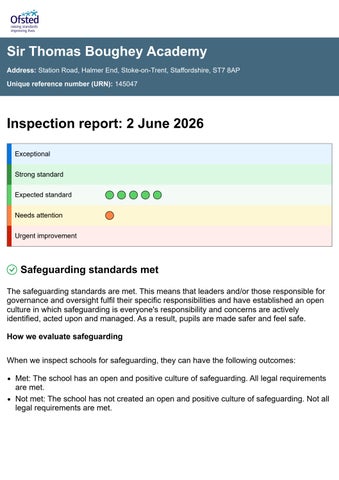
Expected standard
Needs attention
Urgent improvement
Safeguarding standards met
The safeguarding standards are met.This means that leaders and/or those responsible for governance and oversight fulfil their specific responsibilities and have established an open culture in which safeguarding is everyone's responsibility and concerns are actively identified, acted upon and managed As a result, pupils are made safer and feel safe
How we evaluate safeguarding
When we inspect schools for safeguarding, they can have the following outcomes:
Met:The school has an open and positive culture of safeguarding.All legal requirements are met.
Not met:The school has not created an open and positive culture of safeguarding. Not all legal requirements are met
Expected standard
Attendance and behaviour
Expected standard
Leaders have made attendance a priority.There is a clearer and more consistent attendance framework Leaders use analysis of attendance information to identify barriers and patterns of absence. Partnership work with families and external agencies enables staff to provide timely and personalised support.The school's reward systems and strategies, such as inter-form attendance competitions, have resulted in improvements in attendance Attendance is broadly in line with national averages, and persistent absence is declining. Leaders continue to focus on those pupils that do not meet their high attendance expectations.
Leaders have established clear behaviour expectations and systems that are understood and applied by staff and pupils. Pupils experience greater consistency in behaviour management from staff and understand the importance of making better decisions. Pupils demonstrate a growing understanding of the relationship between behaviour, achievement and future aspirations. Pupils are polite and courteous towards adults and visitors. Pupils behave appropriately in lessons and around the school. Classrooms are generally orderly. Disruption in lessons is infrequent, and teachers usually address it promptly The strengthened behaviour systems are resulting in fewer lesson exits and lower suspension rates. Restorative practice and de-escalation training contribute to calmer classrooms and improved relationships between staff and pupils. Bullying and unkind behaviour are rare and dealt with effectively by staff.
Curriculum and teaching Expected standard
The school provides a broad and well-sequenced curriculum It is designed to equip pupils with the knowledge, skills and understanding needed for future success. Leaders have a clear and accurate understanding of the quality of teaching and curriculum implementation. Recent staff training has enhanced pupils’ability to access increasingly demanding learning
Teaching is typically effective and underpinned by secure subject expertise. Learning is carefully structured so that pupils build knowledge over time Teachers routinely use directed questioning and retrieval activities to check understanding. Resources and lesson activities ensure that all pupils, including disadvantaged pupils and those with special educational needs and/or disabilities, generally benefit from well-considered adaptations Feedback allows pupils to address misconceptions and closes gaps in knowledge. Leaders provide tailored support to help pupils catch up when it is needed.
Typically, most pupils retain knowledge well and produce work of a high standard. However, there remains some variability in practice. On occasion, teaching does not fully match pupils' starting points or is not consistently effective As a result, a small number of pupils do not achieve as highly as they could in lessons.Tracking and monitoring of pupils' reading, writing and mathematics ensure pupils who need additional support receive appropriate interventions.
Inclusion
Leaders are ambitious for all pupils, particularly those with special educational needs and/or disabilities and those who are disadvantaged. Leaders have created an atmosphere in which all pupils are expected to access the planned learning equally, with appropriate support
Effective systems enable leaders to identify pupils' needs quickly and accurately. Leaders develop their inclusive practice through links with primary schools, supporting pupils into Year 7. Ongoing monitoring of the impact of interventions and support allows staff to respond and provide timely support when pupils face challenges.
Staff know pupils well and clearly articulate their understanding of pupils' barriers to learning and wellbeing. Staff receive regular training and teachers know which pupils need more support Teachers know the strategies to use when adapting their learning Interventions are well designed and support individual pupils’acquisition of knowledge. Specific support and tailored interventions, for example, through the school's ‘Den', provide a safe and nurturing space for pupils
Leaders work closely with parents, carers and external agencies to ensure pupils receive appropriate support Additional funding, including pupil premium funding, is used effectively to provide personalised support.Alternative provision is carefully selected and contributes positively to attendance and the engagement of those who use it.
Leadership and governance
Expected standard
The recently appointed leaders understand the context of their school and the local community well. Leaders’decisions are firmly rooted in pupils’best interests, particularly for disadvantaged pupils and those with special educational needs and/or disabilities. Effective monitoring and tracking systems now ensure that pupils do not slip through the net academically or pastorally. Leaders have created a safe and inclusive school where pupils feel well supported and have a sense of belonging
Leaders have implemented a range of changes to school routines.The focus on developing the culture of the school has resulted in improved attendance and behaviour across the school. Leaders have implemented evidence-informed professional development, which is leading to improved teaching and learning. Leaders are focused on embedding high-quality teaching across subjects to drive improvement in outcomes for pupils Professional development has a positive effect on staff wellbeing and workload. Staff, including early career teachers, value the support they get from leaders and are positive about the journey the school is on
Leaders work collaboratively with the trust and external partners.The local community committee and trust provide effective support and challenge They understand the school well and fulfil their statutory requirements effectively.The trust holds leaders to account and shares the focus on improving outcomes for pupils.
Parents and carers are positive about leaders establishing a culture of high expectations and improvement. Parental engagement typically highlights how leaders and staff are very
supportive of pupils and, as one parent said, pupils can ‘grow and learn’at the school
Personal development and wellbeing
Expected standard
The school’s personal development programme is carefully planned to meet pupils' needs. It prepares them effectively for life beyond the school.The school’s ‘personal potential’ programme is comprehensive and delivered through tutor time, assemblies and drop-down days. It covers a range of topics relating to personal, social, health and emotional education. Pupils demonstrate knowledge of citizenship themes, including politics, parliament, monarchy and British values. Relationship and sex education is delivered in an ageappropriate manner. Leaders are aware that some pupils' understanding of specific content varies, for example, diversity This variation is being addressed using subject-specialist staff to strengthen implementation and improve consistent delivery.
The pastoral team works effectively to support pupils and contribute well to pupils' understanding of online safety, bullying and appropriate use of technology.This is enhanced through external providers. Pupils benefit from opportunities to discuss difficult issues and develop resilience
Leaders have created an extensive programme of extra-curricular activities that broadens pupils' experiences beyond the classroom Pupils can participate in a range of trips and visits, ranging from the theatre to the zoo.The ‘Boughey Extra’programme provides numerous opportunities, including volleyball, chess, Minecraft, mindfulness and cooking. The school offers a range of student leadership roles that benefit the school and the local community, for example, tree planting. Participation rates are high, particularly for disadvantaged pupils and those with special educational needs and/or disabilities. Many pupils benefit from opportunities that develop confidence, cultural awareness and personal interests.
Leaders have strengthened careers education Pupils benefit from a range of encounters with employers, universities, colleges and apprenticeship providers. Visits to universities and apprenticeship events and engagement with local businesses have increased pupils' awareness of available pathways Pupils are informed about future opportunities, and leaders have a clear understanding of pupils' aspirations.
Needs attention
Achievement Needs attention
Published key stage 4 data is below the national average, and examination results show underperformance across a range of subjects and for some groups, including disadvantaged pupils As a result, some pupils have not been well prepared for their next steps
However, past outcomes and teaching do not reflect pupils’current achievement. Leaders recognise the need to improve outcomes and have strengthened curriculum delivery This is improving pupils’learning. Pupils, including those with special educational needs and/or disabilities and disadvantaged
pupils, are making increasingly secure progress Most have secure subject knowledge and make connections to prior learning.Targeted support helps pupils develop core literacy and numeracy skills and catch up with their peers. Improvements in curriculum delivery and careers provision support more pupils, including disadvantaged pupils, to access education, employment and training.
What it's like to be a pupil at this school
Pupils are known and supported by staff, creating a clear sense of belonging at this inclusive and nurturing school Pupils embody the school's values of excellence, kindness and respect. Relationships between staff and pupils are positive. Pupils benefit from a calm and purposeful atmosphere in lessons and around the school.
Pupils feel safe and happy in school and now attend more regularly. Staff thoughtfully support pupils with barriers to coming to school. Behaviour is generally calm and orderly. Pupils are supported by clear routines to help them make the right choices and meet the school's high expectations. Bullying is rare and is addressed promptly by staff. Pupils know there is an adult to support them in school and appreciate the pastoral support available to them
Pupils enjoy learning, and most take pride in their work. Pupils’historic achievement in national examinations does not reflect their experience in lessons Pupils benefit from staff training that supports the effective delivery of lessons.Teachers have high expectations. Pupils, including those with special educational needs and/or disabilities and those who are disadvantaged, experience an ambitious, well-sequenced curriculum that is adapted to their needs. Many pupils confidently explain their learning and how teachers help them improve.
Pupils benefit from a wide range of opportunities that support their personal development They are well prepared personally for life in modern Britain and for their future aspirations. Pupils can take part in a range of activities, clubs and trips.These, combined with a range of student leadership opportunities, help broaden pupils’interests and make meaningful contributions to school life and the local community. Careers education supports pupils in linking their learning in lessons to preparing them for their next steps in education, employment and training
Next steps
Leaders must continue to ensure that staff have the necessary subject and pedagogical knowledge to deliver the ambitious curriculum.
Leaders must ensure that actions are implemented swiftly so that all pupils receive a highquality education and to raise achievement
Leaders must ensure that they continue to address pupils’barriers to attending school to support high attendance.
About this inspection
This school is part of WindsorAcademyTrust, which means other people in the trust also have responsibility for running the school.The trust is run by the chief executive officer (CEO), Dawn Haywood, and overseen by a board of trustees, chaired byAndrew Middleton
Inspectors carried out this full inspection under section 5 of the EducationAct 2005.
Following our renewed inspection framework, all inspections are now led by His Majesty’s Inspectors (HMIs) or by Ofsted Inspectors (OIs) who have previously served as HMIs.
Inspectors spoke with the headteacher, leaders from the school and the trust, the local community committee, members of teaching and non-teaching staff and several groups of pupils during the inspection.An inspector spoke with the CEO of the trust.
The school meets the requirements of the provider access legislation, which requires schools to provide pupils inYears 8 to 13 with information and engagement about approved technical education qualifications and apprenticeships
The inspectors confirmed the following information about the school:
The school makes use of one registered alternative provision
The headteacher commenced their post in September 2025.
Headteacher: Lisa Shoreman
Lead inspector:
Andrew Washbourne, His Majesty's Inspector
Team inspectors:
Melanie Callaghan-Lewis, Ofsted Inspector
SaraArkle, Ofsted Inspector
Antony Edkins, Ofsted Inspector
Facts and figures used on inspection
The data was used by the inspector(s) during the inspection. More recent data may have been published since the inspection took place
This data is from 2 June 2026
School and pupil context
Well below average
What does this mean?
The total number of pupils currently at this school and how this compares to other schools of this phase in England.
National average: 1,067
School capacity
785
Below average
What does this mean?
The total number of pupils who can attend the school and how this compares to other schools of this phase in England
National average: 1,154
Pupils eligible for free school meals (FSM)
24.78%
Close to average
What does this mean?
The proportion of pupils eligible for free school meals at any point in the last six years.
National average: 28 9%
Pupils with an education, health and care (EHC) plan
1.79%
Below average
What does this mean?
The proportion of pupils with an education, health and care plan.This covers pupils with more support than is available through special educational needs support.
National average: 3 09%
Pupils with special educational needs (SEN) support
8.93%
Below average
What does this mean?
The proportion of pupils with reported special educational support needs at the school.
National average: 13 4%
Location deprivation
Below average
What does this mean?
Based on the English Indices of Deprivation (2019) and the school's location, we have calculated whether the school is located in a more or less deprived area
Resourced Provision or SEND Unit (if applicable)
No resourced provision
What does this mean?
Whether school has Resourced Provision or SEND unit (if applicable)
All pupils' performance
English and maths GCSE
Percentage of pupils who achieved grade 5 or above in English and maths GCSE.
Attainment
8
Ameasure of pupils' point scores across 8 subjects including maths (double weighted), English (double weighted if both language and literature are taken), 3 EBacc measures and 3 GCSE or technical measures.
Progress
8
How much progress pupils made between the end of primary school (key stage 2) and the end of secondary school (key stage 4), compared to pupils across England who got similar results at the end of key stage 2.
Disadvantaged pupils' performance
Disadvantaged pupils are those who have been eligible for free school meals at any point in the last six years and children looked after.
Disadvantaged pupils' English and maths GCSE grade 5 or above
Percentage of disadvantaged pupils achieving grade 5 or above in English and maths GCSE.
Disadvantaged pupils'Attainment 8
Ameasure of disadvantaged pupils' point scores across 8 subjects including maths (double weighted), English (double weighted if both language and literature are taken), 3 EBacc measures and 3 GCSE or technical measures.
Disadvantaged pupils' Progress 8
How much progress disadvantaged pupils made between the end of primary school (key stage 2) and the end of secondary school (key stage 4), compared to pupils across England who got similar results at the end of key stage 2.
Disadvantaged pupils' performance gap
Disadvantaged pupils are those who have been eligible for free school meals at any point in the last six years and children looked after.The school disadvantage gap is the difference between the performance of the school's disadvantaged pupils compared to the performance of all non-disadvantaged pupils nationally.
Disadvantaged pupils' English and maths GCSE grade 5 or above
Percentage of disadvantaged pupils who achieved grade 5 or above in English and maths GCSE.
Disadvantaged pupils'Attainment 8
Ameasure of disadvantaged pupils' point scores across 8 subjects including maths (double weighted), English (double weighted if both language and literature are taken), 3 EBacc measures and 3 GCSE or technical measures.
Disadvantaged pupils' Progress 8
How much progress disadvantaged pupils made between the end of primary school (key stage 2) and the end of secondary school (key stage 4), compared to pupils across England who got similar results at the end of key stage 2
Destinations after 16
Destinations after 16
Percentage of pupils staying in education or employment for at least 2 terms after the end of secondary school (key stage 4).
Absence
Overall absence
The percentage of all possible mornings and afternoons missed due to absence from school (for whatever reason, whether authorised or unauthorised) across all pupils.
Persistent absence
The percentage of pupils missing 10% or more of their possible mornings and afternoons.
Our grades explained Exceptional
Strong standard
The school reaches a strong standard. Leaders are working above the standard expected of them.
Expected standard
The school is fulfilling the expected standard of education and/or care.This means they are following the standard set out in statutory and non statutory legislation and the professional standards expected of them.
Needs attention
The expected standards are not met but leaders are likely able to make the necessary improvements.
Urgent improvement
The school needs to make urgent improvements to provide the expected standard of education and/or care.
The Office for Standards in Education, Children's Services and Skills (Ofsted) inspects services providing education and skills for children and learners of all ages, and inspects and regulates services that care for children and young people.
If you would like a copy of this document in a different format, such as large print or Braille, please telephone 0300 123 1231, or email enquiries@ofsted.gov.uk.
You may reuse this information (not including logos) free of charge in any format or medium, under the terms of the Open Government Licence To view this licence, visit www.nationalarchives.gov.uk/doc/open-government-licence, write to the Information Policy Team,The NationalArchives, Kew, LondonTW9 4DU, or email: psi@nationalarchives gsi govuk
This publication is available at https://reports ofsted govuk
Interested in our work?You can subscribe to our monthly newsletter for more information and updates: http://eepurl.com/iTrDn.
Piccadilly Gate Store Street
Manchester
M1 2WD
T: 0300 123 1231
Textphone: 0161 618 8524
E: enquiries@ofsted govuk
© Crown copyright