OCTOBER 2026 VOL. 21 NO. 8
WWW.WASHINGTONGARDENER.COM
WASHINGTON
gardener
the magazine for gardening enthusiasts in the Mid-Atlantic region
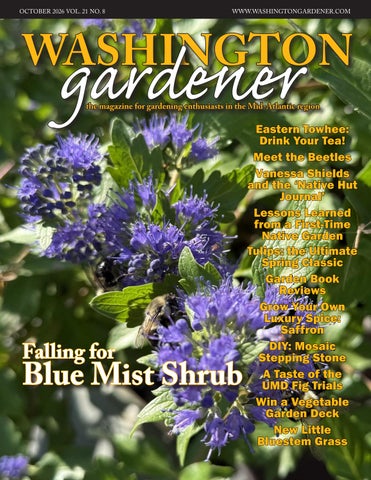
Falling for
Blue Mist Shrub
Eastern Towhee: Drink Your Tea! Meet the Beetles Vanessa Shields and the ‘Native Hut Journal’ Lessons Learned from a First-Time Native Garden Tulips: the Ultimate Spring Classic Garden Book Reviews Grow Your Own Luxury Spice: Saffron DIY: Mosaic Stepping Stone A Taste of the UMD Fig Trials Win a Vegetable Garden Deck New Little Bluestem Grass
RESOURCESsourc
o oo o oo Need a Garden Club Speaker?
Washington Gardener Magazine’s staff and writers are available to speak to groups and garden clubs in the DC region and ONLINE! Call 240.603.1461 or email KathyJentz@gmail.com for available dates, rates, and topics.
RARE AND EXCEPTIONAL PLANTS FOR THE DISCRIMINATING GARDENER AND COLLECTOR Barry Glick Sunshine Farm and Gardens 696 Glicks Road Renick, WV 24966, USA Email: barry@sunfarm.com
�����������������������������
www.sunfarm.com
����������������������������������������
��������������������� ���������������� ����������������� �������������� ��������������� ��������
Your Ad Here
Are you trying to reach thousands of gardeners in the greater DC region/Mid-Atlantic area? Washington Gardener Magazine goes out on the 15th of every month. Contact KathyJentz@gmail.com or call 301.588-6894 for ad rates (starting from $200). The ad deadline is the 10th of each month. Please submit your ad directly to: KathyJentz@gmail.com. 2 WASHINGTON GARDENER OCTOBER 2026
Green Spring Gardens
A “must visit” for everyone in the metropolitan Washington, DC, area. It’s a year-round goldmine of information and inspiration for the home gardener. It’s an outdoor classroom for children and www.greenspring.org their families to learn about plants and wildlife. It’s also a museum, a national historic site that offers glimpses into a long, rich history with colonial origins. Located at 4603 Green Spring Rd., Alexandria, VA. Information: 703-642-5173.
INSIDEcontents
FEATURES and COLUMNS
18
Eastern towhees will sometimes come to birdseed on the ground, especially in winter when ice or snow cover their normal habitat and their bright plumage is hard to miss. Photo by Bill Hubick.
o
Got a Garden Question?
Send your questions to KathyJentz@gmail.com and use the subject line “Q&A.” Then look for your answered questions in upcoming issues.
6
Sam Bahr is trialing 20+ fig varieties (and a few persimmons, too) at the University of Maryland campus in College Park, MD.
10
Tulips are the spring classic with endless possibilities. Combine early-, midseason-, and late-flowering varieties and enjoy weeks of color. Plant in groups in the border or in layers in pots on balcony and terrace. Photo courtesy of iBulb.
BIRDwatch 18 Eastern Towhee BOOKreviews 20-21 Eat Weeds, Psychoactive Plants, Garden Designer’s Handbook DIYproject 8-9 Mosaic Stepping Stone GARDENbasics 16-17 Lessons Learned from a First Native Garden INSECTindex 22 Beetles NEIGHBORnetwork 13-15 Vanessa Shields, The Native Hut Journal NEWPLANTspotlight 11 Little Bluestem ‘Sandhill’ PLANTpick 6-7 UMD Fig Trial PLANTprofile 19 Blue Mist Shrub TIPStricks 10 Tulip Tips, Grow Saffron Spice
DEPARTMENTS
ADVERTISINGindex BLOGlinks EDITORletter GARDENDCpodcasts LOCALevents MONTHLYtasklist NEXTissue READERreactions RESOURCESsources
23 11 4 21 12 11 3 5 2
ON THE COVER Bees enjoy the blossoms of a Caryopteris shrub. In our next issue: Nightshade Weeds A Native Plant Co-Op From Flax to Cloth
Click on the “subscribe” link at washingtongardener.com OCTOBER 2026 WASHINGTON GARDENER 3
Credits
EDITORletter
Kathy Jentz Editor/Publisher Washington Gardener 826 Philadelphia Ave. Silver Spring, MD 20910 Phone: 301-588-6894 kathyjentz@gmail.com www.washingtongardener.com Ruth E. Thaler-Carter Proofreader Jennifer Baxter Jackson Wantman Interns Subscription: $20.00
Your editor at the St. Regis Hotel’s 100th anniversary party in Washington, DC.
Marking Milestones America is 250 this year, but there are so many other recent big milestones happening, from local garden clubs turning 75 to public gardens hitting 100 (or more)! I have been to so many century-marking parties lately that I’m starting to wonder what was in the water 100 years ago. I did a little research and found out that the 1920s were marked by a massive wave of modernization, industrialization, and the opening of international relations post-World War I. Whatever it was that motivated folks in 1926, they sure had ambition and were inspired to think big. They left a lasting legacy and are to be commended. I hope you are taking time in your own life and garden to mark milestones. All too often, we can get caught up in the day-to-day of life and once we pause and look up, we realize that months or years have gone by without reflection. I was looking at a tree in my landscape the other day and in my head, it felt like I planted it last year, when in fact it was more than five! Meanwhile, the GardenDC Podcast hit our 300th episode this summer, so I took that milestone marker as a time for a bit of a break to regroup and re-energize myself to jump back in this fall with new weekly episodes that I hope you will listen to, learn from, and enjoy. Sincerely,
Kathy Jentz, Editor/Publisher, Washington Gardener, KathyJentz@gmail.com 4 WASHINGTON GARDENER OCTOBER 2026
• Washington Gardener Blog: www.washingtongardener.blogspot.com • Washington Gardener Archives: http://issuu.com/washingtongardener • Washington Gardener Discussion Group: https://groups.google.com/g/ washingtongardener/ • Washington Gardener Twitter Feed: www.twitter.com/WDCGardener • Washington Gardener Instagram: www.instagram.com/wdcgardener • Washington Gardener Facebook Page: https://www.facebook.com/ WashingtonGardenerMagazine/ • Washington Gardener YouTube: www.youtube.com/ washingtongardenermagazine • Washington Gardener Amazon Store: www.amazon.com/shop/wdcgardener • Washington Gardener BookShop: bookshop.org/shop/WDCgardener • Washington Gardener Podcast: https://podcasters.spotify.com/pod/ show/gardendc/ • Washington Gardener is a woman-owned business. We are proud to be members of: · GardenComm (formerly GWA: The Association for Garden Communicators) · Green America Business Network · National Garden Bureau · One Montgomery Green · Ladies in the Landscape · Potomac Rose Society · American Horticultural Society · Maryland Nursery, Landscape and Greenhouse Association
Volume 21, Number 8 ISSN 1555-8959 © 2026 Washington Gardener All rights reserved. Published monthly. No material may be reproduced without prior written permission. This magazine is purchased by the buyer with the understanding that the information presented is from various sources from which there can be no warranty or responsibility by the publisher as to legality, completeness, or technical accuracy.
READERcontt
Reader Contest
For our October 2026 Washington Gardener Magazine Reader Contest, we are giving away a Vegetable Garden Deck by Adams Media (value $19). Packed with essential information to help you grow your favorite vegetables and herbs, this deck is a great refresh for anyone looking to start their summer garden. Each of the 50 cards provides easy-to-understand insights about planting times, watering requirements, and harvesting guidelines, plus gorgeous photos—all contained in a convenient box made to withstand the great outdoors! Both expert and beginner gardeners are sure to find something useful while leafing through these cards. To enter to win the grow bags, send an email by 5:00pm on October 31 to WashingtonGardenerMagazine@gmail.com with “Vegetable Garden Deck” in the Subject line and in the body of the email. Tell us what your favorite article was in our October 2026 issue and why. Please include your full name and mailing address. Winners will be announced and notified on/about November 1. Replies might be published. o
Your Ad Here
Are you trying to reach thousands of gardeners in the greater DC region/MidAtlantic area? Washington Gardener Magazine goes out in the middle of every month. Contact KathyJentz@gmail.com or call 301.588.6894 for ad rates (starting from $200). The ad deadline is the 5th of each month. Please submit your ad directly to: KathyJentz@gmail.com.
READERreactions
September 2026 issue I’m a big fan of the podcast, which I try to use to improve my own gardening to the best I can. My favorite article from the September issue was “Leeks: An Ancient Vegetable.” ~ Ben Akiyama, Rockville, MD
Social Media Comments On our “Do you dig your Dahlias” post: “I dig mine because otherwise the voles will devour them over the winter! In spring I replant after dusting with Gold Bond powder, which deters the critters for a season.” ~ Lynn Title, Lanham, MD On our photo album of U.S. National Arboretum fall plantings: “Thank you for posting such lovely photos of a few arboretum beauties loving the rain!!!” ~ Bradley Evans, Greenbelt, MD On our share of the Mt. Cuba Trial Gardens’ Open Day: “They are the real deal! Such a fabulous resource! ~ Lesley Robin Parness, Short Hills, NJ On our post about Orb Weaver Spiders: “They are a really cool web maker. I cant imagine making a beautiful web and then turn around and destroy it. We use to have one on the house.” ~ Gail Johnson, Pennsylvania On our plant profile of Mandevilla vines: “I love them!” ~ Tommy Ogren, Wichita, KS “Such cool plants!” ~ Anonymous
Plant a Row for the Hungry (PAR) is an easy program to participate in and really does not take any extra resources than what you may have in your garden. In normal times, about 35 million people wonder where their next meal will come from. Most of these are children. That’s where PAR steps in. PAR is such a simple program: It urges gardeners to Plant A Row (or a container) dedicated to feeding the hungry, and then take the harvest to someplace or someone that needs it. Once you have donated, send an email to KathyJentz@gmail.com with the total (in pounds and ounces) of what you gave. That is all there is to it. Easy. Effective. Adaptable and Helpful.
On our plant profile of Mexican Sunflowers (Tithonia): “Love Mexican sunflower. Mine got 6 feet tall. It grows like a bush. Butterflies love them.” ~ @estherharrison3786 “A very beautiful plant! I had no idea you could grow them from seed. Great to know, will give them a try. Thank you!” ~ Mary Finelli, Germantown, MD o OCTOBER 2026 WASHINGTON GARDENER 5
PLANTpicks
Tasty Treats: UMD Fig Trial By Jackson Wantman
Have you ever tried a fig? Did you know that there are various types of figs? Well, for me, the answer to both of these questions was “no”—and I’m sure that is the case for some of you readers. But, for Sam Bahr, though, a Facilities Management horticulturist, figs are a way of life, and he has become an expert in them. Bahr has helped manage multiple fig trees on the University of Maryland (UMD) campus in College Park, MD, for 17 years. If you have ever walked around the state’s flagship university, you’ve probably seen or walked by one of these trees. Bahr also conducts tours of these fig trees and aims to teach those with little knowledge of figs or experience trying the fruit, for a better understanding of 6 WASHINGTON GARDENER OCTOBER 2026
what makes them so unique and tasty. In the early stages of growing the fig trees, the results were not very encouraging, according to Bahr. Figs are native to the Mediterranean region and can be a challenge to grow. However, a conversation with a fellow UMD colleague who shared her childhood memories of her grandfather having a fig tree led him to keep going. “She had precious childhood memories of fig trees, and she was very encouraging and told me not to give up,” said Bahr. Fast-forward to today, and there are multiple fig trees planted right next to Tawes Hall, that Bahr says students, faculty, and even those not associated with the university have come from as far as Pennsylvania to see and taste
samples of the figs I had the opportunity to tour the trees and speak to Bahr about the many figs he grows in his trial. Bahr grew up in southeastern Kansas on his parents’ farm, and he would mail-order fruit trees to grow them at home. While figs were not one of the fruits Bahr grew, it inspired his passion for growing fruit that would eventually lead him to figs. Bahr grows a variety of figs species among the trees he has, with the main one being the ‘Brown Turkey’ variety. As Bahr explained, ‘Brown Turkey’ figs have been around for over 100 years and are relatively cold-hardy, which is a big reason why it was the perfect choice to start the collection at Maryland.
PLANTpicks With that said, Bahr evaluates figs by more than just their cold-hardiness. He uses flavor, juiciness, size, and a few other factors to determine what is the perfect fig. Some of the top-rated figs so far include ‘Mega Celeste’, ‘Altreano’, and ‘Takoma Violet’. At the end of my tour and experience with Bahr, I had to ask: Why figs? “Well, for many reasons…They may not be for everybody, but they actually taste better than people imagine.” Bahr’s vast knowledge and experience with figs and these fig trees allow for a comprehensive and worthwhile experience. You can immediately see the passion and love he has for what he does when you meet him. Whether you have tried figs many times or have never been near one in your life, if you are in the area, I highly recommend paying a visit to Bahr and letting him show you around the amazing Maryland fig tree trials. o Jackson Wantman is an intern with Washington Gardener Magazine this fall 2026 semester and a Boston native.
The Azalea Society offers membership to anyone with an interest in azaleas, from home gardeners, collectors and students to plant professionals. The Azalea Society website (azaleas.org) is the source of information about azaleas.
For more information about growing figs in our region: • GardenDC Podcast Episode 166: Figs https://washingtongardener.blogspot. com/2023/09/gardendc-podcast-episode-166-figs.html • Plant Profile: Figs (Ficus carica) https://washingtongardener.blogspot. com/2020/09/plant-profile-figs-ficuscarica.html • Washington Gardener Magazine’s March/April 2006 issue
GROUNDCOVER REVOLUTION IS OUT NOW! By Kathy Jentz
Published by Cool Springs Press
Order it today at: https://amzn.to/3IlYHYL
“Groundcover Revolution is a must-have book for anyone who is interested in having less lawn, fewer weeds, and reduced mulching. The properties charts will save the reader time and money, the pictures provide inspiration, while the detailed plant portraits give the focused information needed for creating beautiful, functional landscapes.” ―C.L. Fornari, GardenLady.com OCTOBER 2026 WASHINGTON GARDENER 7
DIYproje
Broken-Plate Mosaic Stepping Stone By Jennifer Baxter Photos by Katherine Lambert
Local gardener Nancy Newton recently hosted a workshop for the Takoma Horticultural Club about how to craft your own pique-assiette style mosaic stepping stone. This style focuses on embedding found objects like broken plates into a bed of mortar and grouting it to create a beautiful piece that, in this case, can be placed outside in your garden. The following step-by-step guide incorporates steps and tips from the workshop, along with those from outside tutorials. Materials: • Any designed ceramic, porcelain, stone, glass, non-rusting metal, or plastic items that can be cut into pieces • Manual snap cutter • Thin-set mortar • Compound mosaic nipper • Hand towel (optional) • Safety goggles • Face masks (for debris and preventing breathing in grout mix dust) • Work gloves (for handling broken shards) • Outdoor grout mix • Mixing bowl and utensil • Water (for grout mixing) Tips: • Do this using a manual snap cutter for thinner ceramics (up to a quarter inch thick) that need to be cut into squares and rectangles, and a compound mosaic nipper for cutting other types of ceramics such as porcelain. • Do not use nippers with a spring in the middle, as it will not cut the materials. 8 WASHINGTON GARDENER OCTOBER 2026
• Do this onto a hand towel to confine the pieces as you cut. • When cutting, place the nippers toward the edge of each piece, then cut. Once the first crack is created, the rest will come off easily without destroying your desired piece. • You can also wrap your ceramic piece in the hand towel and smash it gently with a hammer; however, this does not allow for as much control over where the piece will break. Step 1: Clean all materials that you plan to cut into pieces and ensure they are about the same thickness (about a quarter of an inch thick). Step 2: Cut your ceramic, plastic, and other material items into many pieces that are flat on one side.
Step 3: Find a base to use for your stepping stone. The bases provided in the workshop were ready-made 12 inch by 12 inch concrete stepping stones. Step 4: This step is optional, but recommended. You can lay out your broken pieces in the design you would like for your stepping stone. This way, you can play around with your design before officially adhering the pieces down with the mortar. Step 5: Pour your thin-set mortar powder into a mixing bowl and slowly add water to it until you have reached the consistency of brownie batter. Using a spray bottle is best for adding water to ensure that you do not overdo add it.
Remove all clumps as best as possible, before letting it slake by letting sit for as long according to your thin-set brand and packaging instructs. Step 6: Apply the thin-set mortar to the back of a piece of your broken items and place it on your base, pressing down enough to secure the piece on the base. Repeat this step until you have created a beautiful mosaic design with the newly formatted placement of your upcycled materials. Step 7: Let the thin-set mortar set/dry according to package instructions (it could be several hours or a few days). Make sure to clean off any loose debris from the materials you used on the top of your finished design before grouting. Step 8: Place outdoor grouting powder mixture into a bowl and slowly add water until you have reached a thick, brownie batter texture. Once this texture is reached, allow the mixture to slake by letting it sit for a few minutes and then stirring it before use. Step 9: Place the mixture on your designed stepping stone and begin to spread it out, using your hands or a smoothing tool. If you choose to use your hands, be sure to wear gloves. Push down hard on the grout when spreading to ensure that it gets into every crevice. Step 10: Using a slightly damp sponge, go over your entire mosaic to smooth out the grouting. Do not try to clean it;
DIYproje
only do this to smooth over and remove the excess grout. If the sponge is too wet, the grout will weaken, which you do not want. Step 11: Let the grout sit for 24–48 hours. To test if your mosaic is ready to buff, stick your fingernail into the grout and if that does not leave a dent, then it is ready. Step 12: Using a piece of fabric or a similar material item, buff and clean off your mosaic by wiping off the excess grout. You do not need water; it is better not to use water if possible, but it can be used if needed. Once you have cleaned your mosaic piece as desired, you are finished with this DIY and you can use your new stepping stone in your garden to add a wonderful pop of color! o Jennifer Baxter is an intern with
Washington Gardener Magazine this fall 2026 semester and a Frederick County, MD, native.
OCTOBER 2026 WASHINGTON GARDENER 9
TIPStricks
Tulips are the spring classic with endless possibilities. Combine early, midseason, and late flowering varieties and enjoy weeks of color. Tulips can broadly be divided into early-, midseason-, and late-flowering varieties. By choosing and combining wisely, you can enjoy weeks of color. Early-flowering tulips open the season. These compact tulips often bloom early in spring and are ideal for pots, containers, and the front of the border. They bring instant color after a long winter. Mid-season tulips form the heart of the tulip season. These are often the classic tulips, with sturdy stems and large flowers. They look stunning planted in groups in the border and are also popular as cut flowers. Late-flowering tulips complete the spring display. Think of elegant lily-flowered tulips, flamed or fringed varieties, and graceful parrot tulips. They bloom later and give the garden a surprising, almost summery feel. Tip: Combine different flowering times when planting in fall. This way, you automatically create a long, continuous tulip display. • Dramatic color and combinations. Tulips really come into their own in the garden border. Plant them in groups rather than neat rows for a natural effect. Play with height by placing lower 10 WASHINGTON GARDENER OCTOBER 2026
Photo courtesy of National Garden Bureau,
Photo courtesy of www.flowerbulbs.com.
Tulips, the Ultimate Spring Classic
tulips at the front and taller varieties slightly further back. Color combinations make all the difference. Choose tone-on-tone with different shades of pink or purple for a calm, stylish look, or go for contrast, such as yellow combined with deep purple, for an energetic spring scene. Tulips combine beautifully with other spring-flowering plants that bloom in the same season. This creates a lively composition that looks different each week. After flowering, other plants take over, while the tulip foliage is left to die back naturally. • Tulips on the terrace and balcony. Even without a garden, you can fully enjoy tulips. In pots and containers, they are surprisingly easy and highly effective. Choose sturdy pots with good drainage and combine several bulbs in one pot for a full look. A popular technique is planting in layers. By planting different tulips with varying flowering times on top of one another, they bloom in succession in the same pot. This delivers weeks of color, even on a small balcony. On the terrace, tulips work beautifully as standalone eye-catchers, for example, in large pots next to the door or along a path. Mix colors and pots for a playful, contemporary effect. • Versatility in shape and style. What makes tulips so special is their enormous variety, from clean and modern to playful and romantic. There are tulips with simple, classic flowers, as well as varieties with double blooms, narrow petals, or softly ruffled edges. This makes tulips suitable for every style. In a modern garden, choose one color and repeat it. In a more natural or creative garden, mix different shapes and shades together. Tulips are planted in fall and reward you in spring with color, shape, and energy. Whether you have a large garden, a small terrace, or a balcony, tulips make it easy to create a strong spring moment. Get inspired by the wide range, experiment with combinations and flowering times, and discover just how versatile tulips can be. This way, every spring becomes a new beginning, full of color and character. Find our more about tulips by visiting, www.flowerbulbs.com. o
Grow Your Own Luxury Spice: Saffron
Saffron may be the world’s priciest spice, but gardeners can grow a few saffron crocus corms to enjoy it fresh. Saffron comes from Crocus sativus, a fall-blooming perennial whose purple flowers each hold three vivid red stigmas that are the true source of the spice. While commercial saffron can cost hundreds of dollars an ounce due to its labor-intensive harvest, growing it at home is an easy, affordable way to bring this luxury ingredient into the kitchen. Did you know that it takes approximately 75,000 flowers to produce one pound of saffron spice? “Saffron has this reputation as an untouchable luxury, but it’s really just a certain crocus corm,” said Diane Blazek, Executive Director, National Garden Bureau. “Anyone with a sunny garden bed or even a few containers can grow their own and harvest enough for a season of special meals.” Saffron crocus are easy to grow and thrive in full to part sun and well-draining soil. While saffron crocus is perennial in USDA zones 6 to 9, it appreciates a layer of mulch to protect it from the cold and preserve soil moisture. In colder zones, consider planting saffron crocus in containers to bring indoors for the winter. Corms should be planted in late summer and flowers 6 to 8 weeks later. To harvest, remove the three red stigmas from each open flower by hand, then use them fresh or air-dry for later use. Known for its floral, earthy flavor and golden hue, saffron enhances dishes in both sweet and savory recipes—with just a pinch needed per recipe. For the full guide, visit https://ngb. org/how-to-grow-harvest-saffron/. o
GARDENnews
Quick Links to Recent Washington Gardener Blog Posts • Fall Soil Test
• Beatrix Potter’s Botanical • Egyptian Starflower Plant Profile See more Washington Gardener blog posts
at WashingtonGardener.blogspot.com o
October Garden To-Do List
New Plant Spotlight Low-maintenance Little Bluestem Grass (Schizachyrium scoparium) ‘Sandhill’ PP36,359
Photos courtesy of Intrinsic.
Little Bluestem ‘Sandhill’ is uniform, hardy, and handsome, with a tall upright plant habit according to the University of Tennessee-Knoxville plant trial, where it received top marks. It trialed well in the Pacific Northwest, the Raker-Robertas trial, and Michigan State University. ‘Sandhill’ is a striking powder-blue plant that combines the ecological benefits of a native grass with a commanding ornamental presence. Thriving through the summer, its wide range of seasonal colors culminates in creamy orange, purple, and rich autumnal hues, extending interest into winter. This low-maintenance Little Bluestem is valued for its water-wise landscape use and erosion control, as well as for supporting pollinators and birds with its seeds. Customers select grasses for their ornamental attractiveness, contribution to plant combinations, and movement in the garden, because they are pest-free, and they tolerate tough environments. A great selection for commercial landscapes, ‘Sandhill’ grows with strong verticality to 3 to 4 feet in height. It has excellent droughtresistance in full sun, and grows well in average to dry soils. Find out more about ‘Sandhill’ at https://intrinsicintroductions.com/.o
• Cover pond with netting to keep out fallen leaves and debris. • Harvest sweet potatoes. • Plant garlic. • Force buds on Christmas Cactus by placing in a cool (55–60 degree) room for 13 hours of darkness. • Apply deer-deterrent spray. • Prevent the spread of disease by cleaning up all infected plants and disposing of them in your trash—not your compost pile. • Plant cover crops in your vegetable gardens and annual beds (i.e., rye, clover, hairy vetch, winter peas). • Set up a cold frame, then plant lettuces, radishes, and carrots from seed. • If you have a water garden, clean out the annual plants and compost them. Cut back the hardy plants and group them in the deepest section of the pond. • Leave seedheads on Black-eyed Susans, Echinacea, Goldenrod, Sunflowers, and Thistles for the birds to enjoy over the winter. • Check for bagworms; pick off, bag, and dispose of them. • Dig up and store potatoes in a cool, dark spot. • Continue to divide and transplant perennials. • Rake leaves and gather in compost piles. • Pick pumpkins at a local pick-your-own farm or visit a local farmer’s market. • Cut garden herbs and hang to dry in a cool, dry place indoors. • Start feeding birds to get them in the habit for the winter. • Attend a local garden club meeting. • Mulch strawberry beds for winter. • Turn your compost pile weekly and don’t let it dry out. Work compost into your planting beds. • Plant evergreens for winter interest. • Weed. • Plant spring-flowering bulbs. • Sow wildflower seeds, such as California Poppies, for next spring. • Collect dried flowers and grasses for an indoor vase. • Clean, sharpen, and store your garden tools. • Lightly fertilize indoor plants. • Pot up Paper Whites and Amaryllis for holiday blooming. • Check that all vines are securely tied against winter’s cold winds. • Collect plant seeds for next year’s planting and for trading. • Pull out spent summer annuals. • Plant hardy mums and fall season annuals. • Water evergreens and new plantings to keep them hydrated this winter. • Fertilize your lawn and re-seed if needed. • Dig up any non-hardy Gladioli bulbs, cut off foliage, dry for a week, and then store inside for the winter. • Transplant trees and shrubs. • Gather seeds and label them carefully. Store in a dry location. • Keep an eye out for the first frost date and insulate plants as needed. In Zone 6, it is expected between September 30–October 30; in Zone 7, it is predicted for October 15–November 15. o OCTOBER 2026 WASHINGTON GARDENER 11
TOP AREA GARDENING EVENTS Classes, Events, and Plant Shows/Sales • October is Urban Agriculture Month in Arlington, VA. They’ll celebrate all month long with special events and activities around the county with garden volunteer days, yoga/fitness classes, educational talks, seed giveaways, and more. More details are posted at https://arlingtonurbanag.org/2026urban-agriculture-month/. • Thursday, October 8, 2:30—3:15pm • Tuesday, October 13, 2:30—3:15pm • Thursday, October 15, 2:30—3:15pm Gardener’s Focus Tour: Plants of the Fall The fall garden shines as plantings, accented by tens-of-thousands of chrysanthemums, begin to transition from the bright growth of summer to fall colors. Jessica Bonilla, director of horticulture at Hillwood Estate, highlights her favorite fall features and first-hand stories of practical gardening lessons. Tickets are distributed at the Ellen MacNeille Charles Visitor Center open opening each day. This 45-minute tour is limited to 20 people and meets in the visitor center conservatory. Details at https://hillwoodmuseum.org/. • Friday, October 9, 10–11am Enid A. Haupt Garden Tour Enjoy a fall Friday in the Smithsonian’s Enid A. Haupt Garden on the National Mall, with one of the knowledgable volunteers or staff for a free garden tour. Discover the history of this urban oasis and explore the new Garden Time Machine installation, part of the Growing Tomorrow exhibition. Tours are offered each Friday in October at 10am and run approximately 40 minutes. Details at https://gardens.si.edu/. • Saturday, October 10, 1–4pm Under the Arbor: Annual Chile Celebration Join members of the Herb Society of America at the U.S. National Arboretum for an afternoon of chile pepper fun. Learn about chile peppers; try different varieties; and taste test foods like salsa, spicy hot chocolate, pickled peppers, and more. Stop by the National Herb Garden for this free program. See https://www.herbsocietypotomac.org/. 12 WASHINGTON GARDENER OCTOBER 2026
Sunday, October 11, 3:30–6pm Forest Feast This forest-to-table event features taste inspirations from the local ecosystem, served outdoors in an edible forest garden. Hosted at Forested in Bowie Maryland. Fee: $150-300. Purchase tickets: https://www.forested.us/foodforest-feast. • Monday, October 12, 2–3pm Seed Saving 101 Learn how to harvest, clean, and store seeds from common garden plants so you can grow them again next season. Green Spring staff will guide you through simple techniques that support biodiversity and help you become a more self-sufficient gardener. Leave with new skills and seeds to start your own collection. Fee: $15 per person. Code P9N.7QQY. Held at Green Spring Gardens, 4603 Green Spring Rd., Alexandria, VA. Friday, October 16, 6–9pm Fierce Flora: A Garden Whodunit Sip sinister spirits and wicked potions with the Friends of the U.S. Botanic Garden as you wander through the “Fierce Flora: Tales of Survival and Demise” exhibit at the U.S. Botanic Garden in Washington, DC. You are invited to become a botanical detective and solve a garden whodunit: Which plant was involved in a mysterious murder? Follow the clues, investigate the evidence, and see if you can crack the case before the night is over. Dare to dress as your favorite dangerous plant, and you just might snag a spooky prize. Enjoy frightfully fun activities; DJ Adrian Loving spinning songs; and explore the fascinating world of plants that sting, poison, and defend themselves. Location: Conservatory. Cost: $40 (Members: $20) Pre-registration required. Must be 21+ to attend. Sign up at https://usbg.swoogo.com/Fierce-Flora_Oct16. • Thursday, October 22, 7–8:30pm Getting Your Garden Ready for Winter Online Class Overwhelmed by winter garden to-do lists? Learn which chores are essential and which you can safely skip as you prepare your garden for the cold months ahead. Discover cost-saving tips and tricks for battening down the hatch-
es before a bad winter hits. Speaker: Kathy Jentz, author of The Urban Garden, editor and publisher of Washington Gardener Magazine. Fee: $15. Register at https://mdmontgomeryctyweb. myvscloud.com/webtrac/web/. Course #PBG0245 300001. • October 31–November 1, and November 7–8, 10am–4pm each day Ginkgo Gold Weekends This time of year brings thousands of new visitors to Blandy, the State Arboretum of Virginia, all hoping to capture the peak transformation of the beautiful Ginkgo Grove, when more than 300 trees transition from green to a canopy of glorious gold leaves. Several food and snack vendors and a natureinspired jewelry vendor will welcome visitors near the parking entrance, before the 10-minute walk to the grove. A ginkgo education table, a State Arboretum of Virginia souvenir stand, and a ginkgo tree sponsorship booth will be in the Gingko Grove. Find out more https://blandy.virginia.edu/state-arboretum-virginia.
Looking Ahead • Sunday, November 8, 2–3:30pm Dealing with Garden Mammal Pests Join Kathy Jentz, publisher of Washington Gardener Magazine and host of the GardenDC Podcast, as she shares her tips and tricks for gardening alongside hungry critters. Learn proven and humane tactics for gardening with deer, rabbits, squirrels, rats, groundhogs, and other creatures that are attracted to both edible and ornamental gardens. Fee: $19 per person. Code: 27C.SZ65. Held at Green Spring Gardens, 4603 Green Spring Rd., Alexandria, VA.
Event Listing Updates
See updated event listings on the Washington Gardener discussion list. Join by emailing WashingtonGardenersubscribe@googlegroups.com.
How to Submit Events
To submit an event for this listing, email washingtongardenermagazine@gmail. com with “Event” in the subject line. Our next deadline is October 20 for the November 2026 issue, for events taking place after November 5. o
NEIGHBORnwork
Vanessa Shields and The Native Hut Journal By Maya Hand
Vanessa Shields is a cookery writer whose Substack, “The Native Hut Journal,” explores topics such as Pacific Islander cooking, plants that are native to the Pacific Islands and the Philippines, travel, art, and interior styling. Shields began “The Native Hut Journal” two years ago when she started cooking Pacific Islander recipes in her outdoor kitchen in Reston, Virginia. She had left a full-time role as deputy director of Asian Real Estate Association of America (AREAA) to devote more time to her children, and connect with her Filipino and New Zealander ancestry through cooking and gardening. Before advocating for Asian American and Pacific Islander homeownership, Shields spent 10 years working as a fashion designer in New York City, where she co-founded a women’s ready-towear collection. Vanessa’s zine, Islands, is the first of six zines that together will form a cookbook. She opens Islands by describing the significance of the title “The Native Hut”: “The native hut symbolizes a style, culture, and connection shared by the islands of the Pacific Ocean. Constructed from bamboo and palm leaves, the native hut experience is about living and creating from what the Earth and ocean provide. Across continents, languages, and centuries, the native hut tells the Austronesian story of a seaborne people who connected the once isolated Pacific Islands. Their culture reminds us that we too can live in deeper commune with nature.” Q: How did you get into gardening? In 2022, we moved to the DMV from San Diego. We had two young children. We had an au pair from Colombia, and that was what was allowing me to still work, but we made a decision for us to find a way of doing it on our own. I quit my fulltime job, and I was basically consulting minimally, and I started volunteering at [my daughter] Hina’s nature preschool, which was really sweet. It was an outdoor preschool, and it was really good for me and my health. It was just a really big
change, ‘cause I’d previously been on the computer at a desk, and it was just not what I wanted to be doing. That experience for basically a year before Hina started kindergarten, though really got me curious about education and using the outdoors to understand the cycles. When she started kindergarten, I was volunteering in [my son] Vasco’s class as a reading teacher, helping once a week. At the end of that year, I asked to help revitalize their outdoor classroom, which was basically a dormant garden. Once upon a time, there was a teacher who was really devoted to it, but for years it had been neglected. It had garden beds that were destroyed and needed to be replaced, and it was basically a mess. I volunteered to help fix it, and I did not know what I was getting myself into. The reality of it was, that school had a huge immigrant population. There were many families from Afghanistan and Ethiopia. There were also a lot of kids from Central America—Honduras, El Salvador—and it was hard for me to connect with a lot of these parents, because I don’t speak Spanish. I knew that there was a communication tool available for us, which was gardening. I thought, “Hey, these people have so much cultural knowledge. Perhaps we can find a way of connecting families with a garden experience.” So, I pitched this idea to the principal: “It’s a world garden, and we can understand what fruits and vegetables grow in these different communities, and try to find some common connections.” I did a bunch of research about what was growing [for example] in Sudan, and how it connected to some parts of Asia. I got pretty far with it. We got architects to donate new garden beds, and we had a day where we cleaned up and all these families came together. Then there was another day where we started planting, and this boy was so emotional that he got to plant something. I think there’s a difference between being an immigrant and living here versus having a connection with land—because there’s this whole process that happens when people have to leave their home countries in terms of generations and connections to a national place. I know for my own Filipino family, before my mom moved here, my grandparents, in my childhood, were farmers. They were taken away from their land in the Philippines for economic reasons. My grandfather, my lolo, had to become a taxi driver. There’s this big story there for me, and I know that’s the case for at least a lot of Filipinos [and] I’m sure immigrants everywhere—where there’s this connection to farming and land. That’s a part of their identity, so for me, to learn how to garden was a way to connect with that storyline and for my kids to tap into this lost, not just skill, but spirituality with growing. There was so much power in seeing something come from nothing. Especially for kids, it’s such a magical process to see that transformation. It ended up being hard for me, because there were not a lot of committed volunteers, so I was watering everything myself, which is not the reason I started it. I really was looking for community in that process, but I’d say from a learn-
ing perspective, one of the other parents was in landscaping, so she taught me everything about gardening, she was teaching me about where you have to plan, how you have to change things, and pollinators. There was already so much richness in the soil that the pollinators grew so quickly, and the tomatoes just came out of the soil. We used compost that was very homemade, so some of the seeds were still in there. It was definitely a trial experience, but it definitely transformed me, and I think that it gave me a sense of, “Oh, I can do this, if I want to.” It takes a lot of courage to start a garden, ‘cause it’s a messy thing where you do not know what you’re getting into, and it requires commitment, but it’s a process that I think is unlike a lot of other things, where you’re giving yourself an opportunity to learn through the earth. There are no other teachers. It’s just you, and the earth’s basically teaching you. It’s teaching you to listen to the environment; it’s teaching you to observe weather patterns and understand where [and] what’s partial shade, what’s full shade; and you’re forced to be outside. I think that’s one of the most important parts about it. That’s why I’m such a firm believer in outdoor cooking, because I feel like it is the same thing with the Philippines storyline. Previously, all the kitchens were outside, and I thought: “Why not cook outside if you have that opportunity? I know we’re dealing with really harsh conditions here, but there are certain months of the year, in the spring and in the fall, where it’s perfect to cook outside, and you’re just getting so much more aroma. Before, I would be cooking, and then I could just compost. You’re seeing the whole cycle of start to finish if you can. If you’re already gardening, the next thing, I think, is cooking. Keeping it outside. Going back to experience, it’s just increasing the level of satisfaction with the process of cooking. Not necessarily cooking to eat, but cooking to enjoy the beauty of produce and the beauty of how things smell or how things look together. It’s funny: I think traditional cookbooks have been very important for me, but I also think that cooking is so much more than pretty pictures. It’s really getting to see the process of so many things, but I think the more I got into cooking, the more I got into where food comes from, and the garden is the answer to all of that. Back to seeing some of these women who didn’t speak that much English, [and] I didn’t speak much Spanish—getting to see how they were so comfortable tending to the garden. It was just second nature for them to know what to do. I know a lot of it’s survival. There’s an element to it that is survival skills, but there’s an element to it of craft in gardening. Having the knowledge of knowing what to do takes years to acquire, so it’s a lot of respect from me when I can see somebody who has been able to harvest something they made. You can come from California, you can move here, but you need to sit through at least a couple cycles to know what you’re working with in terms of climate, where you live in terms of the soil that’s available to you, and what you have to do to enrich the soil, because that’s all a process. OCTOBER 2026 WASHINGTON GARDENER 13
NEIGHBORnwork Q: What plant ingredients used in Filipino and Pacific Islander cuisine are available in the DMV versus San Diego? It’s funny because there’s a huge population of Filipinos in San Diego because of the navy, but there’s Calamansi. It’s becoming this popular flavor. It’s in the citrus family. I have a frozen version of it, because I can never find [it] fresh, unless I have somebody who’s flying in from San Diego; they bring it with them. It’s an incredible garnish. Usually on noodles or fish, they’ll squeeze this citrus, called Calamansi, and it gives life to everything. In my opinion, it’s better than a lime or a lemon. Even in a tea, if you’re drinking an herbal tea, all you need to do is add hot water, just a little bit of honey, and a squeeze of Calamansi. It’s a plant that grows easily in San Diego, because the climate there lends itself to more citrus, and the heat. We were lucky to have a lemon tree in our backyard when we lived in San Diego. You go to San Diego, and it’s palm trees everywhere. It’s not something that we get here. I’m very much about don’t long for what you don’t have; try to cultivate what you can where you are. Even though I have that—wanderlust— where I love traveling. I love culture and style, so of course, I want to experience everything I can, but there’s something to be said about cultivating experience where you are. I think that’s kind of where I’m at these days. I really want to do the most with what I have. Honestly, there’s so much about plant life that I think goes back to that [UC] Davis experience, where I took viticulture and oenology, and I learned all about winemaking. It gave us the option: “You can take this as a science engineering class, or you can take this as a social science class,” because plants are both cultural and scientific. I just lean more toward the cultural piece. I appreciate scientists, but that’s the beauty of plants. I’m much more interested in storytelling from the cultural perspective, even though there’s so much scientific knowledge that we can get about our health, about the climate, about the condition of the Earth. All of these things are really important, but there’s also so much folklore, so much indigenous knowledge, so much beauty and art, from plants. Those are the stories that I’m really interested in telling. I was doing ancestry research on my dad’s side, because it’s so much easier to get British ancestry records than Filipino, because things weren’t translated. They just have really good systems for recording everything, but I found out that my dad’s great-grandpa on his mom’s side, [he was] one of the first settlers to come to New Zealand from London. I found his obituary, and he was a curator of this botanical garden in Hawke’s Bay. I found out my mom’s side had this farming story. My lola and lolo grew up on this farm where they harvested rice. Then I found out my greatgrandfather was in New Zealand and basically curated this whole botanical garden. “There’s gotta be something there,” where I’m needing to pursue this. This is where it goes back to cookbooks, ‘cause I find traditional cookbooks now are all about, “Oh, make this recipe,” but it’s so much deeper
14 WASHINGTON GARDENER OCTOBER 2026
than that. It’s so much more about, “Well, what’s the story of the banana plant, and how is it connected to Filipino culture?” That’s where I want to open it up. I want people to see a banana plant and think, “the Philippines,” as opposed to hearing about Lumpia and Pancit and thinking about the Philippines. What I’m really interested in is the precolonial Filipino foods. In essence, it was them being near the sea, what they could catch from the ocean, what they were growing on the land. It’s the food from nature. I think there are a lot of things headed in that direction in terms of where psychology is going right now. Psychology is becoming much more diverse in its thinking, and I think that there’s a lot of discourse about ancestral healing, generational trauma, and these kind of things. I also think that there’s a desire for people to go back to this origin of a food, maybe also because culturally, things are going in such a technologically advanced way—like AI, robotics, and whatever else is in store for us as a society. It’s this pendulum swing of us wanting to return to the essence of who we are as humans. And what’s the most nourishing thing? Plant life, things that come directly from earth that we need to protect at all cost. And the only way to protect them is to give them more value, and we can only give them more value if there’s more cultural relevance to them. I think it goes back to what matters, what’s going to give us enrichment, and because food is something that we do so often, something we need so much and that we come together for. Food is very much an identity thing. A choice is often something that people make for convenience, but then there’s this other element of, “What’s really going to feed my soul?” Then there’s that opportunity; it doesn’t have to be every day, but that one time of week where you’re like, “I’m going to make something that’s really going to be fulfilling for me.” It could be something you had as a kid. It could just be something also like, “I’m really interested in eggplant, so I’m going to learn how to make something with eggplant.” It’s going to change you, because you’re going to start connecting with an eggplant in a way that you never, ever thought you would. You’re going to learn so much about what an eggplant can do, or what it can’t do, or how it tastes for you, and then you’re opening yourself up to this world of life that is going to be great. Q: Are there plants used in Filipino and Pacific Islander cooking that grow better in the DMV than in San Diego? One of the things I noticed in Reston—I would go walking on this trail, and there was a senior living area, predominantly for Chinese Americans. And there was a little stream. There was a lot of water available at this little valley to this senior living facility, so they decided to grow taro. Taro is basically one of the most important plants when you think of the Pacific Islands. It’s also connected to Taiwan and the Philippines, and other parts of Asia. It requires a water source, you can’t really grow it in soil. There needs to be water collecting around it. So, the fact that I’ve seen it grow in the DMV is really incredible.
Even the lotus at the Lotus Festival—I think traditionally, people see that as an Asian plant. Even Cherry Blossoms are a Japanese gift that was given to the DMV. I have a friend who’s half Jamaican, whom I actually met in Paris—she’s one of my closest friends still—who invites me to go to Jamaica. She hosts me there because the Caribbean has so much in common with the South Pacific, because of the similar plants. If you go to Jamaica, you can basically see all the fruits that grow in Tahiti, or not all of them, but there’s a shared language around fruits there. People don’t normally associate the Caribbean with the Pacific Islands, but it’s the same weather. They’ve shared seeds somehow, so I think that studying plants is opening yourself up to soil and understanding why things have done well in certain parts of the world and not others. There’s a Japanese designer named Nakashima, and he made the most beautiful mid-century furniture from wood. He basically studied all of the wood; all the trees that grew in the Northeast. That was the wood that he had available to him. He took that and applied Japanese design to them. But I think what’s so exciting about his story is, he’s not from here, but he was able to see the beauty and make it his. ‘Cause when I talked about craft before, like basketmaking and even wooden bowls, and why I’m so interested in some of these accessories that belong in the kitchen and eating experience—That’s cultural, too. It doesn’t just stop with the food, it’s all of the things that come from the plants that make it what it is. Q: You mentioned when we spoke earlier that there are ingredients you can only get at an Asian store, but that you also value buying local produce or growing it. How do you balance those two, or incorporate both of them? For example, corn is obviously so central to Native American and Mexican Indigenous communities, and people don’t think of it as an Asian vegetable. But if you go to the Philippines and other parts of Asia, they treat corn more like a dessert. They’re cooking it in puddings, and they’re adding sugar to it, and it’s seen more as a sweet thing. Learning those recipes has given me so much more, made me think of corn very differently. That’s something that we have available to us. Same thing with cantaloupe. My grandmother, my lola, she would—there’s this really special tool in the Philippines where they have this small metal scraper. It’s used for coconut, but it’s really great for cantaloupe, and you basically can thread the cantaloupe with this tool. You get these long tubes of flesh. In the Philippines, it’s called cantaloupe drink, where they’ll strand the cantaloupe, and they’ll put it in ice and sugar and water. There’s local cantaloupe [here]. That’s something that I can use. It might not be native to the Philippines, but it’s been used in the Philippines. What are fruits and vegetables that exist here that I can be creative with, or at least tap into previous things that I might have been exposed to already?
NEIGHBORnwork The old cookbooks that I buy are for teaching me about what’s growing in the Philippines or Hawaii. I might not have access to it, but if I can learn what these things are, then I can start making connections with what’s similar. For instance, usually spinach is such a common replacement for so many recipes. You also start noticing what people are replacing things with when you start studying cookbooks, like, “Oh, they’re using spinach, but what else could they be using?” Starting thinking about, “What else can I use that’s maybe more in line with what I want this to taste like?” Q: Are you growing anything in your home? Right now, we are working towards our outdoor experience. I have not started, which sounds terrible. We’ve lived here for less than six months. We tried at our last house to grow a banana plant and failed. It was because of where we put it, I think, and the soil, and then just not watering it frequently enough. I’ve been talking to a lot of folks about what’s possible. I’ve also been studying a lot of our neighbors’ homes, looking at “What do they grow?” For example, our neighbor across the street is growing a lot. What I’ve always wanted to do is try to grow more Filipino varieties in terms of herbs, and I have a whole book about it. I would have to get my hands on the seeds, and then that would be a whole thing. My plan is to try to get more in that realm of banana plants and things I could find in the Philippines, to see what could grow here. I’ve been researching a lot—observing—watching the climate, watching the seasons change, watching what’s in the area. I think there’s a lot of that noticing that needs to happen. They say that about living in a home, too: Before you renovate it, you should live in a home and see how the light changes. All of this is necessary to whatever environment you want to create, because a garden is really just an extension of a home. Q: Is there a plant you want to grow first? Yeah, I do want to have a banana plant. Also, there is this vegetable in the bean family. It’s called Sitaw. They’re these really long green beans. That’s the thing I’m also interested in. I know they do well here. I bought them before at a farm stand. I think tomatoes are also very important. In Filipino cuisine. There’s actually a lot of tomato usage, especially for stews and things like that, so tomatoes for sure. Okra was something that I tried growing in the past that does well here. It’s actually found in this very common indigenous Filipino recipe called pinakbet. It has squash, tomato, okra, and the green beans that I mentioned. It also has eggplant sometimes. All these really great garden varieties stewed with a little fish paste. It’s almost like you’re getting a bit of that sea flavor with a rich body of succulent, cooked-down vegetables. Q: You wrote in your zine that you have memories of your grandmother harvesting and eating mangoes. What are some food traditions that you’ve learned from your family or particular plants that make you feel connected to home?
Mangoes are a tropical fruit and unfortunately don’t grow here, because the winters are too cold. I hadn’t seen them grow in the wild until we went to the Philippines in 2024. It’s a big connection to my Filipino identity, in terms of conversations I’ve heard about them and how I’ve seen my mom and lola interact with others, and how serious they are about them, in terms of understanding the range of what you can get from a mango— from its green stage all the way to if it’s ripened. I think there is kind of a seriousness about mangoes among Filipinos in general, because people will claim they’re just the best. Even my kids—it’s been this innate thing that they automatically grasp to. It’s funny because they’re so mixed, and my husband’s from Springfield, Illinois, which is central Illinois, which is corn country, I like to say. They both gravitate toward his ancestral foods and my ancestral foods. I’d say the corn and the mango are very easy for them to delight in.
Q: What plants did you grow at your previous home in Reston? How does growing your own food influence the way you cook, if it does? In Reston, I had luck with peppers, like bell peppers and peppers in general. I think that because of the heat, it was very easy to get those happening. I also had some success growing okra. It does influence your cooking because if you’re able to grow something, you put so much effort into growing it. You’re more likely to feel inspired to make something, because you think “I’m going to taste it.” It’s a celebration of the fact that you grew this thing, so it almost forces you to eat what you grow, especially when it’s a vegetable that I know I can cook a Filipino recipe with. I will go out of my way to make sure I can make something that’s special with it. I found that I did that. I usually don’t like okra, but I was so proud that I grew it that I was thinking “Oh, I’m going to make something with it, because it’s like a gift.” Q: What does connecting with nature mean to you in everyday life? Several years ago, I got really into this Polynesian mysticism. It’s certain ideas that a lot of Polynesians believe in—this idea of mana. It’s a source. People have it, but it’s also attributed to being in nature and things in nature—a rock can have a lot of mana, or a tree or a certain plant. Tea leaves are believed to carry a lot of mana. It’s an energy source.
I have this saying that I share with my husband, when my battery is drained. When I feel drained, like I’ve been indoors for a long time or in front of a screen, I use nature to recharge. It’s the same way as putting my phone on a charger. It’s something I need to stay well and feel like I have something to work with in terms of being at my best. Q: What’s the most common way that you reconnect with nature to get that energy? The Japanese have this idea called forest bathing, I’ve been so grateful since we’ve moved to the DMV to have access to these wooded area trails. I find that walking through them, either alone or with friends or family—biking through trails where there’s heavy wooded areas, ferns, small streams, I automatically get recharged through the proximity of being in nature. It’s really being intentional about, “Okay, I’m spending time in nature — not for exercise, not for socializing, but really just to be immersed.” I used to do this in San Diego, similarly with the ocean. I don’t have that access to the Pacific Ocean here, but it would be sort of the same thing. It’s allowing yourself to feel smaller than what’s around you, and remember that you’re not the master of the universe; that nature is a very powerful being that we need to remember and allow to kind of help us. I think that that’s more what it’s about for me. Q: When we talked earlier, you mentioned that compost can be a form of art. How would you describe the art aspect of compost? When I’m cooking in the outdoor kitchen, I’m making all of these things—I’m making the Filipino [vegetable dish] pinakbet, and I’m not using all the vegetables, because there’s seeds from the okra and seeds from the eggplant and all these different things. Then there are the banana leaves, and everything gets thrown into this compost bin. It starts becoming a little bit of your identity in that piece, because it’s not trash. It’s things that are able to go back into the earth, so there’s that element of the self-expression of cooking being preserved through compost. I told you that we were given this compost from Hina’s old preschool teacher when I started the garden at the school. I was very touched, because she had been putting this thing together herself for over a year. It’s almost like when somebody makes you soup or something, and you think “My gosh, this is really thoughtful.” It just goes back to the earth. There’s all this magic that’s happening. This whole process of decay, fruits, and vegetables—I think is very much from whoever made it. If you make it yourself, then it’s almost like it’s a part of you. That’s why I call it art—because it takes a lot of work, it takes a lot of intention. It’s at the next level; there’s gardening and then there’s cooking and gardening, which is compost. o Maya Hand was a summer intern with the Washington Gardener. She is an aspiring science journalist/writer studying journalism at the University of Maryland with a minor in science, technology, ethics, and policy. This profile has been edited for length and clarity. OCTOBER 2026 WASHINGTON GARDENER 15
GARDENbasics
By Becky Band Jain
16 WASHINGTON GARDENER OCTOBER 2026
Lesson 1: Spring Isn’t the Ideal Time to Plant
Fall, not spring, is fabulous for planting—sage advice that came to me through Nature Forward’s Alice Sturm, Director of the Restoration Department. It’s easier on you, easier on the plants. The cooler temps mean less heat stress for them, and less watering, sweat, and exhaustion for you. Spring is a fine place to start—I myself had no choice about it because of when our house closing took place— but it can require more planning and effort for beginners. For example, if you’re not used to going out and watering regularly, you have to remember to do this every few days, especially right after planting and any dry spells (so you have to also remember to monitor the weather!). If you’re like me, you will forget and lose some plants, or come close to it. Tip: If a transplant looks like it’s on the verge of dying, try cutting it back to only a few leaves. This way, it can focus its energy on the roots and will have a better chance at survival.
A common mistake that beginners commit is planting things too far apart. In my case, my excitement to order my first few native plugs through a local Cub Scout troop was soon dashed when they were delivered to me. “This is what I spent almost $200 on?” I thought, my heart deflating like a balloon. Still, plugs are more affordable than the bigger sizes available, so they’re still worthwhile. Just don’t do what I did and follow the instructions to plant them one foot apart, or if you do, be prepared to have empty space (be sure to mulch well to prevent weeds), and wait a couple of years until they fill out. Or, better yet, get more plants and get to work. It took me a while to learn the value of the understated groundcover, sometimes referred to as “green mulch.” Some local examples include violets, which tend to be plentiful in lawns around here; lyreleaf sage; and coral bells. And find fillers like grasses and sedges (often underappreciated by beginners and experts alike because they don’t flower), like little bluestem for sun or wild sea oats for shade. It also helps to think outside of the box to identify new planting areas. For example, the ground underneath tree branches is often bare because of the dry shade, but many caterpillars require a softer landing to survive. In those spots, I’ve had good luck with
Celandine poppy plug. Photo by Becky Band Jain.
In March 2023, we bought a house in Garrett Park, Maryland, with a quarteracre yard. An avid documentary watcher, I had heard that monarch butterflies and bees were in decline, and vaguely knew about the existence of native plants. After reading the work of Doug Tallamy, I was overcome with worry that we’re losing pollinators and insects at an alarming rate. I was inspired to act to mitigate and prevent further damage to our larger food webs. I eagerly got to work converting the mostly ornamental garden to an ecological powerhouse. I drove all over Montgomery County to source plants from the Montgomery County Native Plant People Facebook group, with the goal of establishing maximum native plant variety and biodiversity to support our ecosystems of insects and birds. Many newbies plant in spring and find themselves losing plants because they’ve forgotten to water. They space things a foot apart because that’s what the label says. If you’re new to natives, you also might get overwhelmed by the sudden awareness of all of the nonnatives and try to remove all you can. I learned through trial and error—and the wisdom of local gardening experts and communities—that there are better ways to get started. Now that I’m
in the third season (the one where natives finally leap), I can tell you that things fill out, the creatures return, and the garden is full of life and color and beauty—just maybe not the kind that we are used to seeing.
Fall-blooming wingstem. Photo by Becky Band Jain.
Lessons Learned: Three Things I Got Wrong in My First Native Garden
Lesson 2: Planting Too Sparsely
GARDENbasics
Phlox ‘Jeana’, rattlesnake master, bluestem goldenrod, obedient plant, coral honeysuckle, cutleaf coneflower, and a volunteer honeyvine milkweed are now filling out the space of a former nandina bush. Photo by Becky Band Jain.
Eastern columbine (even scattering the seeds) and golden ragwort. Tip: You will need to move plants, and that’s okay. If they eventually get crowded, that’s a good problem to have! It’s (near) impossible to get everything right the first time, especially as a beginner. The beauty is in the process.
learned that many other invasive vines pose a risk to trees and forests in our region. In addition to ivy, the most harmful are kudzu, porcelainberry, wisteria, Japanese honeysuckle, and Oriental bittersweet. Managing these is a constant struggle, and beginners should know—and accept—that they may never fully eradicate invasives from their yard. Not every non-native is a problem. Some are beautiful and entirely harmless, but be sure to inform yourself, because, while there are some laws to prevent the sale of nefarious plants, they are sometimes behind the times. Even worse, some nurseries still end up selling them anyway. As with anything in life, gardening is about the journey and not the destination. A garden’s beauty comes from its
aliveness, which means that it is everevolving. Many of us hold standards from a time of more traditional garden aesthetics, and there’s a freedom in exploring the world of natives and learning from trial and error. In making and ideally embracing our mistakes, we become more attuned to our surroundings and better stewards of our land. Don’t be afraid to dig in, get your hands dirty, and start restoring the food web right in your own front or backyard—one native plant at a time. o Becky Band Jain is a Montgomery County, MD, gardener three seasons into converting a shady Garrett Park yard to natives, and former VP of the Wild Ones Nation’s Capital chapter. She’s written plant profiles for The Plant Native website and is currently working on a book about natives. To read more, find her at beckybjain.com.
Lesson 3: Overcome by Invasives
It’s easy to get overwhelmed by all of the invasives out there that keep coming back like an endless game of whack-a-mole. To preserve your energy and sanity, triage by harm and tackle the worst offenders first. A great place to start learning is the UMD extension office’s Introduction to Invasive Plants in Maryland (https://extension.umd. edu/resource/introduction-invasiveplants-maryland/). In my yard, I had a ton of English ivy, all over. I hired help to remove it all at once, but I wish I had gone more slowly and replaced it along the way with native seeds and plants to compete with it. Similarly, I’ve removed a bunch of ground ivy from my lawn in an effort to encourage the violets, but then other weeds quickly filled in its place. It’s all about picking your battles. Tip: Since nature tends to fill the void with more weeds, you’ll want to have plants at the ready to fill the newly loosened soil. Heavy mulch can also stand in as a placeholder when replacement plants aren’t ready, but it’s less effective. From participating in the Montgomery Parks Weed Warriors program, I
��������������������� ������������������������������������������������������� ������������������������������������������������ ������������������������������������������������������� �������������������������������� � �������������������������������������� � ������������������������������������������ � ������������������������������������������������� ��������� � ����������������������������������������������� � ����������������������������������������������������
OCTOBER 2026 WASHINGTON GARDENER 17
BIRDwatch
Eastern Towhee: Drink Your Tea!
By Rick Borchelt The male Eastern towhee in our area sports a red eye in addition to its bright plumage. Photo courtesy of Mass.gov.
There are some birds that you hear much more often than you see them, even though they’re common here. They’re secretive enough that you can go an entire season without a sighting, even though they live in or near your yard and you hear them almost every day. One such bird is the Eastern towhee (Pipilo erthyrophthalmus), whose singing admonition drink your teeeaaa! tops the spring soundtrack of many Washington-area gardens and woodlands. It’s also the birdsong about which I get the most questions from frustrated gardeners who keep hearing this loud and persistent song but can never find the songster! Towhees as a group—scientists recognize eight New World species—are actually chunky, long-tailed sparrows, the largest sparrows in our area. However, unlike their drab brown cousins, our towhees look more like robins or orioles, brightly colored in red, black, and white. The contrast between towhees and more sedately colored sparrows led popular bird blogger Don Enright to describe them as “sparrows in drag.” The females and juveniles have the same general color pattern as the adult males, except the colors are more muted tones of rust and brown. 18 WASHINGTON GARDENER OCTOBER 2026
So, how does this brightly colored bird hide so successfully in such close proximity to people? Part of the answer lies in the towhee’s preferred habitat: brushy tangles of brambles, vines, and shrubbery, usually at the edge between your garden and the local powerline or woodlot. Towhees prefer to live where there is no tree canopy and the plants are so thick that you can’t see the ground. These dense tangles are where drink your teeeaaa! pours forth from males seeking mates, especially in the spring. The common name of towhee comes from their other frequent vocalization, an explosive tow-hee’! that can be either an alarm call or a contact call as towhee families negotiate their green jungles. Sometimes this call is translated as chewink or joree, both of which are regional names for Eastern towhees. The female towhee prefers to situate her nest in a hidden tangle of blueberries, brambles, or honeysuckle vines, almost always on the ground, but sometimes in a very low bush. There, she will lay three or four brown-speckled eggs and incubate them for about two weeks. Both parents feed the young chicks for the two weeks they stay in the nest before fledging.
Towhees’ preference for nesting on the ground and at the edges of forests puts them in considerable danger. Brown-headed cowbirds, which lay their eggs in the nests of other birds and leave the parental care of their fastergrowing, bullying chicks to the foster parents, preferentially hijack nests in the open rather than in forests. The towhee’s penchant for nesting on the ground also makes them exceptionally vulnerable to roaming cats or off-leash dogs. In the Northeast and Mid-Atlantic, towhee numbers have dropped by 50% in the past 50 years, partly from loss of the edge habitat they favor and also from nest failure due to predation or cowbird parasitism. Towhees’ kinship with sparrows is more apparent if you ever see them at work in their habitat, scratching through the leaves around brush piles and under arching shrubs. They have a sparrow-like hop with a twist, often called the double-hop scratch, where the bird hops forward slightly, then kicks backward with both feet at once before pouncing on earthworms, insects, or seeds they’ve uncovered. This behavior makes more noise than you would expect; following this sound is often the best way to find towhees in action. The best time to see towhees is in winter, when there is ice or snow on the ground, and especially under bird feeders where cardinals, finches, and other songbirds knock off seeds. If the
Female Eastern towhees have dark eyes but otherwise sport the same plumage pattern in a slightly muted color register. Photo by William H. Majoros.
PLANTprofile
Blue Mist Shrub By Kathy Jentz
The female Eastern towhee builds a cupshaped nest of grass and plant fiber on the ground, hidden by vines or shrubs. The larger egg at the top belongs to a brownheaded cowbird. Photo by Kris Spaeth/ USFWS.
feeders are not far from their beloved woodsy edges, towhees may join juncos and white-crowned sparrows in gleaning the waste seed. Throw a handful of seeds in the lee of a brush pile or shrub tangle, and you’ll be a towhee’s friend for life. Our Eastern towhee and the spotted towhee of the West were considered a single species, the rufous-sided towhee, until sophisticated genetic testing emerged in the mid-1990s that allowed scientists to tell species apart. (You may still see this name for our parti-colored skulker in some birding books.) The genus name Pipilo comes from a common name in Latin meaning bunting, a common name shared by many species of field birds in Europe. Eastern towhee males in our area usually have a bright red eye, which gives them the species moniker erythrophthalmus, Greek for “red eye.” When the great ice sheets of the Pleistocene split the North American continent in two, eastern and western towhees were separated and evolved independently. Now that the ice sheets have receded, Eastern and spotted towhees occasionally hybridize where their ranges overlap once more. You can be a friend to towhees—and other songbirds—by being a lazy gardener. Don’t rake your leaves. Don’t tidy up weed stalks and tall grasses for the winter. Don’t cut shrubs and saplings back to the field or forest edge. Just sit back and take the towhee’s advice: Drink your teeeaaa! o
Blue Mist Shrub (Caryopteris spp.), also known as Bluebeard or Blue Spirea, is a small shrub that flowers from late summer to early fall for several weeks. It typically blooms in shades of blue. It is usually between 2– to 3–feet tall. Most Caryopteris are hardy from USDA Zone 9 down to Zone 5 and some to Zone 4. It blooms best in full sun and needs average garden soil that is not heavily enriched with fertilizer or it can flop. Caryopteris is a low-maintenance plant. In the spring, cut it back to about 8 to 12 inches tall. It blooms on new wood so the old part will not flower. Caryopteris is a deciduous shrub and its flowers, leaves, and stems give off a faint, pleasant scent that makes it deer-resistant. It is fairly heat- and drought-tolerant as well. It has no major pest or diseases. Best of all, pollinators love it as much as you do. The tried-and-true cultivars are ‘Dark Knight’ with deep-blue flowers, and ‘Longwood Blue,’ which has sky-blue flowers. There are newer, compact cultivars such ‘Petit Bleu’ and ‘First Choice’. There are also forms with yellow or chartreuse foliage, such as ‘Sunshine Blue’, ‘Worcester Gold’, and ‘Almost Gold’ o Kathy Jentz is the editor of Washington Gardener.
Rick Borchelt is a science and natural history writer, field naturalist, and garden and botany enthusiast. Reach him with any questions at rborchelt@gmail.com. OCTOBER 2026 WASHINGTON GARDENER 19
BOOKreviews
The New Garden Designer’s Handbook: How to Design Useful, Beautiful Gardens from Start to Finish Author: Daryl Beyers Publisher: Timber Press List Price: $29.99 Order Links: https://amzn.to/4Azm0XY and https://bookshop.org/ a/79479/9781643264691 Reviewer: Jennifer Baxter This book immediately intrigued me as someone who has never started their own garden before. From the beginning of the book, Daryl Beyers provides immense detail to describe the different steps that a person should take to create their own garden, while explaining words that may be confusing to a new gardener. This set me up for success when reading the rest of the book. With three decades of professional experience, including as an estate gardener, and with a degree in environmental design, Beyers is more than qualified a reliable source for the book on designing a useful and beautiful garden. From the landscape grounds themselves, to furniture and outdoor utilities, to the flowers placed intricately in every nook and cranny, he explains the many aspects that a garden can incorporate to make it appealing to the eye while still keeping it functional. This book allowed me to take away lessons that I didn’t know before reading it, one of which I believe may inspire you as a gardener to read it. On page 30, Beyers writes, “My best advice is to strengthen your relationship with plants and come to understand all that the plant layer 20 WASHINGTON GARDENER OCTOBER 2026
can provide.” Here, Beyers is referring to how much the plant layer of your garden, something that all gardeners know and love, can transcend not only to how it looks but also to how it functions. To me, he is also saying that you can never be too in touch with your plant knowledge, which encouraged me not only to look more into garden and landscape design, but also to research plants and their purposes further. Throughout the book, Beyers also includes more interactive sections, such as “Brainstorming a Dream Garden,” which had me thinking rather than just reading, despite it giving step by step tutorials on how to do so in each one. Beyers also shares many inspiring words that resonated with me, maybe even outside of just gardening. On page 11, he writes, “...what makes designing gardens interesting and rewarding are the same things that often make it difficult and frustrating.” I also thoroughly enjoyed looking at all of the artwork in the book, beautifully done by illustrator Elara Tanguy. The colors of the watercolor-like art helps the book’s pages to pop, but also included are real images and sketches to give variety where necessary to help the reader understand topics. Overall, I took away a lot from this book about the things that you may never have expected you needed to know about garden design. By the end, I felt inspired to learn more about, or even start, designing a garden right now, which before reading was never something that I had even considered doing. o Jennifer Baxter is an intern with Washington Gardener Magazine this fall 2026 semester and a Frederick County, MD, native.
Psychoactive Plants & Fungi: A Cultural Guide to 42 Botanicals That Expand the Mind Author: Liam Engel Publisher: Thames & Hudson List Price: $34.95 Order Links: https://amzn.to/4jv8TRt and https://bookshop.org/ a/79479/9781760765873 Reviewer: Jackson Wantman This book is a heavily illustrated and interactive dive into the world of
psychoactive plants, educating readers about the facts and history of 42 species they will discover throughout their reading. For those who may be unfamiliar, a psychoactive substance is something that alters your brain in some way; for example, any type of psychedelic drug. Every plant gets a couple of paragraphs about its historical and cultural use, botanical species, origin, common name, appearance, and environment. This is accompanied by pictures of the plant or fungus. Throughout the book, Engel, an Australian ethnobotanist, breaks down how psychoactive plants have been used by humans in various cultures, such as Siberian shamans, Amazon healers, and modern scientists. In terms of my personal opinion about the book, I think it is a worthwhile read if you want to learn more about plants beyond their aesthetic and environmental uses. I had very little knowledge about the stimulating effects that plants could have on humans, and the way the book is written and structured makes it very easy to get a good understanding. If you are a plant lover and looking to expand your knowledge about these interesting plants, then Psychoactive Plants & Fungi is an amazing book choice for you. o Jackson Wantman is an intern with Washington Gardener Magazine this fall 2026 semester and a Boston native.
BOOKreviews
Eat Weeds: A Field Guide to Foraging: How to Identify, Harvest, Eat, and Use Wild Plants Author: Diego Bonetto Publisher: Thames & Hudson List Price: $29.95 Order Links: https://amzn.to/47p39S6 and https://bookshop.org/ a/79479/9781760765989 Reviewer: Teresa J. Speight If foraging is your favorite pastime, this book should be in your collection. At the beginning of this book is a statement that precedes any of the information it provides. It reminds the reader to spend a little time researching plants and consulting with a professional before ingesting anything foraged. The author, Diego Bonetto, grew up in Northern Italy and, under the tutelage of his mother, learned to identify indigenous plants that could be used for food or medicine. As an adult and father, he wanted his children to learn about responsible foraging the way he did as a child. His reason for writing this book was to share how foraging is as sustainable and useful a practice today as it was in years past. Bonetto realized that foraging was also a wonderful way to connect people and communities with nature. A lost practice, foraging was considered a cultural practice. The art of foraging was not considered appropriate unless you were in a specific class of society. Today, many desire information from our ancestors to continue traditional ways of obtaining nourishment and medicine from the earth.
Although this book was primarily written for an Australian audience, many of the featured plants, as well as their use, can be found in many parts of the world today. As people have migrated, carrying roots, shoots, seeds, and more, the plants found in nature have learned to thrive in different conditions. These plants were a means of survival for many diverse cultures. Bonetto’s words make it easy to reimagine some of the common weeds found in our local green spaces today. Learning how to find your “plant eyes” in your own backyard can be quite magical. As I read this book, I found several “weeds” that grow in my garden today that were indigenous to Australia. New Zealand Spinach is a plant many gardeners sow from seed in the spring. Yet, this plant is indigenous to Australia, grows wild, and is commonly foraged. Foraging is practiced in similar ways all around the world. From cleavers to dock to mushrooms, this book kept me intrigued. It offers simple recipes, individual experiences, and more. The recipes alone are a fantastic addition to a gardener’s personal experience with foraged plants; an enjoyable book for the reader interested in foraging who dares to try it. o
The Urban Garden: 101 Ways to Grow Food and Beauty in the City is all about small-space gardening solutions! By Kathy Jentz and Teresa Speight
Published by Cool Springs Press/Quarto Homes
Order it today at: https://amzn.to/3yiLPKU
Teresa J. Speight is a native Washingtonian, mother, grandmother, steward of the land, garden communicator, and history lover. Her website is https://cottageinthecourt. com/.
Note: The books reviewed in this issue were provided free from their publishers. These book reviews include links to Amazon.com and BookShop.org for ordering them. Washington Gardener Magazine might receive a few cents from each order placed after you click on these links.
Your Ad Here
Contact kathyjentz@gmail.com or call 301.588.6894 for ad rates. The ad deadline is the 10th of each month. Please submit your ad directly to: KathyJentz@gmail.com.
GardenDC Podcast
The GardenDC podcast is all about gardening in the greater Washington, DC, and Mid-Atlantic area. The program is hosted by Kathy Jentz, editor of Washington Gardener Magazine, and features guest experts in local and national horticulture. The latest episodes include interviews with experts on Flower Photography, Greenhouses, and Beatrix Potter. You can listen online at https:// washingtongardener.blogspot.com/ or on Spotify, Apple, etc. o OCTOBER 2026 WASHINGTON GARDENER 21
INSECTindex
By Carol Allen
When you design a garden to support pollinators, do you think of beetles? I bet not! Yet, they were our first pollinators, having co-evolved with the earliest flowering plants: magnolias. Cast your imagination back 95 million years to the Cretaceous period. During this time, the continents were drifting apart and starting to look like our contemporary land masses. Temperatures were warm and there were no polar ice caps. The plant life was lush and dominated by ferns, horsetails, and conifers. There were cycads as well as ginkgoes, but they were on the wane. Magnolias were the first flowering plants to evolve from cone-bearing conifers. The angiosperms—flower-bearing plants—were well on their way to world domination. Also during this time, insects started to diversify and found support for their life cycles in the early-evolving flowering plants. The dominant pollinators at that time were beetles—and they still are significant pollinators. Today, nearly one-fourth of all animal species are beetles, with 380,000 named living species. Their incredible diversity allows them to occupy a wide range of habitats and in doing 22 WASHINGTON GARDENER OCTOBER 2026
so, they have evolved an amazing array of shapes, sizes, and colors. If you want to entice more beetle pollinators into your garden, what do you plant? Beetles are strongly attracted to scents and prefer musky, yeasty, spicy, rotten, or fermented odors. If that does not seem to be your cup of tea, that does describe the scents of magnolias and spicebush. Beetles have been described as inefficient pollinators because they often eat their way through the floral parts. Their bodies can be hairy, so pollen accumulates on them and is transferred to the next flower they wreck. Plants that support beetle pollination offset that destruction by creating many small flowers, like goldenrods, and often have heads of flowers that can support the heavier insects. On the other hand, beetles are attracted to goblet-shaped flowers, like the magnolias, or those that produce heat, like skunk cabbage. Researchers have found rove beetles along with flies and mosquitoes in those stinky, warm, and pollen bearing flowers. The Victoria waterlily is probably one of the best examples of having a strange
Goldenrod soldier beetle (Chauliognathus pensylvanicus) photo by WanderingMogwai, CC BY-SA 4.0 via Wikimedia Commons.
Beetles
relationship with beetles as pollinators. The waterlily flower produces both heat and a sweet fragrance to entice beetles into the flower. The flower closes over the beetles, trapping them as the flower, originally female, changes into a pollenbearing male flower. The beetles escape the next day, covered with pollen, only to be attracted to the next sweet-smelling female flower. Pollination is complete as the entice, trap, and release-with-pollen cycle repeats. Back to the subject of what can I plant in my garden. Unless you have a nearby swamp, skunk cabbage may not be your first thought. Ladybugs (or ladybird beetles) feed on the pollen of the tiny-clustered flowers of parsley, carrots, and golden alexander (Zizia aurea). Zizia also hosts soldier beetles on its wide, flat flower heads. Soldier beetles also cluster, eat, and mate on the flowers of goldenrod, asters, coneflowers, and zinnias. Our native pawpaw is beetlepollinated and beetles also visit the flowers of our native tulip poplar. Include sweetshrub (Calycanthus) and wintersweet (Chimonanthus) to that list, as well as Spirea. The list of pollinating beetles includes blister beetles, longhorn beetles (several genera), and some Buprestid beetles (a type of wood-boring beetle). The good news is that you are probably already planting beetle-attracting flowers. More important is to create an environment that supports their larval and pupating stages. Not using insecticides goes without saying. Let the beetles have their nibble. Having soft, healthy soil with a thick organic layer will provide many species with overwintering shelter and safe places to pupate. Increase the biodiversity of your garden space and sources of shade and moisture. Flower-feeding/pollinating beetles are numerous at this time of year, doing their thing. If you wondered who took a bite out of your coneflower, now you know. o Carol Allen describes herself as a committable plant-a-holic. She has more than 25 years’ experience in the horticulture industry, with a special interest in plant pests and diseases; is a Licensed Pesticide Applicator in the state of Maryland; and is an ISACertified Arborist. She can be contacted at carolallen@erols.com.
ADVERTISINGindex
Your Ad Here
BACK ISSUE SALE!
YOU CAN REQUEST A SINGLE COPY OF PRINT BACK ISSUES FOR $6 EACH OR ANY 6 BACK ISSUES FOR $24, OR ALL 40+ PRINT BACK ISSUES FOR JUST $100. PRICE INCLUDES POSTAGE AND HANDLING. PLEASE SPECIFY THE ISSUE DATE(S). ORDER MUST BE PREPAID BY CHECK OR MONEY ORDER. SEND ORDERS TO:
Are you trying to reach thousands of gardeners in the greater DC region/MidAtlantic area? Washington Gardener Magazine goes out in the middle of every month. Contact kathyjentz@gmail.com or call 301.588.6894 for ad rates (starting from $200). The ad deadline is the 10th of each month. Please submit your ad directly to: kathyjentz@gmail.com.
WASHINGTON GARDENER, 826 PHILADELPHIA AVE., SILVER SPRING, MD 20910
MARCH/APRIL 2005 • Landscape DIY vs. Pro • Prevent Gardener’s Back • Ladew Topiary Gardens • Cherry Trees
MAY/JUNE 2007 • Roses: Easy Care Tips • Native Roses & Heirloom Roses • Edible Flowers • How to Plant a Bare-root Rose
MAY/JUNE 2005 • Stunning Plant Combinations • Turning Clay into Rich Soil • Wild Garlic • Strawberries
JULY/AUGUST 2007 • Groundcovers: Alternatives to Turfgrass • How to Pinch, Prune, & Dead-head • William Paca House & Gardens • Hardy Geraniums
JULY/AUGUST 2005 • Water Gardens • Poison Ivy • Disguising a Sloping Yard • Kenilworth Aquatic Gardens
SEPTEMBER/OCTOBER 2007 • Succulents: Hardy to our Region • Drought-Tolerant Natives • Southern Vegetables • Seed Saving Savvy Tips
SEPTEMBER/OCTOBER 2005 • Container Gardens • Clematis Vines • Sponge Gardening/Rain Gardens • 5 Insect Enemies of Gardeners
NOVEMBER/DECEMBER 2007 • Gardening with Children • Indoor Bulb-Forcing Basics • National Museum of the American Indian • Versatile Viburnums
NOVEMBER/DECEMBER 2005 • Backyard Bird Habitats • Hellebores • Building a Coldframe • Bulb Planting Basics
JANUARY/FEBRUARY 2008 • Dealing with Deer • Our Favorite Garden Tools • Delightful Daffodils
JANUARY/FEBRUARY 2006 • Garden Decor Principles • Primroses • Tasty Heirloom Veggies • U.S. Botanic Garden MARCH/APRIL 2006 • Top 10 Small Trees and Large Shrubs • Azaleas • Figs, Berries, & Persimmons • Basic Pruning Principles MAY/JUNE 2006 • Using Native Plants in Your Landscape • Crabgrass • Peppers • Secret Sources for Free Plants JULY/AUGUST 2006 • Hydrangeas • Theme Gardens • Agave • Find Garden Space by Growing Up SEPTEMBER/OCTOBER 2006 • Shade Gardening • Hosta Care Guide • Fig-growing Tips and Recipes NOVEMBER/DECEMBER 2006 • Horticultural Careers • Juniper Care Guide • Winter Squash Growing Tips and Recipes • Layer/Lasagna Gardening
SUMMER 2009 • Grow Grapes in the Mid-Atlantic • Passionflowers • Mulching Basics • Growing Hops
MARCH/APRIL 2008 • Patio, Balcony, Rooftop Container Gardens • Our Favorite Garden Tools • Coral Bells (Heuchera)
T!
U MAY/JUNE 2008 DO SOL • Growing Great Tomatoes UT! O • Glamorous Gladiolus LD ! SO • Seed-Starting OUT Basics D L •SFlavorful Fruiting Natives O
JULY/AUGUST 2008 • Landscaping with Ornamental Grasses • Edible Grasses to Graze On • Slug and Snail Control • Sage Advice: Sun-Loving Salvias SEPTEMBER/OCTOBER 2008 • Autumn Edibles — What to Plant Now • Beguiling Barrenworts (Epimediums) • Best Time to Plant Spring-blooming Bulbs • 14 Dry Shade Plants Too Good to Overlook NOVEMBER/DECEMBER 2008 • Outdoor Lighting Essentials • How to Prune Fruiting Trees, Shrubs, Vines • 5 Top Tips for Overwintering Tender Bulbs • Harry Lauder’s Walking Stick JANUARY/FEBRUARY 2009 • Compost Happens: Nature’s Free Fertilizer • Managing Stormwater with a Rain Garden • Visiting Virginia’s State Arboretum • Grow Winter Hazel for Winter Color
JANUARY/FEBRUARY 2007 • Indoor Gardening • Daphne Care Guide • Asparagus Growing Tips and Recipes • Houseplant Propagation
MARCH/APRIL 2009 UT! D O Tips • 40+ Free and Low-cost Local Garden SOL ! T • Spring Edibles Planting Guide OU • Testing YourSSoil OLDfor a Fresh Start T! Selection and Care UTree • Redbud O LD Viewing Spots for Virginia Bluebells • Best SO
MARCH/APRIL 2007 • Stormwater Management • Dogwood Selection & Care Guide • Early Spring Vegetable Growing Tips • Franciscan Monastery Bulb Gardens
MAY/JUNE 2009 • Top Easy Summer Annuals for DC Heat • Salad Table Project • Grow and Enjoy Eggplant • How to Chuck a Woodchuck
FALL 2009 • Apples • How to Save Tomato Seeds • Persimmons WINTER 2009 • Battling Garden Thugs • How to Start Seeds Indoors • Red Twig Dogwoods • Unusual Edibles to Grow in Our Region SPRING 2010 • Community Gardens • Building a Raised Bed • Dwarf Iris • Broccoli SUMMER 2010 • Fragrance Gardens • Watering Without Waste • Lavender • Potatoes FALL 2010 • Vines and Climbers • Battling Stink Bugs • Russian Sage • Garlic WINTER 2010 • Paths and Walkways • Edgeworthia • Kohlrabi SPRING 2011 • Cutting-Edge Gardens • Final Frost Dates and When to Plant • Bleeding Hearts • Onions SUMMER 2011 • Ornamental Edibles • Urban Foraging • Amsonia/Arkansas Blue Star • Growing Corn in the Mid-Atlantic FALL 2011 • Herb Gardens • Toad Lilies • Sweet Potatoes • Cool Weather Cover Crops WINTER 2011/EARLY SPRING 2012 • Green Roofs and Walls • Heaths and Heathers • Radishes SPRING 2012 • Pollinator Gardens • Brunnera: Perennial of the Year • Growing Yacon SUMMER 2012 • Tropical Gardens • Captivating Canna • Icebox Watermelons SPRING 2013 • Great Garden Soil • All About Asters • Squash Vine Borer SUMMER/FALL 2013 • Miniature/Faerie Gardens • Beguiling Abelias • Growing Great Carrots WINTER/EARLY SPRING 2014 • Ferns for the Mid-Atlantic • Chanticleer Gardens • Beet Growing Basics
Got a Garden Question?
Got a gardening question you need answered? Send your questions to KathyJentz@gmail. com and use the subject line “Q&A.” Please also include your first name, last initial, and what city and state you are writing from. Then look for your answered questions in upcoming issues.
Advertising Index A big THANK YOU to all of our Washington Gardener advertisers. Please tell them you saw their ad in Washington Gardener!
Azalea Society of America Easy Little Plants GardenDC Podcast Green Spring Gardens Groundcover Revolution Jentz Prints Maryland Biodiversity Project MD Dept of Ag MD HGIC MG Handbook Nature Forward Plant-a-Row GardenComm Sunshine Farm & Gardens The Urban Garden Book Washington Gardener Speakers Water Becomes a Garden
7 2 21 2 7 24 2 17 2 2 5 2 21 2 2
To advertise with us, contact KathyJentz@gmail.com or call 301.588.6894 today.
Next deadline: October 20 OCTOBER 2026 WASHINGTON GARDENER 23
Jentz Prints
Antique Botanical Prints for the decorator, collector, connoisseur, and art lover. Jentz Prints can be purchased at the world-famous Eastern Market on non-rainy Saturdays.
Antique prints are affordable—most in the $10-$30 range—and they are the perfect gift idea for that plant lover in your life. And don’t forget to buy a few for yourself! For more information or to get a detailed show schedule, please contact Jentz Prints by email at UllrichJ@aol.com. 24 WASHINGTON GARDENER OCTOBER 2026