Susie Lewis turns 109 PAGE 9
Ratepayers want $450M from ComEd, Madigan Lawsuit filed on behalf of ratepayers Aug. 10 seeks to force payment in wake of alleged extortion scandal
Vol. IV No. 34
AUGUST 19, 2020
theVillageFreePress.org
Maywood construction heats up, PAGE 6
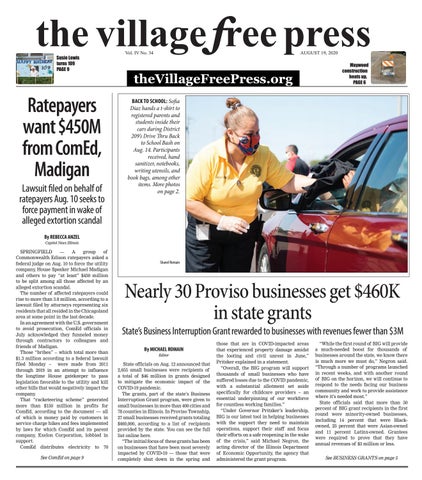
BACK TO SCHOOL: Sofia Diaz hands a t-shirt to registered parents and students inside their cars during District 209’s Drive Thru Back to School Bash on Aug. 14. Participants received, hand sanitizer, notebooks, writing utensils, and book bags, among other items. More photos on page 2.
By REBECCA ANZEL Capitol News Illinois
SPRINGFIELD — A group of Commonwealth Edison ratepayers asked a federal judge on Aug. 10 to force the utility company, House Speaker Michael Madigan and others to pay “at least” $450 million to be split among all those affected by an alleged extortion scandal. The number of affected ratepayers could rise to more than 3.8 million, according to a lawsuit filed by attorneys representing six residents that all resided in the Chicagoland area at some point in the last decade. In an agreement with the U.S. government to avoid prosecution, ComEd officials in July acknowledged they funneled money through contractors to colleagues and friends of Madigan. Those “bribes” – which total more than $1.3 million according to a federal lawsuit filed Monday – were made from 2011 through 2019 in an attempt to influence the longtime House gatekeeper to pass legislation favorable to the utility and kill other bills that would negatively impact the company. That “racketeering scheme” generated more than $150 million in profits for ComEd, according to the document — all of which is money paid by customers in service charge hikes and fees implemented by laws for which ComEd and its parent company, Exelon Corporation, lobbied in support. ComEd distributes electricity to 70 See ComEd on page 9
Shanel Romain
Nearly 30 Proviso businesses get $460K in state grants
State’s Business Interruption Grant rewarded to businesses with revenues fewer than $3M By MICHAEL ROMAIN Editor
State officials on Aug. 12 announced that 2,655 small businesses were recipients of a total of $46 million in grants designed to mitigate the economic impact of the COVID-19 pandemic. The grants, part of the state’s Business Interruption Grant program, were given to small businesses in more than 400 cities and 78 counties in Illinois. In Proviso Township, 27 small businesses received grants totaling $460,000, according to a list of recipients provided by the state. You can see the full list online here. “The initial focus of these grants has been on businesses that have been most severely impacted by COVID-19 — those that were completely shut down in the spring and
those that are in COVID-impacted areas that experienced property damage amidst the looting and civil unrest in June,” Pritzker explained in a statement. “Overall, the BIG program will support thousands of small businesses who have suffered losses due to the COVID pandemic, with a substantial allotment set aside specifically for childcare providers – an essential underpinning of our workforce for countless working families.” “Under Governor Pritzker’s leadership, BIG is our latest tool in helping businesses with the support they need to maintain operations, support their staff and focus their efforts on a safe reopening in the wake of the crisis,” said Michael Negron, the acting director of the Illinois Department of Economic Opportunity, the agency that administered the grant program.
“While the first round of BIG will provide a much-needed boost for thousands of businesses around the state, we know there is much more we must do,” Negron said. “Through a number of programs launched in recent weeks, and with another round of BIG on the horizon, we will continue to respond to the needs facing our business community and work to provide assistance where it’s needed most.” State officials said that more than 50 percent of BIG grant recipients in the first round were minority-owned businesses, including 14 percent that were Blackowned, 25 percent that were Asian-owned and 11 percent Latinx-owned. Grantees were required to prove that they have annual revenues of $3 million or less. See BUSINESS GRANTS on page 5