D209 construction on track PAGE 8
Study explores racial tax gap Economists find average minority homeowner pays extra $300 to $390 in property taxes due to racial bias
Vol. IV No. 33
AUGUST 12, 2020
theVillageFreePress.org
Church without walls, PAGE 2
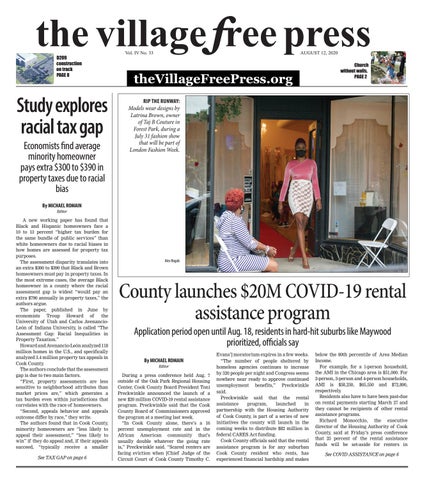
RIP THE RUNWAY: Models wear designs by Latrina Brown, owner of Taj B Couture in Forest Park, during a July 31 fashion show that will be part of London Fashion Week.
By MICHAEL ROMAIN Editor
A new working paper has found that Black and Hispanic homeowners face a 10 to 13 percent “higher tax burden for the same bundle of public services” than white homeowners due to racial biases in how homes are assessed for property tax purposes. The assessment disparity translates into an extra $300 to $390 that Black and Brown homeowners must pay in property taxes. In the most extreme cases, the average Black homeowner in a county where the racial assessment gap is widest “would pay an extra $790 annually in property taxes,” the authors argue. The paper, published in June by economists Troup Howard of the University of Utah and Carlos AvenancioLeón of Indiana University, is called “The Assessment Gap: Racial Inequalities in Property Taxation.” Howard and Avenancio-León analyzed 118 million homes in the U.S., and specifically analyzed 3.4 million property tax appeals in Cook County. The authors conclude that the assessment gap is due to two main factors. “First, property assessments are less sensitive to neighborhood attributes than market prices are,” which generates a tax burden even within jurisdictions that correlates with the race of homeowners. “Second, appeals behavior and appeals outcome differ by race,” they write. The authors found that in Cook County, minority homeowners are “less likely to appeal their assessment,” “less likely to win” if they do appeal and, if their appeals succeed, “typically receive a smaller See TAX GAP on page 6
Alex Rogals
County launches $20M COVID-19 rental assistance program Application period open until Aug. 18, residents in hard-hit suburbs like Maywood prioritized, officials say By MICHAEL ROMAIN Editor
During a press conference held Aug. 7 outside of the Oak Park Regional Housing Center, Cook County Board President Toni Preckwinkle announced the launch of a new $20 million COVID-19 rental assistance program. Preckwinkle said that the Cook County Board of Commissioners approved the program at a meeting last week. “In Cook County alone, there’s a 16 percent unemployment rate and in the African American community that’s usually double whatever the going rate is,” Preckwinkle said. “Scared renters are facing eviction when [Chief Judge of the Circuit Court of Cook County Timothy C.
Evans’] moratorium expires in a few weeks. “The number of people sheltered by homeless agencies continues to increase by 320 people per night and Congress seems nowhere near ready to approve continued unemployment benefits,” Preckwinkle said. Preckwinkle said that the rental assistance program, launched in partnership with the Housing Authority of Cook County, is part of a series of new initiatives the county will launch in the coming weeks to distribute $82 million in federal CARES Act funding. Cook County officials said that the rental assistance program is for any suburban Cook County resident who rents, has experienced financial hardship and makes
below the 80th percentile of Area Median Income. For example, for a 1-person household, the AMI in the Chicago area is $51,000. For 2-person, 3-person and 4-person households, AMI is $58,250, $65,550 and $72,800, respectively. Residents also have to have been past-due on rental payments starting March 27 and they cannot be recipients of other rental assistance programs. Richard Monocchio, the executive director of the Housing Authority of Cook County, said at Friday’s press conference that 25 percent of the rental assistance funds will be set-aside for renters in See COVID ASSISTANCE on page 6