44
Part II Of A Sprawling Interview With Golden & Silver Age DC Editor George Kashdan
KASHDAN: He came around, socially. He was a pathetic little man who dogged the footsteps of Jerry. I don’t recall [if he ever tried to get work]. He probably went directly to Sol Harrison, the art director. But he did not work for us. We were using people like Wayne Boring and Eddie Dobrotka. Wayne was very much solitary and very personable, well-liked. Whenever he came up, he stopped in at the art department, and they were all happy to shoot the breeze with him. He had a nice drawing style. Ed Dobrotka was very intense. We both lived in Levittown at the time. When he finished his work, he would deliver it to my house. One day, he came in. “George, I have to ask you something. Do you remember when I delivered a job, I said such and such to Murray [Boltinoff]?” It would be something that he forgot happened. He felt he was unappreciated. Jack Burnley—I remember him and his brother Ray. I met Ray when he was working in the art department, and decided he’d be better off freelancing. Then he said to Murray that he should have kept his job, because he was getting small freelance assignments. I was able to supplement his income. A sweet little man. JA: There was another “Superman” artist that you might have known: John Sikela. KASHDAN: He didn’t work for me. I remember Curt Swan. He was always cheerful and dependable, and took a great deal of pride in his work. If he brought in a job and Jack or Murray wanted him to change some of his technique, he would get a little irritated. And then he’d calm down and do what they wanted. Everybody was happy. He said, “Just don’t rub my Swedish temper.” [mutual laughter]
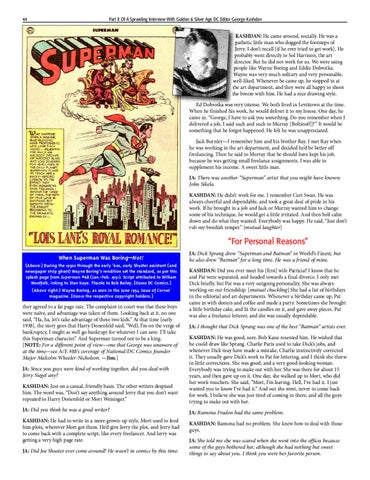
“For Personal Reasons” When Superman Was Boring—Not! (Above:) During the 1950s through the early ’60s, early Shuster assistant (and newspaper strip ghost) Wayne Boring’s rendition set the standard, as per this splash page from Superman #68 (Jan.-Feb. 1951). Script attributed to William Woolfolk, inking to Stan Kaye. Thanks to Bob Bailey. [©2010 DC Comics.] (Above right:) Wayne Boring, as seen in the June 1954 issue of Cornet magazine. [©2010 the respective copyright holders.]
they agreed to a fat page rate. The complaint in court was that these boys were naïve, and advantage was taken of them. Looking back at it, no one said, “Ha, ha, let’s take advantage of these two kids.” At that time [early 1938], the story goes that Harry Donenfeld said, “Well, I’m on the verge of bankruptcy, I might as well go bankrupt for whatever I can save. I’ll take this Superman character.” And Superman turned out to be a king. [NOTE: For a different point of view—one that George was unaware of at the time—see A/E #88’s coverage of National/DC Comics founder Major Malcolm Wheeler-Nicholson. —Jim.] JA: Since you guys were kind-of working together, did you deal with Jerry Siegel any? KASHDAN: Just on a casual, friendly basis. The other writers despised him. The word was, “Don’t say anything around Jerry that you don’t want repeated to Harry Donenfeld or Mort Weisinger.” JA: Did you think he was a good writer? KASHDAN: He had to write in a more grown-up style. Mort used to feed him plots, wherever Mort got them. He’d give Jerry the plot, and Jerry had to come back with a complete script, like every freelancer. And Jerry was getting a very high page rate. JA: Did Joe Shuster ever come around? He wasn’t in comics by this time.
JA: Dick Sprang drew “Superman and Batman” in World’s Finest, but he also drew “Batman” for a long time. He was a friend of mine. KASHDAN: Did you ever meet his [first] wife Patricia? I know that he and Pat were separated, and headed towards a final divorce. I only met Dick briefly, but Pat was a very outgoing personality. She was always working on our friendship. [mutual chuckling] She had a list of birthdays in the editorial and art departments. Whenever a birthday came up, Pat came in with donuts and coffee and made a party. Sometimes she brought a little birthday cake, and lit the candles on it, and gave away pieces. Pat was also a freelance letterer, and she was usually dependable. JA: I thought that Dick Sprang was one of the best “Batman” artists ever. KASHDAN: He was good, sure. Bob Kane resented him. He wished that he could draw like Sprang. Charlie Paris used to take Dick’s jobs, and whenever Dick may have made a mistake, Charlie instinctively corrected it. They usually gave Dick’s work to Pat for lettering, and I think she threw in little corrections. She was good, and a very good-looking woman. Everybody was trying to make out with her. She was there for about 15 years, and then gave up on it. One day, she walked up to Mort, who did her work vouchers. She said, “Mort, I’m leaving. Hell, I’ve had it. I just wanted you to know I’ve had it.” And out she went, never to come back for work. I believe she was just tired of coming in there, and all the guys trying to make out with her. JA: Ramona Fradon had the same problem. KASHDAN: Ramona had no problem. She knew how to deal with those guys. JA: She told me she was scared when she went into the offices because some of the guys bothered her, although she had nothing but sweet things to say about you. I think you were her favorite person.