18
Profile
May 7-13, 2011
TheSouthAsianTimes.info
Growing with the Doshis nish Berry and Tariq Shaikh are a shining example of how high you can rise being around Nitin and Leena Doshi. The two executives also offer an admiring peep into the style of functioning and value system of the Doshis. Both Berry and Shaikh started their careers around the same time in 1992 with Doshi Diagnostic when it had only one center, in Flushing, NY. Today both are partners with the Doshis. Recalls Berry, “My background is in finance and investment but I happened to start in healthcare. The family gave me a chance to grow. We also added value to the business and in time were running the business.” Berry says what he has learnt from the Doshis is “integrity, which is a big part of how they look at life. They also help people grow. They are hard working, humanitarian and worry about the community.
“They have been involved in our life-- to my kids they are grandparents.” Adds Shaikh, “Absolutely, we started our career with the Doshis. “They guided us, nurtured us. Nitin is somebody one can trust always who is there to help”. Shaikh also reflects that there may be 1,400 employees in Doshi Diagnostic, but Nitin and
ing for me. Since then I have been full time with Doshi Diagnostic. SAT: How have you and Leena worked out roles at Doshi Diagnostic? Dr Doshi: Leena is more a logical, analytical, systems oriented person. She does everything, building from bottom up, one block at a time. That is her management style. I am an extrovert, more a people person, a top down guy. So early on, we decided that I would do all the external work, public relations, dealing with accountants, attorneys, cheerleading the team. She created the systems to be able to produce what we are producing. I became the implementer of her systems. But handling the externals, I became more the face of Doshi Diagnostic. After 18 years we pretty much play the same roles. Anything new first goes to her, whether it is equipment, telephony, IT, work flow. My role has been to take those ideas from her and implement them. SAT: What is Doshi Family Foundation’s giving philosophy and how much does it give? Dr Doshi: Started in 1992, it is a big part of how we look at life—
to help people grow, to have concern for the welfare of the community. We are not very religious, but spiritual and humanitarian you can say. We don’t have a fixed budget for the Foundation but have been giving to various causes over the years. We have given $400,000 to AIF (American India Foundation), $600,000 to Veerayatan (which rehabilitates earthquake victims, especially children, in India), $300,000 to Share & Care Foundation, and so on. SAT: You are not seen much at Indian community events… Dr Doshi: In our first few years here, we were active, but then invitations for a variety of awards and honors got to be too much. Similarly, Doshi Family Foundation is also low-key lest we get a barrage of requests for grants and donations. SAT: For years you have been part of a group of Indian families here... Dr Doshi: It is an informal group. What happened is, when we came here in 1973, we bumped into a few people Leena knew from India. One thing led to another, and we formed this group of young immigrants, who happened to be all from Bombay. We were
A
Dr Leena Doshi making her acceptance speech at the Asian Women in Business’s Entrepreneurial Leadership Award in 2005 Continued from page 17 from Lenox Hill Hospital. By 1992 she was ready to open her second and third radiology practice. At that time, we decided that we both can’t be busy considering we had two young kids. And in 16 years I had done everything that I
felt I had to do in dentistry. So, I stopped active dental practice and went into management of my owndental practices and Leena’s radiology practice. Radiology brought better return on the time I devoted to it than dentistry, so I sold off my dentistry practices to people work
Despite their busy schedules, the Doshis manage to take vacations
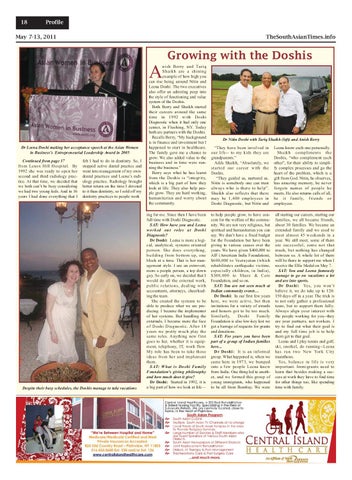
Dr Nitin Doshi with Tariq Shaikh (left) and Anish Berry Leena know each one personally. Shaikh compliments the Doshis, “who complement each other”, for their ability to simplify complex processes and go the heart of the problem, which is a gift from God. Nitin, he observes, has amazing memory, he never forgets names of people he meets. He also returns calls of all, be it family, friends or employees. all starting our careers, starting our families, we all became friends, about 30 families. We became an extended family and we used to meet almost 45 weekends in a year. We still meet, some of them are successful, some not that much, but nothing has changed between us. A whole lot of them will be there to support me when I receive the Ellis Medal on May 7. SAT: You and Leena famously manage to go on vacations a lot and are into sports. Dr Doshi: Yes, you won’t believe it, we do take up to 120150 days off in a year. The trick is to not only gather a professional team, but to support them fully. Always align your interest with the people working for you--they are your partners, not workers. I try to find out what their goal is and my full time job is to help them get to that goal. Leena and I play tennis and golf, ski, snorkel, do running--Leena has run two New York City marathons. Yes, balance in life is very important. Immigrants need to learn that besides making a success at work they have to find time for other things too, like spending time with family.