THE
COMPASS SPRING 2026
THE MAKING OF A WINDWARD TEACHER
II | COMPASS SPRING 2026
Note from the Editor After the spring 2026 issue of The Compass went to print, there was a leadership transition at the School, with Alexis Pochna being named interim head of school for the 2026–2027 school year. Below is a letter from her to our community, outlining her history with Windward, her longtime commitment to its mission, and her goals for the upcoming year. The rest of the publication appears as it was originally printed. Thank you for your readership and support, and we look forward to bringing you a special double issue of The Compass in the fall, which will celebrate 100 years of transformative Windward education.
Dear Windward Community: Many of you know me from my 20 years at Windward, where I have had the privilege of serving our community in multiple roles. During the course of my tenure at Windward, I have come to understand the school through many lenses: the teaching and learning in our classrooms, the intricacies of school operations, the research that informs our program, and the partnerships that have helped cement Windward and the Institute’s reputation globally. Each of these experiences has deepened my appreciation for the extraordinary impact Windward has on students and families, and strengthened my commitment to leading with care, collaboration, and a clear vision for the future.
This is a meaningful moment in Windward’s history as we prepare to celebrate our centennial. Founded in 1926 by Isabel Greenbaum Stone, Windward has a long and proud track record for excellence in helping students achieve academic and personal success. As we honor that legacy, we also look ahead with confidence and ambition. The school is uniquely positioned to make a powerful difference in the lives of the students and families we serve, while also contributing meaningfully to the broader educational landscape. Windward is truly unlike any other organization, and it is my distinct pleasure to shepherd this community through the year ahead. With warm regards,
Alexis Pochna, EdM Interim Head of The Windward School
Contents 8
The Making of a Windward Teacher
14
Unpacking the RULER Tools: The Charter and The Blueprint
18
The Windward School Benefit Raises More Than $1M for Financial Aid and Teacher Training
STAY CONNECTED facebook.com/TheWindwardSchool @TheWindwardSchool linkedin.com/company/TheWindwardSchool
thewindwardschool.org
On the cover: WMS Teacher Sara Jo Karger with students
3 From the Head of School 4 Looking Ahead for Windward:
The Next Chapter Campaign Milestones
6 Looking Ahead for Windward: Marchmester Returns
8 The Making of a Windward Teacher 14 Unpacking the RULER Tools: The Charter and The Blueprint
18 The Windward School Benefit Raises More Than $1M for Financial Aid and Teacher Training
20 Sandra Schwarz:
Maker of Windward Teachers
22 Dream Big 24 What We’re Reading, Watching, and Listening to Now
29 Alumni News and Notes 32 In Memoriam LOCATIONS Westchester Lower School 1275 Mamaroneck Avenue White Plains, NY 10605 (914) 949-6968 Westchester Middle School 40 West Red Oak Lane White Plains, NY 10604 (914) 949-6968 Manhattan Lower & Middle Schools 212 East 93rd Street New York, NY 10128 (212) 222-8628
THE
COMPASS SPRING 2026
The Compass is published twice a year by the School's marketing and communications office. It is a magazine for The Windward School community. Jamie Williamson Head of School Lucy Godman Chief Advancement Officer JP Bifone Director of Marketing and Communications Jana Cook Editor and Associate Director of Marketing and Communications Contributing Editorial Staff: JP Bifone, Timothy Brosnan, Hope Geise, Lucy Godman, and Nicole Nearchou Contributing Writers: Timothy Brosnan, Jana Cook, Hope Geise, Meghan Kennedy, and Jamie Williamson Contributing Photographers: Timothy Brosnan, Mark Liflander, Joe Martin, Siobhan Mullan, Susan Nagib, and Nicole Nearchou Design: hgDesign, NYC BOARD OF TRUSTEES 2025-2026 Maria Reed, President Jenny Price, 1st Vice President Peter A. D’Avanzo, 2nd Vice President David Friedland, Treasurer Staci Marlowe, Secretary Denis J. O’Leary, III ’06, Member-at-Large Patricia L. Wolff, Member-at-Large Akeela Azcuy, PhD Margi Booth Reed Brodsky Michael Cummins Beth Demba Chris Dooley Meredith Jenkins Mitchell J. Katz Ian Levine Magdalena Zavalía Miguens Josh Rosen Stacey Schutzer Kenneth Squire Reed Switzer ’19 Jennifer Weyburn The Windward School does not discriminate in admissions, employment, or administration of programs on the basis of gender, race, religion, age, national or ethnic origin, or sexual orientation.
Impact
Each day, Windward strives to serve as many students as we can and to make a life-changing and transformational impact on every individual child in the classroom as well as within the greater learning disability population. 2 | COMPASS SPRING 2026
From thef.
Head of School One of the things I have come to understand more fully with each passing year at Windward is that its core value of impact operates at two scales simultaneously. There is the impact on the individual child: the student in the classroom today, the one learning to decode text for the first time, learning to write an organized paragraph, and learning to trust themselves. And there is the impact on the broader field: the research both shared and implemented by The Windward Institute and its aim to extend that learning to students, educators, and policymakers far beyond Windward’s walls. We believe, deeply, that we cannot honor one of these commitments without the other; each student is served by the best possible evidence-based instruction, and the field advances through translation of research into practice. This issue’s feature story, “The Making of a Windward Teacher,” breaks down the complex process behind developing Windward’s worldclass faculty, from the structured, two-year teacher training program, to the Summer Intensive Program, to the ongoing professional development that embraces a philosophy of lifelong learning. Teaching is a craft that must be built—not an inherent talent—and the School’s teachers-in-residence, mentors, and program leaders embody this belief each year. Also highlighted in this issue is Sandra Schwarz, who for more than 30 years has been devoted to recruiting Windward’s educators and sustaining the structures that allow them to flourish. There is no clearer expression of impact, accumulated across a career, than hers.
For the first time since 2019, Marchmester returned this spring: 94 students, an eclectic range of courses from chess to mythology to culinary skills, and, notably, a meaningful professional development opportunity for teachers-in-residence, who had the opportunity to build delivery and classroom rapport by teaching subjects they love. Lastly, our final article in the “Unpacking the RULER Tools” series explores the Charter and Blueprint, tools that give the School a shared framework for building the type of environment where all community members can learn and grow. Understanding these tools collectively sheds light on how Windward focuses on multiple domains of a child’s development and why attending to social and emotional growth is not supplementary to our mission but central to it. Taken together, the articles in this issue of The Compass are an expression of the same commitment: to serve as many students as possible and to make a life-changing impact on every individual child in Windward’s classrooms, as well as on the larger community of those with language-based learning disabilities. We are incredibly grateful to carry this work forward alongside such a remarkable community.
Jamie Williamson, EdS Head of The Windward School and Executive Director of The Windward Institute
We are also proud to share that the Kaleidoscope Benefit raised over $1million in support of student financial aid and faculty professional development. Events like Kaleidoscope remind me of the extraordinary generosity that defines this community—and of the direct line between that generosity and the School’s ability to provide access for students who need a Windward education.
COMPASS SPRING 2026 | 3
LOOKING AHEAD FOR WINDWARD
The Next Chapter Campaign Milestones
WLS exterior, naming event November 2022
The Windward School and The Windward Institute are turning the page to dive into their next chapter. The capital campaign has gone public, with some exciting milestones to celebrate this year. During an early phase, one anonymous donor made a $6 million gift—at the time, the single largest donation the School had ever received. This incredible generosity helped pave the way for the Westchester Lower School (WLS) to open a full year ahead of schedule, offering necessary additional space for in-person instruction during the pandemic at the John J. Russell Campus. Since then, some multi-million-dollar gifts are poised to transform the trajectory of both the School and The Windward Institute. Westchester Middle School’s (WMS) soccer and lacrosse fields will soon get a serious upgrade, thanks to the efforts of the development office and the advocacy of Director of Health, PE, and Athletics Marilyn Hunt. She helped secure $1.7 million to overhaul the fields, which speaks to the impact that Windward’s athletics program has on its students and the community. Renderings for WMS fields upgrade project 4 | COMPASS SPRING 2026
Another donor stepped in with a phenomenal seven-figure lead gift to support the Access and Advocacy initiative, which is a five-year, $10 million effort to build capacity, develop programming, and scale The Windward Institute. Since its inception, the Institute has delivered best-in-class teacher training and coaching that bridges the divide between research and practice.
To learn more about supporting The Next Chapter Campaign, email Rosemary Downing-Espinal at rdowningespinal@thewindwardschool.org.
Building upon the progress of the Institute to increase Windward’s impact, this initiative will •
support expansion of free reading screenings offered to surrounding communities;
•
scale the Waypoint Learning platform to provide teachers, schools, and districts with the tools they need, wherever they are;
•
continue to pursue key research and school partnerships that both inform the School’s instruction and expand access to Windward’s programs;
•
enhance the Institute’s robust library of free resources—such as webinars, lectures, the READ Podcast, and The Beacon educators’ journal— that share Windward’s expertise with the larger educational community; and
•
help advance legislative and policy goals that support those with language-based learning disabilities, for example, through participation in the New York State Dyslexia and Dysgraphia Task Force.
The Windward School and The Windward Institute are filled with gratitude for the generous donors who have made such progress possible, and there is still much work to be done. These collective efforts will one day ensure that every child with a language-based learning disability is empowered to achieve unlimited success.
A student works with Windward Institute staff at a free early reading screening event.
SPRING2026 2026 | 5 COMPASS SPRING
LOOKING AHEAD FOR WINDWARD
Marchmester Returns This spring, for the first time since 2019, Windward brought back its popular Marchmester program for families. The program offers an option for students to spend the first week of spring break at Windward, enjoying structured play, learning new skills, and bonding with their peers. Families can select either a half-day or full-day program, and the School welcomed 94 students this March, with 80 students electing to spend the full day. Program Director Hannah Ewing, a Westchester Middle School teacher, worked with senior leadership and faculty to revive the program, and surveyed parents to help develop course offerings. This year, sessions included an eclectic mix of topics: • • • • • • • • • • • • • • • • •
“No Bake” Cooking Crafts Chess Yoga and Mindfulness STEM Discovery Dungeons and Dragons Mosaics Experiments Performance and Movement Workshop Basketball Clinic Forensics Myth Makers—The World of Mythology Intro to Theatre and Improv Comedy Cooking and Culinary Skills Sports and Games Clay/Sculpture Theater Audition Workshop
6 | COMPASS SPRING 2026
Aside from offering a spring break alternative for Windward families, Marchmester gives participating faculty, especially teachers-inresidence, a valuable outlet for sharpening their skills in both curriculum development and classroom instruction. Ewing notes, “One of the best ways to get comfortable in the front of the class is by teaching something you care about and something you’re comfortable with. So by giving newer teachers an opportunity to teach a class like mythology or science experiments, it helps them hone their delivery, their rapport with students, and their classroom management skills while still having fun.”
SPRING2026 2026 | 7 COMPASS SPRING
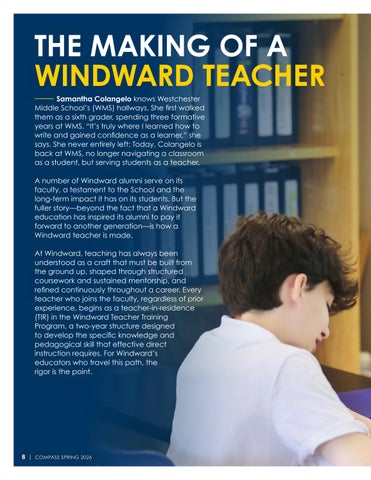
THE MAKING OF A WINDWARD TEACHER Samantha Colangelo knows Westchester Middle School’s (WMS) hallways. She first walked them as a sixth grader, spending three formative years at WMS. “It’s truly where I learned how to write and gained confidence as a learner,” she says. She never entirely left: Today, Colangelo is back at WMS, no longer navigating a classroom as a student, but serving students as a teacher. A number of Windward alumni serve on its faculty, a testament to the School and the long-term impact it has on its students. But the fuller story—beyond the fact that a Windward education has inspired its alumni to pay it forward to another generation—is how a Windward teacher is made. At Windward, teaching has always been understood as a craft that must be built from the ground up, shaped through structured coursework and sustained mentorship, and refined continuously throughout a career. Every teacher who joins the faculty, regardless of prior experience, begins as a teacher-in-residence (TIR) in the Windward Teacher Training Program, a two-year structure designed to develop the specific knowledge and pedagogical skill that effective direct instruction requires. For Windward’s educators who travel this path, the rigor is the point.
8 | COMPASS SPRING 2026
SPRING 2026|| 99 COMPASS COMPASSSPRING SPRING 2026 2026
THE MAKING OF A WINDWARD TEACHER
FINDING THE RIGHT FIT Each fall, the search for Windward’s next teachersin-residence begins in earnest. Director of Faculty Recruitment and Special Projects (and former Director of the Windward Teacher Training Program) Sandra Schwarz describes the approach as casting a wide net: a Windward presence on social media and at job fairs throughout the region, outreach through university partnerships, and a sustained effort in recent years to broaden the School’s reach through diversity-focused hiring events. The process unfolds from November through the summer, drawing candidates from the tri-state area and across the country. The candidate pool that emerges tends to reflect three distinct profiles. The first is the newer educator, someone early in their career who is drawn to Windward’s explicit, multisensory approach to instruction and genuinely open to building a practice. The second is the experienced educator seeking the type of deep expertise that enables them to effectively serve students with languagebased learning disabilities. The third is the career changer, someone who has spent years in another field before arriving at teaching, often with a clear
sense of purpose and the flexibility to start something new. In recent years, Schwarz notes, the School has seen a meaningful number of candidates in the second and third categories: people for whom the TIR model’s intensive entry point is not a deterrent; rather, it’s part of the appeal. What the School is ultimately looking for, however, transcends these profiles. Windward seeks candidates who are curious about how students learn, who are motivated by working with children who have language-based learning disabilities, and who bring the intellectual humility to recognize that— regardless of prior training or experience—becoming a Windward teacher means learning to teach in a fundamentally new way. More than one thousand résumés are reviewed each year, and hundreds of candidates are interviewed; only a chosen few are selected to begin that process. The selectivity is not arbitrary. Instead, it reflects the seriousness with which the School approaches the work of building its faculty.
BUILDING A WINDWARD TEACHER’S CRAFT Many educators consider teaching to be a calling; becoming a Windward teacher means using a passion for education as fuel, with the perspective of a lifelong learner and the understanding that teaching is a craft to be honed over time. “I feel like ‘teacher-in-residence’ accurately reflects that the role is not simply about training,” says Eliza Ross, Westchester Lower School (WLS) teacher, “but about learning and growing within an established professional community.” That distinction— between a program that merely trains and one that integrates new faculty into a professional culture shaped by decades of research and practice—is a key differentiator of the Windward Teacher Training Program. From the moment a candidate signs their letter of intent, before a teacher-in-residence ever sets foot in a Windward classroom, the work begins. Newly hired teachers receive a curated reading list and a set of recommended READ Podcast episodes, orienting them to the ideas that will shape their first year and offered early enough to start their school year with sufficient context. Before the first day of school, they also complete a structured multi-day orientation that introduces them to the School’s leadership, its students, its mission, and the
10 | COMPASS SPRING 2026
colleagues alongside whom they will spend their first year learning to teach. TIRs then enter a structured two-year program designed to build knowledge and practice simultaneously. In their first year, they are enrolled in two foundational Windward Institute courses: Multisensory Reading Instruction— which grounds them in the School’s reading program—and The Windward Expository Writing Program. These courses are taken during the school day, excusing TIRs from their regular schedules to participate in coursework that complements their experiences in the classroom. The sequencing is deliberate, explains Teacher Training Program Director Kara Schremser. “We want them to have enough background before they step into the classroom, but we also don’t want to overwhelm them before they get here.” Each teacher-in-residence is paired with two or three mentor teachers, with the language arts teacher serving as their primary point of contact. This mentorship model is the heart of the program. TIRs observe their lead teachers in action, assist in the classroom, and gradually take on more responsibility as their skills develop. The relationship runs in both directions: Mentor teachers are also accountable for the training process and responsible for explaining curriculum decisions, modeling instructional strategies, and providing ongoing, specific feedback to their TIRs. Ross has been particularly struck by the level of dedication among seasoned faculty: “Despite the demands of their own daily responsibilities, they invest their time and energy into shaping new Windward teachers, and that commitment speaks volumes about the culture of the school.”
“Working with a mentor teacher, receiving actionable feedback, and being part of a professional learning community has had the most impact on my teaching practice,” says Manhattan Lower School Teacher Romel Tovar, who came to Windward after teaching in New York City public schools. Supporting that mentorship is a weekly professional development seminar designed specifically for new teachers. Behavior management is among the first topics covered, Schremser notes; it acknowledges that even the most carefully planned lesson depends on a teacher’s capacity to build and sustain a productive learning environment. These sessions draw on expertise from within the School and from the broader educational field. For example, Dr. David Anderson of the Child Mind Institute has presented to faculty on the social and emotional dimensions of working with students who have language-based learning disabilities, addressing the full range of competencies a Windward teacher must develop. Students’ social-emotional well-being receives additional focus through the School’s implementation of the RULER approach, a systematic program for growing a community’s emotional intelligence. WLS Teacher-in-Residence Ashling Baker-Linehan explains the importance of this dual approach to academics and social-emotional learning: “Education should extend far beyond academics, equipping students not only with the tools to learn but also with the confidence to believe in themselves and the foundation to succeed throughout their lives.” The School’s speechlanguage pathologists (SLPs) also play a distinctive role in TIRs’ development: Rather than working directly
COMPASS COMPASS SPRING SPRING2026 2026 | | 11
THE MAKING OF A WINDWARD TEACHER with students, SLPs work closely with teachers-inresidence to build their understanding of students’ specific expressive and receptive language needs, ensuring that the instructional and academic language teachers use is precisely calibrated to the students in front of them. For teachers who arrive with prior classroom experience, the depth and intentionality of this environment can be unexpected. “The teacher training program has reignited my curiosity and deepened my commitment to this work,” says Ross, who spent five years teaching language arts before joining Windward. Tovar adds, “Teaching at Windward is more rewarding, to me, because it is truly collaborative. My colleagues, mentors, and administrators are here to help. This pushes me to work even harder to support them and help the team.” Baker-Linehan arrived at Windward as a career changer and finds that its approach mirrors her own values. “I find the sequential training to be impactful, which is thoughtfully designed alongside mentorship and opportunities to practice classroom skills,” she says. “Experiencing this combination of guidance, practice, and reflection has deepened my confidence and competence as an educator.” At the close of the first year, TIRs participate in the Summer Intensive Program, a week-long professional development experience designed to consolidate the learning of the year, deepen cohort bonds, and address relevant topics that benefit from the sustained focus that summer allows: curriculum development, lesson planning, and instructional strategy. The program has evolved considerably since its early years. Schwarz reflects, “There are many teachers who really came into their own during that week.” The summer intensive has since become a reliable inflection point in a TIR’s development; for some, it is where the cumulative work of the year finally clicks into place. The summer months offer additional opportunities to extend that development. TIRs are encouraged to participate in Windward’s academic summer program, a four-week day camp serving both Windward students and students from the broader community, where they can observe experienced 12 | COMPASS SPRING 2026
faculty teaching in a classroom setting. Then, in the days immediately before the new school year begins, selected students return to campus for the Windward Practicum: five days of small-group instruction in reading, writing, and mathematics, during which TIRs teach their own lessons under the direct supervision of Windward faculty. Lesson plans are reviewed before each session, and supervisors provide direct feedback afterward, extending into August the same cycle of continuous observation, instruction, and reflection that has defined the year.
A CAREER OF CONTINUOUS GROWTH The second year of training as a Windward teacher builds on the first; TIRs continue with structured observations and lesson planning while enrolling in two additional Windward Institute courses of their choosing, widening their knowledge in areas aligned with their particular teaching assignments. As their skills and confidence develop, some TIRs take on expanded classroom responsibilities during this year, including serving as a co-teacher alongside their mentor—a meaningful step toward full instructional ownership. In addition, rather than recede as a teacher gains experience, the professional development infrastructure expands: Advanced WI courses and workshops remain available at no cost well beyond the TIR years.
That progression is by design, as professional development is understood as a permanent obligation for every member of Windward’s faculty. It is an ongoing practice, not a set of requirements with a defined endpoint. All teachers, including the most senior members of the faculty, are observed by coordinators and administrators throughout the year and receive regular, specific feedback on their instruction. Research is treated as a living resource: Faculty receive relevant articles through their coursework, through coordinator-led presentations, and through the School’s professional library, which every member of the faculty can access. Decisions about which findings to bring into the classroom are made deliberately; the Windward Institute and its research advisory board serve as guides for evaluating when emerging evidence is sufficiently established to shape instructional practice. Coordinators regularly distribute vetted articles to faculty, and the WI’s faculty and researchers do the careful work of review and synthesis before any new approach is recommended for the classroom.
CONTINUING EDUCATION For teachers who wish to pursue advanced standing in their field, Windward offers multiple rigorous pathways: One is a program requiring 100 hours of Windward Institute coursework and a substantial academic component that leads to certification from IMSLEC, the International Multisensory Structured Language Education Council. It is among the most demanding credentials available to practitioners in structured literacy. Through a partnership with Manhattanville University, faculty who have completed their first year of teaching at Windward are also eligible to pursue a Master of Arts in Education Studies with a focus on
literacy. This program was co-designed exclusively for Windward by the Manhattanville University School of Education and Windward leadership to guide teachers in research-based approaches to the range of literacy challenges their students face. The School subsidizes 70 percent of tuition for participating teachers, making graduate study a realistic option for faculty at any stage of their career. To date, 15 faculty members have either enrolled in or graduated from the program. That Windward makes these pathways available, and actively encourages faculty to pursue them, is consistent with everything the program asks of its teachers from the moment they’re hired. In the most fundamental sense, the making of a Windward teacher is a journey, not a destination. “Being a Windward teacher means that professional development is never completed,” Schwarz says of the program she has spent nearly 30 years building. While Windward expects its students to work with rigor, and to find in that effort something genuinely transformative, the School asks the same of its faculty. For Colangelo, that continuity is not abstract. Having experienced Windward from both sides of the classroom, as a student who found her footing at the School and as a teacher still finding hers, coming full circle has had a profound effect: “There is something truly meaningful about returning to an institution that shaped who I am as a learner and now having the opportunity to impact students in the same way.” And just as Windward empowers its students to achieve unlimited success, it gives its teachers the tools and support to help make that vision a reality.
COMPASS SPRING SPRING2026 2026 | | 13 COMPASS
SEL SPOTLIGHT
Unpacking the RULER Tools: The Charter and The Blueprint Each school day, long before students gather in their homerooms, something invisible is already shaping the learning environment: how people feel. Emotions spill out in the tone of a hallway greeting or the residual feelings a student carries in from their commute, and they matter. Research is clear that emotions drive cognition, influencing attention, motivation, and one’s capacity to connect with others and with new ideas. And so, shaping the emotional climate of the School is not a peripheral concern; it is central to everything Windward does.
Learn more about the link between emotions and cognition by reading “A Sometimes Invisible Framework: How Executive Function Shapes Social and Emotional Growth” in the latest issue of The Beacon.
As Windward continues its schoolwide implementation of the RULER approach, developed by the Yale Center for Emotional Intelligence, students, faculty, and staff are building a shared language and a common set of tools for navigating their emotional lives with greater awareness and skill. Previous issues of The Compass explored the Mood Meter, which helps one recognize and name what they are feeling; and the Meta Moment, which creates space between a strong emotion and a response, during which one defines and comes back to their best self.
THE CHARTER: DESIGNING HOW A COMMUNITY WANTS TO FEEL
This article introduces the final two RULER tools being implemented with students during the 2026-2027 school year: the Charter and the Blueprint. Together, they address not only how individuals want to feel, but how the community hopes to feel collectively, and how to return to that shared vision when actions fall short.
Addressing that gap—between lived emotional experience and desired emotional experience—is the purpose of the Charter.
14 | COMPASS SPRING 2026
Researchers at the Yale Center for Emotional Intelligence asked tens of thousands of students a simple but revealing question: How do you feel in school? The most common answers—tired, stressed, bored—stood in stark contrast to how those same students wanted to feel: safe, respected, connected, happy, energized. Adults surveyed reported a similar divide, describing themselves as overwhelmed and undervalued while longing to feel effective and appreciated.
At its core, the Charter is built around two questions: •
How do we want to feel?
•
What will we do to help each other feel this way?
Creating a schoolwide Charter is a community process. Students, faculty, and staff each contribute feeling words in response to the first question: for example, calm, inspired, respected, focused, joyful. What follows is a critical narrowing process: grouping similar words, discussing nuances, and building consensus. Through discussion, the group narrows the list to the five or eight words that best reflect its shared values, and these become the community’s emotional north star. The second question anchors the work, framing these values in actionable terms. If members say they want to feel respected, what behaviors actually create that feeling? If they want to feel connected, what does connection look like in practice? A Charter might include commitments such as the following: •
We listen without interrupting.
•
We assume positive intent.
•
We arrive prepared.
•
We address concerns directly, not through gossip.
These commitments are not simply aspirations hanging on a wall; they are observable agreements that give the community a shared vision to guide its actions.
The most effective Charters are living documents, revisited in meetings and referenced during moments of tension. Some schools practice conducting periodic Charter surveys to assess whether their lived climate aligns with their stated intentions. This ongoing attention is crucial. Emotions that are regulated broaden attention and enhance cognitive flexibility, while chronic stress and boredom constrict both. When a community intentionally designs how it wants to feel, and commits to behaviors that sustain those feelings, it lays the groundwork for deeper learning.
THE BLUEPRINT: REPAIRING WHEN MISSING THE MARK Even in communities with a strong Charter, friction is inevitable; yet it presents an opportunity for learning. Differences of perspective, competing needs, and stressful moments can surface tensions from time to time. The Blueprint does not treat this as a failure, but simply as evidence that human beings are involved, and no one is perfect. Conflict, when navigated well, can deepen understanding rather than erode trust. The question is how it’s addressed. Drawing on research about conflict styles first articulated by Kenneth Thomas and Ralph Kilmann—who identified competing, avoiding, accommodating, compromising, and collaborating as common approaches—the Blueprint does not prescribe a single style as universally correct. Instead, it emphasizes the underlying capacity that makes any style constructive: the ability to understand and consider another’s emotional experience.
COMPASS SPRING SPRING2026 2026 | | 15 COMPASS
SEL SPOTLIGHT
The Blueprint is a structured set of reflection prompts designed to slow down a difficult moment, invite perspective-taking, and help both parties move forward constructively. It can be used individually as a private reflection after a challenging interaction or collaboratively as a guided conversation between two people in conflict. The Blueprint asks: •
What happened?
•
How did I feel? How might the other person have felt?
•
What caused those feelings?
•
How did we express and manage them?
•
How did our actions affect one another?
•
Keeping my best self in mind, how might I respond differently next time?
16 | COMPASS SPRING 2026
This sequence slows the instinctive rush to self-justification. In moments of stress, the brain’s threat response can narrow thinking and heighten defensiveness. By systematically prompting reflection on both one’s own emotions and those of others, the Blueprint strengthens self-awareness and social awareness simultaneously. Empathy requires active listening, such as paraphrasing, asking open-ended questions, and resisting the urge to defend one’s point of view. The Blueprint scaffolds this work, creating space for genuine repair. In a faculty context, a teacher reflecting on a staff meeting that felt contentious might use the Blueprint privately: What was I feeling? What might my colleague have been feeling? What pressures may have been shaping their response? How did my tone affect the interaction? The goal is not self-criticism but honest awareness, and meaningful change relies on conscious awareness. In student settings, the Blueprint becomes a facilitated conversation, with a trusted adult holding the space while two students work through the questions together. The adult’s role is not to resolve the conflict for them but to keep the dialogue respectful, focused, and psychologically safe so that students can co-create their own resolution.
PRACTICAL MEANS OF PREVENTION AND DE-ESCALATION The Blueprint also offers practical strategies to prevent escalation: •
Remain calm; take a Meta-Moment before responding.
•
Use a low, steady tone.
•
Respect personal space.
•
Ask open-ended questions (“What happened?” rather than “Why did you…?”).
•
Empathize with feelings before addressing behavior.
•
Offer choices.
•
Allow silence.
•
Express appreciation for constructive engagement.
These small shifts signal that even in disagreement, dignity remains intact. When the Blueprint is used well, it also refocuses attention to the Charter. If a conflict reveals that members of the community are no longer feeling respected or connected, that they have drifted from the emotional agreements made together, the Blueprint becomes the path back.
A COMPLETE PICTURE If the Mood Meter helps to see what one is feeling and the Meta Moment helps to pause before reacting, The Charter asks to name, together, how a community wants to feel, and to commit to the behaviors that make that possible. Finally, The Blueprint gives a way to repair and reconnect when members stray from the path. The quiet discipline of pausing, perspective-taking, and recommitting to shared emotional commitments may seem modest, but this is truly culture-building work: Used together, these four tools make a significant impact, shaping a school community where everyone, students and adults alike, feels a sense of belonging and acceptance.
IN CASE YOU MISSED IT Learn about the Mood Meter:
Read about the Meta Moment:
COMPASS SPRING 2026 | 17
COMMUNITY SPOTLIGHT
The Windward School Benefit Raises More Than $1M for Financial Aid and Teacher Training On March 7, members of the Windward community gathered at Pier Sixty for Kaleidoscope, the School’s biennial Benefit. The event honored former Manhattan Lower and Middle Schools Campus Head Leslie Zuckerwise and Scott Rudin ’03, creative director of the Ralph Lauren Agency. Zuckerwise recalled the early days of the Manhattan campus, which she described as filled with excitement, nerves, and a deep sense of responsibility. She added that throughout her 20 years at Windward, she watched countless students walk through the doors unsure of themselves and leave confident and capable. Rudin’s remarks moved every single person in the room, as he spoke about his pride in standing not only as an alumnus and current Windward parent but also as proof of what is possible, when the right environment meets the right support at the right time in a child’s life.
18 | COMPASS SPRING 2026
Dylan Douglas ’18 and Stephen Chbosky connected their own Windward journeys—as an alumnus and current parent—to the achievements of the Benefit’s honorees as they graciously presented the awards. The live auction and paddle raise, combined with ticket sales and the silent auction, raised more than $1 million for financial aid and teacher training at The Windward School. DJ B. Mills ended the evening with a set, with guests hitting the dance floor to cap off the celebration. Windward extends a huge thanks to all who participated, especially the Benefit co-chairs—Jessica Atkinson, Kimberly A. Burd ’01, Eliza Ravelle-Chapuis, Lori Squire, Noelle Umbro, and Harry Zimmerman ’12; and the Benefit committee— Ruth Abend, Emilie Coustillet, Rita Godin, Melany Hearne, Christine Miller, Kimberly Raby, and Laura Treadway.
COMPASS SPRING SPRING2026 2026 | | 19 COMPASS
COMMUNITY SPOTLIGHT
Sandra Schwarz: Maker of Windward Teachers Sandy Schwarz’s career in education spans more than five decades. With nearly 30 of those years at The Windward School, Schwarz has played a significant role in shaping both faculty development and the broader educational environment at the School. By spearheading initiatives to consistently recruit and mold incoming teachers-in-residence, as well as expanding professional development overall at Windward, she remains at the forefront of a shared commitment to support students with language-based learning disabilities. Before joining Windward, Schwarz spent more than 25 years in public school education across a range of roles, including classroom teaching, higher education, and as a literacy and curriculum specialist. She ultimately served as an elementary school principal, where she began to confront persistent challenges in instructional support. In that role, she observed that many students were not receiving the targeted instruction they needed, reflecting, “I was becoming frustrated with the lack of support for some of the students. At the time, access to evidence-based research was limited, leaving educators without the tools necessary to address diverse learning needs effectively.” Motivated to identify more effective approaches, Schwarz sought out emerging work in literacy instruction. Through colleagues, she learned of the instructional techniques—and their documented successes—developed by The Windward School. She invited the School’s leaders to provide professional development for her faculty, an effort that led to measurable improvements in classroom practice. 20 | COMPASS SPRING 2026
When she decided to retire from public education, she was invited to Windward as a consultant in curriculum development. This opportunity marked the beginning of what has become one of the most influential tenures at the School. Schwarz’s early years at the School were focused around a deep interest in translating research into classroom practice. Working alongside specialists in the fields of language-based learning disabilities and curriculum coordination, and engaging with new educational research, she began cultivating relationships with key researchers and leaders in and around the growing sphere of LBLDs. This work laid the foundation for what would eventually become The Windward Institute, which is dedicated to advancing teacher training, fostering partnerships with academic institutions, advocating for students with language-based learning disabilities, and sharing Windward’s expertise with the broader educational community. Schwarz’s efforts were, and still are, instrumental in bridging the gap between research and practice, reinforcing her belief that professional growth remains essential at every stage of an educator’s career. Over time, Schwarz assumed a central role in shaping faculty development at Windward, building a teacher training program grounded in research and best practices in literacy instruction. A significant milestone in this work was her leadership in securing IMSLEC certification for The Windward School, positioning Windward as the gold standard across the country for teacher training. By designing a program that emphasizes both evidence-based instruction and continuous professional growth, Schwarz has helped ensure that Windward educators are equipped to meet the complex needs of their students while consistently refining their practice over time. Schwarz’s philosophy about what makes a Windward teacher is the understanding that teaching extends beyond academic instruction; she highlights the importance of empathy, patience,
and the ability to build relationships with students and families. She also emphasizes the role of community within a school, noting that faculty engagement contributes to a sense of trust that supports student learning. She recalls a pivotal moment years ago, when she invited her husband to a Windward graduation ceremony, which she described as having profoundly impressed upon him the power of the community Schwarz has spent decades cultivating.
Throughout her tenure, Schwarz has also demonstrated a consistent focus on collaboration and institutional development. She has worked closely with colleagues to refine programs, expand opportunities for faculty learning, and reinforce connections between research and practice. This work underscores her wider skill set as an educator and leader, including the ability to listen, adapt, and guide change within complex organizational settings.
LEGACY GIFT HONORING A LIFETIME OF FRIENDSHIP The effects of Schwarz’s work extend beyond the School itself and into her personal relationships. Her commitment to Windward’s mission has influenced those closest to her, including her late lifelong friend, Judi Nemlich. Schwarz and Nemlich shared a close and enduring friendship that began in childhood and continued throughout their lives. Although Nemlich was not an educator, she remained deeply interested in Schwarz’s work and frequently asked about her experiences at Windward. Schwarz recalls describing the significance of the School with strong emotion, affirming the extent to which its work supported students and families. Nemlich chose to leave a charitable remainder trust to Windward, and the friendship between Schwarz and Nemlich’s sister, Carol Perlmutter, endures. For Schwarz, this legacy gift accentuates both the depth of their friendships and the importance of Windward’s mission. As she notes, “The gift ensures that students who need Windward will benefit from the School’s programs, a wonderful legacy that will continue to support children over time.”
Across her career, Schwarz has maintained a consistent focus on improving educational outcomes through thoughtful practice, professional growth, and collaboration. Her work at The Windward School highlights an understanding that meaningful impact in education is achieved not only through individual effort, but also through sustained commitment to one’s community. COMPASS SPRING 2026 | 21
DREAM BIG
Mitch Katz ’19 Embodies What It Is to Dream Big “I want to plant a simple idea in all of your heads,” Mitch Katz ’19 began at this spring’s Dream Big event. “You can just do things.” He attributed this quote to Paul Graham, co-founder of Y Combinator, which provides seed funding to startups. This idea—that you don’t have to ask permission to pursue something you are passionate about—went on to change his life. “From an early age,” he said, “I knew I was different. While I struggled with basic reading, I watched my friends and peers cruise through chapter books. But my curiosity for learning was never held back.” Katz attended The Windward School from fourth through eighth grades, where he developed a love for coding and understanding how things work. As a sixth grader, he began developing simple modifications (mods) for the game Minecraft, later uploading videos of what he’d built to his YouTube channel, Sk1er. By the time he was in tenth grade, his videos had been viewed millions of times. At that moment, he realized, “This hobby could actually become a real company. I’ve found my passion.” Katz shared with students that he has always been public about his dyslexia diagnosis. “I think that it’s really important for people without language-based learning disabilities to understand that the only thing [having dyslexia] means is that you learn slightly differently. It doesn’t mean you can’t achieve whatever you want. It just means that you need a little more extra care to be taught in a way that makes sense to you.” He found that extra care at Windward, and credits the School with being pivotal in his life’s trajectory. At Windward, Katz noted, students are unlocking capabilities within themselves that they may not otherwise have thought they could access. He closed by encouraging students, “Figure out what you love doing and how you can be successful with it, whatever your mission. You don’t have to ask permission from anyone to get started.” 22 | COMPASS SPRING 2026
ABOUT THE EVENT Hosted by the Windward Parents Association, Dream Big: Your Dreams Are Your Future brings successful alumni to the School to share their inspiring personal stories with Windward’s middle school students. The aim of the program is to remind students that having a language-based learning disability need not hold anyone back from a lifetime of achievement.
MITCH KATZ ’19 After Windward, Katz attended Rye Country Day School, where he graduated in 2019 with 31 college credits completed. He went on to attend Lehigh University, where he dual majored in computer science and business while also running his own company. After achieving success developing software mods throughout high school and college, Katz formed a partnership with Spark Universe to expand his vision and, as CEO, brought Essential to millions of gamers. After stepping back from roles as CEO and advisor, Katz sold his portion of his company to his business partners at Spark Universe. Wanting to give back to organizations and causes that impacted him, he immediately thought of Windward, generously donating to the Windward Fund to support financial aid.
Grade 8 Basketball Fundraiser Nets More Than $4K In February, Windward’s Grade 8 Student Council teamed up with the athletics department and the alumni relations office to host the third annual Grade 8 Basketball Celebration. The event centers on school pride, teamwork, and understanding the value of giving back. This year, the students set out to raise $4,000 for their class gifts. Students were given the opportunity to design and sell an event T-shirt, with the profits going towards the $4,000 fundraising goal. Congratulations to Zoe Johnson, a Manhattan Middle School student, for creating the winning design. The day of the game, the students enjoyed a pizza lunch, won free Windward merchandise, and participated in multiple raffles—hoping to score a “No Homework
Pass,” a homeroom ice cream party, or a $25 Amazon gift card. Students also cheered on the faculty and staff as the Westchester and Manhattan faculty teams competed at halftime. Though it was close, the Manhattan girls’ and boys’ basketball teams eventually prevailed and won 59-57. Congratulations to our Manhattan students! Amazingly, the students exceeded their goal and raised $4,547.05, which will be used to purchase the 2026 class gifts at each campus. Thank you to the Class of 2030!
Windward Benefit Alumni Co-Chairs This year, the School had its first Alumni Co-Chairs serve on the Kaleidoscope: The Windward Spring Benefit Committee. Kim Burd ’01 and Harry Zimmerman ’12 offered valuable perspectives, and their leadership helped to increase attendance and fundraising from the alumni community. Their commitment reflects the enduring spirit of alumni engagement and the powerful role Windward’s
graduates continue to play in shaping the School’s future. Windward is incredibly grateful for their time, advocacy, and partnership. If you are interested in being involved with the alumni program, please contact Meghan Kennedy at mkennedy@thewindwardschool.org and Hope Geise at hgeise@thewindwardschool.org. COMPASS SPRING 2026 | 23
WHAT WE’RE READING, WATCHING, AND LISTENING TO NOW
LINCOLN IN THE BARDO by George Saunders THE EVIDENCE OF THINGS NOT SEEN by James Baldwin Jonathan Rosenshine, Associate Head of School
A. LINCOLN by Ronald C. White, Jr. A TREE GROWS IN BROOKLYN by Betty Smith
THE YEAR OF MAGICAL THINKING by Joan Didion
Brian Hull,
Manhattan P.E. Teacher
Caroline MacLachlan, MMS Teacher
KRISTIN LAVRANSDATTER TRILOGY by Sigrid Undset Billur Weigell, Assistant
to the Campus Head, WLS
WHAT UNIVERSITIES OWE DEMOCRACY by Ron Daniels DESTINED FOR WAR: CAN AMERICA AND CHINA ESCAPE THUCYDIDES’S TRAP? by Graham Allison Tim Lucas,
WMS Teacher
AND THE MOUNTAINS ECHOED by Khaled Hosseini
Tim Brosnan,
Senior Marketing and Communications Associate
24 | COMPASS SPRING 2026
GREENLIGHTS by Matthew McConaughey
Wendy Guerra, WLS Teacher
A MARRIAGE AT SEA : A TRUE STORY OF LOVE, OBSESSION, AND SHIPWRECK by Sophie Elmhirst THE NEW BOOK: POEMS, LETTERS, BLURBS, AND THINGS by Nikki Giovanni Catherine Ilian,
WMS Teacher
STRANGERS: A MEMOIR OF MARRIAGE by Belle Burden CULPABILITY by Bruce Holsinger WILD DARK SHORE by Charlotte McConaghy Alexandra Frelinghuysen, WMS Teacher
THE HUNGER GAMES: SUNRISE ON THE REAPING by Suzanne Collins Jessica Sheptin, MLS Teacher
THE KITCHEN BOY: A NOVEL OF THE LAST TSAR by Robert Alexander THE ROMANOV BRIDE: A NOVEL by Robert Alexander THE SHORTEST HISTORY OF THE DINOSAURS by Riley Black Lisa Sheptin,
Teacher-in-Residence Staff Developer
THE CORRESPONDENT by Virginia Evans
Maureen Carmody, WLS Teacher
COMPASS SPRING 2026 | 25
WHAT WE’RE READING NOW
EVERYTHING IS TUBERCULOSIS by John Green
ISHMAEL by Daniel Quinn Valeska Stupak,
Anne McGroarty,
MLS Teacher
MMS Teacher
ANNIE JOHN by Jamaica Kincaid
THE NIGHTINGALE by Kristin Hannah Evelyn Cauley,
Sofia Catanzaro,
WMS Teacher
MMS Teacher
THEO OF GOLDEN by Allen Levi THE EMPEROR OF GLADNESS by Ocean Vuong THE AMAZING GENERATION by Catherine Anne Price and Jonathan Haidt Pat Gay,
WMS Teacher
SUCKER: MY YEAR AS A DEGENERATE GAMBLER in The Atlantic
Gabrielle Ohayon, Events Manager
MY BRILLIANT FRIEND by Elena Ferrante
Christina Svenjak, WMS Teacher
26 | COMPASS SPRING 2026
PROJECT HAIL MARY by Andy Weir
Ashling Baker-Linehan, WLS Teacher-in-Residence
WHAT WE’RE WATCHING NOW
PLUR1BUS on Apple TV
THE PITT on HBO MAX
PEAKY BLINDERS on Netflix
Jessica Sheptin,
Jonathan Rosenshine,
MLS Teacher
Associate Head of School
Lisa Sheptin, Teacher-in-Residence Staff Developer
ALL CREATURES GREAT AND SMALL
Lara Damashek,
FINDING YOUR ROOTS
CSE Director
THE GILDED AGE
Valeska Stupak,
Lisa Sheptin,
MLS Teacher
Teacher-in-Residence Staff Developer
THE MEDIEVAL ART COLLECTION at the Metropolitan Museum of Art
Gabrielle Ohayon, Events Manager
“I will give you a secret: If you visit during the holidays, you will see an amazing, 20-foot tree featuring an 18th century handmade Neopolitan Baroque nativity scene!”
Billur Weigell,
Assistant to the Campus Head, WLS
AVATAR: THE LAST AIRBENDER on Netflix
Carrie Minio, WLS Teacher
SHRINKING on Apple TV
Lara Damashek, CSE Director
Gabrielle Ohayon, Events Manager
Jamie Williamson, THE BEAR on Hulu
Head of School and Executive Director of The Windward Institute
Paul Lennihan,
Coordinator of Science
COMPASS SPRING 2026 | 27
WHAT WE’RE LISTENING TO NOW
“It’s an excellent encapsulation of a 40+ year career that redefined metal and influenced every rebellious wannabe musician to pick up a guitar, bass, or pair of drumsticks.”
MEGADETH by Megadeth
Tim Brosnan,
Senior Marketing and Communications Associate
GETZ/GILBERTO by João Gilberto and Stan Getz
IN THE DARK podcast produced by The New Yorker
Tim Lucas,
Jana Cook,
WMS Teacher
Associate Director of Marketing and Communications
THE TELEPATHY TAPES podcast by Ky Dickens RAM DASS HERE AND NOW podcast WHY THIS UNIVERSE? podcast Jonathan Rosenshine,
Associate Head of School
GOOD HANG WITH AMY POEHLER podcast
Jamie Carroll,
MLS/MMS Teacher
28 | COMPASS SPRING 2026
ALUMNI NOTES
2012
2017
Harry Zimmerman recently married his wife Cheney on December 31, 2025, in Brahman Hills, KwaZulu Natal, South Africa. Harry was also awarded first place in the 2025 Coface Grand Prix Global Challenge, a workplace competition by his employer. Harry is a Trade Credit Insurance Advisor at Coface.
Josh Hershkowitz attended Washington University in St. Louis, where he graduated in 2021 with a bachelor’s in business administration, organization, and strategic management. Josh interned with Capital One and was offered a full-time position there after graduating. He participated in their Analyst Rotation Program and worked in various departments, ranging from marketing to analytics to corporate strategies. Recently, Josh created an app that sparked the interest of businessman and entrepreneur Mark Cuban. Josh sold his app to Cuban and was offered a job at Cuban’s pharmaceutical company, Cost Plus Drugs. Josh will be working at Cost Plus Drugs until September, when he will transition into full-time enrollment at Harvard Business School.
2014 Kendra Scotti graduated from the King School in 2014 and went on to attend Boston College, earning a bachelor’s degree in economics. She then discovered her love for teaching and enrolled at Vanderbilt University, where she earned a master’s degree in special education. Kendra is currently a special education teacher in a 6:1:1 classroom for the NYC Public School District 75. Kendra loves being a teacher and is inspired by the hard work the teachers at Windward provided her.
2020 Olivia Friedland graduated from Vanderbilt University in 2024 with a bachelor’s degree in special education. She is currently working at Goldman Sachs in the division of 10,000 Women under the subdivision of Black in Business.
2016 After graduating from the School of the Holy Child, Madison Derrico attended Manhattan College, where she majored in childhood education. She then went on to attend Boston College, where she earned her master’s in curriculum and instruction while teaching full time. Madison now works at St. Joan of Arc Catholic School in Boca Raton, Florida as a kindergarten teacher. She stated, “As a student at The Windward School, I learned the structured tools that shaped the way I study and learn. I truly believe achieving my master’s would not have been possible without the foundation Windward gave me. Today, I bring those same strategies into my classroom every day, supporting my students just as I was once supported.”
*Note: At The Windward School, a student’s class year is the same as their high school graduation year. COMPASS SPRING 2026 | 29
ALUMNI NOTES
2022 Bridget Sisk is a graduating senior at Cornell University, where she is earning a Bachelor of Science in Human Biology, Health, and Society, with a minor in Gerontology. In the fall, she will be working as the research coordinator for the New York office of the Center for Vulvovaginal disorders, where she will be working on clinical trials and publishing literature aimed at improving women’s health outcomes.
2025 Andre “Dinsky” Finamori currently attends Syracuse University, where he is studying architecture.
2026 Jacob Brodsky is graduating from Newark Academy. As part of earning his IB Diploma, he was required to complete a CAS project, which focuses on creativity, activity, and service within the community. After reflecting on the support and education he received at Windward, and his own experience navigating school as a student with learning differences, he decided to create Jacob’s Corner, a YouTube channel designed to share strategies, tools, and encouragement for students with learning differences, particularly in areas such as executive functioning and self-advocacy. Jacob looks forward to majoring in philosophy, economics, or chemistry at his chosen college.
Hollis Daily graduated from the School of the Holy Child in May and will be attending Bucknell University, where she will major in business. Dylan Goldstone graduated from Seacrest Country Day School this spring as president of her school’s National Honor Society chapter. She is excited to be attending Bucknell University this fall, where she will major in psychology. Talia Hodes graduated from York Prep this spring as a member of the National Honor Society. She will be attending The Ohio State University. Mollie Weisberger graduated this June from The Harvey School and will be attending the University of Rochester this fall. Mollie was accepted into the G.R.A.D.E. program, where she will study elementary special education with a focus on psychology and special needs. Mollie was also recruited to the University of Rochester’s Track and Field team, where she will be a sprinter and high jumper.
2027 Alexandra Hill is currently a junior at Schuylerville High School, where she plays on the varsity soccer team as a starting forward and center fielder. This fall, she was selected to the Section 2, Class B all-state girls’ soccer second team.
2028 Watch Jacob’s videos here
30 | COMPASS SPRING 2026
This past March, Charlotte Ewig ran the New York Road Runners United Airlines Half Marathon with over 30,000 runners, and she finished 29th in the 16–19-year-old female cohort of 139 runners with a time of 1:56:29.
Charlotte was the number one fundraiser for Team for Kids and raised a grand total of $4,865.00. Team for Kids is an organization Charlotte is passionate about, “because they help kids see running as a sport that builds selfconfidence, a healthier lifestyle, and a strong community. These are all things that I have personally experienced through finding running and I’m so excited to be able to support other kids on their own running journeys.” Ian Kleiner currently attends the Salisbury School in Connecticut and is an honor roll student. He is a member of the Salisbury soccer, hockey, and rowing teams and is involved in admissions panels.
2029 Lilah Brodsky started at the Wooster School this fall and participates in the Bridge Program. She has had a successful first year academically, socially, and athletically. She is a member of the soccer, basketball, and lacrosse teams and loves the Wooster community. Lilah says she still uses the resources and tools Windward taught her and is excited to be excelling in a new place!
Alexa Hess and her sister Mila led a book donation drive, where they collected more than 1,000 graphic novels to benefit the JCCA Pleasantville Cottages. The pair specifically focused on collecting graphic novels, as this genre can help reluctant readers build confidence without the intimidation of typical chapter books. Alexa is a freshman at Suffield Academy in Connecticut. June Kleiner is a freshman at Rye High School, where she is excelling and playing hockey. She is excited to have been accepted into three prestigious boarding schools, and she plans to further her hockey career. We look forward to hearing which school June selects!
Marcello Cosentino is currently a freshman at Fordham Preparatory. During his transition from Windward to Fordham Prep, he was able to connect with another Windward alum who attended Fordham Prep, George Dolce ’25. George is now a freshman at Princeton University and offered to meet with Marcello saying, “If you’re ever at Princeton, look me up.” Marcello and his family made the trip down to Princeton, where the two boys were able to meet and bond over their similar experiences. According to Marcello’s mother, “the boys immediately hit it off. They felt an instant connection—a true Windward bond.” Marcello is having a successful year at Fordham Prep, where he has fantastic grades and is a member of the lacrosse and track and field teams.
COMPASS SPRING SPRING2026 2026 | | 31 COMPASS
In Memoriam The Windward School received the sad news of the passing of the following individuals. The Windward community extends its condolences to the family and friends of the deceased. Please email alumni@thewindwardschool.org if you receive notice of a deceased community member for inclusion in the next issue of The Compass.
ERNIE ANASTOS Alumni Grandparent
CHARLIE ERDMANN ’16 Alumni
PHILIP ERDOES Alumni Parent
RONALD GEE Grandparent
MARJORIE GLEIT Former Faculty Member
WINSTON HOLT Alumni Grandparent
EDMUND DAVID JENKINS Friend of Windward
JEAN LAWSON STONE Friend of Windward
HOWARD WILKIN Grandparent
32 | COMPASS SPRING 2026
COMPASS SPRING 2026 | 33
1275 Mamaroneck Avenue White Plains, NY 10605 Return Service Requested To be added to The Compass mailing list, please email communications@thewindwardschool.org
Non-Profit Organization US Postage PAID White Plains, NY Permit No. 16
In Case You Missed It: Check out the LEAD on READ episode Dyslexia Advocacy Day and Beyond: Legislative Push for Reading Success in New York. Jamie Williamson speaks to New York State Assemblymember Jo Anne Simon about legislative successes, current policy efforts, and expanding public awareness of dyslexia.