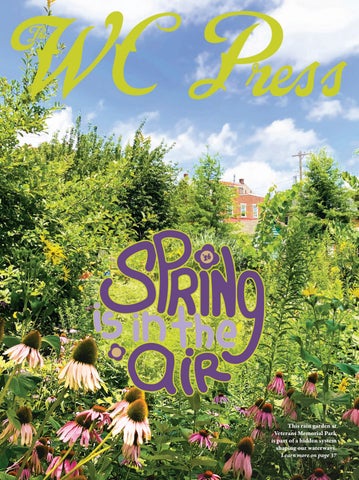
This rain garden at Veterans Memorial Park is part of a hidden system shaping our waterways. Learn more on page 37 Spring 2026
TheWCPress.com
1
2
The WC Press
Voice of the Borough
Spring 2026
TheWCPress.com
3
WHAT’S HAPPENING IN 2026
TWO MAGAZINES, ONE BOROUGH WHAT’S ON THE CALENDAR
Spring
West Chester comes alive as the weather warms, and we’re featuring the can’t-miss events & entertainment. Ad Deadline is 3/31
Early Autumn
As the crisp air comes to town, we start craving soups, hearty meals, and rich, dark drinks. We profile the best of ‘em. Ad Deadline is 9/11
Late Spring
We’re all excited for spring greens and exciting lighter fare that’s hitting tables around town this season. Ad Deadline is 4/24
Mid Fall
The weather starts cooling off, but the borough’s entertainment is lighting up, with multiple parades and plenty to do. Ad Deadline is 10/9
Summer
Summers in WC are full of excitement, from festivals to street fairs there are always better options than the beach. Ad Deadline is 5/22
Holidays
We’ve got Christmas cocktails and cakes plus plenty of hearty meals to pack on the pounds for the chilly winter ahead. Ad Deadline is 11/13
The WC Press
EVENTS • CULTURE • NIGHTLIFE • LOCAL STORIES
Taste WC
RESTAURANTS • BARS • FOOD TRENDS • DINING GUIDES 4
The WC Press
Voice of the Borough
Spring 2026
TheWCPress.com
5
our team PUBLISHER Dan Mathers dan@thewcpress.com ACCOUNT DIRECTOR Nick Vecchio nick@thewcpress.com STAFF PHOTOGRAPHER Adam Jones @toloveanddancing Mathers Productions 1563 Millrace Lane West Chester, PA 19380 mathersproductions.com
For a free subscription, visit thewcpress.com/subscribe
COLUMNISTS Becca Boyd bboyd@thewcpress.com Andrea Mason amason@thewcpress.com Courtney Klimek cklimek@ccls.org
The WC Press is a monthly magazine mailed to more than 1,000 homes throughout West Chester, and dropped off to about 100 locations in and around the borough.
inside this issue 9. @TASTEWC Tag our sister publication’s instagram account with your favorite food photos
29. MILES THAT MATTER The Running Home 5k supports North Star of Chester County.
11. SHORT FILMS, BIG STORIES The West Chester Film Festival feels bigger than ever — without losing what makes it great
35. DESIGNS OF THE TIMES Andrea Mason is a professional interior designer helping you upgrade your space
19. HOME BECCANOMICS Becca Boyd shares tips on life and cooking, plus a recipe to help with both
37. BENEATH THE SURFACE What’s happening in our waterways and the people working to keep them clean
21. THE GAME IS JUST THE START Heyday Athletic is building a community that sticks
47. PHOTO HUNT Find the five differences between the two photos and email us your answers for a chance to win
27. ON THE SHELF A list of picks for all ages from the staff at the West Chester Public Library
Spring 2026
TheWCPress.com
7
8
The WC Press
Voice of the Borough
@tastewc
#tastewc
Like and follow us on social media, then tag us in your posts for a chance to get your work published here. Our favorite image each month () will earn its photographer a gift card to @saloon151.
@saloon151
@thesocialloungewc
@spence.cafe
@drunksofwestchester Spring 2026
TheWCPress.com
9
10
The WC Press
Voice of the Borough
Short Films Big Stories
Two decades in, the West Chester Film Festival feels bigger than ever — without losing what made it work in the first place. story Dan Mathers photo Ed Shin - Shinbone Photography
12
The WC Press
Voice of the Borough
W
hen we first wrote about the West Chester Film Festival back in 2012, it already felt like something worth paying attention to—a weekend where independent film found a home in the borough, where filmmakers and audiences could come together in a way that felt both accessible and intentional, and where a growing creative community had something tangible to rally around. At the time, it was smaller and a bit more contained, still finding its footing and defining what it could become, but even then there was a sense that it was building toward something.
Now, approaching its 20th year, that picture has come into focus in a way that feels both expected and a little surprising at the same time. The festival has grown in scale, in reach, and in ambition—drawing submissions from around the world and welcoming audiences from well beyond West Chester—while still holding onto the same core idea that made it work in the first place. And if there’s
anything that stands out after all that growth, it’s not just how much bigger it has become, but how carefully it has managed to expand without losing the character and purpose that made people care about it to begin with.
For the people who have been with it the longest, that growth doesn’t feel like a single turning point so much as a series of gradual shifts that only really make sense when you step back and look at them all together. What once required physical handoffs and a bit of improvisation now runs through systems that allow the festival to operate at a much larger scale, but without losing the sense that there are real people behind every part of it. It’s more efficient now. More polished. But it still feels personal. Renee McGusty, Vice President and Young Filmmakers Coordinator, has been part of the festival for nearly two decades, long enough to remember when submissions arrived physically and were passed from one volunteer to another in a kind of
The Saturday crowd filling in the upper rows of the Uptown Knauer Performing Arts Center. This year the Knauer theater will host three film blocks, plus an awards ceremony and a meet and greet, all on Saturday. Shinbone Photography
informal rotation. “We used to have submissions mailed to us on VHS or DVDs,” she says, describing a process that now feels distant but, at the time, was simply how things worked. Today, those same submissions arrive digitally from across the world, with this year’s festival drawing more than 300 films from 46 countries—a scale that would have been difficult to imagine early on, but now feels like a natural extension of what the festival has become. Amy Theorin, the festival’s Filmmaker Liaison, sees that evolution in a slightly different way—not just in how films are submitted, but in how the entire experience has taken shape. The move to Uptown! Knauer Spring 2026
TheWCPress.com
13
Performing Arts Center has given the festival a clear center, something it didn’t always have when it was spread across multiple venues throughout town. “The level of professionalism the festival has now is incredible,” she says, especially for something that remains entirely volunteer-run. That combination— growth paired with intention—is what allows the festival to feel bigger without feeling disconnected. And that volunteer structure is still at the heart of everything.
The weekend is about more than just showing films—it is about supporting the independent short film community. -Victoria Rose Renee is quick to point out that, despite the scale, the festival has never shifted away from being a 100% volunteer nonprofit. It’s not just a technical detail—it’s part of the identity. “What makes it truly special is that it’s something we all genuinely care about,” she says, and that sense of ownership shows up in the way the festival is run. It doesn’t feel outsourced. It feels built. Victoria Rose, Director of Sponsorship, reinforces that point by putting it in more practical terms. The festival requires thousands of hours of work each year, with a board that operates year-round to coordinate everything from sponsorships to programming to logistics. It’s a level of effort that could easily feel invisible to attendees, but it’s what allows the weekend itself to feel seamless. You don’t notice it—and that’s kind of the point. Melissa Bullitt, who coordinates judging, sees that effort reflected in the broader community as well. Over time, the festival has become something that extends beyond its organizers, pulling in local businesses, sponsors, and volunteers who all play a role in shaping the experience. It’s not just happening in West Chester—it’s happening with it.
That connection to place is a big part of why the festival works here.
West Chester already leans toward creativity in ways that aren’t always obvious until 14
The WC Press
Voice of the Borough
The festival also features workshops for up-and-coming filmmakers and anyone simply interested in how movies are made. Johanna Walsmith - Heisser Photography
you start paying attention. Murals show up where you don’t expect them. Galleries rotate new work throughout the year. Coffee shops quietly double as exhibition spaces. It’s all there, woven into the day-to-day.
Victoria points to that directly. “West Chester is a town that truly appreciates art,” she says, and the festival fits naturally into
that environment. It doesn’t feel like something added on—it feels like something that belongs. What it brings, though, is access. Many of the films shown at the festival aren’t available anywhere else, at least not yet, which gives the weekend a kind of immediacy that’s hard to replicate. That immediacy is part of what makes short films work in this setting.
Amy talks about the challenge of the format—how filmmakers are able to tell complete, impactful stories in a matter of minutes, something that’s harder than it looks. Melissa
points to the range within each screening block, where audiences move from one tone to another without settling into a single narrative for too long. And Victoria sums it up in a way that feels familiar: a short film, done well, tends to stick with you. Sometimes longer than something much bigger. That structure—short films grouped into curated blocks—is what makes the festival approachable, even for people who haven’t been before. You don’t have to commit to an entire weekend or plan everything out in advance. You can just show up, pick a block, and see what happens.
Renee puts it simply. “Come in and try one block,” she says. “You won’t be sorry.” It’s not a hard sell. It’s more like a quiet confidence that something in that experience will land. For filmmakers, being part of that experience carries its own weight.
Victoria notes that the selection process has become increasingly competitive as the quality and volume of submissions have grown. “Our screeners have an incredibly difficult job,” she says, pointing to the challenge of narrowing down a strong field into a limited number of screening slots. This year’s lineup includes an Oscar-winning animated short alongside other nominated and shortlisted films, as well as work from local and emerging creators. It’s a mix that reflects both the reach of the festival and its commitment to showcasing a range of voices. But the festival isn’t just about the screenings themselves.
Victoria describes it as a filmmaker-friendly space, one where the weekend includes workshops, networking opportunities, and a series of informal interactions that often end up being just as important as
For the festival’s young filmmakers, the Q&A is where the work continues— sharing their films, answering questions, and growing in real time. Shinbone Photography
the films. People meet here. They reconnect. They collaborate. And in some cases, they come back years later with new work that grew out of those connections.
Renee sees that sense of continuity most clearly not just in the filmmakers who return year after year, but in the younger ones who are just starting out, many of whom first encounter the festival through its youth programming and then continue to develop alongside it. What begins as a student project—often rough around the edges, exploratory, and still figuring itself out—has a way of coming back more defined, more confident, and more intentional, sometimes just a year or two later. Spring 2026
TheWCPress.com
15
16
The WC Press
Voice of the Borough
Over time, that progression becomes visible in a way that’s hard to replicate in larger or less locally rooted festivals. The same names reappear. The same filmmakers evolve. Some move from the youth category into the main festival, screening alongside more established creators, not as an exception but as a natural next step. It creates a kind of throughline that connects the future of filmmaking to the present moment, all within the same weekend.
“They feel like family,” Renee says, and in this context it carries a little more weight. It’s not just about familiarity—it’s about investment. These are filmmakers who are growing up with the festival, returning to it, and, in some cases, being shaped by it in real time.
The level of professionalism the festival has now is incredible—especially for something that remains volunteer-run. -Amy Theorin And for a town like West Chester, that matters. It means the festival isn’t just bringing in outside work—it’s helping to develop something local, something ongoing, something that doesn’t end when the weekend is over. For returning attendees, those layers are still there—but they’re now paired with a more polished overall experience.
Victoria points to the additions that help shape the weekend, from the Opening Night Party with its red carpet and ceremonial kickoff, to events like the Horror Block and Coffee & Cartoons, which bring different audiences into the mix. The Uptown venue provides a strong central hub, while the surrounding events give the festival a sense of movement throughout the borough.
“We’ve put a lot of effort into making the WCFF a truly world-class event,” she says, and that effort shows up in the details—photographers capturing the weekend, curated food and drink experiences, and a closing celebration that feels more like a culmination than an ending. But even with all of that, the core experience hasn’t really changed.
Filmmakers gather on the red carpet to celebrate RIP Kevin, a reminder that behind every short film is a tightknit crew—and a story that extends well beyond the screen. Heisser Photography
You walk into a room. You sit down. You watch something you didn’t expect to see. And then you leave with something you didn’t expect to carry. Twenty years in, the West Chester Film Festival has expanded in nearly every direction—more submissions, more countries,
more structure, more visibility—but it has done so without losing the thing that made it work in the first place. It is still about the films, still about the people who make them, and still about the experience of sharing that work in a way that feels both local and connected to something larger. So if you’ve been meaning to go, or if it’s been a few years since the last time you stepped into a screening, the advice from the people who know it best is still the same. Try one block.
The rest tends to take care of itself. Spring 2026
TheWCPress.com
17
put your business on this page for as little as $300 — email dan@thewcpress.com
18
The WC Press
Voice of the Borough
home beccanomics
G
Becca Boyd shares tips on life and cooking from her blog at homebeccanomics.com
rowing up in an Italian American family we enjoyed “coffee and cake” for special occasions... and sometimes no occasion at all. I’ve since come to learn my experience was not remotely singular, and this nostalgic, homey tradition exists in almost every culture, although many choose to substitute tea for coffee. This cake could be called breakfast, would steal the show at snack time, and will be a dessert that’s asked for again and again. It’s a celebrated, time-tested dessert mashup, and one that feels like it should’ve existed from the jump. Enjoy!
Ba n an as Fo s te r Coffee Cake makes 8x8 pan CAKE • 1/2 c. Unsalted butter, softened • 3/4 c. Light brown sugar • 3 very ripe Bananas, mashed • 1 tsp. Vanilla extract • 1 1/2 c. All-purpose flour • 1 tsp. Baking powder • 1 tsp. Baking soda • 1 tsp. Kosher salt
CRUMBLE • 1 c. All-purpose flour • 1 c. Light brown sugar • 1/2 c. Hazelnuts, finely chopped • 2 tsp. Cinnamon • 3/4 tsp. Kosher salt • 1/2 c. Unsalted butter, melted • Powdered sugar for topping 1. Preheat oven to 350°. Prepare 8x8 baking dish with nonstick spray or additional one teaspoon of butter.
2. Cream butter and brown sugar for batter in large bowl. Scrape down edges of bowl and add bananas and vanilla - beat just to combine. 3. In a small bowl, whisk flour, baking soda, baking powder, and salt. Add to mixer and beat till combined on low speed, 30 seconds.
4. For crumble, in a separate medium mixing bowl, combine flour, brown sugar, hazelnuts, cinnamon, and salt and whisk to combine.
5. Add melted butter and stir to evenly combine. 6. Place half of batter in prepared dish and spread evenly. Top with half of crumble.
7. Add remaining batter and spread evenly
on top of crumble, and top with remaining crumble.
8. Bake for 50 minutes. If batter does not seem set when checked, lay a piece of foil over top of pan and continue to bake until set, an additional 5 to 10 minutes. 9. Let cool and top generously with powdered sugar. Spring 2026
TheWCPress.com
19
20
The WC Press
Voice of the Borough
The Game is Just The Start
Heyday Athletic is building a community that keeps people coming back story Dan Mathers
H
eyday Athletic describes itself in a way that feels almost too simple at first: “Little League for adults,” or, depending on who you ask, an extension of college intramurals for people who aren’t quite ready to give that part of their lives up yet. But spend any amount of time around it—on a field, at a bar after a game, or even just talking to the people who have built their routines around it—and it becomes clear that what’s happening here isn’t just about organized sports. It’s about filling a very specific gap that tends to open up somewhere between your early twenties and the moment you realize most of your social life has become either scheduled or incidental. Tim Horan saw that gap before he had the language for it. Back in 1998, when he signed up as an individual for a coed touch football league in Fairmount Park, he wasn’t thinking about building a business or shaping a community—he just wanted to play. But what he walked into stuck with him immediately: dozens of people, mostly in their twenties and thirties, playing, cooking out, drinking beers, bringing their dogs, bringing their kids, all layered into something that felt at once casual and structured, social and competitive. “What’s not to absolutely love about that?” he says now, still sounding a little like the guy who first showed up not knowing anyone. Within weeks, he was working for the organization. A few years later, he was running it. Eventually, through a series of mergers, expansions, and rebrands, that early version of a “sport and social club” evolved into what is now Heyday Athletic—a network of leagues and events that stretch across multiple regions, but feel most at home in places like West Chester, where the density of young professionals, the accessibility of fields and gyms, and the built-in bar and restaurant culture all work together to support something that doesn’t quite function like anything else. The premise is straightforward enough: you sign up for a league—softball, volleyball, basketball, kickball, cornhole—either with a team or on your own, and you play. But the reason people show up, and more importantly, the reason they keep showing up, tends to have less to do with the sport itself and more to do with everything that surrounds it. For a lot of players, this is the first time since college—or even high school—that there’s a consistent, shared activity that puts them in the same place, with the same group 22
The WC Press
Voice of the Borough
Rec sports leagues have a rep for being home to an exclusively 20-something crowd, but Heyday teams (and champs) represent a wide cariety of ages.
of people, week after week, without the friction that usually comes with trying to build a social life from scratch. That consistency matters. It creates familiarity, and familiarity turns into something else pretty quickly. As Tim puts it, when you’re on a team, you don’t have to figure out how to start a conversation—you’ve already got one built in. You’re playing together, or against each other, and that alone is enough to lower the barrier. Then you add in the fact that you’re competing, maybe winning, maybe losing, maybe arguing about a call or celebrating something small that feels bigger in the moment, and suddenly those interactions start to stack. “Sports teams are great uniters of people,” he says, and the longer you spend around Heyday, the harder it is to argue with that. For Tara Murray, that sense of continuity has stretched across most of her life. She first got involved at sixteen, playing in an earlier version of the league alongside her
Tara Murray (left) with Kris and his daughter Hannah—teammates on the same Heyday Athletic squad and part of a community where friendships grow, families get involved, and the game is just one piece of something that continues well beyond the field. older cousins, and what started as something casual has turned into something much more embedded. Now in her forties, she’s still playing, still showing up early to watch other games, still jumping in as a fill-in when another team needs an extra body, and still ending most nights the same way—at a sponsor bar, rehashing whatever just happened on the field over food and drinks. Over time, those routines have expanded beyond the games themselves. The same people she plays with have become the people she sees outside of it—at weddings, birthdays, parties, and everything in between— and what started as a team has gradually
taken on the shape of something closer to a social network that just happens to revolve around sports. At this point, it’s not unusual for players to overlap across multiple leagues or teams, to travel together for tournaments, or to build entire friend groups that exist because of Heyday rather than outside of it. For Tara, that evolution has come full circle in a way that’s hard to plan for but easy to recognize in hindsight: she now plays alongside her son, sharing something with him that started long before he was born, but still feels current enough to matter. That blend of longevity and immediacy is part of what makes the whole thing work. On one hand, you have players who have been around for decades, who treat this as a standing part of their week; on the other, you have people who just moved to town, or just signed up on a whim, or just needed a reason to get out of the house. And the system accommodates both without really calling attention to the difference. Spring 2026
TheWCPress.com
23
24
The WC Press
Voice of the Borough
West Chester, in particular, seems to amplify that dynamic. It’s the kind of place where you can leave work, walk or drive a short distance to a field or gym, play a game, and then head straight into town afterward without breaking the flow of the night. The infrastructure is already there—the bars, the restaurants, the density of people all operating on roughly the same schedule—and Heyday plugs into it rather than trying to recreate it. As Tim puts it, success depends heavily on those relationships, and in West Chester, there’s no shortage of them. Spots like Barnaby’s, Kildare’s, Ryan’s, and others aren’t just sponsors—they’re extensions of the experience, places where the competitive edge softens a bit and the social side takes over.
It starts as a game, but it really becomes about the people you meet and the community that forms around it. -Tim Horan That balance—between competition and connection—is something Heyday is unusually deliberate about maintaining. This is still the Philadelphia area, after all, and people take their sports seriously. Games can get intense, and that’s part of the appeal. But the expectation is clear: compete as hard as you want, just don’t lose sight of why you’re there. “Friendly competition” isn’t just a tagline—it’s a requirement. If you can’t handle losing, or if you make it harder for other people to enjoy themselves, you don’t last long. The same philosophy carries into the events that exist outside of the leagues themselves. The Celtic Crawl and Kris Kringle Crawl, which draw a few hundred people at a time, turn the borough into something closer to a moving block party, with groups traveling from bar to bar in coordinated outfits, feeding off the energy of the crowd and the familiarity of the setting. Phillies outings extend that even further, layering in tailgates, DJs, food, and drinks in a way that makes it just as accessible for people who don’t play as it is for those who do. In that sense, the leagues may be the entry point, but they’re not the boundary. All of this exists, at least in part, as a response to something that’s harder to define but easy to feel. The way social life
Heyday teams take the community beyond the field—bringing the same energy to Phillies games with group outings and tailgates. has shifted, the way people spend more time on their phones, the way interactions have become more fragmented, more scheduled, more transactional. Tim doesn’t overcomplicate it. “Get off the phone and into the game,” he says, updating an older version of the same idea that used to focus on the couch instead. It’s a simple pitch, but it lands because it doesn’t feel like one. It feels more like a reminder—of what it’s like to show up somewhere without overthinking it, to have a place to be that doesn’t require much explanation, to build something gradually just by being present. When I mentioned to our account director, Nick Vecchio, that we were working on a story about Heyday, he didn’t need much prompting. He went straight to a memory. “You should mention how The WC Press
Regulators took home the kickball crown,” he said, immediately. “This was… ten years ago? And I actually still have the shirt.” He paused, just long enough to make it clear that the details still mattered. “Matt Harnett made an unassisted triple play that took us into the championship game,” he added. “He caught a line drive, bounced the ball off a guy trying to tag up, caught the rebound and then gunned a runner out inches from home. Matt and I still high five about that.” That’s the part that tends to stick. Not just the wins, or the losses, or even the specific games, but the accumulation of small moments that end up meaning more than you expect them to. A play you remember longer than you should. A group of people you didn’t know before, but now see all the time. A routine that didn’t exist until it did. And on any given weeknight in West Chester, it’s all still there—happening in real time, without much ceremony, just waiting for the next person to show up and step into it. Spring 2026
TheWCPress.com
25
26
The WC Press
Voice of the Borough
on the shelf
A list of picks for all ages from the staff at the West Chester Public Library
A
s spring arrives, the West Chester Public Library is sharing a fresh collection of staff picks for readers of all ages. Whether you’re looking for something light, thought-provoking, or just a great story to get lost in, these selections are perfect for the season. What are you reading, West Chester? Here’s a list of staff picks from the West Chester Public Library.
Adult Books How to Get Away with Murder by Rebecca Philipson
When a self-help book that claims to teach readers how to commit the perfect crime appears linked to a real murder, Detective Inspector Samantha Hansen returns from leave to investigate. As she tracks down the mysterious author, the case becomes a test of her instincts, her resilience, and her ability to trust herself again. The Starter Ex by Mia Sosa Vanessa Cordero once made a business out of sabotaging relationships—for a fee. When she takes on one last job posing as a wildly inappropriate girlfriend, things quickly spiral as real feelings begin to complicate the arrangement. A sharp, funny romantic comedy about love, boundaries, and unexpected chemistry. Black Dahlia: Murder, Monsters, and Madness in Midcentury Hollywood by William J. Mann
This deeply researched account revisits one of America’s most infamous unsolved murders, placing the Black Dahlia case within the cultural and social tensions of postwar Hollywood. Mann brings new depth to the story, shifting focus back to the victim while exploring the era that shaped the case.
Teen Books The Escape Game
by Marissa Meyer and Tamara Moss
In this high-stakes thriller, contestants compete in a puzzle-based reality show where survival—not escape—is the goal. As a past season’s murder continues to cast doubt over the com-
petition, the new players must not only solve challenges and stay alive, but also uncover what really happened. Packed with twists, suspense, and clever puzzles, it’s a fast-paced read.
Children’s Books Some of Us Are Brave by Saadia Faruqi Set during Hurricane Harvey, this novel follows three very different kids—Yasir, Mona, and Cody—whose lives collide as floodwaters rise in Houston. Not quite friends at first, they’re forced to rely on each other as their world begins to fall apart, navigating fear, tension, and unexpected connection. Told from multiple perspectives, it’s a story about resilience, empathy, and finding common ground in the most difficult moments. When Cherry Blossoms Fall by Katrina Goldsaito illustrated by Yas Imamura
Yuna eagerly awaits her great-grand-
mother’s cherry tree blooming, watching each day as the blossoms slowly unfold. But when the flowers fade just as quickly as they arrived, she begins to understand mono no aware—the awareness of life’s impermanence. A gentle, beautifully illustrated story about change, memory, and appreciating fleeting moments. Female Heroes of Greek Mythology: 51 Legends Who Ruled the Ancient World by Megan Duvarney Forbes
This engaging collection introduces readers to 51 bold and powerful women from Greek mythology, from warriors and queens to goddesses and heroes. Written for younger audiences, the stories are accessible, exciting, and empowering, offering a broader look at mythological figures often overlooked in traditional retellings.
Spring 2026
TheWCPress.com
27
28
The WC Press
Voice of the Borough
Miles That Matter
A spring race through West Chester turns a morning run into real support for families working to stay in their homes. story Dan Mathers | photos Courtesy of North Star of Chester County
30
The WC Press
Voice of the Borough
O
n a spring morning in West Chester, before the shops open and before the first round of coffee orders hits the counter, a different kind of crowd begins to gather. There’s a looseness to it at first—runners stretching along the sidewalk, people catching up, someone fumbling with a safety pin as they try to attach a bib. A few are focused, headphones in, pacing quietly. Others are talking, laughing, settling into the rhythm of the morning. Then, slowly, it builds.
More people arrive. The sidewalk fills in. That low, collective energy starts to hum—the kind that only happens when a few hundred people decide to show up in the same place for the same reason.
But it’s not just about the starting line. It’s everything leading up to it. Volunteers move with purpose, setting up water stations and marking routes, while small groups of run-
Faces Behind the Mission Runners and organizers—including Scott Zukin (right)—show their support for North Star of Chester County, the nonprofit at the heart of the Running Home 5K. ners reconnect with familiar faces they might only see a few times a year—at events just like this. There’s a sense of anticipation, sure, but also something more relaxed, more communal. Even for first-timers, it doesn’t feel intimidating. It feels welcoming. And then they’re off.
For a brief stretch of time, the borough shifts. Streets that usually carry traffic become a course. Corners you pass every day feel different when you’re moving through them with a crowd. West Chester isn’t just the backdrop—it becomes part of the experience.
That’s the Running Home 5K.
The event, held each spring, is organized in partnership with Zukin Realty to benefit North Star of Chester County, a nonprofit focused on preventing homelessness among working families. What brings people out is simple—a 5K run, a one-mile walk, a chance to move through the borough in a different way. But what keeps the event growing year after year is something deeper. It’s the combination of structure and spontaneity. The planning that goes into it— and the ease of showing up. Behind the scenes, the race is the result of months of coordination. Permits, logistics, volunteers, coordination with the Borough, local police, and first responders—it’s a complex operation that, by design, feels effortless once the morning begins. For participants, it’s straightforward: sign Spring 2026
TheWCPress.com
31
up, show up, run or walk, and take part in something that feels both organized and open at the same time. The course moves through familiar streets, drawing a mix of serious runners, casual walkers, and people simply looking for a reason to be outside and engaged. But the race isn’t the end of the story. It’s the entry point.
There are so many moving parts and people involved, but everyone shows up—and that’s what makes an event like this possible. -Scott Zukin Events like this have a way of sneaking up on you. What starts as a simple 5K—something to train for, something to check off a list—quickly becomes something more. It becomes a reason to show up, to see familiar faces, to feel connected to the place you live in a way that’s hard to replicate in the day-today. In a town like West Chester, where community is often built through shared spaces and repeated interactions, those moments matter. A race like this isn’t just about running a few miles through borough streets— it’s about reinforcing the idea that this is a place where people show up for each other. Whether you’re participating, volunteering, or just standing along the route cheering people on, you’re part of it.
And over time, those small moments— those few hours on a Saturday morning— start to add up into something that feels a lot more meaningful.
North Star of Chester County focuses on a group of people most residents would recognize, but might not immediately think of as being at risk. “The parents in our program are your neighbors,” says Nick Lohr, Project Manager for North Star. “They take care of the elderly, serve you in a restaurant, drive the school bus, or attend the same church. They’re with you in line at the grocery store or the pharmacy.” They’re working. They’re part of the community. But they’re also living in a gap.
Words That Carry A supporter cheers on runners with a bright reminder—“Never give up”— capturing the spirit that fuels the race from start to finish. North Star serves what’s known as ALICE households—Asset-Limited, Income-Constrained, and Employed. Families who are doing everything right, but still struggling to keep up with the cost of living.
“In the last few years, most people have noticed the higher cost of living,” Lohr says. “But the lack of affordable housing is by far the biggest challenge our families are facing.” In a place like Chester County, that gap can widen quickly. Rent increases. Everyday costs rise. And without much margin, even a small disruption can lead to something much bigger.
North Star’s work is focused on preventing that moment.
Through rental assistance, financial counseling, and long-term case management, the organization helps families stabilize and move toward independence. It’s a process that takes time—sometimes years—but one that creates lasting change. “Our goal is to have parents leave our program in a better place than where they started,” Lohr says.
He points to one participant, a mother of three referred to as “Kayla,” who entered the program after leaving a difficult situation. With support, she was able to stabilize her housing, pay down debt, begin saving, and move into a higher-paying role. It’s one story, but it’s not an isolated one. It’s exactly the kind of outcome the program is built to create.
And it’s exactly what the race helps support.
“Proceeds from the Running Home 5K can help keep our families housed, and on the path to independence, for an entire year,” Lohr says. That support reaches into every part of a family’s life—housing, food, childcare, financial stability. It creates something that’s easy to overlook but incredibly important: breathing room. The race, in that sense, isn’t just an event. It’s a mechanism. A way of turning a morning in the borough into something that extends far beyond it. For Scott Zukin, that connection is the reason the event exists in the first place.
“We are proud to be a leader in our industry by being an active part of our community,” he says. “The point of all of this isn’t just ‘all about the business’—it’s really about serving our community and building relationships with organizations who are making a real difference.” “A lot of hard work and communication goes into it,” Zukin says. “There are so many
Off and Running Participants take off through downtown West Chester at the start of the Running Home 5K, turning familiar streets into a shared community course. moving parts, and so many people involved— working with the Borough, the police, first responders. Everyone plays an important role in pulling off an event like this.” “We are most proud of the fact that we’ve been able to be a vehicle between our generous sponsors and North Star,” he says. “It’s an honor to hear how that support tangibly changes the lives of the families that are supported.” By the time the race winds down, the streets return to normal. The course disappears. The crowd disperses. The morning settles back into the rhythm of a typical day. But the impact doesn’t end there.
What starts as a few hundred people gath-
ering on a spring morning becomes something more lasting—support that helps keep families in their homes, resources that give people a path forward, and a reminder of how connected a community can be when people choose to show up. On April 25, the scene will look familiar.
Runners stretching along the sidewalk. Friends catching up before the start. That same steady energy building as more people arrive.
And then, once again, they’ll take off through the streets of West Chester—moving through a town they know, in support of people they may not, but who are very much a part of it. Because that’s really the point. It’s not just about the distance or the time on the clock. It’s about everything in between—the shared effort, the encouragement from strangers, the sense that, for a few hours, the entire town is moving in the same direction.
And in a place like West Chester, that’s something worth showing up for. Spring 2026
TheWCPress.com
33
34
The WC Press
Voice of the Borough
designs of the times
Andrea Mason is a professional interior designer who wants to help you upgrade your space
W
ith spring finally here comes that familiar urge for a fresh start—and for many of us, that means cleaning house. There’s something especially satisfying about tackling a project that brings order back into your space. To help get started, I spoke with Heidi Mulherin, a professional organizer with The Simplified Home by Cristina. We took a closer look at one of her recent West Chester projects—a full closet overhaul—and broke it down into a practical, step-by-step guide to help you give your space purpose again. First things first: give yourself a little credit. Getting started is often the hardest part, and finding the motivation to begin can feel like a hurdle in itself. But once you reclaim that space, it’s a real win. Heidi recommends starting small—think a drawer or a closet—so you can see results quickly without burning out halfway through. And one important reminder: things will probably look worse before they look better. That’s part of the process. For this project, Heidi reorganized a bedroom closet, sorting clothing, accessories, and linens into a more functional system. Here’s how to approach it:
Start With A Plan Map out the time you have for clearing out, organizing, shopping for any needed items, and putting everything back. Decide what you want to accomplish and set realistic goals. This can be done in a day or spread out over time. Define Your Goal Are you trying to reduce clutter by 25%? Make things easier to access? Having a clear objective will guide your decisions. Set up three containers. One for trash, one for donations, and one for items that belong elsewhere in your home. Clear Everything Out Start with a blank slate so you can see what you’re working with. Categorize As You Go Group similar items together—t-shirts, pants, hoodies, work clothes—to better understand what you have. Break categories down further if needed. For example, grouping all black shirts together can make it easier to narrow things down. Use The Three-Second Rule Look at each item and decide quickly. Focus on
keeping your favorites rather than feeling like you’re “losing” things. Create A “Maybe” Box For items you’re unsure about, pack them away and label the box with a date. If you haven’t opened it in a year, it’s an easy decision to donate. Declutter Before You Buy If you’re planning to purchase storage solutions, wait until after you’ve pared things down, then measure your space to ensure a proper fit. Keep It Simple You don’t need fancy bins to create a functional space. Heidi recommends wicker baskets, shoe organizers, collapsible containers, and shelf dividers.
Need help with your next project? Contact andrea@andeamasondesign.com
Ask yourself whether you need to see what’s inside, or if an opaque container will work. Once everything is back in place, remember that organization isn’t a one-time event. As your needs change, your system can change with it. Small tweaks over time will keep your space working for you. You’re one step closer to a more organized home. And if you’d rather leave it to the professionals, The Simplified Home by Cristina offers free consultations. You can also check out Heidi’s YouTube channel for a closer look at her process and transformations: youtube.com/@AtHomeWithADHD Spring 2026
TheWCPress.com
35
this magazine in your mailbox
six times a year free of charge
36
The WC Press
Voice of the Borough
BENEATH the Surface
What’s really happening in West Chester’s waterways and the people working to keep them clean. story Dan Mathers | photo Brandywine Red Clay Alliance
38
The WC Press
Voice of the Borough
E
very so often, something happens that forces people to notice the creeks. Maybe it’s a heavy rain that turns a quiet stretch of water into something fast and brown and unpredictable. Maybe it’s debris, or a smell that doesn’t quite make sense. Or, more recently, something like the milky-white water that showed up in Goose Creek—a moment that caught people’s attention not because it was entirely unusual, but because it was visible. That’s usually what it takes.
We tend to take waterways for granted until something feels off. And when it does, the reaction is immediate: What is that? Where did it come from? Is it dangerous?
In cases like that, there’s often a clear answer. What people are seeing is known as an illicit discharge—something entering the stormwater system that isn’t rainwater, whether that’s soap, oil, sewage, or another contaminant making its way into the creek. It’s the kind of problem that announces itself, that gives you something to point to and say, that shouldn’t be there. But the more complicated reality is that those moments, as alarming as they might be, are usually just symptoms of something much larger—and much more constant.
Because most of what affects local waterways isn’t something you notice all at once. It’s something that builds slowly, quietly, and almost entirely out of sight.
A P RO B L E M T H AT D O E S N ’ T A LWAYS LOOK LIKE ONE Brian Winslow has spent years thinking about that disconnect—the gap between how waterways appear and what’s actually happening within them.
As a representative of the Brandywine Red Clay Alliance, Brian works across the region, including here in West Chester, where streams like Goose Creek and Plum Run are part of a much larger watershed system. And one of the first things he points out is that appearance can be misleading. A stream can look clean and still be struggling. “The canary in the coal mine is the bugs,” Brian explains, referring to the aquatic insects that serve as indicators of stream health. In a balanced ecosystem, those organisms are
USGS National Water Quality Assessment studies require analyses of stream and bed-sediment samples for major ions, nutrients, sediments, and organic contaminants abundant and diverse. When they begin to disappear, it’s often a sign that something is off, even if the water itself looks clear.
That’s part of what makes this issue difficult to grasp. There isn’t always a single moment, or a single cause, that defines the problem. Instead, it’s the accumulation of many smaller inputs—sediment, nutrients, road salt, rising water temperatures—that, over time, begin to
reshape the system.
And unlike the industrial pollution of decades past, which often came from identifiable sources, much of what affects waterways today is diffuse.
It comes from everywhere. Lawns. Roads. Parking lots. Rooftops. Fertilizers. Pet waste. Vehicle fluids. De-icing salts in the winter. None of it seems significant on its own, but taken together, it creates a steady stream of runoff that eventually finds its way into local creeks. That shift—from what’s known as “point source” pollution to “non-point source” polSpring 2026
TheWCPress.com
39
In the Current Brian Winslow stands ankle deep at Plum Run Preserve, where restoration efforts are helping reshape how water moves through the landscape—and how the stream recovers over time. Photo Adam Jones
lution—has changed the nature of the problem entirely. It’s no longer about stopping one thing. It’s about managing everything. And at the center of it all is stormwater.
W H E N WAT E R MOV E S T O O FA ST Stormwater, at its most basic level, is just rainwater moving across the landscape. But in a developed place like West Chester, that movement looks very different than it would in a forest or an open field.
Instead of soaking into the ground, water hits hard surfaces—roads, sidewalks, rooftops—and moves quickly, picking up whatever is in its path. By the time it reaches a storm drain, it’s carrying sediment, pollutants, and heat, all of which end up in the nearest stream. And it gets there fast.
“The volume and speed of water is really the issue,” Brian says, pointing to the way impervious surfaces accelerate everything. That increased flow erodes streambanks, destabilizes channels, and makes it harder for ecosystems to recover. It also contributes to flooding in areas downstream, where water arrives more quickly and in greater quantities than the system was originally designed to handle. In other words, the problem isn’t just what’s in the water; it’s how the water moves.
That realization has shifted the way organizations like Brandywine Red Clay approach their work. While cleanup efforts still play a role, the focus has increasingly moved toward long-term solutions—restoring streambanks, planting trees, stabilizing soils, and rethinking how water is managed across the landscape.
Projects like the restoration of Plum Run are part of that effort, aimed not just at improving conditions in a single location, but
The canary in the coal mine is the bugs—when they start to disappear, it’s a sign something’s off, even if the water looks clean. - Brian Winslow, Brandywine Red Clay Alliance
at addressing the broader patterns that affect the watershed as a whole. It’s slow work. It’s incremental. And it often goes unnoticed. But it’s also essential.
B R I N G I N G I T BAC K T O W E ST C H E ST E R If Brian’s perspective helps define the scope of the problem, Will Williams brings it down to street level. As the Borough of West Chester’s Sustainability Director, Will is responsible for translating those larger environmental challenges into practical, day-to-day solutions—many of
Reading the Signs Brian Winslow examines aquatic insects clinging to a stream rock— “the canary in the coal mine” that reveals the true health of a waterway beneath the surface. which are happening just out of sight.
“I lived in West Chester for 12 years, and worked for the Borough for seven years now as its first Sustainability Director,” Will says, describing a role that spans everything from environmental initiatives and capital planning to managing the Borough’s stormwater system and overseeing grant funding. It’s a wide-ranging position, but at its core, the goal is simple: Spring 2026
TheWCPress.com
41
42
The WC Press
Voice of the Borough
figure out how to manage water in a way that works for both people and the environment. That hasn’t always been the approach.
“For the first few hundred years of West Chester history, stormwater management was about moving stormwater runoff to streams as quickly as possible,” Will explains. It made sense at the time—no one wants water pooling in the streets or on their property—but that strategy, combined with decades of development, has created a new set of problems. Streams become overwhelmed. Infrastructure wears down. Water quality declines. And as precipitation patterns shift, those issues become more pronounced. What was once considered efficient is now part of the challenge.
What we notice in a moment is often just a symptom—what shapes our waterways is everything happening quietly, all the time.
WHERE THE MO N EY G O E S For most residents, the most visible connection to all of this is the Stream Protection Fee—a line item on a bill that’s easy to overlook or, in some cases, question. But behind that fee is a system that is both extensive and constantly in need of attention.
Volunteers are a big part of the effort, whether they’re planting trees or cleaning the banks, the community continues to pitch in to keep our waterways clear.
“The stormwater system consists of 24 miles of pipes, over 1,000 inlets, 300 access points, and 73 outfalls,” Will says, describing a network that runs beneath the Borough, largely unseen. “Each of these components will fail in time, and needs to be replaced.”
Maintaining that system is a continuous process, one that includes inspections, repairs, and regulatory compliance with state and federal standards. It also involves monitoring water quality at outfalls—testing for things like sewage and chlorine—in order to identify and address problems at their source.
That’s where incidents like the one in Goose Creek connect back to the bigger picture. The visible issue is just the starting point. The real work happens afterward. And while the Stream Protection Fee covers much of that effort, it’s often supplemented by outside funding. In the past three years
Spring 2026
TheWCPress.com
43
alone, Will has secured more than $1.3 million in grant funding to support stormwater-related projects, helping to offset costs for residents while expanding the Borough’s ability to take on larger initiatives.
SM A L L P ROJ E C T S, B I G I M PAC T Walk around West Chester, and you’ll start to see signs of that work—if you know what you’re looking for.
There are rain gardens, for example, scattered throughout the Borough. At a glance, they might look like landscaped beds, but each one is designed to collect and absorb stormwater from surrounding surfaces before it reaches the storm drain. “When runoff hits a stormdrain it goes immediately to the stream,” Will says. “When 44
The WC Press
Voice of the Borough
In developed communities like West Chester Borough, we need a lot of smaller projects to move the needle—but every one makes a difference. - Will Williams, Borough of West Chester Sustainability Director
it goes to a rain garden, it slows down, percolates, pollutants settle out, and the amount ultimately discharged to a stream is greatly reduced.”
There are now about 20 of these installations in West Chester, each contributing in a small but meaningful way to the overall system.
And that’s really the key. “In developed communities like West Chester Borough, we need a lot of smaller projects to move the needle,” Will explains. “But every one makes a difference.”
That approach—often referred to as green infrastructure—represents a shift away from simply moving water as quickly as possible, and toward managing it more thoughtfully. Instead of relying solely on pipes and drains, the goal is to recreate, in small ways, the natural processes that once handled stormwater before the area was developed. Slow it down. Spread it out. Let it soak in.
A SHARED R E S P O NS I B I L I T Y What makes that approach work is the degree to which it extends beyond the Borough itself. Programs like Adopt-a-Rain Garden invite residents to take an active role in maintain-
Hidden in Plain Sight At a glance, these rain gardens read as simple landscaping—but beneath the surface, they’re working systems, slowing runoff, filtering pollutants, and reducing the burden on stormwater infrastructure. ing these spaces, creating a sense of ownership that goes beyond simple awareness. Volunteers help care for the installations, reducing maintenance costs and strengthening the connection between infrastructure and community. “If you see one working in a garden, thank them,” Will says. “They are keeping costs down for all of us.”
That same principle applies at a smaller scale as well. Residents can install rain barrels. Plant trees. Adjust downspouts so water flows into
a yard instead of directly into the storm system. Reduce fertilizer use. Pick up pet waste. Use less salt in the winter. Individually, none of these actions seem particularly significant. Together, they are. “Small things really add up,” Will says, and in a system defined by cumulative impact, that’s more than just a nice sentiment—it’s a practical reality.
W H AT W E D O N ’ T SEE The challenge, of course, is that much of this work remains invisible. Stormwater infrastructure is, by design, out of sight. Pipes run beneath streets. Water moves underground. Problems develop gradually, without a single moment that calls attention to them. “It’s impossible to walk around and not encounter stormwater infrastructure,” Will
says. “Under almost every street are large pipes, some over 100 years old.” And yet, most people never think about
them... until something goes wrong. That’s the paradox at the center of this story. The health of local waterways depends on systems that are largely unnoticed, maintained by people whose work rarely draws attention, addressing problems that don’t always present themselves in obvious ways. It’s not just about cleaning a creek. It’s about understanding how water moves through a place, how that movement has changed over time, and how it can be managed more responsibly going forward. And it’s about recognizing that the moments we do notice—the discolored water, the strange smell, the sudden change—are only part of the picture. The rest is happening all the time, just beneath the surface. Spring 2026
TheWCPress.com
45
46
The WC Press
Voice of the Borough
PHOTO Spot the five differences between the two images below
Photo of last year’s Film Festival. Find out about this year at www.westchesterfilmfestival.com
HUNT email your answers to contests@thewcpress.com
Spring 2026
TheWCPress.com
47
48
The WC Press
Voice of the Borough