A JOURNAL WHERE PILATES PROFESSIONALS COME TOGETHER TO LEARN, DISCOVER AND SHARE IN THE JOY OF MOVEMENT.
HAS CHOREOGRAPHY GONE TOO FAR?
THE CLASS THAT CHANGED EVERYTHING
BEYOND ONE MODLAITY
Rethinking choreography in today’s group classes.
Finding herself - and helping others belong.
Why the Future of Movement Belongs to Professionals Who Can Evolve.
ISSN 2982-043X
ISSUE 41 - OCTOBER 2026
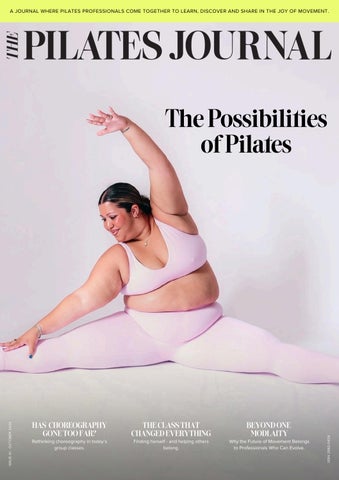
The Possibilities of Pilates
TECHNOGYM REFORM
THE PILATES DESIGN REVOLUTION Developed with the world’s top master teachers, Technogym Reform redefines Pilates with unmatched quality and design. Offering quick and intuitive adjustments and a library of on-demand content, Technogym Reform is the complete solution for personal training and group classes.
Discover more
Call (646) 578-8001 (US) +44 20 3907 5000 (UK) +39 0547 650111 (Rest of the world) or visit technogym.com
ISSUE 41 — PILATESJOURNAL.COM
Note from the Editor
CONTRIBUTORS
Welcome to the latest issue of
Emily Phillips, Kristin McGee, Jill Rothenberg, Ava Rodriguez, Elizabeth Larkam, Erica Bell, Michelle Duval, Seran Glanfield, James Shaw, Bonnie Zeitner and Cecilia Pulido.
The Pilates Journal. Pilates is evolving. The question is not whether it should change, but how we evolve while holding onto what makes the method so valuable.
CONTACT US
This month, Kristin McGee explores why the future of movement belongs to professionals willing to expand beyond one modality. We look inside the rapid rise of JETSET Pilates, while industry veteran Elizabeth Larkam shares lessons from four decades of teaching group Reformer. Michelle Duvall asks whether Pilates choreography has gone too far, opening an important conversation about creativity, purpose, and the method itself.
Editorial Editor-in-Chief Cie’Jai Zarb hello@pilatesjournal.com Photography Emily Phillips, Kristin McGee, Jill Rothenberg, Ava Rodriguez, Jetset Pilates, Elizabeth Larkam, Erica Bell, Michelle Duval, inLIFE Wellness, Seran Glanfield, James Shaw, Bonnie Zeitner, KX Pilates, Nicole Monette, Seasewell, Ashley Bloom and Cecilia Pulido.
We also share the results of our 2026 Pilates Industry Survey, revealing an industry that continues to grow - and what instructors and studio owners believe needs to happen next.
Advertising Cie’Jai Zarb 61412209460
And in a deeply personal story, Jill Rothenberg shares how Pilates helped her navigate anxiety, loss, and self-doubt, ultimately creating a community where others could feel seen and supported.
PO BOX 2193 Clovelly West NSW 2031
hello@pilatesjournal.com Questions/Feedback If you would like to contribute or have any questions, please contact us at hello@pilatesjournal.com
Dates were also announced for our next Expo in Los Angeles January 15-17, 2027 - we hope you can make it!
On the Cover Emily Phillips
CJ Zarb FOUNDER AND EDITOR-IN-CHIEF
3
WHERE THE PILATES INDUSTRY MEETS Learn from Industry Leaders Refine Your Teaching Grow Your Business Expand Your Network Be Part of the Conversation
LOS ANGELES JANUARY 15-17, 2027
TICKETS NOW AVAILABLE
TICKETS NOW AVAILABLE PILATESJOURNALEXPO.COM
LOS ANGELES JANUARY 15-17, 2027
ISSUE 41 — PILATESJOURNAL.COM
Contents
3
EDITOR’S NOTE Welcome to the latest issue of The Pilates Journal.
8 12
Postpartum Pilates helped Emily rediscover herself — and create belonging for others.
BEYOND ONE MODALITY Why the Future of Movement Belongs to Professionals Who Can Evolve.
16 20
THE CLASS THAT CHANGED EVERYTHING
INSIDE JETSET PILATES' RAPID RISE Beyond the Boom: Why the Future of Pilates Belongs to Brands That Know Their Niche.
A WEEKEND THAT MOVED THE PILATES INDUSTRY FORWARD A look back at The Pilates Journal Expo Miami—and why you’ll want to be at the next one.
26 28
The Pilates Journal would like to acknowledge and pay respects to the Gadigal people of the EORA nation as the traditional custodians of the place we call home Sydney - where this journal is produced.
PILATES SAVED ME How Pilates helped Jill navigate anxiety, loss and self-doubt - and create a supportive community.
The Pilates Journal pays respects to their elders, past, present and emerging, and acknowledges all Aboriginal and Torres Strait Islander peoples.
OUR 2026 INDUSTRY SURVEY SHOWS WHAT COMES NEXT The findings reveal an industry with strong demand and growing influence but also increased pressure.
30
HAS PILATES CHOREOGRAPHY GONE TOO FAR? We explore the evolving role of choreography in Pilates and what it means for group classes.
6
ISSUE 41 — PILATESJOURNAL.COM
Contents
34
FROM OSTEOPOROSIS TO BUFFED BONES A DEXA scan at 40 changed everything Ava thought she knew about strength and bone health.
38 42
TEACHING GROUP REFORMER INSIGHTS AFTER FOUR DECADES Elizabeth Larkam draws on four decades of teaching to share five practices for a more meaningful group Reformer experience.
AN OPEN LETTER TO THE FUTURE OF PILATES Pilates is growing faster than ever, bringing both opportunity and important questions for the industry.
46 51
THE BUSINESS OF BELONGING How Scott Capelin is Building a Different Kind of Pilates Franchise.
LEAD YOUR STUDIO, DON’T JUST RUN IT Why Running Your Studio Isn’t the Same as Leading It - And What to Do About It
52 54
57
THE MISSING LINK IN PARKINSON’S EXERCISE
61
INSTRUCTOR SPOTLIGHT: NICOLE MONETTE
Why spinal mobility, posture, and gait must be trained together
FINDING YOUR WHY IN PILATES The real work starts after qualification. Here’s how great teachers are made.
TODAY’S CRITICAL EYE IN PILATES As Pilates grows in the age of social media, developing a critical eye has never been more important.
7
We speak with Pilates Instructor Nicole Monette about her Pilates career to date and her teaching focus.
The Class That Changed Everything HOW POSTPARTUM PILATES HELPED EMILY PHILLIPS REDISCOVER HERSELF - AND INSPIRED A MISSION TO HELP OTHERS FEEL THEY BELONG. by CJ Zarb
ISSUE 40 — PILATESJOURNAL.COM CAREER EVOLUTION
Four weeks after giving birth to her third child, Emily Phillips found herself awake at 3am, feeding her newborn and thinking about movement. It wasn't about losing weight or "getting her body back." It was something much deeper. "I can distinctly remember being about four weeks postpartum, breastfeeding my little baby at 3am and feeling an intense desire to move my body," Emily recalls. After three high-risk pregnancies, she had reached a point where she wanted something for herself.
What began as a way to escape for an hour quickly became something much more significant. "It quickly evolved into so much more than that. It began to shape my entire life. My body was changing, my mind and my outlook was changing. My community that I chose to surround myself with was changing, and I found myself while being in that room." For Emily, the studio became more than a place to exercise. It became a place to heal. A Moment She'll Never Forget
There is one memory Emily still carries with her. "I finally felt ready to take my life back and find movement." At six weeks postpartum, she booked her first hot Pilates class. She had no idea it would completely change the direction of her life.
During that very first hot Pilates class, standing inside a heated room wearing oversized dark clothing, she made a spontaneous decision. "I decided to take my shirt off and move in just a sports bra." What happened next surprised her.
More Than Exercise
Today, Emily wears many hats.
"The most incredible thing happened...nobody looked. Nobody cared."
She is a mother of three children under five, an attorney, a full-time That simple moment reshaped the way she viewed herself. content creator and a Pilates instructor. "It was the most freeing moment of my life, and I learned a very But none of those roles existed in quite the same way before valuable lesson that day, which was that you should do what makes Pilates entered her life. you feel good no matter who is watching, because you just might turn into the best version of yourself while you're doing it." "I started my Pilates journey very newly postpartum with my third child," she says. Rebuilding Through Movement "I was struggling with postpartum depression and wanted an outlet, and began using Pilates classes as a way of getting a mental break."
Pilates became a cornerstone of Emily's recovery from postpartum depression.
9
ISSUE 40 — PILATESJOURNAL.COM CAREER EVOLUTION
Rather than simply improving her physical strength, it helped restore confidence, routine and perspective. "Pilates helped me so much with my postpartum depression. It provided a framework for how I would begin to live my life." The combination of breathwork, movement and dedicated time for herself became transformative. "It combined breathwork and movement, and allowed me to feel strong and confident. It also gave me an hour a day to just be there for myself."
“...you should do what makes
As a mother, that lesson has stayed with her.
you feel good no matter
"It helped me by teaching me that showing up for yourself as a mother is not selfish, it's selfless."
who is watching, because you
Finding a New Mission
just might turn into the best
As Emily became more immersed in Pilates, curiosity turned into education.
version of yourself while you're doing it."
"As time went on, I became more and more invested in the practice, and found myself wanting to learn more about form, movement, choreography and transitions." She became certified and almost immediately began teaching. "I fell in love with translating that feeling to others." Around the same time, another moment changed her perspective. "I saw a video on social media of a girl saying Pilates was not for people over 200 pounds and from the second I heard that, I knew it was my calling and mission to change the way people viewed bigger people." She began posting videos of herself practising Pilates. The response was immediate.
10
ISSUE 41 — PILATESJOURNAL.COM CAREER EVOLUTION
"I think those videos started gaining traction because I was doing what no one else felt comfortable to do, which was simply to show up in a bigger body and take up space." Walking Away From Law
Emily genuinely enjoyed practising law. "I loved being an attorney for so many reasons. It was intellectually stimulating, challenging and it brought out my creative side, especially in my writing."
“I started keeping mental notes of what landed and what didn't." Today, that philosophy shapes every class she teaches. "I think as a Pilates instructor, you become a vessel for people's emotions. People come from all walks of life, and inviting them to be part of the experience and community is tremendously healing." For Emily, creating that safe space is especially important for mothers.
But motherhood changed what success looked like. "I could not stand being away from my children while billing long hours or being in court."
"Giving that person a space that they want to keep returning to fill up their own cup - that is what instructors should be doing." She believes that investing in yourself isn't selfish - it helps you become a better parent.
She planned to return after maternity leave.
A Place to Belong
Instead, Pilates and content creation opened an entirely unexpected path.
For Emily, every class comes back to one simple goal. Belonging. When asked what she hopes every client leaves with, her answer is immediate.
"Right before then my social media platforms started to take off, as well as my decision to become Pilates instructor certified, and I decided to see that through." Learning From Every Class
Emily believes her years as a dedicated client shaped the instructor she is today. "I made it my mission to truly understudy the industry." She took classes across different studios, studying not just the exercises but how instructors made people feel.
"I would hope that she believes that she belongs. I would hope that she feels so proud of herself for showing up, and I would hope that she leaves my class believing that she is confident, she is capable, and she belongs." Emily is the founder of The Well by Emily, a movement platform rooted in a “come as you are” philosophy. With a growing online library of workouts and pop-ups planned across major cities, Emily is on a mission to make movement accessible anywhere, anytime, sharing her belief that movement is medicine.
ISSUE 41 — PILATESJOURNAL.COM CAREER EVOLUTION
Beyond One Modality WHY THE FUTURE OF MOVEMENT BELONGS TO PROFESSIONALS WHO CAN EVOLVE.
by CJ Zarb
Long before the fitness industry began talking about multidisciplinary teaching, Kristin McGee was already living it.
"Women in midlife especially are waking up to this," she says. "They are not interested in just one thing anymore. They want to feel strong and mobile and grounded, and they are asking for integrated approaches."
Across three decades, her career has moved through yoga studios, Pilates studios, television screens, streaming platforms, digital fitness companies and wellness media. Yet despite the variety of roles and modalities, Kristin doesn't see her career as a series of pivots.
That shift is changing what successful movement careers look like.
Go Deep Before You Go Wide
Instead, she sees it as a natural extension of curiosity. While Kristin embraces multidisciplinary teaching, she cautions against expanding too quickly.
"Honestly, I never set out to be the yoga person or the Pilates person," she says. "I just kept following what genuinely lit me up."
"I think you need a deep foundation in at least one area before you start expanding," she says.
That mindset has become increasingly relevant as today's movement professionals navigate an industry that looks very different from the one that existed even a decade ago.
For her, yoga provided that foundation. Years of study and practice created the depth that later allowed her to incorporate Pilates and strength training with confidence and credibility.
For Kristin, the key is understanding that evolution and authenticity are not opposing forces.
"If you try to teach everything without mastering something, your students will feel that." The End of the One-Modality Career
In Kristin's view, the goal is not to collect certifications. It is to develop genuine expertise and then build outward from that base.
The fitness industry has long encouraged specialization. Instructors were often known for a single discipline and built careers within clearly defined categories.
"The instructors I admire most are the ones who have gone deep and then gone wide."
Today, those lines are becoming increasingly blurred. "We're seeing more instructors blend Pilates, strength training, mobility, yoga and recovery because the body is not compartmentalized," Kristin says. "No single modality gives you everything."
Where Pilates and Yoga Meet
She points to a growing understanding of what people actually need to support long-term health. Yoga develops flexibility and breath awareness. Pilates builds core strength and body awareness. Strength training supports muscle mass and bone density. Recovery practices help maintain resilience.
Yoga taught her to begin with the breath.
Increasingly, clients are looking for all of it.
Pilates, meanwhile, sharpened her understanding of anatomy and biomechanics.
Kristin's own career illustrates how different movement disciplines can strengthen one another rather than compete.
"Before we talk about alignment or strength or flexibility, we talk about the breath," she says. "The breath is not an afterthought, it is the foundation of every movement."
13
ISSUE 41 — PILATESJOURNAL.COM CAREER EVOLUTION
"It gave me a much more precise awareness of the deep stabilizing muscles, the way the pelvis and spine relate, the way small adjustments create enormous shifts." The result is not a blending of methods but an ongoing conversation between them. "The two practices have been in conversation in my body for so long that they are genuinely inseparable now."
"The most important thing a
Teaching Beyond the Studio
teacher does is make someone
Few instructors have witnessed as much industry change as Kristin.
feel seen."
Over the course of her career she has taught in studios, on television, through streaming platforms and across digital channels. What those experiences reinforced was not the difference between formats, but the consistency of what people need from a teacher. Early on, she thought being a great teacher meant knowing all the cues and corrections and sequencing. Three decades later, she sees the role differently. Whether teaching one client in a studio or thousands through a screen, the objective remains the same. "You are helping someone find a relationship with their own body. That is sacred work, however it is delivered."
Connection Beyond the Studio
The rise of digital fitness transformed how instructors connect with their communities. "It taught me that connection is possible at scale in ways I never imagined." What surprised her most was the depth of those relationships. "I hear from people who have been practicing with me for years through a screen who feel genuinely changed." Creating those experiences requires different skills than teaching in person. Instructors must learn how to communicate through a lens, build trust remotely and create a sense of belonging across time zones and countries. Yet the principle remains familiar. "People want to be known, not just taught," she says. "They want to feel like you are talking to them specifically, even when you are talking to many."
Staying Relevant Without Losing Yourself
Kristin believes professional evolution becomes much simpler when instructors stop defining themselves by a modality and start defining themselves by their purpose. 14
ISSUE 41 — PILATESJOURNAL.COM CAREER EVOLUTION
"The throughline is what keeps you coherent, not the modality." For her, that throughline has always been helping people feel at home in their bodies. Whether she is teaching yoga, Pilates, strength training or creating written content, the mission remains unchanged. "When everything you do comes from that same place, your audience does not get confused. They recognize you." The real danger, she says, is not diversification. It is pursuing opportunities that are disconnected from your purpose. The Future Belongs to Lifelong Learners As the movement industry continues to evolve, Kristin believes the professionals who thrive will be those who remain students. "I keep practicing," she says. "When you stay a student, you stay curious." That curiosity has helped her distinguish between short-term trends and enduring principles. "Trends come and go, but the truth that movement heals, that breath matters, that consistency compounds over time - that does not change." Looking ahead, she is particularly excited by the growing focus on longevity, functional aging and helping people move well throughout their lives. Kristin McGee is a nationally recognized yoga and Pilates teacher, speaker, mompreneur, and author. With over three decades of experience in the fitness and wellness space, she has had a continuous roster of high profile celebrities, pioneered the launch of Peloton’s yoga and pilates program, and recently branched out on her own to launch Kristin McGee Movement.
"The conversation is finally catching up to what practitioners like me have known for years." She also sees enormous opportunity in the democratization of education and access. Today's instructors can build communities, own their platforms and reach people around the world in ways that were impossible when she began her career.
In addition to her blog content, Kristin offers 1-on-1 virtual sessions, corporate wellness programs, speaking engagements, and brand collaborations.
Because in an industry increasingly focused on longevity, the most sustainable professional path may not be being known for one thing. It may be remaining curious enough to keep growing.
Subscribe to The Pilates Journal today pilatesjournal.com
15
ISSUE 41 — PILATESJOURNAL.COM INNOVATION
Inside JETSET Pilates' Rapid Rise BEYOND THE BOOM: WHY THE FUTURE OF PILATES BELONGS TO BRANDS THAT KNOW THEIR NICHE by CJ Zarb
"People are seeking more of a challenge," Alex explains. "They want strength. They want intensity. They want Pilates that can complement their strength training while still giving them everything they love about the practice."
Years ago, Pilates occupied a very different place within the fitness landscape. Studios were fewer, classes were harder to access, and for many consumers Pilates was still viewed primarily as rehabilitation or flexibility training rather than a regular part of their fitness routine. Today, that picture looks remarkably different.
Rather than replacing traditional Pilates, she believes today's consumers are simply choosing from a broader range of experiences.
Few companies have experienced that shift as dramatically as JETSET Pilates. Alex Lyons joined as Vice President of Product and Talent 18 months ago, and in just that time the brand has grown from 14 open studios with around 80 signed franchise territories to more than 70 open locations and 400 territories awarded across the United States and internationally. But Alex believes the numbers are simply a reflection of something much bigger happening across the industry. "I do think Pilates has moved beyond being a trend," she says. "The practice has always been there. It has stood the test of time. JETSET has been open for 16 years. It’s not just a trend!"
The evolution of modern Pilates
Alex entered the Pilates industry after spending a decade in New York's boutique fitness scene, where she worked across barre and cycling before diving into Pilates. "I was craving the flow and the contemporary style, but also the intensity," she says. That balance between traditional Pilates principles and higherintensity programming has become one of the defining characteristics of modern boutique Pilates.
GET TICKETS
HERE
16
ISSUE 41 — PILATESJOURNAL.COM INNOVATION
Accessibility has changed everything
For Lyons, perhaps the biggest difference compared with five years ago is accessibility.
"The different styles of Pilates allow the consumer to have the power to decide how Pilates fits into their routine."
"Five years ago it was hard to even get into studios," she says. "Pilates often felt more clinical or something you did when you were injured." Today, consumers increasingly view Pilates as part of their weekly training schedule rather than an occasional activity. "It's more accessible. It's easier to fit into people's routines." That accessibility and availability have also changed who is walking through the studio doors. "Millennials and Gen Z want fitness to be part of their daily life and community," Lyons says. "They're looking for experiences they can return to consistently, not just workouts." Rather than replacing strength training, Pilates has increasingly become a complementary practice. "People are doing more strength training, but they still want something on the other days that doesn't completely throw off their routine." That shift has broadened the audience even further, with members arriving from boutique cycling, barre, HIIT, traditional gyms and strength-based training programs.
Growth requires discipline
Awarding 400 franchise territories naturally attracts attention, but Alex is quick to point out that rapid expansion only works when the foundations are already in place. "Responsible franchising is really important to us," she says. "We do very intense vetting because we treat franchisees as business partners." She believes many fitness brands confuse expansion with strategy. "We'll see Pilates brands fail," she says. "Sometimes people mistake expansion for strategy." Instead, Alex credits much of JETSET's growth to investing heavily in infrastructure before accelerating franchise sales. "We front-loaded our resources at headquarters so we had enough support to give back to our franchisees." That philosophy extends well beyond site selection.
ISSUE 41 — PILATESJOURNAL.COM INNOVATION
"Our entire C-suite is invested in every studio's performance," she says. "We're looking at revenue, operational metrics and even knowing how many instructors each studio has. That's inspiring." Experience matters more than equipment. While equipment remains important, Alex believes today's members increasingly judge studios on consistency. "They're looking for an immersive environment," she says. "The music, the lighting, the flow. They want the same experience every time.”
The next challenge: instructors
If there is one issue Alex believes will define the next chapter of the industry, it is instructor development. "The war for instructor talent is real," she says. Rather than waiting for teachers to apply, JETSET actively trains franchise owners to identify and recruit potential instructors from surrounding studios and communities. "We teach owners how to scout talent early." Its education pathway combines digital learning with intensive inperson training and structured teaching progressions designed to build instructor confidence before they begin leading classes independently. For Alex investing in instructors is ultimately an investment in member retention.
Alex Lyon is Vice President of JETSET Pilates, helping drive the brand’s growth and expansion across the US and internationally. With a focus on franchise development and strategic growth, Alex plays a key role in scaling JETSET’s modern Pilates concept into new markets.
"It's not just about selling memberships," she says. "It's about keeping members for as long as possible."
Is Pilates becoming saturated?
Despite frequent discussion about market saturation, Alex isn't convinced the industry has reached its ceiling. "I think it's a mix," she says. Brands that understand exactly who they serve still have room to grow, while those chasing popularity without a clear strategy may struggle. "Every style has a place, as long as it's clear what it is and the customer stays at the centre." She points to growing consumer awareness, increased participation and the emergence of distinct Pilates niches as evidence that the category still has significant room to mature. "The rising tide lifts everyone," she says. "It simply requires all of us to be better."
SUBSCRIBE FOR FREE NOW HERE
19
A Weekend That Moved the Pilates Industry Forward by Emma Wood
The sold-out Pilates Journal Expo brought the Pilates community together in Miami for a weekend of movement, education, innovation and connection. Instructors, studio owners, educators and leading brands gathered to learn from one another, experience new approaches to movement and take part in conversations about the future of the industry. As educator Michelle N. Leach shared, “Good movement is good movement.” Her words reflected a program that encouraged attendees to move “through the lens of Pilates,” while recognising that “your journey is your journey.” Across the weekend, leading educators delivered classes and workshops designed to elevate learning and expand perspectives. The Expo Hall gave attendees the opportunity to discover new products and equipment, including the unveiling of Balanced Body’s LUVO Pilates Chair™and Merrithew’s® new SPX® Max Plus™ NX3 Reformer, alongside an introduction to the GYROTONIC® Method at the Merrithew® booth.
On the Business Panel Stage, industry leaders explored the opportunities and challenges facing Pilates businesses today from changing consumer expectations and instructor education to sustainable growth and the future direction of the profession. “Miami showed what can happen when the Pilates industry comes together - not only to move and learn, but to exchange ideas, build relationships and have meaningful conversations about where the industry is heading,” said CJ Zarb, Founder and Editor-in-Chief of The Pilates Journal. “The energy across the weekend was incredible, and it reinforced the importance of creating a space where every part of the Pilates community can connect.” Thank you to every educator, speaker, exhibitor, partner and attendee who contributed to an unforgettable weekend in Miami. Next stop: The Pilates Journal Expo LA, taking place January 15– 17, 2027, at The Waterfront Beach Resort in Huntington Beach. Then Sydney in February 2027.
LOS ANGELES 15 - 17 JANUARY 2027
GET TICKETS P I L AT E S J O U R N A L E X P O.C O M
ENTER NOW
LAST CHANCE
NOMINATE A FRIEND. NOMINATE A PEER. NOMINATE A COLLEAGUE. NOMINATE A MENTOR.
ISSUE 41 — PILATESJOURNAL.COM PILATES CAREER
Pilates Saved Me HOW PILATES HELPED JILL NAVIGATE ANXIETY, LOSS AND SELF-DOUBT—AND CREATE A COMMUNITY WHERE OTHERS FEEL SEEN AND SUPPORTED. by Jill Rothenberg
Pilates has always been more than movement to me. I grew up an anxious kid, never really understanding or feeling confident in my own skin. I spent a lot of time worrying, overthinking and feeling disconnected from myself. Looking back now, I can see that I was searching for something that would help me feel grounded, although I didn't know it at the time. Everything changed after I lost a close friend in high school to suicide. Like many people who experience loss, I didn't know what to do. I didn't know how to process what I was feeling or where to put all of the emotions that came with it. It was a time in my life that left a lasting impact on me. Pilates became the thing that helped me find my way through.
Pilates saved me.
Not because it fixed everything overnight, but because it gave me something I desperately needed. It taught me how to clear my mind. It taught me how to love myself despite the outside world. It taught me how to be present. For someone who lives with anxiety, shutting off the noise can feel impossible. My mind is always moving. There is always another thought, another worry, another thing demanding attention. Even cardio never gave me the sense of calm I was looking for.
Pilates was different.
GET TICKETS
When I am moving, I have to focus on what I am doing. I have to pay attention to my body, my breath and the movement itself. It forces me to be present. For that hour, the noise quiets down. That experience shaped the way I teach today.
HERE
26
ISSUE 41 — PILATESJOURNAL.COM PILATES CAREER
Sometimes hearing that is exactly what someone needs. The more years I have spent in this industry, the more I have realised that the same principles apply to instructors. Many newly qualified instructors leave their certification programs feeling completely alone.They have the qualification, but they don't have the confidence. They don't know where to go next. They wonder if they are good enough.
“Every client who walks into my
Imposter syndrome creeps in and starts telling them they don't belong. That is why mentorship became such an important part of my work. I wanted to create the kind of community I wish more instructors had access to. A place where people could ask questions, share struggles, practise teaching, exchange ideas and support one another without judgement. A place where instructors felt safe. A place where they realised that all of their feelings were normal and valid.
class is carrying something. Sometimes we know what it is. Most of the time we don't. What I do know is that showing up can be incredibly hard.”
A place where they understood they weren't alone. Because the truth is, we all have days where we doubt ourselves. We all teach classes that don't feel like our best. We all face challenges that nobody else sees. When I think about the bigger mission behind everything I do, it comes back to one thing: community.I want people to feel safe. I want people to feel seen. I want people to become mentally and physically stronger.
Walking into a fitness class for the first time can feel terrifying. It can feel vulnerable. It can bring up insecurities and self-doubt. Because of my own experiences, I never take that for granted. I want every client to feel seen. The hardest thing they had to do was walk through the door. My job is to make them feel safe once they get there.
Pilates has given me so much, and being able to pay that forward through the people I teach and mentor is a privilege. We are stronger together.
I think Pilates offers something that many people are craving right now. We live in a world that is constantly demanding our attention. Our phones never stop. Our schedules are full. We are always connected to something. In my classes, I encourage people to put the screens away and give themselves permission to be present. I always start with slow, grounding movement. I want clients to connect with how they are feeling and what is happening in their bodies. I constantly remind them that they know themselves best. They already showed up. I don't care what happens after that. What matters is that they are there.,Creating a safe environment isn't just about the exercises we choose. It is about the energy we bring into the room. Clients can feel it. They notice how we speak, how we cue and how we treat people. As instructors, our energy is contagious. I want people to feel like they can show up exactly as they are. Not who they think they should be. Not who social media tells them to be. Just themselves. When clients are struggling with confidence or selfdoubt, I often share my own experiences. I remind them that I am human too. I have struggles. I have hard days. I don't have everything figured out.
Jill is a Pilates instructor and mentor who believes movement supports both physical and mental wellbeing. She creates supportive spaces where clients can build confidence and connection, while mentoring instructors to become confident, impactful teachers. 27
ISSUE 41 — PILATESJOURNAL.COM GLOBAL INDUSTRY REPORT
The State of Pilates in 2026 by Emma Wood
The Pilates Journal’s 2026 Global Industry Survey gathered insights from a thousand Pilates professionals. The results point to an industry experiencing significant growth - while navigating the pressures that come with it.
Pilates continues to grow, but what does that growth look like for the people teaching it, operating studios and building businesses within the industry? The Pilates Journal’s 2026 Global Industry Survey gathered responses from 955 Pilates professionals, including instructors, studio owners, educators and industry professionals, to better understand the state of Pilates today - and where the industry may be heading next. The results confirm considerable momentum. 75% of respondents reported increased demand for Pilates over the past 12 months, while 64% said classes are operating at or near capacity. At the same time, growth is creating a more competitive environment, with 52% identifying increased competition as a major shift affecting their work. But these headline numbers tell only part of the story. What the industry is telling us
Across the survey, several themes emerged that point to where Pilates may be heading next. Demand remains strong. Pilates continues to attract clients and create opportunities for studios, instructors and businesses. For many operators, the challenge is increasingly how to manage that demand effectively rather than whether the demand exists. Growth is becoming more complex. As more studios, formats and businesses enter the market, competition is increasing. Standing out, retaining clients and building sustainable business models are becoming more important.
The instructor experience needs attention. The findings raise important questions around income, workload, burnout and career longevity. As Pilates grows, creating sustainable careers for the people delivering the method will be an important part of supporting that growth. Studios are evolving. Businesses are exploring expansion, new offerings and different ways of meeting changing client expectations. Group reformer remains an important part of the commercial landscape, while personalised and specialised services continue to have a role. Education remains important. Professional development emerged as a clear priority, suggesting that even as the industry expands, instructors and businesses continue to place value on developing knowledge and expertise.
GET TICKETS
HERE
Technology is becoming part of the business of Pilates. From administration and marketing to communication and systems, technology - including AI - is beginning to influence how Pilates businesses operate.
ISSUE 41 — PILATESJOURNAL.COM GLOBAL INDUSTRY REPORT
Photography @seasewell
A new stage for Pilates Taken together, the findings suggest that Pilates has entered a different stage of its development.
The conversation is no longer simply about growth. It is increasingly about how the industry grows: how businesses remain sustainable, how instructors build viable careers, how education keeps pace and how the profession maintains quality while welcoming a much larger audience. The opportunity is significant, but so is the responsibility that comes with it. The Pilates Journal 2026 Global Industry Report explores the complete findings from nearly a thousand Pilates professionals, including demand, studio growth, instructor careers, education, investment, technology and the future outlook for the profession. Download the full 2026 Global Industry Report to explore the findings.
ISSUE 41 — PILATESJOURNAL.COM PILATES EDUCATION
Has Pilates Choreography Gone Too Far? HOW MUCH IS TOO MUCH? WE EXPLORE THE EVOLVING ROLE OF CHOREOGRAPHY IN PILATES AND WHAT IT MEANS FOR THE WAY WE TEACH GROUP CLASSES. by Michelle DuVall
In the Pilates community, choreography serves as an essential element in both classical and contemporary practices. However, as the art of movement in Pilates evolves, the question arises: Has it gone too far? This blog post explores how classical and contemporary Pilates utilize choreography and examines its potential benefits and implications for group classes.
Classical Pilates Choreography
Choreography plays a fundamental role in classical Pilates, involving a specific sequence of exercises rooted in Joseph Pilates' teachings. It emphasizes alignment, body control, and movement across various planes, with each exercise building on the previous one to create a cohesive flow. While this choreography may seem rigid at first, it establishes a solid foundation that supports practitioners’ progress toward advanced techniques. As they develop strength and control, transitions become more seamless, enabling participants to perform more exercises with fewer breaks.
GET TICKETS
HERE
Photography Jenna Duffy
ISSUE 41 — PILATESJOURNAL.COM PILATES EDUCATION
Following the established orders of the Classical Mat or Reformer repertoires fosters consistency and familiarity while instilling discipline in practice. While certain exercises can have varied choreography, classical Pilates adheres to specific rhythms passed down through Joseph Pilates and his predecessors. This is why music is not played in classical classes; instead, the body sets the rhythm. These rhythms help instructors keep multiple clients at the same pace or challenge individuals to experience control at different tempos. A faster tempo does not necessarily equal greater difficulty, nor does a slower tempo imply ease. The rhythms and tempos throughout the repertoire of the Mat and Reformer create a dynamic workout as exercises deliberately crescendo and decrescendo.
Contemporary Pilates Choreography
Contemporary Pilates embraces a fluid and artistic interpretation of exercise sequencing, often introducing innovative programs that enhance the overall experience while focusing on specific areas such as lower body, upper body, or full-body workouts. Many contemporary classes incorporate music to synchronize timing and rhythm, creating an engaging atmosphere that encourages participants to move together. Unlike classical Pilates, where the body sets the tempo, music takes on this role, helping to keep the class engaged and providing a distraction during higher repetitions. Just as classical Pilates utilizes tempo and rhythm for cohesion, music can achieve the same goal. Contemporary styles frequently integrate elements from various movement disciplines, enriching the Pilates experience. For instance, incorporating a yoga flow into a reformer routine presents the challenge of advanced transitions while allowing practitioners to experience fluidity in movement. Similar to classical Pilates, as movements become more seamless, they present greater challenges, and employing functional training movements can help build strength, further enhancing the effectiveness of Pilates work.
Has Choreography Gone Too Far?
An excessive focus on choreography - whether in classical or contemporary Pilates - can dilute the foundational principles of the practice. While the principles of Concentration and Flow/Efficiency of Movement are often emphasized, other essential principles may be compromised or overlooked. This raises the question of when a workout transitions from true Pilates to becoming "Pilates-inspired" or something entirely different. Furthermore, prioritizing aesthetics over proper alignment and form can increase the risk of injuries and diminish overall workout effectiveness, as elaborate choreography may overshadow clients' abilities to execute intended exercises correctly.
Shared Goals
Both classical and contemporary Pilates highlight choreography's role in creating effective workouts. Classical Pilates focuses on alignment, body control, and seamless transitions based on Joseph Pilates' teachings, while contemporary Pilates embraces fluid sequencing and innovative programs targeting specific muscle groups. Both styles use tempo and rhythm to promote cohesion; classical relies on the body for rhythm, whereas contemporary incorporates music for synchronization. As movements become more seamless, they present greater challenges, integrating diverse elements classical adheres to traditional rhythms, while contemporary includes disciplines like yoga and functional training. Ultimately, both aim to provide disciplined, engaging workouts that foster movement control and growth. 31
ISSUE 41 — PILATESJOURNAL.COM PILATES EDUCATION
This fosters an inclusive atmosphere that enhances creativity while respecting core Pilates techniques. Instructors should seek feedback from clients to gauge preferences, enabling them to adjust class structures as needed. Tailoring sessions to accommodate diverse skill levels ensures all participants feel engaged and empowered, creating a more enjoyable and effective Pilates experience. Conclusion
In conclusion, choreography in Pilates, whether classical or contemporary, can be a powerful tool that enhances the practice and elevates the overall experience for clients. Both styles share the common goal of fostering movement control and growth, and when approached thoughtfully, choreography can enrich workout effectiveness. By striking the right balance between creativity and foundational principles, instructors can create engaging classes that cater to diverse skill levels. Starting with simple sequences, encouraging personalization, and actively seeking client feedback allows instructors to craft an inclusive environment that celebrates both artistic expression and the integrity of Pilates. Ultimately, when choreography is implemented with critical thinking and intention, it has the potential to transform Pilates classes into empowering experiences for all participants.
Complex choreographed sequences can also be overwhelming, particularly for beginners or those unfamiliar with movement patterns. In group class settings, where multi-level participation is common, clients' varying skill levels can complicate the experience. The pressure to create intricate routines may divert instructors from focusing on core objectives such as functional movement and self-awareness. While creativity is vital for keeping classes engaging, it should not come at the expense of foundational skills. Instructors must strive to balance expressive movement with a steadfast commitment to Pilates principles, fostering an environment that encourages both creativity and proper technique.
Striking the Right Balance
To strike the right balance between creative choreography and foundational Pilates principles, instructors can begin classes with simple sequences to establish strong technical foundations before introducing more complex elements. Minimizing the use of props or keeping sequencing straightforward ensures that participants grasp the core principles of Pilates while staying engaged. Observing whether clients embody these principles allows instructors to challenge their flow and efficiency of movement appropriately. If clients struggle to concentrate, moving to a faster tempo may hinder exercise effectiveness, emphasizing the need for a mindful approach. Encouraging personalization is also crucial; allowing students to modify movements and offering varied pacing - whether or not music is used - gives clients greater autonomy over their workouts.
Michelle DuVall has nearly 20 years of experience teaching Pilates, drawing from her background as a professional dancer and her credentials as the creator of two barre fitness programs and a certified yoga instructor. As a thirdgeneration teacher trainer with Power Pilates, she is dedicated to empowering others through movement.
LOS ANGELES 15 - 17 JANUARY 2027
GET TICKETS P I L AT E S J O U R N A L E X P O.C O M
ISSUE 41 — PILATESJOURNAL.COM TEACHING EDUCATION
From Osteoporosis to Buffed Bones A DEXA SCAN AT 40 CHANGED EVERYTHING AVA THOUGHT SHE KNEW ABOUT STRENGTH AND BONE HEALTH. by Ava Rodriguez
Most of you know me as the joint whisperer, the girl who challenged the status quo and introduced joint strengthening through the globally accredited M.F.A certification. But this story is about the fear around a silent disease that the WHO reports has affected 200 million women worldwide. Take that in for a second. Now is a good time to grab a cup of tea and sit down in your favourite warm chair to read. I remember vividly doing my first DEXA scan at the age of 40. It was a sunny day, the breeze in the air was stroking my cheeks as I obliviously walked into my first scan. If you’ve never had one, you should know it’s an extrapolation, a snapshot, a comparison against a young, healthy reference. The more you do them, the more meaningful the data becomes. But that first one, that one hit hard. My scores came back just shy of osteoporosis, hovering around -2.4 at the femoral neck, close enough that the line felt blurred. My heart sank. I remember sitting there as my GP explained it to me, but I wasn’t really listening. Her voice faded into the background, muffled and distant. All I could hear was my own thinking. How could this happen? How could this happen to me? I didn’t have the usual story. I wasn’t sedentary, I sure as shit wasn’t unaware. I had spent years learning, qualifying, and teaching. I was a strength and conditioning coach, qualified to train professional athletes. I was a manual therapist, a movement screening specialist, and I had just become a joint specialist. So I couldn’t blame Pilates, and I couldn’t hide behind not knowing. The truth was much harder to swallow, because that’s when I realised I had been doing what I loved instead of what I needed. And that’s the part that matters, because that blind spot wasn’t just mine. It’s the same blind spot I now see across the industry.
When I created the M.F.A certification and introduced it to the Pilates industry, I didn’t fully consider one important factor. Resistance. Pilates has a strong culture. When you’ve spent years, sometimes decades, building your confidence, your career, and your sense of self around it, you don’t just teach Pilates, you become it. So when something new walks in, something that doesn’t fit neatly into that framework, the first instinct isn’t curiosity, it’s protection. You feel it in your body before you even have a thought about it, a tightening, a resistance, and a quiet urge to defend. And this is where it gets tricky. When your identity is tied to an ideology, anything that sits outside of it doesn’t feel like information, it feels like a threat, not to your knowledge, but to who you believe you are. So instead of asking how new information could add value, how it could expand what we already do, we default to defending what we know. Not because we’re closed minded, but because it feels personal. The cost of that protection is subtle. It creates blind spots. It keeps us circling the same conversations, the same debates, the same need to prove. Slowly, without realising it, we stop evolving. I didn’t see it coming because I was too close to it. And that’s exactly how it plays out for most of us.. When I see posts on social media asking things like “gym or Pilates”, I can’t help shaking my head. The truth is, if you understand exercise science, biomechanics, and joint neurology, you will never ask that question.
ISSUE 41 — PILATESJOURNAL.COM TEACHING EDUCATION
We need diversity in our training like we do in any other aspect of our lives.
We’re starting to understand that every system has a language, and until you take the time to understand it, to turn information into usable knowledge, you cannot truly integrate it into your teaching. Evolving a method takes understanding it first, respecting its foundation, and then knowing exactly where and how to expand it.
Choosing to specialise in teaching one method is absolutely fine, in fact that’s how you become an expert, but that doesn’t mean you tell your clients they don’t need anything else, because integrity matters. Pilates cannot replace joint work or strength training, and they cannot replace Pilates. They are not competitors, they never were. That was a turning point which forced me to change.
I’ll leave you with a lesson my anatomy professor taught me in our first year of training. Leave 20 percent on the table, because science is constantly evolving and not everything has been studied. That’s how we maintain humility and curiosity to explore.
So I made a plan. I programmed it like I used to write programs for pro athletes. I put myself on a slight surplus and did not compromise on showing up. At this stage, most of us are not messing around. We are not training for our beach bodies, we are training for our old bodies. So the cute six pack isn’t going to cut it when you need to escape your nursing home to drop it like it’s hot with your girls for old time sake. Because not having the option means we deprived ourselves from thriving. By the time I turned 43, I twisted my GP’s arm to put me on MHT, and it changed everything. I was raised by a straight shooter mum who parented in a culture that wasn’t her own, which meant discipline wasn’t optional, it was just the deal. I’m grateful for it now, because consistency is what yields results. Showing up even when you’d rather not. If you’re relying on motivation, ask yourself this. Who in their right mind chooses to push outside of their comfort zone every other day to build something meaningful, instead of lying on the beach blowing bubbles? Not me, I’ll tell you that much. Rebuilding bone takes time. It’s not a quick turnaround. Not all resistance protocols are equal. Bone responds to the magnitude, rate, and direction of load, and evidence shows that combined high-load and impact-based training is what drives meaningful changes in both the spine and femoral neck, whereas resistance training alone has limited effect. So I trained accordingly. Slowly and surely, within two years my DEXA showed -1.9. I was lifting heavy four days a week, integrating M.F.A sessions, because if your joints are angry, your lifting career will plateau before you have had the chance to build properly. I also added plyometrics, ten minutes twice a week. Let the record show, mamacita hates jumping, but I was in my we have to do what we need era, so nothing was going to get in my way. Fast forward eight years, and I’m proud to say I have a T score of +1.1, and I worked my bum cheeks for it.
Founder of Movement Function Academy The missing link between limitation and performance
As an educator and keynote speaker travelling across the Middle East, Asia, the U.S., Europe, and Africa, what brings me more joy is seeing the Pilates community becoming more welcoming of diversity. M.F.A is now represented in 32 countries, and that tells me something is shifting.
36
SYDNEY 19 - 21 FEBRUARY 2027
GET TICKETS P I L AT E S J O U R N A L E X P O.C O M
ISSUE 41 — PILATESJOURNAL.COM EDITORIAL
Photography Balanced Body
San Francisco hospital, private physical therapy clinics, university departments, athletic clubs and boutique studios. I customized Pilates sequences for artists with Cirque du Soleil and developed gait-specific programs for members of the military with prosthetic limbs. Each environment required specialized applications of Pilates and different teaching skills.
Teaching Group Reformer insights after Four Decades in Pilates
In 2024, I decided to experience how Pilates is now most accessible - where it is rapidly growing. After 52 years in the San Francisco Bay Area, I returned to the Austin area where I grew up, joining four generations of my family. I opened a live/work studio for private sessions in a historic home built in 1898 in Georgetown, Texas. At the same time, I began teaching 15 group Reformer classes each week across two different locations.
FOUR DECADES OF TEACHING INSIGHT INTO CREATING A MORE MEANINGFUL GROUP REFORMER EXPERIENCE.
My colleagues raised their eyebrows, concerned that the Texas heat had melted my springs.
by Elizabeth Larkam
This wasn't my first encounter with group Reformer. In 1999, I was part of a pioneering venture with Balanced Body and Polestar Pilates Education to introduce group Reformer classes into fitness centres throughout the United States. The business model was ten Balanced Body Allegro Reformers in a racquetball court converted into a spin studio. Finish the spin class, roll the bikes out, roll the Reformers in. I designed the curriculum and recorded the VHS tapes that accompanied the teacher training courses. 38
ISSUE 41 — PILATESJOURNAL.COM EDITORIAL
This was the beginning of the group Reformer fitness phenomena that created Pilates profit centres for gyms. In 2000 as Director of Pilates & Beyond for Western Athletic Clubs I introduced Reformer classes to augment the schedule of mat classes. The Pilates industry has evolved over the intervening twenty-six years. Teaching group Reformer classes now is an entirely different experience.
“I did not expect to discover the healing potential and
The Responsibility of Teaching Twelve People
power of a community of
The first week, I was elated by the challenge of conveying details of movement to the twelve people in each class. I had spent forty years learning and practising the science and art of teaching Pilates. It was so fulfilling to customise the optimal cue for each individual, delivering the cues while guiding the entire group. I was also terrified by the responsibility of "doing no harm."
twelve uniquely different people moving together.”
I have decades of experience taking detailed health histories prior to developing customised movement programmes that meet clients' short and long-term goals. At this same time Madeline Black and I were co-editing Pilates Applications for Health Conditions. Each person in every class of twelve people could have been a case report from a chapter in that book, deserving private instruction. Everyone in the room except me considered it completely normal that twelve individuals with unique, complex health histories were all together in one class, intent on restoring movement after injury, surgery, trauma and metabolic dysfunction. The adage, ‘Do one thing a day that scares you’ inspired me to reframe the situation as an opportunity. It was essential to quickly upgrade my teaching skills to deliver more individual precision within the context of the group. I moved rapidly up and down the aisle between the equipment stations, speaking clearly and calmly, conveying compassionate authority with humour and developing instant rapport to cultivate trust. I advised spring changes, alignment corrections and exercise modifications. The challenge was to deliver twelve individualized sessions in the context of one class. When necessary, I would simply say, "I am here to save you from yourself. This exercise is not in your best interest now. Let's do this one instead." My goal for every class was to co-create a festival of physical harmony, emotional satisfaction, cognitive clarity and community.
Finding My Groove
It took nearly a year to become sufficiently skilled that I could find my groove and enjoy this demanding teaching style. I often left four-, five- or six-hour teaching blocks feeling quite depleted. Now, however, I am energised by the interactions and appreciate the healthy movement culture we have developed together.
Discovering the Power of Community
Individual sessions are built on the rapport between two people. In group Reformer classes, the resonance of a healing community is palpable. Each participant brings their own unique presence, capabilities and needs. As the teacher, I have the responsibility to facilitate an environment that supports a harmonious, enlightening experience for every participant within the context of the group. My studies at the Academy of Intuition Medicine in Sausalito, California prepared me with tools I use in every Pilates class, and I have been delighted to rediscover their application in the group environment. I adjust the lighting as much as the facility allows. Although the visual system thrives in sunlight, natural lighting is not always available in a Reformer studio. Music selection and low volume matters. Depending on the class, I choose string instrumentals, Motown classics, vocal duets, or recent releases. Frequently I turn the music off entirely so the class will focus on a new concept or simply enjoy moving in silence. I am very aware that my voice is an instrument. Vocal prosody, a smiling, animated face and carefully curated vocabulary all communicate safety, security, trust and compassion. I also love to use dry humour and self-deprecating humour. Since I have developed a reputation over the decades as a significant Pilates professional it is refreshing to use humour to convey humility.
ISSUE 41 — PILATESJOURNAL.COM EDITORIAL
Perfection Has No Place
1. Handwrite each class plan in your Pilates journal. Writing by hand with pen or pencil on paper encourages mental rehearsal of the moves and words. This practice stimulates your proprioceptive sense, enhancing visualization of movement sequencing. While writing you may listen to the music you plan for the class. Listening to a podcast or a conversation will reduce concentration and decrease benefits of this practice.
One might think that with all my professional experience, my confidence is quite secure. But no. I have perfectionist tendencies and still think I must prove that I am enough.
2. Practice teach your class on Zoom to friends or solo to the camera. Do not use any notes. Perform all the movements in real time while speaking your continuous soundtrack of cues. You may watch the recording to critique your movement and verbal accuracy. This practice will enhance your familiarity with the material, connect movement with descriptive language, and raise your confidence. Your teaching will become more accurate and fluid, creating bandwidth for customizing cues for each student.
I have had to get over my seriousness and my desire to teach everything I know. I have learned to recognise that some people simply want a safe space where they can feel themselves move. They do not want me to add demands on their life to recruit more muscle fibres and maximise motor output. Today, they simply want me to keep order and leave them alone.
3. When you travel to the studio, practice grounding visualizations while warming up your voice. For example, softly chant ascending tones that match the chakras while visualizing the colors and locations of each chakras
Perfection has no place in Pilates teaching. The more you know and the more awareness you cultivate, the more complexities you appreciate.
4. Just prior to welcoming the participants and starting the class, quietly practice five Physiological Sighs. Discovered by physiologists in the 1930’s, this practice produces greater improvement in mood and reduction in respiratory rate compared with mindfulness meditation. Inhale deeply through the nose and, when your lungs are full, sniff in a little more air. This double inhale inflates the alveoli. Then sigh, exhaling slowly through the mouth to expel the carbon dioxide that is causing stress. Your students will perceive your field and match your state, improving their condition for focused learning and practice.
Every minute of every class presents infinite branches on the decision tree. I can instantly see what needs correcting in every person at every moment. However, I must choose my battles, prioritising safety, class pacing and compassionate communication. I cannot allow one student with significant movement or processing limitations to hijack the experience for everyone else. Every individual deserves customized instruction within the context of a group class. I have learned that the group will respond with supportive patience when they recognize that their teacher models professionalism and maintains clear boundaries. My advice is simple:
5. Maintain a smooth, calm movement flow throughout the class. Remain in motion, circulating evenly around the equipment stations, observing each individual during every exercise. Provide encouraging comments in a warm, rhythmic voice, making individual corrections as appropriate. To center yourself when speaking cues and walking through the studio, encircle your left thumb in your right palm, wrapping your fingers around your left thumb with your right thumb over the top of your left thumb. Feel the pulse in your left thumb. Repeat for each digit of your left hand. Repeat for each digit of your right hand.
"Buckle up. This is the nature of the group teaching environment. Teaching Pilates is a Calling as well as a Profession. You chose it. Do your best and be grateful for the opportunity to do good in the world." Creating a Sanctuary
Be fastidious about your own movement practice, your health and your continuing education. You are an instrument of communication who embodies movement clarity. Tune your instrument with the best nutrition, sleep, sunlight and movement practices.
lizabeth Larkam is the author of Fascia in Motion-fascia E focused movement for Pilates and co-editor of Pilates Applications for Health Conditions. Contact ELARKAM Movement Systems on elizabethlarkam@gmail.com Instagram @elizabethlarkam
Seven days a week I practise movement for two hours every morning before teaching clients and groups. When driving to class, I chant, hum and say affirmations aloud to prepare my voice, my intentions and my field of resonance. I am thrilled that Pilates is attracting more participants than ever before. This is an opportunity to upgrade education in support of movement in the Pilates environment. Individuals of every age can benefit from movement curated to support physical vitality, neurological health, emotional wellbeing and cognitive clarity. Five practices to improve your Pilates group Reformer class teaching: 41
An Open Letter to the Future of Pilates PILATES IS GROWING FASTER THAN EVER, BRINGING BOTH OPPORTUNITY AND IMPORTANT QUESTIONS FOR THE INDUSTRY. by Erica Bell
ISSUE 41 — PILATESJOURNAL.COM EDITORIAL
Right now, Pilates is growing faster than ever, and I think a lot of people in the industry are feeling both excited and concerned at the same time. On one hand, more people are discovering Pilates than ever before, which is amazing. New studios are opening every day, more teachers are entering the industry, and more people are experiencing the benefits of the method for the first time.
“I think the industry wants to find a balance: embracing the opportunities that come
I really do believe Pilates is for everyone. It’s one of the best forms of movement because it’s mindful, low impact, and adaptable to different abilities, injuries, and life stages. Seeing more people experience that is incredibly rewarding.
with growth while protecting the depth, rigor, and care
At the same time, I think many of us feel protective of the method and the quality of teaching as the industry scales. There has been a shift from studios being opened primarily by teachers who were deeply passionate about the work to, in some cases, businesses being built primarily around rapid growth and profitability. When growth becomes the only focus, quality can suffer. Teacher trainings may become too short, standards can become inconsistent, and education may be treated more as a revenue stream than a responsibility. Ultimately, I think the key is that we
that make Pilates so impactful in the first place.”
don’t make this conversation about who is doing Pilates “right.” We make it about what the industry needs as it grows. equipment safety, and programming structures for group and private sessions. Extensive hours requirements for students including observation, practice teaching, taking classes, and an apprenticeship helps ensure teachers have a solid understanding of the method and how to apply it.
For me, responsible growth means making sure the quality of teacher education keeps pace with the growth of the industry. Pilates is nuanced, and teachers need a strong foundation in anatomy, movement principles, cueing, modifications, and apparatus work in order to teach safely and effectively. Clients are trusting instructors with their bodies, and that responsibility should always come first. Unlike many other fitness modalities, Pilates equipment involves complex spring-based apparatus that can cause serious injury if not used correctly, so safety has to remain a priority.
Comprehensive training programs should be a significant investment because they are preparing teachers to work responsibly with people’s bodies. At the same time that we focus on higher standards for Pilates education, we need to ensure that quality education remains accessible.
The trend towards shorter certification programs that rush students through the process is irresponsible to teachers who won’t be adequately prepared to teach and to clients whose experience of the method will be less than enjoyable. As the industry grows, there is a real opportunity to create stronger and more consistent standards around education and certification so clients can trust they are receiving safe, highquality instruction no matter where they practice Pilates. This is critical to preventing injury and preserving what makes Pilates so valuable in the first place.
For me, the opportunity isn’t about reducing the rigor of education, but finding more ways to make high-quality education accessible. Payment plans, scholarships, and other support pathways can help more people enter the profession while still maintaining the level of quality and care the industry needs. We should not have to choose between access and excellence.
A high-quality Pilates education requires extensive hours from both students and educators both inside and outside the classroom. A thorough curriculum should cover not only the exercises themselves but also anatomy, movement science,
The best teachers are lifelong students who prioritize their own practice to keep evolving, improving, and ultimately providing better care for their clients.
43
ISSUE 41 — PILATESJOURNAL.COM EDITORIAL
Teacher training programs provide the foundation, but so much of becoming a great teacher happens after certification. It happens through experience, observation, asking questions, refining your eye, and learning how to work with real people and real bodies. It also happens through continuing education like mentorships, workshops, conferences, watching videos online, or simply taking other instructor’s classes. It’s important that the next generation of Pilates instructors enters the industry with patience and humility. Becoming a great teacher takes time. The most rewarding opportunities, better pay, and more ideal schedules come with time, consistency, and proven skill. Pilates is not simply about teaching exercises that look good on social media. At its core, it’s about helping people move and feel better, and that responsibility deserves care, curiosity, and a commitment to ongoing growth. As for the wider industry, I think we need more collaboration and less competition. Pilates can sometimes feel divisive, but community is what will help teachers stay inspired, avoid burnout, and build long-term careers. There is room for all of us to succeed. One studio or teacher doing well does not take opportunities away from someone else. The more we support one another, share knowledge, and create stronger communities, the healthier and more sustainable the profession will be. The future of Pilates will not be shaped by how quickly the industry grows, but by how well we prepare the teachers leading that growth. And that is something worth investing in.
Erica Bell is a Pilates instructor, educator and mentor with 13 years of teaching experience, specialising in prenatal and postnatal movement. Based in Los Angeles, she trains clients, leads teacher workshops and mentorships, and is the founder of Pilates Cult, an inclusive community for Pilates teachers. You can learn more ericabellpilates.com
ENTER NOW
Entries close Oct 12
NOMINATE A FRIEND. NOMINATE A PEER. NOMINATE A COLLEAGUE. NOMINATE A MENTOR.
ISSUE 41 — PILATESJOURNAL.COM PILATES FRANCHISE
The Business of Belonging HOW SCOTT CAPELIN IS BUILDING A DIFFERENT KIND OF PILATES FRANCHISE By CJ Zarb
By the time most Pilates studio owners think about opening a second location, Scott Capelin is thinking about opening another twenty. Not because bigger is always better. But because he believes more people should have the opportunity to own a profitable wellness business.
“What if Pilates could be more accessible - not just for
As founder of InLIFE Wellness, Scott has quietly built one of Australia's fastest-growing boutique fitness brands by asking a simple question:
members, but for the people wanting to build a business
It's a philosophy that has seen inLIFE grow from a single flagship studio in 2019 to almost 80 locations across Australia and the United States, with Texas becoming the launchpad for an ambitious North American expansion.
around it?”
A Business Builder Who Found Pilates
Unlike many founders in the Pilates industry, Scott didn't begin as a Pilates educator. His background spans more than two decades in fitness, personal training, business coaching and franchise development. Since entering the fitness industry in 1999, he has worked across personal training, club management, business mentoring and operations, developing an understanding of what makes health businesses sustainable - not just inspiring. It's a philosophy that has seen inLIFE grow from a single flagship studio in 2019 to almost 80 locations across Australia and the United States, with Texas becoming the launchpad for an
"I've always loved fitness, but I've also loved small business," he says. Those years taught him something that still shapes inLIFE today. "Systems promote consistency."
Building the Business for Franchisees First
Originally, franchising wasn't part of the plan. The first studio opened in 2019, only to face the disruption of COVID shortly afterwards. As the business recovered, demand from others wanting to replicate the model became impossible to ignore. "I never set out to be a franchisor."
Perhaps the most distinctive aspect of inLIFE isn't its classes. It's the business model behind them. Scott says every operational decision was made with franchise profitability in mind. Rather than following the traditional boutique fitness formula of expensive fit-outs, large premises and high staffing costs, inLIFE deliberately stripped the model back.
Instead, he found himself building one. 47
ISSUE 41 — PILATESJOURNAL.COM PILATES FRANCHISE
Smaller studio footprints. Centralised programming. Minimal reception staffing. Flat monthly franchise fees instead of revenue percentages. The result is a business designed to be simpler to open, easier to operate and more financially sustainable for owners. According to Scott, successful operators can achieve margins of around 30–35 per cent.
with franchise profitability
His benchmark is refreshingly practical.
in mind. We stripped away
"We're the Toyota, not the Porsche."
the unnecessary costs and
“Every decision was made
kept the model lean.”
It's not about creating the most luxurious studio. It's about delivering value - for members and for operators.
Making Pilates Less Intimidating
While reformer Pilates remains the heart of inLIFE, Scottnoticed something changing in consumer behaviour. People loved reformer. But many also wanted variety.
Today, around 70 per cent of inLIFE’s timetable remains reformer Pilates, while the remaining classes introduce complementary formats including strength, cardio, barre, mobility and circuit-based training. Rather than replacing Pilates, they're designed to bring more people into it. That philosophy extends to the studio environment itself. Scott isn't trying to build a brand for fitness enthusiasts. He's building one for people who may have never felt comfortable walking into a boutique studio before. "We want people to feel warm, welcome and safe." Many members arrive after physiotherapy or injury rehabilitation. Others are trying exercise for the first time in years. Reducing intimidation, he believes, is one of the industry's biggest growth opportunities.
Culture Before Choreography
Ask Scott what separates great instructors and he doesn't immediately talk about cueing. He talks about relationships. 48
ISSUE 41 — PILATESJOURNAL.COM PILATES FRANCHISE
Those small conversations, learning names, checking in with members and creating genuine human connection are central to inLIFE’s retention strategy.
It's to build studios that become part of their local community. Supporting franchisees remains his biggest priority. "People buying a franchise are looking for two things - a proven business model and ongoing support."
"The third space" - the place people choose to spend time outside home and work - is a phrase he returns to often. If members feel seen, they come back.
It's also what keeps him awake at night.
If they feel like just another booking, they don't. That emphasis on culture extends throughout the organisation. More than 90 per cent of inLIFE’s instructors began as members, while many franchisees have also come through the community first.
"Supporting franchisees." Every member of the inLIFE head office team either owns or is involved in operating a studio, ensuring business decisions stay connected to day-to-day realities rather than corporate theory.
"It's really hard to sell this to a stranger." Instead, many future owners experience the culture long before they enquire about buying a business.
More Than a Pilates Company
At its core, inLIFE isn't trying to reinvent reformer Pilates. It's trying to rethink how wellness businesses are built. By lowering the cost of ownership, broadening programming, simplifying operations and placing community at the centre of every decision, Scott believes boutique fitness can become more sustainable for operators and more welcoming for members.
Removing Barriers
One area where Scott believes the industry still has work to do is making Pilates approachable for beginners. Traditional fitness marketing, he argues, often speaks to people who already exercise.
As reformer Pilates continues its global growth, that may prove to be one of the industry's most significant shifts. Not making Pilates more exclusive.
inLIFE intentionally markets to those who don't. The onboarding process reflects that philosophy.
Making it available to more people - on both sides of the reformer.
New members begin with a one-on-one introductory session - not because it's the most profitable option, but because it dramatically improves confidence and long-term conversion.
If you are interested in opening your own inLIFE Wellness franchise contact visit here
"We don’t make money on the trial." But by reducing uncertainty, members are significantly more likely to continue. The same thinking sits behind inLIFE’s membership structure. No lock-in contracts. Affordable pricing. Low barriers to entry. It's a strategy designed to widen participation rather than narrow it.
Growing Carefully
Expansion into the United States hasn't changed Scott’s thinking. If anything, it's reinforced it. Rather than chasing crowded metropolitan hotspots, inLIFE looks for communities where boutique wellness remains underserved. The goal isn't simply to plant more flags. 50
ISSUE 41 — PILATESJOURNAL.COM PILATES CAREER
Lead Your Studio, Don’t Just Run It WHY RUNNING YOUR STUDIO ISN’T THE SAME AS LEADING IT - AND WHAT TO DO ABOUT IT
by Seran Glanfield
If you're a boutique fitness studio owner who feels like you have to do everything in your business for it to run smoothly, you're not alone. You’re teaching classes, managing client relationships, handling admin, posting on social, and probably mopping the floors more than you'd care to admit. It’s exhausting - and even more frustrating when the growth you want still feels out of reach.
Leadership means delegating - not just because you can’t do it all, but because you shouldn’t.
Here’s the truth no one tells you: running your studio and leading it are two completely different roles. And unless you step into the role of leader, your business will always rely on your busywork instead of your strategy.
Create Simple Systems That Don’t Rely on You
Building a team, even a lean one, helps your studio operate with more consistency, and helps you stay in your zone of genius.
If everything in your business depends on your presence, it’s not a business - it’s a bottleneck. Whether it’s onboarding new clients, following up with leads, or managing class schedules, you need systems that run without constant input from you.
Let’s break this down. When you’re stuck in the weeds of daily tasks, you’re acting as an operator. Necessary? Sure. But sustainable? Not at all. Leadership is what creates space for growth, freedom, and scalability. And the good news is you don’t need a fancy MBA or a massive team to lead well. You just need to make three simple but powerful shifts.
Start by documenting the processes you repeat often. Use tools and automations where possible. It doesn’t need to be high-tech. It just needs to be repeatable. This gives you the freedom to step back and lead instead of constantly reacting. Here’s the bottom line: Being a great instructor and being a great CEO are two different skill sets - but your studio needs both. It’s not about doing more. It’s about doing the right things. And that starts with stepping into your leadership role.
Set Real CEO Time — and Protect It
Most studio owners think they’re making time to work on the business…but it’s often squeezed between teaching, emails, and cleaning equipment. CEO time isn’t just about catching up on admin. It’s dedicated space and time to review your numbers, plan your strategy, make decisions, and get clear on your vision.
Because your studio? It deserves a visionary at the helm. And that visionary is you.
Start with just two hours a week. Block it on your calendar. No client calls. No class coverage. This is your time to focus ON your business. Treat it as sacred, because this is how real growth begins.
Seran Glanfield is the founder of Spring Three and host of the award-winning Pilates Business Podcast. A leading business coach and consultant, she helps boutique fitness studio owners build profitable, streamlined and sustainable businesses.
Build a Support System (Even Part-Time)
GET TICKETS
HERE
A graduate from the prestigious London School of Economics, Seran is also a certified business consultant and both Power Pilates and Romana’s Pilates trained Certified Pilates Teacher. To learn more about working with Seran and Spring Three, go to: www.springthree.com or follow @seran_spring_three
You don’t have to hire a full-time team to get relief. Can someone else check clients in? Manage your email inbox? Post to social media? Even 5–10 hours a week of support can free you up to focus on what truly moves the business forward. 51
ISSUE 41 — PILATESJOURNAL.COM PILATES CAREER
Finding Your Why in Pilates THE REAL WORK STARTS AFTER QUALIFICATION. HERE’S HOW GREAT TEACHERS ARE MADE.
by James Shaw
Supporting students and new teachers in choosing education and navigating their career path
“When your why is clearer,
The Pilates industry often starts with what.
the next step how you choose
Most conversations around training begin with questions like
to educate yourself starts to make more sense.”
Which course should I take? What style should I learn? Do I need reformer or mat first? They’re all valid questions but they’re not really the place to start. When I speak to prospective students, I tend to begin somewhere else Why do you want to teach Pilates? It’s a simple question, but it changes the conversation completely. I ask it early on when people enquire about training with me, whether in London or Margate, because it usually tells me far more than anything about course content ever could. Everyone comes to Pilates differently. Some through injury or recovery, others from a background in movement. Some because the method changed how they feel in their body and they want to pass that on. That reason, your reason, is the starting point. Without it, it’s very easy to get pulled into the noise of the industry. There are more trainings, styles and more opinions than ever before. On the surface, it looks like choice but for many new teachers, they feel more confused. When you’re not clear on why you’re doing the work, you tend to look outward for answers. You choose based on what’s popular, what’s recommended, or what seems like the next logical step. Often this leads to doing more and more, without really feeling like you’re moving forward.
52
ISSUE 41 — PILATESJOURNAL.COM PILATES CAREER
Your education is what supports that reason. It’s where you begin to build your understanding, develop your eye and ability to actually teach. This is where I think the difference between training and education becomes important. A training will give you the what. You’ll learn exercises, sequences and what you need to pass an assessment. That’s your entry point into teaching.
“Training teaches the repertoire. Education
Training teaches the repertoire. Education teaches you how to think.
teaches you how to think.”
How you see the body. How you interpret what’s in front of you. How you decide what to do, and why you’re doing it. This knowledge doesn’t come from memorising exercises, booksor self study. It comes from time, mentorship and being in the right learning environment. What I love about the classical system it's so clear. How the work is structured, progressive and there's a why behind all the exercises and the links between the apparatus, looking at how to integrate the whole body. The exercises aren’t random they build on each other. But understanding that isn’t just about knowing the order, understanding what each part is doing and how it contributes to the whole. When students understand why they’re entering Pilates, they tend to choose education differently. They look for depth and understanding that resonates with them rather than just variety or the cost or quickness of the course. They’re less concerned with doing everything, and more interested in doing the right things for where they are. If you’re at the beginning of that journey, start by looking for environments that offer more than certification. Look for mentorship, observation opportunities and teachers who welcome questions. The right learning environment should help you understand not just what to teach, but how to see what’s in front of you. James Shaw is a classical Pilates teacher and educator based between Margate and Central London. Through his Classical Pilates Teacher Training Academy, he supports new and developing teachers to build confidence, critical thinking and a deeper understanding of the classical method. James also presents for Balanced Body at Pilates On Tour London and delivers workshops across the UK and internationally.
SUBSCRIBE FOR FREE NOW HERE
53
Today’s Critical Eye in Pilates AS PILATES GROWS IN THE AGE OF SOCIAL MEDIA AND FAST-TRACK TRAINING, DEVELOPING A CRITICAL EYE HAS NEVER BEEN MORE IMPORTANT. by -
Pilates is everywhere online, with an algorithm determining what we see. It doesn’t know if the moves are safe or how well they are done. It just knows it performed well based on the hooks, saves, and shares. The more sensationalized the better. A newer instructor then sees a video, tries it, and teaches it. It’s that quick and easy. When this happens, the depth of the work is lost. Recreating what we see is not the same as understanding what’s happening in one’s body. The original intent of Pilates was to bring internal awareness. Without that awareness Pilates loses its most valuable skill; the critical eye. Social media didn’t have any influence on my learning experience. There were no fast track certifications, or online courses. The programs available were an investment and needed an average of 450-500 hours of practice to certify - time to help develop a critical eye. Today’s flood of new studios brings a growing demand for group classes and a need for fast tracked certifications to meet staffing needs. For the newer instructor, the opportunities to develop the critical eye are fewer, though thankfully not unattainable.
What is the critical eye
We talk a lot about the critical eye in the Pilates community. Not being critical in the sense of being nitpicky or disapproving, and more than just observing and correcting a series of exercises or movement patterns – as the internet describes it. It integrates an intuitive lens. The ability to read the person in front of us. Their needs. Their energy. Their readiness. This intuitiveness is what keeps people coming back to Pilates and separates it from other fitness methods. Preserving it keeps Pilates from being just another workout, while honoring the ultimate goal of Joseph Pilates – to help people find complete coordination of mind, body, and spirit. The first time I understood this need was with a client who had come in for their session after experiencing profound grief. They didn’t want to sit with it, but they knew they needed to move. It was my job to connect them to their body, while still offering them some solace through movement. Not just correct a series of movement patterns. I had to read the client, discover ways to activate their parasympathetic nervous system, so they could feel safe. Then I could safely challenge them, while bringing some relief from their pain. Even if it were only for an hour.
ISSUE 41 — PILATESJOURNAL.COM TEACHING SKILLS
Instructors with a critical eye may notice a clenched jaw, elevated shoulders, over-engaged core, hands or feet gripped on the bar, or rigidity in the movements. These movers may lack awareness and control, having no reference point to move from. They may use momentum to execute movements. They may use larger muscles to do the smaller muscles work. They may flare their ribs, overarch their back, or lose core engagement.
“It’s the stronger movers entering our studios or showing up in our feeds that are the
Instructors with a critical eye will know when to deepen the work. Not by choosing harder moves, but by building awareness – slowing things down to reduce momentum, holding positions to create stability, adding props to bring connections, changing spring tensions to strengthen stabilizing muscles, connecting advanced moves back to foundational moves.
truest test for instructors.“
Without the critical eye to see these needs, a strong mover will continue to reinforce compensation patterns, missing the depth and awareness of the work that Joseph Pilates held dear.
In The Caged Lion, John Howard Steel goes into great detail about how focused Joseph Pilates was when he worked with a body. Studying every breath, every move. Not watching to see if the exercises were done correctly, but studying every nuance of the body moving in front of him. He writes about Joe’s extraordinary ability to visualize the mechanics of human movement.
Building The Critical Eye
Joe developed this skill entirely on his own. Not by textbook, but through hands-on, lived experience, enabling him to proudly claim to know how the human body works. Steel also wrote that he suspected Joe could sense tension in his body.
Be consistent in your own practice to deepen the work. Cueing choreography is one thing, but having the work live within you will be your guide when it doesn’t land for someone else.
Bridging the gap from simply cueing and correcting exercises – to truly seeing the body in front of us can be done regardless of our education. Joseph Pilates taught us this is possible. Stay Focused
Allow yourself to sit and observe your clients as they move. It’s ok to let a client know there may be times you don’t say much, because you’re taking in the way their body responds to the moves. Less will truly be more.
The Strong Mover And The Critical Eye
New Pilates clients are relatively easy to train. We can spot structural and alignment issues almost immediately. It’s the stronger movers entering our studios or showing up in our feeds that are the truest test for instructors.
Cultivate Curiosity
Not every instructor comes from a fitness background. That’s ok because most instructors tend to be problem solvers and curious by nature.
Their movements may look fine, but they’re often performing from a baseline of tension that might be confused as control. They might muscle through movements using compensation patterns, or be able to perform advanced moves, yet struggle to do basic ones.
55
ISSUE 41 — PILATESJOURNAL.COM TEACHING SKILLS
Use that curiosity. Watch for things that look off when training clients. Ask questions: — Why does this person’s foot supinate during footwork? — Why does this person not feel the muscle focus? — Why does this person struggle with lateral work on one side? — Why is this person quieter today than they were last week? Discuss your questions with clients. Not only will you learn more about the human body, but you will also deepen your understanding of your clients.
Explore Lifelong Education
No matter what your background or educational experience was, your initial certification should be your baseline, not your finish line. Take and teach as many private sessions as possible. They are the foundation of the work. Find a mentor who encourages and supports your teaching journey. Keep enrolling in workshops and courses. Being trained to work comprehensively with all types of bodies will not only benefit clients, but you as well. Every good instructor is ultimately the culmination of every instructor, every body, and every book they have encountered.
The Critical Eye Today
Bonnie Zeitner is a BASI Pilates-certified instructor and mentor with more than 20 years of experience in the fitness industry. She supports Pilates instructors at every stage of their career, from building strong teaching foundations to refining their practice, developing effective programming and creating a sustainable, long-term career.
Our world is now visually driven, fast moving, and constantly evolving. With influencers, and a much larger population of strong movers, using a critical eye through a lens of curiosity and awareness is more important today than ever before. Steel talks about how it was Joe’s dream to see everyone doing Pilates. I’d like to think Joe would bring the same lifelong educational approach if he were teaching today, immersed in every nuance, using the same critical eye to each body he saw – in person or on screen. 56
ISSUE 41 — PILATESJOURNAL.COM WORKING WITH PARKINSONS
The Missing Link in Parkinson’s Exercise WHY SPINAL MOBILITY, POSTURE, AND GAIT MUST BE TRAINED TOGETHER by Cecilia Pulido
Introduction: The Problem with Fragmented Training
"When the spine stops
In many exercise and rehabilitation settings, Parkinson’s disease is approached through a fragmented lens. Posture is addressed in one set of exercises, balance in another, and gait in isolation - often reduced to step length or speed drills. While each element is important, training them separately overlooks a critical truth:
moving well, gait cannot function well."
Human movement is an integrated system.
In individuals living with Parkinson’s disease (PD), changes in the spine, posture, and gait are not independent impairments, but interconnected expressions of the same neurological condition. When trained in isolation, carryover into real-life function is limited. When trained together - Intentionally and systematically - we begin to restore efficient, coordinated, and sustainable movement.
Understanding the Parkinson’s Movement Pattern
Parkinson’s disease is characterized by rigidity, bradykinesia (slowness of movement), and postural instability, presenting as global changes in how the body organizes itself in space. A common presentation includes: — Forward head posture — Increased thoracic flexion (kyphosis) — Reduced spinal rotation — Diminished arm swing — Shortened stride length These changes reflect flexion dominance, reduced variability, and decreased automaticity. As the spine becomes more rigid - particularly through the thoracic region- the body loses its ability to rotate and counterrotate, directly impacting gait, where reciprocal movement between the upper and lower body is essential.
57
ISSUE 41 — PILATESJOURNAL.COM WORKING WITH PARKINSONS
Why Spinal Mobility Is Foundational
The spine is the central axis of movement, allowing rotation (essential for walking), extension (necessary for upright posture), and adaptability.
"I don’t ask clients to hold posture—I help them
In Parkinson’s, rigidity limits spinal mobility, particularly rotation and extension. Without addressing this, efforts to improve gait mechanics are often superficial and short-lived. For example, asking a client to "take bigger steps" without restoring spinal rotation may temporarily increase stride length, but it does not address the coordination required for sustainable walking.
find it."
Pilates offers a unique advantage. Through controlled, precise movement, it reintroduces segmental spinal motion - helping the individual reconnect with areas that have become less accessible. Key Programming Considerations
Programming Framework
Stage alone does not dictate programming. Intensity and progression should be based on: — Age — Overall fitness level — Movement history — Current physical capacity — Fatigue levels and medication cycles
Upright → Mobilize → Integrate → Walk Build the system before training the task. Within the Pilates 4 Parkinson’s Method, spinal mobility is addressed prior to gait training, and sessions follow a consistent sequence: — Uprighting posture — Enhancing spinal mobility — Integrating into ambulation and gait
External feedforward cueing, breath work, and attentional focus can enhance motor output, particularly as automatic movement becomes impaired.
This sequence establishes the foundation for functional movement.
The goal is not simply to perform exercises, but to restore movement relationships within the body.
Individualization Within Structure
Posture: More Than Alignment
While the framework remains consistent, application is individualized. The emphasis shifts based on the individual’s primary motor presentation.
Posture is often treated as a static position to correct. In reality, it is dynamic - it reflects how the body organizes itself in preparation for movement.
For example, a client whose primary symptom is rigidity will benefit from a stronger emphasis on mobility and opening work, particularly through the thoracic spine and anterior chain. This may include: — Supine positioning over a soft roller to encourage thoracic extension — Coordinated arm and shoulder movements to restore upperbody mobility — Targeted opening of the hip flexors to counteract flexion dominance Improving available range of motion is essential before expecting meaningful changes in gait or functional movement.
58
In Parkinson’s disease, a flexed posture shifts the center of mass forward, resulting in: — Reduced ability to generate efficient forward propulsion — Increased reliance on compensatory strategies — Greater risk of instability and falls Posture is not something we "fix" through cueing. It must be earned through movement. When spinal extension is restored and integrated with breath and control, posture changes as a natural outcome - not a forced correction.
ISSUE 41 — PILATESJOURNAL.COM WORKING WITH PARKINSONS
"I shift the focus from 'fixing posture' to improving sensory input encouraging awareness through the feet, visual focus, and breath. When the brain receives clearer information, the body reorganizes more efficiently."
"Gait is not something we
"When they feel the connection from their feet through their spine, upright alignment becomes something they can access and return to - not something they have to force."
train in isolation—it is something that emerges from integrated
A Neurosensory Perspective
movement."
Posture reflects how the brain perceives the body in relation to gravity and the ground, shaped by input from: — The visual system — The vestibular system — The somatosensory system In Parkinson’s disease, disruption across these systems contributes to a less adaptable posture. Structural factors such as scoliosis must also be addressed early. Without this, compensatory patterns may be reinforced rather than improved. By restoring sensory awareness and spinal organization, posture becomes a functional base for movement.
Gait: A Whole-Body Expression
Walking is a coordinated, full-body process involving: — Spinal rotation and counter-rotation — Arm swing — Weight transfer — Timing and rhythm In Parkinson’s, these elements often diminish. Traditional gait training may rely on external cues such as stepping over lines or using auditory rhythms. While helpful, these do not address underlying mechanical limitations. When spinal mobility and posture improve, gait reorganizes naturally. Arm swing returns. Stride length improves. Movement becomes more efficient - not because it is forced, but because the system is functioning cohesively.
59
ISSUE 41 — PILATESJOURNAL.COM WORKING WITH PARKINSONS
Building from the Ground Up
Fluid gait does not begin at the hips - it begins at the foot. The ability to articulate from heel to forefoot to toes supports effective weight transfer and propulsion. Training progresses upward through the kinetic chain: — Foot articulation and activation — Ankle mobility and stability — Knee and hip alignment — Pelvic and spinal coordination As these elements integrate, gait becomes less forced and more coordinated.
Integration: Where Real Change Happens
The strength of Pilates lies in its ability to integrate movement. Rather than separating spinal mobility, posture, and gait, it connects them through: — Sequenced movement patterns — Repetition with variation — Focused attention This supports both physical and neurological change. The individual is not simply exercising - they are actively reorganizing their movement system. Over time, this leads to more efficient walking, greater ease in daily activities, and increased confidence.
Conclusion: Reconnecting the System
Parkinson’s disease disrupts coordinated movement - but also presents an opportunity. By integrating spinal mobility, posture, and gait, we move beyond isolated interventions toward a more effective approach. This work helps individuals recognize they are not passive in their condition - fostering a sense of control, confidence, and long-term movement independence.
Learn more Explore the full Parkinson's Teacher Training Academy and programming applications
Cecilia Pulido, MS, PMMP, 2nd Generation Pilates Master, has over 20 years of experience working with individuals living with Parkinson’s disease and is the founder of the Pilates4Parkinson’s Method, a structured, researchinformed approach to preserving movement independence. Trained under Pilates Elder Lolita San Miguel, she specializes in integrating Pilates, neuroscience, and functional movement to educate professionals and support individuals at all stages of Parkinson’s.
ISSUE 41 — PILATESJOURNAL.COM
Instructor Spotlight:
Nicole Monette
INSTRUCTOR SPOTLIGHT
ISSUE 41 — PILATESJOURNAL.COM INSTRUCTOR SPOTLIGHT
Q.
Tell us a little about yourself and your Pilates background?
A.
I'm Nicole, a Pilates instructor in Tampa, and I've been teaching for the past 6 years. I currently teach at the Pilates Haus, a studio that opened in 2023 and quickly became a special part of my journey. My friends would say I'm the one who marches to the beat of her own drum, and I think my independent spirit is what helps me create classes that are both fun and uniquely me.
Q.
How did you discover Pilates?
A.
I discovered Pilates through my mom, who became an instructor when I was a toddler. When I got older, we would do Pilates workouts together in our living room. Those early experiences definitely sparked a lifelong love for movement and eventually led me to become an instructor myself.
Q.
How do you keep learning? What inspires you in your work?
A.
I'm always looking for opportunities to keep learning, whether that's through workshops, conventions, or taking classes myself. I'm especially inspired by instructors who can take traditional Pilates movements and combine them into fresh, creative, and effective flows. I love that Instagram gives me access to some of the best teachers!
Q.
The best advice you were ever given as a teacher?
A.
Have a plan for class, but be willing to adapt to who's in front of you.
Q.
Is there something you try and instil in each of your clients?
A.
You're not supposed to perfect every move on your first try. Pilates is a practice, and the strength, coordination, and body awareness it requires take time to build.
Q.
The best Pilates course you ever did was?
A.
The best education I've received is through real-life experience. I love traveling to new areas and trying different classes - especially Miami!
Q.
What’s your favourite piece of equipment to use with clients in studio and why?
A.
I'm a ball girl. The ball provides incredible support and can teach you a lot about your body.
Q.
How do you stay motivated?
A.
I stay motivated by living an active lifestyle. My hobbies naturally keep me moving, so fitness isn’t something I have to force. It’s just part of my day-to-day life.
Q.
What makes you laugh the most?
A.
My 14-month-old is hilarious. He finds joy in the simplest parts of our day and is so unpredictable.
Q.
What’s your favourite way to spend a day off?
A.
Q. A.
I love an outdoor adventure, like a beach day, a long walk along the water, or even rollerblading.
How many pairs of grip socks do you own?
I don't have as many grip socks as you would think! I have about 7 pairs. I love a stretch band. It helps add variety and challenge to familiar movements.
Q.
Does your family ‘really know’ what’s involved in your job?
A.
Yes! Because my mom became a Pilates instructor in the 90's, Pilates has always been a part of my life. My family was well-versed in what Pilates was long before it became as popular as it is today. Growing up around it gave me an early appreciation for the method and the impact it can have on people's lives.
62
ISSUE 41 — PILATESJOURNAL.COM REFERENCES
References From Osteoporosis to Buffed Bones Kitsuda et al., 2021 Journal of Bone and Mineral Metabolism DOI: 10.1007/s00774-021-01218-1 PMID: 33851269 Watson et al., 2017 LIFTMOR Trial Journal of Bone and Mineral Research PMID: 28975661 DOI: 10.1002/jbmr.3284 Hettchen M, von Stengel S, Kohl M, Murphy MH, Shojaa M, Ghasemikaram M, et al. (2021). PMID: 33469276 DOI: 10.2147/CIA.S283177
63
ISSUE 41 — PILATESJOURNAL.COM
Upcoming courses
TRAINING COURSES
NATIONAL PILATES TRAINING National Pilates Training (RTO21716) is Australia’s leading Pilates Instructor Training organisation with the most experienced Faculty in Australia offering pathways to full qualifications and Advanced courses starting each month, In person, in a location near you, ‘online only’ wherever you are, when you choose to start. Are you wanting to teach in a group setting, clinical setting, private/rehab setting, work with athletes, part time career, full time career, or add to existing skill base. :August intake -Canberra, Brisbane, Sydney - Randwick :September intakes - Brunswick- Melbourne, Hunter's Hill - Sydney and Central Coast Advanced Diploma - delivered hybrid model. Available for immediate start in all locations. Online only – anywhere, anytime in Australia and world- wide. Find out more www.nationalpilates.com.au. Book a phone call today. Chat with Director of Training Katrina Edwards – katrina@nationalpilates.com.au Online only – global - anywhere and anytime.
UNITE HEALTH Become a globally-recognised Pilates instructor with Unite Health’s APPI Pilates Instructor Certification - trusted in over 24 countries worldwide and accredited by AUSactive, Physical Activity Australia and ESSA.
KX INSTITUTE
Choose from in-person courses in Melbourne, Sydney, Brisbane, Adelaide and Perth, or complete your training 100% online at your own pace. Book a free course consult here. Download course guide here. Learn more about the course here.
Dynamic Reformer Certification
Build the confidence and practical teaching skills needed for modern reformer instructing through this accredited, entry-level, self-paced online certification, supported by KX Institute mentors and real-world studio application.
Intensive (Weekdays in-person for 3 consecutive weeks) Melbourne: 20 Oct-6 Nov | 2 Nov-19 Nov | 30 Nov-17 Dec | 5 Jan-22 Jan | 1 Feb-18 Feb | 2 Mar-19 Mar Sydney: 10 Nov-27 Nov | 5 Jan-22 Jan | 18 Feb-22 Jan | 2 Feb - 19 Feb Adelaide: 5 Jan-22 Jan
Dynamic Mat Certification
Part-time (Weekends online via Zoom with in-person reformer training over 6 months) Melbourne: 17 Oct-14 Mar | 21 Nov-14 Mar | 16 Jan-23 May | 20 Feb-23 May Geelong: 17 Oct-14 Mar | 21 Nov-14 Mar Sydney: 17 Oct-7 Feb | 21 Nov-7 Feb | 16 Jan-25 Apr Adelaide: 17 Oct-10 Jan | Start now-10 Jan | 16 Jan-20 Jun | 20 Feb-20 Jun Brisbane: 17 Oct-7 Mar | 21 Nov-7 Mar | 16 Jan-29 Aug | 20 Feb-29 Aug Perth: 17 Oct-7 Feb | Start now-7 Feb | 16 Jan-20 Jun | 20 Feb-20 Jun
Designed for aspiring Pilates Instructors, this accredited, entry-level, self-paced online certification combines Dynamic Mat education, practical learning, and mentor support to help develop confident and capable instructors.
Hybrid (Weekends online via Zoom and 8 day in-person reformer training over 3 months) Melbourne: 17 Oct- 2 Dec | Start now-2 Dec | Start now-13 Jan Sydney: 17 Oct-9 Dec | 21 Nov-9 Dec | 16 Jan-3 Mar Adelaide: Start now-7 Oct | 17 Oct-3 Mar | 21 Nov-3 Mar | 26 Jan-3 Mar Perth: 17 Oct-3 Mar | 21 Nov-3 Mar | 16 Jan-3 Mar
Combined Mat & Reformer Certification
Develop a comprehensive foundation in both Dynamic Mat and Reformer Pilates through this accredited entrylevel, self-paced online certification, combining flexible learning with practical studio application and support from KX Institute mentors.
100% Online (Self-paced) Start anytime!
64
Learn more: www.kxinstitute.com
ISSUE 41 — PILATESJOURNAL.COM
Upcoming courses
TRAINING COURSES
PILATES ADDICTION Pilates Addiction – Intensive (Friday–Sunday in-person training) Ann Arbor, MI: 2–4 Oct Dallas, TX (White Rock): 2–4 Oct Dallas, TX (East McKinney): 13–15 Nov | 4–6 Dec | 18–20 Dec Wake Forest, NC: 9–11 Oct (Waitlist) Montclair, NJ: 9–11 Oct Pasadena, CA: 16–18 Oct | 6–8 Nov Manvel, TX: 16–18 Oct Austin, TX (Steiner Ranch): 23–25 Oct Wayne, NJ: 30 Oct–1 Nov Orlando, FL (Dr. Phillips): 6–8 Nov Durham, NC: 13–15 Nov Studio City, CA: 20–22 Nov New York, NY (Upper West Side): 20–22 Nov San Antonio, TX (Alamo Heights): 27–29 Nov Livingston, NJ: 27–29 Nov Columbus, OH (New Albany): 11–13 Dec San Francisco, CA (King Street): 18–20 Dec Find out more here.
PILATES ITC New South Wales (Sydney) 7 October 2026: Diploma of Professional Pilates Instruction (11332NAT) 7 October 2026: Professional Reformer and Small Apparatus Instruction Pathway 7 October 2026: Professional Reformer and Matwork and Small Apparatus Instruction Pathway
POLESTAR PILATES Polestar Pilates Australia (RTO 91620) offers the government accredited (11292NAT) Diploma of Polestar Pilates Comprehensive Instruction Method.
Western Australia (Perth) 21 October 2026: Diploma of Professional Pilates Instruction (11332NAT) 21 October 2026: Professional Reformer and Small Apparatus Instruction Pathway 21 October 2026: Professional Reformer and Matwork and Small Apparatus Instruction Pathway
Core Curriculum: Mat (Standard and Intensive), Reformer (Standard and Intensive), Comprehensive Studio/Rehab and full Diploma 2027 dates are now available, including Sydney, Melbourne, Perth, Adelaide, Newcastle, Brisbane, Canberra, Tasmania and the Sunshine Coast.
Queensland (Brisbane) 28 October 2026: Diploma of Professional Pilates Instruction (11332NAT) 28 October 2026: Professional Reformer and Small Apparatus Instruction Pathway 28 October 2026: Professional Reformer and Matwork and Small Apparatus Instruction Pathway
Anatomy: Online (anytime) https://www.polestarpilates.edu.au/courses/ Continuing Education: The Pilates Sessions – 2-day event in Sydney (24-25 October 2026) with Shelly Power and Christi Idavoy from the USA. https://www.polestarpilates.edu.au/thepilates-sessions-2026/
South Australia (Adelaide) 7 October 2026: Diploma of Professional Pilates Instruction (11332NAT) 7 October 2026: Professional Matwork and Small Apparatus Instruction Pathway 7 October 2026: Professional Matwork and Reformer and Small Apparatus Instruction Pathway
Masterclass and workshops in Melbourne (09-10 October 2026). https://www.polestarpilates.edu.au/continuing-education/
All Pilates ITC Courses and Pathways can be studied online from anywhere globally. Our Courses: Our Courses: Book a chat: Our Courses:
65
ISSUE 41 - OCTOBER 2026
A JOURNAL WHERE PILATES PROFESSIONALS COME TOGETHER TO LEARN, DISCOVER AND SHARE IN THE JOY OF MOVEMENT.
HELLO@PILATESJOURNAL.COM PILATESJOURNAL.COM