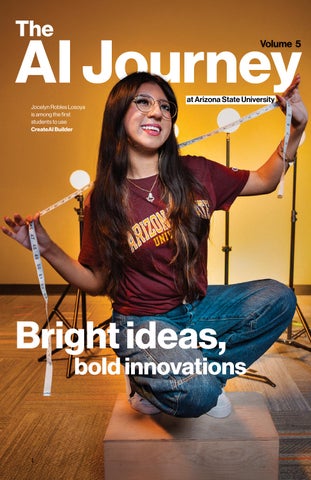
The
AI Journey Volume 5
at Arizona State University Jocelyn Robles Losoya is among the first students to use CreateAI Builder
Bright ideas, bold innovations
1
FOREWORD
ASU President Michael M. Crow At Arizona State University, we design our institution around a fundamental premise: every human being is born with an extraordinarily complex brain and an equal capacity to learn. Augmented intelligence (AI) is our ultimate tool to preserve and elevate that agency, acting as a "hyperspeed calculator" and equalizer that unencumbers individual potential. In these pages, you will see how Sun Devils spark bright ideas and bold innovations, applying AI across every discipline to accelerate discovery, advance public good, and solve grand challenges. But driving transformation at scale demands sustained institutional momentum. Through initiatives like our Changing Futures campaign, led by Gretchen Buhlig and the ASU Foundation, we secure the vital resources required to build this future. By pairing philanthropic investment with these cutting-edge capabilities, we ensure every learner can thrive in an increasingly complex world.
MICHAEL M. CROW PRESIDENT ARIZONA STATE UNIVERSITY
2
FOREWORD
CEO, ASU Foundation Gretchen E. Buhlig Technology has long expanded what is possible. From the printing press to the internet and now AI, each advancement has opened new pathways for learning, discovery and human progress. Today, rapidly evolving technologies are creating opportunities to solve complex challenges and improve lives at a scale once unimaginable. At Arizona State University, we are approaching this moment with optimism and purpose. Guided by the ASU Charter, we are ensuring that emerging technologies are developed and applied thoughtfully to unlock individual potential and advance bright ideas and bold innovations. These values inform the Changing Futures campaign’s advancing technology for good priority. We are driving momentum to make powerful technologies accessible to all. This access leads to more innovative solutions and, ultimately, happier and more resilient individuals and communities.
GRETCHEN E. BUHLIG CHIEF EXECUTIVE OFFICER, ASU FOUNDATION FOR A NEW AMERICAN UNIVERSITY
We invite you to join us.
asuchangingfutures.org
3
Contents 6
Bright ideas, bold innovations Across ASU, AI is moving from ideas to impact. These mini spotlights showcase the people and projects putting AI to work in new ways, advancing learning, research and operations while exploring what’s possible when innovation meets the needs of the ASU community. PAGE 6
AI in action These stories spotlight three initiatives using AI across ASU to strengthen learning, expand opportunity and reimagine how the university serves its communities, offering an in-depth look at innovation taking shape.
Bright ideas, bold innovations
PAGE 12
Title
18 CreateAI: Expanding what’s possible CreateAI continues to grow across ASU! This fall, the toolkit expands to students, introduces new capabilities designed for researchers and introduces Meletai, the new AI patient training for ASU's next medical-engineering students. PAGE 18
CreateAI: Expanding what’s possible
Title
34
Q&A: What endures in the age of AI As AI reshapes higher education, ASU Provost Nancy Gonzales reflects on what should remain at the center: learning, human connection and Principled Innovation (R). She shares how ASU is advancing AI literacy across every college and preparing students to use emerging technologies thoughtfully and responsibly. PAGE 34
How CISA is cultivating healthy AI adoption CISA is building an AI-ready community through training, resources and disciplinespecific learning that helps students, faculty and staff use AI thoughtfully and responsibly. PAGE 42
Q&A with ASU Provost Nancy Gonzales
#
4
The AI Journey is made possible through the collaborative efforts of ASU’s Enterprise Technology Creative x Communications team and Media Relations and Strategic Communications, along with additional contributing units, ensuring a comprehensive and cohesive initiative. Our team of storytellers and digital strategists is excited to showcase how technology is driving transformation at ASU. This publication was designed by Graphic Design Specialist Hyde Groat and Senior Communications Specialist Alisha Mendez. Foreword photography: ASU President Michael Crow photo by Deanna Dent, Arizona State University. Contributors include ASU News and individual reporters from across ASU. Select illustrations and graphics were created with the assistance of ChatGPT by Enterprise Technology/ASU. This report was developed in part using AI tools to enhance and streamline content. Explore how Arizona State University is harnessing the power of AI to enhance teaching, learning and research by visiting ai.asu.edu.
PHOTO BY ENTERPRISE BRAND STRATEGY AND MANAGEMENT, ASU
5
Bright ideas
Bold innovations AI adoption
ASU ranks among top 5 for AI-ready leaders ASU continues to stand out for preparing students to lead in an AI-driven world. The university ranked No. 4 among U.S. public universities in the 2026 Digital Leaders in Higher Education Survey, reflecting its strength in areas including digital transformation management, entrepreneurship, computer science, and data science, AI and business analytics. Source: ASU News
Innovative education
ASU supercharges AI research capabilities A multimillion-dollar technology donation from Intel is expanding access to highperformance AI computing across ASU. The new hardware will help power the university’s AI Research Acceleration (AIR) Platform, giving researchers and students greater capacity to pursue ambitious, dataintensive projects while helping move ideas from exploration to real-world impact. Source: ASU News
6
Pictured above: In 1992, now-Professor Chitta Baral assembles an early AI-enabled robotic prototype. Source: ASU News. Photos courtesy ASU Archives.
AI at ASU
Celebrating nearly
50 years
of AI innovation at ASU Long before generative AI became part of everyday conversation, ASU researchers were helping shape the field. Nearly five decades of work across artificial intelligence, machine learning and computer science reveal a history of discovery that laid the groundwork for today’s innovations. ASU researchers used IBM PCs in 1984, when desktop computing first supported the development of AI.
New AI programs
AI adoption
New certificate lets students add AI expertise to any major
Students bring AI aid to crisis support center
AI skills aren’t just for computer science majors. The Foundations of Computer Science and Artificial Intelligence certificate from ASU’s School of Computing and Augmented Intelligence gives students across disciplines a foundation in programming, data literacy and AI concepts. It’s a great opportunity for ASU students of any major to demonstrate their AI and computing skills to future employers. Source: ASU News
Innovative education
ASU students put AI nursing assist to the test
Lahari Shakthi Arun, an ASU undergraduate student and intern at the AI-CIC, helped to design the AI chatbot.
Through the AI Cloud Innovation Center, powered by AWS, ASU student interns helped develop HOPE (Helpful Online Personal Engagement), a bilingual AIpowered chatbot for WestCare. The bot connects people with crisis and behavioral health resources while incorporating safeguards, privacy protections and pathways to human support.
Innovative education
Reimagining legal education for the AI era Can AI become a trustworthy member of a health care team? ASU nursing students are helping find out by evaluating Avery, an agentic AI nurse assist, through simulated patient scenarios. The initiative is helping students build AI literacy while exploring how AI technology can be used as a responsible assistant to human expertise in health care.
As AI transforms legal practice, ASU Law is giving students opportunities to help shape what comes next. The new AI and Legal Technology Studio led by Sean Harrington combines hands-on experience, emerging technology and community partnerships, empowering future lawyers to develop AIpowered solutions while addressing real legal challenges facing Arizonans. Source: ASU News
Source: ASU News
7
BRIGHT IDEAS BOLD INNOVATIONS
AI adoption
Claude Enterprise comes to ASU ASU departments can now purchase Claude Enterprise licenses for faculty and staff. Claude is a conversational AI assistant built for professional use. It includes Claude Chat, Cowork, and Code to support teaching, writing, data analysis, brainstorming, and more. For subscription details and the latest updates, visit ai.asu.edu/tools.
AI adoption
Cronkite School brings AI to investigative journalism
The Walter Cronkite School of Journalism and Mass Communication launched The Beam, a multimedia newsroom combining accountability reporting with experimentation in AI-driven tools. Reporting is led by professional journalists in residence and supported by student apprentices, with the goal of strengthening investigative journalism while building digital tools, like an AIpowered school board chatbot, that can help audiences be more involved in their communities. Source: ASU News Photo: ASU Enterprise Brand
8
Innovative education
The AI Wave report Domenico Ferraro, Ph.D., (pictured below) Research Professor in the Office of the University Economist and Associate Professor in the W. P. Carey School of Business, examines how AI is reshaping work, hiring and higher education in The AI Wave report. The report urges universities to prepare students to use AI with judgment, evidence and accountability.
9
A GLOBAL SUMMIT | PHOENIX, AZ | OCTOBER 20–22, 2026
Agentic AI and the Student Experience A global summit bringing education and industry leaders together to meet the moment. Agentic AI is moving rapidly from possibility to practice, creating new opportunities to rethink learning, the student experience and how universities operate. For higher education, this is a moment to lead, ensuring that as technology becomes more capable and autonomous, its application remains grounded in human needs and potential. This October, leaders from higher education and industry will gather in Phoenix for Agentic AI and the Student Experience, a global summit focused on meeting that moment.
SCAN TO EXPLORE THE SUMMIT.
OCTOBER 20-22, 2026 PHOENIX, AZ
The summit is made possible through the generous partnership of our sponsors, whose support brings higher education and industry together to advance a human-centered approach to agentic AI and the student experience.
10
AGENTIC AI AND THE STUDENT EXPERIENCE
Hosted by Arizona State University and its partners, the October 20-22 summit returns after a sold-out inaugural event, with an expanded program that reflects the rapid evolution of agentic AI. More speakers and sessions will bring a wider range of perspectives, practical applications and lessons from those doing the work.
These ASU-highlighted sessions demonstrate how experimentation can translate into meaningful applications for learners and institutions. Across keynotes, panels, breakout sessions and interactive experiences, summit participants will examine what is working now, what institutions are learning and where agentic AI could take higher education next.
ASU will also bring its own work to the summit. Faculty, staff and leaders will share how they are putting emerging technologies into practice through designing the AI-ready university with CreateAI Builder, an AI-powered toolkit made for ASU by ASU; introducing a framework for evaluating AI-generated, scenario-based questions across multiple dimensions; and showcasing the university's connected approach to AI readiness across the learner lifecycle from K-12 to career transition.
TITANIUM
PLATINUM
Technology will continue to shift. The opportunity for higher education is to lead with intention, keeping humans at the center while helping determine how these technologies can best serve students and society. The Agentic AI and the Student Experience summit creates a place for leaders to do just that, bringing together the people, perspectives and ideas needed to move higher education forward.
GOLD
11
Putting AI to work for
the public good WRITTEN BY: AYREL CLARK-PROFFITT PHOTOS BY: ASU ENTERPRISE BRAND
The Watts College of Public Service and Community Solutions is exploring how AI can strengthen public services. Through training, research and special-topics courses, the college is advancing context-driven, ethical AI applications and preparing public servants to use the technology to address community needs. “At its core, public service is about efficiency, effectiveness and equity, and how we balance those three core values,” said Shannon Portillo, director of the School of Public Affairs. “AI isn’t good or bad, it is a change, and it gives us another tool in our tool box to meet our values.”
Shannon Portillo Director School of Public Affairs, Lattie and Elva Coor Presidential Chair, School of Public Affairs
AI transforming elections Since last November, the ASU Mechanics of Democracy Laboratory has hosted more than a dozen AI + Elections Clinics across the U.S. The clinics introduce attendees to AI tools, practical applications and potential threats while providing strategies to strengthen election security. AI can be a valuable tool for helping election officials communicate accurate information and reduce errors in materials, said Bill Gates, executive director of the Mechanics of Democracy Lab. In elections, some AI uses — such as tabulating ballots or certifying results — are “off limits”, Gates said. Instead, the clinics focus on backof-house opportunities that save time and resources, such as creating social media posts, translating languages and developing poll-worker training modules.
12
Gates at ESRA clinic Bill Gates (left), executive director of the ASU Mechanics of Democracy Laboratory, brainstorms ideas with attendees at a mini AI + Elections Clinic during the Election Science Reform Administration Conference hosted by ASU at the Sandra Day O'Connor College of Law on June 3.
Teaching AI for the public good In spring 2026, the Watts College offered two AI special-topics courses: “AI and the Future of Government” in the School of Public Affairs and “AI Literacy: Navigating Technology for Social Good” in the School of Community Resources and Development. In the course developed by Joe Zhao, adjunct professor in Public Affairs, students begin with foundational public administration knowledge, then learn to recognize AI risks, biases, privacy concerns and governance issues. With that foundation, students learn to use AI responsibly to address public-sector challenges.
The most important lesson for students is that AI is no longer a future technology, it is a must for current and future public servants.”
Joe Zhao Adjunct Professor, Public Affairs
Using AI to advance complex challenges Hyunsung Oh, an associate professor in the School of Social Work, saw AI’s potential to address language barriers in behavioral health care. Most providers are monolingual. Among the 14,091 providers surveyed in the National Substance Use and Mental Health Services Survey, only one-quarter offer services in Spanish, and fewer than 1 in 10 provide services in other languages. Although comprehensive, the national survey isn’t searchable by patients. Oh used AI assistants to transform the survey’s data into CareConnectAZ, a website that helps Arizonans find mental health and substance use providers by age, language and client characteristics.
AI is also being used to review footage from police officers’ body-worn cameras. Michael White, professor in the School of Criminology and Criminal Justice and associate director of ASU’s Center for Violence Prevention and Community Safety, evaluated the AI platform Truleo in partnership with the Apache Junction and Casa Grande police departments. Results from the study suggest the platform expands departmental review of footage and may encourage positive behaviors among officers.
13
Echo gives alumni a trusted starting point,” “Echo gives alumni a trusted starting point,” said Andrew Carey, vice president of alumni engagement with ASU Enterprise Partners. “They don’t have to know where information lives across ASU. Echo brings those resources together in one place.” ASU Enterprise Partners, in partnership with the ASU Alumni Association, set out to help alumni across 170 countries update their contact information more conveniently. As the concept evolved, the team saw an opportunity to create a scalable way to serve ASU’s growing alumni community. Unlike a traditional chatbot, Echo can help authenticated users to update their information and receive a more personalized experience. All users can explore advanced degree programs, discover local alumni opportunities and access career resources.
The development team is exploring updates that may include enabling donations to ASU, purchasing event tickets and responses in additional languages. “Technology should make it easier for people to connect with the organizations and communities that matter to them,” said Erin BarringerSterner, chief data and operations officer. “Echo reflects our commitment to innovation in service of ASU’s alumni, providing a more accessible and responsive way for graduates to engage with ASU while helping us learn and adapt to their evolving needs.” Echo also helps the alumni engagement team better understand what alumni need. Rather than relying solely on periodic surveys and feedback, the team can gain insights from Echo conversations occurring in real time. “I’m most excited about the real-time gauge on how we are meeting alumni’s needs,” Carey said.
Echo launched in August with curated knowledge from hundreds of ASU sources and offers easy escalation when a user asks something it cannot answer.
15
16
17
Cre Cre Cre
Built for ASU, by ASU CreateAI is the university’s flagship AI toolkit. In addition to faculty, staff and researchers, ASU students now have access to build custom AI experiences using CreateAI Builder. CreateAI Platform is helping to power intelligent innovations like Meletai’s AI-avatars for medical students, along with the new AI Research Acceleration (AIR) Platform expanding AI-supercomputing capabilities for all. Learn more about how ASU is expanding AI access and innovations with CreateAI. 18
eateAI eateAI eateAI 19
CreateAI
Builder now in the hands AUTHORED BY LORI K. BAKER PHOTOGRAPHY BY ALISHA MENDEZ AND TABBS MOSIER
of all ASU students
Starting this semester, all 200,000 students at Arizona State University now have access to CreateAI Builder, putting the university’s flagship AI toolkit directly into the hands of all faculty, staff and students. Jocelyn Robles Losoya, a fashion merchandising major, is among the first ASU students to put it to use. She knows firsthand the headaches of buying a sewing machine as a beginner, from hours spent online reviewing product listings and comparing specs she barely understood. Her frustration didn’t fade once she made her purchase — it turned into an idea. She used CreateAI Builder to develop Stitch Finder, an AI assistant designed to spare other beginners the same difficulties she experienced. The university first introduced CreateAI Builder in 2025 to a select group of university faculty and staff through the AI Innovation Challenge. A year later, it was released to all 20,000 faculty and staff. The tool enables users to build their own AIpowered experience that aligns with their courses, research and daily operations.
20
To date, over 10,000 projects have been built inside the platform, including coursespecific chatbots built from syllabi that students can ask about coursework and grading policies. Practice tools, writing guides, AI mentors embedded in courses and AI portfolio reviewers are among other innovations that enhance student learning. Losoya, who is on track to earn a BA Fashion degree in December, developed Stitch Finder during a course taught by Naomi Ellis, an instructor at ASU FIDM, the university’s fashion school in the Herberger Institute for Design and the Arts. Ellis was among the first wave of faculty granted access to CreateAI Builder starting in spring 2025. In her course AI in Fashion, students like Losoya gained hands-on experience in creating a custom GPT as a versatile industry tool. “The students who had creative vision had the best outcomes,” Ellis said.
Jocelyn Robles Losoya, a fashion merchandising major at The Herberger Institute for Design and the Arts
#
21
Students create a working AI tool with no coding required During the course, Losoya built Stitch Finder, a custom AI chatbot GPT that asks users about their sewing experience, their budget and what they hope to make, then recommends a machine and explains why it fits their needs. The work didn’t begin with code, but with research. Losoya spent weeks combing through sewing blogs and product reviews, compiling machine features, price points and trade-offs into a spreadsheet. Once she had a solid dataset, she uploaded it into CreateAI Builder and began writing prompts that made the bot sound genuinely helpful rather than intimidating. “I instructed the bot to sound very beginner-friendly and not to use any exaggerated sewing knowledge terms,” Losoya said. That instinct paid off, but it also took trial and error as she kept refining its voice based on feedback from classmates and professors who tested the tool. What surprised Losoya most wasn’t the sewing research — it was how manageable the technology itself turned out to be. “I thought it was going to be something really extensive and complicated, and it actually wasn’t,” she said. Losoya wasn’t the only AI in fashion student who created an AI-powered fix for a common consumer frustration. Celeste Polder, a senior at ASU’s Walter Cronkite School of Journalism and Mass Communication, tackled another guessing game: picking the right skincare products. Faced with the flood of products, ingredients and influencer advice that often has little to do with an individual’s actual skin, Polder used CreateAI to develop the Custom Skincare Builder, that delivers evidence-based recommendations instead of guesswork.
#
22
Polder pored over peer-reviewed studies on skin aging, acne, oil production and sun protection, along with ingredient research on why certain compounds, such as fatand water-soluble ingredients, don’t always mix well together. She structured the material so the AI could directly cite sources, replacing vague internet advice with recommendations grounded in science. She tested the tool repeatedly, catching moments when it echoed the same product suggestions or didn’t ask enough follow-up questions. She then rewrote its instructions until it could guide everyone from total beginners to seasoned consumers.
Where AI is part of the curriculum Ellis has built her teaching around this kind of experimentation. She launched the 300level AI in fashion course three years ago through the AI Innovation Challenge and introduced an online 200-level AI foundations for fashion and design course this summer. In this course, lecture videos are followed by conversations with a bot, AI avatars introduce each module, and there is even an AI-generated image detective game. By the end of the course, every student constructs a personal portfolio website showcasing their work. Ellis has redefined how she measures learning, requiring students to submit transcripts of their AI interactions alongside their final products. “It’s not just a checkbox. It’s very much about how the student went through the process.” To date, over 55,000 users have engaged with CreateAI Builder. With the university’s flagship AI toolkit, CreateAI Builder, now placing custom intelligence directly in the hands of faculty, staff and students, the next wave of responsible innovation is open to anyone on campus.
ASU-FIDM instructor Naomi Ellis teaching her course: AI in Fashion
23
Meet the
AI avatar
helping to train ASU’s
next generation of medical-engineering students WRITTEN BY LORI K. BAKER PHOTOS BY ALISHA MENDEZ AND TABBS MOSIER
24
At ASU’s John Shufeldt School of Medicine and Medical Engineering, students are learning how to walk patients through a difficult diagnosis, calm scared individuals and ask the hard questions — all before they meet an actual human patient. These students now train with AI-generated avatars that talk and behave like real patients, creating a virtual space to hone their skills before entering clinical practice. Developed by ASU for use in ASU’s new Shufeldt School, the AI-enabled platform called Meletai, one of the most immersive tools of its kind in medical education today, launched this semester. “There's no other platform that looks as real, has such low latency, and is able to scale in the way that we envision,” said Dr. Jordan Coulston, assistant dean of clinical education for the John Shufeldt School of Medicine and Medical Engineering. Behind realistic patient-provider interactions, an agentic workflow called Case Creator is used to build complex patient-case scenarios with multiple agents working in sync to create a patient’s medical background, current condition and previous clinical appointments. The agentic workflow is powered by ASU’s CreateAI Platform.
#
Once a patient case is created, multimodal AI systems across video and audio are used to develop realistic avatars that simulate standard patient encounters. As students interact with the avatars, the system uses AI to generate a student evaluation that scores an interaction across 25 unique areas, including how they gathered and used information, reached a diagnosis, communicated uncertainty and involved patients in the plan.
25
How it works Meletai works like a telehealth visit. A student logs in and receives a brief explanation of why the AI-simulated patient is there that day before meeting an interactive avatar on screen. The student asks questions, explores the chief complaint and works to solve the clinical problem. The simulation can also provide diagnostic information, such as vital signs, laboratory results, imaging or other relevant clinical data. Students must decide what information to seek, interpret the findings, explain them to the patient and determine the appropriate next steps.
Beyond the standardized patient Medical schools have long used trained actors to portray patients, giving students practice before clinical rotations. But actors are expensive to scale, hard to repeat on
26
demand and limit how thoroughly students can be evaluated. In contrast, Meletai generates a full transcript of each encounter, which can then be run through multiple layers of assessment simultaneously, from basic communication skills for a first-year student to more advanced clinical reasoning for a third-year student. Virtual patients therefore enable a new pedagogy where repeatable, adaptable clinical encounters become a rich source of evidence about learner competency.
“
“There's no other platform that looks as real, has such low latency, and is able to scale in the way that we envision.” Dr. Jordan Coulston, assistant dean of clinical education for the John Shufeldt School of Medicine and Medical Engineering
The team behind the technology Building something this immersive required pulling together product, engineering and design expertise in one place, work handled through ASU Enterprise Technology’s AI Acceleration team. “We partnered with the AI Acceleration team to help bring together different dimensions of technology required for the project, allowing us to take an educational idea all the way to the student-facing software that you see today,” Coulston said. For Meletai’s creators, the technology isn’t meant to replace the human core of medicine — it’s meant to protect it, giving students the chance to make their mistakes, build their instincts and find their bedside manner long before a real patient is on the other side of the conversation. The new medical school is part of ASU Health, an initiative that transforms access to high-quality health care across Arizona. “In order to achieve that vision, it's critical that we train the next generation of physicians to leverage new technologies like medical devices, artificial intelligence and health systems design,” said Dr. Sarah “Holly” Hollingsworth Lisanby, founding dean and foundation professor of the John Shufeldt School of Medicine and Medical Engineering, where students earn both an MD and a master’s degree in medical engineering. “These technologies can be force multipliers, allowing our graduates to care for more patients, have a broader geographical reach and improve access to affordable, effective health care,” she continued.
(Left) Assistant Dean of Clinical Education Jordan Coulston, MD. (Right) Founding Dean Sarah “Holly” Hollingsworth Lisanby, MD, DLFAPA.
“
These technologies can be force multipliers, allowing our graduates to care for more patients, have a broader geographical reach and improve access to affordable, effective health care.” Dr. Sarah “Holly” Hollingsworth Lisanby, founding dean and foundation professor of the John Shufeldt School of Medicine and Medical Engineering
27
ASU breakthrough provides
access to
AI-supercomputing for all
28
Until recently, advanced computing power has been associated with researchers and industry giants; now, Arizona State University is bringing unprecedented access to its entire community through the ASU AI Research Acceleration Platform, or AIR Platform. Supported by a donation from Intel, ASU’s AIR Platform supercharges the university’s advanced computing capacity to enable quicker response times — even when supporting high volumes of prompts. Housed with the university’s governed digital environment, AIR also helps address growing privacy concerns by ensuring information doesn’t leave the campus ecosystem.
AUTHORED BY STEPHANIE KING PHOTOS BY ASU ENTERPRISE BRAND
And in less than six months, breakthroughs for research, education, and institutional innovation are already underway. “The power of the AIR Platform goes well beyond computing capacity. We are already seeing what becomes possible when we put advanced AI capabilities into the hands of more researchers and students across disciplines,” said Sally C. Morton, executive vice president of ASU Knowledge Enterprise and ASU’s chief research and innovation officer. “By lowering barriers to advanced AI, we are creating opportunities to ask bigger questions, explore new ideas and accelerate discoveries that can make a meaningful difference in people’s lives.” As the university looks at expanding AI access and broadening research efforts, students are leading the way.
29
Today all ASU students can access AIR The newest and most accessible pathway to AIR Platform is through CreateAI, the university’s flagship AI toolkit. Used by more than 55,000 members of the ASU community, CreateAI Builder offers a range of AI models to choose from when building a customized AI experience. Select models, including Google’s Gemma 4, are powered by the university’s AIR Platform. Early explorations of AIR-powered AI experiences by students took place in August 2026 during a hackathon-style Spark Challenge. Groups of students, faculty and staff teamed up to build an app inside CreateAI Builder that is powered by the AIR Platform. Two ASU students earning a master’s degree in computer science, Saisrivathsan Manikandan and Shrey Bishnoi, took the top prize for their accessibility tool to support those with visual impairments. “The tool ensures genuine, verifiable educational equity where no student is left uninformed,” Manikandan said. Their project automatically writes alt-text descriptions for every image in a PowerPoint file and saves them directly into the document once the system is confident the description is accurate. Anything uncertain is flagged for a human to review or rewrite. The team built the entire tool on AIR’s secure, on-campus gateway, so no student or faculty material ever reached an outside model. To date, CreateAI has supported over 300,000 queries from the ASU community through the AIR Platform.
30
Building emotional intelligence with synthetic data Professor Chitta Baral, Rishitosh Kumar Singh, Amir Saeidi, Shamanthak Hegde and Shrinidhi Kumbhar from the School of Computing and Augmented Intelligence are using AIR to develop an emotionally intelligent customer service agent. In order to train the AI agent, the team needed to develop a collection of emotionally based responses: confusion, frustration, anger, etc. Training the agent to recognize a range of emotions requires a high volume of responses that demonstrate each emotion. Using AIR’s capacity to generate quick responses, the team simulated approximately 3,000 task scenarios using over 8 billion tokens, which is a massive amount of AI data processing (tokens are measurements of the amount of text that an AI reads and generates). This ultimately developed an emotional benchmark that can be used to train other agents. While this example showcases AIR’s ability to produce an immense amount of synthetic data, the next example shows its ability to support predictive modeling.
Accelerating protein research with predictive modeling Led by L. Felipe Benites, Louie Slocombe and Sara I. Walker of the ASU Beyond Center, a team is using AIR to run predictive modeling to better understand large scale protein folding and its interplay with protein atomic composition. All living organisms on Earth use 20 amino acids to build proteins. The team used predictive modeling across more than 20,000 protein sequences to investigate the consequences of removing amino acids. Their paper is available as a preprint and is currently under peer review in a high-profile journal. To date, there are over 500 ASU researchers leveraging AIR. All these projects require high levels of advanced computing that were not readily available prior.
31
Powering advanced AI in the classroom Students at ASU will also engage with AIR through classroom tools this semester. For example, two courses will use Jupyter Notebook, an interactive tool for writing and running code, which will connect to AIR to power the experience. The courses are taught in The College of Liberal Arts and Sciences and The GAME School, part of Herberger Institute for Design and the Arts (HIDA). Professor Alex Lee of HIDA’s School of Art is also leveraging AIR to run image and video generation models for his new AI Tools for Animation course. Assistant Teaching Professor Ahmed Barakat’s role in the course is to help faculty and students find better workflows and production pipelines. “My goal was to leverage the growing ecosystem of open-source image and video generation models that can run locally,” said Barakat. Working with the ASU’s Research Technology Office (RTO) team, Barakat realized AIR would be a good fit for the students’ needs because it “provides a more accessible and scalable way for students to use these models without installing and maintaining their own instances or duplicating computational resources.” Barakat continues to work with RTO to expand the available models and capabilities, both for the students in the School of Art and for HIDA more broadly. The introduction of AIR has significantly increased access to a broad range of labs, researchers, graduates and now even undergraduate students conducting science in exciting new ways without the steep learning curve of computer science.
32
For ASU faculty, students, staff and researchers interested in building custom AI experiences with CreateAI Builder, visit ai.asu.edu/ai-tools/createai-builder For more information on the Research Technology Office AI services, visit: rto.asu.edu/ai-research-support
“
[AIR] provides a more accessible and scalable way for students to use these models without installing and maintaining their own instances or duplicating computational resources.” Ahmed Barakat, assistant teaching professor
33
PROVOST Q&A
What endures as AI transforms higher education?
From offering AI literacy courses in all colleges at ASU this fall to advancing new frontiers in research and discovery, Provost Gonzales reflects on how and why ASU is guiding the future of AI.
Literacy is not just learning how to use a given AI tool. AI literacy also means that you understand social, psychological and ethical context so that you know how to use the tool effectively and responsibly." PROVOST NANCY GONZALES
WRITTEN BY KEVIN KOVALESKI PHOTOS BY JILL RICHARDS REPRINTED WITH PERMISSION BY ASU NEWS
34
As Arizona State University begins a new academic year, Nancy Gonzales is marking a milestone: five years as executive vice president and university provost at Arizona State University. Gonzales is a leader who knows the university uniquely well. She was an ASU student and alumna, the first in her family to graduate from college. She has served for more than three decades as a faculty member, teacher and mentor, and she has held such leadership roles as center director, dean and now provost. She's also a mom to ASU graduates. Over her career, she has seen ASU’s evolution from nearly every perspective and over a long period of historic growth. And although the last five years have been marked by extraordinary growth, what she’s seeing now with the rapid rise of artificial intelligence and its impact on education is an accelerating pace of change far different from in years past. ASU News sat down with the provost to discuss how ASU is evolving and is distinctly positioned to lead higher education through this generational moment of change.
Q
Let's start this conversation from the perspective of a provost, the person who guides the academic trajectory of a university. What's on the mind of a provost right now when it comes to making decisions about AI for an academic community?
A
As part of my leadership role at ASU, I serve as the AI taskforce chair for the Association of Public & Land-Grant Universities (APLU), an organization of 255 universities across the country. The provosts that participate in that work group, my peers across the country, are all after the same thing: ensuring that our universities play an active role in guiding the best of what AI offers and will offer, while safeguarding the transformative potential of our academic communities for our students and scholars. The first thing on my mind when thinking about my role at ASU is, frankly, gratitude. I am so grateful to be provost at a university with a crystal-clear charter and design aspirations. When it comes to decision-making around a frontier technology like generative AI, and possibly AGI (artificial general intelligence), these fundamental principles offer ASU immediate shared ground and purpose from which to launch our plans. Not all universities have that foundation, which I believe positions us to advance more rapidly and lead our sector more intentionally. I'll be specific. Our charter asks us to advance discovery for public value and take responsibility for our community. In other words, we are compelled to understand AI as a technology that has the potential to improve lives. And our design aspiration, “practice principled innovation,” challenges us to innovate only in ways that advance such positive outcomes.
35
PROVOST Q&A
A closer look at student learning, faculty support and what’s next Provost Nancy Gonzales discusses how ASU is preparing students and faculty for an AI-enabled future and why human potential remains at the center of the university’s work.
Q
Let's discuss student learning. What is ASU's approach to AI in regard to student use of AI?
A
First and foremost, the use of AI technologies begins with AI literacy. Literacy is not just learning how to use a given AI tool. AI literacy also means that you understand social, psychological and ethical context so that you know how to use the tool effectively and responsibly. We want students, and society for that matter, to use AI in ways that help them learn and grow and enhance their abilities, skills and relationships. This is why, starting in fall 2026, we're announcing that AI literacy courses will be offered by every college and school at ASU. Now, every student in every college and school at ASU has access to a course in AI literacy that counts toward their major. We are among the first universities to do so. These classes have been designed by the faculty of these colleges so that the lessons learned in the coursework relate to our students' chosen fields of study. This was a major effort over the spring and summer, and it is a major opportunity for students. I would encourage all students to take the AI literacy course either this semester or sometime over the next academic year.
“We want students, and society for that matter, to use AI in ways that help them learn and grow and enhance their abilities, skills and relationships.”
PROVOST NANCY GONZALES
36
Additionally, we're asking students to understand that their professors will set the “rules of engagement” with AI for their classes, and it may vary from assignment to assignment. Part of AI fluency is learning how and when to use these tools, but also when not to use them. We want to train students to recognize when AI can support learning and when it would get in the way of developing critical thinking, teamwork, comprehension, disciplinary knowledge and other skills faculty are working to teach and assess.
Q
A
As students are learning to use these tools, in many cases professors are as well. It must be challenging for faculty to navigate how AI is used in their classes. How is ASU addressing faculty needs?
As provost, I also think a great deal about the enormous challenge AI poses to the role of a faculty member. Namely, how do you ensure that your students are learning in an era where AI can help students deliver completed homework, essays, etc., instantaneously? That need led us to develop the Assessment Design Accelerator this summer as part of our Creating Assessments in the Age of AI collaboration between the Office of the Provost, EdPlus and faculty members who teach in our top-100 enrolled courses. Through this work, faculty are coming together to examine how AI is changing the conditions for learning and assessment, and to redesign assignments in ways that are clear, meaningful and aligned with course learning objectives. The goal is to support thoughtful, discipline-specific decisions about when AI may enhance learning, when it may interfere with learning, and how students can demonstrate what they know and can do. We're also actively providing faculty and students access to AI tools and training, most of which is available at no cost.
AI by the numbers
100% Every ASU college and school now offers AI literacy coursework or pathways.
200 Students participated in the AI Scholars program in the 2025-26 academic year.
400 AI workshops delivered for faculty and staff.
55,000+ Users on CreateAI, a platform that empowers the ASU community to build and engage with AI-enabled products in a secure environment.
50 Large language models available through CreateAI.
11,000+ AI experiences designed on CreateAI Builder, supported across disciplines.
37
Q
Beyond your role as provost, you are also an ASU faculty member and a psychologist. How does that experience inform the decisions you make as provost?
A
I will always be proud of my faculty role and everything it has allowed me to do as teacher, mentor and scientist. I think it's important to step back and understand why people enter this profession. For most of us, it’s because we believe in people and the transformative power of learning, discovery and creativity. I love my work with students, both in the classroom and the research lab. My research seeks to understand how life experiences, biology, social relationships and emerging competencies combine over time to enable youth to thrive in the face of challenge, and how we can design interventions and opportunities to promote mental and physical health and resilience. Working with a wide variety of populations in educational and clinical settings, I’ve been amazed at the human capacity for growth and learning.
Our students don’t want us to teach them in a bubble. That wouldn’t work anyway, and it will not prepare them for lifelong success. They need us to believe in them and to teach them to use their knowledge, talents and tools to create a life of meaning. They also want to be inspired.”
38
Regardless of the tools available to us, those motivations will persist, and it's on us to determine how to harness this incredible tech so that we don't discount the very human experiences and potential our students bring into their classrooms, studios and labs in our universities. When you're on the leading edge, as ASU always positions ourselves to be, we will undoubtedly make mistakes as we advance. But I will argue that those missteps will be errors in our execution rather than errors in our judgment or vision. In the conversations I have, I see a university that remains laser-focused on practicing principled innovation while also driving the future of what higher education will become. Both of these things can be true at the same time, and that creates a tension that can be challenging to hold but absolutely worth the challenge. We must stay rooted in our principles while we innovate.
Here are two ways I see that transformation: No. 1: It is clear to ASU's academic leaders that we are already seeing significant changes happening in our own work lives because of the AI technologies we use. And we’re hearing from employers that we need to graduate students that have not only expertise in their fields, but also fluency in how to use AI tools.
Q
Back to the student experience: Why is AI literacy necessary for all students?
A
Here's a very immediate answer. It is obvious that students can use AI to complete coursework and write essays. And while there are some safeguards that can detect irresponsible AI use, we know that regulation will not keep up with the creativity of humans using AI. Because policy and detection alone are unlikely to be sufficient, we are focused on providing students the resources they need to use AI responsibly. Training in AI literacy will help students understand that using AI to complete their homework or write their essays only hurts them. On the other hand, if students use AI tools to enhance what they learn, dig deeper into topics outside classroom time, etc., these tools can enrich and even accelerate the learning experience. So, in the short term, I see that AI and AI literacy are significantly changing how students interact with knowledge and learn. In the long term, there's a more transformational opportunity for those who graduate with AI literacy.
As an example, our newly launched medical school is intentionally positioned to be a leader in medicine and medical engineering because physicians with fluency in technologies like AI will be in demand, and they will be the kind of leaders who advance medicine toward new groundbreaking discoveries that will improve health outcomes. I anticipate this happening in all fields. No. 2: At ASU, we want to graduate future leaders who are grounded in principles, ethics and AI literacy so that they can positively impact the trajectory we are on with AI. We intend for our students to be the business, political and community leaders we need to protect our shared humanity. If we leave AI decision making to those only motivated by the technological and economic promise of AI, we may lose the ability to guide the outcomes that we want. Make no mistake, as a species, we need to address the threats that AI poses to our economy and jobs, to democracy and to the health of our planet. Universities are in a unique position to guide us toward the future we want. For example, ASU faculty are already leading the charge in addressing these challenges. It is critically important that our students learn under these leaders so that they can advance AI as a tool for humanity, rather than the other way around.
39
Q
Can you give us some examples of how ASU experts are creating positive solutions through the use of AI?
A
Absolutely. There are many, so I'll share just a few examples. ASU's School of Geographical Sciences and Urban Planning is working with AI industries to reduce the impacts of heat produced by data centers. The School of Sustainable Engineering and the Built Environment at ASU is leading a project focused on alternatives to cooling large-scale manufacturing sites, including data centers, to reduce water consumption. And it's not just engineering-related projects. Watts College of Public Service and Community Solutions recently announced its AI + Elections Clinics to prepare public servants for the impacts of AI on elections. And ASU just won a $4 million project from the NATO Special Operations Forces Command to counter adversarial political influencer campaigns using AI. Finally, I strongly encourage everyone at ASU and beyond to read a recent Substack essay written by N. Ángel Pinillos, professor and faculty head of the School of Historical, Philosophical, and Religious Studies, on the case for the humanities in the age of AI. It was also recently published by the Chronicle of Higher Education. In it, he reflects on why students need the knowledge gained by studying the humanities, especially in the age of AI. His examples are both practical and compelling.
40
Q
As we start the semester, can you share some advice to the ASU academic community as we navigate this emerging, AI-enabled world?
A
“Navigate” seems to be the default word we're using to describe what we're experiencing. I think it's apt because we are on this journey together and figuring it out. I would start by acknowledging that what we're all going through is a significant paradigm shift. I feel that it’s important that we don’t downplay that fact and mistakenly gloss over the impact it may have on people. In any time of major change, there will be a wide range of human reactions, and we should always listen, be willing to learn and engage respectfully. An academic community is not a monolith, so as you can imagine, the sentiment toward AI varies widely, and I respect the range of emotions and reactions to AI. That means being candid about real risks, including academic integrity, privacy, bias, environmental costs and the possibility that AI could weaken rather than strengthen human relationships in learning if used carelessly. To the first adopters of AI, I admire their openness to change and their optimism for the future. I share their excitement that AI will very likely unleash an incredible era of discovery. I would also invite them to think of their role not necessarily as cheerleaders for AI, but as wayfinders for how their peers and colleagues can approach AI. Sharing what they have learned with colleagues or classmates will be vital in responsible adoption.
As one example, AI Days, scheduled on all ASU campuses this fall, will be a great way for students and faculty alike to get together and advance community knowledge of AI.
To those uncertain about AI, I share many of the concerns that I have heard. To call out one, I agree that the relationship between professor and student is, frankly, precious and deserves our safeguarding. The interpersonal dynamic between a student and a teacher often goes beyond dispensing facts. Anyone who has been in the classroom knows that the mentoring, the friendships and the range of human interactions that occur within a class and between faculty and students are vital to the experience. AI can't replace that, nor should it. PROVOST NANCY GONZALES
41
How CISA is cultivating
healthy AI
WRITTEN BY DANIELLE FANNING PHOTO BY ANTHONY TRUJILLO
adoption Universities are being asked to prepare students for workplaces where artificial intelligence has become commonplace while also helping them understand its ethical implications and appropriate uses. At ASU’s College of Integrative Sciences and Arts, the response has been to build an ecosystem of courses, training, guidance, experimentation and conversation designed to create a community making informed decisions about the technology.
42
As AI becomes part of how we work and learn, the value of human thought is greater than ever. At CISA, we’re known for our applied approach, and through that lens, we see AI as another tool our students need to understand and use thoughtfully.”
Manuel Avilés-Santiago Interim Dean and Professor, CISA
One of the universal challenges with AI is the sheer range of individual experimentation. People are trying new tools and building new applications, often faster than institutions can develop formal guidance around them. That creates opportunities and risks. “CISA has a unique place in ASU in that we’re on the Polytechnic, Downtown and Tempe campuses, and that we have enormous range in the array of topics we teach, with many highly curious experts who think outside of the box,” said Stephen Carradini, CISA dean’s fellow for academic programs and curricular innovation, associate professor in CISA’s School of Applied Professional Studies and co-chair of the CISA AI Task Force. The college started with a working group. The CISA AI Task Force is comprised of CISA leadership, faculty from each of CISA’s three schools, staff members in the college’s Academic Strategy and Student Success team and partners from across ASU. From there, it grew into a diverse set of AIfocused resources, including: Regular, virtual office hours for anyone at ASU, where members of CISA’s AI Task Force discuss AI basics and answer questions. A dedicated Slack channel, #cisa-ai, for updates on CISA’s AIrelated activities as well as general discussion about AI topics. The Humans in the Loop blog, which provides timely insights on how AI is affecting disciplines and areas of work from project management to student advising.
Manuel Avilés-Santiago Interim Dean and Professor, CISA
Beyond that, CISA is also developing a faculty and staff playbook in partnership with Enterprise Technology, as well as its own version of ASU’s university-wide AI literacy course for students — IDS 394. According to Adam Pacton, CISA’s senior strategist of AI integration and emerging technologies and the leader behind the custom course, the ability to create something tailored is critical for an interdisciplinary college like CISA. “The questions a counseling student needs to ask about AI aren’t necessarily the same questions a student in project management needs to ask,” Pacton said. “The goal is to give students a foundation for thinking critically about these tools and then let their discipline add the context.” Ultimately, the most important part of the experiment is not to predict what the future holds, but to give faculty, staff and students enough knowledge to make decisions about AI use for themselves and help them navigate what comes next.
43
ai.asu.edu
The AI Journey doesn’t stop here. Explore more now.
44