THE NEW SYSTEM of CRIMINAL LISTINGS in the SUPREME COURT of TASMANIA
PRESENTATION TO THE LAW SOCIETY of TASMANIA
8 AUGUST 2025
Associate Justice Michael Daly
1. At the stage of the week – especially at this early stage of the CPD yearwhen we could all probably justify being elsewhere - thank you for the opportunity to speak.
2. The purpose of this presentation is to give you some information about how the Court's criminal listing approach will work and to provide some context to the changes. I invite questions of discussion at any point
3. From September 2, 2025, the Court's new arrangements for criminal listings commence. The Chief Justice recently remarked that the primary goal of these new arrangements is to: - streamline the process; - reduce delays; and - enhance the overall efficiency of the system.
4. The Chief Justice also stated the Court's expectation that these objectives will be advanced through active case management, from the earliest stage. The new listings system has been conceived to accommodate that approach. I hope that we can work together to achieve these objectives for our mutual benefit.
5. Taking over the process of its own listings will not, of itself, will result in a reduction of the backlog. Many factors impact on that. But the Court will do its part and I'm very hopeful that we can all work together to ensure that our system works efficiently.
6. My own over-arching objective is to put an end to meaningless appearances. To that end I provide some context.
Context
SLIDES
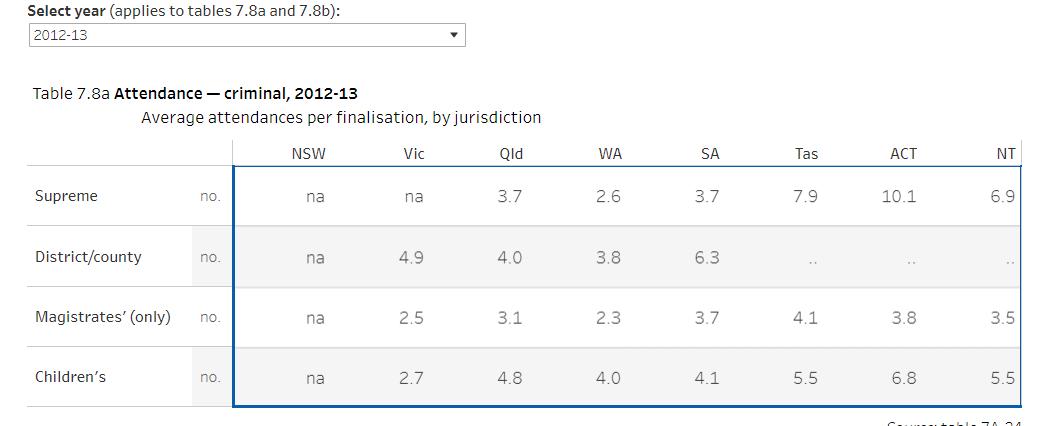
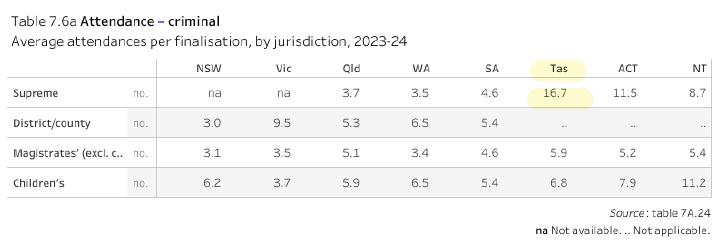
Average number of attendances from first appearance to resolution in 2013 – 7.9, and in 2024, 16.7.
Criminal Case Management Lists - Weekly dates for committal
7. The first and most significant change has been to create weekly lists to which the Magistrates will commit for trial or sentence. Those dates are published in the Circular to Practitioners 10 of 25 published on 7 July by the Registrar. They may be a blessing or a curse. We shall see.
8. Those lists will operate as follows:
Hobart CCML appearances by defendants on bail will be listed for 9:30am and video links listed at 10:30am.
Burnie CCML appearances by defendants on bail will be listed at 9:30am and video links at 10:00am, from Court 1 by video link to Hobart.
Launceston CCML appearances by defendants on bail will be listed at 11:00am and video links at 11:30am, usually from Court 2 by video link to Hobart.
9. The criminal case management list (CCML) ia the single entry point for all cases in the court's criminal jurisdiction. The objectives of these lists include:
o avoidance of unnecessary appearances;
o more transparency in criminal listings;
o consistent, engaged case management;
o equal footing on listing decisions;
o orderly progress of all matters in the list;
o early identification of possibility of resolution.
10. It's the Court's hope is that the CCML might provide an earlier focus for the parties to explore earlier resolution, but it is understood that the issues
with disclosure and the adversarial nature of the prosecution process inhibits that discussion The purpose of these changes is merely to repatriate the process to the Court, and deal with what flows form that, not to necessarily revolutionise any other part of the practice and procedure.
11. For the balance of 2025, the DPP will retain responsibility for the sixth (September) sittings for 2025. The Court and the DPP will share responsibility for what is listed in the October sittings. The eighth, and final, settings for 2025 is the sole responsibility of the court.
12. I will return to the topic of how these lists will be published.
Course of Proceedings
13. On committal for trial, the first directions hearing is to occur in not less than 7 weeks time; and for a committal for sentence, a period of not less then 7 days.
14. Indictable offences are charged on complaint, a process into which the DPP rarely has any input into. That a charge of an indictable offence is laid before the investigation is fully investigated is almost always a necessary circumstance. In our system the first opportunity the DPP has to learn anything of the matter is at the stage of an application for a preliminary proceedings order, or committal. This stage is not one at which any useful discussion can be had in relation to resolution. The statutory architecture of the procedure at the summary stage is not particularly helpful.
15. On first appearance before Justices on an indictable charge the Justices Act 1959 permits an adjournment for a period not exceeding 4 weeks: s 55.
During that period, the police (via the relevant Commander) is to serve certain documents on the defendant: s 56. That duty is ongoing at least up to the order of committal: s 57. I am yet to be convinced that these 2007 amendments have achieved the ambitions for them as expressed in the Attorney-General's 2RS for the Justices Amendment Bill 2007
16. On the second appearance, the defendant must plead unless the interests of justice require that proceedings be further adjourned: s 58. The reality is, as acknowledged by the Director's general instructions relating to the period of time reasonably anticipated for full disclosure, that it will be 12 weeks from the first appearance before any disclosure sufficient to plead will be provided.
17. By the time a matter is committed to the Supreme Court, it is common that it has not been investigated to a level which would permit a Crown Law Officer to satisfy him or herself that there is evidence against the defendant sufficient to put him on his or her trial, or to raise a strong or probable presumption of guilt as contemplated by the Criminal Code Act 1924, s 310. That process is a necessary precondition to any indictment being filed. The reality is that it cannot practically commence until after committal and it often involves re-investigation on a fairly fundamental level. There is, of course, no statutory requirement of sufficiency of evidence reasonable prospects on being charged.
18. Generally: Upon committal to the Supreme Court, the system retains the usual period between committal and first directions, being 7 weeks, notwithstanding what has just been said about the state of the investigation and disclosure. Often at first directions in the Supreme Court, the police have not provided the DPP with a file (certainly not a completed file). Even so, the 7-week period is retained as an accountability measure. It will enable the DPP to have meaningful discussions with the police and there must be a timetabled date.
19. The process at the first directions hearing should not really be any different under the new scheme. The present process of counsel for the state asking whether the matter is a trial and if it's capable of resolution seems perfectly fit for purpose.
Plea Days
20. In the DPP's 2023-2024 Annual Report, he reports that 535 'presented' (I assume that's via order of committal), 84 were tried, 284 were pleas of guilty. The challenge of providing time, and a proper system, for pleas of guilty continues.
21. The judges have agreed that when the new system starts from September 1, each judge sitting in crime will have at least two days per sittings available for pleas of guilty. It is proposed that each judge will have a plea day on the first and third Fridays. We have identified that wherever 2 judges are sitting, this may carry the risk that a counsel may need to be in two courts at once on a plea day and we have some ideas about how that may be addressed, so that may or not change. In any event, a plea of guilty
indicated within the sittings will be adjourned to one of those days. The underlying principle in this aspect of the listing practice is that when a plea is indicated, it should be dealt with in the same sittings. The advantage of listing in this way is the means by which work among the judges is allocated in a fair and transparent manner.
22. The other problem is readiness. The judges have resolved that matters where a plea is indicated should be adjourned to a judge on a date within the same sittings. I've suggested to the judges that there may be some more work may be able to be done in the CCML before listing for plea. We're committed to
Discussion:
- if a plea is not reached during the sittings, should it be adjourned to the next CCML or will the judges maintain carriage? Daly AsJ: This will be up to the judge.
- Despite the requirement that a plea be adjourned to a judge during the sittings in which the plea is this indicated, a sentencing matter may be kept in CCML [strictly on a case-by-case basis] if:
o parties are awaiting reports;
o Crown statement of facts not yet provided and unlikely to be provided by the plea date;
o disputes on the facts have been identified but not resolved.
- Burnie plea days (1st and 3rd Fridays) are also CCML days. Will they simply start later? Daly AsJ: for the moment, probably. But it will be raised with the judges.
Managing cases towards trial
23. In these circumstances, at the first directions hearing presently, there is an enquiry whether the matter will be a trial. That's as good a starting point as any. If there's room for discussion the matter will be adjourned to provide a reasonable opportunity for those discussions to conclude. Noting the objective of avoiding unnecessary appearances, counsel are absolutely expected to diligently pursue those discussions in the time provided for that purpose. But if you say you going to have that discussion, and you haven't had it, the matter will be listed for trial. The avoidance of meaningless appearances depends upon this.
24. It's sometimes not well enough understood that until an indictment is filed, the Court has very few powers in an indictable matter until an indictment is filed: see Criminal Rules 2006, r 3H. The process under the Code s 310 is an important one. No indictment can be filed until the process under s 310 is complete. That requires an assessment to be done by a Crown Law Officer whether there is evidence against the defendant sufficient to put him on their trial or to raise a strong or probable presumption of guilt.
25. Because of the features or bugs of the system as I have outlined above, at the first directions hearing I will usually enquire how long that process will take in the particular case. In these circumstances, there is often little point quibbling with that estimate and the matter will then be adjourned for a reasonable period to ensure that process is concluded. If, however, "it's a trial", then during the adjournment, the Court's expectation is that the papers and indictment are filed, served and sufficient time provided for the defence to read, advise and take instructions on that material. The expectation is that that when the matter comes back before the Court in the
CCML, it can be allocated a date for trial. If it is not a plea of guilty, unless you're adjourning to discuss resolution, then "it's a trial". It is the Court's duty to ensure that happens expeditiously. On that return date, there may be some case management questions asked, such as the estimated hearing time, any pre-trial applications, the number of witnesses, and other matters which may impact the length or scheduling of the trial.
26. Regrettably, when listing a trial, it will not always be the case that a defendant's choice of counsel can be accommodated. But wherever that is possible, an endeavour will be made to do so.
27. The judges have decided that each judge's list is to be listed to 150% of the available trial days. This is to account for changes of plea, discharges, and the usual vicissitudes which effect criminal trials. I will say this: because the Court has not done this before, the process will involve some trial and error.
28. The approach we have taken involves designating certain matters to be 'Priority 1' (P1) and others Priority 2' (P2). While ultimately the Court will designate priority – this is a matter about which the parties should be afforded an opportunity to be heard. Considerations for determining priority include (in no order):
- Child complainant
- Sexual assault
- Accused in custody
- Youth accused
- Trials where pre-recording has occurred
- Long trials.
29. "P2": The language of a "back up" trial is to be banished from the lexicon because of its historical baggage, signifying a mostly speculative listing without any solid expectation that it will proceed at the listed date and time. A P2 matter will be given a listing on a specific date and time. However, these listings will still be subject to the trial judge's management of his or her own sittings upon commencement. While I might do my best to provide a specific date and time for the trial, bear in mind that cases may still move about. Where a P1 trial turns into a plea (or must be adjourned in the interests of justice) that will create a space which must be filled by another trial. That may require other cases to be brought forward. Therefore, doing the best we can, some certainty will be provided, but subject to the same sorts of contingencies that inevitably exist in every criminal jurisdiction.
30. The theory of listing a Priority 2 trial is this. Assume we divide each judge's sittings into 2 week blocks, just for ease of planning. If the P1 trial in the sittings is scheduled for the first two weeks of the sittings: 8 available trial days. In that circumstance the P2 trial would be one of probably no longer than 4 days. It will be listed to commence on the same day.
31. Upon commencement of the sittings, the trial judge will manage their own list, and if the priority trial commences, the trial judge will provide for the further directions in that matter as to whether it is possible or likely to be reached in the sittings. That approach will apply to the sittings generally. Approaching the sittings as two distinct two-week bocks seems to make sense. We will see how things go.
32. The September2025 sittings are the province of the DPP. The seventh (October) sittings is to be shared exercise. The eighth (NovemberDecember) sittings is the sole responsibility of the Court.
33. While the grids for the seventh and eighth sittings of 2025 might be expected to be settled without a great deal of advance notice, in future, we hope to be able to provide more notice of the grid than has been provided previously. But you may not have much more notice about October. We will do our best. I would anticipate that, like most courts, once our system of criminal listings well-established, we will be listing out some significant time into the future, months ahead. Therefore, under the new listings arrangements, the parties should know their trial commitments months in advance. Hopefully, that will assist all counsel with the conduct of their practice. However, we must not lose sight of the reality: this list will be subject to each trial judge's control of their own lists within the sittings.
34. Having said that, you are responsible for your diary. It won't be the case that two weeks out from the sittings, you are told where you are supposed to be. You will be given that information in Court and that is the order you need to listen to and proceed upon. I cannot see that there would be much if any sympathy for diary mismanagement.
35. The Registry staff, once appointed, will be engaged in communication with the parties about matters such as compliance with pre-trial directions, any necessary movement in trial dates, and any other communication with the Court that might be necessary. They will be speaking for the judicial officer involved. Whether that is me or not. They will be the voice of God.
36. At each CCML a Registry staff member will be in attendance to manage the diary Presently that will be Ms Jess Wade. We are currently working out how we provide the trial grids and also visibility of the calendar to parties outside the Court. We want to be able to publish grids early. I am just not sure yet as to the best way to do that. The order setting the matter down is the primary communication as to a trial date, but publication if the grids is obviously something very useful in practice.
Discussion:
If a trial is not reached during its allocated sittings, it will return to the next available CCML for allocation of a further trial date. An assessment will be made of its priority at that point. The trial judge before him was listed for trial may also wish to say something about priority.
Special hearings
37. I note that in the Court's most recent annual report, the sexual offence 'pilot' has been operating since 2019, so there is nothing new about this. However, it is worth describing the procedure. Where there is a sexual offence involving a complainant who is, at the date of the defendant's first directions hearing in the Supreme Court, under 18 years, those cases are to be referred immediately to a judge sitting in crime at that time. The idea behind that is so that judge can do everything that needs to be done so that any orders for an intermediary assessment, ground rules hearing or special hearing is undertaken with the shortest possible time after the accused first appears in the Supreme Court. The problem with this is that that particular judge may be sitting in crime at that point, but may not be sitting in crime for some significant time but still is now the judge who must deal with this matter. It is part of the trial.
38. Obviously, in Launceston and Burnie, the way the allocation of work happens is that those judges may be expected to have to deal with more of these special hearings than their southern based colleagues. Some thought is being given as to whether we can improve this part of the system.
Discussion
How will special hearing dates be scheduled? It would appear as though the system will be as follows: at first directions or as soon afterwards as is practicable, the AsJ will adjourn the matter to a trial judge (who will be the judge sitting in crime and that sittings) By arrangement between the trial judges chambers and the criminal registry, a date or dates will be identified for the special hearing. Ideally, at the time of the allocation of the date for the special hearing, a trial date might also be identified. The practice will need to develop and will in require communication between the trial judge's associate, the criminal registry and the parties.
39. I trust we can all work together to make these changes work. Please let me know as problems arise – hopefully with a suggestion how the issue might be solved.