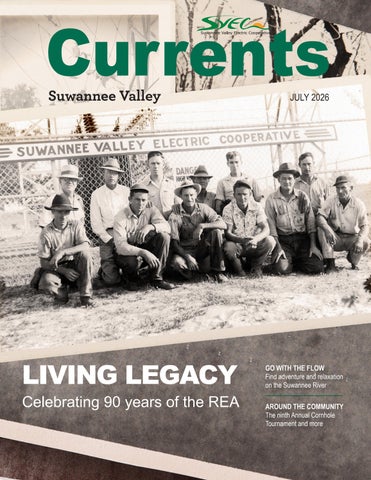
Currents Suwannee Valley
LIVING LEGACY
Celebrating 90 years of the REA
JULY 2026
GO WITH THE FLOW Find adventure and relaxation on the Suwannee River AROUND THE COMMUNITY The ninth Annual Cornhole Tournament and more
CEO’S MESSAGE
A legacy worth celebrating I’ve always enjoyed celebrating Independence Day, but this year it feels extra special. In addition to the usual hot dogs and fireworks, our nation is celebrating its 250th anniversary. It’s an incredible milestone and one that gives us all an opportunity to reflect on the people, ideas and institutions that have helped shape the country we celebrate today. From the start, progress has often been driven by those willing to work together toward a common goal. And in rural America, one of the most important examples of that community spirit is the Rural Electrification Administration. This year marks the 90th anniversary of the creation of the Rural Electrification Act. While it may be difficult to imagine today, there was a time when many communities like ours did not have access to electricity. Families relied on kerosene lamps for light, hand pumps for water and intense labor to complete Executive VP/CEO MICHAEL S. McWATERS everyday tasks. The REA helped change that. By providing financing and support for locally owned electric systems, it empowered rural communities like ours to bring electricity to areas that were often overlooked by for-profit utilities. The impact was transformational. Electricity improved quality of life, strengthened local economies and created opportunities that helped rural communities thrive. Suwannee Valley Electric Cooperative is a direct result of that vision and investment. Like hundreds of cooperatives across the country, SVEC was founded by local people who recognized a need and worked together to meet it. Almost a century later, we continue to benefit from what they built. Poles, wires and substations are important, but it has always been the cooperative spirit behind them that truly makes SVEC special. Our commitment remains the same today as it was for our founders: providing safe and reliable electricity while serving the best interests of our members. In this issue, we take a deeper look at the history of the REA and the important role it played in the creation of electric cooperatives across America. It is a story of innovation, determination and neighbors coming together to solve a challenge that once seemed impossible. That spirit of community service continues to guide us today. Elsewhere in this newsletter, you can find a recap of this year’s Cornhole Tournament as well as information for educators interested in applying for Operation Round Up® grants. As we celebrate America’s 250th birthday, I hope we also take a moment to appreciate the legacy of cooperation that helped bring electricity to rural parts of this country. It is a legacy that continues to power our homes, support our communities and shape our future, and it’s one that SVEC is proud to carry forward every day. ■ 2 | JULY 2026
Suwannee Valley
Currents July 2026
Suwannee Valley Currents is a monthly newsletter published by Suwannee Valley Electric Cooperative, © 2026. It is distributed without charge to all consumermembers of the cooperative.
WE BELONG TO THOSE WE SERVE Business Office: 800-447-4509 11340 100th St. Live Oak, FL 32060 Lobby Hours: 8 a.m.-4:30 p.m., Monday-Friday Drive-thru Kiosk: Open 24 hours 24/7 Power Outage Reporting: 800-752-0025 svec-coop.com facebook.com/sveccoop instagram.com/sveccoop SVEC is an equal opportunity provider and employer.
PHOTO COURTESY OF SVEC
Lineworkers pose in front of the Blackmon Substation, SVEC’s first substation. Local people like these built the system our cooperative still relies on today with the help of the Rural Electrification Administration. Read more on Page 4.
Suwannee Valley Currents
SVEC NEWS
Track your energy usage with The heat is on and so are the appliances we rely on to keep cool. To avoid being hot and bothered by the costs to run those essential items, use SVEC’s SmartHub app, a way for our consumermembers to stay on top of summer energy usage. The app provides graphics showing kilowatt-hours used daily and even monthly, alongside enhanced features like weather data that show how factors like the outside temperature affect your energy consumption. Seeing the when and why can help you better manage everyday trends and habits about electricity use in your home. SmartHub is also a great tool for managing bill payments, keeping account information up to date, reaching out to SVEC with issues or service requests and receiving notifications on anything from payment status to power outages. If you don’t have SmartHub, go to svec-coop.com or download the app on your smartphone and sign up today.
Idalia cost recovery update Invoices Paid
$80,785,807.24
Reimbursements Received
$29,963,827.94
Idalia Cost Recovery Collected
$9,888,248.57
Remaining Balance
$40,933,730.73
FEMA OBLIGATES RECOVERY FUNDS TO SVEC Have you heard the news? Learn more about the recent announcement and what it means for our cooperative by visiting www.svec-coop.com/idalia-cost-recovery
Share summer’s technology! GET A FREE MONTH of Rapid Fiber Internet each time someone signs up using the referral link you send them. /rapidfiberinternet
Suwannee Valley Currents
@rapidfiberinternet
@rapidfiberinternet
Share and save by visiting rapid-fiber.com/residential/refer-a-friend-program.
JULY 2026 | 3
Powering the American promise Celebrating 90 Years of shaping communities through rural electrification As America celebrates its 250th birthday, another milestone reminds us that some of the nation’s greatest achievements didn’t happen in bustling cities or on battlefields. They happened on country roads, family farms and in rural communities where neighbors came together to build a brighter future. This year marks the 90th anniversary of the Rural Electrification Act, a transformative initiative that forever changed life in rural America and laid the foundation for organizations like Suwannee Valley Electric Cooperative.
PHOTOS COURTESY OF SVEC
A countryside in darkness
Today, it’s difficult to imagine life without electricity. But in the mid-1930s, nearly 90% of rural homes and farms across the United States were dark after sunset. Rural families often relied on kerosene lamps, wood stoves and manual labor. The challenge wasn’t a lack of demand. The
FROM LEFT: An SVEC member rides his horse to pay his electric bill. A line crew makes repairs to SVEC power lines. Early cooperative trucks seen on the job. Electric power made life-changing appliances, like freezers, accessible for local families.
problem was economics. Private utilities saw little profit in building miles of power lines to serve just a handful of homes. That left millions of Americans waiting for a connection to the modern world. The turning point came during the Great Depression. In 1935, President Franklin D. Roosevelt signed an executive order creating the Rural Electrification Administration. A year later, Congress passed the Rural Electrification Act, establishing a federal loan program to bring electricity to rural communities. The idea was simple but revolutionary — provide affordable financing and allow local people to organize and build electric systems of their own. What followed was one of the most successful infrastructure campaigns in American history.
Neighbors take charge
Farmers and community leaders across the nation formed member-owned electric cooperatives, pooling resources and working together to build the lines that private companies would not. The cooperative model reflected the spirit of self-reliance, local control and neighbor helping neighbor. Communities didn’t wait for someone else to solve the problem. They organized, elected local leadership and invested in their own future. The results were dramatic. Members gather for one of the cooperative’s annual meetings. 4 | JULY 2026
Suwannee Valley Currents
Following World War II, the pace of rural electrification picked up significantly. Within a few years, the number of rural electric systems doubled, the number of connected consumers more than tripled and thousands of miles of power lines stretched across the countryside. By 1953, more than 90% of American farms had electric service. “The night the lights came on” became a life moment and a cherished memory for many families, passed from generation to generation. Among the communities transformed by the rural electrification movement were those of North Florida.
A local legacy is born
On Dec. 29, 1937, local leaders established Suwannee Valley Electric Cooperative to bring electricity to areas that private power providers considered unprofitable to serve. Inspired by the opportunities created through the REA, community advocates organized rural residents and secured the resources needed to build a local electric system. In 1940, SVEC energized its first lines, serving just 69 members. For those families, electricity meant much more than convenience. It created new opportunities for farming, business, education and quality of life. Like hundreds of electric cooperatives formed during
the REA era, SVEC became a testament to what determined communities could accomplish when given the tools to succeed. The cooperative continued to grow alongside the region it served. In 1948, SVEC joined with 10 other distribution cooperatives to create Seminole Electric Cooperative, helping ensure a reliable and affordable wholesale power supply that continues today. Over the decades, the co-op embraced new technologies while remaining committed to the same mission established nearly 90 years ago — improving the lives of the people it serves.
Bridging new divides
That mission is clear in modern investments such as advanced distribution technology that can automatically detect faults and reroute power to reduce outages. It is also reflected in Rapid Fiber Internet, SVEC’s fiber-to-the-home broadband initiative designed to connect rural residents to the digital economy. Just as electricity once bridged the gap between rural and urban America, high-speed internet now helps close the digital divide. The tools have changed, but the purpose is still the same. As the nation celebrates 250 years of independence and reflects on the ideals that shaped America, the story of rural electrification offers a lesson that lives on — what can happen when ordinary people come together to solve extraordinary problems. Electric cooperatives demonstrate the power of local leadership, community investment and shared purpose. The lights that first illuminated rural America became symbols of opportunity, prosperity and hope. And from those first energized lines to today’s advanced electric and broadband networks, cooperatives like SVEC continue to carry that promise forward. ■
FAR LEFT: Meter Technician Richard Avery tests equipment. LEFT: SVEC purchases its first derrick truck in 1969.
Suwannee Valley Currents
JULY 2026 | 5
RECIPE and SAFETY
Gator Bangers and Mash With Okra INGREDIENTS PHOTO COURTESY OF FLORIDA DEPARTMENT OF AGRICULTURE AND CONSUMER SERVICES
1 pound Florida potatoes, roughly chopped 1 pound Florida alligator sausage ½ pound fresh okra, sliced in half 1 cup milk 3-4 tablespoons unsalted butter at room temperature Oil as needed Sea salt and fresh ground pepper to taste
DIRECTIONS
Fill a large pot with water and add the potatoes. Bring the water to a boil and cook the potatoes until they are fork tender. While the potatoes are boiling, cook the alligator sausage in a large skillet on mediumhigh heat until the sausage is golden brown and reaches an internal temperature of 165 F. Remove the sausage from the pan and set it aside. To the hot skillet, add just enough oil to coat it. Sear the okra on medium-high heat until charred. When the potatoes are fork-tender, drain and then return them to the warm pot. Add milk and butter. Mash together until the desired consistency is reached. Season the seared okra and mashed potatoes with salt and pepper. ■
Safety first Electricity powers modern life, but it is dangerous if not handled carefully. Check back here each month for new tips on how to stay safe around electric power at your home or business. July brings the heat, meaning greater reliance on air conditioning and swimming pools to keep cool. Electrical Safety Foundation International advises that residents:
• Always use a qualified, licensed electrician to perform any installation or servicing of air conditioning and other cooling equipment.
• Check that any cooling equipment you are considering purchasing bears a label showing it is listed by a recognized testing laboratory.
• Cover all outdoor receptacles to keep them dry, especially around pools and spas.
• Make sure all electrical equipment used for swimming pools — even the cleaning equipment — is grounded and there are no electrical devices or cords within 10 feet of a water source.
• Never handle electrical devices when you are wet,
whether from water activities or perspiration. When possible, use battery-operated devices outside.
• Do not swim during a thunderstorm. ■
To learn more about building safe electric habits, click the Outages & Safety tab on svec-coop.com, and follow us on social media.
/sveccoop
6 | JULY 2026
@sveccoop
Suwannee Valley Currents
PHOTOS COURTESY OF VISIT FLORIDA
Snorkelers can enjoy a serene side trip up the Santa Fe River to Ginnie Springs.
Chill out on the Suwannee River BY CHELLE KOSTER WALTON, VISIT FLORIDA We anchored our rental houseboat outside the entrance to Manatee Springs and heaved the canoe into the warm summer waters to paddle into a cove shaded by Spanish moss-shrouded oaks. Suddenly, our bare feet against the bottom of the canoe turned icy. There, we plunged into deep, 72-degree, fountain-clear waters. Starting downriver in Suwannee near the Gulf with my fellow travelers — another mom and four kids — we enjoyed a two-day houseboat excursion along the Suwannee River that took us into the heart and soul of Florida. Prehistoric Gulf sturgeon leapt from the water, and alligators snoozed on the banks as we chugged slowly along the wide Suwannee, past slumping river homes and stretches of wilderness. The Lower Suwannee National Wildlife Refuge protects much of this countryside from development and is one of dozens of recreational areas along the river’s 206-mile course through Florida. Manatee Springs State Park in Chiefland is another, where visitors can enjoy everything Suwannee Valley Currents
from kayaking and biking to camping and scuba diving. Near Old Town, underwater sightseers look for the remains of the circa-1896 City of Hawkinsville steamboat. In Fowler’s Bluff bordering the Lower Suwannee NWR, adventurers can opt to stay at Treasure Camp. Its unfussy cottages cater mostly to anglers, who stop in at the convenience store/restaurant for breakfast, lunch and dinner, with only a screen between them and river views. In the town of Mayo, lodging options get slightly plusher, with homes, log cabins and hotel rooms, in addition to camping at Suwannee River Rendezvous Resort. Springs and parks continue up through North Florida, as do options for fun. If you take a side trip where the Santa Fe River branches off, enjoy tubing at Ichetucknee Springs State Park, then swim and snorkel in Ginnie Springs. Or, stay on course to camp in tents or cabins at Suwannee River State Park, and paddle a bit of whitewater at Big Shoals State Park near White Springs. The main attraction around White Springs honors the man who put the Suwannee River on the musical map — although he never laid eyes on
Ichetucknee Springs State Park along the Santa Fe River attracts tubing enthusiasts.
the river. We very much enjoyed the Stephen Foster Folk Culture Center State Park, with its museum about Foster’s music and a carillon tower that chimes his most famous songs, including, of course, “Old Folks at Home,” Florida’s state song. Many come to camp at the riverside state parks and at Live Oak’s own Spirit of the Suwannee Music Park, which also rents cabins and hosts live musical events throughout the year. But perhaps the most fitting accommodation for the Suwannee River is a houseboat, a home that lets you live the river — from the soles of your feet to a piece of your heart that the river feeds. JULY 2026 | 7
SVEC IN THE COMMUNITY
PHOTOS BY CHRISTY TUCKEY/SVEC
Cornhole Tournament a win for players and for charity The bags were flying in Live Oak as SVEC hosted the ninth annual Suwannee Valley Cornhole Tournament on May 16. The event raised more than $4,300 for the United Way of Suwannee Valley, which provides vital funding, resources and support to families and fellow nonprofits across Suwannee, Lafayette, Hamilton and Columbia counties.
otherwise known as Thomas Iannucci and Mike Cosner, and third prize was awarded to The Finishers, Tima Robinson and Dexter Dye, making their tournament debut.
The tournament is divided into two brackets, recreational and competitive, ensuring people of all skill levels enjoy the day. Medals were awarded to first-, second- and third-place winners in each bracket.
Competitive bracket winners were the Soggy Bottom Boys, Kidd McCloud and Bear Izell, champions in the recreational bracket for the previous three years. The Beardmen, Brandon F. and Chad Henry, finished second, and the Taylor JT team of Donald Tucker and Jimmy Wallace took third.
In the recreational bracket, the top award went to the Happy Hill team, TJ McCloud and Robert. Second-place honors were earned by the Moon Risin’ Farm Flippets, At right, the top three teams in the recreational bracket were Happy Hill, Moon Risin’ Farm Flippets and The Finishers. The top competitive bracket teams, below, were the Soggy Bottom Boys, the Beardmen and Taylor JT.
SVEC is thankful to the businesses and individuals who have joined us year after year, including our tournament sponsors: Seminole Electric Cooperative, First Federal Bank, SunStop Stores, Poole Realty, Cornerstone Clinic and Rapid Fiber Internet. The initial total of $2,181 raised from tournament participants was matched by CoBank through its Sharing Success grant. The tournament is a fun and positive environment, but most importantly, it’s making a difference in the lives of others.
Youngsters get powerful lessons SVEC lineworkers demonstrated their many tools of the trade, including the gear that keeps them safe, as part of a fun lesson to youngsters at Branford Public Library about powerline safety. The June 9 visit was part of Suwannee River Regional Library System’s Dig. Read. Discover. summer reading program, which runs through July 18.
8 | JULY 2026
Co-ops unite to address BEAD concerns SVEC joined NRECA CEO Jim Matheson and a few other distribution cooperatives in a virtual media event ahead of NRECA’s 2027 broadband summit to discuss recent policy changes to the Broadband Equity, Access and Deployment program, better known as BEAD. Matheson expresses concern over ever-changing rules that make it hard for co-ops to participate in the program. “It adds to confusion, it adds to delay, it adds to cost,” he says. Co-ops like SVEC have done the research and know fiber is a future-proof technology that can help our communities grow and prosper as they should. We want to see public policy support it.
Suwannee Valley Currents