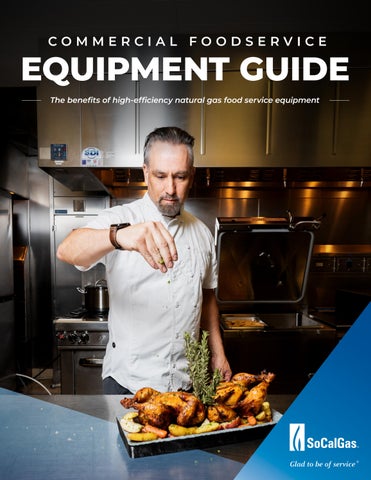
COMMERCIAL FOODSERVICE
EQUIPMENT GUIDE The benefits of high-efficiency natural gas food service equipment
Introduction Why High Efficiency Matters For commercial foodservice operators, high-efficiency natural gas cooking equipment can offer practical operational advantages. These types of appliances are designed to use energy more effectively, which can help reduce energy consumption, emissions and overall operating expenses. Many operators also appreciate that highefficiency models are built to heat quickly and maintain consistent temperatures, which can support smoother workflows and steady output during busy service periods. Over time, these features can contribute to a more productive and effective kitchen setup.
This guide will help you: »
Choose the right equipment for your menu, workflow, and cooking tasks
»
Specify high-efficiency equipment in purchasing and bid documents
»
Take advantage of resources offered by SoCalGas and the California Energy Wise program, including rebates and Try Before You Buy opportunities
A
c
2
CONTENTS 4
Research Behind High-Efficiency Equipment
5
Understanding Efficiency
6
Energy Effectiveness
8
Common and Costly Mistakes
9
Three Questions Before You Buy
11
Specifying High-Efficiency Equipment Online
12
Working With SoCalGas
3
Research Behind High-Efficiency Equipment How do you know if a piece of cooking equipment is truly high efficiency? The answer lies in standardized laboratory testing, verified data, and an appliance database that allows fair comparison across manufacturers and models.
The Foundation: ASTM Standard Test Methods Food service testing labs at California’s investor-owned utilities, including SoCalGas, have tested hundreds of pieces of cooking equipment over the past three decades. This testing follows standardized methods created specifically for commercial cooking equipment. These test methods are developed through field and laboratory research, refined in partnership with food service manufacturers, and published by ASTM International, a voluntary standards organization recognized worldwide.
Why Standardized Testing Matters Think of ASTM test data like the miles-per-gallon ratings on new automobiles. Before MPG stickers existed, car buyers had no reliable way to compare fuel efficiency across different vehicles, and manufacturers had little incentive to improve it. The same was true for food service
equipment before ASTM standards. Purchasing decisions were based on guesswork. Manufacturers made marketing claims impossible to verify. Operators had no way to calculate actual operating costs or compare competing models fairly. Before ASTM testing: »
Equipment selection based on guesswork
»
Marketing claims without supporting data
»
No incentive for manufacturers to invest in efficiency improvements
»
Operators unable to calculate true operating costs
under real-world conditions. These models translate directly into return-on-investment calculations, helping operators understand not just which equipment is more efficient, but exactly how much money that efficiency will save. Unbiased, third-party testing transformed the industry. Engineering now drives equipment design, and operators make purchasing decisions based on facts rather than guesses.
After ASTM testing: »
Equipment selection driven by verified performance data
»
Fair comparison across manufacturers and models
»
Clear incentive for engineering-driven efficiency improvements
»
Operators equipped to make informed purchasing decisions and calculate ROI
From Data to Decisions The data created by ASTM test methods allows operators to model how much energy a specific appliance will use
4
Research Behind High-Efficiency Equipment
Understanding Efficiency This section explains three related concepts that are essential for making informed equipment decisions: energy efficiency, energy effectiveness, and the connection between efficiency and performance.
TEST METHODS
BY THE NUMBERS Began in the
1980s
Continues Today
45+
ASTM TEST
Methods Now Exist
Equipment Covered: + Cooking + Refrigeration + Sanitation + Ventilation
Energy Efficiency
A Simple Example
Energy efficiency measures how much of the energy you purchase actually cooks your food versus how much escapes as waste heat.
A commercial fryer uses 100
The definition: Energy efficiency equals the useful energy that goes into cooking the food divided by the total energy that came through your meter.
BTU of natural gas. Of that energy: »
50 BTU goes into cooking the fries (useful energy)
»
50 BTU escapes into the kitchen as waste heat
This fryer operates at 50% energy efficiency. The Efficiency Range is Wide Once researchers began testing equipment using ASTM standards, they discovered dramatic differences within equipment categories. Natural gas fryer efficiency, for example, ranges from 30% to 65% depending on the model. Why understanding efficiency matters 30% efficient fryer costs roughly twice as much to operate as a 65% efficient fryer for the same food output. You cannot see this difference by looking at two fryers side by side. Only standardized lab testing reveals true efficiency.
5
Efficiency is Performance In the foodservice industry, there’s a long‑standing perception that high‑efficiency appliances may not match the output of traditional, lower‑efficiency models. In practice, equipment performance depends on factors such as design, application, and how the appliance is used in the kitchen. Highefficiency models are engineered to support consistent output. Where the Misconception Comes From Low-efficiency appliances tend to have higher BTU/h input ratings. The industry has long associated high input ratings with high food production, similar to how horsepower ratings are used to compare automobiles.
Energy Effectiveness Energy efficiency is informative, but thinking about “energy effectiveness” makes the concept more practical for operators. The idea: Treat energy as a commodity, an ingredient you purchase just like cooking oil, flour, or produce. Energy effectiveness asks: how much value did I get from the energy I purchased?
Translating Efficiency to Dollars Return to the 50% efficient fryer example: »
You purchase $1.00 worth of natural gas
»
$0.50 of that dollar does productive work cooking food
»
$0.50 is lost as waste heat
You are getting fifty cents of value from every dollar spent on energy. The rest is waste. Another way to express this: energy effectiveness equals the energy you sold (in cooked food) divided by the energy you purchased. Energy is an Ingredient Most operators don’t think of energy as an ingredient, but it truly is. Consider ice, one of the most universal items served in restaurants. Ice is nothing more than water and energy combined. The energy used to freeze and maintain that ice is as much an ingredient as the water itself. The same principle applies to every piece of cooking equipment in your kitchen.
But input ratings measure energy consumed, not food produced. What the Data Actually Shows High-efficiency appliances can produce as much, or more, food than low-efficiency appliances because they direct more energy into the food being cooked and waste less to the surrounding environment.
High-efficiency gas equipment uses energy effectively. More of every energy dollar goes toward producing food you can sell.
6
Fryer Comparison: METRIC
35% EFFICIENT FRYER
55% EFFICIENT FRYER
Fries produced per hour
45lbs
75lbs
Cook time per batch
Standard
Approximately 1 minute faster
Energy direct to food
Lower
Higher
Energy lost as waste heat
Higher
Lower
The high-efficiency fryer delivers more energy from combustion into the oil that cooks the fries. This reduces cook time by about one minute per batch, resulting in significantly higher production per hour. Why This Matters for Your Business For cook-to-order items like fries, increased production directly impacts: TURN TIMES
Faster ticket completion
TRANSACTIONS
More customers served per hour
CUSTOMER SATISFACTION
Shorter wait times
REVENUE
More food sold
The bottom line: Efficiency equals performance. High-efficiency equipment costs less to operate and produces more food.
7
A Common and Costly Mistake The mistake
Two Costs, One Decision
The Result
Choosing equipment based on purchase price alone.
Every equipment purchase involves two types of expense:
This happens constantly in the food service industry, and it costs operators thousands of dollars over the life of their equipment.
»
The lowest-priced item wins, regardless of performance or efficiency.
»
Capital Cost (CapEx) The upfront investment: purchase price, financing, and depreciation. Operating Cost (OpEx) The ongoing expense: energy, maintenance, and consumables like cooking oil or oven cleaner.
Together, CapEx and OpEx determine the true cost of owning a piece of equipment over its useful life. This total is called the life-cycle cost, and it should drive every purchasing decision.
The Problem Most operators lack reliable OpEx information at the time of purchase. Without data on energy consumption and operating costs, they default to comparing CapEx alone.
This approach ignores a critical reality: for energy-intensive cooking equipment, lifetime OpEx typically far exceeds CapEx.
Case Study: Two Griddles A chain restaurant operator needed to purchase griddles for multiple locations. Two options were available: The operator chose the $7,600 griddle based on purchase price.
What They Missed The “cheaper” griddle costs $5,600 more over 10 years. An additional $1,400 in CapEx would have reduced OpEx by $7,000. The high-efficiency griddle delivers a 400% return on the incremental investment.
Case Study: Two Griddles COST FACTOR
STANDARD GRIDDLE
HIGH-EFFICIENT GRIDDLE
Purchase Price (CapEx)
$7,600
$9,000
10-Year Energy Cost (OpEx)
$28,000
$21,000
Total Life-Cycle Cost
$35,600
$30,000
8
Two Lessons
1 2
OpEx is the bigger number. In this case study, the standard griddle’s 10-year energy cost was nearly four times its purchase price. Even the high-efficiency griddle’s OpEx was more than double its CapEx. For energy-intensive equipment, operating cost is the number that matters most.
Small CapEx investments yield large OpEx returns.
The Takeaway
Spending $1,400 more upfront saved $7,000 over the equipment’s life. That is a 400% return on a modest incremental investment, far better than almost any other use of that capital.
When evaluating cooking equipment, always request efficiency data and calculate life-cycle cost. The lowest purchase price is rarely the lowest total cost.
Three Questions Before You Buy When choosing commercial cooking equipment, operators should ask three fundamental questions and get satisfactory answers to all three before making a purchase.
1
Is this equipment right for the task?
The most important consideration is whether the equipment matches your menu. A low oil volume fryer designed for french fries won’t perform adequately for fried chicken. A standard griddle built for hamburgers and pancakes won’t reach the temperatures needed for a plancha to properly caramelize and brown chicken and beef. Getting this wrong means poor food quality, frustrated cooks, and wasted capital. 9
The SoCalGas Energy Resource Center offers a Try Before You Buy program. Bring your own ingredients and recipes to test-cook on a diverse inventory of high-efficiency gas cooking equipment before purchasing. This hands-on approach ensures equipment matches your menu, eliminating guesswork and reducing risk. The first and most important task is to make sure the equipment matches the menu.
2
What will this equipment cost to operate, and is there a way to lower costs?
Purchase price is only part of the equation. Energy bills represent 3 to 8% of most foodservice operations’ total operating costs, and unlike food costs, energy savings go directly to your bottom line. For example, a restaurant operating on a 5% profit margin needs to sell $20 worth of food to generate $1 of profit. But every $1 saved on energy costs drops straight to the bottom line as earnings. High-efficiency natural gas cooking equipment is the most effective way to reduce energy costs in a commercial kitchen.
3
How well does this equipment perform?
Performance means more than food quality. For commercial operators, it means: Production capacity: How much food can it cook per hour? Recovery time: How quickly does it return to cooking temperature after a large batch? Speed of service drives customer satisfaction and throughput, particularly in quick-service and cooked-to-order operations. The more tickets moving through your kitchen, the more revenue you generate. Choose equipment that cooks the most food, recovers quickly, and does both at the lowest energy cost.
10
Specifying High-Efficiency
Equipment Online Understanding the value of high performance, high-efficiency gas cooking equipment is the first step in creating an energyeffective cookline. The second and most important step is purchasing, installing, and commissioning that equipment.
To specify qualifying equipment, an operator can copy this language directly into their specification documents, adding: “All fryers purchased for this project shall meet the following energy and performance requirements...”
To ensure high-efficiency equipment actually makes it onto your cookline, you need effective and precise equipment specifications that include energy efficiency and performance data. Fortunately, there is an easy online resource that provides specification language ready to use in contracts and purchasing documents. The California Energy Wise program offers Instant Rebates when operators purchase qualifying equipment from an enrolled supply source, whether a dealer, manufacturer, or contractor. Qualifying equipment is listed on a Qualifying Products List (QPL), which includes efficiency and performance specifications for each product category. To specify an efficient natural gas fryer, for example, an operator would visit CAEnergyWise.com, select “Qualifying Products List” from the menu, and choose the “Fryers” tab. At the top of the page, language describes what is required for a fryer to qualify:
“Qualifying natural gas fryer models (vat width < 18-inches) must have a tested heavy load cooking energy efficiency of ≥ 50% and an idle energy rate ≤ 9,000 Btu/h utilizing ASTM Standard F1361. Qualifying natural gas fryer models (vat width ≥ 18-inches) must have a tested heavy load cooking energy efficiency of ≥ 50% and idle energy rate ≤ 12,000 Btu/h utilizing ASTM Standard F2144. Tier 2 qualifying natural gas fryer models must have a tested heavy load cooking energy efficiency of ≥ 60% and an
Note: For information on natural gas equipment commissioning and maintenance, refer to the SoCalGas Natural Gas Equipment Maintenance Application Guides.
idle energy rate of ≤ 6,100 Btu/h.”
11
Qualifying Products List Qualifying gas combination oven/steamer models must have a tested steam mode cooking-energy efficiency of ≥ 41% and convection mode cooking energy efficiency of ≥ 57% utilizing ASTM F2861, and meet the idle rate requirements in Table 1. Qualifying electric combination oven/steamer models must have a tested steam mode cooking energy efficiency of ≥ 55% and convection mode cooking energy efficiency of ≥ 78% utilizing ASTM F2861, and meet the idle rate requirements in Table 1. NOTE: Program criteria are subject to change.
Convection Mode Production Energy Capacity Efficiency (lbs/h) (%)
Company
Model Number
Size (Steam Pants)
Fuel Type
Preheat Energy (Btu or kWh)
Idle Rate (Btu/h or kW)
Alto-Shaam
10-10G PRO
11
Gas
10,476
4,818
60%
130
Angelo Pro
Steam Mode Cooking Water Use (gph)
Idle Rate (Btu/h or kW)
Energy Efficiency (%)
Production Capacity (lbs/h)
Cooking Water Use (gph)
0
6,266
43%
182
3.0
10-20G PRO
22
Gas
11,640
6,355
64%
239
1
9,059
51%
312
5.4
20-10G PRO
20
Gas
18,278
6,552
64%
241
0.4
8,460
55%
323
13.2
20-20G PRO
40
Gas
23,377
9,397
63%
445
0.8
9,215
57%
542
4.8
6-10G PRO
7
Gas
6,933
4,725
58%
64
1.2
4,898
41%
113
6.1
CTC7-20G
16
Gas
6,773
5,517
60%
173
1.3
1,654
52%
161
0.9
CTP10-10G
11
Gas
10,476
4,818
60%
130
0
6,266
43%
182
3.0
CTP10-20G
22
Gas
11,640
6,355
64%
239
1
9,059
51%
312
5.4
CTP20-10G
20
Gas
18,278
6,552
64%
241
0.4
8,460
55%
323
13.2
CTP20-20G
40
Gas
23,377
9,397
63%
445
0.8
9,215
57%
542
4.8
CTP6-10G
7
Gas
6,933
4,725
58%
64
1.2
4,898
41%
113
6.1
FX122G3**
24
Gas
9,304
7,693
63%
216
1.8
8,696
55%
223
2.6
FX82G3**
16
Gas
7,387
6,550
60%
145
2
7,334
54%
191
3.7
Table Source: California Instant Rebates Program, Qualified Products List (QPL).
Working
With SoCalGas
The SoCalGas Energy
For Operators and Designers
including operators,
Operators and designers can work with the SoCalGas team to get advice on the right type of equipment for any facility’s menu. They can also test equipment at the ERC as part of the Try Before You Buy program. This customized, hands-on approach to specification and purchasing lowers risk and ensures operators are matched to the most energy-effective equipment.
Resource Center (ERC) is the go-to resource for industry professionals, manufacturers, equipment dealers, reps, and designers.
12
For Manufacturers, Dealers, and Representatives
Manufacturers, dealers, and equipment representatives use the ERC to showcase their best equipment. Manufacturers also work with the SoCalGas engineering team to have high-efficiency equipment tested for inclusion on the California Energy Wise Instant Rebates Qualifying Products List. Beyond testing, manufacturers have collaborated with the SoCalGas team to develop and test new equipment designs that increase performance and energy effectiveness. Manufacturers are encouraged to participate in the creation of ASTM standardized test methods by attending ASTM meetings. The SoCalGas ERC team is dedicated to helping manufacturers create and sell the most energyeffective gas cooking equipment, which benefits customers and is good for business.
Food Service Equipment Center SoCalGas Energy Resource Center 9240 Firestone Blvd, Downey CA, 90241 As a brand-neutral facility, the Food Service Equipment Center is the largest test kitchen for natural gas equipment in the country. Test and compare more than 150 pieces of equipment from over 50 manufacturers. Learn more at: socalgas.com/Foodservice
Try Before You Buy Bring your own recipes and ingredients to our stateof-the-art Commercial Kitchen or Ventilation and Bake Lab. Assess cooking quality, production, ease of operation, and maintenance before you purchase.
Educational Seminars and Webinars Attend no-cost seminars and webinars on food safety, kitchen ventilation, industry trends, equipment maintenance, kitchen remodels, sustainability for foodservice, and more. Learn more and register at: seminars.socalgas.com
Equipment Rebates SoCalGas offers rebates on qualifying natural gas foodservice equipment that can help offset purchase costs, and your operation may benefit from continued savings through lower operating costs year after year. Learn more at: socalgas.com/Business
To make an appointment: Call: (562) 803-7323 Email: ercfoodsvc@socalgas.com
13
Message funded by ratepayers This program is funded by California utility customers and administered by Southern California Gas Company (SoCalGas under the auspices of the California Public Utilities Commission. Program funds, including any funds utilized for rebates or incentives, will be allocated on a first-come, first-served basis until such funds are no longer available. This program may be modified or terminated without prior notice. The selection, purchase and ownership of goods and/or services are the sole responsibility of the customer. Customers who choose to participate in this program are not obligated to purchase any additional goods or services offered by manufacturer, vendor, service provider, or any other third party. SoCalGas makes no warranty, whether expressed or implied, including warranty of merchantability or fitness for any particular purpose, use or application of selected goods and/or services selected by customer. SoCalGas does not endorse, qualify, or guarantee the work of any third party. Eligibility requirements apply; see the program conditions for details.
socalgas.com 1-800-427-2000
© 2026 Southern California Gas Company. All copyright and trademark rights reserved. 901EEM 10/25
14