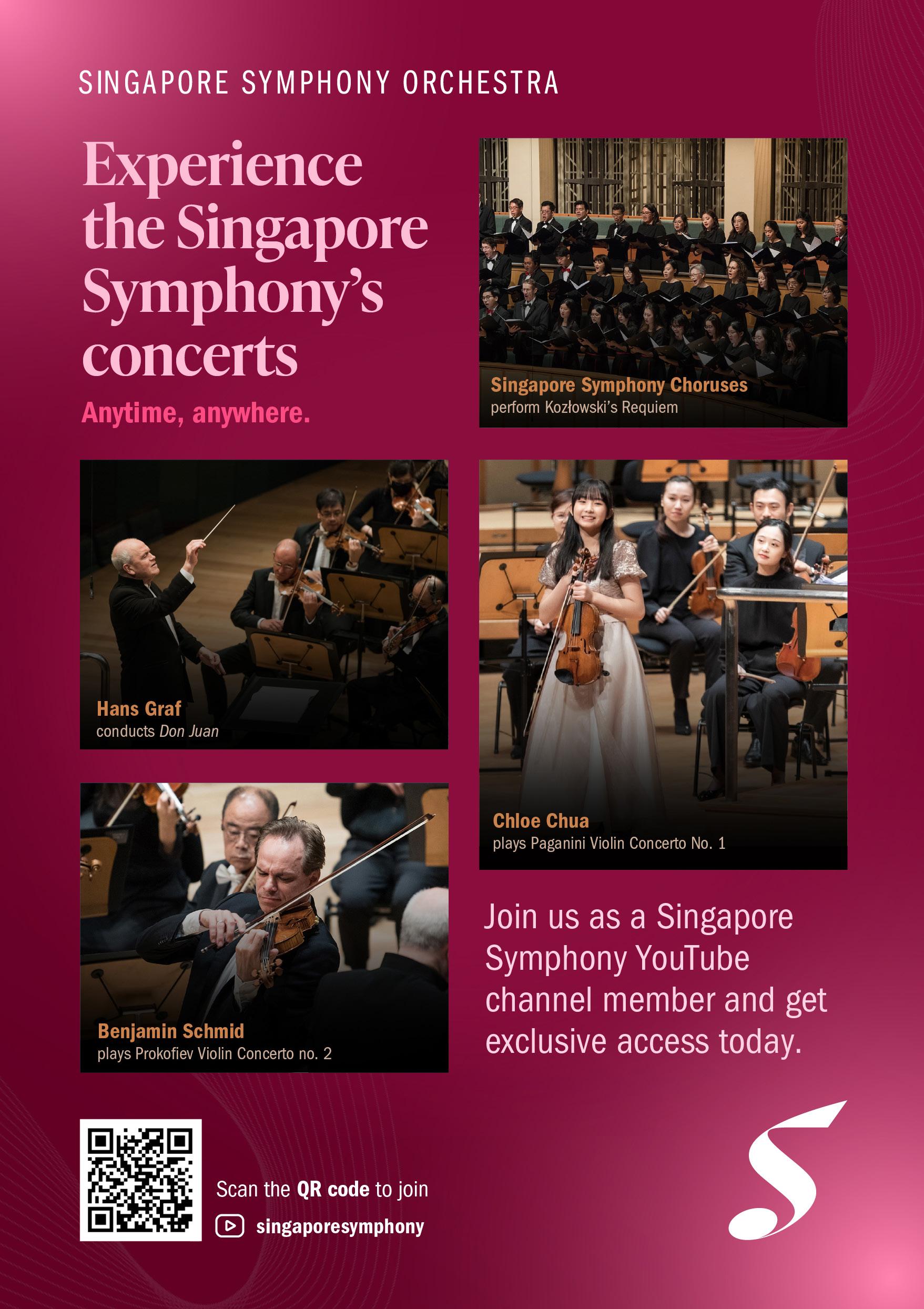
Temasek Foundation × SSO Christmas Concert presented by
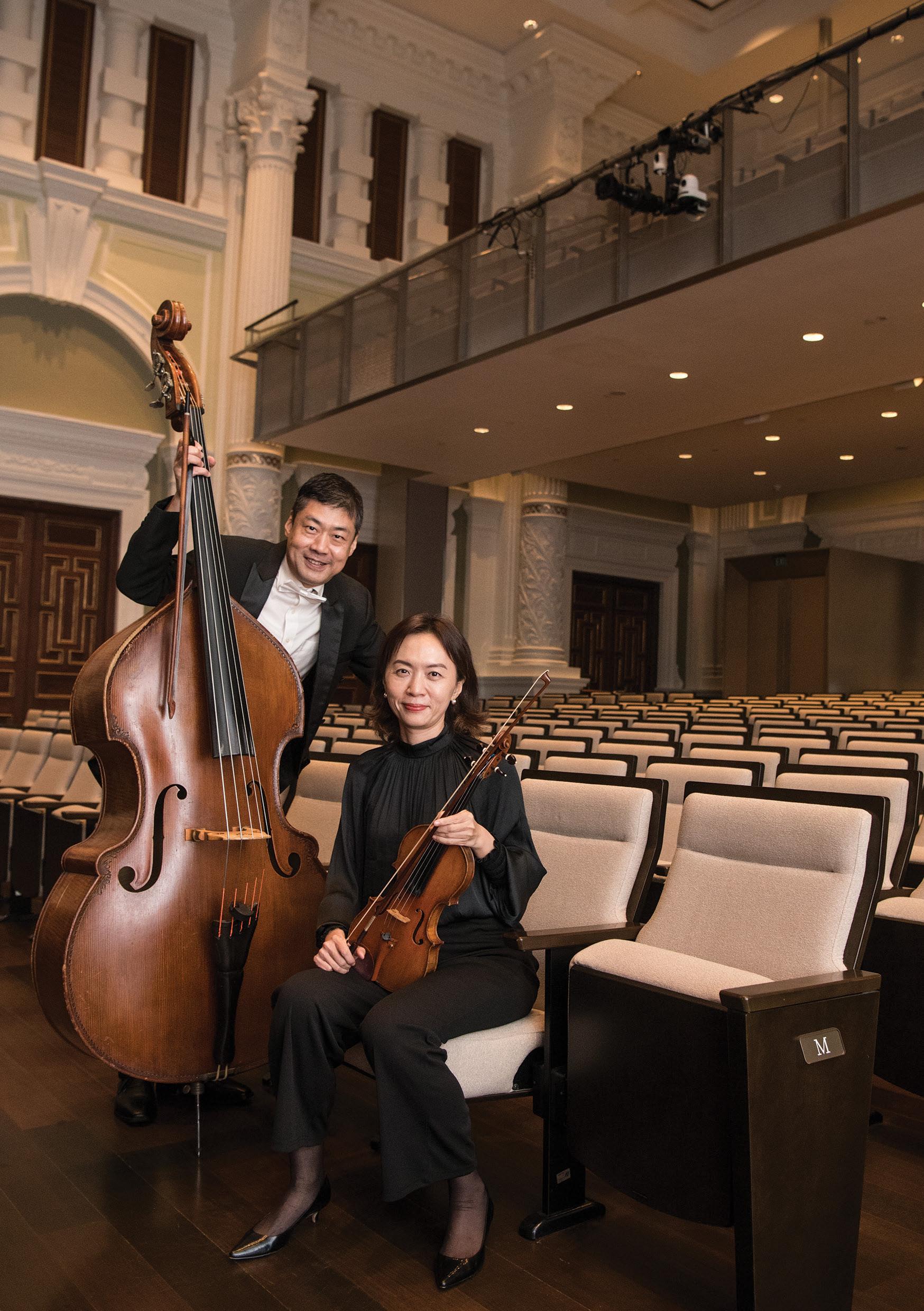
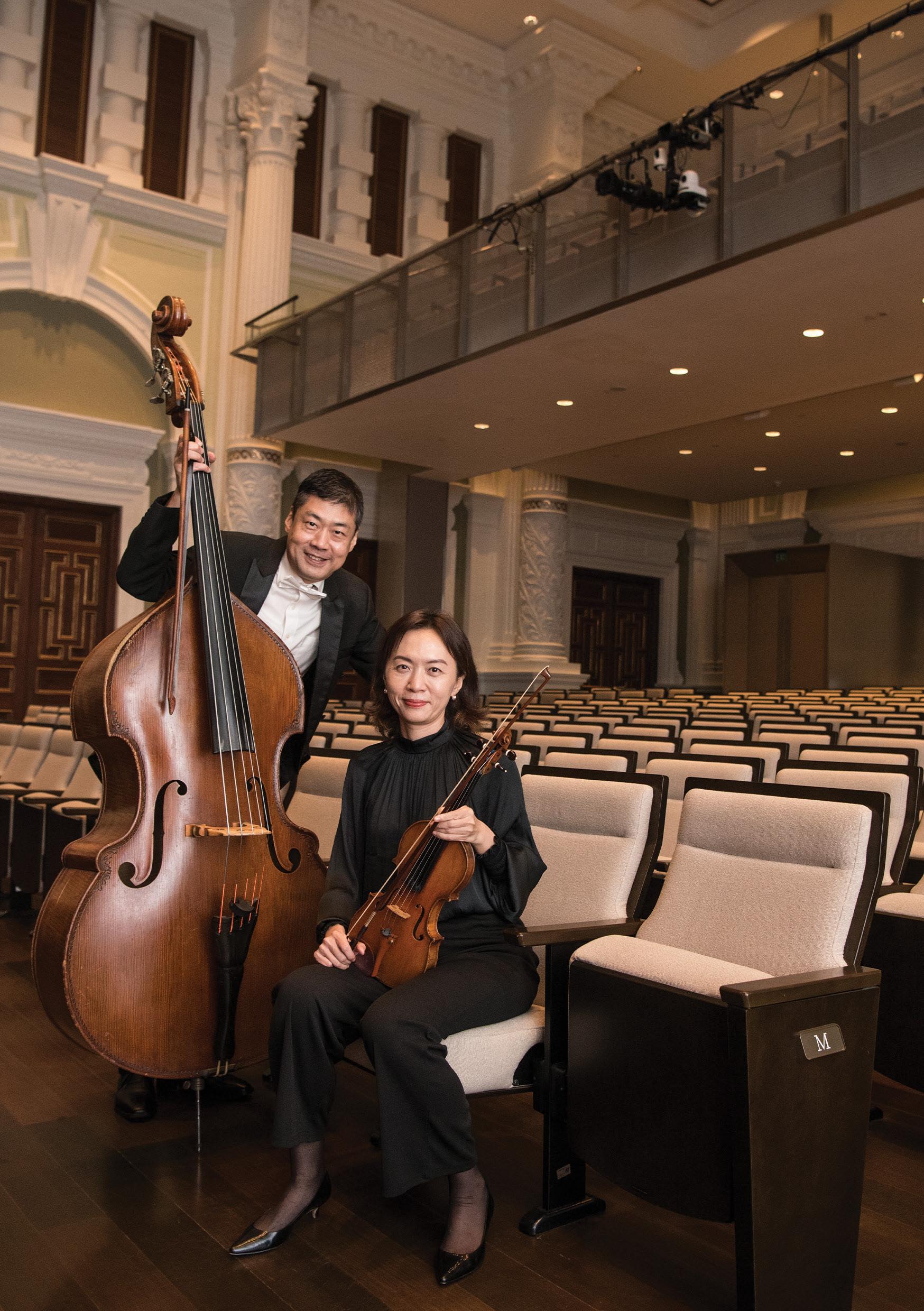
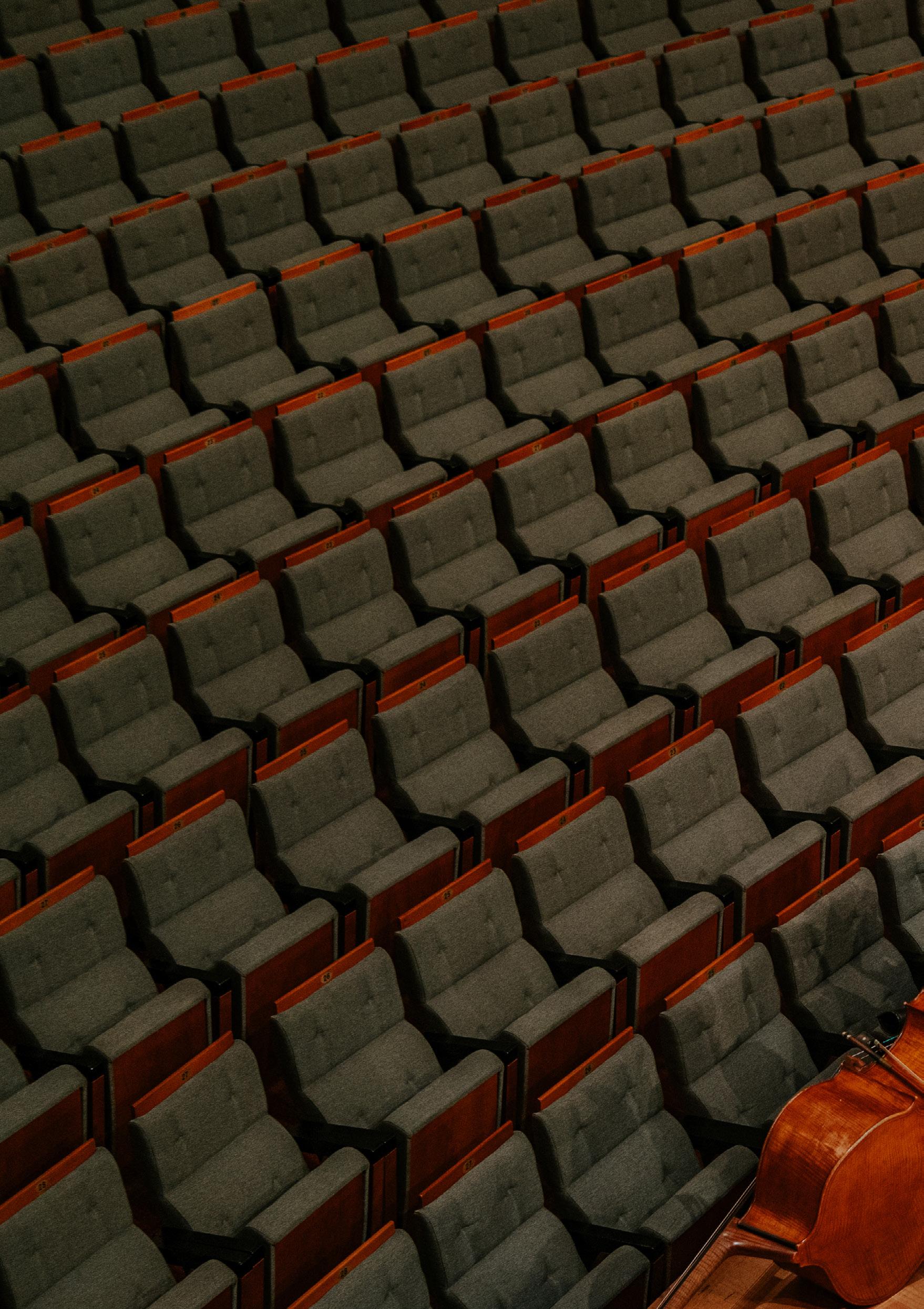
To recognize our donors’ continued support towards the national orchestra, we offer a more personalized way for you to make a mark in the Home of the SSO, with a dedicated plaque on your preferred seat at the Victoria Concert Hall.
Selected seats are up for adoption in donation tiers of $8,000, $15,000, $25,000*
SUPPORT THE SSO
You help to secure the future of the national orchestra.
You enable the SSO to present more world-class performances at the Victoria Concert Hall.
You support SSO children’s programmes that nurture the next generations’ appreciation of the arts and culture.
For more details, please write to director_development@sso.org.sg Tax deduction of 2.5 times the value of your donation may apply (for tax residents of Singapore).
*Patron benefits apply.
Dec
2025
20
29
Temasek Foundation × SSO
Christmas Concert
Fri & Sat, 12 & 13 Dec 2025
Esplanade Concert Hall
Hans Graf & Churen Li
Fri, 19 Dec 2025
Esplanade Concert Hall
For the enjoyment of all patrons during the concert:
Please switch off or silence all electronic devices.
Please minimise noises during performance. If unavoidable, wait for a loud section in the music.
No photography, video or audio recording is allowed when artists are performing.
Non-flash photography is allowed only during bows and applause when no performance is taking place.
Go green. Digital programme books are available on www.sso.org.sg.
Photographs and videos will be taken at these events, in which you may appear. These may be published on the SSO’s publicity channels and materials. By attending the event, you consent to the use of these photographs and videos for the foregoing purposes.
Cover image: Jay Chua
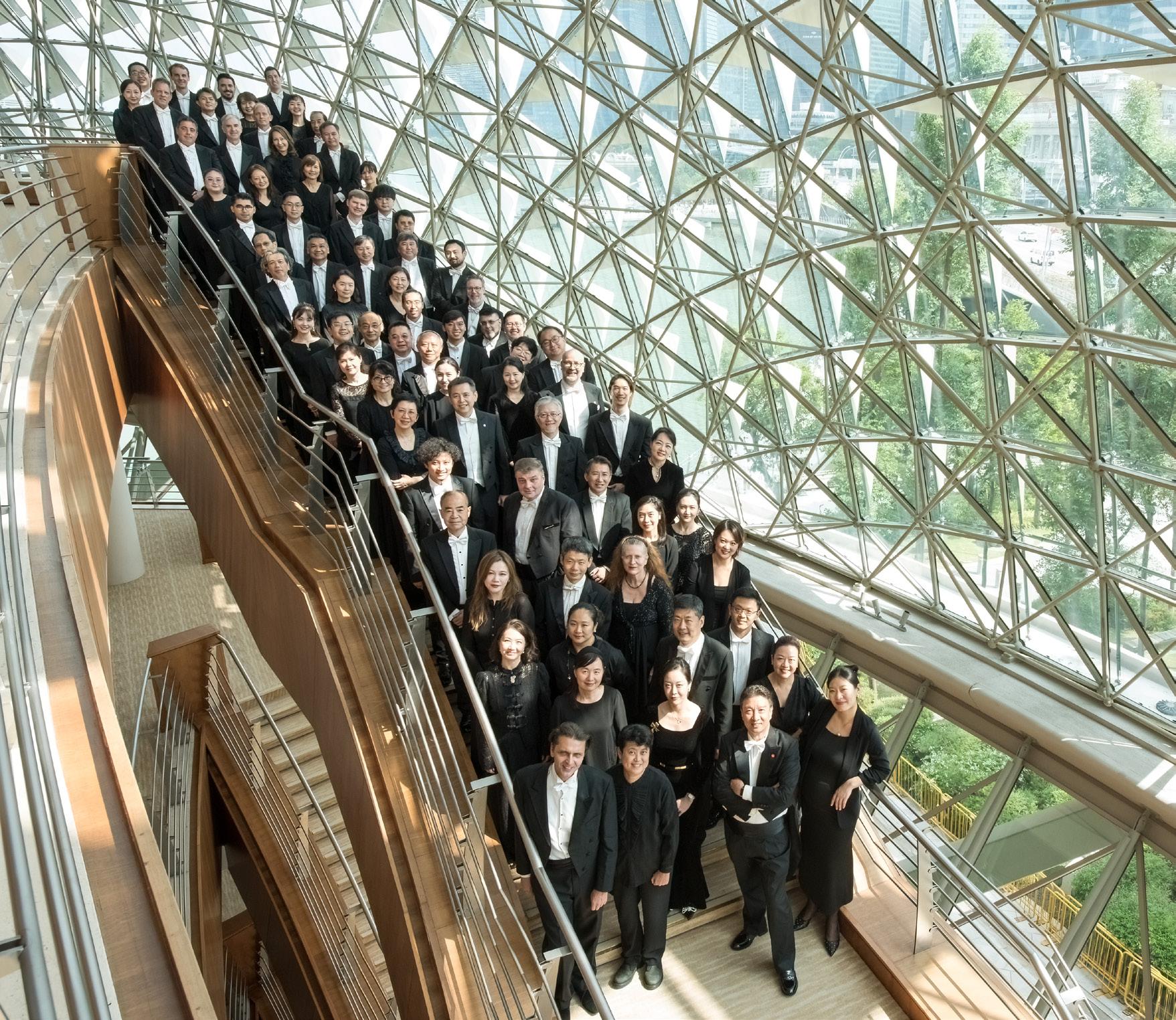
Singapore Symphony Orchestra
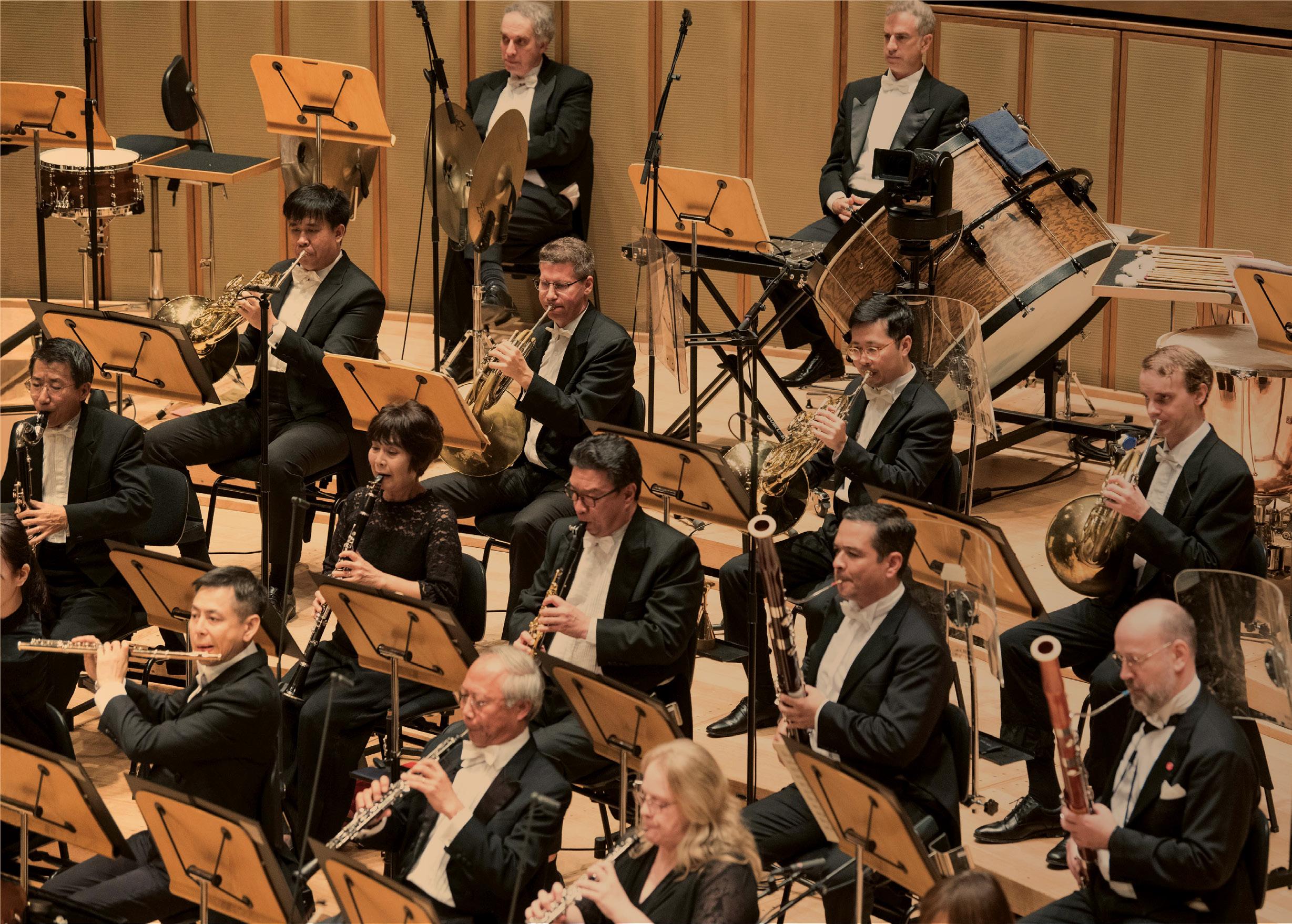
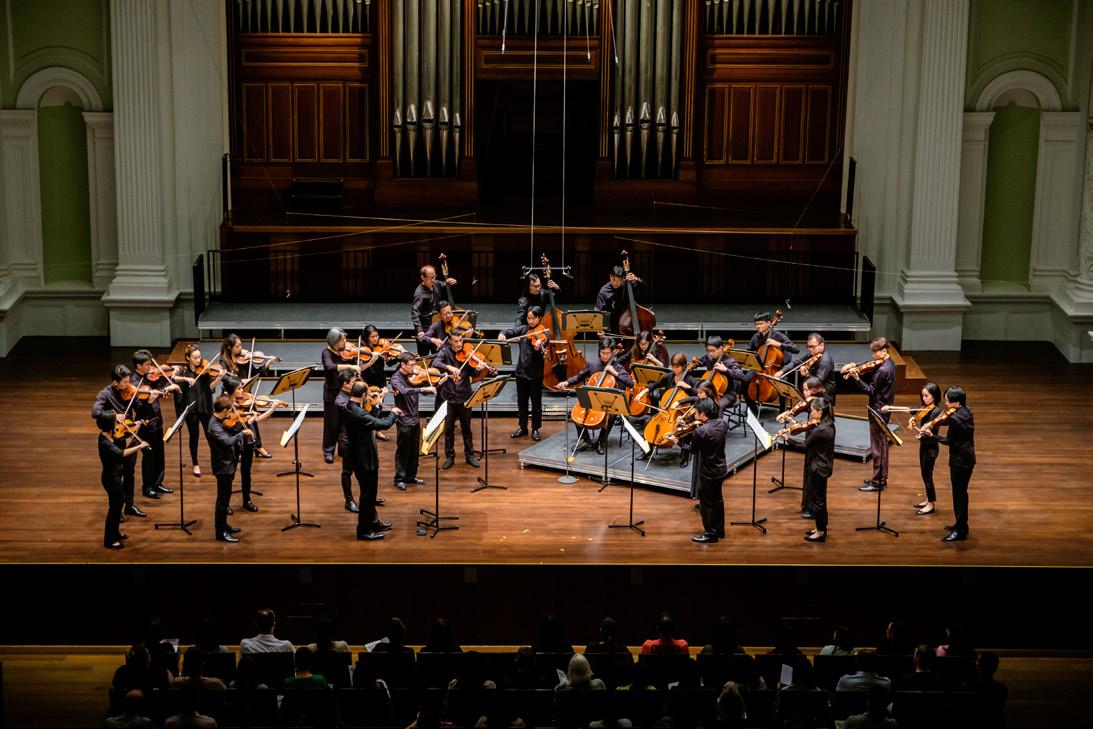
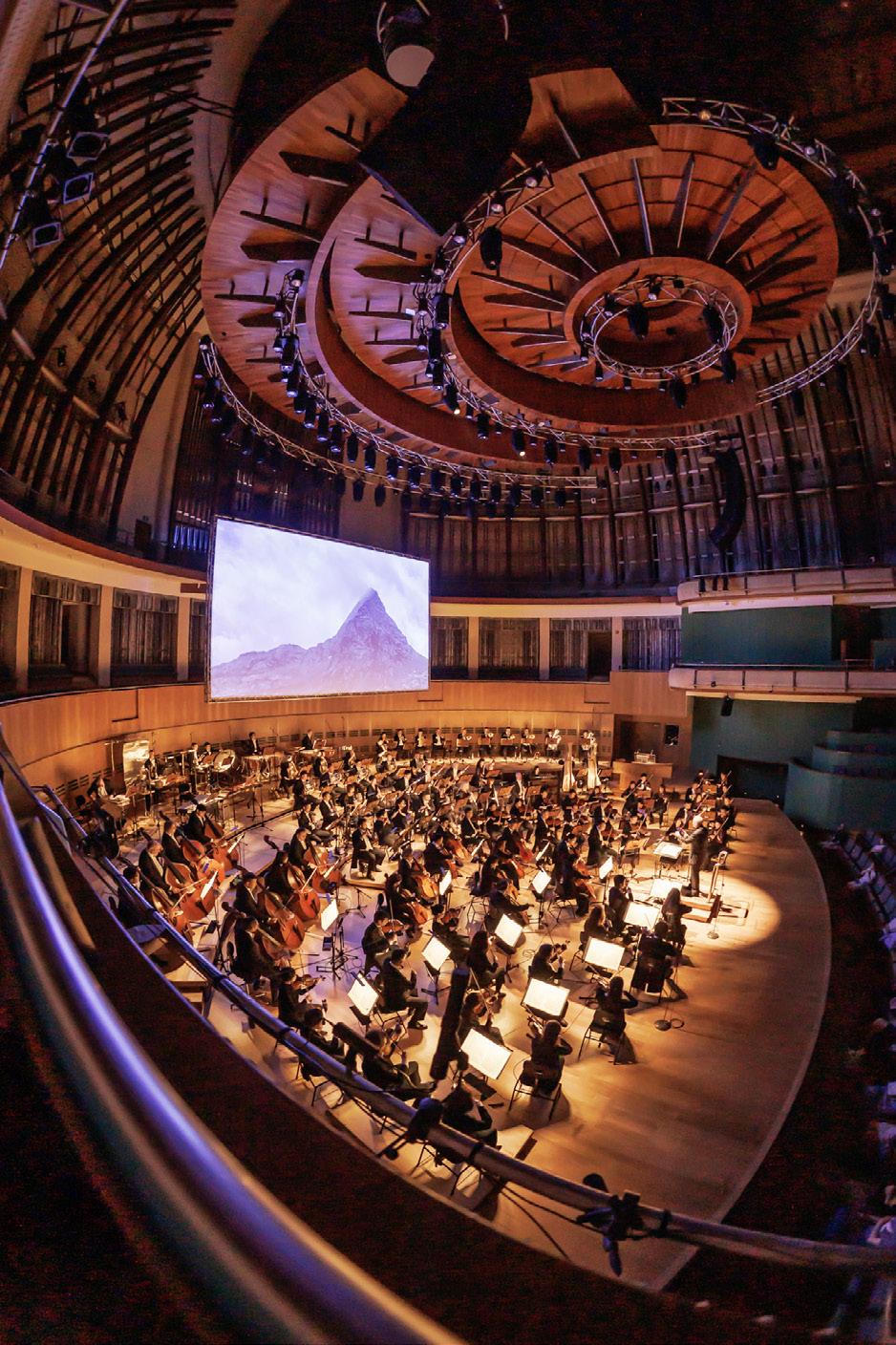
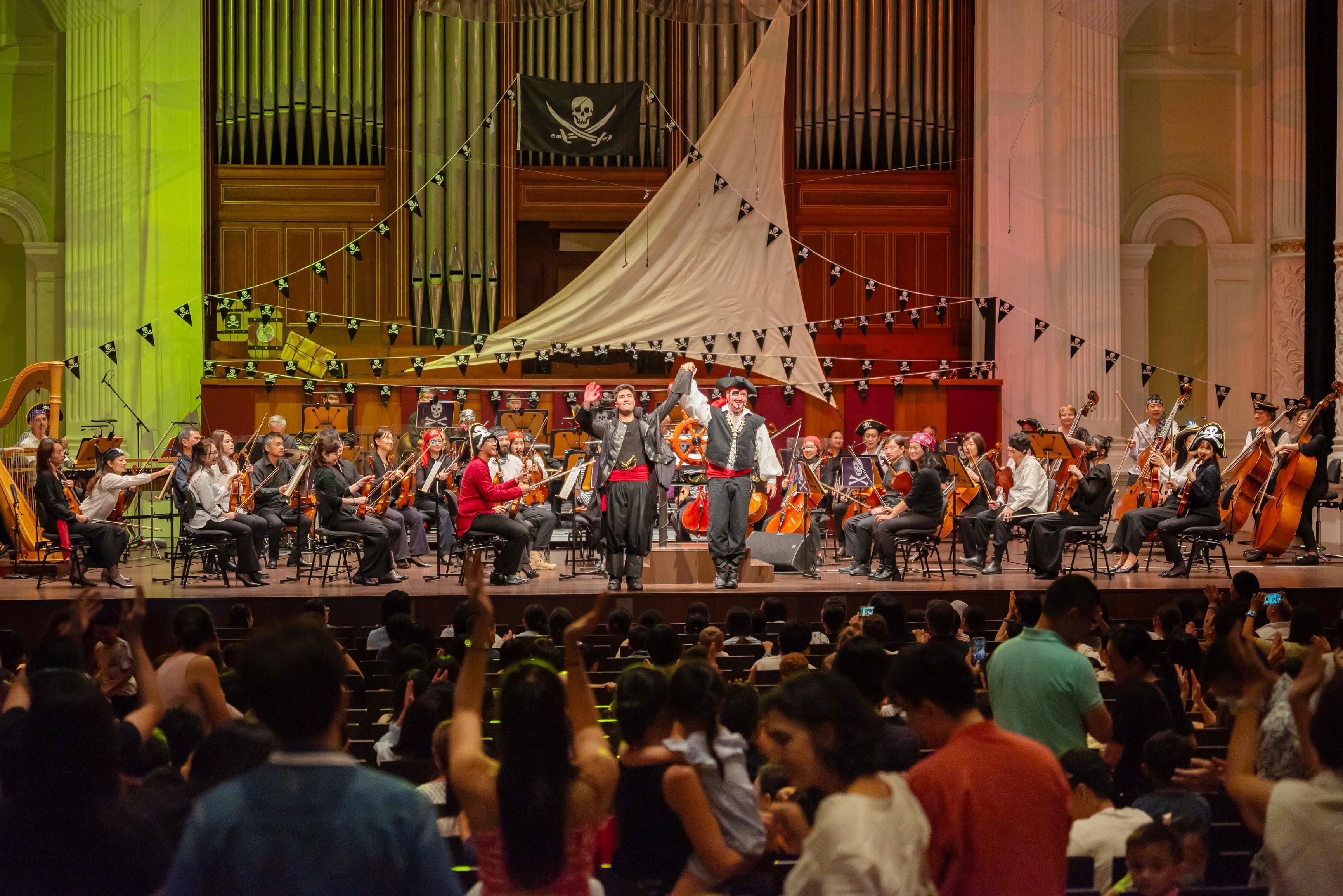
The orchestra performs over 60 concerts a year, and its versatile repertoire spans alltime favourites and orchestral masterpieces to exciting cutting-edge premieres. Bridging the musical traditions of East and West, Singaporean and Asian musicians and composers are regularly showcased in the concert season. The SSO makes its performing home at the 1,800-seat state-of-the-art Esplanade Concert Hall. More intimate works, as well as community performances take place at the 673-seat Victoria Concert Hall, the Home of the SSO.
Since its founding in 1979, the Singapore Symphony Orchestra (SSO) has been Singapore’s flagship orchestra, touching lives through classical music and providing the heartbeat of the cultural scene with its 44week calendar of events.
In addition to its subscription series concerts, the orchestra is well-loved for its outdoor and community appearances, and its significant role educating the young people of Singapore through its school programmes. The SSO has also earned an international reputation for its orchestral virtuosity, having garnered sterling reviews for its overseas tours and many successful recordings. In 2021, the SSO clinched third place in the prestigious Orchestra of the Year Award by Gramophone. In 2022, BBC Music Magazine named the SSO as one of the 23 best orchestras in the world.
From the 2026/27 season, the SSO will be led by Finnish conductor Hannu Lintu, the fourth Music Director in the orchestra’s history after Choo Hoey (1979–1996), Lan Shui (1997–2019) and Hans Graf (2020–2026).
Beyond Singapore, the SSO has performed in Europe, Asia, Australia and the United States. In the 2024/25 season, the SSO performed to full houses at Asia Orchestra Week in Kyoto, Japan, and made its “dazzling – and true-blue – Down Under debut” (Limelight) in Sydney, Melbourne and Brisbane. In May 2016, the SSO was invited to perform at the Dresden Music Festival and the Prague Spring International Music Festival. This successful five-city tour of Germany and Prague also included the SSO’s second performance at the Berlin Philharmonie. In 2014, the SSO’s debut at the 120th BBC Proms in London received praise in major UK newspapers The Guardian and The Telegraph. The SSO has also performed in China on multiple occasions.
The SSO has released more than 50 recordings, with over 30 on the BIS label. Recent critically acclaimed albums include Herrmann’s Wuthering Heights (Chandos) and Scriabin – Poems of Ecstasy and Fire (BIS).
A complete Mozart Violin Concerto cycle with Singaporean violinist Chloe Chua conducted by Hans Graf is released in 2025 on Pentatone.
The SSO also leads the revival and recording of significant works such as Kozłowski’s Requiem, Ogerman’s Symbiosis (after Bill Evans) and violin concertos by Robert Russell Bennett and Vernon Duke.
The SSO has collaborated with such great artists as Vladimir Ashkenazy, Gustavo Dudamel, Charles Dutoit, Joe Hisaishi, Neeme Järvi, Lorin Maazel, Martha Argerich, Diana Damrau, Janine Jansen, Leonidas Kavakos, Lang Lang, Yo-Yo Ma, Mischa Maisky, Gil Shaham, Daniil Trifonov and Krystian Zimerman.
The SSO is part of the Singapore Symphony Group, which also manages the Singapore Symphony Choruses, the Singapore National Youth Orchestra, the Singapore International Piano Festival and the biennial National Piano & Violin Competition.
The Group’s vision is to be a leading arts organization that engages, inspires and reflects Singapore through musical excellence. Our mission is to create memorable shared experiences with music. Through the SSO and its affiliated performing groups, we spread the love for music, nurture talent and enrich our diverse communities.
With deep appreciation to the Rin Collection for their generous loan of string instruments. Musician on annual contract.
Kong Zhao Hui performs on a J.B. Guadagnini of Milan, c. 1750, donated by the National Arts Council, Singapore, with the support of Far East Organization and Lee Foundation.
Chan Yoong-Han performs on a David Tecchler, Fecit Roma An. D. 1700, courtesy of Mr G K Goh. Musicians listed alphabetically by family name rotate their seats on a per programme basis.
Guest Musicians
Temasek Foundation × SSO Christmas Concert
12 & 13 Dec 2025
First Violin
Bobur Eshpulatov
Yvonne Lee
Helena Dawn Yah
Second Violin
Edward Tan
Tian Ye
Viola
Ho Qian Hui
Patcharaphan Khumprakob
Yeo Jan Wea
Hans Graf & Churen Li
19 Dec 2025
First Violin
David Coucheron
Co-Principal Guest Concertmaster
Chen Da Wei
Lim Shue Churn
Sherwin Thia
Second Violin
Jeongyeon Im Guest Principal
Bobur Eshpulatov
Lee Shi Mei
Ling Yun Zhi
Ionut Mazareanu
Edward Tan
Double Bass
Guennadi Mouzyka
Trumpet
Lertkiat Chongjirajitra
Tuba
Tan Yao Cong
V iola
Joelle Hsu
Patcharaphan Khumprakob
Double Bass
Joan Perarnau Garriga Guest Principal
Guennadi Mouzyka
Clarinet
Yung-Yuan Chiang Guest Principal
Percussion
Julia Tan
Organ
Koh Jia Hwei
Piano/Celesta
Aya Sako
Bass Trombone
Jasper Tan
Percussion
Thaddeus Chung
Tan Pei Jie
Joshua Tan
conductor
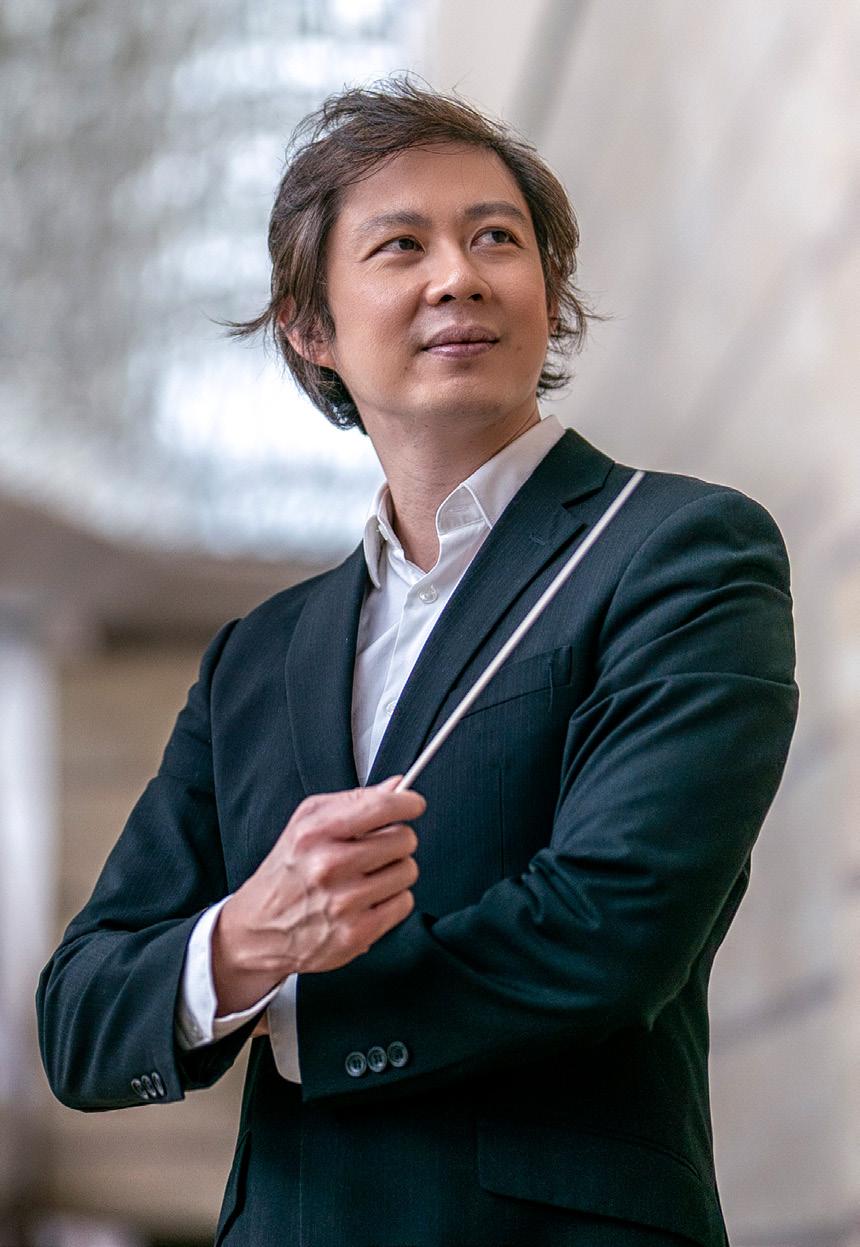
2nd Prize winner of the 2008 Dimitri Mitropoulos International Competition, Singaporean conductor Joshua Tan’s rise to prominence on the international scene has been marked by successful debuts in Carnegie Hall, Philharmonie Berlin, Mariinsky Hall and Bunkamura.
A graduate of The Juilliard School and the Eastman School of Music (High Distinction), he is an awardee of numerous scholarships and awards, such as the Young Artist Award, Singapore, Bruno Walter Memorial Foundation Award, NACShell Scholarship, and the SSO/MOE Scholarship.
Joshua has conducted orchestras all around the world. He has studied with various eminent conductors—James DePreist, Charles Dutoit, David Zinman and Kurt Masur—and worked with many others, such as Michael Tilson Thomas, Ingo Metzmacher and George Manahan.
Known as a versatile conductor, Joshua is at home with symphonic, operatic and ballet works. His substantial repertoire for opera includes La Traviata, Rigoletto, Das Rheingold, Der fliegende Holländer, Lohengrin, Carmen, among others. He is also equally adept with music for ballet, film and multimedia. For the latter, his extensive work include Disney’s Fantasia and Pixar, West Side Story, Jurassic Park and more.
Joshua is presently Music Director of the Singapore National Youth Orchestra and the Asia Virtuosi. He has served successful stints as Associate Conductor of the Singapore Symphony Orchestra, Resident Conductor of the National Centre for the Performing Arts (China) Orchestra, and as Principal Conductor of the Guiyang Symphony Orchestra. Highlights of this season include debuts with Orchestre National de Bretagne, Kanagawa Philharmonic Orchestra, Hiroshima Symphony Orchestra as well as return engagements to Hong Kong Philharmonic Orchestra, Shanghai Symphony Orchestra, Tokyo Metropolitan Symphony Orchestra, and with the Singapore Ballet for Romeo and Juliet and Cinderella
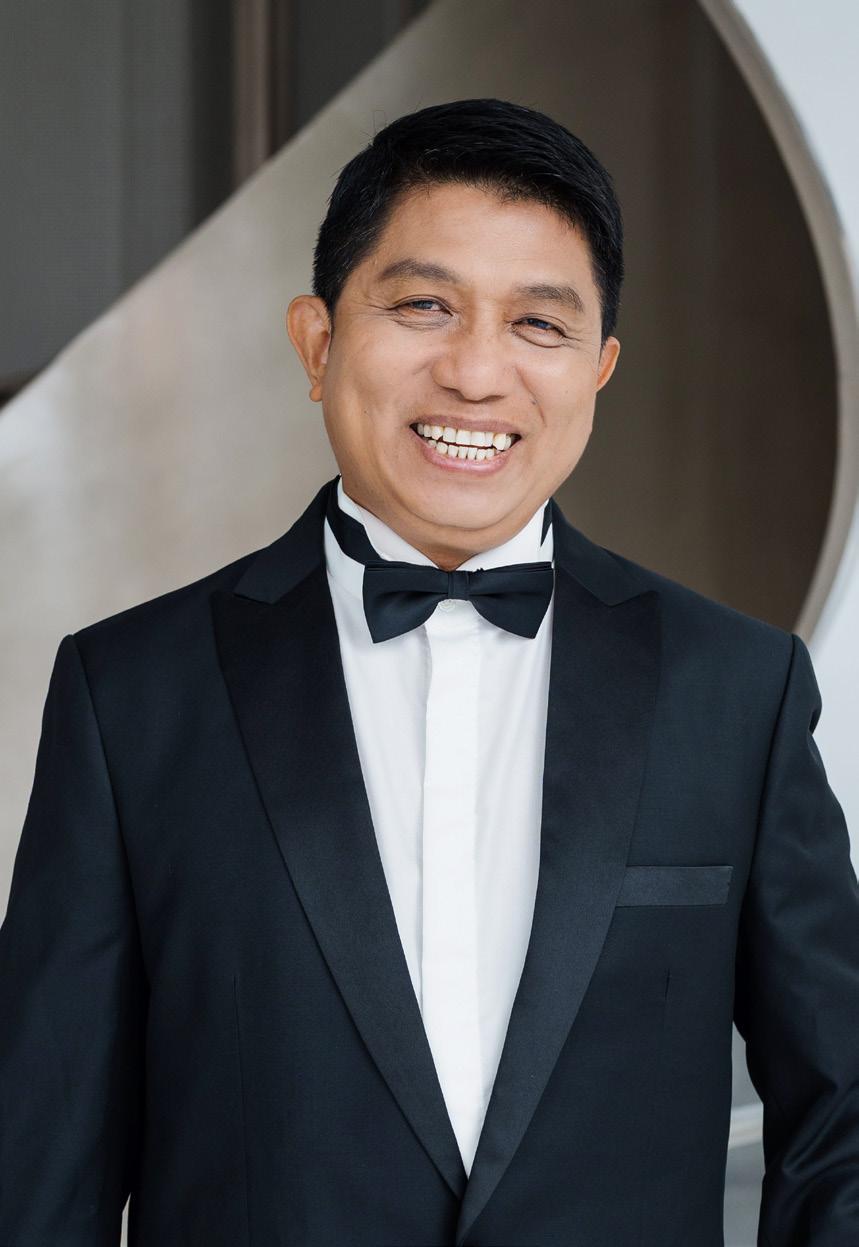
Eudenice Palaruan studied at the University of the Philippines College of Music, majoring in composition and choral conducting. He took further training in choral conducting at the Berliner Kirchenmusikschule, Germany. He graduated doctor of musical arts at St. Paul University Manila.
He was a singer, resident composer/arranger, and assistant choirmaster of the Philippine Madrigal Singers. In addition, he performed with the Berlin Spandauer Kantorei, the World Youth Choir, and sang countertenor with the Berlin Monteverdichor.
In addition, he was the principal conductor of the San Miguel Master Chorale. For years, he has been the resident conductor of the International Bamboo Organ Festival, where he performed and recorded significant selections of Latin-American baroque music. With his active involvement in the choralization of Philippine and other Asian indigenous music, he premiered a substantial volume of new Asian choral works. In addition, he was often invited to give lectures on non-Western vocal aesthetics.
Eudenice also arranges for the SSO choruses and the SSC community outreach programmes. In addition, the SSO choruses have premiered new choral works written by local composers and arrangers in Singapore under his direction.
He taught composition and choral conducting in institutions such as the University of the Philippines College of Music, the Asian Institute for Liturgy and Music, and St. Paul University College of Music and the Performing Arts. In addition, he teaches at the Singapore Bible College School of Church Music and directs the SBC Chorale. Eudenice is often invited to adjudicate in international composition competitions and give masterclasses in choral conducting.
Eudenice Palaruan
Choral Director
Wong Lai Foon
Choirmaster
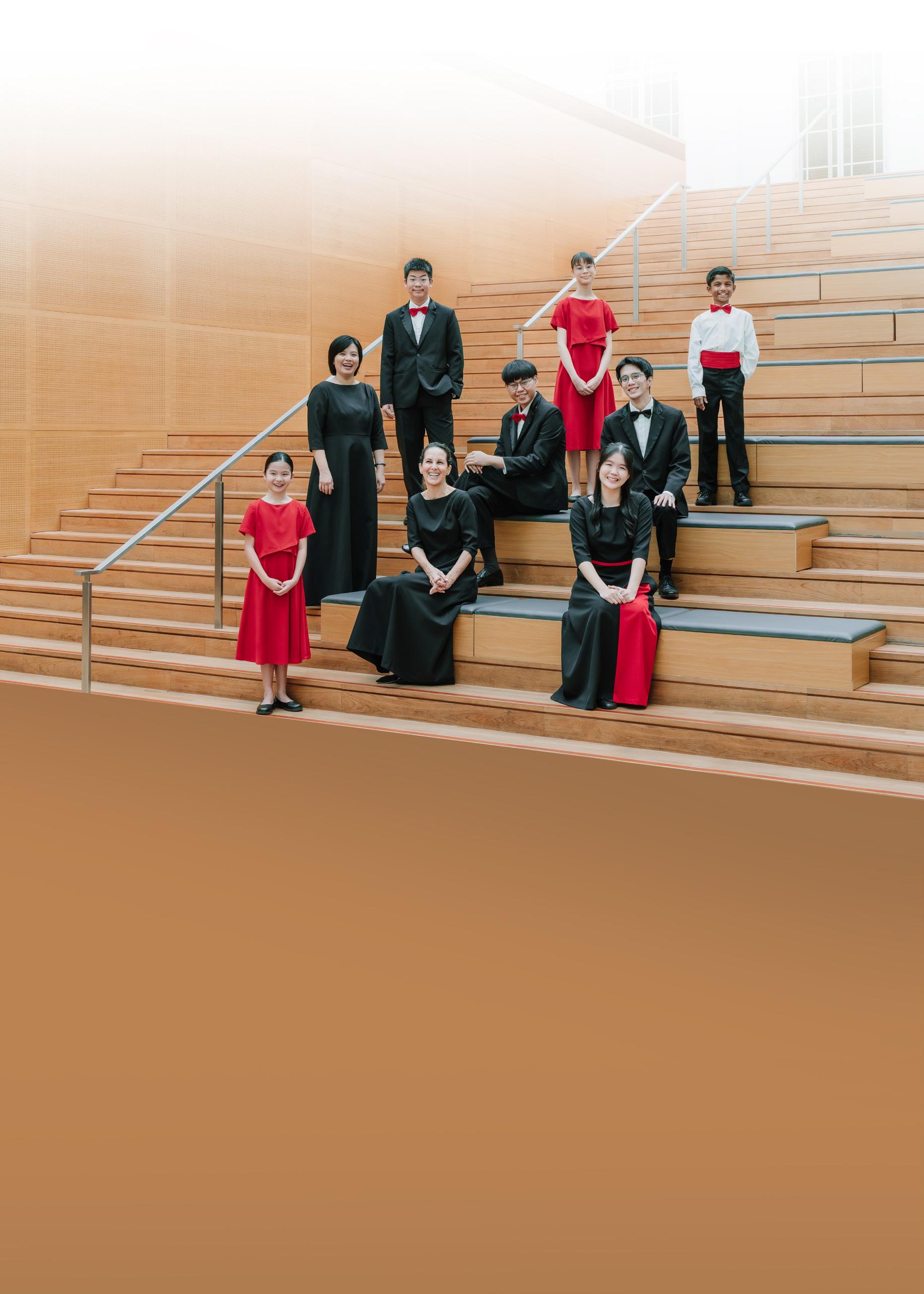
Wong Lai Foon has been a driving force behind the development and growth of the Singapore Symphony Children’s Choir (SSCC) since its inception in 2006. Appointed Choirmaster in 2015 and armed with a mission to nurture young voices and inspire choral excellence, she led in the expansion of the SSCC’s training programme to include six preparatory ensembles, as well as the formation of the Singapore Symphony Youth Choir in 2016.
With repertoire ranging from Baroque to opera to contemporary and popular music, she has directed the SSCC and SSYC in a wide array of concerts, often receiving praise for the choirs’ beautiful tone and sensitivity. She has prepared the choirs in collaborations with renowned conductors and performers such as Stephen Layton, The King’s Singers, and Sofi Jeanin and la Maîtrise de Radio France. The SSCC has also had the distinction of being invited to perform at state functions.
Wong has commissioned and premiered treble choir works by local composers and has also arranged for the SSCC and SSYC. Her efforts to educate and inspire singers extend into the community through workshops, talks, as well as adjudicator, chorus-master and guestconductor roles. Some ensembles that she has worked with include The Philharmonic Chamber Choir, Singapore Symphony Chorus, Singapore Lyric Opera, Hallelujah Singers, and Methodist Festival Choir. She holds a master’s degree in choral conducting from Westminster Choir College, USA.
Singapore Symphony Chorus
Celebrating Choral Excellence
Eudenice Palaruan Choral Director
Ellissa Sayampanathan Assistant Choral Conductor
Ng Sheh Feng Choral Associate
Wong Yang Kai Choral Associate
Shane Thio rehearsal pianist
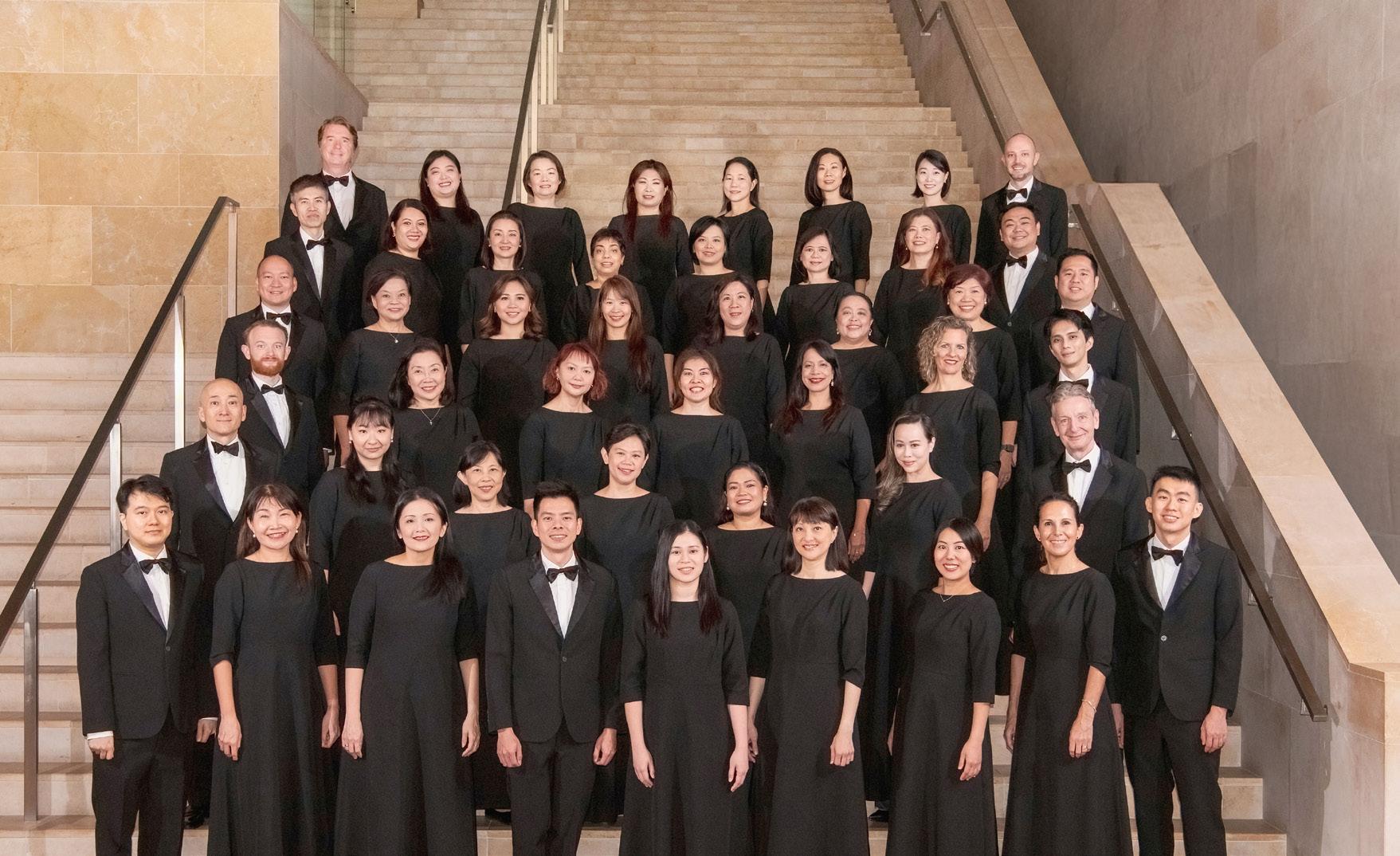
For 45 years, the Singapore Symphony Chorus (SSC) has brought together passionate choristers from varied backgrounds to create stirring symphonic music that transcends language and culture. More than a choir, the SSC is a vibrant community where lasting bonds are forged beyond the stage.
Committed to artistic excellence, its dedicated members rehearse weekly, performing at celebrated venues like the Esplanade and Victoria Concert Halls. Under the baton of world-class conductors such as Okko Kamu, Lan Shui, Lim Yau, Masaaki Suzuki, and Sofi Jeannin, the SSC has built a rich repertoire featuring masterpieces like Tippett’s A Child of Our Time, Arvo Pärt’s Te Deum, Britten’s War Requiem, and Bach’s St John Passion
The chorus’s unwavering dedication to delivering outstanding performances makes the SSC a leading choral ensemble – a shining example of music’s power to unite people across generations and cultures.
JACK YAM
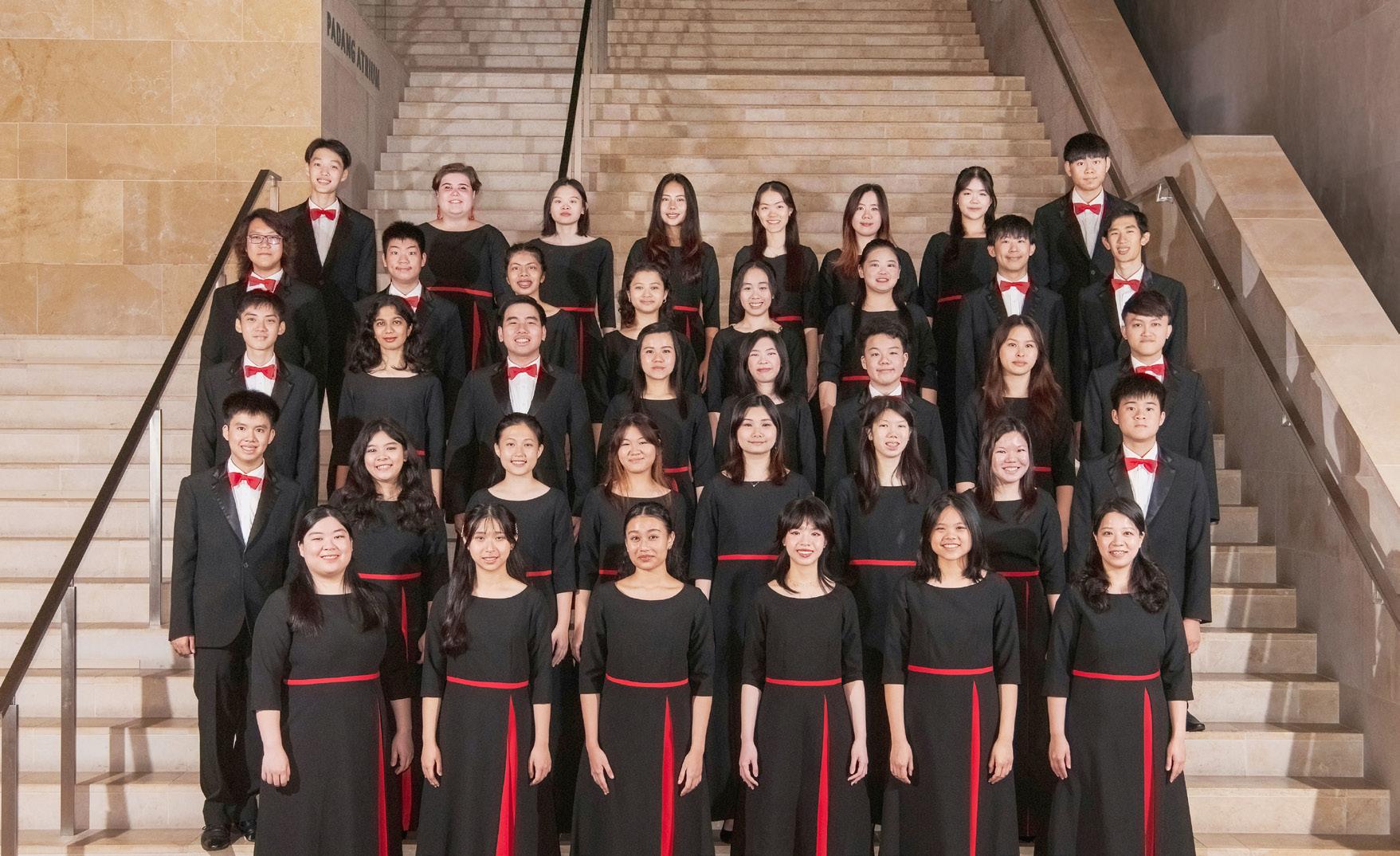
Bursting with energy and passion, the Singapore Symphony Youth Choir (SSYC) is a lively group aged 17 to 28, who thrive on breaking artistic boundaries and growing as one. Beyond making harmonies, the SSYC is a buzzing community where young voices come together to dive into symphonic choral adventures with the national orchestra.
Performing regularly at the Esplanade and Victoria Concert Halls, the SSYC tackles some of the most exciting and challenging choral works across diverse styles and genres. The SSYC regularly collaborates with visionary conductors including Lan Shui, Hans Graf, and Stephen Layton. Their impressive repertoire features highlights like Scriabin’s Prometheus, Puccini’s La Bohème, Tallis’s Why Fumeth in Fight, and Faure’s Requiem, along with recordings of Borodin’s Polovtsian Dances and Mahler’s Symphony No. 2.
The SSYC offers an unparalleled chance to learn and create memories with the seasoned professionals – setting the stage for the future of symphonic choral music.
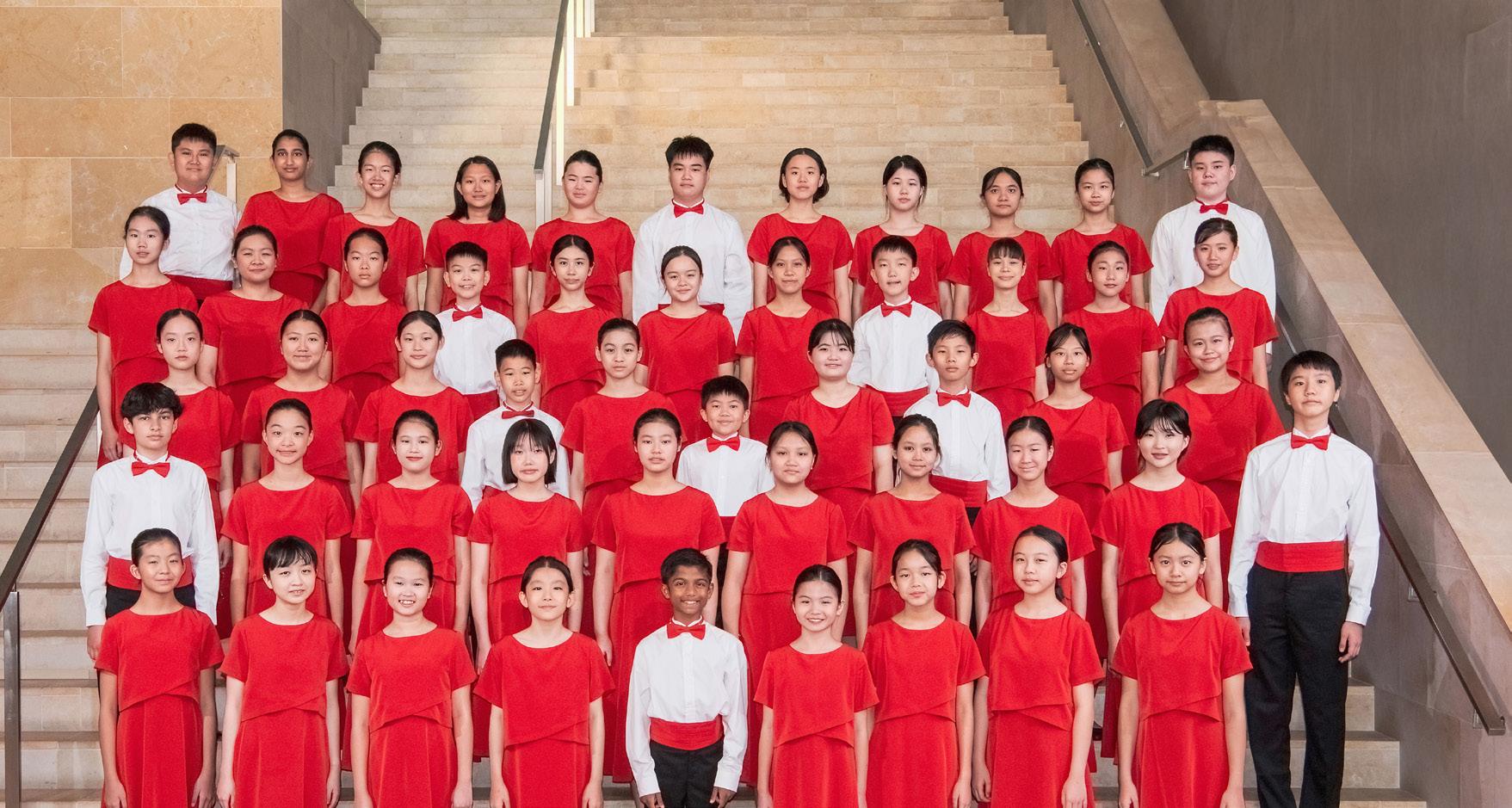
The Singapore Symphony Children’s Choir (SSCC) offers young voices a thrilling gateway into the world of professional music-making. Singing alongside the Singapore Symphony Orchestra and renowned conductors, children discover not only the joy of performance but the discipline, confidence, and creativity that come with it.
Through its nurturing environment, the SSCC develops young children both musically and personally. It’s a space where artistry, friendship, and deep love for music come to life in every rehearsal and performance. Based at the Victoria Concert Hall, the choir has performed under the direction of esteemed conductors like Lim Yau, Sofi Jeannin, FrançoisXavier Roth, and Stephen Layton, and has shared the stage with The King’s Singers.
The SSCC’s impact extends beyond the concert hall, with appearances at national events and international collaborations in Paris and Kuala Lumpur, championing local music by commissioning works from Singaporean composers including Darius Lim, Zechariah Goh and Kelly Tang. Passionate, polished, and proudly Singaporean, the SSCC is shaping the next generation of choral excellence.
SINGAPORE SYMPHONY CHORUSES Delivering choral excellence since 1980
A premier body for classical choral singing, the Singapore Symphony Choruses comprise the Singapore Symphony Chorus, Singapore Symphony Youth Choir and Singapore Symphony Children’s Choir.
Drawing membership from diverse ages, nationalities and walks of life, our Choruses embody a comprehensive singing ecosystem that nurtures the brilliance of our brightest young talents, inspires youthful passion for the art and celebrates the best of choral excellence!
Scan the QR code and visit our website for more details on audition and training opportunities.
@sgsymphonychoruses
The Choruses
Temasek Foundation × SSO Christmas Concert
12 & 13 Dec 2025
Singapore Symphony Chorus
Soprano
Karen Aw
Josephine Budiana
Janice Chee
Alexis Chen
Chia Gin Gin
Elizabeth Daniel
Julie Demange Wodtke
Grace Goh
Vivien Heng
Kaitlyn Kim
Selina Kwek
Rachel Lam
Sun Lee
Jacqueline Liew
Aidah Lim
Liang Xinyu
Lin Wei
Ng Bee Kay
Ng Wing Kei Tracy
Shireen Sanbhnani
Sarah Santhana
Bessie Segarra
Andrea Yenny Sjah
Nelia Soelistia
Stacey Wang Espera
Vivienne Tan
Sarah Tang
Sachiko Tomimori
Gladys Torrado
Wang Yu-Ann
Alto
Grace Angel
Chan Mei Yoke
Joy Chen
Chng Xin Bei
Marie Amelie McKeand
Joanna Deakin
Dieh Xin Xin
Truly Hutapea
Susan Kurniawati
Dorothy Lee-Teh
Wendy Lim
Shoumin Low
Sharon Low
H. Debbie Min
Sylwia Mirucka
Ng Beng Choo
Ng Sheh Feng*
Natividad Solaguren
Ena Su
Ratna Sutantio
Elsie Tan
Tan Seow Yen
Rina Ushioda
Wang Jiunwen
Nadine Yap
Elizabeth Yeo
Tenor
Jean-Michel Bardin
Chong Wei Sheng
Ivan De Jesus
Jonathan Halliwell
Adrian Lim
Elton Lin
Jeroven Marquez
Ronald Ooi
Samuel Pažický
Rac Roldan
Ian Tan
Ben Wong
Yek Kwan Bass
Ang Jian Zhong
Craig Chambers
Arthur Davis
Andy Jatmiko
Ethan Jerzak
Paul Kitamura
Justin Lee
Andrew Ng
Yen Phang
Teo Siak Hian
Michael Walsh
Wong Hin Yan
Wong Yang Kai*
*Choral Associate
Singapore Symphony Youth Choir
Soprano
Cham Li Teng
Halyn Cho
Goh Chen Xi
Jocelyne Harefa
Emily Hia
Rachael Jong
Laura Lee
Emma Lee-Goh
Melina Leong
Giselle Lim
Ng Yi Poh
Teryn Rim
Desiree Seng
Samyukta Sounderamann
Carine Tan
Christabelle Tan
Tan Caewyn
Janelle Tan
Naddy Teo
Jasmine Towndrow
Raeanne Wong
Shuwen
Chloe Zhou
Alto
Megan Fung
Elizabeth Goh
Trinetra Kumarasan
Zoe Li
Zachary Lim
Ong Sherlyn
Suri Rao
Emily Tan
Tan Yuqing
Tan Yulin
Tenor
Andre Ang
Cris Bautro
Hann Lyang
Alfonso Yuji Cortez
Jayden Moktan
Oscar Ociepka
Amos Pan
Seifer Ong
Stanley Yuan Chenye
Singapore Symphony Children’s Choir
Laurel Ang
Adele Chan
Lisa Chang
Samuel Chen
Elizabeth Chern
Paul Chong
Choo Yu En
Chua Jia Le
Deng Handing
Fu Yuqi
Graciella Gunawan
Nadia Hajadi
Callie Heng
Cloris Ho
Joshika Kandasamy
Ropheka Khoo
Giselle Koh
Kok Xiu Yin
Athena Kong
Lucas Lee
Leong Zee Yen
Liew Ying En
Hebe Lim
Stephanie Lim
Eyzen Lim
Lu Yiche
Emma Mok
Lei Nakayasu
Ng Le Xi
Riann Ong
Ong Sze Ying
Pan Yueling
Marie Phua
Kaeshav Rajasekaran
Genevieve Seow
Siew Lok Yan
Allysa Tan
Ashley Tan
Brandon Tan
Caitlin Tan
Michael Tan
Gwynever Tanan
Bass
Leonard Buescher
Bryan Carmichael
Chai Chang Kai
Matthew Chiang
Liu Felix
Loy Sheng Rui
Tan Hee
Joshua Tan
Dominic Tang
Wong Zhen Wei
Yuna Tano
Shania Tay
Germaine Teo
Xavier Tng
Mika Tobita
Rosie Tu
Julian Werstuik
Caresse Wisantoso
Joelle Wong
Joylene Wongso
Joyce Wu
Gracie Xie
Jessica Xu
Evelyn Xue
Yan Xinni
Yan Yichen
Cammi Yeo
Yu Rahee
Felix Zhang
Zhang Kangni
Hans Graf conductor
Quantedge Music Director, Singapore Symphony Orchestra
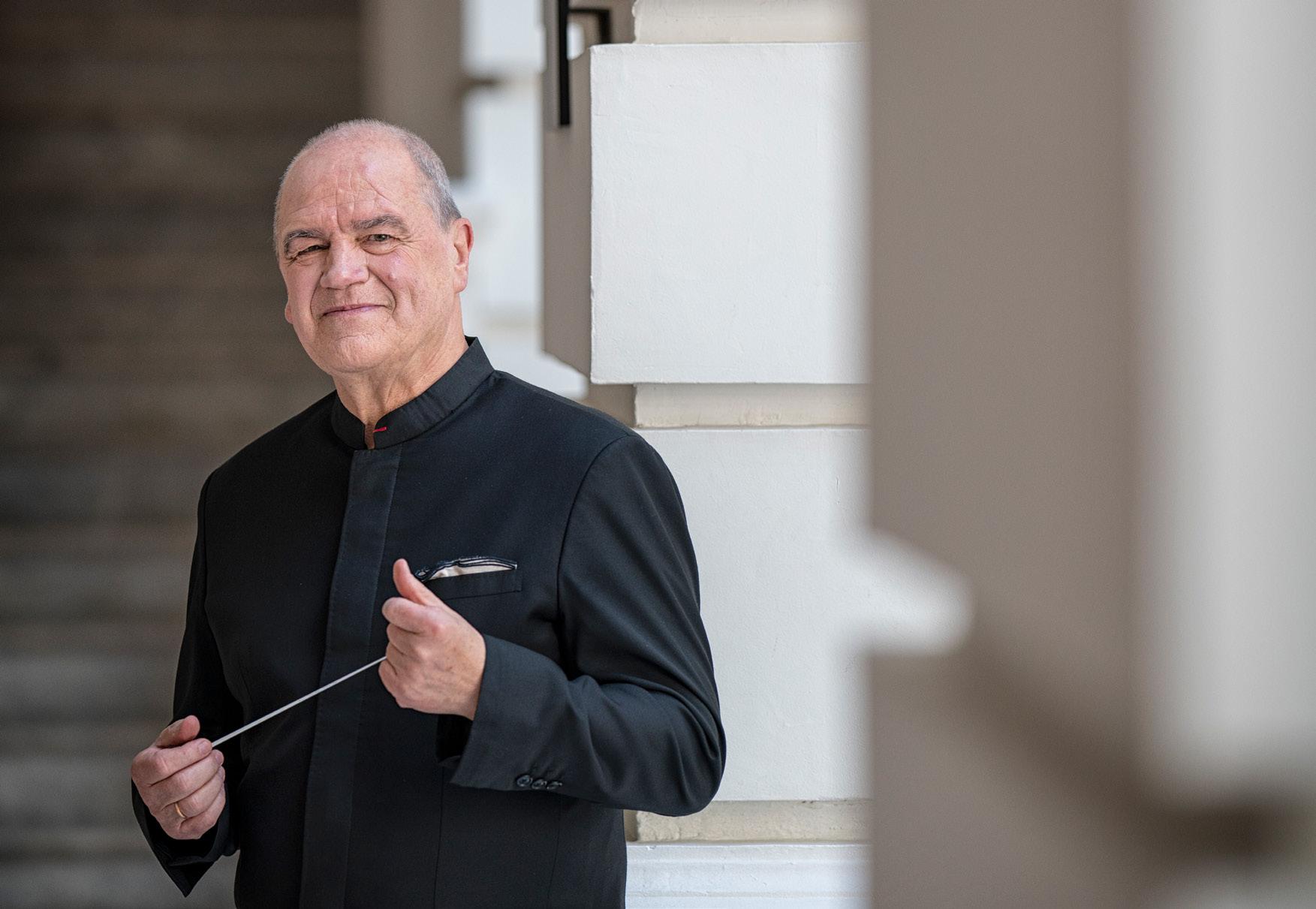
Armed with a spirit of musical curiosity and discovery, creative programming and his commanding presence on stage, Austrian conductor Hans Graf has raised orchestras to new heights while winning audiences young and old alike. With Hans Graf, the Singapore Symphony Orchestra (SSO) has achieved “a brave new world of music-making under inspired direction” (The Straits Times) since his appointment as Chief Conductor in the 2020/21 season, followed by five outstanding seasons as Music Director. Hans Graf’s farewell season in 2025/26 celebrates his remarkable achievements with his being named the SSO’s first Quantedge Music Director.
Graf was formerly Music Director of the Houston Symphony, Calgary Philharmonic, Orchestre National Bordeaux Aquitaine, Basque National Orchestra and Mozarteum
Orchestra Salzburg. He is a frequent guest with major orchestras and opera houses worldwide, receiving the Österreichischer Musiktheaterpreis award at the famed Vienna Volksoper in 2014.
Hans Graf’s discography includes extensive surveys of Mozart, Schubert and Dutilleux, as well as a GRAMMY and ECHO Klassik award-winning recording of Berg’s Wozzeck With the Singapore Symphony, Graf has recorded works by Paul von Klenau, Mozart, Stravinsky and his own edition of Kozłowski’s Requiem.
Hans Graf is Professor Emeritus at the Universität Mozarteum, Salzburg, and a recipient of the Chevalier de l'Ordre de la Légion d’Honneur (France) and the Grand Decoration of Honour (Austria).
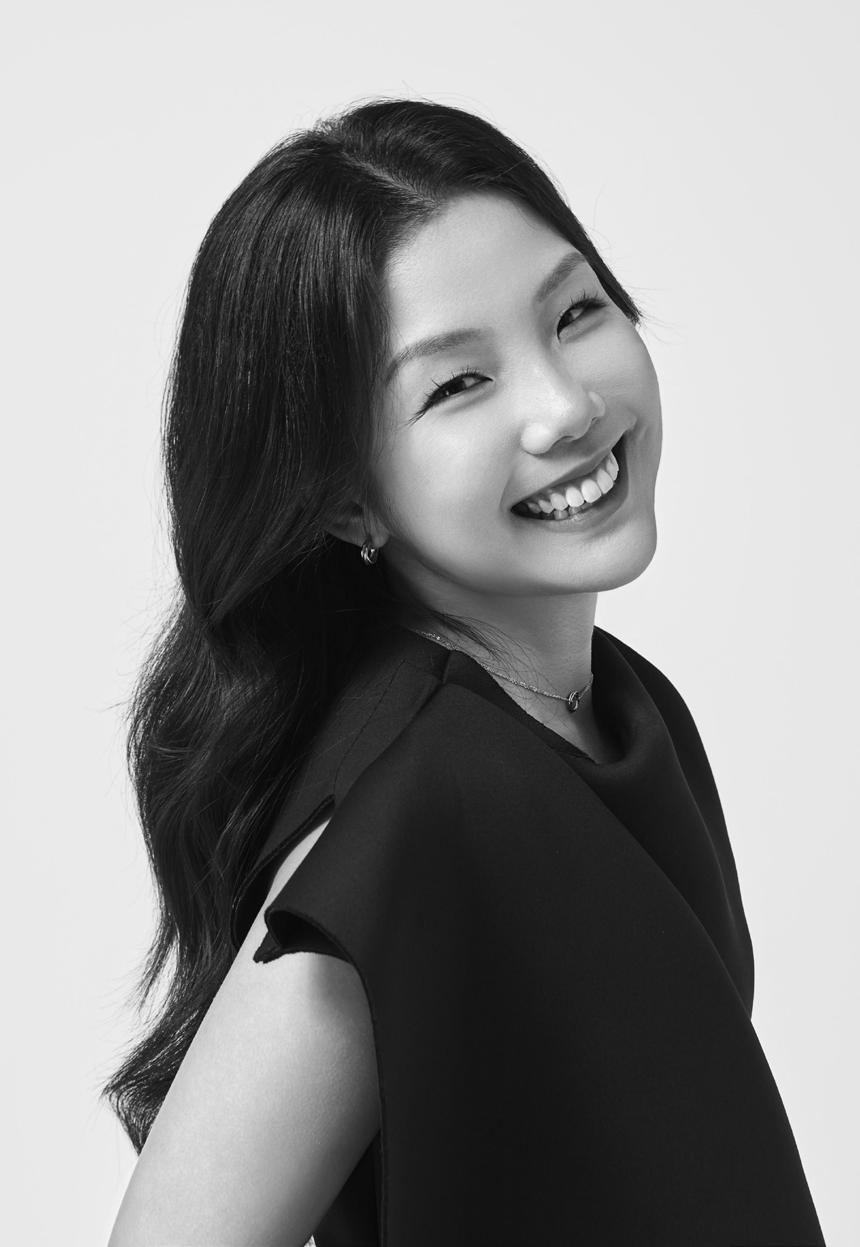
Churen Li is a pianist whose work bridges classical music and contemporary innovation, creating immersive, boundary-defying experiences. Hailed by The Straits Times as “the closest thing I know to be the ‘complete’ pianist” in Singapore, she performs both standard repertoire and her own compositions and improvisations. In 2025, she was featured as a soloist in Singapore’s SG60 National Day Parade.
She opened the Singapore Symphony Orchestra’s 2022/23 season with Grieg’s Piano Concerto under Han-Na Chang. A prizewinner at numerous international competitions, she has performed with orchestras including the Singapore Symphony Orchestra, Cambridge University Orchestra, Klassische Budapest Philharmonic, Ding Yi Music Company, Metropolitan Festival Orchestra Singapore, and Mikhail Jora Philharmonic of Bacau. She has also performed at international festivals such as the Charleston Festival, Singapore International Festival of Arts, Singapore International Piano Festival, Darmstadt International Music Festival, Aspen, Norfolk, and Four Seasons Festivals, among others.
Churen currently teaches at the Yong Siew Toh Conservatory of Music as Artist Faculty and was previously a faculty member at Hong Kong Baptist University and Yale-NUS College. Deeply passionate about community engagement, she founded Classical Music Adventures, a quarterly series of interactive classical music concerts in community venues, now in its third year.
Graduating at 19 with a Bachelor’s degree from the Yong Siew Toh Conservatory of Music (National University of Singapore) as the youngest in her cohort, Churen later obtained a Master of Music from Yale School of Music and a Master of Philosophy in Music from Cambridge University. Her past teachers include Albert Tiu, Bernard Lanskey, Paul Liang, Peter Frankl, and Hung-Kuan Chen.
Churen Li piano
Temasek Foundation × SSO Christmas Concert
Fri & Sat, 12 & 13 Dec 2025
Esplanade Concert Hall
Singapore Symphony Orchestra
Singapore Symphony Chorus
Singapore Symphony Youth Choir
Singapore Symphony Children's Choir
Joshua Tan conductor
Eudenice Palaruan Choral Director
Wong Lai Foon Choirmaster
Kong Zhao Hui Associate Concertmaster
Presented by
Supported by Kris Foundation
Concert Duration: approximately 1 hr 40 mins (including 20 mins intermission)
Post-Concert Survey (13 Dec only)
To help us improve your concert experience, we invite you to participate in our survey. After the concert, be the first 120 to show proof of survey completion at the foyer, level 1, to receive a gift.
Check-in to tonight’s concert
Scan this QR code with the Singapore Symphony Mobile App.
Christmas is a time of good cheer, feasting, music, gatherings with loved ones, religious observance, reflection—things it shares with many other seasons and festivals—but there is one thing about the modern celebration of Christmas that is unique to it: the Christmas carol. Nothing evokes Christmas feeling quite like the sound of Christmas carols above the bustling activities of life, but how did this all happen?
The earliest music associated with Christmas was, of course, music sung during the church services. These ethereal hymns and chants focused on doctrinal and theological statements, and were written in Latin. Most laymen did not know Latin and hence this repertoire remained the preserve of professional chanters and choirs. Slowly, a parallel genre grew up: music, sometimes in Latin, but more often in the vernacular, in rhyming stanzas, with catchy melodies. Thus was born the Christmas carol! These vernacular songs not only praised God and made statements of faith, but also mentioned more mortal concerns and details of daily life during the festivals. Carols existed for many occasions, such as Easter, Corpus Christi, Pentecost, Lent, and the feast days of various saints, and these works survive, but after the 1500s the only festival in the Western world that still retains a tradition of carol-singing is Christmas.
The 19th century saw the beginnings of a sort of Christmas carol that was largely secular in nature—Jingle Bells, Deck the Halls, and Here We Come A-Wassailing being prime examples. As the 20th century progressed, Christmas became more than simply a Christian religious festival. Particularly in the cultural melting pot of the USA, where Catholics, Protestants, and Orthodox mixed freely, even non-Christian minorities, such as Jews, began celebrating
the season in a secular way, as much for social reasons as for business reasons. As a result, Christmas became a cultural phenomenon that embraced all and sundry—it is worth remembering that White Christmas, a quintessential jazzy seasonal classic, was written by Irving Berlin, a Jewish composer! The Christmas Song (Chestnuts Roasting on an Open Fire) was written by Mel Tormé, likewise also of Jewish heritage. Many secular Christmas favourites come from the mid-20th century Jazz age: Rudolph the Red-Nosed Reindeer, Let It Snow! Let It Snow! Let It Snow!, and others.
Around the same time, Katherine Davis gave us Little Drummer Boy, about a poor boy playing his drum for the Virgin Mary and Christ Child. This song was recorded and popularised by the von Trapp Family singers (of The Sound of Music fame), and much later inspired Robert Wendel to combine it with the rhythm part
of Ravel’s Bolero, giving us the delightful crossover Little Bolero Boy.
An interesting phenomenon is how Christmas has tended to ‘absorb’ music from neighbouring festivals. Leroy Anderson’s Sleigh Ride was originally intended as a generic evocation of a sleigh ride and other winter activities. Jingle Bells was originally intended for Thanksgiving, and Leontovych’s Carol of the Bells was originally for Epiphany (the 12th day of Christmas). Tchaikovsky’s The Nutcracker likewise has been absorbed. Through the decades, singers and bands have issued special Christmas albums and film studios have released films that immediately became Christmas classics (e.g. Home Alone, Die Hard, Miracle on 34th Street, The Nightmare Before Christmas, Gremlins etc.). Music from those albums and films thus also became associated with Christmas, making for an ever-expanding canon.
Nevertheless, all through this period, religious carols continued to be written and sung, and many of the most popular Christmas carols date from this period. Silent Night (German: Stille Nacht) was written and performed at Christmas midnight mass in 1818 because the church organ was broken. Neither Fr. Joseph Mohr, who wrote the lyrics, nor the organist Franz Xaver Gruber, who wrote the melody, would have ever imagined it would become one of the most beloved carols, known around the world.
Modern audiences may be surprised to hear modern Christmas songs such as Let it Snow! Let it Snow! Let It Snow! arranged for chorus and orchestra, but this is actually part of a long tradition. Many secular Christmas songs first appeared in the 1940s and 1950s in richly scored versions that featured
full choir and orchestra in addition to the soloists.
We Wish You A Merry Christmas dates from 16th century England, but the sentiment it expresses has ensured its lasting popularity to the present day, and despite the many developments over the centuries, the current tradition of ending a set of Christmas music with seems to be here to stay.
Notes by Edward C. Yong | A writer, editor, and teacher of dead languages, Edward plays lute and early guitars, sings bass, and runs an early music group. Like his dog, he is very much food-motivated.
Three Holiday Songs from Home Alone
1 Somewhere In My Memory
2 Star of Bethlehem
3 Merry Christmas, Merry Christmas
Somewhere In My Memory
Candles in the window, Shadows painting the ceiling, Gazing at the fire glow, Feeling that gingerbread feeling. Precious moments, Special people, Happy faces I can see.
Somewhere in my mem’ry, Christmas joys all around me.
Living in my mem’ry, All of the music, All of the magic, All of the fam’ly home here with me.
Star of Bethlehem
Star of Bethlehem, shining bright, Bathing the world in heav’nly light, Let the glow of your distant glory Fill us with hope this Christmas night.
Star of innocence, Star of goodness, Gazing down since time began, You who’ve lived through endless ages, View with love the age of man.
Star of beauty, hear our plea, Whisper your wisdom tenderly. Star of Bethlehem, set us free, Make us a world we long to see.
Star of Bethlehem, Star on high, Miracle of the midnight sky, Let your luminous light from heaven Enter our hearts and make us fly.
Star of happiness, Star of wonder, You see everything from afar. Cast your eye upon the future, Make us wiser than we are.
Star of gentleness, hear our plea, Whisper your wisdom tenderly. Star of Bethlehem, set us free, Make us a world we long to see.
Merry Christmas, Merry Christmas
Merry Christmas! Merry Christmas!
Sing a song for the glorious season!
Merry Christmas! Merry Christmas!
Sing a song for a Happy New Year!
Sing verily, merrily loud and strong!
Welcome the wintery season!
Just follow along with a holiday song, Santa is here again, yes!
Merry Christmas! Merry Christmas!
Sing a song for the glorious season!
Merry Christmas! Merry Christmas!
Sing a song for a Happy New Year!
Now reindeer fly, if you need any proof, It's merely a matter of reason.
Just listen you’ll hear when they land on the roof, Santa is here again, yes!
Merry Christmas! Merry Christmas!
Sing a song for the glorious season!
Merry Christmas! Merry Christmas!
Sing a song for a Happy New Year!
Merry Christmas! Merry Christmas!
Sing a song for the obvious reason!
Merry Christmas! Merry Christmas!
It’s a magical, lyrical, annual, miracle, Sing it out loud, sing a song for a Happy New Year!
Let It Snow! Let It Snow! Let It Snow! Oh the weather outside is frightful, But the fire is so delightful. And since we’ve no place to go, Let it snow! Let it snow! Let it snow!
It doesn’t show signs of stopping, And I bought some corn for popping. The lights are turned way down low, Let it snow! Let it snow! Let it snow!
When we finally kiss goodnight, How I’ll hate going out in the storm. But if you really hold me tight, All the way home I’ll be warm.
The fire is slowly dying, And, my dear, we’re still goodbyeing. But as long as you love me so, Let it snow! Let it snow! Let it snow!
Silent Night
Silent night, holy night, All is calm, all is bright. Round yon Virgin mother and child, Holy infant so tender and mild. Sleep in heavenly peace, Sleep in heavenly peace.
Silent night, holy night, Shepherds first saw the sight. Glories stream from heaven afar, Heav’nly hosts sing alleluia.
Christ the Saviour is born, Christ, the Saviour is born.
Silent night, holy night, Son of God, love’s pure light. Radiance beams from thy holy face, With the dawn of redeeming grace, Jesus, Lord, at thy birth, Jesus, Lord, at thy birth.
Holiday Moods
1 Deck the Halls
2 O Christmas Tree
3 Here We Come A-Wassailing
Deck the Halls
Deck the halls with boughs of holly, Fa-la-la-la-la, la-la-la-la.
’Tis the season to be jolly, Fa-la-la-la-la, la-la-la-la.
Don we now our gay apparel, Fa-la-la, la-la-la, la-la-la. Troll the ancient Yule-tide carol, Fa-la-la-la-la, la-la-la-la.
See the blazing Yule before us, Fa-la-la-la-la, la-la-la-la.
Strike the harp and join the chorus, Fa-la-la-la-la, la-la-la-la.
Follow me in merry measure, Fa-la-la, la-la-la, la-la-la.
While I tell of Yule-tide treasure, Fa-la-la-la-la, la-la-la-la.
O Christmas Tree
O Christmas tree, O Christmas tree, O tree of green, unchanging.
O Christmas tree, O Christmas tree, You set my heart a singing. Your boughs so green in summertime, Do brave the snow of wintertime.
O Christmas tree, O Christmas tree, O tree of green, unchanging.
O Christmas tree, O Christmas tree, You come from God, eternal.
O Christmas tree, O Christmas tree, You speak of God, unchanging.
Like little stars, your candles bright, Send to the world a wond’rous light.
O Christmas tree, O Christmas tree, You set my heart a singing.
4 Carol of the Bells
5 Jingle Bells
Here We Come A-Wassailing
Here we come a-wassailing Among the leaves so green, Here we come a-wandering, So fair to be seen.
Love and joy come to you, And to you your wassail too. And God bless you and send you A Happy New Year, And God send you a Happy New Year.
And all your kin and kinsfolk
That dwell both far and near, We wish a Merry Christmas And Happy New Year.
Love and joy come to you, And to you your wassail too. And God bless you and send you
A Happy New Year, And God send you a Happy New Year.
Jingle Bells
Dashing through the snow
In a one horse open sleigh; O’er the fields we go
Laughing all the way. Bells on bobtail ring
Making spirits bright; What fun it is to ride and sing
A sleighing song tonight.
Jingle bells, jingle bells, Jingle all the way.
Oh what fun it is to ride in a One horse open sleigh!
Jingle bells, jingle bells, Jingle all the way.
Oh what fun it is to ride in a One Horse open sleigh!
We Wish You A Merry Christmas We wish you a Merry Christmas, We wish you a Merry Christmas, We wish you a Merry Christmas, and a Happy New Year!
Good tidings to you wherever you are, Good tidings for Christmas and a Happy New Year.
Hans Graf & Churen Li
Fri, 19 Dec 2025
Esplanade Concert Hall
Singapore Symphony Orchestra
Hans Graf Quantedge Music Director
Churen Li piano*
David Coucheron
Co-Principal Guest Concertmaster
Check-in to tonight’s concert Scan this QR code with the Singapore Symphony Mobile App.
Glinka
Valse-fantasie
6 mins
Jonathan Shin
child of the shore – Concerto for Piano and Orchestra* With support from Vanessa & Darren Iloste
23 mins
Intermission
20 mins
Shostakovich
Symphony No. 10 in E minor, Op. 93
57 mins
Concert Duration: approximately 2 hrs (including 20 mins intermission)
Mikhail Glinka
1804 – 1857
Valse-fantasie (1839)
Glinka is often regarded as the founding figure of Russian music, a title later affirmed by Tchaikovsky, who remarked that Glinka’s Kamarinskaya (1848) “contained the future of Russian symphonic music as an acorn contains an oak tree”. As early as 1840, Glinka had attempted to write a set of piano variations on the Russian folk tune Kamarinskaya, but he destroyed the draft, calling it rubbish. He returned to the idea in 1848 after noticing that the dance melody resembled a wedding song, From Behind the Mountains, the High Mountains. Kamarinskaya is widely regarded as the first symphonic work based entirely on Russian folk themes.
A decade before Kamarinskaya, Glinka composed his Valse-fantaisie, a work that reveals the influence of Chopin’s grand waltzes, Weber’s Invitation to the Dance (1819), and the waltzes of the Strauss family. Several versions of the Valse-fantaisie exist: the original piano version (1839), an orchestral version for small ensemble that was simply titled Valse (1845), and a final version for large orchestra, retitled Valse-fantaisie to reflect its greater opulence. The fantasy aspect lies not in free improvisation but in Glinka’s fluid, dreamlike treatment of rhythm and colour. Transitions are seamless, with frequent shifts between major and minor that give a sense of emotional ambivalence.
The work exhibits Glinka’s sensitivity to orchestral colour. Rather than developing the melodic material, he chose to vary the
instrumental timbres that surround the recurring theme. This approach to form and texture would become the model for similar waltzes by Tchaikovsky, Glazunov, and RimskyKorsakov, and anticipates the establishment of a lush, Russian national school.
Dedicated to Ekaterina Kern — a woman he admired but who did not return his affection — the piece has often been described as her “portrait in sound”. Its bright, optimistic main theme is carried by upper woodwinds and shimmering strings, while the horns and cellos bring a certain warmth to the texture. Yet an undertone of longing and disillusionment seeps through. In his original piano manuscript, Glinka wrote in the margins: “All I know of love is the pain it causes!”
1839 (solo piano version); 1856 (orchestral version)
Jonathan Shin (b. 1992) performs extensively as a pianist, and composes and improvises across multiple genres and styles. His music has been described as “supremely confident and comfortable in its own skin.” (The Straits Times)
His first commission, the song cycle The Other Merlion and Friends (poems by Gwee Li Sui), was critically reviewed in 2016 as “probably the most compelling and worthwhile new work from any Singaporean composer in recent years.” Since then, his music has been performed internationally and locally, with commissions from the Singapore Symphony Orchestra, Boston Opera Collaborative, the Esplanade, the Orchestra of the Music Makers, and
Jonathan Shin b. 1992
Resound Collective. His affinity for the voice spurred him to compose three chamber operettas in 2020, in collaboration with Ellen Abrams, Felix Cheong, and Theophilus Kwek.
In November 2022, the Singapore Symphony Orchestra and the Singapore Symphony Choral groups premiered his choral symphony Illuminations. His latest foray into the operatic genre is Beacon (libretto by Joel Tan), a commission by The Opera People that will develop over the next two years.
Jonathan holds a Doctorate of Musical Arts from the Peabody Institute. He is currently Artist Faculty at the Yong Siew Toh Conservatory of Music.
child of the shore – Concerto for Piano and Orchestra (2025)
Gerygone
“as she looks out to sea” — after The Great Reclamation Peripheral Joys I II III
When Churen approached me to write a piano concerto, it felt like a natural continuation of our conversation as longtime friends and collaborators. We have between us now half a lifetime of conversations, exchanging of literature, reading duets, improvising, and crucially, performing and listening to the other.
This conversation began with a simple question: “What does the Singaporean piano concerto sound like?” For me, a few years away from the home country sharpened the details of things missed: blue heartland mornings, life suspended in tropical time, the ebb and surf of sea strand. These were easily clouded by everyday busy-ness, unless one was attendant to these magical things in the periphery. child of the shore calls for a return to that awe and wonder with which a child attends to the world.
A birdsong heard from my childhood, a scene from one of my favourite novels, the private experience of the collective morning commute: these phenomena are almost necessarily confined to the periphery of city-existence; in child of the shore, we become attendant to these experiences.
The first movement “Gerygone” takes its theme directly from the birdsong of the goldenbellied gerygone: its cadence is described as “pure, high, clearly whistled, violin-like notes
that descend in an undulating, silvery, sweet cascade, at times lifting briefly, only to resume the downward, tumbling momentum.” Its second subject, played by the oboe, describes the bird’s restless dance among the branches.
The slow middle movement “as she looks out to sea” was inspired by the seaside melancholia and nostalgia of Rachel Heng’s The Great Reclamation. A love song recalling the xinyao style of the 1980s is played unaccompanied by the piano; the flute sings its reply. Crystalline heartbeats accompany a woodwind chorus, until the ebb and flow of the sea’s surf roils into the emotional heart of the movement: a solo cello melody in full lament. This grows in power until the orchestra bursts at its seams, with only the piano and strings left to contemplate the what-might-have-beens of love.
To know a friend for a long time and to be privy to their philosophy and preparation allows for a very intimate knowledge of their pianism. In this way, this concerto was composed with Churen’s pianism very much at the forefront of my mind, with her innate sense of drama beneath an imperious command of technique and craft. I try to capture that through the verve and electricity of the morning commute in “Peripheral Joys”, with Pat Methany-esque voicings and jazz-inspired rhythms.
I am grateful beyond measure to Churen for her belief in my work and for her tireless advocacy for local composers. A special thank you goes to Vanessa and Darren Iloste for supporting the commission for my concerto, the Singapore Symphony Orchestra for commissioning me, and lastly, Seren for being my First Reader and sounding board.
Shostakovich’s creative life was marked by perilous oscillations between state favour and denunciation. His early triumph with Lady Macbeth of the Mtsensk District (1934) — “a model of Soviet achievement” — came to an abrupt end when Pravda published a scathing editorial condemning the opera as “muddle instead of music”. Thus began an era of artistic censure and fear, as composers were ordered to produce music “directly intelligible to the people, expressive of the optimism of the Soviet regime”.
Completed in the immediate aftermath of Stalin’s death, the Tenth marked the longest hiatus between any two of Shostakovich’s symphonies — eight years of humiliation and silence separated it from the Ninth. His Leningrad Symphony (No. 7, 1941) had elevated him to national-hero status, the Eighth (1943) secured his position, but the Ninth (1945) scandalised officialdom. The Soviet public had been primed for a Beethovenian choral Ninth, a triumphant hymn to Stalin and Soviet victory. Instead, Shostakovich delivered what one commentator called “a satirical snub”.
A slow-building landscape, the vast Moderato captures the solitude, grief, and anxiety of Shostakovich’s post-Stalin world. From darkness emerges the low strings, murmuring a longdrawn theme whose first three notes birth the entire symphony. A solo clarinet responds with a fragile counter-voice to the basses’ desolation. As the movement unfolds, the clarinet’s motif becomes the seed of transformation, passed among the woodwinds, then seized by the strings as momentum begins to swell. Shostakovich builds the movement not through contrast but through accretion: layers of sound thickening into a climactic outburst where brass and strings declare the first theme with apocalyptic force. The music collapses into exhaustion, and in its final measures, high flutes and piccolo trace thin lines above tremulous strings and distant timpani.
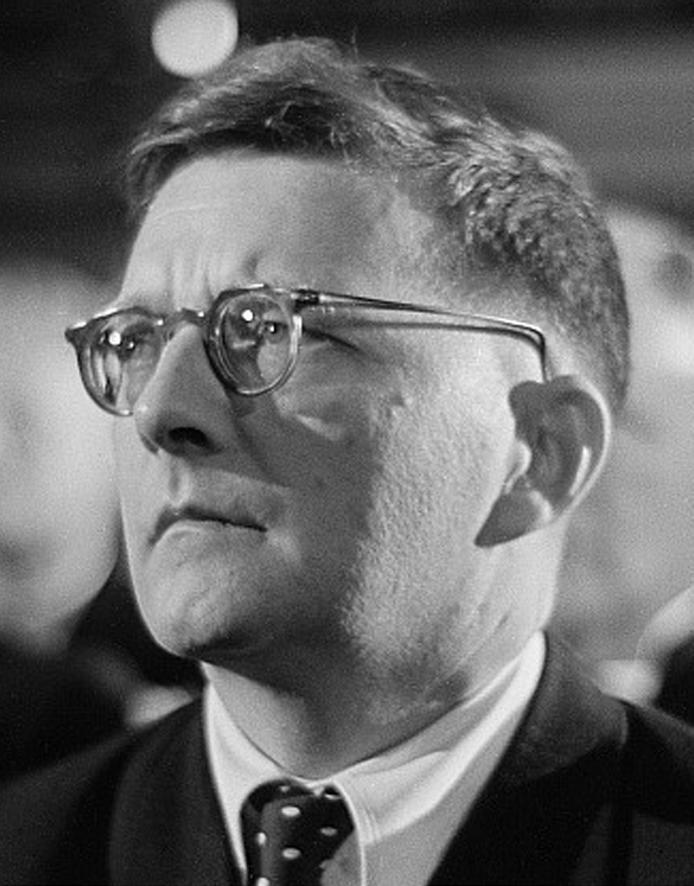
Shostakovich in 1950.
Photo: Deutsche Fotothek (CC BY-SA 3.0 de)
Often interpreted as a portrait of Stalin, the Allegro is four minutes of pure aggression. From its first bars, a terrifying momentum and rhythmic rigidity is set in place by tense, down-bowed strings. Brass and percussion join in with a relentless ostinato. The passage that follows resembles a seething fugato, the upper strings in frantic pursuit of one another while lower strings and woodwinds churn beneath. Even when the orchestral mass subsides, the pulse continues to throb quietly, and the movement ends with a series of explosive chords.
The Allegretto opens with a waltz-like theme in the strings, which might be heard as sardonic in character. A woodwind idea follows; embedded within is Shostakovich’s famous D–E♭–C–B motif (D–S–C–H in German), a cipher of his own name. This self-assertion is intertwined with the ‘Elmira’ horn motif (E–A–E–D–A), referencing pianist Elmira Nazirova, one of his students in the late 1940s, and with whom he had shared an intense correspondence while writing this symphony.
The finale begins with a quiet Andante of lower strings and wind solos. Gradually, a threenote motif shared between clarinet and flute extends into a seven-note figure. With this, the Allegro proceeds with a rustic, playful theme in strings and woodwinds. As the movement unfolds, the D–S–C–H motif returns, now transformed into a symbol of persistence as it is pitted against the ‘Stalin theme’ of the second movement. The music grows in force until the D–S–C–H motif is shouted out by the whole orchestra as it drives towards a majorkey conclusion.
Notes (for Glinka and Shostakovich) by See Ning Hui | See Ning Hui is a pianist, researcher, and educator passionate about integrating underrepresented composers’ music. She is an adjunct lecturer at UAS-NAFA. Upcoming engagements can be found on www.ninghuisee.com.
To Our Donor Patrons
We would like to express our deepest appreciation to the following individuals and organisations who support our mission to create memorable shared experiences with music in the past year. Without your support, it would be impossible for the SSO to continue to strive for artistic excellence and touch the hearts of audiences.
This list reflects donations that were made from 1 Oct 2024 to 30 Sep 2025. We would like to express our sincere thanks to donors whose names were inadvertently left out at print time.
The Singapore Symphony Group is a charity and a not-for-profit organisation. Singapore tax-payers may qualify for 250% tax deduction for donations made. You can support us by donating at www.sso.org.sg/donate or www.giving.sg/sso.
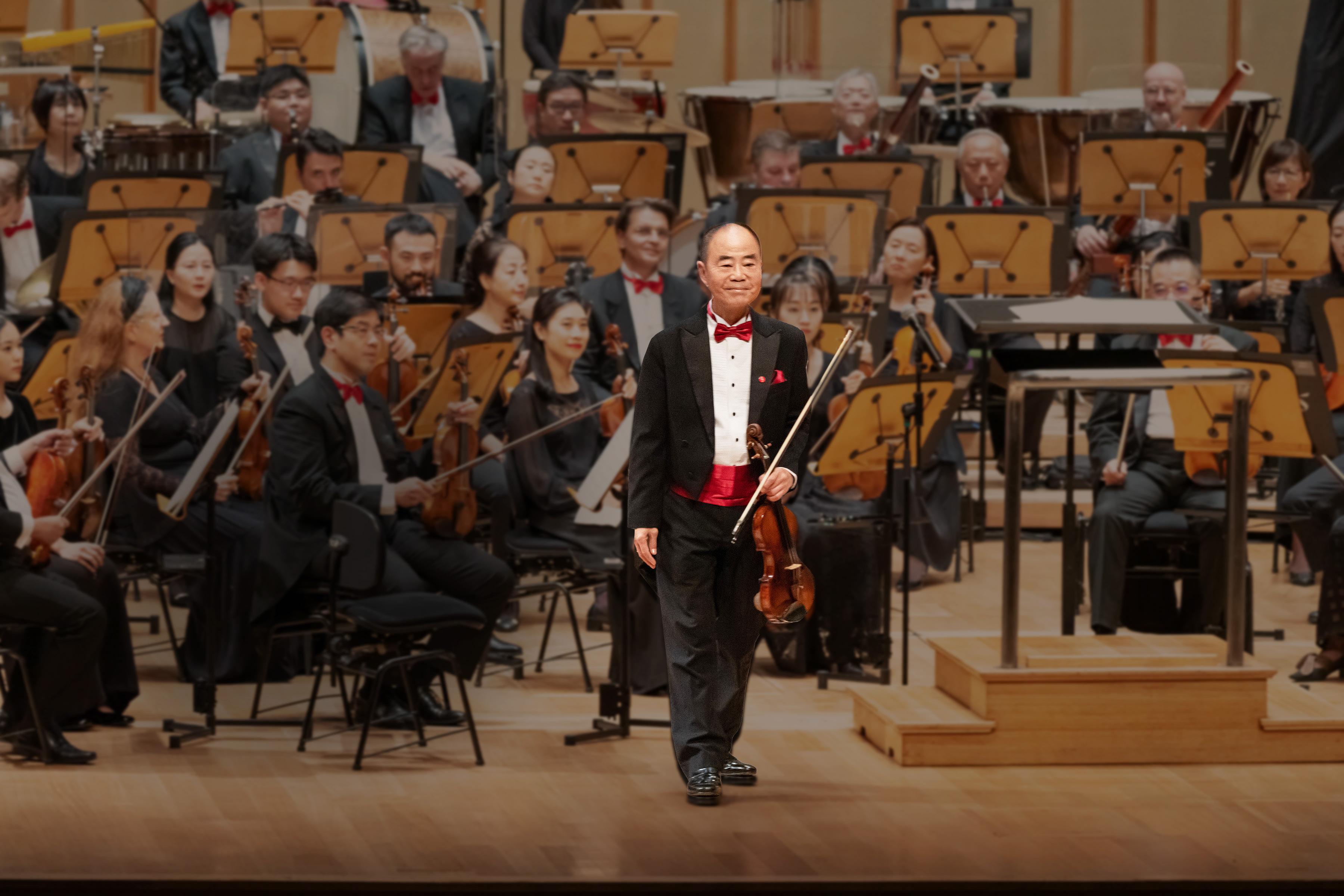
In appreciation of Kong Zhao Hui, Associate Concertmaster
We say a big thank you to Associate Concertmaster Kong Zhao Hui, who retires from the SSO this month after 35 years of service and beautiful music.
From your steady presence in the orchestra to stunning solo performances of Butterfly Lovers, we have been touched by your artistry.
Thank you and happy retirement!
4
As a valued patron of the SSO, you will receive many benefits. How can you help?
While SSO is supported partially by funding from the Singapore government, a significant part can only be unlocked as matching grants when we receive donations from the public. If you are in a position to do so, please consider making a donation to support your orchestra – Build the future by giving in the present.
Corporate Giving
We provide our Corporate Patrons with impressive entertainment and significant branding opportunities. Through our tailored packages, corporates may benefit from:
• Publicity and hospitality opportunities at an SSO concert or your private event,
• Acknowledgement and mentions in SSO’s key publicity channels,
• National Arts Council (NAC) Patron of the Arts nominations,
• Tax benefits.
Packages start at $10,000 and can be tailored to your company’s branding needs.
Partnership
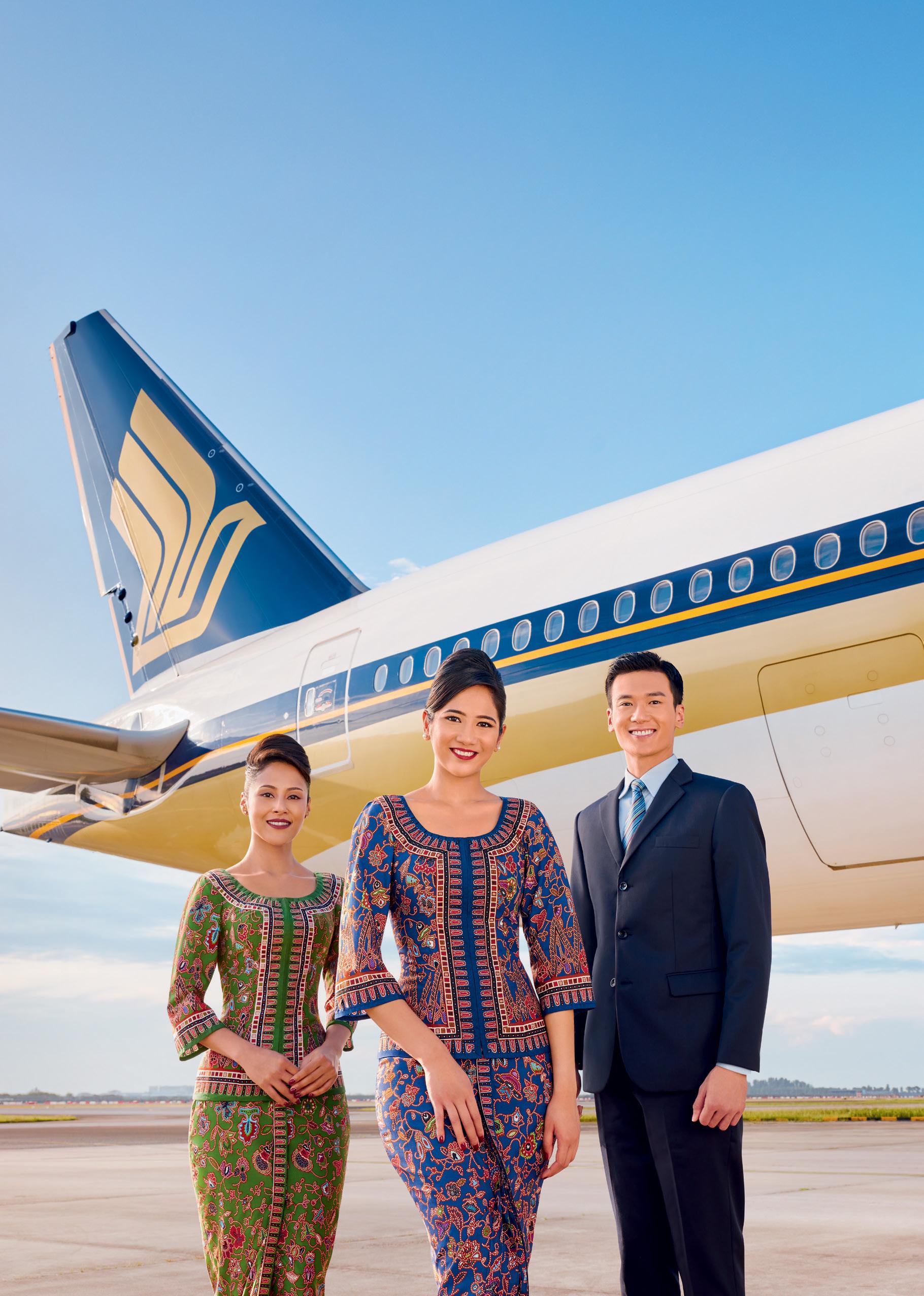
We partner with various corporates through tailored in-kind sponsorship and exchange of services. Current and recent partnerships include Official Hotel, Official Airline, and we offer other exciting titles.
For more details, please write to Sarah Wee at sarah.wee@sso.org.sg
SPECIAL RECOGNITION
A Standing Ovation
We recognise major gifts that help sustain the future of the Singapore Symphony Group. The recognition includes naming of a position in the SSO or in our affiliated performance groups such as the Singapore National Youth Orchestra and the Singapore Symphony Choruses.
F or more information, please write to Chelsea Zhao at chelsea.zhao@sso.org.sg
SSO Concertmaster l GK Goh Chair
In July 2017, the SSO established the GK Goh Chair for the Concertmaster. Mr Goh Geok Khim and his family have been long-time supporters of the national orchestra. We are grateful for the donations from his family and friends towards this Chair, especially Mr and Mrs Goh Yew Lin for their most generous contribution.
Mr Igor Yuzefovich was the inaugural GK Goh Concertmaster Chair. The position is currently vacant.
SSO Principal Cello
The Head Foundation Chair
In recognition of a generous gift from The HEAD Foundation, we announced the naming of our Principal Cello, “The HEAD Foundation Chair” in November 2019. The Chair is currently held by Principal Cellist Ng Pei-Sian.
SSO Principal Flute
Stephen Riady Chair
In recognition of a generous gift from Dr Stephen Riady, we announced in May 2022 the naming of our Principal Flute, “Stephen Riady Chair”. The position is currently held by our Principal Flutist Jin Ta.
SSO Principal Viola
Tan Jiew Cheng Chair
In recognition of a generous gift from the Estate of Tan Jiew Cheng, we announced in February 2024 the naming of our Principal Viola, “Tan Jiew Cheng Chair”. The position is currently held by our Principal Violist Manchin Zhang.
SPECIAL RECOGNITION
Quantedge Music Director
The SSO is delighted to announce the naming of the “Quantedge Music Director” position, currently held by Maestro Hans Graf.
With his spirit of musical exploration, innovative programming, and captivating stage presence, Maestro Graf has consistently inspired audiences and elevated orchestras to new heights. We are deeply grateful for his continued leadership as Chief Conductor in the 2020/21 season and Music Director since the 2022/23 season.
We extend our sincerest gratitude to our anonymous donor for this generous gift of $3 million to mark SG60.
In this multi-hued collaboration with the renowned Ding Yi Music Company of Singapore, musicians of the SSO explore an elemental gathering of Chinese/Asian and Western musical traditions, with music by Singaporean composers Sulwyn Lok and Ho Chee Kong as well as Chinese-American composers Tan Dun and Zhou Long.
SSO Organ Series: Baroque and Beyond 18
Jan
Baroque and Beyond in this instalment of the SSO Organ Series takes you from the familiar hymns and heights of Bach and Corelli to the majestic Organ Concerto No. 2 by Josef Rheinberger (1839–1901), featuring re:Sound with Koh Jia Hwei on organ and Isaac Koh on chamber organ.
Want to know more? Scan here for more information
Supporting the Local Arts and Cultural Scene
Partner of SSO since 1978
NSL, a member of YTL Cement Group, is a long-standing sponsor for Singapore Symphony Orchestra (SSO). We have been instrumental in helping the Orchestra reach out to the commuity-at-large as SSO brings music to the world.
A leading industrial group in the Asia Pacific with businesses in Precast & Prefabricated Bathroom Unit and Environmental Services, NSL believes that while achieving business goals is important, its actions need to also create a positive impact on the community, environment, and all stakeholders.
Board of Directors and Committees
Chair
Goh Yew Lin
Board of Directors
Chang Chee Pey
Chng Kai Fong
Andress Goh
Kenneth Kwok
Clara Lim-Tan
Jesher Loi
Lynette Pang
Prof Qin Li-Wei
Jovi Seet
Farhana Sharmeen
Doris Sohmen-Pao
Prof Peter Tornquist
Geoffrey Wong
Andrew Yeo Khirn Hin
EXECUTIVE & NOMINATING COMMITTEE
Goh Yew Lin (Chair)
Chng Kai Fong
Lynette Pang
Geoffrey Wong
SSO Council
Alan Chan (Chair)
Odile Benjamin
Prof Chan Heng Chee
Prof Arnoud De Meyer
Dr Geh Min
Heinrich Grafe
Khoo Boon Hui
Liew Wei Li
Lim Mei
Sanjiv Misra
Paige Parker
Dr Stephen Riady
Priscylla Shaw
Prof Gralf Sieghold
Prof Bernard Tan
Dr Tan Chin Nam
Wee Ee Cheong
Yong Ying-I
HUMAN RESOURCES COMMITTEE
Doris Sohmen-Pao (Chair)
Jesher Loi
Prof Qin Li-Wei
Heinrich Grafe*
Carmen Wee*
FINANCE & INVESTMENT COMMITTEE
Geoffrey Wong (Chair)
Andress Goh
Chua Keng Hong*
Alex Lee*
DEVELOPMENT COMMITTEE
Prof Chan Heng Chee (Chair)
Dr Geh Min
Heinrich Grafe
Khoo Boon Hui
Paige Parker
Priscylla Shaw
Dr Tan Chin Nam
Odile Benjamin
Lim Mei
AUDIT & RISK COMMITTEE
Jovi Seet (Chair)
Prof Peter Tornquist
Andrew Yeo Khirn Hin
Ryan Siek*
COMMUNITY & YOUTH ENGAGEMENT COMMITTEE
Clara Lim-Tan (Chair)
Chang Chee Pey
Farhana Sharmeen
Asst Prof Kat Agres*
Cecilia Pang*
*co-opted member
Symphony Ball Committee
Paige Parker (Chair)
Celeste Basapa
Geoffrey Wong
Kris Tan
Joy Tan
Dr Karen Soh
Kim Camacho
Lim Kang Ning
Farhana Sharmeen
SSO Musicians’ Committee
Hoang Van Hoc
Austin Larson
Li Xin
Christopher Mui
David Smith
Elaine Yeo
Zhao Tian
Singapore Symphony Group Administration
Chief Executive Officer
Kenneth Kwok
Deputy CEO
Programmes & Production
Kok Tse Wei
CEO OFFICE
Shirin Foo
Musriah Bte Md Salleh
ORGANISATION DEVELOPMENT
Lillian Yin
A rtistic Planning
Christopher Cheong (Head)
A RTISTIC ADMINISTRATION
Jodie Chiang
Terrence Wong
Jocelyn Cheng
Michelle Yeo
Operations
Ernest Khoo (Head)
L IBRARY
Wong Yi Wen
Cheng Yee Ki
Ng Yi Xiu
ORCHESTRA MANAGEMENT
Chia Jit Min (Head)
Charis Peck Xin Hui
Kelvin Chua
P RODUCTION MANAGEMENT
Noraihan Bte Nordin
Nazem Redzuan
Leong Shan Yi
Asyiq Iqmal
Khairi Edzhairee
Benjamin Chiau
DIGITAL PRODUCTION
Avik Chari
Deputy CEO
Patrons & Corporate Services
Jenny Ang
Community Impact
COMMUNITY ENGAGEMENT
Kua Li Leng (Head)
Whitney Tan
Lynnette Chng
Chua Xu Yang
Darren Siah
C HORAL PROGRAMMES
Kua Li Leng (Head)
Lu Heng
Chang Hai Wen
Mimi Syaahira
SINGAPORE NATIONAL YOUTH ORCHESTRA
Ramu Thiruyanam (Head)
Tang Ya Yun
Tan Sing Yee
Ridha Ridza
ABRSM
Patricia Yee
Lai Li-Yng
Joong Siow Chong
Freddie Loh
May Looi
Corporate Services
F INANCE, IT & FACILITIES
Rick Ong (Head)
Alan Ong
Goh Hoey Fen
Loh Chin Huat
Md Zailani Bin Md Said
HUMAN RESOURCES & ADMINISTRATION
Valeria Tan (Head)
Janice Yeo
Fionn Tan
Netty Diyanah Bte Osman
Patrons
D EVELOPMENT
Chelsea Zhao (Head)
Nikki Chuang
Sarah Wee Samantha Lim
Eunice Salanga
Kevin Yeoh
C OMMUNICATIONS, DIGITAL & MARKETING
Cindy Lim (Head)
Communications
Ong Shu Chen
Nikki Loke
Elizabeth Low
Data & Digital Projects
Calista Lee
Lim Wen Jie
Marketing & Content
Chia Han-Leon
Hong Shu Hui
Myrtle Lee
Jana Loh
Kashmira Kasmuri
Carrie Woo
CUSTOMER EXPERIENCE
Randy Teo
Dacia Cheang
Joy Tagore
Enjoy concerts by the Singapore Symphony with your SG Culture Pass credits
There’s something for everyone, including SSO Concerts for Children, SSO Pops and the SSO Christmas Concert.
Scan to find out more information
Be the heartbeat of your orchestra
Support our work as the musical pulse of Singapore, where every performance resonates with passion and joy.
Your contributions keep our music alive and thriving – inspiring audiences, delighting communities and sharing Singapore’s voice on the global stage.
Every donation is matched dollar-for-dollar and eligible for 250% tax deduction (for Singapore tax residents), amplifying the impact of your contribution.