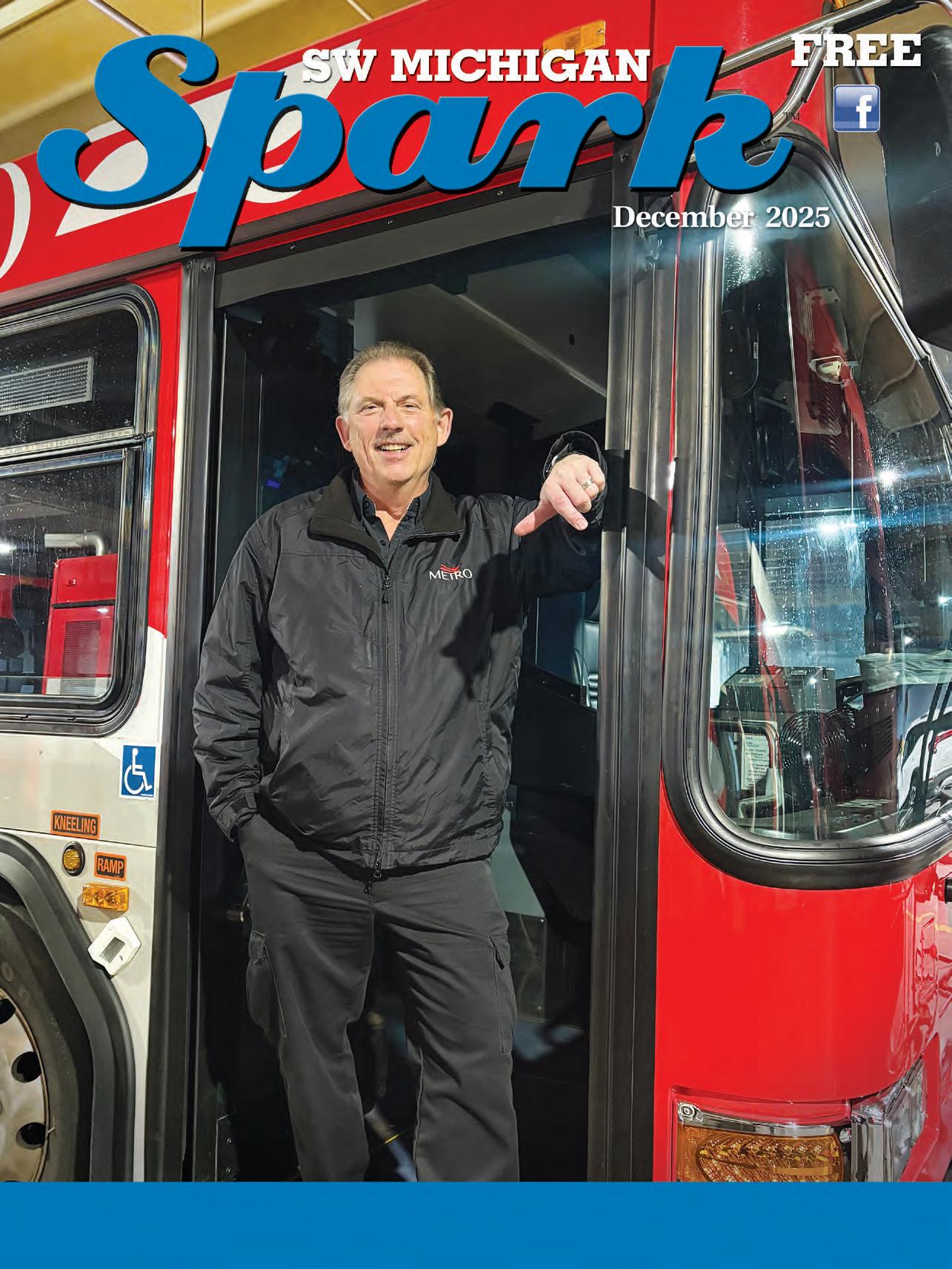
J.R. ENJOYS HIS TIME ON THE BUS ~ PG. 10
J.R. ENJOYS HIS TIME ON THE BUS ~ PG. 10

A: Located on the second floor above Sawall Health Foods , Café 36 uses natural and organic ingredients in preparing flavorful and exotic selections like Blackened Salmon with Blistered Tomato Rice, Asparagus, and Bleu Crea and Pork Secreto with Chimichurri rice, grilled fennel and charred lemon! There are wonderful pasta dishes including: Bolognese, Cavatelli and creative pizzas such as the Bambini, Margherita, Crudo and Vegano. Organic salads, with produce from local farmers, include Kale Caesar and Spinach & Arugula. There are 20 wines, organic craft beers and hand-crafted cocktails that compliment any meal. After dinner, delicious desserts include Amorino Gelato and Sorbetto, Eton Mess -- English whipped double cream, house-made Meringue, red berry Chambord coulis, Amorino Gelato, and Seasonal New York Cheesecake. Café 36 is very popular with Sawall customers looking for a healthy place to eat. Check out the new fall Café 36 menu!
Café ’36
Wed—Sat 5-9pm 501-3399
Sawall Health Foods
Oakwood Plaza • 2965 Oakland Dr. at Whites Rd. • 343-3619 • www.sawallhf.com


Q: What’s the importance of having a funeral service?
A: Funeral services honor a life lived, offering dignity and respect to the deceased. They bring family and friends together to share memories, provide comfort, and support one another through grief. Funerals also help create closure, allowing loved ones to say goodbye and begin healing. By preserving cultural and spiritual traditions, they strengthen community bonds and remind us of the value of life.
Compassionate care, meaningful memories
Adams - Redmond Funeral Homes & Cremation Services and Adams Funeral Homes & Cremation Services
3 locations to serve you
269.343.6156 Kalamazoo
269.349.7735 Parchment
269.657.6347 Paw Paw www.adamsredmond.com www.adamspawpaw.com


Chuck Henrich President & Owner
Q: Can you contribute to an IRA if you already participate with a company retirement plan?
A: Yes. You certainly can. For 2025, the maximum contribution to an IRA is $7000. If you are 50 years of age or older, you can add an additional $1000.
Something to consider is whether you will be able to deduct your IRA contributions during tax season. If you or your spouse have a company retirement plan, or your income is too high, you may not be able to deduct your IRA contributions.
Southwest Michigan Financial, LLC
The Atriums • 4341 S. Westnedge #1201 Kalamazoo, MI 269-323-7964


Q: May I still travel if I live in an independent living community?
A: Many residents continue to travel after moving into senior living. In fact, some communities provide discounts on monthly service fees if you intend on traveling for a month or more. Contact your community’s resident liaison or other staff member to understand your community’s policies on travel.
Friendship Village
“Where Connections Matter” 1400 North Drake, Kalamazoo 269-381-0560 www.friendshipvillagemi.com


Q: How do I know if I need a cochlear implant?
A: Many people who use hearing aids go through several adjustments before realizing the issue isn’t volume—it’s clarity. If speech sounds muffled even with well-fitted hearing aids, it may be time for a cochlear implant.
Unlike hearing aids, which amplify sound, a cochlear implant sends sound directly to the hearing nerve to restore clarity for those with moderate to severe hearing loss. After surgery, most patients go home the same day.
Bronson provides cochlear implants for adults of all ages. Ask your audiologist or primary care provider for a cochlear implant evaluation. If you’re a candidate, they’ll refer you to an ear, nose and throat specialist for a surgical consultation. It’s never too late to hear clearly again. Learn more at bronsonhealth.com/cochlear or call (269) 343-2601.

Justin Reynolds Manager
Q: I had my roof replaced 12 years ago with a 30 year shingle. It already needs to be replaced. What happened? Roofs used to last 20-25 years.
A: Asphalt is the main waterproofing ingredient in shingles giving strength and longevity. Due to improvements in the ability to refine a barrel of crude oil, less asphalt is available for roofing and road projects. And what is left for roofing lacks the quality that we received 20-25 years ago.
We have found that by blending polymers with the asphalt, we can make shingles tougher and more durable. Our shingles will last 25-30 years.
For a free roof inspection, please give us a call at 269 342-0153 or visit us at worryfreeroof.com.
Sherriff-Goslin Roofing Co. Since 1906 342-0153 800-950-1906
Member Home Builders Association of Greater Kalamazoo
I love to run and have enjoyed running long distances for many years. I would run all winter long, at night in the snow, whatever the conditions to train for the Kalamazoo Marathon that is in early May. Running gave me the time to think and appreciate the great outdoors.
Six years ago, my hip gave out and I needed a replacement. I still love to run, but no longer have the motivation or the energy for the long cold runs.
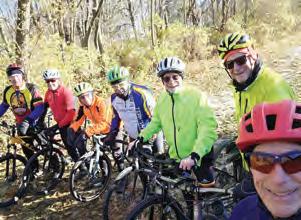
My new passion is biking, which isn’t as taxing on my new hip and my aging joints.
A few months ago, I joined a group of riders that ride 30-35 miles on the Kal Haven Trail a couple times per week, and on gravel country roads on Sunday mornings.
Most of the members are in their 70’s and have stayed in good shape. They all have their ail-

ments, like myself, but regular bike riding has kept them active, positive and reasonably healthy.
I was never a big fan of training in groups and enjoyed my time alone. However, I have found that the group motivation and conversations as we ride, makes the going much easier and a lot more fun!
from Kalkaska to Traverse City through the woods. The thirty-mile race is challenging, with several steep hills (most near the end) and narrow, winding “single track” paths through the woods.
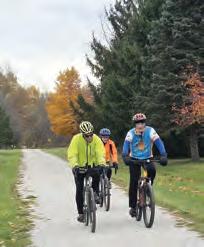
For the last ten years, I have driven to Traverse City, each November, with Jackie, to ride the Iceman Cometh Mountain Bike Race that goes
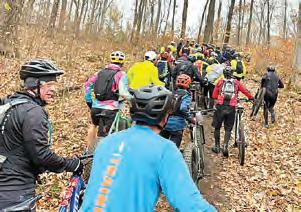
The Iceman is the largest single day mountain bike race in the world. They also offer an 8-mile race called the Slush Cup and a few free races for kids 10 & under (1/4 – 1 ½ miles based on age) called the Sno-Cone, with the combined races attracting close to 5,000 riders each year. The main race consists of 40+ waves, with 100 or so riders in each wave. The waves are released every six-minutes from the Kalkaska Airport and end at the Timber Ridge RV & Recreation Resort in Traverse City.
At the finish line, there is a huge party in the woods, sponsored by Bell’s Beer with vendors, food trucks, bonfires, beer, and thousands of people – it’s quite a spectacle!
I don’t enter to win, but to finish and enjoy this biking challenge, along with the comradery, and hope to be doing this for many years to come.
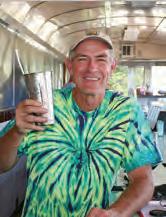



Lee A. Dean screendoor @sbcglobal.net
Certain kinds of technology hate me, because I can never coax them to respond in the desired fashion. When I have a problem getting something to work, I want a swift and simple answer.
I can blunder my way into solving most problems, but at times I need assistance. That’s when the fun begins. Often the first “helper” you encounter is a chatbot. The bot lists a series of suggested “frequently asked questions,” none of which ever address my issue. Recently, I wanted to find out how to pay a bill with a credit card. The bot behaved as if I asked it to tell me the number of hairs in Leonid Brezhnev’s eyebrows.
After three attempts, the bot threw in the towel and told me that I could hold to chat with an actual human being. I waited for this precious human contact … and waited … and waited. The bot reassured me that my call was very important. After 20 minutes, it sent a final message saying that no humans were available, and then abruptly ending the “conversation.” For the first time in my life, a computer hung up on me. The telephone bots are no better, espe-
cially the ones that ask you to verbally express a preference. The result is that I question my ability to speak my native tongue. After years of experience as a public speaker, I think my enunciation skills are at least average. I may not be Demosthenes but neither am I Leon Spinks. But the telephone bot is flummoxed by my speech patterns.
“Who would you like to be connected with?” it asks. I say, “the parts department.” “I’m sorry, I don’t understand you.” I repeat my simple request five times, with increasing volume and decreasing pace. Maybe this is the wrong approach and I should instead quickly state my request by saying similar but incorrect words. “Please connect me with the farts compartment” just might do the trick.
As with the online bots, the best way to address customer questions is to immediately offer the option of holding on the line to speak to a live person. I wait for “Press 0 or stay on the line for the next available representative.”
People complain about customer service calls going to foreign countries where the helper speaks English with a heavy accent. Not me. I don’t want to be mistaken for the ugly American. Plus “Trevor” from Bangladesh often speaks a better brand of English than what I get from
domestic phone jockeys.
A recent customer service call connected me with an American woman who was very loudly chewing gum while attempting to speak. “Let’s see (chonk chonk chonk) what we have available in January (chonk chonk chonk).” She was assaulting that gum as if it owed her money.
Other times the customer service person behaves like a pushy sales rep aiming to hit a quota. On one such call, my wife, the Viking Goddess, realized that a phone service had been automatically renewed without her permission. She called the customer service number and got stonewalled. He would not cancel the plan. After 15 minutes of obfuscation, the time had come for escalation. “If you don’t cancel this plan,” she shouted, “I will take a hammer, smash this phone into a thousand pieces AND MAIL THEM TO YOU.”
The plan was canceled.
There are two sides to this story, I know this from my experience working in two phone rooms. This is a job that is inherently difficult because each caller is unhappy in some respect. Here’s where the customer can help the process move to a satisfactory conclusion.
Being polite always helps. If a thick ac-
cent bothers you, blame your hearing and not their speech. Imagine they are sitting next to you and not many miles away. It is far easier to be rude to someone you can’t see.
Above all, treat the conversation as a collaborative problem-solving exercise. I recently needed to call tech support for help in synching my printer to a new wifi box. The online chatbot failed miserably, and after trying printer tech support (which they wanted me to pay for), I found a helper with the wi-fi company.
I soke with “Charles,” who was from the Indian subcontinent but spoke impeccable English. He had his list of procedures to follow in sequence, but they were not working. “I know you like to do things in a certain progression, but let’s switch the order around and try connecting to a new printer instead of an existing one,” I suggested. Voila! Problem solved.
“I couldn’t have done this without you,” said a delighted Charles. “Have you ever thought of a career in customer support?”
I had not, until writing this column, and never will think of it again. This occupation is better left to the experts, even the ones who loudly chew gum.


By Laura Kurella
I must confess that this column was inspired by a dish, and by that I mean an actual plate, not a recipe. A particular dish designed for an almost solitary purpose, which triggered a dish dilemma. Downsizing, because we’ve accumulated a lot of “stuff,” Hubby and I are trying to part with items we don’t use that much, which caused us to discover we both own “stuff” that’s difficult to part with, like sets of vintage escargot dishes. Given that neither my husband nor I eat escargot, it’s strange to own a set, so why two, and why am I having trouble parting with either of them? Arguing that it is silly to keep something I don’t use, my inner voice suddenly piped in, “Create a use for them or let them go!” Hence, this column. Dreaming up recipe ideas that would serve well on
such dainty dishes, I delved deep into ingredients both Hubby and I like, hoping it would prompt more ways to use these oh-so-delightful little dishes.
Designed for both baking and serving, and made to retain heat to keep food warmer longer after serving, these escargot/mushroom dishes are certainly keen, and should be used for more than just two things it sure seems. Resolving in the end that there is too much flavorful fun to be plated on these dishes to save them only for snails and or mushrooms, unless you adore them of course!
Here now is one of my favorite ways to have a ball on these plates- without snails or fungi. Enjoy and happy holidays
Laura Kurella is an award-winning home cook who loves to share recipes from her Michigan kitchen. She welcomes comments at laurakurella@yahoo.com.
1 1/2 cups leftover mashed potatoes
2 slices crisped bacon, 4 ounces brick cheddar, chunked
6 chives
1 teaspoon garlic powder
1/2 teaspoon unrefined (colored) sea salt, or to taste 1/2 teaspoon freshly ground black pepper, or to taste 1 egg, beaten 3/4 cup panko bread crumbs oil, for frying*
In the bowl of a food processor, combine mashed potatoes, bacon, cheddar, chives, garlic powder salt, and pepper. Process until cheese, bacon, and chives become finely chopped, about 30 seconds. In a shallow bowl, beat the egg with a fork then leave the fork in the bowl. In another shallow bowl, place some panko breadcrumbs then place another fork in the panko.
Using a scoop, form potato mixture into round, 1” to 2” size bombs, then set them into the beaten egg. Using the egg fork, roll bombs and coat with egg then use the fork to transfer to the panko bowl. Use the panko fork to roll bombs around in the panko to coat them well. Fill a fryer or frying pan with at least two inches of oil then heat to 350 degrees.
Once oil reaches temperature, fry the bombs in batches (do not crowd) until the panko is golden and crispy, about 2 to 3 minutes. Remove from oil, drain on a paper towel, and hold warm.
Season with more salt and pepper, if desired.
*= To air fry, spray bombs with cooking spray then place in a single layer in a 375-degree preheated air fryer. Cook for 10 minutes, or until crispy.

By Tom Springer, Vice President for Development
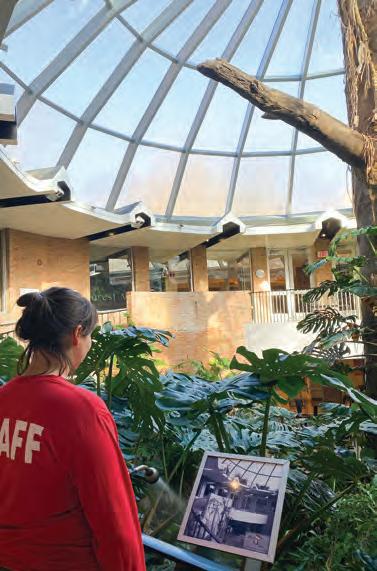
There’s no place more comfortable to sit on a winter day at the Nature Center than the Sun Rain Room. Especially in its newly restored state. The glass dome emits a full spectrum of natural light, just the tonic for moods that sag in the short days of winter.
Inside, a riot of tropical foliage includes Monstrosa plants, with palm-shaped leaves up to 30 inches wide. The murmur and tumble of an artificial indoor stream soothes jangled nerves like a giant, bedside sound machine. The serpentine stream empties into a pond at the foot of a faux banyan tree (pretend it’s a Michigan beech if you must).
For all its horticultural stagecraft, the Sun Rain Room remains a natural place apart. Breathe in the warm, humid air; absorb the ambient oxygen; transport yourself to a tropical clime and destination. If not Brazil or Borneo, then a sunny, muggy Michigan day in July. “People tell me how much more they enjoy the Sun Rain Room,” said Amber Hejl, KNC conservation director, who has overseen the project. “They have happy memories of visiting the space as kids and they’re excited that we’ve reclaimed its appeal.”
The Sun Rain Room has stood at the heart of KNC’s circular-shaped Visitor Center since it was built in 1964. It was designed as a panoramic anteroom to the beech maple forest outside. It was meant to give visitors a glimpse of prehistoric Michigan, with tropical plants that sprout and bloom amid Ice Age boulders. The cement
ramp circles the lush plantings and leads to an indoor pond overlook on the lower level. Just a few steps away -- having descended through Michigan’s rainforest epoch – a trailhead points hikers toward current habitats of fen, forest and stream.
The Sun Rain Room’s original plan was sound, as was its execution. But as with any 65-year-old building, some decay and mission drift invariably seep in. By the time KNC began its latest Visitor Center renovation in 20232024, the room sorely needed a makeover. It began with the new dome: the single-pane model had been durable, but it’s double-pane, insulated replacement conserves far more energy. Next to go was the array of indoor plant misters mounted around the dome’s base. They’d grown leaky, rusty, streaked with minerals and scale – an eyesore whose constant drip caused paint and drywall to peel and mildew. The rejuvenated indoor foliage, which had grown yellow and stunted from mealy bug infestation, once again thrives with jungly vigor. Then in November, KNC staff added four koi to the pond, which dart about with flashes of black, white and orange. The room also features new perches where visitors can absorb the life-giving sun and humidity: a cluster of high-top tables for two that invite reflection, conversation or catching up on emails. It’s also warmer in Sun Rain Room, now that a faulty thermostat has been fixed. Something that benefits people, plants and fish alike. “It’s amazing what a little extra warmth can do,” said Brian
Shannon, KNC’s visitor services host. He should know, as Shannon daily feeds fish pellets to the koi. “When we increased the temperature from 64 to 65, they were hungrier and more active. I can’t say that I blame them.”
Tom Springer is vice president for Development at the Kalamazoo Nature Center and the author “Looking for Hickories,” and “The Star in the Sycamore.”

As the holiday lights begin their annual twinkle across Kalamazoo, my personal period of reflection was recently kickstarted by a question. It happened right in my driveway. A neighbor paused, squinted at the back of my car, and asked, “I see you’ve got OLIMAS on your license plate. I’ve been meaning to ask: What does that mean?”
It was a simple question that unlocked the powerful message I carry with me every day, and one I believe holds the key to a better 2026 for all of us.
We spend December looking back at the past year and whispering our hopes for the next. Too often, we approach this annual renewal with solitary New Year’s resolutions—personal goals we see ourselves achieving alone. But what if we reframed that approach using a different lens, one rooted in this simple Greek concept?
Phonetically translated as “All of Us” or “We All,” Olli Mas is a profound statement of collective existence. In a world that often celebrates the individual hero—the lone marathon runner, the single visionary leader— this phrase reminds us that true, lasting strength is always found in the plural. It’s the powerful antithesis of isolation.

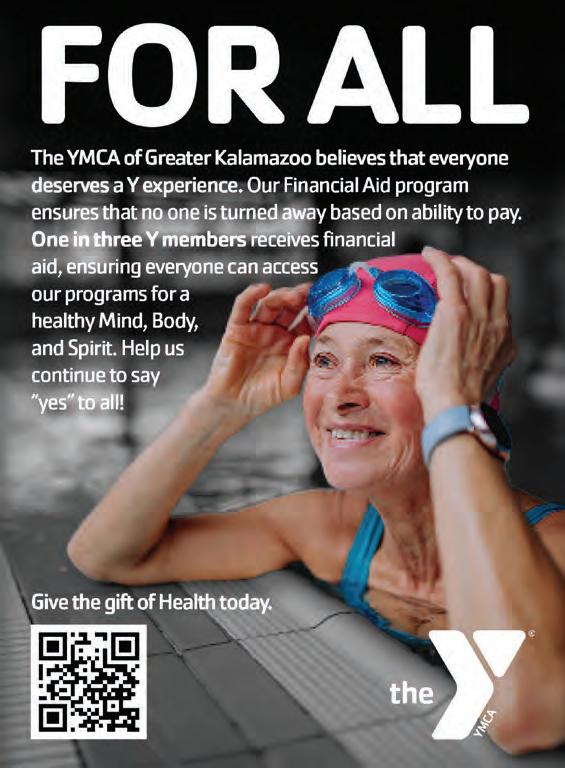
This concept perfectly captures the spirit of the YMCA of Greater Kalamazoo. When we step onto the gym floor, join a youth mentorship group, or volunteer at a community drive, we’re not acting in a vacuum. We’re participating in Olli Mas. When a child learns to swim, it’s due to the coach’s dedication, the parents’ commitment, and the financial support of the community. When a senior finds connection in a fitness class, it’s because other members created a welcoming space. Every single person—from the newest volunteer to the long-time member—is the “Mas” in Olli Mas.
This collective energy is the vital
motivational fuel we need as we launch into 2026. Our New Year’s resolution—whether it’s running a 5K, learning a new skill, or simply showing up more often—doesn’t have to be a lonely struggle. When we commit to a goal, we’re not only accountable to ourselves, but to the entire collective. Our presence encourages the person next to us; our energy fuels the entire room.
This is the promise of Olli Mas: When we act together, we are stronger, more resilient, and kinder. The challenges facing our neighbors—whether they involve food insecurity, access to safe spaces, or mental wellness— are not problems for a select few to solve. They belong to all of us.
So, as we wrap up the year, I invite you to remember my license plate and tuck this Greek phrase into your whispers for change in 2026. Remember that every positive action we take, no matter how small, sends a ripple through the collective. Let the unity of OLLI MAS be the engine that drives your resolution, your family, and the entire Greater Kalamazoo community forward in the year ahead. We are all in this, and we are unstoppable, together.
Submitted by Vicky Kettner, Association Director of Marketing, Community Relations, and Member Engagement at YMCA of Greater Kalamazoo.


Dexter Walker was an energetic 21-year-old with hardly a cent in his pocket when he arrived in Kalamazoo in 1849, but he soon realized there was a strong market for brick in the growing community. With only his hands to work with, Walker set up a brickmaking operation and began making brick from the area’s rich deposits of clay.
During the fall of 1856, Walker bought a lot in the village at the northwest corner of Park and Dutton streets in what was then known as the Kalamazoo Literary Institute addition. To better accommodate his growing family, Walker built a Greek Revival home on the lot using bricks made with clay he dug from the cellar. According to the tax assessor’s description, the brick house had been completed by the spring of 1858.
by Keith Howard, Kalamazoo Public Library
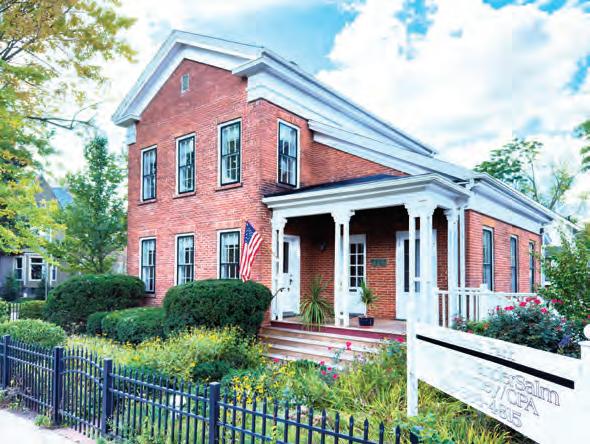
But the Walkers may not have ever lived in the home, or if they did, it would have been for a short period of time. Legend has it that his wife, Phoebe, felt the home was too close to the city and persuaded her husband to instead settle on property north of the village. The Walkers sold the Park Street home in March 1859 to William
a local manufacturer. Now known as the R. Dexter Walker House, the brick structure has since housed several families and businesses. It’s been meticulously restored and stands today as one of the oldest homes in Kalamazoo. It currently houses William VanderSalm’s tax law practice. When the census taker came around in August
1860, the Walkers had by then established a home on the west side of the Grand Rapids plank road (Douglas Avenue), just north of the Kalamazoo village limits. By then, Walker’s brickmaking enterprise employed seven hired hands and was producing a half-million handmade bricks each year.
By the end of the decade, Walker had supplied brick for numerous houses and commercial buildings in and around Kalamazoo, including the Michigan Asylum (c.1860s), the First Methodist Church (c.1865-1869), the Kalamazoo Water Works (c.1868), and others.
After four decades in the brickmaking business, Walker retired comfortably at the family homestead on Douglas Avenue while overseeing his 200-acre farm in Cooper Township. Dexter Walker died in September 1910 at the age of 82 and was laid to rest at Riverside Cemetery. The Walker home on Douglas Avenue was replaced in the 1920s, but the house on South Park Street still stands as a testament to Walker’s skill and determination.

(2025)

The latest entry from wonderfully versatile filmmaker Paul Thomas Anderson (Boogie Nights, There Will be Blood) feels every bit as timely as it is ludicrous. The pace for this action thriller is set in the opening scenes in which the far-left revolutionary group The French 75 (who take their name from this reviewer’s favorite prohibitionera cocktail) stage a raid on a detention center on the Mexico-American border. While they release the immigrants in custody, their leader, Perfidia Beverly Hills (Teyana Taylor) humiliates the camp’s C.O. Colonel Steven Lockjaw (Sean Penn) instilling in him a single-minded psychosexual obsession with her. Shortly thereafter, she and fellow resistance member Bob Ferguson (Leonardo DiCaprio) have a daughter named Willa, but Perfidia flees the country, leaving Bob to raise the child alone while Lockjaw tightens the noose behind the scenes. 16 years later, with members of The French 75 turning up dead, Bob is suddenly thrust into a drug-addled flight for survival with the help of sympathetic martial arts sensei, Sergio St. Carlos (Benedico Del Toro). With his potential membership in a shadowy whitesupremacist quasi-governmental cabal known as the Christmas Adventures Club on the line, Lockjaw must stop at nothing to bring Bob and Willa in. – Submitted by Patrick J.

75 years after the publication of the first Peanuts comic strip, 60 years after the debut of the iconic TV special
A Charlie Brown Christmas, and 25 years after the passing of Peanuts creator Charles M. Schulz, the Peanuts gang celebrates with a DVD set featuring 40 complete TV specials spanning six decades. Kicking off the Peanuts Ultimate TV Specials Collection, that 1965 Christ-
and most beloved holiday TV specials of all time. Even after all these years, Charlie Brown’s angst about the season endures as a feeling far too universal. Who hasn’t been overwhelmed by the commerciality of the shopping season, or the mounting pressures of keeping a gathering (such as the gang’s Christmas play) relatively hitch-free? The melancholy of Vince Guaraldi’s jazz-infused score perfectly matches the story’s mood (and is tempered by its inclusion of the upbeat and timeless “Linus and Lucy” theme). Most of the remaining specials don’t command the same reverence as that first special, though the Halloween and Thanksgiving specials come close. Whether later specials veer into heavier subject matter, or blatantly riff on time capsule pop culture, the Peanuts characters’ original charms and personalities prevail. Fans new and old will find time well spent revisiting, or visiting anew, this ultimate collection of Peanuts adventures. – Submitted by Karl K.

An instant classic when first released in 1950, the Bette Davis-led All About Eve cleverly unfolds as a story about blind ambition, and the pitiless maneuverings of the theater world. It is also a deliciously written and performed rendering of the pressures placed on women in the entertainment business. Written and directed by Joseph L. Mankiewicz, and based on a short story by Mary Orr, the triumph of All About Eve helped to revive Davis’ waning career, which had stagnated by the time she was cast as Margot Channing--the highly respected but aging actress of Broadway whose seemingly benign meeting with devotee Eve Harrington sets in motion one of the silver screen’s most delectable parables of schadenfreude. Deftly narrated using voice overs, the audience quickly learns that the young actor Eve Harrington has won a prestigious award for a recent performance. But how did Harrington come into such fame, and what means did she employ upon her unsuspecting friends and idol, the colorful and complicated Margot Channing? – Submitted by Ryan G.




The Greater Kalamazoo Skating Association presents the
Saturday, December 13, 2:30pm and 7:00pm Wings Event Center
Step into a dazzling celebration on ice as skaters of all ages bring the seasons to life in the Holiday Ice Revue! From Valentine’s romance to fall festival magic, winter holiday cheer, and the excitement of a New Year’s countdown - this year’s show is a joyful journey through the holidays. Featuring spectacular costumes, lively group numbers, and unforgettable solos, it’s a festive tradition the whole family will love!
Tickets can be purchased at the box office or online at: 2:30PM Show: etix.com/ticket/p/43863336 7:00PM Show: etix.com/ticket/p/84679112

By Dale Abbott, Milestone Senior Services
Connie Clines grew up in Albion,Michigan,and after graduating high school,set out for California to join a friend. Not long after,she met her husband,Charlie,who was serving in the Marine Corps. When Charlie completed his service,they decided to return to the Midwest, since Charlie was originally from Indiana. They married and chose Battle Creek to raise their family and build their careers.
Connie originally intended to work in medical transcription but quickly realized she didn’t enjoy typing. What she did enjoy was math and accounting. She began working in bookkeeping and accounting for Lifespan, which was later acquired by Bronson Hospital. After raising two children-a son and a daughter-Connie returned to Kellogg Community College to earn an accounting degree. Meanwhile,Charlie built his business in concrete construction and worked on grounds at Lakeview School District.
Charlie retired in 2020 and Connie in 2024 and both maintain full,busy lives, especially with their three young grandchildren.
It was Charlie who first began considering how to fill their retirement years with purpose. Charlie, who has always been physically active,saw a promotion for Meals on Wheels and reached out to Milestone Senior Services.Soon after, he and Connie were invited to ride along on a delivery route.
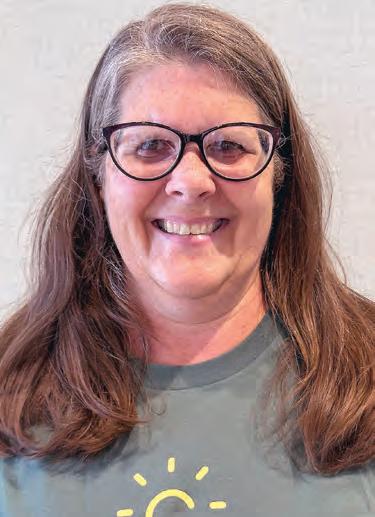
Connie remembers it vividly: a cold, rainy morning. “It couldn’t have been a better experience,” she says,”because we got to see what it was like in the worst conditions.”

They signed up immediately as a Meals on Wheels team and it quickly became a rewarding part of their lives.Charlie drives while Connie 1’hops”-delivering meals to the door. For Connie,it’s not just about food; it’s about dignity,connection, and kindness. She makes a point of addressing each client by name, recognizing them as people worthy of respect and attention. She’s also reminded constantly of just how many people need support, adding, “Somebody always has it worse than you.”
What fills Connie and Charlie with gratitude is the satisfaction of playing even a small role in helping others. Sometimes they take their grandchildren along on deliveries-not just to tag along, but to learn from the experience. Connie explains, “We always talk to them about why we do this. It’s an important life lesson.”
Outside of volunteering, one of Connie’s lifelong passions is reading-especially biographies. She finds them fascinating and inspiring, stories of people who, no matter how difficult their beginnings,overcame hardship to do remarkable things. And in a way,she sees the same spirit in the people she and Charlie serve.
To learn more about the AmeriCorps Senior Companion or RSVP volunteer programs, contact Milestone’s Volunteer Services department at 269-382-0515 or get started right away by applying on the Volunteer page of their website: www.MilestoneSeniorServies.org/Volunteer.
By Dave Person david.r.person@gmail.com
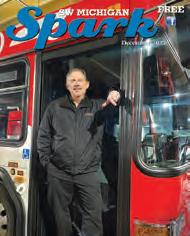
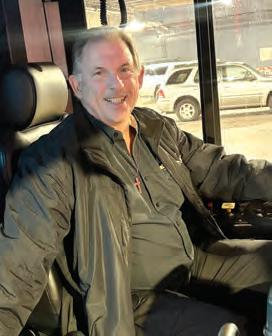
When J.R. Wyatt was growing up in Kalamazoo, relying on public transportation was a necessity.
He and his siblings were raised by their mother, and when she started having health issues they had to hop the bus to get to where they were going.
For the past 21 years, those experiences have been in the back of Wyatt’s mind each time he pulls his Metro bus up at a stop to pick up passengers.
“You have to have a servant attitude,” he says of being a bus driver. “You hope that’s how people remember you, that you were kind no matter who they were.”
Wyatt admits that not every passenger has been pleasant, but he gives them the benefit of the doubt.
“Maybe they’re just having a bad day,” he says.
When Wyatt started driving for Metro in 2004, he was low man on the totem
pole, with 63 full-time drivers and 19 part-time drivers ahead of him in seniority.
At the end of the day on Dec. 11, when he steps down from his Metro bus for the last time and heads into retirement, he will have worked his way up to No. 8 in terms of longevity.
Wyatt, who will turn 65 a few days after he retires, has driven all 21 of the Metro routes and has made many acquaintances over the the past two decades in a career that has always brought a smile to his face.
“You’ve got to love people, and you’ve got to love driving,” he says of the profession.
Wyatt says over time bus drivers get to know their regular riders, and develop relationships with them.

He recalls that one older woman, who lived alone, suddenly stopped riding his bus, so after a few days he requested authorities conduct a welfare check.
It turned out she had been ill.
When she was well enough to ride the bus again, she told

him, “I heard you were asking about me. Thank you.”
“You don’t think you become attached to the people, but you do,” Wyatt says. His current route is on the Western Michigan University campus.
“The students are a delight,” he says. “Most of them, when they get off, they say thank you.”
The first bus Wyatt drove was for the Kalamazoo Public Schools not long after he had been a student there himself.
After that he relocated to Arizona, working for a couple of companies there before moving back.
Upon his return, he was employed by Arvco Container for about 10 years, then did some landscaping, helped build churches with American Church Builders and worked for a lawn-care company before he took the job with Metro Transit, as it was called then.
The rebranding of the service, in which the name was shortened to Metro, is among a variety of changes in recent years, according to Sean McBride, executive director.

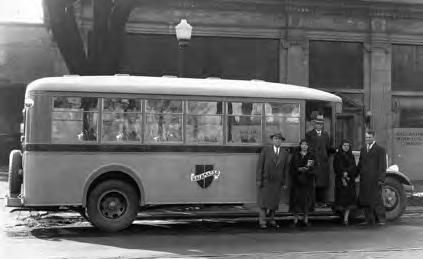
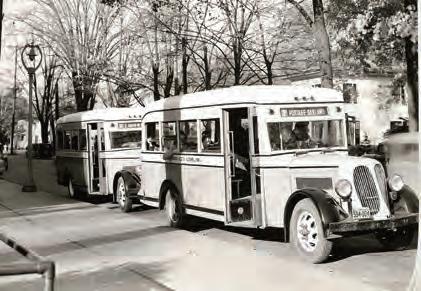
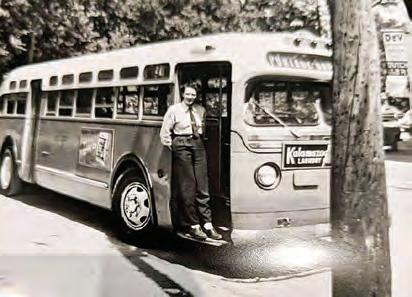
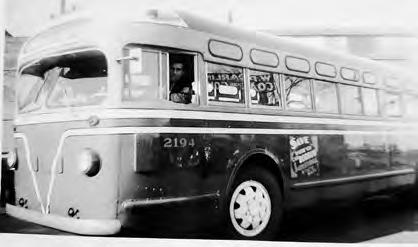
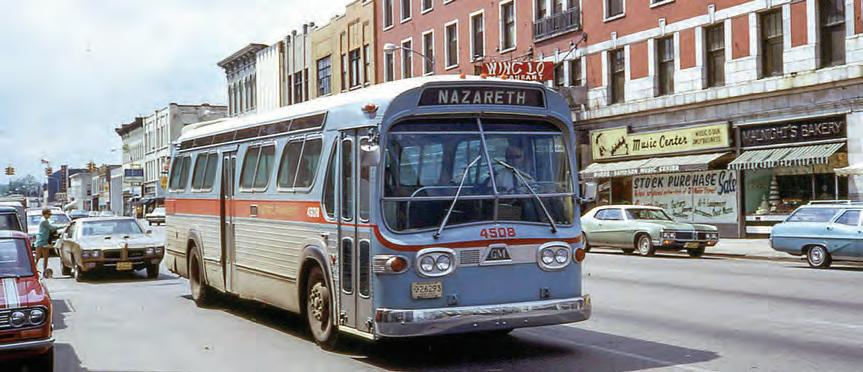
Those include transportation services that have been added, in addition to the standard bus routes, and the change in oversight in 2016 from the city of Kalamazoo to the independent Central County Transportation Authority, he says.
In addition to the fleet of 40 Metro buses, which provided 1.75 million rides
last year, added services include:
METRO CONNECT, which provides transportation to anyone within Kalamazoo County and to the Veterans Affairs Medical Center in Battle Creek. Its vehicles are compliant with the Americans with Disabilities Act. Rides can be scheduled up to a week in advance. Cost

vehicle is generally available within 15 minutes and the cost is $1.50, the same that it costs to ride the bus. “We have a pretty high connection rate, probably above 90 percent,” McBride says. About half of the SUVs that are used for this service are wheelchair-accessible.
METRO SHARE, a pool of Metro-owned vans available free of charge to nonprofit agencies that partner with Metro to use them. Each van holds up to nine people.”What we really target is senior services and (services for) individuals with disabilities,” McBride says. Drivers from those nonprofits, which include churches that use the vans on Sundays, must undergo training from Metro. Metro buses, Metro Connect and Metro Link operate 7 days a week from 6 a.m. until 10 p.m., in most cases, with reduced hours on Sundays.
In addition to the transportation options, Metro has a travel training program to “help individuals and groups figure out how to use public transit to best serve their needs,” McBride says, explaining that one of the main barriers to using public transportation is that people don’t know how to get started. All services combined, McBride says, Metro provides 1.9 million rides annually..
After Dec. 11, however, Wyatt will no longer be helping to provide those rides. Having already sold their house, he and his wife of 40 years, Mary, will be heading out of town in their pickup truck with their new travel-trailer in tow. They plan to travel to North Carolina, Florida, Texas, Arizona and California over the winter, ending up in Portland, Ore., where the youngest of their four children lives.
is $12 for the general public, or $3 to $4 for seniors and people with disabilities.
METRO LINK, piloted in April 2024, an on-demand service similar to Uber or Lyft. Operating in three zones that make up the regular Metro bus routes, riders can travel from one point to another within one of the zones. A Metro Link
Come spring, they’ll be seeing the sights in the northern states, including North Dakota and several New England states that Wyatt hasn’t yet visited.
It’s his idea of the perfect retirement. “My favorite place to be is in my truck, pulling my trailer, with my sweetheart by my side, and seeing things I’ve never seen before,” he says.




By Richard Martinovich
In 1943, Norman Rockwell painted his classic Freedom from Want, also known as The Thanksgiving Picture or I’ll be Home for Christmas, capturing three generations huddled around a table celebrating the abundance of food and family.
The holidays are a time when family and friends gather over good food and conversation.
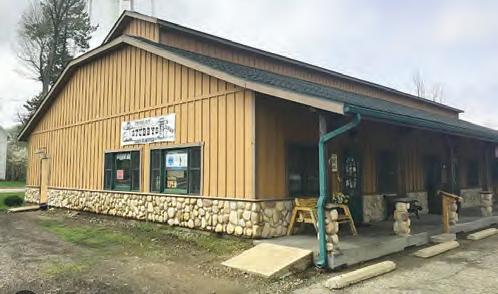
Stubbys Smokehouse in Vicksburg makes those holiday traditions easier with ready-to-eat meals and pre-seasoned meats with cooking instructions -- allowing a little freedom from the kitchen during that busy time of year.
Stubbys smoked turkeys are a popular item during Thanksgiving, and their prime rib is a top choice for Christmas and New Year’s. Stubbys prime rib is seasoned and ready to pop in the oven. Prime rib has been a favorite holiday meal since the Victorian era in Britain, and is still a tradition for many families in America.
Stubbys Smokehouse is your one-stop butcher shop for all your meat products; fresh meat selections of beef and pork roasts, hand-cut steaks, ground chuck, and a variety of seafood; plus an amazing variety of beef and poultry jerky with unique flavor combinations: jalapeno flavor, BBQ,



mesquite, firebush and bushwacker. There are some great smoked cheese combinations, too -- smoked cheddar and crushed red pepper, smoked Swiss, smoked Gouda, and smoked jalapeno.
Stubbys Smokehouse has hot meals to go for breakfast, lunch and dinner. There are homemade biscuits and gravy, smoked and roasted baby back pork ribs, smoked and roasted dry rub chicken, and sides of coleslaw, mashed potatoes, and Cowboy Beans to go with it!
Daily specials may include beef stroganoff, smoked beef brisket, Stubby Burgers, and homemade meatloaf.
Stubbys Smokehouse carries a wide selection of Amish canned items such as pickled vegetables, jams, jellies and salsas. Party trays are available in two sizes, perfect for the holidays. Call to place an order.
Don’t forget to try Stubbys Secret of the North Seasoning, and Secrets of the North BBQ rub to spice up beef or chicken!


The days are short and the nights are long... winter is here. If your spirits sink with the change of seasons, it’s understandable that you might want to just eat carbs, curl up, and wait for spring to come. You’re not alone in that . . . reports show that about 5% of Americans experience serious seasonal depression, caused in part by reduced levels of sunlight and changes in brain chemistry. Some folks respond well to special light treatments, talking with a therapist, or taking medication. Lifestyle changes may help, too – and one of them is going outdoors, even when it’s cold and cloudy.
Forget about fashion... meet the weather and bundle up like an abominable snowman! A walk round your neighborhood is good; it’s even better if you can visit a local park or

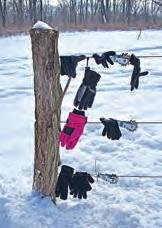
natural area. No matter where you go, try to approach the experience with curiosity. Notice the way the snow has settled on the branches, or how flat and brown everything looks compared to summer. Watch the little birds fluffed up into balls as they go about their business looking for food. Feel the freezing of your nose hairs, the snowflakes on your eyelashes. Listen to the calls of distant crows, or maybe just the winter silence. If you’ve got some extra cash, get some of those traction cleats to put on the bottom of your boots – they make winter walking SO much safer and more enjoyable.
Looking for suggested places to go? One place to start is with Southwest Michigan Land Conservancy. We’ve got 18 public nature preserves that are free and open to everyone from dawn

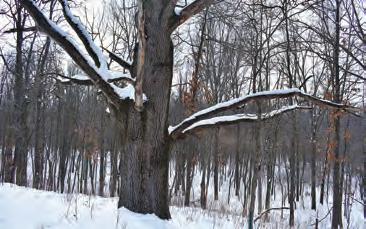
‘til dusk throughout our nine-county service area. We offer a rustic, natural experience . . . so the parking lots may be a bit snowy and the trails won’t be groomed (though you’re welcome to bring your skis or snowshoes anyway). But they’re great places to explore, exercise, find some peace, and feed your soul. They’re there for you, because people need nature – all year round. Details on our website: https://swmlc. org/public-nature-preserves/
Please don’t wish away the winter with a bowl of chips in your lap and sadness in your heart. You’re still alive, even when you can’t feel your toes!
Learn more about us and how you can get involved at our website, www.swmlc.org.

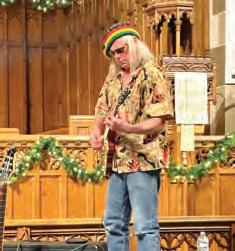

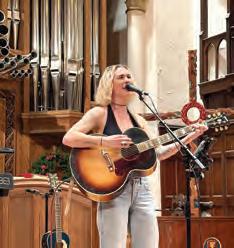

This year marks the 40th anniversary of New Year’s Fest. For those history buffs, NYF survived ice storms, sub-zero weather, Y2K, and COVID. Every year, not one single year cancelled. It’s a tradition.
As a cultural arts festival showcasing local, regional, and national talent, NYF typically features around 22 artists.with about 72 performances. If you have never attended, New Year’s Fest is an all-ages performing arts festival that takes place on New Year’s Eve in Downtown Kalamazoo. The event begins at 6:00 p.m. and runs until 12 a.m. to ring in the New Year. The event features bands, comedians, magicians, ventriloquists, jugglers, and even super heroes and princesses. And, to top it off at midnight there is a ball drop and fireworks.
The 2025 New Year’s Fest will host performances in 5 indoor performance locations, a heated tent and live music from Bronson Park Stage. You need an admission button to attend the shows in the performance spaces. The admission button is $10 in advance, and $15 in Bronson Park starting at 5:00 p.m. The outdoor live stage, heated entertainment tent, fireworks, and ball drop are all free. So is participating and riding the Holly Jolly Trolley (that runs from 6:00-11:00 pm).








Ellen O’Clover

Louisa escaped a tumultuous childhood with a counseling degree and an overnight boyfriend who became a star.
When she suddenly finds herself single, she knows that the one thing she can’t bear to lose is the mountain home in Colorado that had become her first stable place to live. Without her boyfriend’s salary in the picture, Lou decides to approach Henry, the landlord she’s never met, with an idea: what if she turns the house into a bed and breakfast? In exchange for living there, she will run the entire enterprise, and all he needs to do is rake in the cash. As the bed and breakfast takes off, Lou and Henry find themselves interacting more and more. The Heartbreak Hotel is a delightful story that focuses on Lou’s growth just as much, if not more, than the romantic plot, and features an incredible cast of characters along the way.
Gareth Brown

Cassie works in a small bookstore in midtown Manhattan.
One evening, an elderly man who is a regular at the bookstore, Mr. Webber, gives her a book. This is no ordinary book, she soon discovers. Using this book, she can go through any door anywhere in the world. She and her roommate, Izzy, spend the first night traveling to Italy, France, and other exotic places. What she
soon discovers, however, is that the Book of Doors is just one book among many, and there are very powerful and dangerous people who will do anything possible to get this particular book. She meets Drummond Fox, the man in charge of protecting these books, and they try to stay one step ahead of all of them. This is an exciting adventure story with lots of fantastic twists and turns and well-drawn, fascinating characters. Highly recommended.
Elizabeth George

In this latest book of the Inspector Lynley series, the mystery is set in Lynley’s home county of Cornwall, where the tin miner Michael Lobb is found brutally murdered in his workshop. A mining company was pressuring Lobb to sell his land. His family was in favor of this, but he insisted on maintaining the family business, which had been passed down to him. This dispute meant that there was no shortage of suspects for his murder. One of the strengths of Elizabeth George’s writing is her characterization, and each of the characters in this novel really comes alive on the page. We get insights into the lives of the victim’s family, the mining company employee, and the inspector in charge of the case. On the whole, the depth of the characters only added to my enjoyment of the mystery.
Story by Steve Ellis
Dr. Martin Luthor King flew into Kalamazoo on December 18, 1963. His visit came at a very important time in United States history.
On August 28, just a few months before his Kalamazoo visit, King delivered his famous, “I Have a Dream Speech” on the steps of the Lincoln Memorial in front of 250,000 civil right supporters.
On November 22, less than a month before his visit, President John F. Kennedy was assassinated in Dallas, Texas. Kennedy proposed the comprehensive civil rights bill that became the Civil Rights Act of 1964, but his assasination, put doubt in the minds of many, if the Bill could pass without Kenneddy at the helm. King’s flight from Detroit was a half hour late so a local committee was trying to hurry King out of the airport to keep a tight schedule. Inside the terminal, a porter recognized him and exclaimed, “Dr King.” King smiled and said, “Yes sir. How are you?” King was dressed in a dark suit, a modest necktie and highly polished shoes.
The Atlanta clergyman waded through 12-inches of snow to a waiting car to take him to Western Michigan University. King and his party braved the heavy snow storm that was making their schedule hard to meet. His flight was scheduled to arrive at 5:44 p.m. but it was delayed and left King with only a few minutes to answer a few questions from anxious reporters at the faculty lounge at the WMU-Student Center.
A reporter asked if President Johnson had given any indication of confidence that he would be able to influence Congress to pass a strong civil rights bill.

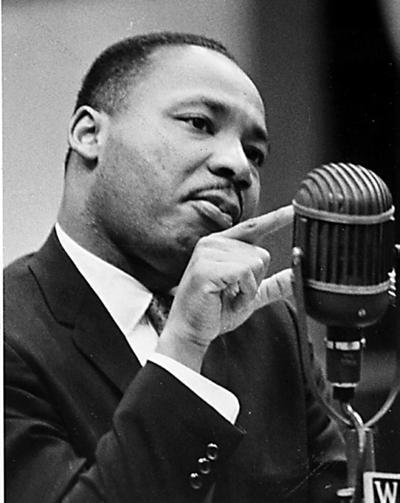
King had just met with President Johnson at the White House on December 3rd. King answered that, “He didn’t give me the impression he has an easy job but his unique experience in Congress may well be of help to this.”
After a few questions, Dr King was whisked to a private dinner by members of

the honor college which sponsored his talk here. Dr Samuel Clark. president of the Honors College headed the welcoming committee of WMU officials at the airport. Also present was William E Borge Jr Battle Creek Regional director of Alpha Phi Alpha a fraternity of which Dr King is a member.
Before his speech, Dr King took a few minutes to rest at the home of WMU President James W Miller and organize his thoughts.
A WMU official said because Dr King speaks without much preparation, he likes to seclude himself for about 30 minutes to compose his thoughts before giving an address.
Dr. King started his speech in front 2,000 at Read Fieldhouse, by proclaiming that, “We must live together as brothers, or we will perish together as fools.
He declared that there is a great need to develop a program of action if the Civil Rights Movement is to succeed. “There is the challenge,” he said, “to get rid of the notion once and for all that there are superior and inferior races.”
Two myths must be answered and dealt with, King said. One is that only time can solve the problem and the other is that legislation can’t change the hearts of those opposed to the movement.
He said that the civil rights legislation must be passed and soon, otherwise he said, “an ugly sore will turn malignant and a cancer will destroy the soul of American society. Dr King emphasized what he declared to be as great a need to end “de facto” segregation in the north as there is to do away with legal segregation in the South.
He told his audience that great strides have been made in the South by use of the nonviolent action (demonstrations, sit-ins, picketing, court action and peaceful marches.)
He said the system of segregation is on its death bed. it’s only a question of how costly will the segregationist make the funeral, he added. Passive resistance particularly in the South has disarmed the opponent, Dr. King said. He doesn’t know how to handle it.
Dr King drew a standing ovation at the conclusion of his talk
Just a little less than 4 hours after his arrival Dr King’s whirlwind visit to Kalamazoo came to an end. His flight left at 10:10 p.m.



Kalamazoo Valley Museum Exhibits
This traveling exhibition from the Fred T. Korematsu Institute asks visitors to think about examples of unfair treatment from our country’s past and present in order to protect the American promises of life, liberty and justice for all.
The exhibition is named after a quote from Fred Korematsu, who famously challenged the mass imprisonment of 125,000 Japanese Americans during WWII. When faced with federal criminal charges for not obeying military orders to leave his home, the 23-year-old U.S. citizen remembered his Constitutional rights and asked, “Am I an American or am I not?”


This exhibit invites audiences to explore the rich festival culture of Mexico through historic and contemporary masks from the collection of the Northwest Museum of Arts and Culture.

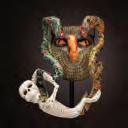

Both Exhibits run through Jan 4, 2026



Kalamazoo’s weekly winter markets are moving into a new space at the Kalamazoo Farmers Market this season.
The People’s Food Co-op Winter Market will move from St. Joseph’s Catholic Church, 936 Lake St., to a new multipurpose building adjacent to the farmers market at 1204 Bank St. The Winter Market begins on Saturday, December 6 and runs through April 25.
Vendors will be selling a selection of fresh produce, meats, fish, poultry, eggs, baked goods, pastas, coffee, jams, jellies and more.


By Steve Ellis
My daughter Lauren, has lived in New Orleans for several years. I visit every year or so, to hang out and do a little exploring together.
She lives in Holy Cross, just two blocks from the Mississippi River and about two miles from the French Quarter. Holy Cross is a sub-district of the Lower Ninth Ward District.
Near her home are two, well known houses referred to as the Steamboat House and the Doullut House. In a city filled with unique buildings, they are arguably among the most unusual, two handcrafted gems sitting along the river as if they had floated right out of the pages of a Mark Twain story and run aground. They’re magnificent examples of local architecture that, although located on dry land, evoke the era of paddle wheelers, flatboats and river bandits.
In addition, Fats Domino’s house is just around corner
Lauren has a small landscaping business and spends her days taking care of trees and plants at houses in the Bywater, Garden District and
other historic neighborhoods in New Orleans.
I spent five days with her in October. Most days involved her loading up her vehicle with what she would need for her jobs and we would drive to a house. She told me I would not be much help so I would bring her bike and ride or walk for three hours, wandering as far as I could.
Two days were spent in the Garden District, between St Charles, with its famous streetcar line, and Magazine Street.
The Garden District consists of several blocks of large, classic mansions on tree lined streets. Many movie stars and other celebrities have homes in the area.
Magazine street has a few miles of

great funky stores, antiques, restaurants, coffee shops and bars.
After peeking in one window and quickly entering what I thought was a small museum, I found that I had entered H. Rault Locksmith, which began in 1845. They are the second oldest locksmith shop in the USA and the oldest in Louisiana. They specialize in unique and antique hardware repair and the store is packed with antiques-vintage locks, keys, door plates and all sorts of vintage home hardware.
Another store, The Slow Down Vintage is very colorful and is packed with some of the best books, vintage clothing and art displays.
The Zele Nola Art Gallery is a great local arts gallery overflowing with all
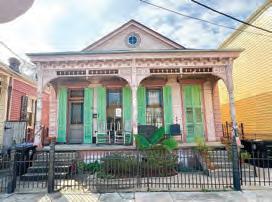
kinds of New Orleans inspired quirky art pieces. They have lots of small pieces which are great for travelers.
Lauren and I walked by The Creole Creamery and even though it was earlier in the day, we couldn’t resist stopping for a couple tasty ice cream cones.
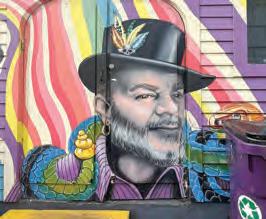
The French Quarter is the most famous part of New Orleans and always packed with tourists. Bourbon Street is the big bar/party street that we tried to avoid.
My favorite street in the French Quarter is Royal Street with its several dozen unique art galleries packed with art you will not find anywhere else.
A few that we spent quite a bit of

time in and enjoyed were the Boxcar Gallery that specializes in outsider & unusual art and the Mortal Machine Gallery that features Contemporary Folk and Outsider, Low Brow, Pop Surrealism and Street Art.
I had heard about The New Orleans Pharmacy Museum, just one block away and convinced my daughter to go. The museum showcases the world of early pharmacies and medicine practices in the 19th century. It is the largest collection of pharmaceutical memorabilia in the United States. The building is the former residence and apothecary of America’s first licensed pharmacist, Louis J. Dufilho, who was licensed in pharmacy in 1816. The museum contains displays and exhibits that showcase the history of pharmacy, including glass bottles, medicines, strange medical instruments, voodoo potions, and “Snake Oil” potions that supposedly cured just about everything.
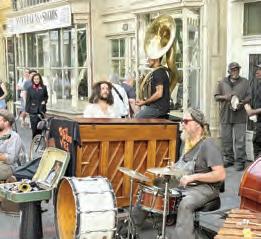
As we walked out the door, we stumbled upon an eight piece jazz band playing in the middle of the street. What a treat!
The next neighborhood over from Lauren is the Bywater, consisting of a few square miles of brightly colored
historic houses, coffee shops, bakeries, bars and restaurants. This is one of my favorite parts of New Orleans. Each street corner has colorful mosaic tiles in the sidewalk for street signs rather than on poles. I loved looking at the colorful tiles and street names including: Desire, Mystery, Toledano, Gen. Taylor, Pleasant, Napoleon, and others.
These mosaic street signs are iconic blue and white ceramic tiles, typically 4-by-6 inches, that began in the mid1880s, and continued until the 1920s. They were a practical way for drivers in horse-drawn carriages to see the street names and are still all over the city of New Orleans. Lauren told me that when street repairs are done, sometimes, some of the letters of the names are put back in the wrong order.
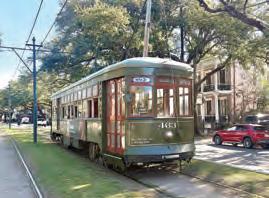
In the evening, Lauren would pick a fun place to eat near her house. A few of these included: 1000 Figs with great Middle Eastern Food- a small, quaint place serving seasonal Mediterranean fare near City Park.
Galaxie Tacosis located in an old Texico Gas Station building from the 1940s, which is on the National Register of Historic Places. We brought one of Lauren’s dogs and sat outside, where we enjoyed the warm weather and delicious burritos and chips.
My favorite restaurant we visited was Budsi’s Authentic Thai with outdoor sidewalk seating. Their pumpkin soup was unbelievable!
I had breakfast outside one morning at Flora Gallery and Coffee Shop with its local artwork, plants everywhere and great food. I sat outside on a
corner and chatted with a handful of longtime locals.
While riding into the French Quarter one morning on Lauren’s bike, I tracked down the Ayu Bakehouse which had been written up recently in the New York Times, mentioned as one of the best new bakeries in
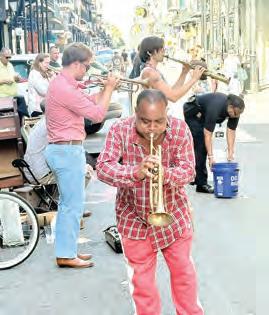
the country. They are located on Frenchmen Street and specialize in handmade croissants, sourdough breads, and light lunch fare. I had an unbelievable pastry stuffed with a pumpkin filling.
One night we went to two local music clubs, The Saturn Bar and B.J.’s Lounge, with Sally Baby and the

Silver Dollars performing to a standing room only, packed house. They are one of the most popular bands in town and one of best bands I have seen in quite a while.
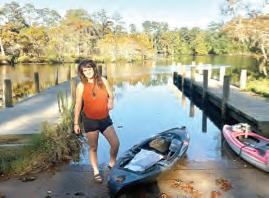
On my last day in town, we loaded up two kayaks and drove north of town, across Lake Pontchartrain on the 23 mile long, Lake Pontchartrain
Causeway bridge. It is still considered the longest bridge over water in the world. The lake encompasses over 630 miles of water and is one the largest in the U.S. There have been many strange deaths in the lake and around the bridge over the years.
Before we kayaked Lauren shared a surprise “attraction” that she thought I would like.
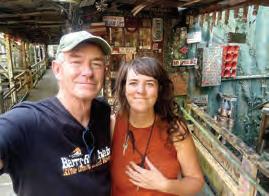
We pulled into the Abita Mystery House in the small town of Abita Springs. It is also known as the UCM Museum and is an old-time roadside attraction. It consists of several buildings that are packed with folk art, 1000s of found objects, and homemade inventions. There is a miniature Southern town with push-buttons that activate animated “displays.” On exhibit are odd collections, memorabilia, pure junk, and old arcade machines that are fun to play. Lauren was right. I loved the place!

We had about an hour and a half to kayak before sunset in a backwater bayou. Thankfully we did not see any alligators, but we did not see lots of cypress trees, hanging moss and birds. On my last morning in town, before heading to the airport, Lauren said. “Do you want to walk to the Mississippi River?” Of course I did, and we headed out after grabbing both dogs and walked just a few blocks to the river and along the rugged shore littered with logs, driftwood, old docks and barges.
It was the perfect way to end a wonderful trip and I look forward to my next visit.