Battlefields Board Rooms Three Cultural Transformations in a South Carolina Company
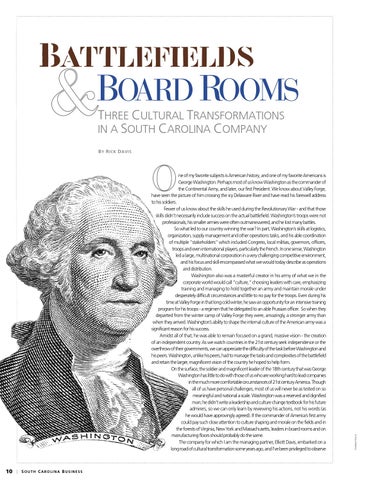
ne of my favorite subjects is American history, and one of my favorite Americans is George Washington. Perhaps most of us know Washington as the commander of the Continental Army, and later, our first President. We know about Valley Forge, have seen the picture of him crossing the icy Delaware River and have read his farewell address to his soldiers. Fewer of us know about the skills he used during the Revolutionary War - and that those skills didn’t necessarily include success on the actual battlefield. Washington’s troops were not professionals, his smaller armies were often outmaneuvered, and he lost many battles. So what led to our country winning the war? In part, Washington’s skills at logistics, organization, supply management and other operations tasks, and his able coordination of multiple “stakeholders” which included Congress, local militias, governors, officers, troops and even international players, particularly the French. In one sense, Washington led a large, multinational corporation in a very challenging competitive environment, and his focus and skill encompassed what we would today describe as operations and distribution. Washington also was a masterful creator in his army of what we in the corporate world would call “culture,” choosing leaders with care, emphasizing training and managing to hold together an army and maintain morale under desperately difficult circumstances and little to no pay for the troops. Even during his time at Valley Forge in that long cold winter, he saw an opportunity for an intensive training program for his troops - a regimen that he delegated to an able Prussian officer. So when they departed from the winter camp of Valley Forge they were, amazingly, a stronger army than when they arrived. Washington’s ability to shape the internal culture of the American army was a significant reason for his success. Amidst all of that, he was able to remain focused on a grand, massive vision - the creation of an independent country. As we watch countries in the 21st century seek independence or the overthrow of their governments, we can appreciate the difficulty of the task before Washington and his peers. Washington, unlike his peers, had to manage the tasks and complexities of the battlefield and retain the larger, magnificent vision of the country he hoped to help form. On the surface, the soldier and magnificent leader of the 18th century that was George Washington has little to do with those of us who are working hard to lead companies in the much more comfortable circumstances of 21st century America. Though all of us have personal challenges, most of us will never be as tested on so meaningful and national a scale. Washington was a reserved and dignified man; he didn’t write a leadership and culture change textbook for his future admirers, so we can only learn by reviewing his actions, not his words (as he would have approvingly agreed). If the commander of America’s first army could pay such close attention to culture shaping and morale on the fields and in the forests of Virginia, New York and Massachusetts, leaders in board rooms and on manufacturing floors should probably do the same. The company for which I am the managing partner, Elliott Davis, embarked on a long road of cultural transformation some years ago, and I’ve been privileged to observe
10
| S o u t h C a r o l i n a B u s i n e ss
THINKS TOCK
B y R ick D avis