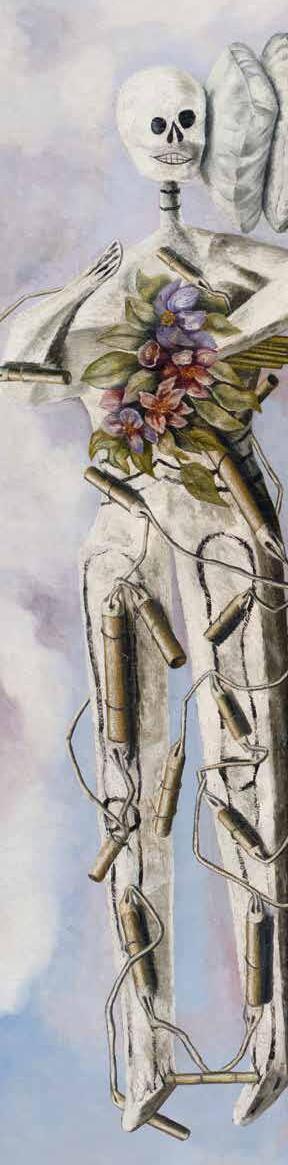
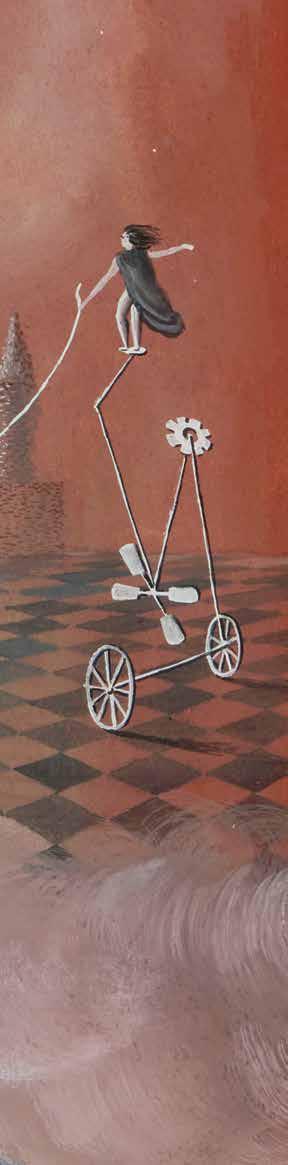
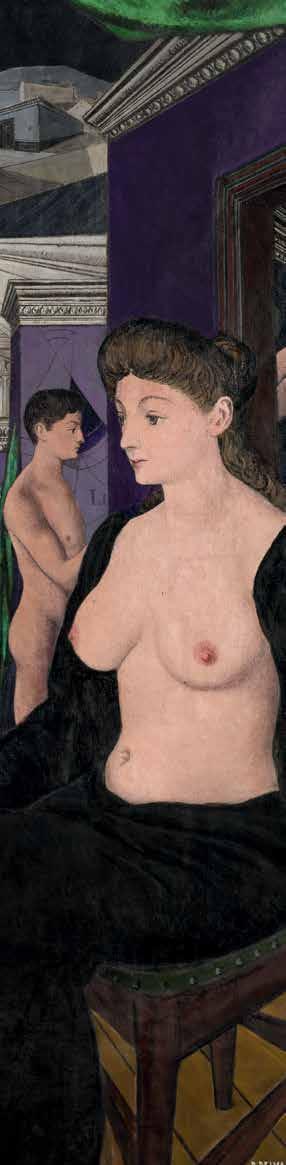
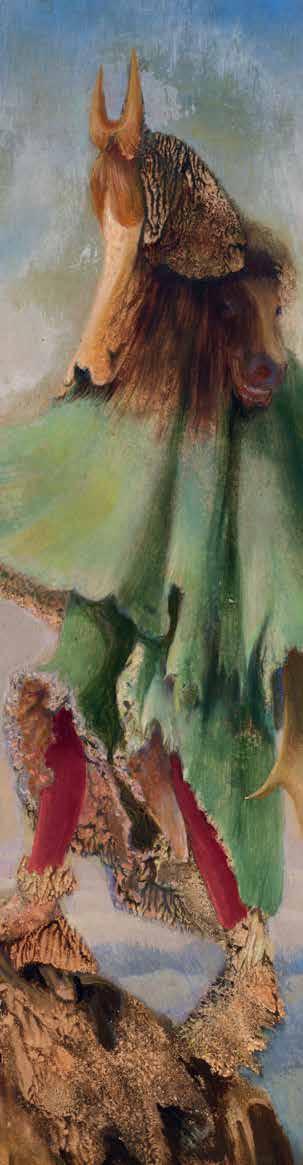
Telephone bid requests should be received 24 hours prior to the sale. This service is offered for lots with a low estimate of $5,000 and above.
PRE SALE COORDINATOR
Bridget Quinn
Impressionist & Modern Art Bridget.Quinn@Sothebys.com
POST SALE SERVICES
Samit Sinha
Client Accounts Receivable Manager Impressionist & Modern Art uspostsaleservices@Sothebys.com +1 212-606-7444
COLLECTION SALE MANAGEMENT
Deborah Engel Senior Account Manager Deborah.Engel@Sothebys.com
8–9
EXQUISITE CORPUS INTRODUCTION
10–17
DREAMING SURREALISM BY DAWN ADES
18–201
EXQUISITE CORPUS:
TREASURES FROM A PRIVATE COLLECTION EVENING AUCTION, NEW YORK
202–261
EXQUISITE CORPUS:
TREASURES FROM A PRIVATE COLLECTION DAY AUCTION, NEW YORK
263
CONDITIONS OF BUSINESS FOR BUYERS IN NEW YORK AUCTIONS
264
INDEX OF ARTISTS COPYRIGHT
This collection comes to auction at a time when “Surrealism” looms large across the art market as well as the cultural zeitgeist—deservedly, perhaps serendipitously so. The current moment, however, ought not belie the vision required to assemble such a sublime representation of the movement at a time before the entire art world had rallied to the Surrealist cause.
Individual connoisseurship and courage, decades of dedication and curiosity, and an unwavering commitment to a singular artistic vision brought this collection into being so many years ago. Through the sieve of history, it entered the realm of legend. When, a decade ago, I conceived Cherchez la femme: Women and Surrealism, a selling exhibition celebrating overlooked female artists at the movement’s fore, it was this collection that stood, for me, as a paragon of what a Surrealist collection could be: proof that the oft-debated definition of Surrealism can be both traditional and enlightened, that expanding the tent is an act of daring, not accommodation or capitulation. The result of this act is, simply, exquisite.
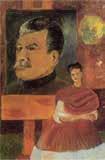
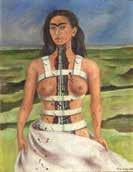
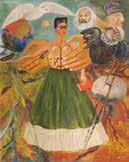
The bright vision behind this collection illuminates the penumbra of the movement, rejoining powerhouse female artists like Frida Kahlo, Dorothea Tanning, Kay Sage, Valentine Hugo and Remedios Varo with similarly underappreciated contributors like Wolfgang Paalen, Stanislao Lepri and Amédée Ozenfant to their rightful place alongside Max Ernst, René Magritte and Salvador Dalí. Whether by André Breton’s gatekeeping, or
in Frida’s case, her own strident rejection, many of the artists illustrated in this catalogue never officially worked under the banner of Surrealism. Yet in aggregate they reveal what true collectors instinctively know: Surrealism is as much a state of mind as a formal doctrine—an embrace of the absurd, a yearning for the fantastic, a respect for the unexpected, a willingness to delve into the unknown.
These paintings, drawings, sculptures and books possess an undeniable power unto themselves, yet—as with all exceptional collections—they exist powerfully in conversation with one another. Recalling the collaborative Surrealist game Exquisite Corpse (Cadavre exquise), in which artists’ successive sketches coalesced into unexpected and fantastical forms, Exquisite Corpus achieves a cohesion that transcends the sum of its interwoven parts. Through it we can visualize the neural network of ideas, ideologies, trauma, diaspora, romance and friendship that cleaved the Surrealists together throughout the twentieth century. That same improbable force has delivered the collection through time and space, standing as a testament to Surrealism’s enduring capacity to challenge perception, provoke critical reflection and affirm its profound relevance in the modern era.
After fifty years of thoughtful stewardship and nearly three decades since its last public exhibition, it is an honor and a privilege to present the collected bounty of Exquisite Corpus at Sotheby’s. It truly is the stuff of dreams.
Julian Dawes Vice Chairman, Senior Vice President, Head of Impressionist and Modern Art, Americas
Dreaming Surrealism
By Dawn Ades
The fact that visual surrealism cannot be defined by style and appearance seems to make it odd as the subject for a collection. Or perhaps that is one of the attractions for a collector? It gives almost unlimited freedom to shape a collection according to personal predilections and ideas, and the great collections of works related to surrealism built up over the last century have been remarkably different from one another, with strong individual characters.
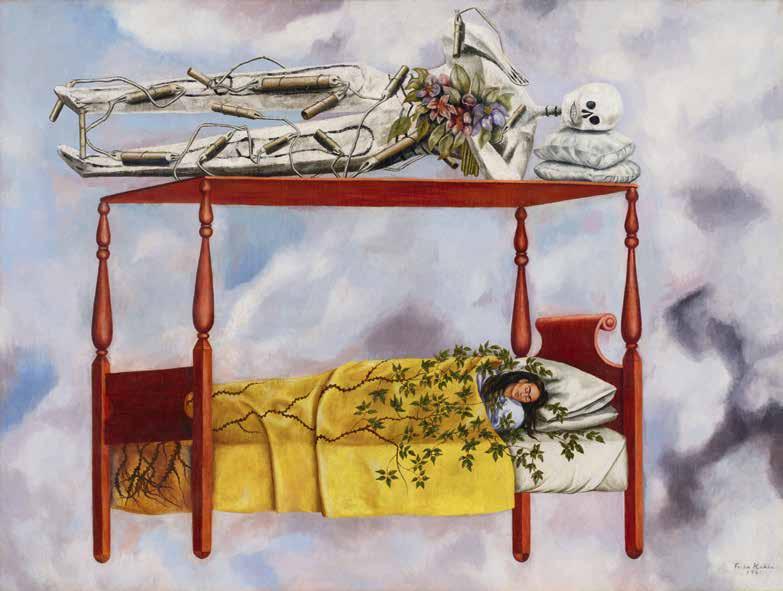
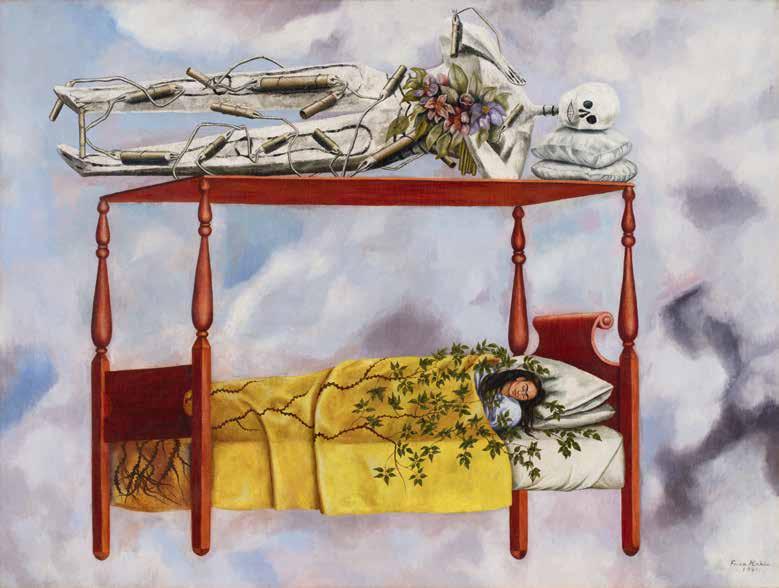
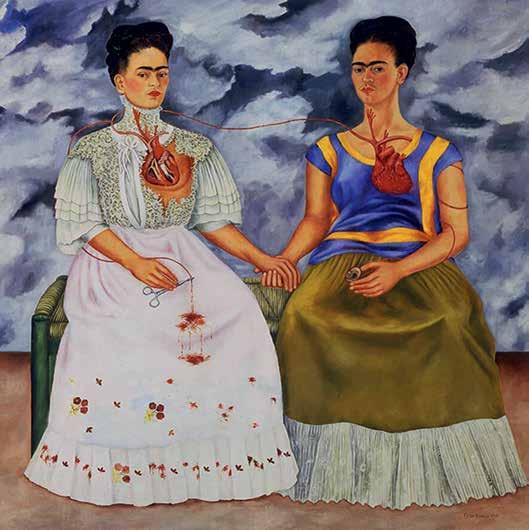
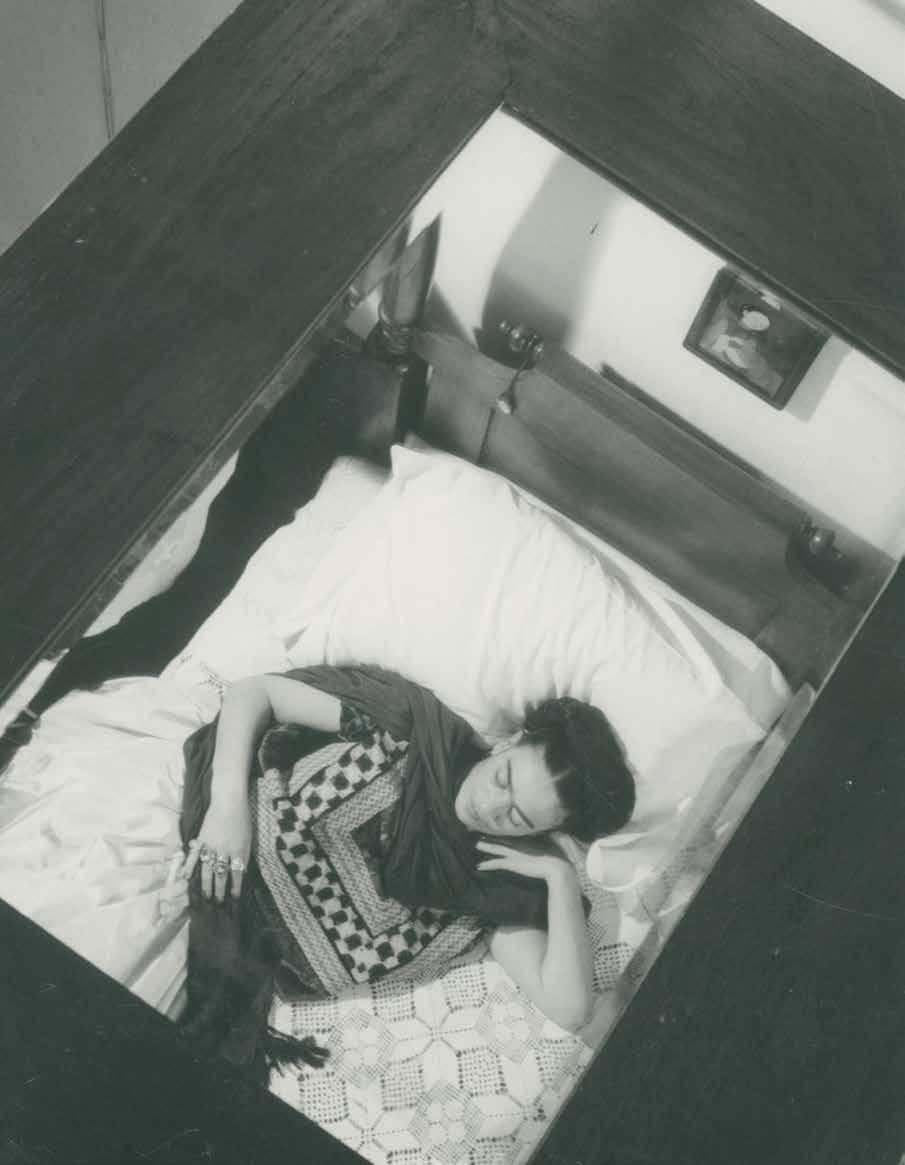
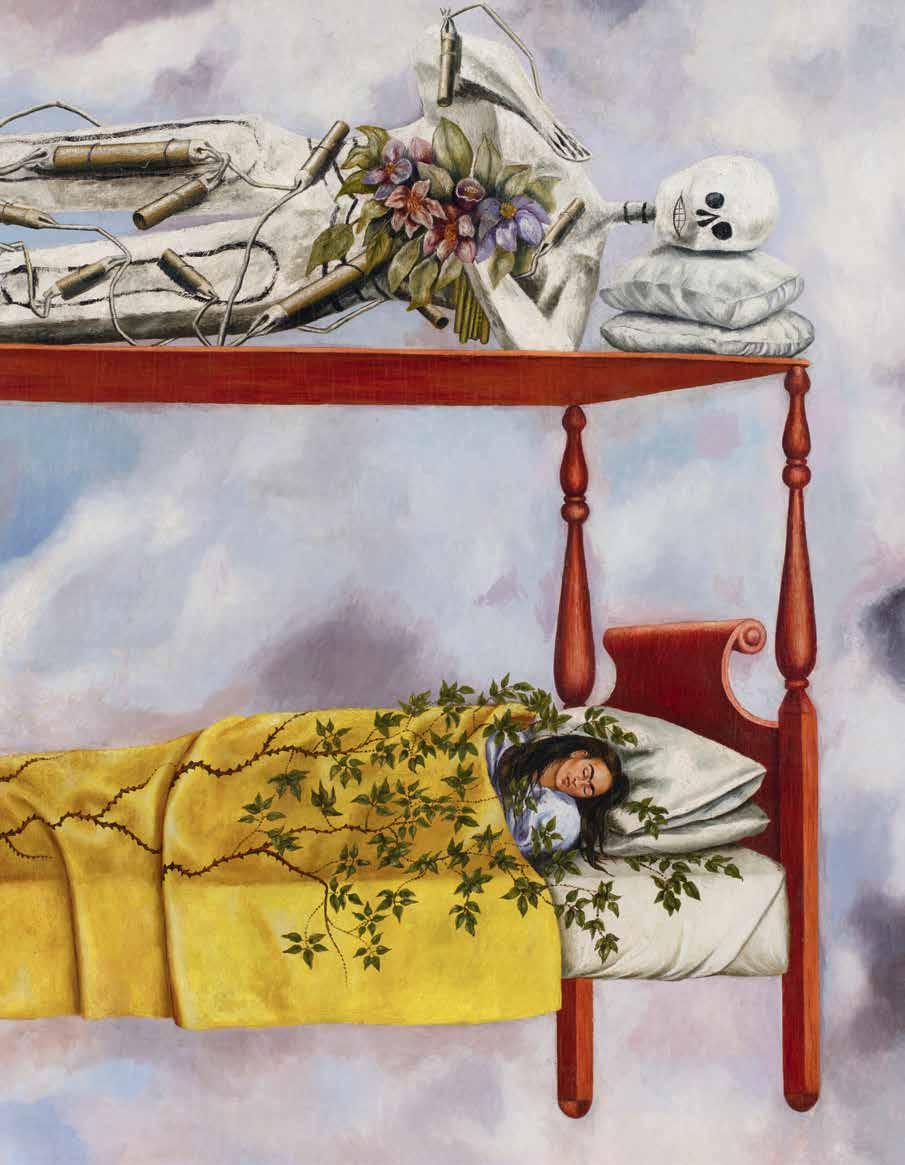
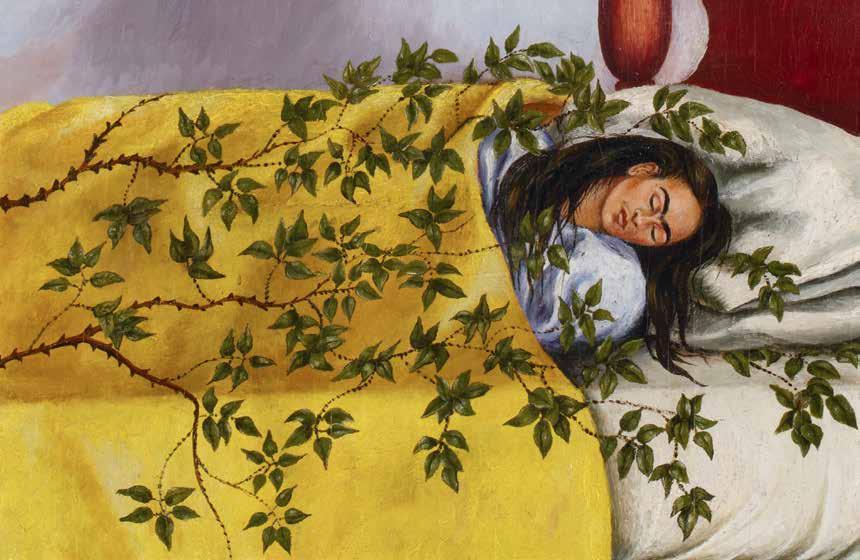
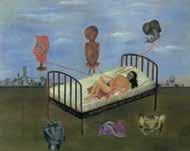
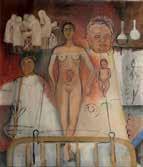
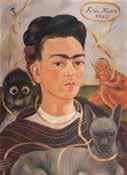
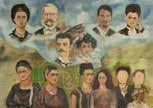
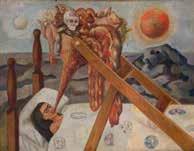
If one work in the current array holds a key to this collection, it is Kahlo’s El sueño (La Cama) The dream world, in all its complexity, including its relationship with the waking world, is at the heart of surrealism. The paintings here reveal how various and unexpected that world is, by no means limited to Salvador Dalí’s fixing of “images of concrete irrationality,” brilliant though that was.
The dream was important for Surrealism from the start. In the first Manifesto by André Breton it is central to the definition: “Surrealism is based on the belief in the superior reality of certain forms of previously neglected associations, in the omnipotence of dream” (André Breton, Manifesto of Surrealism (1924) , translated by Richard Seaver and Helen R. Lane, Ann Arbor, 1969, p. 10).
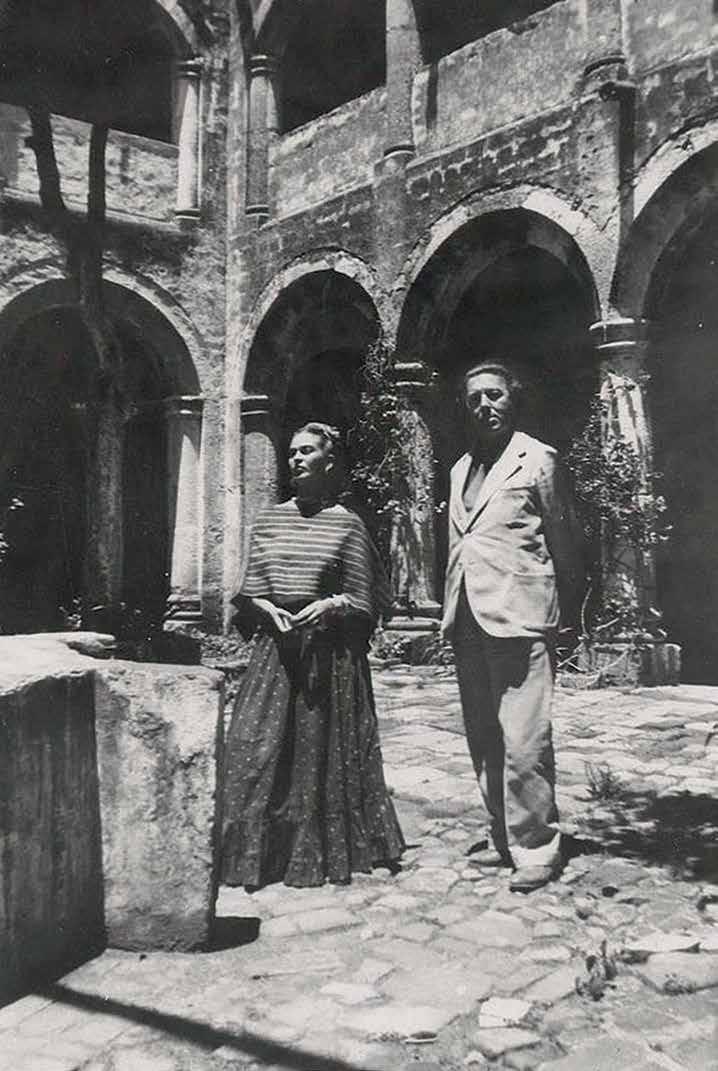
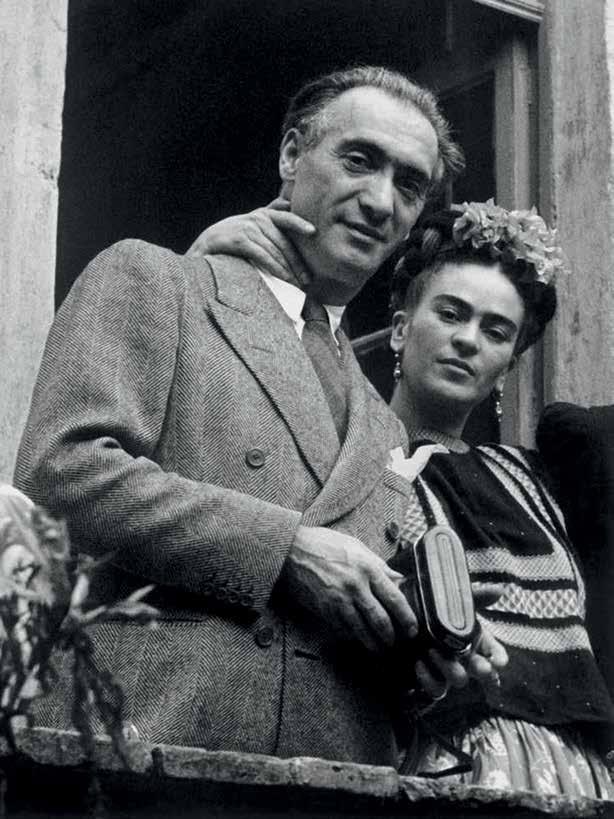
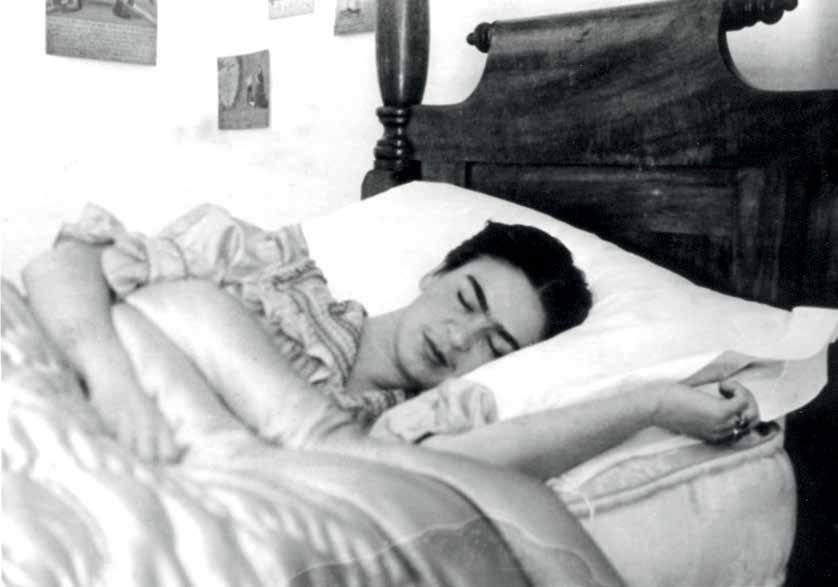
Frida Kahlo and André Breton in Mexico, 1938, Photographer unknown
Breton, who had been occupied with Freud’s ideas while a trainee psychiatric doctor during the First World War, pays homage to the founder of psychoanalysis. Freud “very rightly brought his critical faculties to bear upon the dream. It is in fact inadmissible that this considerable portion of psychic activity…has still today been so grossly neglected” (ibid.). Freud had revealed, in The Interpretation of Dreams, the importance of the role of dreams in our mental worlds and their relationship to the unconscious and its mysterious workings.
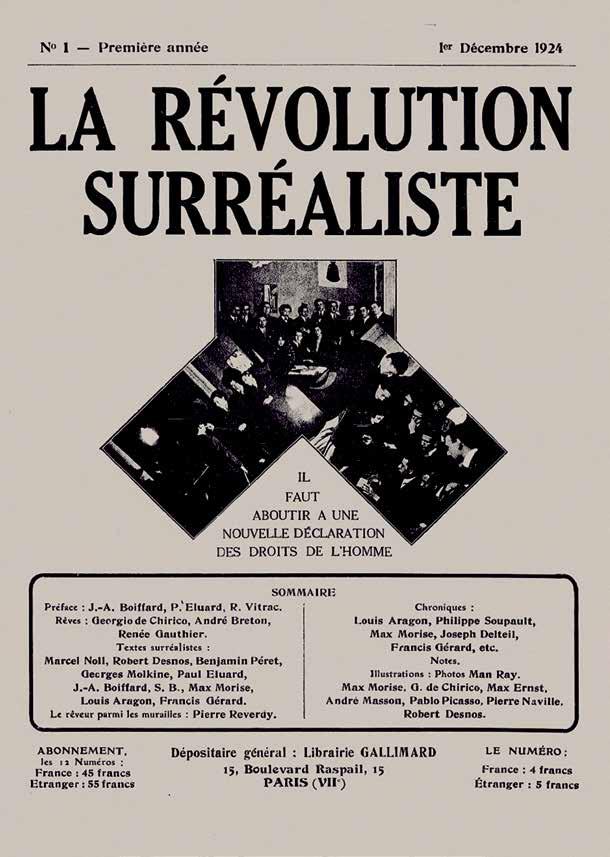
Grasping this idea, Breton argued that “If the depths of our mind contain within it strange forces capable of augmenting those on the surface, or of waging a victorious battle against them, there is every reason to seize them—first to seize them, then, if need be, to submit them to the control of our reason…” But his focus had evolved beyond the purely psychoanalytical, and the Manifesto contains a challenge to the analysts: “But it is worth noting that no means has been designated a priori for carrying out this undertaking and, that until further notice it can be construed to be the province of poets as well as scientists” (ibid.). For the surrealists, the dream in itself was of value, not least for underscoring the importance of the imagination and the poetic as well as psychic value of the irrational. The first of the great surrealist journals, La révolution surréaliste, opened with narratives of dreams by de Chirico and Breton, followed by “surrealist texts”: examples of automatic writing.
Above
Opposite
The first of twelve issues of La
surréaliste, December 1924
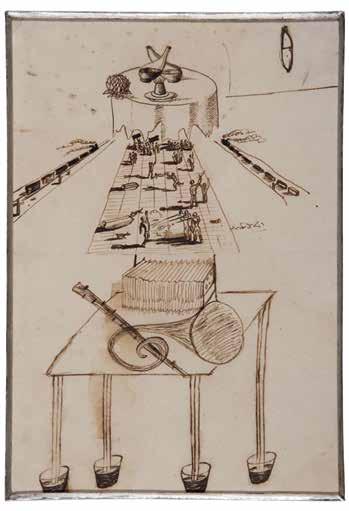
André Breton, Gala (Elena Ivanovna Diakonova), Valentine Hugo and Salvador Dalí , Cadavre exquis (Exquisite Corpse) circa 1932, Museo Nacional Centro de Arte Reina Sofía, Madrid
Révolution
Dream narratives were usually descriptions of the remembered dream—what Freud called the ‘manifest content.’ For Freud, though, what mattered was the ‘latent content’ of a dream, represented often by symbolic associations. The surrealists occasionally interpreted a dream, but this was not the main purpose in capturing it. Inevitably there was disagreement between them: when Breton published a collection of dreams, by various authors, he asked Freud for comments. The result was a resounding rejection. “The superficial aspect of dreams, what I call the manifest dream, holds no interest for me… A collection of dreams, without associations and knowledge of the context in which it was dreamed does not tell me anything, and I find it hard to imagine what it can mean to anyone” (Sigmund Freud in a letter to Breton, Oeuvres completes, vol. 2, p. 1808). The surrealists would not accept that the dream is divorced from life, any more than art itself is. If psychic activity is “constantly active in the dream”, then the dream might one day return “to its true framework, which could only be human life itself” (André Breton, Communicating Vessels (1932), translated by Mary Ann Caws and Geoffrey T. Harris, Lincoln and London, 1990, p, 17 ).
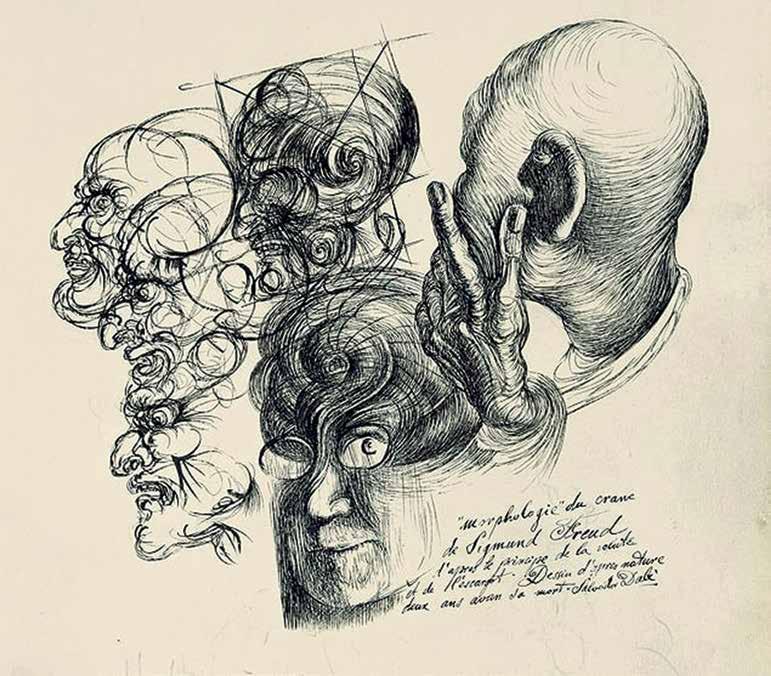
Opposite Salvador Dalí, Morphology of the
1938, illustration for the artist’s autobiography "The Secret Life of Salvador Dali"
Above
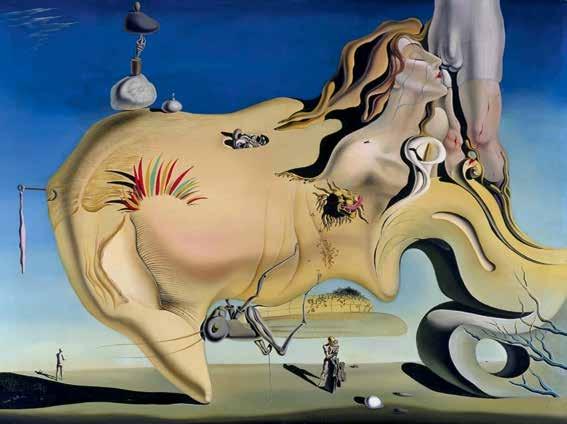
Salvador Dalí, Visage du grand masturbateur 1929, Museo Nacional Centro de Arte Reina Sofía, Madrid
skull of Sigmund Freud
Looking back on over a century of contrasting scientific, remedial and artistic trowelling of dreams, surrealism has gained a foothold in asserting their real expressive power. It is curious, however, that Breton doubted painting’s capacity to “operate in the immeasurable region that stretches between consciousness and unconsciousness” (André Breton, “The Automatic Message” (1933), Break of Day, translated by Mark Polizotti and Mary Ann Caws, 1999, p. 140).
He infinitely preferred the word, spoken or written, to the “unverifiable visual,” as he put it, and laid down a challenge: “Now that I’ve made my point, the floor should be turned over to the painters" (ibid.).
Sometimes dismissed as fantasy, which implies the divorce from or the over-riding of ‘reality,’ surrealist paintings give lucid expression to the free range of the visual imagination characteristic of dreams. Painting, surely, has a unique and uncanny capacity to carry the irrational, but at the time convincing, experiences of dream, for instance those of space, of materiality, movement.
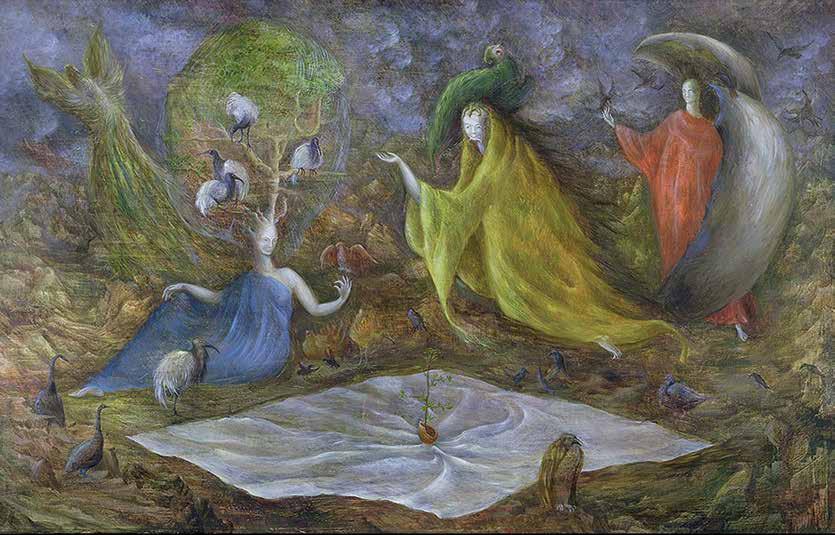
The paintings and drawings here, such as those by Remedios Varo, Oscar Domínguez, Kahlo, Valentine Hugo, Kay Sage, Dorothea Tanning and Yves Tanguy, are very different from each other. However, although with their own strong identity, they may share the effects of “dream work”—
magnification, condensation, contradictions, the fusings of space and time, all of which the dreaming mind accepts, but the rationalist, who believes only in daily realities, rejects.
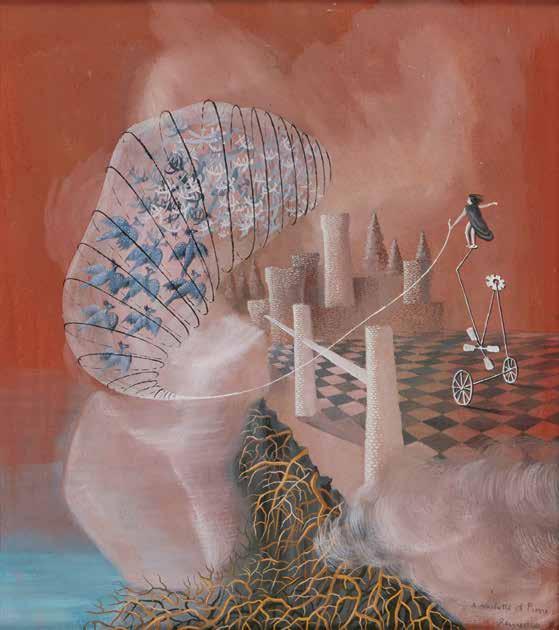
Many surrealists wrote down their dreams, but their connection with painting should not be taken too literally, though sometimes elements may appear. Remedios Varo, for example, recorded dreams that often refer to travel and contain references to objects that figure in her paintings, such as the chequer board in the work here and in the related 1953 painting Premonition However, rather than “recording dreams” that pre-exist, it is in the act of painting, one senses, that the visual effect of dreaming emerges.
It is interesting to compare Varo’s
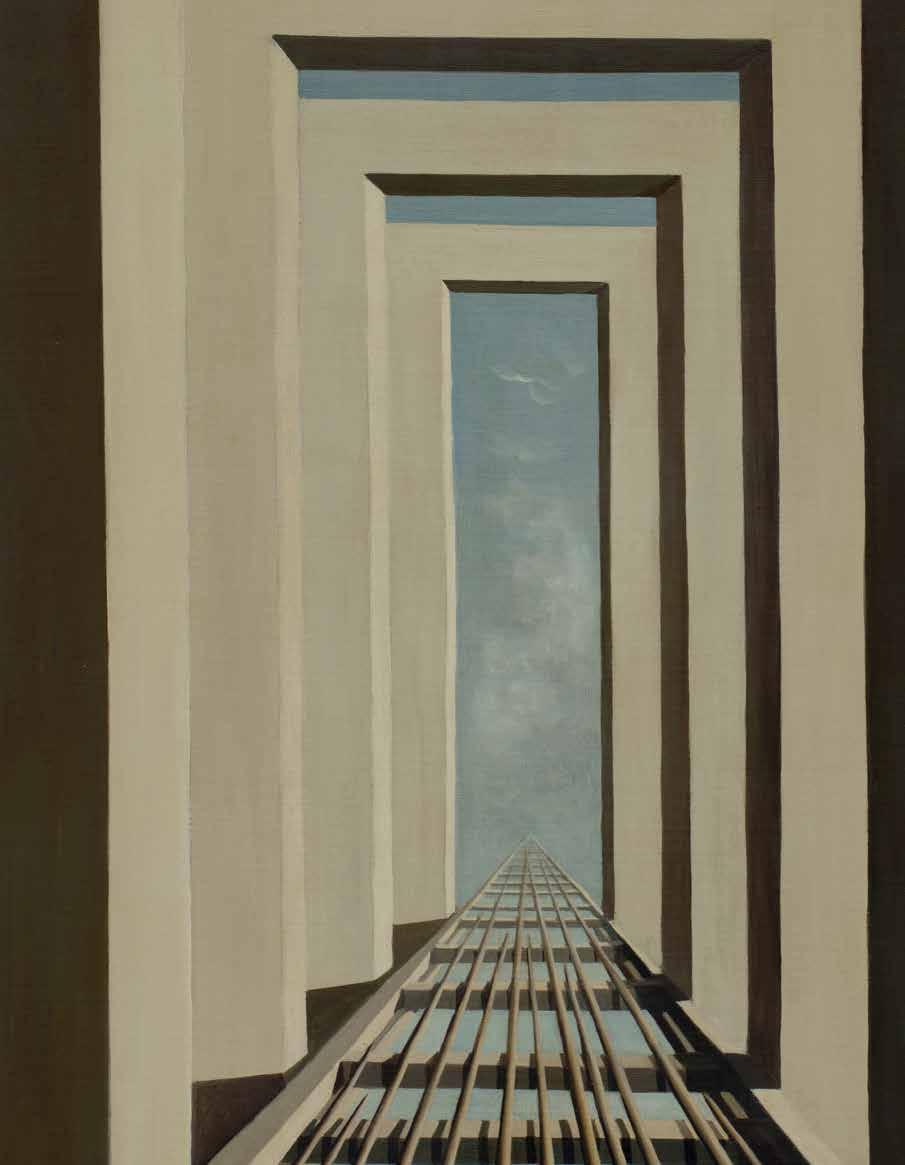
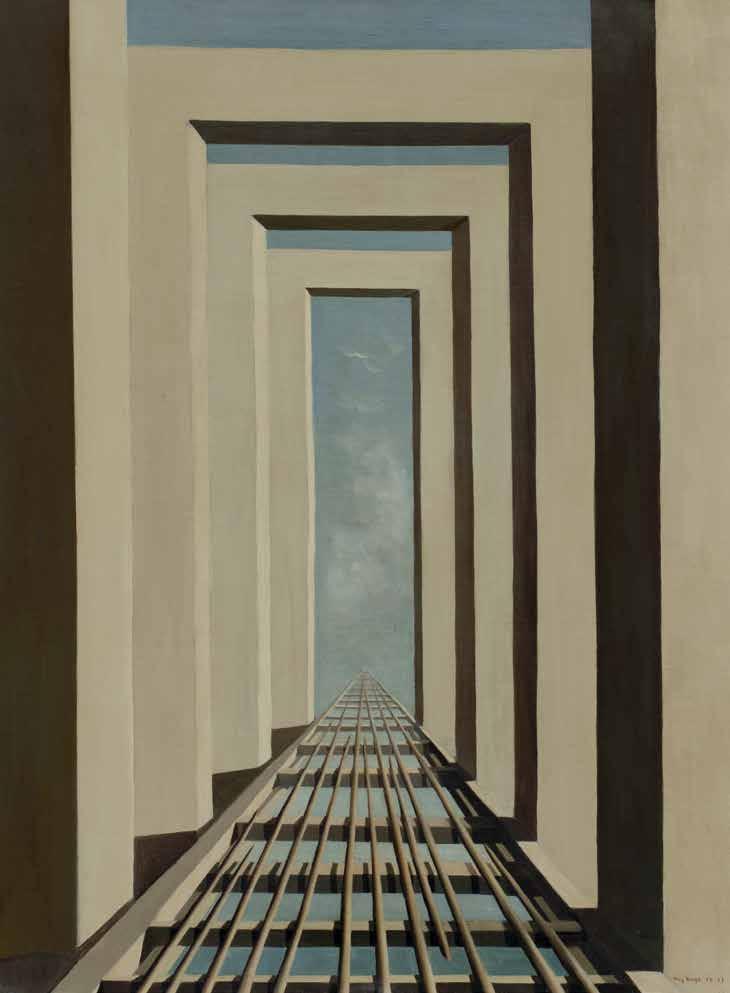
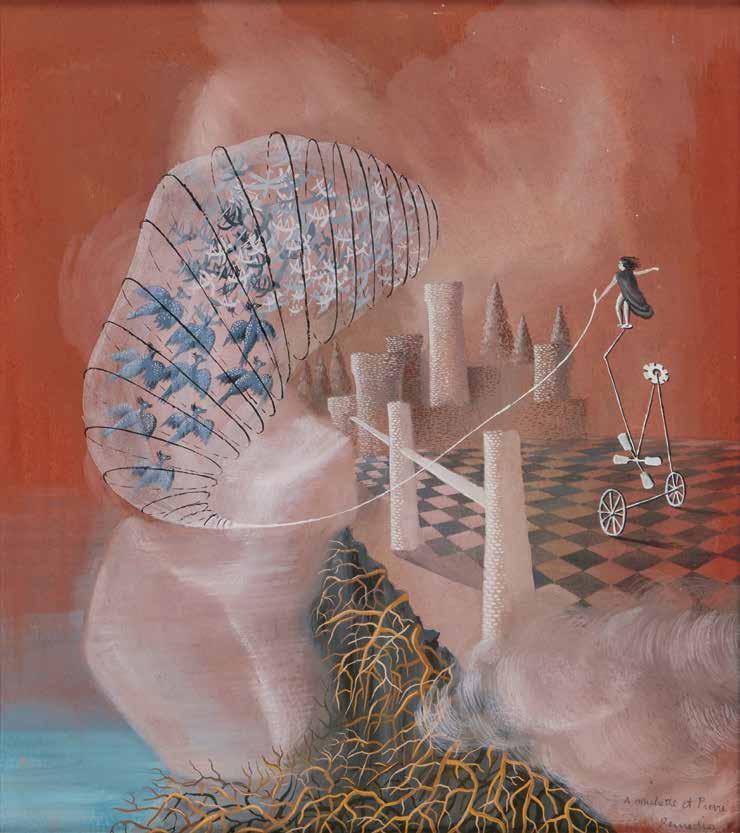
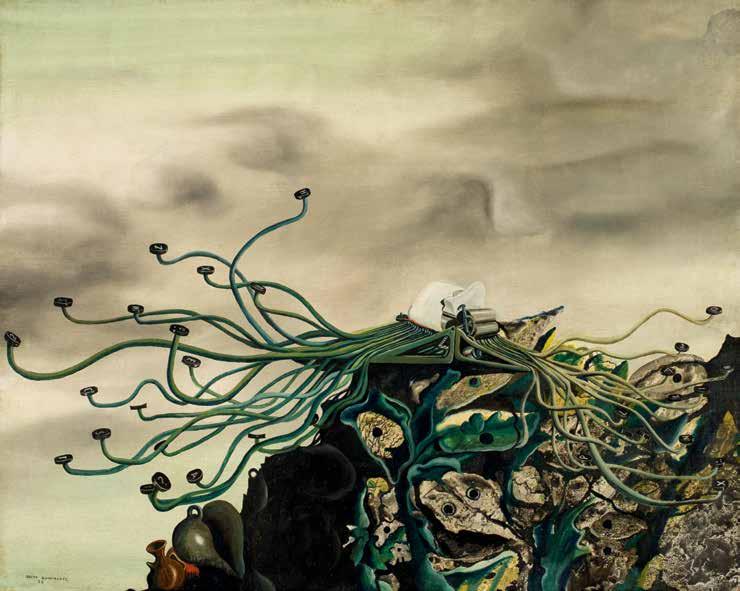
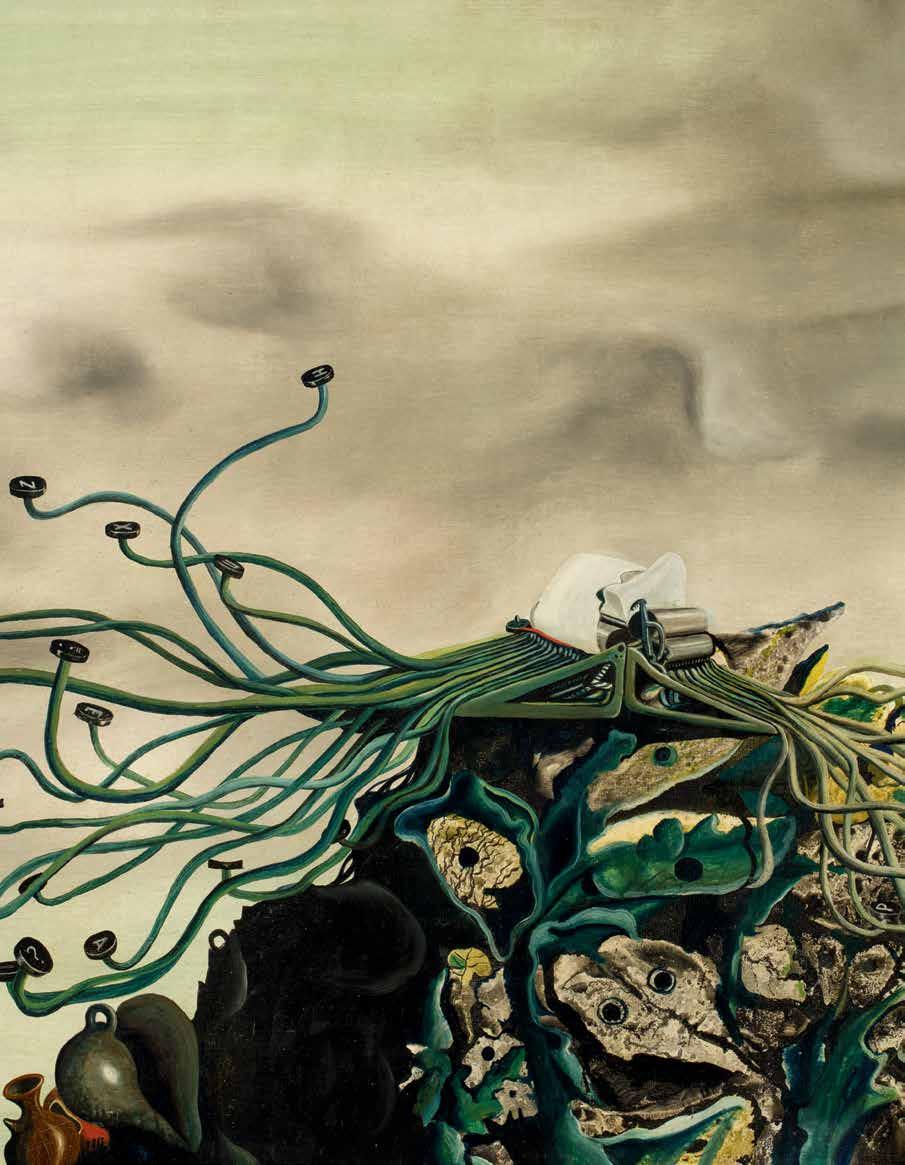
miraculous creation of space in Composition with the paintings of other artists such as Sage, Tanguy and her close friend and mentor Victor Brauner. In Composition the co-existence of defined and imprecise spaces and substances further develops that of Brauner in works like the 1938 Untitled. Varo balances the precision of the posts receding into the distance with the transparent, pulsating container of birds. The chequered platform grows roots, not unlike the sprouting typewriter keys in Domínguez’ The Typewriter—wonderful examples of the unpredictable interventions of nature. Sage’s austere, immaculate structures, which recall the architecture in the paintings of an artist she admired, Piero della Francesca, define space but
Above
Yves
Remedios Varo, Sans titre, circa 1943, lot 12
Opposite
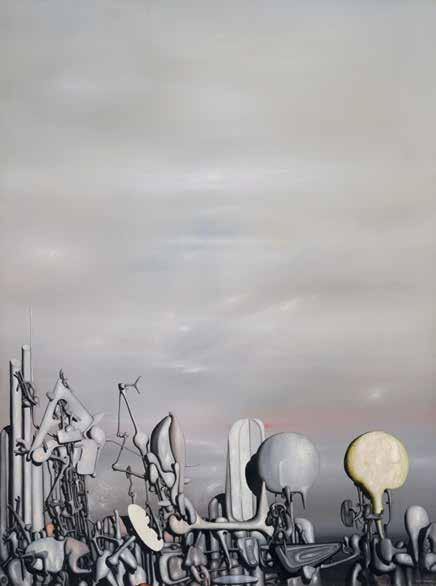
Tanguy, Ce Matin, 1951, lot 10
their certainties are often undermined. In Detour, for example, the receding arched corridor turns out to be impossibly floating in air.
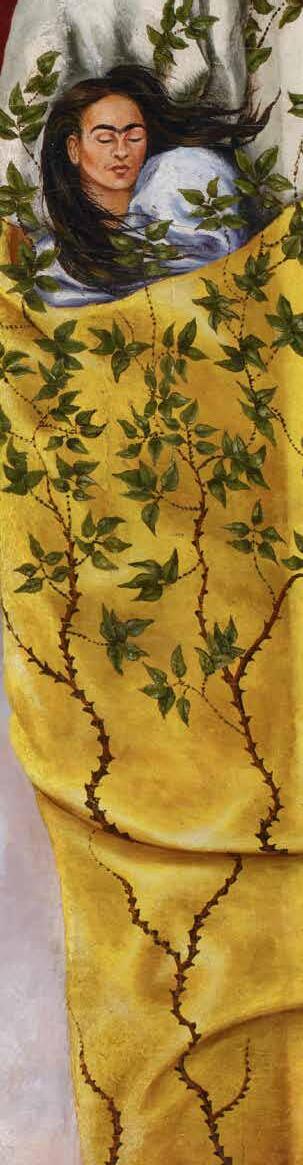
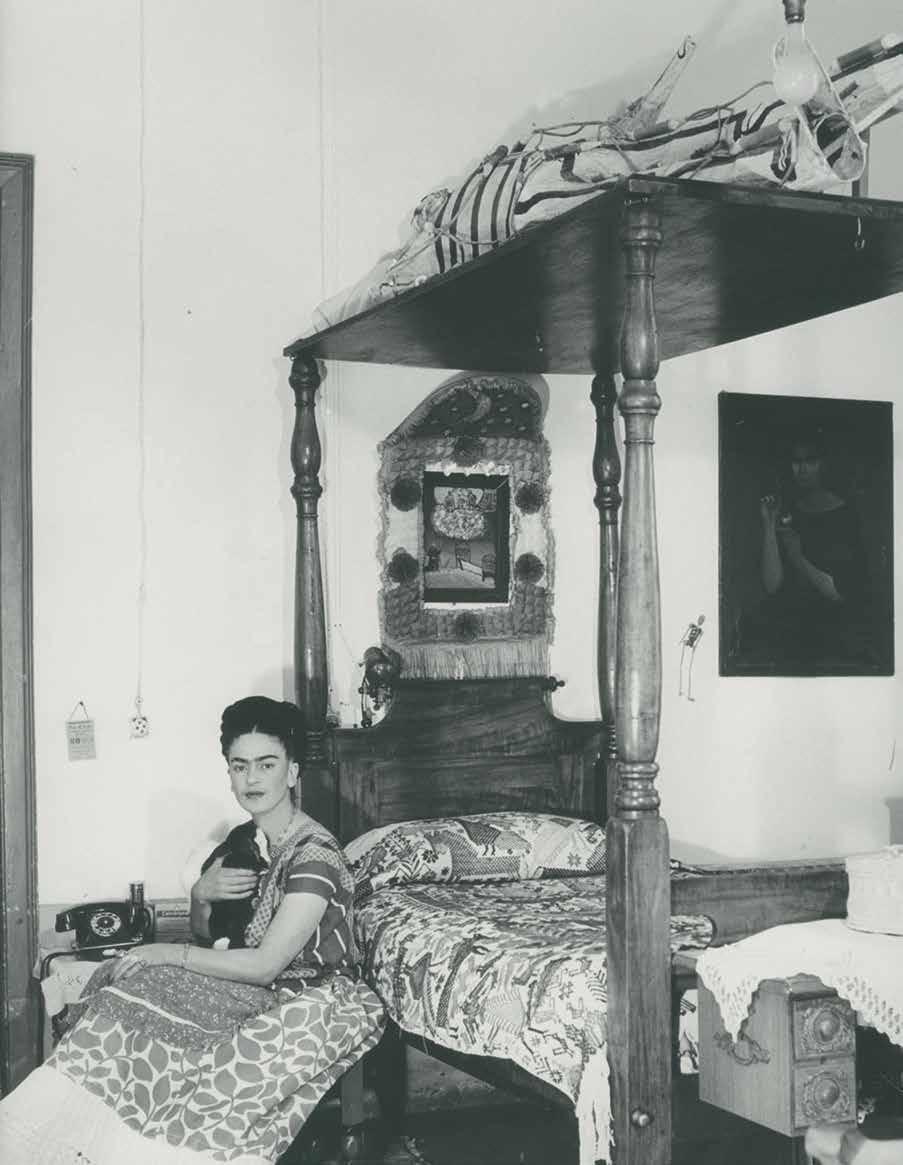
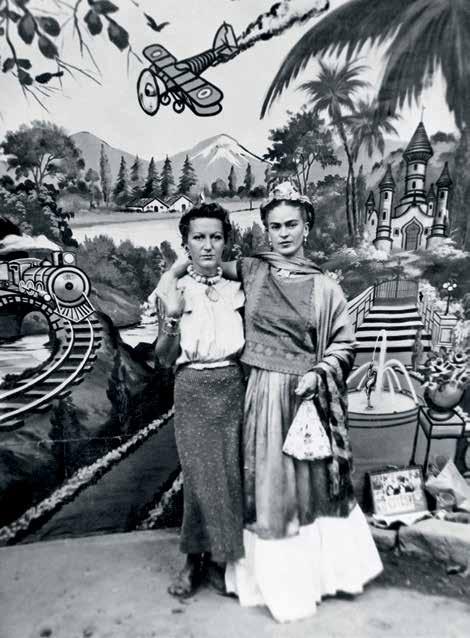
Although Kahlo later denied she was or had been a surrealist, the fundamental compatibility of her paintings with surrealism is striking. The Dream recalls a favourite surrealist metaphor, which was also the title of Breton’s study of dreams, Communicating Vessels This refers to the scientific experiment of two vessels linked by a tube, filled with gas or a liquid which, passing from one to the other, rises always to the same height, a metaphor which exemplified the surrealist belief in the necessary inter-relationship between action and dream, wakefulness and sleep, reality and the imagination. The painting holds two recumbent figures in suspension, not communicating directly but interwoven visually, echoing and contrasting one another: death and life, flesh and bones, flowers and thorns – and most hauntingly the live figure is asleep, the skeleton awake.
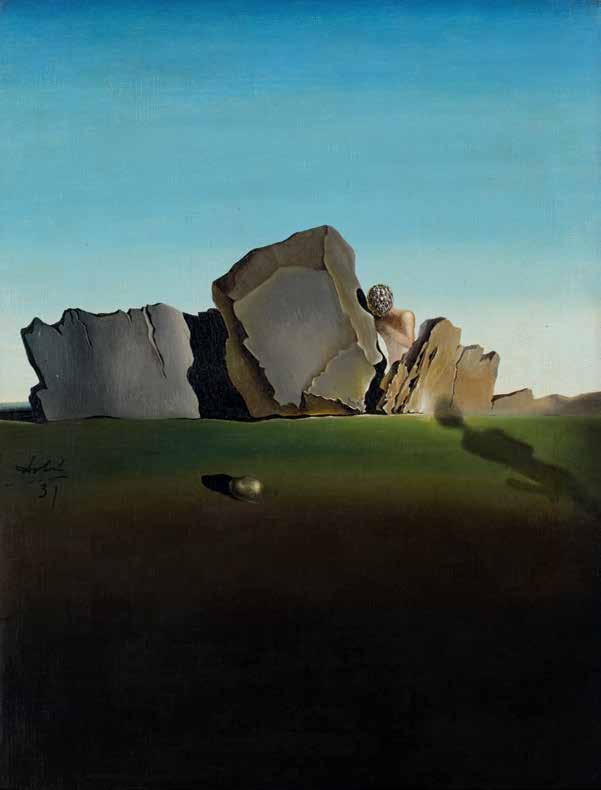
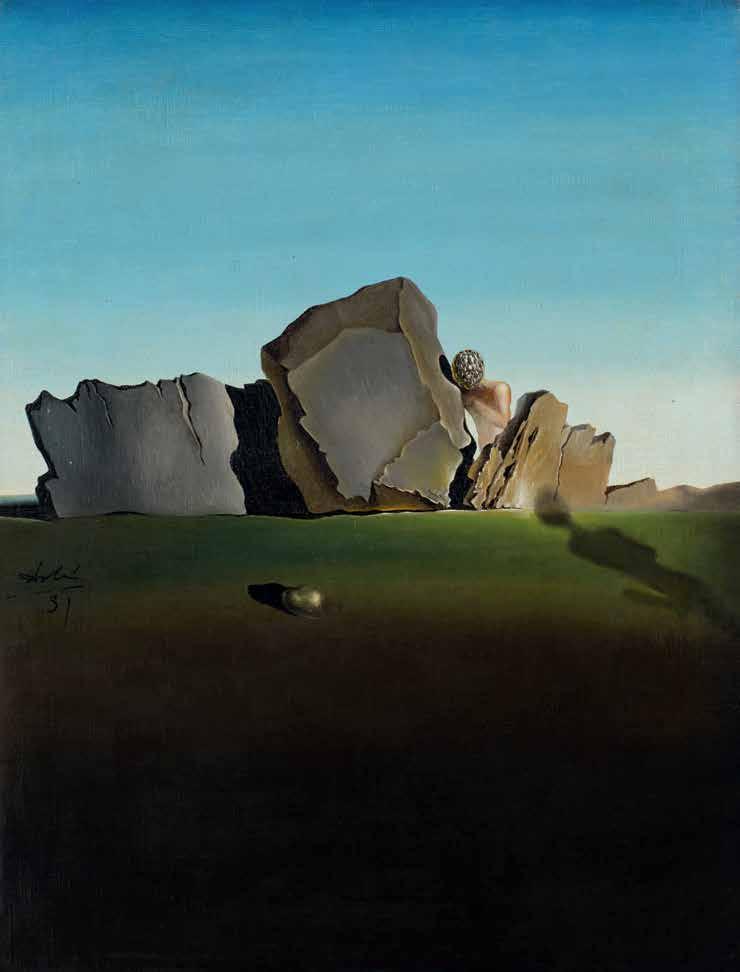
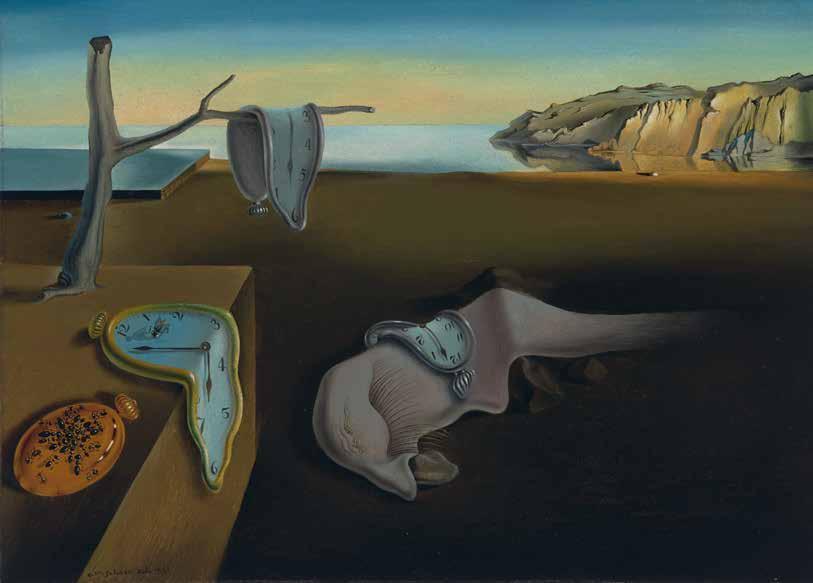
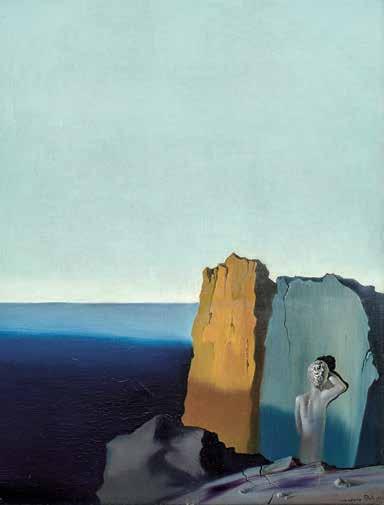
Dalí’s Symbiosis of a Head of Seashells from 1931 was painted the same year as his most famous image, The Persistence of Memory, with its sleeping/dreaming head which resembles that in The Great Masturbator of 1929. Symbiosis of a Head of Seashells picks up this forbidden theme, perhaps informing the strange spatial divorce of the figure behind a rock, hiding his face in shame, from the phallic shadow.
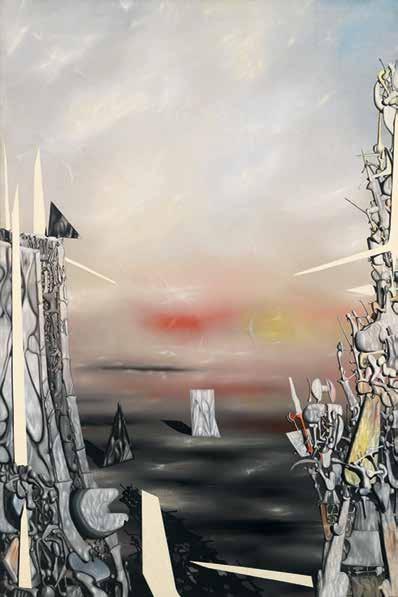
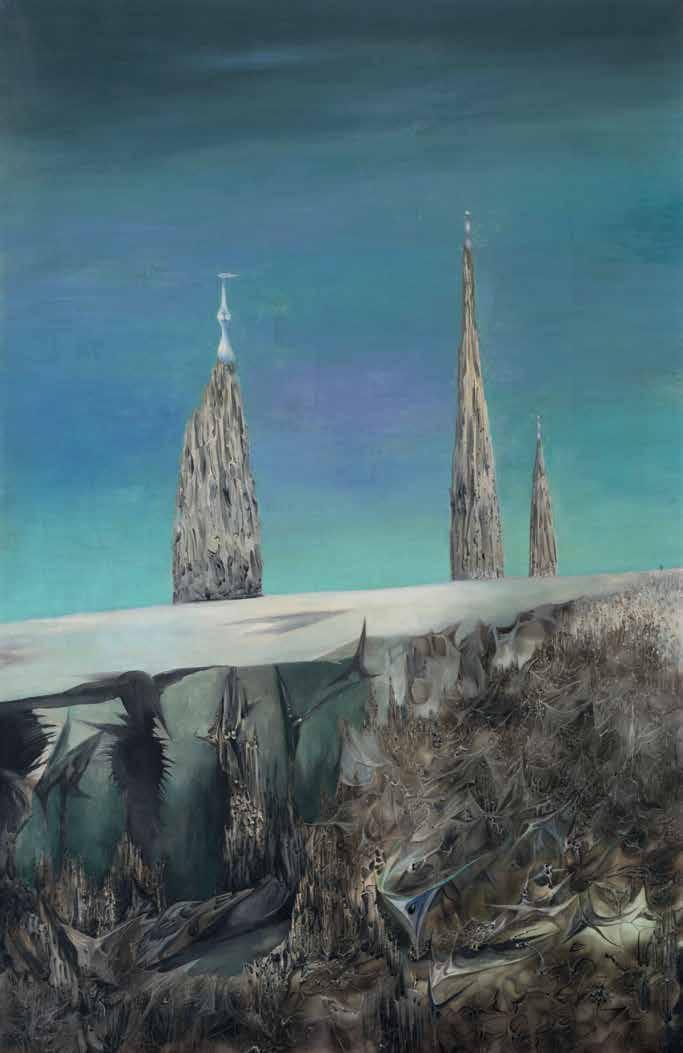
More than any other artist here, however, Tanguy’s uninterpretable vistas, dreamscapes, which are neither and both landscapes and seascapes, seem to take form in the process of painting. He “painted spontaneously, certainly without reflecting, as if while dreaming” (Exh. Cat., New York, The Solomon R. Guggenheim Museum, Surrealism: Two Private Eyes, 1999, p. 29). It is the dream, still pulsing beneath the surface of reason, that lies at the heart of this Exquisite Corpus.
EVENING AUCTION, NEW YORK 6:30 PM LOTS 1–24
1 Valentine Hugo
1887–1968
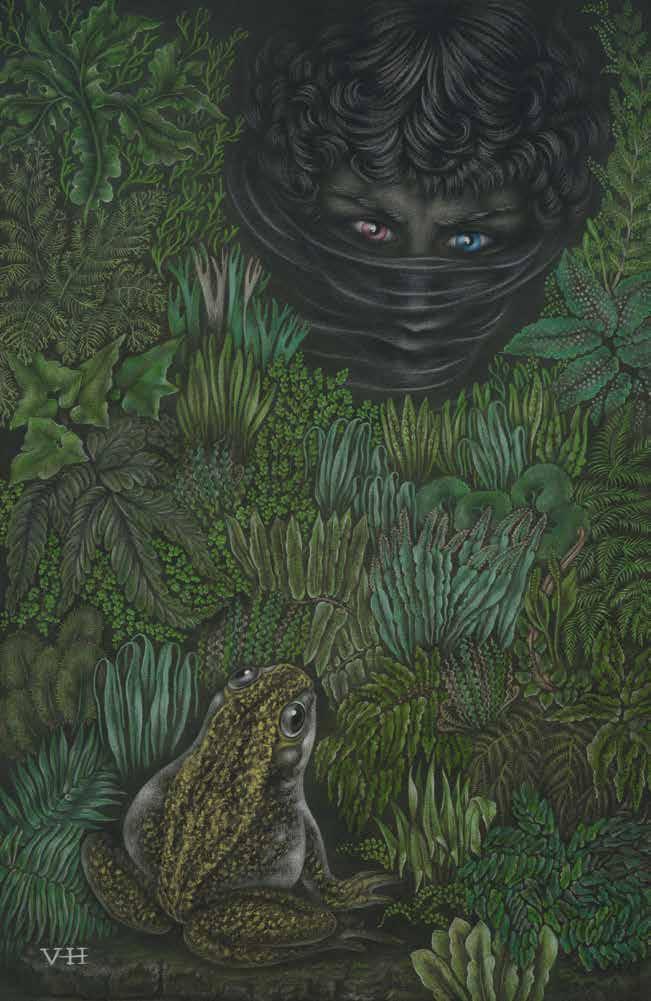
Le Crapaud de Maldoror
signed with the artist’s monogram (lower left); signed Valentine Hugo and dated 1932 (lower right of the artist’s mat); signed again Valentine Hugo, dated Décembre 1932 and inscribed “Tu dois être puissant car tu as une figure plus qu’humaine, triste comme l’univers belle comme le suicide”
Paris (on the verso of the artist’s mat)
colored pencil on black paper mounted in the artist's mat
image: 18 ½ by 12 in. 47 by 30.5 cm.
artist’s mat: 24 ⅛ by 17 ¾ in. 61.3 by 45 cm.
Executed in 1932.
$ 100,000-150,000
Provenance
Daniel Fillipacchi, Paris
Acquired from the above by 1978 by the present owner
Exhibited
Venice, XLII Esposizione Internazionale d’Arte La Biennale di Venezia, 1986, p. 86 (titled Viso rana and dated 1931)
New York, Solomon R. Guggenheim Museum, Surrealism: Two Private Eyes, 1999, vol. I, no. 103, p. 164; p. 165, illustrated in color (dated 1936)
Literature
Surréalisme au service de la révolution, no. 5, 1933, illustrated (titled Lautréamont)
Europe: revue mensuelle, nos. 475-76, 1968, p. 48; p. 49, illustrated
Jacques Baron, Anthologie plastique du surréalisme, Paris, 1980, p. 138, illustrated in color (dated 1936)
Anne de Margerie, Valentine Hugo, 1887-1968, Paris, 1983
Béatrice Seguin, ed., and Jean-Pierre Cauvin, Valentine Hugo, Arles, 2002, p. 141, illustrated (titled Lautréamont, Maldoror et le crapaud)
Exh. Cat., Boulogne-sur-Mer, Bibliothèque des Annonciades, Valentine Hugo, Le Carnaval des Ombres, 2018, fig. 20, p. 24, illustrated in color; p. 132 (dated 1936)
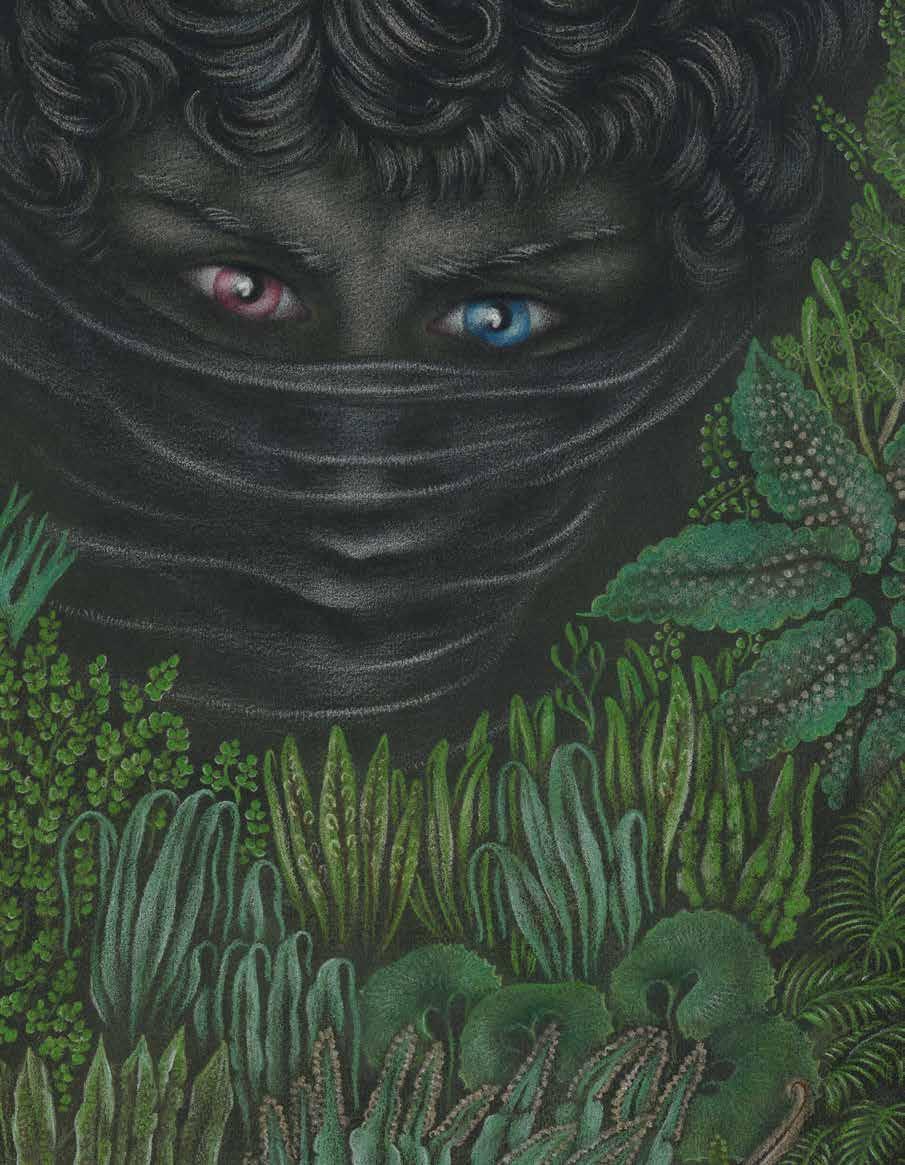
Opposite Detail of the present work
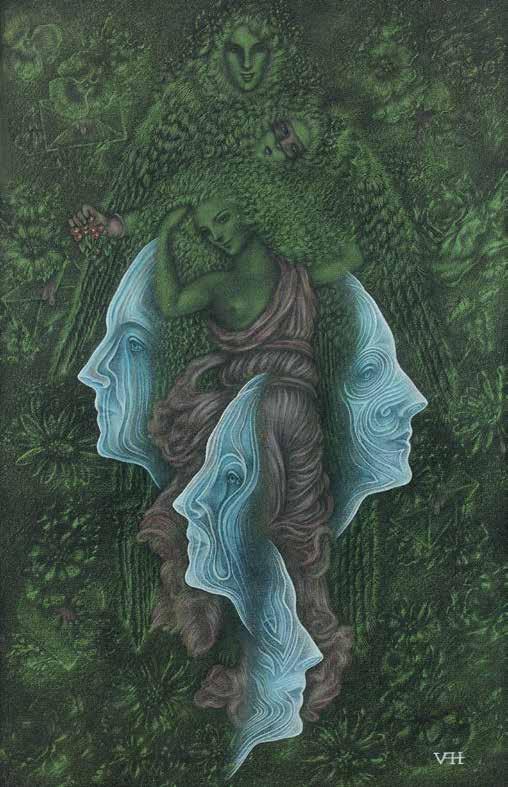
Exquisitely detailed and expertly rendered, Le Crapaud de Maldoror presents one of the most exceptional works on paper by Valentine Hugo, an artist perhaps best known for her frequent contributions to collaborative Surrealist cadavre exquis drawings.
Educated at L’École des Beaux-Arts in Paris, Hugo contributed designs to the Ballets Russes and moved in artistic circles that included Jean Cocteau, Pablo Picasso, Paul Éluard, André Breton and Erik Satie among other luminaries of Surrealism. With her husband, painter and theatre designer Jean Hugo, she hosted Parisian salons frequented by leading artists and intellectuals. By the early 1930s, after her separation from Hugo and increasing involvement with the Surrealists, Valentine developed a distinctive visual language that merged literary inspiration with an intense, personal psychological lens. Her intricate and otherworldly imagery, exemplified by Le Crapaud de Maldoror reflects both her technical mastery
and her engagement with the transformative power of imagination.
The present work draws on Les Chants de Maldoror, a late 1860s prose poem by the French writer Comte de Lautréamont (the nom de plume of Isidore Ducasse), whose text became a touchstone for the Surrealists decades after its initial, overlooked publication. With its transgressive, violent content and its misanthropic protagonist who renounces conventional morality, the work’s absurdist and iconoclastic ideas struck a chord with André Breton and his contemporaries, inspiring imagery that rejected social and moral conventions in favor of psychic and emotional liberation.
Le Crapaud de Maldoror illustrates an episode from Les Chants de Maldoror in which Maldoror encounters a toad (Bufo alvario), a species known for secreting hallucinogens. By licking the toad, Maldoror enters an altered state of consciousness, marked by hallucinations
Above left
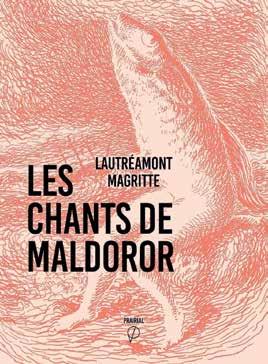
Les Chants de Maldoror, illustrated by René Magritte, 1945
Above right
Man Ray, L’Enigme d’Isidore Ducasse, 1920
and shifts in perception and mood. In this drawing, Maldoror and the toad gaze at each other in a moment of intense tension, the focus squarely on their eyes. Maldoror, with his rich curly hair and radiant heterochromatic eyes, embodies a vision of sublime beauty. His furrowed brows and the fabric partially covering his face suggest an inner struggle, a battle to resist the toad’s hallucinogenic—and potentially lethal—secretion. The intricately rendered vegetation forms a charged psychic landscape, reflecting the protagonist’s inner turmoil. Much like Hugo’s Portrait d’Arthur Rimbaud, in which the poet’s visage and surrounding elements evoke the transformative power of literature and imagination, the toad functions as a cipher for psychic and emotional turbulence, demonstrating Hugo’s remarkable ability to translate literary sources into vivid Surrealist imagery.
The absurdist and iconoclastic ideas of Les Chants de Maldoror struck a chord with the Surrealists. Adopting its author as their prophet, in the First Surrealist Manifesto Breton proclaimed: “With Les Chants de Maldoror Surrealism was born.” Containing scenes of cruelty and nihilistic humour, at times cynical, grotesque and delirious, the poem rejects established notions of religion, state and morality as pillars of Western society. For the Surrealists, who looked for ways to undermine social conventions in their own search for freedom, Les Chants de Maldoror provided a rich source of imagery as an impetus for their imagination.
Right Valentine Hugo, Portrait d'Arthur Rimbaud, 1933, Private Collection
Opposite Valentine Hugo, Portrait de Paul Éluard, 1932, Musée Fabre, Montpellier
A fascination with Maldoror and Ducasse reverberates throughout much of Surrealist art. The dictum of “a chance encounter” inspired Man Ray to use a real sewing machine in his L’Enigme d’Isidore Ducasse of 1920, the work’s title referring both to the concealed identity of its subject, and to the mysterious circumstances of Ducasse’s death during the siege of Paris in 1870. In the 1930s, Dalí produced a series of prints to illustrate the book, using his “paranoiac-critical method;” in the 1940s, Magritte illustrated another edition with a variety of subjects from his own established iconography; several decades later, Hans Bellmer created a series of etchings, taking Les Chants de Maldoror as a starting point for an exploration of his erotic obsessions.
Created in 1932, amid personal and professional turbulence, Le Crapaud de Maldoror reflects Hugo’s inner state and her deep engagement with Surrealist literary sources. The summer of 1931 saw a brief romantic relationship with Breton, ending the following year in a failed suicide attempt. Paul Éluard intervened, saving her life. The two would remain close collaborators, with Hugo illustrating many of his texts. Her work from this period, including a 1932 portrait of Éluard, shares compositional and thematic affinities with Le Crapaud de Maldoror, particularly the dense, expressive vegetation and the interplay between human figures and symbolic surroundings. The work, therefore, stands as both a tribute to a pivotal literary text and a highly personal meditation on the interplay of psyche, literature, and Surrealist imagination.
2
Dorothea Tanning
1910–2012
Interior with Sudden Joy
signed Dorothea Tanning and dated ‘51 (lower right)
oil on canvas
23 ⅞ by 36 in. 60.8 by 91.5 cm.
Executed in 1951.
$ 2,000,000-3,000,000
We are grateful to The Dorothea Tanning Foundation for their assistance in cataloguing this work.
Provenance
William N. Copley, Paris and New York (acquired by 1958)
Ira Genstein and Tonian Volk Genstein, Pennsylvania (acquired by 1974)
Byron Gallery, New York
Acquired from the above by 1976 by the present owner
Exhibited
New York, Alexandre Iolas Gallery, Dorothea Tanning, 1953, no. 9
Paris, Galerie Daniel Cordier, Exposition Internationale du Surréalisme (EROS), 1959-60, n.n.
Santa Barbara, The Art Gallery, University of California, Surrealism: A State of Mind, 1924-1965, 1966, no. 32 (dated 1952)
Paris, Centre National d'Art Contemporain, Dorothea Tanning, 1974, no. 16, p. 26, illustrated
New York, M. Knoedler & Co., Surrealism in Art, 1975 (not included in the catalogue)
New York, Gray Art Gallery and Study Center, New York University, Tracking the Marvelous, 1981, no. 29, p. 35, illustrated
Malmö Konsthall, Dorothea Tanning: Om Konst Kunde Tala (If Art Could Talk), 1993, no. 10, pp. 20-23; p. 46, illustrated in color
London, Camden Arts Centre, Dorothea Tanning: Works 1942-1992, 1993
New York, Solomon R. Guggenheim Museum, Surrealism: Two Private Eyes, 1999, vol. I, no. 243, p. 317; pp. 318-19, illustrated in color
Philadelphia Museum of Art, Dorothea Tanning: “Birthday and Beyond,” 2000-01
Literature
Patrick Waldberg, Max Ernst, 1958, Paris, p. 353, illustrated; p. 354
Patrick Waldberg, Le Surréalisme, Geneva, 1962, p. 114, illustrated in color
Dorothea Tanning, “Note Bibliographique,” Dorothea Tanning, Paris, 1966, p. 153
Alain Bosquet, Dorothea Tanning, Paris, 1966, p. 62, illustrated
“Tanning,” Dictionnaire Universel de l’Art et des Artistes, vol. 3, Paris, 1967, p. 442 (dated 1952)
“Dorothea Tanning,” Encyclopédie du Surréalisme, Paris, 1975, p. 245
Gilles Plazy; Jean Saucet, ed., Dorothea Tanning, Paris, 1976, pp. 24-25, illustrated in color; p. 33
Patrick Waldberg, “Dorothea Tanning: La Mémoire
Ensorcelée,” Les Demeures d’Hypnos, Paris, 1976, p. 320
Marcel Duhamel, “Quarante ans de corps à corps avec la peinture,” Dorothea Tanning: Numéro Spécial de XXe Siècle Paris, 1977, p. 112
John Russell, “Le ‘Moi’ multiforme de Dorothea Tanning,” Dorothea Tanning: Numéro Spécial de XXe Siècle, Paris, 1977, p. 56
Exh. Cat., Brooklyn Museum of Arts and Los Angeles County Museum of Art, Women Artists: 1550–1950, 1978, p. 338
Marianne Oesterreicher-Mollwo, Surrealism and Dadaism: Provocative Destruction, the Path within and the Exacerbation of the Problem of a Reconciliation of Art and Life, London, 1979, p. 93 (titled Interior Scene Accompanied by Sudden Joy and dated 1952)
Jacques Baron, Anthologie plastique du surréalisme, Paris, 1980, p. 254, illustrated in color
Wieland Schmied, “KUNSTmonographie Dorothea Tanning: Die Türen des Unbewussten,” KUNSTmagazin, no. 89, June 1980, p. 24; p. 27, illustrated
John Russell, “Art: Exploding Canvases of Elizabeth Murray… [and] Other exhibitions of interest: ‘Tracking the Marvelous’,” The New York Times, 8 May 1981, p. C20
Norman Weinstein, “Shadows of Eros: Notes on Dorothea Tanning’s Surrealism,” Spring: A Journal of Archetypal Psychology, 1981, pp. 141-43
J.H. Matthews, “Dorothea Tanning,” Dictionnaire Général du Surréalisme et de ses Environs, Fribourg, 1982, p. 398
Dorothea Tanning, Birthday, Santa Monica, 1986, p. 84, pl. 16, illustrated
“Oral History Interview with Dorothea Tanning, conducted by Barbara Shikler, July 11–November 5, 1990,” Archives of American Art, Smithsonian Institution, 1990, p. 155
Bengt Eriksson, “Hundar, hundar överallt,” Sydsvenska Dagbladet, 28 April 1993
Hans Johansson, “Dorothea Tanning,” Beckerell, no. 2, April/ May 1993, p. 41; p. 43, illustrated
Lyn MacRitchie, "Painting is life or death, every time," Financial Times, October 9-10, 1993, p. 23
Robert Radford, “Dorothea Tanning,” Art Monthly, no. 171, November 1993, p. 26
Jean-Christophe Bailly, “Image Redux: The Art of Dorothea Tanning,” Dorothea Tanning, New York, 1995, pp. 18 and 22-24; pl. 29, pp. 72-73, illustrated in color color; p. 96, illustrated
Brenda Shaughnessy, Interior with Sudden Joy, New York, 1999, illustrated in color on the cover (detail); p. 79
Annette Shandler Levitt, “Women’s Work: The Transformations of Leonor Fini and Dorothea Tanning,”
The Genres and Genders of Surrealism, New York, 1999, pp. 104-07
Dorothea Tanning, Between Lives: An Artist and Her World New York and London, 2001, n.p., illustrated; pp. 140 and 152-53
Richard Howard, “Dorothea Tanning: Philadelphia Museum of Art (exhibition review),” Artforum, vol. 39, no. 8, April 2001, p. 135
Joy Press, “Books: The Tanning Salon,” The Village Voice, vol. XLVI, no. 35, 4 September 2001, p. 65
Katharine Conley, “Les révolutions de Dorothea Tanning,” Pleine Marge: Cahiers de littérature, d’arts plastiques, & de critique, no. 36, December 2002, pp. 148; 159-65 and 169; p. 160, illustrated in color
Jürgen Pech, “Hinter den Türen des Werkes von Dorothea Tanning,” Mythen–Symbole–Metamorphosen in der Kunst seit 1800: Festschrift für Christa Lichtenstern zum 60.
Geburtstag, Berlin, 2004, pp. 372-73
Exh. Cat., Paris, Galerie Malingue, “Grands” Surréalistes, 2008, p. 48
Victoria Carruthers, “Between Silence and Sound: John Cage, Karlheinz Stockhausen and the Sculptures of Dorothea Tanning,” Art, History and the Senses: 1830 to the Present, Surrey, 2010, p. 100
Victoria Carruthers, “Dorothea Tanning and Her Gothic Imagination,” Journal of Surrealism and the Americas, vol. 5, no. 1, 2011, p. 141
Surrealist Ghostliness, Lincoln, 2013, pp. 139, illustrated, pp. 144 and 146
Gabriela Glăvan, “Corrupt Childhood. Dorothea Tanning’s Chasm: A Weekend,” British and American Studies, no. 22, 2016, pp. 58-59
“Reinventing The Marriage Between Heaven and Hell: Children’s Literature and the Avant-Garde,” A Serious Genre: The Apology of Children’s Literature, Newcastle upon Tyne, 2016, p. 199
“Verbal Dreamscapes. Dorothea Tanning’s Visual Literature,” Romanian Journal of English Studies, vol. 13, no. 1, December 2016, p. 111
Catriona McAra, A Surrealist Stratigraphy of Dorothea Tanning’s Chasm, London, 2017, pp. 25; 39-40 and 97, pl. 7, illustrated in color
Exh. Cat., Madrid, Museo Nacional Centro de Arte Reina Sofía and London, Tate Gallery, Dorothea Tanning, 2018-19, p. 62, illustrated in color; p. 198
Lauren Elkin, “The Shape-shifter,” Tate Etc., no. 44, Winter 2019, pp. 3 and 5
Catriona McAra, “Glowing Like Phosphorus: Dorothea Tanning and the Sedona Western,” Journal of Surrealism and the Americas, vol. 10, no. 1, 2019, pp. 96-97
Exh. Cat., Brühl, Max Ernst Museum, Max Ernst–D-paintings–Zeitreise der Liebe, 2019, pp. 81-83 and 134
Rochelle Roberts, “Postcards in Isolation 28: Somaya Critchlow and Dorothea Tanning’s Interior with Sudden Joy 1951,” Lucy Writers Platform (online), 15 October 2020
Victoria Carruthers, Dorothea Tanning: Transformations, London, 2020, fig. 70, p. 88; p. 91, illustrated in color; p. 92
Ara H. Merjian, “A Surrealist ‘Little Sister’? Dorothea Tanning’s (Femme) Fatala (1947), Metaphysical Painting, and the Roman Policier,” Word & Image: A Journal of Verbal/Visual Enquiry, vol. 37, no. 2, 2021, pp. 182-83
“Open Portfolio: Dorothea Tanning,” Sedona Monthly, May 2021, pp. 40 and 43
Amy Lyford, Exquisite Dreams: The Art and Life of Dorothea Tanning, London, 2023, pp. 97-130; 213-14 and 216; p. 100, illustrated in color
Willard Spiegelman, “‘Exquisite Dreams’ Review: Dorothea Tanning’s Surreal Vision,” The Wall Street Journal, 16 March 2024, p. C10
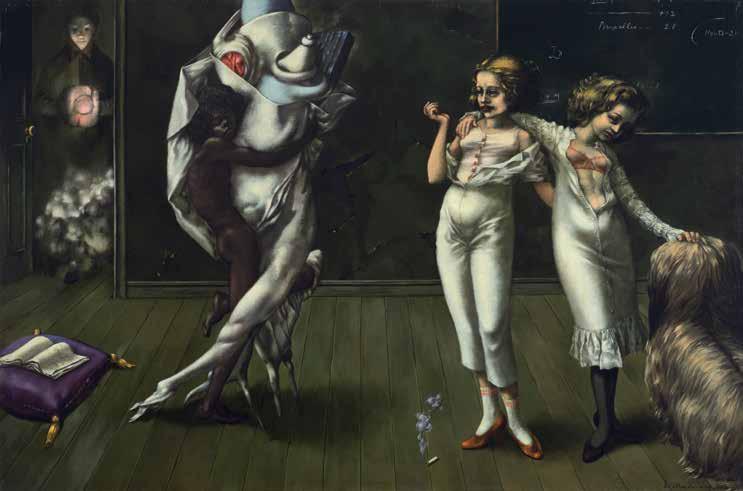
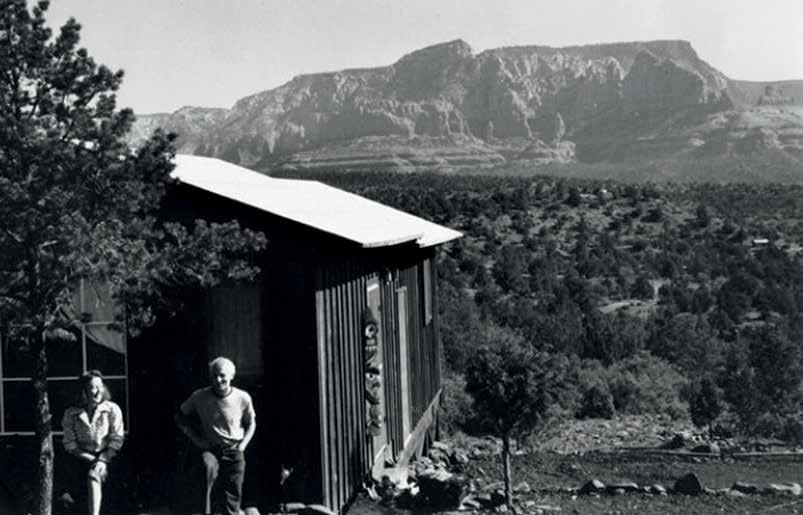
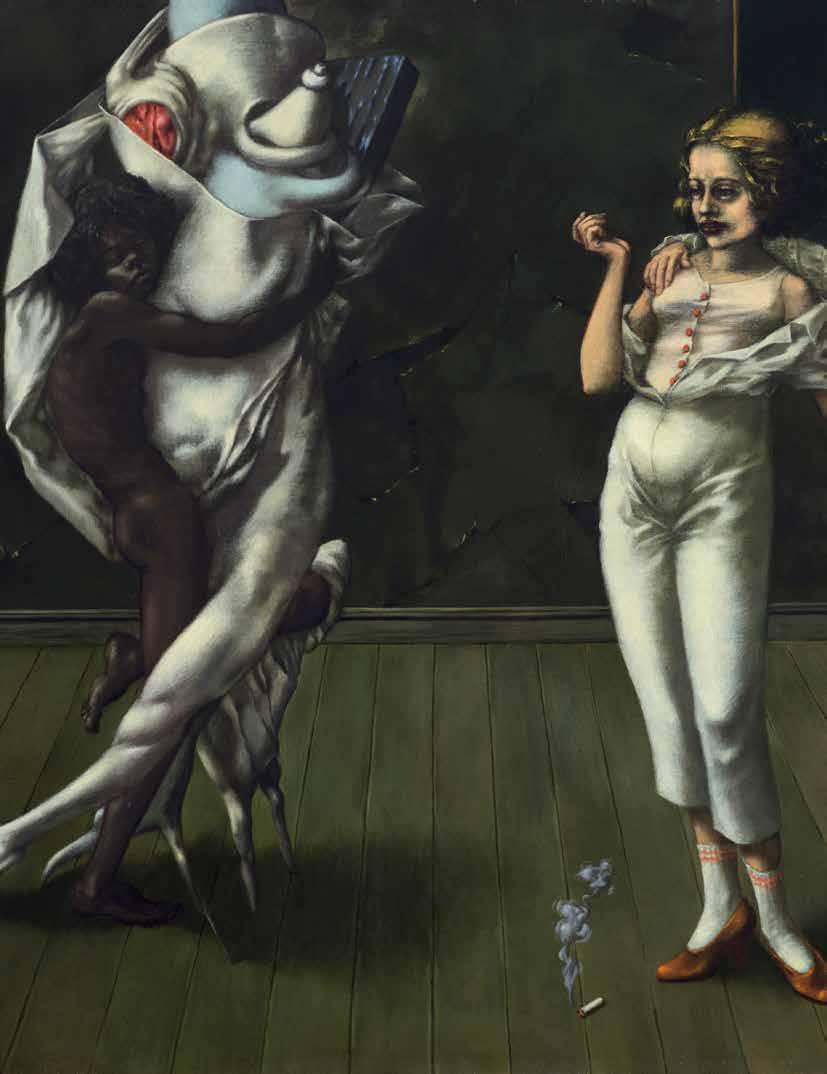
At the time Interior with Sudden Joy was created, Dorothea Tanning lived with husband Max Ernst in Sedona, Arizona.
In this arid “landscape of wild fantasy,” as she described, Tanning’s studio became a refuge from the fierce desert heat and light of the exterior world (Dorothea Tanning, Between Lives: An Artist and Her World, New York, 2001, p. 96).
“Then as now the decibels of nature can crush an artist’s brain. I have seen it happen. So I lock the door and paint interiors. Great events” (ibid., p. 152). The evocative and otherworldly paintings like Interior with Sudden Joy from the early 1950s witness the artist reaching the height of her expressive powers.
Often defined within the context of the Surrealist zeitgeist, Tanning in fact came to the movement in 1936 upon seeing Alfred Barr’s watershed exhibition, Fantastic Art, Dada, Surrealism at The Museum of Modern Art in New York. The legendary exhibition brought works from as early as the fifteenth century
into dialogue with the radical works of Dada and Surrealist artists working in the 1920s and 30s, and in it Tanning found true spiritual resonance with an artistic community. As Tanning later explained, the show was “the real explosion, rocking me on my run-over heels. Here is the infinitely faceted world I must have been waiting for. Here is the limitless expanse of POSSIBILITY” (ibid., p. 49). That possibility unfurled in her practice not as mere imitation but as radical autonomy—her work engaging, absorbing and ultimately transcending the movement’s dogma.
In just a few years’ time, Tanning had become a part of the Surrealist milieu, represented by the gallerist Julien Levy and joining a coterie of European writers and painters who’d relocated to New York during the war. In 1942, she’d begun an impassioned relationship with Max Ernst and by 1946 the pair had decamped to Sedona. There, Tanning would create some of the most exceptional paintings of her career—including Interior with Sudden Joy, which she'd later describe in her memoir.
Opposite
Below Dorothea Tanning and Max Ernst in Sedona, Arizona, photograph by Henri Cartier-Bresson, 1947
Opposite left Dorothea Tanning, Birthday, 1942, Philadelphia Art Museum
right
Dorothea Tanning, Katchina and Her Soul, 1951, sold: Sotheby’s, London, September 2025 for $1.2 million
“A white and dark picture would muffle the red world outside. Big bare rooms with the white frozen figures, like Sodom and Gomorrah. There is opalescent light and velvet dark. Isn’t that the artist’s best joy, to control light? To rival the sun and moon, to turn their logic upside down with brushes and paint and monstrous ego? I am here. Arthur Rimbaud, mad poet, is here too, on the blackboard in my canvas. What you see there are notes from his secret notebook. Private, impudent signs. The door is not a door on the wild red garden, just on a little something personal, like the door of a house looking in.”
–Dorothea
Tanning
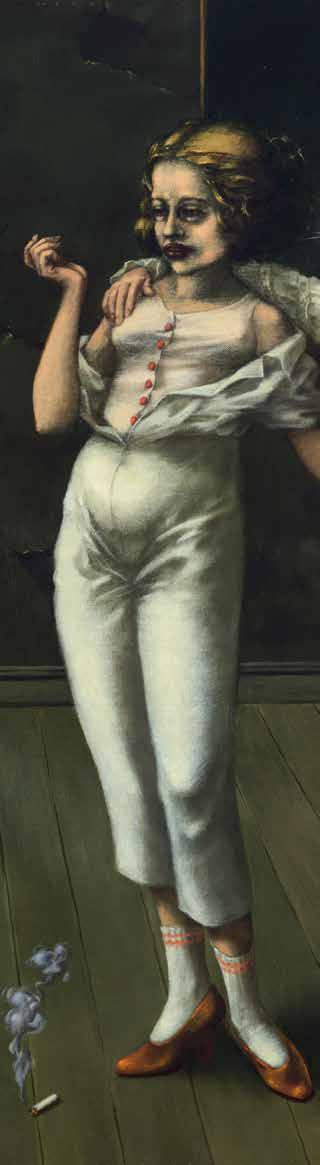
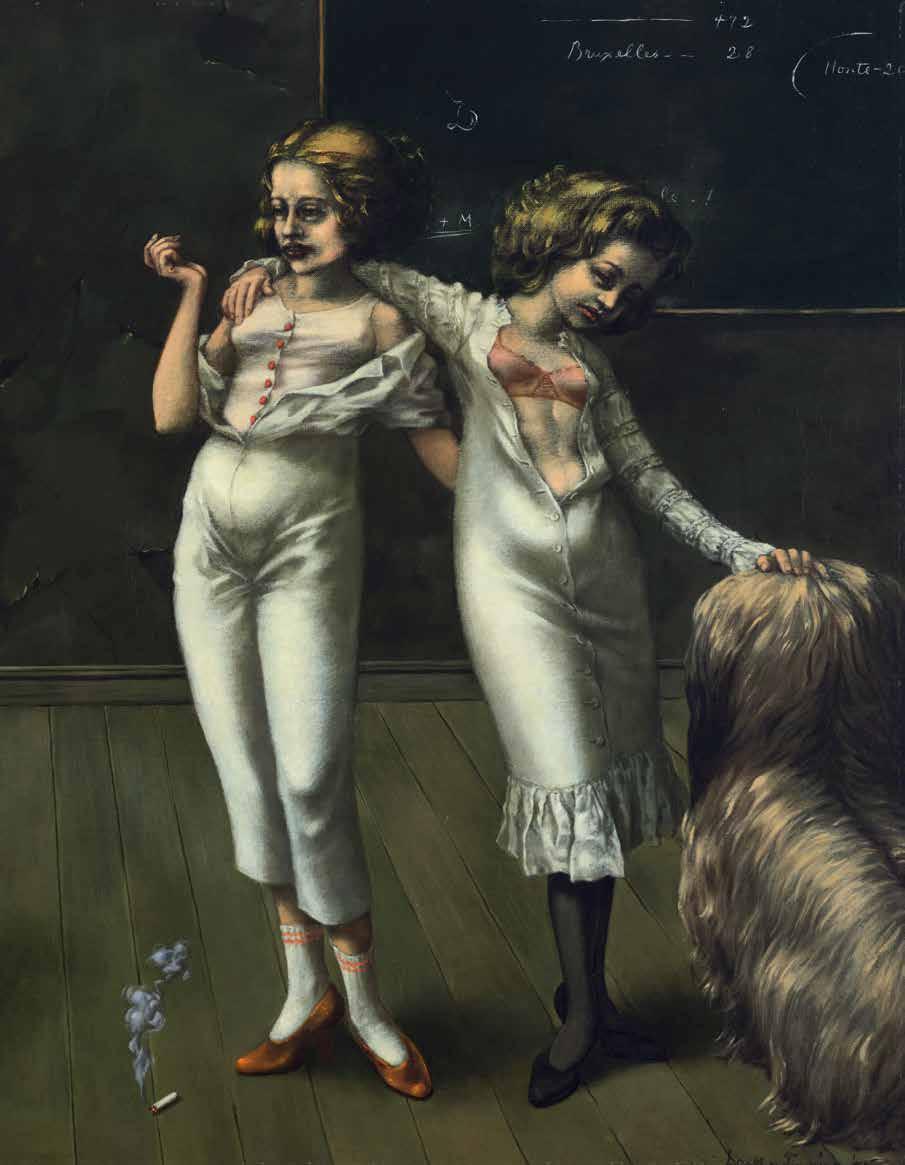
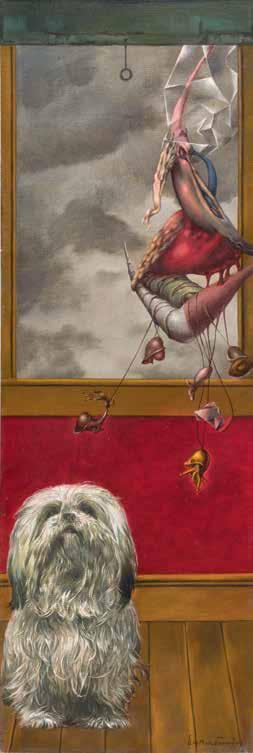
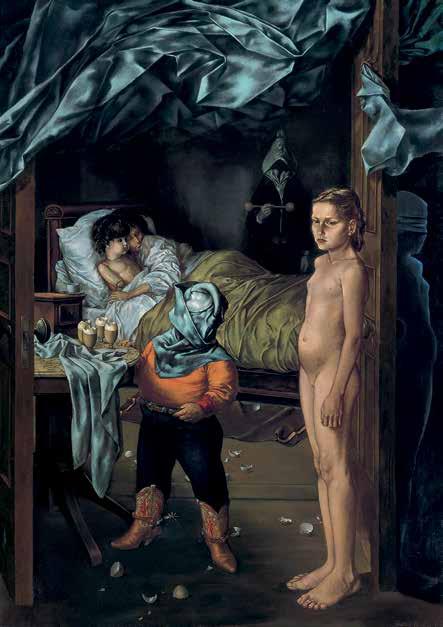
Indeed, Interior with Sudden Joy is defined largely by the dichotomy of light and dark, proof of its Caravaggian power. On the right the eye is drawn to the two young women standing arm-inarm and in various stages of undress. Tanning evokes an unsettling tension with these figures, who convey the nonchalance of adolescence yet assert a certain provocative awareness which only comes with time and experience. One, dress unbuttoned and leaning toward her companion, reaches down in a languid manner to pet a large dog, likely modeled after the artist’s own beloved Lhasa Apso, Katchina (who appears in a number of her paintings from this time). The young woman at left, perhaps a sister, friend, or alter ego of the other, stands transfixed, a focus-less gaze emanating from her heavily made-up face; her lit cigarette has fallen to the wooden floor, dangerously unnoticed. The juxtaposition of these two figures, each with their undergarments and
heels and alternating looks of curiosity and resignation, only heightens the sense of unease and ambiguity within the scene.
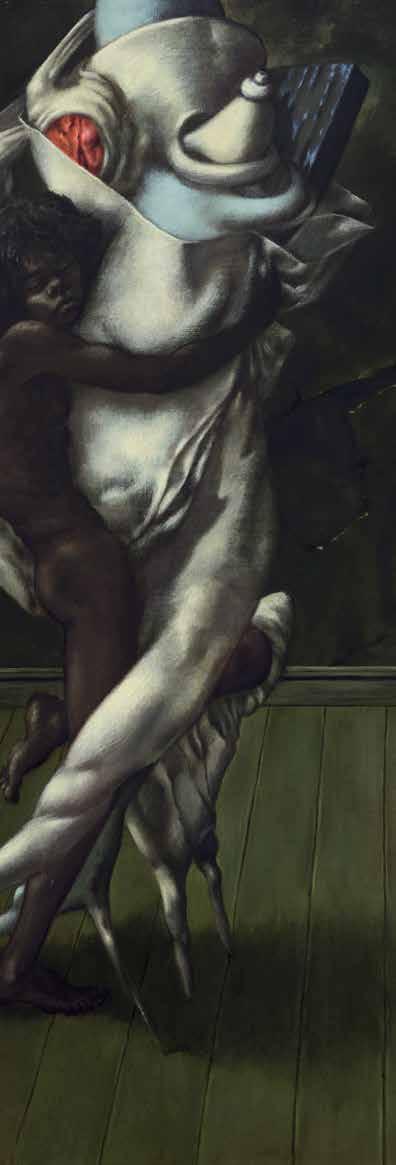
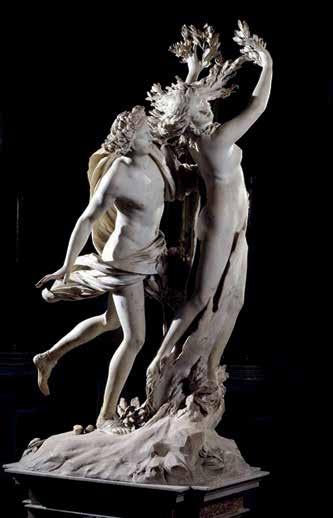
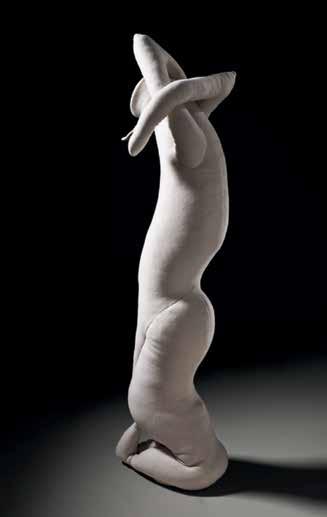
In a separate narrative to the left, a naked young man with dark skin embraces a twisting, monumental white form. At once architectural and corporeal, its contorted, sheet-like limbs encircling him like a protective force. The entwined figures—one in a seeming state of transformation—may evoke Bernini’s sculpture Apollo and Daphne Yet here the myth is transposed into an otherworldly register, reimagined as one of gentle shelter rather than unrequited love and pursuit. In Tanning’s telling, the nymph has already transmuted, not into a tree but to an abstract, sculptural form, foreshadowing the artist’s own transition in her approach to painting that would become increasingly abstract and her later soft sculptures fashioned from cloth.
Right
Opposite Detail of the present work
Left Gian Lorenzo Bernini, Apollo and Daphne 1622-25, Galleria Borghese, Rome
Dorothea Tanning, Xmas, 1969, Los Angeles County Museum of Art
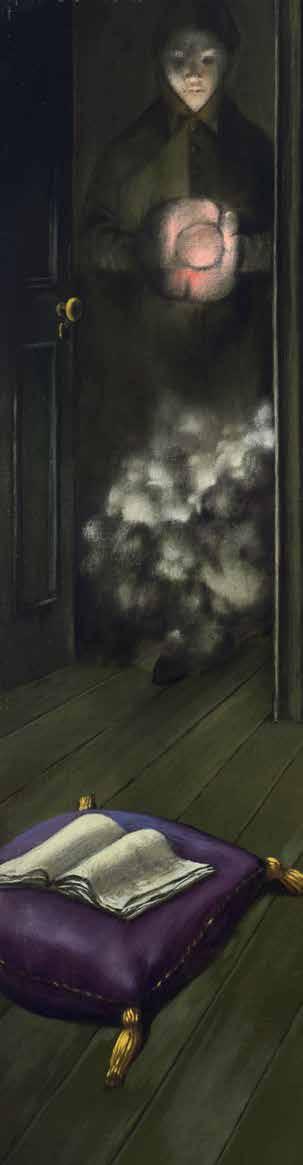
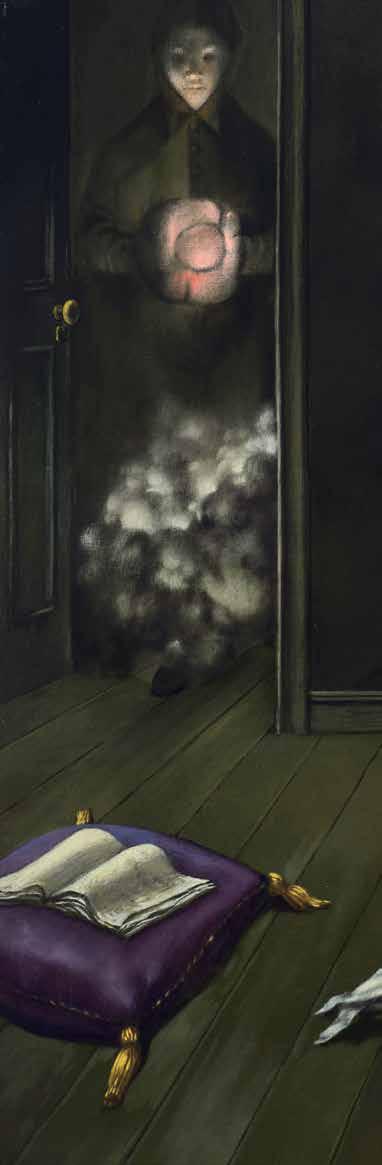
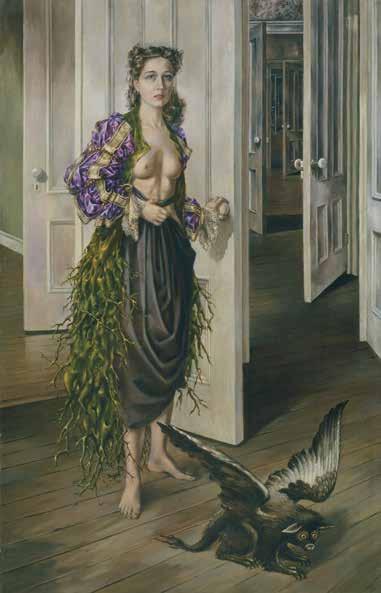
At the painting’s left edge, an ominous figure materializes in the doorway—a symbolic threshold recurring throughout many of Tanning’s early works, including Birthday. This spectral messenger emerges from roiling clouds of smoke like a magician bearing a radiant bundle. Her face, illuminated by the light of her cargo, contrasts sharply in demeanor with the cloaked, shadowy figure seen in Tanning’s related painting The Guest Room (1950–52). The apparition’s meaning may be elusive, yet her penetrating gaze directs the viewer toward the open book resting on a regallooking cushion, seemingly levitating as if imbued with divine power.
The book and a blackboard on the back wall suggest a classroom, though its lessons are enigmatic. Chalk notations punctuate the blackboard behind the central figures—an overt homage, as Tanning herself affirmed, to the poet Arthur Rimbaud–a favorite among the Surrealists. Among the cryptic inscriptions, the word Bruxelles emerges—both the title of one of Rimbaud’s elliptical poems and the city in which his tumultuous affair with Paul Verlaine reached its violent climax. That poem, with its fractured meter, stray ellipses, and vivid yet disjointed evocations of the Boulevard du Régent, conjures a surreal cartography of the city, not
Left
Invitation designed by Dorothea Tanning for her 1953 exhibition at Iolas Gallery, New York
Opposite Dorothea Tanning, The Guest Room, 1951-52, Private Collection
unlike the psychological terrain Tanning renders here. Elsewhere, the word Honte floats into view, likely a nod to another of Rimbaud’s poems, in which shame becomes the fulcrum for a spiral of imagined vengeance and juvenile fury. As in the painting, these references do not operate as fixed symbols, but as atmospheric cues— emotive traces from a shared interior world of reverie and tension.
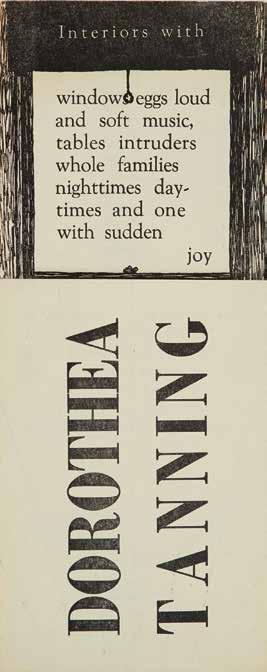
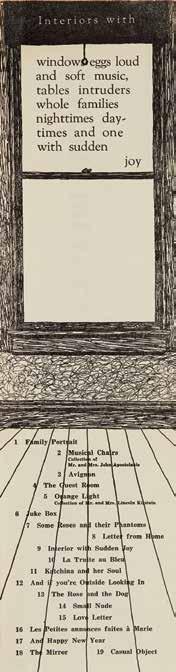
A few years later, Interior with Sudden Joy would resurface in Tanning’s own writings. Her short poem “Interiors with...” was featured on the invitation to her 1953 solo exhibition at Alexander Iolas, in which Interior with Sudden Joy was first exhibited and samples the range of possibilities found in her interior spaces. The design of the invitation reiterates the wide wooden floor boards and perspective of the present work.
The painting, like its title, traffics in allusions and contradictions that invite multiple readings. There may be little visible “joy” in this composition—only its afterimage, the flicker of something once felt or hoped for. Tanning understood that emotion, like space, could be distorted, re-dimensioned, and made uncanny on the canvas. Ultimately, what she offers here is more than a scene to be decoded, but a mood to be entered. It is a room turned inside out, a theater of the self in which the artist and viewer can be both voyeur and inhabitant. As she wrote, for the artist the “best joy” is in making the painting.
In Interior with Sudden Joy, Tanning achieves what few artists of her generation dared: she stages the drama of the mind by combining modes of realism and abstraction. and poses characters as presences, real and unreal, inhabiting a plane where dream and memory intersect. Held in the same collection for more than forty years, the present work is one of the finest examples of Tanning’s work ever to come to auction.
The present work was acquired by renowned collector and artist, William N. Copley during the formative years of his engagement with the Surrealist movement in the 1950s. Interior with Sudden Joy, was subsequently acquired by Ira Genstein, another prominent Surrealist collector, before it entered the present collection by the 1970s. Its presence within these illustrious collections, especially that of William N .Copley, situates this painting within one of the most significant private collections of Dada and Surrealist art assembled in postwar America.
3 Max Ernst
1891–1976 J'ai bu du tabourin, j'ai mangé du cimbal
signed max ernst (lower left); signed again, dated 1940 and inscribed Made in France (on the reverse)
oil on paper mounted on board
13 ⅝ by 10 ¼ in. 34.5 by 26.1 cm.
Executed in 1940.
$ 1,200,000-1,800,000
Provenance
Gypsy Rose Lee, New York (probably acquired directly from the artist by 1942 and until at least 1959)
Cordier & Ekstrom, New York
Acquired by February 1972 by the present owner
Exhibited
New York, Valentine Gallery, Exhibition Max Ernst, 1942, no. 5 (dated 1939)
New York, Cordier & Ekstrom, Bestiary, 1972, pl. 8, illustrated in color (titled Untitled and with incorrect support)
New York, Solomon R. Guggenheim Museum, Surrealism: Two Private Eyes, 1999, vol. I, no. 79, p. 140, illustrated in color
Literature
View, vol. II, no. 1, April 1942 (dated 1939)
Joseph Masheck, “The Bestiary,” Artforum, vol. 10, issue 8, April 1972, p. 88 (titled Untitled)
Sarane Alexandrian, Dictionnaire de la peinture surréaliste, Paris, 1973, p. 22, illustrated in color
Werner Spies, Sigrid Metken and Günter Metken, Max Ernst: Werke 1939-1953, Cologne, 1987, no. 2360, p. 30, illustrated (with incorrect support)
Julia Drost, Fabrice Flahutez and Anne Helmreich, et al., eds., Networking Surrealism in the USA: Agents, Artists, and the Market, Heidelberg, 2019, p. 178 (in reproduction of checklist for New York, Valentine Gallery, Exhibition Max Ernst, 1942); p. 191
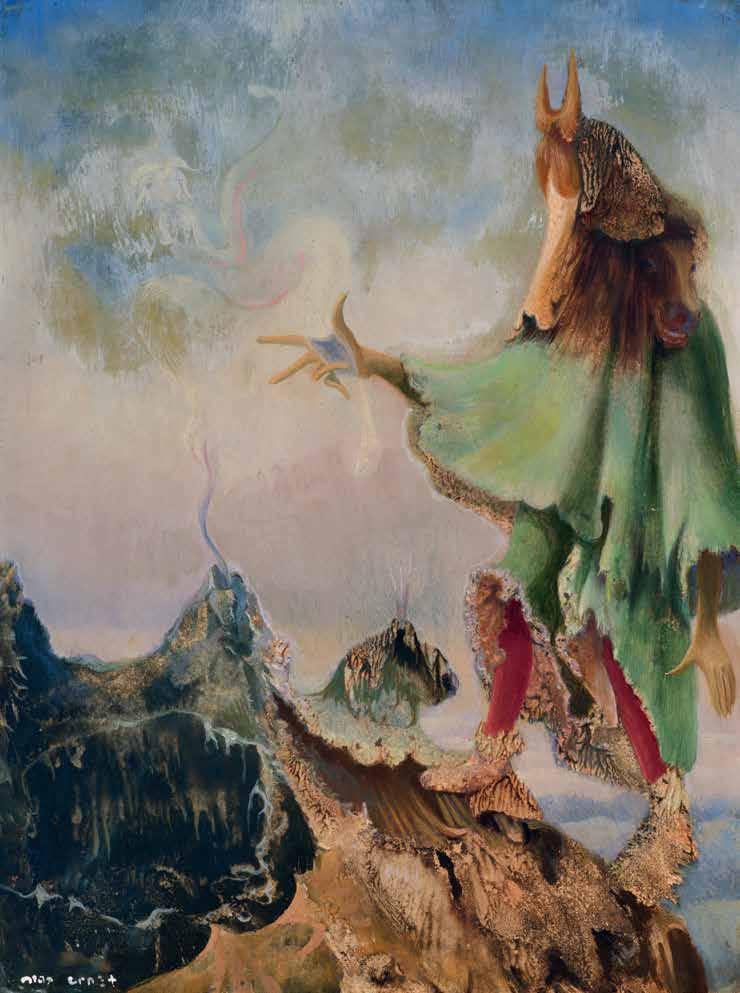
J’ai bu du tabourin, j’ai mangé du cimbal is an exceptional painting created in 1940, arguably the most turbulent year in the life of Max Ernst. A vision of dark symbolism as well as surreal beauty, the captivating composition reflects the drama of the artist’s circumstances during this period as well as that of the wider political situation in Europe.
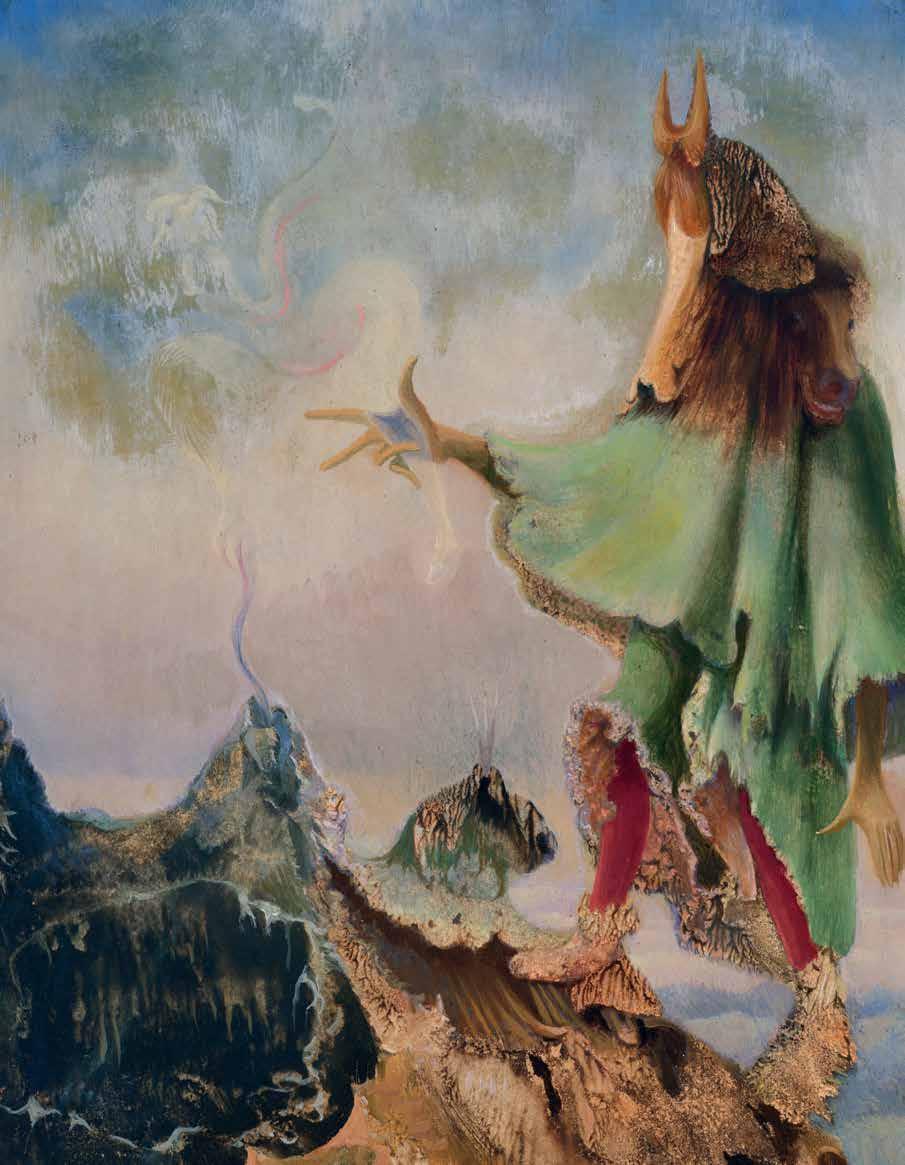
The composition is dominated by a shamanic figure, seemingly bearing two heads—one equine, the other ineffable—atop a humanoid body, a surreal permutation of the mythical centaur. The enigmatic figure floats above the clouds, surveying an apocalyptic landscape below. In a prophetic gesture, he conjures a wispy, birdlike form—perhaps an ethereal manifestation of Loplop, the bird avatar through which Ernst often inserted his presence into his work. The creature
hovers as a diaphanous, spectral presence, its ghostly appearance heightening the sense of otherworldly observation, bridging the cosmic and the terrestrial, and emphasizing the painting’s dreamlike logic.
By the time he created the present work, Ernst had been living in France for nearly two decades. Yet, at the outbreak of the Second World War, he faced persecution as a German national and was twice interned by the French authorities as an enemy alien. In September 1939, only days after the outbreak of the war, he was arrested at his home in Saint-Martin d’Ardèche in the south of France. He was interned first at Largentière and subsequently at the camp of Les Milles near Aix-en-Provence, alongside fellow Surrealist Hans Bellmer, who had just emigrated from Germany and settled in Paris.
Above
Ernst was eventually released through the efforts of several friends including Paul Éluard, with whom he had lived in a ménage à trois—along with Éluard’s wife, Gala—when he first settled in Paris in the early 1920s. Ernst was arrested again in 1940, this time by the Nazis after the occupation of France. His companion Leonora Carrington, with whom he had been living in Saint-Martin d’Ardèche, fled to Spain in desperation. Soon afterwards she suffered a nervous breakdown and was committed to a sanatorium in Santander.
Escaping his internment and the dangers of the Vichy government, Ernst eventually moved to Marseille, joining a community of avant-garde artists awaiting visas that would allow them to leave occupied France and escape to freedom. In Marseille, Ernst joined the Emergency Rescue Committee, an organization led by the American
journalist Varian Fry which helped some 2,000 people to escape Nazi persecution, among them many artists and intellectualsAlong with many of his colleagues, Ernst found refuge at the Villa Air Bel, which had become an oasis of peace and whose occupants were a veritable “who’s who” of European intellectuals.
His stay in Marseille under strenuous, although creatively rich circumstances, provided an opportunity for Ernst’s reconciliation with Breton, from whom he had broken in 1938. To support himself while awaiting his visa, Ernst organized an auction of his and Carrington’s works brought with him from Saint-Martin d’Ardèche.With the help of Peggy Guggenheim, whom he would marry at the end of that year, he finally managed to leave France in July 1941, settling in the United States.
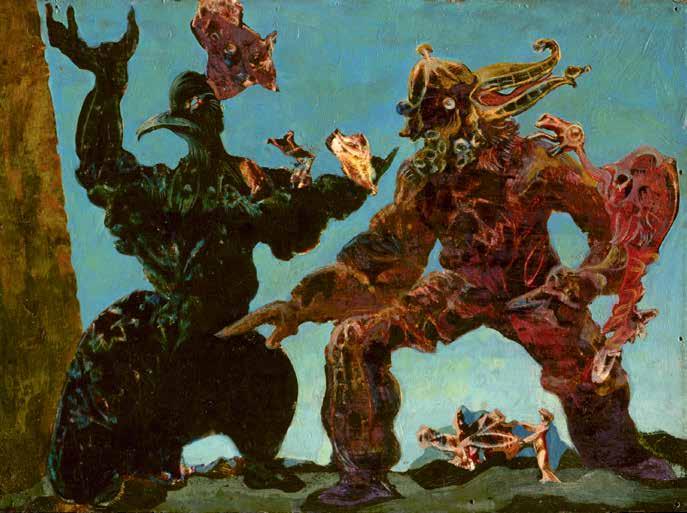
Opposite Max Ernst, Les Barbares, 1937, The Metropolitan Museum of Art, New York
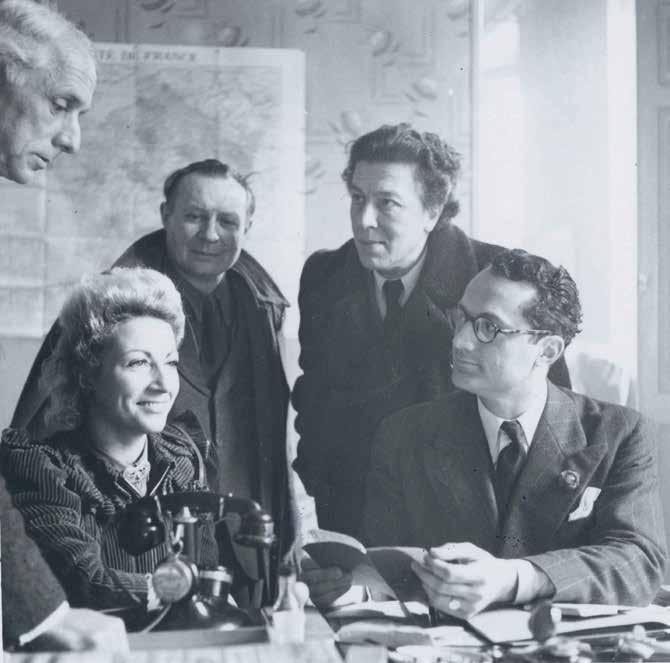
The Emergency Rescue Committee office in Marseilles, 1941. Left to right: Max Ernst, Jacqueline Breton, André Masson, André Breton and Varian Fry
“[Ernst's] chimaeras, the unearthly vegetation, the symbolic episodes, the haunting passages which lead us in the twinkling of an eye from the fabulous to the invisible and frightening realities… are not dream images any more than they are accidents. They are the product of an inventive mind endeavoring to translate in worldly language experiences which belong to another dimension… They are compact with wonder and mystery, awesomely real. A glow emanates from them which arises neither from the day world nor the night world.”
Throughout this precarious period, Ernst continued to innovate, creating several exceptional works like J’ai bu du tabourin, j’ai mangé du cimbal in which he employed the decalcomania technique. Ernst scholar Werner Spies describes decalcomania as a method
“which involves the spreading of paint on a sheet, laying a second sheet on top of the first, pressing it in places, and then lifting it up to leave suggestive images... in general the images are fluid. They represent no known world but rather seem to devour one another and evolve in an endless metamorphosis, evoking some vegetal or cosmic process” (Exh. Cat., New York, Metropolitan Museum of Art, Max Ernst: A
–Henry Miller, “Another Bright Messenger,” View, series II, no. 1, April 1942
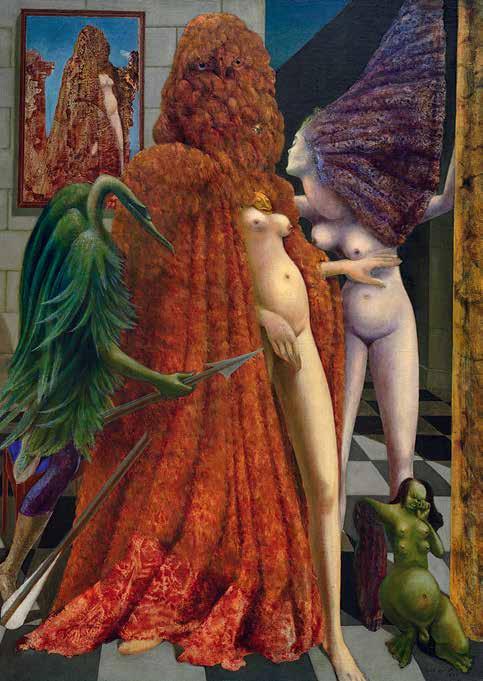
Opposite Max Ernst, La Toilette de la Mariée 1940, The Peggy Guggenheim Collection, Venice
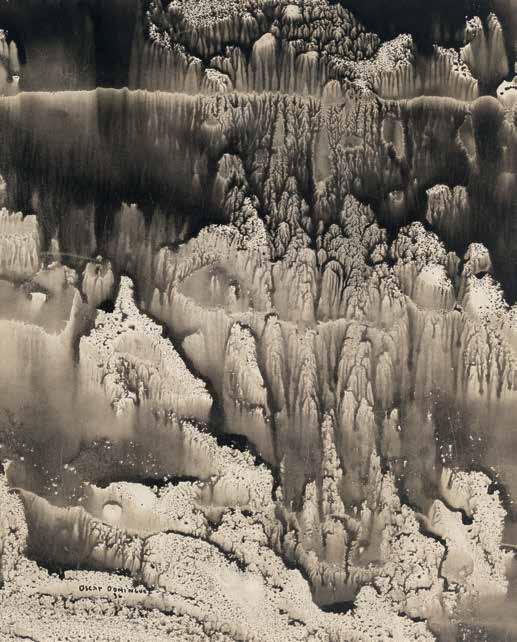
Oscar Domínguez, Untitled, 1936, The Museum of Modern Art, New York
Retrospective, 2005, pp. 13-14). In the present composition, Ernst employs the technique to build the craggy, lunar-like landscape and portions of the figure’s cloak.
First used in 1935 by Oscar Domínguez, decalcomania builds on Ernst’s earlier experimentations with the techniques of frottage and grattage, all grounded in the principles of automatism. Rather than carefully building a pre-conceived scene, the artist would let unexpected, often dramatic forms appear on the surface, suggestive of particular imagery around which he would then create the rest of the composition. In the group of canvases painted in the early 1940s, including the present
work, Ernst used the method of decalcomania to stunning effect, often combining colorful, intricate details brought about by the rubbing technique with mysterious, menacing figures into images of sublime beauty. This group of works includes the now celebrated La Toilette de la Mariée from 1940 and culminated with the apocalyptic Europe After the Rain, started whilst the artist was still living in France and completed in New York in 1942.
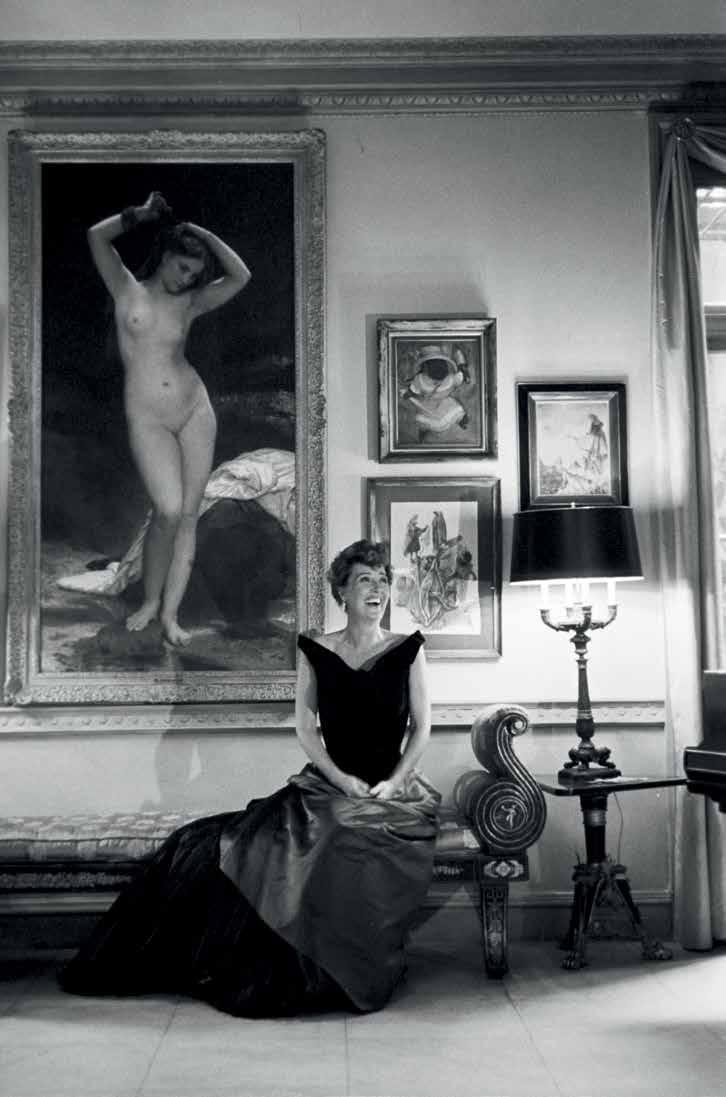
It was in this transatlantic context of upheaval, exile, and continued artistic innovation that the present work found its first home with Gypsy Rose Lee, one of Ernst’s first significant American patrons. Born in Seattle as
Right
Rose Louise Hovick, Lee would become better known as a burlesque entertainer and striptease dancer under the stage name, Gypsy Rose. Also an actress, author and art collector, Gypsy Rose became one of the most colorful and flamboyant personalities of her time, embracing a decadent lifestyle and an incongruous career: as a stylish and humorous striptease dancer in New York she was beloved by audiences and frequently arrested by the authorities; in the 1930s she moved to Hollywood where she made several movies; she wrote murder mysteries, and hosted a television talk show. Lee was also politically active, supporting both the Popular Front during the Spanish Civil War, and the Communist United
Front in America, and was investigated for her allegedly subversive activities. Her memoir, published in 1957, was later adapted to a stage musical as well as a film Gypsy
Gypsy Rose Lee played an active role in avant garde art circles. An amateur painter, her art was included in an exhibition at Peggy Guggenheim’s gallery Art of This Century in 1943. She befriended many artists, both European and American, and assembled a collection including works by Picasso, Miró, Chagall, Ernst and Dorothea Tanning. Following her purchase of Ernst’s A Maiden’s Dream about a Lake, she commissioned the artist to paint her portrait, resulting in the stunning oil Gypsy Rose Lee of 1943.
Opposite Gypsy Rose Lee in her New York home, October 1959; the present work at right Below
Max Ernst, Gypsy Rose Lee, 1943, Private Collection
4 Kay Sage
1898–1963
The Point of Intersection
signed Kay Sage and dated ‘51-‘52 (lower right)
oil on canvas
39 by 31 ⅞ in. 99 by 81 cm. Executed in 1951-52.
$ 1,000,000-1,500,000
Provenance
Catherine Viviano Gallery, New York (acquired directly from the artist in 1952)
Josephine Sprague Taylor, Spain (acquired from the above in 1956)
Sotheby Parke-Bernet, New York, 1 November 1978, lot 66 (consigned by the above)
Acquired at the above sale by the present owner
Exhibited
New York, Catherine Viviano Gallery, Kay Sage, 1952, no. 10
New York, Whitney Museum of American Art, 1952 Annual Exhibition of Contemporary American Painting, 1952-53, no. 115
Bloomfield Hills, Museum of Cranbrook Academy of Art, First Biennial Exhibition: American Painting, Sculpture, 1953, no. 41
Rome, Galleria dell’Obelisco, Kay Sage, 1953, no. 16 (dated 1952)
Paris, Galerie Nina Dausset, Kay Sage, 1953
Ann Arbor, University of Michigan Museum of Art, Woman in the World of Man: Three Women Painters—Irene Rice Pereira, Kay Sage, Dorothea Tanning, 1954
Hartford, Wadsworth Atheneum, Yves Tanguy, Kay Sage, 1954, no. 26
Lincoln, University Galleries, University of Nebraska and Omaha, Joslyn Art Museum, Nebraska Art Association SixtyFifth Annual Exhibition, 1955
New York, Solomon R. Guggenheim Museum, Surrealism: Two Private Eyes, 1999, vol. I, no. 215, p. 284; p. 285, illustrated in color
Literature
Fairfield Porter, “Reviews and Previews: Kay Sage,” ARTnews vol. 51, no. 4, Summer 1952, p. 82
James Thrall Soby, “The Fine Arts: Whitney Annual,” Saturday Review, vol. 35, no. 49, 6 December 1952, pp. 60 and 62; p. 61, illustrated
James Thrall Soby, “The Fine Arts: Double Solitaire,” Saturday Review, vol. 37, no. 36, 4 September 1954, pp. 29-30, illustrated
Helen Mary Hayes, “Life and Motion Permeate Annual Art Association Show,” Lincoln Evening Journal, vol. 88, no. 59, 28 February 1955, p. 7
Stephen Robeson Miller, “The Surrealist Imagery of Kay Sage,” Art International, vol. XXVI, no. 4, September-October 1983, fig. 25, p. 44, illustrated
Judith D. Suther, A House of Her Own: Kay Sage, Solitary Surrealist, Lincoln, 1997, p. 142
Williams College Museum of Art, ed., American Dreams: American Art in the Williams College Museum of Art, New York, 2001, p. 186
Stephen Robeson Miller; Jessie Sentivan, ed., Kay Sage: Catalogue raisonné, Munich, London and New York, 2018, no. P.1952.2, p. 268; p. 269, illustrated in color
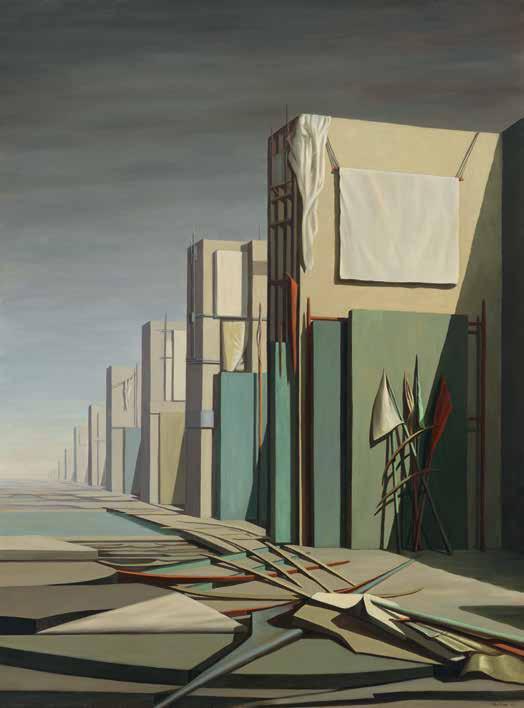
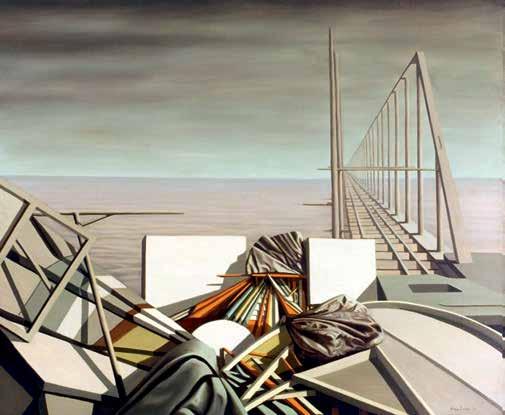
On the occasion of Kay Sage’s first exhibition in Italy, held in 1953, seminal art historian James Thrall Soby declared of her oneiric, enigmatic landscapes: “Her structures rise in a setting…somewhere, deep in memory, their like. These are pavilions of dreaming. They stand in boundless space…We believe in them at once: they will withstand wind and logic’s thunder. Around this enchanted architecture an arid landscape follows a curious geometry, toward infinity and harmonious skies” (Exh. Cat., Rome, Galleria dell’Obelisco, Kay Sage, n.p.). Among the works on view in that landmark exhibition in Rome was The Point of Intersection, a painting that at once invokes solitude and limitless expanse, mystery and possibility. It emblematizes these pavilions of dreaming for which Sage is hailed a master of Surrealism.
Born into privilege in Albany in 1898, Kay Sage trained at traditional Beaux-Arts academies across Europe and the United States, far removed from avant-garde circles. Her early painting practice was curtailed by her 1927 marriage to Prince Ranieri di San Faustino. A turning point came in 1933, when a visit from Ezra Pound reignited her interest in modern art. Inspired by Pound’s connections and a 1936 visit to the International Surrealist Exhibition in London— where she was especially drawn to works by Dalí, Magritte, and Yves Tanguy (whose painting titled Je vous attends (I Await You) would prove prophetic)—Sage left her marriage and relocated to Paris to pursue painting in earnest. By 1938, she had established a distinct artistic voice, exhibiting six works at the Salon des Surindépendants. Her work captured the
Opposite
Above Kay Sage, 1946. Photo by Lee Miller
Opposite above Yves Tanguy, Je vous attends, 1934, Los Angeles County Museum of Art
below Kay Sage, A Little Later, 1938, Denver Art Museum
attention of both Yves Tanguy and André Breton, the latter notably surprised to learn that the stark, architectural landscapes were painted by a woman. Sage quickly moved from the margins of Surrealism to its core. She and Tanguy began a relationship in 1939; as the artist later recalled, “‘I do not believe there has ever been such a total and devastating love and understanding as there was between us. It was simply an amalgamation of two beings into one blinding totality” (quoted in Exh. Cat., Katonah Museum of Art, Double Solitaire. The Surreal Worlds of Kay Sage and Yves Tanguy, 2011, p. 29). She and Tanguy relocated to the United States and married in 1940. With Sage’s help, many European Surrealists secured visas to escape the war, contributing to the rise of the New York School.
Settling at Town Farm in Woodbury, Connecticut, Sage and Tanguy developed their practices in parallel, working in separate parts of a shared studio and only viewing each other’s finished works. Despite their closeness, both maintained strong individual identities as artists. “The traces of each other’s presence discernible in
“A lesser artist would have surrendered her identity to [other Surrealists’] spell. Kay Sage, on the contrary, has watched and listened and profited—and gone her separate way. Her art creates its own silence: lovely, serene and memorable.”
–James Thrall Soby, ibid.
their works are no more than modest borrowings or acknowledgements that can scarcely be construed as invasive or appropriative. Only the interplay of deep shadows, the absence of identifiable beings, and the resultant mystery of silence can be regarded as a binding link between Sage’s and Tanguy’s art” (Renée Riese Hubert, Magnifying Mirrors: Women, Surrealism and Partnership, Lincoln, 1994, p. 198). They declined joint exhibitions until 1954, when The Point of Intersection was included in their two-person show at the Wadsworth Atheneum where works were shown in separate but adjoining rooms.
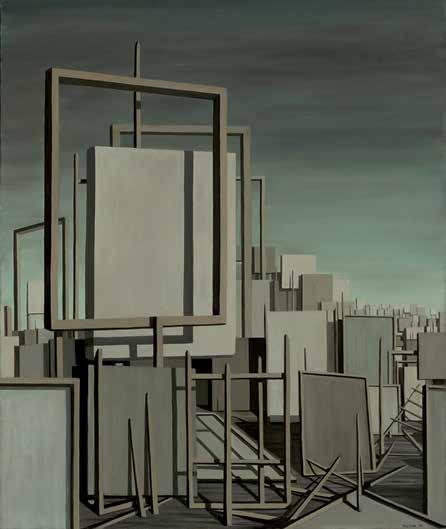
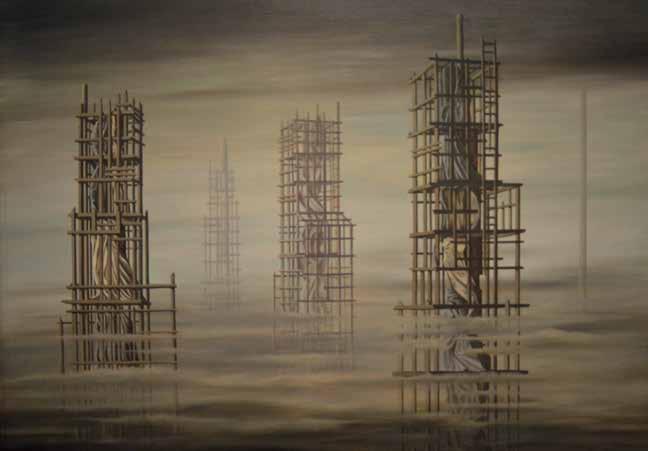
From 1944 onward, Sage developed her signature vocabulary of scaffolding, lattices, and stark architectural forms, replacing earlier biomorphic motifs. This shift was partly inspired by her interest in metaphysical imagery and a hallucinatory episode in Rome, during which she believed the scaffolding of a façade neighboring her palazzo was aflame, an experience she later found mirrored the divine visions of a sixteenthcentury French abbot. In The Point of Intersection, the monumental scaffold structures recede into an expansive, near-infinite terrain, while fractured geometry in the foreground disrupts spatial
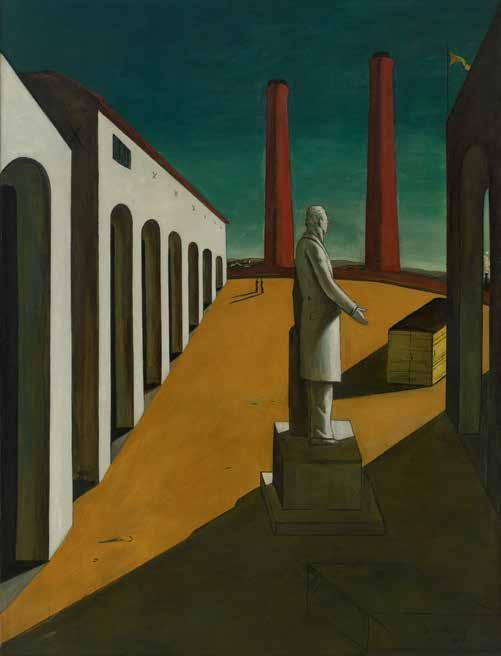
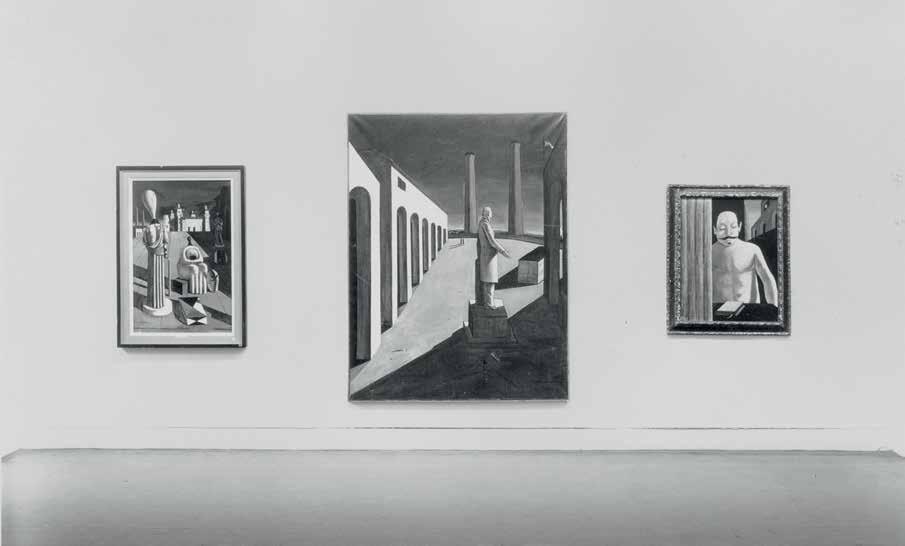
stability, recalling the vertiginous perspective and unvarying architectural programs of Giorgio de Chirico’s seminal metaphysical paintings.
The painting is replete with the tensions of paradox: structure and collapse, presence and absence, distance and immediacy. Shrouded forms suggestive of abandoned figures add to the pervasive solitude that defines Sage’s most accomplished work. As her friend Régine Tessier later memorialized: “Kay Sage never talked about her paintings. ‘Let them speak for themselves,’ she used to say. The messages come loud and clear. They talk about infinity, space and obstacles…the landscapes may be from another planet, but in Kay’s paintings, the scaffolding, the rigging, and the towers are familiar to our modern world in a dreamlike fashion. They
Opposite Kay Sage, No Passing, 1954, Whitney Museum of American Art, New York
Left
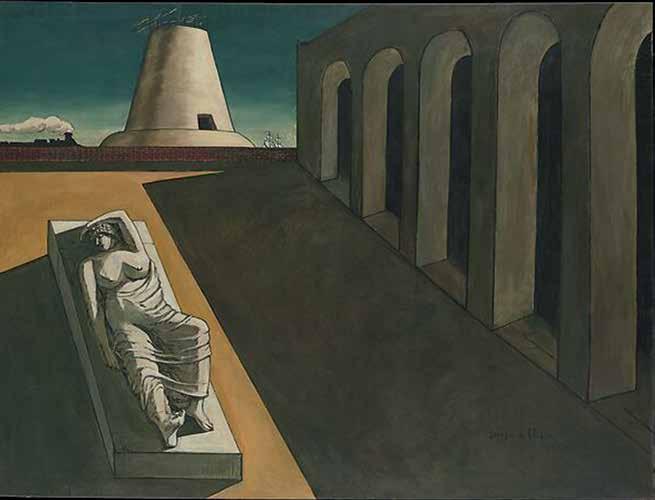
Giorgio de Chirico, L'Énigme d'une journée, 1914, The Museum of Modern Art, New York
are carefully structured and harmonious, but some of them have collapsed, as if pushed by an adverse force that has disappeared after destroying their delicate balance. The colors in her paintings are subtle and glowing at the same time, reminiscent of the sulphurous light before a thunderstorm…The figures in the landscapes are human, but veiled, walking blindly to their destiny. The paths they follow look mysterious, tantalizing, and sometimes treacherous” (Exh. Cat., Ithaca, Herbert F. Johnson Museum of Art, Cornell University, Kay Sage: 1898-1963, 1977, n.p.).
The Point of Intersection dates to the apex of Kay Sage’s output, just before the death of Yves Tanguy in 1955, and stands as a powerful emblem of Sage’s singular contribution to Surrealism. It was featured in several of the exhibitions instrumental to her lifetime international recognition, including the 1952 Annual Exhibition of Contemporary American Painting at the Whitney Museum of American Art, later known as the Whitney Biennial. Last offered at auction over a half-century ago, The Point of Intersection has resided in the same preeminent collection since.
5 Salvador Dalí
1904–1989
Symbiose de la tête aux coquillages
signed Dalí and dated 31 (center left); signed and dated again (on the reverse)
oil on canvas
13 ¾ by 10 ¾ in. 35 by 27.4 cm.
Executed in 1931.
$ 2,000,000-3,000,000
Provenance
Emilio Terry, Paris (probably acquired from the artist by 1936 and until at least 1956)
Galerie André Petit, Paris
Daniel Filipacchi, Paris
Acquired from the above by 1977 by the present owner
Exhibited
(possibly) Casino de Knokke le Zoute, Salvador Dalí, 1956, p. 21 (titled Personnage dans un paysage and dated 1934)
London, Hayward Gallery, Arts Council of Great Britain, Dada and Surrealism Reviewed, 1978, no. 11.6, p. 267, illustrated
Paris, Centre Pompidou, Salvador Dalí: rétrospective, 19201980, 1979-80, no. 89, p. 164, illustrated in color
New York, Solomon R. Guggenheim Museum, Surrealism: Two Private Eyes, 1999, vol. I, no. 43, p. 97, illustrated in color
Literature
Salvador Dalí, Dalí par Dalí, Paris, 1970, pp. 32-33, illustrated (detail; in incorrect orientation)
Sarane Alexandrian, Dictionnaire de la peinture surrealiste, 1973, p. 14, illustrated in color
Jacques Baron, Anthologie plastique du surréalisme, Paris, 1980, p. 78, illustrated in color (detail)
Robert Descharnes, Salvador Dalí: The Work, The Man, Lausanne, 1984, p. 117, illustrated in color
Miguel de Cervantes Saavedra, Il Fantastico hidalgo don Chisciotte della Mancia illustrato da Salvador Dalí, Milan, 1986, pp. 162-63, illustrated (in incorrect orientation)
Robert Descharnes and Gilles Néret, Salvador Dalí, 19041989, Cologne, 1994, vol. I, no. 375, p. 169, illustrated in color; vol. II, p. 749
Marco Di Capua, Dalí, Paris, 1994, p. 116
Alice Stašková and Paul Michael Lützeler, eds., Hermann Broch und die Künste, Berlin, 2009, p. 48
Roger Rothman, Tiny Surrealism: Salvador Dalí and the Aesthetics of the Small, Lincoln, 2012, p. 94
Fundació Gala-Salvador Dalí, ed., Catalogue Raisonné of Paintings by Salvador Dalí, 2019, no. P 273, illustrated in color, https://www.salvador-dali.org/fr/oeuvre/catalogueraisonne-peinture/obra/273/symbiose-de-la-tete-encoquillages (accessed on 2 March 2025)
Will Atkin, Surrealist Sorcery: Objects, Theories and Practices of Magic in the Surrealist Movement, London, 2023, fig. 1.6, p. 36, illustrated in color
Painted at the height of Surrealism in 1931, Symbiose de la tête aux coquillages is an exquisite rendering of Dalí’s power of imagination, giving visual form to the intangible images from his subconscious mind.
The present work was created during a crucial moment in Dalí’s personal and professional life.
In the summer of 1929 he met Gala, the Russian émigrée who was at the time married to the poet Paul Eluard. Dalí became infatuated with Gala, who would become his lifelong companion and muse. That same year, Dalí officially joined the Surrealist group in Paris, which propelled him to the innermost circle of the European avant-garde, and had his first Paris solo show at Galerie Goemans.
In the text written for the exhibition catalogue, Breton pronounced Dalí’s art to be “the most
hallucinatory that has been produced up to now” (Paris, Galerie Goemans, Salvador Dalí, 1929).
Dalí’s liaison with Gala—divorced, ten years his senior—and his alignment with Surrealism provoked fierce opposition from his father. Outraged by an artistic act of provocation, Dalí’s father disinherited his son and ousted him from the family home. The melancholic atmosphere of deserted landscapes, such as the one depicted in the present composition, may well be a reflection of the sense of solitude and rejection the artist felt in the aftermath of this episode. Yet, from this rupture emerged a time of profound artistic accomplishment: in June 1931 Dalí exhibited at Galerie Pierre Colle in Paris; two years later his show at Julien Levy’s New York gallery announced the beginning of his international fame.
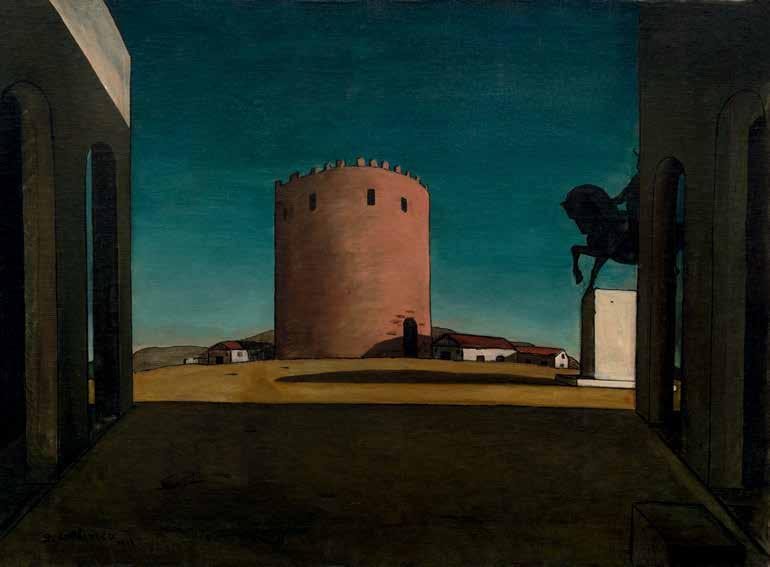
Opposite Giorgio de Chirico, La Tour rouge, 1913, The Peggy Guggenheim Collection, Venice
Above Salvador Dalí, La Persistance de la mémoire, 1931, The Museum of Modern Art, New York
It was in 1930, the year before he painted Symbiose de la tête aux coquillages, that Dalí formulated his “paranoiac-critical method,” which involved self-induced hallucinations that would ignite his imagination and inspire his art. The resulting compositions, which are now among the most celebrated in the artist’s rich oeuvre, are distinguished by their double imagery, playing optical tricks on the mind of the viewer by creating worlds in which one object or figure is seamlessly suggested by the constellation of other objects. The present work depicts a haunted, sleepy landscape dominated by craggy rocks inspired by geological formations of his native Catalonia. With their fissures and ragged surfaces, the rocks acquire an anthropomorphic quality, resembling human heads, their eyes closed and facing towards the sky. Dalí’s anthropomorphic rocks became a key element of his art during this time, most notably
featuring in what is arguably his most iconic oil, The Persistence of Memory, painted the same year as the present work.
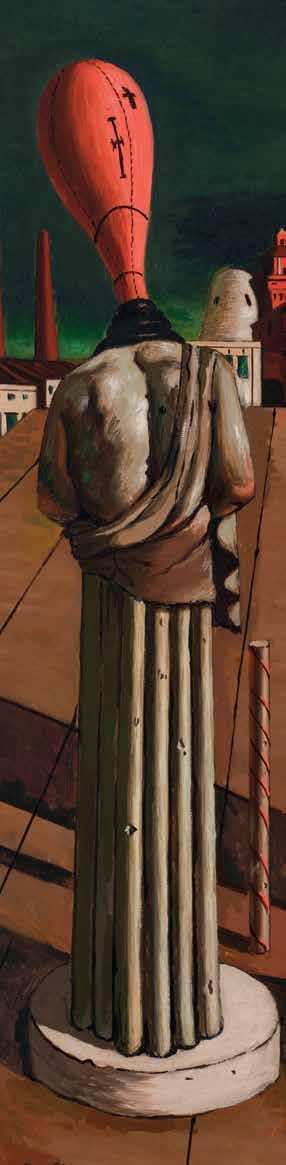
The melancholic and eerie stillness of Dalí’s 1931 landscapes reflects a strong affinity with the deserted piazzas of Giorgio de Chirico, whose metaphysical paintings were foundational to the genesis of Surrealist imagery and sensibility. Yet, where de Chirico’s spaces remain fixed in silence, Dalí’s imagery comes into existence as a result of movement, of shifting perspectives. Recalling a boat journey with a group of Catalan fishermen, Dalí observed: “All the images capable of being suggested by the complexity of their innumerable irregularities appear successively and by turn as you change your position. As we moved forward with the characteristic slowness of a row boat, all these images became transfigured. What had been the camel's head now formed the comb of a rooster”
“
I certainly think that one must no longer underrate the hallucinatory power of some images or the imaginative gift some men possess independently of their ability to recollect.”
–Salvador Dalí, 1931
Above
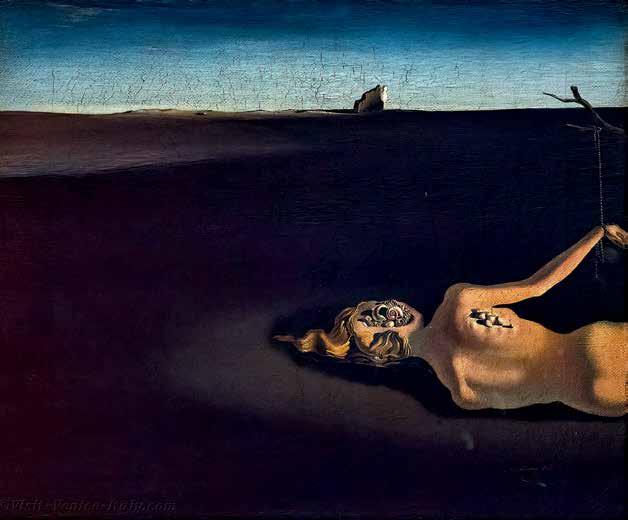
Salvador Dalí, La Solitude, 1931, Wadsworth Atheneum, Hartford
Left
Salvador Dalí, Sans titre (Femme endormie dans un paysage), 1931, Peggy Guggenheim Collection, Venice
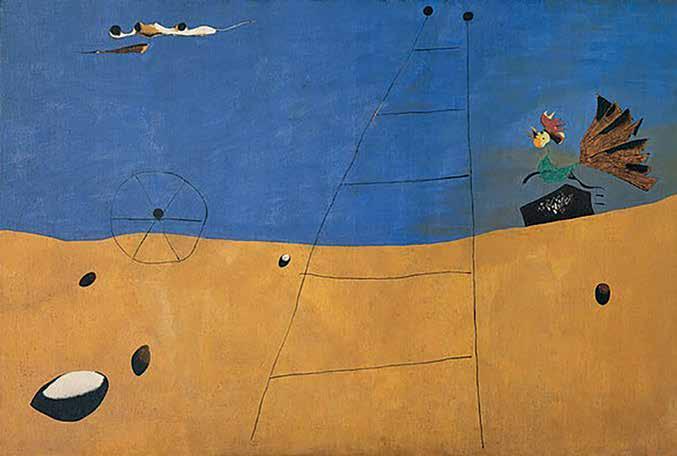
Opposite Joan Miró, Paysage (Paysage au coq), 1927, Fondation Beyeler, Basel
(quoted in Dawn Ades, Dalí, London, 1982, p. 121). The dynamic of the present composition is masterfully achieved by contrasting the timelessness of the rocks with the fleeting moment in which they are transformed, in the painter’s eye, into anthropomorphic images.
Symbiose de la tête aux coquillages belongs to a small group of works created in 1931, the majority of which now belong to museum collections. In these paintings, Dalí explores the anxieties and fantasies of his childhood, with the mysterious long shadows producing a sense of foreboding. Like Dalí, artists including Joan Miró and Yves Tanguy also explored the world of dreamscapes, reaching for imagery from their subconscious mind, their childhood memories and placing them in desolate settings. It was the hallucinatory atmosphere and evocative
power of Dalí’s landscapes, painted with meticulous, sometimes hyper-realist precision, that impressed Sigmund Freud, whom Dalí would meet in 1939. The enigmatic figures appearing in these landscapes are usually depicted nude, with heads inexplicably made out of seashells—a motif that particularly fascinated Dalí at the time. In 1932-33, together with Brassaï, he created a group of photographs known as “involuntary sculptures;” including a seashell in close detail, presumably chosen for its suggestive qualities.
Dawn Ades wrote about Dalí’s art from this key period: “Dalí increasingly persuaded himself of the imperative to make his paintings as convincing, deceptive and illusionistic as possible. His aim, put crudely, was to give form to the formless and invisible, to dreams, reveries,
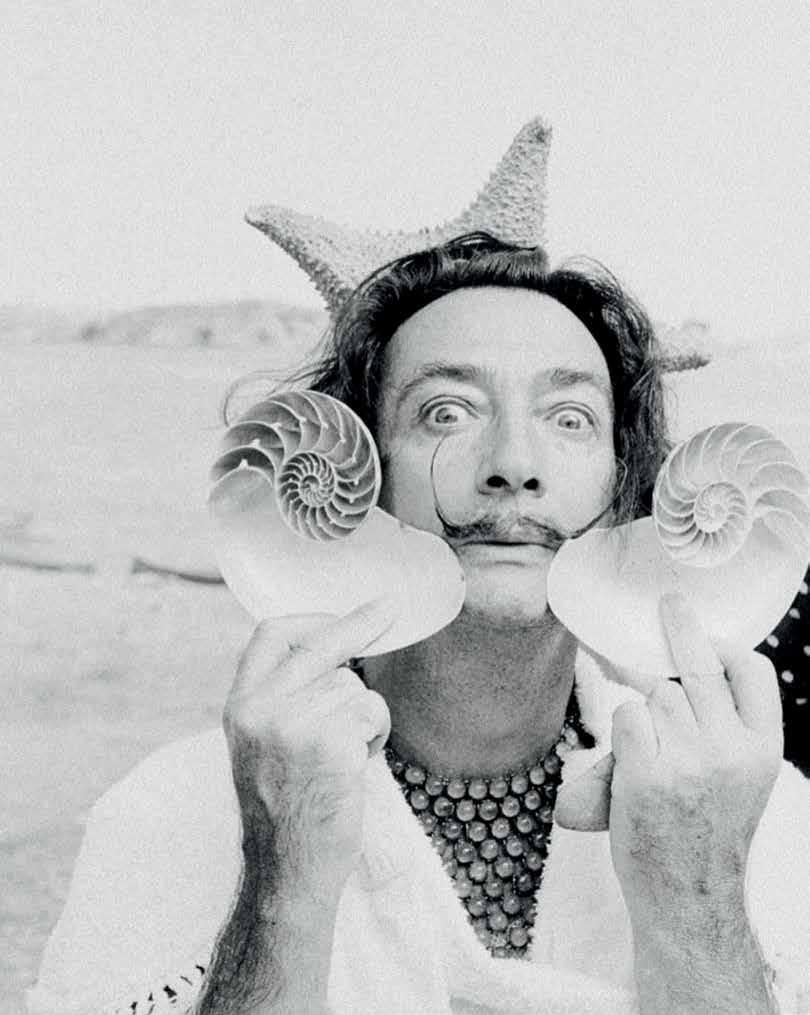
Opposite Charles Hewitt, Dalí with Shells, 1955
Above
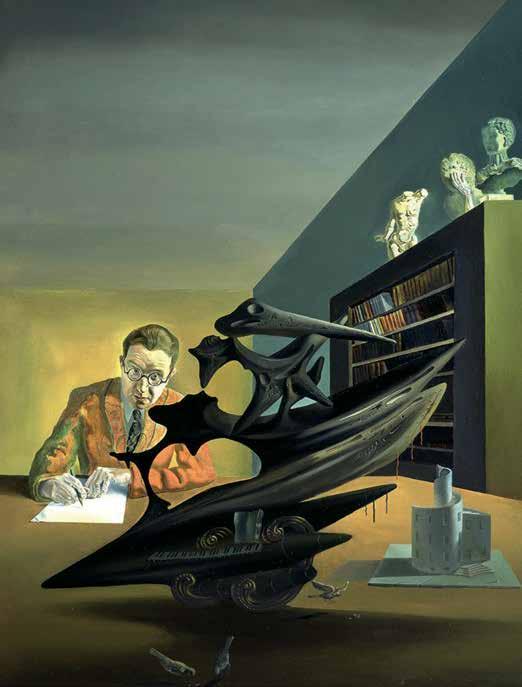
Salvador Dalí, Portrait d'Emilio Terry, 1934, Fundació GalaSalvador Dalí, Figueres
delusions, desires and fears. His ambition, both in what he was aware of depicting and what remained fortuitous and concealed was to make the world of the imagination ‘as objectively evident, consistent, durable, as persuasively, cognoscitively, and communicably thick as the exterior world of phenomenal reality.’ His desire to give substance to the phantoms destined always to remain virtual led to one of the most sustained investigations into the relationship between vision, perception and representation of the century" (Exh. Cat., Hartford, Wadsworth Atheneum and traveling, Dalí's Optical Illusions, 2000, p. 10).
The first owner of Symbiose de la tête aux coquillages was the French artist, architect and interior designer Emilio Terry. An active presence in the Parisian avant-garde circles, Terry was a friend of Dalí’s. He developed a unique architectural style blending elements of the classical and the baroque. Inspired by the Surrealists, in 1933 Terry created a model of a spiral, ‘snail-style’ house—a project that was never built and which illustrates Terry’s vision of “a dream to be realized.” The model is visible in Dalí’s Portrait of Emilio Terry painted in 1934.
6 Victor Brauner
1903–1966
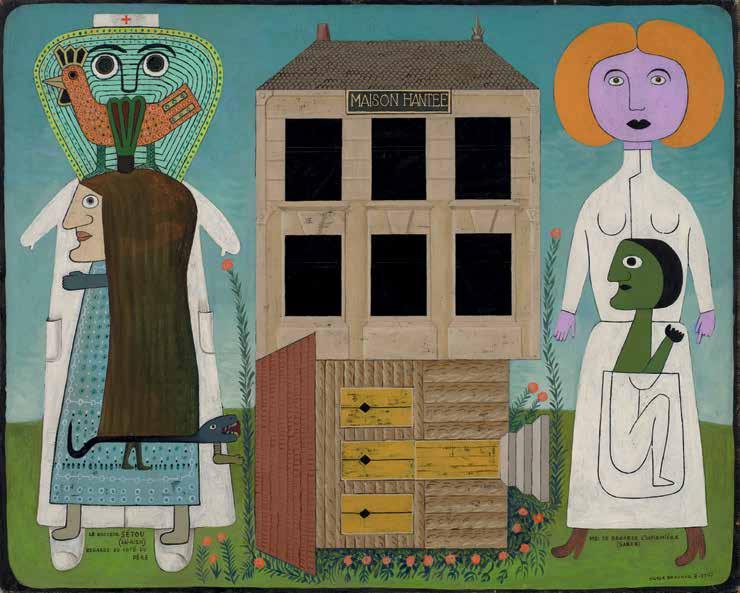
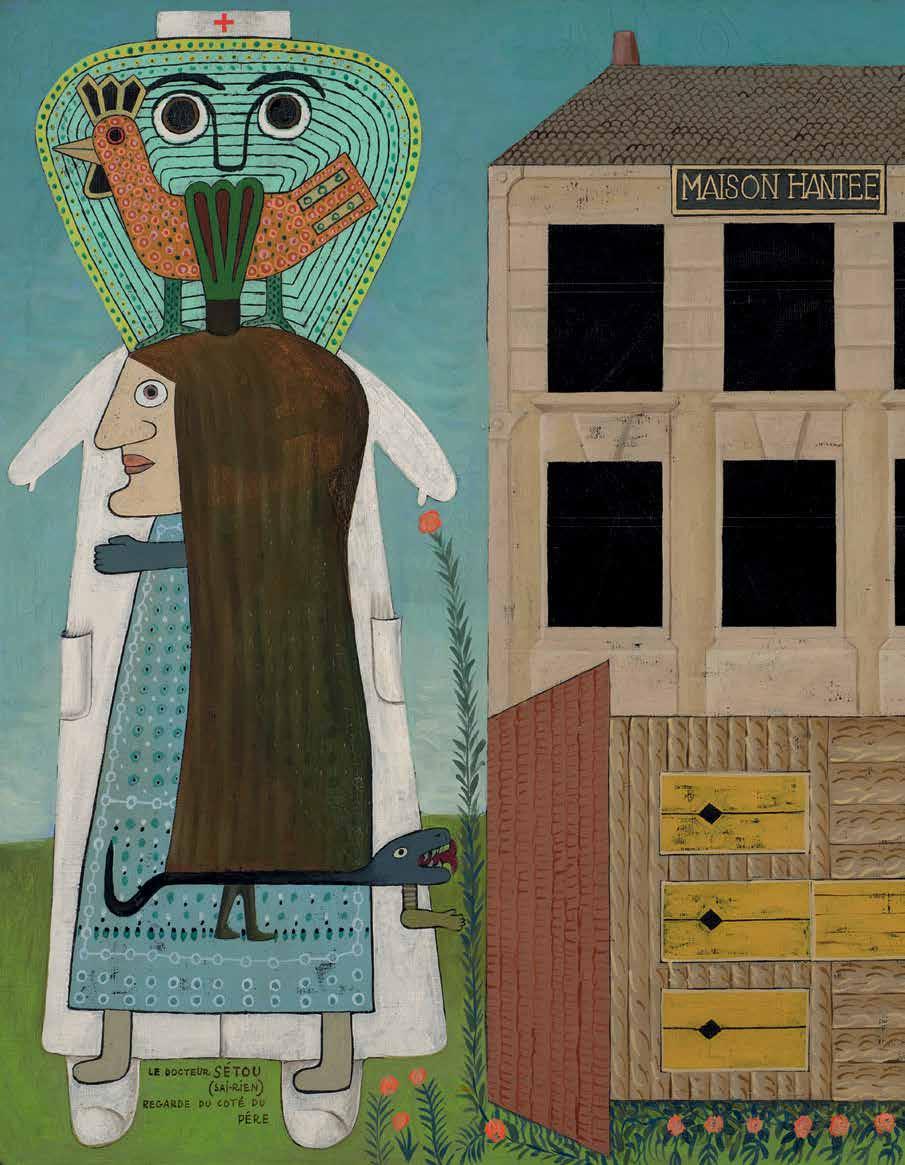
Maison hantée
signed VICTOR BRAUNER and dated 8-1947 (lower right)
oil on canvas
28 ⅞ by 36 ¼ in. 73.3 by 92 cm.
Executed in 1947.
$ 500,000-700,000
Samy Kinge has kindly confirmed the authenticity of this work.
Provenance
(possibly) Richard L. Feigen & Co., Chicago (acquired by May 1959)
Galerie Benador, Geneva
Acquired from the above by 1968 by the present owner
Exhibited
Chicago, Richard L. Feigen & Co., Victor Brauner: Paintings from 1932 to 1958, 1959., illustrated
New York, M. Knoedler & Co., Surrealism in Art, 1975, no. 15, p. 13, illustrated; p. 60
New York, Solomon R. Guggenheim Museum, Surrealism: Two Private Eyes, 1999, vol. I, no. 24, p. 74, illustrated in color
New York, Ubu Gallery, Victor Brauner, 2003-04, pl. 33, illustrated in color
Literature
Sarane Alexandrian, “La symbolique de Brauner,” Cahiers d’art, vol. 24, no. 2, 1949, p. 322, illustrated
Sarane Alexandrian, Dictionnaire de la peinture surréaliste, Paris, 1973, pp. 8-9, illustrated in color
Xavière Gauthier, “Le surréalisme et la sexualité,” Obliques, nos. 14-15, 1977, p. 44; p. 45, illustrated
Didier Semin, Victor Brauner, Paris, 1990, p. 186, illustrated in color; p. 311
Exh. Cat., Houston, The Menil Collection, Victor Brauner: Surrealist Hieroglyphs, 2001-02, pl. 55, pp. 45 and 124; p. 125, illustrated in color
André Breton, Écrits sur l’art et autres textes, œuvres complètes, vol. IV, Paris, 2008, p. 499, illustrated
Surrealist Treasures
a Private Collection • Evening Auction
“Incubi, succubi, ephialtes, lycanthropes, werewolves, ghosts, specters, meet here, my eternal friends. You speak the language of a world of inspiration that is mine.”
–Victor Brauner
Loaded with vibrant, eclectic imagery and bursting with bright hues, Victor Brauner’s Maison hantée forms part of the artist’s powerful body of work produced in the mid- to late 1940s, shortly after his return to Paris following the end of the Second World War. While displaying the uncanny undertones that highlight Brauner’s connection to the Surrealist milieu, the present work also foregrounds the artist’s deeply idiosyncratic visual lexicon that firmly sets him apart from other members of the Surrealist movement.
Brauner’s initial encounter with members of the Parisian Surrealist circle dates to the 1920s, when the Romanian-born artist divided his time between Paris and Bucharest, eventually settling in Paris in 1930. Through his neighbor, the Romanian sculptor Constantin Brancusi, Brauner met several leading members of the movement, including the painter Yves Tanguy and the group’s principal theorist André Breton. The latter became Brauner’s close friend and supporter, writing a preface to the catalogue of the artist’s
first one-man exhibition at Galerie Pierre in 1934. Having sought refuge in the Pyrenees and the Alps during the Second World War, Brauner returned to Paris in 1945, gradually reestablishing links with Breton and other Surrealists and participating in several group exhibitions, including the seminal 1947 show organised by Breton and Marcel Duchamp, Exposition internationale du surréalisme at the Galerie Maeght in Paris.
Yet only a year later, following accusations of ‘divisive activities,’ Brauner was ousted from the group by Breton. Viewed within the context of this watershed moment, Maison hantée, while undoubtedly paying homage to his Surrealist roots, is a work that witnesses Brauner at the precipice of a new, more personal and autonomous direction in his work.
In Maison hantée, an amalgamation of mysterious, whimsical creatures–part human, part animal hybrids–are positioned against the background of a bright blue sky. The eclectic imagery reflects a range of influences that
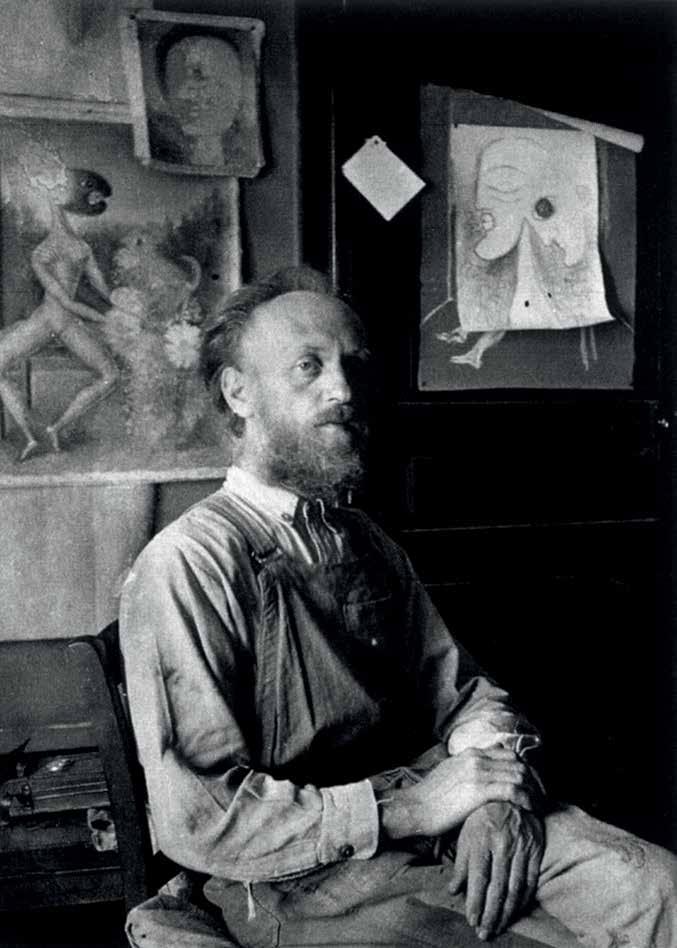
Opposite Victor Brauner in his studio circa 1930s, photographer unknown
Above
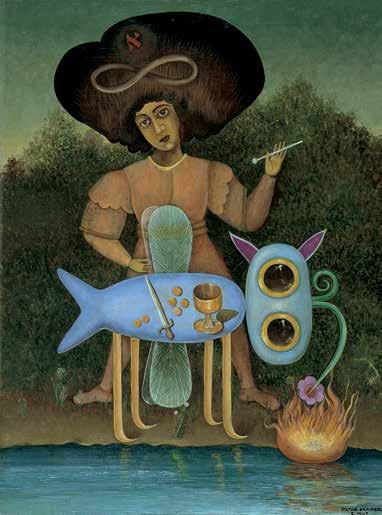
Victor Brauner, Le Surréaliste, 1947, The Peggy Guggenheim Collection, Venice
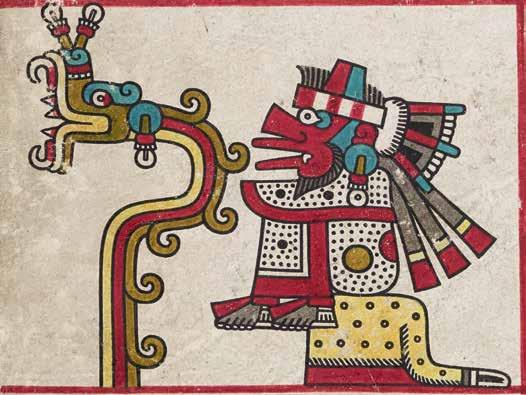
were central to the formation of his creative imagination. As a boy, Brauner was exposed to séances regularly conducted by his father, whose diverse spiritual interests also included evangelical Christianity and the Jewish mystical tradition of Kabbalah. Such early influences and experiences fostered in him a lasting openness towards various occult and esoteric practices. With their flattened features outlined in black, large piercing eyes and brightly coloured faces, the totemic creatures populating the two sides of the painting recall religious deities—a possible reference to Brauner’s native Romanian folk traditions or the Aztec imagery he had been drawn to throughout his career. The serpent, the bird and the childlike figure on the right (the latter conjuring themes of fertility and the divine feminine), as well as the floral patterns adorning the central house elements, are particularly evocative of the imagery found in Aztec codices.
The style and positioning of the figures is likewise suggestive of the imagery found in Tarot cards which were used throughout Europe from around fifteenth century onwards in divination practices and regularly appears in Surrealist art. Just a few years prior, in 1940-41, a group of Surrealist artists including Brauner produced their own illustrated deck of cards likely inspired by Tarot.
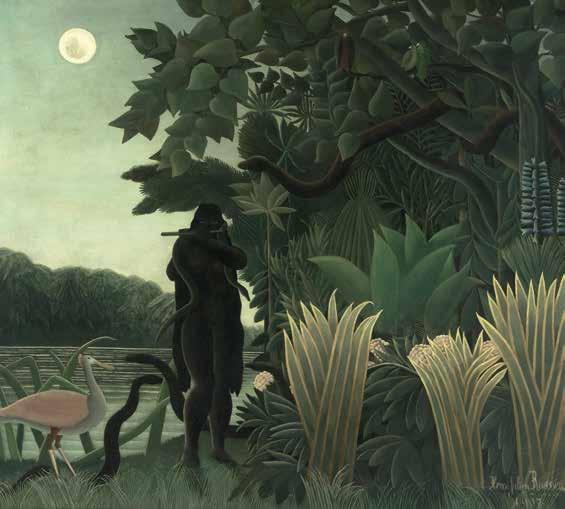
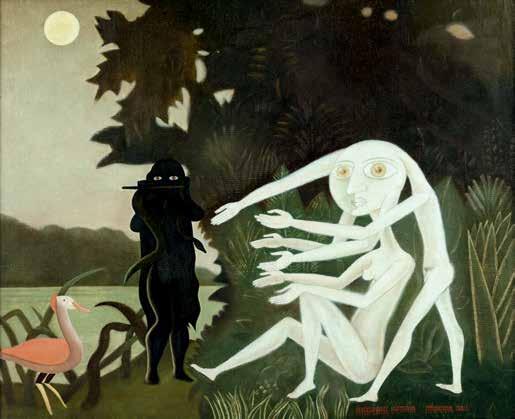
A further influence for Brauner during this period was the work of Henri “Le Douanier” Rousseau, whose Paris studio Brauner moved into in 1945. A year later, Brauner produced a painting La rencontre du 2 bis, rue Perrel directly inspired by Rousseau’s well-known canvas La Charmeuse de serpents from 1907. The simplified, flattened shapes and the deliberate lack of depth Brauner employs in the present work can be read as continuing in the ‘naive’ tradition pioneered by Rousseau.
Opposite left
Detail of a page depicting Quetzalcoatl from Codex Laud, 16th century, Bodleian Library, Oxford
Opposite right
Victor Brauner, Acolo, 1949, Art Institute of Chicago
Right
Henri Rousseau, La Charmeuse de serpents, 1907, Musée d'Orsay, Paris
Below
Victor Brauner, La Rencontre du 2 bis rue Perrel, 1946, Musée d’art moderne de la ville de Paris
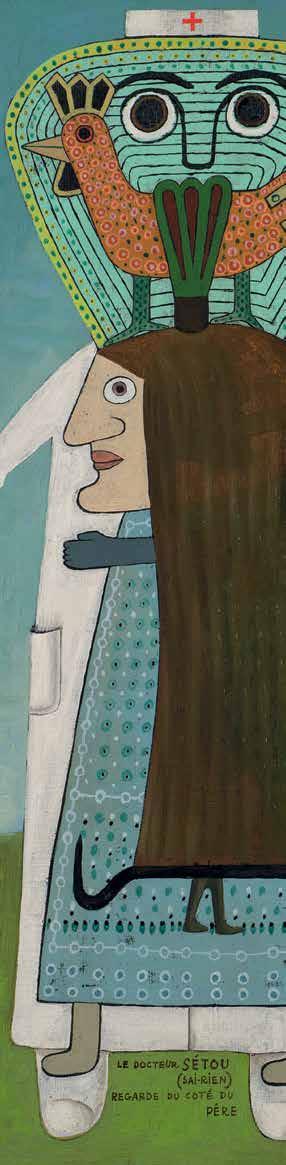
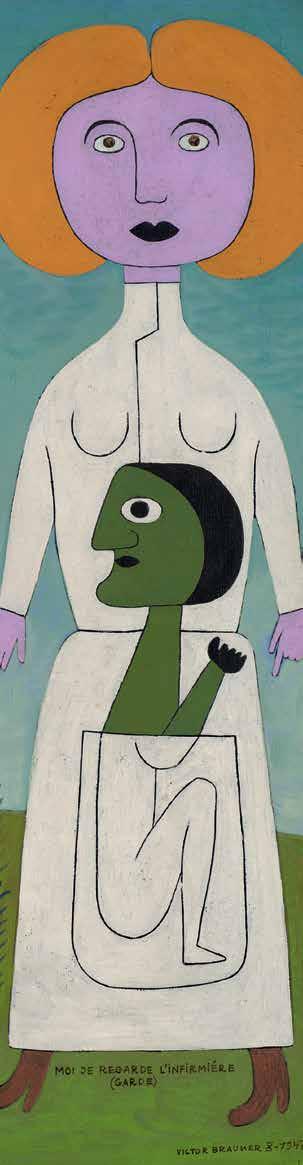
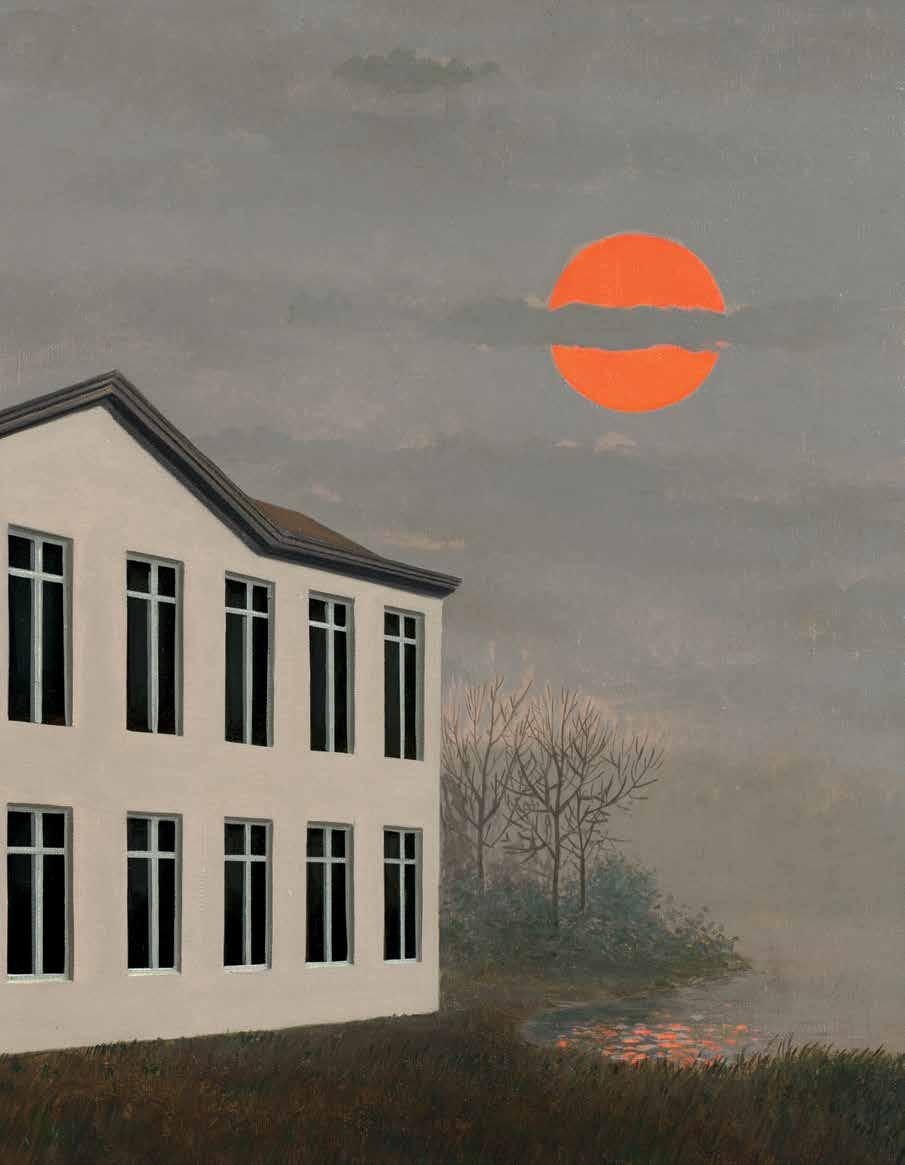
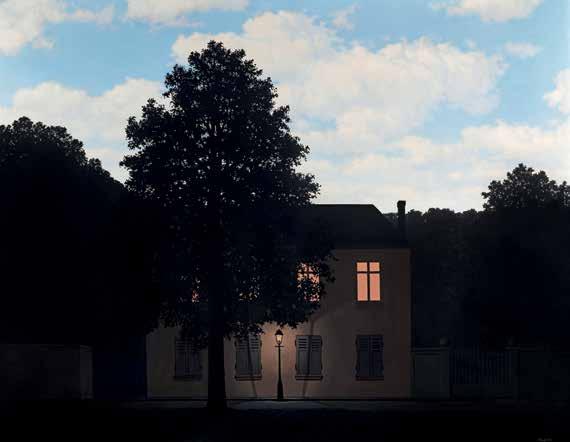
In Maison hantée, Brauner synthesizes this array of aesthetic influences with the prevailing concerns and motifs of his Surrealist contemporaries, for example the iconic nocturnal subject of a house with blackened windows set against a sky of daytime blue. His juxtaposition of night and day, the visible and the hidden, the real and the perceived, was central to Surrealist imagery—most famously in Magritte’s celebrated series L’Empire des lumières, which he begun in the 1940s. Equally aligned is the humorous play on words which Brauner employs in the inscriptions visible underneath the two central figures (“Le Docteur S étou (sai-rien) regarde du coté du p é re” and “Moi je regarde l’infirmié re (garde)”), evincing the fundamental role of play in the Surrealist ethos.
In the present work, the characteristic themes and images of Surrealism are transformed into a more personal, introspective vision. The
Left René Magritte, L’Empire des lumières, 1961, Sold: Sotheby’s, London, March 2022, $79.5 million
Below Max Ernst, Jour et nuit 1941-42, The Menil Collection, Houston
Opposite
Detail of the present work
hybrid beings and symbolic motifs no longer merely evoke the unconscious, but suggest a self-contained cosmology rooted in myth and spiritual transformation. The painting thus marks a key moment of transition—bridging Brauner’s Surrealist foundations and the autonomous, deeply individual language that came to define his mature style.
Never before appearing at auction, the present work has been held in the same distinguished private collection for almost sixty years. It has been widely exhibited in the United States, including the 1959 Brauner exhibition at Richard Feigen’s gallery in Chicago; the 1975 Surrealism in Art exhibition at the Knoedler Gallery in New York; and in 1999, the seminal Surrealism: Two Private Eyes exhibition at the Solomon R. Guggenheim Museum in New York.
7 René Magritte
1898–1967
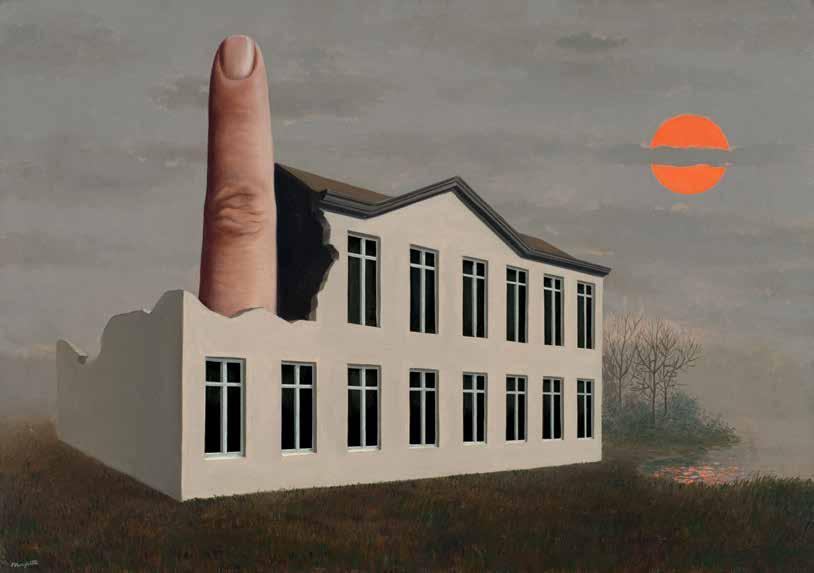
La Révélation du présent
signed Magritte (lower left); signed again, titled and dated 1936 (on the reverse)
oil on canvas
18 ¼ by 25 ¾ in. 46.4 by 65.5 cm.
Executed in 1936.
$ 2,000,000-3,000,000
Provenance
E.L.T. Mesens, London and Brussels (acquired by 1939 and until at least 1956)
Marc Hendrickx, Brussels (acquired by 1965)
Galerie André Petit, Paris
Byron Gallery, New York
Acquired from the above by 1968 by the present owner
Exhibited
Brussels, Palais des Beaux-Arts, René Magritte: peintures, objets surréalistes, 1936, no. 17
New York, Julien Levy Gallery, René Magritte, 1938, no. 10
London, The Lefevre Gallery, René Magritte, 1953, no. 12, p. 2, illustrated; p. 3
Brussels, Palais des Beaux-Arts, René Magritte, 1954, no. 52, p. 31
Charleroi, Salle de la Bourse, XXXme Salon du Cercle Royal Artistique Littéraire, 1956, no. 61
New York, Byron Gallery, René Magritte, 1968, no. 9, p. 19, illustrated in color
Brussels, Palais des Beaux-Arts and Paris, Centre Pompidou, Rétrospective Magritte, 1978-79, no. 116, illustrated
New York, Solomon R. Guggenheim Museum, Surrealism: Two Private Eyes, 1999, vol. I, no. 133, p. 197, illustrated in color
Literature
Patrick Walberg, René Magritte, Brussels, 1965, p. 240, illustrated in color; p. 350
A.M. Hammacher, René Magritte, New York, 1973, fig. 24, p. 24, illustrated
Sarane Alexandrian, Dictionnaire de la peinture surréaliste, Paris, 1973, p. 37, illustrated in color
Alain Robbe-Grillet, La Belle Captive, Paris, 1975, pp. 104-05, illustrated
Jacques Baron, Anthologie plastique du surréalisme, Paris, 1980, p. 166, illustrated in color
René Passeron, René Magritte, New York, 1980, pp. 70-71, illustrated in color
David Sylvester and Sarah Whitfield, René Magritte: Catalogue Raisonné, vol. II, London, 1992, no. 401, p. 219, illustrated
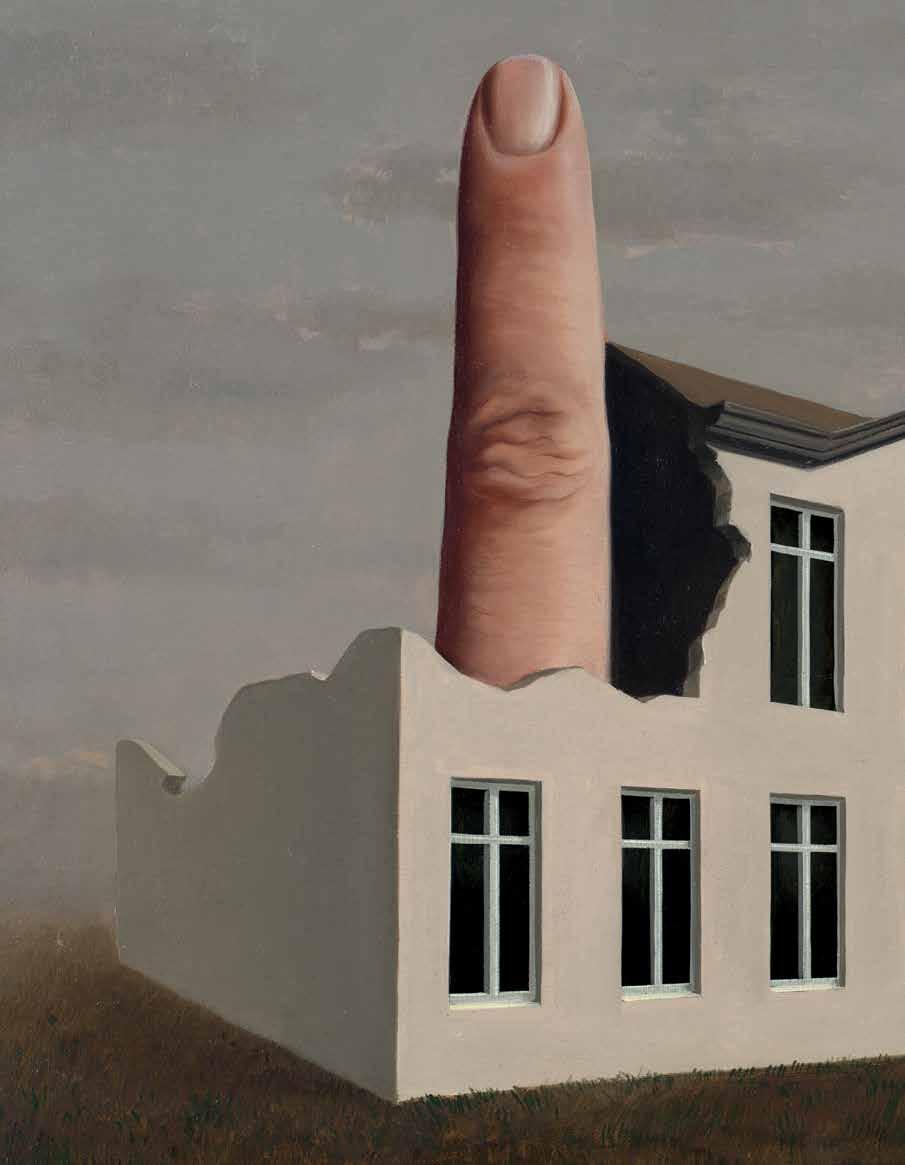
Among the most distinctive characteristics of René Magritte’s idiosyncratic visual language is his inimitable use of the epigram. At Magritte’s hand, the rhetorical device was employed to ends beyond the mere witty recapitulation of an idea or an image, but rather, and somewhat paradoxically, as a means of understanding the original image itself. “His aim,” writes his biographer David Sylvester, paraphrasing the artist’s own assessment of his project, “was to discover the property which belonged indissolubly to an object but which seemed strange and monstrous when the connection was revealed; what preoccupied him was the shock induced when this knowledge was given concrete expression” (David Sylvester, Magritte, p. 220). Executed in 1936, La Révélation du présent marks a pivotal breakthrough within this investigation.
Left René Magritte, Les Affinités électives 1932, Private Collection
Opposite left René Magritte, L’Éloge de la dialectique, 1937, National Gallery of Victoria, Melbourne
Opposite right René Magritte, La Durée poignardée, 1938, Art Institute of Chicago
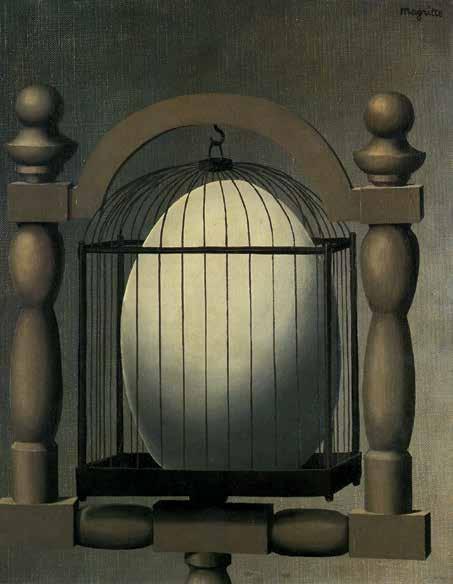
Magritte explained that the seminal point of departure for the broader project was a nocturnal hallucination which prompted him to become aware of the method he had been working with, and the ambition he was working towards: “One night in 1936, I awoke in a room in which a cage and the bird sleeping in it had been placed. A magnificent error caused me to see an egg in the cage instead of the bird. I then grasped a new and astonishing poetic secret, because the shock I experienced had been provoked precisely by the affinity of two objects, the cage and the egg, whereas previously I used to provoke this shock by bringing together objects that were unrelated. Ever after that revelation I sought to discover if objects other than the cage could not likewise manifest… the same evident poetry that the conjunction of the egg and the cage had succeeded in producing” (quoted in Suzi Gablik, Magritte, London 1985, p.
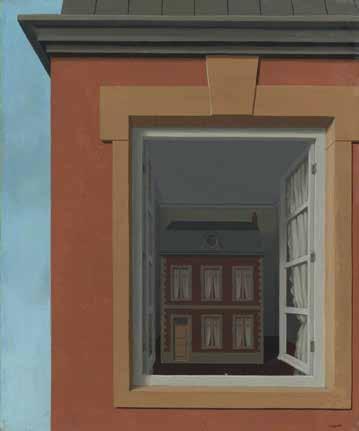
evocatively, of ‘inhabitance,’ both of which we already associate with the image of a house. It is, in many ways, the most and least obvious resolution, in that the answer turned out to be the very same as the problem itself. Such was, as Sylvester explains, the nature of the exercise: “how difficult the process of discovery was yet how self-evident the solution seemed once found” (ibid.).
101). The revelations held within these Elective Affinities, so-named for the eponymous painting of the incendiary caged egg, were achieved through a process of tireless trial and error. One of the earliest motifs for whose “problem” Magritte endeavoured to find a solution was the house.
A series of sketches which Magritte presented to his friend Louis Scutenaire and his wife, the journalist Irene Hamoir, reveal countless attempts at depicting the house in combination with different objects in order to locate the shock within the image. He eventually arrived at his first solution: L'Éloge de la dialectique. There Magritte paints a closely cropped view of the upper right corner of a house, its window open to reveal a room within which sits another house in miniature. In so doing, Magritte engages with and literalizes the notion of ‘containment’ or perhaps, more
Shortly thereafter, Magritte arrived at the combination which he painted in La Révélation du présent—what Sylvester describes as an “anarchic corollary” to L'Éloge de la dialectique. Here, Magritte begins with the conventional image of a house, innocuously placed at the edge of a lake within a nondescript landscape. The shock comes in the form of a grossly magnified finger which bursts through the roof from inside. In its placement, the mind draws a visual parallel to a chimney, only to be jolted into the disorienting realization that the finger is wholly out of place. The effective impact of this combination lies in the conceptual proximity of its two elements. The finger, a metonym for a person, is by that association a logical accompaniment to a house. It is in many ways an effect similar to that which is achieved in his 1938 canvas La Durée poignardée in which he depicts a steam train emerging from the fireplace, and in turn calls upon the uncanny resemblance of the fireplace to a tunnel. This
visual parity enables a logical progression which does not pose an immediate disruption to either of the two elements, nor to the narrative of the composition. It is precisely the fact that perhaps, at first, the eye does not question the apparent absurdity of their combination which makes their pairing all the more mysterious.
Writing in retrospect in 1959, Magritte recalls the genesis of the imagery for La Durée poignardée, a process of ideation which, when reapplied to the elements within the present work, in many ways elucidates the impact of its imagery. “I decided to paint the image of a locomotive. Starting from that possibility, the problem presented itself as follows: how to paint this image so that it would evoke mystery… The image of a locomotive is immediately familiar; its mystery is not perceived. In order for its mystery to be evoked, another immediately familiar image without mystery [must be paired with it]…” Magritte then goes on to locate the genesis,
or rather the psychology behind the source of inspiration for their combination: “I thought of joining the locomotive image with the image of a dining room fireplace in a moment of ‘presence of mind.’ By that I mean the moment of lucidity that no method can bring forth. Only the power of thought manifests itself at this time. We can be proud of this power, feel proud or excited that it exists. Nonetheless, we do not count for anything, but we are limited to witnessing the manifestation of thought. When I say ‘I thought of joining, etc…’ exactitude demands that I say ‘presence of mind exerted itself and showed me how the image of a locomotive should be shown so that this presence of mind would be apparent.’... The word idea is not the most precise designation for what I thought when I united a locomotive and a fireplace. I didn’t have an idea; I only thought of an image” (Letter from René Magritte to Hornik, 8 May 1959, quoted in Harry Torczyner, Magritte: Ideas and Images, New York 1977, pp. 81-82).
Above
René Magritte, La Lecture Défendue, 1936, Musées Royaux Des Beaux-Arts de Belgique
Opposite left Max Ernst, À la première parole claire, 1923, Kunstsammlung Nordrhein-Westfalen, Düsseldorf
Opposite right Giorgio de Chirico, Le Chant d'amour, 1914, The Museum of Modern Art, New York
The presence of mind which Magritte describes as enabling the combination to take shape for him as artist is in many ways transitively extended onto the mode of viewership in which the audience to the work receives the composition. Though at first beguiling, it is a moment of lucidity which allows for the combination of the finger and the house, or the train and the fireplace, to reveal a mysterious affinity between two objects which we would otherwise never think to place together, let alone understand as connected. It is precisely this uncanny quality of their pairing which places La Révélation du présent as a novel expansion upon the lineage of works which, employing the same iconography, were foundational to the development of Surrealism at large. The rupture of the house by the finger has already taken place, the missing piece entirely disappeared, the surface of the water is undisturbed, the trees are still, the house empty, the windows dark, all of which is amplified by the gentle mist which encroaches on the foreground. It begs the question of what will happen next—or rather, what can happen next.
8 Giorgio de Chirico
1888–1978
Le Muse inquietanti
signed G. de Chirico (lower left)
oil on canvas
38 ⅞ by 25 ½ in. 98.6 by 64.8 cm.
Executed in 1924.
$ 3,000,000-4,000,000
The authenticity of this work has been confirmed by the Fondazione Giorgio e Isa de Chirico.
Provenance
André Breton, Paris (commissioned from the artist in 1924)
René Gaffé, Brussels (probably acquired from the above by December 1929)
Henry and Esther Clifford, Philadelphia (acquired from the above through E.L.T. Mesens, Brussels on 25-26 June 1936)
Pierre Matisse Gallery, New York (acquired from the above on 26 February 1941)
Hugh Chisholm, Woodbury, Connecticut (acquired from the above on 30 April 1942)
Bridget Bate Tichenor, New York (acquired by descent from the above by 1955)
Gerrit and Sydie Lansing, New York
Galerie Marie-Louise Jeanneret, Geneva
Acquired from the above circa 1979-80 by the present owner
Exhibited
London, New Burlington Galleries, The International Surrealist Exhibition, 1936, no. 55, p. 16 (dated 1916)
New York, The Museum of Modern Art, Fantastic Art, Dada, Surrealism, 1936-37, pl. 214, illustrated; pp. 39 and 260
New York, Pierre Matisse Gallery, Giorgio de Chirico, Exhibition of Early Paintings, 1940, no. 15
New York, The Museum of Modern Art, Giorgio de Chirico 1955, pp. 127-28, illustrated; pp. 134 and 160
New York, The Museum of Modern Art; London, Tate Gallery; Munich, Haus der Kunst and Paris, Centre Pompidou, De Chirico, 1982-83, pl. 89, pp. 54 , note 68, 72-73 and 79, note 46; p. 196, illustrated
New York, Solomon R. Guggenheim Museum, Surrealism: Two Private Eyes, 1999, vol. I, no. 62, p. 117; p. 119, illustrated in color (dated 1925)
Literature
Sélection. Chronique de la vie artistique,vol. 8, no. 8, December 1929, p. 47, illustrated (dated 1917))
Georges Ribemont-Dessaignes, “Giorgio de Chirico,” Documents, 1930, vol. 2, no. 6, p. 336, illustrated (dated 1917)
James Thrall Soby, After Picasso, Hartford and New York, 1935, p. VIII; pl. 37, illustrated (dated 1917)
Carlo Belli, Il Rubicone, no. 7, 1935, illustrated
André Breton, What is Surrealism?, London, 1936, frontispiece, illustrated
Giovanni Scheiwiller, Lo Duca Giorgio de Chirico, Milan, 1936, pl. VII, illustrated (dated 1916)
Ejler Bille, Picasso, Surrealisme, Abstrakte Kunst, Copenhagen, 1945, p. 205, illustrated; p. 283 (dated 1917)
René Gaffé, Giorgio de Chirico, le Voyant, Brussels, 1946, p. 10; pl. 17, illustrated (dated 1917)
James Thrall Soby, “De Chirico: case history of the metaphysician,” ARTnews, vol. 54, no. 5, September 1955, p. 35
Sele arte, vol. IV, no. 20, September-October 1955, pp. 22-23 illustrated
Luciano Doddoli, “Sono un prigioniero,” La fiera letteraria vol. XLIII, no. 17, 25 April 1968, pp. 10-11 (titled Le Muse)
Massimo Carrà, Patrick Waldberg and Ewald Rathke, Metaphysical Art, London, 1971, no. 139, p. 212; illustrated Carlo Ludovico Ragghianti, Il Caso de Chirico: saggi e studi di Carlo L. Ragghianti, 1934-1978, Florence, 1979, pp. 120-21, illustrated
Maurizio Fagiolo dell’Arco, Giorgio de Chirico «Le rêve de Tobie». Un interno ferrarese, 1917 e le origini del Surrealismo, Rome, 1980, no. 85, pp. 29, note 21, and 62; p. 63, illustrated (dated circa 1924)
Maurizio Fagiolo dell’Arco and Paolo Baldacci, eds., Giorgio de Chirico, Parigi 1924-1929, dalla nascita del surrealismo al crollo di Wall Street, Milan, 1982, no. 1, p. 479, illustrated; pp. 577-78
Exh. Cat., Milan, Galleria Paolo Baldacci, Giorgio de Chirico i temi della metafisica, 1985, p. 11
Exh. Cat., Milan, Palazzo Reale, De Chirico gli anni Venti, 1987, p. 112, illustrated (dated circa 1924)
Maurizio Fagiolo dell’Arco, La Vita di Giorgio de Chirico, Turin, 1988, pp. 138-39
“Giorgio de Chirico, 1888-1978,” Modern Arts Criticism, vol. 2, 1992, p. 143
Exh. Cat., New York, Paolo Baldacci Gallery, Giorgio de Chirico: Betraying the Muse: De Chirico and the Surrealists, 1994, no. 47, pp. 52, 54, 111 and 116; p. 57, illustrated
Maurizio Fagiolo dell’Arco, De Chirico Gli anni Trenta, Milan, 1995, pp. 105, 249 and 363-64; p. 107, illustrated (in reproduction of Carlo Belli, Il Rubicone, no. 7, 1935 illustrated) (dated 1916)
Paolo Baldacci, De Chirico: The Metaphysical Period 18881919, Milan, 1997, no. A6, p. 420, illustrated
Alice Gambrell, Women Intellectuals, Modernism, and Difference: Transatlantic Culture, 1919-1945, Cambridge, 1997, pp. VIII, 69 and 71; pl. 6, p. 70, illustrated
Exh. Cat., Verona, Galleria dello Scudo, de Chirico gli anni Trenta, 1998-99, fig. A, p. 105; p. 110, illustrated (dated 1924-25)
Jole de Sanna, “Giorgio de Chirico - André Breton: Duel à mort,” Metaphysical Art, nos. 1/2, 2002, pp. 64-65, 71 and 81
Giovanna Rasario, "The Works of Giorgio de Chirico in the Castelfranco Collection. The 'Disquieting Muse' Affaire," Metafisica, nos. 5/6, 2006, pp. 287-90, 292-93, 296 and 297, note 127
Exh. Cat., Musée d'Art moderne de la Ville de Paris, la fabrique des rêves, 2009, no. 43, pp. 116 and 300
Elena Pontiggia, ed., Giorgio de Chirico: Lettere 1909-1929, Milan, 2018, p. 311
Victoria Noel-Johnson, “De Chirico in the René Gaffé Collection & the Role of E.L.T. Mesens (Brussels-London),” Metaphysical Art, nos. 19/20, 2020, fig. 11, pp. 47, note 14, 48-49, note 16, 50, note 19, 51, 53-55, 57-61, 64, 66 and 80; p. 49, illustrated
Fabio Benzi, Giorgio de Chirico. Life and Paintings, New York, 2023, pp. 295-98 and 300-12; p. 299, illustrated
Vibrant, dreamlike and profoundly enigmatic, Le Muse inquietanti stands among the most iconic and enduring images of Giorgio de Chirico’s career. A work of singular historical and artistic significance, it marks the artist’s first revisitation of an earlier composition—a practice that would become a cornerstone of the artist’s work and have a profound impact on the history of Modern art.
Initially conceived in circa 1918 at the height of the artist’s renowned Metaphysical Period, the subject of the present work hails from the most inventive of de Chirico’s career, during which he produced works that interrogated the nature of existence by juxtaposing grounded objects— such as statues, piazzas, mannequins, buildings and other geometric figures—with dreamlike landscapes. The present version emphatically showcases themes of monumentality, nostalgia, melancholy and distortion of reality that characterize his most important and celebrated paintings. As historian James Thrall Soby would later proclaim, the present work is “the greatest… of de Chirico’s entire career… The picture attracts and repels, beguiles and frightens, conveys a warm
nostalgic aura but at the same time suggests an impending catastrophe. There is no action; the piazza is still; the figures wait” (James Thrall Soby, Giorgio de Chirico, The Museum of Modern Art, New York, 1955, pp. 134-36).
Born to Italian parents in the Greek port city of Volos, de Chirico began his studies at the Munich Academy of Fine Arts in 1905, where he encountered the paintings of Arnold Böcklin and the writings of Friedrich Nietzsche, Otto Weininger, and Arthur Schopenhauer—figures whose philosophical and epistemological ideas would profoundly shape his imagery. After settling in Italy in 1909, the young artist developed a style of painting that he would eventually term ‘Metaphysical Art.’ Featuring elements such as mannequins, classical statues and other geometric objects, all suspended in disquieting, deserted piazzas, the works conceived during de Chirico’s prime period of 1910–1919 are considered his very best, boldly juxtaposing GrecoRoman referents with with the theatricality of the modern world to create surreal scenes that evoke a sense of both nostalgia and unsettling alienation. The first iteration Le Muse inquietanti emerged from this context in 1918, depicting a central piazza
Opposite Postcard of the Castello
Above
Giorgio de Chirico, I divertimenti di una giovane ragazza, 1915, The Museum of Modern Art, New York
Estense in Ferrara, circa 1940
“Perhaps more forcefully than any other work of de Chirico’s career [Le Muse inquietanti ] illustrates the ambivalent, “metaphysical” nature of his early art. The picture attracts and repels, beguiles and frightens, conveys a warm nostalgic aura but at the same time suggests an impending catastrophe. There is no action; the piazza is still; the figures wait. What will happen? There is no answer…De Chirico’s image—his early art as a whole—appeals directly to the counter-logic of the subconscious, to those swamp-like regions at the edge of the mind where ecstasies bloom white and the roots of fear are cypress-black and deep.”
–-James Thrall Soby, Giorgio de Chirico, The Museum of Modern Art, New York, 1955, p. 136
in the Northern Italian city of Ferrara, where de Chirico resided during World War I following his 1915 military discharge. "The appearance of Ferrara, one of the loveliest cities in Italy, has made a deep impression on me,” the artist later expounded, “but what struck me above all and inspired me from the metaphysical point of view in which I was working, was the appearance of certain interiors in Ferrara, certain window displays, certain shops, certain houses, certain quarters" (Giorgio de Chirico, Memorie della mia vita, Rome, 1945, pp. 122–23).
Against the central plane of La Muse inquietanti unfolds an expansive, sun-drenched piazza, its surface of cobblestones supplanted with long planks of wood evocative of a theatrical stage. Set against an ominous, yet radiant, green sky at sunset, the background is dominated by the Castello Estense, a moated medieval castle located in the center of the city. De Chirico had previously depicted the Castello Estense in his 1915 work I Divertimenti di una giovane ragazza, now held at The Museum of Modern Art, New York. In Le Muse
inquietanti, he offers a broader view and more vivid palette, the castle now glowing a deep scarlet under the setting sun that radiates seemingly beyond the canvas edge. To the left, a Renaissance-style arcade lies in shadow; to the right, a pale factory with two rust-red smokestacks rises inexplicably from below the piazza’s surface.
While notably devoid of human presence, the present work is populated with a duo of titular Muses, Olympian goddesses of inspiration in the arts, literature and science. The bodies of these Muses are constructed in three parts—their torsos are unambiguously human, dressed in classical robes; their lower bodies morph into fluted columns; and in place of a human head are the featureless heads from a dressmaker’s mannequins, hauntingly blank and inscrutable. The left Muse, her back to the viewer, is accompanied by a freestanding club, illuminating her to be Melpomene, the Muse of tragedy; the right Muse, seated facing the viewer, is accompanied by a red mask that leans against her left side, revealing her as Thalia,
Above Giovanni Battista Tiepolo, Thalia and Melpomene, the Muses of Comedy and Tragedy, 1750, Yale University Art Gallery, New Haven
Opposite Giorgio de Chirico (center) and André Breton (fourth from left) at the Bureau of Surrealist Research, Paris, November 1924.
Photograph by Man Ray
the Muse of comedy. In the immediate foreground, a multicolored geometric box lays on the ground, inexplicably rendered from the perspective of the seated Thalia, distorting the audience’s viewpoint. At the right of the painting, a third figure stands enveloped by shadow in front of the arcade: Apollo— the deity of the sun, music, and prophecy, as well as the leader of the Nine Muses—whose head is also transfigured into that of a faceless mannequin.
The present work, de Chirico’s first revisitation of an earlier composition, was commissioned by André Breton, the poet, theorist and founder of Surrealism, who recognized in de Chirico a progenitor of the movement. Breton’s early championing of de Chirico, combined with his role as collector, situates this painting at the very heart of Surrealist history. Breton first encountered de Chirico’s Metaphysical Painting at the home of fellow poet and patron Guillaume Apollinaire in 1916 and later wrote, “I believe that a true modern mythology is taking shape. It is up to Giorgio de Chirico to ensure that it is remembered forever”
(André Breton, Livres choisis. Giorgio de Chirico, 1919 republished in Littérature, no. 11, January 1920, pp. 29-30).
Just as he was among de Chirico’s most vocal champions, Breton also became one of his most voracious collectors. By late 1923, Breton took interest in acquiring the first iteration of Le Muse inquietanti, then owned by Victor Castelfranco, who ultimately refused to sell it. In its place, de Chirico offered to create another version of the work. Fabio Benzi writes, “It was at this point that de Chirico, noting the difficulty of the negotiation, and feeling himself to be helpless in assisting with the negotiations, proposed to make a copy of the Muses… by way of a conciliatory gesture. He reassured him that the works would be identical, only better painted… [with] no defect other than that of being executed with more beautiful materials and a more skillful technique,’ in line with his current research… This is therefore the first exact ‘copy’ ever made by Giorgio de Chirico of one of his Metaphysical works” (Fabio Benzi,
“I believe that a true modern mythology is taking shape. It is up to Giorgio de Chirico to ensure that it is remembered forever.”
–André Breton
La prima “replica” di un dipinto metafisico di de Chirico e il rapporto con Breton: Le Muse inquietanti, 1924, 2025 (unpublished), p. 2). The execution of the present work thus heralded de Chirico’s new practice of revisiting prior compositions, one that would endure throughout the remainder of his career. Such early reiterations are widely regarded as the most compelling of their kind, combining technical mastery with the intensity of the artist’s original vision in a manner that later versions would seldom surpass. James Thrall Soby later declared the present version as “superior in technique and feeling,” to de Chirico’s later revisitations of the Metaphysical works (James Thrall Soby, The Early Chirico, New York, 1941, pp. 70-71). Marking a crowning moment in the history of Surrealism, De Chirico’s delivery of Le Muse inquietanti to Breton in Paris upon their first-ever meeting in November 1924 coincided with the very inception of the formal movement, occurring mere days after Breton’s publication of the first Manifeste du surréalisme
In 1936, the present version of Le Muse inquietanti featured in the seminal International Surrealist Exhibition at New Burlington Galleries in London, constituting the movement’s inaugural exhibition in the United Kingdom and solidifying the link between the nascent British Surrealist group. The New Burlington show would later be remembered as one of the defining events in the history of Surrealism. During this exhibition, the present work was sold to Henry Clifford, curator of the Philadelphia Museum of Art, through its organizer, Belgian gallerist E.L.T Mesens. Further testifying to its importance within de Chirico’s
oeuvre, Le Muse inquietanti was later included in the watershed 1936 Fantastic Art, Dada, Surrealism exhibition at The Museum of Modern Art in New York. This pivotal show was largely responsible for introducing Surrealism to the American public.
The present work would later feature at The Museum of Modern Art’s major 1955 survey of the artist, around which time it entered the collection of Bridget Bate Tichenor, a seminal FrenchBritish painter who would later join the Surrealist circles in New York and Mexico. Le Muse inquietanti was also central to the first comprehensive posthumous de Chirico retrospective at The Museum of Modern Art; Tate Gallery, London and the Centre Pompidou, Paris in 1982-83.
Le Muse inquietanti has proven both enduring and influential due to its iconography and its embodiment of de Chirico’s iterative practice. It would particularly resonate with Pop Art figurehead Andy Warhol, who encountered the present work at the artist’s 1982 retrospective at The Museum of Modern Art. Warhol there recognized the two artists’ shared fascination with notions of originality,
famously proclaiming: “De Chirico repeated the same images throughout his life. I believed he did it not only because people and dealers asked him to do it, but because he liked it and viewed his repetition as a way of expressing himself. This is probably what we have in common… The difference? What he repeated regularly, year after year, I repeat the same day in the same painting” (quoted in Exh. Cat., London, Waddington Custot, Andy Warhol (After de Chirico), 1998, p. 8). That year, Warhol would pay tribute to de Chirico with a series of silkscreens derived from several of the artist’s works—including Le Muse inquietanti. Fully showcasing both de Chirico’s enigmatic symbolism and his then-radical practice of self-reference, Le Muse inquietanti continues to shape artistic imagination nearly six decades after its execution. Held in the same esteemed private collection for nearly five decades and boasting an illustrious exhibition history and unparalleled provenance, Le Muse inquietanti presents one of the most distinguished images of Modern art and stands at center of the history of Surrealism itself.
Above
The present work installed at left in the 1936 Fantastic Art, Dada, Surrealism exhibition at The Museum of Modern Art
Opposite below Andy Warhol, Disquieting Muses (After de Chirico), 1982, Private Collection
9 Kay Sage
1898–1963
Detour
signed Kay Sage and dated 56-57 (lower right)
oil on canvas
28 ¾ by 21 ⅜ in. 73 by 54.2 cm.
Executed in 1956-57.
$ 700,000-1,000,000
Provenance
Catherine Viviano Gallery, New York (acquired directly from the artist in 1960)
Hugh J. Chisholm, Jr., Hillsborough, California (acquired in 1960 and until at least 1965)
Byron Gallery, New York (acquired circa 1981)
Acquired from the above in 1981 by the present owner
Exhibited
New York, Catherine Viviano Gallery, Kay Sage: Exhibition of Paintings—Collages—Drawings, 1958, no. 2 (dated 1957)
Lincoln, Nebraska Art Association, Sixty-Eighth Annual Exhibition, 1958, no. 115
Washington, D.C., The Corcoran Gallery of Art, The 26th Biennial Exhibition, 1959, no. 157
Art Institute of Chicago, 63rd American Exhibition: Paintings, Sculpture, 1959-60, no. 102, illustrated
The Newark Museum of Art, 1960
New York, Catherine Viviano Gallery, Kay Sage Retrospective, 1960, no. 51, illustrated
San Francisco, M. H. de Young Memorial Museum, The San Francisco Collector, 1965, no. 20, p. 26, illustrated (dated 1956)
Literature
Howard Devree, “Exotic Notes: Amazing Old West African Sculpture—Four Contemporary Painters,” The New York Times, 2 November 1958, p. XI3, illustrated (dated 1957)
The Art Quarterly, vol. XXII, no. 4, Winter 1959, p. 402, illustrated
John W. Aldridge, “What Became of Our Postwar Hopes?: A Critic Appraises the Records Made by the Young Writers of the Forties,” The New York Times Book Review, 29 July 1962, p. 162, illustrated
Stephen Robeson Miller, “The Surrealist Imagery of Kay Sage,” Art International, vol. XXVI, no. 4, September-October 1983, fig. 30, p. 44, illustrated
Renée Riese Hubert, Magnifying Mirrors: Women, Surrealism, & Partnership, Lincoln, 1994, pl. 3, illustrated in color; pp. vii and 179-81
Judith D. Suther, A House of Her Own: Kay Sage, Solitary Surrealist, Lincoln, 1997, p. 143
Williams College Museum of Art, ed., American Dreams: American Art in the Williams College Museum of Art, New York, 2001, p. 186
Stephen Robeson Miller; Jessie Sentivan, ed., Kay Sage: Catalogue raisonné, Munich, London and New York, 2018, no. P.1957.5, p. 312; p. 313, illustrated in color
Painted between 1956 and 1957, Detour is one of the finest examples from Kay Sage’s late great oeuvre. These haunting and enigmatic works, with their severe yet strangely familiar architectural structures, were made after the loss of Sage’s beloved husband, Yves Tanguy, who had died suddenly in 1955. Reminiscent of the mysterious expanses of her earlier paintings, Sage’s last series are marked by an increased sense of loneliness and alienation making them among the most powerful in her body of work. Painted between 1955 and 1958 and including her two masterpieces Tomorrow is Never of 1955 (Metropolitan Museum of Art, New York) and The Answer is No of 1958, (Yale University Art Gallery, New Haven), these pictures represent the culmination of Sage’s
artistic career Today, they are widely recognised to be her “best-known work... [their] predominant hues of grays, ochres and beiges reflect[ing] her anguished state of mind”(Victoria Noel Johnson in Exh. Cat., New York, Helly Nahmad Gallery, Kay Sage and Yves Tanguy: Ring of Iron, Ring of Wool, 2023, p. 62).
Fearing a loss of vision in the 1950s, Sage was unwilling to create work that did not live up to her exacting standards of precision and power. It was in 1958, amidst an existential crisis, that she abandoned painting for good. That year, and again in 1960, Sage’s friend, Catherine Viviano, organised a showing of her most recent paintings at two now-landmark exhibitions in her gallery in New York in the hope of wooing the artist back to her craft. With its celestial progression
Opposite above
Kay Sage, The Answer is No, 1958, Yale University Art Gallery, New Haven
Opposite below Kay Sage, Tomorrow is Never, 1955, Metropolitan Museum of Art, New York
Above Photograph of Kay Sage and Yves Tanguy with cats, circa 1950, Archives of American Art, Smithsonian Institution, Washington D.C.
of imposing, modernist arches stretching out across the sky, Detour was one of the leading works shown at both exhibitions. The present painting is the first that Sage completed after working on Le Passage of 1956–widely regarded today as her chef-d'oeuvre
Seemingly epitomizing Sage’s lonely vision of the world without her husband and Surrealist counterpart, this proxy-self portrait of an unknown woman is both one of Sage’s best known yet least characteristic works. The scene is centered around a half-clothed figure seen from behind, staring out unto a vast expanse geometric form at once sea- and desert-like in appearance. Sage hadn’t included such a human form in her work since her pre-Surrealist days in Italy in the 1930s. Since her early works, Sage had come to rely almost completely upon architectural elements and motifs to create
“I find it impossible to think of a picture save as a window, and my first concern about a window is to find out what it looks out on... and there is nothing I love so much as something which stretches away from me out of sight.”
–André Breton
powerful landscapes of the mind. “Le Passage,” she wrote to a friend, is “a strange painting that I'm doing for my pleasure—which doesn't get me anywhere for the fall shows. Too bad, I can't help it” (Kay Sage, “Letter to Germain Duhamel,” quoted in Judith D. Suther, A House of Her Own: Kay Sage, Solitary Surrealist, Lincoln, 1997, pp. 197-98). Painted immediately afterwards, Detour is, by contrast, precisely the kind of painting Sage had in mind for what would later prove to be her last exhibition of new work in oil.
Detour epitomizes the strange, haunting expanses and mystique of her late visions as one of the most austere and minimalist yet mesmerising of all her works. It is a picture in
which, as Ren é e Riese Hubert has written, “the wide open space, the unrecognizable spatial setting, featured in [such paintings as] Tomorrow Is Never and This Is Another Day has [now] disappeared, for the entire world has been reduced to a single architectural construct... [Detour] proposes, as its title suggests,] proposes an additional kind of misplacement by delaying, perhaps forever, a return to the main road—to the mainstream of art” (Ren é e Riese Hubert, Magnifying Mirrors: Women, Surrealism, and Partnership, Lincoln, 1994, pp. 179-80).
Despite the seemingly limitless potential of the open expanse of sky and the architecture’s weightless quality, Sage’s biographer Judith D.
Above Kay Sage, Le Passage 1956, sold: Sotheby’s, London, February 2014 for $4.3 million Opposite Yves Tanguy, Multiplication of the Arcs, 1954, The Museum of Modern Art, New York
Suther has seen in Detour a profound sense of finality, describing the painting as an “entryway to [the] display of artistic negation” found in many of Sage’s late oils. “In this picture,” she writes, “a set of receding doorways, bisected by foreshortened train track-like runners at floor level, leads out into space, high up. There is no horizon line and no suggestion of an anchor point or destination. The heavy portals, with no visible support and no egress except straight ahead into nothingness, appear to mark a terminus. The mood set by this painting is darkly admonitory— all who enter here, abandon hope, it seems to warn” (Judith D. Suther, ibid., p. 198).
Yet, Detour also exemplifies Sage’s ability to serve as a mirror for the viewer’s own
perceptions and predispositions: the work reflects not only its own formal rigor but also the emotional and psychological states projected onto it. Observers encounter in its austere portals either a sense of foreboding or the thrill of poetic enigma—one perceives, ultimately, what one brings to the experience.
“ When asked about one of her works,” Solomon Adler writes, Sage "famously said that she knew ‘nothing of [its] origin except that I painted it.’ There was, however, a certain observation that she readily made: ‘I do know that while I’m painting I feel as though I were living in the place’” (Solomon Adler, “Kay Sage, Midnight Street, 1944,” San Francisco Museum of Modern Art, accessed online).
10 Yves Tanguy
1900–1955
Ce Matin
signed Yves Tanguy and dated 51 (lower right)
oil on canvas
28 by 20 ⅞ in. 71 by 53 cm.
Executed in 1951.
$ 1,000,000-1,500,000
Provenance
Pierre Matisse Gallery, New York (on consignment from the artist)
Marcel Duhamel, Mouans-Sarteux (acquired by 1963)
Daniel Filipacchi, Paris
Acquired from the above by 1972 by the present owner
New York, Acquavella Galleries, Yves Tanguy, 1974, no. 50, illustrated
New York, Knoedler & Co., Inc., Surrealism in Art, 1975, no. 128, p. 55, illustrated; p. 63
London, Hayward Gallery, Arts Council of Great Britain, Dada and Surrealism Reviewed, 1978, no. 17.40, p. 446; illustrated in color
Paris, Centre Pompidou; Baden-Baden, Staatliche Kunsthalle and New York, Solomon R. Guggenheim Museum; Yves Tanguy: rétrospective 1925-1955, 1982-83, no. 111, p. 150, illustrated (Paris); p. 15, illustrated; p. 20 (New York) (with incorrect dimensions)
New York, Solomon R. Guggenheim Museum, Surrealism: Two Private Eyes, 1999, vol. I, no. 238, p. 312, illustrated in color
Literature
Pierre Matisse, Yves Tanguy, Un Recueil de ses oeuvres, New York, 1963, no. 429, p. 183, illustrated
Sarane Alexandrian, Dictionnaire de la peinture surréaliste, Paris, 1973, p. 58, illustrated in color
Patrick Waldberg, Yves Tanguy, Brussels, 1977, ; p. 211, illustrated in color; p. 347 (with incorrect dimensions)
George Melly, “Dada and Surrealism: George Melly Reviews ‘Dada and Surrealism Reviewed,’” Architectural Design, vol. 48, issues 2-3, 1978, p. 131, illustrated in color
Jacques Baron, Anthologie plastique du surréalisme, Paris, 1980, p. 247, illustrated in color
Robert Short, Dada & Surrealism, London, 1980, no. 86, p. 91; p. 92, illustrated in color; p. 173
Iwaya Kunio, “The History of Yves Tanguy,” Mizue, no. 927, Summer 1983, p. 40, illustrated in color
René Le Bihan, Renée Mabin and Martica Sawin, Yves Tanguy, Paris, 2001, no. 114, p. 198, illustrated in color (with incorrect dimensions)
“I found that if I planned a picture beforehand, it never surprised me, and surprises are my pleasure in painting.”
–Yves Tanguy
Painted in 1951, Ce Matin exemplifies the remarkable clarity and compositional authority of Yves Tanguy’s late American period. By this date, the artist had refined his Surrealist language, creating images that hover between dream and reality, figuration and abstraction, with an otherworldly lucidity.
Though his meticulous method of painting— building form upon form through an intuitive chain of associations—remained constant from his earliest Surrealist experiments, Tanguy’s American years produced a decisive expansion of scope and ambition. After settling in Woodbury, Connecticut, with his wife and fellow Surrealist painter Kay Sage, Tanguy exchanged the restlessness of Paris for a rigorous daily practice.
Supported by his contract with Pierre Matisse’s gallery, he painted with steady discipline, producing some of the most complex and commanding canvases of his career. Sage’s own precise, architecturally-inflected Surrealist style may have subtly influenced Tanguy during this
period, encouraging the even greater clarity and spatial rigor that characterize his late work. The wild bohemian of the 1920s gave way in these later years to a consummate craftsman, one who built, in the relative quiet of rural New England, a world of extraordinary invention and grandeur.
In Ce Matin, Tanguy challenges perception through the juxtaposition of a seemingly quotidian title with a profoundly uncanny landscape. A dense congregation of elongated, almost mechanical forms rises along the lower edge of the canvas as two luminous, spherical shapes hover above the fragile architecture, glowing against a pale, hazy sky. The ordinary title—“This Morning”—contrasts sharply with this surreal scene, drawing attention to the tension between the familiar and the unfamiliar, and inviting the viewer to confront a landscape that seems suspended outside conventional space and time.
“Here in the United States the only change I can distinguish in my work is possibly in my palette,” Tanguy explained in 1945 for André
Opposite Irving Penn, Yves Tanguy and Kay Sage Connecticut, 1944, Irving Penn Foundation
Above Kay Sage, Unusual Thursday, 1951, New Britain Museum of American Art, Connecticut
Below Yves Tanguy, Fear, 1949, The Whitney Museum of American Art, New York
Opposite Jean Arp, Figure-germe dite l'après-midinette, 1959, sold: Sotheby’s, New York, May 2025 for $3.6 million
Breton’s Le Surréalisme et la peinture. “What the cause of this intensification of color is I can’t say. But I do recognize a considerable change. Perhaps it is due to the light. I also have a feeling of greater space here, more ‘room’” (quoted in Exh. Cat., New York, Acquavella Galleries, Yves Tanguy, 1974, n.p.).
In Ce Matin, subtle gradations of grey and pale ochre are enlivened by delicate chromatic inflections of red, orange and yellow which hint at warmth beneath the surface, enriching the atmosphere with a quiet, alchemical glow. Compared to his denser canvases of the late 1940s, this work breathes, its sense of clarity and space heightening the impression of permanence.
“Perhaps it is due to the light. I also have a feeling of greater space here, more ‘room’.”
–Yves Tanguy
At the same time, the work reflects the broader tenor of Tanguy’s late oeuvre: its crystalline precision, its unnerving stillness, and its subtle dialogue with the technological anxieties of the postwar world. Where earlier canvases conjured dolmen-like monoliths echoing the prehistoric landscapes of his Breton childhood, his late works often resemble fragments of some advanced but inscrutable machinery, relics of a civilization suspended between the archaic and the futuristic. Here, Tanguy further develops his lifelong engagement with biomorphic forms, pushing their organic, otherworldly logic increasingly toward the mechanical—a convergence of living shapes and abstracted technology also explored by Kay Sage and Jean Arp in the 1950s. In Ce Matin, the fragile balance of forms, silhouetted against infinite space, suggests both emergence and ruin—an ambiguous vision that mirrors the unease of an atomic age.
“There are no landscapes. There is not even a horizon,” André Breton once wrote of Tanguy’s work. “There is only, physically speaking, our immense suspicion which surrounds everything. These figures of our suspicion, lovely and miserable shadows that prowl around our cave, are really shadows. The strong subjective
“The arbitrary distinction between abstract and figurative painting did not exist for Tanguy, who painted real if nonexistent objects, so that his work is in a sense a fusion of the two, always in the interests of a more integral realism.”
–John Ashbery, Exh. Cat., New York, Acquavella Galleries, Yves Tanguy, 1974, n.p.
light that floods Tanguy’s canvases makes us feel less abandoned. Every creature he depicts participates metaphysically in the life we have chosen, corresponds to our mental expectancy, belongs to some transcendent order (superior? inferior?) whose attractiveness is felt by us all.
For a man who acts only on the purest motives, the fact of living among us gives him a vista on the mystery. It also implies his refusal to make a concession. Where most observers would see only a favourite setting for obscure and magnificent metamorphoses, there is actually presented the first survey—achieved without the aid of legends— of a considerable extent of the mental world which is not in its Genesis” (André Breton quoted in Exh. Cat., Tanguy/Calder: Between Surrealism and Abstraction, New York, 2010, p. 31).
Ce Matin embodies that late vision with rare clarity: an immersive dreamscape that resists all categories, neither abstraction nor figuration, neither still life nor landscape. Its monumentality lies not only in its scale but in its ability to conjure an entire cosmos within the frame, a world precise but unknowable. Executed only four years before the artist’s untimely death in 1955, Ce Matin belongs to the final chapter of Tanguy’s oeuvre—paintings marked by a striking sense of confidence, in which the boundaries of dream and reality dissolve into an eternal dawn.
Consigned by the artist to his primary dealer Pierre Matisse shortly after its creation, Ce Matin was subsequently acquired by French actor and screenwriter Marcel Duhamel by 1963. Since then, it has remained in the same private collection for more than fifty years.
Opposite Detail of the present work
11 Hans Bellmer
1902–1975
Mains et bras
gouache on canvas
45 ⅝ by 16 ½ in. 116 by 42 cm.
Executed circa 1950-52.
$ 120,000-180,000
Madame Rodica Aldoux has confirmed the authenticity of this work.
Provenance
Alexander Iolas Gallery, New York
Mr. and Mrs. E.A. Bergman, Chicago (acquired in 1961)
William N. Copley, New York (acquired by 1975)
Sotheby Parke-Bernet, New York, 5-6 November 1979, lot 41 (consigned by the above)
Private Collection, Switzerland (acquired at the above sale)
Acquired by 1981 by the present owner
Exhibited
Chicago, Museum of Contemporary Art, Hans Bellmer Drawings and Sculpture, 1975 (dated 1950)
New York, Solomon R. Guggenheim Museum, Surrealism: Two Private Eyes, 1999, vol. I, no. 14, p. 62, illustrated in color (dated 1950)
Literature
Peter Webb and Robert Short, Hans Bellmer, London, 1985, p. 214 (dated 1952)
Sue Taylor, Hans Bellmer: The Anatomy of Anxiety, Cambridge, 2000, p. 163, illustrated; p. 165 (dated circa 1942)
Peter Webb and Robert Short, Death, Desire and the Doll: The Life and Art of Hans Bellmer, Paris, 2006, p. 117
At once enticing and unsettling, Mains et bras is a superlative example of Hans Bellmer’s subversive artistry. Whilst the ideologies of Dada and Surrealism were subversive by their very nature, Bellmer pushed the boundaries arguably further than any other artist of his time—to the great admiration of Surrealist leader André Breton. Exquisitely painted in gossamer hues, the present work is among the finest of the artist’s oeuvre.
At first glance, Mains et bras appears to depict a delicate, elongated female figure defined by soft curves and flowing lines. Upon closer examination of the intricate arrangement of bodily features, one can discern a semi-nude torso from which limbs extend both upwards and downwards. The woman’s head and feet are thus transformed into arms and hands, creating a figure that is simultaneously enigmatic and fantastical. Rendered with remarkable detail with a fine brush, these features retain an unreal quality, appearing elegantly feminine while also anatomical and doll-like.
“[Bellmer] saw [the doll] as the ideal partner, not as an image of himself but as a being that reflected parts of himself. Re-designed several times during his life, the doll became increasingly mechanical, artificial and sophisticated.”
The fluid lines and exquisite details of Mains et bras can be traced back to Bellmer’s early career as a draftsman in the field of advertising. It wasn’t until the early 1930s that he started producing his famous doll sculptures, which also served as a subject for a series of photographs. According to the artist’s biographer Peter Webb, it was a combination of seeing a performance of Jacques Offenbach’s Tales of Hoffmann, in which a man falls in love with a mechanical doll, and receiving a box of his childhood toys, that ignited Bellmer’s interest in constructing his first doll sculptures. Uniting the erotic with the grotesque, these fetishistic objects depict female nudes whose dismembered body parts were put together in unexpected ways that are whimsical as well as unsettling. Coinciding with the Nazis’ rise to power, Bellmer’s mutilated dolls have often been interpreted as an act of rebellion against their doctrine of a perfect body.
During a visit to Paris in 1935, Bellmer met a number of artists and intellectuals including Paul Éluard and André Breton. Bellmer’s work
Above Hans Bellmer, La Poupée, 1935, Art Institute of Chicago
Opposite Hans Bellmer, Untitled, 1951, Art Institute of Chicago
–Wieland Schmied, Exh. Cat. Hans Bellmer Paris, Centre Pompidou (and traveling), 2006, p. 15
was eventually proclaimed ‘degenerate’ by the Nazis, and in 1938 he was forced to flee Germany and settled in Paris, where he soon became involved with the Surrealists. Immediately after the outbreak of Second World War he was imprisoned by the French authorities as an ‘enemy alien’ and, alongside his fellow German artist Max Ernst, spent the early months of the war at the camp Les Milles in Provence. After the war, Bellmer continued living in Paris until his death in 1970.
By the time he created Mains et bras, Bellmer had moved away from making dolls, and turned his focus to drawings, paintings, prints and photographs, often of an erotic nature. With its striking melding of body parts, the present
composition reflects the way Bellmer adapted the sexualized nature of his earlier works to his new drawings.
Bellmer’s depiction of ball-joints is particularly notable within the composition of Mains et bras, a design element is inspired by the sixteenth-century wooden dolls he admired in the Kaiser Friedrich Museum (now Bode Museum) in Berlin. Bellmer was fascinated by the articulated nature of the dolls and incorporated movable joints into his own works, allowing his dolls to be manipulated and reconfigured for his photographic compositions.
In Mains et bras, Bellmer’s construction of the body from disjointed parts to form a unified— though unsettling—figure, reflects the influence of Giuseppe Arcimboldo, whose fantastical portraits were characterised by double imagery and also proved a notable source of inspiration for Dalí’s “paranoiac-critical method.” In the present composition, Bellmer substitutes Arcimboldo’s fruit and vegetable components, a vision of natural abundance, for an uncanny m élange of body parts.
Writing about the present work and its companion piece Jambes et pieds, Sue Taylor has observed: “Two unusual grisaille paintings from the 1940s [sic.], Hands and Arms and Legs and Feet [...] treat the entire feminine body in a phallic manner. Both paintings include passages of diaphanous drapery, in pleats or veils that allude to labial folds, and both forms, composed of doubled limbs placed end to end, are bony and ball-jointed. Here are striking examples of the equation ‘body = phallus’ recorded, according to an early review by the psychoanalyst Bertram Lewin, ‘in the fields of dream psychology, psychopathology, psychosexuality, ethnology, and the arts.’ Bellmer was quite conscious of the penis-like nature of his fetishistic distortions, which express in entirely antinaturalistic anatomies the same equation Magritte made in his Femme cachée (1929)” (Sue Taylor, Hans Bellmer: The Anatomy of Anxiety, Cambridge, 2000, p. 165).
The exceptional quality of the present work is matched by an illustrious provenance. Having passed through the hands of the famed Surrealist dealer Alexander Iolas, it was acquired by Chicago collectors Lindy and Edwin A. Bergman. A prominent businessman and art collector, Edwin Bergman was a co-founder of Chicago’s Museum of Contemporary Art. The couple assembled one of the most significant collections of Surrealist art, now housed at the Art Institute of Chicago, whilst their contemporary artworks were donated to Chicago’s Museum of Contemporary Art. The Bergmans owned a companion piece to Mains et bras - an untitled drawing showing a complex web of body parts that evade definitive interpretation while at the same time closely resembling the hands in the present work.
Subsequently, Mains et bras was acquired by William N. Copley, arguably the most prominent American collector of Surrealism. Copley was a friend and patron of many Surrealist artists including Magritte, Man Ray and Duchamp, and was an artist in his own right. While his eponymous Copley Galleries in Beverly Hills was a short-lived venture— opening in 1948 and closing down the following year—it staged six nowlegendary exhibitions of Magritte, Tanguy, Matta, Cornell, Man Ray and Ernst. A part of Copley’s private collection, including Mains et bras, was sold at a two-day auction held at Sotheby Parke Bernet in New York in November 1979.
Opposite above Giuseppe Arcimboldo, The Summer, 1563, Kunsthistorisches Museum, Vienna
Opposite below Female Figure, circa 1525, boxwood, Skulpturensammlung und Museum für Byzantinische Kunst, Berlin
Right
René Magritte, Je ne vois pas la cachée dans la forêt, published in La Révolution Surréaliste, no. 12, December 1929
Below
The present work in the artist's 1975 retrospective at Chicago's Museum of Contemporary Art
12 Remedios Varo
1908–1963
Sans titre
signed Remedios and dedicated Remedio a Michette et Pierre (lower right); signed R (on the verso)
gouache and pencil on paper
11 by 9 ⅝ in. 28 by 24 cm.
Executed circa 1943.
$ 500,000-700,000
Provenance
Michette and Pierre Mabille, Paris (acquired as a gift from the artist circa 1943)
Consultat, Paris (acquired from the above)
Acquired from the above in October 1982 by the present owner
“With the same invisible violence of the wind as it disperses the clouds, but with greater delicacy, as if she painted with her eyes rather than with her hands, Remedios clears the canvas and over its transparent surface accumulates clarities.”
–
Octavio Paz, Apariciones y Desapariciones de Remedios Varo, 1965, p. 50
Sans titre marks a pivotal moment in Remedios Varo’s life and practice. xecuted circa 1943, following her fleeing of war-torn Europe, this dynamic work on paper captures the early stirrings of what would become Varo's singular visual language: bird-headed figures, trapped wings, motionless wheels, tangled roots and ethereal skies. Dedicated to her close friends and fellow exiled Surrealists, Michette and Pierre Mabille, the work is a visual
dedication to the enduring power of the symbolic image. In its layered visual allegories, this work offers a rare window into a transitional period defined by upheaval and hard-won artistic agency.
Born in 1908 in Anglès, Catalonia, Varo’s early life was shaped by tension between Catholic orthodoxy and occult rebellion. While studying at a convent school in Madrid, Varo became increasingly drawn to esoteric systems of thought. Her father, an engineer, encouraged
Below
Hieronymus Bosch,
her technical drawing skills, and early visits to the Museo Nacional del Prado introduced her to the fantastical universes of Hieronymus Bosch and the jewel-toned intricacies of Duccio and Fra Angelico. From Bosch, in particular, she learned that a painting could be a self-contained cosmology—plausible in its strangeness, convincing in its absurdity. Such approaches, ever present in works like The Garden of Earthly Delights, would later serve as spiritual ancestors to her own imagined worlds.
After studying at the prestigious Real Academia de San Fernando in Madrid, she fled the Spanish Civil War for Paris, eventually meeting her partner, the Surrealist poet Benjamin Péret, and immersing herself in the Surrealist milieu. During the German occupation, she and Péret were forced into hiding before fleeing to Mexico in 1941. Varo and Péret not only found refuge in Mexico,
but creative clarity, joining a vibrant Surrealist movement in exile that included artists Gunther Gerszo, Kati and José Horna, and Leonora Carrington, among others.
Executed circa 1943, Sans titre emerged from a moment of profound emotional and geographic upheaval. Having fled Spain around the outbreak of the Civil War and taken refuge in Paris, she was again uprooted when the German occupation made her Surrealist affiliations and leftist sympathies perilous. Forced into hiding, Varo's world of constant transition echoes in the present work. Her protagonist’s voyage becomes a metaphor for Varo’s own navigation through constraint and freedom, order and disarray.
In this work, we see a journey of paradoxes. Along the perimeters, striking reds and calming blues, seemingly opposed, meld into one
Opposite left Remedios Varo, Photo by Walter Gruen
Garden of Earthly Delights, 1490‒1500, Museo del Prado, Madrid
“To Varo surrealism meant ample license to unleash her imagination; it was a way of exploring her own subjectivity, of trusting her feminine instincts, and of turning both into a true aesthetic.”
–Luis-Martín
another. Under a cliff, a complex web of roots is suspended, grounded in nothing. Billowing gusts of wind are frozen, seemingly trapped in open air. Monochromatic birds, captured in a spiraling net, are poised between capture and flight. A feminine protagonist, atop a bicycle-like vehicle, is untethered, seemingly floating across a checkered grid towards a castle without a clear entrance. Here, a fleeting passage underway is not halted, but suspended. As Octavio Paz notes, “[Varo] did not paint time but the instants in which time rests” ("Apariciones y desapariciones de Remedios Varo." Corriente alterna, Siglo XXI Editores, 1967, p. 51).
The present work calls upon Leonora Carrington’s The Pomps of the Subsoil, where floating figures engage in quiet rituals, disconnected from linear time and the laws of physics. The present work aligns with these efforts to visualize alternate psychic realities. Indeed, Varo’s vision stands in strong contrast to her fellow male Surrealists—less explosive than Breton’s automatism or Ernst’s collage, and more methodically wrought. Here, we see a surrealism not of rupture, but finely-tuned suspension.
The work is prominently dedicated to Michette and Pierre Mabille—figures deeply invested in Surrealist philosophy. Pierre
Lozano, Deciphering the Magic of Remedios Varo, 1999, p. 27
Below
Mabille, a physician and anthropologist, had long advocated for a fusion of science, myth, and spiritual awareness. A series of metaphors from his 1940 seminal text, Mirror of the Marvelous: The Classic Surrealist Work on Myth, find a remarkable resonance in the present work. Speaking of the journey to the “marvelous,” Mabille writes, “These admittedly enigmatic plans lie like a grid over the routes used…They permit the discovery of a mysterial castle, not far from the well-traveled paths, hidden by undergrowth and thickets…It is the domain of insects and birds” (p. 2). The Mabilles likely received the work during their visit to Mexico in August 1943, when they reunited with Varo, Benjamin Péret, and other Surrealists. Their gatherings that summer, during which Leonora Carrington also presented them with a gouache, underscore the painting’s origins within an intimate
network of creatives. Varo’s composition affirms her and the Mabilles’ shared pursuit of capturing the marvelous—not as fantasy, but as a vital framework for navigating the underpinnings of life.
While often associated with Carrington and other women Surrealists, Varo’s work distinguishes itself through its ability to transcend Surrealist doctrine. Unlike the Surrealist automism favored by André Breton or even Pierre Mabille, Varo's work rarely surrendered to chance. Indeed, Varo had overcome too much in life to do so. Her practice was shaped by her meticulous control over her worlds, in which tableaux of intricate symbols wove together the mystical, the scientific, and the autobiographical. Sans titre is not simply a fantasy, but the encapsulation of a broader ethos. Her imagination was not a retreat from the world, but a means to reconfigure it.
Opposite Remedios Varo, The Tower (La Torre), 1947, Museum of Modern Art, New York
Leonora Carrington, The Pomps of the Subsoil, 1947, Sainsbury Centre, Norwich
13 Frida Kahlo
1907–1954
El sueño (La cama)
signed Frida Kahlo and dated 1940 (lower right)
oil on canvas
29 ⅛ by 38 ⅝ in. 74 by 98 cm.
Executed in 1940.
We wish to thank Professor Luis-Martín Lozano for his kind assistance in cataloguing this lot.
$ 40,000,000-60,000,000
Provenance
Galería Misrachi, Mexico City
Private Collection, Mexico City (acquired from the above)
Sotheby’s New York, 9 May 1980, lot 39 (consigned by the above)
Acquired from the above by the present owner
Exhibited
London, Whitechapel Gallery; Berlin, Haus am Waldsee; Hamburg, Kunstverein; Hannover, Kunstverein; Stockholm, Kulturhuset; New York City, New York University, Grey Art Gallery and Mexico City, Museo Nacional de Arte, Frida Kahlo and Tina Modotti, 1982-83, n.p., illustrated in color
New York, Baruch College Gallery, Women Artists of the Surrealist Movement, 1986-87, p. 179, illustrated in color
New York, The Solomon R. Guggenheim Museum, Surrealism: Two Private Eyes, 1999, no. 107, p. 170, illustrated in color
London, Tate Modern, Frida Kahlo, 2005, no. 25, p. 111, illustrated in color
Minneapolis, Walker Art Center and Philadelphia Museum of Art, Frida Kahlo, 2007-08, no. 43, pp. 65, 113 and 182, illustrated in color
Literature
Bertram D. Wolfe, The Fabulous Life of Diego Rivera, New York, 1963, fig. 157, illustrated
Florence Arquin, Diego Rivera: The Shaping of an Artist 1889 - 1921, Norman, 1971, p.4, illustrated
Lucy Lippard, “Biofeedback”, The East Village Voice, 22 March 1983, p. 104, illustrated
Edward J. Sullivan, “Frida Kahlo in New York”, Arts Magazine, March 1983, p. 91, illustrated
Hayden Herrera, Frida: A Biography of Frida Kahlo New York, 1983, pp. 281 and 321, illustrated in color
Whitney Chadwick, Women Artists and the Surrealist Movement, Boston, 1985, no. 119, p. 136, illustrated
Helga Prignitz-Poda, Salomon Grimberg and Andrea Kettenmann, Frida Kahlo, Das Gesamtwerk, Frankfurt, 1988, no. 71, pp. 133 and 247, illustrated in color
Louis Lo, Frida Kahlo: Portrait of an Artist, KQED-TV, 1989, 46:40-47:16, illustrated in color
Sarah M. Lowe, Universe Series on Women Artists: Frida Kahlo, New York, 1991, pl. 27, illustrated in color
Hayden Herrera, Frida Kahlo: The Paintings, New York, 1991, pp. 141-42, illustrated in color
Carlos Monsiváis, Frida Kahlo: Una vida, Una Obra, Mexico City, 1992, p. 49, illustrated in color
Andrea Kettenmann, Frida Kahlo, 1907-1954: Pain and Passion, Cologne, 1993, p. 83, illustrated in color
Jean-Paul Clébert, Dictionnaire du surréalisme, Paris, 1996, p. 509, illustrated
Salomon Grimberg, Frida Kahlo, Greenwich, 1997, p. 83, illustrated in color
Jack Rummel, Frida Kahlo: A Spiritual Biography, New York, 2000, pp. 138-39, illustrated
Luis-Martín Lozano, ed., Kahlo, Mexico City, 2000, pp. 168-69, illustrated in color and illustrated in color (on the cover)
Teresa Del Conde, Frida Kahlo: La pintora y el mito Barcelona, 2001, pl.XIII, illustrated
Helga Prignitz-Poda, Frida Kahlo: The Painter And Her Work, New York, 2004, pp. 146-49, illustrated in color
Gannit Ankori, Frida Kahlo’s Poetics of Identity and Fragmentation, Westport, 2002, no. 48, illustrated
Exh. Cat., Hamburg, Bucerius Kunst Forum, Frida Kahlo, 2006, fig. 1, p. 23, illustrated in color
Claudia Bauer, Frida Kahlo, Munich, 2007, p. 100, illustrated in color
Fomento Cultural Banamex, ed., Frida’s Frida, Mexico City, 2007, pp. 80-81, illustrated in color
Martha Zamora, El pincel de la angustia, Mexico City, 2007, p. 314, illustrated in color
Exh. Cat., Rome, Scuderie del Quirinale, Frida Kahlo, 2014, p. 85, illustrated in color
Luis-Martín Lozano, ed., The Complete Paintings of Frida Kahlo, Cologne, 2021, pp. 202-03 and 549-50, illustrated in color
Museo Frida Kahlo, ed., Frida Kahlo: Her Universe, Mexico City, 2021, p. 89, illustrated in color
Opposite Frida Kahlo in her bedroom in Coyoacan, Mexico, 1940
Frida Kahlo El sueño (La cama)
by Professor Luis–Martín Lozano
FRIDA KAHLO’S INTEREST IN THE European avant-garde dates to her formative years as an artist in Mexico, well before her travels to the United States between 1930 and 1933. As a young student at the Escuela Nacional Preparatoria, she engaged with the Estridentista (Stridentist) Movement, led by the poet Manuel Maples Arce – a movement informed by both Dada and Futurism, and in particular the work of Kurt Schwitters and Umberto Boccioni, both of whom were part of his extensive “directory of the avant-garde.” Through the Grupo ¡30–30!— a different group of avant-garde Mexican painters —Kahlo encountered the aesthetic proposals of Neue Sachlichkeit (New Realism), mediated through the writings of the German critic Franz Roh. Translated into Spanish beginning in 1927 and disseminated under the term Realismo mágico, Roh’s ideas notably influenced some of Kahlo’s portraits of the late 1920s. Thus, it is hardly surprising that Kahlo was naturally receptive to the visual and conceptual premises of Surrealism, which she first encountered in New York. The themes of dreams and the recording of dream activities began to preoccupy Kahlo upon her arrival in that great metropolis, where she accompanied Diego Rivera in December 1931 for his retrospective at the Museum of Modern Art, during which he was invited to paint fresco panels. During this first stay in New York, the young painter was exposed to a rich variety of the
“A fairy–tale princess, with magic spells at her fingertips, an apparition in the flash of light of the quetzal bird which scatters opals among the rocks as it flies away.”
– André Breton, 1938
international avant-garde—not only from MoMA’s still-developing collection, but also through gallery exhibitions. She was struck that Alfred Barr’s curatorial vision at MoMA included Mexican art in parallel with the School of Paris, German Expressionism, and Post-Impressionism. At the Julien Levy Gallery, which opened in November 1931, Kahlo directly confronted Surrealism, and was profoundly impressed by the works of Salvador Dalí, Max Ernst, and Jean Cocteau, among others. These experiences guided her as early as 1932–33 toward producing drawings using psychic automatism to project imagery from her dream world, and toward experimenting with cadavres exquis (exquisite corpses)—collaborative drawings she executed together with Diego Rivera and the younger painter Lucienne Bloch. Kahlo must have been especially attracted to the freedom and potential unleashed by such new creative processes, through which the artist could venture beyond rational limits, tapping into imagination and sensibility as an infinite torrent of possibilities. In this way, she gradually developed a distinct narrative mode, one increasingly oriented toward her own emotional states.
By the 1940s, Surrealism had achieved international resonance, as André Breton— its founder and self-proclaimed Pope—had envisioned, sponsoring group exhibitions across the world, including in Mexico City in 1940. Breton personally invited Kahlo to participate
in the first International Surrealist Exhibition in Mexico, one of a small number of artists whom Breton regarded as having maintained strong connections with the Surrealist schools of thought in Paris and New York. At this exhibition, she presented two disturbing and iconic paintings— Las dos Fridas (Museo de Arte Moderno, Mexico City) and La mesa herida (whereabouts unknown). Yet her aesthetic ties to Surrealist theory and form had begun earlier, when Breton visited Mexico in 1938. Preparing for his arrival, Kahlo studied the Surrealist manifestos and painted works with him in mind. Upon encountering them, Breton believed he had discovered a painter wholly outside the vanguard and hailed her as a Surrealist, calling her:
“A fairy–tale princess, with magic spells at her fingertips, an apparition in the flash of light of the quetzal bird which scatters opals among the rocks as it flies away.”
He immediately proclaimed her a natural exponent of the movement. Breton’s sanctification won Kahlo an essay in the catalogue for her first solo exhibition in New York, at Julien Levy Gallery—the very space where she had first encountered Surrealism in 1932—and, subsequently, her inclusion among the “authentic” Surrealists in Paris in 1939, most notably in Mexique, an exhibition that capped Breton’s
Opposite Jacqueline Lamba and Frida Kahlo in Mexico City during André Breton’s visit, 1938
curatorial narrative of his Mexican experience.
Undeniably, Surrealism provided Kahlo with a powerful theoretical framework for liberating her creativity. She discovered that by delving into unconscious states she could transcend the limitations of rational explanation and thereby represent in her paintings how she truly felt in the face of her daily difficulties, fears, anxieties, pain, and abandonment. Since the first Surrealist Manifesto of 1924, Breton had championed dreams as a pathway to resolving life’s fundamental problems. For the Surrealists, dreams were a means of freeing the imagination and accessing exceptional revelations of the subconscious. The psychoanalytic methods of Sigmund Freud underpinned this revaluation of dreams in artistic practice; but Surrealists took it further, granting the dream an autonomous and decisive role in artistic creation, parallel to conscious rational decisions. In this framework, the dream became both a permanent source of
inspiration and a material pathway to art.
These premises surely underlie El sueño (La cama) of 1940, where Kahlo adopts a subliminal stance of acceptance toward her personal tribulations, following her divorce from Rivera in November 1939 and their remarriage in 1940. This remarkable painting is, in the strict sense, a selfportrait: Kahlo depicts herself asleep in a canopy bed, like the one that still exists in her Coyoacán home-museum. Yet, far from a conventional portrait, she presents herself floating in a metaphysical atmosphere of clouds, signaling that she is not merely asleep but dreaming, immersed in a trance conducive to the free imagination and subconscious creativity sought by Surrealist painters and poets. The dappled blues and lavender of the background sky suggest that the dream-world is a space where both idylls and nightmares may unfold, in the absence of rational control. As she lies apparently tranquil, green leaves and thorny vines sprout over her body,
Above
Frida Kahlo, Las dos Fridas, 1939, Museo de Arte Moderno, Mexico City
Opposite
Lola Alvarez Bravo, Frida Kahlo in her bedroom, 1943
both caressing and protecting her. Meanwhile, the sky shifts from translucent blues to dark, morbid clouds—foretelling storms—and imbuing the scene with movement and cyclical change. This dynamic narrative, oscillating between foreground and background, unsettles rather than soothes the viewer, evoking the mysterious realm of dreams Kahlo inhabits. The treatment of this illusory landscape recalls the distinctive magic
of certain nocturnal paintings by René Magritte and Kahlo is perhaps not far removed from Paul Delvaux’s series of reclining Venuses.
Above her canopy bed, Kahlo painted the festive figure of a large papier-mâché Judas, its firecrackers ready to explode in whistles and showers of colored sparks. Its presence seems to suggest Kahlo’s intent to signal a passage between dimensions—between reality and dream,
Above
Nickolas Muray and Frida Kahlo, circa 1939 Photographer unknown
“The art of Frida Kahlo is a ribbon around a bomb.”
– André Breton, 1938
between life and death. The grinning skeleton greets her with a large bouquet of flowers as it soars through the air alongside her. Known both as El sueño and La cama, the painting was consigned by Kahlo to the Misrachi Gallery in Mexico City for sale. Yet her correspondence reveals that she had originally intended it for her friend and lover Nickolas Muray. Writing to him in October 1939, she confessed:
“I am not sending the painting with Miguel [Covarrubias]. Last week I had to sell it to somebody through [Alberto] Misrachi because I needed the money… I want to beg you for forgiving that with a painting that was done for you.”
Despite this excuse, the painting was not actually completed until the following year, when Kahlo dated it 1940—the truth was that their
relationship had ended. Muray was soon to marry, aware that although he loved Frida, she would never leave Diego Rivera. Perhaps with this painting Kahlo sought to tell Muray that their separation would lead her into uncharted territory, where the only certainty was that one day she would never awaken. The painting never reached the arms of her lover, its message therefore never received. The work was acquired by a private collector in Mexico, and forty years later his family consigned it for auction in New York through Sotheby's Parke Bernet in 1980. There it was purchased, astutely, by its current owner for his outstanding Surrealist collection. Now, another four decades on, it is once again changing hands, destined for a new temporary custodian of its unfulfilled message of love.
Professor Luis–Martín Lozano
Art Historian, 2025
“Surrealism certainly provided Kahlo with a very effective theoretical framework for setting free her own creativity, and by exploring different states of her subconscious she discovered that she could set aside the restrictions of rational explanation with respect to her feelings, and also the difficulties resulting from her changing situation with anxiety, pain, and sense of abandonment she then had to deal with.”
–Andrea Kettenman, Luis-Martin Lozano, Marina
Painted during a particularly fraught moment in Kahlo's life El sueño (La cama), or The Dream (The Bed) in English, occupies a critical position within her practice, encapsulating her lifelong preoccupation with mortality, physicality, and the emotional complexities of selfhood.
Kahlo depicts herself asleep in a wooden colonial-style bed, wrapped in a golden blanket embroidered with crawling vines and leaves. Her face, characteristically serene yet watchful, emerges from the bedding with a quiet dignity, a stark but tender memento mori. Above her, seemingly levitating atop the bedposts, lies a fullsized skeleton wrapped in strings of dynamite crowned with a vibrant bouquet and nestled on pillows that mirror the artist’s own. Set against a milky sky of clouded blue, lavender and gray, the composition defies spatial logic: the structure of the bed becomes both physical support and metaphysical scaffolding, a stage on which death hovers, quite literally, above life. Certainly, El sueño (La cama) offers a spectral meditation on the porous boundary between sleep and death.
The year 1940 marked a pivotal moment in Kahlo’s life, including her divorce and remarriage to artist Diego Rivera. During this time, her health
continued to deteriorate due to her polio diagnosis and complications following a serious bus accident in 1925. Indeed, Kahlo’s depiction of mortality in the present work is neither theoretical nor distant. Rather, it is intimate, tactile, and saturated with the emotional and spiritual registers of her experience. The suspended skeleton is often interpreted as a visualization of her anxiety about dying in her sleep, a fear all too plausible for an artist whose daily existence was shaped by chronic pain and past trauma.
Kahlo’s use of symbolic duality in El sueño (La cama), between life and death, consciousness and unconsciousness, flesh and bone, places her in compelling dialogue with her Surrealist contemporaries, even as it underscores the distance between her vision and theirs. While artists such as Salvador Dalí and René Magritte constructed sealed dreamscapes grounded in psychological displacement and formal illusion, Kahlo’s surrealism remains resolutely corporeal, tethered to the lived experience of her own body and mind. The present work invites comparison to Paul Delvaux’s Sleeping Venus from 1944, where the reclining goddess is both asleep and besieged by phantasmagoric visions. Yet Kahlo’s composition resists the theatrical and the fantastical; instead, it
Vázquez Ramos, “Catalogue of Paintings”, Frida Kahlo, Cologne, 2021, p. 549
conveys a quiet, penetrating intimacy, born not of abstraction but of recognition. This is not a mirage of the subconscious, but a careful orchestration of the tangible elements of her world: the wooden bed is her own, as is the skeletal figurine resting in her arms, and the blanket embroidered with vines recalls textiles she lived with. The roots curling across the bed are not symbols plucked from dream, but visual echoes of the way she felt her body tethered, sometimes nourished by, sometimes imprisoned within, the natural world. Even the floating skeleton above, though surreal in its placement, is deeply grounded in Kahlo’s cultural and material reality. In this way, Kahlo’s surrealism is not escapist but embedded; she
paints not the imagined but the intensified. Her now-iconic assertion, “I never painted dreams. I painted my own reality,” resonates powerfully here, functioning not only as a rejection of traditional Surrealist dogma, but as a radical redefinition of the genre on her own terms, rooted in personal truth.
By 1940, Surrealism had become an internationally recognized and increasingly global movement. Though Frida Kahlo famously resisted being labeled a Surrealist, her work was enthusiastically embraced by the movement’s leading figures. André Breton, its principal theorist, heralded her paintings as visual manifestations of the subconscious and considered her not a regional
outlier, but a vital contributor to the Surrealist project. In fact, he once famously described her work as “a ribbon around a bomb,” acknowledging the way her delicate, folkloric aesthetics concealed explosive emotional and psychological intensity. Nowhere is this more apparent than in El sueño (La cama), where Kahlo transcends Surrealism’s largely Freudian framework by rooting her imagery in cultural specificity and personal ritual.
The skeleton, known in Mexican tradition as a calaca, is crowned with celebratory flowers, unmistakably invoking the iconography of Día de los Muertos, where death is not feared but commemorated, ritualized, remembered, and made familiar. Kahlo and Diego Rivera were not only devoted collectors of Mexican folk art, but also deeply knowledgeable students of pre-Columbian visual culture, so much so that their personal collection of artifacts is now housed in the Diego Rivera Anahuacalli Museum in Mexico City. The skeletal figure depicted here is not a surreal
invention but a real object from their collection, regularly displayed in their home in Coyoacán. In this context, the calaca embodies more than a general meditation on mortality, it serves as a cultural anchor, bridging the aesthetics of popular art with the spiritual traditions of ancient Mesoamerica. While the European vanitas still life—skulls, extinguished candles, rotting fruit— warns of the brevity of life and the futility of earthly pleasures, the Mexican approach to death, shaped by both indigenous and colonial syncretism, embraces mortality as a generative, cyclical force. Kahlo’s calaca, with its explosive dynamite body and floral crown, is not merely decorative; it operates as a subversive rejoinder to the solemnity of Western art historical tropes.
Indeed, paintings like El sueño (La cama) assert the validity and complexity of these Mexican worldviews as being not ancillary to, but equal in depth and philosophical richness with their European counterparts. Kahlo’s visual vocabulary
Opposite Paul Delvaux, Sleeping Venus, 1944, Tate, London
Above Diego Rivera, Sueño de una tarde dominical en la Alameda Central, 1947, Museo Mural Diego Rivera, Mexico City
is informed not only by her exposure to Surrealist aesthetics and Catholic devotional imagery, but also by ancient sculptural forms. Where Western representations of death often isolate it as a final rupture, Kahlo’s treatment of the theme insists on its integration into daily life, identity, and creative force. In El sueño (La cama), the skeleton hovers not to terrify but to witness, to accompany; it is death rendered not as a grim reaper, but as a part of the domestic and symbolic architecture of the self. In this way, Kahlo elevates a distinctly Mexican metaphysical tradition into the modernist conversation, claiming space for a cultural paradigm in which death is neither taboo nor tragic, but intimate, beautiful, and enduring.
Dreaming occupied a central role within Surrealist philosophy, which sought to liberate the creative potential of the unconscious mind. For
artists like Max Ernst, André Masson, and Salvador Dalí, the dream was not merely a passive state of imagination but an active terrain where the psyche revealed its deepest truths, often repressed, irrational, or fantastical. Surrealists viewed the dream as a purer mode of reality, unencumbered by the strictures of reason or convention. As André Breton proclaimed in his 1924 Manifesto of Surrealism, “I believe in the future resolution of these two states, dream and reality, which are seemingly so contradictory, into a kind of absolute reality, a surreality.” In this view, waking life was merely one fragment of a more expansive, layered consciousness, with dreams offering privileged access to the authentic self.
This conceptual framework was deeply influenced by Freudian psychoanalysis, particularly The Interpretation of Dreams from
1899, in which Sigmund Freud argued that dreams served as the “royal road to the unconscious.” Freud posited that beneath the surface content of dreams lay latent desires, anxieties, and memories, often sexual or traumatic in origin, that the mind encoded through symbolism. Surrealist artists, fascinated by these theories, adopted the visual grammar of dream logic: unexpected juxtapositions, symbolic metamorphoses, and distorted perceptions of space and time. In this context, paintings functioned as psychic landscapes, with the unconscious rendered visible through image. While Kahlo’s visual lexicon often overlaps with this dream-derived aesthetic, her paintings diverge in their unwavering tether to lived experience—her surrealism is not a journey away from reality, but a reconfiguration of it from the inside out.
The structure of El sueño (La cama) also rewards close formal analysis. The upright bedposts divide the canvas into a four-part grid, subtly evoking the symmetry of altarpieces or devotional retablos, and positioning Kahlo not only as subject but as offering, a personal ex-voto presented in the face of suffering and mortality. In Mexican Catholic tradition, ex-votos are small, narrative devotional paintings created to give thanks for divine intervention, typically depicting
Opposite Peres Maldonado
Ex-voto, circa 1777, Davis Museum at Wellesley College, Massachusetts. Previously in the collection of André Breton Right
Hieronymus Bosch, Death and the Miser, circa 1485/1490, National Gallery of Art, Washington D.C.
the moment of danger alongside a written inscription of gratitude. Here, Kahlo adapts that format into a deeply private, secular ritual of selfexamination. The brilliant yellow of the blanket, wrapped tightly around her body, stands in stark contrast to the cool, spectral tones of the clouds and skeletal figure above, creating a visual tension that echoes the painting’s central opposition between life and death. Delicate green tendrils stretch across the surface of the bed like veins or vines, at once decorative and symbolic, suggesting both growth and entrapment. This motif of organic entanglement appears throughout Kahlo’s oeuvre, most notably in Roots from 1943, where the artist’s body physically sprouts vegetation, blurring the line between flesh and earth. In both works, the image of roots functions as an emblem
of regeneration, binding the human body to natural cycles of decay and renewal.
Beds recur throughout Frida Kahlo’s iconography, functioning as potent spaces of convalescence, eroticism, creation, and deathdream. Confined for long stretches of her life due to chronic illness and the aftermath of her near-fatal bus accident, Kahlo transformed the bed from a place of passive rest into a dynamic stage for self-invention, psychological reckoning, and visual testimony. In El sueño (La cama), as in earlier works such as Henry Ford Hospital from 1932, the bed becomes a site of confrontation, where private trauma is laid bare in public form. In Henry Ford Hospital, Kahlo depicts herself hemorrhaging on a hospital bed after a miscarriage, surrounded
Detail of the present work
Opposite Frida Kahlo in her bedroom in Coyoacán, Mexico, 1932
by floating anatomical symbols connected to her body by red cords vividly externalizing the pain and isolation she experienced. The bed, in this instance, is not a refuge but a surgical th eatre of anguish, where emotional and bodily ruptures are exposed with unflinching clarity. In the present work, the bed is not merely a setting but a metaphysical space, one in which Kahlo’s conscious self communes with the inevitability of death, not through spectacle, but through stillness. The vines that stretch across the blanket tether her to the earth, anchoring her body in a symbolic cycle of decay and renewal.
El sueño (La cama) stands as a rare and deeply significant work within Kahlo’s oeuvre, an intimate self-portrait that reveals the full breadth of her symbolic, formal, and psychological vocabulary. Here, Kahlo achieves a haunting balance between restraint and emotional
intensity, translating her confrontation with mortality into a scene of lyrical stillness and unsettling beauty. The painting’s controlled composition, subtle palette contrasts, and deliberate use of personal objects, including a calaca from her home, underscore her ability to fuse the material world with inner experience. It is one of the few works within her oeuvre in which death is rendered not as spectacle, but as silent, suspended presence, invoked through proximity rather than dramatization. In its fusion of Mexican ritual, surreal atmosphere, and corporeal specificity, El sueño (La cama) encapsulates many of the most defining themes of Kahlo’s practice. As both a meditation on the inevitability of death and an assertion of the artist’s interior life, it remains one of the artist’s most poignant and psychologically complex self-portraits.
The Museum Context
Frida Kahlo's Self-Portraits in Museum Collections
39 ⅜ by 31 in. 100 by 78.7 cm.
Executed in April 1931.
San Francisco Museum of Modern Art
Self-Portrait Dedicated to Leon Trotsky oil on canvas
34 ¼ in by 27 ½ in. 87 by 70 cm
Executed in 1937.
National Museum for Women in the Arts, Washington D.C.
Self-Portrait with Monkey oil on board
16 by 12 in. 40.6 by 30.5 cm.
Executed in 1938.
Albright-Knox Art Gallery, Buffalo
Henry Ford Hospital oil on panel
12 by 15 in. 30.5 by 38 cm. Executed in 1932.
Museo Dolores Olmedo, Mexico City
Fulang Chang and I oil on board
15 ¾ in by 11 in. 40 by 28 cm. Executed in 1937.
The Museum of Modern Art, New York
Self-Portrait with Thorn Necklace and Hummingbird oil on canvas
25 by 19 ½ in. 63.5 by 49.5 cm.
Executed in 1940.
University of Texas at Austin, Harry Ramson Center
and the Caesarean oil on canvas
28 ¾ by 24 ⅜ in. 73 by 62 cm.
Executed in 1932.
Museo Frida Kahlo, Mexico City
The Two Fridas oil on canvas
68 ¼ by 68 ⅛ in. 173.5 by 173 cm. Executed in 1939.
Museo de Arte Moderno, Mexico City
Self-Portrait (Dedicated to Doctor Leo Eloesser) oil on Masonite
23 ½ by 15 ¾ in. 59.7 by 40 cm.
Executed in 1940.
Lucas Museum of Narrative Art, Los Angeles
My Nurse and I oil on panel
12 by 13 ⅝ in. 30.5 by 34.7 cm. Executed in 1937.
Museo Dolores Olmedo, Mexico City
Self-Portrait “The Frame” oil on aluminum and glass 11 ⅜ by 8 ⅝ in. 29 by 22 cm.
Executed circa 1938.
Musée National d’Art Moderne, Centre Georges Pompidou, Paris
Self-Portrait with Cropped Hair oil on canvas
15 ¾ by 11 in. 40 by 28 cm.
Executed in 1940.
The Museum of Modern Art, New York
Frida and Diego Rivera oil on canvas
Frida
Self-Portrait with Monkey and Parrot oil on Masonite 21 by 17 in. 53.4 by 43.2 cm
Executed in 1942.
Museo de Arte Latinoamericano de Buenos Aires
Diego and I oil on canvas, mounted on wood 11 ¾ by 8 ⅞ in. 29.8 by 22.4 cm. Executed in 1949.
Museo de Arte Latinoamericano de Buenos Aires
Self-Portrait with Stalin oil on Masonite 23 ¼ by 15 ⅜ in. 59 by 39 cm.
Executed circa 1954.
The Broken Column oil on canvas, mounted on board 15 ¾ by 12 ⅛ in. 40 by 30.7 cm Executed in 1944.
Museo Dolores Olmedo, Mexico City
Self-Portrait The Circle oil on aluminum, mounted on wood diameter: 5 ⅞ in. 15 cm. Executed circa 1950.
Museo Dolores Olmedo, Mexico City
Marxism Will Give Health to the Ill oil on Masonite 29 ⅞ by 24 in. 76 by 61 cm. Executed in 1954.
Museo Frida Kahlo, Mexico City
Self-Portrait with Small Monkey oil on board 22 ½ by 16 ½ in. 57 by 42 cm.
Executed in 1945
Museo Dolores Olmedo, Mexico City
Portrait of Frida’s Family oil on Masonite 16 ⅛ by 23 ¼ in. 41 by 59 cm. Executed circa 1950-54.
Museo Frida Kahlo, Mexico City
Without Hope oil on canvas, mounted on board 11 by 14 ⅛ in. 28 by 36 cm.
Executed in 1945.
Museo Dolores Olmedo, Mexico City
Self-Portrait oil and pastel on canvas 21 ⅝ by 25 ⅝ in. 55 by 65 cm.
Executed circa 1952-54.
Museo Frida Kahlo, Mexico City
Museo Frida Kahlo, Mexico City
14 Óscar Domínguez
1906–1957
La Machine à écrire ou Le Jeu de la logique
signed Oscar Dominguéz and dated 38 (lower left)
oil on canvas
25 ¼ by 31 ½ in. 64.1 by 80.1 cm.
Executed in 1938.
$ 1,000,000-1,500,000
The Asociación en Defensa de Óscar Domínguez, e Isidro Hernández, Curator of the Óscar Domínguez Collection (Tenerife), have confirmed the authenticity of this work.
Provenance
Vilhelm Bjerke-Petersen, Paris (acquired from the artist circa 1938)
Galerie André Petit, Paris
Private Collection
Sotheby’s, London, 3 July 1973, lot 101 (consigned by the above)
Private Collection (acquired at the above sale)
Acquired by 1978 by the present owner
Exhibited
Oslo, Kunstnerforbundet, International nutidskunst, 1938, no. 11 (titled Loggikens leg)
Paris, Centre Pompidou, Paul Éluard et ses amis peintres 1982-83
New York, Solomon R. Guggenheim Museum, Surrealism: Two Private Eyes, 1999, vol. I, no. 69, p. 129, illustrated in color
Marseille, Musée Cantini, La part du jeu et du rêve: Óscar Domínguez et le surréalisme 1906-1957, 2005, no. 40; p. 40
Literature
Fernando Castro Borrego, Óscar Domínguez y el surrealismo, Madrid, 1978, p. 127, illustrated
Exh. Cat., Las Palmas de Gran Canaria, Centro Atlantico de Arte Moderno; Santa Cruz de Tenerife, Centro de Arte “La Granja” and Madrid, Museo Nacional Centro de Arte Reina
Sofia, Óscar Domínguez 1926 Antològica 1957, 1996, p. 40, illustrated
Exh. Cat., Cabildo Insular de Tenerife, Éxodo hacia el Sur. Óscar Domínguez y el Automatismo Absoluto 1938-1942, 2006, p. 68, illustrated in color
Exh. Cat., Paris, Instituto Cervantes, El surrealismo volcánico, 2006, p. 78, illustrated in color
José Carlos Guerra Cabrera, Obra, contexto y tragedia, Islas Canarias, 2020, p. 52, illustrated in color
One of Óscar Domínguez’ most celebrated and emblematic works, La Machine à écrire ou Le Jeu de la logique is a visionary tour de force painted in 1938, at the height of the artist’s immersion within the Parisian Surrealist circle. A hallucinatory image, the canvas stages a pair of anthropomorphised typewriters in the act of coupling, their mechanical forms sprouting tendrils that writhe across a rocky landscape. At once startling and poetic, the composition unites Domínguez’ two most significant contributions to Surrealist painting—the decalcomania technique and lithochronic painting.
Born in Tenerife, Domínguez emerged as one of the most distinctive voices of European Surrealism. After moving to Paris in the late 1920s, he became closely associated with André Breton’s circle, bringing to the movement a visionary sensibility rooted in the volcanic landscapes and mythic imagination of the Canary Islands.
A restless experimenter, Domínguez forged a pictorial language in which chance, desire and
Opposite Detail of the present work
Above Man Ray, Séance de rêve éveillé (Wachtraum Séance), 1924
Right "The OctopusTypewriter #1," Surrealism, vol. I, October 1978
the unconscious converge—making him one of Surrealism’s most original and alchemical figures.
Decalcomania, a semi-automatic transfer technique first pioneered by Domínguez in the mid-1930s and later embraced by Max Ernst and others, exploits the chance impressions generated when one painted surface is pressed against another, producing fantastical structures that inspire new forms. Much lauded by André Breton in the late 1930s, lithochronic painting was a unique invention of Domínguez’ own devising— the name referring to stone (lithos) and time (chronos) that aimed to conjure visions of new worlds from a fourth dimensional perspective, wherein time itself is petrified, and past, present and future exist simultaneously.
Marking a rare combination of both these pioneering approaches, La Machine à écrire is
a work that confronts the viewer with a bizarre futuristic image in which both the archaic and the modern are combined into what one critic has called “a vision of industrial modernity as a relic of a primordial past” (Abigail Susik, Surrealist Sabotage and the War on Work, Manchester, 2021, p. 158).
La Machine à écrire is one of the finest examples of a suite of highly evocative paintings involving machines in strange archetypal landscapes that Domínguez made in the late 1930s. Like the sewing machine, which for Surrealists had gained iconic status ever since the Comte de Lautréamont had declared the uncanny beauty of “a chance encounter between a sewing machine and an umbrella on a dissecting table,’” the typewriter came to possess talismanic allure. In Berlin in 1918 for example, Dadaists had
Opposite
Óscar Domínguez, La Nostalgie de l’espace, 1939, The Museum of
Above
Óscar Domínguez, Souvenir de l’avenir, 1938, Private Collection
famously organised an absurdist race between a sewing machine and a typewriter; Jacques Vaché, in 1919, envisioned an “octopus typewriter.” In the early 1920s the typewriter had also gained a specific aura of mystery among Surrealists when it was used as a means of dream transcription by the Paris group who had famously had themselves photographed standing around the machine at a seance while dictating to an eager female typist.
La Machine à écrire is one of two famous paintings depicting animated typewriters that Domínguez made in 1938. The other, Souvenir de l’avenir bears a title that relates directly to the pseudo-scientific theory of lithochronism that Domínguez had formulated in the late 1930s with his friend, the Argentinean scientist and writer, Ernesto Sabato; a title such as Souvenir de l’avenir could evoke a future world in which a typewriter
had come to life or, as in La Machine à écrire, one in which autonomous typewriters become living entities, approximating organic growth and persisting in some post-human epoch—what Surrealist painter Marcel Jean described as a “small and solitary object” that approximates the “organic surfaces of nature and flourishes [in a future era] long after the interference of humans has vanished” (Marcel Jean quoted in Abigail Susik, ibid , p. 159).
Domínguez’ visions of a future era without humans in which machines had developed an autonomous semi-organic life of their own was to persist in his work throughout the 1940s—sentiments which today resonate with contemporary anxieties and excitements about the future of Artificial Intelligence. His notion of the petrification of space and time was to
Modern Art, New York
culminate in 1939 in the lithochronic network of geometry to be found in the appropriately entitled painting La Nostalgie de l’espace (The Museum of Modern Art, New York). Domínguez’ lithochronic theory inspired André Breton to write a manifesto about the theory and, in his 1938 book, Trajectoire du rêve, recorded a dream he had which featured a painting by Domínguez.
La Machine à écrire reflects a distinctly Surrealist view of machines as animate beings, subject to human impulses of sex and violence. Like all Surrealist objects, the machines in his 1930s paintings are charged with eroticism, morbidity and desire. Among the most famous of these is his 1934 painting Machine à coudre électro-sexuelle, which reimagines the sewing machines as a sado-masochistic device. In La Machine à écrire this fetishization of the machine is extended into a futuristic domain seemingly beyond conventional notions of space and time.
While decalcomania rocks, abandoned amphorae and rich green vegetation combine
against a misty, Yves Tanguy-like sky to generate an archaic sense of a timeless, petrified landscape, the expanding green tendrils of the typewriters paradoxically imbue this landscape with an organic sense of the sprouting of new life.
“Certain surfaces that we call lithochronic open a window onto the strange world of the fourth dimension, constituting a kind of solidification of time,” Domínguez had written in 1939 in an article titled “The Petrification of Time.” With its
elegant articulation of modern office machinery revitalising an ancient volcanic landscape, La Machine à écrire is a work that exemplifies both this vision as and André Breton’s famous assertion in the second manifesto of Surrealism of the strange poetic truth to be found in the seemingly impossible conjunction of opposites.
“Everything leads us to believe,” Breton wrote, “that there exists a point in the mind from which life and death, the real and the imaginary, the past and the future, the high and the low, the communicable and the incommunicable will cease to appear contradictory” (André Breton, Second Manifesto of Surrealism, Paris, 1929).
Hailed as a masterpiece by the leading expert on the artist, Isidro Hernández, La Machine à écrire also bears distinguished early provenance, having been acquired circa 1938 following its
inclusion in the landmark exhibition International nutidskunst at the Kunstnerforbundet in Oslo. Organized by the Danish artist and theorist Vilhelm Bjerke-Petersen—an important conduit between Scandinavian and French Surrealism— the exhibition brought together works by the movement’s luminaries including Domínguez, Salvador Dalí, Jean Arp, Joan Miró, Max Ernst, René Magritte and Yves Tanguy, among others, reflecting the close international dialogue that defined the movement. Notably, the only surviving photograph of an individual artwork from the 1938 exhibition preserved in Vilhelm Bjerke-Petersen’s archives is of La Machine à écrire. This early provenance underscores the exceptional caliber of the present work and exemplifies the vital cross-cultural exchange at the height of European Surrealism in the 1930s.
Opposite Óscar Domínguez, Machine à coudre électro-sexuelle 1934, Private Collection
Right
Vilhelm BjerkePetersen and his wife Elsa Thoresen in front of the present work (at right) in the 1938 International nutidskunst at the Kunstnerforbundet, Oslo; at left is Wassily Kandinsky's Relations, 1934 (now at the Kreeger Museum, Washington D.C.)
15 Wolfgang Paalen
1905–1959
Fata Alaska
signed WP and dated .37 (on the reverse)
oil and fumage on canvas
36 by 23 ⅝ in. 91 by 60 cm.
Executed in 1937
$ 350,000-450,000
Provenance
Eva Sulzer, Paris (acquired by January 1938)
Isabel de Paalen, Mexico City (acquired from the above)
Galería de Arte Mexicano, Mexico City
Acquired from the above in July 1970 by the present owner
Exhibited
Paris, Galerie Beaux-Arts, Exposition internationale du surréalisme, 1938, no. 168 (dated 1936-37), no. 168, p. 7
Paris, Galerie Renou et Colle, Wolfgang Paalen, 1938
London, Galerie Guggenheim-Jeune, Wolfgang Paalen, 1939, no. 3
New York, Julien Levy Gallery, Paintings by Wolfgang Paalen 1940, no. 10
Mexico City, Museo Nacional de Arte Moderno, Homenaje a Wolfgang Paalen, 1967, pp. 9 and 16; p. 33, illustrated in color
Paris, Centre national d'art et de culture Georges-Pompidou, Paris-Paris: Créations en France, 1937-57, 1981, p. 77, illustrated, p. 513
Vienna, Museum Moderner Kunst Stiftung Ludwig Wien, Wolfgang Paalen, 1993, p. 108, illustrated
New York, Solomon R. Guggenheim Museum, Surrealism: Two Private Eyes, 1999, vol. I, no. 201, p. 268; p. 270, illustrated in color
Literature
André Breton, Dictionnaire abrégé du surréalisme, Paris, 1938, p. 64, illustrated
André Breton, “Wolfgang Paalen,” London Bulletin, vol. 1, no. 10, February 1939, p. 5; p. 12, illustrated
Gustav Regler, Wolfgang Paalen, New York, 1946, pl. 3, p. 25, illustrated
Ida Rodriguez Prampolini, El Surrealismo y El Arte Fantastico de Mexico, Mexico City, 1969, pl. XII, illustrated in color
Sarane Alexandrian, La Peinture Surrealist de A a Z, Paris, 1972, p. 49, illustrated in color
Alfred H. Barr, Jr., Fantastic Art, Dada, Surrealism, New York, 1972, no. 187, p. 439, illustrated
Jacques Baron, Anthologie plastique du Surréalisme, Paris, 1980, p. 206, illustrated in color
José Pierre, Wolfgang Paalen, Paris, 1980, p. 22, illustrated in color; p. 79
José Pierre, L’Univers surréaliste, 1983, p. 175, illustrated in color
Mary Ann Caws, Rudolf Kuenzli and Gwen Raaberg, eds., Surrealism and Women, 1990, Cambridge and London, 1990, fig. 5, p. 136; p. 137, illustrated
Andreas Neufert, Wolfgang Paalen: Im Inneren des Wals, Vienna, 1999, no. 37.03, p. 92, illustrated in color; p. 190, illustrated (in photograph of 1938 Paris, Galerie Beaux-Arts Exhibition); pp. 191, 195 and 294
Exh. Cat., Basel, Fondation Beyeler, Surrealism in Paris, 201112, p. 261, illustrated (in installation at Galerie Beaux-Arts Exhibition, 1938, Paris)
Andreas Neufert, Paalen, Life and Work. Forbidden Land: The Early and Christian Years 1905-1939, vol. I, Norderstedt, 2022, p. 255, illustrated
In Fata Alaska, executed in 1937 at the height of Wolfgang Paalen’s involvement with the Surrealist movement in Paris, the viewer is confronted with a haunting and elemental vision: a landscape suspended between icy stillness and subterranean chaos, where towering spires rise from the unknown. One of the artist’s most psychologically resonant canvases, this work is an exquisite example of Paalen’s technical ingenuity, philosophical depth, and command of the unconscious image.
Exhibited extensively both during and following the artist’s lifetime, Fata Alaska occupies a
critical position within the Surrealist canon and within the artist’s own evolution.
Many of the work’s most prominent characteristics are an invitation to speculation. The name evokes a remote, sublime frontier—an imagined Arctic both frozen and hallucinatory. Its strangeness lies in its novelty; unlike the deserts, oceans, or forests more typically rendered by Surrealists such as Dalí, Ernst, or Tanguy, was not a common subject in the iconography of the movement. Paalen’s choice of location is not geographic but psychological. “Fata” may refer to fata morgana, the phenomenon in which distant
Above Wolfgang Paalen in his studio in San Angel, Mexico
“Paalen's secret lies in having succeeded in seeing, in letting us see from the inside of the bubble.”
–André Breton
objects appear distorted, suspended, and unreal, blurring the boundary between perception and illusion. While there is no evidence Paalen had visited Alaska prior to the painting’s execution in 1937, Paalen’s travels at that time underscored the artist’s increased contemplation of emigration (though, he would later travel to Alaska in the Summer of 1939). In this context, as the artist grapples with life far away, Alaska may not exist as a literal destination, but a projection of the anxieties surrounding faraway unknown lands.
Fata Alaska is composed in oil and fumage—a technique the artist pioneered in 1936, where the soot of a lit candle or kerosene lamp was held close to the canvas, leaving an unpredictable smoky trail. First seen prominently in Paalen’s Verbotenes Land ("Forbidden Land"), executed mere months prior to the present work, the resulting forms were not purely automatic, but a collaboration between control and chaos. Consequently, the artist extended the Surrealist ideal of automatism beyond the hand, into the materiality of fire and air.
The upper portion of the work presents a cool, luminous sky in gradations of blue, turquoise and violet, across which rise three colossal totemic
forms. Atop each stands what appears to be a supernatural, limbless female idol. Their faint anthropomorphism reflects the artist’s interest in ancient fertility figures; their abstracted heads and exaggerated figures recall the Venus of Willendorf. Paalen returned to these forms repeatedly throughout his work and abstracted in later works like The Immortal Remains. Stripped of limbs, expression, and motion, they are not passive forms but vessels of primal energy.
Below this liminal ice sheer, the painting descends into a darker, more chaotic realm. Paalen’s use of fumage becomes dense and organic, giving rise to a dark underworld of barbed textures and unsettling anatomical forms. The composition unfolds like a cross-section of the psyche—order above, entropy below. It is a visual articulation of Freud’s model of the divided self: the ego represented by calm above the icesheet, haunted by the deeper, unconscious id. Paalen gives that subterranean underbelly form and color, revealing the psychological fault line that separates our constructed reality from the unconscious forces beneath.
The year 1937 marked a pivotal moment in Paalen’s career. Fully integrated into the Surrealist
circle in Paris, he was invited to exhibit in Andre Breton’s landmark Exposition Internationale du Surréalisme at the Galerie Beaux-Arts in 1938, in which Fata Alaska was included (no. 168). In 1940, the painting traveled to New York for Paalen’s exhibition at the Julien Levy Gallery— one of the earliest American showcases of his work. In the decades that followed, the painting continued to be exhibited widely, including at the Museo Nacional de Arte Moderno in Mexico City (1967), the Centre Pompidou in Paris (1981), the Museum Moderner Kunst in Vienna (1993), and the Solomon R. Guggenheim Museum in New York (1999).
The painting’s provenance reflects its historical importance. First acquired by Eva Sulzer in 1938—a key figure in Paalen’s intellectual circle and a tireless champion of his work—it passed to
Paalen's second wife, Isabel de Paalen. Fittingly, both would accompany Paalen on an excursion to Alaska in 1939. The work later entered the holdings of Mexico’s influential Galería de Arte Mexicano, and has remained in a private collection since 1970. Now marks the first appearance of the work at auction.
Paalen’s position within the Surrealist movement is both central and singular. Though closely allied with André Breton, Marcel Duchamp, and Max Ernst, he carved out a distinct path—one defined not only by formal experimentation but by a deep engagement with science, indigenous cosmologies, and the philosophical dimensions of perception. Where Dalí mined his personal dream life and Magritte played with visual paradox, Paalen was constructing alternate systems of knowledge, creating new realities. Fata Alaska precisely achieves this: it is a cosmology painted in ice and smoke, a mythic vision summoned from the edges of the rational world.
Above left
The Venus of Willendorf, Naturhistorisches Museum, Vienna
Above right Rockwell Kent, Resurrection Bay, 1956, Portland Museum of Art
Opposite
A view of Paalen's studio in San Angel showcasing collection of Northwest Coast art
“The mind is like an iceberg it floats with one-seventh of its bulk above water.”
–Sigmund Freud, A General Introduction to Psychoanalysis (1916–1917), Lecture XV: The Dream
Though Paalen would later emigrate to Mexico and shift his focus toward Pre-Columbian art and speculative philosophy, his Paris years represent the most distilled phase of his Surrealist production. Fata Alaska both encapsulates that critical era and foreshadowed his work to come. Its icy surface and subterranean heat encapsulate the psychological tension at the heart of the Surrealist ethos, in which reality is only a thin crust over the deep well of the unconscious. This work offers no fixed narrative, no stable geography—only a shimmering, fragile map of the mind, where what appears solid may vanish, and what lies hidden is always threatening to rise. It endures not only as a feat of Surrealist painting, but as a rare and poetic document of an artist forging new worlds at the edge of what is visible.
16 Amédée Ozenfant
1886–1966
Nocturne faustien
signed Ozenfant and dated 1929 (lower right)
oil on canvas
38 ⅛ by 51 ⅛ in. 96.8 by 129.9 cm.
Executed in 1929.
$ 150,000-250,000
Provenance
Léonce Rosenberg, Paris
Galerie des États-Unis (Serge Stoliar), Cannes (acquired by 1968)
Paris, Palais de la Découverte, Exposition Internationale des Arts et Techniques, 1937
Cagnes, Château-Musée, Amédée Ozenfant, 1964
Literature
S. John Woods, “The Works of Ozenfant,” Decoration, no. 11, March 1936, p. 33, illustrated (titled Nocturne Goethien)
Amédée Ozenfant, Mémoires, 1886-1962, Paris, 1968, p. 147
Exh. Cat., Saint-Quentin, Musée Antoine Lécuyer; Mulhouse, Musée des Beaux-Arts; Besançon Musée des Beaux-Arts, (and traveling), Amédée Ozenfant, 1985-86, no. 97, p. 113, illustrated
Pierre Guénégan and Marie Guénégan, Amédée Ozenfant, 1886-1966, Catalogue raisonné de l'oeuvre peint, London, 2012, no. 1929/034, p. 436, illustrated in color
Astriking testament to Am é dé e Ozenfant’s intellectual and artistic evolution, Nocturne faustien from 1929 marks a pivot away from the clarity of Purism toward metaphysical and symbolic inquiry rooted in cosmology, mysticism and the Faustian mythos. Here, the artist weaves a visual poem of celestial mechanics, scientific precision and allegory—an art that, as critic S. John Woods observed in 1936, rests upon “geometry—the keynote to Ozenfant, as man, as artist, as writer” (Decoration, no. 11, March 1936, p. 33). Nocturne faustien thus stands at the threshold between order and imagination, reason and reverie.
Nocturne faustien bears the legacy of Ozenfant’s early commitment to Purism—a movement he co-founded with Le Corbusier in the wake of the First World War. Their manifesto Après le Cubisme (1918), and the journal L’Esprit Nouveau (1920-25), championed an art of rational form and clarity inspired by industrial
design and scientific optimism. By the late 1920s, however, Ozenfant had begun to move beyond Purism’s doctrinaire rigor toward a more speculative visual language attuned to spiritual and cosmological questions.
In Nocturne faustien, he transforms Purist discipline into a theatre of metaphysical inquiry. The composition unites coiled tubing, distillation flasks, a telescope-like cylinder, a luminous globe and scattered stars. At its center, a glass vessel shelters a tiny embryonic figure—an unmistakable reference to Goethe’s Faust II, in which the Homunculus is created in a laboratory. This allusion, underscored by the work’s alternate title Nocturne Goethien, frames the scene as both modern experiment and timeless allegory.
While the painting’s compositional rigor recalls his Purist past, its imagery introduces new layers of ambiguity. The gleaming coils and glass spheres function simultaneously as laboratory instruments and cosmic symbols,
Above
Amédée Ozenfant, Nature morte, 192021, San Francisco Museum of Modern Art
“To live under the sign of geometry is to escape the rule of Chance, that god who so often makes us lose.”
–Amédée Ozenfant
evoking both scientific transformation and eternal recurrence. The looping distillation tube suggests chemical processes and the ouroboric cycle of rebirth, binding rational order to metaphysical meaning. Suspended in a dark sky, these instruments appear weightless, intersected by a diagonal beam of light that unites the empirical with the celestial.
In this balanced system, Ozenfant stages the Faustian act of creation as a modern allegory of artistic experiment—the painter as scientist. His union of mechanical clarity and visionary subject matter situates him within a broader current of late Purist experimentation: between 1927 and 1930, artists such as Jean Metzinger, Marcelle Cahn and Fernand Léger began to incorporate cosmological and alchemical references into their work, transforming the rationalism of Purism
into a more poetic visual language. Ozenfant’s exploration of this new symbolic geometry resonates with contemporaries such as Victor Servranckx and László Moholy-Nagy, who likewise translated the vocabulary of machinery and optics into a modern visual poetry, as seen in works like Servranckx’s Opus 57, which reimagines industrial architecture as rhythmic abstraction, and Moholy-Nagy’s Photograms, where light itself becomes a creative instrument.
The scientific imagery in Nocturne faustien reflects the spirit of discovery that defined the late 1920s, when astronomy and quantum physics were reshaping humanity’s vision of the cosmos. For Ozenfant—whose Purist doctrine had already likened painting to “a laboratory of forms”—science provided both method and metaphor: a disciplined pursuit of order through
observation. As Françoise Ducros notes, he belonged to “a generation seeking a spiritual response opposed to the rise of materialism brought on by growing industrialization and scientific progress… aware that this new scientific idolatry probably would bring no answers to human distress” (Amédée Ozenfant, Paris, 2002, p. 133).
In Nocturne faustien, scientific imagery becomes a metaphor for creation itself. The laboratory setting—glass, light, and calibrated form—echoes visual languages emerging from photography and scientific illustration in the late 1920s. Fascinated by photography’s ability to reveal hidden structures within the ordinary, Ozenfant saw it as a parallel to painting’s analytical power. Photography, he observed, allowed him “to rediscover in reality the visual expression of verticals, horizontals, curves, and their neutralization,” creating a “plastic system”
that revealed the world’s underlying forces and their effects on humanity (ibid., pp. 133-37).
Ozenfant’s work thus aligns with the broader current of réalisme magique—the “spiritual rationalism” of the interwar years that sought to reconcile technological progress with metaphysical inquiry. In Nocturne faustien, the laboratory becomes a cosmos in miniature; its glass vessels and beams of light serve not as instruments of experiment but of revelation.
His dialogue between science and spirit finds resonance with Wassily Kandinsky, whose theoretical text in Point and Line to Plane from 1926 proposed a “science of art” extending “beyond the confines of art into the oneness of the human and the divine.” Kandinsky’s Several Circles, from 1926, evokes planetary and atomic systems, visualizing unseen laws of order.
Ozenfant shares this cosmic ambition, though expressed through tangible apparatus and
Above left
Victor Servranckx, Opus 57, 1923, Museum voor Schone Kunsten, Ghent
Above right
László Moholy-Nagy, Photogram, circa 1925, The Museum of Modern Art, New York
Opposite Amédée Ozenfant in his studio on Avenue Reille, Paris
experiment. His globes and flasks correspond to Kandinsky’s points and lines; his radiant coils and beams transform the laboratory into an image of universal harmony. As art critic and first director of the Solomon R. Guggenheim museum Hilla von Rebay observed, Kandinsky “ceased to be satisfied with representation… but felt more and more the desire to express his inner life in a cosmic organization” (preface to Point and Line to Plane, pp. 11-12)—a phrase that might equally describe Nocturne faustien: a synthesis of intellect and intuition, where experiment
becomes creation and matter yields to spirit.
Ozenfant painted two versions of Nocturne faustien in 1929; the pendant work, also known as Le Monde entier, echoes the scientific and cosmic motifs of the present canvas though in a different chromatic register. In his Mémoires, he wrote that “my old interest in astronomy and the physics of universal forces was finally influencing my painting: our present is often made from the slow integration of our past,” giving rise to “the two Nocturnes faustiens” (Mémoires, 1968, p. 147). These twin paintings underscore
“My old interest in astronomy and the physics of universal forces was finally influencing my painting: our present is often made from the slow integration of our past."
–Amédée Ozenfant
Opposite Wassily Kandinsky, Several Circles, 1926, The Solomon R. Guggenheim Museum, New York
Above
Installation Photo of the Exposition Internationale des Arts et Techniques, Palais de la Découverte, Paris, 1937
his engagement with the Faustian myth as an allegory for the modern creative intellect— exploring the boundaries between human reason and divine aspiration.
First handled by Léonce Rosenberg, the present work was exhibited at the Palais de la Découverte during the 1937 Exposition Internationale des Arts et Techniques dans la Vie Moderne, where it hung in a gallery devoted to the unity of scientific discovery and artistic imagination. Conceived by Nobel laureate Jean Perrin as a “living exhibition” in which experiments in physics, chemistry, and astronomy unfolded before the public, the Palais celebrated what Perrin described as “a disinterested effort, pursued for its purely intellectual and artistic value, [that] leads to marvels that only the mind could conceive” (Discours d’inauguration du Palais de la Découverte,
in Exposition Internationale des Arts et Techniques dans la Vie Moderne, Paris, 1937, p. 12). Surrounded by displays on electromagnetism, optics, and cosmic phenomena, Ozenfant’s painting—bridging laboratory imagery and metaphysical symbolism— resonated profoundly with this vision of modern science as a new humanist art.
Held in the same private collection for more than forty years, Nocturne faustien presents a rare example of the artist’s mature synthesis of intellect and imagination at the close of the 1920s. Uniting Purist discipline with metaphysical inquiry and literary inspiration, Nocturne faustien transforms the laboratory into a cosmos of creation—where geometry becomes both method and metaphor. In this luminous equilibrium of science and spirit, Ozenfant reveals his conviction that art, like experiment, seeks order within mystery.
17 Salvador Dalí
1904–1989
La Ville (illustration pour l'article "The American City Night-and-Day," The American Weekly)
signed Salvador Dalí and dated 1935 (upper left)
pencil and charcoal on paper laid down on board
image: 11 by 15 ¾ in. 27.8 by 39.9 cm.
sheet: 11 by 19 ⅞ in. 27.8 by 50.5 cm.
mount: 12 ⅝ by 21 ¼ in. 32 by 54 cm.
Executed in 1935.
$ 600,000-800,000
Nicolas and Olivier Descharnes have kindly confirmed the authenticity of this work.
Provenance
Danenberg-Beilin, Inc., New York
Acquired from the above on 8 December 1975 by the present owner
Exhibited
London, Hayward Gallery, Arts Council of Great Britain, Dada and Surrealism Reviewed, 1978, no. 12.31, p. 300, illustrated
Paris, Centre Georges Pompidou, Salvador Dalí: rétrospective, 1920-1980, 1979-80, no. 270, p. 326, illustrated in color
New York, Solomon R. Guggenheim Museum, Surrealism: Two Private Eyes, 1999, vol. II, no. 394, p. 466, illustrated in color
New York, The National Academy Museum and Phoenix Art Museum, Surrealism USA, 2005, pl. 35, p. 100, illustrated in color; p. 186 (New York only)
Literature
Salvador Dalí, "The American City Night-and-Day," The American Weekly, 31 March 1935, p. 5, illustrated
Salvador Dali, The Unspeakable Confessions of Salvador Dalí, New York, 1976, p. 294
Conroy Maddox, Dali, New York, 1979, p. 80
Exh. Cat., Schloss Heidelberg, Salvador Dali: Gemälde, Zeichnungen, Objekte, Skulpturen, 1981, p. 67
Salvador Dalí, 400 obres de 1914 a 1983, vol. II, Madrid, 1983, pp. 105 and 268
Eduard Fornés, Dali and his books, Barcelona, 1987, p. 40
Robert Descharnes, Salvador Dalí: The Work, the Man, New York, 1989, p. 155, illustrated (in The American Weekly)
Meredith Etherington-Smith, The Persistence of Memory: A Biography of Dalí, New York, 1995, pp. 207 and 256
Juan Antonio Ramírez, Dalí: Lo crudo y lo podrido, Madrid, 2002, fig. 32, p. 59, illustrated
Michel Nuridsany, Dalí, Paris, 2004, p. 320
Nina Schleif, Schaufenster Kunst: Berlin und New York, Cologne, 2004, p. 177
Exh. Cat., Venice, Palazzo Grassi and Philadelphia Museum of Art, Dalí: The Centenary Retrospective, 2004-05, pp. 240, 489 and 572
Exh. Cat., Barcelona, Departamento de Cultura, Dalí: afinidades electivas, 2004, p. 439
Exh. Cat., Barcelona, CaixaForum; Madrid, Museo Nacional Centro de Arte Reina Sofia; St. Petersburg, Salvador Dalí Museum (and traveling), Dalí. Cultura de Masses, p. 194 and 282; p. 199, illustrated in color (in The American Weekly)
Elliott King, Dalí, Surrealism and Cinema, Harpenden, 2007, p. 56
Darío Villanueva, Imágenes de la ciudad: Poesía y cine, de Whitman a Lorca, Valladolid, 2008
Miguel Cabañas Bravo, Amelia López-Yarto Elizalde and Wifredo Rincón Garcia, eds., El arte y el viaje, Madrid, 2011, p. 117; p. 118, illustrated (in The American Weekly)
In November 1934, Salvador Dalí and his wife Gala arrived in New York for the first time, traveling there on the occasion of the artist’s second exhibition at Julien Levy Gallery. The show was a resounding success, both critically and commercially, just as his debut exhibition at the gallery had been the previous year.
Shortly after his arrival in New York, Dalí was commissioned by newspaper magnate William Randolph Hearst to create illustrations for one of his publications, The American Weekly. Dalí published seven illustrated articles between December 1934 and July 1935, and would continue to provide illustrations through 1938, a record of his impressions of daily life in the United States. La Ville is the original drawing for
an illustration published in the 31 March 1935 edition of the paper, accompanying an article by Dalí titled “The American City Night-andDay.” His satirical captions describe New Yorkers as “phantoms that haunt Wall Street on Sunday afternoon, embodying the anguish of the locality,” and “belated loiterers of the city and their suppressed desires retiring into a dream hand.”
The characters who feature within these vignettes appear to be conceived as the manifestation of stereotypes—the denizens of the city as Dalí both perceives and imagines them to be, enacting a critique of underlying social structures which is at once satirical and exactingly sharp.
In this drawing, La Ville is unmistakably New York City at once alien and eerily remote,
Above Kay Sage, Danger, Construction Ahead, 1940, Yale University Art Gallery, New Haven
Opposite left Salvador Dali, “The American City Nightand-Day,” 31 March 1935
Opposite right Vladimir Tatlin, Monument to the Third International conceived in 1920
yet strangely familiar and somehow universal. The city is rendered as a kind of a utopian metropolis, an imagined space that both reflects and transcends the real. When considered in the context of the economic and political conditions in America in 1935—six years after the stock market crashed on “Black Thursday,” and just two years after reaching the highest recorded unemployment rate of the decade-long Great Depression—one can imagine why audiences to The American Weekly were enthralled by the escapism of Dalí’s vision. The spiral tower on the right resembles the tower which Vladimir Tatlin conceived in 1920 for his unrealized Monument to the Third International—a project which posited architecture as a symbolic corollary to the
emerging conditions of modern life. Dalí, however, reimagines Tatlin’s Constructivist form through his own biomorphic lens. The result is a world governed by a kind of centripetal force where the speed and urgency of urban life begin to warp the architecture itself. Cars race up a spiral roadway that leads ambiguously into the structure at left, a violin and disembodied hand stretch upward, as if pulled by some unseen force, two figures appear truncated by the world they inhabit. Together, these elements give visual form to the psychological pressures Dalí encountered upon arriving in New York.
“New York, you are an Egypt! But an Egypt turned inside out. For she erected pyramids of slavery to death, and you erect pyramids of democracy with the vertical organ-pipes of your skyscrapers all meeting at the point of infinity of liberty!”
–Salvador Dalí
Beyond the psychological escape from the reality of daily life which Dalí’s illustrations offered to their American readers, they likewise offered an antipode to the way in which modern life was represented by American painters. In the years directly preceding the Great Depression, the prevailing aesthetic and stylistic concern among American modernists was the architecture of industry and machines which had come to characterize the landscape of the United States. In photography as in painting, radical strides were taken in abstracting the architecture of the metropolitan world, a means for both extolling and seeing anew the construction of the city itself. There was admiration for the infrastructure of the city, but one which was faithful to the rectilinear architecture of its construction. Walker Evans distorted the landscape of New York through unconventional sight lines and exaggerated perspective, both prompting and enabling his viewer to see the world around them from a point of view they might not think to adopt. The
Left
Walker Evans, Brooklyn Bridege, New York City, 1929, The Metropolitan Museum of Art, New York
Opposite left Walker Evans, Buildings New York, 1928-29, The Metropolitan Museum of Art, New York
Opposite right Charles Sheeler, Skyscrapers, 1922, The Phillips Collection, Washington, D.C.
contemporaneous work of Charles Sheeler and the broader cohort of Precisionists took a positivist outlook on the experience of life within the modern condition. As the 1930s progressed, the focus shifted away from the architecture of the industrialized world to the people who inhabited it. Social Realism and its concern for the harsh, albeit stylized, reality of daily life came to replace the almost sublime approach to the American landscape which had characterized the preceding decade. It was against this worldview that Dalí offered his own vision, making the pivotal transgression of the dialectic between figure
and their surroundings to reimagine them as a composite.
The personification of the landscape, or perhaps conversely the edification of its protagonists, placed La Ville, though a world apart, firmly within the language of Dalí’s concurrent investigations in paint. The year prior, in 1934, the artist articulated his seminal notion of paranoiac-critical activity, what he defined as the “spontaneous method of irrational knowledge based on the critical and systematic objectivity of the associations and interpretations of delirious phenomena” (quoted in Robert Descharnes, Salvador Dalí, New York 1976, p. 32). But whereas in his idiosyncratic Surrealist dreamscapes, the world which was depicted as a result of this paranoiac-critical activity appeared to be tangential to yet decisively apart from lived reality, here Dalí works with an explicit and legible reference to a specific place, New York, made strange.
Above right
Salvador Dalí, L'Angélus, circa 193435, sold: Sotheby’s, New York, November 2021 for $$10.7 million
This anthropomorphizing impulse was an instrumental tactic within the Surrealist repertoire at large. Dalí’s precise, controlled draftsmanship sets his work apart within the Surrealist tradition of blending human and architectural forms. Unlike Max Ernst or Kay Sage—whose processes distance the artist’s hand from the final image—Dalí’s drawing feels like a direct, intentional translation of his inner vision. This clarity and control make his anthropomorphized forms especially haunting and psychologically intense.
At the center of La Ville are the two figures borrowed from Jean-François Millet’s L'Angélus:
a man and a woman, heads bent in benediction, who have put down their tools of work to pray. The painting became something of a gospel for Dalí, who, particularly during the years between 1930 and 1934, returned to its imagery. Within La Ville, the two figures are reimagined as skyscrapers. Dalí uses the figures’ prayerful pose to communicate an erotic frisson he perceived between the architecture of the city and its inhabitants. By physically merging the human form with the built environment, Dalí reimagines the paradigm of devotion to a different altar— one rooted in urban desire rather than Millet’s spiritual reverence.
Opposite Detail of the present work
Above left
Jean-François Millet, L'Angélus, 1857-59, Musée d'Orsay, Paris
18 René Magritte
1898–1967
L'Idée fixe
signed Magritte (upper left)
oil on canvas
32 by 45 ⅞ in. 81.3 by 116.5 cm.
Executed circa 1928-29.
$ 1,000,000-1,500,000
Provenance
(possibly) Camille Goemans, Paris (acquired directly from the artist)
Joë Bousquet, Carcassonne (probably acquired from the above circa 1929-30 and until at least 1946)
Palais Galliéra, Paris, 10 December 1964, lot 151
Gerald Wexler, New York
Byron Gallery, New York
Acquired in the late 1960s by the present owner
Exhibited
London, Hanover Gallery, The Poetic Image, 1966, no. 28, n.p., illustrated (dated 1930 and with incorrect dimensions)
Rotterdam, Museum Boymans-van Beuningen and Stockholm, Moderna Museet, Magritte: het mysterie van de werkelijkheid, 1967, no. 32, p. 96; p. 97, illustrated (Rotterdam); no. 23 (Stockholm) (dated 1929, and with incorrect dimensions)
New York, Byron Gallery, René Magritte, 1968, no. 5, p. 21, illustrated (dated 1929)
Brussels, Palais des Beaux-Arts and Paris, Centre Pompidou, Rétrospective Magritte, 1978-79, no. 89, n.p., illustrated in color
Montreal, Museum of Fine Arts, Magritte, 1996, no. 54, p. 140, illustrated in color
New York, Solomon R. Guggenheim Museum, Surrealism: Two Private Eyes, 1999, vol. I, no. 128, p. 191; pp. 192-93, illustrated in color
Literature
Sarane Alexandrian, Dictionnaire de la peinture surréaliste, Paris, 1973, p. 32-33, illustrated in color
Joë Bousquet, Lettres mêlées, Marcinelle, 1979, p. 51
Exh. Cat., Madison, Elvehjem Museum of Art, Richard Artschwager Public (public), 1991, fig. 4, p. 12, illustrated (dated 1928)
David Sylvester ed., René Magritte: Catalogue Raisonné: Oil Paintings 1916-1930, vol. I, 1992, no. 299, p. 328, illustrated
Executed in 1928–29, L’Idée fixe is an early compendium of significant motifs that would recur throughout Ren é Magritte’s oeuvre. Not only does it anticipate the iconographic vocabulary of his mature paintings, but it also marks one of the earliest instances of Magritte’s use of compartmentalization—a structural device he would return to repeatedly in later works. In the present work, the surface of the canvas is transformed into a faux wooden frame, rendered with trompe l’oeil realism. Divided into four compartments, each containing a distinct visual element, the composition disrupts conventional spatial logic while inviting open-ended associative interpretation.
Magritte had relocated to Paris in September 1927, a move made possible through his agreement with Belgian art dealer PaulGustave Van Hecke, who offered him a steady monthly income, engendering one of the most productive phases of his career. Liberated from what he dismissively referred to as his ‘imbecilic’ advertising work, he was finally able to concentrate entirely on painting, and over the course of the next three years he created nearly 360 works. “During his time in the French capital… Magritte became one of the most creative artists of the era, systematically challenging representation in painting in ways that no other artist had done before” (Josef
Above René Magritte, Les Six éléments, 1929, Philadelphia Art Museum
Opposite René Magritte, Georgette, 1937, Musées royaux des Beaux-Arts de Belgique, Brussels
Helfenstein in Exh. Cat., New York, The Museum of Modern Art, Magritte: The Mystery of the Ordinary, 1926-1938,, 2013-14, p. 72).
Living in Paris also brought him into contact with key figures of the Surrealist movement, including André Breton, Louis Aragon, Max Ernst and Salvador Dalí. Among this circle, Magritte was arguably the most adept at orchestrating juxtapositions of everyday objects in ways that feel both uncanny and precise. In the present work, four discrete vignettes are rendered in his meticulous, hyper-real visual language, each framed by beveled edges that draw the viewer’s eye inward and create a heightened illusion of
depth across the pictorial surface. While each vignette addresses a distinct subject—the material and the animate, time and space—they are subtly unified through two shared visual cues: the sleek, honey-colored wood, a signature element in many of Magritte’s paintings, as well as the uneven, curving black corners, as though each scene were captured through the viewfinder of a box camera. This photographic framing suggests that each compartment is not just a painted image, but a moment paused in time— posing, in its own way, for a surreal portrait.
The only figural element—found in the lower right compartment—appears as a bust,
likely a stylized reference to his wife, Georgette, whose image often appears in his work from this period. A comparable treatment appears in a 1937 portrait of her where an equally irrational constellation of objects surrounds her face. Suspended in a void of open sky, that later composition similarly destabilizes spatial logic, placing the subject in a world unmoored from physical reality.
The clock in the upper right quadrant introduces a temporal dimension of temporality into a composition otherwise detached from
conventional markers of time or place. If the surrounding three compartments are read as projections of the female figure’s unconscious, the clock adds a layer of psychological dissonance, heightening the surreal effect. Like Dalí, who famously manipulated the concept of time to unmoor his imagery from reality and reframe it as subjectively elastic, Magritte employs the clock not to anchor the scene, but to further destabilize it. Time here is paradoxical: simultaneously fixed, forever caught at the precise minute and hour on the clock’s face, and yet utterly irrational, disconnected from linear progression.
Throughout Magritte’s oeuvre, stone functions as a potent metaphor for the boundary between the conscious and unconscious, reality and dream. Their evocation of the ancient and prehistoric imbues them with a metaphysical weight—suggesting permanence while pointing toward the unknowable. Around the time of the present work, Magritte began exploring the stone
Above left
Giorgio de Chirico, Grand intérieur métaphysique, 1917, The Museum of Modern Art, New York
Above right René Magritte, Le Dormeur téméraire 1928, Tate Modern, London
Opposite
Joë Bousquet in his artfilled bedroom at his home in Carcassonne, France
as a visual site of embedded meaning, treating everyday objects as if fossilized within slabs of rock. In LeDormeur téméraire (1928), for example, familiar forms—a mirror, a bowler hat, an apple— are embedded in stone beneath a sleeping figure, as though conjured from the depths of his dreams. These juxtapositions elevate the mundane into relics of psychic significance. A similar ambiguity is at play within the present work: the jagged cliff face, rendered with stark realism, calls into question the ephemeral nature of the other three objects.
In the lower right quadrant, Magritte gestures toward a reality that seems to extend beyond the canvas. The glimpse of blue sky suggests perspectival depth, yet the image remains bound to the painting’s characteristically frontal, flattened format. This tension evokes the recursive spatial play found in the architectonic compositions of Giorgio de Chirico and the scaffold-like structures of Kay Sage, where logic
dissolves into poetic ambiguity. In L’Idée fixe, the physical impossibility of housing four distinct scenes within a single pictorial frame underscores the Surrealist preoccupation with perception, paradox, and the unreliability of the real.
Shortly after its completion, L’Idée fixe was acquired by the French poet Joë Bousquet. Wounded in combat during the First World War, Bousquet was left paralyzed and spent much of his life confined to his bed, surrounded by books and an extraordinary collection of art. From this intimate setting, he maintained a rich correspondence with many of the leading Surrealists—including Magritte, Max Ernst, Salvador Dalí and Hans Bellmer—whose works resonated deeply with his own poetic sensibility. A letter to the artist from July 1946 documents the work in Bosquet’s collection at the time; it likely remained in the writer’s possession until his death in 1950. L’Idée fixe has remained in the same private collection since the 1960s.
19 Paul Delvaux
1897–1994
Composition
signed P. Delvaux, numbered and dated 11-45 (lower right)
oil on canvas
80 ⅜ by 94 ⅜ in. 204.2 by 239.6 cm.
Executed in 1945.
$ 2,500,000-3,500,000
Provenance
Suzanne Bertouille, Brussels (acquired by descent from the artist)
Bernard Giron, Brussels
Acquired from the above by 1975 by the present owner
Exhibited
New York, Solomon R. Guggenheim Museum, Surrealism: Two Private Eyes, 1999, vol. I, no. 65, p. 122, illustrated in color
Literature
Sarane Alexandrian, Dictionnaire de la peinture surréaliste, Paris, 1973, pp. 18-19, illustrated in color
Michael Butor, Jean Clair and Suzanne Houbart-Wilkin, Delvaux, Lausanne and Paris, 1975, no. 165, p. 215, illustrated (with incorrect dimensions)
Jacques Baron, Anthologie plastique du surréalisme, Paris, 1980, p. 89, illustrated in color
Painted on an epic scale, Composition is an erotic, hallucinatory vision, dating from the height of the artist's career in 1945, the year of his first solo exhibition at the Palais des Beaux-Arts in Brussels. This haunting nocturnal scene depicts a group of statuesque nudes in a Greco-Roman dreamscape—a theme that preoccupied Delvaux throughout the 1930s and 1940s. The mysterious figures in Composition do not engage with one another, but rather move through space in isolation, as if sleepwalking. Measuring nearly seven by eight feet, this monumental canvas is the largest painting by the artist to appear at auction for over 25 years.
Delvaux's youthful obsession with Greece and Rome was reaffirmed when he visited the
“I
paint myself, the artist, recognisable or not... My male figures are also elements of a reality that is transmuted by the way I situate them... Their intrusion into my paintings, particularly alongside female figures—naked women—is partly intended to create a shock, a shock that results precisely from that very juxtaposition.”
–Paul Delvaux
ruins of the Acropolis, Olympia and Pompeii in the late 1930s later declaring: "Antiquity is present and is still alive: you can see it and feel it" (quoted in Barbara Emerson, Delvaux, Antwerp, 1985, p. 93). Delvaux was well-suited to reimagine an ancient city, having initially studied architecture at the Acadé mie Royale des BeauxArts in Brussels. He retained a meticulous sense of draftsmanship, perspective and structure, as well as an eye for detail. The present cityscape features triumphal arches, Ionic column capitals, and a polychrome Doric temple. Aware of the unsettling power of juxtaposition, the interior incorporates elements from a variety of periods— imperial purple walls, wood panelling, and stucco dentil cornicing, while the thick emerald green curtain and absence of ceiling lend a
Above
Paul Delvaux in his studio, photographer unknown
Opposite above Paul Delvaux, Le Canapé vert (Le Temple), 1944, Fondation Paul Delvaux, Brussels
Opposite below Hellenistic or Roman Culture, Torso of Aphrodite, circa 200 B.C./150 A.D., National Gallery of Art, Washington D.C.
theatrical framing to the composition. The three voluptuous female figures foreground the scene with a grace that similarly evokes a Classical era and the serenity of Botticelli’s passive muses. Each woman wears thick black fabric draped over her arms and legs, leaving her breasts and torso exposed, a sartorial device Delvaux used to mimic limbless Greco-Roman sculptures. Delvaux delighted in ambiguities, playing with the viewer’s perceptions, shifting between imaginary worlds. Alongside his challenges to the laws of optics, physics and perspective— evident here in the impossible light sources and multiple vanishing points—another favorite trope of his was duplicates and mirror images, reflections that disturbingly diverge from reality. In the background of Composition, he reiterates the image of a reclining nude in marble and flesh,one reclining on a black-and-gold kline couch directly beneath her inanimate counterpart in stone in the cityscape beyond. The pairing invokes the myth of Pygmalion, a sculptor who became so enamored of his own idealized statue that Aphrodite, the goddess of love and beauty, brought her to life.
Another characteristic visual puzzle is presented by the nude on the right-hand side of
the composition, separated from the others by a framed portal, perhaps a doorway, window, mirror, or the glazed surface of a painting. Is she part of Delvaux's dreamscape, a painted image within an image, or a disembodied reflection? As Gisèle Ollinger-Zinque wrote on mirrors in Delvaux’s work, the device becomes a form of hidden, unspoken second sight: “At times one doubts whether it is a mirror at all and not, rather, an opening, a doorway to the world of the unseen? The person who is mirrored sees himself differently and that uncertain view adds to his expressive force since if the phenomenon were logical the “sense of its mystery would be destroyed” (Exh. Cat., Brussels, Musées Royaux des Beaux-Arts de Belgique, 1997, p. 25).
Delvaux has often been associated with the Surrealists, who viewed visual art as a tool to explore the hidden depths of the subconscious. Delvaux saw himself as independent from this
movement, but he certainly drew inspiration from the work of other modern European artists, including his Belgian contemporary, René Magritte, and Giorgio de Chirico, whose visions of depopulated classicized spaces and ancient sculpture were an important source for Composition. In the words of art critic Ronny Cohen, "De Chirico and Surrealism helped Delvaux to liberate his own imagination, to pursue his fascination for classicism, to free the modern metaphors deep within himself and let them soar... His distinctively dramatic approach won him the admiration of André Breton and Paul Éluard, and a place in the Surrealist pantheon" ("Paul Delvaux's Imagination," Artforum, February 1985, p. 56).
Composition was executed in the wake of Delvaux's stimulating encounters with Metaphysical and Surrealist art, but also in the traumatic aftermath of World War II. Delvaux remained in Belgium throughout the war, despite
Above
Giorgio de Chirico, Ariadne, 1913, The Metropolitan Museum of Art, New York
Opposite left
Paul Delvaux, Les Grandes sirènes, 1947, The Metropolitan Museum of Art, New York
Opposite right
René Magritte, Portrait de famille Giron, 1943
the Nazi occupation and the mass exodus of many of his contemporaries to the United States.
For Delvaux, the anxiety generated by this geopolitical turmoil found artistic expression in complex, irrational allegories like Composition, which represents a rejection of the material conditions of modern life. Ironically, the 1940s were also a surprising period of creative energy and professional success for Delvaux. In 1945, for example, the same year that Composition was painted, Delvaux's first retrospective exhibition was on view at the Palais des Beaux-Arts in Brussels.
The multi-figural scene on the reverse of the present canvas is stylistically comparable to others produced in the early 1930s, such as L'Homme orchestre (1932) and La Kermesse (1933), both of which are recorded as destroyed in the artist's catalogue raisonné At some point, Delvaux must have abandoned the composition,
covered it with a thin layer of white paint and later repurposed the other side for Composition— much as he had done in 1941, when he painted Le Congrès (Belfius Bank, Brussels) on the verso of a neglected composition from the 1930s.
The first owner of this painting was Delvaux's first wife, Suzanne Bertouille (née Purnal), whom the artist married in 1937 and divorced in 1948. Several critics have argued that the physical and psychological isolation within Delvaux's paintings of this period mirrored the emotional estrangement between the artist and his wife in the final years of their marriage. In 1975, Composition was acquired from Bernard Giron, the son of the Robert Giron (for whom Bertouille worked at the Palais des Beaux-Art in Brussels), and later featured in the 1999 exhibition, Surrealism: Two Private Eyes, at the Solomon R. Guggenheim Museum in New York.
20 René Magritte
1898–1967
La Représentation
signed Magritte (lower right); signed again, titled and dated 1962 (on the reverse)
oil on canvas
31 ⅞ by 39 ⅜ in. 81 by 100 cm.
Executed in 1962.
$ 4,000,000-6,000,000
Provenance
Alexander Iolas, Paris and New York (acquired directly from the artist in February 1962)
Hanover Gallery, London (acquired from the above in 1965)
Private Collection (acquired from the above)
Byron Gallery, New York
Acquired from the above by 1968 by the present owner
Exhibited
New York, Iolas Gallery, René Magritte, Paintings— Gouaches—Collages, 1960—1961—1962, 1962, no. 16
Minneapolis, Walker Art Center, The Vision of René Magritte, 1962, no. 91
Little Rock, Arkansas Art Center, Magritte, 1964, n.n. (possibly) San Francisco, Gump's Gallery, Magritte, 1964 (possibly) New York, Iolas Gallery, Magritte: le sens propre, 1965
Paris, Galerie Alexandre Iolas, Magritte: les images en soi, 1967
Brussels, Galerie Isy Brachot, Magritte, cent cinquante oeuvres: première vue mondiale de ses sculptures, 1968, no. 99
New York, Byron Gallery, René Magritte, 1968, no. 27, p. 61, illustrated
Barcelona, Fundació Joan Miró, Magritte, 1998-99, no. 87, p. 166, illustrated in color
New York, Solomon R. Guggenheim Museum, Surrealism: Two Private Eyes, 1999, vol. I, no. 153, p. 217, illustrated in color
Literature
Letter from Magritte to Iolas, 15 March 1961
Art and Artists, September 1966, p. 7, illustrated
René Passeron, René Magritte, Paris, 1970, p. 20, illustrated in color
Sarane Alexandrian, Dictionnaire de la peinture surréaliste, Paris, 1973, p. 36, illustrated in color
Michel Foucault, This is Not a Pipe, Berkeley and Los Angeles, 1983, pp. vii, 8 and 44-45; pl. 22, n.p., illustrated
Harry Torczyner, Magritte: Ideas and Images, New York, 1977, p. 50, illustrated
Georges Roque, Ceci n’est pas un Magritte, Paris, 1983, no. 46, p. 43, illustrated; p. 196
Sarah Whitfield and Michael Raeburn; David Sylvester, ed., René Magritte: Catalogue Raisonné, vol. III, London, 1993, no. 940, p. 355, illustrated; p. 356
René Magritte; Francine Perceval, ed., Lettres à André Bosmans: 1958-1967, Brussels, 1990, pp. 178-79 and 189
Exh. Cat., New York, The Museum of Modern Art; Houston, The Menil Collection and Art Institute of Chicago, Magritte: The Mystery of the Ordinary, 1926-1936, 2013, p. 39, illustrated in color
“Painting becomes an endless series of repetitions, variations set free from a theme.”
–Michel Foucault
Ren é Magritte’s La Représentation was chosen by the influential postmodernist philosopher Michel Foucault as a key example of the crucial distinction he drew between “resemblance” and “similitude” as two modes of representation: the former grounded in mimesis and fidelity to an original, the latter operating through analogy, repetition, and open-ended similarity. “Take Representation,” wrote Foucault in his seminal thesis, “an exact representation of a portion of a ball game, seen from a kind of terrace fenced by a low wall. On the left, the wall is topped by a balustrade, and in the juncture thus formed can be seen exactly the same scene, but on a smaller scale… Must we suppose, unfolding on the left, a series of smaller and smaller other “representations,”
always identical? Perhaps. But it is unnecessary” (Michel Foucault, This Is Not a Pipe (Ceci n'est pas une pipe), Berkeley and Los Angeles 1983, p. 44).
Painted in 1962, the idea for this scene came to Magritte a year earlier, just as he was finishing his mural for the Palais des Congrès in Brussels and yearning for new and challenging motifs; writing to his primary dealer Alexandre Iolas in March 1961, Magritte stated: "One of these ideas is remarkable by the fact that it will allow me to paint a picture containing 'impossible' images: those of Football-players! You will be very interested to see it I think" (Ren é Magritte quoted in Sarah Whitfield and Michael Raeburn; David Sylvester, ed., René Magritte: Catalogue Raisonné, vol. III, London, 1993, no. 940, p. 355).
Opposite Detail of the present work
Above René Magritte, La Reproduction interdite, 1937, The Museum of Modern Art, New York
“We see [the world] as being outside ourselves even though it is only a mental representation of it that we experience inside ourselves.”
–Réne Magritte
It would be this “impossible” image that prompted Foucault to ask, “What ‘represents’ what?” (Michel Foucault, ibid., p.44). This question invites another reading of the visual dilemma Magritte sets up—one that reverses the logical progression of the image. Rather than moving from a full composition (at right) toward increasingly smaller representations (at left), the viewer is prompted to imagine the opposite: a movement from the smallest-scale image outward toward infinite expansion. This inversion shifts the paradigm from constriction to proliferation and suggests that the edge of the canvas functions like the stone balustrade within the painting—a threshold rather than
a boundary. The space beyond the frame therefore becomes the next logical progression in the series. Magritte’s original title for the work, La Fête continuelle, alludes to this idea of endless visual continuation embedded within the painting itself.
This investigation finds its most explicit visualization in his 1933 canvas, La Condition humaine, on which the artist expounds: “I placed in front of a window, seen from inside a room, a painting representing exactly that part of the landscape which was hidden from view by the painting.
Opposite left
René Magritte, La Condition humaine, 1933, National Gallery of Art, Washington, D.C.
Opposite right
René Magritte, Le Soir qui tombe, 1964, The Menil Collection, Houston
Therefore, the tree represented in the painting hid from view the tree situated behind it, outside the room. It existed for the spectator, as it were, simultaneously in his mind, as both inside the room in the painting, and outside in the real landscape. Which is how we see the world: we see it as being outside ourselves even though it is only a mental representation of it that we experience inside ourselves” (Ré ne Magritte quoted in Suzi Gablek, Magritte, London, 1970, p. 87).
In positioning the easel in front of the window, and depicting that which is hidden
within the landscape as a painting on the canvas’s surface, Magritte maintains that both versions of reality can exist simultaneously. The landscape can, with reason, continue unbroken behind the canvas at the same time that the canvas depicts an exact replication of the scene behind it. In Le Soir qui tombe, executed a year prior to La Représentation, Magritte begins to ask the question of which version of reality, if any, is in fact the original. Here Magritte depicts a window, set within a domestic interior, looking out onto rolling hills illuminated by the same glowing sunset pictured in the present work. The large pane has shattered inwards, and the shards of glass, piled below the sill still hold the image that can be seen through the jagged hole above. In this doubling, Magritte points to the fact that in our passive mode of viewing, the image and its source are not merely correlated but have in fact become the same thing.
In La Représentation, unlike in La Condition Humaine, Magritte subverts expectations by using a framing device that lacks a clear precedent—unlike an easel or window, which we intuitively understand as vehicles for depiction— thereby creating a non-linear relationship between the two images, where the smaller version disruptively fails to belong logically within the larger.
By harnessing the quotidian subject of a soccer match—perhaps an homage to one of his earliest Surreal images, Le Jouer secret (1927), one of the very few other works in the artist’s oeuvre which explores sporting motifs—Magritte undermines the viewer’s trust in visual reality. By presenting a duplicated scene in La Représentation, in which neither version claims to be original or derivative, the familiar becomes uncertain, turning the title itself into a commentary on the ambiguous nature of representation.
The present work also reveals parallels between Magritte’s La Domaine d’Arnheim, also from 1962, revealing a sustained preoccupation with the conflation of interior and exterior space. In both works, Magritte deploys his signature precision of execution and a cool, hyperreal palette that lends ordinary objects an uncanny, cerebral stillness. Each painting establishes a dialectic between containment and infinity: in La Représentation, the recursive image of the soccer match generates an infinite regress of representation, while in Le Domaine d’Arnheim, the mountain’s eagle-shaped form emerges as both landscape and image, a natural phenomenon that simultaneously reads as an artificial construct born of the object of the eggs and nest at the fore. Both compositions hinge upon a visual paradox that transforms
realism into conceptual speculation, made visible through the artist’s favored motifs of the stone ledge. The polished, matter-of-fact style with which Magritte renders these impossible conjunctions—bathed in cool light and defined by crisp edges and calm tonal transitions— heightens their intellectual charge, underscoring his capacity to disguise metaphysical inquiry within the familiar language of pictorial realism. In this sense, both 1962 canvases mark a mature synthesis of Magritte’s lifelong investigation into the limits of resemblance, making visible the philosophical terrain that Foucault would later articulate as the play between representation and similitude. La Représentation was acquired by the present owner by 1968, just a few years after its creation, and has never before appeared at auction.
Opposite René Magritte, La Cascade, 1961, Private Collection
Right René Magritte, Le Joueur secret, 1927, Royal Museums of Fine Arts of Belgium, Brussels
21 Hans Bellmer
1902–1975
Les Bas rayés
oil on panel
39 ⅜ by 39 ⅜ in. 100 by 100 cm.
Executed in 1959.
$ 300,000-400,000
Madame Rodica Aldoux has confirmed the authenticity of this work.
Provenance
Daniel Cordier, Paris (acquired by 1971)
Galerie Brockstedt, Hamburg
Acquired from the above in 1975 by the present owner
Exhibited
Paris, Centre national d'art contemporain, Hans Bellmer, 1971-72, no. 111 (not listed in the catalogue)
London, Hayward Gallery, Dada and Surrealism Reviewed, 1978, no. 17.3, p. 437, illustrated New York, Solomon R. Guggenheim Museum, Surrealism: Two Private Eyes, 1999, vol. I, no. 15, p. 63, illustrated in color
Literature
Jacques Baron, Anthologie plastique du surréalisme, Paris, 1980, p. 30, illustrated in color (dated 1959)
Obliques, special edition, 1976, p. 265, illustrated in color
Peter Webb and Robert Short, Hans Bellmer, London, 1985, pl. xxxi, illustrated in color; p. 287
Peter Webb and Robert Short, Death, Desire and the Doll: The Life and Art of Hans Bellmer, Paris, 2006, no. 25, n.p., illustrated in color; no. 244, p. 161, illustrated; pp. 162 and 196 (dated circa 1959)
“The starting-point of desire, with respect to the intensity of its images, is not in a perceptible whole but in the detail,” Bellmer wrote. “The essential point to retain from the monstrous dictionary of analogies/ antagonisms which constitute the dictionary of the image is that a given detail such as a leg is perceptible, accessible to memory and available, in short is real” (Hans Bellmer, L'Anatomie de l'image, Paris, 1957, p. 38). Depicting several pairs of legs adorned with striped stockings and stiletto shoes, Les Bas rayés distills Bellmer’s ideas of female sexuality into fragmented and intensely charged bodily forms.
A work of exquisite draftsmanship and potent eroticism, Les Bas rayés is exceptionally rare within Hans Bellmer’s oeuvre for its grand scale
and painted medium. The German artist would return to the same subjects throughout his career, reinventing his dolls and stockinged figures across disciplines. Primarily drawn to photography, drawing and engraving, Bellmer completed comparatively few oil paintings during his career, with Les Bas rayés among the finest of its kind.
The present work reflects the links between Bellmer’s art and the writings of the philosopher Georges Bataille, whose work in turn was influenced by the Marquis de Sade, and occasionally banned for its explicit nature. Later recognized as a key proponent of “transgressive fiction,” Bataille exerted significant influence on critical and psychoanalytical theories, yet had a complex relationship with Surrealism, describing himself as its “old enemy from within,” and
Opposite Hans Bellmer, La Poupée, 1938, silver gelatin print, International Center of Photography, New York
Below
Marcel Duchamp, Etant donnés, 194666, assemblage, Philadelphia Art Museum
often clashing with André Breton. Eventually excommunicated from Breton’s circle, Bataille and a group of Surrealist artists and thinkers gathered around the magazine Documents, which they published in 1929-30.
Bataille sought to denounce Breton’s ideology centered around dreams and the subconscious, concentrating his own aesthetic philosophy on “base materialism,” which focuses on direct physical experiences. The cornerstones of his ideology were the notions of violence, sacrifice, seduction and mutilation, and his theories were shaped by dualisms: beauty and cruelty, ecstasy and horror. Whilst Breton-centric Surrealists sought to shed light on the unconscious mind and pursue l’amour fou as a positive force, in Bataille’s worldview, negative forces and the
dualism between life and death took center stage. Bellmer later wrote: “I agree with Georges Bataille that eroticism relates to a knowledge of evil and the inevitability of death[;] it is not simply an expression of joyful passion” (Hans Bellmer quoted in Peter Webb, The Erotic Arts, London, 1975, p. 369).
Much of Bellmer’s art, including Les Bas rayés, can be seen as a visual depiction of Bataille’s philosophy. The two men collaborated on the 1940 edition of Histoire de l’œil, a highly transgressive novella written by Bataille in 1928 and illustrated by Bellmer.
“In all of Bellmer's work, the repetition and scrambling of body parts is intended to show how the obsessive nature of desire transforms perception of the beloved's body, endlessly
replicating it for its own pleasure” (Michael Duncan, “Hans Bellmer,” Frieze, London, June 5, 1993). Bellmer’s first, and arguably most unsettling, “scrambling of body parts” appears in his famous doll sculptures created in the 1930s, which also served as the subject for a series of photographs featuring a variety of suggestivelyposed dolls in both indoor and outdoor settings. He first introduced the motif of striped stockings and interwoven legs in his Céphalopode series of the late 1930s, a reference to marine creatures distinguished by their bilateral symmetry
A year before he completed Les Bas rayés, Bellmer created a series of photographs in which his earlier dolls were substituted with an actual female body. The subject was Unica Zürn, a fellow German artist who became Bellmer’s partner and model. In their collaborative project of 1958, Bellmer photographed Unica’s body
tightly tied up in string, taking the notion of fetishized body parts to a new level. These photographs would serve as a point of departure for many compositions to follow, including the present painting. As Peter Webb and Robert Short observed: “Clearly he was fascinated by the transformations that Unica’s body underwent. Many drawings resulted from the series [...]; a section of [a photograph] became part of ‘Les Bas Rayé s’ (The Striped Stockings) of c. 1959, one of the most successful of Bellmer’s painted images, in which two headless cephalopods play their sexual games [...]. The bold patterns of their striped stockings form an effective contrast to the glimpses of delicate pleated underclothes which accentuate their genitals” (Peter Webb and Robert Short, Death, Desire and the Doll: The Life and Art of Hans Bellmer, 2006, p. 162).
Les Bas rayés extends Bellmer’s exploration
Below
of the fetishized body, presenting a corpus composed of multiple pairs of legs, combined in such a way that the viewer is left wondering whether they belong to a single figure or to several metamorphosed ones.“The fact that the Marquis de Sade and Georges Bataille both had a great influence on Bellmer’s entire corpus is a testament to the contradictory forces of desire and lust as well as shame and aversion” (Jeremy Bell, “Uncanny Erotics—On Hans Bellmer’s Souvenirs of the Doll,” Feral Feminisms, issue 2, summer 2014, p. 72).
Bellmer’s deconstructed sexualized figures have much in common with the work of other artists in Bataille’s circle, including Marcel Duchamp and Alberto Giacometti, who similarly conveyed the close relationship between passion and violence, often testing the boundaries between desire and destruction. This trajectory continues in contemporary art, where it finds new and often shocking expressions in the work of artists such as Robert Gober, Sarah Lucas and Jake and Dinos Chapman.
Hans Bellmer and Unica Zürn in their apartment on rue Mouffetard, Paris, circa 1954
Alberto Giacometti, Femme égorgée 1932, The Peggy Guggenheim Collection, Venice
22 René Magritte
1898–1967
Le Symbole dissimulé
signed Magritte (lower left); titled (on the reverse) oil on canvas
21 ⅜ by 28 ¾ in. 54.3 by 73 cm.
Executed in 1928.
$ 1,200,000-1,800,000
Provenance
Georges Vriament, Brussels (acquired by 1931 and until 1961)
Galerie André Petit, Paris
Acquired by 1968 by the present owner
Exhibited
Brussels, Palais des Beaux-Arts, Guiette, Magritte, Picard, 1931, no. 33
Brussels, Palais des Beaux-Arts, Le Nu dans l’art vivant, 1934, no. 49, p. 24
New York, Byron Gallery, René Magritte, 1968, no. 3, p. 11, illustrated
New York, Solomon R. Guggenheim Museum, Surrealism: Two Private Eyes, 1999, vol. I, no. 127, p. 191, illustrated in color
Brussels, Palais des Beaux-Arts and Paris, Centre Pompidou, Rétrospective Magritte, 1978-79, no. 80, n.p., illustrated
Southampton, The Parrish Art Museum, René Magritte: Poetic Images, 1979, no. 5, n.p., illustrated
Montreal Museum of Fine Arts, Magritte, 1996
Vienna, Kunstforum and Basel, Fondation Beyeler, René Magritte: The Key to Dreams, 2005, no. 32, p. 89, illustrated in color
Literature
Robert Desnos, “Les mystères du métropolitain,” Variétés, vol. II, no. 12, 15 April 1930, p. 837, illustrated
Sarane Alexandrian, Dictionnaire de la peinture surréaliste, Paris, 1973, p. 37, illustrated in color
Jacques Baron, Anthologie plastique du surréalisme, Paris, 1980, p. 166, illustrated in color (dated 1929)
Exh. Cat., New York, The Museum of Modern Art, Henri Cartier-Bresson, The Early Work, 1987-89, p. 36, illustrated
David Sylvester, Magritte: The Silence of the World, New York, 1992, p. 146, illustrated in color
David Sylvester and Sarah Whitfield, René Magritte, Catalogue Raisonné, vol. I, London, 1992, no. 282, p. 85, illustrated in a photograph of the artist’s apartment; p. 316, illustrated; p. 317
Aparagon of René Magritte’s early Surrealist oeuvre, Le Symbole Dissimulé powerfully declares a key pictorial and thematic device that would come to define his canon. Here, the tactic of doubling marks one of Magritte’s earliest means of expression as he found his voice within the Surrealist idiom. Central to his aim of drawing mystery from the everyday, this pairing offers no resolution beyond the images themselves—leaving viewers to confront their own response to the uncanny associations that emerge in their combination.
Lacking explicit context, the composition invites viewers to approach its imagery with a measured objectivity. Magritte’s quasi-diptych format allows the two images to be read either simultaneously or in sequence: as a dual portrait—
two sides of the same image—or as a pairing marked by irreconcilable discontinuity. The balcony, rendered in conventional diminishing perspective, recedes into the painted surface, its depth intensified by the vast, unbounded night beyond. The woman’s body, by contrast, appears in shallow relief, her form filling the frame. The tight cropping and hyperreal shading make her figure—particularly her torso—seem to project outward from the surface.
Around the same time, Magritte executed a second canvas, Le Palais d'une courtisane, in which he presents the same close-cropped torso but this time set within a conventional frame, hung on a wall within a shallow, wood-paneled interior. Once placed within a setting which the viewer can read and relate to with respect to their
Above René Magritte, Le Palais d'une courtisane, 1936, The Menil Collection, Houston
Opposite Salvador Dalí, Couple aux têtes pleines de nuages, 1936, Museum Boijmans Van Beuningen, Rotterdam
own body, there become manifold readings of the image. Magritte suggests the possibility that the frame does not surround a painting hanging on the wall, but rather a window through it, behind which the woman’s body appears to be trapped by and compressed against the glass. The physical impossibility of scale and distance does not diminish the visceral impact of the idea. There also arises the possibility that the frame contains a mirror, and the body depicted is not in fact a painted representation but a reflection.
This complication within Le Symbole Dissimulé is heightened by the ambiguity of the framing
device itself. At first glance, the white border bears a striking similarity to the stretcher bar of a canvas, positing the two scenes as though painted on the reverse of a canvas. The distinctly flat, unmodulated handling, however, creates the suggestion that the frame is placed on top of the composition and in turn bifurcates the image into two.
The idea would resurface in the 1930s, where, as in L'Évidence éternelle, the frame was employed as a vehicle for a different type of deconstruction. In these later works, Magritte created a single image as the composite of separate canvases,
1935,
Opposite above Man Ray, Plaster Cast of a Nude Female Torso, 1920s-30s, The Metropolitan Museum of Art, New York
Opposite below Magritte's brother Paul with the present work in the artist's Paris apartment, 1928
each of which were individually framed in gilded wood and affixed with small gaps between them such that should those gaps be filled in, everything would be in its proper place. The transition which this new format introduced was what David Sylvester terms the “picture-object,” a key tenet of which is the distinction within painting between an image and the thing which it represents. The key distinction between Le Symbole Dissimule and L'Évidence éternelle is Magritte’s insistence in the latter that the act of fragmentation is done to an image of a female body, not to the female body itself. As Sylvester writes, “The eternally obvious, with its cropped and framed fragments of a body isolated from any natural setting and laid out on a plane given a severely geometric shape, is a further and still more extreme affirmation of art’s artificiality” (p. 196).
The fragmentation of the female body was a recurring Surrealist device, its close cropping rendering the familiar strange and seemingly objective. In Le Symbole Dissimulé, this effect is heightened by the contrast between the woman’s magnified torso and the expansive nightscape
Right René Magritte, L'Évidence éternelle
The Menil Collection, Houston
beside it. Beyond the overt psychological impact of their pairing, and the lack of explicit narrative between them, Magritte’s approach to the imagery in Le Symbole dissimule can likewise be read as a striking, poetic evocation of the artist’s own personal mythology.
One cannot help but draw allusions to the story of the death of his mother, Regina. Though Magritte, who was just twelve at the time that the traumatic event took place, scarcely ever spoke about her suicide in his adult life, the haunting imagery reverberates with varying degree throughout his paintings. Seventeen days after she went missing, her body was recovered from the Sambre river which ran through Hainaut, the province in Belgium where Magritte grew up. When she was discovered, the currents had drawn up her nightgown, covering her face and leaving her body exposed. “The veiling of the face by the nightdress is an inspired mixture of the complacently romantic and the shockingly erotic,” writes David Sylvester in his observation of the psychological impact of the event on Magritte’s painting. “The poignant idea of the woman whose delicate sensibility prevents her from facing up to her chosen death; the frisson, at once Oedipal and necrophilic, of a pubescent boy’s glimpse of his dead mother’s torso laid bare” (p. 12).
Despite the deeply personal mythology of the pairing, Magritte may have intended only the mystery born of their proximity. One might draw parallels between the female form as void and the night sky as fertile and unknown, yet thematically the composition evokes a broader dialectic of absence and presence, interiority and exteriority, concealment and disclosure. Above all, its ambiguity reveals Magritte’s ultimate aim: to expose the image’s power to blur the line between seeing and perceiving.
Jean Arp
1886–1966
Poupée borgne
black granite
37 ½ in. 95.3 cm.
Conceived in 1963 and executed circa 1966.
$ 700,000-1,000,000
Provenance
Gallery d'Art Moderne, Basel
Sidney Janis Gallery, New York (acquired in 1967)
Acquired from the above by 1978 by the present owner
Exhibited
St. Gallen, Galerie im Erker am Gallusplatz, Hans Arp, 196667, no. 9, p. 13, illustrated; p. 73 (dated 1964)
New York, Sidney Janis Gallery, Jean Arp, 1968, no. 9 (dated 1964)
New York, Sidney Janis Gallery, 20th Century European Art, 1970, no. 12, illustrated (in installation photograph) (dated 1964)
New York, Sidney Janis Gallery, An Arp Garden of Marbles and Bronzes, 1971, no. 3, illustrated (in installation photograph)
New York, Solomon R. Guggenheim Museum, Surrealism: Two Private Eyes, 1999, vol. I, no. 255, p. 337, illustrated in color
Literature
Herbert Read, The Art of Jean Arp, New York, 1968, fig. 199, p. 181, illustrated; p. 211 (dated 1964)
Eduard Trier, Marguerite Arp-Hagenbach and François Arp, Jean Arp: Sculpture, His Last Ten Years, Stuttgart, 1968, no. 293a, p. 121, illustrated
The Museum of Modern Art, ed., Three Generations of Twentieth-Century Art: The Sidney and Harriet Janis Collection of the Museum of Modern Art, Greenwich, 1972, p. 62 (dated 1964)
Ionel Jianou, Jean Arp, Paris, 1973, no. 293a, p. 81
Jacques Baron, Anthologie plastique du surréalisme, Paris, 1980, p. 16, illustrated in color (dated 1952)
Exh. Cat., Madrid, Museo Español de Arte Contemporaneo, Jean Arp 1886-1966. Esculturas. Relieves, Omba sobre papel. Tapices, 1985, no. 45, p. 126, illustration of the bronze
Exh. Cat., Stuttgart, Württembergischer Kunstverein; Musée d’Art Moderne de Strasbourg and Musée d’Art Moderne de la Ville de Paris (and traveling), Arp, 1886-1966, 1987, no. 256, p. 237, illustration in color of the bronze; p. 310
Serge Fauchereau, Arp, New York, 1988, p. 28
Exh. Cat., Kunsthalle Nürnberg, Hans Arp, 1994-95, no. 85, p. 168, illustration in color of the bronze; p. 181
Exh. Cat., Barcelona, Fundació Joan Miró, Jean Arp. Invenció de formes, 2001-02, p. 238, illustration of the bronze; pp. 239 and 276
Exh. Cat., Biarritz, Le Bellevue and Zaragoza, La Lonja - Palacio de Montemuzo, Los Juegos en el Arte del Siglo XX, 2002, p. 82, illustration in color of the bronze; p. 109
Exh. Cat., Brussels, Palais des Beaux-Arts, Jean Arp. L’invention de la forme, 2004, p. 157, illustration of the bronze; p. 180
Exh. Cat., Venice, Museo Correr, Jean Arp & Sophie Taeuber Arp. Dada e oltre, 2006, p. 183, illustration in color of the bronze; p. 194
Exh. Cat., Appenzell, Kunsthalle Ziegelhütte and Locarno, Casorella, Jean Arp–Poupées, 2008, p. 57, illustration in color of the bronze
Claude Weil-Seigeot, Atelier Jean Arp et Sophie Taeuber, Paris, 2012, p. 24, illustration in color of the bronze (in photograph of Fondation Arp’s sculpture garden)
Kai Fischer and Arie Hertog, eds., Hans Arp: Sculptures—A Critical Survey, Ostfildern, 2012, no. 293a, p. 190, illustration of the bronze
"[Jean Arp] attracts and reflects the most secret rays, those that are most revelatory of the universe. His nude forms tell of the time of lost paradises. They teach us to understand the language spoken by the universe itself.”
-Max Ernst, 1966
Conceived in 1963, Poupée borgne represents a culmination of the artist’s lifelong investigation into the abstraction of the human figure. Carved in granite circa 1966, the sculpture exudes a measured serenity, its quasi-symmetrical presence evoking both the corporeal and the transcendental. The figure’s gaze, referenced in its title—borgne or “oneeyed”—serves as a focal point, suggesting a perceptual bridge between the material world and a contemplative, almost spiritual dimension.
The present work exemplifies Arp’s mature engagement with the “doll” motif, a recurring subject in Dada and Surrealist discourse. Decades earlier, contemporaries such as Hans Bellmer invoked the doll figure to probe themes of desire and destruction, and Sophie Taeubeur employed marionettes and her Dada Heads for their playful and kinetic qualities, whereas Arp arrived at the motif much later as a refinement of the human form and conduit to the divine.
In the 1960s, Arp reimagined the doll form as a vessel for stillness and spiritual reflection, an analogue to the human, distilled to its most essential and sacred form. With his Poupée sculptures, Arp diverged from the themes of his Concretions begun in the 1930s. The supple, rounded volumes of the earlier figures were born from nature, their biomorphic shapes simultaneously evoking human, vegetal and geological forms. By contrast, works like Poupée borgne and Poupée-basset reflect a shift from this outward agglomeration toward an inward contemplation. While the Concretions expressed the generative power of natural forces, the doll figures of Arp’s later years are stoic, often symmetrical and even ascetic. They do not strain, struggle or emerge—they simply exist, embodying a meditative poise. Its
Left
Sophie Taubeur-Arp, Tête Dada, 1920, Centre Pompidou, Paris
Opposite
Hans Bellmer, La Poupée, 1936, Smart Museum, University of Chicago
simplicity, monumentality and repose signal a preoccupation with inner essence, spiritual serenity and the universal qualities of the human figure—concerns that increasingly occupied Arp as he sought solace in his Catholic faith near the end of his life.
As Stefanie Poley writes, “In his later years, Arp created two types of human figures for himself, with which he portrayed the different approaches to his desired goal of “the radiant.” Both are apparently asexual and do nothing but stand and stare; in fact, they seem to be staring into a transcendental realm. The eye is the perceiving organ that connects the body with the transcendental distance. One type resembles the cephalopods, a rather wobbly figure, very human, pitiable, filled with yearning, romantic, struggling…For the other type, Arp referred back to a form he himself did not invent (it was already being used around 1920 by, for example, Oskar
Above
Oskar Schlemmer, Das figurale Kabinett 1922, The Museum of Modern Art, New York
Opposite left Jean Arp, Concretion humaine sans coupe, 1933, San Francisco Museum of Modern Art
Opposite right
Jean Arp, Poupéebasset, 1965, Art Institute of Chicago
Schlemmer, Max Ernst, and Sophie Taeuber). But now it became a symbol of a figure, and a condition, that even has features of the sacred; the memberless, symmetrical “doll” form” (Exh. Cat.Stuttgart, Württembergischer Kunstverein (and traveling), Jean Arp, 1986-87, p. 229).
Poley continues, stating that for Arp, “symmetry expressed tranquility…a motionless symmetrical stance expressed the possession and essence of tranquility. When Arp allowed the “doll” figures to be traversed by fields of color or free lines, or put them in a broad, abstract setting,
the goal of mystical unity seems near. The ‘doll’ is a special form of the ‘modern manichino,’ [defined by André Breton as] the ‘symbol that is capable of touching human sensitivity’” (ibid ).
The present work is the only unique stone version of Poupée borgne of this scale. A bronze edition of three plus one artist’s proof was cast in the late 1960s-early 1970s, while a cement cast was created in 1970. Acquired by one of the foremost Modernist galleries, Sidney Janis, in 1967, the present work has since remained in the same private collection for roughly fifty years.
24 René Magritte
1898–1967
Le Jockey perdu
signed Magritte (lower right)
gouache on paper laid down on canvas
20 by 25 ⅝ in. 50.7 by 65.2 cm.
Executed circa 1942.
$ 800,000-1,200,000
Provenance
Georges Hugnet, Paris (acquired by 1961)
Galerie André Petit, Paris
Daniel Filipacchi, Paris
Acquired from the above by 1968 by the present owner
New York, Byron Gallery, René Magritte, 1968, no. 12, p. 37, illustrated (catalogued as oil on canvas)
Southampton, The Parrish Art Museum, René Magritte: Poetic Images, 1979, no. 14, illustrated
New York, Solomon R. Guggenheim Museum, Surrealism: Two Private Eyes, 1999, vol. I, no. 135, p. 199, illustrated in color
Paris, Jeu de Paume, Magritte: The Use of Painting, 2003, p. 133, illustrated in color
Literature
The Arts Review, London, 23 September-7 October 1961, p. 2
Sarane Alexandrian, Dictionnaire de la peinture surréaliste, Paris, 1973, p. 36, illustrated in color
Jacques Baron, Anthologie plastique du surréalisme, Paris, 1980, p. 165, illustrated in color
René Passeron, René Magritte, New York, 1980, pp. 20-21, illustrated in color (with incorrect dimensions)
David Sylvester, ed., René Magritte: Catalogue Raisonné, vol. IV, London, 1994, no. 1178, p. 53, illustrated
Siegfried Gohr, Magritte: Attempting the Impossible, no. 130, p. 84, illustrated in color
Throughout René Magritte’s career, few images have held such enduring fascination as Le Jockey perdu. First conceived in 1926, the motif of a solitary rider advancing through a forest of towering bilboquets marked the artist’s definitive break from his early Cubist- and commercially-inspired works. Magritte himself later described the initial composition in oil as his “premier tableau”—his first true Surrealist painting, one born purely of a “mysterious feeling” rather than aesthetic intention. Indeed the horse and jockey motif would herald a new direction in Magritte’s artistry, proving the first theme to be revisited in his oeuvre–a practice which would come to define much of the artist’s process. Unique among the various iterations, the present gouache from 1942 presents one of the largest works on paper and
the only example of Le Jockey perdu to feature a wintry landscape.
The 1926 oil version of Le Jockey perdu was celebrated among Magritte’s Belgian contemporaries as a revelation. Within its theatrical framing, where curtains part to reveal a dreamlike stage, motion and stillness, reality and invention collide. It was, as David Sylvester observed, “seen from the very start as something special—and not just by the artist,” inaugurating the enduring practice of deliberately reimagining his own images to uncover new meanings. In the same year, Magritte also produced two papiers collés, each with a similarly dark and foreboding atmosphere, and a pencil drawing of the subject.
The composition encapsulated Magritte’s discovery of a poetic tension between the known and the unknowable, a concept shaped by his
Opposite René Magritte, Le Jockey perdu, circa 1941-42, Private Collection
Below
René Magritte, Le Jockey perdu, 1926, Private Collection
early encounter with Giorgio de Chirico’s Le Chant d’amour, and perhaps most evidently by Paolo Uccello’s Hunt in the Forest. Uccello’s frieze-like procession of horsemen disappearing into a dense forest, noted by Breton in the Manifeste du Surréalisme as an example of visionary composition, resonates in Magritte’s own image: the verticality of the trees, the rhythmic perspective and the theatrical sense of space form a bridge between order and mystery. Belgian Surrealist Camille Goemans described the lost jockey as a metaphor for the artist’s bold new direction, a vision of “Ren é Magritte hurtling recklessly into the void.” As Sarah Whitfield writes, “the image gave [writers like Goemans] compelling reason to do so since it brings to mind one of the most celebrated poetic metaphors, the opening lines of Dante's Divine Comedy which describe man's arduous and bewildering journey through life: 'Midway life's journey I was made aware/ That I had strayed into a dark forest/ And the right path appeared
not anywhere'” (Exh. Cat., London, South Bank Centre (and traveling), Magritte, 1992, n.p.).
More than fifteen years later, in advance of the first monograph on his work, Magritte returned to Le Jockey perdu, producing in 1942 another oil composition and two gouaches, each with a distinct atmospheric charge. These wartime reprises translated the symbolist energy of the 1926 painting into works of crystalline clarity and compositional balance, with the gouaches in particular showcasing the exquisite draftsmanship for which Magritte would become renowned. While one gouache from this period (Sylvester 1180) echoes the 1942 oil, positioning the horse and jockey at the center of a dense bilboquet forest surrounded by walls, the present work offers one of the most singular settings of all the Jockey perdu series. Here, the familiar scene is reimagined in winter: the verdant forest gives way to a frozen colonnade of leafless trees, the pale ground luminous beneath the rider’s suspended stride. Stripped of the overt theatricality of many
Above Paolo di Dono, called Uccello, The Hunt in the Forest (detail), circa 1465–70, Ashmolean Museum, Oxford Opposite Georges Hugnet, René Magritte and Dora Maar, La Solution de rébus, collotype, The Getty Museum, Los Angeles
“[Le jockey perdu] was the starting point for a long enterprise whose object was the systematic upsetting of habitual ways of seeing—and even of imagining as well as the irruption of mystery into the every day… For the moment we may remark that the jockey’s headlong ride through the ambiguous forest evokes the leap through the looking-glass whereby Alice entered Wonderland. ”
–-Patrick
related works, the winter landscape heightens the essential Surrealist tension between the known and the imagined and brings into sharp relief the paradox of movement and immobility.
Executed in gouache—a medium affording a directness and delicacy not readily available in oil—the present composition attains a new atmosphere of stillness and introspection. In revisiting Le Jockey perdu, Magritte was not merely repeating a successful motif but reengaging with the very moment of revelation that had defined his artistic identity decades earlier.
Dada and Surrealist artist and writer Georges Hugnet, was the first known owner of the present work and likely acquired it directly from Magritte. Hugnet is perhaps best known for his bookmaking and publishing endeavors, including among other collaborations, a series of prints and postcards such as La Solution de rébus which featured the designs of Magritte with photography by Dora Maar. Following Hugnet’s early ownership, Le Jockey perdu has belonged to the same private collection since 1968.
Walberg, René Magritte, Brussels, 1965, p. 21
DAY AUCTION, NEW YORK 21 NOVEMBER 2025 9 AM LOTS 201-255
IMPRESSIONIST & MODERN ART
SCOTT NIICHEL Vice Chairman
Head of Middle Market for Modern & Contemporary Art Scott.Niichel@Sothebys.com
Anjli Patel Impressionist & Modern Art Anjli.Patel@Sothebys.com
POST SALE SERVICES
Samit Sinha
Client Accounts Receivable Manager Impressionist & Modern Art uspostsaleservices@Sothebys.com
COLLECTION SALE MANAGEMENT
Deborah Engel Senior Account Manager Deborah.Engel@Sothebys.com
1898–1978
Sans titre paper collage on paper laid down on card
7 ½ by 12 ½ in. 19 by 31.8 cm.
Executed circa 1950.
$ 4,000-6,000 201
Valentine Penrose
John Banting
1902–1972
Stadium
signed John Banting and dated 1929 (lower right) gouache, paper collage and pencil on paper 19 by 15 ¾ in. 48.2 by 40 cm.
Executed in 1929.
$ 4,000-6,000
We are grateful to Dr Silvano Levy for his assistance in cataloguing this work. 202
Jean Viollier
1896–1985
La Fenêtre tombe du ciel
signed Viollier (lower left)
oil on canvas
36 ½ by 25 ¾ in. 92.7 by 65.4 cm.
Executed circa 1929.
$ 3,000-5,000
Gerrie J. Gutmann
1921–1969
Woman in Woods with Babies’ Heads signed Gerrie von Pribosic Gutmann and dated ‘51 (lower right) oil on Masonite
20 by 15 ¾ in. 50.8 by 40 cm. Executed in 1951.
$ 800-1,200
Stanislao Lepri
1905–1980
Curriculum vitae
signed S. Lepri and dated 64 (lower right) oil on canvas
24 by 15 in. 61 by 38.1 cm. Executed in 1964.
$ 15,000-25,000
The authenticity of this work has been confirmed by Richard Overstreet, Leonor Fini ayant droit
Yolande Fièvre
1907–1983
Le Voyeur de rêves
signed Fièvre, titled and dated 1968 (on the reverse)
driftwood and stone in artist's wood box
16 by 16 by 4 ¼ in. 40.6 by 40.6 by 10.8 cm.
Executed in 1968.
$ 3,000-5,000 206
207
1905–1959
Paalen
Sin título signed with the initials WP and dated Mexico 1945 (lower center) oil on amate paper
25 ½ by 16 in. 64.8 by 40.6 cm. Executed in 1945.
$ 20,000-30,000
Wolfgang
Óscar Domínguez
1906–1957
La Masque negre ou Le Papillon
signed Dominguez and dated 49 (lower left) oil on canvas
13 ⅞ by 9 ¾ in. 35.2 by 24.8 cm.
Executed in 1949.
$ 25,000-35,000
The Asociación en Defensa de Óscar Domínguez, e Isidro Hernández, Curator of the Óscar Domínguez Collection (Tenerife), have confirmed the authenticity of this work.
209
Victor Brauner
1903–1966
La Boîte à surprises
incised Victor Brauner and dated 1954 (lower left) oil, pen and ink and encaustic on paper
22 ½ by 29 ⅝ in. 57.2 by 75.2 cm. Executed in 1954.
$ 60,000-80,000
Samy Kinge has kindly confirmed the authenticity of this work.
210
Paul Klee
1879–1940
Kloaken Ente (Sewer Duck)
signed Klee and titled (lower right); dated 24 3/12 (upper right); dated 1924 and numbered 105 (on the artist’s mount) pencil on paper laid down on artist's mount
sheet: 5 ¾ in by 11 ⅛ in. 14.6 by 28.3 cm.
mount: 10 ⅞ by 14 ⅞ in. 27.6 by 37.8 cm.
Executed in 1924.
$ 15,000-25,000
René Magritte
1898–1967
Frontispiece Drawing for Ancre pique et soleil
signed Magritte and dated 1936 (lower right) pen and ink on paper, in autograph manuscript drawing: 6 ⅝ by 4 ⅛ in. 16.2 by 10.5 cm. open manuscript: 6 ⅝ by 8 ¼ in. 16.2 by 21 cm. Executed in 1936.
$ 100,000-150,000
The authenticity of this work has been confirmed by the Comité Magritte.
1905–1980
Incontri
signed S. Lepri and dated 67 (lower left) oil on canvas
25 ½ by 39 ¼ in. 64.8 by 100 cm. Executed in 1967.
$ 15,000-25,000
The authenticity of this work has been confirmed by Richard Overstreet, Leonor Fini ayant droit
Stanislao Lepri
1901–1953
Figures in Street signed Kiki and dated 1929 (lower right) oil on canvas
15 ¾ by 12 ¼ in. 40 by 31.1 cm. Executed in 1929.
$ 10,000-15,000
Kiki de Montparnasse (Alice Prin)
214
Juan Gris
188 7 –1927
À l'aéroport
signed Gris (lower right)
gouache, charcoal and pencil on paper laid down on card
13 ⅝ by 10 ⅝ in. 34.6 by 27 cm.
$ 30,000-50,000
215
1877–1968
signed Van Dongen and numbered 2/40 (lower left)
lithograph printed in colors on Arches wove paper 13 by 19 ⅞ in. 33 by 50.4 cm.
Executed in 1957, this impression is number 2 from the edition of 40.
$ 1,500-2,500
Kees van Dongen
Odalisque
1875–1963
Étude en vue d’un auto-portrait
signed Jacques Villon (lower right)
pen and ink on tracing paper mounted on paper, laid down on card
16 ⅛ by 11 ⅛ in. 41 by 28.3 cm.
Executed circa 1949.
$ 1,500-2,000
The authenticity of this work has been confirmed by Galerie Louis Carré & Cie.
Jacques Villon
217
1889–1963
Portrait de Picasso signed Jean Cocteau (center right); inscribed a Massine souvenir de Rome (upper right); dated Mars 1917 (lower right) pencil on paper
10 ¾ by 8 ⅛ in. 27.3 by 20.6 cm. Executed in March 1917.
$8,000-12,000
The authenticity of this work has been confirmed by Mr. Dominique Bert.
Jean Cocteau
218
Pablo Picasso
1881–1973
Tête de femme signed Picasso (lower left); dated “ler jambier 1969. and “1er. janvier (upper left) pen and ink and colored crayon on paper
17 ½ by 12 in. 44.4 by 30.5 cm. Executed on 1 January 1969.
$ 250,000-350,000
Óscar Domínguez
1906–1957
Corrida
signed Dominguez and dated 51 (lower right) oil on canvas
13 by 16 in. 33 by 40.6 cm. Executed in 1951.
$ 40,000-60,000
The Asociación en Defensa de Óscar Domínguez, e Isidro Hernández, Curator of the Óscar Domínguez Collection (Tenerife), have confirmed the authenticity of this work.
Óscar Domínguez
1906–1957
Le Plus clair du temps signed O. Dominguez and dated - 43 - (lower right) oil on canvas
28 ¾ by 23 ⅝ in. 73 by 60 cm. Executed in 1943.
$ 500,000-700,000
The Asociación en Defensa de Óscar Domínguez, e Isidro Hernández, Curator of the Óscar Domínguez Collection (Tenerife), have confirmed the authenticity of this work.
Wifredo Lam
1902–1982
Sans titre
signed Wifredo Lam and dated 1938 (lower right)
gouache and brush and ink on paper laid down on panel
33 ½ by 25 ¼ in. 85.1 by 64.1 cm.
Executed in 1938.
$ 180-000 - 250,000 221
222
1866–1944
Kühl Im Warm (Cool in Warm)
signed with the artist’s monogram and dated 28 (lower left)
watercolor, Spritztechnik, pen and ink and brush and ink on paper
22 ⅛ by 15 ⅛ in. 56.2 by 38.4 cm.
Executed in July 1928.
$ 250,000-350,000
Wassily Kandinsky
223
1866–1944
Zu Einem Punkt (Towards One Point)
signed with the artist’s monogram and dated 28 (lower left) watercolor and pen and ink on paper
19 ⅛ by 12 ⅝ in. 48.6 by 32.1 cm. Executed in May 1928.
$ 300,000-500,000
Wassily Kandinsky
224
Victor Brauner
1903–1966
Dessin mécanique
signed Victor Brauner and dated 1925 (lower left)
pen and ink on paper
9 ⅞ by 13 ½ in. 25.1 by 34.3 cm. Executed in 1925.
$ 10,000-15,000
Samy Kinge has kindly confirmed the authenticity of this work.
Louis Marcoussis
1878–1941
Une Nuit
signed Marcoussis and dated 37 (lower left); signed Marcoussis and titled La nuit (I) (on the reverse) oil on canvas
19 ½ by 24 in. 49.5 by 61 cm. Executed in 1937.
$ 8,000-12,000 225
1883–1956
Nature morte signed Metzinger (lower right) oil on canvas
19 ¾ by 24 in. 50.2 by 61 cm.
$ 40,000-60,000 226
Jean Metzinger
227
1928–2022
Mouvement lointain signed (lower left); signed (on the reverse) oil on canvas
64 by 51 ¼ in. 163 by 130 cm. Executed in 1965.
$ 15,000-25,000
Joaquin Ferrer
228
Heriberto Cogollo
b. 1945
Le Rhinocéros a oublié sa peau
signed Cogollo, titled and dated 1971-Octobre (on the reverse)
oil on canvas
44 ¾ by 57 ¼ in. 114 by 145 cm.
Executed in October 1971.
$ 12,000-18,000
229
Joan Miró
1893–1983
Sans titre
signed Joan Miró and dated 22/3/34 (on the verso)
watercolor and brush and ink on paper
18 ⅛ by 24 ¾ in. 46 by 62.9 cm.
Executed on 22 March 1934.
$ 120,000-180,000
1920–1993
Le Patriote
signed Mariën (lower left); titled and dated 1976 (on the reverse)
oil on tin can, can opener and board with plastic toy and felt
10 by 8 in. 25.4 by 20.3 cm.
Executed in 1976.
$ 2,000-4,000 230
Marcel Mariën
231
Marcel Mariën
1920–1993
Les Vacances
signed Mariën and dated 11-IX-75 (lower left); titled and dated 11-IX-1975 (on the reverse) paper collage on board
7 ¾ by 10 ⅛ in. 19.7 by 25.7 cm.
Executed on 11 September 1975.
$ 2,000-4,000
Max
1891–1976
Ernst
“Wunderhorn,” Seite 19
signed max ernst (lower right)
chalk and frottage on paper laid down on card 13 ⅛ by 9 ¾ in. 33.3 by 24.8 cm. Executed in 1969.
Dr. Jürgen Pech has confirmed the authenticity of this work, which will be included in the supplementary volume of the Complete Works of Max Ernst now in preparation, edited by Prof. Dr Werner Spies in collaboration with Dr. Jürgen Pech and Sigrid Metken. 232
$ 6,000-8,000
1891–1976
Ernst
Les Oiseaux qui ne peuvent pas voler dedicated à Adrienne de Lière et Bourbousson gracieusement offert par la maison Max Ernst (lower left) oil and grattage on canvas
31 ⅞ by 25 ⅝ in. 80.8 by 65.1 cm. Executed in 1927.
$ 500,000-700,000 233
Max Ernst
1891–1976
Ohne Titel (Untitled)
signed max ernst (lower right)
charcoal, pencil and frottage on paper laid down on card
13 ½ by 10 ⅜ in. 34.3 by 26.4 cm.
Executed circa 1954.
$ 12,000-18,000 234
1884–1962
Pevsner
Costume Design for a Bird's Head
signed Pevsner and faintly dated 19-15. (center right) pen and ink, colored crayon and pencil on paper 11 ½ by 8 ⅛ in. 29.2 by 20.6 cm. Executed in 1915.
$ 800-1,200 235
Antoine
Wifredo Lam
1902–1982 Fantasy signed Wifredo Lam, dedicated Para Didio de su amigo and dated 1953 (lower right)
pen and ink, brush and ink, ink wash and watercolor on paper
18 ⅝ by 24 ¾ in. 47.3 by 62.9 cm. Executed in 1953.
$ 15,000-25,000 236
Victor Brauner
1903–1966
Sans titre signed Victor Brauner (lower right) oil on canvas laid down on panel
23 ⅜ by 27 ⅞ in. 59.4 by 70.8 cm. Executed in 1938.
$ 150,000-250,000
Samy Kinge has kindly confirmed the authenticity of this work.
1889–1963
Le Faux graal
signed Jean (lower right); titled (upper right) brush and ink and watercolor on paper
16 ¼ by 12 ½ in. 41.3 by 31.8 cm.
$ 2,000-3,000
The authenticity of this work has been confirmed by Mr. Dominique Bert. 238
Jean Cocteau
1900–1976
Les Curieuses signed P Molinier, titled and dedicated (on a label affixed to the reverse)
oil on Masonite
16 by 13 in. 40.6 by 33 cm.
$ 12,000-18,000 239
Pierre Molinier
1905–1980
The Restaurant in the Mouth signed S. Lepri (lower right) oil on board
16 by 13 in. 40.6 by 33 cm. Executed in 1967.
$ 10,000-15,000
The authenticity of this work has been confirmed by Richard Overstreet, Leonor Fini ayant droit 240
Stanislao Lepri
Stanislao Lepri
1905–1980
The Happy Few signed S. Lepri and dated 67 (lower right) oil on canvas
14 ⅞ by 24 in. 37.8 by 61 cm. Executed in 1967.
$ 10,000-15,000
The authenticity of this work has been confirmed by Richard Overstreet, Leonor Fini ayant droit
242
b. 1945
La Grand chanteuse ou L'âme du “bird”
signed Cogollo and titled (on the stretcher)
acrylic on canvas
51 by 38 ¼ in. 130 by 97.2 cm.
Executed circa 1970.
$ 10,000-15,000
Heriberto Cogollo
b. 1945
La Vendeuse de rien signed Cogollo, titled and dated Mai - 1971 (on the reverse) oil on canvas
57 ¼ by 45 ¾ in. 146 by 116 cm. Executed in May 1971.
$ 12,000-18,000
Heriberto Cogollo
244
Abidin Dino
1913–1993
Untitled [3 Works]
oil on canvas
i. 10 by 13 ¾ in. 25.4 by 34.9 cm.
ii. 9 by 11 ¾ in. 22.9 by 29.8 cm.
iii. 10 ½ by 8 ½ in. 26.7 by 21.6 cm.
Executed circa the 1950s.
$ 4,000-7,000
245
Abidin Dino
1913–1993
Acinin Resmi (Drawing Pain) signed (lower right) oil on canvas
16 by 10 in. 40.6 by 25.4 cm. Executed in 1967-68.
$ 8,000-10,000
Abidin Dino
1913–1993
Crouching Figure
signed (lower right)
acrylic on canvas
36 ¼ by 28 ¾ in. 91.8 by 73 cm.
Executed circa the late 1950s.
$ 5,000-8,000 246
b. 1945
Sans titre signed Cogollo and dated N- 75 (lower left) oil on canvas
57 ½ by 45 in. 146 by 114 cm. Executed in 1975.
$ 12,000-18,000 247
Heriberto Cogollo
248
Bedri Rahmi Eyüboğlu
1911–1975
Karadeniz Midye - Mağara signed B. Rahmi and dated 70 (lower left); signed, R. Rahmi titled and dated 1970 (on the reverse) acrylic on Masonite
20 by 27 ½ in. 50.8 by 69.9 cm. Executed in 1970.
$ 7,000-9,000
249
1913–1993
Untitled signed (lower left); signed (on the reverse) oil on canvas
31 ½ by 38 ½ in. 80 by 97.8 cm.
Executed circa the 1950s - early 1960s.
$ 5,000-8,000
Abidin Dino
Pierre Soulages
1919–2022
Eau-forte I
signed Soulages (lower right); numbered 73/100 (lower left) etching printed in colors on Arches wove paper plate: 19 ¼ by 13 in. 48.9 by 33 cm. sheet: 26 by 19 ¾ in. 66 by 50 cm.
Executed in 1952, this impression is number 73 from the edition of 100.
$ 15,000-25,000
Henri Michaux
1899–1984
Sans titre signed with the initials HM (lower right) gouache on paper
9 ⅜ by 6 ⅝ in. 23.8 by 16.8 cm. Executed circa 1973.
$ 3,000-5,000 251
This work will be included in the forthcoming catalogue raisonné by Micheline Phankim, Rainer Michael Mason and Franck Leibovici, under the inventory number HM7977.
Victor Brauner
1903–1966
Codex d'un visage, Le Point cardinal
each: signed Victor Brauner and dated 1962 (lower right); inscribed H.C. III (lower left); also inscribed H.C. III (on the colophon) the suite of seven etchings on Arches wove paper, with the colophon and table of contents each: 25 ¾ by 19 ⅞ in. 65.4 by 50.5 cm.
Executed in 1963, this suite is an hors commerce suite aside from the numbered edition of 60 plus 6 artist's proof sets.
$ 5,000-7,000 252
1913–1993
Seated Figure signed (lower left) oil on canvas
18 ¼ by 13 in. 46.4 by 33 cm. Executed circa the 1970s.
$ 5,000-8,000 253
Abidin Dino
Abidin Dino
1913–1993
Untitled signed (lower left) oil on canvas
13 by 16 in. 33 by 40.6 cm. Executed circa the late 1970s.
$ 5,000-8,000
1913–1993
Untitled signed (lower left); signed (on the reverse) oil on canvas
28 ½ by 40 ½ in. 72.4 by 103 cm. Executed circa the 1960s.
We have provided these materials as a convenience for our clients. Please note that all lots are being offered for sale subject to Sotheby’s Conditions of Business for Buyers (which include our Authenticity Guarantee) that can be located on the relevant sale page on www.sothebys.com or by scanning the QR code below, the Conditions of Business for Sellers (which are available upon request), glossary of terms, and any other notices or announcements in the sale catalogue on the relevant sale page on www.sothebys.com or in the saleroom. Please contact enquiries@sothebys.com to request a physical copy of our Conditions of Business.