OCTOBER 2026
WE MAKE INVESTING EASIER FEATURE
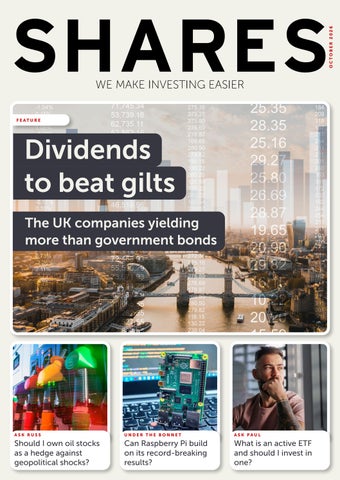
Dividends to beat gilts The UK companies yielding more than government bonds
ASK RUSS
UNDER THE BONNET
ASK PAUL
Should I own oil stocks as a hedge against geopolitical shocks?
Can Raspberry Pi build on its record-breaking results?
What is an active ETF and should I invest in one?
Money & Markets podcast Weekly discussions on everything investing from the teams at AJ Bell, all available on your favourite streaming platforms. The easy way to stay up to speed with the investing world with new episodes each week from Dan Coatsworth, Charlene Young and Danni Hewson.
LISTEN NOW
Contents 04 EDITOR’S VIEW
How to invest when markets feel too complicated
12
05 MONTH AHEAD
Housebuilders eye a Help to Buy-style revival
07 UNDER THE BONNET
Meta’s looks to AI bets to power the next phase of growth
10 UNDER THE BONNET
Can Raspberry Pi build on its record-breaking results?
12 FEATURE
Worried about rising rates? These UK stocks offer generous dividends and growth
15 SECTOR REPORT
Top-performing construction stocks enter a new phase of growth
19 ASK SARAH
15
24
How can I protect a £20,000 windfall from tax after using my ISA allowance?
21 RETIREMENT IN FOCUS
Can you rely on the 4% rule in retirement?
24 ASK PAUL
What is an active ETF and should I invest in one?
26 INCOME INVESTING
What do rising bond yields mean for income hunters?
29 ASK RUSS
32 DISCLAIMER
Should I own oil stocks as a hedge against geopolitical shocks?
IMPORTANT
32 FUNDS
Are commodities back in fashion as investors look beyond AI?
35 ASK RACHEL
Should I move money from my SIPP to an ISA before the inheritance tax changes?
35
Shares magazine is published by AJ Bell, authorised and regulated by the Financial Conduct Authority. It’s here to inform, not to give personal advice. Please don’t base your investment decisions on it alone. If you’re unsure, speak to an independent adviser. And remember: past performance isn’t a guide to the future. Tax benefits depend on your circumstances and tax rules may change.
October 2026 | SHARES | 03
Editor’s View: Tom Sieber
How to invest when markets feel too complicated
T
he world is becoming increasingly complex. Technology is playing a growing part in our day-to-day lives, whether in the cars we drive or the consumer electronics we use, and that complexity is feeding into financial markets too, with the AI theme and wider technology sector holding a dominant position. That is somewhat at odds with a key principle of investing that you should only invest in something you truly understand. Legendary fund manager Peter Lynch once summed it up neatly by saying he would never invest in anything he could not illustrate with a crayon and a sheet of paper.
How keeping it simple can pay off
Lynch’s ‘keep it simple’ approach certainly paid off nicely for him. His Magellan Fund at Fidelity Investments achieved an average annual return of 29.2% during his 13-year tenure between 1977 and 1990. What does this mean for the way you should manage your own investments in 2026? One takeaway is that when investing in individual stocks you could consider testing the waters by allocating your cash to firms whose products you recognise, understand and can easily research. If you feel out of your depth then you probably are and there should be no shame in admitting this. There is nothing clever about leaping in with both feet only to face big losses. However, this could be a bit restrictive and largely limit you to consumer-facing names. Plus, avoiding areas like technology would have meant missing out on some of the biggest returns on offer from financial markets in recent years.
How funds can help
Often it may make more sense to invest through 04 | SHARES | October 2026
a fund to gain exposure to more complex areas. This offers a diversification benefit, meaning if something goes wrong with an individual holding other holdings within the fund can pick up the slack. Your chosen fund could be a tracker, or you might look to an actively managed fund, where a manager can bring their own expertise to bear and can hopefully navigate some of the complexity for you. If you have relevant knowledge or experience there’s nothing to stop you buying individual stocks in more complex sectors. It would though make sense to approach them with some care and to do some research on key industry jargon before getting involved. In going down the route of entrusting your money to a fund manager, longevity is a key consideration. If the person at the helm has experienced a few market or economic cycles there is less risk of them getting caught up in putting cash into something without substance which is flavour of the month. It’s also worth looking at a manager’s own knowledge and experience and whether you think they’re equipped to truly understand the areas where they are putting money to work. At the end of the day, it is no good pleading ignorance if you are caught out by investing in something you didn’t properly have the measure of.
Month Ahead
Housebuilders eye a Help to Buy-style revival It has been a difficult period for the housebuilding sector since the pandemic. Rising inflationary pressures have affected their input costs while the rising borrowing costs associated with the increase in inflation has dampened demand. This has put margins under pressure and hit valuations. In this context, it is no surprise to see investors seize on a rare morsel of good news as the Government announces a new scheme to support first-time buyers getting on the housing ladder. The Your First Home scheme will provide firsttime buyers who put down a 2.5% deposit with a 20% equity loan to buy a new-build property. There will be an initial interest-free period on the loan, but it has not yet confirmed for how long. Several of the big names in the sector are scheduled to update the market on trading in the coming weeks, including Bellway on 13 October, Persimmon on 12 November, Taylor Wimpey on 11 November and Barratt Redrow on
Housebuilding shares have endured a difficult five years Total return (%) FTSE 350 Household Goods & Home Construction
FTSE 350 263%
200%
149%
100 0 2015
2020
2025
Source: LSEG
4 November, and they will be expected to lift the lid on any benefit they might enjoy from this state intervention. Berenberg analyst Harry Goad describes the news as "a very significant positive development for the industry" which should benefit suppliers and retailers connected to the property market.
October 2026 | SHARES | 05
Month Ahead
When are the housebuilders scheduled to update the market? Company
Type of announcement
Date
Bellway
Full-year results
13 October
Barratt Redrow
Trading update
4 November
Taylor Wimpey
Trading update
11 November
Persimmon
Trading update
12 November
Source: Company websites
He adds: “The absolutely critical components, in our view, are the i) significant equity contribution from the state at 20%, and ii) the low contribution requirement from the home buyer at 2.5%. The former makes a very significant (positive) difference to mortgage affordability maths, while the latter means the cohort of first-time buyers who can participate will be significant. “In our view, this has the potential to be materially more significant than, for example, modest adjustments to stamp duty, which at the low end of the house price range do not have a material impact either way. We see this scheme (partially) unlocking much of the affordability headwind that first-time buyers have faced in recent years.” A previous Help to Buy scheme launched by then chancellor George Osborne in 2013 proved very supportive to the housebuilding sector. Official statistics show that from 1 April 2013 to 31 May 2023, more than 380,000 homes were bought with a Help to Buy equity loan, with the total loaned out £24.7 billion and the value of the properties sold coming in at £109.2 billion. However, the market backdrop was very different given low interest rates and very modest cost inflation. While housebuilders will be cheering this move by the Government, they may also flag the impact of wider Budget uncertainty on the housing market ahead of the big day on 28 October.
06 | SHARES | October 2026
UK Stocks
Overseas stocks
Bellway (FY)
13-Oct
Mondi (TU)
15-Oct
Barclays (TU)
22-Oct
HSBC (TU)
27-Oct
GSK (TU)
28-Oct
Unilever (TU)
28-Oct
Lloyds Banking Group (TU)
29-Oct
Shell (TU)
29-Oct
AstraZeneca (TU)
30-Oct
BP (TU)
30-Oct
Delta Air Lines (Q3) ☼
9-Oct
JPMorgan Chase (Q3) ☼
13-Oct
US CPI inflation (Sep)
14-Oct
Goldman Sachs (Q3) ☼
13-Oct
US retail sales (Sep)
15-Oct
Bank of America (Q3) ☼
14-Oct
UK CPI inflation (Sep)
21-Oct
TSMC (Q3) ☼
15-Oct
US interest rates (Fed)
28-Oct
Netflix (Q3) ☽
20-Oct
US GDP (Q3 advance)
29-Oct
Tesla (Q3) ☽
21-Oct
US Core PCE inflation (Sep)
29-Oct
Alphabet (Q3) ☽
28-Oct
5-Nov
Microsoft (Q1) ☽
UK interest rates (BoE)
28-Oct
US jobs report (Oct)
6-Nov 10-Nov
Meta Platforms
Key economic announcements
(Q3) ☽
28-Oct
US CPI inflation (Oct)
Apple (Q4) ☽
29-Oct
Key: Q=Quarter. HY= Half year. FY=Full year.
Amazon (Q3) ☽
29-Oct
☼ = Before market open
TS= Trading statement. ☽ = After market close.
Under the Bonnet: Meta Platforms
Meta’s looks to AI bets to power the next phase of growth
O
nce known as Facebook on the stock market, Meta’s change of name encompasses its evolution from a social media company into an advertising and artificial intelligence infrastructure giant. With billions of users across Facebook, Instagram, WhatsApp and Messenger, the company is investing heavily in AI and virtual reality technologies to drive growth over the next decade. However, not all is rosy in the garden. Meta recently agreed to pay up to $18 billion to settle US claims that Facebook violated privacy laws and deliberately made its platforms addictive for young users. The agreement includes changes to how minors use Facebook and Instagram, including a default two-hour daily limit and a ‘Night Mode’ that blocks access between midnight and 6am. Meta’s smart sunglasses have also raised privacy concerns due to their covert recording capabilities, data harvesting for AI training and a lack of consent from bystanders. The backlash against Meta’s business methods has been a constant thorn in the company’s side, but so far, such allegations and fines have not slowed sales growth or dented Meta’s huge user base. Meanwhile the company continues to develop new products and services.
Muse charms users to top the AI charts The release of Meta’s new shiny AI agentic chatbot, Muse has received an overwhelmingly
Meta Platforms Key stats Price: $744 Market value: $1.4 trillion 2027 PE: 21.5 2027 dividend yield: 0.3% PE = price to earnings Source: Stockopedia
positive response. Within 10 days of launch on 8 September, Muse became the number one free iPhone app in the U.S., overtaking ChatGPT. According to Apptopia, Muse was installed 2.8 million times globally during its first 12 days, exceeding ChatGPT’s early mobile adoption when measured on a comparable basis.
How does Meta expect to make money from Muse? Bank of America analysts wrote: “We think investors were concerned about Meta’s ability to build a differentiated AI product, but have been
October 2026 | SHARES | 07
Under the Bonnet: Meta Platforms
Meta Platforms Total return (%) Meta Platforms 100%
116%
50 0 −50 2022
2023
2024
2025
2026
Source: LSEG
positively surprised with agentic functionality, driving more optimism on Meta’s potential AI investment returns”. CEO Mark Zuckerberg believes Meta can monetise Muse by taking a small fee from transactions initiated by the agent. The company has added support of PayPal and announced integrations with retailers including Walmart, Best Buy, The Gap and others. Meta is rolling out plans take control of the Mac computer on behalf of users. Muse is also coming to Meta’s virtual reality glasses so users can speak to Muse on the go. The upcoming Muse Charm is a dedicated handheld device which allows users to speak to Muse without the need for a smartphone or VR glasses.
Privacy concerns linger
Early reviews suggest Muse’s functionality is resonating with users, particularly the agent’s ability to execute multi-step tasks with limited user intervention. (Think of getting Muse to find the cheapest broadband deals and negotiating with other chatbots). However, there are broader privacy and trust concerns with some users feeling uneasy about granting the agent access to personal information, according to TechRadar. Meta is betting that users who have for years given the company access to their social connections, interests, conversations and behavioural data will also be willing to give AI increasingly intimate access to their lives. 08 | SHARES | October 2026
How does Meta make money?
Advertising contributes 98% of Meta’s overall revenue, driven by the attraction of reaching 3.6 billion daily active users across Facebook, Instagram, Messenger, WhatsApp and Threads. Meta has been adopting AI to improve ad targeting and recommendations which management recently claimed has increased ad conversions on Instagram by around 5% and conversions on Facebook by roughly 3%. Advertising revenue increased by 28% in the second quarter to $60.8 billion and analysts are projecting annual growth between 19% and 25% in the upcoming quarter. Revenue from Meta’s family of apps has reached just of $1 billion for the first time, up 73% driven by WhatsApp paid messaging and subscriptions. Finally, Meta generates hardware sales from its Reality Labs division, which was deeply loss making to the tune of $4.6 billion in the second quarter of 2026.
How has Meta’s pivot towards AI impacted margins and cash flow?
Historically, Meta has generated healthy operating margins and thrown off oodles of free cash flow, reflecting the company’s asset light business model. That changed when Meta’s pivoted towards AI. For example, the company was generating free cash flow margins against sales of around 32% in 2023 (sales of $135 billion and free cash flow of $43 billion). This has subsequently halved to 16% in the year
Under the Bonnet: Meta Platforms
Meta financials Revenue ($bn)
Operating income ($bn)
Operating margin (%)
Free cash flow ($bn)
Invested capital ($bn)
2022
116.6
28.9
24.8%
18.4
111.6
2023
134.9
46.8
34.7%
43.0
125.0
2024
164.5
69.4
42.2%
52.1
153.9
2025
201.0
83.3
41.4%
43.6
219.5
12 months to 30 June 26
228.3
86.9
38.1%
37.9
283.3
Source: Meta Platforms
to the end of June 2026. Meanwhile, invested capital has grown to nearly $300 billion from $125 billion as capital expenditures have surged. Analysts are forecasting 2027 capital expenditures of around $200 billion, which would imply negligible or even negative free cash flows, before free cash flow bounces back strongly from 2028. The key question for investors is whether AI spending will eventually provide an adequate payback for shareholders.
What are the key risks for Meta?
Shifting the business towards a more capitalintensive activity could result in lower profit margins and returns on capital which would imply investors paying a lower PE (price-to-earnings) ratio compared with the past 20 years. Online safety concerns could result in wider remedies which cut teen engagement with Meta’s platforms or result in further safeguards which make it harder for them to gain access. This could threaten advertising revenues. On the plus side, Meta already owns the world’s largest attention platform, which provides the company with an unparalleled distribution advantage.
How does Meta’s valuation compare? Meta trades on PE ratio of 22 times expected
2027 earnings per share which is lower than the other AI data centre providers, sometimes referred to as hyperscalers, while expected earnings growth is at the top end of the range for the group.
Peer comparison PE (2027)
2027 EPS growth (%)
21.5
22.4
26.1
23.5
9.8
8.5
−27.8 Meta Platforms
Alphabet
−17.7 Amazon
Microsoft (June year end)
December year end unless stated Source: Stockopedia, LSEG
By Martin Gamble Shares and Markets Writer
October 2026 | SHARES | 09
Under the Bonnet: Raspberry Pi
Can Raspberry Pi build on its record-breaking results?
Raspberry Pi Key stats Share price: 678.5p
T
he UK market is often seen as falling short when it comes to technology. However, while it may not have tech names to rival those in the US or even in Europe there are some notable exceptions. After a mixed start to life as a public company following its high-profile IPO, Raspberry Pi will have shot to the top of investors’ consciousness after its position as a beneficiary of the artificial intelligence boom became clearer earlier this year and following its recent set of first-half results.
Raspberry Pi shares benefit as company is perceived as AI winner Total return (%) Raspberry Pi 200% 147%
100 0 2025
2026
Source: LSEG
Its shares enjoyed double-digit gains on the day the numbers were released (24 September) as investors reacted with massive enthusiasm to the financial performance. The question now is whether this is as good as it gets for the business or if it has the capacity to build on its recent success.
What is Raspberry Pi?
Headquartered in Cambridge, Raspberry Pi is a designer of high-power, low-cost single-board computers, compute modules and semiconductors. It was founded in 2012 by current CEO Eben 10 | SHARES | October 2026
Market value: £1.34 billion PE 2027: 46.6 Dividend yield 2027: n/a PE = price to earnings Source: Stockopedia, as at 1 October 2026
Upton based on work he did at Cambridge University, starting in the mid-noughties. The charitable Raspberry Pi Foundation remains the single largest shareholder. Raspberry Pi has moved beyond a world of hobbyists and educators looking for cheap computing tools and is now seeing growing use by industrial customers and other businesses, particularly in AI applications which run directly on devices rather than through data centres. This so-called ‘edge AI’, which operates locally without an internet connection, brings benefits around data and privacy and cost while also having the capacity to improve reliability. Raspberry Pi’s kit can be built into items such as factory automation units and autonomous drones, and the company also designs computer accessories and software to ensure the reliable operation and longevity of its products.
How does it get its products to market?
Raspberry Pi designs its own products in partnership with Broadcom and Arm, another Cambridge based technology business which has a 13.1% stake in its smaller counterpart after recently upping its holding. Raspberry Pi then works with third-party manufacturers before selling the finished products directly to its global customer base. Under licensing deals, it also provides intellectual property to Premier Farnell and supplies the related components. Direct sales either to original equipment manufacturers or authorised resellers
Under the Bonnet: Raspberry Pi account for upwards of 70% of units which go out of the door.
Raspberry Pi revenue mix by product and channel (2025) Product and channel
Revenue share (%)
SBC and compute modules – direct
70
Components
19
Accessories – direct
5
Royalties – licensee
5
Semiconductors – direct
1
Source: Raspberry Pi, Berenberg
Taiwan Semiconductor Manufacturing Company fabricates most of the semiconductors used by Raspberry Pi. Because Raspberry Pi’s wafer throughput is below the threshold needed for a direct relationship with TSMC, production is arranged through aggregator IMEC. Assembly is outsourced to third-party contract electronics manufacturers, principally Sony. Around 90% of Raspberry Pi’s SBCs (single board computers) and most of its compute modules are produced at Sony’s facility in Wales, while a smaller range of products are made at its manufacturing site in Japan. Raspberry Pi has limited long-term contracts with customers, who typically make purchases as and when they need. This does mean that customers have the benefits of flexibility and availability of products without the need for long-term contracts. It does, however, result in limited visibility for Raspberry Pi itself over future orders.
What about recent results?
The company’s record-breaking first-half results saw revenue surge 90% and profit more than treble as some forward planning in procurement paid off in spades for the business. Raspberry Pi had built up a significant inventory
of memory chips which not only helped protect it from the big price increases for these components in recent months but also insulated it from supply shortages in this area. This meant it could grab market share from competitors who weren’t as well prepared. This supportive trend is now anticipated to unwind as Raspberry Pi has worked through its lower-cost inventory and Berenberg analyst Jon Byrne says he expects “a more challenging few years due to those higher memory prices and potential supply chain challenges affecting cash flow and profitability going forward”. Rising input costs are likely to begin having an impact in the second half of the current financial year. Nonetheless the company still upgraded fullyear earnings guidance at the half-year stage and is reinforcing its supply chain to help it fulfil future demand. How does this mixed outlook tally with the company’s current valuation? Based on consensus forecasts the shares trade on a 2027 price to earnings ratio of 46.6 times. The company doesn’t pay a dividend as it uses cash flow to invest for future growth, it has limited net debt.
Focusing on long-term potential and key person risk
Assessing Raspberry Pi may well involve taking a view on the company’s ability to tap into long-term opportunities around semiconductors and further product innovation rather than the trajectory of short-term earnings. The growth strategy has three main strands: • Grow established and new customers through its authorised reseller network;. • Engage and win design-in kit directly with industrial companies; • Work towards strategic partnerships to accelerate market reach. In that context, investors may be wary of key person risk given how central Upton has been to the development and direction of the business.
By Tom Sieber Editor
October 2026 | SHARES | 11
Feature: UK stocks
Worried about rising rates? These UK stocks offer generous dividends and growth
UK
10-year bond yields have reached their highest levels since 2007, while longerterm yields rose to their highest since 1998. When government bonds offer investors more than 5% the stock market has a potential problem. That’s because rising bond yields represent increasing competition for investors’ money. Higher yields also put pressure on stock valuations, especially growth stocks where earnings growth is expected far into the future. Why take the extra risk of owning shares when you can earn an attractive return from lending money to the government? Some UK companies are offering a combination of below average valuations, dividends yields above offer UK 10-year bond yields, and near-term profits growth. These types of stocks are not always the ones with the greatest quality or the most sustainable earnings, so it is important to make sure you understand the risks.
12 | SHARES | October 2026
It might seem obvious, but it is important to steer clear of highly indebted companies which could struggle if borrowing costs remain high. Remember, dividends are discretionary and therefore not contractual payments like bond interest, which means they can be cut or dropped without warning.
How did we create the list of stocks?
We crunched the numbers to identify UK stocks with a forecast price to earnings or PE ratio below that of the wider market which also have a premium dividend yield compared with current 10year government bonds. We also wanted to capture stocks which are expected to grow earnings over the next year. As ever with stock screening, the resulting list of names is just a starting point for conducting further research. These companies have valuations, income and earnings characteristics which could, in theory, provide some protection against the changing investment environment.
Feature: UK stocks
Selection of UK companies with low PEs and higher yields Forecast PE
Forecast yield (%)
Energean
4.7
8.5%
Harbour Energy
5.3
6.2%
TBC Bank
6.3
6.3%
Imperial Brands
7.2
7.2%
Serica Energy
8.1
6.1%
ITV
8.3
7.5%
ZIGUP
8.3
6.1%
MONY
9.3
7.7%
Legal & General
10.0
7.9%
Dunelm
10.2
6.7%
RWS Holdings
10.6
5.8%
M&G
11.0
6.9%
Name
Tobacco titans on the list
The largest companies by market value on the list are tobacco firms Imperial Brands and British American Tobacco, which are both cash generating businesses due to low capital expenditure needs, and pricing power. The market’s concern about their long-term growth prospects mean they trade at a PE discount. This has been an advantage for management who have been able to execute share buyback programmes on top of paying juicy dividends. British American Tobacco trades at a premium valuation to Imperial reflecting its larger scale and a perception that it has built a stronger ‘new categories’ tobacco portfolio.
New chapter beckons for ITV
British American Tobacco
11.0
6.4%
Aviva
12.0
6.5%
Domino's Pizza
12.0
5.7%
Based on consensus forecast earnings and dividends, to qualify for inclusion companies had to have one-year earnings growth above the mid-point for the wider market Source: Stockopedia, LSEG. Data at 2 October 2026
ITV has become an interesting situation since the proposed sale of its Media and Entertainment business to Sky, which will change its business profile significantly, when it completes in 2027, subject to regulatory approval. Historically, investors valued the company as a broadcaster exposed to the challenging UK advertising market, but following the sale ITV will become predominantly a global television production company. ITV Studios is benefiting from international demand for content, streaming platforms and has the potential to further monetise its intellectual property. October 2026 | SHARES | 13
Feature: UK stocks
ITV expects to receive around £950 million of net cash from the sale of M&E and has already begun returning cash through a £100 million share buyback.
greater scale in motor and home insurance. The company increased its interim dividend by 7% to 14p per share. The insurer has a target to growth operating earnings faster than the dividend, supported by synergies from Direct Line and a growing wealth management business.
Insurers offering big dividends
Legal and General has one of the highest yields in the FTSE 100 at around 8%, reflecting market concerns around the complexity of its balance sheet and the predictability of surplus cash flows. Core operating earnings per share increased 11% in the first half of 2026, driven by its pension risk transfer business and a strong recovery in asset management fee-related earnings. The company has a target to grow the dividend by 2% a year to from 2025 to 2027 and to grow operating cash flow by around 9% a year. Management believes this dynamic will allow the company to rebuild dividend cover (operating earnings per share to dividend) over time. Analysts at Jefferies have questioned the sustainability of the dividend. The group is targeting more than £5bn of shareholder returns between 2025 and 2027, including dividends and buybacks. It has also completed approximately £450m of its £1.2bn buyback programme. Aviva’s acquisition of Direct Line has made it the UK’s largest multiline insurer, providing it with 14 | SHARES | October 2026
Domino’s Pizza on recovery path
UK’s largest pizza Domino’s has a relatively stable cash flow stream, generated by predictable royalty income from its franchised estate, and modest capital expenditure requirements. First half results showed like-for-like sales growth of 4.9% and a 3.6% increase in underlying core profit driven by an uplift in demand related to the FIFA World Cup. Underlying free cash flow rebounded to £50.2 million, reflecting higher profitability and improved working capital. The dividend was hiked by a modest 2.8% to 3.7 pence per share. Dominos retains a progressive dividend policy, aiming to pay out roughly two thirds of earnings per share, with a focus on organic growth and debt reduction. By Martin Gamble Shares and Markets Writer
Sector Report: UK construction
Top-performing construction stocks enter a new phase of growth
T
he UK construction and materials sector may go under the radar with investors but its recent performance warrants closer attention. In recent years, the market has drastically reappraised the potential for these businesses. They are no longer perceived as poorly managed, low-margin contractors reliant on housebuilding for their revenue but instead as higher quality industrial companies with exposure to longer-term, more complex infrastructure and engineering projects.
A disconnect with the housebuilding sector
As the chart shows, this shift is reflected in the clear disconnect with the housebuilding sector, which has struggled at a time when the stock market fortunes of its construction counterparts have drastically improved, to comfortably outpace even the broader FTSE 350 index. Part of this has been driven by changes at an individual company level as these businesses have engaged in self-help measures. Historically the UK construction industry was
Construction companies are outperforming Total return (%) FTSE 350 Construction & Materials 350
FTSE
FTSE 350 Household Goods & Home
Construction 400% 200 0 2010
2015
2020
2025
Source: LSEG
prone to a lack of discipline when bidding on projects which left it saddled with loss-making contracts and resulted in some high-profile October 2026 | SHARES | 15
Sector Report: UK construction
An introduction to the sector’s main players Company
What they do
Balfour Beatty
International infrastructure group that builds and maintains transport, power, utility and social infrastructure projects. Major contractor on roads, rail and energy projects.
Bodycote
Specialist heat-treatment and thermal processing company. Improves the strength, durability and performance of metal components used in aerospace, automotive and industrial applications.
Breedon
Building materials producer supplying aggregates, cement, asphalt, ready-mixed concrete and construction products to the UK and Irish construction industries.
Costain
Infrastructure engineering and consulting business focused on transport, water, energy and defence projects. Works with governments, utilities and major infrastructure owners.
Galliford Try
Construction and infrastructure contractor delivering building and civil engineering projects across education, health, defence, water and highways sectors.
Genuit
Manufacturer of sustainable water, drainage, plumbing and ventilation systems used in residential, commercial and infrastructure projects.
Keller
Global geotechnical engineering specialist providing foundation, ground engineering and underground construction solutions.
Kier
Infrastructure services, construction and property group working across transport, utilities, local government and building projects.
Morgan Sindall
Construction and regeneration group involved in fit-out, affordable housing, urban regeneration, infrastructure and public-sector construction projects.
This collection of businesses can be split into three broader categories as the table below shows: Category
Relevant companies
Infrastructure & construction services
Balfour Beatty, Costain, Galliford Try, Kier, Morgan Sindall
Engineering specialists
Keller, Bodycote
Building materials & products
Breedon, Genuit
16 | SHARES | October 2026
Sector Report: UK construction
Construction and materials firms' adjusted EBIT margins 2022
2023
2024
2025
2026
4%
2
Balfour Beatty
Costain
Galliford Try
Kier
Morgan Sindall
EBIT = earnings before interest and tax, 2026 is forecast data Source: Berenberg company reports
corporate failures. In the last five years or so, companies have shown greater discipline and made efforts to repair their finances. Berenberg analyst Harry Goad says these firms are now moving to a new phase, “as the focus shifts from improving risk management, strengthening the balance sheets and demonstrating that they can deliver steady, cash-backed profits, to one of seizing the opportunities available in their chosen endmarkets and effectively deploying capital to maximise returns.” Goad adds: “There are certain segments within the sector’s end-markets that present significant opportunities to the construction contractors. These include the UK government’s 10-year Infrastructure Strategy, and the most recent regulatory determinations in water, energy and aviation – all of which involve significant increases in regulatory asset spending over the next investment period.” Other areas of opportunity for construction companies might be found in transport, education and health, as well as defence and nuclear sectors which have come into increasing focus in recent years.
Construction companies' performance and valuation Share price performance (%)
Forecast PE
Balfour Beatty
43.0%
18.4
Bodycote
39.8%
18.2
Breedon
−12.1%
11.2
Costain
81.1%
17.3
Galliford Try
33.7%
14.8
Genuit
−22.7%
11.6
Keller
114.0%
13.5
Kier
31.9%
12.4
Morgan Sindall
−15.8%
11.5
Volution
0.3%
17.1
Company
PE = price to earnings ratio (for current financial year) Source: Sharescope, data to 5 October 2026
October 2026 | SHARES | 17
Sector Report: UK construction
Average net cash as % of revenue for UK construction firms 2022
2023
2024
2025
2026
10%
5
−5 Balfour Beatty
Costain
Galliford Try
Kier
Morgan Sindall
2026 is forecast data Source: Berenberg, company reports
A North American boost
Meanwhile Keller, Balfour Beatty and Breedon all have material exposure to a North American market which is seeing bumper activity thanks to significant expenditure on infrastructure and, in particular, the data centres which are critical to the expansion of AI. This is potentially a double-edged sword as any reversal in the AI trend could stymie the run of recent upgrades from the likes of Keller and Balfour Beatty. As the table of valuations and performance in the sector shows, Genuit and Morgan Sindall trade on lower price to earnings ratios after a difficult period on the stock market for both over the last 12 months. Genuit was hit by Budget uncertainty at the back end of 2025 and has suffered from increased costs in its supply chain in 2026. Particularly on oillinked polymer prices given its position as a major manufacturer of plastic piping. Morgan Sindall, which has an excellent longterm track record, has been hurt by concern about 18 | SHARES | October 2026
the partnership housing space, partly thanks to the woes of specialist housebuilder Vistry Group, and scepticism about the sustainability of its exceptional profits from office fit-out activity.
Strong balance sheets give companies options
Most of the big UK construction businesses now hold net cash on their balance sheets as a means of rebuilding credibility with investors, customers and suppliers. With an improved backdrop and most stakeholders won over at this point, these businesses may have increased capacity to offer more generous shareholder returns in the form of dividends and share buybacks and/or have increased capacity to invest for future organic or acquisitive growth. By Tom Sieber Editor
Ask Sarah: Your questions answered
How can I protect a £20,000 windfall from tax after using my ISA allowance? Ask the experts Sarah Coles is on hand to answer your personal finance questions. If you’d like a question considered for a future edition send it in now. I currently use all my normal “tax free allowances” including a cash ISA and the £1,000 personal allowance on savings interest. I came into a £40,000 windfall recently, and put half of this into a bond that matures in April next year (paying 5%), with the intention of shifting this into my 2027/28 Cash ISA. My question is whether there are any other interest-paying vehicles for the remaining £20,000 that could be exempt from income tax? I have never had to submit a tax return (always PAYE) and do not wish to start now I am retired. A friend suggested that some government loan type products might be suitable. Max
Sarah Coles, Head of Personal Finance, says:
For most people, in a normal year, a £20,000 annual ISA allowance gives them plenty of room to protect their savings from tax as they go along. When you get a windfall like this, however, it can feel frustratingly small. You mention you’re retired. If you’re aged 65 or over, next year’s Cash ISA allowance will remain at £20,000. If you were younger, you’d see it shrink to £12,000, giving you even more of a headache. You’ve already taken advantage of the first ports of call for tax-free savings: your Cash ISA allowance and using your personal allowance for savings. The savings bond you mention having taken out will be taxable, so if the interest busts your personal savings allowance, you will have to pay tax on it. The good news is that given you say you have no other reason for completing a tax return, as long October 2026 | SHARES | 19
Ask Sarah: Your questions answered
as you make less than £10,000 a year in savings interest and pay tax via PAYE on your pension, HMRC will usually be able to adjust your tax code to collect tax on savings interest, so there may be no need for any extra paperwork.
What are some other options?
For your savings from this point, you have a few options. If you’re in a relationship and manage money as a couple, you could consider transferring assets to your partner, so they can take advantage of their allowances. If you’re married there are no tax implications for this, and if you’re not married the only tax you would need to consider would be inheritance tax if you passed away within seven years and held enough assets to pay IHT. Depending on your age, you could also consider paying some of it into a pension and holding it in cash-like assets like money market funds or cash. If you are drawing an income from the pension, you are likely to have triggered what’s known as the money purchase annual allowance, which will limit your annual contributions to £10,000, but you could contribute this sum, and it would grow free of tax. Given you’re retired, you are likely to be over 55, and therefore able to draw money from the pension when you need it. The income would be taxable, but as long as you are under the age of 75 you will have had tax relief on your contributions, so unless you have changed tax brackets you should be no worse off. Some people will hold Premium Bonds if they’re in this position. You’re not guaranteed to make a return at all, but any prizes you win are free of income tax. If you hold £20,000 for a year and have average luck, you’ll beat inflation. However, you won’t make any more money than if you had your cash in the most competitive savings account and paid basic rate tax. More to the point, there’s absolutely no guarantee you’ll be averagely lucky, so you could end up winning nothing and being worse off after inflation.
What about gilts?
Other than that, the government loans your friend is likely to be talking about are gilts. They’re loans to the UK government. You lend them money for a specific number of years, in return for a regular payment known as a coupon. When they mature, 20 | SHARES | October 2026
the government repays the face value (known as par value and usually £100) to whoever holds the bond. Most people know them as an investment class, which they usually access through a bond fund. However, others use them as an alternative to savings, buying individual bonds through investment platforms. You can buy a bond that’s within a few years of maturity, hold it until the end date, and you’ll get the par value at that point. You need to be comfortable with the fact that if the UK government defaults on its debts, you may not get the full repayment, but that’s highly unlikely. The key is that gilts with low interest rates (low coupon is the jargon), issued during the pandemic and set to mature soon, tend to be priced below their initial value (par value). At the time of writing, 8th September, for example, there’s one due to mature in January 2028 with a coupon of just 0.125%, priced at £94.66. On its maturity date you’ll get £100 for every £94.66 you put in – so if you bought £19,878.60 worth, you’d get £21,000 back – a gain of £1,121.40. You’ll also receive the monthly payment until January 2026: £36.75. This will be added to the price you pay and you’ll pay income tax on this. The lion’s share of the return, however, is the difference between what you pay for it and what you get back when it matures. There are two taxes to consider when it comes to gilts. The coupon is taxed as income, so faces the same issue as savings. However, with low coupon gilts, this is only a tiny fraction of the return. The rest is the rise in the value of the gilt between when you buy and when you are repaid, and this is free of capital gains tax. It means most of your gain is tax-free.
Charlene Young: Retirement in focus
Can you rely on the 4% rule in retirement?
T
he 4% rule offers an answer to one of retirement’s hardest questions: how much can I safely spend? But markets don’t move in straight lines and it’s likely that the plans you have for your retirement won’t either. Could being prepared to vary your income help your pension last longer? One of the biggest challenges when moving from saving for retirement to spending your pension is deciding how much you can afford to take out. A popular rule of thumb when it comes to how much you might be able to withdraw in retirement is the 4% rule. Move into an option like drawdown with £500,000, for example, and you withdraw £20,000 in your first year. In subsequent years you increase that £20,000 by inflation rather than recalculating 4% of whatever your portfolio is now worth. The rule has its origins in research published by US financial planner William Bengen in 1994. Using historical US investment returns, Bengen examined how different starting withdrawal rates and asset allocations survived over retirement. The beauty of this rule is that it’s simple to understand, but like many rules of thumb, it doesn’t reflect your personal circumstances, including your portfolio mix.
The order and timing of withdrawals matters
One of the biggest threats facing investors drawing an income is sequencing risk. Imagine suffering a 20% market fall. During your working life it is undoubtedly uncomfortable, but if you are still contributing to your pension and other investments, you might have plenty of time to wait for markets to recover and you might even benefit if you’re adding to your investments when prices are cheaper. But then imagine the same fall immediately after retiring. This could have big consequences if you need to sell investments to finance your living expenses while prices are depressed. This depletes your invested assets more quickly than planned and also leaves less invested overall to participate in the eventual recovery. Two retirees experiencing similar average investment returns during retirement could have very different outcomes depending upon when the good and bad years occur.
Should your income ignore the markets?
It’s worth considering this in the context of the 4% rule. If your £500,000 portfolio falls to £400,000, you don’t recalculate your income as 4% of October 2026 | SHARES | 21
Charlene Young: Retirement in focus
£400,000. You continue taking the original £20,000, increased by inflation. This is handy for budgeting, as your income is relatively predictable, but your portfolio has to absorb the consequences. An alternative is to adjust your spending to absorb some of the volatility instead. At its simplest, you could withdraw a fixed percentage of your portfolio each year. Your chances of completely exhausting the fund may be reduced, but your income could fluctuate dramatically and not give you the lifestyle you’d planned for in retirement. Another approach is a variable withdrawal strategy, sometimes labelled dynamic spending or a guardrails strategy where limits are placed on the changes in annual spending. Withdrawals can rise when investments are performing well and might fall following poor returns, but the floor and ceiling guardrails prevent spending
power moving quite as dramatically as a fixed percentage strategy.
Two retirees walk into a bear market...
So, what difference might that make? Let’s consider an example of two investors, each starting retirement with £500,000 invested in identical portfolios. Both withdraw £20,000 in their first year, but markets hit a bumpy patch, and it particularly impacts their investments. Their investments fall by 20% in year one followed by a further 10% fall in year two, before recovering in later years. Investor A follows a traditional 4% strategy, increasing the original £20,000 withdrawal by an assumed 2.5% inflation each year. Investor B follows a more flexible approach. They target 4% of their portfolio’s value but limit any annual reduction or increase in their cash withdrawal to 5%.
How two different approaches to withdrawals compare Year
Investment return
Investor A withdrawal
0
Investor A pot value
Investor B withdrawal
£500,000
Investor B pot value £500,000
1
−20%
£20,000
£384,000
£20,000
£384,000
2
−10%
£20,500
£327,150
£19,000
£328,500
3
15%
£21,013
£352,058
£18,050
£357,018
4
12%
£21,538
£370,183
£17,148
£380,654
5
8%
£22,076
£375,955
£16,290
£393,513
6
6%
£22,628
£374,526
£15,741
£400,439
7
5%
£23,194
£368,899
£16,018
£403,643
8
4%
£23,774
£358,931
£16,146
£402,997
9
3%
£24,368
£344,599
£16,120
£398,483
10
2%
£24,977
£326,015
£15,939
£390,195
Source: AJ Bell. Withdrawals assumed at the beginning of each year, before investment returns are applied. Withdrawals are gross of income tax. Growth figures net of charges. The returns and withdrawal rules are illustrative and are not forecasts or recommendations.
22 | SHARES | October 2026
Charlene Young: Retirement in focus
At first glance, it seems like investor B has a better outcome. After 10 years they have around £390,000 remaining, compared with approximately £326,000 for investor A. But the picture changes when you consider what they were able to spend. Investor A received approximately £224,000 gross over the decade, compared to investor B receiving only around £170,000 gross. Investor B protected their overall portfolio but effectively accepted a lower income to the tune of £54,000 over the decade to do so. This simple example shows that a variable withdrawal strategy doesn’t necessarily mitigate sequencing risk or make one investor wealthier than another overall. In practice it can transfer some of the risk from your portfolio to your lifestyle because income may need to fall after poor market returns. Another risk that is often overlooked is being too cautious. You might successfully avoid running out of money only to reach later life with a substantial untouched portfolio and realise you could have afforded more holidays, experiences or gifts to your family while you were younger and healthier.
How flexible can you be?
Deciding how much income to take in retirement involves balancing competing priorities and goals. What some people might group into essential spending might also differ, as well as the
priority placed on other goals such as leaving an inheritance or a charity legacy. A useful exercise when calculating your target income is to separate different types of spending into groups, as you would when creating a budget. One group might include essentials such as food, housing, energy and council tax but be separate from discretionary expenditure on holidays, restaurants, cars and gifts. You might find that some of those essential expenses could eventually be covered by secure income such as the state pension. Someone whose essential bills are largely covered by secure income may have much greater freedom to trim investment withdrawals after a market crash. No rule can be regarded as a guaranteed strategy. Even securing your income with an annuity comes with its own considerations and risks. How much you can safely spend depends on how long your retirement lasts, the investment returns you achieve, inflation, fees, tax and any other income sources. But one of the most important questions is how willing you are to change your spending when circumstances change. The trade-off is between certainty today and greater income security later in life. By Charlene Young Senior Pensions and Savings Expert
October 2026 | SHARES | 23
Ask Paul: Your investment questions answered
What is an active ETF and should I invest in one? Ask the experts Paul Angell is on hand to answer your questions about investments. If you’d like a question considered for a future edition send it in now. I hold an active fund in my portfolio, but the company it’s from has just let me know it’s launching an ‘active ETF’ that will invest in the same area. I thought ETFs tracked an index, so what does that mean, and is my money better off there? Jack D Paul Angell, AJ Bell Head of Investment Research, says:
Fund managers will regularly launch new products that they think will be exciting to investors and therefore bring in more money to their company. Our job as investors is to determine if the new product, in this case an active ETF, is something that has a real benefit to us that we aren’t getting elsewhere. Before you try to decide where your money is better off, it’s important to understand what an active ETF is. An ETF (or exchange-traded fund) is different from a traditional fund because of how it’s packaged. It is traded on an exchange, like a stock would be, and you therefore can get immediate access to the market. A traditional fund, on the other hand, you buy and sell off-exchange, meaning market exposure is delayed until the next (daily) pricing point. Most ETFs do track an index, as you say. But there’s a growing group of products, called active ETFs, where managers diverge from the index and make their own selections, at least to some degree.
Why the new products?
There are a growing number of investment managers looking to the active ETF space: J.P. Morgan Asset Management has a range of active ETFs, as does Goldman Sachs and Schroders. Part of the reason these products have been launched is to appeal to a younger generation of investors, who have shown a lot of interest in ETFs. They are also often priced cheaper than a traditional active fund, enabled by the lower administrative costs faced by ETFs and necessitated by existing within a more competitively priced part of the market. An investor therefore might face an ongoing charge between 0.25% and 0.45% for an active ETF, versus an ongoing charge of 0.45% to 0.9% for an active fund or investment trust. In the US, ETFs also come along with additional tax benefits, but it’s important to understand that is not the case in the UK.
Are active ETFs the better move?
Active ETFs aren’t automatically the better investment, but they might suit you more than a traditional fund depending on what you value when you invest. One of the biggest advantages they hold is the ability to provide immediate market access at any point during market hours, October 2026 | SHARES | 37
Ask Paul: Your investment questions answered
How active ETFs and traditional active funds compare Feature
Active ETF
Traditional active fund
How you buy and sell
Traded on an exchange during market hours, like a share.
Bought and sold through the fund provider or platform, usually at the next daily price.
Pricing
Price moves throughout the day, so you know roughly what you are paying when you trade.
Priced once a day, so the final price may differ from when you place the order.
Charges
Often cheaper, though platform dealing charges and spreads may apply.
Often higher ongoing charges, but no bid-offer spread in the same way.
Investment style
Can be actively managed, but may stay closer to an index.
May give the manager more freedom to look very different from the market.
Source: AJ Bell
just like buying a stock on an exchange. Traditional funds only process new investments once each day, which means the price could change from the time you initiate the trade to the time you are invested in the fund. For those who plan to keep their money in the same place for an extended period, this is likely to not make much of a difference in the long term. But for those that plan to make quite frequent trades, ETFs can be more efficient. Cost, as explained above, is the other reason that investors might opt for an active ETF. More expensive products don’t guarantee you better returns, but they do guarantee that more of your investment will be eaten up by fees. That’s not to say that investments with higher fees are never worth it, just that it makes sense to shop around. One element active ETFs can fall short on is offering an investment strategy that is truly differentiated by individual stock picking. While these products don’t follow an index, they often deliver something of a hybrid active and passive approach delivering small deviations from index returns either to the up or downside. How this is done, and to what degree, will differ by product. 38 | SHARES | October 2026
Different ways of being active
The J.P. Morgan active ETFs, for example, follow a ‘research-enhanced’ approach. With analysts picking their favourite stocks, but portfolio managers looking to combine these in a way that resembles much of the characteristics of the broader market. This isn’t necessarily a bad thing given investment returns are largely reliant on asset allocation, i.e. weightings to a specific sector or region, rather than individual stock picking. Therefore by taking less ‘active risk’ investors are limiting the damage done if invested in underperforming parts of the market. An active ETF therefore might fit the bill for your portfolio perfectly if you are on the hunt for an investment that could give you a little bit of an edge over the index. However, if you want an investment that acts completely differently to the index or broader market, you’re more likely to find that in a traditional active fund than an active ETF. The best thing you can do is dig into the details of the fund you hold now as well as the active ETF they will be offering. You’ll want to pick the option that is not just the most exciting to you but is the best fit for the portfolio you’ve created.
Dan Coatsworth: Bond yields
What do rising bond yields mean for income hunters?
I
ncome investors need to be aware of the significant opportunities and risks that can emerge across financial markets because of developments in the bond market. UK and US government bond yields have been rising since the end of June. Investors have increasingly priced in the risk that higher energy prices could add to inflation pressures at a time when government borrowing remains elevated and central banks are reluctant to signal imminent rate cuts. Bond yields move inversely to prices, meaning recent market moves have left many areas of the bond market offering more attractive income opportunities. This has important implications for investors deciding where to generate income, not only within bond markets but also across equities. It also has a direct influence on annuity rates. Fundamentally, higher yields available today mean investors can earn income levels that were simply unavailable for much of the past decade.
What it means for Gilts and Treasuries
Gilts and Treasuries are terms to describe UK and US government bonds, respectively. Yields on these bonds have moved higher as investors weigh the inflationary impact of higher energy prices, sizeable government borrowing 26 | SHARES | October 2026
requirements and the prospect that central banks may keep interest rates higher for longer. That in turn has pushed up expectations for central banks to hold interest rates or increase them.
Gilt yields have surged to multidecade highs UK 10-year gilt yield 4.0% 2.0 0.0 2010
2015
2020
2025
Source: LSEG
In early September, Britain sold £4.25 billion worth of 30-year government bonds with the highest yield since comparable records began in 1998 at 5.82%. At the time of writing in early October, the yield
Dan Coatsworth: Bond yields
Rising bond yields: winners and losers Investors might be thinking about how the shift in the bond market affects what’s already in their portfolio and whether they should rejig holdings and consider new ones. There are some clear winners and losers from rising bond yields, as now discussed.
highs, it’s possible that investors with maturing bonds might be able to reinvest that money and get a higher yield than they’ve been receiving up to now.
Potential losers:
Existing bondholders: Higher yields make existing bonds less attractive, which typically pulls down New buyers of gilts and Treasuries: Investors their market price. Investors holding individual buying gilts and Treasuries today can generally bonds to maturity would still receive par value obtain higher yields than were available a few years at maturity, assuming the government or issuer ago, regardless of whether the bonds are newly remains solvent. issued or purchased in the secondary market. AJ Long-duration bond funds: Many investors access Bell customers can subscribe to notifications to bonds via bond funds rather than buying them receive alerts about upcoming bond offers or view a individually. Bond funds come in different durations, range of bonds and gilts available for online dealing. with some investing in bonds that mature in the Cash savers: Central banks often keep interest rates next one to five years (short duration). Others unchanged, or raise them, to fight inflation. As of 2 mature over longer periods (long duration) and October, the market, on balance, expects the Bank are more sensitive to changes in interest rate of England to raise interest rates to 4.25% by the expectations, making their prices more volatile. end of 2026, implying more attractive returns on Investors should distinguish between individual cash. AJ Bell’s Cash savings hub is an easy way to bonds and bond funds. A holder of an individual access competitive rates on cash. gilt who keeps it until maturity knows what income Annuity buyers: Rising bond yields improve the they will receive and will typically get the bond’s rates on annuities, which provide a fixed income face value back at maturity. Bond funds have no for life. Annuity providers typically invest heavily in maturity date, and their value continues to fluctuate long-term bonds and other income-producing assets as managers buy and sell bonds, meaning rising to back their income promises, so higher yields feed yields can have a more persistent impact on capital into better returns for retirees buying these products values. now. Annuities provide clarity over how much cash Bond proxy shares such as utilities, REITs (Real you will get each month, but payouts stop at the Estate Investment Trusts) and telecom providers: point of death. In comparison, any money left in a Bond proxies are companies whose earnings and pension at death is left in someone’s estate. Some dividends are relatively stable and predictable, like people use part of their pension to buy an annuity the coupon payments from a bond. and keep the rest invested – but note that you Rising bond yields can make their dividends cannot sell an annuity once purchased. less competitive and their valuations can come Annuities can also come in different shapes and under pressure. Investors value shares based on sizes, such as being inflation-linked and versions the present value of future cash flows. Higher that pay out a proportion to your partner when you bond yields tend to push up discount rates used in die. The amount you get depends on the size of valuation models. This reduces the present value of your pension pot, your age, where you live, health, future dividends, leading to lower share prices. lifestyle, market conditions and the type of annuity Many companies classified as bond proxies have to choose. It’s important to understand how each large debts and they can suffer from a higher cost version works and to shop around for the best deal of borrowing which often coincides with rising if you decide that annuities are right for you. bond yields. Anyone owning an equity income fund Investors reinvesting maturing bonds: With UK should check the level of exposure to bond proxyand US government bond yields at multi-year type companies in the portfolio.
Potential winners:
October 2026 | SHARES | 27
Dan Coatsworth: Bond yields
on 30-year gilts had topped 6%; the 10-year gilt traded at 5.51% which was the highest level since 2007; and the 10-year US Treasury yield traded at 5.34%, revisiting levels not seen since 2002. To put those figures into perspective, on the same day the FTSE 100 index of UK shares offered a 3.3% prospective dividend yield based on forecast payouts for the next 12 months. Income investors might therefore think that bonds are the obvious place to put their money given the superior yields. However, there are three key areas to consider. If inflation continues to move higher, the price of existing bonds could fall and lead to new bonds being issued at even greater yields. Higher borrowing needs or concerns about the public finances can push gilt or Treasury yields higher if investors demand additional compensation for lending to the government. Investors buying long-dated bonds should remember that higher yields do not eliminate capital risk. If yields continue to rise, bond prices can fall sharply, particularly for bonds with decades left until maturity.
US Treasury yields are at historically elevated levels US 10-year Treasury yield 5.00% 4.00 3.00 2.00 1.00 0.00 2010
2015
2020
2025
Source: LSEG
The other key factor to consider is the fact bonds offer a fixed coupon, whereas shares can offer a growing income stream as dividends are not fixed. Inflation can eat into the purchasing power of coupon payments, which in plain English means that the income you receive from the bond might 28 | SHARES | October 2026
buy you less in the future. Shares have an edge as dividends can often keep pace with, or even outpace, the rate of inflation. It’s important to take a balanced view with dividends, nonetheless. While dividends have the potential to grow over time and help offset inflation, they are never guaranteed and can be reduced during economic downturns. None of this means investors should avoid bonds altogether. High-quality bonds have historically helped to reduce portfolio volatility, although longer-dated bonds can still experience significant price fluctuations when yields move sharply. It’s simply about recognising that higher bond yields are not a free lunch for income investors.
What’s the key takeaway?
A decade ago, government bonds had a hard time grabbing retail investors’ attention. Now they are giving shares a run for their money thanks to more attractive yields and typically lower credit risk. A rapid decline in the oil price could quickly change interest rate expectations again and potentially lead to lower bond yields. There is little visibility on whether, or when, that might happen, which means investors should treat the current investment environment as a fluid situation. Locking in high bond yields now gives you certainty of cash flows if you hold to maturity. Bond prices could rise if higher energy costs slow economic growth enough to encourage future interest-rate cuts. The flipside is that bond yields could rise further such as if investors demand higher yields if inflation proves persistent. In that scenario, bond (and bond fund) prices would fall. What really matters is the return after factoring in inflation. By Dan Coatsworth Head of Markets
Ask Russ: Your questions answered
Should I own oil stocks as a hedge against geopolitical shocks? Ask the experts Russ Mould is on hand to answer your queries about the financial markets. If you’d like a question considered for a future edition send it in now. With tensions in the Middle East pushing up energy prices, should I consider adding oil and gas stocks to my portfolio as protection if inflation and market volatility return? Len Russ Mould, AJ Bell Investment Director, says:
Seven months after the first strikes on Iran, the Revolutionary Guard are still in power and the Straits of Hormuz in the Persian Gulf are effectively closed. Now, another chokepoint, the Straits of Bab al-Mandab that lead from the Gulf of Aden to the Suez Canal and then the Mediterranean, are under Houthi pressure, even as Saudi Arabian pipelines
face attack. As a result, the price of Brent crude oil for onemonth delivery is up by a nearly 50% since the start of the conflict and European gas prices are up by 150% to their highest mark since late 2022, even if the US Henry Hub natural gas benchmark is broadly flat. Thus far, stock markets have taken this in their stride, in the view that April’s peace deal and then June’s Memorandum of Understanding between Washington and Tehran signified an end to military escalation the start to de-escalation, with a final, peaceful agreement the logical end game. However, bond markets are far from happy, and commodity markets are buoyant, so perhaps markets may need to reassess their views, especially with regard to the unfashionable energy sector that could yet provide a valuable hedge against any worst-case scenarios
Bear case
Bear cases look at their most compelling when they confirm a long-term price trend and, in this October 2026 | SHARES | 29
Ask Russ: Your questions answered
respect, it is easy to write off hydrocarbons as a bad job, given how the all-time peak price for crude oil dates back to 2007 in nominal terms, let alone inflation-adjusted ones, respectively. The inability of oil to challenge its prior high feeds the bearish narrative. This rests upon: The ongoing drive toward renewables and away from hydrocarbons to the detriment of demand. International Energy Administration forecasts of plentiful long-term supply despite near-term disruptions. The entirely understandable assertion that the best cure for high prices is high prices, so that demand destruction or even more supply will follow in the event of a sustained price spike. Traders are acting. They continue to build up short positions against the commodity, elongating a trend that dates back three years.
Traders continue to build short positions againstto crude Traders continue buildoil short positions against 10-year 30-year crude oil 4
10-year
30-year
5.27 4.73
2022
2023
2024
2025
2026
2022
2023
2024
2025
2026
Source: LSEG Refinitiv data, US Commodity Futures Trading Commission Source: LSEG Refinitiv data, US Commodity Futures Trading Commission
Bull case
As the conflict with Iran drags on longer than thought, America is doing its best to keep a lid on oil, and thus gasoline, diesel, and heating oil prices ahead of November’s mid-term elections by releasing supply from its Strategic Petroleum Reserve. But America’s reserves are dwindling and at some stage must surely be replenished, if only to protect it from any further possible energy-related geopolitical shocks. Nor would it be a surprise were 30 | SHARES | October 2026
Barrels (million) Total US oil reserves
Strategic Petroleum
Reserve 1,000 709.43
500
285.36
0 2000
2010
2020
Source: US Energy Information Administration
2 0 0
American strategic oil reserves continue to dwindle
1990
4.73 5.27
4 2
Tehran to be closely watching the weekly inventory data kindly published by the US Energy Information Administration with the same mid-term ballot in mind as it seeks leverage in its negotiations with Washington.
There is a risk that oil traders are looking at crude oil supply, but missing the issue of demand, which remains strong, judging by how crack spreads remain elevated. Crack spreads measure the difference between the price of a barrel of crude and the price of the products refined from it, and the high spreads usually mean refiners are worried about future supply of crude relative to demand for petrol, diesel, jet fuel, heating oil and more. The US diesel crack spread stands at a record high, north of $100 a barrel, while the global 3-2-1 crack spread, which measures the difference in price between three barrels of crude, against two of petrol and one of heating oil, is up more than threefold in 2026 to date. An alleged glut of crude oil could yet turn into a squeeze on refined product supply.
Price tags
A speedy peaceful resolution to US-Iran conflict could take the sting out of these considerations, but there are no guarantees of that. Even though the world is less reliant on oil now, the alternative scenario conjures up bad memories
Ask Russ: Your questions answered
of the stagflation of the 1970s, when equities, bonds and cash were all terrible performers and commodities proved the best store of value.
Nor are stock or commodity markets prepared for rising energy prices, even if bonds are paying attention. The energy index remains near all-time lows as a percentage of total, global stock market capitalisation, even though Covid, Ukraine and Iran are reminders Energy stocks remain unloved of the importance of natural resources and supply chains as part of wider national security S&P Global 1200 energy sector market concerns. capitalisation as % S&P Global 1200 total There is another way to look at this. Artificial intelligence enabler and silicon chip designer Nvidia is currently the world’s most valuable public 10% company with a market capitalisation of $5.5 trillion. They may be less aware that for the same price tag they could buy the West’s seven oil and 5 4% gas majors nearly three times over. Investors could be forgiven that unloved oil 0 stocks could offer some protection from any further nasty surprises in the Middle East, even 2005 2010 2015 2020 2025 if they agree with economist Joseph Stiglitz’s assertion that “the only perfect hedge is in a Source: LSEG Refinitiv data Japanese garden.”
Nvidia’s stock market valuation is more than 2.5 times that of the West’s seven oil majors combined Stock market value ($ billion)
2026E net profit ($ billion)
ExxonMobil
$679
$48
Chevron
$416
$31
Shell
$278
$32
TotalEnergies
$204
$23
ConocoPhillips
$164
$13
BP
$119
$14
ENI
$81
$8
Total Oil Majors
$1,941
$169
Nvidia
$5,094
$243
Source: LSEG Refinitiv data, Marketscreener, analysts’ consensus forecasts
October 2026 | SHARES | 31
Funds: Commodities
Are commodities back in fashion as investors look beyond AI?
T
he price for a barrel of crude oil has taken up a lot of column inches this year and for good reason. It’s hit historically high levels and has led to a lot of other things becoming more expensive as a result. When the Iran conflict started earlier this year, everyone quickly learned where the Strait of Hormuz sat on the map and heard that $100 a barrel was a big alarm bell for the global economy. Oil is only a part of the story. Throughout 2026, commodities from gold to industrial metals have moved higher. This raises larger questions for investors: are resources a good diversification option for investment portfolios and how are fund managers who invest in this space positioning themselves?
A bastion of diversification
As a sector, it’s increasingly being held up as a bastion of diversification and inflation hedging. In part this has come from an appetite to diversify away from the all-consuming AI trade. This push has been encompassed by the emerging HALO acronym. It means ‘Heavy Assets, Low Obsolescence’ and covers stocks and assets which have business models difficult for any AI model to replicate. This includes commodities alongside grids, pipelines, utilities and long-cycle industrial capacity. This has supported increased interest in the resources space this year, especially among UK investors.
Commodities prices are surging Bloomberg Commodity Index 200 150
143.16
100 50 0 1995 Source: LSEG
32 | SHARES | October 2026
2000
2005
2010
2015
2020
2025
Funds: Commodities
What’s happened with gold Gold, which is distinct from other commodities because it has essentially zero industrial-related demand, hit an all-time high at the start of 2026 at $5,600 per ounce, rounding off what was an exceptionally strong 12-month performance. This was linked in part to the ‘Liberation Day’ chaos in markets, central bank buying and weakness in the dollar. But data from Oxford Economics shows that gold doesn’t always rise in times of crisis.
Gold does not always rise during market crises Gold performance during previous crises by weeks since onset Gulf war war
Iran war
2nd Gulf war
Global financial crisis
Liberation Day'
Ukraine
Covid-19
160 140 120 100 80 0
5
10
15
20
25
30
35
40
45
50
Rebased to 100 Source: Oxford Economics, Bloomberg
In the near 30-weeks since the start of the Iran war, the gold price is below where it started, a similar trend to when the Ukraine war broke out and plunged markets into a similar energy crisis. “The outcomes are actually very mixed. The reason is that the nature of the shock matters. The crisis can initially increase safe haven demand, but it also raises inflation expectations, pushes bond yields higher, or strengthens the US dollar,” Oxford Economics says. “These effects can work against gold. This is what we’ve seen recently with the Middle East contract. Oil prices have been pushed higher, and we’ve revived inflation concerns. That’s contributed to expectations that the US monetary policy would remain tighter for longer, and this has ultimately weighed on gold”. Today, the most common exposure is through passive ETFs and ETCs tracking the gold price. “This matters for two reasons,” the think tank argues. “First, ETF flows add another source of demand alongside central banks, particularly when investors are concerned about the financial risks, geopolitics, or the overall macro outlook. But secondly, it also means gold can be more volatile. ETF investors can react much more quickly than central banks to changes in US inflation data, yields, or expectations around the Federal Reserve’s next move. That helps explain why we can remain positive on the medium-term outlook while still expecting fairly significant price weakness.” “Our forecast for gold is for it to average around $4,515 an ounce in 2026, with prices to close near $4,500 year-end,” they say. This would be $1,100 lower than at the start of the year.
October 2026 | SHARES | 33
Funds: Commodities
According to data from the London Stock Exchange and Xtrackers, commodity ETFs are one of the most popular choices for UK investors. Using these products to invest in commodity prices directly is one of the options open to investors along with investing in the individual companies which drill and dig for commodities and passive and active funds which invest in a basket of these companies.
Keith Watson and Robert Crayfourd, co-managers of the City Natural Resources Growth and Income trust, formerly CQS Natural Resources Growth and Income observe: “We’re in an environment where we have geopolitical premiums on the most strategic front-end commodities, which are ultimately power related. If you want to retain standards of living, you need the lights on, you need to be able to get from A to B.”
The foothills of a new commodities cycle What could go wrong for commodities? BlackRock World Mining Trust is an example of a name which invests in global resources stocks. Co-managers Evy Hambro and Olivia Markham say that the commodities sector is in the “foothills” of the next big commodities cycle, which has been a decade in the making after the 2015-2016 commodities crash. Back then expansion by resources companies, backed by cheap borrowing costs in the wake of the financial crisis, led to an oversupply of crude oil, iron ore, copper, and aluminum. This coincided with major slowdown in demand from key buyer China, which was going through an economic downturn and therefore had less money to spend. BlackRock’s Hambro says it’s taken sector participants at least six or seven years to repair their balance sheets and for “management to undo many of the mistakes of the past”. “This was the ‘repair phase’ which creates the foundation for this next cycle, which probably started about three or four years ago when we’ve seen commodity prices rise again,” Hambro says. The 2022-23 energy shock laid out the reality of the world’s reliance on certain commodities. 34 | SHARES | October 2026
A key determinate of the success for commodities in the short term is healthy economic growth, and despite multiple shocks global growth is holding up, according to the OECD. It projects global growth of 2.9% in 2026 and 3% in 2027 but warranted that “risks persist”, and the evolution of the conflict in the Middle East “remains highly uncertain, and will continue to pose considerable risks to the baseline projections”. “Global growth has held up better than expected, but the buffers that absorbed the energy shock are being depleted. Growth is weaker than last year and inflation is rising again,” OECD secretary general Mathias Cormann says. Stunted or declining economic growth is part of Markham’s worst-case scenario, along with a return to the type of “poor behaviour” her sector saw a decade ago with how companies allocated capital. By Eve Maddock‑Jones Funds and Investment Trust Writer
Ask Rachel: Your retirement questions answered
Should I move money from my SIPP to an ISA before the inheritance tax changes? Ask the experts Rachel Vahey is here to answer questions on pensions. If you’d like a question considered for a future edition send it in now. I’m 67 and retired, and I’m trying to get my head around the best way to use my SIPP before the inheritance tax changes come in from 2027. Would I have more flexibility if more of my money was in a Stocks and shares ISA instead? I know I can take 25% of my SIPP tax-free, with the rest taxed as income. I don’t need the money to live on right now, so could I take that tax-free amount gradually, say £20,000 a year through drawdown, and put it into my Stocks and shares ISA so any future growth is tax-free? Paul John
Rachel Vahey, AJ Bell Head of Public Policy, says:
From April 2027, unused pension funds will generally fall within a person’s estate for
inheritance tax (IHT) purposes if they die after 6 April 2027. In practice, “unused pension funds” means pension money that has not yet been accessed, as well as money that has been moved into drawdown but not spent. This change is prompting people to review how much they hold in pensions, especially if they built up pension wealth partly because it sat outside their estate for IHT. For some, bringing unused pension savings into the estate could mean IHT is payable for the first time. For others, it could increase the eventual bill. It’s worth noting that any money passed to a spouse or civil partner is automatically exempt from IHT. Mitigating IHT may only pose a problem for those who are unmarried or on a second death of a couple.
Moving to a SIPP won’t solve the problem on its own
Moving money from a SIPP into a Stocks and shares ISA will not, by itself, solve an IHT problem. ISA savings normally fall into your estate for IHT purposes too. So, if the aim is simply to get money outside the estate, taking money out of a pension and moving it into an ISA does not achieve that. It October 2026 | SHARES | 35
Ask Rachel: Your retirement questions answered
changes the tax wrapper, but not the IHT position. There may still be reasons to use an ISA. ISAs are straightforward, tax-efficient and easy to access. Income and growth are tax-free, and withdrawals are not taxed. But pensions also enjoy tax-free growth, as well as flexible income options. You can usually take money when needed, either by taking tax-free cash and moving funds into drawdown, or by taking lump sums, with 25% normally available tax-free and the rest taxed as income. If you do not need the money now, there may be limited benefit in taking tax-free cash gradually simply to move it into an ISA. You would be moving money from one tax-efficient wrapper to another, while using up your ISA allowance each year. In fact, this approach may even make the options worse for your family. On death, if there is no surviving spouse or civil partner, ISA funds are taken out of the tax wrapper completely. However, pension funds can remain within the tax wrapper and be passed to loved ones to take as and when they want, whilst still benefiting from tax-free growth. There is also an argument for leaving money in the pension if you do not plan to spend it soon. If funds remain invested, future growth could increase the amount of tax-free cash available later, subject to the usual limits. Taking tax-free cash earlier than needed could mean future investment growth happens outside the pension instead.
The spending option
If your objective is to reduce the value of your estate, you could instead spend the money you withdraw from the pension, for example, on 36 | SHARES | October 2026
home improvements or travel. Gifting is another possibility, whether directly to family, into a tax wrapper on their behalf, or through a trust. Gifts have their own IHT rules and timescales, so advice is sensible before making large transfers. The key point is that an ISA may give you simplicity and tax-free access, but it does not give you an IHT advantage over a pension once the new rules apply. If you expect to use the money yourself, drawing gradually from the SIPP can work well. If not, keeping it invested within the pension may still be attractive, while thinking carefully about whether spending or gifting forms part of your wider estate planning.
DISCLAIMER IMPORTANT
Shares magazine is published by AJ Bell, authorised and regulated by the Financial Conduct Authority. It’s here to inform, not to give personal advice. Please don’t base your investment decisions on it alone. If you’re unsure, speak to an independent adviser. And remember: past performance isn’t a guide to the future. Tax benefits depend on your circumstances and tax rules may change.