
Design Education Snapshot
Design is a superpower that shapes our reality. We see it play out in the spaces we live, work, and gather. It shapes how we move through the world, interact with people and objects, and feel in the places we inhabit. Design has the power to address the most pressing global challenges, and is undoubtedly most potent when used collaboratively with diverse perspectives contributing their ideas, values, and experiences. Historically, the design industry has heavily favored a single group, voice, and perspective. The voices of other identities have not had access to, nor an opportunity to shape the spaces around them. It is not much different today; the most recent data from the National Council of Architectural Registration Boards shows that in 2023, people of color comprised 19% of the total architect population, 27% of architects were women, and 0.05% identified as nonbinary. This trend extends beyond architecture: Data USA reports that, across Architecture & Engineering, Urban & Regional Planning, and Interior Design, fewer than 30% of professionals identified as people of color in 2023. While these numbers have improved from previous years, the current gap still reflects an imbalance in representation. Similarly, the design industry is currently struggling to replace its workforce due to an aging talent pool, declining birth rates, and high attrition rates in college programs. This population trend and educational challenges indicate that fewer workers will be available to employers to meet growth needs and replace retiring workers. The design industry desperately needs to strengthen and diversify the pipeline for women and people of color into careers to bridge the divide equitably and strive for a more resilient world that reflects all people.
Our Response
“The power of design belongs to all of us” is central to our organizational ethos. We believe that every individual and community should have the power to shape the built environment around them. Our design education programs are paid internships that exist to educate young people from diverse backgrounds and identities about the power they have to shape their world. We strive to amplify their voices and support them on their journey from curious student to design professional.
Designing Environmental and Social Impact (DESI) is a 17-week paid internship that engages high school students from the Greater Boston area in researching and developing solutions to environmental and social issues in their communities. The Summer Exploratory Experience in Design (SEED) is a 6-week paid internship that provides a design education opportunity for young people exploring careers and for students interested in pursuing design programs and careers in college. These programs connect young people with design professionals— including architects, landscape architects, urban planners, interior designers, technologists, and more—so they can interact and learn from professionals at various stages of their careers, gaining valuable insights for their professional journey. In 2025, DESI ran from January 6 through May 3, while SEED ran from July 7 through August 15.
Our goal is for students to acquire deeper understanding of design and the career opportunities in the industry. We hope our design interns would eventually pursue careers in design. Both programs are continually expanding, providing more high school students with quality design education, introducing them to diverse design careers, and supporting their professional development.
2025 Design Education Experience
In 2025, we engaged 116 participants in our design education programs, including interns (57), teaching assistants (15), project advisors & mentors (38), and clients (6). We surveyed participants on program experience, outcomes, and success. We analyzed survey responses from 58% of participants: 41 interns (72%), 10 teaching assistants (63%), and 11 project advisors and mentors (33%). 97% of participants surveyed reported a positive experience with SEED.

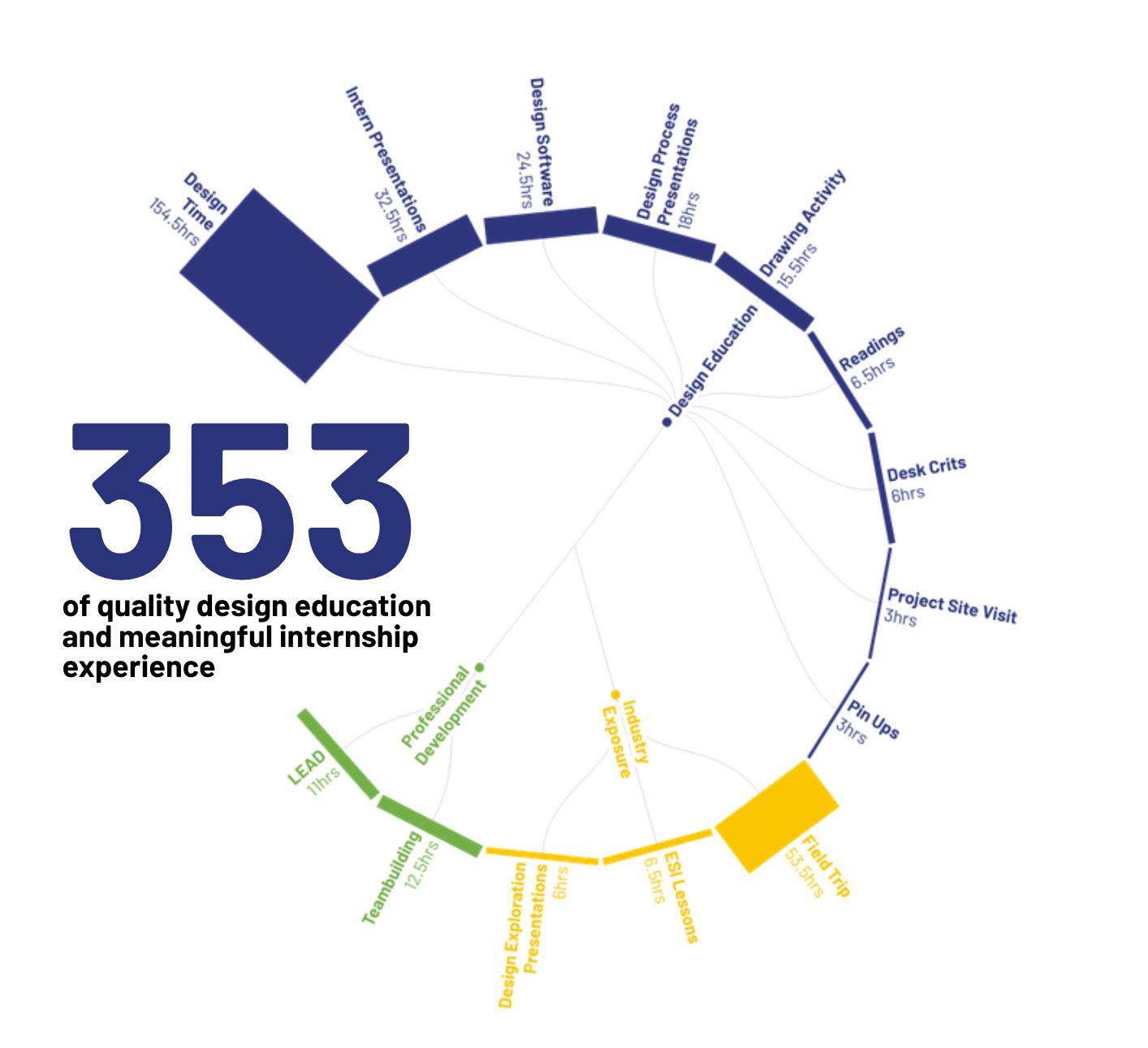
Our programs provided 353 paid internship hours per intern, with a combination of high-quality design education (75%), industry exploration (19%), and professional development (7%). The design education activities included design process presentations, charettes with project advisors, team design time, intern presentations, design software workshops, drawing exercises, readings, desk crits, and pin-ups. The design industry exposure activities included presentations exploring various design pathways, field trips, and lessons exploring design to address environmental and social issues. Lastly, the career development
2 | 2025 Design Education Snapshot
activities included Leadership Education for Aspiring Designers (LEAD) workshops and teambuilding activities. Across both programs, we provided 8938 hours of paid internships to high school students, with a cumulative attendance rate of 91%.

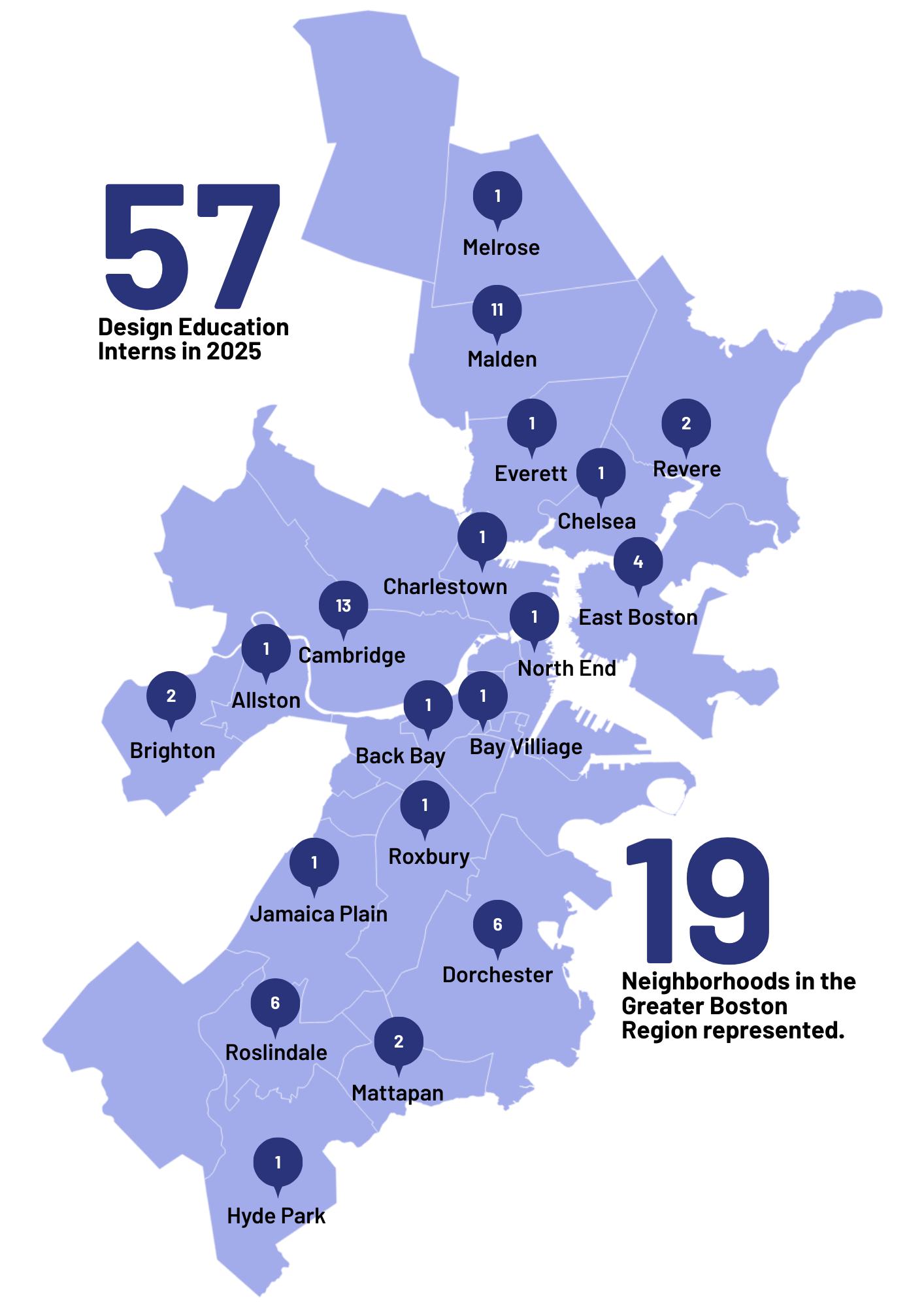
These students were from 19 neighborhoods in the Boston area and the Metro North region. The cities of Cambridge and Malden had the most interns, with 13 and 11, respectively. Dorchester and Roslindale each had six interns. Other neighborhoods represented include Allston, Back Bay, Bay Village, Brighton, Charlestown, Chelsea, East Boston, Everett, Hyde Park, Jamaica Plain, Mattapan, Melrose, North End, Revere, and Roxbury. They also represented 21 high schools with 11% in 9th grade, 33% in 10th grade, 32% in 11th grade, and 25% in 12th grade. They were a mix of first-time participants and returning students. 54% of interns were first-time participants in our design education programs. 95% of the surveyed interns reported having a positive overall experience in our programs.

We employed 15 college and graduate students as teaching assistants to facilitate program delivery and support intern supervision. The teaching assistants were 19- to 24-year-old residents of the Greater Boston area and the MetroNorth region, as well as students in a higher education design or design-adjacent course. This year, the teaching assistants represented nine universities and six different courses. 60% were first-time teaching assistants in our design education programs, and 40% were former interns returning as teaching assistants. We surveyed seven of the 11 teaching assistants about their experience in the program. We analyzed data across program tiers and previous participation to evaluate the teaching assistant experience. All surveyed teaching assistants reported a positive overall experience in our programs, with 50% rating it excellent. The project advisors and mentors were from 14 firms, companies, and organizations. Sasaki designers comprised 50% of the design education mentors and project advisors. The project advisors’ design industry focus areas were architecture (42%), planning & urban design (21%), landscape architecture (16%), and interior design (8%). Other industry areas represented with 5% or less included engineering, design research, ecology, and real estate development. All surveyed project advisors and mentors reported having an excellent experience in our programs.

Program Outcomes
We are approaching the point at which we can measure the long-term impact of our internships on the industry. We are still some way off from being able to measure any societal change, but we can still measure, evaluate, and record their outcomes—what happened as a result. In 2025;
• Fifty-seven high school students from diverse backgrounds in the Greater Boston Area gained access to a design education and career exploration internship.
• Our programs provided continuous design education for 26 returning interns, with five interns gaining experience comparable to that of a first-year studio project.
• Twelve high school students gained awareness of their communities’ environmental and social issues, conducted research, and learned how to use design to address them.
• Fifty-seven high school students developed and practiced essential personal and professional skills, including leadership, communication, networking, and teamwork.
• Fifteen undergraduate and graduate design students gained and practiced industryrelevant skills in a safe environment that encouraged academic and professional development.
• Thirty-eight design professionals volunteered for a design education initiative that provided them with both professional and personal fulfillment.
• Six nonprofit, community-serving, and municipal organizations gained design services and support that expanded their capacity and advanced their organizations’ missions.
These are the outcomes this evaluation describes and explores; however, they do not demonstrate the program’s entire results. The program may have had numerous undiscovered outcomes.
Diversity and Equity Through Design Education
We continue to strive to support young people from underrepresented groups in gaining access to design education and influencing design decisions that affect their communities. In 2025, 98% of program interns identified as people of color, comprising the following groups: Asian (32%), Black/African American (33%), Hispanic/ Latino (21%), and Two or more races (9%). Similarly, 63% of interns identify as female. These demographic distributions are the inverse of the current data on the design industry’s current population.
90% of interns in our programs gained a deeper understanding of the design process. They also gained and practiced technical skills through design software workshops. 83% of interns improved their diagramming and collaging skills using Adobe Illustrator and Photoshop, and their digital rendering skills using SketchUp.


Understanding Environmental and Social Issues
DESI encouraged young people to think about how design can address the environmental and social challenges they face in their communities. The program offered lessons and field trips, facilitated by designers, advocates, activists, and academics who are currently working to address environmental and social issues at various scales. Some of the topics explored through the lessons include redlining and neighborhood divestment, environmental justice, climate resilience, and the rights of indigenous peoples. Some trips explored how site context is essential to site analysis, the value of activism and community action in shaping design decisions, and how innovation in wetland marsh research can protect city coastlines. 88% of interns reported gaining a better awareness of the challenges in their communities and of how design can create solutions.
“The best part of the field trip was getting to know the community of the area and the initiatives people living or working there have to improve their community while also sharing their struggles and challenges.”
- Design Intern
Continuous Education for Returning Participants
In 2025, welcomed back 26 returning interns who had participated in design education internships the previous year. Returning interns accounted for 46% of interns; returners participated in DESI, SEED 2, and SEED 3 to build on the knowledge and skills they had gained in previous internships. SEED 3 interns, in particular, reported that their experience was significantly different from previous levels.
“SEED 3 was a far more intensive program, with higher expectations for my work, the amount I needed to get done, and the skill set I should have. This being said, there was a lot more room to grow and learn within those parameters.”
- Design Intern
This progressive, continuous design education model is essential in ensuring that students remain engaged in the design industry and potentially pursue higher education and careers in design. Their continued involvement with the foundation and participation in the internships have provided them with more clarity and insight into the industry.
“Working with Sasaki helped me realize that I want to be a part of some sort of design career, and more so, that skills with such careers can easily be applied in the real world to help real people. My experiences here have led me to understand that at the very least, there is always an opportunity to change my built environment.”
- Design Intern
Similarly, students preparing to start college were able to practice skills that would serve them well in college and beyond. Teaching assistants and mentors shared that the SEED 3 experience was comparable to a first-year architecture studio course.
“I learned key resources and programs, responsibility, teamwork, bonding, and learning to work with a client.”
- Design Intern
Workforce and Essential Skill Development
Our interns acquired and honed essential skills that boosted their personal and professional growth. Our programs facilitated interns’ interactions with peers and professionals, helping them develop communication, teamwork, leadership, interpersonal, and public-speaking skills. Additionally, LEAD workshops offered activity-based learning experiences in leadership, self-advocacy, well-being, mentorship, time management, project management, and professionalism. 85% of interns reported that these program activities positively impacted their personal and professional development. Our design interns developed essential workforce skills, which may increase their employability and advance their educational and career aspirations. 94% of interns surveyed reported that our programs were great professional and workforce development experiences.

Industry-Relevant Skills for College and Graduate Design Students
Our programs provided both undergraduate and graduate college design students a lowstakes environment to hone the hard and soft skills crucial to their professional development. 90% of teaching assistants surveyed agreed that our programs provided a safe environment for developing and practicing skills relevant to their academic and professional growth. 90% of the surveyed teaching assistants reported that they significantly improved their teaching and facilitation skills through participation. Similarly, all report that they had considerably enhanced their leadership and management skills as a result of their experience.
“I came into this program to test my interest and skills in architectural education. At the end of the program, I have cemented my interest and love for community outreach and education.”
- Design Teaching Assistant
The program had a positive impact on the academic and professional development of the teaching assistants. Teaching assistants shared that the program helped boost their confidence in using their design software knowledge and skills. They also highlighted that they developed many critical soft skills, including professionalism, self-advocacy, time management, networking, and patience.

Design Professionals Career and Personal Fulfillment
In 2025, 83% of the mentors reported that participating in the program had a positive impact on their career fulfillment and job satisfaction. A DESI mentor highlighted that they loved the chance to enhance their knowledge and skills through sharing it with others. Similarly, all design professionals surveyed reported experiencing a positive sense of personal fulfillment from participating in the program. Many mentors shared that they loved watching their interns progress, both as individuals and as designers.
“One
of the highlights of my experience as a SEED project advisor was working closely with the students and witnessing their growth throughout the design process. I especially enjoyed guiding them on material knowledge and construction detailing, which allowed me to see their ideas evolve into more feasible and resilient solutions.”
- Project Advisor
Design Support for Local Organizations
In 2025, we partnered with six organizations to participate as clients for our SEED interns. Clients were all local, non-profit, communityserving, or municipal organizations that directly impact residents in the Greater Boston Area. These organizations have limited resources or capacity to afford, access, or plan for the design services they require to expand the scope and impact of their services. The program provided these organizations with teams of design interns who offered inspiration, research, concepts, and visualizations to broaden their design interests and needs. This year, our interns designed a renovation of a historically significant garage structure at an urban farm with the Boston Food Forest Coalition, a community park along the Little Mystic Channel with the Mystic River Watershed
Association, a climate resilience hub for the Dudley Street Neighborhood Initiative, a concept for a Chinatown library park with the Friends of the Chinatown Library, a child-friendly outdoor space with Elizabeth Peabody House, and garden space at the Tobin Community Center with Sociedad Latina.


FOCL Chinatown Library Park | Design by SEED 3 Interns (Sam, Kathleen, & Elfe)
DSNI Climate Resilience Hub | Team Draco
MyRWA Barry Field Redesign | Team Aquila
BFFC Uphams Corner Garage | Team Vulpecula
Program Success
In 2025, our goals were to continue providing interns with opportunities to gain experience in design and explore design as a career path, empowering them to use design to address pressing social and environmental challenges in their communities.

Design Industry Exposure and Career Exploration for High School Students
We created our internships to engage high school students in activities that broaden their knowledge, experiences, and perspectives of the design industry. Similarly, 88% reported learning more about the design industry and being more aware of various design career pathways. Design industry exploration activities introduced interns to different design disciplines, including architecture, landscape architecture, interior design, urban planning, engineering, construction management, project management, marketing, finance, community engagement, environmental science, graphic design, and botany. These activities presented a wide range of career opportunities in design beyond architecture, landscape design, and urban design. 78% of interns reported interest in pursuing a design industry career.

Designing for Environmental and Social Impact
In 2025, the DESI interns showcased 10 design solutions that addressed 13 ecological and social problems affecting eight neighborhoods in the Greater Boston Region. These projects included “Tai Tung Street Urban Oasis”, a community green space that addressed the lack of green spaces and neighborhood divestment in Chinatown. In Dorchester, interns designed “Boston’s First Indoor Dog Park” to address the lack of community spaces and pet amenities, and the “Algae: The Biostop” in response to poor transport infrastructure and poor air quality. The “Mattahunt Green Space” and “Jamaica Plain’s Flower Haven” were solutions to an overabundance of urban hardscape in Mattapan and Jamaica Plain. “The Rozzie Lounge” employed adaptive reuse to address abandoned or underutilized buildings in Roslindale. In Charlestown, an intern designed the “Rutherford Ave Greenway” to address the problem of inaccessible public spaces. The “110 Holton
Rear-vival” discussed the risk of flooding and mental health issues in Brighton. In Malden, “The Malden River Corridor” addresses poor water quality, while “Interconnecting Malden Station” provides solutions to unsafe pedestrian and commuter conditions.
Conclusion
Although 2025 has been a challenging year for various reasons, our design education programs persevered through uncertainty and continued to build equity in design, pushing towards a more representative industry. We were able to build on our work in previous years by giving more high school students from diverse backgrounds access to paid internships and design education, supporting these students with continuous and progressive engagement with design in college, providing undergraduate and graduate college students the opportunity to gain and practice industry-relevant skills, and supporting the work of local community-serving organizations. With even more support, we can continue to strengthen the design workforce pipeline by amplifying the voices of young designers from diverse backgrounds, perspectives, and
communities, and helping them harness the power of design to shape the present and future positively.

