THE HOW-TO TRE26 ISSUE
NEWSMAGAZINE RUNNING SPECIALTY RETAILERS / RUNNINGINSIGHT. THETHE NEWSMAGAZINE FOR FOR RUNNING SPECIALTY RETAILERS / RUNNINGINSIGHT.COM
MARCH NOVEMBER 202616, 202
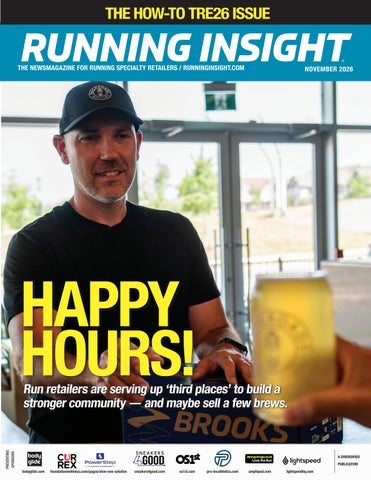
HAPPY HOURS!
Run retailers are serving up ‘third places’ to build a stronger community — and maybe sell a few brews.
A DIVERSIFIED PUBLICATION bodyglide.com
foundationwellness.com/pages/shoe-one-solution
sneakers4good.com
os1st.com
pro-tecathletics.com
amphipod.com
lightspeedhq.com
How-To TRE26 Issue
COME FOR THE SHOES, STAY FOR THE SCENE Run specialty shops are using coffee, craft beer and inviting spaces to become a ‘third place’ for their communities. By Danny Smith
F
or some running shops, the phrase “third place” has nothing to do with – in typical runner parlance – a bronze medal. Rather, “third place” characterizes the running shop’s aims to be a community gathering spot and a complement to one’s home – the “first place” – and work – the “second place.” From public libraries, churches and social clubs to barbershops On the cover: At Backroads Brews and Shoes in Canada, long-time supporter and local beer Instragram influencer Chris McGowan (HopHappyBlog) enjoys a cold one in one of the industry’s more notable third place providers.
and bars – and taken to the next level in the public’s consciousness by Starbucks – third places have a long-established presence in American life. They host lively conversations, celebrations, negotiations, dates, debate and more. A few running shops have dialed up their own “third place” vibe, investing in elements like craft beer, premium coffee, free Wi-Fi, comfortable seating and serene outdoor spaces to encourage customers to come together, linger and frequently return. These four have taken the concept to an even higher level.
®
RUNNING INSIGHT is a registered trademark of Diversified ©2026 all rights reserved. Running Insight is published monthly, is edited for owners and top executives at running specialty stores and available only via email except for two print issues year. The opinions by authors and contributors to Running Insight are not necessarily those of the editors or publishers. Articles appearing in Running Insight may not be reproduced in whole or in part without the express permission of the publisher. Diversified, Portland, ME 04101; (207) 842-5500.
2
runninginsight.com
Advertise
Glenn Dulberg............................gdulberg@Divcom.com Scott Huffman............................shuffman@divcom.com
Editorial
Michael Jacobsen.................. mjacobsen@Divcom.com
BACK ISSUES runninginsight.com SUBSCRIBE runninginsight.com
© 2026 Diversified
In Longmont, CO, Shoes & Brews has created a “third place” atmosphere with a rotating selection of craft beers to complement its evolving selection of running gear.
BACKROADS BREWS + SHOES Established 2017 A talented runner who loved beer, Aaron Hendrikx opened BackRoads Brews + Shoes in London, Ontario, in 2017. It’s a simple, albeit ambitious concept: a traditional run specialty store up front with a taproom in the back serving up beer, wine, kombucha, coffee and more
with a heavy emphasis on local products. In May, Hendrikx oversaw the opening of a second BackRoads in Kitchener, Ontario, about 60 miles northeast of London. While BackRoads’ London shop carries a more rustic feel and the new Kitchener store feels more refined and modern, both locations embrace the same third-place goal with indoor and outdoor seating for guests. “People are floored by the idea. They come in for shoes or nutrition and they stay for a beer or a latte,” BackRoads community engagement manager Scott Goodyear says. As Goodyear talks from the London store on a Tuesday morning in October, he points to a
© 2026 Diversified
SHOES & BREWS Established 2014 Shoes & Brews is a pioneer among running shops actively and intentionally aiming to hit the third-place target. The Longmont, CO-based business co-founded by three former Colorado State University runners blends a full-service, 20-tap brewpub with a fullservice run specialty shop. A glass wall separates the brews from the shoes. “Two passions under one roof,” as Shoes & Brews co-founder Ashlee Anderson explains. W h e n S h o e s & B r ews launched a dozen years ago, Anderson and her co-founders hoped the brewpub would make 3
runninginsight.com
money. They assumed the brewpub would serve as a gathering spot following a group run from the store, which it most certainly has. However, they did not anticipate the brewpub becoming a popular watering hole with its own clientele seven days a week. “We were surprised to see the brews side could be its own business and capture its own customers,” Anderson says. The brewpub’s casual, familyfriendly vibe makes it a hit with locals and customers regularly crossover to the shoes side. The running store has gained customers it never would have gotten if not for the brews component, Anderson says, and customers who pop in for a craft beer routinely grab some energy gels
for their weekend run or investigate cold-weather gear when the weather turns. “We see our customers, especially our loyal ones, a lot,” Anderson says. “We’re not just seeing them every six months when they need new running shoes. They’re here often to try a new beer or meet a friend.”
Stay for the Scene (continued)
At our neighbors to the north, BackRoads Brews + Shoes (above) invites customers to stay a while with a selection of locally sourced beverages. In upstate New York, meanwhile, Neighbor Running invites locals to come hang in its backyard garden.
regular customer sitting on his computer in the corner, a group of business colleagues meeting in front of him and members of the store’s walking club sitting to his side and “shooting the breeze.” He says BackRoads will welcome afternoon customers seeking a mid-day pick-me-up – the shop’s exclusive Runner’s Medium from O-Joe Coffee is a particular favorite – before an evening crowd fills the space for events like trivia, live music or book club. At both BackRoads locations, the bar functions as a common checkout point ringing up purchases of running gear or a beverage. Goodyear says that’s an intentional move to introduce guests of the running store to BackRoads’ unexpected taproom. 4
runninginsight.com
NEIGHBOR RUNNING Established 2025 Kevin Meehan calls his 800-square-foot running shop in Hudson, NY, “a pillbox,” which made his hunt for additional space that much more imperative. When Meehan looked in the back of his shop, he saw an intimate garden in need of some tending. He also saw an opportunity to build something unique for Neighbor Running in his historic, waterfront city in upstate New York. Fortunately, Meehan’s open-minded landlord gave him permission to tidy up the
outdoor space. This past spring, Meehan teamed with hylo athletics and
Silver Botanic to reinvent the garden area and create an inviting destination for Neighbor Running guests. The cozy garden features a mix of materials hylo uses in its footwear, including corn, castor bean, sugarcane and rubber among them, as well as medicinal plants specifically chosen to support athlete recovery, endurance and balance, such goji berry, mint, lemon balm, chia and chamomile. “Neighbors have even come by to cut back some leaves and harvest some herbs,” Meehan says. An intimate space able to hold about 15 people, the garden is open during business hours and also hosts community gatherings every Friday night, from demo runs to bocce ball to adult beverages. Meehan, meanwhile, regularly pumps up the garden on social media to let customers know they have a peaceful spot to meet a friend or tackle some work. “I’m trying to build a model for small-town Amer ica,” Meehan says.
© 2026 Diversified
B2B RETAIL | CASE STUDY RESULTS
THE MOST OVERLOOKED PART OF FIT, COMFORT, AND PERFORMANCE. When retailers fit the sock with the shoe, performance improves-and so does sell-through.
Every great footwear experience starts with: ✓ Proper foot support
✓ Proper shoe selection
FOOT
SOCK
✓ Proper insole / underfoot system
INSOLE
SHOE
+47%
SOCK CATEGORY REVENUE GROWTH 3-Year Retail Case Study Real Independent Running Retailers
SEE HOW LEADING RUNNING RETAILERS DO IT DIFFERENTLY OS1ST.COM/RETAIL-PARTNERS
Stay for the Scene (continued)
St. Pete Running Company & Coffee in Florida was intentionally designed by its owners to encourage repeat traffic and long stays with its high-end coffee program along with welcoming seating areas.
ST. PETE RUNNING COMPANY & COFFEE Established 2026
More than a decade after opening St. Pete Running Company in St. Petersburg, FL, Cody
and Janna Angell were ready to open a second location. This one, however, would carry a twist
LEARN MORE AT THE RUNNING EVENT “More Than a Store: Run Specialty Anchoring Third Spaces” Tuesday, December 1, 2026 • 3:45 p.m. In this 45-minute panel on TRE Tuesday, Carol Holland of Haraka Run & Walk will moderate a discussion featuring Cody Angell of St. Pete Running Company & Coffee, Scott Goodyear of BackRoads Brews + Shoes and Kevin Meehan of Neighbor Running. The three owners will discuss their concepts and creating novel and inviting run specialty environments that attract regular visits and foster community. 6
runninginsight.com
and lean into the couple’s robust enthusiasm for coffee. “We had customers coming in early to group runs and staying late, and we were looking for a deeper way to engage with the community ourselves,” Cody Angell says. “So, we thought, ‘Let’s put in a cafe and give them a reason to hang out.’” Earlier this year, the Angells op ene d St. Pet e Ru n n i ng Company & Coffee on the west side of t he P i nel las Peninsula, about 20 minutes away from their retail flagship. The couple describes their new shop as a place “where performance meets community and caffeine.” Janna Angell designed the skinny storefront on a pedestrian-friendly street. The shop carries a simple, clean aesthetic with white walls and counters balanced with natural wood tones. Running gear, including the shoe wall, runs along one side of the space. Opposite that resides a long bar with seating. There’s additional seating with a long bar at the window as well as patio tables. Cody Angell says he and his wife went all-in on coffee. From the equipment to the beans to the ceramics, everything is first-class. “If this was only a café, it would hold its weight on that alone,” he says. While the new location took time to gain traction following its January 2026 opening, the Angells are now watching it grow before their eyes. Runners visit the shop in their work clothes for a coffee or to have a post-workout chill session with training partners. “We’re becoming a place they want to be,” Cody Angell says. n © 2026 Diversified
How-To TRE26 Issue
A Running Start
For four retail leaders, working at another run shop shaped their professional lives. / By Danny Smith
E
veryone who attends The Running Event in San Antonio next month most likely got their start somewhere other than their current position — and for some running store leaders, that start often happened at another run specialty shop. Gaining an industry foothold elsewhere before entering their own retail leadership rank has its definite perks, from learning product details to seeing operations up close to understanding the systems and process that contribute to success. Here, four running store leaders talk about their entry into the run specialty world and how it inspired the evolution of their own retail operation. NATHAN HOHENSTEIN He now owns … Tortoise & Hare Sports in Glendale, AZ, alongside his wife, Rebecca. But he previously worked at … Playmakers in Okemos, MI, from 1999-2005. He also spent five years working at Marathon Sports stores in and around Boston. Hohenstein describes Playmakers founder Curt Munson and former owner John Benedict as father figures who had a profound impact on his life. And he calls Playmakers “a unicorn.” The 2010 Store of the Year, Playmakers – a massive, singlestore operation – is known for its laser-like focus on customer service, community outreach and staff development, which included paying for Hohenstein to become a certified pedorthist. “I was so incredibly fortunate and blessed to have started there and to see up front and at a deep level what great retail is in really concrete ways,” Hohenstein says. Living and breathing the “Playmakers Way” for six years proved “incredibly advantageous” for the future running store owner. 8
runninginsight.com
easier and faster. “At Playmakers, there was a relentless passion to improve,” says Hohenstein, who brought Good For m Run n ing to Tortoise & Hare with great success. While Playmakers provided Hohenstein some of running retail’s core fundamentals, Marathon Sports owner Colin Peddie showed Hohenstein how to navigate vendor relationships. “Colin was great at connecting with vendors and figuring out what was important to them and how Marathon could be their boots on the ground,” Hohenstein says. Ma r at hon a lso gave Hohenstein the necessary kick to pursue his own entrepreneurial ambitions. Living in Boston and working three jobs, including a part-time role at Marathon, Hohenstein realized he was not afraid of hard work or risk. Before opening Arizona-based Tortoise & Hare Sports with his wife, “So, I either needed to get Rebecca, Nathan Hohenstein worked at both Playmakers in Michigan out of the industry or figure out and Marathon Sports stores in metropolitan Boston. a way to become an owner,” Hohenstein says he gained a deep appreciahe says. tion for compelling footwear, marveling At Tortoise & Hare, which opened in 2012, at Munson’s intuitive ability to identify Hohenstein borrows heavily from his past “good product.” He also saw a retail operaexperiences at Playmakers and Marathon tion ceaselessly centered on the customer and has built a run specialty shop that has experience and devoted to adding value to appeared on every Best Running Stores list its community. Playmakers’ longstanding since 2016, including earning multiple Store Good Form Running clinics, for instance, of the Year finalist nods. have armed thousands or individuals with “I benefitted from seeing things done at the knowledge and skills to run healthier, such a high level,” Hohenstein says.
© 2026 Diversified
X-Tended™ Knee
Support Beyond the Knee
A Running Start (continued)
Kathy Dalby is most associated with Washington, D.C.-based Pacers, but she got her run specialty start at Village Runner in Redondo Beach, CA.
confesses. Upon graduating college, Dalby moved to Washington, D.C. She started working for associations, then law firms, then event management. One day, a friend of Dalby’s invited her to tag along on a visit to Pacers for new shoes. While the friend got her shoes, Dalby got a weekend job as a part-time fitter at Pacers’ Alexandria location. After Hurricane Katrina battered the Gulf Coast in August 2005, Dalby spearheaded a road race that raised $130,000 for relief efforts. That snowballed into the creation of Pacers Events, an equity strategy at Pacers and Dalby’s current role as the company’s CEO and president. Her experience at Village Runner, however, never strays far from her mind. “What a great job to go in everyday and help people get healthy,” Dalby says. “That was Village Runner and it’s something I always come back to at Pacers. Ultimately, what we do is fun, and we can’t take ourselves too seriously.”
trails allowed Dalby to enjoy post-shift runs from the store. “It was the most chill job I ever had,” says Dalby, who worked at Village Runner during summers and holiday breaks from her studies at Michigan State University. Village Runner introduced Dalby to high-performance running footwear, road race management and the idea of running as a lifestyle. She enjoyed helping customers and looking at a wall of “pretty shoes.” Even still, it seemed more fun job than potential long-term career. “I really didn’t know run specialty was a thing,” Dalby
SCOTT TANTINO He now owns … North Wales Running Company in North Wales, PA, and All Kinds of Fast in Phoenixville, PA. But he previously worked at … Bryn Mawr Running Company in suburban Philadelphia. Hunting for a part-time job while attending Villanova University, Tantino walked into Bryn Mawr Running Company – a store he frequented as a prep athlete – ready for a formal interview. Instead, he nervously followed Bryn Mawr Running Company owner Bob Schwelm around the store in occasional conversation until Schwelm
KATHY DALBY She now leads … Pacers, serving as the CEO and president of a company with five retail locations around Washington, D.C. and northern Virginia. But she previously worked at … Village Runner in Redondo Beach, CA. Dalby landed at Village Runner after completing high school. She worked for store owner Mike Ward “back in the days when you’d work the store by yourself and lace up all the shoes.” A cool California beachside breeze swooped in the front door and immediately accessible 10
runninginsight.com
turned around and asked Tantino when he was coming back. “That’s so Bob,” Tantino says. In all, Tantino worked about five years at Bryn Mawr, balancing shifts on the floor with coaching and post-graduate studies at Villanova. “And I loved all of it,” Tantino says. “Fitting people for shoes was a puzzle every time and it was a fun place to show up for work with a great bunch of people.” In particular, Tantino admired Schwelm, who was kind, patient and eager to offer genuine help to customers who walked in the shop – something he actively evaluated with every new hire at his shop. “Bob could care less about someone’s running background,” Tantino says. “He wanted to know how they treated people. Would I want this person to fit my mother? That was his approach and I never forgot it.” Disenchanted with his PhD progra m, Tantino pitched Schwelm on the idea of opening a running store about 40 minutes away in North Wales, Tantino’s hometown. Schwelm went for it and North Wales Running Company opened in 2006. Schwelm served as Tantino’s partner for the opening year and played an active role in setting up the store, opening accounts with vendors and helping Tantino get his bearings as a small business owner. “The greatest set of training wheels in the world,” Tantino says. From Schwelm, Tantino says he learned the value of carrying niche products and making a specialty store special. It led Tantino to take a chance on upstart brands like Topo and © 2026 Diversified
Make room for what’s next.
Make an impact along the way.
As the year winds down and runners prepare for new training goals, your store has an opportunity to turn old sneakers into something meaningful. One easy program. Multiple ways to make an impact. Engage customers beyond the sale Earn funds to support community causes Give athletic sneakers a second life Build a sustainability program without added complexity We provide the collection materials, prepaid shipping, marketing support, and impact reporting. You make the impact possible.
LET'S KEEP SNEAKERS MOVING FORWARD.
Visit Us at The Running Event Booth #12114 Contact Us: (407) 440-1244 | hello@sneakers4good.com
A Running Start (continued)
Scott Tantino (left) worked at Bryn Mawr Running Company in suburban Philadelphia before launching North Wales Running Company in 2006. Years before returning to the family business, Track Shack in Orlando, Chris Hughes worked for Jane Alred’s 1st Place Sports in Jacksonville.
resurgent brands like Puma and Diadora at North Wales Running Company and All Kinds of Fast. “You want people to try on a brand they never heard of or to feel like they’re discovering something,” Tantino says. “Bob drilled that into our heads.” Schwelm also emphasized fun and positivity. He would perform physical comedy to elicit a chuckle from employees and frequently reminded staff they were a constructive piece of someone’s day. “I wouldn’t be doing what I am today had I worked at any other store but Bob’s,” Tantino says. “He was so giving of his time, resources and influence and provided a great example to follow.” CHRIS HUGHES He is now … the director of retail operations at Track Shack, the Orlando-based running store his 12
runninginsight.com
parents, Jon and Betsy Hughes, have owned and operated since 1983. But he previously worked at … the late Capital City Runners in Tallahassee, FL, and 1st Place Sports in Jacksonville, FL. At 15, Hughes told his parents he wanted to be in the run specialty business. Naturally, he worked at Track Shack as a teen to learn the basics of the market and the family business. While attending Florida State University, Hughes then became the first employee at Capital City Runners, a Tallahassee-based shop opened by elite runners Kevin Sullivan and Nathan Brannen. “Even though I was 20 years old, I had the most specialty experience on the floor, so I was training staff from day one,” says Hughes, who also helped with buying and staff management.
After graduating from FSU, Hughes’ parents encouraged him to continue gaining experience elsewhere, either in retail or on the vendor side of the business. “They didn’t want me to feel pigeonholed,” Hughes says of his parents. In early 2012, Hughes moved to Jacksonville to work under Doug and Jane Alred at 1st Place Sports. He served as the assistant manager at the company’s biggest store before taking on a “pseudo assistant GM role” and supporting day-to-day operations as well as staff training at the multi-door business. He calls his time at 1st Place Sports – his first full-time job – “transformative.” He learned accountability and management skills and saw how a different high-performing run specialty business attacked operations. The Alreds also directed Hughes to
join the local Galloway program as a group leader. The immersive experience opened his eyes to issues of access in the sport and the importance of creating a positive environment for runners of all shapes, sizes and abilities. After nearly two years at 1st Place, Hughes returned to Track Shack ready to contribute to the family business and motivated by his experience at 1st Place. Hughes installed promotions like buy-threeget-one-free sock offers that increased Track Shack’s sock sales more than 25 percent. He also strengthened Track Shack’s community ties with a welcoming Wednesday night group run from the store. “I’m forever grateful to 1st Place because that’s where I grew up,” Hughes says. “I came in with an ego, and I needed to learn I didn’t know as much as I thought I did.” n © 2026 Diversified
Let’s Get Runners Visible!
New! Ultra-Luminator™ Headlamp
New! Run Bright™ 1.5L HydrationVest
One-Stop for Top-Selling Visibility Essentials B2B: dealer.amphipod.com E: order@amphipod.com T: 800.806.1288
How-To TRE26 Issue
Tech and TRE26
Four examples of how technology is helping stores build a better business. / By Dominique Smith
T
echnology is going to be all over the show floor at The Running Event in San Antonio next month and it presents a prime opportunity for retailers to see how it is evolving — and how they can get with the times. There’s no doubt run specialty retailers and small business owners are using modern day technology to make business more efficient and to enhance the customer experience. Modern systems and practices, such as Artificial Intelligence (AI) and Optio are being used by business owners and stores to help simplify things such as inventory and drop shipping orders, while also offering analytics on where improvements need to be made throughout the business. From simplistic measures to more complex systems, here are how some of the top running retailers and small businesses are using modern-day technology for their benefit. NAPERVILLE RUNNING COMPANY Time for a Change After 26 years of using the same point of sale system, Naperville Running Co. finally decided that it was time for a change. The company switched from Microsoft RMS to Lightspeed POS earlier this year. One of the biggest reasons for making the change was the need to upgrade the store’s operations, including how they manage inventory to be cloud based. Kyle Brady, director of retail and store management, says that it had become expensive to hire IT professionals to upload a new POS for a register or a backroom computer when needed. The existing system also did not have a loyalty program for customers. The switch to Lightspeed has allowed other operations and programs, such as 14
runninginsight.com
Kyle Brady of Naperville Running Company says the retailer made a technology upgrade to improve the running store’s operations, including how it managed inventory.
e-commerce to run more efficiently and it allowed for the company to introduce a much-needed new loyalty rewards program. “We’re able to communicate with our customers a lot more frequently and more targeted with that, which is nice,” Brady tells Running Insight. “And then like some of the reporting things are good.” Brady says that the transition hasn’t been a difficult one for customers who shop at the store. “From the customer side of things, it’s
been good,” he reports. “It’s been really smooth, which is nice.” Brady’s biggest advice to others looking to up their technology game is simple: As technology evolves, put more time into making things work correctly and properly for the good of the company. “Whether it’s like Optio or other analytics programs, I think that there’s a kind of ‘sky’s the limit’ to all this stuff,” Brady says. “It’s super important to make sure you’re staying on top of everything.”
© 2026 Diversified
Tech and TRE26 (continued)
TRACK SHACK Keeping It Simple Sometimes it’s the simple things that make the biggest difference. This is the case when it comes to Track Shack in Orlando, FL. The storied company has been in business for almost 50 years and Chris Hughes, VP– business operations, describes the company as old school, mentioning that the store didn’t sell products online prior to the COVID-19 pandemic in 2020. The one thing that the store added that has made a huge difference is a digital queue that customers use to sign in when they arrive at the store for a shoe fitting. The queue will notify customers via text when there is a longer wait time. Hughes says that the digital addition has given customers more flexibility to decide if they’d like to stay on site, or venture around the area near the store while waiting. It’s also shored up little things, such as the messiness of people’s handwriting, which eliminates confusion. “Just digitizing that, believe it or not, has been huge for us,” Hughes adds. The digital queue offers a section for outfitters to write specific notes based on the needs of the customers, allowing them to streamline fits, while making the process more efficient. “So if they’re dealing with a specific injury, if they have to fit to a certain type of orthotic, if there’s parameters from podiatrists of what they need in the shoe, even if they want 16
runninginsight.com
Track Shack kept its technology upgrade simple, with a digital queue that improves customer service its biggest move.
to select an individual salesperson to work with, they’re able to notate all of that in the comments on the iPad,” Hughes explains. Hughes advice for other retailers, especially those who have been around for a long period of time is simple: Don’t be afraid of change. “If you’re consistently profitable and you have systems t hat work, somet i mes it’s easy to think that you don’t need whatever is new on the block,” Hughes points out. “But for some of those simple uses, you can save time and use t hat t i me a nd energ y towards other things more efficiently, more effectively, by just being open to new stuff.”
FOR THE RUN Welcome AI As the founder and owner of For the Run, the online running apparel store that was launched in 2019, Shawn King knows that operating a small business requires great precision, especially for someone like him who is involved in all aspects of the business. One of the things that helps King stay afloat is Artificial Intelligence. King made the decision in 2023 to move to AI after years of employing the Search Engine Optimization model for his business. King says the move has saved him at least 20 hours a week and has made his business more efficient. “Through AI, I’m able to really have an impact on every
different part of the process, from development of apparel or stickers, all the way up to trends and dates and windows that make sense for things to drop,” King explains. King says AI also helps assist with backend tasks, such as inventory, managing SKUs and tracking orders. It also gives him a peek behind the curtain to see what other brands are doing well, as well as trends that are taking place throughout the running community. This allows for him to properly strategize his next steps for the business. “It just helps with forecasting, it helps with planning, it helps with understanding how successful a drop or a single release of something was, and just kind of helps me stay on
© 2026 Diversified
In an AI-Driven World, Your Customers Expect More. Meet the next generation of 3D foot scanning technology, combining precision scanning with AI-powered shoe recommendations and hands-free voice guidance. In seconds, shoppers receive personalized fit recommendations built around their unique feet, helping retailers deliver better fits, fewer returns, and a more confident customer experience.
Zoe Pro, St ar ting at $1,995
Scan QR code for technical specifications
Tech and TRE26 (continued)
Shawn King says embracing artificial intelligence has made a huge difference in the operation of For the Run, with a focus on the personal touch as well.
my toes a lot better.” King believes that retailers looking to implement AI into their business model should never lose sight of the audience and the community that they
are serving. “Know your market, know your user, know your runner and never lose sight of what you want your shop to be doing,” King says.
FLEET FEET TUSCALOOSA Do It Yourself If you want something done the right way, sometimes it’s best to create it yourself. That’s what owner Henry Carpenter and the team at Fleet Feet Tuscaloosa did. “Stride is our in-house inventory and business dashboard,” Carpenter explains. “It has role-based views, so the owner, finance, marketing, a floor lead and an outfitter each see what they need and nothing they do not.” The model allows invoices to route straight into QuickBooks instead of getting keyed in by hand. Carpenter says it also allows for the staff to scale model stocks up and down with the season instead of ordering off of gut feel and it allows them to swap proposals and move slow styles out before they turn into dead inventory. Fleet Feet Tuscaloosa has
The team at Fleet Feet Tuscaloosa created its own in-house inventory and business dashboard to improve its operations.
18
runninginsight.com
Technology is going to be all over the show floor at The Running Event in San Antonio and it presents a prime opportunity for retailers to see how it is evolving — and how they can get with the times. been in business for four years and, according to Carpenter, investing in technology played a part in the store’s success. “We opened in September, 2022 with a small team, so technology was the only way to punch above our headcount,” Carpenter says. “We have won the Best Running Store award two years running and year two came with a different leadership team, different outfitting staff and a new location. That only happens if the systems hold the knowledge instead of individual people holding it.” Madison Sanschagrin, marketing director at Fleet Feet Tuscaloosa, adds that the innovative technology helps her to serve the community, strengthen the business and help her team grow. She believes retailers shouldn’t limit themselves on how technology can not only help business, but community growth. “T h in k outside the box and look for ways to adapt in every part of your business,” Sanschagrin says. “The goal isn’t to use technology just because it’s new. It’s to use it to create a better experience for your customers, strengthen your team and build a stronger community.” n © 2026 Diversified
Different Pace. Different Stride. Same Goal:
KEEP GOING TOGETHER. No two runners move exactly the same. That’s why CURREX is designed to move with them. Dynamic Arch Technology™ adapts to natural movement to provide support, comfort and stability throughout the run. Helping you deliver a fit your customers can feel from the first step.
FIND YOUR LOCAL RETAILER >
How-To TRE26 Issue
Emerging Talent
Emerging brands are what make The Running Event special for retailers. / By Dominique Smith
S
ure, all of the big running shoe brands will be on hand at The Running Event in San Antonio next month and they tend to dominate meeting schedules as running retailers check out the latest and great new styles and technologies and lock in their 2027 orders. But there is a different aspect to the two days of exhibits and retailers need to make time for the dozens of emerging brands that will showcase their own latest and greatest products. Here are five of those brands among those dozens to check out – be sure to walk the aisles to explore the brands that will help to differentiate your store. You never know where the Next Big Thing can be found at TRE26!
a traditional elastic hair tie. The product was created and brought to life by Hannah M. Le, who came up with the idea when she was 13-years old. Le says that during her recovery from ACL surgery, she decided to bring her idea to life, and in 2024, she founded Buckle Scrunchies. “T h is concept of a ha i r t ie, or ha i r scrunchie that would click open and unwrap from your hair as easy as unbuckling your belt, untying your shoes, or unclipping your bra — If those solutions existed, why couldn’t we have NO SWEAT HERE one for our hair,” Le Swair is a unique showerless tells Running Insight. shampoo haircare product that “And that’s how I started cleans sweaty hair in five min- Swair co-owners Meredith Krill (left) and Carrie Sporer are looking for their exposure at The Buckle Scrunchies.” utes without residue or white cast. Running Event to translate into more run retailers learning about their haircare product. Le’s passion for her The product avoids using aerosol business has shown up in propellants and powders, instead focusing Sporer explains. “So what we really wanted the product and it has yielded success for her on safe and effective ingredients that break to do was remove a piece of friction between business. Le said that she’s received positive down sweat buildup at the scalp, resulting women and getting sweaty.” reviews from a diverse range of customers, in softer and shinier hair. Sporer says she and Krill are excited for including those who have longer and thicker The product was created by co-founders the opportunity to meet attendees in person hair, as well as customers with disabilities Carrie Sporer and Meredith Krill, two friends at TRE26 and demonstrate how the roduct who aren’t able to use traditional hair ties. who met in 2007 while training for the New works. Le said that she’s excited for TRE attendYork City Marathon. They both shared frus“It’s a really great opportunity for the ees to try the product and learn more about tration over having to wash their hair after stores to be able to sell something new, that’s Buckle Scrunchies. In addition to partnerevery workout and not finding a product that a little bit outside of their traditional zone,” ing with local run clubs in San Antonio eased not only their burden, but the burden Sporer says. and different events throughout TRE, Le of those who shared in the same frustration. is also preparing buckle hair-tie samples in “We felt that a lot of women had to choose BUCKLE UP! goodie bags that will be offered to attendees. between working out and their hair, which Buckle Scrunchies is a hair accessory that She says the preparation ahead of TRE has sounds really silly, but it’s a real pain point,” quickly clicks open to release hair faster than grounded her. 20
runninginsight.com
© 2026 Diversified
Emerging Talent (continued)
do and just see how beloved a product like this is in the market.”
Hannah Le, founder of Buckle Scrunchies, has seen her passion for business pay off in success for her emerging company.
“It’s a very humbling part of the process that really lets me reflect on how far I’ve come with Buckle Scrunchies,” Le says. “I am looking forward to what’s next — and that’s TRE.” GET WILD Wild Strides Paper Co. is a stationary company whose products are built specifically for runners and endurance athletes. It specializes in creating planners and training logs as well as funny and relatable greeting cards and stickers. Professional mountain runner and two-time world champion Grayson Murphy developed the concept eight years ago, when she developed her own training logs and planners. That concept blossomed into the Wild Strides Paper Co. which officially launched in the summer of 2024. Brittany Miller is the co-owner and managing director of the 22
runninginsight.com
Wild Strides Paper Co. who says the training log and planners are foundational pieces for the company, but is has also found success with the other products in its catalog. “(Training logs and planners) are what people come back to us for year after year after year, because it is a daily planner that’s specifically designed with runners in mind,” Miller points out. “But it was the summer of 2024 where we branched off into more stationery products, like our greeting cards and our stickers, and we’ve seen huge success with those in the past two years.” Miller says that Wild Strides are featured in seven retail stores already and she is looking for that to increase after TRE26. “I’m just so excited for retailers to see all of our offerings and I just hope that they can appreciate as much as the runners who see us at race expos
SEE THE LIGHT Runsifly looks to provide consumers with professional, comfortable and lightweight products for runners and was founded in 2025 by LEO (yes, just LEO), an avid runner and former running shoe content creator. He set out to make a product that focused on the running market. “I love running and know what the runners demand,” LEO says. “So I want to design different products in the running market, giving more options to runners.” So far, the young company offers apparel as well as a racing shoe called the Flare Elite. LEO says he has long dreamed of attending TRE and feels that it
will be great for his company and it plans to release its first training shoe called Pivot at the show. “I hope to meet different people, not only potential business partners but also industry participants,” LEO says. “That is greatly helpful in letting Runsifly face the global market.” CRACK DOWN Canyon Crack is an adventure butter fuel designed for intensive high-energy activities that burn large amounts of calories, including running, cycling and hiking. It’s made with grass-fed free-range cookies and the base of the product is made with coconut butter, nut butter, cookie butter, chocolate and honey, as well as crunchy bits like cocoa nibs, chia seeds, espresso beans and ginger crystals.
Here is a sampling of some of the creative stickers that Wild Strides Paper Co. will be highlighting at The Running Event in San Antonio next month.
© 2026 Diversified
Emerging Talent (continued)
At left, LEO, the founder of Runsifly. At right, some of the adventure butter fuel product that will be on display at TRE26 from Canyon Creek.
The brand was created by Tom Richman, who is also a Grand Canyon backpacking guide and tour operator. He believes the fat, protein and carbohydrate ratio in the product sets it apart from its competitors.
“Most other gels and snacks made for running are all carbohydrates,” Richman explains. “Canyon Crack is about 50 percent fat for long-distance, slower release calories.” Richman is excited to attend
TRE26 and he will be offering samples to attendees that stop by his booth. He’s also looking forward to building relationships with retailers who are curious about Canyon Crack. “We’ve received some really
positive feedback from the running community so far – especially the ultra world, so we’re interested in connecting with more retailers interested in expanding their nutrition offerings,” Richman says. n
ENGINEERED FOR NATURAL MOVEMENT Supports natural toe movement and delivers targeted plantar fascia compression.
SEPARATED TOE BOX for natural splay and five-finger footwear fit
FIRM COMPRESSION
DEEP HEEL CUP for heel protection
to support the plantar fascia
24
runninginsight.com
Connect with our team
TO LEARN MORE
© 2026 Diversified
REGISTER FOR TRE 2026 Join us for three days of business, education, and connection. December 1-3, 2026 / San Antonio, TX
REGISTER NOW
@therunningevent
Produced by:
WHAT’S NEW at TRE26!
To ramp up the excitement for the 20th anniversary of The Running Event 2026, December 1-3 in San Antonio, TX, here’s a sneak peek at just some of the new products from the more than 350 vendors that have come across our editorial desks so far. Need more? The December 2026 issue of Running Insight will feature more than 100 new products items to put on any retailer’s shopping list.
Kizik Freedom Pace
The Freedom Pace trainer from Kizik is made with HandsFree Labs technology, an Internal Flex Arc and a tented heel pocket to keep the foot secure. A VivaFoam midsole and rocker sole give a responsive, smooth heel-to-toe ride. The upper is lightweight mesh with nosew overlays, while reflective laces add visibility in low light. MSRP: $139.95
26
runninginsight.com
© 2026 Diversified
Eagle Peak Arches
Eagle Peak’s Start/Finish Arches are available in sizes ranging from 16-feet up to 32-feet wide. Constructed of 420D Oxford fabric, the arches resist tears and maintain their shape. Set-up is quick with the continuous air inflator and the package includes nail stakes, guy-out ropes and a storage bag. MSRP: $849+
Teva Trailpeak
Teva’s first trail shoe fully designed, tested and proven with athletes. Codesigned with Mike Wardian and Erin Ton, the Trailpeak is light enough to move fast and locked in enough to stay nimble, with a Hyper-Comf+ midsole for responsive cushioning, Spider Rubber Endure 3mm lugs, the speedlace fit system and an internal 12-point cage for lateral support and control. MSRP: $160
27
runninginsight.com
© 2026 Diversified
TRE 2026 Product Preview (continued)
Buckle Scrunchies Hair Ties
Salt Stick FastChews
Raide Anorak
Goodr Bug G
Buckle Scrunchies’ click-to-release hair tie accessories now come in a narrow width style. These mini Buckle Scrunchies are for those with fine or straight hair who still want the comfort of a standard scrunchie. MSRP: $25 for a pack of three.
The TrailTech UL Shell Anorak by Raide is a 3L shell delivering waterproof-breathable performance at 45gsm. Built to enable running further, it packs down small enough to live in Raide’s LF 2L Belt. MSRP: $349
28
runninginsight.com
SaltStick FastChews are a fast, convenient way to replenish electrolytes. These chewable electrolyte tablets are clinically proven to start working in 45 seconds. MSRP: $3.50–$19.95
The Bug G by Goodr are soon-to-be-launched high-wrap shades that feature polarized, impact-resistant lenses with backside anti-reflective treatment help cut glare and reflections, while no-slip nose and temple grips keep the lightweight frame locked in place through sweat, speed, and long miles. MSRP: $55
© 2026 Diversified
Lowa Paceterra Pro The Paceterra Pro features a supercritical TPEE midsole, strobel-free construction, a perforated supercritical TPE foam sockliner and a one-piece Matryx woven upper. The Vibram Megagrip Litebase outsole features an open design with cutouts to reduce weight. MSRP: $210
29
runninginsight.com
© 2026 Diversified
TRE 2026 Product Preview (continued)
Sole Mio El Naturalista
The El Naturalista Aeris Collection from Sole Mio pairs a zero-drop geometry with a wide-fitting last and a 24mm phylon/rubber outsole and nobuck and silk suede uppers with a full leather lining and a 100 percent recycled textile insole. MSRP: $229
Drankful/Butt Napkins Bidet Utu Sunscreen Stick
Built for people who train outside, Utu’s Lightly Tinted Sunscreen Stick SPF50 is made from a 100 percent mineral formula, using 24 percent non-nano zinc oxide for broad-spectrum SPF50 protection. It is unscented and lightly tinted, so it blends without the white cast zinc usually leaves. MSRP: $40
The Submarine is a portable travel bidet built to go below the surface and wash away the mess with targeted precision. Just fill, aim and squeeze for a refreshing stream of water exactly where runners need it. Includes one portable bidet, one travel bag and one sealable cap. MSRP: $13.99
Speedland GS:PDX2
Speedland’s GS is getting an update with a new midsole, outsole and a new look as the GS:PDX2.
30
runninginsight.com
© 2026 Diversified
Paradis Bras
Paradis Sport TurboDry Sports Bras feature its new TurboDry performance fabric, engineered to move perspiration away from the skin so that it evaporates faster and helps runners stay drier and more comfortable throughout their most demanding workouts and high-impact activities. MSRP: $56-$59
31
runninginsight.com
© 2026 Diversified
BACK-TO-SCHOOL
At TRE 2026 Education takes center stage at The Running Event next month. Here’s a sneak peek to help plan your schedule.
In these following pages presenters scheduled
opens its doors. Plus there’s the Training Camp
for the education program at The Running
Theater right on the show floor during TRE
Event 2026, in San Antonio, TX, tell us what
along with special events galore.
attendees can expect to take back to their stores if they attend their session.
For even more details, check out the
The education program takes place on
TRE 2026 Event Planner online at
Tuesday, December 1, the day before TRE 2026
www.runninginsight.com
32
runninginsight.com
© 2026 Diversified
TRE 2026 Education Spotlight FINDING YOUR STRIDE: WOMEN’S LEADERSHIP PANEL AND NETWORKING EVENT Tuesday, Dec. 1, 2026 • 2:30 p.m. OPEN TO ALL BADGE HOLDERS • Presented by empowerun
Shaping the Future of Running AN EMPOWERUN CONVERSATION ON LEADERSHIP AND WOMEN IN THE RUNNING INDUSTRY.
W
omen are redefining what running looks like — and who it’s for. But the changes happening across the running industry aren’t just about who is showing up on the starting line. They’re also about who is leading the conversation, making decisions, building teams, creating products and shaping the future of the industry. This session brings together women from both the brand and retail sides of the running industry for a candid conversation about leadership, growth and what it really takes to lead well. Moderated by Maggie Butterfield of Karnan Associates, the panel will start with a conversation that goes beyond the traditional leadership playbook. What happens when you truly understand your strengths? How do you set boundaries without building walls? What does it look like to trust your team enough to let them lead? And how do you become a stronger leader without feeling like you have to become someone you’re not? From there, the conversation will expand beyond individual leadership and into the bigger picture: How are these leadership principles influencing the way we approach product, retail, community, and representation? As women continue to reshape the running consumer and the running experience, brands and retailers have an opportunity to
33
runninginsight.com
rethink how they listen, lead and respond. And we won’t stop when the panel ends. The conversation will continue at a networking event hosted by empowerun, where attendees can connect with the panelists and other industry leaders, share their own experiences and work through real-life leadership
questions. Because leadership doesn’t happen in isolation. The best ideas often come from honest conversations with people who understand the challenges you’re facing. Come ready to listen. Come ready to share. And most importantly, come ready to think differently about what leadership can look like in the running industry.
FIVE TAKEAWAYS 1. Know your strengths—and own them. Your strengths aren’t just personality traits. They can become some of your greatest leadership tools when you learn how to use them intentionally. 2. Boundaries make better leaders. Setting intentional boundaries isn’t about doing less or caring less. It’s about creating the space to lead with clarity, energy and purpose. 3. Trust is a leadership strategy. Great leaders don’t have to have all the answers. Building a team you trust – and giving them room to contribute – is what allows organizations to grow. 4. Leadership shapes more than the workplace. The way we lead influences the products we create, the stores we build, the communities we serve and who feels represented in running. 5. The best leadership conversations are the ones that continue after the session. Bring your questions, your challenges and your perspective. Then stay for the conversation that happens when the panel is over.
© 2026 Diversified
TRE 2026 Education Spotlight THE STORE IS THE PRODUCT: TURNING YOUR RETAIL SPACE INTO A COMPETITIVE ADVANTAGE Tuesday, Dec. 1, 2026 • 9:30 a.m. Speaker: Holly Wiese, Founder, 3 Dots Design
Creating the Experience
YOUR STORE MAY BE YOUR GREATEST COMPETITIVE ADVANTAGE. / BY HOLLY WIESE Through real-world case studies and photo examples from specialty retail environments across the country, the session will unpack what’s working, what’s changing and how retailers can create stronger, more compelling store experiences. Along the way, the session will highlight 10 practical ideas retailers
R
un specialty retailers have always had something that online shopping, big-box stores and even brand-owned retail can’t easily replicate: the ability to create a personal, authentic, community-driven shopping experience. But having a physical store isn’t necessarily enough anymore. The question is, are we making the most of it? Today’s consumers have more choices than ever and their expectations for retail have changed. They’re looking for more than shelves of products and a knowledgeable salesperson. They want experiences, inspiration, connection, and environments that make them feel like they’re part of something. For run specialty retailers, that’s both a challenge and an enormous opportunity. Specialty retailers invest tremendous time and energy into selecting the right products, training their staff and building strong connections within their communities. Yet the physical store, where all those efforts come together, is often overlooked. The store itself is one of the most powerful tools a retailer has to 34
runninginsight.com
can put to work immediately — from small, easy-to-implement tweaks to bigger-picture strategies. Attendees will leave with fresh inspiration and tangible ideas for building stores that strengthen loyalty, sharpen brand identity and stay relevant to the next generation of runners.
THE CAFE EXPERIENCE AT BLACK HILLS RUNNING
communicate who they are, what makes them different and why customers should keep coming back. The good news? Creating a better store experience doesn’t necessarily require a major remodel or a huge investment. Sometimes relatively small changes in merchandising, layout, storytelling or creating unique opportunities for customers to engage with your space can make a meaningful difference.
At The Running Event 2026, we’ll take a closer look at how retailers can turn their stores into a genuine competitive advantage. Through real-world examples, plenty of photography, and lessons learned from specialty retail environments across the country (and outside of the channel), we’ll explore what’s working, what’s changing, and where the opportunities lie. Here are five things we’ll explore:
© 2026 Diversified
FOCAL POINT SHOE DISPLAY AT FF SACRAMENTO
FOCAL POINT MANNEQUINS AT RUN TERRA LOCO
1. Your store tells a story, whether you intend it to or not. From the moment someone walks through the door, your space communicates something about your business. Is it telling the story you want customers to hear? 2. Merchandising is about more than displaying products. How products are organized, presented, and connected can influence everything from product discovery to the overall shopping experience. 3. The customer experience begins long before the fitting process. Store layout, strategic
focal points that guide traffic flow and visual presentation all help shape how customers move through, interact with, and experience your store. 4. Small changes can have a big impact. Not every improvement requires a construction crew or a major budget. We’ll look at practical opportunities retailers can implement without reinventing their entire store. 5. The next generation of runners may expect something different. As shopping habits and consumer expectations evolve, retailers need to think about how their stores will
remain relevant, engaging, and worth visiting. Ultimately, this session isn’t about creating beautiful stores just for the sake of aesthetics. It’s about creating retail environments that work harder for the business, support the staff, showcase the products, and give customers a compelling reason to walk through the door. Attendees will leave with fresh inspiration and 10 practical ideas they can bring back to their own stores, whether they’re planning a full renovation or simply looking for ways to make the space they already have work better.
INTERACTIVE TRAIL MAP AT MARATHON SPORTS
LOUNGE AT MARATHON SPORTS IN NORTH CONWAY, NH
CLEAN INVITING FIRST IMPRESSION AT FLEET FEET CHERRY CREEK
35
runninginsight.com
© 2026 Diversified
TRE 2026 Education Spotlight IF AI CAN’T SEE YOU, RUNNERS WON’T EITHER: A GUIDE TO AI VISIBILITY FOR RETAILERS, BRANDS AND EVENTS Tuesday, Dec. 1, 2026 • 9:30 a.m • OPEN TO ALL BADGE HOLDERS Speakers: Emily Fidrych, Associate Media Director, and Jenna Klein Jonsson, Principal/Managing Director, Blaze Partners
AI and the Running Retailer
IF ARTIFCIAL INTELLIGENCE CAN’T SEE YOU, RUNNERS WON’T EITHER, SO GET ON BOARD. Explore how AI is reshaping the way runners discover shoes, stores and races — and what retailers, brands and event managers need to do to stay visible in that shift.
A
person wants to sign up for their first 10K. They have never owned true running shoes. They ask AI: What shoes should I buy for my first 10k? Where do I get fitted? Is this race worth doing? Seconds later, they have answers. A few brands. A store or two. A race recommendation. They’ll likely act on all of it. That moment is happening thousands of times a day. For years, we’ve sought visibility in search rankings, shelf space, the expo floor, the start line. Those still matter, but there’s a new gatekeeper and it doesn’t hand runners a list of search results. It hands them a short list of answers that are personalized especially for them. ChatGPT, Gemini and Claude are where more and more runners begin their journey — and if your brand, store or event isn’t in the answer, you were never in the running. You don’t have to love AI, use AI or trust AI to take this seriously. The reality is that your customers are already using it. And so is your next loyal customer. We know that runners who get fitted at the right store, connect with the right brand and sign up for the right race often stay for years. Whoever AI points them
36
runninginsight.com
to first has a head start on that relationship. You could have the best fit process in your region, the most welcoming community, the friendliest course on the calendar and still be invisible to the person asking the question. In this session, we’ll look at how consumers are using AI, how it’s quietly rewriting the way they discover products, choose where to shop and decide which events
earn a spot on their calendar. Here’s the encouraging part: AI visibility isn’t reserved for companies with enormous tech budgets. Independent shops, emerging brands and local race directors may be better positioned than they realize. Join us for a session built to give you clarity, not hype. The runners are already asking. Make sure AI knows your answer.
FIVE TAKEAWAYS 1. The new rules, decoded. You’ll finally understand what AI visibility is, why it’s not just SEO with a new name. 2. A look inside the runner’s mind. You’ll see how consumers are using AI. 3. A clear view of what’s at stake. You’ll understand how AI is reshaping shopping habits and where the opportunity (and the risk) is for your business. 4. Your role in the story. You’ll know what this shift means for you, whether you sell the shoes, make them, or put on the race. 5. Five moves you can make tomorrow. You’ll leave with practical, doable tips to help AI understand who you are, so you show up when it counts.
© 2026 Diversified
TRE 2026 Education Spotlight RUNNING USA REVEALS: TOP INSIGHTS FOR EVENT PROFESSIONALS FROM THE GLOBAL RUNNER SURVEY AND BEYOND Tuesday, Dec. 1, 2026 • 1:30 p.m. Speaker: Shawn Sullivan, Running USA
What Runners Want Today
INSIGHT INTO WHAT RUNNERS ARE LOOKING FOR AND HOW RETAILERS CAN BETTER SERVE THEM.
F
or insight into what runners are looking for in their events and running in general, Running USA’s Shawn Sullivan will unpack key findings from the organization’s latest Global Runner Survey,
presented by Active Network in partnership with Wahoo, and explore what they mean for event professionals. Sullivan will connect the data to real-world examples from the event industry, including insights for run specialty. Attendees will leave with a clear view of emerging opportunities ahead, ideas they can act on now and ways event organizers and specialty retailers can work together to engage runners at every stage, from first-timers to lifelong participants.
Take a Running USA pre-TRE survey here:https://api.quizwizards.com/share/ quiz/running-usa-running-insight-2026
THREE TAKEAWAYS • The Global Runner Survey data points that speak to event directors • Ways Running USA is seeing run specialty leverage events and vice versa. • Mini-survey results from Running Insight Survey providing direct feedback from run specialty pros to event directors.
37
runninginsight.com
© 2026 Diversified
TRE 2026 Education Spotlight GO THE DISTANCE: CREATING TEAMS THAT STAY – AND BELIEVE IN WHERE THEY WORK Tuesday, Dec. 1, 2026 • 1:30 p.m. • Speakers: Toni Reese, Co-Owner, and Jacob Sapienza, Floor Manager, Running Lab
Creating Retail Culture ITS STARTS WITH CONSISTENT ONBOARDING AND ELEVATES FROM THERE. A high-impact session designed for run specialty leaders who are ready to stop doing everything themselves and start building teams that thrive without them.
W
hen I started working at Running Lab 11 years ago, I had only been a runner for a handful of years. I didn’t know much about the industry. I came from a restaurant hospitality background and, to be completely honest, I was scared at the idea of taking the risk to work for a small business. I couldn’t name any elite athletes and I definitely wasn’t a shoe geek when it came to the brands, I was hired to sell. But I quickly realized that knowing every shoe and every brand wasn’t the most important part of the job. What mattered to me was the opportunity. I had an opportunity to take ownership of a store as the general manager and help evolve what it could be. I wanted to create a place that felt bigger than just a running store. A place that welcomed everyone, whether you were training for your first 5K, chasing a PR or simply looking for a community. I wanted it to be a hub. A place where people could come in for shoes but leave with a connection. Where they felt seen, supported and like they belonged.
38
runninginsight.com
Eleven years later, that is still what drives me. And I’m thrilled that my floor manager, Jacob Sapienza, and I get to share at The Running Event simple,
actionable plans you can take back to your store to do the same. In our workshop, you’ll learn how to create employee belief, build a consistent onboarding process, engage with your team to elevate your culture and rely on and trust others to help your business grow. We start with our people, and we always come back to what can help them enjoy their jobs more, excel at what they’re doing and want to make a career out of working in this industry. The shoes are important. The knowledge is important. But the people and the community are what make this industry so special. — Toni Reese
© 2026 Diversified
TRE 2026 Education Spotlight SPORTS BRAS: THE OVERLOOKED SALES OPPORTUNITY HANGING IN YOUR STORE Tuesday, Dec. 1, 2026 • 9:30 a.m. • Speaker: Tish Tily, Managing Director/Co-Founder, She Science
Supporting the Bra Sale
EXPLORE HOW RETAILERS CAN RETHINK THE WAY THEY APPROACH THE SPORTS BRA CATEGORY.
S
tep into almost any specialty running shop and you’ll meet staff who can talk shoes all day. They’ll quiz you on mileage, injuries, gait, goals, what you’ve worn before, then steer you toward the right pair. Then that same shopper wanders over to the sports bra wall. In a lot of stores, she’s basically on her own. Sports bras are highly technical. The construction matters and small design tweaks can completely change how a bra feels once someone starts moving. But compared to footwear, the product knowledge, the service and the confidence around fitting in this category often don’t come close. And in my view, running retailers are leaving real money on the table because of it. Selling sports bras isn’t just about knowing someone’s size At She Science we’ve fitted over 40,000 women into better sports bras. One thing that still surprises me is how many had decided discomfort is simply part of exercise. They tolerate bouncing, chafing, straps that dig in or the hassle of wearing two bras at once and many don’t realize there are better options. That’s where a well-trained retailer can change the experience completely. But doing it well takes more than carrying a couple of bestsellers and hoping shoppers figure it out. It means knowing the products you stock, offering a range that suits different bodies and support needs and being able to talk about breast support
39
runninginsight.com
in a way that feels normal and respectful, not awkward. There’s a business angle here
that deserves a closer look, too. How many shoe customers walk out without anyone mentioning sports bras at all and how many of them would have bought one if the conversation had been opened in the right way? In this session, we’ll talk about how retailers can approach sports bras with more intention. We’ll get into range selection, merchandising, staff education and the selling methods we’ve refined over years of specialist fitting. We’ll also run a live fitting demonstration. We’ll look at how to judge fit, what breast movement tells you about support and why certain design elements work better for different customers. — Tish Tily
FIVE TAKEAWAYS 1. How to build a sports bra range that actually sells. Learn what makes a balanced mix, including which brands, size runs, support levels and key design features to think about when planning your assortment. 2. How to present sports bras as technical running gear. See how to merchandise and frame the category so it gets the attention it deservest. 3. How to build a team that can sell sports bras with confidence. Get straightforward training ideas without requiring every staff member to become a specialist fitter. 4. The basics of sports bra fit and performance. Through a live demonstration, learn how to check fit and understand the features that affect breast support. 5. How to bring in more customers and grow bra sales. Find out how education, targeted marketing, and your existing customer base can turn sports bras into a stronger profit center for your store.
© 2026 Diversified
TRE 2026 Education Spotlight FIT STOOL PHILOSOPHIES: HOW TOP SPECIALTY RETAILERS TURN THE FIT INTO A SALE Tuesday, Dec. 1, 2026 • 2:30 p.m. Moderator: Danny Smith, Senior Writer, Running Insight Speakers: Bob Dyer, Co-Owner, Running Niche; Eric Fruth, Co-Owner, Columbus Running; Allie Vincent, CEO, Co-Owner, Swags
A Perfect Fit for Retailers
THE SIT-AND-FIT EXPERIENCE IS WHERE RUN SPECIALTY SETS ITSELF APART.
I
n an increasingly competitive battle for customers, Eric Fruth considers the fit stool one of his running shop’s premier points of differentiation. Fruth, co-owner of Ohio-based Columbus Running Company (CRC), knows the one-on-one interaction between a friendly, knowledgeable CRC associate possessing insights on the fit and function of footwear models and biomechanics as well as other instore solutions provides customers a personal, high-touch experience big-box stores and online outlets simply cannot match. “The fit stool is where we leave our mark, earn trust and demonstrate what CRC is all about,” says Fruth, whose 22-year-old running shop earned Store of the Year honors back in 2014. At the 2026 edition of The Running Event in San Antonio, Fruth will join Bob Dyer, coowner of Running Niche in St. Louis, and Allie Vincent, CEO and co-owner of Swags, a threestore chain in Kentucky and Indiana, in a lively discussion about the fit stool and how their respective stores approach the sitand-fit experience. Running Insight senior writer Danny Smith will moderate the Tuesday afternoon panel. No one-size-fits-all approach To be certain, there are many ways to skin the fit stool cat.
40
runninginsight.com
© 2026 Diversified
Some lean into high-tech foot and gait analysis solutions; others favor analog methods, relying on eyeballs and expertise more than algorithms. Some provide customers an explicit recommendation – “This is the shoe for you.” Others favor a more customer-led journey, methodically guiding the customer to a confident choice through a series of questions that would make Socrates proud. Some geek out on midsole foams, drops and footwear specs; others avoid such terminology at all costs. Some actively introduce socks, insoles and apparel while at the fit stool; others take a listenand-learn approach, discussing non-footwear products only when given a cue from the customer. Some limit staff to one customer at a time; others allow staff to juggle multiple shoe fittings at once. Some send a handwritten follow-up note to customers weeks after a purchase. Some charge fitting fees. Some tie every
who spent decades working on the vendor side with brands like Etonic and Puma before opening Running Niche in 2018 alongside his wife, Jennifer.
customer’s shoes. Some woo a sale with price matching. Every store employs its own approach, with no one methodology superior to any other. Just different. “From experience, trial and error, reflection and refinement, I think we all find a process that works for our individual stores and our customers,” says Dyer,
THREE TAKEAWAYS 1. Explore different approaches to the shoe-fitting process, including how staff make recommendations, pull footwear models and help the customer reach a confident decision. 2. Discover various strategies to build customer trust, secure the sale and navigate distinct customer types, such as the indecisive consumer or the priceconscious shopper. 3. Learn how successful run shops leverage fit stool interactions to drive additional sales, including socks, insoles, apparel, nutrition, accessories and other in-store items
41
runninginsight.com
Learning from other retailers In their TRE program, Fruth, Dyer and Vincent will discuss their stores’ respective approaches to the fit stool, from how they greet customers and determine the initial footwear selection to how they shepherd customers to a confident, five star-worthy purchase. “This panel will offer retail attendees a clean and clear look at the strategies three successful run specialty stores employ at the fit stool, which is so central to the running store experience and cultivating customer loyalty,” says Smith, who spent nine years slinging shoes himself at Dick Pond Athletics in suburban Chicago before covering the run specialty marketplace for Running Insight. Over the 45-minute program, Fruth, Dyer and Vincent will touch on topics like introducing non-footwear products at the fit stool, overcoming objections, combatting showrooming and navigating distinct customer types, such as the indecisive consumer or the price-conscious shopper. “I’m excited to be a part of a panel in which I can share what we do at Swags but, even more, learn from my running retail peers about what they do to ensure a positive customer experience and capture sales,” says Vincent, who runs the three-store Swags operation with her twin sister, Layney.
© 2026 Diversified
TRE 2026 Education Spotlight Wednesday, Dec. 2, 2026 Speakers: Kati Burton, Rut Mountain Runs; Leah Campau, The North Face; Mike Foote, Rut Mountain Runs; Adam Peterman, Hoka • Moderator: Phil Dumontet, Brooksee
Get Out of Your Rut
ORGANIZING A RACE IS ABOUT MORE THAN CHARTING A COURSE — IT’S ABOUT BUILDING COMMUNITY.
O
ver the years of organizing The Rut, I’ve come to believe that community is a participation sport. For people to truly feel connected to an event, they need opportunities to do more than just show up, run a race, and go home. They need to feel like they are contributing to something bigger. At The Rut, that can take a lot of different forms. Someone might race one day and volunteer the next. Families come and participate in different races throughout the weekend. People join us for trail work, training runs, and storytelling events. Spectators bring energy to the course. Even the runners themselves help shape the event. Some of the best ideas we’ve incorporated over the years have come directly from people who have participated in The Rut and cared enough about it to tell us how we could make it better. I think this sense of participation has become a big part of why people come back. The course and terrain are certainly what put The Rut on the map, but the culture surrounding the event is what I believe brings people back. About half of our runners each year are returning participants and half are first-timers. I love that mix because you have people who understand the event and help carry its culture forward, while every year a new group 42
runninginsight.com
comes in and adds something of their own. We try to bring that same thinking to our brand partnerships. One of the first questions we ask a partner is: How can you make the experience better for our runners, volunteers, or spectators? That might mean The North Face putting a DJ on the mountain, YETI offering cold plunges at the finish on a hot day, or Skratch Labs getting food and hydration into runners as they finish. Those contributions become part of the overall experience rather than simply another logo at the event.
As The Rut has grown, I’ve become more protective of the things that are difficult to quantify: the energy, the kindness, the local feel, the stories and the sense of belonging. There are plenty of ways we could make the event bigger, but I don’t think growth for growth’s sake is necessarily the goal. For us, the better question is: How do we keep improving the experience while protecting the things that made people care about it in the first place? — Mike Foote
FIVE TAKEAWAYS 1. Community is a participation sport. Give people meaningful ways to contribute, not just consume an experience. 2. Belonging builds loyalty. An iconic course might bring someone to an event once. Culture, relationships and shared experiences bring them back. 3. Stay rooted in place. Local participants, traditions, stories and relationships give an event an identity that can’t easily be replicated. 4. Ask partners to contribute to the experience. The best partnerships create tangible value for participants, volunteers and spectators rather than simply generating impressions. 5. Protect what makes you special as you grow. Growth should strengthen the culture and experience that created your success, not dilute it.
© 2026 Diversified
TRE 2026 Education Spotlight STOP COMPETING, START COORDINATING: A RETAILER’S GUIDE FOR BUILDING A STRONGER RUNNING COMMUNITY Tuesday, Dec. 1, 2026 • 1:30 p.m. Speaker: Greg Koch, Owner, 605 Running Company
Coordination Orientation
HOW TO ALIGN RUN CLUBS, RACES AND RETAIL IN ONE COMMUNITY.
A
running store wants customers. A race director wants registrations. A run club wants members. A coach wants athletes. We serve many of the same people, but we don’t always understand what the other organizations need to succeed. That creates friction. A group run can conflict with a store event. A race can ask for support without explaining what that support involves. A retailer can expect sales from a partnership without communicating that expectation. Everyone cares about the running community, yet good intentions alone don’t make the relationship work. As the owner of 605 Running Company in Sioux Falls, SD, I work across retail, race directing, timing, coaching and community programming. Wearing those different hats has taught me that each role comes with its own responsibilities, costs, and measures of success. Coordination starts with recognizing those differences. In this session, we’ll use a simple starting point: DTR — Define the Relationship. Before committing to a partnership, we need to understand who we are serving, what each organization hopes to accomplish, and what each party can realistically contribute. A retailer’s staff time, inventory, and space have value. So do a club’s relationships, a
43
runninginsight.com
coach’s expertise and a race director’s participant experience. When those contributions and expectations are clear, we can build partnerships that each organization has a reason to continue. We’ll explore how to move from vague requests to specific agreements, coordinate calendars and communication and evaluate whether a partnership is working. We’ll also discuss boundaries: how to be a supportive community partner while protecting the capacity of your business and team. Attendees will leave with a practical framework for starting better conversations and building relationships that serve both their organizations and the people who run with them.
FIVE TAKEAWAYS 1. Define the relationship. Clarify roles, expectations and responsibilities before committing resources. 2. Understand each partner’s goals. Shoppers, registrations, members and athletes represent different needs and measures of success. 3. Make contributions specific. Identify what each organization brings, including staff time, expertise, space, promotion and financial support. 4. Coordinate the details. Align calendars, communication and participant follow-up so shared efforts work smoothly. 5. Build for continuity. Set realistic boundaries and review results together so partnerships can remain useful and sustainable.
© 2026 Diversified
A Look Back ...
To get everyone fired up about The Running Event 2026, here’s a review of TRE25. More excitement ahead!
44
runninginsight.com
© 2026 Diversified
45
runninginsight.com
© 2026 Diversified
How-To TRE26 Issue
That Was You Once
An industry of ‘who’ over ‘what’ and how TRE helps us connect once again. / By Tom Griffen
The halls of the Henry B. González Convention Center will be filled with friends old and new for the most important three days on the run specialty calendar.
A
hhh … we made it. Another year, another annual gathering to kick tires on what we did well, what we could do better and all the things in between. Another chance to see folks we’d never see otherwise, catch up on their goings on, their families, their accomplishments, their businesses. In coming together we lament our trials and tribulations. Our race finishes. Our health. We honor those we’ve lost. We tell their stories. We share a good laugh, and some tears, perhaps, over an anecdote that illustrates what we’ll never forget about them. We also welcome in a fresh crop of newbies. The terrified and overwhelmed. 46
runninginsight.com
The deer in headlights. We widen our arms to make them feel welcome. Let them know that everything is going to be OK. Just as someone did for us long ago. All of this, I venture to say, is a necessary part of setting the stage for the coming year. Time together at The Running Event in San Antonio, TX, next month is a poignant way for each of us to fill our tanks so we might be ready to go out and do it all over again. It’s about the people So yeah, you’ve arrived at the show with a plan. That’s crucial and important. Maybe you even brought along a team of your people to help execute it. Folks with whom you can split the workload. Maybe
you’ll together reconvene at day’s end to download the highlights. All the new products, new people, new partnerships. All the good discounts, the event support, the possible collabs. This is all in a day’s work at TRE. If you’ve been here before, you know the deal. But let’s not forget about what’s most important at this gathering. It’s simple — it’s the people. I’ve never been a shoe guy and frankly I don’t really care about tech or accessories. This may sound counterintuitive to someone in our business, but it’s the truth. I have a lengthy resume of long races completed in shoes and insoles and socks of no particular category (shocker—they
© 2026 Diversified
all worked fine). Many of these runs I’ve done in cotton clothing (the horror!) and eschewed science-driven sport nutrition in lieu of a pocketed baggie of trail mix and some nuggets of beef jerky. I don’t much care about the what, but dang it, I am absolutely smitten by the who. My life is enriched by a wealth of colleagues who, over the years, have become dear friends. Sure, we may not talk all the time, but I’d drop everything on a dime to lend them a hand. And I know, without a doubt, that this move would be promptly reciprocated. It’s how we roll. My years in the industry are also infused by a litany of folks whose names I don’t recall, but whose presence and words and willingness to take the time nudged me deeper into the fold. Folks who saw that “new guy” look on my face and graciously introduced themselves. A social cold call. How brave of them! They saw me sitting alone at the lunch table and asked if they could join me. They struck up a pre-session conversation with a generic icebreaker (So…where are you from?). They didn’t mind fielding my awkward and sophomoric questions about things I probably should have already known. They made me feel like I was in the right place. Now I’m the ‘old dog’ The people made me want to stay for as long as I’ve lingered — which, GULP, exceeds two decades at this point. My oh my, where has the time gone? 47
runninginsight.com
see a familiar face approaching with a knowing smile. A face that says, “I knew you when, and I still know you now.” One that conveys a certain joy for having landed in each other’s presence. Our connection is what matters the most. Shoot, it’s all that’s ever mattered. So as you scoot through the halls in San Antonio, as you fill the city’s restaurants and bars and coffee shops with your fresh kicks, new PRs and industry chatter, I encourage you to take the time to stop. Pause a moment of comfort with comrades and find a chance to include someone new into the circle. • The person sitting solo at the lunch table — that was you once. • The person wandering the show without an entourage — that was you once. • The person pretending to work on their laptop — that was you once. • The person with no dinner plans — that was you once. • The person who doesn’t know all the important stories — that was you once.
Somewhere along the way I became an old dog. A veteran to whom others reach out with questions. Someone with enough experience to have seen things done in multiple ways, some good and some not so good. Someone who remembers what once was. I can tell the unbelievable stories, and from first-hand experience, of long ago days when we only used a Brannock device. When we
held customers’ bare feet in our hands and wiggled their big toe to check their degree of STJ articulation. When we had to lace all the shoes before we put them in stock. When we accepted personal checks. All those details aside, the human component is all that really matters. None of us will give a dang about our multidoor mega network when we reach our personal horizons. But we’ll surely be thrilled to
A chance to make an impact Just like those who came before you in run specialty, just like those who made an indelible impact on your presence in this industry, you are what will become legacy for the up-and-comers. Let’s prove that what put us on the map is still a reality. That the people, more than anything else, is what makes specialty special. Have fun in San Antonio, folks. Your new friends can’t wait to meet you. n © 2026 Diversified
SWITCHBACK SPRING
May 22-24, 2027 / New Orleans, Louisiana
SAVE the DATE
Ernest N. Morial Convention Center
Experience three days of education, business, and connection built to support and advance the outdoor industry. Follow along on social media at @SwitchbackEvent
LEARN MORE : switchbackevent.com/ switchback-spring