Harnessing the Power of Banks: CALIFORNIA REINVESTMENT COALITION

The Community Reinvestment Act and Building an Inclusive Economy


The Community Reinvestment Act and Building an Inclusive Economy
California Reinvestment Coalition
Updated February 2020
TheCaliforniaReinvestmentCoalitionbuildsaninclusiveandfaireconomythatmeets the needs of communities of color and low-incomecommunitiesbyensuringthatbanks andothercorporationsinvestandconductbusinessinourcommunitiesinajustand equitablemanner.
California Reinvestment Coalition 474 Valencia Street, Suite 230 San Francisco, CA 94103 415-864-3980
www.calreinvest.org

The California Reinvestment Coalition (CRC) conducted a survey of banks in California and CRC member organizations to understand the impact of the Community Reinvestment Act (CRA) and its role in building an inclusive economy where banks meet community needs. CRA is a federal effort that ensures that banks meet their responsibilities in communities where they take deposits and do business. This report details the importance of CRA, discusses survey findings, and outlines recommendations to strengthen it, with particular attention paid to the significance of the public participation process, currently under threat.
Key findings of this report include:
1. Banks that responded to our surveys had lent over $27 billion in 2016 in communities throughout California, and had over $31 billion in total CRA activity.
2. Communities and the non-profits and other groups that serve them highly value CRA for its ability to direct resources towards their work; they also appreciate the ability to dialogue with banks and regulators about how banks can best meet their communities’ and clients’ needs They would also like to see banks better fulfill their responsibilities to communities.
3. There are a number of ways for banks to have a successful CRA strategy; lending (which includes affordable housing community development, small business lending, economic and community development, mortgage lending, and consumer lending), investing, and philanthropic activity all have a role to play in CRA.
4. Smaller banks perform better overall on CRA than their larger peers, of the surveyed banks in California. Mega-banks (above $50 billion in deposits statewide) are failing to meet communities’ needs in California, as compared to small banks.
5. CRC-negotiated agreements lead to more reinvestment in communities, with banks who have signed such agreements reinvesting roughly twice as much in communities as banks without such agreements.
“The Community Reinvestment Act ensures that federally insured depository institutions help meet the credit needs of communities in which they are located. By doing so, it creates affordable housing opportunities, creates and preserves jobs, and directs investments into community and economic development programs that help build wealth in low-income households and traditionally disadvantaged communities. We have seen firsthand the positive effects CRA has had in the Inland Empire.”
ClementeThe Community Reinvestment Act (CRA) is a federal law that was passed in 1977 as a way to address discrimination in lending based on race, known as redlining. Redlining is the practice of lenders denying loans to people in neighborhoods based on race. CRA ensures that banks meet the credit needs of all communities where they take deposits, including low and moderate-income (LMI) neighborhoods. As a result of CRA, banks have increased their lending of capital to small businesses and made home ownership more accessible, regardless of race. It has also resulted in banks providing financial services in more communities, such as opening branches and offering affordable bank accounts without high fees.
CRA has resulted in the development of affordable housing, small business growth, inclusive economic growth, and neighborhood stabilization. Advocates throughout the United States, including the California Reinvestment Coalition (CRC), have negotiated CRA agreements with banks that have included trillions of dollars in reinvestment for LMI communities and communities of color. 1
CRA regulations encourage banks to make meaningful and much-needed investments and lending in LMI communities and communities of color, consistent with safe and sound operations. CRA ensures that banks reinvest in the communities they take deposits from, including those that were historically excluded from these types of opportunities, due to redlining. CRA is a tool that encourages banks to participate in their communities in a more responsible manner. A Federal Reserve study found CRA agreements increased bank lending to LMI borrowers and borrowers of color by up to 20 percent. 2 CRA loans and investments are profitable and consistent with safe and sound operations.
CRA has also been one of the most effective federal efforts to bring investment to communities without taxpayer dollars or government resources. The design of the CRA process encourages banks, regulators, and community leaders to have meaningful dialogue about a community’s needs and banks’ roles in communities.
1 Community Reinvestment Act (CRA). (2017, October 23). Retrieved from https://ncrc.org/communityreinvestment-act -cra -2/
2 Bostic, R. (2002). Do CRA Agreements Influence Lending Patterns? Retrieved from https://lusk.usc.edu/research/working-papers/do-cra-agreements-influence-lending-patterns
This report highlights the result of the California Reinvestment Coalition’s annual CRA survey. To understand the impact of CRA in California, CRC has conducted a statewide survey of banks and CRC member organizations whose work benefits from CRA. These findings, analysis, and recommendations provide an assessment of the
CRA has been one of the most effective federal efforts to bring investment to historically disadvantaged communities. According to the National Community Reinvestment Coalition, more than $6 trillion worth of CRA investments have been committed to LMI communities and
value and impact of CRA, and are designed to encourage banks, bank regulators, community groups, and policy makers to engage in an ongoing discussion on how to amend CRA in areas where it needs to be improved, while preserving and protecting its fundamental benefits.
worked with communities and financial institutions to secure more than $25 billion in new CRA commitments. 4 These commitments are addressing critical community needs that help to create a more just, equitable, and robust economy. In light of California’s severe
“The Community Reinvestment Act is critical in moving community development projects forward in low-income communities that have historically experienced disinvestment. Without this reasonable regulatory tool, NCCLF could not create the scale of impact it has achieved over the last three decades through our commitment to strategic partnerships that promote equitable community development.”
Daniel Hlad,communities of color nationwide since the act was passed. 3 Our survey of banks throughout California shows that CRA is working in California as well; banks are investing in communities throughout the state in a number of impactful ways. Banks that responded to our surveys had lent over $27 billion in 2016 in communities throughout California, and had over $31 billion in total CRA activity in 2016.
CRC negotiates formal written CRA agreements with banks. Over the past three years, CRC has
housing crisis, for example, CRA investments are helping to build and preserve thousands of units of affordable housing. In population dense urban centers, these affordable homes and apartments allow low-income residents to remain in communities where many of their families have lived for generations. Similarly, affordable bank loans for small business owners provide much-needed capital to main street businesses that are the lifeblood of local economic health. These small business loans are
3 CRA 101. Retrieved from https://ncrc.org/wp-content/uploads/2017/11/CRA-101_b.pdf
4 Commitments can be found at http://www.calreinvest.org/publications/bank-agreements
often coupled with technical assistance that helps to ensure that entrepreneurs have access to the financial resources and knowledge to maintain and grow their businesses and create more jobs.
CRA encourages banks, regulators, and community leaders to have meaningful dialogue through comment periods and enforcement. CRA has two regulatory points of engagement
during which the public and regulators must assess the performance of a bank in its deposittaking areas: during a merger or consolidation process and during regular CRA examinations (every three years for national banks, less often for smaller banks). The significance of this process is discussed in the final section of this report, “The Importance of Public Participation.”
“Helping bridge the gap for LMI families seeking to purchase a home in our primary mission. Our goal is to level the playing field: one way to build individual and community wealth is through homeownership. CRA, through our relationships with banking partners, has been instrumental in ensuring that resources that promote affordability and inclusion are available to our community.”
M. DirectorCRC conducts annual surveys to understand the nature of CRA commitments to California communities, as well as ad hoc member surveys to understand the on-the-ground impact of these investments. CRC’s performance evaluation model values certain types of CRA activity over others, with the understanding that certain types of CRA-qualified lending and investment can have large, positive neighborhood impact, or can exacerbate gentrification and concentrate poverty. Even though many of the banks surveyed do not have formal CRA plans negotiated with CRC, dialogue with communities and the anticipation of being graded during exams and mergers contribute to significant reinvestment activity undertaken by banks.
CRC and its members also meet annually with most of the largest banks in California to discuss and evaluate the banks’ CRA performance. The meetings provide an opportunity for banks to share more about their current efforts to help meet community credit and community development needs in the state, and for community group leaders to raise questions and timely issues of concern directly with bank officers. The constructive dialogue at these meetings can range from identification of community needs, to accountability for problematic activity, to joint problem solving and product development ideas. All meeting participants share the same goal of working to ensure that community needs for credit, investment and services are met.
When a bank headquartered in the Midwest decided to purchase a bank operating in the Inland Empire, they contacted CRC and the Greenlining Institute to negotiate a CRA plan, knowing that making a commitment to the local community was a smart way to enter their new market. CRC and Greenlining, along with a number of local affordable housing providers, economic development organizations, and non-profit organizations, negotiated a CRA agreement that met CRC’s “Gold Standard.”
“This agreement illustrates what is possible when communities and financial institutions work together and when banks prioritize community needs. This agreement included home-ownership assistance programs especially targeted at low-income communities and communities of color.”
To understand the impact of CRA in California, CRC conducted a statewide survey of 42 banks (23 responded). Of the banks that responded, 13 were large banks with California deposits over $10 billion, and 10 were smaller banks with California deposits under $10 billion. Deposit amounts ranged from $275 billion to $2.5 billion, indicating a broad swath of responding banks that take deposits in California. CRC also surveyed 300+ member organizations whose work benefits from CRA
Banks and members were invited to participate via email and directed to SurveyMonkey. SurveyMonkey and Excel were used to analyze
results and generate graphs. These results are discussed in the “Monitoring CRA Performance” section of this report. 5
CRC bank surveys track:
• Mortgage originations to LMI borrowers and non-LMI borrowers who will be owner-occupants in LMI census tracts. 6
• Small business loans. 7
• Community development loans, which includes loans to finance affordable housing development and economic development.

5 This report does not name most banks, preferring to keep the focus on the benefits of a strong CRA and on the important work being done in communities across California.
6 This leaves out some CRA-qualified mortgages, which is done to discourage the counting of loans to upperincome investors buying houses in LMI areas. CRA should be focusing on LMI people buying homes, not upperincome people. This also does not consider purchases of loans by one bank from another to be CRA activity since it does not add significant value to the community.
7 CRC focuses on non-credit card lending made to small businesses.
• CRA-qualified consumer loans. 8
• CRA-qualified investments, which includes investments in Low-Income Housing and New Markets Tax Credits, and equity investments in CDFIs 9 that lend out the money to community organizations and small businesses for affordable housing, economic development and community facilities.
• CRA-qualified grants to nonprofit organizations serving the community.
• The amount that banks spend to contract with minority-owned and women-owned businesses, known as supplier diversity or vendor programs.
• Affordable bank accounts that are accessible to LMI consumers.
Our “Gold Standard” for bank CRA plans includes commitment to California communities, single family housing, economic development, consumer lending and services, community development, 10 community investments, and philanthropy. The bank must engage in CRA activity equal to or more than valued at 20% of their deposits in the state. This number is an achievable goal for banks, as evidenced by the multiple banks that have committed to this goal through CRC-negotiated CRA plans. Ultimately, what’s important is that banks are meeting community needs.
CRA funding funneled through CDFIs allows communities to be nimble and responsive to quicklyemerging needs. In Crescent City, after a devastating tsunami in 2011, Rural Community Assistance Corporation sprang into action to rebuild the city’s harbor with a $3.7 million gap loan and $8.1 million revolving line of credit from its loan fund while the city waited to receive federal and state disaster funding disbursements.
CRA funding allowed Crescent City to begin rebuilding its harbor after a devastating tsunami without having to wait for federal and state disaster funds. (Credit: RCAC)

This financing to repair the harbor, a major commercial fishing port for Del Norte County and Northern California, was urgent in a county with 13.5% unemployment and a median household income of $20,000. The harbor directly supported 200 jobs, and indirectly supported another 100. This nimble financing, made possible via CRA funding through a CDFI, was critical to restore the local fishing and tourism industries.
8 Can include student loans, home equity loans, and personal loans.
9 Community Development Financial Institutions.
10 Community development as a CRA activity may include supporting affordable housing, LMI-targeted community services, revitalizing LMI or distressed communities, or financing small businesses.
Engagement between banks and community organizations can lead to funding for innovative projects that strengthen the fabric of communities, mitigate displacement, and spur growth. In East Oakland, a collaboration between the Northern California Community Loan Fund (NCCLF) and Main Street Launch, supported by CRA investments from a large national bank, has allowed for a community-led response to a new Bus Rapid Transit (BRT) project being built along 9.5 miles of International Boulevard. This project, while adding a much-needed transit route, has high potential for displacement, gentrification, and non-equitable development in the community.
(Credit: Main Street Launch)


NCCLF has worked with more than 30 non-profits and community groups along the corridor to provide more than $20 million financing and technical assistance for projects such as affordable housing preservation, community-owned real estate, and acquisition of spaces for non-profit offices. NCCLF recently helped Oakland Community Land Trust by providing real estate consulting services and a loan to cover part of the cost to buy a building in the 23rd Avenue area, under a shared ownership structure that includes residential tenants in the building and non-profit community groups like Cycles of Change, Shaolin Life, Sustaining Ourselves Locally, and Liberating Ourselves Locally/Peacock Rebellion.
Main Street Launch is working to provide greater capital access and technical assistance to the approximately 1,000 businesses with storefronts on this corridor, knowing that businesses in this neighborhood are vulnerable and at risk for displacement from the BRT project. Main Street Launch, via 133 loans totaling $3.9 million in capital, has enabled entrepreneurs to stabilize their businesses in advance of anticipated disruption, and served as a source of funding for business owners who would not qualify for traditional bank loans. The borrowers who received capital created 159 jobs. Technical assistance in the form of financial and cash flow projections, marketing assistance, and business planning has been helpful to entrepreneurs undertaking longer-term business development.
This complementary approach, with NCCLF focusing on non-profits, and Main Street Launch focusing on businesses, has enabled an integrated response to the BRT project. The two organizations have also been able to share data gleaned from needs assessments and mapping projects. CRA investments from the large national bank that is supporting this project have been critical in allowing both of these CDFIs to provide financing and technical assistance for those at risk of displacement along International Boulevard.
1. There are a variety of ways to meet community credit needs.
There are a number of ways to have a strong CRA program. The bulk of CRA activity in California is done through lending, which can take various forms. Of the top three performing banks 11 in 2016, one did a mixture of mortgage lending (home loans) and affordable housing community development (loans to finance affordable rental housing) (57% and 31% of their CRA lending, respectively), one relied on affordable housing community development (90%), and one engaged in a mixture of mortgage lending, affordable housing community development, economic and
community development, and small business lending. Of the top three performing banks in 2015, one relied on mortgage lending (81% of their CRA lending), one did a mix of mortgage and affordable housing community development loans (44% and 27%, respectively), and one did mostly small business lending (62%). In the previous year, the top performing bank had a strategy of engaging in mortgage and affordable housing community development (28% and 47%, respectively), while the second-ranked bank had a mix of small business, economic development, and consumer loans, and the third-ranked bank did mostly small business lending.
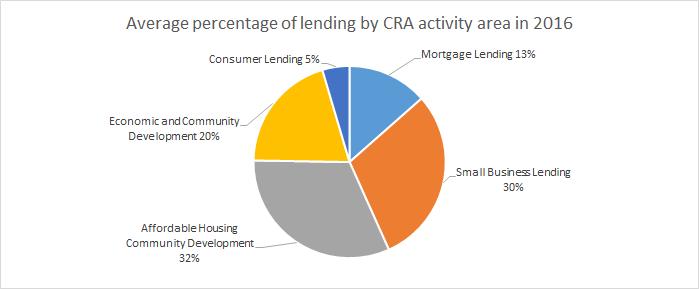
There are a number of ways for banks to meet community credit needs; this chart shows the average percentage of lending by CRA activity area of the surveyed banks in California in 2016.
CRA activity in California is also done through investments, such as tax credits or equity investments. Tax credits such as Low Income Housing Tax Credits and New Markets Tax Credits enable the development of affordable housing and economic development. EQ2, or Equity Equivalent, is an example of an equity
investment which serves as a capital product for CDFIs and their investors. CRC’s benchmark is for at least 0.25% of annual deposits to be devoted for community development investments, of which no more than half should be for tax credits. Of the 20 banks that shared information about their CRA activity, 12 met
11 According to CRC’s performance rankings utilizing the metrics found in the “Gold Standard,” which can be found in the Appendix.
CRC’s benchmark of at least 0.25%, with four banks reaching significantly beyond this benchmark, to more than 1%, with the highest percentage at 1.55% of deposits devoted to community development investments. In terms of the mix of investments, 14 of the 20 banks that provided information did a majority of their investments as equity investments (as opposed to tax credits), which is particularly important to community-driven development efforts. Equity investments are impactful since they can be creative and highly responsive, especially for investments in local CDFIs, which can use them in flexible ways to meet local credit needs.
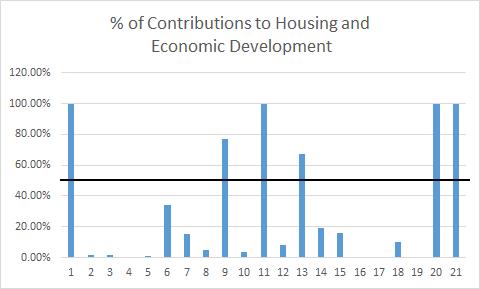
Philanthropic giving is also a type of CRA activity; it is critically important to building and maintaining the capacity of local groups engaged in community development. CRC’s benchmark is at least 0.025% of California deposits devoted to philanthropic giving, with at least 50% of that amount devoted to housing and economic development activity. Only two of the surveyed banks reached this goal, with another two banks reaching 0.020% and 0.023%. This indicates significant work to be done in encouraging banks to increase their philanthropic contributions. It is easy for banks to talk about what projects they are funding and to receive media attention for this work, but CRC data shows that their actual giving does not match community needs.
Banks’ philanthropic giving often does not match community needs, with only two responding banks meeting or exceeding CRC’s benchmark of 0.025% of California deposits devoted to philanthropic giving.
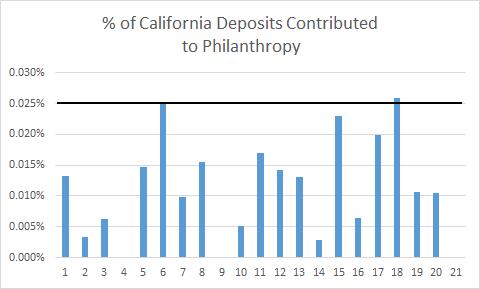
While most banks’ philanthropic giving did not meet CRC’s goal of 0.025% of California deposits, six of the banks that reported data for this question were found to be giving more than 50% of their philanthropic spending to housing and community development.
2. Smaller banks doing business in California perform better overall on CRA than their larger peers.
Looking at bank size (via size of deposits) is helpful to evaluate a bank’s CRA performance: it allows for easy comparison between banks of different sizes, is easily verifiable using public FDIC reports, and shows how well a bank is reinvesting deposits back into communities as a share of their activity. Our data shows that smaller banks (those with California deposits under $10 billion) have been more successful
with CRA activity than the largest banks. This may have to do with the fact that smaller banks are more likely to seek regulatory approval to merge, and know that their CRA performance will be evaluated by regulators. In 2016, small banks that responded to the question had an average of 11.6% of California deposits for CRA activity; in the same year, the mega-banks (above $50 billion statewide) averaged 3.8%. This indicates that mega-banks are failing to meet communities’ needs in terms of CRA activity as measured by their size of deposits in California.
Hope of the Valley Rescue Mission, a non-profit in the San Fernando Valley, sought to construct a 30bed homeless center in Sun Valley, to provide focused care for homeless patients being released from the hospital. This eliminates hospital “dumping,” provides a menu of recuperative services, and does case work for placement after patients have recovered.
Pacific Coast Regional Corporation, a small business development corporation and CDFI, worked with Hope of the Valley to guarantee a $1.6 million bank loan through a state guarantee program, creating access to bank financing that the nonprofit would not have been able to access on their own, and allowing the bank to better serve the community, consistent with CRA goals. The homeless center was sorely needed, as evidenced by the fact that Kaiser Permanente had many of the center’s beds spoken for before the center was even built.
3. CRC-negotiated agreements lead to more reinvestment in communities.
CRC data show that banks with CRC-negotiated agreements reinvest roughly twice the amount of dollars back into communities (with bank size taken into consideration). The CRC negotiation process involves bringing together banks and communities so that financial institutions better understand the needs of those they are serving. This allows for commitments to be made that
provide community lending, investments, and services that are truly needed and are flexible enough to fit within the bank’s business model and set of expertise. CRC benchmarks help outline expectations of types and size of investments for banks, but the negotiation process allows for banks to meet the needs of the specific communities they operate in and for communities and banks to become mutually invested in the success of the other.
In 2015, CRC and community members negotiated a multi-billion dollar CRA agreement with one of the largest depository banks headquartered in Los Angeles County. Los Angeles LDC, a community development financial advisor, was one of the community groups that reinforced the bank’s decision to open a branch in the primarily African-American Crenshaw neighborhood, where the bank had not previously operated. Prior to this, the bank had operated only in very affluent areas and business districts. The new branch replaced a limited service check cashing business, and since opening in 2017, has met all of its business development goals and is on track for a successful 1st year.
The bank made a commitment to seek out new customers in local communities of color. In doing so it was necessary to take the time to understand the community needs and hiring a bank manager and other team members who grew up in the neighborhood has been a key to its early success. “By bringing the best talent to the Crenshaw office, the community was reassured that bank understood the nuances of serving different communities,” said Michael Banner, President and CEO of the LDC. “I believe that relationships are important when you’re working in communities of color,” he continued, explaining that despite Crenshaw Boulevard being a competitively-banked neighborhood, people of color still had unmet banking needs.
4. Community groups throughout California rely on CRA to help low-income clients achieve financial security and would like to see banks do more.
Our survey of members throughout California garnered responses from organizations working in financial education, small business lending, affordable housing, homeownership, inclusive economic development, policy advocacy, and workforce development. Several of their communities have benefited from CRA activities undertaken by banks that have CRA agreements negotiated with CRC. Such activities have included technical assistance, down payment assistance loans, pre-purchase education programs, financial coaching, first-time homebuyer programs, capacity building, EQ2, and a loan pool that funds first-time homebuyers or acquisition rehab resale.
Survey responses confirmed that:
• Members felt more confident speaking with banks that have made public CRA commitments, as opposed to banks that have not made such commitments.
• Members felt that CRA advocacy empowered them to advocate for changes that would benefit their clients or communities, and also appreciated the chance to undertake CRA advocacy and learn more about the policy in order to assist their communities.
• There is considerable room for banks to do more in California communities; members had differing opinions on what that could look like, based on the focus of their work and the communities they operate in.
“CRC’s advocacy recently won a CRA Plan during a merger of two banks that will result in $11 billion in investment in Los Angeles over five years. One of the greatest innovations of this CRA Plan is a loan loss reserve in the amount of $200,000 a year. Each dollar of this fund will be matched by another $7 in Small Business Administration microloan funds so that local nonprofits can make micro loans up to $50,000 each to small businesses. These small loans are often no longer made by the big banks, and this will provide the life blood for small businesses that otherwise would not have access to credit or the opportunity to start or expand a business.”
Namoch Sokham, Director, PACE Business Development Center, Los AngelesCRA can be strengthened in a number of ways to make it a more effective tool and encourage community reinvestment. Our recommendations are aimed at strengthening
the policy’s enforcement mechanisms to make it a more effective policy on a number of levels.
The grading process for CRA scoring must be taken to the next level and made more rigorous. Currently, 96% of banks score “Satisfactory” or “Outstanding” on their CRA examinations, indicating a grading system that is deeply flawed and providing little incentive to banks to increase their CRA efforts. Grade inflation weakens the power of CRA and minimizes the importance of grading.
One way to address the issue of CRA grade inflation is to require clear, public plans with benchmarks. CRA regulations and implementation evaluate banks based on how they are doing in relation to their peers, not on how well banks are meeting community credit needs. Regulators should encourage banks to develop forward-thinking, transparent, multiyear CRA plans that reflect significant public input, address community needs, and that include measurable goals, such as tying reinvestment activity to a percentage of bank deposits. CRA plans are a best practice that have resulted in significant gains for communities in recent years, and are also a way for banks seeking to merge to show that the merger will have a public benefit.
Regulators should encourage CRA plans, particularly in the context of mergers that must show a clear public benefit to the community. Strong and meaningful CRA plans reflect community input about community credit needs, motivate banks by setting strong goals for lending, investment and services, and allow communities to work in partnership with banks to ensure that they are treated equitably and fairly by financial institutions.
CRA implementation should allow for downgrading when needed. CRA regulations
“Banks that discriminate, displace, and fail to protect consumers should be held accountable and see the consequences on their CRA examinations. CRA is meaningless without strong accountability. Banks should be a force of good in communities, not bad actors who prioritize profit over people.”
Paulina Gonzalez, Executive Director, California Reinvestment Coalitioncurrently allow for banks to be downgraded for certain violations, such as discrimination or violation of consumer protection laws, but should also include frameworks for downgrading banks for other types of activity that harms communities. Such harmful practices include financing and enabling displacement of residents and small businesses, violating consumer protection laws, and providing credit to predatory lenders. Regulators should conduct a comprehensive review of a bank’s community impact. Simply investing in a community is insufficient: banks must also not cause harm or break the law.
For example, Wells Fargo was recently downgraded from “Outstanding” to “Needs to Improve” (a double downgrading) for a long list of activities that harmed communities and consumers. The Office of the Comptroller of the Currency’s methods did work, in the sense that the bank’s CRA rating was downgraded, however, it did not go far enough. Had there been stronger CRA implementation and oversight in place in prior years, Wells Fargo’s problematic practices may have been caught earlier, with opportunities to strengthen internal controls before millions of consumers were affected.
Banks should be evaluated for their reinvestment activity beyond current CRA assessment areas (which are now tied to markets where banks have branches) to include geographies where they conduct business and where their depositors live. CRA regulations have not kept pace with banking trends and technology. Locations of bank branches still determine CRA responsibility even though many banks generate deposits and make loans in areas where they do not have branches. Those institutions should still reinvest deposits back into the communities from where they come, even if there is no branch present. Assessment areas should include areas where banks have branches, or where a significant number of their customers and depositors live. Requiring reinvestment only around retail branches makes much less sense today, when internet, credit card, and fintech banks operate nationally but reinvest only in the location of their headquarters.
Banks should not be allowed to receive additional CRA credit for lending or investing outside of the bank’s CRA assessment area. This leads to a dilution of investment in LMI neighborhoods that are most in need of reinvestment. The primary purpose of the CRA is to serve communities where the bank is doing business, not to encourage reinvestment where it is easiest to do so. Banks should not be able to circumvent obligations to serve the communities in their assessment areas.
Rural areas also have less access to CRA investment, especially since many of them are outside of bank full scope CRA assessment areas. With increased bank consolidation and the closing of branches, many rural areas in California have less access to banking and CRA investment than they did 20 years ago. Several
12 Ainger, Paul. RCAC.[Telephone interview].
California banks used to have a large presence in the Central Valley, and were highly involved in CRA activity. This has diminished in the past two decades with bank mergers and consolidations. 12 Not only should regulators update CRA assessment areas to include all communities where banks have a significant presence, but regulators should also designate more of these rural communities as full scope areas, rather than the limited scope review that many currently are. This will lead to greater reinvestment in rural communities and more attention paid to rural development issues.
In passing the Dodd Frank Act on the heels of the financial crisis, Congress called on the new Consumer Financial Protection Bureau to collect and report small business lending data in order to facilitate enforcement of fair lending laws and enable communities, local governments, and lenders to identify business and community development needs and opportunities of women-owned, minorityowned, and small businesses.
CRC members have long expressed that the transparency that would come from the collection and public reporting of small business lending data could be transformational in increasing access to credit to small, minorityand women-owned businesses. And yet, the CFPB has not yet developed a rule, while the Treasury Department has gone so far as to call for the repeal of this requirement. 13 The CFPB should quickly move forward with the development of a strong, small business data collection rule, and bank regulators, lenders and the public should use the data to analyze whether small business needs are being met under CRA, and whether banks are engaged in fair lending, just as has been done for years with Home Mortgage Disclosure Act data.
13 U.S. Department of the Treasury. June 2017. "A Financial System that Creates Economic Opportunities: Banks and Credit Unions," Report to President Donald J. Trump, Executive Order 13772 On Core Principles for Regulating the United States Financial System. p. 113.
CRA should be expanded to include non-banks, such as mortgage companies, credit unions, and insurance companies which currently have no CRA responsibility, but which receive similar federal benefits that allow them to do business and compete. Expanding CRA coverage to these institutions will create a more level playing field for banks, and will lead to greater financial health and wealth building for communities, small businesses, and residents.
Despite the fact that CRA was established as a direct response to racist redlining activities by banks, research shows that racism is still alive and well in determining who has access to credit. In small business lending, credit denial rates for people of color are disproportionately higher than it is for those who are white, from both conventional and government-insured small business credit (such as Small Business Administration loans). 14 An NCRC study showed that banks were twice as likely to offer help to white entrepreneurs with small business loan applications than they were to black entrepreneurs. 15
Home mortgage lending is also an area in which people of color are systematically underrepresented, receiving fewer home purchase and refinance loans than white people. 16 The Office of the Comptroller of the Currency recently issued a release to publicize that banks that were found to have discriminated might not see a lower CRA rating. This is deeply problematic: evidence of discrimination or
redlining should affect CRA ratings. CRA can and should be a valuable tool to make sure that banks invest in communities of color.
Banks can and should serve all communities, and should not harm or discriminate against communities based on factors like citizenship status or race. This can include directly providing loans and investments to immigrants, supporting community lenders and other organizations that serve local communities, and minimizing activities that purport to lower risk for banks but in actuality tend to target people of color.
Banks should ensure that employees represent the diversity of their service areas, and make language access services available to all potential clients. Banks should make loans and investments accessible to all community members, and invest and support community lenders and other organizations that serve local communities.
Immigrants, in particular, have significant unmet credit needs, whether it is a safe place to save money, or a loan to buy a house, purchase a car, start a business, or pursue a citizenship application. There is a great opportunity for banks to step in and help immigrants meet their financial needs, whether by providing credit, accepting alternative IDs or ITINs to open an account, or helping immigrants understand how to prepare themselves for immigration emergencies.
14 Cole, R. A. (2014, January). Credit Scores and Credit Market Outcomes: Evidence from the Survey of Small Business Finances and the Kauffman Firm Survey. Retrieved from https://www.mbda.gov/sites/mbda.gov/files/migrated/files-attachments/rs419tot.pdf
15Study documents discrimination against black entrepreneurs. (2017, November 21). Retrieved from https://ncrc.org/study-documents-discrimination-black-entrepreneurs/
16 The red line: Racial disparities in lending. (2018, February 17). Retrieved from https://www.revealnews.org/episodes/the-red-line-racial-disparities-in -lending/
Under CRA, the public has a right to participate and give feedback on the performance of banks during exams and mergers. This leads to better implementation of CRA, stronger enforcement, and more comprehensive CRA plans with greater community investment. The public also has the right to access information, comment on bank participation, and make their voices heard. This allows communities to advocate for support of established and successful programs, not just programs that are new and flashy.
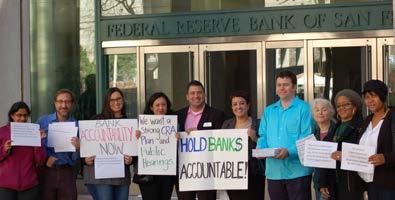
The public participation process is currently at risk on two fronts: 1) manipulation of the public comment process by corporations, often through astroturfing, and 2) an overall unwillingness of regulators to enforce strong CRA commitments from banks in the face of community opposition during the merger process.
Despite the value of public input in the CRA process, community input has been diluted, and is not sufficiently sought and considered under current CRA implementation. Regulators should conduct greater outreach to engage community contacts during CRA exams and mergers. Very few mergers will even have public hearings, despite the fact that most mergers often lead to diminished resources for communities. The reinvestment activities of two separate banks, once merged, do not often add up to the original activities of the two banks while separate.
It is clear that the integrity of the public participation process must be strengthened; this is an important piece of the democratic process. Giving citizens a voice ensures that community needs are met by banks and mitigates any harm the merger may cause in the form of decreased reinvestment or reduced
In 2015, OneWest Bank and CIT Bank merged in a process that resulted in over 100 groups protesting and over 21,000 individuals voicing their concerns. A public hearing was held in Los Angeles and a number of consumers testified with concerns about the merger, noting that OneWest had harmed LMI communities and communities of color, and that the deal could result in a bank that was “too big to fail,” especially considering that CIT had received bailout funds that were later discharged in bankruptcy. OneWest also received over $1 billion in loss share payments from the FDIC to cover costs associated with the bank foreclosing on over 36,000 California households.
access to banking services or branches. Streamlining or fast-tracking merger approvals will minimize the opportunity for communities
and consumers to comment. Regulators must work to restore faith in the public comment process, not weaken it.
In 2012, Capital One’s merger with ING resulted in such a strong response that regulators held three public hearings nationwide in order to give the public multiple avenues to participate. The merger generated thousands of comments from the public, asking for Capital One to have a CRA obligation in California: despite not having branches in the state, the bank holds a very high concentration of credit card, auto, and mortgage loans in California.
As a result of this public participation, Capital One expanded its reinvestment activity to cover more parts of California. Public comment resulted in Capital One having CRA obligations they would not have otherwise had, even though it did not go far enough, especially in covering areas outside of Los Angeles and the San Francisco Bay Area.
CRA in its current form seems to be in jeopardy, as part of a larger context of a federal retreat from fair housing, consumer protection, and inclusive economic development. The U.S. Department of Housing and Urban Development recently considered changing its mission statement to distance the agency from
fair housing, and until public backlash occurred, deliberated removing the statement, “strong, sustainable, inclusive communities and quality affordable homes for all.” 17 The Consumer Financial Protection Bureau has dialed back their enforcement of fair lending, and is not
17 HUD proposes change to mission statement, housing groups push back. Retrieved from https://www.housingwire.com/articles/42708-hud-proposes-change-to-mission-statement-housing-groups-pushback
moving forward towards a critically needed rule for small business data collection.
It is clear that the Trump administration is looking to significantly revise CRA. The Office of the Comptroller of the Currency and the Department of the Treasury have changed leadership under a Wall Street-friendly Trump administration; this administration has caved to banks on tax reform, financial regulation, and other economic issues.
However, CRA is a critical tool that brings investment to communities who need it most. CRA has resulted in the development of affordable housing, small business growth, inclusive economic growth, and neighborhood stabilization. Trillions of dollars have been reinvested in LMI communities and communities of color as a direct result of negotiated CRA agreements. CRA encourages banks to participate in their communities and to engage in meaningful dialogue with regulators and community leaders about how banks can best serve a community’s needs.
CRA is one of the most effective federal efforts to bring investment to communities that have been historically disadvantaged; this is done without taxpayer dollars. This policy, created as an immediate reaction to the practice of redlining, continues to ensure that borrowers of all racial and ethnic backgrounds can access homeownership; it also serves as a way for banks to invest in communities beyond mortgage lending, in critical areas such as small business lending, affordable housing development, and philanthropic activities.
This report has utilized data analysis from recent CRC surveys to better understand the impact of CRA in California communities, as well as outlined a number of recommendations that would strengthen CRA and make it an even more successful law. It is clear that CRA works, and can be strengthened to work even better. Weakening CRA would hurt communities in California and throughout the country, and allow banks to take a less active role in their communities.
BANK 1 has agreed to acquire, subject to regulatory approvals, X branches of BANK 2 in COUNTY, California, with approximately $X million in deposits from BANK 3 in addition to certain other related assets. BANK 1 is looking forward to working with area community groups to define and meet our corporate responsibilities, including to ensure that our business model and core commitment to community development continues to be relevant and continues to make a difference in the communities we serve.
As we hope has become evident, BANK 1 embraces its commitment to meeting the investment, lending and financial product and service needs of low- and moderate-income (“LMI”) and majority minority communities, including these communities’ individual and business needs. We certainly recognize that our company and the nation as a whole progresses when communities of color thrive and where race is never a barrier to economic opportunity. While we are currently in the process of amending our Community Reinvestment Act (“CRA”) Plan to incorporate the addition of the BANK 2 branches into our branch network, we are prepared at this juncture to make certain commitments and to establish certain goals that we believe are reasonably and fairly designed to help meet the needs of the communities for which you strongly advocate and which we believe are earmarks of good responsible corporate citizenship. These commitments and goals were developed based upon feedback from your organization and are indicative of our mutually aligned goals.
A copy of these commitments and goals will be provided to BANK 1’s primary regulator, the Office of the Comptroller of the Currency, as an amendment to BANK 1’s application to acquire BANK 2 branches, deposits and loans, and at least annually.
1. Overall Commitment. On an annual basis over the next five (5) years, BANK 1 will commit to a level of lending, investments, donations and other qualifying CRA activities that meet or exceed 20% of its total deposits in the State of California. BANK 1 will endeavor to ensure that the distribution of its CRA activity funds prioritizes low to moderate income individuals and historically underserved communities and that such distribution fairly and reasonably aligns with the diverse demographics of the COUNTY MSA within which its BANK 2 branches operate.
2. Single Family Housing. BANK will work to increase and diversify its mortgage loan originations, including through affordable home lending products, over the five (5) year period following the closing of the BANK 2 bank branch transaction with the goal of exceeding its proportional share (as it relates to the average of all lenders in the COUNTY assessment area) of mortgage originations to low and moderate income borrowers, owner-occupant borrowers in low and moderate income census tracts, and to racial and ethnic minority borrowers. To that end, BANK 1 will offer its zero down payment product in California, and will formally consider offering an ITIN mortgage loan product in the state. BANK 1 will work with local housing counseling agencies to identify flexible loan products that could better serve the community, hire staff that reflect the local community, and market to the community in language. BANK 1 agrees to abide by the letter and spirit of the California Homeowner Bill of Rights (HBOR). BANK 1 agrees to offer a variety of loss mitigation options to distressed homeowners, including principal reduction modifications, with the goal of keeping all homeowners in their homes. Where home preservation is not possible, BANK 1 will strive to offer any REO properties to nonprofits or first time homebuyer/owner occupants, instead of investors.
3. Financial Products and Services. In 2018, BANK 1 will deploy a product that will offer a low fee checking account for which the Bank will
seek BankOn certification. BANK 1 will allow individual tax identification numbers (ITIN) to be used for purposes of opening accounts as allowed under BSA and AML regulations. In 2018, the bank will, if not cost-prohibitive, waive any out of network surcharges for California public assistance recipients that use Electronic Benefits Transfer (EBT) cards. BANK 1 seeks to increase its customer base, including amongst EBT recipients, and BANK 1 will reimburse its California customers who are EBT recipients for any foreign ATM fees incurred. In 2018, BANK 1 will also commit to develop or deploy a suitable loan product for the BANK 2 branch community based upon community lending needs.
4. Economic Development. Beginning in 2018, BANK 1 will establish an annual goal striving to ensure that one-half of all the BANK 2 branch small business loans are originated in an amount not exceeding $150,000 (excluding credit card loans) and to small businesses with less than $1 million in annual revenues. To help accomplish this goal, BANK 1 will, among other things, develop partnerships and/or referral programs with local CDFIs and other local organizations that focus on and work to improve access to capital in low to moderate income communities through small business lending and other technical assistance programs. BANK 1 will refer, subject to legal and regulatory privacy restrictions, at least 20% of its small business loan declinations to CDFIs and nonprofit community lenders who might be able to make the loan. BANK 1 will also prioritize SBA lending in the COUNTY MSA over the five (5) year period following this acquisition toward businesses owned by women and racial/ethnic minorities, in LMI census tracts, and in lower loan sizes so that its lending to these groups compares favorably with and is otherwise on par with the average of all lenders in this area. BANK 1 will explore participation in the state small business loan guarantee program.
5. Community Investments. BANK 1 will commit to dedicating 0.25% of deposits annually, or X million in 2018, to new community development investments, with no more than one-half being directed to LIHTC and/or New Market Tax Credits. These community
development investments will be directed to affordable housing development, small business lending, California’s CDFIs and CDCs, and other nonprofit community development funds. Beginning in 2020, BANK 1 will commit to allocating $X per year of the .25% of deposits targeted to community development investment funds to fund grants supporting nonprofit, community-based small business lenders in California, including those that maintain loanloss reserves, like the SBA Microloans intermediaries.
6. Corporate and Supplier Diversity. By the second half of 2018, BANK 1 will adopt and implement a formal corporate supplier diversity policy/program. Among other things, the program will prioritize the engagement of vendors for the BANK 2 Branches that are locally-based and owned by members of communities that have historically been underserved for non-bank infrastructure products and services. As may be available, BANK 1 will undertake outreach and partnership efforts with local economic development council or chambers that support a mission to assist small businesses from traditionally underserved communities to provide, among other things, information or training in the area of procurement of and contracting for banking-related services and products. By 2025, BANK 1 will strive to ensure that 20% of its total BANK 2 branch, nonbanking system expenditures are with suppliers that are minority- and/or women-owned businesses. In addition, BANK 1 is also committed to partnering with community organizations to help meaningfully increase the diversity of its BANK 2 branch workforce and supplier base and to provide appropriate, periodic transparency into the demographics of its workforce and suppliers. Finally, BANK 1 is also committed to working with its existing and potential female and minority-owned supplier base to enhance engagement opportunities through technical assistance and capacity building.
7. Charitable and Community Contributions. Beginning in 2018 and continuing for a period of five (5) years, BANK 1 will make an annual contributions of at least .025% of California
deposits (roughly $X in 2018). At least 50% of annual contributions will go toward CRAqualified programs that support organizations serving the needs of low to moderate income communities, including through programs supporting: affordable housing (inclusive of fair housing, and mortgage counseling), economic development (inclusive of technical assistance to small businesses), consumer asset building (inclusive of household financial capacity development), fighting homelessness, making low cost capital available for land trusts, and legal aid to support eviction defense.
8. Community Outreach BANK 1 will commit to bi-annually hosting one or more community groups, beginning in 2018 for the purpose of reviewing, evaluating and developing enhanced or additional strategies for achieving the goals and commitments set forth here. BANK 1’s CEO will participate in at least one annual meeting, and members of BANK 1’s Senior Management will attend and participate in all bi-annual meetings.
9. CRA Resources. The BANK 2/COUNTY market will be overseen and managed regionally by BANK 1, with the assistance of a CRA Officer located in California. And, while BANK 1’s CRA department is centralized in STATE, following this acquisition, BANK 1 will assign a Regional Retail Manager in the COUNTY market who will work closely with the CRA Officer and Director and local support staff to ensure proper coverage of the COUNTY MSA.
10. Branches. BANK 1 does not intend to close any of the BANK 2 branches following the transaction. In addition, in relation to future branch expansion activities, BANK 1 will prioritize and strive to ensure that LMI communities are among those considered for new branch expansion opportunities. In addition, BANK 1 will strive to open 3 branches in LMI areas and/or neighborhoods of color (census tracts with 50% or more people of color) in the first 5 years of this plan. More broadly, in relation to future branch expansion activities, BANK 1 will prioritize and strive to ensure that LMI communities are among those considered for new branch expansion opportunities such
that at least 33% of new branches will be in LMI neighborhoods or neighborhoods of color.
11. Anti-Displacement. BANK 1 agrees to discuss with community groups the role it can play to reduce involuntary displacement of LMI individuals and people of color in its assessment areas. This may include prioritizing home mortgage sales to LMI residents, ensuring that mortgage lending and other financing activity does not foreseeably lead to displacement, and/or the developing special anti-displacement initiatives and pilot projects.
12. Spanish Language Services. BANK 1 will strive to provide in-person bilingual support at its branches in a manner consistent with its predecessor, and where such support is unavailable, BANK 1 has telephonic resources available today to provide bilingual support and will ensure that such services are available to serve the DCB communities following its acquisition. If BANK 1 expands its branching network in the future, including by entering into new communities, BANK 1 will strive to meet the language needs of these new communities as well, including by providing access in the languages identified in California Civil Code section 1632, at a minimum.