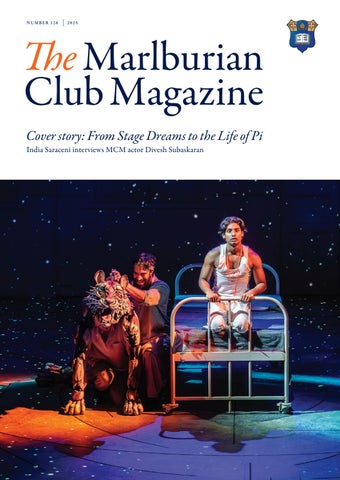
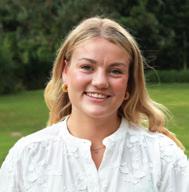
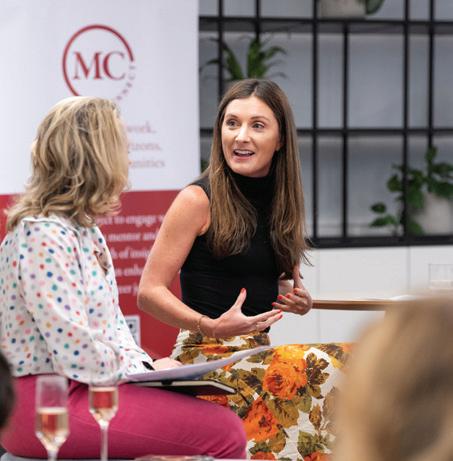
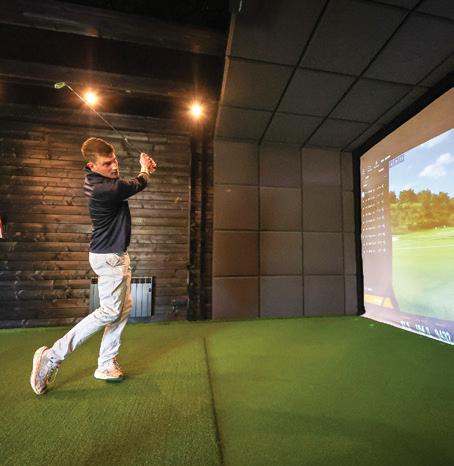
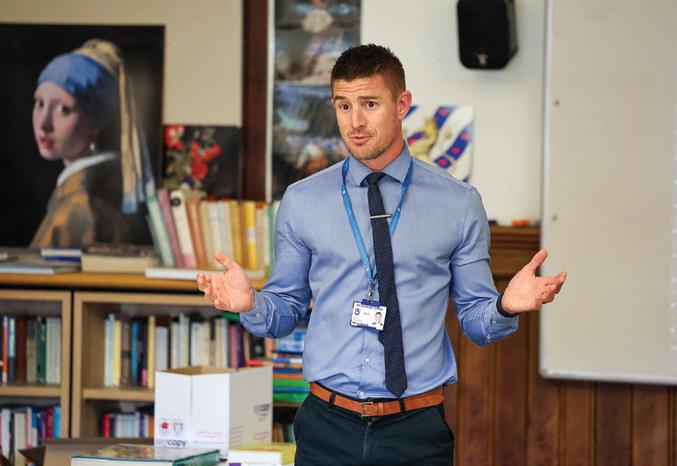
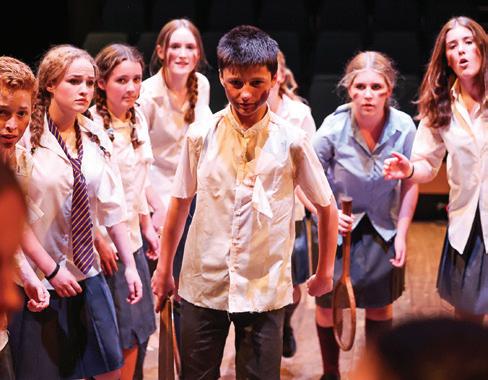
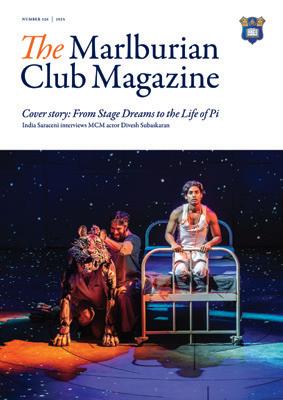
India Saraceni interviews MCM actor Divesh Subaskaran
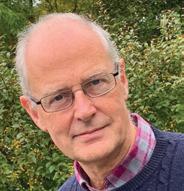
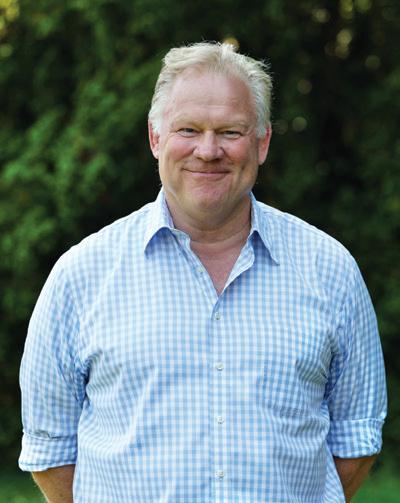
James
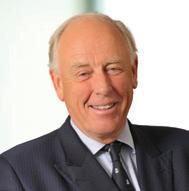
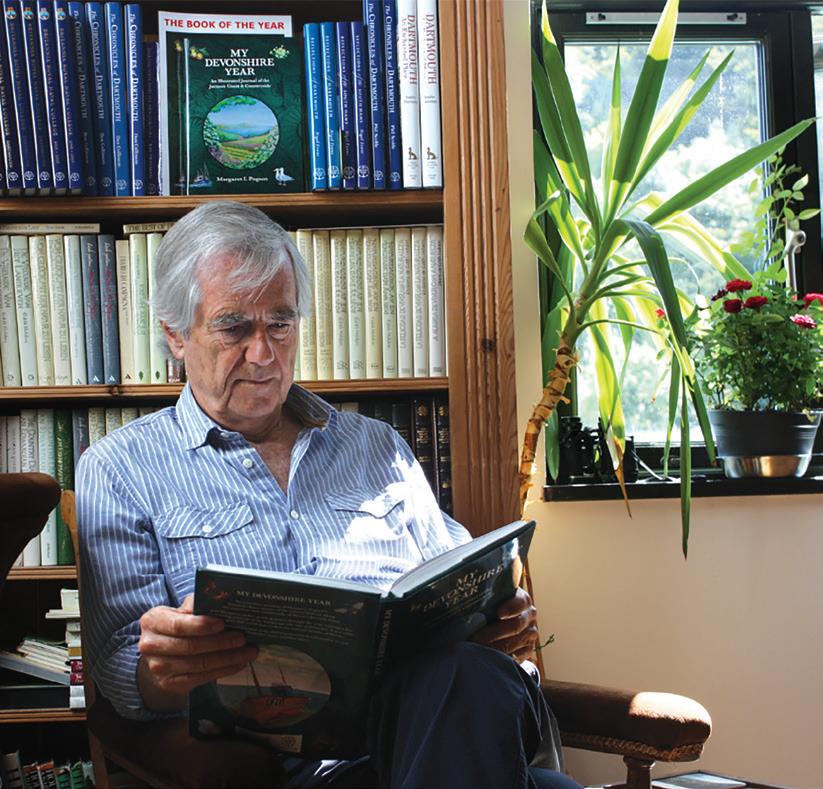
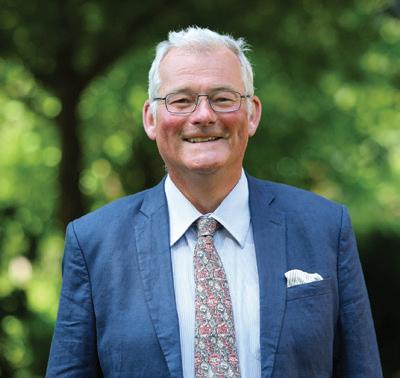
Hugh
23
Did you know?
Significant achievements from
OMs
23 OM of the Year Award
Paddy McClintock, for his campaign for mental health and suicide prevention – Check in on a Mate
26 OM Entrepreneurs
Profiles of two sustainable startups –Sapling Spirits and Batch LDN
30 Memorial Hall Centenary
Celebrating the rich history of a special building
34 How Dig took on the Dragons
Alex Hollingsworth explains how she secured an investment in the Den
37 Interior Escapes
Emma Clarkson explains how she uses her interior design skills to transform utilitarian spaces for charity
40 Mind the Gap!
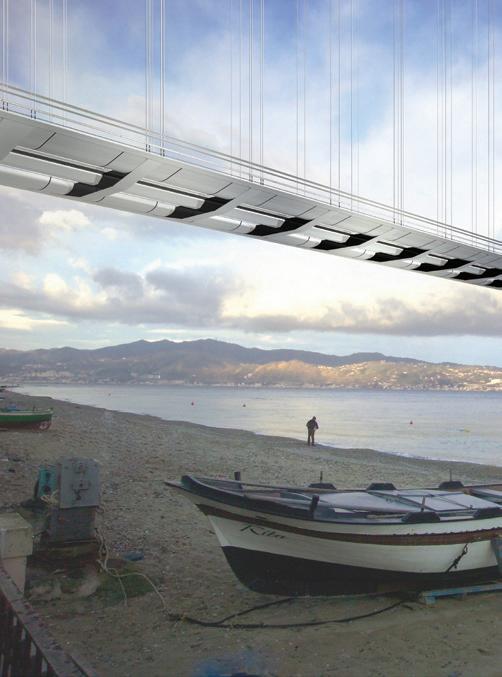
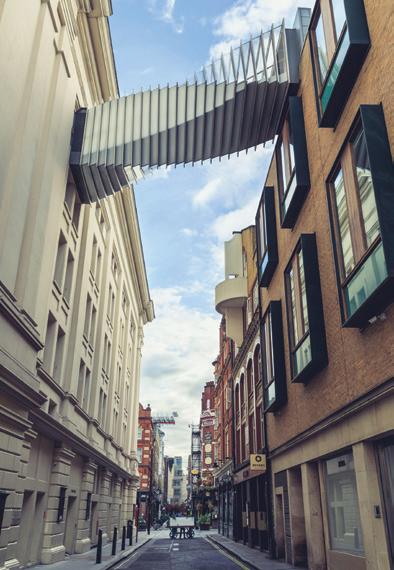
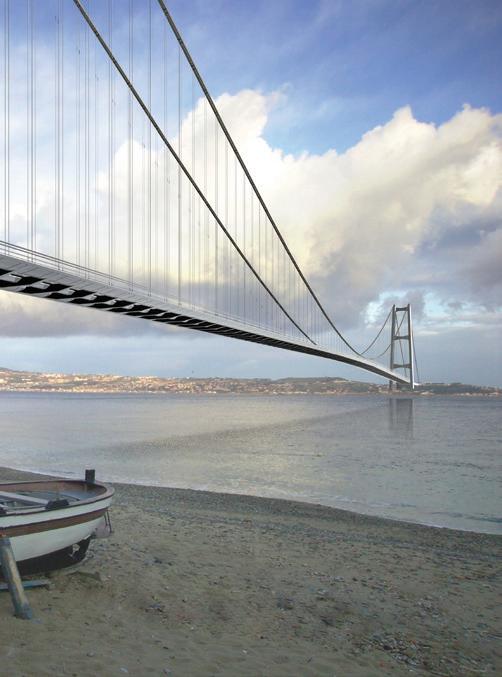
Ian Firth, one of the world’s leading bridge designers, provides a fascinating insight into his career
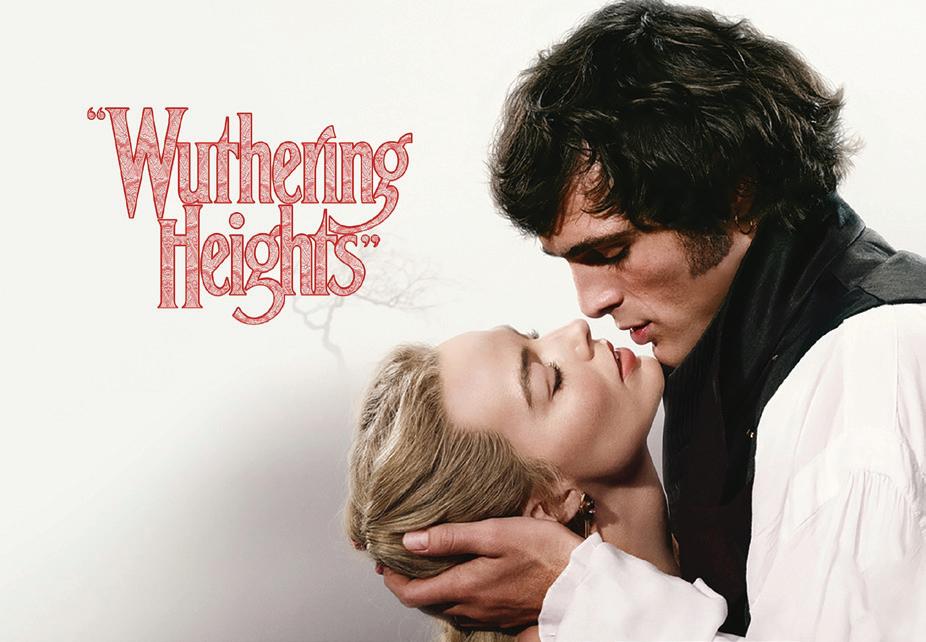
44 The road to Wuthering Heights
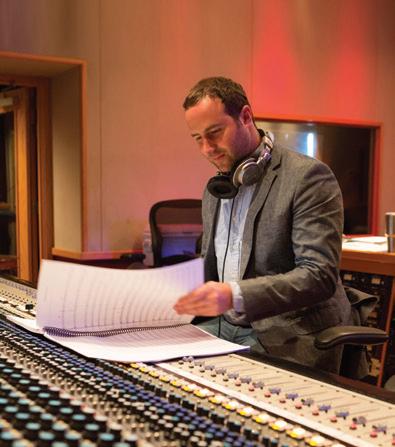
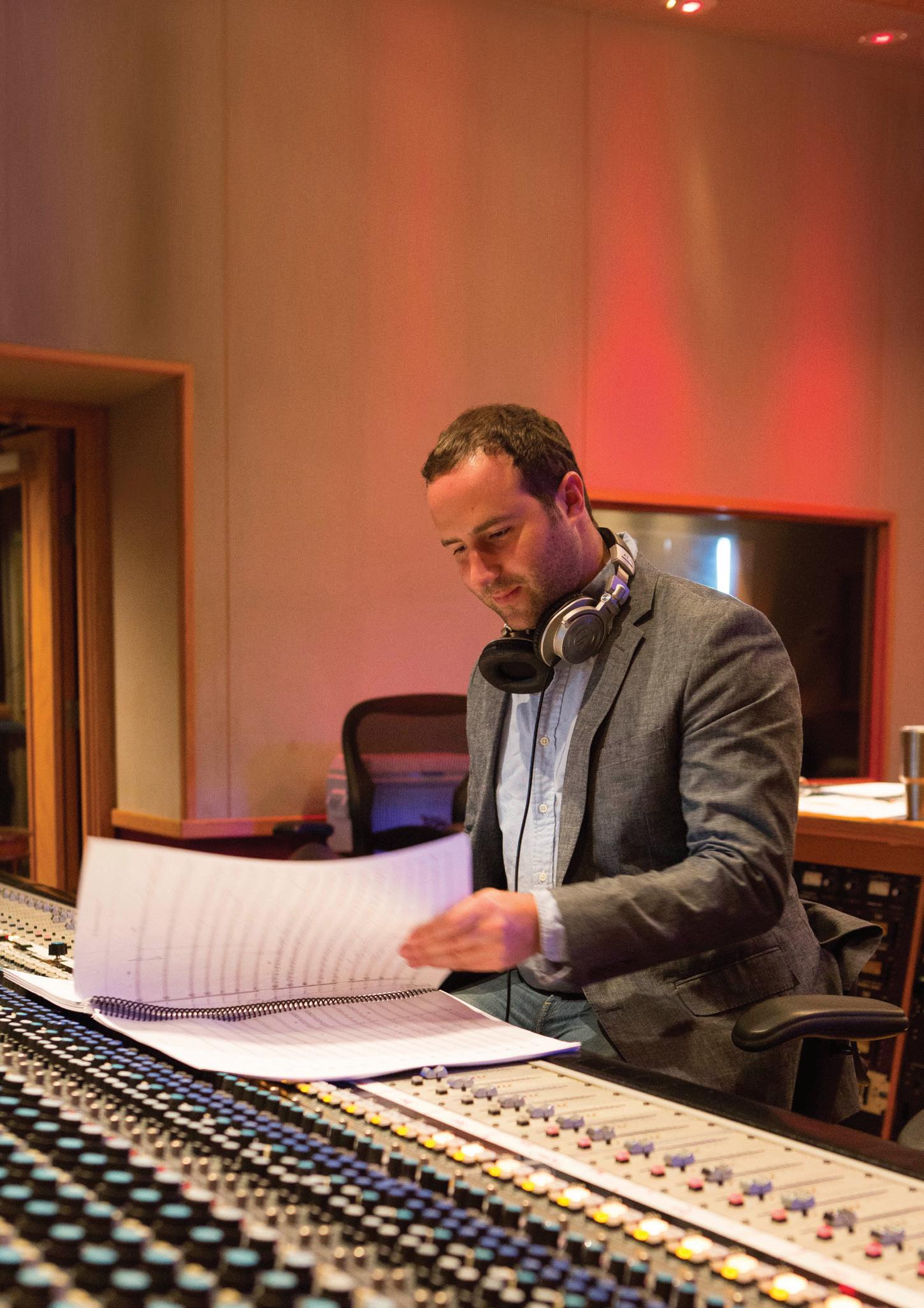
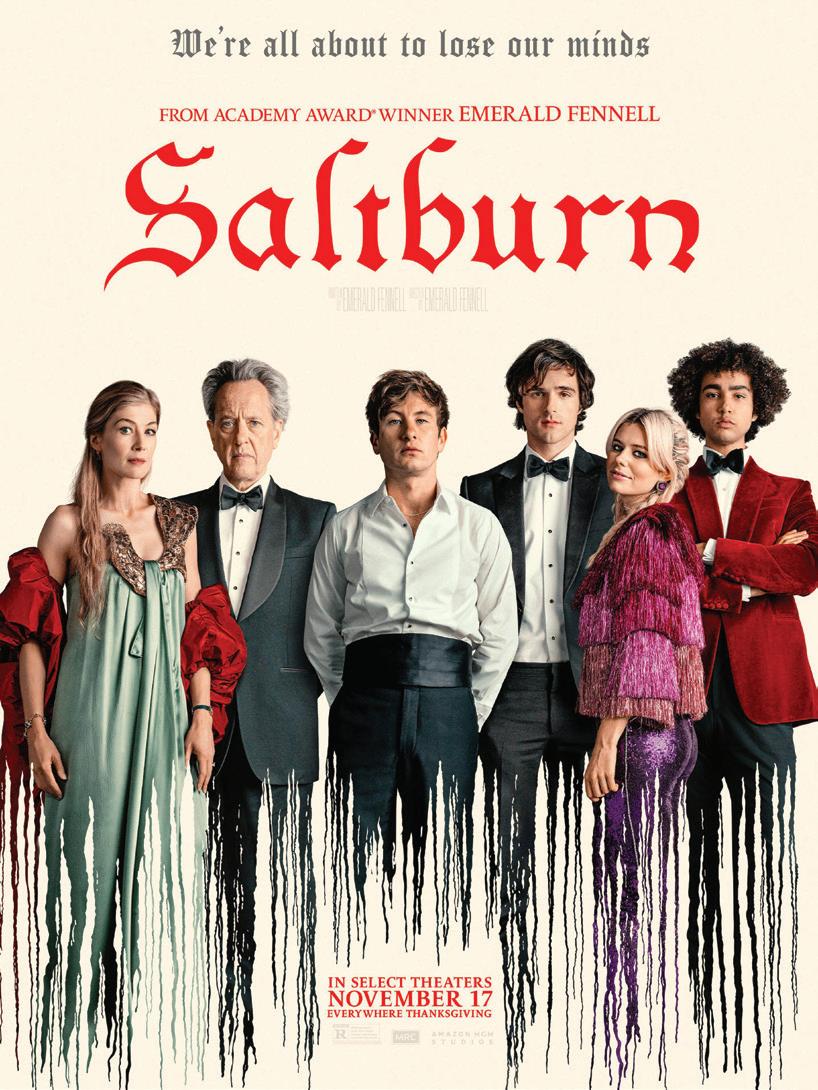
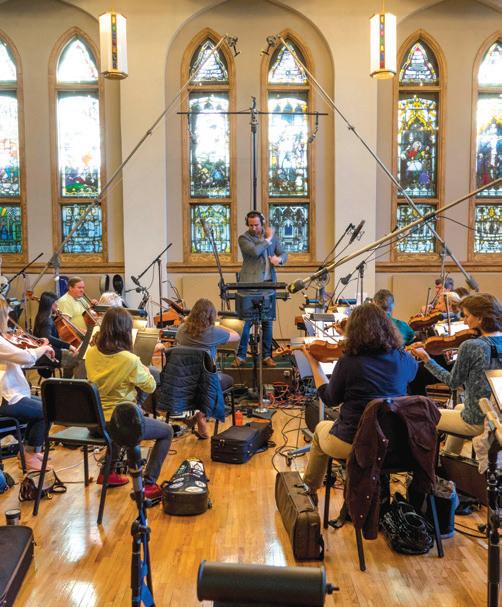
BAFTA-nominated film composer Anthony Willis speaks of his creative collaborations with filmmaker Emerald Fennell.
47 HYROX: The Ultimate Fitness Challenge
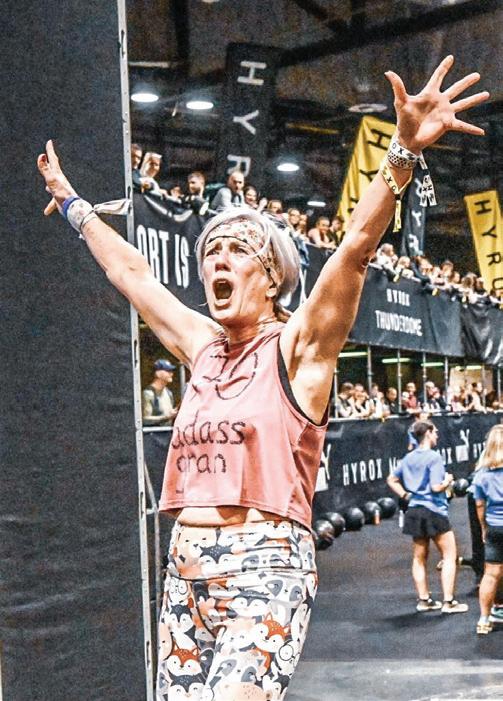
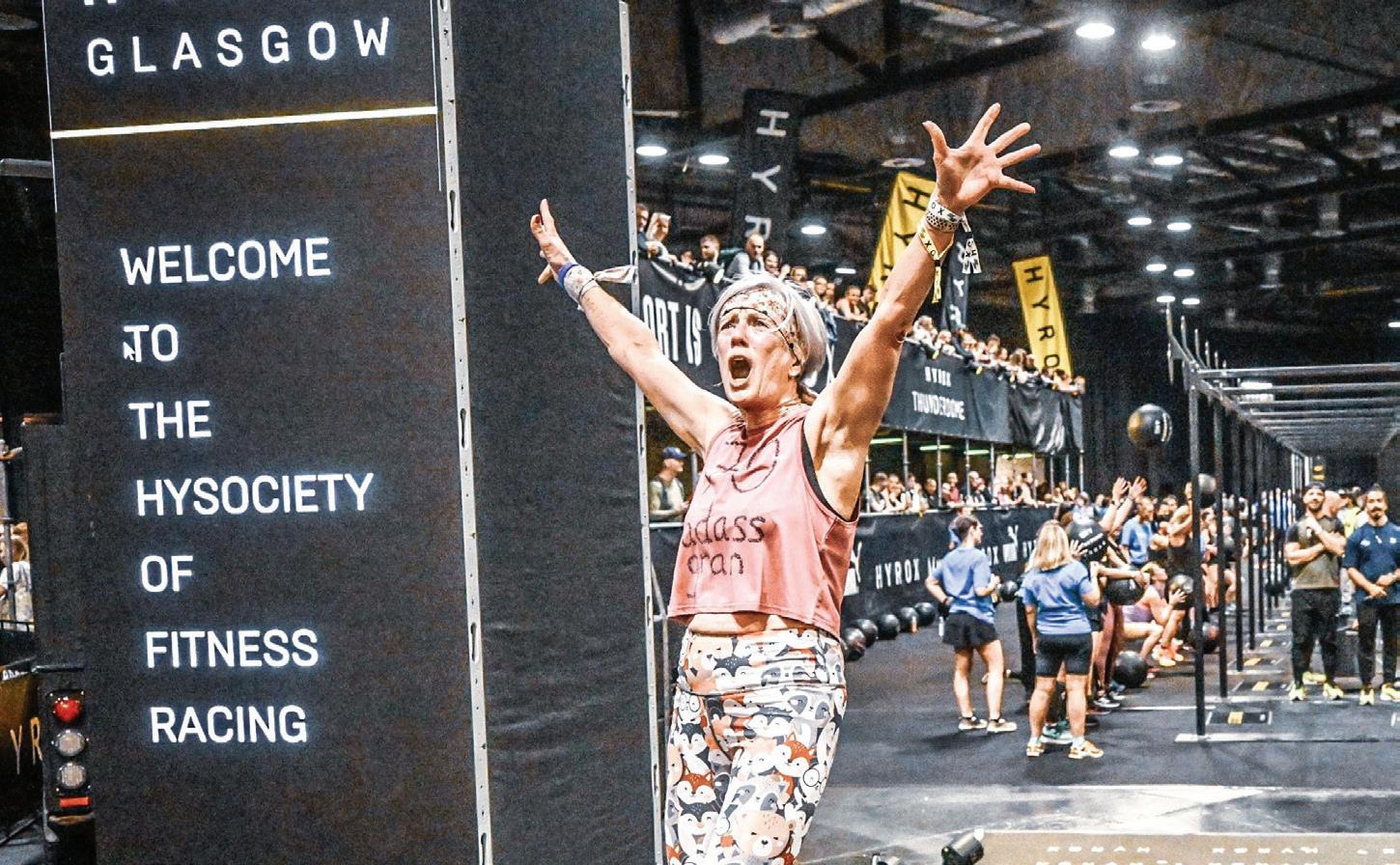
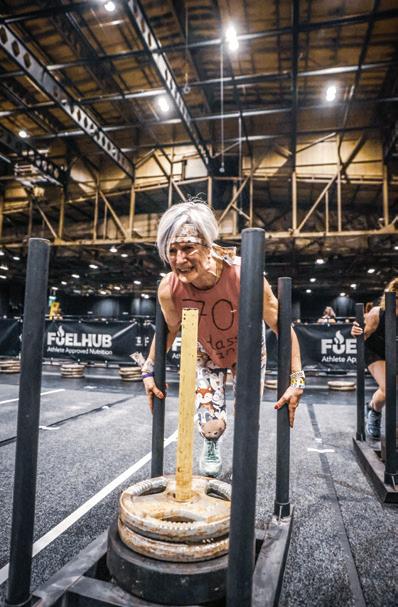
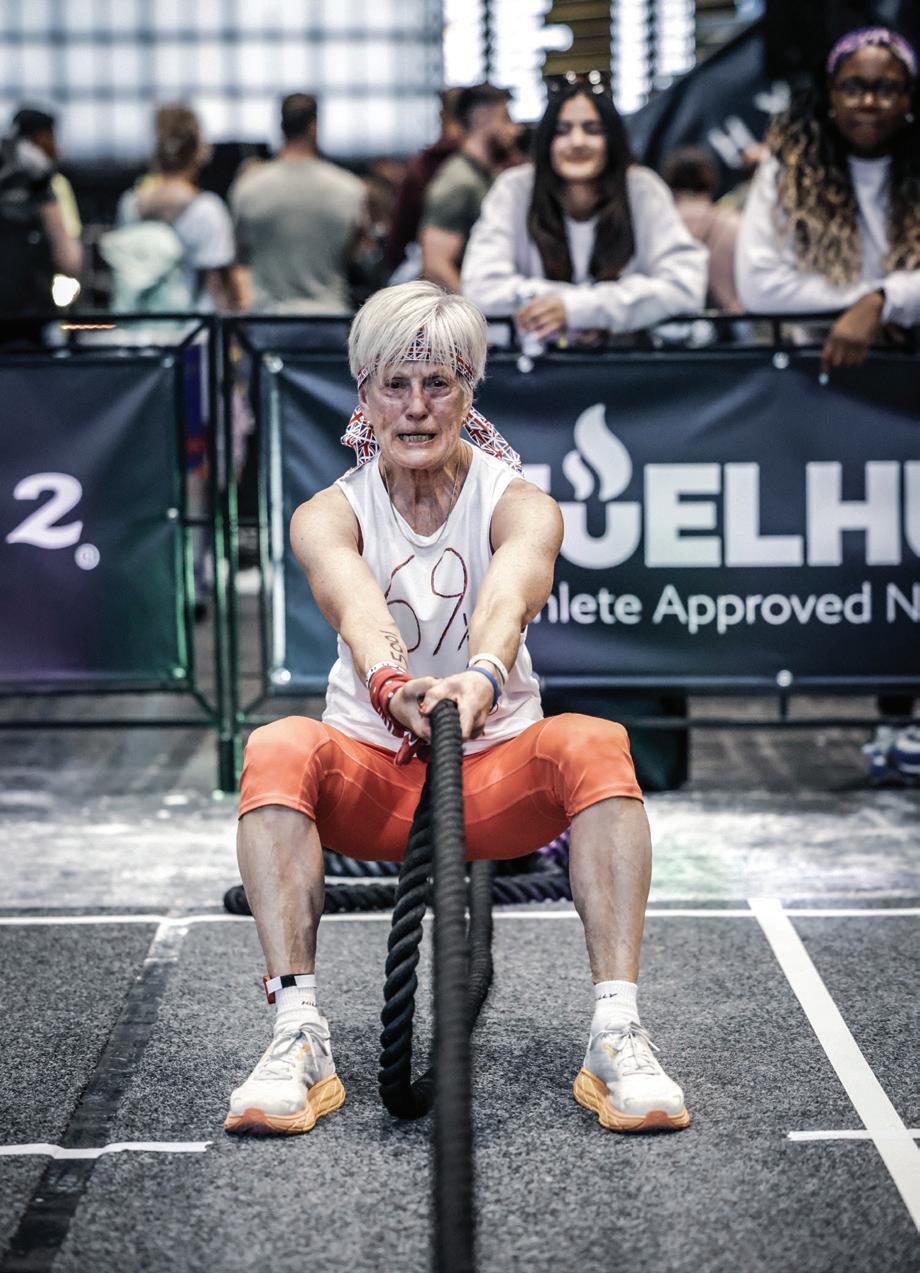
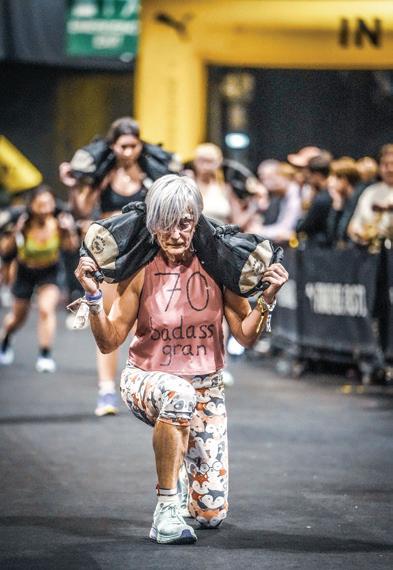
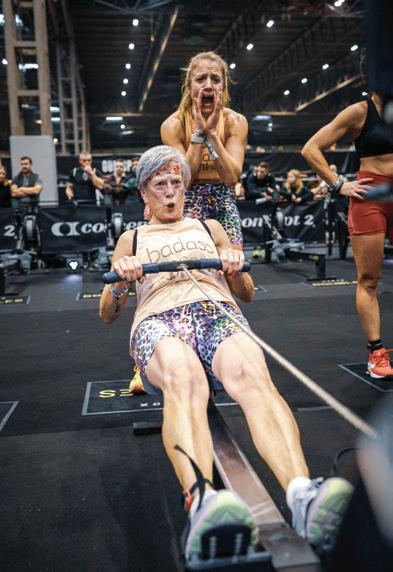
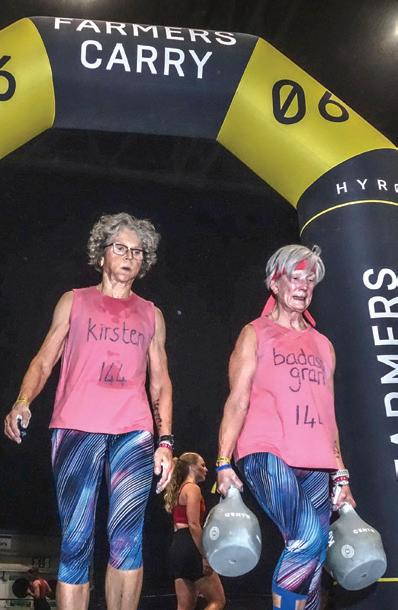
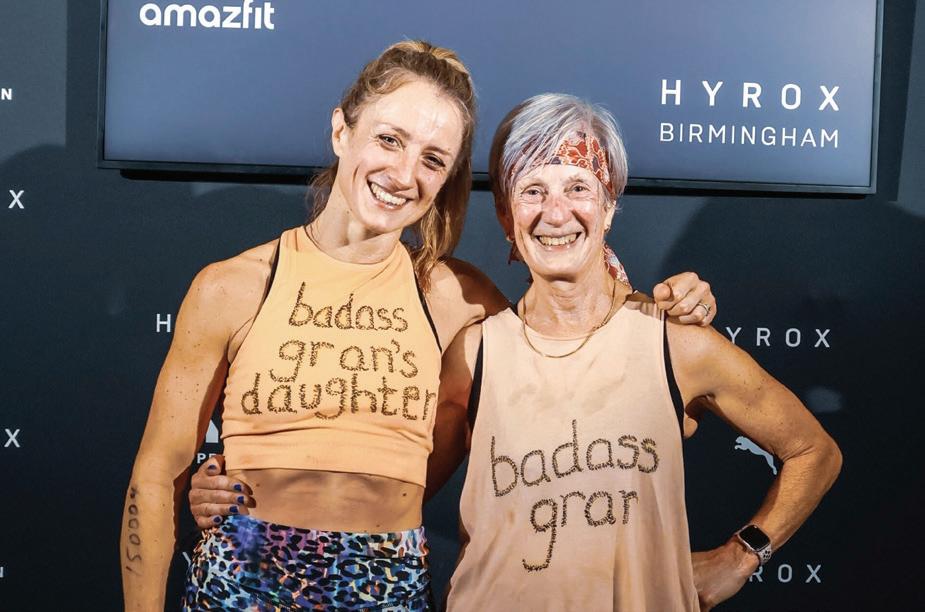
Conrad Leach finds out more about the fitness sensation Celia Duff, aka Badass Gran
50 Father of the House
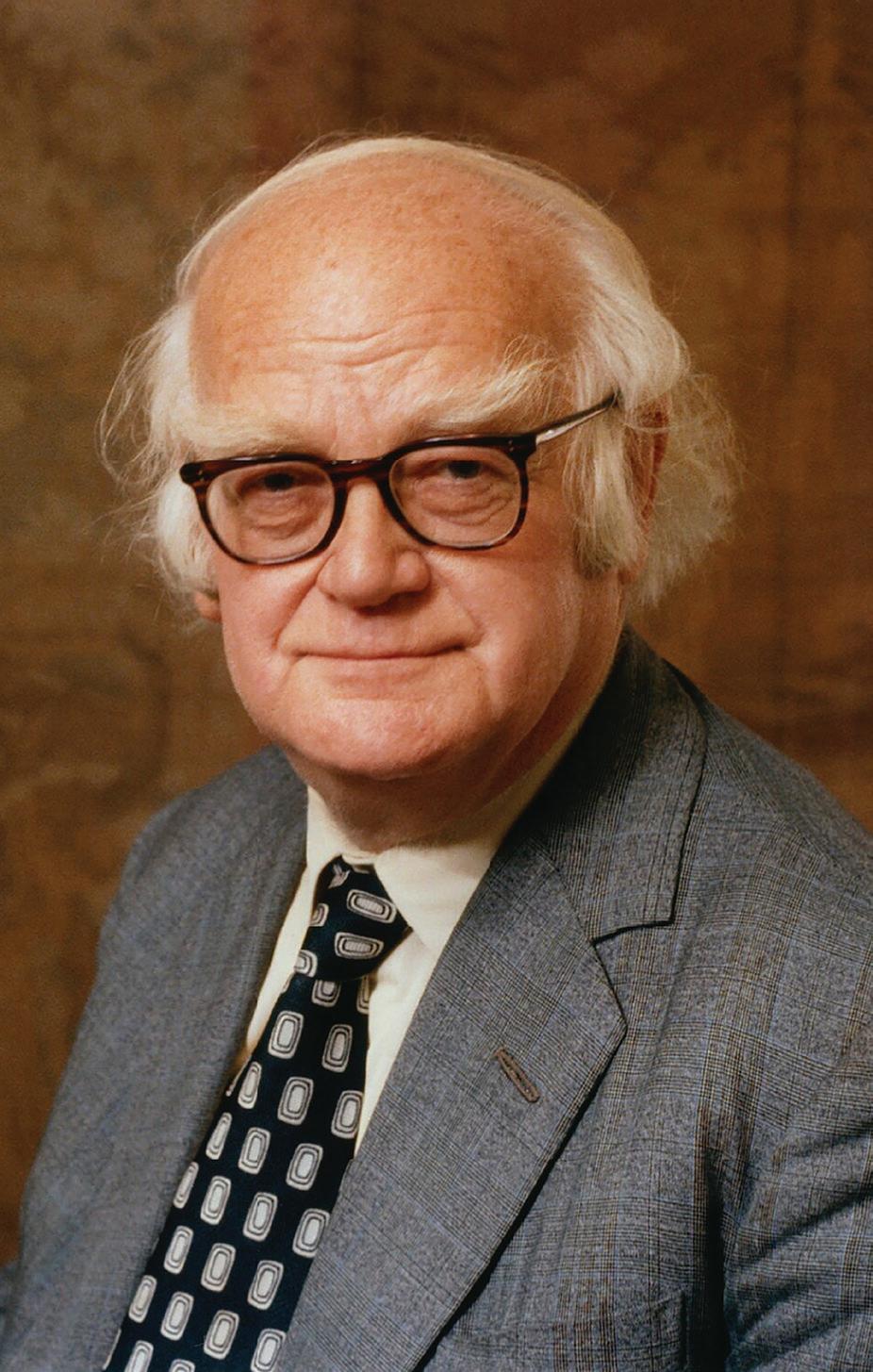
Philip Cayford brings to life the illustrious career of Labour MP John Parker
53 From Stage Dreams to the Life of Pi
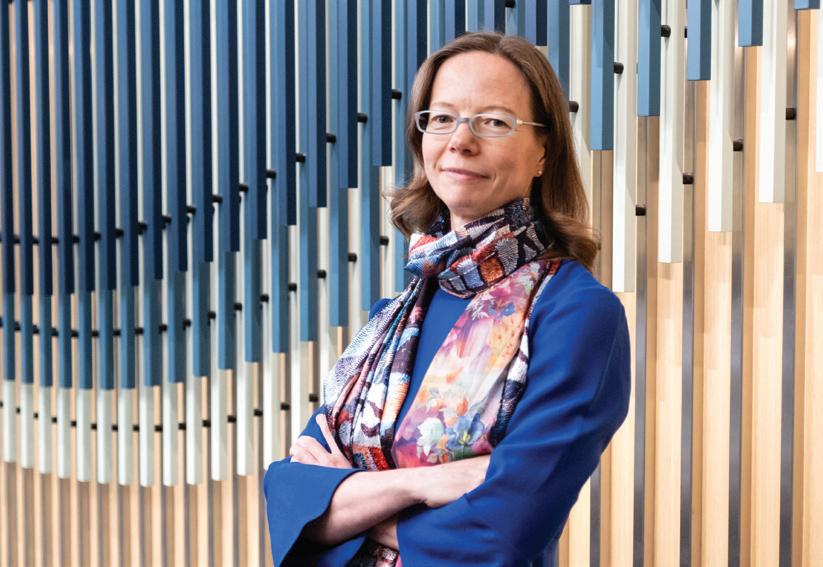
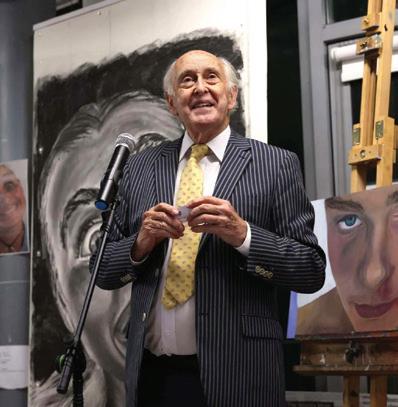
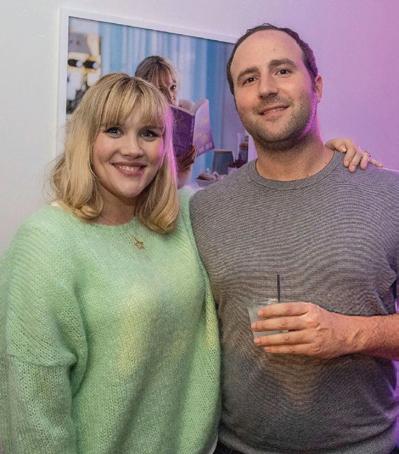
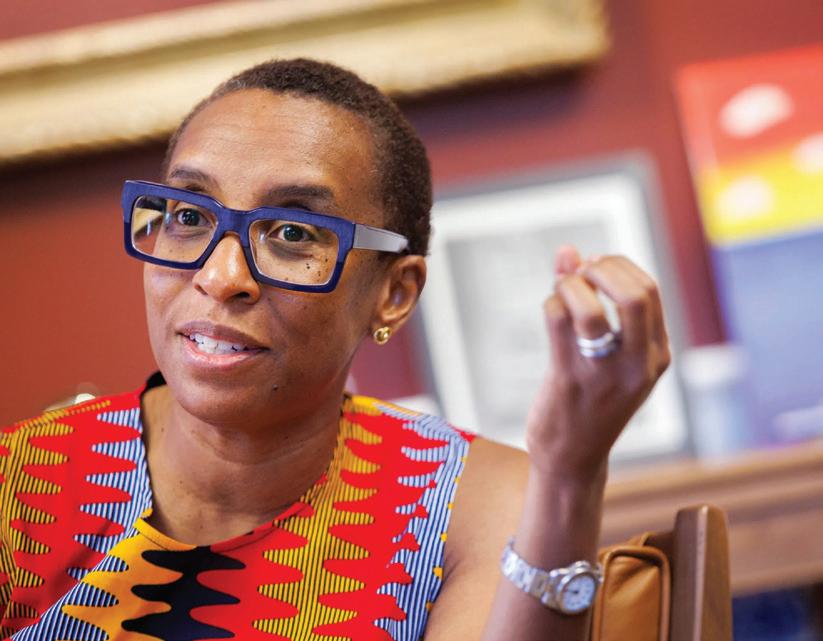
India Saraceni interviews MCM actor Divesh Subaskaran
56 Rare Books: The Reverend Glennie’s Bibles
Marking 150 years since the bequest of our historic collection of Bibles
Upfront
‘These moments have reminded me, once again, how profoundly grateful I am to have had the opportunity to be part of a place that fosters lifelong belonging and friendship.’
It is a great pleasure to welcome you to my second edition of The Marlburian Magazine. It is both a privilege and a responsibility to bring you another issue celebrating the global Marlburian community – a network of more than 10,000 readers around the world. Both the magazine and the Club events programme enable us to stay connected with one another, to hear news of old friends and rediscover that enduring sense of belonging. That sense of reconnection is what this magazine is all about.
The passing of my mother this year was a powerful reminder of just how meaningful the connections forged at Marlborough truly are, and how deeply rooted our sense of community runs. I felt this again with the sudden loss of my friend and fellow OM Dave Colbourne (B2 1979-84) His untimely passing brought our circle of friends back together and led to the creation of a WhatsApp group to help us stay connected. These moments have reminded me, once again, how profoundly
grateful I am to have had the opportunity to be part of a place that fosters lifelong belonging and friendship.
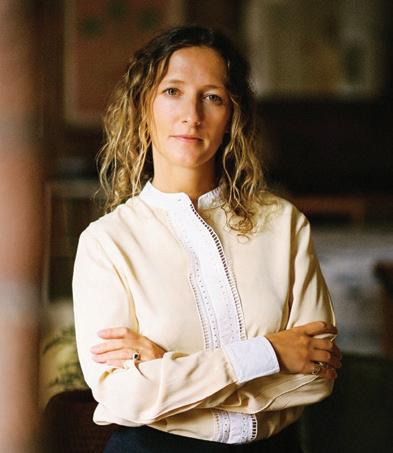
With family connections in mind, Emma Clarkson née Pocock (PR 1995-97), who has used her interior design skills to transform a women’s refuge, a drop-in centre and a homeless shelter, enrolled her daughter at the College in September. She will be the first third-generation female to attend the school since Emma’s mother joined in 1970.
From the same vintage, Celia Duff (LI 1969-71), aka Badass Gran, proves that age is just a number. She has become an Instagram sensation and a HYROX world champion at the age of 71. Her story is inspiring!
Our first OM entrepreneur visited BBC’s Dragons’ Den this year and left with an investment of £75,000. Alex Hollingsworth née Peal (EL 1999-04) co-founded Dig, a garden design business which works like HelloFresh for plants – you select your instant flower bed, perfectly tailored to your space and taste, and it is delivered to your door.
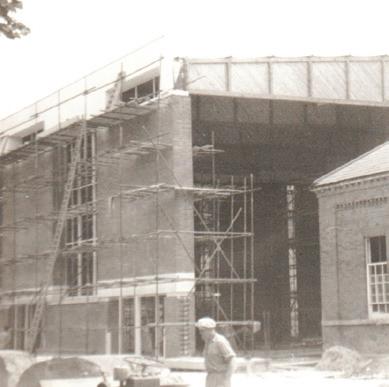
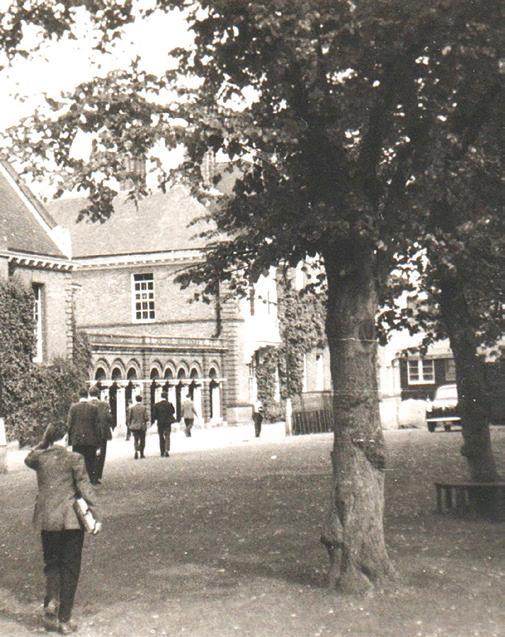
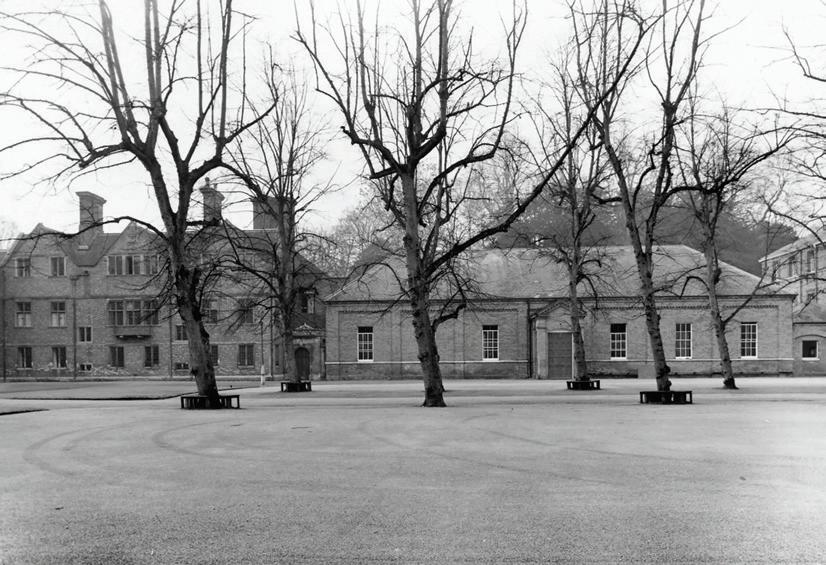
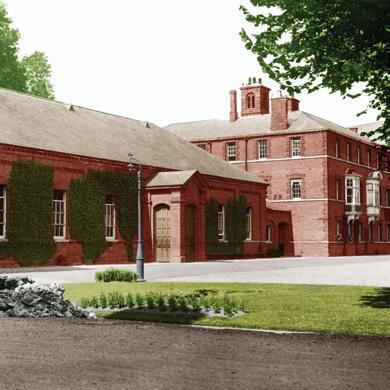
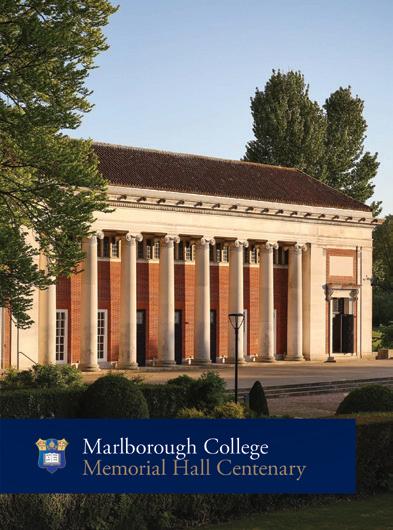
We celebrated the centenary of the opening of the Memorial Hall this year. Everyone with a connection to the College will have their own memories of the Hall. From assemblies to Prize Day ceremonies, from House Shouts to the Celebration of the Individual, from school plays, Penny Readings and musicals to Illumination, not to mention lectures, film nights and professional concerts. Andrew Brown (CR 1981-20) reminds us of the rich history in our midst.
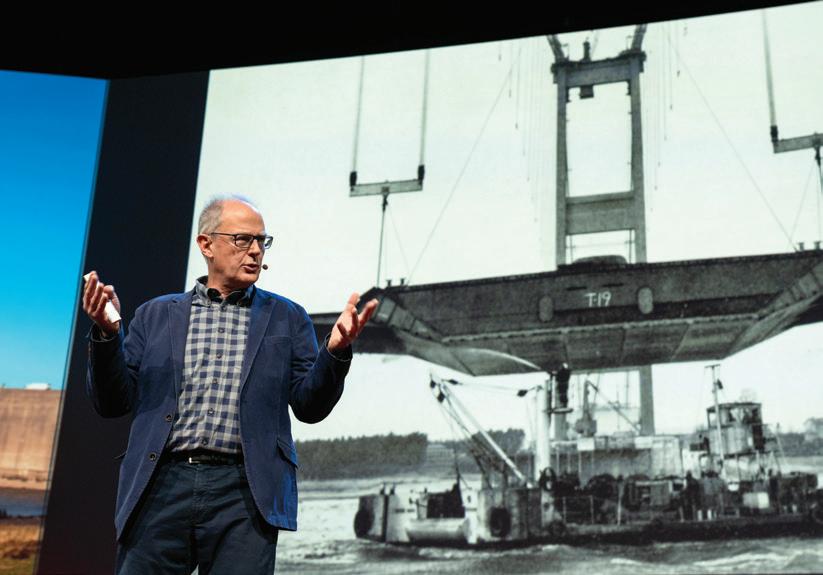
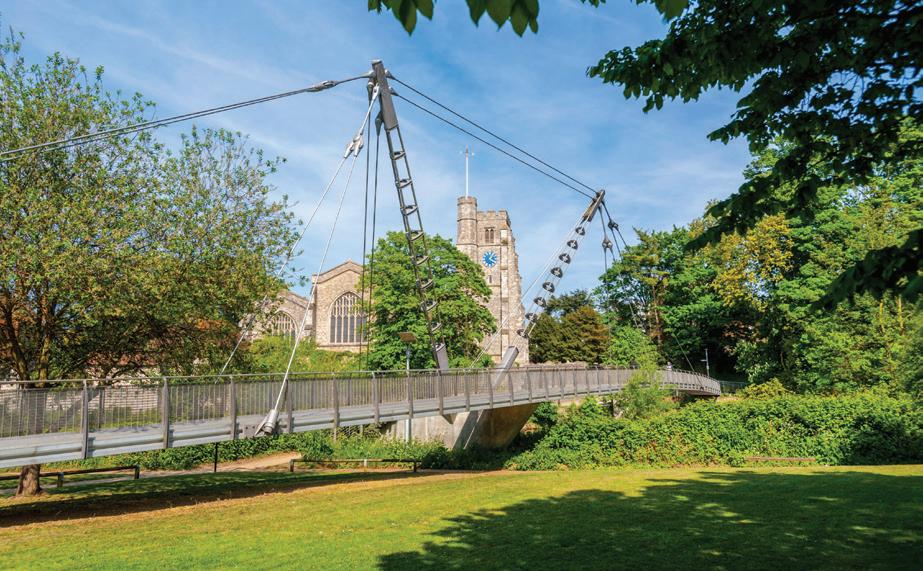
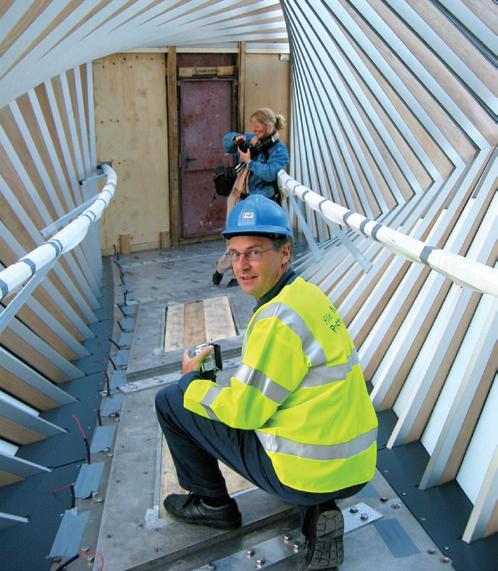
Ian Firth (C1 1969-74), one of the world’s leading bridge designers, provides a fascinating insight into his career in structural engineering. The seeds of his creative pastimes, including carpentry, pottery and metalwork, were sown at school and later found expression in bridges.
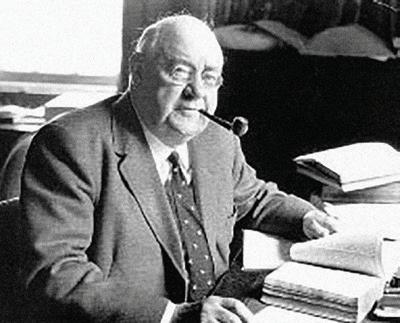
After the Labour government’s first year in power, Philip Cayford (PR 1965-70) brings to life the illustrious career in public service of John Herbert Parker MP (B1 1920-25), an OM Labour politician who sat
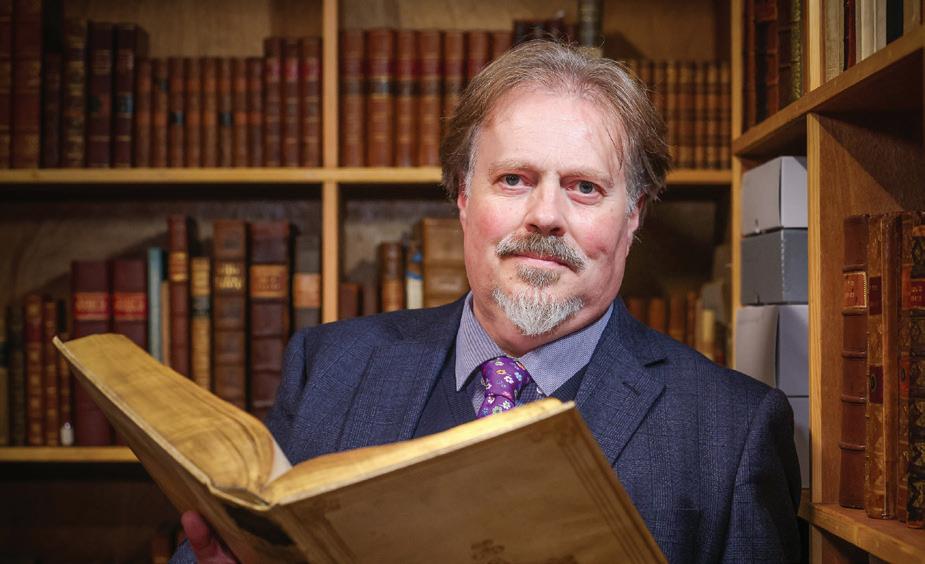
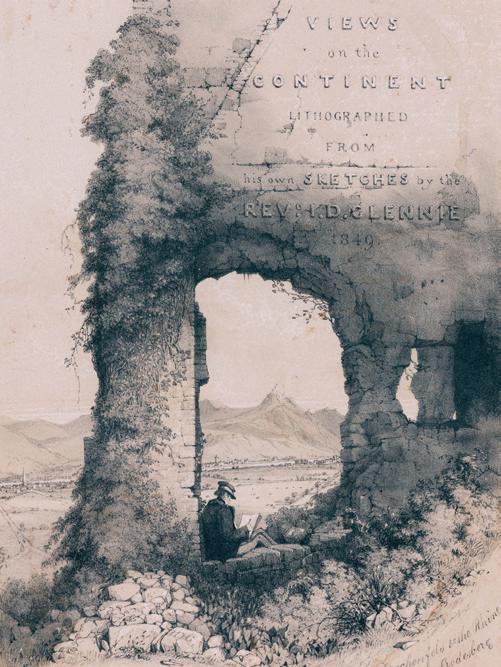
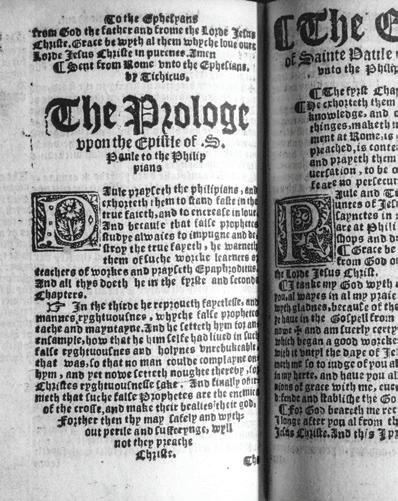
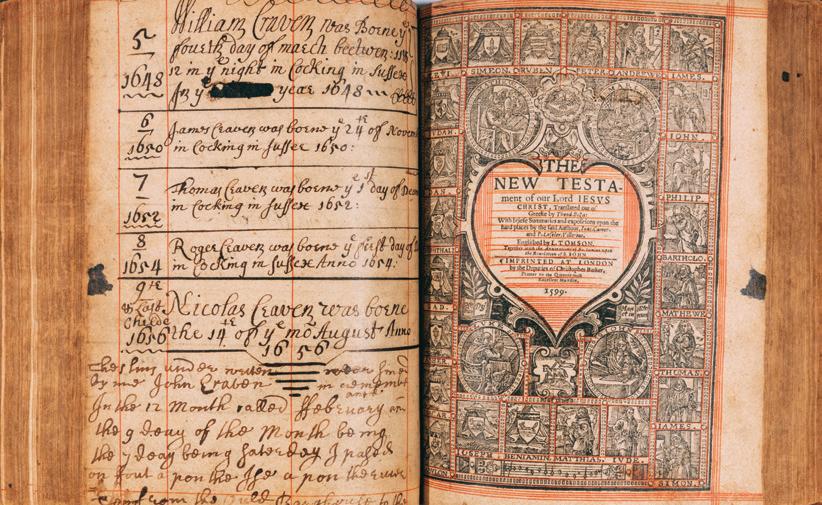
in the House of Commons for over 47 years, including four years as ‘Father of the House’. In the third of a series of articles about the College’s Rare Books Collection, Ed Parkinson (SU 2009-14) discusses the important collection of Bibles that the College inherited from the private collection of the Reverend John David Glennie (1796–1874)
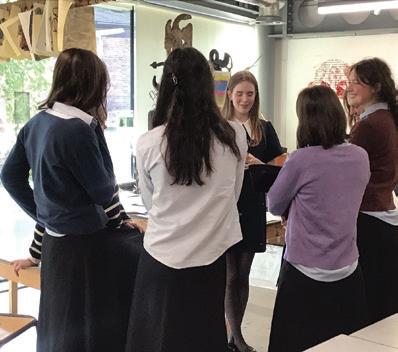
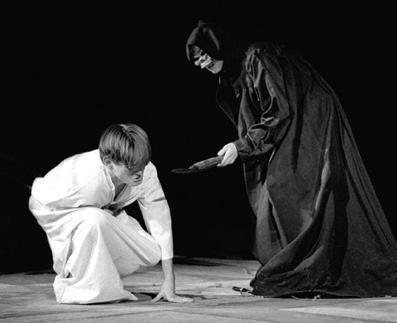
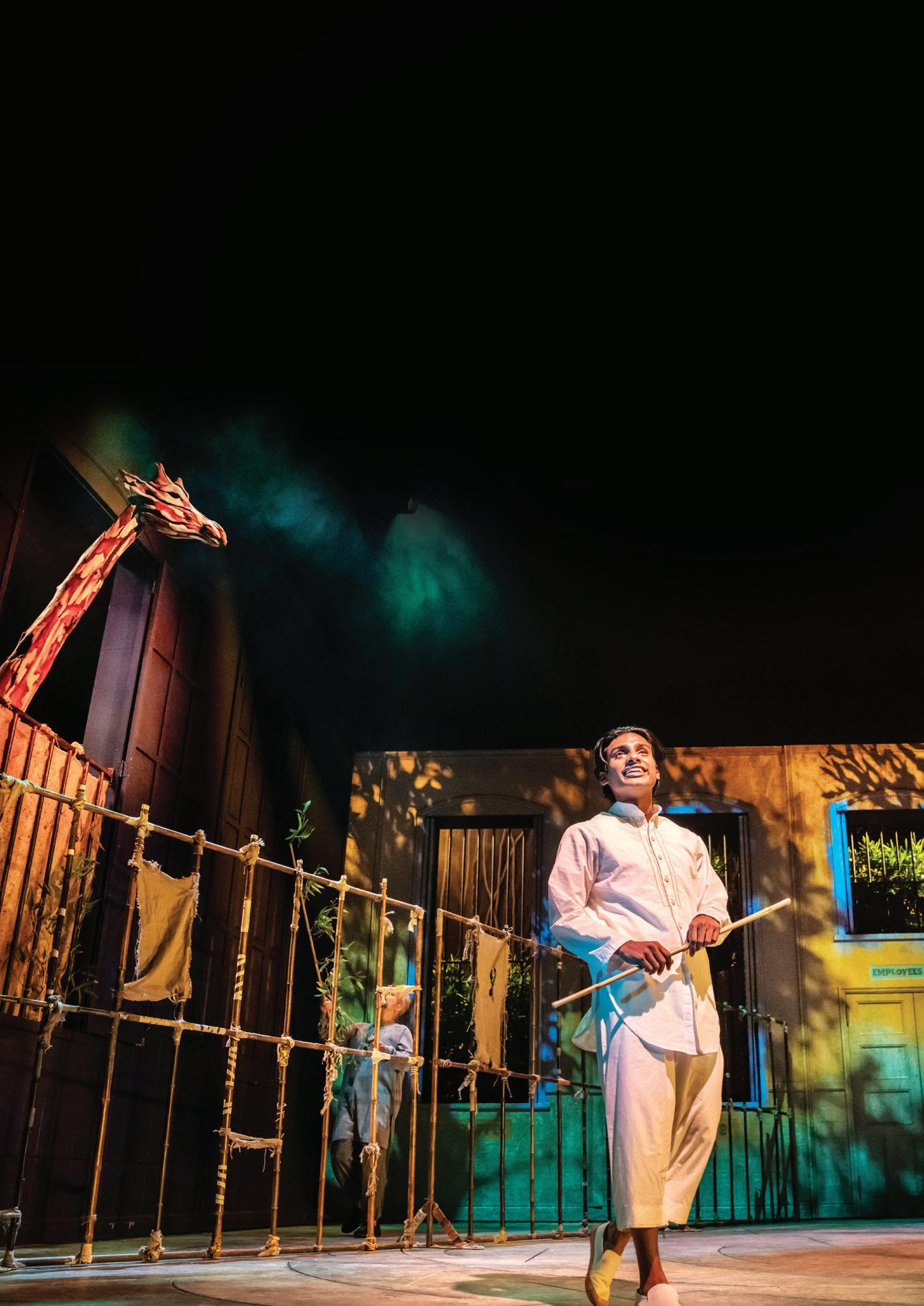
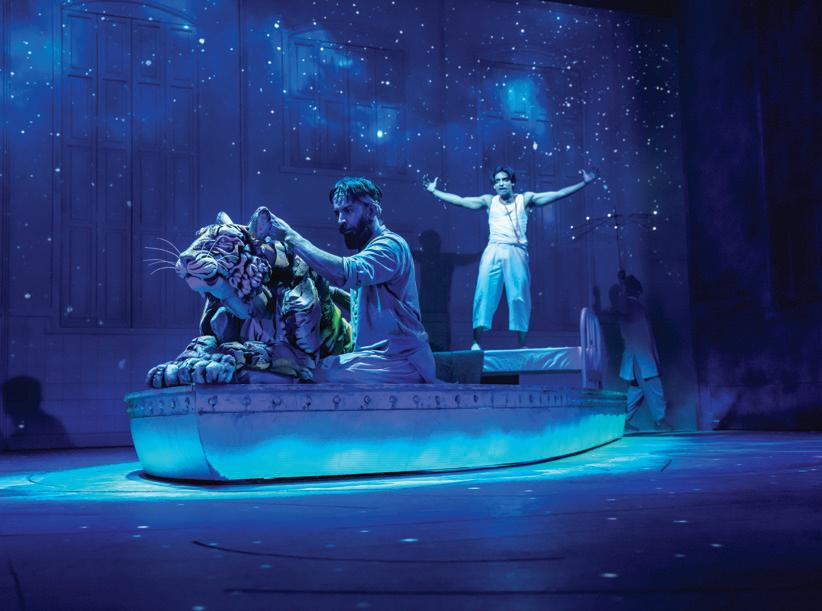
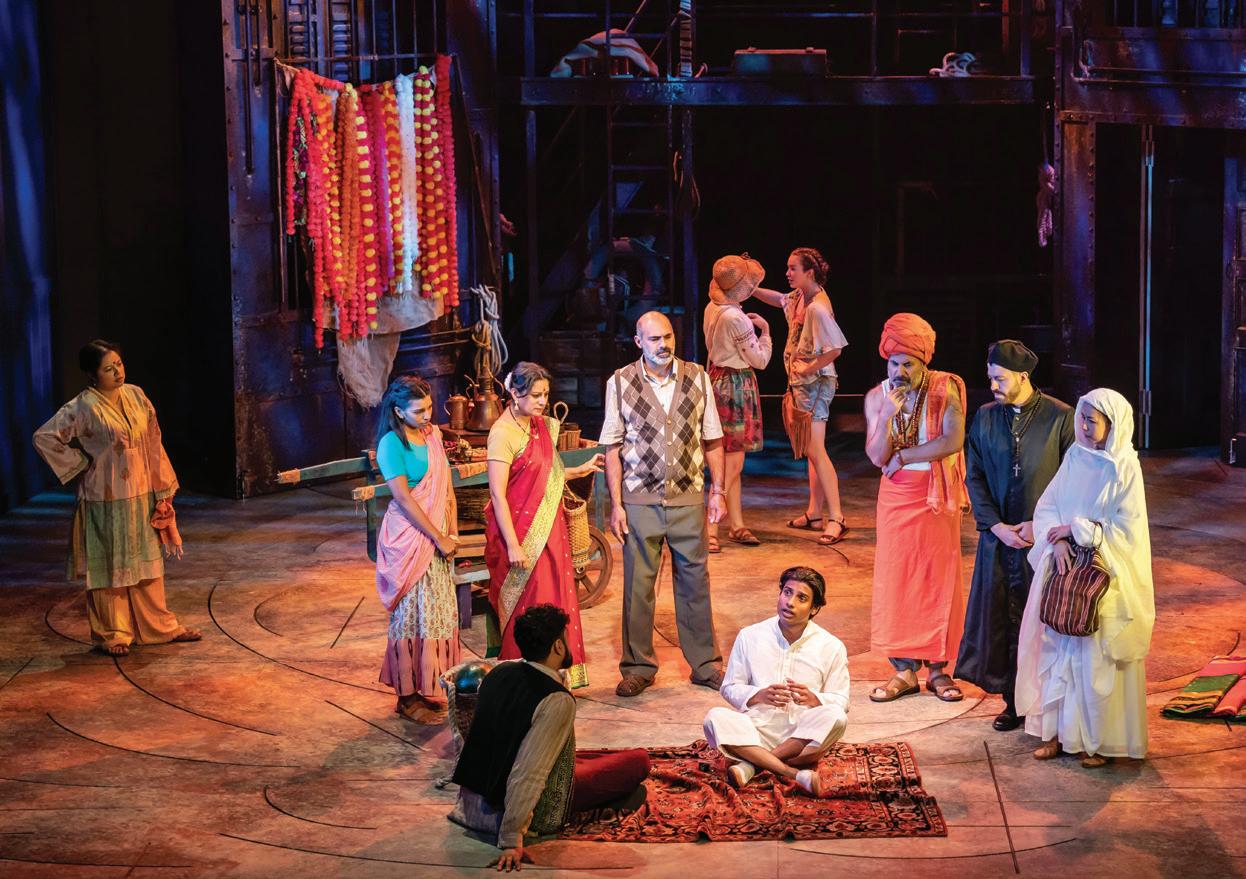
OM Divesh Subaskaran (TH 2014-16) from Marlborough College Malaysia has made waves in the world of theatre with his starring role in the acclaimed stage adaptation of Life of Pi. Fellow actor and director India Saraceni née Gaul (EL 2008-13) draws some interesting comparisons between their shared experiences.
Looking forward to 2026, don’t miss Issy Carr’s (EL 2012-17) interview with Anthony Willis (B1 2000-05). He has been composing the soundtrack to Emerald Fennell’s big screen adaptation of Wuthering Heights after the success of a similar collaboration on Saltburn in 2023. The new film is released in February. The OM community continues to provide a rich source of material for this magazine, but it is only through the commitment of time and skill from our writers that we can bring it to life. I owe them all a huge debt of gratitude.
Thank you for being part of this extraordinary community. Here’s to looking after one another – and staying connected.
Jane Green (B3 1982-84)
Editor, The Marlburian Club Magazine clubmagazine@marlboroughcollege.org
I need your help!
Please let me know if you have a great idea for an article or would like to write one. If you are an author please send me your book and feel free to write to me with reactions to the feature articles.
email: clubmagazine@ marlboroughcollege.org
Contributors
Conrad Leach (PR 1983-88)
Conrad is a sports subeditor at The Guardian
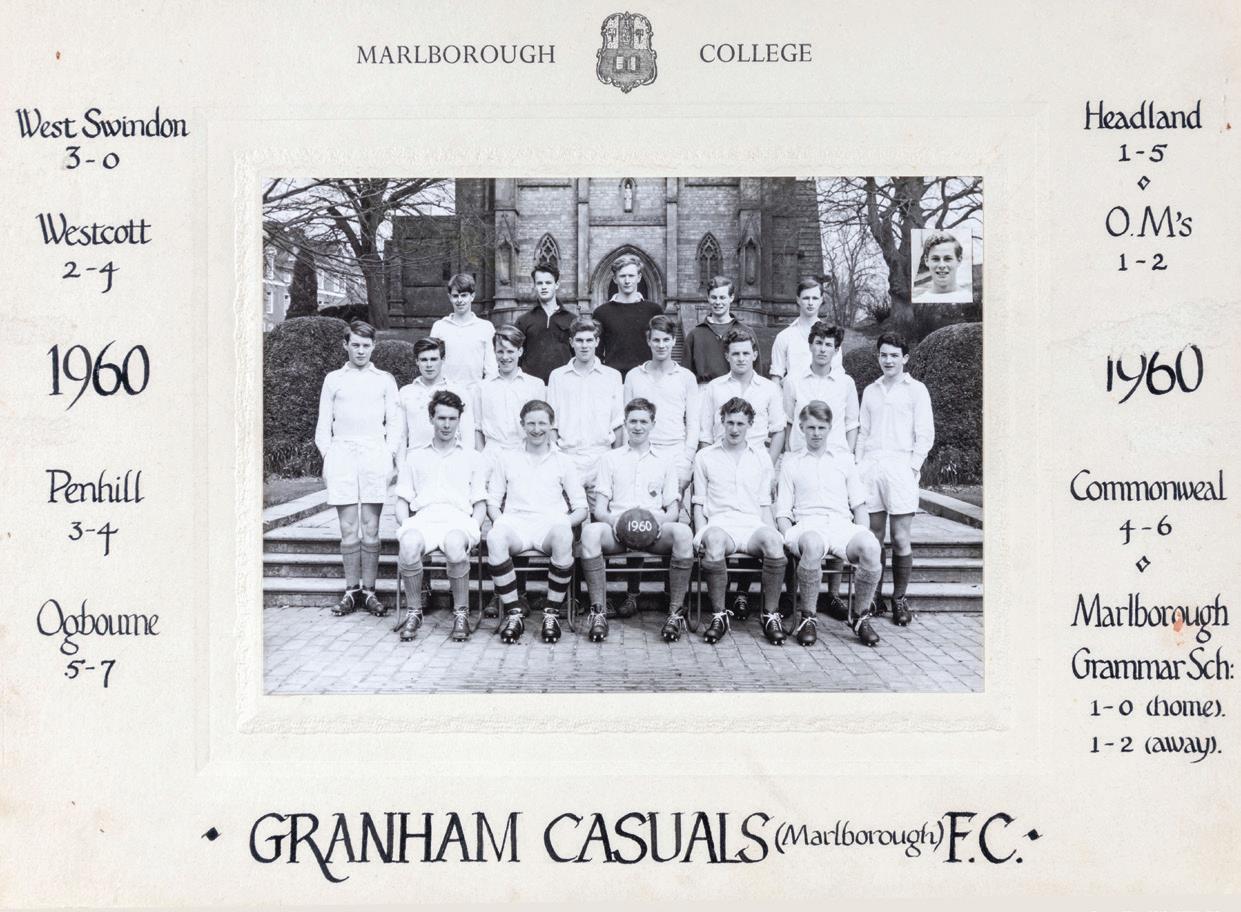
Before that he was a freelance football writer, chiefly for The Independent and The Observer, reporting on the Premier League and various tournaments, including World Cups and the Africa Cup of Nations. He left Preshute in the late 1980s and is proud to say he was captain of the Granham Casuals.
India
Saraceni, née Gaul (EL 2008-13)
Be it a West End show or a major motion picture, Indie (as she is professionally known) is consistently exploring the creative industry. As an award-winning director, actor and writer (she is currently working on her feature film debut), you can see her previous work on Apple TV, Netflix, Amazon, Sky or in the cinemas!
Andrew Brown (CR 1981-20)
Andrew taught at Marlborough for 39 years, but since 2020 he has mentored trainee Modern Languages teachers at the University of Buckingham. He keeps his College links through the Choral Society and writing the Concert Series programme notes, allowing him to carry on enjoying the atmosphere of both Chapel and the Memorial Hall.
Ian Firth
(C1 1969-74)
Ian is a leading UK bridge designer whose work ranges from small footbridges to major long-span structures, all around the world.
He is a graduate of Bristol University and Imperial College London, and now operates as an independent consultant. He was President of the Institution of Structural Engineers in 2017.
Philip Cayford
(PR 1965-70)
Philip Cayford is a practising KC, documentary film-maker and occasional journalist. After university, he was called to the Bar, where he combined a common and family law practice with an emerging passion for environmental and conservation filming, looking mainly at the illegal wildlife trade and endangered species of flora and fauna.
Simon McKeown
(CR 2009-)
Simon is Head of the History of Art Department at Marlborough but also teaches some classes of English. Since 2009 he has served as Keeper of the Rare Books and mounted various exhibitions and given talks based on the College’s collection. In 2023 he published Rare Books at Marlborough: An A–Z
Millie Perry (MO
2015-20)
Millie studied History of Art at St Andrews University, where she also edited the student newspaper, The Saint. After graduating, she joined the Daily Mail as a trainee subeditor and spent a few months at the Scottish Daily Mail in Glasgow before joining the London office. She now lives in west London.
Jemima Sissons
(MO 1994-96)
After her degree in Classical Studies at Leeds University and Università Cattolica in Milan, Jemima began her career on the news and culture desks at The Times and The Telegraph. In her early 30s she moved to Mumbai and launched GQ India. She now edits SPHERE magazine and is a contributor to other titles, including Conde Nast Traveller and Country Life.
Issy Carr
(EL 2012-17)
Issy is a film producer working with Steve McQueen’s Small Axe producers EMU and Rabbit’s Foot Films. Currently she is in pre-production on an adaptation of Edith Wharton’s The Custom of the Country for StudioCanal. At her outfit Heartburn Films she is actively developing film and television projects along with writing her debut feature.
Stay in touch with the
Please update your contact details by using our online form www.marlburianclub.org/ update-contact-details. Alternatively, you can give us a call on 01672 892 558 or email marlburianclub@marlboroughcollege.org
This Year
Iam delighted, if a little surprised, to be the incoming President of the Marlburian Club. Delighted, as it is a real privilege to work with such a hardworking committee to give back to a school that gave so much to me. Many thanks to you all. Surprised, because I must confess to not having been the most diligent of pupils: I remember being rather more interested in smoking behind the Preshute squash courts and dodging prefects in the wooded, pub-filled lanes of Wiltshire.
But, as the Master kindly reassured me when I confessed to a bout of imposter syndrome, this may have been part of the reason why I was chosen for the role. Marlborough has always nurtured and celebrated the slightly unconventional, anti-authority figure, as well as the academic and hardworking. And despite working for that most conventional of institutions today, the British government, the way the school shaped me has stood the test of time.
‘What I hope to achieve in my year is to strengthen the connections between all of us OMs, both digitally and face to face; to ensure that we continue to contribute to the marvellous Marlborough Difference Campaign...’
Because what this wonderful school gave me, in addition to a first-class education, was a group of friends for life, a sense of inner confidence and resilience, and a set of values that have helped me navigate the uncertainties and complexities of life. Which, in this fragile and uncertain world, is a priceless asset for health and happiness.
Marlborough also taught me that there doesn’t have to be a straight career path or formula for success. That variety is better than conformity. That being authentic and unconventional is fine, preferable even, and not weird. That people in authority are just humans trying to do their best, whether they are a beak or, in my case, a prime minister. And that we all need a healthy dose of humour in our lives to get by.
What I hope to achieve in my year is to strengthen the connections between all of us OMs, both digitally and face to face; to ensure that we continue to contribute to the marvellous Marlborough Difference Campaign, which allows children who haven’t had the opportunities we’ve all enjoyed to get the best start in life; and to share our skills, stories and contacts with younger Marlburians who are looking to make their own way in this increasingly confusing world and perhaps need a more experienced guide and friend.
So please OMs, help us give back to the next generation by getting involved in this amazing network. Contribute your personal stories and your time by signing up as a mentor on MC Global Connect and, if you can, your money to the Marlborough Difference Campaign, to return the gift we have all been given. And, finally, please do save the date for our flagship event for the year – the Tri Annual Dinner – on the 5th March 2026. I hope to see many of you there.
Conrad
Bird (PR
1974-78)
President of the Marlburian Club
From the Chair
‘Volunteering not only strengthens our sense of community, but also allows us to learn from one another and stay connected to something bigger than ourselves.’
11, 680 contactable Old Marlburians
This year 1, 576 attended events, including 623 who attended their first event
Over 3, 074 on MC Connect
One of the core values of the Marlburian Club is the support that our members offer, both to each other and to pupils of the College. This year has seen an especially busy schedule and we are delighted to celebrate the commitment of our many volunteers. It is only through the dedication of our members that the Club can offer such an impressive array of events and initiatives.
I would like to thank the President, the Club Committee, Professional Group Heads and Sports Captains for all the time and effort they give to assist OMs and the Club. I never cease to be impressed with the depth of discussion at Committee meetings and take this as a sign that the Club is in rude health, with Committee members who really care about delivering the best outcomes. Meanwhile, the Professional Group Heads also deserve recognition for the planning and thought they put into organising networking events of the highest calibre. Without exception, all our professional networking events this year have offered opportunities for stimulating debate and the chance to rekindle old connections and make new ones. It is also very encouraging to see the numbers of young OMs, including MCM
alumni, parents and pupils, now attending professional networks, which bodes well for the future of our Club. Our Sports Captains also continue to do an excellent job of rallying teams to represent Marlborough in a wide range of sporting disciplines. The sheer camaraderie demonstrated during these sporting events speaks to the strength of the bonds between our Club members.
A special mention should also go to the OMs who have taken part in careers activities, such as mentoring pupils and OMs and attending careers evenings. These events provide invaluable support for all looking to get on the first rung of their career ladder or wishing to change their current career path. Our thanks also to everyone who have participated in our online Marlburian Mondays, which are a popular way for members to learn from the life experiences of accomplished Marlburians.
Further thanks must go to all those who gave their time and donated items to the Marlborough Difference auction and gala dinner. This was an outstanding and highly enjoyable event in support of fundraising for the College’s goal of achieving 100 fullbursary places. I must also thank the Club Development Office for their skill at juggling so many different priorities and ensuring the Club delivers so much to us all.
Our volunteers often speak of the deep satisfaction they gain from supporting the Club. Volunteering not only strengthens our sense of community, but also allows us to learn from one another and stay connected to something bigger than ourselves. There are many ways to get involved: become a mentor; complete your profile on MC Connect, so OMs can reach out to you directly; engage through your professional network; assist with running a network group; offer career advice; help organise reunions; or join a sports group. If you’re unsure how you can contribute, get in touch with Kate Goodwin, our Alumni Engagement Manager – she’d be happy to help.
Thanks to the dedication of our volunteers, I can confidently tell the Sixth Form: ‘If you think the school is good, the Club is even better!’ We’d love to hear from you.
Karen Hill (B2/MM
1988-90)
Club Chairman
My Memories: Behind-the-Scenes
Staff
Who remembers the name of their Houseman, or the College Porter from their time at Marlborough?
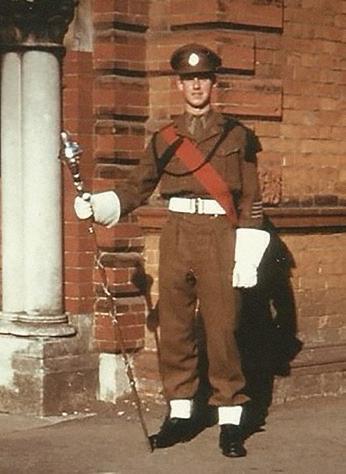
In C2 between 1957 and 1961 we had a really splendid Houseman, Jim Elham, a stout Wiltshire man who cleaned our dorms, lats and showers. He wore a uniform of blue jacket, white shirt with blue tie, navy trousers and a white apron. When oiling (serving) in Hall, a white jacket was worn. Jim held court down in the crowded cellars under Field House while tending the oil boiler, with its tangle of asbestos-coated pipes. He was a veteran of the Great War, and he looked after my Corps boots very well.
Mr Sainsbury held a special position as the College Porter. He resided in the Porters’ Lodge at the main gates and was the main point of security for the College. He wore a dark navy suit with brass buttons and a peaked cap with the College badge, always brightly polished. He manned the gates for one and all, rang the bell for reveille, for Chapel, for morning classes, for lunch in Hall, and again in the afternoon for lessons. Daily, he received all the mail from the Post Office for the College, and sorted it ready for collection by lunchtime for distribution to each house. He was another veteran, wearing his ribbons with pride.
Most of our loos in these days, known as ‘lats’, were outside the houses and classroom blocks. They had no doors, a shock for new prep school boys! They were serviced twice daily by a small team, comprising ‘Sanny’ Sam and his helper. This great pair patrolled the College during the day in their flat caps and tweed jackets, sporting buckets, loo paper (bumf), Jeyes Fluid and a hose and stirrup pump! They cleaned all the lats with gusto and much
water, especially if they caught a luckless pupil in occupation. Sam lived beside the sweet shop opposite the church facing B House, often being seen sleeping in his fireside chair after lunch.
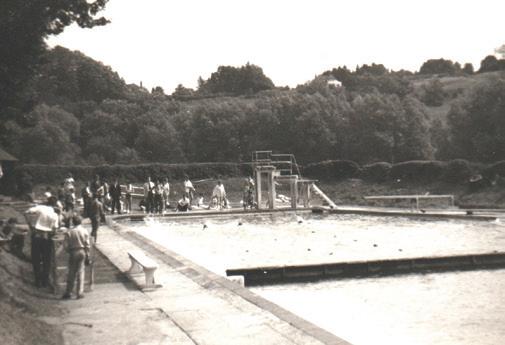
Another often-seen character was the Head Gardener on his three-wheeled tractor, which was powered by an old two-stroke mower engine – smoke and stink everywhere. He would bring loads of cabbage or potatoes from the kitchen garden to Hall. The garden was in the wilderness, behind the Mound and the bathing place. Most of the vegetables consumed by us were grown there, before being cooked to death in the Hall kitchens. The gardeners tended all the gardens around the College, especially the Rose Garden and the Duelling Lawn.
Hall was another area of interest. The new Norwood Hall was under construction in 1961, so we still used the old kitchen, which dated from about 1870. The main oven was an engineering delight, about
‘The garden was in the wilderness, behind the Mound and the bathing place. Most of the vegetables consumed by us were grown there, before being cooked to death in the Hall kitchens.’
50 yards long, low and heated by gas. Trays of food moved through on a conveyor belt, slowly being heated and cooked as they passed the flares.
Meals were compulsory for in-housers and eaten with gusto and speed. Service was from the kitchen itself to the tables, usually by the duty oilers provided on a rota by house. The permanent staff were controlled by Miss Venables, a trained dietician. Casual labour was used to clear and wash the dishes, aided by an ancient and noisy dishwasher. Incidentally, when the Biology fifth required cockroaches for their dissection tutorials, the beasts were caught in the kitchen!
There were many more behind-the-scenes staff who kept us clean and fed who we never got to know well. Often their names were forgotten, but their work was essential, and this is a short note of thanks to them all.
James Thompson (C2 1957-61)
If you have a memory you’d like to share please email the Club Magazine Editor: clubmagazine@marlboroughcollege.org
Totally Inspirational
Dr John Land (CR 1973-98)
While I was clearing out my parents’ house after the death of my mother a few years ago I came across a drawer of letters, mostly from me, from my days at boarding school. Skimming through the 10 years was not very cheering – my time at prep school and then at Marlborough was not marked with any great achievements, and there was definitely a sense of a square peg failing to fit into a round hole!
But then I came across a letter that had been sent to them by Dr John Land, my A level Biology teacher. I wish I had seen it earlier. My parents had written to him to let him know of my progress: a place to study Science and the Environment at Leicester Polytechnic – certainly no Oxbridge for me (though I did eventually move to Oxford).
He wrote something so unnecessarily kind: ‘Hugh will remain for some long time in my recollections of this last year, because, despite having our discussions in the past, we must remember that his cheerful enthusiasm and ability to get along with people – charm? – is a great quality which will put him in a strong position at some stage in the future – I look forward to having update from Hugh in the 10 years’ time.’
Maybe it was the difficult time of emptying out the family home, but it really hit me hard – I felt I had been unjustly harsh on my time at Marlborough. This one act of kindness had a transformative effect on how I see some parts of my history.
But it comes with sadness, because I would love to have given him that update. I did not know about the letter – it arrived in 1984, while I was learning how to drink lots of Guinness as a student. Maybe it was shown to me in the Christmas holidays, but I don’t remember. I wish I had shared with him the excitement of becoming an expert on hedgehogs, of writing about the natural world in articles and then books. I hope he would have approved.
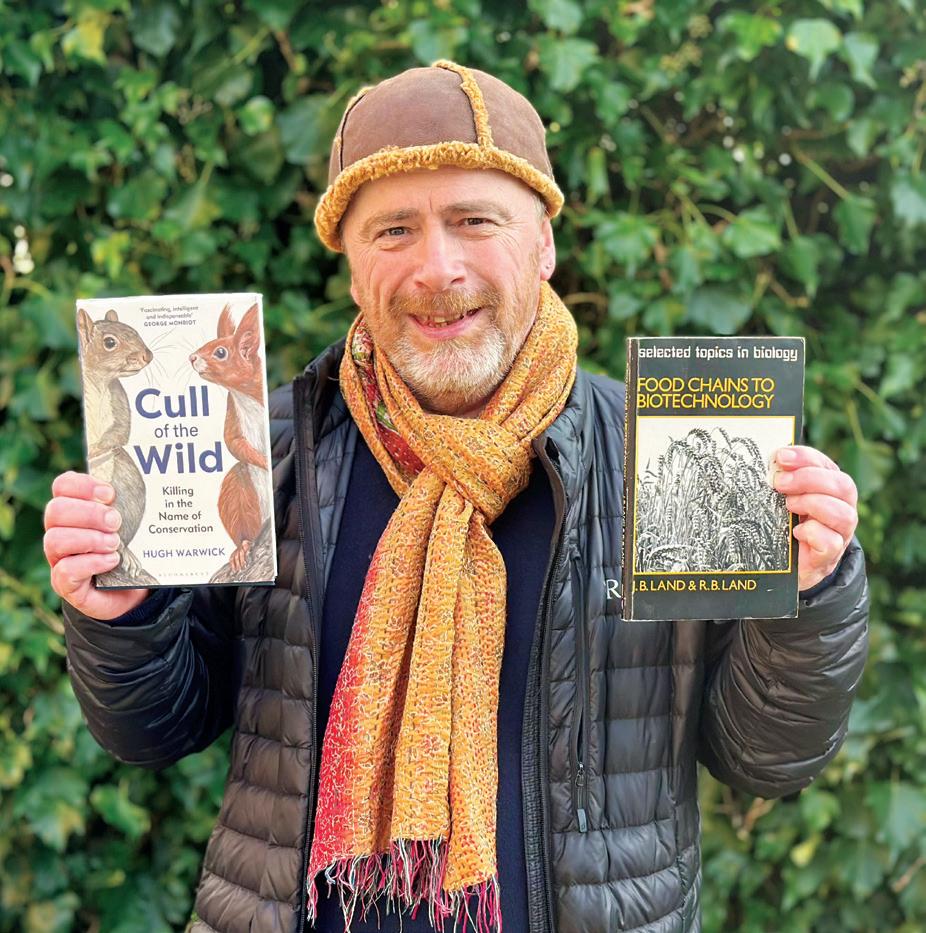
He was a serious man, but he clearly had a warm heart, and I think we would have had fun, sitting and talking through the different paths life can take. His book Food Chains to Biotechnology was the first one I owned where I knew the author. I still have it!
The lesson I learned from this is quite simple. Take a moment to think about how you got to where you are – look back at all those people who helped you on your way as there is no chance you did it all on your own! And while you have the opportunity, thank them – appreciate what they have done for you, and, perhaps even more importantly, take a quiet vow to do the same for young people you meet along the way.
Hugh Warwick (C2 1979-84)
Hugh’s latest book is Cull of the Wild: Killing in the Name of Conservation, Bloomsbury, 2024. He is the spokesperson for the British Hedgehog Preservation Society and can be found on social media: @hedgehoghugh
‘I came across a letter that had been sent to them by Dr John Land, my A level Biology teacher. I wish I had seen it earlier...’
Off the beaten track
Tony Tidmarsh (C3 1949-54) recounts an incident in which he survived the consequences of a haphazard approach to travel.
In 1994 I was appointed manager of TFH Ltd, a subsidiary of my family’s toy business. TFH originally stood for Toys for the Handicapped which had been started 10 years previously by OM Douglas Garrad (B1 1939-44). He had retired in 1990 and a new manager had been appointed. He in turn had had to retire early with heart problems, so my arrival in the business was unexpected. My predecessor introduced me to the staff, gave me a brief explanation of the products and left with the remark that he had fixed a meeting in four days’ time with Wehrfritz GmbH, the leading supplier to the German schools market. Their headquarters was, and still is, at Bad Rodach, about 60 miles from Nuremburg. The staff were aware of this opportunity, it was important I make a success of it.
I faxed Wehrfritz to explain I would be taking the place of our former manager and received a request that I bring as many of our electronic reward toys as I could conveniently pack.
I booked a flight. As there were no direct flights between the UK and Nuremburg, I was to change at Brussels. My plan was to fly the day before the meeting, hire a car and spend the night at a cosy Gasthaus midway between Nuremburg and Bad Rodach. I anticipated a typical hearty German dinner, with luck there would be game served on ‘the hot stone.’ I selected an impressive collection of our products and several batteries and packed them in a large suitcase. I added a clean shirt, hairbrushes and shaving gear.
I arrived early at Birmingham airport and checked the case in. I explained that it contained a lot of electronics. It was opened and the toys examined. This was before 9/11, but there had been several examples of bombs on planes. The check-in clerk explained that I would not need to collect the case in Brussels, it would be transferred to the Nuremburg flight. I bought a copy of The Times and eventually we boarded.
It’s not a long flight to Brussels so I did not start the crossword. We arrived and I looked at the departures board. The flight to Nuremburg was from gate 37 in an hour’s time. I went to gate 37. It was crowded. I settled to the crossword. After about 20 minutes everyone got up and left for Luxemburg. I was alone. I cracked on with the puzzle. About 20 minutes later I was still alone. The whole airport seemed to be closing down. In some panic I hurried back to the main concourse and went to Information. The Nuremburg flight had left from a different gate. The next flight was the next evening.
I asked after my suitcase. It had left on the plane I should have been on. I explained my predicament. ‘If you hurry, you can catch the shuttle to Brussels Central and you should be able to catch the Ostend Vienna Express.’ The Ostend Vienna Express! My spirts rose.
I arrived in Brussels Central at 10.00pm and in due course the huge engine hauled its carriages – full of spies and international
lowlife – into view. I climbed aboard and found a seat in a compartment opposite a very attractive woman. We got talking. I don’t think she was a spy, although you never know as spies do tend to be rather secretive. Else told me she would be changing at Cologne and taking the night train up to Sylt. I had heard of Sylt. It’s an island famous for naturism. Was she a naturist? ‘Ja, of course.’ I plied her with questions. Apparently, Sylt holidaymakers do a lot of cycling: ‘In the nude?’ I asked. ‘Ja, of course.’
Well, I had never imagined naked cycling until then. Else got out at Cologne at about midnight, no doubt looking forward to pedalling along the highways and byways of her island paradise.
The train trundled along. The main characteristic of the Ostend Vienna Express is that it goes quite slowly, but makes up for lost time by only spending a few seconds at each stop. I was terrified that, if I dozed off, I would sleep through Nuremburg, but at last, shortly before dawn, we reached Nuremburg. When I left the train I noticed, with some annoyance, that it remained at its platform for quite a while. I went outside the station and there, right in front of me, was a bus and on its illuminated board was Flughafen, or Airport. What luck. I climbed aboard and, as dawn crept over the eastern horizon, I arrived at my destination.
Nuremburg airport was in two parts. Departures was ablaze with lights and people were arriving. Arrivals was barely lit. I went up and the automatic doors slid back. The concourse was deserted except for a man with a huge mop. I nodded a Grüß Gott (greeting) and strode towards the baggage retrieval door. It too opened and a light came on. There were three carrousels, all stationary, but over in one corner was my case. I picked it up, sauntered back, nodding another Grüß Gott to the mopper. I went to Departures, shaved, changed my shirt and hired a car. An hour later I was at Bad Rodach, early for my meeting. The meeting was a success. I came back with a nice order.
In 2004, I bought TFH. We are still trading with Wehrfritz.
If you have a travel story about a tricky situation, experienced the kindness of strangers or had an epiphany, please email the Club Magazine Editor: clubmagazine@marlboroughcollege.org
Did you know?
Notable Marlburians
It has long been a tradition at Marlborough to honour the lives of distinguished OMs through the erection of memorial plaques on the Chapel walls. But with wall space becoming ever more limited, a digital record has been created to document our alumni’s significant achievements – the Notable Marlburians. This will be available on the Marlburian Club website in due course.
The initial list mirrors those already recognised in Chapel, but it will grow to include alumni whose achievements, across the arts, sciences, academia, military service and beyond, deserve recognition. Following a comprehensive review of alumni records, over 400 individuals have been identified for inclusion.
In future editions of the magazine, we’ll spotlight some of the most remarkable and unique stories from that list.
Did you know that?
Second Word War
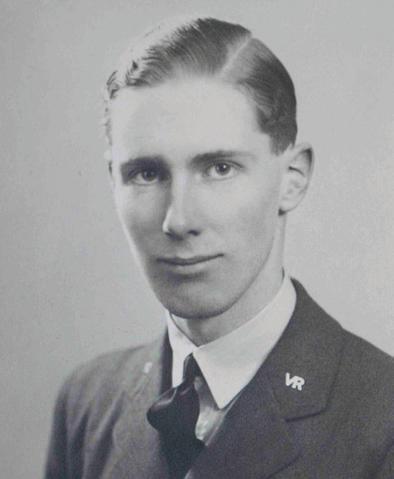
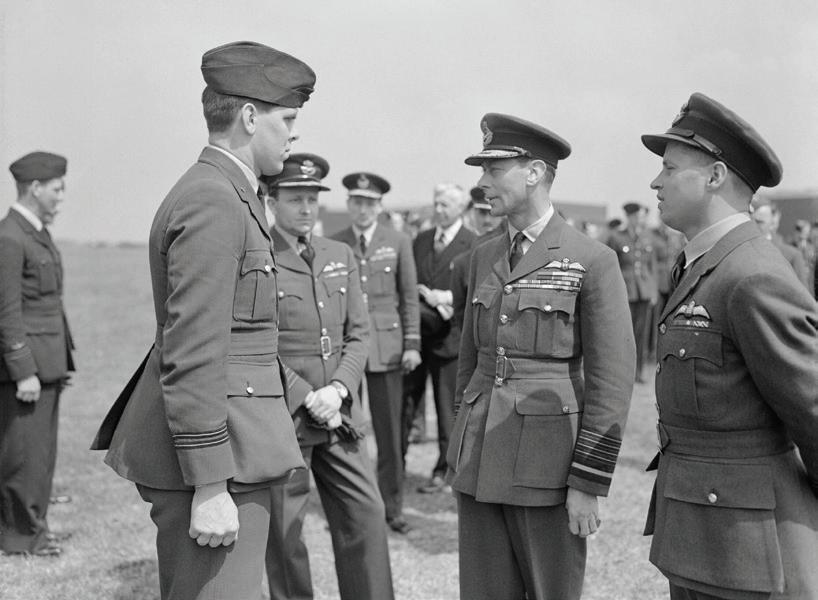
John Hopgood DFC and bar (C1 1935-39) and David Maltby DSO DFC (B3 1934-36) of 617 Squadron piloted M-Mother and J-Johnny in Operation Chastise – the Dambusters raid – in 1943.
James Barron DFC and bar (B1 1929-34), Gerard Brett DSO MC (B2 1928-33) and Joseph Houghton MC (B2 1925-28) all took part in Operation Chariot – the raid on St Nazaire – in 1942.
Robert Hichens DSO and bar, DSC and two bars (B3 1922-27) is the most decorated officer of the Royal Navy Volunteer Reserve.
Sports
In 1871, Arthur Gibson (B2 1857-63) and Alfred Hamersley (C3 1862-66) represented England in the first rugby union international (against Scotland).
In 1872, Robert Barker (C2 1858-62) represented England in the first football international (also against Scotland).
Charles Wilson (C2 1873-77) is one of only three individuals to have been capped for England at both rugby football (in 1881) and football (in 1884).
Leslie Gay (B3 1885-87) is one of eleven individuals to have represented England at both cricket (in the 1894–95 Ashes tour to Australia) and football (in 1892–94).
The unexpected
Derek Macnutt (C3 1915-21), known as ‘Ximenes’, is regarded as the father of the modern crossword.
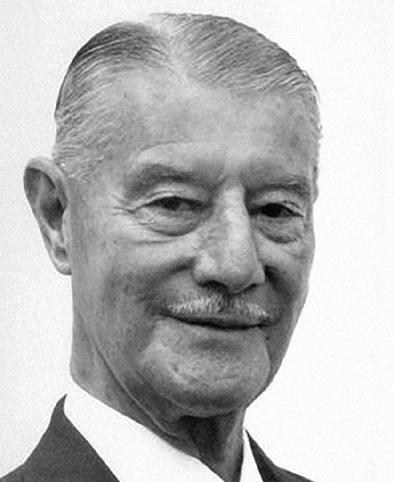
Henry Everard GLM ICD DSO TD (B1 1911-15) was appointed Acting President of Rhodesia by Ian Smith following the Unilateral Declaration of Independence in 1976.
John Hopgood
Henry Everard
Derek Macnutt
King George addressing David Maltby after the Dambusters raid
OM News
MC Connect is our engagement platform for the Marlburian Community
Communicating with the Marlburian Community is easy with MC Connect.
Career Connections: Share and benefit from the knowledge and experience within our community on careers, work experiences and university destinations.
Groups: Join professional networking, sporting, regional and interest groups and communicate with others in these groups via the platform.
Jobs and Volunteer Opportunities: Search for and share jobs and volunteer opportunities.
Online Directory: Search for those you know in the Marlburian Community.
Advice Hub: Pose a question to the Marlburian Community.
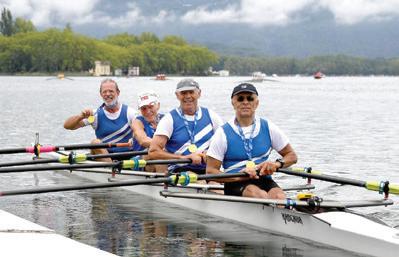
Graham Bagnall (C2 1960-64) was a member of the GB crew at the World Rowing Masters. His quadruple scull won the gold medal in the 70-75 years age category. The competition was held in the spectacular Unesco site of Lake Banyoles, Northern Spain.
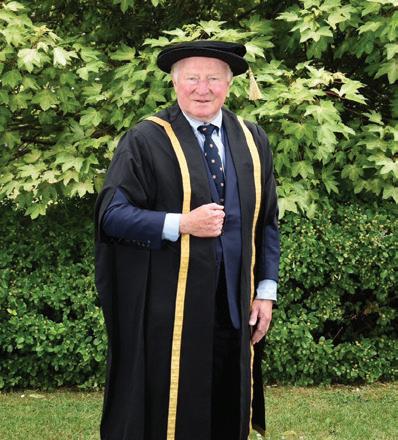
Paul Fairweather (PR 1965-69) has been awarded an honorary fellowship by Cranfield University to record their appreciation for his 10-plus years of association with the university, the last nine as an elected member of the Council of the University and Chair of Finance. Honorary fellowships are quite rare at Cranfield, only two have been awarded in the past 10 years.
James Brennan (C3 1967-70) has been a clinical psychologist for nearly 45 years, with most of his career spent supporting patients and families with physical health conditions, especially cancer. He has taught medical students and doctoral clinical psychology students for most of his career and lectured internationally in the field of cancer psychology.
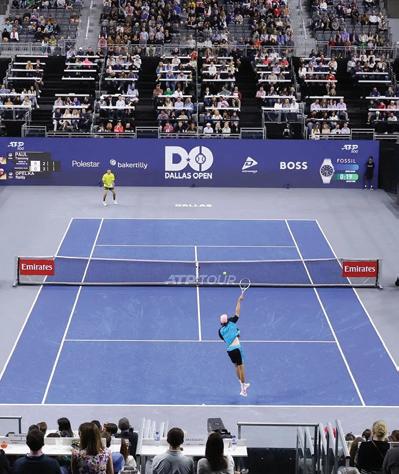
In February, Tony Downer (BH 1975-76) volunteered as a ball person at the Dallas Open. Following in the footsteps of his twin sons, this is a passion Tony has wanted to pursue after retiring from his career as a venture capitalist. After completing a rigorous audition process, Tony was selected to be a ball person for nine US open tennis tournaments and has participated in 23 tournaments to date.
Paul Fairweather
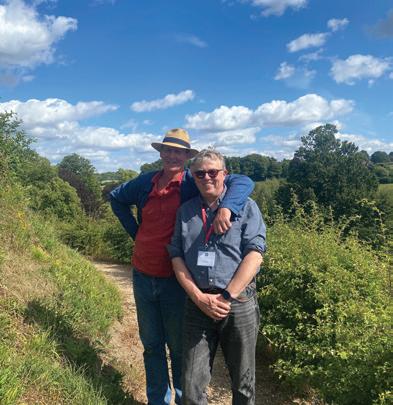
Ben Fenton (B3 1974-77) and Michael Fiddes (C2 1973-78) returned to Marlborough to visit the Mound and Chapel. They were joined by friends from their days at Trinity College, Oxford – including one whose doctorate focused on Neolithic mound-building.
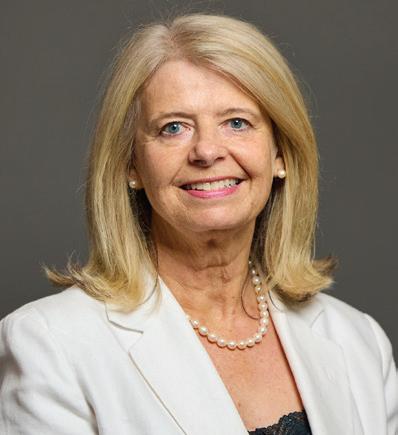
Harriett Baldwin (LI 1975-77) featured on BBC 4’s Any Questions, which was live from the American Museum and Gardens in Bath. The panel comprised: shadow business minister Dame Harriett Baldwin MP; Lord Darroch, formerly the UK’s ambassador to the US; foreign affairs committee chair Emily Thornberry MP; and Ann Widdecombe, Reform UK’s immigration spokesperson.
Jeremy Marsh (PR 1973-78) is a board-level music industry professional with 30 years of experience at the managing director/president level. Most recently, Jeremy has been an advisor to Warner on key artists, including Enya and The Corrs. He is now also Chairman of Harry King TV and a senior advisor to Bell Partners.
coach and has many years of experience in a range of different commercial organisations. He was a corporate financier in two significant merchant banks, worked for a major European media company, set up and ran the first national commercial television service in Hungary, and has run his own business for the past 10 years.
Nick Robinson was joined on BBC Radio 4 by former chief of MI6 Sir Alexander Younger (SU 1976-81), almost six months after his first appearance in the wake of the Hamas attacks in Israel. They reflected on how the war in Gaza had changed since they first spoke.
Caroline Clarke (SU 1985-87), the Regional Director of the NHS in London, was named a Dame Commander of the Order of the British Empire (DBE) in this year’s King’s Birthday Honours list.
After Marlborough, John Harrington (SU 1975-79) studied at Bristol University and completed an MBA at City University Business School. He is a qualified executive
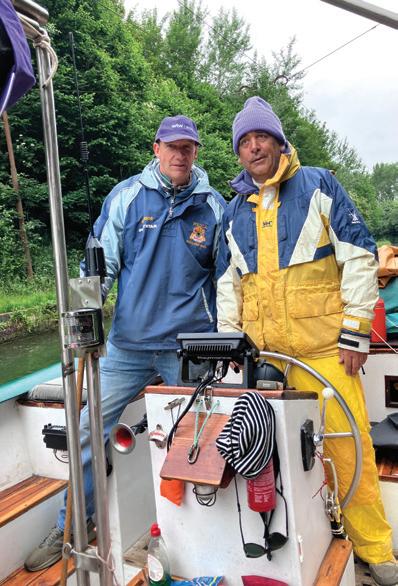
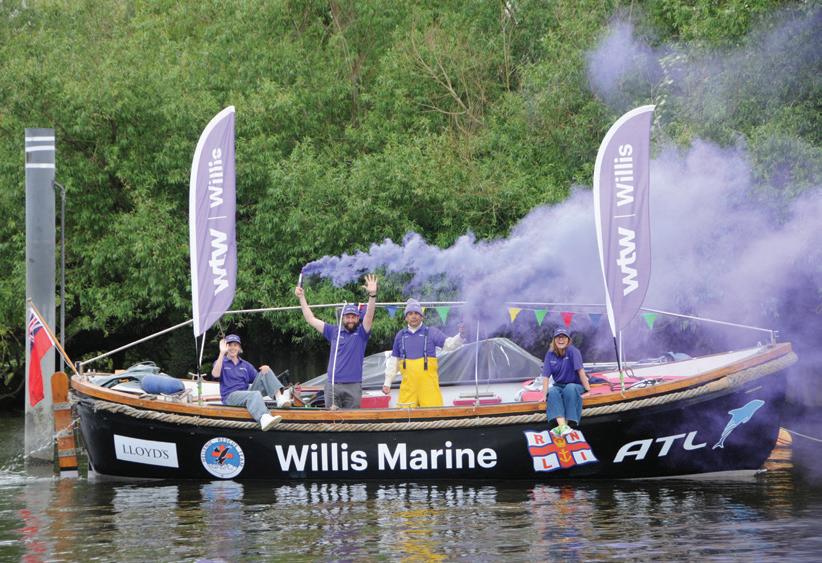
Sebastian Katkhuda (C2 1985-90) is undertaking an extraordinary voyage, piloting his 40-year-old open ship-toshore lifeboat from its long-time home on the Thames, where it has served as a pleasure boat moored at Eel Pie Island for the past 15 years, to the island of Milos in the Southern Cyclades. His route takes him through the French canals and rivers between Calais and Marseille before crossing the Mediterranean, all in support of the RNLI and its Greek counterpart, Hellenic Rescue. Along the way, he has received valuable assistance from several OMs. Having already navigated some 300 locks through France’s inland waterways, Sebastian is now making his way around the Mediterranean and is currently moored in Civitavecchia for essential boat maintenance and some well-earned rest.
Former chief of MI6 Sir Alexander Younger
Caroline Clarke
Rhianon Bragg (PR 1988-90) was nominated last year for the Alice Ruggles Trust Award, which aims to recognise and celebrate those people and projects doing exceptional work to bring stalking to an end.
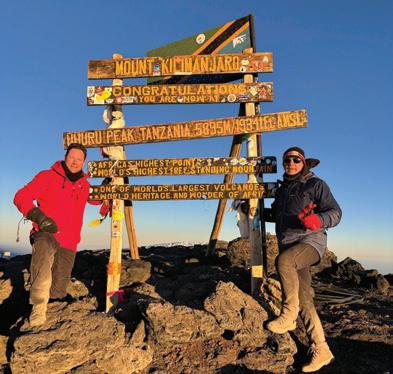
Alexei Rosin (B1 1986-91) completed the climb of Mount Kilimanjaro with a great friend to raise money for The Brompton Fountain, a charity that has supported his son and many others with heart and lung issues. They completed the climb in five days and raised £4,000 for the charity.
Robin Child (CR 1971-92) held a talk in Budleigh Salterton to discuss the hidden aspects of nativity paintings, including Botticelli’s Mystic Nativity.
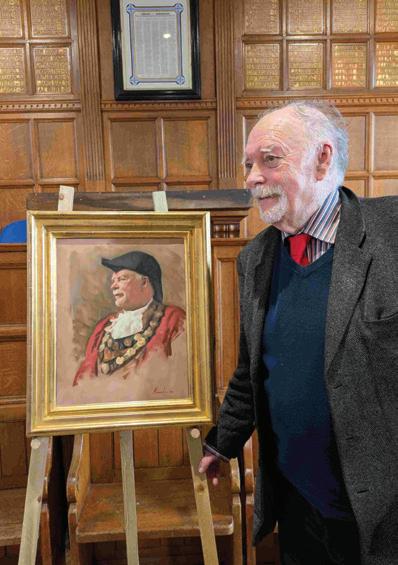
Nicholas Fogg (CR 1978-92) was commemorated with what is believed to be the first portrait of a fully robed Mayor of Marlborough wearing the full insignia since the town received its first charter in 1204.
Toby Britton (TU 1991-96) was Supervising Art Director on Andor, the acclaimed Star Wars series. Working with Luke Hull and Rebecca Alleway their work won an Emmy for Outstanding Production Design, showcasing Toby’s creative talent and impact.
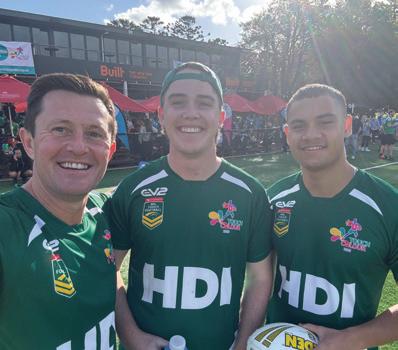
Byron Lloyd-Gilmour (SU 2020-22) has started working alongside Andrew Cochrane (C3 1992-97) in a full-time permanent role at HDI Australia. What started as an initial message on MC Connect a year ago developed into Andrew being
Sebastian Katkhuda piloting his 40-year-old open ship-to-shore lifeboat
Toby Britton won an Emmy for Outstanding Production Design
able to give Byron his first proper corporate job. The two have also attended a corporate touch rugby event together.
Lara Cowan (MO 1992-97) was recently featured on the BBC Gardeners’ World Podcast, where she spoke about how gardening and connecting with nature have profoundly shaped her life. She reflected on the role they have played in managing the challenges of thinking differently and in navigating the impact of several lifechanging events. Later this year, Lara will also be recognised as a nominee for the prestigious Woman of the Year award, presented by ITV’s Lorraine
Nina Rapacioli (NC 1993-98) climbed Mount Snowdon with her nine-year-old son Freddie, who has Type 1 diabetes and autism. Supported by family and lifesaving diabetes tech, their climb raised funds for Diabetes UK, showcasing determination, resilience and the power of family.
In 2010, James (C2 1995-99) and Pollyanna Townsend-Rose (LI 1997-99) embarked on an overland journey from London to Cape Town in a Land Rover Defender, crossing 23 countries. The adventure sparked a lasting love for Africa, and they eventually settled in Cape Town. Fifteen years and two children later, Pollyanna launched Journey South, a boutique travel company creating
personal-ised family safaris and beach holidays across Southern and East Africa and the Indian Ocean Islands.
Omar Salem (C3 1995-00) has been appointed as a Financial Regulation Partner at Fox Williams.
Rosie Wintour (MM 1996-01) has launched a series of events called Grey Matters, which she is piloting in Wiltshire. The events were inspired by a series of conversations that Rosie had with her parents and their peers, who expressed a fear of being left behind. Grey Matters launched in June with an event about cyber security. Rosie and The Pico Players were delighted to return to Cadogan Hall for their 10 Year Anniversary Concert. As befitted this landmark concert, the programme
included the very first piece they performed in concert, Rossini’s Overture to The Italian Girl in Algiers.
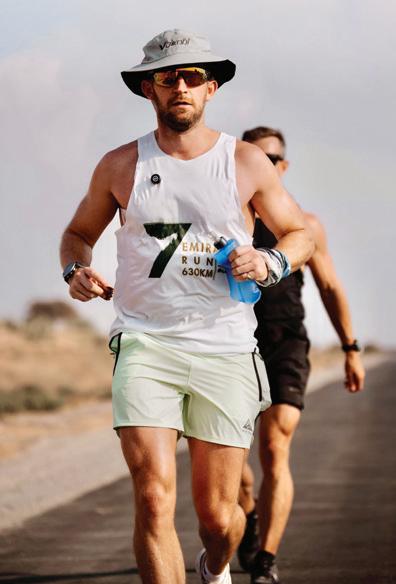
Harry Amos (B1 1999-04) has shaved over an hour off the world record for running 630km across all seven Emirates of the UAE. Becoming only the third runner to complete the route, Harry completed the gruelling ultramarathon in five days, 21 hours and 27 minutes.
Harry Amos
Lara Cowan, recently featured on the BBC Gardeners’ World Podcast
Byron Lloyd-Gilmour and Andrew Cochrane
James Montgomery’s (C1 1999-04) career has spanned roles at Jaguar Cars and Coutts Bank, and he now leads his family’s wealth management business.
Sam Morshead (LI 2000-05) has been a sports journalist for 16 years. He recently launched CounterPress, a publishing platform designed to help sports journalists launch their own sites, so they can focus on quality reporting and avoid the ads and clutter of typical news sites. His news site, The Moonraker, covers Swindon Football Club and already has 500 paying subscribers, and three more sites have been launched using the platform.
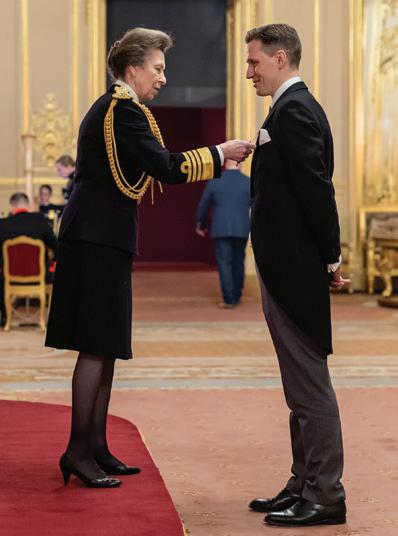
Robert Peal (BH 2001-06) was awarded an MBE in 2024 for services to education, which was presented by Princess Anne. He has been Joint Headteacher at the West London Free School since 2021, worked as a policy advisor to the Schools Minister from 2015 to 2016, and has written several books on education.
Many congratulations to Ed Hill-Smith (C3 2002-07) and his fiancée, Niamh, on the birth of their daughter, Clementine, on 9th January 2025.
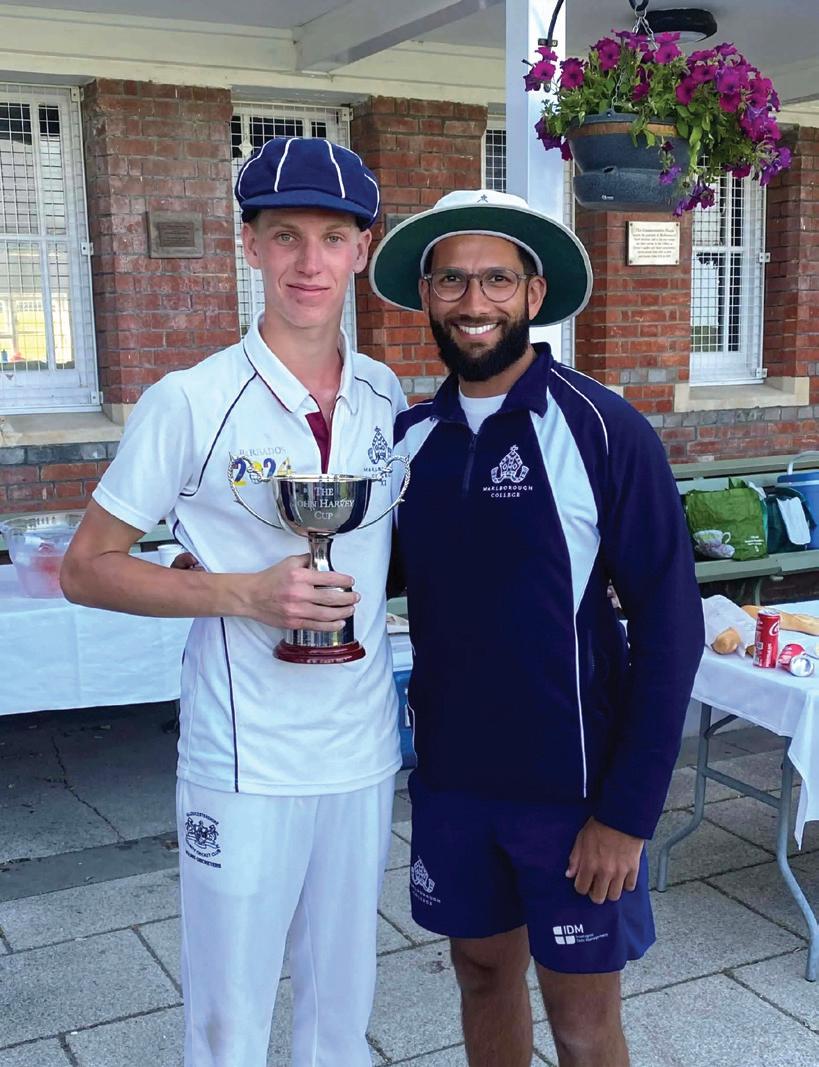
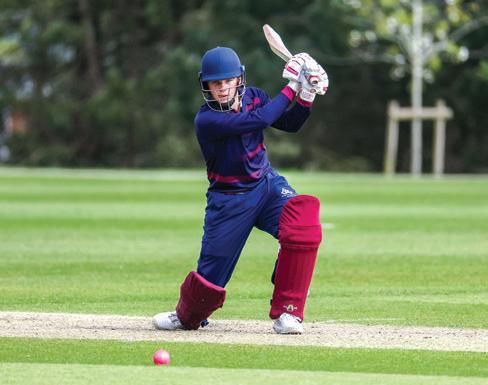
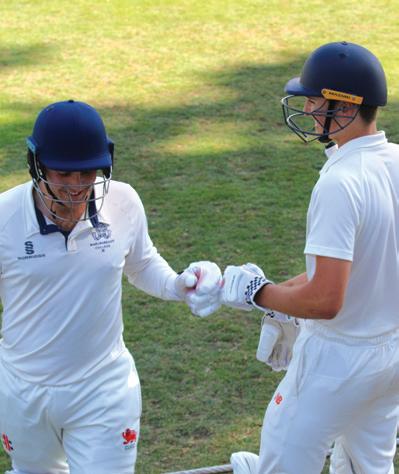
Uzair Qureshi (B1 2007-11), who was an early recipient of a bursary and a former Senior Prefect, has been appointed as cricket professional at the College. Uzi has previously played for MCC Universities, Gloucestershire 2nd XI and Wiltshire. His exceptional talent saw him represent the College XI for four seasons, including two as captain, scoring six centuries – a feat that is yet to be repeated.
Tatiana Humphreys (MM 2006-11) has over a decade in the wine trade, with roles at Berry Bros. & Rudd and Bordeaux Index. With a WSET Diploma and a 1,000+ reader newsletter, she now runs The Little Grape Wine Course in London, helping small groups learn about wines with ease, confidence and enjoyment.
Uzair Qureshi appointed as cricket professional
Robert Peal
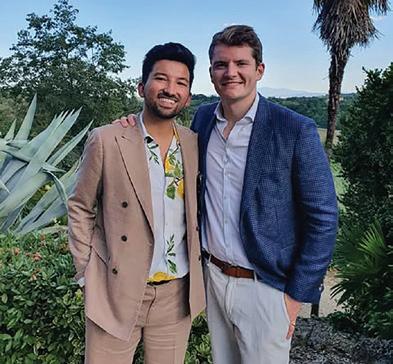
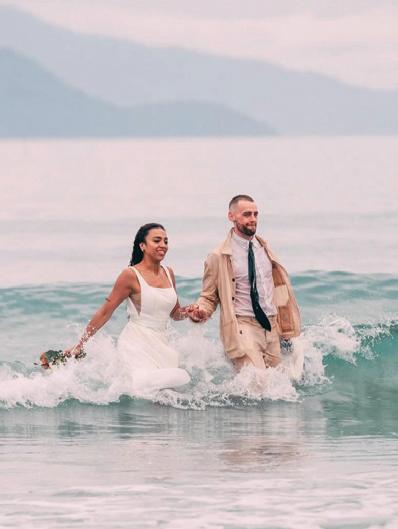
Congratulations to Nick Freer-Smith (TU 2006-11) on his engagement to Will Dawson. The couple are looking to get married in Spring 2026.
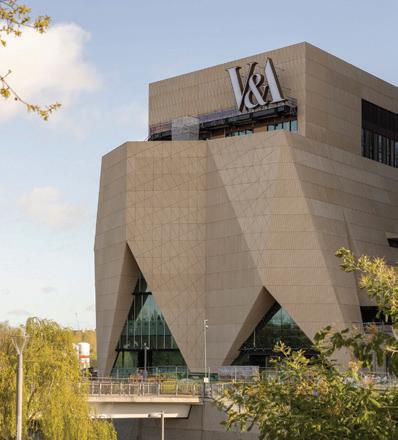
Lucy McVeigh (MM 2007-12) has started working at the new V&A East, which has recently opened in Stratford, London. She works as a producer, focusing on inclusive youth practice by breaking down barriers to accessibility in the arts, particularly with young people.
Samuel Matanle (C2 2008-13) was featured on Stranded on Honeymoon Island, which aired on the BBC in September.
At the start of March, Alastair Dibden (B1 2008-13), Giles Dibden (B1 201015) and Jack Thistlethwayte (C3 201318) completed the Everest in the Alps expedition in aid of The Brain Tumour Charity. This gruelling challenge involved up to 40 hours of ski touring, with up to 20 individual ascents, over four days. Each day, they climbed between 2,000 and 2,500m to reach the overall target of 8,848m.
Since leaving Marlborough, Olivia Hampson (CO 2012-14) has spent 11 years in the US, working as a product manager in the tech world, first in San Francisco, then in New York City. She’s recently returned to the UK and taken on a new adventure as CEO of Extatic Film, a boutique production company that creates bespoke commercial films.
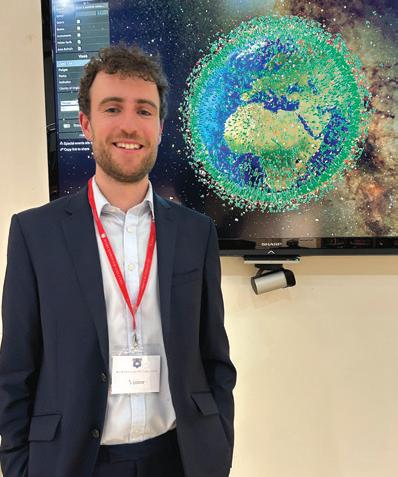
Tom Cayford (LI 2011-16), a spacecraft operations engineer at OneWeb, delivered a fascinating Sun-Earth Day lecture titled ‘Satellites – Do we really need them?’ He explored the anatomy and deployment of satellites and the challenges of overcrowding, space debris and light pollution.
Alastair Dibden, Giles Dibden and Jack Thistlethwayte completed the Everest in the Alps expedition
Samuel Matanle
Honor Koe (MO 2012-17) made her playwriting debut with her play Are We Doing This Right?, about a 20-something singleton who aspires to be an actor. It was performed in September at the Riverside Studios in Hammersmith.
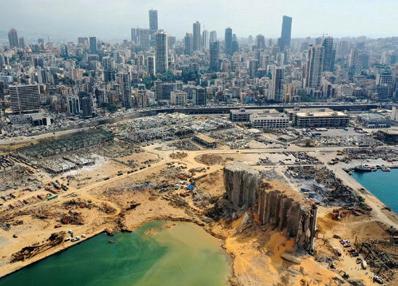
Libby Adam (MM 2012-17) and Evie McVeigh (MM 2014-19) undertook internships with the Alsama Project, based in Beirut, which educates Syrian and Palestinian refugees in a truly innovative way. As part of this, they have both been on the team developing a first-of-its-kind exam for refugees, called the G12++.
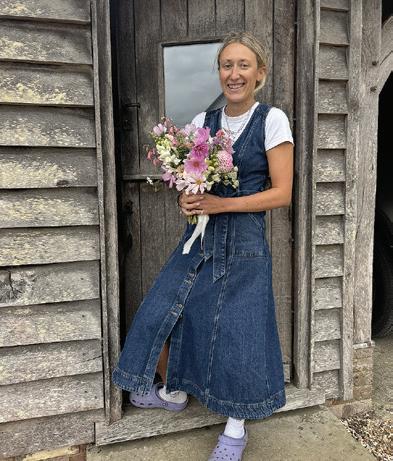
Holly Brookes-Smith (NC 2012-17) runs Flowers by Holly, working across intimate ceremonies and larger-scale weddings and events.
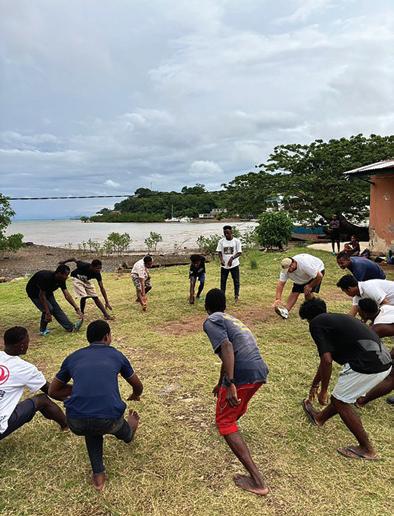
Dylan Cameron (BH 2014-19) participated in a community development internship in Nosy Be, Madagascar, where he taught English and worked closely with local schools and youth centres. As part of this, he fundraised to improve sanitation at the schools and provide more teaching resources, such as desks and chairs for classrooms that currently lack basic furniture.
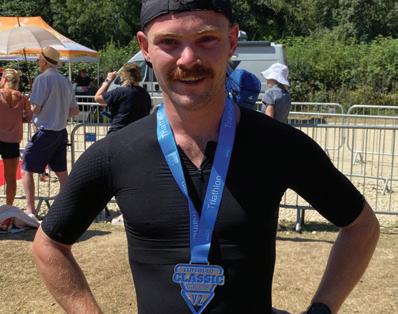
Hector Mackellar (C1 2014-19) took on IRONMAN Wales – a gruelling test of endurance comprising a 3.8km swim, a 180km bike ride and a 42.2km marathon,
with over 3,000 metres of elevation gain, all in a single day. He raised over £4,000 for Helen & Douglas House.
Lily Martin-Jenkins (IH 2014-19) returned to Marlborough to deliver a ‘Life After Marlborough’ talk. Speaking to the Upper Sixth, Lily shared insights into her career journey, which has led to her role as a Commercial Partnership Executive for the Aston Martin F1 Team.
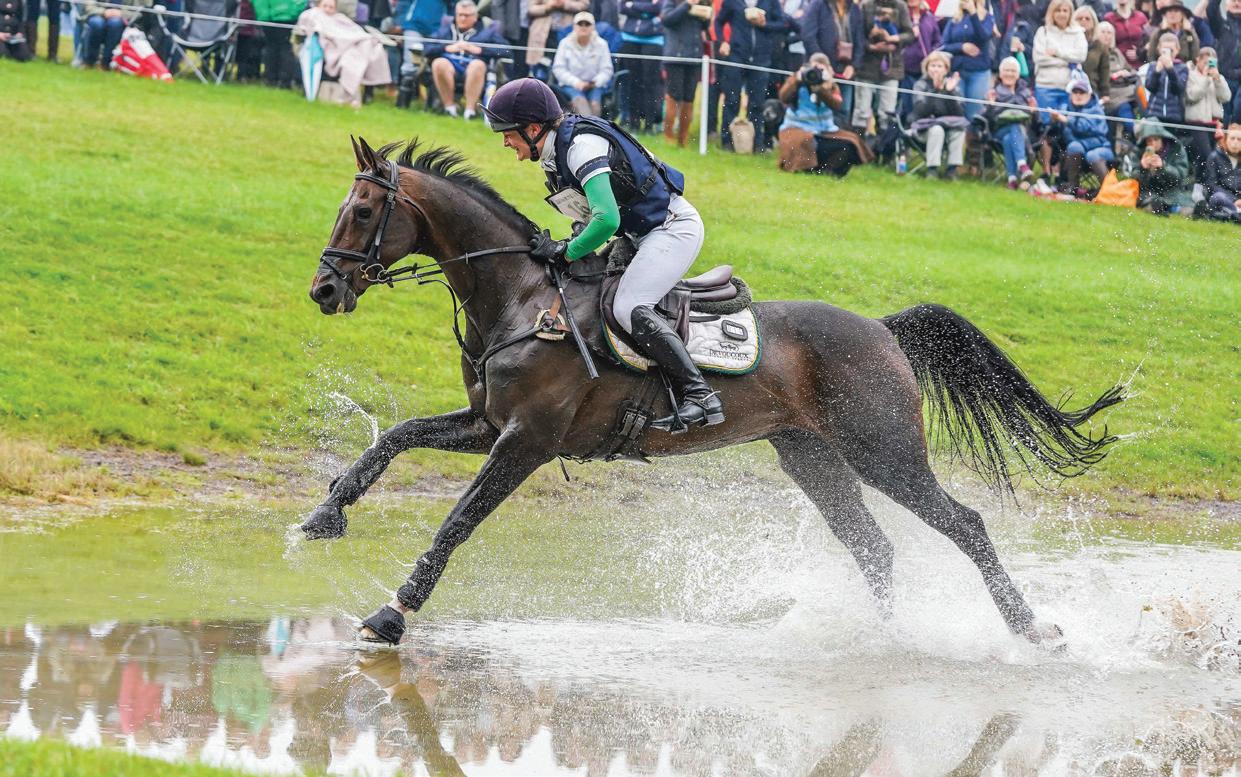
Imo Brook (MM 2014-19) competed at the 2024 Blenheim Horse Trials and performed superbly, coming 27/79 in the combination fences at Blenheim. This means that she has qualified to do a 5* Competition.
Cate Baker (SU 2018-20) returned to the College to speak with Upper Sixth artists,
photographers and architects about life at art college and university. Cate achieved a first-class degree in Fashion this year from the London College of Fashion.
Congratulations to Erin Butler (MM 2018-23) and Freddie Kottler (C2 2016-21), who in February both finished on the winning team in their respective matches at the 95th Rugby Fives Varsity Match. Both played a decisive part in two very close games.
Olivia Eversfield (MM 2016-21) and Francesca Aitchison (MM 2016-21) embarked on a week-long expedition, driving from West Sussex to Lviv to deliver a truck filled with urgent medical supplies to those affected by the ongoing conflict in Ukraine.
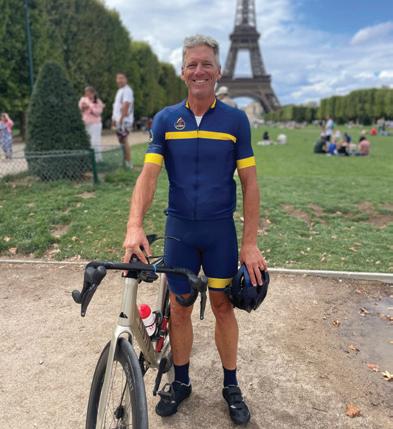
Nick Nelson-Piercy (CR 1998-21) completed Le Loop this summer, a charity cycling event that follows the official Tour de France route, one week ahead of the professionals. He raised £5,000 for The William Wates Memorial Trust, which supports disadvantaged young people across the UK and helps them steer clear of crime.
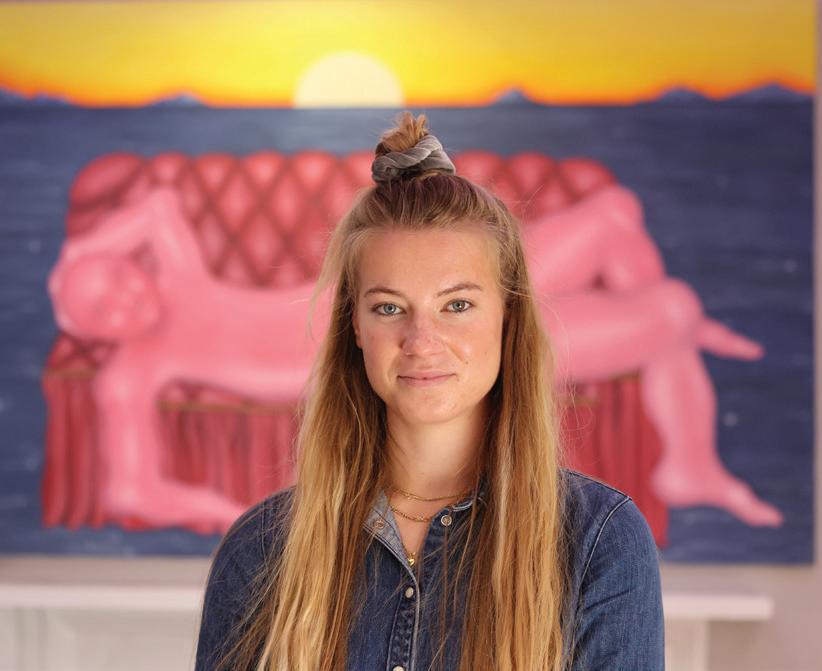
Ella Warner (MM 2016-21) held her first solo exhibition at the Mount House Gallery, called From Under Your Thumbs, which explored modes of storytelling through the use of symbols and allegory.
Paddy McClintock (SU 2019-21) founded Check in on a Mate, a campaign aimed at raising awareness for mental health and suicide prevention, following the loss of close friends Olly Chessher (CO 2020- 22) and
Ella Warner at the Mount House Gallery
Honor Edwards (LI 2020-22). He has been named as OM of the Year 2025 and you can read his story on page 23.
Sam Martin-Jenkins (LI 2017-22) raised funds and awareness last Movember by taking on the epic challenge of running 120km, completing 3,000 press-ups, and a series of other challenges.
Archie Todd-Leask (C1 2017-22) was President of Agression Sessions, a non-profit, student-led boxing event at Durham University, which this year supported charities Point North and CALM.
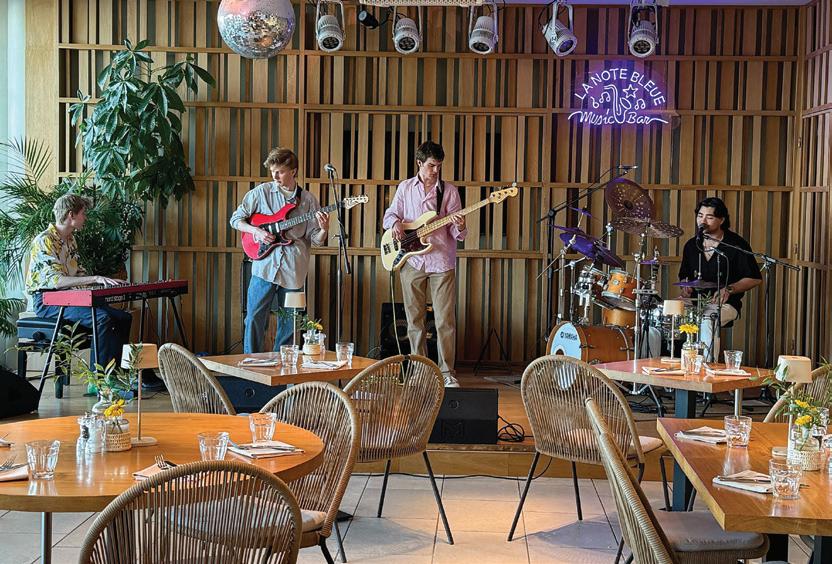
Tommy Watson (C1 2021-23) and Will Moore (C3 2018-23) have continued to raise the profile of their band JVNO, with their current quartet lineup making its debut at the local Manton Fest. Their growing momentum led to a major milestone: opening for French pop star Kendji Girac at the Monaco Arena. This year, JVNO released their debut album, Nothing Strange. They’ve continued to build their reputation on the live circuit, most recently selling out the iconic La Note Bleue jazz club in Monaco.
Since leaving Marlborough, Millie John (CO 2022-24) has done a range of jobs and volunteering. She also qualified as a ski instructor in Whistler over the winter and spent a couple of months in the Alps nannying and teaching skiing. At the time of writing, she’s about to head to Asia with Marlbough friends for a couple of months, so she is well and truly making the most of her gap year.
Phoenix Fleming (NC 2019-24) won the singles and doubles fives titles at the British Universities Championships in February. She was already ranked eighth in the country and will now have risen further.
Archie Todd-Leask
Tommy Watson and Will Moore and their band JVNO
Millie John qualified as a ski instructor in Whistler
OM of the Year Award
The OM of the Year Award recognises someone who has contributed their time and talents for the good of others. This year’s winner, Paddy McClintock (SU 2020-22), was nominated by his Housemaster, Charlie Harrison (CR 2006-), who tells us about Check in on a Mate.
In an age when mental health is finally becoming a more open and urgent conversation, individuals like Paddy McClintock are helping to lead the charge toward compassionate, peer-driven support systems. A medical student, Ironman triathlete and mental health advocate, Paddy is the founder of Check in on a Mate, a grassroots initiative tackling one of society’s most pressing issues: the silent epidemic of mental health struggles and suicide.
From personal observations to purposeful action
Paddy didn’t launch Check in on a Mate out of abstract concern – it grew from personal loss and first-hand experience. Following the loss of close friends Olly Chessher (CO 2020-22) and Honor Edwards (LI 2020-22), Paddy knew there was more that needed to be done.
It became increasingly clear to him that one of the greatest barriers to mental wellness,
‘Whether it’s a quick message, a coffee meet-up or a casual phone call, the campaign encourages people – especially men – to make these acts of support a regular part of life.’
particularly among men, is the social stigma surrounding vulnerability. Coming from a background in rugby, Paddy saw that men are often socialised to appear strong, stoic and emotionally restrained – qualities that can be lifesaving in some scenarios, but are dangerous when they prevent someone from seeking help.
The birth of Check in on a Mate
In 2023, Paddy launched Check in on a Mate, a movement rooted in the belief that small, everyday actions can have life-changing consequences. The initiative revolves around one powerful idea: never underestimate the importance of checking in.
Whether it’s a quick message, a coffee meet-up or a casual phone call, the campaign encourages people – especially men – to make these acts of support a regular part of life. The premise is simple but urgent: you don’t have to be a professional therapist to save a life, you just have to show someone that you are there for them.
The campaign’s message has resonated widely due to its accessibility and sincerity. There’s no pressure to be perfect –
just present. And it’s through this intentional simplicity that Paddy’s idea has gained traction across the UK and beyond.
Ironman discipline, medical insight
Paddy’s dual identity as an athlete and a medical student gives him a unique lens through which to view mental health. As an Ironman triathlete, he understands resilience, endurance and the limits of the human body and mind. As a future doctor, he is deeply informed about the clinical and social dimensions of mental health.
This combination adds both credibility and relatability to his message. When Paddy speaks about mental health, he does so not from a removed or purely academic standpoint, but from lived experience and genuine care.
Paddy often emphasises that checking in on others isn’t about fixing them – it’s about being a presence in their life during tough times, it’s about ‘sitting with them in the mud’ and helping them take their next steps. He reminds people that listening without judgment is one of the most powerful things anyone can do.
Speaking up and building community
A vital part of Paddy’s mission is public engagement. He has delivered impactful talks at institutions such as Barts and The London School of Medicine and Dentistry, as well as returning to Marlborough, speaking to pupils and professionals alike about mental health, community care and the importance of vulnerability. These talks are not only educational, they’re deeply personal and often spark a wave of reflection among attendees.
Paddy also leverages social media platforms to continue spreading his message. He regularly shares stories, reflections and reminders about the importance of being proactive in friendships. These posts often blend lived insight with actionable advice, helping people move from awareness to action.
A new kind of masculinity
One of the most transformative aspects of the Check in on a Mate movement is its challenge to traditional notions of masculinity. By encouraging men to engage emotionally, Paddy is advocating for a more compassionate and expansive definition of what it means to ‘be a man’.
In his interviews and public messages, he often highlights how societal norms can trap men in cycles of silence. ‘Strong’ doesn’t mean silent; ‘masculine’ doesn’t mean unemotional. Through this campaign, he hopes to make vulnerability not just acceptable, but admirable.
‘The beauty of his initiative lies in its simplicity: there is no barrier to entry, no complex protocol. Just take the time to show up, ask how someone’s feeling, how they’re really feeling.’
The initiative also stresses that a mental health problem is not a sign of weakness –it’s a part of being human. This is a message that’s especially needed in male-dominated environments, such as sports, the military and certain professional fields, where emotional expression is often suppressed.
Expanding the movement
Check in on a Mate is not a static campaign – it’s a growing movement. Paddy has ambitions to scale the initiative into partnerships with schools, sports teams, businesses and medical institutions. He envisions educational materials,
workshops and a national ambassador programme across universities, which will equip communities with the tools to foster supportive environments. Paddy is working with Mental Health First Aid England to train individuals to be mental health first aiders within schools, universities and businesses. Sport continues to be at the heart of what Check in on a Mate does. Following the success of charity tournaments, run clubs and sporting events, Paddy is in conversation with global fitness brands such as Ironman and HYROX about potential partnerships to increase the exposure and impact of the campaign.
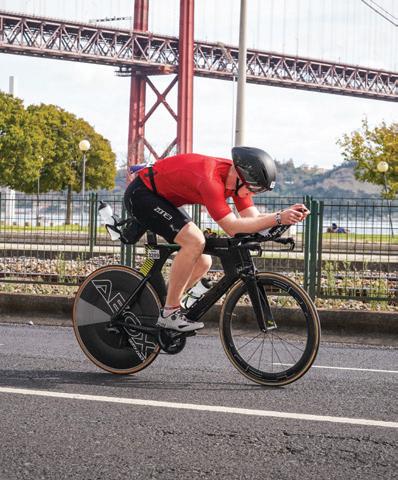
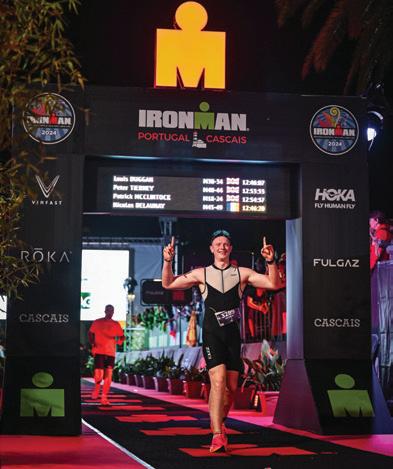
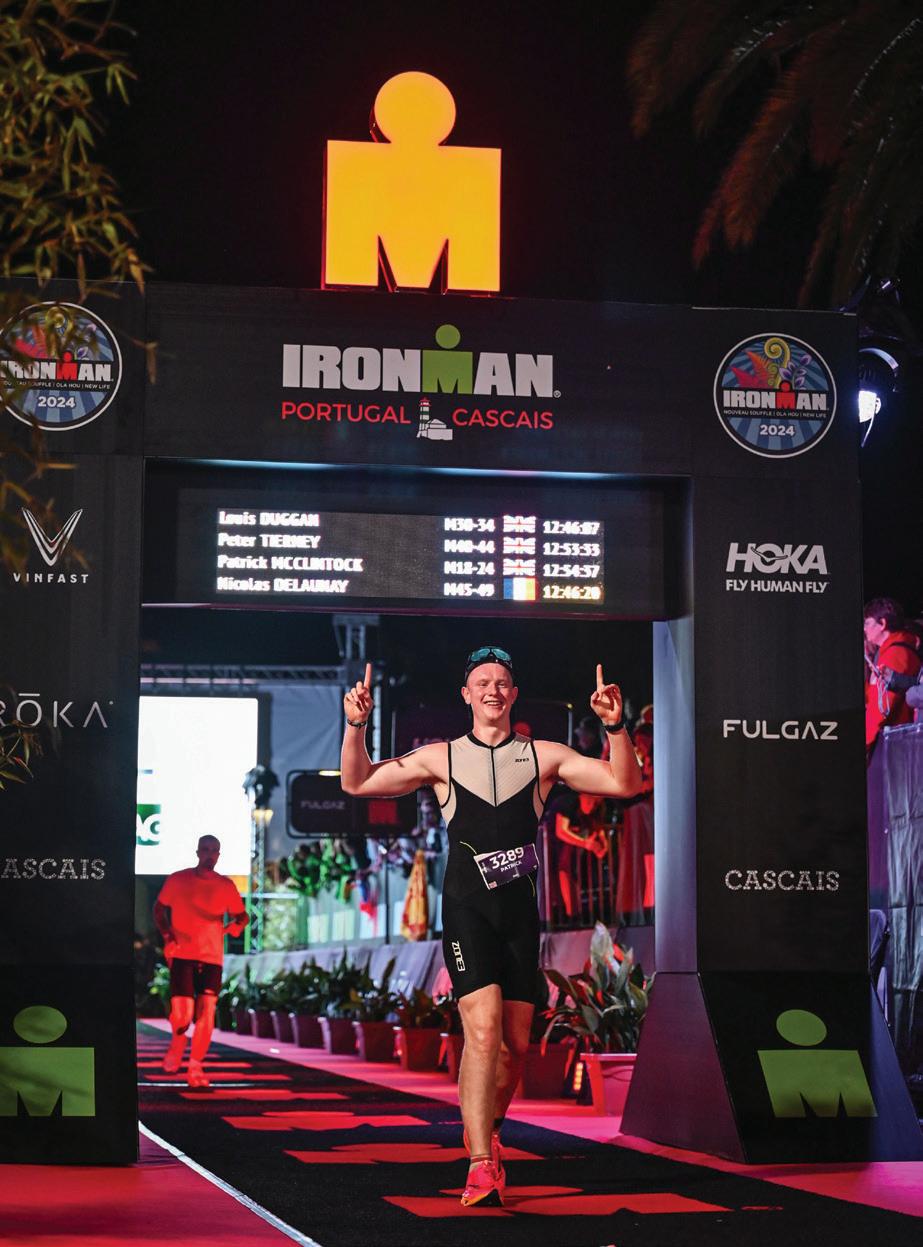
Paddy completing an Ironman event in Portugal
Despite its grassroots origins, the campaign’s potential impact is significant. Every message sent, every coffee shared and every conversation opened represents another link in a chain of emotional safety. Check in on a mate today, maybe save a life tomorrow.
Why it matters now
In the UK alone, suicide remains the leading cause of death among men under the age
of 45. Across the world, millions suffer in silence. The Covid-19 pandemic only deepened the sense of isolation that many already felt. In this context, Paddy’s call to check in on a mate is more than timely –it’s necessary.
The beauty of his initiative lies in its simplicity: there is no barrier to entry, no complex protocol. Just take the time to show up, ask how someone’s feeling, how they’re really feeling.
Paddy is more than just a medical student or an athlete – he is a connector, someone who has found a way to turn empathy into action. Through Check in on a Mate, he reminds us that each of us has the power to be a lifeline for someone else.
Whether it’s through a heartfelt message, an open conversation or just the act of showing up, the legacy that Paddy McClintock is building is one of kindness, courage and community. In a world where silence too often leads to tragedy, his voice – and his movement – are helping ensure that no one feels alone in their struggle. Check in on a mate.
@checkinonamate www.checkinonamate.com
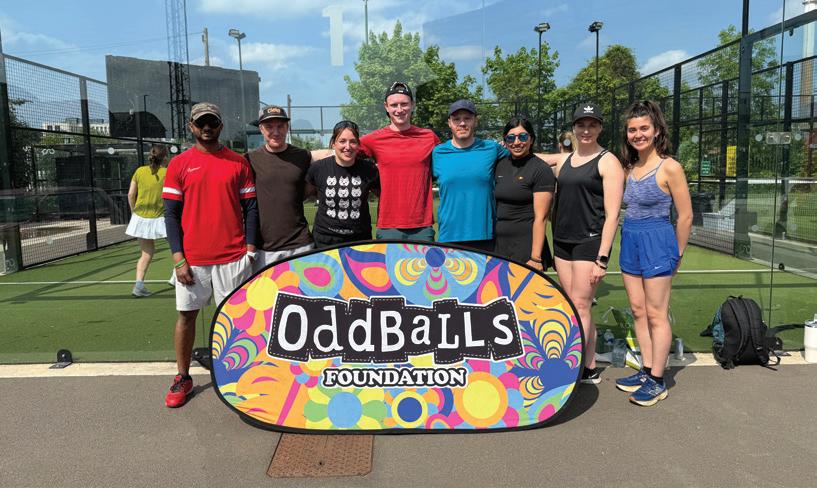
Oddballs Padel Tournament – to raise awareness
OM Entrepreneurs
Profiles of two Entreprenueurs who have adopted sustainable business practices.
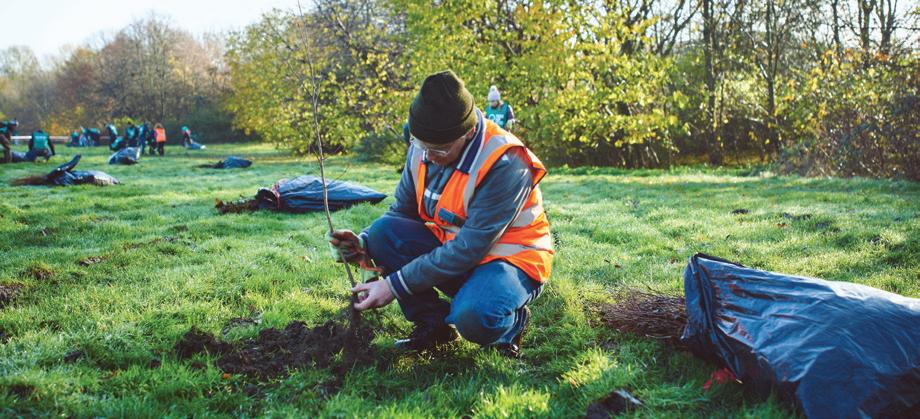
Sapling Spirits
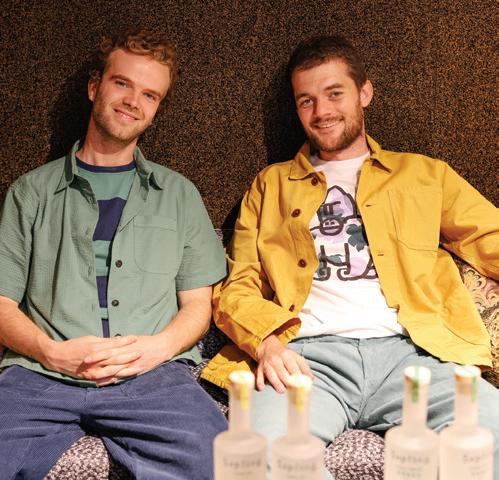
The Founders: Ivo Devereux (B1 200813) and Ed Faulkner (PR 2008-13)
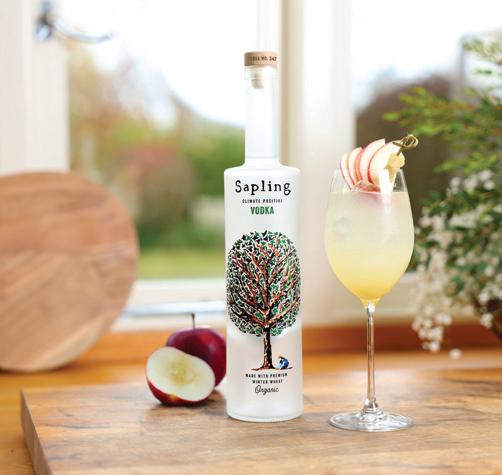
The Business: We make climatepositive award-winning spirits and plant a tree for every bottle sold.
The Beginning: We started a treeplanting music festival. There were no climate-positive spirits that we could serve at the event, so we got to making one!
The Nitty Gritty: Ivo@saplingspirits.com ed@saplingspirits.com
What inspired your brand to adopt sustainable practices in your business, and how do you measure your environmental impact?
Sapling Spirits was founded to create a spirit brand that prioritises the planet. Sustainability has been part of our DNA from day one, setting us apart in the industry. We measure our impact through third-party carbon accounting and are proud to be B Corp certified, holding the highest sustainability score among white spirits globally.
What are the biggest challenges you’ve faced in maintaining sustainability?
The biggest challenge is keeping up with the evolving best practices in
sustainability. Staying at the forefront means continuously adapting our products and operations. However, this is also our strength. It ensures we remain innovative and always have new sustainability milestones to share.
How do you balance profitability with sustainability?
Sustainability is a core part of our business model, not an afterthought. We incorporate its costs into our gross margin, ensuring we can sustain our mission of climate positivity without compromising profitability.
What role do your customers and suppliers play in supporting your sustainability goals?
Our suppliers make up the bulk of our scope 2 emissions, so it’s really important that we work with suppliers that are sustainable themselves. On the customer side, their willingness to choose greener options – such as refills – drives the demand for sustainable solutions.
How do you plan to expand your eco-friendly initiatives in the coming years?
As we expand internationally, we remain committed to sustainability. We will continue sourcing ingredients locally by partnering with third-party distilleries and organic wheat farms in each new market. Additionally, we will localise our treeplanting initiatives to ensure we have a positive impact in every region we enter.
Batch LDN
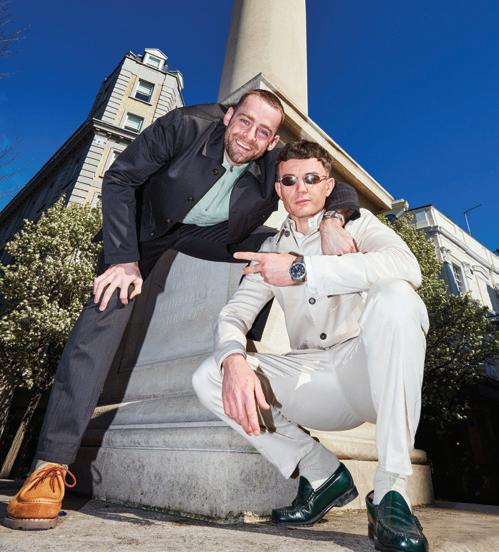
The Founders: Sam Matanle (C2 200813) and Julian Osborne
The Business: Batch creates exclusive made-to-order suits using a sustainable business model that eliminates waste and overproduction.
The Beginning: Two guys who wouldn’t have considered themselves particularly conscientious shoppers set out to create an opportunity for people shop more sustainably.
The Nitty-Gritty: www.batchldn.com
What inspired your brand to adopt sustainable practices in your business, and how do you measure your environmental impact?
Fast fashion is killing the world – we all need to be buying fewer clothes. It is predicted that the fashion industry will be responsible for 25% of the world’s carbon budget by 2050, second only to oil. Our solution is to make clothing to order. It’s a simple equation: if you only make as many items as you sell, you reduce waste and avoid overproduction.
What are the biggest challenges you’ve faced in maintaining sustainability?
For us it was working out where to focus. For example, adding elastane to our garments makes them significantly harder to recycle. But we quickly realised we shouldn’t be designing clothing to be recycled, we should be designing items that last a lifetime. Adding elastane does that. So, really it’s about thinking outside of the box to try and solve a problem in a creative way.
How do you balance profitability with sustainability?
The made-to-order model is inherently sustainable, but it’s also a much smarter way of operating a business. We take cash first and then produce the exact amount of product. So, not only does this give a positive cash flow, it also means we don’t have to account for warehousing, big end-of-season discounts or returns. We therefore have low margin leakage and our path to profitability is quick and clear.
What role do your customers and suppliers play in supporting your sustainability goals?
Any customer who buys a Batch suit is buying into our sustainable ethos –good things come to those who wait. It’s helped us gain access to a wide number of celebrity clients who also support our mission, including Romesh Ranganathan, Ant & Dec, Stephen Bartlett and the whole England rugby team, to name a few. Many of them are now investors in the brand as they love the suits and support the message.
How do you plan to expand your eco-friendly initiatives in the coming years?
We believe in making everyone 10% better, rather than a small fraction of people 100% better. To use an analogy, if you asked a meat lover to go vegan overnight it’s not really going to happen. However, the smaller step of buying meat from the butcher or only eating meat one night a week is much more achievable. We believe we’re going to have the greatest impact by bringing as many people as possible into a slow-fashion mindset.
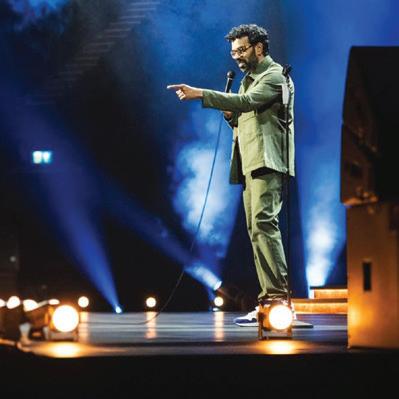
Romesh Ranganathan
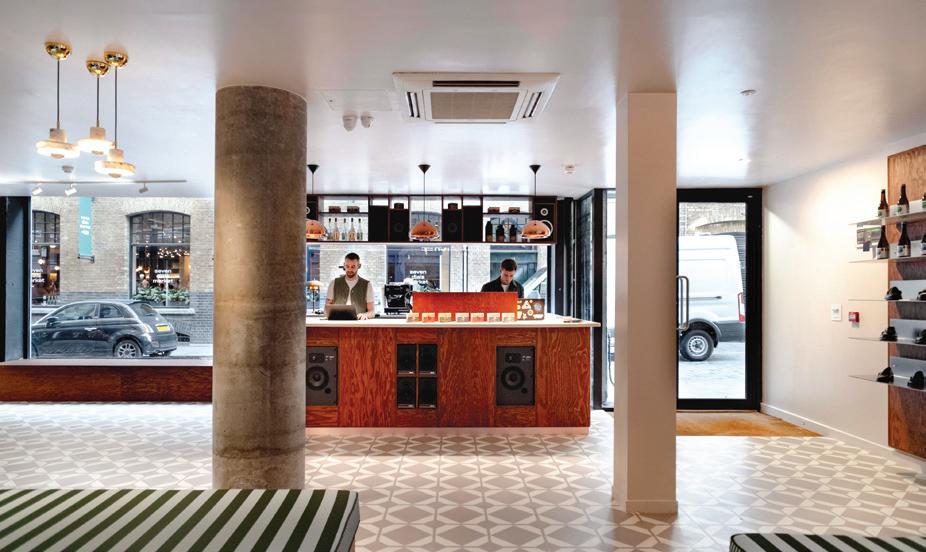
Batch’s flagship store in London
Old Marlburian Lodge
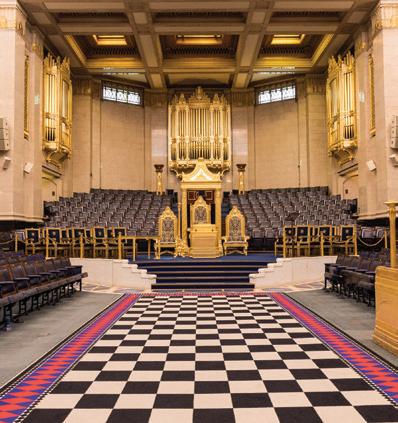
The OM Lodge has met three times a year continuously since 1911, presently at Freemasons’ Hall in Covent Garden, London. It comprises members with close ties to the College, predominantly OMs and beaks.
There are 32 lodges belonging to public schools, and each year we take turns hosting a festival weekend where we all get together. This year we were very well entertained by Shrewsbury School.
Freemasonry includes members from all over the world, and charity is one of its key tenets. Our lodge divides its charitable giving between causes linked to Marlborough College, Freemasonry in general and, because we are a London-based lodge, helping to fund life-saving tools in the capital such as air ambulances, healthcare and firefighting equipment.
Many people enquire about becoming a member out of curiosity. The OM Lodge offers friendship, networking opportunities, and a sense of belonging to an historic organisation which has recently celebrated its tercentenary in England.
If you would like to find out more, please contact the Secretary at: omlodge3533@gmail.com
a feature article is a great way to share stories from your school community.
You’ll develop valuable skills like research, interviewing and creative writing that will strengthen your confidence and communication. Plus, you’ll meet and learn from interesting people with unique experiences and ideas.
Please contact the Editor on clubmagazine@marlboroughcollege.org
This jewel was issued in 2011 to mark the centenary of the Old Marlburian Lodge
Freemasons’ Hall in Covent Garden, London
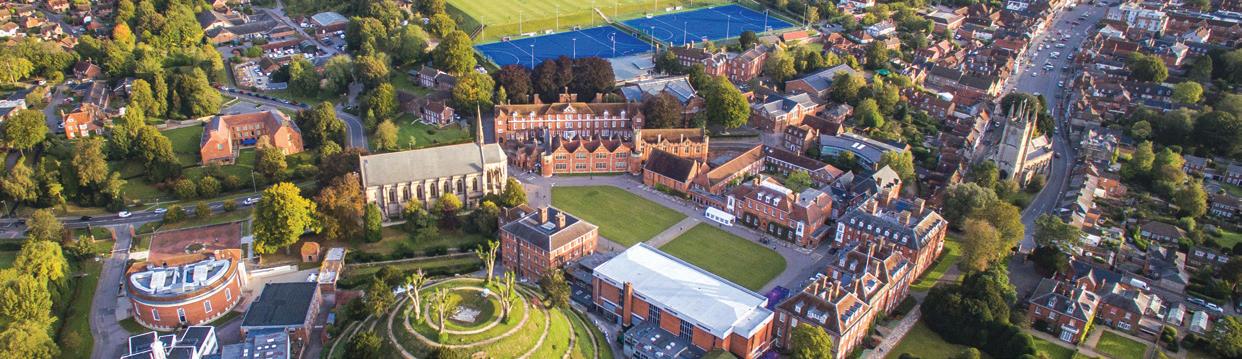
Celebrating 100 Years of the Memorial Hall
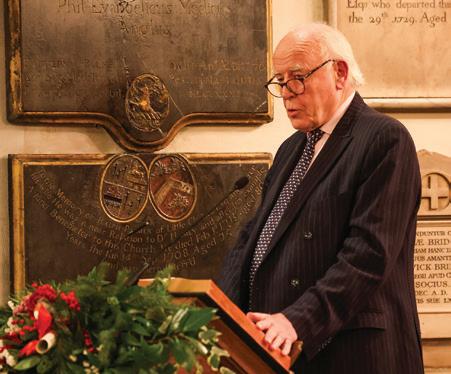
This year marks the centenary of the opening of the Memorial Hall. Andrew Brown (CR 1981-20) tells us about a College publication to mark this milestone event.
Anew digital publication was added earlier this year to the College’s heritage collection, joining works on the College’s Chapel, Spencer Stanhope paintings and collection of rare books. Marlborough College Memorial Hall Centenary is an outstanding record of a building that holds a central place in the history of the College.
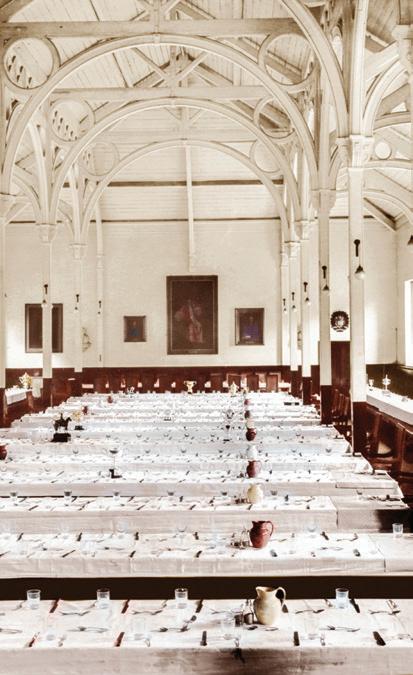
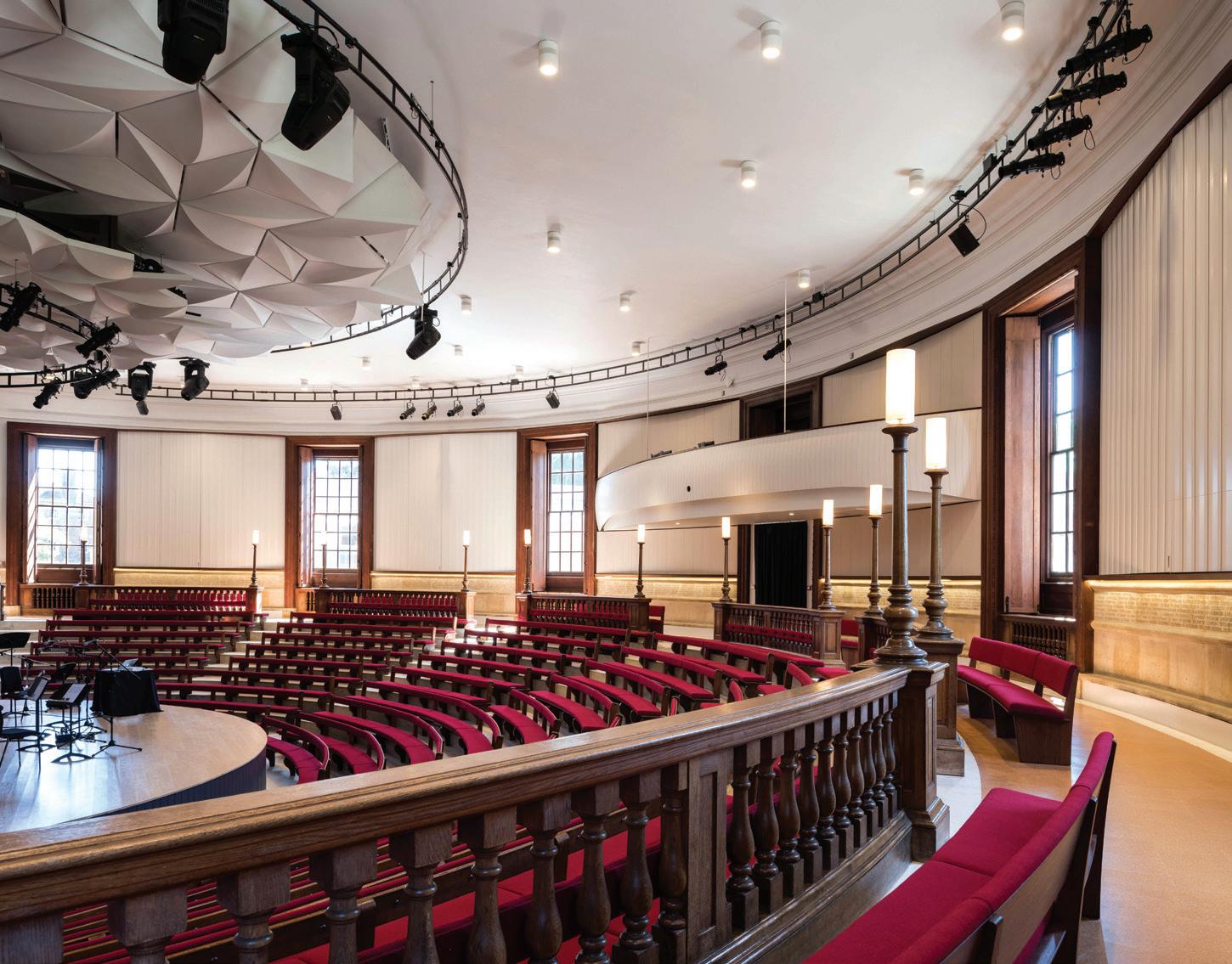
Everyone with a connection to the College will have their own memories of the Memorial Hall. From assemblies to Prize Day ceremonies, from House Shouts to the Celebration of the Individual, from school plays, Penny Readings and musicals to Illumination, not to mention lectures, rehearsals, film nights (in the days before videos, DVDs and streaming), professional concerts, lessons upstairs or downstairs and plenty more besides. Then there is
the atmosphere, the smell of the polished wood, the heavy curtains before the refurbishment, the lamps around the ambulatory, the stonework and brickwork, the decor that became more detailed as the mind wandered during a talk. The memories are there for us all.
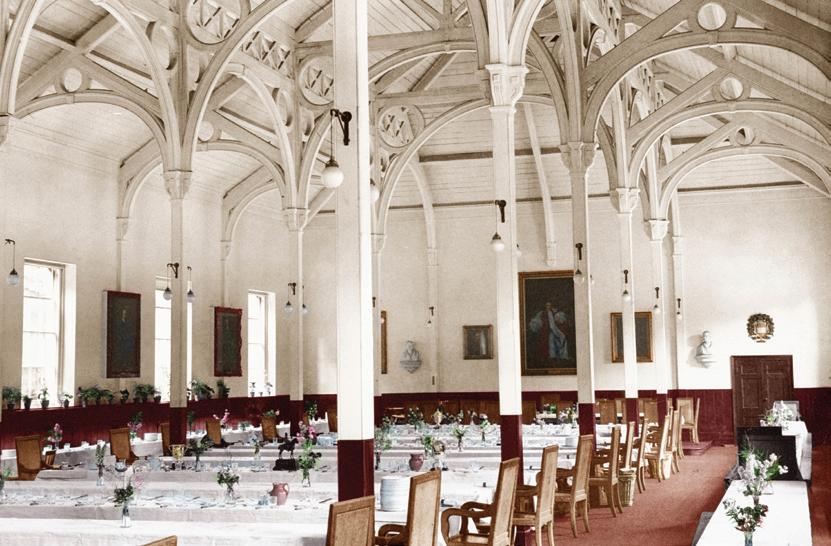
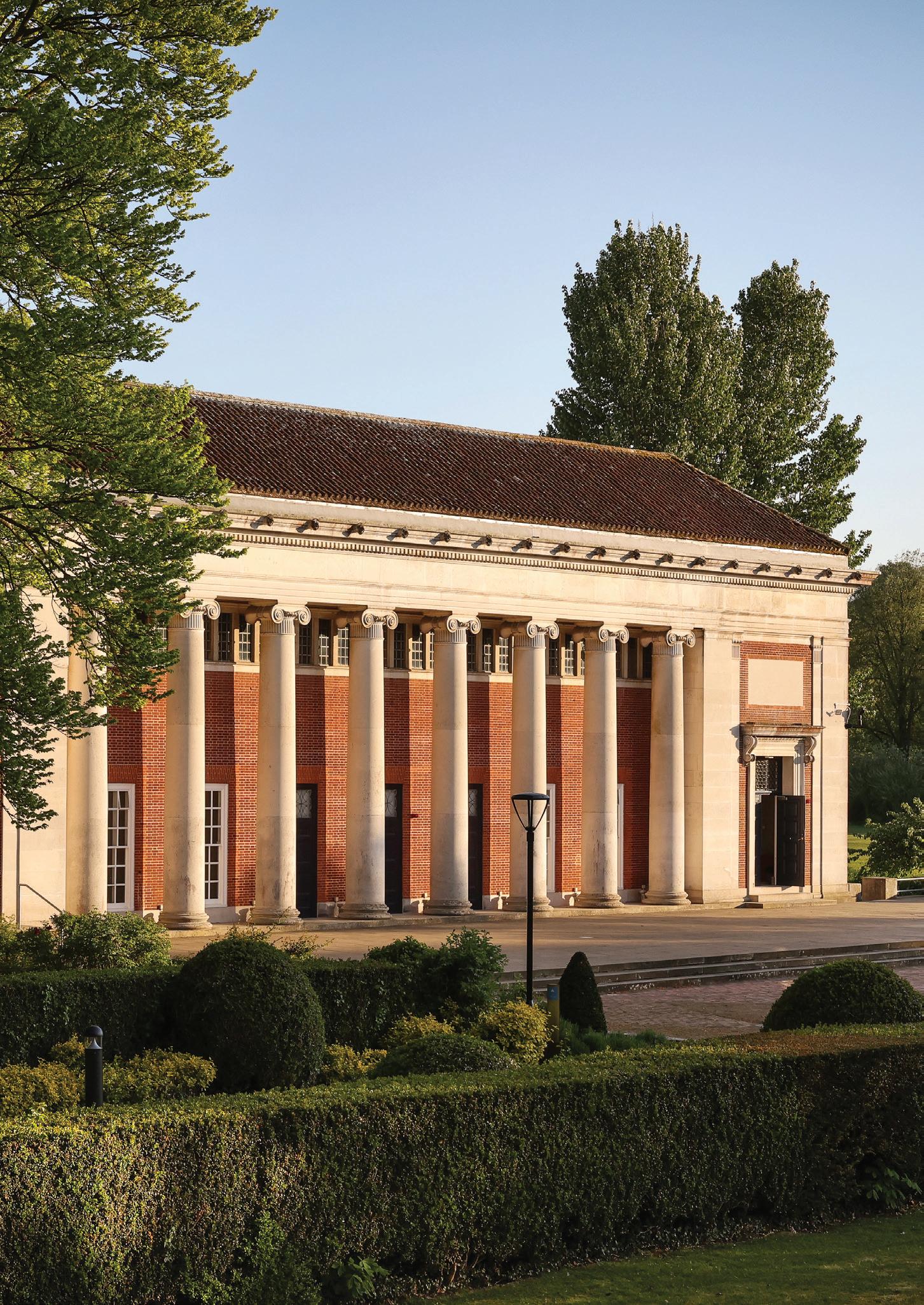
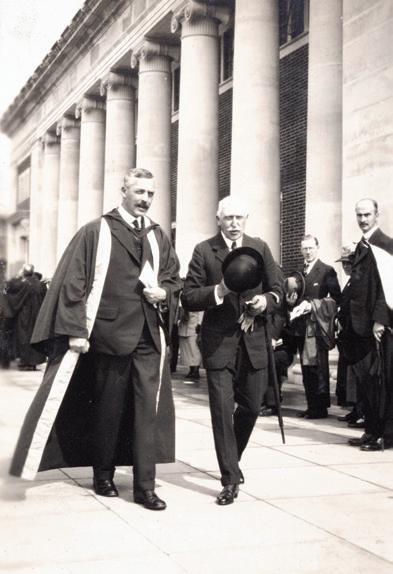
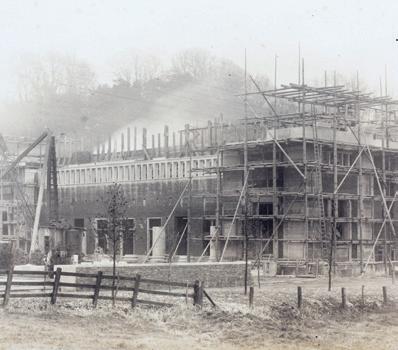
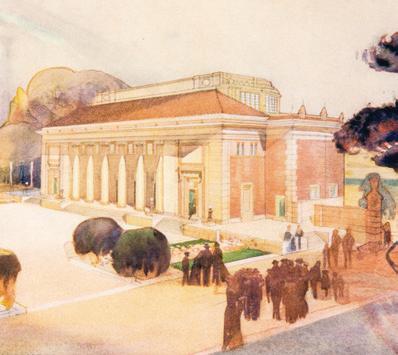
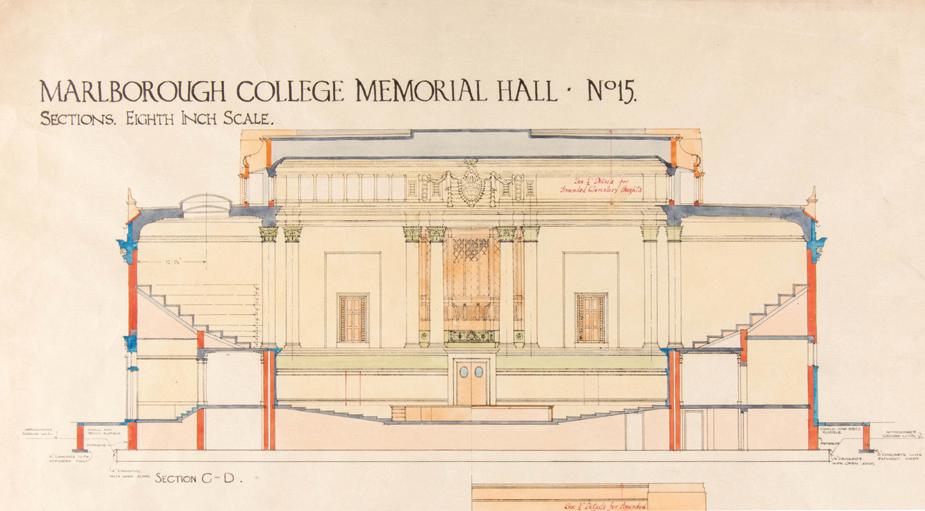
On 23rd May 2025, exactly 100 years after the Hall was officially opened by HRH The Duke of Connaught, youngest son of Queen Victoria, the College marked the centenary with the publication on the College website of the latest heritage publication, the Marlborough College Memorial Hall Centenary. It tells the story of the Hall from its original conception as part of the wider College memorial to the 749 OMs and staff who lost their lives in the First World War, through its design and construction, to its opening and the huge and central role it has played in the College’s life ever since. Later chapters cover the major refurbishment of 2018, to coincide with the 100th anniversary of the end of the War, and, most recently, the Centenary Year Celebrations in March 2025.
‘Everyone
with a connection to the College will have their own memories of the Memorial Hall. From assemblies to Prize Day ceremonies, from House Shouts to the Penny Readings...’
‘Alongside the concept of memorial is the emphasis on youth: from the outset, the primary purpose of the Hall was as a space for performance...’
With articles by over 20 contributors, and beautifully illustrated with photographs, plans, sketches and a wealth of archive material, the publication gives a thoroughly compelling account of how the form of the building was decided upon and how the concept of memorial runs through so many features of its design, from the simple inscription ‘Remember’ above the entrance staircases to the names of the 749 inscribed on the stone dado around the ambulatory and in the Rolls of Honour. Alongside the concept of memorial is the emphasis on youth: from the outset, the primary purpose of the Hall was as a space for performance, a purpose fulfilled as completely today as it was 100 years ago. There are fascinating insights into the planning and construction of the building –and of the difficulties and challenges faced and overcome along the way – as well as recollections of the many performances that have taken place over the years.
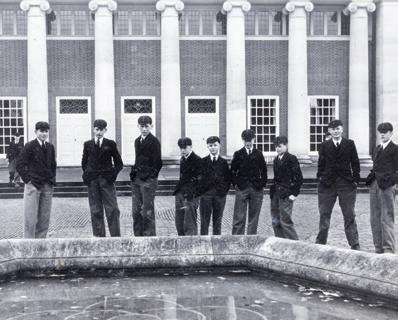
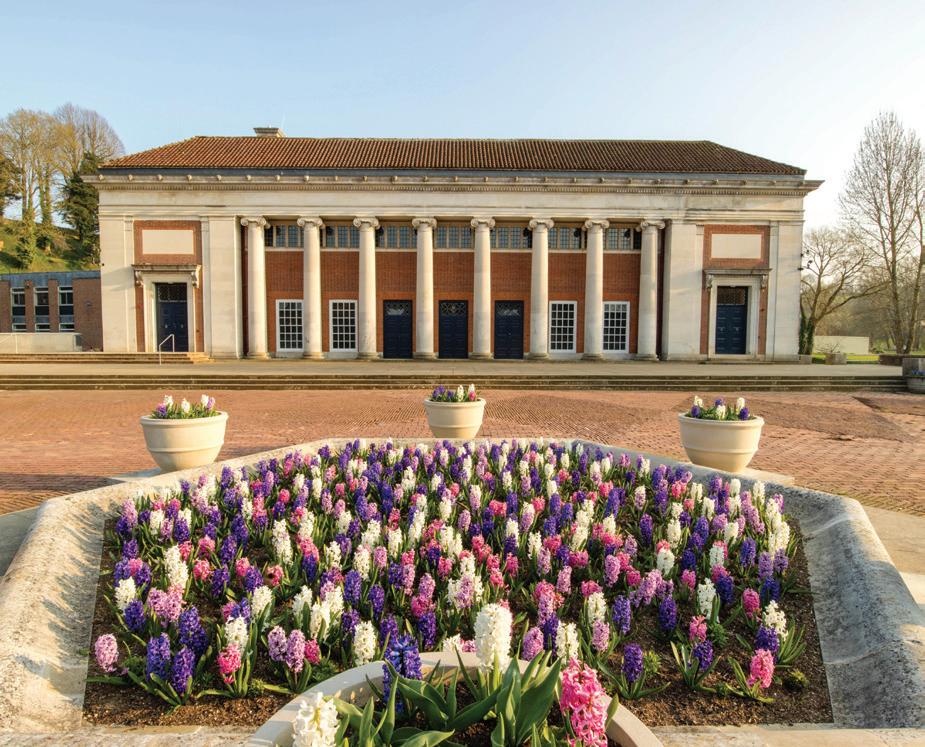
The symbolism of the site around the Hall is carefully and lovingly recorded: the connection between the Chapel and the Hall via the Chapel steps and the brick courtyard; the hexagonal pool (now a flower bed) in the centre of ‘Memorial Court’, with
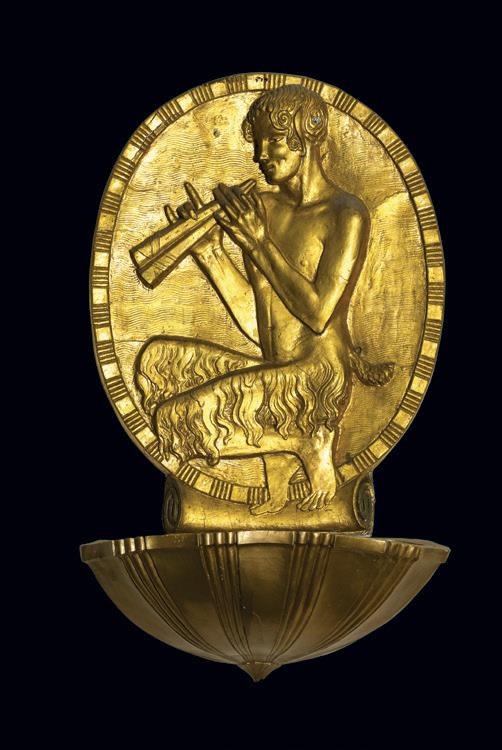
the six large planters that mark the six years between the outbreak of war in 1914 and the Treaty of Versailles in 1919; and the Memorial Garden, with its pergola and gatehouse, generously donated by Herbert Leaf as a quiet place where fallen OMs could be remembered and, additionally, as a memorial to his wife, Rose. The gatehouse is now a museum dedicated to the history of the Mound, itself possibly, of course, a much older memorial. Features that are no longer visible in the auditorium are also noted, such as the playful, theatrical Art Deco plaques by Phoebe Stabler that adorned the walls on either side of the stage, and the plaster keystone of the
‘Perhaps we have all been guilty at some time of thinking of College buildings in isolation, as functional places within the day-to-day almanac of events and commitments.’
cherub presenting the College mitre in the centre of the proscenium arch, the work of OM Esmond Burton (C3 1899-01)
Perhaps we have all been guilty at some time of thinking of College buildings in isolation, as functional places within the day-to-day almanac of events and commitments. This publication helps us to pause, to reflect, to appreciate, to remember … and to reconnect. As the Master, Dr Cyril Norwood (CR 1916-25), commented at the opening ceremony in 1925, we have a ‘hallowed acre’. The Chapel steps connect Chapel to Hall, spiritual to secular; the courtyard opens the Ionic columns of the Hall to full and dignified view from the Bath Road; and the pergola and gatehouse invite us into the Memorial Garden, a place of quiet
contemplation and remembrance. And all the while, the Hall refuses to dwell on death, instead celebrating youth with strength and dignity: refurbished, with its downstairs rooms now fully connected to the main auditorium, it is, in the words of the College’s Artistic Director, Philip Dukes, ‘spectacular and precious.’
Congratulations to Jackie Jordan and Jane Green (B3 1982-84) on producing such a fine publication, and to the Memorial Hall, Happy 100th Birthday. Deus dat incrementum!
Scan the QR code to download the publication
How Dig took on the Dragons
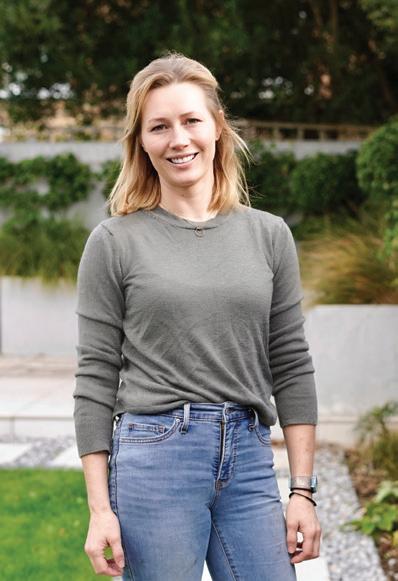
Alex Hollingsworth, née Peal (EL 1999-04) and her business partner found themselves making a pitch and securing an investment on BBC’s Dragons’ Den earlier this year. Millie Perry (MO 2015-20) finds out the full story.
At the start of the pandemic, Alex was seven months pregnant, knee-deep in a house renovation and already juggling more than most. Then came a call from Henry, an old university friend: ‘I’m thinking of setting up a garden design business,’ he told her.
Naturally, Alex said she was on board. Because why not add ‘startup co-founder’ to the mix?
And just like that, Dig was born.
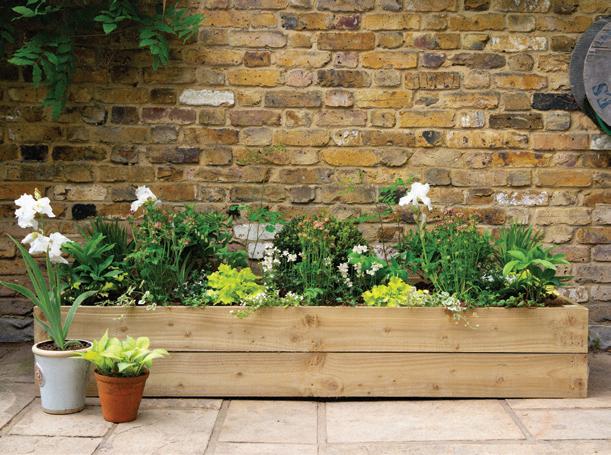
Dig takes the guesswork – and waiting time – out of gardening, delivering themed, pre-designed flower beds straight to your doorstep. You send your measurements, they send the mature plants you’ll need, a HelloFresh for plants. ‘We always had this one chart we’d show people – cost on one axis, effort on the other – and there’s this massive, underserved middle bubble,’ Alex explains. Most people, it turns out, don’t want a Chelsea Flower Show-esque garden. They just want something that looks great, is quick and lasts – without spending an absolute fortune.
Alex heads up garden design at Dig. As well as creating the original designs for the instant beds (there are currently six to choose from), she runs Dig Studio, the bespoke arm of the business.
After leaving Marlborough (‘which I absolutely loved, it was great’), she took a gap year before heading to Bristol University – ‘along with half of Marlborough’ – then moved straight on to the PwC graduate scheme after graduating.
‘That was quite intense,’ she says of PwC. ‘I was doing strategy consulting, travelling a lot, in not a very glamorous way, and working crazy hours.’ But she did meet her now husband, who was in the intake above her, on day one. They married and moved to Ireland, and Alex rejoined PwC in Dublin. And then came a wobble.
‘I had a bit of a panic. We were both doing intense jobs, and I suddenly thought, this just isn’t going to work if we ever want kids.’ So, true to her strategy consultant form, she sat down and analysed her options. ‘I came up with, among other things, bat inspector,’ she laughs. ‘I’m glad I didn’t go down that route.’
‘One of my criteria was something where you have an asymmetry of information. Where you know a lot and have the opportunity to learn a lot, but the people you are working for don’t have that – unlike consulting, where you’re only one Google search ahead of your client.’
And she knew she wanted something project-based, where she could build deep expertise and a body of knowledge that, crucially, wouldn’t shift dramatically all the time. So, she landed on garden design. It helped that lovely gardens had always been a part of her life. ‘My mum, grandma and great-grandma were very keen gardeners, so I kind of took it for granted that you had a beautiful garden full of plants. It was a sanctuary where everyone would spend their time and that had become normalised for me.’
So, she retrained and joined high-end London firm Mazzullo + Russell, who were, she assures me, ‘brilliant and completely terrifying.’ But she learned fast, managing luxury projects with big budgets and high expectations, which would prove to be completely invaluable. She remembers the first garden designer she shadowed, ‘an amazing, eccentric older lady. Everything was hand-drawn, very non-technical. Anyway, she told me: “Always turn up in a clean shirt and never get your hands dirty.” It really sets the tone that you’re not the gardener. You’re the designer.’
After her first son, now seven, was born she set up her own studio. ‘People really let you
Alex Hollingsworth
The Classic
The Cottage
The Jungle
The Mediterranean
‘Not only was the idea of such exposure and publicity exciting, but the chance to secure investment could not have come at a better time...’
into their lives and their homes. I really loved that. And it was going well.’
Then came Covid – and Henry’s message. At first, Alex helped out as a consultant, joining Henry and the other two co-founders, Ed and Ben. ‘The first year was a slow burn. Henry’s “the main guy”, and his plan was always to quit his job and go full-time. That’s a huge leap, so we took it slow.’
And from the start, it felt like a smart idea. ‘With gardens you’ve got high ease and high cost – which is getting a garden designer in.
Then you’ve got going to the garden centre and doing it yourself, which is very hard, but less expensive. But then there’s this huge kind of middle bubble for people who want support but don’t want to pay for a whole full-whack garden designer.’
And as a group they had nearly all their bases covered – Henry has a background in advertising, Ed in PR and Ben in web design. Alex, of course, brought the garden expertise.
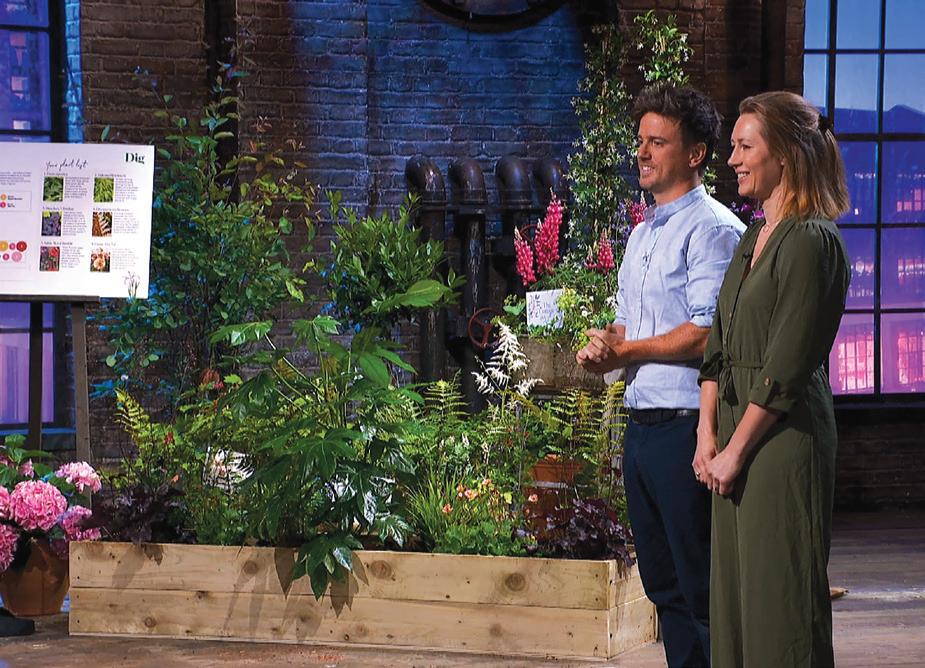
And then, two years in, came another unexpected twist: an email from the producers of Dragons’ Den
‘We didn’t think we’d get through,’ says Alex. ‘It’s not a “product” like the Tangle Teezer or a chilli sauce – it’s more of a service. So we worried it wasn’t differentiated enough
from a normal, existing business model.’ But they kept progressing. ‘Every stage we passed, we were like: oh wow. Now the next thing. And the next. And then suddenly the filming date is in the diary and you’ve got two weeks. That’s the point when I thought “this is actually scary”.’
Not only was the idea of such exposure and publicity exciting, but the chance to secure investment could not have come at a better time – the Dig team were mid-fundraising and this felt like their best shot. ‘We were just so aware you have to really understand the mechanics of your business and so Henry and I just bounced back and forth trying to really nail that down.’
After a mock pitch at home – ‘my dad was absolutely ferocious’ – it was time to face the Dragons. In real life, they had over an hour in front of the panel, which was intimidating but ultimately positive. ‘When you talk to your friends and family they’re always really nice to you. Having five people being really pretty horrible and picking holes and trying to work out all the reasons why you’ll fail … and to still come away with confidence and belief is a really good moment.’
And even better: they walked away with £75,000 from Sara Davies. ‘She’s been brilliant,’ says Alex. When they left the den, Sara came out to see them in a dressing
gown and ‘gave us a massive bear hug. There’s no cameras, no one’s telling you what to say, it’s just a very real moment. She was amazing, full of energy, full of enthusiasm.’
‘After filming, she explained exactly how it works. There’s a big onboarding conference for all the new investees. You meet her team, the other founders, get advice on PR and marketing, all the right introductions. Henry and Ben went up for that. It was really structured, really professional. She gave us a PR person to work with all the BBC stuff, and that was brilliant.’
In the three weeks after the episode aired in February, Dig sold more instant beds than in the whole of 2024. ‘It was a kitchen-table business until about a month before the show. Then suddenly we needed packaging, couriers, storage, staff – everything. We found a unit in Battersea a week before airing. I walked into empty space and thought: is this actually going to happen? Then we saw the orders coming in.’
And for Alex, it was the moment she realised the business was really going somewhere. ‘We just never had the traction, or the reach,’ she explains. ‘Word-of-mouth marketing was great, but it tended to lead to garden design projects, which was obviously great for me. We just didn’t see the volume we needed in instant beds, until Dragons’ Den.’
Now, with three young sons and a business that’s booming, Alex is still spinning plenty of plates. But the momentum from Dragons’ Den continues to be very real. ‘There was that big surge,’ she says, ‘and obviously it’s plateaued, but it’s still a pretty good level.’
Interestingly, Alex tells me: ‘It’s much more of a business job than a creative job. The creative moments are wonderful and crucial because that’s what you’re selling. But day-to-day, it’s a lot like strategy consulting. It’s budgets and profitability, stakeholder management. You might have a couple with totally different visions, or a number of different specialisms on site, and you’re the middle person making it all run. It’s kind of an operations job. And also, you don’t get to do that much actual gardening.’
And they’re already looking ahead. ‘We’d love to go more B2B with the instant beds –restaurants, hotels, housing developments, schools, hospitals. It’s a great untapped part of the market.’
Meanwhile, Dig Studio continues to grow. ‘We’re not reinventing the wheel – there are lots of garden design studios already – but one that focuses on the midmarket and isn’t chasing show gardens or awards is a nice thing to aim for. We just do what we know works and do it really well.’
BBC’s Dragons’ Den
Interior Escapes
Jemima Sissons (MO 1994-96) finds out how Emma Clarkson, née Pocock (PR 1995-97) uses her interior design skills charitably to transform utilitarian spaces into havens for carers, patients and families.
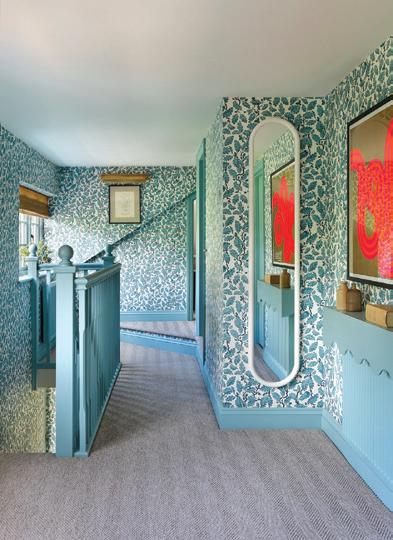
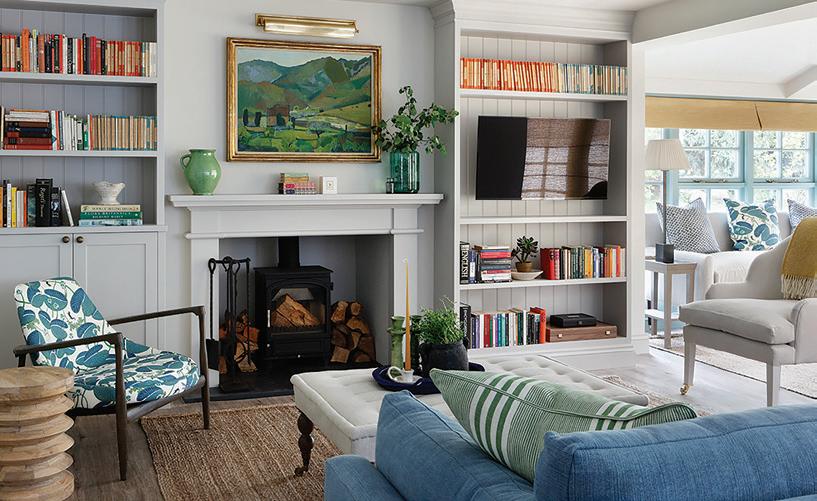
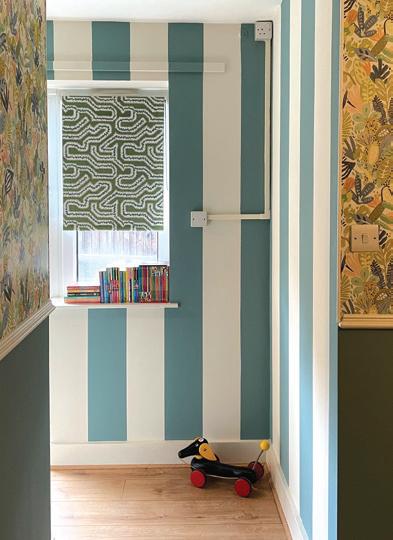
Stately homes in Berkshire, Notting Hill townhouses and villas on Lake Geneva. This roll call of upmarket abodes is what interior designer agency Turner Pocock is renowned for, dreaming up some of the most desirable residences for clients who can dig deep. Known for its high-end projects, bold use of colour and maximalist patterns, the company is regularly listed among the top 100 interior design firms of the year.
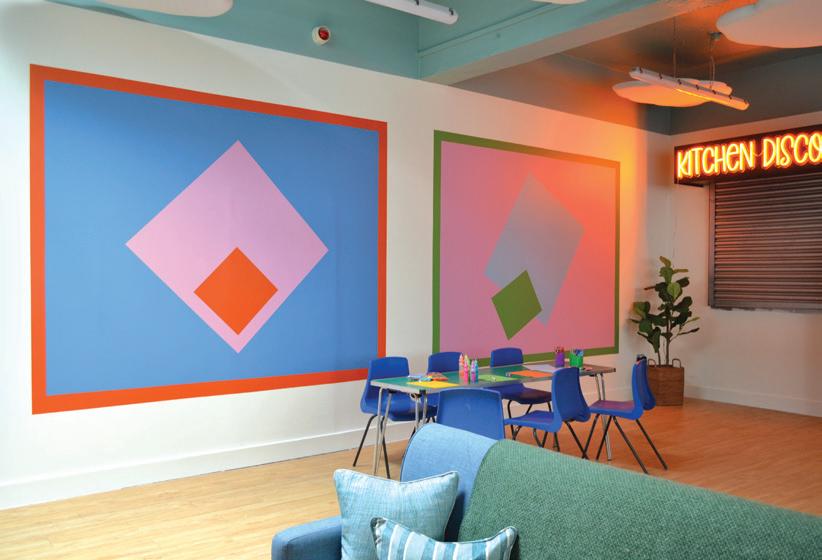
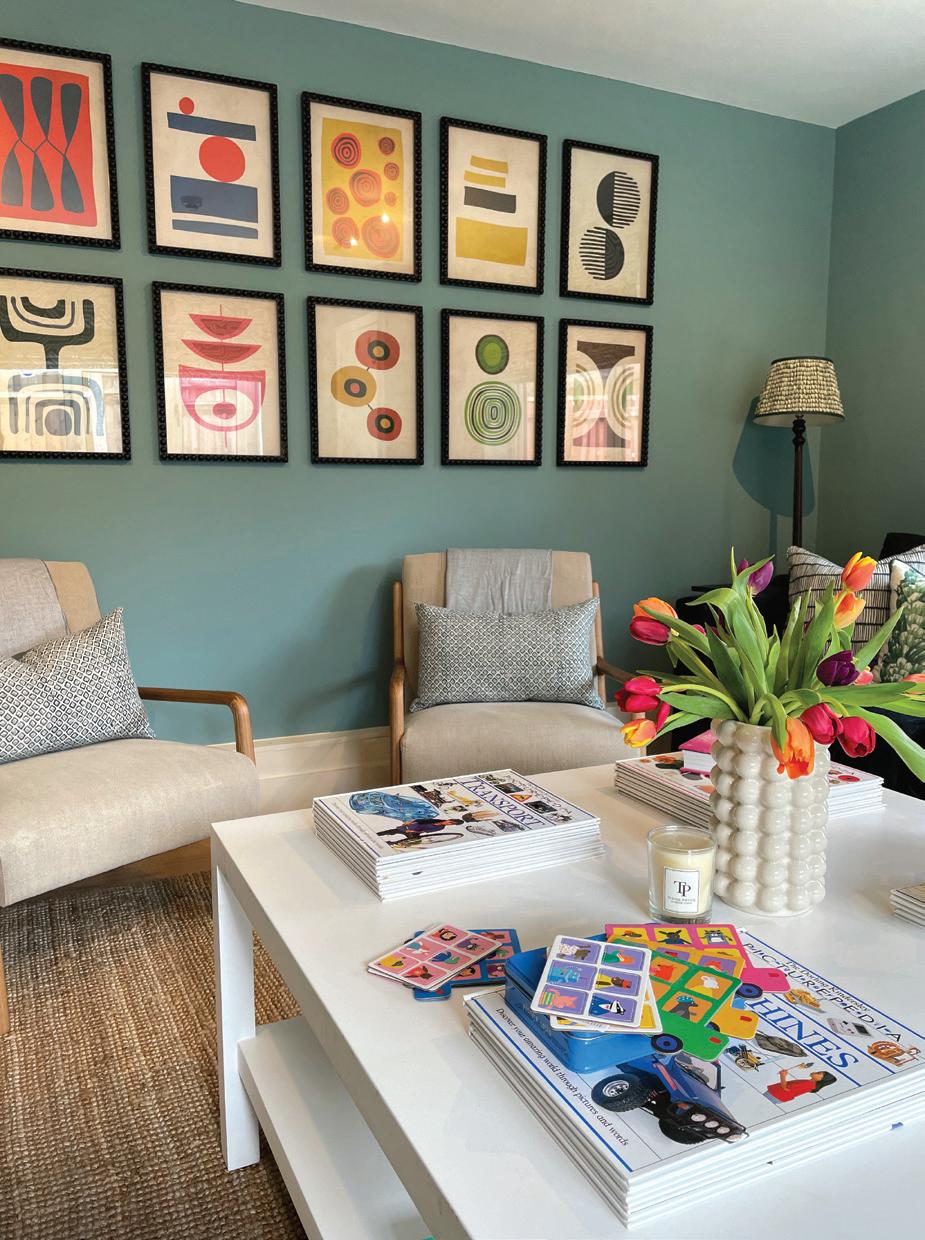
However, in recent years the duo behind the agency have spread their sights – and skills – to the other end of the spectrum. In 2020 they launched TP Caring Spaces, a charity that lends a helping hand – and keen eye – to transform women’s shelters
and hospital spaces, turning them into sanctuaries filled with beautiful furnishings and fabrics. Reminiscent of boutique hotels, with modern art, plush velvet sofas and botanical wallcoverings, the end results are as far from institutional as you can get.
They have now revitalised six spaces, with three more in the pipeline this year, winning awards along the way from House & Garden and Homes & Gardens magazines for their charitable work.
Emma Clarkson and her business partner Bunny Turner were inspired to do this six years ago, just before Covid hit, after being approached by a nurse from Guy’s and St Thomas’ Hospital to transform the nurses’ communal room.
‘It was a very depressing room,’ explains Emma on a Zoom call from her home in Geneva, from where she commutes to the UK for work. ‘It was for nurses who had come off 12-hour shifts to have their tea breaks in. It is the polar opposite of what we do for work – it’s not about expensive pieces, but fun colours, comfort and cupboards for what they need to store.’
Working with loyal wallpaper, fabric and design brands, who donated pieces and became generous partners, Emma and her team started to give rooms new leases of life, from the Masbro Centre, which serves an entire community, to the Barons Court Project, a drop-in centre for the homeless and those suffering with mental health issues. Although initially self-funded, they now have dedicated staff and official charitable status.
The projects are varied. The first, Bridlepath, funded by a current client of Turner Pocock, was to change one of the cottages on the client’s country estate in Berkshire into a place where those recovering from cancer treatment can escape to, with social areas and private bedrooms in which to retreat. The uplifting design celebrates nature, using vibrant greens, with rural artworks dotting the walls and a bespoke oak leaf wallpaper covering the staircase and hallways.
One of their most treasured projects was the Masbro Centre in Shepherd’s Bush, London. The centre serves numerous purposes, from adult education to offering fitness facilities, group activities for the elderly and a fantastic youth club, so the spaces had to be multifunctional. ‘Our desire was to transform the two largest spaces in the centre from soulless lacklustre areas into welcoming, colourful, considered spaces with improved acoustics and marvellous murals.’
The wall paintings were done with the help of a resident from one of their other nearby projects, a homeless shelter. The artist, Dave Martin, a Big Issue seller, had been a longstanding member of the shelter’s community. The renowned rug designer Amy Kent had already collaborated with him to turn one of his works into a vibrant floor piece for the Barons Court Project, and he was subsequently asked to create murals for the Masbro Centre.
‘When I was commissioned to design murals, I turned to my portfolio and studied the geometric shapes and colours I had created,’ he explains. ‘What inspired me was my awareness of what an important place the Masbro Centre is to so many people.’
The whole process is well thought out, with months of preparation beforehand, says Emma. ‘We want to know what those who
‘The projects are varied. The first, Bridlepath, funded by a current client of Turner Pocock, was to change one of the cottages on the client’s country estate in Berkshire...’
Bridlepath
Masbro Centre
use, work, live in and benefit from the spaces are using it for – what are their specific needs and current issues, from simply improving acoustics to fundamentally bringing joy to a place that provides comfort, respite and care for a huge number of people.’
Another transformation very close to the female founders’ hearts was a women’s refuge in London (the location cannot
be disclosed). The aim was to create a welcoming gathering space for women fleeing troubled situations with their children, filled with toys, art and books. ‘When we first visited, we found that the space lacked home comforts, warmth and distractions, and, as with many of the projects the charity works on, things felt decidedly institutional, lacking in colour and cheer.’ Here, the rooms are filled with
‘Another transformation was a women’s refuge in London. The aim was to create a welcoming gathering space for women fleeing troubled situations with their children, filled with toys, art and books...’
Rapture & Wright fabric, Pooky lights, OKA artwork and colourful walls transformed with Edward Bulmer paints. For Emma, it’s about trying to create as calming and considered an environment as possible: ‘Surroundings can be so detrimental to mindset, recovery; being somewhere happy feeling and comfortable is very healing.’
When Emma and Bunny started Turner Pocock it was a two-woman operation. Now, the studio is a powerhouse, with 10 members of staff, including interior architectural designers and project managers. They have collaborated with some of the most coveted names in the interior design industry to create exclusive TP ranges, from Chelsea Textiles and Christopher Farr to Peter Page rugs and Lorfords furniture.
Emma left Marlborough in 1997, but her daughter Lilah is now following in her footsteps, having joined Ivy House in September. As Emma understands it, Lilah will be the first third-generation female to attend the school – Emma’s mother, Georgina Pocock (SU 1970-72), started in 1970, only the second year that girls were welcomed into Marlborough, and was one of only six girls in the entire school at that time.
Living in Switzerland means weekends skiing and an outdoorsy life for Emma, with frequent trips back to London. Her feet are barely able to touch the ground with all her projects, but she remains proud of being able to make a difference.
‘We are very lucky to work in the luxury sector where budgets permit us to focus on craftsmanship and an uncompromising attention to detail. We try to apply that same rigour and care to our projects for TP Caring Spaces, conscious of just how necessary and appreciated these facilities are.’
Women’s refuge
Mind the Gap!
Ian Firth (C1 1969-74), one of the world’s leading bridge designers, provides a fascinating insight into his career in structural engineering.
‘The
world needs bridges!’
That was how I began my 2018 TED talk before going on to address the cultural, historical and technological significance of bridges and why we need to make bridges beautiful. When leaving Marlborough in December 1974, I never imagined I would end up designing bridges all over the world, and even less that I would be standing on a round red carpet in Vancouver telling the world all about it! But one of the things that Marlborough does is to prepare you for the unexpected.
Looking back, a degree in Civil Engineering seemed like a good idea at the time, although I admit to knowing next to nothing about what it would actually involve. It suited my A level subjects (Maths, Physics and Geography), and a creative career designing stuff that people needed sounded appealing, so I thought I would give it a go. Somehow, I managed to secure a place at Bristol University, where despite a very full and demanding timetable (today’s students have it so much easier!) I
managed to find time to continue the music that had been such a significant part of my life at Marlborough. After three years I emerged to join Flint & Neill Partnership, a small consulting engineering firm in London that had built a reputation as specialists in complex bridge engineering, among other things. It was the best move I ever made.
I remember being welcomed on my first day by the senior partner, Dr Tony Flint, an inspirational genius who I have been enormously privileged to have worked alongside. ‘Up until now,’ he said, ‘your teachers have given you marks for method, even if the answer was wrong. But from now on, you need to get the answer right too.’ OK, so no pressure then! That certainly focused the mind of a raw graduate.
Fast forward 10 years and you could find me suspended beneath the Wye Bridge, part of the old M4 Severn Crossing between England and Wales, probably in the middle of the night, freezing cold, supervising some critical strengthening procedure, and hoping I’d got my sums right! Flint & Neill had the
‘After three years I emerged to join Flint & Neill Partnership, a small consulting engineering firm in London that had built a reputation as specialists in complex bridge engineering, among other things. It was the best move I ever made...’
The Severn Crossing
‘Fast forward 10 years and you could find me suspended beneath the Wye Bridge, part of the old M4 Severn Crossing, in the middle of the night, supervising some critical strengthening procedure...’
task of strengthening and upgrading the bridges of the crossing, and I was looking after the cable-stayed bridge over the River Wye. This was innovative and groundbreaking work, all carried out with live traffic on the bridge, and I learned very quickly the need for extreme care and caution. Safety in everything was paramount. You had to believe that what you were doing was correct, and I am sure that learning to have confidence and the courage of my own convictions was established years earlier at Marlborough, alongside the obvious understanding of my innate fallibility and the consequent need for proper independent checking by others.
In fact, before I started designing new bridges, I spent most of my time checking designs prepared by others and assessing the condition of existing structures. This is the perfect training ground for aspiring designers, as I regularly tell enthusiastic young graduates who eagerly want to jump straight in to designing new bridges on day one! For me, the breakthrough to finally designing new bridges from concept stage (that is, starting from a design brief and with a blank sheet of paper and a pencil) came in 1994, fully 15 years after I graduated! The UK Highways Agency had launched a design competition for a new bridge across part of Poole Harbour. I was a young partner in the practice by this time and somehow managed to persuade the others to let me have a go. We had never
done anything like this before, and my partners were sceptical, to say the least, but I was feeling confident and wouldn’t take no for an answer. The competition attracted 99 entries from around the world, and I am glad to say that we won! Sadly, the bridge was never built, being one of many projects cancelled by the incoming Labour government following its election in May 1997, but the result radically changed the direction of my career. Suddenly, we were being invited to join teams to participate in other design competitions, and the timing was good because towns and cities everywhere seemed to want to build their own ‘Millennium Bridge’ to mark the year 2000 and I got caught up in the melee.
The first to see the light of day was the Lockmeadow Bridge in Maidstone, an innovative aluminium footbridge over the River Medway, in front of the Archbishop’s Palace. This was followed quickly by several others as the Millennium bubble gathered momentum, and I was discovering that I had an aptitude for conceptual design and enjoyed working in multi-disciplinary teams alongside architects, landscape designers, urban planners and others.
I had also been working on several major bridges in Hong Kong, and in 2000 I led the team that won the Stonecutters Bridge design competition, which remains one of my proudest moments. Bridge projects of all types and sizes cropped up in France, Sweden, Denmark, Australia, Switzerland
and elsewhere, as well as in the UK, and one of the most notable was for an enormous suspension bridge across the Messina Strait separating Sicily from the Italian mainland. This will have a single span of 3,300 metres, making it by far the longest in the world. The concept for this world record span emerged in the late 1960s, but such enormous projects tend to take many decades to come to fruition and involve many people, not least because of their huge cost and the complex political and socio-economic factors involved. The Messina Bridge has had a particularly long gestation, but happily, the current Italian government seems committed to it, so it might yet be completed in my lifetime.
(I started working on it 25 years ago, but the idea has been talked about since 251 BC, when, according to Pliny, the Romans used rafts to ferry an army of elephants from Carthage bound for Rome across the Strait.) The bridge design comprises three parallel interconnected streamlined steel box girders slung from the main cables. The centre one carries twin rail tracks, and the outer ones carry two three-lane roadways. The main design challenges include ensuring aerodynamic stability, dealing with massive seismic forces and managing the dynamic behaviour of trains on such a slender structure, among many others. It will be an astonishing achievement when completed, having involved many
‘If Messina is the longest span I have worked on, the shortest is the little Bridge of Aspiration across Floral Street in Covent Garden, connecting the Royal Ballet School with the Royal Opera House...’
hundreds of people in its design and development over a very long period, and it is an honour to count myself among them.
If Messina is the longest span I have worked on, the shortest is the little Bridge of Aspiration across Floral Street in Covent Garden, connecting the Royal Ballet School with the Royal Opera House. This twisting, dancing gem of a bridge was pure joy to work on and remains one of my favourite projects.
So, the world does indeed need bridges, but some people need them more than others. I am proud to have been involved, since 2014, with Bridges to Prosperity, a wonderful charity that builds pedestrian bridges in some of the poorest and most remote parts of the world. They have built over 500 bridges and connected two million previously isolated people with services that most of us take for granted – education, healthcare, markets, opportunities – transforming lives in the process. They work with local communities to build simple suspended or suspension bridges, and the transformations and economic impacts are immediate and long-lasting. It is a privilege to work with such an impactful organisation, saving and improving lives of some of the poorest and most isolated people on the planet.
Reflecting on my Marlborough years, I’m struck by the rich tapestry of opportunity and experience that allowed me to develop areas of interest and find such enjoyment and fulfilment in them, for which I am eternally grateful. For me, this meant a lot of music and various other creative pastimes, including carpentry, pottery and metalwork. The seeds sown there germinated and found expression in the bridges and other structures I have been fortunate to work on, trying, in my own small way, to make the world a better place.
proposed Messina Strait Bridge between Sicily and the mainland of Italy. Stonecutters Bridge, Hong Kong
Scan the QR code to Listen to Ian’s Ted Talk
Top left to right: Lockmeadow Footbridge, Maidstone. Inside the Bridge of Aspiration. Bridge of Aspiration across Floral Street, Covent Garden. Below left to right: The
The road to Wuthering Heights
Issy Carr (EL 2012-17) speaks with BAFTA-nominated film composer Anthony Willis (B1 2000-05) about his journey from Marlborough to Hollywood, his creative partnership with filmmaker Emerald Fennell (NC 1998-03) and the musical score for Wuthering Heights.
‘It was at Marlborough that he first discovered the beauty of composing for film and that, for him, it was a possible career path.’
In September, when our conversation takes place, the BAFTA-nominated film composer Anthony Willis is speaking to me over Zoom from his studio in Los Angeles. When we speak, he is preparing to come to London, to finish his work on the score for the highly anticipated adaptation of Emily Brontë’s Wuthering Heights from filmmaker Emerald Fennell, which marks Anthony’s third collaboration with the actor turned writer-director.
Anthony’s musical journey started before his time at Marlborough, when he was a chorister at St George’s School in Windsor. It was at St George’s that he picked up an ‘interest for how music is was assembled and how it could move you’. He then became a Music scholar at Marlborough –he speaks fondly of the House Harmony and House Shout competitions, describing them as ‘amazing melting pots which brought the whole school together’.
Anthony went on to study composition at the College and he recalls how it was in the Music Technology labs, which were in their infancy then, that he developed and began to establish his relationship with sound. One of his teachers, Clare Toomer (CR 1999-), asked if he had ever thought about being a film composer, suggesting that his composition possessed ‘a kind of narrative that would lend itself well’ to films. The insights gained from being taught about cinematic scores made Anthony realise how orchestral they could be, referencing studying James Horner’s score for Titanic It was at Marlborough that he first discovered the beauty of composing for film and that, for him, it was a possible career path.
Anthony was also involved with the amazing Drama Department at Marlborough, which I was also lucky enough to be part of and to which I credit the genesis of my love for visual storytelling. The then Head of Drama, Nigel Bryant (CR 1995-08), commissioned Anthony to write a score for A Christmas Carol, which he also appeared in. Anthony also sang in productions of Grease and Jesus Christ Superstar.
After Marlborough, Anthony went on to study Music at Bristol University, which he loved due to the combination of ‘pursuing an academic Music course’ – where he was studying classical composers such as Mendelssohn and Brahms – and being in an incredibly vibrant modern city.
While at Bristol, he was ‘introduced to and listening to new music all the time’, music that was emerging out of the Bristol dance and electronic scene at the time. It was here he learned about an incredible film composing course at the University of Southern California (USC), in Los Angeles,
Left: Anthony at Ocean Way Studios Nashville.
Top: Comic thriller Saltburn. Right: Conducting at Ocean Way Studios
‘That nomination led to Anthony then scoring the murderous teen robot horror M3GAN for Universal before returning to collaborate with Emerald again on her hugely successful darkly comic thriller Saltburn.’
which happened to be a great feeder to the film business. It would become Anthony’s next chapter after graduating from Bristol.
Uncertain of how he could possibly pay for the course, Anthony moved home, taught piano and took any odd job he could get his hands on. He was also fortunate to have received support from the Marlborough College Charitable Fund, which helped him pay for his tuition fees in the United States, for which he is hugely grateful.
At USC, Anthony won a mentorship with the British composer Harry Gregson-Williams, best known for his collaborations with brothers Ridley and the late Tony Scott on the latter’s Man on Fire and the former’s Gladiator sequel, along with his work on the
Chronicles of Narnia: The Lion, the Witch and the Wardrobe and the Shrek franchise. Anthony also went to work at Remote Control, Hans Zimmer’s facility, before meeting the How to Train Your Dragon composer John Powell and supporting him on the second film in the series. Anthony described as a real highlight coming back to the UK with Powell to record at Abbey Road Studios, a ‘stone’s throw from where I grew up’, coming full circle back to London after journeying through Windsor, Marlborough, Bristol and Los Angeles. As an additional music composer, Anthony then went on to work on projects with Universal, before meeting Emerald Fennell. Anthony describes as ‘the next best part of my story’ being introduced to Emerald. They didn’t know each other at Marlborough, but he does recall her starring in a production of Twelfth Night in the Memorial Hall. He thought she was captivating in the play and was ‘clearly an impressive creative force’.
They did then meet sporadically over the years in Los Angeles, but it was when she was making her debut film, Promising Young Woman, that they came together for good. Initially wanting advice and with Anthony helping to connect her with the right people for her score, Emerald then asked if Anthony would write something for the film – which he loved, by way. He did, but, after a few weeks had gone by, wasn’t sure if anything would materialise. Then, in a serendipitous set of circumstances, the music supervisor Anthony had just worked with on a Universal film was also working on Emerald’s film and, in one of those ‘crazy life moments’, agreed with Emerald (who loved what Anthony had written) that he was the right composer for the film, having just had a wonderful experience working with him. Anthony then went on to receive a BAFTA nomination for his work on the film, during what was a seminal moment in his career.
That nomination led to Anthony then scoring the murderous teen robot horror M3GAN for Universal before returning to collaborate with Emerald again on her hugely successful darkly comic thriller Saltburn, which starred Jacob Elordi, Rosamund Pike and Barry Keoghan. Anthony was well equipped to score this story, about an outsider Oxford graduate who becomes beguiled by an eccentric aristocratic family and their rambling English country house, a 21stcentury spin on a Brideshead-type tale. Anthony’s choral background and the electronic music he experienced at Bristol provided the key sounds he needed to enhance Emerald’s provocative ‘campus thriller’ and capture the neon party feel and sinister vibe of the story.
Anthony then was enlisted to score Emerald’s upcoming feature Wuthering Heights, starring Margot Robbie and Jacob Elordi, which Warner Bros will release on Valentine’s Day 2026. The film features songs by Charli XCX, and Anthony describes it as ‘one hell of ride’.
So, Anthony’s focus for now is on Wuthering Heights, along with spending some time with his family and maybe a trip to England. Before our conversation ends, Anthony asks me to mention how grateful he is to the Marlburian Club for the help he received when his career as a film composer was beginning.
For now, I wait with bated breath to hear Anthony’s score on Wuthering Heights in February, a film sure to excite audiences across the globe. I hope Anthony and I have the chance to work together in the future!
Top: Upcoming feature Wuthering Heights Left: Anthony and Emerald Fennell. Above: Robot horror M3GAN
HYROX: The Ultimate Fitness Challenge
Celia Duff (LI 1969-71), one of the second intake of girls at Marlborough, is now a HYROX world champion and Instagram sensation otherwise known as Badass Gran. Conrad Leach (PR 1983-88) finds out more.
‘I’m not extraordinary, I’m ordinary.’
So says Celia Duff – aka Badass Gran, mother of two and grandmother of two. But Celia is a hit on Instagram (5,400 followers and counting) and a HYROX world champion. Hy what? If you haven’t heard of it yet, you may soon, as functional fitness competitions gather in popularity and frequency. To put it bluntly, HYROX is a tough event that puts its competitors – men and women of all ages – through hell. Running, then strength and endurance sections, more running, maybe some sandbags, and then, to top it all, more running.
The devil is not just in the detail. It’s kicking and screaming at you in large print. How
about this? Each competition is run over 8km, but after each 1km run there is a brutal test of strength and endurance. Things like pushing a 152kg sled and then pulling one that weighs 125kg (the sleds’ runners are metal, meaning there is huge friction to overcome) each over a distance of 50m; walking lunges (knee must touch the floor) while carrying sandbags weighing 20kg; and walking with kettlebells weighing up to 24kg. Also, 1km on ski and rowing ergs, burpee broad jumps, and something called a wall ball, which can weigh 6kg, held while deep squatting then thrown at a target 2.7m high a mere 100 times.
Celia, who was in Littlefield, as one of the second intake of girls in 1969, has been
putting herself through this – training and competition – for the best part of three years and shows little sign of easing. In fact, quite the opposite, because she is getting better. ‘This is not an ego trip, “look at me I’m amazing,” I’m just really lucky. I’ve found this thing I enjoy and am quite good at and have learned lots I can pass on to others. It’s taken me three and a half years and I’m getting faster and stronger.’ There is one caveat, she says. ‘You have to progress slowly when you’re older to avoid injury.’
But there is, naturally for a former consultant in public health medicine, a deeper reason behind this desire to push herself hard. ‘To someone listening to Woman’s Hour [she was on it in January 2025] with a cup of coffee it must be slightly strange to hear me talking about the things I’m doing and the weights I’m shifting. But functional fitness really makes a difference to your longevity.
Glasgow 2024
Every activity of daily living requires strength, flexibility and mobility and when you lose those you become restricted from activities like lifting shopping, climbing stairs or getting out of a chair, and lose the ability to live independently. While I enjoy the immediate feeling of being fit and strong, knowing that I am future-proofing my old age as far as possible is really important to me.’
Celia – now aged 71 – was enjoying a ‘gentle’ retirement with her grandchildren, allotment, hens and dog when Covid struck. She takes up the story: ‘I’ve always been interested in exercise [she rowed at Clare College, Cambridge and subsequently at Oxford, indulged in step aerobics – wearing leg warmers in the ’80s’ – and ran the 2000 London Marathon], but during lockdown I started running again with my dog. Then my daughter, who was already doing HYROX, suggested I try it too.’ Which is where her eye-catching moniker comes in. ‘I had noticed in the marathon that you get a lot of support if you have a slogan. My daughter and I were tossing about ideas and she was asking what’s the message I wanted to put over and I think I said: “I’m being a bit of a badass” so she said “Badass Gran”!’
That was only the start. Not yet versed in the ways of social media, she was at the 2023 HYROX world championship in Manchester with her Badass Gran T-shirt when a stranger approached. ‘He asked if I knew I was all over Instagram. It had gone nuts. My daughter said I needed an Instagram account, so Badass Gran it was, and it has grown from there.’
That it has. She became the 65–69 World Champion in 2023 and 70–74 in 2024. This year she became the first woman over 70 to race doubles in HYROX. She and her daughter also came second in the
‘This is not an ego trip, “look at me I’m amazing,” I’m just really lucky. I’ve found this thing I enjoy and am quite good at and have learned lots I can pass on to others.’
Pro Doubles category for ages 50–59 (a category based on the pair’s average age), which according to Celia was ‘mindblowing and totally unexpected.’ Pro division weights are significantly tougher than Open division ones.
Beyond the thrill of competing, though, she has found friends and the kindness of strangers. ‘A throwaway remark on Instagram asking if anyone fancied some mixed doubles led to a young man, who I’d been following online, sending a reply offering to partner me. We had never met, he owed me nothing and yet he offered to
take me round in Manchester this January. Why should young strangers make friends with me? Even more humbling was that his wife and friends turned out to support us.’
‘You meet a lot of people doing this, you belong to a community, people are really supportive. I’ve made a lot of friends through competing. It makes me feel younger and very alive and very loved to be accepted in something that is really a young person’s sport. And, most importantly, if just one person sees my social media and thinks “If she can do it then I can have a go” then I am beyond thrilled.’
Manchester 2023
Glasgow 2024
‘You meet a lot of people doing this, you belong to a community, people are really supportive. I’ve made a lot of friends through competing. It makes me feel younger and very alive...’
Marlborough’s open spaces greeted Celia in 1969, as she arrived from Winchester County High, among of the first intake of girls not restricted to daughters of teachers and sisters of pupils. She is unequivocal in how it transformed her life for the better, crediting her Housemaster, Bill Spray (CR 1946-70), and Chemistry teacher, one Terry Rogers (CR 1964-14).
‘Marlborough was a turning point educationally. I was very lucky. Terry stood by me when I wanted to drop Maths A level two terms through the year and take up Chemistry and he helped me catch up what I had missed. The teachers were very invested in their pupils. Marlborough suited me hugely. I thrived educationally and with all the other activities. For me, it was a launchpad for the things I’ve been able to do since.’ That meant getting into Cambridge, where she read medicine and rowed for the university, before starting her professional life, with the university city her home for almost all her adult life.
I asked Celia if there have been challenges. She says: ‘Running in winter is the worst because it can be wet, slippy and icy, and injuries at my age are much more difficult to get over. I find running on my own in the cold very, very tough. It’s important to be strong, mobile and have good endurance. My programme includes yoga and pilates, three weekly strength and conditioning classes, Olympic weightlifting, a personal
training session and three runs weekly. The idea of me doing an Olympic weightlifting class is completely nuts but it’s made a difference to my running.’
And as if HYROX wasn’t tough enough, Celia has found more competitions to enter, variations on a theme, such as The Longevity Games, DEKA and Deadly Dozen. If the name of the last one wasn’t a good enough clue, Celia confirms: ‘Deadly Dozen is really tough. The weights are heavy. I’ll see if I can be strong enough for that. You have to carry a 20kg plate for 200m, at the end of an hour of competition.’
It’s all a far cry from her experience of sports at Marlborough. Unsurprisingly, things were a little different more than half a century ago. ‘I played a bit of hockey for the boys’ team at Littlefield, but there wasn’t a lot of opportunity for us. Once a week, girls had to do “girls’ activities”. I think I did flower arranging. I do remember thinking there had to be more than this!’
It is probably fair to say that Celia has made up for it now.
Celia can be found at:
Below left: Birmingham 2025 – World First Women’s Doubles 70-74. Below right: Birmingham 2024 – Pro doubles with my daughter
Glasgow 2024
Birmingham 2024
Father of the House
John Herbert Parker MP (B1 1920-25) was a Labour politician who sat in the House of Commons for over 47 years, including four years as ‘Father of the House’. Philip Cayford (PR 1965-70) brings to life an illustrious career in public service.
John Herbert Parker MP was not quite the first OM Labour MP; that honour goes to the first Earl Jowitt, who joined Parliament in 1922 as a Liberal and later defected to Labour to serve as Attorney General between 1929 and 1932. But John Parker was the second, and towards the end of his long career he held the title ‘Father of the House’, for being the longest continuously serving MP in Westminster.
John was born into a highly political family in Bristol in 1906, the son of a Conservative supporting schoolteacher who had won a scholarship to St John’s College, Cambridge in the 1890s, ‘when Kipling was all the fashion.’ Parker was a bright boy, who at the age of 12 announced that he wanted to become a Tory MP. He arrived at Marlborough in 1920, then under the relatively enlightened leadership of Cyril Norwood (CR 1916-25), a close friend of his father. Parker’s contemporaries included John Betjeman (‘we were all red in those days, weren’t we?’ he wrote to Parker in 1979) and ‘the very aloof’ Anthony Blunt (C2 1921-26), among others. Parker had lost his enthusiasm for the Tories by the time he joined the Independent Labour Party aged 16, in 1922, and founded a Political Society at the College with the encouragement of his distinguished History master, N P Birley (Council Member 1955-66). Parker recalls that not many boys showed much interest,
1923 B1 Rugby
John Herbert Parker MP
‘During the General Strike of 1926, he spent a week in the Rhondda Valley to examine the resulting conditions of dereliction within the mines.’
but that they had good political discussions while riding their bicycles to Stonehenge or Lacock Abbey.
Parker clearly appreciated his time at Marlborough, although in 1979 he wrote an article for The Marlburian emphasising the barbarity of school life in the 1920s.
‘The cult of games was dominant in most public schools; it found its most forcible expression in Field House, C2, under a housemaster who described himself as a muscular Christian. Discipline there was truly Spartan. We bathed sensibly without costumes; the junior boys in his house were called hot-cross bums from the marks most of them bore across their behinds.’
John won a History scholarship to St John’s College, Oxford and soon became President of the Oxford University Labour Society. During the General Strike of 1926, he spent a week in the Rhondda Valley to examine the resulting conditions of dereliction within the mines. Down from Oxford, he moved to Liverpool in 1929 to help organise the local branch of the Society for Socialist Inquiry and Propaganda; in his memoirs he recalled the impact on his socialist beliefs of the widespread unemployment on Merseyside during the 1931 slump and the suffering it created. Having failed in that year to enter Parliament, John became General
Secretary of the New Fabian Research Bureau in 1933 and was elected to the Commons in 1935, at his second attempt, as the Labour MP for Romford.
John’s enquiring, original and slightly eclectic mind remained a feature of his long career in Parliament. As the Second World War began, he complained that the leaflets being dropped by the RAF over Germany were too obviously written by an Englishman and then translated, rather than originating from a German speaker. He strongly supported the melting down of metal railings for use in the war effort, objecting to the use of temporary wooden railings as an unnecessary waste of our timber supplies.
John was furious with the war-time government when it released the fascist Oswald Mosely from prison, saying that it sent an unwelcome message to our allies and enemies alike and demonstrated an unacceptable hypocrisy over its stance on fascism.
John’s war combat record is non-existent, but during that time he served as General Secretary of the Fabian Society, acted as Parliamentary Private Secretary (PPS) to Ellen Wilkinson at the Home Office, dealing with the effects of bombing on Britain’s cities, and remained a good constituency MP in the House of Commons, noting that the number of enquiries from women continued to rise, but that a large majority of them were ‘illiterate.’ He married in 1943, to Zena Mimardiere; the couple had one son. In early 1945, before the end of the war, John joined a parliamentary delegation to Russia, returning through Palestine and Egypt. He later observed: ‘Whilst appreciating the constructive work being done in Palestine by the Jewish agency and the intense desire by Jews following Hitler’s Holocaust to have a home of their own, we could not help feeling that there was trouble ahead in Palestine. Many Arabs
Coal miners in the Rhondda Valley, Wales 1926
The ‘very aloof’ Anthony Blunt An advocate for Sunday trading in 1949
Robert Burns commemorative postage stamps
‘This is a moral issue,’ ‘We are fighting for the younger generation. It is right that we should take steps to prevent them from becoming addicts.’
feared Jewish domination whilst Jews made no secret that they were training in the desert for the fight they foresaw.’
After the war, John’s many varied interests defined his career in the House. In 1945, he lobbied the government to increase the supply of beer to help lift the depressing impact of austerity on the nation. He was briefly a junior minister, from 1945 to 1946, serving as Parliamentary Under-Secretary of State in the Dominions Office, with future Prime Minister James Callaghan as his PPS. But General Jan Smuts of South Africa demanded, and achieved, John’s sacking because of the strong views the latter expressed about South Africa’s pre-apartheid regime and its attempts to annexe Botswana. Returning to the backbenches, John advocated for Sunday trading and entertainment; in 1949 he demanded more Sunday opening for cinemas, and in 1953 and 1969 he introduced parliamentary bills to permit Sunday trading, but to little avail and in the face of much religious and other opposition. Not until 1994, after his death, did the Sunday Trading Act pass into law.
Other esoteric causes were more successful. The farthing – a tiny coin worth a quarter of an old penny – was becoming obsolete by 1957, and John suggested it should be dropped. Shopkeepers and the public no longer wanted the coin, he argued. Conservative Treasury minister Peter Thorneycroft agreed, telling the Commons: ‘The Mint is merely the servant
of the public and gives the public what it wants.’ Farthings ceased to be legal tender at the end of 1960.
Some campaigns were ahead of their time. John lobbied ceaselessly to preserve historic buildings, particularly those in London. He was active on the Historic Buildings Council, the Inland Waterways Amenity Advisory Council, the executive of the National Trust and many other environmental causes. In 1957, he called (unsuccessfully) for the government to put aside parts of St James’s Palace to ensure the display of publicly owned Tudor furniture.
To commemorate the 200th anniversary of the birth of Robert Burns in 1959, John suggested a commemorative set of postage stamps. The Tory Postmaster General Ernest Marples was dismissive: ‘The honourable member’s suggestion would mean a fundamental departure from the traditional stamp policy of this country, which I am not prepared to adopt.’
John persisted: ‘Is it not about time that we changed this Victorian tradition, and adopted some of the more interesting designs used in other parts of the Commonwealth, or in countries like France?’ John ultimately prevailed; the regular use of commemorative postage stamps was finally introduced in 1965 by John’s nearest rival for longest-serving Labour MP, Tony Benn, in his role as Postmaster General. Another success was his promotion in 1959 of the Legitimacy Act, aimed at
legitimising children born to unmarried couples who subsequently marry.
During the 1970s, John returned to Marlborough at the invitation of the then Master, John Dancy (Master 1961-72), noting later in his memoirs that, thankfully, the brutality of the school seems to be much reduced.
In 1972, John suggested a ban on the sponsorship by tobacco companies of sporting events and teams, particularly those in Formula 1 racing.
‘This is a moral issue,’ ‘We are fighting for the younger generation. It is right that we should take steps to prevent them from becoming addicts. This House has fought such battles in the past. I ask honourable members to remember the very important battles over the question of the abolition of the slave trade and slavery itself as a result of backbench members raising the matter’ he told MPs.
But the tobacco lobby was strong and well-funded and, during his lifetime, resisted all John’s efforts. Ultimately, of course, John’s proposals did become law in 2005, but, as in the case of Sunday trading, the MP did not live to see them introduced.
John’s final election was the landslide which brought Margaret Thatcher to power in 1979. He retained his seat (Dagenham by this stage) with a comfortable majority, becoming the Father of the House, the longest serving MP sitting in the chamber. He was delighted, and he commissioned a report from House of Commons archivist explaining the entire history of what he considered to be a great honour.
His eclectic contributions to public life continued. In June 1981, shortly before the Royal Wedding of Prince Charles and Diana Spencer, he complained to The Times that the church of St Mary in the Strand needed urgent cleaning, saying: ‘The back and sides of this baroque church are clothed in a black dirt which will dominate the royal view on the return journey from St Paul’s.’
By the time of the 1983 election, aged 77 and with 13 previous elections under his belt, John decided to call time on his considerable Parliamentary career.
He lived on for another four years, dying in 1987. His wife, Zena, outlived him by five years. He retained his interest in gardens and historic buildings, and until the very end of his life was Secretary of the Beatrice Webb Conference House near Dorking, taking a personal interest in its beautiful Gertrude Jeykll Garden.
Editorial note: This article draws on unpublished material from the archive of Parker’s writing and correspondence, which is held at the LSE.
In 1972, John suggested a ban on tobacco sponsorship for sporting events
From Stage Dreams to the Life of Pi
Old Marlburian Divesh Subaskaran (TH 2014-16) from Marlborough College Malaysia (MCM) has made waves in the world of theatre with his starring role in the acclaimed stage adaptation of Life of Pi. Fellow actor and director India Saraceni, née Gaul (EL 2008-13) draws some comparisons between their shared experiences.
After nearly 20 years in the entertainment industry, I continue to learn from every project, whether on screen or stage. Speaking with Divesh about his early career was a privilege, and we discovered many shared experiences and creative parallels.
Discovering a passion is often considered a stroke of luck. Turning that passion into a career is, for many, the ultimate goal.
But when a dedicated teacher helps uncover that passion, the results can be remarkable.
For Divesh Subaskaran, that support became a defining force in his journey.
Many shining stars had very humble beginnings, and as the lead role in the Olivier Award winning show Life of Pi, Divesh very generously tells me about his.
‘I was seven years old and my brother and I prepared a piece to show everyone at a musical theatre club. We performed
“Low” by Flo Rida, and after I finished my rap I looked at my brother and winked at him as if to say “Yep, we’re in. We got this!” And now years later, after drama school and watching real musicals, I am so embarrassed that that was my first encounter!’ Being exposed to his mother’s love for traditional Indian music – she played the veena and sang Carnatic vocals – meant that Divesh was always involved with performing.
But it wasn’t until attending MCM that Divesh truly thought ‘I could take this further.’
After moving to MCM, Divesh – as a singer and pianist – was initially drawn to the Music Department, something that his previous Singaporean school didn’t offer. Much like Marlborough College in Wiltshire, the Music and Drama Departments at MCM go hand in hand, and so it was only a matter of time before Divesh took a class with Louise Cowley in the Drama Department, which would forever change everything. ‘It was an outlet for me to express myself. She created this safe environment for me to play and have fun in. Her words of encouragement have now manifested into a career – for now.’ Divesh and I have that in common. David Kenworthy (CR 2008-) and Jane Darby (CR 2001-) taught me vital lessons, which I use and think about daily as a freelance creative. But that is not all we share.
From our two worlds apart, we learned that Divesh’s first school play was Amadeus, directed by, of course, Miss Cowley, and that I too was in a production of Amadeus, directed by Mr Kenworthy. Divesh was cast as the leading role of Mozart. ‘It was a proper production. Probably better than most of the productions I did at drama school in London,’ he admits.
Although Divesh only studied at MCM for three years, the school had a huge impact on him. In the assembly hall, in addition to the usual college admin notices, there’s always ‘some kind of show,’ and those sketches, scenes or readings really stuck with Divesh as he completed his GCSEs and later. But being a Singaporean resident meant that, sadly, Divesh couldn’t continue with the International Baccalaureate at MCM, as at the age of 17 he had to return to Singapore to complete his mandatory National Service. ‘I was in an active unit, which meant that I couldn’t go home every day and had to stay. But I did manage to talk my officers into letting me leave every Wednesday night to attend the amateur dramatic group The Stage Club in Singapore. We did The Calendar Girls, where I was cast as Lawrence (the photographer), and through being there I met lots of people who had been to drama school who coached me at the weekends for an hour or two. We would rehearse speeches that I would eventually use for drama school auditions once I completed my National Service.’
Before leaving MCM, both his house parent James Hobby (PR 1980-84) (CR 2004-13, MCM 2013-16) and drama teacher Miss Cowley emphasised that, after his National Service, Divesh should attend drama school in UK– and Divesh certainly
‘Much like Marlborough College in Wiltshire, the Music and Drama Departments at MCM go hand in hand, and so it was only a matter of time before Divesh took a class with Louise Cowley in the Drama Department...’
‘Divesh was, however, shortly to land his dream job – the lead role in Life of Pi for the 38-city UK and Ireland tour and then for the international tour of Canada, UAE and India, where it culminated in 2024.’
held up his end of the bargain. Although his parents had reservations (as any parent does when their child expresses an interest in the uncertain world of the arts – I know mine did!), that didn’t stop Divesh’s father travelling to the UK with him to audition for drama school. After being seen by seven different schools, one of the most prestigious in this country accepted him. And so Divesh began his Foundation training at RADA, going on to complete his BA degree at the Royal Central School of Speech and Drama. Divesh landed an agent in his third year of drama school, an impressive achievement in itself, and graduated in 2022. Like for many of us, his dream role didn’t appear overnight. Instead, he took any opportunity that was remotely connected to acting. While I spent this time working as a runner at Working Title Films, Divesh spent eight months as an usher at the Novello Theatre in London, where the musical Mamma Mia! continues to play. Divesh was, however,
shortly to land his dream job – the lead role in Life of Pi for the 38-city UK and Ireland tour and then for the international tour of Canada, UAE and India, where it culminated in 2024.
At the beginning of the tour, Divesh felt unsure, like everyone does on the first day on a big project: ‘I was so nervous, and I had imposter syndrome, but four weeks into the rehearsal period a cast member said: “Don’t worry if you don’t have it all figured it out yet. We have a long way to go.”’ And he was so right, because since then Divesh has done over 400 shows! Divesh tells me about his opening night in Sheffield, his first professional debut on stage. ‘It was amazing, oh my gosh it felt amazing! My family flew in to support me in a packed-out show that opening night. I felt a huge feeling of accomplishment during rehearsals with the puppets and other creatives. I continually thought “I can’t believe I am doing this” and “It’s all worked
out the way Miss Cowley and my Dad thought it would.” I’m just really, really lucky and everything clicked and I had a real full-circle moment.’
Throughout our conversation, we come across some amazing crossovers of people we have both had the pleasure of working with. As we bond over these encounters, I am glad to have met a new colleague in this industry and I ask him about his final Pi performance: ‘Honestly, I didn’t know my last night on Pi was my last night. The tour ended and I found out I’d got the role of Lysander in A Midsummer Night’s Dream at the Bridge Theatre and so I took that. Life of Pi is currently on tour in China while I’m here in London.’
Divesh and many other OMs, in both Malaysia and the UK, share the same level of passion and love for the arts, which we gained inspiration from at school. Much like in those days as pupils, and even more now in the unpredictable world of entertainment, never have Shakespeare’s words rung more true: ‘The course of true love never did run smooth.’ And I, for one, cannot wait to hear Divesh, a fellow OM and now colleague, speak these words on a professional stage – it gives me hope that it can be done. Divesh is a true success story, and he’s only just getting started.
Rare Books Collection:
The Reverend Glennie’s Bibles
Marlborough College owns one of the most important collections of historic Bibles in the west of England. Many of them came from the private collection of the Reverend John David Glennie (1796–1874), who left them to the College in his will. Now, as we mark the 150th anniversary of the Glennie Bequest, Ed Parkinson (SU 2009-14) sits down with his former History of Art teacher and Keeper of Rare Books, Dr Simon McKeown, to remember the Reverend Glennie and discuss a few of his remarkable Bibles.
Ed: I understand that this year marks a notable anniversary in the history of the College’s Rare Book Collection.
Simon: That’s right. It was exactly 150 years ago, in 1875, that a consignment of extraordinary books arrived here, bequeathed to the College in the will of the Reverend John David Glennie [1].
Ed: So, who was this Reverend Glennie, and what was his relationship to Marlborough?
Simon: JD Glennie was a man of remarkable energy, involved in many enterprises, but of chief importance to us, he was one of the founders of the School for the Sons of Clergy that became known as Marlborough College. Indeed, he was present at the discussions in 1839 that got the ball rolling. He was a signatory of the letter subsequently sent to the Archbishop of Canterbury petitioning for the school, and he was co-opted onto the first Council set
up to govern it when it opened in 1843. He sent his own sons to the College, and one of them, Alfred, founded the Corps, forerunner to our CCF. Glennie was looked to by other members of Council as their education expert: after all, he’d grown up in a boarding school run by his father, the Reverend Dr William Glennie, in Dulwich, South London, so it was very much in his blood.
Ed: Not to be confused with Dulwich College?
Simon: No, indeed. That fine school was a kilometre away across Dulwich Common! But ‘Dr Glennie’s Academy’, as it was known, enjoyed a strong reputation of its own. It was common then for clergymen to supplement their stipends by opening private schools. And in the case of William Glennie, it was logical because he had no fewer than 12 sons – a football team’s worth, including a sub – all educated at home. Having so many sons to teach, it probably didn’t seem
such a big step to open the doors to paying pupils! But it was no amateur operation, and as the academy expanded, Dr Glennie took on additional staff. Soon he was enjoying the custom of the aristocracy, including the newly ennobled Lord Byron, who enrolled in 1799, aged 11.
Ed: Would JD Glennie have known Byron, then?
Simon: Living under the same roof, inevitably; but Glennie was perhaps only five years old when Byron left, so his memories of him can’t have been very developed. What both boys would have appreciated, though, was the expansiveness of Dr Glennie’s curriculum. He encouraged subjects not countenanced at more famous schools, such as Art. Glennie Senior engaged as his drawing-master Samuel Prout, who was later to serve by royal appointment as watercolour tutor to George IV, William IV and Queen Victoria. Prout taught all of the Glennie boys to draw
Dr Simon McKeown 1
and paint, and our man, JD, kept up his skills, exhibiting at no fewer than four Summer Exhibitions of the Royal Academy, and working sometimes as a book illustrator, including for a volume on Byron in 1832 – that link again. But his artistic peak came in Views on the Continent [2], a volume of beautiful lithographs of German and north Italian scenes issued in two volumes in the 1840s. We’re pleased to have a copy of it in the Rare Books Collection.
Ed: So, let’s turn to his bequest. What kind of books did Glennie leave to the College?
Simon: As would befit a clergyman, the majority was religious material, mostly Bibles and books of theology, with a few assorted Classical texts, too. I should emphasise that even in 1875, these were rare and remarkable items, already hundreds of years old. Many had been collected in Georgian times by Glennie’s father in London, and before him, in the 1700s, by his grandfather, the Reverend Dr John Glennie, minister of the kirk at Maryculter, near Aberdeen. But our benefactor, JD, added to the collection, as we can tell from flyleaves where he records places of purchase.
Ed: From where was he sourcing these books?
Simon: Mostly in London. As we’ve seen, he grew up there, but he was tied to the south-east of England throughout his life, first as vicar of Sandgate, near Folkestone, and later as minister of Park Street Chapel in Mayfair, where he lived until his death. Incidentally, his house, 51 Green Street, is still there, a few doors up from where The Beatles shared a flat in the mid-Sixties! But, as I said, Glennie also picked up books
on his travels, for example one bought in Kassell, Germany – a place he sketched for his book of lithographs.
Ed: What are the highlights of the bequest?
Simon: There are quite a few! Maybe it’s right to begin with our copy of the New Testament in the English translation of William Tyndale [3]. This is a real rarity, and a culturally important text. Tyndale, as you know, was the first figure to translate the Bible into modern English – John Wycliffe and his followers had compiled a Middle English translation in the 1300s. Like Wycliffe before him, his efforts earned Tyndale the title of heretic, and he was ultimately burned at the stake on the orders of Henry VIII. But Henry also had all known copies of Tyndale’s translation burned, so only three of the original 1526 edition survive. The Marlborough copy dates from 1550 and belongs to the third edition printed in London in the very different climate of the reign of Henry’s son, Edward VI. The importance of Tyndale’s translation
is that it furnishes so much of the text of the later King James Bible of 1611. That’s always held up as one of the cornerstones of modern English, but the King James translators lifted 85% of their text from Tyndale without crediting him.
Ed: So, what’s next?
Simon: Before the King James Bible, there was another translation, formally known as the Geneva Bible, but more casually referred to as the Breeches Bible.
Ed: As in ‘trousers’?
Simon: Exactly. It’s called the Geneva Bible because it was translated into English by a group of Protestant divines based there during Mary Tudor’s persecution of heretics in England. The Swiss city was one of the so-called ‘cities of refuge’ where Protestants assembled, free to worship their way, and waited for safer times in England. Their translation encouraged personal meditation and devotional reading. It became the most successful Bible of the Elizabethan era, the one read by all the great figures of the time: Shakespeare, Cecil, Ralegh, Spenser, even Eliza herself. But it has this unusual name ‘the Breeches Bible’ [4] because of its rather quaint translation of the passage in Genesis where God encounters Adam and Eve when they’ve first become conscious of their nakedness and weave leaves together to cover themselves up. Flummoxed for a word to describe these makeshift garments, the Geneva translators opted for ‘breeches’, which even in the 1500s was seen as decidedly anachronistic. When it came to revising it, KIng James’ translators’ went for ‘aprons’, which isn’t much better! But the Geneva Bible was hugely liked, much preferred to the King James translation, which didn’t sell well on its appearance in 1611. The authorities had to pass a law forbidding the printing of new Geneva Bibles, which meant that many families
and individuals kept on reading their old copies until they fell to pieces. It was only much later, in the 1700s, that the King James acquired its standing. We’re very happy to own two Geneva Bibles from the Glennie bequest, one from 1582 in its original Elizabethan binding, and another from 1599 that includes details of births, marriages and deaths of several generations of the London family who owned it.
Ed: Are there further treasures from this period?
Simon: Yes, I’ll highlight two. The first is a book of Psalms [5] in the form of a music book with staves and notation. It dates from 1579 and survives in its original pigskin binding – very grubby, very warped, but intact! It’s my experience that music books are often in bad condition because they’re bent into funny shapes by performers squeezing them onto music stands and such like, and certainly this one has been well used. Our copy is of exceptional historical interest, and we actually had a professor fly in from America a couple of years ago wanting to examine it. The other book is from 1569, a folio copy of the first translation of the Bible in Spanish, and extremely rare. Remember that the Kingdom of Spain was then the most powerful political entity in the western world, and staunchly Catholic – the home of the Spanish Inquisition, most obviously. A Bible in Spanish would have been anathema, and anyone owning one faced the prospect of being burned alongside their book. So, it evokes a terrifying age, when ownership of certain books could be a matter of life and death. This Bible was actually printed in Switzerland because of the danger of doing so in Spain. The translator, a Spanish Protestant called Casiodoro de Reina, persuaded the Basle printer Samuel Apiarius to take on the job. Apiarius worked under a Latin version of his surname ‘Biener’, meaning ‘bees’, so his printer’s trademark showed a bear raiding
a beehive. The Spanish Bible carries this device, so is sometimes known as ‘the Bear Bible’. [6]
Ed: What do you think Glennie’s reasons were for leaving such books to Marlborough College, rather than, say, continuing the family tradition, and passing them on to his children?
Simon: I think he knew the importance of his collection, and how it told the story of the early Reformation and of the Established Church in England. One position Glennie held in his career was Secretary of the SPCK – the Society for Promoting Christian Knowledge – an important office within the Church of England, promulgating Christian doctrine, specifically Anglican. So, I think the motive behind his bequest was an extension of his work for the SPCK – endowing the College he had served for so many years with books useful for its mission of educating and inspiring pupils, knowing that many of them would go on to become servants, and indeed leaders, of the Church.
Ed: Has it been possible in the 150 years since Glennie’s bequest to add other historic Bibles to the collection?
Simon: Yes, we have added a few, some in recent years. In some cases, we had owned them for a long time, but they were scattered across campus in various places. So, we acquired an 1841 Bible in Welsh a couple of years ago, and remarkably, a large King James Bible from 1802 was brought out of hiding from among the rafters of The Hermitage in 2021. But we have also been grateful recipients of Bibles that, like Glennie’s, were gifted to us. One is a French New Testament from the years immediately following the French Revolution, when the Catholic Church was in retreat. And just this year, we received a fantastic folio Bible in Swedish [7], a splendid presentation copy commissioned by a prominent Gothenburg merchant to celebrate the 400th anniversary of the Reformation in 1917.
It was given by some friends in Sweden who knew of our Bible collection and thought this special edition might find a meaningful home at Marlborough.
Ed: Are there any major gaps in the collection?
Simon: Inevitably, of course! It would be wonderful to fill out the story of the English Bible with a Coverdale Bible of the 1540s, or a Bishops’ Bible of the 1560s. Also, curiously, our earliest King James Bible dates from the 19th century, not earlier. And perhaps it won’t be a surprise, given what we have discussed, that Glennie didn’t pass on any Bibles of Catholic origin – no early Vulgate Bibles, for example. But these omissions don’t detract from the fact that Marlborough’s collection of Bibles is of national importance, and for that, we pay tribute to the Reverend Glennie 150 years after his generous bequest arrived here with us. Forgive my bias, but when I look at the College crest, and see the open Bible at its centre, I think of the Reverend Glennie. That Bible is surely one of his.
Letters to the Editor
Arabic at Marlborough
I particularly noticed the items in last year’s issue mentioning Richard Pollock (RWWP) (CR 1959-64), who introduced Russian to the College curriculum. I was in one of those French sets that took O level early and were given the opportunity for a year of Russian with RWWP.
However, when my father heard this news, his reaction was ‘Why Russian? Why not Arabic?’ Behind this startling suggestion lay an acquaintance dating from the days when he had been a missionary in southern Sudan and enjoyed the friendship of then District Commissioner John (‘Jake’) Seamer (CR 1955-73), who was now a member of Common Room at the College. So, I took my courage in both hands and raised the possibility with Jake Seamer. It was one of those hare-brained ideas that actually came to fruition and I spent a happy year having one-to-one lessons in Arabic while one of his junior classes got on with their work in the background. I still have his reports, written in Arabic script.
After a gap year in southern Uganda, I went up to Cambridge to read theology and was faced with learning Hebrew. Those Arabic classes gave me a ferocious head start and led to a proportionately good result in part one of the tripos.
Hugh de Saram (C1 1960-64)
House Boxing
I was sorry to read in the latest Club Magazine that Tony Winckworth (PR 1954-59) had died. Tony was two years ahead of me in Preshute. He was the school’s Captain of Boxing. In 1958, he determined that Preshute was going to win the Boxing Cup. He coerced 30 of us to put our names forward, the maximum allowed. We scored one point for each entry, so we had the best possible start. Tony then started us all on a regular series of exercises, runs around Short Corner, boxing training in the gym etc., so we were the fittest team in the competition. I had done some practice with a chap in another house, who was in my weight division, whom I knew would beat me. I therefore trained in the house boiler room wearing as many clothes as I could, and at the weigh-in, a week before the competition, I had managed to reduce my weight so I would box in a lower weight division. Not very sporting perhaps.
Boxing was held in the gym, and the balcony was filled with house members vociferously cheering on their boxers. I managed to win my first fight, largely due to fitness. I hit my second opponent’s nose a few times, which bled profusely, some of which went on to my white swipe. For the final, I wore the bloody swipe again and
I think this frightened my opponent enough to let me win. Preshute had a number of other successes and we won the cup easily. Although Preshute had few cups, our Housemaster, EGH Kempson (CR 1925-67), was not particularly pleased about our victory. He would have preferred us to win the House Shout or, better still, the Glee singing competition.
Simon Petter (PR 1956-60)
Middle: Jake Seamer
EGH Kempson
House Boxing 1960
Letters to the Editor
Granham Casuals
I enjoyed Anna Pembroke’s (MO 2013-18) article on football in last year’s magazine. She included a 1960 photograph of the Granham Casuals in which I am in the centre holding the ball.
When we assembled below Chapel, we learned that the captain was unavoidably detained by his Housemaster and later left the College. As secretary, I was responsible for arranging fixtures and keeping a results book. Football was a minor game, which entitled the captain and secretary to carry umbrellas, but those with colours were not entitled to the ‘Mitre’, then worn on, for example, squash or fives shirts. We played only on Mabs (behind Preshute) on Sundays, but matches were on Saturdays.
Once I played for Preshute against Manton, whose team was arranged by a College Laboratory Assistant, on a very small piece of ground behind the Oddfellow’s Arms. Manton won, but they had a player sent off for smoking.
I have found in my father Charles’ (PR 1925-67) 1934 diary that on 24th November he played ‘soccer’ in a game against the oilers (the vernacular, still used in 1960, for waiters from Hall), and on 12th December ‘watched football match school v town, we won’.
I recall no ‘obstruction’ from the authorities in 1960, but there was certainly little encouragement. Casuals seldom won, but when we did there was none of the unrestrained celebration of the type shown on page 43 of last year’s edition!
Campbell Gordon (PR 1956-60)
Acrostic – SOB
I am sorry to have to make a very small correction to Crispin Owen’s (TU 1972-75) interesting letter about Tommy Garnett’s acrostic.
An SOB was a ‘small’ rather than a ‘senior’ out-boarder. I became one when I arrived in Barton Hill in April 1966. It was generally used to refer to games, in which the four junior out-houses (Barton Hill, Priory, Upcot and Elmhurst) played together.
Reference to the College Register confirms that the housemasters of Barton Hill, Priory and Upcot in 1952 were EG Sandford (CR 1946-52), AEC Cornwall (CR 1928-58) and GL Lamb (CR 1928-57).
Tom Stevenson (LI 1966-71)
Back row: SJ Petter (PR 1956-50), JY Haslam (C3 1958-62), WT Hanbury (C1 1955-60), IA Alston (PR 1957-62), CRC Wilson (B2 1956-60). Middle row: AG Akester (B3 1957-61), MA Whitmarsh (PR 1956-60), JR Style (PR 1957-61), AJC Bradshaw (1955-60), T Jackson (C2 1957-61), RK Burgess (B2 1956-61), N van der Borgh (PR 1956-60), DM Harbinson (LI 1958-62). Seated: NG Phillipson (C1 1955-60), CRD Ginnett (C1 1957-60), AIC Gordon (PR 1956-60), RR Inglis (B2 1961-65), TB Vesey (LI 1955-60)
David Whiting
I was sorry to see news of the death of David Whiting. He arrived in my last year and took charge of a new Wednesday afternoon activity, the Light Entertainment group. We developed skits and songs which we then performed at old people’s homes, hospitals and schools. We also performed an end-of-term entertainment which featured Tobias Smollett and a gorilla.
As you can see from the photograph (above) taken in March 1971, our members included three who went on to higher things: Chairman of Council, Director of the National Gallery, and Acting Archdeacon of Barnstaple.
Catherine Mitchell née Laughton (B1 1977-79)
Correction
I much enjoyed the article ‘A Necessary Way of Thinking’ in the last issue (125) (pages 38–40), which was recorded as conversation by Emily Foster (PR 1993-95) and Kasase Kabwe (LI 1993-98) on the subject of EDI in the workplace.
In it, Emily provided the following example of inequality:
‘There have been some really complex cases [such as what happened at Harvard University with Claudine Gay, a Black woman and Harvard’s president, where she was forced to resign amid allegations of
plagiarism that were seen by some as an attempt to undermine her work on social justice].’
I would like to provide the following amplification of this point.
Professor Claudine Gay’s resignation was forced due to allegations of plagiarism and a Congressional Hearing about her inability to state whether Havard would take action
against students calling for genocide which led to numerous alumni and donors to Havard threatening to withdraw their support. The fact that Professor Gay was found to have plagiarised other people’s work in her own (she wasn’t just alleged to have been a plagiarist, she was found to have been one) was just the icing on the cake.
Ivo Hesmondhalgh (former
parent)
Losing my Leg in the Remove
I was three years ahead of Bill Chubb (B3 1957-62) and I remember hearing about his injury, but I never met him.
I lost my left leg (below the knee) in a car accident in Alaska in 1964, qualified as a barrister in early 1966, and worked from chambers in the Inner Temple. There was an annual golf knockout for current and past Inner Temple barristers over the summer months and I was due at 2pm one Saturday to play a judge from the Court of Appeal. Walking down the King’s Road that morning my (left) foot fell off and I needed to get my spare, which would make me a bit late for tee off time. So, I rang the judge to say ‘I’m so sorry but I’m going to be a bit late as my foot just fell off.’
To which came back the classic ‘I’m dreadfully sorry to hear that old chap.’ I won one up.
Patrick Gardner (C2 1956-60)
Standing at back: Giles King-Smith (C1 1966-71). Sitting: (James) Nicholas Williams (C1 1966-71), Antonia Bullard (LI 1970-72), Charles Saumarez Smith (C1 1967-71), unknown, unknown, unknown, Mark Malloch Brown (C1 1967-71). Standing: David Whiting (CR 1970-05). Lying: Tom Stevenson (LI 1966-71)
Thomas Hinde in Paths of Progress writes that ‘acquiring teachers of exotic languages has not been easy and some have been sent abroad to study them,’ so in 1937, George Turner (CR 1919-39), the ninth Master, sent one of his beaks, Leslie Coggin (CR 1926-62), to Russia. Going to Russia in the middle of Stalin’s Great Purge (or Great Terror as it is also known) would not have been an easy assignment. Nevertheless, the College’s Russian Department was born that same year. In 1987, Marlborough celebrated 50 years of Russian teaching with a Russia Day.
James Beazley (LI 1971-76)
The archivist replies:
I cannot confirm whether Leslie Coggin was the first ever to teach Russian at Marlborough. I can confirm, however, that he did go to Russia in 1937. George Turner mentioned this in the Master’s Speech at Prize that year:
‘Mr Coggin has come back from Russia
delightfully unchanged and full of new learning ’
Leslie Coggin was Housemaster of A House from 1945 to 1950, and of Summerfield from 1950 to 1962.
George Heywood
It was interesting to read about George Heywood (Master 1939-52) in the last edition, who was Master when my father, John Hodge (SU 1939-43), was in Summerfield. My father was a shy man and slipped quietly through the school never coming across the Master, but he knew the form and kept vaguely in touch because my aunt was Tommy Garnett’s (CR 1952-61) secretary in the 1950s. What is interesting is that both George Heywood and my father selected the same houses for their sons, namely Priory and Littlefield.
I was at prep school at Hawtreys in Savernake Forrest under a flogging headmaster, with a hockey blue who was quite terrifying, and so I was really amazed
to have Foss Barber (CR 1937-75) as my first Housemaster at Marlborough, who was a paid-up member of the human race and very kind and cheerful. My father remembered Foss going off to war. I met Simon Heywood (LI 1958-63) in Littlefield. He was a civilised intellectual. I suspect that Reginald Jennings (CR 1927-66) was the reason Littlefield was chosen by my parents, although we did not get him as our Housemaster.
I arrived at Marlborough in 1960, just before John Dancy, whose forward thinking was so far ahead he was in the stratosphere. Even further ahead was Chris Hartnoll (CO 1961-64), who was in Cotton House in the 1960s. He was making electric cars.
The old Littlefield was a terrifying place and very hierarchical. The event that brought the biggest change was the house being burnt down. I was given a five-year diary in 1960 which I kept up, and I believe 17 of us from the old Littlefield inhabited the new house, but it was the terms after the fire that brought us altogether.
Michael Hodge (LI 1960-65)
Reginald Jennings
A letter from 1925
Written by Maurice Woodforde Scott
(B2 1925-30) aged 13 to his older brother, about his impressions of his first term at Marlborough.
A House, Marlborough Col, 16th October 1925, Wilts
Dear Tom
Many, many happy returns of the day. I hope you will have a lovely birthday, and all your little playmates will give you goodies! This afternoon we went for a sweat (run). It wasn’t bad. In rugger I play forward; I have been promoted from the bottom game to the middle game. The top game is called Upper, the second game Lower, and the bottom game 3rd. Of course these are only A House and Wykeham, attached to A House. There are going to be a good many lantern lectures this term; one on the Everest expedition, by Odell, who was on it, another on Dr Johnson, and another on the organ by Dr John Ivimey [CR 1919-33]. Dr John Ivimey is the music master here. He is the most conceited man I’ve ever seen. I’m told that there is never a lecture of some sort without him coming onto the platform at least once, for no reason, except to show off. I’m reading the ‘Vicomte de Bragelonne’;
it’s pretty exciting. On Wednesday we had a half-holiday in honour of the wedding of one of the masters, or rather one of the “beaks”. There is only one master here, and that is the (head)Master. He is never known as the head. I put myself down for learning boxing this term, but Daddy advised me not to. Beatings are very common here and are given by one of the captains (heads of the house). Sometimes, however, Mr Gooch,
surnamed “bhin”; lays hands to the cane and the boy. By the way the cane is known as a pole.
Beating is made into a fine art here, and after a beating one hears such remarks as this, ‘What was it like,’ ‘Direction, fair (good, bad), strength, weak (good, bad)’ etc.
Wishing you every happiness, Best Love From, yr v loving brother, Maurice W Scott
Visitors to the College
Deaths
Marlburian Club deaths between 1st September 2024 and 31st August 2025. Obituaries included in the magazine and featured on the website are marked with an asterisk.
Richard Tudsbery (LI 1941-46)
Robert George (C3 1942-46)*
Derek Montefiore (B3 1942-46)
James Foster (PR 1944-46)
John Crathorne (C3 1942-47)
Ambrose Boyson (B1 1944-47)
Robert Land (PR 1944-48)
Peter Worlidge (C2 1944-49)*
Giles Hopkinson (B3 1945-49)*
Hugh Cantlie (C1 1946-49)*
Bill Willink (CO 1945-50)
David Dufour (B2 1946-50)
Bill Mitchell (C1 1945-50)
Richard Tottenham (PR 1945-50)
Stephen Turner (C1 1947-52)
Christopher Airy (CO 1948-51)*
Michael Macfarlane (C1 1947-52)
Geoffrey Parsons (C1 1948-53)
Patrick King (B1 1951-55)
John Uzielli (CO 1950-55)*
Michael Pawson (C1 1951-55)*
Peter Sanders-Rose (SU 1952-56)
Robert Watts (C1 1952-56)*
Peter Chamberlain (C3 1951-56)
Bob Kefford (B1 1952-56)
Michael Davis (PR 1952-56)
Bill Buxton (C1 1953-57)*
Anthony Spender (PR 1953-57)*
Christopher Jones (C3 1953-57)*
Richard Pim (C2 1954-58)
Colin Henfrey (PR 1954-59)
Tim Jackson (B2 1955-59)
Richard Campbell (B1 1955-59)
Peter Smith (C2 1956-60)
Penelope Garnett (ST 1952-61)*
Malcolm Gordon (C1 1957-62)
William de Segundo (C3 1958-62)*
Richard Thornton (SU 1957-63)
Neil Hall (SU 1961-63)*
John Byrne (CO 1959-64)
William Andrewes (LI 1961-66)*
James Symington (SU 1964-68)
Robin Masefield (PR 1965-69)
Hugh Michelmore (SU 1965-70)
Harry Calvert (PR 1978-83)
David Colbourne (B2 1979-84)*
Michael Dain (CR 1951-88)*
Simon Brett (CR 1971-89)*
Colin Goldsmith (CR 1955-91)*
Obituaries
Robert ‘Bruce’ George
(C3 1942-46)
Bruce was born on 9th June 1928 to Bobby and Betty George in Invergordon, Scotland, the first of four children.
He attended a variety of schools while his parents moved around the world with the Royal Air Force before he was settled as a boarder at Marlborough. He was separated from his parents during the Second World War, while his father was serving as Air Attaché to Turkey in Ankara. Consequently, he spent holidays while at school in Invergordon with his grandparents and one of his brothers.
Bruce excelled at the College, particularly in sports, and was offered a place at Cambridge University to read history. However, he insisted that he wanted to enter the RAF and started at Cranwell College as an officer cadet.
He graduated from Cranwell in 1949 as a commissioned flying officer and was posted to fly Meteors. This was followed by postings to Leuchars near St Andrews, where Bruce met his wife, Vicky. For the next few years, they moved around together wherever the RAF posted them, including an exchange posting with the Royal Australian Air Force.
After their return to the UK from Australia in 1957, Bruce and Vicky’s first son was born, followed by another son in 1961, and then a daughter in 1963. Flying duties in the RAF came to an end in the mid-1960s, after a stint on the V-bombers, and were followed by various RAF postings in the UK until
Bruce left the RAF in 1977. Bursar roles came next, at Dulwich College followed by the Ursuline High School in Ilford, before Bruce retired from work life in 1996 to live on the Isle of Wight.
His retirement life on the Isle of Wight included continued private flying from Sandown Airport, together with working as secretary of the Island’s Air Crew Association.
Captain of the cricket 1st XI (and leading run scorer), rugby 1st XV and hockey 1st XI, Prefect, and later President of the Marlburian Club, Peter was a Marlborough man through and through.
The second of 11 Worlidges to attend Marlborough since the war, Peter stayed closely connected to the school for 80 years.
Marlborough shaped his values of mutual respect and integrity and gave him lifelong friendships.
Married for 68 years to his beloved wife Shirley, Peter was a devoted family man. He loved being surrounded by his four children – Anna, Chris, Joey and Pip –seven grandchildren and a great-grandson, sharing stories and playing sports whenever he could.
A talented sportsman, Peter represented the Public Schools Cricket XI vs Combined Services at Lords in 1949, partnering with Colin Cowdrey (future England captain). He played golf well into his 94th year.
Peter enjoyed a highly successful 42-year career as a Lloyd’s Marine Insurance Broker. Starting at Leonard Hammond in 1952, then Arbon Langrish and Clarksons, he became a leading oil and gas broker. In 1979, he founded and ran a thriving Energy Division at Thomas Miller & Son, retiring in 1993. His work took him around the world, where he forged lasting friendships and business ties.
Obituaries
Known for his energy and enthusiasm, Peter was an active member of over 30 clubs, societies and charities – including multiple cricket and golf clubs, and 60 years with the MCC. He served as President of the Marlburian Club in 1995 and Master of the Turners’ Livery Company in 1997.
Peter was loving, kind and deeply admired, with genuine interest in people of all ages. His full and joyful life, rooted in Christian faith, left a lasting impression on everyone who knew him.
Giles Hopkinson was born in Abbottabad – then part of India, now Pakistan – where his father, an Old Marlburian, served as a District Officer in the Indian Civil Service. He was in Britain with his mother and siblings in 1939 when the Second World War began, and grew up in the Lake District.
At Marlborough, he was first in Barton Hill with ‘Jumbo (Reginald) Jennings’ (CR 1927-66), then B3 under ARH (Arthur) Dee (CR 1929-53). Giles was athletic in prep school, but he lost interest in sport and instead developed lifelong passions for music and art. After Marlborough, he gained a place as a flautist for two years with the National Youth Orchestra.
Hugh Cantlie
The College helped shape his independent character and inspired a deep love for learning. Academically strong, especially in Chemistry, he chose Leeds University over Oxford to study leather science, preparing to join the family business in Newcastle – a bold, unconventional choice for a Marlburian at the time.
He flourished at Leeds, graduating with a first, expanding his love of music and painting, and meeting the woman he would marry. After National Service and a difficult stint in the declining family leather firm, he moved into research, then joined the scientific civil service and later the Department of Transport. There, he played a key role in major projects, such as the Newcastle Metro. Eventually, as head of London’s Property Services Agency, he oversaw landmark buildings, including the Palace of Westminster and Buckingham Palace. He was awarded the Companion of the Order of the Bath on retirement.
In retirement in Stamford, Giles returned to painting, music and furniture restoration. Despite being severely limited by a post-surgery accident, he remained active, creative and kind.
He died just after Christmas 2024, leaving behind three daughters and six grandchildren. Giles was a man of integrity, talent, humour and quiet service – respected by many and beloved by those who knew him best.
Hugh Cantlie was born in Shanghai in February 1932. He started at Marlborough in 1946, the year that King George VI and the Queen Mother visited. After Marlborough, he trained at Sandhurst and was commissioned into the Scots Guards.
After leaving the Army in 1963, Hugh spent three years in the wine trade with German company Henkell Trocken, promoting their sparkling wine (sekt) in the UK. He then qualified as a chartered surveyor and worked extensively in commercial property, spending five years in Germany developing office blocks and shopping centres. He was fluent in both German and French.
On returning to London, Hugh became involved in heritage preservation. He helped to rescue Billingsgate Fish Market, with Save Britain’s Heritage, and was subsequently appointed Surveyor for the Monument Trust, a charity founded by Simon Sainsbury to preserve historically significant buildings beyond commercial repair.
He also served as a trustee for the Fondation Franco-Britannique de Sillery (FFBS), an Anglo-French charity supporting people with disabilities and social exclusion in France.
Hugh returned to China for the first time in 1989 and again in 2011, when he was officially invited by the Chinese government to mark the centenary of the 1911 revolution. During that trip, he met President Xi Jinping.
In retirement, Hugh lectured widely on topics including Sir John Vanbrugh, Andrea Palladio, the Lindisfarne Gospels, and Holy Island – speaking throughout the UK, the US and Canada.
An author as well as a speaker, Hugh created Near the Motorways, a unique guide to pubs within five minutes of UK motorway junctions. He personally visited and illustrated all 200 pubs featured. The 12th edition was completed shortly before his death and is still available.
Major General Sir Christopher Airy, who has died aged 91, had a distinguished Army career and later served as Private Secretary and Treasurer to the Prince and Princess of Wales.
Born in Woolwich on 8th March 1934, he was the only son of Lieutenant-Colonel Eustace Airy. Educated at Marlborough, he studied at the Sorbonne and became fluent in French before commissioning into the Grenadier Guards in 1954 via Sandhurst.
Chrisopher’s early service included operations in Cyprus during the Eoka Emergency and working as military assistant to War Secretary John Profumo. He later commanded the Queen’s Company during unrest in Northern Ireland and served as brigade major in Germany.
In 1974, he transferred to the Scots Guards and commanded the 1st Battalion. Though a rare move across regimental lines, he won swift respect through his charm and deep engagement with regimental traditions.
He later led 5 Field Force in Germany and, as Assistant Chief of Staff, played a key role in planning the deployment of Guards units during the Falklands War.
Promoted to major general, he became Major General Commanding the Household Division and GOC London District, overseeing ceremonial events such as Trooping the Colour.
After retiring in 1989, he briefly led the British Heart Foundation before being invited by Prince Charles to reorganise the household of the Prince and Princess of Wales. Though respected by both, he stepped down after a year amid increasing public pressures.
In retirement in Somerset, he remained active in charitable work, notably raising £50,000 for the Not Forgotten Association
by cycling 1,500 miles to Santiago de Compostela. He also maintained close ties with the Scots Guards.
Airy married Judith Stephenson in 1959. She died shortly before him. He is survived by two daughters and a son. www.marlburianclub.org/2025/07/ christopher-airy-obituary
John Uzielli
(CO 1950-55)
John Uzielli, one of 14 family members to attend Marlborough since 1896, cherished his time at the school. After a successful career in the Lloyd’s insurance market, he returned as Secretary of the Marlburian Club from 1996 to 2002, enjoying regular
Christopher Airy
John Uzielli
Obituaries
visits and even a memorable appearance on the BBC’s Antiques Roadshow
Golf was a defining passion in John’s life. He earned an Oxford blue three times, captaining the team in his final year, and won the prestigious President’s Putter in 1965. A key member of Marlborough’s Halford Hewitt team, he was among the few to have played over 100 matches in both the President’s Putter and the Hewitt.
Highly respected in golf’s upper circles, John served on the Rules of Golf and Championship Committees, was Captain of the Royal & Ancient Golf Club (2000–01), and chaired the Golf Foundation from 2001 to 2009. He also served as President of the Berkshire Golf Club, the Seniors Golfing Society, and the Oxford and Cambridge Golfing Society.
John and his wife Angela – a British Champion golfer in 1977 – were a formidable duo on and off the course during their 31-year marriage. They had two children and five grandchildren, and
enjoyed family holidays in Cornwall filled with golf and sea swims. After Angela’s sudden death in 1999, John found joy again in a long and happy partnership with Phyll Youngman, a close family friend.
Despite personal tragedy, including the loss of two brothers during his school years and later his wife, John remained resilient and gracious. Known for his modesty, kindness, humour and lack of ego, he was deeply loved by family and friends alike, admired not only for his achievements but for his generosity of spirit and unfailing warmth.
Charles Graham (CR 1973-03) recalls that when he arrived to teach at the College in 1973, the first person he encountered was
a tall, distinguished-looking man, cleaning his caravan outside B House, who gave him a warm welcome. Michael Dain it was, and Charles was fortunate to be allocated to B1 as one of his tutors. Michael was in the middle of his three stints of housemastering (A1, B1 and Littlefield), totalling 18 years, before becoming the obvious choice for Roger Ellis to appoint as Second Master. In these roles he was wonderfully supported by his beloved wife, Ruth.
Michael, a Wrangler from Pembroke College, Cambridge, came to Marlborough to teach Maths in 1951 after doing National Service in the RAF. As teacher, housemaster and Second Master, Michael earned universal respect from both pupils and colleagues for his loyalty, his fairness and his approachability. When Roger Ellis retired in 1986, he wrote to Michael and Ruth: ‘Thank you for all your kindness to us. I don’t suppose you realised what a strength we have felt from your constant hard work going alongside us, far beyond the routine tasks for Second Master and his wife.’ From one of his pupils: ‘You have been a great blessing to many, and eternity has been influenced by it.’
Michael retired in 1988 after 37 years of dedicated service to the College, but the next 37 years proved to be equally productive. He became the Administrator of the burgeoning Brandt Group and was involved in all aspects of the life of Preshute Church, as churchwarden, preacher, Home Group leader, ‘Open the Book’ actor, and much more besides. It was indeed his deep Christian faith that was the rock on which he built his life, and the source of his inner strength, his humility, his generosity, his graciousness. He is remembered with great affection by his large family and his many friends.
Michael was born in Edgbaston and moved with his mother to North Oxford after his parents’ separation. He attended St Bede’s Preparatory School before coming to Marlborough. Initially reading English at Jesus College, Cambridge, he later switched to medicine, qualifying at St Thomas’ Hospital in 1962.
Michael Dain
Throughout his career, Mike was a pioneer in exploring the psychosomatic aspects of infertility – how psychology and mental health affect pregnancy. As a registrar under Norman Morris, who revolutionised maternity care by addressing the emotional needs of women in childbirth, Mike contributed to both Morris’s British Medical Journal and BBC Radio 4 obituaries. He became a Member of the Royal College of Obstetricians and Gynaecologists (MRCOG) in 1970.
In 1972, Mike became a consultant at Charing Cross Hospital, establishing one of the UK’s first dedicated fertility clinics. The hospital also housed the UK’s first gender clinic, where Mike carried out gender-confirming surgeries.
He later served at Chelsea and Westminster Hospital as the first clinical director of the Assisted Conception Unit and as director of gynaecological services, retiring from this role in 1998. Elected FRCOG in 1983, he chaired the British Society of Psychosomatic Obstetrics and Gynaecology (1995–96 and 1997–99) and represented the UK on the International Executive Committee of the corresponding global society.
Mike was also a senior lecturer at the University of London and held honorary posts at Imperial College. He examined for various prestigious boards and was a member of the Worshipful Society of Apothecaries, the Medical Protection Society and the Register of Expert Witnesses.
A loyal Wolves supporter throughout his life, Mike married Carolyn Handasyde in 1961. They had three children and six grandchildren. Mike died on 9th November 2024, aged 87.
Penelope Garnett, widow of ‘Tommy’, Thomas Ronald Garnett (1915–2006, Master 1952-61), died in Castlemaine, Victoria, Australia on 7th July 2025, shortly after her 99th birthday.
Born and educated in London, Penelope was evacuated during the Second Word War to live with her grandmother at Gala House, Scotland. At 17, she joined the Women’s Royal Navy Service as a Wireless Telegrapher, Special Operations, linked with Bletchley Park. In 1946, she met Tommy Garnett at her uncle Sir Robert Birley’s home. They married later that year, and Penelope embraced life as a schoolmaster’s wife while raising their growing family.
At just 25, she moved into the Master’s Lodge at Marlborough with Tommy and their three young children, soon followed by two more. A nurturing yet independent spirit, she helped transform Marlborough’s atmosphere, introducing a school crèche and promoting community life. During their tenure, 18 staff marriages and 38 births followed. She supported local causes and initiated projects, such as the crafting of new cushions for Chapel.
In 1961, the Garnetts relocated to Australia, where Tommy led Geelong Grammar School through significant changes. Penelope again played a central community role, even hosting early female boarders. Prince Charles praised the couple’s kindness during his time there.
After retiring, they created the renowned Garden of St Erth, championing conservation and garden history. Though Tommy became the public face, he acknowledged Penelope as its creative force. They became Australian citizens in 1979.
Following Tommy’s decline and their move to Castlemaine, Penelope continued gardening, learning and community work. She republished Tommy’s writings and supported a biography of his life. Widowed in 2006, she remained active into her 90s. She is survived by four children, 16 grandchildren and 17 great-grandchildren. Her granddaughter Sarah Lendon compiled Penelope Garnett: Selected Writings from a Long Life in 2020.
Robert Watts, who has died aged 86, played a vital role in bringing to life some of the most iconic films of the 20th century, including the Star Wars and Indiana Jones series and Who Framed Roger Rabbit Born in London in 1938, Robert was educated at Marlborough and then Grenoble University. He completed National Service with the Royal West African Frontier Force before entering the film industry in the early 1960s as a runner. He swiftly
Penelope Garnett
Obituaries
moved up through the ranks, working on Repulsion, Thunderball, You Only Live Twice and 2001: A Space Odyssey.
Robert’s defining career chapter began in 1976 when he joined George Lucas’s Star Wars as a production supervisor. Filming in Tunisia proved brutal – sandstorms, heat and equipment breakdowns – but Robert kept production on track. Set decorator Roger Christian later said Robert was ‘one of the five people who really stood by George’ to get the film made.
He went on to serve as associate producer on The Empire Strikes Back and co-producer on Return of the Jedi, even helping cast his half-brother Jeremy Bulloch as Boba Fett. Robert also worked closely with Steven Spielberg on all three original Indiana Jones films and produced Who Framed Roger Rabbit for Disney.
Despite his high-profile credits, Robert remained modest and deeply appreciated by fans. He often attended conventions, but he joked that fans usually knew more about the films than he did.
Robert married twice, both marriages ending in divorce. He is survived by three children – Barney, Simon and Liddy – from his second marriage.
Robert died on 30th September 2024. His calm, creative leadership and deep understanding of filmmaking logistics helped shape modern cinema’s blockbuster era. www.marlburianclub.org/2025/07/ robert-watts-obituary
William (Bill) Buxton (C1
1953-57)
‘Bill’ as he was always known, of Winterbourne Monkton, passed away peacefully on 11th September 2024 aged 85, surrounded by his family.
Born on 23rd May 1939 to Mary and John Buxton (C1 1914-19), he lived his early years on the Wirral, alongside his older sister, Helen.
During his time at the College, Bill was appointed both a Prefect and Head of House. He enjoyed much sporting success, including playing for the 1st XI in both
cricket and hockey. He was also Captain of Shooting, a sport he loved and continued with all his life, shooting up until the year he died. He loved the College and took great pride that his son Christopher Buxton (C1 1986-91) and his grandchildren have followed him through the College.
Following his time at Marlborough, Bill graduated from Pembroke College, Cambridge, before joining Lever Brothers. He remained at Unilever for his entire career, retiring in 1999.
When reflecting on Bill’s life, most remember him for his sense of humour, his twinkling blue eyes and his devotion to Sonia, his wife of 56 years.
His love of the College was central to his move to Wiltshire in 2006. As a member of the 1843 Society and with three of his grandchildren at the College, Bill was often spotted supporting them on the campus, usually accompanied by his dogs.
Away from the pitches he was passionate about singing, spending many happy hours singing with both the College and Swindon choral societies. Bill’s love of music led him and Sonia to many of the world’s great opera houses, from St Petersburg to Sydney, and numerous in between, during his early retirement years.
Bill is survived by Sonia, Nick and Christopher and his four adoring grandchildren.
Anthony Platt Spender, born on 5th October 1939 in Alexandria, Egypt, was a man of many talents and interests. His early years were marked by frequent moves due to his father’s naval chaplaincy, and he experienced the loss of his father at a young age. Despite these challenges, Anthony developed a passion for woodwork, photography and cricket during his time in Preshute.
Anthony’s professional journey began with an apprenticeship at Pye radio in Cambridge, but he soon found his calling in the City. He joined a firm of stockjobbers, Francis & Praed, as a London Stock Exchange blue button and become a partner. His success in the stockbroking world was attributed to his quick mental arithmetic and intuitive market sense. He later joined Wood Mackenzie, where he played a significant role in the firm’s growth.
In 1991, Anthony retired from the City to spend more time with his family in Lockeridge when his sons were in C2. He embarked on a second career in commercial property development. Anthony’s love for travel took him to some of the most remote parts of the world, and he planned each trip meticulously.
Anthony was a man of fairness and honesty, living by the motto Dictum meum pactum (‘My word is my bond’). His interests were diverse, from DIY projects and clock restoration to classic cars and social media. He was known for his teasing humour and his ability to make friends wherever he went.
Anthony’s family were his pride and joy. He was a devoted and supportive father, always there to help with a problem or offer encouragement. His love for his family was evident in everything he did, and he will be remembered for his kindness, generosity and unwavering support. Anthony Spender’s legacy lives on in the hearts of those who knew and loved him. www.marlburianclub.org/2025/01/ anthony-spender-obituary
Christopher Jones (C3
1953-57)
Chris Jones, who has died aged 84, was a pioneering British climber known for bold ascents across North and South America in the 1960s and ’70s, particularly in Yosemite and the Canadian Rockies.
After his time at Marlborough, Chris studied engineering at King’s College London
before joining IBM. However, he continued to be a passionate climber, and made difficult ascents in Wales and the Alps.
In 1965, he took up a new job in California, but left it and moved to Yosemite for the climbing season. There, he embraced the countercultural spirit of the era, supporting himself through menial work and immersing himself in the granite challenges of El Capitan. In 1968, he joined Yvon Chouinard, Doug Tompkins, Dick Dorworth and Lito Tejada-Flores on a legendary six-month road trip to Patagonia. They drove 5,000 miles in a van loaded with gear, climbing a new route on Fitz Roy in a 30-hour push.
Their journey inspired the cult film Mountain of Storms, and the names Patagonia and The North Face would become global brands.
In 1974, Chris, together with George Lowe, made the first ascent of the 1,500 metre north face of North Twin in Canada, described as one of the hardest alpine climbs ever done and never repeated in full. Battling rockfall, storms and exhaustion, they bivouacked on tiny ledges and cooked with stoves wedged between their knees. Lowe later wrote: ‘The basic toughness in him … comes out. He probably can’t lead extreme ice but somehow he gets up things.’
After a ski accident in the mid-’70s, Chris turned to writing. His 1976 book Climbing in North America became a classic, documenting the continent’s mountaineering history and filling in its missing traditions.
Later in life, he worked as a software engineer, became a keen cyclist and birdwatcher, and filled his home with books and classical music. In 1996, a wildfire destroyed his Californian home. The photographs of his 1968 trip were thought to have been lost, but they were later rediscovered and published in Climbing Fitz Roy, 1968
Chris Jones is survived by his wife, Sharon, and two stepchildren.
Arriving in C1 with a scholarship to Britannia Royal Naval College Dartmouth, Richard seemed destined to become a naval officer. However, his time at Marlborough led him down a different path – publishing – where he would enjoy a remarkable 55-year career.
He began in London in 1961 as a trainee at Harraps Books, quickly rising to become manager of the book division at Conde Nast Publications. Notably, he oversaw the publication of David Bailey’s Goodbye Baby and Amen, an iconic photographic tribute to the Swinging Sixties.
At 27, Richard became publicity director at Michael Joseph, where he launched campaigns for authors such as James Baldwin, H.E. Bates, Dick Francis, Leslie Thomas, Harold Wilson and Spike Milligan. His hilarious Soho ‘planning lunches’ with Milligan became legend, and his promotional work on Milligan’s autobiography earned him the Publishing Circle’s Silver Trophy.
Richard combined rare creativity with keen business acumen. By 1974, he co-founded Webb & Bower in Exeter with Delian Bower. Between 1976 and 1992, they published over 350 titles, including 24 national bestsellers and one international success.
Their most famous book, The Country Diary of an Edwardian Lady, sold over 3 million copies in 13 languages and was listed in The Guinness Book of Records for its longevity at No.1.
On returning to Dartmouth for what he called semi-retirement, Richard then launched a second career in local publishing, producing over a dozen books about Dartmouth’s naval heritage, food and history.
He fully retired in 2017 at age 73, leaving behind a legacy of literary excellence and entrepreneurial spirit. Richard, a lifelong and much valued friend, died on 25th August 2024.
In 1992, Richard married Gilly Blane Jenkins, who survives him.
William died on 2nd April 2025, aged 80, after a long illness. He is fondly remembered for his sporting achievements at Marlborough – rugby in the days when the staff played the school XV, with RAU ‘Jumbo’ Jennings at full back and newly arrived Cambridge blues Dennis Silk and Ian Beer further forward. His cricketing talent as an all-rounder, batting at no. 7 and bowling fast, shone through in the 1962 Rugby v Marlborough match at Lord’s. The Times captured him hitting a six into the Tavern Stand. His bowling clinched Marlborough’s win.
After Marlborough, William studied German, French, Spanish and, later, Portuguese. He joined banknote printer Bradbury Wilkinson, travelling to newly independent nations across Africa, Southeast Asia and the Caribbean. This included advising new finance ministers on budgeting and the design of banknotes.
In 1975, he married Karen, who was working at Shell. Her job involved extensive travel in the Americas, where William continued his international trade work, selling everything from airline tickets to aircraft engine overhauls.
While in Brazil, William joined the São Paulo Athletic Club and organised a cricket match between Brazil and Argentina in Buenos Aires. He played well, if not victoriously.
Richard Webb
Returning to the UK, William became Chairman of the Canning Club and later Vice Chair of the In & Out, where he was warmly appreciated, despite not having served in the military.
Above all, William was a devoted family man, with three children, including OM Julian (C2 1999-04) and seven grandchildren, as well as looking after nephews at the Lord’s Cricket School. He is deeply missed by family and friends. www.marlburianclub.org/2025/05/ william-de-segundo-obituary
Simon Verity
(PR 1959-63)
Simon Verity, who has died aged 79, was a master sculptor and stone carver whose work spanned cathedrals, churches, gardens and grottoes on both sides of the Atlantic. His artistry graced Exeter, Wells, and St John the Divine in New York, where he led the monumental carving of the cathedral’s ‘Portal of Paradise’.
A revivalist of 18th-century grotto-making, Simon created richly detailed caverns of shells, quartz and salvaged oddities, including one for Marlborough, where he installed a giant clam shell fountain found in Harrods.
Born in Buckinghamshire into a family of architects, Simon emerged from Marlborough a rebellious youth and apprenticed informally with his great uncle, Oliver Hill, at Daneway in the Cotswolds. There, he absorbed a rich Arts and Crafts ethos and met formative figures such as poet David Jones and stone conservator Robert Baker.
Throughout his life, Simon’s patrons included Prince Charles, Elton John and Roy Strong. His work extended from cathedral sculpture to gravestones, sundials, and interior designs with secret doors and whimsical flourishes. He despised power tools, estimating he made ‘many millions’ of hammer blows by hand.
In 1989, after a personal and professional setback, he relocated to New York, where he completed the St John the Divine portal amid the challenges of winter weather, tourist crowds and dwindling funds. His carvings blended biblical narrative with contemporary symbolism – Noah bore the likeness of the cathedral’s dean, and a scene of Jerusalem’s fall was set in New York with looming mushroom clouds, eerily foreshadowing 9/11.
Simon Verity is survived by his second wife, Martha, and three children from his first marriage, to the artist Judith Mills.
Neil Hall was born in Durban, South Africa, in 1947, while his father was teaching at Maritzburg College. Four years in Plön, Germany, followed, at King Alfred’s British Forces School, overseen by the amazing Freddie Spencer Chapman. The positive atmosphere of the school generated by Chapman’s ethos had a very osmosis-like influence on German-speaking children like Neil, aged 2 to 5.
Then two happy prep schools, Ashfold and Fonthill, probably also influenced by new upbeat educational views. Finally, Marlborough College. Quite religious for a time, Neil benefitted greatly from the College in his beloved Wiltshire countryside. Tony Smith-Masters, Deputy Head of Music and scientist, influenced Neil and other boys in various Eastern philosophers, such as Gurdjieff and Idries Shah, under the guise of The Jung Society. Never losing his reverence for Christianity, Neil later became a lasting member of the Institute for Cultural Research and The Idries Shah Foundation.
After Marlborough, Neil broke ranks and chose an entrepreneurial route, starting his own successful London interior design businesses with a Swedish pal. Neil says in his Baby Boomer autobiography that there was no one he met from whom he did not learn something. Over the decades, thousands of people, some quite remarkable, crossed his path, providing him with much rich and colourful life experience. His two sons, the detective writer and journalist son, Tarquin, and the film son, Alexander, both profited immensely from Neil’s meaty knowledge.
Simon Verity
Obituaries
A successful career in financial services followed, largely with St James’s Place. Piano and organ, sailing, drawing and painting, photography, a love of Bach and travelling all continued, and writing skills were honed in his two published books. Neil was known locally as a serious fundraiser for the NGO Afghanaid. Local groups, ARK, The Wilton Windmill, St Peter’s Trust and Change also gained from his lifelong energetic drive. The best of the English, he achieved 58 years of action-packed marriage to his American wife, Lucinda. www.marlburianclub.org/2025/07/neilhall-obituary
Bill Andrewes (LI
1961-66)
Bill lived in Combe from the age of two, where he later became a churchwarden, choir member and, in his heyday, scored a century for Combe Cricket Club. At Marlborough and Cambridge, he showed talent in football and hockey, always playing right wing, aptly reflecting his lifelong disposition. In later life his great love of sport manifested itself on the real tennis court, on the golf course and in the pavilion at Lord’s.
A high achiever, Bill had successful careers at Price Waterhouse and Oxford University Press (OUP), where he rose to become the youngest director ever appointed when aged 32. As Group Finance Director for nearly 20 years, he helped steer OUP through financial difficulties, revitalising its operations. He later devoted his time to smaller publishing ventures, chaired the Family Nurturing Network, and served as a trustee of the Oxfordshire Historic Churches Trust.
Bill cherished his years at OUP and took great pride in his international work there. His contributions left a lasting impact. A particularly proud moment came when he was elected a Fellow of All Souls College, an honour reserved for the most distinguished graduates. In his memoir, he recounts being the only fellow without a first-class degree. The man sitting beside him reassured that being ‘first-class at something’ mattered more. Bill was first-class at many things: a family man, a skilled bridge player, and someone who could finish the Times Crossword before breakfast.
He had a zest for life and was always vocal when enjoying himself. He delighted in
expressing provocative views, often more for the reaction than out of conviction.
He is survived by Jill, his wife of 47 years, and four children. The congregation at his packed memorial service in Combe included many OMs.
Bill’s legacy is one of intellect, generosity, humour and warmth. A truly splendid life well lived.
Simon Brett’s influence in the Art School was far greater than his part-time hours might suggest. After a full-time first year, a reduced timetable enabled his freelance wood engraving.
Simon’s Art Appreciation lectures became immensely popular with pupils, families and towns people. His two working lives connected: entering the Art School one morning he said, ‘I’ve just had a baby –now I must go home and sleep!’ He went straight back into teaching, but a drawing of new-born Emily became her tenderly engraved portrait. A small presence at his lectures, Emily (LI 1994-96) today continues her father’s passion for art.
Working with Robin Child (CR 1971-92), Simon enjoyed sharing his experience, helping pupils create two-dimensional imagery from our three-dimensional world. He is remembered with respect and affection as kind, quiet and thoughtful and an excellent draughtsman, often demonstrating with a few strokes of his pencil on the corner of a drawing. ‘We really enjoyed his lectures as they were full of facts and insights’ (Jonathan Cooke (C1 1972-77)). ‘I had the luck to be taught by him … I will be forever grateful to Simon for introducing me to the language of art’ (Jojo Tulloh (C2 1987-89)). ‘Mr Brett was a brilliant teacher. His ability to introduce us pupils to ideas in a way that included us as fellow travellers on the path of knowledge was life changing’ (Katherine Tulloh (CO 1987-89)).
Simon’s powerfully underpinned lectures allowed him to teach A level Art History at four days’ notice following Dr Peter Carter’s (CR 1955-83) death. Painter,
Bill Andrewes
writer, teacher and wood engraver with an international reputation, Simon’s prolific and intellectual output was celebrated at the College by a leaving exhibition of his paintings.
David Colbourne died on 2nd May 2025 following complications from a heart condition, aged 59.
Dave looked back on his time at Marlborough with real fondness. It was here that his enduring love for music took root, a passion that would accompany him throughout his life. He was a founding member of the band Reality, formed during school days, and remarkably, the band continued to play together well into later life, a living testament to both his musical commitment and the strength of the friendships he forged at Marlborough.
Dave was a man of gentle spirit and generous heart, known for his warmth, kindness and positive aura, which made him beloved among friends, colleagues and family alike. Even in the final year of his life, during which he underwent two major operations, he remained optimistic and positive about the future.
Dave had recently retired from a career in IT, and he was looking forward to having more time to pursue his music and spending more time reconnecting with his
old friends. His passing has therefore been deeply felt by all who knew him, not least the many OMs with whom he remained in contact. Dave’s legacy is one of creativity, kindness and deep, loyal friendship. Many OMs were in attendance at Dave’s funeral, a testament to these long-lasting friendships. www.marlburianclub.org/2025/07/ david-colbourne-obituary
The Ugly Beast, wood engraving by Simon Brett
Marlborough
Development
The Marlborough Difference Gala Dinner
The highlight of this year’s Development calendar was the Marlborough Difference Gala Dinner, held on Thursday 1st May at the Victoria and Albert Museum. Over 200 parents, OMs, and Council members gathered for a magnificent occasion that began with an inspirational address from the Master, who spoke of her belief that a diverse pupil body enriches the lives of all, bringing fresh ideas, cultures and experiences. She hopes that every Marlburian will leave the College inspired by formative years shared with talented, motivated peers who go on to shape their communities, their country, and the wider world.
Following a superb dinner, guests enjoyed both live and online auctions, while pupils sold raffle tickets. The evening’s pinnacle was the performances by OM bursary recipients, who captivated the audience with solo singing, exquisite violin playing, and sincere speeches about the impact of their time at Marlborough. An extraordinary £455,000 was raised on this single evening, fully funding a Sixth Form bursary and a Shell bursary. We are deeply grateful to everyone who contributed to this occasion. In October, the Master was delighted to host a special dinner at Marlborough to thank the Gala and Auction Committee, whose energy, creativity and dedication had made the event such a success.
The Master continues to inspire the Marlborough community at further Development events, sharing her vision for the College’s future. Central to this vision is a commitment to expanding the full and partial bursary programme and advancing ambitious capital projects. These plans have been presented and discussed this year at Development dinners and drinks held in London, New Delhi, New York and Dubai. Our heartfelt thanks go to all supporters whose generosity directly transforms the experience of Marlborough pupils, present and future.
Mary Breen Senior Development Advisor
1843 Society
Since I wrote my article for the Marlburian Club Magazine in 2024, the change of government has meant there is an even greater need for substantial bursaries to provide for the inclusion of many more young people. The Master, the Council and the whole College community have all committed to achieve what is needed and not what is easy. So, I believe it is up to OMs to step up to the crease and ensure that all the years of striving for a better education for many have not been wasted.
Many current and past parents play a significant role in supporting Marlborough to be a place of hard work and diverse opportunities and the results of our leavers is testament to the ethos of the College. It is therefore crucial, when funding is tight for many, that we continue to support the ongoing development of a first-class experience at school.
Please consider contacting the Development Team if you are planning to leave a legacy to the College or have already thought of Marlborough in your will. Leaving a gift in this way will entitle you to membership of the 1843 Society, giving you the chance to visit Marlborough and be invited to 1843 events, particularly the annual Summer Lunch with the Master and Carols in Chapel.
‘...Now I shall be able to discuss my granddaughter’s subject more knowledgeably with her.’
At this year’s lunch in May, we had another chance to go ‘Back to School’, with two beaks giving lessons on the subjects of History of Art and Sports Science. Some of us are now getting many CPD (continuing professional development) points, especially in subjects new to us! One member said, ‘Now I shall be able to discuss my granddaughter’s subject more knowledgeably with her.’
Sadly, I have to announce four deaths of 1843 Society members in the past year: Peter Worlidge (C2 1944-49),* Bill Willink (CO 1945-50), John Uzielli (CO 1950-55)* and Michael Dain (CR
Legacy giving
1951-88).* (Please see pages 65, 67 and 68, or the Club website, for obituaries of those marked*.) We were delighted to continue to see their ‘other halves’ at events, as the 1843 Society is very much a community and an important part of the College. I continue to meet my contemporaries and most agree that they ‘really must re-engage’ with the College.
If you would like more information on the 1843 Society or to visit the College, please email development@ marlboroughcollege.org
Rupert Mullins TD (CO 1967-70) President
If you have decided to leave a gift in your will or would like more information about legacy giving, we would love to hear from you. Contact 1843 President Rupert Mullins at 1843society@marlboroughcollege.org or visit www.marlboroughdifference.org/leave-a-legacy
Master’s Review
Taken from the Master’s speech at Prize Day in May 2025.
Even when you stand on the highest peak or in the lowest trough, you are never truly alone. Every triumph is carried on the support of others and every low might just be eased by their presence. And that, of course, is Marlborough: a community where success is rooted in collective endeavour, where every individual journey is scaffolded by laughter, challenge and unwavering support.
In the academic sphere, Marlburians have shone on national and global stages yet again this year. Our high performing Upper Sixth averaged three As in their A levels, placing the College in the 90th percentile of all schools in the UK in respect of our outstanding value added scores.
Our Model United Nations team secured 10% of the awards available at Haileybury’s 900 delegate conference and we hosted our own MUN conference, welcoming 320 pupils from 26 schools, including local partners Swindon Academy and St John’s.
Our Upper Sixth have secured an exceptional set of university offers: an overall offer rate of 83%, of which 92%
are by Russell Group institutions, including six Oxbridge offers, of which three are for Medicine. Two pupils join Imperial College London, four enter UCL’s Bartlett School of Architecture, and 24 will matriculate internationally at universities from Columbia to Duke, Bocconi, McGill and IE Madrid.
Our determined aim of being a more diverse, accessible, international and outward-looking community has seen continued success and our whole school community has benefitted enormously. We started in 2018 with 11 free places and this September we will reach a fantastic 51 free places, as well as having well over 100 pupils in receipt of partial fee support.
This year, our artists and photographers have produced an astonishing range and diversity of visual thinking across painting, sculpture, ceramics, printmaking, photography, filmmaking and textiles. The Mount House Gallery has hosted seven exhibitions since September, among which was OM Ella Warner’s (MM 2016-21) debut solo show, Richard Shirley Smith’s (CR 1966-70) 90th birthday retrospective,
Alex Norman Walker’s bold paintings, and Professor David Ferry’s urbane collages. Grace Payne Kumar, our Artist in Residence, has electrified the Art School. Simply put: Marlborough’s art is in a league of its own.
Our Drama programme has been nothing short of pioneering. In the Michaelmas Term, Drama and Music crafted an original musical, Brief Encounter, weaving Noel Coward’s text with 1930s–40s tunes and featuring performers from every year group. The Lent Term saw a bold revival of Gorky’s Children of the Sun, a provocative mirror to modern politics, alongside the Upper Sixth’s staging of Howard Barker’s The Possibilities, a series of short, searing plays on the nature of Revolution, and our Shell actors and actresses presented a gripping Lord of the Flies.
We have enjoyed the most incredible year of music. We celebrated the Memorial Hall’s centenary with two outstanding concerts featuring Sinfonia Smith Square: the first, side by side with Marlborough pupil soloists in concerto splendour; the second, a showcase by the professionals joined by our elite choir, Schola Cantorum, with our Artistic Director, Philip Dukes, delivering the most sublime viola solo performance of Vaughan Williams’ haunting Flos Campi. The Chapel Choir’s Choral Evensong at St Paul’s Cathedral
resonated before a congregation of over 300, while our annual Jazz Night brought swing to Norwood. The Music Department has delivered over 100 performances, ranging from rock and pop to chamber, jazz, orchestral and cross-department collaborations. Our internal festival alone staged 240 performances in a single day. And now to sport:
• Hockey: The U16 Girls reached the national quarter-finals (Tier 1 Cup) and the 1st XI won all seven block fixtures. Boys debuted in indoor hockey with the XI winning the regional round. Our Boys’ 1st XI also reached the Tier West quarter-finals.
• Rugby: The Junior Colts reached the U15 Schools Cup Vase quarter-finals. The Colts and Senior Sevens reached the top eight at the Rosslyn Park Nationals. Our first ever U18 Girls’ sevens team competed at the Surrey 7s and Rosslyn Park.
• Cricket: The Boys’ XI both retained the John Harvey Cup and won the two-day match against Rugby. The Junior Colts won the Clark Williams Trophy (the third time in four years) and reached the last 8 of the National Cup. The U15 Girls reached the last 16 in the National Cup, and the U17s reached the quarter-finals.
• We were delighted to open the new Birkin Golf Studio this year. On the course our team were ISGA Singles Cup area finalists and West of England runners-up.
• In lacrosse we entered a third team at the Nationals for the first time, and won a silver medal. The U15s qualified for the Championship division (for the top 16 schools).
• The 1st XI football retained the County Cup, and reached the last 32 in ISFA and last 16 in ESFA. The U16s won the Independent Schools Central League and our Girls’ team completed a full fixtures list.
• Netball: The 1st VII and U14s were Wiltshire Champions and Regional Finalists. The 1st VII reached the regional semi-finals, a first for the College.
• Tennis: The U15 Boys’ 1st and U18 Girls’ 2nd pairs reached ISTA last 16; both 1st pairs reached the quarter-finals. We were first-time entrants in the National Girls Schools Doubles: our U18 1st pair and U14 pair both reached the final. The 1st pair retained their ISTGL title.
• Two athletes competed at the English Schools Nationals. Multiple College records were broken in field events. A record 23 athletes qualified for the County Championships.
• Water polo: The Girls’ U18 reached the English Schools Plate Final. The Boys’ U18 reached the Bowl Final.
• Squash: The U16 Girls were placed seventh and the U18 Boys were Plate Finalists at the Nationals.
• Fencing: Lottie Jordan (DA) represented Northern Ireland in the Senior Five Nations and was placed fifth in the Girls’ Senior Épée. Luke Wyman (TU) was 12th in U18 Foil at the British Youth Championships.
• Cross-country: two Shell girls qualified for National Schools Championships.
• The eventing team qualified for the Schools Equestrian Games Championships in September.
• Rackets: we won the inaugural Mallinson Cup for the best Girls’ Rackets School. The girls were runners-up in the U16 doubles and semi-finalists in four other events. Our Boys reached four quarterfinals. Sophia Mordaunt (MM) retained the U18 national singles and doubles titles, the latter with Annie Hall (MO), earning her sixth Queen’s title and making her the most decorated Queen’s champion in Marlborough’s 157-year history.
And to our Upper Sixth and their families, I hope you will look back on the camaraderie you shared here. You display perfectly all that is good in Marlburians, and we wish for each one of you every possible happiness and success for the future.
Louise Moelwyn-Hughes Master
Malaysia Review
Taken from the Master’s speech at Prize Day in May 2025.
There are schools that teach, and there are schools that inspire.
Marlborough College Malaysia is, without question, the latter. Over the past two years I have continually been wowed by the inspiration that defines this community. Every day is marked by a dynamic, purposeful energy that flows from classrooms to the forest school and the farm, from the theatre to our sports pitches, to our outreach projects, and beyond. That energy, that Marlborough Spirit, is fuelled by experiences that surprise us, bind us, and remind us why education matters.
Our 2024 examination results were excellent across both IGCSE and International Baccalaureate (IB). At IGCSE, 69% of Edexcel grades were 9 to 7 (A*/A), significantly higher than the UK average of 38%, while 35% of pupils achieved five or more A* grades, and one pupil earned the highest mark in the world for Computer Science. In the IB, pupils achieved an average of 34 points, well above the global average of 30, with one in six scoring over 40 points – more than double the global rate – and one pupil achieving an outstanding 44 points.
It has been a remarkable year on the sports field, with outstanding performances across a wide range of disciplines. In football, our teams achieved significant success, with several reaching the finals of the Straits Football Tournament, including our U18 Girls. The U15 Boys also celebrated a standout win at the ISKL Twin Towers Football Tournament. We proudly hosted the FOBISIA Football Tournament and later saw our girls’ team win the BISP Invitational in Phuket, finishing with an emphatic 5–1 victory in the final.
In rugby, two pupils were selected to represent Singapore at the Asia Rugby U18 Sevens Tournaments – one even captained the national team, while the other progressed to the men’s team. Our U18 team narrowly missed out on a win in the closely contested final of the FOBISIA
Rugby 7s, which we hosted, and six pupils were selected for the FOBISIA Representative Squad.
Netball also saw strong results, with our 1st team earning a silver medal at the FOBISIA Netball Tournament in Singapore after a highly competitive weekend. In gymnastics, 26 pupils from Years 2 to Shell proudly represented MCM at the FOBISIA competition in Jakarta, where teams brought home bronze and silver medals and several gymnasts were placed in the top six in various events.
Our tennis programme continues to grow impressively. A particular highlight was MCM becoming JTTL U17 champions. Meanwhile, basketball and volleyball are developing into core sports, with both our boys’ and girls’ teams winning their respective JSAC tournaments.
Beyond these high-profile successes, we’ve seen strong participation and achievement across a wide array of sports. Golf, judo,
‘This year has been exceptional for the performing arts, with a series of memorable achievements and standout performances across all levels.’
squash, rock climbing, touch rugby, swimming, fencing, athletics, badminton, table tennis and cricket have all featured prominently in our calendar, offering pupils opportunities to challenge themselves, build resilience and grow as athletes.
This year has been exceptional for the performing arts, with a series of memorable achievements and standout performances across all levels. The ‘Pops’ concert at Victoria Concert Hall in Singapore was a highlight, and the final of the Master’s Recital Prize revealed an extraordinary level of musicianship. Our jazz band continues to impress with their dedication and flair, while the Bunga Raya Ensemble delivered stunning performances, most notably for over 150 delegates at the FOBISIA Safeguarding and Pastoral Care Conference. Special congratulations to the winner of
first prize at the Premia International Young Artists Music Festival, who also performed at Carnegie Hall this summer, a remarkable achievement and a proud moment for us all.
Productions across all school stages, including Bumblesnouts Save The World, Bugsy Malone and A Monster Calls, showcased talent and were a joy to witness.
The Master’s Art Exhibition was also a highlight. It is a genuine pleasure to have our beautiful home converted into an exhibition space once a year.
This year saw the exciting launch of MCM’s Sailing Club and our inaugural regatta, which adds to the huge array of co-curricular activities we are proud of. Also, for the first time, two teams competed in ‘F1 in Schools’, a global initiative that challenges pupils to design, build and race miniature
Formula One cars. One of our teams reached the national finals and managed to win the Strategic Synergy Award. A magnificent accomplishment.
Three founding pupils from our Upper Sixth left this summer and I would like to thank them, and their families, for believing in Marlborough College Malaysia, when all that we enjoy today was just jungle and plantation. Of course, we wish all 76 Upper Sixth leavers health, happiness and success in their future pursuits.
Simon Burbury Master
Valete
Liu Hong Cannon
(CR 1995-25)
Liu Hong Cannon first started teaching at the College in 1995; the thriving Chinese department that we enjoy today is built on the foundations that she laid. Whether teaching GCSE, A level or Pre-U, she has that ability to impart both the necessary rigour and the vital enthusiasm for language learning that enable pupils to thrive – and, in some cases, to go on and enjoy successful and enjoyable careers built on their fluency.
It’s not easy being a pioneer, but from those early days, a significant Chinese presence came to be felt in Modern Languages. Increasing demand prompted Liu Hong to teach Clare Russell (CR 1980-18) of the Classics department, and Clare in turn went on to share the knowledge and skills that Liu Hong had given her with dozens of her own pupils. So, it is clear how Liu Hong’s teaching gifts have kept on giving, enriching and stimulating many lives.
The same could be said of her novels, which she has written alongside her teaching career, and of course caring for her equally talented family. Her achievements were acknowledged by the award of the Mulan Prize for Arts and Culture in 2024, which recognised her as a role model not only to other women of Chinese heritage in the UK, but to others beyond that community. In short, we say farewell to someone of supreme intelligence, creativity, generosity and strength.
Tom Kiggell (CR 2002-)
Neil Moore (CR 1996-25)
In his 29 years at Marlborough, Neil has made an extraordinary and wide-ranging contribution to College life. Parent to two fine Marlburians, Neil was a gifted Biology teacher, who also taught Chemistry, served as Housemaster of two happy and successful Houses, and coached the Colts 1st XV rugby team with legendary passion. His influence extended far beyond the classroom and sports fields: Head of Athletics, Head of Lacrosse, CCF Contingent Commander, ceilidh instructor, hockey coach, Common Room President, pillar of the Marlburian Club committee, Head of General Studies, Chairman of the Town/Gown Dining Club, staunch chapel-goer, and bagpipe teacher.
‘He brought wisdom, humour and quiet authority to all he did. Famously economical with words, Neil mastered ‘the look,’ a powerful, silent signal that let pupils know they could do better.’
Neil’s distinctive Green Goddess Subaru became a fixture on campus, ferrying him between duties, including his most recent as tutor in Littlefield, where his Thursday night dining room quality checks became tradition. He was a committed supporter of pupils entering healthcare careers and extended his guidance generously to pupils from St John’s and Swindon Academy. His sage advice will be much missed, by pupils and colleagues alike.
He brought wisdom, humour and quiet authority to all he did. Famously economical with words, Neil mastered ‘the look,’ a powerful, silent signal that let pupils know they could do better. When followed by a quiet ‘very good,’ it somehow managed to be a reprimand, a pardon and a warning all in one. Though he wore his responsibilities lightly, Neil’s natural authority and understanding of young people earned him deep respect and affection. The impact he has had on generations of Marlburians is profound and lasting, not just for his many roles, but for the humanity and humility with which he filled them.
With Lyndel always at his side, Neil has shown what it means to serve with dedication, loyalty and love. Marlborough is deeply grateful for their remarkable contribution and will miss them both enormously.
Tom Kiggell (CR 2002-)
Tim Marvin (CR 1999-25)
Tim Marvin has retired after 26 years of outstanding service to the College. Arriving in the late ’90s, he quickly established himself as an exceptional schoolmaster, having honed his craft at Pangbourne and Cheltenham. In the Chemistry lab, Tim inspired pupils across all levels – helping lower sets achieve solid GCSE passes and guiding Oxbridge hopefuls to A* grades. His lessons encouraged dialogue and deep thinking, earning him great respect. Many sought his support for Oxbridge interviews, where he helped them navigate challenging questions.
Tim’s contributions extended well beyond the classroom. A former Oxford rugby blue, he coached the Colts 1st XV for many years and, alongside Bill Nicholas, had a memorable season with the Open 1st XV. His expertise in forward play and lineouts was unmatched. He joined multiple overseas rugby tours, including to Australia and South America, and more recently led Shell trips to Paris. He also supported girls’ lacrosse, coaching the 1st team to a National Small Schools’ title.
His popular cryptic crossword classes in General Studies sparked a lifelong passion in many pupils, with countless OM still tackling the Times crossword thanks to him.
As Housemaster of Preshute, succeeding Colin Fraser, Tim brought a warm, conversational leadership style that resonated with pupils and parents. Tim ran the house in partnership with his wife, Heidi, whose own career as Housemistress of Ivy he has supported in return. Their daughters, Molly and Kitty, also enriched College life.
After Preshute, Tim coached rugby, lacrosse and athletics, and helped Lower Sixth scholars broaden their academic focus. Though retiring from teaching, he remains an Ivy tutor and will likely return to the rugby field. Marlborough has been enriched by Tim’s dedication, intellect and humanity. We wish him every happiness in retirement.
Neil Moore (CR 1996-25)
Matt Blossom
(CR 2001-24)
Matt Blossom joined the History department in September 2001. He had attended Oundle School, where he studied Latin, French and History at A level, followed by Trinity College, Oxford, where he gained a first class honours degree in History, then rose through the ranks of the
marketing division at Unilever, but ultimately he preferred teaching to shifting large quantities of mustard in Dijon.
At A level and Pre-U, Matt was often paired with the former Head of History, Peter Ford (CR 1988-03). Matt’s insistence on high academic standards meant that in one annus mirabilis the department secured five places at Oxford and Cambridge. Never one to hide behind the timid mantra of ‘not my period,’ Matt developed an enduring passion for the ‘unjustly neglected 18th century,’ a passion vividly displayed while guiding groups round HMS Victory Colleagues on these trips learned as much from Matt as the pupils did.
With the support of Master Nick Sampson (CR 2004-12), in 2005 he spearheaded the emerging Form project, an opportunity to update the Shell curriculum. Under his leadership, 12 beaks were galvanised to deliver a programme focused not just on content and exam skills, but also the context and coherence of knowledge. This was followed by a stretch as Master of the Scholars.
Another project that quietly came to fruition during Matt’s time is the Marlborough Mound. A site which had lacked attention for decades, indeed centuries, began to take shape under the guidance of the Mound Trust, which co-opted Matthew as their representative at the College. His vision led to the reimposition of the spiral pathway and inspired some noninvasive field archaeology in the bailey of the Norman castle. Si monumentum requiris, circumspice.
As tutor, Matt naturally felt at home in the 18th-century grandeur of C1 and, contrary to his own expectations, he was delighted by the achievements of those lower teams which he guided to a succession of Turner cups wins in rugby and hockey. His friends valued the honesty of his opinions.
Julian Lloyd (CR 1991-)
Academic Results and College Admissions 2025
Academic Results
The class of 2025 recorded a strong performance in their A levels. 19% of grades were at A*, 54% at A*A, and 87% at A*B. This group of pupils worked diligently throughout the year, and many far outperformed expectations.
There were some exceptional achievements: Ben Armitage (C1) and Elliot Ransome (C1) joined a very small group of candidates nationally to achieve four A* grades, while Ruby Butterfield (PR), Lovisa Franzen (CO), Alfie Isom (BH), Naomi Keighley (DA) and Grace Maddix (SU) each secured three A*s. Once again, the College finds itself in a strong value added position, ranking in the top 15% of schools nationally. This reflects not only headline successes but also the progress made by pupils of all abilities, showing the value placed on effort and growth as well as attainment.
Results Day proved a highly positive experience for the newly minted Old Marlburians. Of those going on to higher education, 80% secured places at their firstchoice university, with destinations including leading Russell Group institutions such as Oxford, Cambridge, Imperial, St Andrews and Durham. Those heading abroad will join a brilliant range of universities worldwide, including in North America at Columbia, Duke, Tufts, Northwestern (Bienen School of Music), Georgetown, the University of Virginia, Babson, Syracuse and Wake Forest. The European ‘insurgency’ also continues, with strong cohorts matriculating this autumn at Erasmus University Rotterdam, Bocconi and IE University Madrid.
The GCSE cohort also recorded impressive results, with 20% of all grades at 9, 47% at 9–8 and 67% at 9–7. There were some outstanding individual performances: four pupils each scored an incredible sweep of 12 grade 9s, while three pupils each achieved 11 grade 9s.
Dan Clark (CR 2016-) Deputy Head (Academic)
College Admissions
For 13+ entry into the Shell, the College uses an assessment process that aims to select children with not only academic ability, but also a keenness to get involved in the wide co-curriculum that a full boarding school like Marlborough has to offer. We consider a combination of academic assessment, in the form of the ISEB Pre-Test, and a head’s reference from the applicant’s current school, as well as inviting every child who enrols to an interview day at the College. The main admissions process takes place when a child is in Year 6, so we would recommend visiting the College when they are in Year 4 or 5.
For 16+ entry into the Sixth Form, the application deadline is early in Year 11. As well as requiring a reference from the child’s current school, the assessment process involves an academic assessment in the form of an ATOM test, two subject papers and an interview. We are looking for children who are academically ambitious, but who will also add to the wider life of the College in the Sixth Form.
If you are interested in either 13+ or 16+ entry, please contact the Admissions Team by emailing admissions@marlboroughcollege.org, or by completing the enquiry form available on the College website. Please indicate that you are an OM so that this can be added to your child’s record.
Day Places
Day places for entry at 13+ and 16+ are now available. The new Day House will open in September 2026, when the College will
welcome pupils to join the Shell (Year 9) and Lower Sixth (Year 12) year groups, making a total of 40 pupils in the first year. Numbers will increase to 80 by September 2027 and will be up to the full complement of 100 pupils by September 2028.
Please contact Admissions by emailing admissions@marlboroughcollege.org
Bursaries
Means-tested bursaries are available. These are no longer linked to scholarships. If you would like to apply for bursarial assistance, please contact the Admissions Department by emailing admissions@ marlboroughcollege.org. Please note that the deadline for application is the 1st of July prior to your child’s enrolment date. For further information visit: www.marlboroughcollege.org/admissions/bursaries
Scholarships
A wide variety of scholarships are available to all children at 13+ and 16+ entry. Scholarships do not offer a reduction in fees but allow pupils to access an enhanced programme of mentoring and enrichment once they join the College. For 13+ entry, only children who have been awarded a place at the College can apply for a scholarship. Details of all available awards, dates, qualification criteria and assessment processes are available on the College website, and an application form will be sent to all those holding places at the end of Year 7. For 16+ entry, scholarship applications are invited at enrolment stage. Visit: www.marlboroughcollege.org/bursarial-support
Charitable Funds
The Marlburian Club Charitable Fund provides support for various purposes, but commonly assists OMs, with a child at the College, who experience unexpected hardship. It also gives grants to College leavers pursuing gap year projects that involve an element of service to others. To apply, please contact marlburianclub@ marlboroughcollege.org
Sports
Marlborough Blues
Cricket Season 2025
The hot summer of 2025 provided some memorable and enjoyable moments. Highlights included victories over the Hampshire Hogs, Old Westminster and the Radley Rangers (regaining the CMJ Trophy) and a hard fought draw against Hurlingham. There were defeats to the school and the Eton Ramblers. Unfortunately the Guards and HAC matches coincided with two rare wet Saturdays and were lost to the weather. Centuries were scored by Archie Wall, Ed Kilbee and Will Caldwell and a five wicket haul was recorded by Will Davies.
Drawn in the Cricketer Cup Bye Round for the first time, the Blues racked up 421-7 (the fourth highest score in the history of the competition) in a comfortable win over the Downside Wanderers, with Elijah Samuel (103) and Max Dunne (96) leading the way. Unfortunately a poor batting display in
Historic new day house opening in September 2026
For entry at Year 9 and Year 12
Marlborough is opening its first co-educational day house in September 2026. The day house will be home to 50 boys and 50 girls split evenly across five year groups, Year 9 to Year 13. Day places are currently available for Shell and Lower Sixth entry in September 2026. Please email:
admissions@marlboroughcollege.org
the next round at Cranleigh proved costly. Having been inserted on a sticky wicket, the Blues slumped to a disappointing defeat. We thank Jack Bunn for his three-year tenure as the Cricketer Cup skipper.
Elsewhere in OM cricket news, Freddie Kottler (C2 2016-21) received the player of the match award at Lord’s as he helped Cambridge to an eight wicket triumph in the Men’s T20 Varsity match. Freddie top scored with 52 off 35 balls and took two catches and a stumping. Max Dunne was selected for the relaunched MCC Young Cricketers programme. Max performed drinks duties and came on as a sub-fielder for England in the test match against India at Lord’s in July.
Cricket results
Played 9 Won 4 Lost 4 Drawn 1 Abandoned 2
v Downside Wanderers 11th May (Cricketer Cup Bye Round H) – Won by 208 runs. Blues 421-7 off 50 (Elijah Samuel (LI 2012-17) 103, Max Dunne (SU 2019-24) 96, Ed Kilbee (C2 2001-06) 52, Will Hammersley (PR 2016-21) 51, Ben Higton (SU 2019-21) 47) Downside 213 all out off 43.1 (Max Woodford (SU 2018-23) 2-19, Ben Higton 2-33, Archie Del Mar (B1 2016-21) 2-39, George Stevenson (C3 2019-24) 2-55)
v School 24th May (Prize Day T20) – Lost by 56 runs. School 160-5 off 20 (Archie Del Mar 2-25) Blues 104 all out off 17.4 (Charlie Brook (C2 2018-23) 27)
v Hurlingham 31st May (A) – Match Drawn. Hurlingham 269 all out (Jack Bunn (SU 2011-16) 4-61, Ed Kilbee 2-8, Mark Cattermull (C3 2009-14) 2-44) Blues 213-8 (Ed Kilbee 48, Mark Liebling (C3 2001-06) 37, Will Fremlin-Key (C2 1998-03) 30, Jack Bunn 28)
v Old Cranleighans 9th June (Cricketer Cup 1st Round A) – Lost by 8 wkts. Blues 113 all out off 36.2 (Joe Farndale (SU 2018-23) 34*) Old Cranleighans 114-2 off 17.3
v School 28th June (H) – Lost by 109 runs. School 290-6 dec (Max Wyman (C3 2019-24) 3-36, Magnus McGrigor (C2 2007-12) 2-68) Blues 181 all out (Ben Spink (SU 2015-20)
53, George Stevenson 32, James Watson (SU 2017-22) 26)
v Hampshire Hogs 5th July (A) – Won by 162 runs. Blues 281-5 off 30 (Archie Wall (PR 2006-11) 100, Stuart Swift (C2 2007-12) 51, Ben Davies (C3 2007-12) 32, Magnus McGrigor 29*, Harry Laidlaw (PR 2007-12) 26) Hampshire Hogs 119 all out off 21.2 (Will Davies (C3 201217) 5-25, Will Caldwell (CO 1991-96) 2-14)
v Old Westminster 13th July (A) – Won by 7 wkts. Old Westminster 176 all out (Ed Kilbee 3-9, James Macfadyen (C3 2018-23) 3-39) Blues 177-3 (Ed Kilbee 111*, Will Pembroke (C3 2017-21) 33)
Golf – Men
This has been another busy year for the Old Marlburian Golfing Society (OMGS) – still the largest OM society – but pride of place must go to the realisation of the indoor golf training facility at the College.
After a project lasting four years, the Birkin Golf Studio was finally opened by the Master on 6th May 2025 – the day of the OMGS match against the school. This project has not been straightforward and particular thanks should be given to Michael Birkin (B3 1971-76), who made a significant contribution to the overall cost, and also to Bob Carrick (B2 1963-67), Tim Martin-Jenkins (B3 1961-65) and Matt Mockridge (C1 1972-76), for their tireless support and leadership. It must also be said that the entire cost of the project – some £100k – was raised by members of the OMGS and thanks are due to all these generous donors.
The building is located on the left-hand side of the playing fields, up near the Observatory, and there are plans for expansion to include a practice net (already installed) and a chipping and putting area.
It is hoped that more young golfers will consider choosing Marlborough given these facilities and that pupils will be able to develop their skills more effectively during their time here. In addition, there is the expectation that Marlborough will produce more low-handicap players capable of competing at a high level during their time at the school and beyond.
There will opportunities for OMGS members to use the Birkin Golf Studio as well. Please see photos of the opening event on page 87.
2024–25 Tournament Reports
Our Halford Hewitt captain, Matt Mockridge (C1 1972-76), is trying to bring down the age of our teams, but without throwing away all the experience. In this regard, he has been quite successful. Most other schools now have a parade of longhitting, good short-game players who can overwhelm the Hewitt courses. Avoiding a double bogey on the card is no longer good enough to win matches. We also hope that having the Birkin Golf Studio up and running will encourage more young OMs to join us.
v Guards 19th July (A) – Match abandoned due to rain
v Radley Rangers 21st July (A) – Won by 8 wkts. Radley Rangers 102-9 off 30 (Max Woodford 3-13) Blues 104-2 off 13.3 (Joe Farndale 56*, Charlie Brook 36*)
v Eton Ramblers 10th August (A) – Lost by 7 wkts. Blues 215 all out (Will Caldwell 102, Finn Campbell (C1 2010-15) 38) Eton 216-3 (Will Hammersley 2-29)
v HAC 30st August (A) – Match abandoned due to rain
Grafton Morrish 2024: Our team of ‘20- to 40-year-olds’ beat Solihull 2-1 in the first round, but then came up against Loretto. In the second round, we were all square on the 18th in the first match but lost after finding a bunker, were beaten well in the second match, and the third game was halved. We qualified for the finals again this year, which were held in October.
Brent Knoll Bowl 2025: A similarly youthful team took to the fairways of Burnham & Berrow a few days before the Hewitt. A clean sweep of 3-0 against the Wighorns was followed by a 2-1 loss to the local Buckthorns. Elliot Matthews (C2 2005-10) and Hamish Greenwood (C1 2002-07) won both their games.
Halford Hewitt 2025: We took 11 players down to Deal for an arduous Hewitt in our continued drive to encourage good young players for the future. Our first round draw against Downside produced several close matches. Our top and bottom pairs won comfortably. Pairs 2 and 3 lost down the 19th, but Chas Blockley (C1 1996-01) and Angus Murray (BH 1983-88) won 1-up. The following day we potentially had two games: the first against Felsted, but
Birkin Golf Studio
as we lost this, we only played one. Jamie Amor (C3 2014-16) and Jim Hewer (CO 1988-90) won again at match 5, as did Blockley and Murray, playing very sensibly up to the 18th 1-up again. Pairs 3 and 4 were well beaten, but our second pair failed to win after going down at the 18th 1-up and eventually lost to a very good 4 on the par-5 21st. I am encouraged by our energy and commitment, and by the stock of good young players coming through.
The team received very good support, not only on the course at Deal, but also from those at home following the matches online.
Alba Trophy 2025: Our team came second in this year’s competition in Woking. Jamie Amor and Hamish Greenwood were doing well at the halfway point, lying seventh, but had an afternoon round of 76 to leapfrog all the field except for Denham.
Dr David Dickson (C3 1967-72)
Captain OMGS 2024/2025 secretary@omgs.info
Golf – Women
Marlborough was represented in the Silver Tassie by our formidable captain extraordinaire, Katie Naylor (CO 1974-76), and a playing team of Rita Mitchell (SU 1995-96), Pippa Lark (BH 1975-77), Kate O'Kelly (B1 1980-82) and (substituting at the very last minute for Catherine Staples who was injured, and making her Tassie debut) Nikki de Kretser (SU 1989-91). The team finished in the middle of the field, but it was a terrific day, well organised as always by Charlotte Hampel (PR 1979-81) on behalf of the Silver Tassie committee. Any OMs interested in joining next year's team would be most welcome!
Rita Mitchell (SU 1995-96)
Rugby
The Malones rugby team has continued to make big strides. With a strong cohort of newly recruited recent leavers, we are proud to have over 90 members as part of the playing squad.
Fixtures have been sparse this season (2024/25), with last-minute cancellations from opposition such as Radley and Sherborne. Not surprising given the unbeaten record the Malones have built up over the past three years. However, at the time of writing, as we enter the 2025/26 season, our next confirmed fixture is at St Edward's Oxford, where the Malones will send a strong squad to defeat the Martyrs as part of a large festival of sport, before the 1st XV compete.
This fixture is a grudge match, with recent results going both ways on the Hammersley pitch – in fact, this home fixture was the last game the Malones lost. But it has always been a crowd-pleaser due to the teams’ flair, the healthy scoreboard numbers and the social atmosphere created. We look forward to continuing our run.
In the off-season, the team has kept spirits high by building momentum both on and off the field. We’re proud to highlight just a few of the incredible individuals who make up the heart of the Malones:
• James Barnes (PR 2014-19) has stepped up to a leadership role in the Malones.
• Christian Freeman (SU 2015-20) continues to play rugby at a high standard for Richmond RFC and headed to Australia for a while to play for Manly Marlins.
• Finn Walsh (C1 2008-13) has taken up a leadership role at the Honourable Artillery Club RFC.
• Zak Chukwuemeka (SU 2016-21) plays a high standard of rugby sevens for the Scimitar Storm.
As always, the Malones have an open-door policy to any leavers who are keen to play. Please get in touch with the Marlburian Club office if you would like to join us.
Kate Goodwin at marlburianclub@marlboroughcollege.org
Sailing
The Old Marlburian Sailing Association (OMSA) came together for the 37th Arrow Trophy, the annual sailing competition for independent schools, held in the demanding waters of the Solent off Cowes.
The crew set sail in high spirits on Friday afternoon for a practice session, hoisting, gybing and dousing spinnakers like pros. It was clear: the crew had actually been practising spinnaker work this year and were working well as a team.
Come Saturday, the team were sent off across the Solent to the Brambles Bank, in the vicinity of Hill Head buoy, in a fair south-easterly breeze and bright conditions. They rolled straight into Race 1 with a strong position on the line, the crew wound up and sailed well in 12–15 knots from
the south-east. Decent height upwind and some good tactical calls – particularly a genius gybe set at the first mark – secured a third place finish in the opening race.
In Race 4, the wind built to around 17–20 knots. The 41s are super-wide boats and don’t handle big seas very well, and they
Chris Freeman
Zak Chukwuemeka
were nearly stopped a few times in some large waves. Despite encountering more snakes than ladders, the crew demonstrated near-professional kite handling to finish a solid sixth. A great full day’s racing in a building breeze and tide resulted in a strong set of results: third, fifth, fifth and sixth.
After a jolly dinner at the recently refurbished RORC Club, the team – true to regatta
Shooting
This year, like last, was not the Club’s finest. But despite last year’s results, the Club competed in our usual array of events throughout the year, including our matches indoors in the spring and autumn against the school and outdoors in May.
In July, we had enough OMs for three teams in the PS Veterans match. A larger number than usual continued on and shot in the annual Imperial Meeting, with varying degrees of success – the Club managed a third place in one of the concurrent matches. Dominic de Vere (BH 1987-92) was our most consistent shooter throughout the Meeting, coming 50th in the Grand Aggregate, out of an entry of 708, which was no mean achievement.
A number of OMs represented their country at the Meeting: Bill Richards (C1 1977-79) coached for Great Britain in the Woomera and Kolapore matches and
tradition – retired to the bar to conduct some ‘karate chop’ analysis of the day’s various manoeuvres and to discuss some of the other skippers’ brash moves. They entered the Saturday night dinner in fifth place overall, just missing the cut for the top four who would go on to match race on Sunday. After a final check with the committee on the complications of the ‘countback’ system, the crew retired to the hostelries of Cowes.
Conditions on Sunday started damp but cleared up to a steady 9–13 knot south-easterly once again. The committee boat was stationed at the eastern end of the Brambles Bank. Two races were scheduled. Marlborough came off the first start well and sailed a strong beat towards Norris. They rounded the top mark in second but overtook the lead boat immediately on the run with a smart hoist from Jim on the bow, Angus at the mast and Andrew trimming. They never looked back and extended their lead throughout the race to win Comfortably.
for England in the Elcho and Mackinnon matches; Ed (BH 1998-03) and Richard Jeens (BH 1994-99) both represented Wales; and Sandy Gill (BH 1996-00) shot for Scotland in the National and Mackinnon matches. Hence, the Club continues to have excellent exposure at the highest levels within the sport.
The Club captain, Ed Dickson (SU 2005-07), has been selected to represent England on a team to tour the West Indies in 2026, which, from personal experience, will be a fabulous trip and one that he will remember for many years to come.
I would to remind all OMs that even if you have not shot for many years, or if you simply fancy the idea of trying target rifle shooting as a sport, you are welcome to join our events. If you would like to get involved, please email: omrc.secretary@ gmail.com.
Bill Richards (C1 1977-79) OMRC President
In the final race, they started well and were right on the line at the gun. They reached the top mark first, but in the building tide and dropping wind, they had to cautiously overstand Norris by a mile to ensure they didn’t miss it. Once around, the skipper let out a huge sigh of relief as they pulled away to win comfortably. Some boats finished so far behind that they were outside the time limit. Not a bad day – two firsts.
With two race wins on Sunday and a consistent showing overall, Marlborough finished fifth of twenty – matching their best result in a decade. A top-four finish is well within reach next year.
The OMSA is thriving like never before and hopes to expand the number of events they compete in. If you’re interested in joining, please do get in touch with the Club.
Charlie Kendrick (C1 1998-03), OMSA Club Secretary ckendrick0123@gmail.com
Squash
Jonathan Jarjis (C3 2020-22), Freddie Covill (SU 2018-23), Charles Laughton (TU 1994-99) and Charlie Horrell (B2 1976-81) made the trip to the College to contest the Harold Radford Rose Bowl last September. Three pupils joined the OMs in a round robin format, which produced some excellent matches ahead of Charlie (Horrell) and Jonathan contesting the final. Jonathan, who left roughly 40 years after Charlie, had the legs to come through the winner and claimed the Rose Bowl on his first attempt. Our thanks go to Jules Beckett, for organising the day.
There is a great history to OM squash, and the Rose Bowl – donated by Harold ‘Tich’ Radford 60 years ago – is now the trophy contested for in our annual OM/College fixture. We do not currently enter The Londonderry Cup, the private schools tournament, despite being winners in 2001, as we do not have a pool of strong enough (young!) players, but hopefully that will change soon. So, please do get in touch if you would like to play some OM squash as we would be delighted to have you join us.
Alex Wildman (C2 1984-89) alex@brookshirecaptial.co.uk
On the Shelves
Power Without Responsibility: Press, Broadcasting and the Internet in Britain
by James Curran (PR 1959-63) and Jean Seaton
This book attacks the conventional history of the press as a story of progress. It offers a critical defence and history of public service broadcasting; provides a mythbusting account of the Internet; gives a subtle account of the impact of social media; and explores key debates about the role and politics of the media.
Now in its ninth edition, it takes account of new developments, such as generative AI, and new scholarship in the field. This is essential reading for students and teachers of media and communication studies and for all those involved with the production and consumption of the media.
Vindicta
by Roger Hunt
(C2 1964-68)
It is 1808. Napoleon is nearing the zenith of his power. Desperate to dent his supremacy, the British government sends James Robertson, a middle-aged, overweight monk, on a secret mission to persuade a Spanish general to betray Napoleon. Meanwhile. Jacques Marquet, a passionate supporter of the Revolution, is appointed chief spy-catcher for northern Germany, despite his career being blighted by his aristocratic birth.
A desperate game of cat and mouse unfolds as Robertson tries to persuade the general to defect, while all the time avoiding
by Marquet. The Scottish monk’s journey takes him through Denmark and Germany and into Bavaria, as he continues his fight against Napoleon.
Combatants: A Memoir of the Bush War and the Press in Uganda
by William Pike (C3/TU 1965-69)
This book is an important historical document, as it reminds us of how much Uganda has changed in the past 30
years and how violent it once was. William Pike’s first visit to the Luwero Triangle was a turning point in the Bush War, as it revealed to the world for the first time the growing strength of the National Resistance Army. The book provides a revealing portrait of President Yoweri Museveni, first as an idealistic young revolutionary and then as the leader who decided to remain in power for over 30 years. The book also reflects on the difficulties of rebuilding a deeply damaged country through the prism of the author’s early years as editor-in-chief at the New Vision newspaper. It concludes with his reflections on his departure from New Vision and on the Ugandan revolution.
capture
Changing Times Changing Trains
by Richard Brown (C1 1966-71)
Through the lens of his many and varied roles over a 43-year career, two-thirds spent in senior leadership positions, Richard reflects on the UK rail industry's changing structures and ownerships, analysing what worked and why. He was part of the leadership team that moved British Rail's InterCity business into profit in the 1980s, and then led the successful transformation of Eurostar into a high-performing railway business in the 2000s. Along the way, he provides many fascinating insights into how to win more passengers and improve a railway's financial performance.
John Vanbrugh: The Drama of Architecture
by Charles Saumarez Smith (C1
1967-71)
Sir John Vanbrugh was one of Britain’s greatest architects and the designer of some of the most important and best beloved English country houses, including Castle Howard and Blenheim Palace. This beautifully illustrated biography draws on close study of Vanbrugh's letters to bring to life his ideas, beliefs, friendships and buildings, as well as providing insight into his professional practice and working relationships.
The book also explores Vanbrugh's activities as a playwright and theatre manager, his circle of friends, his place in 18th-century society and, in a final section, his influence on later architects, from Robert Adam to Robert Venturi and Denise Scott Brown.
Trains of Thought:
A
Natural History of the Mind
by James Brennan (C3 1967-70)
Trains of Thought distils and clarifies our most essential quality as human beings: the ability to think. Taking a natural history approach to the mind, clinical psychologist Dr James Brennan guides us through different realms of psychology – memory, emotions, drives, consciousness, childhood, relationships, therapy and, above all, how we think and how we adjust to change – all brought to life in case vignettes drawn from his work as a therapist.
Betty Joel, Furniture Maker, Designer and Businesswoman in 1920s and '30s Britain
by Clive Stewart-Lockhart (B2 1968-73)
Betty Joel was one of interwar Britain’s most progressive designers, a pioneering
businesswoman who helped to define the Art Deco era. As chief designer of the company she co-founded with her husband, she created award-winning furniture, rugs and appliances, furnishing landmarks such as the Daily Express building, The Savoy and Coutts Bank, as well as private commissions for Winston Churchill and Earl Mountbatten.
Her Knightsbridge showroom showcased both her work and modern French art, placing her at the centre of London’s cultural life. Though her career lasted less than two decades, her legacy endures in major museums and private collections.
A House for Sale
by Douglas Shanks (TU 1972-77) writing as Douglas James
Adam is entering middle age and facing up to the lost dreams of youth. His life is spiralling out of control: failed relationships with former girlfriends and parents, failed exams, and now looming redundancy. Adam enters a period of spiritual acceptance and nostalgia for the glories of lost vitality.
Morelli
by Douglas Shanks (TU 1972-77) writing as Douglas James
Morelli is the story of a charismatic classic-car dealer and his entourage. The narrator, Jim, and his soon-to-be wife,
Nora, are drawn in by their fascination with Morelli and his garage, Phantom Classic Cars (Kensington) Limited. They are aware that Morelli has uses for their skills, but they bask in his affection and have faith in his protection as they collude in what becomes increasingly clear is a criminal enterprise, with profits from money laundering hidden by the rapid turnover of quite ordinary classic cars, while the exotica is kept in the Phantom Collection.
The Archetype Effect: Unlocking the Six Types of Motivation at Work
by James Root (SU
1975-79)
Based on an extensive global research programme conducted in 19 countries and surveying over 48,000 people, The Archetype Effect delivers a new framework for understanding and catering to worker motivators across roles, industries and organisations. This book shows how workers can be classified into six major archetypes based on their motivations, and describes how recent disruptions, such as gig work, remote working and AI-assisted automation, are impacting worker motivators overall.
How to Design a Garden: Create and Maintain Your Dream Garden
by Pollyanna Wilkinson (MO
1998-03)
This book shows you how to untap your garden’s potential by creating a design to suit you and your space: whether that be an extension of your living space for parties and al fresco dining or a calming oasis to relax in. Equipped with all you need to know about light, focal points, hardscaping and planting, you’ll have the skills to create a mood board, design a layout and choose paving, furniture and plant combinations. Polly expertly guides you to understand
how the elements in your garden will work together as one – and she is not shy to share her opinions on certain design dos and don'ts! Once you’ve designed your garden, month-by-month growing guides help you to nurture it, so you can enjoy your dream space for years to come.
Morocconomics: A Fairy Tale
by Walker Zupp (B1
2012-14)
In this groundbreaking novel, Bermudian author Walker Zupp broaches the British Territory diaspora, the neo-colonialism we are witnessing in the modern world, and the rich history of Morocco. Layered with satire, action and tragedy, Morocconomics is a novel for our times.
Wittgenstein Fiction: Portrayals of Ludwig Wittgenstein in Contemporary Western Novels
by Walker Zupp (B1
2012-14)
In this new book, Walker Zupp demonstrates the need to re-evaluate the connection between Ludwig Wittgenstein's philosophy and the extraordinary life that he led, and how the best way to do this, ironically, is by examining novels whose central
characters were inspired by Ludwig Wittgenstein's persona. In Wittgenstein Fiction, Zupp offers comprehensive biographical cross-sections of novels by Thomas Bernhard, Bruce Duffy and Lars Iyer in an attempt to define the genre of Wittgenstein fiction for the very first time.
The Salad Project: How to Build Unlimited Salads
by Clem Haxby (EL 2009-14)
The Salad Project, which is a chain of food outlets in London, have unlocked the formula for building the perfect salad. And they know that wherever you’re eating, your meals should be nutritious, delicious and faff-free.
This book is the inventive, curated and simple response to boring meal prep. With 30 dressing recipes alongside 55 salads, these recipes are designed to be mixed and matched, and to last you all week. These go-to meals from a qualified nutritionist and professional recipe developer are easily personalised and super versatile, without sacrificing fresh flavours.
If you have written, contributed towards, featured in or illustrated a book, please email clubmagazine@ marlboroughcollege.org
Thank you
The College and Club would like to thank members of the Marlburian community who have volunteered their time to help current pupils, Old Marlburians, the Club and the College as a whole.
OMs
Ivan Anderson (C1 2001-06)
Tom Archer (C3 2002-07)
Joe Arkwright (SU 2010-15)
Simon Arnold (B1 1971-76)
Constantin Atnas (SU 1993-96)
Alexander Azis (CO 2004-09)
Harriett Baldwin (LI 1975-77)
Alexander Baring (LI 1991-96)
Andrew Barnes (B1 1973-79)
James Barnes (PR 2014-19)
Nick Baum (PR 1961-65)
Charlie Bawden (MM 2010-15)
John Beauchamp (C3 1995-00)
Conrad Bird (PR 1974-78)
Michael Birkin (B3 1971-76)
Steven Bishop (PR 1969-73)
George Blakey (C2 2006-11)
Rhianon Bragg (PR 1988-90)
Pip Brignall (LI 2002-07)
Charles Brooks (PR 1969-74)
Naomi Brown (B1 1983-85)
Virginia Brown (MO 1997-02)
Caesar Bryan (B2 1968-73)
Charlie Bryant (C1 1983-88)
Frank Bulman (B1 1988-93)
Michael Bush (TU 1993-98)
Will Butler (CO 2006-11)
Alexander Callender (SU 2010-15)
Chris Carpmael (C1 1980-84)
Bob Carrick (B2 1963-67)
Greg Caterer (CO 2000-06)
Philip Cayford (PR 1965-70)
Michelle Chan (TU 1990-92)
Charlie Channing-Williams (TU 2002-07)
David Chase (PR 1994-99)
Jonathan Cheng (B2 1982-86)
Hock Chua (B1 1978-82)
Andrew Cochrane (C3 1992-97)
Rupert Corfield (C2 1979-84)
Rachel Corp (TU 1988-89)
Teresa Cross (B1 1985-87)
Ivo Darnley (SU 1981-86)
Piers Dibben (B2 1981-85)
David Dickson (C3 1967-72)
Robert Drewett (C3/BH 1972-77)
Richard Fleck (B3 1962-67)
Emily Foster (PR 1993-95)
Miriam Foster (TU 2001-03)
Philip French (SU 1989-94)
James Gillett (C2 1971-75)
Rebecca Glenapp (LI 1999-01)
David Good (B2 1955-60)
Babak Goodarzi (SU 1978-82)
Jonathan Grant (B3 1975-80)
Jane Green (B3 1982-84)
Edward Gregg (C2 1988-93)
Rob Guppy (C3 2002-07)
Jonathan Hall (C1 1974-79)
Charlotte Hampel (PR 1979-81)
Owen Hargrove (LI 2011-16)
Simon Henley (CO 1981-85)
Oliver Hickling (CO 1994-99)
Karen Hill (B2/MM 1988-90)
Simon Horner (C3 1977-82)
Robin Inglis (B2 1956-60)
Emma James (EL 2009-14)
Piers Johansen (CO 1983-88)
Dominic Johnson (C2 1987-92)
Kasase Kabwe (LI 1993-98)
Hannah Kapff (EL 1991-93)
Charlie Kendrick (C1 1998-03)
Naomi Kerbel (NC 1993-98)
Henry Langdon (TU 2001-06)
Sara Langridge (MO 2005-07)
Phillipa Lark (BH 1975-77)
Huan Yeong Lau (C2 1970-75)
Mark Lee (C1 1974-79)
Alan Leong (C3 1980-84)
Advertising
Tom Leslie (C1 1988-93)
CJ Lim (C2 1970-75)
Miranda Lindsay-Fynn (NC 1991-96)
Georgie Lloyd Parry (MO 1990-92)
Julian Love (C2 1990-92)
Charles Macfadyen (LI 1985-90)
Tim Martin-Jenkins (B3 1961-65)
Lily Martin-Jenkins (IH 2014-19)
Samuel Matanle (C2 2008-13)
Paddy McClintock (SU 2019-21)
Poppy McGhee (NC 2018-23)
James Meredith (B2 1988-93)
Jake Meyer (C3 1997-02)
Fergie Miller (C2 1992-97)
Rita Mitchell (SU 1995-96)
Matt Mockridge (C1 1972-76)
Tom Montagu-Pollock (C2 1996-01)
Simon Mordant (B1 1973-77)
Kate Morgan (NC 2006-11)
Andy Morley (C2 1968-73)
Ali Muhriz (BH 1990-95)
Rupert Mullins (CO 1967-70)
Katie Naylor (CO 1974-76)
Rupert Naylor (C3 2004-09)
Joshua Neely (BH 2003-08)
Alex Northcott (B1 1982-87)
Michael Orange (PR 1986-91)
Mayoor Patel (PR 1973-77)
Anna Pembroke (MO 2013-18)
Rob Perrins (SU 1978-83)
Lis Priday (B2 1972-74)
Alex Quinan (C1 2004-09)
David Richards (B3 1972-76)
Bill Richards (C1 1977-79)
Mark Riley (C3 1982-87)
Holly Scott-Donaldson (MO 1989-91)
Katya Shipster (NC 1994-99)
Ben Slee (C2 1987-92)
James Spender (C2 1987-92)
Nicholas Stockwell (C2 1992-97)
Alex Tart (CO 1987-92)
Imran Tayabali (LI 1989-94)
Helena Territt (MM 1993-95)
Bernie Thomson (B3 1967-71)
Mark Tidmarsh (B3 1983-87)
Olivia Timbs (C1 1970-72)
Susannah Tresilian (NC 1992-97)
Ed Tryon (C1 1993-98)
Luise von Sturmfeder (MM 1997-98)
Jane Vyvyan (CO 1981-83)
Alisdair Wade (TU 1989-94)
Pippa Walker (SU 1969-71)
Dan Wallis (B1 1986-91)
David Walsh (C1 1960-65)
Finn Walsh (C1 2008-13)
Benedict Walters (SU 2005-10)
Alexander Walters (SU 2007-12)
Greg Wang (CO 1985-90)
Chris Ward (C1 1979-84)
Emily Warner (MO 2010-15)
Tim Webber (B1 1978-83)
Will Wells (C2 1984-89)
Alex Wildman (C2 1984-89)
Mark Williams (C3 1976-80)
Alice Winn (PR 2009-11)
Peter Wong (B3 1958-62)
Alex Wright (B1 1989-94)
Parents, Beaks and Council Members
Penny Cameron Watt
Joe Chambers
Piers Coleman
Peter Denton
Tania Freeman
Stephen Gray
Joanna Jensen
Nick Jones
Ros King
Simon McKeown (CR 2009 -)
Neil Moore (CR 1996-25)
Sabina Reeves
Autumn Rowan-Hull
The Rt Revd Stephen Lake Salisbury
James Sellar
Andrea Tien
Sangay Wangchuk
The Marlburian Club Magazine is circulated to over 10,000 alumni of Marlborough College as well as to all parents and guardians of over 900 current pupils.
Research indicates the magazine is read by between two and five AB1 readers per copy, and that it is kept for the whole year. With alumni and parents living in all corners of the globe, its reach is international. For that reason, the magazine has always attracted very high-quality advertisers. If your business would like to target the same demographic and you would like the opportunity to advertise in next year’s edition, please register your interest today by emailing: clubmagazine@marlboroughcollege.org
The Marlburian Club, Marlborough College, Wiltshire SN8 1PA