September/October 2026
NEWS | SCIENCE | finance | education | business | charity
p.60 USING AI TO END MARINE ANIMAL TRAFFICKING P.62 The future of Australia’s avocado industry P.70 A new Beyond Blue Initiative P. 74 Predicting cancer using blood proteins p.80 Ancient ice sheets impacted Australia’s climate
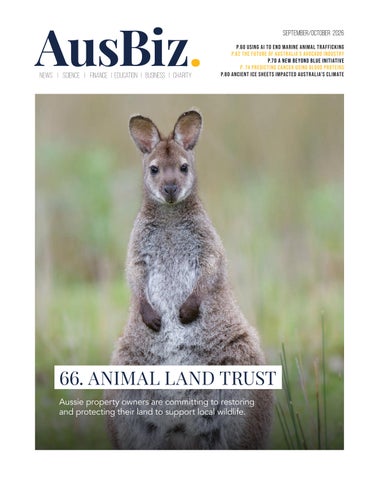
66. ANIMAL LAND TRUST Aussie property owners are committing to restoring and protecting their land to support local wildlife.
AUSBIZ NEWS
GIANT AUSTRALIAN CUTTLEFISH ARE UNDER THREAT Each winter, more than 100,000 giant Australian cuttlefish meet along the coastline of Whyalla in South Australia to perform colourful displays in an attempt to find a mate. Along the 10-kilometre stretch of coastline, the marine creatures make the most of the shallow rocky reefs and sandstone bluffs, which offer vital crevices where female cuttlefish can lay their eggs. It is the only cuttlefish aggregation of its kind in the world, and as such is National Heritage listed. But this year, cuttlefish numbers fell to an all-time low and the thousands of tourists that usually brave the freezing waters to see the unique phenomenon were dissapointed. Giant Australian cuttlefish are the world’s largest cuttlefish, and are only found in southern Australia. They usually meet in small groups
to mate, but on the coast of Whyalla, the numbers reach the thousands. As a type of cephalopod (like octopuses and squid), the cuttlefish lifecycle lasts around a year, and the animals die after mating. This means that the next generation is entirely dependent on the mating success of the previous year. Sadly, tourism operators in the area reported extremely low numbers of cuttlefish in the 2026 season, often spotting fewer than 10 cuttlefish in a dive when they would typically see more than 100. The low numbers this year are unprecedented, and experts are still trying to understand it. A leading theory centres around the South Australian algal bloom, which was dominated by Karenia cristata, a microalgae known to harm cephalopod populations, that the
cuttlefish could have been exposed to. Similarly, a decline in numbers of crabs and shellfish could mean that the giant creatures didn’t have enough prey. Luckily, cephalopods reproduce quickly, so the giant cuttlefish could bounce back if conditions are good. The state government also put in place a 90-day tourism ban to give the remaining cuttlefish the best chance at survival, and researchers are now compiling more data to understand how best to protect these animals for generations to come.
Study finds that teens are still using social media after the ban In a recent study from the eSafety Commissioner, it was found that more than eight in 10 Australian teenagers are still using social media after the government ban, while parental awareness of their usage decreased. On 10 December 2025, the Australian government required social media platforms to take reasonable steps to prevent teenagers under the age of 16 from having accounts. At the recent three-month check-in, eSafety revealed that account ownership declined from 52 per cent to 42 per cent, with reductions across major platforms including YouTube, Snapchat and TikTok. However, despite the reduced number of accounts, the organisation found that teenagers are still using social media daily. In fact, 81 per cent of children admitted to using at least one age-restricted platform, primarily
56 AusBiz.
because social media platforms hadn’t asked them to verify their age (50.2 per cent). Others said that the platforms incorrectly estimated their age (18.2 per cent), while some lied about their age on their accounts (37.1 per cent). The report also suggested that the ban could be creating unintended consequences, with parents less aware of their children’s use of social media. In response to these concerning findings, eSafety announced it was investigating non-compliance by five platforms: Facebook, Instagram, Snapchat, TikTok and Youtube. In June, the government indicated it would double the penalty on tech companies
that failed to comply with the ban, to support the efforts of the eSafety Commissioner. However, the positive findings of the study indicate that the ban could be having an impact on how teens view the importance of social media, with a drop in the number of children who think they’ll miss out if they’re not on the platforms. There has also been no change in children’s engagement with offline activities. It remains to be seen how the ban will affect Aussie teens as the two-year study continues.
THE NEUTRAL BAY CLUB
Neutral Bay Club
A community based club offering great value for money, special events, and a friendly & welcoming atmosphere.
Bistro & wood fired pizzas Barefoot bowls & tennis Indoor and outdoor function spaces Dog friendly
VISIT US TODAY
neutralbayclub.com 3 Westleigh Street 02 9953 2066
READ IT ONLINE
SEE THE FOREST, NOT THE TREES Growth tells you how far you’ve travelled. Reflection tells you if you still like the direction you’re headed in, and what you can do next.
THIS PAGE: ABBY CRAWFORD AND ANDREW COCKBAIN, CO-DIRECTORS OF AUSTRALIAN POWER EQUIPMENT.
Words: Abby Crawford
As business managers, we spend a lot of time measuring growth: revenue, customers, projects, markets, people, margins or pipelines. They’re important measures, but when you’re constantly focused on where your business needs to go next, it can be surprisingly difficult to find the time to look at the broader picture. Recently a substantial application landed in front of me for a major business growth award. I looked through the questions and initially decided it was far too timeconsuming. The questions were straightforward enough, and there were the usual suspects – numbers and evidence – but also questions about leadership, purpose, values, decisions and impact. I decided the potential return (recognition from a third party) didn’t justify the time involved – but then I changed my mind. Perhaps it was the child in me who used to sit up straight when the teacher was handing out merit awards?
58 AusBiz.
Whatever the reason, I started the application and something unexpected happened: it became one of the more useful business exercises I’d undertaken. To answer the questions properly, I had to stop, look at where we’d started, where we were now, and how we’d arrived there. Most importantly, I had to think about, and document, why any of it mattered. We didn’t win the award, but by then, that wasn’t the point.
LOOKING BACK UNCOVERS PATTERNS Australian Power Equipment commenced six years ago, and in those early days our business involved individual product sales of cable hangers, transformers and other electrical equipment required by customers for replacement, maintenance or new projects. Today, the conversations are very different. We’re increasingly involved much earlier in a project,
sometimes from the concept stage, helping customers to develop complete electrical solutions across transformers, cable, substations, switchgear and associated equipment. Instead of simply supplying a piece of equipment when power is needed, we’re increasingly working through how that power will be delivered months or even years beforehand. Our customer base has expanded, as have the many industries in which we operate. Mining remains important, but our work now reaches across infrastructure, renewable energy, transport, defence, marine and other industrial sectors. When you’re living growth day by day, each step feels incremental. Looking backwards though, the trajectory becomes clear. And there was another pattern that emerged: growth creating opportunities beyond our business. As the scale and complexity of our work increases, so too does the
SPECIAL FEATURE
work we provide to other Australian businesses. Complex power solutions rarely arrive as one finished item from one factory. Equipment and components may come from specialist manufacturers around the world, but increasingly we utilise the skills and capability of workshops in Australia to transform individual elements into completed solutions. Australian workshops fabricate, modify, assemble, wire, test and prepare equipment to our engineered specifications before it is dispatched. So when our business grows, some of that growth flows outward. It supports skilled trades, engineers, fabricators and regional workshops. And that’s one of the more satisfying measures of progress.
SUPPORTING CAUSES THAT MATTER The award application led us to reflect on what the success of our business allows us to do, and over time we’ve deliberately chosen to support causes that reflect what matters to us personally and professionally. One of those is the advancement and recognition of women working in traditionally male-dominated industries. We led by example within our own business and our broader industry relationships, and we’ve supported initiatives such as the
Women in Industry Awards because we believe visibility matters. When women succeeding in mining, engineering, energy, manufacturing and infrastructure are recognised publicly, other women can see those industries, and leadership within them, as places where they belong too. Another is wildlife conservation. Australian wildlife has always been particularly important to us, and business growth has enabled us to contribute increasingly meaningful support to conservation organisations. Through our partnership with Aussie Ark, we have had the privilege of participating in the release of endangered broadheaded snakes as part of a critical rewilding program. Through our partnership with Taronga Conservation Society Australia, we’ve seen first-hand the extraordinary conservation work taking place across threatened species recovery, research and wildlife protection. These aren’t activities separate from the business. They’re part of the reason we want the business to succeed, because somewhere along the way, growth stopped being solely about making the company bigger, and it became about increasing what the company could contribute.
We often talk about growth as though it is the objective, but growth isn’t the destination. It’s an enabler that allows a business to employ people, engage suppliers, develop better solutions, invest in capability, support communities and contribute to causes. That doesn’t make financial performance less important. A profitable, sustainable business can choose where it spends its money, where it directs its influence and what kind of footprint it leaves behind. Our application didn’t produce a trophy, but it did produce perspective. Entering awards reminds you that the numbers tell an important part of the story, growth tells you how far you’ve travelled, and reflection gives you the opportunity to ask whether you still like the direction you’re heading in, and what you want that growth to make possible. So the next time an awards application lands on your desk and your instinct is to put it in the toohard basket, perhaps reconsider. You may or may not win the award, but the process of answering the questions will tell you a lot about the business you’ve been too busy building to stop and look at from another perspective. Too often we can’t see the forest for the trees.
THIS PAGE, LEFT TO RIGHT: AUSTRALIAN POWER EQUIPMENT HELPS TO PRESERVE THE BROAD HEADED SNAKE (© AUSSIE ARK); ABBY, ANDREW AND THE TEAM AT B&D TRANSFORMER. SEPTEMBER/OCTOBER 2026 59
READ IT ONLINE
AI JOINS THE FIGHT TO PROTECT MARINE LIFE Seahorses and shark fins are illegally trafficked. A new AI tool could help to stop this heinous crime. WORDS: Dr Vanessa Pirotta
Shark fins on a plane, seahorses in your bag and sea cucumbers in the post – these are just a few examples of rampant illegal marine wildlife trafficking. This crime can be hard to detect. But in a new study, published in the journal Frontiers in Ocean Sustainability, we show how artificial intelligence (AI) can be harnessed as a complimentary detection tool to help stop marine wildlife trafficking at international airports and mail facilities.
60 AusBiz.
A GLOBAL CRIME The cross-border trade of live animals, animal parts or products is a global crime, facilitating the flow of billions of illicit dollars each year. It’s known to converge with other criminal activities, including the trafficking of drugs, arms and humans. The United Nations Office on Drugs and Crime identifies five sources of demand for wildlife trafficking: food, medicine, pets and ornamental plants, specialist collection, and adornment. In some cases, such as pet prestige,
people are motivated both by the desire to have a pet and the perceived status it brings to own an exotic animal.
PEOPLE TRAFFIC MARINE ANIMALS TOO Wildlife trafficking affects around 4,000 species. Many of the more well-known examples involve landbased animals – ivory from elephant tusks, horns from rhinos and scales from pangolins, the world’s most trafficked mammal.
TECHNOLOGY
LEFT, THEN TOP TO BOTTOM: SHARK FINS ARE COMMONLY TRAFFICKED IN AUSTRALIA; SEAHORSES ARE ANOTHER POPULAR TRADE ANIMAL; SHARK FINS SCANNED UNDER 3D X-RAY TO TRAIN THE AI MACHINE (CREDIT: DR VANESSA PIROTTA).
Closer to home, we also see native Australian reptiles and birds sometimes shoved in tins, put in socks and packaged up live to be sent overseas. Marine creatures, unfortunately, are targeted too. This can include live animals such as fish in people’s bags, or dried marine life such as the rise of the seahorse trade and demand for shark fins. We have small pockets of knowledge of this activity. But the reality is we don’t fully understand how widespread it is.
AI TO DETECT MARINE WILDLIFE TRADE Currently, the best means of detecting illegally trafficked wildlife is humans. And then there are our four-legged friends: biosecurity dogs.
Recently, Australia has also been working to develop the use of AI as a potential means of detecting landbased wildlife in illegal wildlife movements – building on existing detection pathways using 3D X-ray machines fitted with algorithms. For our latest study, we built on these efforts by developing world-first marine wildlife algorithms. We taught computers to look for shark fins, seahorses and sea cucumbers. We did this by collecting a total of 68 samples of dead marine animals, which we scanned in a 3D X-ray machine to create a library of images. We then used this image library to develop algorithms that could search for what we taught them to look for – in this case, shark fins, seahorses and sea cucumbers.
Samples were scanned alone and then in more complicated scenarios to reflect how people actually traffic marine life. This means if a bag or mail item is hiding a shark fin, seahorse or sea cucumber, the algorithm will be able to flag this to an operator, prompting them to inspect the item. Out of a total of 298 scans and a training data set derived from these samples, our algorithm had success rates of 95 per cent, 95 per cent and 85 per cent for shark fins, seahorses and sea cucumbers, respectively.
HUMANS AND BIOSECURITY DOGS STILL NEEDED ALONGSIDE AI While technology fitted with computer algorithms may help people inspecting luggage or mail, we still need people to verify what computers see. Sometimes the algorithms get it wrong and may miss items. Despite this, the broader implications of having AI as a second set of eyes searching for trafficked marine life will aid in identifying key trade routes to potentially stop this activity. The next step is relying on implementation of these algorithms on the front lines. Like computer algorithms and AI, the more we learn, the better we get at detecting and potentially stopping this harmful crime. SEPTEMBER/OCTOBER 2026 61
AGRICULTURE
AUSTRALIA’S AVOCADO PRODUCTION REACHES NEW HEIGHTS Australia’s avocado production is rebounding as supply and export levels soar. words: Matilda Meikle
READ IT ONLINE
62 AusBiz.
AGRICULTURE
TOP TO BOTTOM: AUSTRALIA’S AVOCADO SUPPLY IS SET TO INCREASE; RABORESEARCH SENIOR ANALYST MICHAEL HARVEY.
According to a recent report from Rabobank, Australia’s avocado supply is set to reach 170,000 metric tonnes in the upcoming season, with exports also lifting to record levels. After a slow 2024/25 season, this growth signals new opportunities for Australia to leave its mark on the massive global avocado industry.
“Avocado trees have a tendency to produce a heavy crop in one season, followed by a lighter crop in the next season.” GREEN GROWTH Avocados are a popular fruit packed full of healthy fats, fibre, potassium, folate and vitamins. The trees thrive in warm climates with full sun, rich organic soil and good drainage.
Thanks to Australia’s diverse climate, avocado crops thrive year-round, with processing facilities handling millions of avocados a day. Since 2014, Australia’s annual production volume has increased from 57,595 tonnes to 131,385 tonnes, signalling a rapid increase in both quantity and value. Despite this success, the 2024/25 season saw avocado production decline by around 15 per cent. But RaboResearch senior analyst Michael Harvey says this is not reflective of the industry’s longterm growth trajectory. Instead, it is a symptom of natural biennial bearing cycles. “Avocado trees have a tendency to produce a heavy crop in one season, followed by a lighter crop in the next season. It’s a natural production cycle that results in supply fluctuations,” he explains. SEPTEMBER/OCTOBER 2026 63
AGRICULTURE
In fact, the sector has welcomed structural expansion in recent years, as more plantings and new yields from orchards reaching maturity combine to set production on an overall positive path. Queensland remains Australia’s largest avocado-producing state, responsible for 50 per cent of national supply, followed by Western Australia. According to Michael, “growing conditions for the commencement of the 2026 season have been most favourable in these key regions.”
64 AusBiz.
“Increased competition from other exporting nations means Australia will need to continue focusing on market development, product quality and supply chain efficiency to maintain its position in international markets.” RIPE AND READY In 2025, Australian avocado exports broke records with around 18,400 metric tonnes going to overeseas markets. As producers build a presence in Asia and the Middle East, more produce is being exported from the orchards now maturing.
“Established markets such as Hong Kong, Singapore and Malaysia remain key buyers, while emerging markets across Southeast Asia and the Middle East are creating new growth opportunities,” says Michael. “Improved yields and a growing reputation for high-quality fruit are
AGRICULTURE
“Aussies should feel confident buying local avocados because we’re well supplied with high-quality, locally grown fruit for most of the year.” also having an impact. More broadly, rising global avocado consumption continues to underpin demand for Australian exports.” Globally, avocado exports have more than quadrupled over the last 15 years, and are expected to continue growing. Mexico and Chile are the largest producers, yet RaboBank believes they may be reaching saturation, with new players stepping in to meet the increasing demand.
Mexico and Chile deliver approximately 14 kilograms and nine kilograms per capita/per annum respectively, yet have limited space for expansion. In comparison, large population markets such as the EU have more growth potential. “Countries such as Italy, Germany and Turkey are exhibiting rapid relative growth, pointing to broadbased adoption rather than niche consumption,” says Michael.
“For Australia, rising global supply creates both opportunities and challenges. Expanding demand in Asia provides export opportunities, particularly as Australian production rebounds and export volumes hit record levels. “But increased competition from other exporting nations means Australia will need to continue focusing on market development, product quality and supply chain efficiency to maintain its position in international markets.”
A PIT STOP Despite this positive development, risks remain throughout the avocado industry. More specifically, climate change continues to deliver unstable weather patterns that impact growth. The developing El Niño will heighten weather risks, but in an uneven and unpredictable pattern. “Rather than a broad supply squeeze, El Niño will likely increase variability of yields and fruit sizes across regions, thereby amplifying seasonal imbalances and market volatility,” Michael says.
GUAC ON Domestically, abundant supply is expected to keep avocado prices relatively low. “Aussies should feel confident buying local avocados because we’re well supplied with high-quality, locally grown fruit for most of the year, and this abundant supply helps to keep retail prices relatively affordable,” explains Michael. “While New Zealand avocados are sometimes imported to fill seasonal supply gaps, local production remains the backbone of the market and is expected to rebound strongly in coming seasons. Buying Australiangrown avocados supports local growers and takes advantage of the strong domestic supply currently available to consumers.” SEPTEMBER/OCTOBER 2026 65
READ IT ONLINE
SAVING AUSTRALIA’S NATIVE WILDLIFE ONE PROPERTY AT A TIME
THIS PAGE: ORPHANED BENNETT’S WALLABIES AT INALA CONSERVATION RESERVE.
66 AusBiz.
ENVIRONMENT
The Wildlife Land Trust has reached the milestone of more than 1,000 members committed to protecting native habitats. Words: Matilda Meikle The Wildlife Land Trust (WLT) program is a network of over 1,000 Australian property owners dedicated to habitat preservation. Since 2007, the national movement has welcomed farmers, eco-tourism business owners, conservationists and other land owners who are committed to restoring and protecting their land in support of local wildlife. In total, the program spans 96,500 hectares of forests, deserts, farms and bushland from every state in Australia. Humane World for Animals, the organisation behind the major initiative, is a leader in animal protection, and was proud to welcome its thousandth member to the Australian network earlier this year.
FIGHTING FOR FLORA & FAUNA Australia is a country rich in biodiversity. From the rolling sands of the desert to the crashing waves of the coast, it is home to 386 native mammal species, 90 per cent of which are endemic, and 850 native bird species, 45 per cent of which are endemic. In fact, we’re one of only 18 megadiverse countries on Earth, collectively spanning less than 10 per cent of the planet’s surface but home to 70 per cent of its species. Despite this, 100 Australian endemic species have gone extinct since European colonisation in 1788. Every year, more than one million native animals are killed under government issued licences. “Australia is home to some of the world’s richest areas of biodiversity and unique flora and fauna, but they’re increasingly at risk from
SEPTEMBER/OCTOBER 2026 67
ENVIRONMENT CLOCKWISE FROM LEFT: INALA CONSERVATION RESERVE (© BRAD MORIARTY); AN ENDANGERED FORTY-SPOTTED PARDALOTE (© ANDREW BROWNE); BENNETT’S WALLABIES AT INALA IN TASMANIA.
habitat fragmentation and climate change, as well as pressures from rapid urban development and wildlife destruction,” says Wildlife Land Trust Specialist Louisa Bartels. “Protecting our diverse habitats is simply essential for conserving biodiversity. Private landholders can play an important role by preserving habitat on their land and enhancing connectivity through available wildlife corridors.” The WLT program builds a community united by a shared commitment to conservation. Members are encouraged to offer knowledge and seek inspiration from like-minded landholders. The challenges facing conservationists can compound quickly, whether it’s more frequent extreme weather, damage from invasive species, or nearby development, so knowing they’re not alone in their mission for change can be extremely reassuring for land owners across the country. “We also provide conservation advice, access to restoration grants and educational resources to help
68 AusBiz.
landholders care for and enhance the natural values of their land,” adds Louisa.
A COMMUNITY FOR GOOD Since 2014, the 1,500 acre Inala Conservation Reserve has been part of the WLT community, and the newly acquired Orana Conservation Reserve joined last year. Both properties are home to rare and endangered species, including swift parrots, wedge-tailed eagles and fortyspotted pardalotes.
“Native species and natural ecosystems are under more threat than ever before,” says Tonia Cochran, owner of Inala and Orana in Tasmania. “The species and habitats requiring protection are not restricted to national parks and reserves. In fact, privately owned properties are often critical to species survival. “Private citizens can make a huge difference through habitat preservation of their land. I believe we have a responsibility to protect species that are under threat because of human actions.”
ENVIRONMENT
Tonia runs her ecotourism business, Inala Nature Tours, from both properties, and hosts events for local communities and schools to learn more about conservation. For her, the WLT is a valuable resource. “Being part of the Wildlife Land Trust connects me to a national community of landowners who are passionate about protecting nature and inspire me to continue my conservation work,” she says.
“WLT also provides expert advice on a range of areas from habitat restoration to wildlife rescue, which is an invaluable free asset for landowners like me.”
BROADER HORIZONS For Aussies wanting to experience these properties rich in native flora and fauna for themselves, the Sanctuaries You Can Stay Program connects environmentally conscious
“Private citizens can make a huge difference through habitat preservation of their land. I believe we have a responsibility to protect species that are under threat because of human actions.”
travellers with WLT sanctuaries, wildlife tours, citizen science programs and bush regeneration activities to get them involved in the conservation conversation. The WLT program is always looking to expand into new corners of the country and bring its message of hope to new communities. “The Wildlife Land Trust is continually growing, with a goal of expanding its membership to represent more regions and ecosystems, and to protect a greater diversity of species,” says Louisa. “The more people involved, the more impact we can have. We’re exploring new ways to support and engage members, and plan to run many more in-person events and on-ground projects with our members in the future.”
THIS PAGE: OVERLOOKING ORANA CONSERVATION RESERVE IN TASMANIA.
SEPTEMBER/OCTOBER 2026 69
READ IT ONLINE
70 AusBiz.
HEALTH
TACKLING THE MENTAL HEALTH CHALLENGES OF RURAL AUSTRALIA Beyond Blue and Zoetis aim to raise another $100,000 to combat mental health challenges in regional and remote communities.
THIS PAGE: DEREK SCHOEN, FARMER AND CHAMPION FOR BEYOND BLUE
Half of Australians who need support with mental health wait until they are either very, or extremely distressed before seeking professional help. Around 7 million people in Australia – which is about 27 per cent of the population – live in regional, rural and remote communities. In these locations, access to mental health support is limited and the issue of not seeking help is exacerbated. Knowing that more needs to be done about these worrying statistics, animal health company Zoetis and mental health charity Beyond Blue are launching their 11th annual campaign to support mental health in regional communities. The Zoetis and Beyond Blue partnership has already contributed $1 million over the past decade to the Beyond Blue Support Service, and the 2026 campaign aims to raise a further $100,000. We sat down with Derek Schoen – a farmer and champion for Beyond Blue – to discuss the powerful initiative, and the importance of starting a conversation with someone close to you, particularly in rural and regional Australia. AusBiz: What does a meaningful check-in actually look like, especially if someone isn’t used to talking about their mental health? A meaningful check-in doesn’t have to be a big or difficult conversation. Often it’s as simple as asking someone how they’re really going and taking the time to listen. You don’t need to have the perfect words or all the answers – what matters is creating a space where someone feels heard, supported and respected, not judged. In rural communities, we often pride ourselves on getting on with the job and looking after others, but that can sometimes mean we keep our own struggles to ourselves. A simple conversation over a cup of tea at the SEPTEMBER/OCTOBER 2026 71
HEALTH
THIS IMAGE: PEOPLE LIVING IN RURAL AREAS OFTEN DON'T HAVE ACCESS TO THE MENTAL HEALTH SUPPORT THEY NEED.
local club, in the ute or at the farm gate can make a real difference. We know connection matters. That’s why the Zoetis and Beyond Blue partnership is encouraging people to start a conversation. Sometimes knowing someone cares enough to ask can be the first step towards a person feeling less alone, more supported and more comfortable seeking additional support if they need it. AusBiz: Why do you think half of Australians who need support wait until they’re very distressed before asking for help, and can communities change that? It’s a worrying figure because we know support can be most effective when people reach out early, rather than waiting until things feel overwhelming. People in rural and remote communities are often incredibly resilient. They’re used to managing challenges, whether that’s drought and natural disasters, financial pressure, isolation or the day-to-day demands of running a farm or small business. Sometimes people feel they should be able to handle things on their own, or they don’t want to burden others.
72 AusBiz.
We also know that stigma, embarrassment and discomfort talking about mental health continue to be major barriers to seeking help. People often keep pushing through until they’re really struggling. As a farmer, I think one of the most important ways we can change that is by making conversations about mental health a normal part of everyday life. Communities play a powerful role by checking in with one another, creating opportunities
to connect and reminding people that seeking support is a sign of strength, not weakness. The sooner someone reaches out, whether it’s to a friend, family member, GP or a service like Beyond Blue, the sooner they can access support and prevent challenges from becoming overwhelming. AusBiz: What unique barriers do people in regional and remote Australia face when it comes to accessing mental health support? Around seven million Australians live in rural, regional and remote communities, where access to health and mental health services can be more limited than in metropolitan areas. People living in regional and remote communities may face challenges such as long travel distances, fewer local services and fewer opportunities to access support close to home. At the same time, many are dealing with pressures such as financial stress, weather-related challenges, inflation, cost-of-living pressures and uncertainty, all of which can take a toll on mental wellbeing. People in more regional and remote areas are also more likely to experience social isolation.
HEALTH
“A meaningful conversation can help someone feel less alone, more supported and more comfortable reaching out if they need it.”
At the same time, Beyond Blue research shows many Australians feel disconnected from those around them, with only 28 per cent of people feeling part of the community where they live, and around one in five people are unsure whether they have someone they can rely on for support. That’s why it’s so important that mental health support is accessible no matter where you live. Beyond Blue provides free mental health information, support and advice to help people feel better earlier and stay well. Our 24/7 Support Service offers free, confidential counselling, advice and referrals via phone, webchat and email, ensuring people can access support wherever they are in Australia. AusBiz: What signs should people look for if they’re worried that a friend, neighbour or family member is struggling? Often it’s the small changes that people notice first. Someone might seem quieter than usual, withdraw from activities they would normally enjoy, stop returning calls or messages, appear more stressed or overwhelmed, or simply not seem like themselves. Rather than trying to work out exactly what someone may be experiencing, the most important thing is to trust your instincts if you’re concerned, and start a conversation. Ask how they’re going, listen without judgement and let them know you’re there to support them.
You don’t need to have all the answers or solve their problems. Sometimes taking the time to listen can make a big difference. A meaningful conversation can help someone feel less alone, more supported and more comfortable reaching out if they need it. AusBiz: How can rural and farming communities make space to connect? Some of the best opportunities to connect happen through the things rural communities already do well. Making space to connect doesn’t need to be formal. Whether it’s catching up at local sporting clubs, community events, field days, volunteer groups, or simply checking in with neighbours – these everyday moments can make a real difference. For farming communities in particular, making time to connect isn’t always easy. When workloads are high and there’s always another job to do, social connection can slip down the priority list. But even small moments matter – a chat over a coffee, a
conversation at the local footy club or checking in on someone you haven’t spoken to in a while can help people feel supported and less alone. We are incredibly good at looking after each other in rural Australia. If we can continue to make space for genuine connection and conversations about how we’re really going, we’ll help create communities where people feel supported to speak up and seek help earlier when they need it.
YOU’RE NOT ALONE
If you’re struggling, or worried about someone close to you, don’t face it alone. Beyond Blue’s Support Service is available 24 hours a day, seven days a week, offering free, confidential counselling, advice and referrals. Sometimes taking that first step and having a conversation can make the difference. Call 1300 22 4636, or visit: beyondblue.org.au SEPTEMBER/OCTOBER 2026 73
SCIENCE
READ IT ONLINE
THIS PAGE: SCIENTISTS IDENTIFIED BLOOD PROTEIN MARKERS THAT INDICATE A RISK OF LUNG DISEASE.
74 AusBiz.
SCIENCE
THE MARKER IN YOUR BLOOD THAT MAY PROTECT YOU FROM LUNG CANCER Scientists have identified proteins in the blood that could be key to stopping lung cancer in its tracks. words: Matilda Meikle
Scientists from the Francis Crick Institute and University College London (UCL) have identified a blood signature that indicates a risk of lung cancer years before a diagnosis. The findings could help to develop prevention strategies for this deadly disease. The paper, published in Cell, suggests experts my soon be able to identify individuals who would benefit from preventative drugs before a diagnosis.
AN AUSTRALIAN PROBLEM According to the Cancer Council, lung cancer is among the top five most diagnosed cancers in Australia, with around 15,000 new cases each year. Lung cancer occurs when abnormal cells grow and spread in the lungs. 85 per cent of lung cancers begin in the outer parts of the lungs in larger airways, although extreme cases can begin in the middle and spread much more quickly. Tobacco smoking is the biggest cause of lung cancer, however other factors such as exposure to air pollution are increasingly causing diagnoses in people who have never smoked. Now, around a quarter of Australians diagnosed with lung cancer have no history of smoking.
Despite these alarming new risks, lung cancer screening programs are strictly offered to those aged between 50 and 70 who currently smoke or have a history of smoking. This means many at-risk people have no access to early detection tools.
CATCHING THE ILLNESS EARLY As we age, all of us accumulate cells with cancer-causing mutations. Cancers rely on these mutations to grow, yet these mutated cells are not enough to trigger cancer without additional factors, such as the environment. Setting out on their new project, the research team (who previously worked on a paper showing how air pollution can drive cancer) wanted to find a signature that could accurately predict the risk of lung cancer. By using machine learning, they were able to cross-reference blood plasma protein data from over 48,000 UK Biobank participants to individuals on the cancer registry. Experts could then look for commonalities in the bloodwork of subjects who later developed cancer.
SEPTEMBER/OCTOBER 2026 75
SCIENCE
CLOCKWISE FROM LEFT: AGE AND SMOKING STATUS AREN’T THE ONLY INDICATORS OF FUTURE LUNG CANCER; GROWING TUMOURS IN A MOUSE LUNG; STUDY CO-LEADER DR CLARE WEEDEN.
As well as age, smoking status and history of lung disease, the machine learning algorithm successfully identified 14 key proteins in blood that could predict a lung cancer diagnosis within the next five years. The team then used these markers across eight international datasets, and found that all 14 proteins were more common in those with lung
76 AusBiz.
cancer. The signature was also common in people who went on to develop idiopathic pulmonary fibrosis or chronic obstructive pulmonary disease. Evidence of the proteins among those who develop other lung conditions suggests the signature may capture a shared, pre-disease state of lung inflammation.
“Finding a signal for an inflammatory state in the lungs has given us insight into this window of opportunity, when preventative treatment could work best,” says Clinical Research Director and Principal Group Leader at The Crick, and Professor of Cancer at UCL, Charlie Swanton. “This work supports a relatively new idea in the field, that some common
SCIENCE
“Finding a signal for an inflammatory state in the lungs has given us insight into this window of opportunity, when preventative treatment could work best.” age-related diseases, causing a high burden of disease in the community, share a common, presymptomatic state of inflammation. “We think the signature could in the future help to predict and help prevent lung cancer and other lung diseases.”
HOPE FOR THE FUTURE The team’s earlier research found that air pollution can trigger immune cells in the lungs to release an inflammatory signal, which can wake up dormant cells with cancer mutations. Exposure to pollution also increases
the presence of those 14 signature proteins found to indicate future lung disease, and increases the population of KAC cells that normally respond to injury but can also become cancerous if mutations are present. According to Dr Clare Weeden, a corresponding author on the paper, “what surprised us was that very different lung cell types all seemed to converge on the same intermediate state before becoming cancerous – suggesting KACs represent a common vulnerability in lung adenocarcinoma. “If we can identify people in whom this process is active and intervene at
that stage, we may be able to prevent cancer before it develops.“ Amazingly, the team were able to block the inflammatory signal in the lungs of mice exposed to pollution, which limited the number of KAC cells and slowed early tumour development. This suggests that, with the right drugs, lung cancer could be prevented in people whose lungs are showing this inflammatory signal. “Figuring out who is at risk of developing cancer is the holy grail of cancer prevention medicine,” says Dr Weeden. “This proof-of-concept study offers new ideas that could fill this critical knowledge gap. “In doing so, these findings bring us closer to a future where early intervention is possible and successful, even before the cancer has a chance to develop. This research could save countless lives.”
Going somewhere? So are we. From regional communities to growing urban centres, Ochre Health is helping connect Australians with quality healthcare.
NEED CARE AFTER HOURS?
LOOKING FOR YOUR NEXT GP OPPORTUNITY?
Ochre Anytime
Ochre Recruitment
Video GP consultations with experienced GPs outside normal practice hours, including evenings, weekends and public holidays. Call 1800 478 353
Explore permanent, locum and telehealth opportunities across our network of more than 80 medical centres in regional and urban communities.
ochrehealth.com.au
Proudly supported by
CLOCKWISE FROM TOP LEFT: A CHEF FROM MISS MI USING FRESH WA INGREDIENTS; MISS MI REPRESENTATIVES ALWAYS ATTEND MEET THE BUYER™; WA CHIP PROCESSING POTATOES.
READ IT ONLINE
WHY PERTH’S BEST BUYERS KEEP COMING BACK TO MEET THE BUYER™ Ask any experienced Delegate what keeps them returning to Meet the Buyer™ year after year, and the answer rarely starts with a spreadsheet. It starts with a conversation. Now in its sixth year, Meet the Buyer™ has built a reputation as the place where Western Australia’s food and beverage industry meets; where more than 600 products from local growers, producers and makers land in front of the chefs, retailers and foodservice buyers who decide what ends up on shelves and menus across the state. With 85 exhibitors on the floor and 78 per cent of Delegates walking away having made at least one new business connection, the numbers tell part of the story. But talk to the Delegates themselves, and what stands out is the relationships that hold up long after the exhibition doors close.
FINDING THE STORY BEHIND THE SUPPLIER For Sharath Kancharla, Director of Food and Beverage at Novotel Perth Murray Street, the relationships are the point. Overseeing everything from the hotel’s 24-hour room service to its award-winning restaurant Miss Mi, Sharath still shops like the chef
78 AusBiz.
he’s been for 24 years, and Meet the Buyer™ is where some of his most valuable connections have started. It’s how the hotel came to partner with Gage Roads on its own-label beer, poured at the hotel’s Third Space lounge bar. For Delegates like Sharath, the exhibition floor isn’t just a shortlist of usual suppliers, it’s a discovery process that rewards buyers willing to walk past the familiar stands, explore something new, and ask a few extra questions.
TURNING CONNECTIONS INTO RESULTS When the state’s only local chip manufacturer, WA Chip, exhibited at Meet the Buyer™, sales representative Mark Joy wasn’t sure what to expect. What followed was a significant new supply relationship with Mineral Resources, servicing camps across the organisation’s WA mining operations. It also facilitated an introduction to an international delegation that has since opened early conversations about the
company’s first export order with a Singapore-based supplier. It’s a return on investment that goes some way to explaining why WA Chip isn’t just coming back this October, it’s bringing double the team.
WHAT IT MEANS FOR DELEGATES Both of these stories highlight what happens when a Delegate takes the time to walk the floor, ask questions of a supplier they’ve never heard of, and follow through on the connections that result. It’s not incidental to Meet the Buyer™; it’s the entire premise. With 90 per cent of past Delegates saying they’d recommend the show to a colleague, the strength of that word-of-mouth speaks for itself. Meet the Buyer™ returns to Crown Perth on Tuesday 20 October, bringing together the state’s producers and the Delegates who decide what makes it onto WA’s plates, wine lists and supermarket shelves. Meet the Buyer™ is a trade and industry event only. Register now for the trade show at meetthebuyer.com.au
DISCOVER EXTRAORDINARY 2028 Scholarships Applications for Knox Boarding Scholarships for boys from regional areas open Monday 9 November 2026. Examinations will be held at the Knox Grammar School Senior School Campus as below: • Sunday 21 February 2027 – Years 7-11 Regional Boarding 2028 Scholarship Examinations • Sunday 28 February 2027 – Year 5 2028 Scholarship Examinations
Enquiries Please contact Martin Gooding, Head of Engagement on (02) 9473 9768 or email goodingm@knox.nsw.edu.au.
WWW.KNOX.NSW.EDU.AU
LAST WORD
HOW ANCIENT ICE SHEETS ON THE OTHER SIDE OF THE EARTH SHAPED AUSTRALIA’S CLIMATE Scientists have recently discovered that, tens of thousands of years ago, ice sheets in presentday Canada could have influenced the climate in Australia.
READ IT ONLINE
words: Matilda Meikle During the most recent ice age, which occurred around 49,000 years ago, much of North America was covered by ice sheets that were several kilometres thick. These frozen wastes spread across most of present-day Canada, the northern United States, and even into Europe, storing so much water that sea levels fell significantly. For a long time, scientists have known that these ice sheets impacted the climate of the Northern Hemisphere. But in a new study from UNSW, published in Climate of the Past, experts have found that the ice mountains also altered Australia’s climate, despite never actually reaching our continent. During the formation of these ice sheets, levels of carbon dioxide in the atmosphere were low and changes to the Earth’s orbit impacted how sunlight was distributed across the planet. As more water turned to ice, sea levels fell by around 60 metres and exposed underwater landscapes. The bright surfaces of these ice mountains reflected more sunlight into space, cooling the planet. As they were several kilometres high, they also disrupted wind paths, sending North
80 AusBiz.
Atlantic storms southward and changing rainfall patterns in Europe. Curious about how these ice mountains may have impacted Australia, scientists created several climate model experiments that sequentially altered atmospheric greenhouse gas concentrations, Earth’s orbital position, how much sunlight the ice sheets reflected, and the elevation of the sheets. By not changing all factors at once, they were able to identify which factors had the greatest impact on the climate. What they found was that the height of the ice mountains redirected wind and shifted the tropical rainfall belt to the south, reducing rain in parts of Indonesia and Papua New
Guinea, while increasing summer rain in Australia. Interestingly, the scientists also discovered that northern and southern Australia were impacted differently, with more rainfall in the north and a comparatively weak level of rain in the south. This may be because the ice-sheets also prompted change in wind circulation, which shaped coverage in both places. As global temperatures continue to rise, and further environmental degradation is predicted, this study may help experts to understand how changes in the northern hemisphere will impact Australia, setting us up for a better response to the climate crisis in the future.
Exclusive to Melbourne Museum. Must close 25 October. Experience over 180 remarkable objects from ancient Rome never before seen in Melbourne. Featuring original statues, mosaics, frescoes and everyday objects from the humblest to the most sumptuous. Daily guided tours also available.
Only until 25 October | Book now
ORGANISER
EXHIBITION PARTNERS
MAJOR SPONSORS
MAJOR DONOR
CULTURAL PARTNERS
MEDIA PARTNER
START YOUR HOLIDAY Refreshed, not rushed! Make the most of the journey to or from your cruise with a little time to relax, refresh and recharge at Brisbane Airport Hotels.
DAY STAY & REFRESH PACKAGE Unwind between 9am–5pm with a private room, poolside relaxation and delicious on-site dining before continuing your journey.
SCAN TO BOOK