31
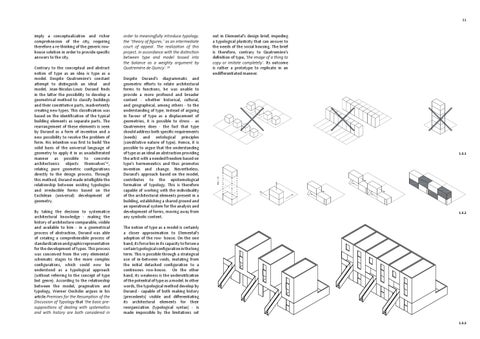
imply a conceptualization and richer comprehension of the city, requiring therefore a re-thinking of the generic rowhouse solution in order to provide specific answers to the city. Contrary to the conceptual and abstract notion of type as an idea is type as a model. Despite Quatremère’s constant attempt to distinguish an ideal and model, Jean-Nicolas-Louis Durand finds in the latter the possibility to develop a geometrical method to classify buildings and their constitutive parts, inadvertently creating new types. This classification was based on the identification of the typical building elements as separate parts. The rearrangement of these elements is seen by Durand as a form of invention and a new possibility to resolve the problem of form. His intention was first to build ‘the solid basis of the universal language of geometry to apply it in as unadulterated manner as possible to concrete architectonics objects themselves’12, relating pure geometric configurations directly to the design process. Through this method, Durand made intelligible the relationship between existing typologies and irreducible forms based on the Euclidean (universal) development of geometry. By taking the decision to systematize architectural knowledge - making the history of architecture comparable, visible and available to him - in a geometrical process of abstraction, Durand was able of creating a comprehensible process of standardization and graphic representation for the development of types. This process was conceived from the very elementalschematic stages to the more complex configurations, which could now be understood as a typological approach (without referring to the concept of type but genre). According to the relationship between the model, pragmatism and typology, Werner Oechslin argues in his article Premises for the Resumption of the Discussion of Typology that ‘the basic presuppositions of dealing with systematics and with history are both considered in
order to meaningfully introduce typology, the “theory of figures,” as an intermediate court of appeal. The realization of this project, in accordance with the distinction between type and model tossed into the balance as a weighty argument by Quatremère de Quincy’. 13 Despite Durand’s diagrammatic and geometric efforts to relate architectural forms to functions, he was unable to provide a more profound and broader content - whether historical, cultural, and geographical, among others - to the understanding of type. Instead of arguing in favour of type as a displacement of geometries, it is possible to stress - as Quatremère does - the fact that type should address both specific requirements (needs) and ontological principles (constitutive nature of type). Hence, it is possible to argue that the understanding of type as an ideal an abstraction providing the artist with a needed freedom based on type’s hermeneutics and thus promotes invention and change. Nevertheless, Durand’s approach based on the model, contributes to the epistemological formation of typology. This is therefore capable of working with the individuality of the architectural elements present in a building, establishing a shared ground and an operational system for the analysis and development of forms, moving away from any symbolic content.
out in Elemental’s design brief, impeding a typological plasticity that can answer to the needs of the social housing. The brief is therefore, contrary to Quatremère’s definition of type, ‘the image of a thing to copy or imitate completely’. Its outcome is rather a prototype to replicate in an undifferentiated manner.
1.3.1
1.3.2
The notion of type as a model is certainly a closer approximation to Elemental’s adoption of the row- house. On the one hand, its force lies in its capacity to forsee a certain typological configuration in the long term. This is possible through a strategical use of in-between voids, mutating from the initial detached configuration to a continuous row-house. On the other hand, its weakness is the underutilization of the potential of type as a model. In other words, the typological method develop by Durand - capable of both making history (precedents) visible and differentiating its architectural elements for their reorganization (typological syntax) - is made impossible by the limitations set 1.3.3