PERUVIAN CULTURAL VIRTUAL BULLETIN FOR AFRICA MINISTRY OF FOREIGN AFFAIRS OF PERU
EDITION DEDICATED TO THE PERUVIAN PRESENCE IN THE UNITED NATIONS
MULTIDIMENSIONAL INTEGRATED STABILIZATION MISSION IN THE CENTRAL AFRICAN REPUBLIC (MINUSCA)
PERU IN MINUSCA
EXPANDING AFRICANNESS
RECIPE MABOKÉ DE CAPITAINE
CONTENTS
Peru in the United Nations Multidimensional Integrated Stabilization Mission (MINUSCA): A Sustained Contribution to Peace and the Protection of Communities in the Central African Republic.
Embassy of Peru in the Arab Republic of Egypt
The Peruvian Presence in the United Nations Multidimensional Integrated Stabilization Mission in the Central African Republic (MINUSCA)
Counsellor of the Diplomatic Service of the Republic, Sandra Rodríguez Sánchez
Peruvian Police and Military Personnel in the Central African Republic: A Shared Achievement for Peace
Third Secretary of the Diplomatic Service of the Republic, Víctor Diego Velásquez Biaggi
Peru and the Central African Republic: A Bridge of Solidarity in the Heart of Africa
Third Secretary of the Diplomatic Service of the Republic, Carolina Cavero Zavala
From Callao to Bangui: The Journey of Peruvian Peacekeepers
Romina Suñé Escaró
SPECIAL SECTION: EXPANDING AFRICANNESS
Decentralized Office in Tumbes of the Ministry of Foreign Affairs
Lecture: “Angola: History, Culture, and Diplomacy” “Cumanana” Chocolate: An Initiative for Economic, Cultural, and Tourism Promotion
Manuel da Silva Domingo
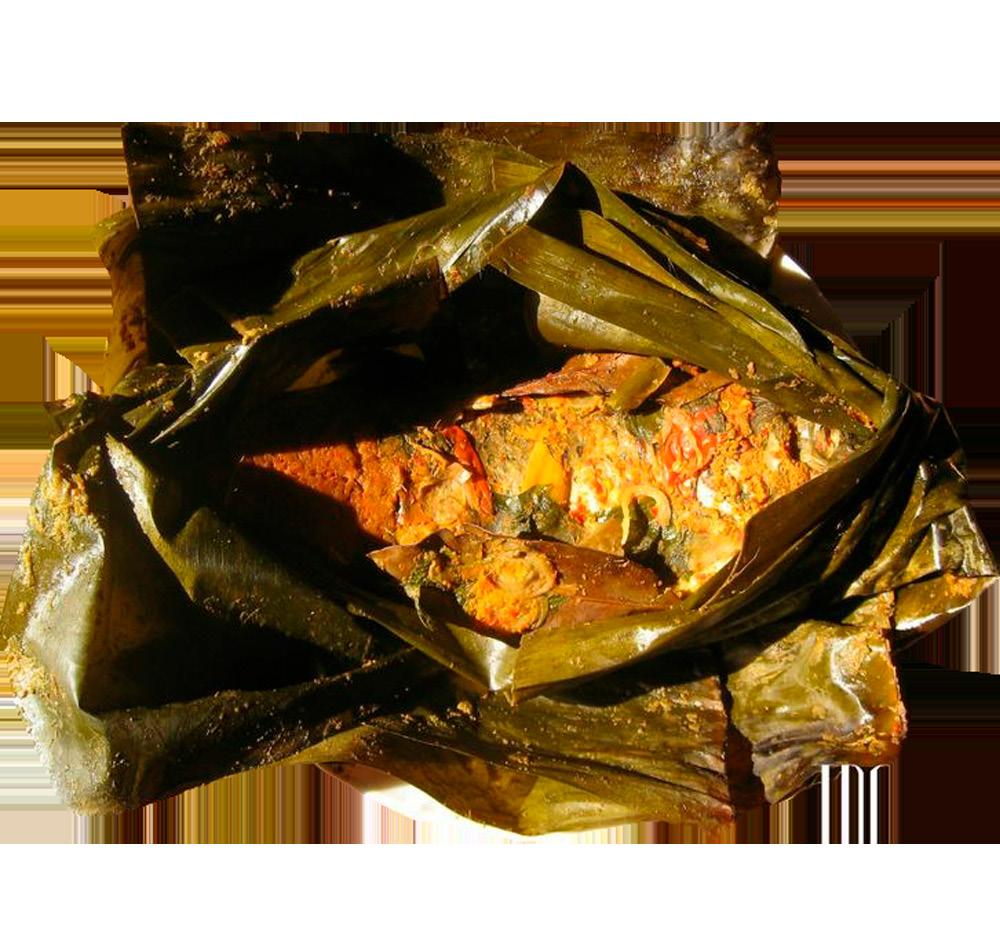
Maboké de Capitaine
PERU IN THE UNITED NATIONS MULTIDIMENSIONAL
INTEGRATED STABILIZATION MISSION
(MINUSCA): A SUSTAINED CONTRIBUTION TO PEACE AND THE PROTECTION OF COMMUNITIES IN THE CENTRAL AFRICAN REPUBLIC
Abstract
This article analyzes Peru’s participation in the United Nations Multidimensional Integrated Stabilization Mission in the Central African Republic (MINUSCA), with emphasis on the deployment of the Peruvian Engineering Company (PERENGCOY). Its objective is to examine the technical, operational, and humanitarian contribution of the Peruvian contingent to international efforts aimed at stabilization and the protection of civilians in conflict settings. The article argues that Peruvian military engineering—combined with a multiservice and inclusive approach—constitutes an effective model for supporting critical infrastructure, mobility, and community cohesion in highly vulnerable areas. It concludes that Peru’s sustained participation in MINUSCA represents a form of diplomacy on the ground that reinforces multilateralism and generates tangible impacts on social recovery, demonstrating the country’s capacity to contribute professionally, compassionately, and humanely to international peace.
A Country’s Commitment to Peace
For more than six decades, Peru has built a solid record in United Nations peacekeeping operations, reaffirming its vocation for service and its international commitment to collective security. Since its first participation in 1958, the country has deployed military and civilian observers to over a dozen missions around the world, contributing professionalism, discipline, and a deeply humanistic spirit.
In 1982, Peru joined the Multinational Force and Observers (MFO) in the Sinai Peninsula, Egypt, contributing military contingents to monitor the peace treaty between Egypt and Israel. Stationed at both the North and South Camps, Peruvian personnel carried out key duties involving surveillance, patrols, and logistical support.
Peru also participated actively in United Nations Peace Operations in Haiti from 2004 to 2016 as part of the United Nations Stabilization Mission in Haiti (MINUSTAH). During this period, the country deployed contingents from the three branches of the Armed
Forces, performing security functions, humanitarian support, reconstruction, and disaster assistance— particularly after the 2010 earthquake.
Minusca Source: Reliefweb
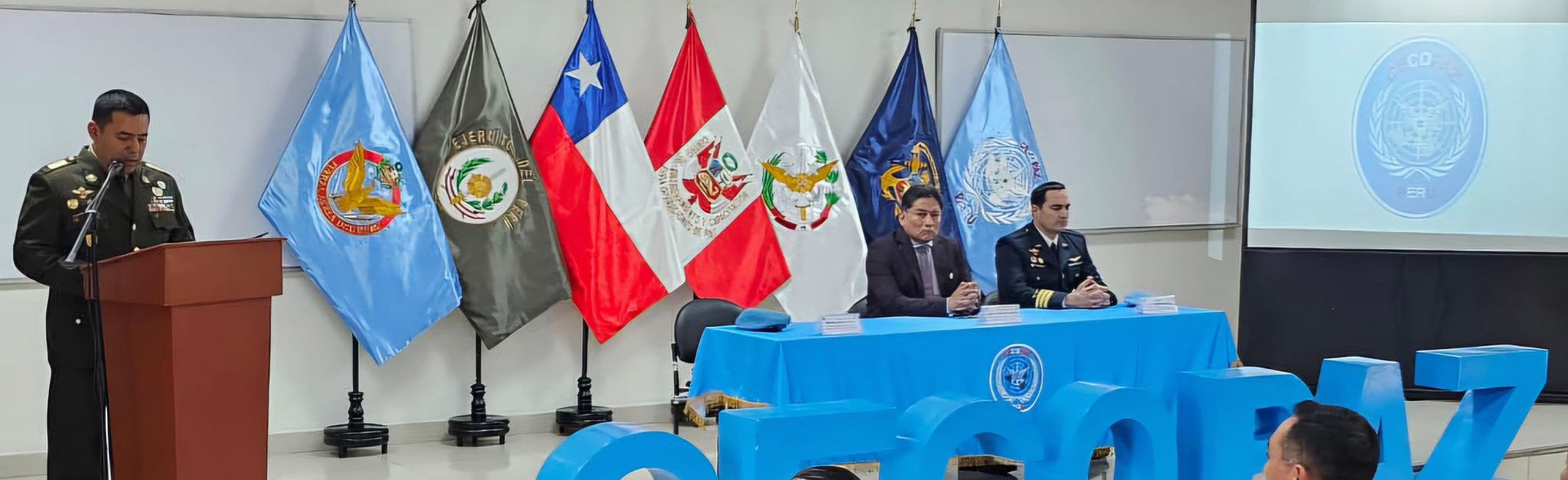
Peru’s active involvement in United Nations peacekeeping operations generally occurs through the deployment of military observers and staff officers, most of whom are trained at the Training and Preparation Center for Peacekeeping Operations (CECOPAZ), where they acquire the competencies required to conduct essential tasks such as monitoring conflict zones, verifying peace agreements, operational planning, and logistical coordination.
Peru’s presence in missions such as MINUSCA, MONUSCO, UNMISS, UNIFIL, MINURSO, UNTSO, and UNVMC reinforces the country’s commitment to peace, security, and international cooperation. It has earned recognition for the professionalism and solidarity of its military, police, and civilian personnel serving in peacekeeping missions.
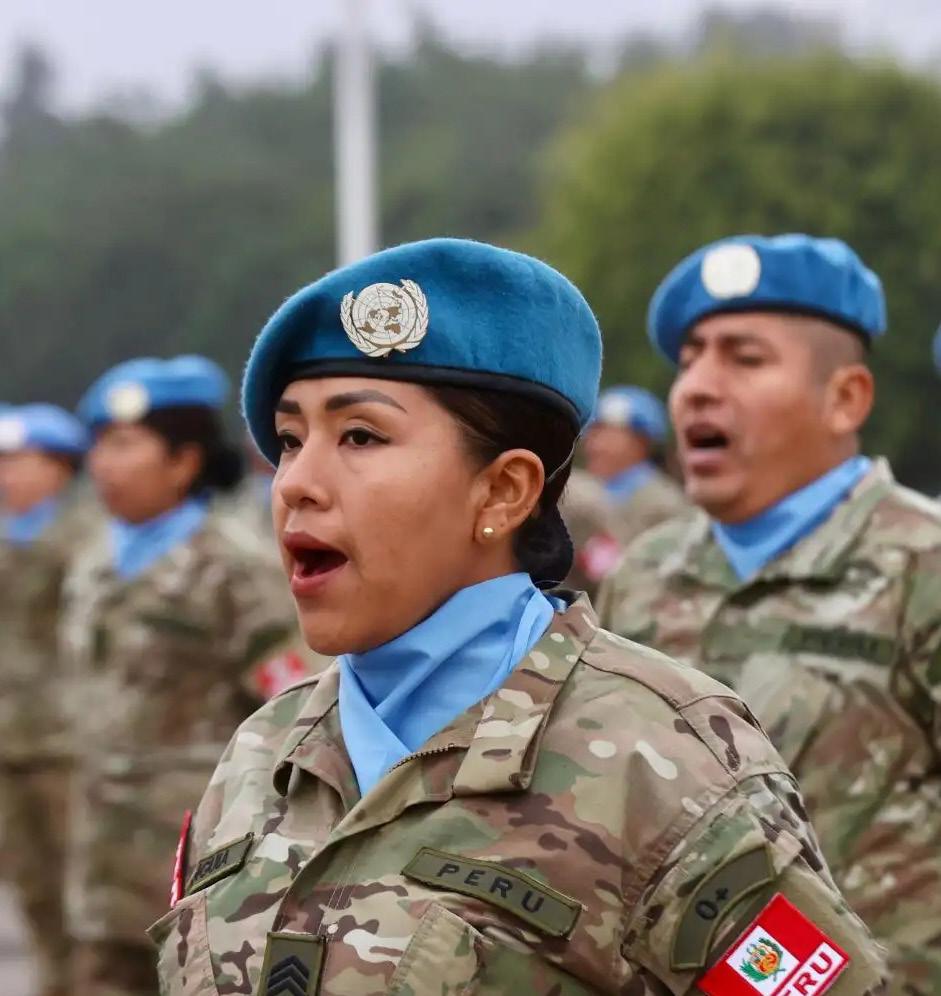
Today, this commitment to peace and well-being is expressed in the Central African Republic, where Peru plays a key role in MINUSCA. There, Peruvian engineers build, repair, and reconstruct roads and bridges, bringing hope to urban and rural communities throughout the country.
Peru and a Mission to Rebuild Hope and Address Human Needs
MINUSCA was established in 2014, following a period of severe political instability and intercommunal violence in the Central African Republic. Its core mandate—protecting civilians, facilitating humanitarian assistance, and supporting the national reconciliation process—has required a sustained and committed international presence.
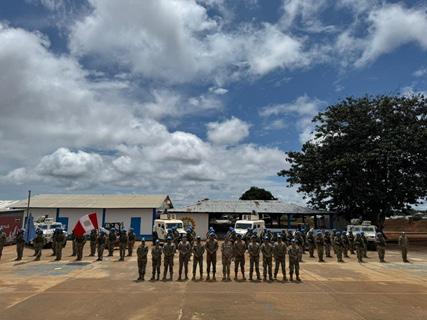
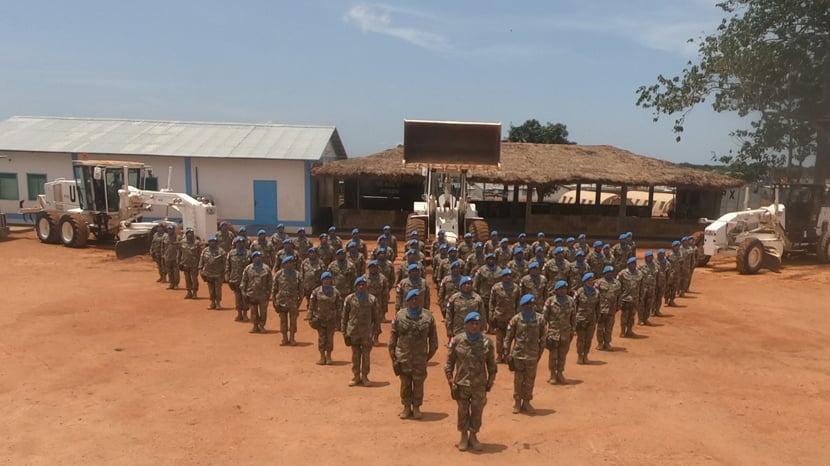
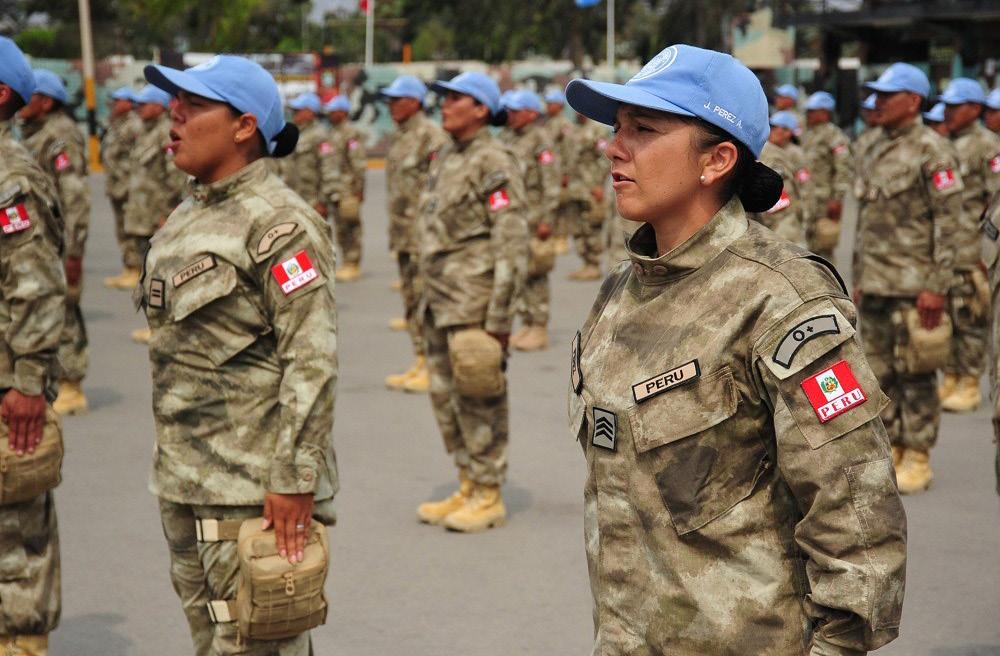
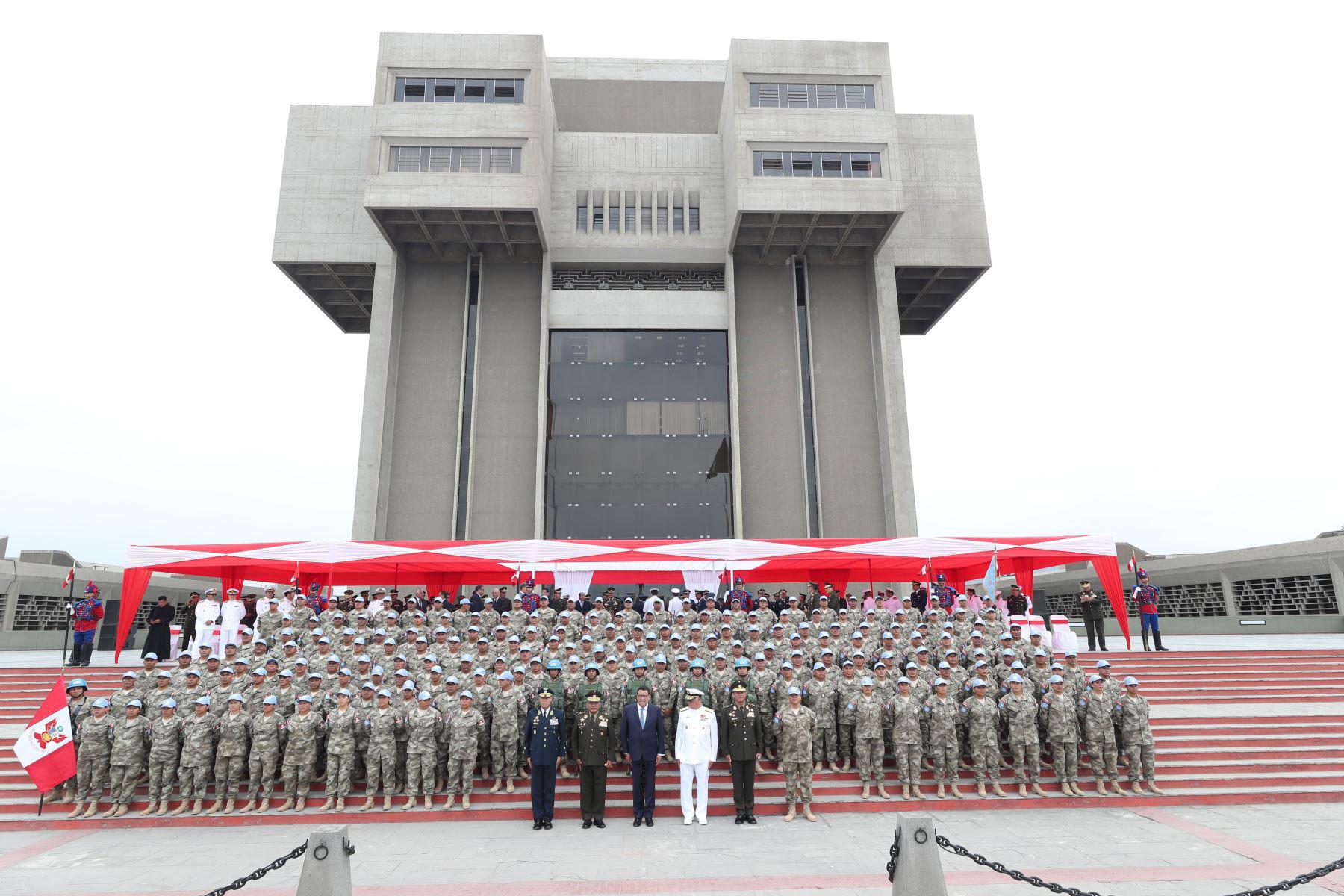
Peru decided to join this effort in 2015 by deploying a Military Engineering Company specially trained to operate in adverse environments, under the command of Colonel Antonio Córdova Espinoza. The advance unit arrived in December of that year, and on 7 January 2016, the full deployment was completed: over 200 members of Peru’s Armed Forces—Army, Navy, and Air Force—arrived in Bangui, the country’s capital.
Since then, more than two thousand Peruvian personnel, organized into ten contingents, have rotated through the Central African Republic, maintaining a continuous chain of experience, discipline, and solidarity. Each rotation incorporates innovations in technical procedures and humanitarian protocols, consolidating the Peruvian Engineering Company (PERENGCOY) as a regional benchmark in operational efficiency and professional ethics. The city of Bouar, in the western part of the country, has served as its permanent center of operations since the first deployment.
Currently, PERENGCOY X—commanded by Colonel Clever Chuquillanqui Caycho and composed of 220 personnel—maintains its operations from the city of Bouar, in the western region of the country, supporting territorial stabilization and the reconstruction of essential infrastructure. This deployment is part of a Memorandum of Understanding between the Peruvian State and the United Nations, ensuring long-term technical and logistical cooperation.
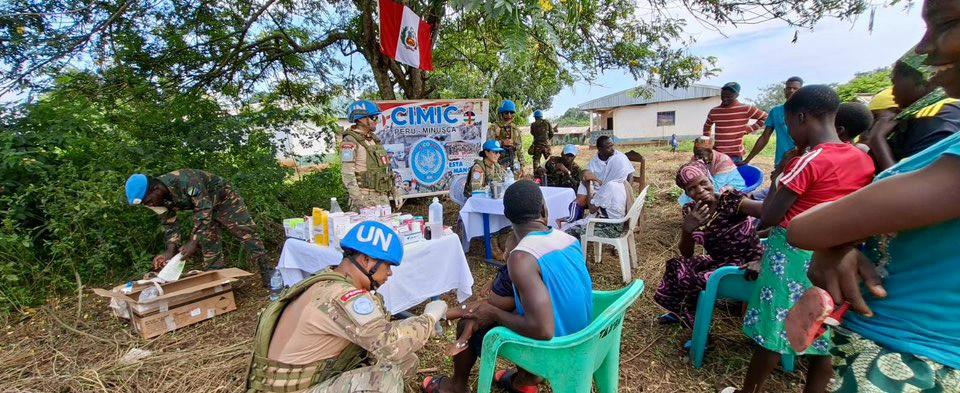
Social outreach activities by Peruvian peacekeepers.
Source: PERENGCO X
Bouar–Bonhong: A Corridor of Hope
PERENGCOY constitutes the core of Peru’s contribution to MINUSCA. Composed of personnel from the Army, Navy, and Air Force, the Company stands out for its multiservice approach, integrating specialists from various branches of military engineering: vertical and horizontal infrastructure, airfield maintenance, tactical logistics, material management, and technical support. This unit combines technical expertise with a strong vocation for service.
Its main responsibilities include [1]:
• Maintenance of airfields and helipads is essential for transporting personnel, humanitarian aid, and medical evacuations.
• Construction and repair of rural roads that reconnect isolated communities and revive local trade.
• Installation of operational bases and logistical centers for the UN in remote regions.
• Explosive ordnance disposal (EOD), safeguarding the civilian population.
• Direct social outreach through community support and cooperation with local authorities.
One of PERENGCOY’s most emblematic projects is the comprehensive rehabilitation of the Bouar–Bonhong road, a 75-kilometer route connecting the provincial capital of Nana-Mambéré with agricultural villages and rural communities, scheduled for completion on 26 February 2026.
For years, this road remained impassable due to erosion and insecurity. Today, thanks to the efforts of the Peruvian contingent, the route has been leveled and compacted, restoring mobility and safety for more than 40,000 inhabitants. The road stimulates the local economy and supports the reintegration of displaced communities, a tangible example of how infrastructure becomes a tool for peace.
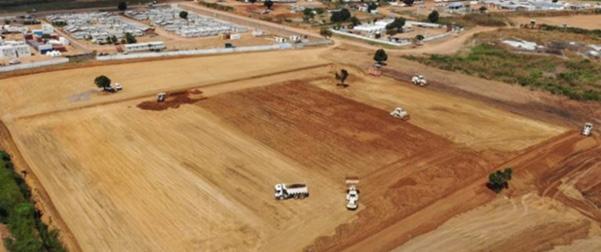
Similarly, in the northwest of the country, in the city of Paoua—home to 35,000 people and capital of the Lim-Pendé prefecture—the Peruvian presence also translates into major works. In only 184 hours of effective work, the contingent built Paoua’s Main State Square, which has become a civic space symbolizing the restoration of the social fabric after years of violence.
In only 184 hours of work, the project transformed an arid plot into a community and cultural gathering space, enabling civic and commercial activities to take place in a safe and organized environment. At the same time, Peruvian engineers are rehabilitating the Paoua airfield, which is vital for humanitarian transport. These actions represent the human face of Peru abroad: a country that seeks no protagonism but serves the common good quietly and effectively.
PERENGCOY I, 2016.
Source:PERENGCOY X
PERENGCOY X, 2025.
Source:PERENGCOY X
Peruvian Women for Peace
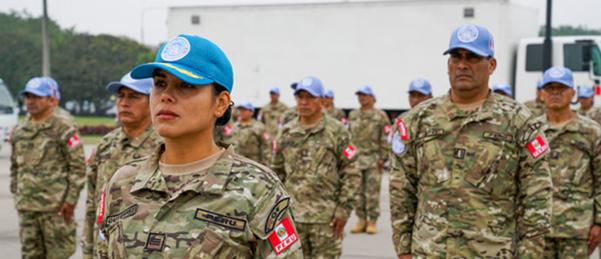
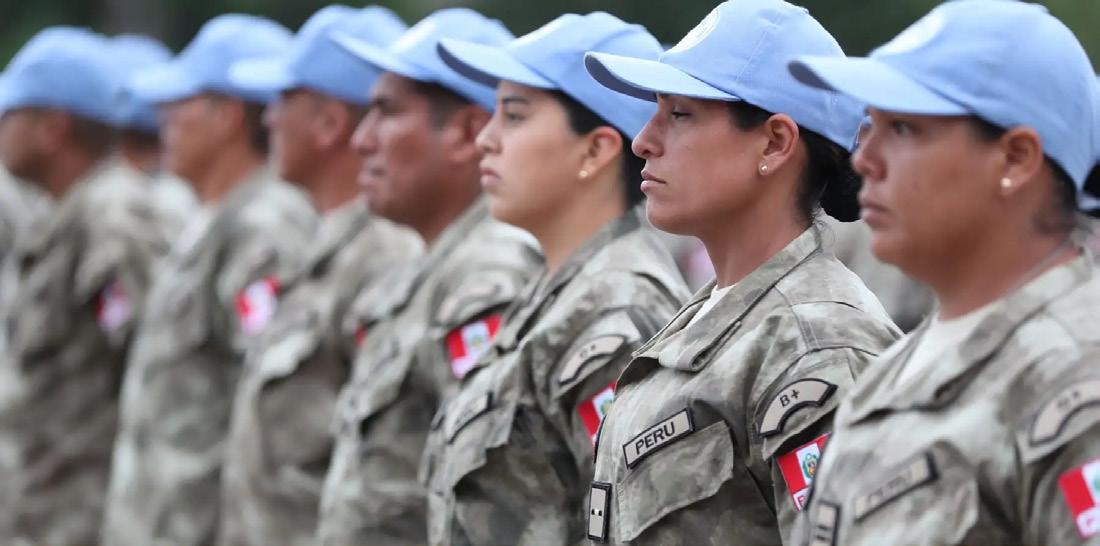
The participation of Peruvian military women in MINUSCA marks a milestone in the history of the country’s peace operations. Currently, 31 women serve in PERENGCOY X, including eight officers (one Major, six Captains, and one Lieutenant) and 23 NonCommissioned Officers and technical personnel (12 technicians and 11 petty officers and Navy ratings across the three branches of the Armed Forces). They serve as engineers, physicians, psychologists, and logistics officers.
Their presence reaffirms the Peruvian State’s policy of equal opportunities and empowerment. They lead projects and embody an inclusive leadership that earns respect within the international community.
Conclusions
Beyond its technical and operational contributions, Peru’s participation in MINUSCA represents a genuine exercise in diplomacy on the ground. The work of PERENGCOY demonstrates that Peru contributes not only specialized engineering capabilities, but also a service-oriented vision that prioritizes the protection of people and the strengthening of vulnerable communities.
Through this mission, Peru reaffirms its role as a country committed to peace, international cooperation, and effective multilateralism. Each contingent deploys not only tools and machinery, but also values: discipline, solidarity, professionalism, and unwavering respect for the United Nations mandate.
The works carried out—roads, bridges, airfields, and community spaces—not only improve mobility and local infrastructure; they create real conditions for populations affected by conflict to regain hope, security, and opportunity. These results reflect the transformative role a country can play when it combines technical capacity with a deep humanitarian vocation.
Thus, in the Central African Republic—as in other regions before—Peruvian engineers leave a legacy that goes beyond material outcomes. Peru demonstrates once again that its contribution to peacekeeping operations is consistent, responsible, and profoundly human.
References
Ministerio de Defensa del Perú. (2016–2024). Informes sobre Participación del Perú en Operaciones de Paz. Gobierno del Perú.
CECOPAZ – Centro de Entrenamiento y Capacitación para Operaciones de Paz. (varios años). Manual de Capacitación para Operaciones de Paz. Ministerio de Defensa.
Cancillería del Perú. (2022). La Política Exterior del Perú y su Participación en Operaciones de Paz. Ministerio de Relaciones Exteriores.
Notes
[1] Fuente: Ministerio de Defensa (https:// www.gob.pe/institucion/mindef/noticias/862241cascos-azules-peruanos-reparan-puente-ycaminos-en-republica-centroafricana?utm_ source=chatgpt.com)
THE PERUVIAN PRESENCE IN THE UNITED NATIONS
MULTIDIMENSIONAL INTEGRATED STABILIZATION MISSION IN THE CENTRAL AFRICAN REPUBLIC (MINUSCA)
sandra rodríguEz sánchEz counsEllor, sdr
msc intErnational human rights law, univErsity of oxford
United Nations Peacekeeping
One of the most effective tools of the United Nations (UN) for helping countries transition from conflict to stability is its wide range of peacekeeping operations, which—depending on the specific context of each host country—are tasked with providing security, protecting civilians, supporting political processes, promoting human rights, contributing to disarmament, among other responsibilities.
As stated by then UN Secretary-General Ambassador Javier Pérez de Cuéllar, when receiving the Nobel Peace Prize on behalf of the UN Peacekeeping Forces in 1989: “the aim of political institutions like the United Nations is to draw the line between struggle and conflict and to make it possible for nations to stay on the right side of that line. Peacekeeping operations are one very practical means of doing this” (Pérez de Cuéllar, 1989).
Troop-contributing countries
Source : UN Peacekeeping
Usually deployed in geographically and politically challenging environments, UN peacekeeping operations are governed by the basic principles of consent of the parties, impartiality, and the non-use of force except in self-defense and/or in defense of the mandate. Since 1948, the UN has deployed 71 peacekeeping operations and currently maintains eleven across three continents (UN).
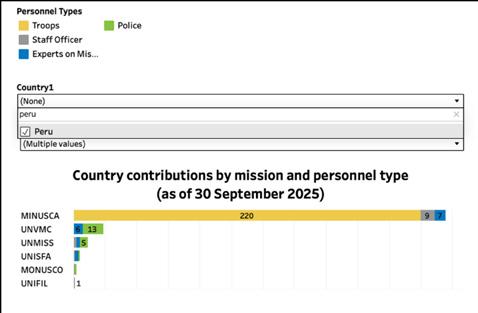
Peru has a long-standing commitment to peacekeeping operations and has contributed military personnel, police officers, experts, and staff officers since 1958, when Peruvian personnel joined the United Nations Observation Group in Lebanon (UNOGIL) (Duclos, 2020). After a significant participation in the United Nations Stabilization Mission in Haiti (MINUSTAH) from 2005 to 2017, Peru currently participates in six peacekeeping missions, four of them in Africa [1]. Without a doubt, the United Nations Multidimensional Integrated Stabilization Mission in the Central African Republic (MINUSCA), created in 2014, is the mission in which Peru has the largest presence, with 220 military personnel, nine officers, and seven experts.
In September 2022, Lima hosted the First Latin American and Caribbean Conference on Peacekeeping Operations, a meeting aimed at promoting increased participation of countries in the region in UN peacekeeping. As a result, sixteen States from Latin America and the Caribbean signed the Lima Declaration “Living in Peace”, through which they agreed, among other commitments, to establish the first Latin American and Caribbean Network for Cooperation in Peacekeeping Operations – RELACOPAZ (Lima Declaration, 2022).
The Situation in the Central African Republic
Most inhabitants of what is now the Central African Republic (CAR) belonged to various groups and ethnicities that settled in the territory during the first half of the 18th century. After obtaining independence from France in 1960, the CAR has been marked by political-military instability, leading to recurrent coups d’état and rebellions.
The apparent period of stability in the CAR was interrupted in 2006, when rebel groups established themselves in the northern region with the goal of overthrowing then-President François Bozizé. One year later, the rebels formed the “Séléka” coalition [2], composed mostly of Muslim rebel groups and mercenaries from Chad, Niger, and Sudan. This coalition signed an agreement with the government for their gradual incorporation into the national army. However, believing that President Bozizé had not complied with key provisions of the agreement, the coalition’s leaders took up arms again in 2012. In 2013, they seized the capital Bangui, forcing Bozizé into exile and proclaiming their leader, Michel Djotodia, as the new president (Rodríguez, 2020). Although Djotodia resigned in 2014 and an interim president was appointed by Parliament, and although Faustin-Archange Touadéra (the current president) was elected in 2016, the country has continued to face chronic crises.
groups known as “Anti-balaka” [3] emerged. From that point forward, both groups engaged in the political use of religious rhetoric, fueling intercommunity violence that weakened State institutions and left millions in a humanitarian crisis.
MINUSCA
The UN has been present in the CAR since 1999, when the Security Council approved SecretaryGeneral Kofi Annan’s proposal to establish the United Nations Peace-building Support Office in the Central African Republic (BONUCA) (UN, 1999). BONUCA was later replaced in January 2010 by the United Nations Integrated Peace-building Office in the Central African Republic (BINUCA), tasked with supporting peace consolidation and strengthening democratic institutions (UN, 2009).
As the scale of the conflict and its geographic spread exceeded the capabilities and number of international troops, in March 2014 the then Secretary-General Ban Ki-moon submitted a report to the Security Council recommending that a multidimensional UN peacekeeping operation be authorized under Chapter VII of the UN Charter, with the primary function of protecting civilians. Based on this recommendation, in April 2014 the United Nations Multidimensional Integrated Stabilization Mission in the Central African Republic (MINUSCA) was officially established, and BINUCA was integrated into the new mission.
The CAR is a predominantly Christian country, though it has a significant Muslim minority. Although both religions had coexisted peacefully, the rise of the Séléka coalition to power ignited violent clashes. In response to the Séléka, the Christian self-defense
Bangui, Central African Republic, 2018
Source : own
Peacekeepers in Koui, Central African Republic, 2025
Source:MINUSCA
The Mission’s priority tasks include:
a) the protection of civilians.
b) supporting the extension of State authority, deployment of security forces, and preservation of territorial integrity.
c) good offices and support for the peace process; and
d) facilitating the immediate, safe, unimpeded, and unhindered delivery of humanitarian assistance.
Other tasks include the promotion and protection of human rights; supporting the government in conducting the December 2025 elections; providing strategic and technical advice for the implementation of the national security sector reform strategy; assisting in disarmament, demobilization, reintegration, and repatriation programs; and supporting national and international justice, the fight against impunity, and the rule of law (UN, 2025).
Peru and MINUSCA
Since 2016, Peru has contributed to MINUSCA with an Engineering Company of more than 200 personnel (from the Peruvian Army, Navy, and Air Force), as well as officers and experts—making it the peacekeeping mission in which Peru has the largest presence. Peru’s participation in this mission is framed within the Memorandum of Understanding between the Peruvian State and the UN, through which Peru expressed its commitment to support UN peacekeeping operations.
It is therefore unsurprising that during Peru’s most recent term on the UN Security Council (2018–2019), the Peruvian delegation attached special importance to the situation in the CAR, underscoring the need to strengthen national defense and internal security forces for deployment throughout the country, as well as the importance of accelerating disarmament, demobilization, and reintegration programs, and the repatriation of mercenaries.
A matter of particular concern during those years were the various attacks suffered by MINUSCA, especially those affecting the Peruvian Engineering Company deployed in the western part of the country, where they were carrying out land-clearing and leveling work to facilitate troop movements (Rodríguez, 2020).
In October 2018, the UN Security Council’s 2127
Sanctions Committee conducted a visit to the CAR to assess the implementation of the sanctions regime imposed on the country since 2013 [4]. During this visit—attended by Peru alongside representatives from Côte d'Ivoire, the United States, France, the Netherlands, Kuwait, Poland, and Russia—the delegation witnessed the precarious living conditions caused by the prolonged conflict.
In addition to meetings with CAR government authorities, the Peruvian delegation held an encounter with the head of the Peruvian Engineering Company deployed in the country to gain a deeper understanding of their work. As part of its responsibilities, the Peruvian contingent had participated in two major operations. In the first— conducted in the border area with Cameroon—the role of the Engineering Company was to clear and level the terrain so that MINUSCA troops could advance and neutralize rebel forces in the area. Once the objective was achieved, the Peruvian contingent built the temporary base for troop deployment. In the second operation—along the border with Chad—as the contingent advanced and regained control of territories held by rebel groups, the Peruvian Company opened roads and subsequently built temporary bases for troop presence. Thanks to these bases and MINUSCA’s presence in the area, the return of more than one thousand displaced persons was made possible.
Over the years, the Peruvian Engineering Company for Construction and Airfield Maintenance deployed with MINUSCA has carried out a wide range of projects, including the maintenance and rehabilitation of roads, access routes, bridges, and helipads. The Peruvian contingent has developed expertise in the construction and maintenance of airfields, the installation and operation of bases, mine-clearing, and the construction of roads linking different communities to increase interconnection and strengthen UN presence throughout the CAR.
Despite the challenges inherent to the country’s context, the experience of the Peruvian contingent in MINUSCA has been highly positive. Peruvian officers and technicians have the opportunity to work alongside personnel from other countries and international organizations and are aware of the global importance of their work. The Peruvian Engineering Company is considered one of the most capable within MINUSCA, due to the consistently high quality of its personnel and equipment.
MINUSCA, Central African Republic
Source: Naciones unidas
References:
Declaración de Lima “Vivir en paz”. (7 de septiembre de 2022). Obtenido de: https://relacopaz.org/ wp-content/uploads/2025/01/Declaracion-deLima-2022-1.pdf
Organización de las Naciones Unidas. What is peacekeeping. Obtenido de: https://peacekeeping. un.org/en/what-is-peacekeeping
Organización de las Naciones Unidas. Consejo de Seguridad. (13 de diciembre de 1999). Lettre datée du 10 décembre 1999, adressée au secrétaire général par le président du conseil de sécurité (S/1999/1236). Obtenido de: https://docs.un.org/en/S/1999/1236
Organización de las Naciones Unidas. Consejo de Seguridad. (07 de abril de 2009). Statement by the President of the Security Council (S/PRST/2009/50). Obtenido de: https://docs.un.org/en/S/PRST/2009/5
Pérez de Cuéllar, J. (9 de enero de 1989). United Nations Peacekeeping Forces. Nobel Prize lecture. Obtenido de: https://www.nobelprize.org/prizes/ peace/1988/un/lecture/
Solari, A., Horna, A., Prieto, E., Tenya, F., Talavera, G., Seoane, G., Meza-Cuadra, G., Rivera, G., Velásquez, H., Castillo, J., Ugarelli, L., Popolizio, N., Lukashevich, O., Duclos, P., Habich, R., Rodríguez, S., Bustamante, V. (2020). El Perú en el Consejo de Seguridad (2018 – 2019). Diplomacia constructiva en tiempos de polarización. Reflexiones del equipo peruano.
Fundación Academia Diplomática del Perú.
United Nations Multidimensional Integrated Stabilization Mission in the Central African Republic (MINUSCA). Mandate. Obtenido de: https://minusca. unmissions.org/en/mandate
Notes:
[1] El Perú participa en la Misión Unidimensional Integrada de las Naciones Unidas para la Estabilización en la República Centroafricana (MINUSCA), la Misión de las Naciones Unidas en Sudán del Sur (UNMISS), la Fuerza Provisional de Seguridad de las Naciones Unidas para Abyei (UNISFA) y la Misión de Estabilización de las Naciones Unidas en la República Democrática del Congo (MONUSCO).
PERUVIAN POLICE AND MILITARY PERSONNEL IN THE
CENTRAL AFRICAN REPUBLIC: A SHARED ACHIEVEMENT FOR PEACE
third sEcrEtary sdr víctor diEgo vElásquEz biaggi
“It Is not enough to talk about peace. one must belIeve In It.
ABSTRACT
This article highlights Peru’s strong participation in UN peacekeeping missions since 1958, with a current focus on Africa. In 2023, a historic milestone was reached with the deployment of Peruvian police officers to MINUSCA, marking the first joint participation of Peruvian police and military personnel in a peacekeeping mission. This achievement reflects the strategic, coordinated work of several national institutions towards a common objective, including the Training and Preparation Center for Peacekeeping Operations (CECOPAZ PERÚ), the Functional Unit for Peacekeeping Missions (UFMP), the Directorate for Security and Defense (DSD), and the Permanent Mission of Peru to the United Nations (ONUPER). Together, they embody Peru’s deep commitment to international peace and security, promoting multilateral cooperation and teamwork among diplomats, military personnel, and police officers.
The article further underlines that this participation not only contributes to global stability but also strengthens Peru’s foreign policy and international image. Inspired by the European Union’s motto “United in diversity,” the Peruvian case shows how cooperation among institutions, sectors, and cultures can achieve shared global objectives, fostering peace in different regions of the world.
Introduction
Peru has a long tradition in United Nations peacekeeping operations dating back to 1958, contributing directly to international peace and security through the effective deployment of 254 police and military personnel in six UN peacekeeping missions, all of them centered in the African continent.
On 8 February 2023, Police Commander Luis Enrique Panibra Rojas and Non-Commissioned Officer Néstor Sánchez Sáenz became the first Peruvian police officers to take part in a UN peacekeeping mission, joining the United Nations Multidimensional Integrated Stabilization Mission in the Central African Republic (MINUSCA). They deployed alongside 220 military personnel from the “Peru” Engineering Company and four military observers, making MINUSCA the first peacekeeping mission in history to feature the joint presence of Peruvian police and military personnel.
This milestone would not have been possible without the coordinated work of the Training and Preparation
Center for Peacekeeping Operations (CECOPAZ PERÚ), the Functional Unit for Peacekeeping Missions (UFMP), the Directorate for Security and Defense (DSD) of the Ministry of Foreign Affairs, and the Permanent Mission of Peru to the United Nations (ONUPER).
leonor roosevelt
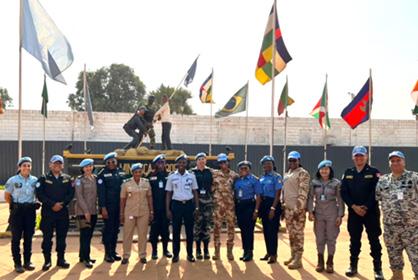
Police Commander Luis Enrique Panibra Rojas and Non-Commissioned Officer Néstor Sánchez Sáenz together with other police officers deployed in MINUSCA. Source: MINUSCA
CECOPAZ PERÚ: A Center that Trains Future Peacekeepers
Preparation is essential for any deployment to a United Nations peacekeeping mission. In this regard, the Training and Preparation Center for Peacekeeping Operations (CECOPAZ PERÚ) is the institution responsible for training and preparing civilian, police, and military personnel for the various roles they may assume in peacekeeping operations, in accordance with UN rules and standards [1].
To this end, CECOPAZ PERÚ develops certified courses for United Nations Military Observers (UNMO) [2] and United Nations Staff Officers (UNSOC) [3], as well as pre-deployment courses for members of the “Peru” Engineering Company and the United Nations Police (UNPOL) course, among others.
CECOPAZ PERÚ also offers language training, including basic and intermediate technical English and French for peacekeeping operations. This is a key element for the performance of deployed personnel and for successfully passing the proficiency tests administered by the United Nations Department of Peace Operations (DPO).
In this sense, CECOPAZ PERÚ plays a fundamental role in training National Police personnel, which contributed directly to achieving the first deployment of police officers to MINUSCA. Training for National Police officers began in 2016 and has continued annually ever since. As a result, Peru now has police personnel—officers, technicians, and non-
commissioned officers—with the professional skills required by UNPOL.
Thanks to coordinated work with the Ministry of Foreign Affairs, from 1 to 6 August 2022, Peru received, for the first time in its history, a visit from the United Nations Selection Assistance and Assessment Team (SAAT) [4], with the aim of evaluating the professional competencies of police candidates for deployment to a peacekeeping mission.
The SAAT test evaluated 59 members of the National Police of Peru (PNP) on UN peacekeeping regulations, 4x4 vehicle driving, use of sidearms (pistols), and intermediate proficiency in English and/or French. At the end of the assessment, eight police officers were certified to participate in UN peacekeeping missions [5].
DIRASINT PNP: Working for Peru and the World
Once the National Police of Peru (PNP) decided to deploy personnel to UN peacekeeping missions, it established the Functional Unit for Peacekeeping Missions (UFMP) [6], under the Division for International Cooperation, Liaison Offices, and Attachés, on 13 May 2021.
United Nations Police Course (UNPOL).
Source: Police Major Juan G. Bajonero Rodríguez
The creation of the UFMP facilitated the management of documentation and actions aimed at deploying police personnel to peacekeeping missions, strengthened cooperation with CECOPAZ PERÚ, the Directorate for Security and Defense (DSD) of the Ministry of Foreign Affairs, and the Permanent Mission of Peru to the United Nations (ONUPER). These actors, within their respective spheres of competence, are also responsible for managing the deployment of civilian, police, and military personnel to UN peacekeeping missions.
Through working meetings and information-sharing, these institutions identified the need to standardize procedures that would allow for effective deployment. This was particularly important in view of certain processes and requirements not expressly regulated in national legislation but necessary for completing the forms and documents required by the United Nations [7].
Since then, the UFMP has become the leading unit for UN peacekeeping missions within the National Police institution, responsible for coordinating the actions needed to make PNP participation in peacekeeping missions a reality and to sustain ongoing processes for consolidating police participation in such missions.
Directorate for Security and Defense of the Ministry of Foreign Affairs
The Ministry of Foreign Affairs plays a central role in managing and coordinating Peru’s participation in UN peacekeeping operations, and the Directorate for
Security and Defense is the organic unit responsible for leading these activities. Dialogue and cooperation with the PNP intensified once the decision was made to deploy police officers to UN peace operations, enabling the organization of SAAT evaluations, interaction with the UN Department of Peace Operations (DPO), and the incorporation of best practices from other police-contributing countries.
In 2022, in close cooperation with the Ministry of Defense, the Directorate co-organized the First Latin American and Caribbean Conference on United Nations Peacekeeping Operations (LAC-UN), a global milestone as the first conference of its kind. The conference concluded with the creation of the “Latin American and Caribbean Network for Cooperation in Peacekeeping Operations” (RELACOPAZ), with the objective of building a regional cooperation network among Ministries of Defense or their equivalents in the field of peacekeeping, in order to increase regional participation in such operations.
This event enabled the PNP to engage directly with other countries that deploy police personnel to peacekeeping missions, learning from their best practices and procedures before carrying out the first deployment of Peruvian police officers. The UN Department of Peace Operations (DPO) also recognized Peru’s efforts to incorporate police personnel into its deployments, and acknowledged the work undertaken by the PNP to ensure that its officers are properly trained for a type of mission that, unlike most military deployments, involves direct contact with the local population.
Police officers who passed the SAAT test together with Ms. Agnessa Ryabikina, UNPOL evaluator.
Source : Juan G. Bajonero Rodríguez
At the intersectoral level, the Directorate for Security and Defense participates actively in the Integrated Intersectoral Mechanism on Peacekeeping Operations (MEC-OPAZ), created by Supreme Decree [8] in June 2022. This mechanism brings together the Ministry of Defense, the Ministry of Foreign Affairs, and Peru’s Permanent Mission to the United Nations to provide UN peacekeeping operations with an integrated intersectoral approach. MEC-OPAZ served as the basis for coordinating the deployment of the first police officers to MINUSCA, with a view to incorporating the PNP formally into the mechanism.
The Directorate’s role as coordinator and facilitator was decisive in bringing together the efforts of the different sectors involved around a single goal: the deployment of police personnel to United Nations peacekeeping operations.
Permanent Mission of Peru to the United Nations (ONUPER)
The Permanent Mission of Peru to the United Nations (ONUPER) plays a decisive role in consolidating Peru’s image in the multilateral arena and positioning the country as a relevant actor in the field of peacekeeping operations.
To achieve this goal, each country’s direct management and coordination with the Department of Peace Operations (DPO) is carried out through “Military Advisers,” who are specialists and advisors in peacekeeping. It is precisely these advisers who became key actors in managing, monitoring, and following up on the deployment of police personnel, assisting with administrative formalities and in securing slots for those officers who had passed the SAAT test.
Through the work of the Military Adviser’s Office, the first six police officers were deployed as Individual Police Officers (IPOs) to the United Nations
Multidimensional Integrated Stabilization Mission in the Central African Republic (MINUSCA) and to the United Nations Mission in the Republic of South Sudan (UNMISS) [9].
In this regard, the Military Adviser for Peacekeeping Affairs is a critical liaison and coordination element, since its strategic location allows for direct communication with the UN DPO. As an advisory body to the Permanent Mission of Peru to the United Nations, the Adviser also participates actively in meetings and events of particular relevance to international peace and security, in support of national interests.
Conclusions
The deployment of National Police personnel to United Nations peacekeeping missions is a historic milestone for Peru, as it reinforces the country’s commitment to contributing to international peace and security. It also represents the fulfillment of one of the PNP’s functions in support of foreign policy, as established in Legislative Decree No. 1267, a mandate that had remained pending until the first police deployment.
It is important to emphasize that the deployment of police personnel also creates opportunities for the PNP itself, allowing its officers to enhance their professional skills through UN-provided training and the exchange of experiences, procedures, and doctrine with counterparts from other countries. These acquired capacities are transferable to the domestic context, strengthening the PNP’s capabilities in combating different forms of organized crime and improving doctrinal aspects of police training. Furthermore, the mere presence of police personnel in peacekeeping operations contributes to projecting Peru’s image and consolidating the institutional presence of the PNP on the global stage.
The first deployment of National Police personnel to UN peacekeeping missions is the result of joint work involving:
1. The Training and Preparation Center for Peacekeeping Operations (CECOPAZ PERÚ) – a key actor in training and instruction on peacekeeping operations.
Patch of the Functional Unit for Peacekeeping Missions (UFMP) of the PNP.
Source: PNP
2. The Directorate for International Affairs of the PNP (DIRASINT) – through the Functional Unit for Peacekeeping Missions (UFMP), which is the lead unit within the police institution for managing and consolidating police participation in peacekeeping operations.
3. The Directorate-General for Multilateral and Global Affairs of the Ministry of Foreign Affairs, through the Directorate for Security and Defense, responsible for managing and leading actions related to the participation of military and police personnel in UN peacekeeping missions.
4. The Permanent Mission of Peru to the United Nations (ONUPER) – a technical and strategic actor for conducting procedures and direct engagement with the UN Police Division, as well as for providing advice on peacekeeping issues.
“United in diversity” is the motto of the European Union [10], conveying the idea that, despite cultural, traditional, and linguistic differences, it is possible to work together, united, in pursuit of a common goal. The historic deployment of National Police officers to United Nations peacekeeping operations is the result of teamwork among diplomats, military personnel, and police officers, who from different angles contributed to this major achievement for the police institution and for Peru’s foreign policy.
This demonstrates that when there is a shared objective, integrated work across multiple sectors can produce results with global reach. Peru’s commitment to international peace and security has materialized, among other ways, through the deployment of military and police personnel to United Nations peacekeeping operations. This has not gone unnoticed in the community of nations and has been acknowledged by the highest authorities of the UN
Department of Peace Operations (DPO).
Today, the commitment of all actors involved in the first deployment of police officers to peacekeeping operations is reinforced by the intention to maintain, strengthen, and increase Peru’s presence in such missions around the world, working towards a common objective grounded in national interests and with a firm commitment to preserving international peace and security.
Notes
General Regulations of CECOPAZ PERÚ, mission.
United Nations Military Observer Course.
United Nations Staff Officer Course.
Selection Assistance and Assessment Team (SAAT).
The 59 PNP members were evaluated by Ms. Agnessa Ryabikina, SAAT Team Leader.
Eight PNP members passed: five were certified for participation in peacekeeping missions in English, two in French, and one in both languages.
The UFMP was created by Resolution of the General Command of the National Police No.
91-2021-CGPNP/EMG, dated 13 May 2021.
To present candidates for SAAT evaluation and prior to deploying police personnel to a peacekeeping mission, the United Nations requires the submission of various forms—most of them in English and some not expressly regulated in national legislation. In addressing these requirements, assistance was provided by ONUPER, CECOPAZ PERÚ, and the Ministry of Foreign Affairs.
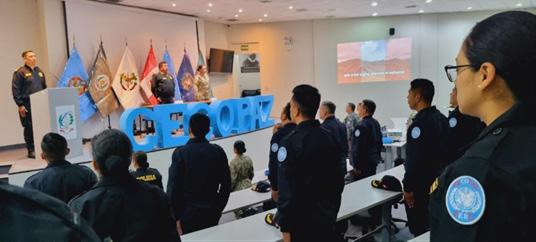
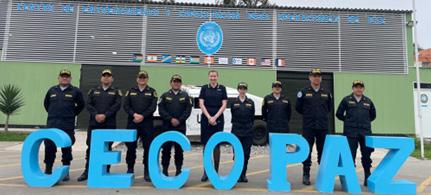
Cecopaz
Source: Cecopaz Perú
Supreme Decree No. 006-2022-DE, dated 17 June 2022.
On 29 March 2023, a second deployment to UNMISS took place, consisting of a police component made up of: Police Captain Luis Felipe Pradinet Lezano; Second-Level Technical Non-Commissioned Officer Juan Jorge Sarcco Tintaya; Third-Level Technical NonCommissioned Officer Melissa Georgett Lantaron Abuhadba de Rose (the first PNP woman deployed to a peacekeeping mission); and Second-Level NonCommissioned Officer Christian Adrián Chamane Vílchez.
The symbols of the European Union are its motto, Europe Day, its anthem, and the European flag.
Bibliography
Capitán PNP Juan G. BAJONERO RODRGUEZ (2022). ¿Cuáles son las misiones de paz de las Naciones Unidas en las que deben ser desplegados el personal de la Policía Nacional del Perú?, se accedió el 09 de junio 2023. Disponible en el portal web de la Policía Nacional del Perú: https://www.policia.gob. pe/pnp/archivos/portal/doc/28657doc_CAP%20 JUAN%20BAJONERO%20-%20LUGARES%20DE%20 DESPLIEGUE%20UNPOL-PNP%2023FEB2023.pdf
Capitán PNP Juan G. BAJONERO RODRGUEZ (2021). Las operaciones de mantenimiento de la paz: oportunidades y desafíos para la Policía Nacional del Perú, se accedió el 02 de abril 2023. Disponible en el portal web de la Policía Nacional del Perú: https://www.policia.gob.pe/pnp/archivos/portal/ doc/22336doc_Las%20Operaciones%20de%20 Mantenimiento%20de%20la%20Paz.pdf
Capitán PNP Juan G. BAJONERO RODRGUEZ (2020). La Policía Nacional del Perú y su participación en las Operaciones de Mantenimiento de la Paz de las Naciones Unidas, se accedió el 05 de marzo 2023. Disponible en el portal web de la Policía Nacional del Perú: https://www.policia.gob.pe/pnp/ archivos/portal/doc/11010doc_PER%C3%9A%20 -%20ART%C3%8DCULO%20PNP%20OPAZ%20 13OCT2020%20CAP%20PNP%20JUAN%20 BAJONERO.pdf
CPTM UN - Panorama general de las operaciones de mantenimiento de la paz de las Naciones Unidas. Lesson 1.7: Working as One in the Mission. Disponible en inglés en: https://peacekeepingresourcehub. un.org/en/training/pre-deployment/cptm/module1
Decreto Supremo N° 006-2022-DE, del 17 de junio de 2022 Disponible en el portal: https://www.gob.pe/ institucion/mindef/normas-legales/3185458-0062022-de
Informe sobre los resultados de UN Selection Assessment and Assistance Team (SAAT) visit to Peru 05/08/2022.
ONU Perú. 2020. “75 años de una carta que cambio al mundo”. Se accedió el 28 de marzo de 2023. Disponible en español en: https://peru.un.org/es/50464-75a%C3%B1os-de-una-carta-que-cambi%C3%B3-almundo
Reglamento de organización y funciones del Ministerio de Relaciones Exteriores.
Resolución de la Comandancia General de la Policía Nacional N°091-2021-CGPNP/EMG de fecha 13 de mayo 2021.
Resolución de la Comandancia General de la Policía Nacional N°544-2019-CGPNP/SUB.COMGEN de fecha 22 de agosto de 2019, con el cual se conforma el “Equipo Técnico Facilitador de la PNP” para tratar en los eventos internacionales sobre misiones de paz desarrollados el año 2019.
Resolución Ministerial Nº0141-2023-IN de fecha 03 de febrero del 2023. Se accedió el 28 de marzo de 2023. Disponible en español en: https://cdn.www. gob.pe/uploads/document/file/4092613/01412023-IN.pdf?v=1675698015
Revista PNP – EDICIÓN N°07 “Policía Nacional del Perú participa en la 25° Conferencia Anual de la Asociación Internacional de Centros de Formación para el Mantenimiento de la Paz”, se accedió el 02 de setiembre de 2021. Disponible en español en: https://issuu.com/policiaperu/docs/1854doc_ revista_pnp_octubre_hd_opt/s/10227162.
PERU AND THE CENTRAL AFRICAN REPUBLIC: A BRIDGE OF SOLIDARITY IN THE HEART OF AFRICA
fElicita carolina cavEro zavala - third sEcrEtary (sdr)
officEr at thE
dirEctoratE-gEnEral
for studiEs and stratEgiEs on forEign Policy
“What counts In lIfe Is not the mere fact that We have lIved. It Is What dIfference We have made to the lIves of others that WIll determIne the sIgnIfIcance of the lIfe We lead.”
Abstract:
This article analyzes the participation of the Peruvian Engineering Company in the UN peacekeeping mission MINUSCA in the Central African Republic, presenting it as an exemplary case of South–South Cooperation (SSC) used as an effective foreign policy tool. Through the construction of vital infrastructure, symbolized by the bridge in Bocaranga, the Peruvian contingent not only contributes to peace and stability, but also projects the image of a supportive and capable Peru on the global stage. The article concludes that this mission, grounded in the principles of horizontality and mutual benefit, strengthens Peru’s international projection and builds a solid bridge for future relations between our country and the African continent.
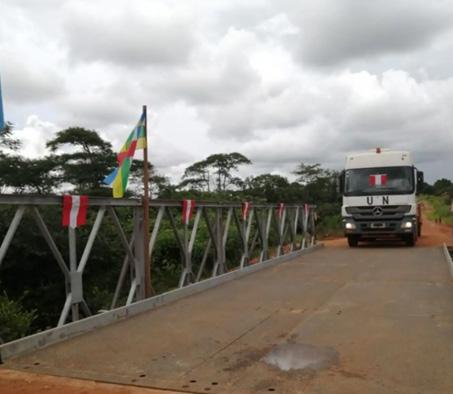
When Peruvian “blue helmets” arrived in the town of Bocaranga, in the Central African Republic, they found two riverbanks separated by the Ouham River. With the arrival of the rainy season, that river became an impassable barrier for months: trade came to a halt, communities were cut off, and humanitarian assistance could not get through. The construction of a 60-meter modular bridge was therefore more than an engineering project; it was an act of reconnection. This image encapsulates Peru’s participation in the United Nations Multidimensional Integrated Stabilization Mission in the Central African Republic (MINUSCA) since 2016.
Peru’s long-standing commitment to multilateralism and peacekeeping (Soto Millonez, 2016) has evolved: it is no longer merely a responsibility, but a strategic instrument of international projection. This is reflected in the contemporary backing of the Strategic Plan for Africa 2024–2030, adopted by our Ministry of Foreign Affairs in anticipation of a more proactive and structured relationship with the African continent (Ministry of Foreign Affairs, 2025). This article argues that the work in the CAR, symbolized by that bridge, goes beyond a standard UN peacekeeping operation. It is presented as an exemplary case of South–South Cooperation (SSC), which simultaneously functions as an effective instrument of soft power and national projection.
Indeed, the Central African Republic is seeking to emerge from a prolonged period of violence that has devastated its essential infrastructure. MINUSCA’s mandate is complex: it must not be limited to protecting civilians or preventing the spread of armed groups. Crucially, it also includes support (United Nations, 2023) so that the Central African State can once again fully inhabit and govern its own territory.
nelson mandela
Official photograph of the bridge built by the Peruvian contingent in MINUSCA Source: Andina
In a country like the CAR, the core challenge is logistical. Sustainable peace depends, in reality, on infrastructure. For the State to be able to guarantee security and deliver assistance, passable roads and functioning bridges are indispensable; without them, the task is practically impossible (United Nations, n.d.). In this context, the role of military engineers is not supplementary but fundamental to peace consolidation.
If infantry contingents perform a deterrent function, the “Peru” Engineering Company has an inherently constructive mission. It works to create the minimum conditions for peace to be viable through three main tasks. Its most visible role is to provide mobility and access: Peruvian engineers carry out critical grading and compaction works on roads that would otherwise be blocked to humanitarian convoys (Joint Command of the Armed Forces, 2021). At the same time, the contingent undertakes works that help restore State authority—essential to building operational bases and strengthening local infrastructure, such as MINUSCA’s Level 2 Hospital in Bouar (Joint Command of the Armed Forces, 2022). Finally, these efforts are complemented by Quick Impact Projects (QIPs), works that provide direct benefits to communities such as drilling wells or rehabilitating schools.
As noted above, the most significant project carried out by the Peruvian contingent was the installation of the modular “Peru” bridge in Bocaranga. This sophisticated feat of engineering, achieved in a volatile security environment, is a powerful symbol of the mission. The bridge is more than a steel structure; it is a stabilization tool. The region had been isolated for months before its construction. Today, it connects
communities, reopens markets, enables the return of refugees, and remains the physical emblem of Peru’s contribution. It is evidence that the UN mission, with Peruvian leadership on the ground, produces concrete results (United Nations Peru, 2020).
Peru’s participation in the CAR must therefore be understood in terms of SSC. This stands in contrast to the conventional North–South assistance paradigm and is shaped by principles of horizontality, solidarity, mutual interest, and mutual benefit. The Peruvian Agency for International Cooperation (APCI, 2012, p. 14) defines SSC as “a form of cooperation through partnerships in which resources, technology, and knowledge are contributed and/or exchanged among developing countries.” The MINUSCA mission is a prime example of this policy in practice: it is not about “donating,” but about creating opportunities to transfer capabilities among countries of the Global South.
Peru is not a traditional donor; it is a partner that shares experiences with the Central African Republic. Our country is fully aware of the challenges of connecting geographically complex regions— challenges similar to those posed by the Andes and the Amazon. Peru therefore possesses a “know-how” grounded in practice. The experience of Peruvian military engineers in building modular bridges and rehabilitating road infrastructure under adverse conditions is a highly transferable capacity for the
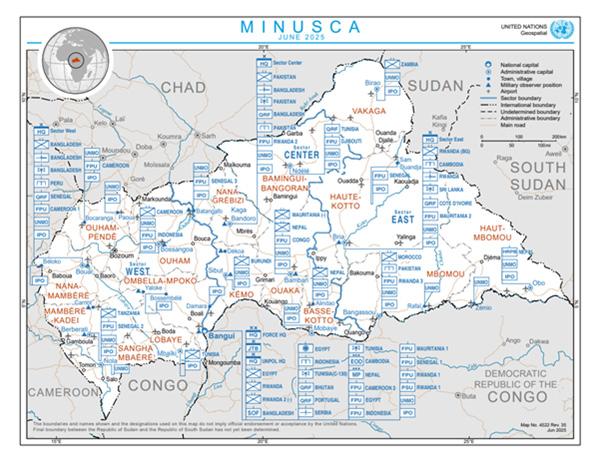
Map of the Central African Republic showing the main sectors and territorial deployment of the United Nations Multidimensional Integrated Stabilization Mission in the Central African Republic (MINUSCA).
Source: Un.org
Blue helmets are international military and police forces who work under a UN mandate to protect civilians in conflict zones.
Source: Infobae
On 19 October 2021, the Peruvian Engineering Company began engineering works to prepare the land for the construction of MINUSCA’s Level 2 Hospital in the city of Bouar.
Source: Gob.pe
CAR. This shared experience between nations of the Global South fosters a degree of empathy and trust with the local population that is difficult for external actors to replicate. Although it generates an effect similar to that of public diplomacy—by strengthening local trust—it is not primarily a communication policy, but rather a legitimacy derived from South–South affinity and shared experiences.
Within this logic, SSC assumes that all participants can benefit from working together. In the context of MINUSCA, this principle is fully met. For the Central African Republic, the benefits are immediate and concrete: it receives essential infrastructure that improves security, enables the return of displaced persons, and lays the groundwork for economic recovery. For Peru, the benefits are also strategic. From a foreign policy perspective, the mission has been an operational initiative that gives life to the “objectives of the Strategic Plan for Africa 2024–2030” (Ministry of Foreign Affairs, 2025). In the defense sector, the benefits are tangible: the mission provides the Armed Forces with indispensable experience in a real and multinational theatre of operations. It directly enhances interoperability and advanced hands-on training (CECOPAZ, 2022), supporting the National Defense objective of contributing to international peace (Ministry of Defense, 2005). Likewise, at the bilateral level, this work forges an extraordinary bond of appreciation with an African nation, helping to “expand Africanness” in our foreign policy—from rhetoric to everyday practice.
This dynamic also involves the soft power of engineering and solidarity. Today, a country exerts influence not only through economic, military, or demographic means, but also through cultural attraction, values, and exemplary conduct. In this sense, the “Peru” Engineering Company is one of the most useful and efficient soft power instruments of the Peruvian State. The blue helmet and the image of Peruvian rehabilitation of a key route have a powerful and lasting impact on local perceptions. Diplomacy through deeds creates ties of trust and appreciation, presenting Peru not only as a conventional power player, but as a supportive partner. This image is invaluable on a continent with a complex history in which external interventions have not always been successful.
This strategic projection aligns with the objective of Peruvian foreign policy to “expand Africanness” (Ministry of Foreign Affairs, 2025). The idea is to move beyond a relationship with Africa based mainly on commemorating the historical diaspora,
toward a real and contemporary engagement. Peru’s entry into MINUSCA thus represents a diplomatic “bridgehead.” It is Peru’s largest, most operational, and most visible presence in Central Africa. This mission builds the trust and mutual understanding necessary for future bilateral relations—diplomatic, commercial, and cooperative—not only with the Central African Republic but also with the member states of the Economic Community of Central African States (ECCAS).
In conclusion, the “Peru” Engineering Company in MINUSCA offers an exemplary model of sound foreign policy, in which multilateral commitments are combined with the principles of South–South Cooperation to create a win–win scenario. The mission is not only about fulfilling an international mandate; it is about implementing a policy that, in turn, helps develop a strategic advantage for the country (Soto Millonez, 2016). Nearly a decade into this engagement, it is clear that Peru is not only exporting engineering—it is exporting stability, hope, and unity.
For these reasons, the Bocaranga bridge built by Peruvian personnel embodies the fulfillment of this vision. It is not merely a steel structure spanning a river; it is a bridge of solidarity that links South America with Africa. It showcases Peru’s capacity to be a positive and supportive actor in the world, serving as a perfect example of how the best way to strengthen international projection is through concrete actions that promote peace.
References
Agencia Peruana de Cooperación Internacional (APCI). (2012). Compendio de Normas Legales de la Cooperación Técnica Internacional. Lima: APCI. Enlace: http://portal.apci.gob.pe/Compendio%20 Normas%20Legales%20CTI/111.pdf
Comando Conjunto de las Fuerzas Armadas. (2021, julio 20). Comando Conjunto de las Fuerzas Armadas despide a Cascos Azules que participarán en Misión de Paz en la República CentroafricanaMINUSCA. Plataforma Digital del Estado Peruano. Enlace: https://www.gob.pe/institucion/ccffaa/ noticias/514649-comando-conjunto-de-lasfuerzas-armadas-despide-a-cascos-azules-queparticiparan-en-mision-de-paz-en-la-republicacentroafricana-minusca
Comando Conjunto de las Fuerzas Armadas. (2022, enero 17). Habilitación del terreno para la construcción del Hospital Nivel 2 de la MINUSCA en la ciudad de Bouar. Plataforma Digital del Estado Peruano. Enlace: https://www.gob.pe/institucion/ ccffaa/noticias/578890-habilitacion-del-terrenopara-la-construccion-del-hospital-nivel-2-deminusca-en-la-ciudad-de-bouar
Ministerio de Defensa del Perú. (2005). Libro Blanco de la Defensa Nacional. Enlace: https:// www.gob.pe/institucion/mindef/informespublicaciones/334409-libro-blanco-de-la-defensanacional
Ministerio de Defensa del Perú. (2022, octubre 25). CECOPAZ fortalece la formación de las Fuerzas Armadas del Perú para misiones de paz de la ONU. Plataforma Digital del Estado Peruano. Enlace: https:// www.gob.pe/institucion/mindef/noticias/1117219cecopaz-fortalece-la-formacion-de-las-fuerzasarmadas-del-peru-para-misiones-de-paz-de-laonu
Ministerio de Relaciones Exteriores del Perú. (2025). Discurso del Viceministro de Relaciones Exteriores, Embajador Félix Denegri Boza, en la XVI edición del Día de la Amistad Peruano-Africana. En: Cumanana, Boletín Virtual de Cultura Peruana para el África. (N° 50). Enlace: https://cdn.www.gob.pe/uploads/
Naciones Unidas Perú. (2020, agosto 19). Cascos Azules peruanos y su aporte en República Centroafricana. Enlace: https://peru.un.org/ es/93157-cascos-azules-peruanos-y-su-aporteen-rep%C3%BAblica-centroafricana
Soto Millonez, A. (2016). La participación del Perú en las Operaciones de Mantenimiento de la Paz de Naciones Unidas y su contribución a la política exterior Tesis de Maestría. Academia Diplomática del Perú Javier Pérez de Cuéllar. Enlace: https://repositorio. adp.edu.pe/bitstream/handle/ADP/98/2016%20 Tesis%20Soto%20Millonez%20Alberto.pdf
Members of the Peruvian contingent during initial operations in the Bocaranga region
Source: Gob.pe
FROM CALLAO TO BANGUI: THE JOURNEY OF PERUVIAN PEACEKEEPERS
romina suñE Escaró
From the port of Callao, where the sea has witnessed centuries of farewells, a group of Peruvians sets out—Peruvians who have learned to serve their country not only within its borders, but also on the broader horizon of humanity. Bound for Bangui, capital of the Central African Republic, the members of the Peruvian contingent deployed to the United Nations Multidimensional Integrated Stabilization Mission in the Central African Republic (MINUSCA) embark on their journey. Their path is not only geographical. It is also a cultural and moral passage: a transition from the Pacific coast to the heart of Central Africa, from military routine to the daily work of peace.
1. Mission context
MINUSCA was established by the United Nations Security Council in April 2014, in response to the institutional collapse that followed armed conflict in the Central African Republic. Its mandate is broad: to protect civilians, promote political dialogue, facilitate humanitarian assistance, and help rebuild State authority (United Nations Peacekeeping, 2025a). In this context, Peru decided to contribute a military engineering contingent, reaffirming its long-standing commitment to multilateralism and peacekeeping operations.
Peacekeepers
Source: geopolitical monitor
The Peruvian contingent—made up of more than two hundred personnel—represents one of the most significant Latin American contributions to the mission (United Nations Peacekeeping, 2025b). Since 2020, Peruvian blue helmets have been deployed to several regions of the Central African Republic, bringing with them not only engineering tools, but also a cultural “toolkit” of discipline, respect, and solidarity (Agencia Andina, 2020).
2. The journey and adaptation
Departing from Callao is more than simply boarding a ship or a plane. It means leaving behind a climate, a language, a geography, and a way of life to enter a radically different world. Bangui, located on the banks of the Ubangui River, offers a landscape of contrasts: dense vegetation, red-earth villages, bustling markets, and a population marked by resilience. There, where distances are measured in hours of mud and the rains dictate the rhythm of the day, Peruvians begin building roads, bridges, and airstrips that facilitate the movement of supplies and people in hard-to-reach areas.
The tasks of the Peruvian contingent are not combatrelated but focused on engineering and logistical support. As Captain Jessica Chuquisengo Acosta of the Peruvian Army explained in an interview with Geopolitical Monitor (Sánchez, 2020), the team performs land-clearing, soil compaction, and leveling as part of airfield construction; maintains, repairs, and builds unpaved runways; constructs and maintains helipads; and transports equipment to work sites. Since arriving in the Central African Republic, the Fifth Contingent has carried out projects such as the construction of the Ghambia–Nofou road and the repair of three bridges in Amada Gaza. It is also undertaking maintenance on the Bouar–Bossembele road and installing a 15-meter prefabricated bridge in Bocaranga.
The Peruvian engineering company also provides logistical support for water transport to refugee and ex-combatant camps within its area of operations. One of the most important projects currently under way is the construction of a heliport in Bouar—with three landing zones, taxiways, and complementary areas—that will serve as an operating base for a peacekeeping unit from Bangladesh. According to that country’s Financial Express, the Bangladesh Air Force (BAF) will deploy a contingent of threearmed MI-171 helicopters equipped with night vision systems and 125 personnel (Sánchez, 2020).
In Bangui, the discipline learned in Peruvian barracks becomes a cultural tool. The military salute turns into a gesture of respect, punctuality, into a sign of reliability. Through these codes, Peruvian blue helmets gradually integrate into local communities, learning words in Sango, sharing meals, and taking part in community celebrations. Distance shrinks when human values coincide.
3. The human dimension of the mission
Every peacekeeping mission is also a lesson in humanity. In the Central African Republic, Peruvian soldiers do more than build roads and bridges: they forge bonds with local communities marked by years of violence and precariousness. In this setting, the Peruvian contingent has discovered that technical cooperation is also an act of solidarity and intercultural respect.
As Captain Jessica Chuquisengo Acosta noted in her interview with Geopolitical Monitor (Sánchez, 2020), conditions in the field are demanding, but the commitment of Peruvian personnel remains firm: “Even though restrictions limit our activities, they will not stop our operations, because we came here with an objective, and that objective will be fulfilled.” Her testimony encapsulates the contingent’s resilience and its conviction that peace is sustained not only with infrastructure, but also with humanity.
In the MINUSCA camps, daily life shared between Peruvians and Central Africans creates spaces for cultural dialogue that transcend technical work. Peruvian blue helmets share their music and traditions, exchange words in Spanish and Sango, and join in community festivities. These gestures, seemingly simple, amount to a distinct form of diplomacy of closeness and care—where empathy and mutual respect become essential tools for peacebuilding.
Peru: Defense Minister highlights women's participation in peacekeeping operations Source: Andina
4. Peruvian women in the field
In the context of the Central African Republic, the presence of women within the Peruvian contingent deployed to MINUSCA represents one of the most notable advances in the recent history of Peru’s peacekeeping operations. The gradual incorporation of women in technical roles, command positions, and specialized advisory functions has not only reshaped the operational profile of Peruvian forces but has also helped consolidate a leadership model that combines technical competence, intercultural sensitivity, and ethical commitment.
The Peruvian engineering company deployed with MINUSCA currently includes 26 women among its officers, non-commissioned officers, technicians, and naval personnel. Their roles span military engineering, medicine, psychology, communications, intelligence, translation, and logistics management, as well as staff positions. For the first time, the contingent includes a legal adviser specialized in preventing sexual exploitation and abuse, a role that connects internal disciplinary policies to the ethical standards of the United Nations (Sánchez, 2020).
In Captain Chuquisengo’s words, this participation has a dual value: it strengthens the contingent’s operational capabilities and builds bridges of trust with the local population. Central African women, she explains, “feel more comfortable interacting with us; that makes operations easier, since we have been able to create a sense of trust with them” (Sánchez, 2020). This direct contact has encouraged the participation of women and children in community reconstruction and health projects, in line with the strategic priorities established by the United Nations regarding women’s participation in peace operations (United Nations Peacekeeping, n.d.).
Similarly, Peru’s Ministry of Defense highlighted, during the farewell ceremony for the Fourth Contingent of the Peruvian Engineering Company, that “for the first time in the history of the contingents, twenty female service members have joined a peacekeeping mission,” adding that “Peru already has a female participation rate of 12.2%, and we are approaching the 15% recommended by the UN for national forces in peacekeeping operations” (Agencia Andina, 2020). These advances reflect the institutional commitment to strengthening women’s participation in peacekeeping missions.
Thus, Peruvian women officers in the Central African Republic do more than carry out engineering or administrative tasks—they embody a process of cultural transformation within the Armed Forces themselves. Their performance shows that women’s participation in international missions enhances the Peruvian State’s ability to project a diplomacy grounded in cooperation and care, in which technical professionalism is interwoven with a human dimension that contributes directly to fulfilling the mission’s objectives.
5. A journey that continues
Peru’s experience in MINUSCA is part of a broader trajectory: the country’s sustained commitment to United Nations peace operations. From its participation in missions in Haiti, South Sudan, and Lebanon, Peru has shown that its international vocation is not defined by the size of its forces, but by the ethical conviction that guides their actions.
In Central Africa, the Peruvian contingent has contributed not only infrastructure but also trust. It has demonstrated that solidarity can be expressed from beneath a uniform, and that peacebuilding transcends language barriers. Its journey—from Callao to Bangui—symbolizes the capacity to build bridges between cultures and to carry the spirit of the country to places where hope is still under reconstruction.
Cumanana records this story not as a war report, but as a cultural testimony: a Peru that engages in dialogue, cooperates, and learns. In the gaze of each blue helmet lies a quiet conviction: to serve world peace is, at the same time, a way of serving the soul of one’s own country.
Peru sends female officers to MINUSCA
Source: Dialogo américas
References
Agencia Andina. (2020, 15 de enero). Peru: Defense Minister highlights female participation in Blue Helmets. https://andina.pe/ingles/noticia-perudefense-minister-highlights-female-participationin-blue-helmets-739242.aspx
Diálogo Américas. (2020, 28 de enero). Peru deploys female officers to MINUSCA.
Sánchez, W. A. (2020, June 19). Soldiers of Peace: A Peruvian Blue Helmet in MINUSCA. Geopolitical Monitor. https://www.geopoliticalmonitor.com/ soldiers-of-peace-a-peruvian-blue-helmet-inminusca/
United Nations Peacekeeping. (2025a). About | MINUSCA. https://minusca.unmissions.org/en/about
United Nations Peacekeeping. (2025b). Troop and police contributors. https://peacekeeping.un.org/en/
troop-and-police-contributors
United Nations Peacekeeping. (s. f.). Women, peace and security. Recuperado el 17 de noviembre de 2025, de https://peacekeeping.un.org/en/womenpeace-and-security-0
Casques bleus Source: Andina
CHOCOLATE “CUMANANA”: AN ECONOMIC,
CULTURAL, AND TOURISM PROMOTION INITIATIVE LED BY THE DECENTRALIZED OFFICE IN TUMBES OF THE MINISTRY OF FOREIGN
AFFAIRS
author: odE-tumbEs
The Decentralized Office in Tumbes of the Ministry of Foreign Affairs (ODE–Tumbes) implemented in 2025 an initiative aimed at promoting the traditional Afro-Peruvian cumananas through a collection of chocolates made with cacao produced in the Tumbes region.
The cumanana is a literary, musical, and poetic genre declared in 2004 as Intangible Cultural Heritage of the Nation. These short melodic verses, rooted in Hispanic, African, and Indigenous influences, took deep hold in northern Peru, particularly in Tumbes. Their authors—through singing or recitation— express profound emotions of love, joy, and melancholy in spirited duels accompanied by guitar.
Chocolate “Cumanana”: A Distinctively Tumbesino Product with Added Cultural Value
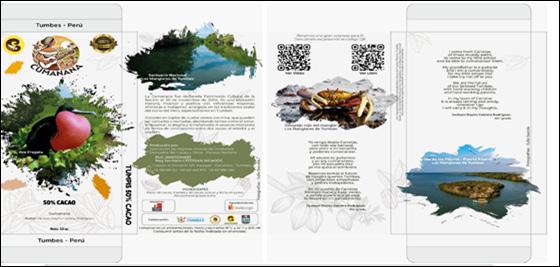
This initiative consisted of designing and producing a series of four chocolate packages under the commercial brand Cumanana, registered with the Regional Office in Tumbes of the National Institute for the Defense of Free Competition and the Protection of Intellectual Property (INDECOPI).
The packages feature tourism information and images of the main landscapes and attractions of the Tumbes region. They also include two online QR codes accessible through mobile devices.
The first QR code links to short YouTube videos showcasing children from Tumbes reciting original cumananas they created themselves, set against beautiful natural scenery such as the beaches of Zorritos and the Hervideros Hot Springs in the province of Contralmirante Villar; the Isla de los Pájaros in the Tumbes National Mangrove Sanctuary in Puerto Pizarro; the Lamederos Lagoon in Papayal district; and the El Caucho sector in Cerros de Amotape National Park, Pampas de Hospital district.
The videos include sign language interpretation, ensuring accessibility for people with hearing disabilities.
Package of Chocolate Cumanana
Source: ODE–Tumbes
The second QR code provides access to a digital book titled Cumananas, Verses Born from the River – From Casa Blanqueada with a Child’s Voice and Ancestral Soul. This compendium gathers all the cumananas created by primary school students from Educational Institution No. 042 “Sagrada Familia,” Casa Blanqueada, in the district of San Jacinto, Tumbes. The school, together with ODE–Tumbes, organized a contest to select four children whose cumananas would be featured on the four chocolate packages.
The cumananas included in this digital book were registered with INDECOPI’s Regional Office in Tumbes with full copyright protection for the children. Under this scheme, 10% of the retail value of each chocolate sold will be allocated to the young creators, providing them with direct economic benefit in recognition of the cultural value they contribute to the Cumanana chocolate line.
It is important to note that the texts printed inside the packages appear in Spanish and have been translated into English to facilitate reading and understanding by foreign tourists and visitors.
Chocolate “Cumanana”: Strategic Partners
To implement this initiative, ODE–Tumbes brought together institutions and civil society organizations as strategic partners, including:
INDECOPI TUMBES
At the beginning of 2025, ODE–Tumbes visited the Regional Office of INDECOPI in Tumbes to present the project’s objectives. An agreement was reached with the Regional Head of INDECOPI, who, together with her team, became directly involved in the initiative as part of the existing Interinstitutional Cooperation Agreement between the Ministry of Foreign Affairs and INDECOPI.
INDECOPI Tumbes provided training and ongoing guidance on intellectual property registration, including orientation sessions for the women of the “Paraíso Norteño Association of Women Innovating Cacao and Other Derivatives.” As a result, the association obtained official certification for its new chocolate brand Cumanana, adding to its existing brand Choco Tumpis.
INDECOPI Tumbes also trained educators and parents from Educational Institution No. 042 “Sagrada Familia” on the importance and benefits of intellectual property registration—a contribution that made possible the creation of the digital book mentioned earlier.
Paraíso Norteño Association of Women Innovating Cacao and Other Derivative
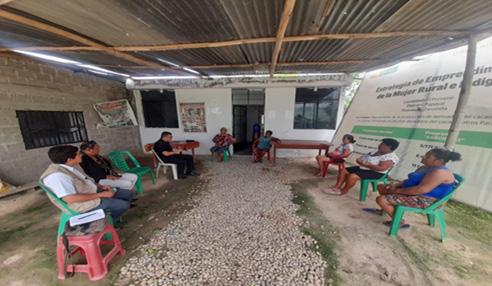
Located in the border district of Papayal, province of Zarumilla, the association is composed of 25 women representing 125 family members who work with cacao, bound by tradition, labor, and love for their land.
Their artisanal workshop is a true laboratory of flavors and knowledge. Here, they process cacao grown in their own plots in the Zarumilla Valley— unique in Peru for its genetic richness—transforming it into chocolate bars using sustainable small-scale methods such as fermentation, drying, roasting, and refining.
Through collaboration with ODE–Tumbes, the Paraíso Norteño Association created an authentic, healthy new product with a deep and distinctive flavor: Chocolate Cumanana.
More than a delicacy, it showcases the cultural
richness of Tumbes through the creativity of local children, whose cumananas bring cultural identity to each package.
The chocolate series includes four bars—50%, 60%, 70%, and 80% cacao—making it an ideal gift for family members, friends, and local or foreign visitors. Its value lies not only in the high-quality cacao but also in the packaging, which highlights natural landscapes, rich traditions, and regional cultural heritage.
Educational Institution No. 042 “Sagrada
Familia” – Casa Blanqueada, San Jacinto, Tumbes
Educational Institution No. 042 “Sagrada Familia,” founded in 1944, served as the key partner in organizing the cumanana contest among children from Tumbes, with the aim of promoting a traditional Afro-Peruvian practice that has been gradually fading over the years. The school’s principal, María Socorro Céspedes Carrillo, was the one who welcomed the initiative proposed by ODE Tumbes. She led the organization and implementation of the internal contest, whose purpose was to select four children with the best cumananas to be featured on the series of four chocolate packages.
The contest was carried out with the support of the teaching staff and administrative personnel and involved the participation of seventy-seven children, who created their own cumananas inspired by experiences related to their homes, school, local community, agricultural challenges, and other themes.
Iván Silva Rivera, Director of ODE–Tumbes, during a coordination visit with the Paraíso Norteño Association
Source: Own
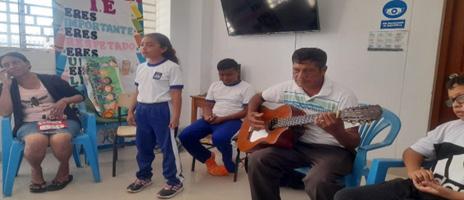
Fourth-grade student Dayana Darlin Pardo Rodríguez, from Educational Institution No. 042 “Sagrada Familia,” rehearses her cumanana accompanied on guitar by Mr. Juan Bautista Rodríguez Cornejo, a resident of the Carretas hamlet in the district of San Jacinto, Tumbes.
Iham Jhosue Pardo Céspedes, a 4th-grade student.
In Tumbes, a beautiful land where the sun always dazzles and shines, there is a sweet that captivates, a chocolate that amazes. Its aromas in the breeze fill the soul and memory; the chocolate of Tumbes is a treasure of history and glory. Come and taste this chocolate, its flavor is a delight; it is a dream to savor a pleasure like no other.
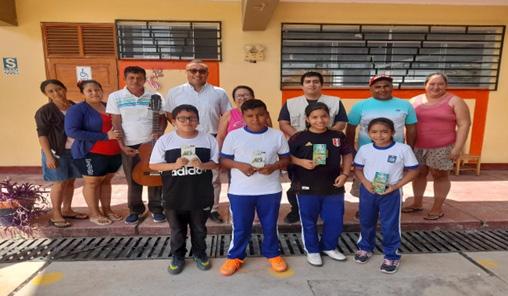
From left to right, the winning students appear: Iham Pardo, Jackson Cabrera, Valeria Ortiz, and Dayana Pardo. They are flanked by their parents, the school principal, and officials from ODE and INDECOPI Tumbes.
Dayana Darlin Pardo Rodríguez, a 4th-grade student. I feel such deep sorrow for all my people, because this year our harvest has been lost. All our crops were swept away by the river; that is why the farmers are now suffering. I feel such deep sorrow, and sometimes I stop to wonder whether the farmers will be able to harvest again. At my school, at my school, its anniversary is approaching; that is why we students are getting ready. The girls from Blanqueada love to go out dancing, but see them at home and they don’t know how to cook. Chocolate, chocolate, why are you so delicious? When I bring you to my palate, I just can’t stop savoring you.
Valeria Lizet Ortiz Canales, a 5th-grade student.
When I would walk to my little field, how much joy it used to bring— to see my tiny plants so green and blossoming.
But now that the Tumbes River has overflowed, my little plot is full of water; my plants look withered, faded and drooping. So now I pray to God to help my dear parents, so their crops may grow green again and turn beautiful once more. I come from a small village called Casa Blanqueada, filled with humble people and women and men of honor. The girls of my Tumbes are lovely but quick to scold; yet when a stranger arrives, they turn quite flirtatious. Behind my little house there is a hill called Picacho where I can see my village and the gossiping ladies chatting away.
Jackson Dayiro Cabrera Rodríguez, a 6th-grade student.
I come all the way from Carretas, through all that muddy trail, to make it to my little school and share my cumanana tale. My grandfather is a guitarist, and I am a cumanana singer; for my dear School 042, I tip my hat with honor. We are the future of our beloved Tumbes, with hardworking parents and children full of eagerness. In my village of Carretas it always rains and winds blow strong; wherever life may take me, I’ll carry it in my heart along.
This cumananas contest at Educational Institution No. 042 “Sagrada Familia” will be presented in 2026 to the Tumbes Local Educational Management Unit (UGEL Tumbes) as an innovative proposal of good teaching practices, highlighting the institutional coordination developed with ODE Tumbes and INDECOPI Tumbes.
“Cumanana” Chocolate: Local, National, and International Presentation and Outreach
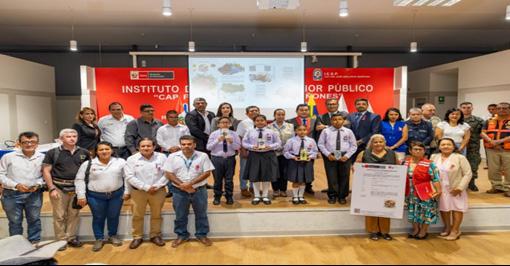
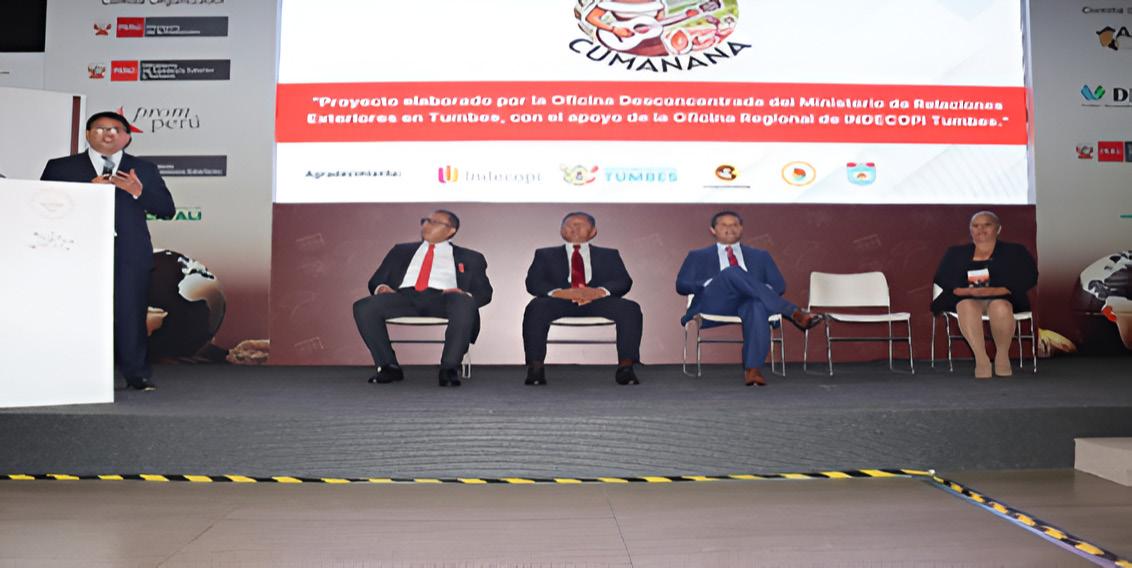
At the local level, this initiative was presented on July 3, 2025, in the auditorium of the Higher Technological Institute “CAP. FAP. José Abelardo Quiñones” in Tumbes. The event was attended by the main authorities of the Tumbes region, as well as representatives of various public and private institutions, civil society organizations, invited guests, and the general public. The presentation highlighted the leadership role of ODE Tumbes in promoting development initiatives in the region with a strong component of cultural identity.
At the national level, thanks to the support of the Provincial Municipality of Tumbes, the “Cumanana” chocolate project was presented at the 16th International Cocoa and Chocolate Salon 2025, held from July 17 to 20 at the Lima Convention Center. On this occasion, the event was attended by the Director of ODE Tumbes, the Mayor of the Provincial
Municipality of Tumbes, senior officials from the National Institute for the Defense of Competition and the Protection of Intellectual Property (INDECOPI Lima), the president of the “Association of Women Innovating Cocoa and Other Derivative Products –Paraíso Norteño,” as well as national and international visitors to this important cocoa and chocolate fair.
At the international level, this initiative has been made available to the Directorate for Economic Promotion of the Ministry of Foreign Affairs so that it may be showcased at various promotional events and specialized international fairs on cocoa and chocolate, with the support of Peru’s network of diplomatic missions abroad.
A large number of authorities and representatives from public and private institutions, as well as civil society, attended the ceremony presenting the “Cumanana” Chocolate initiative in the Tumbes region.
ODE Tumbes, together with the “Association of Women Innovating Cocoa and Other Derivative Products – Paraíso Norteño,” jointly participates in various promotional events and institutional fairs throughout the Tumbes region, presenting the “Cumanana” Chocolate initiative with the aim of promoting, disseminating, and positioning this product in the domestic market.
ODE Tumbes extends its gratitude to all those who, through their work and dedication, supported this economic, tourism, and cultural promotion initiative—an effort that has ensured proper protection of intellectual property for the child creators of the cumananas; helped to recover and strengthen their cultural identity and rich traditions; fostered cohesion among authorities and organized civil society around a shared objective; and, ultimately, promoted the tourism potential of the beautiful Tumbes region, a northern border zone of Peru.
Participation and presentation of the “Cumanana” Chocolate initiative at the 16th International Cocoa and Chocolate Salon 2025, held at the Lima Convention Center
The Director of ODE Tumbes, Iván Silva Rivera (left), presents a collection of the “Cumanana” chocolate series to the Governor of El Oro Province in Ecuador, Mr. Jimmy Blacio Ochoa (right), during the 18th El Oro–Tumbes Border Committee, held in the city of Arenillas, Ecuador, in August 2025.
ANGOLA: HISTORY, CULTURE, AND DIPLOMACY
manuEl da silva domingos
INTRODUCTION: ANGOLA, A NATION OF MEMORY AND ASPIRATION
Angola is, at once, a land of memories and a land of projects. Its historical trajectory has been marked by achievements and challenges, by moments of pain and resilience, but also by the unbreakable capacity of its people to transform adversity into hope and fragmentation into unity.
Within the African landscape, Angola stands out as a nation whose history reflects resistance, creativity, and resilience. From a territory once colonized and torn apart by wars emerged a modern State that combines memory and aspiration, tradition and future. As noted by Maria da Conceição Neto (2012, p. 9), “the history of Angola is both local and global, made of encounters and disagreements, ruptures and continuities that shape a plural identity.”
Before European presence, the Angolan space was occupied by highly complex political formations— Kongo, Ndongo, Matamba, Kwanhama, Bailundo, and Huambo—which articulated power, commerce, and spirituality. José Redinha (1962) highlights
the balance between tradition and adaptation as a defining feature of local institutions. Thus, contemporary Angola is the result of a long process of cultural and political sedimentation that predates colonization.
The Portuguese presence, formalized in 1575, introduced new dynamics of power and exploitation but also generated resistance and cultural blending. As Linda Heywood (2017) argues, colonial occupation was challenged from the outset, and cultural domination was always accompanied by symbolic resistance. After centuries of struggle, the independence of 1975 and the peace of 2002 allowed the reconstruction of the State and the redefinition of the national project.
This paper examines three central dimensions— History, Culture, and Diplomacy—understanding Angola as a historical subject and a voice of international dialogue. As Agostinho Neto, the country’s first president, summarized: “Independence is not a destination, but an ongoing process of liberation.”
HISTORICAL ROOTS
Approaching the history of a nation is an exercise in synthesis requiring the careful selection of the milestones that best define its trajectory. To outline a panorama that strengthens bilateral cooperation between Angola and Peru, this section focuses on three structuring moments of Angola’s national history:
• From sovereignty to colonization – the existence and organization of pre-colonial African kingdoms;
• The struggle for liberation and the building of peace – the recovery of sovereignty and the difficult yet victorious path toward stability;
• The era of peace and national reconstruction – Angola’s current stage of development, diversification, and international engagement.
Together, these three periods—sovereign origins, the conquest of freedom, and the contemporary phase of development—constitute the matrix of modern Angola and the foundation upon which a stronger association with Peru may be built.
a) From the African Kingdoms to Colonization
The formation of Angola is rooted in pre-colonial African civilizations with their own political structures.
The Kingdom of Kongo, flourishing between the 14th and 15th centuries, had a centralized government and sophisticated diplomatic relations. The Manicongo, the supreme ruler, administered subordinate provinces within a complex hierarchy. The correspondence of King Afonso I (Mvemba-aNzinga) with King Manuel I and later with King João III (1526) denounced the slave trade and expressed an African understanding of colonial injustice (Thornton, 1983). Notably, Kongo was a powerful Central African monarchy covering parts of present-day Angola, the Democratic Republic of Congo, Congo-Brazzaville, and Gabon.
The Kingdom of Ndongo, of matrilineal foundation, gave origin to the name “Angola” and became renowned for the leadership of Queen Njinga Mbande, who used diplomacy as an instrument of sovereignty. The famous episode in which she refused to kneel before the Portuguese governor symbolizes the African demand for equality (Pepetela, 2008).
The highland kingdoms—Bailundo, Huambo, Caconda—consolidated commercial networks connecting the interior with the coast, evidencing a dynamic African economy prior to European penetration (Mesquitela Lima, 1981). The Atlantic coast early served as a corridor linking the African interior with the Americas, much as the Lobito Corridor does today.
Portuguese colonization was formalized in 1575 with the foundation of Luanda by Paulo Dias de Novais. During the 17th and 18th centuries, the territory became a major hub of the Atlantic slave trade, supplying labor to Brazil and forming a cornerstone of the colonial economy.
Colonial exploitation intensified after 1885 with the “effective occupation,” aimed at destroying traditional structures and imposing an export-oriented economy based on forced labor. Despite domination, African languages and traditions endured as spaces of cultural identity.
In summary, Angola’s history is marked by what Conceição Neto (2012) calls a “creative tension” between colonial oppression—which left deep scars of inequality—and the persistence of ancient cultures.
Royaume du Ndongo
Source: Mais Geografia
b) The Liberation Struggle and Nation-Building (1945–1975)
The process leading to Angola’s independence in 1975 represents a central chapter of African history. It was marked by the rise of nationalism and an intense armed struggle consolidated in three phases: ideological awakening, the liberation war, and the proclamation of sovereignty.
After World War II, political awareness surged in Angola. The decline of European empires and global debates on self-determination inspired nationalist mobilization, deeply influenced by Pan-Africanism, which advocated for the unity of African peoples and their diaspora.
In 1956, a group of intellectuals founded the Popular Movement for the Liberation of Angola (MPLA)— among them Viriato da Cruz, Agostinho Neto, and Mário Pinto de Andrade. Their program emphasized that “political liberation without cultural liberation is incomplete” (MPLA, 1956). Poetry became a moral weapon, as seen in Sagrada Esperança (Neto, 1980) and Poemas/Monangamba (Jacinto, 1961). Amílcar Cabral reinforced this idea, asserting that “the liberation of a people is an act of culture” (Cabral, 1979).
Alongside the MPLA, two other movements emerged:
• FNLA, led by Holden Roberto, with strong support in the north;
• UNITA, founded in 1966 by Jonas Savimbi, with a base among the Ovimbundu.
Insurrections in 1961—such as the Baixa de Cassanje uprising, MPLA attacks in Luanda (4 February), and the UPA revolt in the north (15 March)—marked the beginning of a long liberation war. The conflict was exacerbated by Cold War dynamics: the USSR and Cuba supported the MPLA, while the United States and South Africa supported the FNLA and UNITA (Birmingham, 2015).
The 1974 Carnation Revolution in Portugal altered the political landscape, paving the way for negotiations that culminated in the proclamation of independence on 11 November 1975. Agostinho Neto declared: “Independence is the beginning of the struggle for the dignity of our people.”
Despite internal divisions inherited from the liberation period, culture—particularly literature and the memory of resistance—became the symbolic
cement for nation-building.
c) The Era of Peace and Reconstruction (2002–present)
The Luena Agreement (2002) ended 27 years of civil war. According to Péclard (2008, p. 46), “peace was less an event than a transition.” Under President José Eduardo dos Santos, Angola invested heavily in physical and institutional reconstruction, supported by rising oil prices.
Between 2004 and 2014, the country experienced extraordinary growth. Projects such as Kilamba City and the Laúca Hydroelectric Dam symbolized national rebirth. Yet inequality persisted. Conceição Neto (2012) observes that “roads were built, but cohesion and justice remained fragile.”
The 2010 Constitution consolidated a strong
Indépendance de l'Angola
Source: Roots to fruits
presidential system. Despite centralization and oil dependence (Soares de Oliveira, 2015), Angola became an active member of the Southern African Development Community (SADC) and strengthened ties with China, Brazil, and the United States through “petro-diplomacy.”
Peace reshaped art: Etona (2012) proposed an “aesthetics of reconciliation,” while writers like Pepetela and Agualusa portrayed post-war contradictions. Since 2017, President João Lourenço has pursued reforms and anti-corruption policies, reinforcing Angola’s role as a regional mediator.
ANGOLAN CULTURE: IDENTITY, LANGUAGE, AND CREATION
Culture is the heart of angolanidade. From communal songs to literature and urban music, it has served as the matrix of symbolic resistance. Mário Pinto de Andrade (1997) summarized: “Culture was the first trench of liberation.”
Language and diversity. Portuguese, once an instrument of domination, has become a unifying language without diminishing the value of national languages—Kimbundu, Umbundu, Kikongo, Tchokwe, and Nyaneka. For Feijó (2005, p. 27), “each language is a body, a drum, a rhythm of thought.” Angola’s bilingualism reflects the coexistence of tradition and modernity.
Literature. The poetry of Neto and Jacinto turned struggle into a moral epic; Pepetela and Agualusa introduced critical introspection. Pires Laranjeira (2010) observes that post-independence literature “replaces heroic rhetoric with critical melancholy.” Writers like Ana Paula Tavares and Yara Monteiro introduced female memory, widening the literary canon.
Music and dance. Semba, kizomba, and kuduro narrate the soul of the Angolan people. Semba embodies tradition, kizomba expresses the tenderness of peace, and kuduro channels the youthful energy of the suburbs (Kia Henda, 2016).
Visual arts and cinema. The Etonist movement (Etona, 2012) advocates art as moral healing. Artists such as António Ole and Délio Jasse project Angolan aesthetics internationally. Films like O Herói (Gamboa, 2004) and Independência (Bastos, 2015) retell history through African perspectives.
Gastronomy. Funge and moamba symbolize communal unity. Pepetela (2018, p. 71) wrote: “Funge is the bread and hymn of Angola: what one eats and what one is.”
Culture thus becomes the territory of peace—a space for rebuilding dignity, preserving memory, and transforming suffering into creativity.
ANGOLA’S DIPLOMACY AND THE WORLD
Angolan diplomacy has evolved in tandem with its political history and may be divided into three phases:
1. Diplomacy of Resistance (1975–1991). After independence, the MPLA aligned with the socialist bloc to secure state survival. Cuban presence proved decisive. The victory at Cuito Cuanavale (1988) symbolized African solidarity (Heywood, 2017).
2. Diplomacy of Reconstruction (1991–2017). With the end of the Cold War, Angola reoriented its approach, joining the CPLP (1996) and engaging financial institutions. Post-2002, oil became a tool of global insertion, especially through Angola’s strategic partnership with China.
3. Diplomacy of Reform (2017–present). Under João Lourenço, foreign policy adopted an ethical and multilateral tone. Angola acts as mediator in regional crises, notably between the Congo and Rwanda (Péclard, 2022), and increasingly employs cultural diplomacy to promote its international image.
Angola’s diplomatic representation around the world is broad and strategic, reflecting its growing profile as a relevant actor on the African continent and on the global stage. At present, the Angolan diplomatic network is made up of more than 80 missions, including embassies, consulates general, and permanent missions to international organizations.
José Eduardo Dos Santos
Source: The Economist
About the Americas, relations are a priority and of great historical, political, and economic importance. Angola maintains a significant diplomatic presence in the region, with embassies and consulates in key countries:
1. Historical and cultural relations: Brazil stands out as the first country to recognize Angola’s independence, in 1975. Bilateral ties have been elevated to the level of a Strategic Partnership, marked by a shared language, history, and strong cooperation in areas such as education, health, and defense. Angola has an embassy in Brasília and consulates general in Rio de Janeiro and São Paulo.
2. Strategic and economic relations: The United States is an important partner, with diplomatic relations normalized for more than 30 years. Cooperation is characterized by trade, investment (especially in the oil sector), and political dialogue. Angola has an embassy in Washington, D.C., a permanent mission to the United Nations in New York, and consulates general in Houston and New York.
3. Other relations in the Americas: Angola also maintains relations with other key countries in the region, with diplomatic representation in nations such as Argentina (embassy in Buenos Aires) and Cuba (embassy in Havana), as well as consular offices in Canada, Uruguay, and Venezuela. This network underscores Angola’s interest in diversifying its partnerships and strengthening South–South cooperation.
In summary, Angola’s diplomatic presence in the Americas aims to consolidate traditional alliances, attract foreign investment, promote trade, and defend national interests within both regional and multilateral frameworks.
South–South Cooperation
In the context of South–South diplomacy, Angola has developed strategic partnerships with countries in Latin America, Asia, and the Arab world.
Among these, cooperation with Peru stands out. Diplomatic relations were formally established on September 6, 1985.
In the decades that followed, relations remained relatively modest; however, on July 10, 2025, the First Angola–Peru Political Consultations were held in Lima. This meeting, marking the 40th anniversary of bilateral relations, symbolized the relaunch and
strengthening of the bilateral agenda.
On that occasion, opportunities were identified, and initiatives were agreed upon to deepen cooperation in five key areas:
1. Elimination of visas for holders of diplomatic and service passports.
2. Technical–diplomatic exchanges between training academies.
3. Logistical partnerships between Angolan port and airport infrastructures (including the Port of Lobito) and Peruvian infrastructures (including the Port of Chancay).
Cuito Cuanavale
Source: Mercadolibre
4. Cooperation projects within the FAO framework, particularly in the fields of fisheries and school feeding.
5. A Peru–Africa cultural platform aimed at promoting artistic and linguistic exchanges.
This partnership reflects the spirit of contemporary Angolan diplomacy: a diplomacy of solidarity and complementarity. As Alves (2014, p. 32) notes, “Angola’s foreign policy has been consolidating its African identity without renouncing the Lusophone and Latin American universality.”
CONCLUSION: ANGOLA AS A VOICE OF DIALOGUE AND HOPE
The history of Angola is a journey from pain to hope. From the African kingdoms to war, from independence to peace, the country has continuously reinvented itself. As Conceição Neto (2012, p. 201) summarizes, “Angola is a living synthesis between the past and the future.”
Culture emerges as the soul of the nation: it preserves the thread of memory and renews the sense of belonging. Pepetela (2008, p. 66) reminds us that “Angolan culture is the living memory of the country; it is in it that the people recognize themselves, even when everything else collapses.”
In foreign policy, Angola has evolved from being an object to becoming a subject of international relations. Today, it is a recognized mediator in Southern Africa, an example of stability and dialogue. Péclard (2022) notes that “Angola is a mediator because it knows the price of war and the value of peace.”
Challenges remain—economic diversification, the fight against inequality, and democratic consolidation—but the horizon remains clear: building a just and caring nation. As Agostinho Neto (1980, p. 15) taught, “The most important thing is to solve the people’s problems.” This phrase encapsulates Angola’s ethos—a country that has transformed resistance into wisdom, now standing as the African voice of hope and reconciliation.
Today, Angola addresses the world with the serenity of those who know the price of war and the value of peace. We are heirs to a history of suffering, but also to a culture that has turned every scar into wisdom. Our greatest legacy is this capacity to rebuild—not only cities, but consciences, not only the State, but the soul.
Peru and Angola strengthen bilateral relations with the first Political Consultations Meeting
Source: Andina
With this spirit, Angola strengthens its solidaritybased presence in the world, and it is with deep pride that we celebrate the cooperation between Angola and Peru—two sister nations which, although separated by oceans, are united by the history of the Lusophone world, by their Atlantic and Pacific vocations, and by their shared commitment to culture and sustainable development.
May this Afro–Latin American friendship continues to flourish as an example of dialogue, respect, and hope. As Agostinho Neto taught, “the most important thing is to solve the people’s problems,” and that is what gives meaning to our action, both within and beyond our borders.
REFERENCES
ALVES, Carlos A. J. Política Exterior Angoleña. Coimbra: Universidad de Coimbra, 2014. ANDRADE, Mário Pinto de. Orígenes del nacionalismo africano: continuidad y ruptura en los movimientos unitarios emergentes de la lucha contra la dominación colonial portuguesa: 1911-1961. Lisboa: Dom Quixote, 1997.
BIRMINGHAM, David. Breve historia de la Angola moderna. Londres: Hurst & Company, 2015. CABRAL, Amílcar. Unidad y lucha: discursos y escritos. Nueva York: Monthly Review Press, 1979.
CONCEIÇÃO NETO, Maria da. Historia de Angola: de la prehistoria al siglo XXI. Luanda: Kilombelombe, 2012.
FEIJÓ, Lopito. El viento que sopló en mis entrañas. Luanda: Chá de Caxinde, 2005.
HEYWOOD, Linda. Njinga de Angola: La reina guerrera de África. Cambridge: Harvard University Press, 2017.
JACINTO, António. Poemas. Lisboa: Minerva, 1961. LIMA, Mesquitela. Etnias e Culturas de Angola. Luanda: Instituto de Investigación Científica de Angola, 1981. 12 MPLA. Manifiesto del MPLA. Luanda: Ediciones del Partido, 1956.
NETO, Agostinho. Sagrada Esperança. Lisboa: Sá da Costa, 1980.
OLIVEIRA, Ricardo Soares de. Magnificent and Beggar Land: Angola Since the Civil War. Londres: Hurst & Company, 2015.
PÉCLARD, Didier. Les incertitudes de la nation en Angola. París: Karthala, 2008.
PÉCLARD, Didier. Angola: Paz y Gobernanza. Ginebra: Instituto Universitario, 2022.
PEPETELA. El casi fin del mundo. Lisboa: Dom Quixote, 2008.
PIRES LARANJEIRA, Manuel. La literatura africana de expresión portuguesa. Lisboa: Caminho, 2010.
REDINHA, José. Etnias e Culturas de Angola. Lisboa: Agência Geral do Ultramar, 1962.
THORNTON, John. The Kingdom of Kongo. Madison: University of Wisconsin Press, 1983.
MABOKÉ DE CAPITAINE
INGREDIENTS:
- 4 fillets of Nile perch or an equivalent white fish (tilapia may be used as a substitute)
- 8 banana leaves (or kitchen aluminum foil)
- 1 large onion
- 1 garlic clove
- 3 small tomatoes
PREPARATION:
- 1 hot chili pepper
- 2 sprigs of parsley
- Salt to taste
Arrange the banana leaves in pairs; if using aluminum foil, cut squares of approximately 30 centimeters. Finely chop the garlic, onion, parsley, and chili pepper, and mix everything together.
Wash the tomatoes, remove the seeds, and slice them thinly.
Place a tablespoon of the onion mixture in the center of each banana leaf or foil square. Lay a fish fillet on top and add another tablespoon of the mixture.
Arrange the tomato slices over the fish. Close the packets and tie them with kitchen string.
Place a rack inside a baking tray and pour boiling water until it covers the base.
Set the packets on the rack and place them in an oven preheated to 400°F.
Bake for 25 minutes, or until the fish is cooked through and flakes easily.
Serve the maboké hot, directly in its packet, accompanied by fried plantains and white rice.
MINISTRY OF FOREIGN AFFAIRS
DIRECTORATE-GENERAL FOR AFRICA, THE MIDDLE EAST AND GULF COUNTRIES
CUMANANA 51 – NOVEMBER – 2025
Editorial Board
Amb. Jorge A. Raffo Carbajal
Min. Marco Antonio Santiváñez Pimentel
M.C. Eduardo F. Castañeda Garaycochea
Editorial Team
Amb. Jorge A. Raffo Carbajal, Director General and Managing Editor
Third Secretary Berchman A. Ponce Vargas, Content Director
Third Secretary Giancarlo Martínez Bravo, Editor for the English Edition
Third Secretary Berchman A. Ponce Vargas, Editor for the French and Portuguese Editions