
The
Executive Summary
There’s been a tipping point over the last couple of years as AI moved from experiments to pilot projects to the point where organizations have decided that there are enough benefits from AI to justify spending big money on it. That’s when AI becomes infrastructure.
Over the next several years, we believe that AI won’t be discussed as a separate “thing.” AI features like machine learning, deep learning, and generative AI will be folded into any application or workflow where it makes sense (and plenty where it probably doesn’t make sense as well).
In 2025 alone, the global AI infrastructure market (AI hardware, not facilities) was $318 billion according to IDC, more than double the $153 billion spent in 2024. This is expected to continue unabated for the foreseeable future.
The problem that many organizations are wrestling with right now is not the “if” they’re going to need an AI infrastructure, but the “what” and “where” questions.
The “what” question is highly dependent on unique organizational factors like what they see as the low hanging AI fruit for their business and how big a move they want to make.
In this report, we are addressing the “where” question in terms of on-premises vs. public cloud options and the respective costs.
We compared the estimated cost of deploying and operating a production-scale AI infrastructure on-premises versus in three major cloud platforms: Amazon Web Services (AWS), Google Cloud Platform (GCP), and Oracle Cloud Infrastructure (OCI). The comparison is apples-to-apples, based on publicly available pricing and clearly defined workload assumptions. The model assumes steady-state, 24×7 operation of a 248-GPU enterprise AI cluster.
The scenario examines a mature, diversified manufacturing organization that has already completed extensive AI pilot programs across multiple business units.
Those efforts have demonstrated measurable operational improvements in areas such as defect reduction, scheduling, supply chain optimization, and AI-augmented HPC workloads. Based on validated demand, the organization is evaluating a
centralized, shared AI infrastructure to support ongoing model training, testing, and development.
Cloud configurations are provisioned to deliver comparable performance and continuous enterprise-scale capacity under committed pricing. All costs are derived from publicly available price sources at the time of analysis.
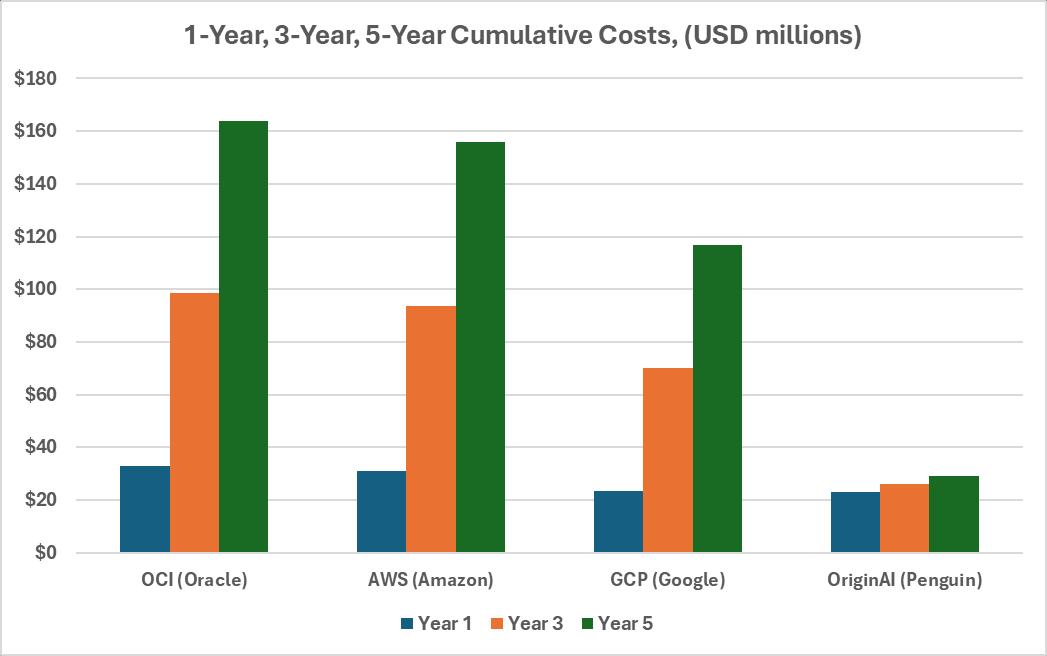
Under these conditions, the cost difference is considerable. Over a three-year period, the cloud options are estimated to cost an average of over 3.5× more than the on-premises deployment. Over five years, that differential widens further.
The cost spread is an illustration of rent vs buy economics. Simply put, if you use something a lot and it’s a significant cost, in most cases you’re better off purchasing it than renting it.
If you change the requirements and assumptions, the numbers will change and sometimes the decision will change as well. In this report, we clearly state the requirements/assumptions, configure on-premises and Cloud Service Provider (CSP) environments to best satisfy the conditions, then cost them out.
Why This Report, Why Now?
Everyone who has even casually kept up with business or technology knows that we’re in the midst of a huge move to add AI functionality to nearly every aspect of business.
The key question that many organizations are wrestling with now is how to add the necessary technology to enable their AI initiatives. Do they add new servers, GPUs, and infrastructure to their existing data center? Or do they rent the capacity in the cloud? And what can they expect to pay in either case?
I’ve been curious for a while about what it really costs to run serious IT (and now AI) infrastructure on-premises versus in the public cloud.
Cloud pricing is public. Anyone can go into Amazon Web Services (AWS) or Google Cloud pricing tools and model detailed configurations. But it’s much harder to obtain a fully builtout, enterprise-sized on-premises with real pricing attached. Without that, an apples-toapples comparison is largely speculation.
Penguin Solutions was interested in the same question. The surge in AI investment has created a wave of infrastructure decision points, and organizations are actively debating where their long-term AI backbone should reside. Penguin funded the time required for me to conduct a detailed cost analysis of a 248-GPU on-premises cluster and compare it against AWS, Google Cloud, and Oracle Cloud.
To be clear, Penguin provided a detailed hardware configuration and associated pricing for the on-premises system. I built the cloud models by using publicly available pricing tools. I defined the workload assumptions, utilization model, storage and network requirements, and ran the cost comparisons. The methodology and conclusions in this report are mine.
Prior work in HPC and infrastructure economics has given me a general sense of how this might turn out. The underlying economics aren’t mysterious. If you’re visiting a city for a week, you book a hotel. If you’re staying for a year, you rent an apartment. If you’re settling in for the long term, you buy a house. The longer and steadier the demand, the stronger the economic case for ownership.
That doesn’t mean hotels are wrong. We absolutely need hotels. We also need apartments and houses. But one model doesn’t fit every situation. The same is true for AI infrastructure.
But analogies aren’t analysis. The point of this report is to move beyond intuition and run the numbers under clearly defined real-world conditions.
Building the Model
We approached this comparison the same way we would approach any infrastructure evaluation: define the workload first, then build systems to support it.
The model assumes persistent usage and high utilization plus 24×7 operation of a centralized 248-GPU AI cluster serving multiple business units within a mature, global manufacturing organization. Utilization is modeled at approximately 80%, reflecting aggregate demand across a range of ongoing AI initiatives.
Cloud configurations were built to mirror the same GPU count, storage capacity, and overall performance envelope. No spot instances or preemptible capacity are used.
I selected Amazon AWS, Google Cloud Platform, and Oracle Cloud Infrastructure because they had instances with x86 CPUs coupled with NVIDIA B200 GPUs. Microsoft Azure did not have these instances available during our research period. We also did not analyze the smaller AI specialist cloud providers due to their relatively small size and newness to the market.
Where published three-year commitment pricing was not available (AWS B200 and OCI), we applied conservative discount assumptions based on historical precedent and typical enterprise negotiation patterns. Those assumptions are called out explicitly in the relevant sections.
Five-year totals are calculated by extending monthly pricing linearly. Why five years instead of three? Because major CSPs have extended their own server depreciation schedules to five years, and the Penguin Solutions on-premises configuration includes five-year break/fix service coverage.
No assumptions are made about renegotiation, future price reductions, or hardware refresh cycles. Vendors negotiate pricing all the time based on deal size, timing, and internal revenue targets. That’s real, but it’s outside the scope of this model.
Global Assumptions and Modeling Boundaries
Continuous 24×7 steady-state operation:
Large global organizations with multiple lines of business tend to have many AI efforts underway at the same time. Some are early pilots, others are testing phases, and some are full-scale training or retraining workloads. This cluster is designed primarily for AI development and training. It could handle inference workloads as well, but inference demand varies widely depending on the model and deployment pattern, so we’re not looking at it specifically here.
Cluster Utilization Assumption:
Utilization is modeled at the aggregate cluster level, not per individual node. We are using 80% as the average cluster utilization rate. The idea is to reflect total demand across multiple concurrent initiatives rather than assume every GPU is fully saturated at all times. In centralized HPC and enterprise AI environments, sustained utilization in the 75–85% range isn’t unusual when infrastructure is sized to the validated demand instead of speculative growth. This model shows operating reality.
High Performance Infrastructure Configuration:
AI training workloads are computationally intensive and require tightly integrated, highperformance infrastructure essentially supercomputing-class systems. Equivalent configurations are available from both on-premises vendors and CSPs, and the cloud models were built accordingly.
No Spot or Preemptible Capacity:
The on-premises system is available to users 24×7, so the CSP configurations are held to the same standard. Many of the workloads modeled here run for days or even weeks. Allowing interruptions would require frequent checkpointing, which adds overhead and cost. Spot market pricing and availability also fluctuate significantly, making them better suited for short-term or burst workloads rather than production environments with ongoing high utilization.
Three-Year Commitment Pricing Where Available:
Committed pricing improves cost predictability and reduces cloud expense. In some cases, high-demand GPU instances are only offered under reserved or committed agreements, so this assumption mimics how large enterprises actually procure cloud infrastructure.
What This Model Does Not Attempt to Capture
• Software or application licensing beyond baseline system management tools.
• Managed services. These are widely available and customizable, but they are outside the scope of this infrastructure cost comparison. Break/fix service is included for the on-premises system since CSP infrastructure inherently includes hardware support.
• Financial treatment (CapEx vs OpEx). Depreciation schedules, tax treatment, and capital structuring vary by organization and aren’t presented in depth here.
• Future pricing changes. All pricing is from publicly available data as of 1Q 2026.
AI Infrastructure Configuration Baseline
Before comparing specific vendor implementations, it’s important to define the common configuration baseline used across all scenarios. The goal is not to model a hypothetical hyperscale environment or a small experimental cluster, but a serious, large-scale enterprise deployment sized to the validated demand.
This configuration assumes a large, mature organization consolidating AI development and training workloads into a centralized shared resource. It is intentionally large enough to expose meaningful economic differences, but not so large as to represent hyperscalerscale infrastructure.
Cluster Size and GPU Generation
OnPremises&CSPConfigurationSummary
Shared Storage VAST Data,2.5PB
FSx forLustre,2.5PB usable ManagedLustre,2.5PB usable OCI Lustre,2.5PB usable Admin /MgmtNodes 8×dual Intel 6767P 8×i4i.32xlarge 8×m3-megamem-128 8×
(*detailed configurations included below)
The configuration is built around 248 NVIDIA B200 GPUs, deployed as 31 nodes with 8 GPUs per node.
The B200 generation was selected because it is a widely available, production-proven GPU architecture offered across the selected cloud providers and the on-premises vendor.
At the time of modeling, B300-class systems were emerging but not yet broadly available across all providers in comparable configurations. Using B200 GPUs allows for a consistent, apples-to-apples comparison.
Future GPU generations will improve performance per watt and per dollar. That improvement benefits both rental and ownership models. The focus here is the cost structure under sustained utilization, not generational benchmarking.
The 248-GPU scale was chosen to represent a substantial but realistic enterprise deployment. It is large enough to support multiple concurrent AI initiatives across business
units and to stress the economic model meaningfully, but it does not approach hyperscale data center magnitude.
Storage Performance Baseline
AI training workloads require high-throughput, parallel storage capable of sustaining large data flows to and from GPU nodes. Storage needs to deliver enough data to keep GPUs highly utilized and avoid idle time. The baseline configuration assumes storage performance consistent with approximately 250 MB/s per TiB in the cloud environments, aligned with enterprise-class managed parallel file system tiers.
On-premises storage is configured to deliver comparable or higher aggregate read/write throughput using a scale-out architecture. The intent is not to optimize for any single vendor’s peak performance, but to ensure that all configurations meet a consistent performance envelope appropriate for large-scale AI training workloads.
Capacity and throughput were sized to avoid bottlenecks in either environment. Storage capacity was set at 2.5 petabytes of usable space.
This baseline intentionally focuses on AI development and training workloads. Inference environments vary significantly depending on model size, deployment pattern, and latency requirements, making them highly workload-specific and less suitable for generalized cost modeling at this scale.
Networking Requirements
Large-scale AI training depends on high-bandwidth, low-latency interconnects between GPU nodes. The baseline assumes a high-performance fabric appropriate for distributed training workloads.
On-premises configurations utilize modern high-speed interconnect technologies common in HPC-class deployments. Cloud configurations were selected to provide comparable intra-cluster networking capabilities within a single region.
All scenarios assume that the full cluster operates within a single region or data center environment to avoid cross-region latency penalties and to maintain training efficiency.
This configuration is optimized for distributed, multi-node training workloads rather than single-node fine-tuning tasks. While smaller fine-tuning jobs can be accommodated, the cluster is sized and interconnected to support large-scale synchronized training runs across many GPUs.
Performance Equivalence
All vendor configurations are constructed to meet the same general performance and capacity targets. The goal is not to claim architectural superiority for any deployment model, but to define a consistent baseline so that cost comparisons reflect economic structure rather than configuration differences.
This baseline is a realistic, enterprise-scale AI infrastructure for a mature company where AI models will need to be tested and trained at scale.
Configuring equally capable systems across on-premises and cloud environments is not trivial. The terminology, specifications, and packaging differ significantly between physical infrastructure and cloud-defined instances. Even among CSPs, there is limited common ground in how instances and performance characteristics are described.
For that reason, the following sections explicitly outline how each configuration was constructed. While the implementations differ in detail, each is designed to meet comparable performance expectations.
On-Premises Configuration: Penguin Solutions OriginAI Infrastructure
The on-prem configuration in this analysis is based on a detailed system specification and pricing provided by Penguin Solutions. The system is a centralized 248-GPU AI cluster intended to support sustained training workloads across multiple business units. The specifications below summarize the compute, storage, networking, and supporting infrastructure components included in the quoted configuration.
Compute Infrastructure (Summarized)
Component Specification
GPU Node Configuration
31 nodes; 248 GPUs total (8 × NVIDIA B200 (192 GB) per node); Dual Intel Xeon CPUs; 2 TB RAM per node; 30.73 TB NVMe per node; NVIDIA 400 Gb/s InfiniBand
The cluster consists of 31 GPU nodes configured for distributed multi-node training workloads. Each node combines eight B200 GPUs with balanced CPU, memory, and highspeed interconnect resources.
Detailed system specifications are provided in Appendix A.
Storage Configuration (Summarized)
Storage Configuration
Component Specification
Architecture VAST Data scale-out storage
Configuration 64 VAST C boxes; 10 VAST D boxes
Usable Capacity ~2.5 PB
Aggregate Throughput 384 GB/s write; 600 GB/s read
Software Subscription $354,000 per year
Storage capacity and throughput were sized to meet the cloud storage performance tier at approximately 250 MB/s per TiB. The configuration supports sustained training workloads and large dataset iteration cycles.
Detailed storage specifications are provided in Appendix A.
Networking Fabric (Summarized)
Component Specification
Back-End Network
Front-End Network
Out-of-Band Network
NDR InfiniBand (400 Gb/s per node); non-blocking, fully redundant
400 Gb Ethernet; non-blocking GPU/storage connectivity; redundant architecture
Dedicated Gigabit Ethernet management network
The architecture separates GPU interconnect traffic, storage and in-band communications, and management functions. The GPU fabric operates in a fully redundant, non-blocking topology optimized for distributed training.
InfiniBand is used by 55% of the systems on the Top500 list of largest supercomputers and 68% of the top 100 supercomputers.
Detailed network topology and switch specifications are provided in Appendix A.
Integration, Support, and Cluster Management
The on-premises purchase price includes all rack hardware, cabling, and related infrastructure required to deliver a complete and fully functioning system. The quoted configuration is an integrated, deployable cluster rather than a partial bill of materials.
Integration and delivery services are included as part of the system price. This covers system assembly, configuration, validation, and deployment within the target data center environment.
Five-year Extended Platform Support is included and provides:
• 24×7 technical support availability
• Severity 1: 24×7 response, one-hour target
• Severity 2: 9×5 response, four-hour target
• Severity 3: 9×5 response, eight-hour target
This support coverage spans the full five-year modeling horizon used in this analysis. The configuration also includes Penguin’s ClusterWareAI software platform, which provides centralized cluster monitoring, management, and operational tooling across compute, storage, and networking components. ClusterWareAI software is billed at $128,000 per year (invoiced monthly) and is included in the total cost of ownership calculations across the five-year period.
All integration, support, and management software costs are included in the total cost of ownership model and are not treated as optional add-ons. Detailed support terms, service scope, and software inclusions are provided in Appendix A.
Energy and Facilities Assumptions
Penguin provided measured power data for the cluster under maximum system load: 538 kW of IT load. For the continuous usage model, we applied our 80% average utilization assumption to convert peak test power into an estimated average operating load.
Annual Energy Calculation (Base Case)
• Peak tested IT load: 538 kW
• Modeled average IT load (80%): 538 × 0.80 = 430 kW
• Marginal PUE (air-cooled): 1.30
• Incremental facility load: 430 × 1.30 = 559 kW
• Annual hours: 8,760
• Annual energy: 559 × 8,760 = 4,896,840 kWh
• Electricity rate: $0.12/kWh (US commercial rate average, Ohio)
• Estimated additional annual electricity cost: $587,621
This approach treats the cluster as an incremental load within an existing data center and applies a marginal PUE to capture cooling and power overhead attributable to the added IT load.
On the facilities side, this model assumes that there is sufficient electrical service and data center floor space to accommodate the AI infrastructure cluster. This isn’t true in all situations, of course. But there are some routes to pursue before looking for a co-location
deal. Large data centers nearly always have ‘ghost’ systems that are powered on, take up floor space, and yet have few or no users. A data center assessment uncovers these systems so they can be decommissioned, and their power/footprint devoted to newer and more efficient systems.
If this doesn’t free up enough resources for the new cluster, then co-location is the best option, and there is a dizzying array of co-location vendors and plans available today.
Personnel Assumptions
Operating a centralized 248-GPU AI cluster requires dedicated infrastructure oversight. The model assumes three incremental full-time equivalents (FTEs) associated with ongoing cluster operations.
This includes:
• One senior cluster/AI architect at an annual fully loaded cost of $260,000
• Two cluster support engineers at $125,000 each per year
These roles cover AI infrastructure architecture, system management, administration, and user support. The additional staff will help support a centralized shared environment serving multiple business units and supporting concurrent training workloads across the organization.
Total incremental personnel cost is $510,000 per year, included in the total cost of ownership calculations and extended across the five-year modeling horizon.
On-Premises Cost Summary: Penguin Solutions OriginAI Infrastructure
Capital Investment
Component Cost
GPU Node Infrastructure (31 nodes, 248 GPUs)
Administrative Nodes (8 nodes)
Storage Hardware (VAST Configuration)
Total Capital Investment
$18,833,366
$336,940
$2,138,000
$21,308,306
The capital investment includes all networking infrastructure, racks, cabling, integration services, and five-year extended platform support. Detailed specifications are provided in Appendix A.
Annual Operating Costs
Component
Total Cost of Ownership (OpEx + CapEx) 3-Year
Annual Costs with Depreciation and Cost Share:
It’s interesting to note that hardware depreciation is by far the largest portion of annual costs both on a three- and five-year depreciation basis. We’ve heard a lot in the press about electricity demand radically increasing with the advent of AI, which has driven up prices. While this is true, notice that the cost to both power and cool this cluster (calculations on page 12) is only 7% and 10% of the overall cluster cost. Even if electricity costs increased by 50%, it wouldn’t have much of an impact on the results of this TCO study.
Amazon Web Services (AWS) Configuration and Cost Summary
For AWS, we configured 31 p6-b200.48xlarge instances to match the 248-GPU baseline (8 GPUs per instance).
We selected Dedicated Instances rather than shared tenancy. If the goal is to compare this to a fully owned, dedicated on-premises system, then shared multi-tenant infrastructure isn’t really the same. Dedicated instances give hardware isolation and more predictable performance. AWS is the only CSP in our study that offers Dedicated Instances, which gives them an advantage, although one that is difficult to quantify.
AWS does not currently publish three-year reserved pricing for B200 instances. To model committed pricing, we applied a 26.55% discount to on-demand rates. That percentage is derived from the historical difference between on-demand and three-year reserved pricing for earlier GPU generations. It’s an estimate, and real-world enterprise agreements can vary.
All instances are placed within a single region to avoid cross-region latency and distributed training penalties.
Storage Configuration
Storage is modeled using Amazon FSx for Lustre at the 250 MB/s per TiB performance tier.
At roughly 2.5 PB of capacity, that tier provides enough aggregate throughput to keep the GPUs fed under distributed training workloads. Managed Lustre scales performance with provisioned capacity. It is architecturally different from the VAST scale-out storage used onprem, but both were sized to avoid creating storage bottlenecks in the model.
Networking
The p6-b200 instances use Elastic Fabric Adapter (EFA) networking with up to 3,200 Gbps aggregate bandwidth per instance.
This is not native InfiniBand like the on-prem system. EFA provides RDMA capabilities over AWS’s high-performance Ethernet network. InfiniBand and EFA are architecturally different, but both are intended to support large-scale distributed AI training.
I modeled all nodes within the same placement configuration to preserve network performance.
Personnel
Cloud does not eliminate operational responsibility. In fact, a data center that is primarily on-prem based and is contemplating a 248 GPU shared AI cluster in the cloud will need some additional personnel to help architect, manage, and provide user support. With this in mind, we assumed three incremental roles:
• One senior cloud architect
• Two cloud administrators
These roles cover architecture oversight, cost management, monitoring, and user support for a centralized AI environment.
Total personnel cost is estimated at $510,000 annually.
Cost Roll-Up (Including Personnel)
Three-year totals reflect committed pricing less reserved discount assumption discussed above. Five-year totals extend the same CSP monthly cost over the next two years. We did not try to guess future discounts or price changes.
Detailed costs for AWS configuration are provided in Appendix B
Google Cloud Platform (GCP) Configuration and Cost Summary
For GCP, the configuration was 31 A4-highgpu-8g instances to match the 248-GPU baseline (8 NVIDIA B200 GPUs per instance).
Unlike AWS, Google does not offer dedicated host options for this instance class. These are shared instances operating within Google’s multi-tenant infrastructure. We configured them as closely as possible to the on-prem and AWS environments, but true hardware isolation is not available in the same way.
The pricing used here shows Google’s published three-year committed use discount (CUD) rates. These are not estimated discounts; they are taken directly from Google’s pricing tools.
All instances are deployed within a single region.
GCI Compute Configuration Notes
There are several hardware differences worth noting:
• Each GPU node provides 3,968 GB of system memory, nearly double the memory in the on-prem and AWS configurations.
• Local NVMe storage per GPU node is 12.88 TB
To bring this closer to the on-prem baseline of 30.73 TB per node, we provisioned an additional 16.88 TB of Hyperdisk per node.
For the administrative nodes:
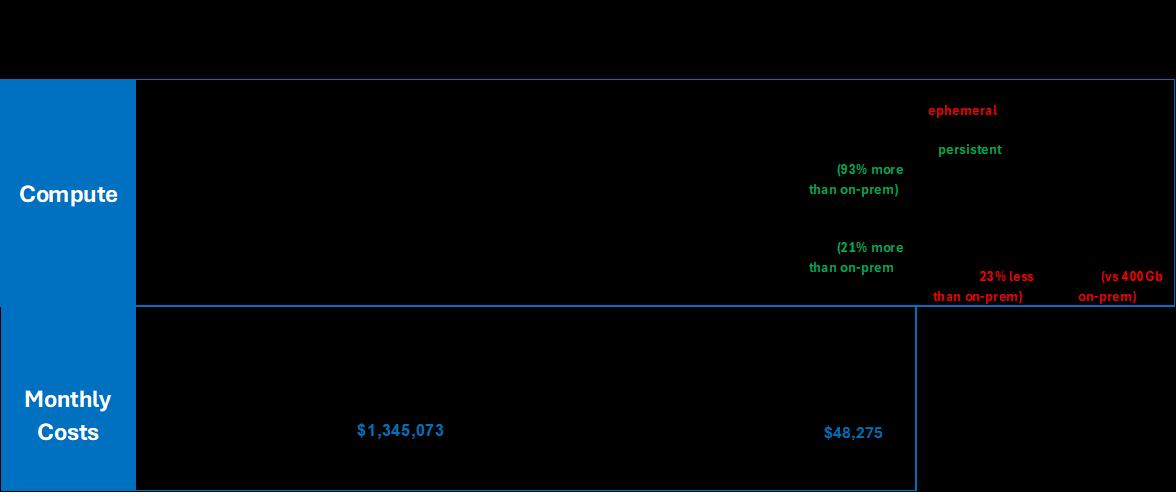
• System memory is approximately 21% higher than the on-prem configuration.
• Local SSD capacity is 3 TB. We added 20 TB of Hyperdisk, bringing total per-node storage to approximately 23 TB, which is still roughly 23% lower than the 46 TB available per on-prem admin node.
Whether these differences represent meaningful performance advantages or disadvantages depends on workload characteristics. For purposes of this economic comparison, the systems were configured to approximate functional parity rather than achieve exact hardware symmetry.
Networking
Google provides up to 3,600 Gbps maximum RDMA bandwidth via its custom network fabric.
This differs architecturally from both AWS EFA and on-prem InfiniBand but is designed to support large-scale distributed AI training. All instances need to be run within a single region to preserve network efficiency.
Storage
GCP storage utilizes Google Managed Lustre at a monthly cost of $551,131
As with AWS FSx for Lustre, performance scales with provisioned capacity. The configuration was sized to provide sufficient throughput to sustain distributed GPU training without introducing storage bottlenecks.
Architectural differences between managed Lustre and the on-prem VAST configuration remain, but each was provisioned to support the same performance envelope.
Personnel:
As with AWS, we assumed three incremental full-time equivalents at an annual cost of $510,000.
GCP Cost Summary
Three-year totals reflect Google’s published committed-use pricing. Five-year totals simply extend the same CPS monthly cost forward. Again, we did not try to guess future discounts or price changes.
Detailed costs for GCP configuration are provided in Appendix B
Oracle Cloud Infrastructure (OCI) Configuration and Cost Summary
For OCI, the configuration was GPU instances to match the 248-GPU baseline across 31 nodes.
As with Google Cloud, OCI does not offer dedicated host options for this instance class. These are shared instances operating within OCI’s multi-tenant infrastructure. We configured them to approximate the same functional capacity as the on-prem and AWS models, but true hardware isolation is not available.
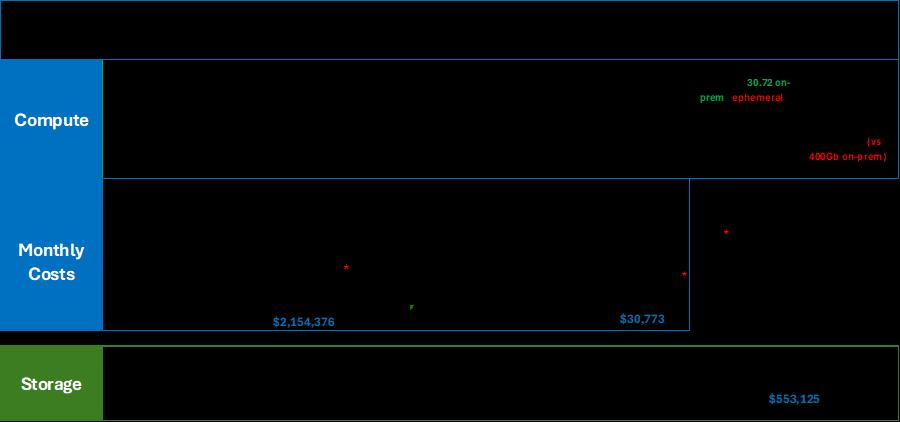
There are some hardware differences worth noting. OCI’s GPU nodes use AMD EPYC processors (128 cores at 2.25 GHz), and each node includes 54.5 TB of local SSD storage, substantially more on-node local storage than either AWS or Google in this model. Whether that translates into a performance advantage depends heavily on workload characteristics and how data is staged and accessed.
OCI Pricing Assumptions
OCI does not publish multi-year committed pricing for these GPU instances in a tool-based format comparable to Google’s committed-use discounts. List pricing for the GPU nodes is $2,534,560 per month.
OCI’s pricing model places greater emphasis on direct enterprise negotiation rather than standardized, tool-based multi-year committed pricing tiers. As a result, committed-use discounts are not transparently published in the same way as Google Cloud’s CUD rates. The 15% discount applied here is intended to approximate a reasonable negotiated agreement for modeling purposes. Actual discounts will vary by customer and contract terms.
For modeling purposes, we applied an estimated 15% discount to both GPU and admin instance pricing to approximate a negotiated enterprise agreement. The resulting net monthly pricing is:
• GPU Instances: $2,154,376
• Admin Instances: $30,773
Storage is at published list pricing to maintain consistency with the AWS and Google models.
OCI Storage
OCI Lustre storage is calculated using:
• $0.086 per GB (capacity charge)
• $0.125 per GB (performance charge)
For approximately 2.5 PB usable storage (2,621,444 GB), this produces a monthly storage cost of: $553,125 (No discount was applied to storage pricing.)
Networking
OCI provides high-performance (presented as 3200 Gbs) RDMA networking designed to support distributed AI training workloads. All instances are within a single region to avoid cross-region latency penalties and preserve cluster efficiency.
Personnel
As with AWS and Google Cloud, we assumed three incremental full-time equivalents:
• One senior cloud architect
• Two cloud administrators
These roles support architecture oversight, cost management, monitoring, and user support for a centralized AI deployment.
Total annual personnel cost is estimated at $510,000
Three-year totals reflect the 15% discount applied to compute instances as mentioned above. Five-year totals simply extend the monthly costs forward. Also, like before, I’m not going to guess future discounts or prices.
Detailed costs for OCI configuration are provided in Appendix B.
What the Numbers Show
To make the comparison clear, the fully loaded costs for each deployment model are shown below. These totals include compute, storage, network, facilities (if applicable) and personnel, and reflect the assumptions described earlier.
With the numbers presented side by side, the relative scale becomes clear.
Over three years, the cloud configurations range from approximately $71.5M to $100.1M. The comparable on-premises deployment is $26.0M.
Over five years, the full on-premises system cost $29.2M, while the cloud configurations range from $119M to $167M.
5-Year Cumulative AI Infrastructure Spending: On-Premises vs Public Cloud
$200,000
$150,000
$100,000
$50,000
$0
OCI (Oracle) AWS (Amazon) GCP (Google) On-Prem (Penguin)
Costs includeinfrastructureandoperationalstaffingundertheassumptionsdescribed inthis report.
The annual cloud spend ranges from roughly $24M to $33M per year; it doesn’t change from the initial first year spending due to the three-year agreements. These contracts were negotiated to both ensure capacity availability and to reduce costs.
During that three-year period, the CSP configurations would remain static as per the contract. In other words, the GPUs wouldn’t be upgraded by the CSP unless there is some mechanism in the contract to require it, probably at a higher cost.
By comparison, the entire five-year cost of the on-premises system is $29.2M. Its configuration would remain static as well, although an upgrade of all or some of the B200 GPUs is technically possible, but the customer would be assuming the cost of the new GPUs.
We believe this cost disparity between CSPs and on-premises systems has always existed and will always exist. The CSPs can and do negotiate deals with customers to reduce costs, but it’s highly unlikely that a special deal would bring cloud TCO to parity with an on-premises deployment. Plus, on-prem vendors also negotiate their prices.
Key considerations for customers trying to decide whether to buy or rent an AI infrastructure (or any other sizable compute project) are:
• Current and future demand patterns for the new system or workflow. How many concurrent users, demand schedules, etc. Constant demand skews the economic decision toward on-prem.
• System sizing and utilization are also important. System utilization under 50% a year edges into cloud territory, unless there is slack space to fit the workload onto another on-prem system. When system utilization climbs above 60%, it skews cost wise toward on-prem.
The decisions here aren’t technical, they’re firmly rooted in buy vs rent economics.
© 2026 Olds Research. All rights reserved. This report was prepared by Olds Research based on publicly available information, vendor documentation, and analytical modeling performed by the author. While reasonable efforts were made to ensure accuracy, Olds Research makes no representations or warranties regarding the completeness or accuracy of the information contained in this report and assumes no responsibility for errors, omissions, or the results obtained from the use of this information.
The analysis reflects conditions and pricing available at the time of publication and is intended solely for informational purposes. No part of this publication may be reproduced, distributed, or transmitted in any form or by any means without prior written permission from Olds Research. Vendors may not quote, excerpt, or reference this report in marketing or promotional materials without prior written permission from Olds Research. All company names, product names, and trademarks mentioned in this report are the property of respective owners and use for identification purposes only
Configuration Memory (GB)
On Node Storage (NVMe)
Network Performance (Gigabits) Purchase Price
GPU Node configuration
Compute
Storage
Admin Node Configuration
2 x Intel 8592+, 64 cores, 1.9 GHz, 8 x Nvidia B200 SXM GPUs, NVLink,Nvidia ConnectX-7 1-Port
OSFP/400Gb NDR IB x 8, 2 x 2 TB M.2
SSD (boot) 2048
2 x Intel 6767P 64C, 2.4Hz, 6400MHz, 350W, 12 x U.2 3.84 TB SSD, 2 x Nvidia ConnectX-7 2-Port
QSFP112/400Gb VPI, 2 x 1 TB M.2
(boot)
Vast Data Universal Storage, C + D boxes, 2.5 PB usable capacity
384 GB/s aggregated write throughput Storage Purchase Price
64 x Vast C Boxes, 10 x Vast D boxes 600 GB/s aggregated read
Back-End Network
Front-End Network
GPU-to-GPUCommunication.Nonblocking400Gb NDRInfiniBand.
In-Band and Storage Communication.Non-blocking 400Gb Ethernet.
12xNvidiaQM970064-portcore switches=4xspineswitchesand 8 xleafswitches(GPU+UFM)
$2,138,000
EdgecoreSwitches(SONiC O/S): 4 x64-portcore,4x64-portedge,2x 32-portedge(admin),2x32-port edge(storage)
Included
Included
Included Networks
Out-of-Band Network
Systems Management & MonitoringSoftware
ClusterWareAI: cluster monitoring and management platform with toolintegration and secure operations
IPMIand SerialConsole Communication forRemote Management.
EdgecoreSwitches(SONiCO/S) GbE,2x32-portcoreswitches, Edgeswitches:2x48-port(admin), 1x48(BEspine/FEcore),2x48port(BEleaf/FEEdge,1x48-port
Handles provisioning/deployment plus Ansible-based orchestration. Monitors status, utilization, and performance atcluster and node level. Slurm, Kubernetes, OpenPBS integration. performance, status
ICE ClusterWare Cost
Additional Components, Integraton/Delivery Services, Warranty
Purchase price includes all rack hardware, cabling, etc., for complete and functioning system.
Integration services: advanced rack level integraton of nodes, Delivery Services: Engineers position racks into data center
Five Year Extended Platform Support: Technical support availability 24x7, Support team response times: Severity 124x7, one hour, Severity 2, 9x5, four hours, Severity 3, 9x5, 8 hours
Total Penguin Solutions Costs, Annual 1 - 5 years
Total 3-year Costs $26,047,168
Total 5-Year Costs $29,206,410
Costs
configuration
Admin Node Configuration
Dedicated instance,24x 7x 365 availability,three year reserved,248 Nvidia B200GPUs
p6-b200.48.xlargex31nodes,8x NvidiaB200GPUs,dualIntel48core, 2.3GHzbaseclock,192vCPUs, NVLink
Dedicated instance,24 x 7x 365 availability,three year reserved,8x adminnodestomatchon-premises configuration i4i.32xlarge x8instances,128vCPU
GPUNode(s)CostCalculations
BaseGPUServer On Demand Monthlycost(31x $120.776x730 hoursamonth) Estimated AWS Discounted Monthly Costbased on threeyear reserve (26.55%*)
$2,007,507
*thereisn'tapublished3-yearp6-b200.48xlargeinstance reserverateatthistime,sousingsameOn-Demandvs3-year reserverateasonp5.48xlargeGPUinstance
Admin Nodes(8instances)CostCalculations
server
cost(8x$ 6.09638x730)
Est.AWS Discounted MonthlyCost based on three year reserve(20%)