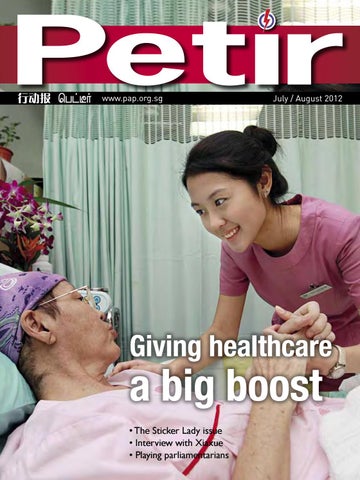
行动报
www.pap.org.sg
July / August 2012
Giving healthcare
a big boost • The Sticker Lady issue • Interview with Xiaxue • Playing parliamentarians
Hock Lian Seng Holdings Limited (“Hock Lian Seng” or “the Group”) is one of the leading civil engineering group in Singapore, with an established track record of more than 40 years. The Group was listed on the Mainboard of Singapore Exchange Securities Trading Limited (“SGXST”) in December 2009. Established in 1969, Hock Lian Seng has undertaken and completed wide range of civil engineering projects for both the public and private sectors in Singapore. We carry out civil engineering works for bridges, expressways, tunnels, Mass Rapid Transit (“MRT”), port facilities, water and sewage facilities and other infrastructure works. The Group has successfully completed Kim Chuan Depot, one of the world’s largest underground depots with housing capacity for up to 77 trains , for the Circle Line in 2007. Our major customers include government and government-related bodies of Singapore, such as the Land Transport Authority, Housing Development Board, PSA Singapore Terminals, Public Utility Board and Civil Aviation Authority of Singapore. The Group also procures and sells building material (concreting sand and aggregates) for building and construction purposes mainly for Singapore public sector contracts. The Group has added property investment and development activities in the residential, commercial and industrial sectors as principal activities.
Website : www.hlsgroup.com.sg
Email : info@hlsgroup.com.sg
80 Marine Parade Road #21-08, Parkway Parade 80Singapore Marine Parade Road #21-08, Parkway Parade 449269 Singapore Tel: (65) 449269 6344 0555 Fax: (65) 6440 9049 Tel: (65) 6344 0555 Fax: (65) 6440 9049
“I’m
a Singaporean; my forefathers arrived here in the early days, back in the 1880s. Through the years, my family’s fortunes have ebbed and flowed, just like the tides of our shores. I am a true son of the soil. My past, present and future lies here. My own destiny also rises and falls, sometimes just meandering but that is my fate and, most of the time, my own doing. I come from a generation in which life was characterised by many fears and uncertainties: just getting an education was a strain on my parents’ limited resources, and there were the dark clouds of Confrontation, the British withdrawal and racial riots hovering over us. Life was not a bed of roses but I was too young to comprehend the sacrifices my parents were making for me. It was only years later that I could understand why my mother stayed up all night when I had a fever, or why my late father went out to work every day when the sun was high or the rain was hard. Even when he was extremely ill, the tears in his eyes were not so much the result of his pain but because we were young and vulnerable then. Correspondingly, I am certain the leaders of Singapore went through the same trials and tribulations during the formative years of our young nation. Today, I am extremely grateful to our leaders, past and present, and especially to the father and architect of modern Singapore, Mr. Lee Kuan Yew. Through his far-sighted visions for the country, he has brought about a stable and thriving environment for us to live and work in, one in which I am able to care for my parents in the way that I hope to. At the same time, I am able to give my children what my parents had to strive so hard for in the past. I now wish all the people of Singapore especially Singapore’s leaders - past and present - the very best of health. May they be able to bring themselves to enjoy the hard-earned fruit of their labour - what they have created and worked so long and hard to achieve. An afterthought... When I was young, I did not recognise the importance or significance of national service. It was merely a requirement that had to be fulfilled. If given a chance to live that part of my life again, I would do it wholeheartedly because I am now convinced of the need to defend my country and family. At the same time, if I could go back to the troubled years of the 50s and cast my vote, I would have voted exactly as my father did.” Today, I publish this unaltered salute for the nineteenth consecutive year and reaffirm my salute to Singapore. Thank you Singapore! Happy National Day!
Chew Chong Khay, Frank
Diamond Industries Pte Ltd Royal Diamond Industries Pte Ltd Bel Gems Jewellery Pte Ltd 20 Harbour Drive, PSA Vista, #01-03 Singapore 117612
Shipmart Pte Ltd 368 Telok Blangah Road Singapore 098834
Contents
06
Editorial
A healthy Singapore Health Minister Gan Kim Yong elaborates on the two objectives to ensure a healthy Singapore. * Also in Chinese, Malay and Tamil
11
Quick News
A round-up of new policies.
12
Face to Face
30 My Say
What really is the essence of democracy… Law professor Walter Woon zeroes in on the tough task of policy-makers.
Should laws against graffiti be changed? Minister K Shanmugam gives his views on what most Singaporeans want.
14
Hot Topic
Moves to put Singaporeans first A round-up of policy adjustments to give citizens the edge.
Xiaxue upfront In the aftermath of the online row, Petir catches up with the blogger for an update.
20
Behind the Scenes
Transport Minister for a day
Reflections of the Young PAP Model Parliament. Publicity and Publications Committee Chairman • Lawrence Wong Vice-Chairman • Seah Kian Peng Secretary • Lim Wee Kiak Members • Alvin Yeo, Arther Fong, Devi Vasantha Haridas, Kalyani Ramasamy, Chiang Heng Liang, Abdul Jafar Darwis District representative • Diana Pang Young PAP • Hamidah Aidillah PAP Policy Forum • Malminderjit Singh PAP WW • Teo Lin Lee Editor • Lim Huan Chiang Editorial and Design • Focus Publishing Limited (Tel: 6319 2392) Printer • timesprinters, Singapore. Photos courtesy of Singapore Press Holdings and istockphoto.com
JULY / AUGUST 2012
22
Behind the Scenes
One-Stop@Paya Lebar reopens After a one-year hiatus, help centre One-Stop@Paya Lebar has resumed its social welfare services. Its monthly PAP CaRES sessions also provide legal and family counselling and letterwriting.
24
Dialogue
Of childhood dreams, pets and politics Comrades Christopher de Souza and Chia Shi-Lu discuss these subjects in MPs Unplugged
26
32 Forum
Our Singapore identity – What's next? YP member says building a strong national identity is the best gift for the next generation.
34 Happenings • Visit from Guangdong party secretary • PS. We care • Getting more volunteers on board • Festive cheers • Painting with love
View from the Front
和谐社会 — 新加坡的经验 高级政务部长李奕贤概述新加坡独立至 今在经济发展、住房政策、社会建设以 及政治体系方面如何贯彻新加坡的信约 背后的主要思想。
Building a harmonious society – The Singapore story Forty-seven years on, Senior Minister of State Lee Yi Shyan says our aspiration is still the same.
35
Backbencher’s Bite
Taking care of the mentally ill
Comrade Tin Pei Ling calls on society to integrate them.
36
Overheard
Best of the sound bites by parliamentarians.
MICA (P) 151/11/2011 Petir is published by the People’s Action Party Central Executive Committee. Material in this publication may not be reproduced in whole or in part without the prior consent of the publisher. Views expressed in this magazine are not necessarily those of the PAP or the government. All rights reserved. PAP Headquarters Block 57B, New Upper Changi Road, #01-1402, PCF Building, Singapore 463057 • Telephone: 6244 4600 • Telefax: 6243 0114 • Internet: www.pap.org.sg
EDITORIAL
A heal hy Singapore A
ll of us are naturally concerned about our health. We want to not only live long, but also to live well. Over the next five years, the Government will double its annual healthcare budget from $4 billion to $8 billion to build capacity and ensure health care remains affordable. Let me elaborate on each of these two objectives. Increase healthcare capacity
First, we need to ensure adequate capacity. The Government has announced plans to significantly increase the capacity of our healthcare services and invest in our healthcare workers to ensure Singaporeans can get the treatment they need. Our population is ageing. Almost 90 per cent of the increase in inpatient load in our public hospitals over the last 10 years came from elderly patients. By 2020, we will add 1,900 beds to our acute hospitals, and 1,800 beds to our community hospitals. We will also add 6,600 beds to our nursing homes to cater to the needs of our ageing population. Many seniors prefer to live at home as they age, rather than to be in an institution. We will help them do so, so that going forward, seniors need not be a burden to society but can be an asset. We will, therefore, build capacity and capability for home care. More day care facilities for seniors will also be needed in the community. Our hospital specialist outpatient clinics (SOCs) and polyclinics have introduced measures to cope with patient growth and to manage waiting time. Elderly patients contributed to about a third of the growth in outpatient load in our polyclinics and SOCs over the last 10 years. The trend will continue. We will need to innovate and develop new models of care. 6
PETIR JULY / AUG 12
Leading a healthy lifestyle is the best to keep healthcare cost down.
One key strategy is to provide a portable subsidy through the Community Health Assistance Scheme (CHAS). Eligible patients can enjoy government subsidy when they are treated by participating private doctors so that they have other choices besides polyclinics. We will also build more community healthcare facilities to bring health care closer to the patients. More financial support for Singaporeans
Second, we need to ensure healthcare services remain affordable. Patients are required to co-pay part of the medical bill. This helps to instil discipline and encourage both the doctors and patients to be prudent in their decisions on medical treatment. This way, we minimise unnecessary treatment that will drive
up overall healthcare costs. The Government has enhanced healthcare subsidies to help Singaporeans with their share of healthcare costs. Medication cost is a major component in bills. We raised the subsidy rate and expanded the list so that more drugs will now be subsidised. We also raised the subsidy rate and introduced more flexibility for non-standard drugs to make them more affordable, including for middle-income patients. We are mindful that some middleincome families may face difficulties in paying for the intermediate- and longterm care of their elderly parents. We have, therefore, enhanced the subsidies for the lower- and middle-income families in community hospitals, nursing homes as well as home care. The 3Ms (Medisave, MediShield and Medifund) are a key part of our healthcare
By Gan Kim Yong Minister for Health
patients. We are currently reviewing MediShield to update and enhance its coverage. To help Singaporeans pay for the likely premium increases, we will provide a one-time Medisave top-up of up to $400 per person. We will review Eldershield next year. As our healthcare needs evolve, we will continue to refine the 3Ms system. Keeping Singaporeans Healthy
financing system to help Singaporeans with their share of co-payments. Medisave is a personal savings scheme that helps patients pay for their share of healthcare costs. MediShield is a catastrophic illness insurance scheme that provides insurance protection against large inpatient bills. Medifund is an endowment fund set up by the Government to provide direct subsidy to the low-income families. We have recently strengthened the 3Ms system. The permanent annual GST Voucher includes a Medisave component of up to $450 a year for older and lowerincome Singaporeans. The Medisave annual withdrawal limit for chronic diseases has also been raised to $400. The Government has put another $600 million into the Medifund this year so that we can provide about $20 million more a year from Medifund to help needy
Even as we build more facilities, train more healthcare professionals and provide more funding, one important question which I hope Singaporeans will ask is: "How can I stay healthy?" After all, staying healthy is the most effective way to keep healthcare costs low. We need a three pronged approach: • Reach out to engage Singaporeans to spread the healthy lifestyle message. Exercise regularly, eat sensibly, and adopt a healthy lifestyle. • Promote screening to detect and treat diseases early. • Better integration of care delivery across sectors to be more patient-centric. Today, our key health indicators already rank high among even the developed countries. Our life expectancy at birth is 81.4 years (2010) compared to 79.5 in the OECD countries. Our infant mortality rate is 2.2 deaths per 1,000 live births compared to 4.6 in the OECD. I believe we can still do better. But the Government cannot do it alone. If we can mobilise the people to work with the Government and our healthcare professionals, we can build a healthier Singapore.
Steps to good health More financial support
• Higher subsidy rate for medication, with an expanded drug list. • More flexibility for non-standard drugs. • More subsidies for community hospitals, nursing homes and home care. • Enhance 3Ms (Medisave, MediShield and Medifund) . • Up to $450 top-up in Medisave every year (as part of GST voucher). • $600 million top-up to Medifund • Review MediShield to enhance coverage.
Expand capacity
• Add 1,900 beds in acute hospitals, 1,800 beds in community hospitals, 6,600 beds in nursing homes (by 2020). • Portable subsidy through the Community Health Assistance Scheme (CHAS). • More community healthcare facilities to bring health care closer to the patients.
Keep Singaporeans healthy
• Spread the healthy lifestyle message. • Promote health screening. PETIR JULY / AUG 12
7
建设一个 健康的新加坡
政府将注入更多资源培训本地的医疗人员以确保国人能获得良好的医疗服务。
Singapura yang Sihat Oleh Gan Kim Yong Menteri Kesihatan
K
ita semua prihatin tentang kesihatan diri kita. Kita bukan hanya ingin hidup lama, tetapi ingin hidup dengan baik. Jadi untuk lima tahun akan datang, Pemerintah akan menggandakan belanjawan kesihatan kepada $8 bilion setahun bagi membina keupayaan dan memastikan penjagaan kesihatan kekal dimampui. Pertama, kita perlu memastikan keupayaan mencukupi. Pemerintah telah mengumumkan rancangan untuk meningkatkan secara meluas khidmat penjagaan kesihatan dan membuat pelaburan ke atas
8
PETIR JULY / AUG 12
pekerja penjagaan kesihatan kita demi memastikan rakyat Singapura menerima rawatan yang mereka perlukan. Mulai 2020, kita akan menambah 1,900 katil di hospital rawatan rapi, 1,800 katil di hospital-hospital masyarakat dan 6,600 katil untuk pusat-pusat penjagaan bagi menampung keperluan rakyat kita yang semakin tua. Kita akan juga membangunkan keupayaan dan kemampuan bagi penjagaan di rumah. Lebih banyak kemudahan untuk penjagaan siang hari juga diperlukan masyarakat bagi menyokong penjagaan di rumah. Klinik-klinik spesialis pesakit luar di hospital-hospital kami dan di poliklinik telah memperkenalkan pelbagai langkah bagi menampung pertumbuhan pesakit
dan menangani masa menunggu. Satu strategi utama adalah menerusi Skim Bantuan Kesihatan Masyarakat. Pesakit yang layak akan menikmati subsidi apabila mereka menemui doktor privet, menawarkan satu pilihan lain selain poliklinik. Akan terdapat lebih banyak kemudahan penjagaan kesihatan bagi mendekatkan pesakit dengan penjagaan kesihatan. Kedua, kita perlu memastikan khidmat penjagaan kesihatan kekal dimampui. Kos ubat-ubatan adalah satu komponen utama dalam bil. Kami telah meningkatkan kadar subsidi dan meluaskan senarai agar lebih banyak ubat-ubatan diberi subsidi. Sesetengah keluarga mungkin menghadapi kesukaran dalam membuat pem-
颜金勇 卫生部长
我
们大家都关心自己的健康。 我们不仅要活到老,还要活 得好。接下来五年,政府将 使我们的年均保健预算增加一倍至80 亿,加强我们的能力,并确保医药保健 是人人负担得起的。 首先,我们必须确保我们有足够的 容量。政府已宣布计划显著提升我们的 保健服务的容量,同时投资在我们的医 护人员身上,确保新加坡人能得到所需 的治疗。 到了2020年,我们将在急症医院添 加1900个床位、在社区医院增加1800个 床位,并在疗养院添加6600个床位。 这都是为了应付人口老化的需求。我们 也会加强家庭护理的设施和能力。我们 的社区需要更多日间护理设施来支持家 庭护理。 我们的医院专科门诊诊所和诊疗所 也实行措施应付病人的增幅以及等候 时间。 其中一个主要策略是通过社保援助
计划(Community Health Assistance Scheme,简称CHAS)。合格的病人 能在征询某些私人医生时享有津贴,这 样一来,病人除了综合诊疗所,还多了 一个选择。将来也会有更多社区保健设 施让保健服务更贴近病人。 其次,我们必须确保保健服务是人 们负担得起的。药物的费用占了医药账 单的绝大部分。我们提高津贴,并使得 更多药物获得津贴。 有些家庭在中期或长期照顾年长者 的当儿,也许会面对经济困难。我们已 经在社区医院、 疗养院和家庭护理方 面为中产阶层和低收入家庭提高津贴。 近日,我们也加强了三M(保健储 蓄[Medisave]、健保双全[Medishield] 以及保健基金[Medifund])系统。年 长和低收入的新加坡人将获得永久性的 年度消费税礼券,其中的医药保健部 分每年达450元。慢性疾病病患每年能 从保健储蓄户头扣除的顶限提高至400 元 。 今 年 , 政 府 将 6亿 元 注 入 保 健 基
金,使我们每年多出2000万元帮助有 需要的病人。目前,我们也在检讨健保 双全计划。为了帮助国人支付更高的保 费,我们将为每个国人的户口进行一次 性的400元添值。我们的保健需求演 变的当儿,我们也会不断修饰我们的 三M。 尽管我们正在建设更多设施、训练 更多专业医护人员、注入更多资金,然 而,确保保健费用开销低廉的最有效方 法是保持身体健康。我们可通过三项措 施达到这一点:(一)宣扬健康生活的 讯息;(二)提倡医疗检验以尽早发现 并治疗疾病;以及(三)更好地综合保 健服务。 我国的平均寿命为81.4岁,而我们 的婴儿死亡率按每1000名活产儿计为 2.2。在发达国家当中,这是相当高的 数据。我相信我们能做得更好。但政府 不能独自取得这个目标。如果我们能动 员国人和政府一起与医护人员合作,我 们将能打造更健康的新加坡。
bayaran bagi penjagaan kesihatan untuk jangka pertengahan dan jangka panjang. Kami telah memperkukuhkan lagi subsidi bagi keluarga berpendapatan sederhana dan berpendapatan rendah di hospital masyarakat, pusat-pusat penjagaan selain penjagaan di rumah. Baru-baru ini kami telah memantapkan lagi sistem 3M (Medisave, Medishield dan Medifund). Terdapat pemberian Baucar GST yang diberikan secara tetap setiap tahun dengan jumlah komponen Medisave mencapai $450 setahun bagi warga tua Singapura yang berpendapatan rendah. Had pengeluaran tahunan bagi Medisave untuk penyakit kronik juga telah ditingkatkan kepada $400. Pemerintah telah menyalurkan $600 juta lagi ke dalam
Medifund bagi membantu pesakit yang memerlukan. Kami kini sedang menyemak Medishield. Bagi membantu rakyat Singapura membayar jumlah premium yang semakin meningkat, kami akan memberikan tokokan Medisave sekali sahaja, yang jumlahnya mencapai sehingga $400 setiap orang. Sedang keperluan penjagaan kesihatan kita berkembang, kita akan terus memperhalusi 3M. Sedang kita membina lebih banyak kemudahan, melatih lebih ramai karyawan penjagaan kesihatan, menyediakan lebih banyak dana, cara terbaik dalam mengekalkan kos penjagaan kesihatan yang di tahap yang rendah adalah dengan mengekalkan tubuh badan yang sihat. Kita perlu pendekatan tiga serampang: 1)
Menyebarkan mesej gaya hidup sihat 2) Mempromosikan pemeriksaan kesihatan bagi mengesan dan merawat penyakit di peringkat awal 3) Menyepadukan khidmat penjagaan. Jangka hayat kita semasa lahir adalah 81.4 tahun dan kadar kematian bayi adalah 2.2 kematian bagi setiap 1,000 bayi yang dilahirkan. Kita dinilai lebih tinggi berbanding negara-negara yang telah membangun. Saya percaya kita boleh melakukan lebih baik lagi. Tetapi Pemerintah tidak boleh melakukannya sendirian. Jika kita boleh menggerakkan rakyat untuk bekerja bersama-sama Pemerintah dan karyawan penjagaan kesihatan kita, kita boleh membina sebuah Singapura yang lebih sihat. PETIR JULY / AUG 12
9
10 PETIR JULY / AUG 12
QUICK NEWS
Government shares blame for MRT breakdowns
New sex education programme
T
he Education Ministry will roll out a revised sexuality education programme later this year. The new curriculum will address the dangers of social networking and cyber relationships, among other things. Abstinence will be the key message. Teachers whose values align with that of the ministry will be specially selected and trained to teach the programme. Each school will have at least 10.
HDB tightens subletting rules
P
T
he Government has accepted responsibility in the two massive MRT breakdowns last December that affected more than 220,000 commuters. Transport Minister Lui Tuck Yew told Parliament in July that although train operator SMRT has fallen short in its maintenance regime, the Ministry of Transport, as the supervising ministry, and Land Transport Authority, as the regulator, could have done more and
better to deliver a reliable system to Singaporeans. The Government also accepts the findings and recommendations made by the Committee of Inquiry, which had concluded that the disruptions were preventable if adequate maintenance measures and checks had been carried out. It will work with train operators to develop plans on maintenance, upgrading and how to deal with breakdowns.
Death penalty: Judges' discretion
J
udges will soon have discretion to impose life imprisonment with caning instead of the mandatory death penalty in specific cases of drug trafficking and murder. For drug trafficking, the accused must have only played the role of the courier. He must also have cooperated with the authorities in a substantive way or has a mental disability. Drug kingpins, producers, distributors and retailers will still face the death sentence. In murder cases, the mandatory
death penalty will apply only where there is an intention to kill. It will remain in firearms offences. The Government proposed these changes in July and will draft them into law later this year. Meanwhile, all executions have been suspended since July last year. When the new law takes effect, all accused persons who meet the requirements, including those currently awaiting execution, can choose to be considered for resentencing.
ermanent residents will now only be allowed to sublet their HDB flats for one year, down from the current three years. When the one-year period ends, they have to apply for an extension and approval will be assessed on a case-bycase basis and granted only if there are compelling reasons. They can only sublet their flat for a maximum of five years. Previously, there was no cap. The revised rules is to deter those who buy flats for rental yields or investment. There are no changes to subletting rules for Singapore citizens.
High school fees for PRs, foreigners
F
rom January next year, school fees for permanent residents and international students studying in government and government-aided schools will go up. PRs will pay $50 to $80 more per month. International students pay an extra $115 to $250. School fees for Singaporeans remain the same. Monthly miscellaneous fees, last revised in January 2005, will also be increased by $1 at primary level, $2 at secondary level and $2.50 at pre-university level for all students. Needy students can apply for financial assistance. PETIR JULY / AUG 12
11
Face to face
Should laws against By Suresh Nair
S
hould Singapore allow anyone to write, paint, stick posters as they like on any public building, HDB void decks, school buildings? Foreign Affairs and Law Minister K Shanmugam was asked this question in a recent interview with Petir. He responded to that question with a question: what do you think the majority of Singaporeans want? He answered his own question: “This is an area where we need to give considerable weight to social and public values and mores. My sense is that many people want artists to be given the space and freedom to express themselves, in designated spaces, buildings. “But I don’t think the majority of Singaporeans want a situation where anything can be painted or written, or drawn, by anyone, in any public place they choose.” He continued: “There are differences of views on the kind of punishment that should be meted out. I think there is much less consensus on this. And this is an area of legitimate debate.” The recent “Sticker Lady” incident had sparked off a public debate on what constitutes art and vandalism. Mr Shanmugam was sharing his thinking on the general topic of vandalism as well as various other subjects during a 45-minute interview on July 24 at the Foreign Ministry in Tanglin. 12 PETIR JULY / AUG 12
Mr Shanmugam stresses that the Government is obligated to explain public-related issues such as housing and immigration. Government’s Engagement
What approach does he take on Government engaging the public on issues? Mr Shanmugam said that the Government has an obligation to explain clearly issues, be it about housing, CPF or ministerial salaries and that it is not “shutting (its) eye to these questions”.
Does this include engaging bloggers? Mr Shanmugam was asked about his meeting in June with blogger Gintai, a train officer with SMRT. He had learnt about the blogger when he was alerted to his posting “Is this my Singapore”, by someone on his Facebook site. “I saw his post on housing. I read it,
graffiti be changed?
“And we need to ensure that whatever policy we choose, Singaporeans’ interests must be taken care of. We must also take care of the quality of life including housing, education, transport and other issues.” stand those issues from the perspective of the people directly affected and then try and address them. We are genuinely trying to solve the issues, across the board for the benefit of all Singaporeans.” Gintai later commented on his blog that “the honourable Minister treated me as a true blue Singaporean with a stake in our country’s future, sharing with me his concerns and challenges.” Limits of Debate and Engagement
and thought he was genuine,” he said. “I checked out and he was willing to meet me and we had frank discussions.” They discussed issues ranging from housing affordability, immigration to social welfare, medical, CPF, defence expenditure and employment. Mr Shanmugam said “we must under-
What are the limits of debate and engagement? Mr Shanmugam said “there should be a full debate on issues.” But he added: “If you want to make personal allegations, like a person is corrupt and so on, then you should prove the allegation. “We keep the debate on issues – it can be a hard, tough debate, and that can help clarify our public and social policies. No need to engage in character attacks – unless of course you can indeed prove
the allegations.” Immigrants
The influx of immigrants has been a sore point with many. Mr Shanmugam said the tradeoffs in restricting the influx of immigrants need to be understood. “We need to put it in context,” he explained. “We are a fast-ageing society, and with a very low Total Fertility Rate (TFR). What is going to happen to our society, our economy? What are the implications if the economy doesn’t grow for many years? What happens if our young people can’t see opportunities for themselves? “And we need to ensure that whatever policy we choose, Singaporeans’ interests must be taken care of. We must also take care of the quality of life including housing, education, transport and other issues.” PETIR JULY / AUG 12
13
hot topic
Moves to put Singaporeans
first
As Singapore celebrates its 47th birthday this year, citizens have more reason to cheer than just a spectacular parade or fireworks display By Ben Nadarajan
O
ver the past year, the Government has adjusted its policies – in areas like healthcare, education and housing – to put Singaporeans first. A year ago, at his first National Day Rally speech after the general elections in 2011, Prime Minister Lee Hsien Loong pledged to place Singaporeans first and announced several initiatives to give citizens the edge over foreigners here.
In education:
In June, the Ministry of Education (MOE) announced that PRs and foreigners will have to pay higher fees in primary and secondary schools as well as junior colleges and centralised institutions. PRs have to pay between $50 and $80 more a month, while foreigners residing here have to fork out between $115 and $250 more each month. There was no change to how much Singaporeans pay. Three months before that, the MOE announced that if balloting is necessary in any phase of Primary 1 registration, Singaporeans would be given “absolute priority” over PRs, who typically make up about 10 per cent of each year’s cohort. Balloting takes place only if there are more children applying for schools than there 14 PETIR JULY / AUG 12
are vacancies. The change also gives Singaporeans priority over PR applicants who may live nearer the school. Previously, Singaporeans were given two ballot slips and PRs only one, to ballot for Primary 1 places, although that still meant that the PRs could get a place before a Singaporean on the waitlist. Welcoming the move, Member of Parliament and chairman of the Government Parliamentary Committee for Education Lim Biow Chuan said it sends a clear signal that Singaporeans are valued. “For some branded schools, balloting takes place for just one or two places, so if you can give Singaporeans priority, it’ll go a long way,” he said. Mr Lim added that some “PRs won’t be happy” but they “cannot expect the same degree of priority as citizens”. In the universities, foreign student enrolment was capped at present levels. Meanwhile, PM Lee said in his speech last year that the Government would be increasing the number of places for Singaporeans in the local universities. In healthcare:
In April, the Ministry of Health (MOH) announced that PRs would get
only half the amount of subsidies that Singaporeans get, the second time since 2010 that the difference between the two had been widened. From Oct 1, a PR occupying a Cclass hospital ward will receive a subsidy of 38.5 per cent to 55 per cent while a citizen will receive 65 per cent to 80 per cent. From April 1, the PR’s subsidy will be further lowered to 32.5 per cent to 55 per cent. In a B2 ward, the PR’s new subsidy will range from 25 per cent to 40 per cent, while the subsidy for a citizen will be 50 per cent to 65 per cent. PRs made up about 5 per cent or 13,000 of subsidised hospital patients last year, and also about 5 per cent or 144,000 of subsidised patients at specialist outpatient clinics. The subsidies for PRs cost the Government $56 million last year and the changes are estimated to save about $6 million. In housing:
In July, the HDB announced new rules to cap the duration of lease and limit on who can rent out HDB flats, making it more difficult for PRs to sublet their flats. Under the new rules, only PRs who have not sublet their flat before will be
Pro-Singaporean changes…
h
allowed to do so, but only for a year. If they want this extended, they will need to seek approval from HDB, which said it would do so only when there are “extenuating reasons”. The entire duration PRs can sublet their flats will now be capped at five years. HDB said the revisions were meant to reinforce the policy of providing HDB flats as homes to PRs, and to “deter those who are buying the flats for rental yield or investment”. PRs here own just under 50,000 HDB flats, of which only about 2,000 are sublet. Towards the end of last year, the Government also introduced higher Additional Buyer’s Stamp Duty (ABSD) of 10 per cent for foreigners buying properties. This helped to curb the possibility that foreigners were snapping up homes here and driving property prices up. In October last year, the Manpower Ministry and the Tripartite Alliance for
• Healthcare subsidies lowered for foreigners.
• Fair hiring guidelines for Singaporeans and foreigners.
C
In employment:
• Foreign students to pay more school fees. • Primary 1 registration priority for citizens.
• Higher Stamp Duty for foreigners buying properties. • Stricter subletting rules for PRs owning HDB flats.
Fair Employment Practices (Tafep) announced new guidelines to end discriminatory hiring practices where companies give preference to hiring foreigners instead of Singaporeans. Minister of State for Manpower, Mr Tan Chuan-Jin, said Singapore was still
open to foreigners but that the core of its workforce must remain its citizens – a point PM Lee had raised in his rally speech as well. The new guidelines mean that employers will now have to ensure that all jobs being advertised are open to Singaporeans and to also groom Singaporean employees to take on higherlevel jobs by developing their skills. Professor Tan Khee Giap of the Lee Kuan Yew School of Public Policy said at the sidelines of the Singapore conference of the Pacific Economic Cooperation Council (PECC) that jobs here should also have a “Singapore first” label and that employers should be allowed to hire foreigners only if they can show there are no deserving citizens to fill the vacancies.
Striking the right balance
As the world becomes more interconnected, many countries are facing greater social issues linked to migration. Countries such as Malaysia, Hong Kong and PETIR JULY / AUG 12
15
hot topic Australia have also had to deal with the issue of its citizens feeling that foreigners were getting it easier than them in the respective countries. While most Singaporeans welcome the shift in government focus towards making citizens the priority, many also felt that there was a need not to alienate PRs and citizens who have plans to settle down in the country eventually. The “Singaporeans First” message should not damage the country’s desire to attract top talent from overseas from living and working here. Apart from these policy changes, there are also many other changes going on, with new attractions constantly coming up to add vibrancy to the country. The recently-opened Gardens by the Bay is set to enhance the country’s clean and green image; and the River Safari with its two pandas are also due to open soon. Overall, Singaporeans have a lot to be optimistic about even though the global
“We don’t want a situation where it is too imbalanced also – where foreigners feel penalised to be here. We need the right blend so that everyone can live together as good neighbours...” – Factory worker G Murthi
economy is slowing down. Factory worker G Murthi, 48, who lives in Toa Payoh, said he felt the Government had made distinctions between citizens and foreigners clear enough and he did not want the difference to go too far.
“We don’t want a situation where it is too imbalanced also – where foreigners feel penalised to be here. We need the right blend so that everyone can live together as good neighbours. That would be something to be truly proud of. If everything we get is easy from the Government, then there’s no pride in it also.” Bishan resident Toh Siow Ling, 34, said she was proud to be a Singaporean because “we are a country which takes care of those who need extra help”. Delivery driver Mohamed Shafiq, 52, from Bedok, said the new attractions made him proud because that is what many foreigners ask him about Singapore. “They want to know how we got so many different plants from various countries here and so on,” he said. “I think that even in hard times like these, Singaporeans can be proud that they have the chance to spend time with family and friends exploring these new facilities.”
Some Singaporeans say new attractions like the Gardens by the Bay make them proud to be a Singaporean. 16 PETIR JULY / AUG 12
Xiaxue upfront X
iaxue (aka Wendy Cheng) is a prominent local blogger and a supporter of the PAP. While her blogs are mainly about beauty, fashion and personal lifestyle pieces, her political views have been the subject of strong attacks, especially in the run-up to the Hougang by-election. Opposition supporters have flamed her and her friends online, with sexual taunts and other insults. In a no-holds-barred riposte, Xiaxue revealed the faces behind these critics, exposing their real identities, along with those of their families. This post “Faces of haters” on her blog which has more than 100,000 followers and more than 40,000 visits a day, stirred up considerable controversy for its name-and-shame tactic. Petir caught up with Xiaxue, who lives in Aljunied GRC. 1. You said, “I hate that I have an opinion and a party I support.” Would you like to elaborate? I feel that politics divide Singaporeans and it makes me feel disliked by my friends who have a differing opinion from me. I’m sure they feel the same way as well. Prior to this election I had no opinion about Singapore’s politics and neither did they. Over the course of years, you pick your friends based on whether you can accept their values and over personality similarities. Just when I thought I can accept all my friends for who they are, out pops something very important that I’ve never considered before – their political inclinations. I cannot say I’ve lost good friends over this issue, but it certainly made things a bit tense during elections.
2. What is it about the PAP that you like? I like that the PAP is made up of the country’s best and I trust them to do the best for my country. They have a proven track record and they made our country low crime, low corruption, if any at all, highly progressive and well, we are rich. A lot of people dislike the PAP because Singapore is getting too cosmopolitan for them, with higher costs of living stressing people out. I personally do not believe in slowing down or reversing our progress to becoming one of the top cities in the world. We cannot return to a kampong state... Yes it is stressful, yes it is tough – but we must progress WITH Singapore... Or get out. I believe that that is the attitude all Singaporeans should have. I like the Singapore that Singapore has become, and I wish for it to continue with PAP’s guidance. 3. Do you know of many young people who are supporters of the PAP? And do they think like you? A good portion of my friends support the PAP but most people I know support the opposition. A lot of times PAP
supporters tend to be very quiet because once they voice out their support they get attacked like crazy. 4. Have you any political ambition? So far – no! 5. Would you react the same way if you were similarly attacked again? Yes, I will. 6. What are the positive things that came out of your recent online experience? Other than an increase in publicity for me, I also had a lot of support from people who actually support the opposition. It is nice to be reminded that a lot of them are still nice, reasonable people because those anti-PAP people online usually sound very crude and scary. 7. After your recent experience, do you think the internet should be regulated? No, I believe it is capable of regulating itself. PETIR JULY / AUG 12
17
SINGAPORE
Behind the scenes
Transport Minister for Reflections on the Young PAP Model Parliament By Jagathishwaran Rajo
B
eing one of the participants in Young PAP Model Parliament (YPMP) was a memorable and enriching experience. When the idea of the YPMP was mooted, I was thrilled and decided to join the initiative. With an array of portfolio choices, I picked the role of Transport Minister. First and foremost, the YPMP offered an immense opportunity to understand the Transport Ministry and its various policies. Before the Model Parliament, I had a passing knowledge of the policies under the Transport Ministry. However, the weeks leading to and after the Model Parliaments sessions allowed me to gain a deeper understanding. I began to appreciate the logic behind both public and private transport. Several participants raised concerns over the $1.1 billion government spending on buses. I had to defend and persuade everyone of the motivation for the government to spend a huge sum of money on buses. Second, the Model Parliamentary session gave me valuable experience about parliamentary debates and procedures. The Arts House at the Old Parliament House provided an authentic atmosphere. Some of the backbenchers, both from the “government” and “opposition”, raised pertinent concerns with regards to the hot issues on housing, transport, healthcare and immigration. In general, the debates were intense but thoughtprovoking. Third, I realised that it was not a simple task to be a frontbencher. Preparing
20 PETIR JULY / AUG 12
YP members get a first-hand experience of what it is like to be in the Parliament.
replies for each session was a challenge. The team had to conduct their individual research and put the facts and thoughts together in one piece. Along the way, I became conscious that policies cannot be perfect and may not satisfy everyone. There was a need to strike a balance between the heart and mind. Polices cannot be too emotional (heart) or purely rational (mind). Overall, the YPMP provided a good platform for young activists to come together and debate over the government policies. A pool of constructive ideas were crafted and shared among the young
activists and students. It was heartening to observe young people coming forward to discuss government policies with passion. Personally, this is a clear signal to indicate the changing political culture in Singapore where many youths are interested in the politics and governance. Personally, I look forward to more of these initiatives for young people to express and exchange their views. The writer is chairman of Zhenghua YP and region chairman of Holland-Bukit Timah
a day What is the Youth Parliament? • The YPMP comprised 80 youths: 42 YPAP activists, as well as 38 youths and university students. The debate was the 2012 Budget, with special emphasis on population, housing affordability, transportation, and economic policies. • Launched by YP Chairman and Minister of State Teo Ser Luck. Also attended by Minister K Shanmugam, Senior Parliamentary Secretary Sim Ann, Speaker Michael Palmer, Deputy Speaker Seah Kian Peng, MP Zaqy Mohamad, MP Vikram Nair, and MP Baey Yam Keng. • After four 'parliamentary' sittings each lasting eight hours, the YPMP achieved bi-partisan support for the Budget.
The Alternative Budget Four key ideas in the final YPMP Budget: • Encourage Singaporeans to have more children earlier by: 1) introducing an additional two months of parental leave (for either the father or mother) on top of the current four months; 2) helping couples who want to start their family early obtain HDB loans for down-payments; and 3) increasing baby bonus.
• Launch of consultation exercise to generate consensus among various stakeholders in Singapore with regards to 1) increasing TFR among Singaporeans; 2) the appropriate number of foreigners; and 3) enhancing integration between Singaporeans and new immigrants. • Extend the 2012 Budget Programme,
Enhancement for Active Senior (EASE) to cover the 100,000 disabled Singaporeans, so that they can benefit from flat fittings. • Fund an agency that monitors the factual accuracy of what is said by politicians from all parties, as well as by new media. PETIR JULY / AUG 12
21
Behind the scenes
One-Stop@Paya Lebar Help centre One-Stop@Paya Lebar recently resumed its social welfare services after a one-year hiatus. On top of job placement and social welfare services, its monthly PAP CaRES sessions include legal counselling, family counselling and letter-writing
I
n Hougang, an unobtrusive corner called One-Stop@Paya Lebar next to a kindergarten at the void deck of Block 115, Hougang Avenue 1, was an oasis for people who needed help. They would find the jobs they desperately needed or apply for the funds to pay for food. In May last year, the centre, which had been open since March 2008, closed its shutters. In the wake of the opposition Workers' Party win in the Aljunied ward, the staff and grassroots volunteers who ran One-Stop wanted to do a review. Grassroots volunteer Vincent Tan, 25, who has just graduated from the Nanyang Technology University with a biological sciences degree, said: “We found after our review that people still needed help.” On June 28 this year, the revamped One Stop@Paya Lebar re-opened its doors. On top of the usual job-matching and application for Comcare funds, it started a once-a-month session called PAP CaRES (Community Assistance for Residents). Sitting in the same room during PAP CaRES sessions is a lawyer and a family counsellor. Grassroots volunteer Abner Koh, 30, a tax adviser, said: “Residents who come here can get on-the-spot advice on legal and family matters.” Fellow grassroots volunteer and enterprise architect Andy Wang, 34, added: “PAP CaRES acts as an avenue for us to help the residents staying in Paya Lebar. This is how we can better serve the people.” Six people living in the area who had heard of PAP CaRES by word-of-mouth walked in for the inaugural June 28 session. The organisers saw 18 cases in July. “We help not only the lower-income 22 PETIR JULY / AUG 12
Andy Wang (left) and Vincent Tan are volunteer letter drafters with the PAP CaRES.
families, but also those middle-income residents who may need legal advice and those who need help getting their children into schools,” said Mr Koh. To get the news out, volunteers also started a Facebook page. “We want to reach out to the youth and get the word out on what we are doing,” said Mr Wang. The youth outreach aspect of PAP CaRES is key: The volunteers take time
out to meet with and talk to youth about what they are doing. Its first “Paya Lebar Talk and Chill” session which stretched from 9pm to midnight was held at a McDonalds outlet opposite the Kovan Community Centre in July. They would have talked about the satisfaction they feel in helping residents like former piano teacher Irene Diong, one of the six residents who turned up on June 28.
reopens Help at hand One-Stop @ Paya Lebar • •
provides job placement and social welfare services from 10am to 5pm on weekdays
PAPCaRES • •
family counselling, legal counselling and letter drafting services on residents’ behalf to government agencies every 4th Friday of the month, from 7.30pm onwards
www.facebook.com/#!/PAPCaRES
Robbed of two fingers on her right hand when she fell prey to a rare form of soft-tissue cancer in 2009, the 49-year-old did not let the amputation get her down, even though she could no longer play the piano, teach or earn an income. After a year-long recuperation, she stepped into the unfamiliar corporate world where she sat at a keyboard slowly typing delivery orders with eight fingers. “I was not even two days there when a
colleague asked me, can you really do it? I was discouraged,” said Ms Diong, who had a history of depression. She hung on for a year but ultimately resigned. She turned to One-Stop. She successfully applied for Comcare again, which will give her $300 a month for three months. At the PAP CaRES session, volunteers listened to her story and also helped her to write a letter to the Housing Devel-
opment Board, asking for assistance to deal with her ballooning mortgage loan arrears. “There is no dignity in asking for help. If I could help myself, I would,” said Ms Diong. “But the people here have been great. The counsellor here, she is doing more than just her job, she’s my friend. I can just call and talk to her if I need to. “To me, to receive help like this gives me hope. There are people who care.” PETIR JULY / AUG 12
23
Dialogue
Of childhood dreams, pets and politics MPs Christopher de Souza and Chia Shi-Lu talk about childhood ambitions, politics and pets in the second session of MPs Unplugged By Huang Huimin
O
ne describes himself as a late bloomer who found his bright spot only in junior college; the other was so talkative in primary school that he was made prefect so that he could put his talking “to good use”. These were the snippets let on by post-65 MPs Christopher de Souza and Chia Shi-Lu at the second session of MPs Unplugged, a dialogue series organised by the Young PAP’s Political Discussions Committee to allow activists and members of the public to get up close and personal with PAP MPs. During the one-and-a-half-hour session held on July 21 at the NTUC Income Marina Bay Centre, the two MPs answered questions ranging from their path to politics to questions about their childhood. “You could summarise me in two words: late bloomer,” said Mr Souza, who is also a former national hockey player. “That’s why I really believe in pockets of opportunity for students right throughout the spectrum, from Primary One all the way up to ITE, polytechnic and university… It’s not that the student is dull, it’s just that sometimes it takes time for things to fall into place, as it did with me.” Mr De Souza’s personal experience has given him a heart for students who may not have found their footing early on in the education system. Over the last six years in Parliament, the second-term MP for Holland-Bukit Timah GRC has spoken up several times on the issue of upgrading opportunities for ITE and 24 PETIR JULY / AUG 12
Participants asked myriad of questions from personal to political issues.
MPs Christopher de Souza and Chia Shi-Lu sharing a light-hearted moment with YP members.
polytechnic graduates. He also keeps a lookout for disadvantaged youths who need help advancing their education, and then tries to guide and help them achieve their potential. On the same topic of education, Dr Chia, MP for Tanjong Pagar GRC, believes that there is a need for schools
to take away some of the current emphasis on results in co-curricular activities (CCA), especially in sports. He recalled how even though he was not chosen to be a member of the school tennis team, he enjoyed his time as part of the tennis club. “CCAs should be an outlet for stu-
MPs Unplugged offers participants an opportunity to get up close and personal with the MPs.
dents to explore… My worry is that now there is a lot of focus on those who can play very well, rather than teach those who want to learn.” The MPs also showed a softer side as they spoke about the pets they had – Mr De Souza had grown up with pets but now finds it difficult to take care of them with two young daughters, while Dr Chia no longer keeps pets after the dog he and his family saved and loved as a family went missing. They also revealed a little about what they were like as children. Dr Chia recalled how he was first made a prefect in Primary Four as punishment for being too talkative in class. He had started the school year with a seat at the back of the class, but was moved to the front of the class, one row at a time. His Primary Four teacher finally decided to make him prefect so he could have a taste of what it was like to discipline other talkative children. Said Dr Chia: “I guess one way of dealing with so-called problematic kids is to put them into positions of responsibility and see how they adapt. I became quite a good boy after that!” The same boy went on to become
President Scholar, and is now an orthopaedic surgeon at the Singapore General Hospital. Mr De Souza, on the other hand, was less decided on his ambition when he was younger. At one time, he had contem-
“CCAs should be an outlet for students to explore… My worry is that now there is a lot of focus on those who can play very well, rather than teach those who want to learn.” – Dr Chia Shi-Lu
plated following his father’s footsteps to a career in the army. Later, even when he was reading law in university, he had toyed with the idea of becoming a diplomat. He eventually found his calling in the legal service, where he spent four years before moving on to private practice. Still, he had always known that he wanted to contribute to Singapore, in some way or another.
“I wanted my work to translate into the betterment of my country,” he said. “I was schooled from a very young age to be patriotic.” While neither had planned for the foray into politics, they are more than prepared for the challenge now that they have taken the plunge. Dr Chia had started out with grassroots work. Later, he caught the attention of the Party, and was asked to shadow MP Yeo Guat Kwang at the then-AljuniedHougang branch. “Over a period of one or two years you have to decide for yourself if you can handle the work. I felt that it is something I can manage. This is my realistic answer,” Said Dr Chia. Calling the decision to stand as candidate for the Party at the 2006 General Election a “joint decision” between him and his wife, Mr De Souza said: “If we do this, we must do it together.” While he admitted to worrying about how his daughters might be thrust into the spotlight because of his position as MP, he believes that it will all be worthwhile. “At least I can tell my daughters, I tried to make a better Singapore for you.” PETIR JULY / AUG 12
25
View from front
和谐社会 — 新加坡的经验
“和
谐”这两个字,对 新加坡的政治有特 别深远的意思。 从1965年独立以来,我们就了解新 加坡的脆弱性。首先,新加坡是个面积 很小的国家,无论是要开发资源,发展 经济,进行防卫,都没法提供有效的基 本条件。其次,我们是个多元种族,多 元宗教的社会,种族之间的和睦相处, 宗教之间的敏感和容忍,都不能被视作 理所当然。 这就是为什么我们的学生从小一开 始都会在升旗礼过后宣读新加坡公民 信约: “我们是新加坡公民,誓愿不分种 族、言语、宗教,团结一致,建设公正 平等的民主社会,并为实现国家之幸 福、繁荣与进步,共同努力。” 这个誓约是1965年开始采用的,时 隔47年,誓约的内容和含义一直是许多 政府的政策和运作背后的主题。 我就以以下四个方面的政策和措 施,来说明我们如何贯彻公民誓约里提 到的和谐社会相关思想。 经济发展-各尽所能,各取所值 从动荡不安的独立历史走出来,新 加坡深知经济的发展先决条件是政治稳 定。而为了确保政治稳定,政府初期的 一项重要工作,就是说服工会和群众, 放弃罢工、暴动的手法,对抗的态度, 而接受一个事实:即劳、资、政必须 携手合作,打造一个适宜外资投资的 环境。 经过多年的磨合,“劳资政”三方 的合作和运行已经形成一个成熟的体 系。这个体系是我们核心竞争力的一个 重要元素,也是保障工友利益的有效 机制。 随着经济的全球化,唯有不断的提 高生产力、加强产品开发能力、提升员 26 PETIR JULY / AUG 12
新加坡的信约强调的是为国民建立一个平等、公正、和谐、民主的社会。
工的技能、鼓励企业创新,否则他们将 面对淘汰的厄运。企业如此,行业如 此,国家也如此。 2010年,政府成立了并拨款20亿新 元给“全国生产力和延续教育理事会” ,让它协助各个行业拟定提升生产力的 蓝图和策略,也监督各个行业生产力计 划的实施,以确保全国能取得每年2% -3%的生产力提升。这个计划,也有助 于实现在十年之内将低薪工友的收入, 提高30%的目标。 为了确保劳动队伍持续保有国际竞 争力,我们拟定了中长期的员工技能培 训和再教育的策略。其中,人力部和其 属下的劳动力发展局积极领导工作,并 和工会、雇主和各个中专及大专学院密
切合作,设计相关的培训课程。 持续教育和再培训的工作是非常迫 切的。在一个包容和谐的社会里,我们 要竭尽所能,让工友掌握最新的技能, 以便能够胜任新的工作,与时并进。就 业是工友福利的最佳保障。 在全球化的经济体系里,低薪工友 的工资很难单靠市场力量上调,并长期 处于低靡。好多国家就为此选择了“最 低薪金制度”。而新加坡则选择了实行 所谓的“就业入薪补助计划”来协助低 收入工友。与最低薪金制不同的是,薪 金补贴所需的资金来自政府,而不是雇 主。我们觉得我们的做法不会违背市场 运作规律,也不会给中小企业带来人为 的成本负担。
李奕贤 关怀和服务社会。人民协会属下的居民 委员会,也经常主办各种各样的居民联 谊和康乐活动,加强邻居之间的互动和 了解。我们在组屋区内实施“种族比例 限额”,目的是为了促进各种族的融合 以及和谐相处。建屋局所实施的政策和 项目的目的是要为居民营造一个和谐以 及具活力的居住环境。
住房政策-民无恒产,则无恒心 新加坡住房政策启动的很早。从 1963年开始,建屋发展局就推出了“居 者有其屋”的计划。但当时大部分人没 法掏出20%的定金。 1968年,政府修改了公积金法令。 公积金缴交率从原来的10%分段提升到 1984年的50%。购买政府组屋的人从 1967年的3000个增加到1996年的7万 个。 目前,新加坡有多过90万个政府组 屋单位,为超过80%的新加坡人提供住 屋。而90%的政府组屋住户拥有自己的 房子。 随着人口老化,我们计划提供更多 的相关配套,鼓励民间组织和政府一起
社会建设-多方援手,自力根生 总理在2011年国会开会演讲时给 包容性社会下了一个定义:“什么是包 容性社会?一个包容性社会要能够让国 民享受到国家进步的好处;每个国民都 可以表达意见、都是利益相关者,并对 国家有归属感;大家都努力追求更美好 的生活,也觉得有真正的机会向上提 升”。 要了解政府对低收入家庭和弱势群 体的关怀,我们可以参考近两年的财政 预算和政府开支:财政部长尚达曼先生 在2011年二月发表财政预算案演讲时 说:“今年的预算案旨在达成两大目 标。首先是争取在未来十年把国人的实 际工资提高三成。其次是强化新加坡社 会以实现建立包容性社会的愿景。” 今年的财政预算里,直接拨给低收 入家庭的财政补贴是12亿新元。项目包 括了:消费税回扣,水电费回扣,医药 保险金的津贴等。而间接拨款于家庭的 财政补贴就高达74亿新元。措施包括了 消费税退税基金,巴士服务提升预算, 雇佣年长者预算,学习储备金,医药保 健储备金,社会关怀基金等。 除了直接拨款给低收入家庭,政府 也积极鼓励和配合民间组织和慈善机 构,为弱势群体提供各种各样的协助和 服务。我们的理念是“多方援手”。 政治体系-任人唯贤,廉洁高效 2011年的大选,人民行动党赢得了
60%的选票,81个议席。工人党则赢得 其他6个议席。 人民行动党自1959年起,已经蝉联 执政53年。在自由选举制度下,一党长 期执政的国家恐怕很少。为什么行动党 能历久不衰,在一、两代人的时间里, 把新加坡从第三世界带到第一世界? 李光耀先生这么说过:“要成立诚 实政治体系的先决条件,就是参选人不 能耗费大量的资金参选,得选。否则就 会导致腐败周期的出现”。 所以,新加坡设立了一套严格的选 举法。政党选举期间所收的捐赠和开 销,都必须向选举局呈报。其中,开销 的总数不能超过选民总数x3.50新元。 这个条例有效、严格地防止金钱政治的 产生。 当然,李光耀先生和其他开国元老 树立的诚实、朴素和严谨的作风,也塑 造了未来新加坡政治和民事服务的献身 精神,专业精神和清廉的风气。 除了维持一个清廉透明的行政系 统,我们还需要优秀人才。每届大选前 后,行动党都会从各个领域物色杰出的 人才,说服他们从政。这种人才选拔制 度,丰富了行动党的人才基础,也不断 的为行动党注入新血,为内阁提供可造 就之才。更重要的是,新加坡没有所谓 永久的统治阶级。因为不管出身贫寒或 富裕,只要是工作上证明有才华,诚实 可靠的有识之士,都能参与领导这个国 家的工作。这本身就是社会流动性的体 现,也是和谐社会上通下达,机会平等 的表现。
作者为贸易及工业部兼 国家发展部高级政务部长。 上文摘录自他于6月间 向访新的广东省委书记汪洋及 该省代表团所发表的演说。 PETIR JULY / AUG 12
27
View from front
Building a harmonious society – The Singapore story By Lee Yi Shyan
“H
armony” is a word that bears profound meaning for Singa-
that “leaves no one behind”. This year’s Budget, for example, set aside $1.2 billion as subsidies for low-income families. In addition, the Government also works with community and charity organisations to provide assistance to the needy, making for a multi-pronged approach to building an inclusive society.
pore politics. We have always understood Singapore’s vulnerabilities: its small physical size means that we lack the basic conditions for the resource development, economic growth and national defence that come so naturally to our bigger counterparts, while our multi-racial and multi-religious makeup means that it is not our place to take for granted the respect that we have cultivated for one another. Forty-seven years on, the aspiration to build a harmonious society, as epitomised by our national pledge, continues to guide and undergird our government policies.
Our Government
Economic Development
Tripartism plays an important role in building a competitive edge for Singapore and is an effective mechanism in protecting worker welfare. There is really no better guarantor of worker welfare than continued employment. It is hence imperative that we do what we can to equip our workforce with the newest skills so that it is able to maintain its competitiveness. Singapore also adopts the less conventional wage subsidies programme that shifts the burden of subsidisation from employer to government, while leaving the economy free to respond to market forces.
through several changes with the times. Today, 90 per cent of HDB dwellers are also homeowners. Various initiatives have been set in place to encourage community service and bonding. Residents’ Committees, for one, help create opportunities for neighbourly interaction by organising community events. The Ethnic Integration Policy, which stipulates a certain racial proportion for each housing estate, has also been implemented to promote racial integration and harmony. An Inclusive Society
Housing Policies
Our housing policies have gone 28 PETIR JULY / AUG 12
An inclusive society, as defined by Prime Minister Lee Hsien Loong, is one
The tone for Singapore politics was set by former Minister Mentor Lee Kuan Yew and our nation-building pioneers – the Singapore administration, led by the PAP, has always been seen as selfless, professional and corruption-free. Election laws are also deliberately stringent. The PAP government also recognises the need to have men and women of calibre to run the government and is hence always on the lookout for political talent from all walks of life to join the party. This not only strengthens the Party talent base, but also rejuvenates it. Most importantly, however, it shows for the fact that there is no ruling class in Singapore. Anyone who is able can be given the opportunity to lead, reflecting the social mobility that characterises a harmonious society. The writer is Senior Minister of State for Trade and Industry and National Development. The above is summary of a Chinese speech he made during the visit by Guangdong Party Secretary Wang Yang and his delegation to Singapore in June.
PETIR JULY / AUG 12
29
MY SAY
What really is the essence A government policy may not be popular but it is the right thing to do. The hard part for our leaders is to convince the people that it is so
P
eople know what they want – or at least they think they do. We all make decisions based on impression, prejudice and incomplete information. Which health insurance policy or investment for our retirement to pick, which car or house to buy. Often, the decision is made on impulse and impression rather than exhaustive research. People know what they want but they don’t always know how best to get it. That is why we rely on advice, of relatives, friends, paid professionals, people whose judgement we trust. In a democracy, the electorate has to trust in the judgement of their leaders. Voters have to be convinced that the policies on offer are good for them. There is a strong emotional component involved. There are two aspects to this. The voter asks firstly, does the candidate empathise with my needs and aspirations? Secondly, is he or she competent to formulate policies to fulfil those needs and aspirations? If a candidate doesn’t pass the first question, the second doesn’t even arise. I spent the last four months in England, watching the travails of the governing coalition. The constant barb being thrown is that they are “posh boys” – brought up in affluence, educated in the most exclusive schools, alumni of top universities. The charge is that they mix only with their own kind and have no connection with the masses. They did not help their case when they proposed a rise in Value Added Tax on hot pasties, which ordinary folk eat but people of their socio30 PETIR JULY / AUG 12
economic class don’t. The Chancellor of the Exchequer then made an abrupt U-turn, which did not enhance the Government’s credibility despite the claim that they had heard the voters. All this comes at a time of national austerity and a flat economy. Can the Government convince the voters that the painful cutbacks and tax rises they propose will bring a better tomorrow? For many, the answer is that the posh boys do not understand the needs of the ordinary folk. Their competence is in
Be popular or do the right thing, that is the question. They are not mutually exclusive, as long as the voters are convinced. For instance, National Service is not popular; but the case has been made and accepted by the voters. doubt too, given the frequent reversals of policies after public opposition. In Singapore, there has been for some time a high level of trust in the Government. This level of trust appears to be falling. Part of it is the “posh boys” syndrome: civil servants and political leaders come from the top tier of society, schooled in the best JCs and universities. What do they know of the problems of
the ordinary folk who ride the MRT to work and worry about foreigners taking their jobs? This is the inevitable result of a generation of meritocracy. My classmates in RI were the sons of taxi drivers, hawkers, ordinary salarymen. They lived in kampongs or HDB estates. Many of their children also made it to RI. My sons’ classmates in RI mostly
of democracy… By Walter Woon
National Service is a prime example of a policy not welcomed by many voters, but the right thing to do.
lived in private properties and took their holidays abroad. This is the group from which we will draw our future leaders. They are unrepresentative of the ordinary Singaporean. We should not lower our standards, but the danger is that if the top slice of society is not seen to care enough for those below them, one day a “man of the people” will convince the majority of
voters that the elite is out of touch and should be out of power. As a society we place much emphasis on academic achievement; voters would prefer empathy and humility to perfect grades. When it comes to policy-making, there is a tendency to contrast being popular with doing the right thing. The underlying assumption is that one knows
for certain what the right thing is. Few of us are equipped to understand all the complexities of modern life. I once set a group of bright young lawyers (graduates of leading universities, several of them scholars) the task of analysing a prospectus issued for certain financial products. They took two days and even then did not manage to identify all the inherent risks. The point is, not even the most brilliant policy-maker can ever be sure of being right. As far as competence goes, anyone who has lived abroad will know how well Singapore is run. But for those who live here, life has become less pleasant. Singapore is crowded; crowds breed stress and unhappiness. Prices go up – housing, cars, the trappings of the good life. When life becomes more unpleasant for the individual, it is hard for him to have faith in the competence of the policy-makers. Be popular or do the right thing, that is the question. They are not mutually exclusive, as long as the voters are convinced. For instance, National Service is not popular; but the case has been made and accepted by the voters. The key is to persuade the people what the right thing is. That is the hard part. But that is the essence of democracy. The writer is a law professor at the National University of Singapore and the Dean of the Singapore Institute of Legal Education. He was a former Attorney-General and Nominated Member of Parliament PETIR JULY / AUG 12
31
Forum
Our Singapore Identity –
I
n the year 2006, local comedian Hossan Leong sang a song about Singapore at the Arts House and one of my favourite lines goes, “I live in Singapura. It’s not perfect living. But at least it is interesting.” I grew up in this tropical city-state, this little red dot, and cosmopolitan metropolis in the heart of Southeast Asia. Despite scoring ‘A’s in many global surveys conducted by reputable international organisations, Singapore does not have “perfect living” and we still have a long way to go in many aspects. On Aug 9, Singapore celebrated our 47 years of nationhood and I would like to reflect about one of our shortfalls – the perceived weakness of our Singapore Identity. This process of building our identity is frustrating, time-consuming and always a work in progress. However, I strongly believe it is a process well worth the effort and it is something all Singaporeans should strive towards. I believe that we can forge a stronger identity by committing ourselves into fostering a set of common values, in preserving a sense of heritage that evokes a sense of continuity with the past and in cultivating a set of characteristics that would allow all Singaporeans to identify as one people. In 1988, the then First Deputy Prime Minister Goh Chok Tong first conceived the idea of having Shared Values that would incorporate the various aspects of our cultural heritage, namely the attitudes and values that will help us 32 PETIR JULY / AUG 12
survive as a nation. Three years later, the Singapore government published a White Paper establishing the Shared Values – Nation before community and society above self; Family as the basic unit of society; Community support and respect for the individual; Consensus, not conflict; Racial and religious harmony – as Singapore’s National Ideology. This was
an attempt by the government to take the lead in creating a common culture among Singaporeans. Fast-forward 20 years, this initiative has done well in guiding the governing principles of the country. However, I feel that its impact in achieving its primary goal of developing a more “Singaporean Singapore” has been less noticeable.
What’s next? By Benjamin Wong
Shared Values will only become part of our Singapore culture if we have the common consensus among Singaporeans. I believe in a more bottom-up approach, there is no need for the government to pin down a set of values that explicitly state what our “Shared Values” are. A Singapore Identity would also incorporate a set of unique characteristics.
For example, Singaporeans can easily identify ourselves with the love of our food, the distinctive use of our own language – Singlish, and the ever-souniquely pragmatic things that we do (‘chope-ing’ of tables included). I am heartened by several government proposals to further strengthen and develop Singapore’s common spaces. This was most recently exemplified in the Hawker Centres Public Consultation Panel proposal for all Hawker Centres to “remain (as) vibrant places pulsating with energy and activity”. To this end, the panel suggested many ideas that can be achieved through a right mix of shops and providing spaces for community activities, ensuring the right management and the training of the next generation of hawkers. Another common is our parks. In line with National Parks (NParks) Board’s vision of building a City in a Garden, it has set in motion ideas to develop three destination parks in the East Coast, Jurong and Admiralty. These parks will provide recreation opportunities for Singaporeans of all walks of life and from different age groups. Finally, an integral part of our Singapore Identity has got to do with a strong commitment towards preserving our heritage. The building of a common heritage would encompass the preservation of historical artifacts as well as the promotion of a strong Arts and Culture scene. The recent handover of the Tanjong Pagar Railway station and its tracks
marked a historic milestone in SingaporeMalaysia ties. The station will serve as a reminder of our colonial past and is nostalgic for older Singaporeans who have taken the train from its platforms to Malaysia. Gazetting it as a historical site would remind future generations of Singaporeans about our common past. Of course, it is a difficult decision whether to keep or to demolish – the Government’s plans for the re-development of “O” School at Mt Sophia and the Bukit Brown cemetery mean that a part of our common heritage will be lost. Finally, the building of an Arts and Culture scene would seek to enrich our heritage by preserving traditional arts forms, as well as through the development of uniquely Singaporean arts works. For example, the song “Home” by singersongwriter Dick Lee has become synonymous with being Singaporean and I feel that it has earned a spot in our heritage. In conclusion, I feel that Singaporeans should never give up fostering a national identity because “… (Although) it’s not perfect living, but at least it is interesting.” This element of being “interesting” is the bedrock for any culture to blossom. More importantly, building a stronger national identity is the best gift that we can hand to the next generation. It is only with this sense of belonging that future generations of Singaporeans would make building Singapore their mission. The writer is 19 years old and a volunteer at Kebun Baru branch. PETIR JULY / AUG 12
33
HAPPENINGS
Visit from Guangdong party secretary
Minister Lui Tuck Yew sharing his personal experience of the MPS sessions he had with residents with party secretary Wang Yang (left).
O
n June 4, party members from the Moulmein branch played host to a member of the Chinese Politburo and secretary of the Guangdong Committee of the Communist Party of China Wang Yang. Mr Wang was keen to find out how Meet-the-People (MPS) sessions were run in Singapore, and he warmly engaged our volunteers at different stages of the MPS, including those manning the registration counter, typists, and petition writers. He was also present to observe how the cases were handled by the MP for Moulmein-Kallang GRC and Minister
for Transport and Second Minister for Foreign Affairs Lui Tuck Yew. Mr Wang was in Singapore on an official visit and had called on Prime Minister Lee Hsien Loong, Deputy Prime Minister Teo Chee Hean, National Development Minister Khaw Boon Wan, Emeritus Senior Minister Goh Chok Tong, and former Minister Mentor Lee Kuan Yew. Mr Wang was impressed that the MPS was run entirely with the aid of volunteers, and remarked that the people helping out did have “a lot of heart to help the less privileged and those in need of help”.
PS. We care
P
unggol South residents in need can now benefit from a new initiative by Punggol South branch named Punggol South Community Action Reaches Everyone (PS CARE). Officially launched on June 24 by Acting Minister for Community Development, Youth and Sports Chan Chun Sing and MP Gan Thiam Poh, PS CARE aims to provide a more extensive and com34 PETIR JULY / AUG 12
prehensive assistance network for the residents. The initiative is to help residents with their financial, emotional, mental needs as well as to promote community cohesion, employment and education. The committee has been working closely with North East Community Development Council, Family Service Centres and Silver Ribbon to achieve this objective.
Getting more volunteers on board
S
ome 50 grassroots members and residents turned up for Volunteers’ Tea Party organised by Admiralty branch, with some signing up to be party members. The tea party was held on April 28 with the aim of recruiting more volunteers for the branch. Branch Secretary Roger Chua gave a brief introduction on the objectives and process of the Meetthe-People sessions as well as the various activities organised for volunteers. The branch also frequently organises training sessions for their new volunteers. At the training sessions, MP Vikram Nair taught the new volunteers on how they should approach the residents, which included a simple role play segment.
Festive cheers
J
alan Kayu Branch Chairman Intan Azura Mokhtar, activists, PAP Community Foundation teachers and grassroots organisations spent a day with some 700 residents from the nearby rental blocks at Buangkok Crescent on July 7. It was in celebration of Racial Harmony Day and the arrival of Ramadan. Vouchers were also given out to the needy residents to help them in buying foodstuff.
Painting with love
T
he white walls of the Sengkang West PCF Kindergarten located at Block 436 were turned into colourful murals decorated with alphabet letters and drawings over two days in April and June. This was a wall painting project led and organised by activists from YP and Sengkang West branch. Over the course of two days, more than 60 volunteers lent a hand to beautify the area. MP Lam Pin Min joined the volunteers in this project.
Backbencher’s Bite
Taking care of the mentally ill Tin Pei Ling MP for Marine Parade GRC
A
s I entered the house, the first thing that struck me was its shocking state – debris all over the floor, windows broken, kitchen flooded, the only furniture being a radio and dirty sofa in the middle of the living room. The owner, a slim but well-toned man in his 40s, was eating lunch, unperturbed by the state of his home. I was four months into my job as an MP when I was alerted to this case. His neighbours had complained that he pounded on his walls every night. Employees of the coffee shop downstairs said he would often empty newly-filled soap dispensers and pull out all the toilet paper at the coffee shop, leaving them exasperated. So I arranged to visit him. Two grassroots leaders and I went with a bag of groceries. We knocked on the door for a long time before he finally let us in. The man calmly spoke to us in Hokkien. If not for the state of his flat and what the neighbours and coffee shop attendants had told us, we would not have guessed that he was suffering from a serious mental health condition. We confirmed this with his doctors later. This may be an extreme case, but the reality is that mental illnesses do affect many people at some point in their life. For example, the Singapore Mental Health Study 2010 estimated that one in 16 in Singapore will suffer from a Major Depressive Disorder (which is the most common form of mental health condition and often known as the “common flu” of the mind) at some time in their lifetime. Given this prevalence, we need to equip our community to take proper care of people with mental health issues.
We must not shut them out, but should integrate them within our community. Most sufferers are not violent, and can get well, or control their condition effectively with drugs and therapy. Besides the family, the community is an integral part of the social support system that can help those with mental health conditions adhere to their therapy and daily regime, as well as provide a nurturing environment to motivate them to stay on track in life. We should increase awareness of mental health issues, strengthen referral channels and improve integration with primary health care. We should actively seek out caregivers, and help them with more training, resources and recognition. We should also enhance follow-up support, to ensure that patients take medicine and attend medical appointments diligently. Most importantly, we need to take the stigma out of mental health problems. No matter how robust our system and assistance schemes are, if people are reluctant to come forward or if we reject those with mental health problems, then we are back to square one. All of us must play a part to be understanding and willing to make allowances for those with mental health conditions, like the case I described earlier. This resident had previously received care from the Institute of Mental Health (IMH). His parents were divorced, and after his elderly father was admitted to a nursing home, there was nobody around to take care of him and make sure he takes his medicine. We managed to
find his elderly mother, but she was also unable to take care of him. Eventually, with his mother’s consent and the psychiatrists’ recommendation, he was readmitted into IMH for treatment. But one day, when we have built up a stronger support system, I am hopeful that he can be reintegrated into the community.
PETIR JULY / AUG 12
35
OVERHEARD We want to make sure that Singapore is not just their home from the past, but also a place in their hearts and where they want to build their future. – Deputy Prime Minister Teo Chee Hean speaks on the emotional significance of Singapore Day for overseas Singaporean
“Active citizenry is about having a can-do attitude, showing initiative and resourcefulness and finally, making things happen. ”
“A deep and intuitive understanding of Asia’s continuing evolution has to be part of the DNA of the Singaporean financial sector professional and leader. ” – Deputy Prime Minister Tharman Shanmugaratnam on developing the “Asian Advantage” amongst Singaporeans
– Minister of State Lawrence Wong on active citizenry
“Believe in yourselves, stand up for what you believe in, and have the conviction to follow your beliefs. Eventually, you will find others believing in you, too.” – Minister Heng Swee Keat speaking at the 2012 ITE Graduation Ceremony
“The entrepreneurship journey can be fraught with difficulties and sometimes, even failures. But you should remember the excitement and fulfilment that comes from overcoming these difficulties and failures, and from living to tell the tale.” – Minister of State Teo Ser Luck remarks on the spirit of entrepreneurship
“Becoming a citizen is a big step. But it’s one step along a journey.” – Prime Minister Lee Hsien Loong urges new citizens to make more effort to integrate 36 PETIR JULY / AUG 12
“In the work of protecting children and families, transformation is our ultimate goal. We want to help both victims and perpetrators change their lives in a fundamental way so that they do not perpetuate the cycle of violence to the next generation. ” – Minister of State Halimah Yacob on family violence
“One day, everyone will grow old and, suddenly, there will be a huge clamour for certain services to be provided. When the clamour starts, you will have no political problems, you will have enough political support. But, by then, it would be too late. ” – Acting Minister Chan Chun Sing on the need for unpopular but timely policies