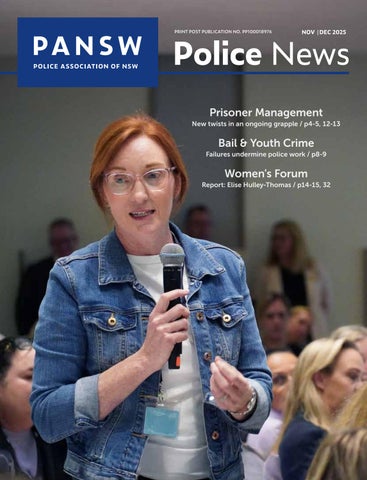
Women's Forum Report: Elise Hulley-Thomas / p14-15, 32
Vol 107 / No.6 September - October 2025
■ Executive Member Steve Kendall p2
■ President's Message p3
■ Prison Disciplinary Matters not Police Work p5
■ Probationary Constable cleared of charges p6
■ Detectives challenge Parliamentary Inquiry p7
■ Bail & the Youth Crime Crisis p8
■ Ongoing issue of prisoner management p10
■ Stop Work Action by Correctives p12
■ 2025 Women's Forum p14
■ CoP's first visit to PANSW p16
■ Bush-to-Post continues making a difference p19
■ Program supports students transferring West p20
■ Money Matters p23
■ PANSW Member Benefits / Study p25
■ Christmas Messages p26
■ Police Officer of the Year Awards p28
■ History on two wheels p30
■ Celebrating Highway Patrol p31
■ In Conversation: Elise Hulley-Thomas p32
■ Crossword p33
Disclaimer: Police Association of New South Wales (“Publisher”) advises that the contents of this publication are the sole discretion of the Police Association of New South Wales and the publication is offered for information purposes only. The publication has been formulated in good faith and the Publisher believes its contents to be accurate, however, the contents do not amount to a recommendation (either expressly or by implication) and should not be relied upon in lieu of specific professional advice. The Publisher disclaims all responsibility for any loss or damage which may be incurred by any reader relying upon the information contained in the publication whether that loss or damage is caused by any fault or negligence on the part of the publisher, its directors and employees. Copyright: All advertisements appearing in this publication are subject to copyright and may not be reproduced except with the consent of the owner of the copyright. Advertising: Advertisements in this journal are solicited from organisations and businesses on the understanding that no special considerations other than those normally accepted in respect of commercial dealings, will be given to any advertiser.
Executive Officers
Executive Member / Northern Region Area 2
Steve Kendall
■ Steve attested from the Academy in 1988. He began his career at Granville before moving to Parramatta and serving a stint at the North West Transit Police in anti-theft and plainclothes roles. He returned to General Duties at Rosehill before being promoted to Sergeant. Then he moved to the MidNorth Coast, attached to the Manning Great Lakes, initially stationed in Taree before relocating to Forster, where he is currently based.
His involvement with the PANSW began at Rosehill when he was elected as the Chair. He held this position for 12 years before his move to Manning Great Lakes, where he became the Branch Administrator.
“We covered a large area where a lot of crime occurred, and I decided that enough was enough and that we needed to start looking after each other.”
PANSW Secretary Pat Gooley was then the Organiser for the South West. Steve recalls attending meetings with Pat and raising many of the issues with the Region Commander that remain at the
forefront of today’s advocacy, particularly the call for additional staff.
The commitment to welfare that pushed him to become involved has persisted throughout his career. He believes the mental health clinicians delivered through the PULSE program are making a difference in Commands.
“Recognizing when someone is not ok, it is great to be able to connect them to those resources. The clinicians can give suggestions on local matters (relating to welfare), and they work with the Branch and the Commander to find ways to improve morale.”
Staffing, prisoner transport and the bail hub are major issues impacting Steve’s members in the Northern Region.
“The centralized bail courts have increased the workload on Custody Managers and Supervisors, along with General Duties. It is impacting entire stations because resources from other areas are being pulled in to assist. Because we’re not able to meet the unreasonable cut-off times, bail-refused prisoners are being held in custody
overnight at times.”
He has been a Conference delegate for the past twenty years and is looking to the next generation to step up.
He believes attending Conference is beneficial for new Branch Officials, who can take knowledge from the focus groups back to support their members through the Branch.
“Greater representation across the regions means the PANSW gets a better understanding of the issues being faced in metropolitan and regional areas. It shapes the outcomes we set out to achieve.”
PANSW President Kevin Morton
Carry-over fights and sad departure
■ While this time of year means a much-needed respite for many, for our members, it's about getting on with the job.
At this time, it’s important to take a moment to reflect on the year that was. Your work is so often thankless, yet it is tirelessly achieved with dedication and enthusiasm. I was fortunate enough to attend the Police Officer of the Year Awards, where exceptional stories were shared about your colleagues who have gone above and beyond in both their professionalism and their commitment to uplifting their colleagues. These individuals reflect the greatest qualities of the entire workforce: your unbridled passion and commitment to policing.
without consultation from the primary stakeholders who were impacted, pushed us to a new breaking point.
You continue to put your shoulder to the wheel despite an unrelenting number of jobs piling up on CAD. While securing your pay rise and entitlements was our focus in 2024, much of this year has been spent on efforts to retain our long-serving officers by reducing the workload-related strain placed on you as the 24/7 problem solvers.
How do we achieve this? By pushing work back to other agencies where it belongs.
Not Police work
Prisoner management has been an issue in metropolitan and regional areas for as long as I have been a serving police officer. With prisoners being held in overcrowded cells for entire weekends after being turned away from correctional facilities built to hold them, with no beds available, the risk to our members and the prisoners in their custody was unacceptable. Something had to give.
The announcement by the Attorney General that centralized bail courts, intended to streamline bail matters via AVL previously handled by registrars, would roll out in regional areas
The movement can be slow at times, which is often the case when the Government is involved, but we have made greater strides in this area than we have in the last twenty years. The NSWPF has agreed that court bail refused prisoner management is not police work. Corrective Services has also acknowledged that prisoner transport and management are part of their core business. The Department of Communities and Justice, responsible for the oversight of CSNSW, has also been involved. The Chief Magistrate has heard our frustration with the centralized bail courts and has committed additional staff to assist with processing paperwork that is keeping prisoners in your custody and delaying moving them through the judicial process.
Now that an agreement has been reached between all involved parties to transition police out of the prisoner management space, we will continue to hold all involved agencies accountable. Although adversarial from the outside, this is about enhancing productive working relationships between Corrective Officers and our personnel on the ground. You will read in these pages that we have also collaborated with PSA
to ensure that managing inmate prison disputes is not added to your extensive list of duties.
You, the members, are our eyes and ears in this space and it is vitally important that we hear from you about ongoing issues with Corrective Service.
It is also important that you let your employer know via the chain of command escalation process by sending the details to NSWPF custodycorrections@police. nsw.gov.au and the PANSW at feedback@pansw.org.au
Vale Ian Leavers
We were saddened to learn of the passing of former Queensland Police Union President Ian Leavers APM. He fought for the interests of police officers at a state and national level as the long-serving President and CEO of the Queensland Police Union along with being elected as the President of the Police Federation of Australia in 2021. Ian will be remembered for his advocacy and fierce protection of the interests of his members. His voice and presence during the Wieambilla tragedy reflected the heartbreak felt by all police officers across the nation at the loss of our own. His legacy in industrial relations will endure, and our thoughts are with his friends, family, and former colleagues at this difficult time.
Final thoughts
Look after each other during the holiday season, especially those colleagues of yours who might be spending the festive period without family or friends for the first time. I hope that you have the chance between shifts to spend time with family, friends and those closest to you. Thank you for your service to the communities of New South Wales throughout this year.
NSW COMMISSIONER OF POLICE MAL LANYON and PANSW PRESIDENT KEVIN MORTON
Elyssa King PANSW Media & Communications Officer
Prison Disciplinary Matters are not Police Work
PSA and PANSW advocacy shifts legislation
■ In October, joint advocacy from the Police Association of NSW (PANSW) and the Public Service Association of NSW (PSA) led to the NSW Government introducing legislation that would prevent thousands of inmate disciplinary matters from being dealt with by police.
Following the receipt of numerous inmate-related complaints of unfairness, the NSW Ombudsman released a report in August 2024 after investigating inmate discipline across all correctional facilities.
The inmate disciplinary system deals with inmates who are alleged to have committed a correctional centre offence while in custody. The investigation conducted a trend analysis of more than 57,000 inmate discipline charges from 2018 to 2023, performing an in-depth review of a sample of over 350 individual determinations.
How disciplinary determinations are made
Since 2018, prison staff have investigated and adjudicated upon disciplinary offences committed by inmates. The offences, ranging from inmate-on-inmate violence to contraband offences, would be dealt with internally under the “balance of probabilities”, which is the civil standard of proof.
More serious matters would be managed under the criminal standard of proof, which is “beyond a reasonable doubt,” and would be reported to the NSW Police Force for criminal charges to be laid.
The Ombudsman’s findings
In the opinion of the Ombudsman, correctional centres across NSW had failed to comply with the requirements of the legislation and relevant policies regarding inmate discipline. The report stated that “contrary to law, findings of guilt are being made in some cases despite not being proven beyond reasonable doubt” as required by the Crimes (Administration of Sentences) Act 1999.
The Ombudsman found in some instances that inmates were being convicted of offences in circumstances “where it was clearly not open to the decision-maker to have found the offence proven beyond a reasonable doubt, as required by legislation”. It was found that this was leading to unjust outcomes and potentially unlawful decisions.
The report also called for CSNSW to amend its policies and practices so that decisions about an inmate’s ongoing management (including parole decisions) should only take into account
a disciplinary determination made since 2018 if a review of that determination was made, which concludes that the relevant finding may be safely relied upon.
From civil to criminal
CSNSW accepted the findings in principle and began the process of implementing the number of recommendations requested. At the lower end of the scale, this meant issuing fines for offenses such as breaking prison equipment or dealing in contraband, such as possession of a mobile phone.
The changes also had more serious consequences. A guilty finding in a disciplinary matter impacts the prisoner’s classification, which in turn affects their placement and treatment within the prison. A higher or lower classification can impact their ability to access privileges and the level of security they require, leading to dangerous prisoners who should be in maximum security prisons being transferred to minimum security. It can also influence parole decisions, which ultimately affects the duration of custody.
A review of thousands of disciplinary matters since 2018 was unfeasible; discarding disciplinary matters could result in changes to a prisoner’s classification from maximum to minimum security, endangering both prison staff and other inmates. In some instances, it could ultimately result in the release of prisoners into the community who would otherwise remain incarcerated.
Changing the standard from a civil to a criminal standard of proof meant that the
PANSW PRESIDENT, KEVIN MORTON
“The need for these changes is baffling when the current disciplinary system that has been set up in consultation with Corrective Services is already effective.”
internal disciplinary system previously established would no longer operate effectively. Unlike police, Corrective Officers would not be able to rely on witness testimonies (which are unlikely to come from other prisoners due to the potential for retribution within the prison system) and a range of resources required to prove a finding to the criminal standard.
Prison work for police
As a result of the change in classification, thousands of disciplinary matters previously handled within prisons would now have to be directed to the police.
Reducing our members’ workload by redirecting the work back to the other agencies they belong to has been at the forefront of the PANSW’s recent advocacy. In 2025, the PANSW has already made significant progress in addressing long-standing issues related to prisoner management and transportation.
The challenges that police officers face in taking on jobs that should sit with other agencies are well-documented. As the 24/7 problem solvers, police officers are required to attend to non-critical jobs, diverting them from responding to emergency call-outs.
Requiring police officers to attend prisons and conduct investigations every time a disciplinary matter arises would have a catastrophic impact on response times. In regional areas, this could mean police traveling hundreds of kilometers to the correctional facilities, leaving their station understaffed to complete the
work of Corrective Services.
Unions’ joint advocacy
With the increased risk to their staff too great, the PSA prepared to take industrial action and prepared communications instructing members to refer all inmate disciplinary matters from the state’s 31 prisons to the police.
PANSW President Kevin Morton and PSA Secretary Stuart Little wrote to NSW Premier Chris Minns about the operational and administrative nightmare that this would cause for both agencies.
President Morton called for legislation to be changed as soon as possible.
“The proposed changes to the investigation of incidents of prisoner behaviors will mean more work for our police officers and put an immediate strain on our frontline.” President Morton said.
“Police strength will immediately need to be increased in areas where prisons are located, particularly in regional areas like Kempsey and Grafton, to deal with 25,000 extra incidents a year.”
“The need for these changes is baffling when the current disciplinary system that has been set up in consultation with Corrective Services is already effective.”
The Government responds
As a result of the joint advocacy, the Minns Labor Government has introduced legislation to improve accountability in inmate misconduct proceedings. The Government introduced a Bill to amend the Crimes (Administration of Sentences) Act to change the burden of proof for correctional centre offences to “satisfied on the balance of probabilities”, rather than “beyond reasonable doubt.”
These changes will bring NSW in line with most other states and territories across Australia, where the “balance of probabilities” is the standard of proof applied for misconduct hearings. Criminal conduct behind bars will continue to be dealt with by the NSW Police Force in accordance with the criminal standard of proof.
In a media release, the NSW Government acknowledged concerns about the impact of current legislative requirements on officer safety, stating that enshrining the “balance of probabilities” as the burden of proof will make the discipline process less complex and ensure inmates are held to account.
The new legislation will continue to protect community safety, with Community Corrections reports to the State Parole Authority reflecting these disciplinary decisions in custody.
PSA SECRETARY, STUART LITTLE
■ In a resounding victory for common sense that starkly reveals the realities of frontline policing, a Probationary Constable from the Central Metropolitan Region has been cleared of all charges relating to the operational use of OC spray during an arrest in 2022.
Jon Goddard PANSW Lead Organiser
Let Cops Be Cops
Common sense prevails in Court matter involving young officer.
On 13 November 2022, like hundreds of others around the state, the young Constable commenced their shift looking after the nation’s biggest CBD. During the shift, when assisting with a street-level robbery investigation, the officer deployed their OC spray on an offender following a foot pursuit. The offender, who had escaped custody, was covered in her own excrement and spat in the face of the member’s partner. Almost any member will tell you they would rather be punched or kicked than spat on.
In response to this, our member acted. Despite the common opinion from experienced street cops that he was acting in accordance with his training, the young officer later found themself the subject of an internal investigation. The internal investigation process is an undertaking to ensure that our members have followed procedural guidelines and acted fairly and reasonably. But the process places a significant psychological strain on the involved officer, left to relive the experience and question their response in scenarios that often require split-second decision-making.
In 2024, following advice from the Director of Public Prosecutions, charges were laid against the officer — including common assault and possession or use of a prohibited weapon without a permit. In these moments, when findings are handed down and a decision goes against the involved officer, the impor-
tance of your membership is fully felt. At a time in their career when the involved officer feels completely alone, a call from one of our Organisers to check in on their welfare or advice from our Legal Services team during the following hours can make all the difference.
In late September 2025, the matter was finally brought before the court. Supported through the process by PANSW Organiser Rod Sheraton and represented through the Police Association’s Legal Assistance Scheme by Solicitor Warwick Anderson and Barrister Tim Lowe, the officer’s case was dismissed. The court ruled there was no prima facie case, awarded costs to the defence, and endorsed the officer’s use of force as reasonable and lawful.
The legal team representing our members' interests in this matter, Mr. Anderson and Mr. Lowe, are both former serving police officers. They hold a wealth of knowledge in operational policing practice and policy, which served our member in this case.
This decision underscores the pressing need for NSW Police leadership and the DPP to back officers who act within their training and authority. Too often, operational decisions made under pressure are second-guessed through a lens of political caution rather than operational reality. Wearing a blue shirt should not
imply that “let the court decide” is the starting point for deciding whether to charge a police officer criminally. The stigma, stress, and loss of career progression resulting from this extensive process, along with the toll that the investigative and legal process takes on our members, can never be made up for with a ‘not guilty’ verdict. We have all seen media gathering by the dozen outside on the first day of a police officer’s court matter. The member will be a story on TV by 6.05pm and on Page 3 in print the next day. Four or five days later following a not guilty finding, there is no media coverage and no follow up story outlining the acquittal.
To his credit, the young officer involved in this matter will continue his career in the NSW Police Force after being supported by his Commanders and placed on restricted duties for many years. Many of our members are not as fortunate and struggle to recover from the loss of purpose.
In looking to the leadership of the NSWPF, Your Association is calling for stronger institutional support and practical decision-making in Use of Force reviews as we move forward. Allowing external pressures to dictate outcomes that impact our members erodes our police officers’ confidence in performing their duties and undermines public safety in the process. Our police officers on the ground are trained professionals who deserve the trust of their leaders, who have undergone the same training to do the job that the community expects them to.
It’s time for the NSWPF’s leadership to show faith in its frontline — and let cops be cops.
FIRST VISIT TO PANSW EXECUTIVE, COMMISSIONER LANYON WAS PRESSED TO BETTER SUPPORT TO ACCUSED POLICE OFFICERS
Elyssa King PANSW Media & Communications Officer
Leave the Investigations to the Professionals
Detectives challenge Parliamentary Inquiry into unsolved homicides
■ Sixty-five detectives attended an urgent meeting of the State Crime Command PANSW Branch on Tuesday 21 October. A motion was passed expressing the members’ extreme disappointment in the NSW Government for establishing an inquiry into unsolved murders and missing persons cases from 1965 to 2010 and called on the Government to consider the overstretched workload of the investigative response and the morale of members undertaking this work.
The motion follows a Parliamentary vote in favour of Legalise Cannabis MP Jeremy Buckingham’s motion to launch an inquiry. The inquiry has asked to interrogate whether there existed impediments in the criminal justice system that impacted the delivery of justice to victims and their families, with reference to matters including the murders of Christine Sharrock, Marianne Schmidt, Cheryl Grimmer, Kay Docherty, Toni Cavanagh, Michelle Pope, Stephen Lapthorne, Leanne Goodall, Amanda Robinson, Robyn Hickie, Joy Hodgins, Anni Tominac, Gillian Jamieson, Deborah Balken, Peter Letcher, Carmen Verheyden, Dianne Pennachio and Gordana Kotevski.
The workload issues facing detectives have been well-documented. Staffing issues have meant that, in recent times, experienced detectives have even been required to jump on the truck to assist General Duties officers in meeting first-response requirements. Members
voiced their concerns about adding to a case load that is already piling up with solvable inquiries. To fulfill the inquiry’s needs, the detectives would be taken off current inquiries and put on hold, so that cases that have already been extensively reviewed could be reopened.
On Wednesday, 15 October, The Hon. Rod Roberts MLC spoke out against the proposed motion. The motion instructed the Committee to review evidence, identify clusters and patterns, establish links in offences and scrutinize the status of all existing investigations in and around the Southern Highlands, Inner Sydney, Newcastle and the North Coast.
With twenty years of experience as a Detective Sergeant under his belt, the MP suggested that these investigations were best left to seasoned law enforcement professionals. He highlighted that “the NSWPF never lets a cold case die”, pointing to the recent arrest of the Moore Park rapist for offences committed more than thirty years ago.
“Police deal with facts and evidence. Why does the Government believe that 41 untrained, unskilled muppets of this House could achieve a better outcome than members of the unsolved homicide
and missing persons unit?”
“By agreeing to this motion, you are making it publicly known that to the people of this state and members of the NSW Police Force that you have lost all confidence in their investigative abilities.”
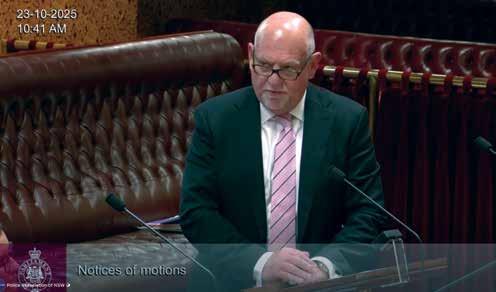
On Thursday 23 October, The Hon. Rod Roberts delivered a motion to Parliament showing his ongoing support for the members of State Crime Command.
“This House notes the concerns raised by these professional and highly experienced detectives and this House notes with gratitude the hard work and dedication of the men and women of State Crime Command as they strive to solve serious crime.”
In an interview with ABC Sydney on Monday 28 October, PANSW President Kevin Morton said that this inquiry has been dreamed up by politicians roleplaying as highly skilled investigators. “This issue is widely and deeply felt by our members. The detectives are extremely disappointed; they are hard-working investigators who are displaying the utmost professionalism and work tirelessly to achieve the best outcomes that they can for the people of NSW.”
“The Homicide Squad has a motto that no cold case ever remains closed, and these cases are reviewed and investigated. We do not have the funds to support this inquiry, and there will need to be a redistribution of resources with detectives pulled in from working on other cases.”
THE HON ROD ROBERTS MLC'S ADDRESS TO PARLIMENT, FORESHADOWED THE SCC'S OWN BRANCH MOTION
Elyssa King PANSW Media & Communications Officer
Bail & the Youth Crime Crisis
Judicial system failures undermine police work
■ The PANSW continues to strongly advocate for targeted reform to address increases in youth crime rates in regional areas. In February 2025, following calls from advocates, including the PANSW and the media, the Minns Labor Government moved to extend the strict bail test that applies to young people accused of stealing cars and breaking into homes amid ongoing concerns about youth crime. An additional test under section 22C of the Bail Act 2013 was introduced by the NSW Government in 2024 in response to growing community concerns about youth crime, particularly in regional areas.
The additional test, applying to young people between 14-18 who are charged with certain car theft or serious break and enter offences while on bail for another offence of that type, said that bail must not be granted unless the bail authority “has a high degree of confidence the young person will not commit a serious indictable offence while on bail” subject to any proposed bail conditions. The section was originally intended to sunset after 12 months. Legislation introduced in February 2025 would see it extended for three years until April 2028.
The circuit breaker
In a media release, the NSW Government stated that early data indicated the strict test was effective, with the bail refusal rate under 22C more than double that of the general bail refusal rate for young people charged with similar offences.
At the time, Attorney General Michael Daley said: “We initially intended this bail law to be a 12-month circuit breaker. One year later, we can see that it is helping and it is still needed. This is not a step we take lightly. I acknowledge that many regional communities feel fear, concern, and frustration about youth crime. We are working on additional measures to address this issue.
As part of its funding package announced in 2024, the Minns Labor Government created a $26.2 million community safety package that included additional funding for a targeted response in the town of Moree and its surrounds. In February, the Government also announced over $6 million to support community safety across Bourke, Moree and Kempsey.
PANSW President Kevin Morton said that legislative reform, coupled with additional support initiatives focused on early intervention and prevention, was a strong response from the Labor Government.
“Police officers are excellent at identifying and capturing offenders, carrying a heavy workload and doing more with less.”
“These additional tools in tightening bail conditions and harsher penalties for sharing criminal acts on social media will provide our police with another tool to reduce the rate of repeat offenders and help support our cops in keeping their communities safe.”
“These diversionary initiatives, including those already run by the NSWPF such as PCYC facilities and youth education programs, will provide additional infrastructure and support services to help young people become better engaged in the community.”
“This encompassing response from all agencies will hopefully lighten the load on our police officers, who are expected to be the 24/7 problem solvers in the city and the bush."
A targeted response
In March 2025, Operation Soteria was launched as a high-level youth strategy to tackle juvenile crime across New South Wales. This strategic initiative focused on aggravated break, enter, and steal offences, stealing motor vehicles, and ‘post and boast’ offences, where social media is used to gain notoriety.
The Operation coordinated the
response to this form of offending, taking overall command and control of criminal investigations into crimes of this nature across Northern and Western NSW police regions. Surge operations were also run in conjunction with officers from the Youth Command as part of a coordinated program of engagement with at-risk youth by facilitating participation in programs and activities aimed at deterring and redirecting youth from criminal activity.
On Wednesday, 15 October, as part of the Operation, three teenagers were arrested in relation to several offences and taken to Kempsey Police Station on the Mid-North Coast. A 15-year-old was charged with 15 offences, including aggravated break and enter, breach of bail, attempted robbery armed with an offensive weapon, and participating in a group criminal activity. Another 16-yearold was charged with 16 offences, including inciting a police pursuit, aggravated break and enter, knowingly/ recklessly direct criminal group assist crime and use etc offensive weapon to prevent lawful detention.
At 12.20pm on the same day, police attended a home in West Kempsey to execute a search warrant. During the search warrant, they allegedly located a 16-year-old boy hiding in a roof cavity. The boy allegedly attempted to strike police with a roof tile before he was arrested and charged with three counts of assaulting a police officer in the execution of duty without actual bodily harm. During the arrest of the boy, a 28-year-old man also intervened and assaulted the police officers before being arrested. All three teens were refused bail to appear before a children’s court on Thursday, 16 October 2025.
The system failing again
These incidents are reflected in regional towns across New South Wales.
On Saturday 18 October, Member for Oxley Michael Kemp took to social media
The victims and the police officers risking their lives to protect them, deserve better from the revolving door of the justice system
to air his frustration with the judicial process in relation to recidivist offenders. The offenders from the break and enter and armed robbery were granted bail, despite two of them being on bail for multiple similar violent offences. The same offenders were suspected of having been guilty of an incident in August where they allegedly drove a car at police officers. The victims and the police officers risking their lives to protect them deserve better from the revolving door of the justice system.
“I’ve spoken to senior police who told me trying to keep morale up after the worst case of bail they’ve seen is a challenge. Our officers are doing everything they can, putting themselves in harm’s way, only to see the system fail them.” He said.
In a story in the Daily Telegraph on Sunday 19 October that highlighted the challenges occurring in regional areas, PANSW President Kevin Morton said that the morale of police officers were being impacted after going to great lengths to bring recidivist offenders before the courts only to see them walk out the door and back onto the streets to terrorize their communities without further consequences.
“We are banging our heads against a brick wall and morale is taking an impact.” He said.
The PANSW President called on the Attorney General to ensure magistrates “meet public expectations” or “let someone else do the job”.
Elyssa King PANSW Media & Communications Officer
Ongoing issue of prisoner management
Good progress will require ongoing vigilance
■ On 28 October 2025, Commissioner of Police Mal Lanyon APM attended the PANSW for his first meeting as the Commissioner. He was greeted by the full cohort of Executive Members, PANSW management, and staff. One of the key questions posed to the CoP that day concerned the ongoing issue of prisoner management.
The ownership and transportation of prisoners have been a long-standing issue that continues to impact the workload of police. In metropolitan areas, police hold prisoners in cells that are not fit for purpose for extended periods. In regional areas, police transport prisoners hundreds of kilometres to and from correctional facilities, along with guarding them to and from court in not fit for purpose vehicles.
In June, the announcement that the centralized bail division would roll out across NSW without proper consultation promised to further overload our members.
As a result, the PANSW Executive passed a motion to cease performing functions from Monday 7 July including:
• Attending Correctional Facilities to collect and transport court-bail-refused prisoners
• Attending court houses to guard Court Bail Refused Prisoners
• Accepting Court Bail Refused Prisoners into police custody facilities from Corrective Services or Juvenile Justice.
The proposed action was stayed following urgent meetings between the PANSW, NSWPF and DCJ which oversees CSNSW. An agreement was reached whereby police in the longer term would be removed from the space of transporting and guarding prisoners once and for all, with short-term actions being implemented until that time which include police performing these functions on overtime.
Custody and the Ghost Truck
Following the suspension of the action, PANSW representatives continued to meet with NSWPF to ensure that localized issues were escalated and resolved. Members were encouraged to continue raising issues related to prisoner management and the bail division through their Commands and to directly to the PANSW.
Members in regional areas continued to undertake functions that should be performed by Corrective Services on an overtime basis as a short-term solution. It quickly became apparent that the terms of the agreement were not being complied with.
The additional CSNSW transport vehicle, managed by CESU, that was set to collect prisoners and free up beds in metropolitan areas had not been operating. Members reported no impact on bed availability at Amber Laurel and SPC, with police regularly being turned away in the evenings and on weekends. On the weekend of 25-26 October, police officers in Mt Druitt, Blacktown and Nepean PACs reportedly were forced to hold police-bail-refused offenders all weekend and close their cells after being
turned away from Amber Laurel. The offenders were still being held in cells on Monday morning, but were later granted bail by the court. Other horror stories involved prisoners sharing cells due to overcrowding or sleeping on the floor. The risk of members managing prisoner custody and the offender being held was unacceptable.
In various locations, Corrective Services staff asserted that they were not instructed to continue to accept police bail-refused inmates as per the agreement. While the PANSW worked with Commands and CSNSW to create resolutions in some locations, tensions between police officers and correctives officers on the ground heightened.
Centralised bail court
The introduction of the centralized bail courts (Bail Division) continued to cause headaches. It was reported that in metropolitan areas, courts would only allow hearing from within the bail division via AVL from Amber Laurel and SPC, not from police stations, unless the prisoner was regarded as vulnerable.
Issues with the centralised bail division’s cut-off times for paperwork submission and delays continue to pile up. In regional areas, problems continue to compound. Through CSNSW staff, the PANSW was informally advised that the bail division was set to become one division operating seven days a week in regional NSW from 22 November.
Concerningly, the bail division was also set to roll out in metropolitan areas “in the near future”. These changes would significantly impact members’ work practices, with a lack of clarity around processes for transporting inmates to the MRRC, the future roles of Amber Laurel and SPC, paperwork delays, and the use of AVL in police stations.
Bail division
From 22 November, the bail division will operate seven days a week for
Don’t wait with a prisoner in your custody for hours - immediately escalate
regional Commands (and inner metro) and pleasingly the 12pm cut-off will now apply seven days a week (no longer 10am on weekends). The PANSW still remains firm that these cutoff times require further review.
Form 1’s will no longer be needed for NSWPF as the new Custody Information Sheet (CIS) is included in charge paper bundles and further enhancements have been made in relation to the provision of charge papers to the court with a “send bail division” function enabled on the system.
Action reissued
The PANSW had been excluded from consultation, discussions, working groups or other arrangements concerning the implementation or progression of these matters. The decision to stay the previous action was predicated on the understanding that PANSW would reserve its right to recommence the action should this exclusion from consultation occur again. During the October Executive meeting, the PANSW President wrote to the Commissioner outlining the continued impact on members and his concerns. He put the Commissioner on notice that the PANSW’s Executive had redirected members to take actions to ensure their own welfare and that of the prisoners in their custody on 17 November 2025, if the previously agreed commitments around prisoner transport management were not met.
Commitments made
In early November, the PANSW entered into heavy negotiations with the NSWPF and the NSW Government, including a one-on-one meeting with the Chief Magistrate himself, to ensure they were fully briefed on the impact that custody and bail have on policing. We were firm with our position on your behalf and will work in the interim on solutions whilst the 18-month plan for CSNSW to take
over the full responsibility of prisoner management is advanced through the Government.
Through PANSW advocacy, the Chief Magistrate committed to a 25% increase in clerical staff in the bail division, which the CMO has benchmarked a turnaround time of 2 hours and under for paperwork to be returned after a bail determination. We will continue to press for improved
timeframes to enable faster release of prisoners from our custody.
Following negotiations with NSWPF and Government, the Commissioner has confirmed with the PANSW the following:
• NSWPF police officers will continue to receive overtime payment for the movement and holding of court bail refused inmates in regional areas.
• From 5 November 2025, CSNSW resumed the CESU transport (ghost truck) in metropolitan areas and that will continue. This is designed to clear out inmates from CESU locations to free up beds for fresh PBR prisoners.
• All current local metropolitan prisoner management/ transport arrangements regarding police bail refused prisoners will remain in place, and CSNSW has committed to ensuring that the
appropriate personnel will be available to take and receive NSWPF transports when presented.
• A CSNSW communication was distributed to all CSNSW facilities reaffirming the commitment to the effective and efficient management of bail-refused inmates across the state, including working collaboratively with NSWPF.
The PANSW insisted on the creation of a Governance Committee to ensure compliance with the above commitments, which was supported by the Commissioner, which will bring together all stakeholders.
Your voice matters
Don’t wait with a prisoner in your custody for hours; immediately escalate this through the NSWPF Custody and Corrections Corporate Sponsors for each region ASAP to get a resolution on the day.
We must continue to be your voice at these meetings between the agencies. The feedback we have received from members regarding the situation with custody allows us to truthfully and accurately present the picture to the Government and the agencies involved. We will not sugar coat it and we will not give up finding a sensible solution that reduces these responsibilities on police officers.
The issues of custody and prisoner management are impacting the whole state and PANSW will continue to keep members up to date with developments. Please continue to provide examples to NSWPF using the Time Delay Form under custody and corrections or custodycorrections@police.nsw.gov.au and also the PANSW at feedback@pansw. org.au
Elyssa King PANSW Media & Communications Officer
Correctives Stop Work Action
Police step in as prison officers stand down in solidarity
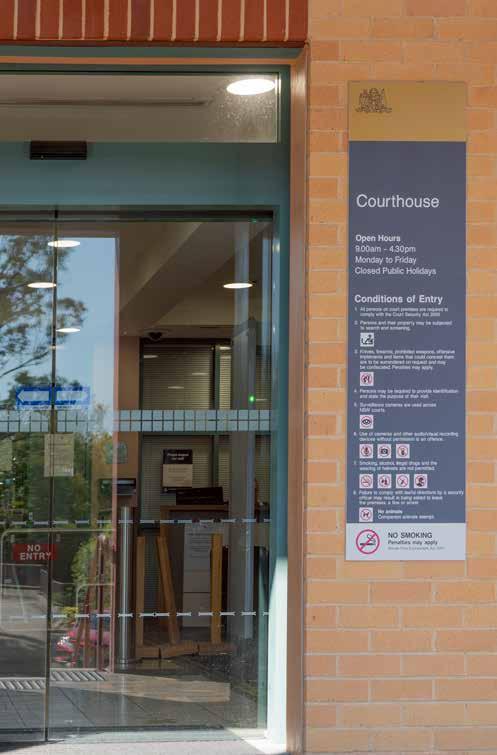
■ On 25 February 2025, four Correctional Officers were viciously assaulted by an inmate, who was already left with serious facial injuries after an assault in the yard at Cessnock Correctional Centre. The injuries were career-ending for two of the prison officers, who will never work again.
The inmate was charged with assaulting the prison officers and inflicting actual bodily harm. The matter was heard before the Cessnock Local Court on Wednesday 29 October. The inmate who had a history of violent attacks received a three-year intensive corrections order, despite already having a previous intensive corrections order revoked, with no additional jail time added.
Following the sentencing, Cessnock Correctional Centre staff met and withdrew labour in protest of the outcome and to show support to the four officers involved. A motion was sent to the Prison Officer Vocational Sub-branches. The motion stated that ‘the current judicial responses fail to adequately deter inmate violence, leaving officers exposed to unacceptable risks’. The prison officers across the state then withdrew labour in a show of solidarity and support.
“How is it that an assault that ends up with injuries like this results in a slap on the wrist and a community treatment order? To have something like this happen is an insult to every prison officer that puts on a uniform.” Public Service Association (PSA) General Secretary Stuart Little said at a press conference.
Police show support
On Thursday 30 October, PANSW President Kevin Morton was notified by the PSA’s General Secretary of its Prison Officers' Vocational Branch’s intention to stop work for a 48-hour period.
“As police, we are well aware of the effect that the lack of support from the judiciary has on a workforce. My members have been let down on numerous occasions, the public generally has been let down, and now it appears that prison officers have been
brought into the equation on several occasions in the last few months, leading to this action”. He said.
“All police officers agree that attacks on any law enforcement or public official performing a role to protect the community should be dealt with in the harshest terms by the judiciary, not the opposite, as seen in this and many police cases.”
“This stop work will affect police officers; Corrective Services will cease accepting Police Bail Refused Prisoners, and at this time, it is unknown if they will accept Court Bail Refused Prisoners. Make no mistake, this stoppage has the potential to impact charge room capacity heavily over the period.”
“Risk assessments on prisoner numbers in charge rooms must be undertaken, and additional staff must be recalled to assist existing custody managers.”
The stop-work action had immediate implications for prisoner management. Jails were shut with prison officers walking off the job from 8 am. The local, district and supreme courts were also thrown into disarray, with no prison officers on hand to escort offenders in custody to and from court, to audiovisual links along with guarding and transporting functions.
The PANSW President and senior PANSW representatives worked with the Commissioner of Police and the NSW Government to ensure that any NSW police officers required to assist during this period were not taken from the frontline, and that first-response policing was not affected. It was made clear that officers should be recalled on overtime to assist with prisoner management. A number of members were called in on cancelled rest shifts to assist Custody Managers managing prisoners in custody.
PANSW Secretary Pat Gooley and Assistant Secretary Legal Ben Lee attended the urgent hearing held between the Minns Government and the PSA that was held at the Industrial Relations Commission to ensure that the interests of the PANSW’s members were represented.
The outcome of the hearing was that
prison officers were ordered by the Commission to return to work by 6 am the following day.
Unacceptable treatment
In the media the following day, NSW Premier Chris Minns stated that steps were being taken to enhance protections for correctional staff, noting the agreement reached regarding the change in the burden of proof for correctional centres.
“We need prison officers back on the job. I know it’s an incredibly difficult job … but we need to keep the public safe by keeping prisoners locked up,” The Premier told 2GB’s Ben Fordham, with the radio host making a point of stating that the sentencing was ‘piss weak’.
“Prison officers can’t be treated in this way … the work they do is incredibly brave and dangerous for the state.” The Premier said. “There’s going to be an appeal … we can’t treat brave corrections officers as if they’re punching bags in our prisons,” he said. “We’ve got a history of listening to the workforce … and we’ll continue to make sure they’re safe doing this dangerous job.”
Appeal lodged
At the Minister for Corrections’ direction, the Corrective Services NSW Commissioner submitted an urgent application to the State Parole Authority formally opposing the release of the inmate who senselessly attacked the four Correctional Officers earlier this year. The matter was stood over to a public hearing on Friday, 9 December 2025.
With the Minister’s full support, the Commissioner of CSNSW also wrote to the NSW Police Commissioner and the Office of the Director of Public Prosecutions (ODPP) requesting that an appeal of the inmate’s sentence be lodged with the District Court.
On Thursday, 6 November 2025, the ODPP confirmed it will appeal the sentence. At the time of writing, the sentencing appeal is currently listed on Thursday, 27 November 2025.
As police, we're well aware the effect a lack of support from the judiciary has on a workforce
Meaningful change
The stop work action following the attacks on the prison officers has prompted the NSW Government to undertake an urgent review of the way CSNSW classifies its inmates across the state’s correctional system.
CSNSW is required to review an inmate’s classification and placement at least every 12 months. A review of an inmate’s classification may also occur if the inmate has been involved in a serious incident. Classification of an inmate, or the process whereby inmates are designated a security rating, takes several factors into account including the seriousness of their offence, length of sentence, and their attitude, conduct and program participation while in custody.
The review will assess the effectiveness of CSNSW’s classification, placement and case management processes. It will also ensure an inmate’s record of behaviour in custody carries appropriate weight when decisions are being made about an inmate’s classification. CSNSW will conduct the review in consultation with staff, the PSA and other stakeholders.
This follows the recent introduction of legislation into the NSW Parliament to improve accountability in inmate misconduct proceedings. Following joint advocacy from the PANSW and the PSA, the Crimes (Administration of Sentences) Amendment (Standard of Proof) Bill 2025 is set to change the standard of proof for determining correctional centre offences from the criminal standard of ‘beyond reasonable doubt’ to the civil standard of ‘the balance of probabilities.’ These changes will bring NSW in line with most other Australian states and territories and will enhance safety in our correctional facilities and better protect officers.
Elise Hulley-Thomas PANSW Executive Member – South West Metro 2
Affirmative Action in Action
The 2025 Forum's increased size reflects an eagerness to bring value to NSWPF
■ Affirmative action refers to purposeful decisions designed to improve opportunities for groups historically underrepresented or disadvantaged. In the context of policing, that work is not abstract. It is visible in our stations, our Commands, our specialist units, and in the cultural shifts underway across the New South Wales Police Force (NSWPF) and the Police Association of NSW (PANSW).
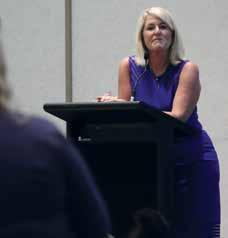
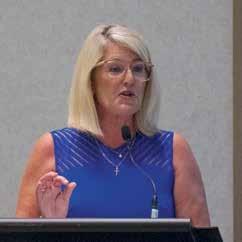
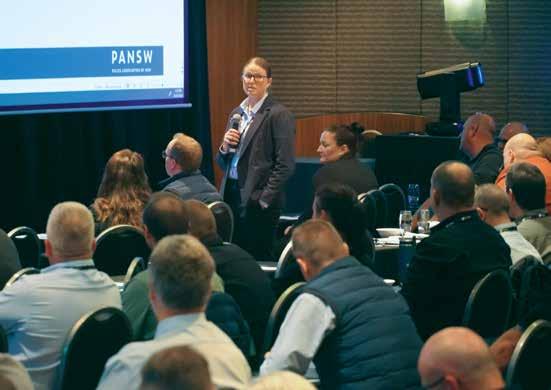
The 2025 Biennial PANSW Women’s Forum demonstrated exactly what affirmative action looks like when it is focused, collaborative, and aligned toward real operational improvement. Women currently represent 28% of the NSWPF and 21% of the PANSW Executive Committee. While there is still work to do, those figures represent significant gains compared to previous decades. Today’s progress can be traced back to deliberate action including the creation of the PANSW Women & Diversity Committee and the establishment of the Women’s Forum in 2015, which began with only 41 women in the room. In 2025, 142 women attended. That growth tells its own story: investment works. Engagement works. Building women’s capability, voice and professional presence works.
Opening: A Forum to Speak Up and Step Forward
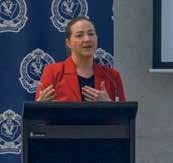
The forum opened with a welcome from Executive Member Alison Dixon, who immediately set the tone - encouraging participation, authentic interaction and confident engagement. This wasn’t a room for spectators. It was a room for leaders.
PANSW President Kevin Morton followed, recognising the value of women’s operational experience, insight, and perspective within both the NSWPF and the Association. He reinforced the strategic priority of increasing female membership and representation, noting that the rise in participation is clear evidence that the strategy is working. His message was simple and strong: what matters is your voice and your contribution. Back each other. Support flexibility. Be honest about
what’s working and what isn’t.
He also highlighted the Association’s advocacy for flexible working arrangements (FWAs) and menopause support - two areas that have been repeatedly raised as workforce capability issues, not “women’s topics.” Flexibility is an operational strength. When flexibility is supported, Commands retain skill and experience instead of losing it to burnout, competing professions or preventable separation.
Commissioner Lanyon: Women Will Be Seen and Heard
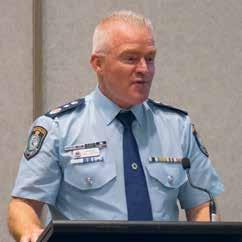
The newly appointed Commissioner of Police Mal Lanyon addressed the forum with a clear intent: I want to listen.
He acknowledged the depth of operational experience in the room and emphasised the importance of working collaboratively with the PANSW Executive to advance workplace culture and opportunity. Commissioner Lanyon credited the Catalyst and iLead programs for strengthening development pathways for women and acknowledged the growth of female-focused leadership initiatives across the organisation.
His commitment was clear: to improve workplace conditions, support flexibility, and drive a culture that genuinely hears and values women. He referenced the current culture review (led by Kristen Hilton) as an opportunity for meaningful change - not a procedural exercise - and stated plainly: “As women in this organisation, I want you to know you will be seen and heard.”
He reinforced the need for honest dialogue, and the audience delivered. Women asked direct, operationally relevant questions on issues including promotions, flexible work arrangements, youth crime, role expectations, and shifting responsibilities back to the appropriate agencies. The confidence in the room reflected the progress made and the expectations now set.
Kristen Hilton (Independent Culture Review into the NSWPF) followed up on the Commissioner's remarks, providing preliminary statistics that referenced the
overwhelming participation of over 5,000 police officers. Some key themes have been identified, and Kristen, along with her team, aims to provide a complete review with recommendations by early next year.
Minister Catley: Because She Did, I Can
Minister for Police and Counter Terrorism Yasmin Catley MP addressed the forum next, setting a strong and supportive tone. She spoke of the broader mental-health-led strategy across government and emphasised the leadership strength women bring — emotional intelligence, resilience, and quiet determination. She encouraged women to support themselves, step up, and continue supporting one another.
Her message captured the spirit of the forum: “Because she did, I can.”
The NSW Government, she promised, will continue to provide the tools and support required for women in policing to thrive and lead.
Menopause and Diversity
Industrial Officers Aileen Fleming and Karen Young delivered a highly engaging and humorous session on menopause. With honest discussion and collective laughter, the room worked through symptoms, impacts and workplace considerations. Menopause is a workforce issue. Addressing it openly ensures women remain supported, capable and retained. Superintendent Darrin Batchelor then addressed the forum in his role overseeing the Sexual, Gender Diverse and Intersex portfolio. He outlined the history and modernisation of the GLLO program, now transitioning toward a broader contemporary model to better support diverse communities. He also covered the Commission of Inquiry into LGBTIQ+ hate crimes, its 19 recommendations, and the work of Taskforce Atlas.
Day Two: Equity, Leadership and Industrial Strength
The second day opened with Lead Organiser Jon Goddard, who outlined
PANSW welfare support services, reinforcing the benefits of union representation and collective care. Jon provided plenty of comic relief, which was appreciated after describing some examples of where the PANSW provided support to families in their times of need and grief.
Former RAAF Wing Commander
Samantha Freebairn delivered a standout keynote on the distinction between equality and equity, as well as the psychological impacts of subtle bias. Her message was powerful: If someone can’t speak for themselves, you must stand up for them. She showcased the success of Project WINTER, which transformed pathways, standards and support for women in non-traditional roles. Her professional experience, humour and authenticity made her a highlight.
PANSW Assistant Secretary Industrial Kirsty Membreno provided a detailed overview of current industrial disputes, ongoing negotiations, and Award protections. Attendees were given the
opportunity to ask industrial-related questions, with full-time equivalent (FTE) and part-time positions being a prominent topic of discussion. Some took this as an opportunity to advertise support for part-time workers and positions at their respective Commands. Burwood or St George, anyone?
This was followed by Senior Industrial Officer Rebecca Neil presenting clear and compelling data charting the increase in women within the NSWPF and the Association. The strategic goal: achieving genuine representation parity between women in the organisation and those representing members at Conference and within PANSW structures.
Panel: Pathways, Barriers & Breaking Them Down
Executive members Alison Dixon, Christine Woods, Kelly Hallinan and Graham Condon, along with myself,
took the stage for a panel discussion. Each spoke to their pathway into PANSW leadership and the challenges women often face when stepping into union representation roles. It was strongly reiterated that the PANSW has the capability and willingness to support women into leadership roles, and barriers are surmountable with the right backing. The 2025 PANSW Women’s Forum showcased the benefit of affirmative action. Growing female leadership strengthens policing. Supporting flexibility retains capability. Addressing women’s workforce needs isn’t symbolism - it is smart management. And as this forum has demonstrated, the message from leadership, government, and the union is aligned: women in the NSWPF will be seen, will be heard, and will continue to lead together, with purpose.
CoP visits PANSW
Commissioner of Police Mal Lanyon welcomed to PANSW by President Kevin Morton and the Executive, his first visit as CoP. In an hour-long meeting he responded to questions around - prisoner transport, support in police complaints processes, directives for proactivity, the scope of the Buckingham inquiry and policing powers. PANSW looks foward to a good working relationship and wishes CoP success in the role.
Blue Ribbon BALL
21 MARCH 2026
Sydney International Convention Centre, Darling Harbour
Detective Inspector Paul Quigg
Bush-to-Post kicking goals
A highly successful approach continues to enhance prospects for youth
■ In 2020, NSW Police commenced the Bush to Posts program in partnership with the Sydney Roosters Rugby League Football Club (RLFC). This program was initiated to teach kids from Aboriginal and Indigenous communities the benefits of school attendance and making the right decisions in life. The kids face tough challenges, and many of them are dealing with significant issues in their home life, as well as other problems within their communities.
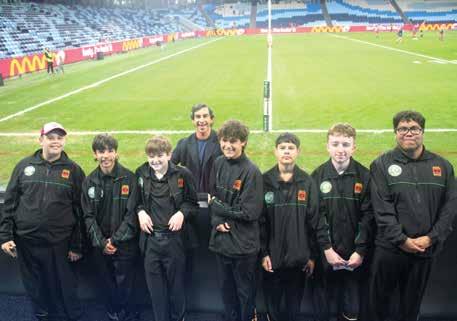
This year, seven Aboriginal students involved in the Clontarf Foundation at Chatham High School in Taree were rewarded after excelling at school in the following areas:
• Training attendance
• Afternoon activity attendance
• School attendance
• Overall academy engagement and most importantly
• The student who attempts tasks set out for them and who continues to grow life skills using the Academy’s values while at school.
The kids were welcomed as guests of the Sydney Roosters RLFC and attended an NRL game between the Roosters and Melbourne Storm at Allianz Stadium in Sydney. As a special surprise, the students formed a guard of honour and clapped the Sydney Roosters team onto the field at Allianz Stadium prior to kickoff. The students also met former NRL stars Johnathan Thurston, Paul Gallen, and former local Taree boy and former Sydney Roosters captain Boyd Cordner before making several presentations to
Sydney Roosters staff who have been instrumental in supporting the program.
The Clontarf Foundation exists to enhance the education, discipline, life skills, self-esteem, and employment prospects of young Aboriginal and Torres Strait Islander men, thereby equipping them to participate more meaningfully in society. It uses a unique, innovative, and highly successful approach to target one of the most at-risk groups in contemporary Australian society – young Aboriginal and Torres Strait Islander men.
Staff involved in the program mentor the students and guide them to finish high school. The benefits of the program have been evident in the fact that the kids have been attending school and completing their schoolwork. Their attitude, manners, and interaction with schoolteachers have improved significantly since the program commenced in schools across outback NSW.
Tapping into the existing passion these boys have for rugby league enables Clontarf to attract Aboriginal and Indigenous boys to school, and then, through sport, keep them engaged. Clontarf is not a sporting program – it’s about developing the values, skills, and abilities that will help the boys transition
into meaningful employment and achieve better life outcomes.
The Clontarf Foundation partners with schools and communities to create ‘Clontarf Academies’, which are embedded within the school grounds and education program. Full-time, locally based Clontarf staff mentor and counsel students on a range of behavioural and lifestyle issues while the school caters to their education needs. Any Aboriginal and Torres Strait Islander male enrolled at the school is eligible to participate in the Clontarf Academy.
The Clontarf Academy activities are planned within the focus areas of education, leadership, employment, wellbeing, life skills and sport. To remain in the program, participants must continue to work at school and adhere to the objectives of the Clontarf Foundation.
The Chatham High School (Clontarf Academy) at Taree currently has 126 students involved in the program. NSW Police attached to Taree Police Station have been supporting the Clontarf Academy at Chatham High School, Taree to ensure the students achieve their goals.
Thanks to Claire Reed and Tatum Sinclair-Harris from the Roosters, Karen Maissin Executive Officer at PCYC Sydney Olympic Park for providing overnight accommodation for the students in Sydney, Aaron Saunders and Mikah Gibson from the Clontarf Academy at Chatham High School Taree and Tanya Thompson MP Member for Myall Lakes for all supporting the Bush to Posts program in 2025.
STUDENTS MEET FORMER PROFESSIONAL RUGBY LEAGUE FOOTBALLER JOHNATHAN THURSTON
Bridging The Gap
Academy program supports students transferring to Western Region
■ Sergeant Steve Webb knows that a simple conversation can have a profound impact on junior police officers just starting out in their careers. As a Lead Educator in the Constable Education Program at the NSWPF Academy in Goulburn, Steve has been involved in supporting Probationary Constables in various roles for over fifteen years. As a former member of the now-disbanded Field Support Unit, Steve was part of a team that prioritized the welfare of students, offering support that ranged from remedial training to promoting resilience awareness. “After they left the Academy and until they got their stripe, we were their safety net.” He recalls. While it’s challenging to measure the tangible effectiveness of these support programs, anecdotal experiences suggest an impact that may not be readily quantifiable in statistics. “I know the value of it, but it’s hard to measure a negative, something that doesn’t happen. Have we prevented someone from suiciding? We will never know.”
While working in the Field Support Unit years ago, he received a phone call from
a Probationer who was stationed in the Western Region. The young cop said that he wasn’t doing well. Steve pulled his car over and chatted for 45 minutes. By providing a semi-independent person who could listen, offer advice, or connect them to resources and support — whether through EAP or academic assistance — he knows that the conversation saved that young person’s life.
Bridging the gap
The exhilaration of attesting from the Academy can quickly turn to anxiety when the reality of beginning the next step of their career sets in for the new recruits.
While city commands will often receive a number of Probationary Constables, a Probationary Constable transferring to a regional or remote district may find that they are the only individual from their class starting at that station. It can be a lonely and overwhelming transition for a new police officer, finding their feet in a town to which they have no connection. In other instances, they may have a family and children who are transferring with
them, adding another layer of stress and anxiety while embarking on a new career path without any help.
Starting from small beginnings in November 2023, Steve, along with a number of passionate educators at the Academy’s Year Two Teaching team, has worked with equally passionate staff from the Western Region to bridge the gap in this transition experience. With a focus on preparedness and sharing the process with others, 132 participants have benefited from the program since its inception. The program has been strongly supported by Chief Superintendent John Klepczarek APM and Western Region Commander Assistant Commissioner Andrew Holland APM.
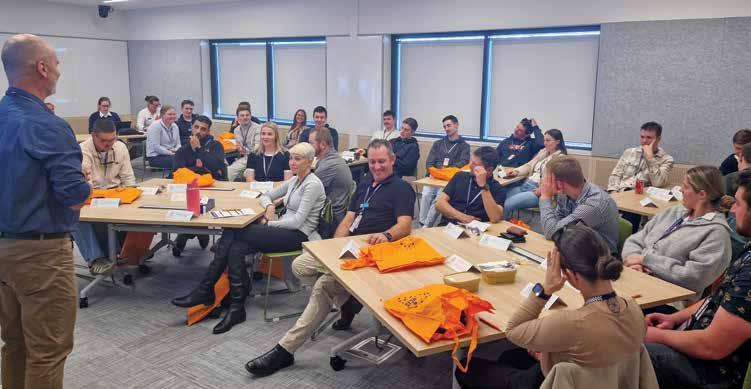
Most recently, stage one of the Western Region Probationary Constable Transition Program was held in midAugust, with 23 students from Class 366 heading to stations in Bathurst, Bourke, Broken Hill, Coonabarabran, Dubbo, Glen Innes, Lithgow, Moree, Parkes, Tamworth, Tenterfield, Warren, and Wellington. The session focused on addressing concerns and expectations
Elyssa King PANSW Media and Communications Officer
132 PARTICIPANTS HAVE BENEFITED FROM THE PROGRAM SINCE ITS INCEPTION
There is a huge anxiety about this unknown thing they are heading towards at a huge rate of knots
related to their placement in the Western Region while they’re still at the Academy. The EDOs and other experienced staff shared their career insights and discussed the benefits and challenges of working in the Western Region.
Representatives from the Health, Safety and Wellbeing Command also outlined a range of support services available to the officers and their families.
As an exercise, Steve poses a series of questions to the students through an anonymous survey link sent to their phones about their upcoming attestation and their expectations for working on the truck.
“The most powerful part of the program is the students getting to share their experiences with others. There is a huge anxiety about this unknown thing that they are heading towards at a huge rate of knots, and we try to ease the burden of that transition.” He said.
“Seeing other people sharing words like ‘scared, anxious, nervous, excited’ on the screen. The relief in their eyes when they see the same words coming up and twenty other people are saying they're scared and nervous and anxious too…there’s this massive weight that is lifted.”
a revision session on police powers to consolidate their learning now that they have practical experience.
The check-in reinforces the connection between Academy learning and field application, providing a shared adult learning experience that supports wellbeing and promotes retention.
Pay It Forward
An important part of the program is paying it forward, with the previous cohort giving back to the latest group of new recruits. Throughout the program,
“We choose a variety of jobs and read them out to the full audience, from gruesome deceaseds to high-speed chases, great lockups to conducting CPR. These first-hand experiences provide powerful mental images of actual police work that assist the next group to prepare for their own transition to the field”.
Focus On The Future
Executive Member for NON-LAC 3 Peter Gurr was recently approached by Steve to explore how the Police Association of NSW can further support Probationary Constables assigned to regional and remote areas of the state.
the students are encouraged to reflect upon their own experiences with the mindset of helping future participants of the project.
The PANSW has a longstanding and proactive commitment to advocating for the welfare and working conditions of police officers serving in these challenging environments. In response to the inquiry, Peter engaged with PANSW Organisers, Industrial Officers, and Welfare Specialists to compile and present a comprehensive overview of the available support mechanisms. This includes both financial assistance and targeted welfare services designed to meet the unique needs of Probationary Constables.
The second stage of the program was held for the first time in August with 27 students from Class 365, who are now three months into their experience as Probationary Constables.
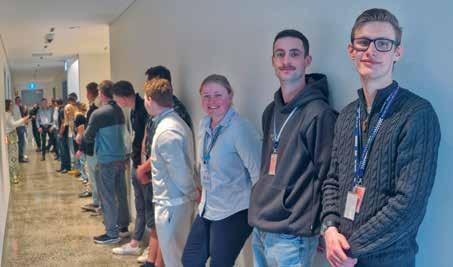
The new police officers gathered together at the NSWPF Western Region Training Facility in Dubbo to reflect on their experiences in the early stages of their careers. The sessions focused on resilience and welfare tips from a mental health clinician, health and fitness testing from PTIs to reinforce the importance of maintaining their physical wellbeing, how to manage the rigours of shift work and eating well with a dietician, and even
“We want that group to tell the next group about their experience,” Steve says. “We challenge the participants to come up with strategies and ideas that make the next cohort's experience easier than their own. It might be certain pubs to avoid, better locations to live, even just which café does the best coffee in town. This peer-to-peer support has been powerful to watch and has provided another avenue for connection in what can be an isolating experience”.
The Year 2 Academy teaching team has expanded on some of these ideas, such as sharing first-shift experiences from the previous cohort with the newly attesting class.
Among PANSW’s recent achievements is the successful advocacy for police students to receive remuneration during their training. Building on this success, the PANSW remains steadfast in its commitment to ensuring that Probationary Constables are wellsupported throughout their first year of service and into their ongoing careers.
The PANSW will continue to champion initiatives that enhance the professional and personal wellbeing of officers in regional NSW, recognising their vital contribution to community safety across the state.
23 STUDENTS FROM CLASS 366 RECENTLY PASSED THROUGH, IN PREPARATION FOR A REGIONAL POSTING
Greg McKenna, CEO of Police Bank
Building a brighter future beyond your paycheck
Money Matters brought to you by Police Bank
■ In high-pressure, high-impact roles like policing, financial wellbeing isn’t just about dollars and cents. It’s about peace of mind. Whether you’re just starting out, well established, or thinking about what’s next, a simple, practical approach to managing your money can make a real difference – for you and your family. We know from working with our members that many take budgeting seriously. We see it in your savings habits, your loan repayments, and the conversations we have with you. But we also know that some find it harder – and in finance, because of compounding, a little harder now can mean a lot harder later.
So, for those who are struggling a bit, here are five practical steps we’ve seen work for our members.
1. Automate what you can
Our brains aren’t wired to think about our future selves. Research shows that when we imagine our future selves, our brains treat them like strangers. That’s why automation works. It bridges the gap between intention and action. When I was younger, automation was clunky. No apps, no instant transfers. But I still set up systems to live within my means. Today, it’s easier. Every fortnight, I transfer my Police Bank salary into a joint account or savings, leaving myself a “living allowance.” It sounds strict, but it works – and we see many of our members do something similar.
2. Budget for the “fatigue spend”
That living allowance is where my discretionary spending sits. We all know that when we’re tired or stressed, we’re more likely to overspend. By automating essentials and setting a spending limit –mine’s in my transaction account – you can reduce the risk of impulse purchases. Some pay cycles you’ll overspend and dip into savings. That’s okay. The goal is to end the year ahead – with more paid off on your mortgage and, ideally, more in savings.
3. Use pay rises wisely
NSW Police Officers have guaranteed pay rises coming. That’s an opportunity. Yes, the cost-of-living crisis is real. But if you can commit one of those increases each year to your mortgage, savings, or superannuation, the compounding effect will be powerful.
Future you will thank present you.
4. Build an emergency buffer
It’s tough right now. Housing, groceries, fuel – everything’s expensive. But we see members building emergency funds by starting small and adding when they
can. Only you know how much you need. But automating a small amount each pay cycle into a savings account is a good start. Over time, it builds – and you adjust your lifestyle without even noticing.
5. Make it personal
There’s no one-sizefits-all solution. What works for one family might not work for another. But what we do see is that members who sit down and build a budget – even if it’s boring – often unlock the process that works for them. And that’s the essence of financial wellbeing: peace of mind.
For more tips on managing your finances, visit www.policebank.com.au or follow us on social media.
This article is intended to provide general information of an educational nature only. This information has been prepared without taking into account your personal objectives or financial situation.
Consider if we’re right for you and read the PDS and TMD at aware.com.au/pds. Aware Super has implemented additional
member accounts and personal information, including an extra step in the login process. Issued by Aware
293340) trustee of Aware Super (ABN 53 226 460 365). AS349 10/25
PANSW Member Benefits
Whether studying at Goulburn Academy, or for the HSC, PANSW can assist
■ Since its establishment in 2000, hundreds of thousands of dollars in profits from the retail outlet have been used to add additional facilities to the NSW Police Force Academy in Goulburn. Over the years, the funding has been used to upgrade facilities, resources and equipment for the students at the Academy, including sporting equipment, WI-FI, BBQ facilities, lighting around the grounds and more. “Any profits derive from the running of the shop are reinvested back into the Academy for the benefit for the students.” PANSW Assistant Secretary Administration Raff Del Vecchio, who is the Chairman of the committee, said.
It is the only retail outlet authorised by the NSW Police Force to sell items using the official corporate branding of the NSW Police Force. The shop was set up as a joint venture between the PANSW and the NSW Police Force. There is a committee of management which comprises of three representatives from PANSW and three from NSWPF. The responsibilities associated with running the shop are managed by staff in the Administrative team at the PANSW along with their other duties. “We manage everything from employing staff and buying stock to paying bills and balancing accounts. We effectively run a retail outlet providing a member benefit to the students, serving police and the
extended police family who wish to buy our products.”
Day-to-day, the Police Shop provides practical benefits for future police officers during their stay along with employees on-site. There is a sophisticated ecommerce platform which allows for the purchasing of goods online. Essentials such as boot polish, clothing and stationery readily available without having to leave campus.
On attestation days, the Shop is a place for family and friends to purchase memorabilia to commemorate a special moment in the life of their loved one.
With an expanded online presence, the Shop has been able to extend its reach over the past ten years. The team can create custom orders for Commands and Police Districts and are also able to attend specific NSW Police Force community events and conferences.
PANSW Scholarships
Is your child in Year 12 this year and completing the Higher School Certificate (HSC)? Does your child intend to go on to some form of tertiary education?
Every year, your Association awards scholarships to assist dependent children of financially serving members to complete their selected course, whether it be at university, college of advanced education or a similar form of a tertiary institution.
Such scholarships are credible for the duration of one full-time undergraduate course (2-4 years) and they are awarded on the results of the HSC. Each application must provide the following as part of their application:
• A copy of the applications results e.g. Record of School Achievement (ROSA)
• A copy of their ATAR
• A copy of the applicant’s enrolment e.g. student record
Scholarships that have been submitted will be awarded by the Association to any eligible applicant whose ATAR of 70.00 or greater or rank of 26 or more under the International Baccalaureate.
Unfortunately, applications received after 28 February 2026 will not be considered except for those in extenuating circumstances.
All applications will then be reviewed in April 2026 after which the applicants will be advised of the outcome with payments to follow shortly after.
For those with an existing scholarship, a letter will be sent out to you in early 2026, outlining what is required from you for the next installment.
For all questions concerning the scholarship or to obtain an application form, please contact PANSW Admin Officer at the Association office by email membership@pansw.org.au or by phone on (02) 9265 6777
Christmas Messages
Reflections on 2025 and best wishes to members of NSWPF from Commissioner of Police, Mal Lanyon APM, Minister for Police, Yasmin Catley MP, and Shadow Minister for Police Paul Toole MP
Commissioner of Police Mal Lanyon APM
Christmas is a time to celebrate with family, friends and loved ones. While it’s a period of reflection, it’s also an opportunity to look forward to the future.
The past year has been a busy one for so many of you across the state.
We have seen not only the day-to-day challenges of preventing, disrupting and responding to crime but also managing large and frequent public safety operations and protecting our community.
Throughout it all, we have continued to show exceptional commitment and professionalism which continues to build trust and confidence in our community, something we should be proud of.
It hasn’t been without challenges, ranging from a dynamic social and cultural environment to the pressure on delivering services to the community with the resources we have.
That’s why, having recently been appointed to the role of Commissioner of Police, it is my commitment with the Executive to continue the focus on our people – ensuring we consistently communicate and engage with you; advocate for you and provide the support you need to get the job done.
Recruitment continues to be a focus to attract the next generation of police to reduce some of the strain on our people
and we are seeing positive signs in that area. I’ve made it clear that we must also focus on the vast experience within our organisation by retaining the great people we have.
Our attention on domestic violence, organised crime, youth crime and keeping people safe on our roads, will also continue.
These require a significant commitment from all of us and I would like to thank the Police Association of NSW for the support provided to its members, the advocacy it provides on their behalf and their working relationships with the NSWPF Executive.
I am mindful that the Christmas period is a busy one for many of you with large community events, road safety operations and responding to local community needs. For some, it may be spent away from family. For others it may be the first without a loved one. For those that give up time with family, friends and loved ones to protect the community, thank you!
Please take the time to check in with your colleagues over this period.
As we head into a new year, I’m looking forward to the opportunities that are ahead of us.
To all members, thank you for everything that you do for your colleagues, the community and the NSW Police Force. Please take care.
Minister for Police Yasmin Catley MP
To everyone across the NSW Police Force, what a year it has been.
It has not been easy. From protests to domestic violence call outs, organised crime and public shootings that shook communities, you have stood on the frontline of some of the most challenging moments.
What makes the NSW Police Force remarkable is the sheer breadth of people that make up its fabric. From the Northern border to the Southern, from beaches to bushlands, every corner of this state holds a story of service and together, you form a tapestry unlike any other.
From Probationary
Constables taking their first steps on the job to seasoned officers whose experience steadies those around them; from detectives and highway patrol officers to members of specialist units; from those who support victims of crime and families searching for missing loved ones to officers responding to domestic violence calls; from working parents juggling shifts and school drop-offs to chaplains offering care in the toughest moments, and to tireless volunteers dedicating their time and energy.
And of course, standing alongside them is the Police Association, giving repre-
sentation, support and a collective voice to every member.
Since coming into Government, I’ve made it my mission to build a Police Force that reflects the community it serves. We’ve taken important steps toward that goal and the results speak for themselves.
For the first time, recruits are being paid to study. Officers are being supported to return to the communities they know best. We’ve delivered a historic wage increase, introduced the full-time equivalent model to allow job sharing and better work–life balance and begun welcoming experienced officers from overseas to join our ranks.
We’ve seen two record-breaking classes, with the largest ever set to join you on the beat this December. There’s more to do, but across the state, the NSW Police Force reflects the community it serves. We will continue giving you the support you need, because the community values your work and so do we.
It’s no secret that policing is one of the toughest jobs there is. Many of you have given more than we could ever ask, facing situations that few could imagine. What keeps you coming back, day after day, is not just duty – it’s each other. It’s the moments between colleagues who understand what the job demands, the pride you take in serving your community and the strength you draw from your
families who stand beside you through every late night, every missed meal and every moment you wish you could be home.
As the year comes to an end, I ask just one thing – take a moment for your families. Many of you will be on duty through the holiday season. But when you can, make time for the people who matter most.
As we close the year, I hope you can take pride in what you’ve achieved this year, and find time to rest, reflect and reconnect with those you love. May 2026 bring you success, good health, and countless moments of joy and gratitude both in your work and personal life. And know that the NSW Police Force will continue to stand beside you, every step of the way.
Shadow Minister for Police Paul Toole MP
As the festive season approaches, it’s a time for many of us to pause, reflect and enjoy the company of family and friends after another busy year.
But for our hard-working men and women of the NSW Police Force there is often little opportunity to switch off. While most of us gather to celebrate, our police continue their vital work keeping our communities safe, protecting lives and upholding the law.
To each and every officer, thank you. Your service, sacrifice and professionalism does not go unnoticed. You put others before yourself every single day often in the face of immense pressures and challenges. Our communities owe you a debt of gratitude.
As Shadow Minister for Police, I remain committed to standing up for you to ensure your welfare, your safety and respect for what you do is always at the front of mind for government decision making.
Merry Christmas to you and your families. Whether you’re on duty or taking a well-earned break, stay safe and know how deeply appreciated you are.
Police Officer of the Year Awards
The annual NSW Police Officer of the Year awards recognises professional excellence and dedication to service by officers and civilian staff.
Overall award winnerDetective Sergeant Natasha Williams Judges deemed Detective Sergeant Natasha Williams worthy of the overall award due to her dedication and commitment to helping child abuse victims for more than 15 years. Since 2010, Detective Sergeant Williams has investigated more than 1,200 child abuse matters, each handled with care, professionalism, and trauma-informed practice. She played a key role in Strike Force Hermoyne, a six-year investigation into multi-generational abuse, which secured a 34-year sentence in a highprofile sexual assault case. Detective Sergeant Williams works tirelessly –accepting after-hours call-outs and urgent risk assessments – collaborating with partner agencies and supporting victims through court.
Detective Sergeant Williams was also named the Investigations & Counter Terrorism Rotary Police Officer of the Year.
Winners in the other award categories:
Metropolitan Field Operations Police Officer of the Year –Sergeant Jonathan Fadeli –Burwood Police Area Command
Professionalism, courage, and care define the leadership of Sergeant Jonathan Fadeli, who consistently delivers strong arrest results and proactive policing outcomes. In 2025, he led Strike Force Camena, seizing nearly seven tonnes of the precursor drug, butanediol and charging five offenders. He’s also saved lives – performing CPR on a patient in Summer Hill and re-engaging their pulse before paramedics arrived. Off duty, he coordinated emergency services during a house fire. Sergeant Fadeli mentors junior staff, fosters team morale, and promotes a culture of support and recognition. His leadership, resilience, and commitment to community safety make him an outstanding role model and a deserving nominee for Police Officer of the Year at Burwood Police Area Command.
Regional NSW Field Operations Rotary Police Officer of the Year Award –Sergeant Michael McCormack –Richmond Police District
Sergeant Michael McCormack has served the Richmond Police District since 1988, dedicating most of his career to the Kyogle community. Known for his daily foot patrols and genuine connection with locals, ‘Mick’ is more than a police officer – he’s a trusted mentor and friend. His leadership during the 2019 bushfires and 2022 floods provided calm and reassurance to a community in crisis. Sergeant McCormack supports his colleagues with quiet strength and compassion, always checking in after tough jobs. His deep local knowledge and unwavering presence have earned formal recognition from the mayor and a nomination for Citizen of the Year. Sergeant McCormack embodies country policing – he’s steadfast, approachable, and deeply committed to his community.
(left to right) Det Sgt BENJAMIN SEGA, Sgt MICHAEL MCCORMACK, CoP MAL LANYON, Det Sgt WILLIAMS, Insp JACQUI CAMERON, BIANCA HALLORAN, AND Snr Const JAKE DIMOND
Rotary Police Employee of the Year –Chief Pilot Rodney Clinch –Aviation Command
Bringing over 10,000 hours of Blackhawk experience from the Australian Defence Force, Rodney Clinch rejoined the police in 2024 as chief pilot. Facing recruitment and capability challenges, Mr Clinch led a transformation of the Aviation Command – introducing night vision systems, expanding tactical flight operations, and restoring 24/7 capability. His unwavering leadership enabled critical missions, including rooftop rescues in flooded Taree and complex winch extractions in Warrumbungle National Park. Mr Clinch also overhauled fatigue management and operational procedures, improving pilot availability and safety. His innovation and execution have directly enhanced community safety across NSW. For his outstanding contribution, Mr Clinch was named 2025 State Operations & Emergency Management Employee of the Year.
Rotary Community Award –Senior Constable Jake Dimond –Youth Command
victim of domestic violence recently. He spent countless hours documenting her experiences, including a 170-page statement, bringing his patience, empathy, and professionalism to the forefront. His respectful and non-judgemental approach helped restore the victim’s trust in police and empowered her to speak out. Despite managing multiple cases, Senior Constable Green remained committed,
Irene Juergens (IJ) Award (Sworn Category) –Detective Sergeant Benjamin Sega –Youth Command
Senior Constable Jake Dimond leads the Engage Program with passion, supporting vulnerable youth through early intervention, mentoring and vocational training. He shines through his handson work, driving students to sessions, coordinating logistics, and building strong partnerships. Senior Constable Dimond was instrumental in working on programs that resulted in 87.5% of participants with prior police involvement not reoffending in 2024. He fundraises tirelessly, volunteers outside hours, and connects with Rotary, Lions, and local businesses to expand opportunities. His respectful, consistent presence has helped build trust with families and shifted perceptions of police – especially among Aboriginal and Torres Strait Islander youth. Senior Constable Dimond also contributes to Fit for Life and Fit for Service, modelling integrity and empathy. His work exemplifies community-first policing and continues to change lives
Customer Service Excellence Award –Senior Constable Jonah Green –South West Metropolitan Region –Domestic Violence High Risk Offenders Team
Exceptional dedication and compassion were evident in the way Senior Constable Jonah Green supported a young
often working long hours and weekends to ensure the victim’s safety and wellbeing. His unwavering support gave the victim courage to leave an abusive relationship and begin rebuilding her life. Senior Constable Green exemplifies the values of the Force – integrity, resilience, and care – and his actions made a lasting impact on someone who needed it most.
Corporate Services Rotary Police Officer of the Year –Inspector Jacqui Cameron –Infrastructure & Assets Command
Both strategic and deeply personal, Inspector Jacqui Cameron’s impact across Corporate Services has been felt widely. Since 2023, she has led major projects within Infrastructure & Assets Command – including the Western Region Training Centre in Dubbo and the Justice Bail Division’s AV link rollout – resolving complex issues and ensuring successful delivery. She’s the go-to contact for regional commands, known for her calm leadership, professionalism, and unwavering support. Inspector Cameron actively mentors staff, fosters team development and contributes to fundraising events like the Polar Plunge for Special Olympics. A competitive swimmer and respected colleague, she brings compassion, strength, and excellence to every role.
Community connection and cultural leadership are at the heart of Detective Sergeant Benjamin Sega’s work. In 2022, he founded the Pacific Officers Law Enforcement Network (POLEN) to support Pasifika staff and strengthen ties between police and Pasifika communities. Driven by a passion to break cycles of youth crime, he leads outreach at events like Samoa Day and Waitangi Day, creating positive engagement and visibility. Detective Sergeant Sega launched the “You Should Be a Cop” program and the Pasifika Career Pathways initiative, helping young people pursue policing careers. His work has inspired similar networks across Australia and will culminate in a national conference in 2026. As the first Samoan sergeant in NSW Police Force history, Detective Sergeant Sega is a cultural champion whose leadership continues to uplift communities and inspire change.
Irene Juergens (IJ) Award (Unsworn Category) –Bianca Halloran –Campbelltown City Police Area Command
With a deep commitment to youth justice and collaboration, Bianca Halloran has transformed support for vulnerable young people in Campbelltown through her role as Youth Action Meeting (YAM) Coordinator. She builds trust with at-risk youth, works tirelessly to find practical interventions, and consistently goes above and beyond – often outside business hours. Ms Halloran unites government and non-government services to deliver wraparound support – breaking down silos and improving outcomes. Her reliability, empathy, and collaborative spirit have earned the respect of young people and professionals alike.
“The qualities of the individuals represent the best of our profession; hard working, courageous in their service and committed to uplifting their fellow officers.” PANSW President Kevin Morton said.
“I’d like to congratulate all the winners and the nominees. They continue to set the standard for excellence in policing and their stories deserve to be shared widely and celebrated.” PANSW Secretary Pat Gooley said.
(L to R) ROMULUS LEUNG WEI, KEVIN MORTON, BENJAMIN SEGA, & PAT GOOLEY
Sonia Roberts PPN Writer
History on Two Wheels
■ Val Bryant’s (Sugden) career may read like a television script but for the highway patrol stalwart it was all about making a difference on our roads.
She retired from NSW Police at the rank of Sergeant in 2010. During her career she spent time as the Region Traffic Coordinator for City East Region and Unit Leader at Surry Hills Highway Patrol.
Today, Val spends her time travelling and occasionally going for rides on her private motorcycle. You can also find Val still involved with her local water polo club in and out of the water.
For the young officer who, in 1983, would become Australia’s first female highway patrol police motorcyclist, her time on two wheels started when she became friends with some of the motorcyclists stationed at Central Police Station. “I was a learner rider then and started getting riding lessons from my friends,” Val said. “When I transferred to North Sydney Highway Patrol, which some may remember as The Bat Cave, I formally applied to become a police motorcyclist.
“I was drawn to highway patrol and road policing as I was interested in motorcycles. Looking back, I think my dad being a diesel mechanic had an influence on me when it came to choosing a career path.”
She found working the VIP escort detail with her fellow cyclists to be a privilege and an honour. Working at large scale events such as New Year’s Eve and dealing with crowd and traffic management was also satisfying.
Official visits from Pope John Paul II, Queen Elizabeth II and the then Prince and Princess of Wales – Charles and Diana – were all special times in Val’s career. “His Holiness came to New South Wales twice. There was certainly something about him…a gentle, yet powerful presence.
“When Diana and Charles came out to Australia for the first time, there were so many moments that remain with me. Diana was extraordinarily beautiful –none of the pictures truly did her justice. The number of people who came out to see Charles and Diana was extraordinary. Time really did not matter to the Princess as she did not want to miss saying hello to as many people as she could.”
Yet, for all the Sydney Harbour postcard moments, it was the deployments to country areas on extended patrols that reinforced the value of road policing to Val. “When we were doing those patrols in country areas, I felt our presence really did have influence in reducing fatal and serious injury crashes in those areas we were visiting."
"We were working down at Bodalla many years ago doing stationary speed enforcement and half an hour after we had left that location there was a fatal crash in that area. It’s moments like that which reminded you of the importance of our work and how what we did makes a real difference."
“One of the things I will always treasure about my time with highway patrol was the friendships we made. Highway patrol has a unique sense of purpose, and it has given so much to so many people. Even though years may pass between people seeing each other face to face, when we do meet up in person, those years just fall away."
“The biggest misconception people have about highway patrol officers is them being there for the revenue raising. We never cared about that. It’s about road safety – first, last and always.”
When asked about the greatest challenge for road safety in 2025, Val became philosophical. “It’s all about making sure the voices of those who are living road safety such as police, paramedics, firefighters, volunteer rescue agencies and hospital personnel keep being heard and prioritised by policy makers and academics alike,” she said.
(left) 1983 NORTH SYDNEY HIGHWAY PATROL WITH CONST. WARREN BOWERS & DENNIS SMITH. (right) CIRCA 1986 IN VIP UNIFORM WHILE WORKING IN PARRAMATTA HIGHWAY PATROL RESPONSE GROUP
Sonia Roberts PPN Writer
A century strong commitment
■ It was a night for friendships to be renewed and the contribution of retired and former highway patrol operatives to be honoured alongside the company of their contemporary peers.
More than 400 current and former highway patrol officers, along with representatives from the wider road safety community, attended the September gala dinner celebrating a century of the NSW Police Force's involvement in road safety and 50 years since the formation of the highway patrol.
Addresses were provided by Commissioner Mal Lanyon, Traffic and Highway Patrol Assistant Commissioner David Driver and NSW Police Legacy Chair Detective Superintendent Donna McCarthy.
Traffic and Highway Patrol Command Assistant Commissioner David Driver said the event was a night where the many people who have worked in road policing and road safety came together and celebrated the moments that mattered.
“For me, there were several highlights, including the recognition of the work
done by now-retired Senior Sergeant John Lovatt in laying the foundations of the highway patrol as we know it today.
“As a Command, it was important that we took the time to celebrate these twin milestones and the biggest part of that, was the role of retired highway patrol officers in shaping the year’s events,” Assistant Commissioner Driver said.
The year-long celebration began with Retired Police Day in 2024 which was held in conjunction with a recruitment day for serving officers interested in becoming a part of the highway patrol.
Assistant Commissioner Driver acknowledged the benefits from people hearing from those who had gone before them.
“The camaraderie, culture and lessons learned have more meaning when it is so tangible. I think that helps build longevity in not only the Command but across the organisation more broadly.
“There are many aspects to our Command, and each play a vital role in achieving our objectives of reducing road trauma. Sadly, not all of our colleagues are still with us. The memories of mates
who died in the line of duty stay with all of us and we can never forget them.
“On Remembrance Day I had the privilege of holding a baby boy at the ceremony. He is the grandson of an officer I worked with who passed away some years ago. I wished he had been there to hold him - he would be so proud of his children.
“Despite the changes there are some things that haven’t changed and never will, and this is the passion and commitment that we all have for road safety,” he said.
(left) TRAFFIC AND HIGHWAY PATROL COMMAND ASSISTANT COMMISSIONER DAVID DRIVER, NSW POLICE COMMISSIONER MAL LANYON, SENIOR SERGEANT JOHN LOVATT (retired) AND DEPUTY COMMISSIONER PAUL PISANOS DURING THE GALA DINNER MARKING 100 YEARS OF ROAD SAFETY AND 50 YEARS OF HIGHWAY PATROL.
(right) SYDNEY OPERA HOUSE PROVIDED THE BACKDROP FOR A DISPLAY OF HISTORIC POLICE VEHICLES MARKING A CENTURY OF NSW POLICE FORCE INVOLVEMENT IN ROAD SAFETY.
Elise Hulley-Thomas PANSW Executive Member – South West Metro 2
Nominate for Conference
Elise Hulley-Thomas encourages Officers to put their hands up
"First conference I went to was in 2021. I kind of fell into it. I hadn't really had too much experience as a Branch Official prior to that, but I remember the fact that the nominations were open to be a delegate at Conference had been communicated by the Police Association. It was a simple form to fill out. It's an official process through the Australian Electoral Commission.
Each region or Non-Lac division is allocated a certain number of delegates and then people can vote for you to represent them.
Part of Conference is the passing or the the speaking to motions. If passed at Conference, they set the direction for the Executive and Association, particularly around industrial issues, award negotiations and any other issues that may arise.
presentation regarding body worn and the interconnected system between the Glock and the Taser and the body worn, which I found very interesting.
At the time, I was and still am attached to the Campbelltown Branch, which is South West Region Two and the Campbelltown branch put up a number of motions, several which were pretty important and passed.
Being my first Conference, it was very, intimidating not knowing the process, procedures and rules of debate, so it was daunting, but definitely got a lot out of it. You get a real sense of pride speaking to motions, particularly if they're deeply and widely felt by your region.
The last few Conferences have been at the Novotel in Wollongong. Generally you'll get there on the Monday afternoon or evening. There's a welcome dinner, then the preceding days there's lots of presentations.
Key speakers come out and talk about various aspects of policing. For example, at the last Conference, there was a
There's breakout groups and sessions where, you know, there might be four different topics that are relevant at the time. So coming up, we might potentially have one around a modern first response policing agreement - what that could look like. There might be a discussion about insurance schemes - as we've just transferred from PRI to APS, so there might be information on that. Anything that's relevant that might educate members on what the Association has been doing.
I think it's important for officers, particularly those who are passionate and willing to speak on behalf of their membership or region or branch. You do need a high level of passion and drive. It does take a lot of time, but there's a great sense of pride, and satisfaction you get from being that voice on behalf of the the people at your
branch.
Historically at Conference, and the Police Force, and Association, women haven't been greatly represented. At the last women's forum, there was a presentation relating to imposter syndrome. I do believe that's a a genuine thing effecting women in particular - a thought pattern they go through prior to putting their hand up to do something, or going for promotion. They want to be a bit more prepared rather than just jump in, give it a go.
If you have a genuine interest in the work of the Association and you're passionate, find someone you know, a Branch Official or even one of your Executive members who have experience, and ask them questions about it. Put in nomination form, the Association will communicate when it's open. Throw your hat in the ring because you never know where you'll be in ten years time."
ELISE SPEAKING TO A MOTION AT CONFERENCE
Down
1. Utilitarian, electric, household objects which work for you
3. Found in lanes behind shops, excellent improvised seating
4. A folding, heat resistant bench you can flatten garments on
5. Hard mounted to walls at eye level, holds garments
7. A long single horizontal surface holding anything that will fit
10. Storage units with doors. Found in kitchens, bathrooms and sheds
12. Rotates overhead keeping the air moving
17. The work surface of a kitchen counter, or shed workspace
18. Outside area you can burn a communal fire in (4,3)
19. Padded chair that leans back, with footrest (8)
20. Big or small, it sits around throwing light (4)
25. They surround tables (5)
28. Soft surface your body touches, hopefully 8 hours a day (8)
30. Hangs on a wall and tells you the time (5)
Across
2. Furniture of exceptional quality handed down through generations
6. Decorative covering on lounge furniture
8. A single hard seat with no back
9. Big box retailer that sells Swedish furniture
11. A comfy seat for 2-4 people
13. Low table in front of a sofa
14. Additional padding for seats and beds
15. A rising set of multiple shelves for stories and knick-knacks
16. Tall enclosed space for hanging garments
21. Before social media, this object was the centre of meals or meetings
22. Soft, shapeless seat that lays on the ground
23. Small bed for a baby
24. Two single beds, stacked vertically (4)
26. Another word for sofa
27. A low, deep upholstered seat with raised sides to lean on (8)
29. A work surface with drawers and room for a chair (4)