November/December 2026
TownandCity N E W
H A M P S H I R E
A PUBLICATION OF NEW HAMPSHIRE MUNICIPAL ASSOCIATION
In This Issue: The Legacy of Industry and the Future of Community . . . . . . . . . . . . . . . . . . . . . . . . . . . . . . . . . . . . . . . . . . . . . . . . . . . . . . . . . . . . . 14 Re-Imagined, Historic Fire Station Maximizes Firefighter Safety and Efficiency . . . . . . . . . . . . . . . . . . . . . . . . . . . . . . . . . . . . . . . . 16 The Job Has Changed. The Values Haven’t. . . . . . . . . . . . . . . . . . . . . . . . . . . . . . . . . . . . . . . . . . . . . . . . . . . . . . . . . . . . . . . . . . . . . . . 17 HR Report: Notice of Suspension for Public Employees: New Requirements Coming . . . . . . . . . . . . . . . . . . . . . . . . . . . . . . . . . . . . 19 NLC: How Local Autonomy Can Build Economic Resilience . . . . . . . . . . . . . . . . . . . . . . . . . . . . . . . . . . . . . . . . . . . . . . . . . . . . . . . . . 20 Cyber Safety Update: You Can’t Protect What You Can’t See: Why Municipal Asset Inventories Matter . . . . . . . . . . . . . . . . . . . . 24 The Official Budget Committee: Roles and Responsibilities . . . . . . . . . . . . . . . . . . . . . . . . . . . . . . . . . . . . . . . . . . . . . . . . . . . . . . . . . 26 NHARPC: “Regional Cooperation Cleans Up Household Hazardous Waste” How Working Together on Costly Disposal Helps Municipalities Save Money . . . . . . . . . . . . . . . . . . . . . . . . . . . . . . . . . . . . . . . 36
Contents Table of
Volume LXIX • Number 6
November/December 2026
3 A Message from NHMA Interim Executive Director 4 Happenings 6 Upcoming Events 8 Legal Q and A: New Law Guidance 10 Legislative Update: Sowing the Seeds of Successful Advocacy 12 Tech Insights: Utilizing NHMA’s Wage Data Part 4 22 Clerk's Corner: A Sneak Peek behind the scenes… Or “Show Time” into our State Primary and State General Elections 48 Trivia: Name that Town or City
14 16 17 19 20 24 26 36
The Legacy of Industry and the Future of Community Re-Imagined, Historic Fire Station Maximizes Firefighter Safety and Efficiency The Job Has Changed. The Values Haven't. HR Report: Notice of Suspension for Public Employees: New Requirements Coming NLC: How Local Autonomy Can Build Economic Resilience Cyber Safety Update: You Can’t Protect What You Can’t See: Why Municipal Asset Inventories Matter The Official Budget Committee: Roles and Responsibilities NHARPC: “Regional Cooperation Cleans Up Household Hazardous Waste” — How Working Together on Costly Disposal Helps Municipalities Save Money
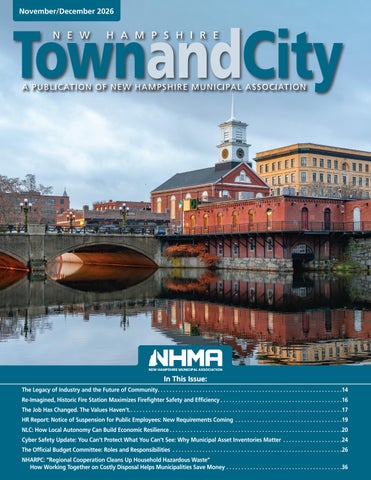
Front Cover: The main street bridge over the Nashua river, Nashua, New Hampshire
New Hampshire Municipal Association Staff Miranda Blaikie, Communications Coordinator, Town & City Editor in Chief Sarah Burke Cohen, NHMA Interim Director & Legislative Advocate Jonathan Cowal, Legal Services Counsel C. Christine Johnston, Legal Services Counsel Brodie Deshaies, Legislative Advocate
Official Publication of the New Hampshire Municipal Association 25 Triangle Park Drive • Concord, New Hampshire 03301 Phone: 603.224.7447 • Email: info@nhmunicipal.org • Website: www.nhmunicipal.org New Hampshire Municipal Association: NEW HAMPSHIRE TOWN AND CITY (USPS 379-620) (ISSN 0545-171X) is published 6 times a year for $25/member, $50/non-member per year, by the New Hampshire Municipal Association, 25 Triangle Park Drive, Concord, New Hampshire 03301. All rights reserved. Advertising rates will be furnished upon application. Periodical postage paid at Concord, NH 03302. POSTMASTER: Send address changes to NEW HAMPSHIRE TOWN AND CITY, 25 Triangle Park Drive, Concord, NH 03301.
Ashley Methot, Event Coordinator
NEW HAMPSHIRE TOWN AND CITY serves as a medium for exchanging ideas and information on municipal affairs for officials of New Hampshire municipalities and county governments. Subscriptions are included as part of the annual dues for New Hampshire Municipal Association membership and are based on NHMA’s subscription policy. Nothing included herein is to be construed as having the endorsement of the NHMA unless so specifically stated. Any reproduction or use of contents requires permission from the publisher. POSTMASTER: Address correction requested.
Pam Valley, Administrative Assistant
© Copyright 2026 New Hampshire Municipal Association
Marty Karlon, Policy & Research Analyst Tammy Letson, Government Finance Specialist Judith Pellowe, Business Administrator
www.nhmunicipal.org
Production/Design Evans Printing Co.
NOVEMBER/DECEMBER 2026
1
New Hampshire Municipal Association
B OA R D O F D I R E C TO R S Jeanie Forrester - Vice Chair Select Board Member, Meredith
Joanne Haight - Secretary Select Board Chair, Sandwich
Joseph R. Devine - Treasurer Town Manager, Salem
Michael Branley Town Administrator, Windham
Conservation Commission, Holderness
Shelagh Connelly
Phil D’Avanza Planning Board, Goffstown
Andrew Dorsett Zoning Board of Adjustment, Lyman
Stephen Fournier Town Manager, Newmarket
Dale Girard Mayor, Claremont
Bonnie Ham Planning Board, Woodstock
Robert Edwards Selectman, Antrim
Jennifer Kretovic City Councilor, Concord
Holly Larsen Finance Director/Tax Collector, Berlin
Conner MacIver Town Administrator, Barrington
Jim Michaud Chief Assessor, Hudson
David Moore City Manager, Somersworth
Matthew Normand City Clerk, Manchester
Lori Radke Town Councilor, Bedford
Dennis Shanahan - Chair Deputy Mayor, Dover
Laura Buono Town Administrator, Hillsborough
Thomas Seymour Moderator, Hill
2
NEW HAMPSHIRE TOWN AND CITY
David Stack Town Manager, Bow
www.nhmunicipal.org
A Message from the
T
NHMA
Interim Director
Sarah Burke Cohen
he end of the year is here! At NHMA, we’re celebrating another successful Annual Conference while preparing for the next legislative session.
The Annual Conference took place on Wednesday, October 28 and Thursday, October 29. The two days were teeming with training for local officials, opportunities for networking and plenty of fun! Members chose from over 50 educational sessions and explored the Exhibit Hall with over 100 vendors, games, and prizes. On Wednesday morning, attendees heard from Clarence Anthony, CEO and Executive Director of the National League of Cities during a fireside chat that focused on keeping local governments non-partisan and finding real solutions for the issues we are facing as a community. Later that evening, attendees enjoyed a cocktail hour reception followed by the NHMA Fair, which featured a fair-inspired buffet dinner, games, and sweet treats. All in all, the Annual Conference brought old and new friends together for two memorable days of learning, connection, and county fair fun—a blue-ribbon success! And what would the end of the year be without preparing for another legislative session? The first filing period for LSRs (legislative services requests) came and went in September, and there will be another filing period in November following the election. The 2027 legislative session is already shaping up to be a busy one, with continued focus likely on proposals that would restrict NHMA’s ability to advocate for our members and impose new mandates and restrictions on local government decision-making and autonomy. The NHMA Advocacy Team is preparing for the session and familiarizing legislators with NHMA’s Legislative Policies and Principles, which the membership adopted at the Legislative Policy Conference in September. We will be calling on our members to strengthen our advocacy, by speaking to your own legislators, testifying at public hearings, writing op-eds, and Warmest regards, any other activity that raises the voice of local governments, and the people they represent, over other special interests. Sarah Burke Cohen, NHMA Interim Director
www.nhmunicipal.org
NOVEMBER/DECEMBER 2026
3
HAPPENINGS Is something new and exciting happening in your city or town? We'd love to include it in Town & City! Email us at publications@nhmunicipal.org Notification of Security Breaches of Personal Information NH RSA 359-C:20 Any business which maintains computerized information that includes Personal Information has an obligation under New Hampshire law to notify consumers if there is a security breach that compromises the security or confidentiality of that data. Under the statute, Personal Information is defined as the individual’s first and last name in combination with any one or more of the following: social security number, driver’s license number or other government identification number, or identifying account number. More information here: https://www.doj.nh.gov/citizens/consumer-protection-antitrust-bureau/security-breachnotifications Opportunity Zones 2.0 Accessing this permanent financial incentive Opportunity Zones (OZ) are federally designated census tracts where private investors can receive significant tax advantages for investing in long-term projects that drive economic and community development. Opportunity Zones were created as part of the Tax Cuts and Jobs Act, which allowed certain investments within designated lowerincome U.S. Census tracts to have tax advantages. New federal legislation has made the Opportunity Zone tax incentives permanent. While the 2018 tracts remain active, newly designated OZ 2.0 tracts run alongside them for a temporary two-year overlap. More information here: https://www.choosenh. com/choosenh/work/business-resources/opportunity-zones#2
4
NEW HAMPSHIRE TOWN AND CITY
www.nhmunicipal.org
Bank of New Hampshire
Municipal Resources, Inc.
Bar Harbor Wealth Management
MuniMins LLC
Cartographic Associates, Inc., dba CAI
New Hampshire Public Deposit
Technologies
Investment Pool (NH PDIP)
CGI Business Solutions Cordell A. Johnston, Attorney at Law Culver Technologies Devine Millimet Drummond Woodsum Eagle Network Solutions Freedom Energy Logistics GovDeaIs HealthTrust, Inc. HEB Engineers, Inc. indus
NH Municipal Bond Bank NH Recycles NH Saves NH Tax Deed & Property Auctions Primary Bank RMON Networks, Inc. Turner Group Umbral Technologies UNH Carsey School of Public Policy Upton & Hatfield, LLP
JSJ Auctions, LLC
VHB
Lifesize Wraps LLC
Vachon, Clukay & Co., PC
Mascoma Bank
Vision Government Solutions, Inc.
Mithcell Municipal Group
Wiemann-Lamphere Architects, Inc.
www.nhmunicipal.org
NOVEMBER/DECEMBER 2026
5
Upcoming
Events NOVEMBER
ADA Title II and Digital Accessibility: What You Need to Know, and Actionable Steps Toward Conformance Webinar 10:00 am – 11:30 am Thursday, November 5 Zoom Veterans Day (NHMA Offices Closed) Wednesday, November 11 Land Use Law Conference 9:00 am –3:00 pm Saturday, November 14 25 Triangle Park Drive, Concord, NH 03301
For more information or to register for an event, visit our online Calendar of Events at www.nhmunicipal.org. If you have any questions, please contact us at registrations@nhmunicipal.org. DECEMBER A Guide to Legislative Advocacy Webinar 12:00 pm - 1:00 pm Wednesday, December 9 Zoom NHMA Board of Directors Meeting 9:30 am - 12:00 pm Friday, December 18 25 Triangle Park Drive, Concord, NH 03301 Christmas (NHMA Offices Closed) Friday, December 25
Women’s Leadership Conference All day Tuesday, November 17 The Inn at Mills Falls, 281 Daniel Webster Hwy, Meredith, NH 03253 AI in NH Local Government Conference 9:00 am - 4:30 pm Thursday, November 19 The Derryfield Restaurant & Event Center, 625 Mammoth Road, Manchester, NH 03104 Thanksgiving (NHMA Offices Closed) Thursday, November 26 – Friday, November 27
For the most up-to-date event and training information, please visit the NHMA website at www.nhmunicipal.org. Event times and dates are subject to change. Thank you.
6
NEW HAMPSHIRE TOWN AND CITY
www.nhmunicipal.org
www.nhmunicipal.org
NOVEMBER/DECEMBER 2026
7
Legal
Q and A New Law Guidance Jonathan Cowal, Legal Services Counsel At the end of each legislative session, municipalities must review the new or amended laws which have been put into place to understand the new legal landscape as it applies to municipal affairs. At NHMA, our Advocacy team, in conjunction with our Legal Services department, seek to summarize those changes which are the most confusing and most impactful to municipalities and provide comprehensive guidance documents to make the process of understanding these changes a little easier. By accessing the “New Laws Guidance” section of our website under the Legal Services tab, which can be found here: https://www. nhmunicipal.org/new-laws-guidance, local officials can find our detailed guidance documents on key pieces of new legislation recently signed into law by the Governor. While these guidance documents will provide a higher level of detail on these issues, this article will address some of the more frequently asked questions we have received on these topics over the past few months. Q. Are municipalities now required to provide explanations for each and every warrant article to be voted on at town meeting? A. RSA 39:2 was amended this year to now require warrant articles to clearly state the intent and effect of each warrant article without “commentary or ambiguity”. It was already required by law for “the subject matter of all business to be acted upon at the town meeting to be distinctly stated in the warrant”. While the subject matter of a warrant article could inherently be different than the intent and effect of said article, it is unclear how municipalities should provide this additional information “without commentary”. Let us look at the following example in an attempt to provide more context to this amendment: “To raise and appropriate $5000 for the Parks and Recreation Department to construct a new basketball court”. The subject matter of the warrant article is a basketball court, and the intent 8
NEW HAMPSHIRE TOWN AND CITY
is clear; the town intends to build a new basketball court. Do you also need to include an additional sentence saying, “The effect of this article will be that the town will build a new basketball court”, probably not. However, if the warrant article instead said, “To raise and appropriate $5000 for the Parks and Recreation Department to expand access to recreational activities in town”, then it may be necessary to add a clarifying sentence stating, “the effect of this article will be to allow the department to construct a new basketball court”. Perhaps, this is an example of the type of ambiguity that the legislature was seeking to avoid with this amendment. Q. With the changes to the electioneering statute, what are towns allowed to say about matters appearing on the warrant? A. Under the amended language in RSA 659:44-a, the definition of electioneering by public employees has been shifted from one based on the intent of the individual to one based on the content of the communication. This shift, however, does not prevent public employees from doing their jobs and providing factual information about municipal issues, including matters that may appear on the ballot or warrant. Practically speaking, this amendment does not significantly alter the advice the NHMA Legal Services has always given as it relates to communication with the public surrounding issues to be voted on at town meeting. There is nothing wrong with educating the public about what they will be voting on, as long as it is done is a factual, content neutral, non-persuasive manner. In practice, what this means is that you should stick to the facts and avoid any statements which could be seen as advocating for people to vote one way or another. As mentioned above, it is already required for the town to explain the “intent and effect” of proposed warrant articles, and so it would stand to reason that statements related to intent and effect provided in an informational www.nhmunicipal.org
capacity ahead of town meeting are acceptable. What you should not do is indicate that people need to vote one way or another on a particular matter, or present your facts in such a way that they appear persuasive towards a particular outcome. Q. For local welfare, are there new residency requirements that change eligibility or municipal responsibility? A. The town or city in which the assisted person “has residence for local welfare purposes, as defined in RSA 165:1 and RSA 21:6-a,” has financial responsibility for welfare assistance. Another municipality may actually be required to provide assistance in the first instance, but if the assisted person is determined to be a resident of another municipality, the municipality of residency may be required to reimburse the municipality that provided the assistance. The process for determining residency, and the options for reimbursement have been changed through this new legislation. Towns and cities may now amend the eligibility criteria in their welfare guidelines to require an individual to provide proof of residency prior to being approved for assistance. Documents that can be used to establish proof of residency can be found in RSA 165:1. In addition, RSA 165:2a, II now requires that, whenever any city or town provides welfare assistance to any person who is believed to be a resident of another municipality (in New Hampshire or elsewhere), the assisting municipality shall: (a) Contact the welfare official for the alleged municipality of residency to seek reimbursement for the costs of relieving and maintaining the applicant; or (b) Request the municipality of residency undertake ongoing relief and maintenance of the person according to the municipality of residency’s welfare guidelines; or (c) Request a hearing to determine the residency of the assisted person (if the matter cannot be resolved through one-on-one discussions). If discussions do not resolve the matter, a hearing will be conducted by an agreed-upon current or former welfare official of a third (unrelated) municipality who consents to do it, or by an attorney familiar with RSA Chapter 165. The hearing will be conducted according to the fair hearing provisions in the welfare guidelines of the alleged municipality of residency, except that the hearing may be conducted www.nhmunicipal.org
by telephone or video conference by agreement of the participants. Municipalities will need to update their welfare guidelines and should reference our full guidance document for more details. Q. Is there a new process municipalities must follow to issue no trespass orders against problem individuals on public property? A. Yes, a new law has established RSA 635:2-a, Criminal Trespass; Order Against Trespass on Public Property. The law establishes a newly required process for how emergency no trespass orders (NTO) are issued, when the NTO expires, and how NTOs can be rescinded, modified, or continued for a defined period. Under the new law, a governing body responsible for public property, or their designee, may issue an NTO directing a person to leave or not enter specified public property when “immediate action is reasonably necessary to protect public safety, prevent substantial disruption of governmental operations, or prevent damage to public property.” The individual subject to the NTO shall have the right to a hearing upon written request, and the request must be made no later than 10 calendar days from the date of issuance or governing body approval of the NTO. If the individual subject to the NTO requests a hearing, the governing body shall hold the hearing at its next regularly scheduled meeting. If a hearing is not held at the next regularly scheduled meeting or if action is not taken to extend the initial emergency NTO within the required 35 days, the NTO will be automatically vacated. Following the hearing requested by the individual subject to the NTO, the governing body shall issue a written decision stating whether the NTO was rescinded, modified, or continued for a defined period, not to exceed one year. The final decision of the governing body may be appealed to the superior court within 30 days of the written decision. It is recommended that the governing body or town or city manager update or adopt a policy to align with the provisions of RSA 635:2-a. Further, it is recommended that the policy should provide formal designations regarding who can issue NTOs, and a draft form for issuing NTOs. There are many other important changes to the law that occurred this past year, most notably several land use related changes which were not addressed in this article. I highly encourage all local officials to review those guidance documents as well as reviewing the full guidance documents related to the common questions listed above. NOVEMBER/DECEMBER 2026
9
Legislative Update: Sowing the Seeds of Successful Advocacy Marty Karlon, Policy & Research Analyst
J
ust as fall preparation is the secret to healthy spring/summer the limits authorized by state law. gardens, taking time to think about municipal advocacy now Consequently, there are many opportunities for legislation to can only lead to more fruitful outcomes when hundreds of affect municipalities. Some of these are obvious; for example, new bills sprout up in the new year. changes in statutes regarding town meetings and elections or In the course of our advocacy efforts, NHMA regularly calls the imposition of statewide zoning standards. Others are less on local officials to share their perspectives and expertise with obvious but may be even more important; for example, a change legislators. We are currently updating our guide to municipal in the state meals and rooms tax rate or distribution formula, advocacy and related materials to make them more accessible, or changes in the state retirement system impacting employer digestible, and mobile-friendly. Our goal is to help local officials contributions. better understand the legislative process, communicate the With more than 1,000 bills filed in an average year, legislators importance of legislative advocacy to their communities, and may not always recognize how state legislation will affect work effectively with NHMA to represent their communities’ municipalities unless local officials explain those effects. While interests. our advocacy team works directly with the legislature, NHMA's The NHMA Legislative Advocacy Team will be hosting a collective influence depends on cities and towns making their webinar on December 9 at noon to introduce members to these voices heard. Every community can strengthen that influence updated materials and answer questions about advocacy. by staying informed, responding quickly, building relationships We all know that New Hampshire is not a “home rule” state. with legislators, and keeping NHMA updated on local concerns. Cities and towns are political subdivisions of the state; as such, they have only the powers granted to them by the state legislature. However, state law authorizes municipalities to exercise a broad range of powers, such as raising funds through taxation or borrowing, enacting ordinances to regulate specific matters, purchasing and selling property, hiring employees, entering into contracts, and regulating land use through planning and zoning regulations. These powers may be exercised only within
10
NEW HAMPSHIRE TOWN AND CITY
We are dedicated to ensuring that the partnership between the legislature and our 234 communities is as productive as possible. While each community is unique, they share common experiences and impacts from state policy. NHMA is here to amplify the collective voice and experience of New Hampshire’s cities and towns, serving as a bridge between local knowledge and state-level policy to ensure municipalities have a voice in shaping informed, effective, and sustainable state-level decisions.
www.nhmunicipal.org
www.nhmunicipal.org
NOVEMBER/DECEMBER 2026
11
Tech
Insights
Utilizing NHMA’s Wage Data Part 4 Tammy Letson, Government Finance Specialist
I
n the last couple of issues, we have worked with NHMA’s wage data. In this issue, we will review various alignment options that can be applied to the wage data or any other data you may be working with.
We will start with positioning data, especially text within a cell. On the Home tab in the Alignment box there are six boxes – three vertical and three horizontal alignment options. The default position is the bottom left corner of a cell. If you wish to change that position, simply click on any of these boxes and your text will shift. This trick is especially useful if a cell is larger than normal. In that same Alignment box, are two indent options. The first, with an arrow pointing to the left, removes an indent while the second, with an arrow pointing to the right, adds an indent. This remove and add works the same regardless of whether your text is right or left align. This feature is great when wanting to shift text over, such as a totals line, to call it out. Another useful alignment option in this same area is the ability to angle the text in certain cells. If you have a series of data where the title is much larger than the data within the columns, try angling the titles which will allow you to reduce the column width. There are multiple options available with the drop-down arrow after the icon, including one which brings up the Format Cell box. Merge & Center allows users to combine multiple cells into one larger cell without having to adjust row heights or column widths. Although this is a powerful tool which I use regularly, please note there are some ramifications which may arise when using this feature. Some of these ramifications may include issues with sorting and filtering, disrupted formulas that cover ranges, inserting columns or rows, using filters, and many others. Wrap text is a great feature which will automatically adjust the height of a cell to contain all the text you have added without changing the column width. Combining this option with the Merge & Center allows notes or larger titles to be placed in a spreadsheet without leaving awkward blank areas. As with many sections within a tab or ribbon in Excel, the icon found in the lower right corner opens a pop out window containing these and many other features. One of the features found in this section may assist with your alignment formatting without needing to merge cells. Before opening this pop out window, first type what you want centered in the first cell of the columns you want it centered across. Then highlight all the cells where you want that text centered. Open the pop out box and on the Alignment tab in the Text Alignment section, choose the dropdown arrow under the Horizontal option. One of the choices is Center Across Selection. Choose that option, press OK to close the pop out window and your text will be centered across those columns. Edits to the text will be made in the original cell the text was put in, then will continue to be across the selected columns.
12
NEW HAMPSHIRE TOWN AND CITY
www.nhmunicipal.org
What affects property taxes in New Hampshire? Part Three: How New Hampshire Compares to Other States
T
here has been a steady stream of op-eds, articles, and speeches in recent years about how New Hampshire property taxes have gotten out of control. With this in mind, NHMA took a deeper dive into the question in a threepart series. We first looked at state aid going back to 2009, the last year state revenue sharing under RSA 31-A was in effect for municipalities. The lookback found that although the dollar amount of state aid has risen, it had not held steady with inflation. Next, NHMA looked at the statewide appropriations, estimated revenue, and property taxes over the same time period. In this review, the data showed that municipalities have increased their services—and therefore their appropriations— but were still able to keep the municipal portion of property taxes from increasing at the same rate, despite the decrease in inflation-adjusted state aid. To wrap up this series, NHMA looked at property taxes as a whole in NH, but also compared to other states. In 2025, New Hampshire raised approximately $5.1 billion dollars in property taxes, excluding the amount raised for precincts / village districts. Out of those funds, 7.1% was for state education taxes, 7.4% was for county taxes, 30.8% for municipal taxes, and 54.6% for local education taxes as shown below.
Compiled from data found in NH Department of Revenue Administration’s 2025 Municipal Tax Rates documentation
to those in other states. Lincoln Institute, a nonpartisan source for research and data on urban planning, property taxation, and land use, compares many facets related to property taxes for the largest city in each state and the District of Columbia. While Manchester ranked 12th highest in tax rates and 10th highest in tax bills for median-valued residential homes, it ranked 38th highest in commercial property taxes, 41st in industrial taxes and 24th highest in taxes on apartment buildings. The Tax Foundation, another independent, non-partisan research entity, compares all taxes across the 50 states, including property taxes. Although New Hampshire ranks 3rd best in their overall tax review, they rank New Hampshire as 44th in property taxes. The Tax Foundation points out that due to the lack of other taxes, New Hampshire relies heavily on property taxes. When looking at education taxes, the largest portion of New Hampshire’s property taxes, the National Center for Education Statistics, an agency of the U.S. Department of Education, indicates that only 31% of revenue for public elementary and secondary schools is from state funding. Conversely, 61% of their funding sources are from property taxes. This ranks New Hampshire as tied for the second lowest in the nation in receiving public school revenue from state sources and the highest in the nation for revenue coming from local sources. As municipal officials hear about escalating property taxes from state and regional officials, as well as your local taxpayers, you might want to fall back on basic accounting. To have a balanced budget, appropriations, whether from legislatively required or locally requested services, must have matching revenue. When a local government’s hands are tied in how it can raise money to offset these services, it must fall back on the only means allowed – property taxes. If these officials and taxpayers decide we need to cut back the amount of property taxes raised, they either need to allow additional funding sources or make the hard decisions to cut back services. It’s simple math.
NHMA looked at the Lincoln Institute’s 50-State Property Tax Comparison Study to see how New Hampshire’s taxes compare www.nhmunicipal.org
NOVEMBER/DECEMBER 2026
13
The Legacy of Industry and the Future of Community Heb Engineers, Inc.
As communities across northern New England plan for the future, many are looking back to the assets that once powered their economies. Waterways, rail corridors, and mill sites that were centers of industry are increasingly being repurposed as places for recreation, housing, entrepreneurship, and community connection. These assets are becoming catalysts for a different kind of community-driven prosperity. But to understand how communities are reclaiming these assets today, we must first recognize the role industry played in shaping them. For generations, rivers and lakes were the foundation of the economy. They powered mills and factories, transported raw materials and finished goods, supplied industrial water, and supported activities such as logging and trade. Later, the waterways that dominated the movement of people, goods, and ideas were largely replaced by the railroad. Communities at the intersection of these resources were especially well-positioned for success. The physical design of many downtowns today still reflects this legacy; if you look closely, you’ll notice many Main Streets oriented with their backs to the water. After all, these were places of industry shaped by the noise, congestion, and hazards associated with mills, railroads, and log drives, not intended as community gathering or recreational spaces. Pike, New Hampshire, a small village in the Town of Haverhill, is but one example of geography shaping industry, and industry shaping community. The Village grew around the Pike Manufacturing Company, established in the 1800’s by Isaac Pike. Later, under the leadership of his sons, Alonzo and Edwin, the Company became internationally recognized for its natural sharpening stones. Pike Manufacturing’s success was driven not only by business acumen, but also by geography. The Oliverian Brook powered the mill, by geographic good fortune, the Concord & Montreal Railroad connected Pike to distant markets, and the mill itself was located one mile downhill from the quarry where stones were extracted. This strategic location reduced transportation, labor, and equipment costs, allowing Pike Manufacturing to ultimately dominate and monopolize the industry. The Pike family's influence extended far beyond the mill. They built workforce housing, operated the village store and inn, served as postmaster, maintained the dams and water infrastructure, and even sold the land where the community church was constructed. The success 14
NEW HAMPSHIRE TOWN AND CITY
of the village was intrinsically tied to the success of the Company; a relationship that created both prosperity and, later, vulnerability. When Pike Manufacturing merged with Norton and closed its Pike operations in 1932, the impacts reverberated throughout the community. Workers lost their livelihoods, younger residents left in search of opportunity, and the village's population, tax base, and sense of identity declined. Pike's story is not unique. Proctor, Vermont, grew around the Vermont Marble Company. Berlin, New Hampshire, was shaped by the pulp and paper industry. Millinocket, Maine, emerged as a company town built around Great Northern Paper. Like Pike, these communities experienced significant disruption as industries declined or disappeared. This history offers valuable insight into how the assets that gave rise to communities in the first place can and should be reimagined to serve new purposes. Long-term viability will be contingent on balance; investing in business growth and workforce opportunities alongside investments in housing, infrastructure, recreation, historic preservation, and arts and culture. By strengthening quality of life and cultivating a strong sense of place alongside a diverse economy, communities become more resilient to changing markets, shifting industries, and evolving demographics. But redevelopment is not cheap, nor easy. For smaller rural communities, these investments rarely happen through a single funding source or private developer. Instead, they rely on community vision and support, grants, loans, local funding, and public-private partnerships. Today in Haverhill, that approach looks like ongoing stewardship of the Blackmount Rail Trail where a former transportation corridor is being maintained as a public recreation asset and economic development opportunity; leveraging Land and Community Heritage Investment Program funding to conserve historic, agricultural, and civic resources; and securing Northern Border Regional Commission funding to expand broadband access for residents, businesses, and remote workers, as examples. Together, these initiatives are reinvesting in the physical, historic, and digital infrastructure that makes rural communities viable. Littleton offers another example of using innovative funding to pull off big projects in undercapitalized towns. www.nhmunicipal.org
The $1.75 million Littleton Riverfront Commons project is transforming underutilized land along the Ammonoosuc River into a public gathering space with new river access, recreation opportunities, and community events like the weekly farmers’ market. Through a carefully assembled funding stack including support from the Land and Water Conservation Fund, Northern Border Regional Commission, Community Development Finance Authority Tax Credit Program, Eversource Charitable Giving, individual private donations, and a United States Department of Agriculture Community Facilities grant awarded through Senator Shaheen’s Congressionally Directed Spending, the town reduced its local share to approximately 10% of the overall project cost. The land is now conserved under a 6f Outdoor Recreation Easement, ensuring it remains available to the public forever. Similar efforts are underway throughout the region as
communities like Newport, Vermont, Berlin, Franklin, and Laconia, New Hampshire, convert former industrial sites and transportation corridors into trails, parks, riverwalks, and recreation destinations that will drive their economies into the future. These efforts are the culmination of partners and stakeholders working collaboratively to achieve a shared vision. Today, the foundations laid by New England’s historic industries still exist. We do not see logs rolling down the rivers, but dollars are still flowing in these areas. The waterways, rail corridors, and industrial infrastructure that once powered manufacturing economies are fueling a new generation of downtown revitalization. The next chapter will be written not by one company or industry, but by entire communities reimagining themselves through the lens of long-term resilience, quality of life, and community building.
Contribute to Town & City! Do you have insights or expertise to share with New Hampshire's municipal community? Town and City invites municipal leaders and industry experts to contribute articles that inform, inspire, and engage readers across the state. www.nhmunicipal.org
NOVEMBER/DECEMBER 2026
15
Re-Imagined, Historic Fire Station Maximizes Firefighter Safety and Efficiency
T
he grand opening of Lebanon’s new Central Fire Station was marked by a ceremonial uncoupling of linked fire hoses strung in place of the more familiar ribbon. Following suit, the design and construction of the $23.78 million facility was anything but traditional.
safely moved from a dirty zone to a clean zone. Many specialized air source heat pumps and heat exchange recovery strategies were installed throughout the facility alongside 60 kW of solar panels on the roof space. The solar array supplies 58 percent of the building’s needs, including heating, and was grant funded with support from Having been constructed in 1954, the need to upgrade Central Fire the city’s planning and energy departments. Station was identified in 2022 when it was no longer meeting modern Responding to emergencies requires opening the huge bay area operational needs. Ahead of renovations, the City of Lebanon decided of the station to immediate exposure to external climate at any time to maximize the buildings’ energy efficiency and leveraged support of day or night. To mitigate these frequent and serious temperature from Liberty, a NHSaves® utility partner, to take advantage of the best losses, the new design incorporated dedicated kitchen and vehicle technical assistance and incentives. exhaust systems and energy recovery from exhaust air streams to Because the new Central Fire Station was set to occupy the meet ventilation requirements. An air to water heat pump unit in same historic site as the original building , several challenges were combination with high efficiency, gas-fired boilers now provide hot water to the in-slab radiant floor for use throughout the whole encountered meeting energy goals: building. The site location and size were not sufficient to support a geoAlongside these new upgrades, Central Fire Station is expected to thermal wellfield; as an emergency center, the fire station required building conditions to be maintained during periods of power loss receive over $50,000 in energy efficiency incentives from Liberty. and extremely low ambient temperatures. To preserve the required These sophisticated energy-saving strategies were made possible by the clearances to neighboring lot lines, much of the mechanical equipment financial and technical assistance of the NHSaves utility partners and are an example of its core mission: When the municipalities in our in the building needed to be consolidated on the roof. communities save, we all benefit from a healthier, more sustainable The new facility’s state-of-the-art decontamination zone environment. highlighted another area where achieving high efficiency presented Visit NHSaves.com to learn more about energy efficiency solutions a challenge. Exposure to toxic particles from modern chemicalized buildings is the main occupational hazard faced by firefighters. The for commercial, industrial and municipal customers and how your new decontamination area ensures that all gear and personnel are facility can make progress toward a sustainable energy transition.
Inside the Lebanon Fire Station.
16
Photo: Patrick Rogers.
NEW HAMPSHIRE TOWN AND CITY
Aerial view of the Lebanon Firehouse opening, April 17, 2026.
Photo: ReArch www.nhmunicipal.org
The Job Has Changed. The Values Haven't. Todd Selig
T
hirty-five years ago, a town manager in New Hampshire or Maine could expect to settle in, learn the community, and spend a career making it better. The job was never easy, but it was knowable. Today, that same role looks dramatically different, and the gap between those two eras tells us something important about the health of local democracy itself. It’s worth remembering why this profession exists at all. The council-manager form of government was born out of the reform movement of the early 20th century, a deliberate response to the corruption and cronyism of the political machine era. Reformers had watched strong-mayor systems become instruments of patronage and self-dealing, and they wanted something different: a trained, impartial professional who would serve the whole community, not just the winning faction. Staunton, Virginia appointed the first city manager in 1908. Today, the model is used in more than half of American cities with populations over 10,000. The founding idea was simple and elegant: separate the politics from the administration.
What has changed? The scope of the work has ballooned. Historically, managers drafted budgets, oversaw departments, and supported their councils or selectpersons. Today, municipalities are expected to address homelessness, addiction, climate change, utilities, energy, workforce housing, pandemic recovery, and an everexpanding roster of social priorities and grant-funded state and federal programs. "The role of municipal government as a backstop to everything has become a stressing point," said Kate Dufour of the Maine Municipal Association. "Everyone expects everything from municipal government." The complexity has not been matched by proportional resources or staffing. The political environment has turned toxic. For generations, the governing mantra was that all politics is local, meaning residents cared most about roads, schools, and local budgets. That has turned on its head. National culture wars now dominate local agendas, from school board meetings to town council chambers. Social media transformed civic discourse. Political arguments that once played out in thoughtful letters to the editor followed by objective local newspaper coverage now ignite in Facebook groups, spreading misinformation with speed and impunity. The National League of Cities reported in 2021 that 81 percent of local officials had personally experienced harassment, threats, or violence, most frequently on social media platforms. At a recent ICMA conference, more than 5,200 town/city managers gathered and identified burnout, wellness crises, and staffing shortages as the dominant themes of their profession.
When I entered this profession in the 1990s, the average tenure of a city or county manager nationally was around 5.4 years according to International City/County Management Association (ICMA) survey data. By 2006, that figure had risen to 7.5 years. But the more telling number may be the median. According to ICMA's 2018 CAO Salary and Compensation Survey, the median tenure of a chief administrative officer in their current position had fallen to just 4.0 years, meaning half of all managers were leaving in four years or less. That trajectory The pipeline is drying up. Fewer young people are studying should concern us. public administration. The University of Maine stopped In Maine, the evidence is stark. A May 2026 investigation by offering the major in 2011 due to low enrollment. ICMA's the Portland Press Herald found that more than 25 communities own demographic data is pretty sobering. In 1934, 41 percent across the state had seen their top administrator vacate the of managers nationally were under 40; by 2012, that figure role in just the past three years. Raymond, ME has had three had dropped to just over 11 percent. Those who do enter managers in two years. Winslow has churned through four since the profession often arrive in smaller communities with less 2023. Gardiner has been manager-less since 2024. The pool of experience and less local knowledge. candidates is shrinking too. When Augusta's longtime city Yet despite these changes, the fundamentals of what makes manager Bill Bridgeo first sought that role, nearly 100 people a great public administrator have not changed at all. The best applied. When he retired in 2021 after nearly 25 years in the leaders in this profession still put the people first. They combine technical competence with genuine humility. They serve the position, the successor search drew just 14. www.nhmunicipal.org
NOVEMBER/DECEMBER 2026
17
THE JOB HAS CHANGED. THE VALUES HAVEN'T. from page 17
council and the community. They are honest with residents about difficult trade-offs, transparent in their processes, and consistent in their ethics. They cultivate strong teams, because no administrator succeeds alone. They practice resilience, acquiring, as former Durham Town Councilor Wayne Burton has often said, “a warm heart, a thick skin, and a tough stomach,” without losing their humanity. What has changed is the environment in which those qualities must be exercised. The arena is louder, faster, and far less forgiving of honest mistakes. The margin for misunderstanding has shrunk while the volume of criticism has greatly increased. Good managers are leaving, not because the work lacks meaning, but because the cost of doing it for the manager and the manager’s family has become unsustainable. The solution is not to make local government management easier. It is to make the conditions for good governance possible again. That means councils and selectboards that model civility.
18
NEW HAMPSHIRE TOWN AND CITY
Communities that distinguish disagreement from demonization. Residents who pause for a moment to reflect and recognize that the professional administrator across the table, in fact, is trying to serve them and the community as a whole. The job description has been rewritten by three decades of social, political, and technological change. The character required to do it well has not. I've spent 33 years in this profession, 25 of them in one community. That kind of tenure is increasingly rare. I still believe this is among the most meaningful work a person can do. The challenge now is making sure others believe that too.
Todd Selig has served as Administrator of the Town of Durham, New Hampshire for 25-years. Durham operates under a Council-Manager form of government.
www.nhmunicipal.org
Notice of Suspension for Public Employees: New Requirements Coming
N
Robert J. Lamberti, Jr., Esq. Drummond Woodsum
ew Hampshire public employers, including towns and cities, will soon be subject to new requirements relating to the notice provided to employees who are suspended. The New Hampshire legislature has passed HB 1109, relating in its relevant part to “notice requirements regarding public employee suspensions and investigations,” which will go into effect on January 1, 2027.
Second, we anticipate disputes may arise regarding the amount of detail that employers must provide to employees regarding the “cause” of the suspension. While ultimately a court may decide what information needs to be included, the law itself does not require anything specific or detailed and some employees may, in fact, prefer less detail in a written notice in light of the court’s current interpretation of RSA 91-A. Cautious employers may wish to reach out to counsel early in a disciplinary/suspension process to discuss The new law, which once effective will be RSA 275:84, provides that the options and risks to receive guidance. “if any public employee is suspended from duty, with or without pay, the public employee shall receive written notice…stating the Third, the law provides a notable exception to the new requirements: cause of the suspension and the anticipated duration, if known.” it does not apply to any public employee that is employed under The law requires that employers provide this notice to employees a collective bargaining agreement which establishes procedures relating to disciplinary actions including suspension. On its face, within seven (7) days of the suspension date. It also requires the this exemption reads rather broadly—but employers will want to employer to provide “periodic updates regarding the status of their review their contract(s) closely to ensure that they have a good suspension” every 90 days “until a final decision is made.” faith basis to exempt their bargaining unit employees based on the
We have all the tools to meet your needs.
While the new requirements may appear simple, public sector language they have negotiated with their union(s). employers should be wary of a few issues when this law goes into Ultimately, while HB1109 may be somewhat unclear, it does effect. encourage best practices for public sector employers by requiring: (1) clear communication with employees about their status and First, the new law does not define “suspended from duty” and Drummond attorneys are experienced at guiding towns, the basis for anyWoodsum’s action taken by the employer, and (2) reasonable there isn’t an otherwise generally accepted definition for the term. updatescities, counties and local governments through a variety of issues about that status. Those concerned about implementation of including: For example, at the State level, “suspension” is defined as “a leave the new law should consult with legal counsel to ensure compliance • Municipal bonds and public finance of absence with or without pay for investigative or disciplinary and minimize risk in the new year. • Land use planning, zoning and enforcement purposes,” while many other employers separate the concept of a • Ordinance drafting disciplinary suspension from a non-disciplinary investigative leave, The information contained in this article is not intended as legal • Tax abatement law may change from time to time, rendering this commonly referred to as “administrative leave.” See N.H. Code advice and •the General municipal matters It is consult with NHMA’s Admin. Rules, Per 102.93, 604.01(b)(8)f. More consistent with article outdated. • Municipalrecommended employment and that labor you matters legal services or your municipal attorney with questions. • Litigation and appeals the latter approach, when considering how an unpaid suspension affected an employee’s seniority, the New Hampshire Supreme We work hard to offer clients the counsel and support they need, precisely when they need it. Court described a “disciplinary suspension” as an “involuntary absence from work for the employer’s purpose.” See Appeal of Flynn, 145 N.H. 422 (2000). Where the law is unclear, it will be prudent for public employers to ensure they review their own dwmlaw.com | 800.727.1941 | Manchester & Lebanon, NH employment policies, contracts, or collective bargaining agreements and identify how they currently use “suspension” or “suspended.” This is not a legal document nor is it intended to serve as legal advice or a legal opinion. Drummond Woodsum & MacMahon, At a minimum, if the employer informs an employee that they P.A. makes no representations that this is a complete or final are “suspended,” the employer should comply with the standards description or procedure that would ensure legal compliance and established in the new law. does not intend that the reader should rely on it as such. www.nhmunicipal.org
NOVEMBER/DECEMBER 2026
19
How Local Autonomy Can Build Economic Resilience Jordyn Taylor, research specialist in the Center for Research and Data Analysis at the National League of Cities. Co-authored by Dr. Adam Yoder, Founder and Principal at Northway Intelligence
T
he issue of governing authority for cities, towns and villages has long existed in the U.S. and has resulted in varying levels of local authority across states, with local governments falling on the spectrum of Home rule and Dillon’s rule. Home rule is the legal principle that gives local governments the power to enact policies and provide services locally, while Dillon’s rule requires the state to specifically sanction an action or grant local authority to municipalities. Another key driver in the local authority landscape is state preemption — when a higher level of government supersedes a lower level of government — which NLC has tracked the costs of, ranging from constrained budgets to limits on service delivery. But what happens when municipalities do have expanded legal autonomy, like home rule? New research on Pennsylvania’s COVID-19 pandemic recovery found that local autonomy produces measurably better economic outcomes, and communities with the most benefits often had the highest needs. In 2021, the Coronavirus State and Local Fiscal Recovery Funds (SLFRF) program, part of the American Rescue Plan Act (ARPA), provided local governments a combination of direct federal funding with flexible rules to aid the response to the COVID-19 pandemic. The research examined how 103 Pennsylvania counties and municipalities used their SLFRF allocations. To measure how effectively local governments recovered during the pandemic, the research study analyzed unemployment recovery rates during the initial SLFRF program period. The findings challenge two common assumptions about economic resilience and the legal frameworks that govern localities. Rural municipalities outperformed urban ones and municipalities operating under home rule charters recovered faster and more completely than those operating primarily under Dillon’s rule. Key Findings Throughout the study, home rule charter status was a statistically significant predictor of stronger unemployment recovery. Home rule municipalities outperformed comparable Dillon’s rule municipalities by approximately 2.5 percentage points, on average. This pattern was consistent even after controlling for the size of SLFRF allocations, population, form of government and regional variation across Pennsylvania. This advantage was rooted in the legal latitude afforded to home rule municipalities rather than the form of government itself. Form of government (i.e. council-manager, mayor-council) had little impact on economic recovery once other factors were controlled for, like population and SLFRF allocation amount. Home rule municipalities have broader authority to structure their own governance, adapt their decision-making processes and respond to local needs more sufficiently. In a fast-moving crisis, that flexibility presents an operational advantage. However, the home rule advantage did not distribute evenly. In a subsample of rural local governments, the advantage grew substantially. Home rule municipalities outperformed their Dillon’s rule counterparts by approximately seven percentage points, and home rule charter status emerged as a significant factor as well. The home rule advantage supported Pennsylvania’s rural governments because of their structure and access to resources. Due to smaller staff, tighter budgets, and thinner organizational redundancy, a rural municipality often has fewer supports to help address a crisis when it hits. By having the legal flexibility to act, reorganize and respond without the common procedural delays associated with urban municipalities, home rule becomes more valuable. However, home rule does not replace organizational capacity, but it can minimize barriers to using existing capacity. Opportunities for Home Rule Reform Pennsylvania’s pandemic unemployment recovery data provides a practical example for how accessible home rule and optional charter status can support smaller and rural municipalities. In this study reviewing pandemic recovery, rural, home rule communities had the most to gain from expanded legal autonomy. But historically, they have the most barriers to accessing it. The opportunity to update the current legal frameworks for local governments to access home rule is ripe and can aid in the long-term health and resilience of local communities. When considering ways to improve the accessibility of home rule, state legislators could review existing 20
NEW HAMPSHIRE TOWN AND CITY
www.nhmunicipal.org
pathways to home rule and optional charter status to assess barriers (i.e., administrative, financial) that could disproportionally impact smaller municipalities. In this review, they could also examine current municipal governance frameworks and how they could be inadvertently restricting communities with limited capacity to respond during a crisis. For local leaders interested in evaluating whether home rule or optional charter status makes sense for your community, this research provides a data-driven reason to start that conversation. The degree of home rule available to municipalities varies greatly between states. Currently, 44 states afford home rule to their municipalities in some capacity (this includes states that limit home rule to communities above a population threshold or by form of government), four states are subject to Dillon’s Rule, and two states have undetermined or mixed home rule access. However, even within home rule states, the level of authority delegated to municipalities and opportunities for home rule varies greatly. NLC’s Principles of Home Rule for the 21st Century (PDF) provides localities an understanding of possible paths to reform home rule in the current local authority climate, such as through a constitutional update or a ballot referendum. The pandemic was an unplanned stress test of how local governance structures perform under pressure. The next crisis will come. The governance structures and legal frameworks that determine how communities respond to it are being shaped, or constrained, right now.
Stay informed with the Legislative Bulletin
How to Subscribe: 1. Log into your member portal. 2. Click "Edit This Profile." 3. Select "Newsletter Management." 4. Under "Email Subscriptions," check "Legislative Bulletin." 5. "Save this profile."
www.nhmunicipal.org
NOVEMBER/DECEMBER 2026
21
Clerks' Corner Sherry Farrell, Londonderry Town Clerk, Executive Board Member
A Sneak Peek behind the scenes… Or “Show Time” into our State Primary and State General Elections
W
hile most people were off enjoying the Labor Day Weekend, maybe preparing for the first days of school, and remembering what Labor Day is and why we observe this American Holiday. Remembering American workers present and past and all that they contribute to our daily lives. The blood sweat and tears of how we got here and the why behind a three-day weekend. For your election teams, when we have an election that Tuesday, their labor doesn’t stop this weekend, it is in full gear. How could you know, but on the Friday before this Labor Day election teams across our great state were planning and setting up gyms, churches and other polling areas so that they would be ready to go on election day or as I always say it’s “show time” and “no room for error.” Labor Day Monday, for most of us, was a day of excitement and worry all rolled into one. Who can rest or relax when we are honored to oversee something that many countries are not permitted to participate in at all. One New Hampshire resident, proudly shared that his son, has served 4 tours of duty for our country in the military. He has served in Iraq and Afghanistan’s. He has witnessed countries where people are not permitted to vote, and countries where those who live there must walk miles to cast their vote. Other countries vote in fear of retaliation, yet many still come out to vote. Sadly, voter apathy in our country is very real, but perhaps together we can change that. Every Vote is so important and does count, fairly, transparently and because of your election teams that are devoted to the American way and our election process that was established by our forefathers and woman at the birth of our nation. 22
NEW HAMPSHIRE TOWN AND CITY
As I always say, it is the very least we can do, to cast our Vote! Let our voices become ONE for the country we love. Many of our Town Clerk Offices are invited to nursing homes, and assisted living places to ensure that every registered voter can cast their vote. Clerks and their assistants often hear things like one resident shared …she thought she would never be able to case her vote again. Many of our seniors have not missed an election since they were first eligible at the age of 18. It is our honor to serve and do our best to ensure that everyone has the opportunity to Vote. Something I always say is that in New Hampshire we do it the very best! Back to how our Town and State elections happen, and how those doors open first thing in the morning and close sometime in the evening. Your Town and City election team is made up of your moderator, town clerk, assistant moderators, deputy town clerk, election works, police, fire, public works, school, departments and our completely volunteer ALERT team in our town of Londonderry. When I say “it takes a village” it really does! Many people have no idea, but for your Town and City Clerks around our great state, were required to be in their offices between 3pm and 5pm to assist with absentee ballots on Labor Day Monday. For many of us we came in earlier to triple check supplies and to work with our moderators because who could relax anyway with such a great event just ahead of us. For most of your election officials Tuesday morning by 4am in the case of Londonderry and I bet for other surrounding towns, your election teams were back at www.nhmunicipal.org
it, checking and double checking, removing ballots from their secure locations so that they could be escorted to the polling area by your local police department. Setting up our ballot counting devices and poll pads which are used to check in voters and making sure that the hard copy voter registration book’s team is set-up and ready to go as a backup which is required by law in our state. You might think that’s not so bad, doors open at 6am and polls close at 8pm, a long day but not a big deal, a few times a year. Boy, do we wish that’s when it all ended, but that’s when the next level of work and detail is just getting started. All votes must be tallied, and every ballot must be accounted for. That includes absentee ballots, spoiled ballots and write-ins. Our moderators are the leads in calculating and reporting our totals, while many of the hopeful candidates are waiting nearby for the results.
America and our Right to Cast Our Vote. This week my Sherry’s Hat goes off too all Election Teams across the state we love. Sherry “I'm very proud of Moultonborough's election team. Without knowledgeable, calm, capable officials, the stress of an election could easily make a difficult day disastrous. Thank You to my entire team, especially my moderator, Paul Punturieri, and my Deputy, Jennifer Boyll. I'm grateful for your hard work and dedication!" Moultonborough Town Clerk Julie Marchand
Once all the paperwork and numbers have been reported, the polling area must be broken down by often incredible school department custodial or public works teams that had been there to set them up. If your election team is lucky, they might have ended their day by 1am or 2am Wednesday morning. It seems hard to believe, but a 20 hour plus day is not unusual for your election teams. Now it’s time for all of us to get ready for State General Election which is right around the corner on November 3rd. Please mark your calendar now, because we are all in this together. God Bless
www.nhmunicipal.org
NOVEMBER/DECEMBER 2026
23
10 0101010 1010100 10101101 10 10110101 10101101 010101010 101101011 1010101101011010 101101110 0110111011010110 110110101 0101101011010110 0 0 1 1 1 0 0 1 1 1 0 1 1 1 0 0 0 1 1 1 1 0 0 1 0 1 1 1 1 1 1 0 1 0 0 1 0 00 0 1 1 1 0 0 1 1 0 0 0 1 0 1 1 1 1 0 1 0 000101 0 0 0 1 1 0 0 10 10 00 011 000 111010101 011001010 10110 001000010 0101010110101101 101010110 1011001010101010 1 1 1 0 0 0 1 1 1 0 0 0 1 1 1 0 0 0 1 1 1 011010110 0 1 0 0 1 0 1 1 011010101 110101101 101101011 101010110 011010110 010101010 010101101 1010101001000010 110101010 0110101101011010 1 1 010101101 1101010110101101 1 0 0 0 01101110 1 0 0 0 1 0 1 0 0 1 000 11011 10101 010101111 10111 01101 01010 0 0 1 1 1 1 1 0 0 1 0 0 1 1 0 1 1 0 0 1 1 0 1 0 0 0 1 0 0 1 1 0 1 0 1 0 1 101010100 0 1 0 0 1 1 10 101101011 101010100 101010000 000111010 101110110 011010110 101010110 1010101011001010 101011011 1011010101010100 0 1 010111101 1111011011101101 010101 1 0 1 0 1 1 1 0 1 0 1 0 1 0 0 0 1 0 1 0 010 0111 01010 10110 10101 11010 0 1 0 0 0 0 0 1 1 1 0 1 1 0 0 0 1 0 1 1 0 0 1 0 1 1 1 0 1 0 1 0 1 1 1 0 1 0 101010000 0 0 01 01 01 11 10101010 101 010101011 101010101 010101011 0110101101011010 101101110 0110101101011010 1 1 0 1 1 1 0 0 1 1 0 0 1 0 1 0 101000111 1101101011010110 1010100 10 00 111 101 101 011010110 011010110 1000001011110110 101010101 1110101010010000 1 1 0 0 0 0 1 1 1 1 0 1 0 1 0 1 0 1 1 1 0 1 0 1 0 0 010111101 10 0110101 11 110 011 101 010101010 0111010101011010 011101101 1101 101011110 101010101 1010101011001010 1 1 0 1 1 1 1 0 0 0 0 1 1 1 1 0 0 1 0 1 1 1 1 1 1 1 0 0 0 0 0 1 1 1 00 10 10 001 010 0001 101010100 010110101 101010101 0101011010110101 010101000 1010101101011000 1 1 0 1 0 1 1 0 1 0 0 1 0 1 1 0 1 0 0 0 1 1 1 1 0 0 0 1 1 1 1 0 0 10 10 1010101 01 011 110 010101010 010110101 0001010110101101 011010110 1010 101010101 1101010101010001 1 1 1 0 1 1 0 1 0 0 1 0 1 1 1 1 0 1 0 1 1 1 1 0 1 0 1 1 0 1 1 0 0 0 0 1 01 011101101 011110110 110101011 101011001 010101101 110101010 101111011 101000001 0101101010101010 101011010 0110101101010101 0 0 1 0 01011 1 0 110101101 0 1 0 1 0 0 1 0 0 1 0 1 1 0 1 0 1 1 0 0 1 1 0 0 01011 01101 11010 00001 01011 10010 1 1 0 0 1 0 0 0 1 0 0 1 1 1 0 1 1 0 1 0 1 0 0 1 0 1 1 1 1 0 1 0 0 0 0 1 0 1 1 1 1 1 1 0 0 0 0 1 1 11 01 10 1010101 101 011 101011010 1011010110101010 110101101 0100100001010110 010110101 0110101101010101 1 0 1 0 1 0 1 0 1 1 1 0 1 0 1 0 1 1 1 1 1 1 0 0 0 110101 10 01 110 101 101 100001010 101 101010111 0010111101101110 101101011 1010110101101110 101010101 0 0 0 0 0 1 1 1 1 0 0 0 0 1 0 1 1 0 0 0 0 1 0 1 1 0 1 0 0 1 0 0 0 1 0 111 101 010 1101 100 101 011010110 1010111000001011 011010110 1010110010101010 101110101 1010101010000011 1 1 1 0 0 0 1 1 1 0 0 0 1 1 1 0 0 1 1 1 0 1 0 1 1 just how much 1 0 10 010010 1010 partner 101know what town 01011010is 101010001a municipal 101010You 110101010 your 01customer 0owns. 010110ou 101110101 101 10onboards 0equipment 1 1 1 1 0 1 0 1 1 0 1 0 1 0 0 1 0 1 0 1 1 0 1 1 1 0 0 1 1 0 0 1 1 1 0 1 1 1 0 0 1 0 0 0 1 1 0 1 1 01 10 011 11101 know1how 01101police 1101010 redundant, 11010110 101in01the 101011is010happening 001unused, 0for 010are 110110probably 1010or 01spend 01101many 0 1 1 cruisers 1 1 0 0 1 excess 0 0 0 0 1 0 1 1 1 1 0 1 0 1 1 0 1 0 1 0 0 1 1 0 0 1 1 0 0 0 1 1 0 1 1 0 0 1 1 10 01 10 101011 0110 10000 1010110 01101trucks 101010101 010111101 010100fleet, 010010000 000 10101equipment. 101plow 1 0 1 1 1 0 0 0 0 0 0 1 1 0 1 1 1 0 0 0 1 0 1 1 how many need maintenance, 1 1 1 1 1 0 1 0 0 1 0 1 antiquated 0 1 1 1 1 1 1 0 1 0 1 0 1 1 10 101 01011110 101110110 101101011 010101010 011001010 101101010 the0town 0101roof 101010101 1010000010111101 0101hall 011101010 1010110101101011 0 1 0 1 0 1 needs attention. 1 0 0 011010110 and01when 0 0 1 1 0 0 0 1 1 1 1 1 0 1 0 10 information matters: But 1101 is another reason 011010 010101 011 0 1010there 0101010this 101010101 0101010101010110 010110101 000111010 1101011010110101 010you 1 1 0 0 1 1 0 0 1 1 1 0 1 0 1 0 1 But could answer the same questions about your 0 1 0 1 0111cannot protect technology you do not know exists. 110101101 011010110 1010110101011010 11011you 1 010101010 1010101000001011 0 1 1 0 0 1 1 0 1 1 town’s technology? 0 1 1 0 0 1 001 0110 10010 Visibility Is the First Step in Security 010101101 0101010101010101 01 1 010110101 How 1 10101the 0 1 1 1 0 0 1 1 many firewalls are protecting network? What 0 1 0 1 0 Cybersecurity is often discussed in terms of sophisticated 101101011
Cyber Safety Update
Y
You Can’t Protect What You Can’t See: Why Municipal Asset Inventories Matter
network switches, wireless access points, computers, cameras, tablets, or other connected devices are operating in the buildings? Who is responsible for maintaining them? When will they need to be replaced? And perhaps most importantly: who can access them—and how? If answering those questions takes some digging, you are not alone. Technology environments grow over time. A new department purchases a system. A vendor installs equipment. A device is replaced but the old one remains connected. A staff member leaves and an account remains active. Each decision may make sense individually, but collectively they can create an environment that becomes difficult to understand, budget for, and protect. An Inventory Is More Than a List When people hear “technology inventory” or “asset management,” they may picture a spreadsheet of computers and serial numbers. That can be useful, but an effective inventory should tell you more: what technology exists, where it is, what it does, who is responsible for it, how it is maintained, and how it is accessed. That information has an obvious budgeting benefit.
If you know what you own, you can plan for replacement instead of being surprised by a failure. You can identify equipment approaching end of life, determine whether a system is still necessary, and avoid paying for technology or services that no longer serve a purpose. One of the most common findings we hear about when a new technology 24
NEW HAMPSHIRE TOWN AND CITY
tools and increasingly complex attacks. But one of the most basic questions is simply: What are we protecting?
If you do not know a device exists, you may not know whether it is updated, supported by the manufacturer, exposed to the internet, or accessible to someone who should no longer have access. Municipal leaders should be able to ask basic questions about critical technology: Who has access? Do they still need it? Is that access secure? Are former employees or vendors still able to log in? These questions do not require a municipal leader to become a cybersecurity expert. They are leadership questions. Where Do You Begin? Creating better visibility does not have to become another overwhelming municipal project. Start small: •
Ask for inventory. If your IT staff or service provider has one, ask when it was last reviewed and how it is kept current.
•
Look beyond computers. Include servers, network equipment, firewalls, wireless equipment, cameras, mobile devices, specialized systems, and other connected technology.
•
Identify responsibility. Know who maintains each important system and who to contact when something goes wrong. www.nhmunicipal.org
01 0 01 01 11 1 01 00 1 10 1 01 1 10 1 11 0 10 1 00
•
Check age and support status. Identify equipment approaching end of life or no longer supported by its manufacturer.
•
Review access. Know who can log into important systems and whether they still need that access. Pay particular attention to former employees, vendors, and shared accounts.
•
Document it. A well-maintained spreadsheet is better than relying on someone's memory.
Then make keeping the inventory current part of your normal process. An inventory that is accurate once but ignored for five years will eventually become another source of uncertainty. The Leadership Question Municipal leaders are not expected to know the technical details of every device in their organization. Your IT staff and technology partners are there to help manage those details.
But leadership still requires visibility. Across our work with New Hampshire municipalities, the Overwatch Foundation has seen how staff turnover, aging infrastructure, limited resources, and reliance on outside providers can make it difficult to maintain a clear understanding of technical environments. In some cases, municipalities have identified technology they are unsure is still working, what it does, or who is responsible for maintaining it. That uncertainty matters. You cannot make a good budget decision about something you do not know you own. You cannot plan its replacement if you do not know how old it is. And you cannot confidently protect it if you do not know how it is connected or who can access it. Know what you have. Know what it does. Know who is responsible for it. Know who can access it. You cannot protect what you cannot see.
Stay Informed with our Bill Tracker Track key legislation affecting New Hampshire municipalities in real time. The New Hampshire Municipal Association (NHMA) advocates for the interests of cities and towns at the New Hampshire General Court and state agencies. With the legislative session running January to June, NHMA tracks state actions that could significantly affect the state's 234 municipalities. • • • • •
Real-time updates on legislative activity through FastDemocracy Access to bills categorized by legislative topic NHMA's stance on key measures Optonal daily or weekly email updates with new bill actions and upcoming hearings No account is required to access FastDemocracy, but members can create one for additional customization
www.nhmunicipal.org
NOVEMBER/DECEMBER 2026
25
The Official Budget Committee: Roles and Responsibilities C. Christine Johnston, NHMA Legal Services Counsel What is an Official Budget Committee? No town is required to have a budget committee, but many towns do. If your town does have a budget committee, understanding the committee’s role starts with determining whether the budget committee is official or advisory. Whether the committee is referred to as a budget committee, an advisory budget committee, a finance committee, or another name, unless it was adopted by the voters pursuant to RSA 32:14, it is not an official budget committee. Nonofficial budget committees serve in an advisory capacity to the governing body (select board), which is in control of the budgeting process. However, if the voters did adopt an official budget committee under RSA 32:14, the responsibility for budgeting has been delegated from the governing body to the official budget committee. In addition to the three to twelve members-at-large, an official budget committee must have one select board ex-officio member, and one village district and/or school board member ex-officio, if there is a village district and/or school district that lies wholly within the town’s borders. RSA 32:15. Therefore, while sections 1 – 13 of RSA Chapter 32 apply to all towns, village districts, and school districts that adopt an annual budget, sections 14 – 24 apply only to those with official budget committees. This article discusses the roles and responsibilities of official budget committees. Overview of Official Budget Committee’s Roles and Responsibilities The purpose of the budget committee is to “assist voters in the prudent appropriation of public funds.” RSA 32:1. RSA 32:16 enumerates the four essential functions of the budget committee. Prepare the budget. While the governing body still prepares its own proposed operating budget, it is the budget committee’s proposed line-item operating budget that is submitted to the Department of Revenue and presented to the voters for adoption at the annual meeting. That being said, the governing body (select board, school board, and village district board of commissioners), not the budget committee, has the authority to propose other appropriations (i.e., separate warrant articles containing appropriations). When a village district or school district lies wholly within a town with a budget committee, the town budget committee also prepares the proposed budget for that village district and/or school district. This is not optional. In addition, in SB 2 towns and districts, the budget committee prepares the default budget 26
NEW HAMPSHIRE TOWN AND CITY
as well as the proposed operating budget. RSA 40:14-b; RSA 40:13, IX(b). Recommendations: As part of the budget committee’s role of assisting voters in the prudent appropriation of public funds, the budget committee is required to put a notation on every “special article” (separate appropriations articles that fall into categories listed in RSA 32:3) of whether the budget committee does or does not recommend it. The governing body is also required to do this. Furthermore, if the voters previously approved a warrant article under RSA 32:5, V-a or RSA 40:13, V-a to require these recommendations be displayed with the vote tallies on all warrant articles containing appropriations (and, in the case of RSA 40:13, V-a, ballot questions), the budget committee’s and governing body’s recommendations should appear on the warrant/ballot for all such articles. RSA 32:5, V-a and RSA 40:13, V-a also permit the governing body in a town to vote to include the numerical tally on these articles even when the town meeting has not voted to do so. It should be noted, however, that there is no authorization in the law for a budget committee to place its recommendations on any article that does not include an appropriation. Communicate with the governing body and other officials and employees. The budget committee has the duty to “confer with the governing body or bodies and with other officers, department heads and other officials, relative to estimated costs, revenues anticipated, and services performed to the extent deemed necessary by the budget committee.” RSA 32:16, II. The statute goes on to say that it is “the duty of all such officers and other persons to furnish such pertinent information to the budget committee.” Therefore, the basic process should work as follows: First, all officers and departments submit statements of estimated expenses and receipts to the governing body. RSA 32:4. (In towns with a town manager, all officers and department budgets are submitted to the manager. The manager prepares a recommendation to the select board by January 31 of each year. RSA 37:6, V.) Then, the governing body submits its own recommendations to the budget committee, together with all information necessary for the preparation of the annual budget, including each purpose for which an appropriation is sought and each item of anticipated revenue, and including all sub-accounts used by the governing body. RSA 32:17. The governing body is supposed to provide this information to the budget committee “at such time as the budget committee shall fix.” RSA 32:17, I. RSA 32:16 and RSA 32:17 also make it clear that the budget committee has the authority to request information directly www.nhmunicipal.org
from department heads and other officials. In addition, RSA 32:17, II states that the information provided to the budget committee by both the governing body and other officials “shall be in a format acceptable to the budget committee.” This obligation may be satisfied, however, by “providing the assistance of a knowledgeable staff person who will attend the budget committee meetings with access to and the ability to provide the required information.” RSA 32:17, II. All of these provisions should be understood in the context of the purpose of the official budget committee. The committee exists to help the voters “in the prudent appropriation of public funds.” In other words, voters have decided to create a budget committee so that there is one group whose sole function is to prepare the proposed budget and provide recommendations on other proposed appropriations. This system recognizes that all of the other municipal boards and officials (including the governing body) have many, many other functions and obligations all year long. The budget committee obtains information from these other boards and officials (who have on-the-ground experience and knowledge) and uses it as the starting point for the budget the committee ultimately proposes. So, while the budget committee has the authority to request information from other boards and officials, and while those boards and officials have the obligation to provide it, the budget committee must remember that it has no authority to direct municipal staff work duties or to interfere with the duties of other officials. Requests for information should balance the budget committee’s need for the information with the realities of the day-to-day obligations of the department heads, boards and officials who are required to respond to them. One of the best ways to do this is for the budget committee to establish a schedule early in the process, ideally in cooperation with the governing body and department heads. This schedule should take into account the times of year when certain boards or departments may be particularly busy. The schedule should be made available to everyone affected so that requests for information don’t come as a surprise. Once the budget committee has received the governing body’s proposed budget and any other information that it might request, the committee reviews everything and prepares its own proposed budget. In doing so, the budget committee may make its own decisions about which purposes and amounts it chooses to propose. The budget committee is not required to maintain the same level of funding or keep all of the same purposes of appropriation in the budgets that were forwarded to them; they may add, reduce, or change purposes and amounts in any part of it and for every department. In many cases, the proposed appropriations put forward by the budget committee and the governing body will agree or at least be fairly close; in other situations, they may differ. In the end, however, the budget committee’s proposed line-item budget is the one on which the voters will act, and the budget committee’s recommendations on the separate warrant articles proposed by the governing body or by petition will affect the 10 percent limitation on the final amount appropriated www.nhmunicipal.org
(discussed below). Conduct the budget hearings. When there is an official budget committee, it becomes responsible for scheduling, noticing, and presiding at the public budget hearings. At least one budget hearing must be held to “disclose or discuss” all purposes of appropriations. RSA 32:5. The deadline for holding at least one budget hearing depends on whether the town or district holds a “traditional” annual meeting or an “SB 2” format meeting. See RSA 32:5; RSA 40:13. If it is an SB 2 town or district, the budget committee is also responsible for making the default budget available for discussion and questions at the first budget hearing. RSA 40:13, XI(a). At the public budget hearing, not only the proposed operating budget but also all separate warrant articles that contain an appropriation must be disclosed or discussed. No new purpose or amount (i.e., one that wasn’t disclosed or discussed at the hearing) can be added to the proposed budget by the budget committee after the hearing has ended unless the budget committee holds an additional budget hearing (although they can still reduce or eliminate items in the budget). Additional budget hearings can be held up until the deadline for finalizing and posting the budget. However, all budget hearings require at least 7 days’ public notice. In addition, any petitioned warrant article that includes an appropriation must also be presented at the budget hearing. To avoid a scramble at the deadline when an unanticipated extra budget hearing is needed, it is good practice to schedule and notice at least two budget hearings, one of which will be immediately after the deadline for filing petitioned warrant articles. If the second hearing isn’t needed, it can be cancelled at any time by posting whatever notice is reasonable. For budget hearing and other deadlines, see NHMA’s Important Date Calendars at https://www.nhmunicipal.org/. Forward the budget. The budget committee must forward copies of the final budgets to the clerk, as required by RSA 32:5, VI, and deliver two copies of the budget and recommendations on special warrant articles (along with the default budget for SB 2 towns and districts) to the respective governing body at least 20 days before the date of the town meeting, to be posted with the warrant. If the budget committee fails to deliver a proposed budget as required, the governing body’s recommended budget will be the one acted on by the meeting. RSA 32:5, IX. Additional Key Matters Reviewing (not controlling) expenditures: In conjunction with the budget committee’s responsibility to prepare the budget, the committee also has the authority to review current expenditures by obtaining from the governing body, town manager or other administrative official a “comparative statement of all appropriations and all expenditures, including all sub-accounts used by the governing body, by them made in such detail as the budget committee may require.” RSA 32:22. In fact, RSA 32:22 says that the budget committee “shall meet periodically to review such statements.” The governing body and administrative officials are supposed NOVEMBER/DECEMBER 2026
27
THE OFFICIAL BUDGET COMMITTEE from page 27 to provide such information to the budget committee “forthwith” when requested. It is, once again, best practice for the budget committee to bear in mind the myriad other duties and obligations incumbent upon the governing body and administrative officials throughout the year and for both the budget committee and governing body/administrative officials to act reasonably and diligently in both making and responding to such requests. The budget committee’s review of current expenditures should, again, be viewed in light of the purpose of the official budget committee, which is to assist the voters in the prudent appropriation of funds. The law says nothing about controlling spending during the year. In other words, the purpose of reviewing current expenditures is to determine whether the current year’s budget is meeting the needs of the town or district and to assist the budget committee in putting together the next proposed budget. It does not give the budget committee any control or official input into the way that the governing body or any other officials are spending money in the current year. In fact, RSA 32:22 makes this clear: “The provisions of this section shall not be construed to mean that the budget committee, or any member of the budget committee, shall have any authority to dispute or challenge the discretion of other officials over current town or district expenditures....” In other words, reviewing current and past expenditures assists the budget committee in preparing future budgets, but it does not give the budget committee authority to control expenditures. The 10% Limitation: In towns, school districts and village districts whose budget is prepared by an official budget committee, the total amount appropriated by the voters, including amounts appropriated in separate and special warrant articles, cannot exceed the total recommended by the budget committee by more than 10 percent. RSA 32:18. The 10 percent calculation is computed on the total amount recommended by the budget committee (including separate warrant articles), less that part of any appropriation item which constitutes “fixed charges.” Fixed charges include
28
NEW HAMPSHIRE TOWN AND CITY
appropriations for principal and interest payments on bonds and notes, as well as mandatory assessments imposed on towns by the county, state or federal governments. In official ballot referendum (SB 2) towns and districts, the 10 percent limitation is calculated based on the initial recommendations of the budget committee prior to the first (deliberative) session, even if the budget committee changes its recommendations after amendments are made at the first session. RSA 32:5, V(b). There are two exceptions to the 10 percent limitation: Vote to override, RSA 32:18-a. If a warrant article for a bond is not recommended in its entirety by the budget committee, the governing body may vote to place the article on the warrant with the phrase “passage of this article shall override the 10 percent limitation imposed on this appropriation due to the non-recommendation of the budget committee.” The decision to put this language into the article is solely up to the governing body, not the budget committee. If the article passes by the usual required 3/5 vote for long-term debt, it will override the 10% limitation and still take effect. This override option is available only for bond articles, not for other appropriations. Cost items excluded, RSA 32:19. Under RSA 32:19, amounts that are included in a budget for funding the cost items of collective bargaining agreements are automatically exempt from the 10 percent rule. As a final point, remember that an individual budget committee member has no authority to act on his or her own. The duties and authority described in RSA Chapter 32 are granted to a budget committee, not a budget committee member. Therefore, official action on behalf of the committee (such as making requests for information from other boards, officials, and employees) must be conducted through a quorum of the board. This is just an overview! For more information on municipal budget law, refer to NHMA’s publication, The Basic Law of Budgeting.
www.nhmunicipal.org
www.nhmunicipal.org
NOVEMBER/DECEMBER 2026
29
30
NEW HAMPSHIRE TOWN AND CITY
www.nhmunicipal.org
www.nhmunicipal.org
NOVEMBER/DECEMBER 2026
31
32
NEW HAMPSHIRE TOWN AND CITY
www.nhmunicipal.org
www.nhmunicipal.org
NOVEMBER/DECEMBER 2026
33
NEW HAMPSHIRE’S ONLY NO-COST, ONE-STOP MUNICIPAL AUCTION SOLUTION! Bringing bundled auction and legal services to New Hampshire’s municipalities. EXPERIENCED, SKILLED TEAM
MARKET-LEADING BIDDER LIST
ZERO COST TO MUNICIPALITY
SUPERIOR RESULTS
MARKETING POWERHOUSE
HIGHLY-EFFICIENT PROCESS
Let us help you fast-track the auction of your surplus municipal properties!
Contact Us Today! NHTaxDeeDaucTioNs.com
(603) 301-0185 | info@nhtaxdeedauctions.com Marianne F. Sullivan, Auctioneer, NH License # 4092
34
NEW HAMPSHIRE TOWN AND CITY
www.nhmunicipal.org
NHT
Info
New Hampshire Town and City, the official magazine of the New Hampshire Municipal Association, a nonprofit organization serving cities, towns, village districts and counties. The magazine reaches approximately 1,300 print subscribers and 1,100 digital subscribers, making it the only publication that covers the entire New Hampshire municipal market. In addition to its subscriber base, the digital edition generates more than 65,000 impressions annually, providing advertisers with extended visibility and reach. Subscribers include mayors, councilors, selectmen, city and town managers, road agents and public works directors, assessors, clerks, and finance directors.
AD SIZE
WIDTH X HEIGHT (IN)
PRICE
Full Page
7.25 X 9.75
$630
Half Page
7.25 X 4.75
$511
Quarter Page
7.25 X 2.25
$389
Sixth Page
4.75 X 2.25
$361
ACCEPTANCE OF ADVERTISING: All advertisements are subject to the approval of the publisher. The publisher reserves the right to place the word "advertisement" with advertising copy which, in the opinion of the publishers, resembles editorial matter. Responsibility for claims and actions based on advertising content is borne by the advertiser. ISSUANCE AND CLOSING DATES: Published six times a year on a bi-monthly production schedule (Jan/Feb, Mar/Apr, etc.). The closing date for advertising file and payment is 45 days prior to the publication month (e.g., the May/June issue deadline is mid March.) Files and payment must be received by the closing date, or your ad will not run. NHMA accepts check, ACH payment, and credit card (with processing fee) as forms of payment. COMMISSIONS: New Hampshire Municipal Association does not allow for any agency commission. ADVERTISING MATERIAL: New Hampshire Town and City is printed on 100 lb. paper for the cover and 70 lb. paper for the inside pages by the photo off set process. The binding is saddle stitched. Complete mechanicals should be furnished for all ads requiring a special layout.
603.224.7447 publications@nhmunicipal.org 25 Triangle Park Drive, Concord, NH 03301
www.nhmunicipal.org
NOVEMBER/DECEMBER 2026
35
NEW HAMPSHIRE ASSOCIATION OF REGIONAL PLANNING COMMISSIONS 36
“Regional Cooperation Cleans Up Household Hazardous Waste” How Working Together on Costly Disposal Helps Municipalities Save Money Tim Josephson, Upper Valley Lake Sunapee Regional Planning Commission Jill Longval, Rockingham Planning Commission Jay Minkarah, Nashua Regional Planning Commission Matthew Rose, Lakes Region Planning Commission Introduction Most waste is simple – reuse it, recycle it, or take it to the transfer station. But what about things you can’t simply toss – household cleaners, solvents, paints, stains, and the like? That’s where Household Hazardous Waste (HHW) collections play an important role in the waste stream. Giving residents an easy, readily available option to dispose of their dangerous waste is the best way to keep our lakes, rivers, and soils clean for future generations. Regional collections provide residents of every municipality, no matter how big or small, the chance to properly dispose of their HHW. Without these options, HHW ends up in the trash – or worse, abandoned alongside a road where it can pollute water, threaten human health, and harm wildlife.
H
ousehold Hazardous Waste are products that contain corrosive, flammable, toxic, or reactive ingredients. The most common items received at HHW collections include oil-based paints, solvents and thinners, automotive products (antifreeze, used oil, old gas), household cleaners, pesticides, herbicides, and aerosols. Event Types There are several HHW collection methods that municipalities can use. Single day pop-up events are typically held on publicly owned sites, such as parking lots, transfer stations, schools, fire stations, or public works buildings. Municipalities hire a qualified hazardous waste vendor to handle the HHW collection, transportation, and disposal of the materials collected. Currently, almost every HHW collection in NH is a single day event, and many are organized at the regional level, allowing residents of any participating municipality to bring their waste to any of the regional HHW collections that season. A permanent HHW facility is operated in a set location on a regular schedule and can receive HHW from residents on a continuous basis. Residents enter the site and drive their cars under a covered unloading area. Staff come out to the car and unload the HHW materials onto a cart. Residents then exit the site. Next, staff log the materials and move
NEW HAMPSHIRE TOWN AND CITY
them to a designated holding/sorting area. Once the materials are identified and sorted, they are either lab packed or bulked in the processing area. Materials are then moved to a main storage room and stored by hazard type. Flammables and other high hazard materials are moved from the main building to a prefabricated hazmat storage building. Finally, the materials are transported from the facility by a licensed hauler when storage capacity or storage time limits have been reached. Many cities and municipalities across the country operate such facilities. Curbside HHW collection programs allow residents to dispose of their HHW directly from their home, rather than traveling to an event or a permanent HHW facility. Municipalities contract with a vendor to provide all aspects of curbside HHW service. Residents contact the vendor to schedule a home pick-up of their HHW items. The vendor sends a collection kit to the resident and the resident prepares their materials for collection. On the set collection date, the vendor picks up the packaged materials directly from the resident’s home. Curbside HHW pickup is offered year-round. While there are currently no examples of curbside HHW collection in NH, it is widely used across the country. New Hampshire largely uses the regional pop-up collection model, which allows residents www.nhmunicipal.org
to participate on several different dates throughout the year. Inevitably, HHW collections receive calls from people outside the region urgently looking to dispose of HHW properly. In the Upper Valley Lake Sunapee region, there have been visitors from as far away as the Seacoast or Littleton because there were no upcoming collections and the resident had to dispose of their waste before a deadline (such as a home sale or move). Not all collections allow non-residents to participate for a fee. New Hampshire currently has no permanent facility for HHW collection in a central location, despite demand in all parts of the state. Development of such a facility would allow all New Hampshire residents an opportunity to safely dispose of their waste at any time of the year. Cost Savings Through Regional Cooperation HHW disposal is costly, but many municipalities find savings through the regional model. Single day events have fixed costs, such as set-up fees, dumpster costs, and vendor staff time, in addition to the HHW disposal charges. A relatively small, single day event can easily cost $20,000-$30,000, which is a large expense for a single municipality to bear. Regional models typically offer 5-6 single day events per year and residents from any participating town can bring their waste to any of the events. The costs of these events are divided between the participating municipalities, which makes them more affordable. Regions vary in terms of how they allocate the costs—some divide collection costs based on population while others base it on participation rates at the collection events. While proper HHW disposal is costly, even under a
regional model, improper storage or disposal of HHW can cost a municipality even more. Municipal transfer stations that hold HHW materials risk fines and may be considered a waste generator, which results in much more liability and administrative costs. Examples of Regional Models Across the State Nashua Region Solid Waste Management District For most Nashua Regional Planning Commission (NRPC) communities, HHW collection events are conducted by the Nashua Region Solid Waste Management District (NRSWMD). The NRSWMD is a cooperative agreement among participating municipalities pursuant to RSA 149-M:19. Members include Amherst, Brookline, Hollis, Hudson, Litchfield, Merrimack, Milford, Mont Vernon, Nashua, Pelham, and Windham. The municipalities agree to work collectively to operate a regional HHW collection program. Each member municipality appoints a Member Representative annually and may appoint an alternate. The District generally meets quarterly. NRPC provides day-to-day staff support, manages the district’s funds, staffs the collection events, and serves as fiscal agent for the District. The HHW program is funded through member assessments, a state grant, and a $20 per vehicle event fee. The NRSWMD operates six HHW collections each year; four in Nashua, one in Milford, and one in Pelham. The events are open to residents from all member communities regardless of location.
Lakes Region Planning Commission Regional Collections
Lakes Region Planning Commission hosts a regional Household Hazardous Waste event each year which includes multiple satellite collections from June through September. Since 2024, attendance has increased at the majority of collection sites, especially during July and August. HHW collections have become more popular as hazardous waste disposal needs have increased. In 2024, the Regional Lakes Region HHW program collected 66,545 pounds of hazardous waste; this increased to 80,990 pounds of hazardous waste collected in 2025. Even though participation in the Lakes Region has increased, the only brick and mortar collection facility in the region closed (Wolfeboro Hazardous Waste Product Facility), which has created a gap for residents without www.nhmunicipal.org
other disposal options. Why has Hazardous Waste Disposal Increased? As home sales increased in New Hampshire over the past decade, it has become apparent that residents were storing large volumes of HHW that needed to be disposed of. A similar scenario often occurs when a loved one passes away and relatives find HHW when cleaning out the home. Improved advertising has also played a role in increasing participation. Communities can reach their residents through social media groups, targeted online advertising to specific zip codes, municipal websites, newspaper articles, transfer station signage, library NOVEMBER/DECEMBER 2026
37
REGIONAL COOPERATION CLEANS UP HOUSEHOLD HAZARDOUS WASTE from page 37
announcements, and road signs. In the Lakes Region, it has been noted that participation increases drastically when a community places road signs on high traffic areas two weeks before an event takes place. Planning For the Future Planning for how your residents dispose of their HHW is critical to keeping our natural environment clean. Many of us can remember stories from our parents or grandparents about the poor quality of lakes and rivers from decades of pollution. Through HHW programs,
we have kept literal tons of poisonous chemicals out of our waterways and soil. No matter how big or small a municipality is, residents need a way to properly dispose of household hazardous waste. Partnering with neighboring municipalities is a cost-saving way to keep New Hampshire beautiful. For information on HHW collection events across the state, visit https://www.des.nh.gov/waste/householdhazardous-waste. This site also provides resources on ways to dispose of waste that may not be accepted at HHW collections.
HHW Collection Event in Pelham
Cars queued up for an HHW Collection Event in Grantham, July 2026
38
NEW HAMPSHIRE TOWN AND CITY
www.nhmunicipal.org
www.nhmunicipal.org
NOVEMBER/DECEMBER 2026
39
40
NEW HAMPSHIRE TOWN AND CITY
www.nhmunicipal.org
www.nhmunicipal.org
NOVEMBER/DECEMBER 2026
41
42
NEW HAMPSHIRE TOWN AND CITY
www.nhmunicipal.org
www.nhmunicipal.org
NOVEMBER/DECEMBER 2026
43
Carsey School of Public Policy C A R S E Y/ N H M A P A R T N E R S C H O L A R S H I P
Advance Your Career & Learning Opportunities The Carsey School Advantage Our graduate programs offer a special mix of academic rigor and real-life expertise to prepare students for a career with impact in New Hampshire and beyond. Our degrees include:
• Master of Public Administration with an Executive MPA Option • Master in Community Development with an Executive MCD Option • Master of Global Conflict and Human Security • Master in Public Policy
Carsey/NHMA Partner Scholarship Program Take advantage of up to a 20% tuition discount Partner Scholarship for eligible employees, appointed/elected officials, and affiliate groups of the NHMA.
Carsey/NHMA Award Eligibility & Benefits • Who is eligible? NHMA Member employees, appointed/elected officials, and affiliate groups. • How much is the Partner Scholarship? Eligible applicants will automatically be awarded a 12% tuition discount. Applicants can also apply for up to an additional 8% Partner Scholarship by successfully completing NHMA certificate trainings, webinars, and workshops, for a maximum 20% tuition discount award.
NHMA’s partnership with the Carsey School builds
upon one of NHMA’s core principles: enhancing
local government through education. We’re excited
to offer this new valuable benefit to our members,
expanding the educational opportunities available to
municipal officials in New
Hampshire for the benefit of our communities.
Learn more or apply today carsey.unh.edu/nhma Scan to learn more
44
NEW HAMPSHIRE TOWN AND CITY
www.nhmunicipal.org
Choose the Master’s Degree Program Right for You • Master in Community Development: This fully online program can be completed in 14 months and is ideal for community focused recreation, tourism development, recreation planning, nonprofit leadership, and federal, state, or local parks and recreation careers.
Learn from experienced faculty and peers actively engaged in their fields.
• Master of Global Conflict and Human Security: This fully online program can be completed in 1 year and is designed for students interested in international development, sustainability, conservation, governance, natural resource conflict, and community resilience. • Master of Public Administration: This fully online program can be completed in 12 to 16 months and prepares students for leadership roles in parks & recreation administration, nonprofit management, municipal or state government, emergency management, and public service.
Apply what you learn in class to real issues.
• Master in Public Policy: This in-person program (online starting fall 2027) on the UNH Durham campus can be completed in 16 months and prepares students for careers in public lands policy, tourism development, sustainability, conservation, advocacy, and policymaking.
920 Alumni
12–24 Months to Completion
Learn more about Carsey’s academic programs carsey.unh.edu/academic-programs Scan to learn more
Build a professional network that continues beyond graduation.
95% Retention Rate
880
Community Projects
Gain Skills for Impact. carsey.unh.edu/academics
NOVEMBER/DECEMBER 2026
www.nhmunicipal.org
Carsey School of Public Policy
45
Unlock the Full Potential of Your NHMA Membership with Our Training Archive! Our Training Archive is a valuable benefit available to all NHMA members. Behind the member wall on our website, you'll find a library of recorded trainings, at no additional cost. These sessions offer practical guidance and support for your ongoing learning and professional development. The Training Archive is just one of the many resources included with your NHMA membership. Explore the Training Archive today and make the most of all your membership benefits!
Scan to get started!
46
NEW HAMPSHIRE TOWN AND CITY
www.nhmunicipal.org
Stay Informed with our Bill Tracker Track key legislation affecting New Hampshire municipalities in real time. The New Hampshire Municipal Association (NHMA) advocates for the interests of cities and towns at the New Hampshire General Court and state agencies. With the legislative session running January to June, NHMA tracks state actions that could significantly affect the state's 234 municipalities. • • • • •
Real-time updates on legislative activity through FastDemocracy Access to bills categorized by legislative topic NHMA's stance on key measures Optonal daily or weekly email updates with new bill actions and upcoming hearings No account is required to access FastDemocracy, but members can create one for additional customization
www.nhmunicipal.org
NOVEMBER/DECEMBER 2026
47
?
?
NAME
THAT
TOWN OR
CITY
NAME THAT CITY OR TOWN Incorporated in 1849, this town was originally part of Exeter until 1727, when it became part of Newmarket. Although established long before, its present name was not officially used by census takers until 1900. Garrison houses, constructed to protect residents from Native American attacks, were once common in the area. Among the earliest tithingmen were Jonathan Robinson (1678); Abraham and Jeremiah Folsom (1720); Andrew Glidden (1721); Trueworthy Leavitt (1725); Samuel Edgerly (1728); Nathaniel Gilman (1729); and Nathaniel Webster (1729). In 1775, a bridge was built across the Squamscott River, connecting the community with Stratham. This shortened the journey to Exeter, which was established as the Revolutionary capital that same year. However, the new route bypassed the town center, which had developed along an ancient Squamscot Indian trail. The arrival of the Boston and Maine Railroad in 1841 further enhanced transportation and accessibility. In 1880, Dr. John M. Brodhead donated his personal library and offered the town $10,000 on the condition that it be renamed. The town subsequently adopted its new name and was incorporated under it in 1895. Today, the town is served by New Hampshire Routes 85, 87, and 108.
? ?
48
When you have figured out the answer, email it to publications@nhmunicipal.org. The answer will appear in the January/February 2027 issue. ANSWER TO PHOTO IN THE MAY/JUNE ISSUE: The municipality in the last issue of New Hampshire Town and City magazine was the Town of Lancaster! Special thanks to Marshall Buttrick, Dawn Coffey, and Sue Girouard who responded with the correct answer!
NEW HAMPSHIRE TOWN AND CITY
www.nhmunicipal.org
Ser ving the Needs of New Hampshire Municipalities for Over 30 Years
Relevant Experience Effective Solutions Valuable Results
Fund Accounting for New Hampshire
Municipal Resources, Inc.| Municipal Technology Systems 603.279.0352 | info@mrigov.com www.mrigov.com
25 Triangle Park Drive | Concord, NH 03301
Periodical Postage Paid at Concord, NH