Albert and the Baskets The Clarke gains a collection that reveals a tradition saved By Heidi Walters
T
he women in her family made baskets — Yurok, Karuk and Hupa women who, since time immemorial, went into the woods and hills to gather sticks and bark, lily stems and other materials, then pounded, split, dried, dyed and bleached them and wove them into beautiful, strong tools. Baby carriers, hoppers, cooking and eating bowls, trays and, after whites arrived, more decorative items made to sell. Vivien Risling Hailstone, who was born in 1913 at Moreck on the lower Klamath River, learned to weave, too. But she didn’t take it up seriously until she was in early middle age. As a child, like many of her peers, she was forced into the Indian boarding school in the Hoopa Valley, where their native culture and language was beaten out of them. Girls could no longer go out with their families to burn
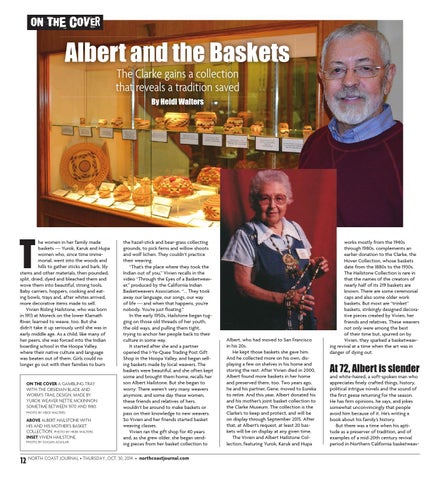
ON THE COVER A GAMBLING TRAY WITH THE OBSIDIAN BLADE AND WORM’S TRAIL DESIGN, MADE BY YUROK WEAVER NETTIE MCKINNON SOMETIME BETWEEN 1970 AND 1980. PHOTO BY HEIDI WALTERS
ABOVE ALBERT HAILSTONE WITH HIS AND HIS MOTHER’S BASKET COLLECTION. PHOTO BY HEIDI WALTERS INSET VIVIEN HAILSTONE. PHOTO BY DUGAN AGUILAR
the hazel-stick and bear-grass collecting grounds, to pick ferns and willow shoots and wolf lichen. They couldn’t practice their weaving. “That’s the place where they took the Indian out of you,” Vivien recalls in the video “Through the Eyes of a Basketweaver,” produced by the California Indian Basketweavers Association. “… They took away our language, our songs, our way of life — and when that happens, you’re nobody. You’re just floating.” In the early 1950s, Hailstone began tugging on those old threads of her youth, the old ways, and pulling them tight, trying to anchor her people back to their culture in some way. It started after she and a partner opened the I-Ye-Quee Trading Post Gift Shop in the Hoopa Valley, and began selling baskets made by local weavers. The baskets were beautiful, and she often kept some and brought them home, recalls her son Albert Hailstone. But she began to worry: There weren’t very many weavers anymore, and some day these women, these friends and relatives of hers, wouldn’t be around to make baskets or pass on their knowledge to new weavers. So Vivien and her friends started basket weaving classes. Vivien ran the gift shop for 40 years and, as she grew older, she began sending pieces from her basket collection to
12 NORTH COAST JOURNAL • THURSDAY, OCT. 30, 2014 • northcoastjournal.com
Albert, who had moved to San Francisco in his 20s. He kept those baskets she gave him. And he collected more on his own, displaying a few on shelves in his home and storing the rest. After Vivien died in 2000, Albert found more baskets in her home and preserved them, too. Two years ago, he and his partner, Gene, moved to Eureka to retire. And this year, Albert donated his and his mother’s joint basket collection to the Clarke Museum. The collection is the Clarke’s to keep and protect, and will be on display through September 2015. After that, at Albert’s request, at least 20 baskets will be on display at any given time. The Vivien and Albert Hailstone Collection, featuring Yurok, Karuk and Hupa
works mostly from the 1940s through 1980s, complements an earlier donation to the Clarke, the Hover Collection, whose baskets date from the 1880s to the 1930s. The Hailstone Collection is rare in that the names of the creators of nearly half of its 219 baskets are known. There are some ceremonial caps and also some older work baskets. But most are “trinket” baskets, strikingly designed decorative pieces created by Vivien, her friends and relatives. These weavers not only were among the best of their time but, spurred on by Vivien, they sparked a basketweaving revival at a time when the art was in danger of dying out.
At 72, Albert is slender and white-haired, a soft-spoken man who appreciates finely crafted things, history, political intrigue novels and the sound of the first geese returning for the season. He has firm opinions, he says, and jokes somewhat unconvincingly that people avoid him because of it. He’s writing a book about his family’s history. But there was a time when his aptitude as a preserver of tradition, and of examples of a mid-20th century revival period in Northern California basketweav-