Heritage Living
July — October 2025 Inside National Trust turns 70 Port Pirie museum reopens New hat collection
Exploring remarkable Engelbrecht Cave



03 CHALLENGING TIMES
Noted historian Susan Marsden explores the challenges behind the formation of the National Trust of South Australia, as we approach our 70th anniversary.
06
MARITIME ADVENTURES
The discovery of a shipwreck at Robe creates exciting opportunities for National Trust volunteers.
08
HIDDEN WORLD
Hydrogeologist and pioneering cave diver Ian Lewis takes us into Engelbrecht Cave, a fascinating State Heritage-listed geological site in the heart of Mount Gambier.
10
WHERE DID SHE GET THAT HAT?
Laura Evans introduces an extraordinary collection of hats donated to the National Trust by esteemed milliner Gwenda Baker.
14
LAST RIDE IN STYLE
Horse-drawn vehicle collection
Honorary Curator Peter Foster reveals the surprising history of hearses.
16
HILDA’S GIFT
Natural Heritage Manager Alex Emmins visits Roachdale Reserve - the first property acquired by the National Trust of South Australia.
18 CELEBRATING AGRICULTURAL SHOWS
Heritage Living Editor Liz Harfull sheds light on the history of agricultural shows as we approach another season.
22 PORT PIRIE MUSEUM
The revitalised National Trust museum at Port Pirie reopens after major conservation efforts and months of hard work by volunteers.
25 WHAT’S ON
Rug up and head out for a diverse winter program of special events and activities.

From the President
MILLIE NICHOLLS
In 2025, the National Trust of South Australia marks its 70th anniversary—a time to reflect on our remarkable history and look ahead with optimism.
As explored in Susan Marsden’s Challenging Times, the Trust began with a determined group of citizens who recognised the importance of protecting South Australia’s unique heritage. Over seven decades, we’ve grown into a respected organisation, safeguarding not just historic buildings and landscapes, but the stories and values that define us.
While this anniversary is a moment to honour our past, it’s also an opportunity to plan for the future. We’re proud to announce the launch of our new Strategic Plan, which outlines a clear path forward. Available on our website, the plan focuses on ensuring financial sustainability while fostering resilience, empowering communities, championing heritage protection, preserving significant sites and ensuring compliance within our organisation.
This is a time of both celebration and transition. Our Chief Executive Officer, Simon Ambrose, has announced his resignation and will be relocating to Western Australia to be with his family. We thank Simon for his dedicated leadership and wish him every success in this next chapter.
As we move into our eighth decade, we remain committed to our mission — protecting South Australia’s heritage and inspiring future generations to value and care for it. With the support of our members, volunteers and communities, we are building a legacy that will stand the test of time.
Together, we honour the past and shape a future where heritage continues to enrich our lives.
The National Trust of South Australia is a communitybased organisation established in 1955 to preserve, protect and promote the State's built, natural and cultural heritage. Our magazine is published three times a year.
PUBLISHER
National Trust of South Australia Ayers House 288 North Terrace Adelaide SA 5000 08 8202 9200 publications@nationaltrustsa.org.au www.nationaltrust.org.au/sa
EDITOR
Liz Harfull www.lizharfull.com
DESIGNER
Rosie Everett Brand Warrior www.brandwarrior.com.au
ON THE COVER
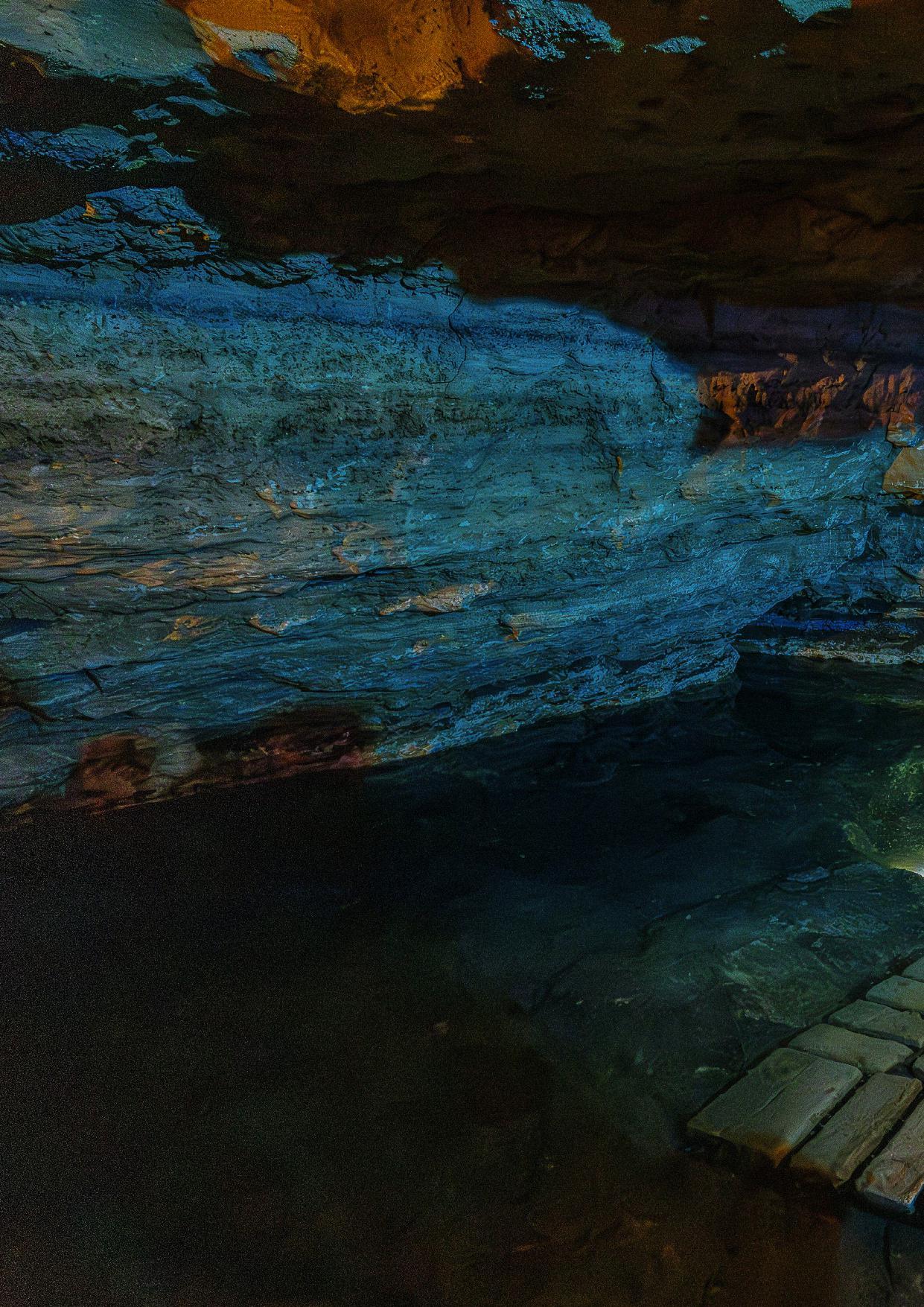
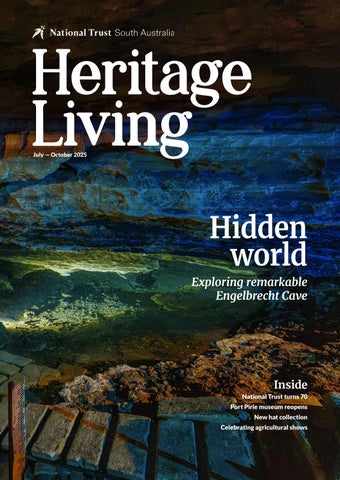
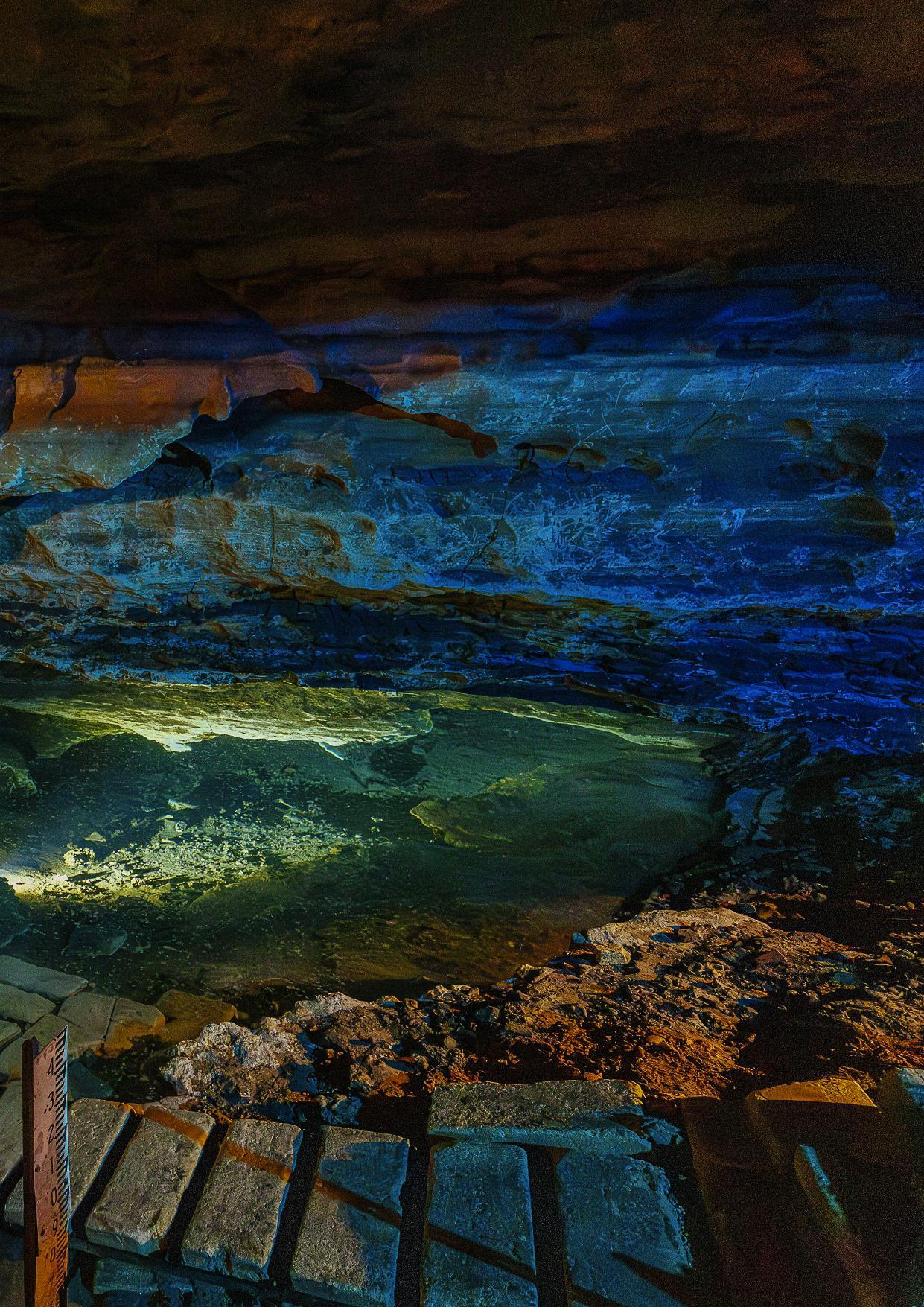
Engelbrecht Cave in Mount Gambier, 2023 (photo supplied by imageBROKER.com/Alamy Stock Photo).
The National Trust acknowledges the Traditional Owners and ongoing occupants of the lands and waters in South Australia. We respect their spiritual beliefs, culture and heritage, and pay deep respect to Elders past and present.
ISSN 0815-7871 PP536155/0036
Challenging times: Founding the National Trust of South Australia
BY DR SUSAN MARSDEN AM
In celebration of the National Trust of South Australia turning 70 this year, highly regarded historian and author Dr Susan Marsden explores the challenges that impelled its formation and those that have emerged in more recent times, drawing on her experience co-writing a book about our history to mark a previous major milestone.
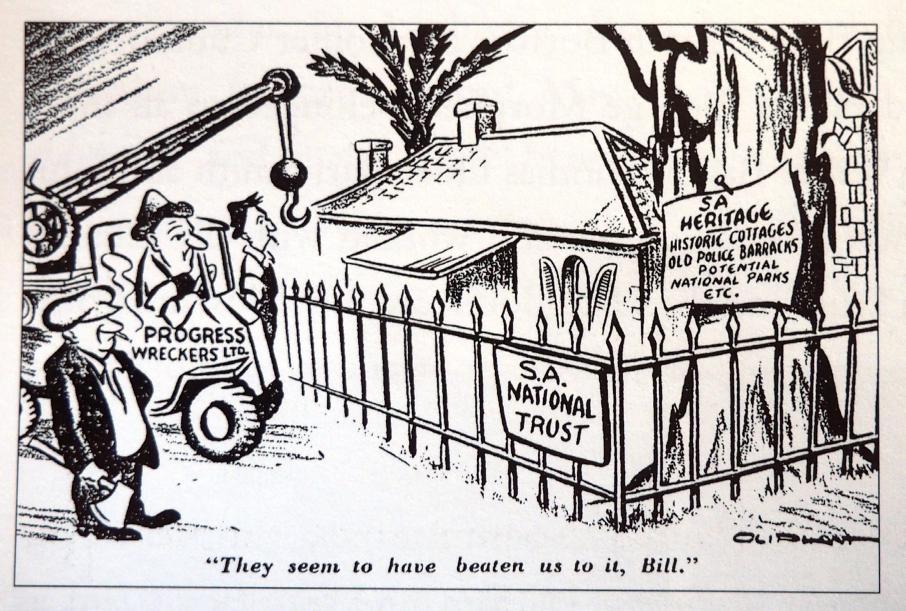
Cartoon by Pat Oliphant commenting on the bill to establish a National Trust (The Advertiser, 3 November 1955).
Challenging Times was the title of the National Trust’s 50th anniversary book launched at Beaumont House on 8 December 2005. Then president Anita Aspinall remarked on that occasion: ‘We face, in a different way, the challenging times that the founders of the organisation faced in the 1950s’. There was, as now, public concern at the destruction wrought on nature and historic places by new and large-scale commercial and housing development and other construction, land clearance and mechanisation. Advocacy and altruism were crucial to creating and building the National Trust.
Incorporation by an Act of Parliament on 8 December 1955 was the culmination of years of effort to protect dwindling natural and cultural heritage in South Australia, and to form a National Trust modelled on that established in England in 1895. Australia’s first was formed in New South Wales in 1945. Following this, in South Australia there were actually two iterations – the National Trust for South Australia (1951) and a separate, successful National Trust of South Australia for the Preservation of Places of Historic Interest or Natural Beauty (1955), which absorbed the first organisation.
After years of lobbying, the reluctant but crucial support of a pro-development premier (Sir Thomas Playford) was gained for the proposed legislation. Further government support was provided in 1957 when the Commonwealth allowed donations to be tax deductible, and legislation in South Australia freed the National Trust from most state taxation. From the 1980s government funding was also provided for national and state heritage surveys through the National Estate program, and restoration of many National Trust properties. All the same, the organisation drew mainly for support on member subscriptions and bequests; donations of old buildings, museum objects and land for reserves; and the dedicated efforts of volunteers and a few paid staff.
MILESTONES
The new National Trust had to acquire members, find money, identify the heritage it hoped to save and locate a headquarters. One hundred foundation members attended the first meeting on 7 March 1956. New members and event sponsors were recruited through Adelaide Establishment networks, including family connections and the professions. Among the founding members were several members of parliament; members of the Bonython, Angas, Hayward, Morphett, Simpson and Holden families; prominent research figures such as Sir Douglas Mawson and Norman Tindale; and writers, architects and artists. They included botanical illustrator and philanthropist Alison Ashby, who was elected to the first council and in 1956 donated property for a reserve at Eden Hills (Watiparinga).
There was also rapid growth in the country. The first branch in a regional area was formed at Renmark in 1956, which was also first to open a museum (1959). Challenging Times lists 61 branches with their founding dates and first chairs. This is by far the greatest number of National Trust branches (and local
museums) in Australia. Their collections were crucial both in their own regions and as part of Australia’s ‘distributed national collection’.
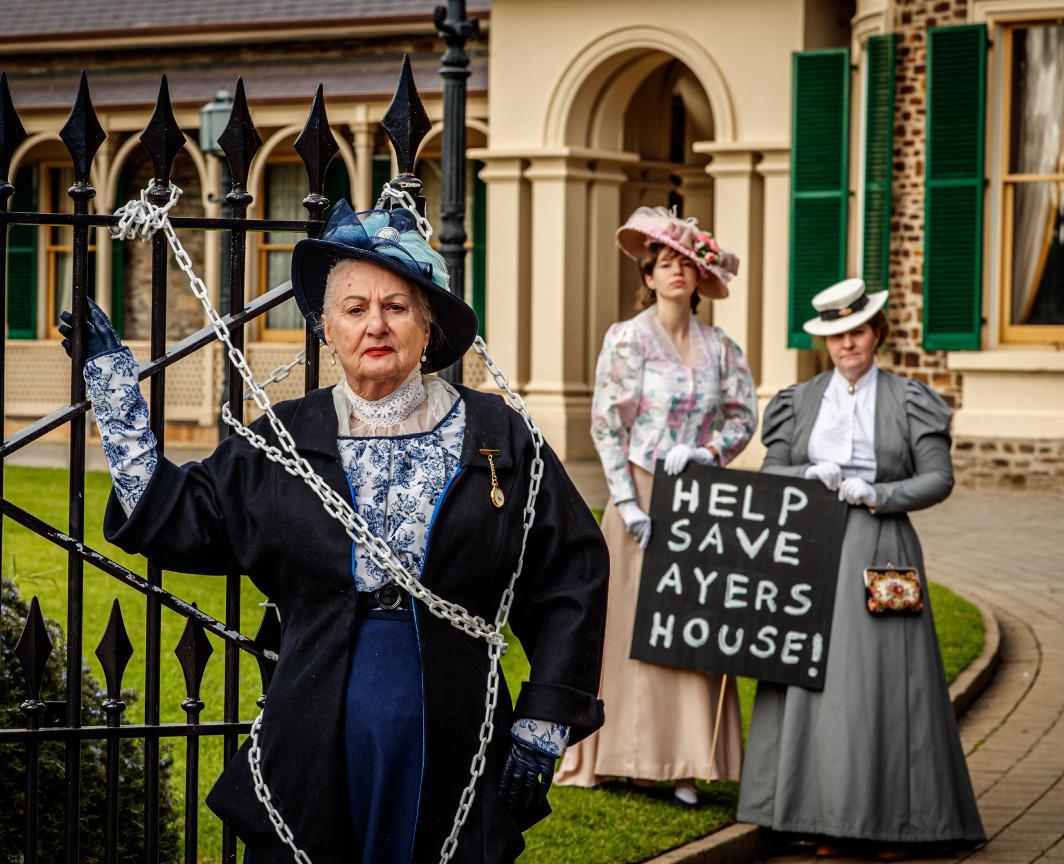
The National Trust of South Australia acquired the largest portfolio of properties in Australia, emulating its British counterpart in concentrating on acquiring land and other properties until the 1980s when property management became a major challenge. In 1961 the National Trust embarked on its most famous activity — compiling a highly influential register of historic buildings. This work continued until 1990, with many of the places listed included in formal government national and state heritage registers. Unrelenting advocacy brought some impressive wins, such as saving Adelaide’s East End Markets and the Tram Barn at the Botanic Gardens. Delegations to Premier Playford to save the government-owned Austral House (Ayers House) bore fruit, and the National Trust’s head office was moved to the property’s Coach House in 1964. This long association with Ayers House underpinned a vehement campaign that returned the National Trust to the building in 2025.
CHALLENGES OF THE 21ST CENTURY
In the years after 2005, the National Trust had to address financial viability. Government grants to help maintain historic state-owned properties ceased, although the History Trust of South Australia still provided museum and related grants. Donations and bequests continued to add to the National Trust’s portfolio. Popular interest was also demonstrated with new branches being formed in places such as Burnside and Port of Adelaide.
Staff and supporters devoted thousands of hours to running museums, historical sites and nature reserves; conducting campaigns and events; and mending, weeding, writing and recording an astonishing range of natural and cultural heritage, including a register of significant trees. In 2009/10 alone, volunteers contributed more than 116,600 hours with an inkind value of $2.56 million for heritage conservation. This was also a challenging time administratively as staff came and went, and their workplace shifted to several different headquarters.
Growing use of internet and mobile technologies reshaped how heritage was documented and shared. These new technologies helped link the past with the present, but many branches did not have the resources to obtain or use them. The ageing of National Trust members and volunteers and continuing poor levels of support at all levels of government are today’s challenges – at a time when reliable history-making and presentation is crucial to our modern societies.
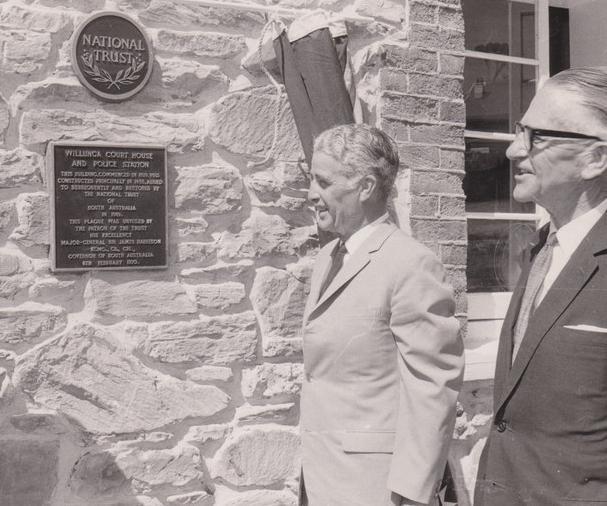
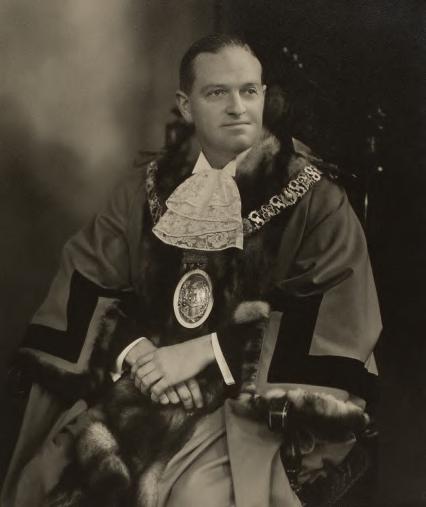
CLOCKWISE FROM TOP: Part of the protest campaign that saw Ayers House returned to the National Trust by the Malinauskas Government, July 2021 (photo by Matt Turner, Newspix); first state president Arthur Rymill, 1950 (courtesy Adelaide City Council Archives); Governor General Sir James Harrison unveils a plaque at the opening of the restored Willunga courthouse and police station with then state president Dean Berry looking on, 1970 (courtesy Willunga Branch).
The hidden world beneath Mount Gambier
BY IAN LEWIS
Hydrogeologist and pioneering cave diver Ian Lewis takes us into Engelbrecht Cave – a remarkable State Heritage-listed geological site, which he first explored in the 1960s as a teenager.
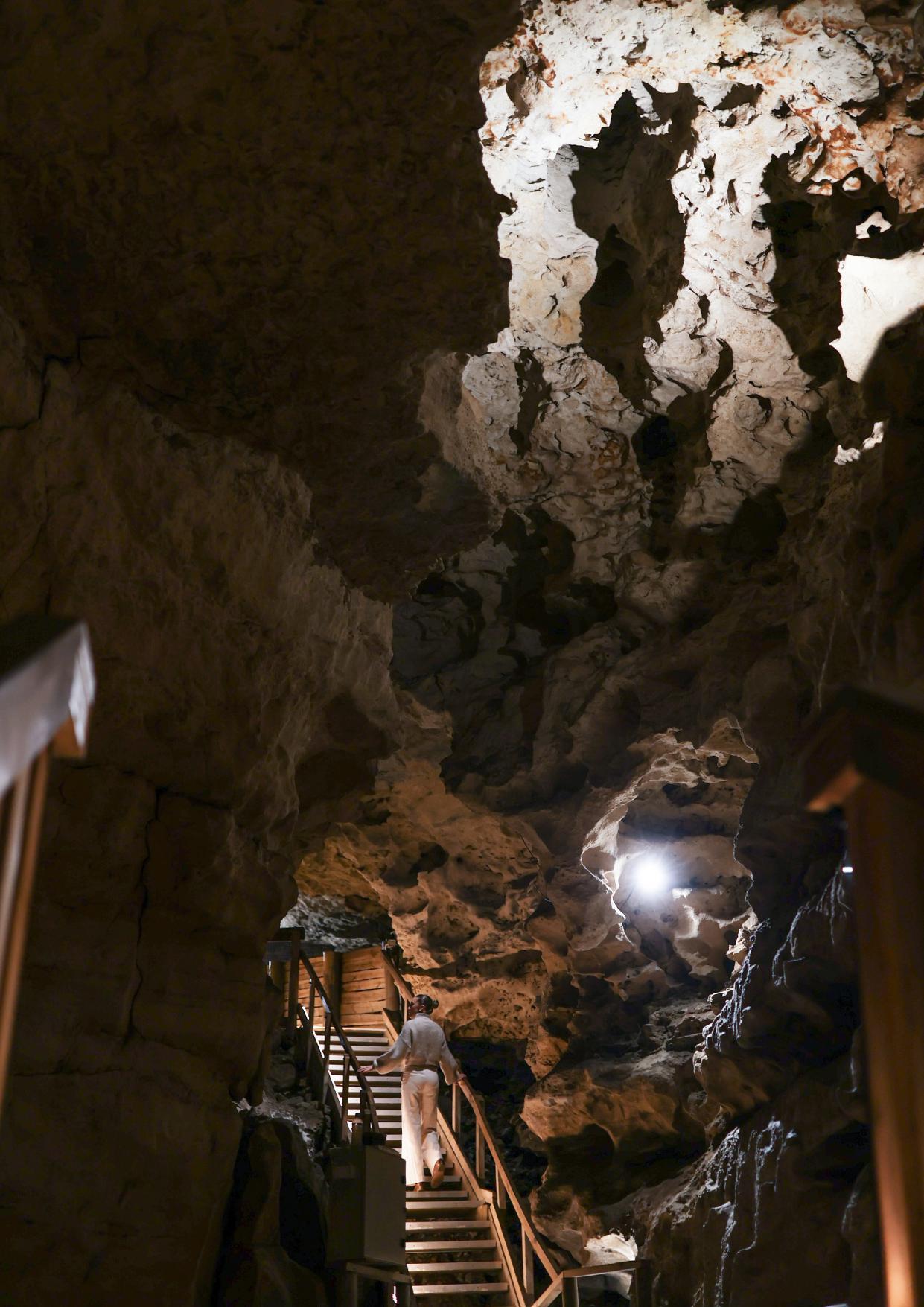
Both a ‘show’ cave and a significant cave-diving site, Engelbrecht Cave is located off Jubilee Highway West in the centre of Mount Gambier, where a sinkhole and two main passageways lead to large chambers and a beautiful underground lake of crystal-clear water. On the traditional lands of the Boandik people, it is one of three large sinkholes in the city. All State Heritage listed, they lie in the Tartwaup Fault zone, which generated them and associated caves in the nearby Tantanoola district up to half a million years ago. This came after the aptly-named Limestone Coast had emerged from the sea floor, creating a large collection of caves and outstanding water-filled sinkholes that are rare on a world scale.
There are no known First Nations songlines or stories directly referring to Mount Gambier’s sinkholes, but Boandik people would likely have shown them to early explorers such as the Henty brothers from Western Victoria in 1839 and the expedition led by Governor Grey from Adelaide in 1844. Englebrecht Cave has had a chequered history since then.
Catholic priest and noted geologist Father Julian Tenison Woods visited the site before writing Geological Observations in South Australia, published in 1862. Referring to it as Vansittart’s Cave, he describes descending a long, sloping precipitous path covered over with ferns and eventually reaching the lake and water ‘so wonderfully clear that its interposition between the observer and the floor is not for a long time perceptible’.
A newspaper article published in 1933 recounts the memories of Charles Grosser, who entered the cave in about 1864 accompanied by his brother Albert and two men. They made use of a canoe built of hardwood and sealed with pitch to undertake a hazardous exploration of the cave’s subterranean waterways: ‘I was only nine or ten years of age at the time, but I can clearly remember how the current caught the canoe and carried us along as soon as we got into the stream. We must have gone 200 yards, travelling directly towards the Blue Lake. The stream took several turns, and the current was so strong we had great difficulty in getting back.’
We now know this was not possible as there are no flowing streams under the limestone in this region – the groundwater takes centuries to seep through the rock to become freshwater springs at the coast. The curved scallop features on Englebrecht Cave’s relatively soft limestone walls show clearly that very slow-moving underground water existed millennia ago. However, the ageing Charles was right about one thing! The eastern chamber heads directly towards the Blue Lake and the
underground lake in the Cave Gardens Sinkhole (about two kilometres away). Recently, cave divers discovered another half-a-kilometre of underwater passages heading from Englebrecht’s Cave in the same direction. Very exciting!
During a prolonged period of exceedingly high rainfall from the 1880s to the 1920s, when lake levels in the sinkholes were also high, locals dug well shafts alongside the entrances, directly over the lakes to draw water by windlass. These wells can still be seen today, all now above dry rock. Why is this significant? Sinkhole lake water levels have been receding as rainfall has been continuously declining in the century since; the dry wells are a record of this.
POLLUTION AND RESTORATION
I first visited Englebrecht’s Cave as a teenager in 1966. The entrance was full of wire and rusting rubbish — we had to clamber through all the wire and crawl down the eastern passage through broken glass and horse bones, squeezing against the roof all the way to the lake. The western chamber was so buried in rubbish that no-one even knew it was there at that time.
For a century or more, sinkholes and cave entrances across the region were seen as handy dumping sites. Engelbrecht Cave is named after an early German settler, Carl Engelbrecht, who acquired the land in 1885 and used the cave entrance to dispose of waste from his nearby distillery. The beginning of systematic cave exploration and cave diving in the 1960s revealed the extent of this ongoing practice and aided environmentalists in developing laws preventing such dumping to protect the groundwater supply upon which everyone depends. The Environmental Protection Agency was set up as a result of these realisations.
In Mount Gambier, the Lions Club cleaned out Engelbrecht Cave, forest department employees rehabilitated Umpherston’s Sinkhole on the other side of the city and the council beautified the Cave Gardens. The sinkholes’ role as unique tourist attractions sprang from these welcome efforts. Today more people appreciate the uniqueness of our Limestone Coast region on a global scale, and we can be proud to protect and share its many stories.
Plan a visit
Tours of Engelbrecht Cave are available daily. For more information and to book go to visitmountgambier. com.au/travel-type/caves/
LEFT: Exploring Engelbrecht Cave (courtesy City of Mount Gambier).
Diving deep into maritime history
BY LIZ HARFULL AND VALERIE MONAGHAN
The discovery of a shipwreck associated with Chinese gold-diggers landing at Robe in the 1850s has generated international media attention and excitement in the maritime heritage community. Closer to home, the project has created invaluable opportunities for National Trust volunteers and the local museum collection, writes Heritage Living editor Liz Harfull and Valerie Monaghan from the Robe Branch.
It began with an email exchange in January 2022. Dr James Hunter, now Manager of Maritime Archaeology at the Australian National Maritime Museum (ANMM) in Sydney, contacted the Robe Branch of the National Trust asking for assistance to tap into local knowledge about a shipwreck in Guichen Bay.
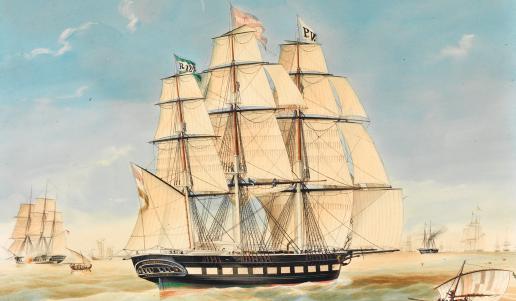
The museum had just been awarded a Shared Cultural Heritage Grant by the Embassy of the Kingdom of the Netherlands to locate the Koning Willem de Tweede, an 800-ton Dutch merchant sailing ship that was wrecked in June 1857. Only days before, more than 400 Chinese miners destined for the Victorian goldfields had been safely discharged from the vessel. However, at least 15 of the ship’s crew drowned during a severe southeasterly gale – the greatest recorded loss of life from any single shipwreck within the bay.
Dr Hunter explained that the project was being carried out in partnership with the Cultural Heritage Agency of the Netherlands and the Silentworld Foundation, whose maritime archaeological conservator Heather Berry was co-leader. The primary aim was to survey Guichen Bay and find the wreck site. However, funding had also been provided to document artefacts and objects held within the Robe community that might have originated from the ship, such as a cannon displayed at the Royal Circus opposite the National Trust’s Customs House Museum, and cabin doors fitted on guest rooms on the top floor of the Caledonian Inn.
Branch members and volunteers were excited to be part of this project and were soon digging through local archives to gather existing material about the wreck, as well as helping with new research to identify more information relating to the ship, its crew, the wreck and its aftermath. Dr Hunter and Ms Berry greeted each find with enthusiasm, encouraging the volunteers in their efforts.
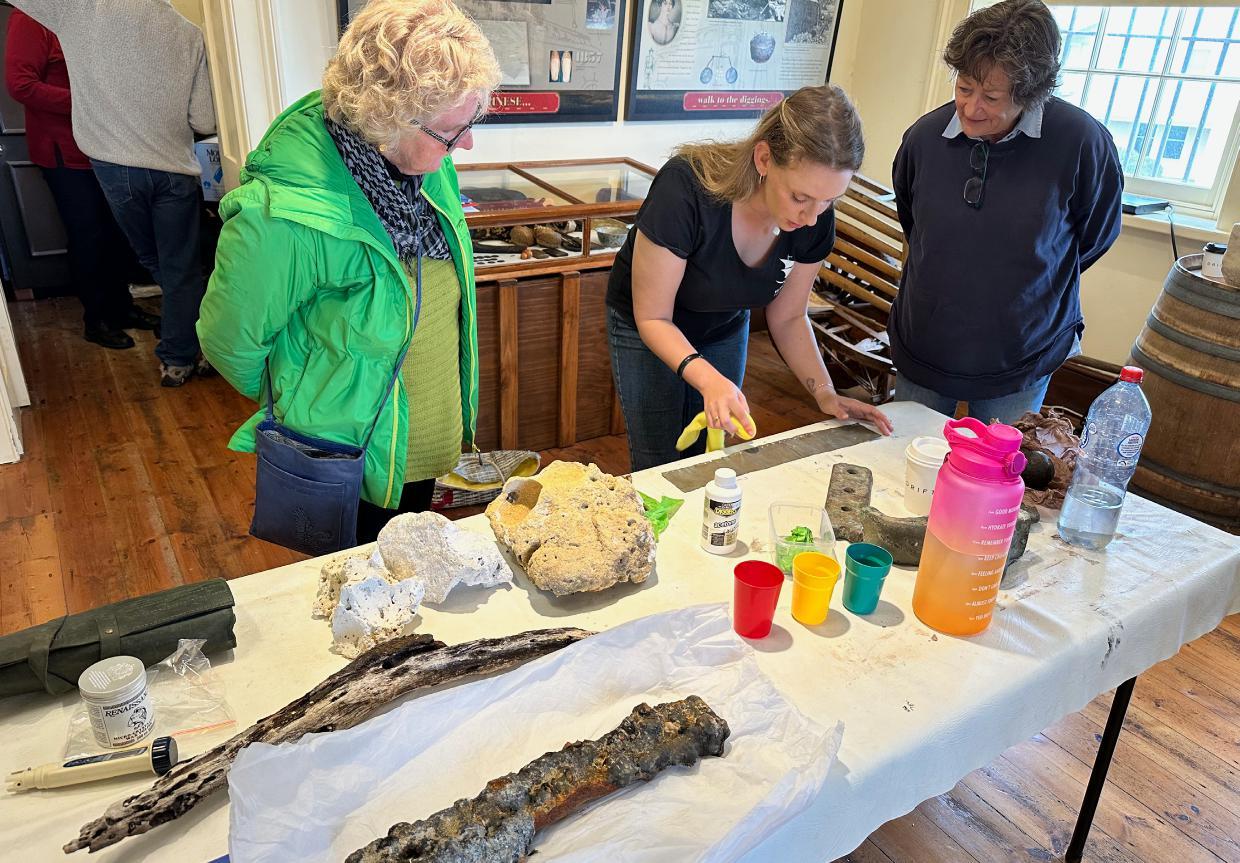
As the project unfolded over the next three years, the team’s passion for shipwreck artefacts proved contagious. Dr Hunter willingly shared his knowledge of maritime history, helping to build understanding of the collection held at Robe. During a series of visits, he and Ms Berry presented information sessions that captured the community’s imagination and Ms Berry led workshops on preserving maritime artefacts. In April 2024, the team even released a 64-page booklet providing practical advice on caring for maritime archaeological finds at Robe. The launch was celebrated at an event in the Robe Institute attended by the Dutch Embassy’s senior policy officer of cultural affairs, Dr Xenia Hanusiak, who travelled from Canberra. She was delighted when the branch added another cultural layer to the experience by catering using Dutch recipes.
The team made their last visit to Robe in March 2025, when they were joined by Mark Polzer, who is Senior Maritime Heritage Officer with South Australia’s Department for Environment and Water, and maritime archaeology students from Flinders University. The visit provided the opportunity to examine a box of artefacts from the Duilius shipwreck (1853), donated to the branch a few months before. Each item was carefully measured, photographed and described in detail. This information has since been added to the branch catalogue. Based on their combined knowledge of maritime history, archaeology and conservation, Dr Hunter and Ms Berry were also able to provide insights into other ship-related artefacts held in the collection.
All these experiences have added phenomenally to the knowledge held within the branch, and opened the door to further training and funding opportunities. In November 2024, Valerie Monaghan attended a special five-day Museum Administrators’ Course in Sydney after successfully applying for one of just ten places. Run through the Maritime Museums of Australia Project Support Scheme, the course was funded by the Australian Government and the ANMM. Experts led sessions on topics such as designing education programs, preserving collections and creating engaging displays. Another valuable aspect of the course was building networks with ANMM managers and participants from other states.
In May, the team was finally able to announce the wreck site of the Koning Willem de Tweede had been located after poor weather and diving conditions had disrupted attempts over several years. Using a combination of marine magnetometer and underwater metal detectors, what is believed to be iron components of the ship’s windlass were found partially protruding from the seabed. Anomalies were also detected that indicate the presence of other large iron artefacts and hull components buried at the site.
The discovery generated widespread interest around the world, with stories published and broadcast by leading international news organisations and specialist publications such as the Smithsonian Magazine. Robe Branch members and volunteers shared the excitement, and the new chapter it adds to the town’s long maritime history. Importantly, the project has also left a lasting legacy of newfound knowledge and conservation skills within the community.
ABOVE:
More information
To read more about the shipwreck discovery visit sea.museum/en/media/2025/5/shipwreck-site-of19th-century-dutch-merchant-vessel-found. More information about the project is also available at silentworldfoundation.org.au/projects/koning-willem/. To download a copy of the conservation booklet visit silentworldfoundation.org.au/wp-content/uploads/2025/05/robe_conservation-booklet_final.pdf
OPPOSITE: Heather Berry conducting a workshop on conserving maritime artefacts at the Customs House Museum, April 2024 (photo by James Hunter/ Australian National Maritime Museum).
Painting of the Koning Willem de Tweede by Jacob Spin, 1842 (courtesy Rotterdam Maritime Museum).
Where did she get that hat?
BY LAURA EVANS
An extraordinary collection of hats has been donated to the National Trust by celebrated Adelaide milliner Gwenda Baker. Regional Operations Manager Laura Evans explores this stylish acquisition and the life of its maker.
The National Trust of South Australia's costume collection is one of the largest and most significant in Australia. Preserving garments and accessories dating from as early as 1752, it serves as a vital repository of our sartorial history and reflects the evolving cultural and social fabric of the State.
Among recent acquisitions is an extensive collection of hats, antique millinery materials and accessories generously gifted by esteemed milliner Gwenda Baker. Dating from the mid 1800s to the early 2000s, the collection includes hats worn by earlier generations of her family and some made by millinery students, however the vast majority are Baker’s own creations.
Offering a unique lens into the artistry and craftsmanship of millinery in the 20th century, the collection not only enriches the National Trust's holdings but also provides invaluable insights into fashion trends and societal norms. Gwenda Baker's contribution is also particularly noteworthy because of her prominent role in Australia's millinery landscape. Her expertise and knowledge shaped the millinery craft for more than 50 years.
Baker left school at the age of fourteen to join the war effort in the final years of the Second World War. The Manpower Office allocated her to G. & R. Wills where she made gloves for servicemen. Her commencement salary was around £1 per week (about $2 in decimal currency). After the war, she began an apprenticeship at the Gawler Place warehouse of wholesale milliners and importers J.W. Richmond and Co Ltd, where Baker worked for twelve years, travelling extensively to visit milliners across Europe. In an era when ladies did not leave home without donning a hat and gloves, she was then invited to take charge of the model workroom at Miller Andersons department store, which made exclusive creations for some of the State’s best dressed women.
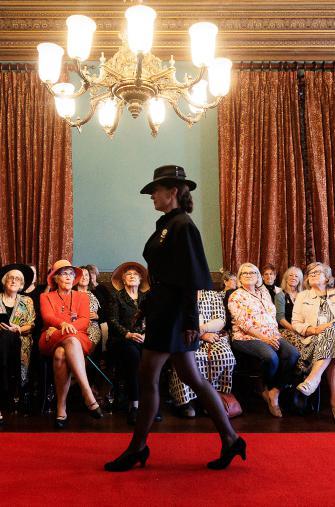
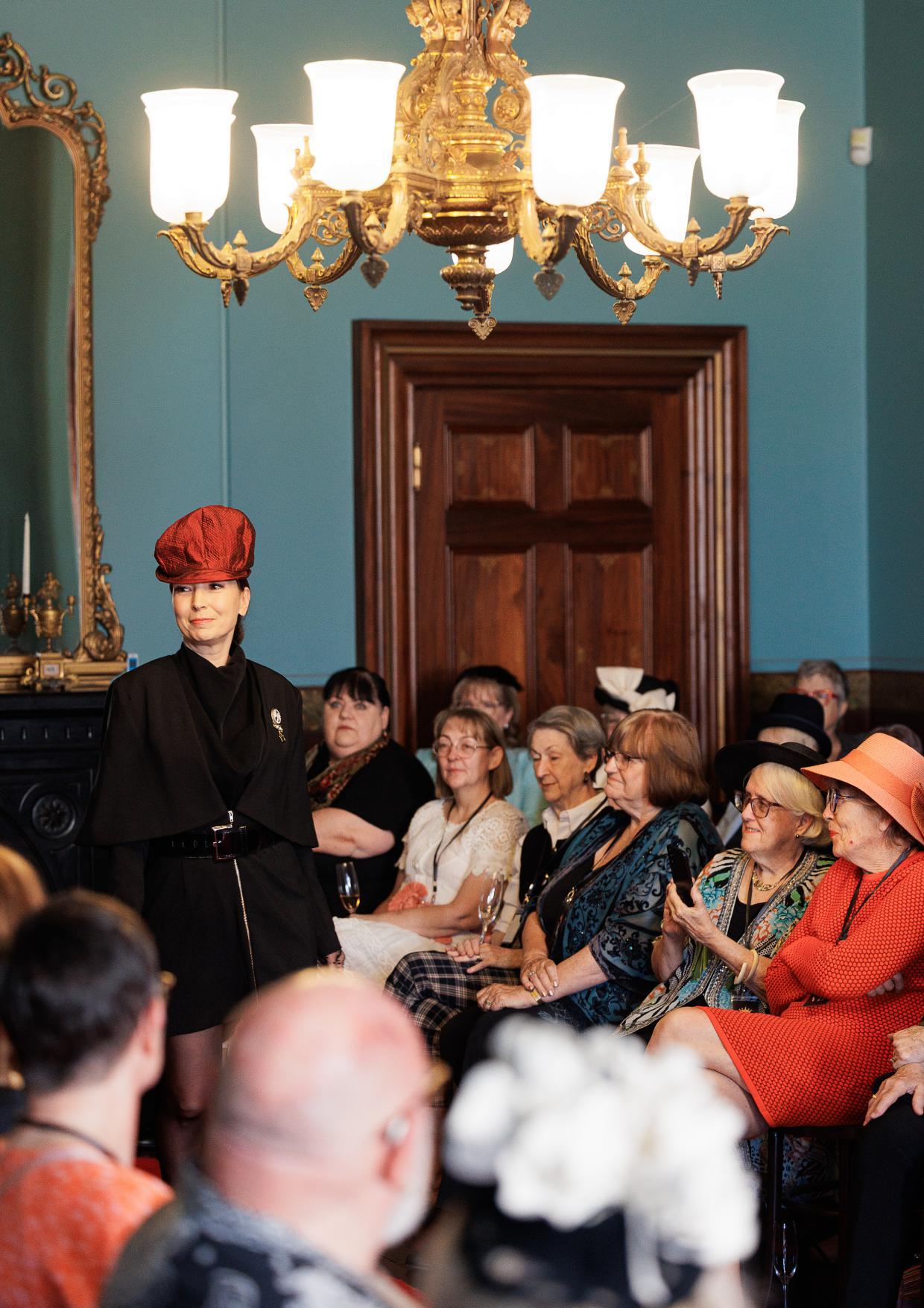
OPPOSITE: An appreciative audience at the Ayers House event, taking in a 1960s shot silk, machine-stitched hat with six-section crown and small peak (image by James Field Photography).
Baker’s dedication and influence extended beyond creation. She imparted her knowledge to students as a lecturer for 30 years at the South Australian Institute of Technology, which transitioned through several changes to become part of TAFE. Several of her millinery students went on to become lecturers and acclaimed milliners themselves. Baker also taught people how to make hats and French flowers as recreational subjects. And she lent her discerning eye as a judge of the Royal Adelaide Show’s millinery and French flower exhibits, retiring at the age of 80 after 50 years of service. In testament to her enduring impact on the field, she was inducted into the Millinery Association of Australia Hall of Fame in 2009.
The significance of Baker's donation to the National Trust was celebrated at a special sold-out event held at Ayers House during South Australia’s History Festival in May. Where Did She Get That Hat? – A Fashion Parade of Hats showcased an exquisite selection from her
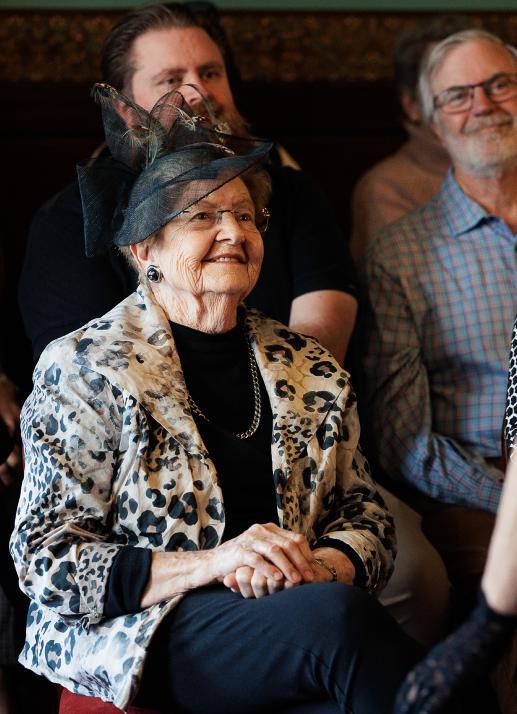
FROM LEFT: Gwenda Baker at the Ayers House event, wearing a hat she made in 2009 from sinamay and osprey feathers; a model-styled flat fur felt hood with feather spine trim; and a hat from the 1970s covered with blue organza bias strips placed individually and sewn to look like pleating, with bow trim. Images by James Field Photography.

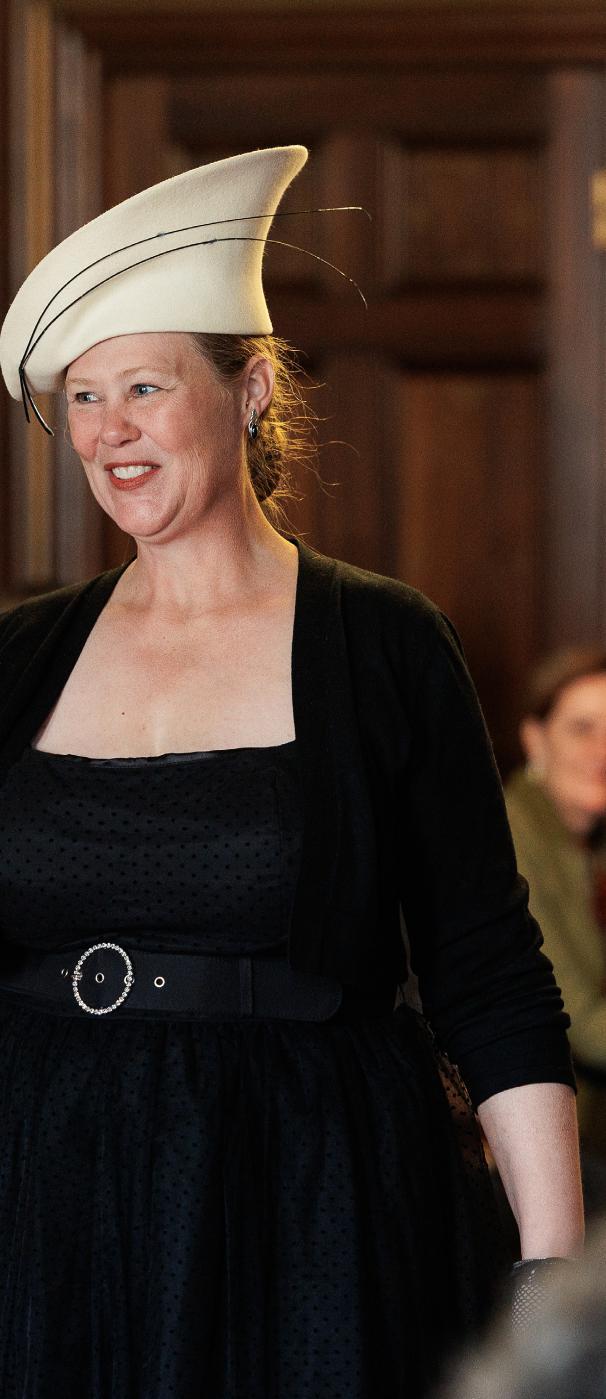
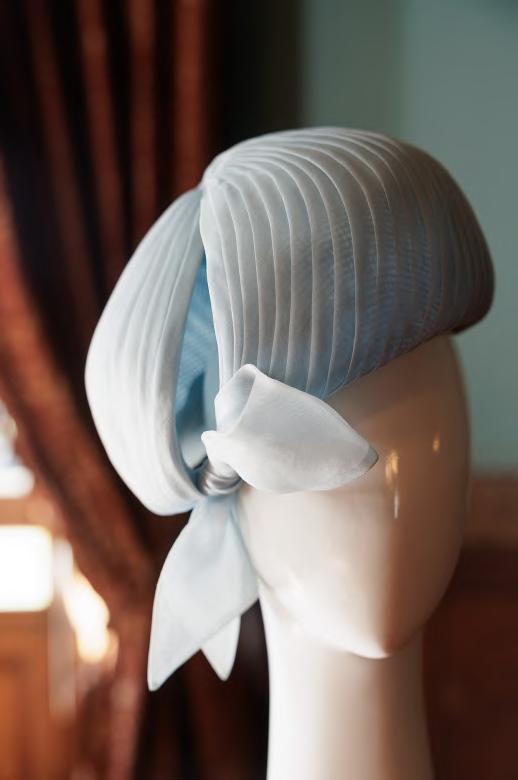
collection, offering attendees a captivating journey through the evolution of millinery styles and techniques over nearly a century. The event not only highlighted the aesthetic beauty of the pieces but also underscored the cultural narratives embedded within them, illustrating how fashion serves as a reflection of societal changes.
By embracing Baker's collection, the National Trust of South Australia reinforces its commitment to preserving the State's rich cultural heritage. Such donations are pivotal in ensuring that future generations have access to tangible links to the past, fostering an appreciation for the artistry and history that define South Australia's identity. Through exhibitions and educational programs, the National Trust continues to bring these stories to life, honouring the legacy of contributors like Gwenda Baker and inspiring ongoing engagement with our diverse heritage.
The last ride in style
BY PETER FOSTER OAM
Wrapping up his series on commercial horse-drawn vehicles in the National Trust collection, honorary curator Peter Foster focuses, fittingly, on vehicles designed for life’s last ride — the hearse!
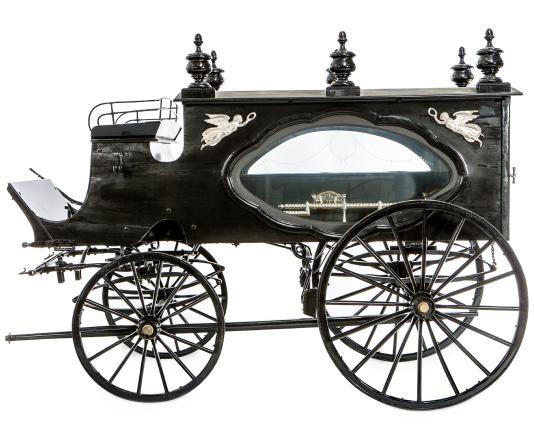
The hearse emerged as a distinctive type of vehicle in the 17th century — a rather basic two or four-wheeled vehicle with open sides designed to carry a casket to its place of burial. It evolved into well-sprung fourwheeled configurations, with glass panels on the sides and rear-door access for the casket. Driven from a front seat, they were mostly pulled by two black horses. If not black, they were adorned in black rugs with black plumes attached to the harness, presenting a visual spectacle despite its sombre purpose.
The earliest records of hearses in Australia depict them as little more than drays, as in S.T. Gill’s lithograph Bush Funeral (1864), and Frederick McCubbin’s painting A
Bush Burial (1890), where the deceased has been carried to a lonely grave in a springless dray. However, specially constructed hearses made their appearance in Sydney following the establishment of larger burial grounds in that city. This meant funeral processions often covered greater distances, necessitating a more sustainable transport unit.
By the 1850s, hearses were available in a range of highly ornamented styles, brought about by the increased social importance of funerals in the Victorian era. The over-wrought fussy finery reflected the gloomy pomp. For the coachbuilder, the hearse was a conduit to exhibit his skill. Very few vehicles gave him better opportunity
for lavish carving and commanding ornamentation, providing the undertaker operated in a wealthy community able to afford such displays of dignified opulence.
Often the funeral cortege for notable citizens and dignitaries was accompanied by a number of attendant vehicles. Although not a specific design, mourning coaches for family and friends were kept in the coach-house. Various vehicles assumed the role, such as broughams, landaus or hooded wagonettes, all painted black.
One of the earliest examples of a developing funeral industry appears in an early advertisement published in The Sydney Gazette on 25 March 1824: ‘Edward Hunt, proprietor of the New State and Travelling Hearse, respectfully informs the Public, that he will perform Funerals in a superior Manner’.
Funerals were not always so well ordered. In The Funerals of Malachi Mooney published in 1900, Australian short story writer Edward Dyson describes the unfortunate scene that unfolds as Mooney’s cortege makes its way to a cemetery in Ballarat after a wake that lasted all night, lubricated by kegs of whisky. Leading the procession was a butcher’s wagon converted into a hearse, driven by Michael Morrisey, with the only black horse in the district between the shafts — an old trotter called The Imp.
The funeral moved at eleven, when it was quite certain that only one baby keg remained. This keg Morrissey took with him on the improvised hearse, as a wise provision for the first half of the journey, which lay through a barren land. Many of the mourners had to be helped into their vehicles, and after the start many remained in only by a miracle. Morrissey led the way, The Imp stepping along with a frivolous kind of a four-footed jig that robbed the cortege at the outset of any dignity… A dozen sleeping, unshaven, unshorn agriculturalists brought up the rear, riding two abreast on large, morbid horses that shuffled moodily through the dust with drooped heads and sagging under-lips…. Meanwhile, the day being hot and the way dusty, a couple of short halts had served to drain the keg on the hearse.
While undertaking businesses in the cities provided a comprehensive service, those in small country towns and hamlets operated quite differently. As the most skilled workers in timber available, local coachbuilders and wheelwrights made the coffins, often for walking funerals. As the community expanded they became the town’s funeral provider.
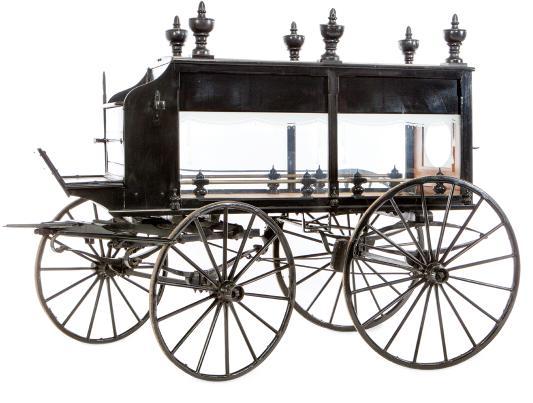
Of the three hearses in the collection, two developed in this manner – one built by the coachbuilder, blacksmiths and wheelwrights H. Mickan of Rhine Valley (now Cambrai) in 1886; the other by the Aldinga coachbuilder John Noah Crisp and his foreman John Nelson in about 1887. The Mickan hearse was used by the Mickan family in the undertaking part of their business until motorised vehicles became more prevalent prior to the Second World War. The third hearse was purchased by Mr J. Templar of Woodside, a builder and contractor, and used by him and his son for funerals in that town. Later taken over by Mr. J. Clarke of the same town, it was built in Mannum, date unknown. Mr Robert Mitchell of Woodside recalls it being used for his brother’s funeral in 1919.
A testimony to the quality craftmanship in the construction and decoration of horse-drawn hearses is the number that were adapted and used on later motorised hearses.
Plan a visit
The collection of horse-drawn vehicles held by the National Trust of South Australia is regarded as Australia’s finest. Featuring some 90 restored and conserved items, it is held at the Millicent Museum.
For more information and opening times visit nationaltrust.org.au/places/millicentmuseum/
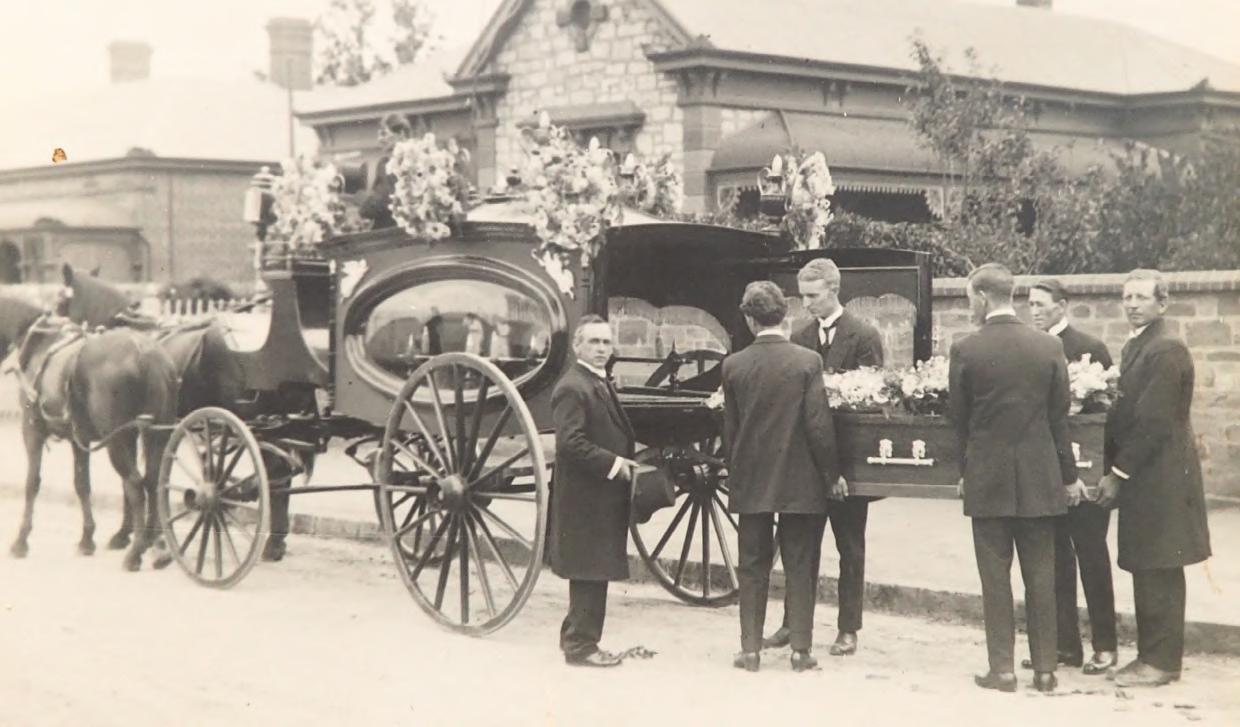
FROM LEFT: A funeral at Croydon with undertakers F.T. Elliott and Sons, 1890 (courtesy Hindmarsh Historical Society); the Clarke hearse and the ornate Mickan hearse (photos by John Nieddu).
Hilda’s gift to nature lovers
BY ALEX EMMINS
With the National Trust of South Australia approaching its 70th anniversary, Natural Heritage Manager Alex Emmins visits the very first property acquired – Roachdale Reserve at Kersbrook in the Adelaide Hills.
At first glance, Roachdale Reserve may seem inconspicuous among the huge swathes of golden wattle (Acacia pycnantha) which grew quickly after the Sampson Flat fires in 2015, but it holds enormous significance. The 46-hectare property was gifted to the National Trust by Miss Hilda Roach in 1955 on condition that the bushland became a flora reserve. It was the very first property given to the organisation, although the formal transfer did not happen until 1957. Part of Roachdale was leased to the Youth Hostels Association, which built a substantial hostel there. Then in 1979, the National Trust developed its first nature trail at the reserve – a 1.7-kilometre loop that remains popular with walkers today.
Situated on Peramangk country, Roachdale is one of the few remaining places in the Mount Lofty Ranges where you can see original woodland typical of the region. Because it responds well to bushfires, golden wattle has colonised many spaces in recent years and appears to have taken over, however the reserve is hugely diverse, both in plant and birdlife. If you take a closer look amongst the undergrowth, leaves, logs and decaying matter, you will find a whole ecosystem where fungi, sundew, moss and lichen thrive. For the budding photographer, this place is a real gem.
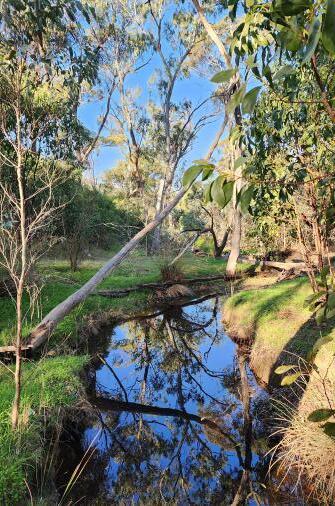
There are distinct plant communities within the reserve, ranging from thick forest to open shrubland and tea tree swampland. In the wintertime a small creek flows through Roachdale into Malcolm Creek, and the deep pools provide a summer source of water for a variety of wildlife. Stop a while
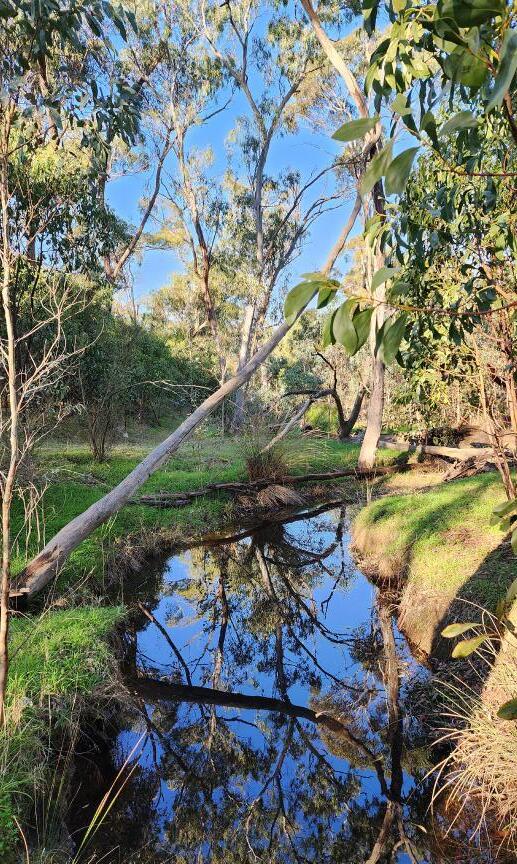
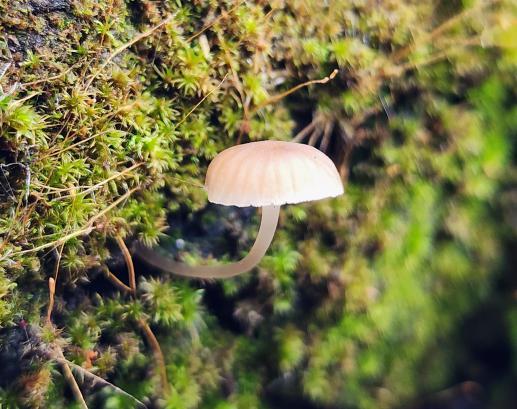
TOP AND ABOVE: Malcolm Creek and a fungi from the mycena genus (photos by Alex Emmins).
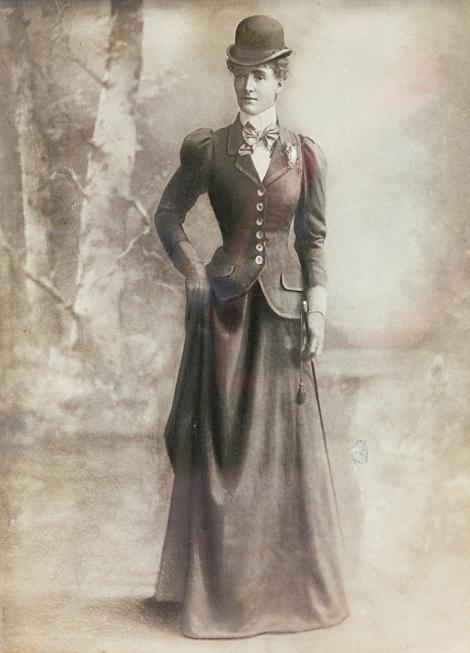
OPPOSITE: Miss Hilda Roach, n.d. (courtesy Tea Tree Gully Museum).
by the creek and soak up the birdsong as the water gently falls over rocks and pebbles. See if you can spot the beautifully constructed white-winged chough nests that have been carefully created in the trees with mud from the creekline.
For the ‘twitchers’ among us, birds are plentiful at Roachdale, including wrens, finches, kingfishers, honeyeaters, robins, thornbills, treecreepers, pardalotes and the cheeky fantails, forever curious about what you’re up to. The reserve contains a wide diversity of plant species too. Since the 1980s, a cumulative total of more than 240 native plant species has been recorded, including 32 of conservation significance. Two species with state ratings as rare and listed are the pink gum (Eucalyptus fasciculosa) and rusty bush pea (Pultenaea hispidula), identified in the last species count in 2021. Many lilies and native orchids such as the veined spider-orchid (Caladenia reticulata) and the endangered pink-lipped spider-orchid (Caladenia behrii) can be found in the spring, putting on a striking display of vibrant colours and patterns for all to enjoy.
Plan a visit
Spring is the best time to enjoy Roachdale Reserve. For more information visit nationaltrust.org.au/ places/roachdale-reserve/
Miss Hilda Roach
An adventurous spirit who lived a life unusual for the times, Hilda Roach was born in 1885 at Burra. The eldest of four girls, she moved to Adelaide as a child with her parents, Jane and John. After her youngest sister died as a baby in 1901, the family travelled extensively overseas, arriving in London in time to watch the coronation procession of King Edward VII. Hilda stayed in England to complete her education at the prestigious Cheltenham Ladies College, where she learnt to ride.
After returning to Adelaide, Hilda trained as a kindergarten teacher and opened her own free kindergarten. In the early 1920s she established a riding school at Collinswood. It expanded quickly, with Hilda keeping more than 10 horses to train both children and adults in the ‘mysteries of trotting, cantering, and acquiring a good seat in the saddle’. Every year during summer, she adjourned to either the hills or the coast for several months with an entourage of students and ponies. Newspaper accounts record the accomplished horsewoman leading small cavalcades of mounted riders out of the city, on their way to places such as Second Valley. Hilda also loved to travel, making six trips overseas by passenger ship. Her first flight in an aeroplane in 1927 inspired a poem – one of more than 200 that she wrote, along with plays for young people and a book about a road trip to the State’s north.
In 1935, Hilda purchased a small holding of almost 46 hectares (113 acres) at Kersbrook, which she named Roachdale. In partnership with Ethel Ogle, she established studs breeding Saanen goats and Tamworth pigs, as well as her beloved horses. Having negotiated lifetime tenancy of the house and grazing land, Hilda managed the property into old age, with Tea Tree Gully Branch members providing occasional manual labour. Hilda died at the Gumeracha Hospital in September 1970 at the age of 84.
Celebrating agricultural shows
BY LIZ HARFULL
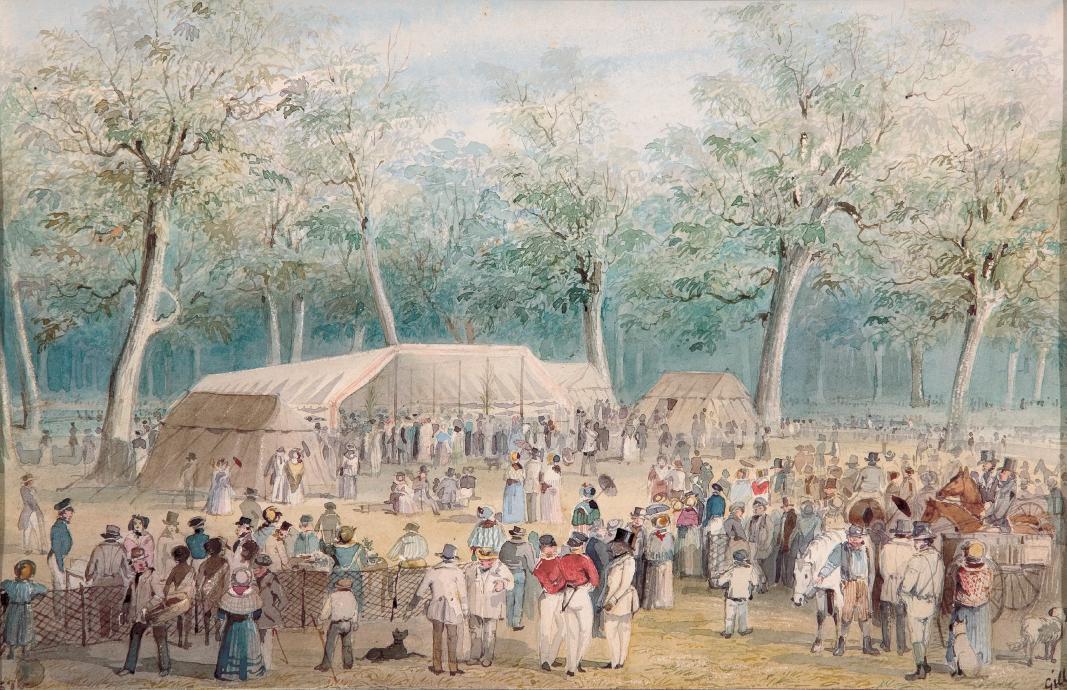
With the spring show season just weeks away, Heritage Living Editor Liz Harfull explores the remarkable history of agricultural shows in South Australia – a tradition that began within a few years of European settlement.
The concept of agricultural shows emerged in Britain in the 1700s as part of a movement to promote the latest farming practices and encourage innovation and excellence through lectures, demonstrations and competitions. This movement gained fresh imperative in the Australian colonies as settlers grappled with learning how to farm and raise livestock in very different conditions.
The first agricultural societies were formed in Hobart and Sydney in 1822. What is often regarded as Australia’s first show or exhibition was staged at Parramatta the following year by the Agricultural Society of New South Wales. Coinciding with a regular market, it awarded prizes for the best Merino sheep, colonial-bred horses and cattle, and servants of ‘good conduct and faithful service’.
In South Australia, the first recorded exhibition was held in the yard of Fordham’s Hotel in Grenfell Street on 8 December 1840, just four years after the arrival of the first European settlers. A modest affair, it featured a small range of produce, including wheat, oats, barley, maize, cheese, potatoes and onions, and leather from the Peacock tannery.
Over the next 40 years the concept quickly spread across the colony, likely beginning with Mount Barker, where an agricultural association was formed in 1846. Around 1500 people attended its first show the following year at Nairne where a specially-erected pavilion housed ‘never equalled’ displays of grains, fruit and vegetables, cheese, butter and hops, and two samples of wine from the previous year’s vintage. Horses and cattle were shown in a commodious yard, and a brass band composed of German musicians enlivened the scene.
By the 1860s, the concept had spread to Mount Gambier (1861) and Penola (1864) in the South East. By 1880 it had reached as far north as Quorn. It is estimated that by Federation in 1901, around a thousand shows were being held across the nation every year in towns large and small, and even farming districts with no established town at all. More followed in the years to come, with a spate of shows rippling into life on Eyre Peninsula and along the River Murray in the early 1900s, followed by further surges after the two world wars as new farmland was opened up through soldier settler and land development schemes.
In the early decades, many shows started out as mid-week ploughing competitions and demonstrations of the latest machinery, with a strong focus on livestock, particularly the working horses that powered so many essential activities. But the concept expanded rapidly into full one- two- and even three-day programs celebrating diverse agricultural, horticultural and floricultural achievements. Indoor facilities, or pavilions, were organised to showcase garden produce, practical craftsmanship such as harness making, and skills that women typically contributed to farm and family life. Butter and breadmaking, preserving and needlework were among the most common, with special classes for hand-stitched handkerchiefs and petticoats.
Sometimes there were classes that allowed a farm family to exhibit collectively samples of everything they had grown, preserved and made that season. Or members of the local Agricultural Bureau might combine forces to display the district’s achievements in intricate displays of renaissance splendour. Patrons would crowd into halls and marquees to see the collections — tables and shelving groaning with home-cured meats, farmhouse butter and cheeses, sheaves of wheat, fresh and preserved fruit and vegetables, baskets of eggs, loaves of bread, bottles of homemade beers, wines and sauces, and jars of pickles and jams. As shows matured, more space was found for what was often referred to as ‘home industries’. By the 1920s, most South Australian shows had dedicated competitive sections for cookery and preserves, art and handicrafts, creating one of the most popular elements of agricultural shows today.
Remarkably, despite economic depressions, world wars, shrinking rural populations, falling volunteer numbers and pandemics, more than 580 agricultural shows are still held across the country every year. In South Australia, 49 show societies are making plans for the 2025-26 show season which kicks off at Crystal Brook on 9 August. Over the coming months hundreds of volunteers and thousands of competitors will once again take part in a tradition that has been part of community life since 1840, helping to preserve and celebrate an important aspect of our heritage.
Go to a show!
To find your nearest country show visit sacountryshows.com/sa-country-shows/
LEFT: Watercolour painting by S.T. Gill of the 1843 Agricultural and Horticultural Society exhibition held in Botanic Park, Frome Road, Adelaide. (courtesy Adelaide Showground Museum and Archives, original held by Art Gallery of South Australia).
WHERE WILL YOUR MEMBERSHIP TAKE YOU?
Exploring Queensland’s heritage coast to country
BY ERIN MILLAR
From the southern surf of Currumbin to the tropical frontier of Cooktown, National Trust Queensland heritage marketing manager Erin Millar explores some of the diverse heritage highlights awaiting members venturing to warmer climes this winter.
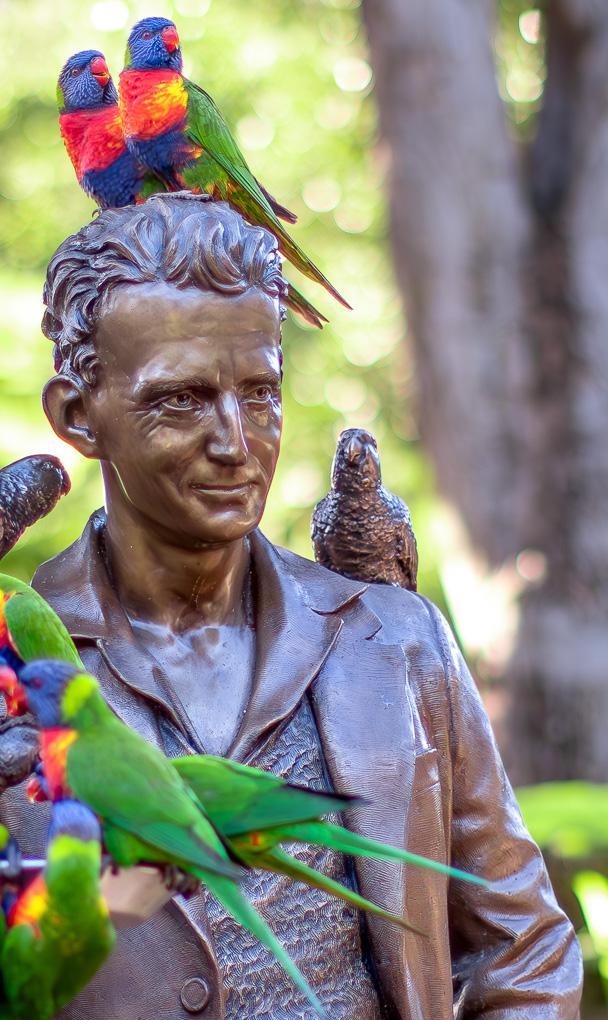
Formed in 1963, the National Trust of Australia (Queensland) cares for a diverse portfolio of properties across the State, offering unique and immersive visitor experiences. From an iconic wildlife sanctuary to remote museums and restored colonial inns, there is something for nature lovers, history buffs and curious explorers alike, along with blue skies and mild warm days. Experience Queensland in a new way by following this coast-to-country trail.
CURRUMBIN WILDLIFE SANCTUARY
At the gateway to Queensland’s Gold Coast, Currumbin Wildlife Sanctuary is a lush oasis filled with native animals and natural wonder. Since 1947, the iconic destination has welcomed guests to hand-feed rainbow lorikeets. Now you can also cuddle koalas and feed kangaroos, wander one of the South Hemisphere’s largest walk-through aviaries, explore lush rainforest trails and enjoy exciting shows.
At the heart of the sanctuary is Currumbin Wildlife Hospital, a free facility that treats more than 14,000 sick and injured animals every year. See the vets in action and learn what you can do to ensure native animals in the wild do not end up here. Beyond exhibits the sanctuary leads groundbreaking conservation work, from koala vaccine programs to breeding endangered frogs.
Discover Outback Springs where you will meet friendly farm animals, pan for gems and sip traditional billy tea, then relax and enjoy local cuisine at The Homestead with sweeping views of the kangaroo paddock. Book a wildlife encounter or take a journey back in time
FROM LEFT: Lorikeets perched on a statue of Currumbin Wildlife Sanctuary founder Alex Griffiths; the Hou Wang Chinese Temple; and Cooktown Museum (images courtesy National Trust of Australia, Queensland).
with the Extinction Trail, where you will discover dinosaurs, Australian megafauna and the mysterious Tasmanian tiger. Hands-on activities like fossil digs make learning meaningful and fun.
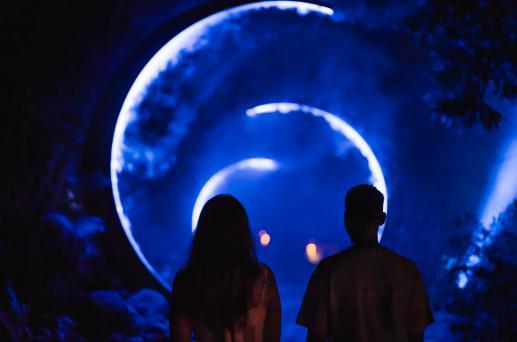
As night falls, the bush awakens and the sanctuary’s newest experience, Astra Lumina, invites you on a celestial night walk, where stars whisper and trees glow in a dreamlike journey of light and sound unlike anything else on the Gold Coast.
ROYAL BULL’S HEAD INN
Two hours northwest of the Gold Coast, step back in time at this beautifully preserved 19th century inn on the Darling Downs. Built in the 1850s, Royal Bull’s Head Inn in Drayton (near Toowoomba) offers a glimpse into Queensland’s early settler days. Inside, visitors will find original furniture, the discovery of Queensland’s oldest known wallpaper as well as stories and items from the Lynch Family who operated the Drayton Post Office in one of the rooms. From family open days to seasonal events, heritage high teas and a little bit of paranormal, this historic property offers a warm welcome and authentic charm.
Continue your journey north, winding your way through a rich tapestry of heritage towns, each with its own story to tell. As you travel past the Sunshine Coast, the historic streets of Maryborough, the cane fields of Bundaberg and the tropical charm of Townsville, you’ll eventually arrive in the cool highlands of the Atherton Tablelands, just inland from Cairns.
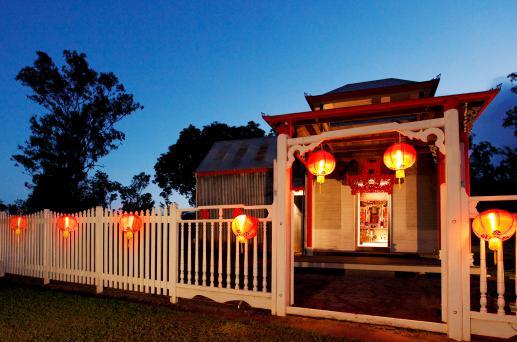
Located in the Atherton Tablelands, this unique heritage site tells the story of Chinese migration and community on the Queensland goldfields. Built in the early 1900s, Houg Wang Temple is the last surviving timber and iron Chinese Temple in Australia. Step inside to discover ceremonial relics, hear stories of hardship and resilience, and explore exhibitions in the museum. The neighbouring Old Post Office Gallery offers insights into multicultural Queensland and often partners with First Nations artists and local curators for special events. With
exhibitions on Chinese medicine and pioneering women, and a fun hands-on Junior Dragon experience for kids, this site offers an engaging and inclusive look into Queensland’s layered cultural heritage.
Cooktown is a place of deep significance for First Nations people and for European explorers. Opened in 1970 by Her Majesty Queen Elizabeth II, the Cooktown Museum is housed in a 19th-century former convent building with a view across the Coral Sea. Visitors can explore the story of James Cook’s 1770 landing, the anchor and canon from HMB Endeavour, the first recorded act of reconciliation between Europeans and the Guugu Yimithirr people, and the legacy of the Sisters of Mercy who ran the original convent and school. With an array of stunning exhibits, Indigenous storytelling, and newly interpreted displays, this is a museum that connects past and present.
Visit nationaltrustqld.org.au/visitor-sites to plan your trip. Please be aware that while entry is free for National Trust of South Australia members, some on-site offerings will be an additional cost. Members receive a discount on tickets to Astra Lumina at Currumbin Wildlife Sanctuary.
Travel the World with the National Trust
For a full picture of where National Trust of South Australia membership can take you visit www.into.org/places
Not a member? Join now.
Scan the QR Code or visit: nationaltrust.org.au/membership-sa
HOU WANG CHINESE TEMPLE AND MUSEUM
COOKTOWN MUSEUM
A new era at Port Pirie
BY CHRISTEEN SCHOEPF
After major conservation efforts and many months of hard work by local volunteers, the revitalised Port Pirie National Trust Museum is once again welcoming visitors. Historical archaeologist and community historian Christeen Schoepf explains what’s been involved in this major undertaking.
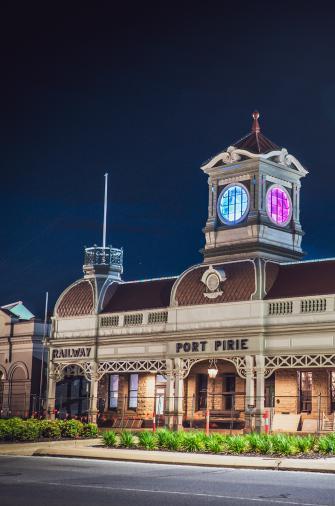
The Port Pirie Railway Station forms part of a heritage precinct that incorporates the former Customs House and original Central Police Station. Together, these buildings comprise the Port Pirie National Trust Museum, which has reopened following extensive preservation, conservation and remedial treatments funded through the Silver to Sea Way project.
Completed in 1902, the railway station building was saved from demolition when the Port Pirie Branch was formed in 1967 with support from then mayor H.B. Welch. The branch initially opened a museum in the Customs House in 1970. After the National Trust purchased the railway station the following year, the museum was extended, with thousands coming to watch a Cavalcade of Transport held as part of the opening ceremony in 1972.
At the mercy of the elements including sea salt, pigeons and proximity to the town’s smelter, both buildings received only minor repairs across the decades, until the Australian Government provided $6.6 million from its Building Better Regions Fund for the Silver to Sea Way project. Marking the ‘sea’ end of the heritage tourism route, the Port Pirie museum (and its buildings) was one of three sites identified for major regeneration.
For volunteers and the committee, the closure of the museum in early July 2023 was bittersweet as the tired and dated displays and artefacts were dismantled and packed into boxes to clear the way for the much-needed conservation projects that would repair unique architectural features, create new and vibrant spaces and bring the heritage building, sometimes kicking and screaming, into the 21st century.
Extensive repairs to the decorative roof and veranda areas by Australian Pressed Metal included hand-cutting smaller pieces of zinc to replace the many from the roof that were rusted and corroded. A skilled team also replaced the metal letters from the front of the building and removed the lead paint. An early 20th century metal mouldings catalogue was used to recreate and replicate the folded pieces of the veranda ceiling and building façade. In 2024, the company was rewarded with

the Association of Walls and Ceilings Industries Award of Excellence in the decorative/heritage section for their work.
Meanwhile, the Customs House was converted into an immersive sound and light space by creative arts company Illuminart Stories in Light. The 35-minute experience affirms the attachment of the Nukunu people to country and shares dreamtime stories relating to the formation of the Flinders Ranges and Spencer Gulf. It also portrays the competitive nature of French and English exploration and the naming of the gulfs, the first white people who tried their luck in the new settlement of Port Pirie, and the people from many countries who chose to make Port Pirie and the Mid North of South Australia their home. A ‘Meet the People’ segment features local actors filmed in short skit-style vignettes retelling aspects of life in Port Pirie and the stories of notable people whose economic vision supported the fledgling town and created its unique character.
The Customs House is also the location of Story Lab, a studio where museum volunteers, locals, students and oral historians can record the memories of local people and visitors who have stories to tell about ancestors, or local events and experiences. Recording is currently available Mondays and Tuesdays.
As a collective, the objects and artefacts housed within the museum reflect the industrial focus of Port Pirie, the railways, and the social, recreational and economic growth and diversity of the people who often struggled to survive under the shadow of the world’s biggest lead smelter. The museum is now a community space where locals and visitors can grab a coffee and snack from the new onsite cafe, Sweet Icings by JJ, and admire the piece de resistance – the large windows extending across the rear of the museum complex that reveal the industrial sights and sounds of the wharf, river and railway line. Visitors can sit and take in the tugs slowly ushering the international ships to be loaded with grain and ore concentrates to the wharf, the train shunting lead and zinc ore into Nyrstar for smelting and processing, and the peacefulness of the river and the ranges on a calm morning. Port Pirie members and volunteers look forward to sharing these spaces and local history with you all soon.
Plan a visit
For more information go to nationaltrust. org.au/places/port-pirie-railway-station/ or call 08 8632 3435. To become a volunteer or book the immersive experience and studio phone the museum. Follow the Port Pirie National Trust Museum on Facebook for the latest news.
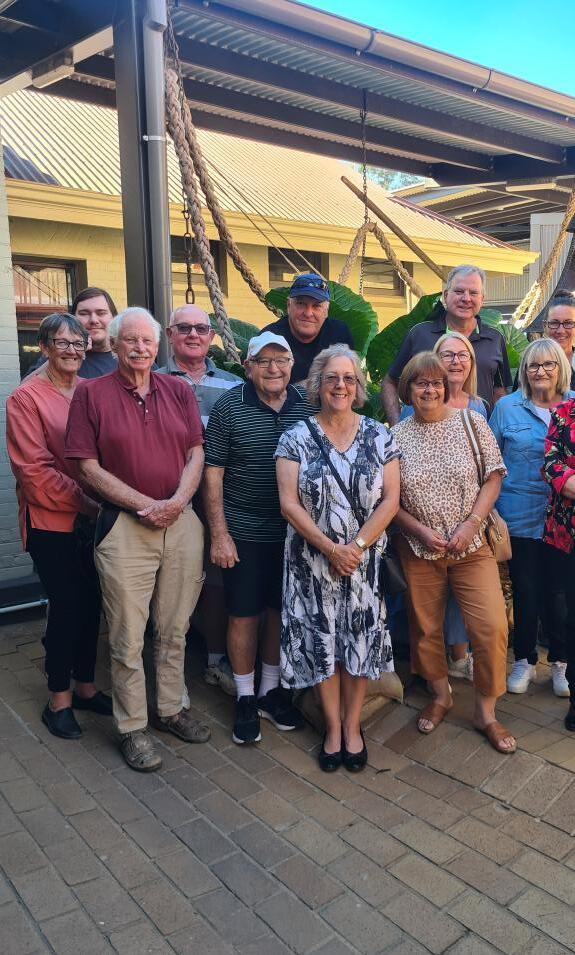
LEFT: Volunteers at the Port Pirie Museum.
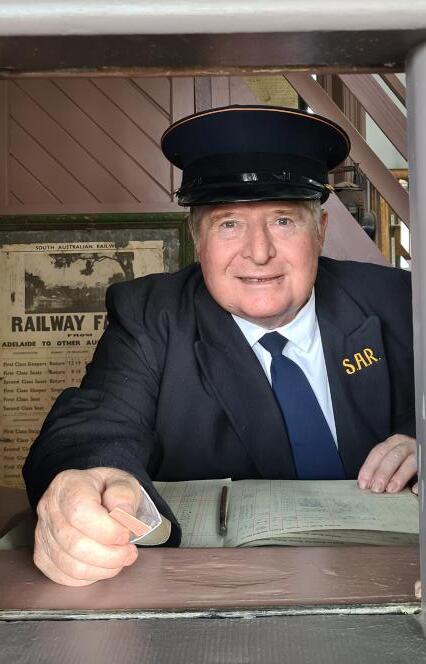
ABOVE: Volunteer Paul Siddell in the ticket office. (Photos courtesy Port Pirie Branch).
Member moments: Anthony Presgrave
Well known at Goolwa for his research skills and fascinating heritage tours, Anthony Presgrave has been a member of the National Trust for more than 50 years.
A founding member of the Coromandel Valley Branch when it formed in 1971, Anthony later moved to Goolwa where he has served on the branch committee since 1987, including some 20 years as treasurer. A State Council regional representative for eight years, Anthony has played a leading role in numerous National Trust projects, including establishing and continuing to build Goolwa’s extensive history archives, and supervising restoration of the slipway beam engine and what is thought to be Australia’s oldest motorhome. His significant contribution led to him receiving the prestigious Dr Mildred Mocatta Award in 2016. A skilled history researcher, he was surprised to discover, almost by accident, that his great great grandfather surveyed part of Goolwa in 1858.
WHAT IS YOUR FAVOURITE ROLE AS A NATIONAL TRUST VOLUNTEER?
I started the history archive when I got down here. Then some 20 years ago now, council was handed a huge historical resource compiled by an individual who researched endlessly, particularly properties and land transactions. He filled his house up with research papers to the extent that he had to buy a bigger house. He gave that resource to the Alexandrina Library but it was so big it had to be split, and the National Trust holds half of it. We set aside one room in the museum building for our archives and we’ve filled it up. We have a huge archive now — there is something like 3000 or more photos in the collection, and we are working on digitising those at the moment.
I spend a lot of time doing historic research. I work between our archives and the history room at the Goolwa Library. If the information isn’t in one place it will probably be in the other, and I've got a reputation for not stopping until I get to the bottom of things. Invariably, if a question is difficult, it’s tossed to me, and I usually either know the answer or where to find it. At the moment, I’ve got three or four projects on hand researching properties and the Uniting Church at Goolwa, and another one on a little church and burial ground at Castle
Range (near Currency Creek). We’ve had a ground-penetrating radar survey done to try and locate the graves.
WHAT HAS BEEN YOUR PROUDEST ACHIEVEMENT AND WHY?
That’s a difficult one. It was probably the establishment of the Alexandrina Council Heritage Advisory Committee in 1991, when I was an elected member serving on the council. The State Government was going to appoint a heritage advisor who would cover two councils and there was umming and erring about it because the position had to be jointly funded. Well, two of us on council got together and decided to push for a Heritage Advisory Committee just in case the appointment didn’t go ahead. It did and the Heritage Advisory Committee went ahead too, and it's still going. I was a member for 31 years and chairman for 27 of them.
And out of that committee came the annual Heritage Awards. Last year they were presented at an event in Milang, and I went along. They presented all these other awards and then they announced that they’d instituted a new award in memory of Lorraine Pomery, who was one of the original members. The award is for service to heritage, and they gave it to me! I knew nothing about it; it came out of the blue.
WHY SHOULD PEOPLE CONSIDER SUPPORTING THE NATIONAL TRUST?
It’s an independent voice for heritage conservation and history. We are not beholden to governments. We can speak our mind. Anyone interested in history can benefit by joining, whether they want to know more just about their own property or the wider area. And of course, there are the benefits when you travel. National Trust membership is good worldwide and the fee is modest in comparison with admission costs in England, for example.
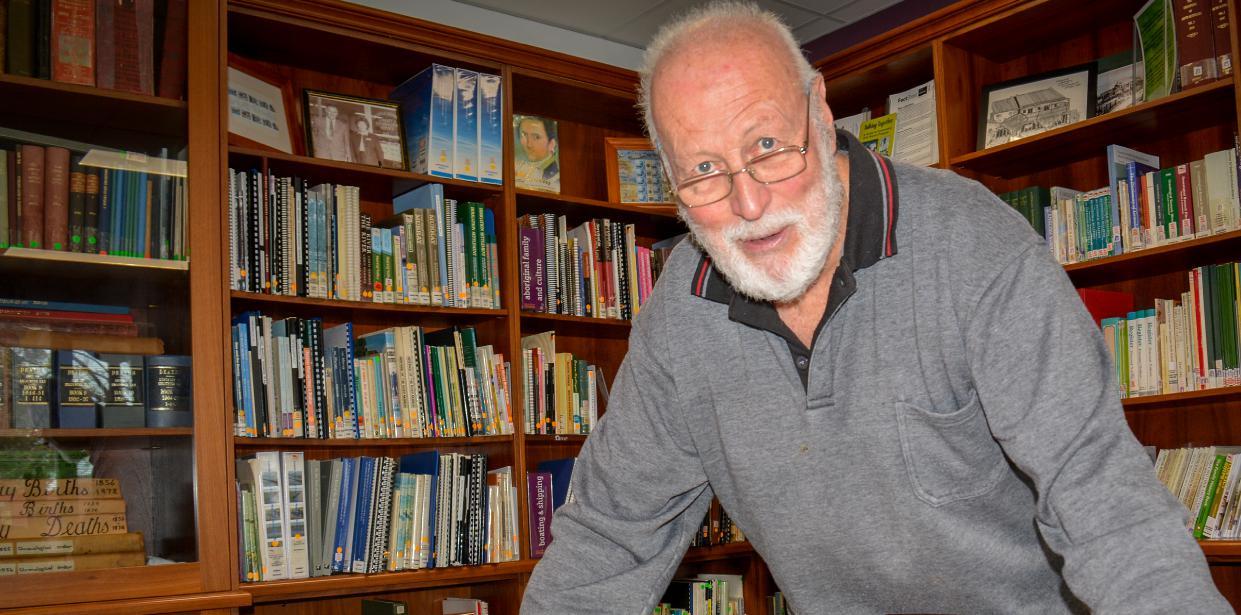
Anthony Presgrave in the Goolwa Library history room (courtesy Alexandrina Council).
What's on
The weather may be cool but that’s no reason to stay home! Rug up and head out to enjoy a diverse program of special exhibitions and activities as the rest of winter unfolds, then celebrate spring as our National Trust gardens open their gates for some of the most popular events on our calendar.
For the latest information and to book please visit the Event section on our website. Event details in this magazine are correct at time of printing.
Cape Jaffa Lighthouse Tours
KINGSTON SE
5 to 20 July, 27 September to 12 October 2025
Embark on a journey through history and mystery at Cape Jaffa Lighthouse. Check out the spectacular views from the top deck and get a glimpse into the fascinating lives of the lightkeepers. Day tours available on the hour, 10am to 3pm daily during the South Australian school holidays.
Tickets: National Trust members free, adults $15, children $7 (under 5 free)
Beaumont House Open Days
BEAUMONT HOUSE, BEAUMONT
First Sunday each month, 2pm to 4.30pm
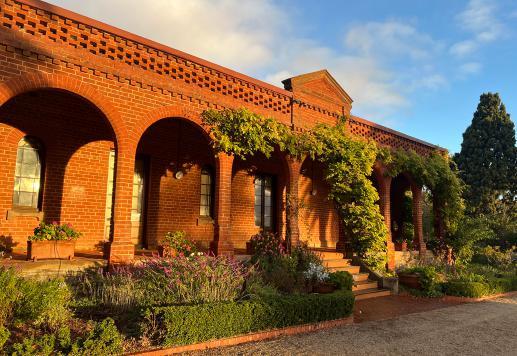
Enjoy a special tour of the house and garden followed by refreshments on the veranda, overlooking the city and gulf (weather permitting). Wander through beautiful gardens and the historic olive grove established by Sir Samuel Davenport.
Tickets: National Trust members $10, adults $15 (including afternoon tea), concession $12, children under 16 $10, afternoon tea only $10
Scan the QR Code or visit: nationaltrust.org.au/sa/
Bear Connection
TEA TREE GULLY HERITAGE MUSEUM
17-19 July 2025, 10am to 2pm
20 July 2025, 11am to 4pm
Bears have overrun the museum! Discover some world-famous bears, learn how bears have become a symbol of help and healing. Enjoy crafts and other hands-on activities. Bring your favourite bear. On 20 July, also enjoy a sausage sizzle, Devonshire tea and working blacksmith.
Tickets: National Trust members free, adults $5 (including admission to the museum), concession $4, children free
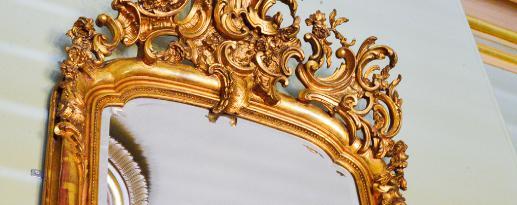
Ayers of Expression
AYERS HOUSE, ADELAIDE
Every Friday & Saturday, August 2025, 6pm to 9pm
Step inside the timeless elegance of Ayers House for Ayers of Expression — a captivating SALA exhibition celebrating South Australian artists across a range of mediums. From painting and photography, to mixed media and installation, explore a rich tapestry of creative expression layered throughout the rooms of this iconic heritage home. Wander at your own pace, discovering artworks in the State Dining Room, hallways and family rooms. Enjoy a glass from our pop-up bar and let live classical music set the tone for an evening where history and art converge.
Tickets: National Trust members $20, adults $25, concession $20, children under 15 $10
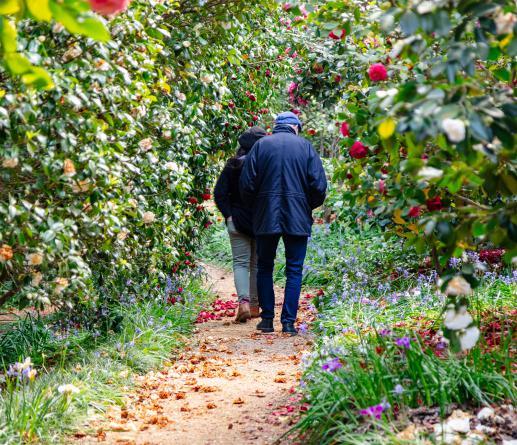
Camellia Society Open Days
STANGATE HOUSE & GARDEN, ALDGATE
Every Sunday in September, 11am to 3pm
The Camellia Society, Adelaide Hills Inc invites you to their September Open Days at Stangate House and Garden. There will be plants for sale, a trading table and refreshments to purchase or bring your own picnic lunch to enjoy.
Tickets: Please visit the Event section of our website to confirm price and booking details.
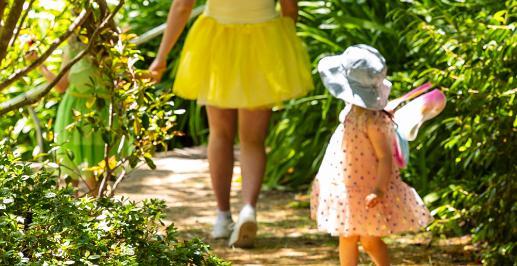
Fairy & Elf Picnic
STANGATE HOUSE & GARDEN, ALDGATE
4 October 2025, 11am to 3pm
Jump into a world of whimsy and wonder at another magical fairy and elf picnic. Bring your own picnic food, rugs or chairs and explore springtime at beautiful Stangate House & Garden. Dress up as a fairy or elf and prepare for a fun-filled day of face painting, fairy entertainers, games and activities. Food and beverage trucks available. Tickets available online only.
Tickets: National Trust members $15, adults $18, children (under 15) $5
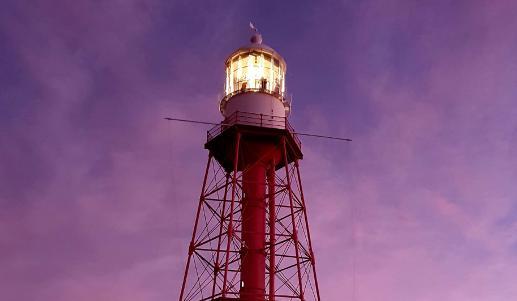
Cape Jaffa Lighthouse Night Tours
KINGSTON SE 5 October 2025, 7.30pm, 8pm and 8.30pm
Take a night tour of this historic lighthouse and visit the lantern room to see the First Order Holophotal Dioptric lens close up, as it shines brightly across the bay from sunset for 90 minutes. Bookings essential.
Tickets: National Trust members free, adults $20, children $10 (under 5 free).
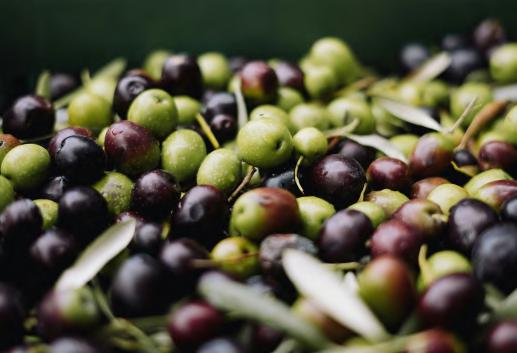
Olive Festival
BEAUMONT HOUSE, BEAUMONT 12 October 2025, 11am to 3pm
Join us for a celebration of all things olive at our vibrant Olive Festival. Enjoy a delightful day filled with tastings, cooking demonstrations, artisan market stalls, family-friendly activities and exclusive tours of the historic olive grove that borders the property. Whether you're a food lover, a history enthusiast or simply looking for a great day out, the Olive Festival at Beaumont House will have something for everyone. Come for the flavours and immerse yourself in the fascinating history of one of the oldest olive groves in the State.
Tickets: National Trust members $12, adults $15, concession $12, children (under 15) free
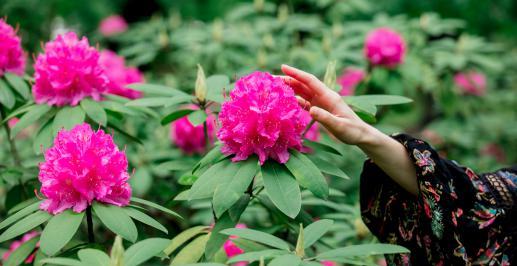
Rhododendron Society Open Day
STANGATE HOUSE & GARDEN, ALDGATE
12 October 2025, 11am to 4pm
The Rhododendron Society invites you to their October Open Day. Stroll through our stunning hectare of blooming gardens. Rhododendrons and other plants available for sale, with morning and afternoon tea also available for purchase.
Tickets: Adults $8, concession $6, children free
Spring in the Garden
TEA TREE GULLY HERITAGE MUSEUM
19 October 2025, 11am to 4pm
Enjoy spring in our beautiful garden, with stalls and entertainment.
Tickets: National Trust members free, adults $5 (including admission to the museum), concession $4, children free

Spooky Halloween Trail
BEAUMONT HOUSE, BEAUMONT
31 October 2025, 4pm to 7pm
Dress up and join the fun. Wander the spooky paths at Beaumont House, dodging zombies and deadly pirates. Pass the haunted graveyard and if you dare enter the witch’s den of horrors. Every child receives a treat bag on exit. All children must be accompanied by an adult. Food and drink also available on site for purchase.
Tickets: Children $5, adults free
GUIDED TOURS
Old Treasury and Tunnels
Adelaide, Sundays at 1pm and 3pm
Go underground and journey through a winding hallway and hidden chambers to discover one of Adelaide’s oldest buildings. Meet some of the colourful characters who shaped South Australia.
Z Ward: Behind the Walls
Glenside, selected weekend dates at 2pm
Constructed in the 1880s, Z Ward was home to South Australia’s ’Criminally Insane’ for almost 90 years. Take a 90-minute tour and discover the extraordinary history of this institution. Visit the rare complete example of a Ha Ha Wall, a deception piece of design that provided security while softening the prison-like image.
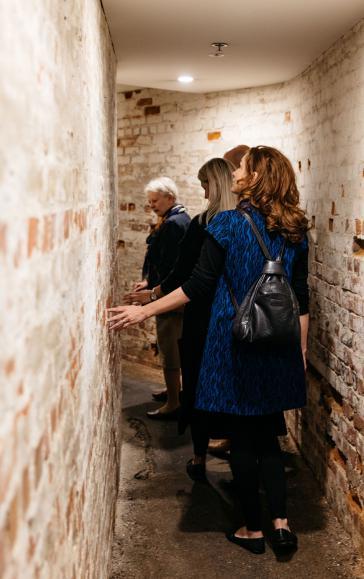
Bookings essential. Tickets for all the above tours: National Trust members $12, adults $20, concession $18, students and children (aged 5-15) $12, under 5 and Companion Cardholders free.
@NATIONALTRUSTSA
Connect with us on Instagram!


COUNCIL
President, Millie Nicholls
Vice President, Alice Fitch
Alison Stillwell
Catherine Peacock
Chris Guille
Di Wilkins
Elaine Davies
James Harvey
Jo-Ann Lokan
Paul Leadbeter
Tully Brookes
Vivienne Pitman
HEAD OFFICE STAFF
Leanne Plews, Business Manager
Laura Evans, Regional Operations Manager
Victoria Pavliv, Finance Manager
Alex Emmins, Natural Heritage Manager
Jimmy Oddy, Finance Officer
Louise Stanford, Events & Engagement Coordinator
Pauline Carty, Membership & Administration Coordinator
Colleen Schirmer, Compliance Coordinator
Felicity Wheeler, Collections & Built
Heritage Coordinator
Erin Bridges, Collections Information Officer
COUNCIL COMMITTEES
Audit, Finance and Governance
Cultural Heritage Members, Regions and Branches
Natural Heritage
BRANCHES
Ardrossan, Auburn, Barmera, Beachport, Burnside, Burra, Ceduna, Central Yorke Peninsula, Clare, Cleve, Coromandel Valley, Gawler, Glencoe, Goolwa, Hahndorf, Jamestown, Kadina, Keith, Kingscote KI, Kingston SE, Koppio, Millicent, Minlaton, Moonta, Mount Barker, Mount Gambier, Naracoorte, Overland Corner, Penneshaw, Penola, Port of Adelaide, Port Elliot, Port Pirie, Renmark, Robe, Strathalbyn, Streaky Bay, Tea Tree Gully, Tumby Bay, Victor Harbor, Waikerie, Wallaroo, Whyalla, Willunga, Yankalilla
PATRON IN CHIEF
Her Excellency the Honourable
Frances Adamson AC Governor of South Australia