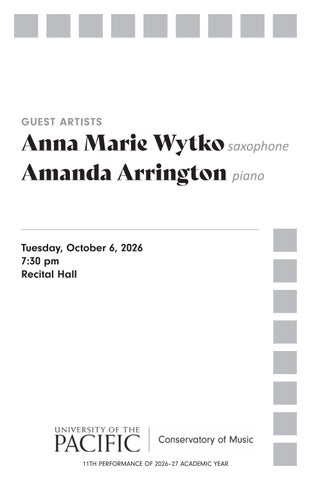
GUEST ARTISTS
Anna Marie Wytko saxophone Amanda Arrington piano
Tuesday, October 6, 2026 7:30 pm Recital Hall
11TH PERFORMANCE OF 2026–27 ACADEMIC YEAR
OCTOBER 6, 2026, 7:30 PM William Grant Still (1895–1978)
5ʹ
Concertino for Alto Saxophone and Chamber Orchestra (1951) Allegro molto Lent Vif et bien rythmé
Jeanine Rueff (1922–1999)
16ʹ
Sonata for Alto Saxophone and Piano (1989–90) Allegro ritmico Cloches de la liberté - Adagio Scherzo - Allegro vivo
Jindřich Feld (1925–2007)
14ʹ
Karen Thomas (b. 1957)
17ʹ
Federico Molina Campos (b. 1963)
5ʹ
Romance (1954)
Intermission
When night came . . . (for the women of Bosnia) (1994) (California premiere)
Retorno (2023) (U.S. premiere)
View digital programs at issuu.com/MusicAtPacific
ARTIST BIOGRAPHIES Saxophonist Anna Marie Wytko, is University Distinguished Professor of Saxophone within the School of Music, Theatre, and Dance at Kansas State University. Her playing has been described by The Absolute Sound as “extraordinary” and the Uruguayan Press as “impeccable.” A Yamaha Performing Artist-Clinician and KSU International Educator of the Year Award Winner, Wytko is a globally acclaimed recording, performing, and teaching artist, as well as a globally praised author of multiple books, articles, and other publications. Sample albums include When Night Came, Anna Marie Wytko – Saxophonist, The Loveliness of Air – I Can’t Breathe, Muddle, and Phraseology. Published by RJ Upmarket Press, Wytko authored pedagogy books The Saxophonist As Rank Beginner and Beyond: A Guide for Saxophone Methods Class, Band Directors, and Private Instructors and The Saxophonist As Musician First – A Sampling Of Resources. As concerto soloist, Wytko has performed in Carnegie Hall in the famous Stern Auditorium on the esteemed Perelman Stage and in the historic National Theatre of Costa Rica with the National Symphony Orchestra of Costa Rica. She has performed as concerto soloist with the Polish Air Force Wind Symphony, the Phoenix Symphony Orchestra, the Banda Sinfónica de Montevideo in Uruguay, with the National Bands of San José and Alajuela in Costa Rica, and with orchestras throughout England and Scotland, among many others. Internationally, Wytko has performed as guest recitalist and taught as guest professor at institutions such as the Royal College of Music in London, the Royal Birmingham Conservatory of Music, the Conservatoire National Supérieur de Musique de Paris, the Conservatorio Nacional Superior de Música de Buenos Aires, the University of Zagreb Academy of Music, the Akademia Muzyczna of Poznań, Poland, the Universidad de Costa Rica, and throughout Italy at the national conservatories of Milan, Florence, Bologna, and Perugia. The winner of numerous awards and prizes, Wytko is a Yamaha Young Performing Artist's first prize-winner, Butterfield Young Artists Concerto Competition's first prize-winner, a recipient of International Incentive Grant, and Mortar Board National Honor Society's award recipient for “Exemplary in Instruction and Dedication to the Students’ Experience,” among numerous others. Learn more at AnnaMarieWytko.com
ARTIST BIOGRAPHIES Amanda Arrington is senior professor of practice and faculty collaborative pianist at Kansas State University, where she performs in numerous performances each year with faculty, students, and guest artists. A passionate advocate for new music, she has premiered works at the World Saxophone Congress, International Trumpet Guild, International Double Reeds Society, and National Flute Association, among others. Her performances have taken her to renowned venues including the Sydney Opera House, the Kennedy Center, and the National WWI and WWII Museums. Arrington’s discography includes Serenade, Ruminations, Anna Marie Wytko – Saxophonist, Wanderlust, and more—all available on major streaming platforms. As a co-founder of Radium Recordings, Arrington administers a classical music label with her husband and recording engineer, Owen Taylor. Arrington holds a Master of Arts in piano pedagogy from the University of Central Missouri and a Bachelor of Music Education from Kansas State University. She received the MTD Excellence Award from K-State’s School of Music, Theatre, and Dance in recognition of her outstanding artistry and service. Learn more at AmandaArrington.com.
PROGRAM NOTES Program notes by Anna Marie Wytko The musical journey begins with William Grant Still’s lush Romance, the first known concert piece for saxophone by an African American composer. Next, immerse yourself in the brilliant three movement Concertino by French composer Jeanine Rueff. Featuring a jazz-inspired final movement, audiences will be certain to dance the rest of the night away following this delightful and joyous music. The California premiere of Seattle-based composer Karen P. Thomas’s When night came . . . reflects the horrors of the war in the former Yugoslavia and, in particular, the atrocities committed against the women of Bosnia-Herzegovina. Partly a lament, the piece is also a tribute to the strength and resilience of these women. Czech composer Jindřich Feld’s substantial Sonate pushes the boundaries of sonic and technical virtuosity in this highly flavorful composition. Last but certainly not least, embrace the rich melodies of Retorno (Return) by Costa Rican composer Federico Molina Campos in this U.S premiere. Still: Romance William Grant Still was a highly prolific American composer of symphonies, choral music, chamber pieces, operas, and ballets. In 1936, Still conducted the Los Angeles Philharmonic Orchestra as the first African American conductor invited to conduct a professional orchestra. A graduate of the Oberlin Conservatory of Music, Still was the recipient of three Guggenheim Fellowships in music composition. Romance for Alto Saxophone and Piano represents the first known concert piece for saxophone composed by an African American composer. Rueff: Concertino An award-winning French composer, Jeanine Rueff served as collaborative pianist at the Paris Conservatory where she accompanied the students in the saxophone class of legendary French saxophonist Marcel Mule. Dedicated to Mule, Rueff’s virtuosic Concertino for Alto Saxophone and Orchestra is comprised of three significant movements. Movement one, Allegro ritmico, can be characterized as a brilliant march. Rueff utilizes the asymmetrical time signature of 7/4 which, at times, creates a fantasy-like character against the driving march theme. The second movement, "Lent," can be characterized as a passionate ballad. The middle section represents a contemplative rhythmic conversation between saxophonist and pianist. Movement three, "Vif et bien rythmé," is, as the title suggests, both lively and rhythmic. Rueff’s jazz-inspired writing evokes a spirited and colorful dance in this joyous final movement.
PROGRAM NOTES Feld: Sonate Czechoslovakian composer Jindřich Feld taught composition at the Prague Conservatory from 1972 to 1986 and served as a visiting professor at numerous universities throughout the world. Sonata for Alto Saxophone and Piano was composed during the years 1989–90. While the piece incorporates various contemporary performance techniques and colors, such as multiphonics and key clicks, the formal structure of the music follows a traditional, classical outline. Movement one, Allegro ritmico, consists of two contrasting ideas. The angular and marcato character of the first theme is complemented by the lyrical and singing nature of the second theme. The second movement, titled "Cloches de la liberté–1989" (Bells of liberty—1989), was written as a tribute to the liberation of the Czech Republic from communist ruling in the year 1989. The haunting and, at times, anguished melodies are juxtaposed with a highly rhythmic and percussive middle section. Movement three, Scherzo, is, as the title suggests, light and playful. Feld’s use of some unexpected, bold colors adds to the humorous nature of this music. Thomas: When night came . . . American composer and conductor, Karen P. Thomas is the artistic director of Seattle Pro Musica. When night came . . . is dedicated to the women of BosniaHerzegovina and is winner of the Theodore Front Prize (International Alliance for Women in Music). The piece is a reflection of the horrors of the war in the former Yugoslavia and, in particular, the atrocities committed against the women of Bosnia-Herzegovina. While the composition is partly a lament, it is also a tribute to the strength and resilience of these women. Two Bosnian folk songs are incorporated into the work. One is a ganga, an intense, vibrant form of vocal music titled "Odkad seke nismo zapjevale" that is based upon a short series of repeated notes. The second folk song, "Kad ja podjoh na Benbasu," is one of the most treasured love songs of Sarajevo, Bosnia-Herzegovina. Molina Campos: Retorno Costa Rican composer and pianist Federico Molina Campos has performed as both solo and collaborative pianist in major concert halls internationally. His compositions have been presented extensively throughout Latin America. Campos also served as director of the Escuela de Artes Musicales de la Universidad de Costa Rica. Retorno (Return) explores intricate, beautiful melodies that are both ethereal and rich in nature. The music culminates in a radiant, singing farewell.
SUPPORT OUR STUDENTS AND PROGRAMS Every gift to the Conservatory from an alum, parent, or friend makes an impact on our students. Conservatory students rely on your generosity to enable them to experience a superior education. To make a gift today, please contact the Assistant Dean for Development at 209.932.2978 or scan this QR code. You may also send a check payable to University of the Pacific: Conservatory of Music, University of the Pacific Attn: Assistant Dean for Development 3601 Pacific Avenue Stockton, CA 95211
To view our upcoming events, scan the QR code or visit Pacific.edu/MusicEvents
Pacific.edu/Conservatory