6 minute read
A Force in Music and Teaching

Military anthem author builds on heritage and hall of fame career
By Robin E. Lee
For many musicians, a place in a hall of fame represents the pinnacle of their career—a validation of years of hard work, talent, and dedication.
For singer-songwriter and MTSU adjunct professor Jamie Teachenor, his induction into the Missouri Music Hall of Fame is not only a professional milestone but also a deeply personal honor—one rooted in family, heritage, and an unwavering passion for music.
In addition to his extensive career in the music industry, Teachenor shares his expertise with Recording Industry and Honors students at MTSU, offering them real-world insights into the evolving landscape of music production and business. His role at the University allows him to mentor aspiring professionals and contribute to developing the next generation of industry leaders.
“Jamie is an extraordinary teacher and songwriter. I am still in awe that he wrote the anthem for the U.S. Space Force, which will be celebrated long after we are gone,” said Beverly Keel, dean of MTSU’s Scott Borchetta College of Media and Entertainment. “His passion for music, education, and our students is inspiring, and his enthusiasm and optimism are contagious. Our students are fortunate to be able to learn from such a talented music leader.”
MUSICAL FOUNDATIONS IN MISSOURI
From his birth in the tiny unincorporated town of Fagus, Missouri, Teachenor’s life was steeped in music. His childhood was filled with melodies, from the echoes of his grandmother’s piano—an instrument she acquired by trading her father’s fiddle—to the impromptu jam sessions that would last into the early morning hours with family and friends.
His father, Jim, a Rockabilly Hall of Fame inductee, was not only his greatest influence but also his biggest fan. It was Jim who inspired Jamie’s first song, “You Can Fall in Love with Me,” penned about his high school sweetheart and now wife, Jen.
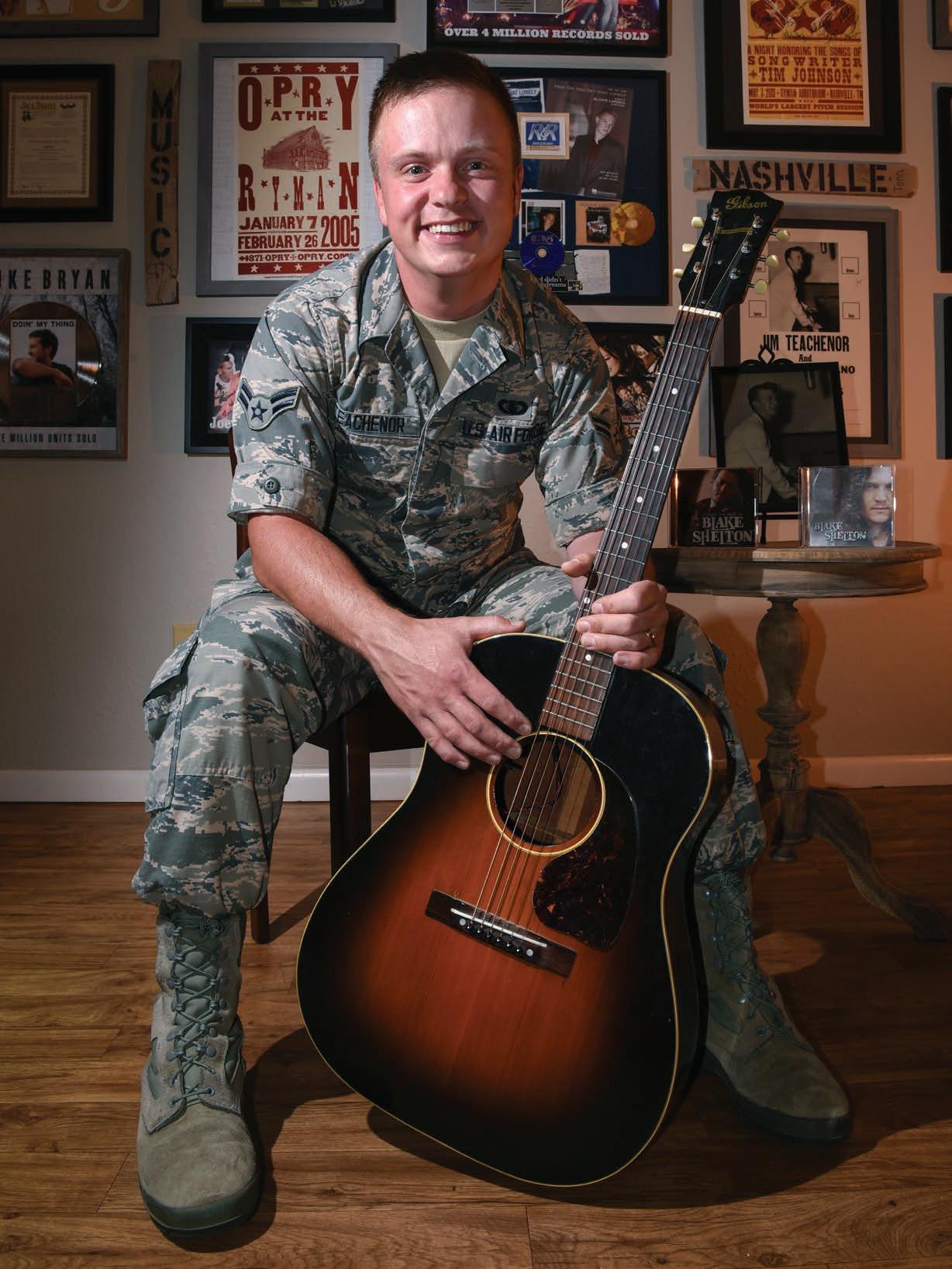
Teachenor’s service in the Air Force led him to an even greater honor: composing the official anthem for the U.S. Space Force.
Growing up in the southeastern corner of Missouri, just inside the upper Mississippi Delta, Teachenor was heavily influenced by the Memphis and Nashville sounds of country, rockabilly, gospel, blues, R&B, soul, and bluegrass. His great-grandfather, Charlie Hammon, was a champion fiddler who performed barn dances across the South and Midwest in the 1920s with Teachenor’s grandmother, Bertie, accompanying him on a pump organ. His father, Jim, toured with his rockabilly band, The Panthers, in the 1950s and ’60s.
From an early age, Teachenor performed in a variety of venues—churches, bars, rodeos, fairs, even high school study halls—wherever there was a piano and an audience. His Saturday nights as a teenager were often spent in his truck, parked on a field road, listening to the Grand Ole Opry and dreaming of one day moving to Music City.
“Missouri made me who I am. And to be honored in the place where my journey began—well, that means everything,” he said of his Hall of Fame honor.
COLLABORATING WITH THE GREATS
Teachenor’s musical journey took him to Nashville, where he had the opportunity to collaborate with country music icons like Luke Bryan, Blake Shelton, and Trisha Yearwood.
His time with Bryan started at Murrah Music, where they bonded over bass fishing and their shared love for country tunes. He recalls a humorous moment with Shelton: “Blake sat on an amplifier right in front of my vocal mic in the studio and pretended to conduct— with a beer in his hand.”

One of his proudest moments was when Yearwood recorded his song “Met Him in a Motel Room” for her album Prizefighter: Hit After Hit. She invited him and his wife to a private album release party.
“How Do You Get That Lonely,” recorded by Blaine Larsen, is one of Teachenor’s most well-known works.
The song, which became his first hit single, was inspired by the tragic loss of a high school student who took his own life. Teachenor and co-writer Rory Feek crafted the song in just over an hour, capturing the heartbreaking reality of loneliness and despair.
“That song opened a lot of doors for me,” Teachenor reflects. “But more importantly, it resonated deeply with people. Fans would come up to us and share how the song had saved their life. Those stories stay with me.”
SERVING THROUGH SONG
In 2015, Teachenor took an unexpected detour in his career, enlisting in the U.S. Air Force at the age of 35. He became a member of the Air Force Academy Band’s country ensemble, Wild Blue Country, as an airman first class. Touring across the country, he performed for troops and civilians alike, bringing music to the military community.
He returned to the Grand Ole Opry—not as a Nashville songwriter, but as an Air Force musician in his service uniform.

“For the first time, the music wasn’t about me. It was about the people we were playing for,” he says.
Teachenor’s service in the Air Force led him to an even greater honor: composing the official anthem for the U.S. Space Force, “Semper Supra.” Inspired by the guardians in the new branch, he spent months researching space history and working to craft a song that would honor the newest branch of the military. His anthem was officially adopted and performed at the Pentagon in 2022.
“When I wrote ‘Semper Supra,’ my greatest hope was that people wouldn’t think of me when they heard it, but instead, they would think of the amazing men and women who serve in the Space Force,” Teachenor said.
From his roots in Fagus, Missouri, to his induction into the Missouri Music Hall of Fame, Teachenor’s career is a testament to passion, perseverance, and purpose. His story is one of unwavering dedication to his craft, his country, and the power of music to inspire, heal, and connect.
With his doctorate from Liberty University, he is now proudly a member of the Honors faculty, teaching songwriting and music business at MTSU.
“I hope to impact everyone I meet in a positive way, and I hope I give more than I take. As an educator, I am less important than the ones looking to me for education.”