THIRD QUARTER 2026 VOL 1026 ISSUE 3
portstrategy.com
PCS Approaches Evolve | VTS Targeting Efficiencies | Tractors: Electric & Automation
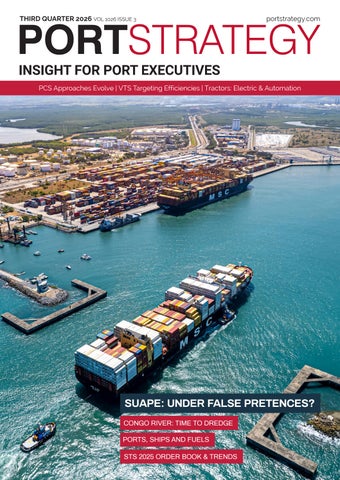
SUAPE: UNDER FALSE PRETENCES? CONGO RIVER: TIME TO DREDGE PORTS, SHIPS AND FUELS STS 2025 ORDER BOOK & TRENDS
\ THE POWER OF GREAT BULK HANDLING Reduced handling costs, shorter turnaround times, reliability and flexibility: Nemag grabs give dry bulk terminals throughout the world that competitive edge they need in today’s demanding market. Driven to achieve the best performance, we closely listen to our clients’ needs. For almost a hundred years, Nemag’s innovative grabs make it possible to realize the highest productivity at the lowest costs. Explore our comprehensive range of high-quality grabs and discover the power of great bulk handling. From coal and iron ore to wheat, scrap metals, minerals and clinker: Nemag has the optimal solution for every dry bulk flow! Contact us find out how we can take your bulk handling to the next level.
Deltastraat 15 • 4301 RC Zierikzee T +31 (0)111 418 948 • E sales@nemag.com
nemag.com
ca
n th
e QR c
o de
Take a peek
S
\ THE COMPLETE TOOLBOX
PORTSTRATEGY INSIGHT FOR PORT EXECUTIVES
The international magazine for senior port & terminal executives EDITORIAL & CONTENT Editorial Director: Mike Mundy mmundy@portstrategy.com Features Editor: Dean Davison ddavison258@gmail.com Consultant Editor: Felicity Landon felicity@felicitylandon.com
VIEWPOINT MIKE MUNDY
Regular Correspondents: Felicity Landon; Ben Hackett; Peter de Langen; AJ Keyes; Johan-Paul Verschuure; Phoebe Davison Production David Blake, Paul Dunnington production@mercatormedia.com
Vessel Movement: Positive Momentum European and UK ports operate advanced Port Community Systems (PCS) and provide a good insight into what can be achieved with state-of-the-art technology – including the important aspect of Just in Time port-toport vessel movement (see article PCS Approaches Evolve p47). Optimising vessel movement represents a useful tool in the fight against congestion
The movement of vessels between ports is an area that offers significant potential to achieve a higher level of port efficiency. Today, we can discern a growing focus on this subject area as a path to promoting both port and terminal efficiency. It is an aspect that up until recently has been largely overlooked but now, with advanced software and AI systems, there is significant scope to build efficiency levels right through from operations and safety to cost and environmental impact reduction. The goal in the port-to-port movement of vessels, particularly in the container sector, is Just-in-Time-Arrival – arriving at a port and not facing any waiting time. The Port Community System (PCS) has a role to play in this respect, in providing real time data exchange between port authorities and terminal operators. it is fair to say, however, that many middle and lower division ports have not yet fully exploited the powers of the PCS in this respect. One thing that promises to help is more education in this area – what can be achieved, how, what the benefits are and standardisation initiatives. The International Port Community Systems Association (IPSCA) potentially has a big role to play. It states as a core view: “Port Community Systems can, and will, play a major role as countries move towards the Single Window environment; the members of IPCSA will be working together to provide expert opinion on proposed new regulation and contribute to the harmonisation and coordination of reporting formalities, processes and procedures.” Laudable goals and as we can see from today’s operating environment – beset by congestion – much needed to translate into positive action. We look forward to that! There is also the Single Window system which potentially has the scope to play a bigger role in port-to-port vessel movement. Plus, we are now seeing an increasing number of commercial initiatives aimed at delivering systems to achieve Just-in-Time vessel movement – Portchain is one, but the advance of predictive systems, many incorporating AI, is spawning innovation generally in this area, and positive developments can be expected. The efficient and timely movement of vessels between ports will not offer a complete cure for congestion but it can make a very beneficial contribution to this and to efficient vessel movement overall. Equally, as our article on vessel traffic system innovation on p49 highlights, so too can the more efficient in-port movement of vessels, another area where technical innovation is delivering positive momentum.
For the latest news and analysis go to www.portstrategy.com
SALES & MARKETING t +44 1329 825335 f +44 1329 550192 Media Sales Executive: Daniel Spicer dspicer@mercatormedia.com Media Sales Executive: Driss Ahraoui dahraoui@mercatormedia.com Marketing marketing@mercatormedia.com Chief Executive: Andrew Webster awebster@mercatormedia.com PS magazine is published quarterly by Mercator Media Limited, Spinnaker House, Waterside Gardens, Fareham, Hants PO16 8SD UK t +44 1329 825335 f +44 1329 550192 info@mercatormedia.com www.mercatormedia.com
Subscriptions: Register and Subscribe at www.portstrategy.com Annual subscriptions from: £303.50 Single user: Full online access to Port Strategy and Greenport with digital magazine issues. For multi-user access: Subscriptions@mercatormedia.com ©Mercator Media Limited 2026. ISSN 1740-2638 (print) ISSN 2633-4232 (online). Port Strategy is a trade mark of Mercator Media Ltd. All rights reserved. No part of this magazine can be reproduced without the written consent of Mercator Media Ltd. Registered in England Company Number 2427909. Registered office: c/o Spinnaker House, Waterside Gardens, Fareham, Hampshire, PO16 8SD, UK.
THIRD QUARTER 2026 | 3
MOMENTUM WHERE IT MATTERS
Building from a one-country operation at the Port of Manila in the Philippines, ICTSI has pressed forward across 38 years. On six continents, currently in 19 countries, we continue developing ports that deliver transformative benefits.
All across our operations, we work closely with our business and government partners, with our clients and host communities: to keep building momentum where it matters, in and through ports that keep driving sustainable growth.
ARGENTINA • AUSTRALIA • BRAZIL • CAMEROON • COLOMBIA • DR CONGO • CROATIA • ECUADOR • GEORGIA • HONDURAS • IRAQ INDONESIA • MADAGASCAR • MEXICO • NIGERIA • PAPUA NEW GUINEA • PHILIPPINES • POLAND • SOUTH AFRICA
www.ictsi.com
sis
om/enews
CONTENTS THIRD QUARTER 2026 VOL 1026 ISSUE 3
portstrategy.com
PCS Approaches Evolve | VTS Targeting Efficiencies | Tractors: Electric & Automation
NEWS
FEATURE ARTICLES
17 Busy PSA
24 U nder False Pretences?
Deals Done
17 Michels Contract Savannah SeaPoint
27 A Fragile Peace
19 Dunkirk Double
28 Time to Dredge
Capacity Boost
10 Second BHP Deal
CONGO RIVER: TIME TO DREDGE PORTS, SHIPS AND FUELS STS 2025 ORDER BOOK & TRENDS
A$200m Contract
On the cover
10 Game Changer
Tecon Suape, an ICTSI group terminal, serves the agricultural and industrial hinterlands in northeast Brazil. The terminal faces competition from a new Maersk/APMT facility but contends this terminal has been brought into service under false pretences
ADP Enters Brazil
Terminal Transactions Groundbreaking Report
13 OneHarbour Deployed
36 News from TOC
15 Bilbao Benefits
38 2025 STS Order Book
15 Dynamic Haven
UKC System Deployed
17 BEST Cranes
Three More for BEST
19 Adopt PAS
TIC 4.0 Urges Ports
19 Swelling Orderbook Kalmar Product Demand
Weekly E-News Sign up for FREE at: www.portstrategy.com/enews
Building Long-term Resilience
34 Ports, Ships & Fuels
Digital System Innovation
Online portstrategy.com 5 Latest news 5 Comment & analysis 5 Industry database 5 Events Online Social Media links Weekly E-News portstrategy.com LinkedIn Sign up for FREE at: 5 Latest news PortStrategy 5www.portstrategy.com/enews Comment & analysis portstrategy 5 Industry database YouTube 5 Events
31 Crisis Aversion
13 Taichung Launch
New Halifax Platform
REGULARS
The Congress is a meeting point that provides senior executives with the solutions they require to meet regulatory and operational environmental challenges. Stay in touch at greenport.com
Congo River Priority
32 L iners in Front
AI Intrusion System
GreenPort magazine is a business information resource on how best to meet the environmental and CSR demands in marine ports and terminals. Sign up at greenport.com
Industrial Dispute Impact
11 Guinea Boost Iron Ore Vessels
is a proud support of Greenport and GreenPort Congress
APMT: Questions Raised in Suape
19 Momentum in Vancouver (BC)
TerraMarine Selected
SUAPE: UNDER FALSE PRETENCES?
THIRD QUARTER 2026
21 The New Yorker Machinations of Washington D.C.
21 Tlinks he Analyst Social Media LinkedIn Room to Grow: PortStrategy Moerdijk Study portstrategy YouTube 23 The Economist
Economic Social MediaTroublesome links LinkedIn Outlook PortStrategy portstrategy 23 The Strategist YouTube Measuring Congestion Reality Check
58 Postscript
Old School Approach to Radical Transformations
For the latest news and analysis go to www.portstrategy.com
Product Innovation
Key Trends Identified
40 P redictive Power Unleashed Digital Twins Five years On
43 Digitising Disbursements Vessel Port Costs
45 C hallenges and Solutions TOS Market Growth
47 E volving PCS
Europe & UK Market Leaders
49 T argeting Efficiencies
VTS Smart Technology
The Congress is a meeting point that provides senior executives with the solutions they require to meet regulatory and operational environmental challenges. Stay in touch at greenport.com
52 E lectrification & Automation
Terminal Tractor Agenda
54 G rabbing Productivity
The Congress is a meeting point that provides senior executives with the solutions they require to meet regulatory and operational environmental challenges. Stay in touch at greenport.com
High Capacity & Performance
Join leading port executives in Athens, Greece from 14-16 October 2019 www.greenport.com/congress
The is a executives meeting JoinCongress leading port point that provides senior in Athens, Greece from executives with the 14-16 October 2019solutions they require to meet regulatory www.greenport.com/congress and operational environmental challenges. Stay in touch at greenport.com Join leading port executives in Athens, Greece from 14-16 October 2019 www.greenport.com/congress
THIRD QUARTER 2026 | 5
Distinctly Hyster, Built for you
Your port needs tailored solutions that dial in performance and shed inefficiencies — not generic equipment or overbuilt extras. At Hyster, our broad lineup of purpose-built trucks and flexible options give you the freedom to find the solution that actually works for your operation, and our team’s right there with you to make sure you’ve got the right setup for the long haul.
Don’t just get a truck for the job. Get the right truck for your job.
PORT & TERMINAL NEWS
NEW DEALS FOR BUSY PSA
PSA Vietnam has signed a new deal to invest in Lach Huyen Port Investment Joint Stock Company for four deepsea container berths at Lach Huyen Port in Haiphong. The first two berths are scheduled to start development before the end of 2026, with completion slated for 2028. The remaining berths form a phase two process to complete the project by 2035, with total handling capacity of 4.5 million TEU per annum then on offer. Lach Huyen Port is located in Hai Phong City, approximately 120km east of Hanoi and adjacent to the Dinh Vu Industrial Zone. The Lach Huyen development will complement PSA’s existing projects in northern Vietnam, including inland container
depot facilities at Bac Ninh, with the aim of “linking ports, inland logistics assets and supply chain ecosystems across its global network.” At the same time, the Port of Gdańsk Authority has signed a 30-year lease deal with Baltic Hub Container Terminal, in which PSA retains a 40% stake, for an additional land parcel of 27ha adjacent to the existing T2 deepwater facility. The site is already designated as port land and has existing rail access. “The expansion of our rail terminal and yard capacity, aligned with PSA Group’s Node to Network strategy, will strengthen hinterland connectivity by enabling a greater share of containers to be transported by
■ PSA is expanding its footprint in Vietnam, with four new container berths across two phases by 2035 at Lach Huyen Port
MSC in Ukraine
Enstructure Buy
Casablanca Extension
Mediterranean Shipping Company (MSC) has reportedly acquired a majority 51% stake in the TIS container terminal at the Port of Pivdennyi near Odesa in Ukraine. The value of the deal has not been disclosed but follows DP World recently selling its 51% share in this facility to TIS directly. TIS is Ukraine’s largest private port operator, managing six specialised terminals, handling diverse cargo streams, and rail facilities.
US-based terminal and logistics company, Enstructure, has confirmed an agreement to acquire all of the marine terminal operations of LOGISTEC, a multi-purpose terminal operator and logistics service provider. LOGISTEC is majority owned by New York-based private equity firm, Blue Wolf Capital Partners LLC, who remain an investor in the combined business. The new entity will comprise 106 facilities across 30 US states and Canadian provinces.
For the latest news and analysis go to www.portstrategy.com
rail” explains Jan Van Mossevelde, CEO, Baltic Hub. Baltic Hub handled 2.7 million TEU in 2025. The Polish Development Fund and IFM Global Infrastructure Fund, each with 30%, are the other shareholders. Additionally, PSA Singapore notes a significant milestone with confirmation of handling 25 million TEU at its new Tuas Port facility since activities commenced in September 2022. Operations continue to ramp up at what PSA says is the world’s largest fully automated container terminal.
Morrocco’s major port and logistics operator, Marsa Maroc, has confirmed a 20-year extension to its concession for Container Terminal 3 (CT3) at the Port of Casablanca. The deal is part of an MAD 3bn (US$321 million) investment at the facility that will see annual capacity increase from 600,000 TEU to 900,000 TEU per annum by 2030. Casablanca is regarded as the country’s primary maritime trade gateway for import and export cargo.
Michels Secures Savannah SeaPoint Michels has been awarded the design-build contract for the new SeaPoint Industrial Terminal Complex in Savannah (GA) on the US East Coast. The 226-acre private multiuse terminal is part of the wider 755-acre SeaPoint Complex. The SeaPoint Terminal is planning to offer 3000ft of berthing and a water depth of 47ft. It will also benefit from no vessel air draft restrictions and is the closest facility to the Atlantic Ocean within the overall Port of Savannah. The site has direct rail access from CSX, with a switching connection to NS and is just 12 miles from the I-95, the major US East Coast, North-South, interstate road artery. The multiuse terminal is being developed as a fully private facility rather than as part of the Georgia Ports Authority’s existing container terminal network. Michels confirms that construction will commence in 2027. The company performs specialty marine construction services on shorelines, harbours, inland lakes and river systems. The SeaPoint site is actually a Brownfield remediation that was originally home to bulk facilities and a municipal landfill.
BRIEFS Portonave Efficiency Portonave of Brazil is investing R$61 million (US$11.8 million) in new equipment to reduce emissions and improve container handling efficiencies. A total of 30 electric terminal tractors (e-TTs) manufactured by Terberg in Malaysia and five electric reach stackers (e-RSs) from Kalmar in China are being delivered by January 2027. Portonave said GHG emissions will be reduced by 80% for reach stackers and 30% for the terminal tractors.
THIRD QUARTER 2026 | 7
FORKLIFTS FOR YOUR WORLD Whatever your world looks like, we can offer a forklift solution from 10-65 tons, tailored to your operation. A broad range of models, options and attachments makes it easy to adapt the truck to your specific material handling requirements. If your businesses moving towards electrification, our E-VER electric forklift combines heavy-duty performance with the latest advances in energy efficiency, helping you reduce emissions without compromising productivity. Investing in a Konecranes forklift means investing in proven technology designed to maximise uptime and lower lifecycle costs. Innovative solutions help reduce wear on key components, extend service life, and keep operating costs under control. When your lifting needs change, a well-maintained Konecranes forklift also has high resale value.
Learn more about our products on www.kclifttrucks.com
PORT & TERMINAL NEWS
TERRAMARINE SELECTED FOR RBT2 BUILD
BRIEFS AI Testbed
The Vancouver Fraser Port Authority (VFPA) has appointed the TerraMarine joint venture (JV) as partner for the construction of the landmass and wharf infrastructure component of the new largescale Roberts Bank Terminal 2 (RBT2) project. When fully completed in the mid-2030s, RBT2 is scheduled to offer 2.4 million TEU of annual capacity, which will be delivered through the construction of a new three-berth container terminal supported by 1300m of quayline and a widened causeway.
The JV partnership is led by FlatironDragados, and includes Van Oord, Aecon Group Inc. and Carlson Construction Group and was selected after a competitive procurement process that saw proposals submitted in May 2026. VFPA said that an independent fairness monitor oversaw the entire matter. Terramarine is expected to sign a design and early works agreement before Q4 2026. VFPA also reports that the RBT2 project has secured key environmental approvals and
■ Vancouver’s RBT2 project has gained further momentum with a partner secured for the landmass and wharf infrastructure component
BEST Deal Off consent from 27 First Nations, with mutual benefit agreements in place, while it is also understood to be viewed as a project of national importance by the government of Canada. A MoU has been signed with existing Vancouver port operator, Global Container Terminals, to explore options for partnership on the RBT2 project.
GRINDROD: FINANCIAL PERFORMANCE AND PROJECTS Headquartered in Durban, South African ports and logistics group Grindrod reports that H1 2026 results saw profits fall from R1.5bn (US$92 million) to R598.3 million (US$37 million). Grindrod claims that this drop in profits reflected a R902.8 million (US$56 million) “one-time gain” booked in 2025 (from the release of foreign currency translation reserves after it bought out the remaining 35% of the Matola terminal joint venture) that has not been repeated in 2026, rather than a “deterioration
in the underlying business.” However, in the first six months of 2026 the Port of Maputo, for example, handled a record 8.4 million tons (up 29%) and group revenue rose to R2.8bn (US$179 million), but the profit line did not seemingly follow the trend. Combined with these activities, Matola, in Mozambique, handled 4.2 million tons, down 7% on the 2025 period due to weather in the Phalaborwa catchment area disrupting magnetite deliveries, while Grindrod’s
logistics division delivered a “subdued performance.” The company is pointing to ongoing projects that will boost future profits. These include the Matola expansion to 12 million tons a year that is within its $40 million budget and on track for completion in Q1 2027, plus dredging of Maputo access due to finish in Q4 2027 to allow Capesize vessels of up to 170,000 tons to call. A container facility at Richards Bay is also planned for 2028 and a bid for Transnet’s Richards Bay Dry Bulk Terminal is currently ongoing.
DUNKIRK SET TO DOUBLE CONTAINER CAPACITY The Port of Dunkirk in northern France, is planning to double its container capacity. As part of the CAP 2020 scheme, and with the investment supported by European Commission stateaid approval, the €303 million (US$346 million) project will raise capacity at the Terminal des Flandres from 850,000 TEU to 2 million TEU per annum.
The expansion works will be completed in 2029 and the terminal will then be able to handle two ultra-large container vessels simultaneously. Grand Port Maritime de Dunkerque awarded the quay civil works package to a joint venture led by Spie Batignolles. The project covers a 1000m deepwater quay wall plus a
For the latest news and analysis go to www.portstrategy.com
South Korea’s Ministry of Oceans and Fisheries has commenced construction of the Gwangyang Port Automation Testbed project. The KRW772.4 billion (US$540 million) investment is developing a new four-berth, 1.36 million TEU capacity, automated container terminal that the authorities in the country are saying will “serve as a proving ground for next-generation port technologies deployment.”
170m connection section, dredged to 17.5m. News of the expansion follows a record year in 2025, with Terminal des Flandres handling 747,000 TEU, equivalent to around 88% of current estimated capacity. In H1 2026, Dunkirk was reinstated on the Ocean Alliance Far East-North Europe FAL1 service, operated by CMA CGM.
Reuters has reported that MSC’s Terminal Investment Limited (TIL) and BlackRock have withdrawn a request for European Commission approval to acquire joint control of the operator of Barcelona’s BEST container terminal. In December 2025 the Commission commenced a Phase II investigation over concerns that the deal could reduce competition in container terminal services and/or result in higher prices or lower service quality at the Port of Barcelona.
“Bomba” Upgrade
The Virgin Islands Port Authority has confirmed the upgrade of the Wilfred “Bomba” Allick Marine terminal in St. Croix is underway. The US$22.4 million project, funded through the US Maritime Administration’s Port Infrastructure Development Program in 2023, is in the design phase ahead of construction. The investment will see structural repairs to the marine terminal, replacement of deteriorated mooring and fendering equipment, and new paving for the container yard. The port is the hub for marine activity on St. Croix and serves as a sub-regional transshipment centre.
THIRD QUARTER 2026 | 9
BULK CARGO NEWS
Go in Indiana
Consolidated Grain and Barge Co.’s (CGB) US $47 million grain expansion at Ports of Indiana-Mount Vernon is underway. The expansion includes new grain storage and truck unloading facilities, as well as a conveyor system that transfers grain between multiple sites at the port. The project will increase the Ohio River port’s storage volume by 4.25 million bushels and boost truck unloading capacity by 200 percent. Construction is expected to be completed in 2027.
More ADM Feed
ADM is expanding its Scottish operations with new storage and berthing capacity at the Port of Greenock to enhance import, storage and distribution capabilities. ADM says this investment comes as Scotland’s feed market continues to evolve, with growing demand for imported feed materials. David Huck, Chief Operating Officer, Ports and Marine at Peel Ports Group, which owns the facility, said the investment “demonstrates the importance of the Clyde as a gateway for agricultural imports serving Scotland.”
Fast-growing AD Ports Group (ADPG) has sealed a deal to enter the South American market, marking its largest acquisition to date, to reflect what it describes as a “game changer” for the company. ADPG has agreed to buy Brazilian agri-bulk terminal operator Corredor Logística e Infraestrutura (CLI) for AED3.1bn (US$835m). It is still subject to regulatory approvals at the time of writing (late August 2026). CLI operates two of Brazil’s most important agricultural export terminals under long-term concessions: CLI Sul at the Port of Santos, the country’s leading sugar export terminal and a major gateway for corn and soybean exports, and CLI Norte at the Port of Itaqui, a key hub in Brazil’s
10 | THIRD QUARTER 2026
Chile Deal
A Konecranes customer in Chile’s mining industry has placed a new order for 23 lift trucks. Equipped with specialised features and protection for harsh mining conditions and a comprehensive service and support package, the machines will be used for logistics operations at a major copper mine in northern Chile. Delivery is scheduled by the end of Q3 2026. Chile is the world’s largest copper producer, playing a key role in global infrastructure and electrification supply chains.
New Bulk in NO
The Port of New Orleans (Port NOLA) and the New Orleans Public Belt Railroad (NOPB) are supporting a new bulk liquid packaging facility by Freedom Intermodal Tank Services in New Orleans East. Located seven miles from the port the site offers Class A warehousing with 38 outbound dock doors, covered truck and rail unloading, heating and blending capabilities, a 450-railcar storage-intransit yard, a dedicated trucking fleet and four acres of laydown yard and trailer parking.
SECOND BHP DEAL
BHP has awarded a A$200 million (US$130 million) contract to Australian engineering company, Monadelphous, to build a sixth car dumper facility at its Nelson Point terminal in Port Hedland. The project is part of efforts to boost iron ore exports from the port. Construction is already underway and will continue into 2028, with the new facility expected to be able to support at least five car dumpers fully operational more than 90% of the time – current utilisation is 60%. This new project includes structural, mechanical, piping, electrical, and instrumentation activities for Car Dumper 6 and its supporting conveyors and materials-handling infrastructure.
■ BHP has awarded another contract to further develop iron ore exports from Port Hedland, with operational utilisation expected to increase
BHP states that this latest initiative is being delivered under its Port Debottlenecking Project 2, which is part of the Western Australia Iron Ore Port Program that is aiming to help sustain production of more than 305 million tonnes per year for the immediate future. This latest contract follows the award of a contract worth A$175 million (US$125 million) to Monadelphous for car dumperrelated work at Finucane Island, which is the second iron ore export hub at Port Hedland operated by BHP.
GAME-CHANGER FOR AD PORTS
rapidly expanding “Arc of the North” export corridor. In 2025, CLI handled 17m tonnes of agri-bulks and generated revenues of AED654 million (US$178 million), with an EBITDA of AED360 million (US$98 million).
■ AD Ports Group aims to establish new trade routes directly linking Brazil to Khalifa P ort and Abu Dhabi Food Hub
Captain Mohamed Juma Al Shamisi, MD and Group CEO, ADPG, highlights the rationale
behind the investment: “The transaction extends our international reach for the first time into Latin America and deepens our growing agrifoods activities, one of our core verticals.” ADPG also reports that it is planning to develop new East-West trade links connecting Brazil with the UAE, East Africa, ISC and Southeast Africa, with specific direct connectivity to its Khalifa Port and the Abu Dhabi Food Hub as part of developing stronger food-security supply chains for the UAE population. Brazil is the world’s largest sugar exporter and also a major exporter of coffee, corn and soybeans,
For the latest news and analysis go to www.portstrategy.com
BULK CARGO NEWS
GUINEA-CHINA IRON ORE BOOST The delivery of a new vessel type is expected to boost movement of iron ore from the Rio Tinto-led Simandou site in Guinea China’s CSSC Chengxi Shipyard has delivered the first of five transshipment vessels that will support the dry bulk conveyor belt from West Africa to China. The 41,800 dwt self-unloader, mv Wontanara (meaning “we are together” in Soussou), is owned by SimFer, the joint venture bringing together Rio Tinto, Chalco Iron Ore Holdings and the Guinean government. Canadian self-unloading specialist CSL is also involved in the vessel programme. The ship measures 215m long and 42m wide, a design draught of 7.5m, making it ideal for the waters in West Africa, and a 29,000 m3 cargo hold. It has five azimuth thrusters – two forward and three aft – that replace a conventional propeller-and-rudder arrangement. Wheelhouses at both ends allow the ship to operate in either direction. It can reach 12 knots in reverse in ballast and 10.5 knots forward when fully laden. The vessel utilises two reversible longitudinal conveyor belts and twin C-shaped lifting systems, part of a highcapacity self-unloading system that was engineered by EMS-Tech, who confirm that it offers a number of key features to better support this cargo trade route, including: ● High Capacity: The EMS-Tech system features an unprecedented discharge rate of 12,000 metric tonnes per hour, making it the fastest specialized self-unloading system in operation ● Rapid Discharge Time: The system can completely unload the 41,800-tonne vessel in under 3.5 hours ● System Components: The setup includes patented feeder gates to maximize throughput, twin reversible longitudinal tunnel conveyors, two of the world’s largest “C” Loop elevating conveyors, and twin luffing, slewing, and shuttling ship loaders
‘‘
Wheelhouses at both ends allow the ship to operate in either direction. It can reach 12 knots in reverse in ballast and 10.5 knots forward when fully laden ●
Positive Operational Impact on Simandou - the coastal waters of Guinea’s Morebaya Port are shallow, meaning ocean-going bulk carriers cannot dock directly at the terminal. The mv Wontanara acts as a high-speed marine shuttle by ferrying iron ore to Capesize vessels waiting offshore, bypassing the need for shore-based port cranes SimFer has ordered five ships in this series.
■ The first of five transshipment vessels supporting the movement of iron ore from the Rio Tinto-led Simandou site in Guinea is already setting new records
The second and third units were launched in May and June 2026, respectively, and are scheduled for delivery during the first half of 2027. Once all five vessels are operating, Chengxi has stated that total transfer capacity will mean the ability to load a 200,000-dwt bulk carrier within 24 hours, reducing anchorage waiting times and supporting SimFer’s production ramp-up. These new vessels will be serving Simandou blocks three and four, where Rio Tinto is the majority shareholder and managing partner and are expected to become one of the world’s most important new sources of high-grade iron ore.
New Grain Transload in Baltimore Under a partnership agreement between Ports America Chesapeake and Frey Commodities, a new grain transload facility located at Seagirt Marine Terminal in Baltimore will make it easier for Maryland farmers to get their products to the port for export worldwide. The facility encompasses four acres, includes three grain silos, and is used to facilitate the export of soybeans, corn, wheat,
and other agricultural commodities. It allows a farm truck to come directly into the Seagirt terminal, deposit its grain onto a conveyor system, which will transport it directly into a silo. Ports America Chesapeake then removes the grain from this silo and places it into containers ready for export. This process means farmers no longer need to place their grain into an empty container located offsite before it is then moved to the port.
For the latest news and analysis go to www.portstrategy.com
Mark Schmidt, President of Ports America Chesapeake, outlines the benefits: “This new partnership with Frey adds transloading capabilities at the Port of Baltimore and creates a more efficient, streamlined supply chain for farmers while strengthening the region’s competitive position. Direct delivery to Seagirt reduces complexity and cost for producers and allows the Port to expand agricultural exports.”
THIRD QUARTER 2026 | 11
Protect Lives and Equipment The Fogmaker fire suppression system is tailor-made for each type of material handling equipment.
Minimize the risk of downtime and damages with Fogmaker’s fire suppression system!
Water-based mist chokes fires quickly and cools the area to prevent reignition. Fogmaker’s system is automatic, independent of electricity, and always ready.
PFAS-Free for the Future!
www.fogmaker.com
DIGITAL NEWS
AI BREAKWATER INTRUSION SYSTEM LAUNCHED
The Port of Taichung in Taiwan has launched a new Breakwater Entrance Intrusion Detection System (IDS) at its signal tower as part of moving towards becoming a smart port. Entering service in early 2026, the port operator, Taiwan International Ports Corporation (TIPC), states that the introduction of this equipment represents a milestone in its smart safety management and water security programme. The IDS utilises customised software to monitor security at and around the port’s breakwater entrance, with high-definition and thermal imaging security cameras installed near the top of the signal tower. In addition, multi-sensor and AI computing technology that deliver continuous, all-weather surveillance of vessel activity at the entrance to the port, is also in place.
There are acknowledged limitations to more conventional Vessel Traffic Systems (VTS), often due to using manual monitoring and having restrictions in surveillance scope. Therefore, the approach from the Port of Taichung is to use AI-based automated alerting in its new smart inspection system, while also combining AI vessel image recognition with the port’s automatic identification system (AIS). This means that IDS can identify and assess unknown vessels within its designated surveillance zone, while triggering response warnings when unauthorised vessels or unusual vessel movements are detected. The automated security system reduces the operational burden on human monitoring and instead allows port staff to focus on
responding to anomalous events rather than just routine surveillance. The new arrangement is seen to strengthen the safety of all vessels entering and leaving the port. The Port of Taichung is Taiwan’s second-largest port, located on the west coast of Central Taiwan. It serves as a critical gateway for Central Taiwan’s industrial and commercial activities, notably as a major hub for bulk cargo, semi-conductors, and energy imports. The port’s entrance and inner channels are 350-400m wide, with water depths ranging from 16m to 18m.
Optimising Namibia
Portchain Westport
Smart Ports Plan
A new digital call optimisation platform is being implemented at the ports of Walvis Bay and Lüderitz in Namibia. The project aims to reduce vessel waiting times and cut greenhouse gas (GHG) emissions from ships while in port, with reductions of up to seven per cent expected annually. The 18-month project is being led by Prodevelop S.L., in conjunction with CENIT (Centre for Innovation in Transport) and local partner WKN Trading Enterprise CC.
Westport Moss Terminal (Westport AS) has joined the Portchain Connect network to increase the speed of its berth alignment with shipping line customers by utilising the digital platform for data sharing and digital handshakes. “By joining Portchain Connect, we improve our ability to coordinate vessel calls earlier with carriers and respond more proactively to schedule changes,” states Helge F Instanes, Head of Business Transformation at Westport Moss.
For the latest news and analysis go to www.portstrategy.com
■ Taiwan’s second largest port, Taichung, has introduced an innovative new Breakwater Entrance Intrusion Detection System to reduce the operational burden on humans and improve vessel safety
China has set out a five-year programme to upgrade customs infrastructure, digital systems, and multimodal links across its principal maritime gateways for the 2026–2030 period. These plans include increased use of automated inspection equipment, integrated data platforms, and intelligent customs services, while improving links between the national single-window system and supply-chain platforms.
OneHarbour Deployed at Port Halifax Datifex is deploying its OneHarbour™ platform across the Port of Halifax’s operational infrastructure after signing a Managed Service Agreement with the Halifax Port Authority. The platform is built on Datifex’s DATIVerse 3D™ technology, OneHarbour and can consolidate vessel traffic, berth scheduling, environmental conditions, and safety events into a single browser-based 3D system that is accessible in real time from any device. This process means the operational complexity faced by HPA’s 24 x 7 Operations Centre can be reduced through automated alerts covering potential vessel collisions, unauthorised movements, restricted-zone incursions, high air draft vessel bridge clearance risks and hazardous weather. This new platform, which Datifex confirms was developed through membership of The PIER, HPA’s living lab, which enables real-world testing in an operational port environment. David Thomas, Executive Director, The PIER at HPA, underlines: “OneHarbour has given our OPCEN a level of situational awareness that was not possible before, and the capabilities it brings to harbour management are insightful, timely and accurate.”
BRIEFS Digital B1 for TTI
CyberLogitec is providing a terminal operating system and digital twin technology to the B1 expansion project in Algeciras, Spain, via OPUS Terminal. The project for Total Terminal International Algeciras (TTI Algeciras) sees development of an integrated platform covering vessel, yard, gate, and equipment operations as part of the increase in annual container handling capacity from 1.6m TEU to 2.1m TEU in 2028.
THIRD QUARTER 2026 | 13
LaseMF
WWW.LASE-SOLUTIONS.COM
MULTI-FUNCTIONAL MEASUREMENT SYSTEM FOR YARD CRANE
LaseMF is a modular, multifunctional laser measurement system based on multilayer laser scanner technology. The MF base system is equipped with the necessary functional modules depending on the application. The listed functions are available individually or in combination. The range of functions, number of scanners, and sensor positioning are configured specifically for each crane based on the selected modules.
MULTILAYER SCANNER
GLOBAL PLAYER FOR
LASER MEASUREMENT SYSTEMS MAIL: SALES@LASE.DE
Setting the standard in tandem lifting worldwide
SingFlex
Tandem Headblock ramspreaders.com
» » » » » » »
LaseGCP - Gantry Collision Prevention LaseTLP - Truck Lifting Prevention LaseCPD - Cabin Position Detection LaseTMD - Truck Movement Detection LaseASTO - Area Surveillance Truck Operation LaseTPS - Truck Positioning System LaseESD - Empty Space Detection
SCAN ME FOR MORE INFORMATION E S AT TH VISIT U E 2026 ROP TOC EU BURG IN HAM F72 BOOTH
DIGITAL NEWS
BILBAO TAPS INTO MULTI DIGITAL SYSTEM BENEFITS
As the main multimodal centre in northern Spain, handling cargo of around 16.6 million tons annually, the Port of Bilbao continues to adopt innovative technologies and use of digitalisation in targeting improved cargo management. The port has confirmed recent projects as part of what it says currently include “ambitious digital transformation initiatives” using Machine Vision and Deep Learning technologies. These include: 1. A utomatic Verification System for Incoming Dangerous Goods: For many ports, verifying ADR and IMO-classified shipments at the gate depends on the label being read by a human through a booth window, with no automatic blocking and no forensic record of every crossing. Bilbao has deployed Allread technology, across all road and rail lanes, that can read dangerous goods labels, BIC container codes, and vehicle licence plates. It also simultaneously, crossreferences the authorised manifest in real time, and clears or blocks the vehicle before it proceeds. Iñigo Imaz, Head of Telecommunications and Cybersecurity, Port of Bilbao, also cites the positive benefit of: “The reduction in queues at the port’s road accesses has led to shorter
Kalé PCS for Maputo
Kalé Logistics Solutions has been awarded the new Port Community Systems (PCS) contract for Maputo Port Development Company (MPDC). The PCS forms part of the Government of Mozambique’s digital transformation strategy enhancing and automating processes that will provide a single digital platform connecting stakeholders across the port and logistics ecosystem.
waiting times, reducing both costs and emissions.” 2. M ajor Gains in Computational Performance: Running OCR across multiple simultaneous gate lanes requires proportional hardware investment, with more cameras resulting in extra computational requirements. Bilbao has invested in AllRead’s integration of NVIDIA DeepStream to move the full processing pipeline onto GPU via TensorRT, handling 12 cameras at 30 frames per second (FPS) on the same footprint that previously supported two cameras at 10 FPS. 3. A utomating Access without new Infrastructure: Replacing a gate OCR system, or digitalising one that has never had it, can require new portals, civil works,
■ Bilbao: Digital systems innovation has led to more efficient gate operations ranging from prompt cargo identification to enhanced traffic cycle times
and a 12-month project. However, Bilbao targeted an alternative option, as AllRead explains: “The Port Authority of Bilbao needed to digitalise access control and dangerous goods traceability. AllRead integrated with the existing ALPR infrastructure, adding no more than a single camera to read in real time BIC container codes, tractor and trailer license plates, and ADR/IMO/UN dangerous goods codes, connecting to the gate operation system (Zutabeport + Honeywell).”
DYNAMIC UKC SYSTEM FOR HARWICH HAVEN Harwich Haven Authority (HHA) is implementing DHI Seaport’s NCOS ONLINE Dynamic Under Keel Clearance (UKC) system. Responsible for managing the waterways for vessels entering and leaving both the ports of Felixstowe and Harwich, HHA has signed a deal with DHI Seaport to introduce the technology in three phases. The system is currently being built with the first phase expected to go live before the end of this current year. DHI Seaport is developing a detailed model of the Harwich harbour area and its
BRIEFS
approaches – which will also bring together live data on tides, swell and wind alongside the latest bathymetrics. The system will be integrated with HHA’s existing Kongsberg Vessel Traffic System (VTS), enabling vessel data to be automatically transferred into NCOS ONLINE Training will be provided by DHI Seaport to HHA’s VTS duty officers and pilots throughout the first four-month period. Stage Two has been earmarked for Q1 2027 and will include a gradual and carefully managed
For the latest news and analysis go to www.portstrategy.com
transition from the current static 10% UKC requirement to a dynamic UKC within the harbour area. Stage Three will see the Port of Ipswich introduced into the system before a final integration stage across the remaining HHA ports. Louise Fennessy, Deputy Harbour Master (Pilotage) at HHA, notes: “This new system will help us more safely and accurately determine the UKC required to cater for (these) larger vessels, further minimising disruption and increasing reliability for our customers.”
Smart PTP & Siemens
The Port of Tanjung Pelepas (PTP) has signed an MoU with Siemens to explore and deploy digital technologies. The collaboration will assess the partners assess the deployment of nextgeneration systems including AI, IoT applications and predictive maintenance tools, plus smart asset tracking solutions, and energy optimisation initiatives. There will be a strong focus on evaluating scalability and return on investment, in a live port environment, to improve operational efficiency.
Liebherr AI Parts Assistant is Live
Liebherr Maritime Cranes has released Parts Assistant, a digital application designed to simplify spare parts identification and maintenance preparation for maritime cranes. The app combines AI-powered part recognition with guided maintenance planning. It is said to address a long standing operational challenge in cargo handling of achieving fast, errorfree access to the right components at the right time. The free app is available in 100 languages.
THIRD QUARTER 2026 | 15
Kalmar Electric Straddle Carriers
For ports of the future. The eco-efficient Kalmar Electric Straddle Carrier range produces zero emissions at source and can operate as an end-to-end solution in any shaped yard or as a shuttle system between the quayside and your stacks. CCS charging is fitted as standard, or you can choose the quicker optional MCS plug-in high capacity charging or hands free FastChargeTM. Kalmar, making every move count.
Battery technology Net operating time dependent on energy consumption level.
300-600 mins
Charging time with FastChargeTM and Megawatt Charging System (MCS).
45-50 mins
kalmarglobal.com
EQUIPMENT NEWS
HUTCHISON: THREE STS FOR BEST…
BRIEFS APMT 34 E-RTGs
Hutchison Ports BEST in Barcelona, Spain, is purchasing three new next generation ship-to-shore (STS) cranes from ZPMC of China. Each of the new cranes will feature maximum-capacity specifications, with 55m under spreader and an outreach of 26 containers, enabling more efficient operations for next-generation vessels. BEST says that these new cranes will have a direct strategic impact, comprising: ● Increasing operational capacity to serve next-generation mega vessels and to absorb higher traffic volumes.
Enhancing quay productivity, enabling more agile operations and an overall optimisation of loading and unloading times. ● Optimising energy efficiency, due to more advanced and efficient equipment, aligned with the terminal’s sustainability goals and the reduction of its environmental impact. ● Boosting the competitiveness of the Port of Barcelona, strengthening its position as a strategic hub in the Mediterranean for exporters and importers operating through BEST. Guillermo Belcastro, CEO, of ●
■ Hutchison BEST received two new cranes in June 2026, with three more now ordered from ZPMC
Hutchison Ports, BEST, states: “We are very proud to share the addition of these three new STS cranes together with ZPMC, which has been a key supplier since BEST began operations. With these investments, and with the arrival of two additional cranes this June, we are strengthening our capacity to handle the largest vessels in the world while also increasing our level of service for all our customers. In this way, we once again reaffirm our leadership in efficiency,”
...AND FELIXSTOWE RAISES AUTONOMOUS STAKES The Port of Felixstowe, owned by Hutchison Ports, has confirmed an order for a third batch of autonomous trucks from Shanghai Westwell Technology Co. Ltd. (“Westwell”), increasing its autonomous truck fleet to 100 vehicles. The port says this latest order which extends the use of autonomous trucks into mixedtraffic container terminal operations is the first deployment of its kind in Europe. The new trucks will incorporate enhanced sensor and perception technology, including 128-line LiDAR and advanced camera systems. The investment also includes a second automated battery swapping station. The port’s existing station enables autonomous trucks to exchange depleted batteries for fully
charged units in just five to six minutes, helping to maximise fleet availability and minimise operational disruption. Clemence Cheng, Executive Director of Hutchison Ports and Port of Felixstowe CEO, explains: “This further investment marks another important step in the Port of Felixstowe’s journey towards smarter, safer
and more sustainable port operations. Expanding our autonomous truck fleet to 100 vehicles demonstrates our confidence in the technology…. and this latest order reinforces our commitment to innovation, operational resilience and our target of achieving Net-Zero for Scope 1 and 2 emissions by 2035.”
53 E-HYBRID RTGS FOR YILPORT Global terminal operator YILPORT Holding has ordered 53 E-Hybrid Rubber-Tired Gantry (RTG) cranes from Konecranes. It comprises: ● 10 Automated E Hybrid RTGs for Liscont Container Terminal in Portugal ● 10 Automated E Hybrid RTGs for Leixões Port in Portugal ● 18 E Hybrid RTGs for Acajutla Port in El Salvador
For the latest news and analysis go to www.portstrategy.com
15 E Hybrid RTGs for Takoradi Port in Ghana YILPORT confirms that this largescale order is a key part of “reinforcing its long-term strategy and plans to reduce emissions.” The equipment was ordered during Q2 2026, with the various deliveries scheduled to take place over the next two years. ●
APM Terminals (APMT) Elizabeth has ordered 34 electric Rubber-Tyred Gantry (E-RTG) cranes, with an option for six more, from Konecranes. The order was booked in Q2 2026, with deliveries due by the end of 2028. The new E-RTG fleet, fully powered by onboard battery packs, is designed to strengthen yard capacity, improve operational reliability and support more efficient, electric operations. The deal is part of a broader modernisation initiative at the Port of NY/NJ.
Coapsa Acquired
Konecranes has acquired the nuclear service and port service businesses of Coapsa Control Sl, a specialist in crane services based in Viladecavalls, Spain. The value of the acquisition, which supports Konecranes’ strategy to expand its Industrial and Ports Services businesses, is not being disclosed. Konecranes said the acquisition, effective from July 1, expands its Spanish port and industrial service network with a competent and experienced team at the new location.
Westports buys electric tractors
Westports Malaysia is introducing 60 new electric terminal tractors at Port Klang as part of equipment trials targeting largerscale fleet electrification. Each unit will use Chinese port technology of the Westwell PowerOnair automated batteryswapping system, which can replace a depleted battery in around five minutes. Work has already started on Westports 2, developing terminals CT10 to CT17 and raising capacity from 14m TEU to 27m TEU.
THIRD QUARTER 2026 | 17
All the facts that you will ever need
SAY HI TO PIONEER 817 AKA THE SPREADER
55-tonne capacity for 20-40 ft containers
EQUIPMENT NEWS
SWELLING ORDERBOOK FOR KALMAR Leading equipment manufacturer, Kalmar, continues to report strong product demand and a swelling orderbook on a global basis. Of the numerous new developments, the following are particularly notable: ● Launch of the upgraded T2i terminal tractor and start of manufacturing in Shanghai - the T2i provides a modular platform that moves away from “one-size-fits-all” solutions, allowing customers to configure the precise machine needed for their specific cargo flow. This includes expanded capacities with distinct lifting capacities of 28, 32, or 36 tonnes, modular wheelbases of 2950 mm, 3200 mm, or 3450 mm frames to optimise manoeuvrability and various engine options including Stage 3A (Cummins QSB 6.7) for unregulated regions or Stage V (Cummins B6.7) for markets with stricter emission standards. ● Bringing the fully electric TT7 terminal tractor to European markets – specifically engineered to meet the growing demand for zero-emission solutions in the European market, the TT7 EV joins the newly released TT7 series as a robust, battery-electric alternative for port terminal, yard, and logistics operations. Sales commenced at TOC Europe, Hamburg, in May 2026. ● New orders for electric reachstackers across China - Kalmar has concluded separate agreements with customers in Inner Mongolia,
SOCMA Expanding
Chinese SOCMA International, a subsidiary of Fujian Southchina Heavy Machinery Manufacture Co., Ltd, is extending its reach into the port sector. The company said it is “rapidly expanding its footprint globally in varied infrastructure equipment sectors,” adding that the electric equipment being manufactured is “gaining wider acceptance” in markets like USA, Europe, Singapore, Africa, Japan, the Middle East, India and Asia.
Tianjin, Shanghai and Hong Kong to supply a total of four electric units, with deliveries planned throughout 2026. The machines are the first units to feature Kalmar’s nextgeneration lithium-ion battery technology, which delivers enhanced energy capacity, improved thermal stability, and a longer, more predictable performance curve across a wide range of operating environments. They also include native GB/T fastcharging, allowing customers to charge the machines via a direct connection to the local power grid. The reachstackers
were manufactured at the company’s Shanghai plant, which was recently expanded to optimise operations and enhance production capacity. ● Major order from Patrick Terminals, Australia – There are 10 Hybrid Straddle Carriers going to Patrick’s Melbourne terminal, with a further 12 Hybrid AutoStrads destined for the Sydney AutoStrad terminal. The order was booked Q2 2026, with delivery scheduled during Q2 2027. Kalmar reports higher sales and stronger cash flow in Q2 2026, supported by growth in its eco portfolio, although the full-year outlook remains unchanged. This could improve if the strong orderbook continues into the second half of 2026.
Thessaloniki Spend
Liebherr for PGT
■ The T2i Terminal Tractor is now produced at Kalmar’s Shanghai facility
ThPA has introduced eight hybrid straddle carriers at the Port of Thessaloniki as part of its €10.3m ($11.9m) investment to increase container terminal capacity, improve productivity and reduce emissions. The new diesel-electric machines are based at Pier 6 and will increase yard handling efficiency and lower fuel consumption and carbon emissions compared with conventional equipment. The new units were commissioned in August.
For the latest news and analysis go to www.portstrategy.com
Patimban Global Gateway Terminal (PGT) has received a new Liebherr LHM 550 mobile harbour crane. The delivery supports the start of container activities at the facility in Indonesia. Located east of Jakarta, PGT is planning to help reduce congestion at Tanjung Priok. It is operated by a group including Africa Global Logistics, part of MSC Group, Toyota Tsusho Corporation and Samudera Group.
Adopt PAS 4000 Digital Standard Says TIC4.0
The Terminal Industry Committee 4.0 (TIC4.0) is urging ports and terminals to adopt a new information model to improve interoperability and reduce supply chain costs, following the publication of PAS 4000 by BSI. TIC4.0 states the specification establishes a common semantic framework to harmonise how operational data is structured and exchanged across ports and logistics hubs. Increasing reliance on automation has exposed limitations caused by differing semantic models used by operators and solution providers according to TIC4.0. The benefit of PAS 4000 is to ensure that “any process and data related to operational activity taking place in a port or logistics hub is expressed in a consistent, unambiguous and appropriate way, irrespective of the type of technology used”. TIC4.0 states that adoption across terminals, equipment manufacturers and digital providers will be required for the framework to deliver measurable impact across the port and logistics sector. TIC4.0 alignment with PAS 4000 refers to the official release of PAS 4000:2026 (“Cargo Handling Facilities: Digitalization of Logistic Operations – Specification”), an internationally recognised standard coordinated by the British Standards Institution (BSI) .
BRIEFS LB-LA CleanAir
The Port of Long Beach has approved a new package of clean-air measures. Along with neighbour Los Angeles, funding of US$20m is being made towards a regional charging infrastructure that will also see more financial incentives for the cleanest oceangoing vessels and for the uptake of zero-emission trucks. Long Beach has 102 truck charging stations in operation, with 92 more due this year.
THIRD QUARTER 2026 | 19
Reach the decision-makers in the ports & terminals industry
Connecting brands with verified buyers and influencers
WEB TRAFFIC
EMAIL AUDIENCE
AVERAGE MONTHLY PAGE VIEWS
AVERAGE OPEN RATE: 22% AVERAGE CLICK RATE: 3.9%
5,900
VISIT US AT: TOC ASIA – STAND #H2
ELEVATE CRANE EFFICIENCY Imagine a bustling port, where cranes set the rhythm of the day. Since the 1970s, Alimak has been a trusted companion, ensuring global trade flows smoothly. Since our first port elevator in 1971, we’ve supplied over 3,000 elevators, providing reliable access that minimizes downtime and maximizes productivity and safety. Today, Alimak elevators are in ports and shipyards across more than 90 countries, supporting the seamless flow of goods worldwide. Our elevators are the trusted partners that keep everything running smoothly and safely. For more stories and information, visit our website.
alimak.com
8,700
SOCIAL MEDIA
4,650
270 ATTENDEES
ACROSS ALL PLATFORMS
GreenPort is the leading information source for the port executives in the port management industry. It is also the official partner to Coastlink, the short sea shipping conference and the GreenPort Congress, addressing environmental challenges in ports.
Audience: Senior port executives from port authorities, terminal operators and equipment suppliers
Sponsored Content
Podcasts
Webinars
Magazines & Special Reports
Social Media
Let’s build your marketing campaign Request your media kit today and discuss your campaign with our team: T (+44) 1329 825 335 E: sales@portstrategy.com/greenport
THENEWYORKER BARRY PARKER
Mid-August, as this comment is being prepared, is the beginning of Iteration #3 on the Jones Act waivers, initiated in mid-March (60 days) with a follow up in May (90 days). It also marks 60 days after the initiation of the “Memorandum of Understanding” between the US and Iran. Closer to home, the Jones Act (dating back to 1920, and- according to some maritime historians, based on longerstanding practices), requires that ships trading between US ports must be built in the States, owned by USTit entities (leave that one to the lawyers) and crewed by US mariners. The duration of the latest round is 90 days, meaning that its expiry will occur two weeks after the upcoming mid-term elections. Besides the elections, the situation with the Iran war adds to the turbulence; these hostilities are not unrelated to the waivers, where part of the justification is to enable movements of fuels tied to military/defence efforts. The waiver conversation is complicated, and there have been intense campaigns by both sides to put their points of view across.
MACHINATIONS OF WASHINGTON D.C. BUILD A CONFUSED PICTURE
It is clear to me that the US should have an ocean-going commercial fleet for supply chain continuity (and to support military/defense, if need be). On the other hand, it Is hard to argue with the lines on the maps prepared by folks tracking waiver liftings, showing patterns of cargo moves not seen previously (or, at least intensified post-waivers). For port planners impacted, who may have already seen the changing complexion of vessel traffic, hopefully they have
■ The White House keeps ringing the changes but…?
been able to accommodate these shifts in port traffic. The oil markets, a major driver of affected trades, are difficult to predict; crude oil seems calmer than anticipated, perhaps due to a production boom in the USA. While commodity markets are already hard enough to predict, then factor in the impact of the Iran war (and, to a lesser extent
state-side, the Ukraine war), and planners will be doing a lot of head scratching. And then, we have the elections, really the ultimate head-scratcher. Some insiders, in media reports, have suggested that the Trump administration has been looking for an opportunity to implement modifications to the Jones Act. Add tariffs, and vessel routing workarounds to the mix, and renewed considerations of penalties on certain vessels…. I will be observing all this from the sidelines. For me (a one-time trader of bulk shipping freight and some energy commodities), I will be watching, but would not even try to guess at all the machinations that may come out of Washington, D.C. For the planners, schedulers and business development folks who do not have the luxury of just throwing their arms up in the air and shaking their heads… keep a “weather eye” on all these items, and be flexible, where possible. There is an old cliché along the lines of “…the only constant is change…,” and it is applicable now.
THEANALYST PETER DE LANGEN
ROOM TO GROW: MOERDIJK CASE STUDY As I have stressed previously, port-industrial complexes are increasingly isolated ‘islands’ of manufacturing and logistics, in an increasingly nuisance free service-based economy. No wonder that it is incredibly difficult to expand these port industrial complexes, even if doing so clearly serves important policy goals such as increasing strategic autonomy and enabling a transition to sustainable energy and materials systems. One of the cases in the Netherlands that illustrates the port expansion difficulties clearly is the industrial port complex of
Moerdijk, located in the vicinity of Rotterdam and sizeable in terms of hectares (around 1600) and direct employment (around 20,000), though less well known internationally given the limited maritime throughput volumes (around five million tons). Given the transitioning energy system, additional land in Moerdijk is needed for energyrelated activities. As this puts further pressure on the quality of the living environment of the residents in the village of Moerdijk, local politicians took the bold move of proposing that for the longer term, the best approach would be to abolish the
For the latest news and analysis go to www.portstrategy.com
village, with fair compensation for its inhabitants, to enable the development of around 600ha of land for industrial and logistics development. The national government would have to pay for this – as most of the public interests at stake are national, rather than local. While no formal decision has been made, it now seems most likely that this bold plan will not go ahead, given budgetary constraints and the high political risks involved in abolishing a village. This case may remind us of a somewhat similar initiative in Antwerp to abolish a village (Doel) to make way for port activities. In
Doel, there was strong opposition from residents, in Moerdijk less so, but in both cases the most likely end result is that the villages remain. In this situation, port expansion has to be implemented with (often costly) measures to avoid negative impacts on the living environment of residents. While that is in itself totally reasonable, it does stress the need to make spatial reservations for future port development and stick to these. It raises the scenario that countries need one or more large-scale port industrial islands, to secure sufficient strategic autonomy and energy independence.
THIRD QUARTER 2026 | 21
Events | Live & Digital Content | Networking
20- 22 October 2026 Cartagena,Colombia
Connecting the Port & Terminal Industry Across the Americas
THIS YEAR WE ARE
MOVING TO
CARTAGENA COLOMBIA
Register Now!
Join the conversationonline#TOCAmericas
www.tocevents-americas.com
THEECONOMIST BEN HACKETT
A TROUBLESOME ECONOMIC OUTLOOK The fundamental signs for the coming 12 to 18 months do not look promising for ports and global trade. The mix of a failed “excursion” by the United States combined with the global impact of irrational tariff policies aimed at economic and political domination are coming together to drive the global economy into a recession. The strategy of the US for Iran has shown a complete lack of understanding of the country, and it has led to the failure of airpower to sustain even a medium-term success. The US has for all intents lost its naval bases in the Persian Gulf and reportedly drastically diminished its high-tech munitions. The alternative, an economic war is bound to fail as China and Russia’s support is beyond the control of the US. Given the Gulf situation, it is unlikely that free passage through the Strait of Hormuz will be possible for some time to come, impacting shipments of LNG, fertilizer, aluminum and
Continued uncertainty in the Arabian Gulf and US economic policies represent a threat to global trade and the cost of living
petrochemicals such as diesel. This has an impact on inflationary pressures and repercussions on agricultural and industrial output particularly in eastern. Asia and Europe. If the above is not bad enough, the domestic economic policies of the Trump administration are playing havoc on global trade as
■ Continued uncertainty in the Strait of Hormuz and the economic policies of the US pose a threat to global trade
high tariffs are applied on friend and foe alike, which is leading to the breakdown of alliances and trust of the US. The outright tariff attack on Canada is just one example of destroying
a relationship that had lasted over 150 years. Meanwhile, US national debt has risen to $40 trillion and continues to grow. Surprisingly, it has not yet triggered a crisis, despite exceeding gross domestic product. This is likely because 42% is held by the public. However, the stability of the US dollar remains at risk if major foreign holders of the debt decide to sell, which could disrupt global markets. This gives countries such as China leverage in response to US tariffs. The changing global logistics supply chain is resulting in the reduction on reliance of trade with the US to the benefit of intra-Asian trade and the growth in trade volumes in Africa and South America. These uncertainties create an unease in the economic outlook with inflationary pressures impacting consumer confidence leading to reduced spending on non-essential goods.
THESTRATEGIST MIKE MUNDY
Diverse sources report heavy port congestion in place around the world. Multiple causes are identified: Donald Trump’s war on Iran and the resulting chaos in the Straits of Hormuz; the peaks and troughs caused by the weaponising of tariffs, widespread strikes by labour, typhoon season, bad weather and so on. The net effect is the generation of uneven flows of vessels to and from port facilities resulting in congestion - vessels arriving and/or departing off their scheduled times. Some miss dedicated time slots and others, operating on a first come first served basis, experience extended waiting times.
MEASURING CONGESTION: CRYING OUT FOR A PROPER SOLUTION The latest data from leading analyst Sea Intelligence records all 14 of Asia’s busiest container ports as recording weaker schedule reliability in July. “Shanghai,” it says, “was among the worst hit, with schedule reliability plunging to just 21%, while Ningbo fell to 34.6%.” Singapore, the world’s largest transshipment hub was recorded as 43.2% with Yantian identified as suffering the largest monthly deterioration, dropping down 25.5 per centage points to a reliability level of 48.3%. What is interesting about such a scenario is that the schedule reliability level identified in each
For the latest news and analysis go to www.portstrategy.com
case is a value attached to each port. In effect, it is a measure of a given port’s ability to perform in whatever circumstances are thrown at it including the impact of negative circumstances beyond its control. This latter point becomes more interesting when you factor in annual performance evaluations such as those featured in the Container Port Performance Index (CPP!). Take one example: vessel bunching, the arrival of multiple vessels in a similar time window. This can pose significant operational problems but invariably is not the result of the port’s direct actions. It will
nevertheless be judged, in terms of the CPPI, on how quickly it can process these vessels. PS has long highlighted the failings of the CPPI, documented in detail in our Q4 issue 2025, p24-25. This begs the question: in today’s operating environment, is it not appropriate to identify and roll out a more realistic, less fallible, way of assessing port performance? This, in turn, could lead to technical initiatives designed to optimise vessel movement between ports etc. A proper method of assessment has the potential to facilitate workable, longer-term solutions!
THIRD QUARTER 2026 | 23
BRAZIL: SUAPE – CONTAINER HANDLING
UNDER FALSE PRETENCES? Questions are being asked of AP Moller in Suape, Brazil, after Maersk announced its intention to remove liner services from the existing ICTSI terminal to its own new facility, as Rob Ward discovers
■ Maersk and APMT Suape are coy on the traffic expected to be moved from the existing ICTSI Tecon Suape facility, but at least two services (if not more) seem to be being primed for the move
“It was all supposed to be so different,” mused one experienced Brazil watcher observing the dark black cloud that descended over the initial celebrations following the official inauguration of the Reais2bn (US$350 million) APM Terminals Suape container facility in June 2026. Maersk promised that the, initial, 400,000TEU capacity terminal would create additional jobs, bring in new cargoes, help fruit exporters and various importers, as well as bolster the Suape Industrial Port Complex (SIPC, which also acts as the port authority) and encourage industry in general in the Northeast state of Pernambuco. “APM Terminals Suape reflects our long-term commitment to Brazil’s growth and to strengthening the country’s logistics infrastructure,” declared Daniel Rose in a press release. He has been appointed CEO for the new facility, to add to the same role at Maersk’s similar facility at Pecem, on the north Coast of Brazil. “More than a new port asset, the terminal expands capacity in the Northeast and has already generated 1000s of new jobs,” he was additionally quoted. One of the new jobs has gone to Carolina Merkle Brown, the new COO for both terminals, which will be competing with each other for the lucrative fruit export markets, which lie inland roughly equidistant to the two ports. Total fruit exports were worth US$1.45bn last year (up more than 50% since 2021), according to the Brazilian Fruit Exporters and Producers Association (Abrafrutas), with more than 25% from the Northeast region; with mangoes and grapes the most lucrative fruit exports, followed by melons. In terms of imports, car parts for the growing auto industry (especially Stellantis and some Chinese manufacturers) feature strongly, as well as components for the firms manufacturing in the SIPC and also another large industrial park to the north of Recife. THEN CAME THE CLOUDS Then came the clouds. During the second week of August 2026, Maersk’s managers delivered an official note to Tecon
24 | THIRD QUARTER 2026
Suape, the existing box terminal in the SIPC stating that at the end of the month the two Maersk services currently calling were going to start migrating to the new APMT Suape facility across the bay, with more services likely to follow. Tecon Suape, which is part of International Container Terminal Services (ICTSI), hit back immediately alleging that this move was “illegal, and not part of the agreement that APMT Suape had signed up for” with all the relevant authorities. The company issued legal notices and said that in taking away the two services, Maersk was removing around 25%-30% of the terminal’s entire throughput and jeopardising the terminal’s viability. This facility handled 725,000TEU in 2025 and recorded 333,786 TEU during the first half of 2026, the same as in the 2025 six-month period.
‘‘
It is our job to be a point of balance between the two terminals and not take sides in this quarrel…. Armando Monteiro Bisneto, CEO, Suape Port Authority “To get the deal past the Brazilian authorities Maersk promised new cargoes and new services but instead they are taking ours,” explains Thomas Lima, CEO, Tecon Suape. Further, Lima/ICTSI contends that the sale of the land had been made under “false pretences,” in that it was supposed to be returned to the state if the initial shipyard venture was halted. Instead, it was sold by owners, Grupo Camargo Correa, and Queiroz Galvao, to APMT for Reais450 million (US$85.9 million) having been purchased for just Reais10 million (US$1.9 million) a few years earlier. ICTSI claims this is illegal and that the Brazilian authorities need to investigate possible “irregularities.” Deputy Attorney General, Lucas Furtado, requested the inquiry based on documents received from ICTSI and if irregularities are
For the latest news and analysis go to www.portstrategy.com
BRAZIL: SUAPE – CONTAINER HANDLING confirmed it could lead to a review of the terminal’s status, according to reliable sources. “On top of that,” continued Lima, “the port authority may end up losing out on the port concession fees we pay every year [estimated at $77.8 million in 2025] which APMT will not be paying as it is a TUP [Private Use Terminal], while we may also have to lose over 100 jobs to stay at least close to viable. This much-vaunted new terminal is not creating new business and jobs, but is, in fact, destroying existing ones.” FIRST TWO SERVICES The first two services to make the switch are understood to be the cabotage operations by Maersk that uses the Brazilian flag Alianca branding ALC1 and ALC2, although APMT Suape will not confirm this, despite repeated requests. Lima said two deep-sea services, one to Asia and one to Europe, might also come under threat. This would leave Tecon Suape with only seven services (three deep-sea and four other cabotage) and it might not be enough to ensure continued viability, said various sources. From its side, Maersk/APMT Suape has not made it clear when operations will begin. ICTSI is now proposing that it brings forward a plan to extend its current concession, which ends in 2031, to 2051, and take its annual capacity up to 1.4 million TEU per annum creating more than 1000 new jobs. Armando Monteiro Bisneto, CEO, Suape Port Authority, said that it was “unfortunate” that the two container terminal owners were vehemently opposed to each other but he hoped that eventually things would calm down and that the port of Suape, the nearby city of Recife (capital of Pernambuco with 1.6 million inhabitants) and industrial parks will benefit from increased container capacity. “It is our job to be a point of balance between the two terminals and not take sides in this quarrel,” he said in a lengthy interview with Port Strategy. Bisneto added: “APMT Suape will add volume to the public port and hopefully we will become a very competitive public port and the two terminals will complement each other. To me, it is a privilege to have APMT here and the extra equipment they bring will improve our capacity to handle imports and exports and with the EU (new trade) agreement coming into force it will help enormously. I do understand why ICTSI is worried about the situation, but I think there is space in the port for both operators. They complain about each other but then it is our job to play the honest broker in the middle. We are unique in the Northeast in having two container terminals in one port, and with over one million TEU of capacity, and this could be a good selling point to importers and exporters.” He added that Maersk has also offered to bring in new services connecting to markets in North America and Europe and then there would be enough cargo for everyone. Bisneto said he hoped to win back some of the fruit cargoes, namely mangoes and grapes, which had migrated to the ports of Salvador and Pecem from the Sao Francisco Valley. On the other hand, third party sources point out that the reality of new services is not yet visible. Further, they suggest that the port authority approach can be seen to be rather optimistic – a ‘having your cake and eating it scenario’ – and at the end of the day it is a risk in terms of losing ICTSI concession fees. This, it is noted, will require more than a ‘balancing act.’ UNEVEN PLAYING FIELD There are also fears in Rio Grande, in the far south of Brazil, right up to Suape, in the Northeast, via Santos, that the expansion of shipping lines into port operations and other levels of the logistics chain are creating an “uneven playing field.”
For the latest news and analysis go to www.portstrategy.com
“It seems very much like the shipping lines – MSC as well as Maersk, and CMA CGM to some extent – are taking over or establishing new container terminals in Brazil and then transferring as soon as they can, all their services to their inhouse terminals,” said a veteran Rio de Janeiro based Brazil watcher, who did not wish to be identified, for fear of losing future business. “This is terrible for the maintenance of fair competition and for rival terminals to be playing on a level playing field. These worries are also reflected in the forthcoming tender for STS 10, where Maersk and MSC are also likely to compete. Brazil does urgently need more container capacity, so from that point of view the new facility in Suape is beneficial, but we also need an even playing field.” Lima believes there are various government bodies that should be over-seeing the process that saw a moribund shipyard turned into a Terminal de Uso Privado (or TUP), with all of them taking a narrow view of the gradual development and building of APMT Suape and not an over-arching view that would have pointed out the “inconsistencies” in the process. During a couple of tense August 2026 weeks, Anders Kjeldsen, Regional Head of Americas, ICTSI, jetted into Suape to re-affirm his company’s continued support to the region. “We have a strong commitment in Suape and our expectation and intention is to stay here for many years to come and continue to invest,” he said during a meeting with Bisneto. “We had talks regarding an early extension to ICTSI’s current contract, which is due to expire in 2031 but now we might renew until 2051 to encourage even more investment in the port,” added Bisneto. Port Strategy contacted APMT Suape managers between early July and mid-August 2026 and repeatedly asked what cargoes the terminal would be competing for and what plans existed to entice new cargo, as well as what would be the first vessel to call. One reply stated it will be targeting fruit exports but apart from that the responses were merely vague hints that the first call would be a smaller, likely cabotage call (operated by Maersk subsidiary Alianca Navegacao) and probably be carrying empties. APMT managers also said that delays were only due to the “homologation” (or ratification) of the new draft, of 15.1 metres and that it was “imminent.” Other sources said that Maersk would not be able to poach any deep-sea calls until it obtained authorisation for its planned 238,000m2 proposed bonded area, currently awaiting approvals from Brazilian customs authorities.
■ ICTSI alleges irregularities in the acquisition of land for APMT’s terminal and a failure by the company to meet promised development objectives
THIRD QUARTER 2026 | 25
Train to gain Remote operator training for real world performance www.liebherr.com
LiSIM ROS
URUGUAY: CONTAINER HANDLING
A FRAGILE PEACE IN URUGUAY Rob Ward tracks developments between employers and workers in Montevideo, Uruguay, discovering that a fragile peace is now in place as the facility seeks to regain lost container traffic An uneasy truce has broken out and it is now all quiet on the Uruguay front, or at least mostly quiet. No, it’s not a historical documentary about the WW2 Battle of the River Plate, and the aftermath of the sinking of the Admiral Graf Spee (a German pocket battleship) but the battle between stevedores in Montevideo and the management of Terminal Cuenca del Plata (TCP), which is majority owned and operated by Belgian outfit Kateon Natie. Problems started in October last year when TCP tried to get workers to use a new Navis port operating system that had already been implemented and was functioning but with a collective agreement that had expired. Dock workers, members of the Cuenca del Plata Terminal Union, said they would only continue to work on the system if TCP reduced the daily working hours from eight to six, while maintaining pay equivalent to eight hours – the equivalent of a 25% pay rise. BATTLE RUMBLED ON However, the battle between employer and employees really took off in January this year and rumbled on until July, and, having lost more than 30% of its regular annual throughput Hontou also said that the Paraguayan cargo was cyclical over the past three years, TCP (Katoen Natie) needs to be very and would return eventually. “It is cyclical, the way it flips from careful that poor industrial relations do not lead to more Buenos Aires to us and then back to Buenos Aires again,” he losses, and more shipping lines culling calls. Montevideo has added. seen a fall of more than 24% since 2023, with 1.12 million TEU Several commentators told Port Strategy that since the leftin 2024, and 857,491TEU in 2025, according to figures from wing Yamandu Orsi became President of Uruguay in March Administracion Nacional del Puertos (ANP). TCP handles 70% 2025, trades unions have become more militant and taken and stevedore Montecon handles the other 30%. more strike actions than in previous years, perhaps hoping they Click here to read article on In terms of transshipment, the situation is even worse, with can cash in on left-wing sympathies among the populace. This, Port Strategy online a 43.5% fall from 700,000TEU in 2023, most of it to/from however, makes it very difficult for Orsi’s government as 20% of Paraguay and fleeing to Exolgan in Buenos Aires. Figures are the shares of TCP are owned by the government. holding up this year with 439,464TEU during the first six TCP is the only dedicated container terminal in Montevideo months, about the same as last year. and handles 70% of all containers that pass through the Gonzalo Hontou, Commercial Manager, TCP, confirmed to Uruguayan capital, with Montecon, (which uses the public Port Strategy that a total of 60 days has been affected by strike berths) dealing with the rest, as well as much of the breakbulk actions from the dockers but the heated exchanges had died cargoes. down and operations were “back to normal” while further discussions continued. Continued strike actions would be disastrous for TCP – which has a workforce of 550 - as it has haemorrhaged both transshipment and Paraguayan cargo over the past three years. At the height of the labour dispute, in early July 2026, two regular deep-sea services skipped TCP and two more ended operations early to escape strike delays. In August 2026, MSC pulled another service from TCP citing “labour disputes”. Gonzalo Hontou, Commercial Manager, TCP
■ TCP is emerging from a protracted industrial dispute which has seen significant cargo losses but now it expects the situation to improve
‘‘
Between January and July 10th of this year we saw our workers take strike action on 60 days, but now we are back to normal
BACK TO NORMAL “Between January and July 10th of this year we saw our workers take strike action on 60 days, but now we are back to normal,” said Hontou, who has held a management position with TCP for more than 15 years. “There have been one or two hours of stoppages since then, but only while negotiations were being held between the two parties.” He added that some of the strikes at the beginning of the year were general strikes involving other sectors and unions. Sunca, the construction workers union, persuaded the government to reduce their average working week from 44 hours down to 40, and TCP’s labour union now seems to want something similar.
For the latest news and analysis go to www.portstrategy.com
Four years ago, TCP signed an agreement with the Uruguayan government that meant its concession would be extended by 50 years in exchange for US$455 million worth of investment in a new quay, port equipment, and civil works. As part of the agreement, the government agreed to grant TCP monopoly status when it comes to the handling of containerised cargo, and Montecon would have to concentrate on breakbulk. “We have had some delays with our works and expansion projects,” explained Hontou “Back in 2023 we thought that by this time, we would have completed the works of phase 1 and that today we would have the monopoly in place but now we expect that to happen by July of next year.”
THIRD QUARTER 2026 | 27
SUPPLY CHAIN OPTIMISATION: THE CONGO RIVER
CONGO RIVER: TIME TO DREDGE Most of the preparatory work for implementing important dredging works in the Congo River has been done. It is in the national interest to reconcile local objections and move the project to the implementation stage
■ Another piece of the supply chain jigsaw – Matadi Gateway Terminal is rapidly progressing the construction of a 2.68km road connecting the terminal to the N1 (national road). Purpose-built for container carriage, with a load bearing capacity of 316Kn/ m2, the new road will ease traffic flow reducing traffic in the streets of Matadi and improving cycle times in the terminal
The implementation of dredging works in select stretches of the Congo River can deliver major benefits in terms of cost and overall efficiency to Democratic Republic of Congo’ (DRC) importers and exporters. Dredging the river in select locations, notably between Boma and Matadi, will provide extra draft and therefore load capacity to container shipping services opening up economies of scale. The port element of the container system has undergone a major transformation in the last decade with investments made by International Container Terminal Services Inc. (ICTSI) and local partners in the Matadi Gateway Terminal (MGT). Today, MGT functions as a modern container terminal with handling power over the quay provided by state-of-the-art mobile cranes and eight rubber tyred gantries providing the backbone of landside handling power. The challenge today is to overcome a lack of funding and to reinstate dredging services on the river with these preceded by studies to determine the viability of deepening draft from 26ft to 33ft. In fact, these studies were already underway when due principally to objections raised by Compagnie des Voies Maritimes (CVM) at a local level the studies were shelved. CVM is the national Congolese Maritime Authority responsible for hydrographic and bathymetric surveys, dredging, buoyage and pilotage with the remit to ensure safe navigation on the Congo River. The studies flowed out of a commitment by MGT to provide funding in conjunction with a PPP scheme to be set up and administered jointly with CVM, targeted specifically at improving the shipping channel from the mouth of the Congo River at Banana to Matadi. Matadi is the main container hub on the Congo River, situated 150 kilometres upstream from the Atlantic Ocean and fulfilling the role of the natural gateway to Kinshasa, the DRC’s fast growing capital city.
28 | THIRD QUARTER 2026
The PPP scheme as proposed was a highly organised effort with its main characteristics as featured in Table 1. The consultancy HAEDES was selected by CVM to undertake the required technical and economic studies as a precursor to the dredging works but its project involvement was cut short by the objections raised by the CVM Boma agency and as a result the Chairman of the Board of Directors of CVM suspended the study work in September 2023. BACK ON TRACK The impediments to getting the project back on track – the objections raised – weighed against the material benefits that will flow from its implementation are visibly minor. Given the required studies generate a positive result and the project is implemented this will deliver sizable economic and system benefits to importers and exporters. These stand significantly taller than the objections raised and as such there are strong grounds, on a national scale, for the project to proceed with this to be kick-started by sensible dialogue. The architecture of the project remains in place and can relatively easily be actioned into live mode. The impetus to get things back on track is even stronger given that there is minimum financial risk to CVM and the government as a whole. Various ideas have been proposed for the recovery of the funds required for the capital dredging with these comprising: (a) an ANAPI scheme - Under the supervision of the Ministry of Planning and Development Aid Coordination, the National Agency for Investment Promotion (ANAPI) is the public institution responsible for improving the business climate and facilitating investment in the Democratic Republic of Congo. (b) The introduction of a temporary toll or (c) A combination of (a) and (b).
For the latest news and analysis go to www.portstrategy.com
SUPPLY CHAIN OPTIMISATION: THE CONGO RIVER Certain parties that wish to maintain the current situation for competitive reasons have also floated the idea that setting up a joint venture between MGT and CVM will lead to the dissolution of CVM. On this point MGT is emphatic this is not the case: “It is nonsense that our proposed joint venture with CVM under a PPP arrangement will lead to the replacement of CVM or an erosion of its powers. On the contrary, we are stepping in to bolster its capabilities and help drive a project forward that will deliver major positive economic impact at both a local and national level,” underlines Timothée Jeannin, Directeur General, MGT. In this context, it is also relevant to take into account that the dredging project will only have a short duration, just 12 months is estimated. Also significant in giving credence to the project’s viability is the acceptance of its goals and methodology by the shipowners using the river. They have stated their willingness to accept a user pays toll-based system, a concept proven in other areas of the world such as the Paraguay-Paraná Waterway where vessels transiting the Argentine section of the waterway are subject to a toll. Additionally, there is no possibility of competitive service being offered by road. To-date there are no functioning container port services at Banana at the mouth of the Congo River – they are planned but development works remain at an early stage – and in any case the road journey from Banana to Kinshasa, which routes via Matadi, is not a viable journey due to the condition of what is a very primitive road between Banana and Matadi. Furthermore, the extremely high cost of road transport in the DRC is yet another major limiting factor. The deepening of the Congo River will also not negatively impact the Banana containerport project which is targeted at much higher capacity mainline vessels rather than the smaller capacity feeder vessels that offer service along the Congo River. Indeed, when Banana is operational it could benefit from the deepening in conjunction with transshipment operations to feeder vessels. BEST ALTERNATIVE There is no question that the all-water journey to Matadi on the Congo River is by far the best alternative to serving
● MGT to provide initial funding for the necessary studies
with no obligation on CVM to reimburse funding if the studies proved inconclusive. ● CVM to cooperate with MGT in the provision of technical
expertise.
■ Table 1: Principal Steps Involved in Setting Up and Features of the Public Private Partnership proposed for The Congo River
● Establishing an ad hoc committee, made up from all
interested parties, to examine the technical and economic aspects of the project. – Delegates to be appointed by each stakeholder including the ministries involved. – Establishing the rules of procedure governing the ad hoc committee. ● Agreeing Terms of Reference for the project. ● Drafting a Memorandum of Understanding between the
parties to be submitted to the Minister of Finance and the Minister of Transport, Communications and Public Works for approval. ● The appointment by consensus of a qualified
consultant, proposed by CVM, to carry out the required technical and economic studies. Kinshasa. This will be further underlined as Kinshasa’s population, today estimated at circa 20 million, continues to grow at a rapid pace and as an emerging middle class drives demand for higher-end imported goods. “The Congo River forms part of a very important supply chain. It is essential to optimise its capacity, for today and tomorrow and especially with Kinshasa enjoying the status of one of Africa’s fastest growing mega-cities and ranking among one of the largest populated urban areas in Africa,” emphasises Jeannin. This position will also be capitalised on when complementary supply chain developments take place. Notably, the improved road links to MGT and the railway corridor being established between new Matadi and Kinshasa ICDs which are now under development. Multiple benefits will ensue ranging from further reductions in logistic costs and faster cargo movement to improved supply chain resilience and environmental positives. ■ Early work on the ICD site at Kenge being developed by MGT. This will be connected via railway to a second ICD near Kasangulu on the periphery of Kinshasa. Multiple benefits are anticipated including reduced logistic costs, faster cargo movement and improved supply chain resilience
For the latest news and analysis go to www.portstrategy.com
THIRD QUARTER 2026 | 29
Portsmouth
HOST PORT
BALANCING ENVIRONMENTAL CHALLENGES WITH ECONOMIC DEMANDS
Conference Programme Silver sponsors
PDA sponsor
Supporters
Tour sponsor
Where environmental ambition meets operational reality. GreenPort Congress 2026 explores how ports can improve water quality, reduce emissions, enhance resilience and create lasting value through innovation, collaboration and practical action. Media partners
Incorporating Petrospot and Bunkerspot brands
Meet and network with over 150 attendees representing port authorities, terminal operators and shipping lines. For more information on attending, sponsoring or speaking, contact the events team: visit: greenport.com/congress tel: +44 1329 825 335 email: congress@greenport.com
#GPCongress
Book Online at https://www.portstrategy.com/greenport-congress
DAY ONE - Wednesday 7th October 2026 08:00 Coffee & Registration 09:00 Welcome by Chairman Mark van der Veen, Director of the Graduate School of Business, University of Amsterdam
09:10
Welcome Address
Mike Sellers, Port Director, Portsmouth International Port
09:20
Gold Sponsor Welcome
Session 1: How policy, strategy and the road to net zero are improving water quality and driving environmental change Hear from leading experts on the latest regulatory updates shaping ports’ sustainability journey, from European Port Strategy and EU water quality rules to emerging international priorities. This keynote session explores the policy landscape driving environmental action across the sector. Moderator: Mark van der Veen, Director of the Graduate School of Business, University of Amsterdam 09:30
An overview on environmental/sustainability policy Isabelle Ryckbost, Secretary General, ESPO
09:45
EU Ports Strategy Lamia Kerdjoudj, Secretary General, FEPORT
10:00
Geraint Evans, CEO, UK Major Ports Group
10:15
Lee Howes, Port Environmental Lead Officer, Portsmouth International Port
10:30
Questions & Answers
For further information please call +44 1329 825335 or email info@greenportcongress.com
Book Online at https://www.portstrategy.com/greenport-congress
Session 2: How monitoring, measurement and environmental intelligence are delivering smarter data decisions Understand how ports are using real-time environmental intelligence to monitor water quality, track vessel activity, and support more sustainable operations. From emissions to shore power and channel optimisation, this session will give the insight needed to drive smarter data decisions. Moderator: Raj Kehal, Chief Executive, Women in Ports 11:15
Rhona Macdonald, IMO Liaison Officer, IAPH Manfred Lebmeier, Senior Environmental Advisor, Hamburg Port Authority*
11:30
Mapping the vessel journey: Utilizing real-time environmental intelligence to manage port-proximate emissions Sjoerd de Jager, CEO & Co-Founder, PortXchange
11:45
Creating resilience and ensuring sustainability through channel optimisation Jonathon Pearce, Business Development Manager and Marine Technical Advisor, OMC International
12:00
Measuring the environmental impact of shore power in Portsmouth Harbour Kasia Kot, SEACHANGE PhD Student, Portsmouth University
12:15
Andreas Slotte, Head of Sustainability & HSEQ, Port of Helsinki
12:30
Questions & Answers
Session 3.1 Tackling pollution, sediment and comprehensive risk management to support greener ports Learn how ports are tackling pollution, sediment, and environmental risk with practical, real-world solutions. From hull cleaning and cleaner dry bulk handling to high-reliability approaches that support safer, greener port development, this session puts operational resilience and sustainability centre stage. Moderator: Mark van der Veen, Director of the Graduate School of Business, University of Amsterdam 13:50
14:05
The importance of hull cleaning with collecting to avoid alien species Jorn-Erik Hausmann, Special Advisor Sustainability and QHSE, Bergen Havn
From cargo loss to coastal pollution: Operational practices for cleaner dry bulk handling Małgorzata Żochowska, Business Manager - Dry Bulk, Race for the Baltic
14:20
Richard Haine, Managing Director, Frog Environmental
14:35
How the High Reliability Activity approach can support a safe port development, clean energy integration, and digital transformation Peter Beerten PhD, Doctoral Researcher, University of Amsterdam
14:50
Questions & Answers *invited
For further information please call +44 1329 825335 or email info@greenportcongress.com
Book Online at https://www.portstrategy.com/greenport-congress
Session 3.2 WORKSHOP
Stakeholder Engagement: Turning Challenges into Opportunities
Please register in advance: limited Facilitated by: Elseline Journée, Assistant Director, ECO Sustainable Logistics Chain Foundation (ECOSLC) Herman Journée, Chairman, ECO Sustainable Logistics Chain Foundation (ECOSLC) Introduction (10 minutes)
Why stakeholder engagement matters for ports Key risks and opportunities Examples of successful engagement initiativest
Interactive Group Exercise (20 minutes)
Identify key stakeholders Discuss stakeholder-related risks and opportunities Share experiences and challenges from your own port
Group Discussion (15 minutes)
Best practices and lessons learned Building trust and maintaining positive relationships Practical approaches that deliver results
Wrap-Up (5 minutes)
Key takeaways
15:00
Coffee & Networking
How stakeholder engagement supports sustainability goals and EcoPorts
Session 4: Energy, electrification and net zero in ports. Showcasing real world implementation of shore power systems to IEC standard Hear first-hand insights from Portsmouth International Port’s electrification journey, from meeting IEC standards and grid constraints to connectivity and delivery. Featuring the key players behind the project, this session explores the full route to net zero through practical lessons in energy, infrastructure, and implementation. Moderator: Mark van der Veen, Director of the Graduate School of Business, University of Amsterdam 15:30
Luca Imperiali, Global Product Manager, ABB Peter Walbridge, Project Manager & Civil Engineer, AtkinsRealis Stephen Watkyns, Technical Director, Portsmouth International Port Andrew Connolly, Project Director for Static Wound Plant Portfolio Team, National Grid
16:20
Conference close by Chairman
For further information please call +44 1329 825335 or email info@greenportcongress.com
Book Online at https://www.portstrategy.com/greenport-congress
16:30 Port tour
Sponsored by:
Go behind the scenes at Portsmouth International Port with an exclusive tour of the site, operations and facilities, including an up-close look at the UK’s only high-voltage multi-berth, multi-user, multi-frequency shore power system. This year’s port tour will take place immediately after the conference sessions on Day 1 (7th October) and finish in time for delegates to make their way to the conference dinner at 1900, or join the harbour tour directly from the port.
17:30 - 18:00 Harbour tour
Sponsored by:
Following the Port Tour, delegates will have the opportunity to join a Harbour Tour and see The Solent from the water. Delegates will be taken to Gunwharf Quays with approx 1-hour of free time prior to the conference dinner and drinks reception.
19:00 Conference Dinner - Nelson & Princess Royal Galleries The conference dinner will be held within Portsmouth Historic Dockyard. Storehouse 11, an 18th-century Grade I listed building, features the Nelson and Princess Royal Galleries with reclaimed wood from decommissioned ships. Delegates can join from 19:00 for a drink’s reception in Nelson’s gallery; home to an impressive collection of artefacts relating to Admiral Lord Nelson. Followed by a 3-course dinner with networking in a relaxed atmosphere.
For further information please call +44 1329 825335 or email info@greenportcongress.com
Book Online at https://www.portstrategy.com/greenport-congress
DAY TWO - Thursday 8th October 2026 08:30 Coffee & Registration 09:00 Opening by Chairman Mark van der Veen, Director of the Graduate School of Business, University of Amsterdam
Session 5: Environmental reports: Tracking progress and driving action Hear the latest updates as ESPO launches its annual environmental report at GreenPort Congress 2026, alongside the EcoSLC Environmental Report. This session offers fresh insight into how the sector is measuring progress and shaping a more sustainable future. Moderator: Mark van der Veen, Director of the Graduate School of Business, University of Amsterdam 09:10
09:25 09:40
ESPO Environmental Report Tim Verhoeven, Senior Policy Advisor – Sustainable Development, ESPO
EcoSLC Environmental Report Mark van der Veen, Director of the Graduate School of Business, University of Amsterdam Questions & Answers
Session 6: What do shipowners want from ports? Gain key insight into what shipowners prioritise when managing their sustainable port operations. Moderator: Mark van der Veen, Director of the Graduate School of Business, University of Amsterdam 09:50
Details to be confirmed
10:40
Coffee & Networking *invited
For further information please call +44 1329 825335 or email info@greenportcongress.com
Book Online at https://www.portstrategy.com/greenport-congress
Session 7: Spotlighting practical action to address climate resilience, water scarcity & adaptation Learn how ports are adapting to climate risk, water scarcity, and long-term environmental change. From resilience planning and lifecycle integration to real-world lessons from drought and adaptation projects, this session spotlights practical action for a more sustainable future. Moderator: Christopher Wooldridge, Science Coordinator, ECOPorts EcoSLC 11:10
Piraeus Port: Climate Change Resilience & Adaptation Chrysanthi Kontogiourgi, Chemical Engineer, Piraeus Port
11:25
Making climate risk actionable: Embedding climate resilience across the port development lifecycle Ingrid Lambert, Green Ports and Climate Resilience Consultant, Haskoning
11:40
Dredging and Predictability: Waterway Resilience and Logistical Governance in Response to the 2026 Amazon Drought Maria Eduarda Medeiros, Naval Inspection Analyst, Instituta PORTa
11:55
Paula Sengo, Head of Studies and Planning, Port of Lisbon*
12:10
Questions & Answers
12:25
Lunch & Networking
Session 8:
Port infrastructure, terminals & sustainable operations
Learn how ports are balancing infrastructure delivery, terminal efficiency and environmental responsibility. From resilient infrastructure and sustainable operations to long-term value creation, this session examines practical approaches to building a more efficient, adaptable and sustainable future for ports. Moderator: Stephanie Haszczyn, Senior Policy Manager, Logistics UK 13:40
Mike Sellers, Port Director, Portsmouth International Port
13:55
Brix Lacroix, Junior Policy Officer, NABU
14:10
Helena Puce, Senior Environmental Advisor, DP World
14:25
Speaker to be announced
14:40
Questions & Answers
14:50
Coffee & Networking
For further information please call +44 1329 825335 or email info@greenportcongress.com
Book Online at https://www.portstrategy.com/greenport-congress
Session 9: Ports of the future – Collaboration & system integration Discuss with experts how collaboration, science-based targets and integrated reporting can bring the port ecosystem together. This session explores how system-wide thinking can streamline sustainable practices, improve decision-making and deliver measurable returns on investment. Moderator: Mark van der Veen, Director of the Graduate School of Business, University of Amsterdam Edvard Molitor, Head of International Public Affairs and Sustainability, Port of Gothenburg
15:10
Ekaitz Lopez Amurrio, Chief Financial Officer and European Funds Coordinator, Bilbao Port Authority Chris Hatter, Head of Compliance, Portsmouth International Port
16:10
Conference wrap-up by Chairman
DAY THREE - Friday 9th October 2026 Technical tour
Sponsored by:
Join fellow GreenPort Congress delegates for an exclusive technical visit to BMT’s Digital Innovation and Simulation Centre (DISC), where you’ll be the first cohort to experience DISC SIM from a port operations perspective. Built on BMT’s advanced simulation and immersive digital technology, DISC SIM brings complex port scenarios to life, helping stakeholders explore decisions, test ideas and de‑risk future projects in a realistic, virtual environment. Date:
Friday 9 October
Time:
10:00–12:00 (delegates collected at 09:30)
Location:
BMT’s Digital Innovation and Simulation Centre (DISC), Fareham
Transport:
Return transportation will be provided from a central location in Portsmouth
Refreshments:
Light refreshments will be served during the visit.
For further information please call +44 1329 825335 or email info@greenportcongress.com
RESILIENCE
CRISIS AVERSION STRATEGY A third of the world’s busiest logistics hubs face high risk from acute threats. The Hormuz crisis, the largest oil market disruption in history, is just the latest proof. From the 1973 oil embargo to the Red Sea disruptions of 2023-24, the industry has experienced a recurring theme: crisis hits, reactive measures follow, and once the pressure eases, significant structural reform gets shelved. The sector is forced to adapt each time, but these measures are often a band-aid approach, leaving the deeper issue neglected. As UN Trade and Development puts it, the question is not of adaptation, but whether adaptation is actually sustainable. After the 1973 embargo, for instance, the sector set up the International Energy Agency (IEA) to coordinate responses to global oil disruption. But long-term dependence on traditional routes and fossil fuels largely remained, meaning the same weaknesses persisted. Remove the specific trigger, and the Hormuz closure is a reminder of a long-standing vulnerability. Approximately 90% of world trade by volume is transported by sea, and most of it flows through the same few places, yet it remains beyond traditional approaches by diversifying shipping routes concentrated through a handful of chokepoints. For example, and trade corridors, expanding handling capacity at smaller 20% of global oil flows through Hormuz, around a third of ports, and building greater flexibility into logistics networks so global trade passes through the Strait of Malacca, and 12% they can better absorb and respond to disruption. through the Suez Canal. Port leadership has a critical role to play in strengthening Some of that is unavoidable geography, but there is also long-term resilience through a combination of measures. the issue that port infrastructure and routing decisions have On-site renewable energy, including wind and solar, can been optimised for efficiency over resilience. Although power microgrids, support port electrification, and diversify research estimates that disruptions at the 24 major maritime energy sources. Investment in infrastructure such as green chokepoints affect around $192 billion worth of maritime hydrogen and energy trade each year, investment has continued to concentrate on read Click here to article on storage can further improve energy resilience, while these routes despite calls for route diversification. Port Strategy online collaboration with local energy providers and other partners helps strengthen regional capacity. Equally important is identifying site-specific vulnerabilities before external shocks occur and ensuring close coordination with neighbouring ports and the wider logistics network to minimise disruption when crises arise.
‘‘
… resilience is achievable, but it requires sustained investment long before a crisis hits… Iván Jimenez, President, Port of Bilbao
The most important argument to make is for decarbonisation. A recent survey of shipping executives shows declining confidence in alternative fuels. That doubt is a mistake: dependence on fossil fuel supply chains routed through geopolitically unstable corridors is itself the vulnerability. Over 90% of the global fleet currently operates on conventional fuels and, yet, more than half of all new ship orders can run on alternatives. The sector has the potential but needs to operationalise it. Broader net zero commitments, like the IMO Net Zero Framework and FuelEU Maritime, are key investments in global energy security and shipping’s long-term stability. RETHINK REQUIRED The industry must also rethink how it invests in port infrastructure. The World Bank estimates that port congestion and operational inefficiencies can magnify the impact of external shocks. Building greater resilience will require moving
For the latest news and analysis go to www.portstrategy.com
Credit: Port of Bilbao
Iván Jimenez, President, Port of Bilbao, puts the case for building long-term resilience to minimise the impact of future crises
■ Iván Jimenez, President, Port of Bilbao, says a rethink on the investment approach to port infrastructure is a key component of building resilience as a path to minimising the impact of crises
EMBEDDED RESILIENCE At the Port of Bilbao, we have embedded resilience into our strategy through regional partnerships with grid operators and energy giant Petronor, alongside investment in renewables and port electrification. Petronor is currently building a renewable hydrogen electrolyser at the port, capable of producing 2,000mt of e-fuels annually to be used in shipping from 2027. We have also diversified beyond the Europe-Asia route, through new transatlantic lines to Canada and Latin America. This strategy has ensured competitiveness, despite geopolitical disruptions, with traffic increasing by 12% this year. Bilbao’s experience shows that resilience is achievable, but it requires sustained investment long before a crisis hits, not scrambling once one does. The decisions taken, or deferred, over the next two to three years on port capacity, logistics connectivity, and intermodal infrastructure will determine how exposed the sector is when the next crisis arrives. The sector has the knowledge, the technology, and the policy frameworks it needs. What it hasn’t had, historically, is the discipline to keep building resilience once the headlines move on.
THIRD QUARTER 2026 | 31
TERMINAL TRANSACTIONS
LINERS PUT HEAD IN FRONT PS looks at a range of key terminal transactions that have taken place in the period May 1 to September 1, 2026. Activity remains strong overall with CMA CGM, HGT and MSC/TIL prominent on the liner side, and DP World notable among terminal operators with its bid to be the ‘comeback kid’ in the USA If you read some analyses of concession and terminal acquisition then you will receive a picture of a shift in activity towards supply chain elements outside the terminal sector. Other, more academic analyses, highlight an era of concession renewal plus, as noted by ourselves in the last issue of PS, there is now a greater incidence of multi-terminal deals, albeit that the TIL/Blackrock/COSCO purchase of the Hutchison ports portfolio is now in stalled mode. On the first point above, there is definitely increased interest in investing along the supply chain and this includes
some established players such as International Container Terminal Services Inc. (ICTSI) who have comparatively recently entered the fray. Despite this, however, as can be seen below terminal transactions continue apace with no major drop in focus on this area discernible. The proposition, launched from the academic sector, that we have now entered the era of concession renewal is highly questionable. As far as PS is concerned, we have been in this era for over a decade and it just rolls on!
AFRICA Transnet Offers Durban Logistic Sites
Transnet National Ports Authority (TNPA) has issued requests for proposals from qualified investors to develop two logistics sites in the Port of Durban. Located at Ambrose Park, close to the main port facilities, the two sites are being offered on the basis of a 25-year lease with design, build and operate. Transnet presents the view that the two new facilities will accommodate activities such as diverse logistics services, warehousing, cargo handling, storage and distribution.
■ Table 1: New Terminal Operating Arrangements, Bids and Concession Extensions Implemented from 1 May 2026 to 1 September 2026
AMERICAS Vancouver Fraser Port Authority Seeks Operator
The Vancouver Fraser Port Authority has initiated a process to find an operator for its Fraser Wharves terminal site in Richmond. The terminal was formerly used as an auto terminal and covering 40 acres is a fully paved, secured and fenced site with rail and road infrastructure already in place. Rail service is via CN with nine on-site tracks and room for expansion. Road access is also efficient with Highway 99 just 1.5km away.
DP World Negotiating With Corpus Christi
Two decades on from when DP World had to exit the USA and divest the businesses it acquired from P&O Ports, it is now plotting a return via the Port of Corpus Christi, Texas. Negotiations centre on developing and operating a new container terminal at the port. DP World has entered exclusive negotiations with the Port of Corpus Christi to develop and operate a new container terminal, a move that could mark the company’s first major container terminal investment in the US since the controversy surrounding its acquisition of P&O Ports’ facilities in 2006. The DP World initiative complements a programme of diversification being pursued by the port following significant improvements made recently to its main shipping channel. Further highlighting its desire to be active in the USA, DP World’s name also comes up in relation to the planned sale of Maher Terminals in New York, the largest container handling facility on the US East Coast.
ASIA MICT Concession Extension
International Container Terminal Services Inc. (ICTSI) has secured a 25-year extension to the concession for its flagship Manila International Container Terminal (MICT). The extension, granted by the Philippine Ports Authority (PPA), takes place against a background of ICTSI scheduling substantial investments to consolidate and expand terminal capacity as well as improve offtake infrastructure in the period to 2037.
DP World Gets Five More Years at Laem Chabang
Through a negotiated concession extension arrangement DP World has extended its tenure at Thailand’s Laem Chabang Port’s B5 container berth by five years. The extension, awarded by the Port Authority of Thailand, will run from May 2026 to April 2031.
SOUTH ASIA MSC Eyes Hambantota
Liner operator MSC is understood to be in discussions with China Merchants Port Holdings (CMPH) and the Sri Lanka Ports Authority (SLPA) to purchase a sizable stake in the Sri Lankan port of Hambantota. The port was built with Chinese funding but due to Sri Lanka’s inability to repay the associated loan the debt was restructured and CMPH became an 85% shareholder. With container congestion manifest in Asia, Hambantota has recently seen increased usage by carriers and particularly MSC.
Ennore Plots High-Capacity Container Berths
Ennore Port, on the East Coast of India, is planning to construct two new high-capacity container berths with the first berth expected to be in operation in 2029 and the second in 2031. CMA CGM, Hapag Lloyd and JM Baxi are reported to be showing interest with Adani Ports and MSC potentially liable to be excluded from bidding due to their existing joint operation in the port.
32 | THIRD QUARTER 2026
For the latest news and analysis go to www.portstrategy.com
TERMINAL TRANSACTIONS
MSC Buys into Vizhinjam
MSC has acquired a 49% stake in fast growing Vizhinjam Port from Adani Ports and Special Economic Zone Limited (APSEZ). The terminal will be included in MSC’s Terminal Investment Limited (TIL) terminal portfolio with TIL reportedly buying in with an investment of US$1.39 billion, a figure which represents a 49% share of the overall US$2.85 billion valuation for the facility. Situated in Kerala just 10 nautical miles from the main East – West shipping lane Vizhinjam Port is India’s first purpose-built, deep water, transshipment hub.
AUSTRALASIA DP World & Co Pursue Lyttelton Port
DP World, in conjunction with three Maori partners, has submitted an unsolicited proposal to operate Lyttelton Port on New Zealand’s South Island. The scheme as proposed would see Christchurch City Council keep ownership of the port land and other major assets while a jointly-owned company would lease and operate the port. The matter is reported to be under review by Christchurch City Holdings Limited while port unions have voiced their opposition describing the idea as ‘privatisation by the back door.’
EUROPE Gdansk: Baltic Hub Container Terminal Signs 30-year Lease
The Port of Gdańsk Authority has signed a 30-year lease agreement with the Baltic Hub Container Terminal for a 27-hectare site next to the Baltic Hub’s T2 deepwater terminal. The site is to be developed to include new container handling and intermodal rail facilities. Extensive new handling systems will be acquired throughout the new area’s multi-phased development.
Hanseatic Global Terminals Buys into Maasvlakte II, Rotterdam…
Container line Hapag Lloyd has reached an agreement to acquire a 25% stake in APM Terminals Maasvlakte II Rotterdam terminal. Hanseatic Global Terminals (HGT), the line’s terminal division, will process the investment the financial terms of which have not been disclosed. The terminal is currently undergoing significant expansion including a doubling of quay line from 1000m to 2000m, the addition of yard space, provision of four rail tracks and automated container handling systems. Overall capacity will rise to around 5.4mTEU/yr.
…and Hamburg, and Ups Stake in TC3 Tangier Med
HGT is also set to acquire a 20% stake in Eurogate Container Terminal Hamburg (CTH) and double its holding in Morocco’s TC3 terminal at Tangier Med from 10% to 20%. The CTH investment secures for the carrier a second strong position in a Hamburg container terminal – it already has a 25.1% equity stake in HHLA’s advanced Container Terminal Altenwerder. The TC3 terminal investment signals the increasing importance of the terminal as a transshipment base.
MIDDLE EAST L’IMAD to Take AD Ports Private
Abu Dhabi sovereign investor L’IMAD has launched a cash offer, estimated to be worth about AED7.8bn ($2.1bn), for the remaining 24.58% of AD Ports Group equity that it does not own. Effectively the Abu Dhabi sovereign wealth fund is seeking to secure full ownership of the ports and logistics group. Among other advantages, L’IMAD contends that full ownership would give AD Ports more room to pursue investment and acquisitions without short-term public-market pressures. AD Ports originally listed in Abu Dhabi in 2022.
DP World Bets on Fujairah
In a move calculated to respond to the USA-Iran conflict in the Middle East, DP World has reached an agreement in principle with the Fujairah Ports Authority to develop two terminals on the UAE’s east coast under a 50-year concession arrangement. The two terminals comprise the Al Rugavlat container and multipurpose terminal and the Dibba General Cargo Terminal. It is envisaged that Al Rugavlat will be able to offer a capacity of up to 2.3 million TEU/yr and handle the latest generation of Ultra Large Container Vessels as well as accommodate 1.7 million tonnes of general cargo annually and 190,000 car units. Dibba will have an eventual general cargo capacity of 3.6 million tonnes. Development of both facilities will be on a phased basis with construction forecast to take up to 30 months. Both facilities would be located outside the Persian Gulf, on the Gulf of Oman away from the troubled Straits of Hormuz. Their development will also see Fujairah offer significant new competition to nearby Khorfak kan which unlike Fujairah has seen a strong upturn in business following the ongoing problems in the Straits of Hormuz.
Multipurpose & Logistics Terminal for Sohar Port
CMA CGM and the Asyad Group have signed a framework agreement to establish – develop, manage and operate – a new multipurpose terminal at Sohar Port, Oman. It is reported the terminal will be developed with advanced technologies which will support international and regional trade development.
RSGT and CMA CGM Sign for Jeddah Terminal
Red Sea Gateway Terminals (RSGT) and liner operator CMA CGM have signed a definitive agreement to develop and operate the new Terminal 4 at the port of Jeddah, Saudi Arabia. Total investment in the new facility is expected to be in the order of USD435 million which will put into place a terminal with a 2.6 million TEU capacity served by 10 ship-to-shore cranes. ■ DP World aims to capitalise on the Port of Corpus Christi’s upgraded shipping channel with a new container terminal
For the latest news and analysis go to www.portstrategy.com
THIRD QUARTER 2026 | 33
decision makers. There appear to be few u GROUNDBREAKING WORLD BANKwithin REPORT the document. This means it all sum contribution to thought leadership in the s a “as fast as practical transition” in the ma
PORTS, SHIPS AND FUELS
Hallelujah, a major institution shining a cold bright light onto shipping’s alternative fuel fantasy! One of the many interesting dimensions explored in the challenging new report, Ports, Ships and Fuels The World Bank is not widely known for its helpful and practical contributions to the maritime sector. The undermining of LNG as a transition fuel being an act of self-harm to transition that should not be forgotten. But it does appear to be trying to redeem itself in its latest venture into research and policy guidance in the maritime sector. The new Bank report, Ports, Ships and Fuels, is said to be a report focused on East Asia and the Pacific. It reads, however, more like a global statement on, “Maritime Efficiency, Safety, and Sustainability”, which appropriately happens to reflect half of its subtitle. The report delivers 130 pages of big data driven analysis, problem identification and recommendations. Each of the three study areas, ports, ships and fuels, is addressed in the same depth and given equal billing. The report has clearly been road tested with a broad spectrum of active industry decision makers. There appear to be few unrealistic assumptions and forecasts made within the document. This means it all sums to a groundbreaking and very relevant contribution to thought leadership in the sector. It is a must read for those committed to a “as fast as practical transition” in the maritime sector. In praising the benefits and successes of the maritime sector the report provides some sunshine and joy into the sector’s difficult transition. Not for this report the savaging from NGOs obsessed with seeing evil in the sector. So, congratulations to the report for mentioning that shipping is the world’s most fuel-efficient transport sector. Further, for understanding that port development and shipping have been the transformational services that have enabled more poverty reduction and economic growth than ANYTHING else in history. Lastly, but certainly not least, for encouraging us all in the sector by delivering the analysis that shows the sector is the one, the only, economic sector to disconnect further sector activity growth from growth in emissions since the climate emergency was declared in 2008. Let us be clear, shipping emissions have flatlined without transformational changes in the fuel used (Figure 1). The data that the team behind the report has acquired, analysed and presented suggests a sector working hard, performing well but still driving towards a cliff edge crisis. The fleet is ageing and every investment decision to stop this progress toward disaster has high technology and commercial risks. Though not stated clearly the implication of the report is that the aging fleet risks reversing the safety improvements achieved in some shipping sectors. “EFFICIENCY, SAFETY AND SUSTAINABILITY,”... ...by interlinking these and analysing initiatives, policies, regulations, technology and investment it is possible to identify those options that will deliver change most effectively. The example of the container as the transformational maritime technology that demonstrates the model’s effectiveness is perhaps an ambitious claim, and it was a little disappointing that the authors could not deliver a similar transformational idea or technology for today’s situation. But perhaps it provides the thought structure and data to help everyone else get to that critical idea!
34 | THIRD QUARTER 2026
Source: IMO estimates (2000-22) and World Bank staff calculations (2024). Note: Dotted lines indicate interpolated data. Solid lines indicate modeled data
In addressing Ports, Ships and Fuels, the chicken and egg situation of the sector in respect of the big transformation decisions is exposed by the report.
■ Figure 1: Decoupling of international shipping emissions from trade growth, 2008-24
PORTS: MAKING PROGRESS Ports do seem to be the sub-sector most advanced through transition. The concentration of bunkering in Singapore and other large hubs clearly assists in providing key hubs for the delivery of alternative fuels to ships. Those hubs have the technical and financial capability to prepare. Indeed, these ports are preparing, for any and every choice the shipping sector considers. The report doesn’t say it, but it does provide the evidence that suggests all talk of the opportunities for new bunker hubs and locations being created by alternative fuels are just that, talk! There may be some rebalancing between existing big bunker ports, but they will remain the dominant fuel suppliers to ships for the foreseeable future. Two key reasons for this are identified: (i) Data shows, first generation dual fuel ships have the same range as their competitor conventional fuelled ships, and (ii) It is much cheaper to move alternative fuels from where they are produced than to divert ships to where it is produced to collect bunkers. Concluding from data that port emissions are predominantly from sources other than port operations is helpful to port operators. The data driven demonstration that ships and hinterland transport dominate port emissions; making in some ports over 95% of emissions clearly highlights the difficult position of port operators. The port operators must encourage and assist their users to change; at the
For the latest news and analysis go to www.portstrategy.com
competitor conventional fuelled ships, and (ii) It is much cheaper to move alternative fuels fro than to divert ships to where it isREPORT produced to c GROUNDBREAKING WORLD BANK
Co em fro op op de hi po po cl po po an at th be
same time as attracting them to use their facilities by being competitive and helpful. In the context of the above, the report is overly diplomatic about onshore power for ships, quote, “The commercial case for onshore power is perhaps unclear”. A less diplomatic organisation than the World Bank may have written, “if you don’t regulate for onshore power, it is not going to happen.” It is even more interesting to note that the Authors’ do mention that onshore power may not be the silver bullet for ship emissions in ports that many suggest it to be. In most ports, the evidence presented shows that the emissions made as ships move within port limits and at anchor can still represent over 50% of all port emissions; these emissions are not addressed by onshore power. The report’s identification of the ability of ports and short sea shipping, especially ferries, to commit to electrification as a solution is a bold statement from the World Bank. The technical progress has indeed been considerable. The World Bank is clearly excited about being able to benefit from a clean maritime technology with low risk that really can deliver clean equipment within ports and ships for short sea shipping especially ferries and harbour craft. In doing so it will be at the forefront of a movement that will be transformational. It is probably good that the Bank had something positive to say about electrification. The evidence presented in the report questions almost everything else on fuel pathways promoted strongly by NGOs, technology companies and sometimes countries. Methanol and Ammonia will be, based on the data presented, struggling for decades and not deliver a competitive solution for this generation of ships (and maybe not the next). Biodesel is covered in the report with production volumes and actual benefits questioned.
In re BE PRACTICAL, KEEP WORKING on So, reading between the lines, the World Bank doesn’t really “T see a solution to the maritime sectors chicken and egg problem. Being pragmatic it suggests, therefore, picking off on the things that can be done and underlines that we should keep working to find the right answer. It is hard to argue with un such pragmatism (Table 1). We understand that further reports that focus on Ports, Ships and Fuel in ASEAN and seems it has the appetite to address the efficiency, safety ■ Figure 2: EAP or port-related finally in the Pacific are in the works. It is presumed that the and sustainability issues of the worst domestic maritime emissions in typical situation of biofuels will be explored in rather more depth in sectors. There are good reasons why these areas have been ports, various years Ba the ASEAN report, Indonesia and Malaysia are the obvious challenging for decades so best of luck to the bank as it major producers of these fuels. It will be interesting to see endeavours to move forward!” don’t regulate for onshore power, it is not going to happen what the World Bank concludes. The report, “Ports, Ships and Fuels” can be downloaded From attending the launch event online, it was encouraging note from the World Bank’s web site by do following this link: Ports, that the Authors’ mention that onshore power ma to learn that the World Bank is intent on committing funds to Ships, and Fuels: Maritime Efficiency, Safety, and Sustainability address domestic fleet renewal in client nations. Further, it ship in Eastemissions Asia and Pacific. in ports that many suggest it to be. In mos presented shows that the emissions made as ships move ■ Table 1: Three-tier TIER 1 TIER 2 TIER 3 framework of action anchor can still represent over 50% of all port emissions; Foundational actions Enabling actions Next-generation actions Universal, low or no-regret System building and marking shapingby onshore Frontier and future-ready addressed power. Source: MPA Singapore 2023; PSA Singapore 2023; Jurong Port 2022; PAT 2024; Pelindo 2023; CPA 2024; FPCL 2023; and consultant’s estimates. Scope 3 vessel-related emissions were modelled based on AIS data from AXSMarine (retrieved: December 2025)
Source: World Bank staff
Who: All countries
Who: Countries scaling reform and investment
Focus areas: Operational efficiency (ports, vessels); core safety standards and enforcement; data, coordination and monitoring systems
Focus areas: Advanced digital platforms, including Port Community Systems; asset upgrading and maintenance regimes; regulatory clarity and risk-sharing frameworks
Delivers: Faster turnaround and lower costs, fewer disruptions and incidents, stronger evidence for future investments
Who: Advanced and front-runner systems
The report’s identification of the ability of ports and short Focus areas: Advanced automation and AI-enabled zero and ferries, to commit tooperations; electrification as a solution is a bold low-emission vessels; alternative fuels and bunkering Bank. The technical progress has indeed been considerab excited aboutDelivers: being able to benefit from a clean maritime Delivers: Improved investment Long-term competitiveness bankability, better public-private and resilience, alignment with global really can deliver clean equipment within ports and ships coordination, stronger compliance at climate goals, strategic positioning in scale
For the latest news and analysis go to www.portstrategy.com
future value chains
THIRD QUARTER 2026 | 35
CONTAINER HANDLING: PRODUCT DEVELOPMENT
TOC PRODUCTS UNVEILED The Terminal Operations Conference, held in Hamburg in May this year, showcased both new and proven products/systems that offer enhanced performance, safety, cost efficiency and multiple other benefits
■ Bromma’s second generation electric, hydraulic oil-free, spreader is working at HHLA’s Container Terminal Altenwerder in Hamburg
■ ABB: Reshaping Terminal Operations ABB brought what is described as an “important conversation” to the stage at TOC Europe - how waterside automation is reshaping terminal operations. Thomas Kumm, Global Technology Manager, Ports, ABB, says that 16 years ago, the introduction of remote operation on quay cranes revolutionised quay operations and since then operations have evolved through different levels of automation, continuously enhancing the reliability and consistency of waterside activities. He notes that it is now time for another revolution with full, next-level, waterside automation. This will impact processes throughout the terminal, including evolution of control room roles, moving decisions closer to where exceptions and bottlenecks appear. “Where automation creates the most value, what it takes to advance terminal electrification, how to apply new technologies across existing equipment and operations, and, not least, how people remain at the centre of success,” he states. The goal according to ABB is a succinct one for what is needed for the port and terminal industry: a steadier operational pace, and more consistent reliability to deliver the performance shipping lines expect, with Kumm concluding on the topic of revolutionising terminal operations that “automation is a stepwise strategy.” ■ Bromma Generation 2 at CTA Bromma has confirmed that HHLA Container Terminal Altenwerder (CTA), Port of Hamburg, has selected its new STS45E G2 spreader to equip the new generation of highly automated STS cranes from Liebherr. Bromma’s STS45E G2 is the second generation of the company’s fully electric ship-to-shore spreader and follows the launch of its first electric spreader at the Port of Oslo less than five years ago. This is the first installation of the secondgeneration electric STS spreader in Europe.
36 | THIRD QUARTER 2026
The STS45E G2 is designed to integrate into fully automated crane systems. The spreader’s electric drives provide precise, repeatable motion control, and the system’s interfaces are built to communicate directly with crane automation platforms. Suitable for modern cranes, significantly reducing energy consumption and CO₂ emissions, it eliminates hydraulic oil from the spreader entirely and replaces it with electric actuation throughout, thereby requiring 90% less power. Hydraulic systems require regular scheduled maintenance and typically every six years, a full replacement of all hydraulic hoses, requiring skilled hydraulic technicians (a resource becoming scarce as port equipment becomes more automated and electrified). “The shift from hydraulic to fully electric spreaders has a clear operational logic. Hydraulic maintenance is becoming more demanding — not just in terms of cost, but in finding the right skills. Electric spreaders remove that challenge. Combined with the compatibility with our high-automation crane systems, the STS45E G2 was the right choice for CTA,” explains Daniel Rademacher, Engineer for Cargo Handling Equipment, HHLA Technik GmbH. CTA developed the electric spreader in conjunction with Bromma Bromma has delivered spreaders to more than 500 terminals in over 90 countries across six continents. ■ Fogmaker: Growing Interest Speaking to Fogmaker, the fire suppression systems supplier, at TOC Europe the company reports growing interest from the ports sector with, at the time, five or six new ports ranging from Pakistan and Brazil to Europe recently added to its client portfolio. Allied to this in general terms it sees the fire suppression market growing at a rate of around 10 per cent annually. There are many potential causes of fire in the port environment but without doubt nowadays one of the most dangerous is electric vehicle and lithium-ion battery fires.
For the latest news and analysis go to www.portstrategy.com
CONTAINER HANDLING: PRODUCT DEVELOPMENT They become even more dangerous in confined spaces such as a container or onboard a ro-ro vessel. It is notable that they do not need external oxygen to burn and can release dangerous toxic and flammable gases. They represent a growing safety and risk management challenge for the ports and shipping sector. A typical incidence of this is a fire that took place at the port of Southampton, UK, in June of this year. It took place in a storage compound with vehicles located close to each other and resulted in the destruction of 33 electric power Jaecoo SUVs. In this context Fogmaker, which supplies a wide range of fire suppression systems for many different situations, notes that it offers a new generation suppression system for electric vehicles a central feature of which is a sectioning deployment valve. This allows a single central suppression unit to target multiple critical compartments like battery packs and auxiliary bays. Other key features of this new system are: automatic detection of a fire; sustained suppression for an extended discharge time, high pressure water mist, electricity independent in terms of power source and deployment of a water mist that does not conduct electricity and does not penetrate components. The Port Equipment Manufacturers Association (PEMA) has published a co-authored white paper titled Fire Detection and Suppression Systems for Mobile Port Equipment (Information Paper IP28), with contributions from industry experts including Fogmaker International. ■ Hyster: Electric Heavy Lifting – Model J16XD12 At TOC Europe 2026, Hyster showcased its integrated lithium-ion high-capacity forklift, specifically highlighting the Hyster® J16XD12 electric heavy-duty lift truck. As underlined by Hyster, the J16XD12 model is designed to deliver internal combustion engine (ICE)-like performance with zero tailpipe emissions. The JI6XD12 electric unit belongs to the Hyster® J10-18XD series, specifically designed for port and terminal and other heavy-duty applications. Key features of the design, highlighted by Hyster, include: a modular construction which facilitates tailoring to a particular application/duty, multiple load centre options, fast battery charging and a strong emphasis on operator comfort designed to maximise safety and productivity over long period of operation.
■ Hempel: Bespoke Coating Solution Leading coating systems supplier Hempel identifies its product Avantguard 750 Pro as a coating system specifically designed to offer the maximum protection in the often harsh operating environment of a maritime port. The company states: “Built for the world’s harshest conditions, Avantguard 750 Pro delivers lasting steel protection for cranes that must perform year after year.” It is,” Hempel elaborates, “designed for new build, repairs and maintenance and comprises an activated zinc-rich primer offering the highest solids (76%) and lowest VOC content (244 g/l) on the market.” Hempel particularly points out that it employs a selfhealing mechanism that stops micro-cracks as soon as they form. “It is,” the company points out, “the ideal choice for port owners looking for superior performance and long-term sustainability – no matter how challenging the conditions.” The latter is the recently introduced top of the range coating system in the Avantguard range. Hempel further points out that there are various coating systems within the range which can efficiently and cost-effectively meet a wide range of requirements. ■ LASE: Essential in Remote Operations LASE describes itself as a “a world-leading company for laser-based sensor applications in industry.” And highlights that it “offers innovative and productive solutions by combining state-of-the-art laser technology and highly developed software applications.” The scope of the application of its technology in the ports sector is extensive and spans collision prevention for ship-toshore (STS), rubber tyred gantry and rail-mounted gantry cranes. This can be avoidance of a load collision between the load and the stack, the spreader and the load with yard gantry systems and in a STS context between containers under a spreader and units onboard a ship. There are multiple other applications, for example, during container drop off checking the position of the receiving truck’s cabin and for accurate chassis positioning and so on. The two common themes running through all the system applications are maximising safety and efficiency which in the latter respect includes securing decarbonisation benefits. The company notes that it considers its systems as essential where remote operations are concerned and that currently its customer base is split 75% new applications and 25% retrofit. ■ The 33 electric Jaecoo SUVs destroyed by fire at Southampton docks. Fogmaker in its fire suppression system design aims to provide a solution to minimising the impact of such an incidence
For the latest news and analysis go to www.portstrategy.com
THIRD QUARTER 2026 | 37
SHIP-TO-SHORE CONTAINER CRANES
STS 2025 ORDER BOOK & TRENDS STS crane deliveries in 2025 reveal the high concentration of the sector and the very strong dependence on Chinese manufacturers, which is not easily changed. By Fabian van der Poel and Johan-Paul Verschuure, Rebel Ports team
■ Liebherr is active in the USA but will European and USA based manufacturers be able to fill the gap if Chinese container crane builders are barred on security grounds?
Ship-to-Shore crane deliveries are a reliable and tangible display of near future capacity shifts. Analysing crane deliveries gives another insight into the key prevailing trends in the container industry. The authors analysed a dataset of 197 STS crane deliveries to deep-sea container ports in 2025, using public news sources and terminal operator websites. The picture is one of continuing handling capacity expansion, Chinese manufacturing dominance, and a geographic centre of gravity shifting towards markets in South and Southeast Asia. NEW OVER REPLACEMENT The vast majority of cranes reported as delivered in 2025 are intended for expanding a terminal’s capacity. Using standard productivity benchmarks for STS cranes this means that around 35m TEU of global handling capacity was introduced by the cranes analysed in the dataset. The dataset represents roughly 2.5% of growth in installed handling capacity, relative to an estimated approximate four per cent growth in global container handling capacity last year. With part of the expanded container handling capacity coming from replacement by newer and larger cranes, as well as the use of Mobile Harbour Cranes (MHC) in smaller and multipurpose terminals, the analysed data set focuses exclusively on the majority of new STS cranes. The dataset only contains some 18 cranes intended for replacement, which is well below the expected number of cranes which should be replaced considering a lifespan of between 15-20 years. Either many of the cranes are stretched beyond this lifetime, with extensive overhauls and
38 | THIRD QUARTER 2026
replacement postponed as much as possible, or replacing cranes is considered to be less newsworthy. SOUTHEAST ASIA’S CRANE ELEVATION Considering the crane deliveries as a proxy of anticipated growth for the next few years, Southeast Asia remains the centre of growth expectations (40 cranes). Growth is concentrated in Malaysia (13 cranes across multiple ports) and the Singapore Tuas buildout, highlighting the anticipated growth in transshipment over gateway volumes. With Durban taking care of most of the Sub-Saharan crane deliveries, the new operating entity in placed there is readying itself for realising the growth ambitions of the port.
■ Figure 1: Crane
deliveries by region Crane deliveries by region
Southeast Asia Mediterranean East Asia US & Canada Middle East & Red Sea North Europe South Asia & Indian Ocean Latin America Caribbean Sub-Saharan Africa Black Sea 0
5
Source: Rebel
10
15
20
25
30
35
40
45
# Cranes
LIFTING ZPMC'S THE MARKET? For GRIP the latestON news and analysis go to www.portstrategy.com
In recent years there has been increasing talks about cranes from Chinese manufa
headlines indicated security concerns were raised in the US about cranes from Ch
by European manufacturers this would necessitate manufacturing capacity havin
factor of 3 at least. Figure 2 summarizes manufacturer output by key manufacturer
SHIP-TO-SHORE CONTAINER CRANES Europe accounts for roughly 25% of the delivered cranes with 31 deliveries in the Mediterranean and only 17 in North Europe. Egypt is the standout story: the new Damietta Alliance terminal received seven HHMC cranes, while APM Terminals expanded at Port Said East, and APMT Barcelona began a five-crane expansion with three ZPMC cranes being delivered. North America adds another roughly 10% of the global crane deliveries. See Figure 1.
# Cranes
Figure 2: Delivered STS cranes in 2025 by manufacturer 160 140 120 100 80 60 40 20 0
es
us tri
In d
Vi na
Di ns on
Do os an
cr an es
E& S
Ko ne
ui
d)
M its
oc at e
Sa ny
# Cranes
Se co nd -h an d
(re l
HH M C
bh er r
Lie
ZP M C
LIFTING ZPMC’S GRIP ON THE MARKET? In recent years there have been increasing talks about cranes from Chinese manufacturers. In early 2025 headlines indicated security concerns were raised in the US about cranes from Chinese manufacturers. Also, the EU has signalled a more protectionist approach, also highlighting security concerns as a key driver. This implies significant ■ Figure 2: changes for sourcing quay handling equipment. Delivered STS Analysing the 2025 data it clearly shows the strong grip cranes in 2025 by manufacturer ZPMC has on manufacturing output. Almost 70% of the cranes APMT IN THE LEAD in our dataset were from ZPMC with the company delivering SECOND-HAND APM Terminals leads MARKET with 36 cranes across its wholly-owned globally. When adding the market shares of HHMC and Sany and joint-venture terminals1, reflecting APMTs strong recent the share of Chinese manufactured cranes increases even extension of its terminal portfolio. DP World follows at 22, Only a very small share of 2025 crane deliveries involved second-hand cranes. Rel further to above 80%. ZPMC, however, recorded an even with most of its cranes being delivered along the China-EU APMT Pier 400 Los Angeles cranes finding a second life at Cai Mep in Vietna higher market share, further indicating the pressure on the former corridor. Hutchison Ports and PSA International each received seem to have focused on repair and relocation recently sourcing of essential container handling equipment. 19, with PSA’s intake concentrated at Tuas and Nhava Sheva. relocating STS cranes betw The recently launched EU port strategy tries to ensure “a terminals. TiL received 12 cranes, including the expansions in Le Havre. fair global competition for EU shipyards and equipment As such the crane delivery market is as concentrated as manufacturers,” with this holding some scope to be Withthe shipping industry If European policies are directed container vesselsitself. gradually increasing in size across trades, it is interesting to influenced by export financing mechanisms and other sector at increasing the share of European or American cranes are also not redeployed in line with the vessel upscaling. Where crane conf specific tools. Although the EU port strategy is not entirely manufactured STS cranes, the headquarters of these terminals could consider buying larger equipment, dealing with the higher and furt clear on its position regarding STS cranes, a push to increase international operators will need to be convinced. Given requirements of the vessels, andstrict ‘cascading’ the older equipment down to o European manufactured cranes will, however, require much these operators arelarger often non-European, policies and more than just funding mechanisms. guidance will likely be needed to achieve the protectionist thelisted high intransportation costs and risks involved with transporting cranes In 2025, Liebherr is a distant runner-up at 15 units (8%) with Naturally objectives the EU Port Strategy. Konecranes responsible for circa 10% of the market. If all and commissioning/decommissioning costs play a role in this, but for new termina European and American cranes were required to be sourcedbeing CHALLENGING delivered alongcould the China-EU corridor. Ports the andasset PSAba In expansions this option be further explored byHutchison way of optimising by European manufacturers this would necessitate Recent protectionist and security ambitions around STS with PSA's risk. intake concentrated at Tuas and Nhava Sheva. TiL received 12 investment manufacturing capacity having to grow by up to a factor of 3 cranes will be very challenging to achieve for Europe and in Le Havre. at least. Figure 2 summarizes manufacturer output by keyexpansions America. Currently the market share of non-Chinese It would help if new cranes could designed to COLUMN be more flexible and transportabl manufacturers. manufacturers is well below the be share in demand from PLEASE LOCATE FOOTNOTE UNDER THE WITH THE ABOVE European and American terminals. Especially when adding As such the crane delivery market is as concentrated as the shipping ind SECOND-HAND MARKET the higher replacement numbers from the older European APMT IN THE LEAD areTurning directed at increasing thebyshare of European or American ma Only a very small share of 2025 crane deliveries involvedpolicies terminals. this around not be done just creating APM Terminals leads with 36will cranes across its wholly-owned and joint-venture term second-hand cranes. Relocations included former APMT Pierheadquarters financing mechanisms or general ‘sector specific initiatives.’ will It of these international operators need to be convinced. strong arecent extension of its terminal portfolio. 400 Los Angeles cranes finding a second life at Cai Mep in APMTs will require very extensive programme to boost DP World follows at 22, wit often non-European, strict policiesdesigned and guidance will likely be needed to Vietnam. Also, Kalmar seem to have focused on repair and capacity in the crane and equipment manufacturing industry listed in the EU Port Strategy. 1 If cranes relocation recently relocating STS cranes between Eurogateobjectives across Europe. These type industry policiesby have typicallyoperators, each operator will be are delivered to a of terminal shared multiple terminals. proved difficult toin roll-out whencross-section. only a few countries number of especially cranes delivered this data ■ Figure 3: Crane With container vessels gradually increasing in size across in the EU benefit. deliveries to major trades, it is interesting to witness that STS cranes are not Figure 3: Crane deliveries to major terminal operators terminal operators redeployed in line with the vessel upscaling. Where crane 40 configuration permits, terminals could consider buying larger equipment, dealing with the higher and further lifting 35 requirements of the larger vessels, and ‘cascading’ the older equipment down to other terminals. 30 Naturally the high transportation costs and risks involved 25 with transporting cranes between terminals and commissioning/decommissioning costs play a role in this, 20 but for new terminals or riskier expansions this option could 15 be further explored by way of optimising the asset base and reducing investment risk. 10 It would help if new cranes could be designed to be more flexible and transportable for this purpose. 5
0 If cranes are delivered to a terminal shared by multiple operators, each operator will be attributed the total number of cranes delivered in this data cross-section. 1
APMT DP World Hutchison Ports
PSA
MSC / TiL
CMA CGM
ICTSI
Recent protectionist and security ambitions THIRD around STS cranes For the latest news and analysis go to www.portstrategy.com QUARTER 2026 | 39 will be
Europe and America. Currently the market share of non-Chinese manufa
DIGITAL TWINS
PREDICTIVE POWER UNLEASHED Back in 2021, Digital Twins were heralded as one of the most important areas of investment for ports and terminals. Five years on, Dean Davison charts the advance of the concept In October 2020, Science Direct published a report assessing the growing interest in Digital Twin development in the port industry: “Smart port uses innovative technologies such as “Digital Twin” in its management, it can help the port industry make better performance of digitalisation and move to a new era.” Then in September 2021 it offered an update: “Digital Twin creates a revolutionary opportunity for the smart ports’ authorities, with the capability of high-fidelity digital representation of real-world things….management is able to predict potential risk, it is considered to be a key integration involving transport and operation related with smart port supply chains.” So, what is industry saying five years on? PSA continues to leverage on Digital Twins capabilities in its drive for operations and engineering excellence. This is confirmed by Ms Tan Liang Hui, Vice President, Tuas Development & Strategic Port Technology, who underlines: “Digital Twins provide a potentially powerful platform for understanding, predicting and optimising increasingly complex port operations. As Digital Twins converge with AI, automation and advanced analytics, they will remain an important enabler in advancing nodal excellence at our ports, helping PSA deliver greater reliability and visibility for our customers, in line with PSA’s Node to Network strategy designed to build smarter and more resilient supply chains for the future.”
minimises disruption to port traffic and supports more efficient maintenance planning. Instead of relying only on periodic inspections, the port can combine inspection data with real-time sensor information and make better-informed decisions about the condition of key infrastructure.” PSA affirms: “At PSA in Singapore, we view Digital Twins as a potential key enabler of smarter, data-driven port and supply chain operations. These capabilities are being applied to support the planning, testing and optimisation of terminal operations. Leveraging emerging digital twin capabilities, we create dynamic digital representations of operational processes, equipment and infrastructure with real-time data A DATA-DRIVEN VIRTUAL REPLICA incorporated to optimise port operations and maintenance. Hexcoder Technologies offers a good definition of the concept The global operator says that it also uses Digital Twins to of Digital Twins. The India headquartered company specialises evaluate different scenarios, simulate operational impacts in providing digital solutions, including web development, Click here to read article on before physical implementation, and make more informed mobile app development, UI/UX design, and emerging Port online decisions on resource deployment and capacity planning. technologies like AR/VR and AI-driven applications, andStrategy states: As a result, Digital Twin technology remains what PSA “A digital twin creates a live, data-driven virtual replica of refers to as an “important component” of its digital physical assets, operations, and processes within a port. transformation journey to “build more resilient, sustainable Unlike static models or dashboards, Digital Twins are and intelligent” supply chain ecosystems. It elaborates: “As constantly updated in real-time with data from sensors, IoT global trade and supply chains become more dynamic and systems, terminal equipment, and operational platforms.” unpredictable, Digital Twins strengthen our ability and agility Of course, Digital Twins are not restricted to just the port to respond to changing customer demands, evolving trade industry and are used globally across almost all industries, as patterns and sustainability objectives. Hapag Lloyd endorses: “Whether in space, aviation or freight “The evolution of related technologies, including AI, transport, Digital Twins are playing an important role in many equipment automation, 5G, IoT technologies and advanced areas to mimic certain conditions and thus identify problems analytics all contribute to enriching the potential value of Digital at an early stage.” Twins in port operations,” the global operator emphasises. Within the port sector, however, how is the concept continuing to advance? DISCONTINUED IN ROTTERDAM Axel Mattern, CEO, Port of Hamburg Marketing, states: The Port of Rotterdam relates interesting experience in the “The Port of Hamburg has been working with digital twin sector. “The Digital Twin programme has been discontinued technology for several years, particularly in the field of as an integrated project, but its individual components are infrastructure monitoring and predictive maintenance. One being continued (by the various digital and data teams),” says example is the Köhlbrand Bridge, one of the port’s most a spokesperson. Each individual part, it is further noted, important transport links. As part of a smart bridge pilot represents a key component of the port’s Vision 2030 plan, project, hundreds of sensors were installed to continuously which aims to establish the world’s first fully digital and monitor the condition of the structure. The data helps identify intelligent port by 2030. The building blocks of this are: changes, stresses or potential weak points at an early stage, ● Autonomous Shipping: The digital twin supports the port allowing maintenance and repair work to be planned more authority’s goal of enabling autonomous navigation within precisely and before serious damage occurs. the port by 2030. “This approach reduces the risk of unexpected closures,
40 | THIRD QUARTER 2026
■ The ports sector continues to advance the use of digital twins across multiple areas of activity: planning/ development; operations, maintenance and other key sectors
For the latest news and analysis go to www.portstrategy.com
DIGITAL TWINS Predictive Analytics: Real-time data allows predictive scheduling for vessel docking, cargo handling, and maintenance, improving efficiency and safety. ● Operational Optimisation: By combining sensor data with AI, the port can optimise asset lifecycles, reduce manual inspections, and minimise environmental and operational impacts. ● Collaborative Ecosystem: The project fosters collaboration among port stakeholders, research institutions, startups, and educational centres, creating an innovative ecosystem for maritime technology. PSA states that it continues to build and enhance its digital twin capabilities by integrating rich operational data, simulation models, optimisation engines and AI-driven analytics into a common decision-support ecosystem. “With this, we can move from understanding what is happening to NEXT STEPS anticipating what may happen and determining the best PSA says that Digital Twin technology remains firmly on its course of action,” the company confirms. agenda: “PSA continues to work on building greater visibility In practical terms, PSA explains that its digital twin and understanding of end-to-end supply chain processes, with capabilities have progressed by: digital twin technology being a key enabler. PSA also continues ● Providing greater visibility into operational performance to invest in areas that enhance the effectiveness and value of and system interactions. digital twin technology. These include strengthening real-time ● Anticipating demand patterns, equipment requirements, data connectivity between operational systems, equipment, Click here to read article on and potential bottlenecks. sensors, and planning platforms to improve data fidelity and Strategy online ● Evaluating alternative resource deployment Port scenarios and create more accurate digital representations of terminal recommending the best course of action. operations. We continue,” emphasises the company, “to expand the use of simulation and modelling capabilities to improve the speed and robustness of operational planning, infrastructure development, and resource optimisation across different operating scenarios.” The port operator adds that by integrating AI and machine learning capabilities with digital twin environments, it is exploring ways to enhance forecasting, anomaly detection, and operational recommendations, in ways that are also more intuitive for humans to use. In addition, the company is exploring how digital twin technologies can support PSA International sustainability goals through better monitoring of operational performance, optimisation of resource usage and evaluation “Collectively, these advancements have expanded the of carbon-reduction initiatives. relevance of Digital Twins beyond day-to-day operational The Port of Hamburg is equally clear about its use of Digital planning to support longer-term strategic decision-making, Twins going forward. Mattern states: “In the long term, the enabling PSA and its customers to anticipate disruptions, integrated digital model can support both operational decisions manage supply chain variability and make more informed and strategic port planning. Different scenarios, such as new logistics decisions,” the global operator adds. terminal developments, infrastructure changes or future traffic Hapag Lloyd fields a shipping line perspective: flows, can be simulated in advance. This helps the port assess “Container shipping also requires constant diagnosis and potential impacts on efficiency, costs, sustainability and forecasting to optimise processes. After all, shipbuilding is a resilience before decisions are made. For terminals, customers highly complex field of development. Digital Twins are also and logistics partners, the main benefit is a more reliable, used in ports to address challenges such as efficiency, transparent and better coordinated port operation.” emission control, and ergonomics of operating systems,” the The last word goes to PSA, with the global operator offering company states. a succinct summary of the usefulness of Digital Twins: Specific examples involving shipping that Hapag Lloyd “For our customers, this translates into more reliable highlights are: operations, better visibility of cargo movements, and ● Predictive maintenance: Digital replicas of ship improved predictability in how capacity and resources are components, such as engines and propulsion systems, planned across the supply chain. As we continue to develop enable predictive maintenance by analysing real-time Tuas Port in Singapore, digital twin technologies are sensor data to anticipate failures and schedule proactive increasingly important in supporting the entire development repairs, minimising downtime, and optimising performance. lifecycle – from design, commissioning, scaling to continuous ● Supply chain visibility: Comprehensive Digital Twins of the operations improvement. supply chain provide real-time visibility into inventory levels, “Beyond enhancing terminal performance, these transportation routes, and delivery timelines, enabling capabilities support PSA’s Node to Network strategy by companies to identify bottlenecks, mitigate risks, and strengthening connectivity, visibility, and coordination across improve overall supply chain resilience and responsiveness. our global network of ports and supply chain nodes. By ● Port operations optimisation: Virtual representations of port modelling complex operational scenarios in a virtual facilities, including berths, cranes, and storage areas, facilitate environment, we can better manage implementation risks, optimisation of port operations by simulating vessel berthing, improve operational readiness and resilience, and optimise cargo handling, and storage space allocation, leading to performance across the wider network.” improved efficiency and reduced congestion. ●
■ The port of Hamburg believes the integrated digital model can support both operational decisions and strategic port planning
‘‘
… more reliable operations, better visibility of cargo movements, and improved predictability in how capacity and resources are planned across the supply chain
For the latest news and analysis go to www.portstrategy.com
THIRD QUARTER 2026 | 41
FIRST
Seaport in Florida and Major east coast cruise port
to offer Shore Power.
#CleanAndGreen
SHIPPING: PORT COST MANAGEMENT
PORT COST DATA MODERNISED Antonis Malaxianakis*, Founder & CEO, HarborLab, puts the case for digitising vessel port cost disbursements and cites multiple benefits Port costs are consistently one of the largest expenses in shipping, often ranked just behind fuel. Yet unlike fuel, which the industry has spent the past decade digitising through voyage planning tools, bunker optimisation, and emissions tracking, disbursement accounts are still managed largely as they were 30 years ago: on spreadsheets, in email threads, invoice by invoice. This outdated approach deserves more attention than it gets: a single port call typically generates dozens of invoices spanning pilotage, towage, agency fees, and more, each needing to be checked, coded, and reconciled by hand. A single voyage can produce as many as 300 pages. When multiplied across a fleet, the administrative load becomes substantial, but it rarely registers as a strategic problem because most companies have never tracked it as one. Fragmented manual workflows let inflated port charges go unnoticed, with the cost felt directly in profit and loss. A giving operators confidence that what they expect to pay process that looks like a back-office inconvenience on paper aligns with what they’re charged. can quickly become an operational one in practice. Framed this way, the case for modernising port Part of the reason is that many operators believe they disbursement management goes beyond cost or solved this years ago by handing disbursement accounting convenience. It has become a marker of how seriously an to a third party. But outsourcing didn’t change the underlying operator runs its wider business, whether it treats one of its process – the paperwork may move off someone’s desk, but largest cost categories with the same discipline as fuel or it doesn’t disappear. Many outsourced providers still run the crewing, or continues to accept a level of manual risk that same manual checks and the same spreadsheets that would would be unthinkable elsewhere in the operation. have been familiar in the 1990s, meaning that the problem The commercial case for this shift goes beyond catching hasn’t gone away; it’s simply become harder to see. individual overcharges, though that alone matters for profit That matters even more in today’s freight markets, where and loss. On average, operators taking this approach save risk is amplified in both directions. When margins are tight, more than US$700 per port call, and some have tripled their unexplained cost variance quickly erodes voyage profitability. processing capacity without adding headcount. Just as When markets are strong, the same inefficiencies are significant is what that structure frees teams to do instead, absorbed by healthy returns and go unnoticed. for example, The 2024-2025 disruptions in the Red Sea added a further Click here to read articlefocus on on genuine exceptions and supplier relationships, rather than routine reconciliation. In a cost layer, rerouting vessels, increasing port calls, and pushing Port Strategy online category this large, even a modest percentage improvement disbursement volumes up at exactly the moment every other translates into a meaningful annual return. cost line, from financing to fuel to carbon compliance, was For many years, disbursement accounting has been moving the wrong way too. Fuel costs are especially exposed treated as an administrative necessity rather than a strategic to this pressure, driven by oil prices no operator can control. opportunity. But as one of the largest cost categories, it has That makes the predictability of a well-managed been left in the background for far too long. Outsourcing the disbursement process more valuable, not less: it’s one of the process made sense when reducing the administrative few large cost categories operators can actually forecast, burden was the priority. Reclaiming ownership and offering room to offset the parts of the budget they can’t. empowering in-house teams with the tools to manage shipping’s second-largest cost centre faster and more REBUILDING THE PROCESS accurately makes sense more than ever. The savings are real. The operators pulling ahead are rebuilding the process itself, So is the confidence that comes from managing this process validating every disbursement account against live tariffs with the same rigour and digital efficiency operators already and market benchmarks rather than relying on assumptions apply to other areas of their business. and memory, and treating port cost data as something to own and understand in-house, not delegate and forget. HarborLab is a maritime technology platform providing port cost A genuinely modern approach moves from reactive and estimation, DA evaluation, and husbandry cost management for manual to structured and continuously validated. AI plays an the global commercial shipping industry. harborlab.com important role in that shift by handling repetitive tasks and analysing large volumes of disbursement data far more *Antonis Malaxianakis, Founder and CEO, HarborLab efficiently than manual processes ever could, allowing Antonis Malaxianakis is the Founder & CEO of HarborLab, a people to focus on exceptions, judgement, and commercial maritime technology company transforming how the global decision-making. Instead of checking invoices after the fact, shipping industry manages port costs and disbursement the process becomes predictive, using historical port-call accounts intelligence to flag unusual charges before they’re paid and
For the latest news and analysis go to www.portstrategy.com
■ Antonis Malaxianakis, Founder and CEO of HarborLab, argues that outsourcing disbursement accounting has failed to address the process’s underlying inefficiencies, and that a modern digital approach gives operators greater visibility and control
THIRD QUARTER 2026 | 43
PORTAINER® STS Crane
TRANSTAINER® RTG Crane
• •
THREE RTG POWER CONFIGURATIONS • Conventional-Diesel-engine powered • NZE-Battery-electric operation Charging: Diesel genset, hydrogen fuel cell, or shore power • Direct shore power- Grid powered; no onboard battery
Stronger & Lighter Accommodates the largest Container Vessels
WHEN VISIBILITY IS KEY TO PRODUCTIVITY, DON’T LOSE SIGHT OF OPERATIONS Real-time business intelligence for improved terminal performance.
Propulsion & Future Fuels is the longest-running technical conference in the shipping & marine engineering sector providing senior executives with a meeting place to learn, discuss, and share knowledge of the latest developments in efficient propulsion technology and low flashpoint, low carbon fuels.
BOOK NOW
Powering shipping’s next phase of decarbonisation VIEW View the full programme Gold sponsor
IDENTECSOLUTIONS.COM
Silver sponsor
PROGRAMME
Sponsors
Visit: motorship.com/propulsion-and-future-fuels-conference Contact: +44 1329 825335 Email: conferences@propulsionconference.com
TERMINAL OPERATING SYSTEMS
MARKET AND SYSTEMS GROWTH The market for terminal operating systems (TOS) is set to increase significantly across the port industry. Dean Davison looks at the prevailing challenges systems must address and the solutions being delivered According to Hong Kong-based PW Consulting, in 2025 the worldwide container terminal operating system market “stood at US$798.2 million.” In its Worldwide Container Terminal Operating System Market 2026 report, available from June 2026, the company adds that growth of 5.85% per annum between 2025 and 2032 will see the TOS market reaching US$1.19bn by the end of this forecast period, while offering the following summary of market trends: “The growth path reflects a mix of operational complexity and the continued push to improve terminal efficiency as trade volumes and fleet activity expand. As terminals process more moves year after year, demand rises for systems that can coordinate planning, yard operations, and scheduling with tighter turnaround expectations…. In practical terms, operators keep investing in upgraded operating systems because the cost of delays and inefficient workflows grows as volumes increase, and the economics favour incremental improvements that compound across the full operating cycle,” PW Consulting confirmed in releasing its new assessment report. At TOC Europe in 2026, Subbu Bhat, Interim President and Head of Engineering at Tideworks Technology, said that AI interest in this area was “running well ahead of the foundations needed to support it — 43% of terminals overall were prioritising AI investment, and among large terminals handling over a million TEU that rose to 64%.” A clear indication that digital technology remains at the core of TOS activity. OPERATIONAL INTELLIGENCE Carlos López Barberá, VP & Executive GM, Marine Solutions, Kaleris, provides a good summary in terms of TOS innovation and advanced optimisation from the viewpoint of Navis products, notably the N4 system: “As terminals look for new ways to increase throughput without expanding their physical footprint, the conversation is increasingly focused on operational intelligence. With Kaleris Advanced Optimisation, we are helping terminals with N4 make smarter decisions in real time by continuously aligning resources, equipment, and workload across the operation. The benefit is not just greater productivity, but a more agile terminal that can respond to changing conditions while maximizing the capacity it already has.” PW Consulting adds that there is an ongoing transition towards smart port ecosystems driving TOS activity too. “The transition toward smart port ecosystems, powered by Artificial Intelligence for real-time yard optimisation, became a primary driver for container terminal operating systems in 2025. As maritime trade volumes rose, operators needed more sophisticated software to handle complex berth and crane scheduling, where faster decisions directly affected throughput and dwell times. Regulatory pressure also tightened the business case. From 2023, International Maritime Organisation Carbon Intensity Indicator (CII) rules started to take effect and will tighten through 2030, pushing ports to cut energy use and idle time; that requirement increases demand for TOS capabilities that could support more efficient operational patterns.”
For the latest news and analysis go to www.portstrategy.com
GIVING THE GREATEST VALUE López Barberá goes further and states that there are notable requirements within a TOS that can focus on specific needs at the terminal. A good example is RTG Optimisation, which is a module within the Navis. Advanced Optimisation suite. He explains why this area of focus is important to port terminals: “Equipment efficiency has become a key competitive differentiator for terminals, particularly as operators balance performance targets with sustainability initiatives. Kaleris RTG Optimization gives terminals a more dynamic way to manage crane operations, ensuring that equipment is deployed where it delivers the greatest value at any given moment. By reducing unnecessary travel and improving utilisation, terminals can accelerate cargo flow, lower operating costs, and make measurable progress toward emissions-reduction goals.” However, López Barberá also highlights that one of the biggest challenges facing terminal operators today is that cargo volumes continue to grow while yard capacity, workforce availability, and operational complexity are all moving in the opposite direction. To support this challenge, the company launched Yard Intelligence Suite, another module within Advanced Optimisation at TOC Europe 2026, as he explains: “Many terminals are not fully realising the value already available within their existing systems. Kaleris Yard Intelligence Suite was developed to address that reality by bringing outcome-based optimisation and AI-augmented decision support into the yard planning process. Rather than simply reacting to congestion, operators can proactively identify imbalances, evaluate alternatives, and make more informed decisions that improve predictability, increase throughput, and unlock additional capacity from the infrastructure they already have.” Speaking at the TECH TOC theatre panel “The other side of AI: Navigating opportunities, risks and reality” at TOC Europe 2026, Bhat offered an interesting conclusion from the perspective of TOS and technology: “I think this industry has real hunger for more data, for a more data-driven approach to make decisions…. but we must get incrementally better. Otherwise, you end up doing things that may not be the right things to do.”
■ The TOS market is to continue to grow and there is a need to maximise existing capabilities as well as introduce new digital-led technology
THIRD QUARTER 2026 | 45
PORT COMMUNITY SYSTEMS
PCS APPROACHES EVOLVE Dean Davison assess the use of Port Community Systems across two of Europe’s largest port complexes and contrasts this with the state of play in the UK The World Bank has a clear definition of Port Community Systems (PCS) and the objectives being targeted: “A digital collaborative platform that enables the seamless exchange of information among a port’s many stakeholders, including customs agencies, port management, shipping and logistics companies, and freight forwarders.” Based on this explanation, it is very clear that collaboration between all interested parties is an essential requirement – and especially at the moment it seems! “In 2025, one thing became clearer than ever: only through collaboration in the supply chain can ports remain safe, efficient, and resilient. Geopolitical tensions, new legislation, and ongoing digitalisation are increasing our mutual interdependence,” underlines Portbase, the executive not-forprofit organisation of the Port of Rotterdam Authority and the Port of Amsterdam for digitally connecting its wider port community, in its Annual Report 2025. To achieve these aims, Portbase (and any similar organisation) must offer a robust and efficient PCS capable of delivering key requirements such as functional depth, ease of adoption, interoperability, security standards, scalability, and long-term vendor support, while ensuring that existing digital processes can deliver smarter decision-making through analytics and automation. On a day-to-day basis key factors that need to be met include vessel arrival and departure coordination, electronic document exchange (manifests, bills of lading, gate passes etc.), customs and regulatory submissions, cargo tracking and visibility and billing, invoicing, and port charges management. Axel Mattern, CEO of Port of Hamburg Marketing, highlights the key benefits a fit for purpose PCS can deliver. “The digital exchange of release information reduces paperwork, accelerates cargo handover, increases transparency, and enhances security throughout the supply chain. For terminals, logistics providers, and cargo owners, this translates into faster, more reliable, and more efficient container handling.” HURDLES TO OVERCOME Portbase says that there are several ongoing factors that make the PCS process complex, particularly because there are a range of different organisations seeking uniformity. These include compliance with legislation and regulations, transparency of, and insight into, supply chains, making each participant’s operation and the chain more sustainable and, finally, IT maturity, standards, and digital security. All can have their challenges. As part of monitoring the functions being undertaken, Portbase regularly conducts an in-depth user survey and its 2026 results, gained from 343 responses, offers a good summary of the process, and reveals what users value most. “For them, one aspect stands out above all else: services must be reliable and function without hitches. Availability, stability, and rapid problem resolution are crucial in this regard.” THREE-POINT PLAN In response to the feedback, Portbase is pursuing a threepoint plan. ● Smooth service usage - The duration of PCS sessions will be extended from 60 to 120 minutes.
For the latest news and analysis go to www.portstrategy.com
More support options - With new Customer Service tooling, users can indicate when their question has been answered and close their own ticket. It will also soon be possible to submit questions via a form on the support website. ● Information during disruptions - Portbase monitors the performance of services and their integrations. Automatic detection helps identify disruptions or delays in the chain more quickly. The Port of Hamburg also reports good progress with respect to services offered via its PCS. “Hamburg’s Port Community System is operated by DAKOSY and continues to drive digital collaboration across the logistics chain. A recent milestone was the successful completion of the North Sea Ports project, which introduced a fully digital container release process between participating ports” confirms Mattern. ●
■ Tracking PCS changes: Portbase in Rotterdam continues to evolve, so does DAKOSY in Hamburg – the UK is playing catchup but making progress
UK CATCH-UP According to one experienced industry source, who is familiar with the role of PCS in the UK for one of the largest container terminal operating companies, there is another angle to be considered. “A good PCS connects all stakeholders in the port, but the UK approach is slightly different. Portbase in the Netherlands is not-for-profit and owned by the local city and community. In the UK, there is a monopolistic approach with no competition. Ask major container shipping lines and they will say that charges are higher in the UK than on the North European Continent,” he explains, while requesting anonymity. There is, however, modernisation underway in the UK. In December last year Community Network Services (CNS) commenced rolling out the latest phase of its new PCS. With this in place in initial terminals, expansion into other terminals including DP World Southampton & London Gateway is in process. Progressive benefits are anticipated from this new generation system that is said to offer a modern, user-friendly interface that improves navigation, boosts productivity and streamlines critical workflows. The system replaces the CNS Legacy Compass system, a first-generation PCS.
THIRD QUARTER 2026 | 47
STORE MORE. WORK SAFER.
25
ENHANCE THE SAFETY, STORAGE AND EFFICIENCY OF YOUR LOGISTICS WITH COMBILIFT For almost 3 decades, Combilift has been revolutionising the way companies handle and store goods. We help companies of all sizes and from every industry to maximise the capacity, safety and efficiency of their warehouse and storage facilities. Our pioneering product range of multidirectional, articulated and pedestrian forklifts, straddle carriers and container loaders allows you to manoeuvre long loads safely, reduce aisle widths and increase the amount of space available for storage.
CONTACT US TODAY
To find out how Combilift can help you unlock every inch of your storage space.
combilift.com
VESSEL TRAFFIC SYSTEMS
TARGETING EFFICIENCIES Ports are looking to technology to support more efficient Vessel Traffic Services. Dean Davison highlights developments at key ports that aim to capitalise on groundbreaking new technology The International Maritime Organization (IMO) has a simple definition of what Vessel Traffic Services (VTS) entail at a port: “VTS are shore-side systems which range from the provision of simple information messages to ships, such as position of other traffic or meteorological hazard warnings, to extensive management of traffic within a port or waterway.” IMO continues by adding that “…ships entering a VTS area report to the authorities, usually by radio, and may be tracked by the VTS control centre.” While this is, of course, a true description, it is also interesting to note that contact is made via a radio – a process that has not changed for many, many decades, even into the 21st century, despite the growth of digital services and artificial intelligence. However, there is no doubt that today’s modern ports are looking towards, and investing in, much greater use of technology with respect to vessels entering or leaving their berths and terminals. PILOT PROGRAM POTENTIAL Handling 44.5 million TEU in 2025, Singapore is one of the world’s busiest container ports and last year it recorded over 11,500 vessel calls, including from the largest container ships in service. So how it handles vessel traffic needs to be safe and efficient. In April 2026, the Maritime and Port Authority of Singapore (MPA) confirmed a pilot programme for an advanced AI-driven vessel traffic management system, aiming to significantly “enhance navigational safety and optimise port efficiency.” The new AI-powered system was introduced across selected areas of the port’s highly congested waters and utilises machine learning algorithms while processing realtime data from radar, AIS, and weather sensors to predict vessel movements, identify potential collision risks, and suggest optimal routing for incoming and outgoing ships. MPA has confirmed that initial results indicate “potential” for up to 15% reductions in vessel waiting times and improvements in overall traffic flows, while also reducing the possibility (and impact) of human error. In edition the new system has the capability of generating predictive analytics for berth allocation and resource management to port operators, thereby helping to streamline complex vessel movements (comprising both large deepsea vessels and smaller feeder units) simultaneously. MPA is expecting a full rollout by late 2027, with this initiative being a key component of Singapore’s Smart Port 2030 vision, which aims to leverage technology to maintain its position as a global maritime hub. INCREASE THE OVERALL EFFICIENCY Similarities with Singapore can be noted in Hamburg. The port’s terminals saw over 6800 ship calls in 2025 and the use of technology is certainly at the forefront of how vessels move to/from the port’s berths. “In vessel traffic management, the Hamburg Vessel Coordination Center (HVCC), a privately-run joint venture, supports the coordination of vessel arrivals and departures in close cooperation with the Hamburg Port Authority, shipping
For the latest news and analysis go to www.portstrategy.com
lines, terminals, pilots and other nautical stakeholders,” Axel Mattern, CEO, Port of Hamburg Marketing, explains, before outlining the benefits that are derived: “By optimising arrival and departure planning, the HVCC helps reduce waiting times, improve berth utilisation, and increase the overall efficiency of port calls. Better coordination also contributes to lower emissions by supporting more efficient sailing speeds and minimising unnecessary vessel idle time.”
■ In pursuit of safe and efficient vessel movement in port, key ports such as Singapore, Rotterdam and London are deploying new generation vessel traffic management systems
A CRUCIAL FACTOR According to the Port of Rotterdam, digitalisation and innovation play a key role in the transition to an efficient, sustainable, and future-proofed vessel traffic management system. “If data is available early in the chain, changes and disruptions can be addressed more quickly and appropriately…. when terminals gain earlier insight into arriving and departing vessels, this provides greater scope to anticipate restrictions, such as available cranes and quay capacity,” the port states. In April 2026, the port introduced a pilot project for an innovative artificial intelligence-powered vessel traffic management system (VTMS). The new system focuses on improving situational awareness for terminal operators by integrating data from radar, AIS, and weather forecasts. Here the AI algorithms are engineered to predict potential traffic bottlenecks and vessel traffic patterns, optimise ship scheduling to help prevent congestion, and provide proactive alerts for collision avoidance. The Port Authority expects the AI-VTMS to deliver enhanced safety, a reduction in waiting times for incoming vessels, and an overall improvement in operational efficiency at a port that continues to see up to 29,000 ship calls annually. Also of note, in the UK a new Kongsberg VTS system has been delivered to the Port of London Authority (PLA) covering 95 miles of the tidal River Thames in London to monitor and manage vessel movements. The system integrates radar, AIS, CCTV, and other sensor data into a single, intuitive interface, with advanced radar tracking capabilities offering greater clarity and stability in monitoring vessel positions, even in high-traffic areas and complex river bends.
THIRD QUARTER 2026 | 49
HEAVY DUTY FLTs
THE FUTURE IS ELECTRIC Electrification, digitalization and customization are shaping the future for heavy-duty forklift trucks
■ Hyster’s recently-launched J10–18XD highcapacity electric forklift offers zero emissions
SECTOR ANALYSIS: DEVELOPMENT DRIVES ON The drive towards decarbonization within the ports sector has seen electric power become ever more dominant within the heavy-duty forklift truck sector. As the company-by-company reviews below highlight, the majority of new models are electrically powered, not only offering zero emissions but additional benefits including energy efficiency and reduced maintenance. Other major themes include digitalization and AI. Ricky Hirani, Director, Product Management, Big Trucks for Hyster, tells Port Strategy: “Telemetry and the Terminal Industry Committee (TIC 4.0) standards are also driving integration of trucks into terminal operating systems, specifically solutions that feed real-time data on truck position, container height
and load status.” Another trend is towards customisation and application-specific equipment. “Tailoring equipment for its application can elevate productivity, safety consciousness and equipment longevity compared to “off-the-shelf” machines,” Hirani says. One clear path forward is the “thoughtful configuration” of big trucks, for example high-capacity forklifts with quick-disconnect carriages, coil rams or magnets extend multipurpose capability. “This flexibility helps ports avoid overinvesting in single-task equipment, particularly when cargo mixes and volumes fluctuate,” he comments. There are also interesting reports of ongoing development in the heavy-duty FLT diesel-powered sector.
DATA ANALYSIS: BATTERIES, DURABILITY AND AI ■ Bobcat: Bobcat launched the largest forklift trucks in its line-up in March this year. The new DV180S-9 and DV250S-9 diesel forklifts, introduced to the market at European intralogistics exhibition LogiMat, are “purposebuilt to exceed the toughest end-customer expectations,” the USA headquartered company underlines, adding that they “deliver exceptional durability, advanced safety and superior operator comfort, making them the ultimate choice for demanding industrial environments and heavy-duty material handling applications”. Key product features and
50 | THIRD QUARTER 2026
advantages of the Bobcat DV180S/250S-9 diesel forklifts include the ability to lift a maximum of 18 and 25 tonnes at a 1200 mm load centre. They are driven by a powerful HDI DL08V diesel engine and feature a ZF 4-WG-211, 4-speed powershift transmission and a Kessler drive axle. The DV180S-9 stands out as one of the most compact machines in its class, with a width of under 2550 mm. Bobcat says that this allows for easy transport without special permits, saving on logistics costs and offering more flexibility for operators.
For the latest news and analysis go to www.portstrategy.com
HEAVY DUTY FLTs ■ Hyster: Hyster’s recently-launched J10–18XD highcapacity, zero emission electric forklift with integrated lithium-ion battery power, has been designed for heavy-duty environments, such as ports and terminals. With lift capacities from 10,000 kg to 18,000 kg, it offers a -zeroemission alternative to internal combustion engine (ICE) power. The forklift is available with a range of battery sizes, configurable up to 280kW. The 350-volt architecture provides a right-sized solution for ICE-like performance and energy efficiency. This solution offers long run times and minimises energy loss without the additional cost and complexity of higher-voltage systems. Ricky Hirani, Global Commercial Product Leader, Big Trucks, Hyster states: “We also took steps with this series to help ease the transition for
operations pursuing decarbonisation. This includes a high level of commonality with equivalent diesel Hyster models, tools to help monitor and manage batteries, and compatibility with common charging infrastructure.” All Hyster electric big trucks incorporate a Combined Charging System (CCS), which uses a single, standardised charging connector. Hyster notes that equipped with the right battery pack and charger, the truck in a typical duty cycle can add approximately one hour of work time from 11 minutes of charging at 90 kW. Each truck includes an onboard Battery Management System (BMS) that provides information on battery health and overall performance. The BMS also helps monitor overheating, control overcharging, and manages lift interrupt at low charge.
■ Kalmar: The Kalmar Heavy Electric Forklift truck is an important driver for net zero loads. The ECG180-330 has a lift capacity range of 18-33 tonnes for sectors including container handling. The Finland-headquartered company underlines how an electrically powered driveline enables faster and smoother acceleration and more responsive handling while still being able to lift up to 33 tonnes efficiently and safely. Fewer moving and mechanical parts are said to facilitate less maintenance and the company points out that it can run
optimally within a broader range of temperatures with Kalmar’s Thermal Management System, which keeps the core battery temperature between 15-35˚C for best performance, even when the temperature outside gets down to -30˚C or up to 40˚C. By linking the Thermal Management System to the Climate Control System, the energy used to heat or cool the operator’s cabin is reduced. Orders over the last few years include a delivery to Norwegian transport company CargoNet’s intermodal terminal in Oslo.
■ Konecranes: Decarbonisation, electrification and smart capabilities are among the main themes driving Konecranes’ recent developments within its terminal heavy-duty truck sector. The Finland-headquartered company has revealed that all its latest Generation C Konecranes lift trucks can run on HVO100, which can reduce fossil-based CO2 emissions by up to 90%. Within the last two years, the company has also introduced a heavy-duty version of its flagship E-VER electric forklift for lifting capacities of 18-25 tonnes. Konecranes says that this new range of lift trucks is part of its aim to electrify its entire lift truck fleet by the end of 2026. The new 18-to-25tonne Konecranes E-VER range is intended for heavy-duty industrial applications including ports, with low energy consumption and zero tailpipe emissions. The lithium-ion (Li-ion) battery pack fuels the truck’s electric motors. Easily adaptable to the local power grid, it allows fast charging of under an hour, top-ups from braking energy during work shifts, and slower charging when not in use. A combination of high voltage and low current reduces energy consumption and losses, allowing the truck to use up to 90% of available
energy. When no longer able to hold enough charge to run the motors, the battery can be repurposed as a power reserve at charging stations, or a backup power supply if regular sources fail. The forklift uses Konecranes TRUCONNET to collect real-time data, including battery charge monitoring and estimated truck autonomy; energy consumption per lift, distance or load; the amount of energy recovered from braking; and alarms, alerts and other diagnostics. This transmits to the customer portal to monitor and control the truck’s operational efficiency, productivity, safety and environmental impact.
■ Linde Material Handling: Germany-headquartered Linde Material Handling (MH) has expanded its digital customer platform to manage and control industrial forklift trucks with an AI feature. Announced in June this year, the new AI feature in myLinde makes creating analyses and reports easier. Instead of entering data into analysis tools, users of the web portal can now enter instructions or questions such as: “Create a table showing the operating hours of all forklifts over the past week,” or “What were the respective travel and lift percentages for each forklift.” Tobias Klein, Portfolio
Manager, Linde MH, points out: “Compiling information from various data sources is tedious, and very few people enjoy doing it. Thanks to the ‘myLinde AI’ chat feature, this will soon become much easier and more convenient.” On the myLinde all-in-one digital platform, Linde MH consolidates software applications for fleet, safety and battery charging management. The Linde HT heavy duty forklift truck series uses hydrodynamic drive and heavy-duty diesel engines to move heavy loads with an emphasis on fuel efficiency. Linde also offers high-performance electric heavy-duty forklifts.
■ SANY: SANY has boosted its port electric forklift offerings over the last few years by introducing the 35-tonne SCPE350, its largest yet. The truck possesses a fully-loaded running speed of 28 km/hr, an empty-loaded lifting speed of 350 mm/s, and its response time is less than 400 ms. The China-headquartered company claims it takes only 2.5 kWh of electricity to accomplish the exact same workload as one litre of diesel. Therefore, based on 2000 annual operating hours, SANY estimates the SCPE350 can deliver annual cost savings of up to 200,000 RMB ($28,571). Featuring an
upgraded 750 V double-gun charging system, SANY claims that the SCPE350 charges twice as fast as conventional models, fully charging in just 1.5 hours, enabling up to 10 hours of continuous operation. Equipped with a smart client system and a large HD screen, operators can monitor real-time equipment running track and data. The autodiagnosis system can identify problems quickly and support historical fault queries, boosting maintenance. The SCPE350 is equipped with a dynamic anti-tipping system, automatic fire extinguishing system, and high voltage isolation system.
For the latest news and analysis go to www.portstrategy.com
■ Bobcat has introduced its largest diesel forklift trucks signalling ongoing product development in this conventional sector
THIRD QUARTER 2026 | 51
TERMINAL TRACTORS
ELECTRIFICATION & AUTOMATION Electrification and automation are high on the terminal tractor development agenda. Latest initiatives highlighted
■ Pier 400’s (Los Angeles) new Orange EV electric terminal tractors undergoing charging
MARKET ANALYSIS: BATTERIES & AUTOMATION ARE KEY DRIVERS Electrification and automation are the main areas driving new developments within the terminal tractor sector. As the company-by-company review below highlights, the latest models being launched are mainly using battery propulsion, while several projects involving ports, terminal tractor manufacturers and other technology providers, are trialling automation. Moving from diesel power to battery power allows ports to decarbonise their cargo handling operations and meet emissions requirements, as well as reap benefits including the higher torque
delivered by electric motors and reduced maintenance. Terminal Tractor Market Report 2026 singles out the importance of fast battery charging technology: “Major companies operating in the terminal tractor market are focusing on developing innovative solutions, such as fast charging technology, to minimise downtime, increase operational efficiency, and enable continuous heavy-duty yard operations with zero-emission electric vehicles.” Automation of electric terminal tractors is still at an early stage but, as also highlighted below, advancing rapidly.
DATA ANALYSIS: BATTERIES, AUTOMATION, TRIALS & NEW ORDERS ■ Capacity Trucks: Capacity Trucks has debuted a new terminal tractor cab design and showcased its latest alternative fuel technology. The US-headquartered company used ACT Expo, in May, to highlight its LPG powered TJ 5000 terminal truck, featuring a newly redesigned cab, engineered to improve operator comfort, visibility and functionality. The updated cab includes a redesigned HVAC and temperature control system, improved ergonomics with more intuitive access to controls,
52 | THIRD QUARTER 2026
and at least 32% more clearance for easier entry and exit. Integrated technologies – including Bendix® Intellipark®, D Cams and a smart diagnostic dash gauge – are designed to enhance safety and simplify daily operation. The LPG powered TJ 5000 is powered by a spark ignited, naturally aspirated engine delivering 265 horsepower and 553 foot pounds of torque, offering diesel like performance while helping reduce preventive maintenance and total cost of ownership.
For the latest news and analysis go to www.portstrategy.com
TERMINAL TRACTORS ■ Kalmar: The Finland-based company has launched the fully electric version of the Kalmar TT7 terminal tractor, the TT7 EV, in Europe. Specifically engineered to meet the growing demand for zero-emission solutions in the European market, the TT7 EV joins the newly released TT7 series, with sales starting in May this year at TOC Europe in Hamburg, Germany. The Kalmar TT7 EV has the re-engineered chassis of the TT7 series, which was developed based on extensive customer feedback regarding durability and ease of maintenance. Kalmar explains that by using a heavy-duty galvanised steel frame and reinforced axles, the terminal tractor provides the structural integrity required for demanding European shunting operations. To simplify repairs, the front bumper is constructed in three sections, and the electric drivetrain reduces the number of mechanical components requiring service. Updated
ergonomic features in the cabin include improved suspension and climate control. Thor Brenden, President, Terminal Tractors at Kalmar states: “…We have focused on combining the practical robustness of the TT7 series with a sustainable drivetrain. It is a reliable and efficient solution for those looking to reduce their carbon footprint without compromising on the essential power and visibility required for daily operations.” Elsewhere, Kalmar has also launched an upgraded version of its T2i terminal tractor, to boost operational efficiency with what it says are enhanced modularity and superior ergonomics. It provides a modular platform with expanded capacities offering three lifting capacities (28, 32, or 36 tonnes) to match varied load profiles. The updated version features a redesigned ROPS/FOPS certified cabin and a “significantly bolstered” chassis architecture.
■ MAFI: MAFI, Eurogate and autonomous driving solutions company Embotech have carried out a second pilot project for Autonomous Terminal Tractors (ATTs) at Eurogate’s Hamburg terminal. Deploying Germany-headquartered MAFI’s T series as a base vehicle, powered by Embotech’s Level 4 AV-Kit, the six-month pilot started at the end of January this year and builds on the successful technical feasibility pilot completed at Eurogate Wilhelmshaven. While the Wilhelmshaven pilot validated the technical maturity of
Embotech’s autonomous tractor solution across landside and waterside operations, the Hamburg pilot shifted the focus to operational performance. Key to the pilot has been autonomous tractors carrying out container transport moves between the railway terminal and the container terminal via straddle carrier interchange zones, covering a critical segment of horizontal container movement. Performance is being assessed through: throughput; availability, and process stability under day-to-day terminal conditions.
■ Orange EV: The ports of Los Angeles and Long Beach have boosted their ongoing decarbonisation efforts with the acquisition of electric terminal tractors. In June this year, the Port of Long Beach celebrated the addition of 15 zero emissions Orange EV tractors, at SSA Terminals’ Pier C facility. The new vehicles are part of an award of $37.8 million for zero-emissions cargo-handling equipment at Pier C under the SWIFT program. And just weeks earlier APM Terminals in Los Angeles announced that it had expanded its electric terminal tractor fleet with a 40-unit Orange EV contract. Orange EV will provide 40 HUSK-e® XP battery-electric terminal tractors to Pier 400, bringing the terminal’s total electric terminal tractor count to 60 units. The expansion completes the electrification of the terminal’s on-dock rail drayage fleet — the first container terminal in the Port of Los Angeles to reach that
milestone. Pier 400 has deployed 40 Orange EV electric terminal tractors since April 2025, which have accumulated 42,000 zero-tailpipe emission operating hours with an average uptime rate of 98.8%, displaced more than 40,700 diesel equivalent gallons, and avoided an estimated 427 metric tonnes of CO₂. “This procurement is grounded in 12 months of real-world performance data,” says Jon Poelma, Managing Director of APM Terminals Los Angeles. “Our operators ran these trucks hard, and the results earned this expansion.” With 60 electric terminal tractors anticipated in operation by January 2027, Pier 400 will have converted approximately 60 per cent of its 101-unit terminal tractor fleet to battery-electric. The vehicles employ a 310 kWh lithium iron phosphate (LFP) battery, the largest available battery pack in the Orange EV lineup.
■ SANY: China’s SANY has seen interest in its electric terminal tractors gain momentum after completing some large deliveries this year. Terminal operator ICTSI announced in June that Contecon Manzanillo (CMSA) is integrating Sany’s electric terminal tractors into operation at the Specialized Container Terminal II in the Port of Manzanillo. The new tractors are powered by rechargeable batteries, eliminating direct tailpipe emissions while supporting uninterrupted operations through on-site charging infrastructure. ICTSI notes that the acquisition forms part of a broader programme that will see the terminal
gradually increase its electric tractor fleet over the coming years as CMSA focuses on operational efficiency while reducing its environmental footprint. Elsewhere, in April it was announced that SANY had delivered a batch of SM4602T0BEV electric terminal tractors to a customer in Thailand. According to SANY, the SM4602T0BEV is equipped with a rapid battery swapping system. Each swap takes less than five minutes – and can be completed in under two minutes. Powered by a 282 kWh battery pack, the vehicle achieves a range of over 120 km and has a maximum traction capacity of 75 tons.
■ Terberg Special Vehicles: Terberg has unveiled its latest generation of electric terminal tractors with the launch of the new Terberg YT201EV and the enhanced Terberg YT203EV. Produced at Terberg’s Pasir Gudang facility, the nextgeneration YT201EV is designed for East and South global markets and has scooped over 250 orders ahead of launch. Terberg said that the YT201EV has been “comprehensively redesigned with a next generation engineering architecture that enhances performance, serviceability and operational reliability in demanding terminal environments”. The larger cabin offers improved visibility, refined ergonomics and a modernised driver interface, supporting operator comfort, safety and productivity. Both the YT201EV and YT203EV feature a 310 kWh battery system, with Terberg noting that
this upgrade for YT03EV represents a step forward in energy autonomy. A 155 kWh battery option for both models is aimed at applications with lower energy requirements. Both electric models include the Terberg Connect telematics system for preventive maintenance and fleet monitoring. Order update: APM Terminals Maasvlakte II, together with Embotech and Terberg Special Vehicles, has inaugurated five additional electric, automated terminal tractors at the terminal. They comprise the third batch delivered to the site. With this addition, the deployment now includes 10 electric automated terminal tractors, as the partners move toward a planned fleet of 30 vehicles, which is expected to become one of the largest automated terminal tractor deployments in Europe.
For the latest news and analysis go to www.portstrategy.com
THIRD QUARTER 2026 | 53
BULK HANDLING
GRABBING PORT PRODUCTIVITY Demand for high capacity and productivity boosting grabs is rising fast
■ PD Ports has enhanced its bulk handling capability at Teesport, UK, with new taskspecific grabs from Verstegen
SECTOR ANALYSIS: THE GRAB IS CRITICAL TO EFFICIENCY Demand for port cargo grabs is rising, driven by larger bulk fleets, faster ship turnaround targets, and a wider variety of materials to be handled. As Guven Grab says in a recent blog: “As vessels grow larger and cargo densities become more demanding, ports can no longer afford inefficiencies, performance gaps, or unplanned downtime. Modern port grabs, therefore, play a critical role in shaping the pace, reliability, and sustainability of daily operations.” High capacity and productivity-boosting grabs are in more demand than
ever before, as is underlined in the below companyby-company reviews. Peel Ports’ Teesport, for example, has invested in a new spider grab, boosting handling capacity from 7.5 cubic metres to 17 cubic metres per grab. Elsewhere, new Nemag grabs in the Port of Pecém, Brazil have increased productivity by over 20%. Other fast-developing trends include the application of digitalisation to port equipment. Grabs are being brought into the wider digital port ecosystem, which brings further productivity benefits.
DATA ANALYSIS: EFFICIENCY, CAPACITY, IOT AND ORDERS ■ GENMA: GENMA recently shipped three large grab ship un-loaders from RHP Port, destined for an unnamed customer in India to boost bulk cargo handling efficiency at its port. These three units are part of a 14-unit order secured by GENMA last July, which includes twelve 1,500 tonnes per hour (t/h) and two 2,000 (t/h) grab ship un-loaders. All equipment is manufactured by Nantong Rainbow Heavy Machineries. GENMA said that its grab ship un-loaders feature a dualmode ‘grab and hook’ operation. In grab mode, they efficiently
54 | THIRD QUARTER 2026
handle coal, ore, and other bulk materials for vessels from 70,000 to 240,000dwt. In hook mode, they can lift steel plates, pipes, and general cargo. The units also support reverse loading – using the grab to load cargo from the yard onto ships, or container flipping for rapid loading – making them multi-purpose. The 2,000 t/h models, designed specifically for high-efficiency unloading of coal and iron ore, come with auto-positioning and synchronised hoisting for precise, stable, and energy-saving operation.
For the latest news and analysis go to www.portstrategy.com
BULK HANDLING ■ Guven Grab: Radio remote control grabs have been gaining popularity in the ports sector, helping to improve efficiency and cutting emissions. Turkey headquartered Guven Grab has highlighted the benefits of its Guven® Radio Remote Control Grab in a recent blog. By eliminating external power supply requirements, wiring, and onboard generators, its grab introduces a self-contained, batterypowered system. “The result is a remote-controlled grab that integrates smoothly with existing cranes while reducing operational risk and maintenance exposure,” Guven Grab states. By operating through an internally optimised
hydraulic system that does not rely on external motor-driven power transfer, there are fewer moving parts leading to less maintenance. The grab opens via a remote command, and once it is lowered onto the cargo, the closing action is activated naturally by the lifting force of the crane. This gravity-assisted closing mechanism removes the need for continuous electrical actuation. Güven Grab specialised bulk cargo handling grabs also include mechanical, and electro-hydraulic options. Founded in 1984, the company announced last year that it has delivered more than 15,000 grabs worldwide.
■ Nemag: One of Nemag’s latest additions is its Clamshell Grab, with beneficial features including a light weight, productivity and low maintenance costs. The Netherlandsheadquartered company wanted to keep the operating expenditure of the grab as low as possible. To this end it says it used the most durable materials possible and reduced the number of parts that are susceptible to wear and tear. The opening direction of the new Clamshell Grab can be either transversal or longitudinal, while available shell options are open, semi-enclosed or closed. It has a safe working load
range of 20–120 tonnes. Previous to the Clamshell Grab, Nemag launched its-new generation NemaX iron ore grab. Nemag released a case study last year about the use of its grabs at the VLI-operated Port of Pecém in Brazil. The terminal installed Nemag’s Clamshell and NemaX grabs, reporting a productivity boost of over 20%. “We unload a ship in four days instead of five,” notes Paulo Ribeiro, Port Operations Technician, VLI Port of Pecém. Reasons for this include quicker opening and closing, safer operation, and faster changeovers of the grabs.
■ Stemm: Stemm has announced the launch of its new IoT module, designed to optimise the diagnostics and monitoring of its electrohydraulic orange peel and clamshell grabs. The module enables the monitoring of key parameters such as temperature and pressure, thus helping to prevent maintenance issues. Stemm says that one of its main advantages is the ability to detect faults remotely – at distances of up to 50 metres – facilitating faster response times. The system operates as a cloud-based digital platform, accessible via smartphone, through which users can perform technical queries using text or voice and receive immediate diagnostics. The module provides real-time
analysis and anomaly detection, reducing downtime, improving operational continuity, and decreasing reliance on external technical support. The service is automatically updated with new cases and improvements and is offered through a monthly subscription model. The Spainheadquartered company has also recently introduced a spare parts tool for all companies that use Stemm grab machines. Stemm states there was a “clear goal to simplify machine maintenance and help extend the service life of our equipment”. Through the spare platform, accessible from Stemm’s official website, customers can request spare parts quotes. It can also manage spare parts shipments worldwide.
■ The Grab Specialist: The Grab Specialist’s (TGS) acquisition of heavy machinery manufacturing company Rudomatic has enabled it to manufacture its own grab taglines in its factories in the Netherlands. TGS states: “This strategic move allows us to maintain full control over the production chain, resulting in superior craftsmanship and shorter delivery times.” Taglines are a critical component when operating a grab to move dry bulk cargo. The Rudomatic Tagline is designed to securely hold a crane grab steady. Once installed, the Tagline operates automatically,
streamlining the process. Operating on a coil spring system, the Rudomatic Tagline maintains a constant and positive tension on the grab. TGS explains the benefits: by incorporating taglines, the risk of accidents and injuries is significantly reduced. Keeping hands off the load and using taglines prevents workers from getting struck or pinned under a swinging load, especially during rigging failures. Taglines also enable precise load positioning and control. The Netherlands- headquartered company provides hydraulic, electric hydraulic, mechanical (rope) and diesel grabs.
■ Verstegen Grab Intelligence: PD Ports has boosted its bulk handling capability at Teesport with the arrival of two new task-specific grabs from Verstegen, which it says allow its operations team to better match equipment to individual cargoes and conditions. Its investment also includes a third electric-hydraulic Liebherr LPS 550 crane. The new grabs deployed by the port are Verstegen’s clamshell and 17cbm spider grab (also known as an orange peel grab). The UK port operator states that the spider grab, which is designed to handle scrap metal, will increase handling capacity from 7.5 cubic metres to 17 cubic metres per grab. The scrap grab also features bespoke lifting points, allowing plant to be transferred from shore to ship without changing the gear. Grant Honzik, Business Unit Director – Bulks, points out: “The new grabs allow us to handle cargo more efficiently, increase load and discharge speeds and better tailor our equipment to individual products, opening up opportunities in new and emerging bulk and breakbulk markets. Combined with the crane’s increased lift capacity and tandem lift capability, this investment gives us the flexibility to support everything from
high volume bulk commodities through to complex project cargo, including large scale infrastructure developments across the region.” PD Bulks Teesdock has another 10 grabs of between 18 and 24cbm, which are a mix of Verstegen and Smag (4-line and electrohydraulic). Netherlandsheadquartered Verstegen Grab Intelligence, which manufactures rope operated mechanical grabs, has marked its 75th anniversary milestone this year. It says its grabs now serve ports in more than 115 countries.
For the latest news and analysis go to www.portstrategy.com
■ Grabs have been an important way for PD Ports to boost its cargo handling capacity at Teesport
THIRD QUARTER 2026 | 55
PRODUCTS & SERVICES DIRECTORY
YOU CAN DEPEND ON BIG RED!
+32 67 89 50 41 info@vigan.com www.vigan.com
+49 201 24 22 0 info@ifm.com www.ifm.com
DURABLE TYRE SOLUTIONS FENDER & MOORING SOLUTIONS
DSP supports ports, terminals, inland facilities & rail terminals around the world with services and products related to Terminal Operating Systems, Terminal Automation and Optimization. +41 91 230 27 20 info@dspservices.ch www.dspservices.ch
DockGuard is a global provider of marine fender technology and mooring solutions offering a true collaborative approach with customers. We have a reputation as a dependable partner in the international port, harbor and waterways market. +44 (0) 8452 778800 sales@dockguard.com www.dockguard.com
FENDER SOLUTIONS
+49 (0) 281 - 9 59 90 - 0 info@lase.de www.lase.de
DATA AND SYSTEM PLANNING
56 | THIRD QUARTER 2026
LASE offers innovative andproductive solutions for ports by combining state-of-the-art laser scanner devices and sophisticated software applications. We are specialised in the fully automatedhandling of containers, cranes or trucks.
For more than four decades, Steelpaint has protected and prolonged the life of heavy industrial facilities such as ports, offshore platforms, tanks, bridges, and ships. Its 1-C-PUR coatings set new standards in corrosion resistance, surpassing traditional epoxy coatings.
Magna Tyres is a global supplier of premium OTR, industrial, port handling and truck tyres. We deliver durable tyre solutions for port handling equipment, ensuring maximum performance and efficiency worldwide. 0031-6-21383568 info@magnatyres.com https://magnatyres.com/
+49 (0) 9321 370 40 mail@steelpaint.de www.steelpaint.de
+46-(0)157-45 43 40 info@dellnerdampers.se www.dellnerdampers.se/
CARGO HANDLING SYSTEM
BULK HANDLING
+44 (0)2882 251100 sales@telestack.com www.telestack.com
Customised damper and buffer solutions for container spreaders and ship-to-shore, rail mounted gantry and process crane’s. When fitted to spreaders, our dampers protect the hydraulics’ and reduce noise.
ELME Spreader is well known for our reliable container handling solutions. Trust and reliability have made us the largest independent spreader manufacturer in the world. +46 10 222 18 00 sales@elme.com www.elme.com/
CORROSION PROTECTION
CARGO HANDLING SOLUTIONS
BULK HANDLING
+44 1353 665001 sales@samson-mh.com www.samson-mh.com/
Telestack are a leading global manufacturer of equipment for the bulk material handling industry including Ship Loaders/Unloaders, Hopper Feeders, Truck Unloaders, Bulk Reception Feeders, Stockpiling Conveyors, Link Conveyors and Telescopic Stackers.
www.taylorbigred.com
+46 8 620 09 00 sales@bromma.com https://bromma.com/
+49 (0)451 398 850 info@orts-gmbh.de www.orts-gmbh.de/
SAMSON Materials Handling Ltd specialisesin the design and manufacture of mobile bulk materials handling equipment for surface installation across multiple industrial segments. Designed for rapid onsite set-up and continuous high performance SAMSON equipment provides an excellent return on investment.
Bromma is a global organization with an extensive sales and service network around the world. We have delivered spreaders to more than 500 terminals in over 90 countries on six continents. In all, more than 14,000 crane spreaders and rotators have been put into service.
+49 2408 9456 6136 info@inform-software.com www.inform-software.com
+1 662 773 3421 contact_sales@taylorbigred.com
CONTAINER HANDLING SOLUTIONS
BULK HANDLING
BULK HANDLING EQUIPEMENT
Main customers are shipping companies with their bulk carriers, which know that they can rely on the performance, speed and reliability of ORTS grabs for many, many years. But also terminal operators, stevedore companies and heavy industry companies (e.g. steel works) value the quality of ORTS grabs.
American Manufacturer of industrial lift trucks. Taylor Machine Works designs, engineers, and manufactures morethan 100 models of industrial lift equipment with lift capacities from 4,000-lbs. to 125,000-lbs.
DATA AND SYSTEM PLANNING
ifm is one of the world’s leading sensor companies in the automation of measurement and control, optimizing technical processes in almost all industries.
Portable pneumatic conveyors or grain pumps, Continuous pneumatic Ship Unloaders on gantry, Mechanical Ship Unloaders and loaders, as well as complete turnkey projects for port terminals.
CARGO HANDLING EQUIPMENT
BULK HANDLING
AUTOMATION TECHNOLOG
ifm electronic gmbh
INFORM develops software to optimize business processes using AI and operations research. Since 1969, it has enabled sustainable value creation across industries through tailored solutions that support resilient, efficient, and successful decision-making worldwide.
ShibataFenderTeam is focused on customization and pursues a holistic approach to fender system design to ensure the safety and protection of vessels, port infrastructures and people. With more than six decades experience and an unparalleled expertise in rubber production. +49 (0)40 63 86 10 - 170 contact-germany@sft.group www.shibata-fender.team
For the latest news and analysis go to www.portstrategy.com
PRODUCTS && SERVICES SERVICES DIRECTORY DIRECTORY PRODUCTS
886-7-521-9000 #6616 www.twport.com.tw
PD Ports is one of the UK’s biggest and most progressive port groups. Headquartered in the Tees Valley, PD Ports operates from 11 key ports and logistics centres across the country to keep vital supply chains moving. +44 (0) 1642 877000 enquiries@pdports.co.uk www.pdports.co.uk
RBS (Realtime Business Solutions) is an Australian software company founded in 1991 that develops advanced Terminal Operating Systems for the container handling industry, helping ports and terminals optimise operations globally with cutting-edge technology. +61 2 9893 9255 sales@rbs-tops.com https://rbs-tops.com/
TERMINAL OPERATIONS SYSTEMS
For the latest news and analysis go to www.portstrategy.com
PORT AND LOGISTIC CENTRES
+447435946179 www.clarksons.com/ port-services/
Taiwan International Ports Corporation, Ltd. (TIPC) is a state-owned enterprise, 2012. TIPC focuses on Taiwan’s port business operations as well as the integration of various domestic and international commercial port resources.
Hammar is the world leading manufacturer and developer of Sideloaders, also known as Sidelifters or Self-loading trailers. With over 115 countries, Hammar offers a high quality logistics solution tailored for your needs. +46-33 29 00 00 info@hammarlift.com www.hammarlift.com
TERMINAL OPERATING SYSTEMS
PORT AUTHORITY
LOGISTICS MANAGEMENT SERVICES
HIGH-PRESSURE PUMPS
+49 (0) 25 22 / 76 - 0 mail@hammelmann.com www.hammelmann.com
Clarksons Port Services (CPS) is dedicated to supporting marine and port operations with over 50 years’ extensive experience, we have established ourselves as a key member of the supply chain delivering Integrated Logistics Management services.
The National Oceanography Centre (NOC) is a leading UK-based marine science research and technology institute, with a dedicated commercial team that serves as the catalyst for a sustainable blue economy. � +44 (0)300 131 2321 https://noc-innovations.com
+44 (0)203 404 2468 info@psolved.com www.psolved.com/
www.royalhaskoningdhv.com/
Ten thousand Hammelmann high-pressure pumps are in operation around the world in countless branches. Whether in constant use around the clock or when needed, our customers count on energy efficiency, reliability, performance, service and innovative solutions.
As Logistics & Change professionals, we use our expertise to help our customers capitalise on their expertise; creating modern 21st Century, customer-centric services that help them secure their short and long term success
SIDELOADERS
07388 996426 info@tba.group https://tba.group/
LOGISTICS & CHANGE SERVICES
GREEN PORT CONSULTANCY SERVICES
Royal HaskoningDHV is an independent consulting engineering company that is helping clients with challenges ranging from climate change and digital transformation to the energy transition.
MARINE SCIENCE RESAERCH INSTITUTE
+43 5577 87387- 0 www.identecsolutions.com
We are a global software & services business offering integrated solutions to simplify the operations for the entire lifecycle of ports and terminals, enabling every client to deliver for their customers safely and efficiently.
CONDUCTIX-WAMPFLER The world specialist in Power and Data Transfer Systems, Mobile Electrification, and Crane Electrification Solutions. We Keep Your Vital Business Moving!
+49 7621 662 0 info.uk@conductix.com www.conductix.com
+45 33 91 25 07 mail@rohde-nielson.dk www.rohde-nielson.com
www.bmt.org/ports
INTEGRATED SOFTWARE SOLUTIONS
GREEN PORT CONSULTANCY SERVICES
At IDENTEC SOLUTIONS we are engineering ideas to improve efficiency in the Industrial Internet of Things. Our wireless solutions keep people safe, make teams work better, deliver valuable insights and eliminate wastefulness - even in harsh environments.
As one of Europe’s largest dredging- and marine contractors. We work with nature, performing Beach Nourishment, Land Reclamation, Port Development, Capitaland Maintenance Dredging, Rock Installation, and Offshore Services.
POWER & DATA TRANSFER SYSTEMS
+46 470-772200 info@fogmaker.com https://fogmaker.com/
Safer, smarter, more sustainable and secure port operations. Integrated port solutions combining risk management, operational efficiency, sustainability and cyber security to future-proof maritime infrastructure globally.
MARINE CONTRACTORS
INTEGRATED PORT SOLUTIONS
FIRE SUPPRESSION SYSTEM
The Fogmaker Fire Suppression System is a high-quality and efficient Swedish engineered product. It is not only cost-effective, but it is also tailor-made according to each type of material handling equipment.
Tideworks Technology provides comprehensive terminal operating system solutions for marine and intermodal terminal operations worldwide. +1 206 382 4470 info@tideworks.com www.tideworks.com
THIRD QUARTER 2026 | 57
POSTSCRIPT OLD SCHOOL APPROACH TO RADICAL TRANSFORMATIONS
‘‘
…publishing a hard copy book is an ‘old school’ way to get ideas across in the current phase of “radical transformations” for the port industry
Peter de Langen, longstanding contributor to Port Strategy under the tag The Analyst, has published a new book on ports that provides some interesting insights relating to development of ports as business ecosystems. Peter de Langen highlights in his new book, Developing Ports as Business Ecosystems, underlines the fact that the ecosystem concept has become popular relatively recently, both in the academic world and in business. The core idea is that companies derive huge benefits from being part of a broader ‘ecosystem’ of related companies. Moreover, companies actively invest in developing such ecosystems, because they can be a source of competitive advantage. Indeed, he notes how many large companies such as Apple, Wal-Mart, Amazon, Toyota and BASF are perhaps best regarded as developers of business ecosystems. So, how is this business ecosystem logic relevant for ports? Well, he points out that ports are “quite special” in the sense that they are often developed with a landlord business model whereby the landlord port development company is often government owned - and generally for “good reasons.” SPECIAL CHALLENGES However, de Langen is also keen to explain why this situation creates special challenges – namely, the port development company wants to develop a vital port business ecosystem, in which third parties, like terminal operating companies and logistics service
■ Peter de Langen has taken an old school approach to help support radical transformations for the port industry
providers, are willing to make substantial investments. That said, it is also crucial that the port business ecosystem also now transitions to “becoming greener, more digital and productive, and resilient.” EVOLUTION At the same time, this new publication adresses how port development companies learn something from other business ecosystem developers because many state-owned port developers are gradually evolving towards more active involvement in shaping the business ecosystem. Other ecosystem “orchestrators” do the same, states de Langen, stressing that “their experience is valuable.” This is because port development companies can set standards, develop common (digital) infrastructure, invest in joint innovation initiatives, and co-develop energy management systems. “All of these actions aim to make the port business ecosystem more vital,” he concludes. He is quick to accept that to some, publishing a hard copy book is an “old school” way to get ideas across in the current phase of “radical transformations” for the port industry. This publication is the result of a “long journey in the ports industry, as strategist, advisor and academic,” but is supporting a simple aim, to help meet the challenges of getting policies, regulations, governance and strategies right.
■ The preceding commentary is based on the comprehensive views and analysis of Dr. Peter W de Langen, a regular contributor to PS, as expressed in his new book, Developing Ports as Business Ecosystems. The >300 page publication can be sourced from Routledge (Developing Ports as Business Ecosystems: Port Development, Management) at a price of €60 per copy (e-book). A discount code, DPBE28, is applicable for Port Strategy subscribers.
58 | THIRD QUARTER 2026
For the latest news and analysis go to www.portstrategy.com
You can Move the World As a leading enabler of global trade, PSA empowers you to move the world. Through operational excellence, integrated services and strategic coordination across our global ports and supply chain ecosystems, we are enabling more seamless trade. Innovating alongside our partners, we help to boost economies, upli communities and connect people with life's essentials and beyond. uplift
globalpsa.com
3 – 6 November 2026 London, United Kingdom
Headline sponsor
BOOK NOW IAPH has developed into a global alliance, representing 200 ports and 173 port-related businesses across 94 countries. Member ports together, handle well over one third of the world’s sea-borne trade and over 60% of the world container traffic. #IAPH2026 will bring together stakeholders from the global maritime supply chain including port authorities, policy makers, ship and cargo owners and service providers, delivering an international platform for networking, innovation and debate. Gold sponsor:
Bronze sponsors:
Networking sponsors:
Silver sponsors: Awards sponsors:
For information on attending/sponsoring contact the events team: visit: worldportsconference.com contact: +44 1329 825335 or email: wpc@mercatormedia.com
#IAPH2026