INFRASTRUCTURE
Talking Rubbish While possibly invoking the thought that I regularly talk rubbish, there’s a pressing need to discuss the serious issue of managing physical refuse in our communities, says Leigh Auton
L
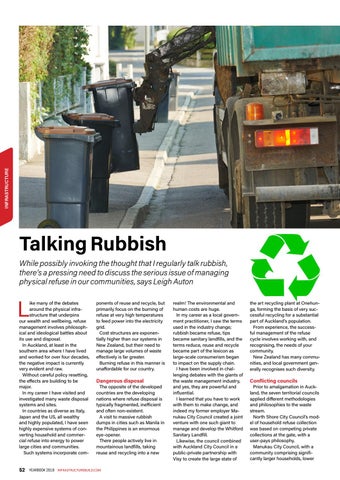
ike many of the debates around the physical infrastructure that underpins our wealth and wellbeing, refuse management involves philosophical and ideological battles about its use and disposal. In Auckland, at least in the southern area where I have lived and worked for over four decades, the negative impact is currently very evident and raw. Without careful policy resetting, the effects are building to be major. In my career I have visited and investigated many waste disposal systems and sites. In countries as diverse as Italy, Japan and the US, all wealthy and highly populated, I have seen highly expensive systems of converting household and commercial refuse into energy to power large cities and communities. Such systems incorporate com52
ponents of reuse and recycle, but primarily focus on the burning of refuse at very high temperatures to feed power into the electricity grid. Cost structures are exponentially higher than our systems in New Zealand, but their need to manage large volumes of waste effectively is far greater. Burning refuse in this manner is unaffordable for our country.
Dangerous disposal
The opposite of the developed countries are the developing nations where refuse disposal is typically fragmented, inefficient and often non-existent. A visit to massive rubbish dumps in cities such as Manila in the Philippines is an enormous eye-opener. There people actively live in mountainous landfills, taking reuse and recycling into a new
YEARBOOK 2018 INFRASTRUCTUREBUILD.COM
realm! The environmental and human costs are huge. In my career as a local government practitioner, I saw the terms used in the industry change; rubbish became refuse, tips became sanitary landfills, and the terms reduce, reuse and recycle became part of the lexicon as large-scale consumerism began to impact on the supply chain. I have been involved in challenging debates with the giants of the waste management industry, and yes, they are powerful and influential. I learned that you have to work with them to make change, and indeed my former employer Manukau City Council created a joint venture with one such giant to manage and develop the Whitford Sanitary Landfill. Likewise, the council combined with Auckland City Council in a public-private partnership with Visy to create the large state of
the art recycling plant at Onehunga, forming the basis of very successful recycling for a substantial part of Auckland’s population. From experience, the successful management of the refuse cycle involves working with, and recognising, the needs of your community. New Zealand has many communities, and local government generally recognises such diversity.
Conflicting councils
Prior to amalgamation in Auckland, the seven territorial councils applied different methodologies and philosophies to the waste stream. North Shore City Council’s model of household refuse collection was based on competing private collections at the gate, with a user-pays philosophy. Manukau City Council, with a community comprising significantly larger households, lower