Book Review
Verlyn Klinkenborg Timothy; or, Notes of an Abject Reptile
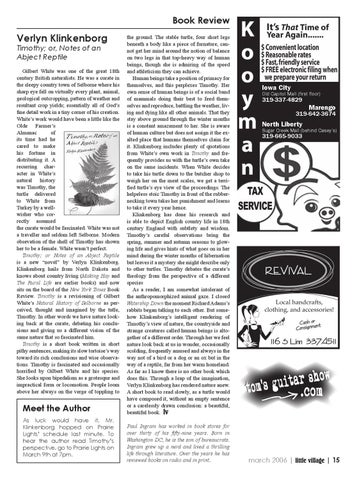
Gilbert White was one of the great 18th century British naturalists. He was a curate in the sleepy country town of Selborne where his sharp eye fell on virtually every plant, animal, geological outcropping, pattern of weather and resultant crop yields; essentially all of God’s fine detail work in a tiny corner of his creation. White’s work would have been a little like the Olde Farmer’s Almanac of its time had he cared to make his fortune in distributing it. A recurring character in White’s natural history was Timothy, the turtle delivered to White from Turkey by a wellwisher who correctly assumed the curate would be fascinated. White was not a traveller and seldom left Selborne. Modern obsevation of the shell of Timothy has shown her to be a female. White wasn’t perfect. Timothy; or Notes of an Abject Reptile is a new “novel” by Verlyn Klinkenborg. Klinkenborg hails from North Dakota and knows about country living (Making Hay and The Rural Life are earlier books) and now sits on the board of the New York Times Book Review. Timothy is a revisioning of Gilbert White’s Natural History of Selborne as perceived, thought and imagined by the tutle, Timothy. In other words we have nature looking back at the curate, debating his conclusions and giving us a different vision of the same nature that so fascinated him. Timothy is a short book written in short pithy sentences, making its slow tortoise’s way toward its rich conclusions and wise observations. Timothy is fascinated and occasionally horrified by Gilbert White and his species. She looks upon bipedalism as a grotesque and impractical form or locomotion. People loom above her always on the verge of toppling to
Meet the Author As luck would have it, Mr. Klinkenborg hopped on Prairie Lights’ schedule last minute. To hear the author read Timothy’s perspective, go to Prairie Lights on March 9th at 7pm.
the ground. The stable turtle, four short legs beneath a body like a piece of furnature, cannot get her mind around the notion of balance on two legs in that top-heavy way of human beings, though she is admiring of the speed and athleticism they can achieve. Human beings take a position of primacy for themselves, and this perplexes Timothy. Her own sense of human beings is of a social band of mammals doing their best to feed themselves and reproduce, battling the weather, living and dying like all other animals. That they stay above ground through the winter months is a constant amazement to her. She is aware of human culture but does not assign it the exalted place that humans themselves claim for it. Klinkenborg includes plenty of quotations from White’s own work in Timothy and frequently provides us with the turtle’s own take on the same incidents. When White decides to take his turtle down to the butcher shop to weigh her on the meat scales, we get a terrified turtle’s eye view of the proceedings. The helpeless stoic Timothy in front of the rubbernecking town takes her punishment and learns to take it every year hence. Klinkenborg has done his research and is able to depict English country life in 18th century England with subtlety and wisdom. Timothy’s careful observations bring the spring, summer and autumn seasons to glowing life and gives hints of what goes on in her mind during the winter months of hibernation but leaves it a mystery she might describe only to other turtles. Timothy debates the curate’s theology from the perspective of a different species As a reader, I am somewhat intolerant of the anthropomorphized animal gaze. I closed Watership Down the moment Richard Adams’s rabbits began talking to each other. But somehow Klinkenborg’s intelligent rendering of Timothy’s view of nature, the countryside and strange creatures called human beings is altogether of a different order. Through her we feel nature look back at us in wonder, occasionally scolding, frequently amused and always in the way not of a bird or a dog or an ox but in the way of a reptile, far from her warm homeland. As far as I know there is no other book which does this. Through a leap of the imagination, Verlyn Klinkenborg has rendered nature anew. A short book to read slowly, as a turtle would have composed it, without an empty sentence or a carelessly drawn conclusion: a beautiful, beautiful book. Paul Ingram has worked in book stores for over thirty of his fifty-nine years. Born in Washington DC, he is the son of bureaucrats. Ingram grew up a nerd and lived a thrilling life through literature. Over the years he has reviewed books on radio and in print.
Iowa City
Old Capitol Mall (first floor)
319-337-4829
Marengo
319-642-3674
North Liberty
Sugar Creek Mall (behind Casey's)
319-665-9033
march 2006 |
| 15