TAKING ON THE BIG GUYS
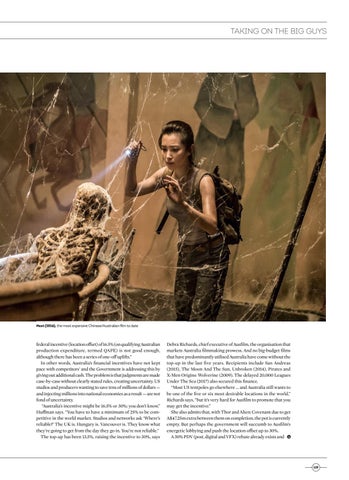
Nest (2016), the most expensive Chinese/Australian film to date
federal incentive (location offset) of 16.5% (on qualifying Australian production expenditure, termed QAPE) is not good enough, although there has been a series of one-off uplifts.” In other words, Australia’s financial incentives have not kept pace with competitors’ and the Government is addressing this by giving out additional cash. The problem is that judgments are made case-by-case without clearly stated rules, creating uncertainty. US studios and producers wanting to save tens of millions of dollars — and injecting millions into national economies as a result — are not fond of uncertainty. “Australia’s incentive might be 16.5% or 30%; you don’t know,” Huffman says. “You have to have a minimum of 25% to be competitive in the world market. Studios and networks ask ‘Where’s reliable?’ The UK is. Hungary is. Vancouver is. They know what they’re going to get from the day they go in. You’re not reliable.” The top-up has been 13.5%, raising the incentive to 30%, says
Debra Richards, chief executive of Ausfilm, the organisation that markets Australia filmmaking prowess. And no big-budget films that have predominantly utilised Australia have come without the top-up in the last five years. Recipients include San Andreas (2015), The Moon And The Sun, Unbroken (2014), Pirates and X-Men Origins: Wolverine (2009). The delayed 20,000 Leagues Under The Sea (2017) also secured this finance. “Most US tentpoles go elsewhere … and Australia still wants to be one of the five or six most desirable locations in the world,” Richards says, “but it’s very hard for Ausfilm to promote that you may get the incentive.” She also admits that, with Thor and Alien: Covenant due to get A$47.25m extra between them on completion, the pot is currently empty. But perhaps the government will succumb to Ausfilm’s energetic lobbying and push the location offset up to 30%. A 30% PDV (post, digital and VFX) rebate already exists and
119