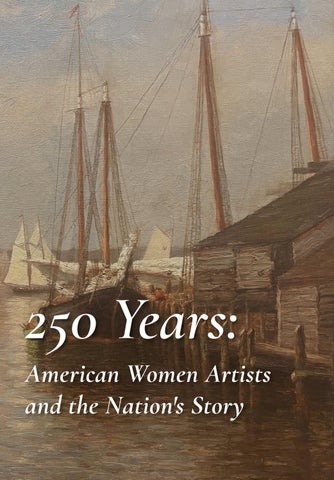
250 Years: American Women Artists and the Nation's Story
All rights reserved, 2026. This catalog may not be reproduced in whole or in any part, in any form or by any means both electronic or mechanical, without the written permission of Lincoln Glenn. Catalog design by Clanci Jo Conover Cover illustration: Laura Woodward (1834-1926) Gloucester Harbor, c. 1880 Oil on canvas 18 x 24 inches
250 Years: American Women Artists and the Nation's Story October 1–December 4, 2026
17 East 67th Street, 1A New York, NY 10065
(646) 764 - 9065 gallery@lincolnglenn.com www.lincolnglenn.com
Foreword The 250th anniversary of the United States offers an occasion not only to celebrate the nation’s history, but also to reconsider how that history has been told. American art has never developed along a single, uninterrupted path, nor has it been shaped solely by the figures who have traditionally occupied its textbooks and museum galleries. It is a history composed of many individual acts of persistence, experimentation, and creative independence. Women artists have been central to that story from its earliest chapters. 250 Years: American Women Artists and the Nation’s Story grew from a desire to examine the full arc of American art through the work of women. Bringing together artists active in every decade from the Revolutionary era to the present, the exhibition reveals a remarkable continuity of ambition across two and a half centuries. Its earliest practitioners worked at a time when women were largely denied formal artistic education and professional recognition. Many learned within the home, through family members, or by assembling an education from whatever opportunities were available to them. Later generations entered academies, formed independent societies, taught, traveled, exhibited, and established studios of their own, gradually expanding the possibilities available to those who followed. The works gathered here encompass portraiture, landscape, still life, abstraction, sculpture, and contemporary practice. Together, they demonstrate that women did not merely participate in the development of American art; they helped define its subjects, methods, and ambitions. From the intimacy of nineteenth-century miniature portraits to the formal experimentation of postwar abstraction, each object reflects both an individual artistic vision and the broader conditions under which it was created. This exhibition is necessarily selective. No presentation of this scale could fully represent the extraordinary range of women who have contributed to American art over the past 250 years. Rather than claiming to offer a complete account, we hope to establish a dialogue across generations. Familiar figures appear alongside artists whose achievements have received far less sustained attention. Seen together, their works illuminate relationships that conventional histories have too often obscured: the transmission of knowledge between women, the persistence of artistic careers despite institutional exclusion, and the recurring determination to create on one’s own terms. This project also reflects a central commitment of Lincoln Glenn Gallery: to bring greater attention to artists whose importance has not always been matched by their recognition. We are deeply grateful to the collectors, scholars, artists, estates, and institutions whose generosity and knowledge helped make this exhibition and catalogue possible. Our sincerest gratitude is extended to the Tormey-Holder Collection, Peggy McClard, Elizabeth Muir, Jennifer Krieger, and Titi Halle for sourcing works for the exhibition as well as their expertise in early American art. Sincerely, Douglas Gold & Eli Sterngass 1
AMERICAN BEAUTY: 250 YEARS OF WOMEN ARTISTS by Clanci Jo Conover
The United States’ 250th anniversary presents an opportune time for reflection on the nation’s artistic history and the artists who either traveled or settled here, laying the foundation for America’s rich artistic legacy. While figures such as Benjamin West and Gilbert Stuart are widely recognized, who preceded them, who were their contemporaries, and how did the artistic landscape evolve through the generations that followed? Moreover, how have women artists shaped American art from its earliest beginnings to the present day? 250 Years: American Women Artists and the Nation’s Story provides a very special opportunity for viewers to walk through American art history from the Revolutionary era to the present by spotlighting the work of women artists. Exhibitions illustrating the progression of art in America through each decade of its history are few and far between, but the chance to see a show of this type composed solely with women artists is exceedingly rare. Predictably, some of the first European artists in North America were male explorers and naturalists who documented the “New World” for a curious audience back home. While these men signify the genesis of Western art in America, there are numerous surviving examples of art across the country in the form of petroglyphs and pictographs (Fig. 1) that were created by Native Americans independent of European influence. Precontact indigenous artisans were skilled in ceramics (Fig. 2), shell engraving, weaving, woodcarving, stonework, and more, but their purposes were generally more utilitarian or ritual based when compared to their European counterparts.
Fig. 1 (left): Barrier Canyon style pictograph, Sego Canyon, Utah, early Fremont Period, around 2,500 B.C Fig. 2 (right): Ceramic of the Underwater Panther, from the Mississippian culture, 1400 - 1600, found in Rose Mound, Cross County, Arkansas, From the Smithsonian Museum of the American Indian, New York
The first female artist (and first pastelist) trained under Western sensibilities working in the American colonies appears to be the portraitist Henrietta Johnston (c. 1674-1729).1 Johnston came to Charleston, SC, from Ireland as wife of the rector at Saint Philip’s Church in the early 1700s—records show that her husband initially did not receive wages due to political challenges, so the money she earned from commissioned portraits (Fig. 3) supported their family when they otherwise would have faced destitution.2 2
Establishing Fine Art in a New Nation The United States worked to find its footing for years after the American Revolution, seeking to establish cultural and political ethos. As in Europe, members of the American aristocracy commissioned portraits as symbols of status, making portraiture one of the principal ways artists could earn a living. Portrait miniatures proved especially profitable, as they required fewer materials and could be produced relatively efficiently. In response to growing demand, artists established miniature-painting studios in major cities throughout the country. Much of the foundational scholarship on this art form Fig. 3: Henrietta Johnston, Mrs. Pierre dates to the 20th century. Harry B. Wehle, a curator at Bacot (Marianne Fleur Du Gue), c. the Metropolitan Museum of Art from 1918 to 1948, 1708-1710, pastel and red and black on toned laid paper, 11 x 8 9/16 described the distinctive function of the American chalk in., Collection of the Metropolitan portrait miniature: Museum of Art, New York “[A miniature] is designed simply as a memento, its purpose being essentially that of an intimate personal document, not to be kept by the subject of the likeness, but intended to serve the owner as an aid in visualizing the admired or beloved person portrayed. In its emotional appeal to the original owner it partakes thus a little both of the companion and the talisman. The Eighteenth Century practice of setting a lock of the sitter’s hair in the back of the frame served to reinforce the association, and in some cases a conventional mourning motif or a word of farewell cut from a letter written by the sitter was introduced to add pathos. During its heyday, the miniature was always small, for it was designed to be carried on the person or set into some such personal article as a snuffbox or a memorandum case, or at the very least to be kept in one’s own desk, probably secreted in the smallest and most private of its drawers.”3 The miniature by Sarah Goodridge (1788-1853, p. 15) featured in this exhibition includes a lock of the unidentified sitter’s hair just as Wehle describes. It is also set into a pendant style frame, similarly to the work of her sister Eliza Goodridge (1798-1882, p. 15) or Anna Claypoole Peale (1791-1878, p. 15-16), indicating that these particular miniatures were intended to be worn by their owners. These small-scale works could also serve more somber purposes, with mourning miniatures commissioned as tokens of remembrance for a lost loved one, often a child. Portrait miniature of William Henry Baldrey (p. 16) by Clarissa Peters (1809-1854) commemorates such a loss, forever memorializing the infant as he holds a delicate bird in his hands. Textiles and needlework were a major creative outlet for early American women, uncommon practices for men as these were considered part of the female domain. Four examples appear in the present exhibition, each taking a different format and illustrating the range of objects that would have been made under this style in the 18th century. Delicately preserved crewelwork fragments from a bed curtain (Fig. 4 / p. 10) display a close attention to detail, the unknown maker putting great care into the embroidered 3
botanicals. A pocketbook (p. 11) with the name “Silas Swallow” embroidered on the interior ingrains the object with a lasting personal reference that has aided in the identification of its likely maker, Lucy Emerson Swallow of New Hampshire (1751-1827). Both of these pieces are functional and would have been used regularly by their owners, denoting the pervading cultural mindset of necessity over luxury. The decorative qualities of these pieces, however, do indicate that they would have been produced and used by upper class women, as they would have had both the time to execute these intricate Fig. 4: Artist Unknown, Crewelwork Border From a Bed Curtain [details], circa 1760-1800, full listing p. 10. designs and the capital to acquire them. The young Lydia Biddle (b. 1784-?) created the featured needlework sampler (p. 12) at age 11, her skill level so early in life likely stemming from prior years of practice and repetition that would have been expected of high society girls. Another embroidered linen sampler (1804, p. 13) by the mysterious creator Sarah Rendell (dates unknown) features only text, reproducing the recently penned Winter Song poem of Robert Bloomfield (17661823). Samplers were considered an integral part of genteel schoolgirl education in early America, and both of the represented examples illustrate the range of styles in which they were produced. As the country moved into the 19th century, it became a more stable, attractive place for businessmen and artists alike, with a growing number of immigrants arriving from Europe. The miniature, and even the full size portrait to some extent, were discarded as the primary mode of portraiture with the advent of photography. Opportunities to train as a fine artist gradually increased but were still limited, especially for women, who were typically barred from taking figure drawing classes for much of the 19th century. The study of figure drawing aided in producing historic paintings that could achieve higher prices, so without access to this type of training, women often stuck with portraits and still lifes out of necessity. Mary Way (1769-1833) worked as a portrait painter and was largely self-taught, as was her sister, Elizabeth Way Champlain (1771-1825). With few opportunities for formal instruction, Mary cobbled together an artistic education wherever she could and supplemented her income by teaching art when portrait commissions were insufficient.4 Most of her known works depict their subjects in rigid profile (p. 14), a stylistic tendency that may reflect her limited formal training. The Goodridge sisters, Sarah and Eliza, grew up in a large family of humble means, receiving sporadic arts training but primarily teaching themselves like the Way sisters. Sarah established a successful miniaturepainting studio in Boston and eventually earned enough to purchase a home. Both sisters demonstrated a sophisticated understanding of perspective and considerable skill in handling paint on ivory (p. 15). Sarah never married,5 while Eliza did not marry until the age of 51, indicating their aptitude for independence.6 For both the Ways and 4
the Goodridges, pursuing artistic careers alongside their sisters created an important network of mutual support, allowing them to exchange ideas, share what they learned, and encourage one another’s artistic development. A reliable route for American artists to receive quality instruction was to learn from a trained family member, as was the case with the legendary Peales. For women, studying under male family members had historically been a path to a career in the arts when formal education otherwise excluded them. American-born patriarch Charles Wilson Peale (1741-1827) studied painting with artists including John Singleton Copley (17381850), later traveling to England for three years where he apprenticed with Benjamin West (1738-1820).7 He took his education and trained many of his family members as artists, going on to found the Pennsylvania Academy of Fine Arts in 1805, giving the women in this family unprecedented access to arts education.8 Charles’ niece Sarah Miriam Peale (1800-1885, p. 18) became one of the first female members of PAFA in 1824 along with her sister Anna.9 The younger Mary Jane Peale (1827-1902, p. 17), granddaughter of Charles, was likewise skilled in the arts, writing in her diary in 1847 that she hoped to become an artist, “For it will be more profitable to make my living in that way than in any other— certainly more agreeable.”10 Even Harriet Cany Peale (1799-1869), who married Charles’ son Rembrandt after taking one of his classes, became part of the family legacy with her skilled portraits (see: p. 16) and robust landscapes. Both Mary Jane and Sarah Miriam never married, relying on their artistic talents to support themselves throughout their lives.11 Women artists found ways to retain their independence in the hyper-patriarchal colonial world, where the English concept of coverture—a doctrine where “the legal identity between husband and wife was entirely under the husband’s domain, and the wife’s husband had full legal control over her”12— remained law in the states until the later 1800s. Susannah Paine (1792-1862), for instance, successfully divorced her husband in 1823 and never remarried, traveling throughout New England and advertising in local papers when she would be in town to ensure business was waiting on her arrival.13 Her c. 1830 Portrait of a Woman (p. 15) is exemplary of full size portraits from early America, maintaining an honesty in the sitter’s depiction that was often lost in the stylized portrayals of European masters. By the second half of the 19th century, art academies were emerging in major cities throughout the United States, providing more structured opportunities for artistic training. At the same time, a growing number of established artists were available as mentors, while patronage of the arts was becoming a greater sociocultural priority. Women artists, and artists in general, were finding more opportunities to produce landscape and genre paintings, moving into styles like the Hudson River School, Impressionism and the Ashcan school. Julie Hart Beers (1835-1913) followed the family training path and studied with her brothers who were able to train in Europe. She became one of a number of women associated with the Hudson River School and the White Mountain School, executing detailed scenery with precision (see: p. 19). Despite her brothers’ protests against her venturing out into the wilderness, she “...tramped on after them many a weary mile through mud and wet.”14 Laura Woodward (1834-1926) was associated with the same landscape movements as Beers, and the two inevitably became colleagues. Gloucester Harbor (c. 1880, p. 21)
5
reflects her signature tonalist style and comes from her extensive travels across New England, where she painted in the Catskills, White Mountains, Adirondacks, Green Mountains, Connecticut, New Jersey, Pennsylvania, and the coasts of Maine and Massachusetts.15 Mary Russell Smith (1842-1878) began painting in her youth at the encouragement of her artist-parents; raising chickens was a favorite childhood hobby, so she naturally gravitated towards small animals as subject matter, evinced by works such as Feathered Tribe (1871, p. 20). Expanding the Vision Breaking into the 20th century, women artists increasingly produced work informed by their own female gaze, making art for and from women’s sensibilities rather than defaulting to the male expectation, forging a union of innocence and independence. Mary Cassatt (1844-1926) is one of the most prestigious artists who pursued compositions appealing to women, frequently depicting mothers and children (Fig. 5). The Silver Mirror (c. 1909, p. 23)16 by Impressionist Louise Williams Jackson (1872-1939) shows an intimate moment for a finely dressed woman, who considers her reflection in a small mirror. Scenes such as this, centering a woman in a private moment rather than commemorating her likeness in a portrait, were not to be found a hundred years prior in the lexicon of American art. Many of Jackson’s paintings mimic this style, imbuing each canvas Fig. 5: Mary Cassatt, Heads of Elsie and Robert 1880, drypoint on paper, image: with an element of her sitter’s identity by depicting Cassatt, 4 7/8 x 3 7/8 in., Private Collection, them as real people. courtesy of Lincoln Glenn Gallery The aristocrat Harriet Whitney Frishmuth (1880-1980) was arguably a pioneer of the female gaze in American sculpture. Frishmuth regularly modeled her figures after Desha Delteil, a dancer with the Fokine Ballet, which was established in 1913 around the idea of liberating the body from academic constraints of traditional ballet17—a sentiment that resounded with countless women artists of the century. Rhapsody (1925, p. 26) also features Desha, and is one of few sculptures the artist produced with two figures, appearing to be mid-motion as they flow organically through dance. Artists like Louise Cox (1865-1945) and Nura Woodson Ulreich (1899-1950) often featured children as their primary subjects, further embracing the female perspective as it applies to motherhood and the responsibility of shepherding the next generation. Cox and Ulreich were the beneficiaries of expanding opportunities for American art students in the later 19th and early 20th centuries, with Cox studying at the National Academy of Design and the Art Students League in New York, and Ulreich enrolling in her local Kansas City Art Institute. Ulreich’s highly stylized figures are representative of a greater level of exploration in American art around the limits of figuration as well as a desire to capture authentic childlike emotion rarely seen in formal portraiture (see: p. 27).
6
Cox’s decorative panel painting Fons Vitae (Fountain of Life) (1918, p. 24) is steeped in allegory, with the children reminiscent of the putti that appear on countless Italian ceilings—one figure to the right holds the American flag while another helps him with his greaves (Fig. 6). Cox conceived of these decorated phonograph cases and frequently executed them with the help of her artist-husband Kenyon and son Allan.18 Fons Vitae was illustrated in a magazine article from July, 1918, and by that time Allan was in Italy fighting in World War I.19 The dating of this article confirms that the piece was executed before the war ended, so the flag-holding figure is likely on his way to battle. With the progression of the 20th century, conventions such as landscape painting had been subverted from the traditional, representational format to geometric planes, vibrant colors, and ambiguous places. Fig. 6: Louise Cox, Artists were evolving from the detail oriented vistas of the Hudson River FonsVitae (Fountain of School and the hazy allure of Impressionism to start characterizing a Life) [detail], 1918, type of art that was distinctly American. Grace Hill Turnbull’s (1880full listing p. 24 1976) Laughing Waters (1925, p. 25) is indicative of her dynamic style, her landscapes possessing an emotive quality tied to place and time. Turnbull’s paintings of waterfalls, the American Southwest, and verdant tropics all have a punchy quality that reminds of contemporaries like Marsden Hartley (1877-1943) or Georgia O’Keeffe (18871986), although she never considered herself a Modernist and was known to produce portraits and miniatures in the traditional style. In contrast, Georgina Klitgaard (1893-1977) eagerly incorporated abstract principles within her landscapes, stating that when considering a view, she would “organize the multitude of small forms of the panorama towards the largeness, weight, and sense of deep space which the landscape primarily evoked… To accomplish this within the limits of my frame, I have come to build upon non-objective design, using geometrical forms, which are not arbitrary, but which are an interpretation of Nature’s unity and emphasis.”20 Buttermilk Bay, Cape Cod (1932, p. 30) is arranged through such a method, with each element contributing to an overall scheme designed to appeal to the eye. Artists like Natalie Van Vleck (1901-1981) pushed the stylized landscape even further, painting cubist scenes like Waterfall, Connecticut (1929, p. 28), where she takes liberties in depicting the angled planes and silver stream of falling water so as to transform her view of the natural world. While not necessarily a refuge, the advancing world of American art had slightly more space for unconventional lifestyles and, by extent, queerness. Van Vleck (Fig. 7) was known to dress androgynously and remained unmarried—though her orientation is unclear, she challenged social conventions not just with her status as spinster artist, but with her everyday wardrobe. Deconstructing and Reconstructing: Abstraction to Today By the 1940s, abstraction had officially migrated from Europe and was taking off in America. The reign of abstraction did 7
Fig. 7: Natalie Van Vleck as a teenager, c. 1916
not just open doors to new styles and ways of creating, it also gave representation a clear counterpoint. Theory around what constitutes art, what abstraction means, recommitment to and redefining of representation—these discussions all emerged out of nonobjectivity. Juanita Guccione’s (1904-1999) Study for Ladders (1948, p. 31) provides a visual reference point for how Surrealism and Cubism broke down recognizable forms and inspired the evolution to total abstraction. The featured works of Mercedes Matter (1913-2001, p. 32) and Diana Kurz (b. 1936, p. 33), who were good friends, retain loosely recognizable forms that serve as a sort of anchor where all else is broken down. Sherron Francis (b. 1940, p. 34) and Teruko Yokoi (19242020, p. 38), on the other hand, omit all figuration and experiment with the limitations of different materials, incorporating mixed media into their explorations. Each of these women received formal training that aided in their development as individual artists, something that was inaccessible to many women who came before them. Responses to both the sensationalization and normalization of abstraction emerged in the later 20th century by way of styles like Pop Art, Minimalism, and Conceptual Art. Feminist artist Harmony Hammond (b. 1944) found her voice after first believing she had to “paint what the boys paint,” recalibrating her original approach and discovering her identity as a lesbian in the process.21 What she landed on was summarized by art historian Mara R. Witzling: “Hammond has dedicated her life to exploring womancentered themes and imagery in sculptures, paintings, and painted assemblages. As she said, her work ‘is for women and about women,’ and her purpose in creating is to ‘give form to my female feeling’ by working with ‘women’s materials—cloth, thread, hair.’”22 Ruffled Waters (1980, p. 35) comes from her series of ‘personages,’ lively alter egos that embodied the renegade spirit.23 Artists like Hammond went beyond a desire to create art and really grappled with what it meant to be a woman artist. They questioned why work created for women by women had hardly ever received critical attention, marking a new era of thinking in American art. Compare Jocelyn Hobbie’s (b. 1968) Untitled (Woman in Pool with Stormy Skies) from 2000 (p. 37)—showing a topless woman with gravity-defying breasts in an emotional state— with the featured 1908 Louise Williams Jackson painting (p. 23). Even though nearly 100 years separates these works, artists from Jackson’s generation can be credited with testing the limits of painting from feminine perspectives, laying the groundwork for successors like Hobbie to explore these perspectives without reservation. Margaret Thompson (b. 1990) alternatively offers a current reference to the surrealist tradition in Embrace (2023, p. 39), with figures depicted floating in a cosmic canoe against a fantastical background, the dreamy composition echoing predecessors like Guccione while incorporating a color palette that inimitably mystifies the viewer. Indigenous American artists have received greater attention in recent years, with creators like Kay Walkingstick (b. 1935, Cherokee Nation), Wendy Redstar (b. 1981, Apsáalooke Tribe), and Emmi Whitehorse (b. 1957, Navajo Nation) earning major museum shows. An interest in collecting indigenous crafts has long been engrained in the American psyche, but that interest strayed into fetishization, and the critical attention these artists are now receiving places them in the same weight class as other exalted American artists. Emmi Whitehorse has spent decades establishing her practice, finding inspiration in her Diné heritage. Keyah 8
(Red) (1993, p. 36) displays Whitehorse’s aesthetic inventions, where she applies drawing techniques to a painterly scale and creates her own visual iconography. The symbols and forms that appear across the piece are reminiscent of ephemeral sand painting and precontact pictographs (see Fig. 1). The artist had looked to her own culture and observed visual links between Diné imagery and contemporary art: “I started looking at things, and I thought, ‘My God… That quilt looks like a Frank Stella, and that was done hundreds of years before Frank Stella ever got around to painting… But it’s so contemporary.”24 Conclusion A through line can be drawn from the 18th century artists to the 21st century artists included in this show, presenting a visual reference point for the development of American Art over the last 250 years and providing insight into the ways women artists carved out space for their own careers. Natalie Van Vleck would not have created cubist landscapes if artists like Julie Hart Beers or Harriet Peale weren’t working in representational landscapes first. Sherron Francis wouldn’t have experimented with total abstraction in mixed media if those like Juanita Guccione hadn’t played in the numinous realm of surrealism. The fine arts in America grew from modest beginnings with minimal opportunities for instruction into an epicenter of innovation and creativity. Americans initially had to undertake costly voyages to Europe to receive formal training; it is only through the persistence and commitment of artists like those featured here that the nation became—and remains—a beacon of aesthetic ingenuity, drawing artists from across the globe to pursue education, inspiration, and opportunity. Endnotes 1 Henrietta Johnston object label for Henriette Charlotte Chastaigner (Mrs. Nathaniel Broughton), Gibbes Museum of Art. 2 Ibid. 3 Harry B. Wehle, American Miniatures, 1730–1850: One Hundred and Seventy-Three Portraits Selected with a Descriptive Account (New York: The Metropolitan Museum of Art, 1927), p. 5. 4 Catherine E. Kelly, “Mary Way and Elizabeth Way Champlain: Fashioning Lives out of Art in the Early Republic,” presented by Lyman Allyn Museum of Art,YouTube video, January 12, 2022, https://www.youtube.com/ watch?v=fNKLUdA52M0. 5 Holton, Randall L; Gilday, Charles A (November–December 2012). "Sarah Goodrich: Mapping places in the heart". The Magazine Antiques, ISSN 0161-9284. 6 Strickler, Susan, American Portrait Miniatures (Worcester: Worcester Art Museum, 1989), p. 63. 7 Kate Nearpass Ogden, “Peale Family of Painters,” Encyclopedia of Greater Philadelphia, 2016, https://philadelphiaencyclopedia. org/essays/peale-family-of-painters/. 8 Ibid. 9 Sarah Cascone, “Why Was Sarah Miriam Peale, Pioneering Member of America’s First Art Dynasty, Left Behind?” Artnet News, April 9, 2026. 10 Diana Marsh, “Mary Jane Peale: The Forgotten Peale Painter,” American Philosophical Society, July 17, 2017, https://www. amphilsoc.org/blog/mary-jane-peale-forgotten-peale-painter. 11 Cascone, "Sarah Miriam Peale," Artnet News. 12 E. H. Deering, “Coverture and Lasting Effects of Gender Inequality: An Analysis through Equal Protection Jurisprudence,” Washington University Jurisprudence Review 16, no. 2 (2024), p. 299. 13 “Susannah Paine,” Cape Ann Museum, accessed August 28, 2026, old.capeannmuseum.org/collections/artists/susannah-paine/. 14 Toledo Museum of Art, “Julie Hart Beers, Forest Interior with White Birch,” museum label, Toledo, OH. 15 Dulce Román, “Celebrating Women’s History Month: Laura Woodward in Florida,” Harn Museum of Art, University of Florida, harn.ufl.edu/resources/celebrating-womens-history-month-laura-woodward-in-florida. 16 Jackson’s The Silver Mirror was exhibited at the Boston Art Club in 1909, the same year of its creation. 17 Clarisse Fava-Piz, “On Harriet Whitney Frishmuth’s The Vine,” Smithsonian American Art Museum, September 17, 2019, https:// americanart.si.edu/blog/harriet-whitney-frishmuths-vine. 18 W.M. Laurel Harris, "The Phonograph as a Piece of Furniture," Good Furniture, Vol. XI, July 1918,. - See article for more on Cox’s phonograph case paintings, Fons Vitae illustrated p. 13. 19 Ibid. 20 Louise Jonas, “Her Light Became a Symbol of Courage, Thus Georgina Klitgaard, Creator of Post Office Mural, Became Legend in Catskill Mountains,” Poughkeepsie Sunday NewYorker, Sunday, November 21, 1943, Two-A. 21 Mara R. Witzling, “Introduction,” in Voicing Today’sVisions:Writings by ContemporaryWomen Artists, ed. Mara R. Witzling (New York: Universe, 1994), p. 7-8. 22 Ibid., p. 243. 23 “Harmony Hammond: Material Witness, Five Decades of Art,” Sarasota Art Museum, accessed August 28, 2026, https://www. sarasotaartmuseum.org/past-exhibitions/harmony-hammond/. 24 Emmi Whitehorse, “Emmi Whitehorse,” in The Painter Speaks: Artists Discuss Their Experiences and Careers (Westport, CT: Greenwood Press, 1993), p. 170.
Artist Unknown 18th Century, Dates Unknown
Crewelwork Border From a Bed Curtain, c. 1760-1800 Wool embroidery on tabbyweave linen with meandering trail with florals, foliage, berries, and grassy sprays. Worked in twoply worsted wool in various stitches including satin, stem, and ladder; one of a pair; American (New England) Each approximately 82 x 9 inches 10
Attributed to Lucy Emerson Swallow 1751-1827
Pocketbook/Wallet, 1785 Worked in wool needlepoint on canvas with stylized carnations in pink, blue, yellow, and green on a brown ground; lined in green wool. On the interior, "Silas Swallow. 1785" worked in white silk on midnight teal blue silk in chainstitch; American, likely New Hampshire. A piece of paper in the pocketbook has the obituary of Monroe Dheher. 4 x 8 1/2 inches Image credit: Cora Ginsburg LLC / Rachel Robshaw 11
Lydia Biddle 1784-?
Alphabet Needlework Sampler, 1795 Worked with silk threads on a linen ground 17 1/2 x 12 inches Rows of alphabet above inscription, "Lydia Biddle / Made in the 11 year of her age 1795"
12
Sarah Rendell 18th-19th Century, Dates Unknown
"Winter Song" by Robert Bloomfield, 1804 Thread on a linen ground 15 x 13 inches Signed and dated lower center
13
Mary Way 1769-1833
Side Profile of a Woman with a Hat, c. 1810 Watercolor on paper 3 3/4 x 3 inches
14
Eliza Goodridge
Sarah Goodridge
Gentleman, c. 1825 Watercolor on ivory Oval, 2 3/4 x 2 1/4 inches
Young Lady in a White Gown, c. 1825 Watercolor on ivory; housed under glass in a pendantstyle gilt metal case with a glazed compartment on verso containing a lock of hair; Oval, 2 1/2 x 2 inches
Anna Claypoole Peale
Susannah Paine
Gentleman Wearing a Blue Coat c. 1825-29, watercolor on ivory Oval, 2 1/4 x 1 3/4 inches
Portrait of a Woman, c. 1830 Oil on panel 27 x 20 inches
1798-1882
1791-1878
15
1788-1853
1792-1862
Anna Claypoole Peale
Sarah Peters Grozelier
Lucy Ann Bainbridge, c. 1833 Watercolor on ivory Oval, 2 3/8 x 2 inches
Benjamin Sumner Procter, c. 1844 Watercolor on ivory Oval, 2 1/2 x 2 inches
Harriet Peale
Clarissa Peters
Portrait of Rebecca, 1840 Oil on canvas, 28 3/4 x 23 3/4 inches Inscribed verso, “Portrait of Rebecca Greenwood (?)/Aged 25 years/ Painted by Harriet C. Cany/ May 1840”
Portrait miniature of William Henry Baldrey c. 1850, watercolor on ivory in the original daguerreotype case, together with a note inscribed William Henry son of Capt. and Mrs. Samuel Baldrey died age 10 mos. 15 days, set in a leather carrying case; sight: 2 3/4 x 2 inches
1791-1878
1799-1869
1821-1907
1809-1854
16
Mary Jane Peale 1827-1902
Portrait of Fanny Adam, 1857 Oil on canvas, 20 x 17 inches A scanned photograph of the back of the canvas taken prior to relining shows the inscription "Fanny Adam / painted by / Mary J. Peale / Pottsville / 1857"
17
Sarah Miriam Peale 1800-1885
Pair of Still Lifes: Cherries and Basket with Berries, c. 1860 Oil on canvas Each 12 x 10 inches
18
Julie Hart Beers 1835-1913
Pastoral Landscape with Cattle, 1865 Oil on canvas 9 1/2 x 13 1/4 inches Signed and dated at lower left
19
Mary Russell Smith 1842-1878
Feathered Tribe, 1871 Oil on canvas 9 1/2 x 14 3/4 inches Signed and dated lower left
20
Laura Woodward 1834-1926
Gloucester Harbor, c. 1880 Oil on canvas 18 x 24 inches Signed lower left
21
Cecilia Beaux 1855-1942
Mrs. Isaiah Stetson, 1893 Oil on canvas 45 x 32 inches Signed and dated lower left 22
Louise Williams Jackson 1872-1939
The Silver Mirror, c. 1909 Oil on canvas 31 3/4 x 27 inches Signed with monogram, upper right
23
Louise Cox 1865-1945
Fons Vitae (Fountain of Life), 1918 Oil on panel, decoration for a phonograph Overall: 39 1/4 x 58 3/4 x 5 inches Titled top center, dated lower right
24
Grace Hill Turnbull 1880-1976
Laughing Waters, 1925 Oil on canvas 26 x 37 inches Signed lower right, titled on verso
25
Harriet Whitney Frishmuth 1880-1980
Rhapsody, 1925 Bronze, dark brown and green patina 11 3/4 x 8 1/8 x 5 inches Hand-signed by artist, Signed on base: HARRIET W. FRISHMUTH / © 1925 Stamped on base: GORHAM CO FOUNDERS QFGT
26
Nura Woodson Ulreich 1899-1950
When Summer Comes, 1927 Oil on canvas 40 x 34 inches Signed "Nura" and dated lower right; signed, titled and dated on the reverse
27
Natalie Van Vleck 1901-1981
Waterfall, Connecticut, 1929 Oil on canvas 30 x 25 inches Signed and dated lower right
28
Lucile Blanch 1895-1981
Eighth Avenue and 56th Street, 1930 Oil on canvas 31 3/4 x 24 inches Signed and dated lower right 29
Georgina Klitgaard 1893-1976
Buttermilk Bay, Cape Cod, 1932 Oil on canvas 18 x 30 inches Signed lower right
30
Juanita Guccione 1904-1999
Study for Ladders, 1948 Gouache on paper 17 x 13 inches Signed lower left, dated, and inscribed “Study for Oil Painting #310” on the reverse 31
Mercedes Matter 1913-2001
Untitled (Reclining Nude), c. 1954-56 Oil on canvas 30 x 36 inches
32
Diana Kurz b. 1936
Small Green Pale, c. 1960-61 Collage and mixed media on board 12 1/2 x 10 inches
33
Sherron Francis b. 1940
Brownstone, 1977 Acrylic and mixed media on canvas 32 1/4 x 25 1/4 inches Signed, titled and dated on the reverse
34
Harmony Hammond b. 1944
Ruffled Waters, 1980 Mixed media on paper 18 1/8 x 24 inches Signed lower right
35
Emmi Whitehorse b. 1957
Keyah (Red), 1993 Oil on paper mounted to canvas 38 x 50 inches Signed, titled, dated on the reverse
36
Jocelyn Hobbie b. 1968
Untitled (Woman in Pool with Stormy Skies), 2000 Oil on canvas 22 1/8 x 28 1/8 inches Signed and dated on the reverse
37
Teruko Yokoi 1924-2020
Untitled, 2010 Watercolor and collage on paper 15 x 11 inches Signed and dated lower right, with dedication upper right
38
Margaret Thompson b. 1990
Embrace, 2023 Oil and wax on linen 24 x 18 inches
39
Artist Index Cecilia Beaux (1855-1942)....................................... 22 Beers, Julie Hart (1835-1913)................................... 19 Biddle, Lydia (1784-?)............................................. 12 Blanch, Lucile (1895-1981)....................................... 29 Cox, Louise (1865-1945).......................................... 24 Francis, Sherron (b. 1940)....................................... 34 Frishmuth, Harriet Whitney (1880-1980)................ 26 Goodridge, Eliza (1798-1882).................................. 15 Goodridge, Sarah (1788-1853)................................. 15 Grozelier, Sarah Peters (1821-1907)......................... 16 Guccione, Juanita (1904-1999)................................ 31 Hammond, Harmony (b. 1940)............................... 35 Hobbie, Jocelyn (b. 1968)..................................... 37 Jackson, Louise Williams (1873-1939)..................... 23 Klitgaard, Georgina (1893-1976)............................. 30 Kurz, Diana (b. 1936)............................................ 33 Matter, Mercedes (1913-2001)................................. 32 Paine, Susannah (1792-1862)................................... 15 Peale, Anna Claypoole (1791-1878)......................... 15, 16 Peale, Harriet (1799-1869)..................................... 16 Peale, Mary Jane (1827-1902)................................. 17 Peale, Sarah Miriam (1800-1885)............................ 18 Peters, Clarissa (1809-1854).................................... 16 Rendell, Sarah (18th-19th century)......................... 13 Smith, Mary Russell (1842-1878)............................. 20 Swallow, Lucy Emerson (1751-1827)........................ 11 Thompson, Margaret (b. 1990)................................ 39 Turnbull, Grace Hill (1880-1976)............................ 25 Ulreich, Nura Woodson (1899-1950)........................ 27 Van Vleck, Natalie (1901-1981)................................ 28 Way, Mary (1769-1833)........................................... 14 Whitehorse, Emmi (b. 1957)................................... 36 Woodward, Laura (1834-1926)................................ 21 Yokoi, Teruko (1924-2020)....................................... 38
LG
LINCOLN GLENN
17 EAST 67TH STREET
(646)764-9065
NEW YORK, NY
gallery@lincolnglenn.com
10065
www.lincolnglenn.com @lincolnglenngallery