Inquiries about membership, upcoming events, replacement Viewfinder issues, and special orders should be directed to:
Richard Rejino, Executive Director Leica Society International 14070 Proton Road, Dallas, TX 75244 info@leicasocietyinternational.org (972) 233-9107
Viewfinder is the official publication of the Leica Society International, a nonprofit organization incorporated in the state of Delaware. Copyright 2024. Reproduction or use of any material contained herein without permission of the Society if forbidden.
Leica is a registered trademark. It and other trademarks pertaining to the Leica System are the property of LEICA CAMERA, USA, INC or LEICA CAMERA AG.
ISSN 1543-8732
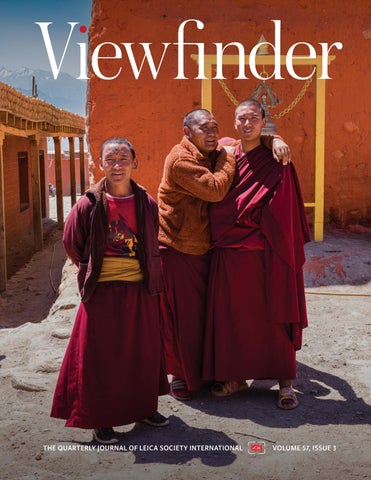
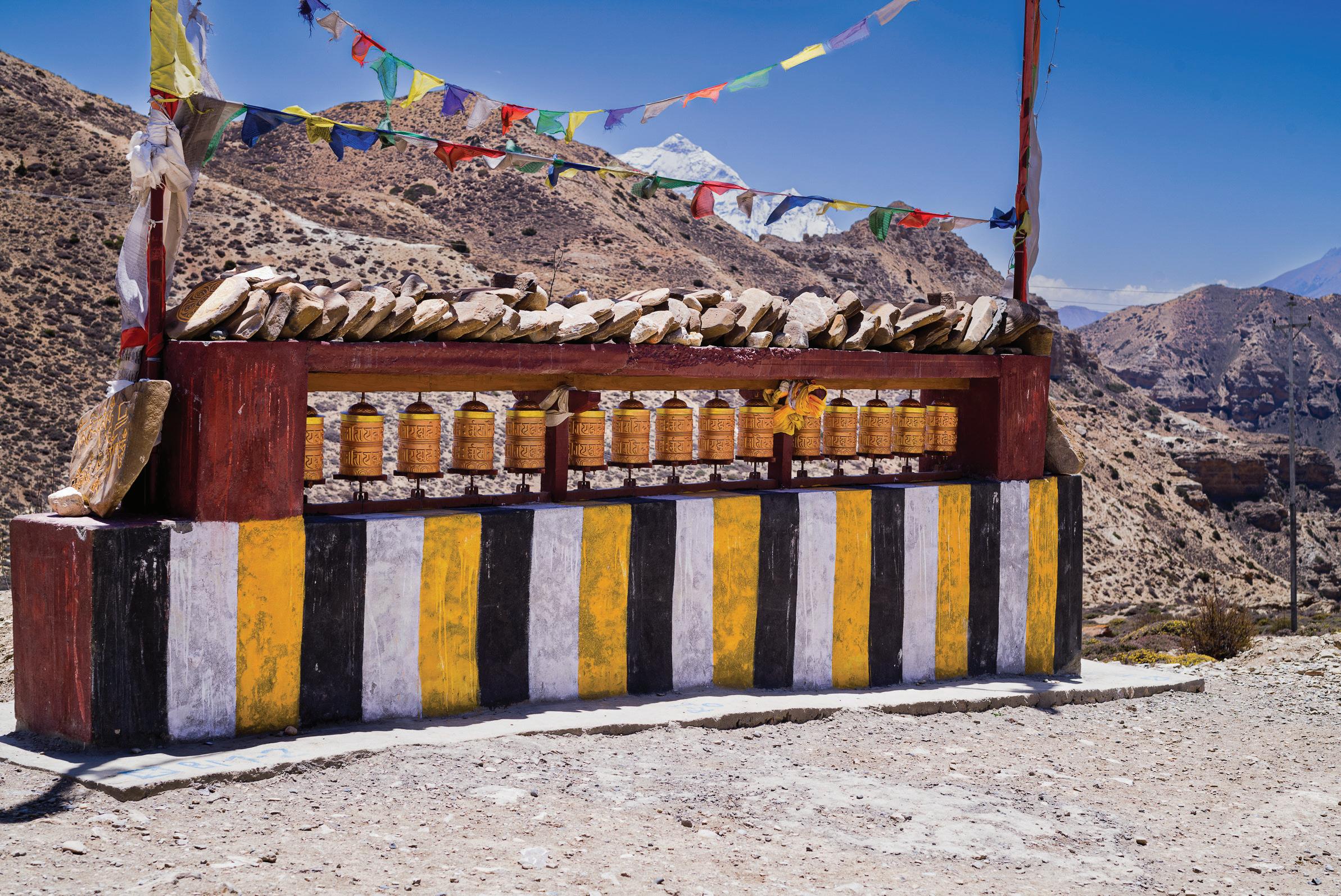
FRONT COVER From Jim Handsfield's article "Nepal", pp
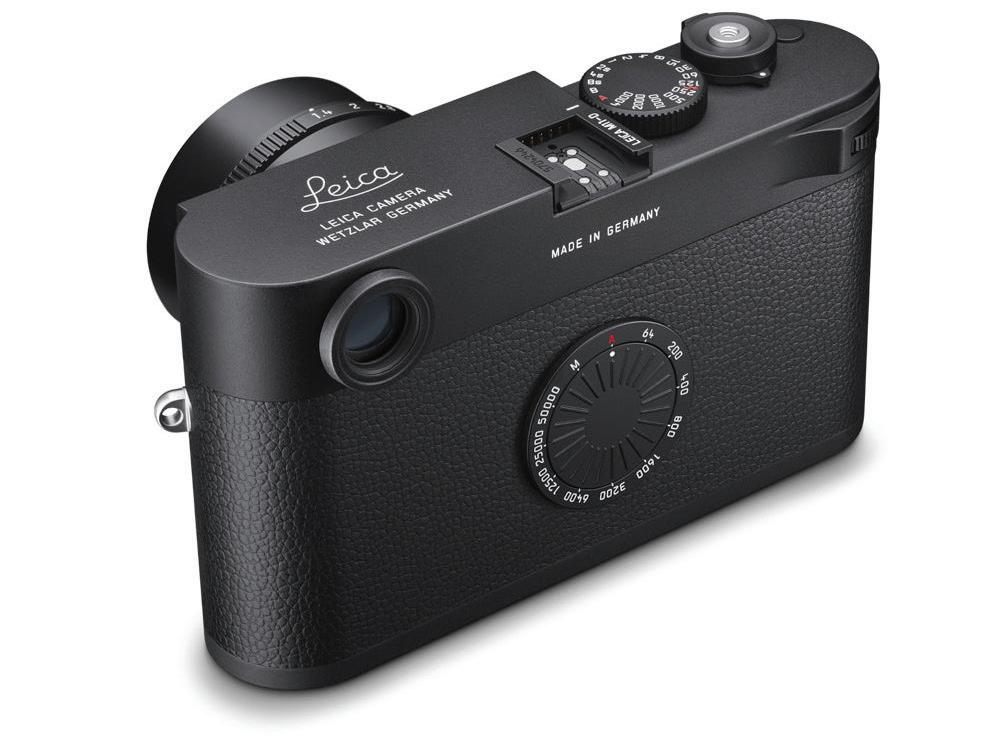
summertime blues: the m11-d
nepal with the m11 & m11m by Jim Handsfield
42 enhancing cropped images using artificial antelligence by Bill Royce
45 the forgotten fulet by Jim Lager
46 the different m6 variations: part ii by Jo Geier
Class of 2025 Continued Hari Subramanyan Heidelberg, Germany
Kirsten Vignes Minneapolis, MN
Class of 2026
Sandra Eisert Redmond, WA
Tom Fey Oxford, Ohio
Wayne Goodman United Kingdom
Jonathan Slack United Kingdom
Class of 2027
Amitava "Chats" Chatterjee Manassas, VA
Marke Gilbert Royal Oak, MI
Wilbur Norman Sante Fe, NM
John Pegouske Dearborn, MI
A LETTER FROM THE EDITOR
by BILL ROSAUER
Ithink you will agree that Kirsten has done an outstanding job with the look and layout of this issue of Viewfinder. We are so fortunate to have her doing our layout work, with such beautiful results. The cover photo by Jim Handsfield is outstanding, and sets the tone for the rest of the issue. As always, I try to strike a balance on content, although this issue may be a little heavier on gear. Leica continues to bring new product to the market and we are happy to have Jono Slack giving us the latest Leica news.
Richard’s Retirement Letter as the Admin for the LSI leads off this issue of Viewfinder. Speaking from personal experience, Richard has been a tireless worker on behalf of the Society and a tremendous resource for the LSI. Richard has been a good friend as well, and has been very helpful with my work as the Viewfinder editor, and he will be helping us out in the future on Viewfinder as well. I remember well when we hired the Madeleine Crouch agency and met Richard at his fi rst annual meeting. Little did I know that Richard would become the serious Leica guy he is now, and spread his wings with us as a talented photographer as well. Well done Richard! You will be a tough act to follow.
Leica has been on a tear introducing new models of its cameras of late, and Jono Slack does his review of the Q3 43 and the redesigned M11-D entitled “Summertime Blues”. As always, Jono gives us a very detailed review of both of them and his unique take on these new cameras. He fi nds the Q3 43 to have one of the best lenses Leica has ever done, and incidentally it is very close to the focal length of the lens used on the Ur-Leica back in 1914! It’s the perfect camera to help you reproduce Barnack’s famous image of the Eisenmarkt with. Jono fi nds the re-designed M11-D to be closer to a fi lm M than ever.
Ed Schwartzreich does his review of the New/Old Light Lens Labs 28/2.8 9 Element lens and the IDS Grip for the M11. As Ed points out, LLL has been making some very interesting re-issues of popular lenses from Leitz in the past couple of years, beginning with their incredibly popular 8 element Summicron clone. With the 9 Element 28/2.8, they have gone a step further, improving on the original Leitz lens while retaining the physical appearance and character of the original lens. Ed has told me that he is using this lens as you would the Q3, cropping to 135mm with no appreciable loss in quality. Th is says a lot, as the Q3 has one of the best lenses Leica has designed to date. Ed fi nds the IDS M11 grip to be very useful in helping hand hold the M camera. Being able to store a
spare card and compatibility with ARCA Swiss tripod heads is the cherry on the top! It’s great that there is this very useful niche industry supporting us in our use of Leica M cameras.
Jim Handsfield takes us with him on his journey to Lower and Upper Mustang in Nepal with the Leica M11 and M11M. From the sound of it, this was quite a journey, led by our good friend Wilbur Norman. Jim explores the rich culture with his minimal M kit of 2 cameras and 5 lenses. His choices for his kit are very similar to my own, so I can readily identify with the gear he is working with. It covers a broad range of expected and unexpected situations you may encounter on a trip you will only go on once in a lifetime. I think you will be impressed with Jim’s description of this journey, and the photographic results he has obtained.
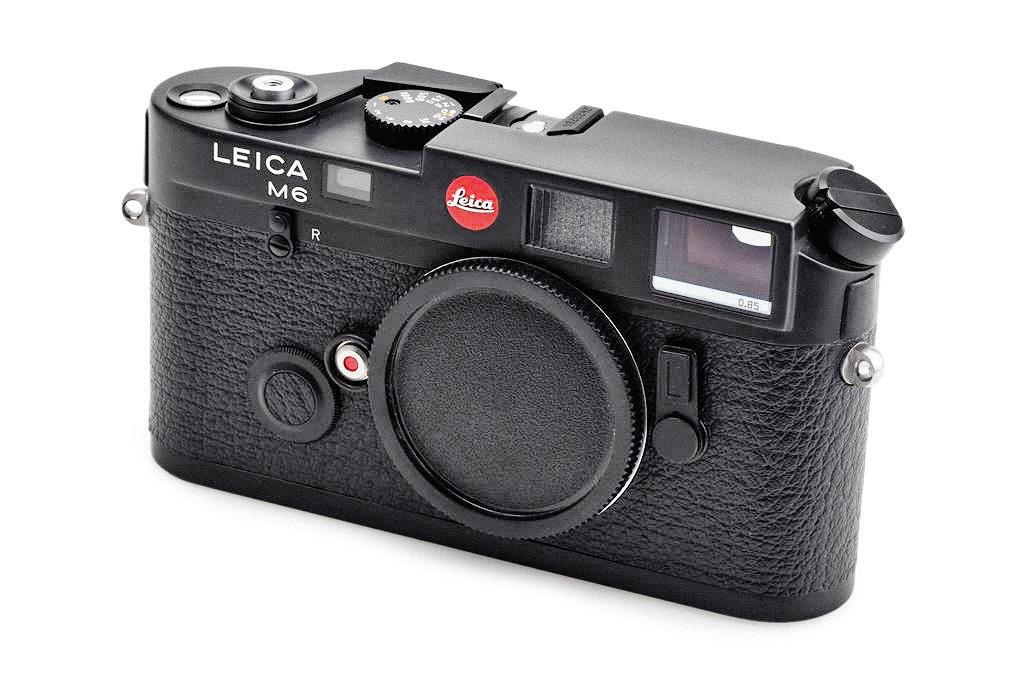
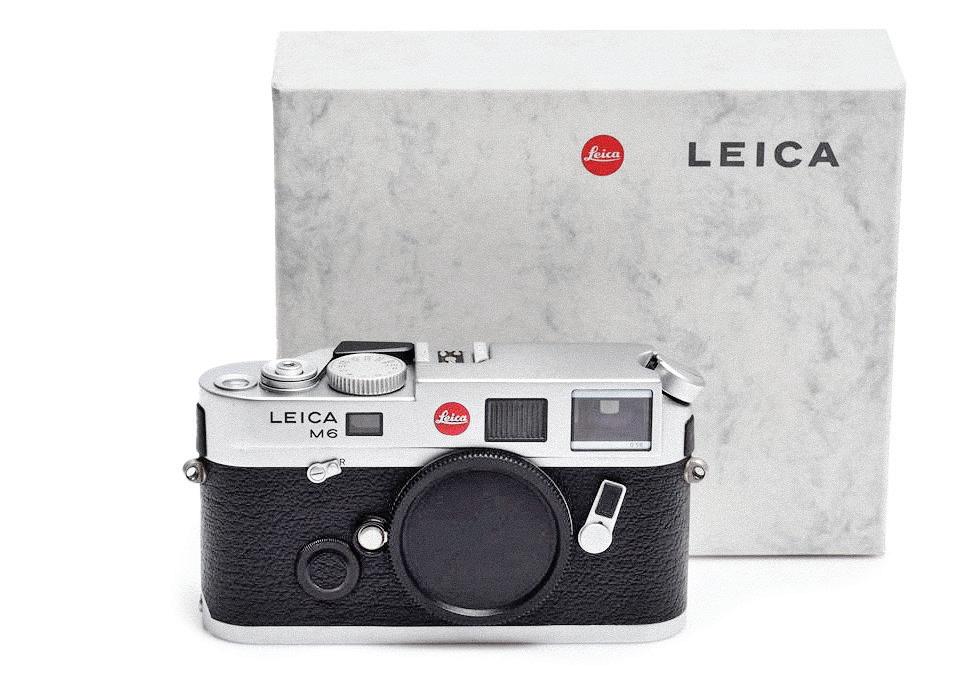
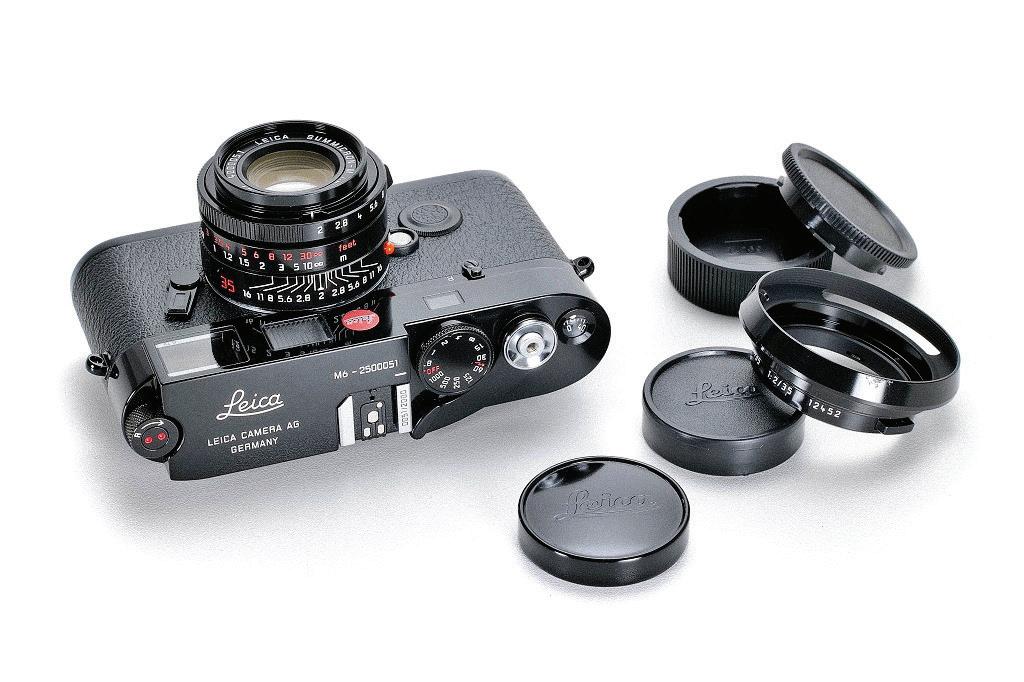
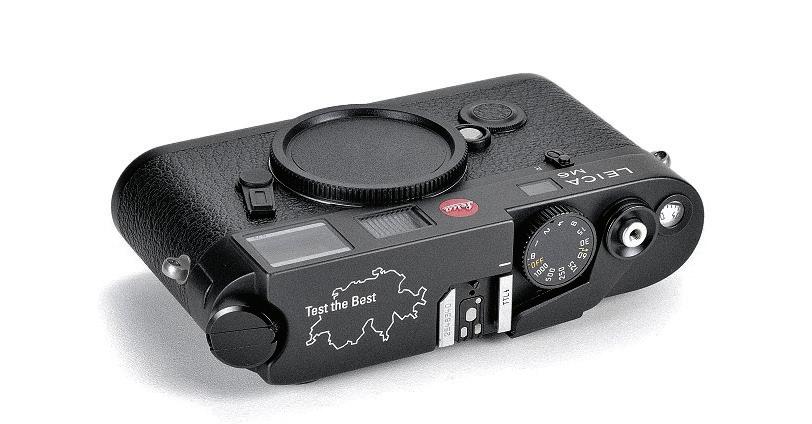
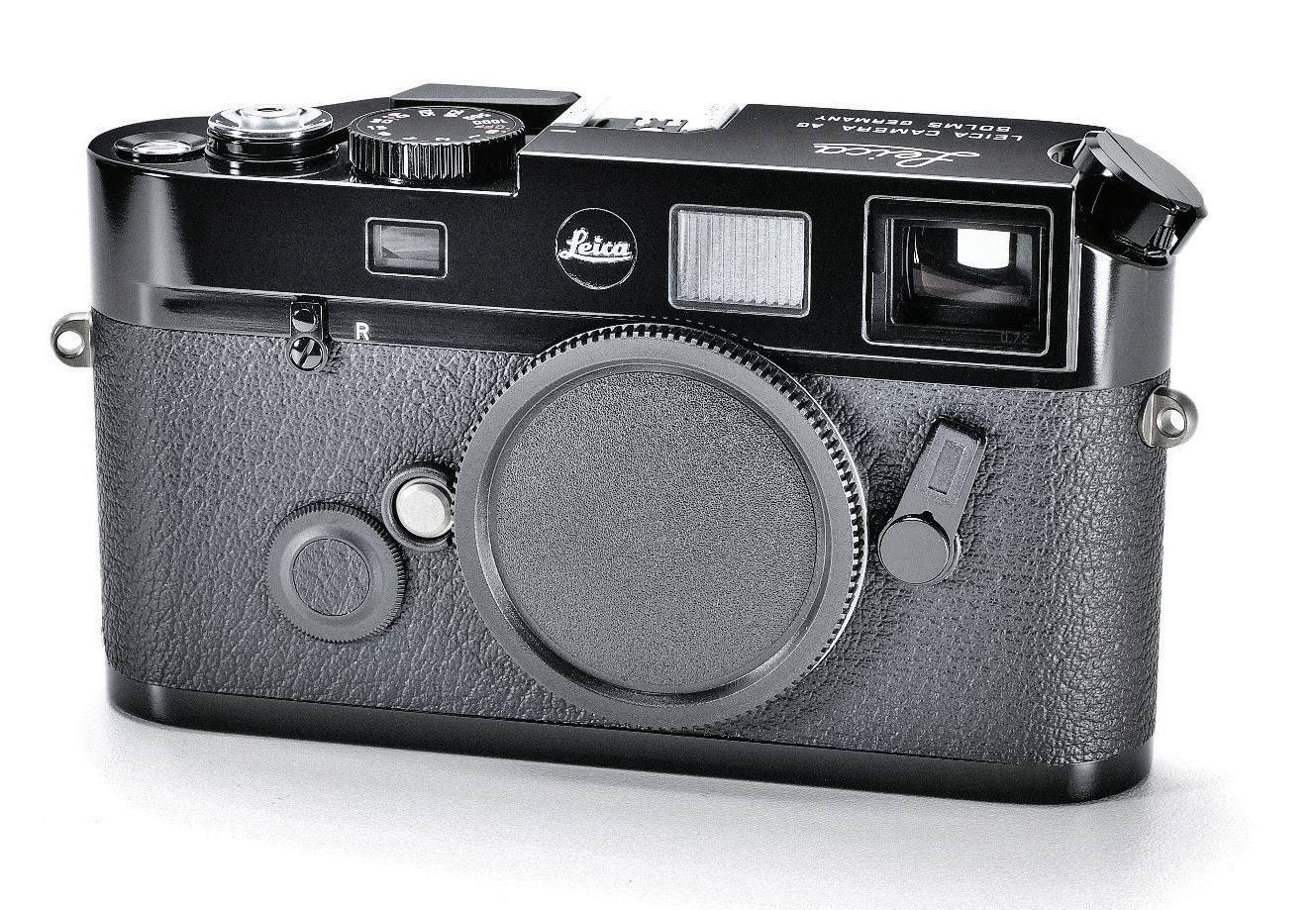
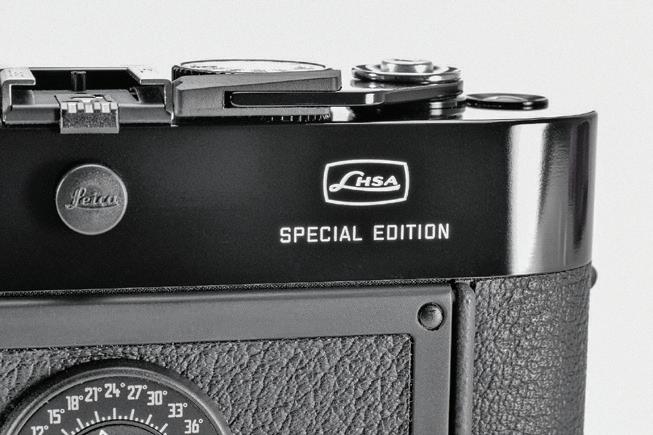
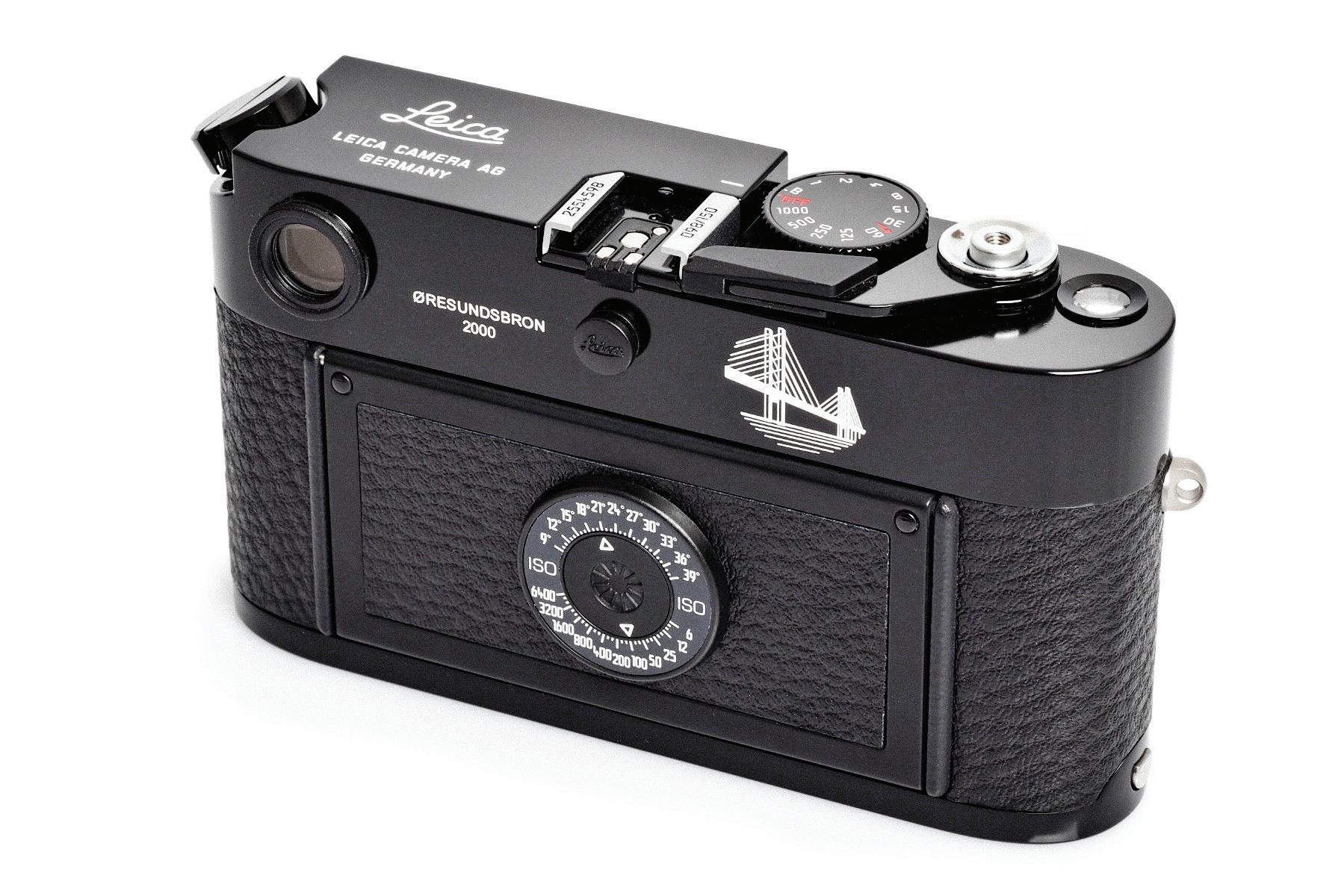
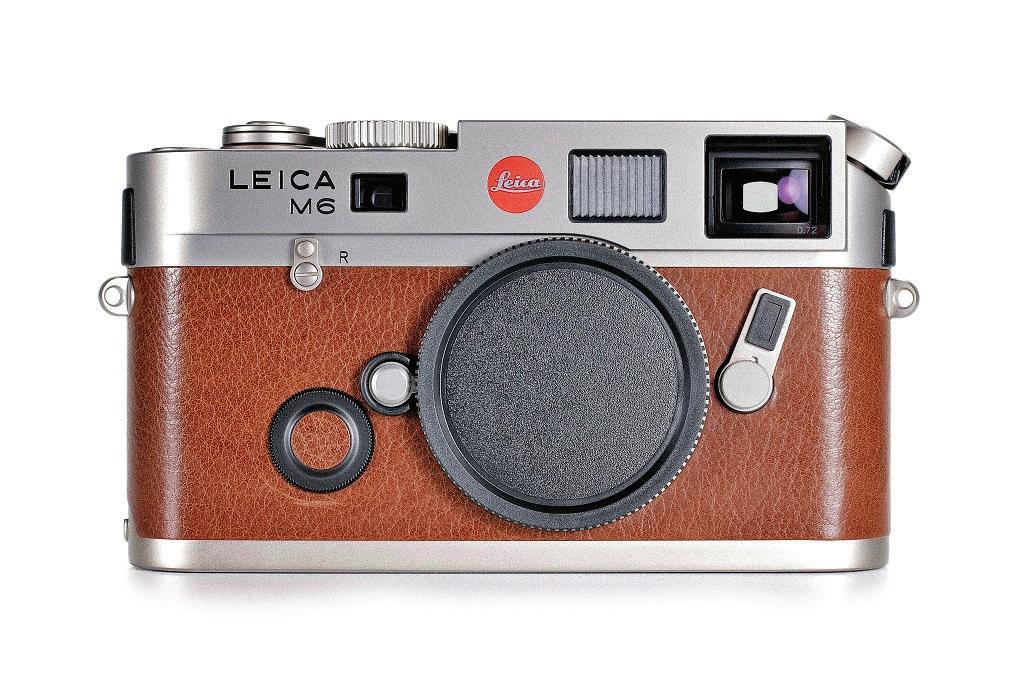
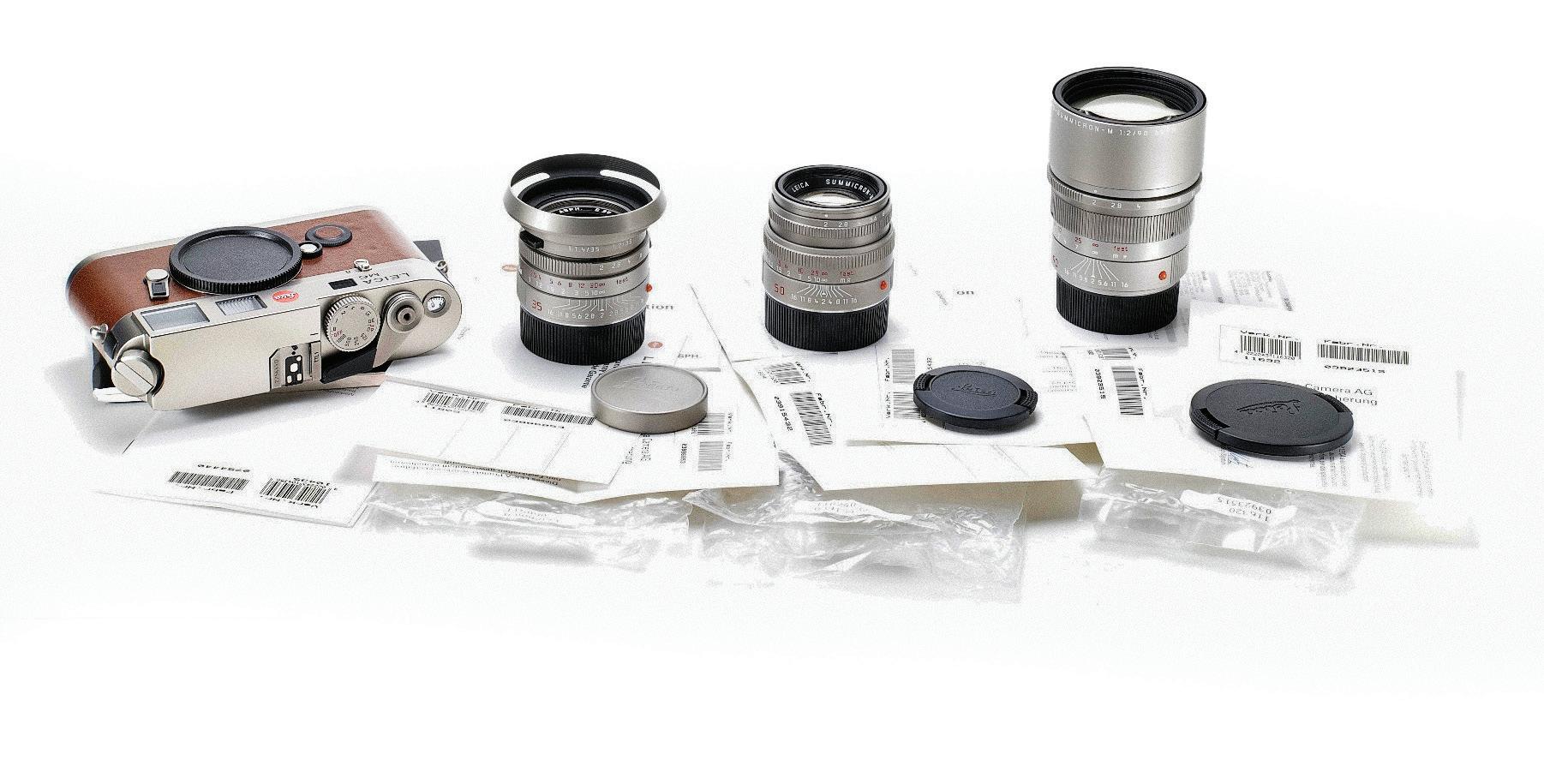
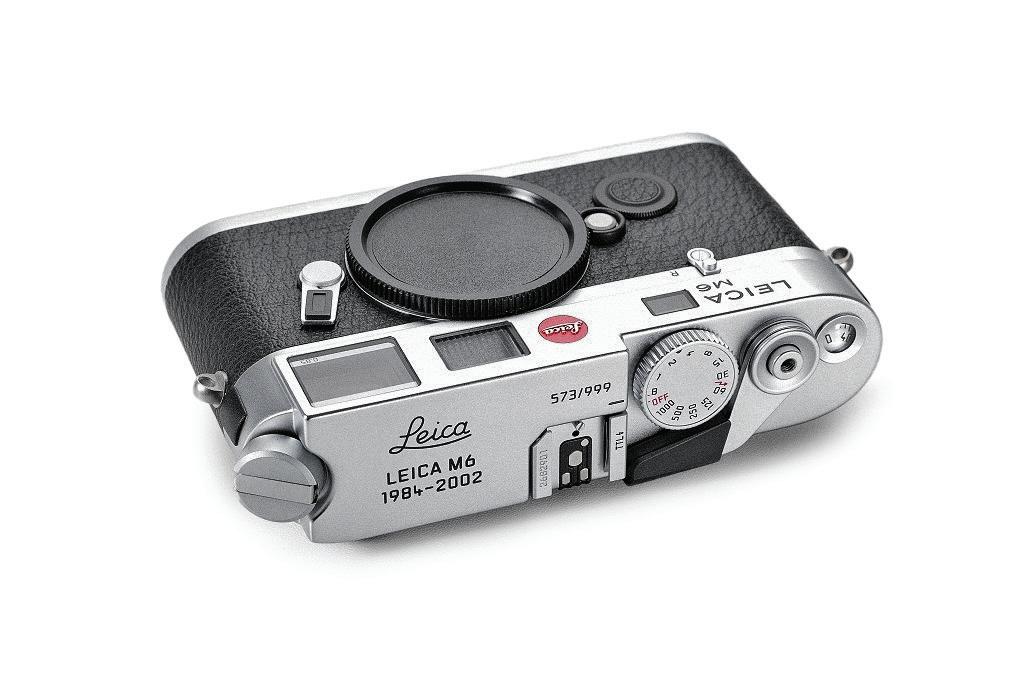
We have Part 2 of Jo Geier’s Leica M6 variations article in this issue. We received a lot of positive response to part 1 of his article, as with the re-issue of the M6, there is a lot of interest in its history. I saw Jo at the Wetzlar camera auction in October, and as always, he is a very pleasant and knowledgeable person to spend time with. I was glad to see my baby, the LHSA M6 Black Paint special edition in this article. Th is camera took four long years of cajoling and convincing Leica to do black paint, and it amazes me how many other special edition cameras have been done in black paint since then. It also became a standard fi nish for Leica M cameras again, and Leica just introduced black paint versions of the M11 and 50/1.2 Noctilux, with a huge amount of interest for both as well.
Bill Royce gives us an overview of the advantages of AI coming to photography, in this case Gigapixel AI as part of your postprocessing arsenal. In the case of photography, AI is a very useful tool to help us get the best results from our digital images. Bill shows us how in a few steps how this is done with one of the more popular AI programs.
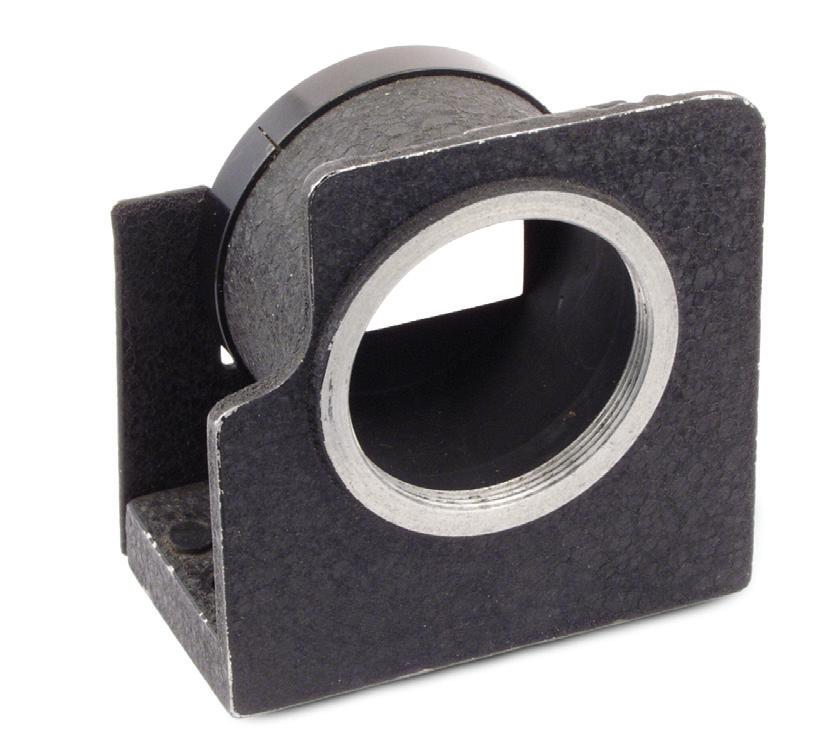
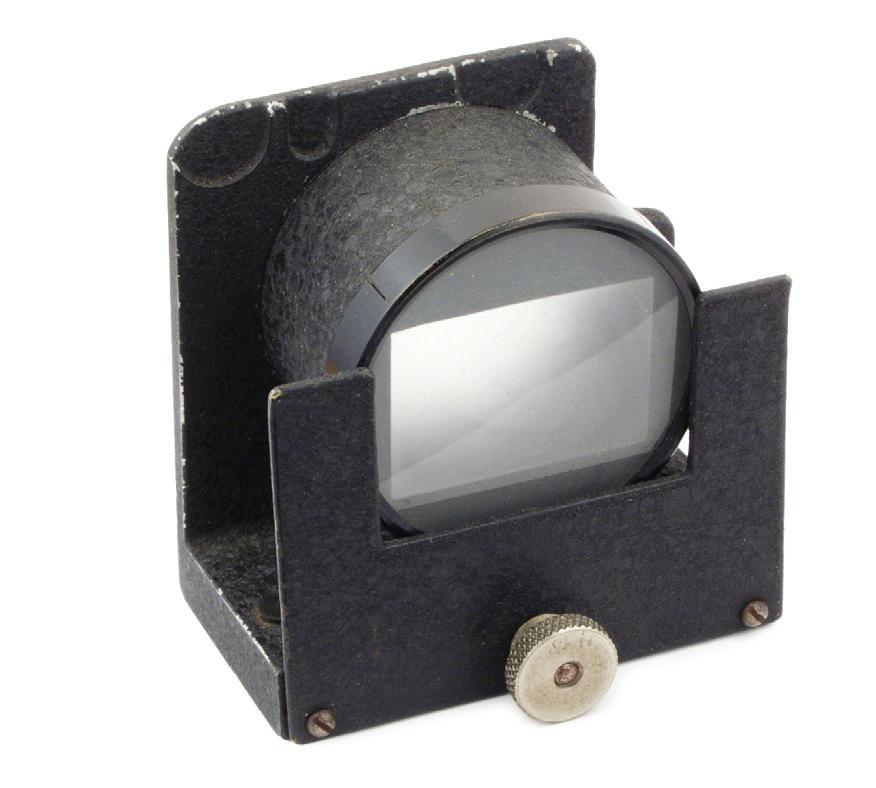
Jim Lager shares another Leica rarity with us, the Forgotten FULET Focusing Copy Attachment. These are very rare and as Jim points out, many people had no idea of what they are when found, as there is no Leica or Leitz marking on them. The FULET was superseded by the more versatile FULDY, which I am sure helped in the demise of the FULET. Its always amazing looking at the history of these now little known Leitz accessories, and gives us Leica historians endless food for thought and discussion.
2025 also marks the 100th Anniversary of the Leica camera. Wetzlar is planning a huge special event in June, and it should be a very memorable and once in a lifetime experience. I am planning on being there with my group. Let me know if you are interested in being a part of Leica history.
Bis nächste Zeit! - Bill
A LETTER FROM THE PRESIDENT
by DAVID KNOBLE
Members & friends of the Leica Society International: As we close out another year and step into 2025, we fi nd ourselves looking towards a significant milestone—the 100th anniversary of Leica Wetzlar. Th is celebration is not just a testament to the legacy of Leica, but also to the enduring journey of Leica Society International. Together, we’ve become stewards of this remarkable history, connecting generations of photographers while embracing the future of the art we love.
One of the most extraordinary aspects of Leica’s design philosophy is its timeless compatibility. Today, we still have the ability to mix and match lenses and cameras created over a century of refi nement. Th is rich continuity is safeguarded by the Leica archives in Wetzlar and our own LSI archives. It’s fascinating – and humbling – to reflect on how these archives intertwine. Leica relies on our archives as much as we rely on theirs, a mutual commitment to preserving the history that defi nes us.
Yet, while we honor the past, we also look forward. Photography continues to evolve, and we, as a society, embrace the new tools and technologies shaping the field. Artificial intelligence (AI) is one of those tools. Though it stirs debate, many AI applications today can anrguably enhance the photographic process without compromising authenticity. From quick, precise masking reminiscent of the intricate paper masks used by Magnum masters, to AI-driven tools that help us organizing and searching vast digital libraries, refi ning sharpness, and adjusting contrast – all while leaving the essence of an image intact, the future time-saving possibilities are exciting. In this issue, Bill Royce offers an
insightful tour of how AI can assist us in enlarging our images with minimal loss of tones and fi ne details through the extraordinary modern leica lenses.
Film remains relevant and, like content credentials in the M11-P, help ensure authenticity in an era where reality is often questioned. While many craft s are being replaced by automation, fi lm photography remains vibrant.
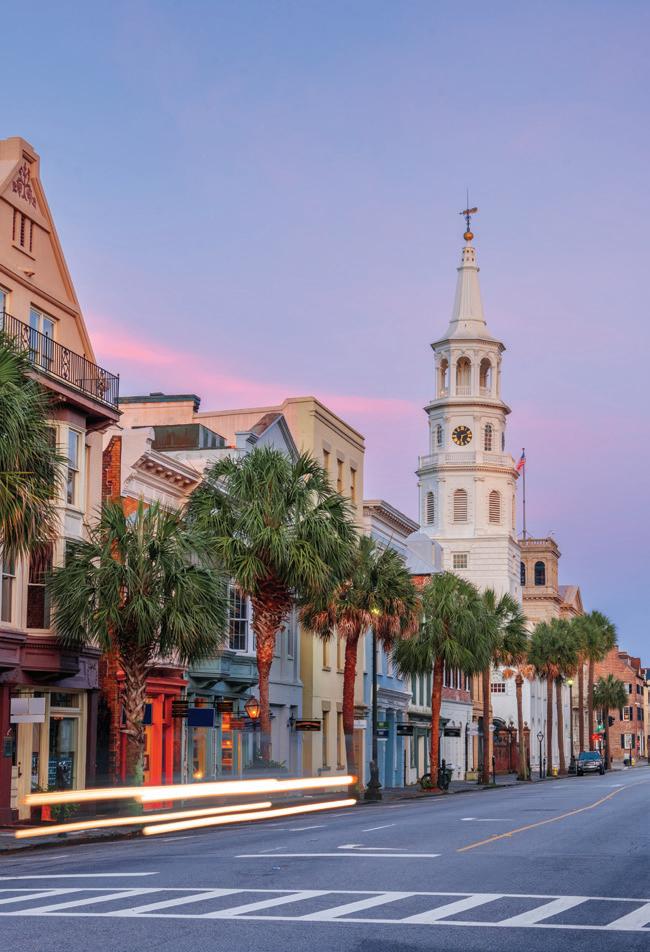
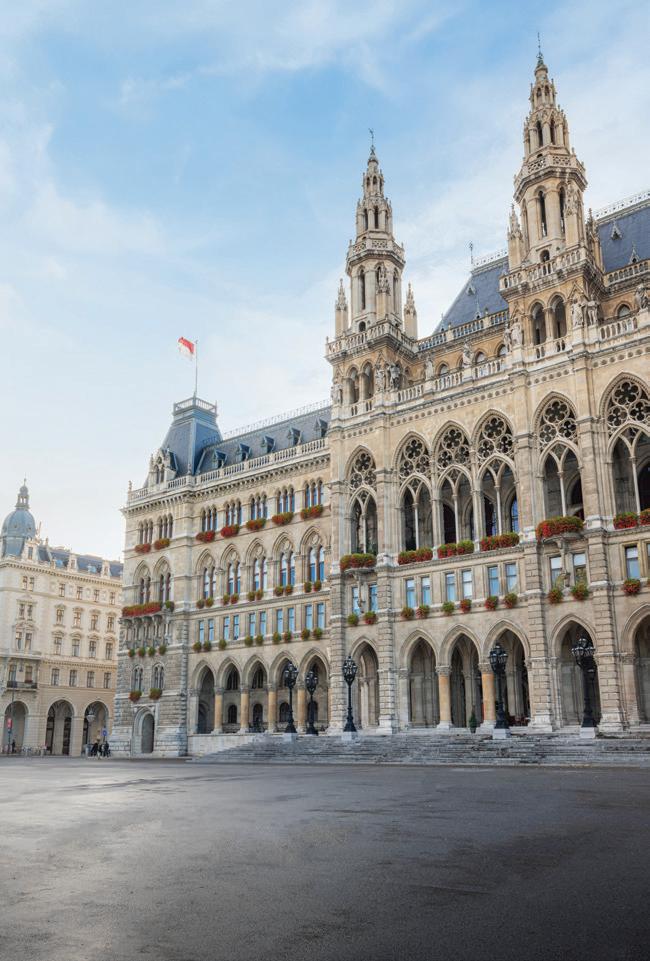
As we navigate these advances, LSI continues to provide spaces for discovery, conversation, and inspiration. Our 2025 conferences in Charleston, SC; Vienna, Austria; and Montreal, Canada, will explore topics like this while showcasing artists journeys and skills. Beyond the conferences, our WhatsApp channels buzz with daily discussions, image critiques, and creative challenges. Whether you jump into a two-week challenge or ask a question about technique, this is a space to share stories, seek opinions, and connect. Don’t worry about keeping up, the conversation continues globally 24 hours a day!
Th is is what LSI is all about—our shared passion for photography, a bridge between history and innovation, and a community that grows stronger with each interaction. We Are Photographers, and together, we continue to explore and create.
I look forward to continuing the conversation with you and am honored to serve as your president.
David Knoble
President, Leica Society International
A LETTER FROM RICHARD REJINO
LSI Executive Director 2014 - 2024
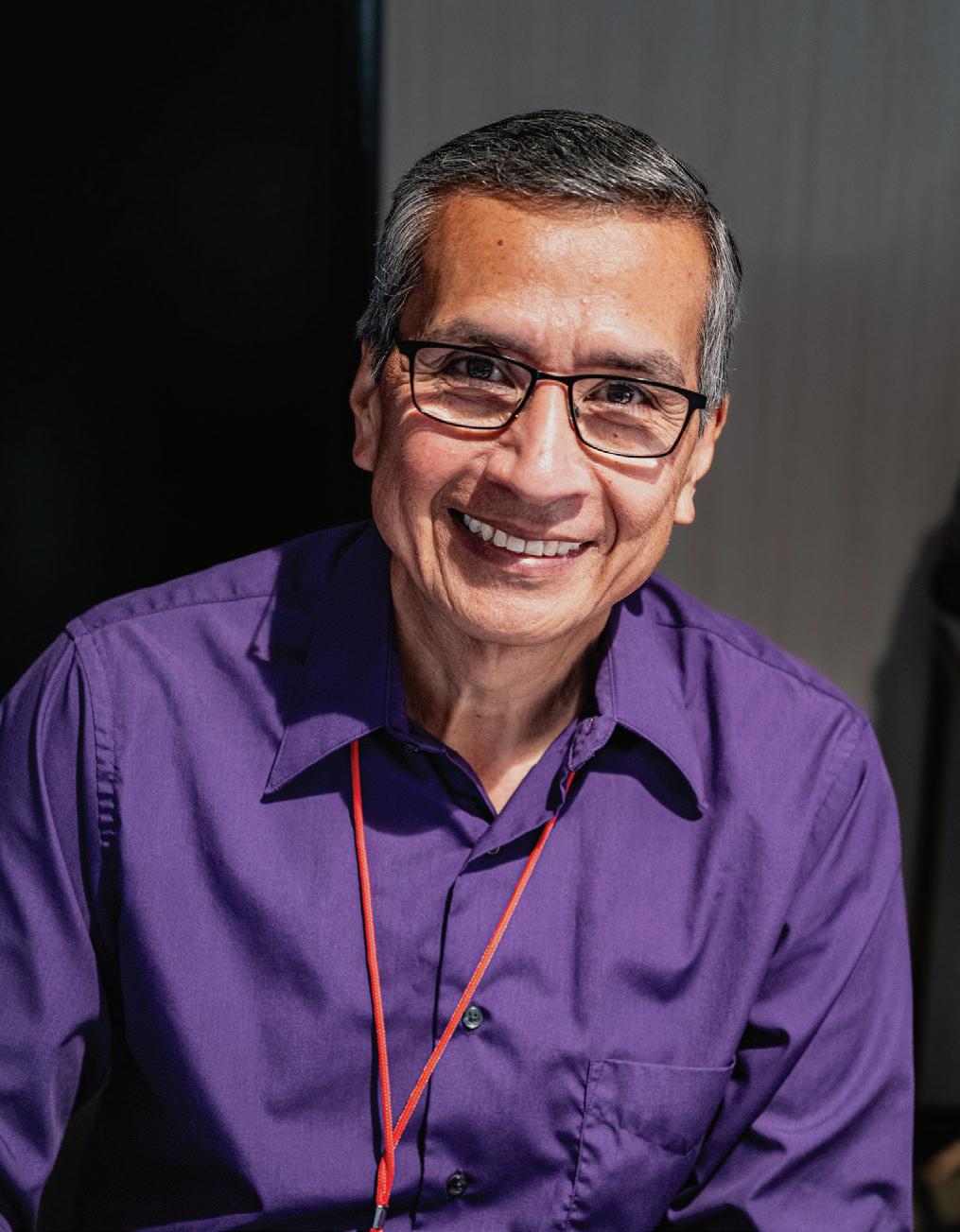
DearLSI Friends and Colleagues, if I have learned one thing, it is that change is never easy, but it is inevitable. So, it is with incredible gratitude and sadness that I am announcing my retirement as LSI’s Executive Director at the end of 2024. My ten years with this organization have been a privilege and an unexpected joy. Little did I know that in 2014 my work with LSI would become one of the most rewarding experiences I’ve ever had. Not only did I relish working with a society of photographers, but I also grew to love the people in it. In these last several weeks I have reflected on the many blessings I have had from serving as your Executive Director.
I know from experience that not many people are lucky enough to do what they love, to have their passions and their job converge into a meaningful purpose. But I am one of those people. As a young, farm boy, no matter what task I was given, my mother would always ask me if I was doing a good job, and my father’s relentless work ethic defined his character and integrity. Through their example they shaped me during those impressionable years, but I also quickly learned that for me, to do a good job meant that I had to care about the job I was doing. I had to be emotionally invested. As a result, my career reflects the most important parts of me: music, writing, and photography; and compassion and service. LSI embodies all of that for me.
My good fortune would never have been possible were it not for the people who gave me the right opportunities. None have been more important than Madeleine Crouch & Co., who is your management company. Madeleine recruited me in 2013 after I had spent 30 years in the retail print music business. I was growing tired of the retail world, and she decided it was time for me to change course and work for her. So, I did. I’ve never known anyone who is more generous and around whom I feel safer and more protected than Madeleine. I will always be grateful for her empathy, trust and respect – and for finding (LSI) the perfect client for me!
One of the benefits of my job is working with new leadership every year. It has taught me to listen more and talk less; to be curious, as Walt Whitman said, and not judgmental. At LSI, I’ve been surrounded by incredible leaders, each of whom left an indelible mark on the Society. Working with them was humbling and they inspired me to be a better person and a better photographer. I want to thank the presidents with whom I have been honored to serve: Gary Hough, Alan Weinschel, Keith Sbiral, Brad Husick
and David Knoble. They and the board of directors have been the reason for LSI’s renaissance. Were it not for their courage and vision, LSI would be much different today. Instead, it has evolved into a flourishing global community. In ten years, LSI has grown from 725 members to almost 3000, and yet we have managed to keep LSI focused on its members and dedicated to supporting the larger Leica community.
Someone once asked me what I enjoy most about my work with LSI. Without question, the first things are the conferences. When I see members from all over the globe come together and become a family, nothing beats the look of satisfaction on their faces after three days of sessions and experiences that have helped them find new friends and become better photographers.
Next are LSI’s Photography and Women in Photography annual grants. By “paying it forward,” we have touched and changed the lives of so many deserving photographers, which is what LSI is all about – nurturing and inspiring the next generation of artists. What could be more thrilling and rewarding than that?
It has also been a great honor to have been part of a team of people who always want the best for this organization. To know that I contributed a small part to LSI’s rebirth, its successes, and its vision for the future, is for me a source of great pride. Thank you for the opportunity to serve with you.
I know you will be in good hands with my successor, Colin McKinley, who is a talented and passionate photographer in his own right. He cares about people and building relationships – a win-win for LSI. He will have the support of Jason Bohls, LSI administrative assistant, and the MCC staff behind him. I know you will welcome them with the same warmth and support as you did me.
I want to thank my family for their support, especially my wife, Mona, who is my morning light. She put up with all the worries and crankiness I brought home with me. Let it be known to all of you, she is the reason for my everything.
Lastly, I want to thank you, the LSI membership, for your kind words and patience with me over the years. To know you, whether personally or through occasional emails, is of great value to me. My desire was to support and help you in any way that I could. If I failed you, I hope it was temporary, and if I succeeded, thank you for making so many days at work a true pleasure.
As I look toward the next phase of my life, know that I am changing and not disappearing. I plan to remain an active member of LSI, to continue my Leica journey, and finally enjoy conferences as a participant!
My memories of LSI will always be rich and full – from having the audacity to attend an LSI meeting with a Canon camera, to
orchestrating my fi rst international conference in Wetzlar. But what I will probably cherish more than anything, and what still amazes me to this day, is the passion for Leica photography that all its members share. It is, in a word, astounding. And it has helped me understand why I love photography as much as I do, why the sound of the shutter still evokes the surprise of possibility in my eyes.
Thank you, again, for the true privilege of serving you. I look forward to LSI’s future with hope and possibilities.
With deep gratitude and admiration, Richard Rejino
LSI Executive Director 2014-2024
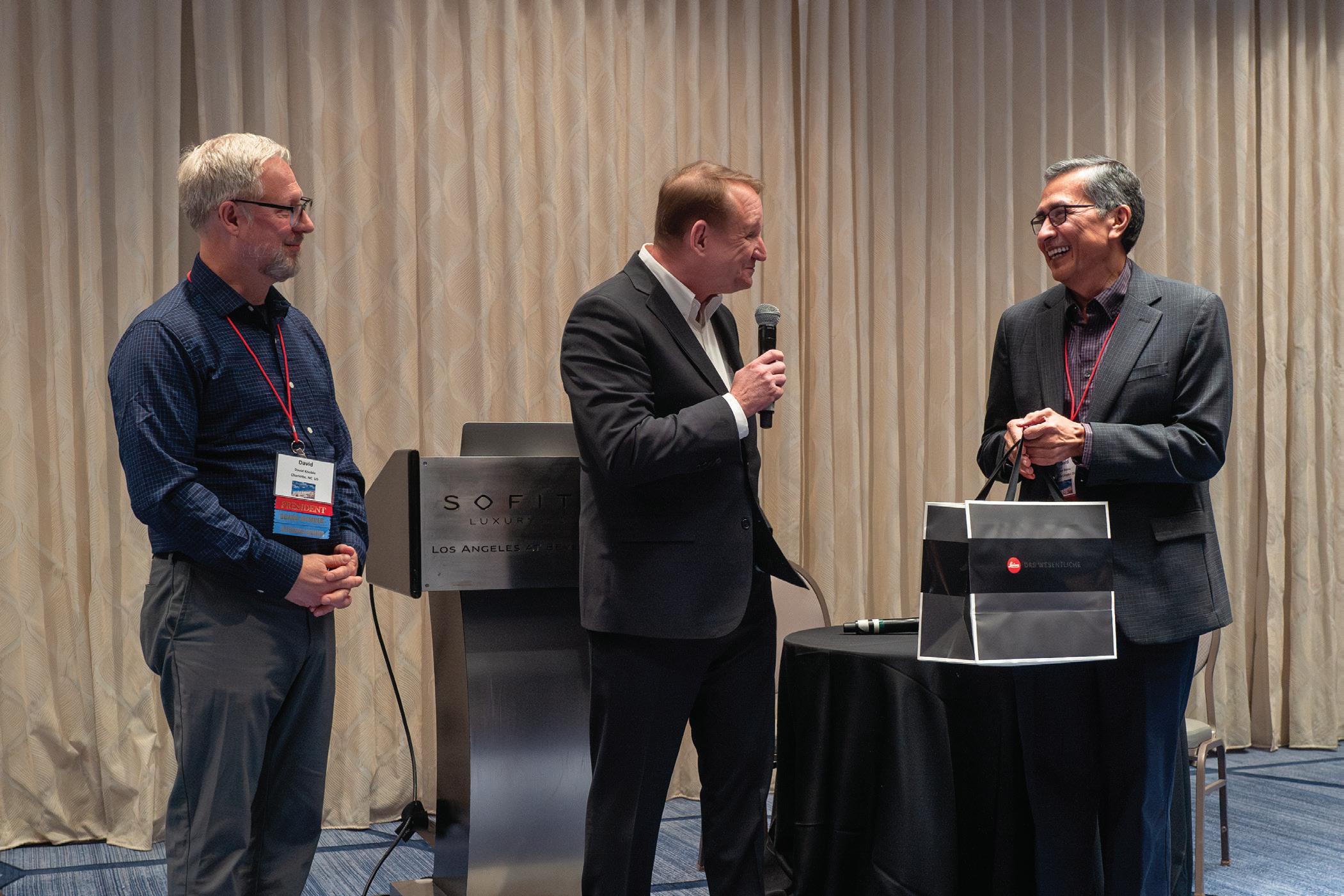
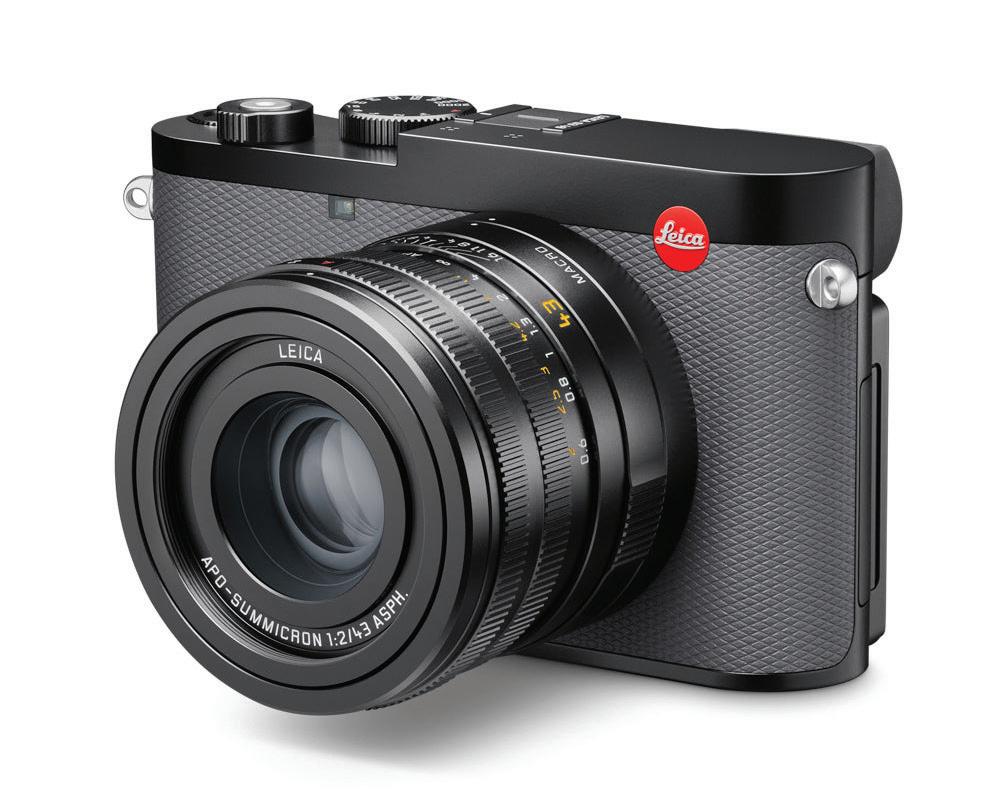
(above) At our Annual Meeting in October 2024, LSI President David Knoble (left) and Tom Smith of Leica Akademie USA (center) presented Richard Rejino with a Leica Q3 43 as a Thank You for his decade of service.
The IDS M11 Grip
by ED SCHWARTZREICH
When I was in communication with Henry Tse about his company’s articulated thumb rest, he asked if I would like to review the hand grip that they were just making for the Leica SL3. That sounded like a great offer, except that I do not own an SL3. However, they do have a hand grip for the Leica M11, recently upgraded, and I indicated that I would be happy to do a review of that accessory.
I started talking to my wife about camera grips, as she too, earlier on, had been a photographer. I told her that I was going to test out one from IDS. Aside from jokes about me finally “getting a grip”, this was an interesting conversation. Memories of large film SLRs with separate flash unit brackets and cable releases on their handles floated up from the past.
I have for years been an M-purist, more or less. A street photographer with a grip? Would HCB use one? When Leica digital Ms started getting much heavier, though, something had to give. Without realizing it, I had been getting leather half-cases which had a rudimentary body handgrip built in. And I started using more secure thumb rest arrangements, like the Hobby Japan one, and then IDS’s foldable one. Digital M bodies plus Apo lenses are HEAVY. I remember well the last camera with which HCB was depicted; it was a Leica Minilux: perhaps not feather light, but small and compact. My thinking: I am rapidly approaching HCB’s then-age, so maybe a grip makes sense, but wouldn’t it add bulk and more weight to the ensemble?
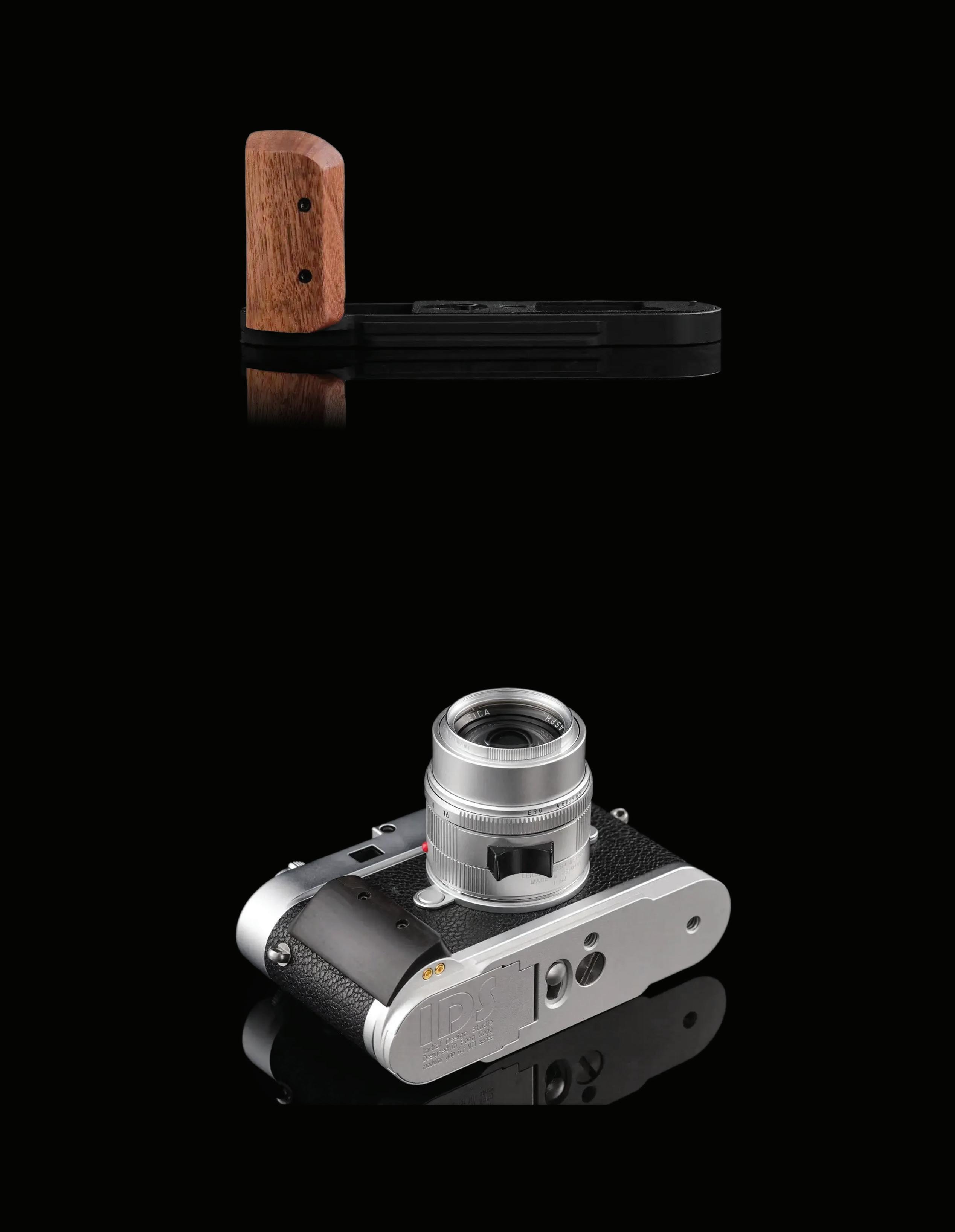
Two images seen on the cover page are from the IDS website. Their grip looks light and thin.
When I got my Leica M11, I had already purchased a half case for it, with a small protuberance that serves as a grip. Not only have I been enamored of the combination of camera protection plus the usability of this arrangement, but it also protects the camera’s base, where all sorts of things reside. If I now decided to like the grip idea, what was I going to have to give up? (Answer. It must be one or the other).
In preparation for a review, I wanted to consider the other M11 grips out there, but even though I asked, no one was ready to send me one of Leica’s own, at over $400, to do a side-by-side. I did ask. I also saw that there were at least two other commercially-offered M11 grips, one from Really Right Stuff, and one from Gurippu. There are many unlabeled ones on eBay that appear similar to the Gurippu.
The grips seemed to fall into two categories: minimalist appearing, and more formidable. The Gurippu is skeletonized; the RRR heavy-duty. The Leica and the IDS ones were perhaps in the middle: relatively tiny, had an enclosed base but with a trap door for the battery, and were ergonomic looking. In fact, except for the optional finger loop for the Leica grip and a small channel for one’s fingers on the IDS one, the profiles of these two seemed similar. Online, one writer had complained that the bottom door on the IDS grip came open too easily, but that has apparently been fixed on the updated model that I received.
There was some assembly required. The African Blackwood handle / grip pad of my grip (there are several other choices of materials on the IDS website https://idsworks.store) needed to be screwed into the base, and there was a minor issue of fitment so that the external swinging button on the base could fit and then activate the switch that opens the door where the battery and SD card reside. The magnet that holds the trap door closed over the battery compartment seemed very robust, and unlikely to pop open even in heavy use.
Henry’s website says that he felt forced to design his own handgrip for the Leia M10, because he did not find what was out there satisfactory. That grip replaced the factory baseplate. There are now also grips for several different models available; again, see Henry’s website. Of course, on the M11 there is no baseplate, so things had to be different.
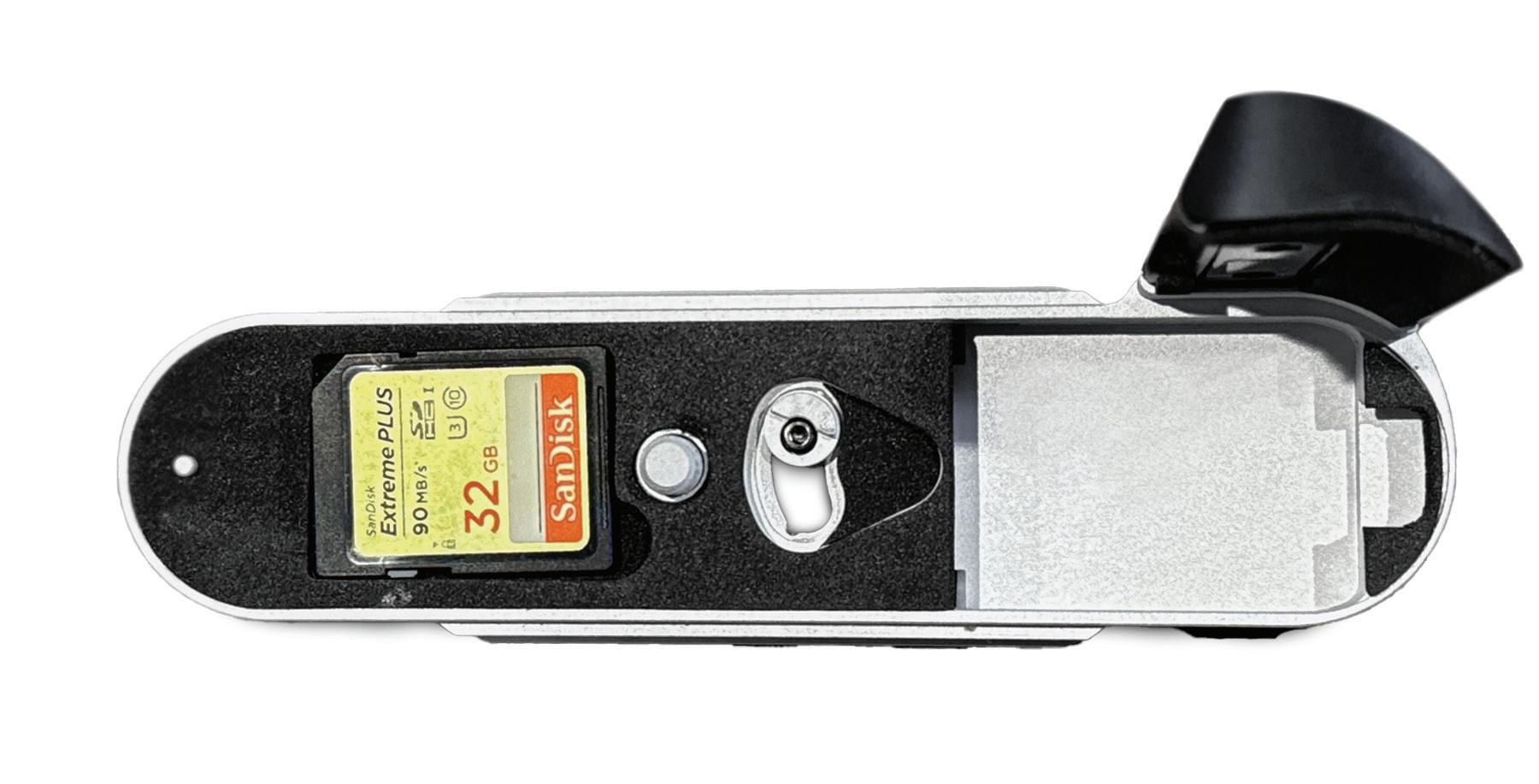
The “inside” of the grip, with the space milled-out for an SD card.
Henry has this to say online about the M11 grip:
"[Aluminum zinc alloy] 7075 was used in the construction of the M11 grip because of the new battery design for the M11. 7075 maximized the strength of the grip since when the legendary bottom plate design [of all earlier Leica M designs] was discarded, a much harder metal was felt necessary.
The bottom plate plus the grip pad supporting structure is now ONLY 60 gram compared to 85 gram before. It means with our lightest grip pad at 5 grams, the total weight is only 65 gram! Also, all fastening screws to the body had been upgraded ... to aluminum with the same finish for better looks."
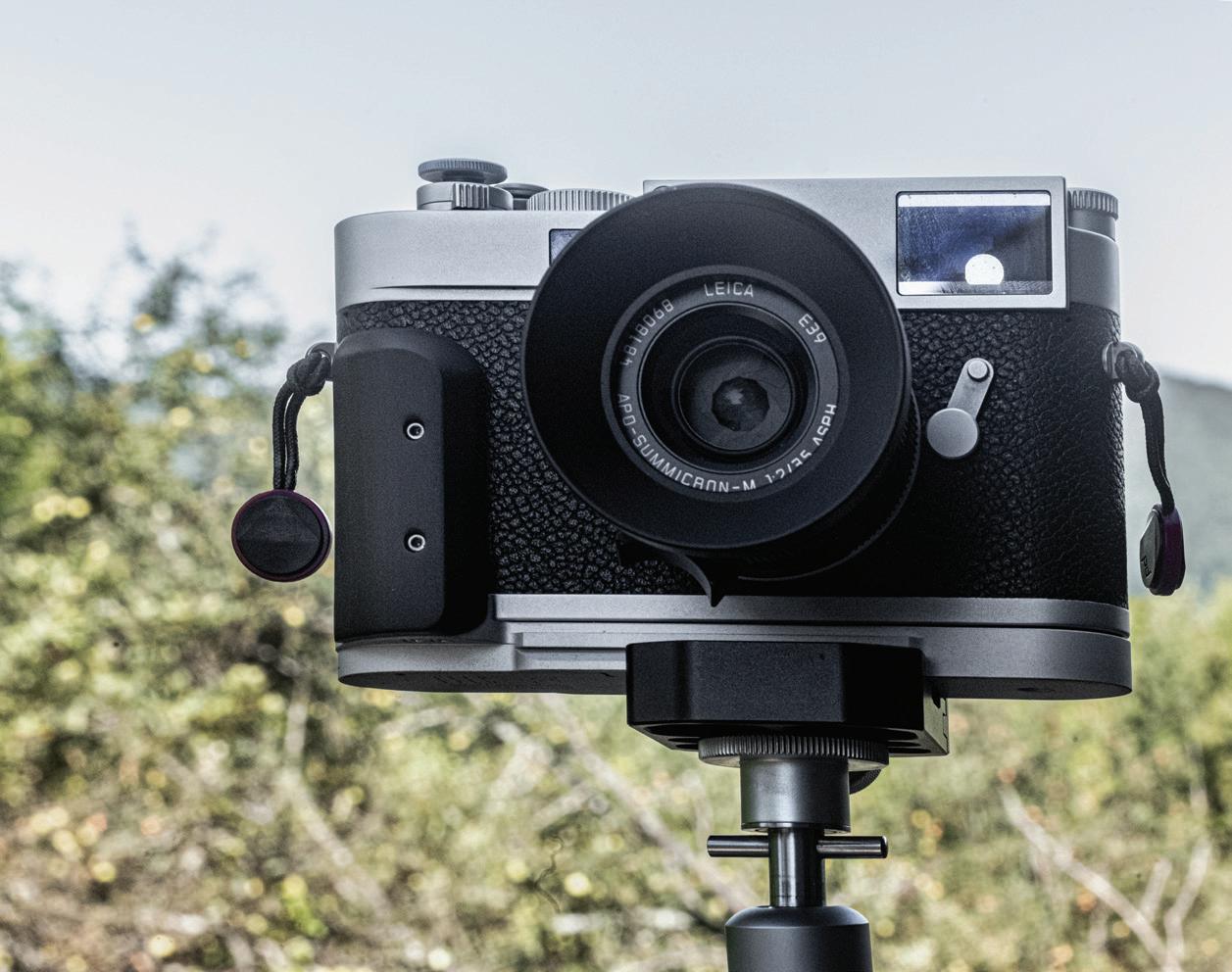
A Modular ARCA rail design is integrated into the base, allowing quick loading on an ARCA system. M11 handgrips from some other manufacturers also are ARCA-Swiss compatible.
Here is the grip on my M11-P, atop a Leitz ballhead with an Arca-Swiss quick release. Rock solid.
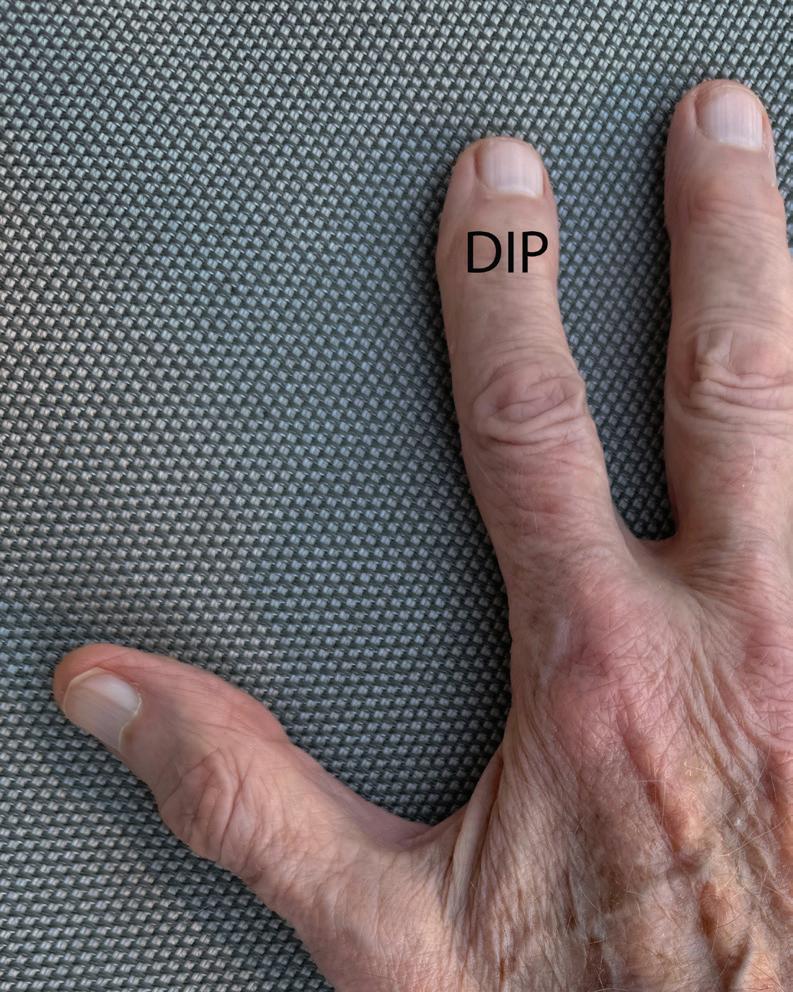
I had considerable satisfaction when handling and heft ing my M11 with this handgrip attached. The camera feels about the same, but now it has a small but effective handgrip (more accurately, a hand AND fi nger grip, because of the groove indentation between the grip pad and the camera body). I fi nd especially that the combination of this grip plus IDS’s foldable thumb grip gives even more secure handling and weight distribution. With a fi nger grip plus a thumb grip one’s supporting musculature is shifted from a pincer fi nger-grasp to the fi ngers, wrist and arm as a unit. And using the
handle / grip pad puts your index fi nger DIP joint over the shutter release / soft ie; this is how it ought to be.
For those of us street shooters who fi re with zone focusing, Henry adds:
"The design of the grip provides a very convenient vertical shooting experience. The shape of the grip pad with 3D variable curves allows different variations in holding the camera horizontally and vertically at eye level, waist level. as well as at a really low angle. Combining your experience in zone focusing as well as distant judging skills, it allows you to get your orientation right and having more chances of getting that shot of the moment."
Would this accessory be right for you? I am liking mine quite a bit, and before it arrived, I wondered whether I would. It is both minimalist and secure. And FWIW my half-case weighs 44 g versus 65 g for the grip. That difference is about the weight of one AAA battery, or two pencils. It is worth adding that there is a padded space milled-out inside the mounted grip that will hold a spare SD card.
Price is $325 plus shipping.
Light Lens Lab’s
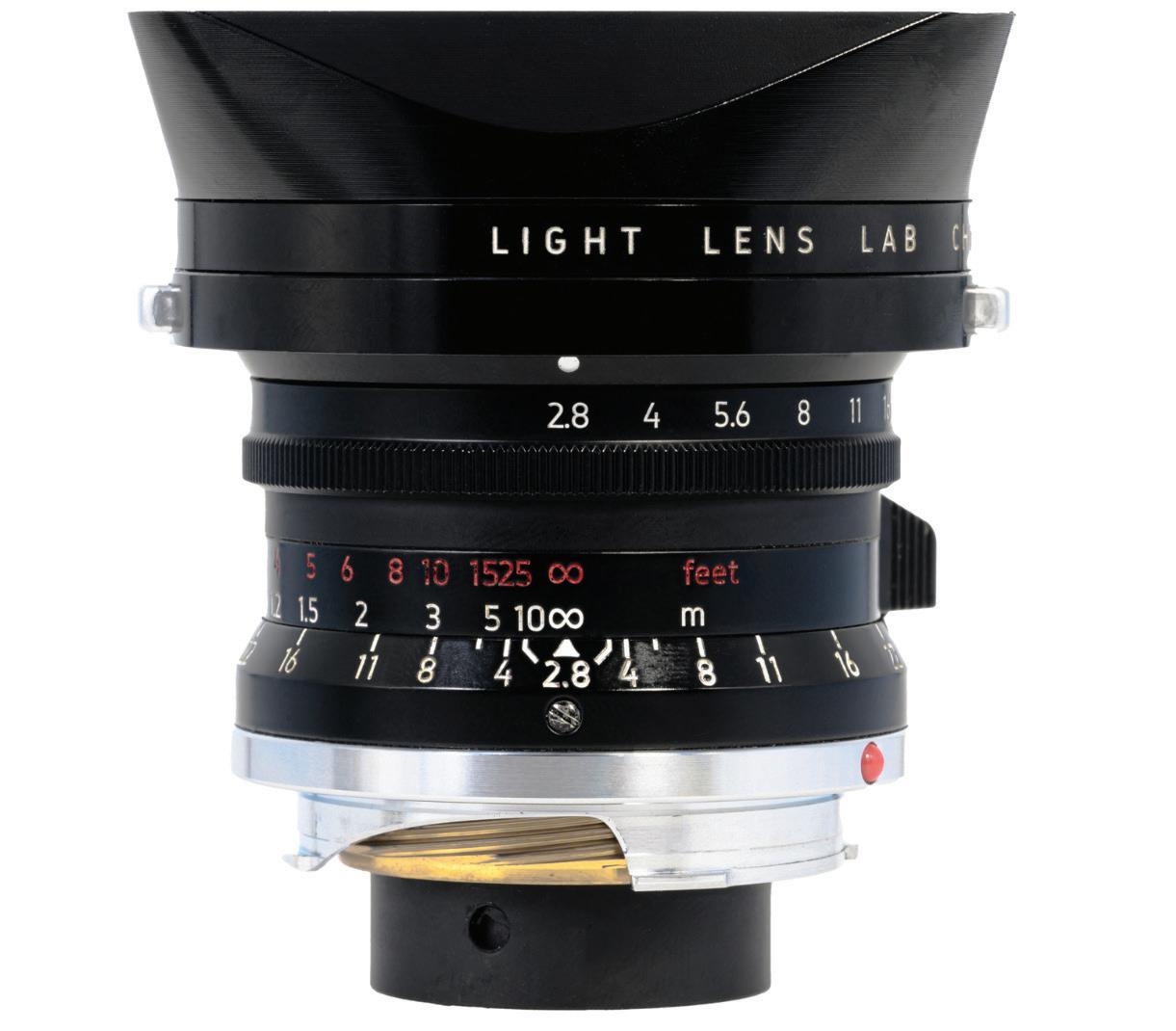
New / Old 28mm f /2.8
9-Element (9E)
by ED SCHWARTZREICH
Recently I was handed for evaluation an unexpected new lens from the Chinese firm Light Lens Lab. It references Leitz’s first 28/2.8 Elmarit, the lens perhaps best known for not being able to meter correctly on film Leicas because its rear elements protruded too far backwards. I never owned this lens myself and was aware that it was quite average optically – but those were not the days when fast wide-angles excelled. Because of its ergonomics, this lens was superseded by other Leitz 28 Elmarits that were built with retrofocus designs –much smaller and without the need to have the rear element near the focal plane. Eventually, Leitz developed very fine 28 Elmarits due to Walter Mandler’s designs.
The story of Leitz’s 28 mm focal length lenses is well known, but here is a précis: In the 1930s, Zeiss with its Contax and Leitz raced to develop 28mm lenses for the 35mm format. Zeiss came out with a 28/8 Tessar in 1933, and Leitz had to catch up and surpass them with its 28/6.3 Hektor in 1935. Both lenses could only be used in bright light, or tripod-mounted. Dr. Paul Wolff used the Hektor this way, tightly closed down for many of his magnificent portraits of workers at their workstations.
Postwar, in 1955, Leitz introduced its 28/5.6 Summaron, a lens with fine performance despite its modest aperture; and of course now we have a re-introduced version of the Summaron which works admirably with the extended ISO of modern digital cameras.
Nikon introduced a 28/3.5 in 1952 and it was available in LSM; its optical diagram looks a lot like the Summaron, and it was a decent performer. Canon had a 28/3.5 Serenar from 1951, and a 28/2.8 Canon Lens from 1956; the author has never tried either, unlike with the Nikkor.
Leitz knew it needed a faster and more modern 28mm focal length. From their earlier work with Schneider on the two 21mm Super Angulons, Wetzlar developed its own similar 9-element optical layout for a 28/2.8, the update of which I just received. The performance of this lens is described as having medium contrast but good center sharpness wide open, with lesser performance in the outer zones. Opinion had it that this 1960s lens, and the next (retrofocus) Elmarit were both fairly similar performance-wise, the latter because Leitz was still a relative newbie at retrofocus designs; Dr. Mandler was not involved until the next (3rd) version, in which performance was at SOTA level going forward many years.
Why has Light Lens Lab decided to make this lens?
LLL is currently working on several lens designs, including perfecting the 35/1.4 AA which I tested a while ago, as well as at least one very advanced original lens that I know of. Here is what I have heard from Mr. Zhou, via David Yu-Heng Chen the
company’s North American representative. Mr. Zhou felt in the interim that because his firm had not marketed a 28mm focal length lens, that they would try to emulate the 9-element 28/2.8 Elmarit. They chose this lens because of its relative rarity, its beautiful appearance, and possible collector status.
Mr Zhou, adds:
"However, this lens will be our first time not following the original design in terms of the chemical composition of the optical elements. The reason behind this change is that the quality of the original 28mm f/2.8 “Nine Element,” was deemed unsatisfactory in terms of rendering and performance upon our testing. So, we have worked upon it to improve it.
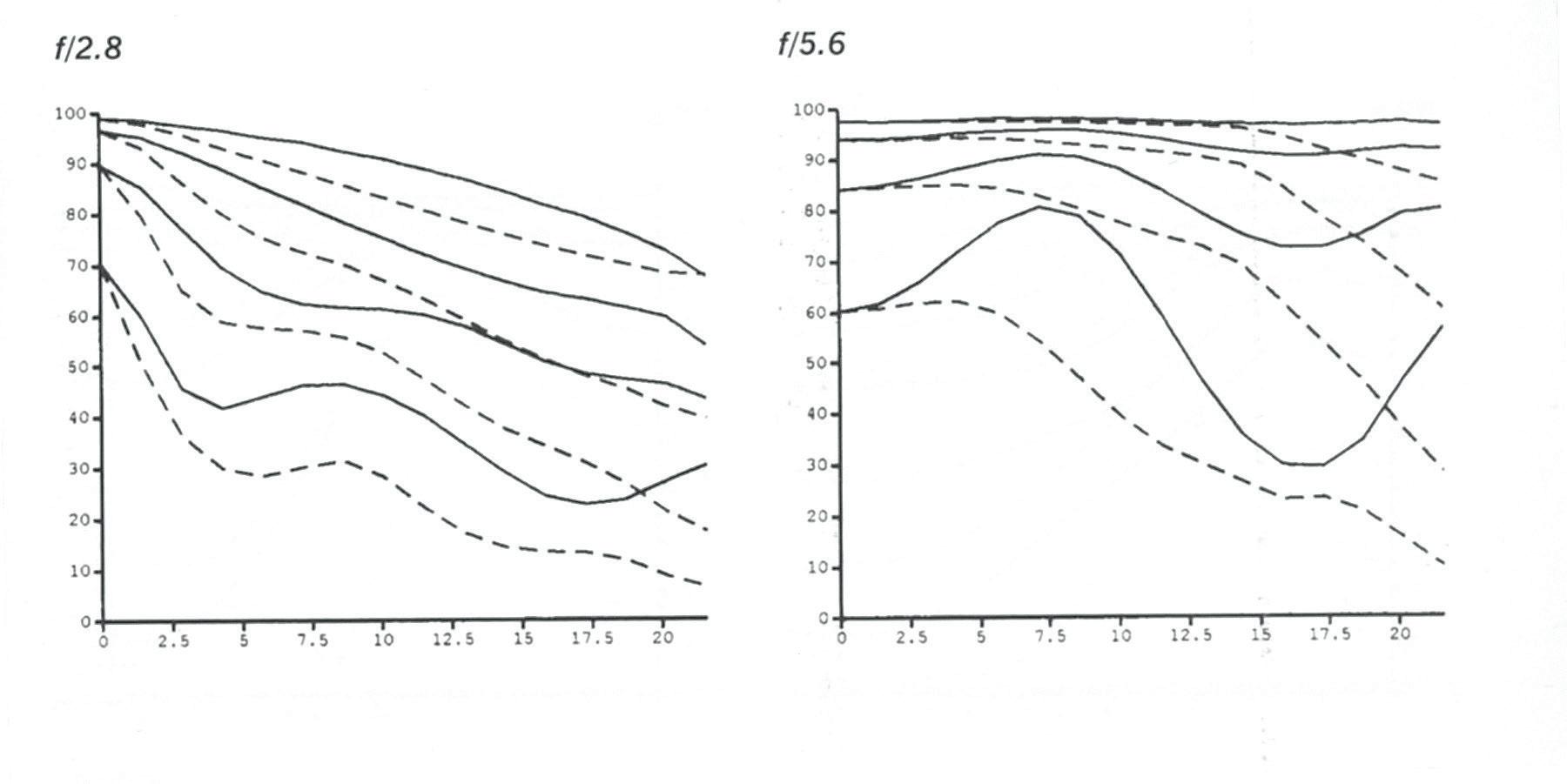
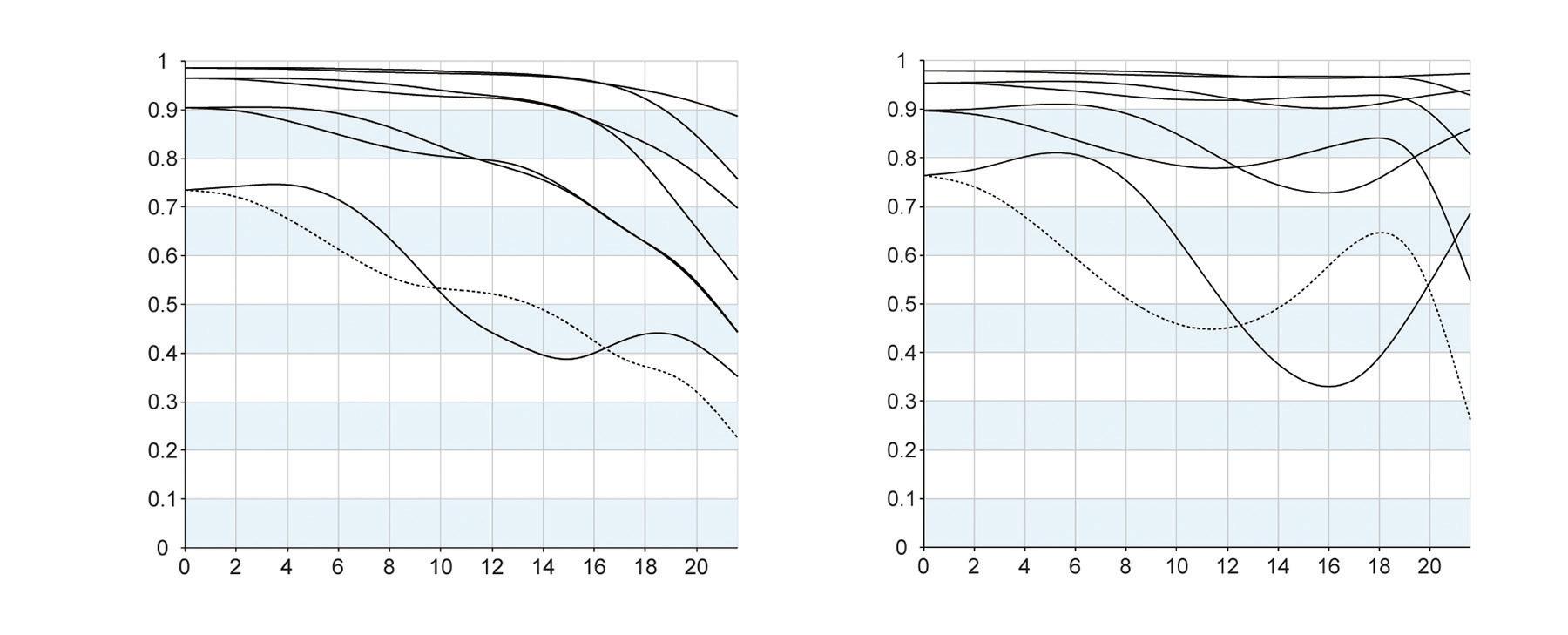
The Nine Element has unique rendering characteristics within the Double-Gauss family. We have closely followed the original design and its MTF information from a field of view starting at zero degrees and upwards to the full field of view. However, while we have followed the form and the scale of the MTF original’s curves, by our changes we made improvements upon all contrast transfer ranges in terms of lp/mm. For example, the 40 lp/mm of the New Nine Element shares the same data information as the contrast transfer of the 20 lp/mm of the original’s MTF information.
This improvement in the contrast transfer also applies to all ranges of lines/mm throughout all fields of view (with the most importance regarding rendering performance in the corners). We have only made marginal improvements in the center because we wish to retain the classic good rendering characteristics in this area.
Again, I will have to re-iterate the things that we have changed and those we retained - we have retained the classical exterior aesthetics, the original nine-elements-in-six-group design. Speaking of which, during the design phase of this 28mm f/2.8 Nine Element, we
concluded that this group design must be retained; while it is an old design in terms of optical technology and challenging to produce, it benefits by keeping the physical size of the lens within its original limits. However, while we are retaining the same optical configuration, we have had to change the type of some optical elements. The original lens had poor performance; we changed one of the elements inside to an Extra-Low Dispersion (ED) glass (specifically, the sixth inner element). The result of the change was a marginal increase in resolution in the center, a drastic increase in resolution in the corners and edges, and drastically minimized distortion and chromatic aberration. Out-of-focus characteristics are now more rounded with a pleasant circular out-of-focus bokeh. We eliminated the red-fringing that occurred with digital camera sensors with the original lens.
With our focus on specialized glass-element development and manufacturing, we discovered that in order to make the improvements that we aimed for during our development phase, we had to replace an element with our own completely new fluorite-like glass designed specifically for the task. Such proprietary development is an entirely new endeavor for us.
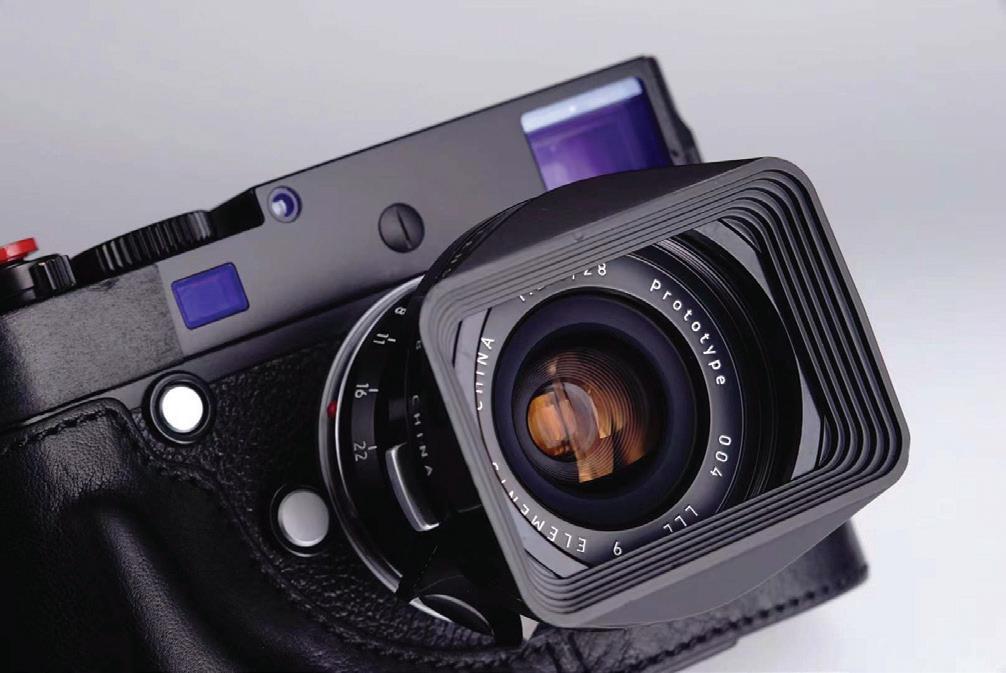
In production and construction, we have used brass alloy as our body material. Be aware that the original Nine Element exterior body is made with aluminum, which means the Light Lens Lab version will be slightly heavier. The lens will come in two different finishes - Brass Black Paint and Brass Silver Chrome. The black paint finish will develop a nice patina from regular use, while the chrome will have a very clean and new aesthetic even after longterm use. The original 12501 lens hood was very expensive back in the day, and it is now a collector item with a high price. The lens hood has a unique shape, resulting in complicated production and a high failure rate. To have its production be more manageable, it was made of plastic and rubber. We use all-metal (more specifically aluminum) construction for our lens hood (which is included within the package). Upon our testing, the metal construction of our lens hood caused a reflection which created some distortion (especially with the Silver Chrome lens hood). We have taken the initiative to have our lens hood undergo a chroming process for both finishes so this will not happen.
Oh, I forgot to mention that we have not changed the lens coating from the original so that any flaring from this will have the same characteristics as the original. This is something that we had to retain. And we followed the challenging construction method of the original infinity lock. All in all, it is a show of appreciation by us for the quality of lenses made in the 1960s."
So, what I was given for testing is NOT the original lens as an exact copy, but a lens which should be viewed as an upgrade which references the original. LLL did the same thing, much less drastically perhaps, when they reproduced the 50/1.2 Noctilux. I felt this was all for the better: tweaking things for improvement but keeping the design. Leica, OTOH when it issued its own modern copy of the 50/1.2, reconfigured the design fairly markedly, but with the aim of matching the “look” of the older lens, which it did.
Above left are the MTF curves of the original 9-element Leitz lens.
One can readily see the performance issues from these curves – the falloff in definition towards the edges and the medium contrast wide open.
Pictured also are the curves of the new lens, as supplied by Mr. Zhou. Contrast and sharpness are quite good wide open, and into the corners, and the performance at f/5.6 is also better.
Yet some of the general shape of the curves remains similar, likely preserving the way the new lens draws compared to its predecessor.
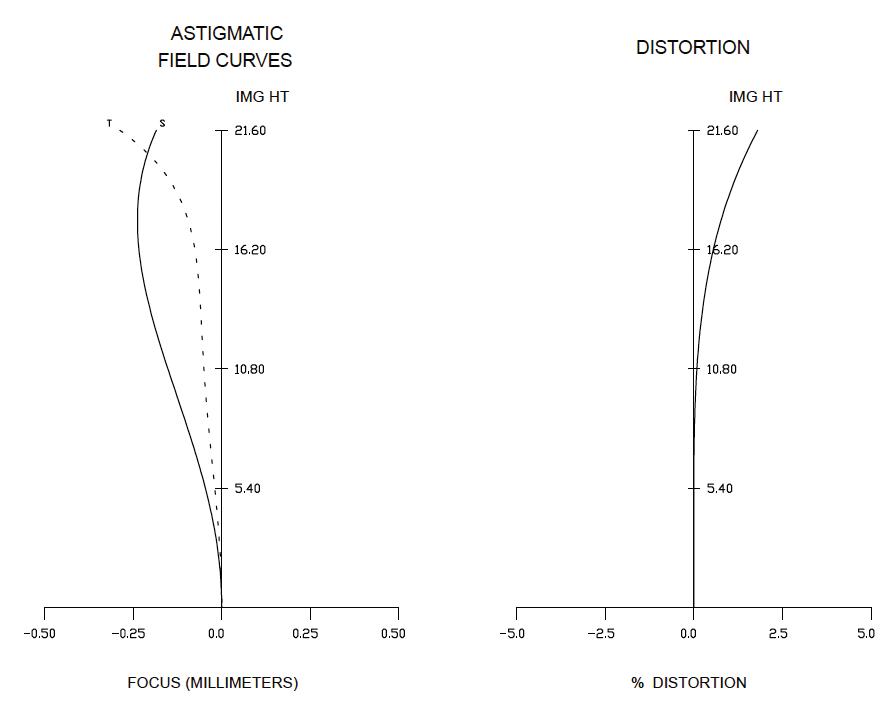
To the bottom left are the focus and distortion curves: they confirm for me that presence of some positive field curvature inward towards the lens, and minimal pincushion distortion.
Here is what LLL has to say about the field curvature:
"Yes, there is a slight positive field curvature wide open, inherent in the lens design. The change of glass type and the use of ED elements improved upon the original rendering. The only option to eliminate field curvature would be to use ASPH elements. One noticeable thing regarding both this lens and the original, however, is the smooth transition between each level of the subject in the foreground and background wide open; this was done by Leitz's design."
MTF Curves of the original 9-element Leitz lens.
MTF Curves of the new Light Lens Lab replica.
I would add here that Leitz had, at times, different thoughts about field curvature, striving at times for a flat field, or allowing some positive curvature to offset other aberrations at other times. We are not privy to their thinking here.
I have always considered 28mm on the 35 mm format to be a “utilitarian” focal length, good for pictures of groups; or for close-in shots where a fair amount of information needs to be in the frame, visually belying the distortion nonetheless inherent in that focal length used that way. I have never considered a 28 as a “carry around” lens on a camera for street shooting, nor do I think of it aesthetically for “fine art” work, whatever and however that is defined.
With this LLL lens, I may change my opinion. It delivers a rich color palate, great center sharpness even wide open, seems to have some positive field curvature at f/2.8 which tends to enhance the almost 3d effect of the images. It has some flare with specular or open highlights, but all my 28s trend that way; that does not bother me greatly. Distortion appears low. Shots I made, including of a blank white wall showed modest-to-moderate vignetting wide open; I am not able to quantify this. I could easily see using this lens as my prime 28. I love the way it draws. It is a SERIOUS lens. It meters correctly on both my M10s and my M6. I have not tried it on my M5.
Here is what Mr. Zhou has to say about compatibility:
"The Original Version is incompatible with many M cameras, including some of the digital Ms, due to the recessed element being longer than the lens flange distance. Users will require external metering as the camera internal meter on most digital/ analog cameras will be blocked from metering due to the said recessed element. And with some digital/analog Ms, exposure compensation inside the cameras is required to expose the image correctly.
Figure 1
Figure 2
Figure 3
We have taken steps to recess the rear element by 1~2mm into the lens compared to the original version so that the camera's internal meter (that is, if the M-camera has internal metering) functions correctly. Thus, the New 9-Element is compatible with 99% of the digital and analog M cameras. (But both the LLL and Leica versions cannot be compatible with the M5/CL since these have a different metering mechanism and the rear protruding element will be in contact with their metering arm)"
Here are some images. Almost all are wide open at f/2.8. One is cropped slightly. Mostly no post-processing has been done except levels and perhaps highlights / shadows and very minor PS’ing removal of artefacts.
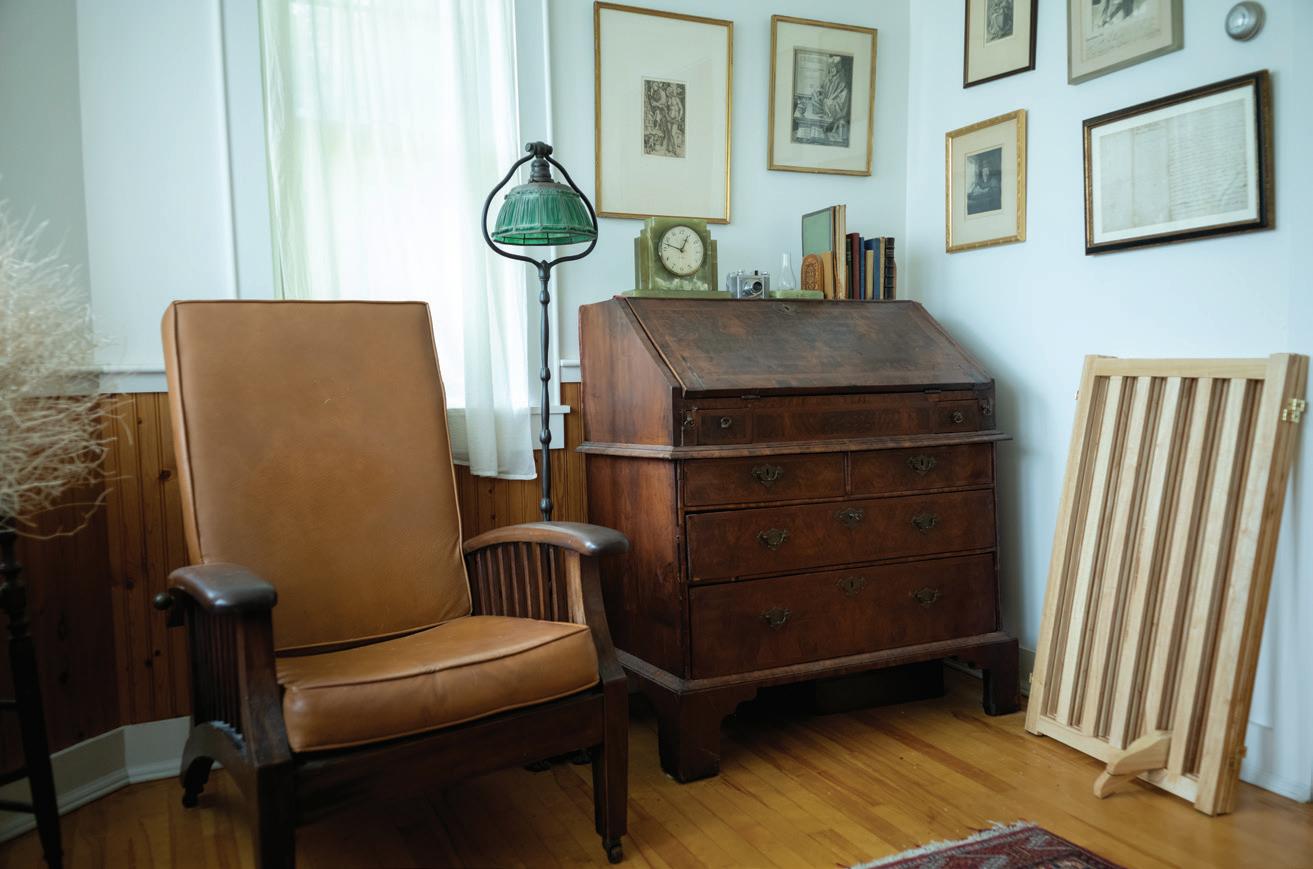
Figure 1 is the image I always take first RFfocused and wide open with any new lens, sitting in a chair opposite. Most of the time it is a disappointment, and I do not show it in reviews. Here it shows how nicely the lens draws, and the clock at the center (where I focused) is very sharp. Some flare through the window curtains. No post-processing.
Figure 2 is the second shot I always make, of my brother-in-law in his chair. And a crop (figure 3) from this to show how sharp the lens draws centrally wide open. Minor photo-shopping of a distracting article in the lower left was done. Again, flare in the (quite intense) highlights in this rather darkened room.
Figures 4 and 5 are two images made with the M10 Monochrom. Figure 4, taken at f/2.8, has clouds added, but no other manipulation.
Figure 5 is taken at f/4. No post-processing.
Figure 4
Figure 5
Next, a car trip to a local ice cream establishment, in the Vermont hills. Figure 6 is a shot of my filling of my Audi with fuel for the trip. Full frame, no postprocessing. F/2.8. Focus on the stickers to the right of the screen on the pump. This is typical close-in shot with a 28, with an optically busy field with everything looking natural and undistorted nonetheless.
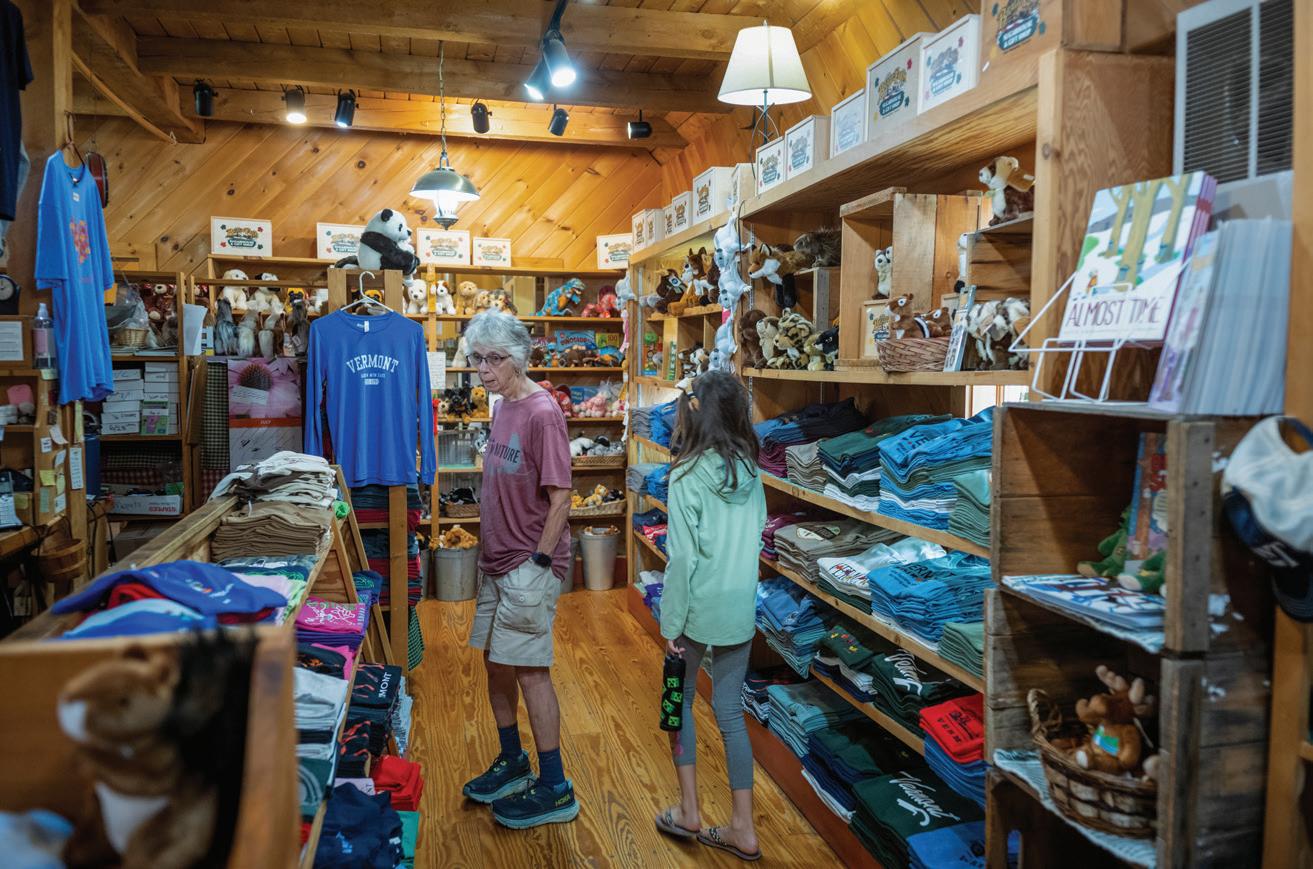
At the shop, which also had a gift section. You can see some flare around the lights. The slight field curvature helps here. (Figure 7)
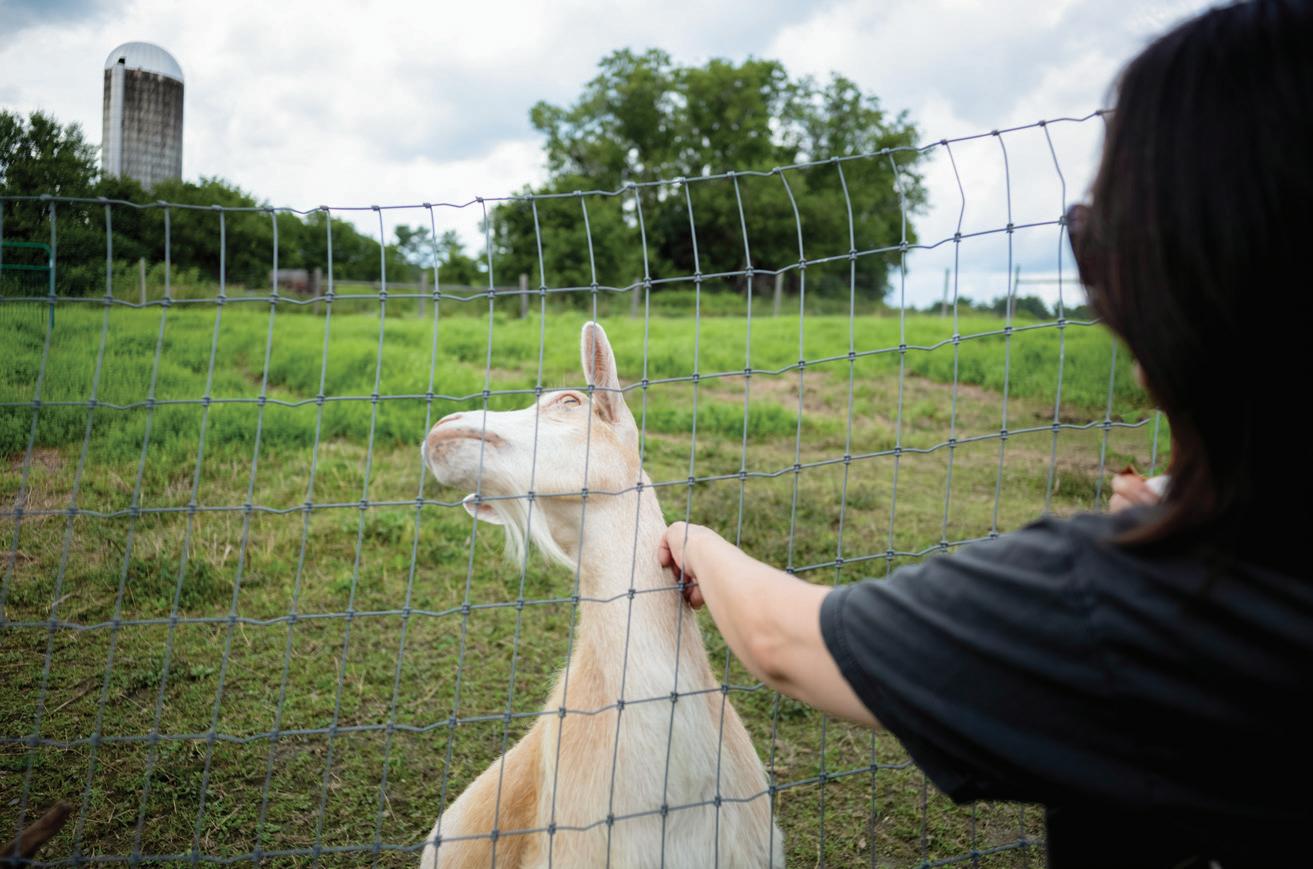
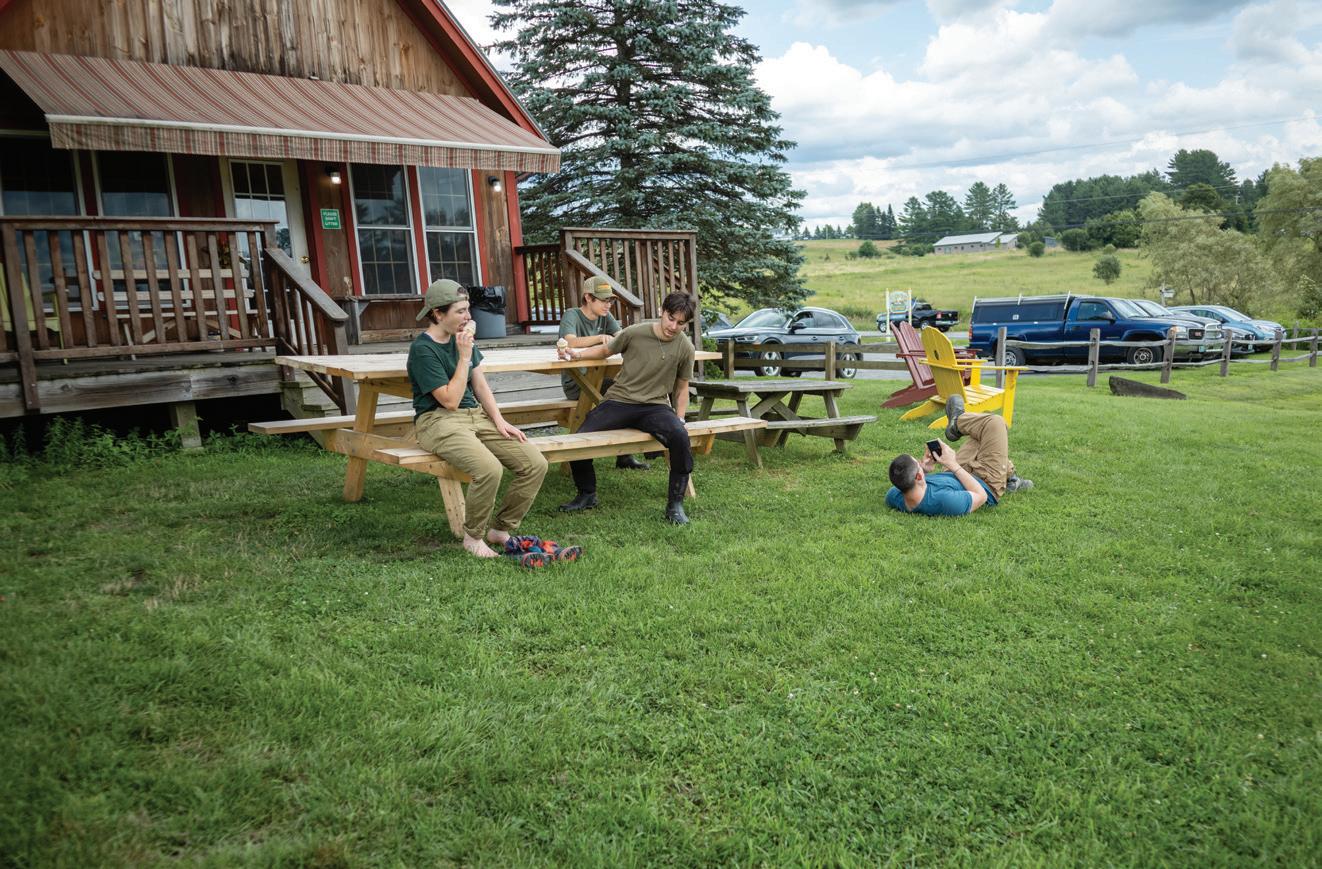
On the opposite page are three images outside of the shop. All wide open. The one with the boys in it (Figure 9) had slight cropping. There was a distracting small element removed via PS in the one with the goat. The goat image (Figure 8) is another example of the 28 being used close-in, looking natural.
So, what to say about this lens? I already mentioned how much I like what it does. I could see this as my 28 of choice. Despite being a bit large, much of the bulk of the lens is inside the camera, so its external protrusion does not feel marked. It did not feel bulky in use. My prototype had a stiff focus, and it took me awhile to notice that there was a focus lock, as with the 8element 35 Summicron. Focus through the RF was spot-on.
I have now tested prototypes of 6 Light Lens Lab lenses. Some of the prototypes had minor issues, but optically and mechanically they felt like they were Leitz / Leica lenses, a philosophy based on Mr. Zhou’s reported love and respect for the Leitz / Leica company. I sense a progression of the LLL company from mere lens copies, skillfully done, then to tweaked and improved versions of classic lenses, fully capable on the most modern cameras but mostly hewing to the design parameters of the originals.
With this 28/2.8 we have something different: a new / old design, using the lens-element layout of the older lens, but considerably improving on this with more
modern glass. And I am aware that LLL is working on their own designs, still with an eye to keeping the Leica look, feel, and reference. So, David suggested that I not label the recent LLL lenses as “replicas” but as something else. “Updates” or “upgrades” perhaps. Maybe “revisioned” if I may coin a phrase.
Other companies that produce lenses that fit Leica have used and modified older Leitz / Leica lens formulas to produce quite capable lenses that are faster, wider, or perform somewhat better than their older cousins. Or they have mixed and matched lens formulas from other marques and put them in a Leica-compatible mount. And of course, today’s computerized lens designs are mostly excellent in quality across the board, in Leica mount or not. So, we have many nice lenses that we use happily, and a few truly wonderful original designs to place on our Leicas.
Light Lens Lab, IMO is doing something slightly different. They are hewing closely to the Leica lineage and Leica build-quality in their products. There is a sense of respect here, even as they show off what they can do. I said above that I considered this 28/2.8
Figure 6
Figure 7
“a serious lens”. LLL wanted to re-make the earlier Leitz lens but found it deficient. Yet it was the best Leitz could do in the 1960s, so LLL kept the design look and the optical layout but improved significantly on the performance. They sensed excellence in the concept, if not in what 1960s glass could do. They don’t call this lens something new but consider it a reference to the earlier landmark lens. I am sure they would be happy to sell as many examples of this lens as possible, but their thinking is what my old friend and earlier LHSA / LSI president Roy Moss would have called “Leica-centric”. It is all about how you think.
David has this to say about pricing and availability. The lens is now available for 899 USD for Chrome and 999 USD for Black Paint.
The fi rst initial batch of customers will receive a matching-color E49 UV fi lter (priced at 90 USD) with the order.
Figure 8
Figure 9
Figure 10
by JONATHAN SLACK
f/2.8, ISO 320, 1/1250 sec.
The Q has been an amazing success for Leica, which is absolutely deserved, it was a brave move in the face of the almost complete demise of compact cameras. So Leica made an expensive, full-frame model which was not all that compact, but which had a peerless lens and incredible image quality; and it sold like hotcakes!
Ever since it first arrived with its 28mm f/1.7 lens and 24 mp sensor there have been people who have said “It should have had a 35mm lens” or “I want a 50mm version.”
Leica have been very aware of these requests, but I think they were wary of spoiling the clarity of purpose of the Q models. Finally, they have been convinced, and on September 26th, 2024, we have the release of the Q3 43.
In this article, I'm going to have a look at the implications of the new camera. If you would like to know more about the previous Q cameras, or more information about the Q3 specifically visit my website at https://www.slack.co.uk/ or use the QR Code at the end of this article.
However, I think that there are a lot of Q2 users out there who resisted the temptation to upgrade to the Q3, so it’s worth briefly mentioning some of its advantages:
The Changes from Q2 to Q3
• New 60 mp BSI Back Side-Illuminated CMOS Sensor (similar to M11)
• USB-C and Mini HDMI connectors
• Phase Detect Auto Focusing
• Tilting LCD
• Improved Bluetooth and WiFi
• Small, Medium and full-sized DNG and / or JPG files 60,43, 36.5, 18.6 mp
• Reliable Geotagging in conjunction with Leica Fotos
• Rear Button Layout change
• Long exposures possible (with any combination of ISO and shutter speed). Long Exposure NR can be disabled.
• One additional function button
• USB-C Charging
• Optional Grip enabling WiFi charging
• Better resolution EVF with 5,760,000 dots and 0.79x magnification
• Better resolution 3" Display with 1,843,200 dots
• Digital Zoom now has 28, 35, 50, 75 and 90mm framelines
• Leica Looks
Why 43mm?
Well, I just wondered if it was because it was halfway between 35mm and 50mm, but I thought there must be more to it than that, so I asked Leica!
43mm is the diagonal of the full frame 24 x 36 sensor. It is also approximately the focal length of the human eye. It is a better focal length for both portrait and street photography (keep your Q3 for landscapes!)
There are also historical connections for Leica who have made many lenses around 40mm. There was the Leitz Milar 42mm f/4.5 from 1905. The Ur-Leica used the Mikro-Summar 42mm f/4.5 (replaced by a 50mm lens in series 1). Then, later on in 1973, the original CL used a 40mm Summicron-C f2 lens and the lens on the Minilux was around 40-42mm.
Finally, there are practical considerations. Leica wanted to create a lens with the best possible quality and bokeh characteristics, but they wanted to keep the Q3 size and weight.
All these factors combined to lead towards the new 43mm APO Summicron.
e Difference Between 28 & 43mm
28mm is such a versatile focal length (you can always crop but you can never make it wider). Ricoh understood this with their popular and versatile GR range of cameras.
When the Q2 came with its 48mp sensor and the Q3 (60mp) this cropablility became more and more true; with the Q3 it’s quite reasonable to crop to 75mm for portrait images (even if you don’t get the isolation of a true 75mm lens). Indeed, even the 5.8mp of the 90mm crop is just about enough for a good A3 sized print or to look at full screen on an Apple Studio display.
Q3 Crop vs. Megapixels
Q3 43mm
Crop vs.
Megapixels 43mm 9520 x 6336 px 60.3 MP
4544 x 3024 px 13.7 MP
3408 x 2272 px 7.75 MP
Q3
The Flower Hut. f/2.8, ISO 400, 1/125 sec.
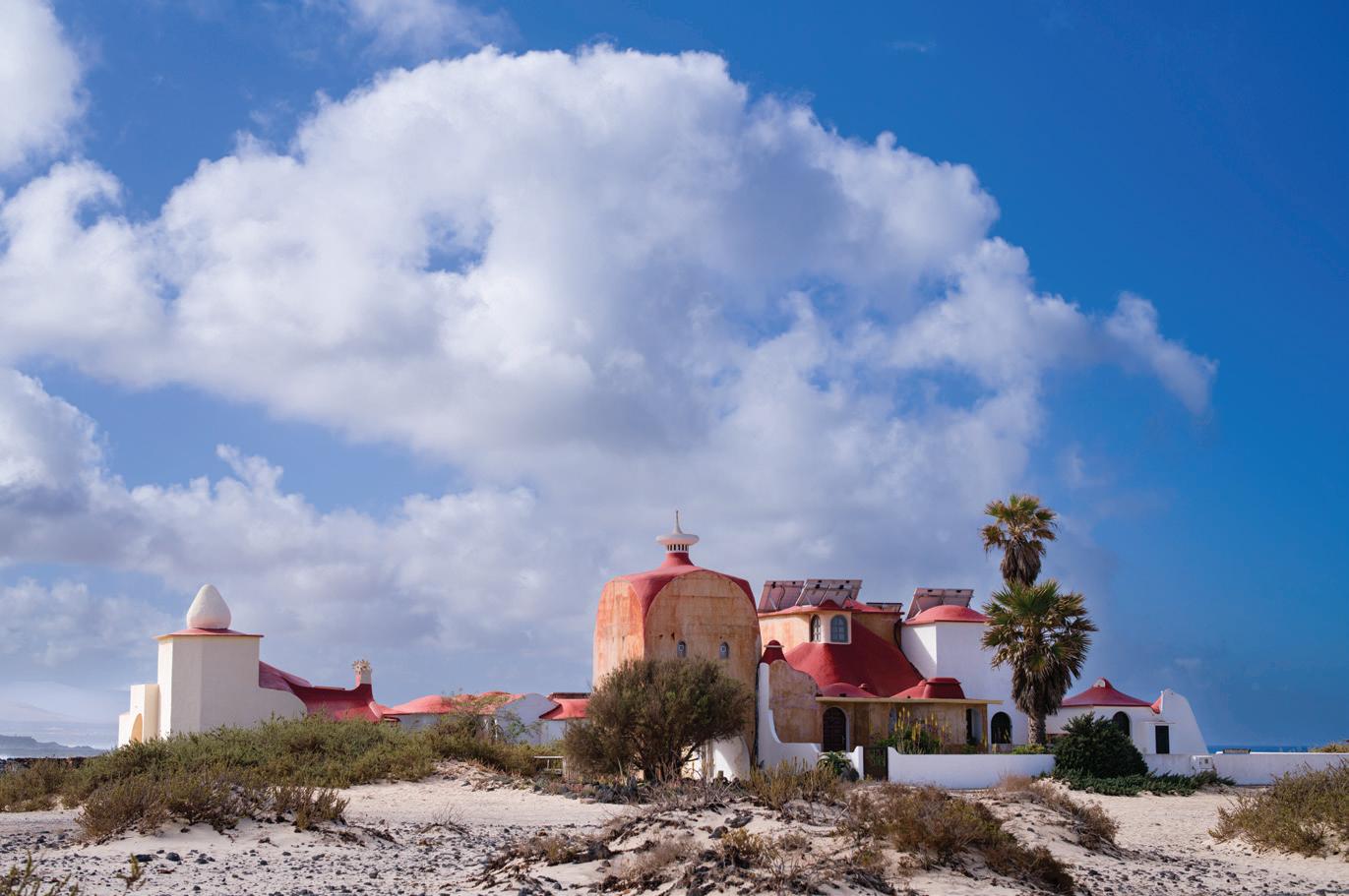
f/2, ISO 200, 1/2000 sec.
f/7.1, ISO 500, 1/250 sec.
f/2.8, ISO 100, 1/5000 sec.
f/2, ISO 100, 1/8000 sec.
f/2, ISO 5000, 1/120 sec.
f/2, ISO 100, 1/3200 sec.
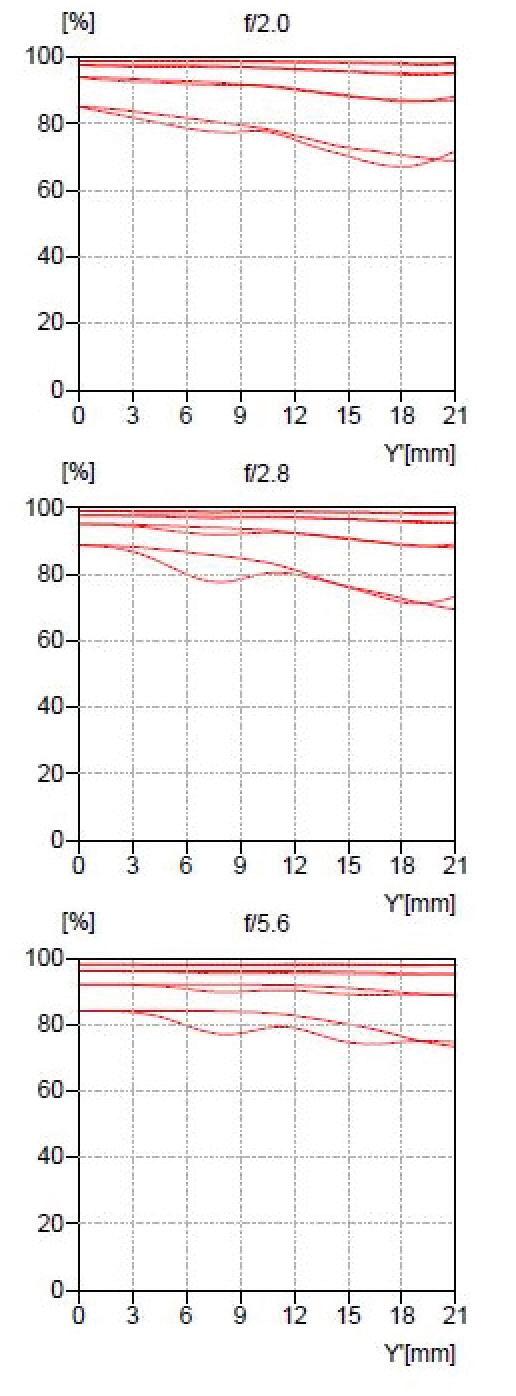
MTF Curves for the APO-Summicron-Q 43mm f/2 ASPH at f/2, f/2.8 and f/5.6.
e APO-Summicron 1:2/43 Asph. Lens
The lens is almost exactly the same size as the lens on the normal Q3, with the same 49mm filter thread.
In macro mode it focuses down to 27 cm, and the maximum aperture in macro mode is f/2.8 (even if you have the lens set to f/2) This aperture change is the same as the 28mm Q lens.
Changing to and from macro mode changes the distance display for manual focusing in just the same delicious manner as the Q3!
In normal mode the minimum focusing distance is 60 cm. The Q3 focuses closer (17 cm in macro mode, 30 cm in normal mode.) So the maximum magnification on the Q3 43 is 0.25 - 1:4, whilst the maximum magnification on the Q3 is 0.26 - 1:3.8. Pretty similar in fact!
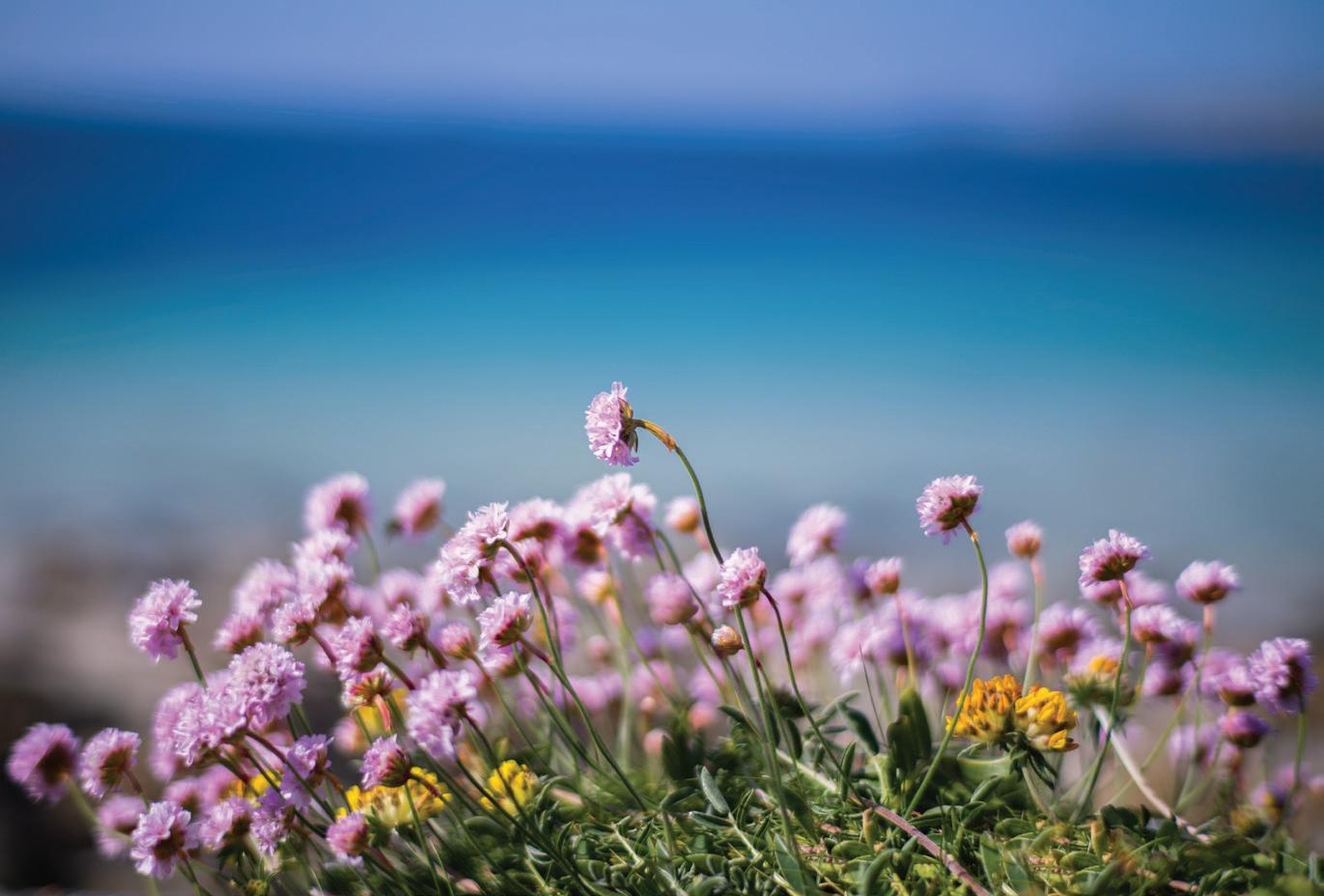
Bokeh is rather a subjective matter, but the bokeh on the new lens reminds me very much of the M APO lenses - very creamy with a quick but very gentle transfer to the incredible detail where the lens is in focus. Many of the images in this review were shot at f/2.
MTF figures can't tell you everything about a lens, but at least looking at these (left) gives you an idea of how technically accomplished this lens is, right up there with the 35mm APOSummicron-SL (perhaps the best lens Leica have ever made).
Leica FOTOS App
The connection with Leica Fotos is now very fast, and file transfer is lightning quick over the cable, and very satisfactory over WiFi, even for full-sized DNG files.
You can easily drop images into the Leica Gallery (and thus Apple Photos if you are on an iPhone). You can also send images directly to Lightroom without needing to clutter up your Phone or Tablet (or your Apple Photos application): My technique is as follows:
• Connect the camera to your device using the supplied USB-C cable
• Go through the images marking the best as favourites
• Set the filter to Favourites
• Choose Select - then Select all
• Press the Share button and choose DNG - files transferred to a buffer
• From the Share dialog choose Lightroom
• Then, in Lightroom Mobile, go to imports and choose your import
• Select the files and then choose Add To at the bottom of the screen
• Choose the Collection you wish to add them to.
The DNG fi les will appear on your home computer via Adobe Cloud in the mobile backup folder, and in the collection you chose from your phone/tablet.
I've started to use this method for all my photography except for event shooting. Th is is because you can only transfer 50 images at a time to Lightroom using the share button - so for event work I import from the SD card to my MacBook Pro.
Leica have been doing a lot of excellent work with Fotos over the last year or so, and I plan on writing an article about incorporating it into a "Device to Lightroom Classic Workflow" at a later date.
Conclusion
Th is camera has been a long time coming. Indeed, many photographers had assumed that Leica were going to stick to the one focal length. The development of the Q3 43 has been a well kept secret.
The obvious advantages over the Q3 are more control over depth of field, and slightly more than twice the resolution for any given focal length. Of course, you lose the wide angle view of the Q3.
The design of the Q is an evolution from Kaoru Mokunaka’s perfect concept in the Leica X1, it has developed into a really well thought-out camera aimed solidly at photographers rather than ticking technical boxes! I would challenge anyone not to love it.
However, I'm sure that a lot of photographers are like me - we tend to go hunting for pictures with a 35mm or 50mm lens and stick with what's on the camera for the shoot. The 28mm of the Q was very flexible, but in the end, a lot of cropping meant that it was more like an 18 mp fi le at 50mm (okay), or 8 mp at 75mm which was a compromise for me, and still one had the depth of field characteristics of a 28mm lens.
I had not shot with a 43mm lens before (or 40mm come to that!) and it’s been an absolute joy! Having 20 mp for a 75mm portrait lens with a narrow depth of field is quite enough. Add to that the wonderful bokeh of this APO lens and quite honestly I’m in camera heaven!
Although I loved the Q3, in the end I didn’t buy one, but in this case I’m certainly doomed, and when Leica manage to recover the kidnapped test camera I’m afraid I’ll have to stump up. Pictures from Crete coming up soon!
To see Jono's article on the Leica Q2, Q2M and Q3 and to see more images fro the Leica Q3 43, use the QR Code or visit https://www.slack.co.uk/
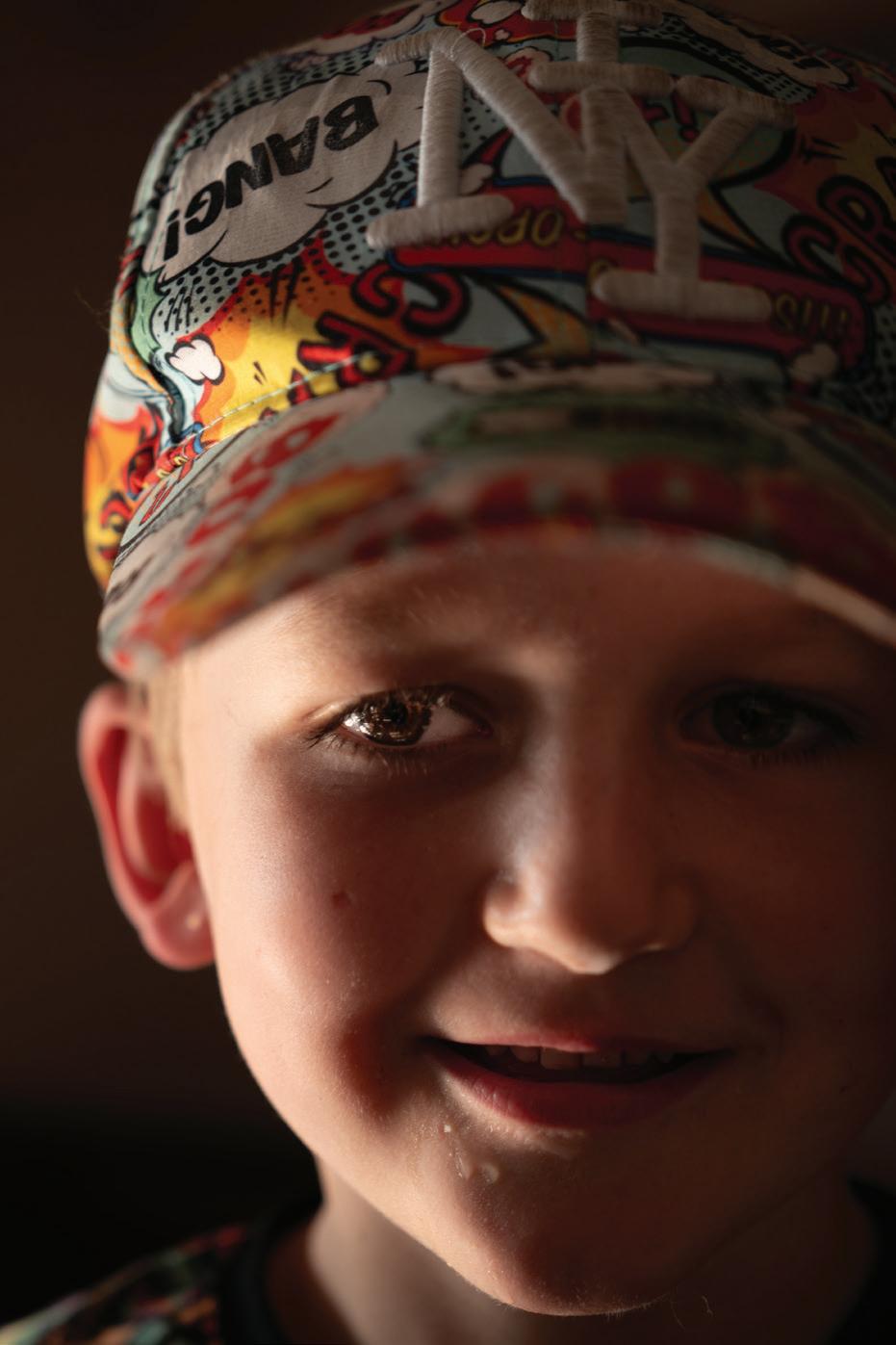
Roo and his hat. f/2, ISO 100, 1/320 sec.
The Leica M11-D
by JONATHAN SLACK
Summertime Blues
Ihave been shooting with the M11-D for 6 months now, which has included trips to Fuerteventura, Porto, Cornwall, and Wetzlar, so I have had a lot of time to get to grips with the camera. Much of that time has been spent testing firmware and the connection to Fotos, but a lot more time has been spent simply having fun shooting with the camera.
Over the last year or so I have had two serious excursions into film cameras. First of all, with a beautiful mint condition Leica R8, and then with one of the gorgeous M6 remakes. But dealing with film developing and scanning is just too time-consuming, and after 25 years shooting digital going back is not going to happen, so I had given up the struggle.
It's lovely shooting with a film camera - no chimping possible, you can just concentrate on what you are doing. Sometimes I felt it would be still better to
leave the film out of the camera so that you could have the satisfaction of looking and looking and shooting, without the bother of processing (or being disappointed with the results)
Then along came the M11-D, and the shooting experience was just the same, although I suppose the internal memory means that you can't shoot 'without film'! For the images in the article, I've largely used my triumvirate of Leica's classic remakes of old lenses (it seemed appropriate) so most of the images are with the 28mm Summaron, the 35mm Summilux Steel Rim v1 and the wonderful 50mm Noctilux f/1.2.
In this article, I'm going to try and put the M11-D into its historical context, and to look at the technology and connectivity in some detail. I hope you enjoy it, and that it helps you to understand what the camera is all about.
A Room with a View. Leica M11-D + 50mm Summilux-M Asph.
History
LEICA MD • In 1964 Leica released the MD, and this was perhaps the first and most extreme example of Leica's minimalism. The camera was mainly designed for technical and medical purposes, and to that end had no rangefinder.
LEICA M EDITION 60 • Ten years ago in September 2014, Leica introduced the M Edition 60 designed by Audi. This limited edition model was to celebrate 60 years of the M camera - since the original M3 was announced in 1954.
This was no 'ordinary' special edition though, Leica had removed the LCD rear screen and replaced it with an ISO dialin their words:
"Reduced to only the essential camera features, the Leica M Edition 60 is the first digital camera to concentrate exclusively on the bare functions required for digital photography – shutter speed, aperture, focusing, and ISO sensitivity. This is also the reason for the replacement of the camera’s display with an ISO selector dial. For reasons of quality, exposures are saved as raw data in DNG format.
Working with the Leica M Edition 60 intentionally demands the same care and
attention as working with an analogue model. Only the sensor and the entire electronics reflect the state of the art of contemporary camera technology."
The M-D (TYP 262) • The M edition 60 caused enough interest for Leica to get more serious about the concept and in April 2016 the Leica M-D (Typ 262) was introduced. The camera was technically identical to the Leica M (Typ 262), a quieter and cheaper version of the M (Typ 240) with the video options removed.
With the M-D you shot in Auto White Balance and the camera only recorded DNG files. The only way to look at the images was to remove the SD card from the camera and look at the files on a computer. I was not offered one to test at the time, and being limited to Auto White Balance was enough of a turn-off to stop me from buying one.
The M10-D • The M10-D was released in October 2018, and I was much more involved in the testing, and also discussions about the design, including an exciting dinner in London looking at an early mock-up.
The M10-D had a wind-on lever to use as a thumb grip, an exposure compensation dial (rather than an ISO wheel) on the back. It also had the special quiet shutter of the M10-P. Although the faux wind-on lever caused quite a lot of dispute on the forums (and in my family!) the camera was, and still is a real favourite with many photographers. I have just searched around the internet and only found two for sale, and both of them for more than £6000 - for a 6 year old camera!
The M10-D was a more practical camera than the Typ 262 in that it had the option of attaching the Visoflex electronic view-
finder, and you could also connect to the camera over Wifi and look at the images on your phone in Fotos (albeit very slowly)
If you would like to know more about the camera you can read about it on my website https://www.slack.co.uk/
The M11-D • This brings us to the M11-D which was announced this fall on September 12th, 2024.
This time Leica have made rather a different camera, they have abandoned the faux wind-on lever (which will disappoint some people and please others). They have also removed the ISO dial from the top left of the M11 body and made a black, tactile, stainless steel ISO dial on the back plate (just like so many film bodies). Exposure compensation can be assigned to the thumb dial in the same way as the M11, as well as ISO settings, if the ISO dial is set to M (manual).
It's a lovely object, and at first sight it certainly seems like a perfect example of Das Wesentliche ("the Essentials") with its minimal design, and only dials for shutter speed and ISO (just like a film M)
On the other hand the camera has all the technical advantages of the M11 and M11-P over the M10:
• Integral base plate improves weather sealing and strength.
• New black paint option is very resilient with grippy finish
• Aluminium top plate makes it significantly lighter
• Battery with 700 shot CIPA standard (modest!)
• 256Gb of very fast internal memory (like the M11-P)
• Faster Maestro III processor
• 60mp Back Side-Illuminated sensor with excellent dynamic range
• Full time off-sensor metering
• Electronic Shutter up to 1/16,000 sec
• USB-C Charging
• PTP and Apple MFI connectivity using USB-C port
• Improved Fotos App allowing filtering selections and tethering
• New well-constructed EVF with a bigger and brighter image (like Q2)
To see Jono's article on the Leica M11, M11-P, M10-D and see more images fro the Leica M11-D, visit https://www.slack. co.uk/ or use the QR Code to the right.
• Variable DNG size (18.4mp, 36.5mp & 60.3mp)
• Leica Content Credentials (Like the M11-P)
• Bluetooth connection with FOTOS app allowing Background Transfer of small images and Geotagging
If you would like to read more about these advantages you can look at my articles on the M11 and the M11-P on my website https://www.slack.co.uk/ or using the QR Code below.
Since the release of the M10-D six years ago Leica has taken a leap forward in terms of connectivity. And, although the M11-D is just as much a 'back to basics' camera, unlike its predecessors, it really can be used in situations where more visibility is necessary, making it much more feasible as an only camera. I'm going to look at this in more detail in the rest of this article.
The Body
The M11-D is only available in the same black finish as the M11 and M11-P with the lighter weight aluminium top plate. There is no chrome/brass option this time. Personally, I think it would be lovely in black paint, but the matte black is certainly very handsome.
From the front it looks exactly like the M11-P with a screw instead of the red dot of the M11. The base plate is also identical.
The top plate is the same as the black M11-P, complete with Leica logo and the single function button, but the ISO dial on the top left has been removed.
The back plate only has the large ISO dial; - simplicity itself.
The new ISO dial is beautifully made, you turn the inside to point to the relevant ISO value and it requires two thumbs to turn easily, which means that it doesn't get changed by mistake.
Well, the point of the M11-D and the previous "D" cameras is to mirror the operation of a film camera as much as is possible, to put off the moment of gratification when you actually look at your images. To stop the distracting practice of chimping. This is the point where Das Wesentliche stops being a slogan and really seems to be Leica’s intention with the M series.
I've seen people saying "but you can just turn off the LCD," which, in effect is the same as the argument against the Monochrom: "but you can just convert to black and white in Lightroom." In literal terms both statements are true, but it just isn't the same thing as putting yourself in the position where you cannot chimp or have a colour image.
To be honest, I don't do a great deal of chimping when I shoot, but not being able to is quite different. It seems to help focus on taking the pictures and getting a proper flow of concentration.
In retrospect, the M10-D with the faux winder and exposure compensation on the back (instead of ISO) seems charming, although perhaps a little gimmicky, but
the M11-D really does inherit the spirit of the Leica M film cameras; only the function button on the top plate is a reflection of the modern age. Superficially the M10-D might be thought of as fun, and the M11-D perhaps a touch serious, but still, when you shoot with the camera it really does help you to concentrate on the image and not the camera.
The Function Button (Part 1: Settings)
The function button is used for a number of operations:
• Resetting the camera to factory conditions
• Setting the camera for connection to Fotos
• Cleaning the sensor
• Updating the Firmware
• Changing the USB Mode
• Setting the date and time
There are different timed presses and combinations with the thumbwheel which make these work - I have to look them up every time, but that's because you really need to use them only on first setting up the camera.
The Function Button (Part 2: Information)
Looking through the viewfinder and pressing the function button sequentially gives you information with respect to the current condition of the camera. In order:
• Remaining photos
• Remaining battery charge in %
• USB Mode (Apple MFi/PTP)
• Memory mode
• Connectivity
• Leica Content Credentials
• Wifi Mode
The M11-D with the FOTOS App
With FOTOS version 5 Leica has introduced 'Background Transfer for the M line of cameras. This sends small images directly to your phone, into the FOTOS library and also the apple Photos library. These are fine for social media and small enough not to be a problem on your device (typically around 512 kb / 2112 x 1408 / 3 mp).
It uses the bluetooth connection with the camera (previously just used for geotagging and time synchronisation). You can choose all photos, or just favourites.
Stormy Weather. Leica M11-D + 28mm Summaron-M.
Leica M11-D + 50mm Noctilux-M f/1.2 Asph.
This is really quite a game changer with the M11-D - meaning that if you really need to check an image, you can.
Image Selection & Transfer to Lightroom
I use this for DNG images which I don't want to go into my FOTOS or Apple Photos library. This can be done easily by choosing the 'Share' button in FOTOS rather than the 'Download' button
I go through the images on my iPad, marking favourites, then I limit to favourites using the filter and choose select all - press the share button, and the full sized DNG files are downloaded to the iPad.
I then choose Lightroom to share to, and the images are very quickly transferred to Lightroom. You can then go into Lightroom mobile / Imports and use the 'Add To' button to add the images to the collection of your choice.
You could skip Fotos and import directly to Lightroom, but the preview is nothing like as good as it is in Fotos.
Camera Settings in the FOTOS App
The Camera Settings section allows fairly detailed configuration possibilities for setting up the M11-D. Currently the following options are available and are transferred to the camera pretty much instantly. This may be updated with future firmware / Fotos updates.
Quite a lot of this was available with the M10-D and Fotos, but back then the connection was rather unreliable and much slower than with the M11-D. Personally, I would like to see User Profiles which could then be chosen using the function button, but to be fair the current selection suits basic requirements very well.
CAMERA SETTINGS
• Leica Content Credentials
• Lens Detection
• Drive Mode
• Noise Reduction
• Exposure Metering
• Shutter Type
• Camera Standby
• Auto Review
• Maximum Auto ISO
• USB Charging
• M-ISO
• Maximum Exposure Time
• Firmware
PHOTO
• File Format
• White Balance
• DNG - Resolution
• Self-timer
• JPG Settings
CAMERA
Leica M11-D + 50mm Summilux-M Asph.
The M11-D with the Visoflex 2
I feel that using the Visoflex 2 is perhaps rather against the spirit of the M11-D, on the other hand it allows you to use the close-up function on some of the recent lenses and perhaps for focusing wide open with some high speed lenses.
Superficially the Visoflex 2 works just as it would on an M11: you can set the Auto Review time in Fotos (or switch it off ). However there is currently no 'Play' mode, so you can't use the Visoflex 2 to scroll through images on the camera. I actually think this is a good thing, but for some it might seem a missed opportunity (although presumably it's something which could be added later).
There are the four basic display profi les and you can use the function button to cycle between them. The profi les have increasing amounts of information including focus peaking and the level gauge. Currently, these profi les cannot be changed, although that might be possible in later fi rmware iterations.
Using the M11-D as a Primary Camera
With previous 'D' cameras I felt that lovely as they were, you couldn't really use them as a primary camera. There are times where you really do need to know whether you have nailed the shot or not. It's all very well setting your camera up the way you want and leaving it, but sometimes you need to change something unexpectedly - White Balance or Drive Mode for instance.
I wrote about this with respect to the M10-D in my article on its release where I came to the conclusion that there really were times when it wasn't okay (a Greek Christening for instance!).
With the M11-D I've not found the limitations irritating in any situation, but I have often found that those same limita-
tions got me concentrating more on what I was shooting and thinking less about the camera.
Conclusion
Ever since I've been working with Leica I've been impressed by their real dedication to minimalism; in trying to make photographic tools which are not simply computers taking pictures.
At the same time, they have embraced new technologies. The sensor in the M11 is one of the very best available at the present time and Leica are trailblazers in the Content Credentials movement.
Th is camera is a perfect example of both of these approaches, with no more controls than a fi lm camera it really does embrace minimalism, and on the other hand, they have incorporated excellent connectivity with Fotos, Content Credentials, variable sized DNG fi les and so much more.
The M11-D is also a real return to basics - the faux winder is gone and the rear cover exposure compensation dial is now an ISO dial (as it should be)
It might not be the camera for everyone, but this time I think Leica have got it right and for some people, it will be the only M camera they need.
Acknowledgements Special thanks to my wife Emma who has not only put up with me writing this, but has actually proof read it!
Thank you to my contacts at Leica Camera who have been incredibly helpful over the course of the testing, and who are really hospitable on trips to Wetzlar. Especially to Stefan Daniel, Christoph Mueller, Jesko von Oeynhausen and Nico Koehler with respect to the M11-D
Thank you Elmar Streyl for all the interesting discussions; we might not always agree, but it's always great to talk it through. See you at COP!
To all the guys at the Beta Testing Forum who make a difficult job fun with their humour and dedication. Especially to Leon Baumgardt for his quick reactions and cheerful communication.
Country Bumpkin in the Big City. Leica M11-D + 35mm Summilux-M Classic Steel Rim.
SAVE THE DATES
DERLEICAMAN TOURS
Bill Rosauer and Derleicaman Tours are planning three tours this year. For more details, contact me directly at derleicman@gmail.com or go to the Derleicamantours.com website.
TOUR OF JAPAN, TOKYO & KYOTO
Week of March 24 th
Tour of Japan, Tokyo and Kyoto. We will visit a number of interesting sites in Japan for some great photography. We will visit the Leica Store in Kyoto and Tokyo as the guests of Leica Japan. Join us for a once-in-a-lifetime experience!
100 TH ANNIVERSARY OF LEICA IN WETZLAR
Week of June 23 rd
100th Anniversary of the Leica in Wetzlar. We will be the guests of Leica Camera Germany in Wetzlar and Leica is planning many special events. This will be the event of a lifetime, and is filling up quickly, so book now!
CELEBRATION OF PHOTOGRAPHY IN WETZLAR
Week of October 6 th
Annual Celebration of Photography in Wetzlar the week of October 6th, if you can’t join us for the big celebration in June.
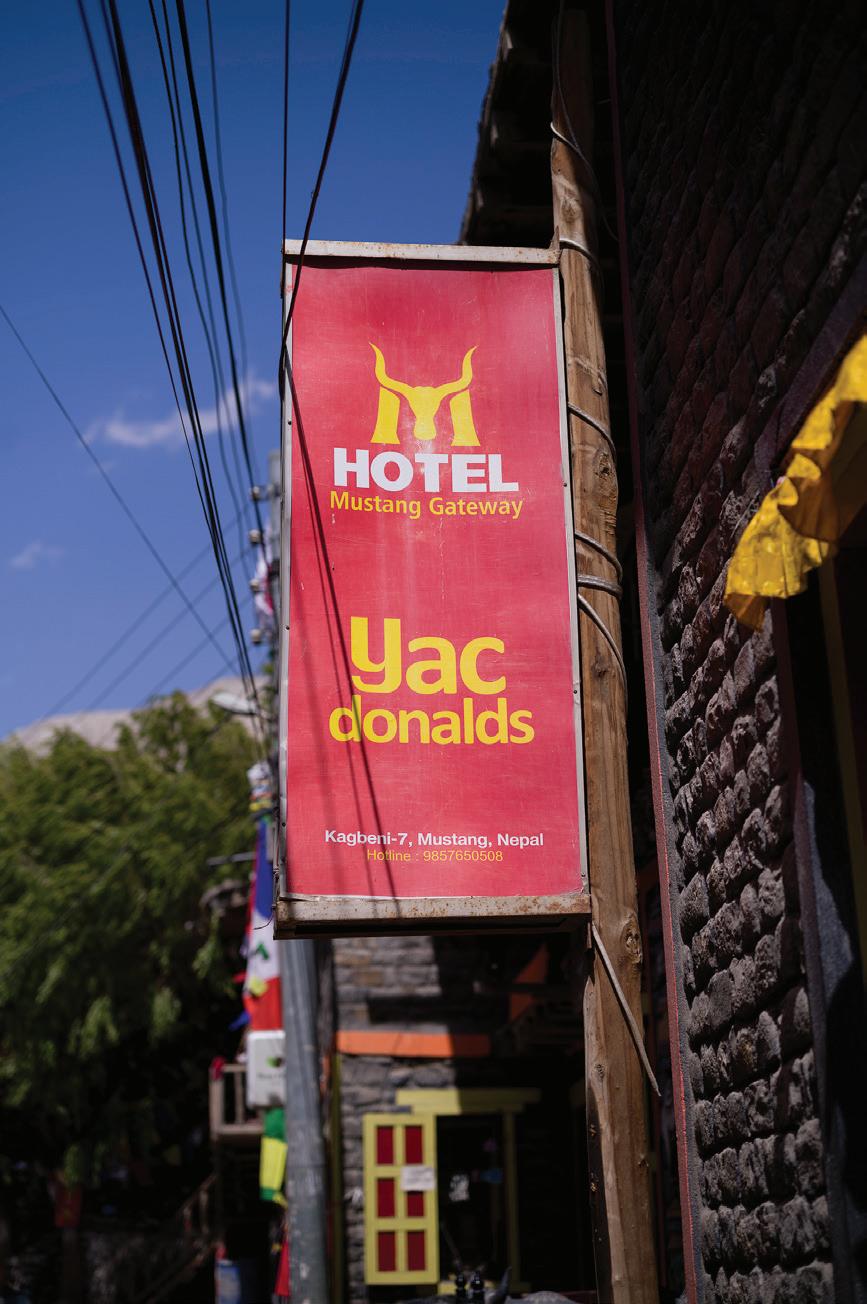
NEPAL
WITH THE LEICA M11 & M11 MONOCHROM
by JIM HANDSFIELD
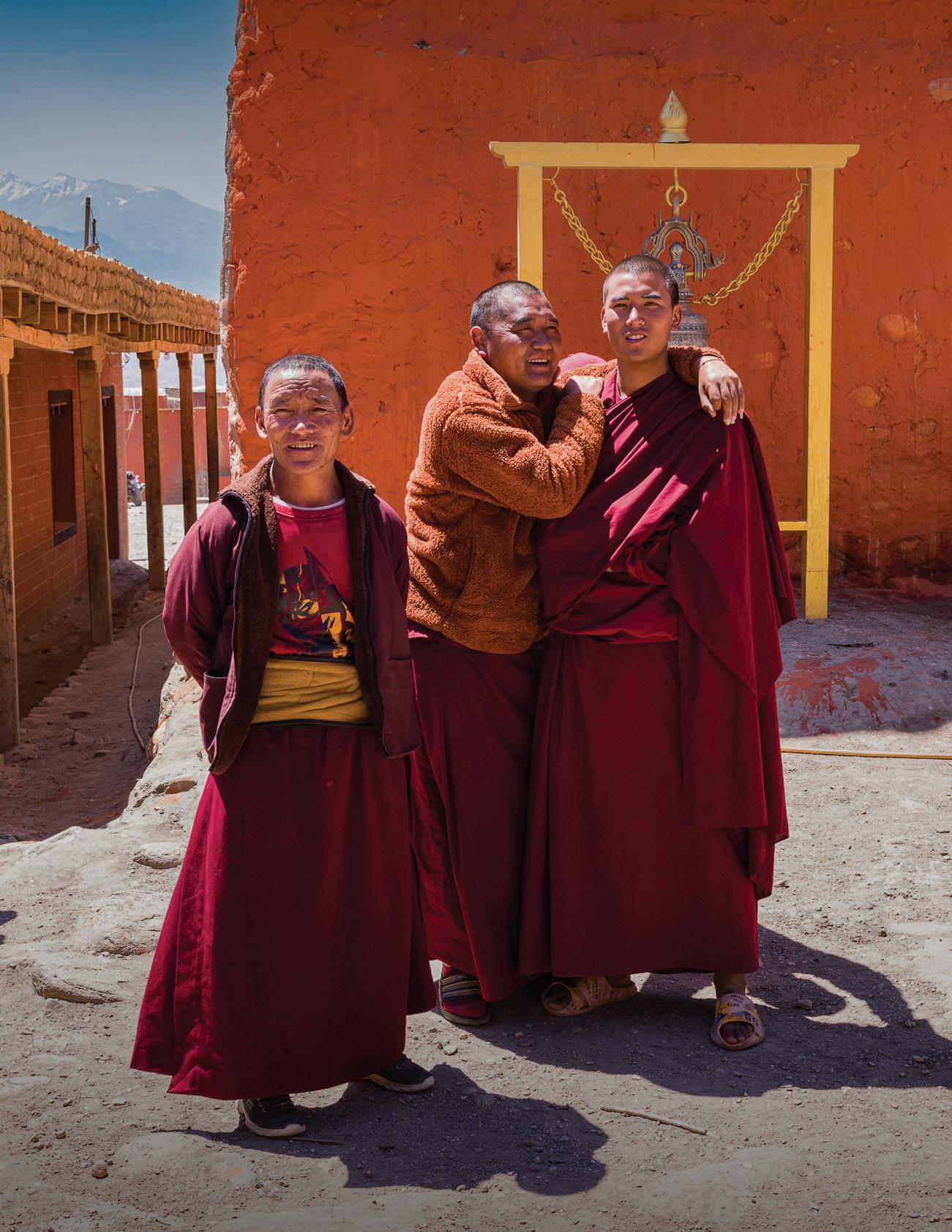
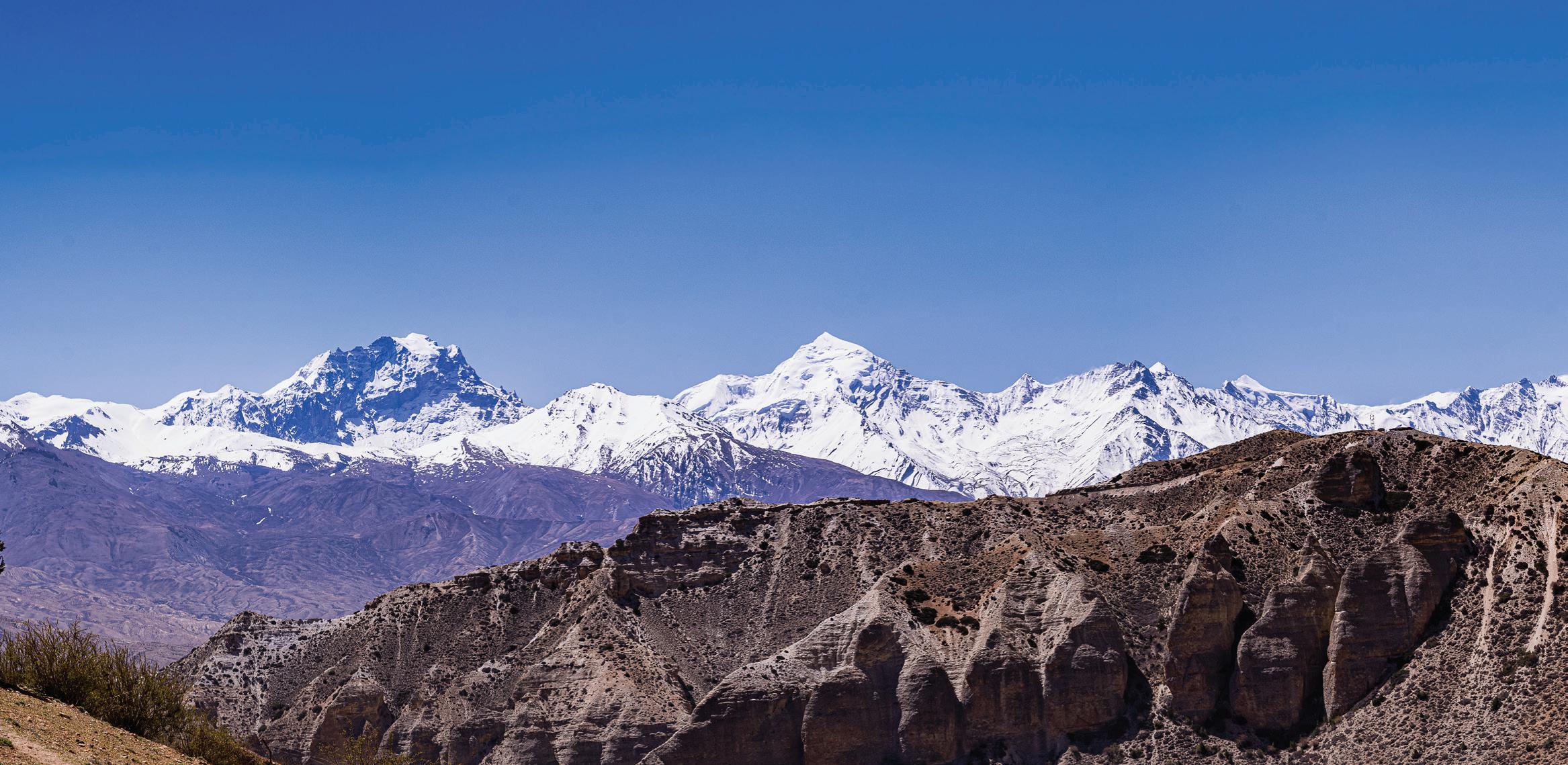
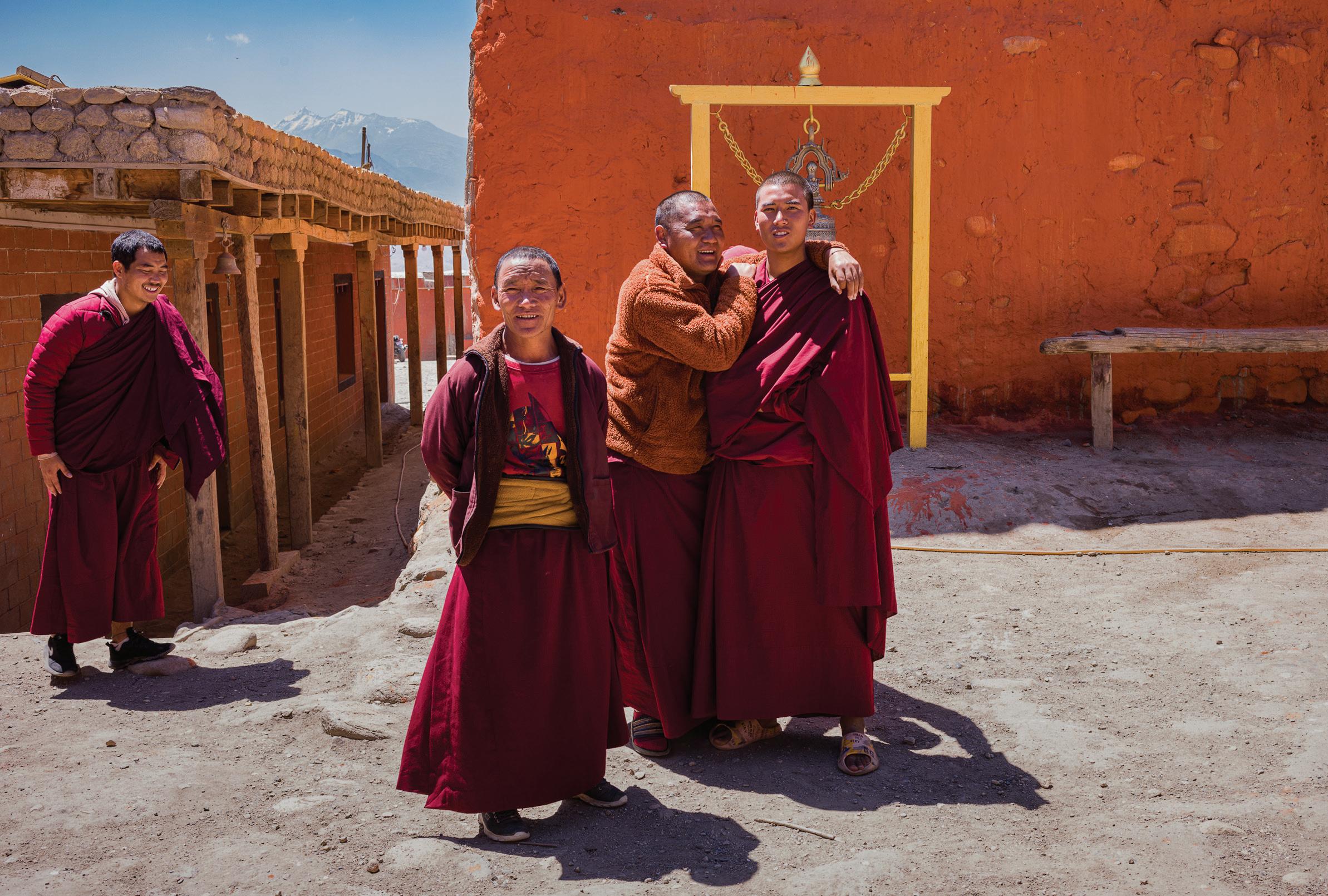
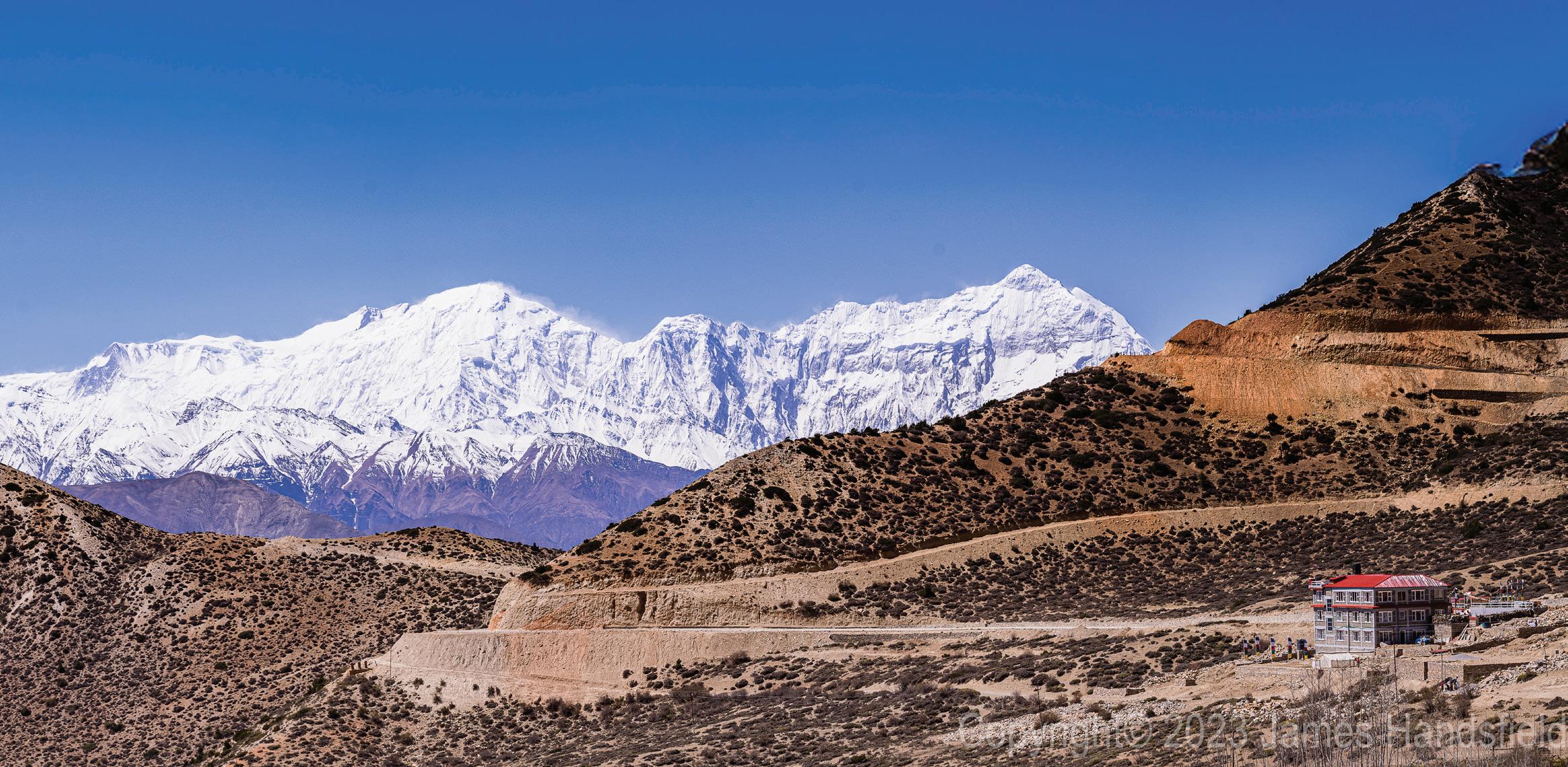
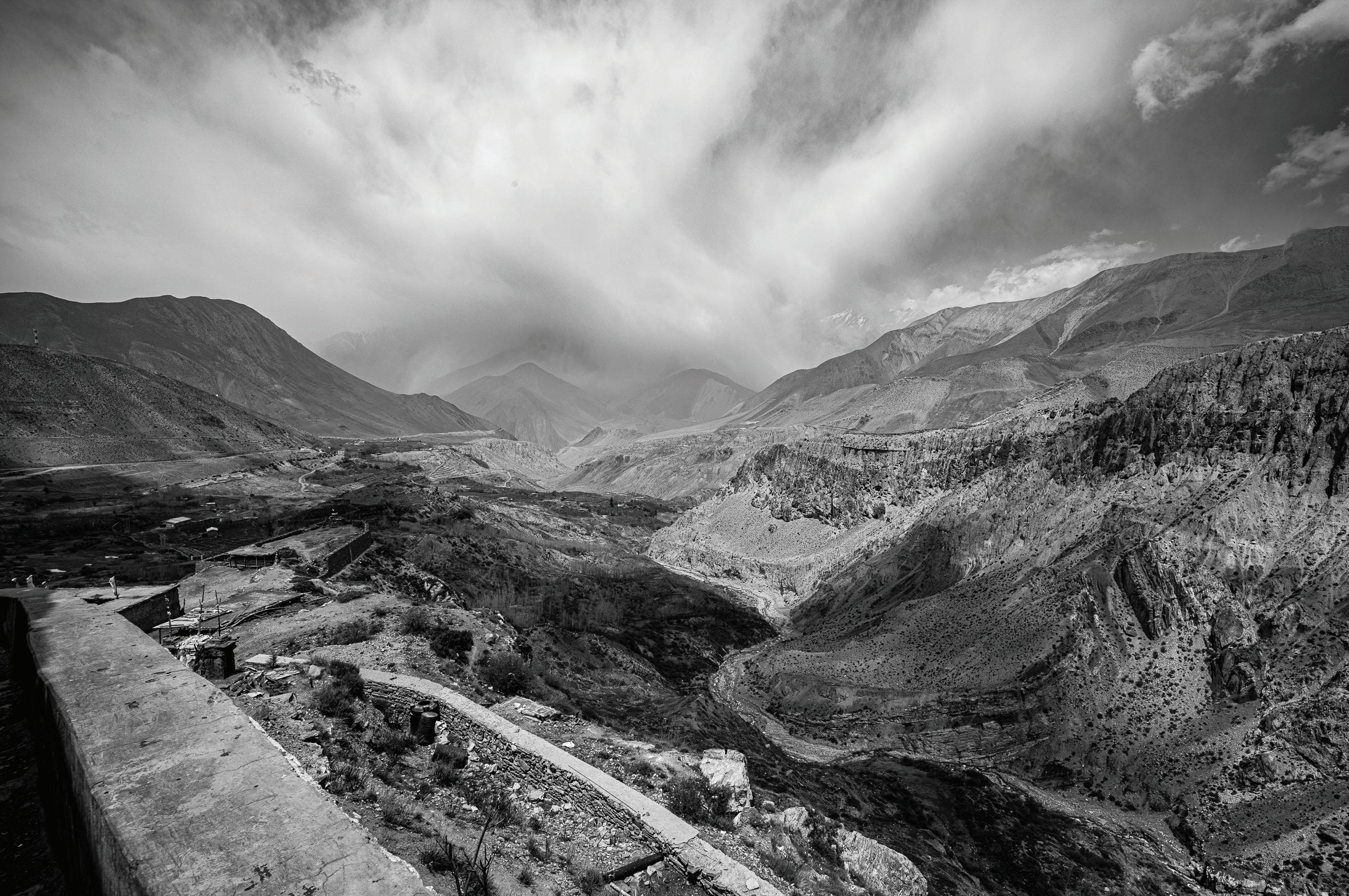
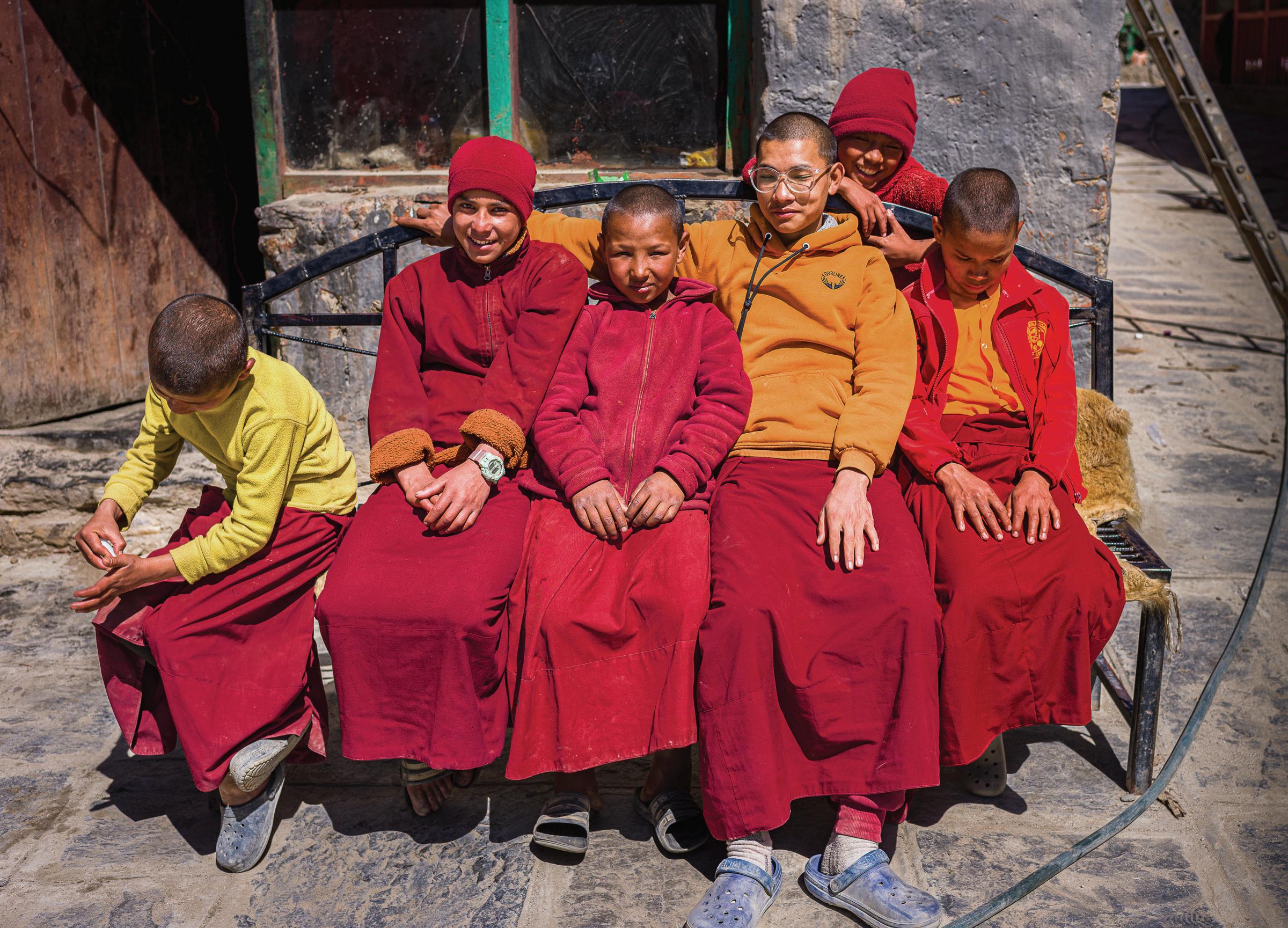
(top left) Monks on a break. Leica M11 + 35mm Summilux-M f/1.4 Asph. (top right) Prayer Wheels. Leica M11 + 50mm APO-Summicron-M f/2 Asph (bottom) Annapurna Range. Annapurna itself is behind the two peaks on the right. Seven shot panorama with M11 + 50mmAPO-Summicron-M f/2 Asph.
INFebruary 2023, I received an email from Wilbur Norman. He was filling out the roster for his planned trip to Lower and Upper Mustang in Nepal, and asked if I would like to join. I thought about it for a couple of seconds and said yes. So began a lifechanging journey.
Knowing Wilbur from the Leica Society International, I assumed it was a photo excursion, so I began to plan what I would take. I knew it would be rigorous, so I decided to travel light and take my two M11;s and five lenses: Wide-Angle-Tri-Elmar, Summilux-M 35mm ASPH FLE, APO-Summicron 50mm, Summarit-M f/2.4 75mm, and APO-Telyt-M 135mm. On May 3, 2023, I headed out to New York, Doha, and Kathmandu.
this page
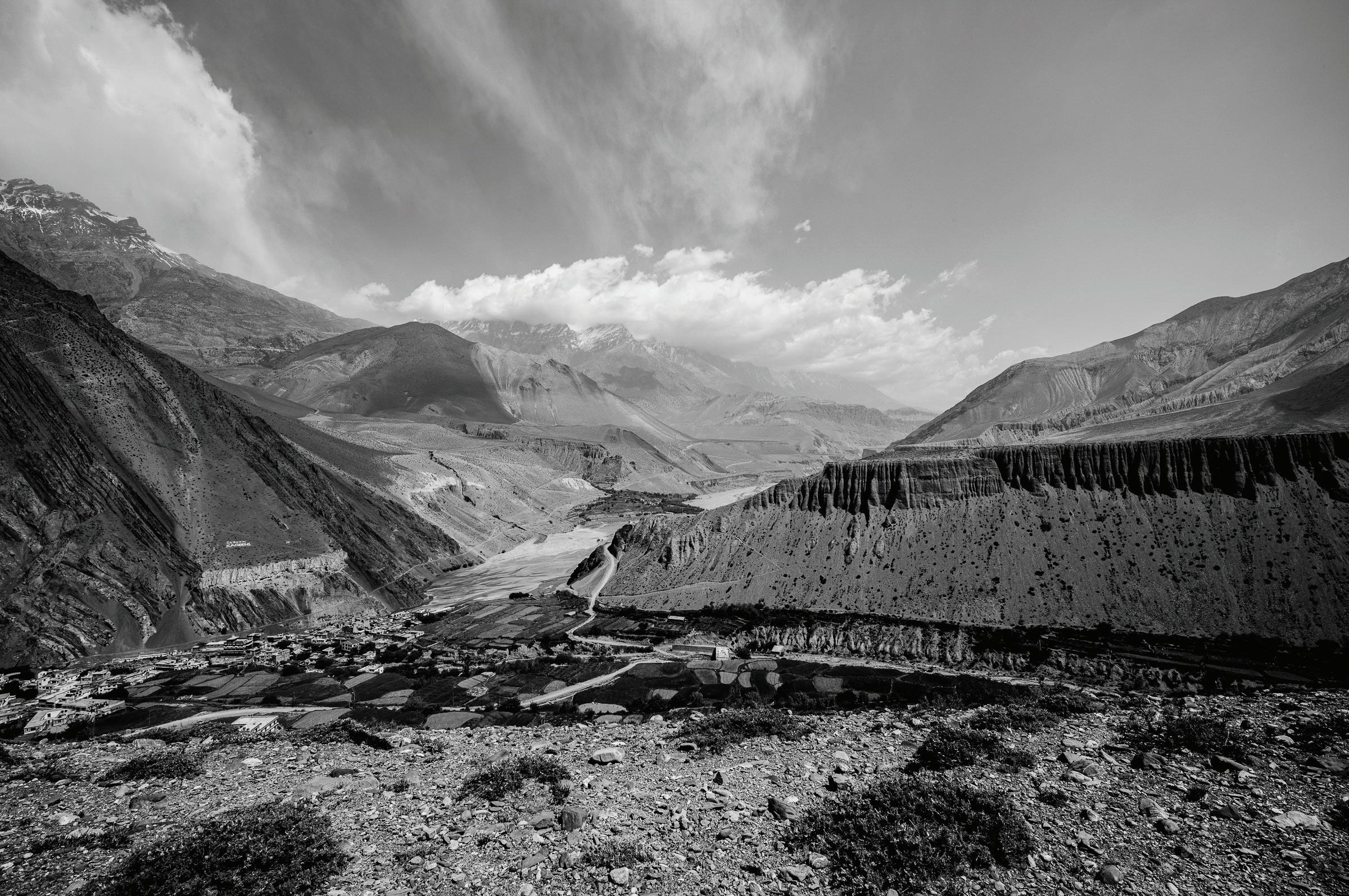
(above) Himalayan Vista.
Leica M11 Monochrom + 16-18-21mm Tri-Elmar f/4.
opposite page
(top) Himalayan Village.
Leica M11 Monochrom + 16-18-21mm Tri-Elmar f/4.
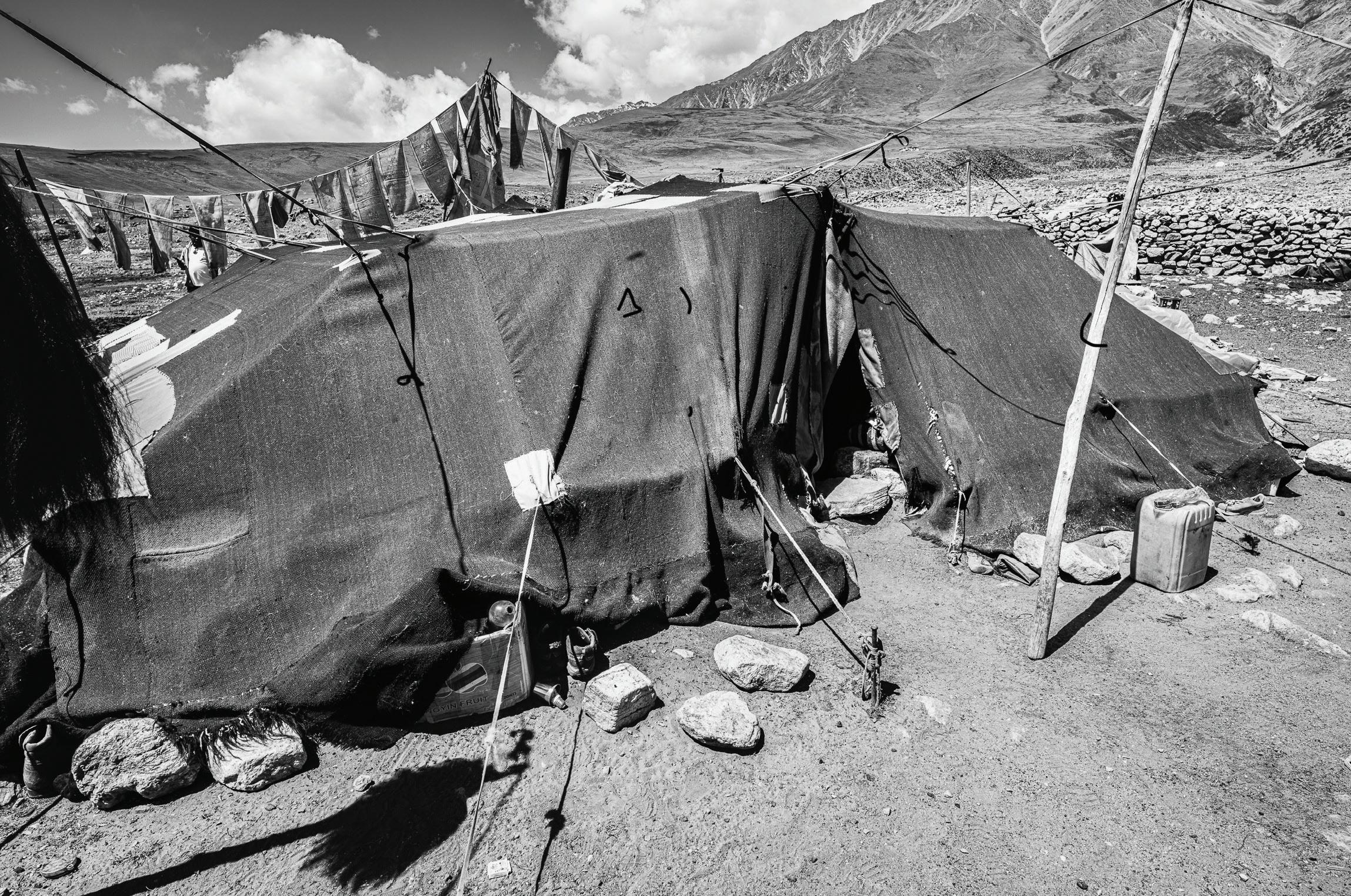
(bottom) Yak Herder's Tent.
Leica M11 Monochrom + ?.
THE ENVIRONMENT When I have thought about Nepal, my mind immediately went to the mountains: Mt. Everest, Lo-Tse, K2, and Annapurna. But it is also a very harsh environment. Mustang starts at approximately 9,000 feet above sea level and extends to over 20,000 feet. Plants are typical desert-like, it is windy, and there's a fine dust everywhere. Temperatures range from quite chilly to warm – layering of clothing is essential and I wore a Buff most of the time.
Our route took us by airplane from Kathmandu to Pokhara to Jomsom in Lower Mustang, and from there by 4-wheel drive vehicles to Lo Manthang in Upper Mustang. A road in Mustang seems to be anywhere one can take a car. We took our time going up about 1000 feet per day to acclimate to the altitude, staying in small villages along the way. All the villages cultivate their own produce consisting of barley, wheat, potatoes, other root vegetables, and apple trees. At this time of year, water was relatively plentiful with man rivulets coming down from the beginning of the spring thaw. There was very little snow in Mustang last year.
Our guides were Tsewang Bisti, a native of Mustang, and Pema Sherpa, and three drivers.
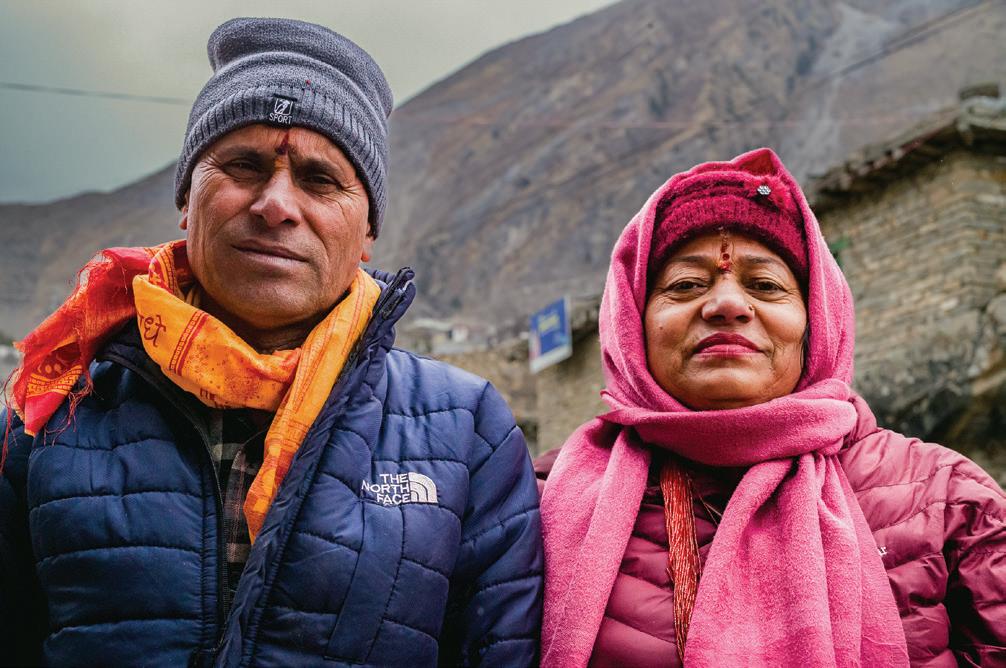
THE CULTURE All the villages were small, with around 30 to 40 families, and the people were very welcoming. Everywhere we went, we were given wonderful hospitality and friendliness.
We spent two nights in Kag Beni at around 10,500 feet and took side trips to Muktinath, which is one of five holy places all Hindus are expected to visit at least once in their life.
The temple is at 13,000 feet, and visitors are invited to bathe in the frigid waters.
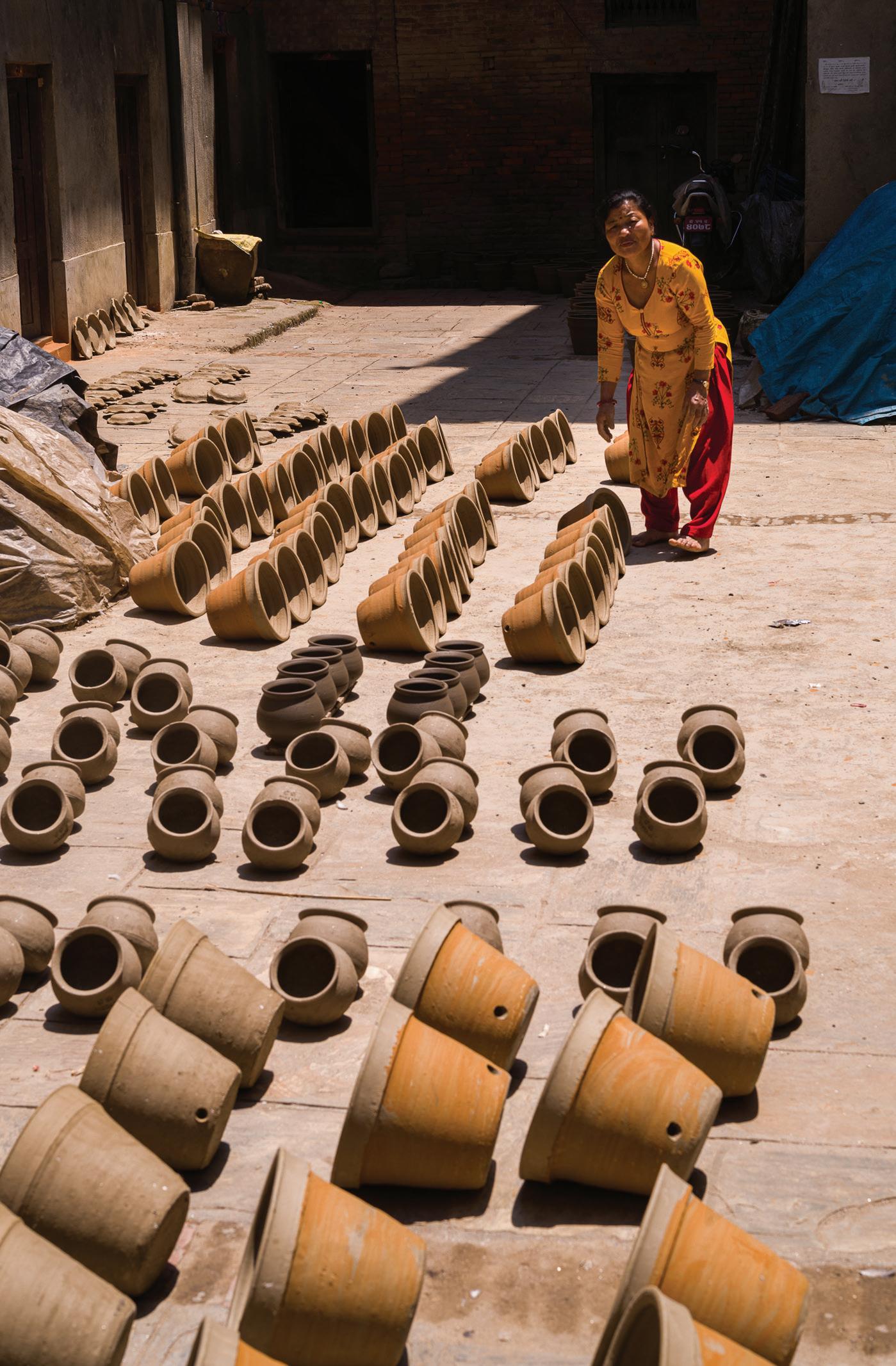
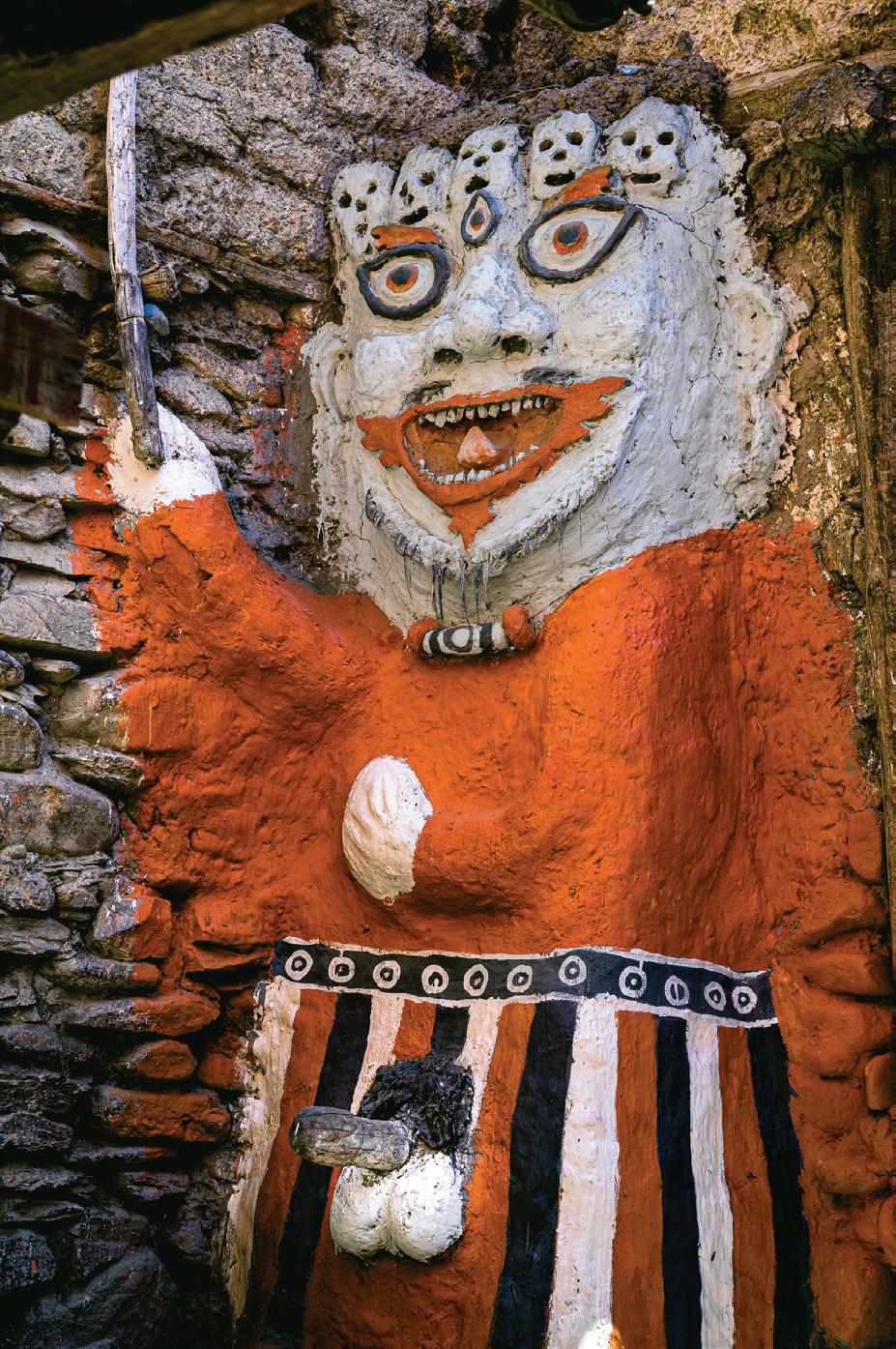
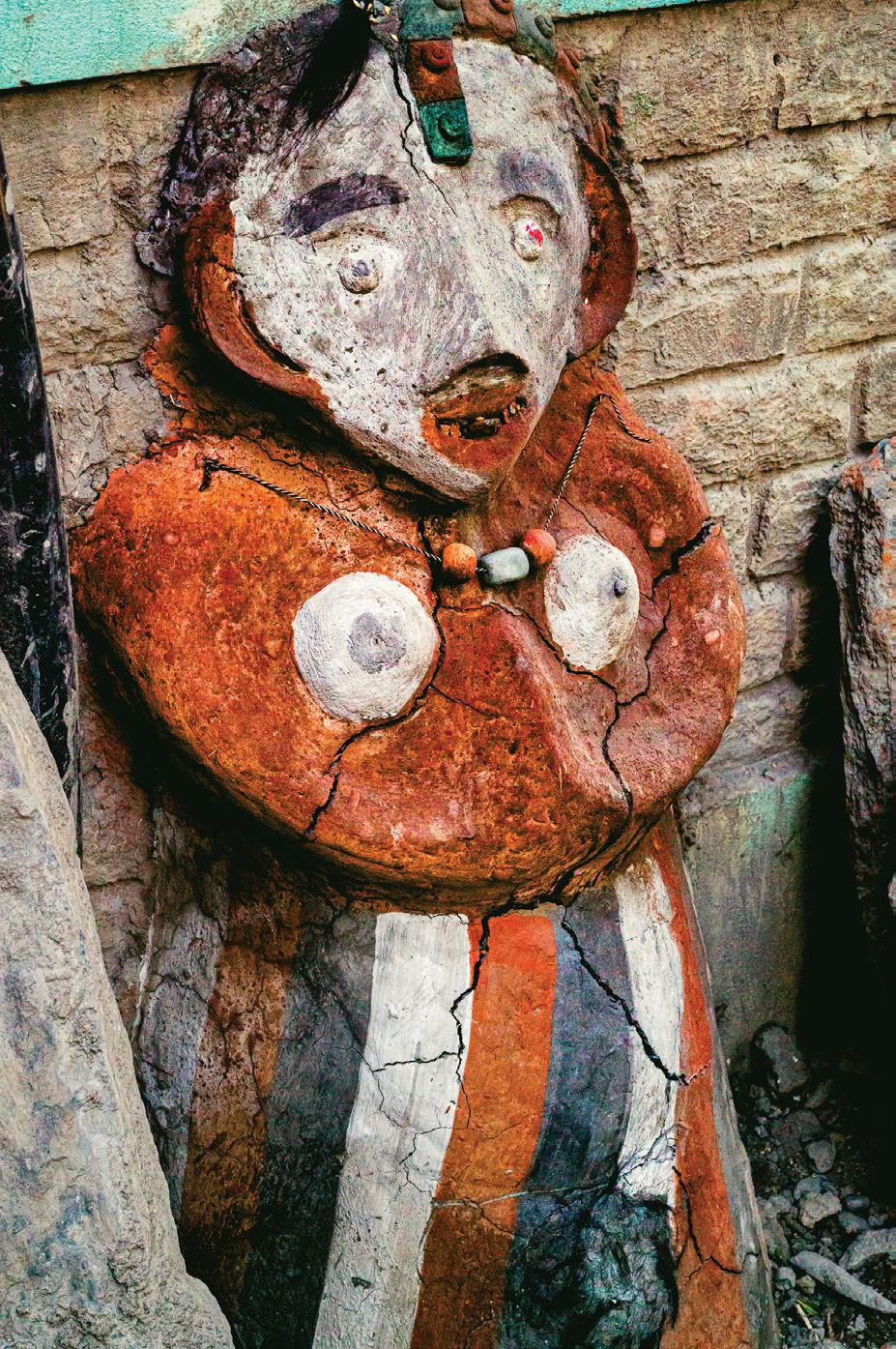
Heading further up the valley we visited several Buddhist monasteries and stupas (reliquaries). Prayer flags and prayer wheels were ubiquitous, as were village guardians (male and female). One village, Timan is known for its pottery which all people in the central village participate in making, from spinning the vessels, to painting and adorning the finished product.
Everywhere we went we were served tea of various types from black tea served with milk and honey to Tibetan butter tea. All part of the hospitality we were shown. In some of the monasteries, we were allowed to visit the ceremonies to hear the chanting, ringing of bells, and blowing of horns. Most charged a small fee and were happy to accept offerings. In one, the chanting monks smiled when I took their photo, and the chant leader reached down into a sack and offered me a cookie.
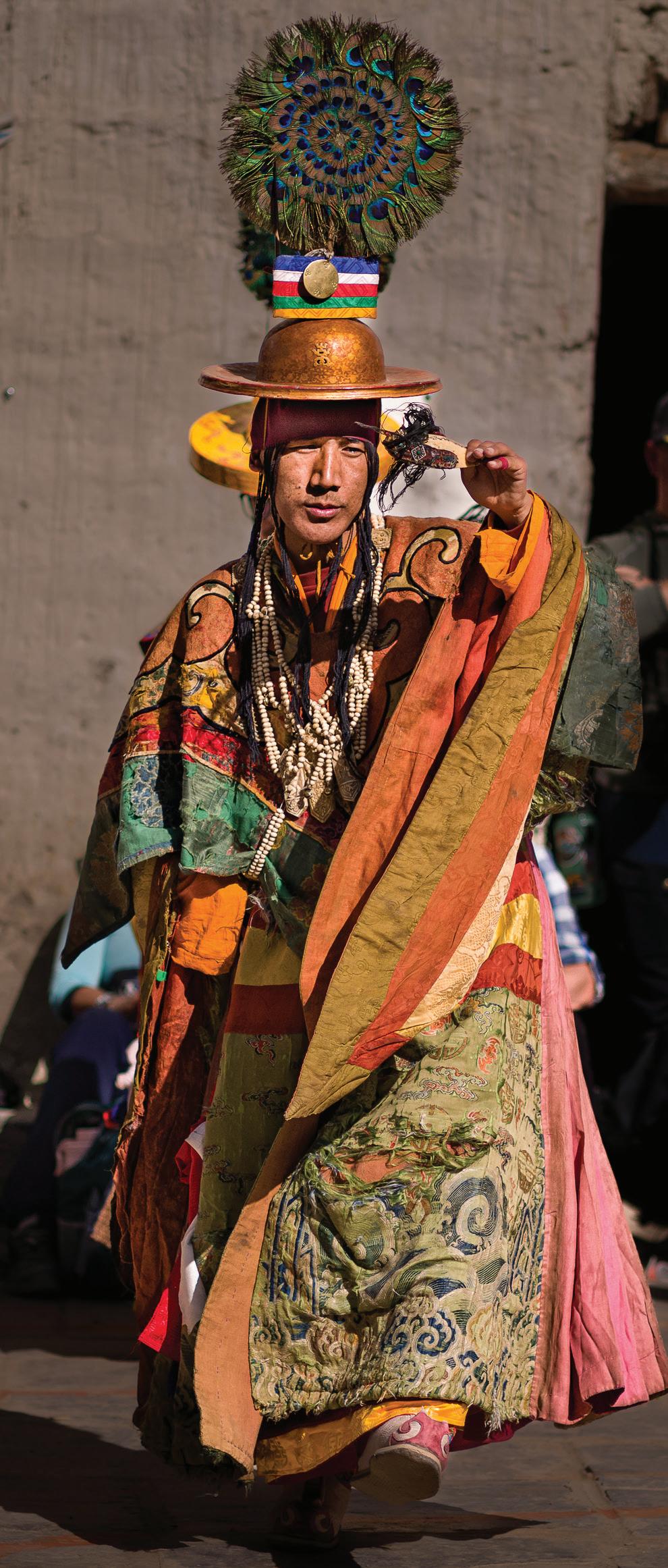
One of our main objectives was the Tiji Festival in Lo Manthang, the capital of Mustang. Quite a bit larger than most of the villages, it contains the palace of the King of Mustang, though the palace isn’t used as a dwelling any longer (the king stays in the King’s Hotel, so named because it is the king’s hotel).
The Tiji Festival (https://omgnepal.com/upper-mustang-tijifestival-lo-manthang/) is a three day celebration of dance for world peace. During the dance, led by a head lama, lamas dance to overcome demons, portrayed by dancers. Three of the demons are converted to Protectors during the ceremony. The patron overseer of the festival is Padmasambhava (https://www.learnreligions.com/ padmasambhava-450201), the father of Tibetan Buddhism.
this page
(right) Male & Female Village Guardians.
Leica M11 + 50 APO-Summicron-M f/2 Asph.
opposite page
(top left) Turning the pottery.
Leica M11 + 50 APO-Summicron-M f/2 Asph.
(top right) Head Lama Dancer.
Leica M11 + 75mm Summarit-M f/2.4
(bottom) Entrance to the Monkey Temple.
Leica M11 + 50 APO-Summicron-M f/2 Asph.
While in Lo Manthang, we took a side trip to visit a nomadic yak herder family in their yak hair tent, where we were invited inside and served perhaps the best tea I’ve ever tasted. It was windy and chilly outside the tent, but stifl ingly hot inside, warmed by the dark color of the yak hair and the charcoal stove on which the mother made tea.
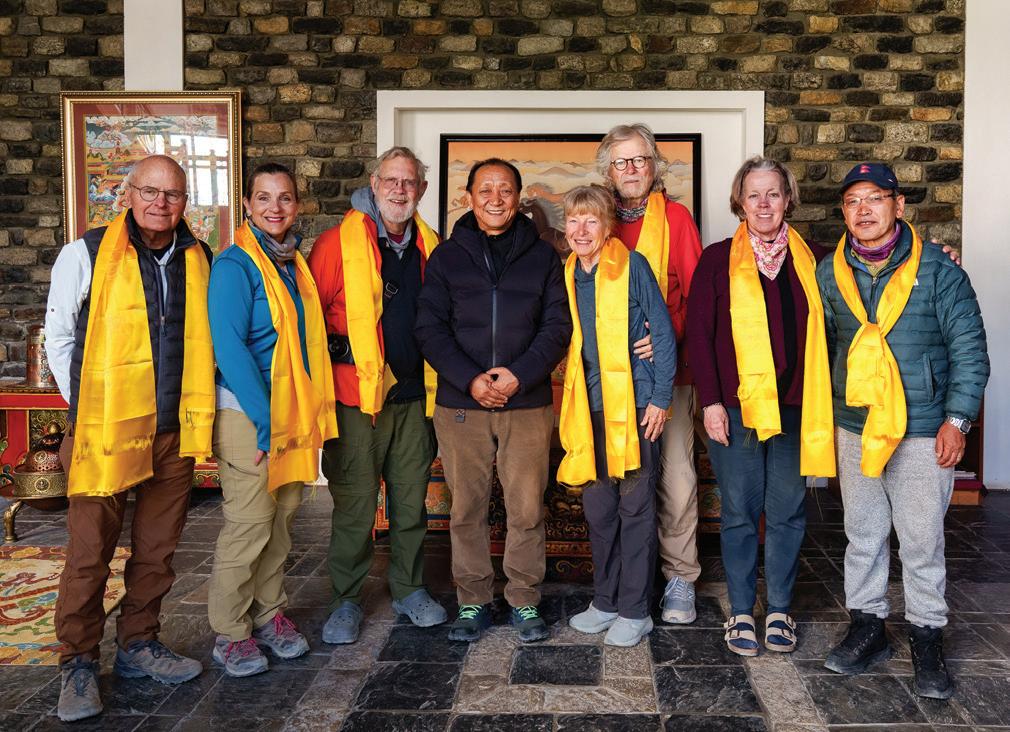
As a fi nal treat in Lo Manthang, we had an audience with the King of Mustang, cousin to our guide, Tsewang.
SPIRITUALITY I cannot write of Mustang without mentioning the spirituality of the people. Most are Buddhist, and their recognition of spirit is fully integrated into everyday living. The way they greet others with “namaste” (https://en.wikipedia.org/wiki/Namaste) comes from their deep understanding. The direct translation is “I bow to you,” but to me seems more like “I see YOU!” Almost all the people I said it to brightened their faces with a brilliant smile, even the dourest looking individuals.
Present everywhere are prayer wheels and prayer flags. The largest prayer wheels may contain thousands of prayers (om mani padme hom) inside and embossed on the outside, and with each full turn of the wheel, all those prayers are released. Those same prayers are written on all the prayer flags, and with each flap in the wind, those prayers are released.
Nilgiri is a sacred mountain which no one may climb.
Nepal is approximately 65% Hindu, 30% Buddhist, and 5% Muslim and Christian. There is no apparent social divide between these faiths.
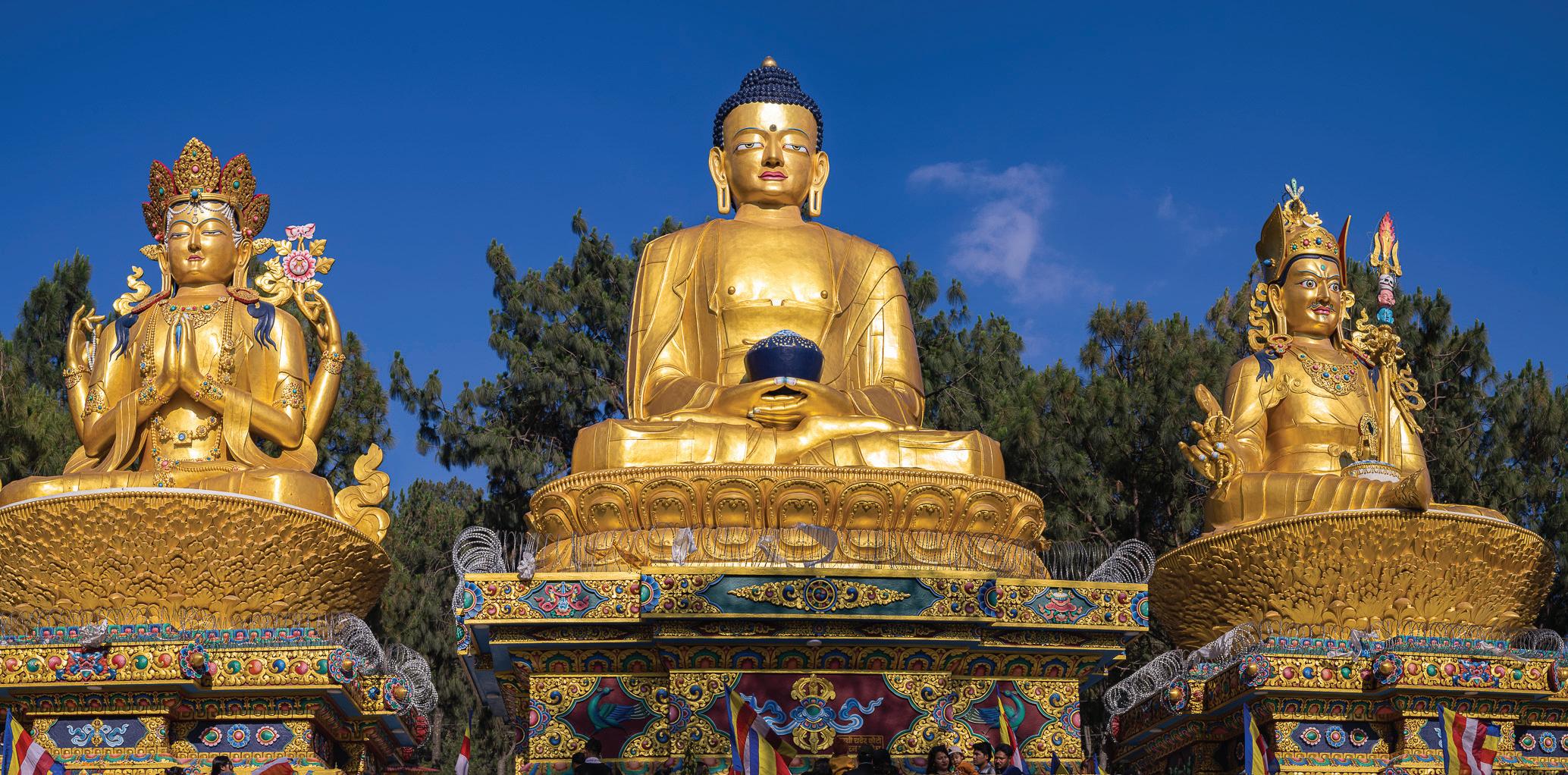
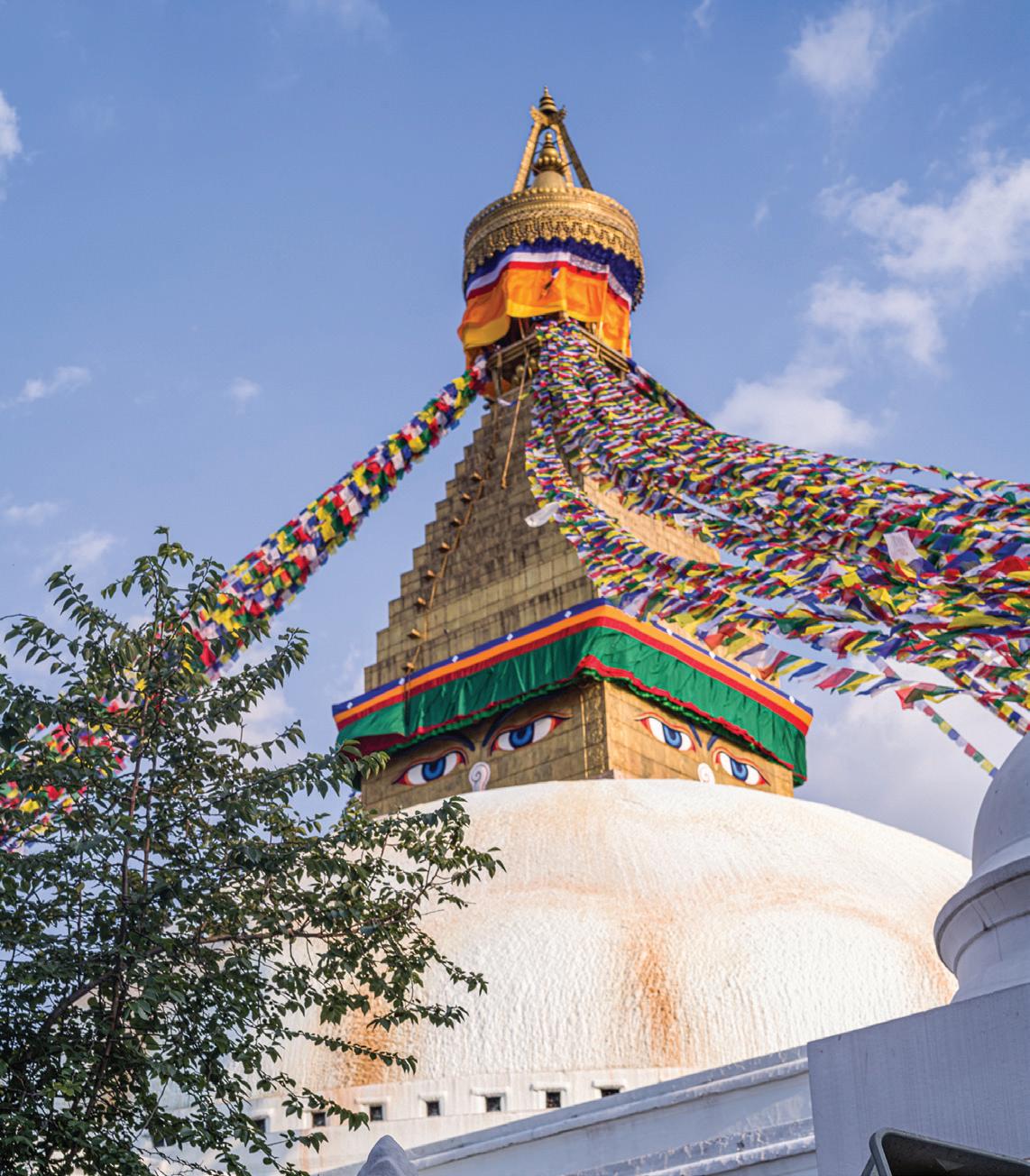
KATHMANDU Our trip began and ended in Kathmandu, the capital city of Nepal. Our fi rst full day in Kathmandu was the birthday of the Buddha. We made several side trips both before and after our visit to Mustang, including the Monkey Temple, so named for the Rhesus macaques that inhabit the area, where many people noticed us and wanted pictures taken with us and the Grand Stupa, which contains at least some of the remains of the Buddha. The Eyes of the Buddha on the Stupa is replicated in many places.
this page (top) Pilgrims at Muktinath. Leica M11 + 50 APO-Summicron-M f/2 Asph. (bottom) With the King of Mustang.
I have a friend from high school (Leysin American School in Switzerland) who grew up in Nepal (her father worked for the U. S. State Department) and returned there after her education and founded a home for abandoned, trafficked, abused, and orphaned children, Ama Ghar (https://ama-foundation.org). I visited the home with most of the group before we went to Mustang, and then again after with one member who couldn’t go the fi rst time. Bonnie Ellison’s work is mostly funded by individual donations.
ENHANCING CROPPED IMAGES USING ARTIFICIAL INTELLIGENCE (AI)
by BILL ROYCE
Leica owners using fixed focal length lenses, or even zoom lenses, can at times find themselves standing a bit too far from the subject when they take a picture, where the subject is but a small part of the full image frame. As a Leica SL2 owner, I have experienced a need to enhance images made with my Sigma 100-400 L-mount zoom lens when shooting wildlife. Also, shooting with an M camera results in an even greater need for enhancement when using lenses much shorter than the Sigma 100-400 zoom. This article shows the Leica shooter a way to get high image quality, in spite of these limitations.
Fortunately, as a Leica shooter, there are several factors that work in your favor in solving this problem:
• The very high quality of Leica lenses and many L-mount lenses
• With the SL2, In-body image stabilization (IBIS), yielding sharp images at lower shutter speeds
• Image stabilization in the Q cameras
• The sensor quality and high pixel count of the current Leica cameras, including the M11, Q3 and Q3 43
• The introduction of AI editing software that can measurably enhance severely cropped images
The following discussion will show you how to use one of the leading image enhancement software applications, Gigapixel AITM from Topaz Labs. Gigapixel AI can be used as a stand-alone application and can also be launched from within Adobe LightroomTM as a plug-in using the Edit in> command. Also, it can be launched from Adobe PhotoshopTM Applications using AI for image enhancement rely on analysis of many thousands of images to improve the mathematical algorithms that calculate the result. You will find that Gigapixel AI is a very simple application to use, requiring minimal skills to achieve excellent results. Simply load the image, adjust the sliders, select the degree of enlargement and save.
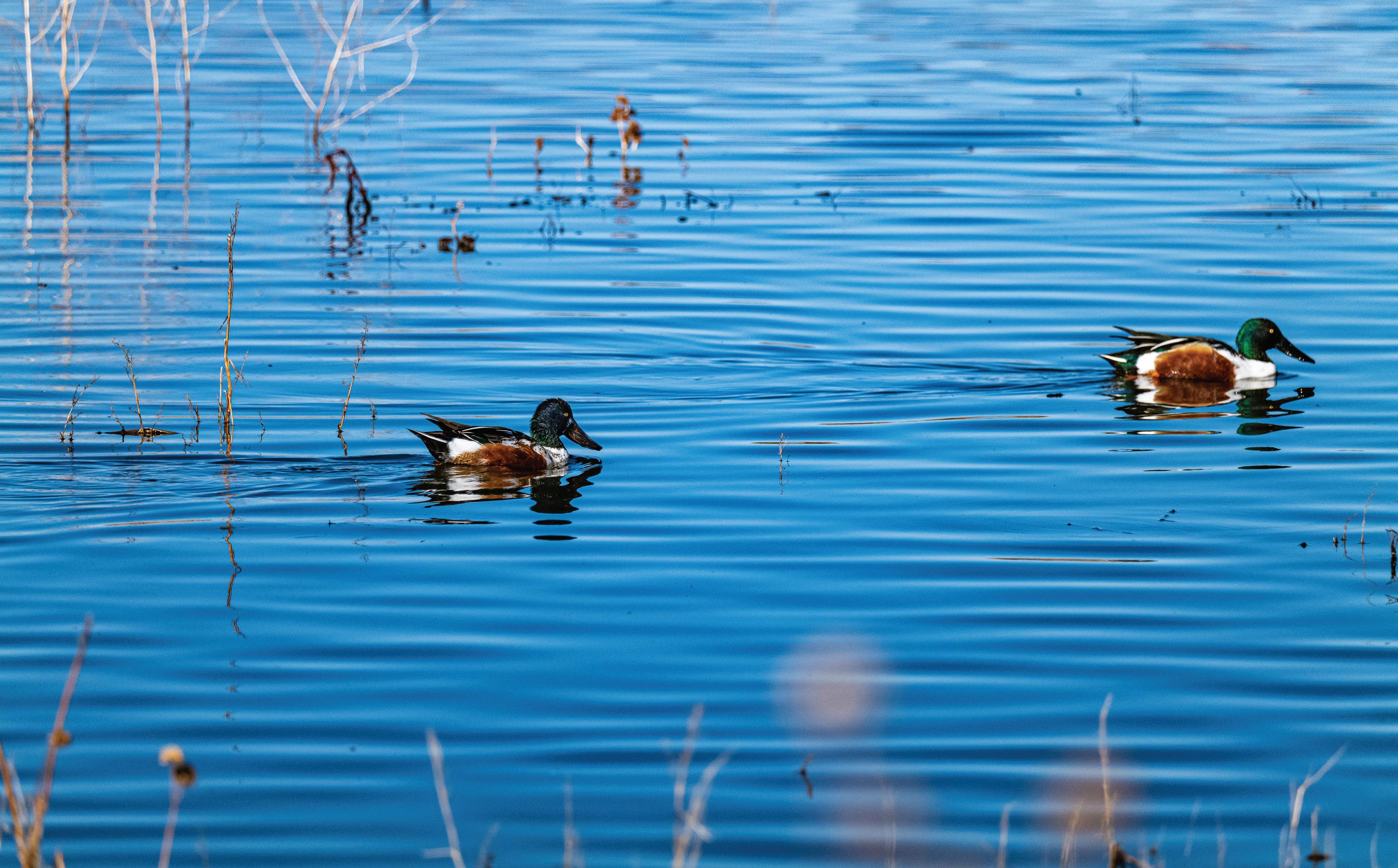
For this example, I will show how to enlarge and enhance the uncooperative Northern Shoveler duck on the left in the above full frame image (8368 pixels wide), taken with an SL2 with a Sigma 100-400 L-mount lens at 400mm.
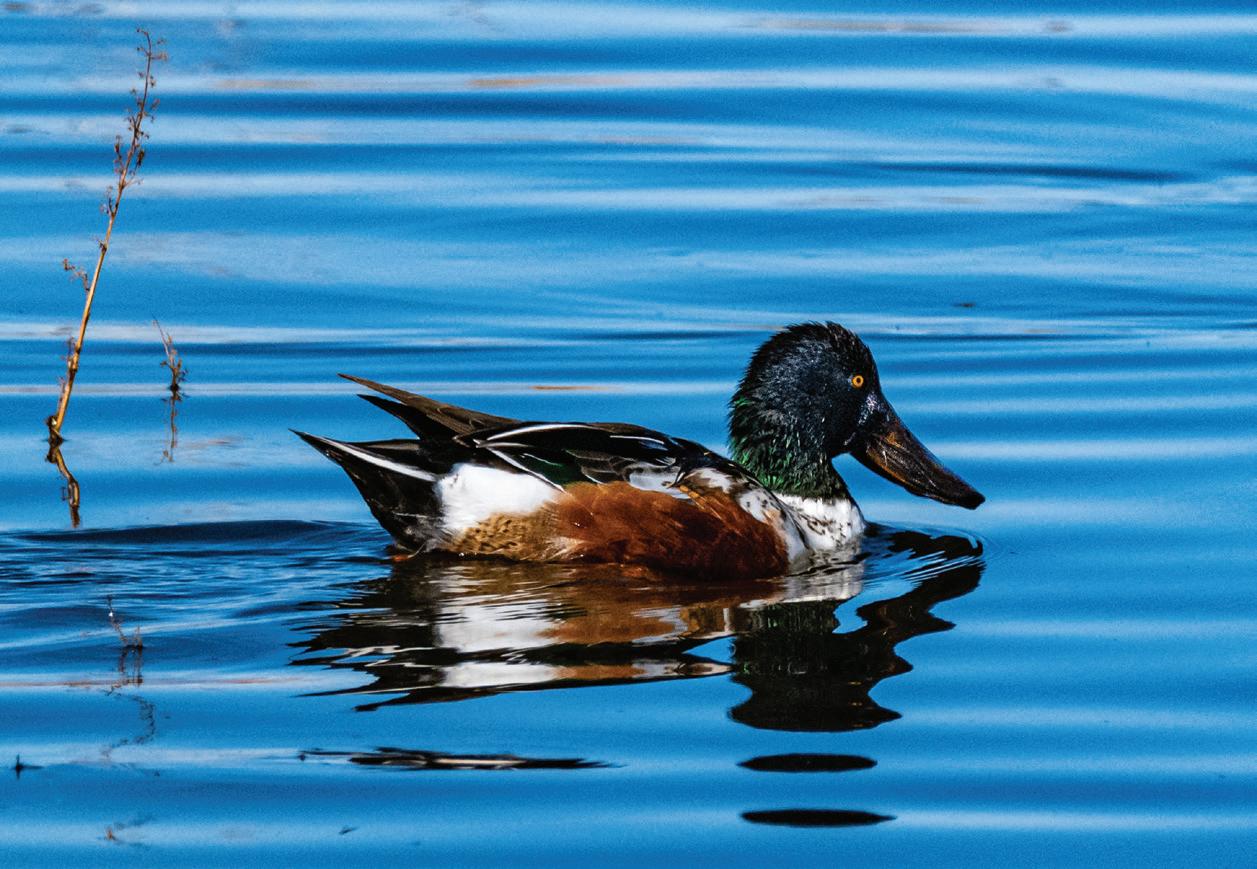
The cropped version on the opposite page (without enhancement) is now only 1718 pixels wide. (Figure 2)
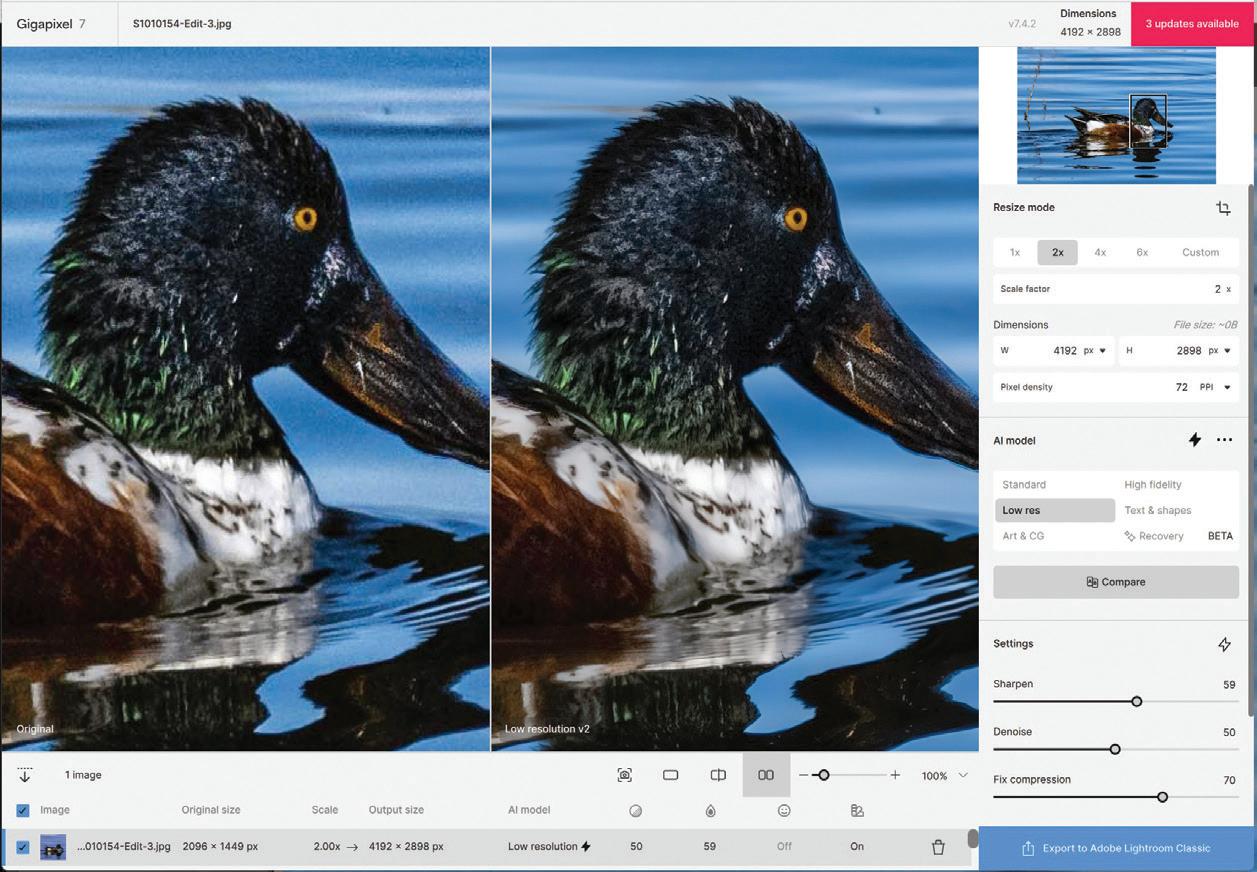
Once Gigapixel AI is launched, and you have loaded the image, you will see the following display. (Figure 3) You must then select the scale (in this case 2x, doubling the image dimensions) and select the amount of noise suppression and blur removal using the sliders shown. There are other settings worth experimenting with but are of secondary importance. Gigapixel shows you how a portion of the enhanced image will look with the selected settings.
Once you have chosen the settings and adjusted them to your satisfaction, save
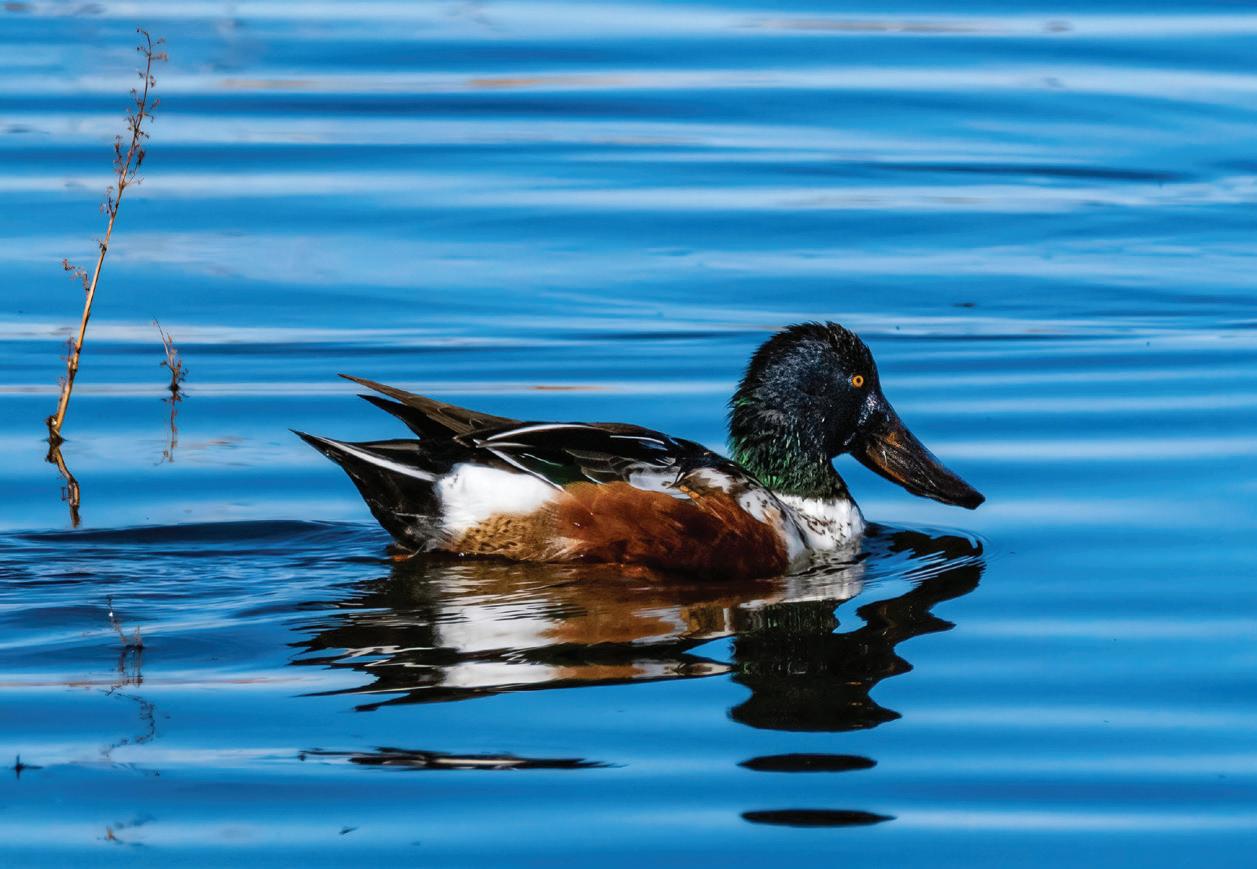
the image to apply the enhancements to the entire image. The newly enhanced image is now 3436 pixels wide, with little apparent loss of quality. If further refinements are needed this image can be edited in Lightroom, Photoshop or other editing applications. The finished image, after cropping, is now the equivalent of an image taken with a lens of almost 2000mm!
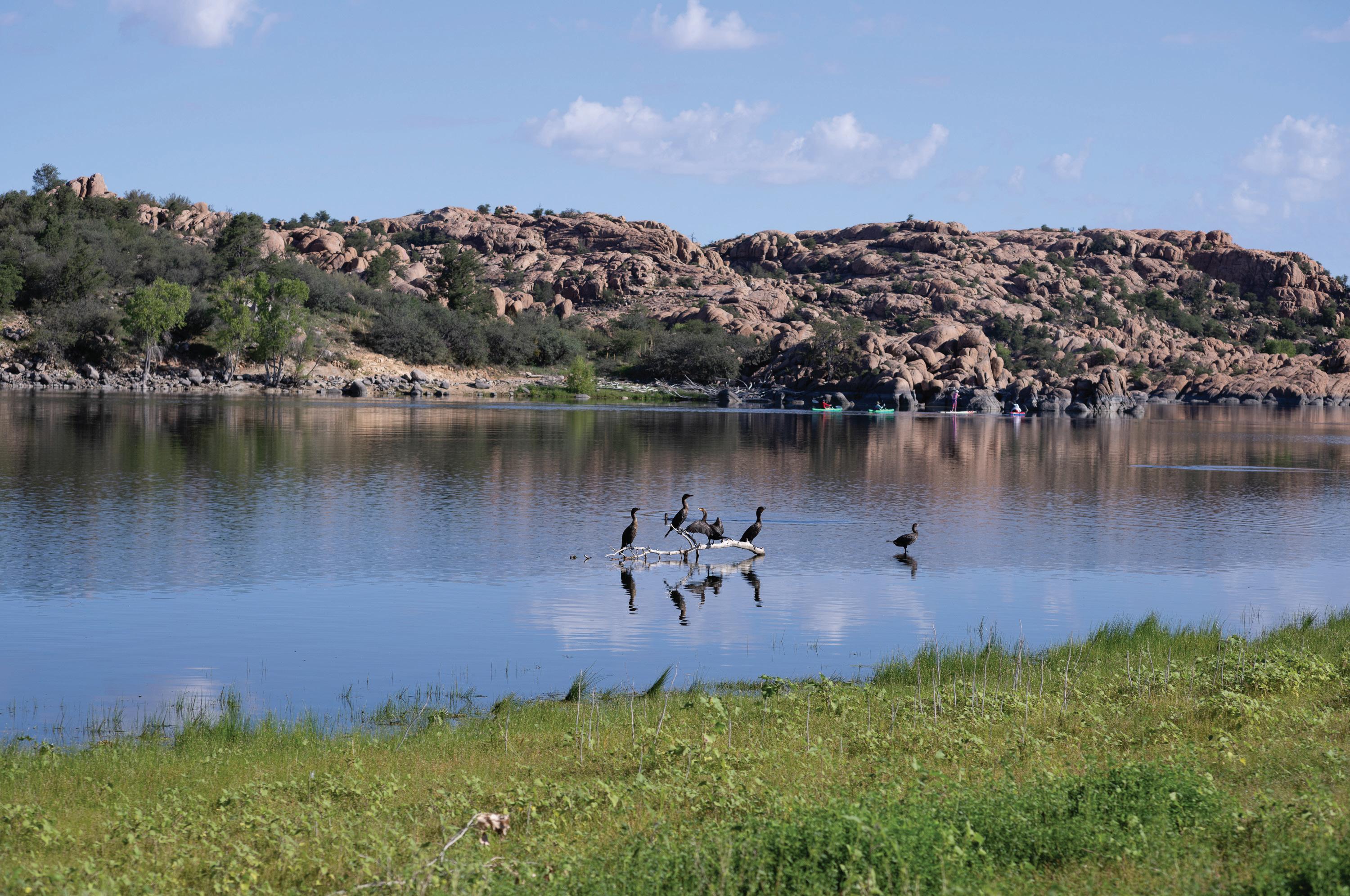
Another, more extreme example, is this image of a group of cormorants on the following page, taken recently with an M11-P + 90mm Elmarit-M, shot at 1/750s, f/5.6, at ISO 64, hand-held. (Figure 5) This yields impressive results, in spite of using an older lens that is neither an APO nor an ASPH lens. The full-frame image is 9528 pixels wide, providing lots of detail to work with!
The image was cropped to a width of 2015 pixels and then processed at 2x using the same settings as the previous example, yielding a final width of 4030 pixels. The equivalent focal length is 425mm. The details of the feathers have been nicely preserved and the overall image is very sharp. (Figure 6)
In summary, images with subjects that initially appear to be too small to enlarge or print may be processed in AI software like Gigapixel AI to achieve excellent results. That lens you thought was too short in focal length can produce amazing results, especially if that lens is of the quality typical of a Leica. Can you lighten your camera bag and take just your shorter lenses while traveling? Perhaps! More than 210mm with a 50mm M or SL lens? 150mm with a Q3?
Worth a try! With the introduction of the new Q3 43, you might be surprised to see equivalent focal lengths exceeding 200mm with your images.
For the mathematically inclined, equivalent focal length can be calculated as follows: f equivalent = [full format pixel width/pixel width of the cropped image*] x f where f = focal length of the taking lens
*note: use the cropped image dimension before multiplying it in Gigapixel AI.
Figure 2. Cropped to 1718 pixels.
Figure 3. Gigapixel AI interface.
Figure 4. Processed at 2x yielding a final width of 3436 pixels (2000mm equivalent focal length).
Figure 5. Original uncropped and unenhanced image at a width of 9528 pixels.
Figure 6. Cropped to 2015 pixels and then processed at 2x yielding a final width of 4030 pixels (425mm equivalent focal length).
THE FORGOTTEN FULET
by JIM LAGER
the#70350 FULET is listed but not illustrated on page 43 of the E.Leitz, Inc.New York catalogue 1275 march 1939. It is identified as Focusing Copying Attachment Model 2. The more sophisticated #70325 FULDY is illustrated and called the Sliding Focusing Copying Attachment Model 1. The sliding feature evolved into the later Focoslide assemblies.
Page 299 of Miniature Camera Work, 1st Edition, 1938, Morgan and Lester Publishers New York shows the FULET.
Pages 292-302 feature an E.Leitz, Inc. New York advertising section. These pages are reproduced in our Viewfinder 45, #4, 2012. The FULET is also shown on page 138 of my Volume III-Accessories.
The FULET carries no Leitz identification. Most examples have probably been lost/ discarded over the years. If you fi nd one you will now know what it is. A simple E. Leitz, Inc. New York copying device from the 1930's.
FULET camera side. Focusing screen positioned.
FULET lens side. Leica thread mount. Remove screen. Replace with Leica and take photo. 5cm Elmar commonly fitted.
THE DIFFERENT M6 VARIATIONS
PART TWO
by JO GEIER
Since there are so many different models of one of the most popular Leica cameras, we thought we could shed some light on this and list all variations known to date. Maybe it will help you to choose the M6 you are looking for.
1996
M6 Platin / Platinum / Gold Sultan of Brunei
Another order from the Sultan of Brunei for 500 cameras: 250 in gold and 250 in platinum finish. The platinum cameras were covered in grey snakeskin. All cameras were engraved with the Sultan's crest. 125 of the platin and 125 of the gold cameras were fitted with a diamond just above the accessory shoe. With Summilux-M 1.4/35mm Asph.
Another small batch must exist as at least two other cameras with earlier serial numbers and Summilux-M 1.4/35mm Asph. are known to exist (maybe 100 pieces)
1996
M6 Platin / Platinum
Schmidt Group of Companies
100 Years / Centenary Edition
150 sets with Elmar-M 2.8/50mm. Altough they were up to special number 188 as Schmidt was omitting all numbers containing a 4.
1997
M6 Platin / Platinum Anton Bruckner
The Austrian Leica distributor ordered 200 cameras with Elmar-M 2.8/50mm to commemorate the 100th anniversary of the death of the Austrian composer Anton Bruckner.
Product Code: 10454 Set
Product Code: 10425 Body Product Code: 11839 Lens
1998-1999
From now on available with viewfinder magnification 0.85 (engraved in the silver band in the viewfinder) with frame lines for 35, 50, 75, 90 and 135mm lenses.
Product Code: 10413 – Black Body 0.85
M6 Jaguar XK
To celebrate the 50th anniversary of the Jaguar XK. Chrome body with British Racing Green Conolly leather with Elmar-M 2.8/50mm. Only 50 sets made. Product Code: 10469 Set
M6 Platin / Platinum 150 Jahre Optik
To celebrate the 150 years of the foundation of Carl Kellner's Optical Institute in July 1849, Leica Camera issued 150 cameras. Each camera is engraved with one of the years from 1849 – 1999 together with the name and optical diagram of the matching lens. Each 30-years group of cameras was supplied with a different lens.
Product Code: 10480 (1970-1999)
Summilux-M 1.4/35mm
Product Code: 10481 (1940-1969)
Summicron-M 2/35mm
Product Code: 10482 (1910-1939)
Summilux-M 1.4/50mm
Product Code: 10483 (1880-1909)
Summicron-M 2/50mm
Product Code: 10484 (1849-1879) Elmar 2.8/50mm
Leica M6 TTL
Product Code: 10433 Black Body 0.72
Product Code: 10434 Chrome Body 0.72
Product Code: 10436 Black Body 0.85
Product Code: 10466 Chrome Body 0.85
Product Code: 10475 (2000 - 2002) Black Body 0.58
Product Code: 10474 (2000 – 2002) Chrome Body 0.58
1998
1999
1998-2002
Leica M6 TTL Kanto
The Japanese repair shop ordered 100 cameras with 0.72 magnification and Summicron-M 2/50mm lenses. 1999
2000
M6 Black Paint Millenium
2000 black paint M6 have been produced with matching black paint Summicron-M 2/35mm and black paint Summilux-M 1.4/50mm. The rewind knob shaped as on the M3/M2/M1.
Product Code: 10442 Body
Product Code: 11611
Summicron-M 2/35mm Asph.
Product Code: 11623
Summilux-M 1.4/50mm
2000
M6 TTL Safari Green
After Leica announced their black paint Millenium M6, a special order was placed by a Hong Kong dealer for 300 green paint cameras. The Rewind knob is in the style of the M3/M2/M1.
Product Code: 10478 Body
2000
M6 TTL NSH
The Japanese Leica distributor NSH (formerly Siber Hegner) commissioned 400 of their own version of the black paint M6 with 0.85 viewfinder magnification. The Rewind knob shaped as on the M3/M2/M1.
Product Code: 10477 Body
2000
M6 TTL Test the Best
Swiss demonstration camera with 0.72 magnification. Only 40 pieces have been made. The camera is engraved with an outline map of Switzerland.
Product Code: 10479 Body 0.85 2000
M6 TLL Black Paint LHSA
650 cameras with 0.72 and 500 cameras with 0.85 viewfinder magnification for the members of the Leica Historical Society of America (now Leica Society International). 60 pieces of the 0.85 cameras have been converted to 0.58 viewfinder magnification cameras.
Product Code: 10443 Body 0.72
2000 M6 Black Paint Millenium
M6 TTL Black Paint Øresundsbron
An edition of 150 cameras with 0.85 viewfinder magnification was commissioned by Nordisk Foto Import A/S Denmark to commemorate the opening of the bridge between Denmark and Sweden. 50 cameras were sold as "body only." 25 with a special Summicron-M 2/35mm Asph. in black paint and 75 with a special Summilux-M 1.4/50mm in black paint.
Product Code: 10492 Body Only
Product Code: 11622
Summilux-M 1.4/50mm
M6 Black Paint ICS
An edition of 200 cameras with 0.85 viewfinder magnification was commissioned by the Japanese Leica distributor Kanto.
M6 Black Paint Dragon 2000
An edition of 500 cameras with 0.85 viewfinder magnification for the chinese market.
M6 TTL Hansa
The Japanese buying organization commissioned 100 cameras with 0.72 viewfinder magnification in chrome with Elmar-M 2.8/50mm lenses to celebrate their 80th anniversary. 2001
M6 TTL Al-Thani
"With orange leather covering, engraved top plate with 'Sheikh Saud Bin Mohd. Al-Thani 20xx Photography Competition Qatar' and with Summilux-M 1.4/50mm was produced in a small series of 16 cameras by Leica in 2001 for presentation to the winners of the Sheikh Saud Photography Competition from 2002-2017. 2001
Paint
2002
M6 TTL Titan / Titanium
Limited Editon of 1000 titanium plated M6 TTL cameras with 0.72 viewfi nder magnification with buffalo leather covering. At the same time 500 examples of titanium plated Summicron-M 2/35mm Asph. (11609), Summicron-M 2/50mm (11624) and Apo-Summicron-M 2/90mm Asph. (11632) lenses have been produced.
Product Code: 10435 Titanium Body 0.72
2003
M6 TTL Die Letzten 999
In January 2003, 18 years after the it's introduction, Leica announced the end of production of the Leica M6 by making a last series of 999 cameras.
Product Code: 10542 Black Body 0.58
Product Code: 10543 Chrome Body 0.58
Product Code: 10544 Black Body 0.85
Product Code: 10545 Chrome Body 0.85
2003
Leica M6A
Prototype of the Leica M7 with exposure automatic.
Leica M6 Re-Issue
After almost 20 years, Leica has re-introduced the classic Leica M6 with a brass top and base plates instead of the former zinc and copper top and base plate. Based on the Leica M-A, the re-issue now features the classic M6 rewind crank, no plastic inserts above the strap lugs, a built-in exposure meter and a "Ernst Leitz Wetzlar Germany" engraving on the top plate. The painted top and base plate are now matte black painted as the Leica M11 and are no longer black anodized as they used to be.