Inquiries about membership, upcoming events, replacement Viewfinder issues, and special orders should be directed to:
Richard Rejino, Executive Director Leica Society International 14070 Proton Road, Dallas, TX 75244 info@leicasocietyinternational.org (972) 233-9107
Viewfinder is the official publication of the Leica Society International, a nonprofit organization incorporated in the state of Delaware. Copyright 2020. Reproduction or use of any material contained herein without permission of the Society if forbidden.
Leica is a registered trademark. It and other trademarks pertaining to the Leica System are the property of LEICA CAMERA, USA, INC or LEICA CAMERA AG.
ISSN 1543-8732
PRESIDENT Brad Husick Medina, WA
EXEC.VICE PRESIDENT
David Knoble Charlotte, NC
VP / TREASURER
William Fagan Dublin, Ireland
IMMEDIATE PAST PRESIDENT
Keith R. Sbiral Chicago, IL
PRESIDENT EMERITUS
James L. Lager
Rolf Fricke
Bill Rosauer
APPOINTED OFFICERS
Viewfinder Editor
Bill Rosauer Buffalo Grove, IL
lhsaeditor@yahoo.com
Associate Viewfinder Editors
Ed Schwartzreich Waterbury, VT
Amitava "Chats" Chatterjee Manassas, VA
EXECUTIVE DIRECTOR
Richard Rejino Dallas, TX
ELECTED DIRECTORS
Class of 2023
Sandra Eisert Redmond, WA
Robert Levite Coral Gables, FL
Ashwin Rao Seattle,WA
Jonathan Slack United Kingdom
Class of 2024
Amitava "Chats" Chatterjee Manassas, VA
Wilbur Norman Sante Fe, NM
John Pegouske Dearborn, MI
David Spielman New Orleans, LA
down the highway, down the tracks: the bob dylan center by David Bush
michael clements' colorblind by Richard Rejino
the new leica m6 by Jonathan Slack
35mm steel rim by Milan Swolfs
the leica 35mm steel rim by Jonathan Slack
rockleigh memories by Jim Lager
Class of 2025
Henry Berman Chestnut Hill, MA
Bill Royce Prescott, AZ
Hari Subramanyan Heidelberg, Germany
Kirsten Vignes Minneapolis, MN
SENIOR DIRECTORS
Gary Hough Woodinville, WA
Douglas Drumheller Pittsburgh, PA
Alan Weinschel Roslyn Heights, NY
CONTRIBUTING EDITORS
James L. Lager Closter, NJ
S.R. Gilcreast Jr. Peterborough, NH
S. Willis Wright Port Washington, NY
A LETTER FROM THE PRESIDENT
by BRAD HUSICK
Dear LSI Members: Once again, it gives me great pleasure to present this issue of Viewfinder . The content in this issue is terrific, with a healthy mix of technical and artistic. Our Editor, Bill Rosauer, and our multiple awardwinning Graphic Designer, Kirsten Vignes, are both members of the board. I am constantly amazed by the quality of the work these two produce. We are so fortunate to have them.
I am happy to report that your Society is stronger than ever. We are setting new records in 2023, honoring Women in Photography with our first-ever Spring Photo Grant. Entries open in March and the winner will be announced in June. Leica North America is a co-sponsor of this grant, and we thank our dear Leica friend Kiran Karnani for her unwavering support. More details will follow soon.
Another first for LSI is our first-ever Spring Shoot in Europe. We will be in Rome from May 18-20. Many thanks to member Milan Swolfs for chairing this event. We will be staying in the heart of Rome and seeing all the well-known and some notso-well-known ones as well, joined by some fantastic speakers and guests.
Our first-ever Spring Conference (more extensive than a “shoot”) in the US is now SOLD OUT! In April, we’ll be at Leica North America’s new headquarters outside New York City. If you’re an LSI Sustaining Member, we hold a spot open for you, so email us at info@leicasocietyinternational.org if you’d like to come but didn’t register in time. We’re looking forward to a jam-packed event with excursions to the city, famous photographers, executives from Leica NA and AG, a preview of the items in the upcoming Leitz Auction, and much more. Many thanks to LSI member Stan Shire for chairing this event.
We will hold our Annual Meeting & Conference in Wetzlar, Germany, this October at the Leica AG headquarters. I like to call this “Return to the Mothership.” It’s going to be outstanding, and if you’re a Leica enthusiast, you will be in heaven. There’s a lot more to share, so stay tuned. Our dates are October 18-21, with an optional photo opportunity on October 22, 2023. We’re fortunate to have board member Hari Subramanyam as our chair for the event.
I look forward to seeing many of you again at our three events this year. Invite your friends, even if they’re not yet LSI members.
It will be a very exciting time for Leica photographers this year, as the rumor mill is buzzing with new product speculations. Leica is very busy working to satisfy our desires for more and better, and I have a good feeling that they will come through with outstanding offerings.
In your service, Brad
A LETTER FROM THE EDITOR
by BILL ROSAUER
The big news from Leica in this issue is the re-issue of the Leica M6 Classic, the camera that Leica originally introduced at Photokina 1984. That Photokina was also the first one I attended as a new Leica dealer. I was so impressed by the M6, that upon my return home, I called Leica in New
Jersey and told them I had to have one. Leica accommodated with a Code U camera, Leica’s code name for a demo camera. Fine with me, as I would be using it to demo the new Leica to my customers at my store. Years later, I showed Stefan Daniel my M6, and he confirmed that it was in fact a Photokina camera that was shown during the introduction in Cologne. Stefan was in the service department in Wetzlar in 1984, and was part of the team getting the new camera ready for its introduction at the show. I still have that camera, and I used it for many years, documenting my travels and my young family growing up. I used it professionally as well, shooting special events such as weddings, Bar and Bat Mitzvehs and corporate events. That camera never let me down over all the years of heavy use I gave it. Fast forward to 2022, and the M6 was big
news of the Celebration of Photography at Leitz Park in Wetzlar I was attending. It was quite entertaining to see all the young influencers and attendees totally in awe of this “new” film camera. Leica is riding the wave of a new generation of film photographers, by reintroducing one of the best and most popular film cameras from their past.
In this issue, I have Jonathan Slack’s review of the new camera. Leica also introduced a reissue of the classic 35/1.4 Summilux-M Steel Rim lens. Stefan Daniel revealed this latest reissue lens to me a while back, after I told him how I had re-discovered what a wonderful lens my old 35 Summilux pre-ASPH lens is, with its unique character. Wide open it is soft and dreamy, yet stopped down a bit, becomes tack sharp. Truly like having two lenses in one. After letting me go on for several minutes on the virtues of this lens, Stefan told me that I had guessed what new lens would be introduced to the Classic Line. It took a minute for this to register, and I have been waiting eagerly since then to see it come to fruition. I had the chance to play with both the original Steel Rim and the reissue in Dublin, and as usual Leica has done a wonderful job of it. I was most impressed with it, and I am sure you will enjoy reading the reviews in this issue by Jonathan and Milan.
As part of the Celebration of Photography, Leica also had the Oskar Barnack Awards, where outstanding achievement in photography is recognized in the work of an established photographer and an up and coming young person. Please see my story on this year’s winners. I would also encourage you to visit the Oskar Barnack Awards website to see more of their impressive body of work.
Michael Maximilien does a wonderful wrap-up of the annual meeting in Dublin meeting last October, hosted by William Fagan. Those who attended will agree that this was one of the best meetings we have had. We are all looking forward to this year’s Society events in New Jersey, Rome and Wetzlar. We are well on our way to becoming a truly international Leica Society.
Dick Gilcreast, takes a look at the LTM Summitar lens in his article, “A Lens to Equal the Elcan”, comparing it favorably to the Elcan lens from Light Lens Labs reviewed in Viewfinder by Ed Schwartzreich. Dick finds this lens superior to the first version of the legendary Summicron 50. Read on as Dick explains the appeal and usefulness of these classic Leica LTM lenses.
Richard Rejino has done an article with Michael Clements about his book, “Colorblind”. Richard documents Michael’s journey in the making of his images and unique approach to photography. Where most of us try and to have the sharpest and most technically perfect images possible using our Leicas,
Michael has gone in a completely different direction with his Leica photography. All of his images are about tones and out-of-focus images. There is nothing that can be discerned or related to a conventional image. This is where he asks the viewer to become actively involved in the image itself. The viewer decides what he is seeing, not the photographer! Take a look, and see what you can see in these extremely impressionist photographs.
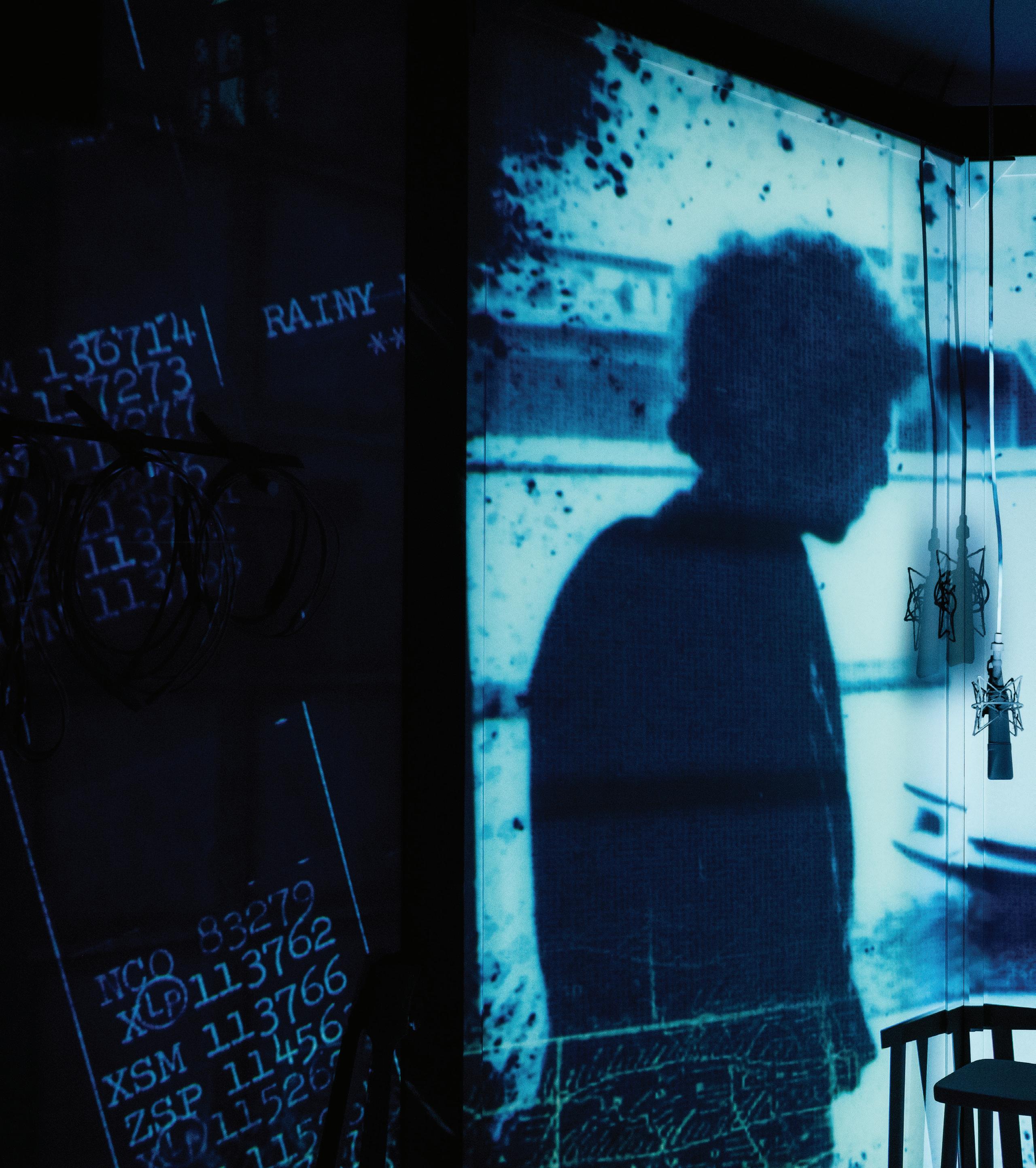
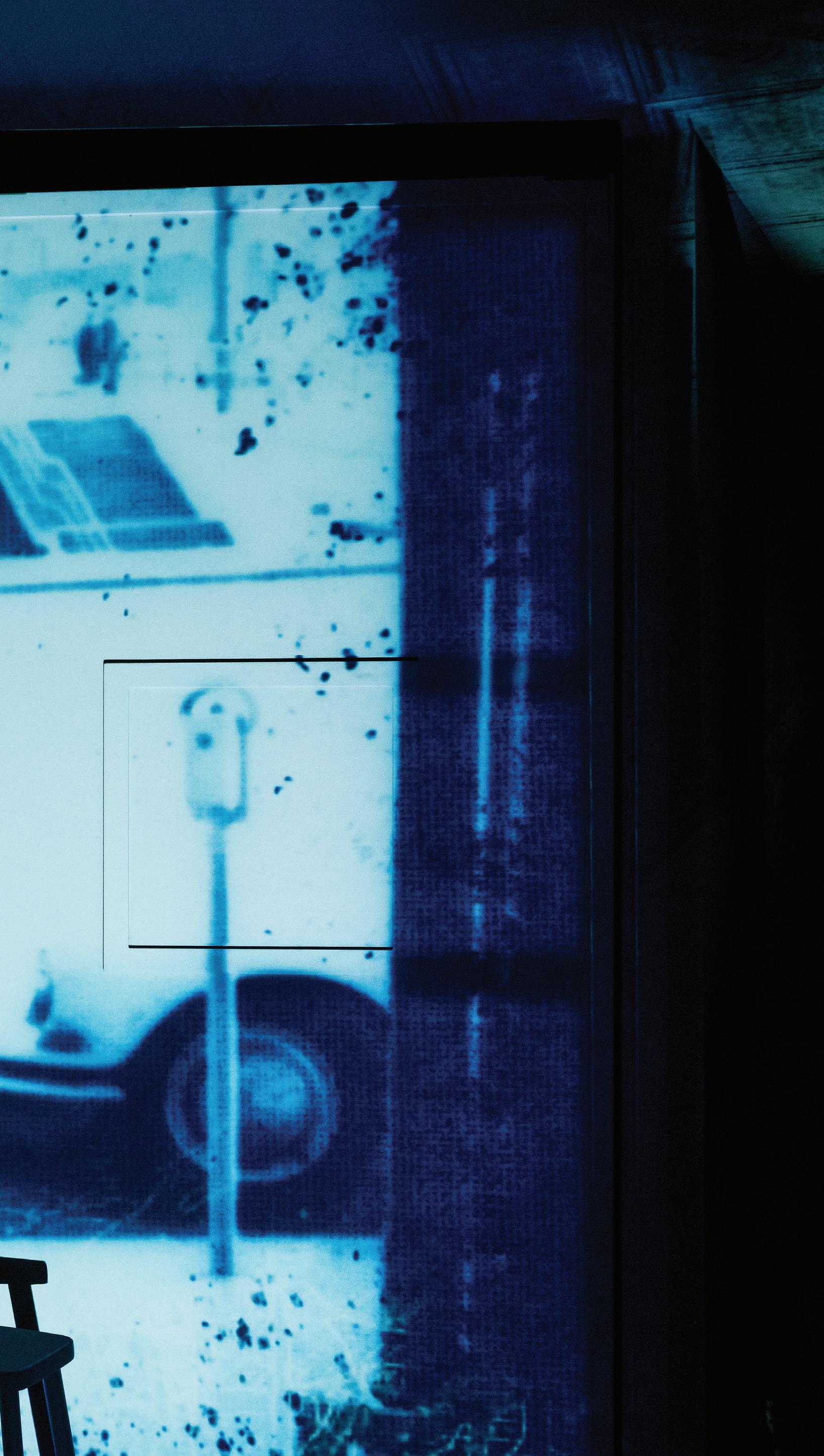
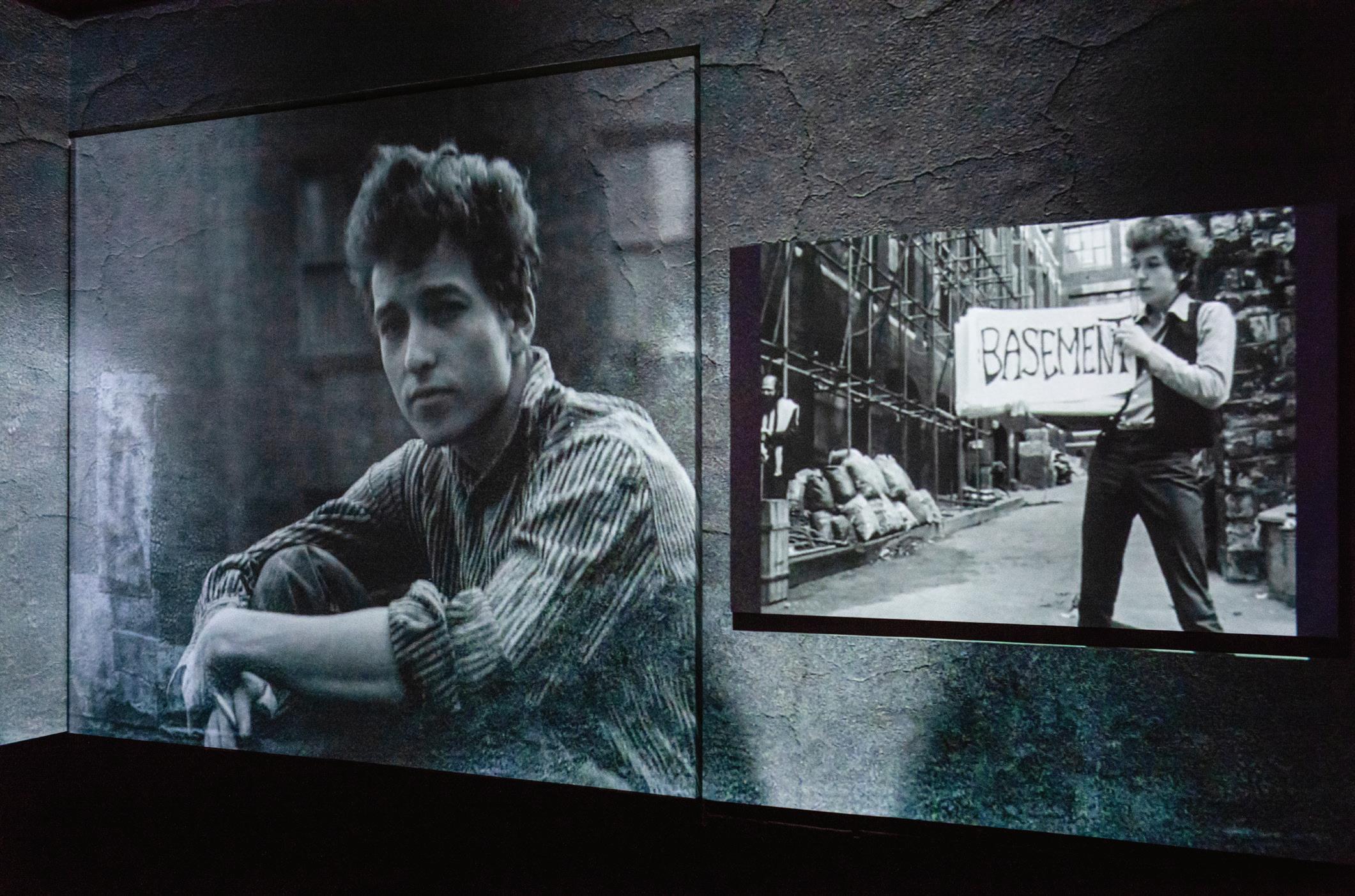
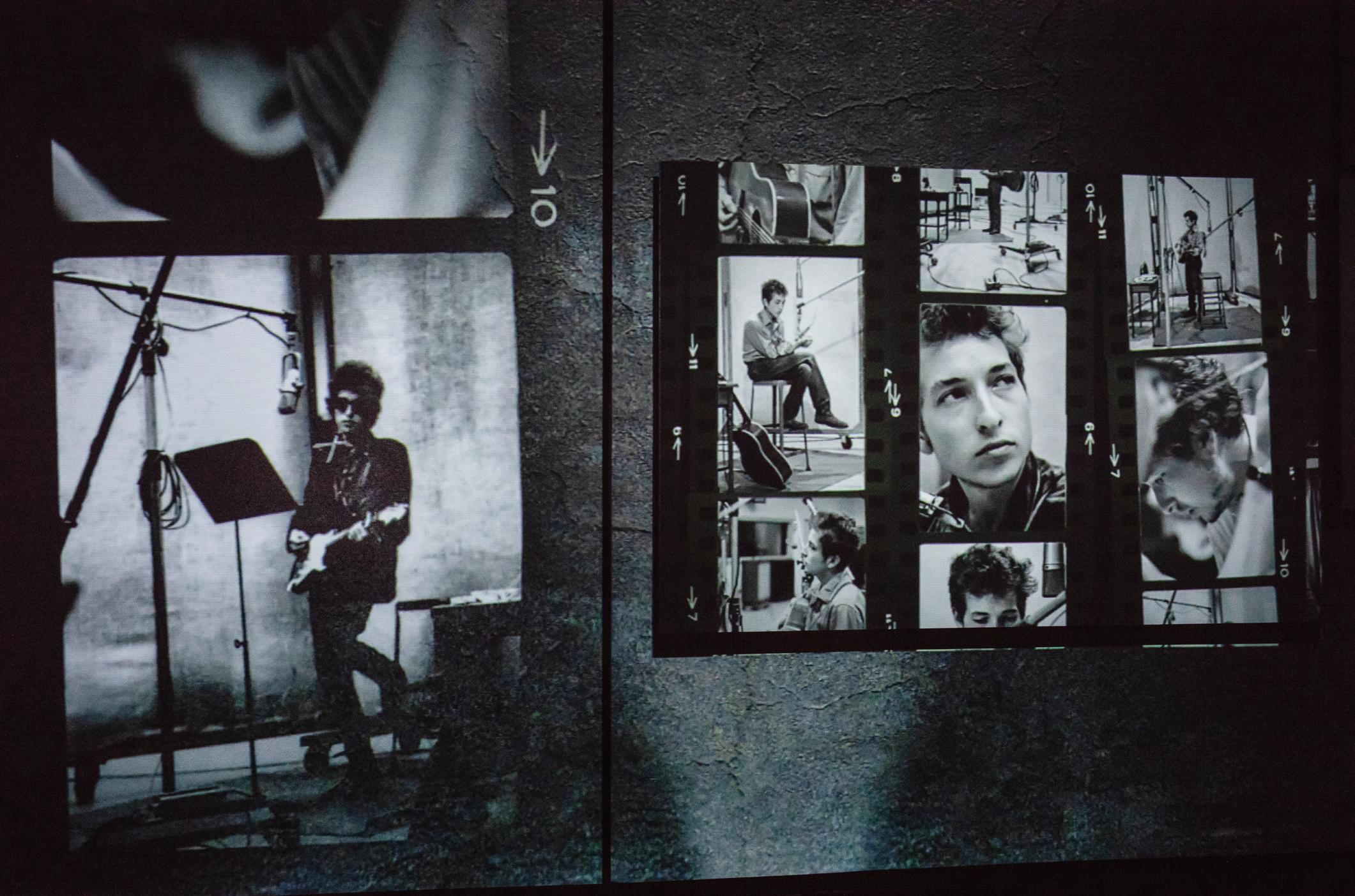
David Bush documents his visit to the newly opened Bob Dylan Center in Tulsa. As most of us of a certain age, we grew up with the music of Bob Dylan. Along with the Beatles, the Stones and Hendrix, Bob Dylan is an icon. His music and his persona only added to his legendary status. David takes us on a visual tour of the Center, using his M10-R and Summicron 35/2 ASPH to document the wonderful multi-media displays. Sounds like a good idea for a Leica spring shoot location!
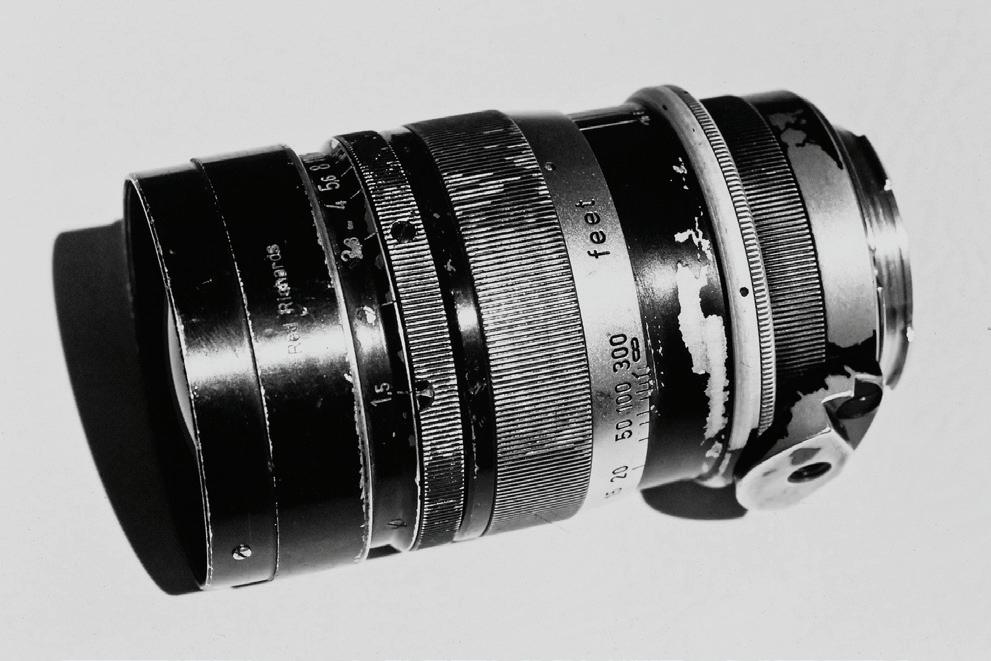
Finally, we have Jim Lager’s article, “Rockleigh Memories” highlighting some of the more interesting Leica pieces Jim came across while working at Leitz Rockleigh. I was happy to see one of the items Jim had in his article was my Black Summarex with the “Red Richards” engraving. I acquired this lens a few years after Jim photographed it in the Service Department in Rockleigh. I am happy to say I still have this lens in my collection! We also have Jim’s Leica collage as the back cover of this issue.
Finally, I would like to express my sorrow on learning about the sudden passing of bee berman last year, one half of the team that has brought us FOGG bags since 1986. That was when Nigel Fogg and his partner bee berman came out with their innovative line of bespoke camera bags. I was one of a handful of FOGG dealers in the U.S. back in those days, and I still use them as my preferred bag for my Leicas to this day. Nigel and bee brought a unique approach to their bags, with an incredible attention to workmanship and detail in their bags. bee had a unique sense of humor and world view. I have continued to keep in touch with Nigel and bee over the years, and Nigel has very kindly repaired some of my older bags. I understand from mutual friend Jonathan Slack, another dedicated FOGG bag user, that Nigel is devastated with the loss of bee. Our prayers and best wishes go out to Nigel.
Bis nächste Zeit! ‒ Bill
by BILL ROSAUER
Leica held their annual Celebration of Photograpghy and Oskar Barnack Awards the third week of October this past fall, following our annual meeting in Dublin. My group and I were fortunate to be in attendance for the events, hosted by Andreas Kaufmann and Karin RehnKaufmann. A wonderful program was put together for the attendees by the staff at Leica AG in Wetzlar. There were tours of the factory facilities (lens grinding and assembly), the Leica Museum and Archive, Haus Friedwart, and other interesting things Leica. We were also fortunate to have private meetings with Dr. Kaufmann, Stefan Daniel and one of the younger lens designers at Leica under Peter Karbe. I also arranged some interesting tours for my group, including the old factory at Hausertor, visiting the grave sites of the Leitz family, Oskar Barnack and Max Berek in the old Wetzlar cemetary, and a first-time tour and inside look at the Villa Rosenberg, the first home Ernst Leitz II built on the Kalsmunt above the old Leitz factory in Wetzlar. I will have the exclusive story about Villa Rosenberg in an upcoming issue of Viewfinder We also visited the Archives, and with the help of Ulf Richter and Tim Pullmann, were able to have a close look at what some have called the “Mutter der Ur” (the Mother of the Ur camera) , known internally as M875. I will also have a story about this very rare and obscure item from the Museum Archive in an upcoming issue of Viewfinder as well.
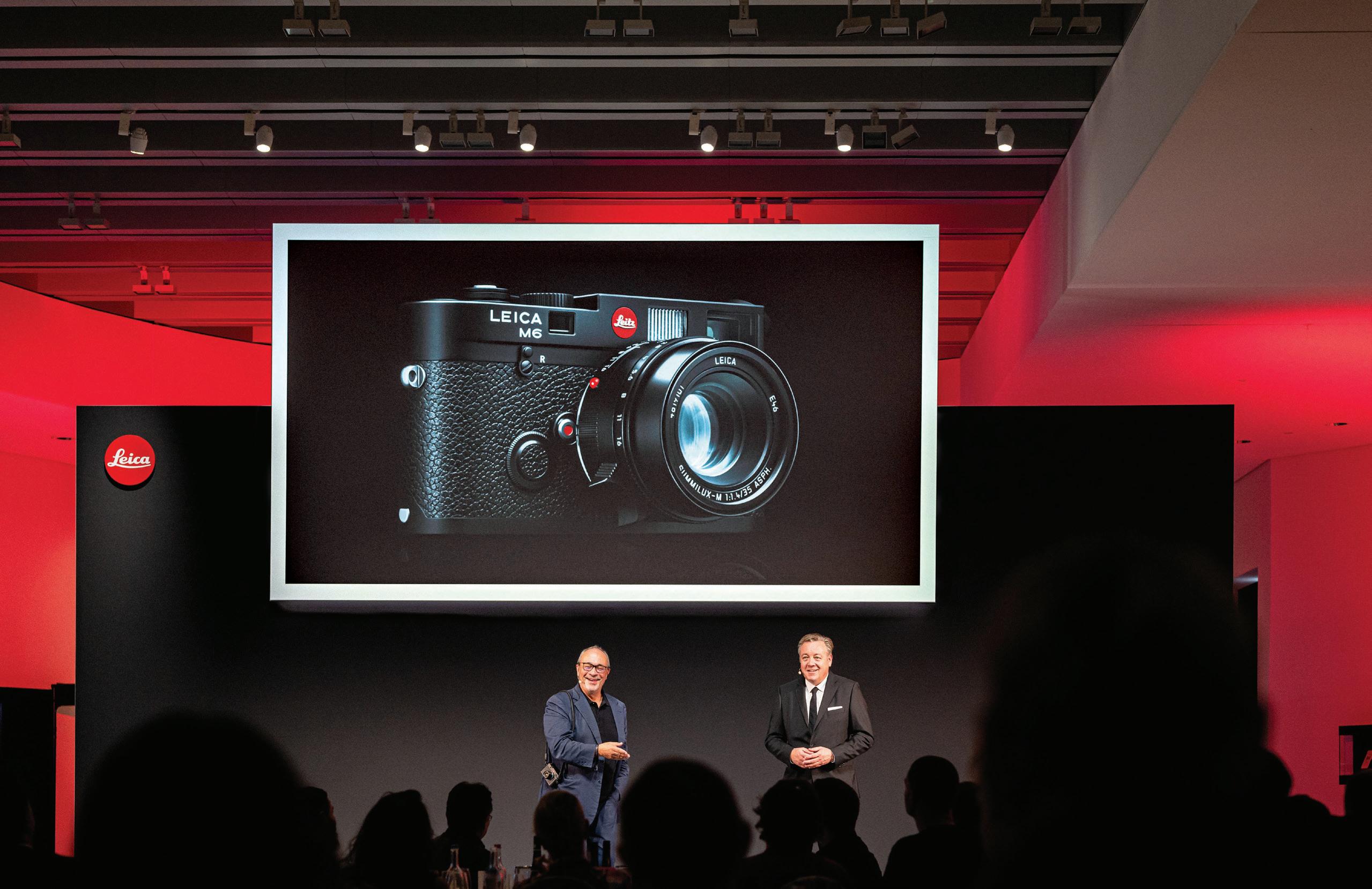
Of course, along with the festivities at Leitz Park and the Leica Oskar Barnack Awards (LOBA), there were some much anticipated new product introductions. As everyone knows by now, the big news was the re-introduction of the classic film Leica M6. There has been an incredible resurgence in film photography over the past several years, and Leica is the only manufacturer to still produce 35mm film cameras. As many of you know, the prices for used Leica M film cameras have
been steadily increasing in recent years, and the M6 has been especially sought after as it is considered by many to be the paragon of the film M camera. Leica wisely chose the Classic M6 camera to re-introduce the film Leica to its new audience. Leica invited a number of people influential in this new “film” movement in photography to the intro in Wetzlar at the LOBA banquet. We were amused by the presence of so many of these “influencers” at Leitz Park, and their fascination with their introduction to the world of Leica. Hopefully, this new found enthusiasm with Leica is more than a fleeting trend! Along with the new M6, Dr. Kaufmann and Stefan Daniel also introduced a re-issue of the legendary first generation 35mm Steel Rim Summilux lens, as well as a Reporter version of the SL2-S camera. We have reports on the new M6 and Steel Rim in this issue of Viewfinder as well.
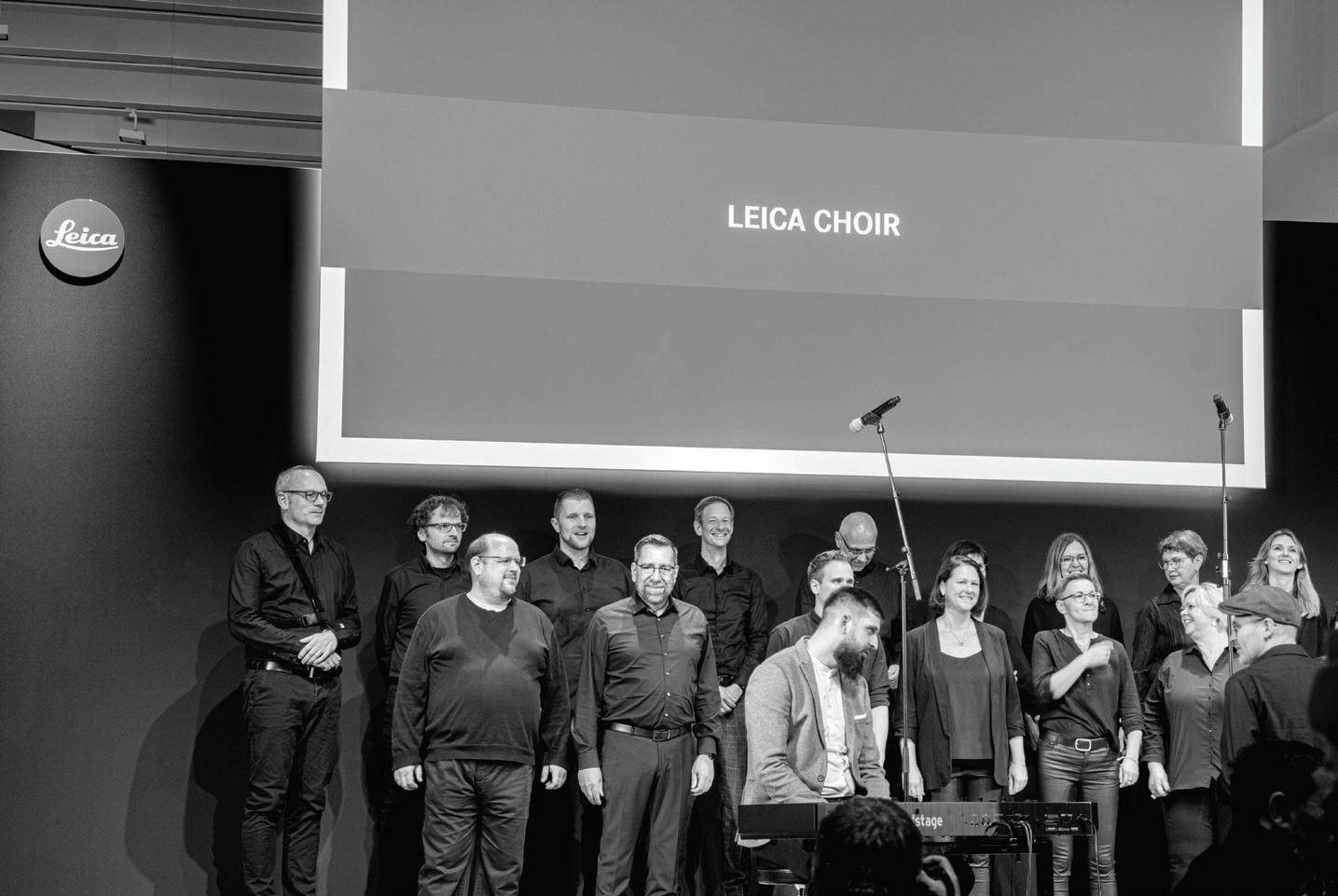
As an introduction, the LOBA awards have been an annual event since 1979. Sponsored by Leica Camera, the LOBA is one of the most highly endowed and prestigious awards in the field of photography. The winner receives 40,000 Euros and 10,000 Euros of Leica camera equipment. The Newcomer Award receives 10,000 Euros and a Leica Q2. Nominators for LOBA include renowned photographic curators, gallery owners, art directors and photo editors, as well as numerous photographers from around the world. The only requirements are that the photographs be of a documentary or conceptualartistic nature, and deal with the relationship of humanity to the environment. This year, the nominee for the Newcomer Award will be selected in collaboration with 17 photography schools and institutions. One pleasant surprise at this year’s LOBA celebration was the performance of the Leica Choir, with the employees of Leica Camera, Wetzlar, featuring our good friend Jesko von Oeyenhausen, Head of Product Photo at Leica.
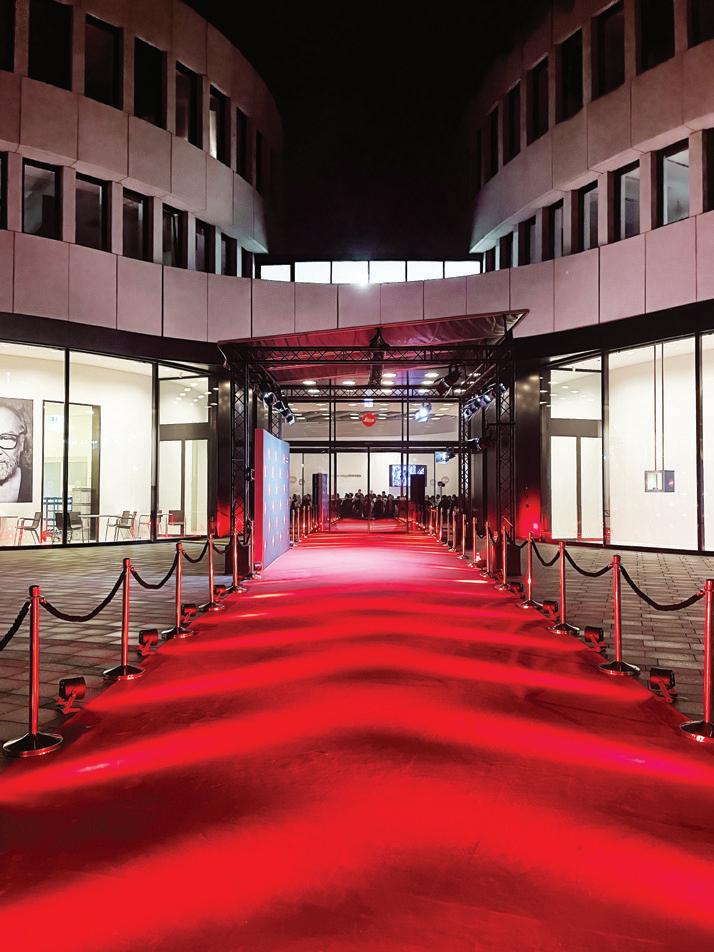
(left) The Leica Choir opening the LOBA celebration. (right) The red carpet at the entrance of Leitz Park in Wetzlar. (opposite page) Dr. Andreas Kaufmann and Stefan Daniel introduce the new re-issue of the Leica M6 Classic.
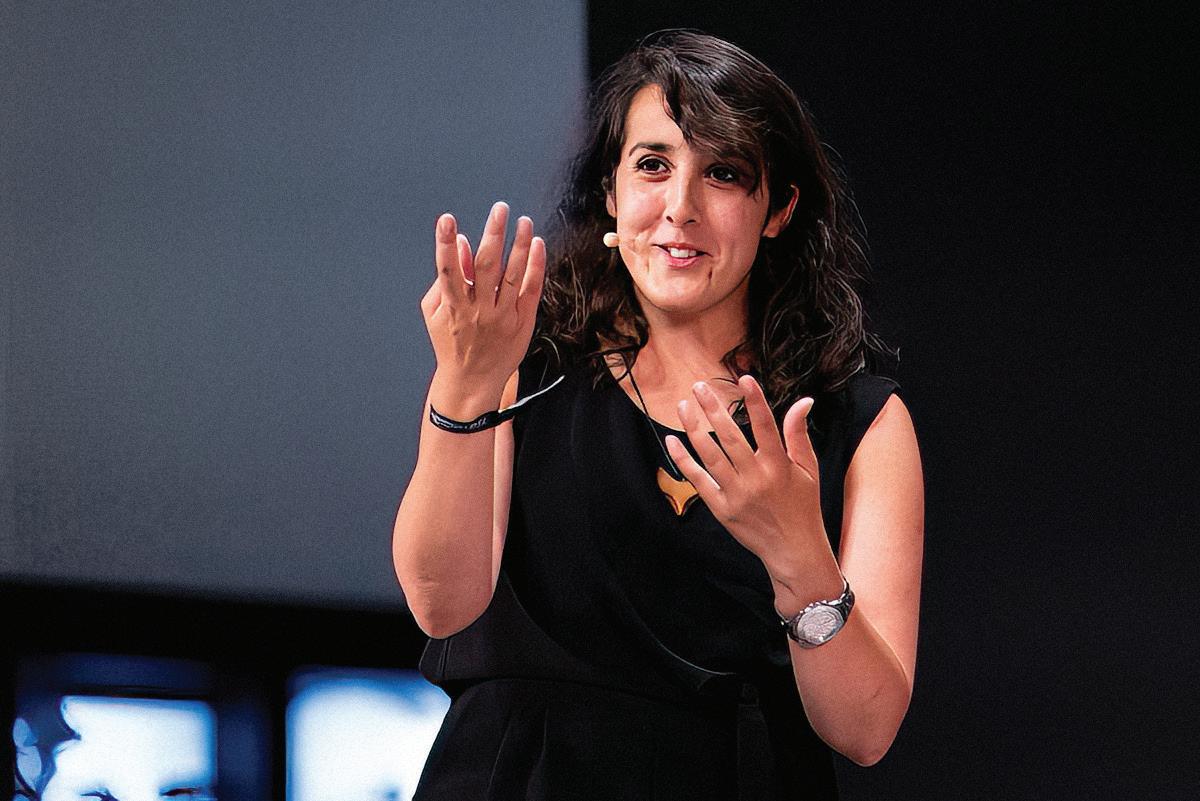
Last year, the winner was Ana Maria Arévelo Gosen, who we featured in the Viewfinder . This year, the winner is Kiana Hayeri, 34 years old (above, left). Born in Tehran and raised in Canada, she has been living in Afghanistan for the past seven years. Her project, entitled “Written on the Ice, Left in the Sun” series, documents the lives of women in Afghanistan. In her own words, “My work focuses on Afghan women. T0day many of these women feel they have been abandoned and left behind. Afghanistan is a place of extremes, where the best and the worst of humanity live side by side. Fear and courage, despair and hope, life and death coexist”. In 2021, she was awarded the Robert Capa Gold Medal for her photo series “Where Prison is a Kind of Freedom” which documented the life for Afghani women in Herat Prison. She has received numerous other awards for her conflict reporting in Afghanistan, and she writes regularly for The New York Times and National Geographic. Her work is very strong and thought provoking. On a side note, even stronger restrictions on women in Afghanistan were announced recently by the Taliban. No young girls can attend school past puberty, women are restricted from the workplace and all women must be fully covered when out in public. One can only hope that through the work of photographers such as Kiana with their focus on the plight of Afghan women, an end can be put to this madness.
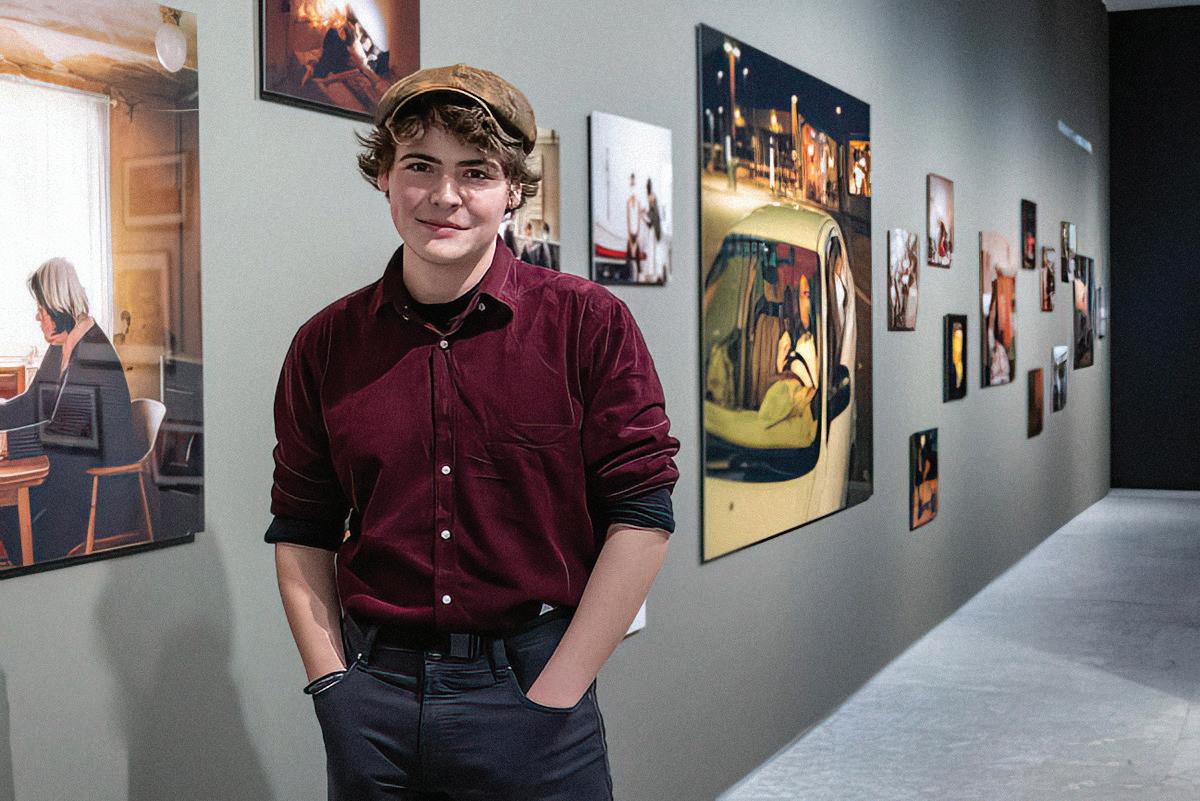
Valentin Goppel (above, right), winner of the Newcomer Award is a young German photographer born in 2000. Valentin began to take portraits of his friends as a teenager. His series, “Between the Years”, young adults in the times of Corona, explores the impact of the pandemic on his generation. “The pandemic was an exceptional situation for all of us. We were suddenly fighting against demons, which we had held back by means of distractions. It is amazing how similar the experiences of these last years were for me and my friends – and yet, we all felt so alone. My state of limbo drags on.” Valentin has been studying Documentary Photography in Hanover since September, 2019, and has received his first assignments from Publications including Der Spiegel and Die Zeit
This year’s LOBA Awards demonstrated Leica’s commitment to advancing women in photography, as well as the contributions of younger people to excellence in photography. We are all looking forward to see what next year’s COP will bring in terms of new product and the exciting photographic images the LOBA award winners will have made with their Leicas.
Kiana Hayeri Valentin Goppel
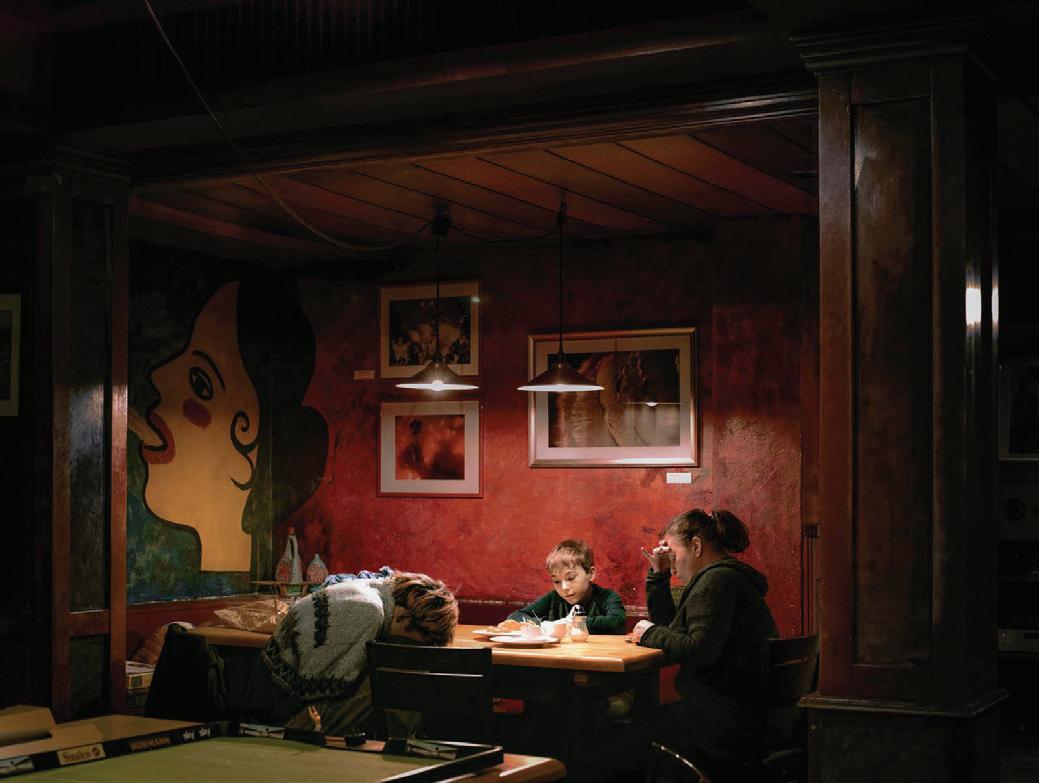
Image by Valentin Goppel, the 2022 LOBA Newcomer Award Winner.
Image by Kiana Hayeri, the 2022 LOBA winner.
A Lens to Equal the Elcan?
by DICK GILCREAST
Thanks, Ed Schwartzreich, for the full report on the interesting LLL replica of the 50mm f/2 Elcan in Viewfinder #54-4! Designed for military use it had to be cost effective yet still capable of important work. It would make a small and light – and very good – general-purpose lens to carry on a single camera.
You'll be interested to know that I'm carrying and using a lens pretty much equal to the Elcan's performance, maybe even slightly better around the edges, while costing a whole lot less –and available in SM mount as well as adaptable to M. It may not be any lighter in weight, but it takes up less space when carried collapsed on the camera, and the aperture ring stops down in the conventional direction. What is it?
It's the older but well-known 50mm f/2 Summitar! It was designed for maximum sharpness in the center of the frame, with image quality necessarily falling off somewhat toward the edges and corners when used wide open, but improving when stopped down, reaching an impressive full frame maximum sharpness at around f/8. It was a re-design of the six-element 50mm Summar with larger elements to provide more illumination in the corners to reduce vignetting. It required one additional element to keep the edges as good as in the Summar, but with the same central area of sharpness. The succeeding 50mm Summicron, also in collapsible mount, had a different aim – to provide a flatter field for edge sharpness and improve performance across the frame. The only obvious difference between it and the Summitar is the Summicron's aperture clickstops, but there is also some difference in full aperture performance.
The many Summitars I've used over the years have been consistently slightly sharper in the center area at largest apertures than the almost equal number of collapsible Summicrons I've had experience with. The Elcan's MTF graph you showed in VF looks similar to that of a collapsible Summicron when stopped down, quite amazing that it could be achieved with only four elements in later years where it required six or seven in the 1930's. But why am I not using a collapsible Summicron now? Although all the Summicrons had that elegant flat field at f/4 and smaller, the actual early production
collapsible Summicrons I tried varied considerably in center and edges at largest apertures, where Summitars have been very consistent in central sharpness as well as rangefinder synch in their coated versions from 1946 up to 1953 when the collapsible Summicron was officially released.
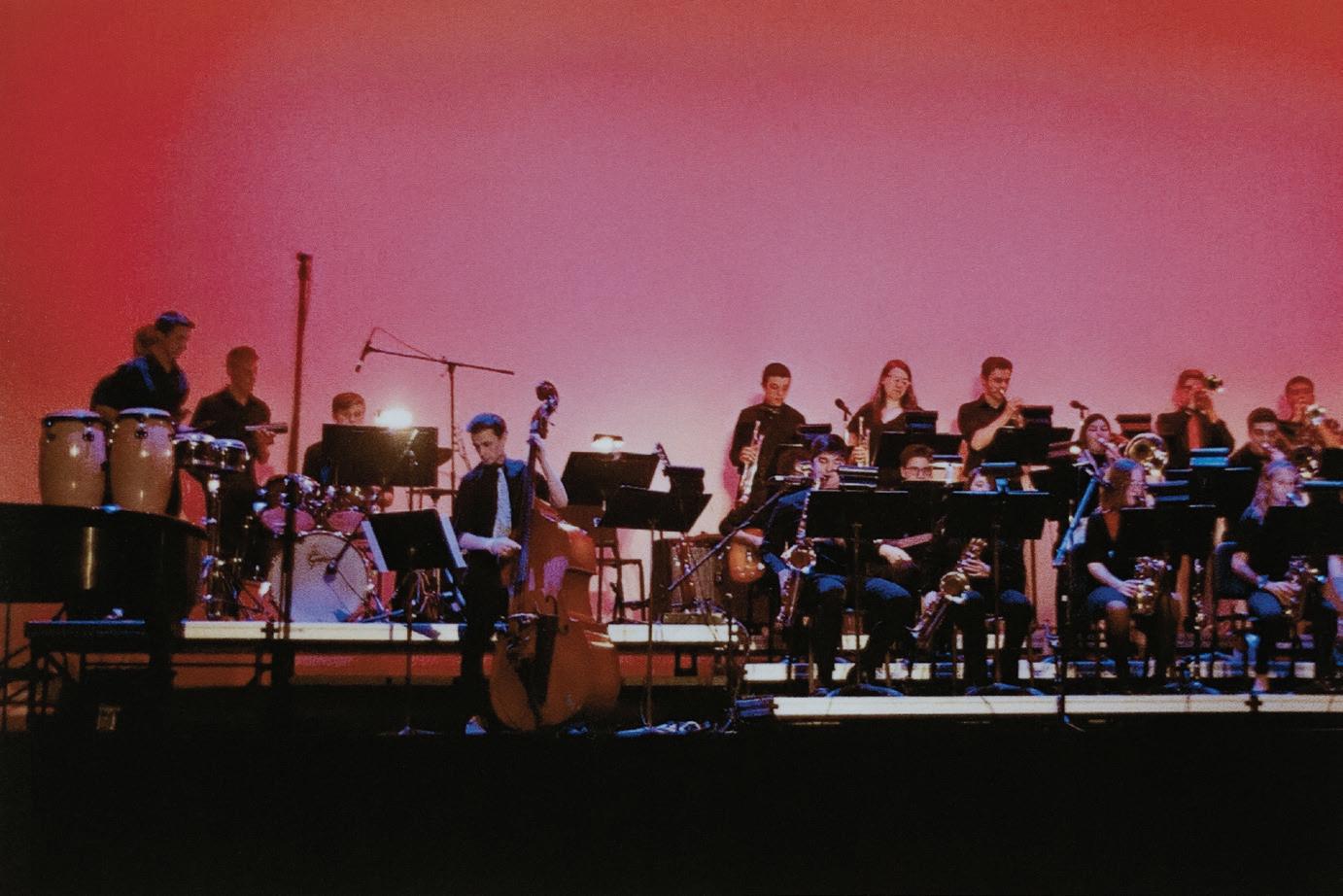
So the use of that central sharpness at full aperture was the reason I held onto an older Summitar to use on my SM cameras during retirement. The illustration shows an example of that sharpness. A grandson is standing while strumming the double bass during one of his high school jazz band concerts. As you can see the lighting was fairly low, requiring an aperture of f/2 to get a reliably steady handheld shutter speed on ISO 400 film from my seat in the audience. He is well within the circle of best sharpness, with band members at the edges losing a little, but the result is probably better than I would have gotten with any of the collapsible Summicrons I tried out – and quite similar to the results you report on the Elcan.
This particular Summitar is numbered 608129 from mid-1946 (date from Leica Pocket Book, Bower & Clark). It is coated, has the earlier flat diaphragm blades, has the later international standard F numbers, and is in the apparently common #8 mount (the focal-range classification number of the mount which appears on the underside of the infinity catch).
Dublin
LEICA SOCIETY INTERNATIONAL 2 022 ANNUAL MEETING
by MICHAEL "MAX" MAXIMILIEN
Arrivals I attended the annual conference in Dublin in October 2022, this was my third LSI meeting in a row and my fifth meeting over the past five years. With the new Leica Society International name announced, the location was perfect for the new “international” moniker in the name, representing the reach of the society.
I had been to Dublin before but was excited to spend time visiting again, doing street photography in the old city, and more importantly seeing old friends again —— many European members did not attend US meetings.
Check-In: Leica Gear As with each LSI meeting, the conference starts with a brief registration and the opportunity to sign up for “Leica on Loan” where attendees can borrow for the day a variety of Leica gear (lenses and camera bodies). I had taken advantage of this program many times in the past to test out lenses and bodies that are not in my collection.
This is how I became convinced that the Leica SL2-S was the mirrorless Leica for me and that the 21 mm Summilux-M was to be the one next M-lens acquisition. For this meeting, the good folks from Leica Store Manchester and Leica Akademie Austria brought the goods and welcomed us with a smile.
Welcome to Dublin The conference room was set up as a series of round tables, each seat adorned with a black cap with the subtle new LSI logo. President Brad Husick welcomed the group and gave a brief overview of what to expect for the week. It was then time for the emcee and chair for this annual meeting, and Dublin resident, William Fagan to welcome us to the literary city and give a complete agenda of the different activities and talks planned for the rest of the weekend.
Dublin Street Photography As someone who always loves to visit a new city by spending time walking the streets capturing candide photos, one of the planned activities was to do just that. The main difference was that William had a list of historic and somewhat “cryptic” specific locations he wanted us to go to capture the photos.
It was like a GPS Easter hunt with the added fun that once you found the location you had to figure out how to capture something interesting that included the setting. As the hotel was centrally located, this made the walks rather easy and gave us more time to try to capture something interesting.
One location that stood out from the rest for me was Trinity College. Located less than a 1/2 mile from the hotel, the campus is full of 19th century Ruskinian gothic architecture and is peppered with statues of the many illustrious writers who had made this city famous. As a lucky break for me, I met by chance a conference attendee who lives in Dublin and was crossing the campus and gave me a personal guided tour.
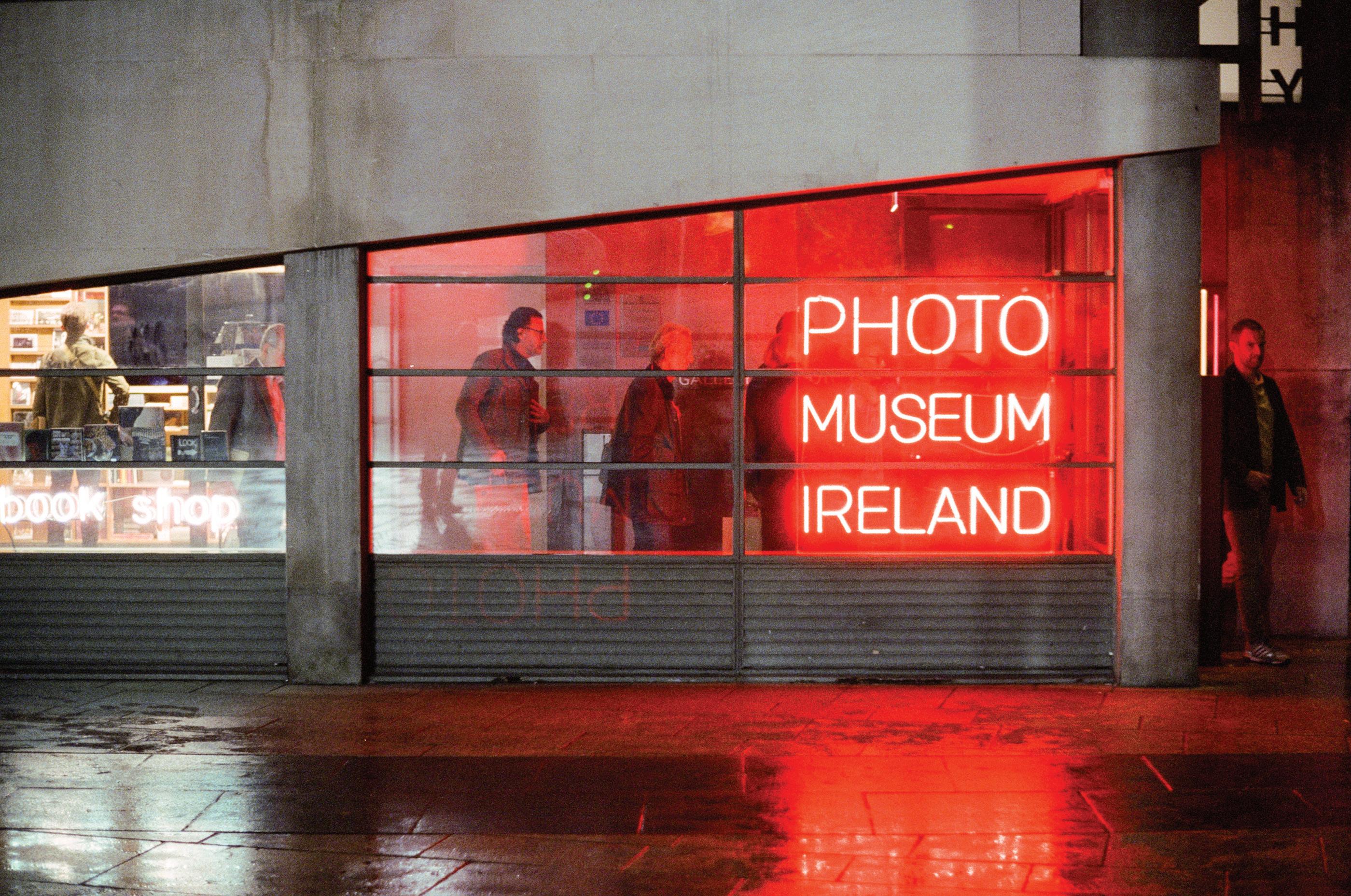
Photo Museum Ireland One highlight of this conference was a visit to the Photo Museum Ireland. A small museum dedicated to photography in the heart of Dublin. The entrance of the museum includes the shop where William and staff greeted us with wine and a brief overview of the museum’s history and purpose.
After that, the audience was invited to make their way into the tightly spaced multiple levels hallways, all with views of the central area of the museum space. There, prominent Dublin photographer Tony O’Shea gave an oral presentation of his oeuvre while projecting select photographs to the white wall. The museum’s location in Meeting House Square in Temple Bar is central to downtown Dublin, which allowed us at the end to walk to pubs and restaurants.
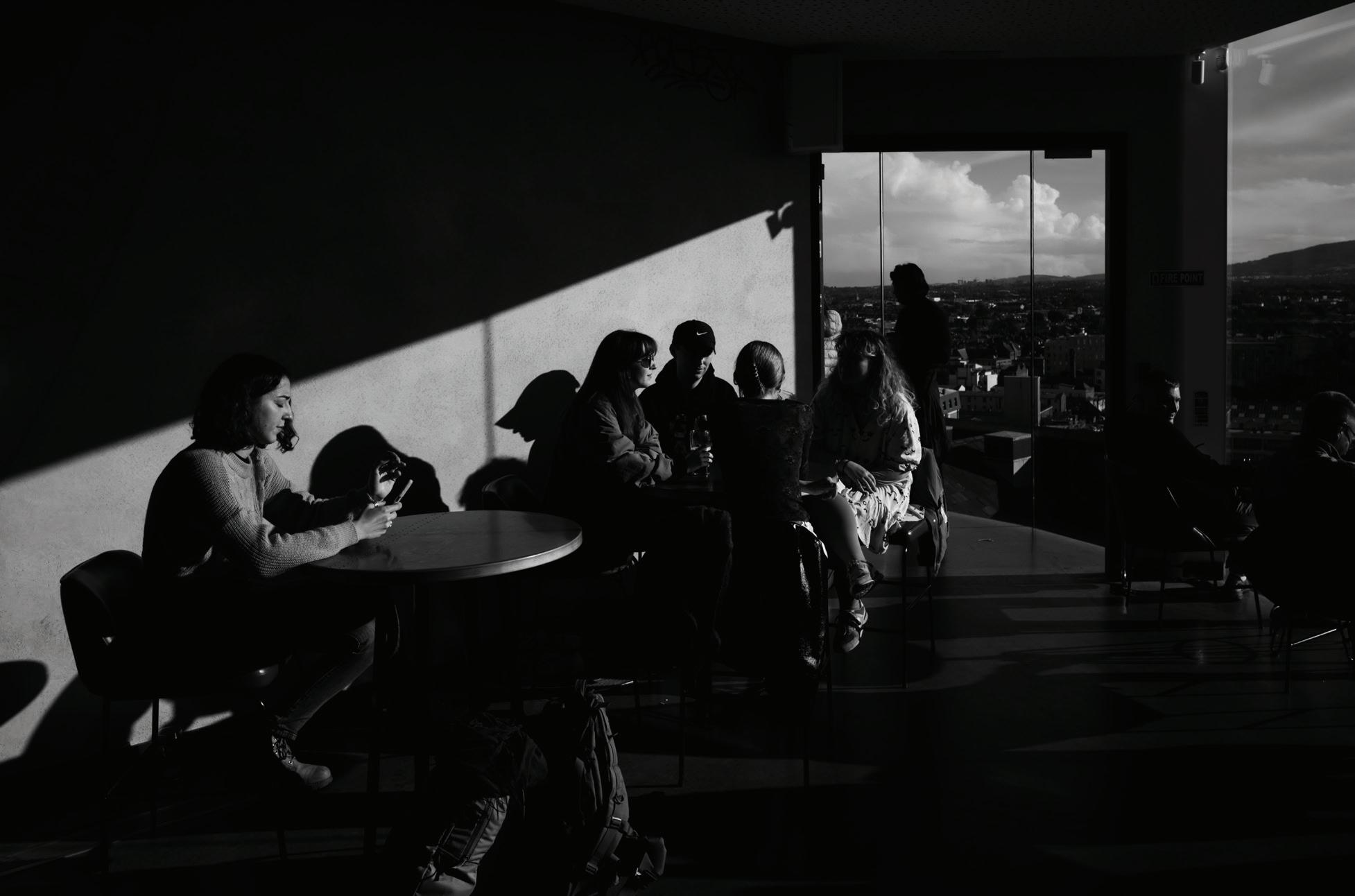
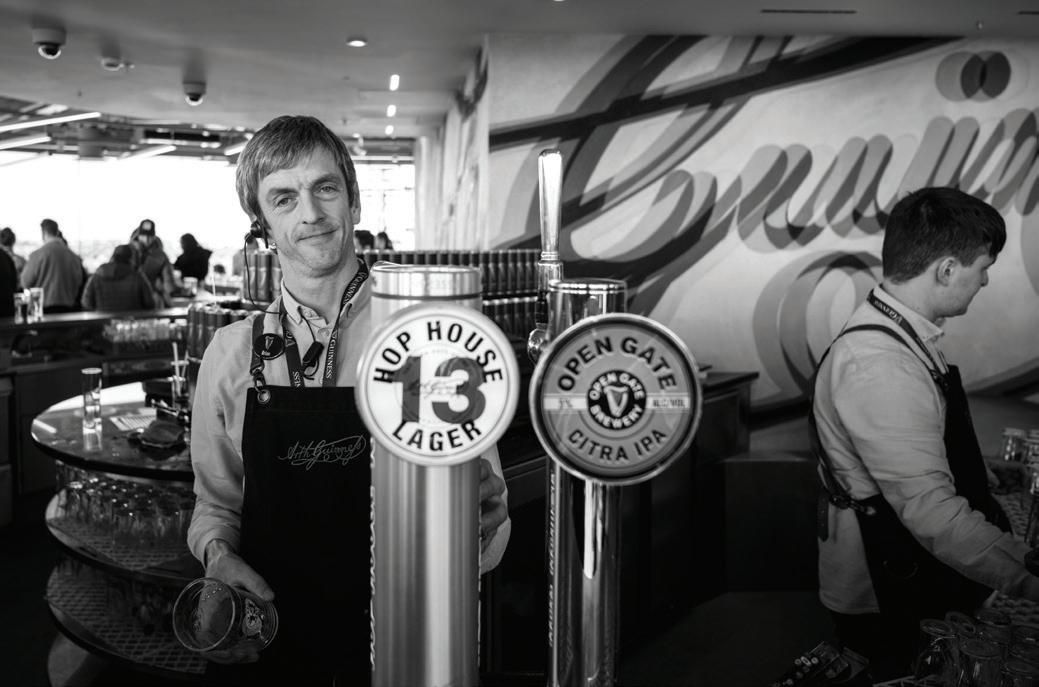
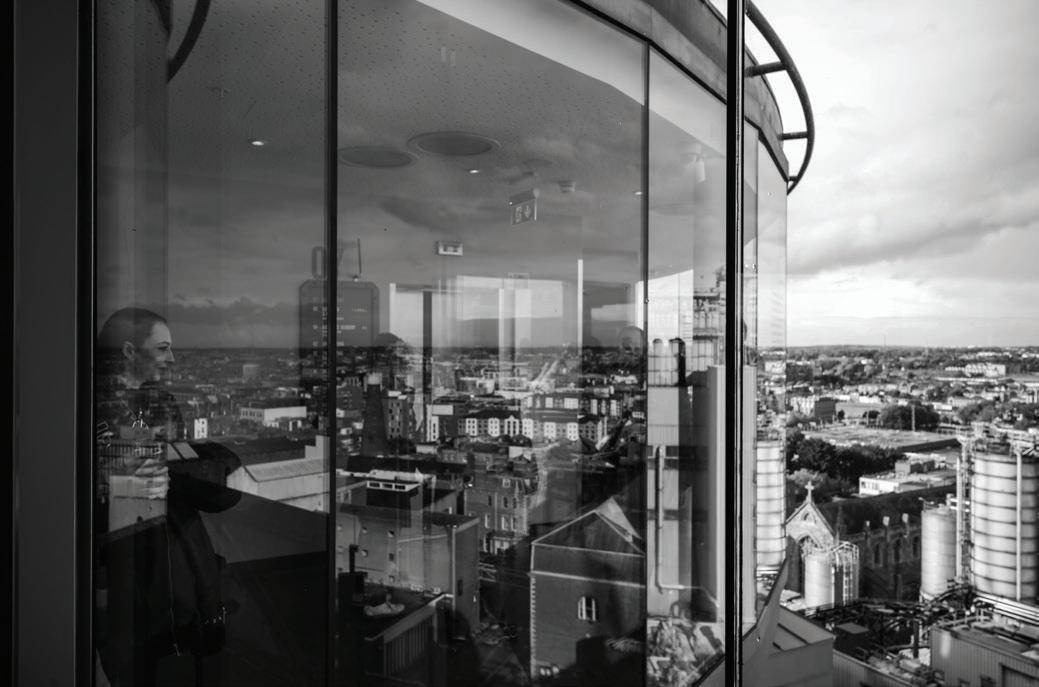
Guiness Factory Tour I had visited the Guiness factory before in my previous visit, and I was not surprised by the Disney-like atmosphere and layout that the multi-story building offers. Nonetheless, it was a good opportunity to socialize with other conference attendees while swirling up the factory to the tasting area. Each visitor gets a pint of beer to enjoy at the end of the visit. And the rooftop 360 degrees tasting area made for great photos (through the glass) of Dublin.
Keynotes From previous experiences, the best reason to attend the conference are the invited talks and keynotes. This year was no different. After an amazing presentation of the history of LHSA (now LSI) and its Viewfinder magazine we got a preview of the coming Leitz Auction.
Presented by Leica Vienna employees and “curators” of the coming auction, the presentation highlighted, with images and videos, the important lots. One example that stuck with me was one of the original prototype 50 mm Noctilux f1.2 in silver that belonged to the daughter of Helmut Marx and which is expected to fetch over 1/2 million dollars.
Leica Executives: Stefan & Peter Another key highlight was the presentations by Leica executives Stefan Daniel and Peter Karbe who made the trip from Wetlzar to be with us on the second day until the end of the conference.
Stefan was his usual self, charming, confident, and kind. Answering all the questions that the audience had. Nothing was off limits, though Stefan is good at avoiding to give any hints at unannounced Leica products or services.
Peter Karbe is somewhat the polar opposite, shy, reclusive, and humble but as generous and kind with his time. The presentation was a veritable masterclass in lens design. As he did for Leica M and SL lenses, Peter this time gave a thorough presentation on the Leica APO lenses.
Starting with a broad history of lens design, to the first APO design for Leica R, to today’s latest 35 mm APO M, which uses exotic glass and a fancy triplet lens design and custom manufacturing process. This was easily the top highlight of the conference for me.
Ana Maria Gosen Ana Maria was back presenting the continuation of the work that helped her secure the 2020 Leica Society International grant and the Leica Oskar Barnack Prize in 2021. Ana Maria’s work centers around the intimate exposé of incarcerated women in Venezuela, and now across South America.
The presentation was remote as Ana Maria could not attend in person due to last minute visa issues to travel from Portugal. However, the zoom presentation was enough to allow her to show the visceral portraits, which at times felt uncomfortable due to how close Ana Maria is able to be to these women, documenting the difficult and terrible conditions that they are living under.
2022 LSI Photo Grant Winner This year’s LSI Photo Grant award winner was the last highlight of the conference for me. Monika Bulaj who spent her life documenting the condition of minorities at risk across the world. The presentation of her work: Exiles, covered years of work across Africa, parts of the Caribbean, and countries in South America where the slaves trades of the 16th17th centuries have profoundly marked the culture and the people.
The photographs are extraordinary in their breadth and scope and in the emotions that they elicit. I remember thinking that this was the most impressive work I had seen in 2022 and from all previous LSI Photo Grant award winners. I would not be surprised to see Monika win more awards for this work. It’s a powerful reminder of humanity’s past that sheds light on the present. It needs to be seen by the world!
Final Thoughts I was happy to have made the trip to the annual event. Even though I had visited Dublin in the past, it was another opportunity for me to see more of the city and the culture of its people while embedding myself with likeminded conference attendees.
Getting a chance to again see Stefan and Peter in person, while attending a private hour masterclass on APO lens design was cherry on top. One that made me a more knowledgeable photographer and Leica enthusiast. Plus having an opportunity to ask questions and hear others ask their own questions of Stefan and Peter, while having all answered, is a privilege only LSI membership can afford.
From reuniting with old friends like Milan, Jono, Kiran, Kirsten, Gary, Blake and Sean to meeting new ones like Evris and Mark; the LSI annual meeting is a unique opportunity to submerge yourself for three days into all things photography, learn about the incredible legacy of this company and of the tools we so love. I could not think of a better fall trip. Hope to see you at the next one.
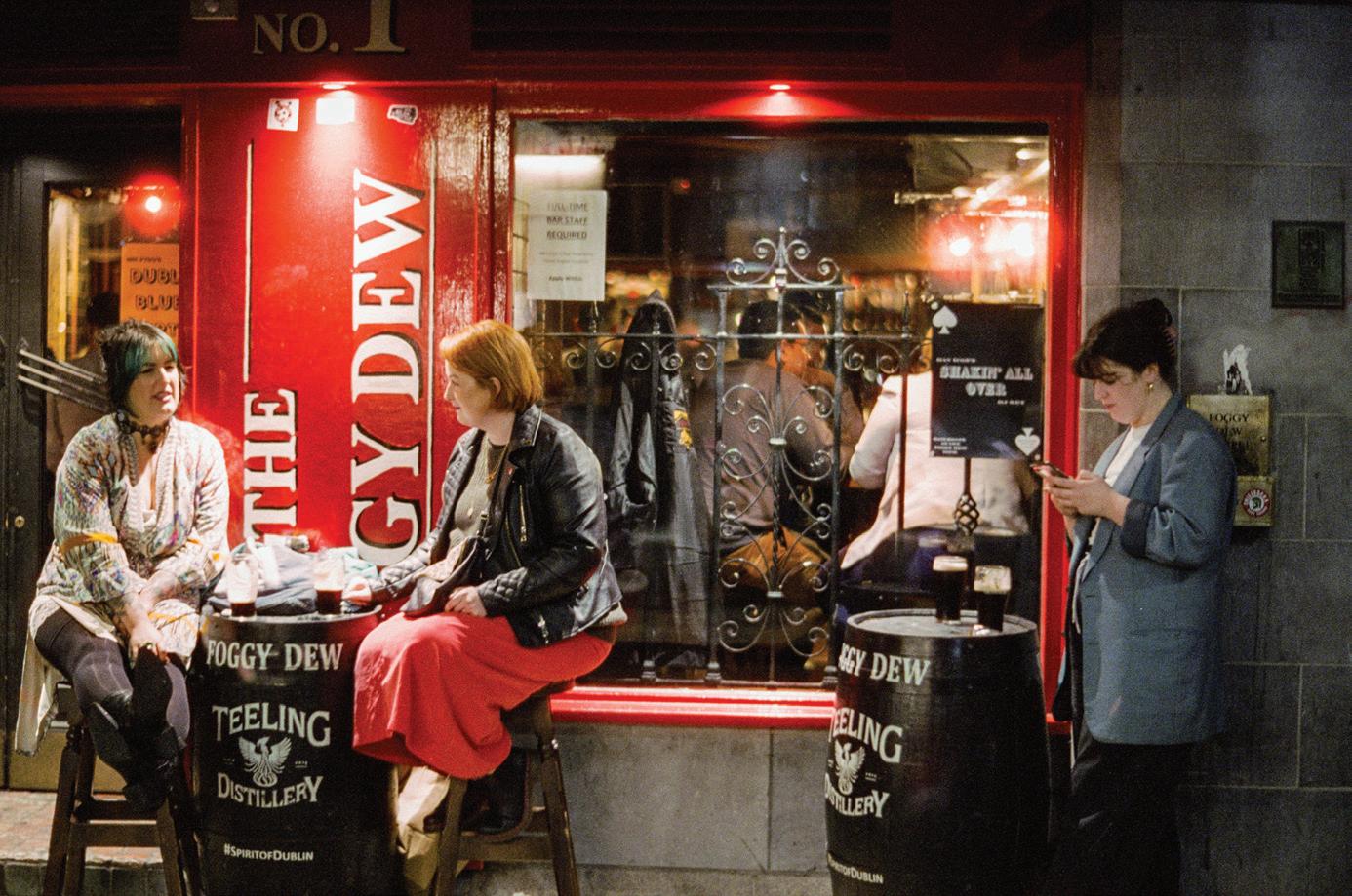
Color photos with the Leica MP and 35mm Summilux-M and CineStill 800T.
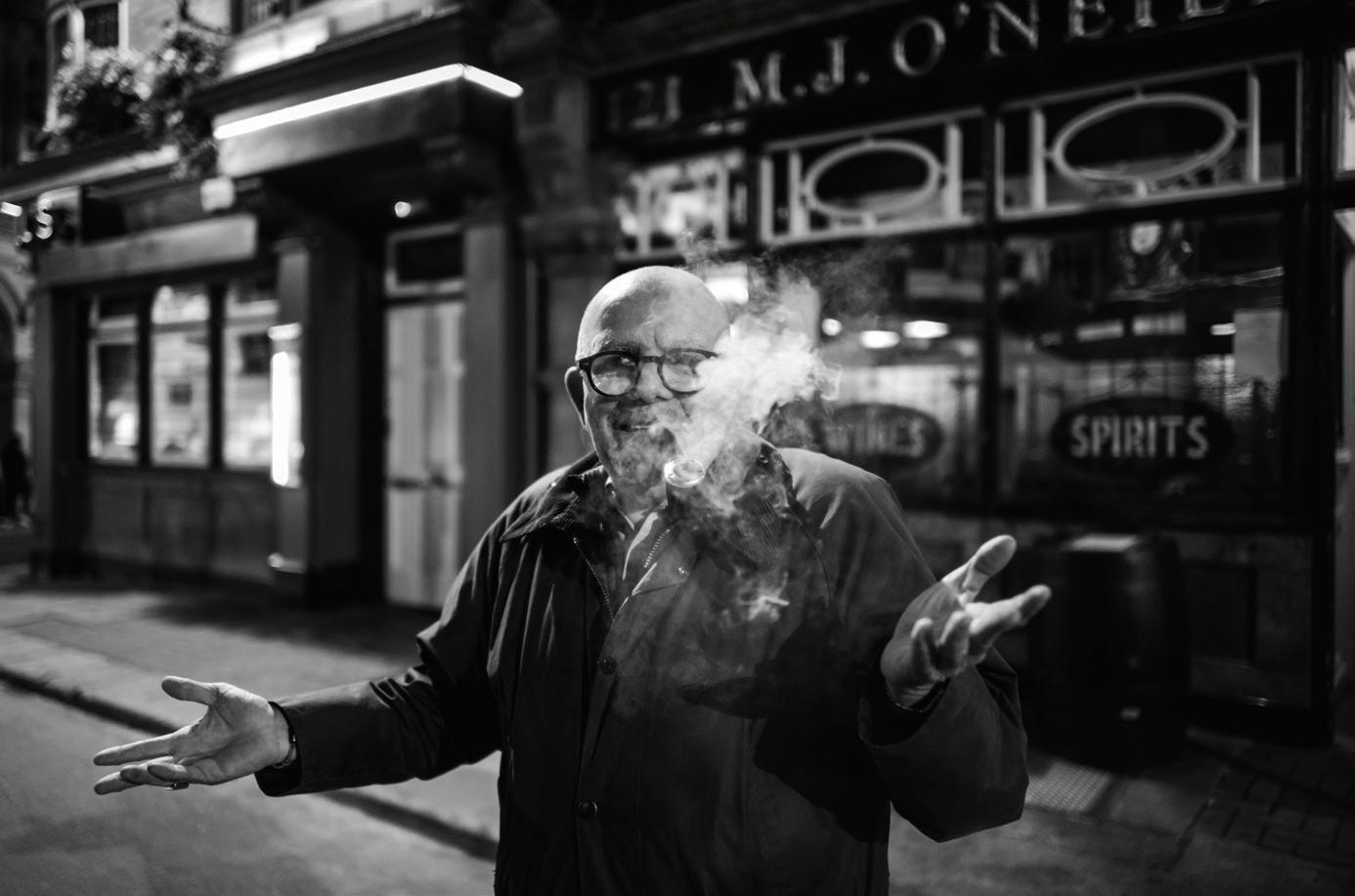
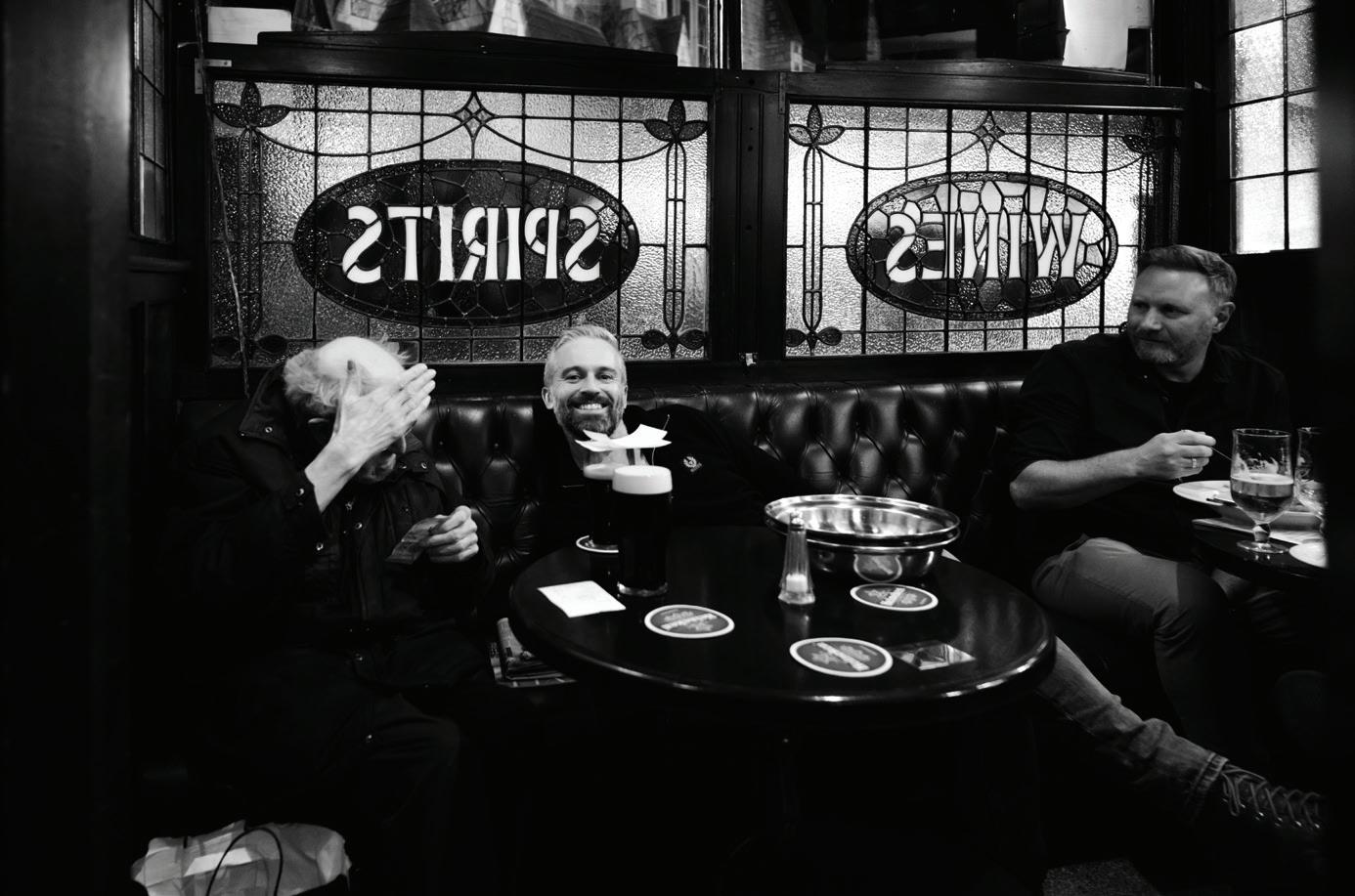
Black and white photos taken with the Leica M10 Monochrom and 24mm Summilux-M.
You can reach out to Max and see some of his photography on Instagram
@maximilien.color
@maximilien.bnw
Down the Highway, Down the Tracks:
The Bob Dylan Center
Wby DAVID BUSH
hen I was around 15, I fell in love with photography and the music and lyrics of Bob Dylan. That was more than 50-years ago, and both of these deep and early interests turned out to be enduring passions. There has always been something about Dylan’s mystique, his inscrutability and fearless iconoclasm, the power and brilliance of his extraordinary verbal facility, the mythic atmosphere of his songs, and the tenacity of his constant invention and reinvention that spoke to me then and continues to speak to me now.
Dylan’s imagery is often ambiguous. His songs and metaphors contain unexpected juxtapositions. His word-play moves across linear dimensions of time, place, circumstance, and perspective in ways that often carry enormous emotional impact even when – or maybe especially when – narrative meaning is open to interpretation and varies according to personal experience.
Dylan opened doors inside my adolescent imagination. His work has brought me places and made me feel things. My connection to Dylan’s ever-changing lyrical and musical universe has shaped my approach to photography, particularly feeling drawn to images that depict the world as a complex and enigmatic place, at once familiar and surprising.
When I learned that the Bob Dylan Archive had been acquired by the George Kaiser Family Foundation in Oklahoma and would be opened to the public, I knew a trip to Tulsa was in my future.
Upon hearing about the newly-opened Bob Dylan Center (BDC), the first question most people ask is: “Why Tulsa?” There are some semi-obvious reasons for this location. The BDC is adjacent to the Woody Guthrie Archive and, having grown up in Northern Minnesota, Dylan has always had deep empathy for the American heartland.
My response to the why Tulsa question is why would anyone expect a center dedicated to the life and work of Bob Dylan to be in a more obvious place? As an artist, Dylan has always challenged his audiences and getting Dylan usually requires a certain amount of effort for most people. With this in mind, Tulsa makes perfect sense, and I will not be surprised if the BDC is at the forefront of a cultural renaissance there. Dylan has always been ahead of the cultural curve.
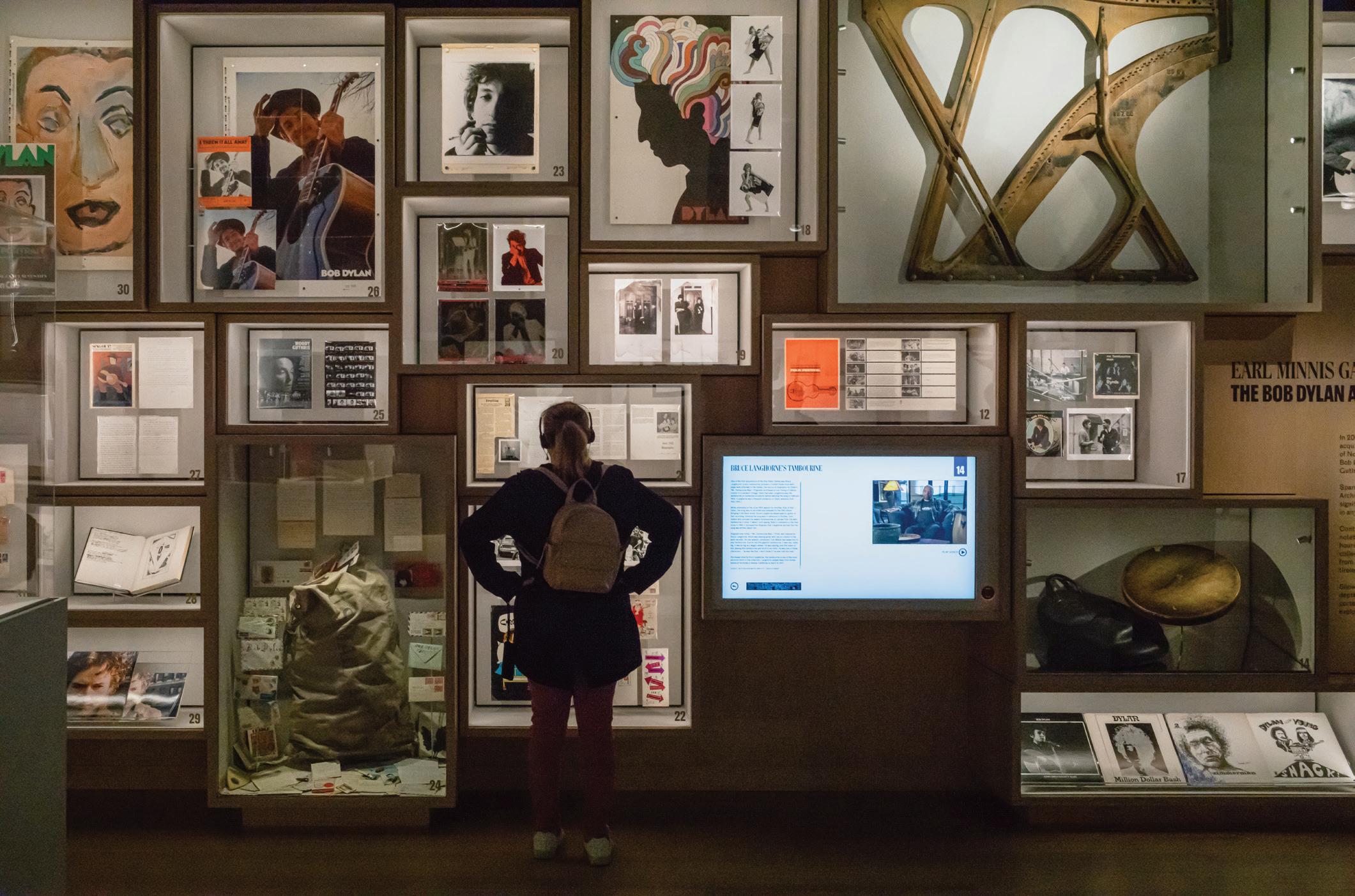
The BDC is a treasure trove of Dylanalia . People at all levels of appreciation can find something of interest there, including those who may not have any in-depth knowledge or familiarity with Bob Dylan at all, but can be interested in gaining insight into the creative process and developmental background of a paradigm-changing artist and cultural icon.
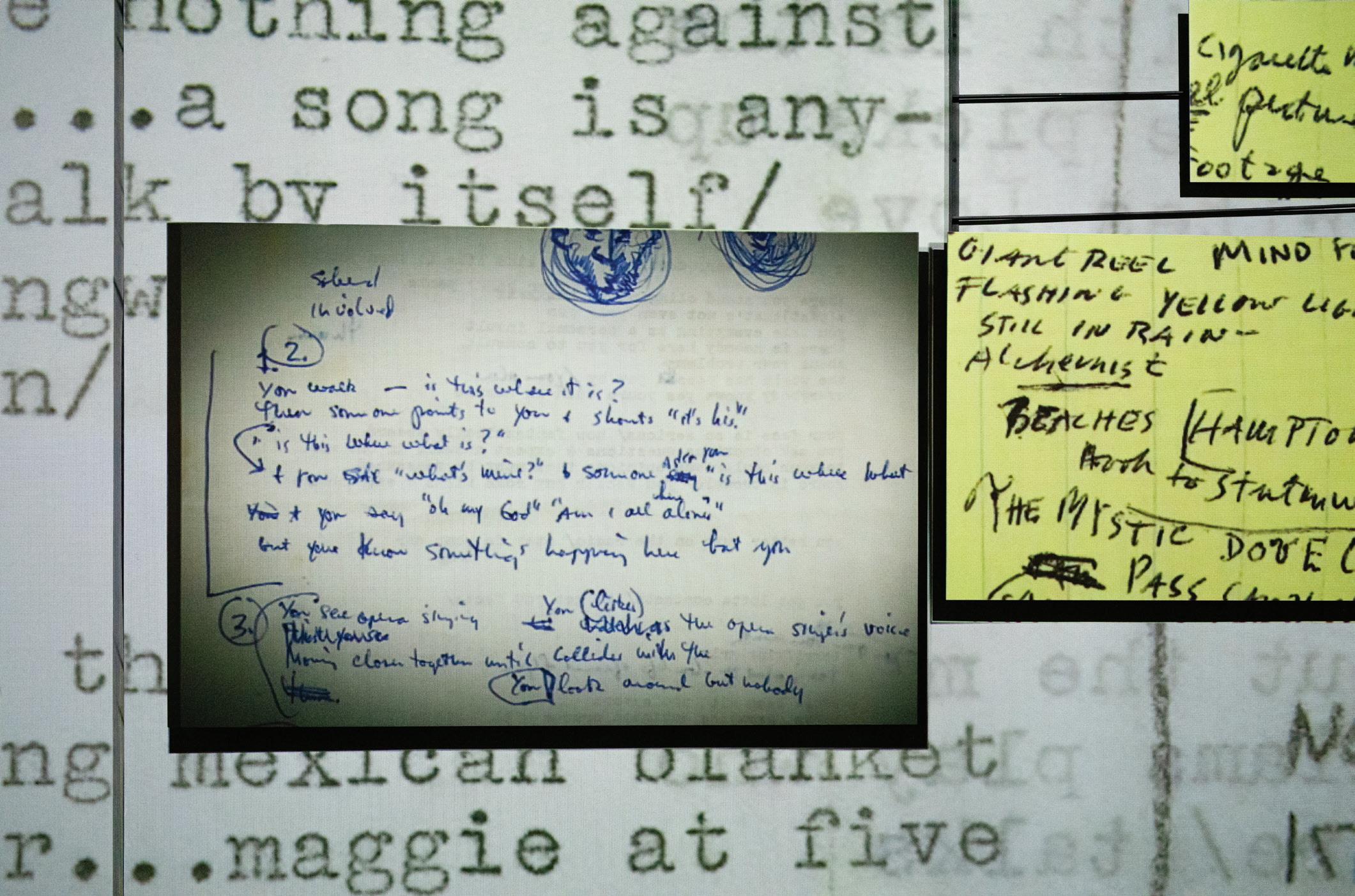
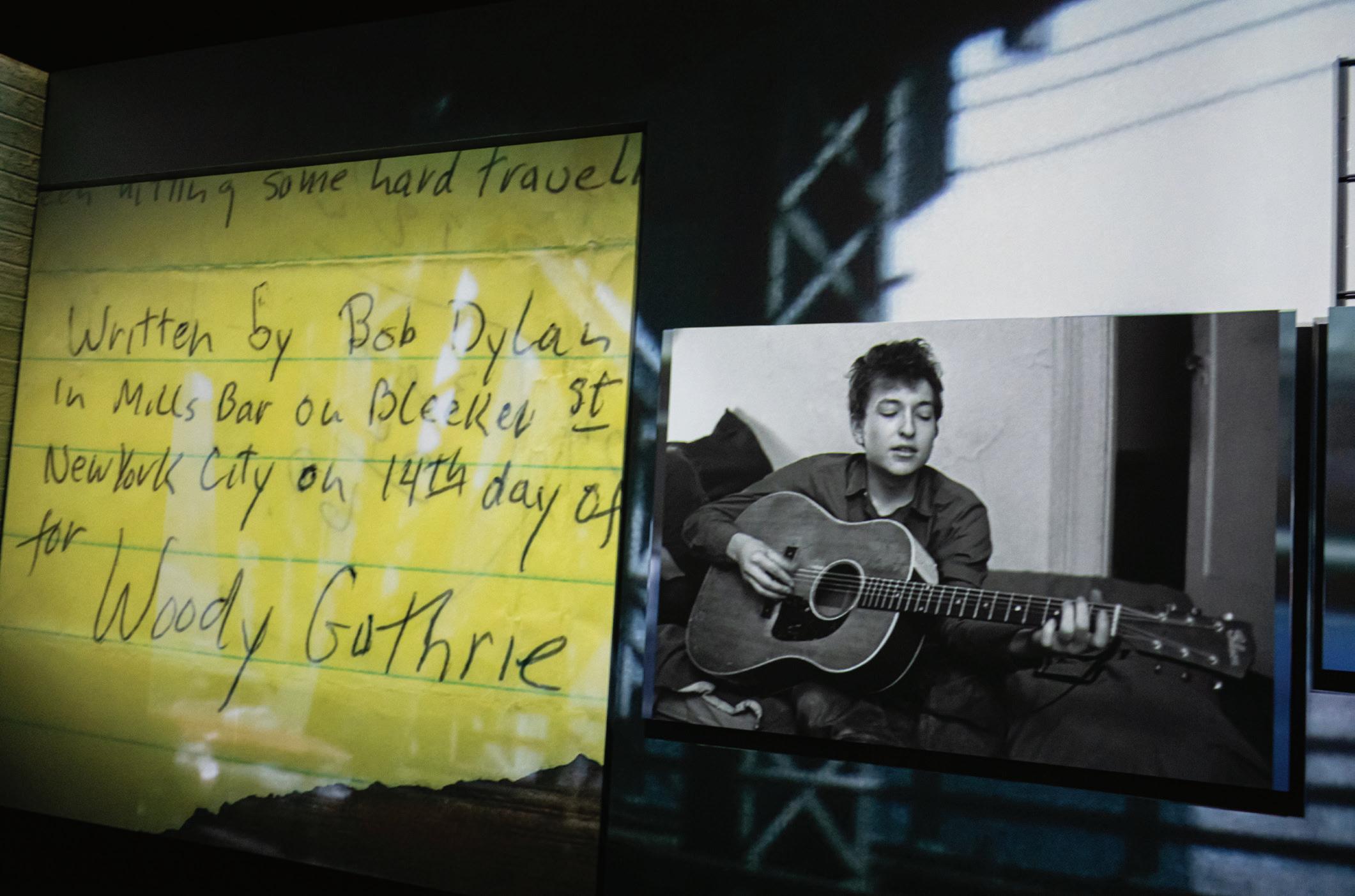
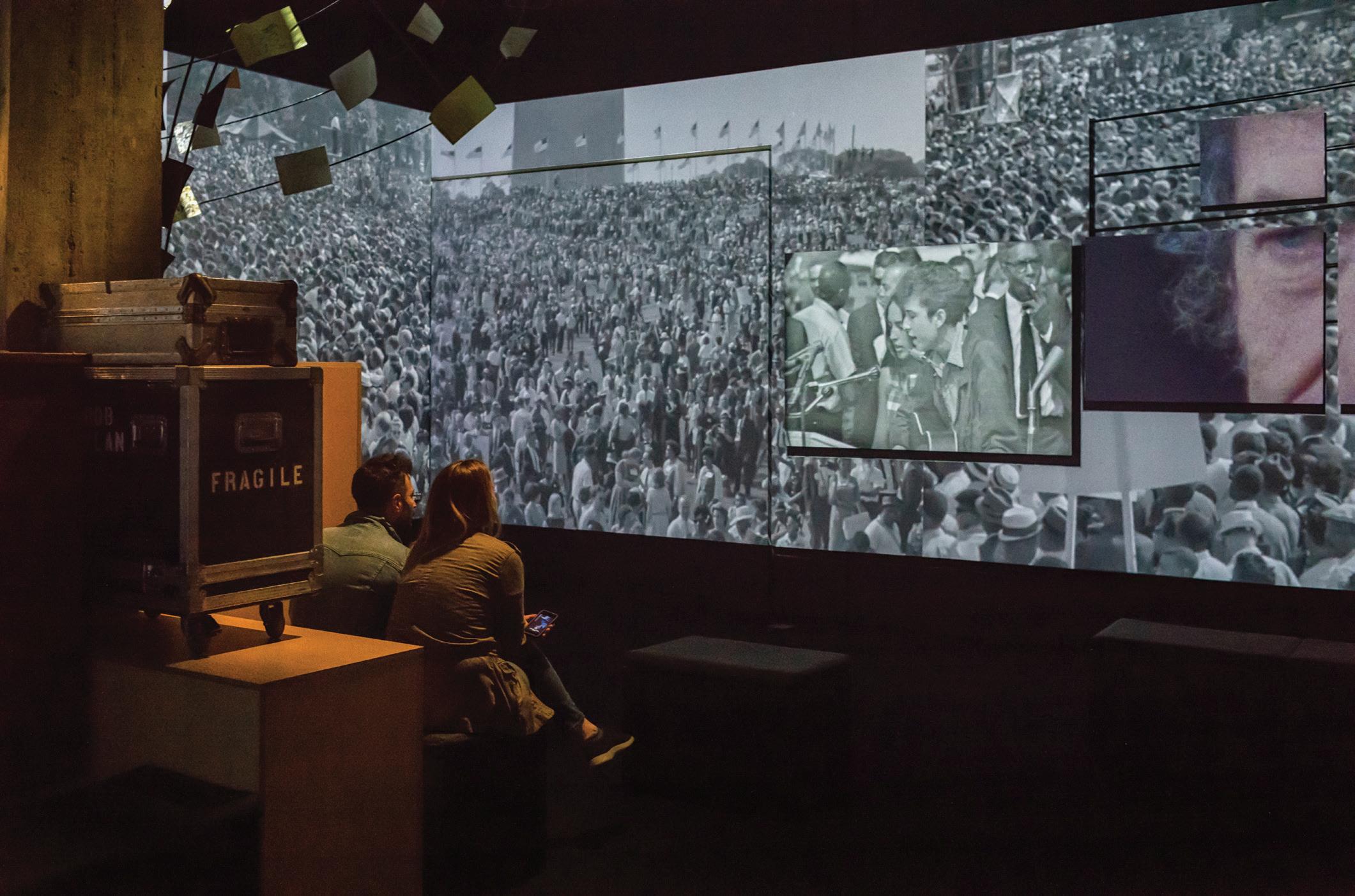
The archive has a vast array of items spanning decades. These items include handwritten notes, cards and letters, previously unreleased photos and film footage, personal artifacts, multimedia exhibits, and installations that focus on specific songs and lyrics that mark particular epochs across the artist’s long career.
Some of my personal favorites are the three pocket notebooks* containing iterations of the handwritten lyrics for the 1975 masterpiece Blood on the Tracks , Dylan’s typewritten appreciation of what is arguably the greatest rock cover ever, Jimi Hendrix’s recording of All Along the Watchtower (“…his soul
& my soul were on the same desert”), and a digital jukebox curated by Elvis Costello with recordings by Dylan as well as some relatively obscure music that inspired Dylan.
The BDC is beautifully designed and laid out in the building of a former paper factory that is located in the Tulsa Arts District. Most of the photos shown here come from the multimedia installations, although I have included a few images of the exhibit spaces. All of the images shown here were made at the BDC in May 2022, using a Leica M-10R and a SummicronM 35mm f/2 ASPH lens.
To see more images, scan the QR code below:
For more information on the BDC, visit: https://bobdylancenter.com/visit/ http://bobdylanarchive.com
*Note: Since visiting the Bob Dylan Center in May 2022, I have learned that one of the three "Blood Notebooks" has been returned to the Morgan Library in New York City.
David Bush is a double board-certified neuropsychologist in Palm Beach Gardens, Florida and a veteran of many Bob Dylan concerts, beginning with Dylan’s comeback tour with The Band in 1974. There was a solo exhibit of Bush’s street photography in Cuba at the Tamarkin/Rangefinder Gallery in Chicago in 2016. More of his photography can be seen at the Leica Camera Blog using the QR code below:
Michael Clements'
ColorBlind
A Series of Fortunate Events
by RICHARD REJINO
In a world where photography is firmly rooted in realism, imagine a photographer making an image where he purposely turns the focus ring to its extremes. He is experimenting and out of his comfort zone. He is finding a different way of seeing and telling a new kind of story in which the viewer must take part. Step by calculated step – and with a little bit of chance – he waits for magic to happen, not knowing what the image will look like. This is the world of Michael Clements’ project and captivating book, ColorBlind
The first time I saw the images in ColorBlind , I was mesmerized. This monograph of 37 photographs takes the viewer on an odyssey into a different way of seeing. One that challenges us to look past what we see and imagine something new. I was immediately drawn in by the richness and variety of hues as if each color palette were taken out of a Monet painting and recast in the style of Mark Rothko. It was easy to view them – even dismiss them – merely as abstract studies, but after spending time with each one, they reminded me of how much we are attracted to or repelled by different colors. How color arouses within us feelings of warmth, contentment, happiness, and dread, among so many others. The sequencing of the images is
artfully executed and intended or not, functioned to confront my notions of perception and imagination. I smiled. I grimaced. I sighed. I asked myself if they were a close-up of a nebula or a study of the northern lights. If they were pictures of traffic lights. How were they made? What was I looking at? In the end, it didn’t matter. They were undeniably compelling, beautiful, and evocative. They challenge the viewer to leave the confines of what the eye has trained itself to see and step into an existence both familiar and unknown. As with most abstract art, how the viewer interprets the work and answers the questions it provokes is often as fascinating as the images themselves. At a recent gallery showing of ColorBlind this past October, Michael described the reaction to his photographs. “My photographer colleagues and friends got it right away, but my engineering friends wanted to know what they were looking at or how to think about them, and they became rather indignant when I wouldn’t tell them what the image actually was.” It is this juxtaposition that makes ColorBlind so exciting and unique.
As if that weren’t enough, there is ColorBlind, the title, which in one blended word raises the stakes of this collection even higher. The photographer/
"Michael Clements' monograph ColorBlind is a poignant body of work consistent with Michael's psychological response to content as well as, more importantly, his perception of color."
- Mark de Paola
artist Michael Clements is indeed color blind, another juxtaposition that adds to the mystique of his images. He discovered his condition during a college class when his professor was using a PowerPoint template with bright colors. As his classmates took notes, Michael sat perplexed. “My colorblindness is red and greens,” he explained. “If they overlap at all, I can’t see the difference between them. In that class, I could see there were colors, but I couldn’t tell there were green letters on a red background. I couldn’t see the tonal difference. Another weakness for me are skin tones under fluorescent light –I can’t tell if the color is off. In eight out
of the ten color palettes, I can’t discern patterns. When colors are mixed, I can see the dominant color best.”
The element of color blindness opens a myriad of questions about how these images were made, but it is only part of the story. When you consider that the idea for this project began as happenstance and was almost dismissed and that there were a series of fortunate events that converged and led to the curation of the book like a perfect storm, it boggles the mind. But no matter the point of view, at the heart of the story of ColorBlind is the magic of chance, the exciting realization of a good idea, and
the moment when a project suddenly takes on a life of its own.
ColorBlind as an idea first made itself known in 2018. It bears mentioning that Michael is one of those rare creatures in the photographic world: for the past 30 years he has been a full-time, working professional photographer. At the time, he was working for the University of North Texas as a staff photographer, covering sporting events. He also worked as a photojournalist and freelance photographer. “Basically, the idea for the project started by accident,” he explained. “Every time I went on assignment, I’d be walking
along, not knowing that my camera was bumping around and taking photos behind me. I came home to postprocess and I would see photos of these haphazard, out-of-focus images that I never really paid much attention to. Every once in a while, though, I would see some that looked interesting. Then I went to Wetzlar with LHSA that same year. I checked out the 75 Noctilux (Leica on Loan) and I started playing with it, intentionally making out-offocus images. Using this technique, I shot a sunset, and when I saw it on my computer, I knew I was on to something.”
Michael kept experimenting with this technique and occasionally showed his photos to colleagues who encouraged him to continue developing the idea. Then, when the pandemic hit in 2020, the lockdown and its aftermath were devastating. Everything stopped.
University work, freelance jobs, everything. Those difficult days gave rise to a short-lived existential crisis, but also an epiphany. Reflecting on his career, Michael realized that as good as he was at capturing amazing moments at sporting events, as gratifying as it was to satisfy his employer’s assignments, he didn’t have a body of work that he could call his own. “When Covid
happened, I was going crazy, and I had to find an outlet,” he said. “That period taught me that I could do different kinds of work, that I could do things that were outside of what others thought I could do. I realized it didn’t matter to me what other people thought of the images I was making. That’s what told me I had something. I was proud of them. It felt like a body of work that was mine and a part of me.”
Coming out of this newfound realization, the more he experimented, the more Michael learned to visualize in a new way. “Before, in my work, everything I did as a sports photographer had to
be precise and tack sharp, but working on this project, I had to teach myself to undo all of that. I had to learn to see things in the opposite way I had taught myself to see. Soon, they weren’t total accidents anymore. I knew what to look for and I could visualize the tones. I got pretty good at spotting something that would make an interesting image.”
Over time, he accumulated hundreds of images and eventually decided to produce a book of his work. He pared them down to 240, but ultimately grew frustrated and utterly overwhelmed at the process of selecting and sequencing the final number of images. He looked
for help and enrolled in Leica Akademie USA’s Monograph Masterclass with De Paola Pictures, where he worked with Mark De Paola and Sage Backstrom. He recalled the moment when the work he had been developing for eighteen months suddenly had a name and everything came together.
“Mark De Paola was very enthusiastic about my work, which felt very affirming for me. For about half the images, he and his team would say, ‘Oh, I like the red, green combination’ in this one or that one, and I would say, I don’t see it. So, I had to explain to them that I couldn’t see as clearly as they do. The
"Working with Michael on his monograph ColorBlind was not unlike composing an orchestral song with moments of visceral color dissonance, harmony, and well-placed moments of respite - white space. When resting my eyes in soft focus on the images, it appeared that the images actually moved with some kind of resonance. The design of the book in sequence, to me, is not unlike witnessing a sort of visual theater."
- Sage Backstrom
designer Melodee Stephens said, ‘OH! you’re color blind,” and in a moment of inspiration, producer Sage Backstrom exclaimed, ‘That’s the name of the book – ColorBlind! ’ We had been struggling with what to call the book and all of a sudden it became pretty obvious, and they talked me into it.
“It was very liberating for me to give up control. Before, I would stare at the images, knowing that I couldn’t see some of them normally. The book producers and I were able to sequence them together and it took the stress away. We had basically one criterion for the book: if the viewer could look at an image and tell what it was, the photo was taken out.”
All the images in ColorBlind were made with a Leica. Michael’s relationship with Leica cameras began when he was first starting out in his career. He loved the way the rangefinder made him slow down and made him more thoughtful about what he was shooting, but because of his employer’s demands, he had to forego using them professionally. He returned to Leica again and again over his career and eventually, his M camera turned into a haven where he was free to put away his professional gear and use the Leica M system to nourish his creativity. “The images I made would not have been possible
without a Leica. It’s an extension of me, and I’m always intrigued by what the camera sees,” he said.
Looking back at the evolution of ColorBlind, one is struck by how a delicate chain of events led to the finished product. Were it not for a series of accidental, outof-focus photos, or the persistence of working through different possibilities, or Michael’s conviction and willingness to reach for help, or the element of chance in creating the images in the book, the project may not have ever been completed.
From the idea to the book, Michael acknowledges that not everyone will understand the images in ColorBlind He’s okay with that. He learned early on that if he revealed what the image really was – a purposely blurred photograph of a house, a bike, a window – it often took away from the aesthetic of the work, as if the viewer was let down or even disappointed by knowing too much. He chose instead to let the work stand on its own with the barest frame of reference and with the courage to ask the viewer to make up his own mind –to think for ourselves.
To purchase a copy of ColorBlind, visit: https://www.mclementsphoto.com/
Richard Rejino is the Executive Director for Leica Society International. A writer, photographer and musician based in Dallas, Texas, he is the author of What Music Means to Me.
Ilford FP5 & 50mm Noctilux-M
THE NEW LEICA M6
A LITTLE HISTORY
Leitz produced the M5 in 1971 by which time rangefinder sales were threatened by the burgeoning SLR market. It was a bold move, with many advances from the M4 which had preceded it (1967). Perhaps the most obvious development being Through-the-lens (TTL) metering and a large shutter speed dial overlapping the top plate.
But the camera was bigger than its predecessors and users didn't like this (or the vertical strap lugs on one side of the body) . Sales were disappointing and production was discontinued in 1975. For a while it looked as if Leitz might abandon production of rangefinder cameras altogether.
It's a sad tale, especially as the M5 was a visionary camera, and I know several modern Leica users who think it was the best film M of all.
Walter Kluck, the CEO of Leitz Canada, managed to convince Leitz Germany to produce a new M4 with lower production costs. A hundred or so were manufactured in Wetzlar and then production was moved to Midland in Canada. The M4-2 was born, and although it was only in production for a couple of years, it proved to Leica the viability of the rangefinder. It was succeeded by the M4-P in 1981 which was the first camera to pair the 28/90, 50/75 and 35/135 framelines. All but the last few cameras were made in Canada.
In 1984 manufacture was moved back to Wetzlar and the M6 was born. It was basically an M4-P with a new TTL metering system, centre-weighted, reading from a grey spot on the centre of the cloth shutter. This idea was simple and elegant and worked very well, and the camera was a real success, remaining in production until 1998 when the M6 TTL with through-the-lens flash metering was produced. The M6 TTL was a few millimeters taller than the M6, which then became known as the M6 Classic.
When it was first produced, the M6 was manufactured in Wetzlar, with the red dot logo saying "Leitz". Production was moved to Solms in 1986, and the logo was changed to "Leica".
The production values of the M6 were similar to the simplified ones of the M4-2, but with a lighter, cheaper cast zinc top plate. The M4-2 top and bottom plates were brass, using a deep draw process like the previous M cameras.
by JONATHAN SLACK
After the M6 TTL came the M7 with aperture priority, and in 2003 Leica produced the MP. The MP was basically a Leica M6 Classic, but with the manufacturing values, rewind crank and advance lever of the M3. It has a machined brass top and bottom plate and an improved meter with a middle dot. It is still in production today.
At the Oskar Barnack Award Ceremony on October 20 th 2022, Leica announced a reissue of the Leica M6 (along with its remake of the original 35mm Summilux)
First of all, I haven't tested this camera. There isn't so much need to test a film camera, so I've not had one sent my way.
THE REMADE M6
Ilford FP5 & 50mm Noctilux-M
(top) Leica M6 Ilford FP5, 50 Noctilux M (bottom) Leica M6 Ilford HP4 with 35mm Summilux V1 remake
(top) Leica M6 Ilford FP5, 50 Noctilux M (bottom) Leica M6 Ilford HP4, with 35mm Summilux V1 remake
I thought it was a great idea, but I didn't know the full details until visiting Dublin for the LSI Meeting in October, where Stefan Daniel was carrying the new camera with the 35mm Summilux v 1
I'm afraid I fell head over heals in love, and as soon as I got home I placed my order for a camera. Supply was short, and I had to wait my turn - I received my own camera just in time for Christmas.
So this article is not a review in any sense of the word. (I've only just discovered that the opportunity of running down the battery is just the same as the original M!) . However, I've been doing some research and asking Leica questions, and hopefully I can offer some interesting observations on the new camera.
THE BODY
Superficially the camera is a replica of the 1984 version of the M6, complete with the Leitz red spot and the engraving on the top plate.
The shutter speed dial is also exactly as the original camerasmaller and in the other direction from the M6 TTL and M7. It's useful to know that switching the shutter speed to 'B' also switches off the meter; I ran my first battery down in a couple of days without realising this. I tend to re-cock the camera after shooting, and if you pop it back in your bag, the shutter release is 'proud' and continually switches the meter on unless you set the shutter speed to 'B'. The consolation is that LR44 batteries are very cheap and easy to find.
Just like the original M6 the new camera will function purely mechanically with all shutter speeds working without a battery. Only the meter will stop working without power.
The original camera had a die-cast zinc top and brass bottom plate, but the new camera is machined out of a solid brass billet like the MP. This means that at 575 grams the new body weighs a little more than the M6 Classic.
The finish of the new M6 is quite different. It uses a shinier version of the black paint on the M11 (which is incredibly durable) . It's a lovely finish, and although it will wear in the end, I suspect that it might take many years for the first brassing. The leatherette is also the same as the M11.
The body looks and feels gorgeous, and incredibly solid and well made.
THE VIEWFINDER
The M6 has the latest version of the 0.72 rangefinder. As far as I can see this is identical to the rangefinder in the M11 (rather than the MP) , with slightly rounded ends to the
frameline 'sticks' and also to the rangefinder patch itself. This is in contrast to the MP (and the M10) which have squared off edges to both the 'sticks' and the patch.
The lights for the TTL metering on the M6 are different from any of the previous M cameras. Unlike the original M6 it has a confirmation dot in between the > and < symbols, but unlike the MP the <> symbols are rounded off slightly.
MANUFACTURING & LONGEVITY
Unlike every other major camera company, Leica has never stopped making film cameras. The MP will soon celebrate 20 years of manufacture, and the purely mechanical M-A has been made for almost 10 years. In addition to this, whilst parts are still available, Leica has been restoring and repairing many of the older cameras. Purely mechanical cameras are not so troublesome because they have no electronic components and Leica still has the machines and skills to make new parts as required.
However, some of the more recent cameras can no longer be fixed, for instance it's a while since Leica ran out of parts to fix the M5 or the metering in the M6 Classic, and the meter in the MP cannot be used as it is not backwardly compatible. There have also been some supply chain issues for the M-A and MP cameras which have sometimes made delivery times longer.
So Leica has taken the opportunity to renew their supply chain with the development of the M6. More than this, careful design and redesign of many of the parts should eventually speed up manufacturing for the M-A and MP and allow Leica to repair and restore the M6 Classic again including the electronics and meter (although they will now have the middle dot like the new M6)
CONCLUSION
The M6 is a lovely camera, made with the intention of maximising the virtues of the original camera, but without the constraints which Leitz were certainly facing in the early 1980's. The body has been improved, the meter has been improved, and the viewfinder has been improved, but without compromising the spirit of the original camera.
This is Leica reaffirming their allegiance to film photography whilst every other manufacturer has abandoned it. More than that, the whole reissue series is Leica embracing its past and reissuing classic designs with updated manufacturing and precision.
In a world of 35mm lenses why choose one less than perfect?
IN
the Leica lens world, you are either a 35 or 50mm photographer. I used to be the latter, a true 50mm lens afficionado, but the last three years I have gravitated towards 35mm. In my opinion, 35mm is the ideal travel and environmental focal length. It is not too wide and if you do not come too close the lens is still very flattering for environmental portraits. As most of you know, I specialize in portraits and being a lens fanatic, I have used and owned most of Leica’s 35mm offerings, all the way from the vintage glass of the 60's to the most modern 35mm Summilux FLE and the 35 APO.
2022 has been an exciting year for Leica and they have not released one but two 35mm offerings - the 35mm f/1.4 FLE v2 with close focusing and two extra blades and the reissued mythical 35mm f/1.4 v1 a.k.a. the "Steel Rim." Both are Summilux f/1.4 lenses but besides sharing the same focal length and aperture, they couldn’t be further apart character- and rendering-wise. I will further elaborate on my experiences with the Steel Rim, abbreviated as SR hereforth.
Leica has a long history with 35mm lenses. In the film days they wanted to offer a small but very fast lens. This led to the birth of the first Summilux SR. This 35mm Summilux V1 was the only Leica lens to have a prominent steel front ring for mounting its OLLUX hood, and because of this distinguishable characteristic it became known as the Steel Rim, a very compact lens with its signature glow and halos. The SR is not a perfect lens. It has shortcomings which define its character. It is soft wide open, has a lot of chromatic aberrations, creates halos and has some wild bokeh. You could call it the opposite of the modern 35mm APO-Summicron-M.The SR had a very short production run of only 7,500 units and were produced between 1961 and 1966. Itcame in two versions: a Goggled one for the M3 and a non-Goggled version for the M2 along with two color variants, standard silver chrome and the very rare black one. All lenses came with an infinity lock.
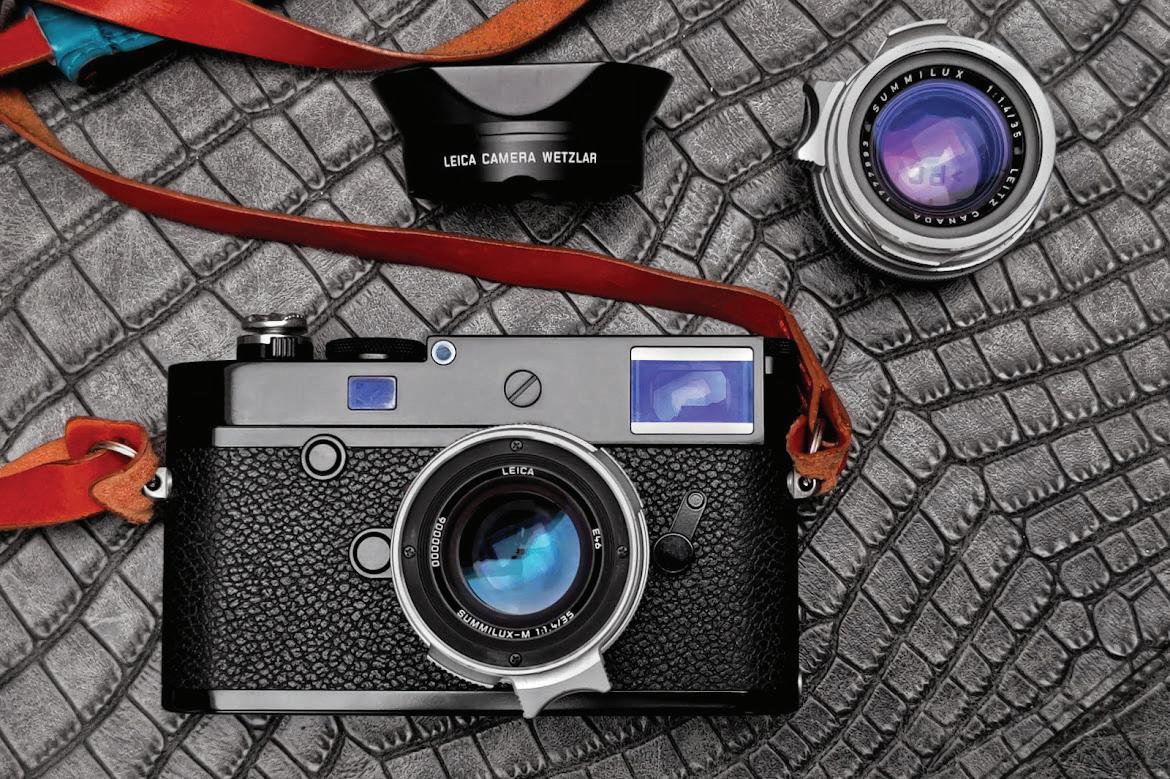
(above, top) The 2022 reissue of the 35mm Summilux-M Steel Rim mounted on the Leica M10-R Black Paint along pictured alongside a 1960's original.'
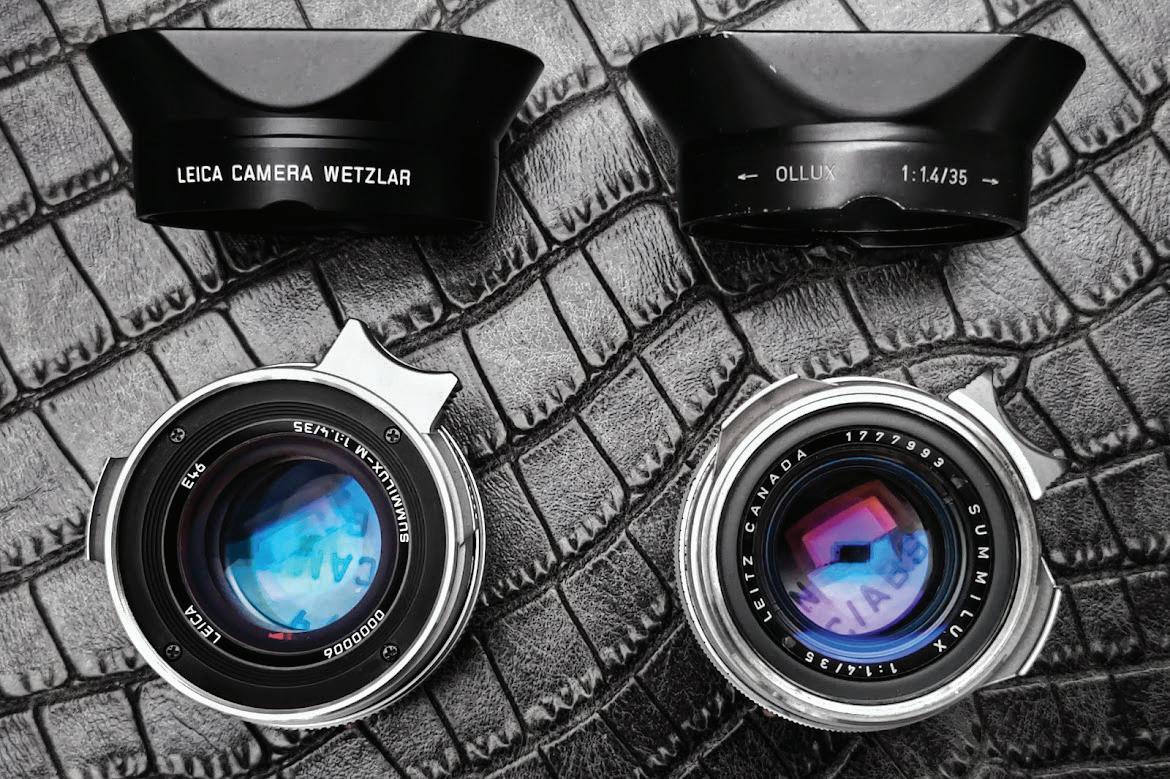
(above, bottom) The 2022 reissue of the 35mm Steel Rim (left) and a 1960's original (right) pictured with their respective hoods.
OLLUX, A Unique Shade
All SR lenses came with the unique OLLUX hood not shared with other Leica lenses. The filter thread was a rare 41mm, which the SR shared with the Summarit 50mm f/1.5. The OLLUX hood is a clip-on shade and highly sought-after, with prices going up to 2K USD on the used market.
Although the Goggled version can focus down to 0.65 meters, the non-goggled version only close focuses to 1 meter. On the collector market the non-Goggled version is much more appreciated and hence is almost double the value of the goggled version.
The SR was replaced with the 35mm Summilux f/1.4 (so called Pre-ASPH) with the transitional model sharing the same optical formula as the SR but the lens received a slight redesign to accommodate a different lens shade with Series VII filter compatibility.’ This second version went on to be produced for nearly 30 years, until it was replaced with a new aspherical model in 1995.
I am fortunate to own an original SR with OLLUX shade and I was of course more than happy when the Product Manager of Leica Camera offered me to beta test this lens so I could compare the reissue with the original one.
As with all the reissues it isn’t an exact copy, but Leica has adjusted both the outer and inner mechanics. The outer dimensions are different, which implies that one cannot use the new OLLUX shade on an old SR and vice-versa. The reissue SR also swapped out the 41mm for a 46mm filter thread. This might be unfortunate for the owners of an original SR who lost their shade, but this prevents Frankenstein models appearing on the collector market. The reissue comes with two shades: the OLLUX-styled one and a more traditional threaded round shade which takes 46mm filters. The lens itself is made from brass and and satin silver chrome finish like the original but lacks the brass elements inside the original, which makes the reissue feel lighter (211 grams) compared to the original (233 grams).
Leica’s optical engineers have copied the original formula of the lens but the coatings have been improved and this means
there will be a small difference in rendering between the original and the reissue SR.
I have noticed this when testing both and the original one has even a wilder bokeh, more glow and crazy reflections when using it with a light source close to the lens. Don’t get me wrong: the reissue is very close in rendering to the original one with a significant glow when shooting wide open, with very dreamy bokeh and crazy halos. Soft wide open (but sharper than the 90mm f/2.2 Thambar and even the Noctilux 50mm f/1.2) but very sharp in the middle once stopped down to f/2.8. The size and the dual character of this lens makes it a wonderful travel companion. I love this lens for portraiture as it is sharp enough wide open, but it creates soft skin tones and drawing which I can’t get with any other 35mm lens. The only downside for me is the 1 meter close focus, but as I tend not to come too close for portraits to avoid distortion this is not a big drawback for me. Ergonomically speaking, the aperture and focus ring are very close to each other, and this needs some time to get used to. Focusing and aperture are very smooth but certainly not loose.
The New King of the Night?
When we speak about the King of the Night, we often think about the Noctilux range but I feel the SR comes alive at night. It is the lens I would bring to smoky jazz clubs and bars, but also street scenes and Christmas markets. The results of the SR are often unpredictable, which makes it a very fun lens to use. The biggest strength of the vintage line of lenses like the 28mm Summaron, the 90mm Thambar and the 50mm f/1.2 Noctilux is the classic rendering in a new improved package. Lenses which often are too expensive on the used market are now accessible to all Leica enthusiasts and they come with better coatings and a warranty. I always find it a pity to see that collectors do not use these heritage lenses and keep them in a safe. Like a classic car should be driven, all these gems are meant to be used.
Over the few months I used this lens I must admit I left my original SR in the closet and enjoyed the reissue. I took it everywhere for some of my new work with professional models, to holidays and even to a wedding in Italy. It is a classic 35mm lens which has such a different character compared to the other modern offerings from Leica, so I believe this is a very good addition to any collection! Could it be used as a daily driver? Maybe yes, because it is small and once stopped down it becomes very sharp, but in my opinion most will add this in combination with a modern 35mm lens like the 35mm f/1.4 FLE (v1 or v2) or the 35mm APO.
On request by many I have created a special dedicated group on Facebook for this lens and you can find many photos taken with the SR on my Instagram account.
@milanswolfsphotography | www.milanswolfs.com
Special thanks to Stefan Janssen, Murat Akkus and Stefan Daniel from Leica Camera AG for the talks and offering me the possibility to beta test this lens.
THE LEICA 35MM STEEL RIM
by JONATHAN SLACK
On October 20th 2022 Leica announced two new Classic releases: the 35mm Summilux-M v1 'Steel Rim' first released in 1961, and the Leica M6 classic first released in 1984.
This article will concentrate on the new lens which I have been testing on and off for a little over a year. However, I held the M6 in my hands for the first time at the Leica Society International meeting in Dublin earlier in October and fell immediately in love (See pages 28-33 for more on that!)
Leica Classic Lens Remakes Lots of photographers are discovering the charms of older lenses (and coincidentally their vices!) . Collectors have long understood which lenses are interesting or scarce, so that prices for vintage lenses can be extremely high.
For instance a quick check on eBay finds copies of the Leica 35 Summilux (Steel Rim) in good condition on sale for as much as €30,000. The black ones are a great deal more expensive. The hood was an accessory and the OLLUX (12522) is now trading for around €2,500 - and considering how easily it falls off. you would have to be very brave to use it!
If you are a collector then that's all well and good, but if you're a photographer, and you would like to use these classic lenses, then it's pretty hard to justify the cost. More than that, they were at the cutting edge of technology in the fifties, sixties and seventies, and were extremely difficult to manufacture, so there was quite a large sample variation between different examples, added to which many have suffered the slings and arrows of outrageous fortune over the years.
Leica had the bright idea of remaking some of these iconic lenses. In most cases the original glass is no longer available, so they have carefully chosen equivalent modern glass and coatings which have similar characteristics.
Lens technology has come a long way in sixty years, so manufacturing is now much more straightforward, and the sample variation which plagued the lenses of the 60's will not be an issue today. So far Leica has produced the 28 f/5.6 Summaron (from the mid-fifties), the 90mm f/2.2 Thambar soft focus lens (from the thirties), and last year saw the introduction of the 50mm f/1.2 Noctilux (which I wrote about here: https:// www.slack.co.uk/leica-noctilux-f1.2.html).
This brings us to the newest lens in the range: the Leica 35mm f/1.4 Summilux-M v1 (Steel Rim)
HISTORY The 35mm f/1.4 Summilux Verson 1 was produced from 1961 to 1966 and came either with or without goggles. The lens was produced in silver chrome finish and black anodised aluminium (Leica didn't use black chrome plating until 1971) . The insides of the lens were brass in both cases. There were around 8,000 lenses made in total.
Lenses for the M3 cameras came with goggles and focused down to 0.65 meter. Those for the M2 came without goggles and focused only down to a metre.
The Leitz shipping records for the lenses did not indicate either their finish (black or silver) or their mount version (goggles or not). Lars Netopil has estimated the quantities of the different versions by interpolating from the number of M3 and M2 cameras sold during the period and come up with:
• 4,400 chrome lenses with goggles
• 3,360 chrome lenses without goggles
• 160 black lenses with goggles
• 80 black lenses without goggles
Because the M2 was the accepted camera for wide angle lenses, Lars suspects that there might actually be around 200 black
lenses without goggles, making them very sought after. However, one needs to be careful as the last 1,000 lenses made were already the re-designed version with A42 front mount, fitting the 12501 clamp-on sunshade - these are much less valuable.
THE CLASSIC REMAKE The remake of the 35 Summilux is a lovely thing. The lens itself is made from brass and silver chrome just like the original. It weighs only 200 grams, and is not a great deal larger than the 28 Summaron. It handles so nicely on an M11, a great camera and lens combination you can hold in one hand all day.
It comes with two different lens hoods: a remake of the original Ollux and a round screw in hood. Leica has retained the 'fall off' characteristics of the original Ollux, so the screw in shade is very welcome!
Unlike the original lens, the new version has a 46mm screw thread for attaching filters. The round shade screws into this, and retains a thread inside, so you can attach filters with either shade (or with no shade).
As an object and a package, the whole thing is irresistible. I would recommend you don't look at one if you don't intend to buy!
IMAGE QUALITY Erwin Puts in his book Leica M-Lenses: Their Soul & Secrets (2002) wrote:
"At full aperture this lens has low overall contrast with a modest definition of fine details and subject outlines. Stopping down, the improvement is commendable, becoming excellent around f/8. The overall performance characteristic should be put in the context of its age and small volume."
This is a perfect description, but perhaps doesn't cover the 'soul' angle quite enough.
Wide open the lens is dreamy and never quite sharp. Depending on the subject it can produce really interesting effects.
Stopping down, even to f/2.8, makes the lens a great deal sharper and by f/5.6 in the centre, it's really very sharp indeed. The edges of the frame are sharp by f/4, but the furthest corners never quite make it.
The lens is also rather subject to flare - often in the form of a rainbow, which again can be fun to experiment with.
Clearly the point of buying this lens is for its 'look', not because it compares well with the latest 35mm APOSummicron-M, and 'look' it delivers in spades.
The Bokeh - as with all lenses - depends very much on the
subject. With very detailed backgrounds, it can seem busy and 'nervous' but never nasty; more often it's sumptuous and creamy.
HANDLING Focusing is with a focusing tab, and it's really delightfully smooth and tactile with an infinity lock. I'm not personally a fan of the infinity lock,.
Still, Leica has made it easy to escape and the release button is natural to use.
As you might expect, there is some focus shift, with the focal point drifting forwards as you stop down - f/2.8 shows it most clearly, but after that, the increasing depth of field makes up and by f/5.6, it's not really visible.
Like the original lens, you change aperture by holding the tabs for the lens hood, this is a bit fiddly, but the aperture ring feels lovely and it soon becomes second nature.
The small size is a bit of a revelation after using a modern 35mm Summilux - it's wonderfully tiny.
DESIRE Perhaps this is the point at which I should confess that I have mostly been an advocate for Leica's modern lenses, especially the APO lenses ,which I see as having a real character of their own, detailed, gentle and with a lovely bokeh.
However, I own (and love) the little 28 Summaron, and when I tested the f/1.2 Noctilux, I was definitely impressed. I didn't buy one at the time - mostly because I like to shoot wide open in bright light and I had an M10 with a top speed of 1/4000 th (I'm much too lazy to use Neutral Density filters) .
Having tested this 35mm lens over an extended period, it's been a long time since I've known I had to buy one.
A few months ago I got an email with some questions about the Noctilux f/1.2 and couldn't remember the answers. On googling it I was referred back to my own article, and on reading it I promptly placed an order!
With the M11's hybrid/electronic shutter, there is no need to use ND filters, and the new EVF makes critical focusing much easier. Of course, these advantages are relevant for the new 35 Summilux classic as well.
So, although I still love the modern lenses, I now have a firm base in classic lenses with the 28 Summaron, the 35 Summilux and the 50 Noctilux (Keep them coming!) .
CONCLUSION Leica has gradually grown its commitment to classic remakes, and this past fall's announcement of the M6 and the 35 Summilux Steel Rim really brings it into clear focus. Leica is celebrating their heritage by producing exciting new tools for both analogue and digital photographers - made to modern manufacturing standards, but with designs from their illustrious past. One can imagine remakes of other classic lenses like the Mandler 75mm Summilux or the 21mm Super Angulon...
For photographers who actually want to use classic lenses, the re-issue series is a wonderful opportunity. The 35 Summilux is not much more than 10% of the cost of a 60-year-old version and has none of the problems of variance or deterioration. In addition, the remake lenses all have the advantage of being properly 6-bit coded and corrected.
But the real point is that this lens is a delight to use, and produces lovely images on modern digital cameras as well as classic film Leicas.
https://adobe.ly/ 3SRsX09
https://adobe.ly/ 3K8glOq
Acknowledgements:
First of all to my lovely wife Emma, who puts up with all the stress involved in writing these articles.
Murat Akkas at Leica Camerathank you for proof reading this so carefully and stopping mte from making some dreadful mistakes!
Special thanks also to Lars Netopil who kindly gave up time getting me up to scratch on the history of the lens.
Also to Stefan Daniel, Jesko von Oeynhausen and Christoph Mueller at Leica who are always so great to work with.
More pictures can be seen using the links to the left.
ROCKLEIGH MEMORIES
by JIM LAGER
My employment with E.Leitz, Inc. Rockleigh, New Jersey began in February 1971. Has it really been more than 50 years since I joined the Leica Technical Department? Between 1971-1975 I dealt with most facets of the Leica System on a daily basis. Cameras, lenses, and accessories. In many instances it was an initial meeting. Allow me to recall a few of these encounters.
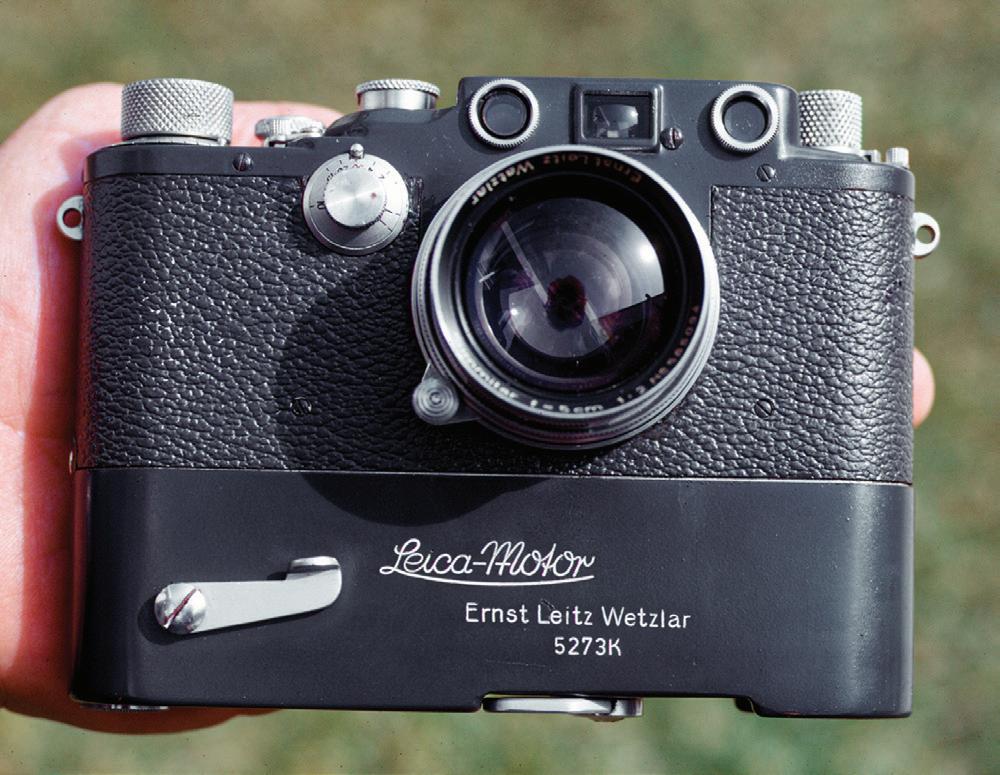
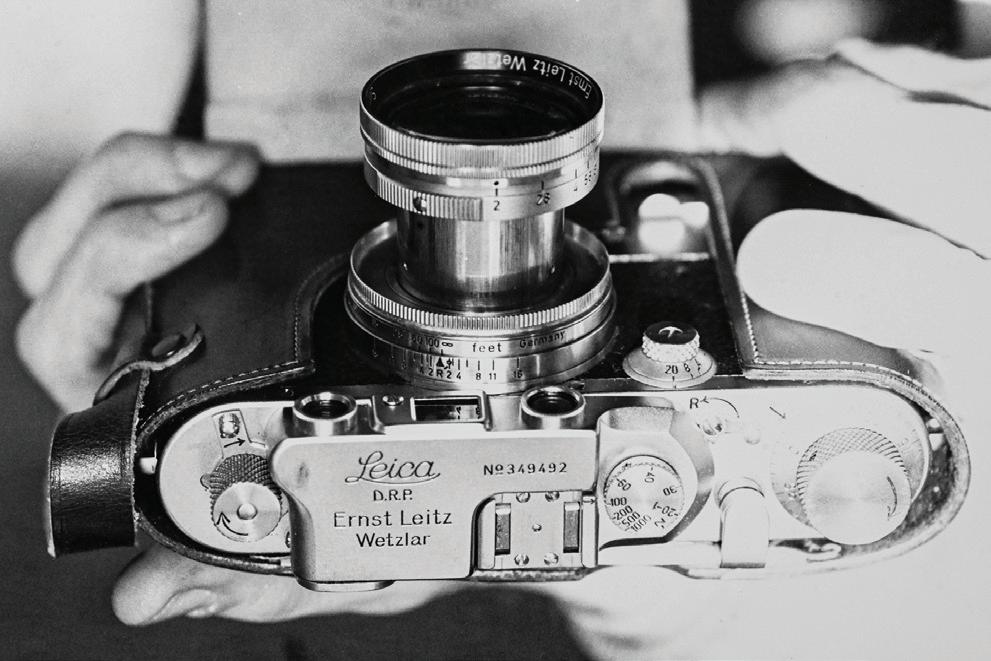
It was during a sunny Summer day when a customer arrived with an extraordinary assemblage. A Luftwaffen-Eigentum grey IIIcK coupled to a grey MOOLY-C motor. (#1) I was aware of the black or chrome motif but the grey finish was new to me. Out came my Leicaflex SL to document this rarity. Another first encounter centered on a well worn black 8.5cm Summarex. (#2) The lens carried a tiny engraving reading Red Richards which I surmised to be the name of a previous owner. This lens survives today cherished by an LHSA member.
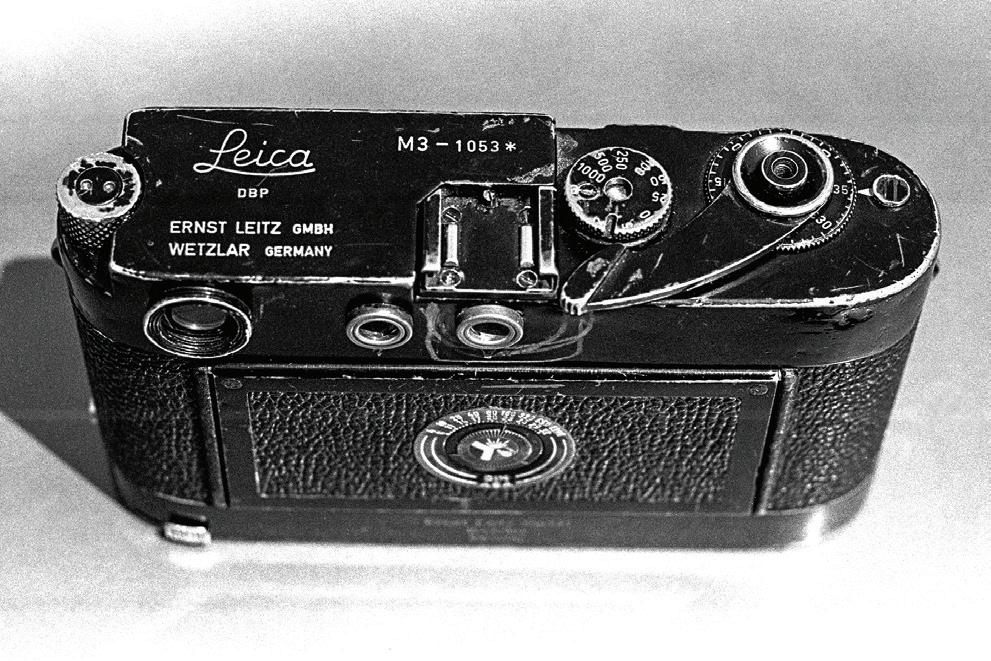
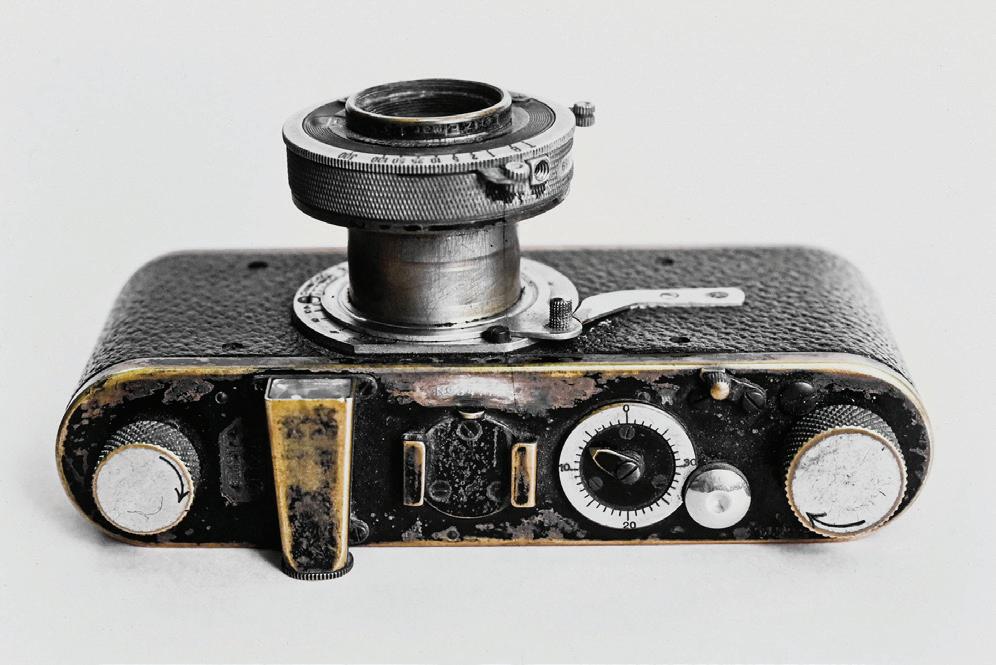
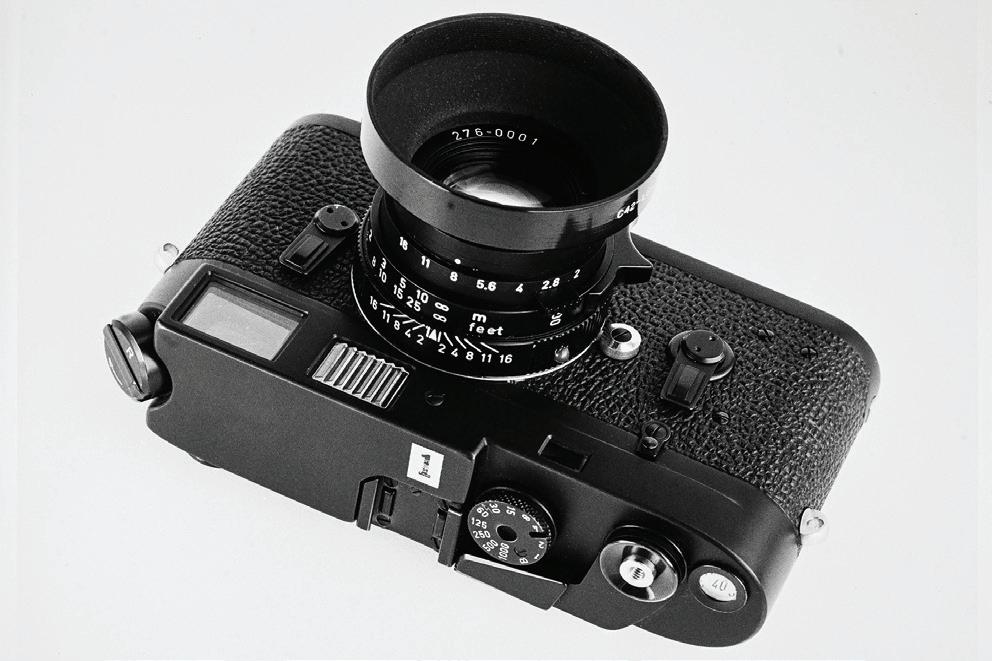
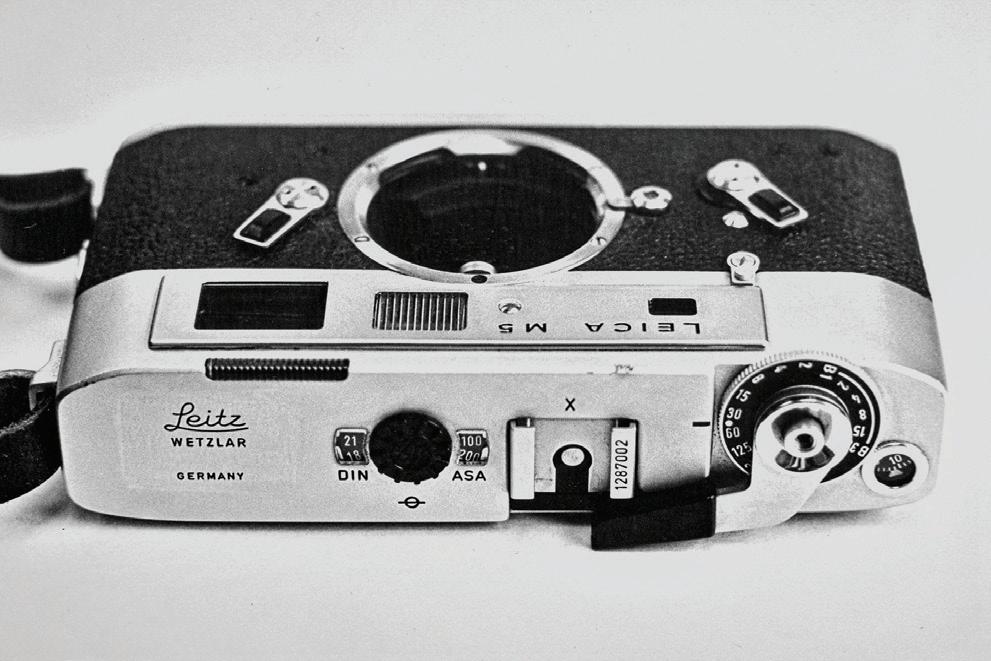
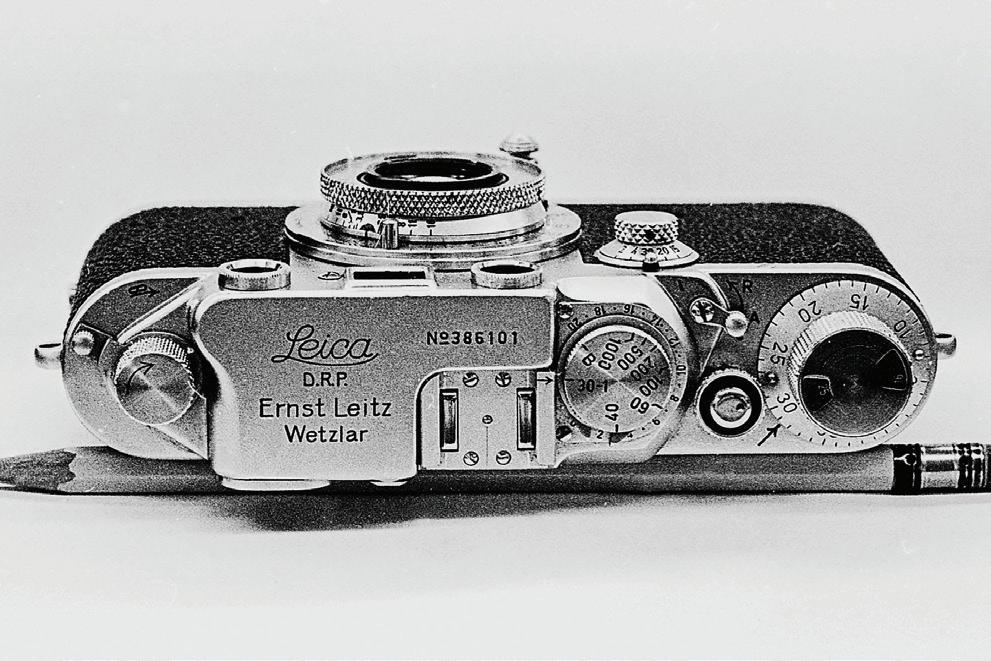
How about a 1940 Leica IIIb with MOOLY and beautifully crafted leather case? (#4) Again I went to the SL. No time for proper photos but quick snapshots were better than nothing. Highly trained service department technicians would regularly summon me with “ Jim, we have something here you should see”. I went immediately. There it was on the workbench. An absolutely battered black M3 with unusual engraving M3-1053*. (#3) Years later I realized this was a prototype MP prepared for evaluation by prominent photojournalists. Then a 1930 rim set Leica B so worn you could not read the entire serial number. (#5) Leica IIIc 386101 converted to a IIIf. (#6) Future research indicated original shipment to Japanese occupied Shanghai in 1942. An early KE-7A with 5cm ELCAN 276-001 for in-house evaluation. (#7) Null series M5 1287002 being shown to the M specialists. (#8) They were seeing the new M5 for the first time. I watched and listened from the appropriate distance and distinctly remember uttering "My God, what has Wetzlar done to my M3".
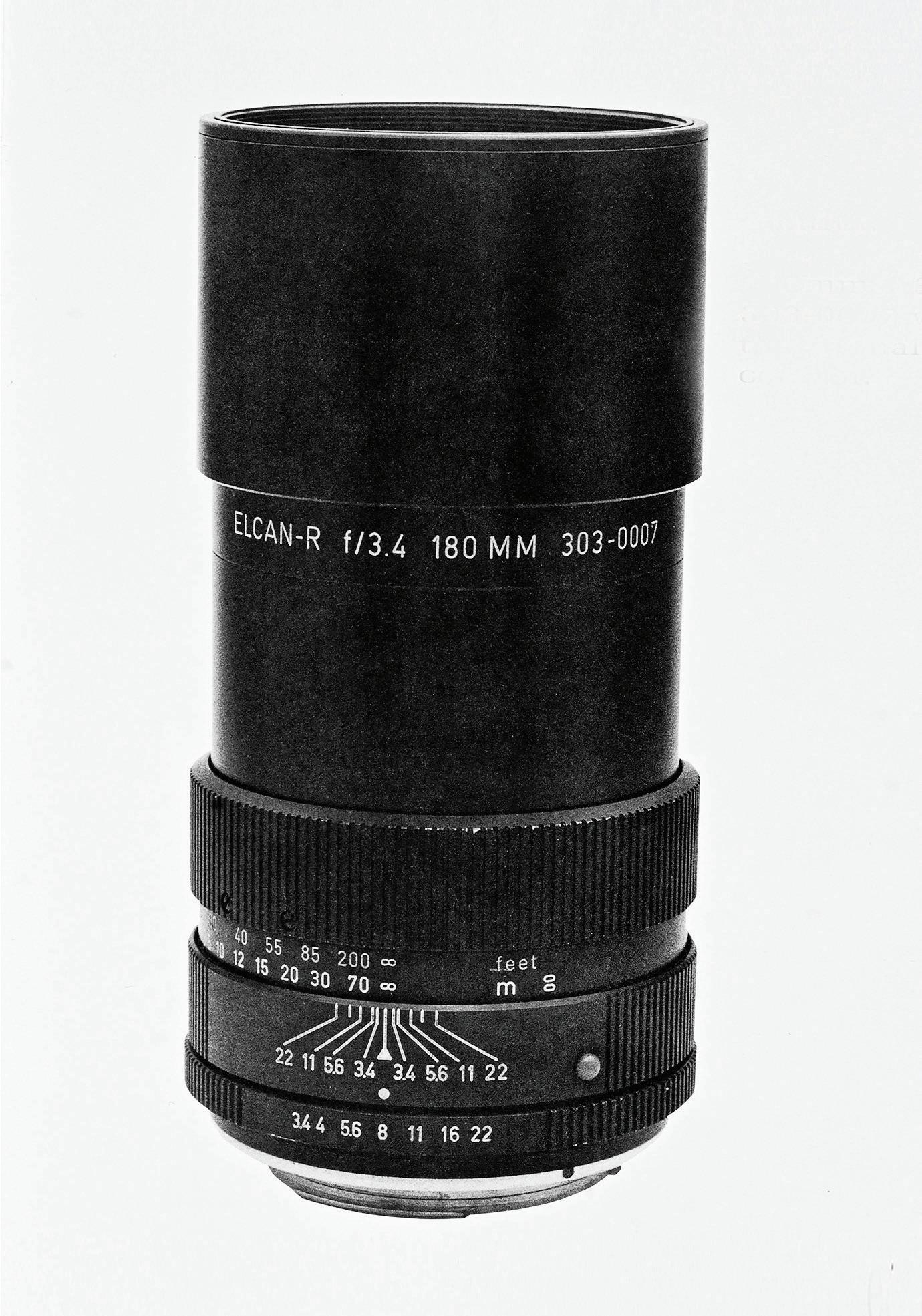
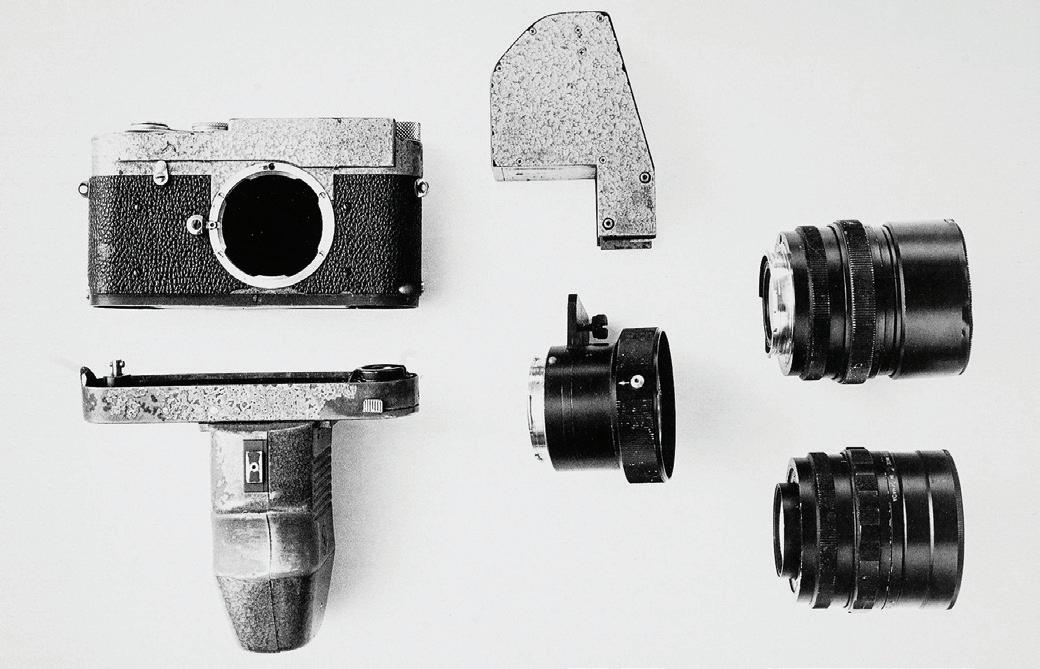
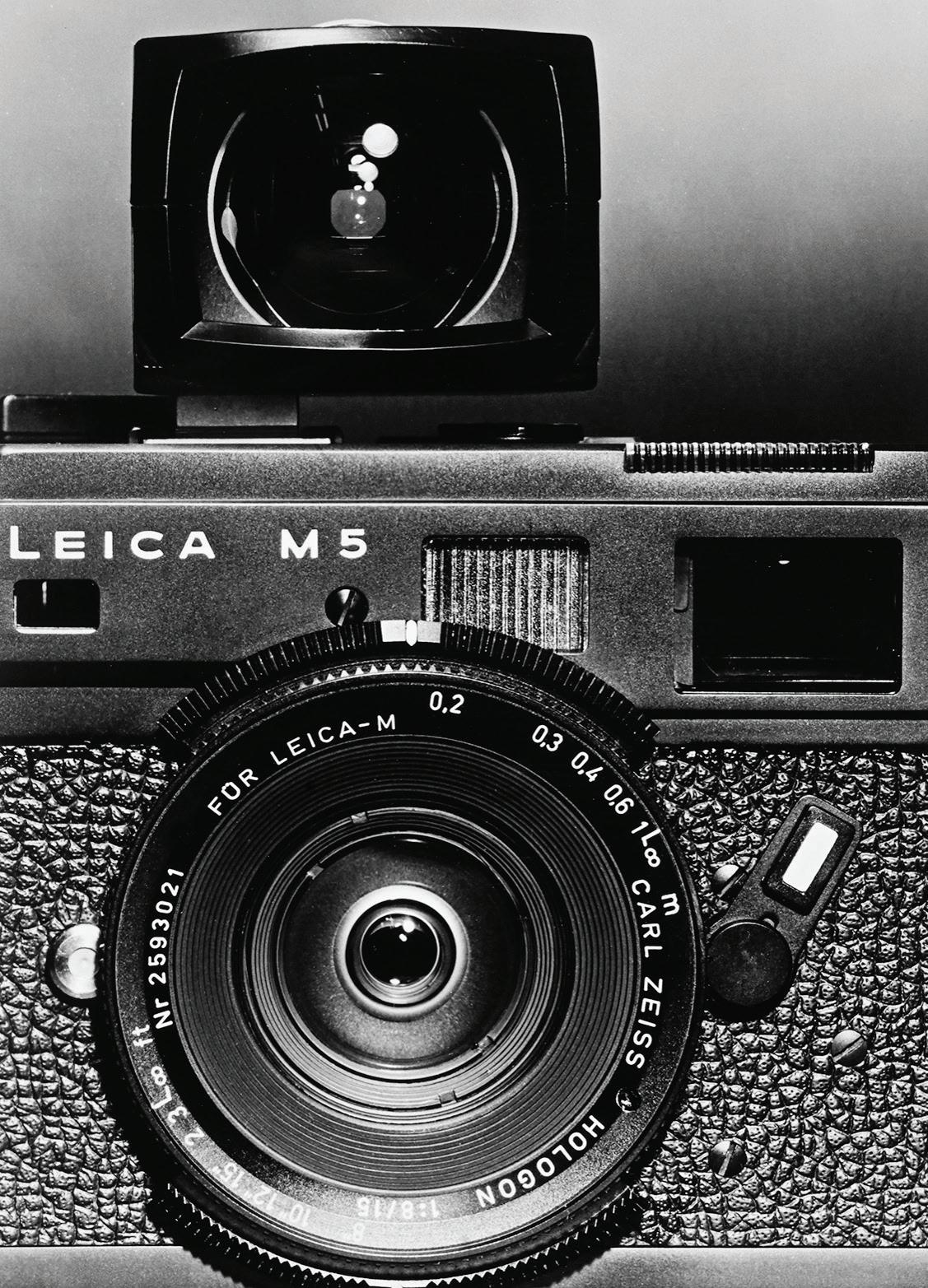
The 180mm 1:3.4 ELCAN-R came with the understanding I could shoot with it but not photograph it. (#9) It was during the Cold War and the lens was classified. Built for the U.S.Navy and later commercially introduced as the Apo-Telyt-R. Important visitors from Leitz Wetzlar had concluded their meetings and were about to depart. Suddenly without warning a tiny M lens was handed to the Leica Technical Department. I mounted the 15mm 1:8 Hologon to an M5 and shot exteriors of the Rockleigh headquarters building. (#11) The special variable density filter reduced vignetting. A lens for the specialist. All of the transparencies I shot with the 180mm ELCAN-R and Hologon were Company property, hence, I do not have them. A silver Haliburton case arrived filled with M equipment never seen by the service department. A Leica MS with two lenses and special viewfinder. (#10) This equipment was forwarded to ELC in Midland. See the LHSA Viewfinder 53-3.
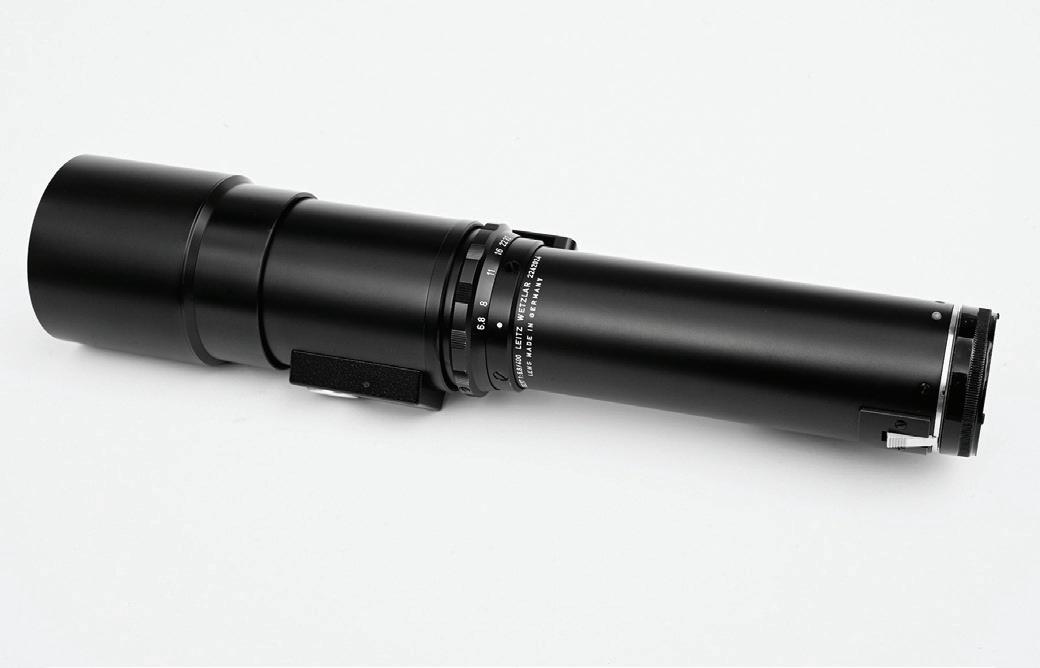
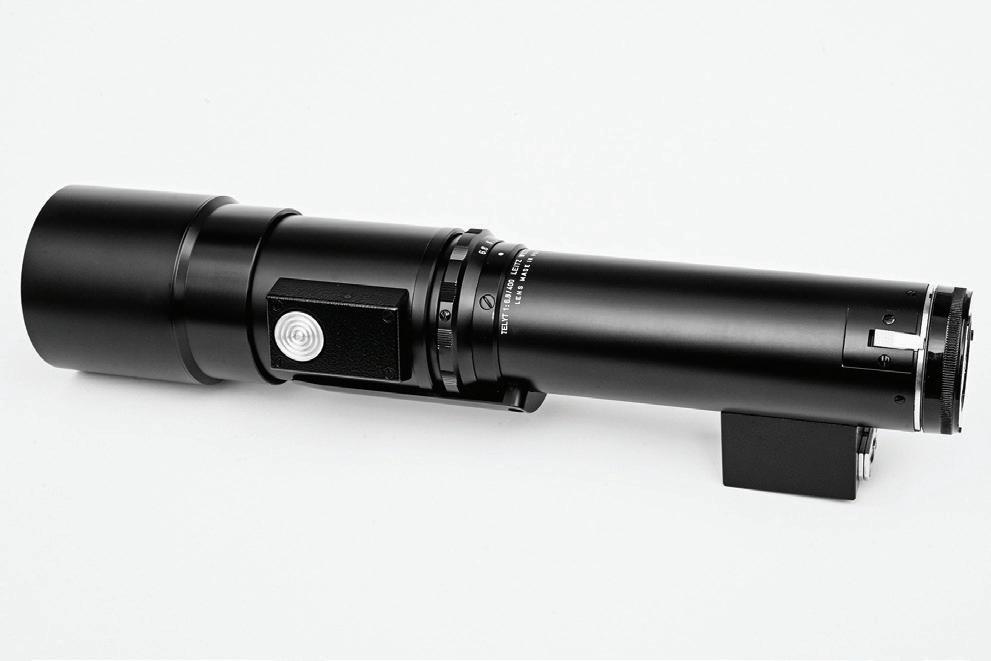
A first style 400mm 1:6.8 Telyt emerged from storage. (#12) It was just like the one used by DDD at the 1968 presidential conventions. Fifty of this style were prepared with single piece construction
#1. Grey IIIcK with grey MOOLY-C
#2. Black Summarex 593285
#4a. IIIb with MOOLY and case
# 4b. IIIb with MOOLY and case
#5. Rim set Leica B
#6. IIIc 386101
#8. Null series M5 1287002
#7. KE-7A with lens 276-001
#9. 180mm 1:3.4 ELCAN-R 303-0055
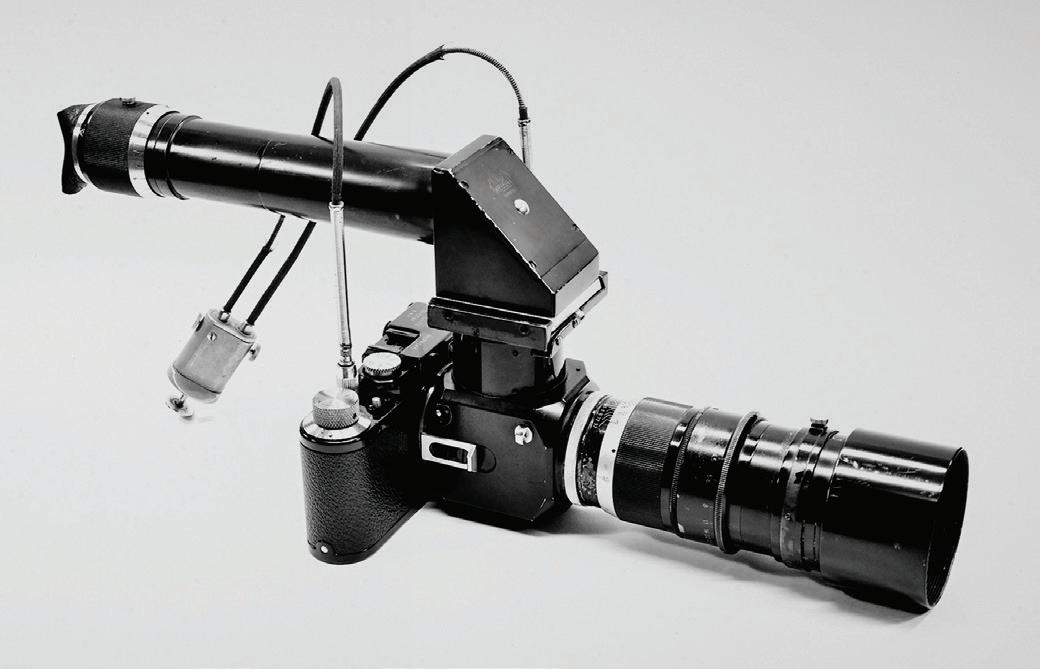
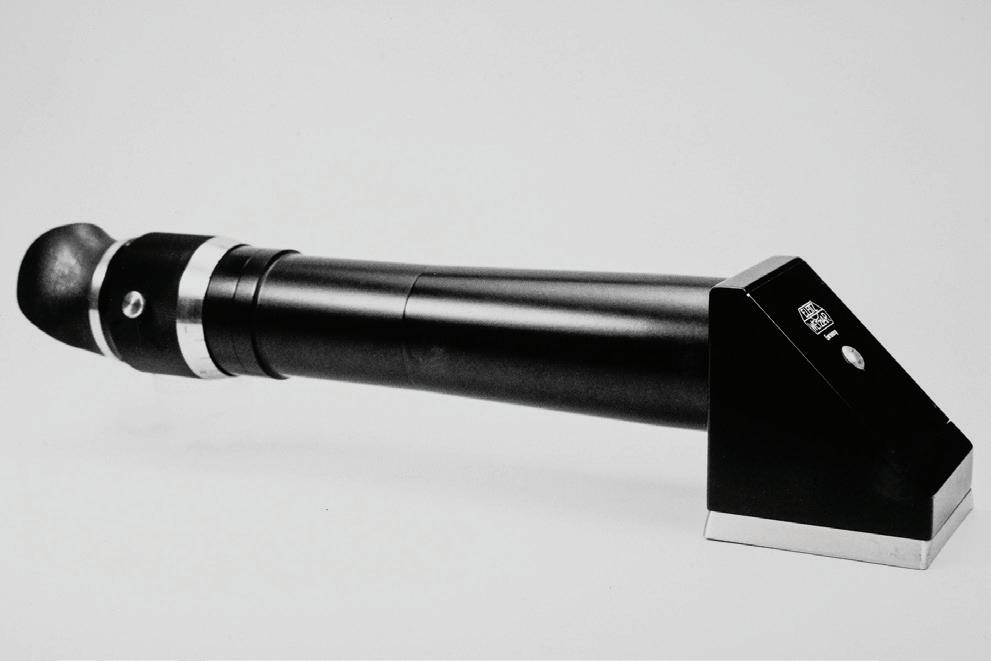
and no filter slot. Batch 2242001-2242050. A chance discovery in a corner of the stockroom unearthed a container containing viewfinders engraved Leitz Wetzlar. The finders were like the one fitted to the Leica Gewehr in the factory museum. Still wrapped in protective tissue paper the finders had not been used. A few found their way into collections. Very rarely the PLOOT reflex housing is found modified to accept the finder. (#13)
Rockleigh memories. An extraordinary experience I will always treasure. Total immersion in the Leica Universe. Hopefully today’s Leica enthusiasts will share my 50+ years passion.