Inquiries about membership, upcoming events, replacement Viewfinder issues, and special orders should be directed to:
Richard Rejino, LHSA Executive Director 14070 Proton Road, Dallas, TX 75244 info@lhsa.org, (972) 233-9107
Viewfinder is the official publication of the LHSA - The International Leica Society, a nonprofit organization incorporated in the state of Delaware d.b.a Leica Society International. Copyright 2020. Reproduction or use of any material contained herein without permission of the Society if forbidden.
Leica is a registered trademark. It and other trademarks pertaining to the Leica System are the property of LEICA CAMERA, USA, INC or LEICA CAMERA AG.
ISSN 1543-8732
PRESIDENT Brad Husick Medina, WA
EXEC.VICE PRESIDENT
David Knoble Charlotte, NC
VP / TREASURER William Fagan Dublin, Ireland
IMMEDIATE PAST PRESIDENT
Keith R. Sbiral Chicago, IL
PRESIDENT EMERITUS
James L. Lager
Rolf Fricke
Bill Rosauer
APPOINTED OFFICERS Viewfinder Editor Bill Rosauer Buffalo Grove, IL lhsaeditor@yahoo.com
Associate Viewfinder Editor s Ed Schwartzreich Waterbury, VT
Amitava "Chats" Chatterjee Manassas, VA
EXECUTIVE DIRECTOR
Richard Rejino Dallas, TX info@lhsa.org
ELECTED DIRECTORS
Class of 2022
Andrew Godlewski Middletown, RI
Bill Royce Kirkland , WA
Kirsten Vignes Minneapolis, MN
Philiip Blair Kenmore, WA
Class of 2023
Sandra Eisert Redmond, WA
Ashwin Rao Seattle,WA
Robert Levite Coral Gables, FL
Class of 2024 Wilbur Norman Sante Fe, NM
David Spielman New Orleans, LA
Amitava "Chats" Chatterjee Manassas, VA
John Pegouske Dearborn, MI
SENIOR DIRECTORS
Gary Hough Woodinville, WA
Douglas Drumheller Pittsburgh, PA
Alan Weinschel Roslyn Heights, NY
CONTRIBUTING EDITORS
James L. Lager Closter, NJ
S.R. Gilcreast Jr. Peterborough, NH
S. Willis Wright Port Washington, NY
A LETTER FROM THE PRESIDENT
EVOLUTION & ADAPTATION
by BRAD HUSICK
you can see from this issue’s cover, your Society has a new name and a new brand identity. This is the result of much creative energy and careful consideration by your board of directors over the past year. It’s actually the result of more than 13 years of deliberate evolution in our name and logo. As you’ll learn in Bill Rosauer’s fascinating article in this issue of Viewfinder , the name and identity of the Society has changed several times in our 54 year history, and now is the right time for us to evolve and adapt again.
Rebranding is aimed at developing a new identity of the established brand in the minds of members, potential members, and partners by creating a new name, symbol, visual identity, positioning or combination of these elements. The main objective of rebranding is to revise the perception of the group by modernizing the brand and adapting it to the current mission and future vision.
Our Mission (what we stand for today) : Inspiring Leica Photographers Worldwide to Achieve Their Best
Our Vision (what we strive to become) : To Be The Ultimate Place for Leica Photography Enthusiasts
We have grown to be much more than the words behind “LHSA” represented. We are more than history and more than American. In fact, nearly half our members live outside the US. That’s why the new name “Leica Society International” makes sense. We will also be using the acronym “LSI” from this point forward.
Brad Husick - President, Leica Society International as
In designing a new visual identity we had several goals to achieve:
• It should instantly connect us with the Leica brand
• It should emphasize our global reach and membership
• It should encompass more than the history of Leica photography
• It should connect with our past and present, but be fresh and timeless
• It should work well everywhere: online, in social media, in print, on cameras and lenses, and on merchandise
• It should telegraph the same quality, solidity, and stature of the Leica brand itself
As you can see in our new logo, we pay homage to our past with the rounded-rectangle shape in red and our distinctive script “L”. The bracket elements surrounding are a design inspired by the viewfinder frame lines from one of the most important Leica cameras ever, the Leica M3.
We designed not only a single logo, but also a flexible logo system, where the elements can be rearranged as the design application fits best. You’ll be seeing this in our communications, logo merchandise, and future special-edition products. The prior logo products may even increase in value as collector’s items!
Welcome to your new Leica Society International. We have big plans for the future and you’re an important part of it.
At your service,
A LETTER FROM THE EDITOR
by BILL ROSAUER
this issue of Viewfinder, our Society President Brad Husick announces our name change from the Leica Historical Society of America (LHSA), to the Leica Society International or LSI. This marks the third name change for our Society, which began as the Leica Collectors International (LCI) in 1968. To reflect the evolution of the Society from a pure collector’s group, to one which also emphasized the study and history of the Leica camera, we changed our name to the Leica Historical Society of America in 1971. As Brad explains in his President’s letter, our Society has evolved once again into a Society which is more inclusive of all things Leica, not just the collecting, history and study of the Leica. Over the years, as your editor of the Viewfinder , I have encouraged the effort to be more inclusive, to invite contributors who may not necessarily be members, and to cover a broad range of subject matter in Viewfinder . My main criteria have been that the subject matter must be “Leica-centric”.
Of course, we still encourage articles on the history of the Leica, notably articles by one of our founding members Jim Lager. Ed Schwartzreich, William Fagan and myself also continue to contribute articles of historical interest. But we have also broadened our subject matter to also include people of interest to Leica, travel photography with the Leica, equipment reviews, human interest stories, to name a few. I think you will agree it certainly makes Viewfinder more interesting and varied to the broad range of Leica enthusiasts around the world. This issue reflects these changes and variety of subject matter that I always strive to achieve. In this issue you will find my “Short History of the LHSA”, to help you all understand our evolution over these past 54 years. We will also be introducing our new LSI logo with this issue, which is the result of the hard work of our committee members and several other members of the Society under Brad’s leadership.
We also have big news from Leica, with the introduction of the 35/1.4 Summilux M ASPH FLE II lens. In order to take advantage of the new close-focus capabilities of the recent M cameras, Leica introduced this revised version of one of their more popular lenses. Even better news is that it is at a lower cost than the lens it replaces! Of course, we have Jono Slack’s review of this amazing new lens from Leica, which I am sure will be of interest to all of you. In this issue, we also have Ed Schwartzreich’s review of the new Visoflex 2, which was introduced with the M11 camera. Ed lets us know how this accessory works on the M10, and if it is a worthwhile upgrade from the Visoflex 020.
Richard Rejino has an interview with Kiran Karnani, Leica USA’s VP of Marketing. This is a follow up to the web interview the LHSA
did with her last May. I am sure you will find this interview with Kiran very interesting! She talks about her life journey that has brought her to Leica, and the work she is doing there. She has been working very closely with our Society to mutually benefit Leica and the LHSA.
Albert Knapp and Ruth Oratz return to this issue of Viewfinder with their stunning photography, this time to the beautiful landscape of Virginia. We also have an article in this issue from Newcomer Marcio Pimenta. He takes us to a little-known place on earth known as Tierra del Fuego, on the tip of the South American continent. Discovered over 500 years ago by Ferdinand Magellan, this unknown region to the Europeans was called Terra Astralis Incognito, and its discovery led to the first globalization of modern society. Unfortunately, this discovery came at great cost to the land’s original inhabitants, the Selk’nam, who had been living there for over 10,000 years. Marcio’s amazing photography with his Leica M10, tells the story of this mysterious land and the return and new hope of its native population, after their near extinction.
David Knoble writes an introduction to the possibilities of using Leica R lenses on digital Leica cameras, especially the current SL. He reviews the history of the R System, the development of R zoom lenses which really proved that zooms could be of the highest optical quality and not merely a makeshift placement for intermediate focal lengths. David demonstrates what some of the R lenses can do on the modern SL, and promises additional articles about this subject. It is one of the joys of the modern Leica digital cameras that they can use many older SLR lenses quite easily, without any loss of their picture taking quality.
Jim Lager recalls some interesting memories of working at Leitz Rockleigh early in his career with Leica with his article “Rockleigh Memories”. He was in the perfect position to come into contact with many interesting Leica cameras and lenses, which allowed him to turn his passion into an incredible series of publications about Leica, and also his being a past editor of Viewfinder and past president of the Society. BTW, we are planning on doing our Spring Shoot at Leica’s new facility in New Jersey, where they have just relocated.
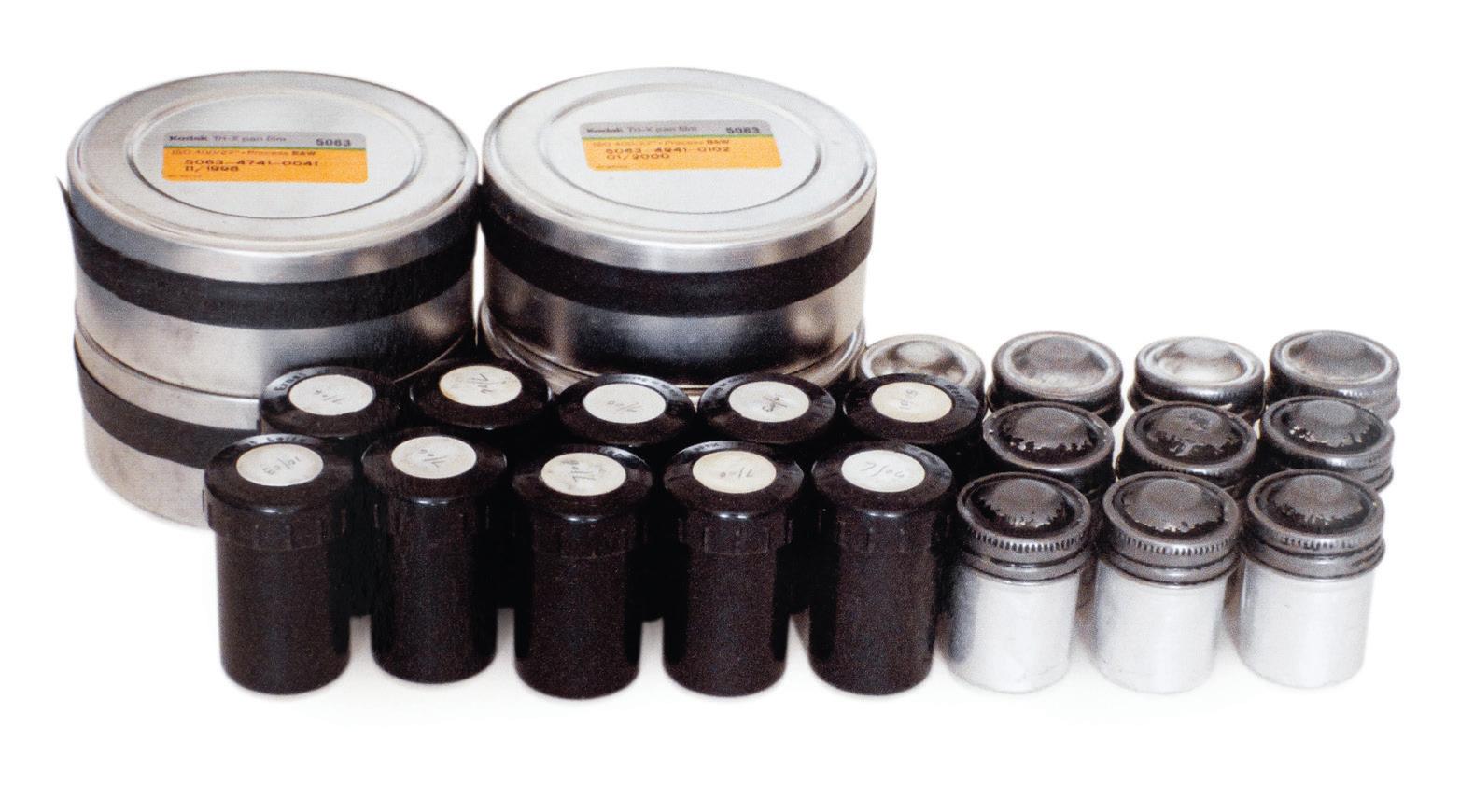
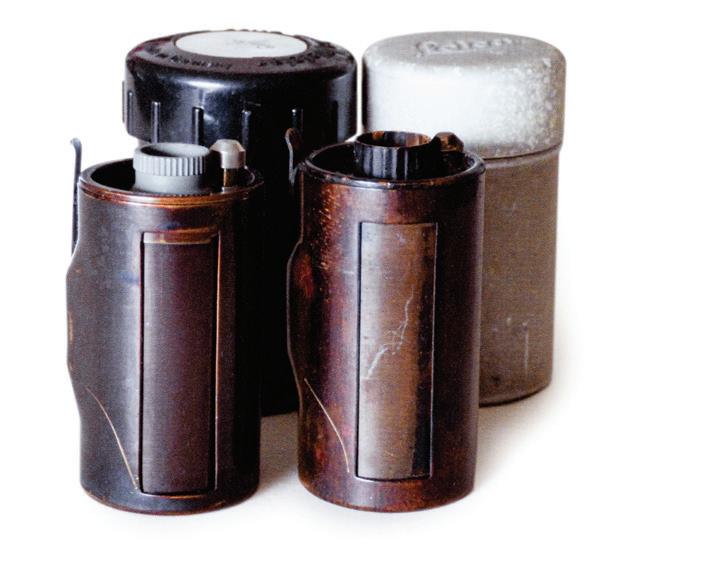
Dick Gilcreast brings us his article on using bulk film with the Leica. Bulk film has always been in the realm of the “heavy users” of Leica film cameras, but with the renewed interest in 35mm film photography, Dick lets us know there are still some tricks left up his sleeve!
See you in Dublin! Bis nächste Zeit! - Bill
A Short History of the LHSA
by BILL ROSAUER
The LHSA dates its beginnings back to 1968 when Gerald Leeson proposed to a few acquaintances who shared an interest in Leica that they form a “Club for collectors of old Leica models and accessories”. Leeson was the founder of this new organization. Daniel Eppelsheimer was our first president. The initial name for the group was Leica Collector’s International or LCI. The LCI was the logical successor to the stillborn Barnack Leica League, founded by Jim Forsyth and Oskar Barnack’s son, Conrad. Apparently, Forsyth had signed up a number of members and had collected dues from them, but none of the paid membership ever received anything in return. The LCI would change all of that!
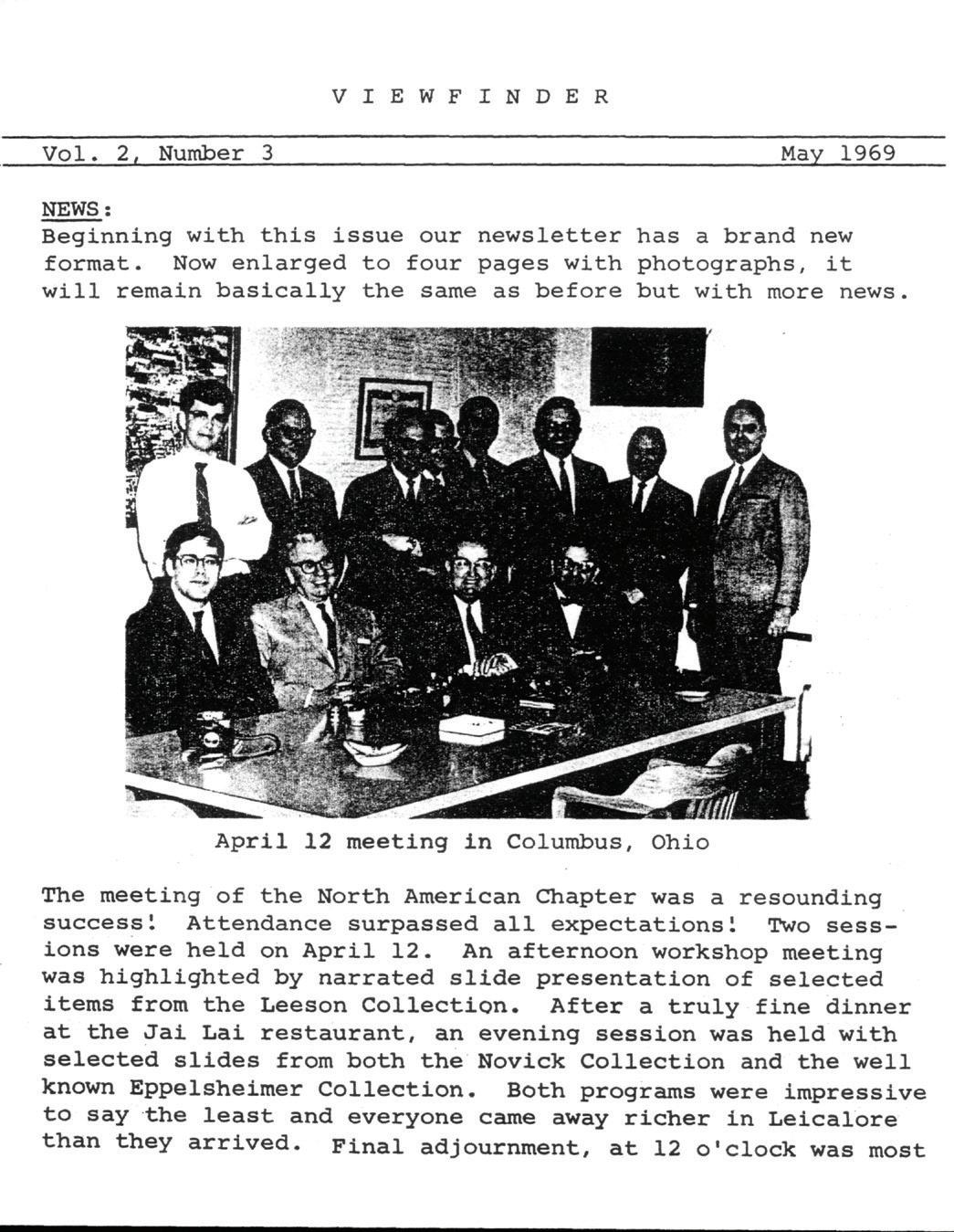
The first meeting was held in 1969 in an unused classroom on the campus of OSU (Ohio State University) in Columbus, Ohio. Al Clarke, a professor at OSU, provided the meeting space. In a photo of the attendees at that first meeting, there are 12 men all dressed in a suit and tie. Of the 12, eight of them were charter members of LCI. Among them were, Frank Christian, Rolf Fricke, Al Clarke and Jim Lager. As a tie in to the Null-Series Leica 105, Frank Christian and Al Clarke were the second and third owners of this historic camera. At first, no dues were collected, and costs were kept to a minimum. By November of 1968, the organization “had crossed the Rubicon”, and effective immediately, annual dues of $5 USD
would be charged to the membership. In return, each member would receive an 8” x 10” membership certificate suitable for framing and one year of Viewfinder . Also, new members would be considered for membership by member sponsored application only. In 1970, members of the LCI voted to change the name to Leica Historical Society of America, to reflect the growing interest in the history of Leica as well as in the camera itself. As quoted in Viewfinder , “This sounded less materialistic, and it forms a friendly international bond with our sister societies…”. By the middle of 1971, membership had expanded to 82 members.
By our 10 th anniversary in 1978, membership had grown to over 500. In the anniversary issue of Viewfinder , then president Al Miller asks the question, “Now, what about the future? Should we continue to grow? Shall we go to one or two thousand members?” It would take many years to reach this very ambitious goal of 1,000 members.
Leeson was also the author of its single type-written page newsletter, the Viewfinder . The first issue of the Viewfinder dates to January, 1968. He proposed having a bi-monthly newsletter which would be called the Viewfinder . He proposed that the founders underwrite the cost temporarily, given the unhappy experience of the Barnack Leica League.
The basic charter for the Society would be simple, summed up in a few short paragraphs:
“Preserve for posterity examples of all possible forms of early Leica equipment. Principally those which were manufactured in very small numbers in the early years.”
“Membership would be open to all who express a genuine interest in the hobby regardless of the size or extent of their personal collection.”
“That every effort be made to research historical truths and these be mutually shared with our fellow club members.”
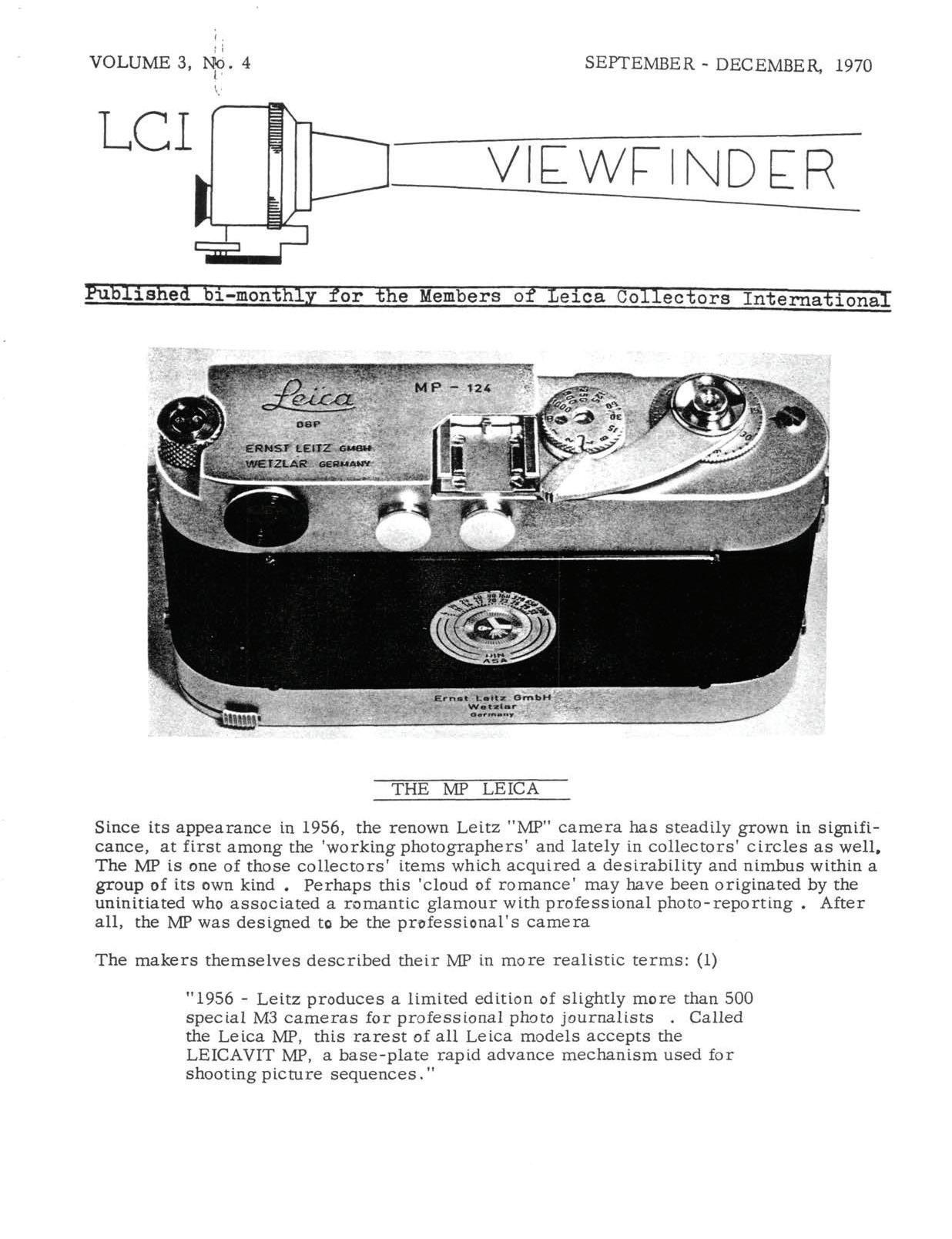
The LCI masthead logo of a stylized Torpedo Finder, made its first appearance in 1970, along with a grand content of four typewritten pages! Viewfinder 10-1, commemorating our
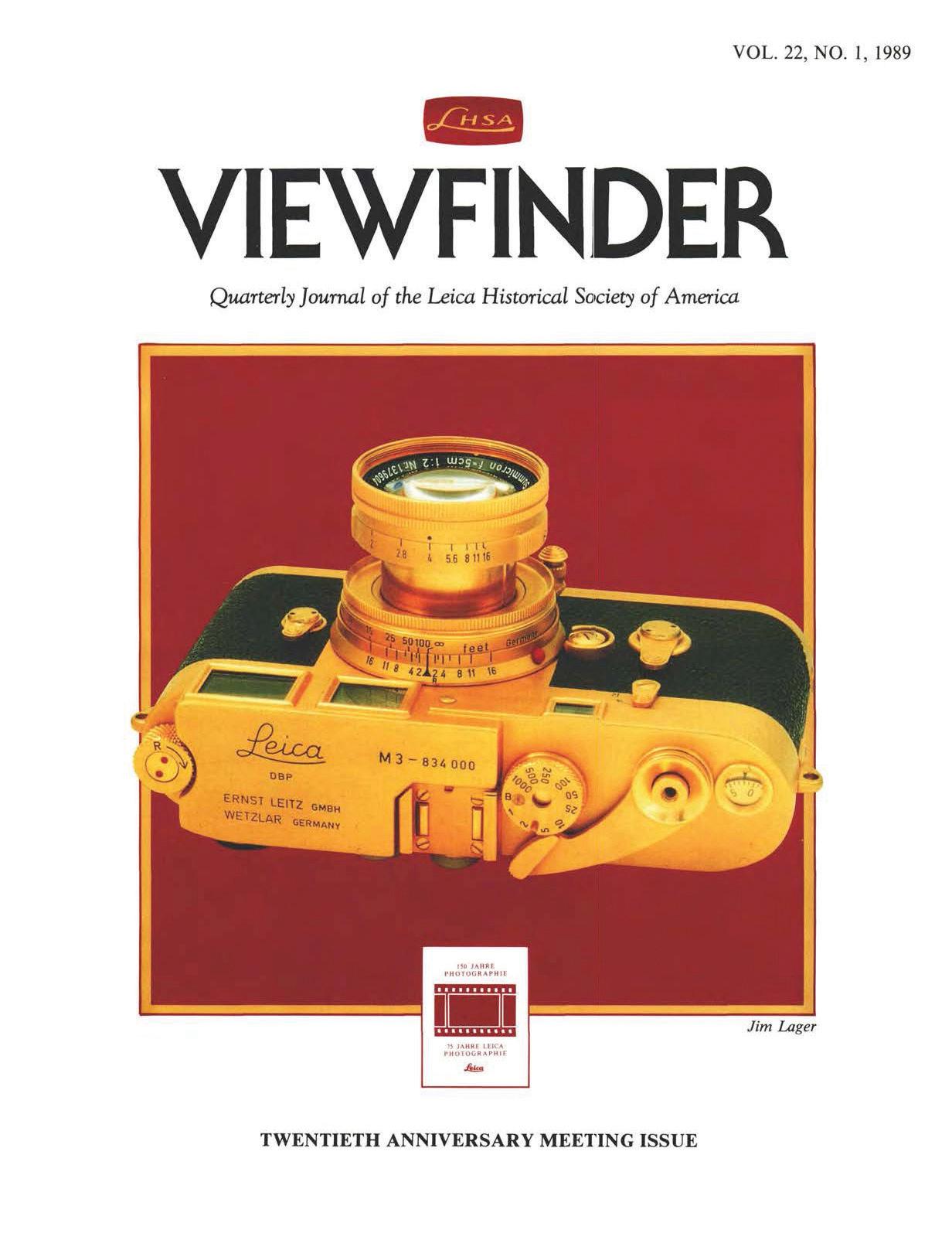
tenth year anniversary contained a grand total of 20 typeset pages with a scattering of images for the articles, and a saddle stitched binding. It took until Volume 16-1 for the first high quality image to appear on our cover, and Viewfinder now boasted thirty-two pages. Our first color cover photo, of a gold plated M3, appeared in 1989 with Volume 22-1. Many changes came over the years to the Viewfinder , where today we have a full color publication that has won several awards, and currently runs 54 pages per quarterly issue. For several years, we have also offered a digital version of Viewfinder at a reduced membership fee. We have also expanded our subject matter in Viewfinder , as well as our contributor base. In addition to the original subject matter of historic Leica camera and lenses, and the history of Leica, we now feature articles on using the Leica, improving your photographic technique, digital post-processing, and other wide-ranging subjects. The only requirement is that everything in Viewfinder be “Leica-centric”.
Every single back issue is available to all of our members in the LHSA archive on our website.
Annual meetings have always been a highlight of our year, with meetings all over the United States, several in Wetzlar, the home of the Leica, and this year, Dublin, Ireland emphasizing the international nature of the Society. We have also had Spring Shoots over the past 20 years, where a more informal setting is enjoyed by the attendees. We have also had a number of Leica luminaries attend our meetings. Among them, we have had Ernst Leitz III, Walter Kluck, Dr. Walter Mandler, Walter Benser, world famous photographers Alfred Eisenstaedt, Costa Manos, Jim Marshall, and current Leica management with Stefan Daniel and Dr. Andreas Kaufmann and our own world renowned Leica authority and historian, Jim Lager, to name a few important figures at Leica and the history of Leica.
The LHSA has also sponsored a number of Special Editions in collaboration with Leica Camera. These very special cameras and lenses sell out quickly, and have appreciated greatly in the collector market. The LHSA specials were responsible for the return of the Black Enamel M camera, and the retro versions of the 50mm Summilux M ASPH and the 50mm Summicron M APO lenses. Rest assured; more special editions will be in our future.
This brings us to our latest transition with a change in our name, to emphasize the international nature of our organization. We will now be known as the Leica Society International, or LSI in shortened form. We will also be introducing a new logo along with the new name, and it is a bridge between the old and the new.
GETTING
KIRAN KARNANI TO KNOW
by RICHARD REJINO
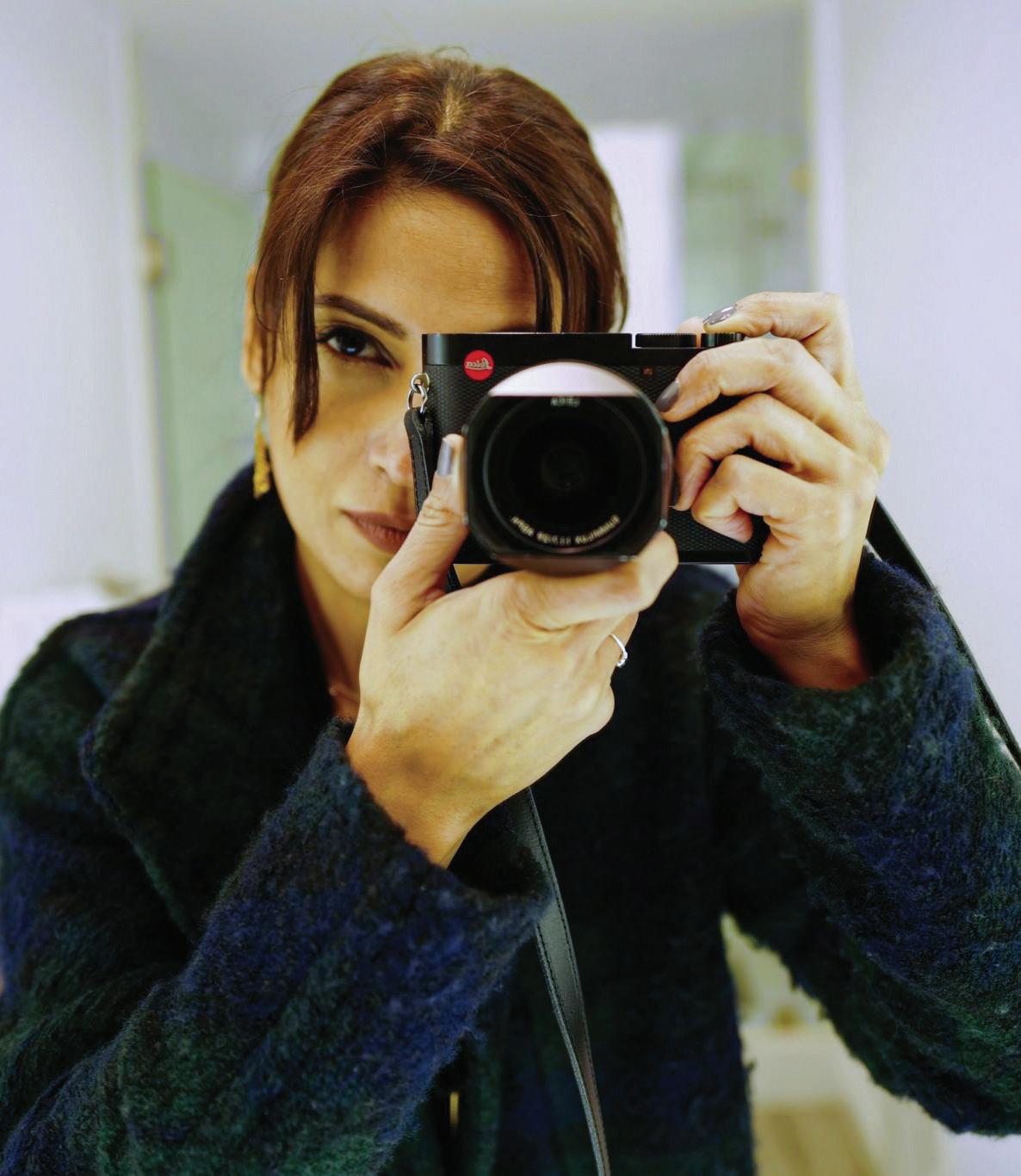
Kiran Karnani is one of the more prominent faces representing the Leica brand in the U.S. and across the globe. During her tenure as VP of Marketing for Leica Camera Inc., she has been pivotal in steering Leica toward new horizons, especially in causes that are important to building community, inclusion, and raising the voices of underrepresented photographers – particularly women. To know her is to know that she is passionate about her work, about Leica, and about understanding the shared Leica experiences that bring people together. For her, Leica is more than just a job. She famously said that (next to having her children) the best decision she ever made was to align herself with the Leica brand because at the heart of the company is the value they place on community and a shared passion for Leica photography.
Kiran’s background is rooted in the garment industry where she managed production and marketing for her family’s business in apparel manufacturing. “Growing up in a family business involving my father, his brothers, their sons and their wives, our collective conversations focused on work,” she described. “For us, the separation between work and personal did not exist. The two co-existed in harmony through a passion for work and family.” Indeed, work has always been “close to home” for Kiran and in many ways, she regards the Leica family as part of her own. In speaking with her, it’s easy to see the personal connection she enjoys with Leica and the people who stand behind it. It is the kind of connection that is essential to success.
If you’ve never met Kiran and asked someone about her, you will have likely heard the phrase, “Kiran’s wonderful!” That was certainly the case with me when I asked a colleague, “who is this person, Kiran, I keep hearing about?” When we finally met for the first time at an LHSA event in Seattle in October 2021, she and Mike Giannattasio, President of Leica
Camera Inc. were there to make a presentation to our conference attendees. I heard the animation in her voice when she spoke about the “Women in Photography” campaign. She spoke movingly about the need for inclusiveness and the art of storytelling to help create a sense of real community. Later, when I complimented her for the work she was doing, she was quick to deflect any credit and gave kudos to Leica leadership and others who have helped along the way. In addition, to the other superlatives I heard from others about her, I could now add one more, humility.
In the months since, LHSA has found no better friend than working with Kiran in strengthening its partnership with Leica USA/AG. Both she and Mike G. have been unwavering supporters of the Society by exploring collaborative programs, ideas, and advocating our Society in unprecedented ways. As a result, our membership is higher than it has ever been, thanks in part to special email campaigns from Leica, not to mention their donation of $5,000 and a M10 camera and lens toward the 2022 LHSA Annual Photo Grant. They are offering the similar support for the LHSA/Leica Women’s Photography Grant, which we will offer in the spring of 2023. Kiran and Mike G. see the International Leica Society as an opportunity to build a stronger Leica community, and we are proud to be an active part of that effort.
Recently, I had the opportunity to interview Kiran and find out a little bit about her photographic journey in hopes of showing a more personal side to our Viewfinder readers. Below are excerpts from our “email” and Zoom conversations.
RR: In your webinar with LHSA earlier this year, you mentioned that your Leica photography journey began with your parents, particularly your father. You described him as pausing the flow of family events so that he could record them for posterity. In those early childhood experiences, were you drawn to photography or the images first?
KK: Neither photography nor the images. What I remember is the impact of pausing time to record the moment. For my father, the camera was an opportunity to express to his subject his value of their presence, pausing time to record a shared experience. We chase light with our cameras, and my father’s purpose in making photos was to make his subjects feel radiant. In those early experiences, I was drawn to human connection, to the value of seeing moments that matter while simultaneously feeling seen.
RR: And when was the first time you picked up a camera on your own and created your own images?
KK: The first time I picked up a camera – with the intention to tell a story - was at 18. I spent time in India to immerse myself in a culture I was part of, but largely unfamiliar with as a second generation American. I bought a camera and rolls of black & white film from a local photo lab in Mumbai and started exploring and documenting. There were groups of children I’d pass by daily, some who lived on the streets lining the apartment buildings near Breach Candy. The camera served to remove our language barrier, making portraits and sharing the printed photograph where possible. I no longer have access to those images but hold dear the memory of them.
RR: How has your photographic journey evolved from that moment to today?
KK: My interest in photography is anchored in fostering emotional connections. Recording time through images feels expansive, expressive, and evolutionary to my life experience, and continues to be part of the way I engage and interact with the world. There is no shortage of inspiration from legends and icons for the next generation of photographers: Henri Cartier-Bresson, Vivian Maier, Gordon Parks, Sebastião Salgado, Ralph Gibson, Maggie Steber, Lynn Johnson, Rania Matar, Todd Hido, Devin Allen, Andre Wagner – the list goes on. With each image that inspires us, each image we make and share, we contribute to the evolution or our collective photographic journey.
RR: With all that inspiration to nurture you, how would you describe the experience of making photographs with a Leica as compared to other cameras? Which is your favorite Leica camera?
KK: Recording moments with a Leica is an experience. There’s an inherent emotional connection between a photographer and their Leica, a focus on the essentials – das Wesentliche – and a shared commitment to reduce distractions between photographer and subject. The camera doesn’t get in the way of a moment, but rather, serves as an extension of the eye to see in synergy with the photographer’s way of seeing. With this focus on the “essence” of a moment, it has been said that a Leica is a camera with a soul.
Ralph Gibson has been quoted as saying, “Learn how your lens sees - your lens will learn how your eye sees.” With other cameras, I’ve felt constrained by the way the camera wants to record a moment over the way I envision the photograph. I don’t enjoy post-processing, and with Leica, I’m satisfied with the resulting images straight off the sensor. My favorite Leica cameras are the Q2 – the weight, size and image quality make it easy to carry daily, and the M11. The USB-C connection on the M11 makes transferring images to my phone a breeze, the improved battery life and internal storage are truly remarkable.
RR: What kinds of photography are you drawn to? People, landscapes, abstracts, moods, etc.?
KK: I love photographing people and places – making emotional connections in the process. There’s an energy of a moment that I try to record, but not control. As Maggie Steber once described, “Photographs are like our children. We put the best of ourselves into them - the best of our vision, our minds, our hearts - and then
we send them out into the world. At some moment, perhaps the moment we click the shutter, they are being released. From that moment on, they don't really belong to us anymore.”
The presenting energy and emotion in any given moment is what drives me to press the shutter.
''...a Leica is a camera with a soul."
RR: When you are making photographs, would you describe yourself as an instinctual shooter or are you analyzing what is in front of you?
KK: Highly instinctual. My primary driver in making photographs is the experience and emotional connection between three audiences: the subject, the viewer, and myself.
RR: You have said that aligning yourself with the Leica values/brand was one of the best decisions of your life. Can you elaborate on what specific values or ideals of the Leica brand are in concert with your own?
KK: We talked about Leica’s commitment to the essence of the moment, providing photographers just the essentials to make a photograph, free of distraction. Not only do we believe in the integrity of our cameras and lenses, but also in the resulting images. We invite you to get closer to your subject, to be mindful with the moment, to think differently and with intention. With this ethos, our brand campaign, The World Deserves Witnesses, invites us all to record moments in time, no matter how big
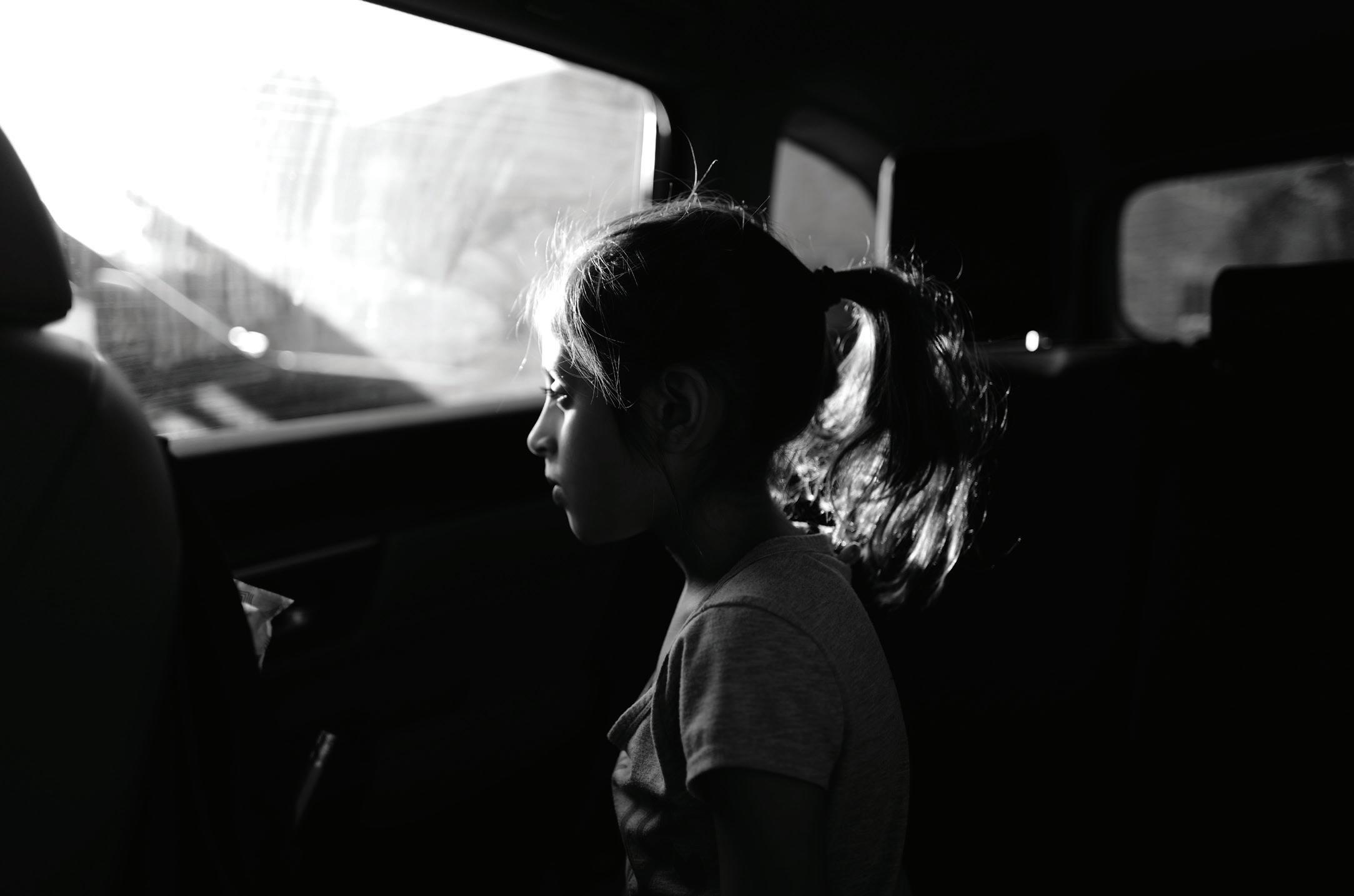
(above) Leica Q2, 1/500 sec, f/4, ISO 50 (below) Huawei MHA-L29, 1/900 sec, f/2.2, ISO 125
or small, as a shared responsibility towards the next generation. Bearing witness to our world, being fully present to see and record the beauty, the charm, the grace and the moments in between, fully aligns with my personal values and beliefs. Leica shines light on moments that matter, and it’s my belief that every moment matters.
"Leica shines light on moments that matter, and it’s my belief that every moment matters."
RR: Among the many achievements you have made with Leica, certainly one of the more passionate of these is your work promoting the voices of women. What would you say are the most salient points you try to communicate about the importance of women in photography?
KK: Photography has the power to inform the way we see and interpret our world. Diverse perspectives serve to reshape a single narrative to afford the viewer more opportunities to determine how they choose to receive visual information. With fluidity on our definitions of gender, there’s a sense of responsibility to amplify visual stories from underrepresented voices to evolve the way we think, see, act, and feel.
The Leica Women Foto Project was conceived through a conversation with Maggie Steber, whose experiences sparked opportunities. Maggie shared stories of her remarkable career, candidly expressing the challenges she and others have experienced as a woman in photography. We identified that women need three things to serve their success in the field of photography: 1) Funding 2) Equipment 3) Mentorship. And with that conversation, the Leica Women Foto Project was born. With Karin Rehn-Kaufmann at the forefront of Leica’s commitment to art & culture - leading with the Oskar Barnack Award, the Leica Hall of Fame Award, and now, the Leica Women Foto Project Award - the pursuit of an initiative that amplifies underrepresented voices in photography in a meaningful way delivers the most fulfilling experiences on both a professional and personal level.
RR: The classical composer, Felix Mendelssohn once said that life and art are not two different things. How have your own values/experiences informed the way you conceive and communicate the Leica brand?
KK: With visionaries and icons leading the Leica brand – Dr. Kaufmann, Mrs. Karin Rehn-Kaufmann, Mattias Harsch, Stefan Daniel, Peter Karbe, Andrea Pacella, Mike Giannattasio and more, shared values towards the pursuit of optical excellence and the essential experience of making a photograph become intrinsic values on a personal level. With the recent record-breaking auction, we continue our service as stewards of the Leica brand, holding the legacy, heritage and innovation with utmost care, respect, and reverence.
RR: Likewise, how has Leica (and the camera) changed or fulfilled your life?
KK: There is always a moment to be inspired with Leica. From visionary talks by Dr. Kaufmann, to the cultural initiatives driven by Mrs. Karin Rehn-Kaufmann, to Mike Giannattasio’s inspiring leadership, the people, products and community uplift and motivate.
Experiencing the evolution of our community in their own personal journey through the world of Leica photography while bearing witness to their remarkable accomplishments is deeply rewarding. One camera can say so much, but it’s the community that brings light to the story. The growth and expansion of our photo community is deeply influential towards my own way of seeing.
Our relationship with LHSA grows stronger with each year. Working in partnership with LHSA on philanthropic efforts underscores our shared commitment to amplify underrepresented voices in photography with exciting opportunities. With initiatives like the Leica Oskar Barnack Award to LHSA’s Grant to the Leica Women Foto Project, there’s no shortage of opportunities to feel purposeful and fulfilled.
"LHSA is an important voice of Leica and plays an integral role in our evolution."
LHSA holds a set of keys to the Leica legacy. From the preservation of our history to the stories each member creates and shares, LHSA is an important voice of Leica and plays an integral role in our evolution. There’s an interesting dance between legacy and personal fulfillment: how do we choose to see and carry our visual expression for generations to come? Any camera can record time. With a Leica, we choose to see with deliberate intention, authentic to our visual perspective, for stories that transcend time.
RR: It has been a joy to learn more about you I have one final question: I have often said that Leica is to cameras as Apple is to computers. Both are beautiful in design and functionality; in our hands, they transform into an extension of ourselves rather than a mere camera or computer. How can Leica enthusiasts, leverage this passion to make a difference and give the world much deserved witness?
KK: Through the active participation in the recording and sharing of life’s journey. With Leica in hand, we bear a responsibility to tell our unique story. By documenting moments that matter and observing that every moment is one that matters, we co-create visual stories the world deserves. •
I want to thank Kiran for sharing her story with Viewfinder and for sharing her images with us. We are happy to announce that Viewfinder will also be featuring the 2022 recipients and mentees of the Leica Women Foto Project Grant in upcoming issues. It will be an honor to bring their work to you.
“Kiran’s dedication not only to the Leica brand but to our Leica community fuels the scope of storytelling and passion that brings us all together as artists. Her support of my transition to the company two years ago is unending and she continuously strives to support every aspect of our brand to continuously build upon the legacy of Leica.”
– Mike Giannattasio President, Leica Camera Inc.
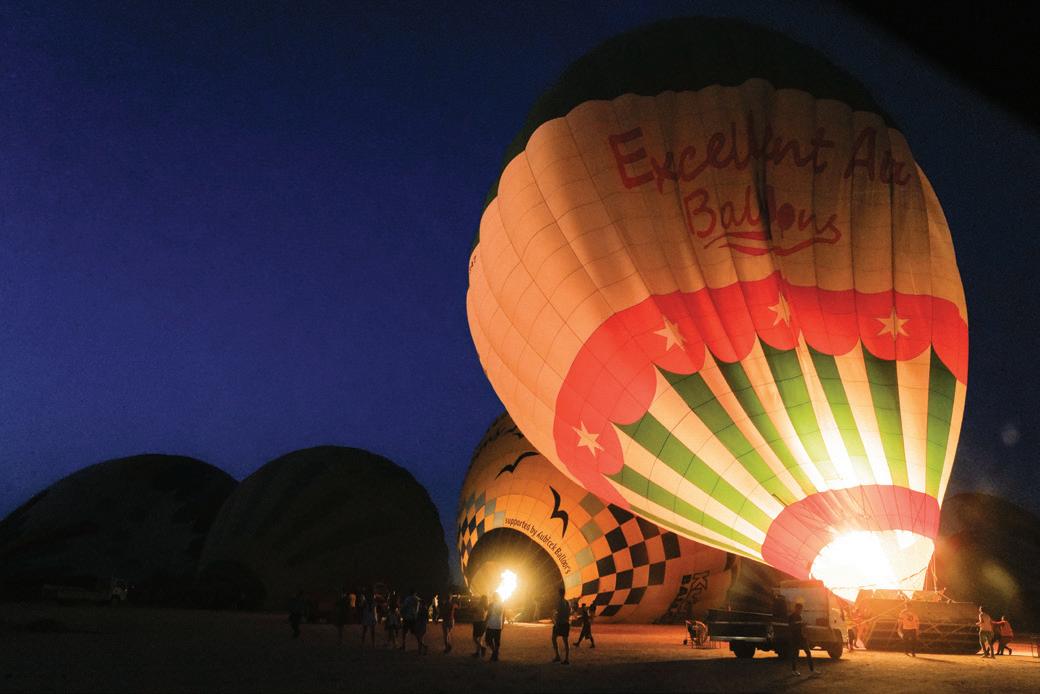
Leica Q2, 1/3200 sec, f/8, ISO 100
THE 'CLOSE-FOCUS' 35MM SUMMILUX-M F/1.4 ASPH FLE II
by JONATHAN SLACK
I've been shooting with the new Leica 35mm Summilux-M f/1.5 ASPH FLE II since February, but I wasn't aware of the launch date until the day before we came on holiday. So I've been shooting the M11 with the new 35mm Summilux FLE exclusively since we arrived. We've become the best of friends.
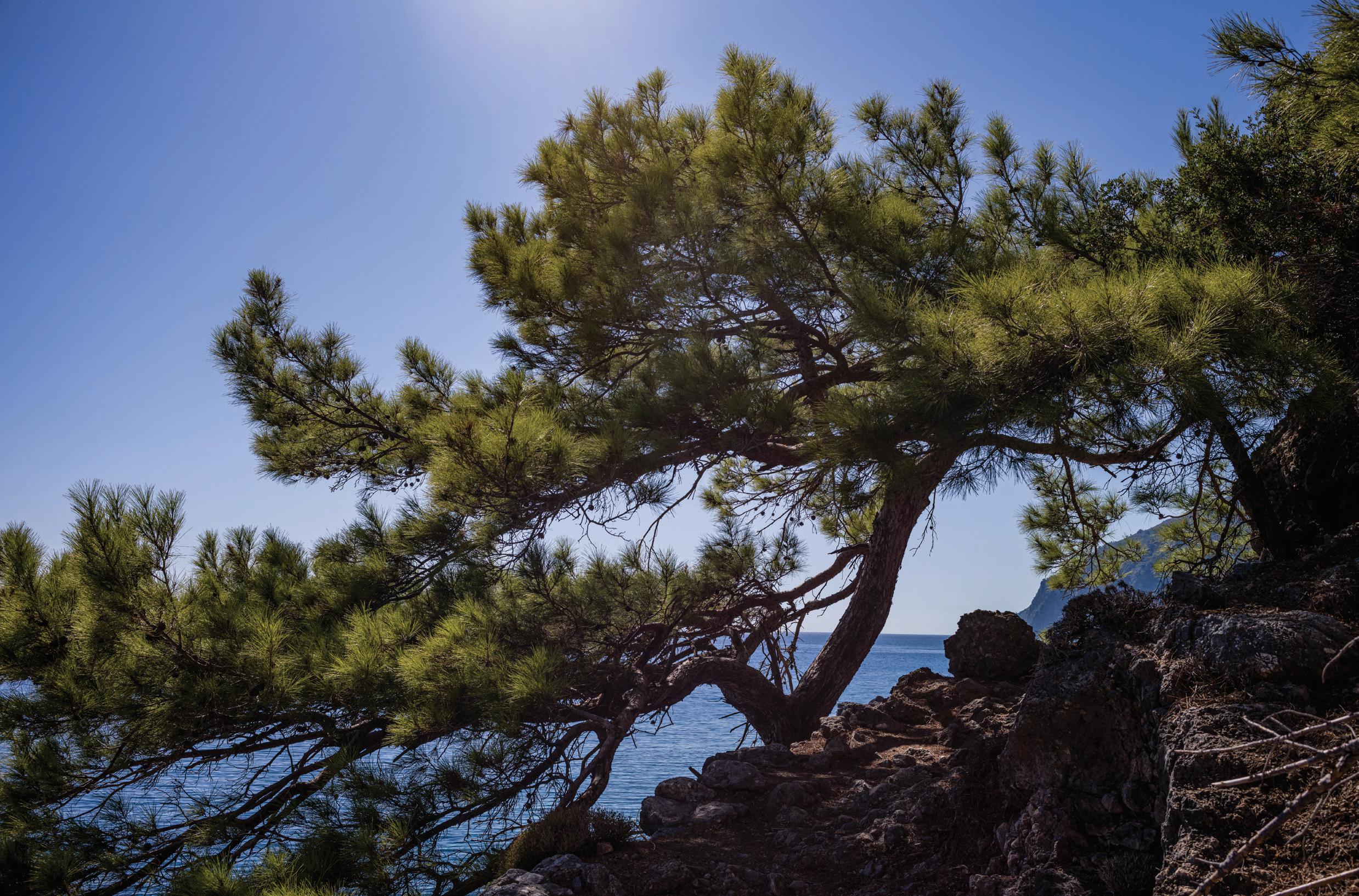
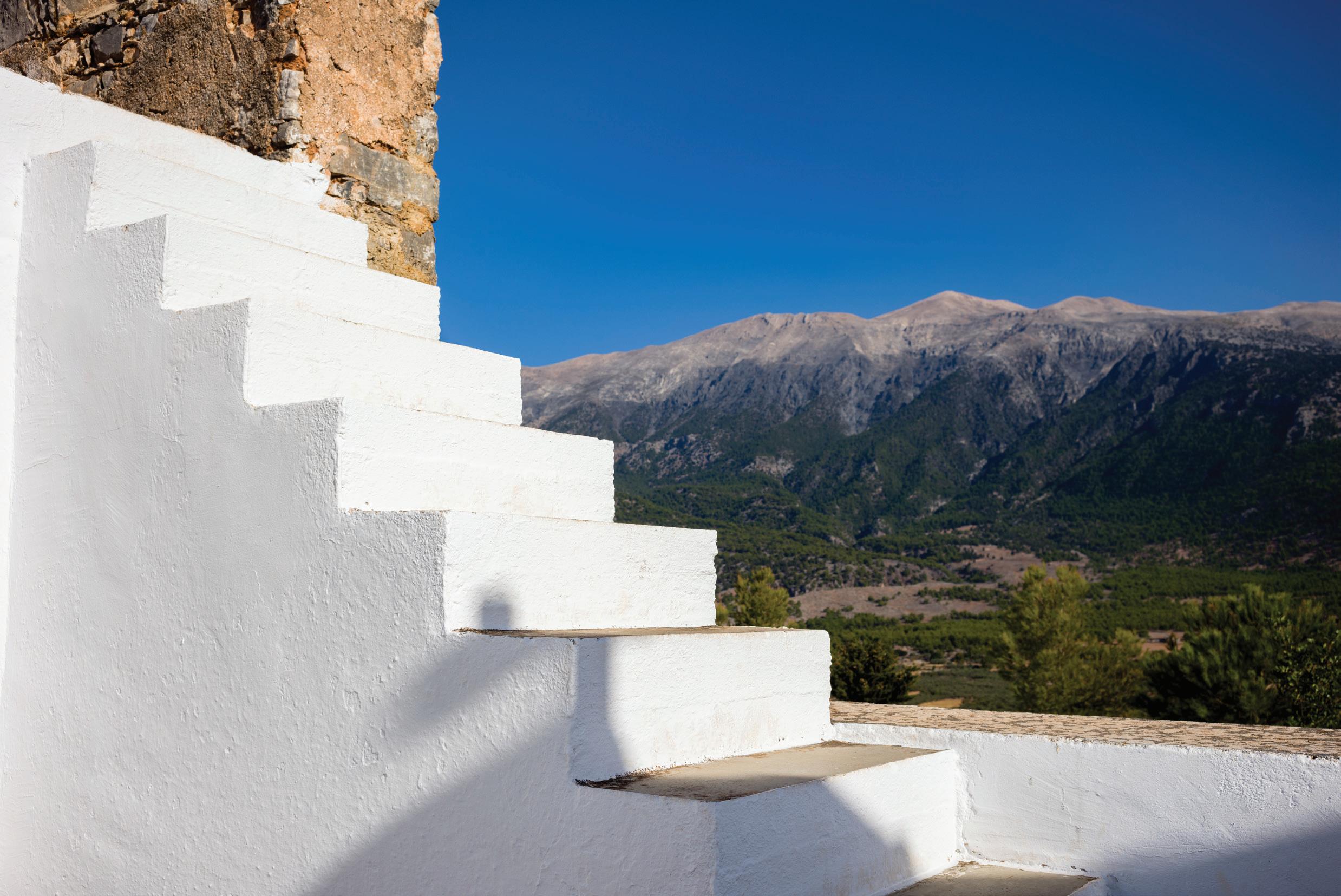
We have spent the last couple of weeks in the South West coast of Crete, where the Lefka Ori (the White Mountains) come down to the sea. There is a stretch of coastline between Chora Sfakion in the East and Sougia in the west where there are no made up roads down to the coast and you must either catch a boat or walk. It's wonderful to spend a few weeks without even seeing a car! However, the upshot of this is that quite a lot of this article has been written on an iPhone mini whilst sitting on the beach. At any rate, here are my thoughts on the new lens.
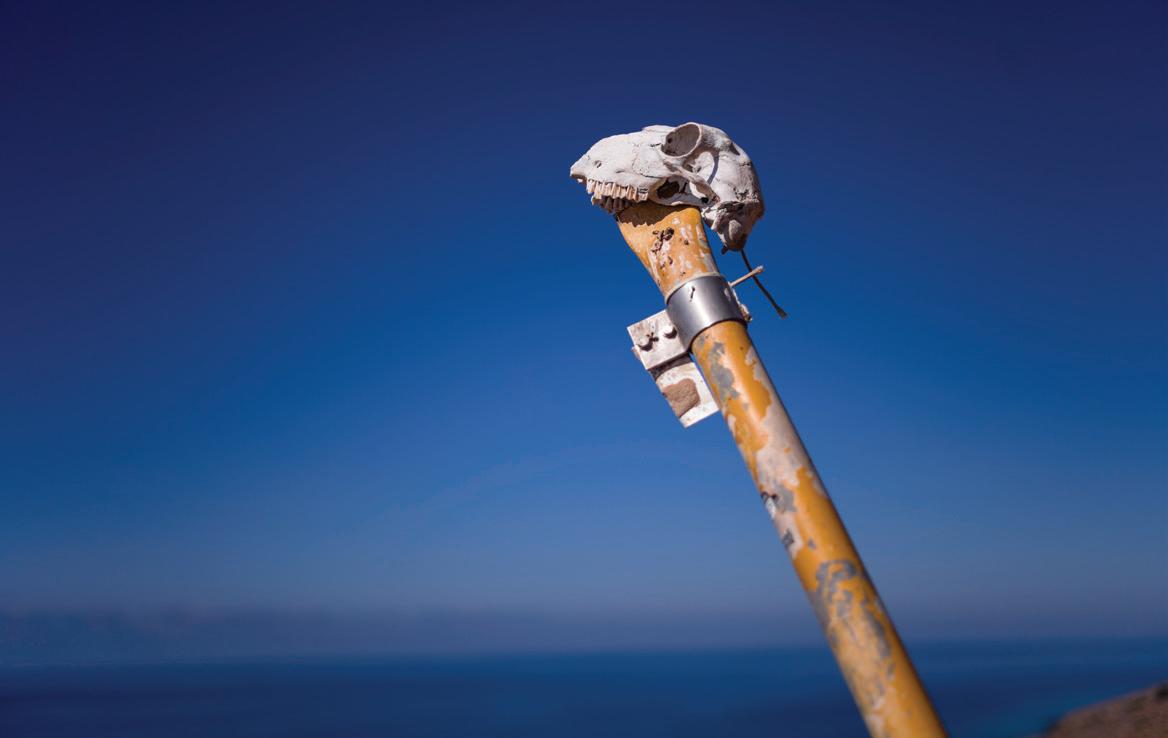
The denizens of Lefka Ori are the goats and the vultures (with the odd taverna in the most unlikely place) . I've tried to catch the spirit of it whilst putting the new lens through its paces. I've always meant to shoot a trip with one camera and one lens, but I think this is the first time I've actually done it. Mostly just using the rangefinder - with Live View for the odd close up shot - but sometimes with the EVF, it's a little like shooting a 35mm Q2 on steroids!
Since the early days of 35mm images, photographers have been divided as to whether 35mm or 50mm is the real 'standard lens'. Of course there isn't a proper answer, it depends on what you shoot and your personal preference.
What certainly is the case is that since the arrival of the first Summilux lens in 1959 (the 5cm f/1.4), the Leica Summilux has been the workhorse lens for photographers around the world. The first 35mm Summilux arrived in 1961 (the 'steel rim') and is still a lens prized by collectors and photographers alike.
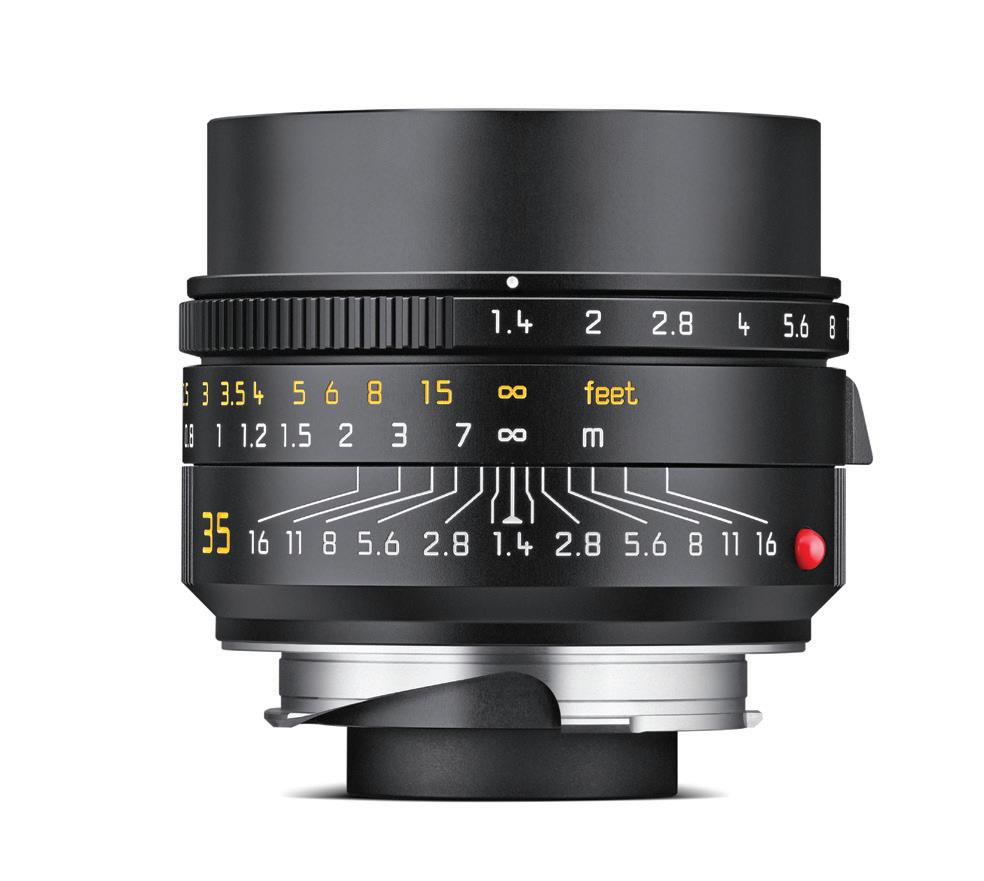
The new close-focus Leica Summilux-M 35mm f/1.4 ASPH FLE II. Image courtesy of Leica Camera.
The first aspherical 35mm arrived in 1991, but less than 4000 copies were made - perhaps due to the difficulty in manufacturing with its two aspherical elements. It was replaced by the 35mm Summilux-M ASPH in 1994 with one aspherical element. This was in production until 2010, a fantastic lens, but rather subject to focus shift.
To solve the focus shift issue, Leica introduced a new 35mm Summilux with a floating element in 2010. Generally known as the 35 FLE, this lens has been the centre of many photographer's arsenal for more than 10 years.
THE LEICA SUMMILUX-M 35MM F/1.4 ASPH FLE II (CLOSE FOCUS) When the FLE was released, the M9 was Leica's flagship camera. There was no Live View or electronic viewfinder, so there was no incentive to improve on the close focusing limit of the Rangefinder (0.7 metres).
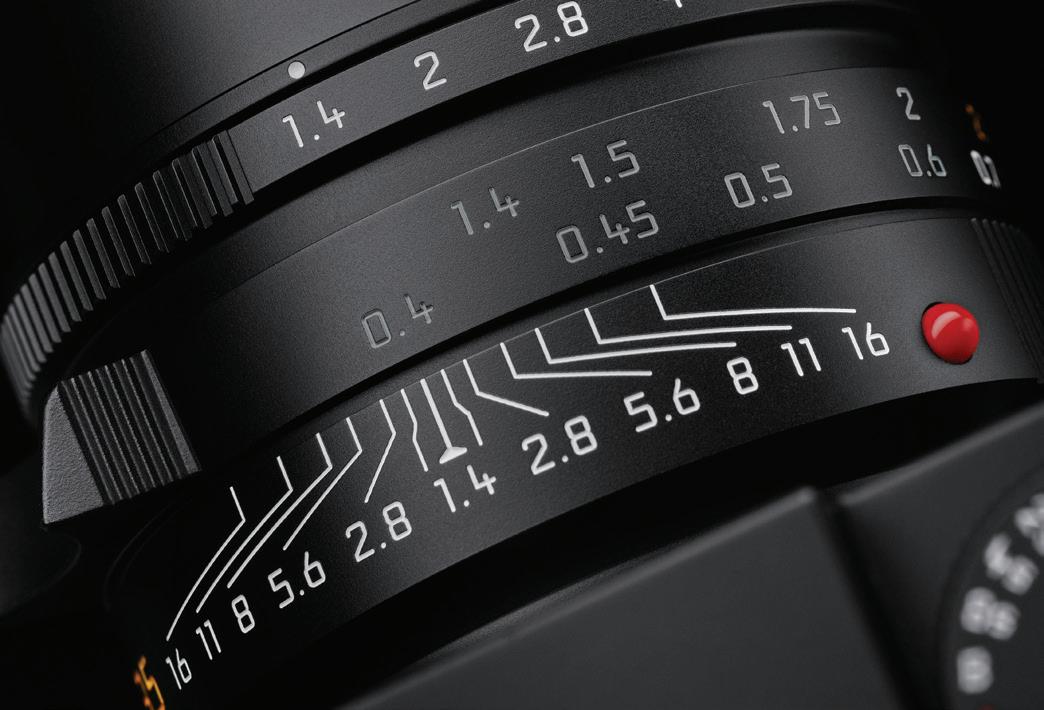
By the time the SL2 and the M10 were released, times had changed, and there was a real possibility of making M lenses with closer focusing. The 35mm APO-Summicron-M f/2 ASPH was the first lens to support this newly designed 'double cam' focusing mechanism, and the new close-focus 35mm Summilux allows you to focus down to 0.4 metres. The focusing throw has been almost doubled to 176 degrees and there is a clearly felt resistance at 0.7m beyond which you need an EVF, Live View or Leica Fotos for precise focusing.
Although the screw in lens hood of the FLE was a definite advantage over the clip on (drop off!) offerings of earlier lenses, it still added considerably to the bulk of the lens. The new slide-out lens hood is better still, and seems to be just as successful at reducing flare. The result of these changes is that the new lens as about 1mm shorter than the old one, and about 1mm fatter, not something which will be easily detected.
The original FLE had 9 aperture blades, which helped to produce its great bokeh. The new close-focus FLE has 11 blades, improving the bokeh for all apertures smaller than f/1.4 where the aperture is round for both lenses.
PERFORMANCE I've been using the new lens since February, largely with my M11, but also with the SL2. I've carefully compared the performance with my 35 FLE, and it does seem that the new lens has a slightly more relaxed and gentle bokeh.
Like the original FLE, the new lens is prone to a small amount of Chromatic Aberration with high contrast edges, especially at wide apertures (think tree branches against grey sky ). This is easily fixed in Lightroom or the processor of your choice.
CLOSE FOCUSING The new close focus option is lovely to use, and also creates great photo opportunities. I have been using it mostly on the M11 - both with Live View and with the EVF.
I’m writing this from Crete where the high contrast and bright colours make for lots of opportunity to use the close focus. Here the electronic shutter really comes into its own, making it possible to shoot wide open without using Neutral Density filters.
CONCLUSION This lens has three benefits over it's predecessor:
• Close focus opportunities
• Newly designed body with twist out lens hood
• 11 as opposed to 9 aperture blades for better bokeh
The optical formula is the same as the original FLE (no bad thing) . It comes in black and silver anodised versions which weigh the same.
If you already have the FLE, then the new lens might not be a compelling upgrade, but Leica has made some real incremental improvements to what was already a great lens. If your principal camera is an M11 or an SL2 then the upgrade may seem quite compelling.
Personally, I've found that the combination of the close focus, and the excellent EVF on the M11 together with the improved ergonomics has made the new Leica 35mm Summilux-M ASPH FLE remake a lens to fall in love with.
(above) Close-focusing scale on the new 35mm FLE. Image courtesy of Leica Camera. All other images in this article were taken with the Leica M11 & 35mm Summilux-M f/1.4 ASPH FLE II (Close-Focus). For more sample images, visit https://www.slack.co.uk
A little over 500 years ago, the Portuguese Ferdinand Magellan discovered a sea passage in the south of the planet, a region completely unknown by the Europeans who later called it “Terra Australis Incognita”. This discovery united the world and would come to be the first globalization of modern society. The waters of The Strait of Magellan unites the Atlantic and Pacific oceans. Strait of Magallan, Chile, 2021.
CLASH OF CIVILIZATIONS
by MARCIO PIMENTA
Just over 500 years ago, Portuguese navigator Ferdinand Magellan discovered a sea passage in the southern reaches of our world, a region unknown to Europeans, who called it Terra Australis Incognita. This discovery united the world in the first globalization of modern society. The passage became known as the Strait of Magellan. In the wake of Magellan came European farmers, who had already domesticated plants and animals, and, upon reaching the now-named Tierra del Fuego, found hunter-gatherers who were living there for over 10,000 years, as a result of humankind’s migration throughout the planet. Among the tribes there was an ethnic group that would be known as Selk’nam. The meeting between European farmers and hunter-gatherers meant the death sentence of the latter, a tragedy still to be discussed. Considered extinct in history books and laws written by the victors, the survivors claim to be alive, and are now fighting for recognition.
Just over 500 years ago, Portuguese navigator Ferdinand Magellan, leading an expedition from the then Kingdom of Spain, discovered a sea passage in the southern reaches of our world, a region unknown to Europeans, who called it Terra Australis Incognita. The discovery united the world in the first globalization of modern society. Groping for a passage to the Indies, the expedition, commandeered by the explorer aboard the Victoria, was already below latitude 52º S when, through the fog, bonfires were sighted on the coast of South America. It was the first sign of human presence at these latitudes. The navigators did not know it, but that land was called Karukinka (Our Land) and the fires were lit by the Selk’nam people (also known as Ona) to combat the cold and cook food. The Selk’nam had arrived there more than ten thousand years ago as a result of our species’ great adventure across the planet, a journey of at least 60,000 years that started at the East Africa Rift Valley and along which humans spread throughout and found their the last land – finis terrae – the last continental frontier.
Hundreds of years after Ferdinand Magellan, in the 19th century, other Europeans and their descendants would arrive – this time to stay. They were farmers, bringing the culture of domesticated plants and animals, and Salesian missionaries. The outsiders found groups of hunter-gatherers living nomadically in that wild and inhospitable environment of short summers and long winters. The meeting between European farmers and hunter-gatherers meant the death sentence of the latter, resulting in a genocide which, in twenty years, brought about the almost complete extermination of
the population of Tierra del Fuego.
Tierra del Fuego is a Patagonian archipelago separated from the South American continent by the Magellan Strait, which connects the Atlantic to the Pacific Ocean (so named by Ferdinand Magellan).The name Tierra del Fuego (Land of Fire) was also given by Magellan in 1520, when he saw the flames and smoke of natives’ many bonfires from his vessel on the coast of Isla Grande, the main island of the archipelago. Magellan, leading a Spanish expedition, was the first European to reach those windy lands.
Fast forward many centuries, and there I was, facing blowing winds which were, almost successfully, trying to prevent my advance towards the Selk'nam. I was in Punta Arenas (Chile), still on the continental side of Patagonia. I was walking on the shores of the wild blue sea of the Strait of Magellan, leaning forward, as low as possible, to overcome the force of the wind. I felt as though I was pulling a sled loaded with many days’ worth of food and equipment, but actually, it was summer, there was no snow, and all I carried was my Leica M10 camera.
I finally reached the hotel where the Selk'nam resided, and was welcomed by Hector Chogue and his brother, José Luis Vásquez Chogue. They laughed at my futile attempts to overcome the fierce winds, even though they were very close to me. Hector is the former vice-president of the Covadonga Ona community and José is the current secretary of the Corporación Selk'nam, the institution which organizes the demands of its people on the Chilean side of Tierra del Fuego. These groups were similar to the Argentinian Comunidad Rafaela Ishton, in that they exist to fight for the rights of their peoples’, starting with the very acknowledgement that they still exist and have not been extinct.
Having a Leica with me was extremely advantageous. The people of Patagonia and Tierra del Fuego are very distrustful, evasive and taciturn, and really do not like cameras. As such, the aggressiveness of large DSLR cameras is generally not welcome. But when I took out my Leica M10 with a discreet Leica APO-Summicron-M 90mm f/2.0 ASPH lens, they were reassured. I was glad I had the perfect gear to make portraits and photos as perfect as that hostile land. I also carried a Leica Summarit-M 50mm f/2.4 and Leica Summicron-M 35mm f/2 ASPH. In addition to highperformance memory cards and extra batteries, I carried a backup Leica Q.
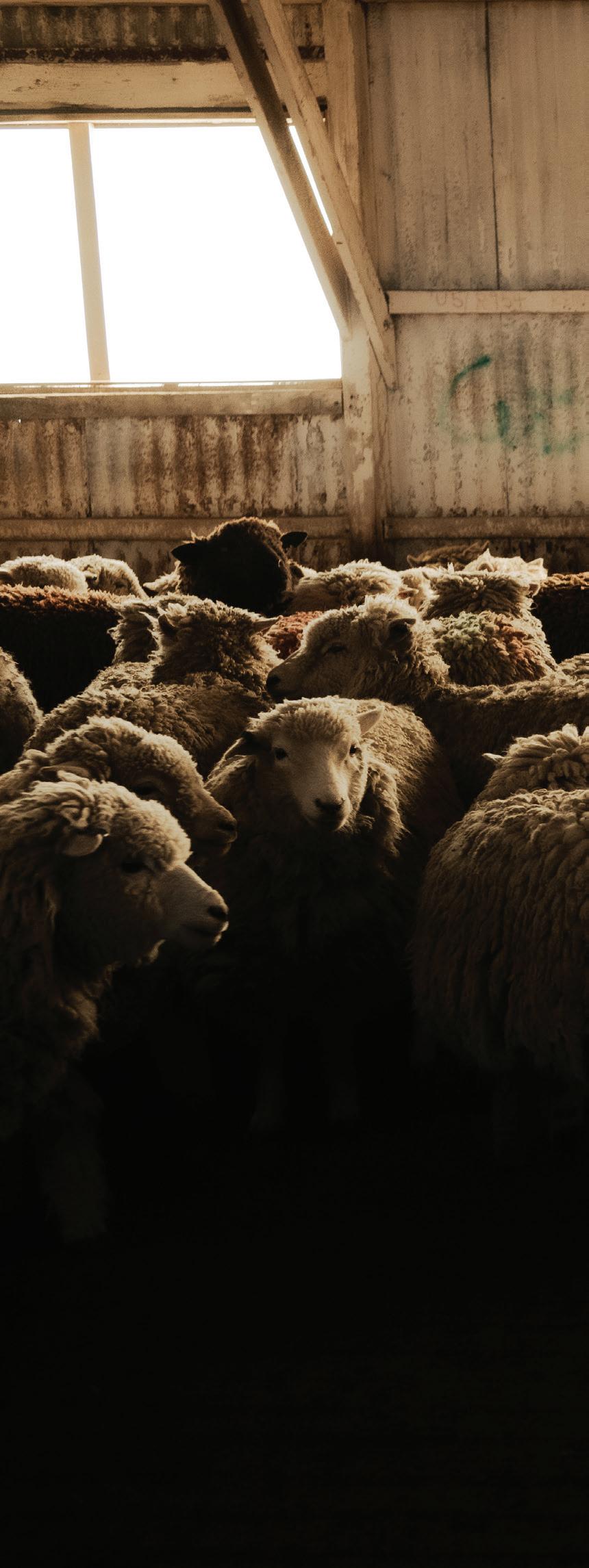
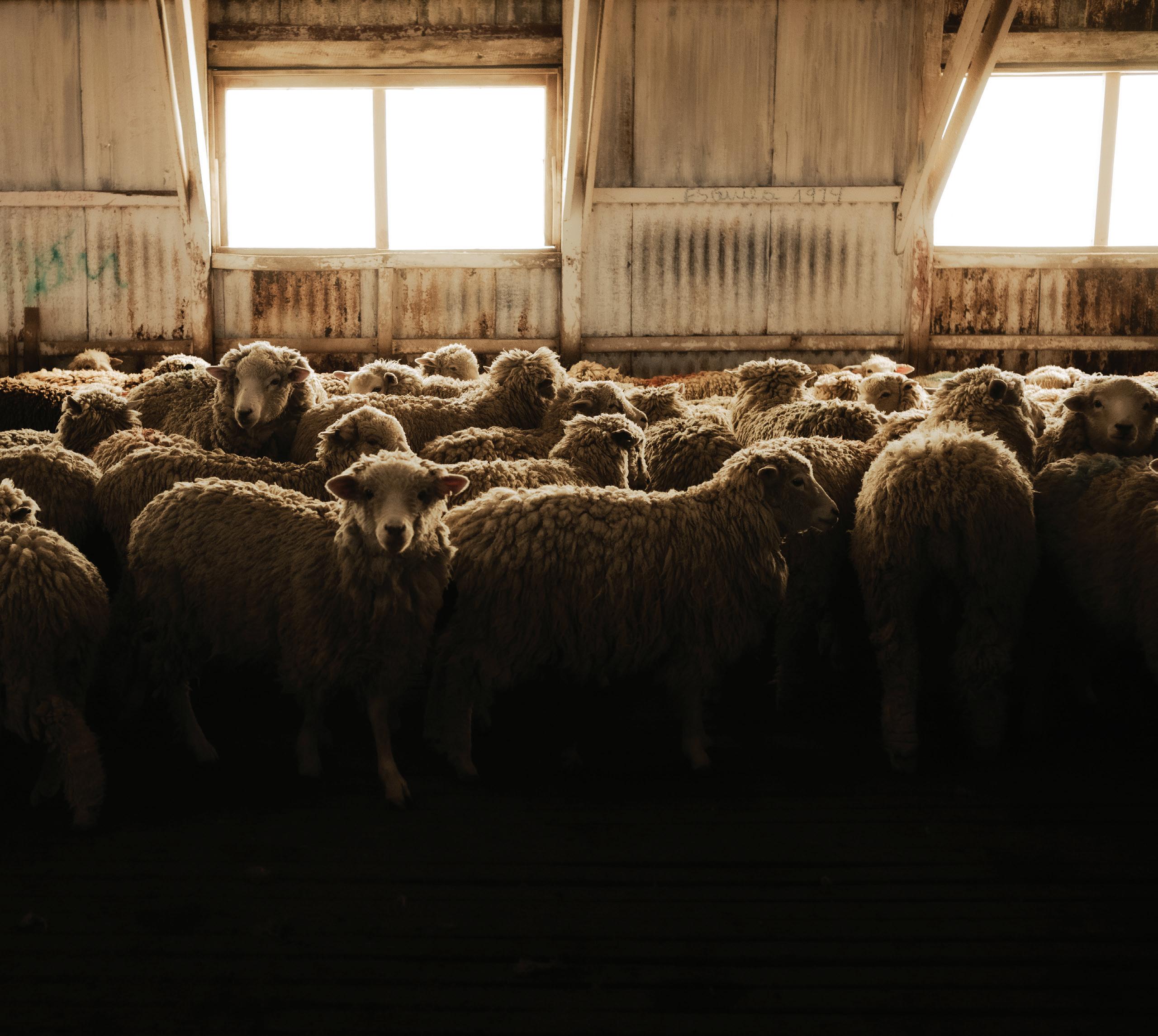
(top) The Europeans brought horses and sheep. The way of life that required large areas of land caused conflict with the Selk'nam. Tierra del Fuego, Chile, 2021.
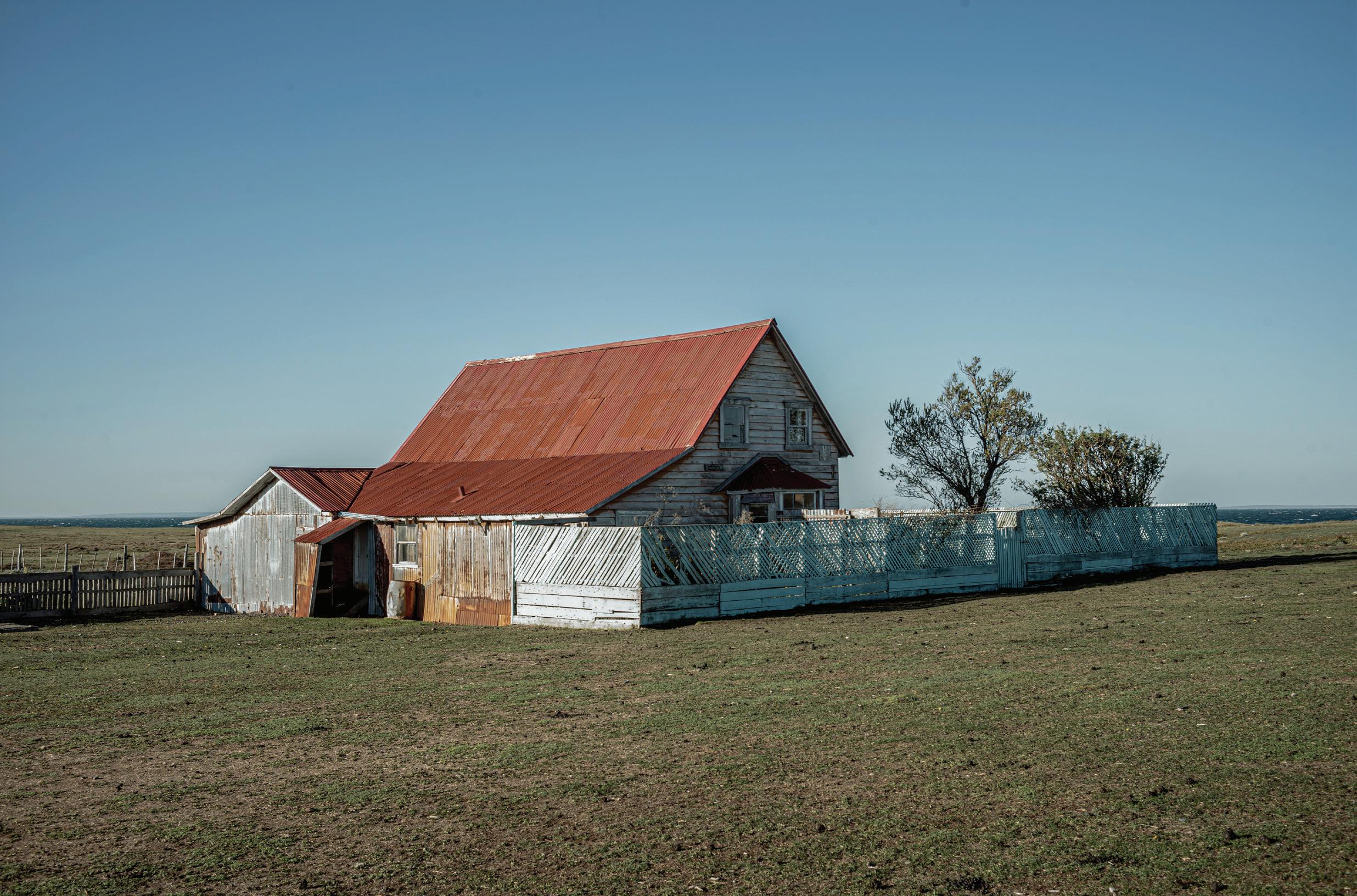
(bottom) Society Ganadera Gente Grande, according to recent surveys was the first farm to be founded on Tierra del Fuego, in 1883. Here began the conflict between the Selk'nam and the farmers. The house also had a small port for the ships. Some Selk'nam were taken to Europe to be exhibited in human zoos. Tierra del Fuego, Chile, 2021.
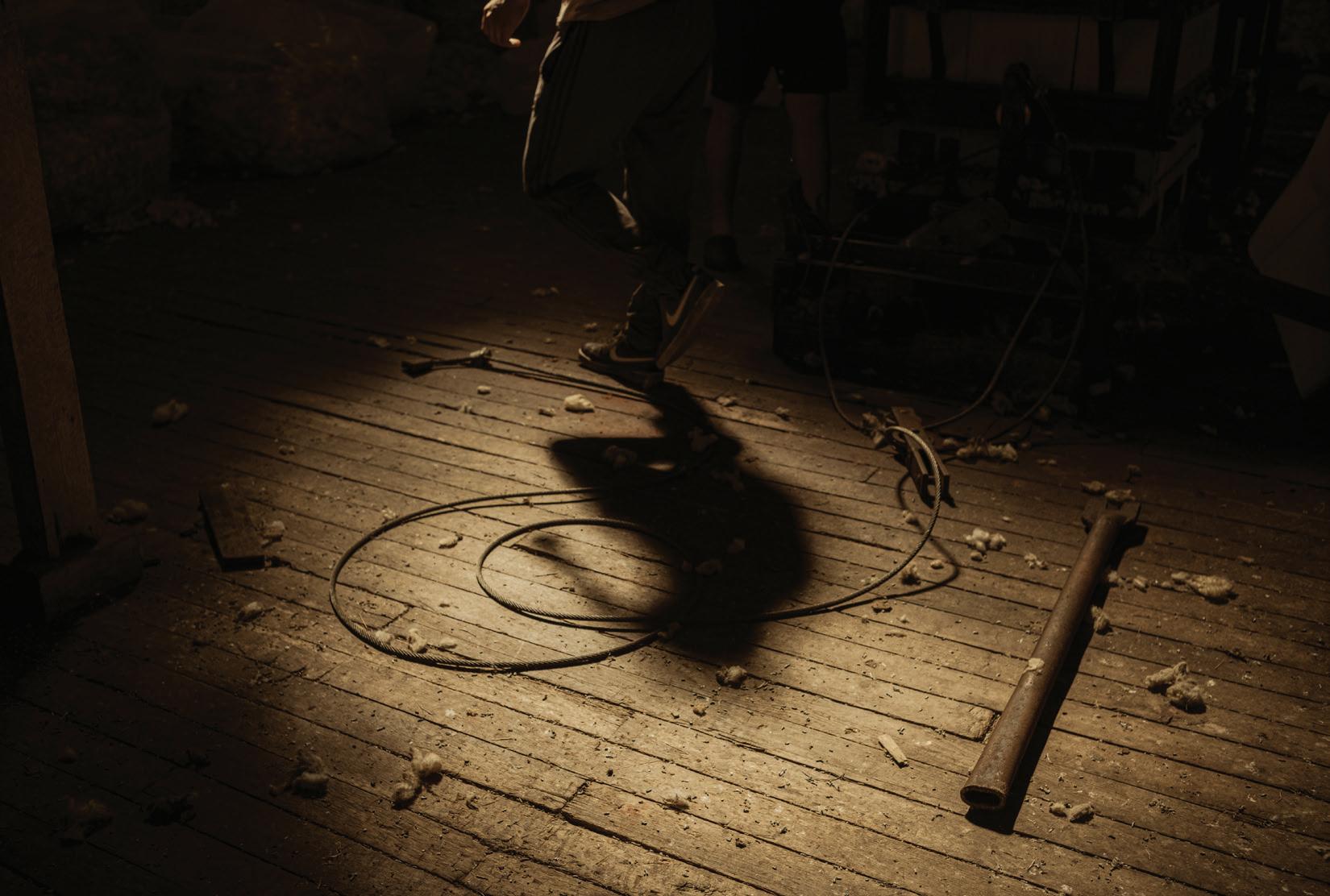
A worker shears a sheep. The occupying force had a clear motive: to raise sheep. Farmers occupied the fishing and hunting lands of the Selk'nam. There are records that some Selk'nam groups were arrested at the ranches before being sent to Dawson’s Island. Or murdered. Tierra del Fuego, Chile, 2021.
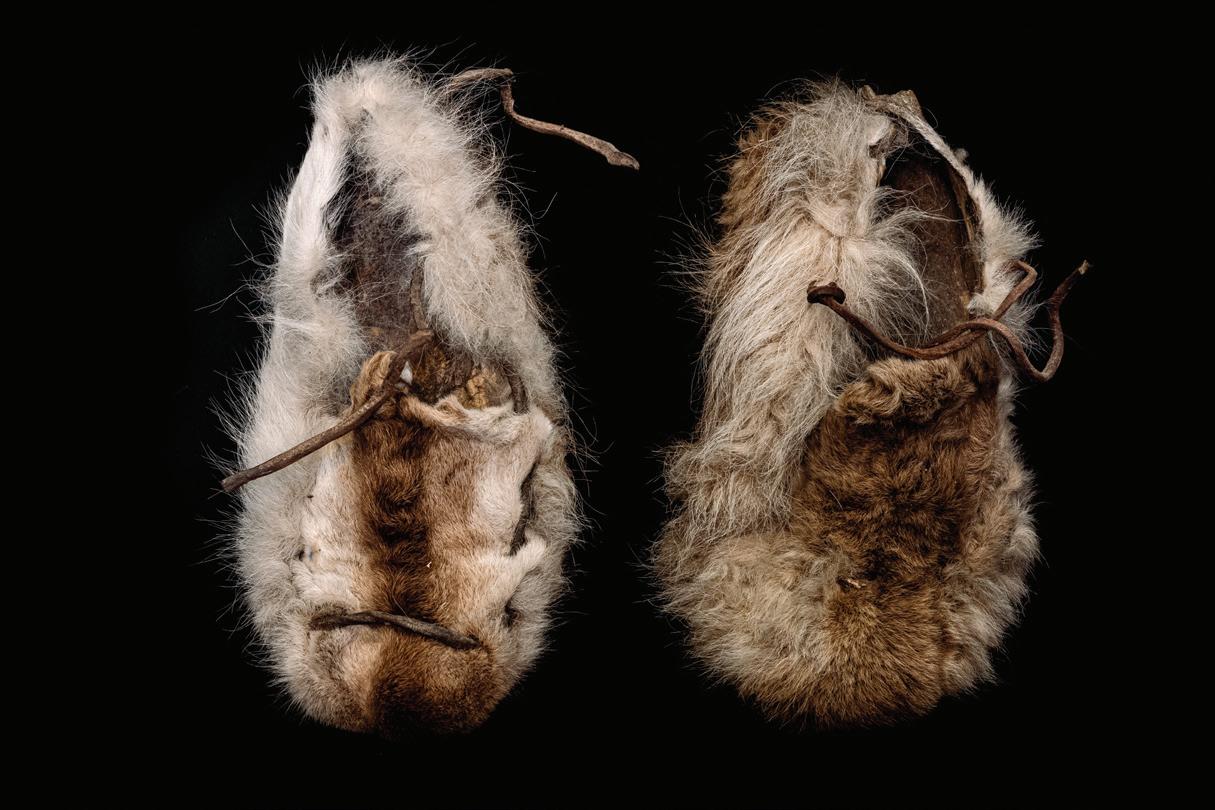
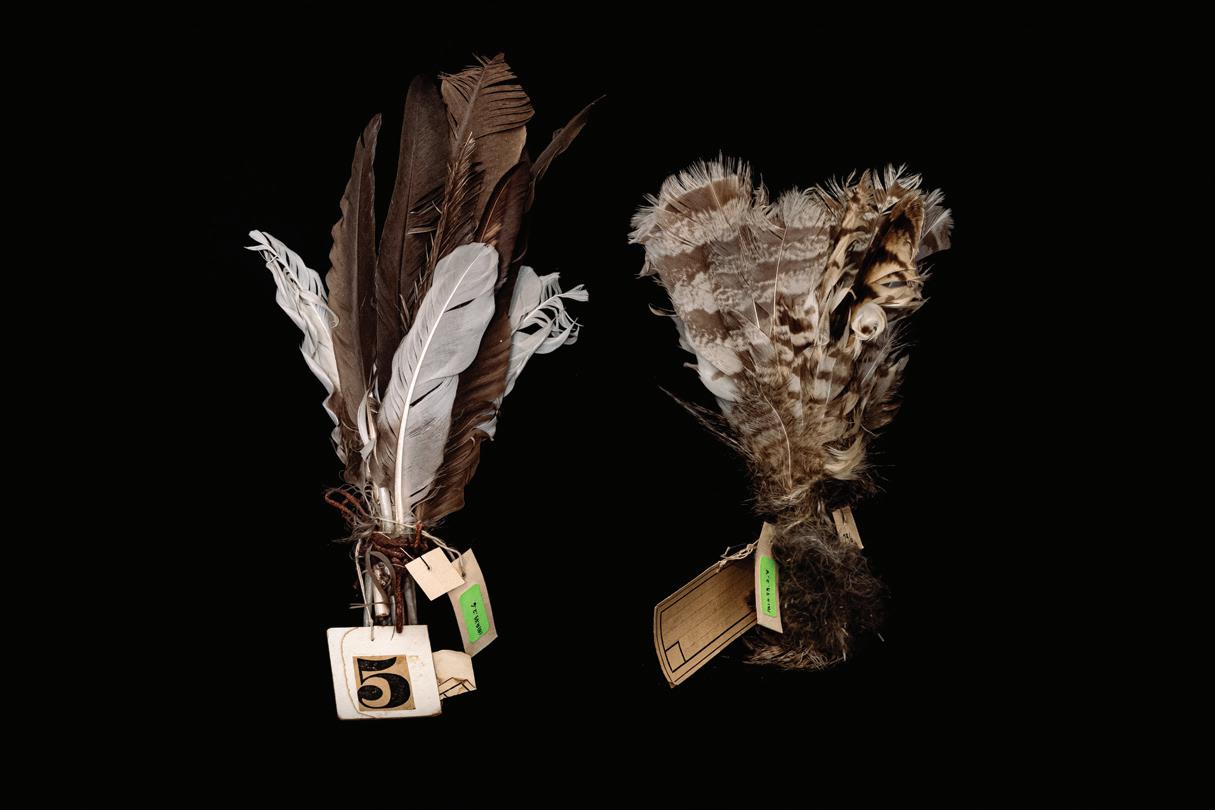
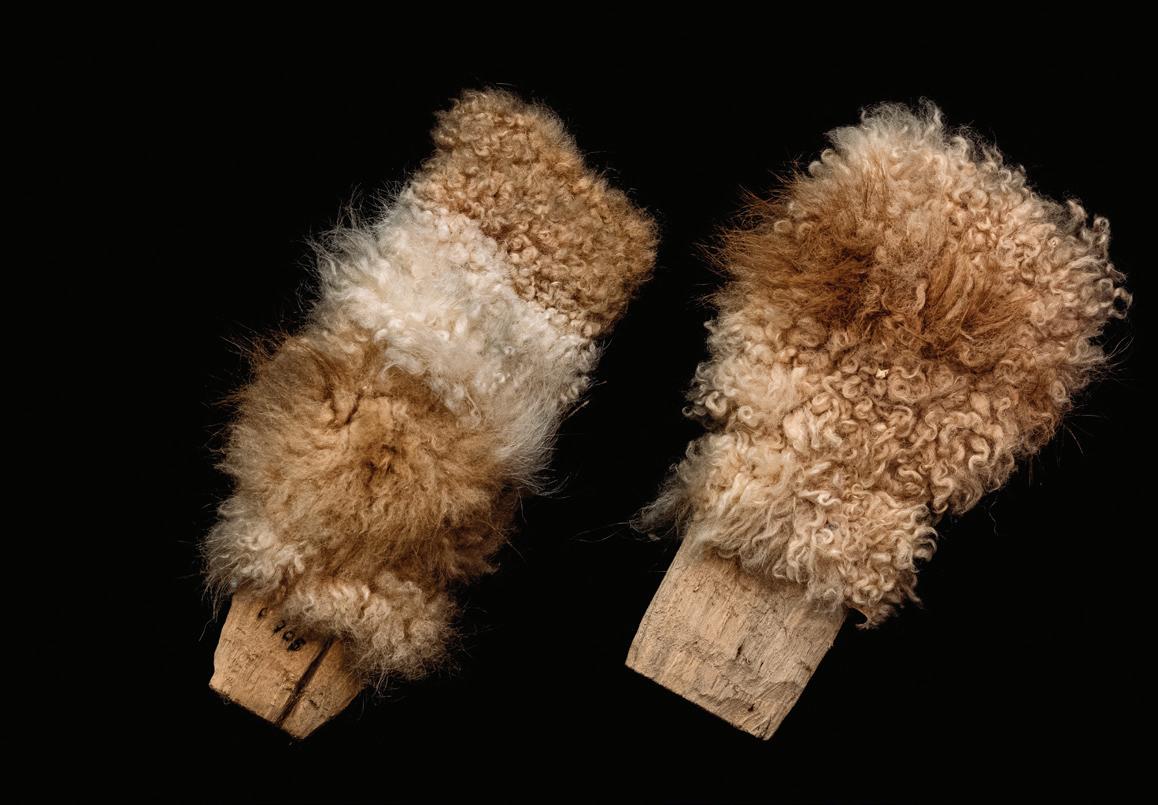
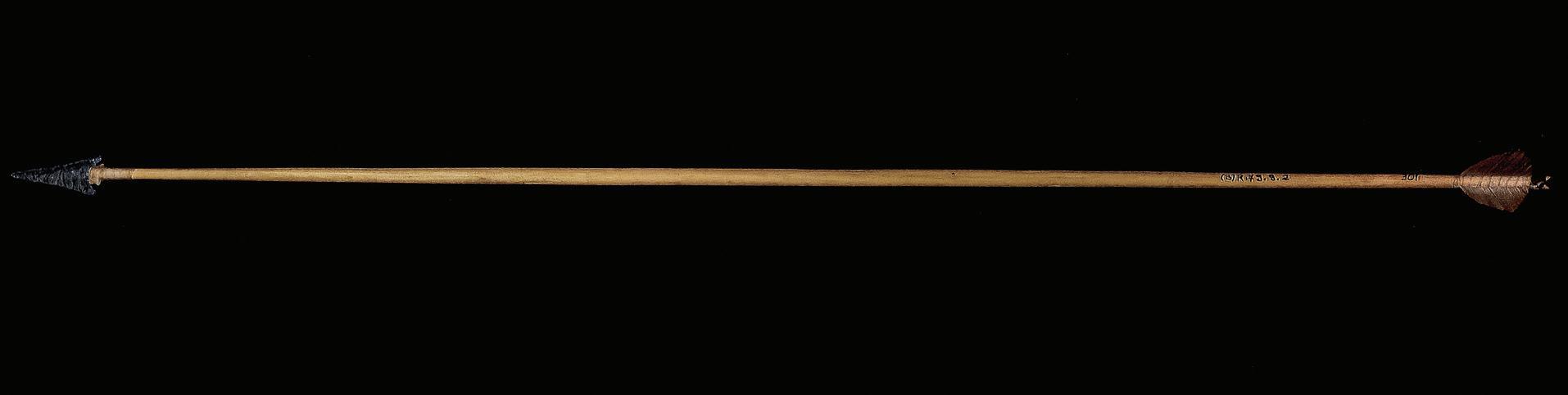
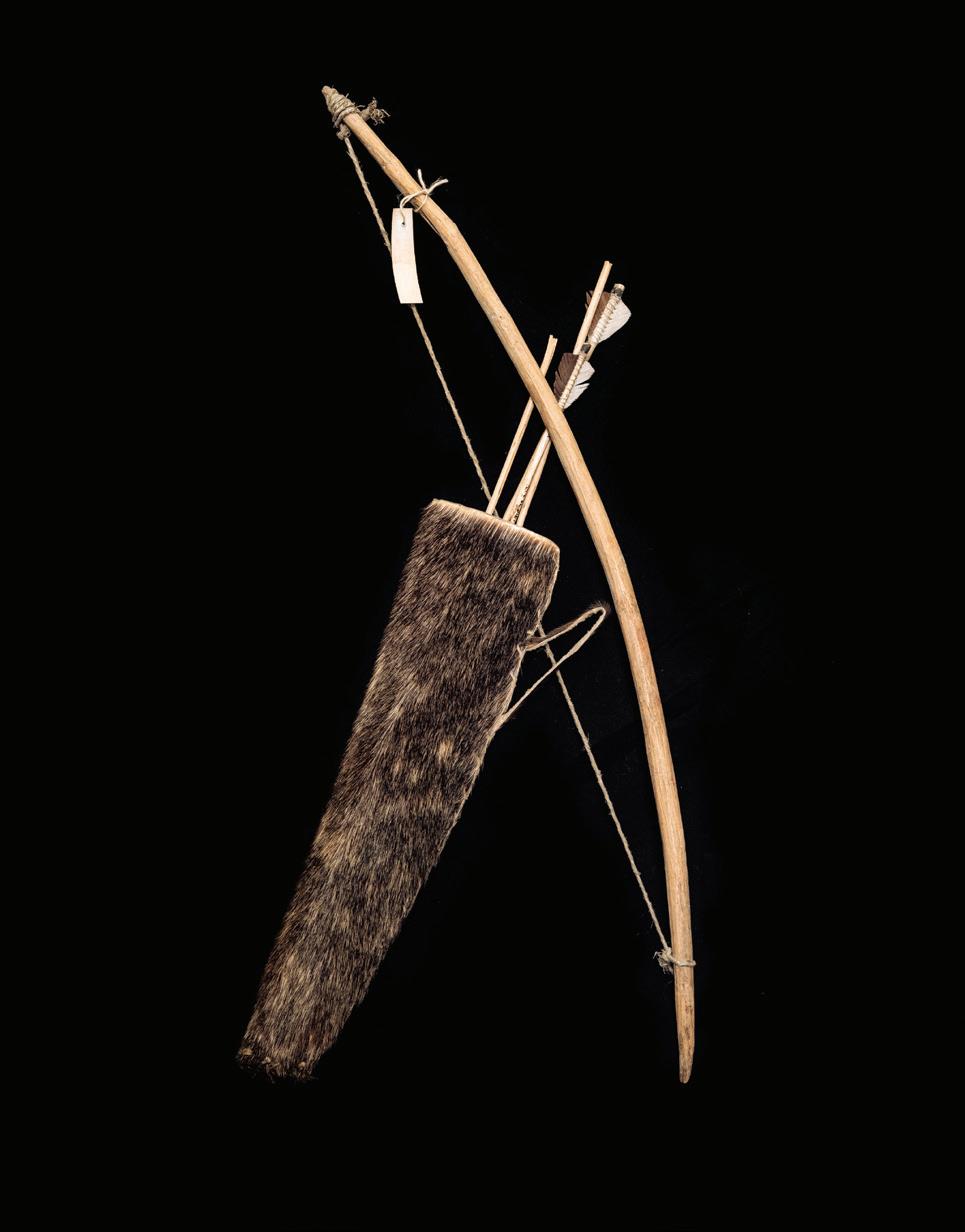
(this page) Original Selk'nam artifacts on display at the Maggiorino Borgatello Museum, Punta Arenas, Chile. Punta Arenas, Chile, 2021.
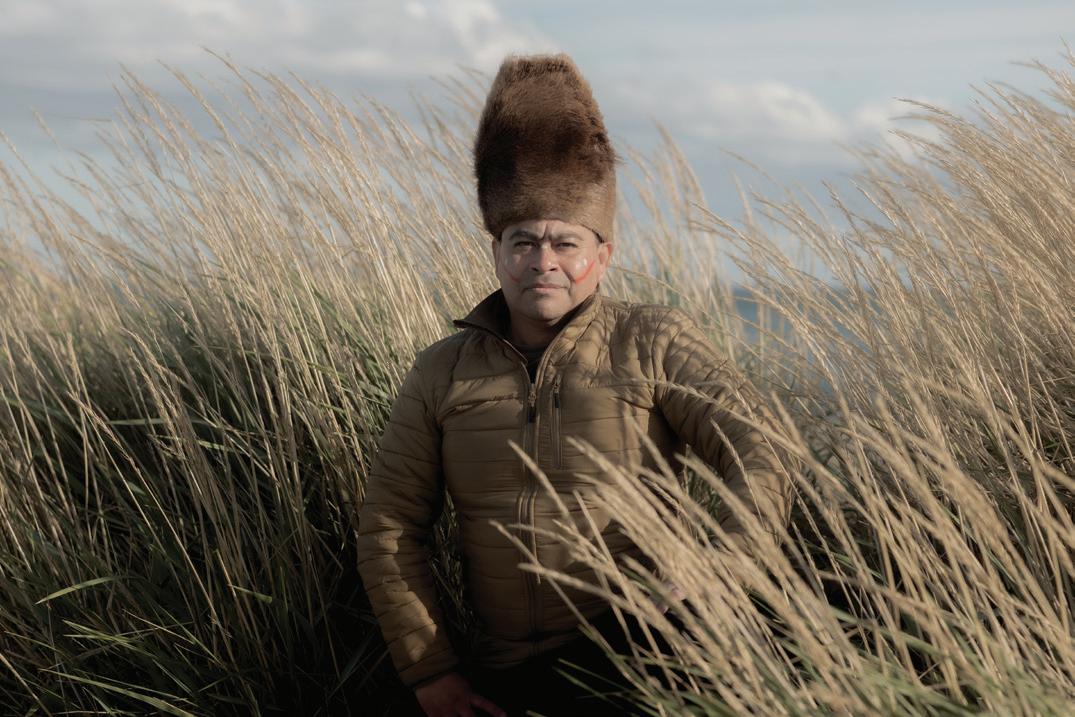
(oppposite page, left) José Luis Vásquez Chogue, Secretary of the Corporation Selk’nam. This is the first time he has visited the land of his ancestors, the Tierra del Fuego. Punta Arenas, Chile, 2021.
(oppposite page, right) Hector Vasquez Chogue, in the urban Santiago de Chile. He heard he is Selk’nam just 3 years ago. Hector went into shock because for the first time, in a search of more than 30 years, he took knowledge of its origins. Santiago, Chile, 2021.
Long before Tierra del Fuego was divided between Argentina and Chile by a treaty ratified in 1881, several adventurers tried to occupy Karukinka. Initially they were hunting for gold. They caused epidemics of tuberculosis, syphilis and respiratory infections – the same biological weapons that hit and decimated other Amerindian peoples. It was the beginning of the end. Then came the mass influx of European, Chilean and Argentinian farmers who saw Karukinka as the perfect place to raise sheep for the production of wool and meat. They invaded and seized territories occupied by the Selk’nam, Tehuelche, Yagane, Haush and Kawesqar groups, between Patagonia and Tierra del Fuego.
The invasion cost the Selk’nam their land and the freedom of their nomadic culture, but at the same time they realized it was much
easier to hunt a domesticated sheep than a wild guanaco. This, of course, would not be accepted by the farmers’ culture, who saw in private property the leap to progress – although it cannot be proved that such a lifestyle had brought them closer to happiness. The coexistence between farmers and hunter-gatherers was impossible. The newcomers decided to eradicate the Selk’nam population in order to take hold of all the land, and hired bounty hunters to do their misdeeds. These opportunists would cut off the ears of Selk’nam caught hunting sheep and take them to the farmers as proof of “a job done” to receive payment. Selk’nam repeat offenders were decapitated. Naturally, there was a reaction, and the Selk’nam used their primitive arrows to kill the farmers that got too close.
It was, however, an unbalanced conflict, and soon the Selk’nam men were exterminated. Elderly people, women and children were captured and sold as domestic servants or sent to Salesian missions in Rio Grande (Argentine sector) and Dawson Island (Chilean sector) to be “civilized”. Women were repeatedly raped and forced to marry non-natives. Diseases, malnutrition, evangelization, loss of culture and separation from families decimated the population. Only young children remained. When the farmers arrived, there were about four thousand Selk’nam; in 1930 there were just over a
hundred. Traces of the Selk’nam vanished and they were reported extinct in the history books and laws written by the victors.
Salesian’s accounts describe the Selk’nam as a people of incredible abilities. They were able to see far beyond what Europeans could see even with binoculars. They were also endowed with phenomenal hearing ability. They easily learned other languages, exhibited far above-average creative ability and a talent for painting and drawing. Their imagination developed admirable stories and religious culture. Furthermore, they were admittedly kind and amiable folk.
In the climatic bands of high latitudes, the incidence of solar rays occurs in an extremely inclined way, and for an extended period
of time, giving me over 18 hours of sunshine a day. With time as my ally, I was able to go about documenting the people and scenery around me calmly and methodically, with plenty of time to listen to stories and tales of times past before photographing these people.
A century of strife, opportunism, and dictatorships has passed without adequately addressing the Selk’nam genocide. This has only recently begun to change in the 2010s, due to the Internet, where users looking for their origins found each other. Now, with the strength in numbers, the Selk’nam face the process of rewriting official history, decolonizing and denaturalizing the one-sided historical perspective, recovering and reframing what happened from their viewpoint. They have created community centers where families’ experiences, stories and memories are shared and the truth is confronted for all of us to see.
Marcio Pimenta is an explorer and photographer This project was supported by the Pulitzer Center on Crisis Reporting.
Washington’s Virginia
UNDER MY OWN VINE & FIG TREE
by RUTH ORATZ MD & ALBERT B. KNAPP MD
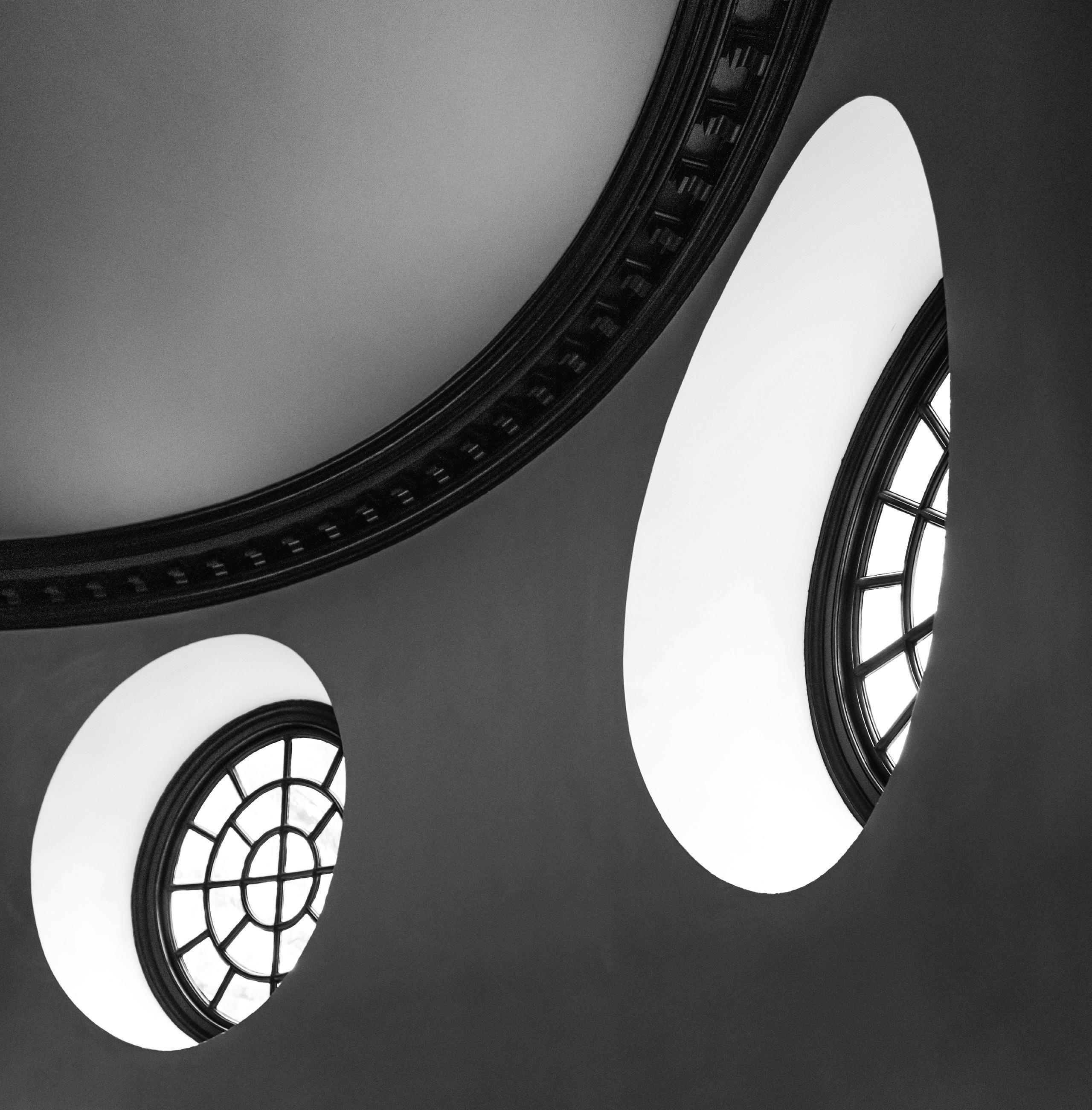
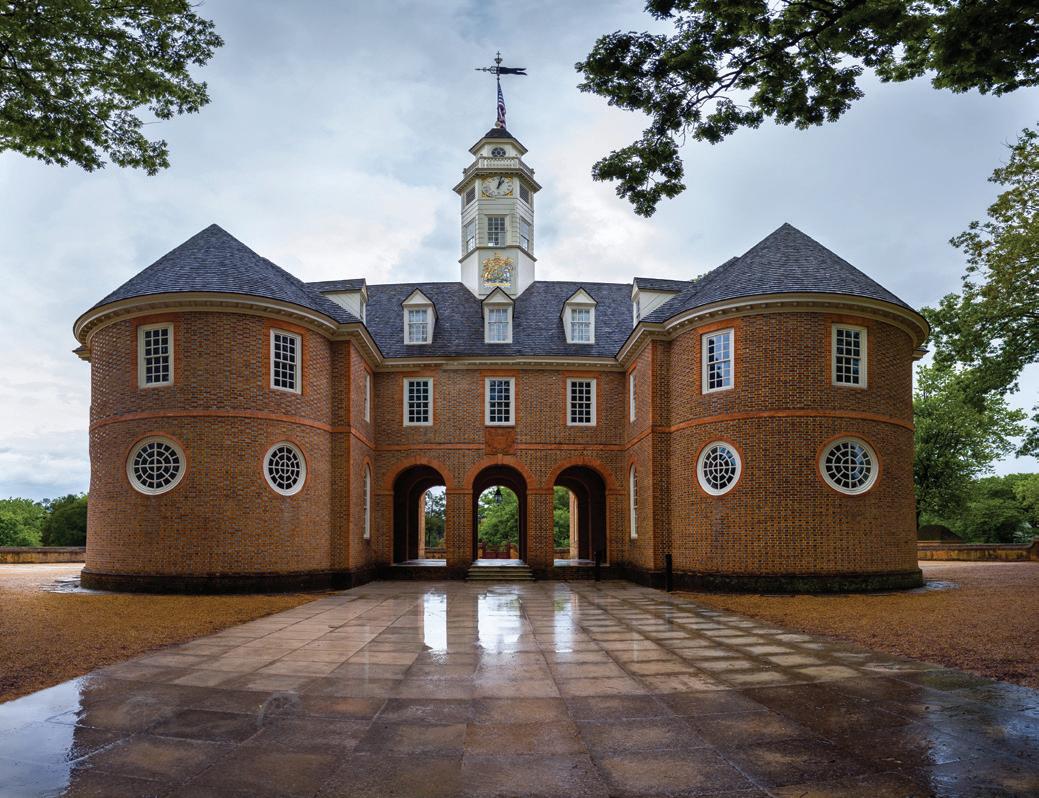
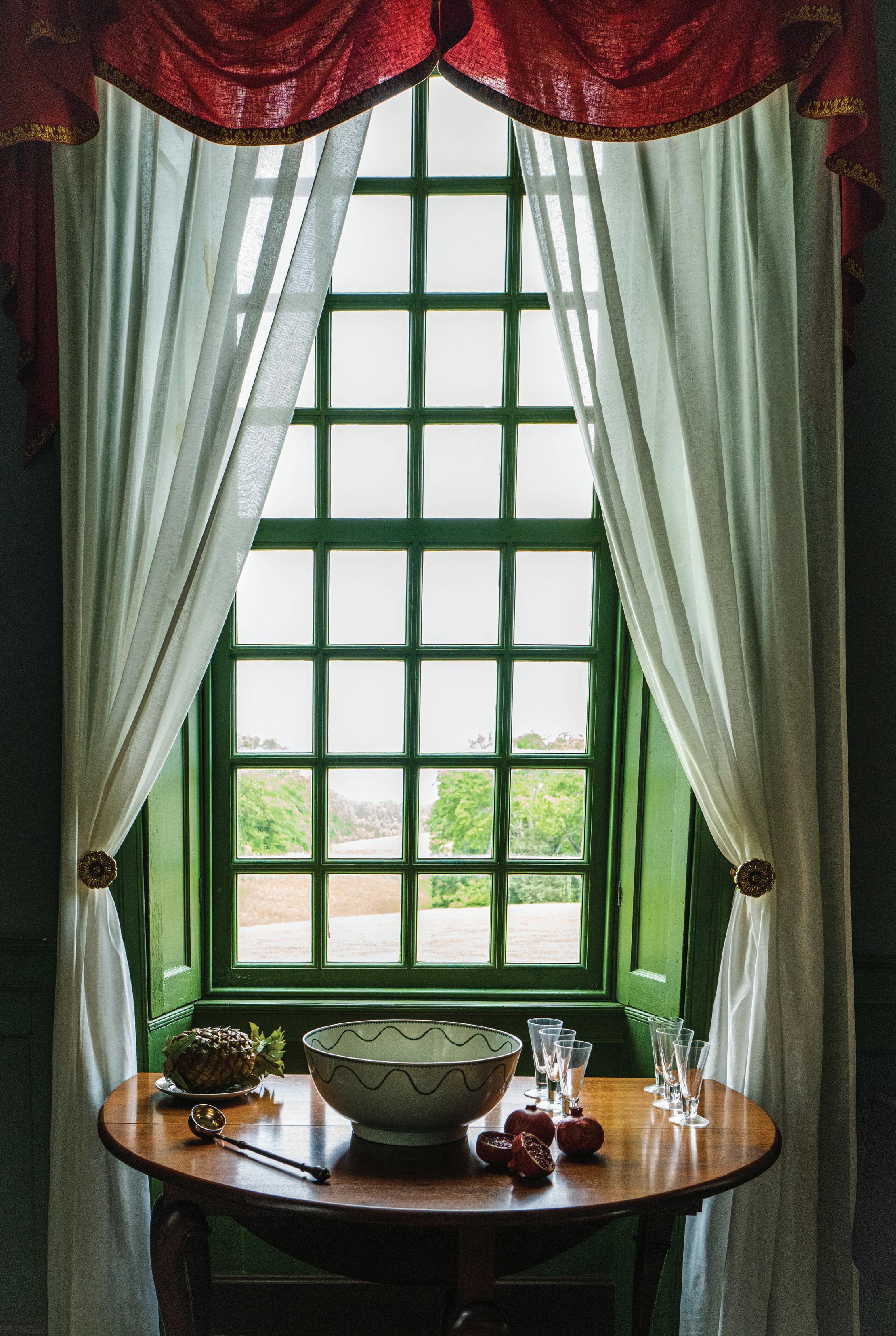
#1. Windows, House of Burgesses. Williamsburg, VA. Leica Q2M Summilux 28mm f/1.7 ASPH at f/2.2, 1/60 sec, ISO 3200.
George Washington is myth and legend, a military leader, statesman, founder, and held in our esteem as the Father of Our Country. Washington served as Commander of the Continental Army, President of the Constitutional Convention and First President of the United States of America. Yet despite his glorious public persona, George Washington always clung to his roots in the Virginia countryside and his private identity as a farmer. At the end of his presidency, Washington wrote “I am once more seated under my own vine and fig tree and hope to spend the remainder of my days – which, in the ordinary course of things…cannot be many – in peaceful retirement.”
For our own trip through Virginia, Albert and I chose to pack lightly. The Q2 and Q2 Monochrom as always were versatile and easy to carry. The Q2 handled a wide range of lighting conditions from very dark interiors to bright outdoors. Albert brought the M-system with a limited number of lenses because of severe space constraints on a regional airline. Once again, he rendered romantic landscapes with the Thambar-M 90 mm f/2.2 .
George Washington was born on February 22, 1732, at Pope’s Creek in Westmoreland County. Most of his childhood and early years were spent at the Ferry Farm, outside of Fredericksburg. (#2) So called because it sat at the juncture of the ferry landing on the Rappahannock River and the highway into the town. The house was substantial for its time. Little is known about the details of daily life, but the Washingtons were on the fringe of Fredericksburg gentility. Unlike his two older brothers, George did not receive a formal education, rather was likely tutored privately, perhaps by local teachers. The family’s financial situation was uncertain, worsened after his father died when the lad was but 11 years old. George supplemented whatever education he received with his own constant studies.
Washington was eager to leave Ferry Farm and make his way in the world. His first career was surveying. Working close to home and journeying out to Western Virginia, he learned a great deal of geography and developed a keen interest in real estate property. He ultimately became a substantial landholder, possessing up to 70,000 acres between the Potomac and Ohio Rivers.
Washington realized that although surveying provided him with reliable income it would not lead to upward social rise. A military career provided this entrée and came as the British entered the French and Indian War. Washington proved his astonishing bravery and sang-froid in battle. In March 1758, during a break in the fighting, Washington returned to Williamsburg, the center of Virginia politics – home to the Governor’s Palace and the House of Burgesses. (#1 & #3) There he met Martha Dandridge Custis, a young wealthy widow
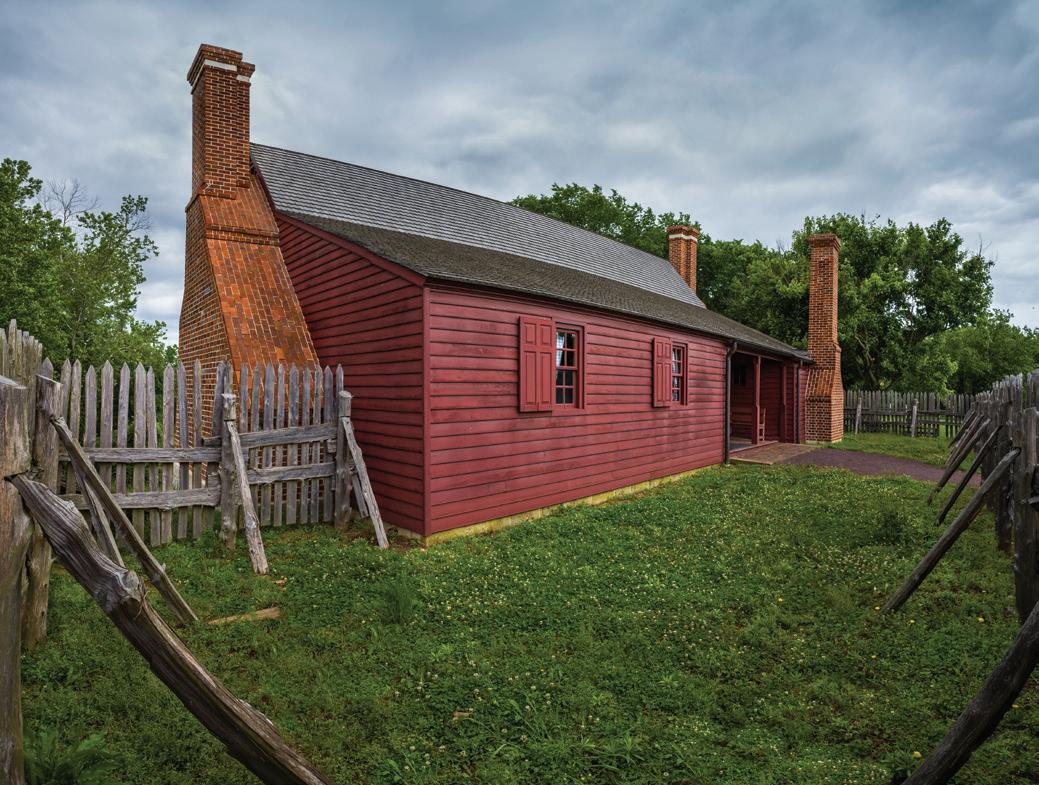
#2 (top) Ferry Farm. Fredericksburg, VA.
Leica M10 + Super-Elmar-M 21mm f/3.4 ASPH at f/4.8, 1/350 sec, ISO 400.
#3 (middle) House of Burgesses (1705-1747). Williamsburg, VA.
Leica M10 + Super-Elmar-M 21mm f/3.4 ASPH at f/3.5, 1/4000 sec, ISO 640.
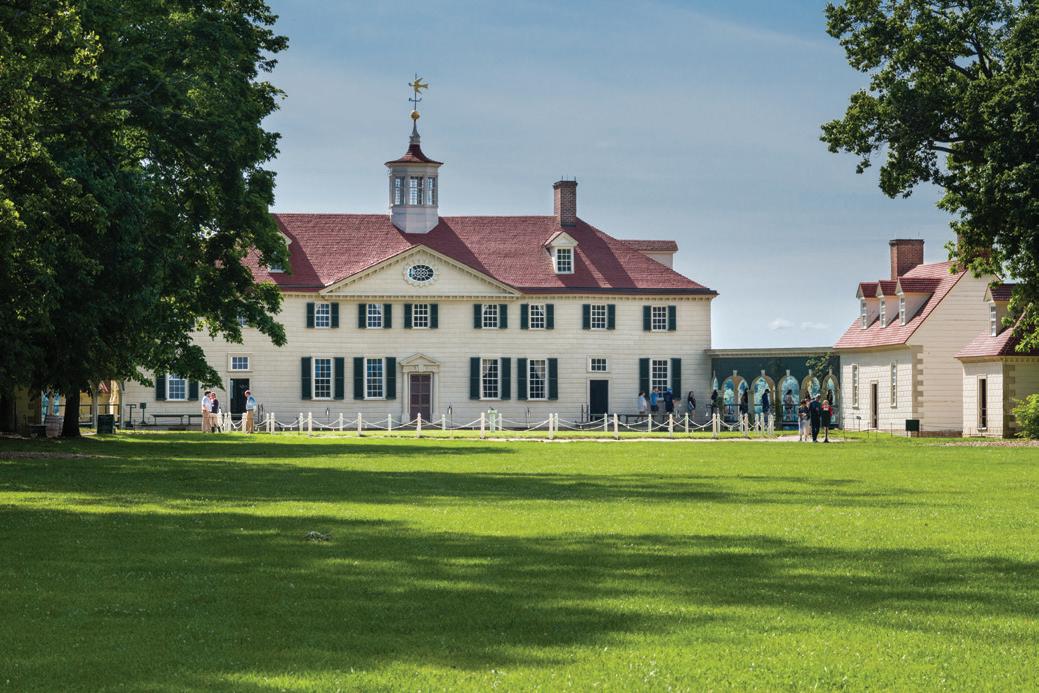
#4. (bottom) Mansion. Mount Vernon, VA. Leica M10 + APO-Summicron-M 90mm f/2 ASPH at f/11, 1/500 sec, ISO 400.
with two children; they were married in January 1759. Both he and Martha found a loving and trusted mate in one another.
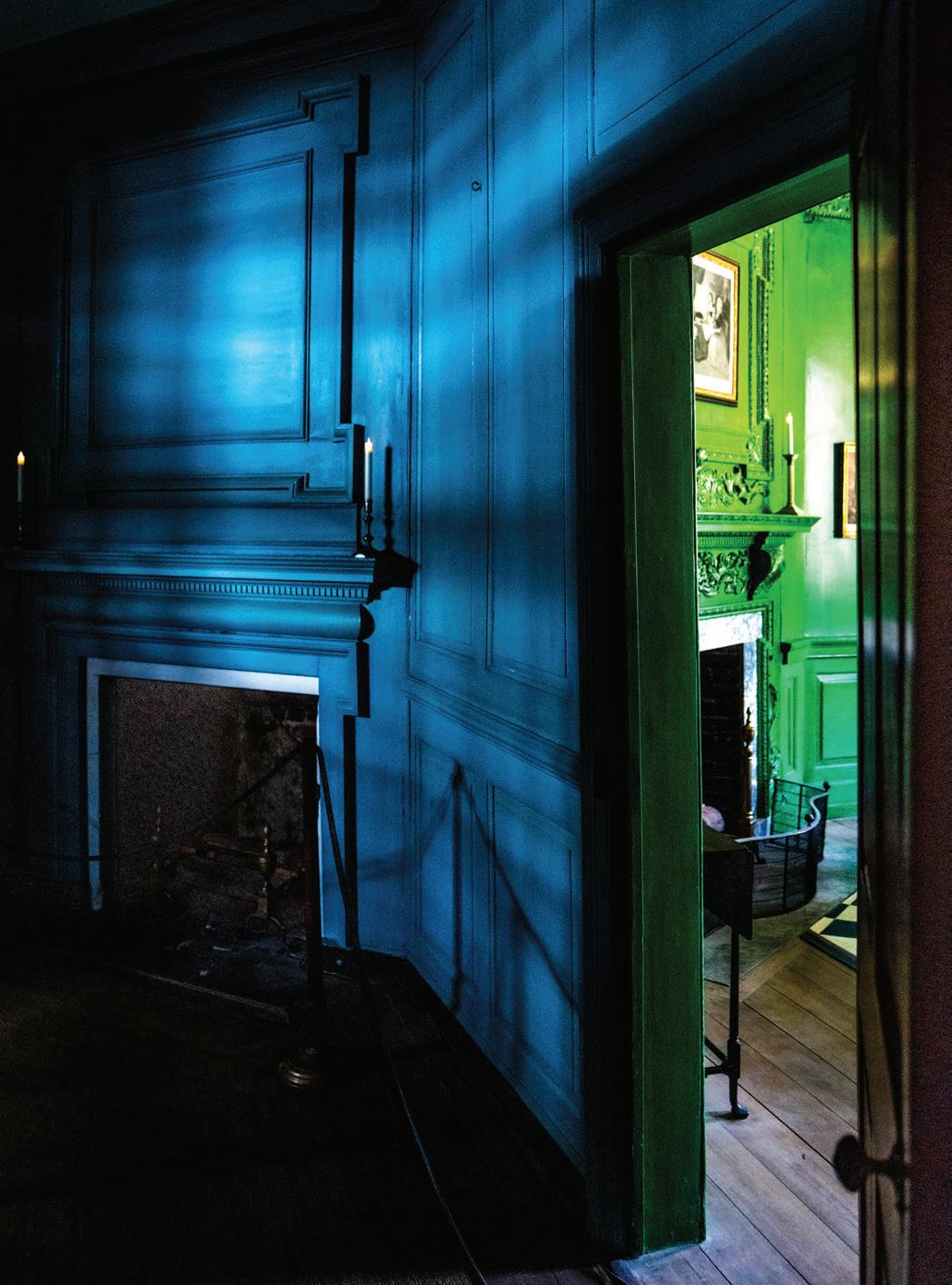
Washington inherited Mount Vernon, a 2,000-acre plantation on the Potomac River, from his older brother Lawrence. (#4) Mount Vernon was the center of George and Martha’s world. Their household bustled with activity. One month after his marriage, Washington assumed his elected seat in the House of Burgesses, the beginning of an illustrious political career. From then on Washington would be torn between his public duties and longing for quiet life at home in Mount Vernon. (#6)
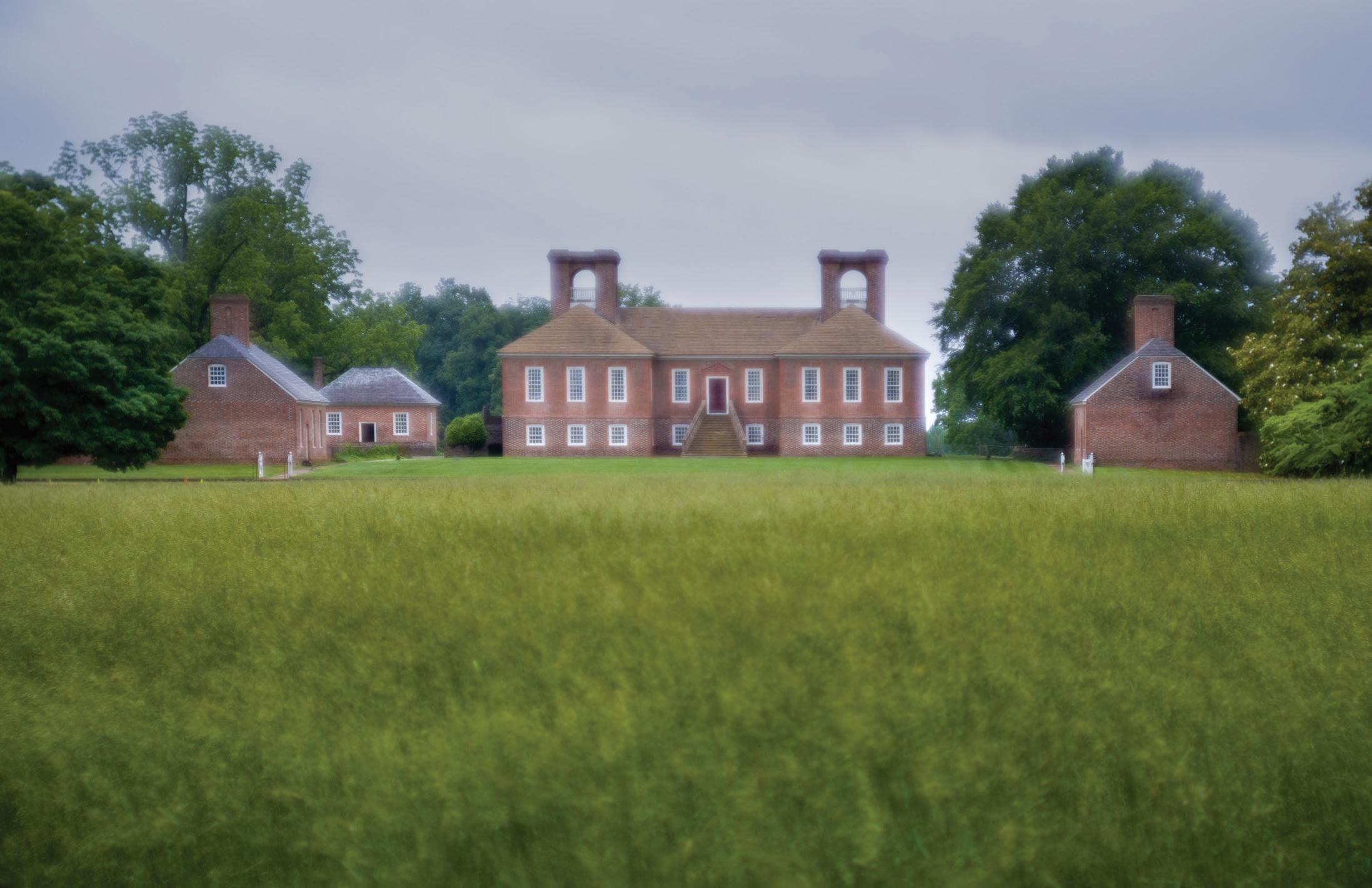
Washington’s social circle centered on the Virginia gentry. Among these were the prominent Lee family. It is likely that Washington could have visited their home Stratford Hall in the rolling hills of the county. (#5 & #7) Washington also maintained close connections to Fredericksburg. He purchased a house in town for his mother to be closer to his sister Betty and her husband Fielding Lewis. Lewis minded Washington’s affairs while he was away at war and in government service.
#5. (above) Stratford Hall (~1738). Stratford, VA. Leica M10 + Thambar-M 90mm f/2.2 at f/4, 1/3000 sec, ISO 400.
#6. (left) Interior Passageway. Mount Vernon, VA. Leica Q2 Summilux 28mm f/1.7 ASPH at f/2.8, 1/ 250 sec, ISO 3200.
#7. Windows, Stratford Hall. Stratford, VA.
Leica Q2 Summilux 28mm f/1.7 ASPH at f/5.6, 1/250 sec, ISO 1600.
Hugh Mercer, physician and apothecary, practiced in Fredericksburg. (#9 ) A Scotsman who escaped to America after fighting against the English, he became an American patriot and close friend of Washington’s. Mercer fought beside Washington in the French and Indian War, and as brigadier general of the Continental Army, dying in the Battle of Princeton in January 1777.
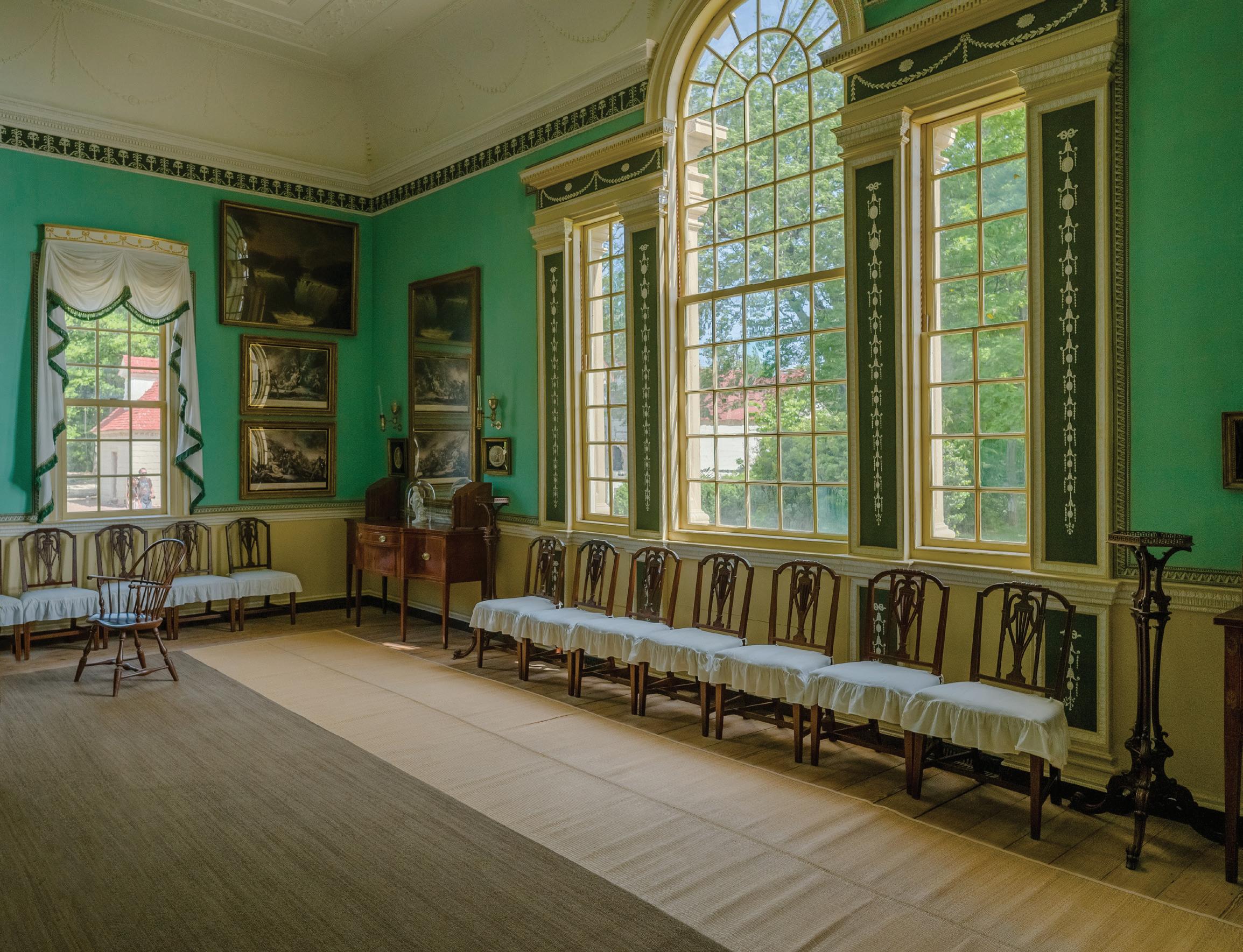
Mount Vernon provided great pleasure and delight for the Washingtons, but also proved to be a burdensome challenge. Managing the large estate, at times suffering significant financial losses, Washington was continuously seeking to improve the operation of the plantation. His goal was to transform Mount Vernon into something more like a self-sufficient village than a farm, fusing his economic interests with his political ideas. A gracious and expansive country house, Mount Vernon was also designed for entertaining. The centerpiece of the public rooms is the refined large dining room, illuminated by a magnificent Palladian window, adorned with an elaborate plasterwork ceiling, and painted bright green, a striking sign of power and affluence. (#10) The green verdigris pigment, made by suspending copper over a bath of vinegar, was a costly process. Imported from England, it was a “must have” in every great house. Completed just in time for
the return from the Presidency, Washington knew that this room would receive statesmen, dignitaries, and guests from the highest ranks. During his decades of public service Washington corresponded regularly with a succession of property managers who were entrusted with running the estate and managing family finances, always tenuous.
At long last in March 1797, Washington retired from public life and returned to Mount Vernon. Both he and his beloved home wore the effects of the preceding decades. Washington, 65 years old, was not as vigorous as before. Though he still went on horseback each morning to inspect his farms, he did not have the strength and endurance of his youth. On December 12, 1799, he returned home after riding out in inclement weather. Guests were present, but Washington went to bed early with a sore throat. His condition deteriorated rapidly; exacerbated by the doctors’ bloodletting, he weakened further. George Washington died at Mount Vernon with Martha by his side. He is buried in the simple yet dignified family vault on the property. Always remembering his home in Virginia, “No estate in the United America is more pleasantly situated than this... on one of the finest Rivers in the world.” (#8)
#8. (above) Potomac River. Mount Vernon, VA. Leica Q2 Summilux 28mm f/1.7 ASPH at f/8, 1/500 sec, ISO 100.
ith the creation of the Leica SL digital system in 2015 and the myriad of lens adapters, the Leica R lenses began a rebirth. As Leica R film camera bodies became harder to get repaired, the SL system with a Leica R-Adapter L allowed the use of some great analog-based glass. In the next few articles, I will explore some of the Leica R lenses, their history and their ability to make high-quality images even today. I still use Leica R film cameras and the Leica SL digital series, so I’ll include images from both systems. At the end of this article, I’ll share some of the lenses that this series will encompass.
If you have not used the Leica R system before, you might be wondering why I am calling the increasingly popular Leica SL system a “digital” system. The answer is simple. In 1964 Leica created the company’s first single lens reflex system and the 1968 model was aptly named the Leicaflex SL. Since I am discussing lenses, when I refer to the Leica SL, I am referring to the new mirrorless digital system and not the original film SLR.
Unlike the Leica M or Leica S lenses, Leica R lenses can be divided into two main categories: zoom lenses and fixed focal lengths. The history of the fixed focal lengths in the Leica R series is broad and deeply rooted in the development of Leica M lenses. For example, the Leica Summicron-R 50mm version II is virtually the same as the Leica Summicron-M version IV. Leica R zoom lenses have a more complicated history.
For many camera manufacturers, zoom lenses were first made for convenience. They started with multiple fixed focal lengths (think of the Leica M MATE 28-50-35). In addition, the first zooms had very small f-stops (f/4, f/5.6) to keep aberrations to a manageable level. Later, advances in glass types and the processes for manufacturing aspherical elements provided the ability for zoom lens construction that rivaled some fixed focus lenses. Ingrained in the Leica culture, Leica began manufacturing zoom lenses when they could ensure their high standard could be met. This is why Leica arrived later in the zoom market. For example, the Leica Vario-APO-Elmarit-R 70-180mm f/2.8 weighs 1,870 grams and uses an E77 filter size providing very high contrast at full aperture. Erwin Puts noted that using this 1995 zoom lens in the 80mm to 110mm range at least equals the contrast and edge sharpness of the Leica APO-Macro-Elmarit-R 100mm f/2.8 macro lens, which is very similar to the current Leica Macro-Elmar-M 90mm f/4 lens. This quality is impressive for a 27-year-old lens and the same cannot be said of many 1990’s era zoom lenses from other manufacturers.
Leica R lenses have a complicated mounting system consisting of 1-cam, 2-cam, 3-cam, 3rd-cam only, and ROM lenses. I won’t go into all the details of the various Leica R cam systems as plenty of information exists on the internet. However, note that because the cam system is complex, the Leica R lenses with 1- and 2-cams are typically not compatible with later Leica R bodies and Leica R to SL adapters. In part, this is due to the ROM reader which replaces an area previously holding a cam. My favored Leica R lenses have the ROM either as released or retrofitted for a specific reason. The R to L adapter includes contacts for the ROM lenses and transfers both focal length and aperture values to the EXIF in the final digital image. This is valuable for digital catalogs when later searching or filtering, not to mention some of the metering modes in the Leica R8 and R9 series. The Leica R8 / R9 bodies have a complex multi-metering system that can take into account the vignetting of the Leica R lenses with ROM contacts and is one of the best I’ve seen for film cameras including the Nikon F3.
If you are still questioning the quality of a zoom lens from Leica or using an older film-based lens on a newer digital system, then consider some of the Leica R development history. Leica R offerings started as wide as 15mm and extended to the 800mm arena. There are some one-of-a-kind Leica R lenses outside this range, but we mere mortals only have access to the wide variety of focal lengths in the standard catalog. More interesting are the partnerships over the years between Leica and Minolta, Schneider and Kyocera. There are fingerprints of these design and manufacturing partners in some Leica R lenses, and no doubt have a lot to do with the L-Mount consortium that Leica has developed with the modern SL system.
A single lens reflex system has different challenges than a compact range-finder. Where the Leica M lenses are designed for
high quality in a small package, the same limitation did not exist for the larger SLR systems. However, the impact of the mirror between the lens and the film does cause some needed adjustments. The distance between the lens mount and the film plane is 47mm. This means a 21mm lens for the Leica R system cannot be made the same way as one for the Leica M system where a lens can protrude right up to the shutter (and in fact, some have!). Instead, the Leica R system is forced to use retrofocus lens designs so that the mirror has enough room to swing. The only other choice is to raise the mirror and lock it in the up position to fit the lens, but that negates the ability to focus, which is the point of an SLR system. The idea of a retrofocus lens was not new, but it did cause the lens to require more elements and be of a larger design. This can be shown by putting the Leica Elmarit-R 19mm lens (60mm long) beside the Leica APO-Summicron-R 90mm lens (70mm long). This shows how the 19mm lens had to be larger to enable proper use with the SLR mirror and yet this super wide-angle lens is superb and hard to find as a result.
Similar to the Leica M lenses, research and development by Leica provided increasingly better image capabilities. Negative lenses were used as the front element, which led to some incredible optical improvements over time. The idea of floating elements increased the complexity of the lens designs but provided a better solution for close focusing at wider apertures. Lower vignetting was one advantage of the Leica R retrofocus designs over the Leica M lenses. While certainly still present, it could be more easily reduced. With the exception of a few zoom lenses, these characteristics apply mostly to the fixed lenses in the Leica R system. Also of interest is the fact that the mirrorless system of the Lecia SL has a short back focal length, similar to the Leica M system. This allows less use of retrofocus designs in the Leica SL system and a more compact design that would otherwise be necessary if it was not mirrorless.
There are lengthy writings on lens aberrations, and Erwin Puts is well known for providing such knowledge to the general public. While some of his writing is better understood by those that study optics as a career, there is also much information that can be understood by the interested but casual user. The following discussions I have gleaned from Mr. Puts’ writings specifically about the Leica R lenses and attribute the information to his works.
There are many aberrations that Leica optical designers combat before producing a lens used by the Leica community. I believe the most noticeable aberrations are based on the corners of lenses including both contrast and coma, as well as the differences in focusing both the tangential and saggitarial light rays. I will not try to dissect these terms, but rather talk in a simpler language. Suffice it to say that reading Mr. Puts’ work will allow an in-depth study of the science.
(top) Leica SL2-S + Vario-Elmar-R 35-70mm f/4 at 1/320 sec, f/11, ISO 50 (left) Leica SL2 + Elmarit-R 90mm f/2.8 at 1/13 sec, f/6.8, ISO 50
(right) Leica SL2 + Vario-Elmarit-R 28-90mm f/2.8-f/4.5 at 1/40 sec, f/14, ISO 50
It is a fact that increasing the diameter of a lens to create a wider f/stop or increasing the focal length of a lens for higher magnifications causes an increase in chromatic and other aberrations. Corrections to these aberrations are not inexpensive, but available to lens designers of the appropriate aptitude. Glass with anomalous dispersion can lessen these types of aberrations, but is very expensive and harder to work with. Yet, the glass type is only one leg of the design. Ignoring the movement of light through the system, another important aspect is the required manufacturing tolerance.
The ability to consistently make a lens that retains the tolerance from the point of manufacture to many years in the future is important for a high-quality lens. Leica has succeeded in doing this as part of their culture and is evidenced by the use of 1950’s Leica M lenses on today’s film and digital cameras to still produce outstanding imagery. The roots of this success come from the willingness of Lecia to restrict focal lengths and apertures compared to some of the competition. Think about the current Leica Vario-Elmarit-SL 24-70mm f/2.8 lens which has a reduced range compared to the Leica Vario-Elmarit-SL 24-90mm f/2.8-f/4.0 lens. This choice had to do with lens diameter and quality in the total zoom range. In reality, I prefer a lens that performs throughout it’s range admirably, rather than a lens I cannot use in certain situations because the quality is not as good. It leaves me free to be creative without worrying about the resulting image quality. Erwin Puts said this about the quality of the Leica R lenses in 2003:
“I could convince myself of the longevity and sustained accuracy over many years when I was able to test and check several scores of older lenses, often very heavy used. Every lens, even the most worn out ones, were within the originally specified tolerances and there was not a sign of decentering, one of the earliest signs of degraded performance. The optical performance was as expected from a new lens just out of the box.”
At the time the Leica R system was being developed, autofocus cameras were not yet in the picture. Mr. Puts reminds us that an auto-focus system inherently “smooths out the small errors in mechanical accuracy.” The long life and continued use today of Leica R lenses is due not only to the quality of the glass and lens computations, but due to the tight tolerances of construction embedded in the Leica company’s DNA.
The other correction tool employed by Leica is the use of aspherical surfaces. Some famous Leica M lenses, including the Noctilux-M 50mm f/1.2 lens and the Summilux-M 35mm f/1.4 Aspherical lens, used hand ground and polished aspherical surfaces. As technology enabled more consistent and cost effective manufacture of aspherical lenses that were within required tolerances, lens designs added aspheres to the computations.
This discussion is relevant because some of the later Leica R lens designs used all these abilities to produce lenses that still have good contrast in details greater than 40 line pairs per mm, which is no small feat! Additionally, this provides an understanding of the performance expectations of some of the version 1 Leica R lenses. For example, the Leica APOSummicron-R 90mm f/2 has the same outstanding imagery as the Leica M model, and the older Leica APO-Elmarit-R 180mm f/2.8 resolves incredibly well at 100 line pairs per mm providing detail many sensors and films cannot capture!
From the perspective of the Leica R fixed focal length lenses, understanding how the lens will draw the light on the Leica SL sensor is much easier. The zoom lenses require a little more discussion.
The history of zoom lenses in the late 20th century is fraught with sub-par results. This tainted many professional photographers who refused their use in early development by the large camera companies. Instead, the zoom lens was an inexpensive way for an amateur to obtain multiple focal lengths. This has a lot to do with the inherent optical problems that are unique to zoom lenses. Leave it to a company such as Leica to overcome the limitations while providing extraordinary zoom lenses.
The simplicity of a zoom lens is interesting. Mr. Puts eloquently tells us that a zoom lens really has only two requirements: (1) the focal length must be continuously variable and (2) the distance setting or focus position must not change when the focal length changes. Only two lenses are needed to create a zoom lens; one lens is used for each requirement. One only need look at the complex Leica SL zooms, such as the 90-280mm zoom to see that many more than two lenses are used. Yet, Leica also designed the lens to have two very small and light lenses accomplish the focusing. The remainder of the system is used to change the focal length and correct aberrations.
Leica SL2-S + APO-Summicron-R f/2 at 1/6 sec, f/4, ISO 800
(top) Leica SL2-S + Vario-Elmar-R 80-200mm f/4 at 1/1600 sec, f/6.8, ISO 400 (left) Leica SL2-S + Elmarit-R 28mm Version I at 1/250 sec, f/8, ISO 50
(right) Leica SL2-S + Vario-Elmar-R 21-35mm f/3.5-4 at 1.3 sec, f/22, ISO 50
While this may sound like an easy process, there is still more to the quality equation. Just like the prime lenses, manufacturing tolerances must still be kept small and consistent. In a zoom lens the group of lenses to change the focal length generally move in a different manner and distance than the focusing lens group. While this can be compensated in an electronic lens, manual focus lenses must accomplish this without the aid of computer chips and motors. One of the most
mechanically complex lenses ever made by Leica was the Medium Angle Tri-Elmar-M (MATE) 28-50-35mm lens. Not only did the lenses have to properly move in tandem, but a mechanical connection to the rangefinder CAM system had to move the viewfinder screens adding another non-linear movement to the system. Leica’s dedication to producing high quality, consistent tight tolerance lenses provided zooms that were of such optical quality the professionals used them without reservation.
Many of the Leica R lenses were made in the 1970’s through the 1990’s. This makes those lens designs between 30 and 50 years old. Yet, after a CLA to clean, lubricate and adjust the lens,
they essentially perform as they did new out of the box. After adding the high optical quality and strong aberration correction into a mechanical system that does not require power, another complete lens system is available for the Leica SL.
I am not comparing image quality between the two systems because they are too different. The Leica SL Summicrons are another leap forward in optical results. However, that does not prevent the Leica R lenses from producing outstanding imagery alongside the native SL lenses. Add the fact that the Leica R lenses are meant to be looked through when composing an image, unlike electronic viewfinder systems, and the distortion and color representation is what-you-see-is-whatyou-get. I personally love using the medium format Leica S system because I can look through the optical viewfinder. The same joy comes from the use of the Leica R lens system.
All of the images in this article are from Leica R lenses and the Leica SL. In the remainder of this series, I will review some of the Leica R lenses I have acquired over time and show more images from both the Leica R film cameras and the Leica SL digital cameras. These lenses include fixed focus Leica R lenses in the range of the Leica Elmarit-R 28mm f/2.8 version 1 through the Leica APO-Elmarit-R 280mm f/2.8 lens. I will include lenses such as the Leica Summilux-R 80mm f/1.4 and the rather unique Leica Super-Angulon-R 28mm f/2.8 perspective correction lens (PC). It will also include zoom lenses like the Leica Vario-Elmar-R 21-35mm f/3.5-4 ASPH, and the Leica APO-Vario-Elmarit-R 70-180mm f/2.8 as well as the very compact Leica Vario-Elmar-R 80-200mm f/4 and others. I will talk about each lens and my experience in using them with sample images in my every-day use. The intention is not to recreate a scientific analysis of the MTF charts, but let you see how the lenses produce images using today’s modern Leica cameras.
(top) Leica SL2-S + Summicron-R 50mm f/2 at 1/15 sec, f/9.5, ISO 50
(bottom) Leica SL2 + Vario-APO-Elmarit-R 70-180mm f/2.8 at 1/1250 sec, f/8, ISO 400
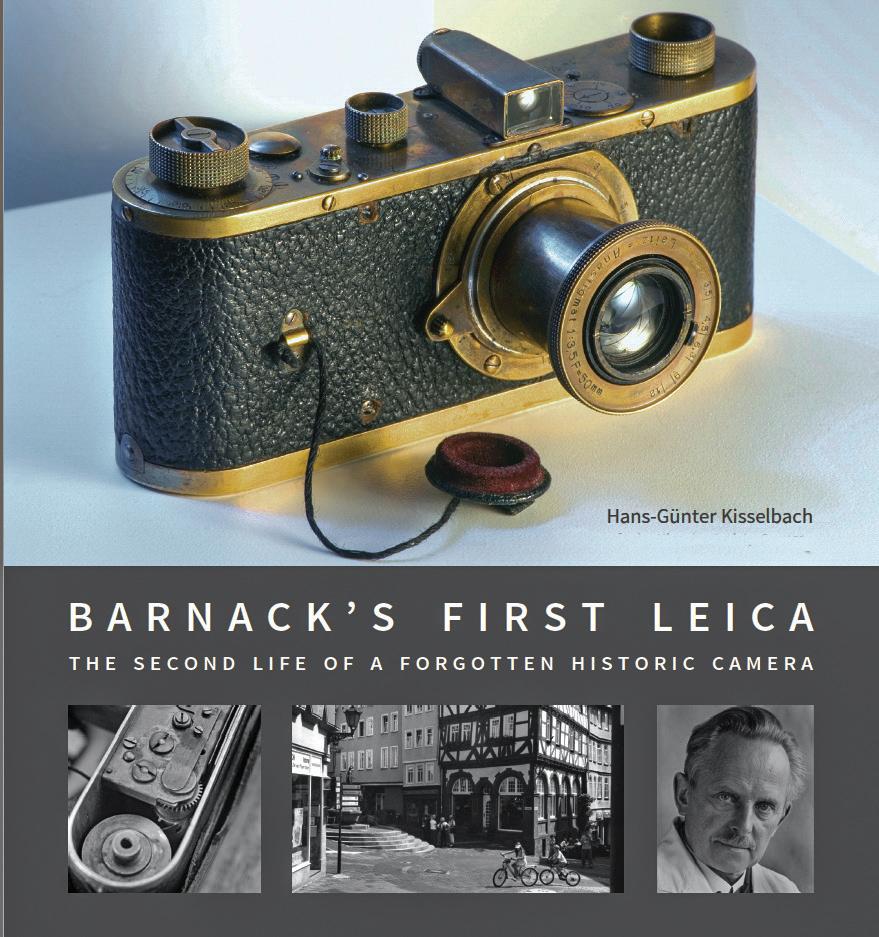
Günter Kisselbachʼs Book on “Barnackʼs First Leica” is
Now Published in Hard-Cover
English Translation
by ED SCHWARTZREICH
This fascinating book was published in a German edition about 15 years ago, and in that form was reviewed here in Viewfinder (Vol. 42, No. 3, 2009). Subsequently, an English-language e-Book of this title was published, and that also was reviewed in Viewfinder (Vol. 51, No. 1, 2018). Readers are directed to look in the LHSA Archives for these reviews if they do not already own hard copies of those issues. At the time of the e-Book’s release, there was still a clear need for a high-quality print edition in English.
Dr. Kisselbach has finally been able to have such an edition prepared, and it is quite handsome in addition to all of its
other interesting and important features. Recall that we published Ulf Richter’s book on Barnack in English translation for LHSA’s 50th Anniversary. Dr. Kisselbach’s book was also considered for that honor, but we could only manage one title. Readers with interests in either the mechanical aspects of early Leicas, or with Barnack the inventor will find much to like here. Ditto those who admire having a legendary Leica both dismantled to see its innards, or shooting many rolls of film with it, rather than leaving it solely in a safe deposit box.
Dr. Kisselbach's book in English will be sold through Leica Stores.
THE LEICA VISOFLEX 2 ON THE M10
by ED SCHWARTZREICH
This article is not intended to be a how-to, nor an indepth look at the ins and outs of use of the Visoflexes on M10’s. There already exists a lengthy, truly exhaustive, and indeed-awe-inspiring presentation of the uses of the EVF 1 (Typ 020) by Thorsten Overgaard. At the time of this writing, Thorsten’s piece can be accessed at https://www.overgaard.dk/ Leica-M10-digital-rangefinder-camera-page-08-How-to-Focus-a-Leica-M10-with-electronic-viewfinder.html This author learned quite a bit from reading Thorsten’s text, and no longer looks down his nose at this rather humble and clunky / chunky Leica add-on. It is truly a clever and useful device, not merely a make-shift for close-ups, the use of non-M-coupled lenses, and when there is a question of accurate focus. It is true that using the Viso adds shutter lag, but the advantages of this device are such that it should have a definite place in the M-shooter’s armamentarium.
Handheld at minimum focus of 1 mtr. near the lilac bush, waiting for a lull in the breeze. 12mm CV lens at 1 meter, cropped. Focus checking through VF was easy.
Rather, this article has to do with how the new Visoflex 2 fits, feels, and performs on M10s vis-à-vis the older Typ 020. In early May 2022 the firmware upgrades finally arrived for using the new device on our M10s. Visoflex 2’s were thin on the ground at that moment, but not surprisingly various persons online offered their opinions about it, both from trying it out at Leica stores, or having actually purchased and received one and used it on an M11. The opinions vary. Of course, no one had yet tried it out on an M10, as the firmware was lacking. And we are told definitely and in advance that full performance with the device in not possible with an M10.
On the actual day of the firmware release David Farkas had this to say on line: “I had the chance to compare the live view experience between the original Visoflex (Typ 020) and the new Visoflex 2 on an M10-R. Contrast, brightness, color fidelity and sharpness were certainly improved when using the newer OLED-based Visoflex 2 – reasons for many to want to upgrade. But there are two trade-offs versus the older EVF. First, the live view image is smaller in the new EVF when compared to the same viewfinder on the M11 or using the previous Visoflex 020 on the M10. Without a side-by-side comparison, you may not notice, but switching between the two, the difference is clear. Because the M10 is limited to 2.4MP video output, the active image area is reduced versus the full 3.68MP displayed from the M11. Given the perfect blacks of the OLED display, there is no visible or distracting unused area so it's perfectly usable and might be worth the overall increase in image quality. The second drawback is that you will lose GPS geotagging functionality when switching from the Visoflex 020 to the new Visoflex 2. For some, this might be a deal breaker. For others, not so much. If you're wondering what geotagging is, you probably fall into the latter category”.
David’s remarks certainly had the juices flowing, but one did not yet have access to the accessory. Never fear: about a week later the one the author had purchased arrived for testing and use.
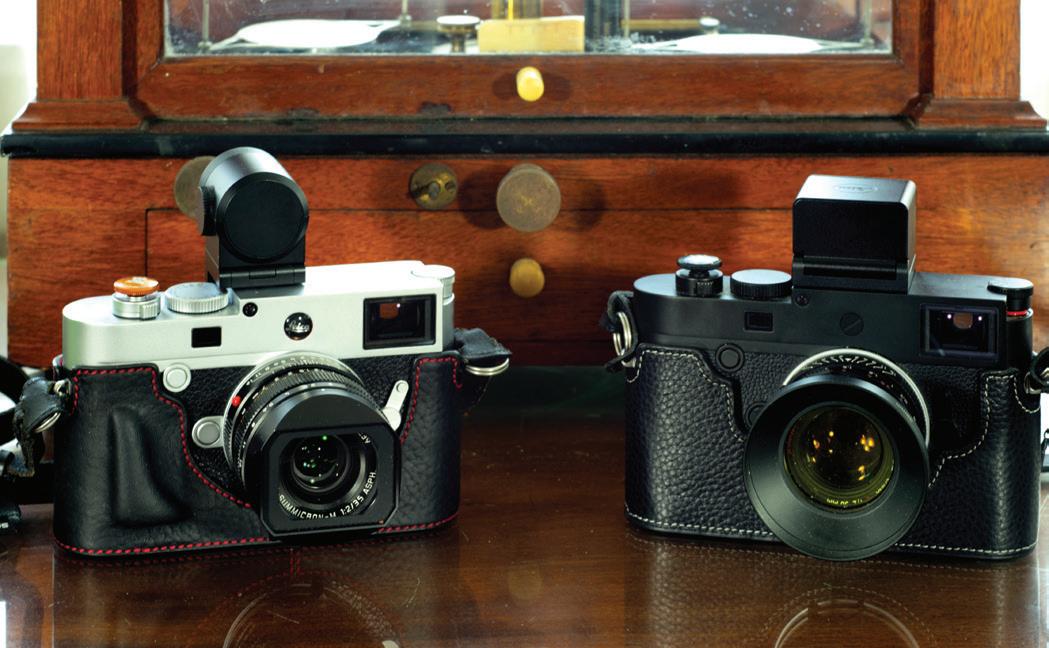
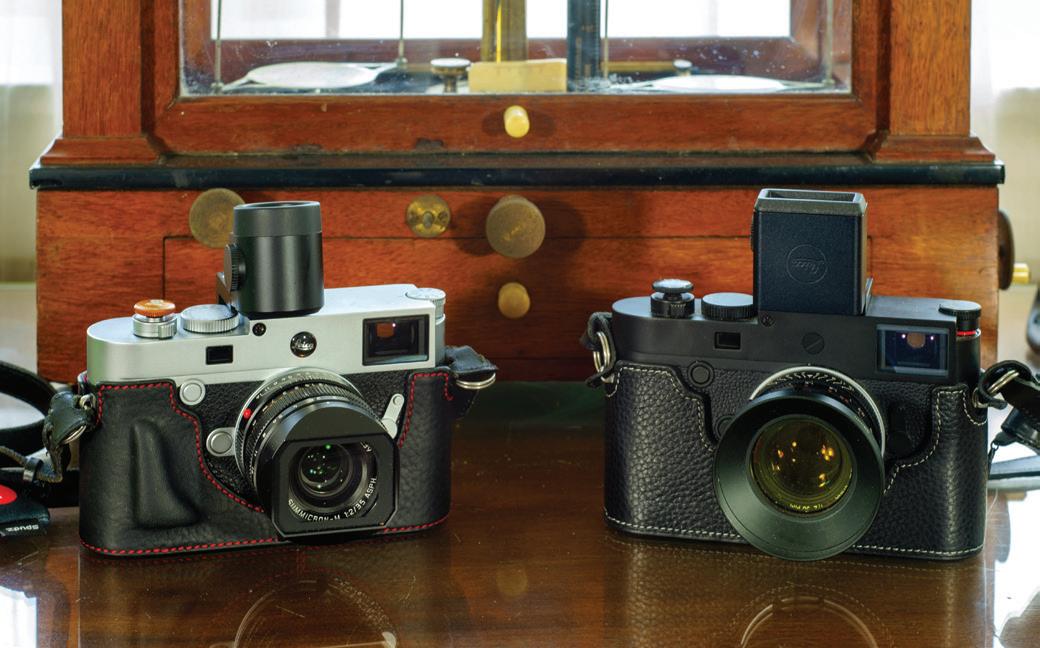
Here are images of the two Viso’s on two M10’s, both horizontal position, and 90° position.
In use, the two versions function similarly. However, there are several cosmetic, ergonomic, and aesthetic differences.
Perhaps folks here will remember the author’s previous article about items in Leica M’s shoes or hot shoes being precarious as to falling out unexpectedly. That possibility seems less likely with the new Visoflex 2, as this one clicks better into place. And although the height of the new Visoflex 2 is only slightly less than that of the older version, its shape of the gives the impression of being rather integral to the camera, making it feel much less precarious. So also does the fact that it is metal. It impresses the senses as also being less likely to hit something and be damaged, true or not. The aesthetics also may matter: the Visoflex 2 is somewhat boxy, but Typ 020 is bulbous and may be of less visual appeal to some.
The older Typ 020 covered up the M10’s body marking for the speed dial, but the new Visoflex 2 has its own marking for this. The diopter adjustment on the Visoflex 2 is much stiffer and without position markings. One is much less likely to inadvertently move the internal focus setting on the new product, but its adjustment by the user could be more difficult on the fly.
This author is a right-eye shooter. In the old days he attempted to switch to his left eye because his nose fouled the main eyepiece when looking through external finders. The Visoflex 2 unfortunately retains such a liability; the Typ 020 less so since its eyepoint is higher. Since our noses and ears grow larger as we grow older, or so the author has read, younger users may have this issue to look forward to.
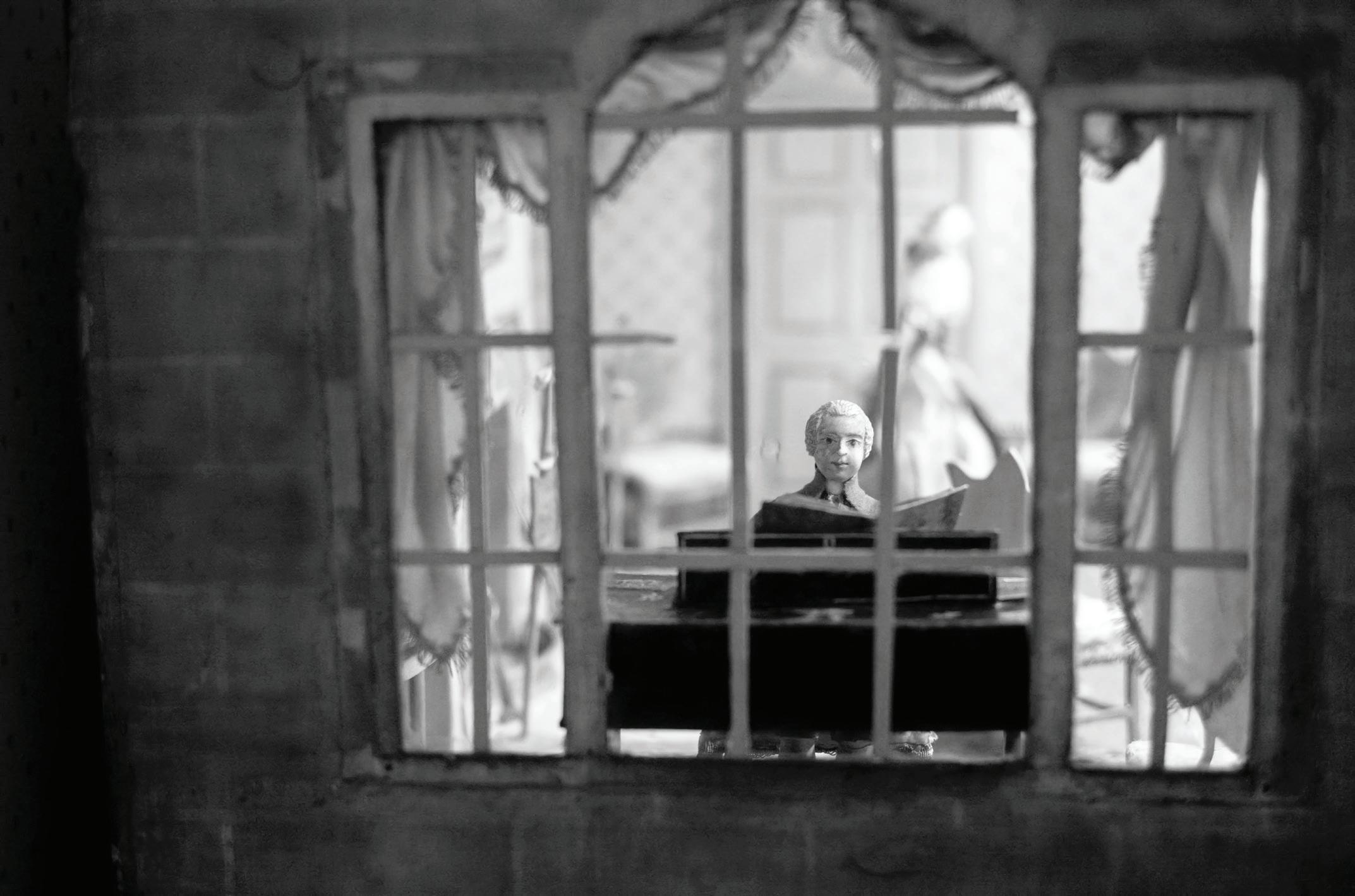
David Farkas is on target when he describes the increase in brightness for the newer Viso. This makes its use a pleasure shooting museum pieces (like through this dollhouse window), and easily finding focus when looking downwards into the 90° finder for a somewhat surreptitious (here cropped) portrait. The older Typ 020 can do these things almost equally well, of course.
(above) M10R + 50/2 ELCAN Replica Prototype. Camera was sitting on the bar near the subject, and the photo was focused and then made casually and unnoticed by him while having a conversation.
(left, top) M10R + 50/2 ELCAN Replica Prototype. ISO 12500 1/45 sec @ f/3.4, post processing with ON1 NoNoise AI. Shot hand-held at the Shelburne Museum.
(left, bottom) 35/2 APO Aspheric, cropped. Focus checking through the Visoflex 2 was easy.
For this reviewer, the bottom line is that:
• The Visoflex 2 looks and feels like an actual part of the camera when attached, especially with black M10’s, where it blends in visually.
• Its metal body gives confidence and is likely more durable.
• The view through the new Viso is brighter and crisper.
• Battery life could possibly be a bit extended versus using the Typ 020 because of less power needed for the OLED versus the Typ 020’s regular LED – the author did not test this, nor could he find such information on line at the time of writing.
Geotagging is indeed missing, apparently due to the metal construction on the Visoflex 2. Be advised, and make a concurrent image with your mobile phone if you need this.
The resulting M10 / Visoflex 2 chimera does not look or feel exactly M-ish, but the new Visoflex 2 feels less like an addon than a well-designed accessory such as a grip or a thumb support. And of course one can simply take it off when the point is to shoot pure “Rangefinder-M”. The author would not probably keep either Viso on the camera if street shooting -yet the special ability of the Viso to reactivate old Rolleiflex TLR skills via the 90° viewing position can indeed tempt one to use its unobtrusiveness when shooting in public. Perhaps with an M12, live-view and RF focus will somehow be integrated, but one cannot then expect that a 90° view could be possible, except by an articulated rear viewing screen.
But one should not let one’s imagination run wild. The author feels that just as Leica finally got a digital RF camera “right” with the M10 (especially the later variants with their quieter shutter), that this new Visoflex 2 is “right” for the current state of technology.
While quite decent framing can be done with the M10's frame lines on 35-50-90 lenses, having the Visoflex 2 really lets you know what is within the frame.
The four images here taken with the Visoflex 2- All of these make use of a Viso's particular advantages and would have been more difficult using only the RF focus.
#1. Four 100ft bulk film cans - three with fresh film, one empty - along with 10 IXMOOs and 10 reloadable Kodak cassettes. When all are loaded, that is 80 rolls of film fitting into this very small space!
Traveling with Bulk Film
by DICK GILCREAST
Did you ever wonder how those famous 35mm photographers back in the 1930s through the late 1950s such as Cartier-Bresson were able to travel and shoot world-wide for many months, while carrying all the film they needed in no more space than the corner of a suitcase and a small camera bag? The way they did it was to use reloadable Leitz FILCA cassettes for their SM cameras, and later on the IXMOO model designed for both SM and M cameras identified by its chrome plated knob at the top, shown in photo 2. At the end of the day those famous photographers took their exposed cassettes into a totally dark space - Cartier-Bresson is reported to have sometimes done this under the covers of a bed - wound the used film strips into an empty bulk film can, and reloaded those cassettes from a fresh bulk roll. In this way all the film, fresh and exposed, could be transported conveniently, and would last a long time. Some photographers developed a sample of a day's shoot to make sure the cameras were working right, but normally all the exposed film would go back for processing in the bulk film cans.
Figure #1 (above) shows a considerable film load of four bulk film cans, three of them holding 60 rolls of fresh film, plus one empty can, and 20 cassettes for the camera bag. Imagine how big a box would have to be carried everywhere holding 80 rolls in manufacturers cassettes! And all those 80 cassettes would also have to be carried back for processing at the end of the trip. The unloading and reloading saved a lot of space.
The system shown, typical of one used by the author, consisted of 10 IXMOOs, but also supplemented by 10 reloadable Kodak cassettes (with the usual felt light traps) for use in Leicaflex and Leica R and other cameras - but all using Leitz center spools, available from Leica as replacements, with those handy one-way locking slots which do not require the use of tape. I never had a b&w assignment that required reloading on the road, so that was done in the home darkroom. The number of IXMOOs, up to 22 by recent count, were used in M6 and Ille cameras as late as 2012.
We can thank Oscar Barnack for designing the SPUCA center spool used for all 35mm films since the beginning. There was an 8mm long end that had serrations around the outside to make it easier to hand-roll, and lugs placed inside the short end to engage the Leica's rewind shaft. Zeiss's Contax of 1932 copied this same 36 exposure spool, and every camera and film manufacturer since has used it. The only changes Leitz made were one in 1937 (Leica Collectors Guide, Laney) providing the one-way locking slot in the middle of the spool, eliminating any need for tape. And then much more recently both Leitz and everybody else added lugs inside the longer end for use in cameras which had a bottom rewind - thus making a Leitz center spool inside a Kodak cassette usable in the bottom-rewind Leica MS! All gray Leitz spools have bottom rewind lugs. Most black ones do not, although there were some. Check any spools you might want to use for a bottom rewind camera.
PROCEDURE IN THE DARK Each 100 ft bulk roll was enough for 20 rolls of 60 inches each. Kodak's bulk rolls have frame numbers from 1 to 44 so the same number will not appear twice even on a slightly long roll.
Working in total darkness, the only equipment required was a small pair of child's scissors. No bulk film loader with its exposed strips of film at both ends of the processed film. No laborious measuring of film length in the dark. And no tape.
After any exposed cassettes were unloaded and consigned either to an empty can, or directly to processing, a bulk can of fresh film was opened. A "V" was then cut on the end of the new roll with the scissors, and the end inserted into the spool's one-way slot with emulsion side down (figure #3). Then, for rolling the fresh film onto the spool, the procedure was for the left hand to turn the spool clockwise, as seen from the short end, while the fingers of the right hand lightly kept the film tight on the spool during winding. With a b&w film of normal thickness, such as Plus-X or Tri-X, the rolling would be stopped just before the rolled film came level with the flange of the spool, and cut off at that point. This method eliminated any need for measuring the length, and also kept each roll just short of 36 exposures in order for each roll to fit onto a single contact sheet with no more than six strips of six frames. Finally, the loaded spool was inserted into the inner shell of the Leitz cassette, which was then inserted into the outer shell, twisted closed and locked, while making sure to leave a short bit of leader coming out. The Kodak cassettes only needed to be capped at the open end after the spool of film was inserted. Once all the cassettes were loaded, and the bulk film can sealed shut, the lights could come on and the leaders of all cassettes trimmed for loading into their intended cameras.
Back in the day, anyone who used SM cameras appreciated the Leitz FILCA cassettes which could be used time and time again without any scratches or bits of lint from a light trap appearing on the negatives - but also to avoid the appearance of sprocket holes on the negative's bottom edge. In 1952 Cartier-Bresson did some shorter trips to Ireland and elsewhere without using his Leitz cassettes, and had some trouble with sprocket holes showing on the bottoms of some of the pictures. Due to his requirement that
the total frame's composition be shown in reproduction, some pictures from this period have appeared in books with sprocket holes showing - examples from that trip seen on page 88 in "H.C.B. the Man, the Image, & the World, a Retrospective", Thames & Hudson, 2003. Leica fixed the problem in that same year of 1952 with the introduction of the red dial II If camera which had a spike sticking up from the baseplate to keep the film up in its correct channel when using commercial cassettes. This modification was continued through the production of the lllg. The M cameras from 1953 onwards did not have this problem, but required the later model IXMOO cassette with a slightly shorter total height. The IXMOO was usable in both SM and M cameras, but the earlier FILCA in SM cameras only.
#2. Leitz cassettes IXMOO, left, with chrome knob, and FILCA, along with their typical containers.
From the 1970's on, although the IXMOO cassettes were still highly valued for black and white work, more and more color transparency films were becoming a primary requirement for publication. And the IXMOOs were to become difficult for air travel because of their unusual appearance to the airport inspectors. Of course the reloadable Kodak cassettes could still be used for b&w bulk film during air travel, along with those Leitz center spools, but the felt light traps began to wear and scratch after about five reloads each. And, finally, the declining use of the Leitz cassette was shown when the M6 camera's baseplate rotating device for opening them was phased out in about 1996, and the IXMOO could not even be inserted into the following M6TTL of 1998. So ended the reign of the Leitz film cassette - but not Barnak's center spool design which keeps going today. My latest roll of Kodak Ultramax 400 has the long end of its plastic center spool measuring that same 8mm exactly!
#3. The Leitz center spool, grey or black, has a narrow hollow depression next to the slot, easily seen on this grey spool in the photo, and easily found by hand in the dark. Hold the spool with the long end upward, and rest your right thumb in the hollow spot. Then, with the left hand holding the end of the film, with the emulsion side down, introduce the Vee into the slot from the left side. That makes sure the film goes in the correct direction to lock in place. The fingers of the left hand can then wind the film onto the spool, shiny side up, turning clockwise as seen from the short end of the spool. Barnak's serrations were put there to grip the spool firmly during this rolling action.
It helps to cut the Vee narrow enough to protrude a little way on the other side of the spool, leaving just enough to grip and pull it through the one-way slot to discard it after the rest of the roll has been torn or cut off the spool for processing.
ROCKLEIGH MEMORIES
by JIM LAGER
My employment with E.Leitz, Inc. Rockleigh, New Jersey began in February 1971. Has it really been more than 50 years since I joined the Leica Technical Department? Between 1971-1975 I dealt with most facets of the Leica System on a daily basis. Cameras, lenses, and accessories. In many instances it was an initial meeting. Allow me to recall a few of these encounters.
It was during a sunny Summer day when a customer arrived with an extraordinary assemblage. A Luftwaffen-Eigentum grey IIIcK coupled to a grey MOOLY-C motor. (#1) I was aware of the black or chrome motif but the grey finish was new to me. Out came my Leicaflex SL to document this rarity. Another first encounter centered on a well worn black 8.5cm Summarex. (#2) The lens carried a tiny engraving reading Red Richards which I surmised to be the name of a previous owner. This lens survives today cherished by an LHSA member.
How about a 1940 Leica IIIb with MOOLY and beautifully crafted leather case? (#4) Again I went to the SL. No time for proper photos but quick snapshots were better than nothing. Highly trained service department technicians would regularly summon me with “ Jim, we have something here you should see”. I went immediately. There it was on the workbench. An absolutely battered black M3 with unusual engraving M3-1053*. (#3) Years later I realized this was a prototype MP prepared for evaluation by prominent photojournalists. Then a 1930 rim set Leica B so worn you could not read the entire serial number. (#5) Leica IIIc 386101 converted to a IIIf. (#6) Future research indicated original shipment to Japanese occupied Shanghai in 1942. An early KE-7A with 5cm ELCAN 276-001 for in-house evaluation. (#7) Null series M5 1287002 being shown to the M specialists. (#8) They were seeing the new M5 for the first time. I watched and listened from the appropriate distance and distinctly remember uttering "My God, what has Wetzlar done to my M3".
The 180mm 1:3.4 ELCAN-R came with the understanding I could shoot with it but not photograph it. (#9) It was during the Cold War and the lens was classified. Built for the U.S.Navy and later commercially introduced as the Apo-Telyt-R. Important visitors from Leitz Wetzlar had concluded their meetings and were about to depart. Suddenly without warning a tiny M lens was handed to the Leica Technical Department. I mounted the 15mm 1:8 Hologon to an M5 and shot exteriors of the Rockleigh headquarters building. (#11) The special variable density filter reduced vignetting. A lens for the specialist. All of the transparencies I shot with the 180mm ELCAN-R and Hologon were Company property, hence, I do not have them. A silver Haliburton case arrived filled with M equipment never seen by the service department. A Leica MS with two lenses and special viewfinder. (#10) This equipment was forwarded to ELC in Midland. See the LHSA Viewfinder 53-3.
A first style 400mm 1:6.8 Telyt emerged from storage. (#12) It was just like the one used by DDD at the 1968 presidential conventions. Fifty of this style were prepared with single piece construction
#1. Grey IIIcK with grey MOOLY-C
#2. Black Summarex 593285
#4a. IIIb with MOOLY and case
# 4b. IIIb with MOOLY and case
#5. Rim set Leica B
#6. IIIc 386101
#8. Null series M5 1287002
#7. KE-7A with lens 276-001
#9. 180mm 1:3.4 ELCAN-R 303-0055
and no filter slot. Batch 2242001-2242050. A chance discovery in a corner of the stockroom unearthed a container containing viewfinders engraved Leitz Wetzlar. The finders were like the one fitted to the Leica Gewehr in the factory museum. Still wrapped in protective tissue paper the finders had not been used. A few found their way into collections. Very rarely the PLOOT reflex housing is found modified to accept the finder. (#13)
Rockleigh memories. An extraordinary experience I will always treasure. Total immersion in the Leica Universe. Hopefully today’s Leica enthusiasts will share my 50+ years passion.