Inquries about membership, upcoming events, replacement Viewfinder issues, and special orders should be directed to:
Richard Rejino, LHSA Executive Director 14070 Proton Road, Dallas, TX 75244 info@lhsa.org, (972) 233-9107
Viewfinder is the official publication of the LHSA, The International Leica Society, a nonprofit organization incorporated in the state of Delaware. Copyright 2014. Reproduction or use of any material contained herein without permission of the Sociey if forbidden.
Leica is a registered trademark. It and other trademarks pertaining to the Leica System are the property of LEICA CAMERA, USA, INC.
ISSN 1543-8732
PRESIDENT Alan Weinschel alan.weinschel@lhsa.org
VICE PRESIDENT
Keith R. Sbiral krs@reddotbluedot.com
SECRETARY/TREASURER Thomas Campbell leicar7@aol.com
IMMEDIATE PAST PRESIDENT Gary Hough gary.hough@lhsa.org
PRESIDENT EMERITUS
James L. Lager
Rolf Fricke
Bill Rosauer
APPOINTED OFFICERS Viewfinder Editor Bill Rosauer lhsaeditor@yahoo.com
Associate Viewfinder Editor Ed Schwartzreich ed.schwartzreich@imagere.com
32 taking a travel 'mate' by David Knoble
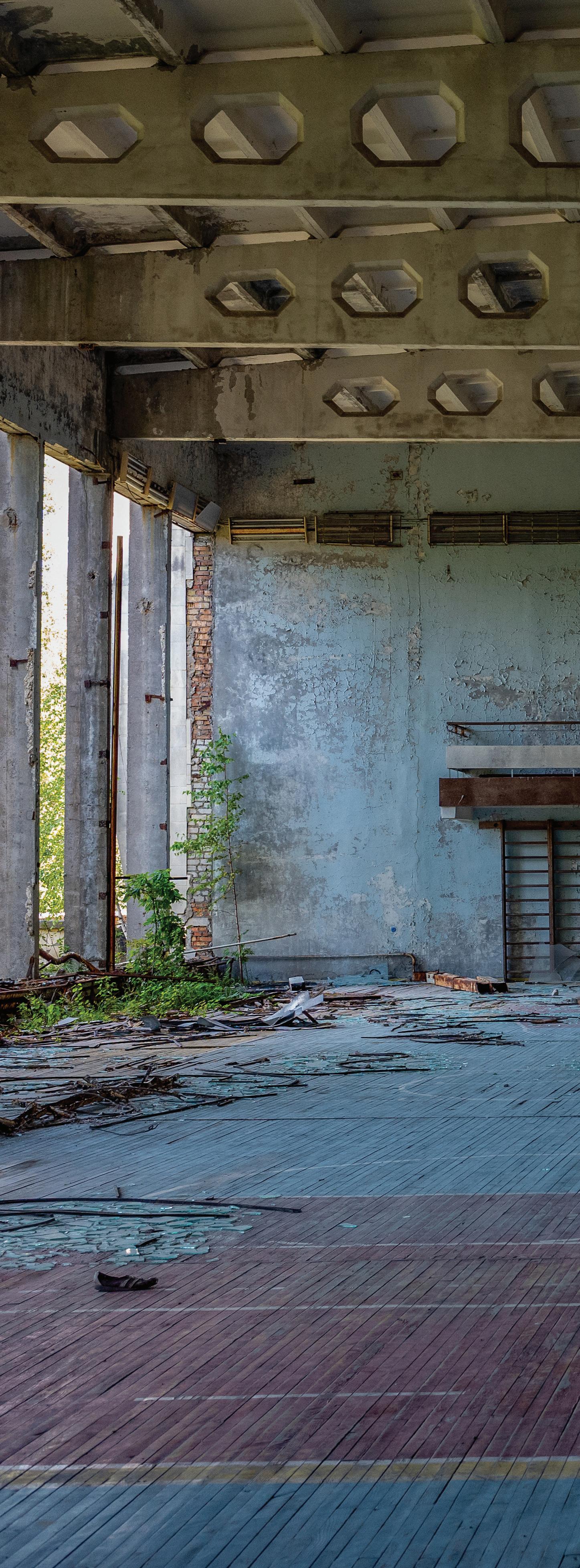
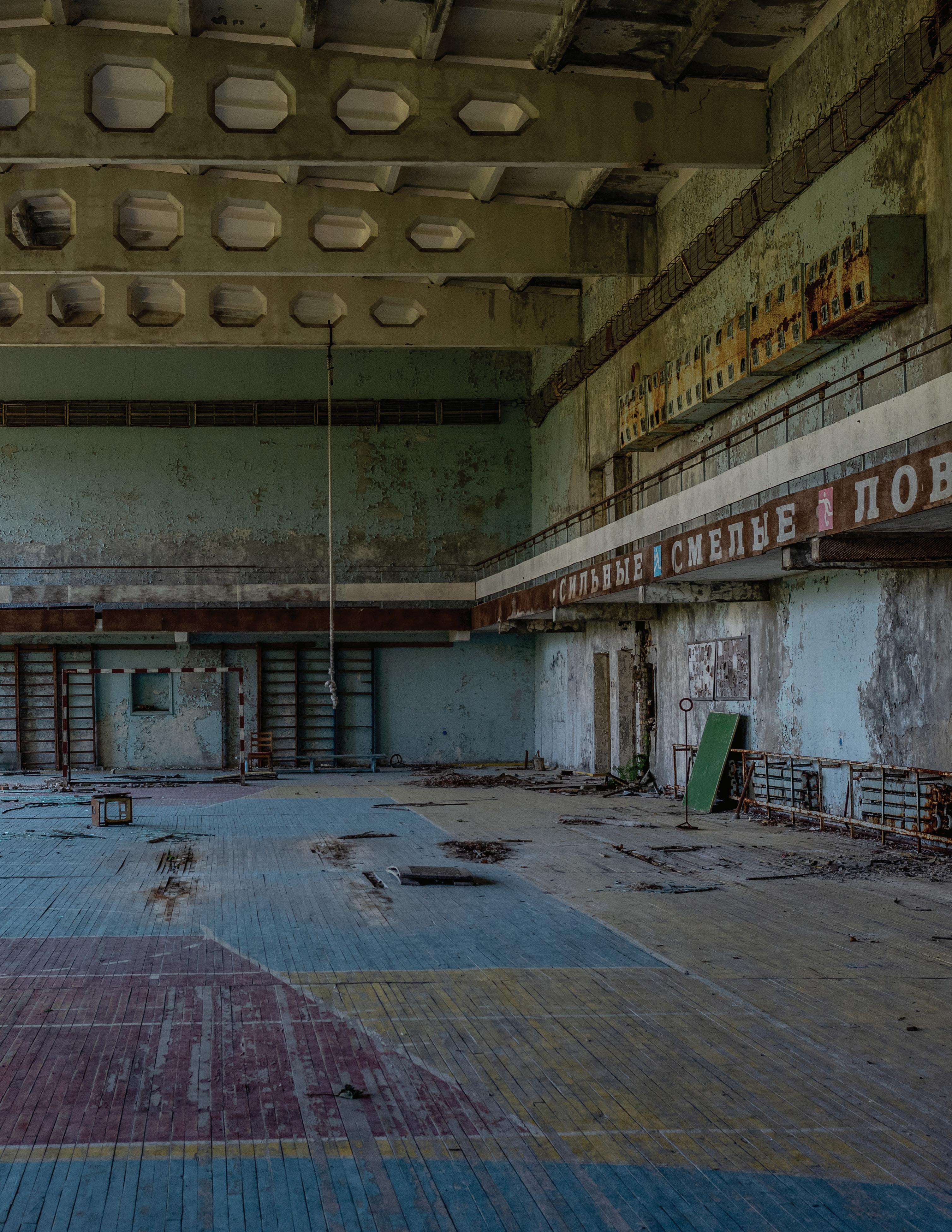
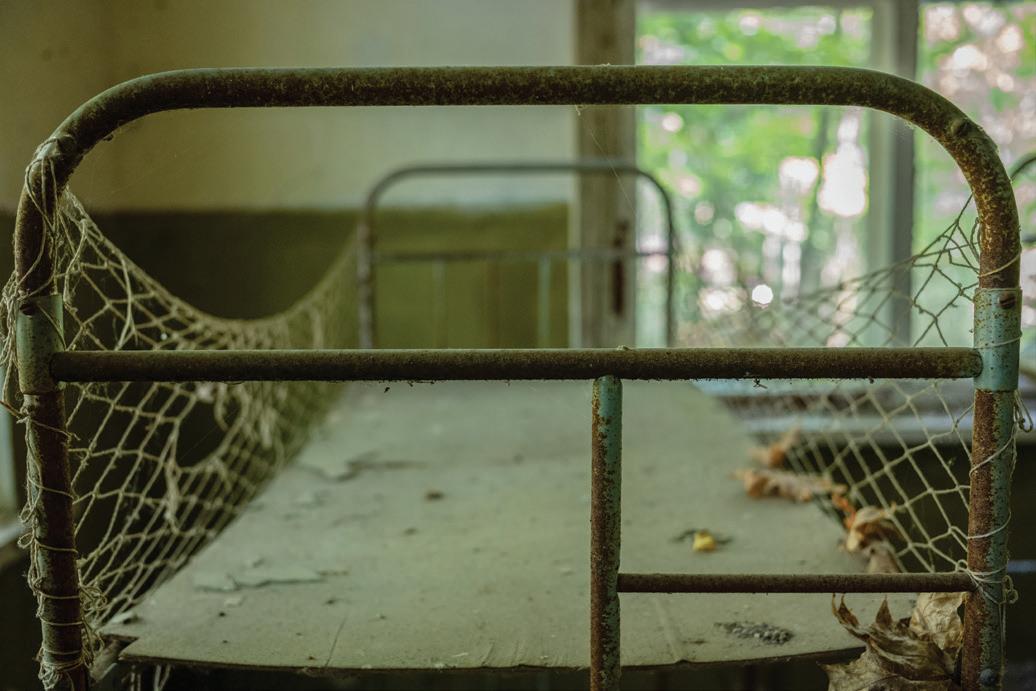
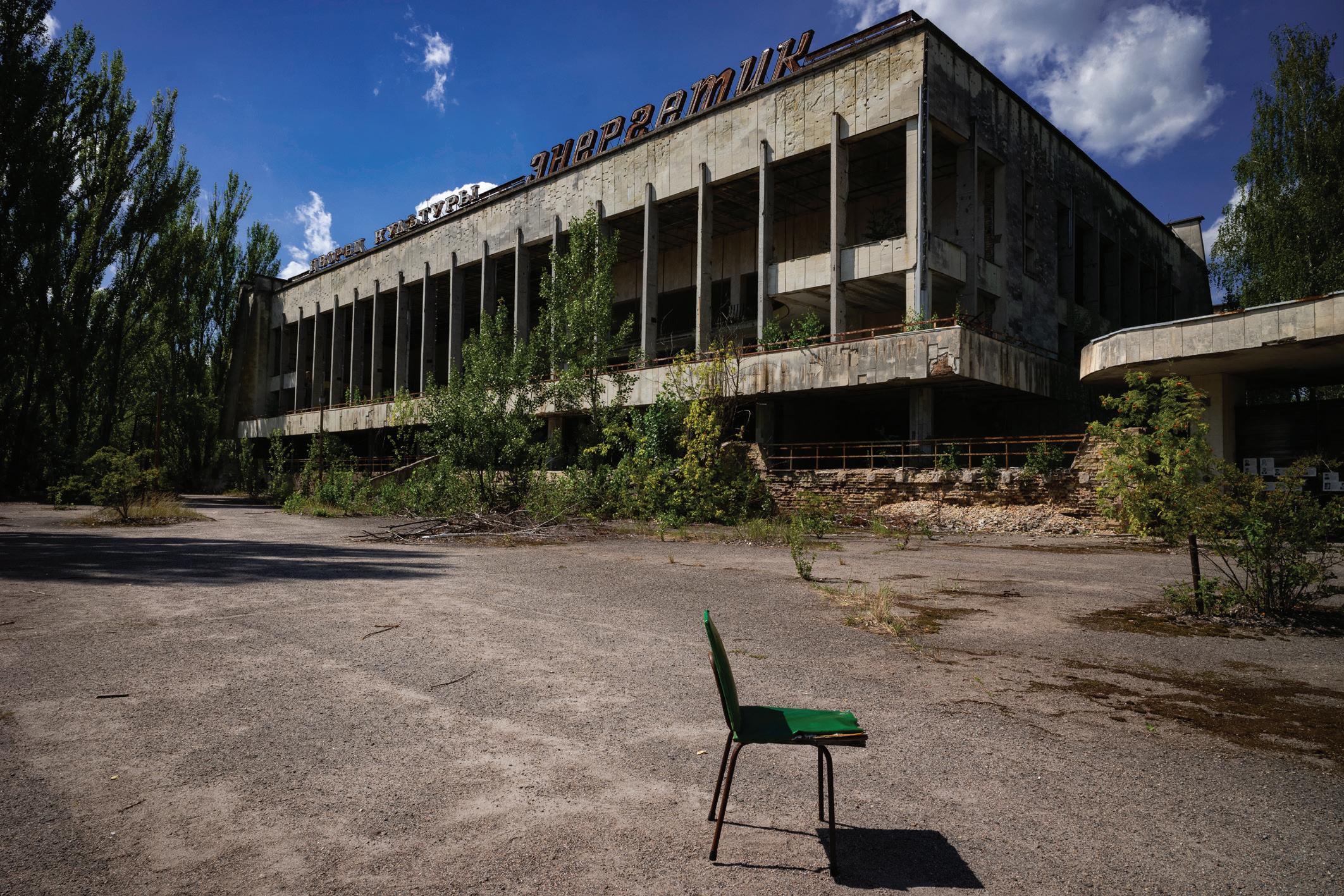
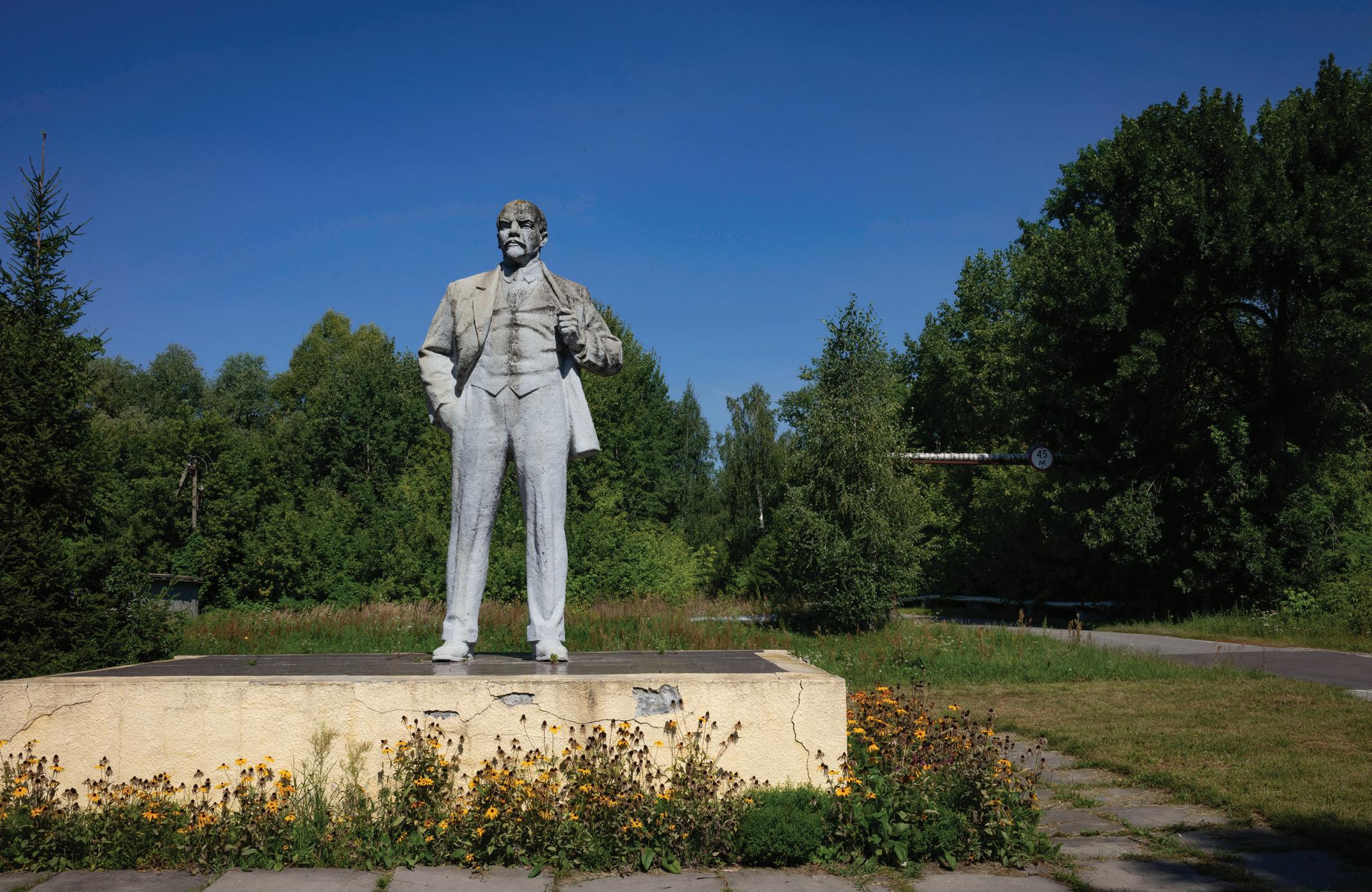
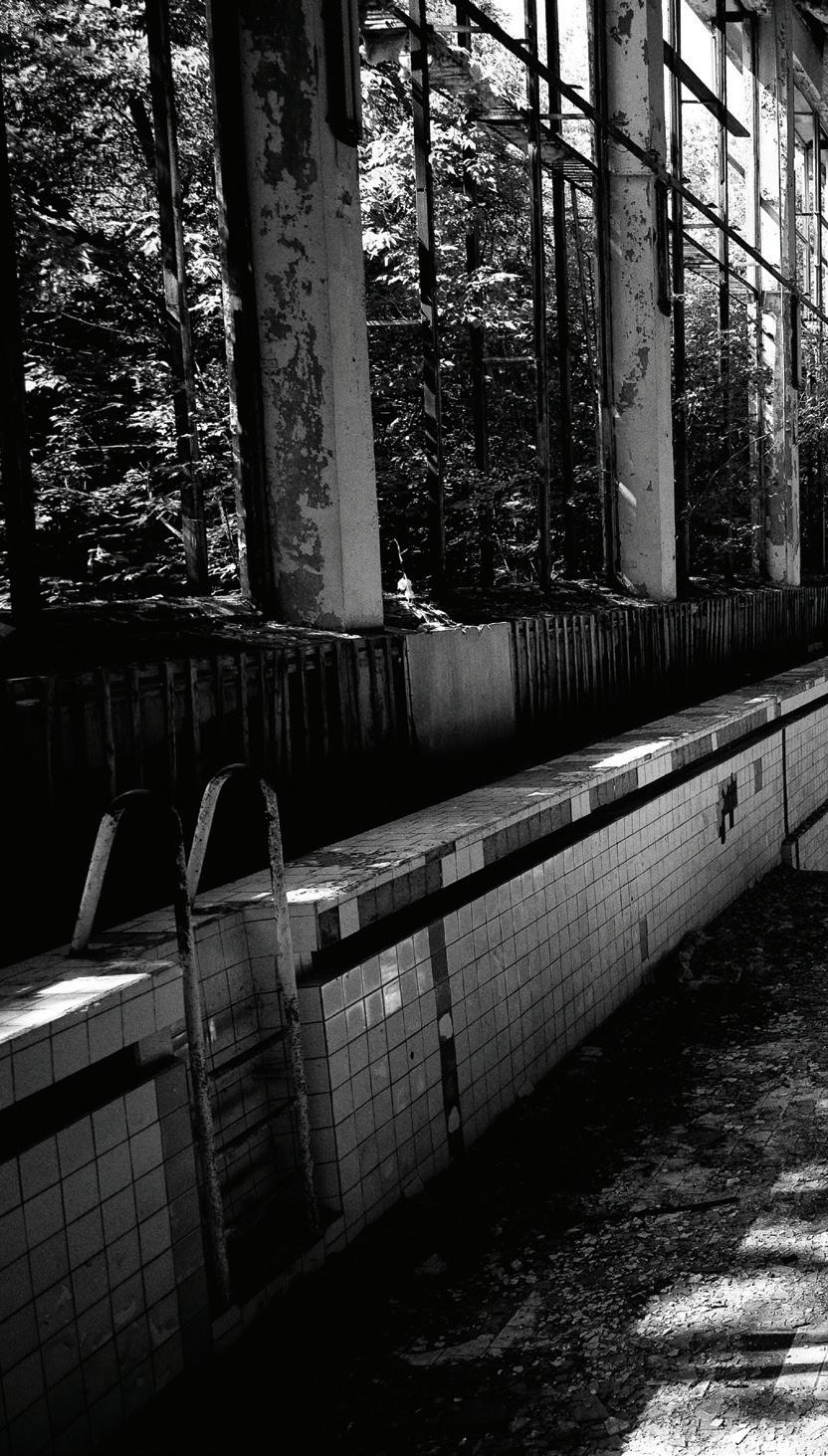
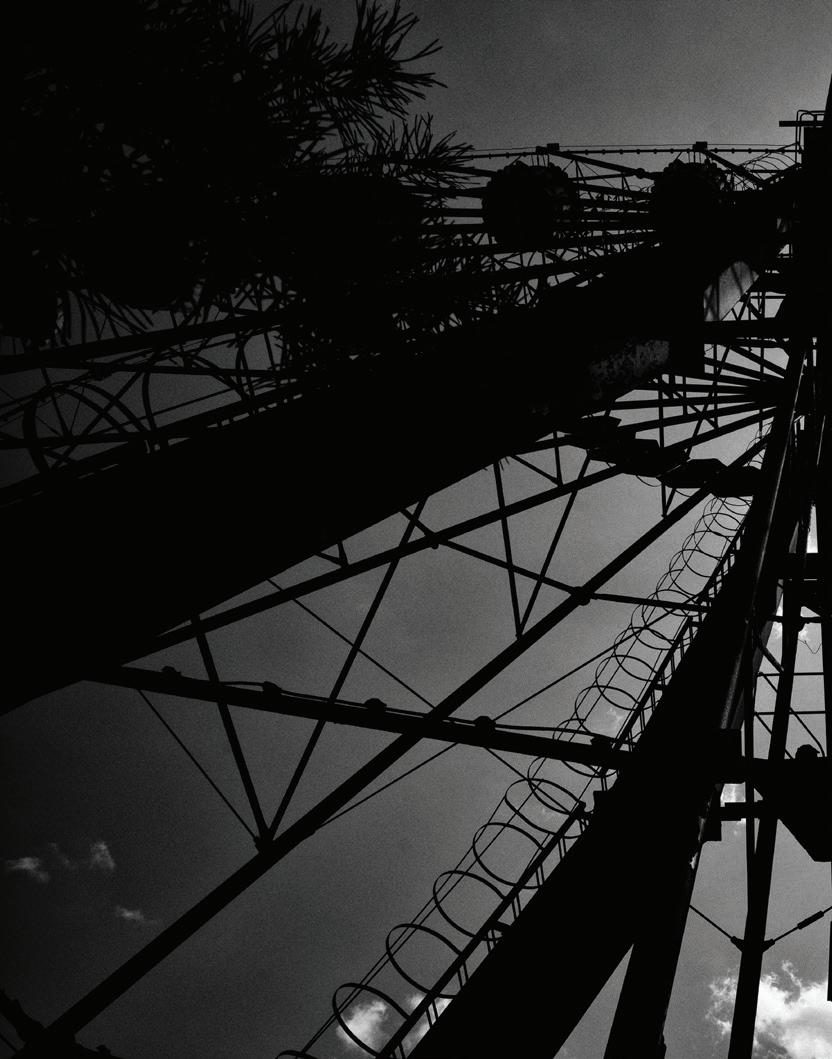
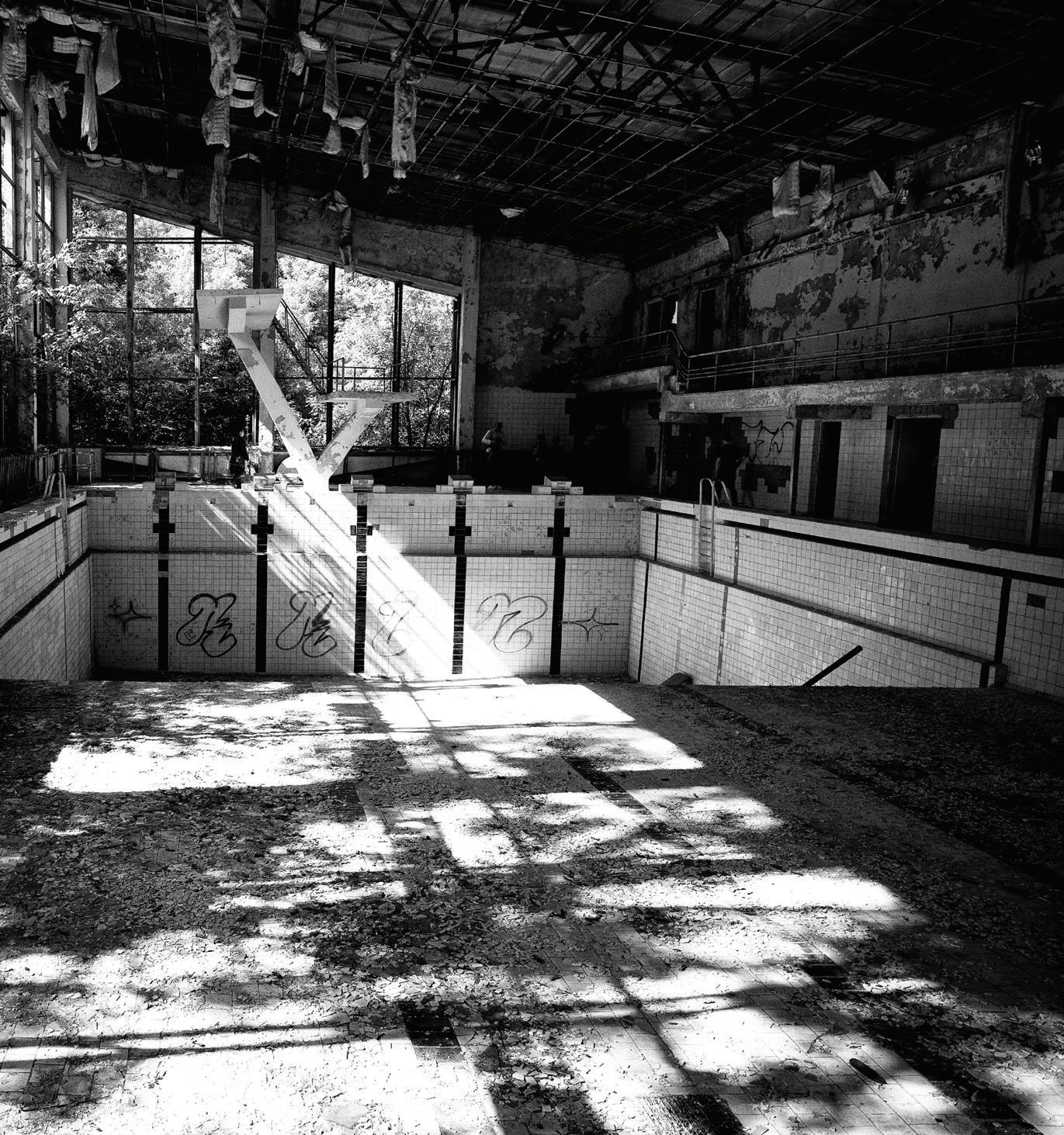
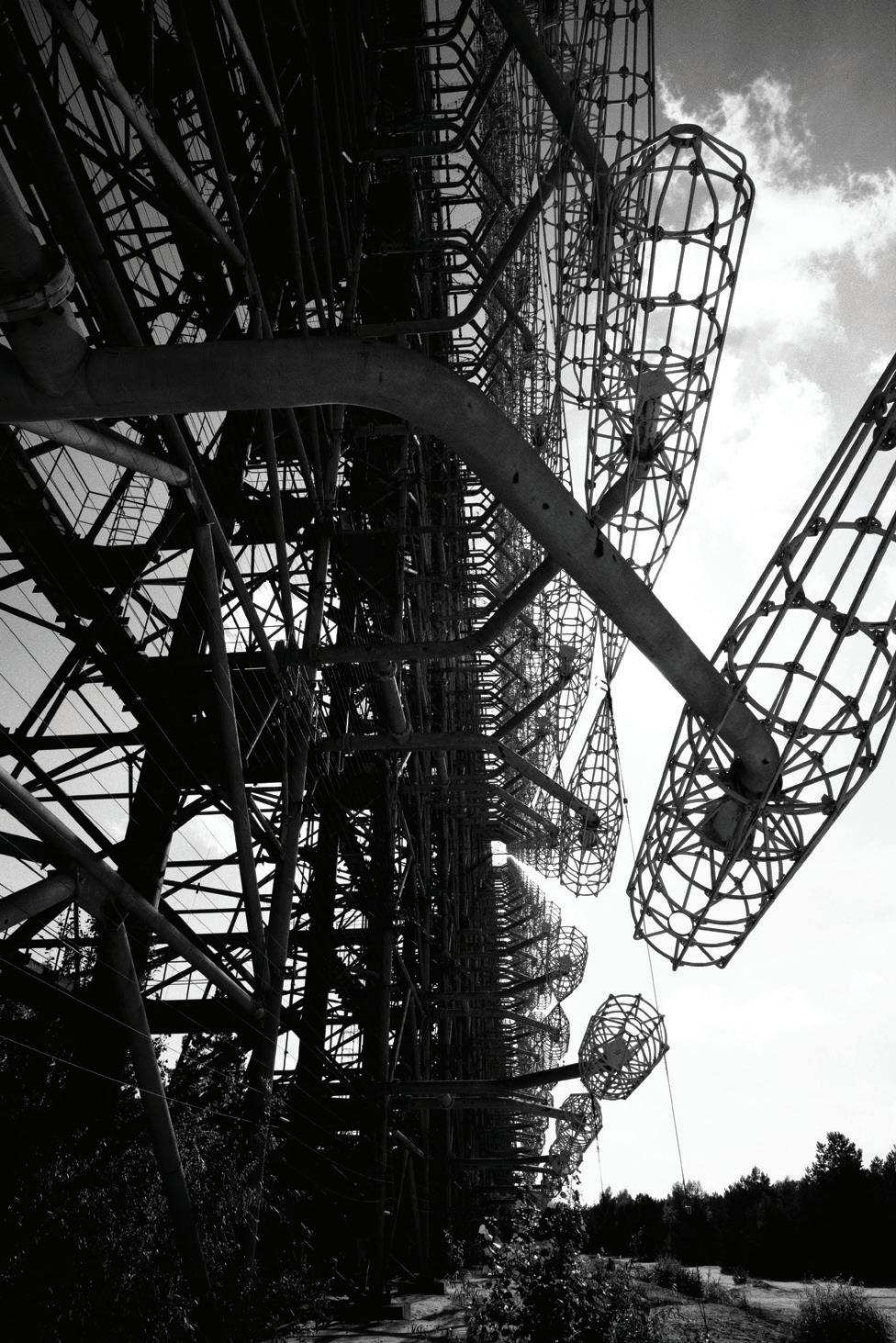
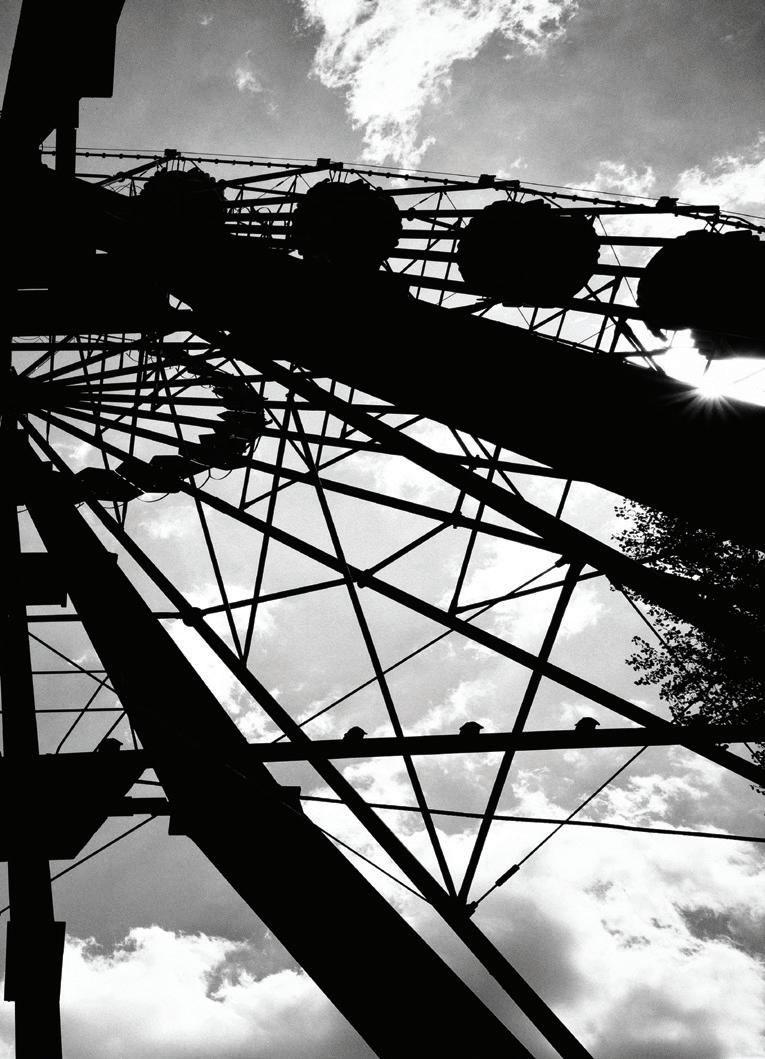
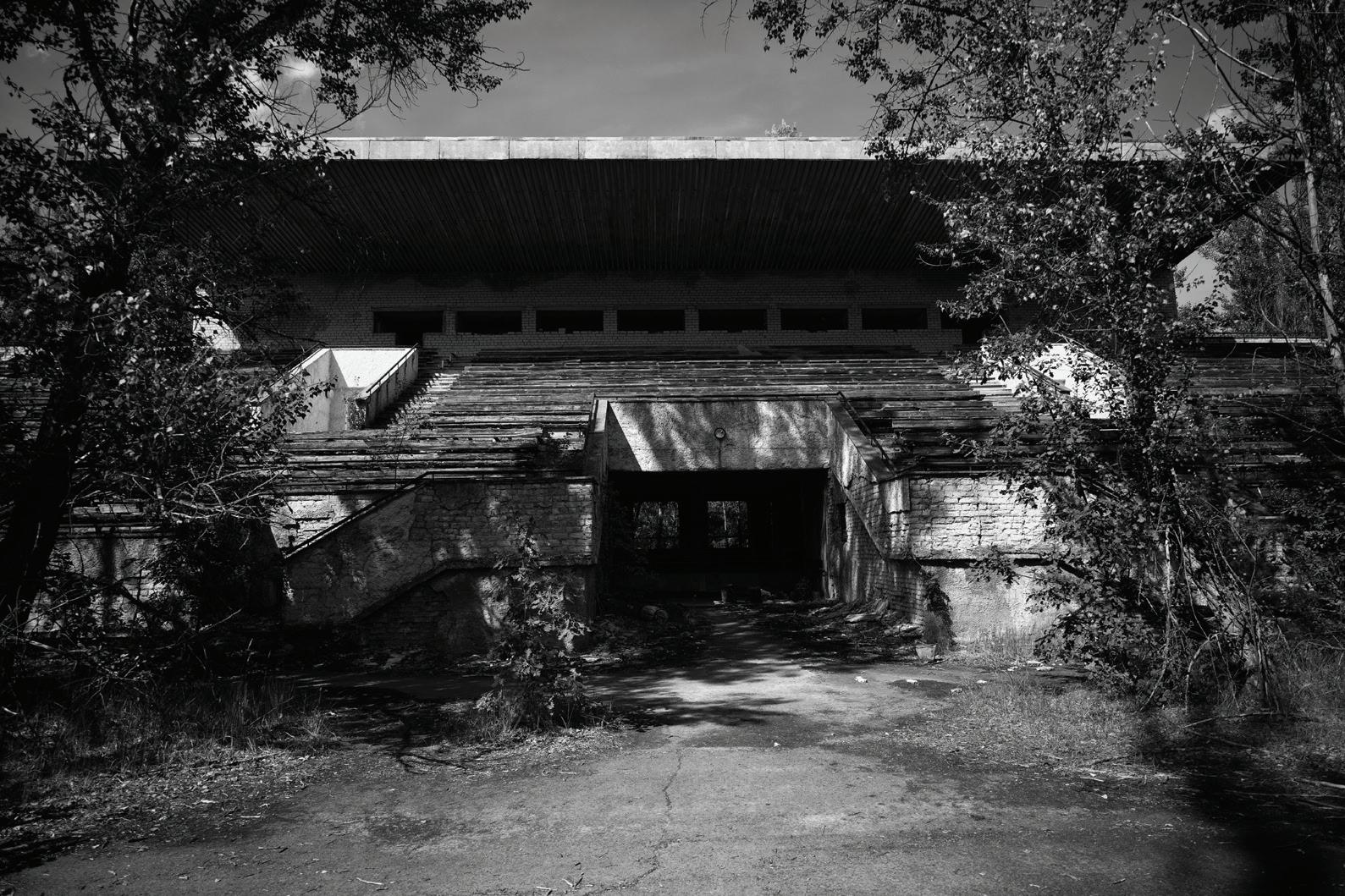
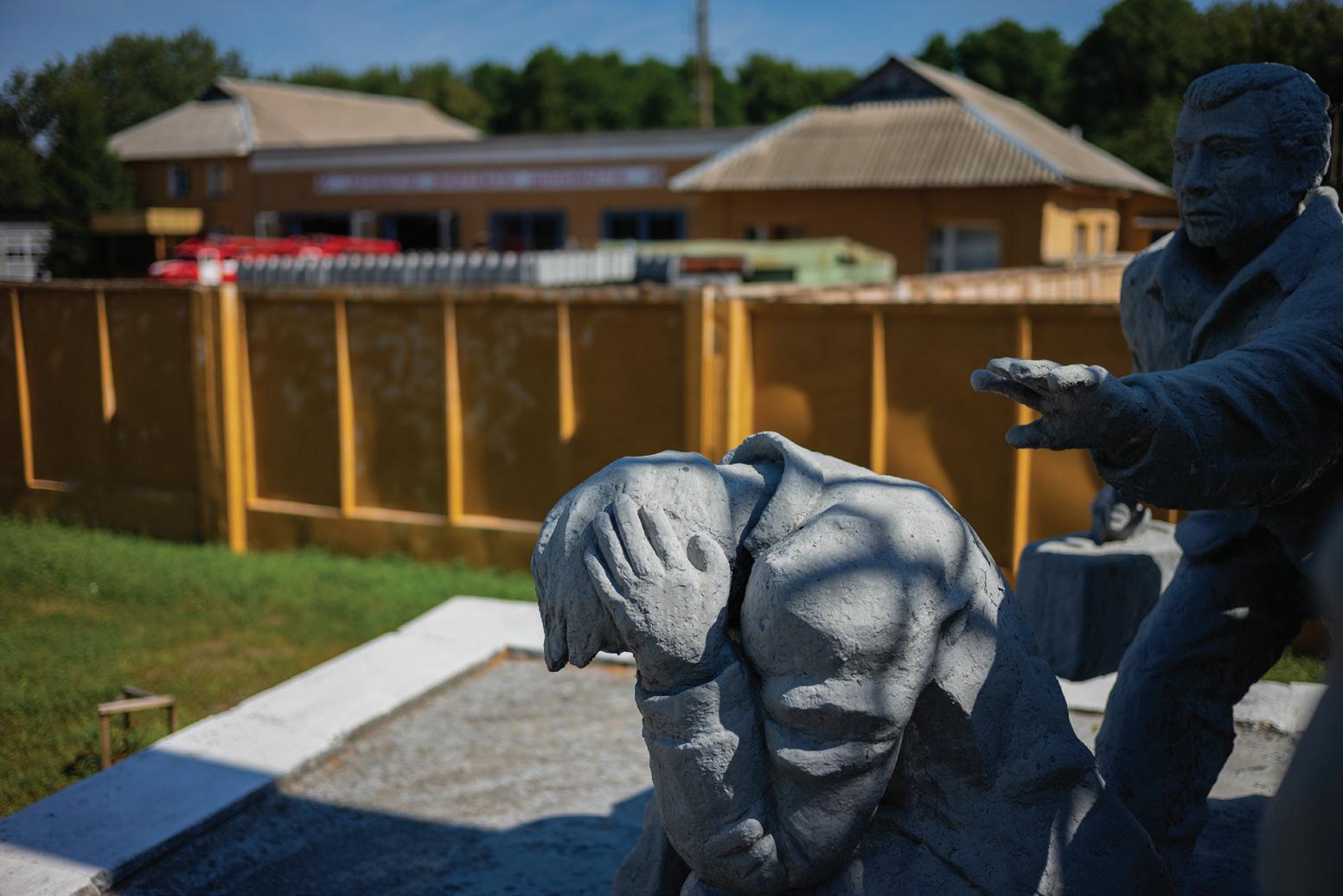
40 chernobyl & travel photography by Keith R. Sbiral
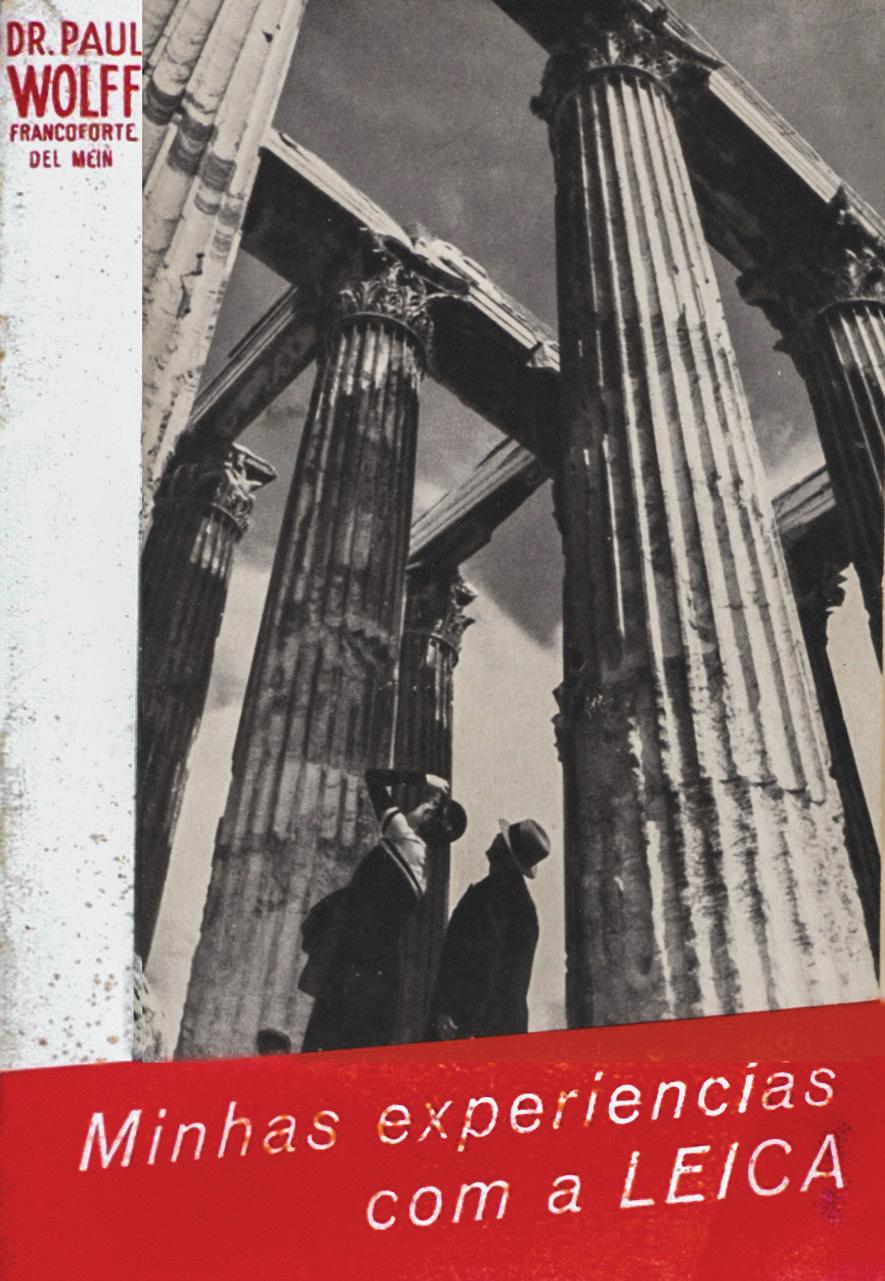
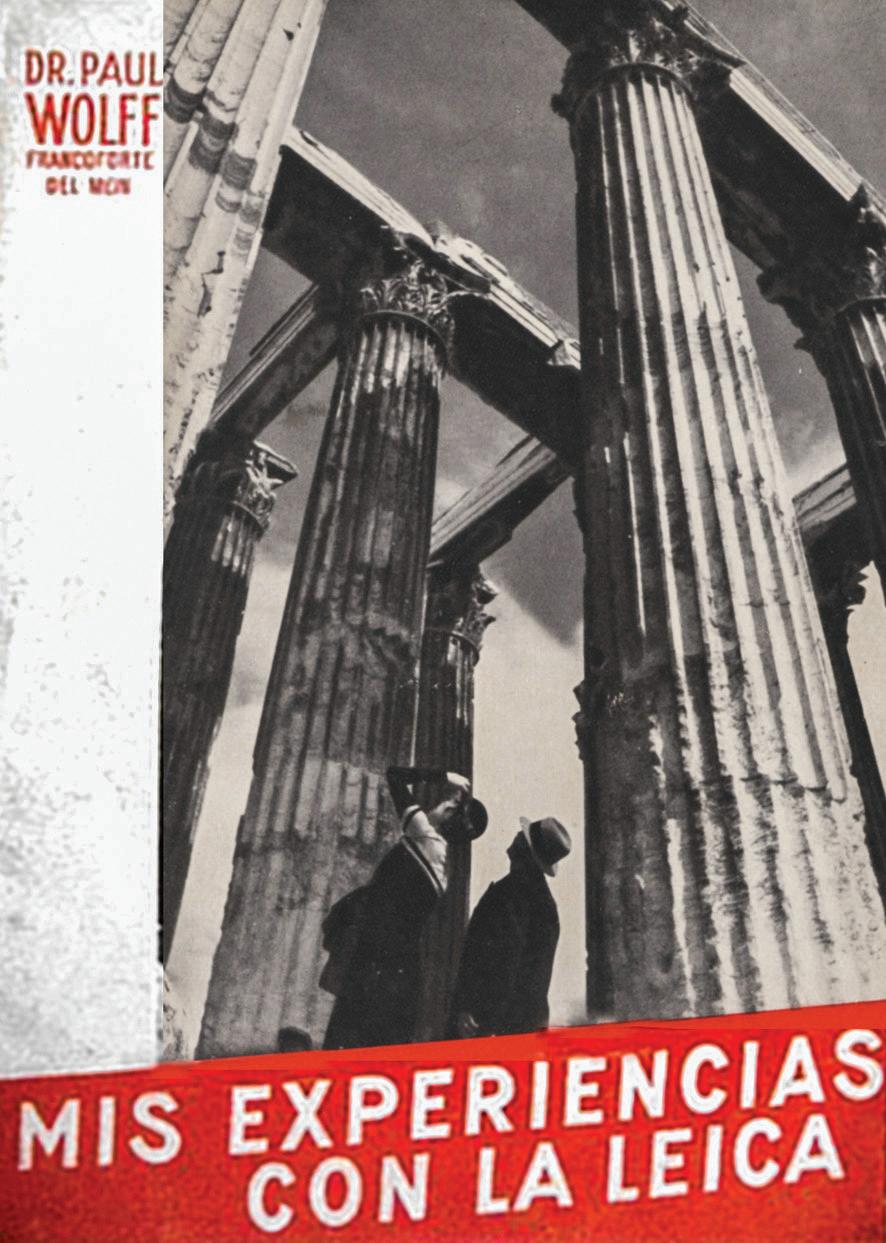
48 more dr. wolff exhibition catalogs from 1934 by Ed Schwartzreich
49 a gamble & then a phone call by Jim Lager
50 one thousand leicas by Jim Lager 51 summicron surprise by Jim Lager
ELECTED DIRECTORS
Class of 2019 Peter Dooling peter@leicastoremiami.com
Andrew Godlewski harley772@yahoo.com
Bill Royce wfroyce@gmail.com
Class of 2020
Douglas Drumheller dougdrum@comcast.net
David Knoble dmknoble@gmail.com
Dan Tamarkin dan@tamarkin.com
Class of 2021 Wilbur Norman coupdefoudrellc@gmail.com
Keith Sbiral ksbiral@mac.com
David Spielman david@davidspielman.com
CONTRIBUTING EDITORS
S.R. Gilcreast, Jr. (603) 381-8293
James L. Lager jlager100@yahoo.com
S. Willis Wright beoon@aol.com
A LETTER FROM THE PRESIDENT
by ALAN WEINSCHEL
LHSA member We have used the word “engagement” frequently in the past two years as we work to reinvigorate and, in some ways, reinvent your society. I thought I would go through some of the forms of engagement that we in the leadership deal with on a daily basis.
We are engaged with Leica. We are not affiliated with Leica, nor they with us, and we both have completely separate management and legal status. Nevertheless, we spend a lot of time working with Leica on efforts that will benefit both Leica and LHSA. This takes many forms, including staying in the Leica communications loop so we can tell you about new product developments, software or firmware updates, and Leica-sponsored events. We maintain connections with both Leica Camera US and Leica Camera AG. This has enabled us to develop commemorative products like the LHSA 50th Anniversary 50mm APO Summicron. At our meetings, we have almost always had a selection of new Leica gear to try out for a day (“Leica on Loan”). Our engagement with Leica has also resulted in the program under which buyers of new Leica system cameras and Leica Q cameras are offered a free one-year digital membership in LHSA. That program began on October 1, 2018 and nine months later we have had more than 1,200 new Leica owners take us up on the offer. We will need to engage with those new members so that they will want to pay dues to continue to benefit from LHSA. More on that later. We are very grateful to our friends at Leica for their help in engaging us.
The leadership is engaged. The leadership of LHSA – the Board and the Officers are very engaged in the work that must be done to keep the organization going. This includes day to day matters as well as planning for meetings and other programs. All of the time spent on this – with the exception of our Executive Director, Richard Rejino – is strictly volunteer. Board members and officers receive no compensation for their efforts and pay their own way to attend meetings as well. And officers and directors are ineligible to enter our Sweepstakes too. I can tell you that it is purely a labor of love. By the way, our meetings are not intended as profit centers; the objective is to break even on the costs incurred in putting on a meeting. We sometimes guess wrong and lose a few dollars and sometimes have some dollars left over, but our meetings are not structured to be a profit center for us.
Also, on the subject of meetings, by the time you receive this Viewfinder (or shortly thereafter) registration will be open for our annual meeting in Boston October 18-20. There will be sessions with Costa Manos, Ed Keating (NY Times Pulitzer prize winner), Monika Bock (the head of the Leica archives in Wetzlar), Sean Reid, Antonio di Benedetto of Leica US, and our own Bill Royce. Plus an optional Boston harbor tour, and a Marketplace for selling or swapping. Our meetings provide an opportunity for members to get to know each other, learn from each other, and make friends. Beyond Boston, we are planning on Colorado Springs in May 2020 for the spring Shoot (with instruction from David Spielman), Seattle in October 2020 for the annual meeting, and Dublin for the Fall of 2021. That is a lot of work for our Board, but it is worth it.
Member engagement: The thing that drives us is our members. Sharing our Leica experiences enriches everyone. Here are some things for you to consider:
1. Come to a meeting! It is an opportunity to meet your fellow Leica travelers, learn, and may be even teach somebody else something. Just looking at the great photos of photographers with different ways to see will inspire you.
2. Tell others about your own Leica story. It is fascinating to hear of the passion of others on their photographic journey. Each of us has a unique story and they are all interesting and sometimes fascinating.
3. Contribute your photos: We are in the middle of an effort to collect member photographs of Notre Dame. By the end of the summer we should have quite a collection to share with the restoration team, and the best will go into a book, whose proceeds will go towards restoration. Send us yours.
4. Have your portfolio reviewed. We have been truly fortunate to have a great relationship with Craig Semetko. If you ever have a chance to hear him speak of his own photographic journey, do it. You will learn something about serendipity and other things (no spoilers!). Craig has agreed to review a member’s portfolio and provide critical comment. It will be a random member chose from those who have indicated their willingness to provide about a dozen images. This is no cost, but it is open to members only.
5. Support your society by contributing to our Photographer’s Fund that each year helps out an aspiring photographer with a project. You can also support us by entering the Sweepstakes we run from time toi time. We just concluded a successful sweepstakes for one of our APO Summicon 50mm 50th Anniversary commemorative lenses, and later this year we will have another of these spectacular lenses in another Sweepstakes.
6. Vote in the LHSA election later this summer. Under our new by-laws, all paid-up members can vote electronically. In the past, only those attending the Annual Meeting were entitled to vote.
Let us know how we’re doing you can contact me or Richard Rejino if you have ideas or otherwise want to let us know what is on your mind. - Alan Weinschel
A LETTER FROM THE EDITOR
by BILL ROSAUER
usual, I think we have a great issue of Viewfinder , with something that should appeal to everyone in the membership. We have some brand new international contributors, some articles from our active leadership and of course some articles from long-time contributors in this issue.
I’d like to welcome new member and contributor Dennis Berti to Viewfinder and the membership. Dennis did an article on using a Leica M10 to shoot weddings, which caught my eye on the l-camera-forum. I was very impressed with what I saw and Dennis’s story, so I reached out to him to see if he would like to share his story and images in our journal. It turns out Dennis is a working pro in Mexico and also a brand ambassador for Nikon. Dennis is new to Leica and had no idea who the LHSA was, but he enthusiastically accepted my invitation and joined the Society that same day. I think you will enjoy his story and images. I am always on the lookout for new talent, and I have recruited many new members by inviting them to contribute to Viewfinder. Perhaps you know
other Leica people who could benefit from joining the Society and could make a valuable contribution to our journal?
David Knoble does a sequel to my article in the last issue, “WATE, the Ideal Travel Lens”, with his article on the MATE, “Taking a Travel MATE”. David makes a strong case for the original Tri-Elmar 28-35-50 as a very useful travel companion and why it deserves a place in your bag. Considered one of the most difficult lenses to produce ever made by Leica, it was discontinued a number of years ago, and there have been consistent rumors of its resurrection over the years. I have even seen images online of a prototype replacement, which unfortunately never reached production. Well, we’ll keep our fingers crossed!
Keith Sbiral, our new vice-president takes us on an interesting tour of the devastation of Chernobyl, a place many of us will never visit, but all of us have heard of. Keith and his wife Amy Gardner operate Red Dot Blue Dot, whose mission is to bring people together through travel photography. Keith shows us as
the environmental and human side of the story within the exclusion zone of the disaster area. Keith also shares some useful, common sense tips to improve your travel photography experience.
Dick Gilcreast surveys the Leica lenses available to the professional Leica photographer using a screw mount Leica camera. Dick discusses each of the lenses and gives examples of the results he obtained while using these lenses over his career as a professional photographer. This is a very helpful guide for those members who may not be familiar with the screw mount Leica legacy lenses.
Kirsten Vignes, our very talented layout person, reports on the Spring Shoot in Asheville, North Carolina. Kirsten’s images convey very well the comradery of those in attendance. Of course, Viewfinder would not be Viewfinder without an article by Jim Lager, and in this issue we have three. I think you will find Jim’s articles informative and entertaining, especially the one about the Lexus that the experts of the time were not aware of and that graced the cover of Jim’s first book.
Ed Schwartzreich reports on two newly discovered catalogs from the 1934 exhibition tour of Dr. Paul Wolff’s Leica enlargements. These are included in a new bibliography on Wolff and Tritschler which will be published later this year. Also due out this year is a major new book on Paul Wolff, as well the opening this July of the new Ernst Leitz Museum at Letiz Park, featuring the work of Dr. Paul Wolff and Tritschler, “Light and Shadow, Photograps from 1920 to 1950”. We will have more on these important new developments in future issues of Viewfinder.
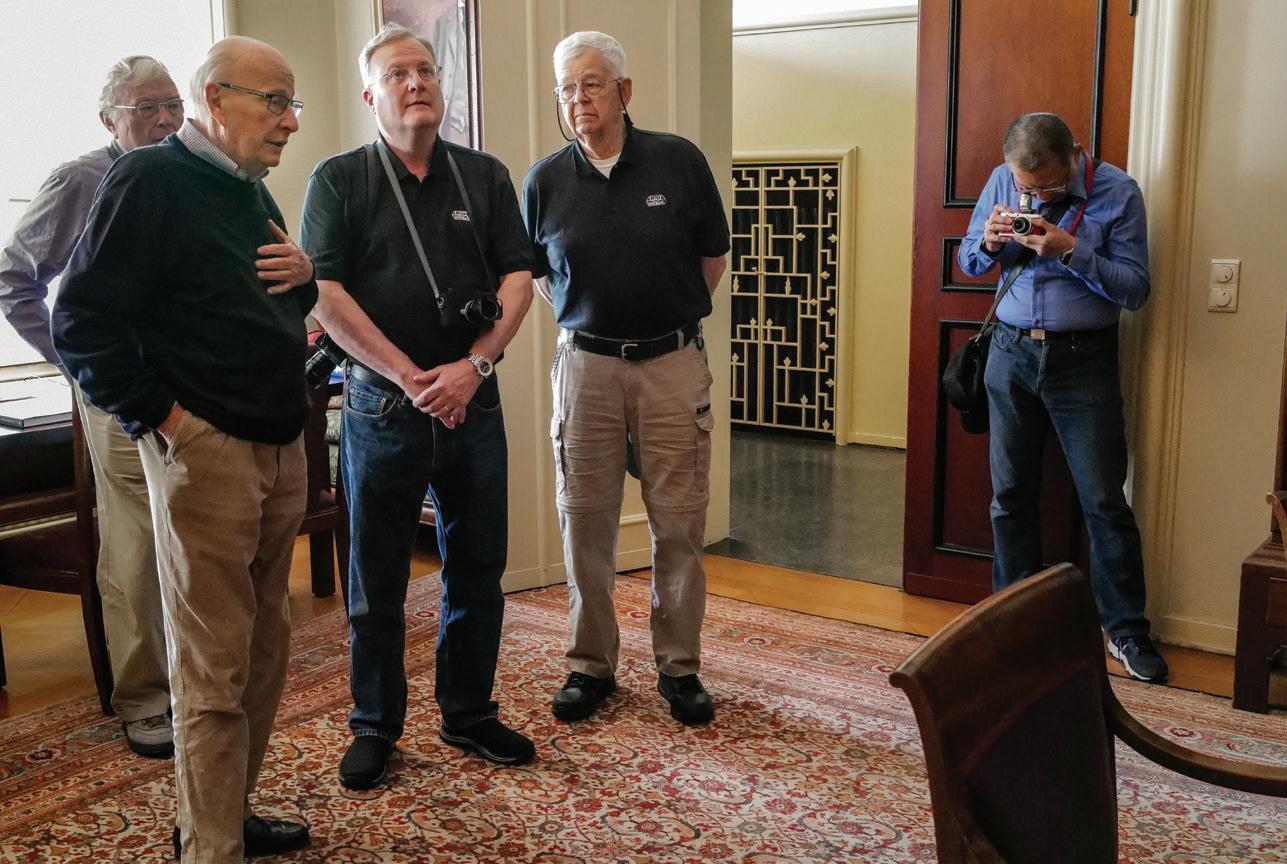
In this issue, I have images from an exclusive tour of Haus Friedwart and the old Leitz Administration building in Wetzlar by Knut Kühn-Leitz, the grandson of Ernst Leitz II. This was part of my inaugural guided tour of Leica and Wetzlar, “The Total Wetzlar Experience”. Seeing the inside of these two buildings so important in the history of the Leica had been a lifelong dream of mine, and I was very fortunate to have Knut agree to be our guide. To my knowledge, I have never seen anything published in any Leica publication on these two buildings. There are very few images online, and nothing has ever appeared in Viewfinder or any of our sister publications. There is only the book by Alfred Ziffer on the architecture and artwork in Haus Friedwart. I hope you will enjoy this exclusive inside look here in the pages of Viewfinder. Please contact me about joining me on a future tour of Wetzlar for your own opportunity of a lifetime “insider tour”.
Congratulations go to two of our members who have had their work featured in the pages of Viewfinder, and now have had their work appear in gallery showings. Allen Bourgeois had a one man show at the Amerikazentrum Hamburg e.V.in Germany entitled “Streets, Alleys and Other Observations, Chicago”, for the entire month of May. Keith Sbiral, our new Vice President, had a show at Dan Tamarkin’s Rangefinder gallery in Chicago entitled, “Connecting with Place and People: Traveling the World with a Leica.”
Bis nächste zeit!
Bill
A sh e vill e
by KIRSTEN VIGNES
SPRING SHOOT 2019 • A NEW SEASON FOR LHSA as
one of the youngest members of LHSA, I don’t have a great deal of society meet ups under my belt, but I’ve attended enough to know that the recent Spring Shoot in Asheville, NC was different. Over the last few years, our board, under the leadership of past president Gary Hough and current president Alan Weinschel, has made great strides in growing our membership and ushering in a new era of Leica enthusiasts. This spring shoot, it was clear their hard work has paid off. New faces brought a new energy and a love for all things Leica ran deep.
The first day in Asheville commenced at the Biltmore Estate, a historic house museum that once served as a summer getaway for the Vanderbilt family. The opulent Gilded Age mansion provided not only a photographic backdrop, but also a stage for members to catch up and get acquainted with one another. A constant hum of camera shutters and Leica talk was heard
as we meandered through the Biltmore’s decadent rooms and vast halls. Outside, the gardens were alive with song and bloom. Spring was ever present and the change it brought reflected our society’s forward progress.
The second half of the day proved equally as exciting. Guest speaker, David Spielman, gave a lecture on staying photographically inspired and avoiding cliches before breaking us into groups and sending us out on assignment. I was lucky to have Jon Kidder in my group who was an Asheville frequenter and knew the city well. We wandered past record shops and street performers, through bookstores and a community garden. Asheville, although small, left nothing to be desired when it came to street photography. This sentiment only grew as day shifted into night, and the city really started to wake up. Live jazz drifted from speak easies, buskers serenaded passersby, and the beating of drums echoed from Pritchard Park. Asheville’s night scene allowed us to push ourselves and our ISO’s to capture the rhythm and atmosphere of the city.
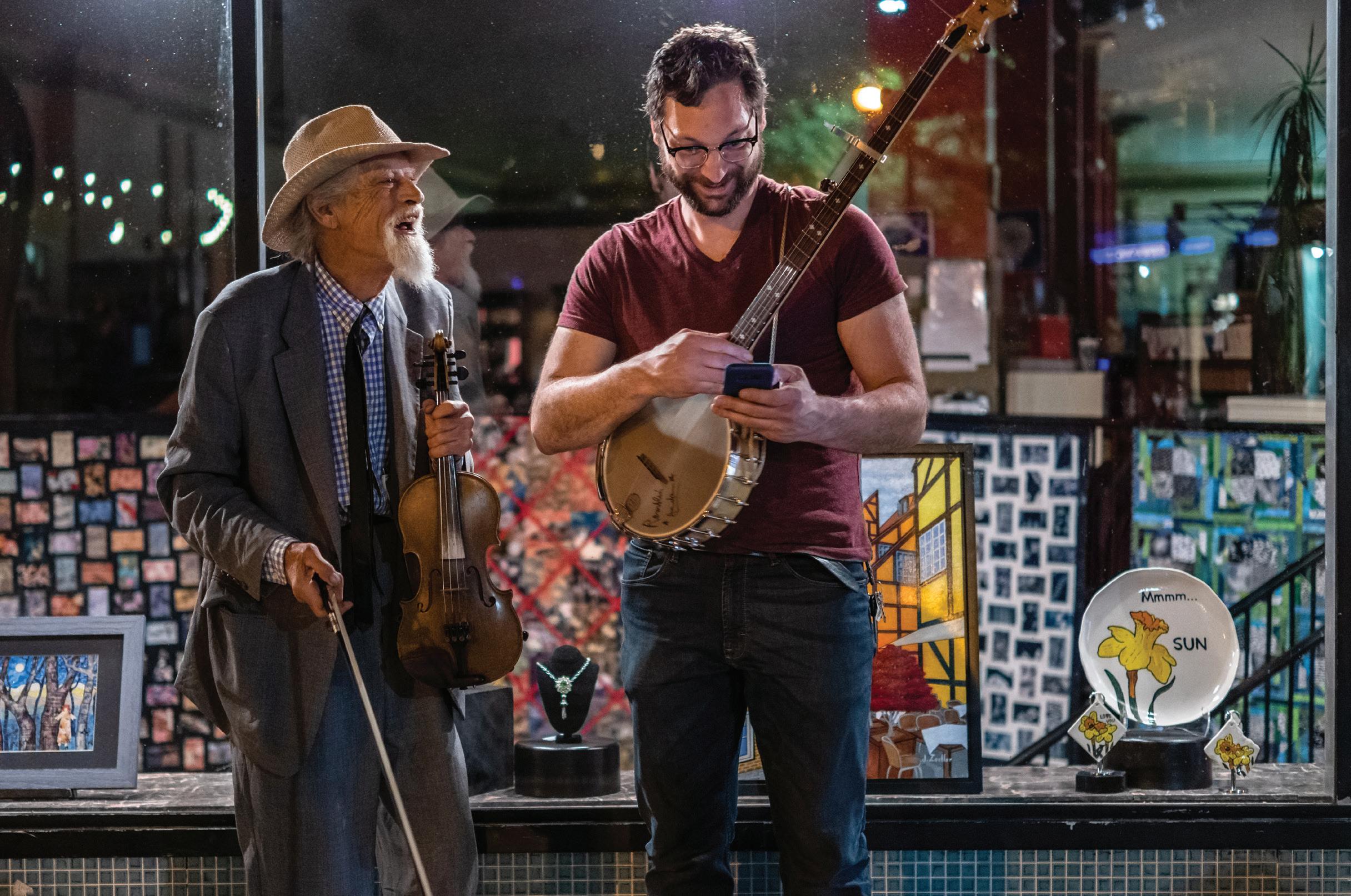
(above) Street musicians in downtown Asheville. (below) Conductor of the Coffee Bus, a go-to coffee hub in Asheville.
John Kral opened the second day with a keynote on his career in photojournalism. As a local to South Florida, Kral’s work particularly resonated with me. In his years with the Miami Herald, he captured moments and subcultures rarely documented in the Sunshine State. Both Spielman and Kral have published books on their work and gave us insight into the importance of personal projects.
After a photo walk with John Kral and lunch, board member David Knoble educated the group on using the Leica FOTOS mobile app. With the rate at which technology changes these days, even the savviest of society members appreciated this session. As the graphic designer of Viewfinder, I’ve had the honor of laying out several of Knoble’s articles, but had never actually met him. One of the most rewarding parts of society meet ups is getting to meet people in person and putting a face to a name.
Of course, like every society meet up, the highlight of the weekend was the closing banquet. Tom Smith of Leica Akademie and our Executive Director Richard Rejino duetted a heartfelt closing speech and pointed out the successes and progress our society has achieved. We owe a round of applause to all of our appointed officers for their dedication to expanding the society and bringing in a new generation. In 2018, we celebrated LHSA’s past fifty years. In 2019, the focus has shifted and we’re looking forward to the next fifty.
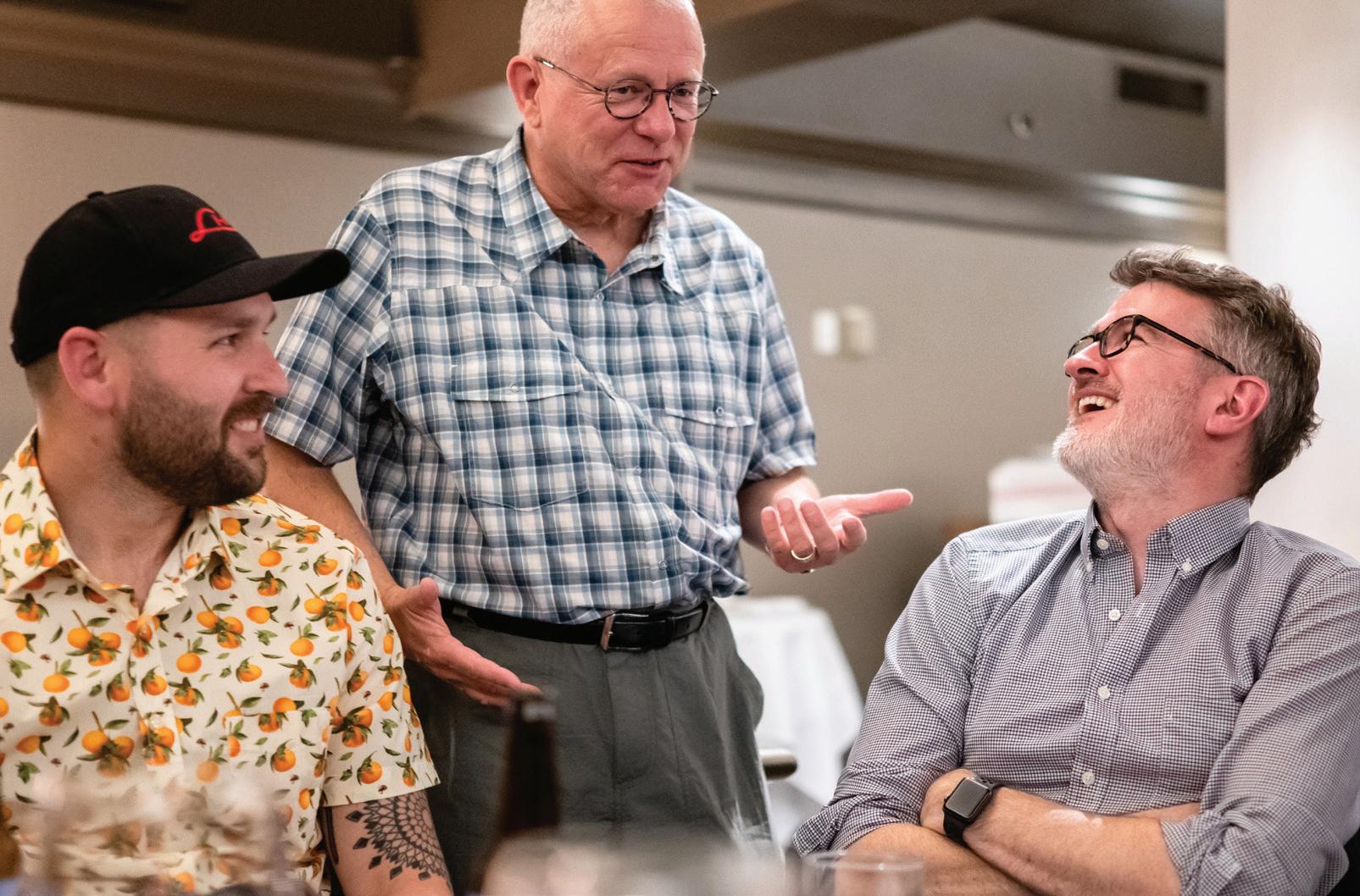
(top) Ham Hollet, Jim Rice & Peter Dooling at the closing banquet.
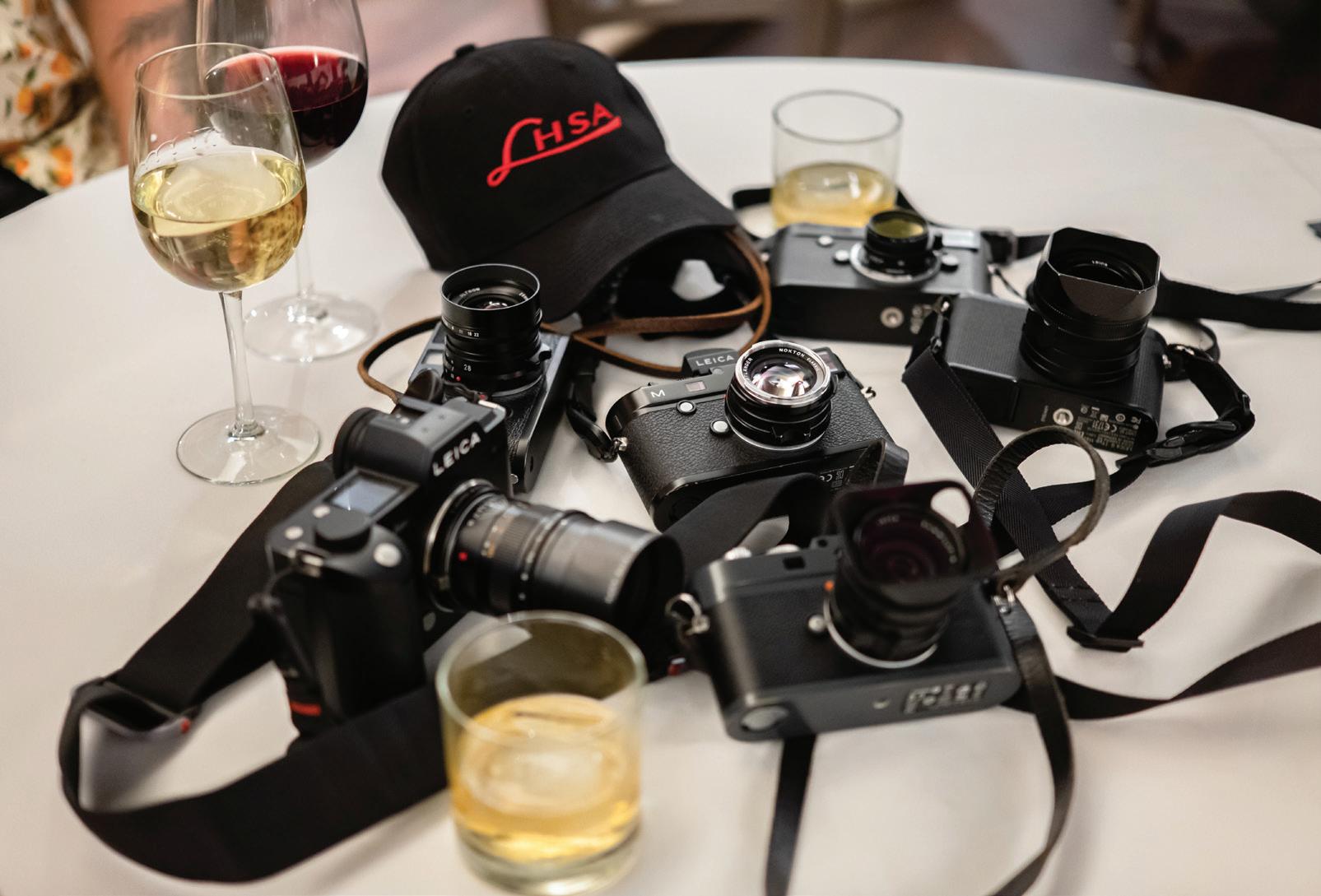
(center) Wine & Leicas: One of the many reasons to attend an LHSA meetup!
(bottom) David Knoble & Jim Handsfield at the closing banquet.
A Full Range of Focal Lengths for Leica Screw-Mount Cameras
by DICK GILCREAST
anyone interested in using the older Leica screw-mount cameras, it is possible to put together a full-range system of coated SM lenses from 21mm to 400mm that can be quite competitive with those from Leica SLR and M camera systems. Here is a set I have used over the years, found capable of excellent image quality during their years of use -- and I wish I had all of them back today! Of course there were plenty of alternative lenses that did well, some of them listed, but the featured set is the SM primaries I used and liked best during their time.
Started first freelancing in 1954-55 while still in college; 1956-57 in the Navy while attached to the Navy's Blue Angels flight demonstration team. After that was some school teaching while getting back into freelancing for magazines, school and camp catalogs, and some regional commercial and architectural photography. Winding down since the 1990's, it's been mainly local publicity, regional scenic photo card sales, family, grandkids, and my column in Viewfinder. The included pictures show some of the subjects this set of SM lenses was used for. All these photos were made with screw-mount lenses, and most with SM cameras, even though the M cameras had became my primaries by the 1960's, along with a reflex or two. As time went on some of the SM lenses were traded for mere modern equivalents, but a few can be found on the favorite SM cameras I still use today. Not included in the above list are any of the very early uncoated lenses, some of which can also be good performers.
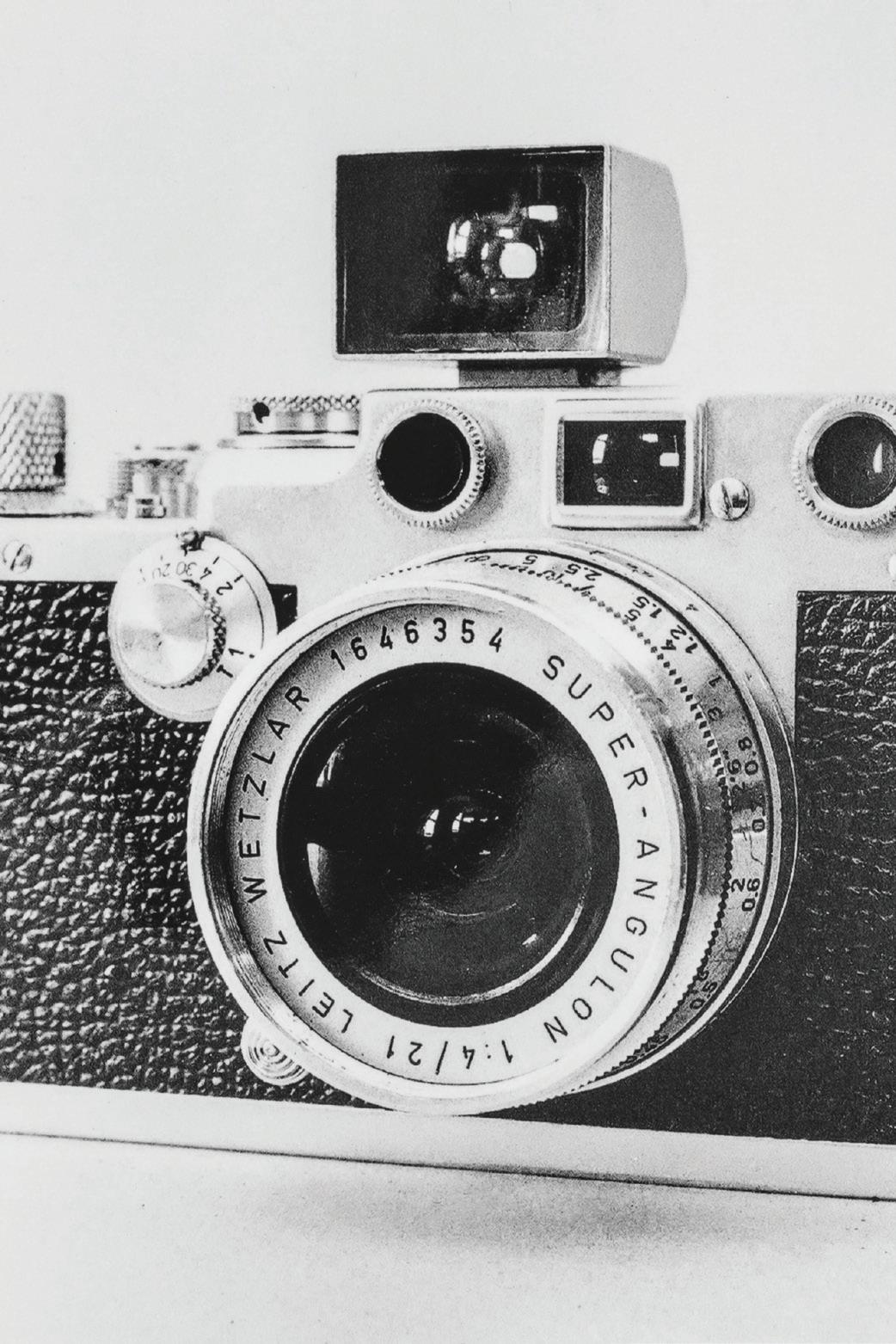
Super-Angulon 21mm f/4
SUPER-WIDE 21mm f/4 Super-Angulon
First available in 1958, the widest option for the Leica was the 21mm f/4 Super-Angulon. I got mine in 1960. It was produced in SM mount as well as adapted to M mount, from which the adapter can be removed, so either version can be used on SM cameras. A valuable asset is the closest focus of 40cm -- 16 inches -- much closer than the rangefinder can track, which makes the lens useful for realistic rendering for such things as architect's models or model railroad layouts, besides the usual full size buildings and interiors and landscapes. At closest focus range this lens outperformed the later f/3.4 Super-Angulon-M at the edges and corners.
WIDE
28mm f/5.6 Summaron
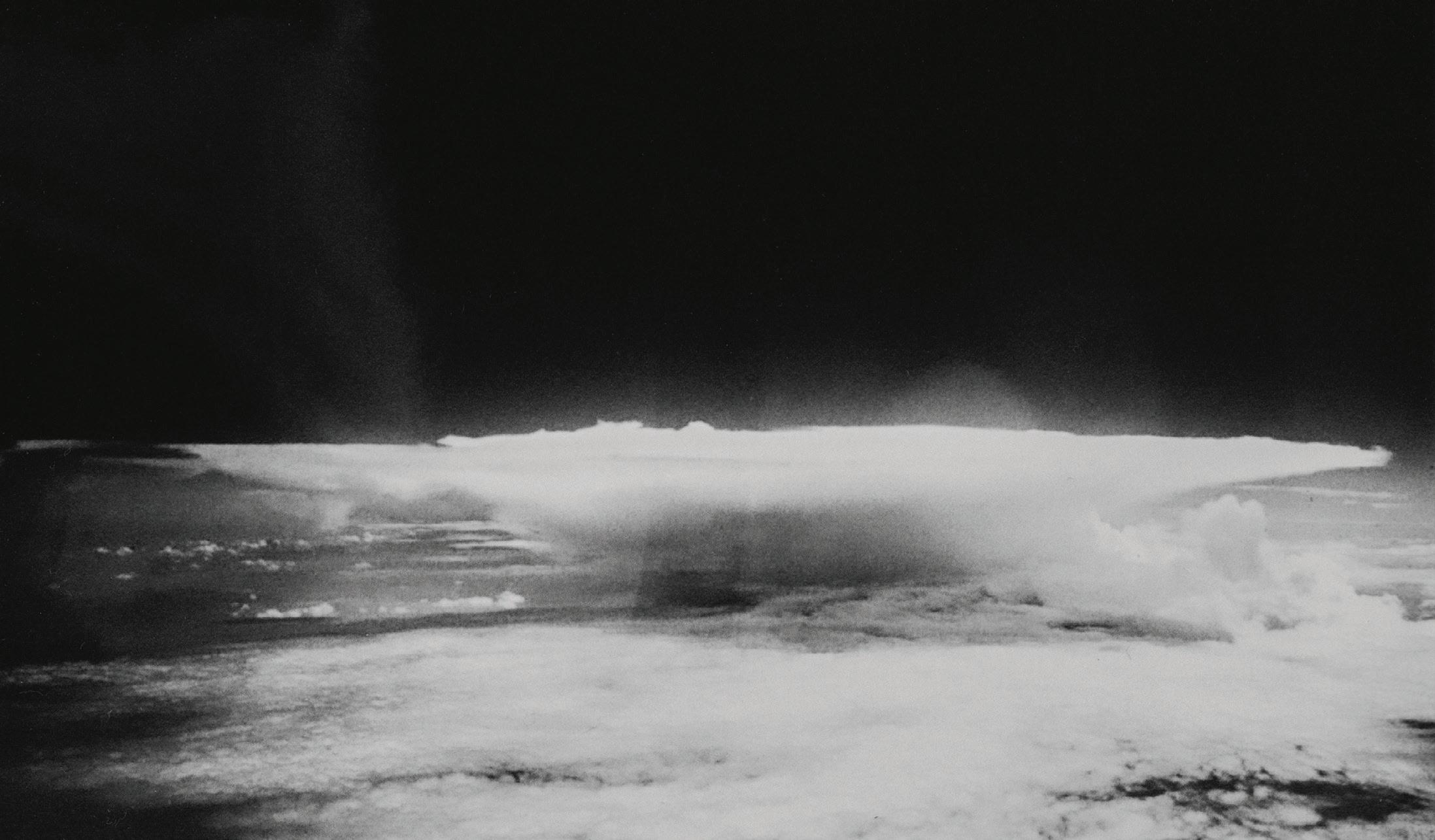
Before the 21 Super Angulon appeared in 1958, the 28 had always been the widest focal length available from Leitz. I bought this lens in 1957 during Navy days for its extra-wide flat field. Originally produced only in SM mount, it has just recently been revived in M mount. This shot of a Texas thunderhead was made at an altitude of 46,000 feet -- nearly nine miles high -- to stay above the tops of the weather during across-country flight that day in the back seat of a Navy two-place F9F-8T Cougar. From original on Kodachrome.
Alternative 28mm also used: 28mm f/3.5 Nikkor in Leica SM mount used in the 1970's.
Super-Angulon 21mm f/4
Super-Angulon 21mm f/4
28mm f/5.6 Summaron
FAST WIDE ANGLE 35mm f/2 Summicron
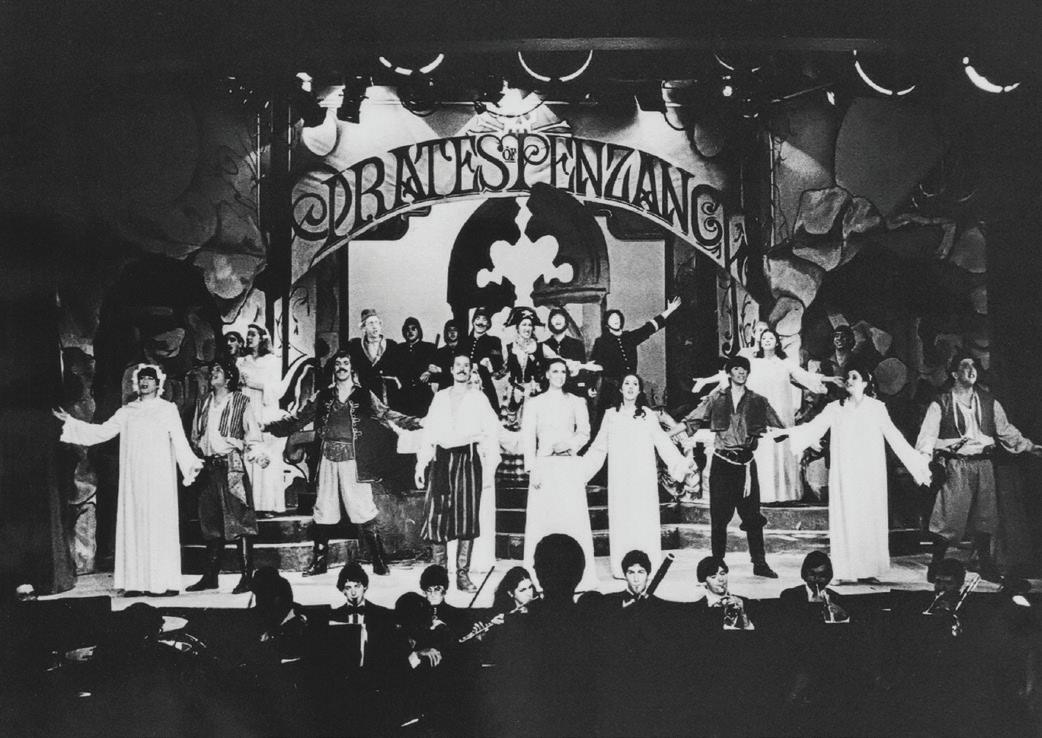
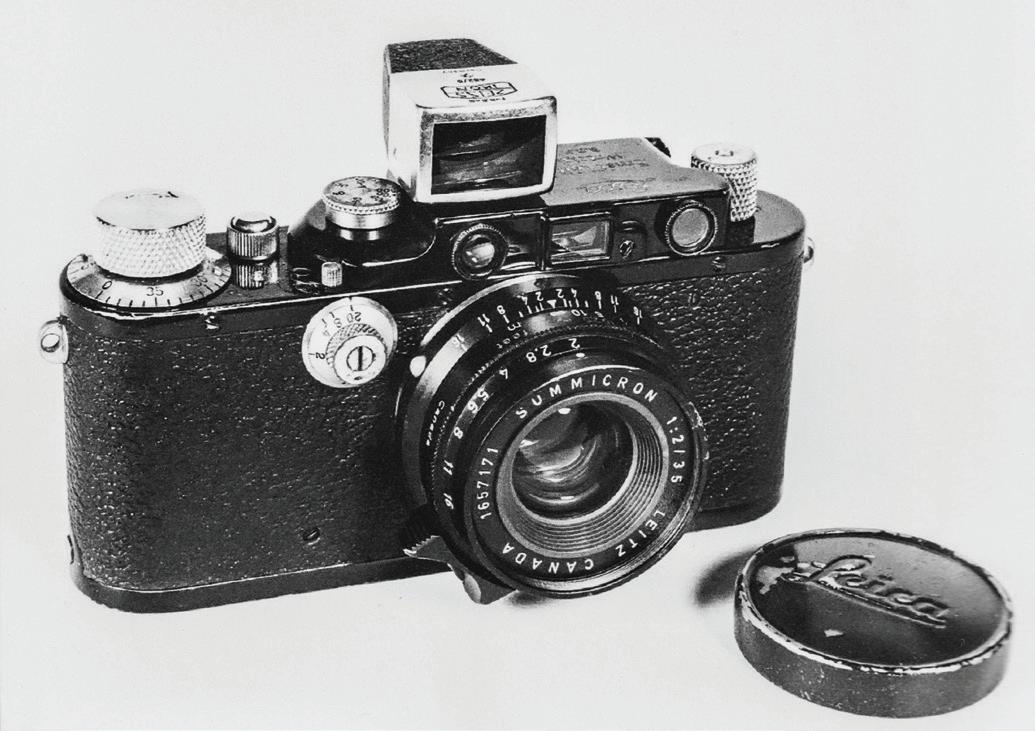
The first high-speed 35mm lens from Leica was the f/2 Summicron of 1958 -- initially available in SM mount, but also in M mount with adapter which can be removed. Illustrated is my early black anodized M version of 1959 with removed adapter, used for many years on both SM and M cameras. Focus on the M camera version goes down to 70cm -- 28 inches -- so be aware of the one-meter focus limit while used on an SM camera rangefinder. The ultra-rare original SM version had its focus limit at the usual one meter. The specialty of this lens is available light, as seen here during the finale of a Gilbert & Sullivan operetta at Harvard.
Alternative 35's that were also used:
• 35mm f/1.8 Canon, bought and used from 1957 until the f/2 Summicron.
• 35mm f/3.5 Summaron -- only option before 1957. Curvature of field can be variable, so test before buying.
FAST STANDARD
50mm f/1.4 Nikkor
The first high-speed 50 with sharp and contrasty wide open image quality was the 50mm f/1.4 Nikkor, used and publicized by David Douglas Duncan in Korea in 1950. Available in Leica SM mount, mine was bought new in 1955 and used during Navy days. Focus goes closer than 1 meter, but there is a small detent in the focus action at that point as a reminder not to go beyond it.
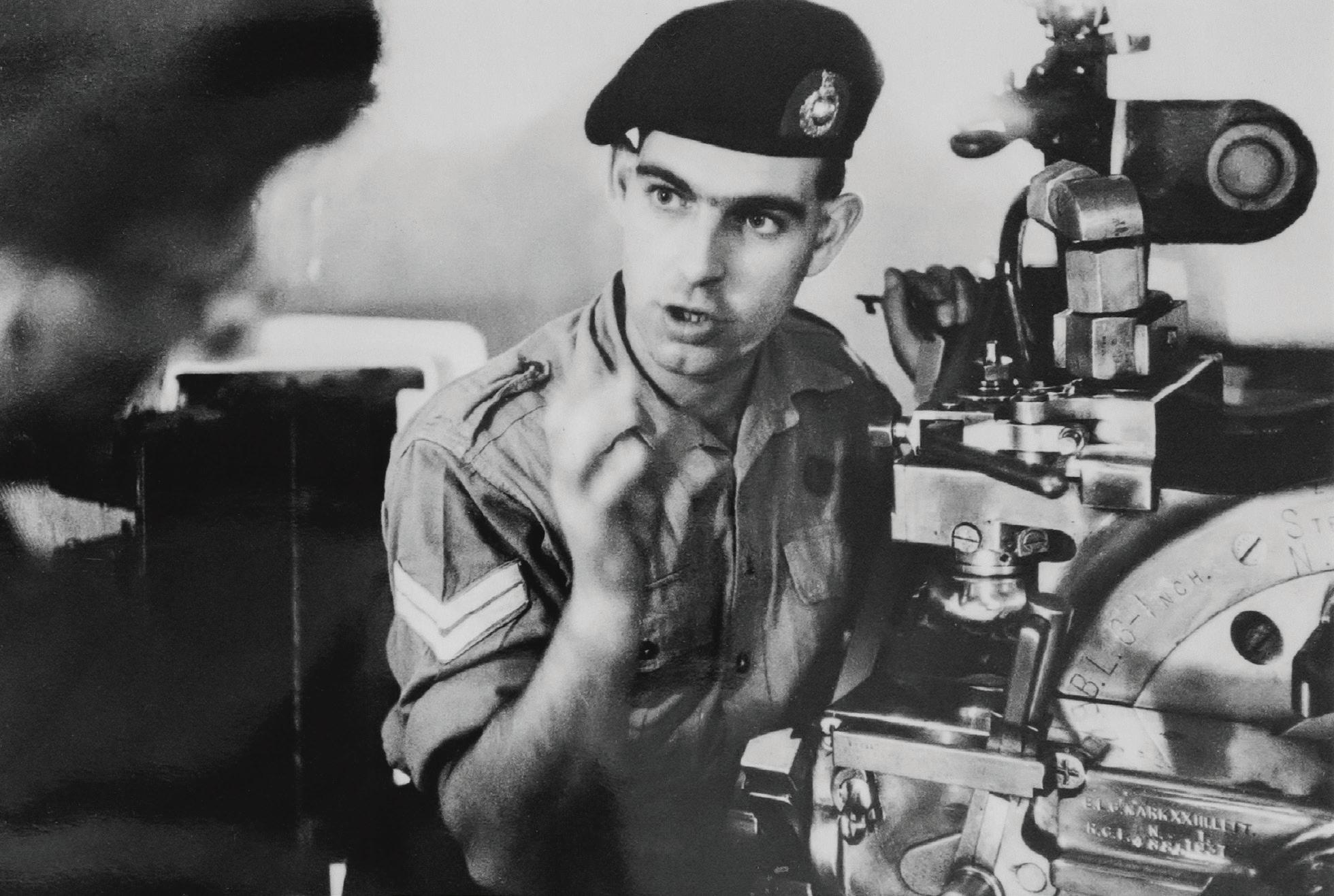
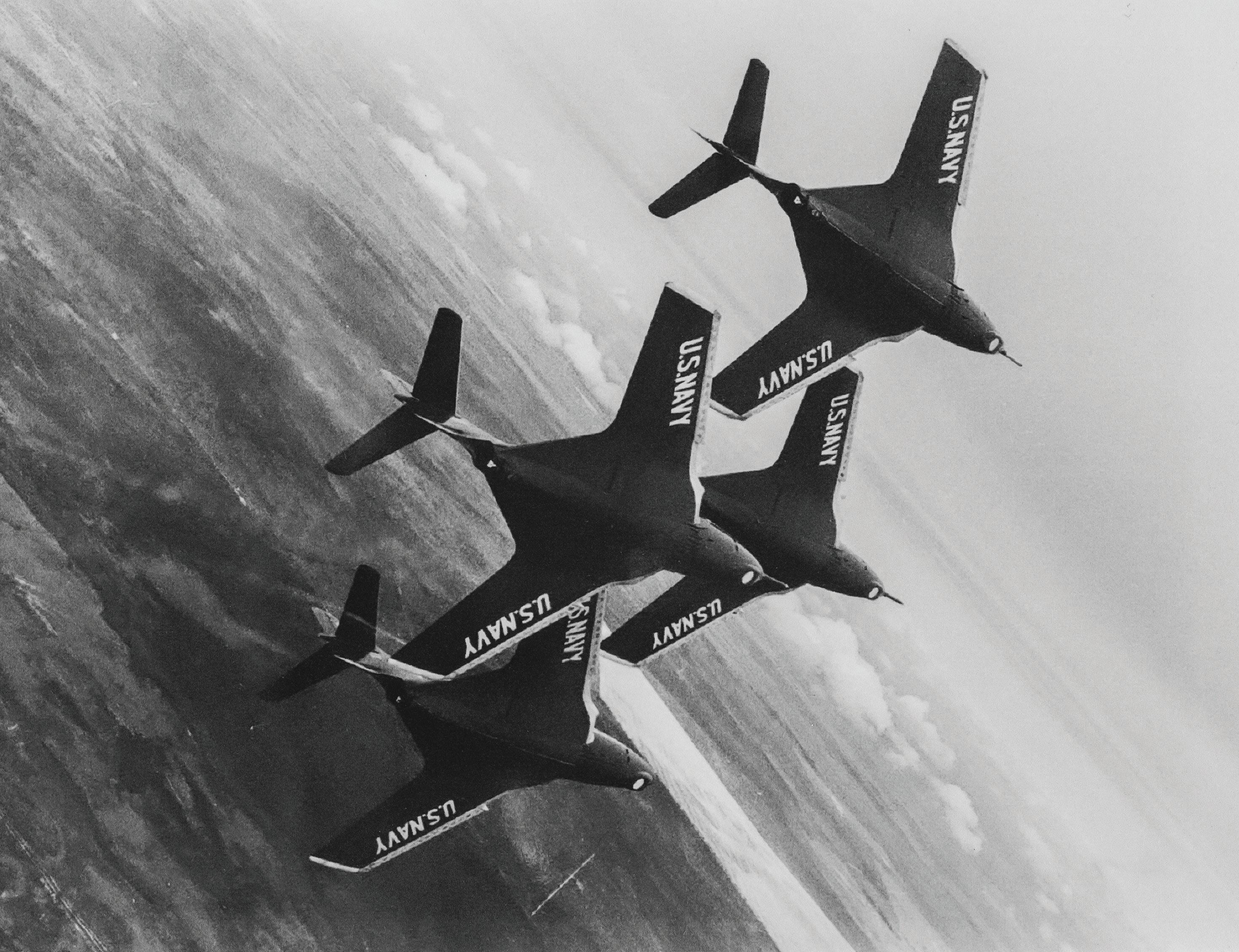
The photo of the diamond roll of F9F-8 Cougars was made in 1956 with my lllf and 50 Nikkor, seen from the back seat of a Lockheed TV-2 chase plane. The later F11 F-1 Tiger aircraft the team started flying in 1957 were mainly photographed using my newly bought M3 and rigid M mount 50mm Summicron, but with the SM cameras and lenses providing good backup. An available light shot made inside one of the British Navy cruiser HMS Kenya's forward turrets -- showing the Nikkor's closeup image quality wide open at f/1.4 -- while the Royal Marine gun captain explains the breech mechanism.
Alternative SM 50mm lenses that were also used:
• 50mm f/3.5 red scale Elmar -- Sharp and compact to carry, and using common filters, but not fast in low light.
• 50mm f/2 Summicron collapsible, a good choice for both speed and compact carrying. Image quality is apt to be variable, however, so test before buying.
• 50mm f/2 Summitar -- consistently good image quality
• 50mm f/1.2 Canon -- Used in the 1970s. RF synch can be slightly variable, so test before buying.
35mm f/2 Summicron
35mm f/2 Summicron
50mm f/1.4 Nikkor
50mm f/1.4 Nikkor
FAST SHORT TELEPHOTO
8 5mm f/2 Nikkor
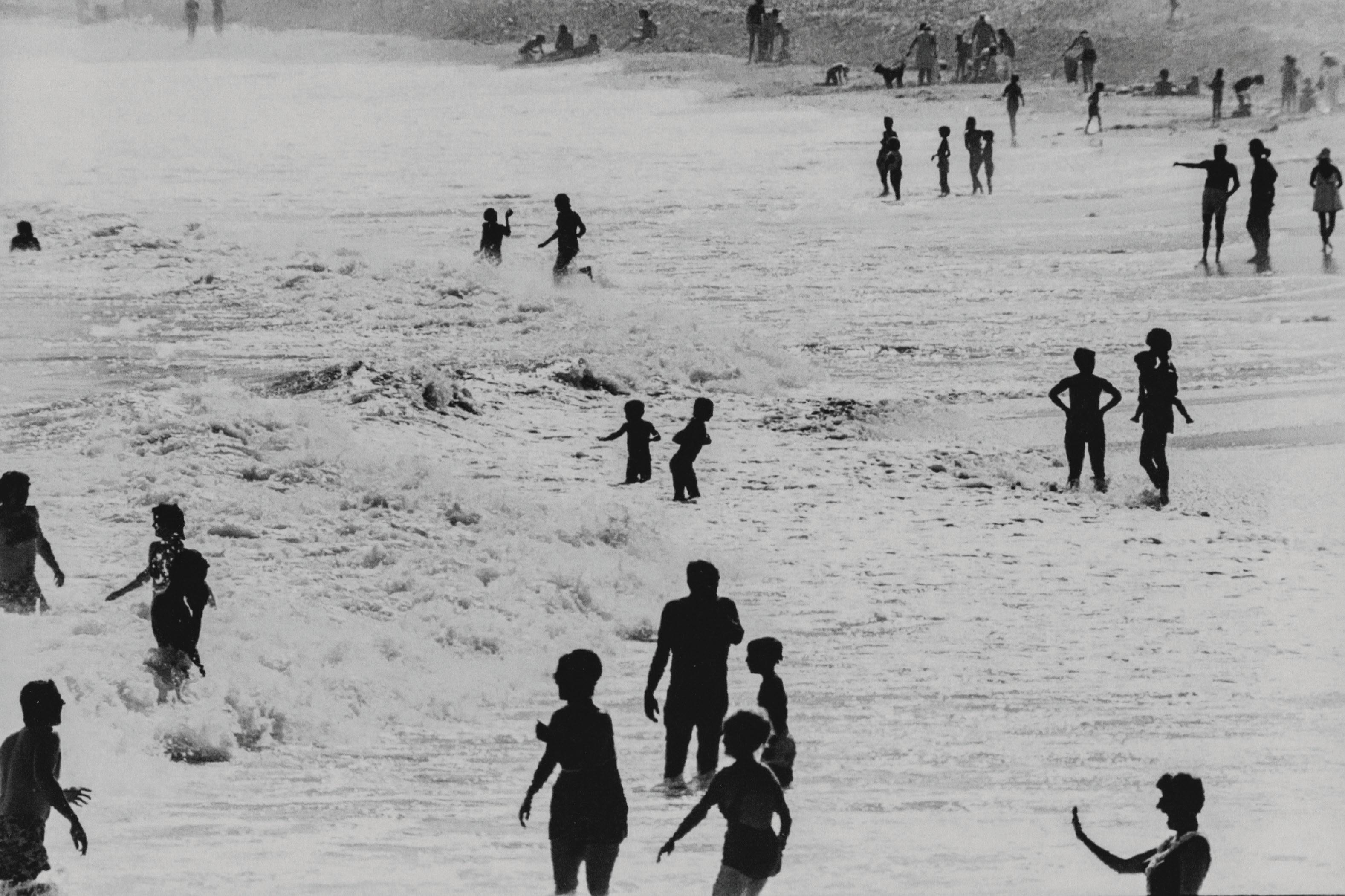
The 85mm f/2 Nikkor in Leica SM mount was used by the author in three variants, all of good image quality and, most important, consistent RF synch, which was not the case with two other makes of higher speed short teles I tried at the time. Bought my first all-brass Nikkor in 1956, while in the Navy, when Leica's only options at the time were the 90mm f/4 Elmar or the 85mm f/1.5 Summarex.
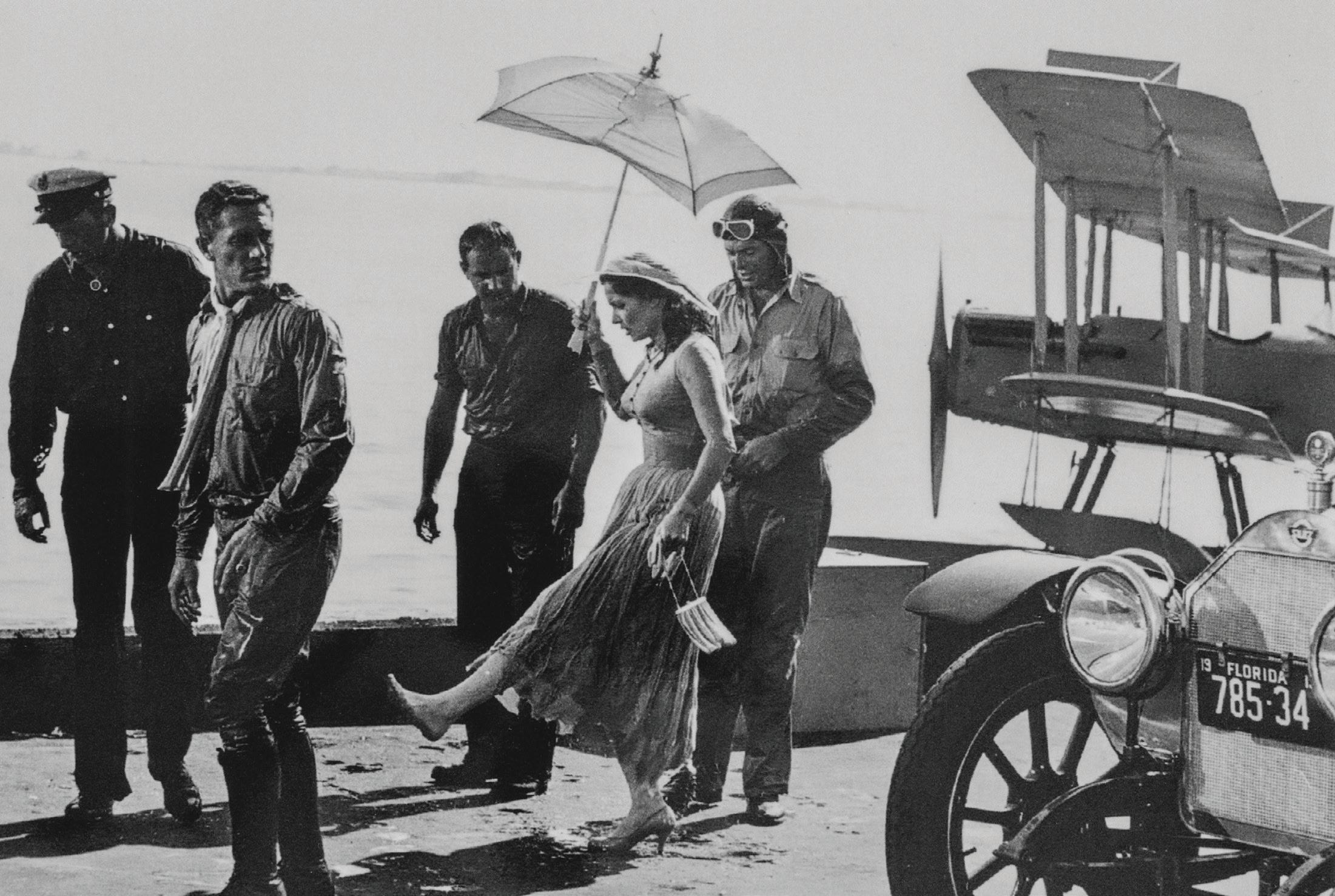
Seen here an 85mm shot made during the filming of "The Wings of Eagles" in Pensacola during 1956, starring John Wayne, Maureen O'Hara, and Dan Daily. Seen here are Miss O'Hara, Daily, and a group of actors walking back from the Stutz Bearcat for a second take after a mass rush from the water to the car. She had to do all this while soaking wet, and with only one high-heeled shoe.
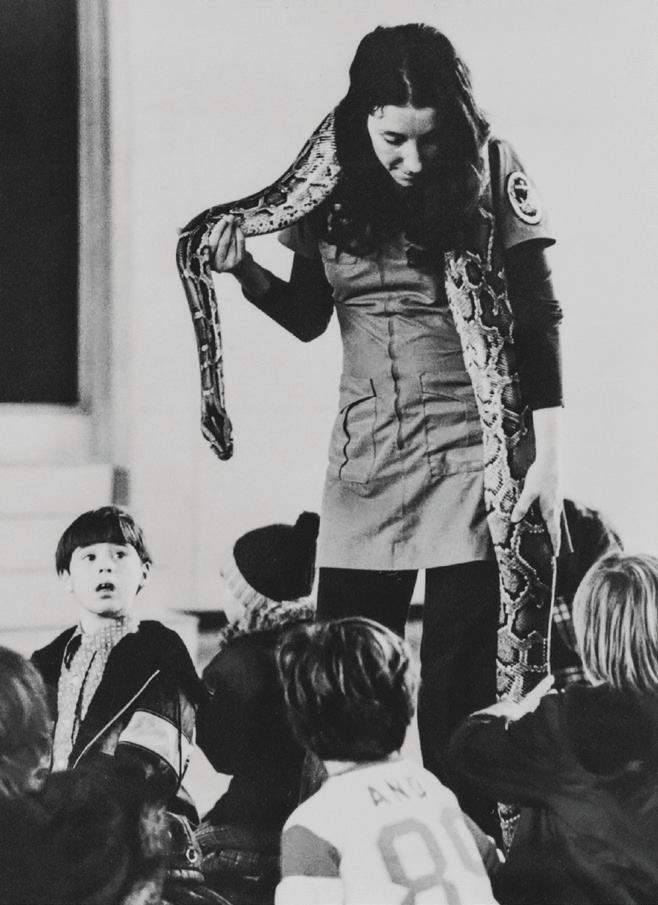
During a wildlife demonstration for a group of kids in a school gymnasium. Here the 85 was useful for reaching over the group to get a closeup -- and the reaction!
Alternative short fast telephoto:
• Tried the 85mm f/1.5 Summarex briefly after 1959. Worked well, but very heavy.
• 90mm f/2.8 Elmarit in SM mount -- from 1960 lens head used on Visoflex with OTZFO focus mount ( 16464) for macro work in the field.
85mm f/2 Nikkor
85mm f/2 Nikkor
MEDIUM TELEPHOTO
135mm f/4.5 Hektor
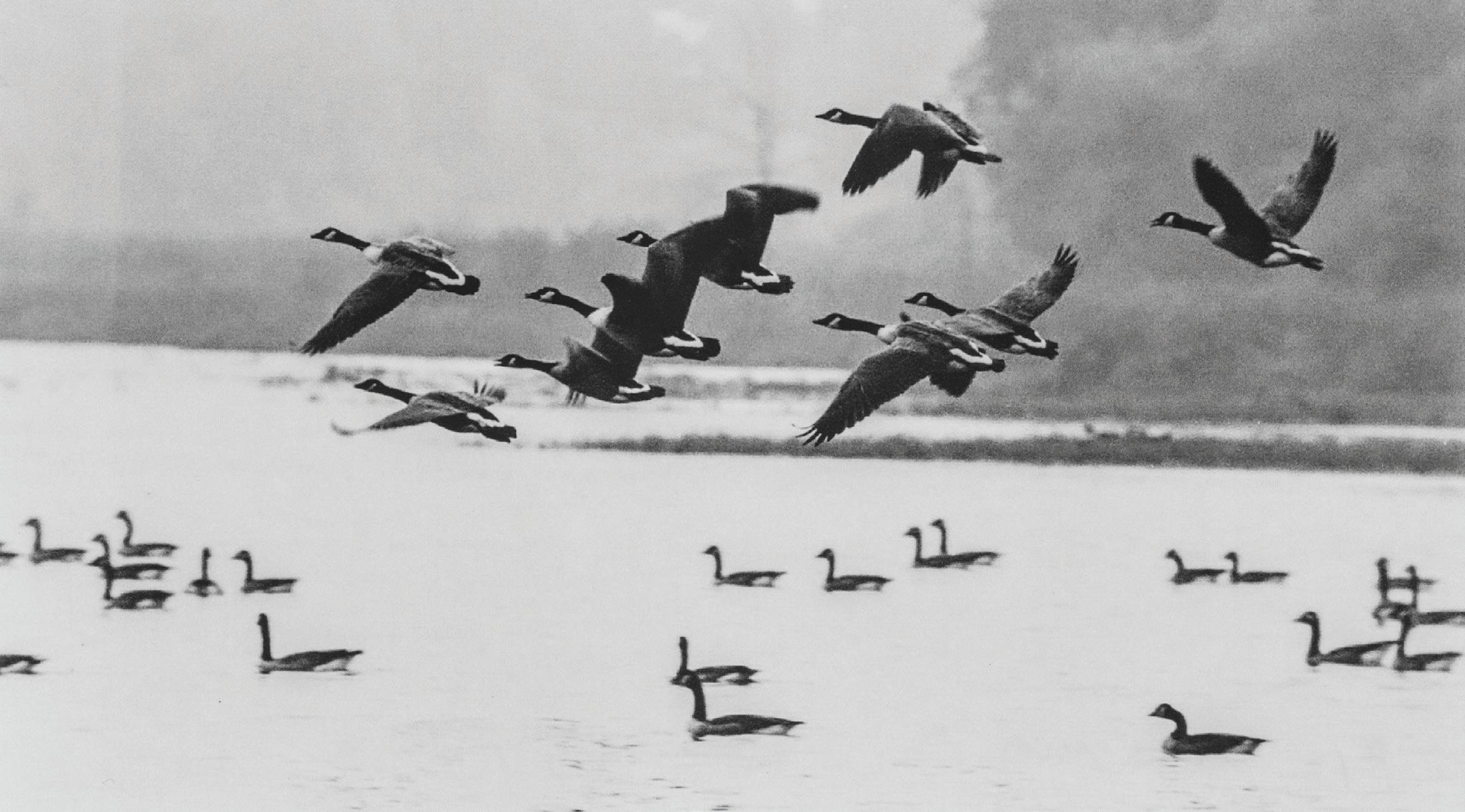
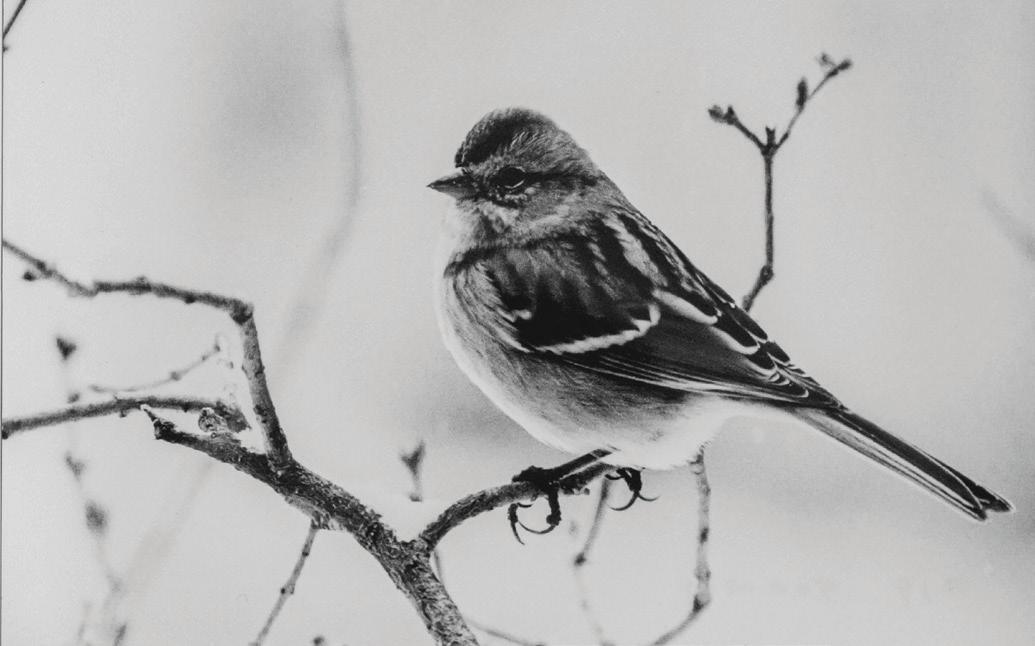
135mm f/4.5 Hektor -- Several of various vintages used by the author since 1957 with consistent results. Here seen used for sports and wildlife with SM camera rangefinder. But also useful with Visoflex 11 for macro work, as in the photo using the lens head with Visoflex and Bellows 11.
Alternative 135: 125mm f/2.5 Hektor used briefly in 1957 on a modified Novoflex reflex housing with 45 degree prism finder, mainly for the larger viewing image.
135mm f/4.5 Nikkor
135mm f/4.5 Nikkor
135mm f/4.5 Nikkor
VISOFLEX 200 TELEPHOTO
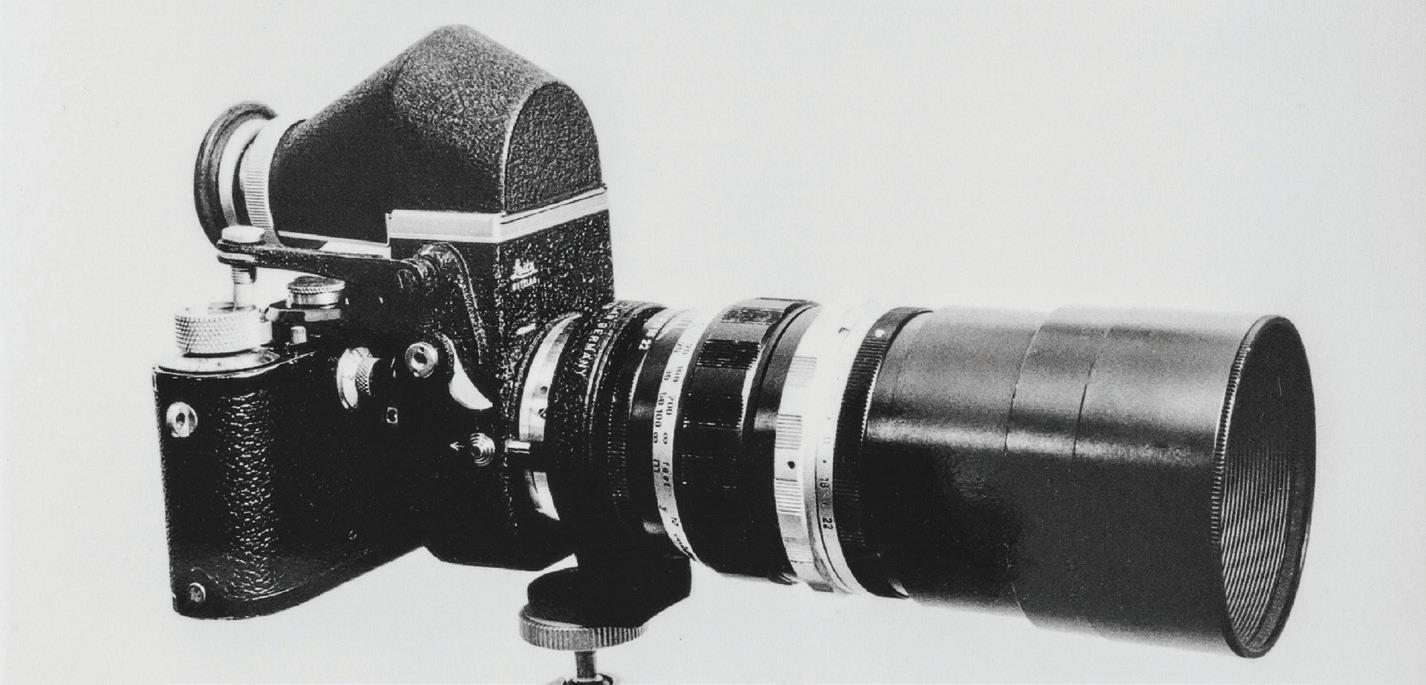
200mm f/4 Telyt
200mm f/4 Telyt-V -- used after 1960 on SM mount Visa II with OUBIO (16466) adapter, as seen in photo, which made the rig an excellent handheld SLR. Particularly excellent when using the FOCORAPID mount for sports action, but also with wildlife. The rule was to eliminate any time lost stopping down, so focus and shoot at f/4 or f/5.6 all the time.
VISOFLEX 400 TELEPHOTO
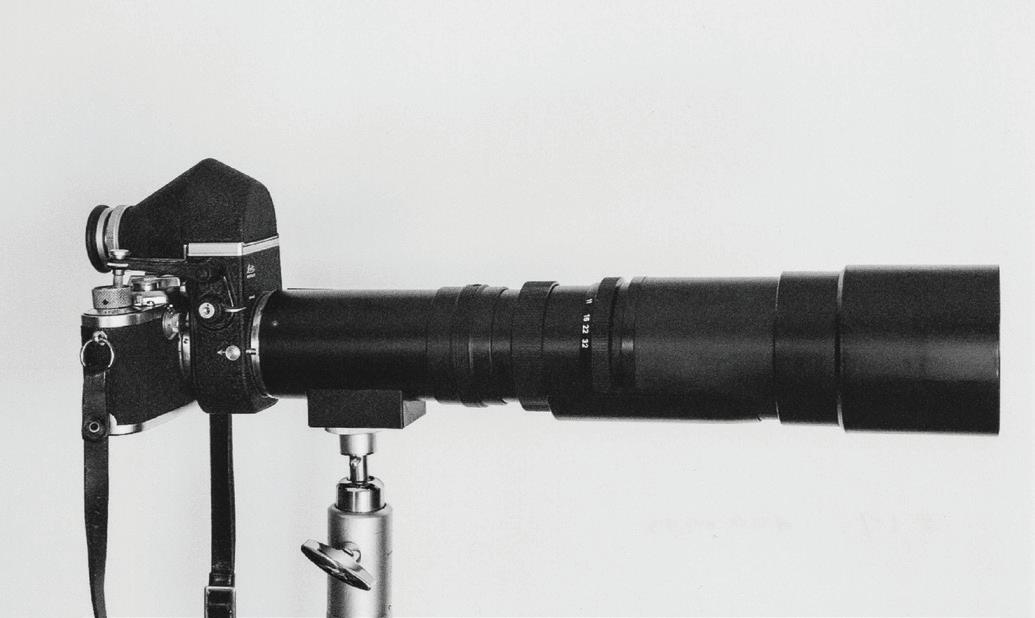
400mm f/6.8 Telyt
400mm f/6.8 Telyt-V -- Used after 1970. Lens in Visoflex mount (not R mount) can bemounted directly onto Viso II with no extra adapter. Excellent for handheld use with shoulder stock, providing a very steady handhold combined with quick focus. Again, little or no stopping down used or needed, as in the two photos shown.
Alternative 400: 400mm f/5 Telyt lens head adapted to FOCORAPID mount from about 1965. Worked well, but very front-heavy. Quickly went to the f/6.8 when it came out.
400mm f/6.8 Telyt
400mm f/6.8 Telyt
400mm f/6.8 Telyt
SHOOTING WEDDING S WITH THE LEICA M10
by DENNIS BERTI
“All roads lead to rome!”
To paraphrase the famous quote, we can all use different tools to achieve a similar purpose, right?
My belief is that a professional photographer should be able to achieve great results, no matter what camera or gear he is using. It's about light, composition, moments and vision, because all these factors (the ingredients of a great photo) are exactly the same if I shoot with a DSLR, a mirrorless, a point & shoot or a rangefinder. These are just tools to achieve good results. I have always used Nikon DSLR cameras to shoot weddings, and I really think it is the best fit for my way of working and perfectly provides what I require from a camera. But, if I believe that, I should also be able to shoot weddings using other kinds of cameras such as mirrorless or rangefinder...
Well, speaking of rangefinders: for this wedding I gave the one and only Leica M a chance.
As a gift for my 40th birthday, I gave myself an expensive (but well-deserved) gift, a Leica M10. This little gem is now my daily camera and I always carry it with me to shoot street photography, lifestyle, and travel. It is very light and compact, besides being aesthetically beautiful.
I think every photographer who owns more than one camera or lens, at the moment of traveling is always asking himself the same question: "Which gear do I bring with me?" It's always such a commitment, right? If I bring only one lens, a wide angle for example, I can take landscapes, panoramas and give more context to the story, right? But what if I need/want to shoot a portrait? Having all my gear with me, I would probably choose a 58mm or 85mm. Should I bring a flash? A tripod? How many cards? And so on... The photographer’s endless dilemma.
When I chose the Leica M10 as my daily and travel camera, I was conscious about all of this. But without agonizing over it too much, I decided to buy the M10 with a single prime lens: the legendary Leica Elmarit-M 28mm f/2.8 Asph.
Why this lens? Because it’s the most compact lens of the entire portfolio of Leica M lenses; the 28mm is an excellent focal length to shoot different kinds of subjects; it was not as expensive as other 28mm lenses (such as the Summicron-M 28mm f/2 asph or the Summilux-M 28mm f/1,4); and also for my way of shooting with the Leica, I didn’t need a fast lens. The f/2.8 maximum aperture was more than enough.
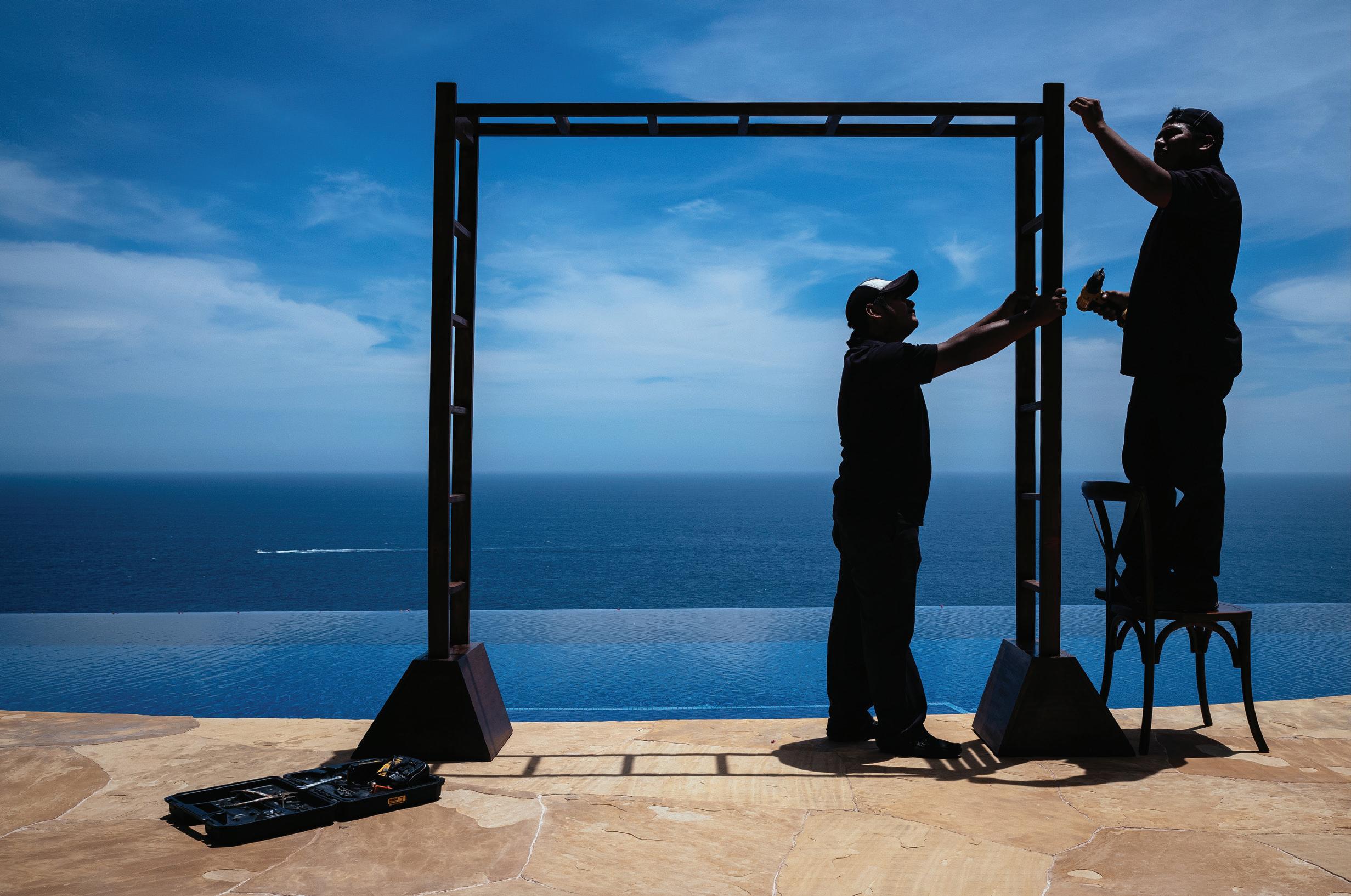
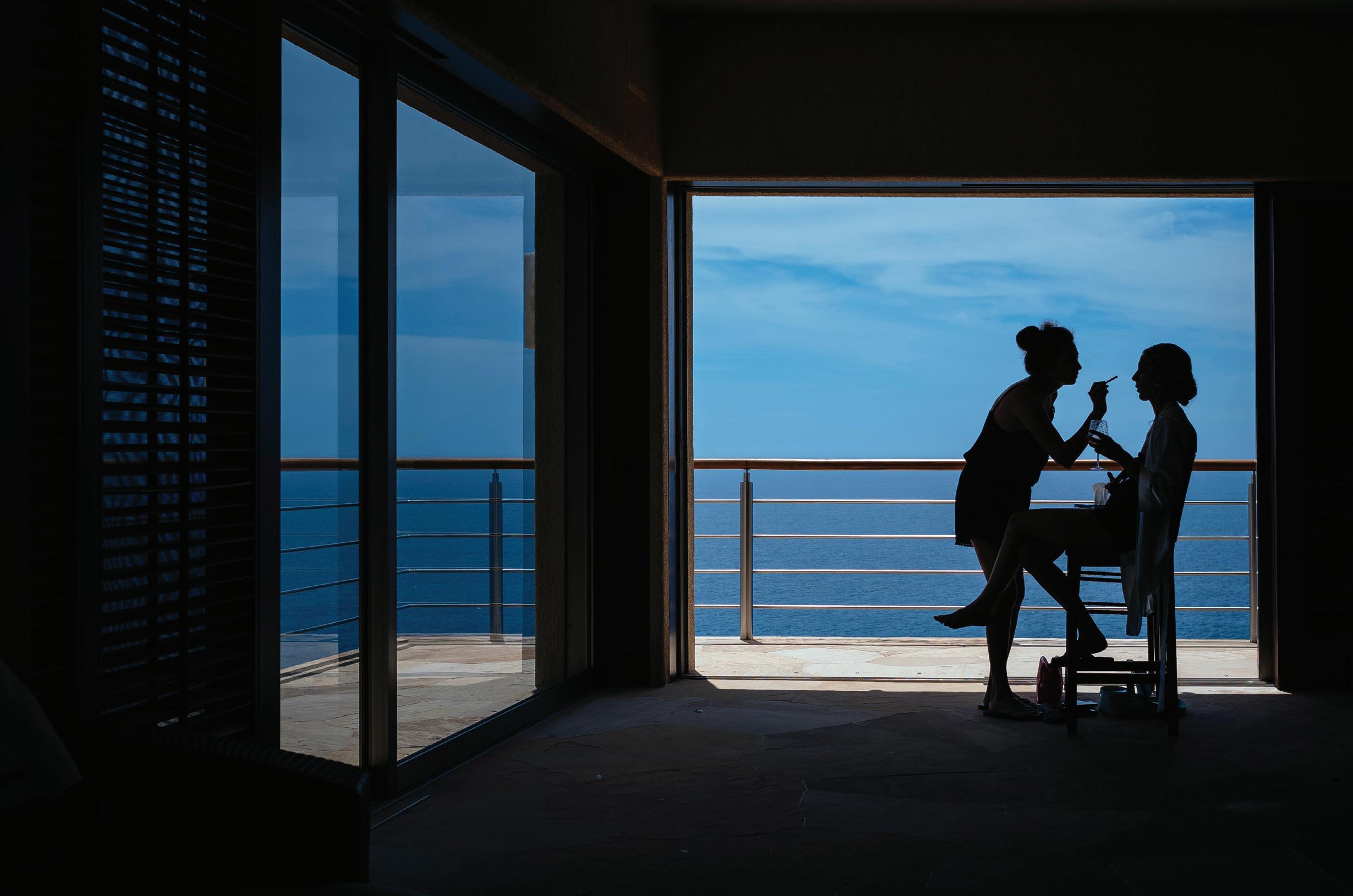
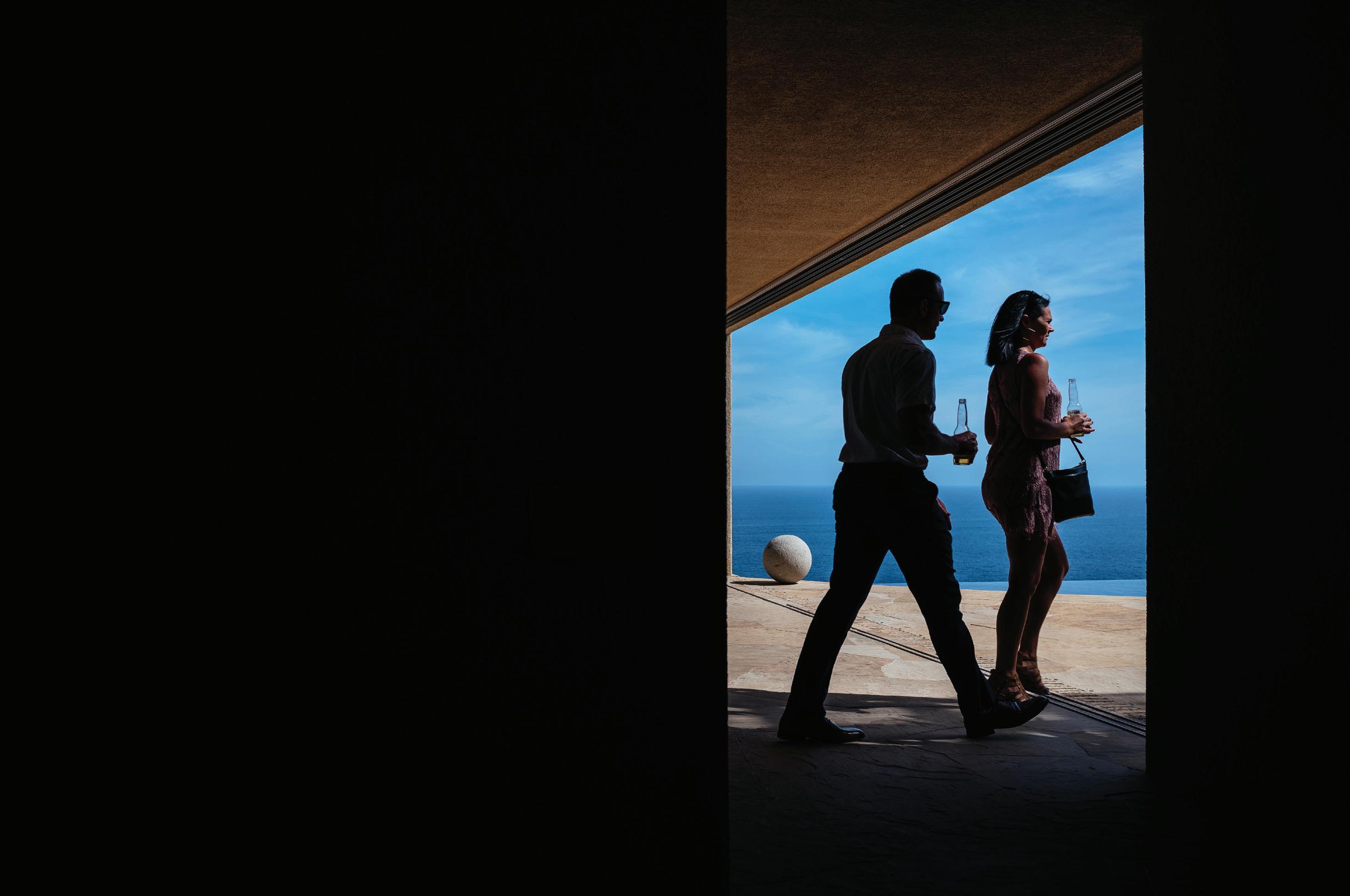
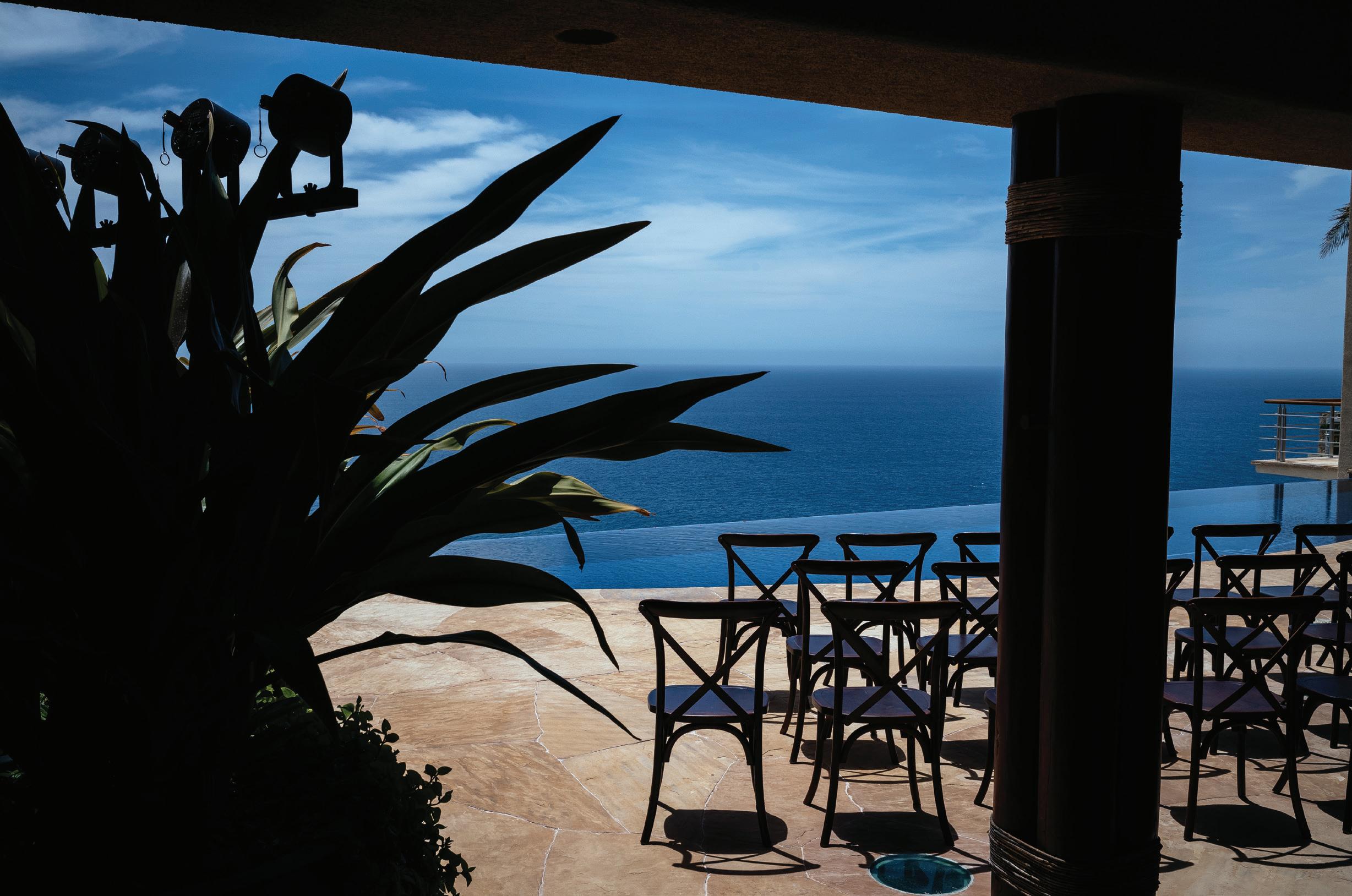
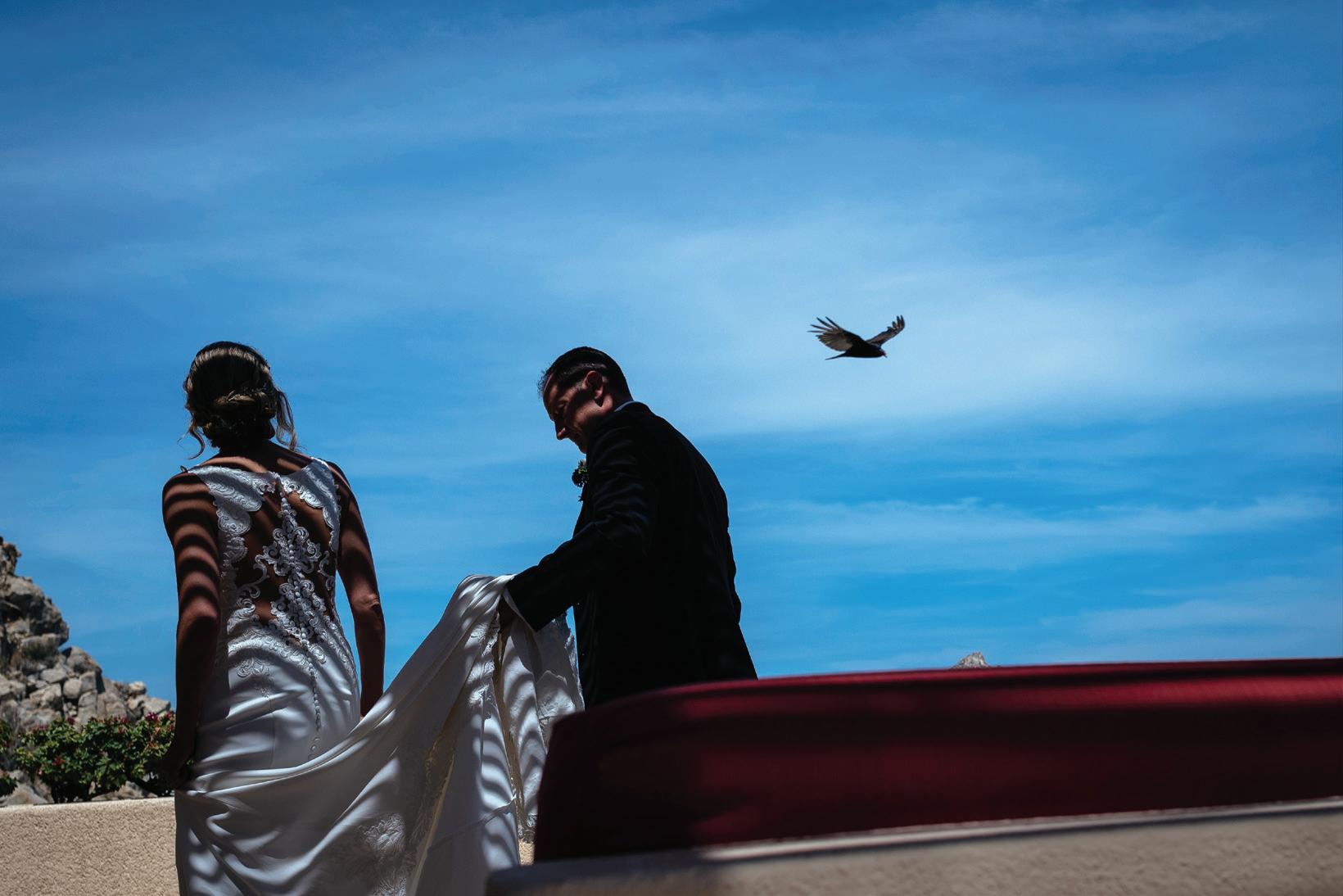
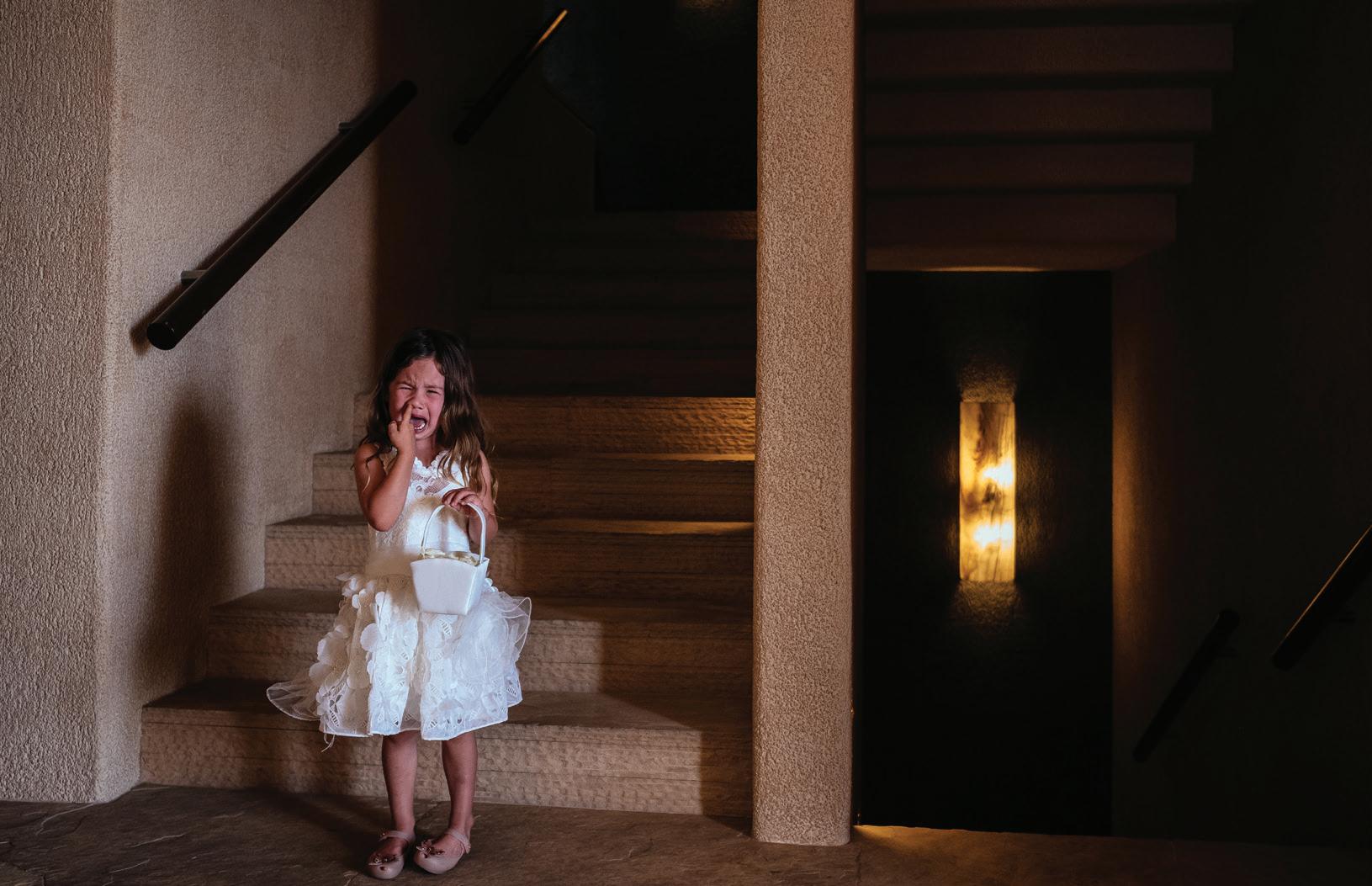
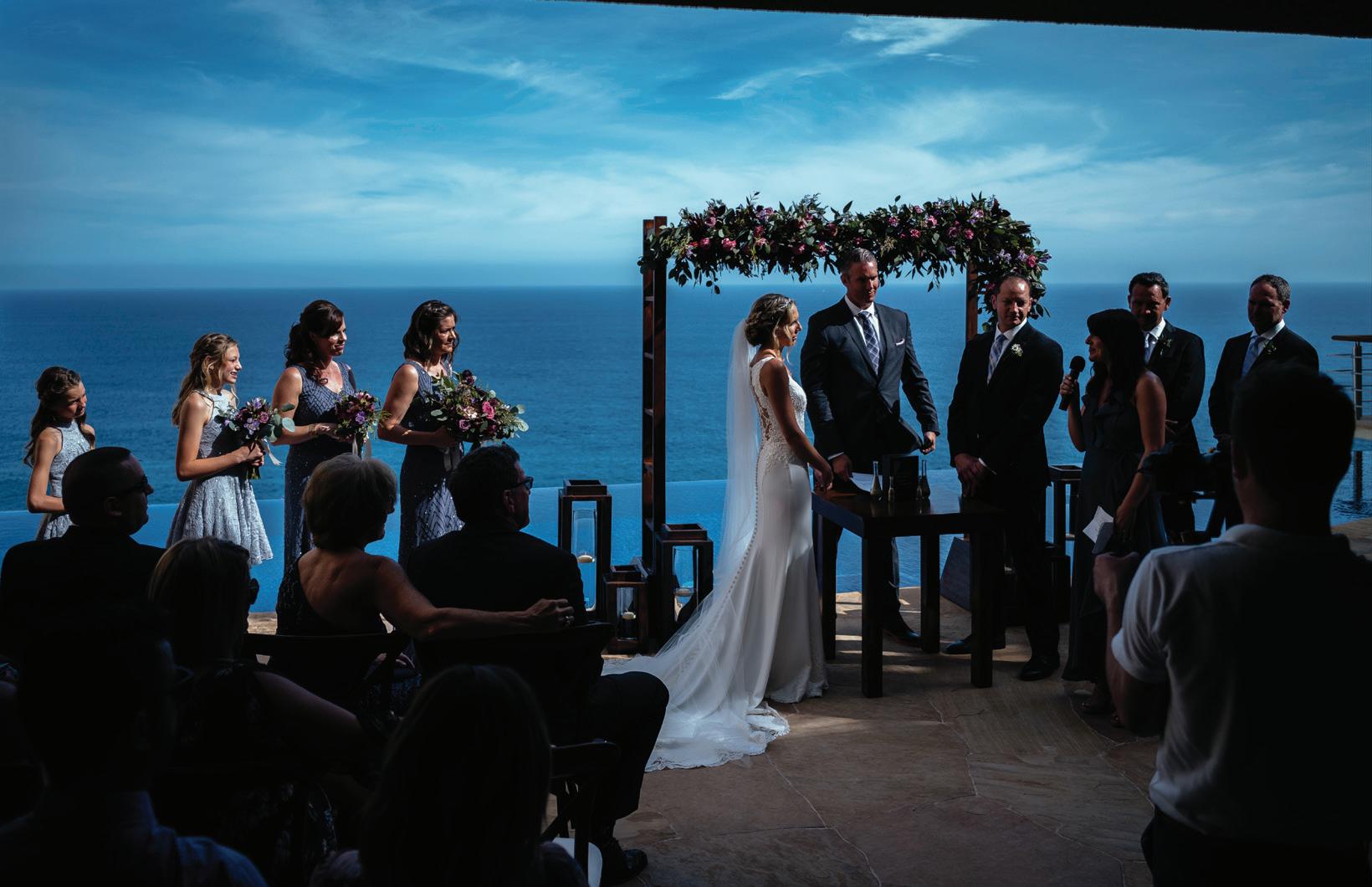
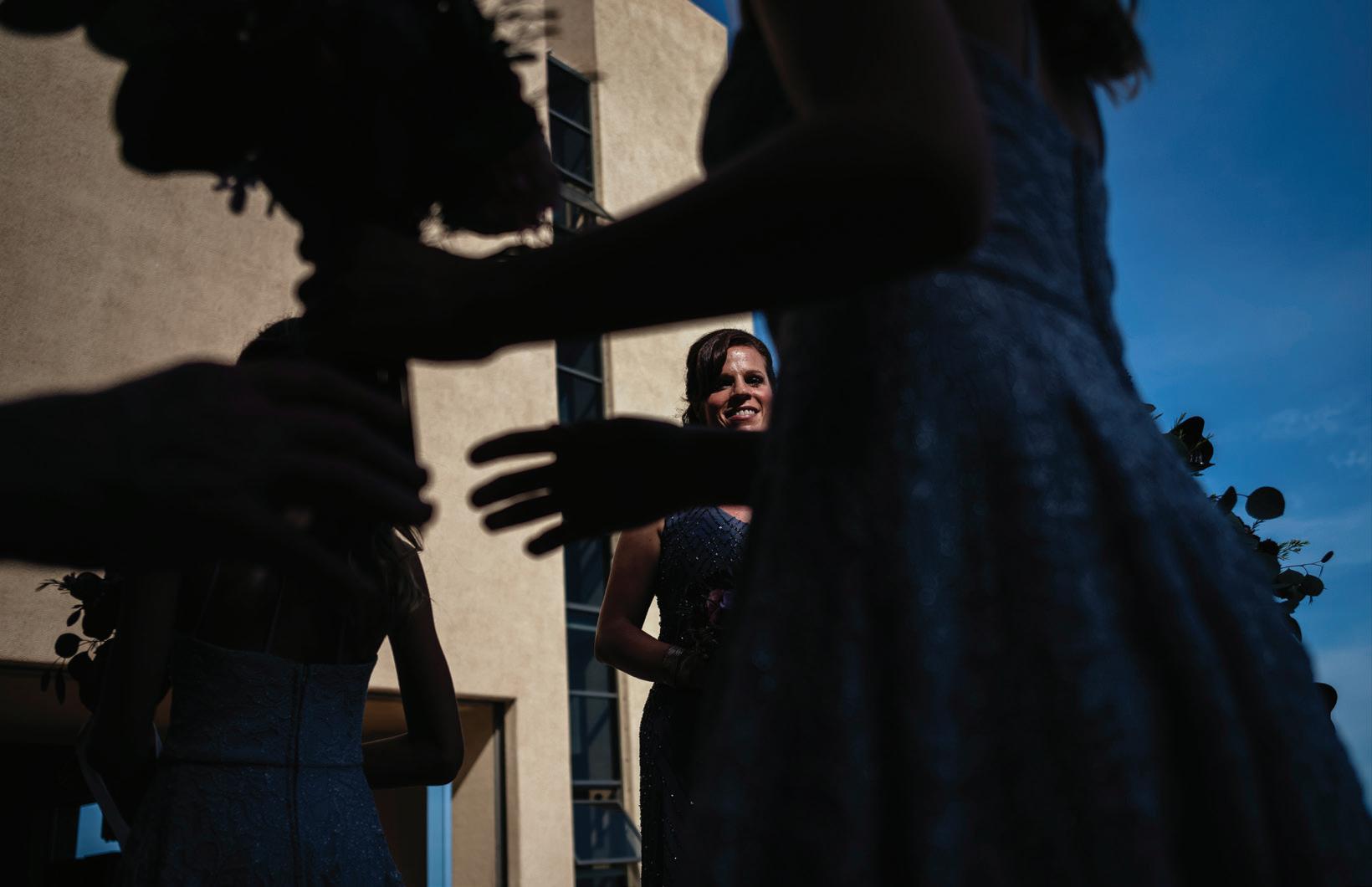
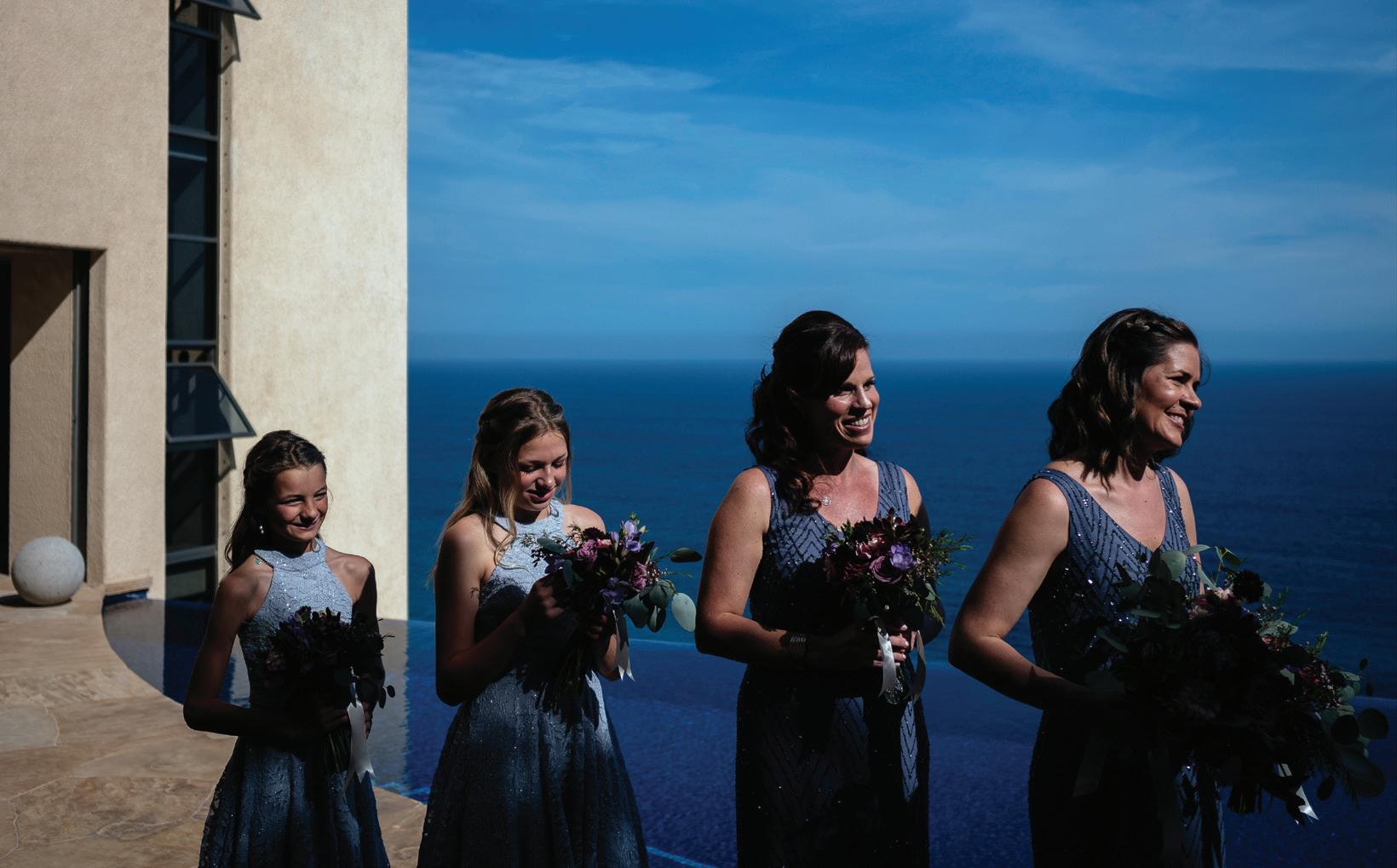
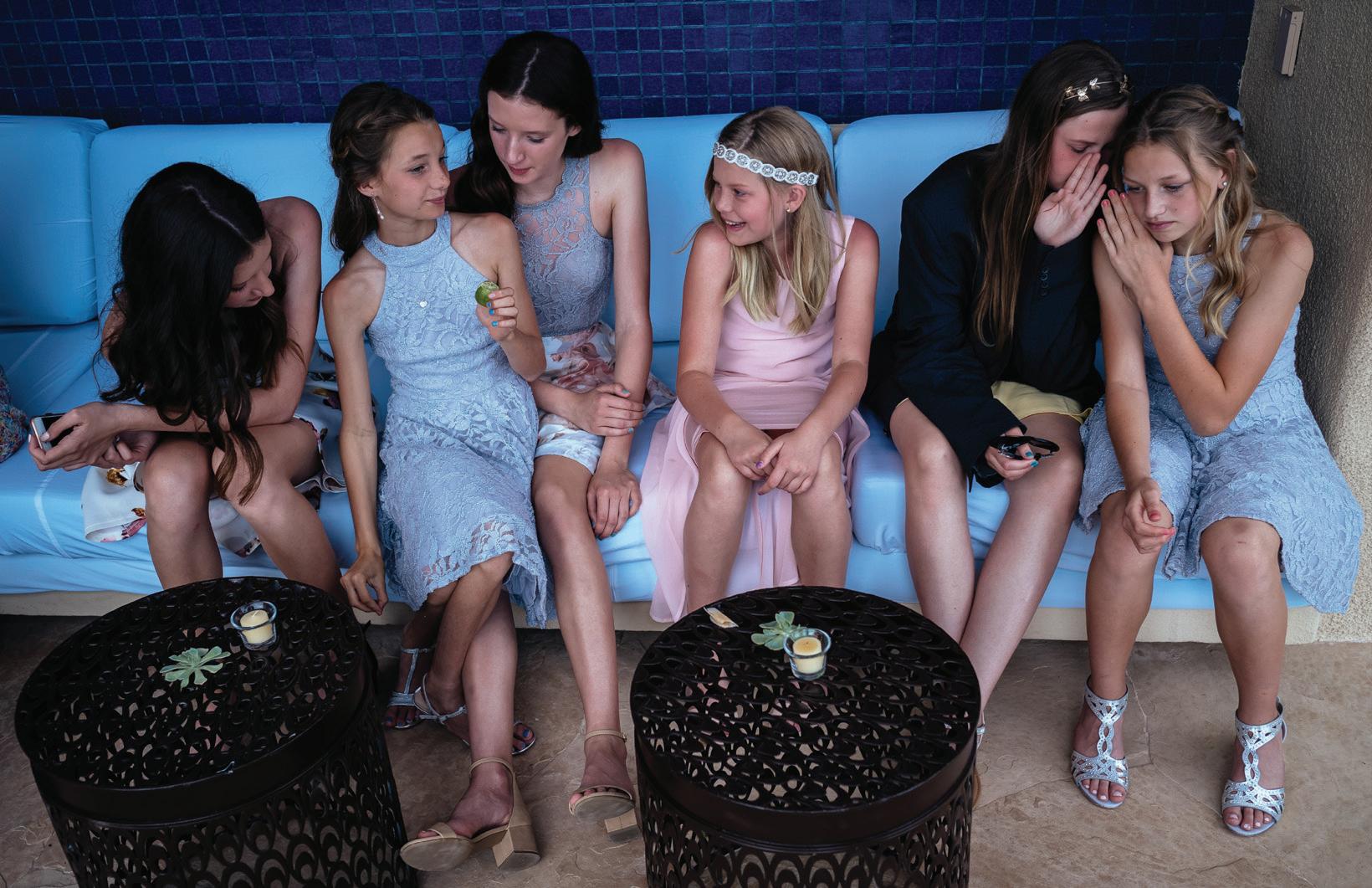
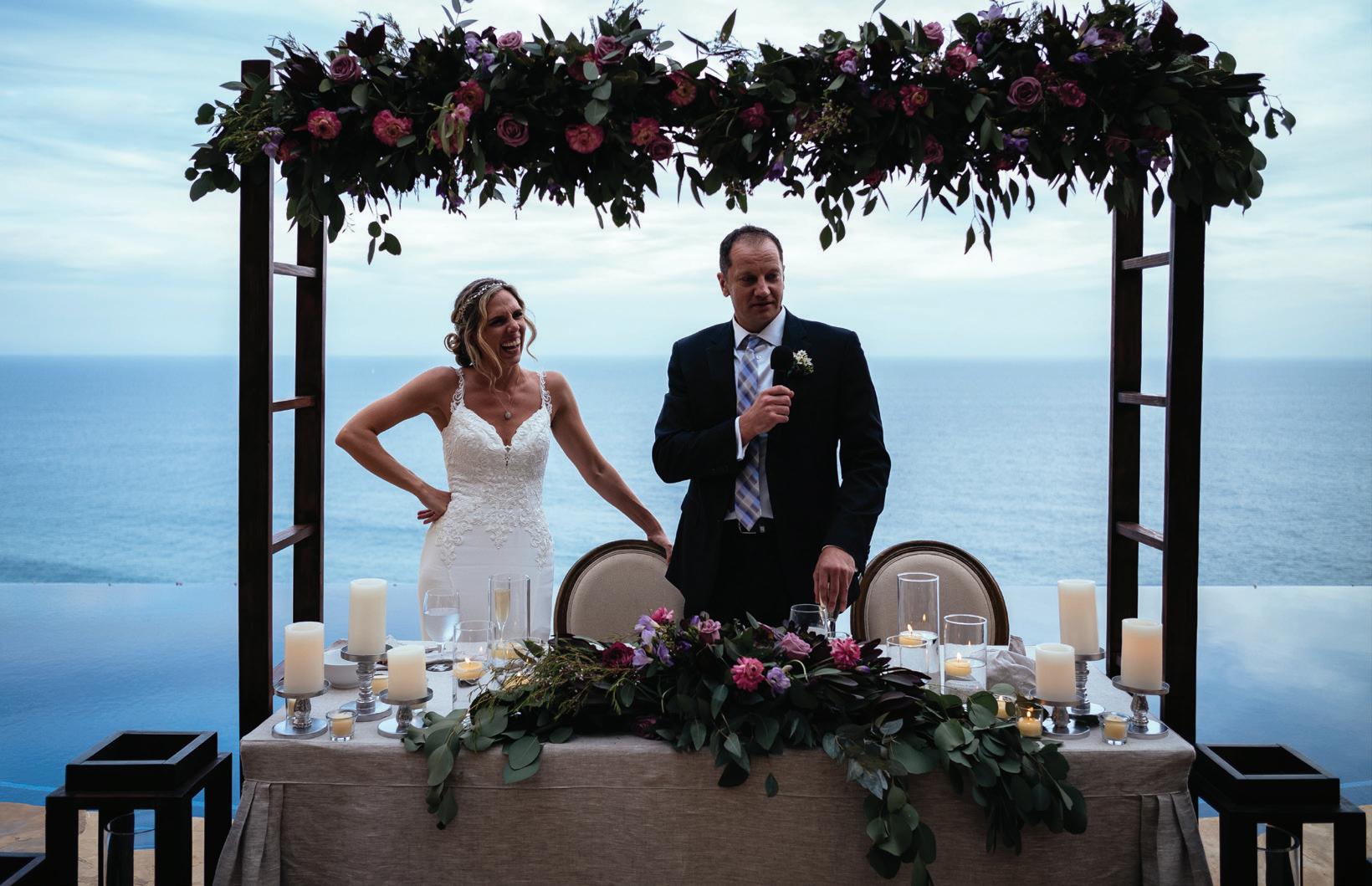
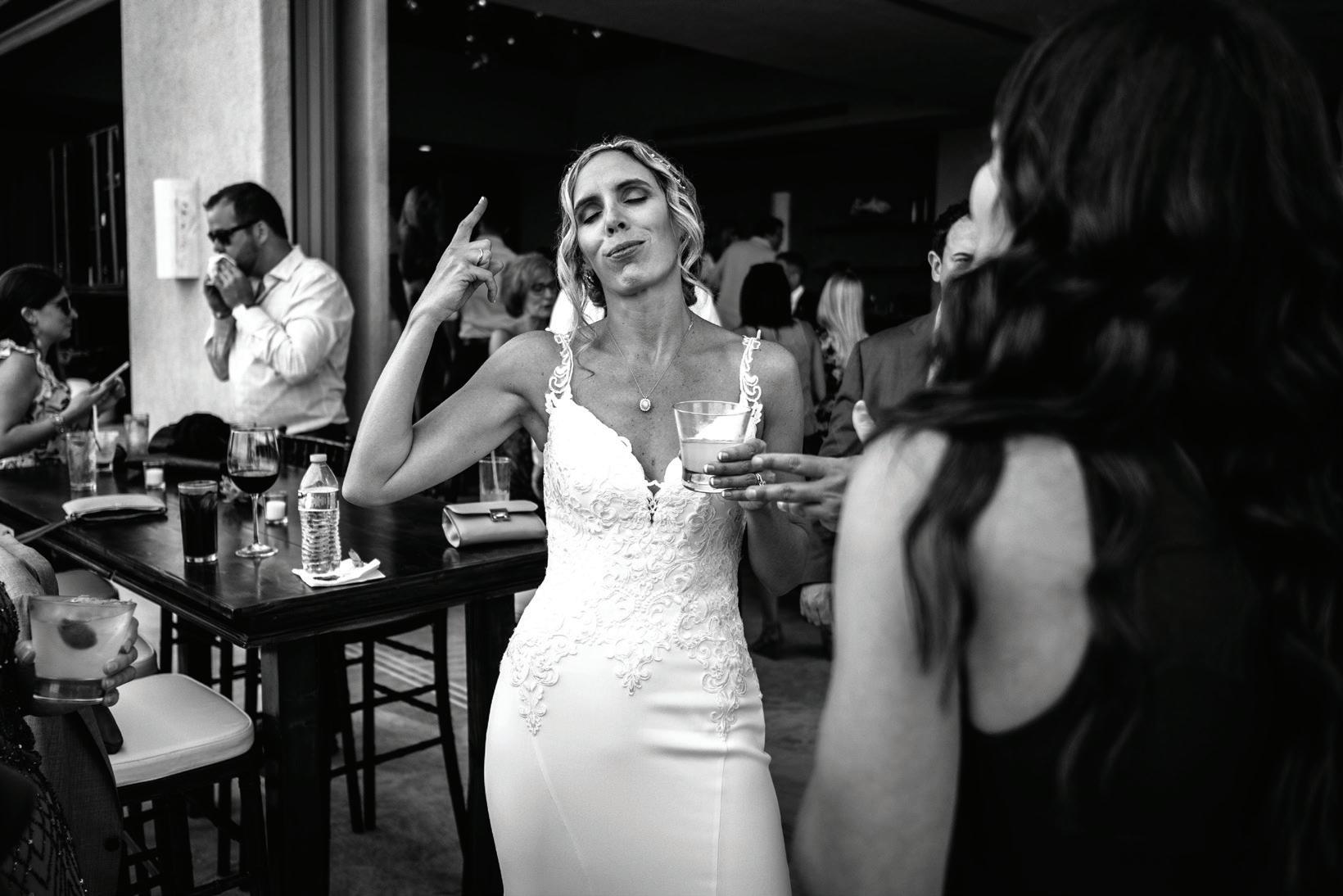
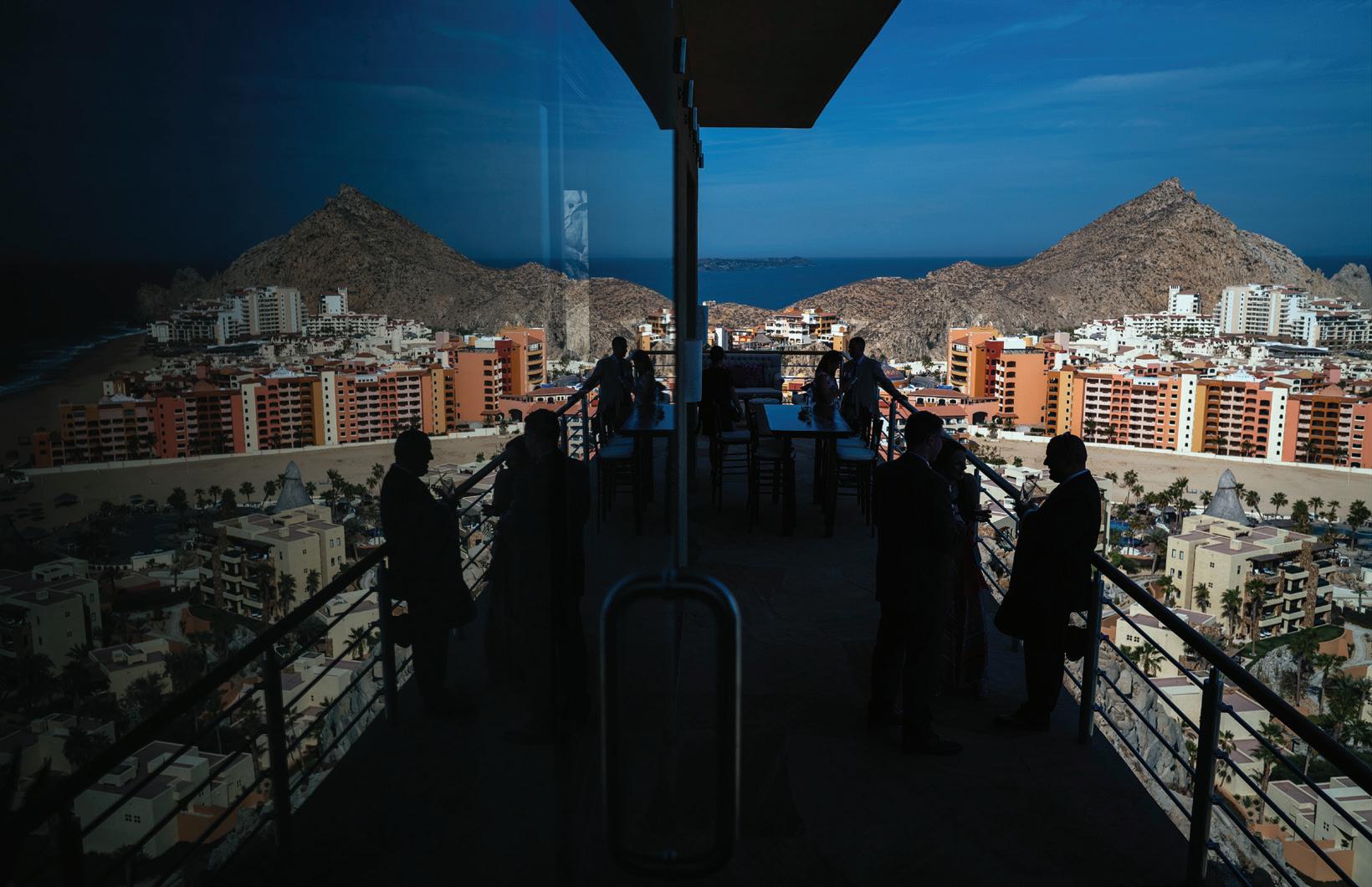
A few months ago I had the great opportunity to shoot a wedding with an amazing and very talented couple of photographers: Todd and Danette of Laffler Photography. The destination wedding was held in the beautiful luxury ocean front Villa Bellissima in Cabo San Lucas, Mexico. Aside from thanking Todd and Danette for the invitation, I would love to thank Riley and Tommy for let tingme be part of their special day. I really appreciate it!
Now let’s start being a little more technical and detailed about how it feels shooting a wedding with a Leica M10.
First of all, let me say that for me this wedding was not easy at all. Why? Since I was not the primary shooter, I had to make sure I was not in the other photographer’s frames, which is fundamental when you are a second shooter. And having a 28mm, with its wide 75° angle of view, it was much more complicated. But in the end, I’m happy with what I got.
Things I really love about shooting a wedding with the Leica M10:
• I just love how simple and minimal the camera is. Leica calls this “das wesentliche” (the essentials). There are only three big buttons on the back of the camera (Menu, Play and Live View). No top LCD screen to see settings; three buttons and that’s it. But I don’t need more. Once all the camera settings are set, I don’t press either Menu or Live View while shooting... And this is one of the best things about this camera: straight to the point! I can just focus on shooting and make art, instead of continuously changing settings or pressing buttons. Leica users know that this is the philosophy of the brand (at least for the M series): to forget about menus, buttons and settings and focus on your vision!
• To shoot at f/8 and f/16 is amazing... Embrace it! These lenses are so sharp and with deep details, and if you like how the depth of field works, you know what I'm talking about it. Shooting as my Magnum photo idols did: shooting with a Leica rangefinder chasing the perfect moment, showing us a lot of context... And shooting at smaller apertures. In many photographic styles, people are used to using prime lenses shooting wide open, to get that bokeh that "really" makes the difference. Me, I prefer context, information, allowing one to better appreciate the story. Sometimes when I want just a little depth of field but still wanting to understand the scene, I usually shoot at f/4, but most of the time, it's f/8 or f/16.
• I really love that with a rangefinder, I’m always able to observe the entire scene through the viewfinder without any blackout. Yes, in a DSLR when you click the shutter there is blackout, because the mirror is covering your vision. It’s a fraction of second, but if you shoot often having always the complete vision and understanding of what is happening in the full scene, it really makes a difference.
• This is weird when coming from a DSLR camera, but when you embrace it you’re gonna love it. There are frames lines appearing in the viewfinder, according to the lens you’re using. The rangefinder has a fixed field of view that doesn’t change depending upon which lens you have mounted. The frame lines give you an idea of what the picture will look like (or almost) but it’s really about visualization to acchieve your final composition. This is great because it doesn’t leave anything to chance. You have to know how composition works with a rangefinder, in order to get the same photo you’re thinking of in your mind. The point here is that you shoot more instinctively: if you feel that it could be a good picture and you press the shutter button, that’s it. It could be complicated at the beginning, because you’re seeing differently in your viewfinder. 100% challenging, love it!
• There are no video features, HDMI, USB or other "useless" connections. There is no built-in GPS, no tilting screen, no in-camera stabilization. The battery and the SD card are covered by a metal plate, and they're not readily accessible...which is great. The camera is better sealed and with not so many buttons, grooves or slots, I can concentrate better and focus on my photography. Yes, because I can change aperture, ISO and shutter speed using the old school dials...straight to the point! I repeat, once you know your camera and settings very well, you only need to change these three settings and nothing else. The pure essence of photography. Back to the basics, but with style!
• Image quality?... Oh yeah! Some people may think that when you buy a Leica, you pay more for the brand than the camera/lens features... It’s a bit true, everything with Leica is more expensive than the regular photography market. But the quality of the lenses, for example, are some of the best in the world, objectively. My 28mm is so sharp, with almost no vignetting or chromatic aberration. You can easily have an amazing sharp photo without post processing the photo itself. Really! The sensor has an amazing dynamic range and the details are maximized because of the lack of an anti-aliasing filter. Wow, everything together gives us supreme image quality.
• The camera is so fast! Why? Many reasons... The Leica M system doesn’t have autofocus (AF), everything is manual focus. The focusing is very easy with the Leica, and if you’re familiar with “zone focusing”, depth of field and hyper focal distance, you will be fast as Superman. Because once you master the rangefinder manual focusing system, you can be faster than a super accurate AF. Also because there is no mirror, there is not shutter lag, meaning there is no delay between you clicking the shutter and the image registered on the sensor.
• At weddings, guests expect to see a photographer with huge cameras and lenses. But shooting with a Leica M10 and a prime lens such as the 28mm, you really will be unnoticed, much more discrete. The camera is very silent compared with a DSLR. It is smaller and lighter than many cameras out there and I’m sure that your back and shoulders will appreciate it too!
Conclusion
The Leica M10 is an amazing camera. I really love it, and I will keep shooting weddings with this little gem. At the moment, I can’t use it as primary camera. Why? I only have one lens! I would need for sure a 50mm, for a full day coverage: a 28mm + 50mm is an amazing combo for weddings. The features of this camera are very, very simple and the options are minimal, which is awesome. I repeat, once the camera is set all you need is to shoot.
Think for a second about the mirrorless camera of the moment: the Sony A7III. There are so many buttons, features and menu options that I feel like the Leica M10 and the Sony A7III are at two opposite poles: the newest technology versus pure minimalism. I really think that the technology can help, but also interfere. A camera with five options and a camera with twenty five: they can give you similar results but with a very different approach.
In a saturated world as ours, we have too many options to choose, and there is the paradox of choices. Having only very few options can boost your photography skills and let you concentrate only in what we want: shooting a great photo. And I’m not talking about showing off your Leica camera here. The Leica M line has a legendary status among photographers, yes, but your wedding clients really don’t care about which brand you are using or how cool your camera is. They want facts: amazing photos.
Definitely, it’s not a camera for everyone. For some, it could be more complicated to shoot with a Leica rather than a Fuji or Sony mirrorless or a Nikon or Canon DSLR. You need to master the rangefinder system and how to focus in order to guarantee results. It takes a lot of practice to be sure you can manually focus in any situation. If I were a sport photographer I wouldn’t chose a Leica M camera of course, because I would need super fast AF that is mandatory for sport photography. But for a general purpose, travel, street photography and why not, weddings, it can be an amazing camera. What are your goals when shooting a wedding? What do you really need and what is unnecessary? Think about that, maybe you can give Leica a chance.
Haus Friedwart
HAUS FRIEDWART
by BILL ROSAUER
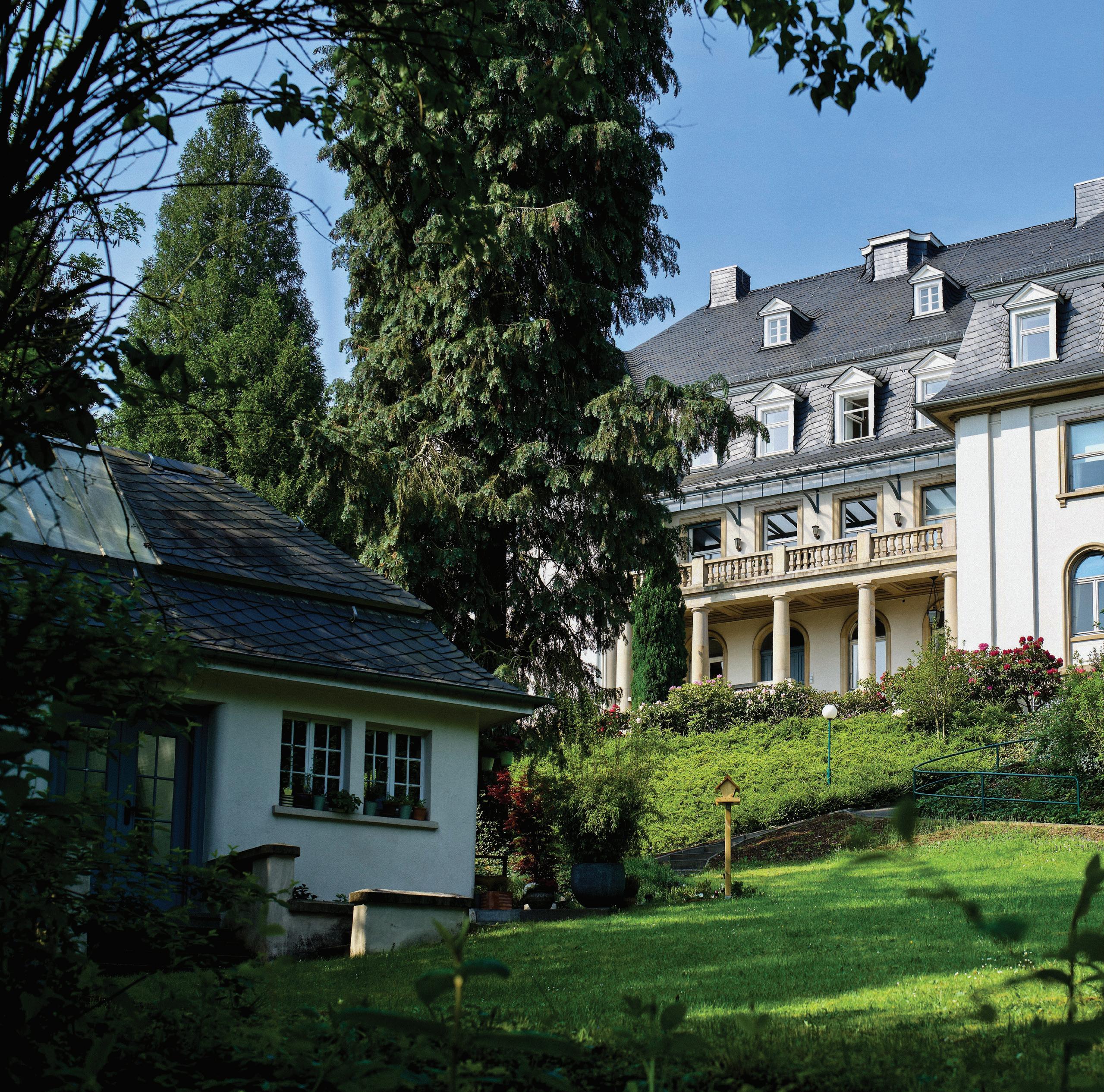
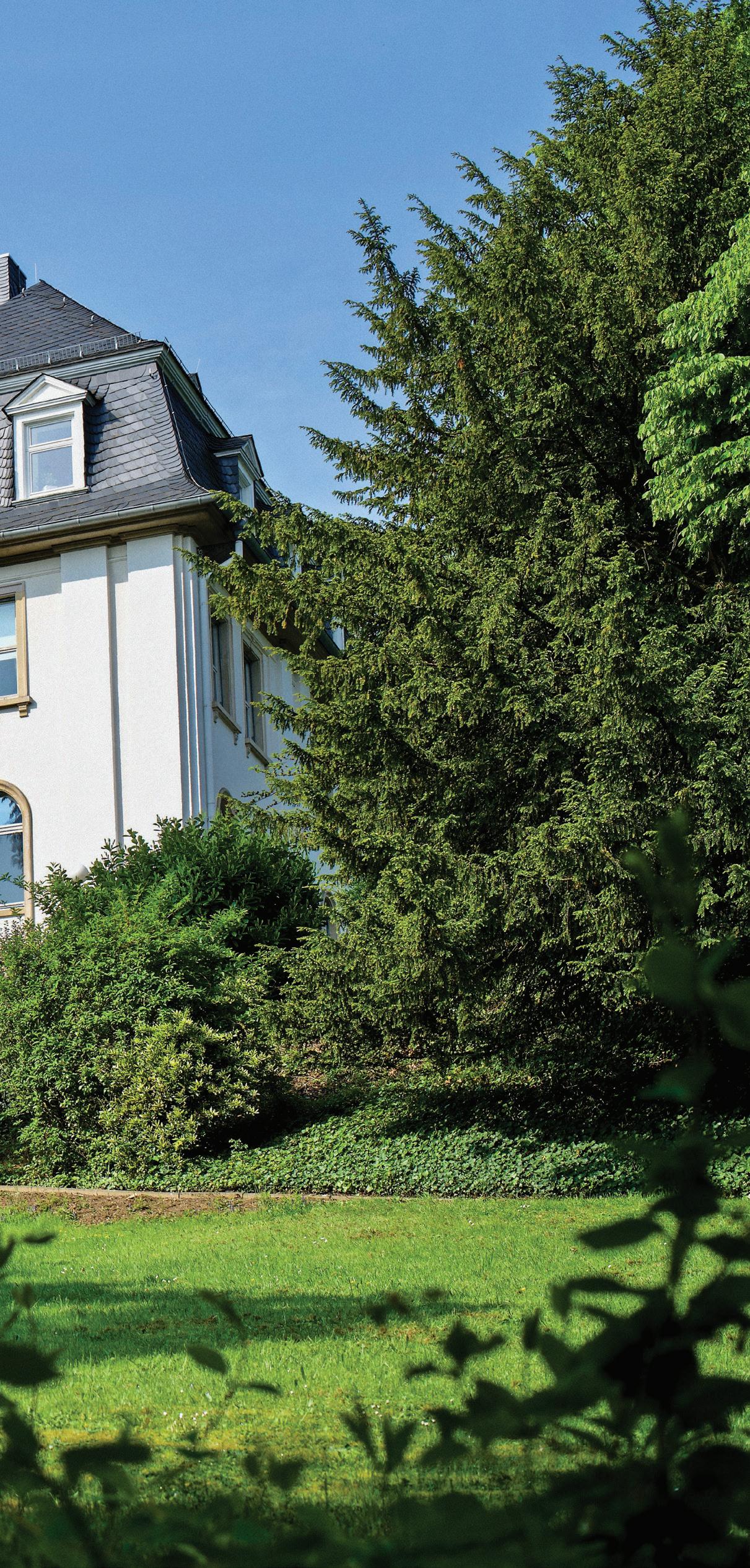
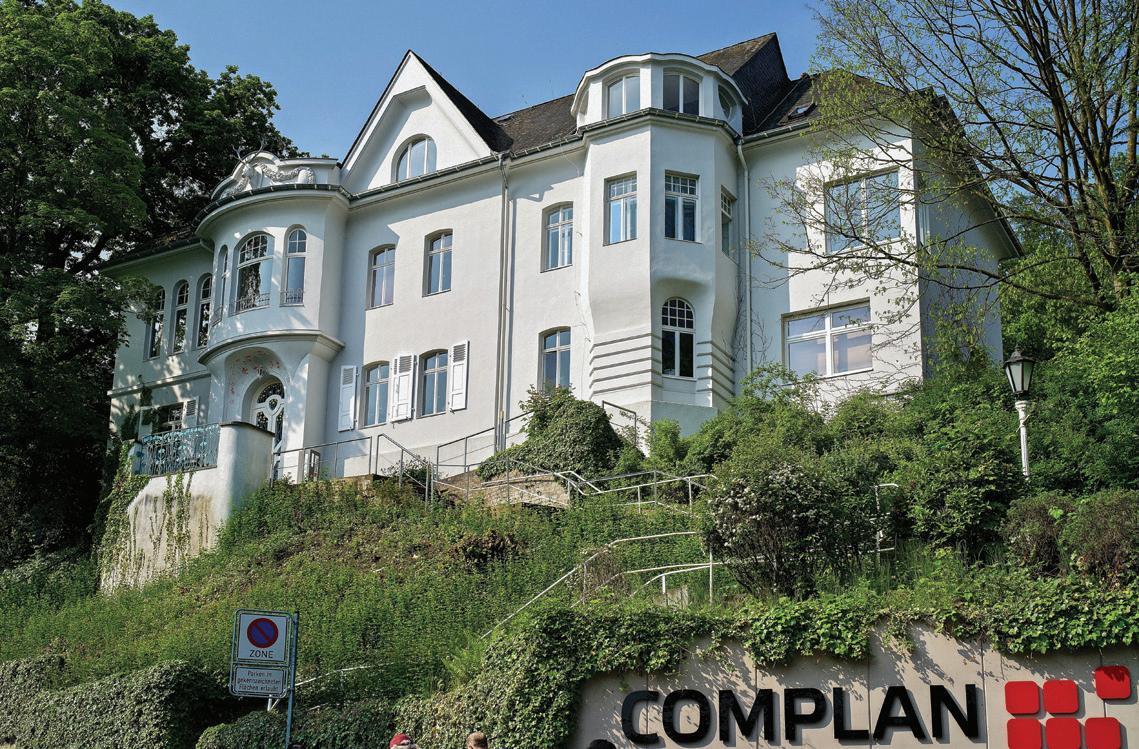
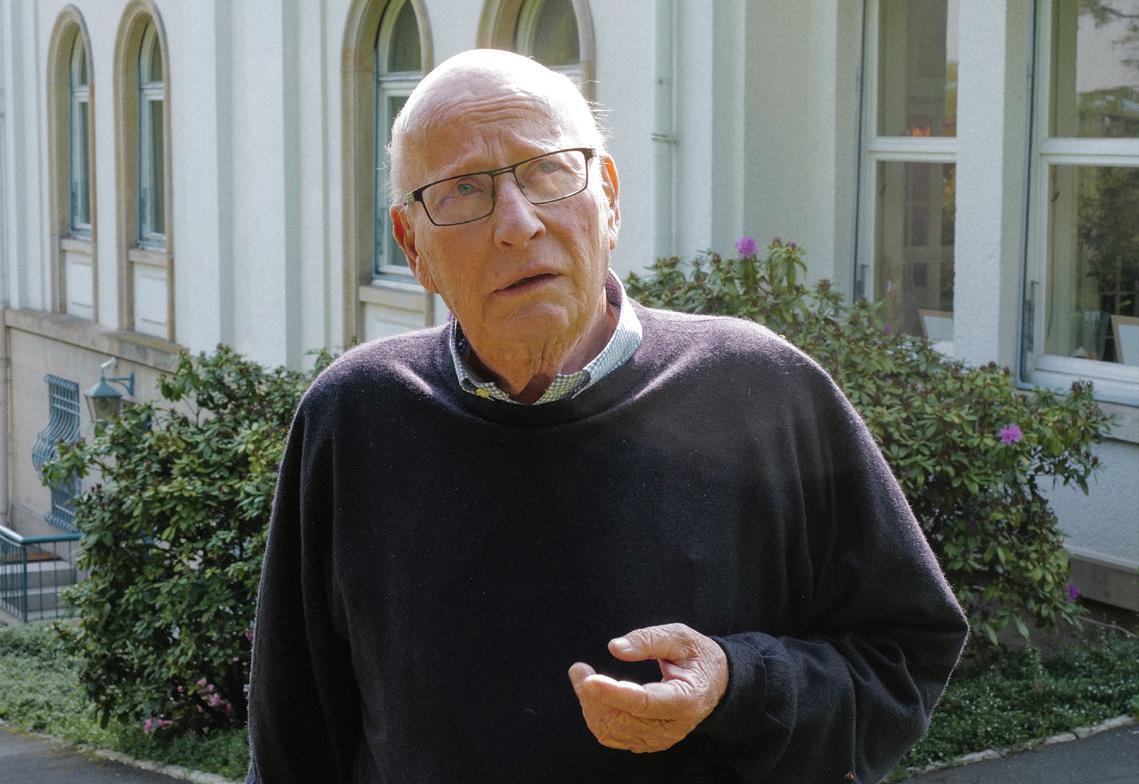
Haus Friedwart, the Wetzlar home built by Ernst Leitz II, is well known to students of Leica history. It stands on the hill above the old factory in Wetzlar, known as the Kalsmunt, at 4 Lauferdorfer Weg, with a commanding view of the factory, Wetzlar and the hills beyond. I had seen the outside of it many times during my visits to Wetzlar in the past 45 years, but had never been able to see the inside of it. I remember well one visit with my dad back in the mid-80’s, as we walked around the house and he told me of his first time there as a young GI in 1947 to try and get a Leica camera. Needless to say, he came away empty handed on that trip! As part of my “Total Wetzlar Experience” tour, I was determined to make a tour of Haus Friedwart a highlight of the many things my group saw while in Wetzlar. I had arranged for a personal tour of Haus Friedwart and its grounds by the grandson of Ernst Leitz II and son of Elsie, Knut Kühn-Leitz. Elsie returned to live in the house in 1940 after her marriage to Kurt Kühn, and Knut grew up here as a boy.
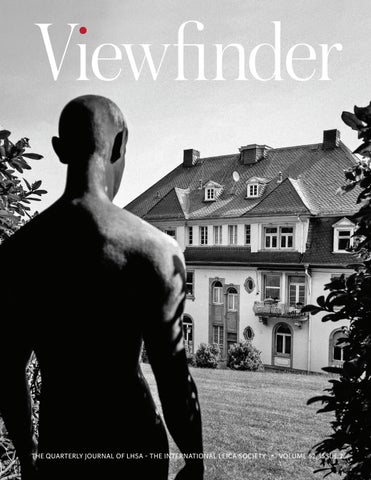
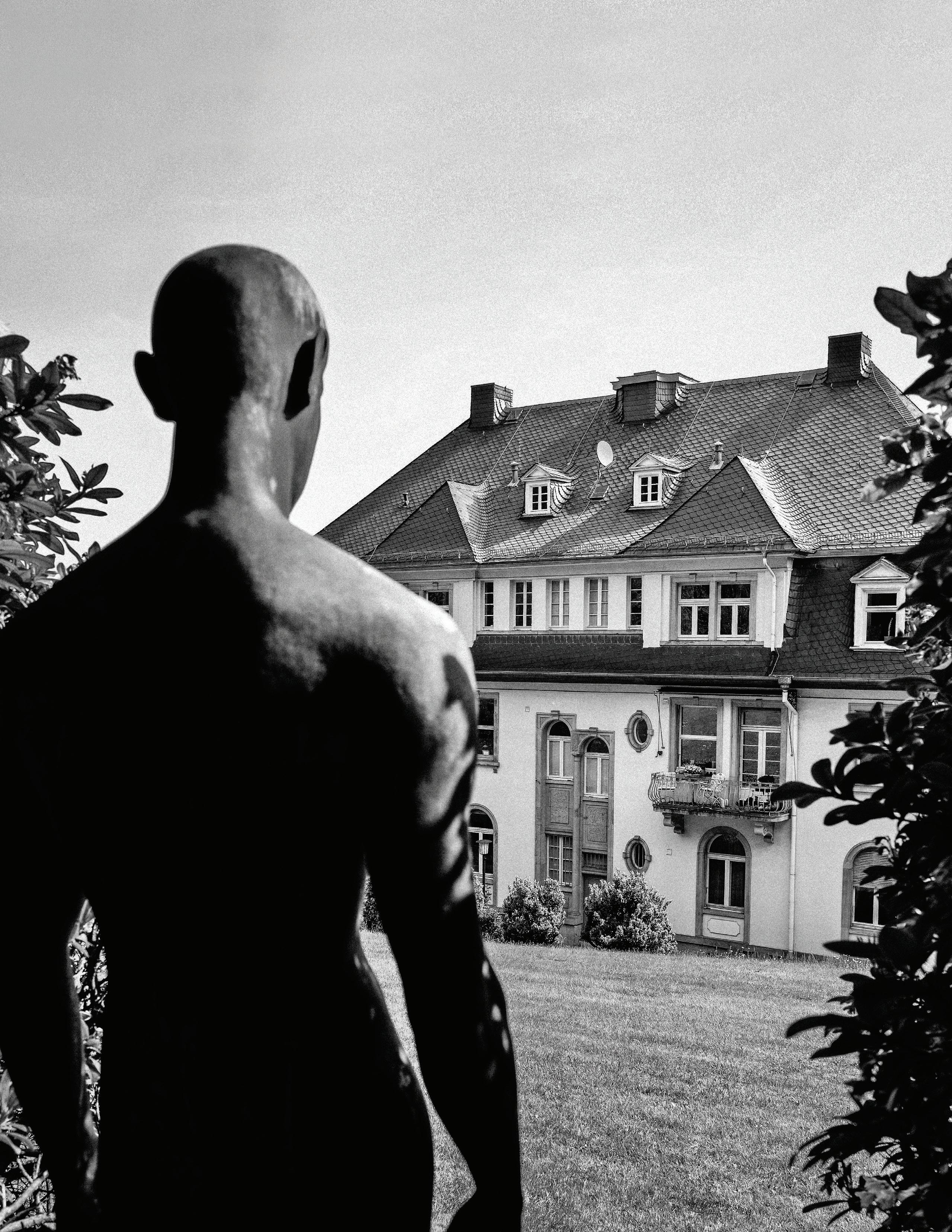
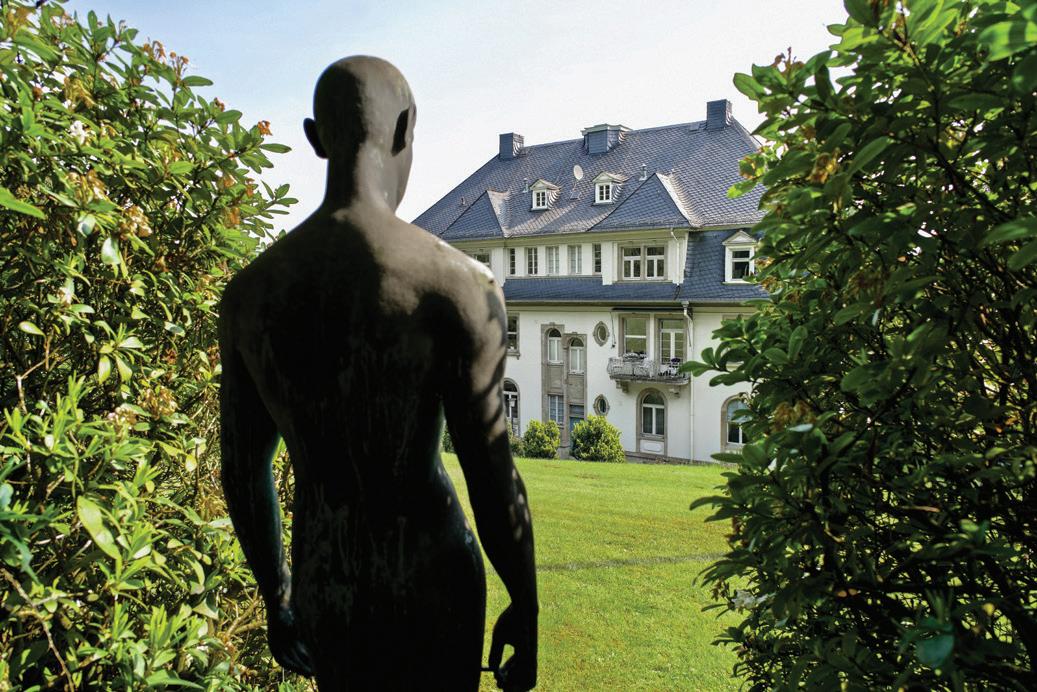
Bronze Man with Flowering Branch by Hermann Lickfeld overlooking the rear of Haus Friedwart.
Haus Friedwart is in fact the second home Ernst Leitz II built in Wetzlar, constructed in the years 1914 to 1917. The first home built by Ernst Leitz II for his first wife Elsie and their three children (Elsie Leitz, Ernst Leitz III and Ludwig Leitz II) was located just up the hill from the Kalsmunttor at 3 Lauferdorfer Weg. Built in 1904, this was a large, two story house in the then popular Art Nuveau style, and was named Villa “Rosenberg” after the floral style of the window frames, bow windows and ornamental ironwork of the house.
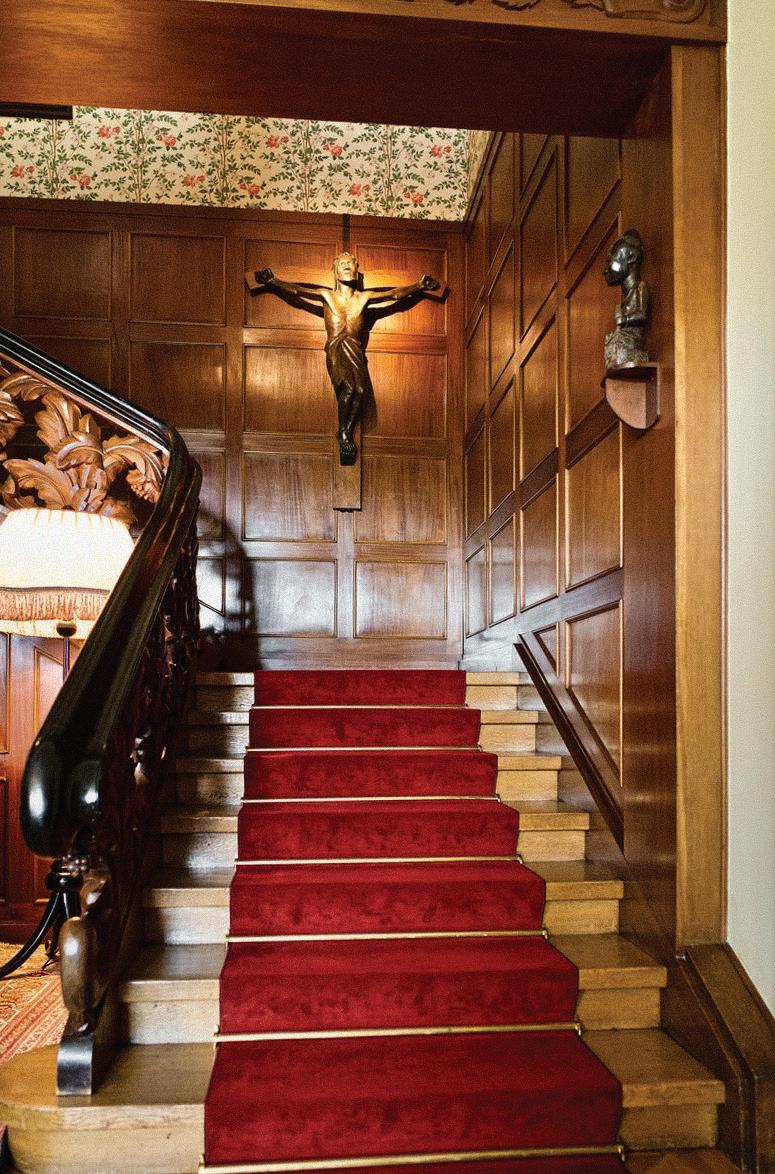
After a few happy years at Villa Rosenberg, Ernst became a widower in 1910 with three small children to care for. He was looking to make a new start, having married his second wife Hedwig, and this became the inspiration for Haus Friedwart, loosely translated into English as “Guardian of Peace”. Jean Emil Schmidt received the commission from Ernst Leitz II for the main architectural and structural elements of the house. Schmidt was responsible for the design and construction of the Leitz factory “Hochhaus” on Ernst Leitz Strasse and for several other buildings at the Leitz Werke, so he was someone whom Leitz already trusted and had a good working relationship with. Through his connections to and design work for Ernst Leitz’s sister Ella Bocks, Bruno Paul, a successful painter, graphic artist and architect and Director of the Kunstgewerbemuseum in Berlin, and she introduced him to her brother. He became well-known for the creation of the “Gelbes Haus” for a Werkbund exhibition in Cologne in 1914, and his artistic style was a precursor to what later became known as the Art Deco movement. Bruno Paul was then at the pinnacle of his artistic career having designed other elegant villas, chic interiors for ocean liners and commercial buildings, and he was commissioned to make certain alterations to the exterior of the house and was responsible for the entire interior design. Bruno Paul was assisted by Emil Orlick, an associate from the Kunstgewerbemuseum, and was responsible for one of the unique features of the house, the design of the intricate carvings on the stair banisters in the front hall of the house.
(top) Villa Rosenberg, first home built by Ernst Leitz II.
(center) Knut Kühn-Leitz
(bottom) Front Hall with elaborately carved stair bannister by Emil Orlick and sculpture of Christ on the Cross by Ernst Barlach.
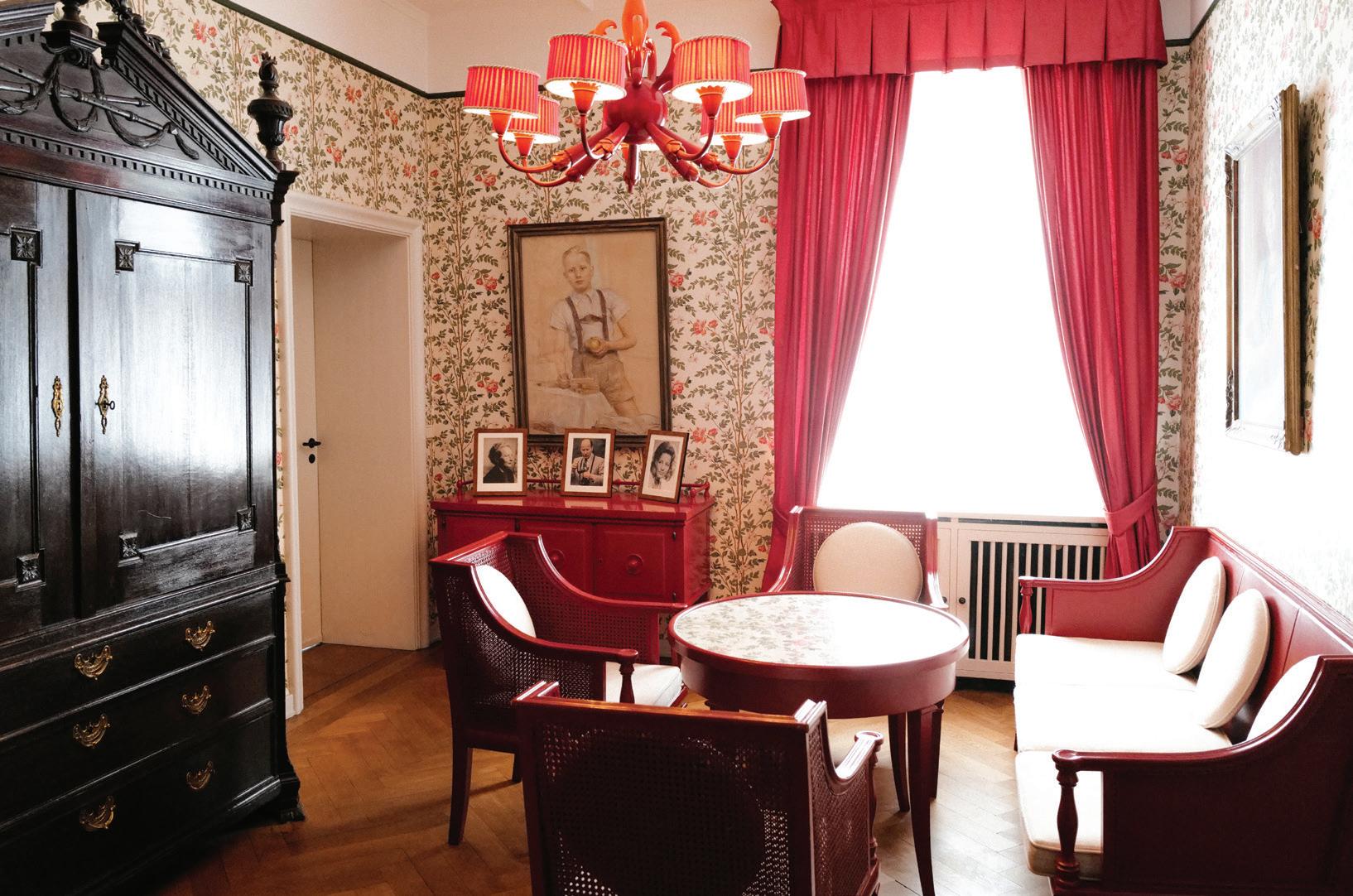
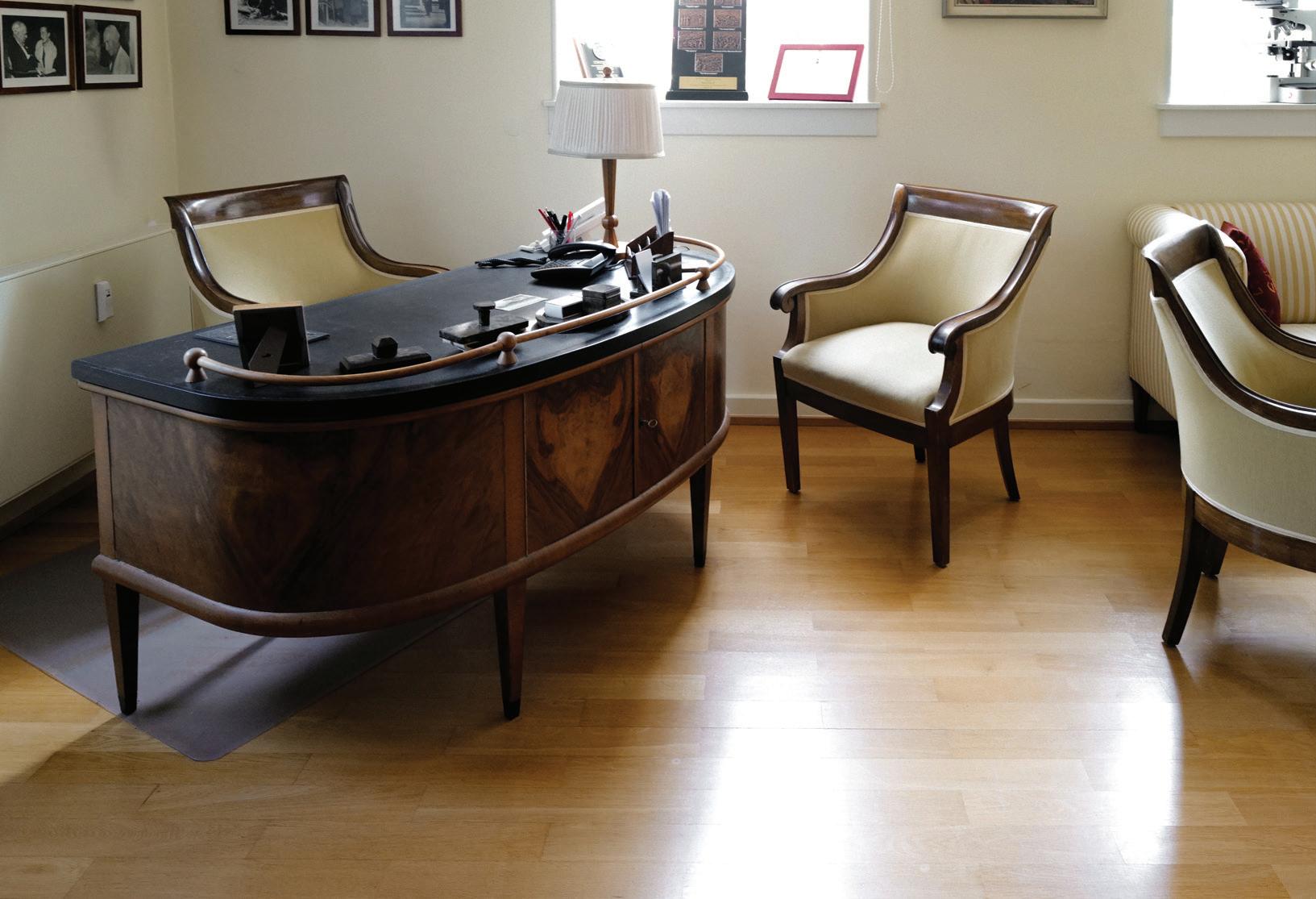
(left, top) The Red Vestibule on the second floor of Haus Friedwart
(left, center)
Ernst Leitz II’s office desk & chairs
(left, bottom)
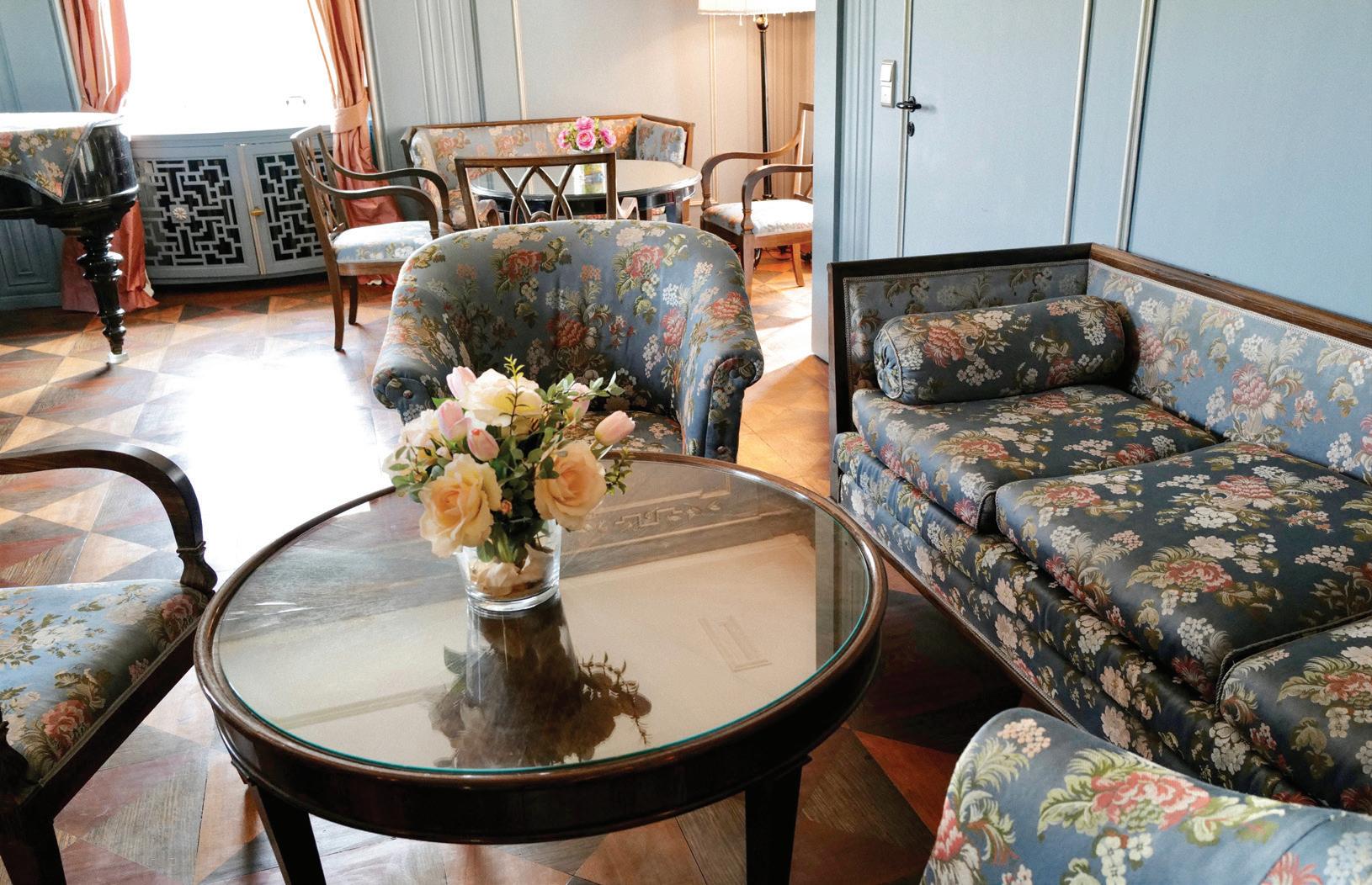
Music Room & Sitting Area
(above)
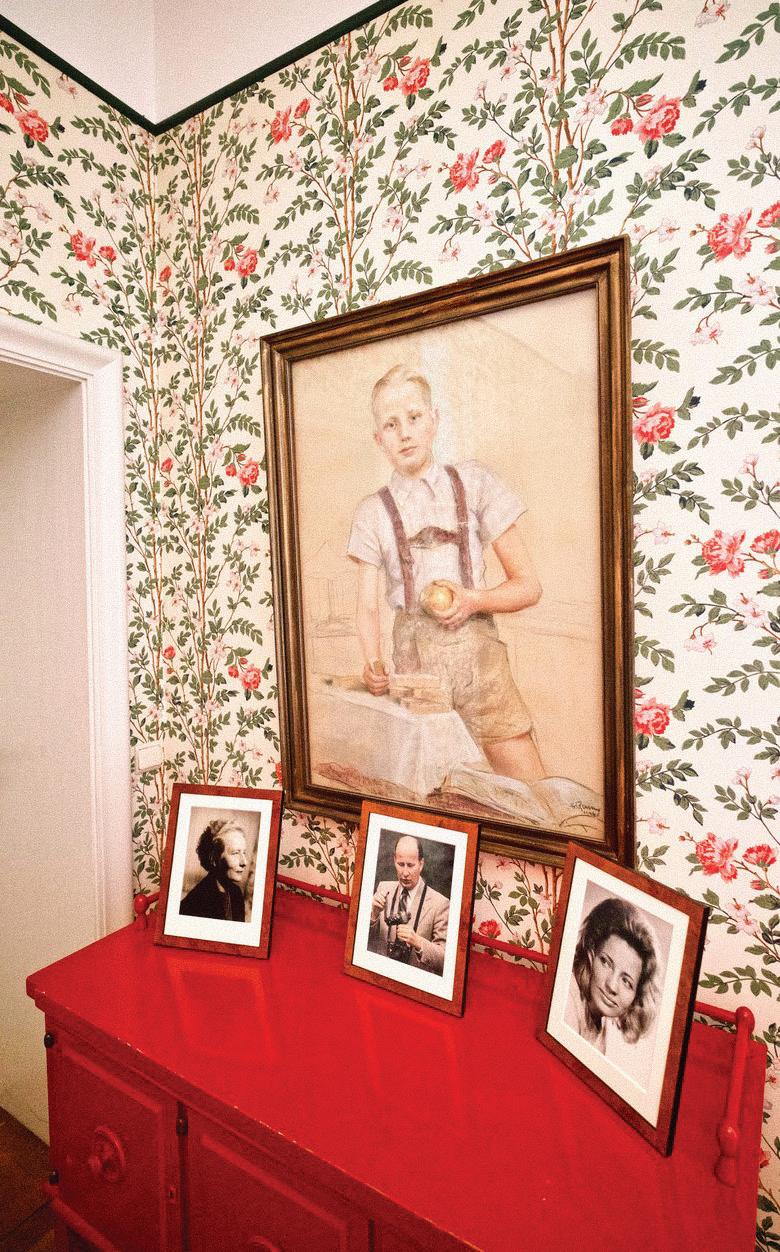
Portrait of Knut as a young man in Lederhosen in the Red Vestibule. Framed portraits of Elsie Kuhn-Leitz, Knut and Cornelia Kuhn-Leitz, Knut's sister on the table.
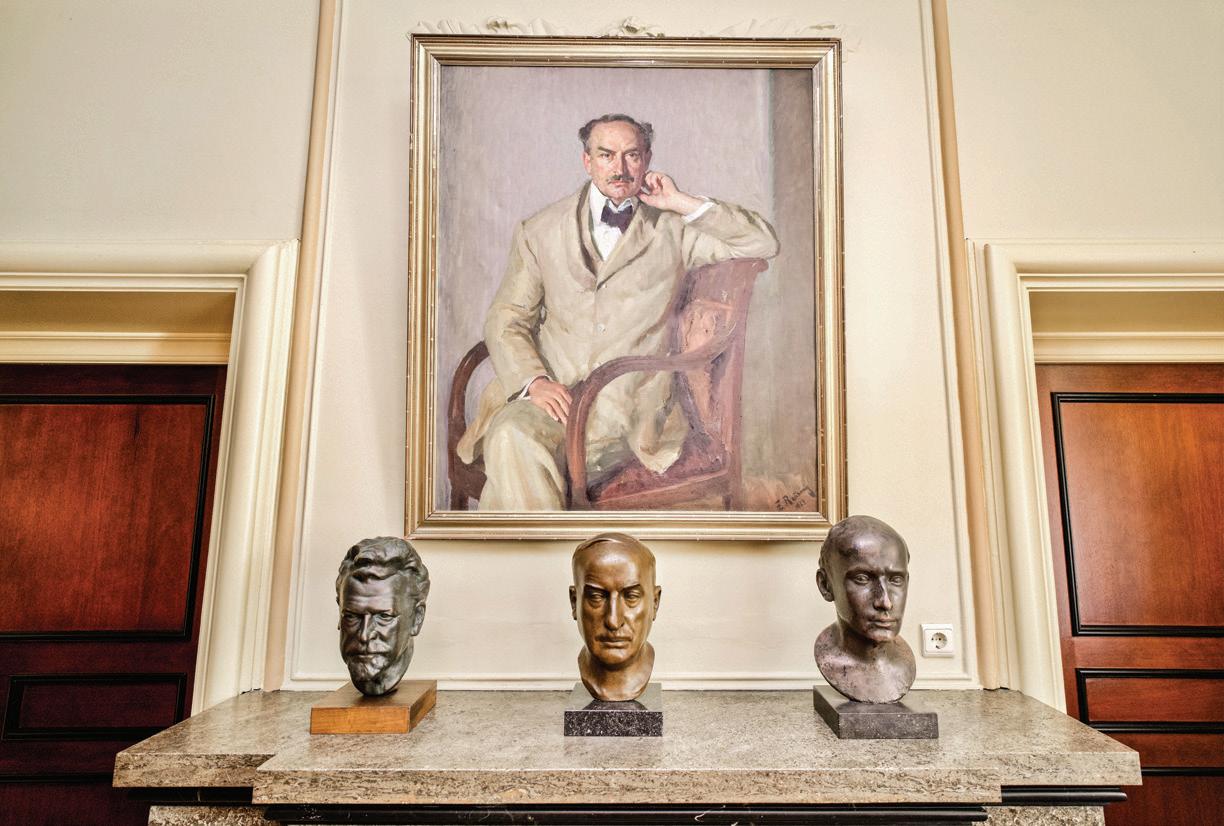
The grounds around the house are quite steep, with Knut leading us around the front and back of the house, pointing out interesting details along the way. Despite being in his 80’s, Knut had no problem with all the walking up and down hill. We entered the house through the front door and on into the front hall with staircase. Here there were portraits of Ernst Leitz I and II, along with busts over the fireplace of Ernst Leitz I, II and III. Here stood a grand piano with the Guest Book for us to sign. We were quite honored to do so, and glancing through it is like a Who’s Who of the twentieth century. Albert Schweitzer, Theodor Heuss, Elly Ney, Konrad Adenauer, Walter Gieseking, Patrice Lumumba, Emporer Akihito, Henri Cartier-Bresson, Ernst Haas, Elliott Erwitt, Alfred Eisenstaedt and many others had signed the Guest Book before us. Knut pointed out the intricate carving and words over the staircase, and also to the large sculpture of Jesus on the Cross on the back wall. This sculpture is one of only four made by Ernst Barlach, and was declared “degenerate art” by the Nazi regime. To save it from being melted down, it was hidden during the
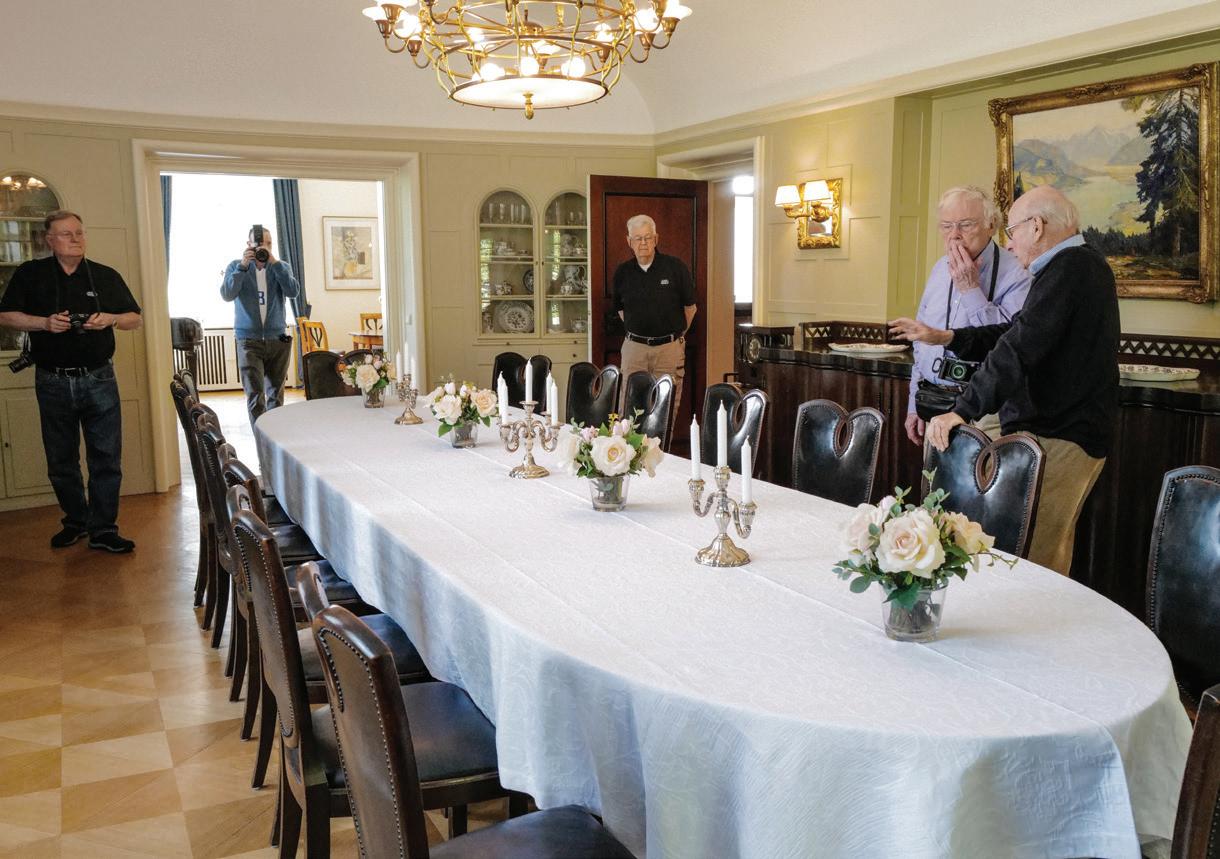
war years under the staircase! Going up the stairs to the family living quarters, one is struck by the thought of all of the Leitz family going up and down these same stairs all those years ago. One room that was quite impressive was the Red Vestibule, with its striking display of red furniture, drapery and fixtures. Here hangs a portrait of a young Knut in Lederhosen. Next came the dove gray Music Room with a concert grand piano, one of several in the house played by famous guest musicians over the years. Haus Friedwart was not only the home of the Leitz family, but also a center for the arts and artists who visited Wetzlar from around the world. Through one room after another, Knut pointed out the unique design features and stories, with family pictures placed all around with many being of Knut, his mother, uncles and Grandfather. We passed through the sitting rooms and grand dining room, and one could only imagine the dinner guests in attendance in so grand and cultured a place. Heads of state, famous composers and musicians, humanitarians and yes, famous photographers over the years have been here to visit before us.
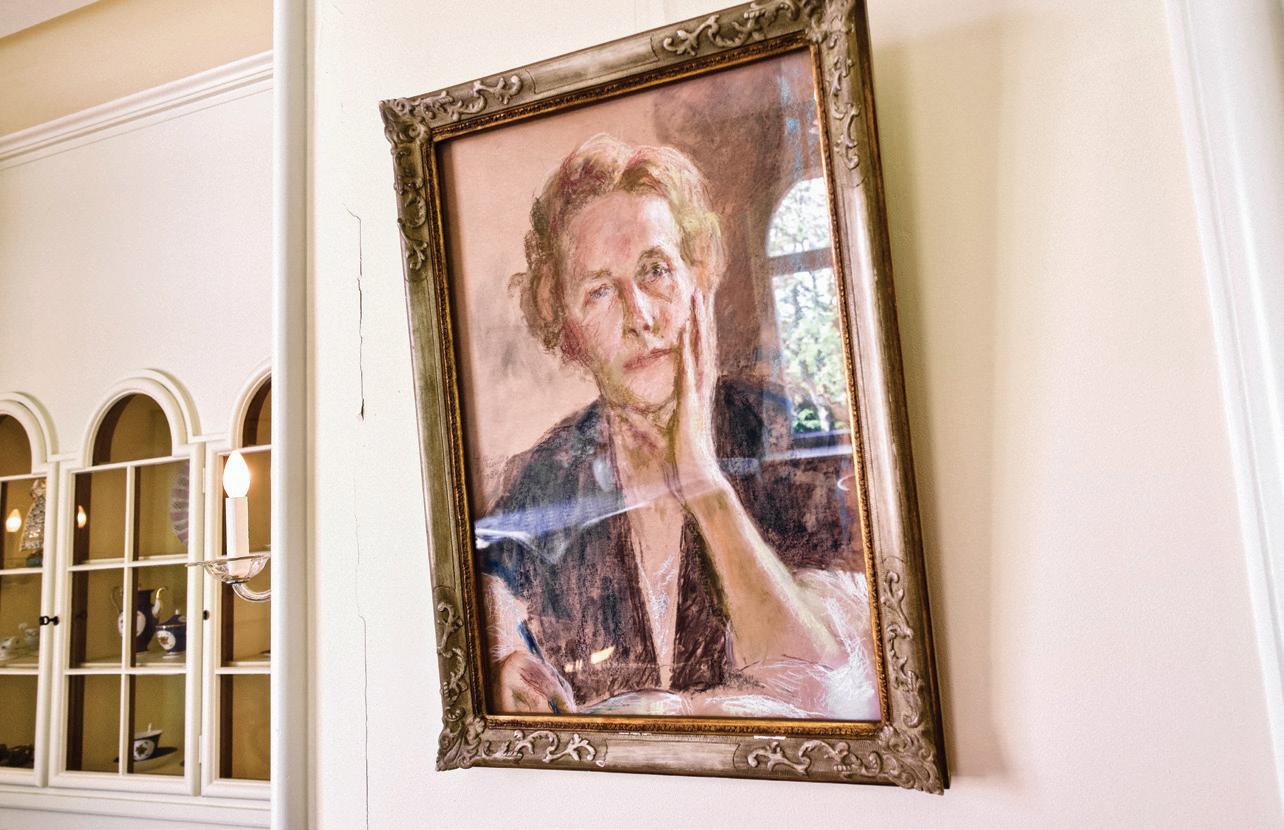
(top) Portrait of Knut's mother, Elsie. (bottom) Knut pointing out features of the intricate carvings in the Front Hall.
(top) Portrait of Ernst Leitz II & busts of Ernst Leitz I, II and III. (bottom) Dining Room
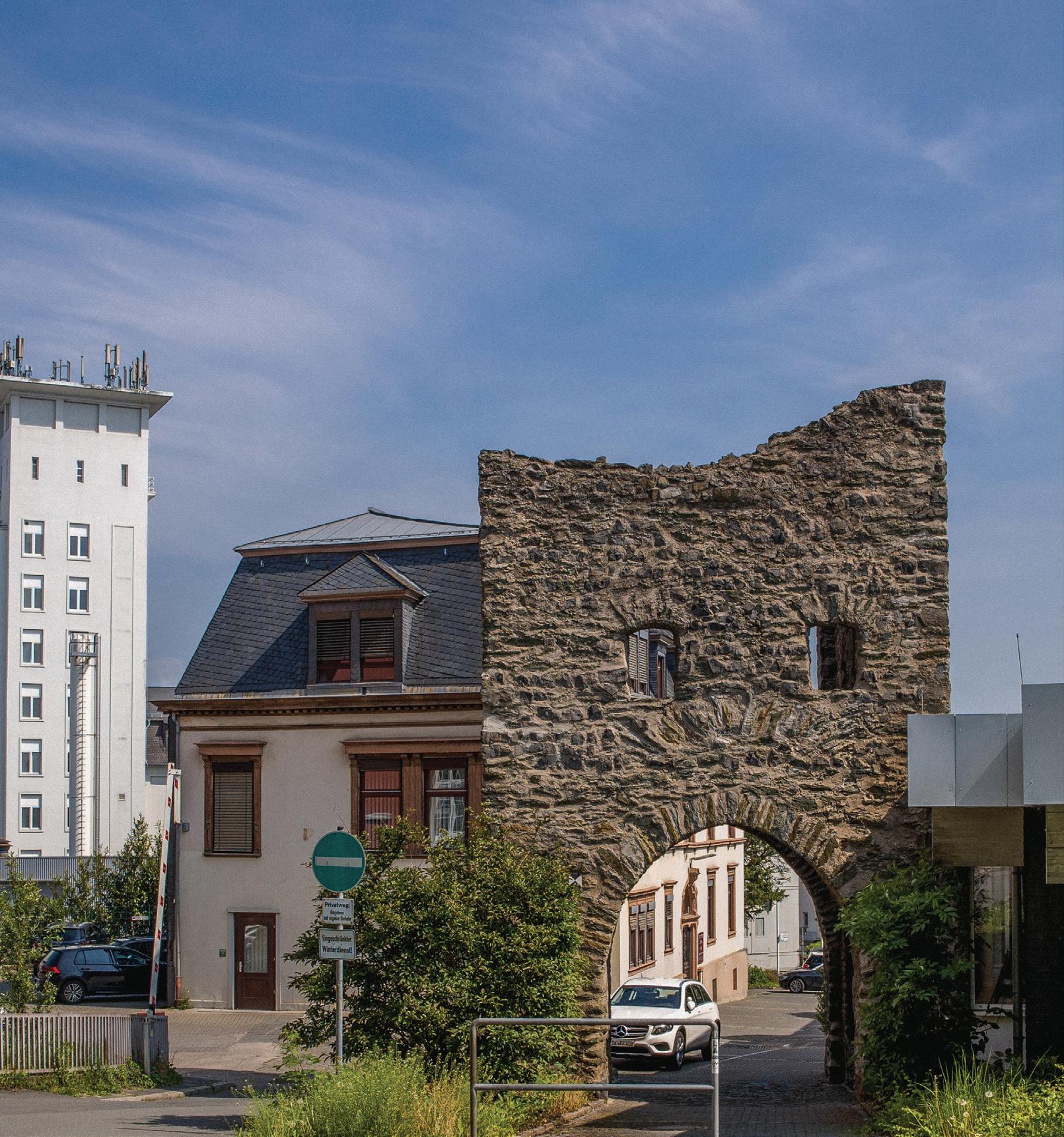
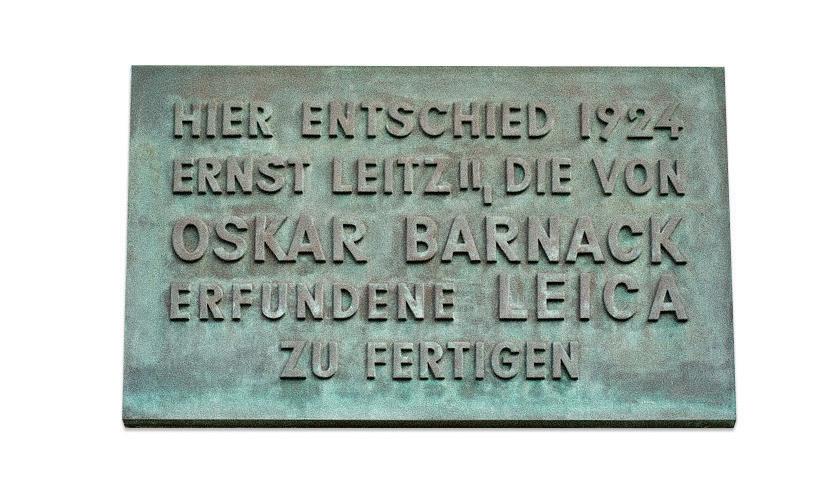
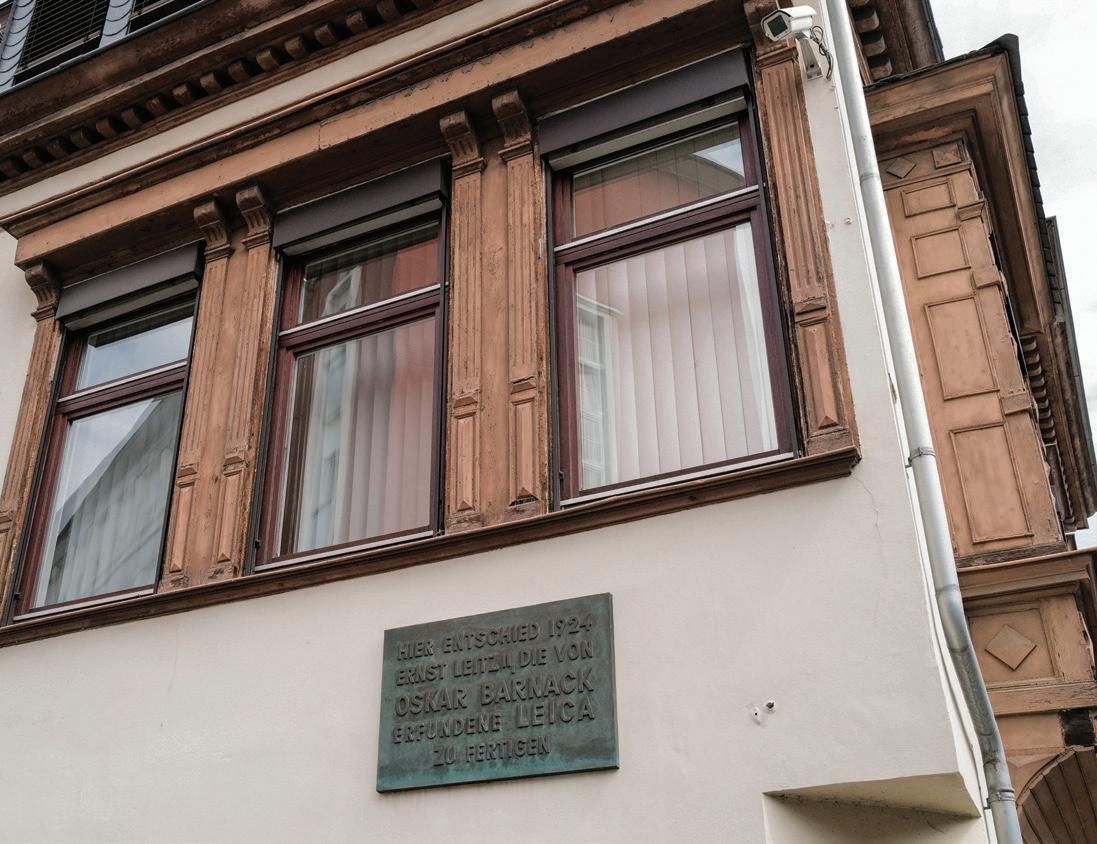
Walking downhill again from Haus Friedwart, we returned to the old Administration Building at the Kalsmunttor next to the old factory. I had visited this spot many times as well, as I’m sure many others have, to see the plaque on the wall commemorating the decision made in 1924 by Ernst Leitz II to produce the Leica after a contentious morning-long board meeting with the directors of the Leitz firm. In attendance were Ernst Leitz II, Oskar Barnack, Max Berek, Dr. Henri Dumur, Michael Becker, and the foremen of the mechanical and optical departments, August Bauer and Rudolf Zak. Becker was on hand to advise as to the potential success of the new camera in foreign markets. There were strong arguments against making the Leica, such as Leitz was a producer of capital goods such as microscopes, not consumer goods such as cameras. The Leica was seen as a toy, as everyone knew you could not make good pictures from such a tiny negative. But Ernst Leitz was determined to diversify the Leitz Company at a time of great economic uncertainty to help his workers and the company survive. The period of hyper-inflation and
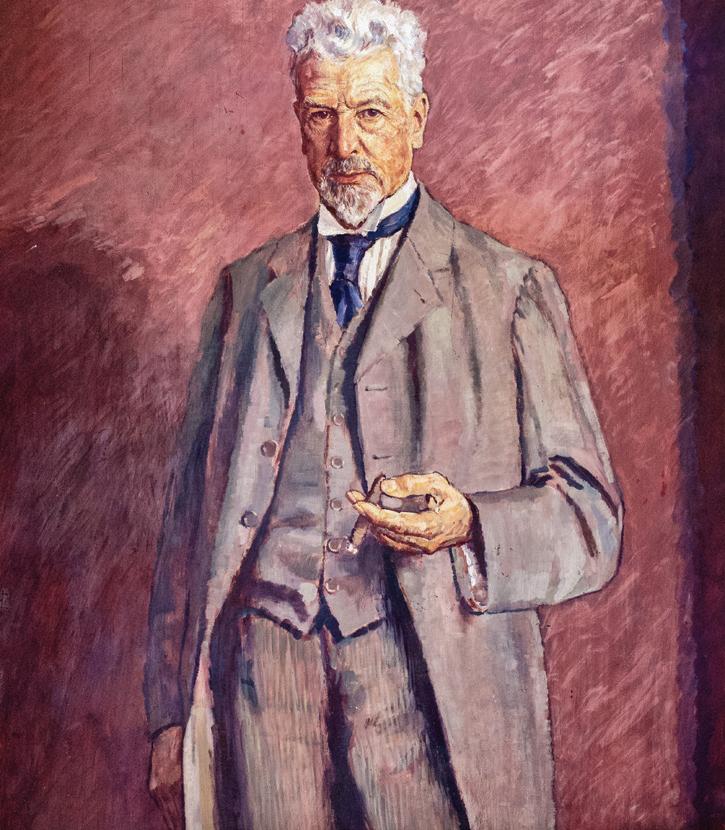
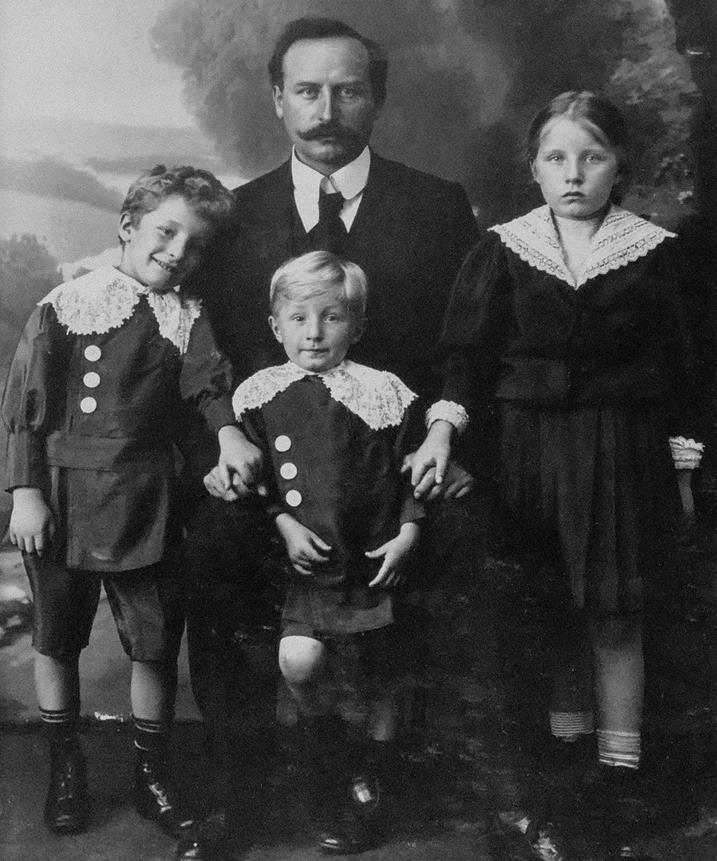
(top) Portrait of Ernst Leitz I (bottom) Ernst Leitz II with his children Elsie, Ernst Leitz II and Ludwig Leitz II
Plaque memorializing the place where the decision was made to make the Leica in 1924. This is below the triple window of the board room.
(above) View of the Kalsmunttor, the old Leitz Admin building and the Leitz Hochhaus building.
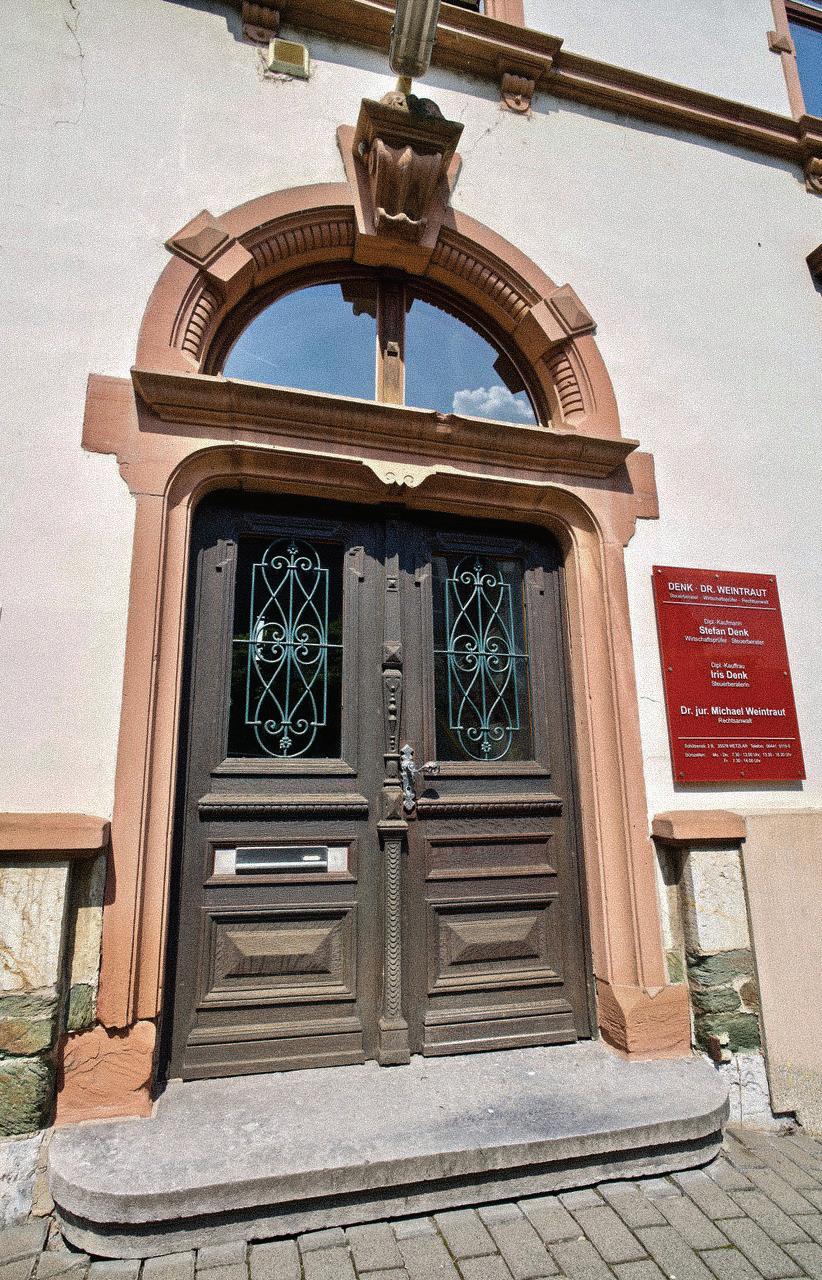
(top) Front Entrance (bottom) Plaque memorializing the place where the decision was made to make the Leica in 1924. This is below the triple window of the board room.
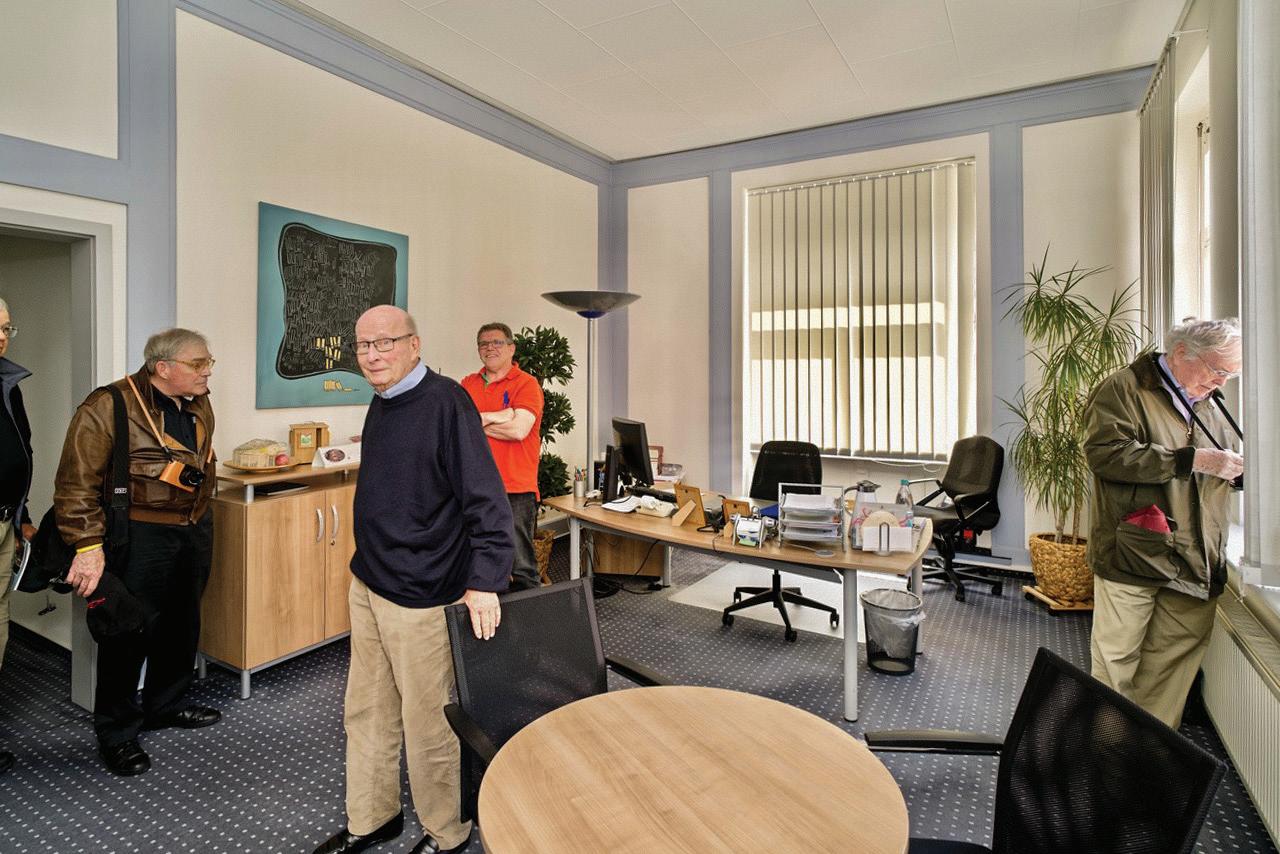
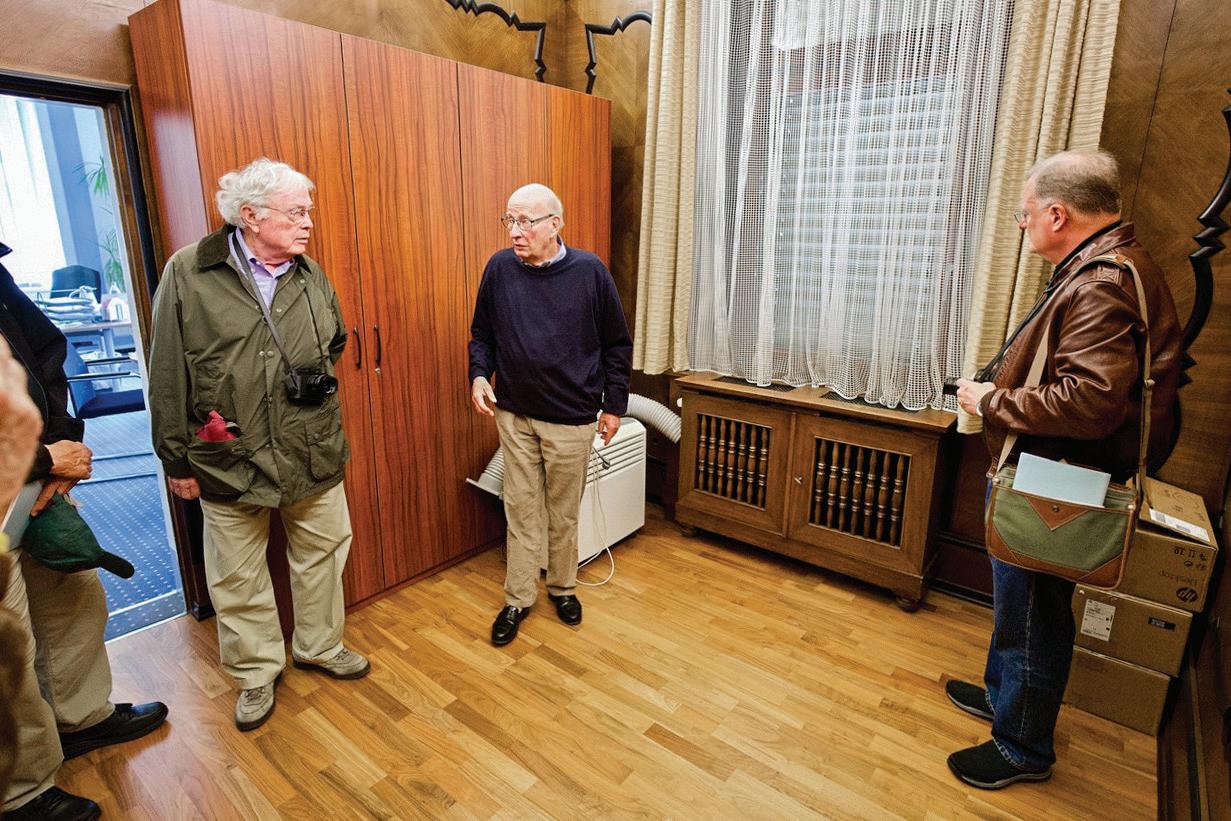
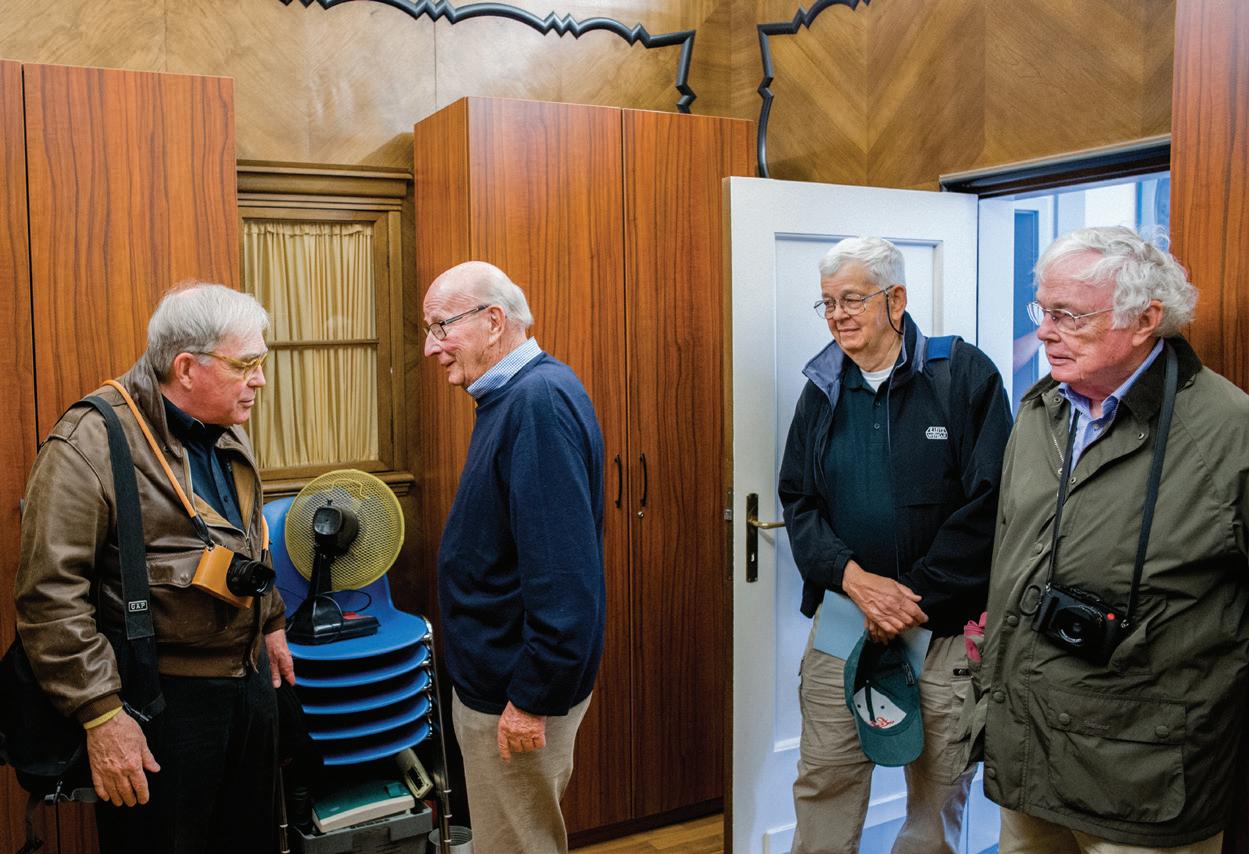
(top) Old Board Room where the decision to produce the Leica in 1924 was made. (center & bottom) Office of Ernst Leitz II, now a records storage area.
subsequent economic depression had hit Germany hard. Leitz felt strongly that the consumer market was ready for such an innovative new camera. After many hours of argument, there was no consensus among the board members. Finally, looking at his watch, Leitz said, “So, it is now twelve-thirty pm. We conclude this meeting. I hereby decide it will be risked.” The board room is now the office of the wife of the current building owner. It is hard to imagine today what it was like in 1924. We were also shown the office of Ernst Leitz II, which is now a records storage room! We learned that not only was this building used by the Leitz Company for its offices, but it was also the home of Ernst Leitz I, and that his son had grown up here! Knut told us a funny story about the office and one of its famous occupants. This was about Max Berek and his dog Rex, who inspired the name for Berek’s masterpiece, the Summarex lens. Frau Berek would send the dog in to the office to fetch his master so she didn’t have to climb the stairs every day, and then they would all go home for lunch. This is only one of the many stories Knut told us during our visit.
Many thanks to Knut Kuhn-Leitz for making this tour of Haus Friedwart possible. It has been a life-long dream of mine to get to see the inside of the house after so many visits in years past. I have visited many homes of the “rich and famous” over the years, from Mount Vernon, Paul Revere’s home in Boston, the Vanderbilts summer home The Breakers in Newport and George Eastman’s house in Rochester. Yet, none of them had the impact of Haus Friedwart, with its sense of Leica history and the beautiful concept and execution of Bruno Paul’s vision of what a grand house should be. Dad, you would have loved it!
For more information on Bill's Wetzlar tours, please visit www.derleicamantours.com
(above) Main stairway for the old Admin buiding.
TAKING A TRAVEL 'MATE'
by DAVID KNOBLE
not often you hear the phrase “Wait or mate?” To some it has no meaning and to others it brings a smile. In the last issue, Bill Rosaur brought us stunning images and a great review of the Leica Wide Angle Tri-Elmar lens - the WATE. In this issue I’m going to discuss its older sibling, the Medium Angle Tri-Elmar lens - the MATE.
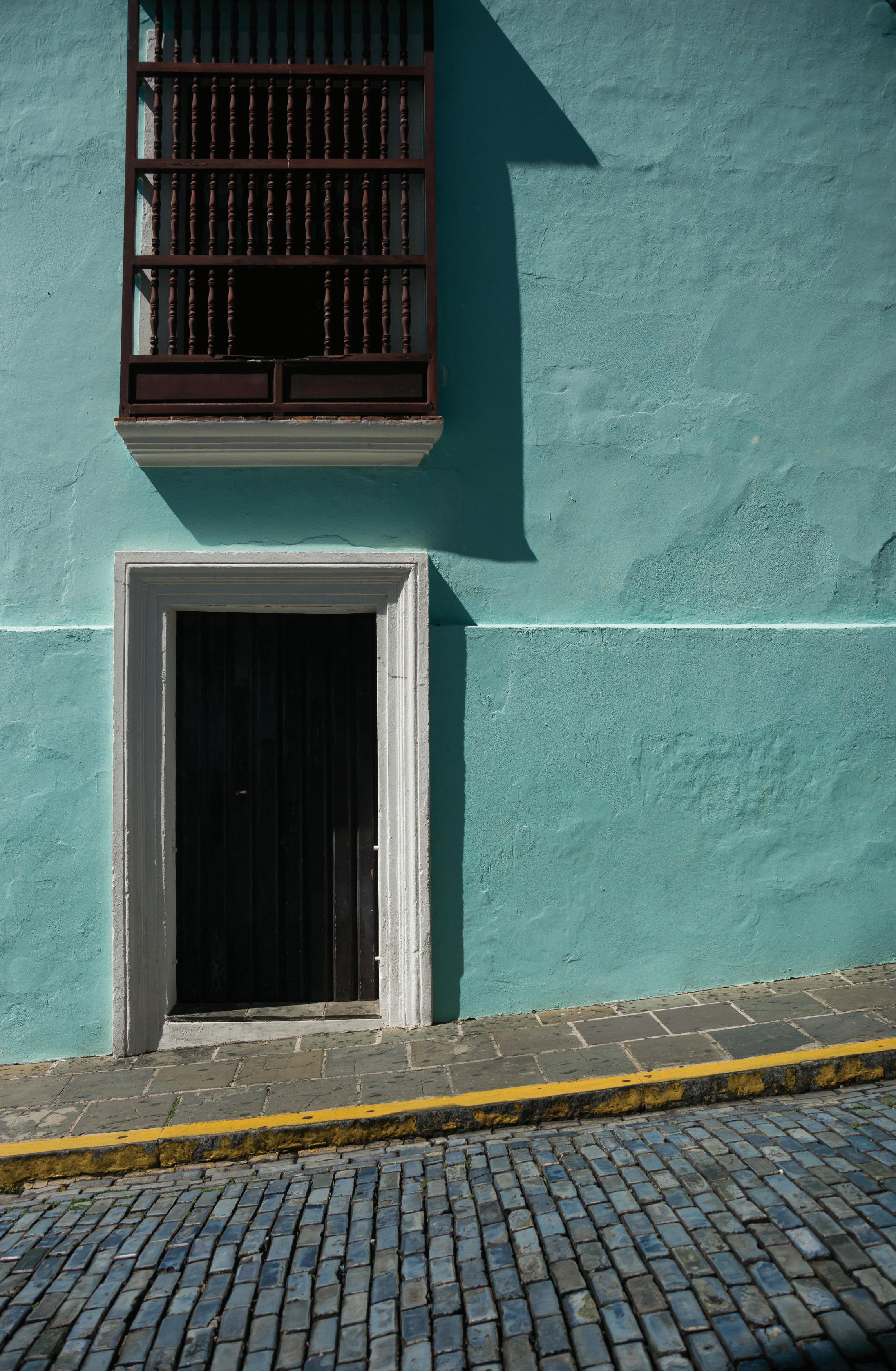
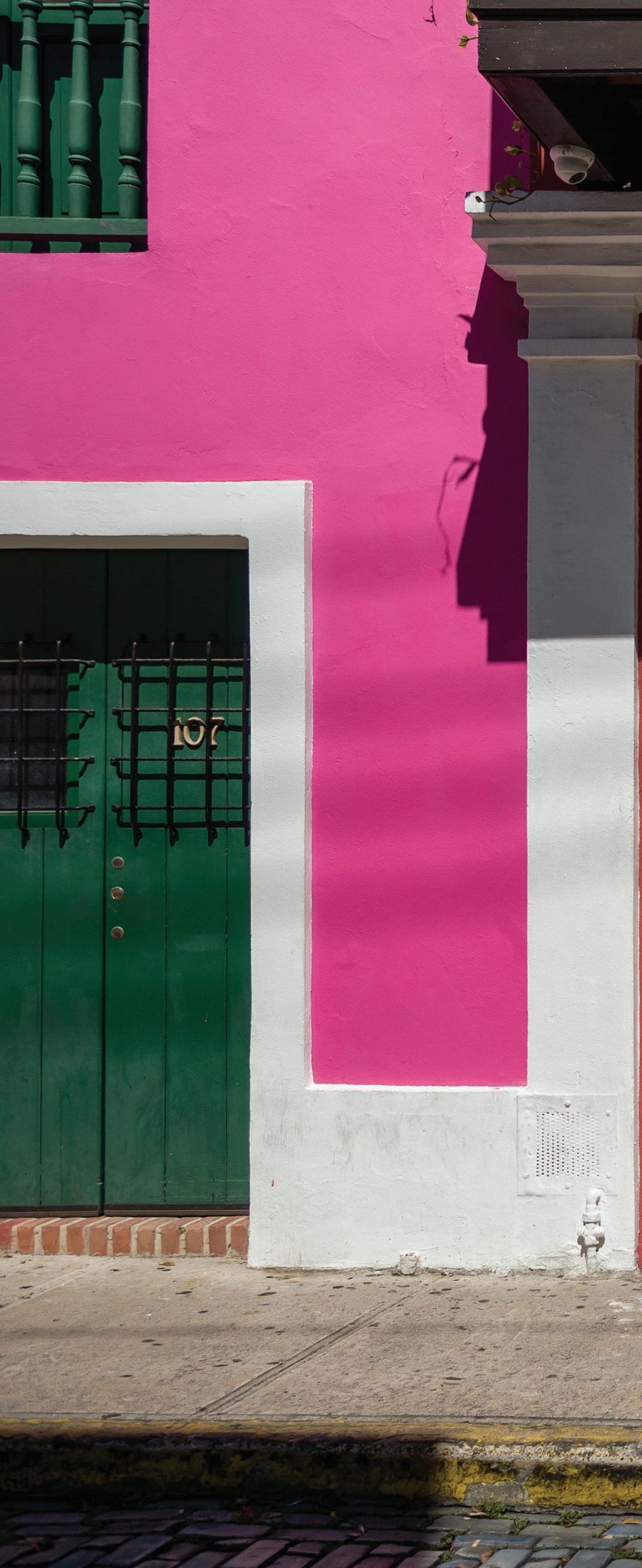
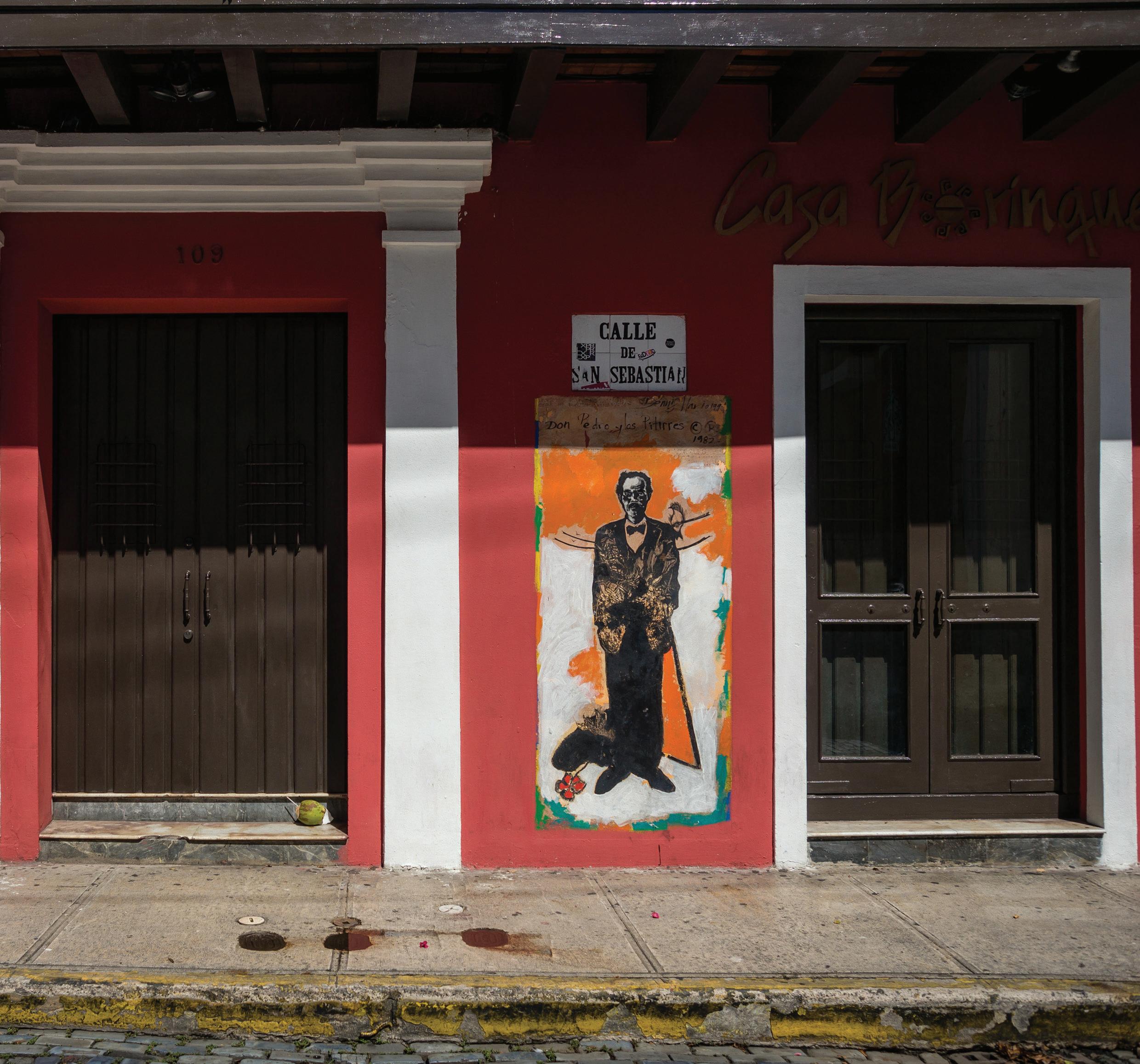
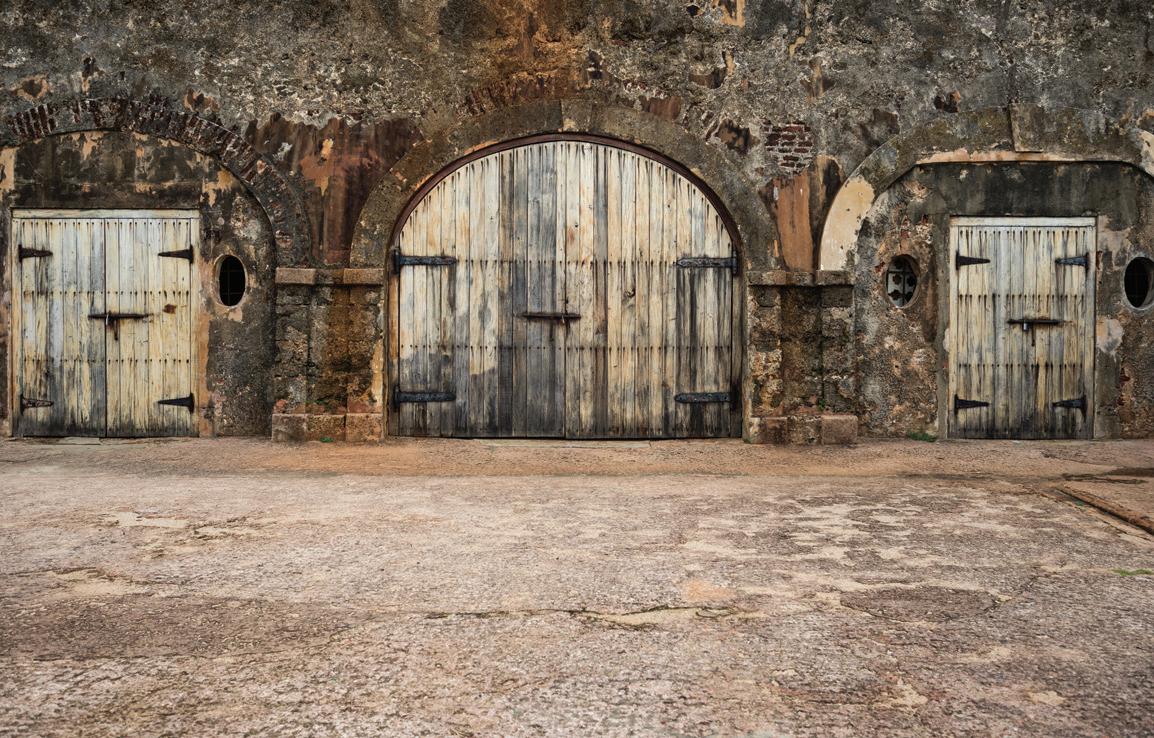
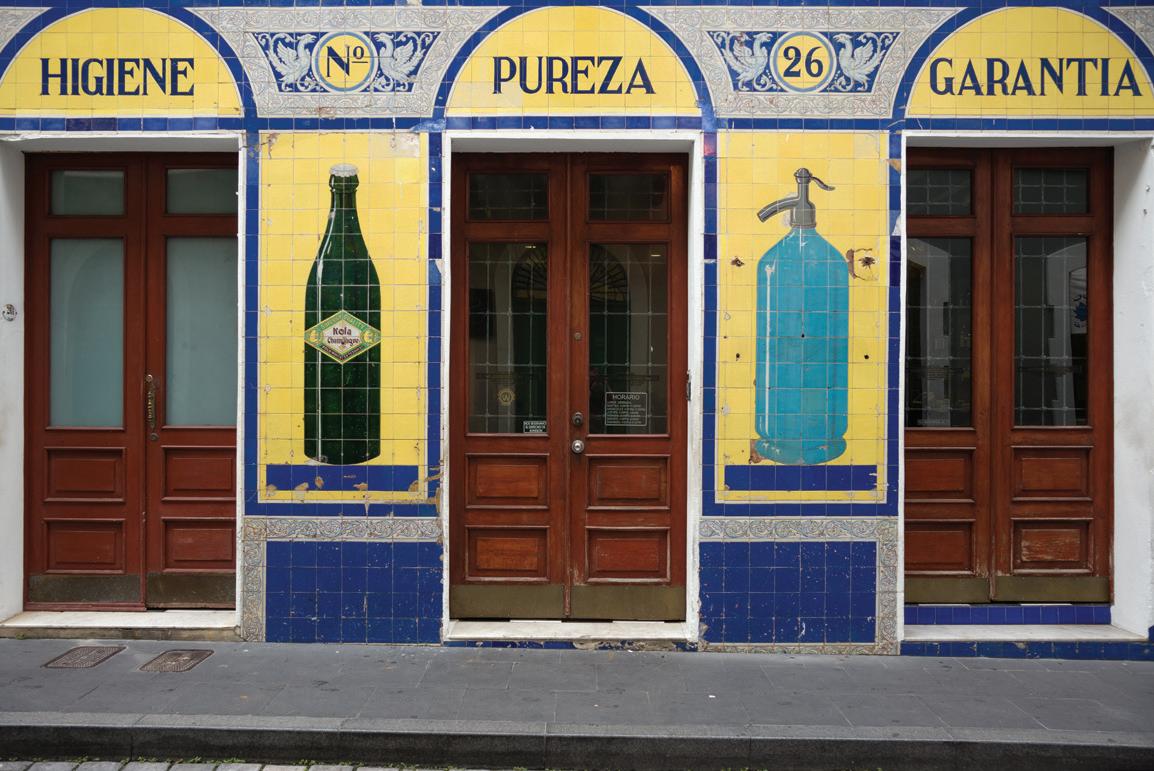
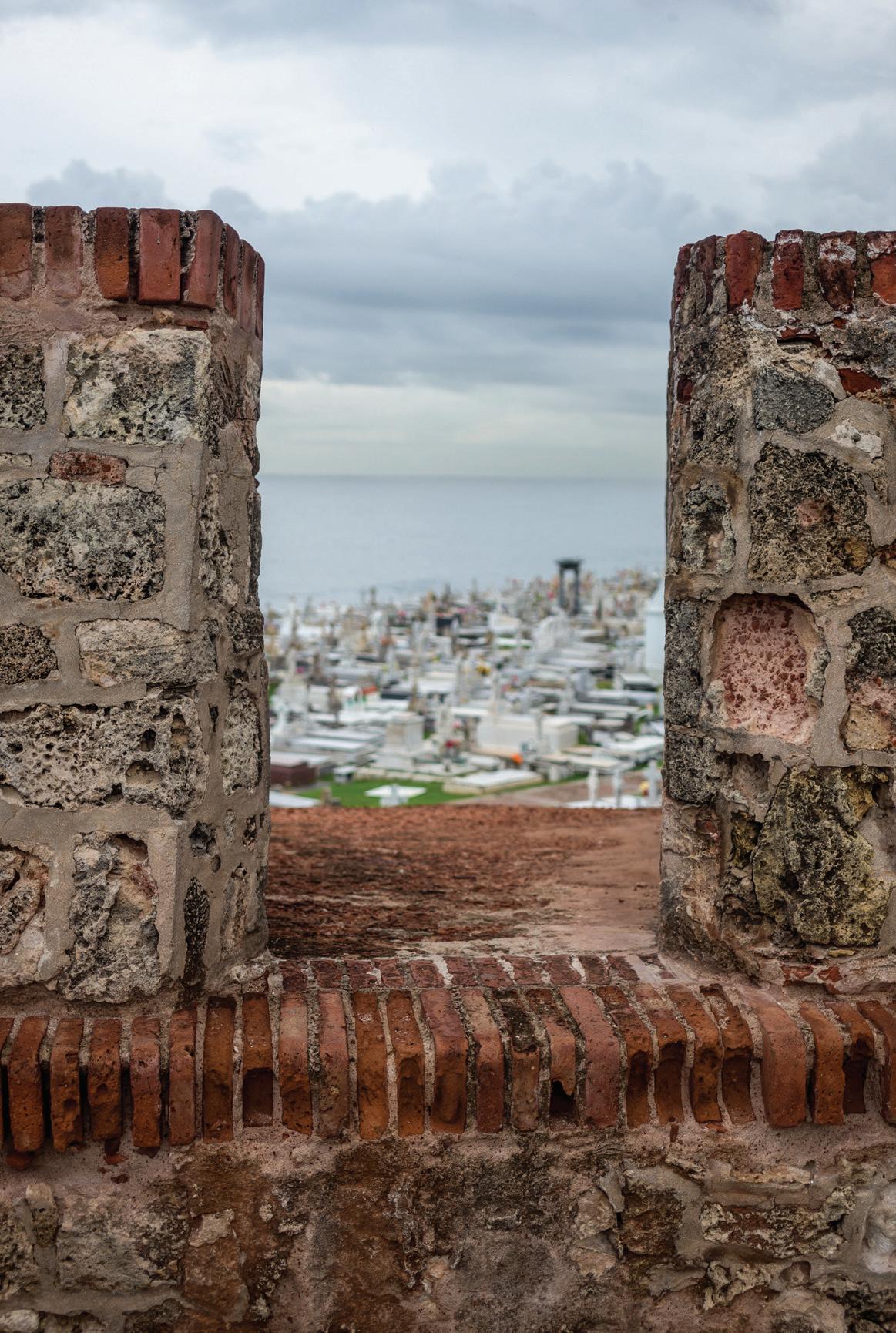
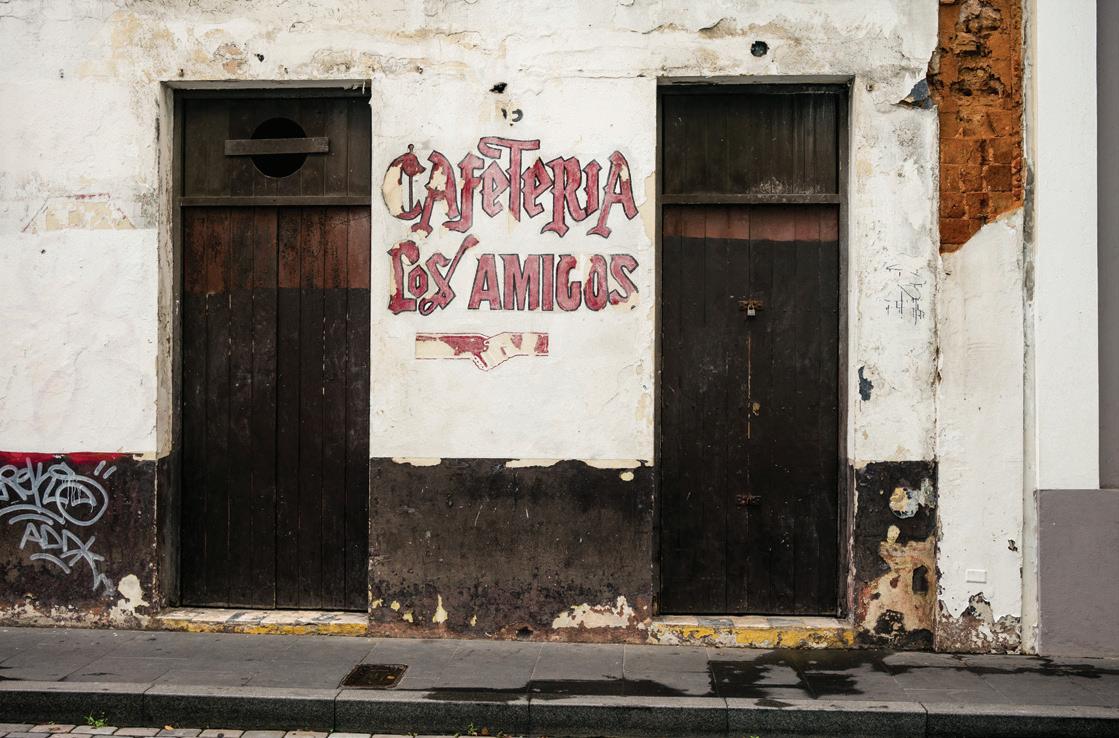
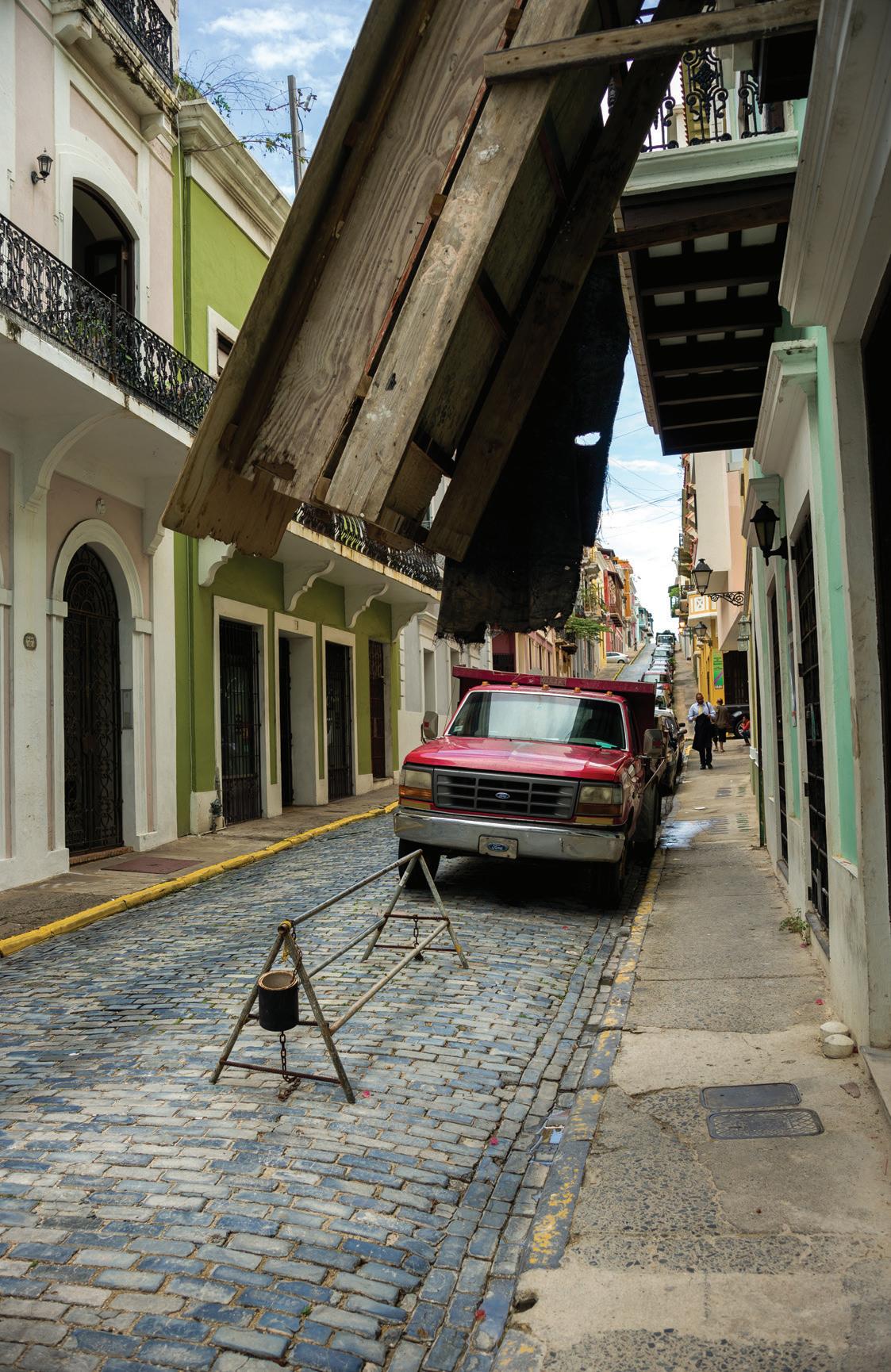
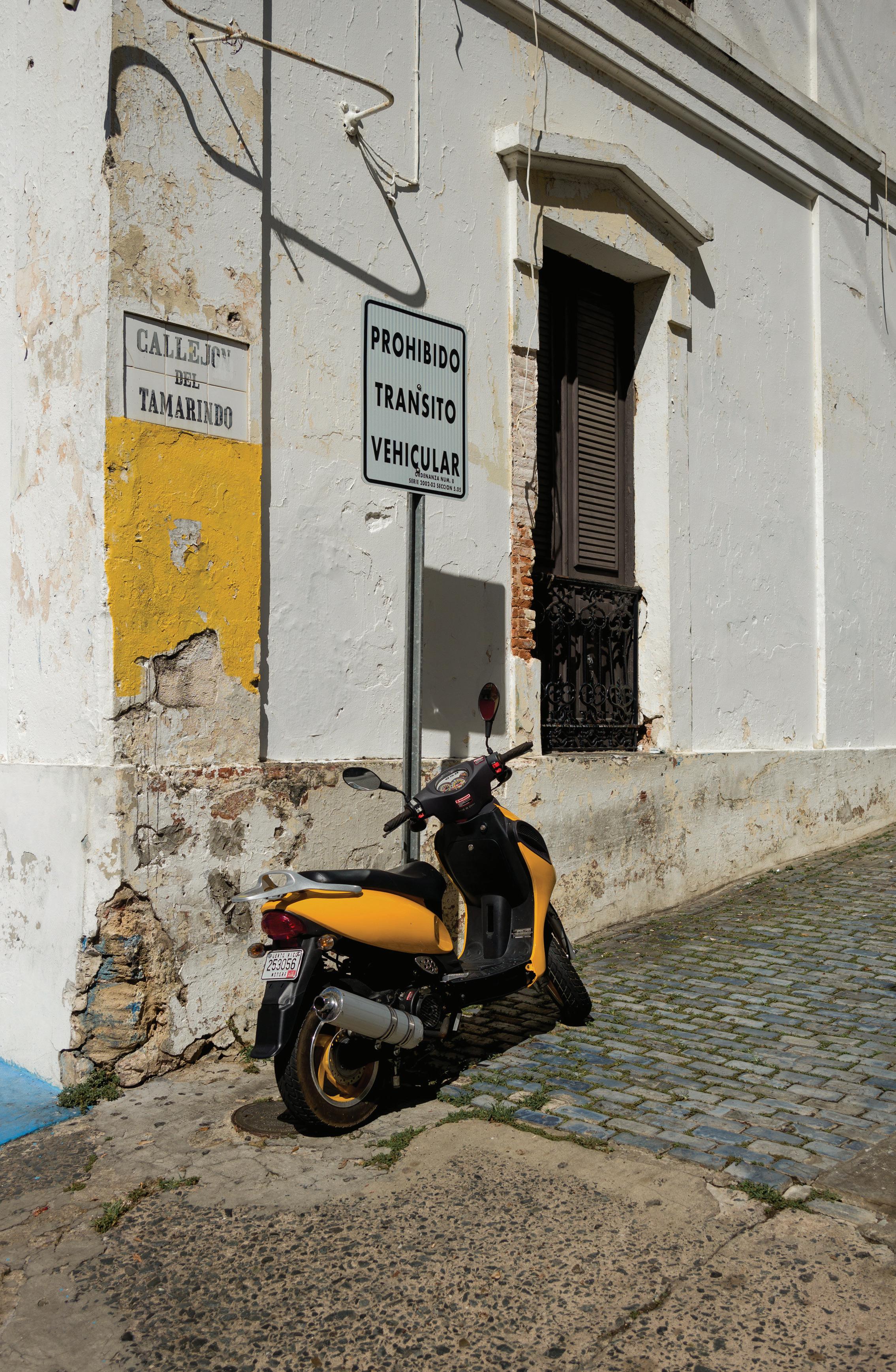
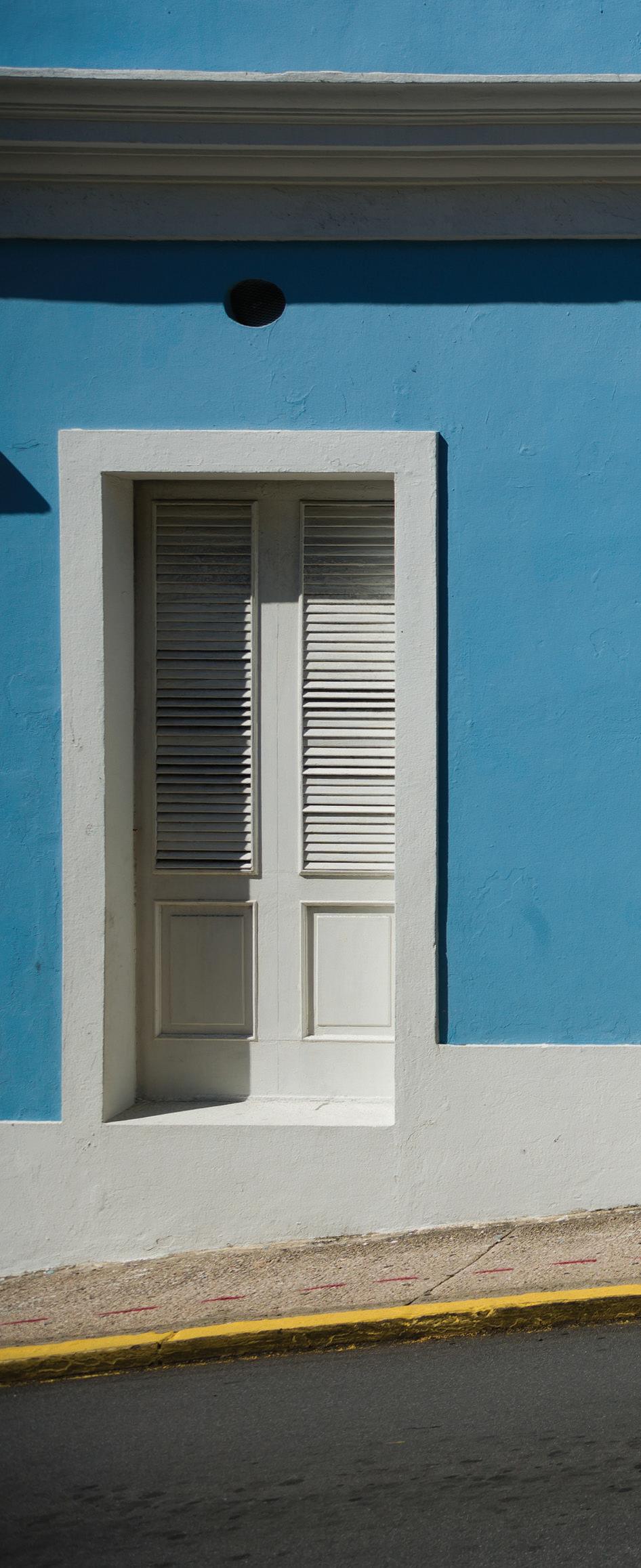
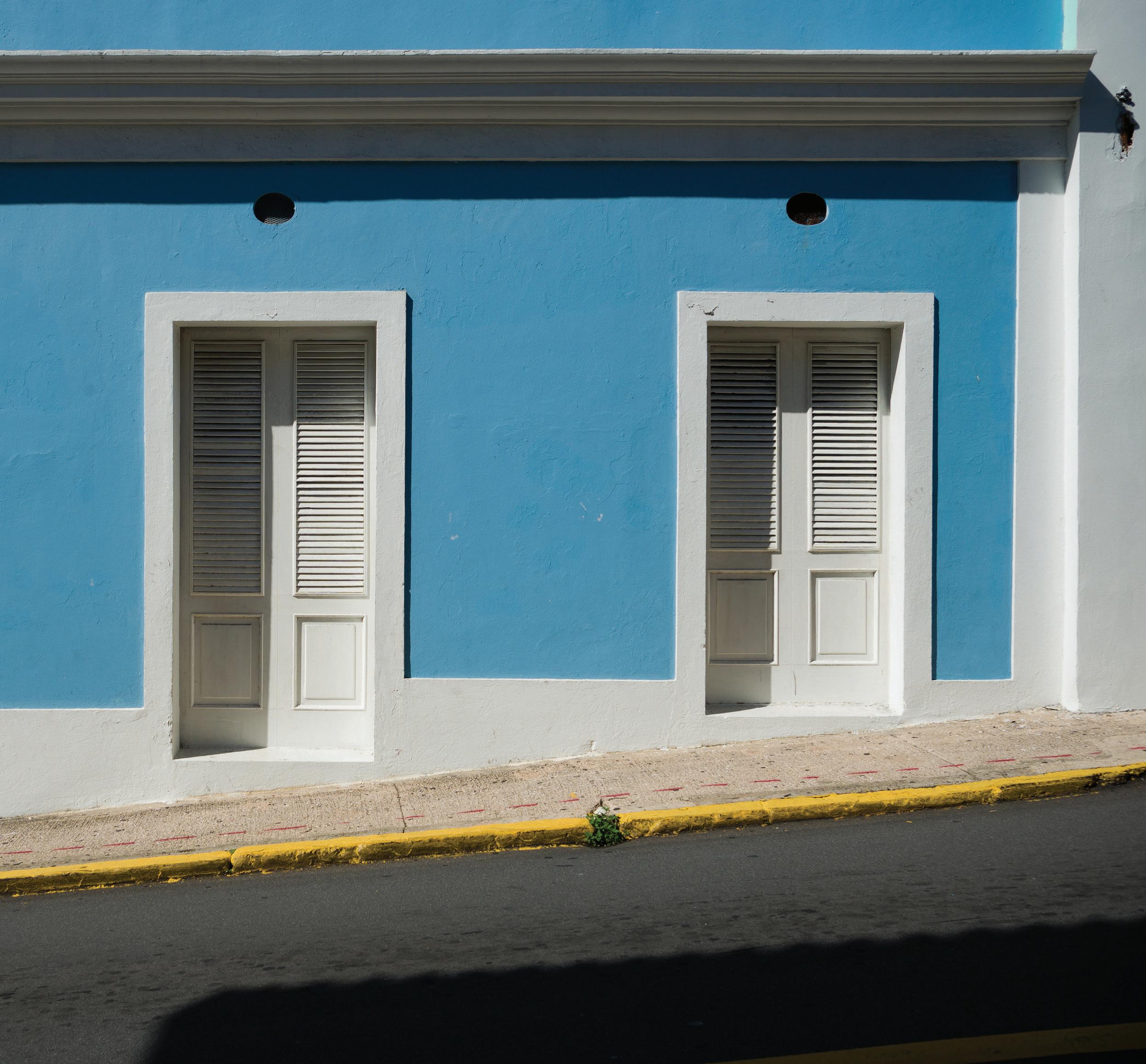
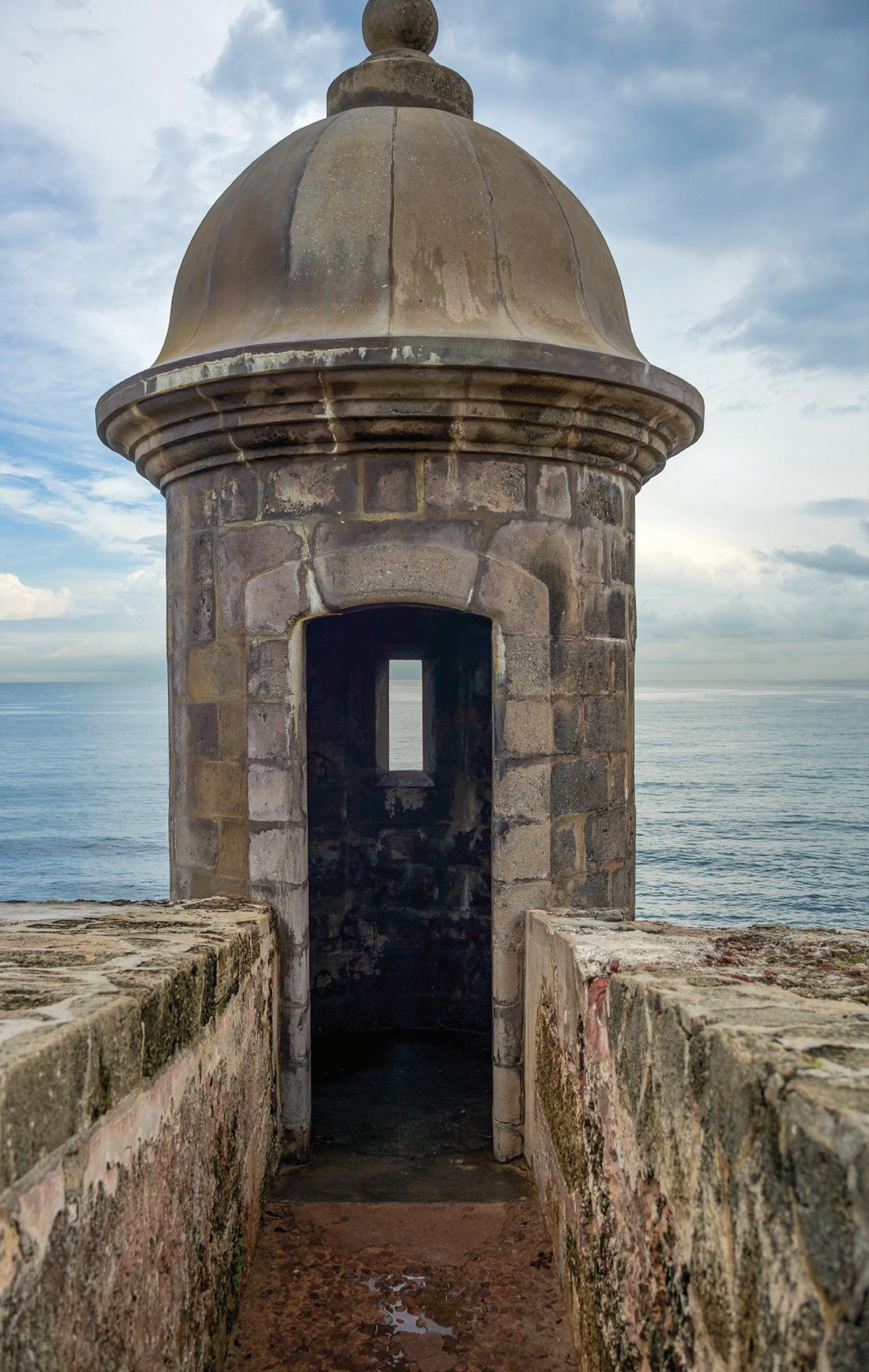
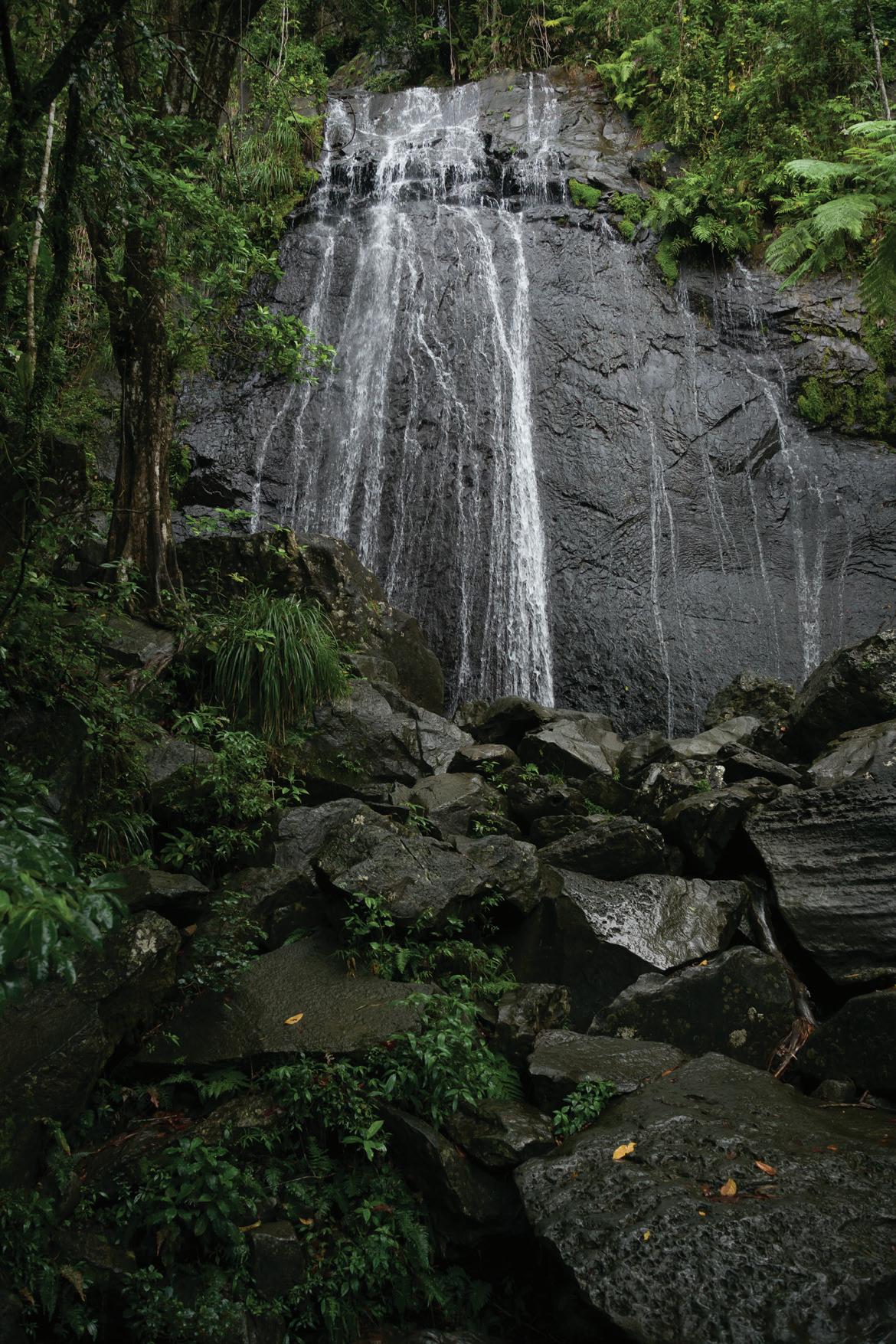
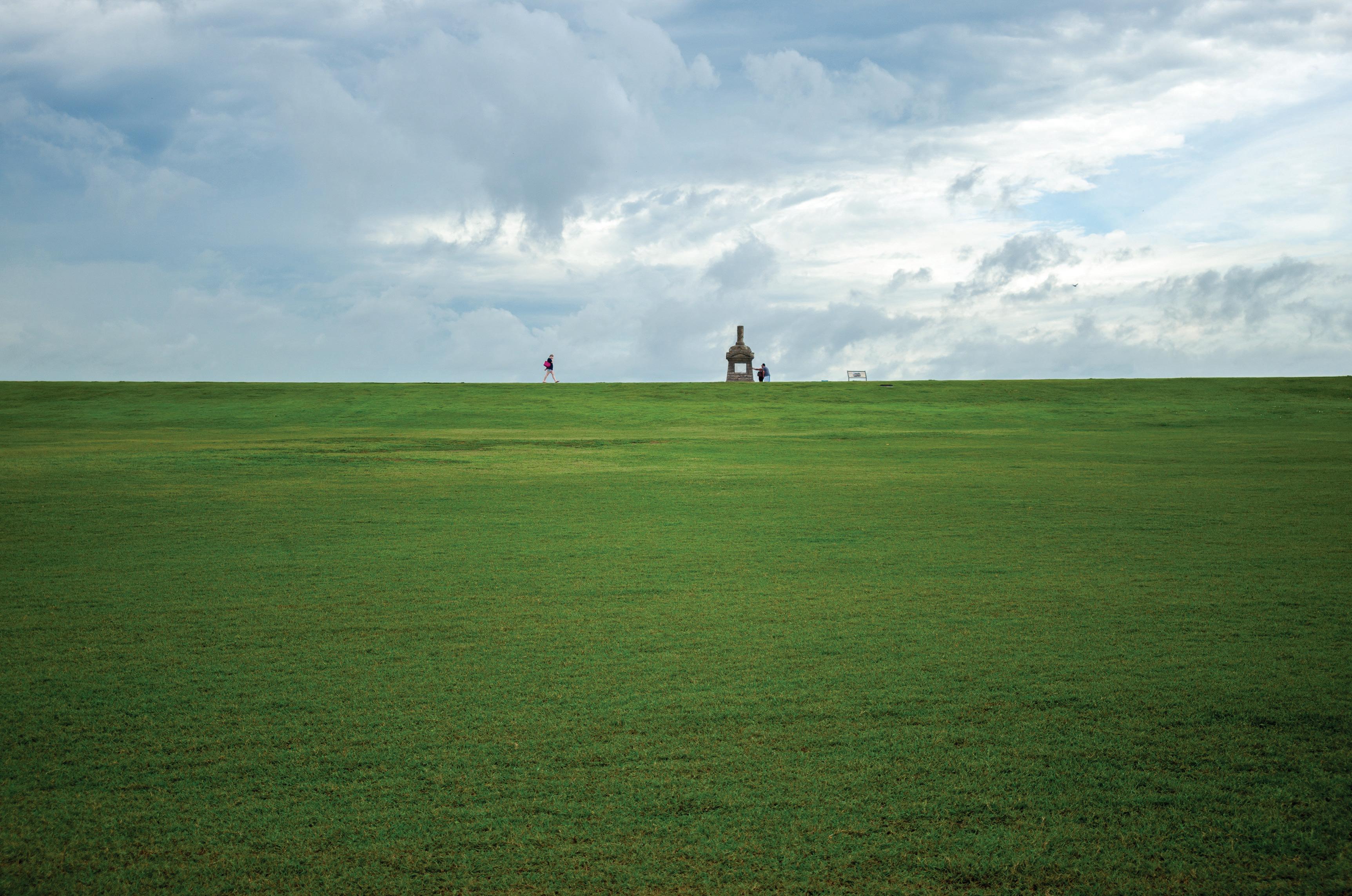
Both of these closely named lenses share similar looks, similar operation and represent the only two multi-focal length lenses in the M-mount stable. The photographs here are from Puerto Rico and all taken with the MATE on a Leica M (Typ 240). For this trip I took only the MATE, keeping the kit as compact as possible.
Puerto Rico, or “rich port” in Spanish, was colonized after 1493 when Columbus landed in this archipelago of the Greater Antilles. The Spanish left their mark building several fortifications that remain today. One fortification is Castillo San Filipe del Morro built in 1540 and named after King Phillip II. The towers on the outer walls, or Garitas, have become an icon of Puerto Rico.
I spent most of my time in Old San Juan, the original portion of the capital city. The name “San Juan Bautista” was originally given to the entire island by Columbus, meaning St. John the Baptist. Later the island was referred to as the rich port, while the capital city took the name San Juan.
The island is rich with cultural history. A commonwealth of the United States, Puerto Rico contains about 3.5 million residents that receive some benefits under the U.S. umbrella, but not all. They have been granted a governor and have a non-voting representative in Washington, DC, but decisions are affirmed or overturned in the mainland United States. While various referendums have been held in Puerto Rico, the most recent and decisive was November 6, 2012. Almost 78% of the population voted for U.S. statehood, but almost one-third of the ballots were blank or inadmissible; the United States has still not taken action.
Walking around inside the old city walls is a great experience. People are friendly and speak both English and Spanish, plantains are cooked in a variety of local fashions and the architecture is similar to other Caribbean islands - bright and colorful. Economic recessions have hurt real estate sales and buildings are in various states of remodeling and repair. Nonetheless, Old San Juan remains artistically beautiful. These images were taken in 2015, prior to the 2017 landfall of Hurricanes Irma and Maria which devastated much of the island by taking down most of the electrical grid and resulting in several thousand deaths. Climbing out of such natural disaster is not easy and will take years to recover.
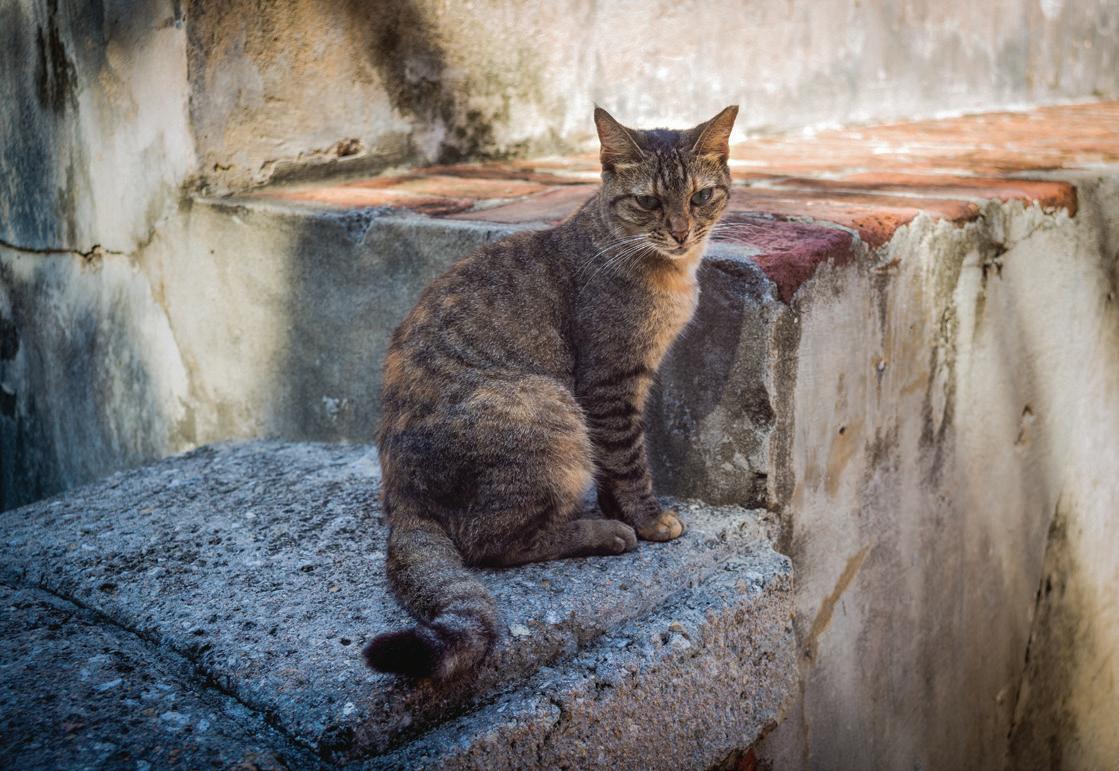
Cats are an integral part of the island and most cats are stray
in Old San Juan. However, they are well cared for by the locals. Similar to many shipping ports, rats are inevitably introduced to the local population and some believe they hit Puerto Rico in the early 1500’s. Cats became part of the solution. Over time local groups, like the non-profit Save-a-Gato (Facebook @SaveAGato), have used donations to keep these feral cats from reproducing while still providing medical care and shelter. It is not uncommon for people to put out food and water for the stray cats to help keep the rodent population down.
Using only the MATE, I spent 5 days photographing in Old San Juan, including one day in the El Yunque National Forest. The MATE is sometimes referred to as the “28-50-35.” Yes, I can count. Yes, the numbers are out of order, but that is on purpose. The 28mm, 35mm, and 50mm focal lengths have been used on Leica M cameras since the earliest productions.
The rangefinder-bayonet coupling mechanism, or cam, adjusts framelines for different focal lengths determined by the cutout on the back of each lens. Herein lies the issue - the mechanical design of the cam is such that 28mm comes before 50mm, which comes before 35mm! This seemingly odd sequence has to do with the mechanical frameline order. So, different from the WATE, the order of the focal lengths is not sequentially driven, but mechanical driven. While this could be changed by Leica, the consistency allows lenses from the 1950’s to remain compatible with modern digital cameras, and vice-versa, most modern lenses fit older film bodies.
The MATE was first introduced in 1998 using an E55 filter on the front. Beginning in 2001, a redesigned MATE replaced the original that was more reliable and featured an E49 filter size and an A53 lens hood (Leica #12450). Both versions use two aspherical elements to reduce distortions and monochromatic image errors and contain five highly-refractive glass elements. In Leica M style, this is all done to keep the lens size to a minimum while maximizing image quality. Erwin Puts says in his third edition of “Leica Compendium” this lens is a “landmark design in optical and mechanical construction,” and “an engineering feat of daunting complexity.”
A lens that moves horizontally in and out to change focal lengths is very common and not anything special in today’s computer assisted optical computations. Think of a 35mm to 105mm zoom lens many manufacturers produce. Even the WATE is effectively a 16mm to 21mm zoom and can be used at any point in between. However, moving lens elements to change from a 28mm to a 50mm and back to a 35mm in a linear fashion is unique. The MATE can only be used at these three focal lengths. Settings in between cannot be accurately focused using the rangefinder system nor can the EXIF information be recorded. Also unique to this lens is the cam cutout which changes at each focal length so the rangefinder frames and focusing work properly - this truly is an engineering feat!
This brings us to one advantage of the MATE. Because the camera knows mechanically which focal length is used, the digital M bodies record which lens position was used for each image! The WATE does not couple to the rangefinder cam, so no focal length is recorded. Of course, like the WATE, 6-bit coding helps record the basic lens used in the EXIF.
Also like the WATE, the f/stop range starts at 4.0 and decreases to f/22. While an f/stop of 4.0 is not categorized with the likes of the Summicrons (f/2.0) and Summiluxes (f/1.4), the high ISO digital cameras today help level the playing field. Images made inside during the day are possible using high ISO’s at handheld shutter speeds, and wide-open. The images will be noisier than the larger f/stop sister lenses, but it will work.
Another advantage to the MATE is the recessed lens. The MATE went through a design change before being discontinued in 2007. The interior mechanics were so complex that a redesign of the interior made the lens more reliable, reducing the filter size from E55 to E49 in the process. The front element of the lens moves in and out as the focal length changes. So, even at its closest point to the rim of the lens, the front lens element is set far enough back that a sun-shade is not necessary in many shooting situations. Compared to the front element of the WATE that can extend past the rim and must be protected, using filters on the MATE is simple.
The WATE was introduced in 2006 and the eight-year technology difference provides better overall image quality. However, the MATE still excels over older versions of the same focal lengths (28mm, 50mm and 35mm) and provides similar image quality as some of the newer ASPH lenses of the same focal lengths. There are two important characteristics to understand about the MATE’s image quality.
First, the image corners are softer when using wide-open f-stops. Not unlike many lenses, the widest f/stops are frequently sharper in the center of the image and softer at the edges. Many lenses perform at their optimum point after closing down two f-stops. The MATE is no different. Using f/8.0, the MATE typically has the largest coverage of the best image quality with the most extreme edges still showing softer details. This is actually very impressive considering the lens is really 3-in-1! The WATE has a similar issue with corner sharpness but is much less noticeable due to the advanced optical design and much wider focal lengths.
Second, the 28mm focal length on the MATE has a significant amount of distortion compared to more modern lenses of the same focal length. However, I have created my own correction as a preset in Adobe Lightroom, which I apply to digital and scanned negatives alike. The images here have been digitally adjusted for the lens distortion at 28mm.
The color rendition of the MATE is almost perfectly neutral, which is not the case with all Leica M lenses. This is a further attribute to the work that goes into designing a lens as complex as the MATE.
What do these all these characteristics mean in every day practice? We mount a lens and start photographing without always realizing the design work - glass, lens shape, aberrations, contrast, color, mechanics. In reality, the MATE will not provide 17 x 22 prints with sharp corners or fine details at wide open apertures. However, I have printed 11 x 17 and 13 x 19 images taken at f/5.6 and f/8.0 that are fantastic from proper viewing distances. The colors generated from this lens are spectacular.
Knowing that the corners may be soft, when photographing a detailed and busy scene, I either use a wider angle or I step back to allow for a small amount of cropping. While the older MATE design was subject to more flare, the newer version is almost flare free. I am convinced my UV filter was the cause of most flare I encounter. To reduce flare, I use the lens shade most of the time.
Most importantly, for travel photography, the simple and compact nature of one lens provides a distinct advantage. Focal lengths do not to be need changed in dusty or windy environments, and images are not lost because the wrong fixed focal length lens is attached. The 28mm distortion fixes easily in postprocessing, provided important parts of the image are kept away from the extreme edges. The 35mm focal length is my favorite and I typically keep the focal length there while walking around.
You should note two items if you decide to find a copy of the MATE to use. One, the front element glass type is no longer manufactured, so if you damage it, you are out of luck. Second, the mechanical nature of this lens is so complex, either look for copies with a recent CLA (Clean, Lubricate, and Adjust) from Germany, or be prepared to send it off for a CLA and wait for a while. I found it worth the cost to pay more for the newer edition of a MATE that had both the 6-bit coding and a CLA already completed.
If you really want a compact travel kit, combine the WATE and the MATE to end up with 6 focal lengths in 2 lenses. Now the next time you hear “wait or mate?” you can answer with your preferred focal length “wide” or “medium!”
RED DOT BLUE DOT
As a Leica user, you may have already found, as I have, that a love for photography is perfectly matched with a passion for travel.
I recently completed my first single trip circumnavigation of the globe as part of a project we call Red Dot Blue Dot. Including our circumnavigation with my wife, Amy M. Gardner, I have visited 40 countries, many of them multiple times, including traveling over a dozen times in just six years to Cuba.
My photography mixes components of documentary, street, low or available light, and travel photography. My goal is to create a genre of photography people recognize as Red Dot Blue Dot Photography that combines key aspects of several well-known genres in order to connect people to each other and connect people to places. The key to Red Dot Blue Dot Photography is capturing people, our environment, and the affect and effect of both in a way that connects us to everyday life and emphasizes the vast connectedness of our world.
The mission of www.reddotbluedot.com, the Red Dot Blue Dot website, is to bring travelers and photographers together in a positive community that enriches and encourages photographers, travelers, and those new to photography and travel to see the world and make great images.
The site currently features photographers, images, and travel content that aims to inspire travelers to truly engage with their surroundings and experience the world around them. Through great images we also hope to bring a true sense of place to those who are unable to travel as regularly as we have had the good fortune to travel.
One example of the experiences we have had and shared with our followers since launching Red Dot Blue Dot in the summer of 2018 was traveling to Chernobyl. The relatively short twelve hours we spent there is a great case study for how to tell a story of place and people through photography.
I think in order to truly capture a sense of place and people one must take a deeper dive into the places they travel than the hop-on-hop-off tour bus is able to provide. Additionally, to create a true connection that tells a story we must move beyond the beautiful landscape shots and images that exist in many online variations and populate Instagram (often in heavily edited forms). It can be more challenging, but as Amy and I have witnessed leading trips to Cuba, anyone who can use a camera can curate great travel experiences with a bit of effort. You don’t have to have a photo shoot set up for you with a photography-based tour or workshop. You can actually enjoy the place you are visiting and still have a great selection of images when you return that tell the story of the place and the people.
Because movies as well as the recent HBO drama miniseries have peaked interest in the catastrophe in the former Soviet country of Ukraine and spiked tourism to the exclusion zone, I would like to use a day I spent in 2018 within the exclusion zone of Chernobyl as a case study for the contention that meaningful travel can result in one-of-a-kind experiences and images beyond the standard “tourist shots.”
Chernobyl is one of those places that require a guide. That can be a blessing as well as a curse. Selecting how you travel to the exclusion zone is therefore critical. I won’t get into tour specifics here as there are a myriad of options, but you can check our site for a post about how to travel to Chernobyl. As photographers we often want to see beyond the beaten path. To tell an individual story. And visiting with a guide who gives time to do that is a must.
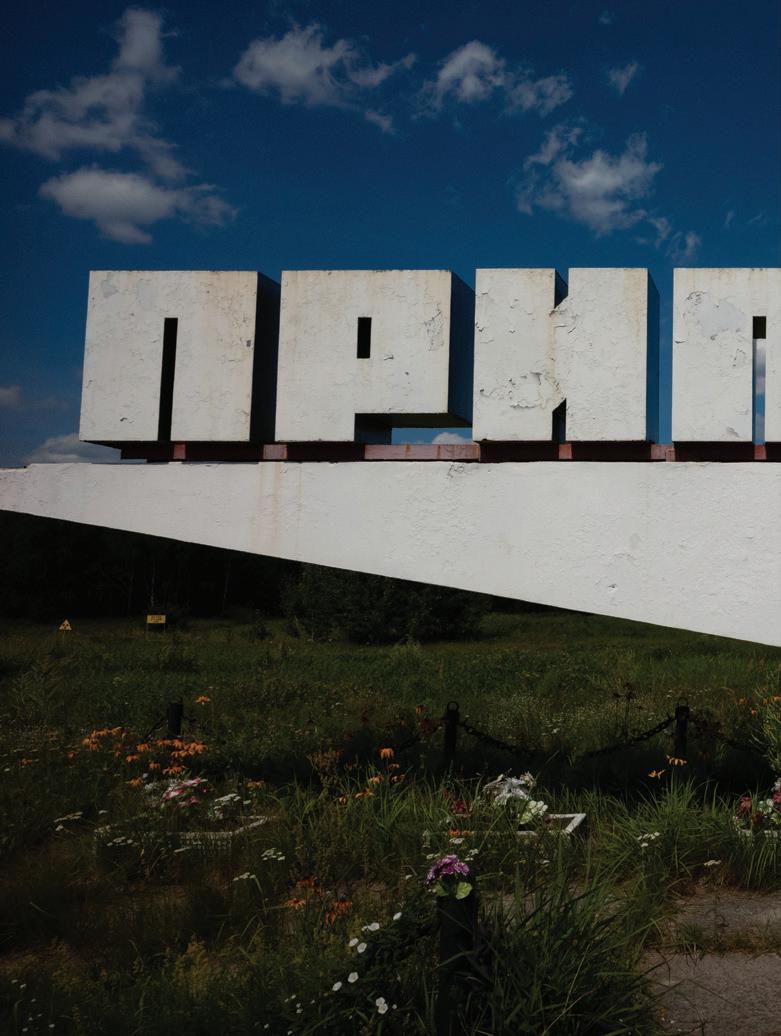
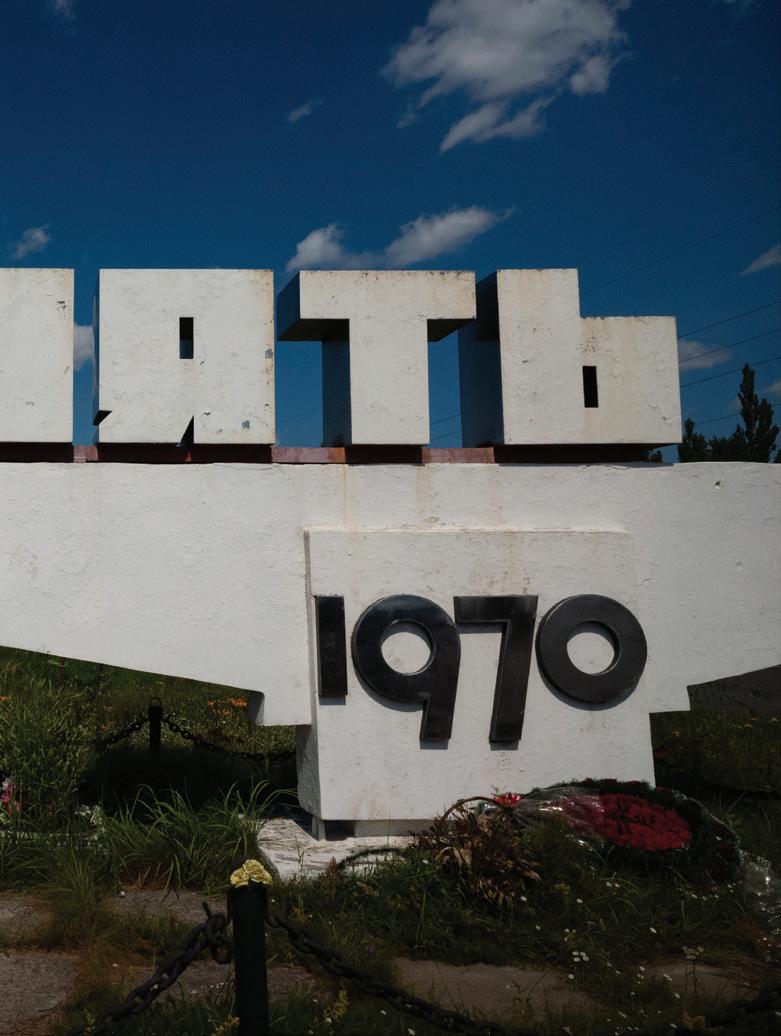
As you may know, on April 26, 1986, the reactor number 4 at the Chernobyl nuclear power plant had one of what is only two nuclear accidents ever rated with the most severe classification. In the days and weeks after the accident the company town of Pripyat, along with over 1000 square miles of
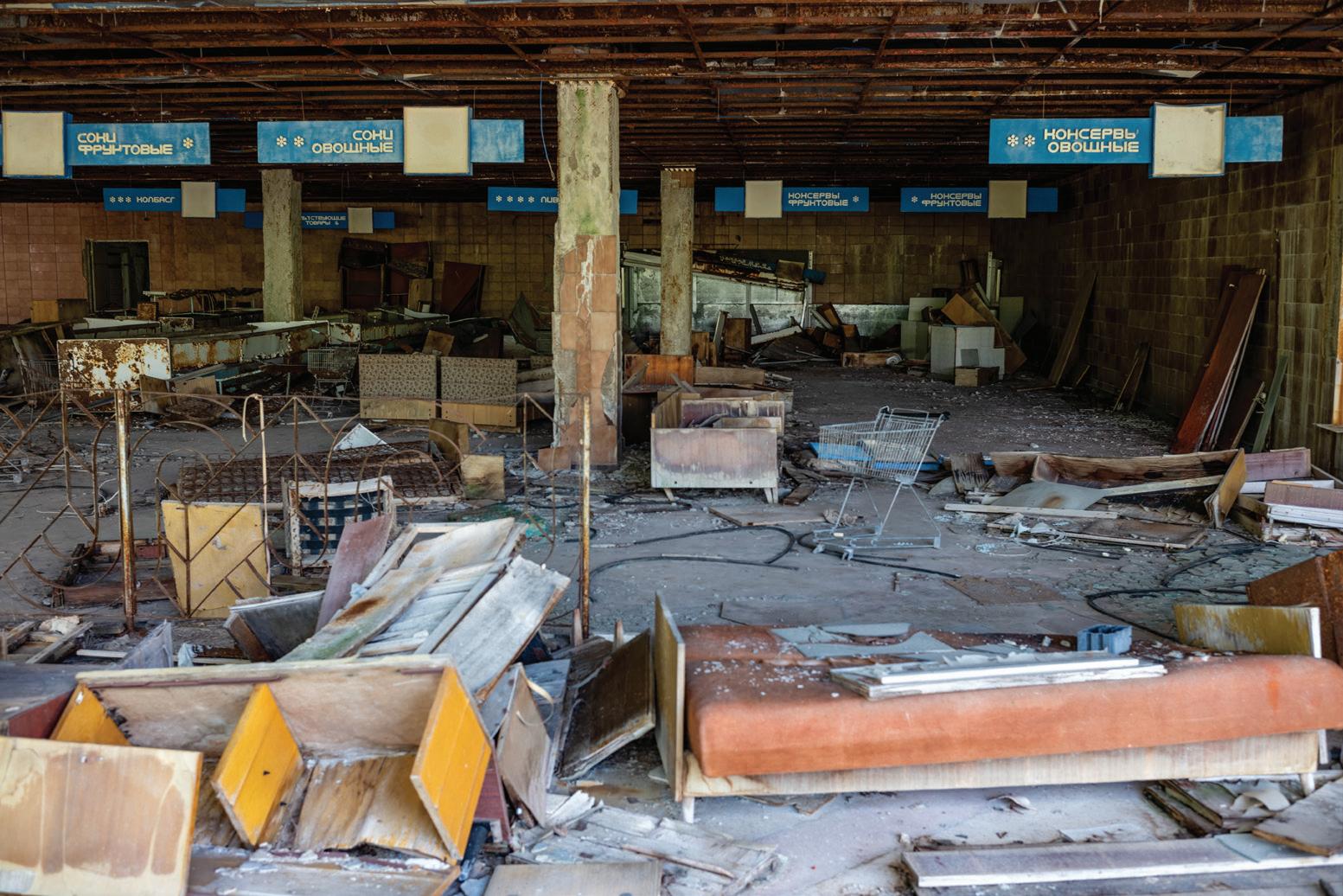
land, were exposed to higher than normal, and in some cases deadly, levels of radiation. In the months and years since the accident, thousands of people labeled “liquidators” were charged with cleanup of the immediate surroundings and containing the remaining reactor core. These stories are told in modern media. But the silence, visual remainders of vacated structures, and monuments few people ever see are what tell the real story of the Chernobyl disaster. While it is easy to get a photo of a broken doll that has been “left behind” as a photo prop, it is far more challenging to try to understand and capture the level of human tragedy in a 12 hour tour. Unless you are fortunate to take a private tour, you will be with a group of travelers. As we boarded our minibus in Kiev, the other 12 tour participants were quiet with anticipation, and possibly a little trepidation. During the drive to the exclusion zone we were shown a video explaining what happened and the valiant efforts of the liquidators.
It is safe to travel for short periods into the exclusion zone; in fact, hundreds of people work within the zone every day. That being said, 30 years of cleanup makes a big difference. The environmental and human tragedy is evident as you step off the bus at the first check point.
Once you arrive and check in through the exclusion zone, receive your geiger counter, and any protective gear you wish to rent, you head to several stops around Chernobyl and Pripyat. You will visit very close to the reactor including the Red Forest, the wilderness areas around the reactor, the city of Pripyat, and see remains of equipment used to put the fire out and deal with radiation. You will see areas that are still highly radioactive, and you will likely visit an antenna array remaining from the Cold War designed to use waves bounced off the ionosphere to detect incoming planes or missiles.
The challenge is to capture these areas in a way that isn’t touristy, cliche, or repetitive. Additionally, I feel it is critical to honor and respect the memory of those who died in the tragedy and in the years since. This type of “catastrophe tourism” or “disaster tourism” can serve to enlighten people and honor historic events, or it can be disrespectful and destructive. In fact there are serious ethical debates over this type of tourism and photography. As photographers we have a responsibility to be respectful and ensure we honor the people affected and tell stories so that more people can learn and understand. It is from that perspective that I believe our concept of Red Dot Blue Dot Photography approaches telling the stories of these types of places. I’ve done my best to represent images in this article that go beyond the cliche images and try to show the loss as well as the human and environmental devastation that exists. In this case with limited time it was difficult to get all of the shots I wanted and if I have the chance I will certainly return. This small region is
part of a bigger story about Ukraine and while we spent over a week in Ukraine, you could easily spend much longer.
As I approached my day in the exclusion zone, my mind first focused on the story of the liquidators. These are people, military and civilian, who were charged with responding to the emergency. With little or no information, and in some cases incorrect information, these people went into the radioactive zone in an effort to deal with the situation. As the world watched the limited reporting coming from the Soviet Union, liquidator pilots called back from Afghanistan would fly sand over the melting reactor in an effort to dissipate the fire in hopes of stopping the nuclear fuel from further explosions. These pilots flew right through the worst radiation.
Monuments built in the exclusion zone celebrating the fire fighters, liquidators, and entire villages lost to the accident mark empty town squares and intersections. So my challenge was to grasp the human component of a place with essentially no visible humans. The vast emptiness of many of the spaces told that story. Many places are marked as highly radioactive. For example, a graveyard of equipment used at the accident site is visited by many, but people must stay a clear distance from the equipment as it remains highly radioactive.
The city of Pripyat has been extensively photographed. A city once home to over 49,000 residents with 147 mass transit busses, over 50 stores and cafes, and over 150 apartment blocks has been vacant since 1986. It is easy to create photography that is saturated with color prompting thoughts of radioactivity or dismal with high contrast black and white images that create the image of a land of monsters depicted in movies. My goal was to capture images that told the story of a once vibrant city home to thousands of people full of hope for the future and devastated in an instant by human made disaster.
In my images I have attempted to capture both the tragedy of the environment and the people.
It is easy to fail at this type of travel photography. Often thousands of images come down to 10 images that tell the story you wish to tell. Three travel tips have helped me and may help you improve your odds of telling an interesting story from your travel images.
TRAVEL TIPS
The International Leica Society LHSA, has grown rapidly over the last few years. While it may have been safe to assume that those reading Viewfinder in the past were seasoned veterans of Leica photography, there are now many people brand new to this wonderfully creative and interesting group. Further, not everyone considers themselves a “travel photographer.” With that in mind, I want to offer three tips for travel photography. These tips are designed to help you achieve that “Red Dot Blue Dot” image that tells a story of place and people without words. They may seem basic and simplistic, but they can be beneficial to beginner, intermediate, and professional photographers alike.
(left) "Deep End" - Leica SL (Typ 601), 21mm f/3.4 Super Elmar (right) "We Hear You" - Leica SL (Typ 601), 21mm f/3.4 Super Elmar
(left) "Cliche" - Leica SL (Typ 601), 21mm f/3.4 Super Elmar (right) "Stands" - Leica SL (Typ 601), 21mm f/3.4 Super Elmar
Be sure to study your subject prior to your travels. Movies, books, and research can be critical to give you advance knowledge of what you will see. Additionally, and in the case of Chernobyl, I visited a small museum that is often overlooked in Kiev prior to my actual visit. That gave me a solid foundation of knowledge on the subject. Then it is time to travel.
TIP #1 Be a travel minimalist.
We are all Leica enthusiasts, many of us are historic camera enthusiasts, or even more widely, equipment enthusiasts. For many there are never enough lenses, cameras, and gear for the occasion. While I truly believe there is always room for one more camera, lens, or camera bag, travel and travel photography is better served by limiting the load. Every year I carry less and less gear, making my bag lighter and lighter. As technology has improved a MacBook Pro became an iPad Pro, and soon the upcoming iPadOS will provide an even more robust travel system. Some have moved from a DSLR to a mirrorless camera. And the changes in the industry are ongoing. When it comes to gear, in the last year I have been carrying only one or two bodies and one or two lenses on a trip. But when I go out for the day, I typically decide on one camera and one lens and don’t even take a bag.
Creating the ability to be closer to people, without making them nervous about the huge camera, is a key to street photography and is a huge benefit of using a Leica. That said, taking that to the next level and shooting with one camera and one lens alone makes it even easier to become part of the environment you are shooting and connect directly with the people who are your subjects.
TIP #2 It really is all about the people.
Although I really encourage you to, you may not photograph people at all. I never photographed people until I met my friend and fellow Leica photographer Bob from New York who told me, “Oh, you just have to include people, they make the image interesting!” But even if you shoot landscapes, abandoned places, or wildlife, the key is almost always the people.
Talking to people while traveling can be intimidating. But the payoff can be a gold mine in photo opportunities. There is nothing like a local person to know that “locals only” off the beaten path place. Creating these relationships can not only open up your photography opportunities but it can open a door to truly understanding the place you are visiting. Creating a deeper understanding will pay dividends in how you see your subject through the viewfinder. In turn you will have photos that tell a more detailed, accurate story of place. So don’t be shy and engage with locals, even if only through pantomimes or smiles.
TIP #3 Say yes.
Even if you aren’t naturally introverted, traveling to a new place can often make you uncomfortable and at a minimum more guarded. This, of course, is the exact opposite of what we try to achieve by traveling. So how can you combat the naturally protective nature of your brain in order to have the very experiences you set out to have?
I find that the answer is to say yes. Say yes more often. Travelers are inundated with decisions on a daily basis. Often we only have two weeks of vacation from our job where we make decisions every day. The phenomenon of decision fatigue can
be addressed (at least from a travel photography perspective) by making your default yes.
When someone you meet asks if you want to taste a new food... Yes.
When your cab driver tells you there is a really interesting neighborhood you should visit...
Yes, take me there.
When you are exhausted and just want to go to bed but your travel companion wants to go see a night street food market...
Get out of bed and go! Yes.
The key here is to get out of your comfort zone. Embrace things you wouldn’t normally do. Be open to experiences you would never have at home. Now, disclaimer, I’m not advising you to embrace risk or put yourself in dangerous situations, just to be open to new experiences that you may not be naturally comfortable with.
I would never have seen mud volcanos in Azerbaijan, snorkeled in the Straights of Hormuz, salsa danced at a Bosnian rave, or had homemade liquor from a Georgian market vendor lady’s private stash if I had not said yes. And, perhaps more relevant from a Viewfinder standpoint, I wouldn’t have images of those experiences if I had not said yes.
So be a travel minimalist, embrace local people, and say yes.
CONCLUSION Whether traveling to environmentally devastated places like Chernobyl or in the heart of a vibrant city, my goal is to connect with both the place and the people.
Keep traveling and keep making incredible travel images. I hope you are able to visit www.reddotbluedot.com and support the project. We are launching new features regularly to build a travel and travel photography community that embraces the type of travel I’ve outlined above. We have fantastic shirts that we collaborated with Tog Tees in Philadelphia on, a great soft release that shows your Red Dot Blue Dot travel photography spirt, Photographer in Focus features, and aim to be a great source for information and content to help travelers and photographers alike.
Keith R. Sbiral serves as Vice President of the International Leica Society, LHSA, is a career transitions coach for his firm Apochromatik and co-owns both Red Dot Blue Dot and Complete Cuba. He currently has a gallery show of Red Dot Blue Dot images at The Rangefinder Gallery in Chicago, Illinois. He can be contacted at: krs@reddotbluedot.com or www.keithsbiral.com
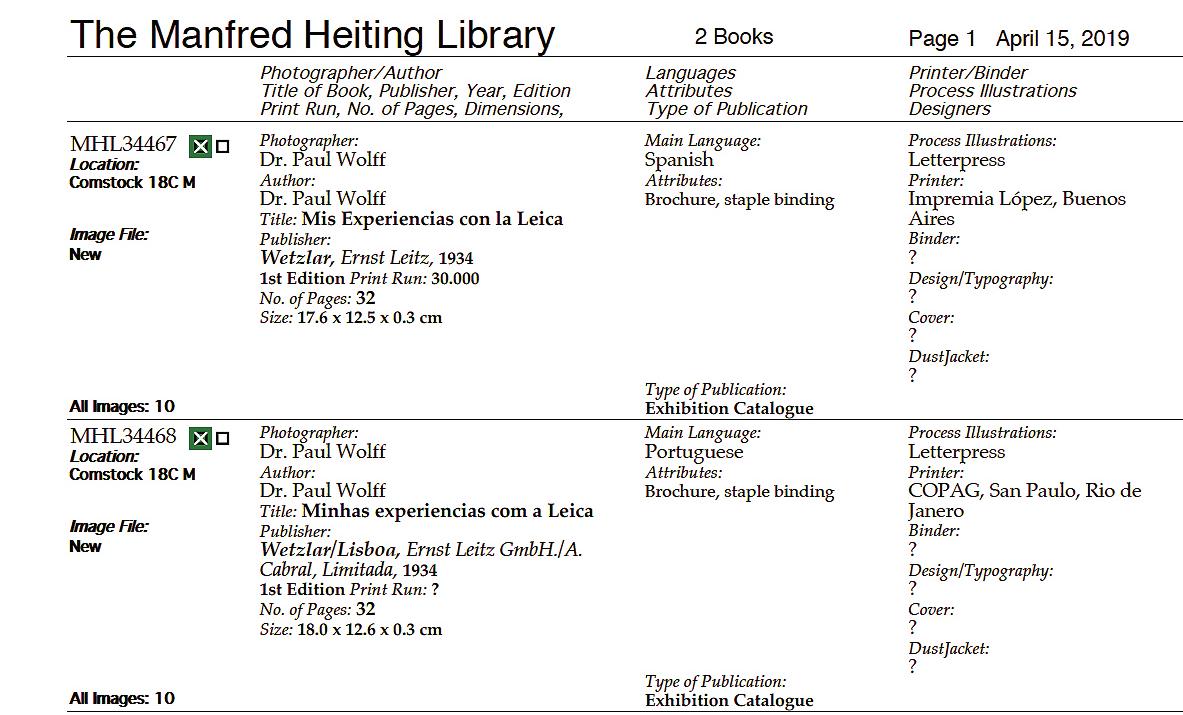
anfred Heiting, who is compiling a definitive bibliography of everything that Dr. Wolff published, has turned up two more catalogs from the famous 1934 Leitz-sponsored first exhibition of Dr. Wolff’s Leica enlargements. These pamphlets in Spanish and Portuguese were apparently intended for the travels of this exhibition to South America, although there was no reason why they could not have been used within Europe as well. These catalogs further our information about Leitz’s outreach across the globe for their products.
Mr. Heiting’s new bibliography will run to considerably more than 1000 items, and include every book with even a minimal Dr. Wolff or Wolff & Tritschler contribution, as well as magazine articles, postcards, and so forth. For the books, each edition or variant is described, as well as depicted. In comparison, my own Dr. Wolff bibliography only covered books and ephemera where 50% or more of the total images were by Wolff.
Here is what part of the layout in Manfred’s book may look like for these two Dr. Wolff catalog items, with images of the catalogs along-side.
Manfred Heiting’s book will likely be available by the end of calendar year 2019.
A GAMBLE & THEN A PHONE CALL
by JIM LAGER
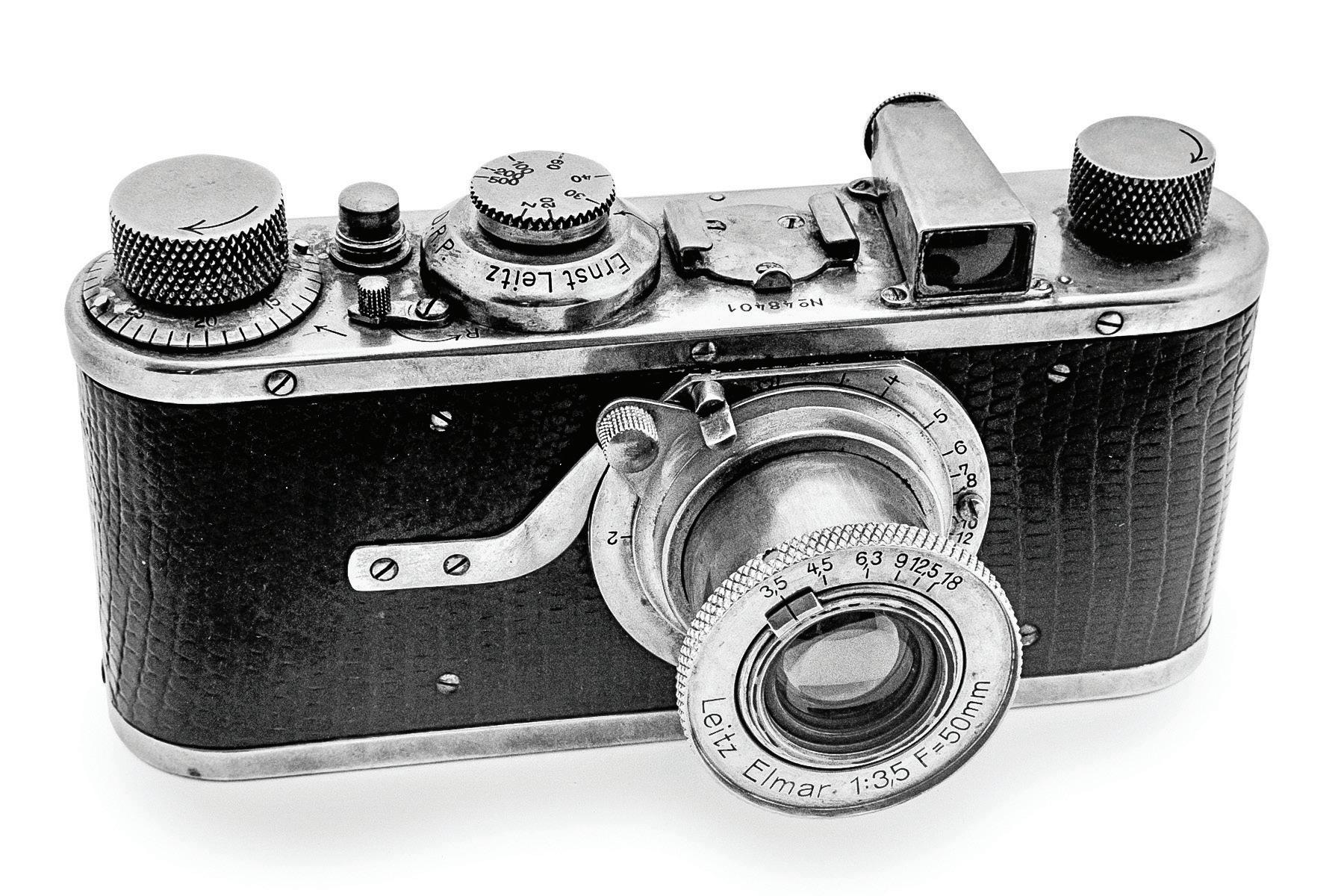
During the preparation of my first book I had to choose the front cover illustration. I wanted a Leica that would attract attention. Among the rarest and eye catching were the Leica 250, Compur, IId, 72, MP, and Luxus. I chose the LUXUS. The front cover camera was No. 48401. This was mid 1975 and this serial number was not listed as a LUXUS in documents I consulted. Was this a genuine LUXUS?
After very careful inspection of the camera itself and it’s provenance I “gambled” confident this artifact was genuine. Thankfully, just before my book was printed I received confirmation through Leitz Wetzlar that a small number of LUXUS models were prepared beginning with No. 48401.
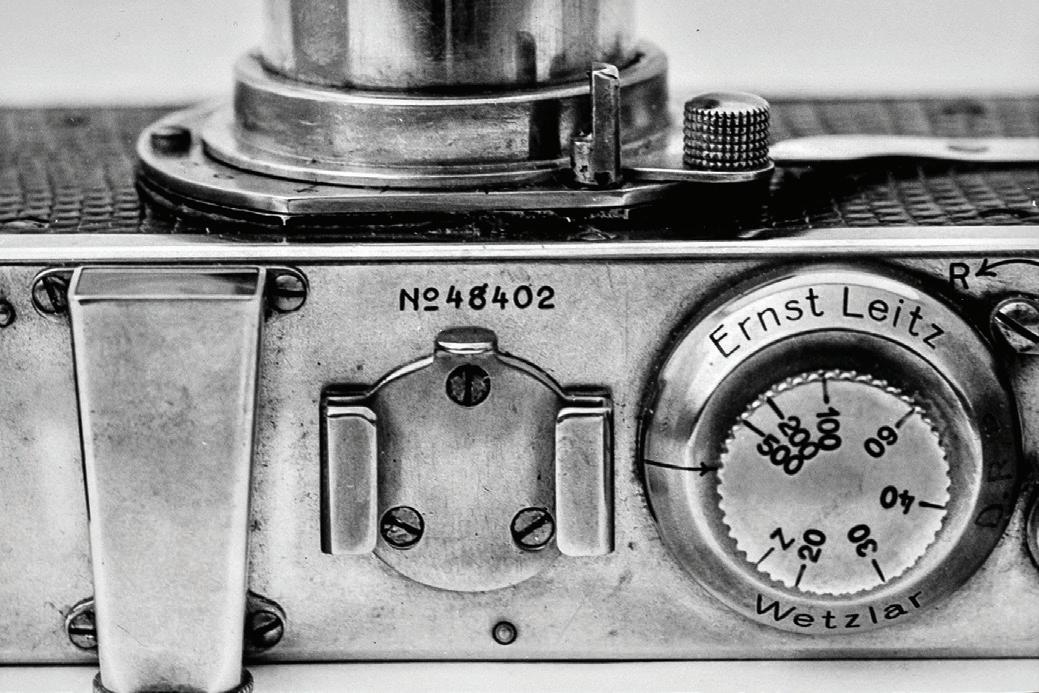
Months later my dear friend Roger Pelham from Dayton, Ohio called me and said there was a gold plated Leica for sale in Florida and that several Leica enthusiasts had inspected it but declared it a fake because serial number records did not list it as a LUXUS. My book was still on the press and Roger was unaware of No. 48401 on the cover. I asked Roger the number of the Florida camera. No. 48402 came the answer. I roared into the phone and advised Roger to purchase it immediately. He did and this Leica became a treasured artifact in a prominent Leica collection. It must be emphasized that in 1975 there was very limited research data available. When access to delivery information became possible we found that Leicas
No. 48401 and No. 48402 were written LESSALUX shipped to New York on order number 1338 dated October 31, 1930. LESSALUX means camera, three cassettes, colored ETRIN style case, and gold FODIS rangefinder. Catalog 1Kd July 1930 contains this description.
Other Leica stories are waiting to be told. Share yours with LHSA and contact Editor Rosauer.
LUXUS 48401
LUXUS 48402 (Pelham photo)
ONE THOUSAND LEICAS
by JIM LAGER
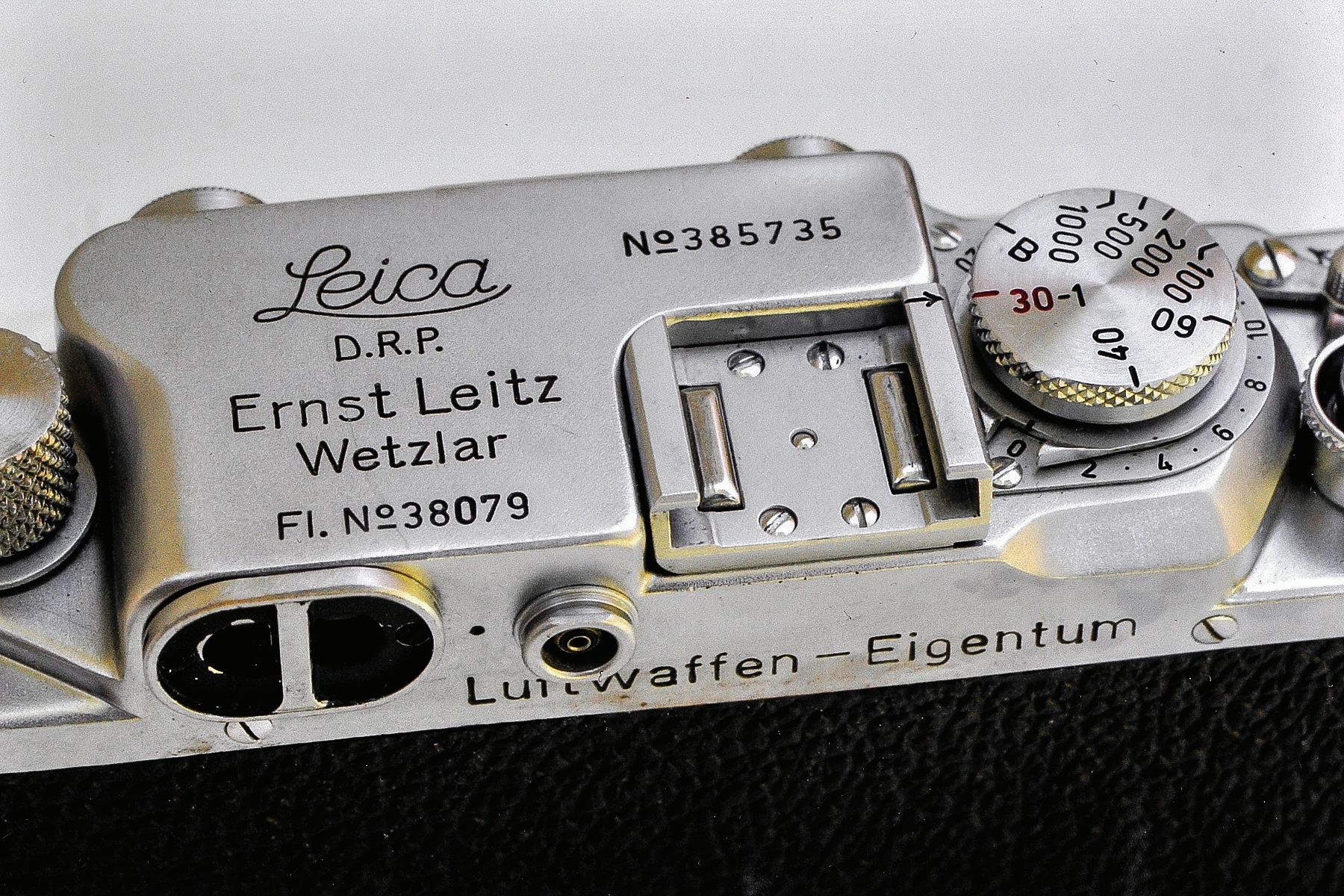
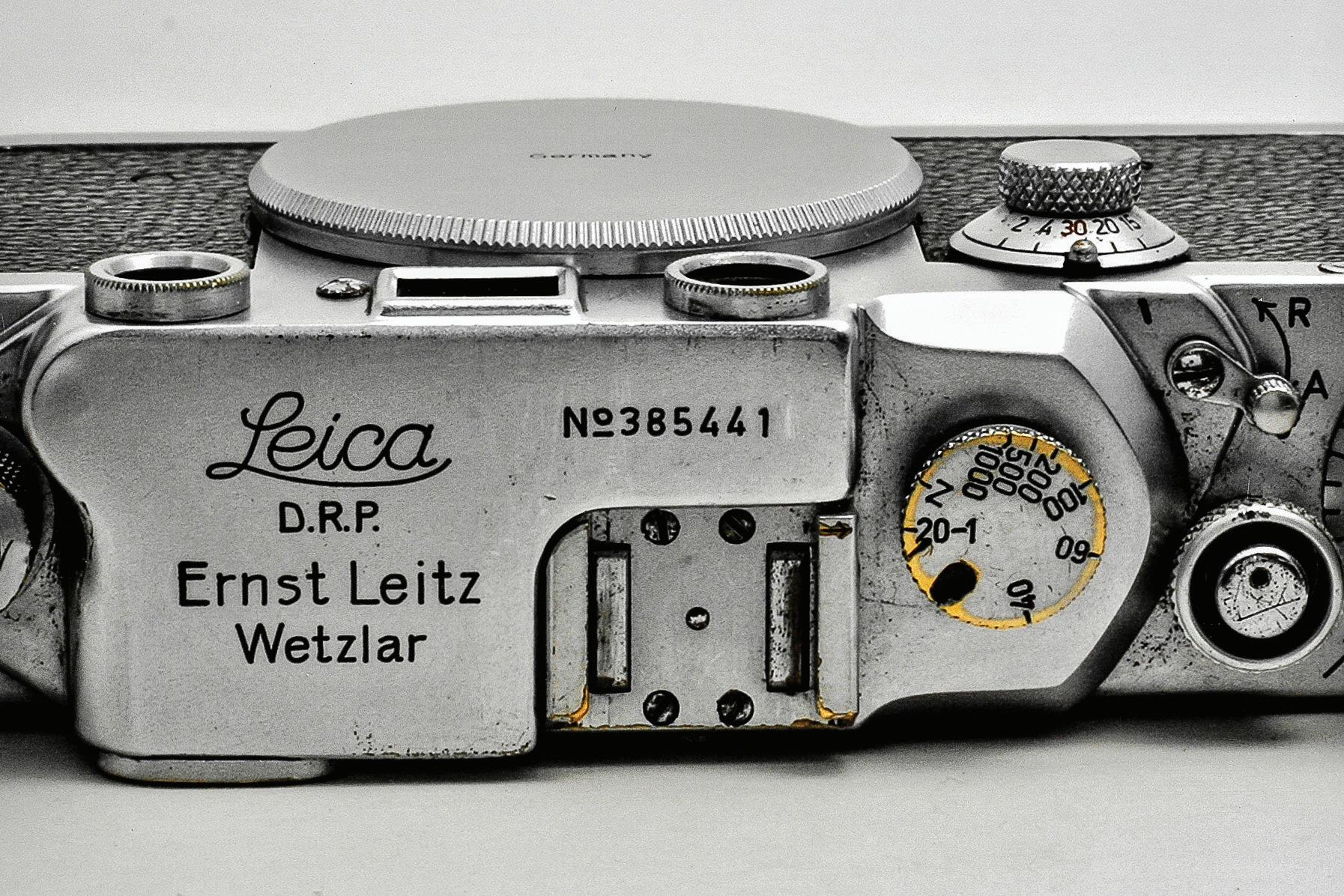
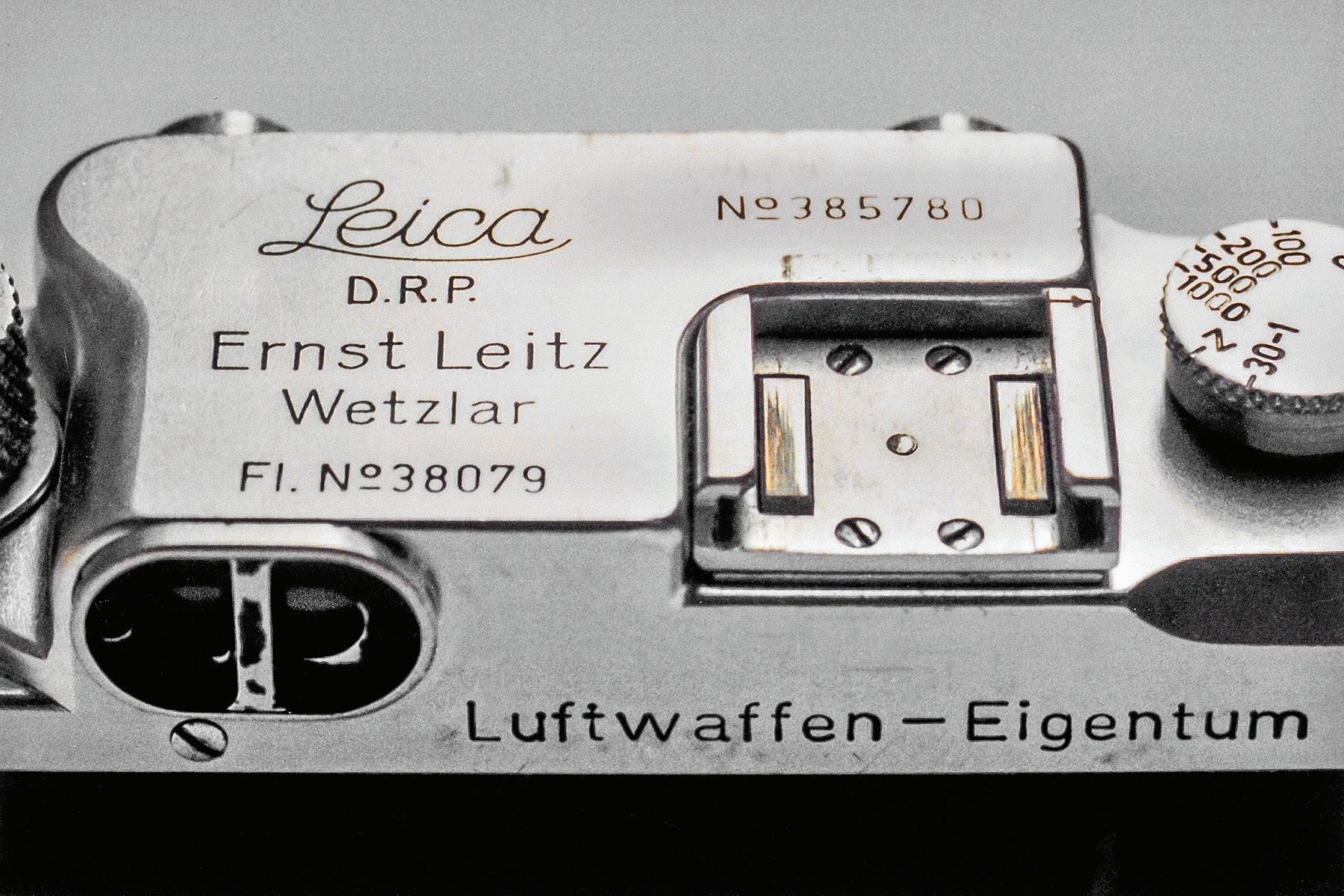
during the years 1942-1945 the Leica IIIc within serial numbers 385001 - 386000 was sent to numerous destinations. In addition to Germany the delivery records carefully preserved at the Leitz Park Archive list the following: Albania, Austria, Bulgaria, China, Manchukuo, Czechoslovakia, Denmark, Finland, France, Greece, Hungary, Italy, Netherlands, Poland, Portugal, Rumania, Spain, Sweden, Switzerland, Turkey and Yogoslavia. Italy received approximately 14% of the deliveries. Allied countries are not recorded.
The Leica IIIc at 385001-386000 is usually absent in collections I have studied. Were many (if not most) of these artifacts lost/destroyed during the Second World War? The illustrations show several examples discovered during over four decades of research.
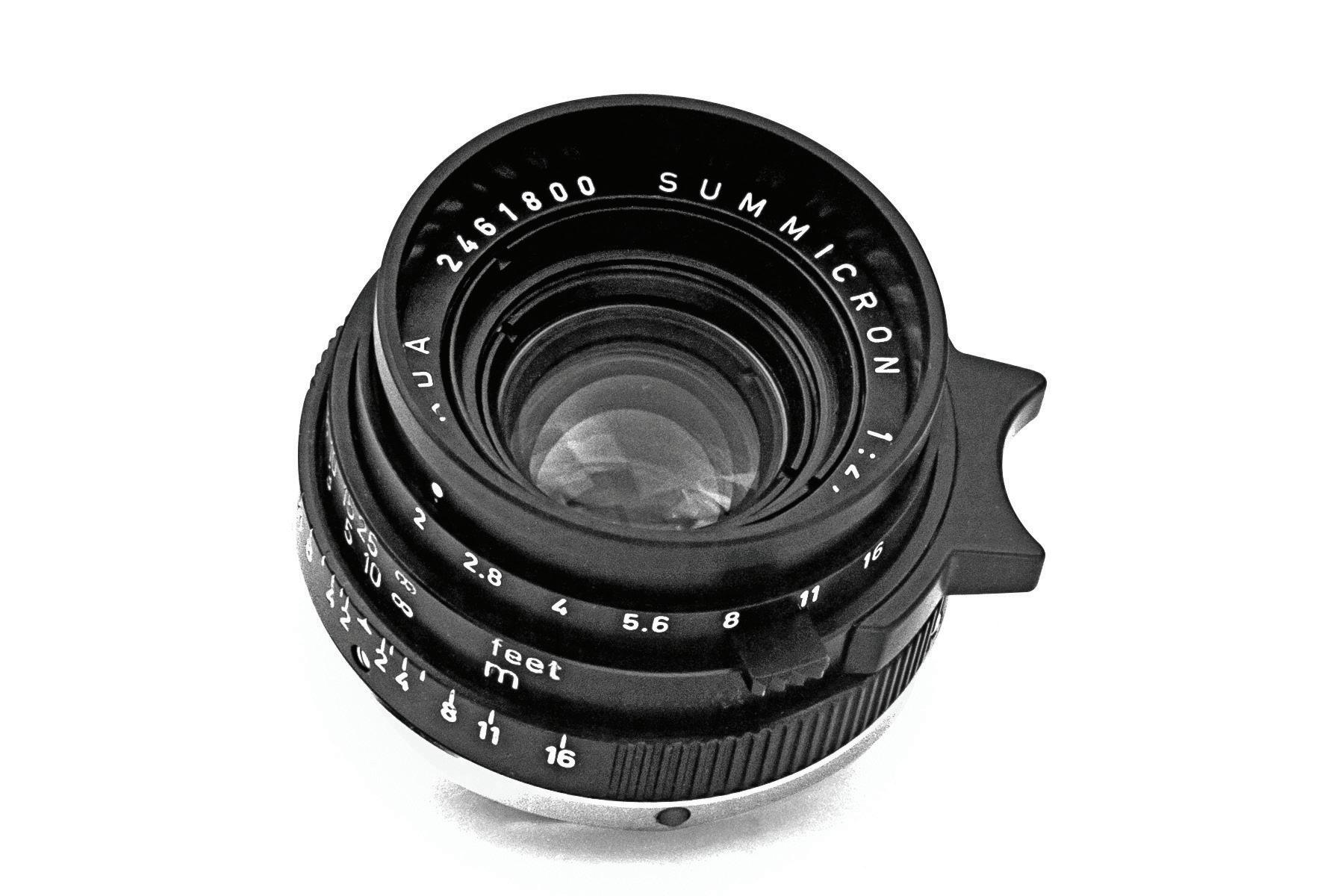
during my employment at E. Leitz, Inc Rockleigh New Jersey (1971-1975) it was necessary to regularly visit the Photo Stockroom to inspect newly arrived Leica equipment. One “visit” is especially remembered. #11309 Leitz Canada M mount 35mm 1:2 Summicrons had been received and my co-worker Walter Moffatt (now deceased) and I were studying the new arrivals.
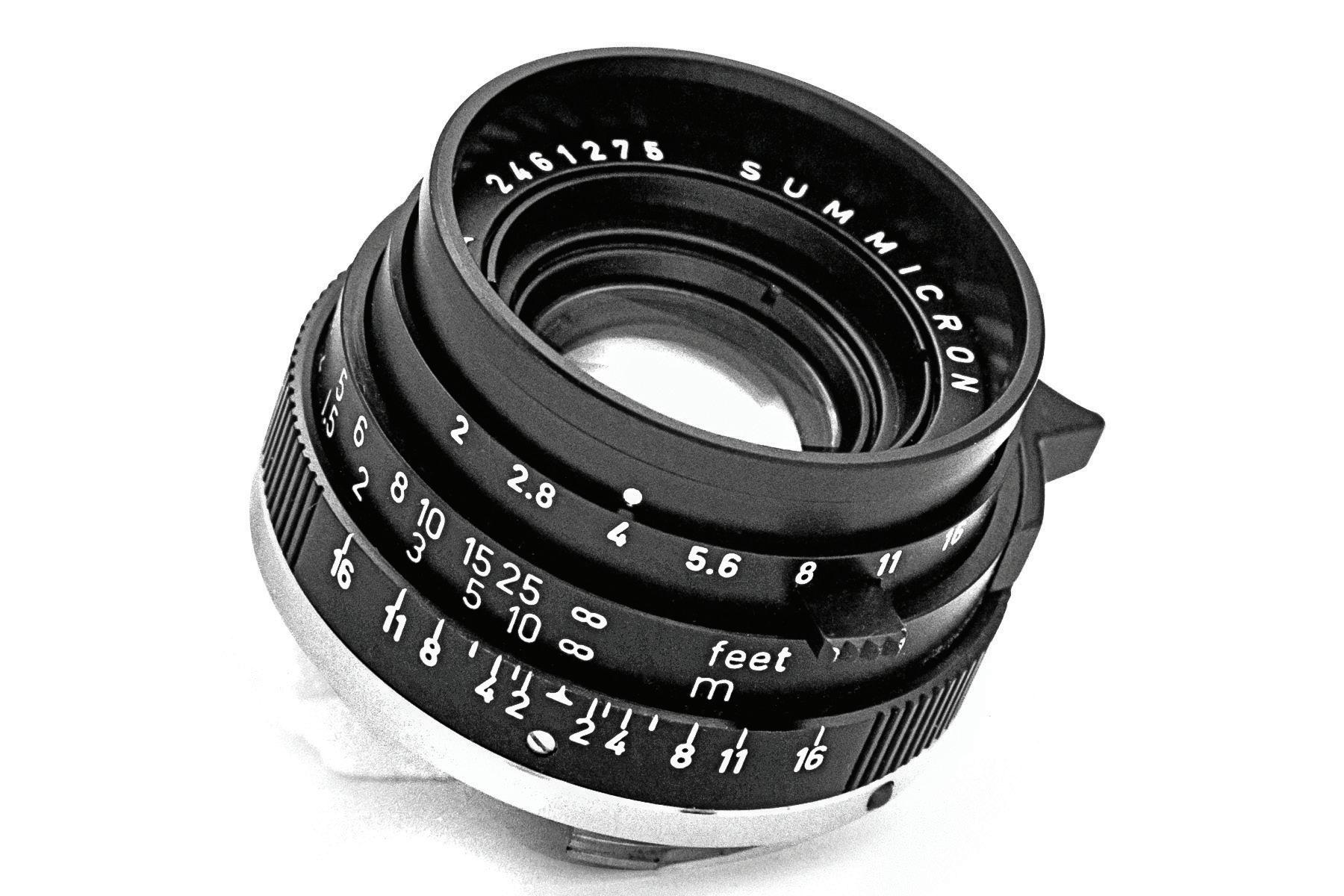
The optics, very early third computation samples just above 2641000, exhibited a protruding aperture control and scooped focusing lever without infinity lock. We noticed immediately the expected E-39 filter threads were absent. Did Leitz Canada forget to cut the threads? Was this a mistake? The presence of the 12504 lens hood suggested use of Series 7 filters. Perhaps the lack of E-39 threads was deliberate?
When the new lenses reached customers the Leica Technical Service received communications asking about the missing E-39 threads. Customers were not happy. They wanted to use their E-39 filters and without threads they could not. Leitz Rockleigh management was immediately alerted and subsequent production restored the threads. LHSA members who have a threadless #11309 Summicron can advise Editor Rosauer or myself. Perhaps we can ascertain how many units were prepared.
Leitz Canada #11309 lens 2461275 without E-39 filter threads.